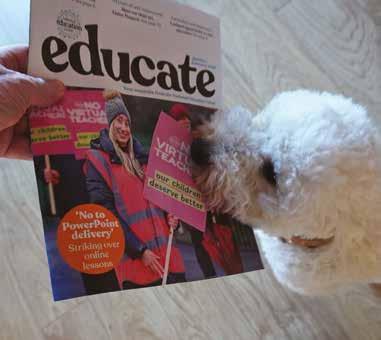
Support plans scandal Members forced out on false capability claims. See page 31. Running on empty Voting to Save Education at conference. See page 16.
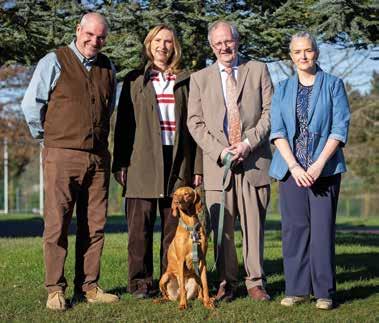
Puppy power
The school-based dog boosting wellbeing. See page 36.
BOOK
THE MUSICAL THE MUSICAL
MUSICAL MUSICAL
Celebrating on Stage ea rs
Celebrating ea rs
DENNIS KELLY MUSIC & LYRICS TIM MINCHIN
BOOK DENNIS KELLY MUSIC & LYRICS TIM MINCHIN
Educate May/June 2026
Together Alliance march against the far right, London, 28 March.
Photo by Jess Hurd hurdjess
NEU president
Ed Harlow
NEU general secretary
Daniel Kebede
Editor Max Watson
Editorial assistant Frankie Faccion
Journalists
Sally Gillen, Emily Jenkins & Sarah Thompson
Newsdesk
t: 020 7380 4768 e: educate@neu.org.uk
Production editor/design Amanda Ellis
Design & subbing Melissa Harteam Moore
Display adverts
t: 020 7880 7614
e: educate-magazine@redactive.co.uk
Recruitment adverts
t: 020 7880 8542
e: educate-jobs@redactive.co.uk
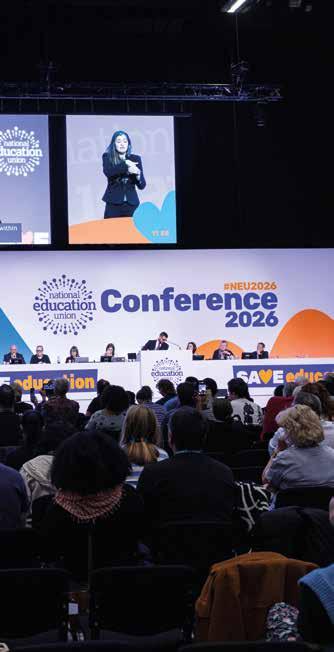
THE stormy April weather in Brighton during this year’s annual conference seemed to reflect the mood.
Winds whipped flagpoles and a pale sun, just visible behind clouds, shone over the conference centre on Brighton’s seafront.
Inside almost 1,400 delegates took part in lively debates, criticising the government for its failures, chiefly to fund education adequately and pay them what they are worth. As always, there was no shortage of fiery determination.
Not every motion voted on covered chronic underfunding, of course, but 16 years of austerity was at the root of many. Not just financial, said NEU president Ed Harlow in his conference address, but also austerity of imagination, creativity, pedagogy, ambition and joy. You can read all about it in our eight-page coverage (pages 16-23).
Most striking was the sense of solidarity, present every year but almost palpable this time, perhaps because many conference delegates had just two days before been among 15,000 members on the Together Alliance march in London against the far right.
Educate writer Sarah Thompson joined the march and spoke to members who told her why the fight against growing hatred and division is now so urgent (see pages 26-29).
In this issue, we also have a feature on the alarming misuse of support plans, a scandal disproportionately impacting highly experienced women aged 50 and over. Expensive and therefore expendable is the view taken by some schools (see pages 31-33).
But, as always, your magazine also celebrates some great practice. Our four-legged class act Juno is brightening up the school day for students and staff at a secondary in Northern Ireland (see pages 36-37).
And on page 41, regular columnist and primary school English lead Jon Biddle explains how primary and secondary educators are working together to address the steep decline in the numbers of children reading for pleasure. Inspirational stuff but also timely.
We hope you enjoy the issue.
Max Watson Editor, Educate
Communication & Performance
Qualifications that support:
Oracy and vital life skills
Mental health and wellbeing
Parental engagement
Confidence in school
Academic development
SEND learners
Scan the QR code to discover more & book a free introductory webinar
May
Burston Strike School opens, founded by the community after teachers Tom and Annie Higdon are dismissed from their former school for “discourtesy” when they challenged landowners over child labour and poor conditions. Their removal had sparked a walkout by pupils, supported by families and unions, leading the community to set up its own school.
“We send a message: you are not alone.”
PHOTO by Kois Miah
PHOTO by Mark McCormick
‘Funding has to match SEND ambition’
MAJOR reforms of special educational needs and disability (SEND) provision in England set out in the schools white paper are likely to fail unless the government significantly increases funding for them, the NEU has warned.
At the union’s annual conference (30 March2 April), delegates passed an emergency motion calling for more funding to help implement the white paper (see pages 16-23).
The government has announced a £1.6 billion inclusion grant, which will be used to fund mainstream SEND over the next three years – just £13,000 for the average primary school. A £200 million training budget for teachers and teaching assistants is only £264 per teacher.
NEU general secretary Daniel Kebede said: “The NEU is deeply opposed to government plans to hold schools to account for SEND provision when they are so woefully underfunded.”
SEND proposals in more detail
The government is proposing that SEND needs will be primarily met in mainstream schools, which will offer three levels of support: targeted, targeted plus and specialist.
THREE new posters celebrating the achievements and contributions of Black people in the UK and around the world have been added to the union’s Black history poster series.
Dr Anne-Marie Imafidon, computer scientist and cofounder of Stemettes, who has championed diversity in technology and science, is featured on one.
More complex needs will be met through education, health and care plans.
‘Experts at hand’ will allow mainstream schools to involve health and care professionals without the need for referral. But the NEU says schools will be offered just 40 days of support a year, which is insufficient when the average primary school has 40 pupils in need.
Indy fees, maternity pay, and more
The union has welcomed the white paper’s commitment to cap independent special school fees and the £3 billion pledged to create more specialist school places within local authorities.
The wide-ranging white paper, which will be implemented over the next ten years, also covers curriculum and assessment, school accountability, and maternity pay for teachers.
The NEU has welcomed government plans to double full-pay maternity leave from four to eight weeks, following our campaigning.
But the union strongly opposes the government’s aim for all schools to join ‘school trusts’ and is concerned by its refusal to accept the link between multi-academy trusts (MATs) and higher teacher turnover.
In 2025 the NEU examined ten years of data from the school workforce survey that
showed that the largest MATs have the lowest retention rates, with one in five MAT teachers leaving their jobs in the academic year 2024-25 versus one in seven local authority teachers. n Visit gov.uk/government/publications/ every-child-achieving-and-thriving
Class sizes need to come down for a million pupils
ON 14 April, NEU general secretary Daniel Kebede gave evidence to the education select committee on the government’s proposed SEND reforms, set out in the white paper.
Daniel told MPs the government’s “good intentions will not deliver better outcomes alone” and the funding allocated was likely to soften underfunding in schools rather than fund inclusion. “The government is right to act, as the system is adversarial, fragmented, chronically underfunded and failing children. But for the SEND reforms to succeed the Treasury has to match the government’s ambition.
“More than a million children are being taught in class sizes of 30 or more – the highest level this century. Until we bring our class sizes down to the European average, meeting the aspirations in this white paper are going to be nigh-on impossible.”
Another celebrates the Abasindi Cooperative, founded in Manchester in 1980 as a social, supportive base for Black women.
The third highlights the achievements of Lewis Hamilton, the first Black Formula 1 driver and a social justice campaigner. Posters include key information about the subject, as well as lesson-planning ideas. n Download the posters and explore more people and places of Black history all year around at neu.org.uk/blackhistory-month
Parents back free school meals for all primary pupils, says YouGov
NEARLY 90 per cent of parents of primaryaged children in England believe free school meals (FSM) should be extended to all primary pupils, an NEU-commissioned survey has found.
The YouGov poll of 2,106 parents found that families are continuing to struggle with the soaring cost of living. One in five reported struggling to make ends meet and 31 per cent said the quantity and variety of their food shop had reduced.
More than half – 57 per cent – said
giving a free meal to every primary school pupil would ease their family finances, while 44 per cent said it would have a positive impact on their mental wellbeing.
From September 2026, all children in England whose families receive universal credit will be eligible for FSM, following campaigning by the NEU-led No Child Left Behind coalition of more than 350 organisations. It means 500,000-plus more children will receive a hot school dinner every day.
YouGov’s poll found that even among families not receiving universal credit, 27 per cent were reducing their weekly food shop, suggesting that the government’s proposed reforms will not be enough to tackle the cost-of-living crisis for many families.
NEU general secretary Daniel Kebede said: “If this government is committed to giving ‘every child the education they deserve’, it must roll out universal free school meals to ensure no child is left behind.” n Visit freeschoolmealsforall.org.uk
Educators ready to strike to Save Education
AN overwhelming majority of teachers and support staff balloted by the union are prepared to strike if the government doesn’t increase pay and funding and reduce workload.
Results from two indicative ballots show 90.5 per cent of teachers and 86.1 per cent of support staff would take industrial action.
“Members have indicated they are willing to take whatever action is necessary to Save Education, because the government seems intent on attacking our schools,” said NEU general secretary Daniel Kebede.
In the England-wide ballot of teachers in state-maintained schools, 96 per cent voted
to reject the government’s pay offer of 6.5 per cent pay split over three years.
It is not yet known what the School Teachers’ Review Body (STRB), which advises the government on pay, has recommended.
The union is urging education secretary Bridget Phillipson, who has had the STRB
report since February, to publish the recommendations straight away.
The separate ballots of support staff and teachers were carried out online between 28 February and 1 April, with more than 150,000 votes cast.
It is an “inescapable fact that schools are running on empty” and 16 years of austerity has left them “on their knees”, said Daniel.
“Schools are desperately short of teaching assistants and subject specialists. It feels like no help is coming,” he added. “To add insult to injury, schools have been given no new money to fund staff pay, which will mean more cuts –to support staff and basic resources. Cuts that will damage children’s education.”
Pupils from Grange Primary School in Ealing, west London, aboard the NEU’s FSM bus, which toured the country in September 2024
PHOTO by Rehan Jamil
Little Ilford members overturn cover policy
TEACHERS at a school in London will no longer be timetabled to provide cover after taking strike action.
Staff at Little Ilford School in Newham took action over the policy, which breached the school teachers’ pay and conditions document (STPCD).
They will also have their 50 teaching periods every two weeks reduced to 48 from September, after their six strike days in January.
Learning walks, also part of their dispute, which staff felt were being used for monitoring, rather than professional development, will be made more supportive.
James Andrews, a teacher and one of six NEU reps at Little Ilford, said: “There is a feeling that people are much happier and the school is taking the union seriously now. Having a team of reps made a big difference too. We really worked as a team and had each other’s backs.”
Union meetings with management will be scheduled every half term so members can continue to hold it to account and resolve any issues.
NEU membership at Little Ilford increased from 119 to 143 between July 2025 and March 2026.
‘Last-resort’ strikes succeed
NEU members in Coventry are celebrating success after winning their dispute over health and safety concerns, workload and pay.
Staff at Baginton Fields Academy took seven days of strike action. The school, for pupils aged 11-19 with special educational needs, is run by multi-academy trust Thrive Education Partnership.
Concerns were raised about lack of cover for staff absence, with teaching assistants expected to cover lessons, often long term, leading to unmanageable workload and stress. No teaching and learning responsibility (TLR) payments had been in place for teachers leading subjects and the pay policy was not in line with the school teachers’ pay and conditions document (STPCD).
The trust has agreed to meet teachers to discuss minimum staffing levels, introduce
TLR payments and update the pay policy to mirror Coventry city council’s pay policy. Unreasonable demands relating to data collection, monitoring and planning have also been resolved.
NEU executive member Jodie MallierRidley said: “These children deserve the highest level of care and what’s really clear is that the staff want to deliver it. Staff have been clear that the dispute is against the trust, not the head teacher, who inherited the issues and has worked to try and resolve them.”
In a statement, Baginton’s five NEU reps, Sharon Macleod, Kate Beaumont, Jordan Nicholl, Ruth Fairbrother and Jonny McGarry, said: “We reached a point where we felt unsafe. Minimum staffing, stretched resources, and expectations that go beyond our pay and role mean we can’t provide the level of care and education our pupils deserve. Strike action was a last resort, but a necessary one.”
Members take action over cuts to PPA time
MEMBERS at Llantwit Major School in the Vale of Glamorgan took two days of strike action in March over the school’s decision to cut planning, preparation and assessment (PPA) time.
The school’s leadership first proposed reducing PPA from six to five hours a week last year, but following negotiations agreed it would remain unchanged for 2025-26. However, when staff returned last September, they were dismayed to find the change in place. After further negotiations failed, 94 per cent of members voted for strike action.
NEU branch secretary for Vale of Glamorgan Rhys Craven said the strong
turnout showed the depth of frustration: “Members have acted responsibly throughout, even delaying action for Estyn, but they cannot deliver the education pupils deserve without the time to plan, assess and respond to learners’ needs. Cutting PPA harms students’ progress and drives unmanageable workloads.”
There was support on the picket line from members of the governing body, parents and pupils. “They recognise that deteriorating working conditions for staff affect children’s experience in the classroom,” added Rhys.
More strike action is planned for the summer term, with NASUWT colleagues set to join the dispute following a successful ballot.
Hospital educators battle on against bullying
Teachers at Great Ormond Street Hospital School continue strike action over suspension of members, including an NEU rep, and bullying culture.
‘Shocking’ sickness policy prompts walkout
MORE than 400 members at 18 schools in a London borough took strike action on 27 March in a dispute over a punitive sickness policy.
Three employers in Enfield – Connect Education Trust, Children First Academy Trust and the local authority itself – have introduced the policy, created by Enfield Schools Human Resources.
It states that formal procedures can be triggered if staff take three separate occasions of sick leave within six months, or ten days’ sick leave in 12 months.
New HR head’s policy a ‘red line’ Enfield council appointed a new head of human resources who is reviewing all policies.
“He had changed a few already, but the sickness absence policy was the red line,” said Claire Docherty, NEU branch and district secretary for Enfield. She said the local authority had argued the new policy was designed to implement supportive measures earlier, but added: “This is clearly about getting rid of people, presenteeism and making people go to work when they’re too ill to be at work.”
Alex Voelcker, NEU rep at Carterhatch Junior School, said: “We can’t avoid getting ill. We work with children. For the local authority to have created this fear that there
will be a punitive response to staff being off sick is really shocking and upsetting. Nothing in the tone of these new policies makes me feel it’s about taking care of us as teachers.”
Joining members on Carterhatch’s picket line, NEU general secretary Daniel Kebede said: “Enfield local authority is attempting to implement dangerous changes to how staff sickness is managed.”
BLS ‘must do the right thing’ on pay
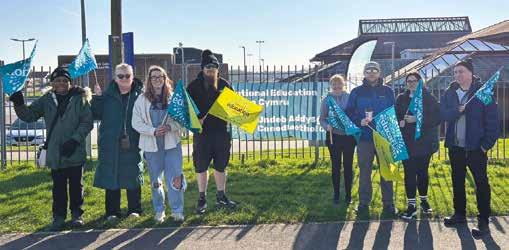
SWAPPING lesson plans for placards, members at Brick Lane School (BLS) in east London took two days of strike action in March in a dispute over pay and sick leave.
The school is owned by the Outcomes First Group (OFG), which runs special and other independent schools.
“Sadly, the pay and terms and conditions of employment are not special,” said Lucy Preston, NEU Tower Hamlets and the City joint district and branch secretary. “There are no pay scales for teachers and support staff so it’s very difficult to know exactly
what everyone is on, but it is significantly less than national pay.”
Unlike other schools in the borough, BLS does not pay staff an inner London allowance, and its sick pay policy is just five days, with staff having to make up time taken off. The NEU proposed 15 days of sick leave, which was rejected.
“Members at BLS undertake very challenging roles and support some of the most vulnerable children,” said Lucy. “The employer must recognise that it is time to stop suppressing wages and other benefits and do the right thing.”
n Members at schools run by the Ivy Learning Trust, also in Enfield, were on strike over the trust’s sickness absence policy, which can be triggered if a staff member has three separate occasions of sick leave of any length in 12 months.
The trust has also refused to buy into the facilities time agreement for union reps.
Action halted after 100% ballot result
NEU members who voted to strike over failures to address long-standing concerns about a list of issues including unpaid pension contributions and pay errors have won significant concessions.
Members at Tennyson Road Primary School, in Luton, had voted 100 per cent for strike action on a 100 per cent turnout.
They felt unsafe, unheard and unable to do their jobs properly, said NEU rep Hamera Khan. She added the ballot turnout and result were “incredibly rare and have delivered real change before
a single strike day was taken”.
Membership grew by 42 per cent during the dispute, as staff saw the power of acting collectively.
Other concerns that had been ignored include blocked fire exits and a delay in pay for new staff that meant some had to rely on food banks.
The ballot for strike action forced the trust to engage and produce an action plan. An interim chief executive has been appointed, and strike action has been paused to allow them an opportunity to deliver improvements.
Members from Enfield atop a London bus
MONTHS
UNTIL SCHOOL DINNER IS SERVED FOR 500,000+ MORE CHILDREN.
Thanks to members, parents and our 350+ strong coalition of civil society organisations, public figures and MPs, we’re one step closer to Free School Meals for All.
Starting September, every child in a family on Universal Credit will get Free School Meals.
But no child should be left behind.
in England.
The sums do not add up on school funding
NEU general secretary
Daniel Kebede says the indicative ballot result should serve as a wakeup call to government: educators will not back down over pay and school funding.
AS Educate went to press, the government had still not published the report of the School Teachers’ Review Body (STRB) – the independent panel that makes recommendations on teacher pay – nor ministers’ response.
This is a gross dereliction of duty by education secretary Bridget Phillipson, who previously promised to bring forward publication to give head teachers more time to plan their budgets for September.
Under previous Conservative ministers, publication of the STRB report slipped later and later; in at least one year it was not released until the school summer holidays had already started, forcing heads to do extra work during the break.
The NEU has called on Phillipson to release the report – which was sent to her in late February – and announce whether the government will honour its recommendations or impose an alternative pay rise for teachers.
‘Wholly inadequate’
In its evidence to the STRB in October last year, the government proposed teachers should receive a pay rise of 6.5 per cent spread over three years. Separately, school support staff, along with wider local authority workers, have been offered 3.3 per cent from April.
These proposed rises are unacceptable. They are likely to represent real-terms pay cuts – with renewed uncertainty around inflation and the cost of living due to instability in the Middle East – and come on the back of 15 years of stagnating wage rises.
But the main issue – under this government as under previous governments – is funding.
There has been no commitment by the government to give schools additional money to fund staff pay. In fact, ministers have suggested schools should have to fund salary increases from existing budgets.
This is despite the Department for Education’s own figures showing schools can only afford 1.35 per cent a year for the next two years.
So, further cuts will have to be made.
Already, 71 per cent of teachers believe their school does not have enough funding to meet basic provision for pupils, according to a recent NEU survey. Essentials like glue sticks, pens and exercise books are scarce.
Schools are stripped to the bone and heads will almost inevitably be forced to cut staffing further to make ends meet.
It is in this context that the government’s proposed special educational needs and disability (SEND) reforms must be viewed.
Ministers announced the flagship schools white paper in late February, covering a range of areas – including reforms for schools and young people with SEND.
The NEU supports the principles behind the plans, including the ambition to “give every child the education they deserve”. There is clearly a crisis in SEND that must be addressed.
But with schools already struggling with staff shortages, ballooning classes and dwindling resources, the amount of money the government has pledged to achieve inclusion is wholly inadequate.
The inclusion grant announced equates only to a part-time teaching assistant for the average primary school and two teaching assistants for the average secondary school. The
£200 million pledged for teacher and support staff training is meant to cover early years, schools and colleges: it’s clearly not enough. And without the staff to deliver support, any attempts at reform will be hugely hampered.
We cannot sit back and watch
More than 150,000 teachers, leaders and school support staff in England cast their vote in our online indicative ballots on funding, pay and workload, between 28 February and 17 April.
In those ballots, most teachers rejected the government’s pay offer of 6.5 per cent over three years and around 90 per cent of all educators said they were willing to take strike action to win sufficient funding for schools.
Teachers do not go on strike without good reason – so this verdict should act as a wake-up call to the government.
And delegates at our annual conference earlier this month reaffirmed the union’s position that we will campaign, lobby and take any action necessary – including holding a formal ballot for strike action, if we must – to improve education funding.
As a profession, we cannot sit back and watch the ongoing systematic underfunding of our schools.
Through our Save Education campaign, we will look to unite with allies – sister unions, parents and politicians – to put pressure on the government and win the future our schools, our educators and our young people deserve.
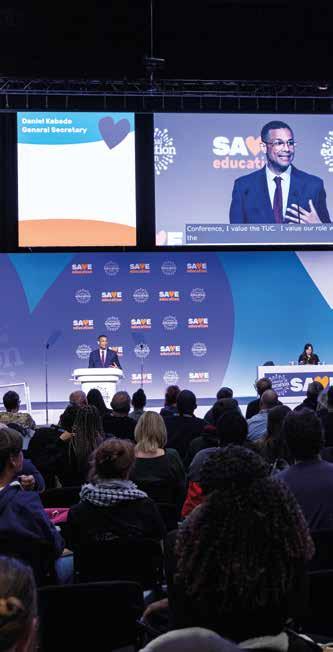
Daniel delivering his speech to conference in April
PHOTO by Kois Miah
Members vote to recruit support staff
THE NEU has started actively recruiting support staff who are not in a union, after members made a historic decision to withdraw from a 2017 TUC agreement.
At a special conference held in London on 28 February, attended by more than 1,200 members, there was an unanimous vote to end an agreement that controls the union’s powers to actively recruit and represent support staff.
The agreement, signed when the ATL and NUT amalgamated nine years ago to create the NEU, stated it “should undertake no action that could be regarded as organising activity on behalf of school support staff”.
But almost a decade on, underfunding, a recruitment and retention crisis, and increased academisation of schools is hitting support staff – including teaching assistants, IT and data workers, kitchen, office and grounds staff – hard. Workload has increased, many have had their hours cut, and thousands have lost their jobs in restructures forced by years of underfunding.
Two-thirds support staff not in a union
Speaking at the start of the conference, NEU general secretary Daniel Kebede said twothirds of support staff – most of them women and the education sector’s lowest paid – were not represented by a union.
“Our intention has never been to compete with or undermine other unions,” he said, making it clear that the decision to hold the special conference had not been taken lightly.
“We want to organise those not in any union and work together with our sister unions. Everyone wants to see support staff better organised and with better pay and conditions.”
One member, a support staff worker for 14 years, said: “Times have changed drastically. The demand on pastoral and safeguarding support is high pressure and time-consuming. It takes a village to raise a child and support staff are our village.”
Many delegates said withdrawing from the 2017 agreement was necessary if the NEU was to continue fighting for support staff and produce meaningful gains for its membership.
Jobs saved and T&Cs protected
The union has had huge wins for support staff, Daniel told conference, pointing to the victory in January at the Arthur Terry Learning Partnership, a multi-academy trust (MAT) in the West Midlands (Educate, March/April, p8).
Strike action by support staff and teachers at 24 of the MAT’s schools saved more than 100 jobs and protected support staff terms and conditions.
During the debate at the special
conference, one new member said: “I want to be in a union that fights together. It is imperative we unite as workers.”
‘An injury to one is an injury to all’ Another said: “Representation and collective action is what brings everyone to the party. We must always believe that an injury to one is an injury for all and fighting for low-paid workers in our sector is one powerful way we can build our union.”
Addressing delegates after the vote, Daniel reiterated the NEU’s desire to work “collegiately with our sister support staff unions, building on the work we have done already to give a voice, organise effectively and support and defend working people in schools”.
He also expressed the vital importance of the NEU’s membership of the TUC.
“We have long been proud affiliates and remain so,” he said.
Education festival tackles teaching difficult climate truths
AROUND 300 people gathered for the climate and nature education festival on 14 March, organised as part of the Year of Trade Union Climate Action.
Held at Regent High School in Camden, north London, the event was organised by the NEU, the University and College Union, Unison and the Ministry of Eco Education,
a group of teachers and environmentalists supporting schools across the country.
NEU vice-president Debra Beale told delegates that the climate crisis was the most significant threat to our planet, and young people stood to lose most if it was not addressed. She added that many of them felt hopeless and helpless, disillusioned by the lack
of action by adults with power and authority.
At a breakout session delegates heard how they could teach difficult climate truths without overwhelming themselves or students. n The NEU climate network organises members keen on developing and implementing union policy. Email neuclimatechangenetwork@ gmail.com
More than 1,200 members attended the special conference
PHOTO by Lee Thomas
Bigger picture
“SAY it once, say it again, no excuse for violent men!” chanted thousands of women at this year’s Million Women Rise (MWR) march and rally on 7 March.
Among them were around 120 NEU members who joined the annual event, which calls for an end to male violence against women and girls. They marched through London, before rallying in Trafalgar Square.
In a passionate speech, NEU executive member Denise Henry (pictured above, centre right) told the crowd: “Women’s rights matter. Our voices matter. Our safety, dignity and equality are not negotiable… when women rise, when communities rise, when we rise together, change is unstoppable.”
The NEU stood in solidarity with women experiencing violence across the world, she added, including women
and children in places like the Democratic Republic of the Congo, where conflict and violence continue to devastate communities and disrupt education.
The event was organised by MWR, a Black and global majority grassroots movement, the day before International Women’s Day (8 March).
“International Women’s Day was born from struggle, from women who organised, marched and demanded a better world,” said Denise. “Today we honour that legacy by standing together and continuing the fight for justice.”
PHOTO by Jess Hurd
Systemic change needed to challenge sexual abuse
A REPORT by charity UK Feminista concludes schools and colleges need radical ‘system change’ to stop sexual harassment and abuse against female students and staff.
Their report, System Change, cites findings from a pilot programme, which ran between 2022-2025, and provided schools and colleges with support for operating a whole-school approach to tackling sexism and sexual harassment.
Nina Humphries, director of UK Feminista, said: “For too long, sexism and sexual harassment have been everyday experiences for women and girls working and learning in schools and colleges. Our report sets out a clear blueprint for action. A systemic problem demands a systemic response.”
The report concludes that the government should track the scale of sexual harassment in education settings and publish data; provide greater support, including funding, for the implementation of a wholeschool approach; and education inspectorates should assess schools’ and colleges’ progress in their whole school approach.
n Visit ukfeminista.org.uk
Your views on social media
THE government is consulting until 26 May on how to keep young people safe on social media.
Educators, parents, carers and young people are being asked for their thoughts on measures to limit the influence of social media platforms, including raising the age of access, and imposing curfews and screen time limits.
It follows pressure from the NEU, which is leading the Big Tech’s Little Victims campaign to raise the age limit for accessing social media to 16.
A recent algorithm experiment by the campaign showed that on average it takes just three minutes for a 13-yearold to be served harmful content on social media.
A guide for those who want to fill in the consultation has been produced by the campaign group.
n Visit bigtechlittlevictims.org/governmentconsultation
BELFAST sixth form student
Sophie Edgar presented her art, which highlights violence against women and girls in Northern Ireland (NI), at the NEU NI Girls in Action Day. Her works include ceramic torsos with mono printed images of women and a textile quilt depicting bloodstained houses, which explore sexual violence, abuse and femicide. Sophie, a student at Bloomfield Collegiate School, took part in the event, which was organised by NEU NI women’s officer Pamela Cosgrove (pictured with Sophie) and vice-president Charlotte Carson.
The NI executive has produced an Ending Violence Against Women and Girls strategic framework, setting out a vision for a society free from genderbased violence and harm.
First NEU workshop on AI in education
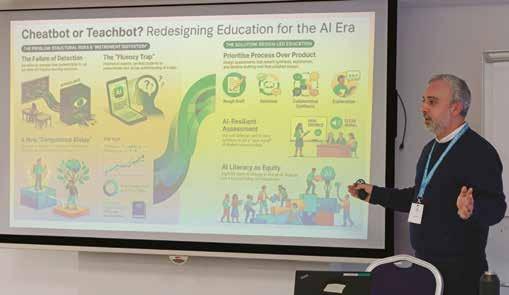
FIFTY members gathered for the NEU’s first artificial intelligence (AI) workshop (pictured above), where they exchanged practical uses for AI tools and discussed what the NEU’s priorities must be to shape safe and executive use in education. .
Topics at member-led sessions ranged from how to use AI for personalised learning for students with special educational needs to its potential to reduce workload, including
administrative tasks such as emails to parents.
Members raised concerns around AI producing incorrect and/or biased materials, the risk to pupils’ critical thinking, and the lack of centralised guidance and training on using AI effectively and safely.
Many members said teacher expertise needed to be at the centre of national decision-making on AI in education.
n Visit neu.org.uk/about-ai
A worthwhile experiment?
Once, some people thought, there’s a reasonable way schools could be for all if local people had a say.
The plan to do this that met general accord was for each locality to vote for a school board.
Next came the idea: schools run by a local authority which meant they were run by the party in majority.
Then people in government did some analyses. They said: “Local control’s bad! We need academies!”
These kinds of schools hand over their fate to managers and trusts but, ultimately, the state.
All this requires disruption and movement Yet no one seems to know if it’s an improvement.
‘No matter,’ say the experts, ‘it’s been a worthwhile experiment.’
‘So, let’s academise the lot!’ says the government.
Words by Michael Rosen
Illustration by Dan Berry
Conference news
Our mission: to save education
Sally Gillen, Emily Jenkins and Sarah Thompson report on some of the highlights from this year’s NEU annual conference in Brighton.
Photos by Kois Miah.
CONFERENCE kicked off with a lively debate on Ofsted, as speaker after speaker slammed the new inspection framework, which was introduced in December.
Ian Walters, a member of the union’s national executive, said Ofsted had made “an appalling system even worse” and there was already evidence from the first inspections it was judging attainment rather than achievement in the school’s context.
Doug Morgan of Birmingham NEU said: “Ofsted is simply a body of bullying,” prompting cheers when he added: “Ofsted is a safeguarding concern in and of itself.”
Vina Vekria from Brent NEU, who proposed the motion to continue campaigning for the abolition of the toxic inspectorate, urged conference to “reject the rebrand”, which was “cheap perfume” that could not disguise the smell of Ofsted’s rotten core. It was passed unanimously.
“Play isn’t just fun but fundamental to learning,” Dawn Gallagher from Birmingham NEU told delegates during a debate on a motion passed by conference calling for the reception baseline assessment to be removed and less time spent on phonics and formal learning in key stage 1, to allow more time for play.
First-time speaker Denise Newman from Luton said on paper her timetable looked like most afternoons were for child-initiated
learning, though in reality it was just three hours a week because of the demand to squeeze in English, maths and phonics.
“It is disgraceful,” she added. “The joy in play is disappearing.”
Conference passed a motion calling on the union to publicly oppose the new statutory year 8 reading assessment Holly Williams from east Kent said: “There’s no hard sell needed. We all agree the goal is for every child to leave school a confident, capable reader. Reading isn’t just another skill. It’s a gateway to every subject, every opportunity, and every future.”
But introducing yet another test would increase the pressure and narrow the curriculum. “You cannot build a love for reading through high-stakes tests,” she said, adding that literacy inequality does not begin in year 8, but in poverty. “It begins in underfunding early years provision. It grows with cuts to special educational needs and disabilities (SEND) and deepens with school libraries closing and when specialist interventions disappear.”
Megan Quinn of Camden NEU spoke in support of an amendment to the motion calling for reform of the early years foundation stage and primary assessment to remove high-stakes testing of reading and phonics at reception, year 1 and year 6. She said: “The current approach is too much, too young. It creates barriers to engagement for many
children who may experience feelings of failure as readers before they have even found their favourite story.”
First-time delegate and speaker Kachanda Irwin from Lambeth in south London proposed a motion passed by conference calling for a national campaign on the curriculum, saying: “We need to see an end to central government dictating the pedagogy and features of the curriculum. And when we have input from local communities and children themselves, we are the people best placed to understand them, their context, and teach them how to learn in a way that embraces critical thinking.”
Seconding, Rachel Moore from Bedford said: “We are told to follow the script, to just open the next PowerPoint and read the task on the screen. The aim, apparently, is to reduce our workload. It certainly does not reduce the workload, and it certainly does reduce the enjoyment of it. These boring curriculums further disadvantage our pupils and alienate them in the classroom.
“We must do more to ensure that our education is anti-racist, anti-sexist, supports LGBT+ people, those with disabilities, and our most disadvantaged. We must celebrate diversity. We cannot have a transformative pedagogy while we continue to value curriculum off the peg rather than spending money supporting the development of people in the room.”
A motion put forward by the disabled members’ conference instructed the executive to oppose all cuts to welfare, including personal independence payments (PIP).
Moving the motion, NEU executive member Leigh Seedhouse said: “This isn’t welfare reform. It’s welfare abandonment. And education has been forced to absorb the fallout.”
“Conference, my community needs you. We need your allyship and solidarity because, honestly, we are all afraid of what’s going to happen to us if the far right take over,” said Alexandra Summerson from Durham, speaking movingly for an LGBT+ motion calling for the union to stand up against the far right and defend the LGBT+ community, which is experiencing increasing discrimination.
In Durham, the first action by the newly elected Reform UK council, in May 2025, was to remove the Pride flag from outside County Hall. In August, the deputy leader of the council, Darren Grimes, then announced that Durham Pride would no longer receive continued on page 18
On the fringe
FRINGES, workshops, CPD and Activist Zone sessions – on themes ranging from AI in education, to child poverty, to curriculum reform – ran throughout conference.
n AT a joyful fringe on the Arts and Minds campaign there was a rallying cry – “we need the arts for every heart and mind, we’re never leaving kids behind” – as members co-wrote a protest song with the support of former frontman of pop group Chumbawamba, Dunstan Bruce. theartsandmindscampaign.org.uk
n EXECUTIVE director of Tax Justice UK Faiza Shaheen explained how millionaires and billionaires are woefully undertaxed, and that proper taxing of the wealthy would support the funding of education and other national services.
The School Cuts website shows 74 per cent of schools in England receive less funding, in real terms, than in 2010. NEU general secretary Daniel Kebede shared stories from educators and pupils who experience daily struggles due to severe funding cuts. He also shared the story of a teacher who had chosen to stop drinking water during the working day because the toilet near their classroom had been broken for over a year, leaving them with no time between lessons to access another facility. schoolcuts.org.uk
n EMMA Venetis, senior research analyst from the Brookings Institution, discussed how generative AI impacts learning. It has many benefits both for students and teachers, she said, but warned overuse decreases overall knowledge, reading and writing skills, critical thinking and creativity.
Sandra El Gemayel from the Digital Futures for Children Centre at the London School of Economics said there is extreme inequality around AI and digital access, particularly for disadvantaged children. This can lead to a widening of the attainment gap, as advantaged children may be able to access more support in understanding schoolwork, or even using AI for their homework.
continued from page 17
money from the council. “When I saw Grimes’ gleeful video and post about the removal of the Pride flag from Durham County Hall, I was angry. I was angry that the first order of business for our Reformcontrolled council was to tell my community that we were not welcome, that we were not accepted for who we are,” said Alexandra.
The motion, which was passed unanimously, also encourages NEU districts to support, attend and donate to local Pride festivals.
Conference voted for the NEU to lobby for the reinstatement of mandatory reporting of racist incidents in all schools, which was removed by the government in 2012. First-time speaker and delegate Djimadom Moguena from Derby, proposing, said racist incidents were increasing.
The motion also instructs the NEU to develop guidance for members on best practice for recording and responding to racist behaviour. “Conference, we cannot tackle what we do not record. We cannot address what we do not acknowledge,” said Djimadom.
A motion calling for strengthened support for independent sector members was passed by delegates, calling for a review of how casework support is handled.
Phil Lindsey from Newham moved a motion on campaigning on support staff pay. “I’m tired of being underpaid for the work
I do and not able to do anything about it,” he said. “Let’s pass this motion, pass all the way through the door we opened by withdrawing from the 2017 TUC agreement on support staff, and build an education union the likes of which has never been seen.”
Conference passed a motion calling on the union to campaign to defend post-16 vocational qualifications and to work with other unions to fight for better funding for post-16 provision
Proposer, post-16 member Duncan
Blackie from Sheffield, slammed the Labour government’s plans to abolish BTECs, which left his students unable to do the course they wanted, and he described the introduction of V-levels (vocational levels), with no proper thought, as “a disgrace”.
“V-levels are mythical. They form half a page in the further education white paper. No-one knows what they’re about, nobody has thought about writing a textbook, and yet that’s what’s being offered to young people in 12 months’ time.”
‘Libraries empower children to think for themselves’
KRISTABELLE Williams from Lewisham NEU proposed an emergency motion, Fight censorship, defend librarians, after cases of librarians coming under pressure to remove specific books from the shelves. She added that in the context of the rise of the far right there was also a serious risk of external complaints and challenges, and protests or campaigns about books and the curriculum.
“We can be prepared as schools to defend our diverse, inclusive library collections, curriculum and staff. We know the NEU will defend librarians and literature,” she said.
Bernice Reynolds from Swansea NEU said: “When books start disappearing from shelves, it’s never
the literature that’s the problem. It’s the fear behind the decision.
“Libraries should be places of curiosity, not caution; discovery, not defensiveness. Shrinking access to stories has never protected a child but empowering them to think for themselves always will.”
NEU general secretary Daniel Kebede said: “Any move to censor books in school libraries, based on misinformation and fearmongering, should ring alarm bells for all of us. The US and Hungary are examples of countries which have implemented book bans in schools, primarily targeting books by women, Black and LGBT+ authors. This is not a path we are prepared to follow in the UK.”
Delegates voted on motions that will go on to form union policy
Bernice Reynolds from Swansea
Moving a motion on ending the marketisation of the early career framework (ECF), Alice DermodyPalmer from Warwickshire said governmentaccredited training organisations run as charities were profiting from the ECF and early career teacher (ECT) programme and diverting potential funds away from school budgets.
She also said the ECT programme was “insulting” to educators, with generic content that is often irrelevant or repeats the PGCE programme – something many have already completed. Delegates laughed as Alice – who works in a sixth form college – recalled a unit on behaviour management which asked her to watch a reception class teacher’s practice and record how she would use the strategies in her own classroom.
Conference 2026 Programme
Leigh added: “Educators have a crucial role. Our classrooms are one of the few places where young people can learn to question and think critically and see through the scapegoating.”
Elizabeth McLean from Denbighshire in Wales proposed a motion calling on the union to campaign to counter the far-right’s false rhetoric that migrants are to blame for all violence against women and girls “Violence against women is not imported. It is woven into the fabric of our own society,” she said. On average, 140 women are killed by men every year.
30 March-2 April Brighton
“ECTs deserve high-quality support, but it must be meaningful, flexible and reflect the reality of the classroom,” said Kevin Londero from north-east London. “Schools are not identical and ECTs do not all need the same thing. The most effective professional development does not come from a centralised script.”
He warned that the current system was contributing to the recruitment and retention crisis: “At the very point where teachers need support the most, we’re giving them more to do, adding workload, duplication and training that doesn’t reflect the classrooms that teachers are actually in. ECTs are leaving, and workload is noted as the number one factor.”
There were cheers as Kevin said that no organisation should be profiteering from the ECF: “Professional development should be about improving teaching and supporting staff, not generating income streams. Where profit becomes part of the system we have to ask: whose interests are being prioritised?”
Members voted through a motion calling on the union to oppose all forms of racism, fascism and far-right extremism, including the divisive politics of Reform UK. Proposer Leigh Seedhouse said the country was “living through a moment where racism and authoritarianism are being normalised at a frightening pace”. Britain is part of a global pattern, as across Europe the far right is advancing and parties built on racism and fascism are shaping the political agenda.
“The rise of Reform UK, with its relentless scapegoating of migrants and obsession with ‘taking our country back’, is a warning,” said Leigh. “A political agenda shaped by Reform would turbo-charge racism, legitimise division and give confidence to every reactionary force in this country.”
an amendment calling for anti-misogyny reps to be introduced in schools. “We cannot keep pretending that a few assemblies and a poster on the wall will fix a cultural crisis,” she said.
“Prevention isn’t a slogan, it’s a strategy. It starts with a generational shift in how we teach boys to be men, not through shame, silence but through deliberate modelling of respect, empathy and accountability.”
Charlotte added that educators should not be expected to become experts in tackling male violence against women and girls, and anti-misogyny reps in schools would have the training, backing and mandate to challenge
Also speaking during the debate, Charlotte Jones from Plymouth seconded continued on page 20
Zack Polanski: ‘Time to end toxic Ofsted’
“OFSTED is a toxic, failed institution, which is harming teachers and children, and it is time to end it,” said Green party leader Zack Polanski (pictured), receiving cheers and applause from conference.
He added that the Ofsted era needed to be replaced by a collaborative model, and support and guidance for teachers.
In a passionate keynote address, he put forward his vision for education, starting with a huge cash injection. Toxic twin pressures of an unforgivable squeeze on budgets and an ideologically driven reorganisation had pushed education “to the brink”, resulting in support staff jobs being cut, less money for school trips and extracurricular activities, and fewer GCSE subjects being offered.
“Time after time we hear how important it is to give our children a world-class education, but funding for schools and colleges is stretched to breaking point,” he said. The government needs to start listening and trusting teachers and properly funding education.
For students with SEND there was a “huge urgency” to give pupils more support, he added, but a crucial part of the jigsaw had to be making sure the resources are there to make learning in mainstream schools as inclusive and accessible as possible.
Money for education should come from the wealthiest, whose
wealth had only increased during years of austerity and was “made off the back of this country’s education system”. The government also needs to address the cost-of-living crisis, which is pushing millions of children deeper into poverty. “Every day you are seeing children come in, tired, hungry, unable to learn because they haven’t eaten or been able to sleep,” said Zack. “This is no way to raise the next generation.”
He went on to criticise the “failed model” of the academies system and the over-testing of pupils, further entrenched by the introduction of a statutory year 8 reading test.
“If government wants to say education is the backbone of this country, it needs to start acting like it,” he said.
Conference news
continued from page 19
harmful rhetoric and support colleagues who want to do the right thing but need the tools. “This isn’t about blame, but responsibility, and refusing to accept misogyny is inevitable or that girls and women must simply adapt to it.”
She went on to say schools can be the
places where the script changes, but only if we stop tiptoeing around the problem and start confronting it head on. “It is not all men, but it is every man’s responsibility to call it out, challenge it, to stop shrugging and start showing up.
‘Austerity of funding, pedagogy and joy’
FUNDING education is not a bureaucratic issue; it is a moral one. That was the message to government from NEU national president Ed Harlow, as he took to the stage at conference.
In a moving address to delegates, Ed described the creative freedom and healthier funding for schools before the financial crisis hit in 2010 and former education ministers
Michael Gove and Nick Gibb joined the Department for Education.
“We entered an era of austerity,” he said. “Austerity not just of spending, but austerity of imagination, austerity of creativity, of pedagogy, of ambition, of joy.
“Politicians like to speak of ‘standards’ in education but rarely do they bother to define this term. Instead, it has become a lazy catchall euphemism used as justification for a rigid, narrow, regressive and unimaginative curriculum designed to be easily tested.”
Schools in England have the highest class sizes in Europe, with
more than a million children now taught in classes of 31 or more – the highest figure this century.
And the partially funded 6.5 per cent pay rise for teachers over three years recommended by the government would do nothing to deal with the recruitment and retention issues in teaching.
Applause rang out in the auditorium as he said: “Nobody goes into education for the money. But working dignity is the least we deserve. For too long educators have had to make do and mend in a broken system.
“We must be clear: fund our schools, invest in educators, invest in our children, invest in our communities. If we are to save education, austerity must end. Not in words, but in deeds.”
“Women and girls have carried this burden long enough and they will not carry it alone in our schools.”
There were a series of debates about inequality in the education system and the stereotypes, prejudice and barriers faced by many educators. Decisions taken recommitted the union to challenge sexism, racism and transphobia, and to promote fairness and inclusion for LGBT+ members and disabled members
Conference passed a motion calling on the union to defend pensions for all educators and lobby government to make membership of the Teachers’ Pension Scheme (TPS) the statutory default for all teachers, compensate the WASPI women and require local authorities and academy trusts to create supply pools allowing TPS access
Lucinda Pang from Kirklees asked: “Why is it that once we’ve given a lifetime to teaching, we have to fight for the right to retire?”
Anne Drew from the West Midlands noted the 71,616 members who were still waiting for a remedial service statement. A pension is not a perk, she told delegates. “It’s deferred pay. It’s our money, our future, and it’s under attack.” She went on to condemn academy trust attempts to opt out of the TPS for new staff. “If trusts can pay £300,000 a year to some, they can afford to pay their staff pensions.”
Conference passed a motion to campaign to increase preparation, planning and assessment (PPA) time from ten to 20 per cent, highlight good practice on workload and PPA, and co-ordinate disputes across workplaces.
Jodie Mallier-Ridley from Coventry said: “Funding cuts mean that teachers are pulled away from their PPA to cover lessons or deal with other issues. Time that’s meant to support teaching and learning is instead used to plug gaps in a broken system.”
Delegates gasped when Kelly McElroy from Warwickshire said the cover supervisor at her school had tried to cover 50 lessons in one day, and a maths class of 52 students had been taught in the canteen due to lack of maternity cover.
Duncan Morrison, a primary school teacher on the Isle of Wight, said it was “ludicrous” the government is closing schools when we have the largest class sizes in Europe, and a SEND crisis. He proposed a motion, passed by conference, calling for the
FOUR members of the NEU’s Ukraine solidarity network were cheered as they set off for Kyiv in a van filled with school supplies purchased with £5,000 donated by members, districts and regions. Computers and children’s reading books in English were among the items transported in the van, later donated to a school in Zaporizhzhia.
Michael Kearney from York, who was named joint winner of this year’s Steve Sinnott award for his work in Ukraine (see page 24), said: “We have a van full of supplies donated by schools in York and London. People have emptied their school sheds and given what little they have.”
union to campaign for a moratorium on school closures, amalgamations and restructures and promote the principle that smaller class sizes can improve educational quality and reduce workload.
Carly Slingsby from Hackney said in London the housing crisis was directly linked to falling school rolls, with working-class families priced out. “Children disappear from local rolls, not because they choose to, but because the systems push them out,” she said.
teachers had died from mesothelioma, which was the “tip of the iceberg”.
progression and for the executive to campaign against any attempt by schools to require teachers at the upper end of the pay scale (UPS) to undertake extra responsibilities.
NEU4164 AC26 agenda cover.indd 4 24/02/2026 12:16
Housing estates are being turned into luxury flats in her borough, she said, adding that her school, St Dominic’s, had been one of eight closed within the last two years. “We have new schools opening in Hackney without proper local authority oversight, when existing schools are struggling to survive. That’s not planning, it’s chaos.”
She added that the union needed to demand emergency funding to keep schools open, while rolls fluctuate. “We need to fight for every job, against every school closure, and for every child to stay in their school and community.”
Sarah Vaughan, who is on the union’s national executive, moved a motion calling for a national programme of asbestos removal, saying the deadly material is estimated to be in 83 per cent of schools. “The Department for Education is simply pretending asbestos is not there,” she said, but since 1980 more than 450
In contrast, the government had acted with urgency over the reinforced autoclaved aerated concrete (RAAC) crisis, despite it being less deadly than asbestos, which can be released by a movement as small as a pin tack from a display. “No more hidden hazards, no more excuses,” said Sarah. “We choose a classroom where everyone is safe, every corridor secure and our members go home with their health intact. We demand safety and action now.”
Camilla Simpson from Devon proposed a motion calling for a minimum 20 per cent of timetabled teaching time to be guaranteed as PPA and for the union to lobby the Department for Education to provide an indisputable definition of “trapped time” so it cannot be used to mask workload increases. “Why is it every second counts in our lessons but not in our PPA, lunchtime and trapped time?” she said, prompting applause, and again when she said colleagues were being put on support plans but “nine times out of ten it’s a lack of capacity, not capability, that’s the issue”.
She added the teachers aren’t asking “for the moon or gold thrones in our classrooms, just time to do our jobs, a job incredibly important for now and in the future”.
Shirley Perry from Birmingham NEU said: “We say automatic progression to UPS, unless in formal capability.”
Sean McCauley from Worcestershire moved a motion calling for all supply staff to be covered by the same pay and conditions as directly employed staff, and for supply pools in every local authority, which give staff access to the TPS. Sidney Williams, from Hertfordshire, said the huge profits made by teaching agencies was “immoral”.
Charlotte Amy Lawrence from Portsmouth said staff were being grabbed, kicked, punched, spat at, cornered in classrooms and subjected to threats.
Moving the motion on violence in schools, she said it was not about introducing zero-tolerance policies and blaming children, many of whom were struggling with unrecognised trauma, communication difficulties and mental health challenges.
“But no teacher, support staff member or child should be expected to endure harm because the system cannot provide the support required to keep them safe,” she said, to cheers from delegates.
Members passed a motion for a ninepoint pay scale, automatic annual continued on page 22
Conference news
continued from page 21
Susan Kent from Hampshire said a member in her district was left with bruises and bites from a pupil, adding that 40 per cent of teachers reported physical abuse from students. “A child in crisis needs support, but the adult supporting them must be safe.”
“We want to reverse the privatisation of education, and return to a fully funded, fully accountable system,” said Louise Cuffaro from Newham. She told delegates that the under-funding of local authorities was a direct result of multi-academy trusts (MATs).
“MATs are sitting on billions of reserves. It’s not theirs, it’s state money.”
Rachel Ferraby from Leeds said: “Our workplaces should not be run on goodwill. Job creep makes people stressed, overwhelmed and undervalued,” while Phil Lindsey from
Newham NEU won applause when he said: “Professionalisation without compensation is exploitation.”
An urgent motion calling for the union to oppose all UK involvement in the Iran war, condemn the US attack on Venezuela and reaffirm opposition to the genocide in Palestine, was passed.
Moving the motion, Louise Regan on the national executive said: “Israel and the US are escalating attempts to impose a ‘might makes right’ order that threatens humanity at large. It’s a world borne out of the genocide in Gaza, a world where crimes that were once hidden or covered up are boasted about openly and livestreamed to our phones.”
Jess Edwards from Lambeth said: “Trump is presiding over an empire in
massive decline and, as it declines, becoming ever more barbarous. We must be steadfast in our opposition. Don’t believe those who claim bombs will bring about the liberation of the Iranian people. You can’t bomb people into liberation.”
She warned the UK government: “We will not pay the price for their wars, for Starmer’s complicity. We want welfare, not warfare, we want wages not weapons, we want books not bombs.”
Joe Flynn from Croydon described Trump as a deadly and imminent threat to global security: “He is the figurehead of a masked, gangster, imperialist approach to international relations where the strong take what they can and the weak suffer what they must.”
‘US educators protect students as immigration officials hunt parents’
“TO be an educator, union member or student in America right now means dealing with a level of confusion, cruelty and chaos none of us signed up for.” That was the message to conference from an executive member of the National Education Association (NEA), a leading union in the US.
In a speech that was by turns terrifying, moving and inspiring, Dr Tia Mills, a special education teacher from Louisiana, spoke of the need for international union solidarity at a time when “the world feels fragile”.
Delegates applauded loudly, as she said: “When unions stand together internationally, we send a message to every student, family and community: you are not alone.”
There was silence in the auditorium as Dr Mills described government attacks on education and immigrant families across the US. It was broken often by cheering and applause, when she spoke about the fundamental right of every child to an education, the need for unity, and union efforts to protect children.
Funding for schools has been slashed, she said, and vital programmes for vulnerable students cut. Raids by immigration officials “hunting humans” were taking place at schools, with children watching
as their parents are taken away from school parking lots, or handcuffed and teargassed on school property.
“Children are afraid to go to school, parents feel unsafe letting their kids onto the bus each morning, and students are showing up with more stress, anxiety and emotional strain than ever before,” said Dr Mills.
In Los Angeles alone, 13,000 children had been withdrawn from school. But she said the NEA was standing shoulder to shoulder with members and deploying staff to help.
“Educators, families and community organisations have stepped up to protect children and keep schools safe.”
All around the country, schools were providing escort programmes so children can travel safely to and from school, and implementing lockdown protocols and safety plans for when immigration activity is reported nearby. Teachers had adapted lessons for hybrid and remote options so children could continue learning without fear.
Authoritarian and far-right leaders across the world were looking to President Trump, emboldened by him, and sharing their “playbooks of destruction”, she said, but unions were strategising and fighting back.
“I’ve learned how teachers in the UK are banding together against division and fear. Together, we are a global force protecting our students, empowering our members and defending quality education in every corner of the world.”
Drawing to a close, Dr Mills spoke of hope. “Every child deserves the chance to go to school without fear of deportation or hunger. Hope grows when people come together – and we need hope more than ever. Keep hope alive!”
Members were on their feet.
‘Ambition without funding is performance’
IN a rousing speech to conference, NEU general secretary Daniel Kebede said NEU members were leading the fight against the rise of far-right politics and the threat of Reform UK – “a party trading in fear” – forming the next government.
He said he was proud to stand with members on the Together march in London.
“We marched to refuse a politics that can only survive by pointing its finger downwards, by naming the vulnerable as the cause of what they did not create,” he said. “We marched deliberately and unapologetically to insist on something our opponents fear far more than our anger: the stubborn belief that we belong to one another, that love is a political force, and that unity, once claimed, cannot be defeated.
“Whenever injustice demands an answer, this union is never silent. We’re growing in membership, growing in activity, growing in confidence.”
Daniel said the exit from the TUC agreement of 2017, restricting the NEU’s ability to organise school support staff, was one of his proudest moments as general secretary, and he now wanted to work with sister trade unions to organise the 70 per cent ununionised support staff.
He criticised the government for failing to deliver on its promises for education, on Ofsted reform, curriculum and assessment and
AC26 programme COVER.indd 2
“This war is costing a billion dollars a day,” he added. “There’s always money to kill people, but there is never money to help people. We say to the UK government: instead of supporting Trump’s wars, send humanitarian aid instead.”
Delegates passed an urgent motion to lobby for more funding, after hearing that much-needed SEND reforms – a major part of the white paper published in February –would fail without a major funding boost.
Proposer Chris Denson, a member of the NEU national executive, said education was already “creaking” because of chronic underfunding. Chris said after 16 years of Tory austerity the education system was now unrecognisable: teacher pay is down 20 per cent, recruitment figures have been missed year on year, and retention figures this year were as bad as they have ever been.
He said the SEND reforms, which have a
funding. And he warned that the success of any reforms in the white paper relied on adequate funding.
“The document speaks of ambition, but ambition without funding is not ambition at all – it is a performance,” said Daniel. “It is the state writing cheques with words and asking schools to cash them with people’s wellbeing.
“You cannot build a fair education system on exhausted workers and underfunded schools. You cannot promise inclusion while you starve the services that make inclusion real.”
Nearly three quarters of schools operate with less funding than they had in 2010, Daniel said. He applauded members in schools who had fought back locally against cuts, workload, closures, restructures and redundancies, and said it was time now to mobilise every educator in the country as part of the NEU’s Save Education campaign.
“We must demand, collectively, the funding our schools need. Without it, we are asking schools to perform miracles while denying them even the tools to survive.”
“Save Education is a campaign for the right of every child to be taught in a properly staffed, properly supported school – and for every educator to do this work without being ground down.
“We are not waiting for permission to save education. We are not waiting for another crisis to ‘prove’ what we already know. We are going to leadbecause that is what this union does.”
focus on inclusion and early intervention, were “lofty ambitions”. But in the context of funding cuts and the loss of support staff, the reforms would mean exclusion within mainstream schools for many children with SEND, including his own.
He added that proposals to restrict education, health and care plans, when added to the lack of funding for the reforms, was “terrifying”. Members are truly in a fight for the soul of our education system, which is “a fight that we cannot and will not shy away from”, he said.
Sophie Houghton, also an executive member, seconded the motion, telling delegates: “The title of the white paper is Every child achieving and thriving. Yet it’s clear the government’s plan has not factored in that for every child to thrive we must have the staff and education system to be thriving too.” She added that the paper’s wide range of reforms
was spare on detail, and without sufficient funding to implement them overstretched schools would be “completely destitute”.
Sabrina Greenall from Torfaen in Wales said schools had been placed under intense pressure as they tried to implement reforms for pupils with additional learning needs (ALN).
“For 15 years, funding in Wales has not grown but costs have: energy bills, post-Covid recovery and, most significantly, the costs of ALN reform have been rolled out without the funding needed to make it work.”
She added that 90 per cent of school leaders had said ALN funding was insufficient. n Another motion was passed that calls for the union to campaign “vigorously” against any removal or dilution of education, health and care plans (EHCPs) and work with parents carers and sister unions on high-quality, legally protected SEND provision for every child.
Your union thanks you
Every year at annual conference, the NEU presents awards to celebrate outstanding members, officers, supporters and campaigners for their commitment to education.
Nikki Simpson award
Rebecca Fallows (right), Stoke-on-Trent
Equality officer, LGBT+ officer and international solidarity officer Rebecca won for her “steadfast work and tireless passion” in strengthening recruitment and engagement.
Rebecca said: “Education and learning is how we’re going to change this world for the better. Knowledge is power. I believe the NEU is far and away the most vibrant union; a union that doesn’t just represent the diversity in our world, but celebrates it, supports it and fights to preserve it.”
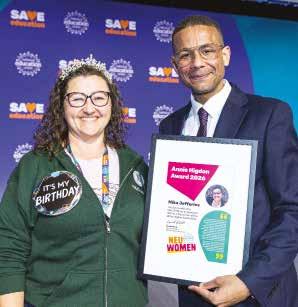
Annie Higdon award
Mika Jefferies (left), Plymouth
This award celebrates the work of members challenging sexism and building women’s activity in the union. Plymouth teacher Mika Jefferies’ work was described as “empowering”.
She said: “When I got the email saying I’d won the award, I thought: ‘I haven’t been doing anything. I’ve just been trying to encourage more women into the union.’
“Annie Higdon was resilient, inspirational, believed in the power of education to change lives and was intolerant of injustice, just like the women around me.”
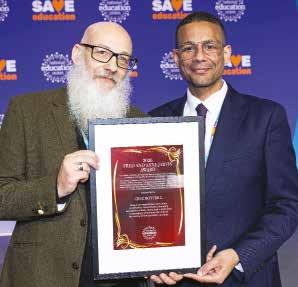
Fred & Anne Jarvis award
Greg Bottrill (left)
Former teacher and assistant head Greg said it was “truly humbling” to be awarded for his advocacy of “joy and childhood” and his dedication to helping educators develop their understanding of play-based pedagogy.
He said: “Here’s to childhood. Here’s to the restoration of joy, and here’s to the community of teachers and leaders who know that all children are unconditionally loved for who they are and who continue to illuminate the wonder within them.”
Blair Peach award
Ruth Osman, Monmouthshire & João Félix, Rhondda Cynon Taf (above)
Disability rights champion Ruth Osman helped establish the NEU disabled members conference in Wales in January 2025.
Ruth said after her cancer diagnosis, which meant she needed support at work, she began to see the barriers so many educators face every day which go unnoticed by those who don’t have to navigate them.
“What started as a deeply personal challenge became something more. I became an activist in the NEU. I didn’t want other educators to experience the discrimination, barriers and – at times – outright degrading treatment I received after my cancer diagnosis. Change often starts with a single voice refusing to stay silent.”
A member of the NEU international solidarity organising forum for Wales, João Félix, also received the award for “exceptional commitment to promoting equality, diversity and social justice”. In 2025, he helped to establish the Stand up to Racism (SUTR) branch in the South Wales Valleys, leading counter-demonstrations against far-right groups. João also distributed 7,000 fliers as part of efforts to successfully defeat Reform UK in the 2025 Caerphilly by-election.
“As educators, it is our duty to oppose the far right, their division and the conditions that cause it, and to put forward a vision and action for an equal, free and fair society,” he said.
Steve Sinnott award
Michael Kearney (right), City of York
Primary teacher Michael was joint winner of this award for his solidarity with the people of Ukraine since Russia’s invasion in 2022. He accepted the award with “great humility”, saying: “This isn’t mine alone: the NEU Ukraine solidarity network was built by the courage, passion and determination of a small group of trade unionists, people who refused to look away and chose action over silence. That’s what international solidarity looks like.”
He added: “If children are suffering, we stand with them, no exceptions. Let it be known the NEU did not stay silent.”
Michael made three trips to Ukraine in 2025, visiting schools and bomb sites in often challenging circumstances, returning after one 11-day visit on a Monday morning and going straight to work. He has donated more than £500 and welcomed a refugee into his home who has become a close friend.
Rep of the year
Arthur Terry Learning Partnership team (above), West Midlands
Cheers filled the auditorium as the team of 37 reps at the Arthur Terry Learning Partnership were named NEU rep of the year. NEU president Ed Harlow described them as a “true beacon of collective strength and union spirit”.
Seven of the reps travelled from the West Midlands to accept the award, given for their landmark victory in saving 100-plus jobs at schools across the trust and winning improvements to members’ terms and conditions.
Sinead Corden, one of the reps who collected the award, said: “When working
people stand together and voices unite, even the mightiest giants begin to fall.”
The reps are: Aaron Huggins, Adam Pattinson, Adam Chetwynd, Aimee Cass, Alexandra Kendrick, Anisa Mohamed, Antitsa Undzhiyan, Ben Smith, Christopher Gordon, Claire Hughes, Connor Herron, Demitrius Smikle, Elly Thornley, Emily Cornwell, Fiona Burns, Genna Pilling, Grace Sparkes, Heather Sandford, Helen Board, Joanne Port, Jordan Orchard, Katherine Milligan, Kathryn Gough, Kerry Lynch, Lucy Stevenson, Lucy Taylor, Matthew Hayward, Matt Neiland, Nicola Baldwyn, Nicola Edwards, Ploutis Koumi, Robert Gaudin, Ryan Horne, Sarah Evans, Sinead Corden, Victoria Cooper and Wendy Brown.
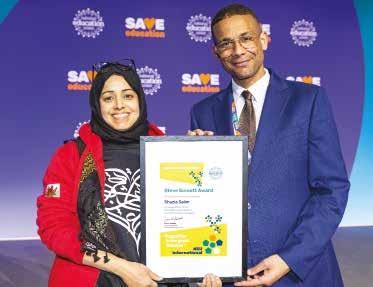
Shahzia Salim (below left), Rhondda Cynon Taf
International solidarity officer Shahzia is a second-time NEU award winner, having won the Blair Peach award in 2025. This year, she was recognised for her “outstanding contribution to international solidarity work” with countries including Sudan, Cuba and Palestine. She has taken a leading role in organising fundraisers and has worked with groups such as Parents and Teachers for Palestine.
Shahzia was described as “a living testament to the meaning and practice of international solidarity”. During Ramadan, she set a target of raising £15,000 to provide eco-homes for people in Gaza, which was achieved. “Just in the month of Ramadan, the whole team – friends, family and colleagues – helped so many people,” she said. “We must educate future generations, and the children in my lessons always get a lesson on international solidarity. We must all do the same to fight against the injustices around the world.”
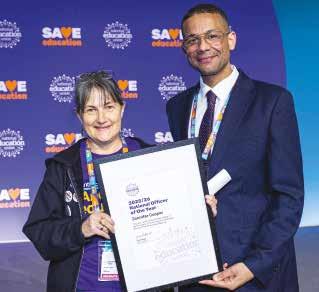
Officer of the year
Jenny Cooper (above), Brent
Accepting this award, which recognises her “outstanding service and commitment to the union”, Brent NEU joint secretary Jenny Cooper said: “Never stay silent when something is wrong, and help members find their voice.”
Jenny, a teacher and long-standing activist who has also taken an active role in the NEU’s climate change network, said it was the death of a pupil on a school trip that “turned me into an active rep”.
She added: “I vowed after that incident I would never stay silent in the face of injustice.”
Together in hope
On 28 March, many thousands took to London’s streets to join the Together Alliance’s march against the far right. Members told Educate why they are taking a stand.
Interviews by Sarah Thompson
Photos by Jess Hurd
continued on page 28
Interview Feature
continued from page 27
“We need properly embedded strategies within schools to be able to deal with farright thinking. That’s one of the biggest challenges for educators.
“As an educator, you can sometimes feel very isolated. But being here today is really brilliant, you realise you’re not the only one who thinks like this.”
Chris Kelly, Cheshire
“You need numbers on marches like this. It’s really important to show up in person, to show that most people are against what the far right is saying and doing.
“It’s so threatening. In my school, it affects our families and our staff, many of whom come from different parts of the world. Hackney is a very diverse community and the far-right way of thinking is a threat to everyone’s existence.
“We’re here representing the whole school. We have total support from the school community – from the governing body to the head teacher.”
Jane Carter (left), Hackney
“Suella Braverman, Reform’s education spokesperson, has called diversity, equity and inclusion ‘ridiculous’. A Reform government will attempt to bring this mindset to education, which will be devastating.
“As educators, we need to teach about unity in diversity – teaching about different cultures and religions, while also letting young people know they have similarities. Encouraging them to respect difference and not feel threatened.
“To know that there are so many people who want to take a stand for a cause they believe in and came from all over the UK to do so feels special and inclusive.”
Ragam Mirza (right), Hackney
“I feel very strongly about the principles that the march stands for. I want to instil these in my students – to be thoughtful and stand up for what they believe in.
“I see farright thinking seeping into the classroom. I think challenging, educating and reasoning are such an important part of what we do as educators. We very much need to be a part of this – it’s so important that we’re here today.”
Claire Lawson, Somerset
“It’s so important that we unite against the far right and bring everyone together to show solidarity across the country.
“There are a lot of boys in my secondary school who are Reform supporters – they’re 14 and 15 years old. So many of them don’t understand what Reform’s policies mean.”
Rachel Ferraby, Leeds
“It’s great to be able to come together on this huge, historic march and show that we’re all united.
“We see so many effects of the way the far right behaves, the intimidation of non-white people. And also of women – a significant number of the men arrested in the 2024 summer riots had previously been reported to the police for domestic abuse.
“After the riots, we came back to college and there was a palpable sense of fear among the non-white members of our college community. It’s really hard to find meaningful ways to support people, and this march is an opportunity to show that it is the far right who are the minority. They are not going to win. We know that from history. We know their games and their tactics.
“It’s just a distraction from what’s really going on –the inequality in our country – and it’s got to stop.”
Amy Newiss, Bradford
“I’m here because we’re seeing the rise of far-right thinking seeping into our towns, villages and cities.
“We recently had the displeasure of Nigel Farage coming to speak in Swindon. You listen to the message that’s being given to people who are living on the breadline and are looking for someone with answers. They think the likes of Tommy Robinson and Nigel Farage have the answers.
“But you’ve only got to look at councils where Reform have taken power and made things so much worse for the people who they’ve conned into voting for them.”
Debbie Brown (left), Swindon
“My youngest child is 11 and I worry about the misogynistic content he is able to see on the internet. Some of his friends have unlimited access to the internet and to people like Andrew Tate.
“I’m here to stand up against the hatred; for teachers who are being told they’re radicalising children. One of my children is transgender. She just wants to get on with her life, but has been attacked and feels scared to leave the house.
“And that I put squarely at the feet of people like Nigel Farage and Tommy Robinson. ”
Clare O’Connor (right), parent, Swindon
On the frontline
After 20 years in policing, Carmen Lambert Singer left to retrain as a teacher. She talks to Frankie Faccion about the transition.
ON the face of it, policing and teaching have little in common. But trainee history teacher Carmen Lambert Singer, who worked as a police officer for two decades before switching careers, has found the two jobs aren’t worlds apart.
The most transferable skills from the police force have been patience, resilience and communication, she says (“the ability to communicate is two-thirds of teaching”). In the classroom, the need for those skills shows up in subtle but important ways: noticing when a pupil might need support, for instance, or understanding the context behind certain behaviours.
“That’s not something you’re taught in a session,” she adds. “It’s experience. You learn to see things like that.”
A natural switch
Carmen’s former career spanned frontline policing, working in the criminal investigation department (CID) and specialist safeguarding roles, including child protection. Much of the role, she says, dealt with communication rather than enforcement.
This experience has been invaluable on Carmen’s school-centred initial teacher training placements at Royal Alexandra and Albert School and Reigate School, both in Surrey. “In policing, I would meet people at the worst moments of their lives,” she says, adding that it was crucial she was able to sit down, talk to them and help them make sense of what was happening.
She also mentored and coached younger officers, supporting them through difficult situations and helping them build confidence. “People would come to me when they were struggling,” she says.
But the job also took its toll. Carmen became burnt out by detective work, and was signed off for five months with anxiety and depression. She returned but later left the
“The ability to communicate is two-thirds of teaching.”
force after becoming “disillusioned” with the role, citing poor supervision as a key factor.
Having realised mentoring was the part of the job she loved most, teaching seemed like a natural career switch. And, as a selfprofessed “history geek”, she had no trouble choosing her subject.
Carmen says she has felt warmly welcomed into the profession and has built close relationships with mentors and her training lead. Joining a union for the first time has also been exciting (police are prohibited from being union members): she has always believed workers are stronger together, she says, adding that being an NEU member
gives “a sense of security in a world where uncertainty breeds fear”.
But Carmen admits to finding teaching tough. She is very candid about the challenges of entering the profession at a time of deepening recruitment and retention pressures (almost ten per cent of teachers in England quit each year, according to a 2025 report by the Organisation for Economic Co-operation and Development).
“I cannot equate the tiredness I’ve felt to anything,” she says. “It’s another level.” Teacher training, she explains, has also required a shift in mindset: “You have to completely retrain your brain.”
At times, that adjustment has felt overwhelming. “I thought, ‘I’m never going to get through this,’” she admits. Support from her mentors has been a lifeline. “They said: ‘what you’re going through is normal. What you’re feeling is normal.’”
Moments of joy
Carmen’s experience reflects wider concerns raised by the NEU about workload, pay and stress driving teachers out.
In her fifties, and having paid off her mortgage, she was able to train as a teacher, but recognises not everyone will be.
“I’m very lucky that I don’t have money issues, but what about the people who would be just as good as me but can’t afford to do this?”
Pay and rising housing costs remain major barriers to teaching for many entrants. In 2025, charity Shelter found renting was unaffordable for 43 per cent of new teachers in England.
Despite the pressures, she believes teaching is a “brilliant profession” that provides unparalleled moments of joy. She fondly recalls a student asking: “We’ve got a Stone Age, a Bronze Age, an Iron Age… Where’s the Wooden Age?”
“It was a brilliant question,” Carmen laughs. “Moments like these are what make it all worthwhile. You think: this is it, this is why I’m here.”
Support plans are supposed to be developmental tools, but a worrying trend is emerging – they are being misused to get rid of staff. Sarah Thompson reports.
SUPPORT plans are being used to manage teachers out of their jobs, for reasons that include them questioning new policies or directions, refusing to take on extra duties or – as is the case for many –because they are highly experienced and simply deemed too expensive.
Silenced by Support, a report published by a campaign group of the same name, is a compilation of more than 100 teachers’ accounts of being placed on a plan, ostensibly to improve their teaching.
They describe being set unachievable targets, subjected to false claims about their practice and competence, excessively scrutinised and bullied. The impact on most is devastating.
Losing your career is like a bereavement Many say they felt suicidal, and some were never able to return to the classroom, likening the loss of their career to a bereavement.
“It’s awful, absolutely crushing, because teaching is part of your identity, not just a job,” says Nick Smart, who co-founded Silenced by Support with former teachers Sarah Dunwood and Sharon Cawley.
Sarah and Sharon discovered there was a problem with support plans when they set up a Facebook group on how to thrive after leaving teaching and noticed increasing numbers of people posting about leaving their jobs, sometimes the profession, via unfair informal capability procedures.
“I don’t believe we live in a world where professionals don’t need support plans, because they do, but support seems to have become a threatening word,” says Sarah. “People spoke of being blindsided when told they were being put on one.”
The campaign group’s research has found women aged 50 and over are at the highest risk of being put on a plan inappropriately. That chimes with data gathered by the NEU’s AdviceLine, which says calls about support
“A new head said he was going to put an older teacher on capability as she was too expensive.”
plans are one of the most common reasons members get in touch. Plans are frequently misused following a period of sickness, and menopause is often a factor in cases when capability is suddenly questioned.
Often the plan signals the start of a punitive process that leads to women exiting teaching early. Their high salaries as experienced professionals, with perhaps decades in teaching, also contribute.
Financial pressure is a recurring theme among the testimonies in the report. One assistant head writes: “A new head told me he wanted to get rid of an older teacher as she was too expensive, so he was going to put her on capability.”
Another shares: “We were forced in budget meetings to put end dates on staff
and then to make sure we got rid of them, or someone of a similar cost, by the end date.”
Reform needed on how plans are used
Last year, Sarah at Silenced by Support wrote to education secretary Bridget Phillipson raising concerns about the numbers of teachers inappropriately placed on capability procedures. The group, which is uniting teachers driven out of their job, is calling on the government to reform how schools and multi-academy trusts (MATs) use support plans, and the NEU also wrote recently to Phillipson highlighting this worrying trend.
Designed as a developmental tool, support plans are now too often misused with devastating professional, as well as personal, consequences for teachers placed on them.
ERIN*
had worked as a special educational needs and disabilities (SEND) teacher for seven years in a north-west London secondary school, but when a new SEND co-ordinator (SENDCo) was employed to lead the team, she found her practice being questioned.
“I was 47 and had worked under two excellent SENDCos at the school, and was a very experienced teacher,” Erin says.
There were immediate warning signs with the new SENDCo. “In meetings – often 90 minutes or longer – we were only allowed to speak if she spoke to us. Nobody was able to ask questions or leave on time.
“I was the first team member targeted. I think I was seen as someone others listened to and who had the voice of authority because I was experienced and would put my hand up to speak in those meetings.”
Three months after the SENDCo was appointed, Erin was observed delivering one-to-one support for a student and was told her teaching was inadequate. “The review was full of misinformation, and very different from all the lesson reviews I had received for years, not just in that school.”
continued on page 32
Silenced by support
Interview Feature
continued from page 31
She was “totally blindsided” when told she was being put on an informal capability plan. “I couldn’t understand it. And because it was ‘informal’ it was all so vague. I asked if it could be formalised so that proper records would be kept. I could then go to my union for support, but they refused.”
‘Drowning with nothing to hold onto’ Her mental health and confidence were significantly impacted. “I was questioning myself. I had sleepless nights and was afraid to go into work. It’s like you’re drowning, and you’re reaching out, but there’s nothing to hold onto. It was absolutely awful.”
Erin believes she was targeted, not just because she would speak up, but because she was expensive, and there was pressure to make savings. “If you can hire a young, cheap teacher, you can keep them for two or three years, get rid of them and hire another, saving thousands.
“After I was forced out, other teachers within the SEND team became the targets. Soon, there were no SEND specialist teachers left, only managers and teaching assistants. I imagine it saved the school a lot of money.”
LOUISE
, a teacher for 14 years, was at the top of the upper pay scale when she refused to take on a significant additional responsibility without extra time or pay. The head responded by putting her on a support plan.
“When I was asked if I could set up a citizenship programme, I initially said yes,” Louise explains. “But when I asked what would be removed from my timetable, the answer was nothing. I explained that I had no capacity to take on additional whole-school responsibilities and said I couldn’t do it.
“No-one ever said no to the head teacher, and she was extremely unhappy I had. She commented: ‘It sounds like you need a support plan for time management.’”
A lesson observation followed and the feedback was overwhelmingly negative.
“It was surprising and distressing. I had consistently achieved strong results over many years and had never had concerns raised about my teaching,” says Louise, who at the time was listed on a local alliance group of highly experienced teachers who the local authority could approach if they needed advice or help with a subject area.
“The head just wanted me out. I was threatened with formal capability before I’d even started the support plan. That’s not
support,” she argues. “The culture was toxic. The head teacher had a gang around her and if your face didn’t fit, or you weren’t willing to say yes to everything, she didn’t want anything to do with you.
“In my first observation she focused only on the things I could improve and didn’t mention any of the positives.”
Targets shifted, set up to fail
Targets constantly shifted, Louise adds, and it was impossible to do anything right. “I was being set up to fail.” She met all the targets but was then moved onto formal capability. “I said: ‘But you’ve just signed everything off.’ And the head said: ‘We need more.’”
Weeks went by and her mental health began to suffer. “I wasn’t sleeping, I felt sick all the time. I had to pull over onto the hard shoulder a number of times on the way to work because I’d have a panic attack.”
Louise eventually sought help from her doctor after admitting to family that she had chosen the wall she was going to crash her car into. She was signed off with work-related stress. She was ready to end her career, but two weeks into her period of sick leave, she heard of a vacancy in a secondary school through a friend, applied and got the job.
As an experienced – and more expensive – older teacher, she had felt confident enough to say no to an unacceptable request. “Ten years earlier, I probably wouldn’t have said no, but I was prepared to stand up to the head.”
AMY* had been working as a SENDCo in a primary school for 15 months and was
placed on a support plan when she asked for some help with workload.
In April 2025, she was instructed by the head teacher to become entirely classroombased, to support a year 1 class with a lot of SEND and some challenging behaviour.
“I was told to go in for two weeks and turn things around,” explains Amy. “The children needed more breaks, less time sitting and more play. They weren’t ready for the curriculum they had been given.”
But suggestions she made met with disapproval from the senior leadership team.
The head’s approach was a simple “just do anything to make them sit in their chairs” and at odds with Amy’s belief in a traumainformed model, which puts communication, play and curiosity at the heart of learning.
Six weeks later Amy was still class-based and becoming “burnt out”.
She met the head teacher to ask for help and, despite some initial unwillingness, they seemed to understand and told Amy they would work through it together.
That evening Amy received an email informing her she was being placed on a support plan. “It felt like quite a gaslighting experience. I had just asked for help, and the words ‘support plan’ were never mentioned.”
She immediately contacted the NEU, which confirmed that the support plan was inappropriate. “The union explained that the head teacher should have told me I would be put on a plan and it was supposed to be collaborative. I knew at that point it was wrong.”
She was assigned a caseworker, and an email was sent to the head teacher, which covered some legalities, including what Amy
was entitled to and the process of an informal support plan.
The school, part of a MAT, had been rated Requires improvement by Ofsted and Amy believes that putting her on a support plan was an act of self-preservation by the head. Amy discovered she was one of four teachers who had worked in the year 1 setting and been placed on a support plan over a period of two years.
When the head teacher refused to remove the plan, Amy decided she had no choice but to leave. “I just thought that our values were so different the professional relationship was
never going to work. I had this feeling I’d never pass the informal support plan.”
Amy returned to work but met her NEU rep and confirmed she would not engage in the support plan and began applying for other jobs. In the May half-term, she handed in her notice.
The pressure of the day to day at school and trying to find a new job had become too much. She was signed off with work-related stress. “I really wanted that to be named as the reason, because there are procedures in place if a certain number of people are off with workrelated stress in one setting.”
“It felt really disappointing to be another
statistic,” says Amy, adding that when she had started at the school a number of parents had said to her: “Let’s see how long you last.”
“I tried to fight back. But I think the campaign name Silenced by Support is right. I did feel silenced. They had my life in their hands. I needed a job to pay my mortgage, I’d also been planning to try and have a child. It felt like they could take these things away.”
But Amy got another job. She contacted her previous head teacher, who recommended her for a post, and she is now at a SEND independent school. “I’m happy,” she says. *not their real names
Support or stitch-up? Know your rights
WHAT IS INFORMAL CAPABILITY/SUPPORT?
n Informal capability or support can be triggered when you are judged to be consistently under-performing.
n Department for Education guidance states that any concerns about under-performance should, wherever possible, be raised initially during your appraisal/assessment meeting.
n It is the first stage of capability proceedings.
n Familiarise yourself with your school’s capability and appraisal policy, which differ from school to school.
HOW SHOULD I BE NOTIFIED THAT I AM BEING GIVEN AN INFORMAL CAPABILITY OR SUPPORT PLAN?
n Your head teacher should write inviting you to a meeting to discuss their concerns.
n The letter should outline the nature of the concerns, evidence to support them and suggested actions.
n You should be given at least five working days’ notice of the meeting, with the opportunity to postpone, to arrange representation. Ask your NEU rep to attend the meeting and contact the NEU’s AdviceLine for support.
WHAT SHOULD I EXPECT FROM AN INFORMAL SUPPORT PLAN?
n It should include your role and responsibilities.
n Concerns about your performance should be clearly set out.
n It should be a collaborative process and you should be given the opportunity to ask questions and comment.
n Support plan targets should be clear and must relate to the Teachers’ Standards.
n You should receive a timescale for improvement and the steps you must take to achieve this. The NEU believes there should be at least 13 weeks of initial support.
n The plan should be a developmental tool, rather than a punitive one. It might include mentoring programmes, CPD, extra resources and peer support.
n If you believe the plan is manageable and feel supported, you may agree to it.
n You should agree on progress meetings and a review date.
n The support plan should end as soon as the targets are met.
DO I HAVE TO AGREE TO AN INFORMAL SUPPORT PLAN?
n No. Agreement is a choice rather than a requirement.
n You can raise concerns if the plan is unmanageable, punitive or poorly structured.
n You can also request adjustments or clarifications before agreeing.
WHAT HAPPENS IF I REFUSE TO AGREE TO THE PLAN?
n Refusing the plan doesn’t mean the school can impose it on you. Instead, leaders should reconsider the plan, address your concerns, or work with the union to amend it.
n However, because informal support normally comes before formal capability, refusal may prompt the school to review whether informal support can continue.
n They must still show that any escalation to formal capability is justified, proportionate, and follows a fair process.
WHAT SHOULD I DO IF I’M UNSURE ABOUT THE PLAN?
n Ask your NEU rep to attend meetings with you and contact the NEU AdviceLine.
n Targets must be clear, linked to Teachers’ Standards, achievable, and supported by genuine developmental measures such as mentoring or CPD.
n If the plan feels unmanageable or punitive, you can challenge it and request changes.
WHAT IS FORMAL CAPABILITY/SUPPORT?
n You should only be placed on formal capability if your performance is having a significant impact on the school’s ability to deliver education to pupils or ensure their health and welfare.
n It should follow a period of informal support, and you should be notified at least seven days in advance that a transition meeting will take place to determine whether formal capability/support should begin.
COULD FORMAL CAPABILITY PROCEEDINGS AFFECT MY FUTURE CAREER PROSPECTS?
n Yes. In the UK, your school is expected to reveal to any future employers if a candidate has had formal capability proceedings.
Ask the union
Is training part of PPA time?
I WORK in a secondary school and need to attend some training. My head teacher says this means forfeiting my planning, preparation and assessment (PPA) time. Is that right?
No. PPA is protected time and should not be taken away for other directed activities such as training, meetings, cover or supervision.
If the school needs you to attend training, it should be scheduled within directed time, or your PPA should be re-timetabled, so you still receive your full entitlement. If you have already lost PPA, ask for equivalent time to be provided.
If the issue isn’t resolved quickly, raise it with your NEU rep/branch so it can be addressed through workload and directed time arrangements.
Pupil’s personal care needs
I’M a primary school teacher and have been told I must help a child with their colostomy bag, but I haven’t received any training and don’t feel confident doing this.
While it is vital that the child’s needs are accommodated and their dignity upheld, teachers cannot be directed to administer medicines or undertake personal care. This can only happen on a voluntary basis. You can therefore refuse this direction.
If you do wish to take on this role, you shouldn’t do so until you have been properly trained. You should also make sure that provision is in place for any related changing or cleaning to be undertaken in a clean, private place that preserves the dignity of the young person and meets safeguarding protocols.
All schools should have a policy that covers personal care, rather than expecting staff to support individual children on an ad hoc basis. Some support staff may already have such personal care duties as part of their job description. When this isn’t the case, any changes to job descriptions or contracts should be subject to negotiation. It shouldn’t be assumed that support staff will just take this on without any support or training.
This is an issue likely to be of concern to many members of staff so we would suggest holding a union meeting to find out how satisfied, or not, members are with current arrangements. Concerns can then be shared with management, with the aim of getting a policy in place which staff are happy with and which supports the needs of children.
n Visit neu.org.uk/personal-care-pupils
Free CPD webinars for all NEU members
NEU members have exclusive access to our continuing professional development (CPD) webinars. Here are some of the courses coming up.
Rebalancing reading
How to develop reading motivation and engagement in readers of all ages.
14 May 3.45-4.45pm
Reflecting realities in the book corner
Focus on the annual Reflecting Realities survey examining ethnic representation in UK children’s literature.
18 May 3–3.45pm
Leadership masterclass – leading change
An online masterclass for middle and senior leaders or those leading a team.
19 May 11am-12pm
Preventing and reducing exclusions
An overview of the key factors driving exclusions and the practical steps schools can take to reduce them.
20 May 3-4.15pm
Getting behaviour right – expert panel
Interactive panel session covering a range of behaviour topics.
1 June 11am-12pm
No mat pay as contract ended I’M pregnant and have been told I will not receive my occupational maternity pay because my fixed-term contract has ended and I will not be returning to the school.
Many schools use the Burgundy Book scheme, which requires you to return to work for 13 weeks after maternity leave to keep full occupational maternity pay. This includes school holidays and most other absences.
If you don’t return for 13 weeks, you can keep the first six weeks of maternity pay and any statutory maternity pay (SMP) or maternity allowance (MA), but your employer can reclaim the 12 weeks at half pay from you.
However, employers can waive this requirement, and the NEU believes repayment shouldn’t be required when you can’t return for reasons outside your control, for example a fixed-term contract ending or a flexible working request refused. Some local authorities also do not reclaim if you start work at another school after maternity leave. The NEU argues this should count as meeting the 13-week return requirement. If you need support, contact your NEU rep.
n Visit neu.org.uk/maternity-leave-and-pay
Contact us…
n Please email your questions to educate@neu.org.uk
n If your question is urgent, please call the AdviceLine on 0345 811 811
ECTs and trainees – outdoor learning
Practical ideas for taking the secondary curriculum outdoors and the benefits for pupils’ learning and development.
3 June 2.30-3.30pm
Reading for pleasure
Explores the social nature and benefits of sharing reading experiences.
4 June 9-10am
Leadership masterclass – coaching others
An online masterclass for middle and senior leaders or those leading a team.
23 June 4-5pm
Cartoon by Tim Sanders
Government can’t simply rebrand academies
Warwick Mansell is a freelance education journalist and founder/writer of educationuncovered.
THE schools white paper has rightly attracted most attention for its reform of policy on support for children with special educational needs and disabilities.
But buried towards the back of the document is a section that’s remarkable for two reasons.
First, it saw the Labour government revive what had been a flagship – though failed –policy under its predecessors: plans to turn all state-funded schools in England into academies.
This was a major shift in the stance of this government, which had previously adopted a position of agnosticism on school structures, not wanting to pursue a blanket mass academisation drive – something the Conservatives attempted unsuccessfully in 2016 and 2022.
But it was hard to spot this – because the second remarkable aspect of policymaking in this section was a change in terminology that obscured the move.
For the Department for Education (DfE) appears no longer to want to talk about academy trusts or academies at all. It now wants all schools to become academies, but to call the organisations they join “school trusts”, rather than “academy trusts”.
So, in the white paper, the words “academy trust” do not appear in a substantive sense at all, whereas “school trust” gets 30 mentions.
However, when I checked with the DfE, it confirmed that all school trusts would consist of academies. So these would be academy trusts, just not referred to as such in policy documents.
Sources close to the academy trust sector confirm that there has been a drive among policymakers – who seem heavily influenced by the employers’ body the Confederation of School Trusts – to ditch the terms “academy” and “multi-academy trust” (MAT) because they are seen as somewhat tarnished.
But the key question seems to me to be: if the word “academy” is indeed tarnished, would
it not be better to address the problem that has led to the policy’s controversial reputation, rather than simply trying to rebrand it?
MATs continue to attract controversy in part because of the high salaries paid to their managers: I reported, for example, on more than 60 academy leaders paid more than the leader of England’s largest education authority last year, despite each of the former organisations overseeing far fewer pupils.
Yet the government, while gesturing in the white paper towards concern about this, will not be taking the logical step of introducing a national pay structure for trust executives, as exists for teachers, to mitigate it.
MATs can also attract controversy in cases where their headquarters are distant from the schools they operate. The DfE wants more local “school trusts”. But it is not proposing to break up larger MATs, or to require more local representation on academy trust boards.
Sadly, then, this paper is signalling that it is full steam ahead – again – towards an all-academy system, but without addressing the policy’s weaknesses. Instead, it is changing the wording and hoping no one notices.
A class act
‘If someone is upset, Juno will
Frankie Faccion discovers what makes therapy dog Juno (pictured) a class act.
JUNO is the centre of attention at Oakgrove Integrated College in Derry. The ten-monthold Hungarian vizsla can’t make it through the corridors without being fussed over.
“Teachers and students constantly stop to pet her, and she brightens everyone’s day,” says drama teacher and NEU rep Steve Wakeley. “I might not be able to explain it in terms of pedagogy or research, but I can confidently say there’s been a noticeable uplift for both staff and students from having Juno here.”
But the pup’s role goes far beyond that. She is now a staple of the school’s support hub, a space that provides emotional and learning
support for students who find mainstream school challenging.
‘A calming, inviting environment’
Hub leader Barbara Sherrard, who is also Juno’s owner, explains that many students find it difficult to open up about how they feel, and Juno helps bridge that gap by creating a calming, inviting environment for the kids.
Her presence also lowers barriers to conversation. Instead of sitting face-to-face with a teacher or support worker, some pupils find it easier to talk while interacting with Juno. “Students will sit petting her and suddenly start sharing what’s going on in their lives,” explains Barbara. “Just having her beside them can make a difference.”
Juno at work with (clockwise from left) teacher and NEU rep Steve Wakeley, learning support assistant Amanda Blaha, principal John Harkin and support hub lead Barbara Sherrard; pupils Maddie Strawbridge, Luke Cowan and Maggiemay Gallagher; and Luke Cowan and Kieran Johnston-Smith
Learning support assistant and NEU support staff member Amanda Blaha adds:
“Dogs are very intuitive, and if someone is upset, Juno will notice that and come and sit beside them. She’s a very grounding force.”
Students have already begun to develop personal connections with the puppy, asking to see her because they find her relaxing, and reluctant pupils are encouraged to attend school knowing they will be able to see her. Petting, walking and grooming an animal also helps reinforce among students the importance of looking after themselves.
Research published by the University of Lincoln in 2022 found spending time with a therapy dog significantly lowers levels of the stress hormone cortisol.
Photos by Mark McCormick
notice and sit beside them’
A 2023 survey published by the Mental Health Champion, an independent agency that advises the Northern Ireland executive, found 45 per cent of 16-year-olds showed signs of probable mental ill health. It also found the wellbeing of 11-year-olds had declined to its lowest level since 2016. Causes included pressure to do well at school, peer relationships and financial worries at home.
On top of this, Oakgrove’s principal John Harkin explains that decades after the Troubles, the mental health of young people is still impacted. “There is clear evidence of transgenerational trauma,” he says. “That legacy doesn’t simply disappear, and we often find ourselves supporting young people dealing with complex pressures beyond the classroom.”
Mental health is often described as central to education, but the funding doesn’t always reflect that, he adds, and only six per cent of Northern Ireland’s health and social care budget is spent on mental health – lower than in other parts of the UK. “We are always looking for creative ways to support young people, and sometimes that means thinking differently about what support can look like. We did our research and knew a therapy dog would be effective,” says John.
So when Amanda, who has bred Hungarian vizslas for years, had a lightbulb moment that the breed would be ideal, it was agreed she would choose one from the next litter to be trained.
Velcro vizsla
Known for their affectionate temperament and love of being close to people, vizslas are dubbed velcro dogs, she explains, and Juno’s placid nature – “some of the litter were crazier than others” –made her a good choice.
Barbara was then keen to take Juno into her own home and help facilitate her role at Oakgrove, whose students are aged 11 to 18. Training is delivered through PAWS Therapy Dog Training Ltd, which provides materials and supervision to ensure therapy dogs can work safely in schools, and Amanda and Barbara emphasise Juno’s welfare is always the priority. “The school environment is really stimulating for a dog,” says Amanda. “She’s only on duty maybe an hour or two a day and spends a lot of time resting.”
There have been a few mishaps – Juno is a puppy, after all. “She had a pee accident on one of the school mats,” Barbara laughs. “She got quite fond of doing that, so we had to get rid of it.” Amanda adds that Juno also has “a bit of a penchant for toast and if the kids have a slice in the morning, she cheekily manages to get some”.
Although Juno is Barbara’s dog and goes home with her at the end of the day, the school covers the £3,700 therapy dog training cost (for three members of staff). It’s a worthwhile investment, says John, and cheaper than having a therapy dog for short visits. And being a permanent fixture also changes how pupils connect with Juno. “It means she has become part of school life,” he adds.
Oakgrove itself is an integrated college, part of a movement to bring together pupils from different community and religious backgrounds. “We are all about embracing everyone,” says John. “We want to break down barriers and challenge prejudice, including the stigma that can still exist around mental health. Any strategy that helps overcome that barrier is worth exploring.”
Juno’s presence in the hub is about more than simply having a friendly dog in school. “Therapy dogs aren’t a gimmick,” he says. “They are part of a wider cultural conversation
Do you know a class act?
Email educate@ neu.org.uk
NEU’s Emergency Fund appeal for Save the Children
Tasha*, are living in a refugee camp after they fled the
in
At a Save the Children safe space, they get the chance to play, make friends and learn.
(* names changed)
Photo: Ezibon Saadalla / Save the Children.
Amira*, with her twin cousins Aba* and Nura* and her little sister
war
Sudan.
International
THE devastating war on Iran by US and Israeli military forces has been the latest in a series of catastrophes for the Iranian people.
Trade unionists, women and human rights defenders have long endured the brutal repression of their rights by the Iranian regime.
Then, at the end of February, a new threat of death came from the skies as US and Israeli jets bombarded their country.
The NEU has consistently criticised the regime and spoken out against the human rights abuses inflicted on Iran’s people. It has campaigned for the release of teacher trade unionists imprisoned simply for their union activity and has petitioned against the threat of execution faced by human rights defenders.
At the same time, the union condemns the war waged against Iran and its population.
On regime change, the NEU’s position is clear: “Change must come from within. It must reflect the will of the Iranian people themselves. It cannot be imposed by external military force, nor can foreign powers determine Iran’s future. Lasting freedom is built by people, not delivered by bombs.”
In one appalling act of war, in the southern city of Minab, US Tomahawk missiles destroyed a girls’ primary school, killing 165 people, most of them children. Speaking at the UN’s official International Women’s Day commemoration just one week after the attack, female education campaigner Malala Yousafzai stated: “Under international law, killing children in their classrooms is a war crime.”
The war quickly spread across the Middle East with over 16 countries affected by the crisis and over 100 million children impacted.
Human rights abuses
During the most recent uprisings in January, the Iranian regime slaughtered more than 7,000 of its citizens and arrested many more. What began as protests over worsening economic conditions quickly grew into nationwide demonstrations demanding greater freedom and democracy.
Teachers and students in Iran paid a particularly heavy price. The Co-ordinating Council of Iranian Teachers’ Trade Associations (CCITTA), an affiliate of Education International (EI), documented the names of more than 200 schoolchildren killed during the uprising. In a statement that has resonated globally, an EI spokesperson said: “Each child killed leaves behind an empty
Empty desks: lives interrupted, futures denied
desk. Each empty desk is a life interrupted and a future denied.”
Trade unionists targeted
The NEU publicly condemned the brutal repression and reiterated that it stood in solidarity with all human rights defenders, Iranian trade unionists and with its brothers and sisters in the CCITTA.
Members of the CCITTA have themselves been detained, denied access to legal counsel and contact with their families. Some detainees have been subjected to forced confessions.
The UK-based Committee for the Defence of Iranian People’s Rights (CODIR) condemned the US and Israeli war and called for maximum solidarity with the people of Iran.
Jamshid Ahmadi, CODIR’s assistant general secretary, states: “The brunt of brutal attacks by the theocratic dictatorship and deadly bombing of the US and Israel have been borne by the people of Iran. CODIR supports them in their urgent call for peace and their right alone to democratically determine their own future, free of internal suppression and externally imposed terror.”
Jamshid added: “CODIR has campaigned for the right of teachers in Iran to organise freely in their own independent trade unions. We support their right to campaign for a
progressive and quality education system in Iran, free and available to all children and young people, and to seek to secure better pay and conditions of service for all teachers.
“The future of Iran must be for the people of Iran to decide for themselves.”
As Iran rebuilds its future after the war, the Iranian authorities must end the violent repression of civilians and peaceful protesters, listen to the demands of the people and respect their fundamental rights, including the rights to freedom of expression and to peaceful assembly. They must guarantee the safety and protection of students, teachers and education communities in schools and universities.
The NEU will continue to stand in solidarity with teachers, students, trade unionists and the people of Iran.
n Encourage your NEU district to affiliate to CODIR using this form: tinyurl.com/CODIR-form
n Support the NEU + Save the Children Raising Hope for Children in Crisis appeal, which provides emergency humanitarian support for children and their families in nine countries across the Middle East, here: neu.org.uk/raising-hope
Women mourn at the funeral of the victims of a missile strike on a girls’ school in Minab PHOTO by Amirhossein Khorgooei/ISNA/Wana via Reuters
Reviews
100 Ideas for Secondary Teachers: Oracy
THIS professionally written collection provides clear, adaptable strategies to help students articulate their ideas and feelings with confidence.
Well-structured and easy to navigate, this practical book recognises that strong spoken communication underpins achievement across the curriculum. It deserves a place in every secondary staff room.
Cavan Wood
The Five Clues (Don’t Doubt the Rainbow #1)
100 Ideas for Secondary Teachers: Oracy by Topsy Page and Alan Howe. Bloomsbury Education. £13.50.
The Ultimate Guide to SelfRegulation in the Classroom AN excellent resource that provides innovative ideas for teaching pupils how to manage their own behaviour. Suggestions include breathing exercises, using stories and role play, and goal setting to build resilience.
Each chapter provides an overview, making it ideal for educators to quickly access what they need.
The book is practical, structured and full of actionable guidance. Highly useful for teachers seeking to support children’s social and emotional learning and to help pupils develop independence, self-awareness and confidence.
Cindy Shanks
The Ultimate Guide to Self-Regulation in the Classroom by Sue Cowley. Bloomsbury Education. £20.
Read a book that other educators might find useful?
Send us your 100-word review to educate@neu.org.uk with a link to the book, plus your membership number, and your review could be published.
WHEN teenager Edie Marble discovers a note from her late mother, who had been involved in a dangerous human rights investigation, she begins to suspect that her mother’s death was not an accident but murder.
Left with five cryptic clues, Edie embarks on a tense mission to uncover the truth behind a pharmaceutical scandal. What follows is a gripping mystery that balances suspense with emotional depth.
Author Anthony Kessel weaves psychological insight through the narrative, encouraging readers to reflect on mental health and resilience alongside the detective plot. An engaging and thought-provoking read for readers aged 11 and above.
Cindy Shanks
The Five Clues (Don’t Doubt the Rainbow #1) by Anthony Kessel. Crown House Publishing. £6.99.
The Animal Body Book
THIS exploration of animal biology is both informative and visually striking. With detailed illustrations and clear, accessible writing, it is ideal for children up to age nine.
The author introduces the main animal classes before examining selected species more closely, revealing fascinating insights into their physiology.
Readers will be intrigued to learn that a kiwi’s egg can weigh up to one fifth of the bird’s body weight and discover how a cat’s night vision is enhanced by the tapetum lucidum. Educational without being overwhelming, this is an absorbing addition to any young reader’s bookshelf.
Mike Follows
The Animal Body Book by Jess French, illustrated by Jonathan Woodward. DK Children. £20.
How to Land a Degree Apprenticeship
THIS practical guide helps students and teachers understand the process of securing a degree apprenticeship.
Packed with advice, it demystifies recruitment and explores why so few students from low-income backgrounds progress on to these programmes. The book offers clear guidance on applications, interviews and navigating employer expectations, making what can feel like an opaque system far more accessible.
Author Ned Browne recently founded the Degree Apprenticeship Project to address inequality in this sector. Concise, accessible and solutions-focused, this is a valuable resource for careers advisers and sixth form leaders.
Cindy Shanks
How to Land a Degree Apprenticeship by Ned Browne. Lollard Press. £7.99.
A book to ease school transition
Jon Biddle, English lead and NEU rep at Moorlands Primary in Norfolk, is passionate about fostering a love of reading for pleasure.
THE transition from key stage 2 to key stage 3 can be challenging for pupils in many ways.
Getting used to multiple teachers, new peer groups and increased independence can all contribute to dips in attainment and motivation. As children enter adolescence, relationships intensify and new hobbies emerge, meaning that reading can understandably feel less important.
In primary school, reading is often built into the structure of the day. In secondary school, timetables tend to be more subject based, with less dedicated time for voluntary reading. It’s therefore no real surprise that reading for pleasure decreases during this time.
Sense of continuity
The recent National Literacy Trust report, Teenage Reading: (Re)framing the Challenge, found that just under half of children aged eight to 11 enjoyed reading, with this figure falling to around 30 per cent for those aged 11 to 14. In response, many primary and secondary schools have started to work more closely together to address this decline.
For the past three years, our pupils have read The Final Year by Matt Goodfellow as their final book in year 6. Last year, its sequel, The First Year, was published. After discussions with English teachers and librarians at several local secondary schools, we agreed that they would read it with their year 7 pupils. Because the two books follow the main character’s journey from primary to secondary, every child is able to relate to what he has to deal with and the challenges he faces. The shared reading experience will help create a sense of continuity, ensuring that pupils arrive in September with a familiar voice, character and narrative thread.
Several secondary schools also take small groups of pupils into primary schools towards the end of the summer term to introduce them to the books they’ll encounter in year 7. We had a visit from three year 8 pupils last year who did exactly this. Because our children
remembered them from when they attended our school, they took their recommendations on board and asked them several thoughtful questions about books.
‘You see the excitement straight away’ Amy Brookes, librarian at Manchester Enterprise Academy, explained to me that pupils in many Manchester schools take part in a ‘transition read’ at the end of year 6. They each receive a book to take home and read over the summer, which is then used in English lessons for the first few weeks of year 7. Last year’s title was Quiet Storm by Kimberly Whittam (pictured, above right).
“We actually hand them the book on their first transition day with us,” Amy says. “You can see the excitement straight away. For some pupils, it might be the first time they have a book of their own. I upload videos summarising each chapter and asking questions about the book, which they can watch during the holiday. We arrange for the author to visit early in the year and ensure as many of our children as possible get to meet them. It’s a great way to get them enthused about reading.”
The school also provides additional ‘library detectives’ sessions for more vulnerable students. Pupils are set mini challenges around the school library, such as finding the biggest book on the shelves or choosing a book they think their teacher would enjoy. They complete the challenges in small groups and then sit together to talk about their choices.
“It shows them that the library is a calm and welcoming place, and that I’m someone they can turn to. It helps ensure their first memory of reading at secondary school is a successful one, which will hopefully lead to many more.”
What is important is that all this transition work is intentional. None of it is left to chance. We can’t simply hope that our pupils will carry their reading identities with them as they go through school; we have to help them to do so. Shared texts, familiar characters, pupil ambassadors and trusted librarians all ensure children are not starting again in September, but continuing a journey.
(Left) School librarian Amy Brookes champions the summer holiday ‘transition read’
AI can’t replace human connection
THE cover story featuring teachers holding placards reading “No virtual teachers” (Educate, January/February, page 7) caught my attention because I have been thinking a great deal about the emergence of the new generation of artificial intelligence (AI) and how it is impacting education and the use of edtech.
My interest in machine learning began at university in 1989 and I have followed developments ever since. The recent emergence of large language models (LLMs) seems to have caught everyone by surprise, including me.
Recently I came across neuroscientist Jared Cooney Horvath discussing Bloom’s two-sigma problem: the claim that one-to-one tuition dramatically improves learning outcomes. In an article on the Education Next website, Paul T von Hippel analyses
Bloom’s claim and highlights significant weaknesses in the original research.
The link between this and today’s AI debate is clear. I can just imagine the wheels of thought turning in Whitehall: if one-to-one tutoring produces dramatic gains and AI can replicate what a teacher does more cheaply, should schools be using
Teacher’s pet Chester
AI-powered tutors to improve outcomes and save money?
But while LLMs may appear to demonstrate higher-order thinking, they lack experiential understanding, particularly when it comes to human emotion and relationships. When we lose that human connection, we lose something essential in the teaching and learning process.
I think we need to be shouting this from the rooftops, before more harm is done.
Richard Hind, Yorkshire
SEN reform misguided
I’M incensed by education secretary Bridget Phillipson’s latest announcement on special educational needs (SEN). It has been presented as bold reform, when in reality, it looks like a reheated version of ideas teachers have seen before.
Her central proposal is to restrict education, health and care plans (EHCPs) to children with the most complex needs. Ministers argue that rising demand for EHCPs is creating delays and pressure on the system.
But EHCPs exist for a reason. They are the only legal
protection guaranteeing support for pupils with SEN beyond the discretion of schools and local authorities. When families pursue an EHCP it is usually because informal support has failed or resources simply are not there. Against that background, claims of parental or teacher “overdemand” ring hollow.
The idea that pupils with SEN should be educated in mainstream schools wherever possible has shaped policy for over 40 years. The Warnock Report of 1978 introduced the concept of special educational needs and promoted mainstream inclusion. Subsequent legislation embedded these principles in law, culminating in the Children and Families Act 2014, which replaced Statements of SEN with EHCPs and extended support to age 25.
Inclusion, then, has not been ignored. What has changed is the level of funding and support available to make it work.
Phillipson’s proposals also emphasise complexity as the threshold for statutory support. Yet complexity is not the same as severity. A child with profound hearing loss or severe ADHD Chester is the lovely dog of Tim Fulford, a health, safety and environment officer in Wakefield.
Tim says: “Sometimes I have to fight my poochon, Chester, over who gets Educate first.
“He turns one next week and has been keeping me on the right track after 40 years in the classroom. I am currently off work with ill health, and he is the perfect therapy dog and loyal assistant.
“He follows me around and sits at my feet while I answer health and safety questions for our region.”
If you have a treasured pet you’d like to show off, email a high-resolution photo with 50 words about what makes them so special to educate@neu.org.uk
PHOTO by Paul Currie for Paul Greenwood Photography
Please write The editor welcomes your letters but reserves the right to edit them. Write to Letters, Educate, NEU, Hamilton House, Mabledon Place, London WC1H 9BD or email educate@neu.org.uk
Please note we cannot print letters sent in without a name and postal address (or NEU membership number), although we can withhold details from publication if you wish.
may have a single need but still require significant and sustained support. Restricting EHCPs to pupils with multiple diagnoses risks redefining need downwards rather than addressing the resource pressures facing schools.
The proposed individual support plans (ISPs) will feel familiar to many teachers. Before 2014, schools commonly used individual education plans (IEPs) as part of a staged process that could eventually lead to statutory assessment.
In theory, these plans identified needs early. In practice, they often delayed access to statutory support. Rebranding IEPs as ISPs will not change those dynamics. Without sustained investment in staffing, training and specialist services –and without legal enforceability – they are likely to become hurdles on the way to statutory protection.
EHCPs are now criticised for bureaucracy and rising demand, but demand is high for a reason. Reducing access to them without strengthening provision elsewhere leaves families dependent on local authority discretion rather than enforceable rights.
If ministers genuinely want to improve SEN provision, the debate must focus on funding, staffing and capacity in schools.
David Buck, Kent
Covid key workers commemorated
THE NEU was represented at a national Covid day of reflection ceremony, which was held at the TUC’s Congress House in central London to recognise and commemorate the experiences of key workers, including educators.
A minute’s silence was observed, followed by the laying of wreaths (pictured right) in tribute to those whose dedication, courage and sacrifice supported our communities through such an unprecedented time.
Star letter
A ‘life-changing’ cultural exchange
MEMBERS of the NEU from Cheshire West, Liverpool and Sefton welcomed visitors from Palestine as part of a cultural exchange project titled Beyond the checkpoints, organised by the charity Camden Abu Dis Friendship Association (Cadfa).
Eight students and three youth workers spent two days in Merseyside meeting local students, teachers and union members.
Highlights included visits to Anfield, Archbishop Blanch School in Toxteth and Crosby Beach. The group also visited the Ukrainian Welcome Centre, where they met displaced children from Kyiv. Despite language barriers, the young people quickly found common ground, sharing stories, food and activities.
In the evening, more than 70 NEU members and local residents gathered to hear directly from the students about their lives and experiences. For many in the audience, the conversation brought a human dimension to stories often seen only in the news.
Reflecting on the trip, one student said: “I will never forget this visit. It has been life changing.” David Moorhead, Sefton
The event, which took place on 8 March, offered a moment for quiet reflection, collective remembrance and gratitude for
everything key workers did to support others.
Six years have passed since the first UK lockdown. Memories
fade, but the extraordinary contribution made by key workers must never be forgotten, nor the fact that health and safety must always be the cornerstone of a civilised society.
The NEU now awaits the final recommendations from the Covid public inquiry. The report on the impact on children and young people is expected in early 2027. The union is confident that its participation in the inquiry over the past four years will help to ensure the country is better prepared for the next pandemic.
Top: David Moorhead (left) with some of the visitors from Palestine Bottom: Members of the group wave Palestinian flags at Crosby Beach
GLORIOUS NORTH DEVON
Only 9 cosy caravans on peaceful farm. Wonderful walks in woods & meadows. Close sea, moors & lovely days out. £125-395pw. Pets welcome. 01769 540366 www.snapdown.co.uk
North Norfolk Coast, Mundesley
Lovely, fully equipped holiday chalet. Sandy beach, great cycling country. NEU discount
Located N Devon coast in an area of outstanding natural beauty. Well equipped holiday cottages sleeping 2-8. Pets welcome. 01237441311 www.pattard.co.uk
SHROPSHIRE
Cottage sleeps 4 in rural village near Ludlow. Adventures or peaceful tranquility
www.stmilburgachapel.co.uk
Loved by School Groups
Multi Award Winning 4* Hotel overlooking the sea in Bournemouth 01202 552111 www.marshamcourthotel.co.uk
Llyn Peninsula, North Wales. Quaint, rural, 2 bed luxury
www.glansoch.co.uk 01758 712565
GLORIOUS WYE VALLEY
BALTIC STATES, SCANDINAVIA & EASTERN EUROPE
Specialists in tailor-made private tours & small group tours www.balticholidays.com 0161 818 7140
Orlando, Florida
Luxury 4 bed, 3 bath villa. Own secluded pool. 15 mins from DisneyWorld
Go to www.sgbvillas.co.uk or Ring 01992 610003 or 07941 661796
Flexible work, good rates and support. Summer camp roles also available Info@livingenglish.com
Simple Acts to stand with refugees
COURAGE is the theme for this year’s Refugee Week (15-21 June), the world’s largest festival celebrating the contributions, creativity and resilience of refugees and people seeking sanctuary.
Pupils can participate in its Simple Acts campaign, nine activities to stand in solidarity with refugees. Sharing food, watching a film together and having a courageous conversation are among them. Children and young people can also post their simple acts on social media using the hashtags #SimpleActs and #RefugeeWeek.
Illustrator Quentin Blake, most famous for his work on Roald Dahl’s books, has created a series of free, downloadable illustrations to celebrate Refugee Week and the Simple Acts campaign (see above).
This year also marks 75 years since the 1951 Refugee Convention – a landmark United Nations multilateral treaty that defines who a refugee is and asserts that a refugee should not be returned to a country where they face serious threats to their life or freedom. For 75 years it has provided the legal foundation that has saved millions of lives.
n Visit refugeeweek.org.uk
Exploring nature in school with the WWF
A NEW schools programme that helps children connect with nature every day has been designed by World Wide Fund for Nature (WWF).
Created for primary children, the Happy By Nature programme is free to educators and includes a classroom pack with a poster, four themed sets of short, adaptable nature activities aligned to the curriculum, interactive lessons, and opportunities to explore nature in your school.
Schools can follow the programme through the changing seasons within an academic year or use it flexibly to pick and mix what they use and engage with.
WWF has also established a Happy By Nature Fund to support schools in building
nature spaces. Schools can apply for grants of up to £10,000 each, plus expert guidance from Learning through Landscapes, to help them develop nature-rich school grounds. The fund has closed for this year but will be reopening for applications in September.
n Visit tinyurl.com/WWF-Happy-By-Nature
Wildlife resources and news hub
INTERNATIONAL wildlife charity Born Free has launched an education hub providing free wildlife and environmental educational resources tailored to students in key stages 1 and 2.
Charlie Smith, Born Free’s senior education officer, said: “With a range of fully resourced lessons, multi-lesson schemes of work, standalone worksheets, club session ideas and lesson starters, Born Free’s new educator hub has something for everyone.”
The site will be regularly updated with new resources and relevant news. n Visit bornfree.org.uk/uk-education
Recycling old tech ‘treasure’
THE Hidden Treasure Hunt is a new campaign encouraging primary school children to tackle the UK’s growing electrical waste crisis.
When pupils drop off their unwanted or broken technology at any Currys store or drop-off point, they will receive points for their school. Schools with the most points at the end of the 2025-26 academic year will receive a share of £20,000 of technology vouchers.
Participating schools will receive a campaign pack including curriculumlinked resources to support learning around climate change, sustainability and community engagement.
n Visit hiddentreasurehunt.org
THIS photo was captured by Katie Davis, a secondary school teacher in the West Midlands.
Katie says: “I took this photo at Blenheim Palace in Oxfordshire last summer. We stood for ages admiring the view and watching the ducks enjoying themselves, as they took it in turns to slide down the waterfall.”
IT’S vital that the NEU has up-to-date details for all its members. You may be eligible for reduced subscriptions – for example, if you work part-time, are about to take maternity leave or retire.
It’s important that we have the correct address for you for balloting purposes so, if you have moved, make sure you tell us your new home or workplace address.
The easiest way to update your details is by logging on to myNEU. Go to my.neu.org.uk to manage
Why not send a picture to us at educate@neu.org.uk It should be large and high resolution, accompanied by 50 words about its subject. We send a digital £20 book token to each featured so don’t forget to include your address in the email too.
your membership, including updating your address, workplace and equality information. Alternatively: n call us on 0345 811 8111 (Monday to Friday, 9am-5pm) n email membership@neu.org.uk
n or write to Membership & Subscriptions, NEU, Hamilton House, Mabledon Place, London WC1H 9BD.
Access myRewards today
myNEU is also a portal to accessing hundreds of exclusive discounts available to members through myRewards. From savings on your weekly shop to holidays and special treats, you could save up to £1,000 a year.
Visit neu.org.uk/neu-rewards
Quick crossword
Across
1 Monica ___ : Courteney
Cox’s Friends character (6)
4 Japanese city, host of the 1998 Winter Olympics (6)
9 Surrey’s cricket ground (3,4)
10 Tooth for cutting (7)
11 Constellation and sign of the zodiac (5)
12 Host town of the World Economic Forum (5)
14 Coen brothers comedy crime thriller (5)
15 River ___ : World War II naval battle fought off coast of South America (5)
17 Pacific island country (5)
18 Sovereign ruler (7)
20 Kind of crane with a pivoted arm (7)
21 Epitome of male beauty in Greek mythology (6)
22 Gordon ___ : celebrity chef (6)
Sudoku
Down
1 ___ City: home of Batman (6)
2 ___ Casta: French actress and model (8)
3 ___ Presley: the King of Rock and Roll (5)
5 Pear-shaped fruit (7)
6 Kingsley ___ : novelist and poet (4)
7 Egyptian god of the afterlife and fertility (6)
8 Name associated with Stan Laurel (6,5)
13 Volcano near Naples (8)
14 Iconic Italian sports car (7)
15 A traditional Spanish dish (6)
16 Ankara is the capital of this country (6)
17 Wife of Sir John Major (5)
19 Coinage in Mexico and the Philippines (4)
Last issue’s (March/April 2026) sudoku solution (from left: Easy, Medium and Difficult)
Answers at bottom of page 49
Sudoku solutions will feature on this page next issue.
Prize crossword
A £50 Marks & Spencer voucher
Across
1 Seeing small changes to biblical book (7)
5 Formal discussions upset 10 before teas distributed (7)
9 Being a little more drunk, hint at fresh rise! (7) 10, 11 & 12 Revised bank rates fed bad type of holiday accommodation (3,3,9)
14 One helps to open doors to something else within (5)
15 Silly to include Romeo in preliminary version (5)
17 Sees terms differently, as divisions of the school year (9)
19 They study plants in new bus station, uniform discarded (9)
21 Dreadfully fast foxtrot for teachers! (5)
24 Wash inside of oyster in seawater (5)
25 Persevered, making strides with PE (9)
27 Starting Durham University, Edward is expected at a certain time (3)
28 Back of taxi often seen at pub (3)
29 A moderately slow and neat composition? (7)
31 Incorrectly name lad Nelson, for example (7)
32 Redesigned space-suit is missing receptacles for hot drinks (7)
Down
1 Retire? Booted out after end of dig (2,2,3)
2 Regularly unhappy with short sleep (3)
3 Most inkwells contain nasty smell! (5)
4 Exceeds school under review initially, with successful exam results (9)
5 Turning up in tutu, be dressed for first appearance (5)
6 Religious followers did thus move around in empty bus (9)
7 One being given instruction in a tree, possibly (7)
8 Dejection of poor Edna, with 3 shillings (7)
13 Historical period that saw beginnings of educational reform activity (3)
16 This fruit ain’t green, strangely (9)
18 Nice and smart maybe, but he’s done wrong (9)
19 Lack of interest felt by head of biology – do more chopping up! (7)
20 Abbey provides team leader with American medical graduate (7)
22 A heartless robot produces school subject (3)
23 Unusually gifted, gets First from Sheffield and can’t sit still! (7)
25 ‘Patrol and arrest’ openings for this police car? (5)
26 Country at the centre of rekindled alliance (5)
30 Your union is rising in influence (3) Last issue’s (March/April 2026) prize crossword solution Across 1
Send your completed crossword, with your contact details, to: May/June crossword, Educate, NEU, Hamilton House, Mabledon Place, London WC1H 9BD, or email a photographed copy to crossword@neu.org.uk. Closing date: 31 May.
The winner and solution of this prize crossword will feature on this page next issue. Congratulations to last issue’s winner – Christel Vere from Kent
This issue’s quick crossword solution (p48)
The invisible privilege of experiencing stories
Fact file
Diana Gerald is co-chief executive of UK reading charity BookTrust. Visit booktrust.org.uk
READING is a powerful tool for children. The academic benefits are well known but it also improves resilience and wellbeing and helps mitigate some of the effects of poverty.
However, too many of our children are starting school never having been read to. They haven’t been given the vast, invisible privilege which experiencing stories from birth brings. They’re at a huge disadvantage the moment they walk through the school gates for the first time.
This needs to change. BookTrust has been working with Waterstones children’s laureate Frank Cottrell-Boyce to make access to books and reading a universal right for children from birth. In March, Frank and BookTrust convened a summit of experts on children’s reading and it couldn’t have been more urgently needed.
This is the National Year of Reading and there’s a crisis facing children’s reading in this country. A recent BookTrust survey backs this up, showing a steep decline in daily shared reading at home for children aged under eight. The number of parents reporting daily shared reading with their children fell from 60 per cent in BookTrust’s 2021 research, to just 49 per cent in our most recent survey.
Our summit, which minister for early education Olivia Bailey joined, heard from professionals who are working on pilot schemes with BookTrust to embed reading support
across early years services. Speakers included a library worker who held a face-painting activity, with the one condition that children had to take out two books first. A doctor who spreads the word to families about the public health benefits of books at his surgery. And a council worker who goes door to door, delivering books and giving reading tips to families living in temporary accommodation.
These people are on the frontline of the reading crisis. As co-chief executive of BookTrust and the chair and vice-chair of two multi-academy trusts, I know all too well that teachers and nursery workers are there too. Almost 70 per cent of teachers we surveyed said they were seeking additional resources and/or support for reading for pleasure.
Lack of time – and lack of books
Our research has found the decline in children’s reading for pleasure begins during key stage 1 and continues through key stage 2. In our polling, 81 per cent of primary teachers told us they face multiple barriers to encouraging reading for pleasure, with challenges including lacking time to let children read and lacking books that pupils enjoy.
As children grow and develop, a key part of the puzzle is access to a choice of books. We need to understand the factors that lead to positive reading habits and unlock them. Research tells us that one of these factors is allowing children and young people to have a
sense of autonomy over what they read – and by that we mean being able to choose a book to read for themselves. One that sparks their interest or resonates with their experiences.
At BookTrust, our school reading programmes like Bookbuzz, which has just launched in primary schools for the first time, aim to tackle this. Like the popular Bookbuzz secondary programme, it gives children the opportunity to choose and keep a book they’ll love from a range of diverse and inclusive titles, picked by BookTrust’s expert panel of teachers.
All of this is so important because the benefits of reading for pleasure are huge and expand far beyond literacy, particularly in the early years where it lays foundations for life.
There are signs that politicians are awakening to the power of books and the education select committee’s inquiry into reading for pleasure is a much-needed move. But, as BookTrust’s co-chief executive Annie Crombie told the inquiry during her evidence in March, more work needs to be done.
That’s why we’re calling on system leaders and policymakers to ensure that early childhood reading shows up in policy, guidance and frameworks – wherever it can make a difference. This includes giving reading for pleasure greater prominence in key stages 1, 2 and 3. Its value, not only to literacy, but to so many other aspects of a child’s life, requires nothing less.
Author and children’s laureate Frank Cottrell-Boyce (left), who has been working with BookTrust, with early education minister Olivia Bailey
Racism in schools
Do you see my trauma? report published.
Can you dig it? Amazing discovery in Port Talbot park.
‘Hate is not welcome’ Congratulations to our competition winners.
inwales
Issue 82
Summer term 2026
NEU Cymru members set out their demands for next Senedd
NEU Cymru has issued a manifesto (see right) ahead of the Senedd elections on 7 May setting out members’ priorities for an education system in Wales fit for the future.
Officers and members have been handing out leaflets at the main party-political conferences in recent weeks and explaining exactly why education must be a top priority.
Wales secretary Nicola Fitzpatrick said: “NEU Cymru members are really clear –education must be a priority for the Welsh government. Schools are at breaking point. Children and young people are missing out on vital support, especially those with additional learning needs. Teachers and support staff are seeing their workloads increase, while supporting children with increasingly complex needs.”
She added: “The next Welsh government needs to find the funding to save education in
NEU Cymru’s election manifesto calls for:
• a state-run education system without money being siphoned off to the private sector
• the education system to be fully funded including an above-inflation pay rise, additional learning needs (ALN) reform and a qualified teacher in every classroom
• trust in the education workforce and reduced workload
• an end to child poverty with properly funded support services.
Wales, and support the workforce to deliver for every child.”
Calling for less testing and more teaching, NEU Cymru says trust in the
South Wales pupils part of archaeological team that struck gold finding remains of Roman villa. See page 3
workforce is paramount: “Our members tell us they know the children and young people in their classrooms. They don’t need to keep testing them, they need time to teach and support them.”
With a third of children in Wales living in poverty, the union calls on the next government to increase the pupil development grant; keep free school breakfasts and lunches, and extend them to all primary and secondary pupils; and increase the education maintenance allowance in line with inflation. It should also invest in local communities, ensuring adequate housing for all.
NEU Cymru believes child poverty plays a large part in the behavioural challenges members face from pupils in schools and colleges, including an increase in violent physical attacks on staff.
NEU Cymru Manifesto
Cuban educator at Cardiff BEC
SOUTH Wales members hosted a visit from a Cuban educator after she had taken part in the Viva la Educatión conference at the NEU’s London HQ.
Miladis Thoma Tamayo, from the Ministry of Education in Cuba, visited Cardiff for the Black educators’ conference where she shared her experience of, and pride in, her country’s education system.
As well as a trip to the Senedd, she visited several schools and spoke at a Stand Up to Racism rally in Caerphilly. n Ask your division to affiliate with the Cuba Solidarity Campaign. Visit cubasolidarity.org.uk/get-involved/affiliate
Racism is ‘widely apparent’
MORE needs to be done in schools to tackle the racial trauma suffered by children from ethnic minorities, including those from refugee and asylum-seeking families.
A report commissioned by Adverse Childhood Experiences (ACE) Hub Wales found that racism in schools was widely apparent, with many of the children and young people interviewed feeling that teachers did little to address it.
The research by Ethnic Minorities and Youth Support Team aimed to gather an insight into the everyday racism experienced by people aged nine to 60-plus across Wales from a wide range of ethnic minority backgrounds, and how it can cause racial trauma.
One boy from north Wales, who was a top scorer in football and chosen for his school team, was told he was taking the position away from white people and should “go back to Afghanistan”. “It’s difficult, if you are not good at school people hate you and if you are too good people hate you as well. You have to blend in, but you can’t outshine other people.”
Other children reported hijabs being pulled off as well as physical assaults and
Learning dates for your diary
name-calling, and biased treatment in schools.
The report – entitled Do you see my trauma? – said continuing racism can cause the children to react, which can lead to them being excluded or punished without the racism being taken into account. “This in turn causes heightened feelings of injustice coming from the schools and teachers,” says the report.
The authors make several recommendations to the Welsh government and public bodies across Wales. For schools they include a more equal disciplinary system for ethnic minority and white children; training in racial trauma for teachers; and encouraging children to speak out about racist incidents which should be properly recorded.
n Do you see my trauma? is available at acehubwales.com/racial-trauma
n Anti-racism charity Show Racism the Red Card (SRtRC) has worked with further education colleges including Neath Port Talbot College, UWC Atlantic College, Cardiff and Vale College, Bridgend College and Gower College Swansea as part of the Anti-racist Wales Action Plan to eliminate racism in Wales by 2050. For more information on SRtRC’s training and workshops, visit theredcard.org/training-and-workshops-2
LEARNING is at the heart of NEU Cymru and we take pride in the local training that we provide for education professionals, local officers and workplace representatives.
TRAINING FOR REPS
Foundation and advanced reps courses are now available for reps to attend for three days in one block. Courses have been arranged, subject to numbers, on the following dates:
Foundation courses 17-19 June – Swansea tinyurl.com/June-26-Swansea 29 June-1 July – Llandudno tinyurl.com/June-26-Llandudno
Advanced courses 8-10 July – Newport
tinyurl.com/July-26-Newport
Representing support members courses
4 June – Newport tinyurl.com/June-26-Newport
Representing members in the workplace course 11-12 June – Llandrindod tinyurl.com/June-26-Llandrindod
If you’re interested in becoming a school rep and attending one of the courses, email cymru.wales@neu.
org.uk – and remember, reps are legally entitled to attend this training. The NEU will support any rep who has difficulty getting time off work to attend.
MORE COURSES THROUGH WULF
COURSES are also available through the Wales Union Learning Fund (WULF). Visit tinyurl.com/wulf-courses for a regularly updated list of topics.
If you would like the union to consider organising a particular course, email either Lisa Williams lisa.williams@neu.org.uk or Beth Roberts beth.roberts@neu.org.uk
Check your email inbox, like us on Facebook at facebook.com/neucymrutraining, follow us on Bluesky at @neucymru.bsky.social, on X at @neucymrutrain and visit neu.org.uk/courses
DO YOU SEE MY TRAUMA?
Miladis Thoma Tamayo (second from left) during a visit to the Senedd
Amazing discovery as pupils dig for relics
BUDDING archaeologists may soon be able to get digging on a site in south Wales where signs of Roman habitation have been found in what has been described as an “amazing discovery”.
School children were involved in a project looking for remains of 18th and 19th century villages in Margam Park near Port Talbot last winter when geophysical surveys nearby revealed the outline of a Roman villa complex.
Evidence of the Bronze and Iron Ages and the medieval era was already known in the area but Dr Alex Langlands, associate professor and co-director of Swansea University’s Centre for Heritage Research and Training, said they knew little about the Romano-British period. “This is the missing piece of the puzzle,” he said, describing the find as an amazing discovery.
It was particularly exciting for the children involved in the dig near the site of the villa as Roman history is on the primary school curriculum. Eight schools from the area had taken part in the six-month archaeological research as part of ArchaeoMargam, a project
run by Swansea University, Neath Port Talbot (NPT) council and Margam Abbey Church.
Tracy Breathnach, a former drama teacher and now freelance arts and heritage consultant, was working with the schools and said she hoped more funding would be made available from the National Lottery Heritage Fund.
“There was huge interest from local schools, and I know that many more would love to have been involved in a live archaeological dig,” she said.
“I think it’s wonderful that young people can be involved and take the narrative forward of identity and belonging.”
The survey shows the villa sitting inside a large, defended enclosure with a longer building close to it that may have been used as a meeting hall or for agricultural storage.
Dr Langlands said: “Working with pupils, students and young people is what makes the whole project so worthwhile. It’s experiences at this age that unlock creative and critical enquiry about the world around us, and we are keen here at Swansea University to do more work in this area.”
n NPT Young Archaeologists’ Club for ages eight to 16 meets every month for young people interested in unearthing the past. Visit tinyurl.com/npt-young-arch
(Above) Dan Irons from Black Mountains Archaeology with pupils from Catwg Primary School, Neath. (Below) An AI-generated image of the Roman villa – CREDIT Christian Bird, Terradat. (Page 1, left) A pupil from Tairgwaith Primary School, Ammanford holds a clay pipe found on the dig
Here to help
AS part of the largest education union in Europe, NEU Cymru can offer members an unrivalled service.
Our professional team is here to provide expertise to our network of workplace representatives and district and branch secretaries. If you have a problem at work or want to know more about member services, contact: n your workplace representative n your branch secretary n AdviceLine 0345 811 8111 n NEU Cymru office.
Senior organiser – policy and industrial: Daniel Maney
Senior Wales representation officer: Stuart Williams
Senior Wales representation support officer: Joanne Downes
Industrial organisers: Cai Jones, Robert Goddard, Beth Roberts
Wales solicitor: Angharad Booker
Executive members: Elizabeth McLean, Hannah O’Neill, Claire Rickard
Head office
National Education Union, Hamilton House, Mabledon Place, London WC1H 9BD
Tel: 020 7388 6191
Website: neu.org.uk
President: Ed Harlow
General secretary: Daniel Kebede
Translation by Rhys Iorwerth Cyf rhysiorwerth@ hotmail.com
Seven-day Urdd Eisteddfod in Anglesey
OFFICERS from NEU Cymru are looking forward to meeting members new and old at the Urdd Eisteddfod in Anglesey this half-term.
The festival is being held over seven days for the first time, from 23-29 May, due to the high number of entrants and demand for more competitions. It takes place at the Anglesey Showground near Gwalchmai.
See the schedule at urdd.cymru/ en/eisteddfod/mon-2026
Sending a strong message against hate
POWERFUL messages against hate and Islamophobia were designed by pupils of all ages in a competition arranged by NEU Cymru’s Black educators’ organising forum.
The anti-Islamophobia poster competition was open to pupils across Wales aged four to 18.
They were invited to create an eyecatching poster that raised awareness and promoted unity, with artwork that inspired understanding, respect and solidarity among all communities.
The winning poster will be featured in an anti-Islamophobia awareness month campaign in November and the first three winners also received Hobbycraft vouchers.
First prize was won by primary pupil Lani Leanne Bates from Ysgol Bryn Hedydd in Denbighshire, whose poster declared: Faith is welcome, hate is not, which she combined with a strong and colourful design. In second place was Ellis Llewelyn from Bryn Celynnog Comprehensive School, Torfaen and third prize went to Bella Louise Pawson Rees, also from Ysgol Bryn Hedydd.
Winner Lani Bates from Denbighshire
Ellis Llewelyn from Torfaen Bella Louise Pawson Rees from Denbighshire
Hiliaeth mewn ysgolion
Cyhoeddi adroddiad am drawma.
Cloddio campus
Darganfyddiad rhyfeddol ym Mhort Talbot.
Herio casineb Llongyfarch enillwyr ein cystadleuaeth.
nghymru yng addysgu
Rhifyn 82
Tymor yr haf 2026
Galwadau aelodau NEU
Cymru cyn etholiad y Senedd
MAE NEU Cymru wedi cyhoeddi maniffesto (ar y dde) cyn etholiad y Senedd ar 7 Mai, a hwnnw’n datgan blaenoriaethau’r aelodau er mwyn creu system addysg sy’n addas i Gymru’r dyfodol.
Mae swyddogion ac aelodau wedi bod yn rhannu taflenni yng nghynadleddau’r prif bleidiau gwleidyddol dros yr wythnosau diwethaf, gan esbonio pam fod yn rhaid i addysg fod yn flaenoriaeth fawr.
Meddai Nicola Fitzpatrick, ysgrifennydd Cymru: “Mae neges aelodau NEU Cymru yn gwbl glir – mae’n rhaid i addysg fod yn flaenoriaeth i lywodraeth Cymru. Mae hi wedi cyrraedd y pen ar ysgolion. Dydy plant a phobl ifanc ddim yn cael cymorth hollbwysig, yn enwedig y rheini sydd ag anghenion dysgu ychwanegol. Ac mae llwyth gwaith athrawon a staff cymorth yn cynyddu, a hwythau’n cefnogi plant sydd ag anghenion cynyddol gymhleth.”
Ychwanegodd: “Mae angen i lywodraeth nesaf Cymru ddod o hyd i’r cyllid i achub byd
Dyma alwadau maniffesto NEU Cymru:
• system addysg yng ngofal y wladwriaeth, heb i arian fynd i bocedi’r sector preifat
• ariannu’r system addysg yn llawn, gan gynnwys codiadau cyflog sy’n uwch na chwyddiant, diwygio anghenion dysgu ychwanegol, a sicrhau bod athro cymwys ym mhob dosbarth
• ymddiried yn y gweithlu addysg a llwyth gwaith llai
• rhoi diwedd ar dlodi plant, gyda gwasanaethau cymorth sy’n cael eu hariannu’n iawn.
addysg yng Nghymru, a chefnogi’r gweithlu i gyflawni dros bob plentyn.”
Gan alw am lai o brofi a mwy o addysgu, mae NEU Cymru yn pwysleisio bod yn rhaid ymddiried yn y gweithlu: “Mae ein haelodau’n
adnabod y plant a’r bobl ifanc sydd yn eu dosbarthiadau nhw. Does dim angen dal ati i’w profi nhw. Yn hytrach, mae angen treulio amser yn eu haddysgu nhw ac yn eu cefnogi nhw.”
Gyda thraean plant Cymru yn byw mewn tlodi, mae’r undeb yn galw ar y llywodraeth nesaf i gynyddu’r grant datblygu disgyblion; i barhau i roi brecwast a chinio ysgol am ddim, gan ehangu’r rheini i bob disgybl cynradd ac uwchradd; ac i gynyddu’r lwfans cynhaliaeth addysg yn unol â chwyddiant.
Dylai’r llywodraeth hefyd fuddsoddi mewn cymunedau lleol, gan sicrhau bod tai digonol ar gael i bawb.
Mae NEU Cymru yn credu bod tlodi plant yn cyfrannu’n fawr at y problemau ymddygiad ymhlith disgyblion mewn ysgolion a cholegau, gan gynnwys cynnydd mewn ymosodiadau corfforol treisgar ar staff.
Addysgwr o Giwba yng Nghaerdydd
CROESAWODD aelodau yn y de addysgwr o Giwba i’w plith ar ôl iddi gymryd rhan yng nghynhadledd Viva la Educatión ym mhencadlys yr NEU yn Llundain.
Bu Miladis Thoma Tamayo, o’r Weinyddiaeth Addysg yng Nghiwba, yng nghynhadledd yr addysgwyr Du yng Nghaerdydd lle bu’n sôn am system addysg ei gwlad ac yn mynegi cryn falchder yn y system honno. Yn ogystal ag ymweld â’r Senedd, bu mewn sawl ysgol a siaradodd mewn rali yn erbyn hiliaeth yng Nghaerffili. n Gofynnwch i’ch ardal ymaelodi ag Ymgyrch Undod Ciwba. Ewch i cubasolidarity.org.uk/get-involved/affiliate
Hiliaeth yn gwbl amlwg
MAE angen gwneud rhagor mewn ysgolion i fynd i’r afael â thrawma hiliol ymhlith plant ethnig leiafrifol, gan gynnwys plant o deuluoedd ffoaduriaid a cheiswyr lloches.
Yn ôl adroddiad gan Hyb Profiadau Niweidiol yn ystod Plentyndod Cymru, mae hiliaeth mewn ysgolion yn gwbl amlwg, gyda nifer o’r plant a’r bobl ifanc a gafodd eu cyfweld yn teimlo nad oedd athrawon yn gwneud prin ddim i fynd i’r afael â’r broblem. Gwnaed y gwaith ymchwil gan y Tîm Cymorth Lleiafrifoedd Ethnig ac Ieuenctid ymhlith pobl o amrywiaeth eang o gefndiroedd ethnig lleiafrifol, a’r rheini rhwng naw oed ac ychydig dros 60 oed. Y nod oedd casglu gwybodaeth am yr hiliaeth y byddan nhw’n ei brofi bob dydd ym mhob rhan o Gymru, a sut gall hynny achosi trawma.
Dywedwyd wrth un bachgen o’r gogledd ei fod yn dwyn llefydd plant gwyn ar dîm pêldroed yr ysgol, er ei fod yn brif sgoriwr y tîm, ac y dylai “fynd yn ôl i Afghanistan”.
“Mae’n anodd,” meddai’r bachgen. “Os nad ydych chi’n dda yn yr ysgol, mae pobl yn eich casáu chi ac os ydych chi’n rhy dda mae pobl yn eich casáu chi hefyd. Rhaid i chi gymysgu, ond allwch chi ddim rhagori ar bobl eraill.”
Soniodd plant eraill am bobl yn tynnu eu hijabs oddi arnyn nhw, ac am ymosodiadau
Dyddiadau dysgu i’ch dyddiadur
HYFFORDDIANT I GYNRYCHIOLWYR
Mae cyrsiau sylfaen ac uwch bellach ar gael i gynrychiolwyr eu mynychu am dri diwrnod mewn un bloc. Mae’r cyrsiau wedi’u trefnu, yn amodol ar y niferoedd, ar y dyddiadau canlynol:
Cyrsiau sylfaen 17-19 Mehefin – Abertawe tinyurl.com/June-26-Swansea 29 Mehefin-1 Gorffennaf – Llandudno tinyurl.com/June-26-Llandudno
Cyrsiau uwch 8-10 Gorffennaf – Casnewydd tinyurl.com/July-26-Newport
Cyrsiau ar gyfer cynrychioli aelodau cymorth 4 Mehefin – Casnewydd tinyurl.com/June-26-Newport
Cwrs ar gyfer cynrychioli aelodau yn y gweithle 11-12 Mehefin – Llandrindod tinyurl.com/June-26-Llandrindod
Os oes gennych chi ddiddordeb mewn dod yn gynrychiolydd ysgol a mynd ar un o’r cyrsiau, anfonwch e-bost i cymru.wales@neu.org.uk Cofiwch fod gan gynrychiolwyr hawl gyfreithiol i gael yr hyfforddiant hwn.
corfforol, galw enwau, a chael eu trin yn annheg yn yr ysgol.
Mae’r adroddiad – Ydych chi’n gweld fy nhrawma? – yn dweud bod hiliaeth parhaus yn gallu gwneud i’r plant ymateb. Byddan nhw weithiau’n cael eu diarddel neu eu cosbi wedyn, heb i neb ystyried yr hiliaeth a oedd wrth wraidd hyn. “Mae’n achosi teimladau cynyddol o anghyfiawnder sy’n deillio o’r ysgol ac athrawon,” meddai’r adroddiad.
Mae’r awduron yn gwneud sawl argymhelliad i lywodraeth Cymru a chyrff cyhoeddus drwy’r wlad. O ran ysgolion, mae’r argymhellion yn cynnwys cyflwyno system ddisgyblu decach ar gyfer plant ethnig leiafrifol a gwyn; rhoi hyfforddiant i athrawon mewn trawma hiliol; ac annog plant i godi llais am ddigwyddiadau hiliol a ddylai gael eu cofnodi’n gywir.
n Mae Ydych chi’n gweld fy nhrawma? ar gael yn hybacecymru.com/trawma-hiliol n Mae’r elusen wrth-hiliaeth, Dangos y Cerdyn Coch i Hiliaeth, wedi gweithio gyda cholegau addysg bellach gan gynnwys Coleg Castell-nedd Port Talbot, Coleg yr Iwerydd, Coleg Caerdydd a’r Fro, Coleg Penybont a Choleg Gwyr Abertawe fel rhan o Gynllun Gweithredu Cymru Wrth-hiliol i gael gwared ar hiliaeth o Gymru erbyn 2050. I gael rhagor o wybodaeth am hyfforddiant a gweithdai’r elusen, ewch i theredcard.org/training-and-workshops-2
^
Bydd yr NEU yn cefnogi unrhyw gynrychiolydd sy’n wynebu anawsterau wrth geisio cael amser i ffwrdd o’r gwaith i fod yn bresennol.
RHAGOR O GYRSIAU DRWY WULF MAE cyrsiau ar gael hefyd drwy brosiect Cronfa Ddysgu Undebau Cymru (WULF). Ewch i tinyurl.com/ wulf-courses i weld rhestr o bynciau sy’n cael ei diweddaru’n rheolaidd. Os hoffech chi i’r undeb ystyried trefnu cwrs penodol, anfonwch e-bost naill ai at Lisa Williams lisa.williams@neu.org.uk neu at Beth Roberts beth.roberts@neu.org.uk
Ewch i fewnflwch eich e-bost, hoffwch ni ar facebook.com/neucymrutraining, dilynwch ni ar Bluesky yn @neucymru.bsky.social, ar X yn @neucymrutrain ac ewch i neu.org.uk/courses
Miladis Thoma Tamayo (ail o’r chwith) ar ymweliad
â’r Senedd
Darganfyddiad anhygoel wrth i ddisgyblion gloddio
EFALLAI y bydd egin archeolegwyr yn gallu cloddio ar safle yn y de cyn hir, lle mae arwyddion o fywyd Rhufeinig wedi’u canfod yn dilyn “darganfyddiad anhygoel”.
Roedd plant ysgol yn rhan o brosiect a oedd yn chwilio am weddillion pentrefi o’r ddeunawfed ganrif a’r bedwaredd ganrif ar bymtheg ym Mharc Margam ger Port Talbot yr haf diwethaf, pan ddatgelodd arolygon geoffisegol amlinelliad fila Rhufeinig.
Roedd hi’n hysbys bod olion o’r Oes Efydd, yr Oes Haearn a’r cyfnod canoloesol eisoes yn yr ardal. Ond yn ôl Dr Alex Langlands, athro cyswllt a chyd-gyfarwyddwr Canolfan Ymchwil a Hyfforddiant Treftadaeth Prifysgol Abertawe, doedden nhw’n gwybod fawr ddim am y cyfnod Brythonig-Rufeinig. “Dyma’r darn coll yn y jig-so,” meddai, gan ddisgrifio’r darganfyddiad fel un anhygoel.
Roedd yn brofiad hynod o gyffrous i’r plant a fu’n rhan o’r gwaith cloddio ger safle’r fila, gan fod hanes y Rhufeiniaid ar gwricwlwm yr ysgol gynradd. Roedd wyth ysgol o’r ardal eisoes wedi cymryd rhan yn y gwaith ymchwil archeolegol dros chwe mis, a hynny fel rhan o ArchaeoMargam, prosiect
yng ngofal Prifysgol Abertawe, cyngor Castellnedd Port Talbot ac Eglwys Abaty Margam.
Roedd Tracy Breathnach, cyn-athrawes ddrama sydd bellach yn ymgynghorydd llawrydd ym maes y celfyddydau a threftadaeth, yn gweithio gyda’r ysgolion ac mae hi’n gobeithio y bydd Cronfa Dreftadaeth y Loteri Genedlaethol yn rhoi mwy o arian i’r prosiect.
“Roedd gan yr ysgolion lleol ddiddordeb aruthrol, ac rwy’n gwybod y byddai llawer mwy ohonyn nhw wedi bod wrth eu boddau’n gwneud gwaith cloddio archeolegol,” meddai.
“Mae’n hyfryd bod pobl ifanc yn gallu cymryd rhan a chyfrannu at y naratif hwn sy’n ymwneud â hunaniaeth a pherthyn.”
Mae’r arolwg yn dangos bod y fila y tu mewn i ddarn caeedig o dir, gydag adeilad hirach wrth ei ochr a oedd o bosibl yn neuadd neu’n storfa amaethyddol.
Meddai Dr Langlands: “Gweithio gyda disgyblion, myfyrwyr a phobl ifanc yw’r hyn sy’n gwneud y prosiect hwn yn un mor werth chweil. Profiadau yn yr oedran hwn sy’n ysgogi chwilfrydedd creadigol a beirniadol am y byd o’n cwmpas ni, ac rydyn ni ym Mhrifysgol Abertawe yn awyddus iawn i wneud rhagor o waith yn y maes hwn.”
n Mae Clwb Archeolegwyr Ifanc Castellnedd Port Talbot ar gyfer plant rhwng wyth ac 16 oed yn cwrdd bob mis. Ewch i tinyurl.com/npt-young-arch
(Uchod) Dan Irons o Archeoleg Mynydd Du gyda disgyblion o Ysgol Gynradd Catwg, Castell-nedd. (Isod) Llun wedi’i greu gan ddeallusrwydd artiffisial o’r fila Rhufeinig – CREDYD Christian Bird, Terradat. (Tudalen 1, chwith) Disgybl o Ysgol Gynradd Tairgwaith, Rhydaman, yn dal pibell glai a ddarganfuwyd wrth gloddio
Newyddion
Yma i helpu
FEL yr undeb addysg mwyaf, gall NEU
Cymru roi gwasanaeth heb ei ail i’w aelodau. Mae ein tîm proffesiynol yma i ddefnyddio’u harbenigedd er mwyn helpu ein rhwydwaith o gynrychiolwyr gweithle ac ysgrifenyddion rhanbarthau a changhennau.
Os oes gennych chi broblem yn y gwaith neu i gael rhagor o wybodaeth am ein gwasanaethau i aelodau, cysylltwch â’r canlynol: n cynrychiolydd eich gweithle n ysgrifennydd eich cangen
n AdviceLine
n Swyddfa NEU Cymru.
NEU Cymru
Ty Sinnott, 18 Neptune Court, Vanguard Way, Caerdydd CF24 5PJ
Ffôn: 029 2049 1818
E-bost: cymru.wales@neu.org.uk
Ysgrifennydd Cymru:
Nicola Fitzpatrick
Uwch drefnydd – polisi a diwydiannol: Daniel Maney
Trefnwyr diwydiannol: Cai Jones, Robert Goddard, Beth Roberts
Cyfreithiwr Cymru: Angharad Booker
Aelodau’r weithrediaeth: Elizabeth McLean, Hannah O’Neill, Claire Rickard
Prif swyddfa
Yr Undeb Addysg Cenedlaethol, Hamilton House, Mabledon Place, Llundain WC1H 9BD
Ffôn: 020 7388 6191
Gwefan: neu.org.uk
Llywydd: Ed Harlow
Ysgrifennydd cyffredinol: Daniel Kebede
Cyfieithiad gan
Rhys Iorwerth Cyf rhysiorwerth@hotmail.com
Eisteddfod yr Urdd yn para wythnos ym Môn
MAE swyddogion NEU Cymru yn edrych ymlaen yn arw at gyfarfod aelodau hen a newydd yn Eisteddfod yr Urdd ar Ynys Môn dros hanner tymor.
Am y tro cyntaf, bydd yr wyl yn para wythnos gyfan, rhwng 23 a 29 Mai, a hynny oherwydd bod cynifer
o gystadleuwyr a galw am fwy o gystadlaethau.
Bydd yr eisteddfod yn cael ei chynnal ar Gae Sioe Môn ger Gwalchmai.
Mae’r amserlen i’w gweld yn urdd.cymru/en/eisteddfod/mon-2026
Anfon neges gref am gasineb
MAE disgyblion o bob oed wedi dylunio negeseuon grymus am gasineb ac Islamoffobia mewn cystadleuaeth a drefnwyd gan fforwm drefnu addysgwyr Du Cymru.
Roedd y gystadleuaeth, a oedd yn galw am boster yn gwrthwynebu Islamoffobia, ar agor i ddisgyblion rhwng pedair a 18 oed ym mhob rhan o Gymru.
Gwahoddwyd y disgyblion i greu poster trawiadol a fyddai’n codi ymwybyddiaeth ac yn hybu undod, gyda gwaith celf a fyddai’n creu dealltwriaeth a pharch ym mhob cymuned.
Bydd y poster buddugol yn ymddangos yn ystod mis ymwybyddiaeth gwrth-Islamoffobia fis Tachwedd, ac enillodd y tri a ddaeth i’r brig dalebau Hobbycraft hefyd.
Aeth y wobr fuddugol i Lani Leanne Bates, disgybl cynradd o Ysgol Bryn Hedydd yn Sir Ddinbych. Roedd ei phoster yn datgan bod croeso i ffydd, ond nid i gasineb, a hynny wedi’i gyfuno â dyluniad atyniadol a lliwgar. Yn ail roedd Ellis Llewelyn o Ysgol Gyfun Bryn Celynnog, Torfaen, ac yn drydydd roedd Bella Louise Pawson Rees, hefyd o Ysgol Bryn Hedydd.
Yr enillydd, Lani Bates, o Sir Ddinbych
Ellis Llewelyn o Dorfaen Bella Louise Pawson Rees o Sir Ddinbych