Ending austerity in schools Campaigning to save education. See page 6.
44 years of anti-racism work Meet our class act, Elaine Huggett. See page 32.
Curriculum and assessment A missed opportunity to reset education. See page 8.
January/ February 2026
Your magazine from the National Education Union
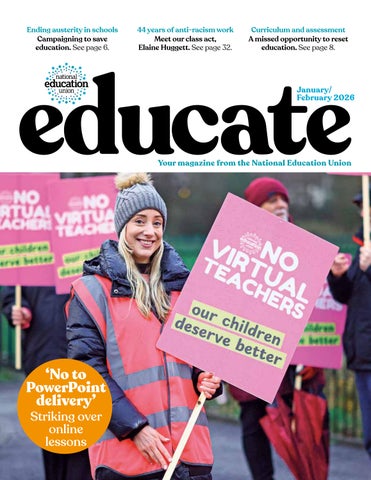
‘No to PowerPoint delivery’ Striking over online lessons
DISCOVER THE TREASURES OF ANCIENT EGYPT
GREAT RATES FOR SCHOOLS STUDENT TICKETS £9.50
TEACHERS GO FREE
Ancient Kings and Priceless Treasures, in the UK for the first and only time. With an interactive digital trail, a dedicated teaching space, and curriculum-aligned resources this is a learning experience worthy of a Pharaoh. Opens February 2026. FOR MORE INFORMATION
Visit TheSchoolTrip.co.uk/ramses Email neon@theschooltrip.co.uk
Tickets On Sale Now Ramses and the Pharaohs’ Gold is presented by NEON in association with Egypt’s Supreme Council of Antiques and the Egyptian Museum.
Educate
January/February 2026 Rep Emily Cooke with fellow teachers and parents on the picket line at The Valley Leadership Academy in Lancashire, striking over the introduction of a ‘virtual’ maths teacher. Photo by Paul Currie for Paul Greenwood Photography paulgreenwoodphotography.co.uk
Ending austerity in schools Campaigning to save education. See page 6.
44 years of anti-racism work Meet our class act, Elaine Huggett. See page 32.
Curriculum and assessment A missed opportunity to reset education. See page 8.
January/ February 2026
Your magazine from the National Education Union
‘No to PowerPoint delivery’ Striking over online lessons
NEU president Ed Harlow
NEU general secretary Daniel Kebede
Editor Max Watson Editorial assistant Frankie Faccion Journalists
Sally Gillen, Emily Jenkins & Sarah Thompson
Newsdesk t: 020 7380 4768 e: educate@neu.org.uk Production editor/design Amanda Ellis Design & subbing Melissa Harteam Moore neu.org.uk
linktr.ee/shareneu
TO ADVERTISE IN EDUCATE Display adverts t: 020 7880 7614 e: educate-magazine@redactive.co.uk Recruitment adverts t: 020 7880 8542 e: educate-jobs@redactive.co.uk
Welcome
WHO is Rachel Reeves kidding? A Budget that delivers for “ordinary people” was how she described her spending decisions back in November. Assuming that’s a politician’s shorthand for most of the population, the chancellor’s claim is laughable. Delivering for ordinary people means – as a starting point – investing in the education of their children. But where was the money for that in Reeves’ Budget? Proceeds from bake sales shouldn’t be buying school basics, but they are. There are a lot of things that just should not be when it comes to education, most of them the result of underfunding, which is why in 2026 the NEU will be gearing up for a major anti-austerity campaign. You can read about it on page 6. The government swept to power on promising to end austerity, and education secretary Bridget Phillipson promised to “build back trust with the profession”. But the pages of this issue of Educate show how far the government has drifted from that mission. No more money for education and a paltry pay ‘rise’ of just 6.5 per cent for teachers over three years. Not even an ordinary deal for some truly extraordinary people. Among you, the hundreds of members around the country who have taken time to fundraise for those in Jamaica who lost their possessions – even homes – in Hurricane Melissa (see pages 28-29). In this issue, we also cover the curriculum and assessment review. Disappointingly, its conclusions felt largely irrelevant by the time it was published, because the government had already announced all primary statutory assessments would stay and a new year 8 reading test would be introduced. A missed opportunity, many members feel (see pages 8 and 50). On page 7, we report on an unusual dispute in Lancashire. At a multi-academy trust, pupils in years 9, 10 and 11 are being taught maths by a ‘virtual teacher’ some 300 miles away in Devon. Encouragingly, parents and grandparents have joined teachers on picket lines. They understand that this shocking development at their child’s school is, at its heart, the result of underfunding. Ordinary people, whether professionals or parents, understand the fight for fairer funding for schools is, and will continue to be, a joint one. Enjoy the issue. Max Watson Editor, Educate
Except where the NEU has formally negotiated agreements with companies as part of its services to members, inclusion of an advertisement in Educate does not imply any form of recommendation. While every effort is made to ensure the reliability of advertisers, the NEU cannot accept any liability for the quality of goods or services offered. Educate is printed by Warners Midlands Plc. Inside pages are printed on paper comprised of 100% recycled, post-consumer waste.
educate Your magazine from the National Education Union (NEU)
3
If I pass away Canine Cared For
are home If I move to a c Canine Cared For g diagnosis in g n a h c e f li a If I receive Canine Cared For
Make sure your dog is cared for with a Canine Care Card
You’ve always done what you can to protect your four legged friend, and that shouldn’t change when life does. With a Canine Care Card, you won’t have to worry about what’s next for them, because we will look after and rehome them at one of our 21 rehoming centres, located all across the UK.
Apply online to get your FREE Canine Care Card at: dogstrust.org.uk/ccc E: ccc@dogstrust.org.uk or T: 020 7837 0006 Please quote “1057728”, or complete this coupon:
Please send me a Dogs Trust Canine Care Card application form
(Please fill out in block capitals) Title
First Name
Address Postcode
1057728
From time to time we would like to send you exciting updates about our work, products, services and how you can support us, including fundraising activities and research by post. If you’d rather not receive these mailings, please tick here In order to communicate with you more effectively, better understand your preferences and ability to support our work, we may analyse your data. We do share your information within the Dogs Trust Group; currently Dogs Trust Worldwide, Dogs Trust Ireland and Dogs Trust Promotions. To read our full privacy policy visit dogstrust.org.uk/privacy.
Please send this coupon to: FREEPOST DOGSTRUSTL (No stamp required.) N.B. Service only available for residents of the UK, Ireland, Channel Islands & Isle of Man.
A dog is for life® dogstrust.org.uk
© Dogs Trust 2026
Surname
Registered Charity Numbers 1167663 & SC053144 Co. Ltd 09365971
The rest is history
Contents
17 January 1941
The Green Book, Education After the War, is presented to the Board of Education’s post-war planning committee, setting out plans for a free, universal national education system. Its ideas form the basis of the 1944 Education Act, which establishes free secondary education in England and Wales.
Regulars
Features PHOTO by Kois Miah
22
19 Union people 21 Michael Rosen & Dan Berry 31 Tim Sanders & Warwick Mansell 35 Ask the union
“The fatigue was just ridiculous.”
36 International 38 Jon Biddle & reviews 43 Teacher’s pet & letters 47 Photo opportunity 48 Crosswords & sudoku
p22-25
News
22 Teaching with cancer
6
Assistant head Laura Tutty (above) on how she told pupils about her diagnosis – and handled their awkward questions.
NEU members have been joining relief efforts to support those affected by the Caribbean cyclone (below).
PHOTO by Kois Miah
28 After Hurricane Melissa
The NEU’s new campaign.
8 CAR crash
26 The play’s the thing
John Godber talks to Educate as his play Teechers returns to the stage (below right).
End austerity in education
32
Review a ‘blown opportunity’; SEND pupils and SATs.
13 Free school meals
100 million milestone reached.
14 NEU at COP30
Report from climate conference.
15 Bigger picture
Short film tipped for success.
16 News from the picket lines
GOSH, Flint, Angel, Cathedral.
18 Black educators’ conference PHOTO by Jess Hurd
Insights from the latest BEC.
32 A class act
28
26
‘I’m making the difference I want to see’ (above left).
50 Final word
The DfE is failing children.
educate Your magazine from the National Education Union (NEU)
5
News
Staff and schools running on empty An indicative ballot on strike action will be launched in February as part of a major campaign by the NEU to end austerity in education. The union will ask teachers in England if they would be prepared to take industrial action over the government’s plans to pay them below-inflation pay rises for the next three years and continue underfunding their schools. PAY: 6.5% over three years
WORKLOAD: changes to directed time The government wants to increase workload further by loosening the rules around what constitutes directed time. The NEU made it clear to the STRB that 1,265 directed hours should be a contractual limit and there should be a ban on surpassing those hours, as teachers regularly work 50-hour weeks and leaders 56.5.
Recruitment and retention will suffer In a joint letter to the education secretary in November, education unions warned: “Any award that is not fully funded will inevitably result in further cuts to staffing and essential provision, undermining the ability of schools to deliver high-quality education for all pupils.” The letter calls on the government to deliver fully funded, above-inflation pay awards every year of this parliament and restore real-term value of teachers’ pay. NEU members gave oral evidence to the STRB on 1 December, setting out how their lives are affected by falling levels of pay, and the union warned that the recruitment and retention crisis will worsen due to poor pay rises.
FUNDING: find ‘inefficiencies’ Phillipson also proposed schools should partly fund pay rises by identifying “inefficiencies” in their budgets, which unions warn will be hugely damaging.
No additional funding for schools Chancellor Rachel Reeves’ failure to announce any additional funding for schools in her November Budget – on top of a paltry pay offer – had left the union with no choice
The decision to ballot, taken by the NEU’s executive, follows education secretary Bridget Phillipson’s recommendation to the School Teachers’ Review Body (STRB) that teachers should receive a 6.5 per cent pay uplift, split over three years.
but to ballot for action if pay and funding are not increased. Schools are “running on empty”, said NEU general secretary Daniel Kebede, and the crisis in schools would be made worse if teachers are given yet another unfunded pay award. ‘We must – and will – save our schools’ “Members tell me daily the effect that years of real-term funding cuts is having on their working lives – and the education of the children they teach,” said Daniel. “The Budget has done nothing to improve this. The NEU will not accept the continued underfunding of our schools. We will not accept another pay cut. We must convince this government to change course – even if that means balloting for strike action. He added: “It is in the government’s gift to avoid a confrontation with the profession. We must – and we will – save our schools.”
Pay updates… Pay updates… Pay updates… Pay updates… n NORTHERN n In WALES, IRELAND members have rejected a fully members are funded pay rise waiting to of four per cent hear details from the Welsh of the government. In a union survey, 79 per 2025/26 pay cent voted to reject the offer, 84 per offer expected in January after cent have said they would be willing agreeing last year, following weeks to take strike action and 96 per of industrial action, to accept agreed with afrom plan to launch educate Your magazine the National EducationaUnion the (NEU) 2024/25 award of a 5.5 per 6cent political campaign to secure more cent uplift, along with a suite of funding for schools in Wales. measures to address workload.
6
educate Your magazine from the National Education Union (NEU)
n In November, NEU members at
SIXTH FORM COLLEGES in England
voted to accept a four per cent pay offer from the Sixth Form Colleges Association, but rejected its response on workload demands. The pay claim had called for workload protections including limits on contact hours and class sizes, and the addition of planning, preparation and assessment (PPA) time in teachers’ terms and conditions.
Arts provision suffering as funding cuts bite
More than half of school leaders polled by Teacher Tapp won’t increase the arts offering at their school.
Valley strike over use of ‘virtual’ teachers BRAVING the cold and rain, NEU members at a Lancashire secondary school took a third day of strike action on 10 December over the introduction of a ‘virtual’ maths teacher. Pupils in years 9 to 11 in the top maths set at The Valley Leadership Academy, in Bacup, have been taught online by a teacher based around 300 miles away in Devon since September. Star Academies, the multi-academy trust that runs Valley, appointed the virtual teacher, without consultation, blaming recruitment and retention problems. The trust has 39 schools across the country and has also brought in ‘virtual’ maths and English teachers at a school in Bradford and another in Blackpool. ‘Diminished to a PowerPoint delivery’ Maths teacher and joint NEU rep Emily Cooke told Educate: “Teaching at Valley is a human endeavour, based upon human interaction, and that cannot be replicated over a screen. I will not stand back and watch the teaching profession be diminished to online PowerPoint delivery.” Joining members on the picket line, NEU general secretary Daniel Kebede warned: “If we allow this to slide, we’ll see virtual teachers at schools around the country,
Daniel Kebede with members and parents at Valley
which undermines the learning children expect and deserve. ” Members were joined on the picket line by concerned parents and staff from other schools in the trust. Parent Kelly Reeves said her daughter Maisie, in year 11, had been “getting worked up and anxious” about a virtual teacher and how it would affect her grades: “I emailed the
TPS and wellbeing on IS agenda ATTENDING the NEU independent sector conference in London as a first-time delegate was an eye-opening and inspiring experience. I presented the first session alongside Claire Rickard and Rebecca Hayes, both school reps and national council independent sector (IS) members. We shared our successes in gaining union recognition, taking action in Teachers’ Pension Scheme (TPS) disputes, collaborating with senior leadership, and promoting staff wellbeing. I was particularly excited to discuss my role as
a health and safety rep, where I’ve implemented measures to improve staff wellbeing over the last academic year. I was inspired by the dynamic efforts one rep and his members took to challenge TPS withdrawal at their school. The day concluded with three key motions aimed at improving conditions for members, which were put forward for a vote to take to national conference. The conference deepened my understanding of the vital role unions play in education.
By Hayley Williams, NEU health and safety rep, Cardiff
PHOTO by Paul Currie for Paul Greenwood Photography
head teacher with my concerns, and in response Maisie was moved down a set. The head said she could still access the higher tier maths paper, but I’m not sure why the head of maths isn’t qualified to teach top-set maths.” She added: “How can a teacher pick up if pupils are feeling down, frustrated or unwell over a screen?” More strike action is planned.
Ofsted overlooks staff concerns NEU general secretary Daniel Kebede has criticised Ofsted’s 2024/25 annual report for failing to comment on educators’ wellbeing. “It makes very few references to the skills, views or concerns of the education profession, and no reference to the wellbeing of staff,” he said. Poor student behaviour is recognised as driving teachers out of the profession, but the report ignores the link between testing, relentless recording of data and pupil disaffection, he added. The union also believes the new grading scale risks making it
harder for educators to respond to the “very real” challenges the report sets out. Among them are disparities in outcomes for disadvantaged and vulnerable children and the “endemic problem” of absence. The NEU continues to campaign for a system that is supportive, effective and fair and encourages members to use the union’s risk assessment guide.
n Read the full report at
tinyurl.com/Ofsted-2024-25
n Visit neu.org.uk/ofstedrisk-assessment-guide
n Visit neu.org.uk/ofstedjargon-buster
educate Your magazine from the National Education Union (NEU)
7
News National Education Museum TRUSTEES of the National Education Museum are in the process of buying a property in Portsmouth to house books, documents and artefacts. The space will also be used for exhibitions and outreach work with local schools. Jean Roberts, who with her husband Hank has been key to raising funds and progressing the project, said: “Our slogan is to ‘educate, enlighten and entertain’. This will not be a museum of dusty old books and frayed artefacts, but a place to enjoy and learn from.” n Visit nationaleducationmuseum.uk
£3bn over four years for SEND THE government has announced £3 billion to fund more places in mainstream schools for children with special educational needs. The money will be spread over four years. NEU general secretary Daniel Kebede said of the much-needed investment: “Funding 50,000 places in mainstream and specialist settings will address desperate shortfalls and bottlenecks.” He said that it was sensible to create more places near families so children would not have to travel long distances to school, to settings that aren’t right for them. “Teachers, leaders and support staff will welcome the additional investment because there is such anxiety about the gap between what pupils need and what is available,” added Daniel.
‘Backbone of NEU’: biggest ever support staff conference THE biggest ever support staff annual conference was held on 7-8 November in Manchester. The 190 delegates heard from NEU general secretary Daniel Kebede, who described support staff as “the backbone of our union”. Activists led a panel discussion on workplace action, including the pay win at Cathedral Schools Trust (see pages 16-17). Members discussed the NEU’s special conference, which will be held on 28 February in London to discuss and decide how support staff will be represented by the union in future. 8
CAR: sticking to the tried and over-tested MORE than half of teachers surveyed by the NEU (56 per cent) say keeping all primary school statutory tests – recommended by a national review – will further narrow the curriculum. A snap poll of 1,136 primary and secondary teachers was carried out following the publication of the government-commissioned curriculum and assessment review (CAR) on 5 November. It also found 75 per cent of primary school teachers believe retaining tests will worsen student engagement and wellbeing. For SATs specifically, the figure was 86 per cent. ‘Blown opportunity to reset education’ NEU general secretary Daniel Kebede said the government had pre-empted the conclusions of the CAR by announcing in March 2025 – while the review was still underway – that no primary statutory assessments would be scrapped. “Sadly, the panel’s work was undermined by a government intent on sticking to the tried and over-tested,” he said. “The government blew the opportunity to reset education and eradicate the mistakes and tick-box obsessions of past governments.” Another example of that was the new statutory year 8 reading test announced by education secretary Bridget Phillipson months before the review team had reported, added Daniel. The CAR, chaired by the chief executive of charity the Education Endowment Foundation, Professor Becky Francis, advised
“Unleashing opportunity for young people starts with the curriculum.” Daniel Kebede against introducing any more national tests. It recommended a non-statutory diagnostic reading test in year 8. Union welcomes the end of EBacc Other changes to the curriculum and assessment system include scrapping the English Baccalaureate (EBacc) accountability measure, welcomed by the union, and recommendations that there is greater representation across the curriculum and that teachers must be co-creators in its design and implementation. It was “disappointing”, said Daniel, that no alternatives to high-stakes secondary exams had been recommended. “If the government is serious about young people and unleashing opportunity, then that starts with the curriculum,” Daniel added. “It is clear that the strategy of yet more assessment will do nothing to broaden the curriculum. This is the very opposite of what parents and the profession want to see.” n See Final word page 50
Key points of the CAR review n EBacc scrapped, but Progress 8 remains. n GCSE content reduced and exam times cut by ten per cent, but no alternative
assessment methods proposed. n Programmes of study updated to include “stronger representation of diversity that makes up our modern society”. n Teachers to be involved in testing and design of new curriculum. n Introduction of an oracy framework. n Introduction of non-statutory year 8 reading test.
educate Your magazine from the National Education Union (NEU)
New SEND in the Spotlight podcast on BBC Sounds
The realities of life for young people with SEND, their families and professionals who support them. Email send@bbc.co.uk to share your stories.
Parents of children with SEND delivered a letter to the education secretary calling for reform of primary assessment
PHOTO by Doug Peters/PinPep
‘Odds are so stacked against SEND pupils sitting SATs’ PARENTS of pupils with special educational needs and disabilities (SEND) have delivered a letter to education secretary Bridget Phillipson, telling her SATs “actively harm” their children. They handed it in to the Department for Education (DfE) on 18 November, two weeks after the curriculum and assessment review (CAR) failed to recommend scrapping statutory primary tests. Signed by 22 parents, including actor Anna Maxwell Martin, the letter calls for “meaningful reform of the primary assessment system”. It says: “Children who already face huge challenges at school spend their entire year
6 convinced they are not clever enough. They feel they don’t belong. They try harder every day, but the odds are so stacked against them that the weight of it all eventually breaks them.” Anna said there were systemic failings within the assessment system, “not the fault of any individual teacher or head teacher”. Campaigners from coalition More Than A Score, who joined parents for the letter hand-in, said 76 per cent of SEND children had not met the expected standard in SATs in 2025. Kirsti Hadley told Educate her 14-yearold son, who is autistic and has ADHD and OCD, had experienced severe anxiety and
panic attacks on the way to school in the year leading up to SATs. “He told me he loved the teachers and his friends, but hated learning,” said Kirsti. “The DfE seems hell-bent on pretending the assessment system is working, but it’s not. We need radical reform and holistic inclusion.” She urged parents and teachers to write to their MP. “If we all put our voices together, we can bring about the change we need. It’s probably too late for our children but we need to do this for future generations and future teachers,” said Kirsti.
n See Final word page 50
n SATs fail SEND kids – email your MP today: tinyurl.com/SATsFailSEND educate Your magazine from the National Education Union (NEU)
9
Rediscover
England
Join a River Cruise Holiday in the Beautiful Severn Vale Luxury hot el boat crui ses up to 22 passengers.
Moori ngs cl ose to tours or transport provi ded.
New dest inations dail y. 3-6 nights l ong.
Cosy twi n cabins - cl imate control , wi ndows, ensui te.
Tradit ional Engl ish food, special diet s welcomed.
All deposits financially protected.
Incl udes food, drink, tours & more - no hi dden ext ras.
Pre- crui se hot el packages avail abl e.
FREE BROCHURE: Call 01452 410411 englishholidaycruises.co.uk
Examine with us Mark A Levels & GCSEs • • • • •
• Build confidence supporting your students with assessment • Enhance subject knowledge • Great for professional development
Join our team: as
10
educate Your magazine from the National Education Union (NEU)
Opinion
Labour let us all down. Enough is enough NEU general secretary Daniel Kebede looks back at Rachel Reeves’ disappointing Budget and sets out next steps in the fight to end the ongoing austerity in education.
HAPPY new year, and I hope you were able to have a relaxing break over the holiday. As we welcome pupils back for a new term, we can start to feel the dark nights lightening and the hope that the prospect of spring brings. But sadly, there is very little in the way of optimism in education at the moment. You have been telling me shocking tales of the impact continued austerity is having on you and the young people you teach. Staff and children shivering in their coats in class because there’s no money to fix the heating. A teacher who has stopped drinking water during the day because her nearest toilet is broken and she does not have time to walk across the school to another one. Workload rising further as support staff leave and are not replaced, and class sizes swell. Never has the working day felt such a slog. We have a deep recruitment and retention crisis in our schools and colleges, and it’s not difficult to see why. No crumbs of comfort from Labour It doesn’t have to be like this. Many of us believed a Labour government would at least start to fix the problems educators are facing. But it seems our faith was misplaced. At the end of November, chancellor Rachel Reeves announced her Budget – a clear opportunity to start fixing the funding crisis in our schools. But in her statement there were no crumbs of comfort to be found for head teachers struggling to balance their books. This failure to improve school funding was a further kick in the teeth that followed the government’s evidence to the School Teachers’ Review Body (STRB) – which makes recommendations on teacher pay rises – for a 6.5 per cent pay rise spread over three years and weighted towards later years.
Daniel speaking at a public meeting on funding cuts at Cheney School in Oxford
This pay ‘rise’ – likely to be a pay cut once inflation is taken into account – will have to be funded by schools making “efficiencies”, with no extra money provided by government. Seriously, what world do these politicians live in? You know as well as I do that there are no “efficiencies” to be made, only deep cuts that will irreparably damage children’s education. And teacher pay has already fallen by around 20 per cent since 2010, contributing to the shortages we are now seeing. Shockingly, the government’s STRB remit also includes a suggestion to look at ways of eroding the workload protection of the current limit on “directed” working hours of 1,265 per year. With workloads already at unmanageable levels, how on earth will this attract more teachers and help keep the ones we have? A system running on empty Before Christmas, your elected representatives on our national executive met to map out the next steps in our campaign to save education. Because when this government says the country cannot afford to invest more money in education, we say this: we cannot afford not to. Education funding as a share of gross domestic product is at its lowest percentage for
PHOTO by Kois Miah
25 years. Under the last Labour government, it was five per cent; now it is 3.9 per cent. That difference means education is being shortchanged to the sum of £20 billion. Funding is worse now than under Boris Johnson or Theresa May’s governments. Staff are trying their best to hold things together, but they are swimming against the tide. The system is running on empty. And it is children who, ultimately, are losing out. Working together, we will build a case over the coming months for better pay and funding – taking the argument to government, and to parents. We need a commitment to fully funded and above-inflation pay rises that start to address the real-terms pay cuts since 2010. And we need a guarantee to raise the level of education funding to reward and retain our amazing school staff and restore teaching to its rightful place as a high-status profession. If this government doesn’t deliver, we are prepared to take whatever steps are necessary. We will launch an indicative ballot in February, asking if you are willing to take strike action on the issue of continued austerity in education. It is in the government’s gift to avoid a confrontation, but time is running out.
educate Your magazine from the National Education Union (NEU)
11
News ‘Love is greater than hate and hope more powerful than fear’
THE NEU has joined a coalition of more than 50 organisations and hundreds of individuals to counter growing hate and division. The Together Alliance was launched on 2 December as a response to the growing popularity of Reform UK, and record numbers of people joining far-right street protests. NEU general secretary Daniel Kebede said, as a union of half a million members, the NEU knows “our strength lies in solidarity”. A statement of support on Together Alliance’s website warns “the voices of division in our country are growing louder and those who preach division are becoming more confident”. It has been signed by hundreds of organisations and individuals. Daniel said: “As educators we are the heart of our communities and at the NEU we believe that love is greater than hate, unity is stronger than division, and hope is more powerful than fear. “Together we can reject division and racism, build solidarity in our communities, and unite against the far right.” Sister education unions the National Association of Head Teachers and NASUWT have also joined the alliance, alongside Unison and Unite, and other organisations including charities Stand up to Racism and Show Racism the Red Card. High-profile figures in the entertainment industry including comedian Sir Lenny Henry, singer Paloma Faith and actors David Harewood, Toby Jones and Juliet Stevenson have signed up to support. n Sign up at togetheralliance.org.uk
National demo against the far right, London Saturday 28 March 12
Supply teacher wins pay claim A SUPPLY member has won a claim for equal pay against one of the largest agencies in the UK after she used the NEU agency pay assessor tool and found she was being underpaid. The member, who cannot be named, took a placement at a primary school in September 2023 on an M3 salary on the main pay range and was legally entitled after 12 weeks to be paid on M4. Agency Worker Regulations 2010 (AWR) state that after 12 weeks in the same role with an employer, supply teachers are entitled to the same rate of pay as directly employed staff. However, the member was kept on M3 until she left the placement in August 2024 and then contacted the agency using the NEU’s AWR model pay letter, explaining she been underpaid for eight months. It refused to pay the arrears, telling her she was not eligible for the same pay as a classroom teacher, having been hired as a ‘cover teacher’. The union’s regional office took up the case, and the agency has now settled the claim for a four-figure sum. “Know your rights and fight for them,” the member told Educate. “We do a very hard job and should be compensated fairly. Use the
support of your union to help you. I am grateful to the NEU for fighting my case and seeing my rightful wages paid to me.” She added: “Hopefully the agency will think twice before trying the same thing again. It has contacted me to find out my availability, but I have declined to work with it again. It is a shame for them as I was in demand as a supply teacher with schools requesting me by name.” n If you are concerned you are being
underpaid, visit awrpayassessor.neu.org.uk
Join our campaign The NEU’s Stop the agency rip-off campaign is calling for the government to protect supply teachers by compelling employers to pay them nationally agreed rates and to introduce a national supply teacher register to replace commercial agencies. On average, a school pays more than £200 a day for a supply teacher, who may receive as little as £110. Add your voice to the campaign at neu.org.uk/stop-agency-rip
SPIRITED debate took place at a joint working event in Northern Ireland (NI), where committee members from the NEU joined the Irish National Teachers’ Organisation (INTO) and Ulster Teachers’ Union. Executive member Edel McInerney led a session on the pressures in special educational needs (SEN), including increasing complexity of pupils’ needs and delays in accessing external support. Edel also facilitated a discussion about NI education minister Paul Givan’s new strategy to transform teaching and learning – TransformED NI. Delegates examined the SEN-related elements of the proposal, and were clear that reforms must be properly resourced, co-designed with practitioners, and realistic for schools already working beyond their limits.
educate Your magazine from the National Education Union (NEU)
Nominate your NEU rep and officer of the year Closing date Friday 16 January. Find out more at neu.org.uk/rep-and-officer-awards
Daniel Kebede and Sadiq Khan with pupils and staff at Shoreditch Park Primary School
PHOTO by Paul Bates
Historic day as 100 million meals are served NEU general secretary Daniel Kebede marked 100 million dinners being served as part of London’s universal free school meals (FSM) scheme with mayor Sadiq Khan and pupils at Shoreditch Park Primary. Describing the milestone as “historic”, Daniel said: “Westminster can learn a lot from London’s universal free school meal provision.” Khan introduced FSM for every primary age pupil in September 2023, saving families around £500 per child annually, and has pledged to fund the scheme while he remains in office.
Daniel said: “The provision of 100 million FSM has lifted hundreds of thousands of families up, relieving the pressure on parents and carers and ensuring children have the healthy, nutritious lunch they need to thrive in school.” ‘Too many children still missing out’ He added that the government’s expansion of free school meals to all children in households receiving universal credit was welcome, but “too many children are still missing out”. Commenting on the government’s longawaited child poverty strategy, published in
December, Daniel said more needed to be done to tackle child hunger. The NEU’s Free School Meals for All campaign is continuing to call on the government to introduce FSM for every primary school child in England, in line with London and Wales. The removal of the two-child benefit cap, included in the strategy and announced in November’s Budget, was welcome, but Daniel said a lack of binding targets in the strategy was a concern. “Warm words will not heat homes or help children concentrate in class,” he said.
Help us raise vital funds with Save the Children THE NEU has joined forces with charity Save the Children to support its work with the millions of children living in crisis around the world. More than 210 million children are in need of humanitarian support because of war, disaster or disease, while funding from wealthier countries is diminishing.
The NEU is proud to be supporting Save the Children’s emergency fund with the launch of its Raising Hope appeal. As well as inviting individual donations from members, districts and regions, the union suggests organising events such as a cake stall or fundraisers, for example to mark International Day of Education on 24 January or International Women’s Day on 8 March. All money raised will make an impact on the charity’s work – £12 provides a birth kit
to help a woman in Sudan deliver her baby safely, £30 is enough for a teaching kit in Afghanistan, while £60 could provide a food parcel to a family in Gaza.
n For more information, visit neu.org.uk/ raising-hope
n To donate, go to justgiving.com/ campaign/neufundraising
n Save the Children can provide speakers for your fundraising events. Visit savethechildren. org.uk/how-you-can-help/schools
educate Your magazine from the National Education Union (NEU)
13
NEU members joined a London climate march in November
PHOTO by Kirk Pritchard
NEU campaigns at COP for ‘just transition’ By Jenny Cooper, NEU climate change network and TUC delegate to COP30
I WAS honoured to represent the NEU and TUC at COP30, the United Nations (UN) climate change conference, in Belém, Brazil. The NEU pushed the case, alongside global unions, for a Belém Action Mechanism (BAM) on just transition, a framework to ensure workers and communities are protected with regards to finance, jobs, safety and human rights while a country moves to a green economy. Unions globally are concerned by the rise of far-right politics, which claim that moves to
a green economy will be detrimental to working people, but through our collective action at COP we persuaded the UK government to back it. The NEU delegation took part in the People’s Summit, a huge march on 15 November, and members in cities including London (pictured above), Leeds and Brighton took part in solidarity protests. I attended education meetings including the launch of the Greening Education Partnership tools, which were produced by the UN Educational, Scientific and Cultural Organisation (Unesco), Education International (of which NEU is an affiliate)
and other international stakeholders, to help countries prepare for climate change. I was proud to be on the briefing panel for the education toolkit, which gives advice for schools. Ninety-seven nations, including the UK, have already signed up to the partnership. I also presented a live online class on climate change, alongside colleagues from Canada and Zimbabwe, beamed to thousands of UK school children. My colleague from Zimbabwe, Sifiso Ndlovu, was funded by the NEU to attend COP to increase the voices of the Global South in discussions on climate change.
By Shaniqua Edwards-Hayde, primary school teacher and co-chair of the London region’s NPYW network
TRAINEE educators, early career teachers (ECTs) and support staff came together for an evening of politics and discussion at the London region’s new professionals and young workers’ (NPYW) network event on 7 November, held at the NEU’s head office. For many, it was their first NPYW event and a chance to find a supportive community. Sarah Green, secondary teacher and vice-chair of the NPYW national council, spoke about the union’s campaign A Better Deal for New Educators, which is calling for adequate time for training, an end to support 14
plans for ECTs and trainees, and ensuring that preparation, planning and assessment (PPA) time is protected.
panel also answered questions on key issues, including agency work, support plans, fixed-term contracts, and PPA from home.
During a panel discussion, educators active in the union shared how they first got involved, what keeps them engaged, and some honest stories about school life. The
A representative from the London Renters Union spoke about the housing pressures affecting not only the families we teach, but also educators themselves, highlighting how the
educate Your magazine from the National Education Union (NEU)
cost-of-living crisis cuts across home and school life. The evening was a chance to meet others, build connections over pizza, and hear about the wider life of the network, including our January bowling social, NPYW conference, organising meetings and cross-union football.
Bigger picture
LARGO, a short film about a Syrian refugee living in foster care in the south of England, tells the story of ten-year-old Musa who, feeling unwelcome and homesick, decides to build a boat and sail home to his parents. Starring first-time actor Zack Elsokari (pictured) as Musa and Tamsin Greig as his foster parent, the film is being described as a possible contender for the Oscar and BAFTA awards. School screenings are planned in 2026 and last November it was shown at three schools. At Stoke Newington School, in north London, Zack joined year 9 students and
head of year Anna Gluckstein. She said it was “eye-opening” for pupils, who were “totally empathetic”. “To have a sympathetic story about a child for other children to see is more powerful than anything teachers can tell them in the classroom,” she added. Co-writer and director Salvatore Scarpa said Largo was “a counter to the negative narrative surrounding refugees in the UK, which school students have grown up with their entire lives”. n Teachers interested in screening Largo and running the associated workshops can email largofilm@slickfilms.co.uk n Visit slickfilms.co.uk/largo
News South Wales Women Against the Far Right: ‘Not in our name’ By Kate Pearce, NEU assistant branch secretary, Llanelli
AT the launch of Women Against the Far Right in south Wales on 4 November, I spoke as a proud member of the NEU against the far right’s attempt to weaponise violence against women and girls. Women Against the Far Right is a movement of women, educators, trade unionists and campaigners refusing to let our struggles for equality be turned into excuses for racism. Women do not need to be ‘protected’ by the far right. Reform UK and anti-immigration groups, such as Pink Ladies UK, claim to care about our safety, but they are not defending women, they are using us. Male violence is twisted into a tool to target migrants, refugees and minority communities, rhetoric that does nothing to keep women safe. We need fairness, justice and investment in the services that protect all of us. Communities are in crisis because housing, health and education have not had the funding they need, not because of refugees and migrants. My message was simple: in our schools, unions and communities, we must stand up against hate in every form. We must build a movement that says women’s safety will never again be used as a justification for racism. Not in my name. Not in our name.
Independent investigation into ‘bullying’ head at Flint MEMBERS at Flint High School in north Wales are celebrating after their 12 strike days forced Flintshire county council to agree an independent investigation into bullying by the head teacher. The industrial action was also taken because of poor behaviour management at the school, where students subjected teachers to physical harm and threats. NEU rep Rob Oldfield said: “All members look forward to our school becoming a safer place of learning and teaching.” 16
TEACHERS at a sixth form in north London are continuing strike action over their employer’s refusal to award them the nationally agreed 4.3 per cent pay rise. Members at Sixth Form Angel (pictured above) have taken 16 days of action because Capital City College (CCC) group, which manages the college, offered just 2.5 per cent. CCC says it wants to close the pay gap between teachers and lecturers employed by further education colleges in the group. Talks held with arbitration service Acas on 13 November failed to resolve the dispute.
Huge victory for CST support staff
Daniel Kebede on the picket line with Cathedral Schools Trust members
A MAJOR pay win by support staff at a multi-academy trust (MAT) means some members will receive thousands of pounds in withheld salary increases. Support staff at Cathedral Schools Trust (CST) took four days of action in November after discovering they were losing pay each year because they were receiving their annual uplift in their September, rather than April, salary. The NEU took action alongside Unison members at nine of the MAT’s 12 schools across Bristol and North Somerset. One NEU member, who has been employed at CST for six years, calculated he had been underpaid by £2,000. Emma Bowyer, a rep at St Werburgh’s Primary, said: “I’m so proud to have been part of this action. Striking is never easy, but
educate Your magazine from the National Education Union (NEU)
this win proves it’s necessary, and knowing the difference it will make to support staff is amazing. I’m going to celebrate by turning my heating up.” The trust agreed to backdate the 2025 uplift to April, after staff were balloted for action in September 2025, but it had still refused to repay salary withheld in previous years. November’s strikes were supported by teachers, parents and NEU general secretary Daniel Kebede, who joined picket lines. Members unanimously agreed to settle the dispute after being offered an individual payment. Roz Keir, Bristol district membership secretary and a careers lead at CST, said: “The trust saw the strength in our numbers and our support. It could not beat us.”
No time for complacency, says NEU
Rise in number of teacher trainees, but a quarter of new teachers quit within three years.
Hospital school staff strike over bullying NEU members at Great Ormond Street and UCL Hospital School in London have taken 14 days of strike action after four members – one a union rep – were suspended when they raised concerns about a bullying management culture. Three of those suspended, senior leaders who are active in the NEU, haven’t been at work since October. All four members are on full pay and being represented by the NEU. ‘Chaotic, unacceptable management’ Staff began to raise concerns in 2024 when a new head teacher implemented “chaotic, bullying and unacceptable management practices”, such as changes to directed time, without consulting staff. Changes included making supervision – a form of therapy for the emotional side of the teaching role – mandatory, group based and after directed time, when previously staff were able to opt in and choose a one-to-one or group setting. Staff were also concerned about the head’s insistence that pupils attend a school assembly via Zoom, which meant they would lose 20 minutes of their daily one-to-one, hour-long lesson on the ward if the two clashed. Speaking up brought accusations they were “barriers to change”, say members, which created a “climate of fear”. One NEU rep told Educate: “Within a month of the head starting, colleagues were coming to me crying and saying they felt disrespected. It’s a difficult enough job
NEU general secretary Daniel Kebede on the GOSH picket line
working with children who are very sick, but when you’ve got colleagues coming to you in tears, not because their pupil is ill but because of the way they are spoken to, it is really difficult.” A strike ballot in June led to talks with arbitration service Acas and changes were agreed, including a strategic calendar for events such as assessment deadlines and school trips, but not implemented. NEU members say there is a “divide and rule” culture, in which they are sidelined, denied promotions and refused support.
PHOTO by Jess Hurd
One of those suspended said: “It feels like a punishment for daring to use my voice. That is dangerous in a school where we are working with vulnerable children.” A petition set up by Camden NEU had more than 1,200 signatures as Educate went to press. It calls on the governing body to reinstate the four members, launch an independent investigation into unacceptable practices at the school and end trade union victimisation. n Sign the petition at tinyurl.com/ GOSH-UCLH-petition
SIX days of strike action have been taken by staff at a north west London special school over cuts to support staff pay and hours that will leave some £200 a month worse off. Staff at Woodfield School (pictured left), in Brent, are fighting back after Compass Learning Trust said 47 support staff would lose 3.5 hours a week from 31 December. NEU rep Anchalee Limchawalit said members had met with the board “in good faith” after the sixth strike day, but unanimously rejected the offer to give them back just one hour a week. “They felt the trust hadn’t even attempted to meet them halfway, leaving frontline staff feeling deeply undervalued despite the vital work they do every day,” said Anchalee. As Educate went to press, three more days of action were scheduled for the last week of term. educate Your magazine from the National Education Union (NEU)
17
PHOTOS by Kois Miah
News
‘The best Black educators’ conference’ GATHERING for this year’s Black educators’ conference (BEC) in Birmingham (14-16 November), more than 600 members debated issues under the theme Unity at a time of polarisation. The weekend included a panel debate on the discrimination experienced by overseas-trained
teachers (OTT), where members learned about the NEU’s new model policy for OTTs. Speakers at the conference included Dr Lesley Nelson-Addy, former education manager at race equality thinktank The Runnymede Trust, who presented research on exclusions, misogynoir and the Eurocentric curriculum. Jeffrey Boakye entertained delegates as he shared his journey from a
Unapologetic celebration of identity By Johnoi Josephs (left), an assistant head in Lewisham, south London, and co-founder of Black Men Teach.
ATTENDING as a delegate and a workshop facilitator was an energising and grounding experience. This year’s theme could not have been more fitting. What struck me immediately was the collective understanding that meaningful change does not rest on the shoulders of a few. As the conference reminded us, it’s better when all of us do a little something than when some of us do a few things. This speaks directly to school leaders navigating increasingly complex educational landscapes. One of the most resonant moments came from author Jeffrey Boakye’s reminder: “If we are not at the table, 18
we are on the menu.” As a Black school leader, this landed heavily. For years, I had been told that leaders should not be in the same union as the staff they manage. BEC 2025 reminded me that leadership does not exclude us from community. The NEU is strengthened when leaders take their place within it. What I appreciated most was being in a space that spoke directly to my own visible intersectionality as a Black educator. The language, the framing, the unapologetic celebration of identity and contribution – these were affirmations I didn’t realise I needed. Beyond the sessions, the laughter, the reconnecting, the sense of shared purpose reminded me that remaining in this profession is not only a career decision, but also a duty of representation, community and continuity. BEC 2025 sharpened my thinking, reinforced my belonging, and renewed my commitment to the work ahead.
educate Your magazine from the National Education Union (NEU)
classroom teacher to author and broadcaster. Topics at the member-led workshops ranged from the Black boy’s experience to Islamophobia, while there was also time to celebrate the exceptional commitment and contribution of six educators (see box, below). One member declared it “the best BEC ever”. Delegates left feeling energised, reconnected and unified.
BEC’s best Meet our winners n New activist For talent and innovation. Lauretta Nwaka, Norfolk n Outstanding contribution Union leaders who have sparked positive change. Denise Henry, Lambeth, London n Claire Gray award Internationalist work that has had a global impact. Rizwana Shelley, Medway, Kent
n Manoj NathaHansen award For great intersectional work. Akeim Mundell BEM, Manchester n Support staff award Work that strengthens our union. Dee Makanda, Cambridgeshire n Sauda Kyalambuka award The vital contribution of supply members. Zeenat Syed, Barnet, London
Union people Economics teacher George Buchanan is the workplace rep at Cheney School in Oxford, where he has taught for 11 years. What do you love about your job?
People have struggled for generations so that children can access the kind of learning we have today. To be able to work with students and give them the opportunity to participate in world-class education is a privilege. My specialist subject is economics, and I see the value in equipping students with the analysis they need to be able to interpret the world and understand the economic forces that shape their experience.
What do you love about being in the union?
Our union has a lot of active members who campaign to change education for the better: Stop School Cuts, Abolish Ofsted, Free School Meals for All, Big Tech’s Little Victims, which calls on the government to urgently raise the age for using social media to 16. Our members don’t passively accept worsening conditions or untenable situations.
The NEU is also an internationalist union, which stands in solidarity with educators in places such as Cuba and Palestine, who are on the frontiers of antiimperialist struggle.
What have you been up to lately?
I organised a Stop School Cuts public meeting at my school. It was a great display of professional unity, with representatives from the four major education unions – the NEU, ASCL, NAHT and NASUWT. We had educators, parents and carers on board, and our general secretary Daniel Kebede spoke. In November, I attended Viva la Educación, the NEU’s first conference with Cuba Solidarity Campaign, and in the leadup to the conference, NEU Oxfordshire hosted a comrade from Cuba. I was part of a delegation to Cuba in 2023 and want to continue to support the international work the union does.
What’s important to you right now?
We are living in a critical moment with respect to state education. Educators carry a lot of the burden of society and are at breaking point. Overworked and stressed, mental ill health among professionals is at crisis level. Educators’ working conditions are students’ learning conditions. We’ve seen real-wage decreases for educators over the last decade, directly impacting recruitment and retention in education. Support staff remain underpaid and undervalued. There are teaching assistants who are on term-time only contracts. Support staff are vulnerable to being the first to be made redundant in cost-cutting restructures. Most school support staff aren’t in a union, which is hampering progress in improving conditions. As the majority are women, the lack of real pay progression contributes to the gender pay gap.
What do you do on your day off?
Photo by Kois Miah
I’m working towards chartered teacher status through the Chartered College of Teaching. When I’m not doing that, I participate in pub quizzes, sew patches onto my jacket, write articles for Economics Today magazine, and hunt for industrial action to put on strikemap.org. I also play ultimate frisbee and knock around on narrowboats on the Thames.
Tell us something we don’t know.
‘A critical moment for educators’
I recently gave blood for the 50th time. For me, it’s an act of solidarity. If I needed a blood transfusion, I know I would accept one from a stranger, and I should be willing to offer my blood to others who need it. In a similar vein, I donated my left kidney to a stranger in 2013. My workplace is the only school in the country which is also a museum with full accreditation by the Arts Council. The museum is spread across the school and features original and replica artefacts from a range of eras. You can read more about it at rumblemuseum.org.uk
19
Timber windows
WINTER SALE
15
% OFF
ALL TIMBER WINDOWS & DOORS IN DECEMBER & JANUARY
Naturally beautiful, our award-winning timber windows and doors are the logical choice. Constructed from engineered timber slow grown in cold climates, their strength, stability and beauty are guaranteed. Our collection has been carefully and sensitively tailored to complement the English home. Unlike timber windows of old, our products will not twist, will not rot and require very little maintenance. High levels of insulation and security ensure there is no need to sacrifice beauty for comfort.
15%discount off all windows
With a
& doors in our Winter Sale, explore the range in
56 showrooms nationwide.
T: 0800 030 2000
Pick up o ur brand ne INSPIRA w TIONS magazine in your local sho wroom
timberwindows.com/em
20 educate Your magazine from the National Education Union (NEU) Educate - 95.5mm w x 263mm h.indd 1
19/11/2025 09:32
Michael Rosen
Testing testing… Beware of a terrible kind of affliction! Or perhaps it’s really a kind of addiction. Those who run education think it best if they test and test and test and test.
But is this enough for the exam addicts? No! They say that a good exam predicts students’ needs and learning rates So they’ve invented a new one for year 8s!
The phonics screening check comes first ‘Voluntary’ key stage 1 SATs aren’t the worst. Then it’s key stage 2 SATs including GPS giving us the ‘expected levels’ mess.
Those who run education think it best to test and test and test and test.
Key stage 3 was test free, positioned before the GCSE mountain in key stage 4. This leaves some experts perplexed given the paths students take next.
Words by Michael Rosen Illustration by Dan Berry
educate Your magazine from the National Education Union (NEU)
21
Feature Interview
22
educate Your magazine from the National Education Union (NEU)
Laura Tutty is an assistant head teacher at The Bromfords School in Essex. In April, she was diagnosed with breast cancer. She talks to Educate about navigating her role as an educator during treatment. IT’S common for educators to experience some anxiety on GCSE results day, longing for their students to do well. But this year, Laura Tutty found herself worrying for another reason: she had started chemotherapy just weeks earlier and it had caused her hair to fall out. “I got myself in a bit of a tizz as I didn’t want to arrive at school and take attention away from the students getting their results.” In the end, Laura went along, but only after she had gone out and bought a wig – so uncomfortable she stopped wearing it a few weeks later – and was glad she had attended. “Staff and students just said, ‘I like your new haircut.’ That was it. The things we build up in our heads are frequently less significant than we fear,” she says. But managing cancer treatment as an educator has been eye-opening, she adds, with concerns including whether, and how, to tell students and parents; the increased risk of infection in a classroom environment; the difficulty of taking breaks; and being on her feet for so much of the day. “If you’re working in an office, you can manage things in a way that’s quite different from standing in front of a group of students.” Beginning treatment It was during the February half term that Laura found a lump in her breast during a self-examination, something she does periodically because of her family history of cancer. Laura’s younger sister had cancer of the brain and spine as a child, and her mother now has stage 4 breast cancer. “I knew I’d go straight to the GP as soon as I returned home,” she says. Laura was referred to hospital, had a biopsy and a mammogram, and was diagnosed at the beginning of April, the day before the Easter break. In May, she had a lumpectomy – surgery to remove the tumour in the breast and some lymph nodes in the armpit. Analysis showed that chemotherapy was required, which she started in July, finishing in early October, before beginning radiotherapy. Her line manager, also the head teacher at Bromfords, has been so supportive throughout, she says. Following the lumpectomy in May, Laura was off work until mid-June, at which point the school arranged
a telephone appointment with an occupational therapist, and together they made some recommendations to the school. ‘The fatigue was just ridiculous’ Laura requested part-time working and asked that her role would not include teaching, break and lunch time or detention duties, attendance at senior leadership team meetings and whole-school briefings. Instead, she focuses on her role as assistant head teacher: SENCo, which includes undertaking annual reviews and line managing staff within the special educational needs and disabilities (SEND) department. She is on site three hours a day, although this can be longer on good days. Equally, if she feels unable to go in, she might work from home. Laura’s course of treatment caused extreme exhaustion. “The fatigue was just ridiculous, to the point that I’d wake up, take a shower, go to put some clothes on, and then have to lie down for 30-45 minutes, because I felt so exhausted,” she explains. “But I’ve been so keen to keep working, even though there are some days when I probably would have benefitted from staying at home. Like most people in teaching, I feel very emotionally connected to my job.” Being completely office-based means that she can take regular breaks and is no longer required to stand up for long periods. She is able to take phone calls from the hospital, which can be frequent. She also has help from her SEND administrator, who has taken dictation when Laura has struggled to look at a computer screen. She really misses teaching and her students, which has perhaps been the biggest change to her role. “By stepping away from teaching, I was reducing the risk of picking up infections,” she explains. “I’ve had colleagues and friends who have been going through cancer treatment who have caught pneumonia and various infections. Your body is so weak it doesn’t have the capacity to fight anything off.” But she feels fortunate that there are still opportunities to see students in her role overseeing the SEND department. “We have a number of students who come up to the office at break and lunch, so I still get some social interaction with them. And when I’m wandering around the corridors, students will come up and say hi.” While there is still a risk of infection, it is reduced by coming into contact with fewer people. continued on page 25
Road to recovery Interview by Sarah Thompson Portrait by Kois Miah educate Your magazine from the National Education Union (NEU)
23
Sick leave and sick pay entitlements While the law does not give employees an automatic entitlement to be referred to occupational health after a certain period of sick leave, employers have a duty of care under health and safety laws and the Equality Act 2010 to consider reasonable adjustments for employees with health conditions or disabilities.
Referring to occupational health is often part of fulfilling that duty and most workplace policies allow the employer to make such a referral after four weeks or more of absence. For more information about your rights while on sick leave, go to neu.org.uk/sick-pay-leave
NEU4122/1225
Occupational health can give professional input on your fitness for work and your need for workplace adjustments as a result of ill health.
Feature continued from page 23 Laura thinks being an assistant head probably made her role easier to adapt. She was not in the classroom full time, and much of her role was carried out in an office environment. “If you’re a face-to-face primary school teacher, though, that’s not necessarily an option. Everybody’s experience will be different, depending on their role within a school and the key stage they teach,” she says. One of the things Laura says she struggled with was finding any advice on how to tell students about a cancer diagnosis. “There is a lot of guidance about how to tell your own children you have cancer, but that’s very different from being faced with a group of students. There’s also the nuance of how you would approach the subject with a primary class, as opposed to secondary students.” After giving it some thought, Laura decided not to make a big announcement, but to provide students with information as and when they asked for it. “For the most part, my philosophy has always been that when you give students honest and concise information, they tend to process that and respond really positively.” Some questions have, however, been very blunt. One child asked: “Are you gonna die, miss?” and while Laura says she didn’t mind this, and feels lucky that her cancer has not spread, she appreciates that some would find the question very difficult and upsetting. She has perhaps been more surprised by the reactions of some parents. Initially, Laura chose not to share the news of her diagnosis
“I’d wake up, take a shower, then have to lie down because I felt so exhausted.” with parents. “I felt I didn’t want to draw attention to myself.” The importance of peer support But following surgery and her return to work, some parents asked questions. “I’ve had emails from parents saying, ‘I don’t mean to cross any boundaries, but clearly you’ve got stuff going on.’ Most of the time it’s very well meaning. But it’s also about thinking: what am I prepared to answer, what am I prepared to share? “In hindsight, it would have been more straightforward to have sent out a blanket message to parents, explaining that for health reasons I was only on site part time. But that’s in hindsight, and wouldn’t be the same for everybody,” she says. At times, Laura has felt slightly cut off from school life. There is, understandably, a reluctance from colleagues to contact someone when they are not in work, but that can feel quite isolating, she says, because you want to know how your students are progressing and what’s going on with your staff. So for
most people, a degree of contact is probably important, she thinks. Back in school, Laura has also found that the fact she is no longer teaching, and is working part time, means fewer social interactions than before. “My office is a little offset from the main building and I’m only in for three hours a day, so sometimes I don’t cross paths with anyone. But when people take 30 seconds to drop you a WhatsApp message or stick their head around the door to say hi and ask how you’re doing, that’s so appreciated.” She thinks a peer support system would have been beneficial and is considering putting one, or something like it, in place when she is back in work full time. Women make up 76 per cent of the teaching profession, and of NEU members. “By that statistic, there’s a very high likelihood a lot of women today are going through treatment for breast cancer.” For any NEU members going through an experience similar to hers, Laura advises contacting the school or college’s union rep, a great “sounding board” who can provide support and information on rights and reasonable adjustments. Laura is also keen that educators have a way of sharing their experiences and good practice, and offering peer support. She is now exploring setting up an online platform for educators to do all these things. Laura’s last radiotherapy session was at the end of November, after which she gradually increased her hours. She hopes to be back at work full time in January.
Work and cancer Advice from the NEU and Macmillan n Protection from discrimination A cancer diagnosis is treated as a disability under the law, and a person who has had cancer is protected from unfair treatment at work for the rest of their life. Examples of discrimination include losing out on a promotion to someone less able and experienced than you for a reason related to cancer; being demoted without your agreement; receiving a formal warning about sickness; an employer suggesting you retire or stop working or selecting you for redundancy.
Workplace NEU reps can provide advice, or call the union’s AdviceLine on 0345 811 8111. n Right to reasonable adjustments You may request
reasonable adjustments to help you keep working throughout treatment or after you return to work. Some people experience long-term side effects for months, even years, after their treatment has ended. Fatigue, pain and limited movement, bowel and bladder changes are among them. Adjustments
such as reduced hours, a change in duties, extra breaks and time off for medical appointments can help. neu.org.uk/cancer-reasonable-adjustments n Telling colleagues about a cancer diagnosis Choosing
whether to tell colleagues is a personal choice. The benefits of talking about it include receiving support, including from others who also have or have had cancer. It may also help colleagues understand the impact of your symptoms and side effects from treatment, including fatigue, loss of concentration or the risks you face from infection.
n Macmillan Cancer Support offers
help with any question, big or small. For information, support or just someone to talk to, call 0808 808 00 00 or visit macmillan.org.uk
educate Your magazine from the National Education Union (NEU)
25
Feature Interview
‘Helping find their
Playwright John Godber discusses his former life as a drama teacher and the importance of arts in education with Emily Jenkins. AS a “working-class lad from a mining family”, playwright John Godber knows the difference arts subjects can make to marginalised and disadvantaged students. “When I was at school, everyone did drama, art and music. And that is the reason I’m sat here today. There was just something about drama that allowed me to understand the world,” he says. John has achieved successes most writers can only dream of. Beginning his professional writing career in 1984 on the TV show Grange Hill, he has since written more than 70 plays, with several now listed for study on the GCSE and A-level drama curriculum. In 1993, he was rated as the third most performed playwright in the UK after William Shakespeare and Alan Ayckbourn by The Plays and Players Theatre Yearbook. Marginalised arts ‘rings alarm bells’ A passionate advocate for arts in education, John says that over the years he has seen creative subjects deprioritised within the curriculum. The introduction of the English Baccalaureate (EBacc) in 2010, which focused on core academic subjects such as English and maths, has led to a huge drop in students studying arts subjects. Between 2010 and 2023 there was a 42 per cent decrease in GCSE entries to creative subjects and, since 2014, a 57 per cent drop in arts further education. “When you start to see the arts marginalised and put at the edge of the curriculum, it rings alarm bells,” he says. In November, as part of the curriculum and assessment review it commissioned, the government announced that the EBacc would be scrapped so that “arts GCSEs will now be given equal status”. The announcement has been welcomed by the education profession, the NEU and arts organisations. 26
The changes will not come into effect until 2028. Meanwhile, a generation of young people have been discouraged from studying arts subjects, says John. A place of expression The largest fall in A-level exam entries in the last two years has been for drama (6.7 per cent). Before going into writing, John was a drama teacher then head of drama at Prince Henry’s Grammar School in West Yorkshire, where he had also been a pupil. A teacher for five years, he got his break into TV after taking a play he
Win two tickets to John Godber’s Teechers tour
The cast of Teechers
Email educate@neu.org.uk by 20 January with the subject line TEECHERS. Make sure to include your name, membership number and the date and location of your preferred performance. One lucky winner will be selected at random.
educate Your magazine from the National Education Union (NEU)
r empathy button’
Feature
From teacher to Teechers John has updated one of his earliest plays, Teechers, and it is returning to UK stages in 2026 for a six-month tour. First performed in 1987, Teechers is a play within a play, in which three students from fictional comprehensive Whitehall High School tell the story of their year working with new, idealistic drama teacher Mr Nixon. Down the road is the “posh” private school St George’s which has all the facilities and opportunities that Whitehall does not. The play explores the value of arts in supporting disadvantaged students and the challenges teachers face working with limited resources and disenfranchised young people. The three students play all 20 parts, using nothing but the bare essentials. “When I first wrote it, I wanted to put it on with the same facilities that a drama teacher from a comprehensive has in the classroom – just some bags, three desks, three chairs and some masks I brought from WH Smith to represent the different characters,” says John. He based the character of Mr Nixon on a colleague and fellow National Union of Teachers member, who was the rep at his school. The fictional Mr Nixon begins as an idealist, railing against the private school and the injustice in educational opportunities. However, the pressures of working at the school, the lack of facilities and the challenging students later lead him to apply for a job at St George’s for his own mental health. He thinks teaching has only become more challenging over the years: “Teachers are under so much more pressure. There seems to
Portrait by Kim Hardy
wrote for his students to the National Student Drama Festival. Teaching in a school full of “workingclass lads”, he says he found that drama could help reach these students in a way other subjects could not: “Studying drama in school gives students a release. A place of expression. It helps them find their empathy button.” He says it encourages them to understand what it is like to exist as someone else.
“I wrote it a long time ago and it’s a little depressing that Teechers is still so relevant.” John Godber be so much anxiety in school, and expectations on teachers in terms of pastoral care. It is more onerous than it’s ever been.” The play is almost 40 years old, and yet the points it makes still seem incredibly pertinent. “If state education was what we all wanted it to be, and the arts were at the centre of the curriculum, as I believe they should be, I wouldn’t do the play again,” he says. The new production updates the play to set it in a modern state school, post-Covid. However, John had to make very few changes to the original script to bring it up to date. “I wrote it a long time ago and it’s a little depressing that it is still so relevant,” he says.
Teechers will be touring the UK between 29 January and 13 June. Visit thejohngodbercompany.co.uk/teechers-26 educate Your magazine from the National Education Union (NEU)
27
Feature
‘We can’t sit and do nothing’ NEU members have been busy fundraising and collecting items on behalf of those people affected by Hurricane Melissa.
The power of solidarity STAFF at Kensington Avenue Primary School, in Croydon, co-ordinated a collection of essential supplies, including tins of food and toiletries, as part of charity BME Croydon’s relief effort to support families affected by the hurricane.
They also joined staff and students at Norbury High School for Girls to take part in Croydon BME’s sponsorship day, where students donate £1 and wear a colour of the Jamaican flag. NEU member Sala Ba says: “This collaborative effort demonstrates the powerful impact schools can have when communities come together in solidarity and a shared purpose.”
A very sad journey
NEU Luton secretary David Mingay (above left) presented a cheque for £350 – donated by the branch – to local barber Kevin George (above right), who was fundraising for JN Foundation. The charity works alongside other agencies in Jamaica to provide support and relief. David, who taught Kevin’s son, says: “Luton is home to many people from the Caribbean, especially Jamaica, and this includes many of our members. The best unions organise in their community, and that is what we have tried to do here in Luton.” 28
educate Your magazine from the National Education Union
She was visiting her mother in Portland, on the north-east coast. “It was a very sad journey. There were uprooted trees blocking the roads, houses that had lost their roofs. When I got to Portland there was no electricity or water,” says Carol. She co-ordinated a collection of non-perishable foods and clothing at her school, which will be sent to Portland Infirmary and Muirton Boys’ Home. Hillingdon NEU donated £500 to cover the cost of shipping the items, and £500 has been donated to charity Food for the Poor.
PHOTO by Rehan Jamil
NEU Hillingdon district secretary Carol JumppGraham was on the last flight into Jamaica’s Norman Manley airport before it closed.
Feature Treat others like you want to be treated
Head teacher and NEU Leadership member Dean Gordon, who is Jamaican, says his school community has been so generous. “We know the damage that was caused and this is the least we can do to help families get back on their feet,” he says. A bake sale at the school raised more than £1,000, which paid for other items and covered the cost of barrels and shipping. Hurricane Melissa swept through western Jamaica on 28 October, before moving across Cuba and Haiti. As Educate went to press, the number of people killed was estimated at 75. More than a million others have been affected, with homes destroyed or damaged. Some staff and parents have relatives in Jamaica who were directly affected by the hurricane.
PHOTO by Jess Hurd
BARRELS of clothing, food and children’s toys collected by staff, students and parents at Grinling Gibbons Primary School, in south London, are making their way to families in need.
(From left) Midday meal supervisor and cleaner Nyree Culhane, Zanai, Dean Gordon, assistant head Opha Robertson and Fola
The items are being sent directly to those families who will distribute them to others in the community. Year 6 student, head girl Fola (pictured right, above), says: “We couldn’t sit and watch families get hurt and losing all their things.” Zanai (in red jumper), also in year 6, says he is “super proud” of the school community’s effort. “My heritage is Jamaican, so knowing that barrels have been
sent makes me feel happy and safe – some of it could go to my family. Even if we’re not from
those countries, we can’t sit and do nothing. You should treat others like you want to be treated.”
Donate to the NEU’s emergency campaign for Save the Children at justgiving.com/campaign/ neufundraising
Fundraising at Christmas meet MEMBERS of Denbighshire NEU used their annual Christmas meeting on 3 December to raise money for Cuba Solidarity Campaign’s Hurricane Melissa appeal.
Denbighshire NEU’s fundraising Christmas meeting
Jess Bagguley spoke about her trip to Cuba as part of the NEU’s 2025 delegation, ending with images of the devastation and impact that Hurricane Melissa had on the eastern provinces of the country. Members of the Denbighshire committee donated books and raffle prizes for the evening. “We were thrilled to raise an incredible £200 on the night and will continue to link fundraising events to our meetings in future,” says Denbighshire district secretary Liz McClean.
Jess (left), who gave a presentation on Cuba, and Liz
educate Your magazine from the National Education Union (NEU)
29
Donate to the NEU’s Emergency Fund appeal for Save the Children
Amira*, with her twin cousins Aba* and Nura* and her little sister Tasha*, are living in a refugee camp after they fled the war in Sudan. At a Save the Children safe space, they get the chance to play, make friends and learn.
Photo: Ezibon Saadalla / Save the Children.
NEU4121/1225
(* names changed)
Opinion
Cartoon by Tim Sanders
Can we trust trusts to spend funds wisely? Warwick Mansell
is a freelance education journalist and founder/writer of educationuncovered. co.uk
IT was a small thing but revealing. In the multi-academy trust’s annual accounts, the heading read: Priciples Risks & Uncertainties. Underneath, the text began: “The trustees determine areas of principle risk…” Such spelling mistakes, sadly, scarcely inspired confidence that the board was on top of its job. These financial statements – and these errors – were supposed to have passed under numerous pairs of eyes as they were signed off by its directors and independently audited. The accounts belonged to the Arthur Terry Learning Partnership (ATLP), a Midlandsbased trust that runs 24 schools. It has struggled financially since 2022, partly because of its decision to buy 11,000 iPads for pupils and staff. From having had £4.3 million in “unrestricted income funds” in 2021/22, the
trust had then gone into the red. ATLP had overspent its income by £6.05m in 2022/23, and appeared to have done so by a similar amount the following year. Speaking at the Labour party conference in September, Dave Robertson, MP for the city of Lichfield, home to six of ATLP’s schools, said the trust had “decided that every single kid… would have their own iPad. They spent millions on this… the lack of oversight in some academy trusts is very, very concerning.” The trust responded that its academies’ IT was outdated and that all schools were facing financial challenges. In the fallout, ATLP looked poised to close the sixth form of one of its schools in Lichfield, citing “sustainability”. The government blocked this move, saying it would have left insufficient alternative post-16 options in the town. Scepticism about placing so much emphasis on board-level decision-making was underlined again during an investigation I carried out into the level of financial reserves held across England’s schools. Aggregate schools – and especially academy trusts – have seen reserves grow
recently, to the extent that the Department for Education has now told the School Teachers’ Review Body that “sizeable financial reserves” are being “under-utilised”. The issue is more pronounced within academies, with trusts overall holding reserves equating to 11 per cent of their annual income in 2023/24, compared with seven per cent in local authority schools. And 63 academy trusts collectively held £1 billion in reserve that year, with 12 trusts having buffers of at least £20 million each. Is such caution necessary? With more than 2,000 academy trusts, each of which will want to be prudent with their finances, I wonder whether a system with a more collectively understood concept of risk and investment – with the government stepping in to fund building works and ensure that no organisation falls over – might prove more efficient? Less atomised management of schools might free up more resources for classrooms. As it is, our system invests a lot in boardlevel oversight and strategising. But, as those ATLP mistakes appear to underline, this can have its problems.
educate Your magazine from the National Education Union (NEU)
31
A class act
‘We need everyone’s help to regain lost ground’ Sally Gillen discovers what makes modern foreign languages teacher Elaine Huggett a class act. “ONE of the toughest things for me is recognising that after 44 years as a teacher, the work I was doing on anti-racism in 1981 and the things I was trying to change then are almost the same today.” Elaine Huggett pauses for a moment, then adds: “I don’t think that nothing has changed, but a lot of things keep happening that make me think, have we moved on? Will our kids be OK?” She worries about the future when members of mainstream political parties say things that not so long ago would only have been said behind closed doors or by marginal, far-right groups. “It’s all unravelling so quickly,” she sighs. “All those years of antiracism work, and the progress made, and look at how easily things are being undone.” But she certainly doesn’t feel hopeless, not when she reflects on the resistance to racism seen around the country. Counter-protests against the far-right riots in 2024, many of them organised or attended by educators, are an example of that fightback. “People came out – Black, white and brown – to say ‘not in our area, mate’. We will need the help of everyone to regain the
lost ground and start forging ahead again,” argues Elaine. Bitterly disappointed at times, she is never defeated. At 68, and nearing the end of her career as a modern foreign languages teacher, in the last five years Elaine has injected as much energy into her anti-racism work as she did starting out all those years ago at a school in her home borough of Brent in north London. ‘Vital and urgent’ to counter far right Racism was rife. Trying to challenge it, at the same time as learning her craft as a teacher, was exhausting. Incidents were many but a white teacher commenting that she “felt sorry” for the only white child in a class of Black pupils sticks in her memory. It is hard to imagine that happening today, in London anyway. But the shadow being cast by the rise of the far right and its influence on mainstream politics means the focus on anti-racism in schools – always important – is still vital and urgent. At her own school, Nower Hill High in Harrow, north west London, Elaine’s commitment intensified after George Floyd’s murder by a police officer in the US in 2020. “I was nervous, but decided I was really going to go for it and try to make the difference I want to see,” she says. “I’m coming to the end of my career, so I can really focus on this.”
Her school adopted the NEU’s anti-racism charter – “a great, useful document” – and she committed to help implement it. Then she set up a Black educators’ group, which initially wasn’t well received by senior leadership. Very little anti-racism work had been done at the school, says Elaine. Although there were areas of the curriculum, such as art and humanities, where there had been attempts to make subjects more diverse, overall the curriculum wasn’t very inclusive. She has a deep and enduring commitment to anti-racism practice. Celebrating Black history is one part of it, but Elaine also focuses on the talents, accomplishments and contributions of Black people across the board before, during and after the transatlantic slave trade. From wholeschool events and programmes, to supporting individual Black pupils to access opportunities, including those at Russell Group universities, Elaine seizes every opportunity. She has been responsible for a series of firsts at Nower Hill. She began delivering assemblies on the Windrush Generation three years ago, sharing her own story of arriving in London as a five-year-old from Jamaica in the bitterly cold winter of 1962 and seeing wellies and snow for the first time. She’s now delivering the assembly at neighbouring schools.
“It’s all unravelling so quickly. All those years of antiracism work, and the progress made, and look how easily things are being undone.” Elaine Huggett (left) 32
educate Your magazine from the National Education Union (NEU)
A class act
Elaine with classical music prodigy Braimah and Nower High’s own musicians
In 2021, she became Black educators’ officer for Harrow NEU, carrying out anti-racism work beyond her school. Weekends and holidays are spent attending conferences; she almost entirely selffunds continuing professional development (CPD) events; she goes to talks, debates and workshops, gathering information and making contacts she can share with colleagues to help them decolonise their subject areas. A Saturday in October was spent at a talk learning more about the Church of England’s links to the transatlantic slave trade. Elaine brought back information and resources for colleagues in the religious education department. When a teacher asked for help finding some Black science, technology, engineering and maths (STEM) professionals to visit the school, Elaine introduced her to an immunologist, a neurologist and a doctor. “Although I teach languages, I’m interested in absolutely everything,” she says cheerfully. In 2016, Elaine began following the Kanneh-Masons, a Black family of seven siblings who are all classical music prodigies, and this year invited the second eldest, Braimah, into the school (pictured). He gave an assembly to year 7 and then spent an hour with all the musicians at Nower Hill. Braimah was joined by his mother Kadiatu, who spoke about her book, To Be Young, Gifted and Black. They then answered students’ and parents’ questions and Kadiatu signed copies of her book. “It was a wonderful, memorable day for students,” says Elaine, adding that she also
“A responsibility to remove this burden of irrelevance.” invited pupils from neighbouring schools to the event, including Harrow public school. Although only around six per cent of Nower Hill’s pupils are of African-Caribbean heritage – the majority are from south Asian families – Elaine believes that anti-racism learning is vital for all students, irrespective of race. It is a fundamental part of a full education. Correcting the untruths and dispelling the myths about Black history, “that we have no history, that slavery is the only event of any note in our history”, is a key driver in what she wants to achieve. “I also want to change the narrative around Black people. By that I mean changing the generally held beliefs about Black people, which is why the KannehMason visit was so important.” Elaine learned nothing about Black history when she was at school, and very little during her time at University College London studying for a joint honours degree in art history and French. She remembers that a lack of racial and class literacy among teachers almost scuppered her chance to pursue her love of art. In 1974, when she was 17, Brent council was offering
PHOTOS by Kois Miah
a part-funded bursary, allowing young people to spend a summer in France. Not many Black working-class students were given such an opportunity, says Elaine. But her French teacher told her she had nearly “blown” the interview for bursary applicants by answering no, when asked by a panel member if she had been to an art exhibition in London. “My parents would never have allowed me to go into London on my own to an exhibition and they never would have taken me,” she says. It was 1974 and she hopes there is now greater awareness among educators but believes the need for racial and class literacy is as important as ever. Her advice to a group of trainee teachers at a recent anti-racism event organised by the Institute of Education was: develop racial literacy, build an anti-racist curriculum and create an anti-racist ambience in your classroom. “Children need to know they are in a safe space, that you are anti-racist and have their back,” she says. “There are so many Black school children going around thinking ‘we are nothing’ and we haven’t contributed anything to this world. And it’s not true. “They lack the cultural and personal esteem that all children need. We, and by that I mean all teachers, have a responsibility to raise their cultural and personal esteem, to change their mindset, so they can remove this burden of irrelevance from their shoulders.”
n Visit neu.org.uk/
anti-racism-charter
educate Your magazine from the National Education Union (NEU)
33
Protect yourself with our Ofsted risk assessment While our union fights for change on a national level, you can protect yourself and your colleagues from Ofsted’s impact by using our Ofsted risk assessment guide to collect and record evidence of damage and risk caused by the inspectorate and its consequences. The health and wellbeing of members must be prioritised and protected before, during and after an inspection.
neu.org.uk/ofsted-risk-assessment-guide
Ask the union No agency work since assault
I’M a supply teacher and was recently assaulted by a pupil. I have some memory loss and experience nausea. Before the assault, the supply agency had confirmed the school would like me to stay on, but now says I am no longer required because I have been “psychologically affected”. Can it do this? It is unacceptable that the school has behaved in this way, but also unusual. In most cases where a school decides it does not wish to continue with a supply teacher, it simply tells them their services are no longer required. What support did you receive from the school? Did you discuss the matter with the NEU school rep/safety rep? Did you report the incident in the school’s accident book? Under the Education (Health Standards) Regulations, the head teacher is obliged to refer you to a clinician to assess your fitness to teach, and to consider any reasonable workplace adjustments that would support your continued employment at the school. If those steps were not taken, you could make a claim of disability discrimination under the Equality Act 2010. The NEU AdviceLine will refer you to the relevant regional office for help. You may also wish to explore whether your circumstances give rise to a personal injury claim against the school and/or agency – your NEU regional office will be able to advise. Furthermore, if your agency contract entitles you to Burgundy Book terms and conditions (for example, under the Agency Worker Regulations) and you are unable to work, you should argue for the enhanced sick pay arrangements that apply to teachers injured in the course of their employment.
The vital role of reps in the trade union movement
I’M interested in becoming a workplace rep. How much work does it involve? Reps are the face of the NEU in the workplace and take a lead in representing members’ collective concerns to management, building the union and supporting individual members with employment-related issues. The amount of time required to do the role varies from workplace to workplace. However, where the union is recognised, reps are legally entitled to paid release from work to carry out their duties. We actively encourage the election of joint reps to share the workload and provide mutual support.
The NEU will provide the training you need to fulfil the role effectively and with confidence. Again, you are legally entitled to paid release from work to attend training and the union will cover your expenses. You’ll also be supported by our network of skilled and experienced local branch and district officers. The NEU is a democratic organisation, so to become a rep you’ll need to have the backing of members at your workplace. Beyond that you just need the enthusiasm to help your colleagues and to care about the issues facing the profession. n Visit neu.org.uk/get-involved/reps
n Please email your questions to educate@neu.org.uk n If your question is urgent, call the AdviceLine on 0345 811 811
Free CPD webinars for all NEU members NEU members have exclusive access to our continuing professional development (CPD) webinars. Here are some of the courses coming up.
as a leader in education and how to use it to identify opportunities and challenges. 21 January 11am-12pm
Effective revision and intervention Practical, evidence-informed methods to model, scaffold and embed revision skills so students know exactly how to plan, practise and review their learning. 19 January 11am-12.15pm
Using graphic novels in the primary classroom Explore how graphic novels can be used effectively in the classroom, both to help develop reading for pleasure and improve children’s writing. 21 January 3.45-5pm
Leadership masterclass – strategic thinking Explore the concept of strategic thinking
What does a climate action plan look like? How your school can create and develop
a strong and positive climate action plan. 11 February 3.45-5pm Leadership development programmes Developing middle leaders Online programme blending up-todate research with practical activities designed to develop your confidence and leadership skills. Four live online sessions over six months. Run with the Centre for Educational Leadership, UCL. Starts February n Webinars are available for 14 days. n Visit neu.org.uk/national-cpd
educate Your magazine from the National Education Union (NEU)
35
International
Teaching as an act of love and resilience Assian Nimaga (left) is a languages teacher, head of year and co-ordinator of international links at a secondary school in Swindon. She is passionate about equality, creative education and global solidarity. Assian with pupils at Escuela Unificada Felipe Poey Aloy in the Cuban capital Havana
TRAVELLING to Cuba in October with the NEU, as part of a solidarity delegation, was an experience that truly moved me. I went hoping to understand a different education system, but what I discovered reached far beyond classrooms. The journey strengthened my faith in teaching as a vocation rooted in love. Across Havana, Pinar del Río and Viñales, we visited schools that, despite the material constraints caused by the US blockade, were full of pride and hope. Each school felt purposeful and welcoming. Teachers spoke about educating with love, not as a slogan but as a guiding principle that shapes their day. The power of learning to change lives Education in Cuba is understood not as an individual pursuit but as a collective mission. Parents, teachers and students see themselves as collaborators, united by a shared belief in the power of learning to strengthen communities and change lives. In one primary school, I asked a class how they thought their school could be improved, deliberately phrasing the question so as not to suggest where the change should come from. Their answers were thoughtful and humble: “I could work harder,” “I could help keep my school clean,” “I could make sure my behaviour is good,” “I must be respectful.” It was striking to witness such maturity and sense of agency, a reflection of an education system that cultivates self-discipline and moral responsibility from a young age. One of the most inspiring visits was to the art school in Pinar del Río, where 36
“Teachers are held in high regard as builders of the nation.” students performed ballet infused with African influences. The result was a spectacular expression of identity and inclusion, a beautiful display of artistry that honoured heritage while breaking boundaries. Watching young dancers perform with such confidence and grace was profoundly moving. In a world where ballet often remains limited by class and race, Cuba’s inclusive approach felt revolutionary. The arts are not a privilege but a vital part of personal and national expression. That same spirit of inclusion and creativity shone through at the Con Amor y Esperanza (With Love and Hope) project, a parent-led initiative supporting children and young people with Down syndrome. The project began when a group of parents proposed to local authorities the creation of a space where their children could dance, make art and perform. The government supported their idea, and today the project offers workshops led by professional artists in an atmosphere filled with joy and dignity. Seeing young people express themselves so freely, surrounded by families and teachers
educate Your magazine from the National Education Union (NEU)
who believe in their potential, was a powerful testament to what can happen when education is shaped by compassion and collaboration. Resilience rooted in solidarity Cuba’s schools and community projects reminded me that education is not measured by test results or inspections but by the relationships it builds and the values it sustains. Teachers are held in high regard not only as professionals but as moral leaders and builders of the nation. Even under the strain of the blockade, which limits access to basics such as pens, pencils and paper through to musical instruments and ballet shoes, educators continue to innovate and inspire. Their resilience is rooted in solidarity and a shared belief that education can shape lives. The lesson I learned from them, one that will stay with me forever, is that education rooted in love and shared purpose endures even in the face of adversity. For NEU members, standing in solidarity with Cuba is not just a gesture of friendship, it is a moral imperative. The blockade harms ordinary people and restricts access to education and healthcare, yet Cuba continues to prioritise equality and compassion. Each school we visited was deeply grateful for the supplies we brought, including 15 Braille machines, guitar strings and tons of basics. Supporting our Cuban colleagues affirms that education is a human right and that teaching, wherever it takes place, is an act of love and resistance.
Find out more
Interested in getting involved in the NEU’s international work? Visit neu.org.uk/international
Why fascists worldwide fear educators NEU delegates demonstrated international solidarity in the age of Trump, aid cuts and right-wing populism. THE NEU’s international solidarity conference 2025 brought together more than 150 delegates to consider how NEU members can respond to the dismantling of the international aid system, collapse of international law and the rise of the far right. With crises and conflicts multiplying around the world, strengthening international solidarity is vital. Yet wealthy governments such as the UK’s are retreating from their international obligations to the world’s most vulnerable people and slashing their aid budgets. At the same time, political parties preaching messages of division and hate are surging in the polls. Learning lessons from Srebrenica The conference opened with a powerful plenary on learning the lessons from Srebrenica in tackling the growth of the far right. The Srebrenica genocide in July 1995, when over 8,000 Bosnian Muslim men and boys were systematically murdered, was the worst atrocity on European soil since World War II. Thirty years on, and with intolerance and racism rising across the UK and Europe, the lessons of Srebrenica are more urgent than ever. The panel was a powerful reminder of how quickly friends and neighbours can turn on one another when the conditions for hate and violence prevail. Spotlighting education in emergencies Over 470 million children – more than one in six globally – live in areas affected by conflict. The conference spotlighted how conflicts in Gaza and the occupied West Bank, the Democratic Republic of Congo and Sudan are disrupting education for a generation of children. Addressing conference, Saed Erziqat (left), general secretary
Mohammed Amin, chief executive of Rohingya Centre UK
of the General Union of Palestinian Teachers, said: “Since October 2023, education in Gaza has been almost completely destroyed. Almost every school in Gaza – 95 per cent – has been damaged or destroyed. “This is not a temporary interruption; it is what UN experts have called ‘scholasticide’ – the deliberate killing of education itself.” A panel on Teachers in Emergencies further highlighted the challenges facing teachers in Ukraine, Lebanon and in the Rohingya refugee camps in Cox’s Bazar, Bangladesh (above). “The childhood of millions of Ukrainian children has turned into a struggle for survival. More than 3,800 educational institutions have been damaged, more than 450 schools have been completely destroyed,” Olga Chabaniuk (right), vice-president, Trade Union of Education and Science Workers of Ukraine (TUESWU), told the conference.
PHOTOS by Rehan Jamil
Why fascists fear teachers The conference concluded with a keynote address from Randi Weingarten, president of the American Federation of Teachers (AFT). As the head of one of the largest unions in the US, Weingarten is among the last lines of defence for American public education, trade unions and minorities. Speaking to the themes of her book, Why Fascists Fear Teachers (below), she gave a rousing defence of public education as the cornerstone of democracy and outlined why teaching students to think critically is key to defeating would-be dictators. Trump’s second term and the growth of the far right internationally are existential challenges to the trade union movement. The NEU’s international solidarity conference spotlighted how NEU members and our partners are at the forefront of the fight against injustice, inequality and the far right.
educate Your magazine from the National Education Union (NEU)
37
Reviews It’s More Than Flags and Rainbows THIS practical guide uses author Ian Timbrell’s own experiences to help schools develop and embed LGBT+ inclusivity across all aspects of school life. Each chapter begins with a thoughtful and personal anecdote and shows how this has influenced Timbrell’s work. Using language, vision statements, policy and pastoral care, this handbook shows how to work with staff, pupils (both primary and secondary) and parents to move inclusion beyond the superficial and to make deeper changes to a school’s culture. Activities and resources, such as example surveys and planning tools, support this process. Graham Ward-Tipping It’s More Than Flags and Rainbows: Getting LGBTQ+ provision right in schools by Ian Timbrell. Independent Thinking Press. £18.99.
How Does Change Happen? THIS book by Sam Gonçalves uses the principles of activism – educate, agitate, organise – in three chapters to explore how we make change and have a positive impact. Each section is centred on conversations with activists and organisers: landless workers in southern Brazil, hospitality workers in Glasgow and Christian Climate Action. They explore the successes and struggles faced in their respective protests, and the subsequent wider impact of organising with others. The conclusion brings these stories together to show how a lasting collective of people can build movements to make change happen. This is an uplifting, enjoyable and inspirational read.
Creating Belonging in the Classroom HOW do you create belonging in the secondary school classroom? Zahara Chowdhury explains in this informative resource. Drawing on her own experiences, case studies and research, she explains what belonging is and how pupils can become disengaged or mask their identity if they believe they don’t belong. Chowdhury shows the importance of creating time for tough and honest conversations to build relationships where everyone feels safe and valued. There are whole-school suggestions regarding curriculum audits, reform and ideas for making each subject more inclusive. A useful bibliography and websites are also provided for further information. Cindy Shanks
Creating Belonging in the Classroom by Zahara Chowdhury. Bloomsbury Education. £18.
Totto-chan: The Little Girl at the Window WIDELY read in Japan, this memoir is insightful for anyone working in education. Totto-chan is expelled from school at the age of six, bored by the teaching and preferring life outside the classroom window. She goes to another school where the children are taught in old railway carriages, learning through experience and at their own pace. The head teacher takes them to a graveyard at night so they can overcome their fears. He creates sports events that favour a disabled child and lets Totto-chan do things that might surprise a conventional teacher, and she thrives. This true story shows the world through a child’s eyes and will encourage educators to reappraise what they do. Andrew McKay
Totto-chan: The Little Girl at the Window by Tetsuko Kuroyanagi. Translated by Dorothy Britton. Kodansha. £9.99.
Graham Ward-Tipping
The Making of an Educator A CANDID memoir exploring the personal and political forces that shaped the author’s journey. Drawing on Albert O Hirschman’s book Exit, Voice and Loyalty, Andy Hargreaves reflects on how to respond when systems begin to fail. His response was to help develop the UK’s Records of Achievement initiative: a way of recognising students’ wider skills and experiences beyond exam results. Hargreaves champions teacher collaboration and questions the marginalisation of sociology and philosophy in education faculties. Peppered with nostalgic pop music references, this is a thoughtful, provocative account of reinvention and persistence. Mike Follows
How Does Change Happen? Scenes from
The Making of an Educator: Living Through and Learning
the Frontlines of Activism by Sam Gonçalves.
from The Great Education Shift by Andy Hargreaves.
Inklings. £7.50.
Crown House Publishing. £16.99.
38
educate Your magazine from the National Education Union (NEU)
Reading for pleasure
All in to unleash the power of reading Jon Biddle, English lead and NEU rep at Moorlands Primary in Norfolk, is passionate about fostering a love of reading for pleasure. THIS year is a National Year of Reading, the first in the UK since 2008. It’s being led by the Department for Education and the National Literacy Trust, and supported by other reading charities and organisations, including BookTrust, The Reading Agency, Empathy Lab, Authorfy and Bookmark. The vision is clear: to reconnect people with reading as a meaningful, modern and social activity, and reverse the decline in reading for pleasure. At the launch, chief executive of the National Literacy Trust, Jonathan Douglas, said: “Working closely with schools, families, libraries, communities and partners across the country, we will make reading a shared national mission – because every child, no matter their background, deserves the best start in life and every adult deserves to get the best out of life.” Ringfenced time for reading Teachers, librarians and support staff across the country are already working hard to deliver something that will have an impact lasting far longer than 12 months. It’s a massive opportunity that we need to make the most of. There have been many conversations about what would make the National Year of Reading a success in schools. The most obvious and important measure is going to be increased reading engagement and enjoyment in the classroom, with more children having conversations about books, more peer recommendations and more reading taking place. This depends on a number of factors, many of which I’ve written about before. Do children have access in school to what they actually want to read? This means graphic novels, poetry, comics and exciting non-fiction, in printed form and online. Is there going to be time prioritised during the school day? The
Read more ideas from Jon next issue
interactions and an increased willingness to view the world through someone else’s eyes, helping classrooms become kinder, safer spaces.
“What would make the National Year of Reading a success in schools?” curriculum is packed but if we’re talking about creating a national shift in attitudes, reading has to be given top billing, with ringfenced time for reading aloud, independent reading and book talk. In every school, every day. Although most of our efforts should be dedicated to increasing engagement during the school day, where impact is most direct, we must still try to develop family and community involvement, so the ripple effect extends far beyond the classroom. More empathy through fiction If our pupils are reading more fiction and being exposed to a wide range of characters, cultures and viewpoints, we’ll see increased levels of empathy and social understanding. This will lead to improvements in peer
Working collaboratively I asked colleagues around the country what they’re hoping to see next year. The most common response, both in primary and secondary, was for school libraries and librarians to be given a higher profile. They need to be a bigger part of the conversation. Developing strategies and resources to help parents understand the value of reading outside school was also highlighted. Several people emphasised the importance of training for leadership teams and all school staff, not just those directly involved in reading. Secondary staff pointed out how much harder it is to introduce wholeschool change when reading is still sometimes viewed as being the sole responsibility of the English department. Schools must also have opportunities to work collaboratively together. There are examples of outstanding practice in reading to be found in every part of the country. These need to be shared and celebrated. One message: reading matters Developing partnerships between all stakeholders was viewed as essential. Schools, libraries, reading charities, authors, illustrators, publishers and anyone else with a role in engaging young people in reading must aim to deliver the same message – reading matters. Let’s make this the year every child – and adult – experiences the joy of stories and realises reading isn’t a task to finish, but a choice to make. Let’s fill our schools with stories that grow empathy, strengthen voices and help children see both themselves and others more clearly. And let’s work together to ensure the National Year of Reading becomes a celebration of everything reading can truly unleash. n Sign up today at goallin.org.uk
jonnybid.bsky.social
educate Your magazine from the National Education Union (NEU)
39
Letters
14 truly inspirational women Our Hidden Heroes competition (Educate, November/December 2025, pages 30-31) generated a record number of entries. Dozens of members got in touch to nominate inspirational and exceptional women, from their mothers and grandmothers to more famous faces from history. Our three prize winners are in the boxout below, and will receive a copy of Kate Mosse’s Feminist History for Every Day of the Year for their classrooms. We have also included a selection of honourable mentions. In the half term, I visited the Grace Darling museum in Bamburgh, in Northumberland, with my two daughters. Grace, the lighthouse keeper’s daughter, risked her life to save many others from a shipwreck in 1838, achieving national fame. My daughters were already aware of her through the key stage 1 history curriculum, but I know many adults who, sadly, are unaware of her. Karen O’Hanlon (left), SEND class teacher, W Yorkshire I use Mary Anning, the palaeontologist, as an example for my early years class when we are learning about dinosaurs. She chipped away at
the cliffs by Lyme Regis, in Dorset, and made such great discoveries that she is known as the mother of palaeontology. She could only attend Sunday school and was not allowed to attend or teach at university, even though she knew more than all the men who could. My reception class love that lots of her discoveries came from coprolite – dinosaur poo. Sally Brown (right), reception teacher, London We teach year 7 about inspirational individuals as their first topic in September. One of these individuals is Anne Lister, otherwise known as Gentleman Jack, who, as well as being local
to us in Bradford, was a gay woman at a time when it wasn’t socially acceptable. She made huge inroads in advancing respect for women in the business world. It never fails to amaze me how accepting our pupils are of Anne, and how inspired they are by her dogged determination. Wayne Doherty (left), head of history, Bradford I admire Malala Yousafzai for her courage and determination to stand up for girls’ education, even when it put her life in danger. She’s shown incredible strength and continues to fight for equality and the right for every girl
Our three prize winners: often overlooked heroes you Nancy Wake (right) was born in
New Zealand and began her career as a journalist. Her life took an extraordinary turn during World War II, when she chose action over fear and joined the French Resistance. She smuggled passports, guided people to safety across borders into free Spain and co-ordinated escape missions for those persecuted by the Nazis. Her ability to evade capture earned her the nickname ‘the white mouse’, given by the Nazis themselves, who hunted her relentlessly but never caught her. Nancy fled to the UK and was
40
recruited by the British Special Operations Executive. Just before D-Day, she was parachuted back into France alongside two others to supply, recruit and co-ordinate with multiple French Resistance groups. As the only woman among them, she had to constantly prove her strength and leadership. The men under her command came to respect and admire her deeply. One of her most incredible feats was cycling more than 500 kilometres in a day to deliver an urgent messages.
Olivia Riddell (right), assistant head teacher, London
educate Your magazine from the National Education Union (NEU)
I used the diaries of Annie Kenney (left) extensively for my dissertation on women’s suffrage. Often the women in history we hear from are the advantaged middle or upper-class, who had resources available to them. Annie campaigned tirelessly but, as she was from a workingclass background, her voice is often overlooked.
Annie Clements (right), head of history, Orpington
Letters to go to school. I think she’s an inspiration and a reminder that one person’s voice can make a huge difference. Marta Zarzecka (right), science teacher, south east My nanny Ruth taught me to not allow others to silence me because I am a woman. Many of the messages she taught me, I am now teaching to my students. It is common to name famous figures as feminist heroes (as many have fought hard for women’s rights), however we need to recognise those within our everyday lives as well. Amy Farmer-Palmer (left), history teacher, Swindon The brilliant female team at the Institute of Education empowered and supported me when I found out I was pregnant a few weeks before starting my modern foreign languages PGCE. They were so considerate and flexible, I think of them regularly. Lorna Taylor (right), MFL teacher, London
My mother Freida Richards was brought up in Yorkshire and ran away to London when her father refused her and her sisters an education past the age of 14. She survived marriage to a man who made her life intolerable, while bringing up three children on her own. I am the first woman in my family to have not one, but two degrees, all because of her encouragement. Carmen Lambert Singer (left), trainee history teacher, Surrey Captain Beverley Bass is a now-retired pilot. At 34, she became the first female captain of a commercial American Airlines plane, and in 1986 captained the first all-female crew. During the 9/11 terrorist attack, Bass was flying a Boeing 777 between Paris and Dallas and had to make an emergency landing in Newfoundland. Hannah Hope (right), learning coach, secure & specialist education, Hampshire Lady Hale was the first woman to serve as president of the UK supreme court. She led the historic ruling that held former
should – but probably don’t – know Mary Seacole (left)
treated wounded soldiers, regardless of rank or nationality, during the Crimean War. If they couldn’t pay, she wouldn’t charge them. She was also known for going out onto the battlefield to pick up wounded men while the battle was going on. As a school governor, I was pleased when one of our houses was named Seacole.
Peter Ryerson (right), retired member, Middlesex
The editor writes: In 2013, then education secretary Michael Gove attempted to have Mary Seacole removed from the national curriculum. He failed. More than 35,000 people signed a petition demanding that Mary, a great Black Briton of Jamaican and Scottish heritage, should remain, alongside nurses Florence Nightingale and Edith Cavell. A bronze statue (right) of Mary, the first of a named Black woman in the UK, was erected in the grounds of St Thomas’ Hospital facing the Houses of Parliament in London in 2016.
prime minister Boris Johnson’s government accountable during the 2019 prorogation crisis, when he was found to have acted unlawfully when he suspended Parliament for five weeks. With calm authority and intellectual clarity, Lady Hale demonstrated women can uphold justice and challenge those in power without compromising integrity or compassion. Christine Roberts (left), dyslexia specialist teacher, Huddersfield My best friend gave me the courage to leave a toxic relationship when I had been subjected to domestic abuse for many years. She reminded me that I was a strong feminist in my teens and that I could become a strong feminist again in my fifties. Her dogged determination set me free. I’m also proud to say that both my sons are union members, one about to become a rep. They are good men who see women as the equals we are. Mandy Wills (right), retired EYFS teacher, Cornwall Josephine Butler campaigned to end the sexual double standard between men and women in the Victorian age by working to repeal the Contagious Diseases Act. I have always admired how she ensnared notable men who were using children as prostitutes and was successful in bringing their behaviour to light and raising the age of consent. Kate Limb (left), history and citizenship teacher, Leicestershire
educate Your magazine from the National Education Union (NEU)
41
42
educate Your magazine from the National Education Union (NEU)
Letters Please write The editor welcomes your letters but reserves the right to edit them. Write to Letters, Educate, NEU, Hamilton House, Mabledon Place, London WC1H 9BD or email educate@neu.org.uk Please note we cannot print letters sent in without a name and postal address (or NEU membership number), although we can withhold details from publication if you wish.
Resit students need constructive feedback Education is about learning, yet little real learning comes from the practice of giving students GCSE or A-level grades that just indicate a pass or fail. These exams are crucial for employers, apprenticeships and higher education, yet students receive almost no information that helps them understand their performance. The exam process lacks any constructive feedback for 16- and 18-year-olds. They get a pleasant surprise or deep disappointment, and those with lower grades often lack the confidence to resit. Without guidance on where they lost marks, they feel inadequate and miss opportunities for apprenticeships or further study. Exam boards should be required to provide brief, informed feedback for students with lower grades. Returning
Star letter We can all take action to protect children I was delighted to read that the NEU has launched a campaign calling on the government to protect children from the harms of social media (Educate, November/December 2025, pages 25-27). We are at a critical stage of realising the massive negative impact technology, particularly the exam paper and indicating which questions lost marks would turn the results experience from despair into useful advice. A small amount of encouragement could help stem the growing number of disaffected young people becoming NEETs (not in employment, education or training). After 20 years in adult education, I have met many who lost heart after disappointing exam results, avoided resits
social media, is having on our children and young people. In his book The Anxious Generation, Jonathan Haidt advocates for four foundational reforms, all actions we can take in our families, schools and communities: no smartphones before 14, no social media before 16, phone-free schools and far more unsupervised, independent play without technology.
It would be amazing if as many people as possible could support these reforms at grassroots level, as well as through the NEU. The more we collectively say no to giving children a smartphone, the sooner we will see the benefit for our children, young people and society. Please have a look at smartphonefreechildhood.org Rachel Goldby, Northern Ireland
for fear of another failure, and as a result lost confidence and motivation. Sadly, this is not surprising. Barbara Connor, North Wales
accountability to a formative, qualitative model with no Ofstedstyle grading. In October, the Campaign for State Education (CASE) held a one-day conference on alternatives to Ofsted. Read CASE’s report at campaignforstateeducation. org.uk/conference-2025 Carl Parsons, CASE national executive member and retired NEU member, Canterbury
Same old Ofsted
Ofsted still looks like the same old surveillance and accountability system (Educate, November/ December 2025, page 8). Teacher wellbeing is still not valued in the new framework and Ofsted has not shifted to being a partner in managing education. It is still punitive and damaging, when it needs to take a collegial and learning-focused approach. In Wales, inspection has been radically reformed, with a move away from summative, data-based
Correction
In the feature on baby loss (Educate, November/December 2025, page 29), we said staff are legally entitled to 52 weeks of statutory maternity leave after 26 weeks. It should have said 24 weeks.
Teacher’s pet Champagne Champagne is the loving cat of Daisy Tedds, a primary teacher and NEU rep in Coventry. Daisy says: “Champagne is always there to cheer me up and provide entertainment after a busy day at school. The children love hearing stories about her and always ask how she is. She’s become something of a classroom mascot.” If you have a treasured pet you’d like to show off, email a high-resolution photo with 50 words about what makes them so special to educate@neu.org.uk
educate Your magazine from the National Education Union (NEU)
43
UK HOLIDAYS GLORIOUS NORTH DEVON Only 9 cosy caravans on peaceful farm. Wonderful walks in woods & meadows. Close sea, moors & lovely days out. £125-395pw. Pets welcome. 01769 540366 www.snapdown.co.uk
Loved by School Groups
RECRUITMENT
Host & teach international students
General, Business or Academic English, adults & teenagers. Flexible work, good rates and support info@livingenglish.com
WE NEED YOU LIVE IN OR AROUND NORTH LONDON?
Quali¿ed teachers needed to teach motivated pupils on weekday evenings and/or Saturdays
WE OFFER GREAT RATES
ONLINE TUTORING
O O O O
Primary Years 1 - 6 Secondary Maths Secondary Science Secondary English
Please email CV to: info@afterschoollearning.com 020 8440 8586 | www.afterschoollearning.com
WALKING THERAPY
Multi Award Winning 4* Hotel overlooking the sea in Bournemouth
Walking Therapy in Nature
01202 552111
,ɢ ɡ ʤʖȷɏ Wɛ ʠʢLʝʢLʤLȿɏ \ʝɤ
www.marshamcourthotel.co.uk
Pattard Cottages
Located N Devon coast in an area of outstanding natural beauty. Well equipped holiday cottages sleeping 2-8. Pets welcome.
01237441311 www.pattard.co.uk
Llyn Peninsula, North Wales. Quaint, rural, 2 bed luxury ĐŽĂƐƚĂů ĐŽƩĂŐĞ͕ ĚŽŐ ĨƌŝĞŶĚůLJ͘ www.glansoch.co.uk 01758 712565 Lovely self-catering converted railway wagons. ĞĂƵƟĨƵů zŽƌŬƐŚŝƌĞ tŽůĚƐ͘ ϰͲƉŽƐƚĞƌƐ͕ ĐͬŚĞĂƟŶŐ͕ ƚǀ͕ ƉĞƚƐ ǁĞůĐŽŵĞ Ͳ ŶŽ ŐŝƌĂīĞƐ͘ Ϭϭϯϳϳ ϮϭϳϯϰϮ͘ www.thewagons.co.uk
UK HOLIDAYS
SHROPSHIRE Cottage sleeps 4 in rural village near Ludlow. Adventures or peaceful tranquility www.stmilburgachapel.co.uk
GLORIOUS WYE VALLEY
Immaculate cottage. Sleeps 2. Lovely southerly views. www.wyegardencottage.co.uk 01989 740720 / 07876 796255
Stone In My Boot offers a gentle therapeutic walking programme, set against the breathtaking beauty of the Lake District. This three-day retreat, inclusive of accommodation, provides personal therapy amidst nature, contemplative sessions and the opportunity v À Ã ÌÕ`i À ÀiyiVÌ °
Overlooking the shores of Derwent Water and led by two experienced counsellors - with a combined 25 years’ experience in education - we offer a supportive, therapeutic space where you can: • • • •
Decompress Deepen self-awareness Find Strength Gain Direction
Running on the following weekends: 20th – 22nd Feb 2026 10th - 12th April 2026
Get in-touch today to reserve your place \ v JÃÌ i ÞL Ì°V °Õ /\ 07860 804793 www.stoneinmyboot.co.uk
HOLIDAYS ABROAD Orlando, Florida Luxury 4 bed, 3 bath villa. Own secluded pool. 15 mins from DisneyWorld Go to www.sgbvillas.co.uk or Ring 01992 610003 or 07941 661796
BALTIC STATES, SCANDINAVIA & EASTERN EUROPE Specialists in tailor-made private tours & small group tours www.balticholidays.com 0161 818 7140
Want to promote a service or product to over 500,000 educators? Contact us for more information : E: educate-class@redactive.co.uk | T: +44 (0)20 7324 2758
44
educate Your magazine from the National Education Union (NEU)
Noticeboard
PHOTO by Hydar Dewachi
Creative classrooms with Tate
Making schools more inclusive JUST Like Us offers online courses to help teachers make their schools more LGBT+ inclusive. Courses include advice on preventing LGBT+ bullying in primary and secondary schools, and setting up Pride groups in secondaries. Teachers can also register to access free teaching resources or book a student talk from a young LGBT+ speaker. The talks can be
adapted to suit individual secondary school or college communities. Topics for discussion include allyship, age-appropriate explanations of key terms and concepts, positive and diverse LGBT+ representation, myth-busting and stereotypes. Just Like Us also provides posters for LGBT+ History Month, which takes place in February.
Developing critical thinking
n Visit justlikeus.org/teacher-training-page
THE Big Schools’ Birdwatch is an annual project run by the RSPB, which engages students with nature, science and maths.
n Visit rspb.org.uk/ big-schools-birdwatch
BRING the national art collection into classrooms with the Tate galleries’ new online platform. Tate Schools includes activities such as step-by-step crafting, ten-minute art challenges, and SEND-first immersive activities intended to support creative learning objectives. Designed for a range of key stages, the platform also includes video stories, with Tate artists discussing their work and the themes and materials that inspire them. These are followed with suggestions for in-class activities connected to the topics discussed. n Visit tate.org.uk/schools
Schools across the UK can register to participate any time between 6 January and 13 February. Schools submit results and receive resources with which to compare their sightings with national results from previous years, as well as follow-up lessons. The results contribute to the larger Big Garden Birdwatch, helping to track UK bird populations. The Big Schools’ Birdwatch counts as one activity towards the RSPB’s free Wild Challenge award.
OXFORD University has launched a free online platform for teachers in UK state schools, which is designed to develop pupils’ critical thinking skills and encourage them to think like a university researcher. The Oxplore Teach platform provides ready-to-use online challenges for students aged 11 and older. Designed to be run with minimal preparation time and materials, each challenge focuses on three of Oxplore’s list of key skills, which include problem solving, curiosity and oracy. The list is based on the skills university tutors and employers look for in potential job candidates. n Visit oxplore.ox.ac.uk
educate Your magazine from the National Education Union (NEU)
45
The Show Racism the Red Card School Competition is a chance for young people to take ownership of the anti-racism message & express their creative talents. It is free to enter and open to young people of all ages and abilities. The Awards Ceremony is held at a high-profile venue and there are some fantastic prizes to be won
CATEGORIES Year 1-4 Artwork & Creative Writing Year 5-6 Artwork
Showcase your students’ creativity and register your school online today!
Year 5-6 Creative Writing Year 7-9 Artwork Year 7-9 Creative Writing Year 10+ Artwork & Creative Writing Additional Support for Learning Artwork & Creative Writing All Ages Film Category All Ages Music Category All Ages Design a Football Boot Category All Ages T Shirt Design Category
SCAN THE QR CODE TO REGISTER OR VISIT WWW.THEREDCARD.ORG/COMPETITIONS
Photo opportunity
WIN!
THIS photo was captured by retired member and former president of Leeds NEU Richard Raftery. Richard says: “In Chile’s capital city Santiago, I discovered the grave of Víctor Jara, a teacher, theatre director, poet, singer-songwriter and political activist. “Víctor’s support for former president Salvador Allende’s government led to his arrest and imprisonment during General Pinochet’s CIA-backed military coup in 1973. Interrogated, tortured and shot, his body was thrown onto
Send us your photo to win a £20 book token
a Santiago street. His murder transformed him into a symbol of the struggle for human rights and justice for those killed under the Pinochet regime.” Why not send a picture to us at educate@neu.org.uk. It should be large and high resolution, accompanied by 50 words about its subject. We send a £20 book token to each featured so don’t forget to include your address in the email too.
Update your membership details – visit my.neu.org.uk IT’S vital that the NEU has up-to-date details for all its members. You may be eligible for reduced subscriptions – for example, if you work part-time, are about to take maternity leave or retire. It’s important that we have the correct address for you for balloting purposes so, if you have moved, make sure you tell us your new home or workplace address. The easiest way to update your details is by logging on to myNEU. Go to my.neu.org.uk to manage
n or write to Membership & Subscriptions, NEU, Hamilton House, Mabledon Place, London WC1H 9BD.
your membership, including updating your address, workplace and equality information. Alternatively: n call us on 0345 811 8111 (Monday to Friday, 9am-5pm) n email membership@neu.org.uk
Access myRewards today myNEU is also a portal to accessing hundreds of exclusive discounts available to members through myRewards. From savings on your weekly shop to holidays and special treats, you could save up to £1,000 a year. Visit neu.org.uk/neu-rewards educate Your magazine from the National Education Union (NEU)
47
Answers at bottom of page 49
Quick crossword Across 1 Type of cotton cloth (6) 7 One of the Channel
Islands (8) 8 Basic monetary unit in Bulgaria (3) 9 Trojan War hero (6) 10 Princess ___ : Star Wars character (4) 11 Board game played by Magnus Carlsen (5) 13 A Cambridge college for women (7) 15 Powerful ape (7) 17 Oregon’s state capital (5) 21 Diana ___ : Emma Peel in The Avengers (4) 22 Type of fungus (6) 23 ___ Poulter: English golfer (3) 24 Leonardo ___ : Hollywood actor (8) 25 P. T. ___ : US showman, businessman, politician (6)
Down 1 Scottish football club (6) 2 Edible plant of the
1
2
3
4
8 9
10
11
12
13 14
15
16
17
18
21
22 23
24 25
Across
Down
1 - Scottish football club (6)
7 - One of the Channel Islands (8)
2 - Edible plant of the carrot family (6)
Sudoku solutions will feature 3 - Captain ___ : Scott's gallant companion (5) on this page next issue.
8 - Basic monetary unit in Bulgaria (3) 9 - Trojan War hero (6)
5 6 6 7 7 8 5 1 3 5 2 6 5 2 3 2 8 6 1 5 7 5 4
4 3 6 1 9 7 6
5
7
6 4 5 9 1
2
(from left: Easy, Medium and Difficult)
5 - Country where one finds Colombo (3,5)
3 5 1 6 - Light sensitive 5 part9of the eye (6) 13 - A Cambridge 7 college6for women (7) 6 3 12 - Marine creature with a long serrated spine (8 15 - Powerful ape (7) 14 - Nicolas ___ : Spanish former top ten tennis p 2 1 7 5 4 2 17 - Oregonʼs state capital (5) 16 - ___Colman: English actress (6) 4: Emma Peel 1 in 9The Avengers 9 (4) 7 3 21 - Diana ___ 18 - ___ Freud: British painter (6) 22 - Type of fungus (6) 19 - Size of3wine bottle (6) 5 23 - ___ Poulter: English golfer (3) 20 - ___ Zuma: former President of South Africa ( 8 1 7 5 24 - Leonardo ___ : Hollywood actor (8) 25 - P. T. ___ : US showman, businessman and 3 1 6 8 4 politician (6) 2 4 1 8 3 1 7 3 4 5 11 - Board game played by Magnus Carlsen (5)
Easy
Last issue’s (Nov/Dec 2025) sudoku solution
4 - Ancient Greek epic by Homer (7)
10 - Princess ___ : Star Wars character (4)
2
Medium 6 7 1 3 9 2 4 5 8
5 8 9 7 4 1 2 6 3
educate Your magazine from the National Education Union (NEU)
2 3 4 5 6 8 9 1 7
1 2 7 9 3 5 8 4 6
19
20
1 - Type of cotton cloth (6)
2
6
7
carrot family (6) 3 Captain ___ : Scott’s gallant companion (5) 4 Ancient Greek epic by Homer (7) 5 Country where one finds Colombo (3,5) 6 Light sensitive part of the eye (6) 12 Marine creature with a long serrated spine (8) 14 Nicolas ___ : Spanish former top ten tennis player (7) 16 ___ Colman: English actress (6) 18 ___ Freud: British painter (6) 19 Size of wine bottle (6) 20 ___ Zuma: former President of South Africa (5)
Sudoku
48
5
3 9 5 4 8 6 7 2 1
8 4 6 2 1 7 3 9 5
4 6 3 8 5 9 1 7 2
7 5 8 1 2 4 6 3 9
9 1 2 6 7 3 5 8 4
Difficult 6 4 3 7 9 1 5 2 8
2 8 7 3 5 4 1 9 6
1 5 9 6 8 2 3 4 7
5 3 2 8 1 9 7 6 4
9 6 8 4 7 5 2 1 3
4 7 1 2 6 3 9 8 5
7 1 4 5 2 8 6 3 9
3 9 5 1 4 6 8 7 2
8 2 6 9 3 7 4 5 1
5 8 9 4 1 7 2 3 6
3 6 4 2 8 5 9 7 1
1 7 2 9 6 3 8 5 4
8 9 6 5 3 1 4 2 7
2 5 7 8 4 9 6 1 3
4 3 1 6 7 2 5 8 9
9 1 8 7 2 6 3 4 5
6 4 3 1 5 8 7 9 2
7 2 5 3 9 4 1 6 8
Prize crossword
WIN!
Across 9 Possibly bore
with a tale – over-detailed and complicated (9) 10 To bring up children is real issue, oddly (5) 11 Public school backing small musical symbols (5) 12 Need a girl change her name to this one? (9) 13 Redesigned entrance not right for works restaurant (7) 14 Formal discussions on diabetes treatment – I leave (7) 17 & 19 across Perhaps ‘A’ belongs as Argon, for example (5,3) 20 He wrote poems by young Mr Weasley (5) 21 A name is altered, which leads to loss of memory (7) 22 Error makes it wrong (7) 24 Arrange sport with a dog and snail, for example (9) 26 Study more centrally this Royal house (5) 28 Portion of pastry dish – outside of case (5) 29 One who gets the blame when a coat peg’s damaged (9)
A £50 Marks & Spencer voucher
1
2
3
4
5
9
14
18
19
21
24
Down 1 & 2 down Trained man cleverly to become famous 3 They’re looking for work that mixes beers with jokes! (10) 4 Awful nightmare, missing the edge of the page (6) 5 He accompanies women to be married in Scottish islands (8) 6 Exam that’s a bit demoralising (4) 7 Rise isn’t peculiar – it’s ominous! (8) 8 & 23 down Unusually we’re on hand at the present time (4,3,3)
15
25
16
20
22
28
13 Line dance? (5)
8
12
13
singer/actor (4,6)
7
10
11
17
6
23
26
27
29
The winner and solution of this prize crossword will feature on this page next issue.
15 Betsy – brat I transform into child-minder! (10) 16 Slightly burn some bridges in German (5) 18 NB: Head is crazy, so sent away (8) 19 One propping up the bar during football game? (8) 22 Noon did shift during month in spring (6) 23 See 8 down 24 Openings for geography and political science beginners (4) 25 Concerning the Spanish dance (4) 27 Educating her was Mr Russell’s work (4)
Send your completed crossword, with your contact details, to: January/February crossword, Educate, NEU, Hamilton House, Mabledon Place, London WC1H 9BD, or email a photographed copy to crossword@neu.org.uk. Closing date: 31 January.
Last issue’s (November/December 2025) prize crossword solution
Across 8 MEDITATE 9 RAISIN 10 RUDE 11 CUP 12 SHEILA 13 TINSEL 15 CHEAPEST 17 SECONDS 19 FOREIGN 22 POLYMATH 24 DISMAY 25 SARTRE 27 NAP 28 BLUE 29 MULLET 30 CHEMISTS Down 1 DEPUTISE 2 LIFE 3 RASCAL 4 RESPECT 5 PROSPERO 6 WIFE 7 FIELDS 14 STORY 16 PRESS 18 DIALECTS 20 GRADUATE 21 PHONICS 23 OPAQUE 24 DAPPER 26 TALE 28 BAIT Congratulations to last issue’s winner – Victoria Morrey from Cheshire This issue’s quick crossword solution (p48)
1 CALICO 7 ALDERNEY 8 LEV 9 AENEAS 10 LEIA 11 CHESS 13 NEWNHAM 15 GORILLA 17 SALEM 21 RIGG 22 AGARIC 23 IAN 24 DICAPRIO 25 BARNUM Down 1 CELTIC 2 LOVAGE 3 OATES 4 ODYSSEY 5 SRI LANKA 6 RETINA 12 STINGRAY 14 ALMAGRO 16 OLIVIA 18 LUCIAN 19 MAGNUM 20 JACOB educate Your magazine from the National Education Union (NEU)
49
Final word
PHOTO by Yamu_Jay Pixabay
DfE needs to be bold to break down barriers
Fact file
Professor Ulrike Tillmann is chair of the Royal Society education committee.
OUR education system should be the foundation for improving lives. It should provide the skills and knowledge to thrive in a world of immense global challenges and prepare young people for fulfilling lives and exciting careers. It is failing to do all those things. It is within this context that the government commissioned a curriculum and assessment review. The Department for Education (DfE) announced on the day the report was published in November that it had already accepted many of the recommendations, including scrapping the English Baccalaureate (EBacc), a ten per cent reduction in overall GCSE exam time, and a review and update to all programmes of study across the curriculum. These points certainly indicate some of the weaknesses in the education system that the Royal Society and others have pointed to for years. The EBacc was a major driver in narrowing student options at GCSE, although we do have some concerns about the impact of removing the EBacc on subjects like languages and would like to see alternative proposals on how language provision can be addressed. In terms of exams, the report published last year by Cambridge OCR, Striking the Balance, showed students in England spend more time in exams than nearly all other high-performing countries. That creates a burden of assessment with a focus on high-stakes exams, which is often stressful for students and doesn’t necessarily facilitate 50
the best learning opportunities. The Royal Society is in favour of exploring alternatives to terminal assessments, such as projectbased learning, and this review is a missed opportunity to redress the balance between learning and high-stakes exams. It is disappointing more consideration wasn’t given to assessment in the review, in general, as there is an assumption from the start that GCSEs and A-levels are fit for purpose and, therefore, that assessment structures don’t need changing. The starting point shouldn’t have been subjects and content. The kind of change that is needed is more systemic and structural. Overall, if the government does intend to “break down the barriers to opportunity”, education needs a more urgent, and much bolder, transformation. Teaching profession at heart of reform When the Royal Society responded to the curriculum and assessment review’s call for evidence last year, we knew that beyond all our other recommendations, and mostly beyond the given remit of the review itself, one area was crucial: the teaching profession. Interestingly, the review’s final report made reference to the intention to involve teachers in the “testing and design” of programmes of study throughout the drafting process. This was encouraging to see, and the Royal Society is keen to work with the DfE and specialists across the education sector to ensure that teachers are, as we wrote in our submission, co-creators in this process.
educate Your magazine from the National Education Union (NEU)
We pointed out the uncomfortable fact that teachers are leaving the profession in record numbers with too few recruits joining to fill those vacancies. Across the sciences, mathematics and computing, and in other disciplines too, we know there is an increasing reliance on non-specialist teachers. Expert teaching is also an issue of equity, with schools in less affluent areas often having less access to specialists across different subjects. The Royal Society is also well aware of the challenges faced by teachers in gaining access to specialist subject-specific continuing professional development (CPD) and, in 2021, we recommended the government invest in renewing and improving CPD infrastructure for science teachers. Support, training and professional development opportunities for science teachers is once again crucial to discussions around the review’s recommendation that all students have the opportunity to study triple science at GCSE. The government needs to provide a more compelling vision for the future of education that resets and rebuilds the teaching profession itself, by recognising teachers’ agency and value, restoring professional autonomy, and ultimately providing less prescription and more trust in how teachers can teach. Teachers are the lifeblood of the education system, and the success of any meaningful reform will require their support and creative input. That the curriculum and assessment review has stated the inclusion of teachers in the next steps of reform is a positive step, but the teaching profession deserves more.
Get your money in better shape. Our experts are ready to help.
As an education professional you do all you can to help shape the future of those in your care. But who is helping you shape your financial future? We can help you to: Take control of your money.
Achieve a comfortable retirement.
Make the most of your savings.
Book your FREE initial financial consultation
Approver Quilter Financial Services Limited. November 2025.
Q25_0625/November 2025.
Artificial intelligence Estyn report on the pros and cons of AI.
‘More funding essential’ NEU Cymru relaunches Stop School Cuts campaign.
The (Welsh) Hobbit Translations of Tolkien and Orwell classics.
inwales
Issue 81 Spring term 2026
Funding crisis takes centre stage at conference THE Welsh government must increase funding for additional learning needs (ALN) and mental health provision in schools, and ensure there is more access to support services for children and staff, delegates agreed at conference Cymru. The motion raised members’ concerns around the alarming rise in violence and abuse directed at school staff over recent years and called for greater awareness of the causes, such as underfunded ALN provision, inadequate mental health support, staff shortages and a lack of suitable alternative provision and training. Delegates from across Wales voted on 22 motions over the two-day conference held at St George’s Hotel, Llandudno. It was chaired by NEU treasurer Hazel Danson and guest speakers included Cefin Campbell
Speakers Cefin Campbell MS (above) and Daniel Kebede (inset)
MS, Plaid Cymru’s education portfolio holder, and NEU general secretary Daniel Kebede. A motion from Denbighshire branch highlighted
the funding crisis, estimating that funding per student in Wales is up to £400 a year less than per pupil in England. Members called for the Welsh government (WG)
to direct local authorities to ringfence school funding to ensure it is spent on education. Conference agreed that little meaningful progress had been made to address the issues affecting supply teachers in Wales who continue to be disadvantaged, while the outsourcing of supply provision to private agencies continues. The WG should ensure sufficient funding is restored so that supply staff are paid according to nationally agreed terms and conditions. Concerns were raised by Caerphilly branch over the growing use of teaching assistants to teach classes and conference agreed that only fully qualified teachers should be used to teach pupils except in emergency situations. Other motions included the need to address the poor state of school buildings and tackle disability discrimination in education.
Welsh-speaking teacher numbers fall short of target THE number of Welsh-speaking teachers is falling short of the target needed to meet the Cymraeg 2050 aim for a million Welsh speakers in Wales. According to the Education Workforce Council (EWC), around one third (33.4 per cent) of teachers in Wales speak Welsh. But this is not enough to meet the target of 5,200 primary school teachers able to teach through the medium of Welsh and 4,200 secondary teachers by 2050. Latest figures
show the respective figures were 2,792 and 2,549 in 2023/24. An update on the Welsh in education workforce plan says that while it is “on the right path” to meet the primary target, the number of students preparing to teach in Welsh in secondary schools needs to double. “Our vision is to enable all learners to develop their Welsh language skills and to use the language confidently in everyday life. To achieve this vision, we need to have
practitioners with the skills to teach Welsh as a language and across the curriculum,” says the report. It encourages local authorities and regional consortia to ensure the development of staff Welsh language skills is part of their schools’ strategic planning.
n The National Centre for Learning Welsh offers free courses for educators at all levels. Visit learnwelsh.cymru/education-workforce
n Read the full update on the Welsh in education workforce plan at tinyurl.com/welsh-workforce
educate in Wales Your magazine from the National Education Union (NEU)
1
News Powys council still undecided on future of post-16 provision
Estyn reports on the impact of AI
POWYS councillors are unlikely to decide the future of sixth form provision in the county until the autumn term at the earliest. The council has been reviewing post-16 provision since an Estyn inspection report in February 2025 recommended changes. Head teachers, governors, parents and students were being consulted last autumn following meetings with school staff during the summer term. A summary of the feedback is due to be presented to the council’s cabinet this spring term and will be followed by a further period of “open public engagement” to give everyone the opportunity to comment on the findings and shortlisted options through the summer. There are currently sixth forms on 12 school sites, which Estyn inspectors said last year was not financially sustainable and did not support equal access to post-16 learning. The council says any changes to provision are not expected to be made before 2030.
WHILE artificial intelligence has the potential to transform teaching and learning, it also brings challenges that cannot be ignored, says Wales’ chief inspector of schools. Owen Evans was commenting on a report on AI (pictured right) published by the inspectorate Estyn which included case studies from schools across Wales. It describes how AI is already being used as a way of reducing workload for teachers and as an important learning tool for pupils, but also highlights some of its pitfalls. Pupils at one primary school discovered how “it doesn’t always get things right” and sought more reliable sources for their
New Era: How Artificial Intelligence (AI) is Supporting Teaching and Learning TheAt opportunities challenges of AI 10 in schools work. anotherand school, a year student and PRUs in Wales and how leaders should respond commented: “You can ask it to write your October 2025 work but then you won’t learn anything.” Estyn says a coherent national approach is needed to ensure AI is used safely, ethically and effectively.
Our thanks to Debbie A LONG-serving member of the NEU Cymru staff has retired after 30 years working for the union. Debbie Scott started her career with the former National Union of Teachers (NUT) in 1995 when she was appointed as a professional/administrative assistant, giving members advice on pensions and maternity matters. She was promoted to principal officer and later became one of two Wales officers before finishing her career as the Wales senior representation officer. NEU Cymru staff and officials from across Wales wish Debbie a long and happy retirement.
Learning dates for your diary LEARNING is at the heart of NEU Cymru and we take pride in the local training that we provide for education professionals, local officers and workplace representatives.
TRAINING FOR REPS
Foundation and advanced reps courses are now available for reps to attend for three days in one block. Courses have been arranged, subject to numbers, on the following dates: Foundation courses 4-6 February – Carmarthen tinyurl.com/Feb-26-Carmarthen 11-13 March – Cardiff tinyurl.com/March-26-Cardiff Advanced courses 16-18 March – Llandudno
tinyurl.com/March-26-Llandudno Redundancy and restructuring courses 21 January – Swansea tinyurl.com/Jan-26-Swansea 23 January – Llandudno tinyurl.com/Jan-26-Llandudno If you’re interested in becoming a school rep and attending one of the courses, email cymru.wales@neu. org.uk – and remember, reps are legally entitled to attend this training. The NEU will support any rep who has
difficulties getting time off work to attend.
MORE COURSES THROUGH WULF COURSES are also available through the Wales Union Learning Fund (WULF) project and a regularly updated list of topics can be found at tinyurl.com/WULF with information on how to register. If you would like the union to consider organising a particular course, email either Lisa Williams lisa.williams@neu.org.uk or Beth Roberts beth.roberts@neu.org.uk
Check your email inbox for information on the latest training opportunities. Like us on Facebook at facebook.com/ neucymrutraining, follow us on X at @neucymrutrain and visit neu.org.uk/learning-and-events 2
educate in Wales Your magazine from the National Education Union (NEU)
Missed something?
Read back issues of Educate in Wales, in English and in Welsh, at neu.org.uk/educate-wales
THREE members from Wales were among the NEU’s latest delegation to Cuba in October. Jess Bagguley from Denbighshire, national executive member Liz McLean and Roxanne Beckles from Vale of Glamorgan were part of the union’s 20-strong group showing solidarity with the US-blockaded country. Jess said: “Cuba reminded me that love, nurture and care are central to a successful education system. Cuba taught me to ‘share what you have, not what you have left over’. “I was struck by how the Cuban government works so seamlessly with the teaching unions to make informed decisions on the education system. Every professional we met was shocked when we told them that our education ministers have never worked in education. “They were also shocked when we told them how our government views our unions and how we are pressurised by Estyn inspectors demanding we produce data and spreadsheets rather than educated and happy children. “I cannot stop thinking about Cuba, about how the children were performing for us at nearly every school we visited. Music and creativity is everywhere. “The big thing that differentiates us is that the Cuban education system sets all children up to thrive.”
(From left) Jess Bagguley, Liz McLean and Roxanne Beckles
NEU Cymru leads battle against underfunding <<CONSTITUENCY>>
NEU Cymru is relaunching the union’s campaign to stop cuts to school funding, which have left two thirds of schools in Wales receiving less than in 2010. Working with other Welsh teaching unions, the School Cuts Cymru campaign calls on the Westminster government to increase funding to Wales and for the Welsh government (WG) to ensure that any extra money they receive goes directly to education. It is estimated that some schools receive up to £400 less per pupil than they did in 2010. “This means fewer staff and resources, less individual support for each child, and a reduction in support for additional learning
GOVERNMENT CUTS MEAN
66% of schools in Wales have less funding IN REAL TERMS THAN IN 2010
needs and the curriculum,” Nicola Fitzpatrick, NEU Wales secretary, said. “Heads, teachers and school staff are doing all they can to mitigate the impact on children, but this is not sustainable. There is simply not enough money in the education
system in Wales. If Wales is to deliver a world-class education system, as it aims to do, more funding is essential.” She said the underfunding of education over the past 14 years by the UK government has had clear consequences: Find out how“Education in Wales is struggling. Many local authorities are much your in a dire financial predicament with a number school has lost facing bankruptcy. schoolcuts.cymru “The WG needs to change the way monies are divided between local authorities across Wales and replace it with a consistent, transparent model of funding.” n Members can get involved through the
website at schoolcuts.cymru and check how their own local schools have been affected by the cuts.
High-attendance primary’s ‘outstanding teaching, rich experiences’ A CAERPHILLY primary school achieved almost 100 per cent attendance last term. Attendance at Ysgol Gymraeg Caerffili is regularly high but last September it rose to 98.2 per cent. Acting head teacher Eleri Jones said the school’s approach to improving and maintaining attendance was rooted in the relationships it builds with pupils, staff and families. “School has to be a place pupils want to attend and, thanks to our
outstanding teaching and the rich experiences we provide, we’re able to offer exactly that,” she said. “We’re proud that our ethos has led to exceptional attendance. We will continue to build on this success.” The Welsh government provided £7 million funding last year to help reduce pupil absence across Wales. Cabinet secretary for education Lynne Neagle said: “This school demonstrates what’s possible when we combine targeted support with strong family and wider community engagement.” educate in Wales Your magazine from the National Education Union (NEU)
3
News
Here to help AS part of the largest education union in Europe, NEU Cymru can offer members an unrivalled service. Our professional team is here to provide expertise to our network of workplace representatives and district and branch secretaries. If you have a problem at work or want to know more about member services, contact: n your workplace representative n your branch secretary n AdviceLine 0345 811 8111 n NEU Cymru office.
NEU Cymru
Ty Sinnott, 18 Neptune Court, Vanguard Way, Cardiff CF24 5PJ Tel: 029 2049 1818 Email: cymru.wales@neu.org.uk Wales secretary: Nicola Fitzpatrick Senior organiser – policy and industrial: Daniel Maney Senior Wales representation officer: Stuart Williams Senior support officer: Joanne Downes Industrial organisers: Cai Jones, Robert Goddard, Beth Roberts Wales solicitor: Angharad Booker Executive members: Elizabeth McLean, Hannah O’Neill, Claire Rickard
Head office
NEU Cymru recognises the need for a supportive network of Black, and global majority, educators. Lisa McCracken (pictured right), the union’s equalities officer in Torfaen, is determined to make this happen. She is working with members to create meaningful connections with like-minded educators. One member said being a Black educator can be isolating, and draining, “constantly being the one who has to represent”. Lisa agreed: “Being heard and valued, without having to over-explain myself, has created a safe space I didn’t know I needed.” As well as speaking at national conference, she trains school staff in racial literacy. n To contact Lisa, email lisa.mccracken@neu.org.uk
Animal Farm and 1984 a hit in Welsh WELSH translations of classics such as JRR Tolkien’s The Hobbit and George Orwell’s 1984 and Animal Farm are proving top sellers for a small Welsh publisher. Melin Bapur was founded two years ago by Adam Pearce (pictured above) after he unsuccessfully applied for a grant to publish his Welsh translation of The Hobbit. The book has gone on to sell thousands of copies – and he is hoping for similar success with the Orwell books. “1984 is already our second best selling book and it only came out a few months ago,” he said.
National Education Union, Hamilton House, Mabledon Place, London WC1H 9BD Tel: 020 7388 6191 Website: neu.org.uk President: Ed Harlow General secretary: Daniel Kebede Translation by Rhys Iorwerth Cyf rhysiorwerth@ hotmail.com 4
educate in Wales Your magazine from the National Education Union (NEU)
Adam’s translation of 1984 – Mil Naw Wyth Deg Pedwar – remains set in London as in the original book, while the translation of Animal Farm has moved events, and dialect, to north west Wales. Translated by Anna Gruffydd, Foel yr Anifeiliaid also sees familiar characters such as Napoleon and Old Major with new names better suited to the area. “Orwell’s very well-known books fit into the bank of works that people are familiar with so they know the story when they read it in Welsh,” said Adam. “There’s a misconception that people won’t want to read Welsh when they can read the original in English but there is a demand, people are buying them. It’s filling a gap in the market.” Melin Bapur (which means Paper Mill), based in Llanover, Monmouthshire, has a catalogue of works including Welsh classics, translations of books from around the world, and The Hobbit in four other Celtic languages. n Visit melinbapur. cymru
Deallusrwydd artiffisial Adroddiad Estyn am y da a’r drwg.
Galw am fwy o gyllid NEU Cymru yn ail-lansio’r ymgyrch yn erbyn toriadau.
Yr Hobyd (yn Gymraeg) Cyfieithiadau o glasuron Tolkien ac Orwell.
addysgu yng nghymru Rhifyn 81 Tymor y gwanwyn 2026
Yr argyfwng cyllid yn hawlio sylw’r gynhadledd MAE’n rhaid i lywodraeth Cymru roi mwy o gyllid ar gyfer anghenion dysgu ychwanegol (ADY) a darpariaeth iechyd meddwl mewn ysgolion, ynghyd â sicrhau bod plant a staff yn gallu cael mwy o wasanaethau cymorth. Dyna neges glir y cynrychiolwyr yng nghynhadledd Cymru. Roedd y cynnig dan sylw’n mynegi pryderon yr aelodau am y cynnydd brawychus mewn trais a chamdrin y mae staff ysgolion wedi’i brofi dros y blynyddoedd diwethaf. Roedd y cynnig hefyd yn galw am fwy o ymwybyddiaeth o’r rhesymau dros hynny. Yn eu plith mae diffyg cyllid ar gyfer darpariaeth ADY, cymorth iechyd meddwl annigonol, prinder staff, prinder darpariaeth amgen, a diffyg hyfforddiant. Pleidleisiodd cynrychiolwyr o bob rhan o Gymru ar 22 o gynigion yn ystod y gynhadledd
a gynhaliwyd yng Ngwesty St George’s, Llandudno, dros ddeuddydd. Hazel Danson, trysorydd yr NEU, oedd yn cadeirio’r gynhadledd, ac roedd y siaradwyr gwadd yn cynnwys Cefin Campbell AS, sy’n gyfrifol am bortffolio addysg Plaid Cymru, a Daniel Kebede, ysgrifennydd cyffredinol yr NEU. Cafwyd cynnig gan gangen Sir Ddinbych yn tynnu sylw at yr argyfwng cyllido. Amcangyfrifwyd bod y cyllid ar gyfer pob myfyriwr yng Nghymru hyd at £400 yn llai y flwyddyn nag yn Lloegr. Galwodd yr aelodau ar lywodraeth Cymru i fynnu bod awdurdodau lleol yn clustnodi cyllid ysgolion er mwyn sicrhau bod hwnnw’n cael ei wario ar addysg. Cytunodd y gynhadledd mai prin oedd y cynnydd go iawn a wnaed i fynd i’r afael â’r problemau sy’n effeithio ar athrawon cyflenwi yng Nghymru, a hwythau’n dal i fod o dan anfantais. Ac mae’r arfer o drefnu i asiantaethau preifat
Y siaradwyr Cefin Campbell AS (uchod) a Daniel Kebede (ar y dde)
ddarparu athrawon cyflenwi ar gontractau allanol yn dal i fynd rhagddo. Dylai llywodraeth Cymru sicrhau bod digon o gyllid ar gael er mwyn i staff cyflenwi gael eu talu’n unol â’r telerau a’r amodau y cytunwyd arnyn nhw’n genedlaethol. Cododd cangen Caerffili bryderon am y defnydd cynyddol o
gynorthwywyr addysgu i addysgu dosbarthiadau, a chytunodd y gynhadledd mai dim ond athrawon sydd wedi cymhwyso’n llawn ddylai addysgu disgyblion, oni bai bod argyfwng. Ymhlith y cynigion eraill roedd yr angen i fynd i’r afael â chyflwr gwael adeiladau ysgolion a gwahaniaethu ar sail anabledd yn y byd addysg.
Nifer yr athrawon Cymraeg yn llai na’r targed MAE nifer yr athrawon Cymraeg sydd gennyn ni’n llai na’r targed sydd ei angen i gyflawni nod Cymraeg 2050 o greu miliwn o siaradwyr yng Nghymru. Yn ôl Cyngor y Gweithlu Addysg, mae tua thraean (33.4 y cant) o athrawon yng Nghymru’n siarad Cymraeg. Ond nid yw hyn yn ddigon i gyrraedd y targed, sef bod 5,200 o athrawon cynradd a 4,200 o athrawon uwchradd yn gallu dysgu drwy gyfrwng y Gymraeg erbyn 2050. Mae’r ffigurau diweddaraf yn dangos mai’r ffigurau
cyfatebol oedd 2,792 a 2,549 yn 2023/24. Yn ôl diweddariad am gynllun y gweithlu Cymraeg mewn addysg, er bod hwnnw “ar y llwybr cywir” i gyrraedd y targed ar gyfer athrawon cynradd, mae angen dyblu nifer y myfyrwyr sy’n paratoi i ddysgu drwy’r Gymraeg mewn ysgolion uwchradd. “Ein gweledigaeth yw galluogi pob dysgwr i ddatblygu ei sgiliau Cymraeg a defnyddio’r iaith yn hyderus yn eu bywyd bob dydd. Er mwyn cyflawni’r weledigaeth hon, mae angen i ni gael ymarferwyr sydd â’r sgiliau i addysgu
Cymraeg fel iaith ac ar draws y cwricwlwm,” meddai’r adroddiad. Mae hwnnw’n annog awdurdodau lleol a chonsortia rhanbarthol i sicrhau bod datblygu sgiliau Cymraeg staff yn rhan o gynlluniau strategol ysgolion.
n Mae’r Ganolfan Dysgu Cymraeg
Genedlaethol yn cynnig cyrsiau am ddim i addysgwyr ar bob lefel. Ewch i dysgucymraeg. cymru/porth-gweithlu-addysg
n Darllenwch y diweddariad llawn am gynllun y gweithlu Cymraeg mewn addysg yn tinyurl. com/4nye66j4
addysgu yng nghymru Eich cylchgrawn gan yr Undeb Addysg Cenedlaethol
1
Newyddion Cyngor Powys heb benderfynu am ddyfodol darpariaeth ôl-16 MAE’n annhebygol y bydd cynghorwyr Powys yn penderfynu ar ddyfodol darpariaeth chweched dosbarth yn y sir tan dymor yr hydref, ar y cynharaf. Mae’r cyngor wedi bod yn adolygu darpariaeth ôl-16 ers i adroddiad arolygu gan Estyn ym mis Chwefror 2025 argymell newidiadau. Ymgynghorwyd â phenaethiaid, llywodraethwyr, rhieni a myfyrwyr yr hydref diwethaf yn dilyn cyfarfodydd â staff ysgolion yn ystod tymor yr haf. Mae disgwyl cyflwyno crynodeb o’r canfyddiadau i gabinet y cyngor yn nhymor y gwanwyn, a bydd cyfle agored wedyn i ofyn barn y cyhoedd. Bydd modd i bawb roi sylwadau am y canfyddiadau a’r opsiynau ar y rhestr fer dros yr haf. Ar hyn o bryd, mae chweched dosbarth ar 12 o safleoedd ysgolion yn y sir. Yn ôl arolygwyr Estyn, nid oedd hynny’n gynaliadwy’n ariannol, ac nid oedd yn rhoi cyfleoedd cyfartal i bawb gael addysg ôl-16. Mae’r cyngor yn dweud nad yw’n disgwyl gwneud newidiadau i’r ddarpariaeth cyn 2030.
Adroddiad Estyn am effaith AI ER bod gan ddeallusrwydd artiffisial (AI) y potensial i weddnewid addysgu a dysgu, mae hefyd yn dod law yn llaw â heriau na ellir eu hanwybyddu, yn ôl prif arolygydd ysgolion Cymru. Roedd Owen Evans yn rhoi sylwadau am adroddiad y mae Estyn wedi’i lunio am AI, a hwnnw’n cynnwys astudiaethau achos o ysgolion o bob rhan o Gymru. Mae’n disgrifio sut mae AI eisoes yn cael ei ddefnyddio i leihau llwyth gwaith athrawon, ac mae hefyd yn adnodd dysgu
pwysig i ddisgyblion. Ond mae’r adroddiad ar yr un pryd yn amlygu rhai o’r peryglon sy’n gysylltiedig â’r dechnoleg. Roedd disgyblion mewn un ysgol gynradd wedi gweld “nad yw [AI yn] gwneud pethau’n iawn bob tro”, ac roedden nhw wedi chwilio am ffynonellau mwy dibynadwy wrth wneud eu gwaith. Mewn ysgol arall, dywedodd myfyriwr ym mlwyddyn 10: “Gallwch chi ofyn iddo ysgrifennu eich gwaith i chi, ond yna ni fyddwch chi’n dysgu unrhyw beth.” Yn ôl Estyn, mae angen dull cenedlaethol, cydlynol i sicrhau bod AI yn cael ei ddefnyddio’n ddiogel, yn foesegol ac yn effeithiol.
Diolch i Debbie MAE aelod o staff NEU Cymru wedi ymddeol ar ôl rhoi 30 mlynedd o wasanaeth i’r undeb. Dechreuodd Debbie Scott ei gyrfa gydag Undeb Cenedlaethol yr Athrawon (NUT) (fel oedd gynt) yn 1995, pan gafodd ei phenodi yn gynorthwyydd proffesiynol/gweinyddol. Yn y swydd honno, bu’n rhoi cyngor i aelodau am faterion yn ymwneud â phensiynau a mamolaeth. Cafodd ei dyrchafu i fod yn brif swyddog ac wedyn yn un o ddau o swyddogion Cymru, cyn dod â’i gyrfa i ben fel uwch swyddog cynrychiolaeth yng Nghymru. Mae staff a swyddogion NEU Cymru o bob cwr o’r wlad yn dymuno ymddeoliad hir a braf i Debbie.
Dyddiadau dysgu i’ch dyddiadur HYFFORDDIANT I GYNRYCHIOLWYR
Mae cyrsiau sylfaen ac uwch bellach ar gael i gynrychiolwyr eu mynychu am dri diwrnod mewn un bloc. Mae’r cyrsiau wedi’u trefnu, yn amodol ar y niferoedd, ar y dyddiadau canlynol: Cyrsiau sylfaen 4-6 Chwefror – Caerfyrddin tinyurl.com/Feb-26-Carmarthen 11-13 Mawrth – Caerdydd tinyurl.com/March-26-Cardiff Cyrsiau uwch 16-18 Mawrth – Llandudno
tinyurl.com/March-26-Llandudno Cyrsiau am ddileu swyddi ac ailstrwythuro 21 Ionawr – Abertawe tinyurl.com/Jan-26-Swansea 23 Ionawr – Llandudno tinyurl.com/Jan-26-Llandudno Os oes gennych chi ddiddordeb mewn dod yn gynrychiolydd ysgol a mynd ar un o’r cyrsiau, anfonwch e-bost i cymru.wales@neu.org.uk – a chofiwch fod gan gynrychiolwyr hawl gyfreithiol i gael yr hyfforddiant hwn. Bydd yr NEU yn cefnogi
unrhyw gynrychiolydd sy’n wynebu anawsterau wrth geisio cael amser i ffwrdd o’r gwaith i fod yn bresennol.
RHAGOR O GYRSIAU DRWY WULF MAE cyrsiau hefyd ar gael drwy brosiect Cronfa Ddysgu Undebau Cymru (WULF) ac mae rhestr wedi’i diweddaru o’r pynciau i’w gweld yn tinyurl.com/WULF yn ogystal â gwybodaeth am sut i gofrestru. Os hoffech chi i’r undeb ystyried trefnu cwrs penodol, anfonwch e-bost naill ai at Lisa Williams, lisa.williams@ neu.org.uk neu at Beth Roberts, beth.roberts@neu.org.uk
Cadwch olwg ar eich e-bost i weld y cyfleoedd hyfforddiant diweddaraf. Hoffwch ni ar Facebook yn facebook.com/ neucymrutraining, dilynwch ni ar X drwy @neucymrutrain ac ewch i neu.org.uk/learning-and-events 2
addysgu yng nghymru Eich cylchgrawn gan yr Undeb Addysg Cenedlaethol
Wedi colli rhywbeth?
Darllenwch hen rifynnau Addysgu yng Nghymru, yn Gymraeg ac yn Saesneg, yn neu.org.uk/educate-wales ROEDD tri o aelodau o Gymru ymhlith cynrychiolwyr diweddaraf yr NEU a aeth i Giwba ym mis Hydref. Roedd Jess Bagguley o Sir Ddinbych, Liz McLean, sy’n aelod o’r weithrediaeth genedlaethol, a Roxanne Beckles o Fro Morgannwg ymhlith y grŵp o 20 o’r undeb a aeth i gyd-sefyll â’r wlad sy’n wynebu blocâd gan yr Unol Daleithiau. Meddai Jess: “Atgoffodd Ciwba fi fod cariad, magwraeth a gofal yn ganolog i system addysg lwyddiannus. Dysgodd Ciwba fi pa mor bwysig yw ‘rhannu’r hyn sydd gennych chi, nid yr hyn sydd gennych chi dros ben’. “Roedd hi’n hynod gweld sut mae llywodraeth Ciwba’n gweithio mor ddirwystr gyda’r undebau addysg i wneud penderfyniadau doeth am y system addysg. Cafodd yr holl weithwyr proffesiynol y daethon ni ar eu traws sioc pan ddywedon ni wrthyn nhw nad yw ein gweinidog addysg ni erioed wedi gweithio yn y byd addysg. “Cawson nhw sioc hefyd pan esbonion ni wrthyn nhw sut mae ein llywodraeth yn trin yr undebau, ac wrth sôn am sut mae arolygon Estyn yn mynnu ein bod yn cynhyrchu data a thaenlenni, yn hytrach na phlant addysgedig a hapus. “Alla’ i ddim rhoi’r gorau i feddwl am Giwba, ac am sut roedd y plant yn perfformio i ni yn yr holl ysgolion. Mae cerddoriaeth a chreadigrwydd ym mhobman. Y gwahaniaeth mawr yw bod system addysg Ciwba wedi’i chreu er mwyn i bob plentyn ffynnu.”
(O’r chwith) Jess Bagguley, Liz McLean a Roxanne Beckles
<<CONSTITUENCY>>
NEU Cymru yn arwain y frwydr yn erbyn tangyllido MAE NEU Cymru yn ail-lansio ymgyrch yr undeb i atal toriadau i gyllid ysgolion – toriadau sydd wedi golygu bod dwy o bob tair ysgol yng Nghymru’n cael llai o arian nag yn 2010. Gan weithio gyda undebau addysg eraill Cymru, mae ymgyrch Toriadau i Ysgolion Cymru yn galw ar lywodraeth San Steffan i gynyddu’r cyllid i Gymru. Ac mae’n galw ar lywodraeth Cymru i sicrhau y bydd yn gwario unrhyw arian ychwanegol y bydd yn ei gael yn uniongyrchol ar addysg. Yn ôl yr amcangyfrifon, mae rhai ysgolion yn cael hyd at £400 yn llai am bob disgybl nag yn 2010. “Mae hyn yn golygu llai o staff, llai o adnoddau, llai o gymorth unigol i bob plentyn,
GOVERNMENT CUTS MEAN
66% of schools in Wales have less funding IN REAL TERMS THAN IN 2010
a llai o gymorth gydag anghenion dysgu ychwanegol a’r cwricwlwm,” meddai Nicola Fitzpatrick, ysgrifennydd NEU Cymru. “Mae penaethiaid, athrawon a staff ysgolion yn gwneud popeth o fewn eu gallu i leihau’r effaith ar blant, ond dydy hyn ddim yn gynaliadwy. Yn syml, does dim digon o arian
yn y system addysg yng Nghymru. Os yw Cymru i greu system addysg o’r radd flaenaf, a dyna’r nod, mae’n hanfodol cael mwy o arian.” Dywedodd fod llywodraeth y Deyrnas Unedig wedi tangyllido addysg dros yr 14 out how mlynedd Find ddiwethaf a bod goblygiadau amlwg i hynny: “Mae’r byd addysg much your yng Nghymru’n wynebuschool talcen caled. Maelost nifer o awdurdodau has lleol mewn trafferthion ariannol dybryd, gyda nifer arschoolcuts.cymru fin mynd yn fethdalwyr. “Mae angen i lywodraeth Cymru newid sut mae arian yn cael ei rannu rhwng awdurdodau lleol ledled Cymru, a disodli hynny â model ariannu cyson, tryloyw.” n Mae modd i’r aelodau gyfrannu drwy’r wefan yn schoolcuts.cymru ynghyd â gweld sut mae’r toriadau wedi effeithio ar eu hysgolion lleol nhw.
Presenoldeb rhyfeddol, addysg eithriadol a phrofiadau gwych ROEDD y gyfradd bresenoldeb mewn ysgol gynradd yng Nghaerffili yn agos at 100 y cant y tymor diwethaf. Mae’r presenoldeb yn Ysgol Gymraeg Caerffili yn gyson uchel, ond fis Medi diwethaf, cynyddodd i 98.2 y cant. Yn ôl Eleri Jones, y pennaeth dros dro, roedd yr ysgol yn gwella ac yn cynnal lefelau presenoldeb da drwy greu perthynas â disgyblion, staff a theuluoedd. “Mae’n rhaid i’r ysgol fod yn rhywle mae’r disgyblion eisiau dod iddo. Diolch i’r addysg eithriadol a’r profiadau gwych rydyn
ni’n eu rhoi, rydyn ni’n gallu cynnig hynny,” meddai. “Rydyn ni’n falch bod ein hethos wedi arwain at bresenoldeb eithriadol. Byddwn ni’n dal i ddatblygu ar y llwyddiant hwn.” Rhoddodd llywodraeth Cymru £7 miliwn y llynedd i helpu i leihau absenoldeb ymhlith disgyblion. Meddai Lynn Neagle, ysgrifennydd y cabinet dros addysg: “Mae’r ysgol hon yn dangos beth sy’n bosibl pan fyddwn ni’n rhoi cymorth wedi’i dargedu, ac yn cyfuno hynny â chamau cryf i ymwneud â theuluoedd a’r gymuned.” addysgu yng nghymru Eich cylchgrawn gan yr Undeb Addysg Cenedlaethol
3
Newyddion
Yma i helpu FEL yr undeb addysg mwyaf, gall NEU Cymru roi gwasanaeth heb ei ail i’w aelodau. Mae ein tîm proffesiynol yma i ddefnyddio’u harbenigedd er mwyn helpu ein rhwydwaith o gynrychiolwyr gweithle ac ysgrifenyddion rhanbarthau a changhennau. Os oes gennych chi broblem yn y gwaith neu i gael rhagor o wybodaeth am ein gwasanaethau i aelodau, cysylltwch â’r canlynol: n cynrychiolydd eich gweithle n ysgrifennydd eich cangen n AdviceLine n Swyddfa NEU Cymru.
NEU Cymru
Ty Sinnott, 18 Neptune Court, Vanguard Way, Caerdydd CF24 5PJ Ffôn: 029 2049 1818 E-bost: cymru.wales@neu.org.uk Ysgrifennydd Cymru: Nicola Fitzpatrick Uwch drefnydd – polisi a diwydiannol: Daniel Maney Uwch swyddog cynrychiolaeth Cymru: Stuart Williams Uwch swyddog cymorth: Joanne Downes Trefnwyr diwydiannol: Cai Jones, Robert Goddard, Beth Roberts Cyfreithiwr Cymru: Angharad Booker Aelodau gweithredol: Elizabeth McLean, Hannah O’Neill, Claire Rickard
MAE NEU Cymru yn cydnabod bod angen rhwydwaith cefnogol ar gyfer addysgwyr Du ac addysgwyr sy’n perthyn i’r mwyafrif byd-eang. Mae Lisa McCracken (yn y llun ar y dde), swyddog cydraddoldeb yr undeb yn Nhorfaen, yn benderfynol o gael y maen hwn i’r wal. Mae hi’n gweithio gyda’r aelodau i greu cysylltiadau ystyrlon ag addysgwyr sydd â barn debyg. Dywedodd un aelod fod bod yn addysgwr Du’n gallu bod yn brofiad sy’n ynysu ac yn llethu rhywun, “fel yr un sy’n gorfod cynrychioli dro ar ôl tro”. Roedd Lisa’n cytuno: “Mae cael fy nghlywed a fy ngwerthfawrogi, heb orfod esbonio fy hun yn ormodol, wedi creu gofod diogel – a finnau heb sylweddoli bod angen hynny arna’ i.” Yn ogystal â siarad yn y gynhadledd genedlaethol, mae hi’n rhoi hyfforddiant i staff ysgolion ym maes llythrennedd hil. n I gysylltu â Lisa, anfonwch e-bost i at lisa.mccracken@neu.org.uk
Animal Farm a 1984 yn taro tant yn Gymraeg MAE cyfieithiadau Cymraeg o glasuron fel The Hobbit gan JRR Tolkien ac 1984 ac Animal Farm gan George Orwell yn gwerthu’n wych i gyhoeddwr bach o Gymru. Sefydlwyd Melin Bapur ddwy flynedd yn ôl gan Adam Pearce (yn y llun uchod) ar ôl iddo wneud cais aflwyddiannus am grant i gyhoeddi ei gyfieithiad Cymraeg o The Hobbit. Mae’r llyfr wedi gwerthu miloedd o gopïau – ac mae Adam yn gobeithio am lwyddiant tebyg gyda llyfrau Orwell. “Mae 1984 eisoes yn ail ar restr ein gwerthwyr gorau, er mai dim ond ychydig fisoedd yn ôl y cafodd ei gyhoeddi,” meddai.
Prif swyddfa
Yr Undeb Addysg Cenedlaethol, Hamilton House, Mabledon Place, Llundain WC1H 9BD Ffôn: 020 7388 6191 Gwefan: neu.org.uk Llywydd: Ed Harlow Ysgrifennydd cyffredinol: Daniel Kebede Cyfieithiad gan Rhys Iorwerth Cyf rhysiorwerth@ hotmail.com 4
addysgu yng nghymru Eich cylchgrawn gan yr Undeb Addysg Cenedlaethol
Mae cyfieithiad Adam o 1984 – Mil Naw Wyth Deg Pedwar – wedi’i osod yn Llundain fel y gwreiddiol, tra bo’r cyfieithiad o Animal Farm wedi symud y digwyddiadau, a’r dafodiaith, i ogledd-orllewin Cymru. Anna Gruffydd yw cyfieithydd Foel yr Anifeiliaid, ac mae gan gymeriadau cyfarwydd fel Napoleon a’r Old Major enwau newydd sy’n gweddu’n well i’r ardal. “Mae pobl yn gyfarwydd â llyfrau enwog Orwell, felly maen nhw’n gwybod y stori wrth ddarllen yn Gymraeg,” meddai Adam. “Mae yna gamargraff na fydd pobl eisiau darllen yn Gymraeg pan fydd modd darllen y Saesneg gwreiddiol, ond yn sicr mae galw, ac mae pobl yn prynu’r llyfrau. Mae’n llenwi bwlch yn y farchnad.” Mae gan wasg Melin Bapur, sydd wedi’i lleoli’n Llanofer, Sir Fynwy, gatalog o weithiau sy’n cynnwys clasuron Cymraeg, cyfieithiadau o lyfrau o bob cwr o’r byd, a The Hobbit mewn pedair iaith Geltaidd arall. n Ewch i melinbapur.cymru