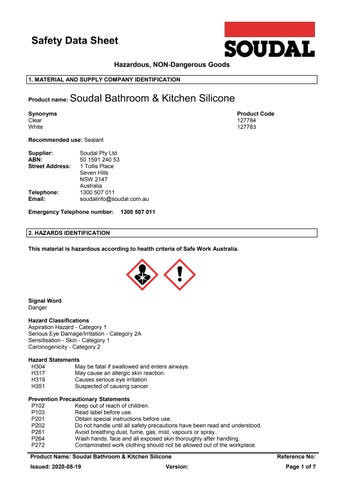
This material is hazardous according to health criteria of Safe Work Australia.
Signal Word Danger
Hazard Classifications
Aspiration Hazard - Category 1
Serious Eye Damage/Irritation - Category 2A
Sensitisation - Skin - Category 1
Carcinogenicity - Category 2
Hazard Statements
H304 May be fatal if swallowed and enters airways.
H317 May cause an allergic skin reaction.
H319 Causes serious eye irritation.
H351 Suspected of causing cancer .
Prevention Precautionary Statements
P102 Keep out of reach of children.
P103 Read label before use.
P201 Obtain special instructions before use.
P202 Do not handle until all safety precautions have been read and understood.
P261 Avoid breathing dust, fume, gas, mist, vapours or spray..
P264 Wash hands, face and all exposed skin thoroughly after handling.
P272 Contaminated work clothing should not be allowed out of the workplace.
Safety Data Sheet
P281 Use personal protective equipment as required.
Response Precautionary Statements
P101 If medical advice is needed, have product container or label at hand.
P301+P310 IF SWALLOWED: Immediately call a POISON CENTRE or doctor/physician.
P302+P352 IF ON SKIN: Wash with plenty of soap and water.
P305+P351+P338 IF IN EYES: Rinse cautiously with water for several minutes. Remove contact lenses, if present and easy to do. Continue rinsing.
P308+P313 IF exposed or concerned: Get medical advice/attention.
P321 Specific treatment (see product label).
P331 Do NOT induce vomiting.
P333+P313 If skin irritation or rash occurs: Get medical advice/attention.
P337+P313 If eye irritation persists: Get medical advice/attention.
P363 Wash contaminated clothing before reuse.
Storage Precautionary Statement
P405 Store locked up.
Disposal Precautionary Statement
P501 Dispose of contents/container in accordance with local, regional, national and international regulations.
Poison Schedule: Unknown
DANGEROUS GOOD CLASSIFICATION
Not classified as Dangerous Goods by the criteria of the "Australian Code for the Transport of Dangerous Goods by Road & Rail" and the "New Zealand NZS5433: Transport of Dangerous Goods on Land"
If poisoning occurs, contact a doctor or Poisons Information Centre (Phone Australia 131 126, New Zealand 0800 764 766).
Inhalation: Remove victim from exposure - avoid becoming a casualty. Remove contaminated clothing and loosen remaining clothing. Allow patient to assume most comfortable position and keep warm. Keep at rest until fully recovered. Seek medical advice if effects persist.
Skin Contact: Effects may be delayed. If skin or hair contact occurs, remove contaminated clothing and flush skin and hair with running water. If swelling, redness, blistering or irritation occurs seek medical assistance.
Eye contact: If in eyes, hold eyelids apart and flush the eyes continuously with running water. Continue flushing until advised to stop by the Poisons Information Centre or a Doctor; or for at least 15 minutes and transport to Doctor or Hospital.
Safety Data Sheet
Ingestion: Immediately rinse mouth with water. If swallowed, do NOT induce vomiting. Give a glass of water to drink. Never give anything by the mouth to an unconscious patient. If vomiting occurs give further water. Immediately call Poisons Centre or Doctor.
PPE for First Aiders: Wear gloves, apron, safety glasses Available information suggests that gloves made from should be suitable for intermittent contact. However, due to variations in glove construction and local conditions, the user should make a final assessment. Always wash hands before smoking, eating, drinking or using the toilet. Wash contaminated clothing and other protective equipment before storing or re-using.
Notes to physician: Treat symptomatically. Effects may be delayed.
5. FIRE FIGHTING MEASURES
Hazchem Code: Not applicable.
Suitable extinguishing media: If material is involved in a fire use water fog (or if unavailable fine water spray), alcohol resistant foam, standard foam, dry agent (carbon dioxide, dry chemical powder).
Specific hazards: Non-combustible material.
Fire fighting further advice: Not applicable.
6. ACCIDENTAL RELEASE MEASURES
SMALL SPILLS
Wear protective equipment to prevent skin and eye contamination. Avoid inhalation of vapours or dust. Wipe up with absorbent (clean rag or paper towels). Collect and seal in properly labelled containers or drums for disposal.
LARGE SPILLS
Clear area of all unprotected personnel. Slippery when spilt. Avoid accidents, clean up immediately. Wear protective equipment to prevent skin and eye contamination and the inhalation of dust. Work up wind or increase ventilation. Cover with damp absorbent (inert material, sand or soil). Sweep or vacuum up, but avoid generating dust. Collect and seal in properly labelled containers or drums for disposal. If contamination of crops, sewers or waterways has occurred advise local emergency services.
Dangerous Goods - Initial Emergency Response Guide No: Not applicable
7.
HANDLING AND STORAGE
Handling: Avoid eye contact and skin contact. Avoid inhalation of dust.
Storage: Store in a cool, dry, well-ventilated place and out of direct sunlight. Store away from foodstuffs. Store away from incompatible materials described in Section 10. Store away from sources of heat and/or ignition. Store locked up. Keep container standing upright. Keep containers closed when not in use - check regularly for spills.
8. EXPOSURE CONTROLS / PERSONAL PROTECTION
National occupational exposure limits: No value assigned for this specific material by Safe Work Australia.
Biological Limit Values: As per the "National Model Regulations for the Control of Workplace Hazardous Substances (Safe Work Australia)" the ingredients in this material do not have a Biological Limit Allocated.
Safety Data Sheet
Engineering Measures: Natural ventilation should be adequate under normal use conditions.
Personal Protection Equipment: GLOVES, APRON, SAFETY GLASSES
Personal protective equipment (PPE) must be suitable for the nature of the work and any hazard associated with the work as identified by the risk assessment conducted.
Wear gloves, apron, safety glasses Available information suggests that gloves made from should be suitable for intermittent contact. However, due to variations in glove construction and local conditions, the user should make a final assessment. Always wash hands before smoking, eating, drinking or using the toilet. Wash contaminated clothing and other protective equipment before storing or re-using.
Hygiene measures: Keep away from food, drink and animal feeding stuffs. When using do not eat, drink or smoke. Wash hands prior to eating, drinking or smoking. Avoid contact with clothing. Avoid eye contact and skin contact. Avoid inhalation of dust. Ensure that eyewash stations and safety showers are close to the workstation location.
9. PHYSICAL AND CHEMICAL PROPERTIES
Form: Paste
Colour: Variable in colour, depending on the composition
Odour: Characteristic odour
Specific Gravity: 1.2
Density: 1180 kg/m³
Flammability Limits (%): lower: Not easily combustible
Melting Point/Range (°C): N av
Boiling Point/Range (°C): N Av
pH: N Av
Viscosity: N Av
(Typical values only - consult specification sheet) N Av = Not available, N App = Not applicable
10. STABILITY AND REACTIVITY
Chemical stability: This material is thermally stable when stored and used as directed.
Conditions to avoid: Elevated temperatures and sources of ignition.
Incompatible materials: Oxidising agents.
Hazardous decomposition products: Oxides of carbon and nitrogen, smoke and other toxic fumes
Hazardous reactions: No known hazardous reactions.
11. TOXICOLOGICAL INFORMATION
No adverse health effects expected if the product is handled in accordance with this Safety Data Sheet and the product label. Symptoms or effects that may arise if the product is mishandled and overexposure occurs are:
Acute Effects
Safety Data Sheet
Inhalation: Material may be an irritant to mucous membranes and respiratory tract.
Skin contact: Contact with skin may result in irritation. A skin sensitiser. Repeated or prolonged skin contact may lead to allergic contact dermatitis.
Ingestion: Swallowing can result in nausea, vomiting and irritation of the gastrointestinal tract. May cause lung damage if swallowed. Small amounts of liquid aspirated into the respiratory system during ingestion or vomiting may cause bronchopneumonia or pulmonary oedema.
Eye contact: An eye irritant. Exposure to the dust may cause discomfort due to particulate nature. May cause physical irritation to the eyes.
Acute toxicity
Inhalation: This material has been classified as non-hazardous. Acute toxicity estimate (based on ingredients): LC50 > 5 mg/L
Skin contact: This material has been classified as non-hazardous. Acute toxicity estimate (based on ingredients): >2,000 mg/Kg bw
Ingestion: This material has been classified as non-hazardous. Acute toxicity estimate (based on ingredients): >2,000 mg/Kg bw
Corrosion/Irritancy: Eye: this material has been classified as a Category 2A Hazard (reversible effects to eyes). Skin: this material has been classified as not corrosive or irritating to skin
Sensitisation: Inhalation: this material has been classified as not a respiratory sensitiser. Skin: this material has been classified as a Category 1 Hazard (skin sensitiser).
Aspiration hazard: This material has been classified as Aspiration Hazard - Category 1
Specific target organ toxicity (single exposure): This material has been classified as non-hazardous.
Chronic Toxicity
Mutagenicity: This material has been classified as non-hazardous.
Carcinogenicity: This material has been classified as a Category 2 Hazard.
Reproductive toxicity (including via lactation): This material has been classified as non-hazardous.
Specific target organ toxicity (repeat exposure): This material has been classified as non-hazardous.
12. ECOLOGICAL INFORMATION
Avoid contaminating waterways.
Acute aquatic hazard: This material has been classified as non-hazardous. Acute toxicity estimate (based on ingredients): >100 mg/L
Long-term aquatic hazard: This material has been classified as non-hazardous. Non-rapidly or rapidly degradable substance for which there are adequate chronic toxicity data available OR in the absence of chronic toxicity data, Acute toxicity estimate (based on ingredients): >100 mg/L, where the substance is not rapidly degradable and/or BCF < 500 and/or log Kow < 4.
Ecotoxicity: No information available.
Safety Data Sheet
Persistence and degradability: No information available.
Bioaccumulative potential: No information available.
Mobility: No information available.
13. DISPOSAL CONSIDERATIONS
Persons conducting disposal, recycling or reclamation activities should ensure that appropriate personal protection equipment is used, see "Section 8. Exposure Controls and Personal Protection" of this SDS.
If possible material and its container should be recycled. If material or container cannot be recycled, dispose in accordance with local, regional, national and international Regulations.
14 TRANSPORT INFORMATION
ROAD AND RAIL TRANSPORT
Not classified as Dangerous Goods by the criteria of the "Australian Code for the Transport of Dangerous Goods by Road & Rail" and the "New Zealand NZS5433: Transport of Dangerous Goods on Land"
MARINE TRANSPORT
Not classified as Dangerous Goods by the criteria of the International Maritime Dangerous Goods Code (IMDG Code) for transport by sea.
AIR TRANSPORT
Not classified as Dangerous Goods by the criteria of the International Air Transport Association (IATA) Dangerous Goods Regulations for transport by air.
15. REGULATORY
INFORMATION
This material is not subject to the following international agreements: Montreal Protocol (Ozone depleting substances)
The Stockholm Convention (Persistent Organic Pollutants)
The Rotterdam Convention (Prior Informed Consent)
Basel Convention (Hazardous Waste)
International Convention for the Prevention of Pollution from Ships (MARPOL)
This material/constituent(s) is covered by the following requirements:
• All components of this product are listed on or exempt from the Australian Inventory of Industrial Chemicals (AIIC)
16
OTHER INFORMATION
Reason for issue: 5 Yearly Revision
This information was prepared in good faith from the best information available at the time of issue. It is based on the present level of research and to this extent we believe it is accurate. However, no guarantee of accuracy is made or implied and since conditions of use are beyond our control, all information relevant to usage is offered without warranty. The manufacturer will not be held responsible for any unauthorised use of this information or for any modified or altered versions.
If you are an employer it is your duty to tell your employees, and any others that may be affected, of any hazards described in this sheet and of any precautions that should be taken.
Safety Data Sheet
Safety Data Sheets are updated frequently. Please ensure you have a current copy.