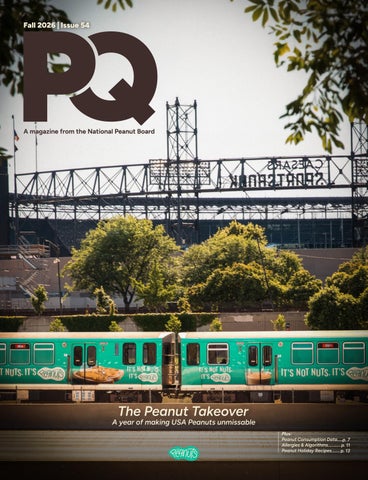
Fall 2026 | Issue 54
A magazine from the National Peanut Board
The Peanut Takeover
A year of making USA Peanuts unmissable Plus: Peanut Consumption Data.....p. 7 Allergies & Algorithms............ p. 11 Peanut Holiday Recipes........ p. 13
National Peanut Board 2026 Officers and Members Neal Baxley, Chairman Jeff Roper, Vice Chairman Thomas Adams, Treasurer Westley Drake, Secretary
A Message From Our 2026 Chairman
Alabama Thomas Adams Josh McCoy, alternate Arkansas Allen Donner Heath Donner, alternate
Dear Fellow Peanut Farmers and Peanut Lovers,
Florida Lance Jackson Scott Walker, alternate
What a year. And what a privilege it’s been to sit in this role during such a significant year.
Georgia Casey Cox Kerr Wesley Webb, alternate Mississippi Lonnie Fortner Alan Atkins, alternate Missouri Russ Hoggard Clay Deane, alternate North Carolina Raymond Garner Jr. Julie Ward, alternate Oklahoma Mark DeLeon Arthur Kell, Jr., alternate South Carolina Neal Baxley Doug Jarrell, alternate Texas Jeff Roper Mason Becker, alternate Virginia Westley Drake Richard Williams, alternate At-Large Cliff Neece Don Sanders, alternate
Ryan Lepicier NPB President and CEO PQ Editorial Staff & Contributors Editor-in-Chief: Danielle Karnbach VP & Chief Marketing Officer: Dena Malsom Chris Fitzgerald DeMarquiné Houston
Markita Lewis, MS, RDN Parusha Reddy
Sandra Flores, Creative Director Zarina Waldo, Art Director & Illustrator Samantha P. Perez, Designer Silvia Flores, Content Manager Paola Magallanes, Contributor
1
I’ve gotten a front seat in driving unity across our industry, and it’s hard to summarize the gratitude and optimism I’m feeling as the end of 2026 approaches. It’s been tremendous to see all the ways you’ve rallied behind NPB’s new brand. (I’m not sure about you, but it’s near impossible to get “It’s Not Nuts, It’s Peanuts” out of my head.) From seeing USA Peanuts flags waving in fields to watching students embrace our peanut products with enthusiasm, there’s much to feel proud of. But I won’t sugarcoat the challenges we still face. Peanut butter consumption remains down. It’s been a tough harvest filled with pricing uncertainties, reduced planted acreage, and even a hurricane. Yet what lies ahead is what generations before us have always done: the opportunity to navigate the hurdles with grace and fortitude, while appreciating the good in each day. Throughout this year, we’ve shown up in so many new places and spaces — as one cohesive, modern industry. We’ve collaborated with peanut brands in ways we’ve never done before, adding value and credibility that only NPB can. If you haven’t seen our social media yet, you should check out all the different ways we’re speaking with Gen Z. People want to hear our story: our state peanut organizations connected with thousands of college students who had never seen a peanut plant before, and school nutrition directors were eager to share more about peanut harvest with their students to explore more “farm to cafeteria” options.
Brands, influencers, other countries and, most importantly, U.S. consumers are really starting to pay attention. This upcoming year will be all about converting that attention and excitement into repeat purchases. It’s been an honor to represent our industry as NPB Chairman. From gaining invaluable food insights in Thailand, to hosting our summer Board meeting in my home state, to sitting on the American Peanut Council Executive Committee, this year has been a gift. Now more than ever, when we champion each other’s ideas and wins, we all come out for the better. I’ve seen firsthand just how impactful we can be when we rally together. Thank you for the trust, support, and energy you’ve brought to 2026. Wishing you and yours a memorable holiday season.
Neal Baxley NPB 2026 Chairman
Growing Pains? What We're Learning About Peanut Demand Dear Growers and Industry Partners, We recently hosted Parusha Reddy, a Mars Ambassador Program Representative, who spent several weeks studying a question many of you have asked: is peanut consumption really declining, and why? The honest answer is more nuanced than a headline. Following pandemic highs of 7.7 pounds per person, percapita consumption (excluding peanut oil) has normalized to roughly 7.1 pounds.¹ Inflation, tight household budgets, changing retail dynamics, and cost pressures have created real challenges — from shellers holding inventory longer to pressure at our farm gates. Peanut butter remains our core anchor at 60%² of total crop usage, but shifting habits have slowed traditional growth. While trial rates among Gen Z and Millennial consumers are high, we face a retention gap: too many new buyers try our products without becoming long-term consumers. Facing these challenges directly is how we find our greatest opportunities.
All of this is in line with our laser-focused strategy: fewer, bigger, better. We are concentrating our resources where they deliver the highest return. One of the ways we’re working to close the retention gap is through our new USA Peanuts brand. In late spring, we launched the new “It’s Not Nuts. It’s Peanuts” consumer campaign designed to reach Gen Z with positive messages about the unique value of peanuts. We are also partnering across the supply chain to share data, maximize marketing dollars, and protect shelf space. American peanut farmers grow high-quality, sustainable protein, and consumer demand for nutritious, affordable food is not going away. By working together — from farm to sheller to retail aisle — we will convert trial into lasting loyalty and return our industry to sustained growth. The data confirms a challenge — not a decline in what peanuts have to offer. Our job is simple: get more people enjoying more peanuts, more often. I'm grateful to everyone across this industry for making that possible, and I remain genuinely optimistic about where we're headed.
The data shows strong reasons for optimism: Warmest regards, • Unmatched Value: Within the broader nut category, peanuts are actually gaining ground, winning share from numerous other nuts. Peanuts are holding close to 40%³ of nut volume, even as prices rise. Our loyal consumers keep buying — price increases and all. • Clean Nutrition: Modern shoppers want clean ingredients, low cholesterol, and plant protein, which are all standards that USA-grown peanuts meet.
Ryan Lepicier President & CEO National Peanut Board
• High-Growth Areas: Peanut inclusions in categories like health bars and frozen novelties continue to see strong momentum.
¹ USDA Peanut Stocks & Processing Report ² USDA NASS ³ NielsenIQ Retail Measurement - Total US xAOC + Conv (L52W)
2
The Year
Peanuts
Took Over By: Chris Fitzgerald
A CATEGORY FINDS IT’S VOICE When the “It’s Not Nuts. It’s Peanuts” campaign launched on May 18, 2026, it marked a historic first for the agricultural industry. Rather than marketing a commodity, the campaign introduced a unified brand identity. It gave peanuts a contemporary personality, a fresh voice, and a newly elevated position in today's cultural conversations. At the center of the campaign is a crew of six friends, joined by a DJ, traveling through imaginative worlds inspired by different forms of peanuts and peanut butter. Anthony Farquhar-Smith, Not to Scale Studios’ awardwinning producer, led the project, stating, “with 781 handpainted characters, each just the size of a quarter, this is the smallest-scale project ever produced using real peanuts and real food.” Each world highlights modern peanut occasions, from performance and nutrition to convenience, snacking, and connection. Together, they showcase what peanuts have always been: versatile, nutritious, and affordable fuel for everyday life. Just as important was the collaboration behind “One Brand. One Industry.” Growers, state peanut producers, brand and industry partners all aligned around a shared vision, replacing fragmented messages with a single story. For perhaps the first time, consumers saw the peanut industry speak with one voice.
A bright harvest-green L-train pulls into a downtown Chicago station. The doors open, a commuter steps aboard, and the morning ride becomes something unexpected: a peanut-powered world where tiny “This is more than the National Peanut Board’s brand,” said explorers experience environments that feel more like a Dena Malsom, VP and CMO at NPB. “This is your brand. This is our industry brand. It’s a coordinated strategy to elevate stop-motion adventure than an agricultural campaign. peanuts and drive consumer demand.”
Soon, those same friends and worlds appeared globally on social feeds, at a Florida baseball game, during World Cup festivities in Atlanta, and on billboards in New York City's Times Square. Peanuts were suddenly showing up where people live, play, cheer, and scroll.
That alignment created consistency across touchpoints. On Chicago trains, in Times Square, on digital kiosks throughout Atlanta, and on social media, consumers encountered the same message: peanuts are a category of one with surprising benefits and worth another look.
For generations, peanuts have fueled American life, from game days and school lunches to road trips and family recipes. But familiarity alone does not guarantee relevance. Peanuts have to earn their place. Today’s core challenge is sparking consumer demand and showcasing fresh ways to experience the surprising benefits of peanuts.
Far beyond standard advertising, this campaign met consumers everywhere they shop, including digitally through Crazy Richard’s Amazon.com activations, physically as Peanut Butter & Co updates packaging with the new seal, and globally across the U.K., Canada, China and more! By uniting touchpoints, our partners demonstrated the true momentum of One Brand. One Industry.
That challenge led to a simple question: How do peanuts fuel your world?
3
Throughout the summer, consumers encountered peanuts at major sporting events, city landmarks, and community gatherings across Atlanta and Chicago, with more than 50,000 branded peanut packs distributed along the way.
NPB’s ads captivated consumers commuting and traveling around Chicago via brightly wrapped trains.
Then came a signal no marketing plan can manufacture: people began recognizing the campaign before anyone explained it. “During our sampling events, consumers weren't just enjoying peanuts; they were singing their own versions of the ‘It's Not Nuts. It's Peanuts.’ jingle back to us,” said Mike King, president of StriKing Marketing. “In all my years in marketing, that's a first.”
Some of the strongest moments were unplanned, like when various famous athletes were caught enjoying their peanut love out in the world. One basketball player was spotted courtside enjoying a PB&J, while a racecar winner credited peanut butter as their favorite winning food. It reinforced a simple truth: peanuts already belong in the moments consumers care about. The campaign isn't trying to reinvent peanuts. It's helping consumers rediscover them.
Outside Wrigley Field, one consumer approached a brand ambassador and said, “I saw you guys on the L-train this morning.” At Atlanta's Peachtree Road Race, a runner remarked, “I saw you at the World Cup and was hoping you guys would be out here again to help me recover.” Those interactions reflected more than awareness. Consumers were beginning to connect with the story. Momentum soon spread beyond live events. Content creators and influencers incorporated peanuts into recipes and routines. Athletes connected peanuts with preparation, performance, and recovery. The category began appearing in conversations consumers were already having about food, fitness, and everyday life. NPB’s partnership with pro football standout Jeremiyah Love became one visible example. “Peanuts have been a part of my routine long before this partnership,” said Love in a statement for Men’s Journal. “They were the fuel for late‑night training sessions and the thing I grabbed on the way to practice when there wasn’t time for a full meal.” In response, USA peanut farmers thanked him with a literal ton of fresh peanuts, which you can see on the @USApeanuts Instagram page. Anthony Farquhar-Smith showcases one of the hundreds of handcrafted figurines from NPB’s ads.
4
GROWING THE FUTURE That opportunity is especially important in attracting Gen Z, a dynamic audience that appreciates product discovery through creators, communities, and shared experiences, and participates in ideas that capture their attention — not simply watching from the sidelines. Through a nationwide college experiential tour and a network of ten campus brand managers, the campaign brought the worlds to life through immersive experiences. Students rediscovered peanuts through interactive games, more than twenty brand partners showcasing peanut variety, collectible merchandise, and opportunities to meet local peanut growers.
The six friends may be exploring peanut-inspired worlds, but the bigger story begins in the real one. Behind every peanut is a farm family helping fuel everyday moments across America. As consumers continue discovering new ways peanuts fuel their worlds, America's peanut growers remain at the heart of that story. Different worlds. Same fuel. And that's a future worth growing. Chris Fitzgerald is the Director of Marketing at the National Peanut Board.
Macy Moates, NPB’s former campus brand manager at Clemson University, shared: “Interacting with students across campus [was] the best part of my job. From creating shareable content to keep peanuts top of mind, to hooking up peers with peanut merch, or identifying new food service opportunities on campus, I’m helping introduce students to peanuts and expanding peanut offerings on campus.” A peanut farmer and college student may seem worlds apart, but they're connected by everyday choices: a snack between classes, fuel before practice, a packed lunch, or a peanut butter sandwich on the go. Those moments help shape the category's future. For growers, seeing peanuts on Chicago trains, Times Square screens, and college campuses can sometimes feel surreal. Yet it makes visible the connection between the field and the consumer. “At the heart of this campaign are America’s peanut farmers whose hard work and dedication make this crop possible,” said Thomas Adams, NPB Treasurer and Board Member representing Alabama. “This brand gives us a chance to tell our story and remind consumers that every peanut starts with farm families like ours. We are hopeful ‘It’s Not Nuts. It’s Peanuts’ storytelling will engage Gen Z while growing demand within our loyal consumers!” The distance between a peanut field and a consumer's life has never been that far. A peanut harvested in Georgia or Texas or Virginia may one day become the fuel to power a workout, a convenient on-the-go snack, a game-day ritual, or a PB&J to energize the brain for a late-night study session. That's the idea behind It's Not Nuts. It's Peanuts. Not to reinvent peanuts, but to help people rediscover them and their surprising benefits.
Snapshots from the many NPB activations this summer, from peanut sampling near sports games to a celebrity athlete partnership to an epic college tour.
5
405M+ impressions
from ads on Instagram, TikTok, & YouTube plus influencers, trains, kiosks, & NYC billboard
32.4M
complete YouTube views reaching Gen Z where they’re watching
Six friends. Many worlds. One story.
151K+ website visits
driving consumers deeper into the story
443M
earned media impressions adding credibility to new audiences
100K+
experiential impressions making memories with consumers through city activations
50K+
samples distributed getting people tasting delicious peanuts across Atlanta & Chicago
12
college tour stops
reintroducing all the peanut possibilities to the next generation of shoppers
6
Mars’ Parusha Reddy visits the peanut farm of Wesley Webb, NPB Alternate Board Member for Georgia.
What Consumption Data Really Says By: Parusha Reddy Over the month of August 2026, I had the privilege of stepping outside my day-to-day role at Mars to immerse myself into the world of USA Peanuts. My travels from Johannesburg, South Africa, to the National Peanut Board (NPB) in Atlanta, Georgia, through the Mars Ambassador Program (MAP) provided an invaluable passage into one of America’s most resilient, nutritious, and vital agricultural sectors. MAP is a signature program that brings Mars’ purpose to life: "The world we want tomorrow starts with how we do business today." It gives us as employees the incredible opportunity to apply our functional expertise to nonprofits organizations to create real, mutual value across our broader value chain. As a Strategic Revenue Management Lead, my task was to assess USA Peanut market demand. Diving headfirst into the data available to understand the key drivers behind the shifting trends in peanut consumption, my work spanned the entire value chain —
7
from understanding and analyzing crop yields and USDA data, all the way to Nielsen and Circana scan and panel data to uncover market patterns. Recent volume metrics highlight a changing landscape for peanuts. ADDRESSING SHIFTING RETAIL DYNAMICS AND VOLUME TRENDS Analysis of supply reports, correlated with retail demand scan and panel data, shows key volume trends across retail channels. The highest volume usage lies in peanut butter. While peanut butter remains a trusted household pantry staple, modern snacking habits demand higher portability, functional wellness messaging, and innovative flavor profiles. Another important category that needs attention is peanut and peanut butter candy, as volume consumption remains in decline year after year. Consumption has been impacted by various factors, including economic pressures, consumer preferences, and product and packaging evolutions.
A key takeaway is that volume expansion opportunity lies in functional, high-protein peanut butter formats and flavor innovation, where younger demographics prioritize health, convenience, and experience over traditional uses. The data shows that while concerted industry efforts succeed in encouraging trial, consumer retention remains a key bottleneck. The critical strategic question facing the category is how to move beyond initial trial and drive recurring consumer loyalty. SUPPLY CHAIN EFFICIENCY AND AGRICULTURAL RESILIENCE
celebrating with the NPB team — reflecting on our shared achievements and mapping out the clear path for next steps — was the perfect close to an extraordinary chapter. Thank you to Ryan Lepicier, Dena Malsom, and the entire NPB Staff for welcoming me with open arms, entrusting me with critical data, and sharing the immense passion for America’s peanut growers. From the researchers optimizing crop resilience to the farming families across USA whose dedication feeds millions, I thank you too. The hard work from all sectors of the peanut industry forms the foundation of this entire ecosystem.
I had the privilege of visiting Albany, Georgia, in the heart of American peanut country. While the data insights were incredible to uncover, nothing compared to stepping directly onto the field. Walking through Wesley Webb Farms and speaking with growers gave me a deep appreciation for the dedication, science, and hard work required to cultivate high-quality peanuts. This included an insightful pre-harvest business session to dive into crop forecasts, agricultural innovation, and the economic factors shaping this year’s harvest. The trip highlighted that long-term peanut sustainability depends heavily on farm-level economics as well. Yield optimizations, precision irrigation, and controlling fungi on crops to name a few, are ways farming families are tackling climate and economic headwinds to ensure the peanut legacy lives on for many generations to come. Overall, unlocking sustained category growth requires capitalizing on these insights — aligning modern consumer messaging with value-pack innovation, emphasizing functional nutrition, and leveraging the growers’ and crop's inherent sustainability advantages. SOUTHERN HOSPITALITY AND MEMORABLE MOMENTS BEYOND THE DATA While I was prepared to bring my expertise to NPB, I was not prepared for what I learned from the warmth and culture of Georgia and the peanut industry that made the four weeks unforgettable. NPB exemplified authentic Southern hospitality from day one. NPB gave me a genuine taste of local culture, including the incredible privilege of attending my very first live Braves baseball game. Taking in the energy of the ballpark with a cold drink and traditional roasted peanuts in hand was an authentic American experience I’ll never forget.
NPB’s Markita Lewis and Maria Mehok enjoy a baseball game with Parusha Reddy.
LEARNING FROM ONE ANOTHER The MAP collaborative effort with NPB demonstrates the power of bringing cross-industry expertise to real-world agricultural challenges. It’s a wonderful feeling to have given important data and learnings about USA market demand to help the peanut world. It’s an equally rewarding feeling to take with me back to Africa all that I learned from the people, the place, and the industry that I will never forget. Parusha Reddy is the Strategic Revenue Management Trade Lead for South Africa & Sub-Saharan Africa within Mars Snacking. Parusha served as the Mars Ambassador Program representative for the National Peanut Board in August 2026.
Our field trip further south became an adventure of its own. Road-tripping to Albany, Georgia, meant pulling over to a roadside spot for authentic Southern comfort food, shared laughs, and deep, insightful conversations that went far beyond business. Wrapping up the month by
8
Advancements at APRES Every year, the American Peanut Research & Education Society (APRES) hosts its Annual Meeting for advancing peanut research and education. NPB is proud to champion the innovators supporting the future of the peanut industry, which is why our organization runs the NPB Graduate Student Poster Competition during this event. In July, NPB’s Research Director, DeMarquiné Houston, joined NPB’s At-Large Board Member and Research Chair, Cliff Neece, to identify the impressive winners of this competition. Read on for details about each submission from the winners’ perspectives.
9
Ph.D. Poster Competition 1st Place
2nd Place
Gourav Chahal
Ranadheer Vennam
Auburn University
Virginia Polytechnic Institute
Impact of Winter Cover Crops on the Critical Period For Weed Control in Peanut
Leveraging Multispectral Imagery and Machine Learning to Assess Peanut Leaf Wilting under Water Stress in Rainfed Environments
This research elucidates how high-residue cover crops alter the critical period for weed control (CPWC) in strip-tilled peanut (Arachis hypogaea). We observed that planting cereal rye delayed early-season weed interference; this strong suppression narrowed the CPWC to a tight 3.2 to 5.8 weeks across multiple site-years. Much like bypassing a logistical bottleneck, this delayed weed emergence provides growers with significant flexibility for earlyseason herbicide applications.
This study evaluated the use of UAV-based multispectral imagery and machine learning to assess peanut leaf wilting under water stress in rainfed environments. We integrated spectral bands, vegetation indices, and accumulated growing degree days with visual leaf-wilting ratings to develop models for monitoring peanut canopy wilting. XGBoost performed the best and was used to develop wilting maps that can support monitoring and management of water-stressed peanut crops.
Master’s Poster Competition
1st Place
Charles Naapoal
University of Georgia
My research evaluated a Spanish-type peanut population in the field for water-deficit tolerance, then tested it in the lab for resistance to Aspergillus flavus colonization. We identified several promising lines that combined reduced A. flavus colonization with above-average yield under water deficit. Drought and heat make peanuts in the field more susceptible to A. flavus. Even so, water-deficit tolerance alone did not predict resistance to colonization. Breeders therefore need a separate lab assay to select for both traits together.
2nd Place
Carlos Toruno
University of Florida
This study evaluated the relationship between seed calcium concentration, seedling growth, and field emergence in six runner-type peanut genotypes grown with and without gypsum application. Gypsum significantly increased seed calcium concentration, and higher seed calcium was associated with improved early field emergence and greater root development, although responses varied among genotypes. These findings suggest that higher seed calcium concentration improves early root growth which in turn improves early field emergence of seedlings.
10
@whattoexpect
Allergies on the Algorithm By: Danielle Karnbach Between waiting for pediatrician visits and staying awake during midnight feedings, busy new parents are still finding time to scroll. As the generation that grew up online grows families of their own, it’s only natural that they have been incorporating screen time into their daily lives. Parenting advice over the decades has shifted from magazines to blogs to Instagram, with social media influencers even accumulating hundreds of thousands of followers with content dedicated to one specific part of raising children. There are feeds dedicated to infant feeding, TikToks on toddler trends, and families documenting their household hacks. In a time of life that can feel daunting, social platforms offer easy-to-access advice from voices that feel relatable. So much so that even doctors themselves are taking their credentials beyond the physical walls of an office to reach parents across every state. While an endless stream of social content might seem overwhelming, it offers a powerful opportunity for peanuts. Throughout FY26, NPB has been leveraging social platforms to spread the word about early peanut introduction, and the impact has been promising. In April, NPB joined the ultimate yearly gathering of mommy influencers: Mom 2.0 Summit. From coordinating a luncheon featuring prominent allergy doctor Dr. Ruchi Gupta to creating an engaging booth packed with Little Peanut plushies, it was a direct line to thousands of the internet’s top parenting content creators. They were equipped with empowering materials to talk about early introduction in whichever ways resonated with their online audiences. After learning this “life hack,” influencers were eager to do even more with NPB. Two influencers from that event have been creating paid social media content for USA Peanuts across Instagram and TikTok, with their posts already getting well over one million views (with more yet to come, as of this writing).
11
The most-loved post so far took a fun angle on a serious concern many consumers have: parents most likely do not need to introduce peanut in an ER parking lot. Given the many uninformed videos that exist online with fearful parents waiting in front of the ER, NPB’s partnership educated parents in a unique way that generated lots of positive response in the comments section. For the Halloween season, NPB is mailing PR boxes to certified healthcare professionals with major social media followings. The purpose is to remind these credible voices that early introduction doesn’t need to be spooky, especially with Little Peanut as the allergy superhero! NPB also partnered with two of the most popular pregnancy and parenting brands: BabyCenter and WhatToExpect. Many expecting parents use these brands’ apps to track the size of their baby (“today, baby is the size of a peanut!”), learning all kinds of relevant information from these companies. This summer, we ran ads educating the importance of early peanut introduction across these apps and websites, as well as sending out email blasts to their parent networks. In total, these tactics reached over 340,000 parents. Data proved just how highly engaged these audiences were, with parents clicking through our education materials at a significantly higher rate than the typical successful benchmark.
@thatfamily7
Every day, there is a new set of parents to reach. And NPB is showing up exactly where those parents are scrolling. Danielle Karnbach is the Director of Communications at the National Peanut Board.
@danimorin_
12
’Tis the Season for Peanuts Make your holiday gatherings unforgettable with vibrant, nourishing dishes that showcase peanuts. From cocktails and appetizers to mouthwatering side dishes, peanuts bring versatility, crunch, and flavor to your holiday menus. NPB has curated a collection of recipes to inspire you throughout the fall and winter months. Create memorable moments with loved ones and discover new ways to enjoy peanuts together. We’d love to hear what peanut dishes make it to your table. Wishing you a happy and delicious holiday season!
13
Photography by Sandra Flores and Samantha Perez. Styling by Paola Magallanes.
Scan here for holiday recipes
14
Peanut Butter Blackberry Cocktail Yield: 1 cocktail | Serving Size: 1 drink | Servings: 1 • ¼ cup fresh blackberries • ½ oz simple syrup • 2 oz peanut butter whiskey • ½ oz freshly squeezed lemon juice • Fresh rosemary sprigs • Ice 1. Muddle the berries. Add the blackberries to a sturdy serving glass. 2. Add the aromatics. Pour in the simple syrup and add a small sprig of fresh rosemary. 3. Release the flavors. Gently muddle the blackberries and rosemary to release their juices and aromas. 4. Mix the cocktail. Fill the glass with ice. Add the peanut butter whiskey and fresh lemon juice, then stir well to combine. 5. Garnish and serve. Top with additional ice, if needed, and garnish with a fresh rosemary sprig. Serve immediately.
15
Potato Wedges Roasted in Peanut Oil Yield: 40 potato wedges | Serving Size: 5 wedges | Servings: Approximately 8 • 10 russet potatoes • ½ cup peanut oil • ½ teaspoon paprika • ½ teaspoon salt • ½ teaspoon garlic powder • ¼ teaspoon onion powder 1. Preheat the oven. Preheat the oven to 425°F (220°C). 2. Wash the potatoes. Scrub the potatoes thoroughly under running water to remove any dirt. 3. Parboil the potatoes. Place the potatoes in a large pot and cover with water. Bring to a simmer and cook over medium heat for 15 minutes. 4. Drain and dry. Drain the potatoes and transfer them to a clean kitchen towel. Allow them to air-dry for at least 20 minutes.
5. Cut into wedges. Slice each potato lengthwise twice to create wedges. Arrange them on the kitchen towel and allow them to air-dry for an additional 10 minutes. 6. Prepare the seasoning. In a large, deep mixing bowl, combine the peanut oil, paprika, salt, garlic powder, and onion powder. Stir until well blended. 7. Season the wedges. Add the potato wedges to the bowl and toss until evenly coated with the seasoned oil. 8. Arrange on the baking sheet. Line a large baking sheet with a silicone baking mat or parchment paper. Arrange the wedges in a single layer, leaving space between each piece to promote even roasting. 9. Roast and serve. Bake for 28 minutes, or until the wedges are golden and tender. Carefully remove from the oven and serve hot.
16
Peanut Butter, Kale & Beets Salad 17
Servings: 4 | Prep Time: 15 minutes | Cook Time: 1 hour | Total Time: 1 hour 15 minutes Salad • ½ cup chopped honey-roasted peanuts • 6 cups roughly chopped kale • 2 large beets • ½ cup dried and sweetened cranberries • 2 ounces of goat cheese • 1/4 cup olive oil • ¼ cup balsamic peanut butter vinaigrette
Peanut Butter Vinaigrette • 1/4 cup olive oil • 1 tablespoon peanut butter • 1/4 cup rice wine vinegar • Lime juice (1 lime) • 1 tablespoon soy sauce or tamari • Black pepper, to taste
If Using Fresh Beets 1. Preheat the oven to 400°F. 2. Prepare the beets. Trim the tops and thoroughly wash the beets. 3. Roast. Place the whole beets in a small oven-safe baking dish with a lid. Cover and bake for approximately 1 hour, or until the beets are tender when pierced with a knife. 4. Cool and peel. Remove the beets from the oven and allow them to cool. Once cool enough to handle, remove the skins. 5. Dice. Cut the peeled beets into small, even cubes and set aside.
TIPS
Enhance the flavor: For an extra layer of flavor, spread or smear a small amount of the vinaigrette over the bottom and sides of the serving bowl before adding the salad. This helps coat the ingredients as they are added and distributes the dressing throughout the salad.
Peanut Butter Vinaigrette 1.
Combine. Add the olive oil, peanut butter, rice wine vinegar, lime juice, soy sauce or tamari, and black pepper to a glass jar or container. 2. Mix. Seal the container and shake vigorously until the ingredients are well combined and the vinaigrette is smooth and emulsified. 3. Store. Keep refrigerated in a sealed glass container until ready to use. Stir or shake well before dressing the salad.
Assemble the Salad 1. Massage the kale. Place the chopped kale in a large mixing bowl. Drizzle with a small amount of olive oil and gently massage the kale with your hands until the leaves become softer and more tender. 2. Layer the salad. Add the massaged kale to the bowl, followed by the cranberries and the diced beets. Gently toss to combine. 3. Add the toppings. Sprinkle the crumbled goat cheese and chopped honey-roasted peanuts over the salad. 4. Finish. Drizzle the remaining peanut butter vinaigrette over the salad and serve immediately.
Find recipe at: NationalPeanutBoard.org/recipes
18
Peanut Butter Sheet Cake 19
Pan: 18 × 13-inch half-sheet cake pan | Yield: 24 squares Cake • ½ cup peanut butter • 1 cup water • 2 sticks (1 cup) unsalted butter • 2 cups all-purpose flour • 2 cups granulated sugar • 1 teaspoon salt • 1 teaspoon baking soda • 2 large eggs • ½ cup milk
Frosting • 1 stick (½ cup) unsalted butter • ½ cup peanut butter • 6 tablespoons milk • 1 teaspoon vanilla extract • 4 cups powdered sugar
Prepare the Cake
Prepare the Frosting
1. Preheat the oven to 350°F. Grease a sheet cake pan and set aside. 2. Combine the dry ingredients. In a large mixing bowl, whisk together the flour, sugar, salt, and baking soda. 3. Prepare the peanut butter mixture. In a saucepan over medium heat, combine the peanut butter, water, and butter. Bring the mixture to a rapid boil. 4. Combine the mixtures. Carefully pour the hot peanut butter mixture over the dry ingredients. Stir until well combined. 5. Add the remaining ingredients. Add the eggs and milk, mixing until the batter is smooth and evenly combined. 6. Bake. Pour the batter into the prepared sheet cake pan and spread evenly. Bake for 20–25 minutes, or until the cake is set and a toothpick inserted into the center comes out clean.
Cooling & Storage
1.
While the cake is baking, combine the butter, peanut butter, and milk in a saucepan. 2. Bring the mixture to a rapid boil, stirring as needed. 3. Remove from the heat and stir in the vanilla extract. 4. Gradually add the powdered sugar, stirring until the frosting is smooth and well combined. Finish the Cake 1. Spread the frosting over the cake while the frosting is still hot. 2. Allow the cake to cool completely and let the frosting set. 3. Cut into 24 squares and serve.
Cooling: Allow the frosted cake to cool completely before covering or storing. This prevents condensation from forming and keeps the frosting from becoming sticky. Room temperature: Store tightly covered at room temperature for up to 3 days. Refrigerator: For longer storage, cover tightly and refrigerate for up to 5 days. Allow individual pieces to come to room temperature before serving for the best texture. Freezing: For longer-term storage, wrap individual pieces tightly in plastic wrap and place in a freezer-safe container or bag. Freeze for up to 2 months. Thaw overnight in the refrigerator or at room temperature before serving.
Find recipe at: NationalPeanutBoard.org/recipes
20
Bringing Peanuts Back to Grade School Menus By: Markita Lewis, MS, RDN
Districts around the country are moving away from hard-to-enforce peanut bans. Schools are bringing peanuts back onto menus through comprehensive food allergen management plans that not only help keep students with peanut allergies safe but also expand nutritious and accessible options for students. In order to achieve this, many district leaders are utilizing individually wrapped peanut products to meet their staff and student needs. The rationale for this decision lies in maximizing safety; these products are easily identifiable as containing peanuts while helping to reduce cross-contact in kitchens and student dining areas.
21
Leslie Wagner, Executive Director at Southern Peanut Growers, supports the Georgia Peanut Commission in spreading the word about the power of peanuts for students.
Pre-packaged PB&J sandwiches, such as Uncrustables™, have established themselves as an introductory menu item in schools. Why? They are familiar to students, easy to use across breakfast, lunch or snack programs, and districts see increased student participation in school meal programs after adding them. Some districts haven’t stopped there. To-go cups of peanut butter and one-ounce peanut packs are now being integrated into protein-forward bento boxes, salad bars, fruit and vegetable snack packs, and as a topping for various dishes. This expansion allows for more opportunities for peanuts to be used across the menu, supporting more scratch cooking and fresh ingredients in school meals. The growing demand for one-ounce peanut packs (a full serving size) has opened doors for U.S. peanut growers to collaborate with districts to increase purchases of locally grown peanuts. One success story is in Georgia, where the Georgia Peanut Commission is working with districts to get local peanuts into the schools and increase culinary innovation. Back in 2022, the USDA’s Local Food for Schools program created an exciting opportunity where many schools were able to use their allocated funds to purchase food products produced in their state. This sparked an interest in creating one-ounce Georgia Peanut packs, which are a full meat alternate in the school meal pattern and qualify as a USDA Smart Snack. This collaboration has created a boom of culinary innovation and increased the number of schools in the state who have started serving peanuts. “The packs are convenient and versatile,” said Jessie Bland, Director of Promotions & New Market Development at Geogia Peanut Commission. “They can be served on their own, incorporated into graband-go boxes, used as salad toppers, a meat replacement in a dish for a vegetarian student and other creative menu options. Most importantly, they offer schools another way to provide students with a nutritious food while growing a market for Georgia-grown peanuts. It has been a win for students, school nutrition programs and Georgia peanut farmers alike. It is an exciting time in school nutrition, and we are proud to play a role in helping grow the next generation of peanut lovers.” Individually wrapped peanut products are only the beginning. As districts become more comfortable with their allergen management and scratch cooking, schools will be able to more regularly use peanuts as an ingredient to create dishes that bring both comfort and excitement to students. Markita Lewis, MS, RDN, is a Marketing and Communications Manager at National Peanut Board.
22
A New Class of Peanut-Powered Ambassadors By: Chris Fitzgerald
The National Peanut Board (NPB) recently welcomed its second class of Campus Brand Managers (CBMs) to Atlanta for two days of learning, collaboration and peanut-powered inspiration. The kickoff gave students an inside look at the peanut industry while equipping them with the knowledge, tools and connections needed to bring the "It's Not Nuts. It's Peanuts!" campaign to campuses across the country. This year, the program has doubled in size, with 10 student leaders representing universities across the Southeast and beyond:
Alexa Bouziden
Oklahoma State University
AnnCleamson University
atson Ramsey W
Kayla JuthirisCarolina
y of Universit
Aleeza Ali
Nor
Virginia
Tech
y of North
Kambyl USnicveh rsity
Kellyn Brisendine Brooklyne University Davis
pi Stat
Mississip
23
University of Georgia
ony
Univers
University of Florida
y
Carolina
illing
Texas Tech
Auburn
Macy Jordan
Madeline Dempse
Universit
Layne Bas
ity
This year's team is united by a shared mission: helping their peers discover the nutrition, convenience and versatility of USA-grown peanuts. The kickoff began with an introduction to the organization. During a Peanuts 101 session, CBMs learned about NPB's mission, the peanut industry and the story behind USA peanuts. The group also participated in a peanut allergy session, gaining valuable insight into an important area of NPB's work. Now, the CBMs are bringing that knowledge back to their campuses. Throughout the year, they are serving as peanut ambassadors, leading creative activations, building campus partnerships and finding new ways to connect students with peanuts. From handing out peanut packs to hosting campus experiences, CBMs are on the front lines of bringing the "It's Not Nuts. It's Peanuts!" campaign to life. Together, they will distribute approximately 40,000 Hubs peanut packs throughout the school year while creating memorable opportunities for students to sample and learn about peanuts. Beyond sampling efforts, the team is promoting peanuts as an affordable, convenient source of plant-based protein and identifing opportunities to incorporate peanuts into campus events, wellness initiatives and student activities. Working alongside their Subject Matter Expert groups, they are developing ideas and programming centered on three key themes: Fuel, Performance and Snacking.
Mississippi State ambassador Brooklyn Davis kicks off the semester with peanut pack sampling and shows off her impact on social media.
Content creation also plays a role in their efforts. CBMs are creating Instagram and TikTok content, documenting campus activations and pitching ideas that could be featured on NPB's national social channels. They have already supported the NPB College Tour when it visited their campuses, helping engage students and amplify the story of USA-grown peanuts through on-the-ground activations. A unique part of the program is the opportunity to connect directly with local peanut farmers and state peanut board members. These relationships are giving CBMs a firsthand look at the people behind the industry and helping them share authentic stories about agriculture with their peers. Behind the scenes, each student is identifying opportunities within campus dining and retail environments by documenting where peanut products are sold, auditing dining hall offerings and building relationships with dining decisionmakers. Armed with knowledge, fresh ideas and plenty of peanutpowered enthusiasm, the second class of Campus Brand Managers is ready to make its mark. These student leaders are helping introduce a new generation of students to the value, versatility and appeal of USA-grown peanuts, one campus at a time.
University of Florida ambassador Macy Jordan gives peanut product donations to an on-campus food pantry.
Chris Fitzgerald is the Director of Marketing at the National Peanut Board.
24
Honoring Dee Dee Darden Former NPB Chairwoman Dee Dee Darden was a changemaker with remarkable passion and dedication to the peanut industry. It’s thanks to her intervention that the research and guidance on peanut allergy prevention have so significantly evolved since the early 2000s. Together we honor her inspiring legacy and look back admirably on that fateful day when she walked into Dr. Gideon Lack’s office with a vision.
25
Financials
NATIONAL PEANUT BOARD BUDGET Fiscal Year 2027 (November 1, 2026 - October 31, 2027)
FISCAL YEAR 27 BUDGET
ACCOUNT DESCRIPTION
REVENUES Crop Projection, Prior Years, & Reserves
$11,826,186
Prior Year Savings, Interest, & Other Income
$1,294,814
TOTAL REVENUE
$13,121,000
PROMOTION AND RESEARCH EXPENSES Domestic Promotions
$8,422,503
Export Promotions
$483,000
Grower & Intra-Industry Communications
$629,500
Production Research
$2,314,897
TOTAL PROMOTION AND RESEARCH EXPENSES
$11,849,900
OTHER EXPENSES AMS Oversight
$210,000
Administrative
$1,061,100 TOTAL EXPENSES
TOTAL EXPENSES
$1,271,100
$13,121,000
26
National Peanut Board 3350 Riverwood Parkway, Suite 1150 Atlanta, GA 30339
Peanut Mountain Cookies
Photography by Zarina Waldo
Find recipe at: NationalPeanutBoard.org/recipes
@USAPeanuts
@usa_peanuts
National Peanut Board
CONTACT INFORMATION 3350 Riverwood Parkway, Suite 1150 • Atlanta, Georgia 30339 • toll-free tel: 866.825.7946 • tel: 678.424.5750 • fax: 678.424.5751 email: peanuts@NationalPeanutBoard.org • web: NationalPeanutBoard.org