NCH Classical Season 2026/2027
Season Opening
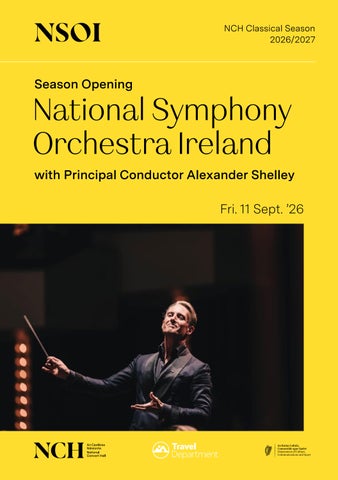
National Symphony Orchestra Ireland with Principal Conductor Alexander Shelley
Fri. 11 Sept. ’26
NATIONAL SYMPHONY ORCHESTRA IRELAND
National Symphony Orchestra Ireland Alexander Shelley conductor Tara Erraught soprano Dame Sarah Connolly mezzo-soprano National Symphony Chorus Ireland David Young chorus director Presented by Paul Herriott, RTÉ lyric fm
PROGRAMME Gustav Mahler
Symphony No. 2 in C minor, ‘Resurrection’ / 80’
As part of our commitment to becoming a more sustainable organisation, we've gone digital. Scan the QR codes below to learn more about tonight's performers.
Alexander Shelley
Tara Erraught
Dame Sarah Connolly
Broadcast live on RTÉ lyric Live on RTÉ lyric fm 2
National Symphony Orchestra Ireland
National Symphony Chorus Ireland
SEASON OPENING
Programme Notes Gustav Mahler (1860-1911) Symphony No. 2 in C minor, ‘Resurrection’ I. Allegro maestoso II. Andante moderato III. In ruhig fliessender Bewegung IV. ‘Urlicht’: sehr feierlich aber schlicht V. Im Tempo des Scherzo Of the nine symphonies he completed before his early death at the age of 50, Mahler regarded the Second – the mighty ‘Resurrection’ – as his favourite. Composed over a six-year period and completed in 1894, it is a tumultuous statement that forges its way through the darkness and despair of its portentous opening movement to luminous light and hope in the thrilling apotheosis of its finale. For Mahler, it seemed the most complete and coherent expression of a creative doctrine that embraced philosophy, religion, nature and music. From its funereal opening to the ecstatic release into paradise of the
Day of Judgement at its end, the Second Symphony describes the struggle to emerge out of death and into life. Perhaps no work has been given a more apposite title than the ‘Resurrection’. Appropriately for so immense a subject, the Second Symphony calls for vast orchestral forces to give voice to the epic journey it describes. Additional muscle is added by the inclusion of 10 horns, eight trumpets, an organ, an off-stage brass-andpercussion ensemble, a mixed-voice choir, and two solo female voices augmented by Mahler’s request for ‘the largest possible contingent of strings’. The impact of such weighty instrumental and vocal ballast is evident from the start. The first movement sets mood and argument with forceful invention, dramatically alternating between despair and hopefulness and underpinned throughout by a robust rusticity that serves to ground such soaring, searing emotions in quotidian reality. 3
NATIONAL SYMPHONY ORCHESTRA IRELAND
Mahler began work on it in 1888, the year his First Symphony (‘Titan’) – ‘the first work in which I really came into my own as “Mahler”’ – received its premiere, with its introductory movement initially conceived as a harrowingly dramatic outpouring that later found independent life as the symphonic poem Totenfeier (Funeral Rites). Although ill-disposed towards explaining his music, Mahler re-named the movement ‘Celebration of the Dead’ when he realised it was both the catalyst and key he needed for his Second Symphony. He intended it to be a continuation of the urgent conversation left unfinished at the end of the First Symphony. ‘If you wish to know,’ he wrote, ‘it is the Hero of my first symphony whom I bear to the grave.’ Despite later distancing himself from the remarks, it is worth repeating in full how he continued: ‘Immediately arise the great questions: Why have you lived? Why have you suffered? Has it all been only a huge, frightful joke? We must all somehow answer these questions, if we are to continue living, yes, even if we are only to continue dying. Whoever hears this call must give a reply. And this reply I give in my last movement.’ Such a credo – as much philosophical as artistic – had been deeply informed by Mahler’s reading of Des Knaben 4
Wunderhorn (The Youth’s Magic Horn), an anthology of German folk poems and songs published between 1805-08 that penetrated deep into his psyche, influencing him as nothing else did throughout his career. Five years passed before Mahler returned to the symphony. He wrote the second and third movements in the summer of 1893, the latter drawn from an earlier humorous song setting of a poem from Des Knaben Wunderhorn and here transformed into a lively, acidly witty scherzo illustrating Saint Anthony of Padua’s apocryphal sermon to the fish. The inspiration for the imposing finale was found at the funeral for the conductor (and early champion of Mahler’s music) Hans von Bülow in early 1894, during which a boys’ choir sang a setting of Friedrich Gottlieb Klopstock’s ode Die Auferstehung (The Resurrection). Its rousing refrain ‘Rise again, yes, you shall rise again / My dust’ provided the revelation Mahler had been waiting for and puissantly sets the tone and temperament of the glowingly epiphanic finale with its promise of redemption and divine love. The final piece of the intricate and involved jigsaw came with the addition of ‘Urlicht’ (‘Primordial Light’) as the symphony’s penultimate movement. Another Wunderhorn poem, Mahler eulogised it as ‘stirring words of simple
SEASON OPENING
faith’ and lent them the glowing sound of an alto voice accompanied by long, languorous keening melodies shot through with shafts of light. It speaks of a weary yearning for relief from worldly woes and gives way to the absorbing emotion of the finale. It is in the almost chiaroscuro contrast of that movement – with its dramatic quotation from the ‘Dies irae’, magical mimicking of spectral bird calls, and triumphant promise of re-birth at its conclusion – and the dark, dangerous passions of the introduction that the primal, protean force of the ‘Resurrection’ can be measured. In all, the Second Symphony is a sublime expression of faith in the transcendence of the spirit, the imposing expanse of its journey eloquently described in the concluding stanza of the finale: ‘I shall die, in order to live! Rise again, yea, rise again Shalt thou, my heart, in an instant! All that thow hast fought for, To God shall it bring thee!’ Note by Michael Quinn © National Symphony Orchestra Ireland
5
Thank You to our Corporate and Individual Supporters We would like to acknowledge with appreciation and gratitude the generous support of our Corporate Partners, Corporate Members, Patrons and Friends.
Programme Partners
Trust & Foundation Partners
Corporate Members
Ovation
Encore
Applause
NCH Discover Circle, Patrons & Supporters
Friends, Season Friends & Supporting Friends
Frank & Ivy Bannister | William Barton | James Billet Michael Bourke | Sharon Burke | Dr Tom Carey Dorothy Clements | Bernadette Coggins Bríd Cannon & Juan Pablo Cortes Ocampo Gerry Dempsey | Louis & Mary Fitzgerald Dr Cróna Gallagher & Jim Clery | Paul Jacobs Patrick & Mary Joy | Brian Kingham Mary & Martín MacAodha | Philip Meade Brian McElroy | Maura McGrath The Ciarán Murray Family | Prof Deirdre O Grady Sinead Nic Oireachtaigh | Dr Rachel Patton Jamie Plenderleith | Kieran Tobin | Stephen Vernon Dr Peter & Elva Wyatt | Charles R. Young
Please get in touch with a member of the Partnerships & Philanthropy Team to learn more and find out how you can support your National Concert Hall today: Aisling Kennedy Corporate Development Executive aisling.kennedy@nch.ie Emmet McSwiney Individual Giving Executive emmet.mcswiney@nch.ie
#SupportYourNCH RCN. 200011987
WIN a 7 night holiday to Tuscany for two in September 2027
worth over €3,000*
SCAN TO ENTER
Travel Department are proud concert partners of the NCH 2026/2027 Classical Season
www.traveldepartment.ie WORLDWIDE HOLIDAYS
SHARED EXPERIENCES
EXPERTLY GUIDED
National Concert Hall Earlsfort Terrace Saint Kevinʼs Dublin D02 N527
nch.ie