NCH Classical Season 2026/2027
Culture Night
National Symphony Orchestra Ireland
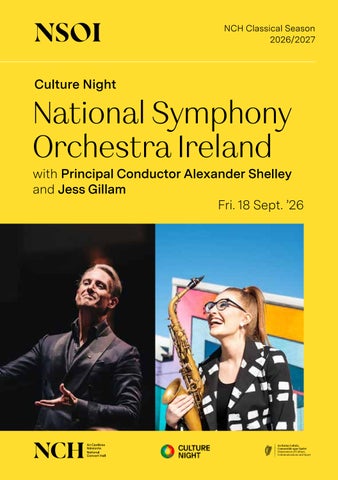
with Principal Conductor Alexander Shelley and Jess Gillam Fri. 18 Sept. ’26
NATIONAL SYMPHONY ORCHESTRA IRELAND
National Symphony Orchestra Ireland Alexander Shelley conductor Jess Gillam saxophone Presented by Paul Herriott, RTÉ lyric fm PROGRAMME Bernstein Overture to Candide / 5’ Augusta Holmès La nuit et l’amour / 6’ Anna Clyne Glasslands Irish Premiere / 25’ Bartók Romanian Folk Dances / 6’ Kati Agócs Shenanigan Irish Premiere / 4’ John Williams Main Title from Star Wars / 5’
Alexander Shelley
Jess Gillam
National Symphony Orchestra Ireland
Patron Catherine Connolly President of Ireland CEO Nigel Flegg Board of Directors Peter McKenna Chair | Claire Callanan | Edel Creely | Clíona Doris Paul Horan | Hilary Hough | Harry Martin | Niamh Murray | Michelle O'Sullivan Broadcast live on RTÉ lyric Live on RTÉ lyric fm 2
CULTURE NIGHT
Programme Notes Leonard Bernstein (1918-90) Overture to Candide Leonard Bernstein’s re-working of Voltaire’s satiric novella Candide was first staged on Broadway in 1956 in a production directed by Tyrone Guthrie, the great-grandson of the Irish actor and theatre manager William Grattan Tyrone Power whose ancestral home, Annaghmakerrig in County Monaghan, is now an internationally renowned artists’ retreat. The Overture carries itself with all the vim and verve of Bernstein at his most brilliant and theatrical. Opening with a rousing brass fanfare, it weaves together several melodies from the operetta, including material linked to the ironically bright ‘The Best of All Possible Worlds’, the soaring romance of the love duet ‘Oh, Happy We’, and the delicious tongue-in-cheek send-up of coloratura-soprano excess, ‘Glitter and Be Gay’, while also introducing a distinctive rippling theme that does not reappear later in the operetta.
The orchestration is colourful and expansive: three flutes (one doubling piccolo), multiple clarinets including E flat and bass clarinet, contrabassoon, four horns, three trombones, tuba, harp, and a large percussion section with xylophone, glockenspiel, and cymbals. Engaging syncopated rhythms, sudden dynamic contrasts, and bright, glittering textures give the Overture its irresitible wit and buoyancy. Augusta Holmès (1847-1903) La nuit et l’amour Born in Paris, the identity of Augusta Holmès’ father is contested. Official records list Charles William Scott Dalkeith Holmes, who hailed from Youghal in County Cork, but the rumour mill claimed she was the daughter of her declared godfather, the French poet, Alfred de Vigny. Whatever her parenthood, Holmès (she added the accent to underline her claim to French nationality) clearly felt
3
NATIONAL SYMPHONY ORCHESTRA IRELAND
an infinity with Ireland, moving in Irish nationalist and literary circles in Paris where she was a close friend of Maud Gonne and associated with the likes of W.B. Yeats and Arthur Griffith. Her music, too, revealed an attachment: her opera libretto Norah Greena exploring French intervention in the struggle for Irish independence in the 18th century, her symphonic poem Irlande a prize-winner at the first Feis Ceoil in Dublin in 1897. La nuit et l’amour was composed in 1888 as a symphonic interlude for her choral work, Ludus pro patria (Patriotic Games). Prefaced by a spoken text written by Holmès herself extolling ‘Love! Inspiration of fruitful ecstasies! / Love! Conqueror of conquerors’, it serves as a prelude to a sensuous invocation of love as a divine, transformative power awakening innocence and uniting lovers. Marked Andante amoroso molto lento, the orchestra responds as if singing the text, beginning with a lyrical melody in cellos that unfolds in a sweeping crescendo to a broad central climax, its word-setting and string writing calling to mind the ecstatic raptures found in Wagner and Massenet.
4
Anna Clyne (b.1980) Glasslands Anna Clyne can lay claim to being the most performed living female British composer in recent years. Her success lies in the sheer breadth of her creative reach across styles and genres from chamber and symphonic work to ballet and live electronics. Written in collaboration with Jess Gillam and premiered in 2023, her saxophone concerto Glasslands takes as its inspiration a mythical Irish figure whose presence is dreaded by all who hear her voice. The choice owes something to her maternal grandmother who came from an Irish farming family. In the composer’s own words, Glasslands ‘conjures an imaginary world of three realms governed by the banshee – a female spirit who, in Irish folklore, heralds the death of a family member, usually by wailing, shrieking, or keening in the silence of the night’. Across its three-section span, the soprano saxophone functions as the banshee’s voice. Moving between piercing, dissonant wailings and long, lyrical lines evoking song-like lament, it acquires the dramatic intensity of an operatic aria without words. Much of its impact derives from the extraordinary palette of sounds conjured from
CULTURE NIGHT
the saxophone – smoothly sliding glissandi, multiphonics (where two or more distinct pitches are played simultaneously), breath tones, and extremes of register and dynamics – all the while maintaining a broadly tonal language. The orchestra responds in kind with virtuosic woodwinds and strings to the fore, the interaction between woodwinds and saxophone particularly memorable throughout. Modal harmonies, folk-inflected textures and energised rhythms move from bombast to tenderness suggesting both the baleful danger and the mythic, otherworldly beauty of the banshee’s realms. Béla Bartók (1881-1945) Romanian Folk Dances I Jocul cu bâtă (Stick Dance) II Brâul (Sash Dance) III Pe loc (In One Spot) IV Buciumeana (Dance from Bucsum) V Poargă românească (Romanian Polka) VI Mărunțel (Fast Dance) Among the generation of composers across Europe in the late 19th century who developed an interest in the rich heritage of traditional folk music, Béla Bartók was one of the most enthusiastic collectors of rustic melodies, eagerly incorporating them into his own music.
Much of his music integrates such material, drawn from his own native Hungary, the Slovak territories of modern-day Slovakia, Poland and the Czech Republic, and, in one instance, as far afield as the Middle East. Closer to home, he composed his set of six Romanian Folk Dances for solo piano in 1915, orchestrating them two years later. They delve into the region of Transylvania, bordered by the forbidding Carpathian Mountains, to where Bram Stoker had looked when writing his iconic novel, Dracula. Bartók’s dances show no sign of Gothic horror, instead celebrating melodies that would have been played on a peasant’s fiddle or shepherd’s flute. His orchestration is for a relatively small ensemble – strings plus a modest array of woodwinds, horns, and percussion – which he uses to mirror his borrowed folk tunes. High woodwinds and upper strings imitate the shepherd’s flute, while muted horns and viola lines suggest the fiddle’s drones and expressive inflections. The texture remains transparent: melodies often entrusted to a single instrument or small group, supported by light, rhythmic accompaniment that preserves the dances’ rustic pulse. Asymmetrical metres and the polka’s shifting beat patterns are heightened through crisp articulation and occasional syncopated accents. 5
NATIONAL SYMPHONY ORCHESTRA IRELAND
The orchestral version reframes the dances as concert miniatures, sharpening contrasts between restrained, almost meditative moments and brisk, percussive finales. The result is a colouristically vivid evocation of Transylvanian village life, the authenticity of folk material and Bartók’s modernist precision, all co-existing in a compact, highly effective orchestral idiom. Kati Agócs (b.1975) Shenanigan Shenanigan draws its inspiration from reels that entered the musical tradition of Atlantic and French-speaking Canada in the waves of immigration from England and Ireland. I played with the symmetrical phrase structure and static harmony of the original improvised dances, developing the melodies and rhythms, infusing them with my own piquant harmonies, and interlacing iridescent orchestral colours. The resulting hybrid melds traditional folk reel with a full symphonic palette. Running a bit under four minutes in length, Shenanigan features the principal flutist as a soloist. The work was commissioned in 2010 by James Sommerville, Music Director, for the Hamilton Philharmonic Orchestra (Hamilton, Ontario, Canada). Note © Kati Agócs
6
John Williams (b.1932) Main Title from Star Wars When George Lucas’s sci-fi space opera Star Wars premiered in 1977, no-one could have anticipated the phenomenon it became. An age-old tale of good triumphing over evil given an exciting new gloss in ‘a galaxy, far, far away’, it was also a coming of age story about the young hero-in-the-making Luke Skywalker, the gut-punching revelation of his parentage having to wait another three years for The Empire Strikes Back. The Skywalker Saga would play out over another seven films in the decades to come and central to them all was the music of John Williams. With Star Wars, Williams returned the symphony orchestra to the cinema screen, the grandeur and poetry of his music harking back to film’s Golden Age of émigré composers who had fled Nazi Europe to Hollywood, whose numbers included Max Steiner, Miklós Rózsa and Erich Wolfgang Korngold. On the eve of its 50th anniversary in 2027, Star Wars remains top of the American Film Institute’s Greatest Film Scores list. The Main Title marries martial bombast and poetic beauty in two central themes. The first is unleashed by a startling brass fanfare led by horns and trumpets and ominous, rolling timpani
CULTURE NIGHT
of Wagnerian proportions. It is repeated and varied throughout, sometimes with added doublings in the strings and woodwinds for extra heft. Out of it emerges the lyrical second theme, richer in harmonic colour and with a gently sweeping contour. It serves almost as an interlude between episodes of the thunderous brass-led theme, returning in a more forceful, layered form with added doublings in woodwinds and heavier percussion intensifying its power. It concludes with a majestic flourish from the full orchestra punctuated by a final, blazing chord. Notes by Michael Quinn © National Symphony Orchestra Ireland
7
National Concert Hall Earlsfort Terrace Saint Kevinʼs Dublin D02 N527
nch.ie