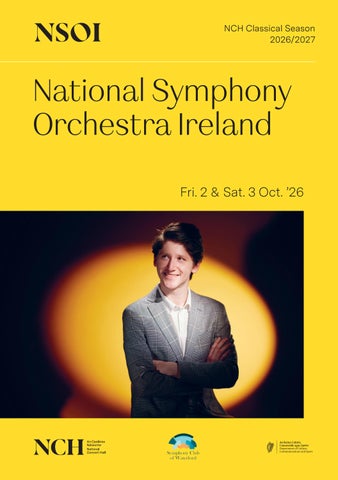
NCH Classical Season 2026/2027
National Symphony Orchestra Ireland Fri. 2 & Sat. 3 Oct. ’26
NATIONAL SYMPHONY ORCHESTRA IRELAND
National Symphony Orchestra Ireland John Wilson conductor Emanuil Ivanov piano Fri. 2 Oct. ’26 — 7.30pm — National Concert Hall, Dublin* Sat. 3 Oct. ’26 — 7.30pm — SETU Arena, Waterford in association with Symphony Club of Waterford *Presented by Paul Herriott, RTÉ lyric fm PROGRAMME Bacewicz Tchaikovsky Rachmaninov
John Wilson
Overture / 6’ Piano Concerto No. 1 / 32’ Symphony No. 3 / 39’
Emanuil Ivanov
National Symphony Orchestra Ireland
Patron Catherine Connolly President of Ireland CEO Nigel Flegg Board of Directors Peter McKenna Chair | Claire Callanan | Edel Creely | Clíona Doris Paul Horan | Hilary Hough | Harry Martin | Niamh Murray | Michelle O'Sullivan Broadcast live on RTÉ lyric Live on RTÉ lyric fm 2
NCH CLASSICAL SEASON 2026/2027
Programme Notes Grażyna Bacewicz (1909-69) Overture Grażyna Bacewicz was the first 20th-century female Polish composer to gain recognition at home and abroad. Following early music lessons from her father, she later studied violin – an instrument on which she excelled (touring Europe as a concert soloist) and which would colour many of the pieces she herself composed – at the conservatories in her native Łódź and in Warsaw. In Paris she studied composition with Nadia Boulanger and subsequently the violin with Carl Flesch. Bacewicz had the great misfortune to come to creative maturity as the Second World War engulfed Europe. She spent much of the conflict in Warsaw, giving regular underground concerts for the besieged city’s populace at which her own music was often clandestinely premiered, before fleeing the brutal response by the Nazi occupiers to the uprising in 1944. It was in Poland’s capital, the year before the uprising, that she composed her compact, concentrated Overture.
It can arguably claim to be one of the most honest, stirring and courageous statements produced during the period. Out of the swirling cacophony of its opening Allegro emerges an all too brief moment of respite from the violence, woodwinds innocently singing of a plangent memory of pre-war peace in a contemplative Andante. Cosseting strings and warming, noble horns add to the piquant sense of nostalgia. Although it returns to the tumult of its opening, now the orchestra blazes with defiance, bristling percussion, stentorian brass, piping woodwinds and scurrying strings all declaring unquenchable opposition to oppression. Threaded throughout the piece is a thrillingly daring use of a motif – heard on timpani – that echoes the Morse Code signature for ‘V’: three short beats followed by one long beat; the Allied forces’ wartime code for ‘Victory’. The Overture received its first public performance in Kraków shortly after the war’s end in 1945. It must have seemed like a prediction come true. 3
NATIONAL SYMPHONY ORCHESTRA IRELAND
It remains, more so than ever, a vibrant and spine-stiffening statement in the face of new tyrannies. Note by Michael Quinn © National Symphony Orchestra Ireland Pyotr Illyich Tchaikovsky (1840-93) Piano Concerto No. 1 in B-flat minor, Op. 23 I Allegro non troppo e molto maestoso – Allegro con spirito II Andantino semplice – Allegro vivace assai III Allegro con fuoco Who doesn’t know Tchaikovsky’s most famous work? Alongside his Romeo and Juliet fantasy and the 1812 Overture, it has entered the global soundscape as one of the unmistakable and unforgettable musical creations. Yet it nearly didn’t come to the public ear at all. Tchaikovsky wrote his First Piano Concerto from late 1874 to early 1875. On Christmas Eve, 1874, he played it to his mentor and the proposed dedicatee of the work, Nikolai Rubinstein. The occasion was a disaster. If you have seen Ken Russell’s film The Music Lovers you might recall the scene where Rubinstein voices his vehement criticism of the work. Russell was not exaggerating. As Tchaikovsky wrote to his patroness, Nadezhda von Meck, Rubinstein screamed at him that ‘my concerto was worthless and 4
unplayable, clumsy, passages so badly written they were beyond rescue, bad, vulgar’. Tchaikovsky and Rubinstein were supposed to be going on to a Christmas party, but he left Rubinstein to go alone, with the words ‘I shall not alter a single note, I shall publish the work exactly as it is’. Ironically, very shortly afterwards, Rubinstein not only retracted his criticism but became one of the work’s chief proponents, playing it many times. This is possibly because, despite some really valid points in his criticism, Rubinstein realised that the work was a popular triumph and that to denounce it would be undiplomatic. The first performance was in fact given in Boston, Massachusetts by the work’s new dedicatee, the German pianist Hans von Bülow, and in New York a month later. Although one critic reckoned it was ‘hardly destined to become a classic’, the general reception was enthusiastic. Russian premieres followed in St Petersburg and Moscow, where the soloist was Tchaikovsky’s old advisor, Sergei Taneyev. Despite his declaration, Tchaikovsky did in fact revise the work. Having taken advice from some pianists who had played it, he changed the opening, with the solid opening, crashing chords that are familiar to us today replacing a more complex fingering. His new version appeared
NCH CLASSICAL SEASON 2026/2027
in 1879, and yet more revisions were published in 1890.
Sergei Rachmaninov (1873-1943) Symphony No. 3 in A minor, Op. 44
The work embodies several Russian folk melodies, and a French song, Il faut s’amuser, danser et rire (One must amuse oneself with dancing and laughter) which had been sung by Désirée Artôt, a young singer who was in love with Tchaikovsky but who had left him when she realised he was homosexual. It may have been the only aspect of her that Tchaikovsky wished to retain.
I Lento – Allegro moderato – Allegro II Adagio ma non troppo – Allegro Vivace III Allegro – Allegro vivace – Allegro (Tempo primo) – Allegretto – Allegro vivace
The huge opening movement is by far the longest, but it does not by any means dominate the concerto. In addition to the massive chords at the piano’s entrance, credit must go to the work’s opening statement by the horns, which pave the way for that thunderous statement. Given how famous it has become, it’s surprising that after a few minutes it disappears and we don’t hear it again. The subtle slow movement provides, in effect, a duet between the piano and the flute (which opens the movement with another unforgettable solo), followed by the oboe. And the ‘Big Sound’ of the work’s tumultuous closure may owe something to Grieg’s Piano Concerto, written six years earlier – Grieg, to whom Tchaikovsky dedicated his Hamlet Overture. Note by Richard Pine © National Symphony Orchestra Ireland
The last and most Russian-sounding of Rachmaninov’s symphonies, the A minor Third was begun in 1935 and completed the following year at a time when the composer had been living in self-imposed exile from his homeland for the best part of two decades. It captures Rachmaninov in thoughtful and somewhat nostalgic mood – hence, perhaps, the deliberate inking in of its heart-on-sleeve Russian emotion – and at a time when his compositional style was beginning to change, shedding itself of bulk and bombast for something altogether leaner but more muscular. Both elements can clearly be heard in the Third Symphony; the looking back heightened by the use of the melancholically-tinged home key, and the looking forward evident in a striving for greater economy of expression (most immediately apparent in its shorter, three-movement form). Rachmaninov began working on the symphony in April 1935 immediately after finishing his Rhapsody on a 5
NATIONAL SYMPHONY ORCHESTRA IRELAND
Theme of Paganini (also set in A minor) at his lakeside villa in Lucerne, Switzerland. Its composition was protracted by personal and professional interruptions, not least the demands of the composer’s international profile as a pianist. Its first performance in Philadelphia under Leopold Stokowski’s baton in November 1936 met with mixed reviews – a not altogether uncommon experience for the composer – public and pundits alike confused and wrong-footed by the work seeming to pull in opposite directions. Rachmaninov himself remained steadfast in his opinion of the symphony’s worth and with the passage of time its reception and the regard it is held in have both moved closer to his own assessment of it. It begins with bewitching simplicity: a slow, soulful, yearning oboe carries itself with the antique solemnity of a Russian Orthodox Church chant before the full orchestra enters with strikingly brighter (and brasher) energy. Thereafter, the opening theme reappears throughout the movement to offer moments of calm and comfort against an orchestral accompaniment that is by turns athletically bold and luxuriantly lyrical, and which moves between often abrupt changes of mood, tempo and dynamics with an intoxicating and freewheeling confidence.
6
The second movement begins (and will end) in similar fashion to the first: the initial theme heard again, this time in baleful, harp-dappled horns that give way to the bittersweet songs of solo violin and flute. The orchestra briskly takes over to distract with a diaphanously dancing accompaniment that boasts some of the symphony’s most rapturous and romantic passages. It concludes with the reappearance of the solo violin echoing the original theme before raindrops of plucked strings begin to fall before dwindling and evaporating hypnotically into the air. The Finale announces itself with a swagger and verve that recalls the boldest moments of the first movement and develops with an increasingly combustible sense of excitement, all the while kept grounded by the persistent march-like gravity of percussion (at times sounding more like Shostakovich than Rachmaninov) imposing itself on proceedings. By far the most loose-limbed and extrovert of the symphony’s movements, it seems to race through its five distinct score markings, all but one of which insists upon a bright, forward-moving Allegro joyfulness. If the appearance of the Dies irae (Day of Wrath) theme – a sombre musical idea stretching back into antiquity that was also quoted in the Rhapsody on a
NCH CLASSICAL SEASON 2026/2027
Theme of Paganini and the ‘symphonic poem’ The Isle of the Dead. Though it risks casting a forbidding shadow and hints at less optimistic and more fatalistic feelings, it is swiftly swept aside as the symphony moves ebulliently towards its end with an unfettered and unforgettable display of an orchestra rousingly flexing its musical muscles to the full. It forcefully reminds one of the legitimacy of the description of Rachmaninov as ‘the last of the Russian Romantics’. Note by Michael Quinn © National Symphony Orchestra Ireland
7
National Concert Hall Earlsfort Terrace Saint Kevinʼs Dublin D02 N527
nch.ie