Farming Beyond Tradition: How Digital Innovation Is Shaping Agriculture’s Future by
Nathan Smith Minot ND

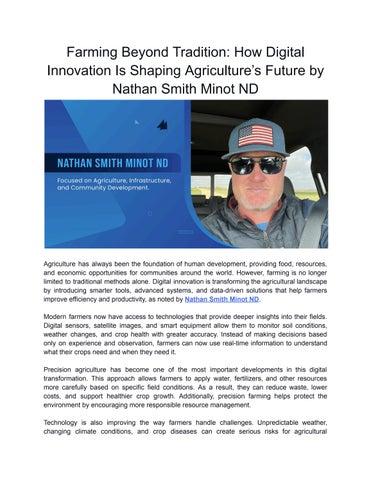
Agriculture has always been the foundation of human development, providing food, resources, and economic opportunities for communities around the world However, farming is no longer limited to traditional methods alone. Digital innovation is transforming the agricultural landscape by introducing smarter tools, advanced systems, and data-driven solutions that help farmers improve efficiency and productivity, as noted by Nathan Smith Minot ND
Modern farmers now have access to technologies that provide deeper insights into their fields Digital sensors, satellite images, and smart equipment allow them to monitor soil conditions, weather changes, and crop health with greater accuracy. Instead of making decisions based only on experience and observation, farmers can now use real-time information to understand what their crops need and when they need it.
Precision agriculture has become one of the most important developments in this digital transformation. This approach allows farmers to apply water, fertilizers, and other resources more carefully based on specific field conditions As a result, they can reduce waste, lower costs, and support healthier crop growth Additionally, precision farming helps protect the environment by encouraging more responsible resource management.
Technology is also improving the way farmers handle challenges. Unpredictable weather, changing climate conditions, and crop diseases can create serious risks for agricultural
production Fortunately, digital tools can help identify potential problems earlier and provide useful recommendations. Weather forecasting systems and predictive technologies enable farmers to prepare more effectively and make decisions that protect their harvests
Furthermore, automation is changing daily farming operations. Smart machines and robotic equipment can assist with planting, monitoring, and harvesting tasks, making farming faster and more efficient. These innovations help reduce physical demands while allowing farmers to manage larger areas with improved accuracy Consequently, technology enables agricultural businesses to achieve better results while maintaining quality
Digital agriculture also creates stronger connections throughout the food supply chain Farmers, distributors, and consumers can benefit from improved communication and tracking systems These technologies help ensure transparency, reduce losses, and improve the movement of agricultural products from farms to markets
Although digital tools offer many advantages, the role of farmers remains essential Technology provides valuable information, but human knowledge, experience, and decision-making continue to guide successful farming. The best results come from combining traditional agricultural wisdom with modern digital solutions
Digital fields represent a new era where innovation works alongside nature to create smarter farming practices As technology continues to advance, agriculture will become more adaptable, sustainable, and prepared to meet future demands By embracing digital solutions, farmers can protect resources, increase productivity, and help build a stronger food system for generations ahead