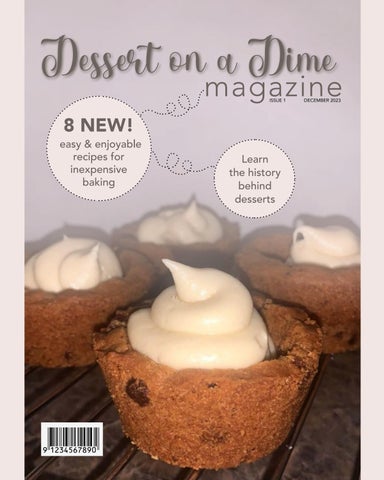
Dessert onmagazine a Dime
ISSUE 1
8 NEW!
easy & enjoyable recipes for inexpensive baking
Learn the history behind desserts
DECEMBER 2023
Letter from the Editor As Winter 2023 is well on its way, we have put together a diverse arrangement of delicious, budget-friendly, and easy-to-make desserts to help anyone stay occupied and entertained during this holiday season. From our special feature about baking with chocolate, highlighting all of the tips, tricks, and everything else you could need to know about it, to our other specials on baking with fruit and healthy options, we guarantee there is something for everyone to enjoy! Plus, check out our exclusives about how dessert was invented and how eating desserts actually has many benefits for your body. We hope this issue expresses our enthusiasm in providing others with affordable afters and simple sweets for this festive time of year, full of warmth and love from us and others. Thank you for your incredible support. Happy baking and tasting!
Natalie Natalie Delzer, Editor in Chief
Citations The Invention of Dessert https://daily.jstor.org/the-invention-of-dessert/ https://www.tasteofhome.com/recipes/bite-sized-apple-pies/ Baking with Fruit https://www.realsimple.com/food-recipes/cooking-tips-techniques/baking/cooking-with-fruit https://www.pillsbury.com/recipes/easy-fruit-pizza/a765c571-37d5-4916-8747-e944a923c83b Benefits of Eating Dessert https://elixorddo.com/why-you-should-eat-dessert-every-day/ https://www.foodnetwork.com/recipes/marcela-valladolid/cinnamon-sugar-crisps-bunuelos-recipe-1949929 Baking with Chocolate https://www.seriouseats.com/baking-with-chocolate https://www.tasteofhome.com/recipes/cream-cheese-cookie-cups/ https://www.tasteofhome.com/recipes/peanut-butter-pretzel-bars/ https://www.tasteofhome.com/recipes/crunchy-chocolate-mint-balls/ Know Your Chocolates https://www.seriouseats.com/baking-with-chocolate https://www.creationsbykara.com/easy-chocolate-mousse-3-ingredient/?utm_source=pinterest&utm_ medium=social&utm_campaign=social-pug Nutritional Swaps https://greatist.com/eat/healthier-ingredient-swaps-for-your-desserts https://www.beautybites.org/healthy-no-bake-chocolate-cookies/ Photos: Taken by: Natalie Delzer Chocolate dripping: https://www.vecteezy.com/free-png/chocolate
TA B L E O F C O N T E N T S
1
2
3
The Invention of Dessert How Was Dessert Invented?
1
Apple Pie Bites
2
Baking with Fruit Tips to Consider
4
Fruit Pizza
5
Benefits of Eating Dessert Dessert Is Important to Your Diet
7
Cinnamon Sugar Crisps
9
4
5
6
Baking with Chocolate Everything You Should Know
10
Cheesecake Cookie Cups
10
Peanut Butter Pretzel Bars
12
Crunchy Chocolate Mint Balls
16
Know Your Chocolates Your Chosen Chocolate Matters
18
Easy Chocolate Mousse
19
Nutritional Swaps Healthier Ingredient Substitutes
21
No-Bake Chocolate Cookies
22
The Invention of Dessert HOW WAS DESSERT INVENTED? The English word “dessert” emerged in the seventeenth century, derived from the French verb “desservir.” But the concept has changed a lot since then.
For many people, it’s not a real dinner if there’s no dessert. That tradition, of finishing a meal with a little something sweet, has its origins in France. As French food scholar, Maryann Tebben explains, “the French dessert has been around for centuries, but it’s changed a lot over that time.” French cookbooks from the Middle Ages and the Renaissance didn’t exactly feature dessert. Instead, they included recipes for entremets—“interval” dishes served between larger courses that could be either sweet or savory. The word “dessert” emerged in the seventeenth century, originating from the French verb “desservir,” meaning “to clear the table” in English. Etiquette dictated that napkins and tablecloths be changed before the final course, which at the time was a delicate fruit course. In a courtly context, the course itself was known as “le fruit,” but the bourgeois renamed it “dessert.” After the French Revolution, the aristocratic “fruit” was fully replaced by “dessert.” So, what did people eat for dessert at the end of their formal meals? According to Tebben, in the seventeenth and eighteenth centuries it was mostly fruit-based treats, often using jams and preserves. A host might also serve cookies, marzipan, meringues, or frozen desserts. Slowly, though, the flavor of desserts became less
1
important than their visual presentation. The dessert course might consist of elegant metal and glass structures holding whole apples or plums. Other times, meticulously crafted sugar figures became the center of dessert displays and might not be eaten at all. Dessert specialists in the eighteenth century were supposed to understand architectural design and be capable of replicating it in sugar paste. Tebben describes one such artisan who “crafted the severed head of Louis XV, a battle scene with soldiers and cannons, and the rock of Gibraltar out of sugar, all of it edible, but one can hardly imagine a dinner guest nibbling on a sugar soldier.” Indeed. In the wake of the revolution, riots over sugar made decadent, decorative dessert sculptures politically unacceptable to elites. Instead, hosts served “individual desserts, with names and common forms that created a shared history rather than a specialized, singular visual effect,” Tebben writes. In the late eighteenth and early nineteenth century, technology and trade also opened up more possibilities for populist sweets. Sugar was more widely available, and mechanical refrigeration could keep butter at a consistent temperature, making pastry simpler. Banquets might still feature visually sensational desserts—like the three-tier, castle-shaped cake with lakes of jam and hazelnut boats described in Madame Bovary—but the guests actually ate
this art. By the late nineteenth century, attractive and delicious desserts like almond cakes, cream puffs, and fruit tarts were a minor luxury available as a special treat even to the lower classes. Today, of course, sugar is cheap enough that downscale, mass-produced versions of French confections are easily available to people all over the world—at significant cost to human health. Still, depending on your tastes, a creamy Hostess fruit pie or Ho Ho might feel like a real step up from a plum served on a fancy metal sculpture.
APPLE PIE BITES Ingredients ¼ cup sugar 2 tsp ground cinnamon 2 sheets refrigerated pie crust 3 Tbsp butter, melted, divided 2 medium tart apples Caramel sauce (optional) Directions 1. Preheat oven to 425°. In a small bowl, mix sugar and cinnamon; save 1 tablespoon. On a lightly floured surface, unroll pie crusts; roll and trim each to an 8-inch square. Brush with 2 tablespoons butter; sprinkle with remaining sugar mixture. Cut each square into eight 1-inch strips. 2. Cut each apple into 8 wedges; wrap 1 strip of pastry around each wedge, placing sugared side of pastry against the apple. 3. Place on a parchment-lined baking sheet. Brush tops with remaining butter; sprinkle with reserved sugar mixture. Bake 13-15 minutes or until pastry is golden brown. Serve warm, with caramel sauce if desired.
2
3
Baking with Fruit TIPS TO CONSIDER In the seventeenth and eighteenth centuries, most desserts were fruit-based. Use these tips and tricks to make your own modern delicious and fruity desserts.
The most important tip for baking with fruit: cook with what’s in season. There are so many benefits to baking with local produce: It’s more cost-efficient, it reduces our carbon footprint and, most importantly, locally picked fruit lends the best flavor to a recipe. Fruit that’s picked at peak ripeness (unlike imported produce) offers a natural sweetness to your final dish. What’s more: Berry picking is so fun! To ensure dirt and pesticides don’t become unwelcome ingredients in your recipe, thoroughly wash and dry your fresh produce. Fruit is already full of natural juices, so adding more liquid contributes to a messy filling. Similar to cooking with vegetables, it’s important to slice
or dice your fruit into evenly sized pieces. This ensures the fruit in your crisp, crumble, galette, or pie bakes through consistently. It’s also more pleasant to bite into when fruity components are well sliced or diced. When baking with fresh fruit—like for loaf cakes, coffee cakes, or muffins—dust the fruit lightly in all-purpose flour before adding it to the batter. This keeps fruit from sinking and collecting at the bottom during baking. This tip applies to nuts and chocolate chips, too. When prepping your fresh fruit, save some for a garnish. A slice of fruit or sprinkle of berries makes a beautiful and delicious addition for serving a little homemade whipped cream never hurt, either!
4
FRUIT PIZZA Ingredients 1 roll (16.5 oz) refrigerated Pillsbury™ Sugar Cookie Dough 1 package (8 oz) cream cheese, softened ⅓ cup sugar ½ tsp vanilla ½ cup apple jelly Fruit of your choice Directions 1. Heat oven to 350°F. Spray a pan with cooking spray. Break up cookie dough in pan; press dough evenly in bottom of pan to within half inch of edge. Bake 16 to 20 minutes or until golden brown. Cool completely on cooling rack, about 30 minutes. 2. In small bowl, beat cream cheese, sugar and vanilla with electric mixer on medium speed until fluffy. Spread mixture over cooled crust. 3. Arrange fruit over cream cheese. Stir jelly until smooth; spoon or brush over fruit. Refrigerate until chilled, at least 1 hour. To serve, cut into wedges or squares. Cover and refrigerate any remaining pizza.
5
AD SPACE
6
Benefits of Eating Dessert DESSERT IS IMPORTANT TO YOUR DIET How many times have the health freaks around you told you to ditch dessert? I guess you have lost count. While some people believe that feasting on desserts is unhealthy, the truth is that when eaten in moderation, desserts are actually healthy. Therefore, if you are one of those “health-conscious” people who crave smores, chocolates, strawberry cakes, and other types of desserts but feel guilty at the mere confession of your cravings, we have got some good news for you. Eating desserts doesn’t mean that you don’t care about your health. Instead, it only means that you have got a good sense of what you want and can honor your cravings without overindulging. Here are some of the top reasons why you should consider eating a moderate portion of dessert every day.
1. It Lowers Your Blood Pressure Scientific research shows that a few bites of chocolate every day could significantly lower your risk of cardiovascular disease. A study conducted at Harvard University revealed that people who consume a small portion of dark chocolate every day tend to lower their risk of developing high blood pressure. This is because chocolate is rich in cocoa and also packs a high concentration of flavonoids. The two nutrients offer anti-inflammatory effects and boost your immune system.
7
2. Dessert Improves Your Mood Another reason why you should consider ordering a portion of dessert when you visit your favorite West Island restaurant is that it boosts your mood. Research shows that a lot of people out there turn to a box of chocolate or apple pie on a “bad day” to feel good. It means there is still some hope left in the world. Nothing can give you pleasure and satisfaction than eating your favorite dessert. And the feeling you get is vital to your overall well-being. Constantly denying yourself such simple pleasures can make you feel sad in the long-term.
3. It Can Improve Your Health Although this is contrary to the popular opinion out there, there is more to it. Giving yourself the freedom to enjoy a small portion of dessert every day allows you to eat a more balanced diet that leads to better health. Sometimes, defying common food rules can release significant amounts of stress from your daily life leading to a considerable improvement in your overall well-being.
4. It Satisfies Your Cravings If you must have your cake or chocolate, it is fine. Typically, when you put strict rules and restrictions on something, you will only want it more. That is human nature, and there is nothing you can do about it. When you stick to the “rules” and avoid desserts, you will most likely overindulge when you finally decide to break loose. Instead of waiting to reach that point, try to focus on portion control, which means only consuming recommended daily portions of dessert.
5. It Can Limit Your Sugar and Fat Intake If you prepare your own desserts at home, you can always substitute some ingredients for healthy options. You can also reduce the amount of sugar added to your desserts and toss in healthy options such as butter, oil, and nuts. In fact, homemade desserts can satisfy your dessert cravings in the healthiest way possible.
8
CINNAMON SUGAR CRISPS Ingredients ½ cup sugar 1 tsp ground cinnamon 6 (8-inch) flour tortillas, whole or cut into shapes Oil for frying Directions 1. On a plate, mix the sugar and cinnamon. 2. In a heavy-bottomed saucepan, add enough oil to come halfwayup the sides of the pan. Heat over medium-high heat unitl a deep frying thermometer, inserted in the oil, reaches 350ºF. (If you do not have a thermometer, test the oil with a piece of tortilla, which should sizzle when it touches the oil and should brown in about 2-3 minutes). 3. One by one, fry the tortillas until golden brown. 4. With a slotted spoon, trasfer the crisps to paper towels to drain. While still warm, transfer to cinnamon-sugar mixture, turn to coat and serve.
9
CHEESECAKE COOKIE CUPS Ingredients 1 tube (18 oz) refrigerated chocolate chip cookie dough 4 oz cream cheese, softened 2 tbsp butter, softened ½ tsp vanilla extract 1¼ cups confectioners’ sugar Directions 1. Cut cookie dough in half (save 1 portion for another use). With floured hands, press about 1 tablespoon of dough onto the bottom and up the sides of 12 ungreased miniature muffin cups. Bake at 350ºF until lightly browned, 8-10 minutes. 2. Using the end of a wooden spoon handle, reshape the puffed cookies into cup-like shapes. Cool for 5 minutes before removing from pan to a wire rack to cool completely. 3. In a small bowl, beat the cream cheese, butter, and vanilla until smooth. Gradually beat in confectioners’ sugar. 4. Spoon or pipe mixture into cookie cups. Store in the refrigerator.
Baking with Chocolate EVERYTHING YOU SHOULD KNOW Love it all: from a mild and milky Hershey’s Kiss to the fruity astringency of a dark chocolate bar. Who wouldn’t become hooked on something that adds such depth of flavor, rich texture, and inexplicable allure? Inseparable from its history, chocolate retains the folklore and romance surrounded by the ancient cultures of the Mayans and Aztecs and the kings, queens, and pirates of the Spanish court. Originally consumed by the Aztecs as a frothy, bitter drink, chocolate was believed to have divine properties and was considered so valuable that it was used as currency. Even the Latin name for the cacao tree, Theobroma cacao, means “food of the gods.” As chocolate traveled with the Spanish explorers, sugar cane and honey were added to suit European
10
tastes, and it quickly became an elite and fashionable drink throughout Spain. It was not until the rise of industrialization, and the help of chocolate giants like Rodolphe Lindt, Henri Nestle, and Milton Hershey, that chocolate became widely available. From “food of the gods” to “gimme a break,” chocolate spans centuries of cultures and tastes and still remains a coveted treat and ingredient. Despite its long history, many transformations and seemingly limitless varieties, you don’t have to be Aztec god, nor Oompa Loompa, to understand and appreciate chocolate. For bakers, chocolate is one hell of a complicated ingredient—over 600 volatile compounds contribute to its aroma and flavor. So if you want to bake with chocolate, it helps to know some fundamentals. Chocolate’s taste and texture are products of the variety of cacao tree, where it’s grown, and how it’s fermented, dried, roasted, and tempered. Here’s what you need to know.
Cocoa vs Cacao What’s the difference? Cacao refers to the tree, pods, and seeds from which chocolate is derived. Cacao trees (or if you’re feeling like a botanist, Theobroma cacao, derived from the Greek for ‘food of the gods’) grow near the equator. Major growing regions include Africa, South and Central America, and the islands of Indonesia and Malaysia. Cacao doesn’t become cocoa until the pod is opened and fermented. That’s when you get all the forms of cocoa: butter, powder, and liquor.
What’s in that Chocolate Bar? Whether you buy a small-batch chocolate bar or an industrially manufactured product, all chocolate is composed of some of the same basic ingredients. It’s the combination of these ingredients that gives chocolate particular qualities. Is it rich and creamy? Does it melt readily? Is it sweet or is it bitter? While the ratio of ingredients determines a lot about the final product, it’s not the complete picture. If you think about chocolate as a recipe, the technique to make the chocolate is equally as important as the ingredients. Imagine if you had really high quality ingredients to make chocolate chip cookies, but didn’t know how to put them all together—the quality of ingredients does not always guarantee a delicious final product. Just like a baker, it’s the job of the chocolate maker to skillfully bring the ingredients together. Chocolate liquor: Chocolate liquor (which has nothing to do with chocotinis) refers to the paste made from ground cacao beans, and it’s what gives chocolate its core flavor. Chocolate liquor is composed of cocoa solids suspended in cocoa fat, and is naturally about 55% cocoa butter. The “liquor” part of the name refers to the warm chocolate’s liquid state. When chocolate liquor hardens, it’s commonly
11
known as “unsweetened chocolate.” Cocoa solids: The “solids” in chocolate liquor are the particles of fiber, protein and starch, which are suspended in the fat (cocoa butter). If you think of chocolate liquor as a nut butter, the cocoa solids are what give impart flavor characteristics, while the fat makes it smooth and flowing. Cocoa butter: Yes, this is the same cocoa butter that’s in your body lotion. In fact, its high demand in both the food and cosmetic industries make it chocolate’s most expensive ingredient. Cocoa butter is the naturally occurring fat in cacao beans. Although it doesn’t significantly contribute to flavor (it’s pretty bland), it impacts the chocolate’s texture, shape, and melting qualities. The structure of the fat molecules gives chocolate its glossy appearance, a hard but not greasy surface, the snapping sound when it breaks, and its smooth, creamy texture. While chocolate liquor naturally contains cocoa butter, additional cocoa butter is often added during chocolate manufacturing (the additional cocoa butter is included in chocolate percentage). Sugar: Without sugar, chocolate would be about as fun as eating coffee grounds. Cacao is naturally bitter and acidic, which may have been fine for the ancient Aztecs who ate and drank it unsweetened, but not for your s’mores. Sugar is the second most prevalent ingredient in dark chocolate and plays an even bigger role in many milk and white chocolates. Crystalline sucrose, your basic table sugar, is most commonly used in chocolate production, where it’s pulverized to less than 25 millionths of a meter to feel smooth and creamy on your tongue. Milk solids: Milk solids are the defining ingredient in milk and white chocolate (although dark chocolate in America can contain up to 12% milk solids). Also called “milk powder,” milk solids are a manufactured dried milk product that doesn’t add any unwanted moisture to the chocolate. Milk chocolate must contain at least 12% milk solids, which contributes to
PEANUT BUTTER PRETZEL BARS Ingredients 1 package (16 oz) miniature pretzels, divided 1½ cups butter, melted 1½ cups peanut butter 3 cups confectioners’ sugar 2 cups semisweet chocolate chips 1 tbsp shortening Directions 1. Line a 13”x 9” baking pan with foil, letting ends extend up sides. Set aside 1½ cups pretzels for topping. In a food processor, pulse remaining pretzels into fine crumbs. (You can also handcrush pretzels). 2. In a large bowl, mix butter, peanut butter, confectioners’ sugar, and pretzel crumbs. Press mixture into prepared pan. 3. In a microwave, melt chocolate chips and shortening; stir until smooth. Spread over peanut butter layer. On top, spread and gently press down saved pretzels. 4. Refrigerate, covered, until set, about 1 hour. Lifting with foil, remove from pan. Cut into bars.
12
PICTURE
13
its characteristically sweet and mellow flavor. Milk chocolate often has a softer, less snappy texture than dark chocolate because the amount of milk solids and sugar outweigh the amount of chocolate liquor and cocoa butter. Flavorings: Vanilla flavor and salt are two of the most common flavor additives in chocolate. Vanilla adds slight floral notes to chocolate’s flavor, which complement its natural bitterness. Other flavorings includes spices, nuts and any other flavors. Lecithin: Almost all chocolate contains small amounts of lecithin, an emulsifier extracted from soybeans. If there’s no water it chocolate, why does it need emulsifiers at all? Despite usual classifications, lecithin doesn’t play the roll of an emulsifier in chocolate. Instead, it reduces chocolate’s viscosity, which improves the flow of melted chocolate. This is useful for enrobing truffles, glazing, and spreading chocolate out to create chocolate décor. It also allows the melted chocolate in your mouth to more quickly gush over your taste buds for a full-flavor experience.
Cocoa by Any Other Name Just like coffee, which comes in species like Arabica and Robusta, chocolate has its own cast of beans. Most fall into three categories: forastero, criollo, and trintario. Forastero: Forastero beans make up about 70% of the world chocolate crop and are sometimes referred to as “bulk beans.” Originating from the Amazon, today forastero trees grow all over the world—the majority being grown in West Africa. It’s a hearty variety that produces better yields than its fancy-pants cousin criollo. Yet it also requires a longer fermentation time to remove its high astringency. Criollo: Meaning “native” in Spanish, criollo was the predominate type of cacao when the Spanish invaded the Americas. Today, due to its mild bitterness and acidity, it’s often considered the world’s top of the line chocolate. But complex fruitiness and low bitterness and astringency come at a price; the pods have a low yield, are prone to disease, and can be expensive to grow. Criollo beans account for a mere 10% of the world’s chocolate supply. Manufactures do not typically advertise the type of beans they use, but a clue that your chocolate might be made with criollo is the chocolate’s light reddish hue. But there are good criollo chocolates and bad criollo chocolates—don’t just a bar’s heritage over your own tastes. Trinitario: A hybrid of criollo and forastero beans, trinitario is a heartier
“
TASTE
ALL THE
CHOC –O–
LATE
YOU CAN
”
14
variety with lower bitterness than forastero. The flavor is less fruity than criollo with more earthy notes. Take note: You can make generalizations about each bean, but using a particular bean doesn’t guarantee quality chocolate. Think of cacao varieties like wine grapes. They have broad differences, but the final product is as dependent on the manufacturing process as source ingredients. So don’t assume that a bar made with criollo beans is automatically delicious. Chocolate tastes different depending on where it’s grown; like wine, cacao beans differ widely by terroir: the effects of place, from the soil to the water and climate, that influence flavor. For example, South American beans tend to be intensely fruity and floral, African beans are known for simple and earthy chocolate flavor, and Madagascar beans are often fruity and acidic. The best way to learn about terroir: taste all the chocolate you can.
What Chocolate Percentage Means (and What it Doesn’t) The percentage on a chocolate bar tells you how much in the bar come from the cacao bean. We’re talking about the chocolate liquor and cocoa butter. Although the percentage reveals some information about how much cacao you’re getting, it doesn’t tell you anything about the ratio of chocolate liquor to cocoa butter. Therefore, one chocolate labeled with 75% could contain all chocolate liquor with no added cocoa butter, while another 75% bar could contain only 60% chocolate liquor and 15% cocoa butter. These two chocolates would be drastically different—although both would contain about the same percentage of sugar/sweetness, the chocolate bar containing no added cocoa butter would be much darker than the chocolate bar containing 15% cocoa butter even though the two are both labeled 75%. The darker bar is not necessarily better than the other. It simply offers a different intensity and texture. What does this all mean when it comes to choosing a chocolate bar? It means that a higher percentage does not always guarantee a darker chocolate (a 60% chocolate could theoretically contain more chocolate liquor than a 70% bar), but it does guarantee a less sugary one. There’s a growing trend of small, adventurous chocolate manufacturers (and even some of the bigger ones) making milk-dark chocolates, which contain high percentages of cacao (around 50%), along with milk solids, resulting in less sweet versions of a typical milk chocolate bar.
What’s the Deal with Tempering Chocolate? Cocoa butter’s molecular composition is where tempering comes into play. Chocolate fats can form into one of six types of fat crystal structures, but since each structure has a different melting point, only one structure (called Beta V) is beneficial for snappy, smooth-melting chocolate.
15
When tempered, chocolate is carefully cooled to specific temperatures and agitated to create “good” stable Beta V fat crystals. These good crystals melt just below body temperature, which means the chocolate releases its flavor as soon as it warms up in your mouth. The fat crystals, which surround the cacao solids, melt as they hit your tongue, releasing the flavorful solids within on your taste buds.
What Chocolate Does for Your Desserts Obviously we bake with chocolate because it tastes so good. Brownies and chocolate chip cookies just wouldn’t be themselves without it. But chocolate does a lot more for baked goods than flavor them. It provides structure: Baked goods are a careful balance of rough, load bearing structural ingredients (think of flour and egg white like concrete and steel beams) and tenderizers (such as sugar, fat, and egg yolks) that keep cake softer than bread. Chocolate has a lot of fat, but it winds up adding more structure than tenderness to baked goods. Cakes or cookies with cocoa powder need less flour than those without, and a sweet made with dark chocolate will be tougher than one made with milk. It adds texture: What makes mousse, frosting, glaze, and ganache so infatuating? Fat! And the more fat you add, the smoother and creamier those sweets will be. High-fat chocolate enhances those creamy textures in dairy-based chocolate sweets like mousse. It absorbs moisture: Flour soaks up the water in eggs, butter, and milk, which you need for a solid baked good. Cocoa powder does the same, and pound for pound it can absorb more liquid than flour. So if you’re adding cocoa to a cookie or cake you can decrease the flour.
CRUNCHY CHOCOLATE MINT BALLS Ingredients 1 package (10 oz) mint chocolate chips ¼ cup butter, softened 1 can (14 oz) sweetened condensed milk 1¼ cups chocolate wafer crumbs (about 22 wafers) White sprinkles
Directions 1. On low-heat stovetop, melt butter and mint chocolate chips until smooth. 2. Stir in sweetened condensed milk. Add wafer crumbs; mix to coat. Refrigerate mixture for 1 hour or until easy to handle. 3. Roll inot 1-inch balls; roll in sprinkles. Freeze until firm.
16
AD SPACE
17
Know Your Chocolates YOUR CHOSEN CHOCOLATE MATTERS Here are the major varieties of baking chocolate you’ll find in the wild.
Bittersweet, Dark, and Semi-Sweet It’s hard to disentangle these categories because “bittersweet” and “dark” are often used interchangeably. Typically, “semisweet” contains 35 to 45% cacao and is sweeter than dark/bittersweet chocolate. But there are no legal regulations to distinguish between dark, bittersweet and semisweet. They all simply must contain at least 35% unsweetened chocolate and can only contain up to 12% milk solids. Milk Chocolate Milk chocolate must contain at least 10% cacao and 12% milk solids. Its flavor, texture, and quality can vary significantly due to the many different flavors of dairy solids available. Some milk chocolate has a ripe, even sour, flavor, while others are mellower. Some milk chocolate even has caramelized notes from when the milk and sugar are heated together.
White Chocolate Since white chocolate has cocoa butter but no chocolate liquor, some argue that it’s not really chocolate at all. But whatever you call it, the term “white chocolate” does have a regulated meaning. It must contain at least 20% cocoa butter and 14% milk solids. Unsweetened (100%) Chocolate When chocolate liquor is sold in its solid form, it’s called “unsweetened chocolate.” The bar is 100% chocolate mass and has no sugar. Couverture Chocolate Couverture comes from the French word “to cover.” Also called dipping or coating chocolate, couverture contains extra cocoa butter (about 31-38% fat), which gives it a glossy finish and allows it to flow easily. For this reason, it’s typically used for coating or glazing cakes and pastries.
18
EASY CHOCOLATE MOUSSE Ingredients 1 cup chocolate chips 1 cup whipping cream 1 tsp vanilla extract Directions 1. Melt chocolate chips in microwave at half power, stirring every 30 seconds. Let cool for 5 minutes. 2. Beat whipping cream in a large mixing bowl till soft peaks form. Beat in vanilla. Add melted chocolate chips and quickly beat until all chocolate is incorporated. 3. Pipe or spoon into serving dishes. Serve immediately or chill for a firmer set chocolate mousse.
19
M M Y !Y
U
MMY!
U
U
HUN ? T G E
NGRY
MMY! Y
OV
ERLOA V O
S
D
Y Y
S
E T ?
Y
Y
EETN W E S
GR
Y!
N
MM
!
R
YET? H Y U
HU
Y
U
!
S
ERLO
A D 20
SW
EET
N E S
Nutritional Swaps HEALTHIER INGREDIENT SUBSTITUTES For those of us who enjoy a daily dessert, it might be a good idea to find some lighter swaps to make it easier to eat on the regular. Use some of our favorite dessert ingredient swaps to amp up the nutrition.
21
1. Use 70 percent or higher dark chocolate instead of milk chocolate The percentage refers to how much cacao is in the chocolate. Cacao’s iron, magnesium, and calcium nutrients are why chocolate can be beneficial. The lower the percentage, the higher the amount of sugar.
3. Substitute white all-purpose flour for other flours Use whole-wheat flour swapping about 1/3 to 1/2 of the white flour for whole-wheat flour to get more fiber and nutrients. You can also get more protein and other nutrients when you use other kinds of alternative flours, made from beans, oats, quinoa, amaranth, and more.
2. Use fruit, especially dates and bananas, instead of refined sugar Using fruit as a sweetener can add some micronutrients to the recipe. Try soaking some dried dates and then pureeing them into a rich caramel-like paste. The fruit is quite sugary naturally, but you’re also getting more fiber and nutrients like potassium.
4. Swap butter with Greek yogurt Use plain Greek yogurt in place of butter. It’s often a 1-to-1 ratio, up to 1 cup. You need the yogurt to be Greek, though, because of its thickness. Greek yogurt is an amazing source of protein and will give your recipe some added creaminess.
NO-BAKE CHOCOLATE COOKIES Ingredients ½ cup peanut butter (or almond butter) ⅔ cups oats ½ cup dark chocolate, chopped (around 100g) 3 Tbsp chopped nuts 1 Tbsp coconut oil Directions 1. In a bowl, mix peanut butter, oats, and chopped nuts. 2. In microwave, melt dark chocolate, heating in 30-second intervals and mixing in between for about 2 minutes. Add dark chocolate to peanut butter mixture and mix until combined. 3. Take a tablespoon of the chocolate mixutre and place on a baking sheet or large plate that’s been lined with parchment paper. 1 Tbsp = 1 cookie. (It may lose its shape and become more of a bark, but it still tastes great). 4. Leave in refrigerator for around 1 hour before eating. Store in refrigerator in an airtight container.
22
Rules Magazine Dimensions Full bleed size: 8.5” x 10.5” Full trim size: 8” x 10” Top, Left, & Right Margins: 0.5” Bottom Margin: 0.75” Bleed: 0.25” Typefaces See Styles page for typeface rules Magazine Rules Page Numbers: Page numbers must be placed in the bottom corners, be 0.18" away from the sides and 0.26" away from the bottom, and follow the colors of the magazine At the bottom of each page centered between the page numbers, there must be a 5pt dotted stroke line that follows the magazine colors with a X coordinate of 0.5347," a Y coordinate of 9.6602," and a length of 0.5347" Cover: Masthead is centered "Desert on a Dime" has a drop shadow the same color of the text with a 0.0359" distance, a 135º angle, a 0.0254" X and Y offset, and a size of 0.0623" “Magazine” and the Issue # and Date & Year are right justified “Magazine” falls below “a Dime” part of the masthead Issue # falls below “a” and date & year fall below “ine” in “magazine” 1.5pt dotted loop-de-loop lines connect the masthead to the teasers Teasers must be centered in a circle with a 1.5pt dotted stroke Teaser headings must be a larger font size than any teaser subheadings Teaser circles must be placed in the blank space of the photo so they do not cover any of main focus up Photo must be 7” wide, bleed off the top and bottom of the page, and be centered, it must have a 50% opacity of the background color layered over it, and the opacity layer must have a linear gradient feather effect at a -90º angle Photo must be a final product from one of the recipes Background and text colors must be only #F2E6E4 (pink), #6B635D (brown), #FFFFFF (white), or #000000 (black) Letter from the Editor: 16.5" x 1.4" rectangles bleed of the top and bottom of the page which
are either pink or brown Text color of the heading is the opposite of the rectangles Header is 0.4" away from body copy Body copy is left aligned and fills up the second to seventh column Signature is 0.7" away from body copy Signature is centered and the same size font as the header Typed out name and "Editor in Chief" is 12pt leading below the signature and falls below the second to last letters of the signature Header, body copy, and signature are centered between the rectangles
Citations: 16.5" x 1.4" rectangles bleed of the top and bottom of the page which are either pink or brown Text color of the heading is opposite of the rectangles Header is 0.16" away from body copy Header and body copy are centered between the two rectangles Table of Contents: Pink (#F2E6E4) rectangles on the left and right page of the spread fill up the entire length and fill up the width of the columns closet to the left and right sides to act as side borders “Table of Contents” is left justified, textbox is rotated 90º, top of textbox is aligned with the beginning of the first column, and left side of the textbox is aligned with the bottom margin "Table of Contents" has a black drop shadow with a 0.086" distance, a -131.8º angle, a 0.0573" X offset, a -0.0641" Y offset, and a size of 0.0636" Circles with section numbers are 0.7062” by 0.7062” and have a 1.5pt dotted stroke, and the section numbers are centered inside Section numbers have a black drop shadow with a 0.0317" distance, a 144.7º angle, a 0.0259" X offset, a 0.0183" Y offset, and a size of 0.0636" Circles on the left page of the spread align with the beginning of the second column, and circles on the right page align with the first column Circles are connected by 1.5 pt dotted loop-de-loops Section headers are in a different font and at a larger size than the section subheaders and page numbers, and they are left justified Section header/subheader textboxes are 0.4” away from the section circles The top of each section header/subheader textbox is aligned with the top of its corresponding section circle Section subheaders have a leading of 28pt away from their headers and 22pt away from other subheadings Page numbers are in line with their corresponding subheadings and are right justified
Feature, Shorts, and Briefs: Section headers are centered and their textboxes lie in between the top margin and first horizontal line within the grid Section subheaders and their accompanying texts are centered and spaced evenly between the section header and the body copy Body copy fills up any combination of the 8 columns, and each column filled with text must be the same length If there is a sidebar, the body copy lies 0.5" away from it If a photo is placed within a part of the body copy, it must have the wrap around object shape text wrap setting applied with a spacing of at least 0.25" around all sides If there is text that lies over the top of a photo, the photo must have a pink (#F2E6E4) 85%, at most, opacity layer over top of it Body copy headers must be on a separate line of text than the regular body copy Body copy subheaders must be on the same line of text as the regular body copy If there are other photos on the page, not within body copy or without text over the top, they must be spaced evenly between textboxes or the borders of the page If there is a page where the body copy textboxes are placed around a photo on the page, they still follow the rule of taking up any combination of the 8-column grid; however, the header, subheader, and subheader's accompanying text become left justified, the subheader and accompanying text lie 0.4" away from the second horizontal line within the grid, and the body copy textboxes do not need to be the same length. Recipes: Recipes are left justified and must be separated into their own sections If a recipe is on a page of the feature or one of the shorts or briefs, it must be separated from the text with dotted 5pt stroke lines of the magazines colors, and it must be centered in between the lines If a recipe is on a full photo page, the center of its textbox must be in-line with the center line of the grid, it must be placed between the 3rd and 7th columns and it must have a white 75% opacity rectangle behind it that borders the text by 0.2" If a recipe is within a sidebar, it must have a 0.5" border of either pink (#F2E6E4) or brown (#6B635D) on the left and right sides of the textbox, and the border must bleed of the top and bottom of the page Full Photo Pages: Photos must be 7” wide, bleed off the top and bottom of the page, and be centered
Background color must be pink (#F2E6E4) or brown (#6B635D) If a full photo page includes a recipe over the top, the photo must have a 75% opacity of the background color layered over the top If a full photo page does not have any text over the top, it must have a 70% opacity of the background color layered over top with a radial gradient feather effect
Pull Quote Sidebar: Pull quote textbox fills up 2 of 8 columns The pull quote text must be bold and fill up as much of the textbox as possible, meaning the quotation marks are on their own line, and each word can have a different size, be broken up, or experimented with some other way to fill the space The sidebar's background must be pink (#F2E6E4) or brown (#6B635D), border the textbox on the left and right by 0.5" and bleed off the top and bottom of the page Recipe Sidebar: The sidebar's background must be pink (#F2E6E4) or brown (#6B635D), border the textbox by 0.5" and bleed off the top and bottom of the page Photo Sidebars: Photo sidebars must be 2" x 10" and bleed off the top and bottom of the page and either left or right page depending on what side of the spread they are on There must be 3 photos within the sidebar of whatever recipe the page it's on corresponds to, and the photos must be 2.1" x 2.1" The photos must have even spacing, 0.825," between one another, and be in the center of the sidebar Specialty Page #20: The photos must be relating to the previous recipe and must be in ellipse surrounded by text There must be 3 total ellipses with 2pt dotted strokes, growing in scale as they go down the page, and they must alternate between the left and right sides of the page There must be text surrounding each ellipse, and the size of the text and the text's spacing away from the ellipse grows with the size of each ellipse Back Cover: The masthead must be placed on the back page in the same position and at the same size as on the front cover page The background color must follow the colors of the magazine There must be bottom text that is placed at the bottom margin of the page There must be a photo from one of the recipes placed in a 5.4" circle, which is spaced evenly between the masthead and bottom text, with a 3pt dotted stroke
Styles Cover Dessert on a Dime, Lucky Sunshine Regular, 72pt magazine, Avenir Light, 45pt, 50 tracking ISSUE #, DATE & YEAR, Avenir Roman, 7pt
8 NEW!, Avenir Black, 28pt
easy & enjoyable recipes for inexpensive baking, Avenir Medium, 16pt Learn the history behind desserts, Avenir Medium, 16pt
Letter from the Editor
Letter from the Editor
, Lucky Sunshine Regular, 42pt
Body copy, Avenir Book, 12pt Natalie, Holligate Signature Regular, 42pt Natalie Delzer, Editor in Chief, Avenir Heavy, 9pt Citations
Citations
, Lucky Sunshine Regular, 42pt
Subheaders, Avenir Heavy, 11pt Body copy, Avenir Book, 11pt Table of Contents Section #, Avenir Heavy, 26pt
Headers, Lucky Sunshine Regular, 28pt
TA B L E O F C O N T E N T S , Avenir Black, 45pt, 120 tracking
Subheaders, Avenir Book, 14 pt Page #, Avenir Heavy, 14pt
#6B635D
#F2E6E4
#000000
Feature, Shorts, and Briefs
Section Header
, Lucky Sunshine Regular,, 55pt
SECTION SUBHEADER, Avenir Heavy, 14pt
Section subheader accompanying text, Avenir Book, 12pt Body copy headers, Avenir Heavy, 10pt Body copy subheaders, Avenir Heavy Oblique, 10pt Body copy, Avenir Book, 10pt Recipes
RECIPE NAME, Avenir Black, 14pt Ingredients, Avenir Heavy, 11.5pt Directions, Avenir Heavy, 11.5pt Body copy, Avenir Book, 11.5pt
Sidebar Pull Quote
Geneva Regular, Regular 170pt, 125% horizontal scale TASTE, Avenir Black, 37pt, 20 tracking ALL THE, Avenir Black, 28pt CHOC, – O –, Avenir Black, 38pt, 20 tracking LATE, Avenir Black, 46pt, 30 tracking YOU CAN, Avenir Black, 24pt, 11 tracking
Specialty Page #20 Y U M M Y !, Avenir Black, 15pt, 240 tracking H U N G R Y Y E T ?, Avenir Black, 21pt, 250 tracking S W E E T N E S S O V E R L O A D !, Avenir Black, 32pt, 150 tracking Back Cover Masthead is the same as on the front cover
SWEETS MADE SIMPLE, Avenir Black, 25pt
#FFFFFF
Dessert onmagazine a Dime
ISSUE 2
JUNE 2024
INSIDE
master budgetable baking while still satisfying your cravings!
Why do some of us have a sweet tooth?
0.25” bleed
8-column x 2-row grid
0.5” top margin
1.25”
1.5”
4.875”
Grid 0.5” left margin
0.5” right margin
Column 1 7”
Column 2 7”
Column 3 5.2”
0.2” gutter
Column 4 4.4”
Column 5 3.4”
Column 6 2.6”
Column 7 1.6”
Column 8 0.8”
*any column width can be moved within the grid to fit between any column lines
0.75” bottom margin
Dessert onmagazine a Dime
SWEETS MADE SIMPLE