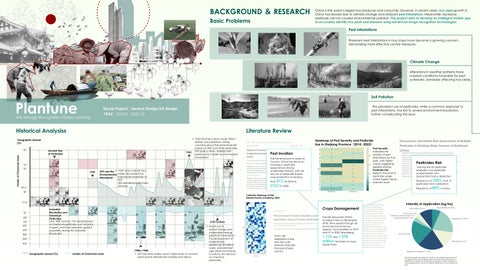
BACKGROUND & RESEARCH Basic Problems
China is the world’s largest rice producer and consumer. However, in recent years, rice yield growth in China has slowed due to climate change and rampant pest infestations. Meanwhile, excessive pesticide use has caused environmental pollution. This project aims to develop an intelligent mobile app to accurately identify rice pests and diseases using advanced image recognition technologies.
Pest Infestations Rampant pest infestations in rice crops have become a growing concern, demanding more effective control measures.
Climate Change Alterations in weather patterns have
created conditions favorable for pest outbreaks, adversely affecting rice yields.
Soil Pollution
Plantune
#AI #Image Recognition #Deep Learning
The prevalent use of pesticides, while a common response to pest infestations, has led to severe environmental pollution, further complicating the issue.
Group Project - Service Design/UX Design YEAR:2023.3 - 2023.10
Historical Analysiss
Literature Review
Geographic Spread (%)
Variety of Chemicals Used
90
Ancient Use of Pesticides
75 70
1962
1939
45.5 40
1962: Rachel Carson's book "Silent Spring" was published, raising concerns about the environmental impact of DDT and other pesticides. This book is often credited with sparking the modern environmental movement.
DDT and the 1939: Swiss chemist Paul Environmental Müller discovered the insecticidal properties of Movement DDT (dichlorodiphenyltrichloro ethane).
Heatmap of Pest Severity and Pesticide Use in Zhejiang Province(2010 -2022)
Pest Severity : Indicates the severity of pest infestations for that year, with higher values suggesting greater severity.
Pesticide Use : Reflects the level of pesticide usage, where higher values indicate more
Pest Invation
The fall armyworm invasion in Yunnan, China has led to an increase in pesticide expenditure among smallholder farmers, with the full cost of pesticide-based crop protection increasing from 81% IN 2018 to 276% in 2020.
Among the 55 pesticides
analyzed, two pesticides (carbendazim and acetochlor) had a detection frequency of 100%, and 12 pesticides had a detection frequency of 80% or more.
Calendar Heatmap of PestRelated Events in Zhejiang, 2022
10.5 50 100 150 200 250 300 350 400
Pesticides Risk
Crops Damagement
Industrial Revolution and Chemical Pesticides Late 18th Century: The development of chemical pesticides, such as sulfur, copper, and lead arsenate, gained popularity during the Industrial Revolution.
Geographic Spread (%)
Variety of Chemicals Used
1940s-1950s DDT became widely used in agriculture to combat insect-borne diseases like malaria and typhus.
21st Century Advances in biotechnology and sustainable farming practices have led to the development of biopesticides, genetically modified crops, and precision agriculture techniques to reduce the reliance on chemical pesticides.
Each cell
represents a day, and the color intensity indicates the level of pest activity.
Intensity of Application (kg/ha)
The fall armyworm (FAW) invaded China in December 2018, then spread through 26 provinces (autonomous regions, municipalities) in 2019 and 27 in 2020, damaging 1.125 and 1.278 million hectares of crops, respectively.
Intensity of Application (kg/ha): The pie chart representing the intensity of application for a given period. The size of each slice indicates the proportion of intensity for that period compared to others, providing a visual representation of how the intensity distribution has changed over time.
Rice-Pests species
Green semilooper
Black bug
What it does
Young larvae of semiloopers scrape the tissues from leaf blades, while mature larvae feed on leaf edges to create notches.
What it does
Black bugs remove the sap of the plant. They can cause browning of leaves, deadheart,
Chongshi Village
How to identify
Check for feeding damage, such a scraped leaves exposing the lower epidermis, an damaged leaf edges.
How to identif Check leaves for discoloration. Black bug damage can cause reddish brown or yellowing of plants. Leaves also have chlorotic lesions.
Green leafhopper What it does
Green leafhoppers are the most common leafhoppers in rice fields and are primarily critical because they spread the viral disease tungro.
Field cricket What it does
Crickets, also called gryllids, feed on leaves by making irregular to longitudinal exit holes.
How to identif irregular to longitudinal exit hole deadheart
How to identify
Rice fields infested by GLH can have tungro, yellow dwarf, yellow-orange leaf, and transitory yellowing diseases.
Armyworm
Rice
Mole cricket
What it does?
How to identify
Armyworm feeds on rice Armyworms feed on by cutting off leaves and leaf tips and along leaf young seedlings at the margins. When they plant's base. They can eat whole leaves, they also cut off rice panicles can remove them from base.
completely or leave only the midribs.
How to identify
What it does
Check for the presence of Mole crickets feed on insect and feeding seeds, tillers in mature damage, including plants, and roots. They can cut plants at the base loss of plant stan cut seedlings at base resulting to loss of plant stand.
Stakeholders Map
Business canvas
Provides policies, funding, and infrastructural
and improved livelihoods Influence: Active users and promoters of the app.
support.
A comprehensive collection of annotated images of rice pathogens Serves as the training data for the AI models in the app.
Government Agriculture Department Agricultural Research Institute Extensive Tagged Dataset
Al-powered Pest Management App
Companies providing hardware and software infrastructure Include cloud services and big data analytics tools Essential for the technical Consumers backbone of the app.
Design vision Rampant Pest Infestations Impacting Rice Yields
Interest: Increased crop yield, reduced losses from pests,
Regulatory and support body
Technology Partners
Site Analysis
Central tool using Al for pest identificatiAlpowered Pest Management.
Agricultural Research Institutions: Collaborate on data collection and algorithm improvement Government Agencies: Seek support for wider adoption and funding.
KEY RESOURCES Interest: Increased crop yield, reduced
Smallholder Farmers
KEY PARTNERS
losses from pests, and improved livelihoods Influence: Active users and promoters of the app.
KEY ACTIVITIES App Development: Continuous improvement and updates Training Models: Regularly update AI algorithms with new data Collaboration: Work with agricultural experts for ongoing support and improvement.
Image Database: Extensive tagged dataset of rice pathogen images Convolutional Neural Networks (CNNs): Advanced image recognition technology Agricultural Experts: Collaborate for dataset curation and algorithm refinement.
VALUE PROPOSITION
USER
RELATIONSHIPS
USER
SEGMENTS
COST STRUCTURE
Precision Pest Management: Accurate identification of rice pests and diseases Affordability: Making AIpowered tools accessible to smallholder farmers Increased Productivity: Boosting crop yield through targeted pest control Environmental Sustainability: Reducing reliance on excessive pesticides.
User Support: Provide assistance for app usage and issue resolution Educational Content: Regular updates and information on pest management Community Engagement: Foster a sense of community among users.
Smallholder Farmers in Impoverished Rural Regions: Primary users who lack access to advanced pest management tools Agricultural Extension Services: Government and non-profit organizations supporting farmers.
App Development: Initial and ongoing costs for software development Data Collection and Tagging: Expenses related to acquiring and maintaining the image dataset Marketing and Outreach: Costs associated with promoting the app and conducting workshops.
CHANNELS
Mobile App Platforms: Distribution through app stores Agricultural Extension Offices: Collaborate for wider outreach Training Workshops: Conduct workshops to educate farmers on app usage.
Excessive Pesticide Use Causing Environmental Pollution
Design Goal: Develop an AI-powered app for precise pest identification and management, enhancing rice yield productivity through timely and accurate pest control.
RECEIVE STREAM Freemium Model: Basic app functionalities for free, premium features at a cost Partnerships: Collaborate with agricultural organizations for funding or revenue-sharing.
Design Goal: Promote sustainable farming practices by reducing reliance on chemical pesticides, leveraging the app's AI capabilities to guide eco-friendly pest management solutions.
System Map
Image Recognition(YOLOv5)
Impact on Environment and Well-bein Environmental Monitoring: Assess the impact of pest management on the ecosystem Health and Safety: Ensure pest control methods are safe for humans and wildlife Sustainability Goals: Align the project with broader environmental sustainability objectives.
Data Collectio Source Identification: Identify diverse sources for collecting rice pest images Image Acquisition: Capture images of various rice pests and healthy rice plants Community Input: Encourage farmers and agricultural experts to contribute images.
Data Preprocessin Image Processing: Crop, resize, and normalize images for consistency Labeling: Annotate images with pest types and other relevant information Quality Control: Ensure data accuracy and diversity.
Image Recognitio Pest Detection: Apply the YOLOv5 model to identify and classify pests Accuracy Assessment: Evaluate the precision of pest detection.
User Interactio App Usage: Users capture or upload images of rice plants using the app Guidance: Provide instructions for capturing effective images.
Dataset
Bacterial leaf blight
Blast
Brownspot
Result Presentation and Advic Visualization: Display detected pests on the app with annotations Information Dissemination: Provide detailed pest information Treatment Recommendations: Offer guidance on pest management.
During the training of YOLOv5, this primarily includes three types of losses: box loss (box_loss), objectness loss (obj_loss), and classification loss (cls_loss). The following is the training curve graph of the model trained for crop leaf disease identification.
Healthy
heatmap of identification accuracy The provided heatmap visualizes a classification model's performance, using a color gradient to communicate accuracy rates across various categories. Diagonal values reflect correct predictions, with off-diagonal cells indicating misclassifications. The chosen color scheme enhances readability and distinction between data points.
Identification Process Data Collection and Preprocessing
Model Selection and Training
Imput Image
Choose YOLOv5 as the object detection model.
Train the model using the labeled rice pest image dataset to learn pest features.
Gather a dataset of rice pest images, including various types of pests and healthy rice images.
Preprocess the images, including cropping, resizing, and normalization for model input.
User Interface design
Diagram of Model Training with Loss Functions
Model Deployment
User Interaction
Image Recognition
Result Presentation
Deploy the trained YOLOv5 model, which can be deployed on mobile devices, servers, or cloud platforms.
Users use a mobile application to capture or upload images of affected rice plants.
The model utilizes the YOLOv5 algorithm to perform pest detection and classification on the uploaded images.
Detected pests are marked on the images, displaying their locations and categories.
Usability Test
Home Screen
A
The Home Screen is the primary interactive gateway providing simplified, direct access to the app’s core functions, prominently featuring a camera tool for immediate pest analysis initiation.
Keywords:
User Profile
dvice Page
perienced
Farmer
Female, 50
solution-oriented interface delivering customized management strategies for identified diseases, alongside essential field information and support features to promote effective pest control practices.
Ex
A
Brown spot
Task
A
griculturalStudent
Female, 25
n educational resource offering detailed insights into rice diseases, with visual aids and textual information aimed at equipping farmers with the knowledge to identify and understand crop afflictions.
10
Male, 35
ccess Image Recognition
10
s
Open App & identify
20
s
5s
read and understand the advice
20
5s
2
ccess Image Recognition
10
s
Open App & identify
10
s
Navigate to Advice Section
2
5s
read and understand the advice
10
s
5s
ccess Image Recognition
30
ishighlighted well, but thescreen is hard to see insunlight."
Confusion with focus
"I think adding a guide for optimal photo distance will be better."
"The design is
intuitiveespecially the cameraaccess."
s
1
"The app's main feature
s
Simulate Photo Capture
Simulate Photo Capture
Slow due to glare
s
8
A
accidentally hit theservice button multipletimes."
5s
1
Use Camera Button
"The advice is practical,but I
s
Simulate Photo Capture
Navigate to Advice Section
tension
Worker
s aps
20
User Feedback The camera button iseasy to spot and use.
2 t
12
Ex
A
Use Camera Button
Use Camera Button
A
Camera Functionality Page
1
read and understand the advice
Success/Error
5s
Open App & identify
Use Staff Service
A
Time Taken
s
"The layout is good, but
separate the service and correction buttons more.
"Information is detailedbut navigation can bemore intuitive."