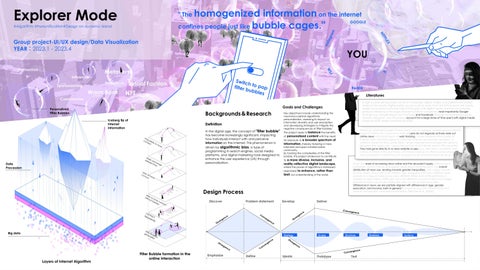
"
Interview
Ideation
eeswam plot of users(interviewers)
B
Risk & Challenges
uantity
Q
-64
How do you typically access news and information online, and do you think your online experience is influenced by personalized content that aligns with your existing beliefs and interests?"
These profiles revealed varying levels of awareness and concern regarding filter bubbles. The common theme was a general lack of deep understanding of how personalized content shapes perception and knowledge.
"
Echo Chambers and Polarization: Filter bubbles can create echo
Lee Workers
Interviewer Group
thers
College students
O
A
: 34
Social Media Usage: Active on Weibo and WeChat
articles that pop up in my feed. They generally align with what I believe, so I feel comfortable reading them. I've never really thought about how this might be shaping my view of the world."
Age: 29
Social Media Usage: Limited; mainly uses LinkedIn for professional networking.
"As an academic, I'm deeply concerned about the narrowing of perspectives due to these so-called filter bubbles. It's crucial to actively seek out diverse viewpoints, or we risk becoming prisoners of our own biases."
Wang ge
"I usually click on the first news
chambers where individuals are exposed primarily to viewpoints and information that reinforce their existing beliefs. This can lead to increased polarization, as people become less exposed to diverse perspectives and more entrenched in their viewpoints.
Misinformation and Propaganda: When individuals are enclosed in
filter bubbles, they may be more susceptible to misinformation and propaganda. Without exposure to diverse sources of information, it becomes challenging to fact-check or gain a balanced understanding of issues.
Social Isolation: Filter bubbles can lead to social isolation, as people
might only engage with a small, like-minded group and become less likely to interact with a broader community.
Chen
Age: 21
Social Media Usage: Highly active on Douyin (Chinese TikTok), Bilibili, and QQ.
"I mostly follow what's trending on Douyin
and Bilibili. I guess those algorithms know what I like. I don't really go out of my way to find different types of news. As long as it's interesting and quick, I'm good."."
Awareness
Zhang
Algorithem
Age: 62
Social Media Usage:Recently started using WeChat.
critical thinking and public discourse Concerned about the macro impact of filter bubbles on society, such as political polarization and misinformation.
Youngor Generation Prefer fast, trending content on social media
May have lower demands for information diversity, making them more susceptible to the effects of filter bubbles.
Elderly People
Rely on traditional media, facing barriers in accessing
and understanding online news Difficulty in identifying biases in online information, indicating a need for improved media literacy across all age groups.
ncourage users to actively seek out diverse news sources and viewpoints.
Provide guidance on recognizing and overcoming personal biases in information consumption. Encouraging Critical Thinking
"I find the internet quite
E
Algorithmic Transparency and Regulation:
Promote greater transparency in how
algorithms function in social media and search engines.
Implement regulations to ensure these algorithms do not overly restrict the diversity of content presented to users. iversification of Content eeds:
Promote critical thinking skills
that enable individuals to question and analyze the information they receive online Create online resources and tools to help users evaluate the credibility of information.
D
Summary & Problem Statement
Academics or University Professors Higher awareness of filter bubbles and their impact on
Improvement
overwhelming with all its different opinions and news sources. I miss the days when news was just news. I'm not sure how to tell if what I'm reading online is biased or not."
Workers Tend to consume information that aligns with their personal views Lower awareness of the filter bubble phenomenon suggests that some groups may not understand how online content is personalized.
User Awareness and Personal Responsibility:
F
User Mentality
Conclusive Insight Awareness Variability: There are significant
differences in the level of awareness of the filter bubble phenomenon among users of different ages and backgrounds. Increasing public awareness of this phenomenon is key to addressing the issue
nformation Consumption Habits User groups exhibit varied habits in consuming online information. olutions need to be tailored to different groups to accommodate their information consumption patterns
User's initial engagement with digital platforms Content Personalization
:
S
Societal Impact Filter bubbles have profound effects on public discourse and political polarization, necessitating societallevel interventions and strategies :
Media Literacy Education: Improving media
literacy, especially among the elderly, is crucial for recognizing and addressing filter bubbles.
ociaty
S
Widespread use of personalized digital content
cho Chamber ffect in ociety
E
S
cho Chamber
Public Discourse Polarization
Reduced
Fragmentation of
xposure to
Information cosystem
E
Diverse Views
:
Unawareness of Bias Impact arrowed perspectives N
Stratedgies
E
Formation of
E
Adjust algorithms to introduce a broader range of content, deliberately incorporating viewpoints that differ from the user's usual preferences.
E
Increase in ocial Divisions
S
Challenges in
Democratic ngagement
E
UI Redesign Community and iscussion eatures:
D
F
Facilitate discussions and community
interactions within the UI, encouraging users to engage with different perspectives.
Design comment sections or forums to highlight a variety of opinions in a respectful and constructive manner.
Customizable ilters F
Allow users to customize their filters and content preferences Provide UI options for users to adjust the level of content personalization versus randomization.