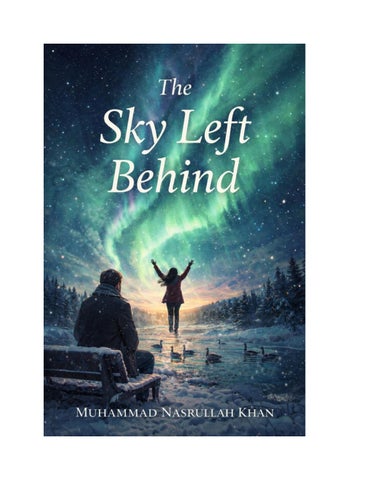
THE SKY LEFT BEHIND A Novel of Love, Exile, and the Spaces Between by Muhammad Nasrullah Khan
CHAPTER 1 – THE SKY THAT WAS PROMISED Nahom first understood freedom while standing in freezing water. Many years later, standing knee-deep in the chilly current of the Elbow River, Nahom would look up and remember the first Canadian sky, vast and pale, stretching above him like the gaze of a distant god. That sky had watched his twenty-year exile with indifference, and now, Freedom stood where it always had visible, untouchable, unseeing. Though the flight to Toronto Pearson lasted eighteen hours, he felt aged. His knees ached. His shoulders didn't relax down from his ears. His fingers found the crumpled cigarette pack in his pocket. He rolled the cigarette between his fingers to feel the freedom he'd chased since childhood. When his beaten-up suitcase finally showed up on the carousel, he grabbed it like the whole airport might disappear. Airports had always triggered the old panic: suspicious questions, lines, ending in rejection. He pushed himself forward. Behind the counter sat a woman with eyes the colour of winter fog. Her gaze landed on him—the tall Black man with wild hair, a face etched with sleeplessness, a smile that wavered between defiance and desperation. She looked at his passport, then said the words that had followed him across deserts and oceans, through camps and borders:
"Refugee from Eritrea." And then, for the first time in twenty years: "Welcome to Canada." Welcome. The word sat in his mouth like water offered to someone who'd forgotten how to swallow. He hadn't heard it since he was a kid, in another language, from grandparents who were now gone. It was a drink offered after a long thirst, but his throat had forgotten how to swallow. His mind didn't focus on the meaning, but on the opposite: the Sudanese border guard's sneering chin jerk; the bored "no, no" from the Egyptian officer as he waved him back; the Israeli detention agent's silent, pointing finger to a line of unwanted people. Each memory was a stone in his hand. This woman's words felt like an attempt to take that weight away, and he almost pulled back. The pleasant strangeness of it was a taste on his tongue, both sweet and odd, like a fruit he'd loved in a childhood dream. She indicated the twelfth line. One more officer. The same practised grin. Calm, rehearsed movements with a good-natured tone of habit. Smiles had never given safety. Still, when she smiled at him, something in his chest loosened before he could stop it. He remembered the men who smiled at checkpoints before hitting. The authorities at the camps who grinned as they took him to the end of the queue. Smiles were forerunners of denial and disguises of savagery. But what about this? Was it only a waiting room until the next exile, another stage? The officer examined him with patient weariness—one swamped by a thousand lives, each stamped and signed. The questions were beyond suspicion. When the landing papers slid across the counter, it was so simple, so plain, that Nahom paused. His hand hovered, half-expecting them to be pulled back. For twenty years, every paper had been a demand, a rejection, a reminder that he didn't matter. This one felt different. Outside, his hands shaking, he lit a cigarette. Smoke filled his lungs; it was not just a habit, but a freedom now. Each drag reminded him that his breath was his, and his alone. Above him, the sky was so bright it looked painted. A blue he'd forgotten existed. Clouds floated by, plentiful and calm, and for the first time, he didn't feel excluded from their peace. The world was opening up. The air he breathed was his own.
It was the kind of sky his mother would have loved. He remembered her hug the day he left, how she held him like she'd never let go. The sky is the same everywhere, she had said, pointing to the horizon. Even when they take everything else, they can't steal that. The sky here was different—cleaner, softer, like no one had ever set it on fire. Nahom wondered if his mother had ever dreamed of such a sky, or if she had died under the one that watched them both cry. The taxi smelled of cumin and old sweat—a smell that usually made his chest tight. Home, or what was left of it. The driver was from his country, his face showing the same lines of exile, his eyes dull like burnt-out light bulbs. When Nahom greeted him in their shared language, the man just grunted, changing gears so roughly it was like even the car didn't want him there. "Take me to the hotel closest to the airport," Nahom said, pressing his hand to the window to steady himself. "I'm going to Calgary tomorrow." "Just off the plane, huh?" The driver's voice was flat. "You'll feel the cold. But it's nothing compared to the cold we carry inside." Nahom met his eyes in the rearview mirror. They shared a tired understanding. "How's life here?" "They sell you a perfect dream," the driver said. "You spend your life chasing it, only to find it's rotten inside. We just swap one hunger for another." Neon lights and snow zipped by. Nahom thought of his mother, who promised that beyond wars and hunger, there were places of light. Now he was in that bright place, yet the man who should have been like a brother spoke like a prisoner counting the days. The next morning, his plane landed in Calgary. Outside was just endless white, like the earth was wrapped in a clean, white cloth. Streets and roofs were buried under winter snow. He leaned his head against the cold window, watching the view pass by like a half-remembered dream.
Looking down at that frozen city, he understood that a welcome was just a start. What came next was the slow, real process of figuring out where you'd landed and everything you'd brought with you to get there.
CHAPTER 2 – THE SETTLEMENT Nahom's uncle waited for him at the airport, looking older, tired. He seemed both familiar and a stranger. When he saw Nahom, his eyes did a funny thing, like he recognised him but also looked sad. "Nahom." Hearing his name after so long hit him hard. Then came a hug, a real one, the first in ages. It cracked open the tough shell he'd built around himself since he was a kid. His uncle felt skinnier than he remembered. The woolly, smoky smell of his coat brought back old times. His uncle let out a sigh, heavy with years gone by and goodbyes never said. He didn't let go. Nahom looked past him, through the glass, at Calgary spreading out under a sky the colour of wet cement. He spotted a dark line in the distance, cutting through the white: the Elbow River. For a second, it felt less like just scenery and more like a real thing, watching the city back. "It looks like a dead city," he said quietly. Even though he'd spent twenty years escaping heat and dust, he felt a sudden sadness. Cities were like mothers, their streets like brothers and sisters, their trees like fathers. He'd loved them, even when they didn't love him back. "Dead and cold," his uncle agreed. "It wakes up in summer. The river does too." He waved his hand vaguely, as if summer might just show up if he called it.
Nahom braced himself for questions about Eritrea, old friends, the family still over there. But none came. Maybe his uncle didn't have the energy. Or maybe those questions were just too heavy for a reunion this delicate. The car ride was silent. The tyres whispered over the snow, like enemies sneaking around. Silence was never peaceful; it brought fear. He'd been born in fear, grew up with it, and it had carried him across continents, like a drowning man grabbing onto something that just pulled him further down. He thought of his father. In those last years, with the dictatorship's silent, watchful fear everywhere, no father with a son was allowed to sleep in his own bed. The President's suspicion covered the whole country. Soldiers from Isaias Afwerki's government patrolled at night, enforcing a curfew that was really just a way to keep everyone isolated. His father, like other farmers, was told to sleep in his fields, guarding against fake spies and troublemakers. But a father is still a father. After midnight, when the dogs were quiet and fewer patrols were out, he'd sneak like a ghost along the dry creek beds, climb the compound wall with his tough hands, and drop silently into the yard. His gentle landing was a rustle, a soft thud, the most special sound in Nahom's world. For an hour, sometimes two, he was simply there, a warm, breathing presence in the dark, a hand on his sleeping child's head. Until the night the boots didn't pass by. They must have followed him. They didn't come yelling, but with a terrible quiet efficiency. The door, never strong, splintered open. The room filled with the smell of sweat, cheap uniform fabric, and oiled metal. They didn't ask questions. They dragged his father from his mat by his ankles. His head hit the floorboards with a sound like a melon dropping on a rock. Nahom, frozen next to his mother, saw his father try to get up, his mouth trying to form a reassuring word or a plea. A soldier put his boot on his chest, holding him down. Another bent close to his face. "You're the spy," he said, his voice completely calm. It was just a statement of fact. The rifle butt came down once. Then again. There was no fuss about it. It was just work. When they stepped back, his father's eyes found Nahom's across the short, awful distance. They opened
wide, not with pain, but with a final, heartbreaking clarity. Then the light in them just went out. The soldiers left as fast as they came, their job done. One of them mumbled the usual phrase for such situations: "He got what he deserved." The blood slowly spread on the packed dirt floor. In that quiet moment, Nahom understood. The powerful ones, men with boots and rifles who could call you a traitor, controlled his life. The kind God of his mother's hymns was nowhere in that room. "Here we are," his uncle said, pulling into a small garage. Snow bent the roofline. Nahom blinked. The memory faded like smoke. He stepped out, his boots sinking into the snow, realising this wasn't just another temporary stop. This was where his life would either start fresh or end alone and quiet. Snow kept falling, calm and uncaring, as it always had, as it always would.
The basement felt like it swallowed him. Low ceiling. Damp walls. Air that smelled sour and mouldy. A thin mattress sagged in the corner; a narrow closet leaned; a single chair sat there like an afterthought. When he leaned his head against the small window, streetlights flickered like candles at a vigil. On the third day, his uncle came downstairs, his boots thudding like a judge's hammer. "I found you a job. You'll be a butcher." The word hit him. "A butcher? I don't know how..." "You're Eritrean. Our land is full of butchers. It's in your blood." His voice wasn't mean, just final. The word "butcher" seemed to grow in the damp air. It wasn't just a job anymore. It brought to mind the men who came at night, who handled metal and bone. It was the President in his palace, carving up a country. It was history itself, a line of bloodshed passed down like a family trait. His uncle meant that staying alive in their homeland always involved knowing the knife, whether you held it or it was held to you. "My friend is a manager there. He'll teach you. Be happy; it's this or warehouses, and those are hell. "Canada must have better jobs."
"Canada is good. America too. But freedom needs cheap labour. Nothing comes free."
The slaughterhouse smelled of blood and cleaner. Steel shined under the bright lights. The electric cutter shrieked when Nahom touched it, slicing into animal bodies that swung slowly, almost alive in their own way. Meat slapped against his apron, warm and red. The smell followed him home, even into his sleep. At night, the basement filled with strange sights. Heads without bodies rolled toward him, laughing. He woke up gasping, his hands clawing at the blanket. He started drinking. The bottle stopped the cutter's screams, but dreams still snuck through. One evening, a co-worker leaned over a rail of hanging lambs, his eyes glassy not from the cold but from something deep inside him. He caught Nahom's eye and grinned, a slow, tired grin. "Just wait," he said, in a quiet voice, like he was sharing a secret about the job. "Just wait for summer." He nodded towards the high, sealed windows, with the city beyond. "Out there, the streets… they blossom. Not with flowers." He wiped his hands on his apron, leaving a faint, pink smudge. "With legs. Bare legs. Walking, running, crossing in the sun." He paused, his gaze wandering over the pale bodies swaying gently on their hooks. A long, quiet moment passed. "Living meat," he finally mumbled, almost to himself. The word "living" hung in the cold air, so full of longing it felt like sorrow. It wasn't a wish spoken, but a lack revealed—the basic human need of a man who spent his days reducing life to pieces and weight, dreaming of a warmth that moved on its own, always just out of reach, behind the glass. The words stuck in Nahom's chest, cold and troubling. Flesh everywhere. He stumbled back to the basement. His reflection blurred in the window, snow covering his face. He pressed his forehead to the glass. "Oh God," he whispered. "Why so much flesh? Why cover the earth with it?" The bottle slipped, breaking. Alcohol spread dark across the concrete. He lay down, letting the basement close over him like dirt, drifting into hooks, snow, endless laughing flesh.
The basement's cold got into his bones. Each night he lay on the mattress, clenching his teeth against the chill from the concrete. The walls were damp; his breath hung pale like smoke. He pressed his palms together, as if prayer might warm them, but no words came. Only one thought kept coming back: this isn't living; this is a slow way to die. At work, he let a complaint slip out. "It's like sleeping inside a refrigerator." A colleague, tired but kind, stopped what he was doing. "You should go to school. It's free here —for new people. I'll take you." School. The word brought a cool breeze. For a moment it calmed the burning desire inside him. Then memory pulled him back; he was a boy again, holding his father's hand under a spring sky. Teachers stood at the gate, their eyes sharp. Mornings were spent singing hymns to a gentle, unseen God. Afternoons were spent with men with thick moustaches and heavy boots, teaching them obedience, silence, fear. The memory of his father's empty eyes came back, as it always did, showing him the truth. That night, after the soldiers took the body and the neighbours cleaned the dirt, the house was just a hollow shell filled with whispers. His mother sat on the floor, holding him, a ten-year-old bundle of bones and terror, in her arms. She wasn't crying. Her silence was bigger than any sound. He tilted his head back to look at her. In the deep darkness, her eyes shimmered with a terrifying mix: a bottomless love that seemed to physically hurt, a sharp, animal fear for him, and a sorrow so deep it had stopped her breathing. Those eyes were the only light in the world. "I will run," he whispered, the words coming out like a secret. Her arms tightened around him, as if her body fought against the decision her mind knew was needed. She pressed her lips to his forehead, his eyelids, his cheeks, as if mapping him, a useless attempt to keep him safe inside herself. Her touch was feverish. When she finally spoke, her voice was a raw, thin sound. "Then you must live." It wasn't a blessing, but a command carved in pain. Letting him go was like tearing out her own heart, but keeping him meant giving him to the slaughterers. The sacrifice hung between them, awful and absolute.
But Nahom, snuggled against the warmth he would forever after connect with loss, turned his face away. He wanted to survive, and surviving needed a toughness that her love, in all its intense brightness, couldn't afford. So he ran. Two days later, Sudan's border opened like a crack in a wall. At Shagarab camp, life shrank down to just waiting. Eventually, he followed others to Khartoum. They paid for a private car, travelling under the cover of night, as shapes moved with covered faces and heavy guns. One pressed a barrel to his head. He did what they said. The desert swallowed them. Days blurred. Hunger chewed at him. At one stop, people were shoved into a water truck. Metal walls pressed in. Air got thin. By the time the hatch opened, three bodies weren't moving. After five months in Sinai, he slipped into Israel. Six years as a man without papers or protection. And now, this basement. This cold. This sky that promised nothing, but for the first time, it belonged to him as much as to anyone. He looked at the small window, at the snow still falling. The sky was turning a deeper grey, the colour of forgetting. But under it, somewhere, flowed the Elbow River—a dark, steady presence he hadn't yet truly seen, already waiting in his memory. He understood then, with a clear feeling that was like a new kind of coldness, that he'd brought something with him that no clean, soft sky could ever wash away. It wasn't in his suitcase. It was the exact weight and feel of a dying man's hand, held in the dark of a desert truck. A debt of survival he could neither pay back nor name. And beneath that, older and colder, was the memory of blood on a dirt floor, and the voice of a soldier calling his father a spy. (Continued)