INCONCERT
A PUBLICATION OF THE NASHVILLE SYMPHONY
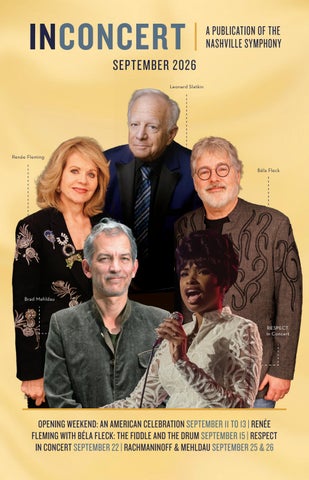
SEPTEMBER 2026 Leonard Slatkin
Renée Fleming Béla Fleck
Brad Mehldau
RESPECT In Concert
OPENING WEEKEND: AN AMERICAN CELEBRATION SEPTEMBER 11 TO 13 | RENÉE FLEMING WITH BÉLA FLECK: THE FIDDLE AND THE DRUM SEPTEMBER 15 | RESPECT IN CONCERT SEPTEMBER 22 | RACHMANINOFF & MEHLDAU SEPTEMBER 25 & 26
LETTER FROM THE PRESIDENT & CEO W
elcome to Schermerhorn Symphony Center. It is with deep gratitude and genuine humility that I welcome you to my first season as President and Chief Executive Officer of the Nashville Symphony. Few institutions are entrusted with a greater responsibility than the stewardship of a community's artistic life. For nearly 80 years, this orchestra has fulfilled that calling with distinction, enriching Middle Tennessee through music that inspires, challenges, and unites us. To join that enduring legacy is among the greatest privileges of my professional life. This season stands at the meeting point of history and possibility. Together, we celebrate the 80th Anniversary of the Nashville Symphony, the 20th anniversary of Schermerhorn Symphony Center, and the 250th anniversary of our nation. These milestones invite us not merely to honor the achievements of those who came before us, but to consider what we now hold in trust for those who will follow. It is especially fitting that we begin this new chapter by welcoming Leonard Slatkin as Music Director. Throughout a remarkable career, Slatkin has demonstrated that artistic excellence and bold imagination are not opposing ideals, but faithful companions. His inaugural season celebrates the timeless masterpieces upon which our tradition rests while embracing the voices of today and the promise of tomorrow. In doing so, he reminds us that a great orchestra is never content merely to preserve its heritage; it continually renews it. Yet the true measure of an orchestra is found not only in the performances it presents, but in the lives it touches. The work of the Nashville Symphony extends far beyond this magnificent hall—into classrooms, neighborhoods, and communities throughout Middle Tennessee. Through education, outreach, and service, we affirm a simple but enduring belief: that music has the power to elevate the human spirit, strengthen the bonds of community, and remind us of the better possibilities within ourselves. As I begin my service to this remarkable institution, I do so with confidence in what lies ahead. The Nashville Symphony possesses extraordinary musicians, devoted supporters, visionary leadership, and a community that believes deeply in the value of the arts. Together, we have the opportunity not only to keep building one of America's finest orchestras, but to demonstrate how a great orchestra can help shape the civic life of a great city. Whether this is your first visit or one of many over the years, thank you for sharing this evening with us. Your presence sustains this orchestra and affirms the enduring importance of live music in our lives. It is our privilege to welcome you, and our promise to continue earning your confidence through performances of the highest artistic excellence and through faithful service to the community we proudly call home. May this season inspire us, challenge us, and remind us that the finest traditions are those that continue to grow. How will you help us create this new chapter in this marvelous journey? Warmest regards,
Mark Cantrell President & CEO
INCONCERT A PUBLICATION OF THE NASHVILLE SYMPHONY
SEPTEMBER 2026 September 25 & 26
The Nashville Symphony inspires and engages a diverse and growing community with extraordinary live orchestral music experiences.
39 Individual & Corporate Donors
CONTACT US
An American Celebration
42 Board of Directors
615.687.6400 info@NashvilleSymphony.org NashvilleSymphony.org
26
45 Staff Listing
8 Orchestra Roster
32
9 Conductors
Rachmaninoff & Mehldau
13
HCA HEALTHCARE TRISTAR HEALTH CLASSICAL SERIES
OPENING WEEKEND: September 11 to 13 PRESENTATION
AN AMERICANAFEST SPECIAL EVENT
Renée Fleming with Béla Fleck: The Fiddle and the Drum September 15
29
SPECIAL EVENT
RESPECT In Concert September 22
HCA HEALTHCARE TRISTAR HEALTH CLASSICAL SERIES
PHOTOGRAPHY & VIDEO POLICY Video cameras, recording devices, and flash photography are strictly prohibited in the concert hall or in any other space where a performance or rehearsal is taking place. Cameras with a detachable lens may only be used pending approval from the artist and the venue and will be subject to rules and restrictions. For more information, please contact the Nashville Symphony's Communications office.
Advertising Sales
RED CURTAIN GROUP
73 White Bridge Rd, STE 103-115 Nashville, TN 37205 615.909.9904
SHARE YOUR EXPERIENCE #NASHVILLESYMPHONY INCONCERT
7
2026/27 NASHVILLE SYMPHONY LEONARD SLATKIN Music Director
GIANCARLO GUERRERO Music Director Laureate
Martha & Bronson Ingram Music Director Chair
VALERY SAUL
TUCKER BIDDLECOMBE
Associate Conductor
Billy Ray Hearn Choral Director
FIRST VIOLIN*
Peter Otto, Concertmaster
Walter Buchanan Sharp Chair
Erin Hall,
Acting Associate Concertmaster
Gerald C. Greer,
Acting Assistant Concertmaster
Tianpei Ai Isabel Bartles Francesca Bass Beverly Drukker Dawn Gingrich Anna Lisa Hoepfinger John Maple Kirsten Mitchell Ashley Odom
SECOND VIOLIN* Jung-Min Shin, Principal Lucia Nowik, Acting Assistant Principal
CELLO*
Kevin Bate, Principal
James Victor Miller Chair
Una Gong, Assistant Principal Anthony LaMarchina, Principal Cello Emeritus
Samuel Sin Melinda Whitley Clare Yang Guanliang Zong
Acting Assistant Principal
Daniel Lochrie
Joel Reist, Principal Glen Wanner, Assistant Principal
Matthew Abramo Evan Bish Kevin Jablonski Katherine Munagian
Gloria Yun,
The Drs. Mark & Nancy Peacock Chair
Assistant Principal
BASS*
VIOLA*
Michelle Lackey Collins Christopher Farrell Anthony Parce
Assistant Principal ◊
Spencer Prewitt Daniel Lochrie
FLUTE
Assistant Principal
TROMBONE
Danny Goldman, Principal Katherine Kohler,
Stephen Drake Bradley Mansell Keith Nicholas Lynn Marie Peithman Xiao-Fan Zhang
Likai He Daniel Kim Charissa Leung Louise Morrison Laura Ross Johna Smith Jeremy Williams Pierre Cavel, Principal Shu-Zheng Yang,
CLARINET
E-FLAT CLARINET Katherine Kohler ◊
BASS CLARINET
Anne Potter Wilson Chair
Leslie Fagan,
Assistant Principal
Nicole Haywood Vera Tenorio +
HORN
PICCOLO
Beth Beeson Radu V. Rusu,
Norma Grobman Rogers Chair
Acting Associate Principal/ 3rd Horn
OBOE
Hunter Sholar Anna Spina,
Assistant Principal
ENGLISH HORN Fengyang Ju +
Acting Assistant Principal/ Utility Horn +
TRUMPET William Leathers, Principal Patrick Kunkee, Co-Principal Alexander Blazek
* Seating Section Revolves 8
SEPTEMBER 2026
TIMPANI
Assistant Principal
The Dr. Anne T. & Peter L. Neff Chair
Fengyang Ju +
Chandler Currier, Principal
Nicole Haywood Vera Tenorio +
Acting Assistant Principal
Leslie Norton, Principal
Ellen Menking,
TUBA
PERCUSSION
Norma Grobman Rogers Chair
Principal
Chance Gompert ◊ Reid Harman +
Asha Kline, Acting Principal + Gil Perel,
Gloria Yun,
Titus Underwood,
BASS TROMBONE
Joshua Hickman, Principal
BASSOON
CONTRABASSOON
Érik Gratton, Principal
Paul Jenkins, Principal Anthony Cosio-Marron,
Sam Bacco, Principal Richard Graber,
HARP
Licia Jaskunas, Principal
KEYBOARD
Robert Marler, Principal ◊ Stephen Kummer, Acting Principal +
LIBRARY
Renee Ann Pflughaupt, Principal Librarian
Amelia Van Howe, Librarian
ORCHESTRA PERSONNEL Pavana Stetzik,
Director of Orchestra Personnel
Sarah Figueroa,
Manager of Orchestra Operations
+One-Year Position
◊ Leave of Absence
CONDUCTORS
MUSIC DIRECTOR
LEONARD SLATKIN
Martha & Bronson Ingram Music Director Chair
I
nternationally acclaimed conductor Leonard Slatkin is Music Director of the Nashville Symphony, Conductor Laureate of the St. Louis Symphony Orchestra (SLSO), Music Director Laureate of the Detroit Symphony Orchestra (DSO), Directeur Musical Honoraire of the Orchestre National de Lyon (ONL), and Principal Guest Conductor of the Orquesta Filarmónica de Gran Canaria (OFGC). He maintains a rigorous schedule of guest conducting and is active as a composer, author, and educator. In addition to multiple appearances in Nashville, the 2026/27 season includes engagements with the International Violin Competition of Indianapolis, Manhattan School of Music Symphony Orchestra, National Symphony Orchestra, OFGC, Orchestra of the Music Makers (Singapore), New World Symphony, Colorado Symphony, Las Vegas Philharmonic, Florida Orchestra, SLSO, Frost Symphony Orchestra (Miami), National Symphony Orchestra (Ireland), National Polish Radio Symphony Orchestra, and Orquesta de Valencia. Slatkin has received six GRAMMY® awards and 35 nominations. His most recent recording, Pictures at an Exhibition: The Paintings of Bob Peak, was released on Warner Classics in 2026. Naxos has reissued Vox audiophile editions of his SLSO recordings featuring the works of Gershwin, Rachmaninov, and Prokofiev. Other Naxos recordings include Slatkin Conducts Slatkin—a compilation of pieces written by generations of his family—as well as works by Saint-Saëns, Ravel, Berlioz, Copland, Borzova, McTee, and Williams. A recipient of the National Medal of Arts, Slatkin also holds the rank of Chevalier in the French Legion of Honor. He has been awarded the Lincoln Medal from Ford’s Theatre Society, the Prix Charbonnier from the Federation of Alliances Françaises, Austria’s Decoration of Honor in Silver, and the League of American Orchestras’ Gold Baton. His debut book, Conducting Business (2012), for which he received the ASCAP Deems Taylor Special Recognition
Award, was followed by Leading Tones (2017) and Classical Crossroads: The Path Forward for Music in the 21st Century (2021). His latest books are Eight Symphonic Masterworks of the Twentieth Century (spring 2024) and Eight Symphonic Masterworks of the Nineteenth Century (fall 2024). A second volume of twentieth-century score studies will be published by Bloomsbury in February 2027 as part of this ongoing series. Slatkin has held posts as Music Director of the New Orleans Philharmonic-Symphony Orchestra, SLSO, National Symphony Orchestra, DSO, and ONL, and he was Chief Conductor of the BBC Symphony Orchestra. He has served as Principal Guest Conductor of London’s Philharmonia and Royal Philharmonic, the Pittsburgh Symphony Orchestra, the Los Angeles Philharmonic at the Hollywood Bowl, and the Minnesota Orchestra. He has conducted virtually all the leading orchestras in the world, including the New York Philharmonic, Chicago Symphony Orchestra, Philadelphia Orchestra, Boston Symphony Orchestra, San Francisco Symphony, Los Angeles Philharmonic, Berlin Philharmonic, Bayerischer Rundfunk (Munich), Royal Stockholm Philharmonic Orchestra, Royal Concertgebouw Orchestra (Amsterdam), Orchestre de Paris, Oslo Philharmonic Orchestra, and Israel Philharmonic Orchestra, as well as all five London orchestras. Slatkin’s opera conducting has taken him to the Metropolitan Opera, Lyric Opera of Chicago, Washington National Opera, Opera Theatre of St. Louis, Santa Fe Opera, Vienna State Opera, Stuttgart Opera, and Opéra Bastille in Paris. Born in Los Angeles to a distinguished musical family, he began his musical training on the violin and first studied conducting with his father, followed by Walter Susskind at Aspen and Jean Morel at Juilliard. He makes his home in St. Louis with his wife, composer Cindy McTee.
INCONCERT
9
C OND UCTO R S
VALERY SAUL, Associate Conductor
D
escribed by Marin Alsop as a “powerful presence on the podium,” conductor Valery Saul is recognized for her d y n a m i c l e a d e r s h i p, technical command, and charismatic rapport with both musicians and audiences. She begins her threeseason appointment as Associate Conductor with the Nashville Symphony in the 2026/27 season. Valery Saul served from 2023 to 2026 as the Associate Conductor of the Arkansas Symphony Orchestra, and she is a regular cover conductor for the Oregon Symphony, St. Louis Symphony, Minnesota Orchestra, and Charlotte Symphony. Saul is also an alumnus of the Dallas Opera's Hart Institute for Women Conductors. Equally at home in the concert hall and the orchestra pit, Valery
regularly conducts opera, ballet, broadway, and pops performances, earning praise for her versatility and passion for championing all genres of music. Saul was a participant at the Cabrillo Festival of Contemporary Music and fellow at the Bellingham Festival of Music, and she won Second Prize at the Denver Philharmonic Orchestra's Conducting Competition. She has participated in numerous conducting masterclasses including the Buffalo Philharmonic Orchestra, the National Symphony Orchestra, L'Orchestre Métropolitain, and the Baltimore Symphony Orchestra. A graduate of the Peabody Conservatory of Music and the University of British Columbia, Saul holds degrees in both conducting and opera performance. Her mentors include Marin Alsop, Cristian Măcelaru, Nicole Paiement, Marcelo Lehninger, Miguel HarthBedoya, and George Manahan.
TUCKER BIDDLECOMBE,
T
ucker Biddlecombe is the Billy Ray Hearn Chorus Director of the N a s h v i l l e Sy m p h o n y Orchestra and is entering his tenth season as director of the Nashville Symphony Chorus. In addition, Biddlecombe serves as Professor of Choral Studies at Vanderbilt University’s Blair School of Music, where he conducts the Vanderbilt Sixteen and University Singers. His work with the Nashville Symphony has included chorus preparation for many of the repertoire’s most revered masterworks. This season includes preparation for Maestro Leonard Slatkin on Bernstein’s Chichester Psalms and Brahms's Requiem. Biddlecombe will conduct the orchestra and chorus in Handel’s Messiah, and a birthday concert of the works of Bach including Magnificat in D. He has prepared the chorus for multiple major world-premiere recordings including John Harbison’s Requiem, Gabriela Lena-Frank’s Conquest Requiem, and the upcoming release of Jonathan
10
SEPTEMBER 2026
Billy Ray Hearn Chorus Director
Leshnoff’s The Sacrifice of Isaac. The chorus recently recorded a live performance of Carol Barnett’s The World Beloved: A Bluegrass Mass for upcoming commercial release. Performance highlights at Blair have included Britten’s War Requiem, Brahms’s Ein Deutsches Requiem, Bach’s St. Matthew Passion, and Fire in My Mouth by Julia Wolfe. He has conducted honor choruses in a dozen states, two concerts at Carnegie Hall, and in 2022 conducted the UCTB honor choir for the Southern Region of the American Choral Directors Association. International engagements have included guest conducting throughout the United Kingdom, the Czech Republic, and a residency with the Central Conservatory of Music in Beijing. He is a graduate of SUNY Potsdam and Florida State University, where he completed studies in choral conducting and music education with Daniel Gordon and André Thomas, respectively. He resides in Nashville with his wife Mary Biddlecombe, director of the Blair Academy at Vanderbilt, and Artistic Director of Vanderbilt Youth Choirs.
Honoring the Legacy of
Martha Rivers Ingram 1935-2026 The Nashville Symphony mourns the passing of our dear friend and greatest champion, Martha Rivers Ingram. A fierce supporter of the arts and education, a philanthropist, and a devoted civic leader, Martha believed deeply in Nashville and in the essential role the arts play in a thriving city. Her lifelong passion for the arts guided her vision for what this community could become. Martha’s leadership, vision, generosity, and tenacity profoundly shaped the Nashville Symphony. Quite simply, we would not be the institution we are today without her. Her belief in the arts grew from a deep desire to ensure that no Nashvillian would miss the cultural experiences she felt she had lacked growing up in the South. That desire drove her to help make the Nashville Symphony one of the country’s leading orchestras, performing in an acoustically superb, state-of-the-art concert hall worthy of its musicians and the community they serve.
HCA AD?
After moving to Nashville in 1961, Martha began asking what she could do to strengthen the city culturally. That question guided a lifetime of leadership and service. For Martha, the arts were not an amenity. They were essential to the life and identity of a thriving community. She understood that great cities need vibrant arts organizations and welcoming places that inspire creativity, bring people together, and present the arts at the highest level. She also knew that gathering places created for commerce, recreation, entertainment, or residential life must respond to the needs of the people they are intended to serve. During Kenneth Schermerhorn’s 22 years as Music Director, the Nashville Symphony grew tremendously in artistic stature. But the acoustical limitations of its performance spaces constrained the orchestra’s continued development. Martha was unwilling to accept constraints that prevented Nashville’s orchestra from truly shining as the artistic gem it had become, kept the community from fully appreciating its extraordinary artistry, and threatened its long-term sustainability. She brought together civic leaders, cultivated support, and secured the resources needed to build not just any hall, but one of the very best in the world for live orchestral music, a world-class hall that would allow the Nashville Symphony to flourish for generations. Her visionary leadership convinced all of us involved that setting our sights at the highest level would lead to greater success than retreating into our own limited perceptions of what was possible.
H C A H E A LT H C A R E T R I S TA R H E A LT H C L A S S I C A L S E R I E S
OPENING WEEKEND:
AN AMERICAN CELEBRATION FRIDAY & SATURDAY, SEPTEMBER 11 & 12 AT 7:30 PM | SUNDAY, SEPTEMBER 13 AT 2 PM
NASHVILLE SYMPHONY & CHORUS LEONARD SLATKIN, conductor TUCKER BIDDLECOMBE, chorus director SUZY BOGGUSS, vocalist BAXTER HALL, vocalist STORM LARGE, vocalist KATHY MATTEA, vocalist SYLVIA MCNAIR, vocalist
JOAN TOWER Made in America SAMUEL BARBER Adagio for Strings LEONARD BERNSTEIN Chichester Psalms Psalm 108:2; Psalm 100 Psalm 23; Psalm 2:1-4 Psalm 131; Psalm 133:1
CLASSICAL SERIES PRESENTED BY
INTERMISSION CRISTINA SPINEI Strut! AARON COPLAND Old American Songs
CHORAL PERFORMANCES ARE GENEROUSLY SUPPORTED BY
Simple Gifts At the River The Dodger The Little Horses Zion's Walls I Bought Me A Cat
GEORGE GERSHWIN Porgy and Bess: A Symphonic Picture
This concert will last approximately 1 hour, 45 minutes, including a 20-minute intermission. INCONCERT
13
CL A SS I CA L
WHAT AMERICA SOUNDS LIKE This program marks three anniversaries at once: the United States’ 250th birthday, the Nashville Symphony’s 80th season, and the 20th anniversary of Schermerhorn Symphony Center. For Music Director Leonard Slatkin, who conducted the hall’s inaugural concert in 2006, the occasion represents both a return and a new beginning. His aim was to acknowledge history while establishing a vision for the season ahead. An opening concert, as Slatkin notes, “sets the tone for the whole year.” The six composers on this program offer different answers to what American music can be: music of remembrance and faith, music rooted in Nashville’s own creative community, and music shaped by folk song, Broadway, jazz, and the theater. The moods they evoke range from grief and spiritual searching to humor and sheer pleasure in performance.
Joan Tower
Made in America Composed: 2004
J
oan Tower, a trailblazing figure in American composition and the first woman to receive the Grawemeyer Award in Composition, remains an active composer in her late 80s, a national treasure in American music. She wrote Made in America in 2004 for a nationwide project that ultimately saw the piece performed by 65 orchestras across all 50 states. The work has an unusually strong connection to Nashville: the Symphony performed it during Schermerhorn Symphony Center’s inaugural season, and Slatkin and the orchestra went on to record it for a Naxos album that won three GRAMMY® Awards, including the orchestra’s first. “That has very strong historical significance,” Slatkin says, making its return for the hall’s 20th anniversary especially apt. The title also has personal roots for Tower, who spent nine years of her childhood in Bolivia. Returning to the United States left her newly conscious of freedoms and everyday comforts she had previously taken for granted. As she began composing Made in America, “America the Beautiful” kept coming to mind, and Tower decided to use it as the work’s central—and symbolic—musical idea.
WHAT TO LISTEN FOR “America the Beautiful” provides the work’s central thread. It is, in Tower’s words, “challenged by other more aggressive and dissonant ideas that keep interrupting, unsettling it.” Yet the original tune “keeps resurfacing in different guises (some small 14
SEPTEMBER 2026
and tender, others big and magnanimous), as if to say, ‘I’m still here, ever changing, but holding my own.’” Tower wonders whether that resilience in the face of the “musical struggle” reflects an unconscious response to a larger challenge: “how do we keep America beautiful?” Scored for pairs of flutes (2nd doubling piccolo), oboes, clarinets, bassoons, horns, and trumpets; trombone; timpani; 2 percussion; and strings.
Samuel Barber Adagio for Strings
Composed: 1936; arranged for string orchestra: 1938
T
he first performance of this program takes place on September 11, exactly 25 years after the attacks of 2001. For Slatkin, that coincidence immediately clarified the place of Samuel Barber’s Adagio for Strings in an otherwise celebratory evening. The Adagio is also a work with which the conductor is closely associated: he has conducted it at many moments of public remembrance. Barber’s music is not tied to a particular faith, text, or historical event, yet its long, searching lines have repeatedly provided a shared space for mourning. It was heard after the deaths of Franklin D. Roosevelt and John F. Kennedy, following September 11, and at memorials around the world. Its appearances in films, most famously Platoon, have carried its emotional language beyond the concert hall. The piece began in a much more private setting. Barber composed it as the slow movement of his String Quartet in 1936. Two years later, he arranged the music for string orchestra and sent it to Arturo Toscanini, who had asked the young American to show him new scores. Toscanini introduced the orchestral
CL A SS I CA L version in a nationwide NBC radio broadcast in November 1938, bringing the 28-year-old composer international recognition. The string version needs no words to communicate its movement from restraint through anguish and back toward stillness. On this program, it creates a necessary pause within the celebration—a reminder that national memory includes grief as well as triumph.
WHAT TO LISTEN FOR Barber asks the strings to play “very slowly, expressively, and with a singing quality.” A simple tune unfolds in small steps, passing through the different sections of the orchestra as it rises and gathers weight. Its power lies in the steady intensification of a single melodic phrase. The ascent culminates in an anguished peak and then abruptly breaks off, leaving a sudden silence at the music’s most intense point. A gentle reprise then recasts the opening music in a new guise of peaceful resolution. Scored for string orchestra.
Leonard Bernstein Chichester Psalms Composed: 1965
S
latkin wanted the opening program to feature the Nashville Symphony Chorus, an ensemble he regards as one of the institution’s particular strengths. Nashville is among the relatively small number of American orchestras to maintain its own chorus, he notes, “and they sing very, very well.” That led him to Chichester Psalms, which he considers “one of maybe the four or five great American choral works.” Leonard Bernstein composed the piece in 1965, during a sabbatical from his position as music director of the New York Philharmonic. He had hoped to use the time to return to Broadway with a musical based on Thornton Wilder’s The Skin of Our Teeth, but the project collapsed. The abandoned show nevertheless left him with musical ideas that would find new life when Walter Hussey, dean of Chichester Cathedral in southern England, commissioned a work for the cathedral’s summer festival.
16
SEPTEMBER 2026
Hussey encouraged Bernstein to write in the vivid, accessible language for which he was best known and even suggested including “a hint of West Side Story.” Bernstein responded with three movements drawn from six Hebrew Psalms, combining the rhythmic excitement of the theater with music of prayer, conflict, and reconciliation. Bernstein received the commission during a period when he was reconsidering his own musical language. During his sabbatical, he had tried to write in the austere, highly systematized style known as serialism. Many influential composers of the time regarded that approach as the only respectable form of modern music. He eventually discarded the results. “It just wasn’t my music; it wasn’t honest,” he later explained. Chichester Psalms became one of his clearest affirmations of melody and direct communication with an audience. The first movement begins with a commanding call to awaken before the chorus launches into the words “Make a joyful noise unto the Lord.” Bernstein fills the music with dancing rhythms and an energy that belongs as much to Broadway as to the cathedral. The movement is brief and exuberant. The second movement turns inward. A solo voice sings the familiar words of Psalm 23: “The Lord is my shepherd; I shall not want.” Bernstein imagined the part for a boy’s voice or a high adult male voice, whose clear, unguarded sound would embody innocence and faith. The chorus’s violent interruption—“Why do the nations rage?”—shatters the serenity of the soloist’s Psalm 23. Private faith is confronted by the noise and aggression of the world. Bernstein draws part of this turbulent music from material originally intended for The Skin of Our Teeth, while the soloist’s gentle melody continues beneath the uproar and eventually returns. The third movement begins in uncertainty before the chorus enters quietly. The instrumental sound gradually falls away, leaving the singers to ask for humility, unity, and peace. The closing words come from Psalm 133: “Behold how good and pleasant it is for brethren to dwell together in unity.” Bernstein ends on a sustained note of hope as the chorus fades into stillness.
CL ASSICAL WHAT TO LISTEN FOR
WHAT TO LISTEN FOR
Listen for the contrast between the work’s public and private voices: the chorus’s jubilant opening, followed by the intimacy of Psalm 23 and the threatening chorus that presses against it. Near the end of the work, after ideas from the opening return, the orchestra gradually falls silent, leaving the chorus to settle into slow, hymn-like chords.
Spinei marks the opening “Jauntily.” A repeating figure in the piano and lower strings is immediately set against syncopated rhythms in the winds and brass, propelling the music forward. These ideas pass among different instruments; a lighter central passage brings playful woodwind solos and plucked strings to the foreground.
Scored for boy soprano or countertenor, choir, 3 trumpets, 3 trombones, timpani, 5 percussion, 2 harps, and strings.
Scored for 3 flutes (3rd doubling piccolo), 2 oboes, English horn, 2 clarinets, bass clarinet, 2 bassoons, contrabassoon, 4 horns, 3 trumpets, 3 trombones, tuba, timpani, 2 percussionists, piano, and strings.
Cristina Spinei Strut!
Composed: 2015
S
latkin is always keen to make discoveries among local talent, and he determined that it was important to represent the music being created in Nashville today on the program. Cristina Spinei (“spinAY”) proved to be “a discovery” for him. A resident of the city since 2014, she has developed especially close ties to Music City’s dance world, including work with Nashville Ballet beginning in 2017. Spinei’s affinity for dance runs through much of her music; before becoming a composer, she even imagined a future as a ballerina. She describes her musical language as “minimalish”—a playful nod to minimalism and its reliance on repetition and rhythmic patterning. “I always want there to be some kind of movement through the music in the audience,” she says, describing a response that might be as simple as a listener keeping time with their own gestures. “The title of the work came to me before the music,” Spinei explains. “I read an article about composers who were in the habit of going on walks while thinking about their music,” she recalls, citing Beethoven, Mahler, Britten, Tchaikovsky, and Satie. “Some of my favorite musical ideas have come to me when I’m out traipsing through town, always in a hurry and always in loud heels,” she says, adding: “The rhythm of my gait has worked its way into my music on a few occasions, and I thought it would be fun to incorporate that sound and the cadence of many people walking into a brisk piece for orchestra.”
Aaron Copland
Old American Songs Composed: 1950–52; Orchestrated: 1954–57
Aaron Copland’s Old American Songs forms the centerpiece of the program. Slatkin’s idea is to use excerpts from this collection to “connect different worlds of music” by bringing together performers associated with country music, popular entertainment, and the classical stage. Nashville may be identified internationally with particular styles, but this presentation asks what happens when those musical communities meet inside the concert hall. Copland published the songs in two sets of five, the first in 1950 and the second in 1952. Their apparent simplicity conceals the care with which he gathered, selected, and arranged material from a wide variety of American traditions. The result is what his biographer Howard Pollack calls “a diversified portrait of America itself, held together by the unity of Copland’s style.” “Give me a book of tunes,” Copland once remarked, “and I’ll immediately know what tune attracts me and what one doesn’t.” He selected memorable melodies and developed orchestral settings that sharpen the character of each. The songs chosen for this performance range from the revivalist fervor of “Zion’s Walls” and the Shaker simplicity of “Simple Gifts”—which Copland had famously woven into his 1944 ballet Appalachian Spring—to the hymn tune “At the River” and the campaign song “The Dodger,” before the children’s song “I Bought Me a Cat” brings the sequence to its comic conclusion. The five guest soloists bring distinctive vocal styles to Slatkin’s idea of connecting different musical worlds: country singer-songwriter Suzy Bogguss, a 2026 Grand Ole Opry inductee; singer-songwriter and guitarist INCONCERT
17
CL A SS I CA L Baxter Hall; Storm Large, known for her work with the genre-crossing ensemble Pink Martini; country and bluegrass singer Kathy Mattea, host of NPR’s Mountain Stage; and soprano Sylvia McNair, whose career spans opera and the American Songbook. Each will bring an individual vocal personality to Copland’s arrangements. The finale, “I Bought Me a Cat,” turns the experiment into outright theater. Each guest singer or section of the Nashville Symphony Chorus takes responsibility for one of the song’s accumulating characters, returning with the same line in every succeeding verse. Slatkin himself joins for the final round. “This is going to fall apart at some point,” he predicts with evident delight. That possibility is part of the design: it will “give us a chance to have some fun” as the increasingly elaborate chain becomes a test of timing and ensemble coordination.
WHAT TO LISTEN FOR Copland gives each tune its own character. “Zion’s Walls” has the buoyancy of a revival song; “Simple Gifts” unfolds with charming directness and restraint; “At the River” broadens into the dignified sonority of a hymn; and “The Dodger” brings in the political satire of an old campaign song. For this performance, in addition to solo voices and mixed chorus, scored for flute (doubling piccolo), oboe, 2 clarinets, bassoon, 2 horns, trumpet, trombone, harp, and strings.
George Gershwin Porgy and Bess: A Symphonic Picture
Arranged by Robert Russell Bennett Opera composed: 1934–35 Symphonic Picture arranged: 1942
To close the evening, Slatkin wanted a work with immediate recognition. Porgy and Bess: A Symphonic Picture sums up the program’s central themes: the meeting of concert music and popular entertainment, the search for a distinctly American voice, and the complicated question of whose experiences that voice represents. George Gershwin discovered DuBose Heyward’s novel Porgy in 1926 and read it through the night. Set in Catfish Row, a fictional Black waterfront community modeled on tenements in Heyward’s native 18
SEPTEMBER 2026
Charleston, the story centers on Porgy, a disabled beggar, and Bess, who is trying to escape the violent Crown and the influence of the drug dealer Sportin’ Life. Porgy offers Bess shelter, and the two fall in love, but their fragile happiness is destroyed when Crown returns and Porgy kills him. While Porgy is detained by the police, Sportin’ Life persuades Bess to leave for New York; the opera ends with Porgy setting out to find her. Gershwin immediately recognized the story’s potential for the American opera he had long wanted to compose. He admired its combination of “100 percent dramatic intensity” and comedic energy, arguing that an American opera without humor could not “run the gamut of American expression.” Nearly a decade passed before Porgy and Bess opened on Broadway in 1935. By then, Gershwin had spent years moving between Broadway and the concert hall and exploring how blues, jazz, popular song, and European operatic traditions might coexist. At the height of his success, he set aside almost two years for the project and spent time on Folly Island near Charleston, absorbing the musical life of the region’s Gullah communities. Although he incorporated such local sounds as street vendors’ cries, he decided not to quote existing spirituals or blues songs. “I wanted the music to be all of one piece,” he explained. Familiar numbers such as “Summertime,” “I Got Plenty o’ Nuttin’,” “Bess, You Is My Woman Now,” and “It Ain’t Necessarily So” therefore belong to a continuous musical world shaped around the characters and the community of Catfish Row. Porgy and Bess has generated persistent debate over its representation of African-American life. Gershwin insisted on an all-Black cast and created substantial operatic roles for Black singers at a time when the nation’s leading opera houses largely excluded them. Yet its portrait of Black life was created by a white Southern novelist and a white Jewish-American composer, a tension that has continued to shape the work’s reception. The music first became widely known not through the complete opera but through songs and arrangements extracted from it. Gershwin prepared his own orchestral suite, later titled Catfish Row, but it fell out of circulation after his early death in 1937. Robert Russell Bennett, a friend of Gershwin and one of Broadway’s leading orchestrators, later assembled the more familiar Porgy and Bess: A Symphonic Picture. Bennett brings together highlights from the score in a continuous orchestral sequence that moves freely through the drama.
CL ASSICAL WHAT TO LISTEN FOR The Symphonic Picture sets the scene in Catfish Row at the outset with the cries of the Strawberry Woman and the Crab Man as they peddle their goods, then veers into the third-act mourning music for those believed lost in the hurricane before doubling back to the bustling music that opens the opera. Among the familiar numbers Bennett draws into the sequence are Gershwin’s immortal “Summertime,” first encountered in the opera as Clara’s hushed lullaby; Porgy’s buoyant “I Got Plenty o’ Nuttin’”; Gershwin’s depiction of the terrifying hurricane; the expansive love music of “Bess, You Is My Woman Now”; and the sly rhythmic swagger of Sportin’ Life’s “It Ain’t Necessarily So.” The sequence culminates in the forward-driving “Oh Lord, I’m on My Way,” associated with Porgy’s decision to leave Catfish Row and search for Bess. He has no assurance that he will find Bess; the optimistic energy comes from his decision to set out anyway. Scored for 3 flutes (3rd doubling piccolo), 2 oboes, English horn, 2 clarinets, bass clarinet, 2 bassoons, contrabassoon, 4 horns, 3 trumpets, 3 trombones, tuba, timpani, 2 percussionists, piano, and strings. - Thomas May is the Nashville Symphony's program annotator.
80 YEARS OF MUSIC. 20 YEARS AT SCHERMERHORN. The music you hear tonight is part of an enduring story. As we celebrate 80 years of the Nashville Symphony and 20 years at Schermerhorn Symphony Center, the 80/20 Overture fundraising initiative honors the people and music that brought us here while investing in what comes next. Your gift helps bring powerful performances to the stage, introduce young people to live orchestral music, and share meaningful music experiences with communities throughout Middle Tennessee.
EVERY GIFT BEGINS THE NEXT MOVEMENT. MAKE YOUR GIFT TODAY. NASHVILLESYMPHONY.ORG/8020 INCONCERT
19
CL A SS I CA L
NASHVILLE SYMPHONY CHORUS TUCKER BIDDLECOMBE, chorus director
SOPRANO
Lucy Alegria Dana Amindaneshpour Mary Biddlecombe Maddie Brasher Syd Braunstein Julia Brown Valerie J. Burmeister Miranda Burnett Megan Calgaro Bethany Cardenas Angela Carr Forsythe Sara Jean Curtiss
Christina E. DeVaughn Katie Doyle Sarah Dunnevant Abby Ferrell Amy Frogge Gillian Garnowski* Eleanor Garrard Kelli Gauthier Grace J. Guill Ally Hard Emily Harrison Heaven Howard
Vanessa Jackson* Jiana Kevilus Leda Knowles Ashleyn Lagerberg Jean Miller Moira Mitchell Abigail Orr Emily Packard Angela Pasquini Veronica Selby Sana Selemon Renita J Smith-Crittendon
Megan Starkey Rachel Steiner Armentrout Marie Stennett Angela Stenzel Clair Susong Leigh Sutherland Marva Swann Sylvia R Wynn McClain Kitchens Ziegler
ALTO
Tessa Berger Taylor Bradley Joyce Brittain Sarah Bronchetti Vinéecia Buchanan Carol Byrd Cathi Carmack Sara Chang Kelsey Christian Haynes Lisa Cooper Sami Copeland
Carla Davis Daniela Diano Bethany DiSantis* Peggy Lin Duthie Michelle East Becky Evans-Young Jessica Fashun Peyton Garrison Elizabeth Gilliam Bevin Gregory Alyson Haley Halden
Leah Handelsman* Amanda Hopkins Sidney Hyde Chloe Jalkut Jessie Jung Ae Kim Stephanie Kraft Brittany McDonald Alisha Menard Eva María Monroy Grace O'Duffy Hannah Parker
Stacy L. Reed Naudimar Ricardo Arnosa Bonnie Ritchie Yuriria (Yuri) Rodriguez Catherine Runnels Emily Sharnick Gray Shiverick Deanna Talbert Cassidy Van Amburg Miranda Vargo Clara Warford
TENOR
Stephen Calgaro Daniel Capparella Taylor Chadwick Joe A. Fitzpatrick* James E. Howell Gunnar Hudson Ron Jensen Ben Kahan
David Lowe Damon Maida Devin Mueller Ryan Norris Derrick Rohl Kevin Salter Michael Saracco III AJ Sermarini
Zach Shrout Daniel Sissom Eddie Smith* Larry Smith Carlos Solano Nathan Stroud Mark Sullivan Alex Tinianow
Art Torpy Matt Tuggle Rodrick Watkins Philip Gallo Nathan Wildes Jonathan Yeaworth Phillip Zuehlke
BASS
Jeff Burnham, collaborative pianist | Patrick Dunnevant, assistant director Ally Hard, chorus president | Sara Jean Curtiss, chorus librarian
Spencer Allen Dan Arterburn Michael Beckhart Christian Bumpous Carson Burch Mitchell Crain Dustin Derryberry* Kyle Duckworth Patrick Dunnevant Stuart Garber Timothy Goodenough
Duane Hamilton Andrew Hard Jonah F Hathaway Jason Jedlička Jacob Laan John Legan Ryan Li William Loyd Zayne Lumpkin Rob Mahurin Andy Miller
Christopher Mixon Steve Myers Alec Oziminski Steve Prichard Nate Pylant Michael Rahimzadeh Austin Reid Raphael Reyes Scott Sanders Zachary Sheinfeld Daniel Silva
Merv Snider Larry Strachan* David B. Thomas Nic Townsend Miles Troxler Addison Waege Brian Warford Eric Wiuff David Wyckoff
*denotes section leader
20
SEPTEMBER 2026
NON-INVASIVE CARDIAC SUPPORT • BRENTWOOD, TN
�e Beneets Creates a new heart by improving natural blood flow and circulation • Eliminates erectile dysfunction by supporting improved vascular function
Improves cognitive ability by enhancing oxygen and blood delivery to the brain • Reduces blood pressure by promoting healthier circulation and heart performance
CL A SS I CA L
ABOUT THE SOLOISTS SUZY BOGGUSS vocalist During the creative explosion that was country music in the 1990s, Suzy B ogguss sold 4 million records with sparkling radio hits like “Outbound Plane,” “Someday Soon,” “Letting Go,” “Drive South,” and “Hey Cinderella." But you can’t peg Suzy that easily… In the midst of her country popularity, she took time off to make a duets album with the legendary Chet Atkins. In 2003, she made an album of modern swing music with Ray Benson of Asleep At The Wheel. An album of original music in 2007 landed her at number 4 on the jazz charts. Her folk music roots show
BAXTER HALL vocalist It takes a true explorer to simultaneously traverse a familiar path and the road less traveled, but Baxter Hall is nothing if not a musical multi-tasker. With one boot planted in his family’s path of professional musicianship, and another kicking up dirt in the realm of roots rock, the Boston singer-songwriter wields a carefree rock ‘n’ roll spirit fortified by a lifetime of discipline and dedication to his craft. Working as a professional guitarist starting at age 13, Hall’s industrious nature soon caught the attention of GRAMMY®-nominated artist Duke Robillard—once a touring guitarist with Bob Dylan and Tom Waits—who adopted Hall as a mentee and collaborator.
STORM LARGE vocalist Storm Large: musician, actor, playwright, author, awesome. She shot to national prominence in 2006 as a finalist on the CBS show Rock Star: Supernova, where despite having been eliminated in the week 22
SEPTEMBER 2026
through in her frequent appearances on public radio’s A Prairie Home Companion, in the GRAMMY® award she earned for her work on Beautiful Dreamer: The Songs of Stephen Foster, and in her critically acclaimed album and book project from 2011, American Folk Songbook. In 2014 she released Lucky, a collection of songs written by Merle Haggard and interpreted through Suzy’s crystal vocals from the female point of view. Her latest offering, Prayin’ For Sunshine, is an Americana tour de force with all songs written by Bogguss. She continues to tour the world, both on her own and with fellow country radio divas Terri Clark and Pam Tills as “Chicks With Hits” and more recently, with Kathy Mattea on their Together At Last tour. So yes, you can call her a country singer if you want, but really that’s just the beginning.
Hall took the plunge into solo musicianship with his 2021 debut album Somewhere in My Guitar, which he quickly followed with the Real Conversation / High Vibe Friends EP in 2022. His spring 2024 release, High Road, digs deeper into these meditations, yet reveals a touch of previously unheard twang. A new EP, The Work, led by the magnetic and emotive title track single, is slated for a September 2026 release. These rich layers—insightful lyrics, extensive training, and a malleable palate of rock, folk, roots and pop—overlap at Hall’s dynamic live shows, which have touched every part of Boston, from the Paradise Rock Club to hotel rooftops downtown. Performer magazine dubbed Hall a “gifted axe-slinger,” while VOX Amplifiers, JBL, and Elixir Strings have all backed his vision with brand partnerships. But ultimately, it’s a lasting, positive impact—not digital plugs and shares—that Hall is after every time he picks up his guitar.
before the finale, she built a fan base that follows her around the world to this day. Storm appeared on the 2021 season of America’s Got Talent. On the 10th anniversary of its premiere, Storm reprised her one-woman autobiographical musical memoir Crazy Enough at La Jolla Music Society and Portland Center Stage in 2019. She has headlined with orchestras around the world, including the Chicago, Detroit, Houston, National, Toronto, BBC, and RTE
CL ASSICAL
Symphonies; the NY Pops and Philly Pops; and the Louisville Orchestra, with which she recorded the 2017 album All In for Decca Gold. Storm continues to tour concert halls across the country with her band Le Bonheur.
KATHY MATTEA vocalist Hailed by The Washington Post as “one of Nashville’s finest song interpreters,” Kathy Mattea has enjoyed much success and acclaim during her 35-year career in country, bluegrass and folk music, including two GRAMMY® wins,four CMA Awards, four #1 country singles, and five gold albums (plus a platinum Greatest Hits collection). Her latest album is Pretty
SYLVIA MCNAIR vocalist Two-time GRAMMY® Award winner and regional Emmy Award winner Sylvia McNair lays claim to a stellar career in the musical realms of opera, oratorio, art song, jazz, cabaret, and musical theater. Her journey has taken her from the Metropolitan Opera to the Salzburg Festival, from the New York Philharmonic to the Rainbow Room, from the Ravinia Festival to the Mormon Tabernacle Choir, from the pages of The New York Times and the Wall Street Journal to the London Times and the cover of Cabaret Scenes. Having appeared as a soloist multiple times, sometimes more than once per season, with nearly every major opera company and symphony orchestra in the world, this songbird eventually flew the classical coop and successfully retraced her star route with Gershwin, Porter, Hamlisch, Bernstein, and Sondheim. Sylvia has recorded for every major classical record label, garnering two GRAMMY® awards and six GRAMMY® nominations. Her recording ROMANCE, a disc of Latin American jazz standards was released to a rave review from Fanfare Magazine: “… here the record is, and it’s fabulous. In fact, it’s the biggest surprise of its kind I’ve encountered since Diana Ross’s live album of Billie Holiday standards.” A review of her performance with Marvin Hamlisch
Storm made her debut as guest vocalist with the band Pink Martini in April 2011, singing four sold-out concerts at the Kennedy Center in Washington, D.C.
Bird, produced by her old friend, roots music wizard Tim O’Brien. The wide-ranging collection of songs chronicles a period of re-dedication to singing, digging back in with a vocal coach and emerging with a poignant and eclectic record. In addition to creating and recording music and performing live on tour, Kathy is increasingly involved with public broadcasting, consulting and contributing on screen in Ken Burns's 2019 documentary for PBS Country Music, and recently replacing founder Larry Groce as the host of the long-running NPR show Mountain Stage.
and the Milwaukee Symphony exclaimed: “…she is that rare opera type who really gets the popular song. She reined in the vibrato and played to the microphone perfectly. Her matchless enunciation not only delivered the words and their sentiments, but also helped to etch the rhythms. Her wonderfully pure Summertime, purged of all diva carrying-on, is among the best I’ve ever heard.” (Third Coast Digest) After her opening at the famed Oak Room of the Algonquin, critic Rex Reed swooned, “I could get used to this kind of ecstasy.” Outside of music, Sylvia says she is doing the most important work of her life teaching ENL (formerly known as ESL) and adult literacy through a program called VITAL, Volunteers In Tutoring Adult Learners. She volunteers with the Mobile Food Pantry, part of the Area 10 Agency on Aging's outreach in her community. And she works for the Refugee Support Network in Bloomington, Indiana, where she encounters some of the bravest people she’s ever met and considers it an honor to work alongside them. A proud Buckeye from Mansfield, Ohio, Sylvia earned a master’s degree with distinction from the Indiana University School of Music. She received honorary doctorates from Westminster College (1997) and Indiana University (1998), the Ohio Governor’s Award for Outstanding Achievement in Arts and Entertainment (1999), the Indiana Governor’s Arts Award (2011).
INCONCERT
23
MUSIC + WELLNESS PRESENTED BY NASHVILLE SYMPHONY
SEPTEMBER 20, 2026 | 4:00 PM A concert experience harmonizing breath, meditation, and gentle movement with transcendent music from Nashville Symphony musicians. Guided by Evan Galante, CEO of Lolu, this class will incorporate classic and modern breath-work techniques; using measured, rhythmic breathing to explore the balance between activation and restoration. In addition to inspirational classical gems, the musical selections will also feature local composer and sound artist, Christopher Lippincott.
JANUARY 3, 2027 | 4:00 PM On the first Sunday of the new year, immerse yourself in a transcendent blend of crystal singing bowls, meditative sound healing instruments, live ambient vocals and the rich, grounding tones of a live string ensemble. Led by musician and sound practitioner Kayce Laine, this genre-crossing collaboration with symphony musicians invites you into a deeply restorative listening journey — the perfect way to begin 2027.
FEBRUARY 22, 2027 | 6:00 PM A concert experience harmonizing a full vinyasa flow yoga practice with inspiring music from Nashville Symphony musicians. Guided by local singer and much beloved yoga teacher Rachel Beauregard, this beginner friendly cl ass will incorporate familiar yoga flows and somatic movement. Your practice will synchronize both energetically and rhythmically with music that will ground, motivate, and exhilarate your practice. No experience is required.
BUY TICKETS! Le on ard S l atk in , Mu si c D i recto r
615.687.6400 | NashvilleSymphony.org/SymphonySync
P R E S E N TAT I O N
AMERICANAFEST
Renée Fleming with Béla Fleck: The Fiddle and the Drum Featuring My Bluegrass Heart with Sierra Hull TUESDAY, SEPTEMBER 15 AT 7:30 PM RENÉE FLEMING, vocals BÉLA FLECK, banjo MICHAEL CLEVELAND, fiddle SIERRA HULL, vocals, mandolin DOMINICK LESLIE, mandolin JEFF PARTIN, dobro, vocals MARK SCHATZ, bass JAKE STARGEL, guitar
The 26 TH annual AMERICANAFEST returns to Nashville September 15–19, 2026, bringing together fans and industry professionals alike for a celebration of American roots music through nightly showcase performances, business panels, networking opportunities, and one-of-a-kind special events across Music City. Scan the QR code to learn more about AMERICANAFEST.
Renée Fleming appears by arrangement with IMG Artists, www.imgartists.com. Ms. Fleming is an exclusive recording artist for Decca and Mercury Records (UK). Ms. Fleming’s jewelry is by Ann Ziff for Tamsen Z.
26
SEPTEMBER 2026
PRESE NTAT ION
ABOUT THE SOLOISTS RENÉE FLEMING, soprano Renée Fleming is internationally celebrated for her vocal and dramatic ar t ist r y, as wel l as her dedicated advocacy for the powerful impacts of the creative arts in health. Honored with five GRAMMY®Awards and the U.S. National Medal of Arts, she has sung not only in the world’s leading opera houses and concert halls, but also for momentous occasions from the Nobel Peace Prize ceremony to the Super Bowl. In 2023, the World Health Organization appointed her as a Goodwill Ambassador for Arts and Health. Renée’s anthology Music and Mind: Harnessing the Arts for Health and Wellness was published in 2024. She created a live program called Music and Mind, which she has presented in more than 70 cities around the world. She is now an advisor for major initiatives in this field, including the NeuroArts Blueprint at Johns Hopkins University. In 2024, she launched the Renée Fleming NeuroArts Investigator Awards, funding interdisciplinary research projects by early career scientists in collaboration with creative artists. Her other honors include the Fulbright Lifetime Achievement Medal, Germany’s Cross of the Order of Merit, France’s Chevalier de la Légion d’Honneur, and honorary doctorates from 10 major universities.
BÉLA FLECK, banjo Over the past half-century, Béla Fleck has exploded the parameters of the banjo, taking his staggering musicality to inspired blends of bluegrass, fusion, folk, jazz, classical, global music, and more. In the process he’s won 19 GRAMMY® Awards and rightfully earned a reputation as one of our most brilliant instrumentalists. If you’re already familiar with Fleck—the genreblurring virtuoso has done more to expand the possibilities of the banjo than any other player in the instrument’s history. To wit: last year, he released a collaboration with his new all-star trio with harpist Edmar Castañeda and drummer Antonio Sánchez. The year prior, it was his inspired reimagining of Gershwin’s Rhapsody in Blue. Fleck has also been the banjo’s most thoughtful advocate and ambassador, and his acclaimed 2008 documentary Throw Down Your Heart and its accompanying soundtrack celebrated the instrument’s unsung African roots. Fleck has the virtuosic, jazz-to-classical ingenuity of an iconic instrumentalist and composer with bluegrass roots. For more than 30 years, he has led Béla Fleck and The Flecktones, the groundbreaking quartet inspired by jazz, funk, bluegrass and beyond. From writing three banjo concertos for full symphony orchestra to collaborations with Dave Matthews, Chick Corea, Zakir Hussain, and beyond, many tout that Béla Fleck is the world’s premier banjo player. As Jon Pareles wrote for The New York Times, “That’s a lot of territory for five strings.”
INCONCERT
27
SPECIAL EVENT
TUESDAY, SEPTEMBER 22, AT 7:30 PM
NASHVILLE SYMPHONY | ANTHONY PARNTHER, conductor PRODUCED AND BOOKING BY FIFTH SEASON CREATED BY BLACK INK PRESENTS COPYIST SCOTT MCRAE MUSIC DIRECTOR JOHN BEAL MUSIC EDITOR MICHAEL RYAN SHOW PROGRAMMING MIKE KASPER PRODUCTION MANAGEMENT BY BLACK INK PRESENTS
PRESENTED IN PARTNERSHIP WITH
This concert will last approximately two hours, 35 minutes, including a 20-minute intermission.
INCONCERT
29
SPE CI A L E V EN T
ABOUT THE CONDUCTOR ANTHONY PARNTHER Anthony Parnther has forged a conducting career that spans the world’s leading orchestras, Pulitzer Prizewinning composers, and the Hollywood recording stage. Described as “a conductor for the future” (The New York Times), “the quintessential L.A. musician of our day” (Los Angeles Times), and “Hollywood’s go-to conductor for epic projects” (Billboard), he serves as Music Director of the San Bernardino Symphony Orchestra and Principal Guest Conductor of the Cleveland Institute of Music. Parnther has led many of the world’s foremost orchestras, including the New York Philharmonic, Los Angeles Philharmonic, Philadelphia Orchestra, Chicago Symphony Orchestra, Cleveland Orchestra, Boston Symphony Orchestra, National Symphony Orchestra, San Francisco Symphony, Cincinnati Symphony Orchestra, Houston Symphony Orchestra, Atlanta Symphony Orchestra, St. Louis Symphony Orchestra, Sydney Symphony Orchestra, and Royal Scottish National Orchestra. In the 2026/27 season, he makes his London Symphony Orchestra debut with the world premiere of David Önaç’s Atlantic Requiem, featuring J’Nai Bridges, Orson Van Gay II, and the BBC Singers, as well as returning to the New York Philharmonic, San Francisco Symphony, and Chineke!, which he leads at Germany’s Heidelberg Frühling Festival and London’s Queen Elizabeth Hall. In 2025/26, Parnther led the New York Philharmonic’s Opening Night Gala concert, featuring Cécile McLorin Salvant; conducted The Philadelphia Orchestra’s New Year’s Eve concert; returned to The Cleveland Orchestra, St. Louis Symphony, and San Francisco Symphony; made debuts at the Cincinnati May Festival and with the Boston Pops at Tanglewood, in one of several collaborations with Cynthia Erivo; and served as the lead conductor for Ludwig Göransson’s Academy Award-, Golden Globe-, BAFTA-, and GRAMMY® Award-winning score for Sinners. Recently, Parnther led the Indianapolis Symphony Orchestra’s world premiere performances of James Lee
30
SEPTEMBER 2026
III’s Phenomenal Queen: Coretta Scott King. He also conducted the premieres of two major commissions commemorating the 250th anniversary of American independence: Peter Boyer and Mark Campbell’s oratorio A Hundred Years On, with The Philadelphia Orchestra, and Patricia Leonard’s Persistence of the Dream, in his debut with ROCO (River Oaks Chamber Orchestra). Over the course of his career, Parnther has collaborated with artists including Jon Batiste, Joshua Bell, Julia Bullock, Cynthia Erivo, Randall Goosby, Lynn Harrell, Jennifer Holliday, Wynton Marsalis, Anthony McGill, Jessye Norman, Leslie Odom Jr., Cécile McLorin Salvant, and Frederica von Stade. He has premiered and recorded works by Pulitzer Prize laureates Anthony Davis, Michael Abels, Julia Wolfe, George Walker, and Lewis Spratlan. Parnther has earned the trust of the world’s leading media composers and has conducted recording sessions for many of the world’s most iconic entertainment franchises, including Disney, Star Wars, Avatar, Marvel, Ghostbusters, Black Panther, Transformers, Creed, Minions, Diary of a Wimpy Kid, Ice Age, PAW Patrol, League of Legends, American Dad!, Looney Tunes, and Avatar: The Last Airbender. His recording credits also include the Academy Award-winning films Oppenheimer and Sinners, the GRAMMY® Awardwinning animated musical Encanto, and the Emmy Award-winning series The Mandalorian. Beyond the podium, Parnther is one of Hollywood’s most sought-after recording bassoonists, collaborating closely with many of the industry’s most celebrated composers, including John Williams, Hans Zimmer, Alan Silvestri, Thomas Newman, James Newton Howard, Alexandre Desplat, Michael Giacchino, John Powell, and Randy Newman. His bassoon playing has been featured on hundreds of film, television, and video game scores, including as the featured solo bassoonist on Only Murders in the Building, Looney Tunes, and Animaniacs. He divides his time between Los Angeles and Palm Springs.
H C A H E A LT H C A R E T R I S TA R H E A LT H C L A S S I C A L S E R I E S
RACHMANINOFF & MEHLDAU FRIDAY & SATURDAY, SEPTEMBER 25 & 26, 2026, AT 7:30 PM
NASHVILLE SYMPHONY KEVIN JOHN EDUSEI, conductor BRAD MEHLDAU, piano
CLASSICAL SERIES PRESENTED BY
LUDWIG VAN BEETHOVEN Overture to Coriolan, Op. 62 BRAD MEHLDAU Piano Concerto INTERMISSION SERGEI RACHMANINOFF Symphony No. 3 in A minor, Op. 44 Lento - Piu vivo Adagio ma non troppo - Allegro vivace Allegro
This concert will last approximately 1 hour, 35 minutes, including a 20-minute intermission.
32
SEPTEMBER 2026
CL ASSICAL Ludwig van Beethoven
Brad Mehldau
Overture to Coriolan, Op. 62
Concerto for Piano and Orchestra
Composed: 1807
B
eethoven wrote only one opera, but he was a profoundly dramatic composer. Even without words, he could evoke confrontation and psychological struggle. The Coriolan Overture, composed in early 1807 while Beethoven was also working on the Fifth Symphony, shares that work’s key of C minor. It is one of the most concentrated examples of his dramatic instinct. Heinrich Joseph von Collin’s 1802 play Coriolan was ideal for a composer drawn to situations of conflict. Collin, an Austrian dramatist and poet, treats the same ancient Roman figure as Shakespeare’s Coriolanus, though his version of the story differs substantially. Beethoven later considered collaborating with Collin on an operatic version of Macbeth, but the project never materialized. In Collin’s play, the war hero Coriolan joins Rome’s enemies in pursuit of revenge after he is exiled from the city. But his resolve begins to falter when his mother Volumnia and his wife plead with him to spare Rome; unable to reconcile those demands, he takes his own life. The overture compresses the essence of this drama into a single orchestral movement; Beethoven supplied no additional incidental music for the play. Its first performance came at an ambitious private concert that also included the world premieres of his Fourth Symphony and Fourth Piano Concerto.
WHAT TO LISTEN FOR Beethoven compresses the drama into two sharply contrasting musical ideas. The first opens the overture as a call-and-response between a sustained C on the strings and forceful chords from the full orchestra, then develops into agitated idea associated with Coriolan’s stubborn determination. Volumnia’s plea for mercy is represented by a gentler, more lyrical melody. Beethoven repeatedly brings these musical characters into confrontation. Beethoven “did not always insist on joyful conclusions,” notes biographer Maynard Solomon. The ending of this overture is Exhibit A. In the final moments, the music loses force and begins to fragment. Coriolan’s agitated theme can no longer sustain its earlier momentum; the texture thins and the overture breaks apart in terse dying gestures. Scored for pairs of flutes, oboes, clarinets, bassoons, horns, and trumpets; timpani; and strings
Composed: 2018; revised 2020
F
or more than three decades, Brad Mehldau has been a major force in jazz. In 2023, The New Yorker called him “arguably the greatest working jazz pianist.” His musical upbringing was eclectic from the start. Mehldau’s first piano teacher encouraged improvisation, while later lessons gave him a strong classical foundation. Workshops introduced the teenage Mehldau to the music of John Coltrane and Miles Davis. After spending much of his childhood in Connecticut, Mehldau entered the New School in New York at 18 and quickly became involved in the city’s jazz scene. Early in his career, he joined saxophonist Joshua Redman’s quartet before establishing his own trio with bassist Larry Grenadier and drummer Jorge Rossy. The influential Art of the Trio recordings became central to his reputation. His trio programs could place a traditional jazz standard alongside songs by Radiohead or Nick Drake, with each becoming material for improvisation. Classical concert music has also been part of Mehldau’s world for years. He has written for singers including soprano Renée Fleming, collaborated with orchestras and, as early as 2007, composed The Brady Bunch Variations for Piano and Orchestra. Later projects have ranged from music inspired by Bach and the French composer Gabriel Fauré to orchestral works of his own. NSO Music Director Leonard Slatkin calls him “one of the most thoughtful musicians out there in the jazz world.” The Concerto for Piano and Orchestra, premiered in 2018 with Mehldau as soloist and revised in 2020, brings these interests together.
WHAT TO LISTEN FOR The first movement begins with a nod to Herbie Hancock’s 1965 jazz standard “Maiden Voyage;” its title, “(the voyage continues),” acknowledges the connection, as does Mehldau’s dedication of the entire concerto to Hancock “with respect and gratitude.” Mehldau explains that in his woodwind introduction he took a cue from Hancock’s opening, retaining something of its modal harmony—an approach centered on a particular scale or mode rather than driven by conventional chord changes—while building denser chords around it.
INCONCERT
33
CL ASSICAL Much of the movement is in a “dreamy” 7/4 meter— seven beats to a measure—but Mehldau wants our awareness of that pattern partly to recede. As he puts it, listeners can sense the pulse without having to count it and “simply drift with the music.” Mehldau calls the second movement “a little bow” to favorite dance movements such as “the fiery scherzos of Brahms.” Instead of the three-beat meter traditionally associated with a scherzo, he uses 5/8. He further blurs the meter by layering different rhythms and tempos in the piano—a technique he identifies with what jazz musicians call “metric modulation.” Mehldau points to Mahler’s Third and Ninth Symphonies—both conclude with expansive slow movements—when discussing the slow tempo of his own finale. He also notes that for many years he has ended each jazz trio set with a ballad. Here, as Mehldau remarks, the language of late romanticism rubs against the vocabulary of the blues. More broadly, he regards the intersection of European art music and African American music as an important aspect of his work. In addition to solo piano, scored for 2 flutes (2nd doubling alto flute), 2 oboes (2nd doubling English horn), 2 clarinets, bass clarinet, 2 bassoons, contrabassoon, 4 horns, 2 trumpets, 2 percussionists, harp, and strings .
ABOUT THE SOLOIST BRAD MEHLDAU One of the most lyrical and intimate voices of contemporar y jazz piano, Brad Mehldau has forged a unique path, which embodies the essence of jazz exploration, classical romanticism, and pop allure. From critical acclaim as a bandleader to major international exposure in collaborations with Pat Metheny, Renée Fleming, and Joshua Redman, Mehldau continues to garner numerous awards and admiration from both jazz purists and music enthusiasts alike. His forays into melding musical idioms, in both trio and solo settings, has seen brilliant reworkings of songs by contemporary songwriters like The Beatles, Cole Porter, Radiohead, Paul Simon, Gershwin, and Nick Drake; alongside the ever-evolving breadth of his own significant catalogue of original compositions. With his self-proclaimed affection for popular music and classical training, “Mehldau is the most influential jazz pianist of the last 20 years” (The New York Times).
TITOS AD?
INCONCERT
35
CL ASSICAL Sergei Rachmaninoff Symphony No. 3 in A minor, Op. 44 Composed: 1935–36
S
ergei Rachmaninoff took a long break from writing symphonies after completing The Bells in 1913. He regarded this choral symphony inspired by the poetry of Edgar Allan Poe as his “Third” symphony and did not return to the genre until 1935, when he began the work we know as Symphony No. 3, completed the following year. By then, Rachmaninoff had already been living in exile for years. The Revolution of 1917 had forced him to leave his Russian homeland for good, and he came to depend on his international career as a concert pianist to support his family. The demands of performing and conducting left far less time for composition, and his output dwindled dramatically. During the 1930s, Rachmaninoff found a setting that rekindled his desire to write. He had a villa built near Lake Lucerne in central Switzerland, which he dubbed SENAR, combining the first two letters of his and his wife Natalia's first names and concluding with the initial of their last name. There he sought to recreate something of the atmosphere he had known at his former Russian estate at Ivanovka. It was in this idyllic getaway—a retreat even as fascism spread ominously across Europe—that he completed the Rhapsody on a Theme of Paganini in 1934 and composed the Third Symphony during the summers of 1935 and 1936. While Rhapsody had been an instant success, the Third Symphony received a discouraging response at its 1936 premiere with the Philadelphia Orchestra under Leopold Stokowski, one of the era’s celebrity conductors. Some critics heard too much of the old Rachmaninoff and dismissed his late-romantic style as out of touch with the direction modern music was “supposed” to be taking. Other listeners had almost the opposite complaint: the Third’s sparer language seemed too modern and lacked the sweeping lyricism they loved in his earlier works. However painful he found the critical reaction, Rachmaninoff nevertheless believed strongly in the Third. After revising the score, in 1939 he recorded it with the same orchestra. “Personally, I’m convinced that this is a good work,” he wrote in a letter to a friend. “But sometimes authors are wrong, too. In any case, I am sticking to my opinion.” Rachmaninoff retained vivid memories of the
Russian Orthodox worship he encountered as a child. He once remarked that a favorite recollection was when his grandmother took him to St. Sophia Cathedral in Novgorod, where the sound of the great church bells made a lasting impression; bell sounds would recur throughout his music. The chant-like writing that opens the Third Symphony evokes that same Russian Orthodox sound world, now recalled by a composer living far from his homeland.
WHAT TO LISTEN FOR The Third unfolds in only three movements. Rachmaninoff entrusts the opening to a delicate blend of clarinet, muted horn, and muted cello, creating one of the score’s most distinctive colors. They introduce a three-note idea, which returns throughout the score and helps hold the three movements together. The first movement moves between meditative passages and more exuberant music. The second begins with a horn and harp recalling the opening chant theme before a solo violin introduces the first of several melodies that grace this movement. At the center of the second movement, a faster, scherzo-like section brings a sudden burst of speed and restless motion before the slower music returns. The finale begins with bright, dance-like energy and later introduces another chant that appears repeatedly in Rachmaninoff ’s music: the medieval Dies Irae, a chant about the Day of Judgment familiar from the traditional Requiem Mass. But any hints of gloom are dispelled in the joyous rush of the final minutes. Scored for 2 flutes and piccolo, 2 oboes, English horn, 2 clarinets, bass clarinet, 2 bassoons, contrabassoon, 4 horns, 2 trumpets, contralto trumpet, 3 trombones, tuba, timpani, percussion, 2 harps, celesta, and strings. - Thomas May is the Nashville Symphony's program annotator.
INCONCERT
37
CL A SS I CA L ABOUT THE CONDUCTOR KEVIN JOHN EDUSEI German conductor Kevin John Edusei is sought-after the world over. He is praised repeatedly for the drama and tension in his music-making and the sense of architecture, warmth and stylistic insight that he brings to his performances. He is deeply committed to the creative elements of performance, cultivating audiences and conducting an eclectic range of repertoire. In the 2025/26 season, Edusei was Conductor-inResidence with the Royal Philharmonic Orchestra, which included three specially curated programmes at London's iconic Cadogan Hall. He continued to be in high demand in North America where he debuted with the Atlanta and St. Louis Symphony Orchestras and returned to the Kansas City, Colorado, Indianapolis and Seattle Symphony orchestras. Other engagements include returning to the Sydney Symphony Orchestra, the Deutsche Radio Philharmonie, and the Royal Scottish National Orchestra as well as his debut with the Prague Symphony Orchestra and Orquesta Sinfónica de Castilla y León. Highlights of Edusei’s guest conducting in recent years have included his critically acclaimed debut with the New York Philharmonic, concerts with the Los Angeles Philharmonic Orchestra, London Philharmonic Orchestra, Netherlands Radio Philharmonic, Munich Philharmonic and with the Vienna Radio Symphony Orchestra at the Musikverein.
38
SEPTEMBER 2026
In 2024 he conducted the Berlin Konzerthaus Orchestra in the Opus Klassik Awards ceremony and recently made his Asian debut with the Taiwan Philharmonic. In 2022, Edusei made his debut at the Royal Ballet and Opera conducting Puccini's La bohème, which was streamed across cinemas world-wide, and in 2023/24 he returned for a production of Madama Butterfly. Previously he has enjoyed great success with productions at the Semperoper Dresden, English National Opera, Hamburg State Opera, Volksoper Wien and Komische Oper Berlin. During his tenure at the Bern Opera House, he led highly acclaimed new productions including Peter Grimes, Salome, Bluebeard’s Castle, Kátya Kábanová, Tannhäuser, Tristan und Isolde and a cycle of the Mozart-DaPonte operas. E dus ei studie d orchest ra l conduc t ing at the University of the Arts Berlin and the Royal Conservatory The Hague. In 2004 he was awarded a conducting fellowship at the Aspen Music Festival by David Zinman, in 2007 he was a prize-winner at the Lucerne Festival conducting competition under the artistic direction of Pierre Boulez, and in 2008 he won the first prize of the Dimitri Mitropoulos Competition in Athens. Edusei is an alumnus of the Deutsche Bank Akademie Musiktheater heute and the Dirigentenforum of the German Music Council. He is the former Chief Conductor of the Munich Symphony Orchestra and the Bern Opera House. He resides with his family in Munich.
INDIVIDUALS MARTHA RIVERS INGRAM SOCIETY Gifts of $50,000+
Anonymous Mr. & Mrs. Dennis Bottorff Mr. & Mrs. Jack O. Bovender Jr. Mr. & Mrs. Michael Carter Mr. & Mrs. Joseph Cavarra Cathey & Wilford Fuqua Mrs. Martha R. Ingram* Ralph & Donna Korpman Drs. Mark & Nancy Peacock Bill & Jewel Polk Mr. and Mrs. Benjamin L. Rechter Mr. & Mrs. James C. Seabury III The Harris Widener Family Fund
WALTER SHARP SOCIETY Gifts of $25,000 - $49,999
Anonymous Dr. & Mrs. Carl C. Awh Mrs. Janet E. Ayers Mrs. Dorit V. Cochron Mr. & Mrs. Kevin W. Crumbo Mr. & Mrs. Michael Duffer Mrs. Leda Goldsmith Dr. & Mrs. Stephen L. Houff Mr. & Mrs. David B. Ingram T.K. Kimbrell & Laura Covington Robin & Bill King Dr. & Mrs. Howard Kirshner Dr. & Mrs. George R. Lee Mr. Mark E. Lopez & Mr. Patrick J. Boggs Mr. & Mrs. Christopher Joseph Simovich Mr. Jason P. Somerville and Mr. Eric Cook Mr. & Mrs. Joel Williams Mr. William H. Woerner Jr.
VIRTUOSO SOCIETY
Gifts of $15,000 - $24,999 Anonymous Mr. & Mrs. Stephen M. Abelman Keith Arendsee Mr. Russell W. Bates & Mr. Benjamin D. Scott Mr. and Mrs. Kevin L. Byard II Hilton & Sallie Dean Robert J. Dennis and Kelly Magill Mr. & Mrs. C. David Griffin Mr. & Mrs. Rick Horne Mrs. Mark Humphreys Walter & Sarah Knestrick Mr. & Mrs. Jonathan A. McNabb Drs. Christopher & Patricia Mixon Anne Mosley Anne & Peter Neff Mr. & Mrs. Christopher R. Redlich Jr. Will & Kellie Robinson Mrs. Anne L. Russell Dr. Warren S. Sandberg Kenneth & Joan Sands Mr. & Mrs. Rick Scarola Eric & Julie Sumner Mr. & Mrs. William H. Wade Mr. & Mrs. Ernest Williams III
MUSICIANS CIRCLE
Gifts of $10,000 - $14,999 Anonymous Mr. Reed R. Arvin David & Stephanie Bailey Mr. & Mrs. John H. Bailey III
The Nashville Symphony is deeply grateful to the following individuals who contributed to the 2026 Fiscal Year to support the concert season and services to the community through their generous gifts to the Annual Fund, Endowment and support for Special Events.
Mr. Thomas Barrett & Ms. Belinda Berry Brad & Kim Blevins Mr. & Mrs. Claiborne Blevins Richard & Judith Bracken Mr. & Mrs. William T. Cheek III David & Starling Clark Mr. Roy J. Covert Ms. Kelly Crockett John Crosslin Nick Deidiker & Connie Richardson Travis & Robin Dunn Tommy & Julie Frist Mr. & Mrs. F. David Haas Andrew Horowitz Mr. & Mrs. John Ingram Mr. and Mrs. Hank Ingram Mr. Henry L. Ingram Mr. Orrin H. Ingram Mr. & Mrs. Steven L. Jackson Leslie Jones Larry & Leiyan Keele Mr. & Mrs. Neil Krugman Mr. & Mrs. Denis Lovell Erin L. Luper Mr. & Mrs. Lowell F. Martin Mr. & Mrs. Robert A. McCabe Jr. Richard L. & Sharalena Miller Mr. David K. Morgan Mr. & Mrs. Matthew P. Mulroy John & Meredith Oates Victoria Chu Pao Mr. and Mrs. Bernard A. Pargh Mr. W. Brantley Phillips, Jr. & Mrs. Joelle Phillips Mr. Brett Ponton Sylvia Rapoport & Ronald Soltman Rebecca Rouland Ms. Teresa Sebastian & Mr. Steven Tunis Mr. & Mrs. Brian S. Smallwood Dr. Neil & Ruth Smith Mr. & Mrs. James H. Todd Mr. Robert J. Turner Alan D. Valentine Mr. Richard J. Waldrop Ms. Amanda Warner MRCO, LLC. Mr. Craig Zimberg & Ms. Tara Sawdon
STRADIVARIUS SOCIETY Gifts of $5,000 - $9,999
Anonymous Mr. Howell Adams Dr. Brian O. Bachmann Kelley & Lee Beaman Michael & Sharry Beard Craig & Angela Becker Ms. Betty C. Bellamy Mr. & Mrs. Douglas Bennett Jr. Laura Blackstock Dr. & Mrs. Frank H. Boehm Mr. & Mrs. Martin S. Brown Jr. Ms. Teresa Broyles-Aplin & Mr. Don Aplin Joseph Burnett & Callie Khoury Ms. Heather C. Burroughs Chuck & Sandra Cagle Mr. & Mrs. Mike Cain Mr. & Mrs. Anthony Calderon Lisa Campbell Mr. & Mrs. John P. Campbell III Jamie Brennan Capps Mr. & Mrs. Richard W. Carlton Larry & Anita Cash Dr. Andre' L. & Ms. Doreatha Churchwell Ed & Pat Cole Mr. & Mrs. Charles W. Cook Jr. Mr. & Mrs. Daniel S. Corlew
Drs. Michael S. & Rowena D. Cuffe Mr. & Mrs. J. Bradford Currie Mr. & Mrs. Gregory S. Daily Mr. and Mrs. Allen Damon Mr. & Mrs. Ralph W. Davis Jr. Mr. Ralph A. DeCuyper & Mr. Stephen Sirls Mr. & Mrs. Robert Doochin Mrs. Pearl Downton Mrs. Kathleen H. Duer Burton Dye Mr. Stephen R. Eaves Dr. & Mrs. Jeffrey B. Eskind Dr. & Mrs. Steven Eskind Ms. Marilyn Falcone Mr. & Mrs. Gerald M. Farina Ms. Alice Fitzgibbon Bill & Tracy Frist Mary Taylor Gallagher & Chris Cardwell Mr. and Mrs. Luther Gause John & Lorelee Gawaluck Mrs. Allis D. Gilmor Frank & Louise Grant Mr. Steven J. Greil Jim & Paula Grout Mr. & Mrs. J. Michael Hayes Mr. & Mrs. Robert E. Henry Gregory Hersh Gordon & Shaun Inman Donald L. Jackson Trent Janos Mr. & Mrs. George Kennedy Jr. Ms. Diane Klaiber Mr. Paul H. Kuhn, Jr. Mr. & Mrs. Gaylon M. Lawrenc Mr. & Mrs. Lawrence Lipman Mr. & Mrs. Terry Logan Samantha Breske Magee & Lucas Magee Mr. & Mrs. David Manning Kathryn Martin Mr. & Mrs. Dewitt Kerry McCluggage Mr. Don Miggs and Lisa Debartolo Mr. David K. Mitchell Mr. & Mrs. William P. Morelli James & Patricia Munro Dr. Turner Nashe Mr. Randall Newman Barbara Newton Suzanne Noble Bob* & Doria Panvini Mr. & Mrs. Laurence M. Papel Hal N. & Peggy S. Pennington Mr. & Mrs. Joseph Ross Pepper Mr. & Mrs. Philip M. Pfeffer Mr. & Mrs. Gustavus A. Puryear IV Paul & Gerda Resch Ms. Danielle Rice Jeanie Rittenberry Ms. Melanie Robinson Ms. Judith A. Robison John & Carol Rochford Mrs. Roseann Rogers and Dr. Aa Mr. & Mrs. David L. Rollins Mr. and Mrs. John B. Rosen Michael & Leslie Roth Dr. Norman Scarborough Mr. James Benjamin Banwell Schiffbauer Mrs. J. Ronald Scott Dr. Stephen K. Seale Ms. Sheila Shields Vivian & Justin Shields Mrs. Jay Shuman Mr. Irvin L. Small Esther Smith Mr. Cade Smith Ms. Maggie Smith K.C. & Mary Smythe
While we strive to recognize all our donors at the appropriate levels, mistakes can happen. If you believe an error has been made, please contact giving@nashvillesymphony.org.
INCONCERT
39
ANNUA L F UN D Christine Spears and Harris A. Decker Mr. Clark Spoden and Mrs. Norah Buikstra Michael & Grace Sposato Mr. and Mrs. Robert J. Steinke Lauren Sullivan Mr. and Mrs. Hank Sweetman Mr. Mark Taylor Ms. Janice E. Ticich David Tiller and Sheila Robertson-Tiller Bryce VanDiver Mr. & Mrs. John E. Waggener Jr. Betty R. Waters Mrs. Barbara Bransford White Ms. Memorie K. White Mr. & Mrs. W. Ridley Wills III Ira Work Shirley Zeitlin Rodney Irvin Family
GOLDEN BATON SOCIETY GIFTS OF $3,000 - $4,999
Anonymous Mr. Kenneth S. Adams IV Virginia Adamson Shelley Alexander Dale & Julie Allen Amy Andersson & Rich Bonaventura Mr. & Mrs. William F. Andrews Peggy Andrews Celia Applegate & David Blackbourn Mr. & Mrs. Jeremy Atack Mrs. Sallie B. Bailey Mr. David Baldwin & Ms. Melissa Moss Dr. & Mrs. Jeffrey R. Balser Mr. Joe Barlow Lewis & Denise Bellardo Mrs. Jean Bills Randolph & Elaine Blake Tammy & Dennis Boehms Angela Bostelman-Kaczmarek Jamey Bowen & Norman Wells Mrs. J. C. Bradford Jr. Robert & Barbara Braswell Dr. Robert J. Brewer Mr. & Mrs. Steve Brubaker Branden Leslie Burkey Richard Burroughs Mr. & Mrs. Barney D. Byrd Mr. Benjamin Byrd & Ms. Lindsay Stevenson Mr. & Mrs. Sykes Cargile Mr. David Carlton Crom & Kathy Carmichael Mr. and Mrs. Clay R. Caroland III Mr. & Mrs. Thomas H. Carr Mr. & Mrs. Kenneth Chadwell Dr. and Mrs. Robert Chalfant David Chamberlin Charles A. Chase Ms. Carol J. Childress Ms. Catherine Chitwood John Chosay Kymberly Clevenger Dr. G. Edward Cooke Teresa A. Corlew & Wes Allen Roger & Barbara Cottrell Paula & Bob Covington Ms. Denise Cummins Chelsea Curtis Mr. Charles Curtiss Dr. and Mrs. Charles Daley III Mr. Kamel Daouk Mr. M. Bradshaw Darnall III Anne Bradbury Davis Ms. Myrtianne Downs & Mr. Robert McMahan Mr. & Mrs. Steve Dugas Mr. & Mrs. Thomas Eck Mrs. Sherie Edwards Mr. & Mrs. Charles Anthony Elcan Megan & Steven Epstein Mrs. Ethel T. Fennell Dr. Luis G. Fernandez and Dr. Viviana A. Lavin
40
SEPTEMBER 2026
Drs. Ricardo Fonseca & Ingrid Mayer Tom & Judy Foster Dr. & Mrs. Thomas Frist Jr. Dr. & Mrs. Ronald E. Galbraith Mr. & Mrs. Stuart Garber Ms. Marilyn L. Garcia Drs. Waldon and Renee Garriss Mr. Paul & Mrs. Beth Gilbert Mr. Norman B. Gillis Mr. & Mrs. Martin E. Gilmore Mr. Leonard C. Glass Sr. Jim Govekar Mr. and Mrs. Keith Gregg Dr. & Mrs. Benjamin D. Griffin Bob & Judy Gunter John & Libbey Hagewood Mrs. Robbie J. Hampton Mr. & Mrs. Aubrey Harwell Jr. Jim Hastings Mr. John Burton Hayes Douglas & Elizabeth Heimburger Steve Hesson Mr. Bradley Hickman Ms. Sylvia Hix Aurelia L. Holden Ms. Mary A. Hooks Mr. & Ms. David Hunt Mr. Alton Ingram Mr. & Mrs. John Jacques Mrs. Elizabeth H. Jennings Ms. Shannon Kasakevics Ms. Terah S. Kimbrell and Mr. Mr. & Mrs. David J. Klintworth Mr. & Mrs. Michael A. Koban Jr. Mr. & Mrs. Stewart Koch Mr. & Mrs. Mike LaDouceur Bobbie Jean Lamar Mr. Edward Lanquist Larry J. Larkin Mr. Joseph Y. Lee W. Lee & Jane St. Clair Mr. John M. Leinard Ted & Anne Lenz Douglas and Mizuho Leonard Ms. Sherrie Russ Levine Sally M. Levine Mr. & Mrs. Bradley Little Mr. & Mrs. James C. Lundy Jr. Mr. George Luscombe Joan & Myles MacDonald David M. Mansouri Hunter McGee Mr. Garry K. McGuire Dr. & Mrs. Mark H. Messenger Mr. & Mrs. S. Moharreri Mr. Wayne E. Morris Dr. & Mrs. Kelvin A. Moses Ms. Karen Mufarreh Mr. & Mrs. Patrick H. Murphy Johnny Mutina & Earl Lamons Michael & Patricia Nelson Mr. & Mrs. Carl A. Neuhoff Jr. Mrs. Laura Yancy Niewold Mrs. Gwen Noe Aaron Odom Mr. & Mrs. Murat Ozgener Pamela & David Palmer Mr. Mark Patterson & Ms. Susan Holt Ms. Donna Pavlick Mr. John Perry & Mrs, Catherine Holsen Melinda C. Phillips Mr. & Mrs. Keith B. Pitts Robert Pitz & Carol Armes Mr. Jason E. Poole Mr. & Mrs. Thomas F. Potter Mr. & Mrs. Thomas Priesmeyer Ms. Petra Radova Mr. & Mrs. W. Edward Ramage Mr. and Mrs. Frederic W. Reisner Mr. Allen Reynolds Mr. & Mrs. Don Ricketts Ms. Kathy R. Robbins Dr. Amy Robertson & Mr. Carl Marshall Anne & Charles Roos Ms. Sara M. Rosson
BEYOND THE STAGE The Nashville Symphony is dedicated to sharing live orchestral music experiences with communities across Middle Tennessee — at Schermerhorn Symphony Center and beyond. Your support helps send our musicians into schools, community centers, and parks throughout the region.
EASY WAYS TO GIVE
SCAN THE QR CODE TO DONATE NOW! via phone: 615.687.6494
via mail: One Symphony Place Nashville, TN 37201
Online: NashvilleSymphony.org/Donate
* denotes donors who are deceased
ANNUA L F UN D Mr. David B. Thomas Sr. Mr. & Mrs. Cromwell Tidwell III Martha Trammell Mr. & Mrs. William M. Truan Jr. Mr. & Mrs. James F. Turner Jr. Larry & Brenda Vickers Kris & G. G. Waggoner Mike & Elaine Walker Mr. & Mrs. Mark Wathen Christy A. Watkins Mr. & Mrs. Talmage Watts Carroll Van West
Mr. & Mrs. Christopher J. Casa Santa Daniel Schafer & Melissa Rose Dr. & Mrs. John Schneider Mr. & Mrs. Todd Seifferth Jennifer Shinall Mr. & Mrs. Kevin S. Smith Nan E. Speller Mr. & Mrs. Thomas H. Stearns Mr. & Mrs. Thomas R. Steele Mr. & Dr. Robert J. Stewart Suzanne & Andrew Storar Ms. Meril Temlock
Art* & Lisa Wheeler Ms. Judith B. Wiens Mr. Lanny Willis Mr. & Mrs. William M. Wilson Ms. Pamela J. Wright Micah Zuercher Dr. & Mrs. Arthur C. Fleischer & Family The Kirkland Foundation/Chris & Beth Kirkland Matthews Family Charitable Fund The Shayne Foundation Williams, Crosslin, Sparks & Vaden, P.C.
And deepest thanks to all our donors who made gifts of any size. We’re so appreciative of you and your support! It’s never too late to add your name to the list with a generous contribution to the Nashville Symphony Annual Fund. Your support makes this performance and many more possible. Visit NashvilleSymphony.org/Donate to give and see your name in lights soon.
202 6/2 7 BOA RD OF DI R EC TORS OFFICERS
DIRECTORS
Teresa Sebastian Board Chair
Steve Abelman Reed Arvin Grace Awh Alec Blazek* Teresa Broyles-Aplin Alexis Caddell* Pamela Carter Dr. Andre Churchwell Starling Davis Clark Brian Cook Eric Cook John Crosslin
Mary Cavarra Immediate Past Board Chair Dr. Mark Peacock Vice Chair Hank Ingram Vice Chair Jonathan McNabb Treasurer
Yuri Cunza Nick Deidiker Bob Dennis Nicole Dunigan Dr. Stephen Eaves Tony Giarratana Catherine Grace Brenda Griffin Tonya Hallett Michael Hayes Likai He* Vicki Horne
Andrew Horowitz John Huie Henry Ingram Martha R. Ingram*◊ Sandra Lipman Samantha Breske Magee Jonathan McNabb Rhonda Mulroy Anthony Parce* Brett Ponton Marielena Ramos Jeanie Rittenberry
Emily Humphreys Secretary Mark Cantrell President & CEO
+ Indicates Young Leaders Intern * Denotes Non-Voting Member
◊ Denotes Honorary Lifetime Member
• Owen Board Fellow
202 6/2 7 A S SO CI AT E B OA R D OF DI R EC TORS OFFICERS
42
DIRECTORS
Alex Wilhelm Chair
Trent Janos Development Chair
Jasmine Greer Spirits of Summer Co-Chair
Alexander Chan
Courtney Orr Immediate Past Chair
Virginia Adamson Governance Chair
Alexandria Payton Spirits of Summer Co-Chair
Valentina Guidi
Hank Ingram Chair Emeritus
Katherine Richardson Membership – Engagement Chair
Branden Burkey Secretary
Lindsay Stevenson Performance & Special Events Chair
SEPTEMBER 2026
Chelsea Curtis Jason Eskind Gina Guo Lizzie Hogan Morgan Karr Keeley Locke Devin Mueller Owen Thorne Trey Watson
Will Robinson Jim Rooney Laura Ross Dr. Kenneth Sands Benjamin Scott Valentine Steven Bryce VanDiver Bill Wade Johnna Watson Betsy Wills Peter Witte* Craig Zimberg
CORPOR AT I O NS & FOUNDATIONS
Thank you to our corporate and foundation partners for their generous support of our concert season and our education and community engagement activities. Partners from the 2026 Fiscal Year.
INSTITUTIONAL PARTNERS
AMERICAN ENDOWMENT FOUNDATION
COUNIHAN FAMILY FOUNDATION
PATRICIA AND LOUIS TODD FAMILY FOUNDATION
SANDRA SCHATTEN FOUNDATION
THE WILLIAM STAMPS FARISH FUND
WASHINGTON FOUNDATION, INC.
SPONSORS Accurate Healthcare Actual Food AllianceBernstein American Endowment Foundation Ann Hardeman and Combs L. Fort Foundation Aventi Aviation Group Beam Smile Design BellSouth Brian S. Biesman, M.D. Brown Advisory Brown Brothers Harriman Bruce Pittman Inc. Carolyn Smith Foundation Castle Homes Chad James Christenberry Anderson Loomis Family Foundation Coca-Cola Bottling Company Consolidated The Cockayne Fund Inc. CoreCivic Daniel A. Hatef M.D. The Danner Foundation DeLozier Plastic Surgery Diamond Cellar Dillard's Corporation DRC Ventures Earl Swensson Associates Equitable Trust
GOVERNMENT SPONSORS
44
SEPTEMBER 2026
Ernest & Selma Rosenblum Fund Ernst & Young Fifth Third Bank First Tennessee FirstBank Gilpin Facial Plastics Goodin Lawncare Gus Mayer The Hendrix Foundation Henry Laird Smith Foundation The Heritage at Brentwood The Hermitage Hotel Hewlett Packard Holland & Knight Hub International James Stephen Turner Family Foundation Jewish Federation of Nashville and Middle Tennessee KraftCPAs PLLC Laroche Family Foundation Lightning 100 M. Stratton Foster Charitable Foundation The Mall at Green Hills MedDev The Memorial Foundation Metropolitan Government of Nashville & Davidson County Modern Woodmen of America
Nashville Center For Aesthetic Dentistry Nashville City Club Nashville Electric Service Nashville Plastic Surgery Institute Northern Trust Oakwood Cleaners The Palm Restaurant – Nashville Patricia Marie Fine Jewelry Private Edition Publix Super Markets Charities Regions Financial Corp R. H. Boyd Publishing Corporation Ryman Hospitality Properties Foundation Samuel M. Fleming Foundation Sebastian-Tunis Foundation The Signatry Soundtrack My Drink Steinway Piano Gallery StillWater Style Blueprint The Swanson Family Foundation THNKS Truist Financial Turner Foundation, Inc. UBS Vanderbilt University Medical Center Zuzu
NASHVILLE SYMPHONY STAFF LISTING EXECUTIVE Mark Cantrell, President & CEO Jeff vom Saal, Chief Operating Officer Kim Patterson, Chief Development Officer Amy Killett, Chief Financial Officer Matthew Merker, Chief Marketing Officer Kimberly Kindle, Executive Assistant to the President & CEO/Board Liaison
ARTISTIC ADMINISTRATION Angelica Franzino-Brown, Vice President of Artistic Planning Evann Brantley, Director of Artistic Operations Abby Sams, Manager of Artistic Planning Relle Boetel, Artistic Coordinator Andrew Risinger, Organ Curator
COMMUNICATIONS Sherry D. Gibbs, Vice President of Communications Alina Van Oostrom, Director of Creative Services Randi Wilson, Graphic Design Specialist Matthew Oh, Communications Specialist
DEVELOPMENT Kimberly DePue, Director of Major Gifts Serena Collins, Corporate Partnerships Assistant Ross Bader, Director of Donor Relations & Volunteer Services Robert Esposito, Assistant Director of Development Operations Emma Rojo, Development Operations Specialist Victoria Leniar, Development Coordinator
EDUCATION & COMMUNITY ENGAGEMENT
ORCHESTRA OPERATIONS & PRODUCTION
Kelley Bell, Director of Community Engagement Bryson Finney, Director of Learning Jane Jaikumar Knight, Learning Program Manager
Kimberly Kraft McLemore, Vice President & General Manager
FINANCE Karen Warren, Controller Sheri Switzer, Senior Accountant Bobby Saintsing, Payroll & Accounts Payable Manager
INFORMATION TECHNOLOGY Trenton Leach, Vice President of IT
MARKETING & TICKETING Luke Henry, Director of Ticketing & Customer Service Julia Towner, Ticketing & Customer Service Manager Nathan Stone, Director of CRM & Analytics Elise Boling, Ticketing Operations & Analytics Manager Misha Robledo, Senior Account & Groups Manager Richard Byington, Account Manager
Orchestra Personnel Pavana Stetzik, Director of Orchestra Personnel Sarah Figueroa, Manager of Orchestra Operations Production Trey Franklin, Senior Lighting Director Kelly Scheuman, Assistant Lighting Director Cameron Lambert, Director of Production Cameron Martin, Orchestra Stage Manager Lacy Tier, Assistant Orchestra Stage Manager Brent Mitschke, Audio Engineer & Production Manager
VENUE MANAGEMENT Eric Swartz, Vice President of Venue Management John Sanders, Chief Technical Engineer Kenneth Dillehay, Chief Engineer Wade Johnson, Facility Director Amber Arthur, Director of Events Abigail Imthurn, Event Manager Kensi Bledsoe, Sales & Event Coordinator Kamiljon Bouranov, Beverage Manager Dominic Vulcano, Assistant Beverage Manager Robert Gibbs, Director of Security Tonesha Greer, Stage Door Receptionist
INCONCERT
45