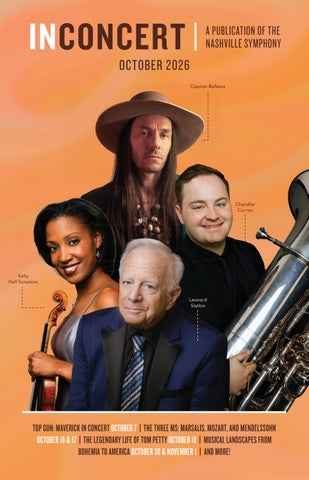
INCONCERT
A PUBLICATION OF THE NASHVILLE SYMPHONY
OCTOBER 2026 Clayton Bellamy
Chandler Currier
Kelly Hall-Tompkins Leonard Slatkin
TOP GUN: MAVERICK IN CONCERT OCTOBER 7 | THE THREE MS: MARSALIS, MOZART, AND MENDELSSOHN OCTOBER 16 & 17 | THE LEGENDARY LIFE OF TOM PETTY OCTOBER 18 | MUSICAL LANDSCAPES FROM BOHEMIA TO AMERICA OCTOBER 30 & NOVEMBER 1 | AND MORE!
LETTER FROM THE PRESIDENT & CEO A
n orchestra is among the few places where many distinct voices can speak at once and, through discipline and listening, create something none could create alone. That is more than a musical achievement. It is a model of community. October makes that idea vividly clear. In a single month, the Nashville Symphony moves from the cinematic sweep of Top Gun: Maverick and the unmistakable sound world of John Williams to Mozart, Mendelssohn, Wynton Marsalis, Dvořák, Smetana, and a brilliant concerto featuring our own Principal Tuba Chandler Currier. These programs do not belong to separate musical worlds. Together, they reveal the extraordinary reach of the modern American orchestra. That range matters in Nashville. We are a city shaped by many musical traditions, many histories, and many ways of hearing the world. The Nashville Symphony should be the place where those traditions meet at the highest level. Here, longtime concertgoers can deepen a lifelong relationship with orchestral music, and first-time visitors can immediately understand that this institution belongs to them as well. Our responsibility therefore extends beyond what happens onstage. A world-class performance deserves a world-class experience from the moment you arrive until the moment you leave. The welcome, the hall, the service, the conversation, and the music must form one coherent experience: thoughtful, generous, and unmistakably Nashville. As we celebrate 80 years of the Nashville Symphony and 20 years of Schermerhorn Symphony Center, we are not simply looking back. Through the 80/20 Overture, our annual giving initiative, we honor the people and music that brought us here while investing in what comes next. Every gift begins the next movement and helps shape what this orchestra can become for the next generation: artistically fearless, broadly welcoming, and essential to the life of our community. Thank you for being part of that future and for being here with us.
Warmest regards,
J. Mark Cantrell President & CEO
INCONCERT A PUBLICATION OF THE NASHVILLE SYMPHONY
OCTOBER 2026 8 Orchestra Roster 9 Conductors 12 SPECIAL EVENT
Top Gun: Maverick In Concert October 7
13 POPS SERIES
A Close Encounter with the music of John Williams October 8 & 9
17
HCA HEALTHCARE TRISTAR HEALTH CLASSICAL SERIES
The Three Ms: Marsalis, Mozart, and Mendelssohn October 16 & 17
26
PRESENTATION
The Legendary Life of Tom Petty October 18
The Nashville Symphony inspires and engages a diverse and growing community with extraordinary live orchestral music experiences.
29
HCA HEALTHCARE TRISTAR HEALTH CLASSICAL SERIES
Musical Landscapes from Bohemia to America October 30 & November 1
39 Individual & Corporate Donors 42 Board of Directors 45 Staff Listing
CONTACT US 615.687.6400 info@NashvilleSymphony.org NashvilleSymphony.org
PHOTOGRAPHY & VIDEO POLICY Video cameras, recording devices, and flash photography are strictly prohibited in the concert hall or in any other space where a performance or rehearsal is taking place. Cameras with a detachable lens may only be used pending approval from the artist and the venue and will be subject to rules and restrictions. For more information, please contact the Nashville Symphony's Communications office.
Advertising Sales
RED CURTAIN GROUP
73 White Bridge Rd, STE 103-115 Nashville, TN 37205 615.909.9904
SHARE YOUR EXPERIENCE #NASHVILLESYMPHONY INCONCERT
7
2026/27 NASHVILLE SYMPHONY LEONARD SLATKIN Music Director
GIANCARLO GUERRERO Music Director Laureate
Martha & Bronson Ingram Music Director Chair
VALERY SAUL
TUCKER BIDDLECOMBE
Associate Conductor
Billy Ray Hearn Choral Director
FIRST VIOLIN*
Peter Otto, Concertmaster
Walter Buchanan Sharp Chair
Erin Hall,
Acting Associate Concertmaster
Gerald C. Greer,
Acting Assistant Concertmaster
Tianpei Ai Isabel Bartles Francesca Bass Beverly Drukker Dawn Marlowe Gingrich Anna Lisa Hoepfinger John Maple Kirsten Mitchell Ashley Odom
SECOND VIOLIN* Jung-Min Shin, Principal Lucia Nowik, Acting Assistant Principal
CELLO*
Kevin Bate, Principal
James Victor Miller Chair
Una Gong, Assistant Principal Anthony LaMarchina, Principal Cello Emeritus
Samuel Sun Melinda Whitley Clare Yang Guanliang Zong
Acting Assistant Principal
Daniel Lochrie
Joel Reist, Principal Glen Wanner, Assistant Principal
Matthew Abramo Evan Bish Kevin Jablonski Katherine Munagian
Gloria Yun,
The Drs. Mark & Nancy Peacock Chair
Assistant Principal
BASS*
VIOLA*
Michelle Lackey Collins Christopher Farrell Anthony Parce
Assistant Principal ◊
Spencer Prewitt Daniel Lochrie
FLUTE
Assistant Principal
TROMBONE
Danny Goldman, Principal Katherine Kohler,
Stephen Drake Bradley Mansell Keith Nicholas Lynn Marie Peithman Xiao-Fan Zhang
Likai He Daniel Kim Charissa Leung Louise Morrison Laura Ross Johna Smith Jeremy Williams Pierre Cavel, Principal Shu-Zheng Yang,
CLARINET
E-FLAT CLARINET Katherine Kohler ◊
BASS CLARINET
Anne Potter Wilson Chair
Leslie Fagan,
Assistant Principal
Nicole Haywood Vera Tenorio +
HORN
PICCOLO
Beth Beeson Radu V. Rusu,
Norma Grobman Rogers Chair
Acting Associate Principal/ 3rd Horn
OBOE
Hunter Sholar Anna Spina,
Assistant Principal
ENGLISH HORN Fengyang Ju +
Acting Assistant Principal/ Utility Horn +
TRUMPET William Leathers, Principal Patrick Kunkee, Co-Principal Alexander Blazek
* Seating Section Revolves 8
OCTOBER 2026
TIMPANI
Assistant Principal
The Dr. Anne T. & Peter L. Neff Chair
Fengyang Ju +
Chandler Currier, Principal
Nicole Haywood Vera Tenorio +
Acting Assistant Principal
Leslie Norton, Principal
Ellen Menking,
TUBA
PERCUSSION
Norma Grobman Rogers Chair
Principal
Chance Gompert ◊ Reid Harman +
Asha Kline, Acting Principal + Gil Perel,
Gloria Yun,
Titus Underwood,
BASS TROMBONE
Joshua Hickman, Principal
BASSOON
CONTRABASSOON
Érik Gratton, Principal
Paul Jenkins, Principal Anthony Cosio-Marron,
Sam Bacco, Principal Richard Graber,
HARP
Licia Jaskunas, Principal
KEYBOARD
Robert Marler, Principal ◊ Stephen Kummer, Acting Principal +
LIBRARY
Renee Ann Pflughaupt, Principal Librarian
Amelia Van Howe, Librarian
ORCHESTRA PERSONNEL Pavana Stetzik,
Director of Orchestra Personnel
Sarah Figueroa,
Manager of Orchestra Operations
+One-Year Position
◊ Leave of Absence
CONDUCTORS
MUSIC DIRECTOR
LEONARD SLATKIN
Martha & Bronson Ingram Music Director Chair
I
nternationally acclaimed conductor Leonard Slatkin is Music Director of the Nashville Symphony, Conductor Laureate of the St. Louis Symphony Orchestra (SLSO), Music Director Laureate of the Detroit Symphony Orchestra (DSO), Directeur Musical Honoraire of the Orchestre National de Lyon (ONL), and Principal Guest Conductor of the Orquesta Filarmónica de Gran Canaria (OFGC). He maintains a rigorous schedule of guest conducting and is active as a composer, author, and educator. In addition to multiple appearances in Nashville, the 2026/27 season includes engagements with the International Violin Competition of Indianapolis, Manhattan School of Music Symphony Orchestra, National Symphony Orchestra, OFGC, Orchestra of the Music Makers (Singapore), New World Symphony, Colorado Symphony, Las Vegas Philharmonic, Florida Orchestra, SLSO, Frost Symphony Orchestra (Miami), National Symphony Orchestra (Ireland), National Polish Radio Symphony Orchestra, and Orquesta de Valencia. Slatkin has received six GRAMMY® awards and 35 nominations. His most recent recording, Pictures at an Exhibition: The Paintings of Bob Peak, was released on Warner Classics in 2026. Naxos has reissued Vox audiophile editions of his SLSO recordings featuring the works of Gershwin, Rachmaninov, and Prokofiev. Other Naxos recordings include Slatkin Conducts Slatkin—a compilation of pieces written by generations of his family—as well as works by Saint-Saëns, Ravel, Berlioz, Copland, Borzova, McTee, and Williams. A recipient of the National Medal of Arts, Slatkin also holds the rank of Chevalier in the French Legion of Honor. He has been awarded the Lincoln Medal from Ford’s Theatre Society, the Prix Charbonnier from the Federation of Alliances Françaises, Austria’s Decoration of Honor in Silver, and the League of American Orchestras’ Gold Baton. His debut book, Conducting Business (2012), for which he received the ASCAP Deems Taylor Special Recognition
Award, was followed by Leading Tones (2017) and Classical Crossroads: The Path Forward for Music in the 21st Century (2021). His latest books are Eight Symphonic Masterworks of the Twentieth Century (spring 2024) and Eight Symphonic Masterworks of the Nineteenth Century (fall 2024). A second volume of twentieth-century score studies will be published by Bloomsbury in February 2027 as part of this ongoing series. Slatkin has held posts as Music Director of the New Orleans Philharmonic-Symphony Orchestra, SLSO, National Symphony Orchestra, DSO, and ONL, and he was Chief Conductor of the BBC Symphony Orchestra. He has served as Principal Guest Conductor of London’s Philharmonia and Royal Philharmonic, the Pittsburgh Symphony Orchestra, the Los Angeles Philharmonic at the Hollywood Bowl, and the Minnesota Orchestra. He has conducted virtually all the leading orchestras in the world, including the New York Philharmonic, Chicago Symphony Orchestra, Philadelphia Orchestra, Boston Symphony Orchestra, San Francisco Symphony, Los Angeles Philharmonic, Berlin Philharmonic, Bayerischer Rundfunk (Munich), Royal Stockholm Philharmonic Orchestra, Royal Concertgebouw Orchestra (Amsterdam), Orchestre de Paris, Oslo Philharmonic Orchestra, and Israel Philharmonic Orchestra, as well as all five London orchestras. Slatkin’s opera conducting has taken him to the Metropolitan Opera, Lyric Opera of Chicago, Washington National Opera, Opera Theatre of St. Louis, Santa Fe Opera, Vienna State Opera, Stuttgart Opera, and Opéra Bastille in Paris. Born in Los Angeles to a distinguished musical family, he began his musical training on the violin and first studied conducting with his father, followed by Walter Susskind at Aspen and Jean Morel at Juilliard. He makes his home in St. Louis with his wife, composer Cindy McTee.
INCONCERT
9
C OND UCTO R S
VALERY SAUL, Associate Conductor
D
escribed by Marin Alsop as a “powerful presence on the podium,” conductor Valery Saul is recognized for her d y n a m i c l e a d e r s h i p, technical command, and charismatic rapport with both musicians and audiences. She begins her threeseason appointment as Associate Conductor with the Nashville Symphony in the 2026/27 season. Valery Saul served from 2023 to 2026 as the Associate Conductor of the Arkansas Symphony Orchestra, and she is a regular cover conductor for the Oregon Symphony, St. Louis Symphony, Minnesota Orchestra, and Charlotte Symphony. Saul is also an alumnus of the Dallas Opera's Hart Institute for Women Conductors. Equally at home in the concert hall and the orchestra pit, Valery
regularly conducts opera, ballet, broadway, and pops performances, earning praise for her versatility and passion for championing all genres of music. Saul was a participant at the Cabrillo Festival of Contemporary Music and fellow at the Bellingham Festival of Music, and she won Second Prize at the Denver Philharmonic Orchestra's Conducting Competition. She has participated in numerous conducting masterclasses including the Buffalo Philharmonic Orchestra, the National Symphony Orchestra, L'Orchestre Métropolitain, and the Baltimore Symphony Orchestra. A graduate of the Peabody Conservatory of Music and the University of British Columbia, Saul holds degrees in both conducting and opera performance. Her mentors include Marin Alsop, Cristian Măcelaru, Nicole Paiement, Marcelo Lehninger, Miguel HarthBedoya, and George Manahan.
TUCKER BIDDLECOMBE,
T
ucker Biddlecombe is the Billy Ray Hearn Chorus Director of the N a s h v i l l e Sy m p h o n y Orchestra and is entering his tenth season as director of the Nashville Symphony Chorus. In addition, Biddlecombe serves as Professor of Choral Studies at Vanderbilt University’s Blair School of Music, where he conducts the Vanderbilt Sixteen and University Singers. His work with the Nashville Symphony has included chorus preparation for many of the repertoire’s most revered masterworks. This season includes preparation for Maestro Leonard Slatkin on Bernstein’s Chichester Psalms and Brahms's Requiem. Biddlecombe will conduct the orchestra and chorus in Handel’s Messiah, and a birthday concert of the works of Bach including Magnificat in D. He has prepared the chorus for multiple major world-premiere recordings including John Harbison’s Requiem, Gabriela Lena-Frank’s Conquest Requiem, and the upcoming release of Jonathan
10
OCTOBER 2026
Billy Ray Hearn Chorus Director
Leshnoff’s The Sacrifice of Isaac. The chorus recently recorded a live performance of Carol Barnett’s The World Beloved: A Bluegrass Mass for upcoming commercial release. Performance highlights at Blair have included Britten’s War Requiem, Brahms’s Ein Deutsches Requiem, Bach’s St. Matthew Passion, and Fire in My Mouth by Julia Wolfe. He has conducted honor choruses in a dozen states, two concerts at Carnegie Hall, and in 2022 conducted the UCTB honor choir for the Southern Region of the American Choral Directors Association. International engagements have included guest conducting throughout the United Kingdom, the Czech Republic, and a residency with the Central Conservatory of Music in Beijing. He is a graduate of SUNY Potsdam and Florida State University, where he completed studies in choral conducting and music education with Daniel Gordon and André Thomas, respectively. He resides in Nashville with his wife Mary Biddlecombe, director of the Blair Academy at Vanderbilt, and Artistic Director of Vanderbilt Youth Choirs.
SPECIAL EVENT
ON SALE NOW
WEDNESDAY, OCTOBER 7 AT 7:30 PM
NASHVILLE SYMPHONY LAWRENCE LOH, conductor
PRODUCED BY ROYAL ALBERT HALL ORIGINAL MUSIC SCORE COMPOSED BY HAROLD FALTERMEYER LADY GAGA HANS ZIMMER WITH THANKS TO esk. films. This concert will last approximately 2 hours, 35 minutes, including a 20-minute intermission.
ABOUT THE CONDUCTOR LAWRENCE LOH Described as bringing an “artisan stor yteller’s sensitivity… shaping passages with clarity and p ower via beautifully sculpted dynamics… revealing orchestral character not seen or heard before,” (Arts Knoxville) Lawrence Loh enjoys a dynamic career as a conductor of orchestras all over the world. After an extensive two-year search, Lawrence Loh was appointed Music Director of the Waco Symphony Orchestra in the Spring of 2024. He was named Conductor Laureate of The Syracuse Orchestra after serving as Music Director from 2015–2025. As a self-described “Star Wars geek” and film music enthusiast, Loh has conducted numerous sold-out John Williams and film music tribute concerts. Part 12
OCTOBER 2026
of his appeal is his ability to serve as both host and conductor. “It is his enthusiasm for Williams' music and the films for which it was written that is Loh's great strength in this program. A fan's enthusiasm drives his performances in broad strokes and details and fills his speaking to the audience with irresistible appeal. He used no cue cards. One felt he could speak at filibuster length on Williams's music.” (Pittsburgh Tribune) Mr. Loh has assisted John Williams on multiple occasions and has worked with a wide range of pops artists from Chris Botti and Ann Hampton Callaway to Jason Alexander and Idina Menzel. As one of the most requested conductors for conducting Films in Concert, Loh has led Black Panther, Star Wars (Episodes 4-6), Jaws, Nightmare Before Christmas, Jurassic Park, Casablanca, The Wizard of Oz, and Singin’ in the Rain, among other film productions.
POPS SERIES
A CLOSE ENCOUNTER WITH THE MUSIC OF JOHN WILLIAMS THURSDAY & FRIDAY, OCTOBER 8 & 9 AT 7:30 PM
NASHVILLE SYMPHONY RICHARD KAUFMAN, conductor
Summon the Heroes "A New Beginning" from Minority Report "Fawkes the Phoenix" from Harry Potter and the Chamber of Secrets "Scherzo for Motorcycle and Orchestra" from Indiana Jones and the Last Crusade Excerpts from Close Encounters of the Third Kind "Jim's New Life" from Empire of the Sun Love Theme from Superman "The Rise of Skywalker" from Star Wars: The Rise of Skywalker "Main Title" from Star Wars
INTERMISSION Liberty Fanfare Theme from Schindler's List "The Face of Pan" from Hook "If We Were in Love" from Yes, Giorgio Theme from Jaws "Devil's Dance" from The Witches of Eastwick "Flying Theme" from E.T. (The Extra-Terrestrial)
INCONCERT
13
POPS
ABOUT THE CONDUCTOR RICHARD KAUFMAN Richard Kaufman has devoted much of his musical l i fe to c ondu c t i ng and supervising music for film and television productions, as well as performing film and classical music in concert halls and on recordings. He holds the permanent titles of Pops Conductor Laureate of the Dallas Symphony Orchestra, Principal Pops Conductor Laureate of Pacific Symphony, and for more than 20 years, led performances on the Chicago Symphony’s series “CSO at the Movies.” Kaufman received the 1993 GRAMMY® Award for Best Pop Instrumental Performance. In addition to recordings with the Nuremberg Symphony, he has recorded multiple albums with the London Symphony Orchestra, New Zealand Symphony Orchestra, and the Brandenburg Philharmonic. One of the world’s leading conductors of film music, Kaufman has appeared with numerous symphony orchestras throughout the US and Canada, including New York, Cleveland, Philadelphia, Atlanta, St. Louis,
14
OCTOBER 2026
San Francisco, and Toronto. He has appeared as guest conductor with the Royal Scottish National Orchestra, as well as the orchestras of London, Liverpool, Dublin, and the Leipzig Gewandhaus. In 2015, Kaufman made his debut with the Boston Pops, stepping in for John Williams at the Annual Pops Film Night. The following season, he shared the podium with Mr. Williams at the annual Tanglewood Film Night. In 2016, Richard conducted the San Diego Symphony in the score for Star Trek Beyond, accompanying the film in its gala world premiere in IMAX. As a studio violinist in Hollywood, Kaufman performed on numerous film and television scores, including Jaws and Close Encounters of the Third Kind, and has recorded with artists including John Denver, Burt Bacharach, The Carpenters, and Ray Charles. As a unique part of his career, Kaufman has coached actors in musical roles, including Jack Nicholson, Dudley Moore, and Tom Hanks. He has conducted for performers including John Denver, Andy Williams, Amy Grant, The Beach Boys, Ray Charles, and The Righteous Brothers.
H C A H E A LT H C A R E T R I S TA R H E A LT H C L A S S I C A L S E R I E S
THE THREE Ms: MARSALIS, MOZART, & MENDELSSOHN FRIDAY & SATURDAY, OCTOBER 16 & 17, AT 7:30 PM
NASHVILLE SYMPHONY LEONARD SLATKIN, conductor KELLY HALL-TOMPKINS, violin
CLASSICAL SERIES PRESENTED BY
FELIX MENDELSSOHN The Hebrides (“Fingal’s Cave”), Op. 26 WOLFGANG AMADEUS MOZART Symphony No. 39 in E-flat major, K. 543 Adagio - Allegro Andante con moto Menuetto: Allegretto Allegro
INTERMISSION WYNTON MARSALIS Concerto in D for Violin and Orchestra Rhapsody Rondo Burlesque Blues Hootenanny
Kelly Hall-Tompkins, violin
This concert will last approximately 1 hour, 40 minutes, including a 20-minute intermission.
INCONCERT
17
CL A SS I CA L
Felix Mendelssohn Born on February 3, 1809 Died on November 4, 1847
The Hebrides (“Fingal’s Cave”), Op. 26 Composed: 1830; revised 1832 First performance: 1832
and release. The music gathers force, at times hinting at the violence that is as much part of nature as its beauty, but subsides in a remarkable closing passage— almost like a glimpse of sunset. Mendelssohn allows the music to fade, leaving a mysterious impression of the sea’s timeless ebb and flow continuing long after the orchestra has fallen silent. Scored for pairs of flutes, oboes, clarinets, bassoons, horns, and trumpets; timpani; and strings
Last Nashville Symphony performance: June 14, 2022 Approximate Length: 10 minutes
Wolfgang Amadeus Mozart
T
ravel was an important source of inspiration for Felix Mendelssohn. In 1829, at the age of 20, he set out on an extended European journey that took him from the social whirl of London to the rugged landscape of Scotland. During an excursion through the Hebrides off Scotland’s west coast, Mendelssohn was struck by their misty appearance in the distance. A talented visual artist as well as a composer, he sketched the scene in pencil and, in a letter home, wrote down a musical idea that would become the opening of The Hebrides. The following day, Mendelssohn and a friend sailed to Staffa, the uninhabited island famous for Fingal’s Cave. The crossing left him miserably seasick, but the sheer scale of the cave-riddled cliffs and their towering black basalt columns made a powerful impression. Mendelssohn continued working on the music over the next several years, completing an initial version at the end of 1830 and revising it repeatedly before arriving at the work we hear today. Although it is described as an overture, The Hebrides was not written to introduce an opera or play. In Mendelssohn’s time, the word “overture” could also describe a selfcontained orchestral piece, and he helped make that kind of work increasingly important. Here, the orchestra evokes a place and atmosphere rather than telling a specific story. Fingal’s Cave later became an alternative title.
WHAT TO LISTEN FOR The opening immediately creates the scene. Violas, cellos, and bassoons introduce a restless, curling idea that seems to fall away and begin again. Its gravitational pull downward contrasts with a more lyrical melody that ascends with a sense of openness 18
OCTOBER 2026
Born on January 27, 1756 Died on December 5, 1791
Symphony No. 39 in E-flat major, K. 543 Composed: 1788 First performance: Unknown Last Nashville Symphony performance: January 12, 2013 Approximate Length: 28 minutes
M
ozart’s symphonies span almost his entire creative life, from childhood works written in 1764 to the final three of 1788. During those years, the symphony genre itself changed dramatically: from music often written for particular occasions or as concert entertainment into a form capable of carrying a composer’s most ambitious orchestral ideas. Mozart’s own development helped shape that transformation. The culmination of Mozart’s symphonic achievement came during the summer of 1788. In the astonishing space of about six weeks, Mozart composed the three works that would become his final symphonies: Nos. 39, 40, and 41. No surviving commission explains why he wrote them, and the circumstances of their earliest performances remain uncertain. Their origin has therefore long been something of a mystery, although scholars have questioned the assumption that Mozart had no practical purpose in mind. Symphony No. 39 came first. Although it has sometimes been overshadowed by the dark intensity of No. 40 and the grandeur of No. 41, later nicknamed “Jupiter” after the chief Roman god, its achievement is no less extraordinary. The orchestra itself contributes to the symphony’s distinctive character. Mozart omits oboes altogether
CL ASSICAL and gives the clarinets an especially prominent role. Their warmer, mellower sound becomes one of the work’s identifying colors, particularly in the third movement.
WHAT TO LISTEN FOR Mozart launches the piece with unusual ceremony, beginning with a lengthy slow introduction—only the third time he had opened a symphony this way. Powerful gestures suggest confidence and grandeur, yet the music turns toward more unsettled territory. Rather than making a sharp break into the faster material, Mozart gradually allows the tension of the introduction to ebb. The transition is so smooth that the new tempo seems almost to grow naturally out of what came before. The second movement begins with a deceptively simple, graceful melody, but darker passages soon interrupt its calm. The third movement draws on the character of a stately dance, combining elegance with weight; its contrasting middle section brings the clarinets into particular focus, allowing their warm color to step briefly into the foreground. The finale is a dazzling example of Mozart’s ability to do more with less. It is driven by a tiny, quick-moving idea that he continually reshapes and passes around the orchestra. Its exuberant momentum is matched by the wit and theatrical timing familiar from Mozart’s great comic opera The Marriage of Figaro. Scored for flute, 2 clarinets, 2 bassoons, 2 horns, 2 trumpets, timpani, and strings
Wynton Marsalis Born on October 18, 1961 Resides in New York City
Concerto in D for Violin and Orchestra Composed: 2015 First performance: 2015 Nashville Symphony Premiere Approximate Length: 28 minutes
B
orn in New Orleans in 1961 and raised in the nearby suburb of Kenner, Wynton Learson Marsalis grew up immersed in the extraordinary musical culture of the New Orleans area, with the city widely regarded as the birthplace of jazz. Music
was equally close to home: his father, Ellis Marsalis Jr., was a prominent jazz pianist and teacher, while his brothers Branford, Delfeayo, and Jason also became professional musicians. Surrounded by both the living traditions of New Orleans and an extraordinary musical family, Marsalis emerged at a young age as an exceptional trumpeter and went on to become an influential performer, composer, bandleader, and educator. His work as a composer has increasingly extended into the concert hall. In the Violin Concerto, Nashville Symphony Music Director Leonard Slatkin hears Marsalis “finding this way to balance the vernacular of jazz and pop and blues” with the structural demands of the classical concert tradition. Marsalis wrote the Violin Concerto in 2015 for Scottish violinist Nicola Benedetti, whom he later married. “To and for the virtuoso, educator, and inspired advocate” reads the dedication. Benedetti asked him to “invite a diverse world of people into the experience of this piece.” That challenge appealed to Marsalis, for whom “finding and nurturing common musical ground between differing arts and musical styles has been a lifetime fascination.” As part of their collaboration, Benedetti supplied Marsalis with scores of major violin concertos, including those by Beethoven, Brahms, and Tchaikovsky—all of which were written in the same key of D major—as he immersed himself more deeply in the instrument’s classical concerto tradition. He approached the concerto, Marsalis explains, “from the perspective of a jazz musician and New Orleans bluesman.” That presented technical and even philosophical challenges. Marsalis had to find ways of bringing “the nuance and virtuosity in jazz and blues” into a symphony orchestra whose players do not normally work in those styles. He also had to discover “how to create a consistent groove without a rhythm section.” Benedetti’s Scottish background sent Marsalis searching for connections between her musical world and his own. Among the examples he considered were the African American abolitionist Frederick Douglass’s love of the Scottish poet Robert Burns; Marsalis’s deep admiration for Scottish baritone saxophonist Joe Temperley; and the career of Francis Johnson, an early African American composer and trailblazing champion of the keyed bugle. Marsalis says these sources led him “to reconnect with the Anglo-Celtic roots of Afro-American music.” For Marsalis, these musical associations reflect a broader belief: “that all human beings are connected in the essential fundamentals of life: birth, death, INCONCERT
19
CL A SS I CA L love, and laughter; that our most profound individual experiences are also universal (especially pain); and acknowledging the depth of that pain in the context of a groove is a powerful first step towards healing.”
WHAT TO LISTEN FOR Marsalis writes that the concerto opens with the violin “whispering a solo note before the orchestra enters,” as if saying “And so it came to pass” or “Once upon a time.” He conceived the work with the number four in mind—the four movements echoing, in his imagination, “the four corners of the earth” reached by Benedetti’s travels. Each movement explores “a different aspect of her dream, which becomes reality through the public storytelling that is virtuosic performance.” The first movement, “Rhapsody,” unfolds as “a complex dream” that turns into nightmares and then “progresses into peacefulness and dissolves into ancestral memory.” “Rondo Burlesque” abruptly changes the scene, evoking “a New Orleans jazz, calliope, circus clown, African gumbo, Mardi Gras party” that is propelled by irregular rhythms.
In the third movement, “Blues,” Marsalis traces what he describes as “the progression of flirtation, courtship, intimacy, sermonizing, final loss, and abject loneliness that is out there to claim us all.” “Hootenanny,” as Marsalis titles the finale, offers a “raucous, stomping and whimsical barnyard throw-down.” He imagines the soloist dazzling the audience with "virtuosic chicanery” and revelry before continuing “on down the Good King’s highway to other places yet to be seen or even foretold.” In keeping with the blues and jazz tradition, Marsalis notes, “our journey ends with the jubilance and uplift of an optimistic conclusion.” Scored for solo violin, 3 flutes (3rd doubling piccolo), 3 oboes (3rd doubling English horn), 3 clarinets (1st doubling E-flat clarinet, 3rd doubling bass clarinet), 3 bassoons (3rd doubling contrabassoon), 4 horns, 3 trumpets, 3 trombones, tuba (doubling sousaphone), timpani, 4 percussionists, harp, and strings − Thomas May is the Nashville Symphony's program annotator.
ABOUT THE SOLOIST KELLY HALL-TOMPKINS violin Winner of a Naumburg Int e r n at i o n a l Vi o l i n Competition Prize and the Sphinx Medal of Excellence, featured in the Smithsonian Museum for AfricanAmerican History, and as New York Times “New Yorker of the Year,” Ms. Hall-Tompkins is a violin soloist entrepreneur appearing with numerous orchestras including St. Louis, Baltimore, Dallas, and Oakland, as well as conductors Leonard Slatkin, Keith Lockhart, and Michael Morgan. She has also been a featured artist in residence with the Cincinnati Symphony and New York City’s WQXR and on Broadway as "Fiddler"/ Violin Soloist of the GRAMMY® and Tony-nominated production of Fiddler on the Roof. A collaboration with five-time Emmy-winning composer Jeff Beal features a new violin concerto, Body in Motion, written for her. The collaboration also features celebrated conductor Leonard Slatkin. Ms. Hall-Tompkins and
20
OCTOBER 2026
Slatkin performed the sold-out world premiere with the St. Louis Symphony to critical acclaim. Kelly Hall-Tompkins and Slatkin also gave the European premiere with the Orquesta of Gran Canaria, Spain this spring. As the first soloist to perform the Wynton Marsalis Violin Concerto after the dedicatée, Kelly Hall-Tompkins has been a champion of the work in 25 performances so far, including the Lucerne Festival Premiere in Switzerland and a tour across the Netherlands. The first American artist to perform in China after the pandemic, Ms. Hall-Tompkins received a Chinese “Rare Talent Visa” to perform as soloist with the Shanghai Symphony. As founder of Music Kitchen-Food for the Soul, Kelly Hall-Tompkins is a pioneer of social justice, bringing top artists in over 100 concerts coast to coast in homeless shelters and presenting the World Premiere of Forgotten Voices: A Song Cycle for Voices and Strings, in association with Carnegie Hall. Ms. Hall-Tompkins is also a published author contributor to Music and Human Rights on Routledge Press.
BE MOVED. BE AM HCA Healthcare TriStar Health Classical Series
Presentation
Musical Landscapes from Bohemia to America
A Very Dave Barnes Christmas DEC 10, 2026
OCT 30 & NOV 1, 2026
Presented without the Nashville Symphony
Special Event
Special Event
Richard Marx
Holiday Brass Spectacular
with the Nashville Symphony
with Members of the Nashville Symphony
NOV 4, 2026
DEC 13, 2026
Movie Series
Special Event
Harry Potter and the Prisoner of AzkabanTM in Concert
Bluebird at the Symphony Christmas
NOV 6 TO 8, 2026
DEC 15, 2026
Pops Series
Special Event
Nat King Cole Songbook
with Charles Esten & Friends
Handel’s Messiah
NOV 12 & 13, 2026
with the Nashville Symphony Chorus DEC 18 TO 20, 2026
The Ann & Monroe Carell Family Trust Family Series
Choral performances are supported by C.B. Ragland Company
NOV 15, 2026
Special Event
HCA Healthcare TriStar Health Classical Series
JAN 3, 2027
NOV 19 TO 21, 2026
HCA Healthcare TriStar Health Classical Series
How America Found Its Sound
SymphonySync +SoundBath
Two Giants: Guerrero & Bronfman
Down the Rabbit Hole into a World of Enchantment
Special Event
Holiday Voices
with the Nashville Symphony Chorus DEC 1, 2026
Special Event
Choral performances are supported by C.B. Ragland Company
Special Event
Elf in Concert DEC 2, 2026 Special Event
Home Alone in Concert DEC 4 TO 6, 2026 Presentation
Ricky Skaggs
& Kentucky Thunder Christmas DEC 8, 2026
JAN 8 & 9, 2027
Bluebird at the Symphony
with Caitlyn Smith, Gordie Sampson, & Troy Verges JAN 16, 2027 The Ann & Monroe Carell Family Trust Family Series
The Conductor’s Spellbook JAN 17, 2027 Special Event
The Music of Studio Ghibli:
Celebrating Joe Hisaishi's Cinematic Wonders JAN 21 & 22, 2027 HCA Healthcare TriStar Health Classical Series
The Romance of the Cello and the Orchestra JAN 29 & 30, 2027 The Lawrence S. Levine Memorial Concert
Movie Series
The Wizard of Oz in Concert FEB 5 TO 7, 2027 Pops Series
Aretha: A Tribute FEB 11 & 12, 2027
Buy More, Save More on 3+ Concerts |
MAZED. BE. HERE. Special Event
HCA Healthcare TriStar Health Classical Series
Bluebird at the Symphony with The Love Junkies
Three Generations of Romantic Composers
FEB 13, 2027
APR 22 & 24, 2027
HCA Healthcare TriStar Health Classical Series
Movie Series
FEB 18 TO 20, 2027
APR 30 TO MAY 2, 2027
Brahms’ A German Requiem
Superman in Concert
Choral performances are supported by C.B. Ragland Company Special Event Special Event
SymphonySync +Yoga
Celebrating Beethoven MAY 7, 2027
FEB 22, 2027 Pops Series HCA Healthcare TriStar Health Classical Series
Carmen, Queens & Pictures at an Exhibition
Better Than Ezra and Friends MAY 13 & 14, 2027
MAR 4 & 5, 2027
The Ann & Monroe Carell Family Trust Family Series
Pops Series
MAY 16, 2027
Warren Haynes Dreams & Songs Symphonic Experience MAR 11 & 12, 2027
Heroes and Villains
HCA Healthcare TriStar Health Classical Series
Mahler: The Song of the Night MAY 21 & 22, 2027
HCA Healthcare TriStar Health Classical Series
Scheherazade and Music of Enchantment MAR 19 TO 21, 2027
Movie Series
Star Wars: The Empire Strikes Back in Concert MAY 28 TO 30, 2027
Special Event
Bluebird at the Symphony
HCA Healthcare TriStar Health Classical Series
with Kristian Bush, Lee Thomas Miller, & Wendell Mobley
Closing Weekend: An American Celebration
MAR 26 & 27, 2027
JUN 11 TO 13, 2027
Special Event
Pops Series
Bach’s Birthday: From Brandenburg to Magnificat with the Nashville Symphony Chorus
Cody Fry
with the Nashville Symphony JUN 17 & 18, 2027
MAR 31, 2027
Choral performances are supported by C.B. Ragland Company
Movie Series
Jurassic Park in Concert APR 2 TO 4, 2027 HCA Healthcare TriStar Health Classical Series
Slatkin Conducts Schubert APR 9 & 10, 2027 Pops Series
Keith Lockhart’s The Golden Age of Pops APR 15 & 16, 2027 The Ann & Monroe Carell Family Trust Family Series
Philharmonia Fantastique APR 18, 2027
NashvilleSymphony.org/CYO | 615.687.6400
P R E S E N TAT I O N
THE LEGENDARY LIFE OF TOM PETTY SUNDAY, OCTOBER 18, AT 7:30 PM
CLAYTON BELLAMY
LOOSE LIPS
JAY TOOKE
BENNY CARL
JIMBO HART
MYLES BAKER
KEVIN ALDRIDGE
RYAN CAIN
KEVIN GASTONGUAY
ROBBIE CREDE
ABOUT THE ARTISTS CLAYTON BELLAMY B o r n i n B o n ny v i l l e , Alberta, Clayton Bellamy is a 30-year veteran of the Canadian country music scene whose impact spans multiple facets of the industry. A multi-platinum award-winning songwriter, Bellamy has crafted chart-topping hits in both country and rock, earning accolades for his authentic, memorable lyrics. He is best known as the vocalist and lead guitarist for the multi-platinum JUNO- and CCMA Award-winning band The Road Hammers, while also showcasing his versatility as the frontman of the rock band The Congregation. Beyond his musical achievements, Bellamy has established himself as a dynamic force in entertainment. He has hosted the Drive Home show for CISN Radio in Edmonton for three years and appeared on the CMT television series Ice Racer Showdown. His acting credits include roles in HBO's Tin Star, Paramount's Joe Pickett, and the recent theatrical release Souls Road with Dallas Smith. A dedicated philanthropist, Bellamy founded the Clayton Bellamy Foundation for the Arts, supporting youth through arts and education. His commitment to making a positive impact both on and off the stage has cemented his legacy as a respected and influential figure in Canadian music and culture. 26
OCTOBER 2026
LOOSE LIPS Loose Lips is a high energy rock-and-roll, blues-and-soul, funk, spunk, and all-thatjunk machine. Found most frequently in Nashville's historic Printer’s Alley, the band has performed a weekly residency at Bourbon St. Blues and Boogie since 2020. The band is made up of a handful of core members with decade- long friendships forged in Music City that tend just pour right off the stage. Despite being based mostly in Middle Tennessee, the band makes its way around the country playing festivals like the annual Bike Week in Daytona, Florida and a slew of private engagements.
TITOS AD?
H C A H E A LT H C A R E T R I S TA R H E A LT H C L A S S I C A L S E R I E S
MUSICAL LANDSCAPES FROM BOHEMIA TO AMERICA FRIDAY, OCTOBER 30 AT 7:30 PM | SUNDAY, NOVEMBER 1 AT 2 PM
NASHVILLE SYMPHONY KEN-DAVID MASUR, conductor CHANDLER CURRIER, tuba
THANK YOU TO OUR CLASSICAL SERIES SPONSOR
DOBRINKA TABAKOVA Orpheus' Comet BEDŘICH SMETANA "The Moldau" from Má vlast JOHN WILLIAMS Concerto for Tuba and Orchestra Allegro Moderato Andante Allegro molto
Chandler Currier, tuba
INTERMISSION ANTONÍN DVOŘÁK Symphony No. 8 in G major, Opus 88 Allegro con brio Adagio Allegretto grazioso Allegro ma non troppo
This concert will last approximately 1 hour, 30 minutes, including a 20-minute intermission.
INCONCERT
29
CL A SS I CA L
ABOUT THE PROGRAM Images of the natural world are a thread binding this program together—from the buzzing bees that set Orpheus’ Comet in motion to Smetana’s sonic journey along the Vltava River and the countryside surrounding Dvořák’s home at Vysoká. As a young musician in Prague, Dvořák had a direct connection to the generation represented by Smetana, playing viola in the orchestra of the Provisional Theater while Smetana was its principal conductor. A few years after writing the Eighth Symphony, Dvořák moved to New York, where he would compose his New World Symphony—providing a historical link between the Czech music heard here and the American world of John Williams.
Dobrinka Tabakova Born in 1980 Resides in London
Orpheus’ Comet
Book IV is largely concerned with beekeeping, but its account of the beekeeper Aristaeus leads into a reconsideration of the myth of Orpheus and his descent into the Underworld to restore his dead wife Eurydice to life, only to lose her again when he looks back before their journey is complete. In Virgil’s telling, Aristaeus is responsible for Eurydice’s death: as she fled his advances, she was bitten by a snake.
Composed: 2017 First performance: 2017 Nashville Symphony Premiere Approximate Length: 5 minutes
D
obrinka Tabakova moved to the United Kingdom with her family from her birthplace in Bulgaria at the age of 11 and has been based in London ever since. Her catalogue encompasses chamber, choral, and orchestral music, including a substantial body of works for strings. She served as composer in residence with the BBC Concert Orchestra from 2017 to 2021. It was with Orpheus’ Comet that she inaugurated her residency. Tabakova wrote the piece on a joint commission from the BBC and European Broadcasting Union to mark the 50th anniversary of the regular Music Exchanges of Euroradio, the European Broadcasting Union network through which member broadcasters share concerts and recordings. Describing Orpheus’ Comet as “a celebration for orchestra,” Tabakova wanted to find a way to use the “regal, upbeat opening” of Monteverdi’s 1607 opera L’Orfeo, which serves as Euroradio’s signature melody, as the culmination of her piece. As she researched the myth Monteverdi retells in his opera, she encountered one version in the fourth book of Virgil’s Georgics, a first-century BCE poem about agriculture and rural life.
30
OCTOBER 2026
WHAT TO LISTEN FOR The sound of bees buzzing suggested the opening musical idea, first heard in the horns and answered by the low strings. The activity gradually expands into dense clusters of sound, with brief accents flashing around the orchestra. A broad, hymn-like sequence emerges from this increasingly busy activity. The earlier “buzzing” music is then folded into it and transformed into “almost hypnotic rhythmic loops,” as the composer puts it, while a melody takes flight in the flute and clarinet. As the momentum gathers, the trombones add weight to the texture until Monteverdi’s opening theme makes its appearance—but “with a modern twist.” Scored for 2 flutes (2nd doubling piccolo), 2 oboes, 2 clarinets, 2 bassoons (2nd doubling contrabassoon), 4 horns, 3 trumpets, 3 trombones, optional tuba, timpani, percussion, and strings
CL A SS I CA L
Bedřich Smetana Born on March 2, 1824 Died on May 12, 1884
Vltava (“The Moldau”) from Má vlast Composed: 1874 First performance: 1875 Last Nashville Symphony performance:
ruined castles loom above the riverbanks. Later the current turns more turbulent at the St. John Rapids, a rough stretch of the Vltava south of Prague. The river finally widens as it approaches the capital and passes Vyšehrad, the historic fortress overlooking the Vltava—one of Prague’s most famous landmarks— before continuing toward its eventual meeting with the Elbe. Scored for piccolo, 2 flutes, 2 oboes, 2 clarinets, 2 bassoons, 4 horns, 2 trumpets, 3 trombones, tuba, timpani, triangle, cymbals, bass drum, harp, and strings
January 13, 2019 Approximate Length: 12 minutes
B
edřich Smetana’s Vltava—also widely known as The Moldau, which is taken from the German name for the river that winds through the Bohemian countryside and Prague—is the best-known part of his six-work cycle Má vlast (My Homeland). Smetana began composing the work in 1874, at a difficult turning point in his life. That summer he began experiencing an ominous ringing in his ears, marking the rapid onset of the deafness that soon forced him to resign from his position as principal conductor at Prague’s Provisional Theater. Already established as a pioneer of a distinctively Czech musical language, especially through his works for the stage, he now turned increasingly toward orchestral composition. Vltava became the second part of Má vlast, whose six tone poems he completed over the next several years. Smetana supplied his own description of the river’s journey. It begins at the Vltava’s source, where “two brooks, one cold, the other warm, join a stream,” as he observed during a trip in 1867. From there, his program follows the river through the Bohemian countryside toward Prague, combining natural scenery with depictions of village life, history, and legend.
WHAT TO LISTEN FOR Smetana’s two small streams are suggested at the opening before they gradually merge into the broad, flowing melody associated with the Vltava itself. That melody returns as the scenery changes along the river’s course, providing a recognizable thread through the journey. The music becomes livelier as the river passes a peasant wedding, then enters the moonlit world Smetana describes, where “mermaids dance” and 32
OCTOBER 2026
John Williams
Born on February 8, 1932 Resides in Los Angeles
Concerto for Tuba and Orchestra Composed: 1985 First performance: 1985 Nashville Symphony Premiere Approximate Length: 20 minutes
J
ohn Williams’s music has become part of the soundtrack of modern American life. His scores for Star Wars, Jaws, E.T., the Indiana Jones and Harry Potter films, Schindler’s List, and many others have made him one of the most widely recognized composers of his generation. Yet his career has never been confined to the movie studio. Alongside more than 100 film scores and extensive work for television, Williams has built a substantial catalogue of concert music and has enjoyed a long career as a conductor. Music surrounded him from childhood. His father was a percussionist with the Raymond Scott Quintette, and jazz formed part of Williams’s early musical environment. After studying in Los Angeles and serving as a conductor and arranger for the U.S. Air Force, he continued his training at Juilliard while earning money as a jazz pianist in New York nightclubs. Williams’s closest institutional relationship in the concert world has been with the Boston Pops Orchestra, which he led as music director and later served as laureate conductor. Concertos occupy an important place in his concert catalogue, often inspired by particular performers and instruments. The Tuba Concerto grew directly from that Boston connection: Williams composed it in 1985 for the 100th anniversary of the Boston Pops which he
NON-INVASIVE CARDIAC SUPPORT • BRENTWOOD, TN
�e Beneets Creates a new heart by improving natural blood flow and circulation • Eliminates erectile dysfunction by supporting improved vascular function
Improves cognitive ability by enhancing oxygen and blood delivery to the brain • Reduces blood pressure by promoting healthier circulation and heart performance
CL A SS I CA L was then serving as music director. The work was composed for Chester Schmitz, principal tubist of the Boston Symphony Orchestra and Boston Pops, and Williams conducted its premiere.
Antonín Dvořák
Born on September 8, 1841 Died on May 1, 1904
WHAT TO LISTEN FOR Williams connects the concerto’s three movements without any pauses. The soloist enters almost immediately in the first movement against what the composer describes as a “gently rocking pulse” in the strings, harp, and upper woodwinds. The tuba’s first idea is passed to other instruments before the soloist introduces another theme and moves into increasingly elaborate music. Unusually, the cadenza—a passage normally reserved for the soloist alone—is accompanied here by all four horns. The English horn opens the slow second movement with a line that becomes increasingly decorated before passing to the flute. Williams sets up a brief conversation between tuba and flute, followed by a section in which the soloist plays syncopated figures against a steady orchestral beat. The opening melody eventually returns, with tuba, English horn, and flute gradually receding as the strings hold a quiet chord above them. The brass establish the momentum that drives the finale. Williams alternates passages for the full orchestra with thinned-out textures—such as a dialogue in which the tuba trades short phrases with the harp while the strings add crisp plucked notes underneath. Woodwinds and trumpets increasingly come to the fore, adding brightness and energy. After a last exchange between tuba and harp, the entire orchestra takes over and closes the concerto on an exuberant note. Scored for solo tuba, 3 flutes (3rd doubling piccolo), 2 oboes, English horn, 2 clarinets, 2 bassoons, 4 horns, 3 trumpets, 2 trombones, timpani, 3 percussionists, harp, piano/celesta and strings
34
OCTOBER 2026
Symphony No. 8 in G major, Op. 88, B. 163 Composed: 1889 First performance: 1890 Last Nashville Symphony performance: January 9, 2022 Approximate Length: 36 minutes
L
ike Smetana before him, Dvořák helped establish a distinctively Czech voice in European concert music, although Dvořák would eventually carry that tradition to a much wider international audience far beyond Bohemia—including through his tenure heading the National Conservatory of Music of America in New York from 1892–1895. Johannes Brahms played an important part in that rise. In 1875, he served on the jury of the Austrian State Prize committee that awarded Dvořák a stipend substantial enough to give him more freedom to compose. Brahms later introduced him to his own influential publisher, Franz Simrock, helping pave the way for Dvořák’s first major successes beyond his native Bohemia. By the time Dvořák composed his Eighth Symphony in 1889, he had become an internationally established composer. The success of his Seventh Symphony four years earlier had helped confirm that a Czech composer could stand confidently within the great European symphonic tradition then epitomized by his friend Brahms. With the Eighth, Dvořák felt freer to follow a more individual path. He wanted it to be, as he put it, “different from the other symphonies, with individual thoughts worked out in a new way.” Much of the new work took shape at Dvořák’s country home in Vysoká, about 30 miles southwest of Prague. He had converted an old sheep barn there into an inviting retreat and made a habit of taking daily walks through the surrounding countryside, often stopping to talk with local villagers. Nature left a strong imprint on the Eighth Symphony, with birdsong, lyrical expansiveness, and sudden bursts of energy woven into the music. Yet its pastoral character is frequently unsettled by darker moods and unexpected turns. Dvořák composed the symphony in connection with his appointment to the Bohemian Academy of
CL ASSICAL Science, Literature, and Arts and conducted members of Prague’s National Theater Orchestra in the premiere in February 1890. The work soon traveled abroad. After Hans Richter conducted the Vienna premiere in 1891, he wrote to Dvořák that everyone involved regarded the symphony as “a superb work” and had performed it with deserved enthusiasm.
WHAT TO LISTEN FOR The first movement begins with a singing theme tinged with melancholy. This material returns at several important moments, but the mood soon brightens dramatically. A flute calls out a birdlike theme, and the music settles into the radiant home key of G major—as though sunlight has suddenly broken through the trees. The flute melody is more than decorative birdsong: it becomes an important theme in its own right. Dvořák continually reshapes and recombines his material, creating the impression that new ideas are growing naturally out of earlier ones. Pastoral passages give way to energetic, brass-driven climaxes, while shifts between brightness and shadow keep the movement unpredictable. The slow second movement begins reflectively but ranges through a remarkably broad emotional
landscape. Its opening string idea returns in changing orchestral colors, while one episode subtly recalls the birdlike atmosphere of the first movement. The serenity is repeatedly disturbed by more turbulent music, giving the movement a restless undercurrent beneath its lyrical surface. Instead of the fast, boisterous dance movement often heard at this point in a symphony, Dvořák gives the third movement the character of a gracefully melancholy waltz. Its contrasting middle section introduces a sweeter melody adapted from a one-act comic opera he had written much earlier in his career. A trumpet fanfare opens the finale before the cellos introduce its two-part main theme. Dvořák continually varies this material, which also recalls the flute theme from the first movement. The sheer inventiveness of the process has echoes of Beethoven and Brahms, but the music remains unmistakably Dvořák’s own. In the final minutes, the mood becomes increasingly playful—at once magical, touched with Czech humor, and, ultimately, almost giddy. Scored for 2 flutes (2nd doubling piccolo), 2 oboes, 2 clarinets, 2 bassoons, 4 horns, 2 trumpets, 3 trombones, tuba, timpani, and strings − Thomas May is the Nashville Symphony's program annotator.
ABOUT THE SOLOIST CHANDLER CURRIER tuba Tennessee Native Chandler Currier is the Principal Tubist of the Nashville Symphony Orchestra, appointed by maestro Giancarlo Guerrero in 2023. He also serves as the professor of Tuba and Euphonium at Austin Peay State University. An active educator, Currier runs a private music studio, teaches at the Nashville Symphony's Accelerando program, and has previously taught Tuba and Euphonium at the Interlochen Arts Camp. Currier attended the Music Academy of the West where he won the Keston
Max competition. As a result of this he traveled to London to perform two subscription concerts with the London Symphony Orchestra. He has also made appearances with the New York Pops Orchestra, Huntsville Symphony Orchestra, Greenwich Village Orchestra, Nashville Symphony Brass Quintet, and several other ensembles. He plays an active role in Nashville’s recording industry where he has appeared in soundtracks for video games and movies. Currier attended the Juilliard School in New York City and the Interlochen Arts Academy in Interlochen, Michigan. He highly enjoys the outdoors and loves to explore national parks with his wife Elizabeth in his spare time.
INCONCERT
35
CL ASSICAL
ABOUT THE CONDUCTOR KEN-DAVID MASUR Hailed as “fearless, bold, and a life-force” (San Diego Uni on - Tr ibune ) and “a brilliant and commanding conductor with unmistakable charisma” (Leipzig Volkszeitung), Ken-David Masur is celebrating his eighth season as Principal Conductor of the Chicago Symphony’s Civic Orchestra, his first season as Artistic Partner with the Oregon Bach Festival, and recently concluded his tenure as Music Director of the Milwaukee Symphony. Season highlights of Masur’s 2026/27 season include a return engagement with the Nashville Symphony as well as debuts with the Houston Symphony, Alabama Symphony, Charleston Symphony, Charlottesville Symphony, ProMusica Chamber Orchestra of Columbus, and Symphony San Jose, in addition to his weeks with the Chicago Symphony Civic Orchestra. Masur has conducted orchestras around the world including Boston, Chicago, New York, San Francisco, l’Orchestre National de France, Kristiansand
Symphony, NFM Wrocław Philharmonic in Poland, and Tokyo’s Yomiuri Nippon Symphony. He makes regular festival appearances at Ravinia, Tanglewood, the Hollywood Bowl, Verbier, the Pacific Music Festival, and the Oregon Bach Festival. Masur is passionate about contemporary music and has conducted and commissioned numerous new works including Wynton Marsalis, Augusta Read Thomas, and Unsuk Chin, among others. He has recorded with the English Chamber Orchestra and the Stavanger Symphony and received a GRAMMY® nomination from the Latin Recording Academy for the album Salon Buenos Aires. Masur and his wife, pianist Melinda Lee Masur, are founders and Artistic Directors of the Chelsea Music Festival, an annual summer festival in New York City, with programs ranging from baroque and classical to contemporary and jazz, with a special emphasis of intersecting with the culinary and visual arts. Founded in 2010, The Festival has been praised by The New York Times as a “gem of a series” and by TimeOutNY as an “impressive addition to New York's cultural ecosystem.”
INCONCERT
37
INDIVIDUALS MARTHA RIVERS INGRAM SOCIETY Gifts of $50,000+
Anonymous Mr. & Mrs. Dennis Bottorff Mr. & Mrs. Jack O. Bovender Jr. Mr. & Mrs. Michael Carter Mr. & Mrs. Joseph Cavarra Cathey & Wilford Fuqua Mrs. Martha R. Ingram* Ralph & Donna Korpman Drs. Mark & Nancy Peacock Bill & Jewel Polk Mr. and Mrs. Benjamin L. Rechter Mr. & Mrs. James C. Seabury III The Harris Widener Family Fund
WALTER SHARP SOCIETY Gifts of $25,000 - $49,999
Anonymous Dr. & Mrs. Carl C. Awh Mrs. Janet E. Ayers Mrs. Dorit V. Cochron Mr. & Mrs. Kevin W. Crumbo Mr. & Mrs. Michael Duffer Mrs. Leda Goldsmith Dr. & Mrs. Stephen L. Houff Mr. & Mrs. David B. Ingram T.K. Kimbrell & Laura Covington Robin & Bill King Dr. & Mrs. Howard Kirshner Dr. & Mrs. George R. Lee Mr. Mark E. Lopez & Mr. Patrick J. Boggs Mr. & Mrs. Christopher Joseph Simovich Mr. Jason P. Somerville and Mr. Eric Cook Mr. & Mrs. Joel Williams Mr. William H. Woerner Jr.
VIRTUOSO SOCIETY
Gifts of $15,000 - $24,999 Anonymous Mr. & Mrs. Stephen M. Abelman Keith Arendsee Mr. Russell W. Bates & Mr. Benjamin D. Scott Mr. and Mrs. Kevin L. Byard II Hilton & Sallie Dean Robert J. Dennis and Kelly Magill Mr. & Mrs. C. David Griffin Mr. & Mrs. Rick Horne Mrs. Mark Humphreys Walter & Sarah Knestrick Mr. & Mrs. Jonathan A. McNabb Drs. Christopher & Patricia Mixon Anne Mosley Anne & Peter Neff Mr. & Mrs. Christopher R. Redlich Jr. Will & Kellie Robinson Mrs. Anne L. Russell Dr. Warren S. Sandberg Kenneth & Joan Sands Mr. & Mrs. Rick Scarola Eric & Julie Sumner Mr. & Mrs. William H. Wade Mr. & Mrs. Ernest Williams III
MUSICIANS CIRCLE
Gifts of $10,000 - $14,999 Anonymous Mr. Reed R. Arvin David & Stephanie Bailey Mr. & Mrs. John H. Bailey III
The Nashville Symphony is deeply grateful to the following individuals who contributed to the 2026 Fiscal Year to support the concert season and services to the community through their generous gifts to the Annual Fund, Endowment and support for Special Events.
Mr. Thomas Barrett & Ms. Belinda Berry Brad & Kim Blevins Mr. & Mrs. Claiborne Blevins Richard & Judith Bracken Mr. & Mrs. William T. Cheek III David & Starling Clark Mr. Roy J. Covert Ms. Kelly Crockett John Crosslin Nick Deidiker & Connie Richardson Travis & Robin Dunn Tommy & Julie Frist Mr. & Mrs. F. David Haas Andrew Horowitz Mr. & Mrs. John Ingram Mr. and Mrs. Hank Ingram Mr. Henry L. Ingram Mr. Orrin H. Ingram Mr. & Mrs. Steven L. Jackson Leslie Jones Larry & Leiyan Keele Mr. & Mrs. Neil Krugman Mr. & Mrs. Denis Lovell Erin L. Luper Mr. & Mrs. Lowell F. Martin Mr. & Mrs. Robert A. McCabe Jr. Richard L. & Sharalena Miller Mr. David K. Morgan Mr. & Mrs. Matthew P. Mulroy John & Meredith Oates Victoria Chu Pao Mr. and Mrs. Bernard A. Pargh Mr. W. Brantley Phillips, Jr. & Mrs. Joelle Phillips Mr. Brett Ponton Sylvia Rapoport & Ronald Soltman Rebecca Rouland Ms. Teresa Sebastian & Mr. Steven Tunis Mr. & Mrs. Brian S. Smallwood Dr. Neil & Ruth Smith Mr. & Mrs. James H. Todd Mr. Robert J. Turner Alan D. Valentine Mr. Richard J. Waldrop Ms. Amanda Warner MRCO, LLC. Mr. Craig Zimberg & Ms. Tara Sawdon
STRADIVARIUS SOCIETY Gifts of $5,000 - $9,999
Anonymous Mr. Howell Adams Dr. Brian O. Bachmann Kelley & Lee Beaman Michael & Sharry Beard Craig & Angela Becker Ms. Betty C. Bellamy Mr. & Mrs. Douglas Bennett Jr. Laura Blackstock Dr. & Mrs. Frank H. Boehm Mr. & Mrs. Martin S. Brown Jr. Ms. Teresa Broyles-Aplin & Mr. Don Aplin Joseph Burnett & Callie Khoury Ms. Heather C. Burroughs Chuck & Sandra Cagle Mr. & Mrs. Mike Cain Mr. & Mrs. Anthony Calderon Lisa Campbell Mr. & Mrs. John P. Campbell III Jamie Brennan Capps Mr. & Mrs. Richard W. Carlton Larry & Anita Cash Dr. Andre' L. & Ms. Doreatha Churchwell Ed & Pat Cole Mr. & Mrs. Charles W. Cook Jr. Mr. & Mrs. Daniel S. Corlew
Drs. Michael S. & Rowena D. Cuffe Mr. & Mrs. J. Bradford Currie Mr. & Mrs. Gregory S. Daily Mr. and Mrs. Allen Damon Mr. & Mrs. Ralph W. Davis Jr. Mr. Ralph A. DeCuyper & Mr. Stephen Sirls Mr. & Mrs. Robert Doochin Mrs. Pearl Downton Mrs. Kathleen H. Duer Burton Dye Mr. Stephen R. Eaves Dr. & Mrs. Jeffrey B. Eskind Dr. & Mrs. Steven Eskind Ms. Marilyn Falcone Mr. & Mrs. Gerald M. Farina Ms. Alice Fitzgibbon Bill & Tracy Frist Mary Taylor Gallagher & Chris Cardwell Mr. and Mrs. Luther Gause John & Lorelee Gawaluck Mrs. Allis D. Gilmor Frank & Louise Grant Mr. Steven J. Greil Jim & Paula Grout Mr. & Mrs. J. Michael Hayes Mr. & Mrs. Robert E. Henry Gregory Hersh Gordon & Shaun Inman Donald L. Jackson Trent Janos Mr. & Mrs. George Kennedy Jr. Ms. Diane Klaiber Mr. Paul H. Kuhn, Jr. Mr. & Mrs. Gaylon M. Lawrenc Mr. & Mrs. Lawrence Lipman Mr. & Mrs. Terry Logan Samantha Breske Magee & Lucas Magee Mr. & Mrs. David Manning Kathryn Martin Mr. & Mrs. Dewitt Kerry McCluggage Mr. Don Miggs and Lisa Debartolo Mr. David K. Mitchell Mr. & Mrs. William P. Morelli James & Patricia Munro Dr. Turner Nashe Mr. Randall Newman Barbara Newton Suzanne Noble Bob* & Doria Panvini Mr. & Mrs. Laurence M. Papel Hal N. & Peggy S. Pennington Mr. & Mrs. Joseph Ross Pepper Mr. & Mrs. Philip M. Pfeffer Mr. & Mrs. Gustavus A. Puryear IV Paul & Gerda Resch Ms. Danielle Rice Jeanie Rittenberry Ms. Melanie Robinson Ms. Judith A. Robison John & Carol Rochford Mrs. Roseann Rogers and Dr. Aa Mr. & Mrs. David L. Rollins Mr. and Mrs. John B. Rosen Michael & Leslie Roth Dr. Norman Scarborough Mr. James Benjamin Banwell Schiffbauer Mrs. J. Ronald Scott Dr. Stephen K. Seale Ms. Sheila Shields Vivian & Justin Shields Mrs. Jay Shuman Mr. Irvin L. Small Esther Smith Mr. Cade Smith Ms. Maggie Smith K.C. & Mary Smythe
While we strive to recognize all our donors at the appropriate levels, mistakes can happen. If you believe an error has been made, please contact giving@nashvillesymphony.org.
INCONCERT
39
ANNUA L F UN D Christine Spears and Harris A. Decker Mr. Clark Spoden and Mrs. Norah Buikstra Michael & Grace Sposato Mr. and Mrs. Robert J. Steinke Lauren Sullivan Mr. and Mrs. Hank Sweetman Mr. Mark Taylor Ms. Janice E. Ticich David Tiller and Sheila Robertson-Tiller Bryce VanDiver Mr. & Mrs. John E. Waggener Jr. Betty R. Waters Mrs. Barbara Bransford White Ms. Memorie K. White Mr. & Mrs. W. Ridley Wills III Ira Work Shirley Zeitlin Rodney Irvin Family
GOLDEN BATON SOCIETY GIFTS OF $3,000 - $4,999
Anonymous Mr. Kenneth S. Adams IV Virginia Adamson Shelley Alexander Dale & Julie Allen Amy Andersson & Rich Bonaventura Mr. & Mrs. William F. Andrews Peggy Andrews Celia Applegate & David Blackbourn Mr. & Mrs. Jeremy Atack Mrs. Sallie B. Bailey Mr. David Baldwin & Ms. Melissa Moss Dr. & Mrs. Jeffrey R. Balser Mr. Joe Barlow Lewis & Denise Bellardo Mrs. Jean Bills Randolph & Elaine Blake Tammy & Dennis Boehms Angela Bostelman-Kaczmarek Jamey Bowen & Norman Wells Mrs. J. C. Bradford Jr. Robert & Barbara Braswell Dr. Robert J. Brewer Mr. & Mrs. Steve Brubaker Branden Leslie Burkey Richard Burroughs Mr. & Mrs. Barney D. Byrd Mr. Benjamin Byrd & Ms. Lindsay Stevenson Mr. & Mrs. Sykes Cargile Mr. David Carlton Crom & Kathy Carmichael Mr. and Mrs. Clay R. Caroland III Mr. & Mrs. Thomas H. Carr Mr. & Mrs. Kenneth Chadwell Dr. and Mrs. Robert Chalfant David Chamberlin Charles A. Chase Ms. Carol J. Childress Ms. Catherine Chitwood John Chosay Kymberly Clevenger Dr. G. Edward Cooke Teresa A. Corlew & Wes Allen Roger & Barbara Cottrell Paula & Bob Covington Ms. Denise Cummins Chelsea Curtis Mr. Charles Curtiss Dr. and Mrs. Charles Daley III Mr. Kamel Daouk Mr. M. Bradshaw Darnall III Anne Bradbury Davis Ms. Myrtianne Downs & Mr. Robert McMahan Mr. & Mrs. Steve Dugas Mr. & Mrs. Thomas Eck Mrs. Sherie Edwards Mr. & Mrs. Charles Anthony Elcan Megan & Steven Epstein Mrs. Ethel T. Fennell Dr. Luis G. Fernandez and Dr. Viviana A. Lavin
40
OCTOBER 2026
Drs. Ricardo Fonseca & Ingrid Mayer Tom & Judy Foster Dr. & Mrs. Thomas Frist Jr. Dr. & Mrs. Ronald E. Galbraith Mr. & Mrs. Stuart Garber Ms. Marilyn L. Garcia Drs. Waldon and Renee Garriss Mr. Paul & Mrs. Beth Gilbert Mr. Norman B. Gillis Mr. & Mrs. Martin E. Gilmore Mr. Leonard C. Glass Sr. Jim Govekar Mr. and Mrs. Keith Gregg Dr. & Mrs. Benjamin D. Griffin Bob & Judy Gunter John & Libbey Hagewood Mrs. Robbie J. Hampton Mr. & Mrs. Aubrey Harwell Jr. Jim Hastings Mr. John Burton Hayes Douglas & Elizabeth Heimburger Steve Hesson Mr. Bradley Hickman Ms. Sylvia Hix Aurelia L. Holden Ms. Mary A. Hooks Mr. & Ms. David Hunt Mr. Alton Ingram Mr. & Mrs. John Jacques Mrs. Elizabeth H. Jennings Ms. Shannon Kasakevics Ms. Terah S. Kimbrell and Mr. Mr. & Mrs. David J. Klintworth Mr. & Mrs. Michael A. Koban Jr. Mr. & Mrs. Stewart Koch Mr. & Mrs. Mike LaDouceur Bobbie Jean Lamar Mr. Edward Lanquist Larry J. Larkin Mr. Joseph Y. Lee W. Lee & Jane St. Clair Mr. John M. Leinard Ted & Anne Lenz Douglas and Mizuho Leonard Ms. Sherrie Russ Levine Sally M. Levine Mr. & Mrs. Bradley Little Mr. & Mrs. James C. Lundy Jr. Mr. George Luscombe Joan & Myles MacDonald David M. Mansouri Hunter McGee Mr. Garry K. McGuire Dr. & Mrs. Mark H. Messenger Mr. & Mrs. S. Moharreri Mr. Wayne E. Morris Dr. & Mrs. Kelvin A. Moses Ms. Karen Mufarreh Mr. & Mrs. Patrick H. Murphy Johnny Mutina & Earl Lamons Michael & Patricia Nelson Mr. & Mrs. Carl A. Neuhoff Jr. Mrs. Laura Yancy Niewold Mrs. Gwen Noe Aaron Odom Mr. & Mrs. Murat Ozgener Pamela & David Palmer Mr. Mark Patterson & Ms. Susan Holt Ms. Donna Pavlick Mr. John Perry & Mrs, Catherine Holsen Melinda C. Phillips Mr. & Mrs. Keith B. Pitts Robert Pitz & Carol Armes Mr. Jason E. Poole Mr. & Mrs. Thomas F. Potter Mr. & Mrs. Thomas Priesmeyer Ms. Petra Radova Mr. & Mrs. W. Edward Ramage Mr. and Mrs. Frederic W. Reisner Mr. Allen Reynolds Mr. & Mrs. Don Ricketts Ms. Kathy R. Robbins Dr. Amy Robertson & Mr. Carl Marshall Anne & Charles Roos Ms. Sara M. Rosson
BEYOND THE STAGE The Nashville Symphony is dedicated to sharing live orchestral music experiences with communities across Middle Tennessee — at Schermerhorn Symphony Center and beyond. Your support helps send our musicians into schools, community centers, and parks throughout the region.
EASY WAYS TO GIVE
SCAN THE QR CODE TO DONATE NOW! via phone: 615.687.6494
via mail: One Symphony Place Nashville, TN 37201
Online: NashvilleSymphony.org/Donate
* denotes donors who are deceased
ANNUA L F UN D Mr. David B. Thomas Sr. Mr. & Mrs. Cromwell Tidwell III Martha Trammell Mr. & Mrs. William M. Truan Jr. Mr. & Mrs. James F. Turner Jr. Larry & Brenda Vickers Kris & G. G. Waggoner Mike & Elaine Walker Mr. & Mrs. Mark Wathen Christy A. Watkins Mr. & Mrs. Talmage Watts Carroll Van West
Mr. & Mrs. Christopher J. Casa Santa Daniel Schafer & Melissa Rose Dr. & Mrs. John Schneider Mr. & Mrs. Todd Seifferth Jennifer Shinall Mr. & Mrs. Kevin S. Smith Nan E. Speller Mr. & Mrs. Thomas H. Stearns Mr. & Mrs. Thomas R. Steele Mr. & Dr. Robert J. Stewart Suzanne & Andrew Storar Ms. Meril Temlock
Art* & Lisa Wheeler Ms. Judith B. Wiens Mr. Lanny Willis Mr. & Mrs. William M. Wilson Ms. Pamela J. Wright Micah Zuercher Dr. & Mrs. Arthur C. Fleischer & Family The Kirkland Foundation/Chris & Beth Kirkland Matthews Family Charitable Fund The Shayne Foundation Williams, Crosslin, Sparks & Vaden, P.C.
And deepest thanks to all our donors who made gifts of any size. We’re so appreciative of you and your support! It’s never too late to add your name to the list with a generous contribution to the Nashville Symphony Annual Fund. Your support makes this performance and many more possible. Visit NashvilleSymphony.org/Donate to give and see your name in lights soon.
202 6/2 7 BOA RD OF DI R EC TORS OFFICERS
DIRECTORS
Teresa Sebastian Board Chair
Steve Abelman Reed Arvin Grace Awh Alec Blazek* Teresa Broyles-Aplin Alexis Caddell* Pamela Carter Dr. Andre Churchwell Starling Davis Clark Brian Cook Eric Cook John Crosslin
Dr. Mark Peacock Vice Chair Hank Ingram Vice Chair Jonathan McNabb Treasurer Emily Humphreys Secretary
Yuri Cunza Nick Deidiker Bob Dennis Nicole Dunigan Dr. Stephen Eaves Tony Giarratana Catherine Grace Brenda Griffin Tonya Hallett Michael Hayes Likai He* Vicki Horne
Andrew Horowitz John Huie Henry Ingram Martha R. Ingram*◊ Sandra Lipman Samantha Breske Magee Jonathan McNabb Rhonda Mulroy Anthony Parce* Brett Ponton Marielena Ramos Jeanie Rittenberry
Mark Cantrell President & CEO + Indicates Young Leaders Intern * Denotes Non-Voting Member
◊ Denotes Honorary Lifetime Member
• Owen Board Fellow
202 6/2 7 A S SO CI AT E B OA R D OF DI R EC TORS OFFICERS
42
DIRECTORS
Alex Wilhelm Chair
Trent Janos Development Chair
Jasmine Greer Spirits of Summer Co-Chair
Alexander Chan
Courtney Orr Immediate Past Chair
Virginia Adamson Governance Chair
Alexandria Payton Spirits of Summer Co-Chair
Valentina Guidi
Hank Ingram Chair Emeritus
Katherine Richardson Membership – Engagement Chair
Branden Burkey Secretary
Lindsay Stevenson Performance & Special Events Chair
OCTOBER 2026
Chelsea Curtis Jason Eskind Gina Guo Lizzie Hogan Morgan Karr Keeley Locke Devin Mueller Owen Thorne Trey Watson
Will Robinson Jim Rooney Laura Ross Dr. Kenneth Sands Benjamin Scott Steven Valentine Bryce VanDiver Bill Wade Johnna Watson Betsy Wills Peter Witte* Craig Zimberg
CORPOR AT I O NS & FOUNDATIONS
Thank you to our corporate and foundation partners for their generous support of our concert season and our education and community engagement activities. Partners from the 2026 Fiscal Year.
INSTITUTIONAL PARTNERS
AMERICAN ENDOWMENT FOUNDATION
COUNIHAN FAMILY FOUNDATION
PATRICIA AND LOUIS TODD FAMILY FOUNDATION
SANDRA SCHATTEN FOUNDATION
THE WILLIAM STAMPS FARISH FUND
WASHINGTON FOUNDATION, INC.
SPONSORS Accurate Healthcare Actual Food AllianceBernstein American Endowment Foundation Ann Hardeman and Combs L. Fort Foundation Aventi Aviation Group Beam Smile Design BellSouth Brian S. Biesman, M.D. Brown Advisory Brown Brothers Harriman Bruce Pittman Inc. Carolyn Smith Foundation Castle Homes Chad James Christenberry Anderson Loomis Family Foundation Coca-Cola Bottling Company Consolidated The Cockayne Fund Inc. CoreCivic Daniel A. Hatef M.D. The Danner Foundation DeLozier Plastic Surgery Diamond Cellar Dillard's Corporation DRC Ventures Earl Swensson Associates Equitable Trust
GOVERNMENT SPONSORS
44
OCTOBER 2026
Ernest & Selma Rosenblum Fund Ernst & Young Fifth Third Bank First Tennessee FirstBank Gilpin Facial Plastics Goodin Lawncare Gus Mayer The Hendrix Foundation Henry Laird Smith Foundation The Heritage at Brentwood The Hermitage Hotel Hewlett Packard Holland & Knight Hub International James Stephen Turner Family Foundation Jewish Federation of Nashville and Middle Tennessee KraftCPAs PLLC Laroche Family Foundation Lightning 100 M. Stratton Foster Charitable Foundation The Mall at Green Hills MedDev The Memorial Foundation Metropolitan Government of Nashville & Davidson County Modern Woodmen of America
Nashville Center For Aesthetic Dentistry Nashville City Club Nashville Electric Service Nashville Plastic Surgery Institute Northern Trust Oakwood Cleaners The Palm Restaurant – Nashville Patricia Marie Fine Jewelry Private Edition Publix Super Markets Charities Regions Financial Corp R. H. Boyd Publishing Corporation Ryman Hospitality Properties Foundation Samuel M. Fleming Foundation Sebastian-Tunis Foundation The Signatry Soundtrack My Drink Steinway Piano Gallery StillWater Style Blueprint The Swanson Family Foundation THNKS Truist Financial Turner Foundation, Inc. UBS Vanderbilt University Medical Center Zuzu
NASHVILLE SYMPHONY STAFF LISTING EXECUTIVE Mark Cantrell, President & CEO Jeff vom Saal, Chief Operating Officer Kim Patterson, Chief Development Officer Amy Killett, Chief Financial Officer Matthew Merker, Chief Marketing Officer Kimberly Kindle, Executive Assistant to the President & CEO/Board Liaison
ARTISTIC ADMINISTRATION Relle Boetel, Artistic Coordinator Andrew Risinger, Organ Curator Hoi Ting Davidson, Manager of Artistic Planning
COMMUNICATIONS Sherry D. Gibbs, Vice President of Communications Matthew Oh, Communications Specialist Alina Van Oostrom, Director of Creative Services Randi Wilson, Graphic Design Specialist
DEVELOPMENT Kimberly DePue, Director of Major Gifts Ross Bader, Director of Donor Relations & Volunteer Services Robert Esposito, Assistant Director of Development Operations Kimberly Kraft McLemore, Senior Director of Development Emma Rojo, Development Operations Specialist Victoria Leniar, Development Coordinator
EDUCATION & COMMUNITY ENGAGEMENT
ORCHESTRA OPERATIONS & PRODUCTION
Kelley Bell, Director of Community Engagement Bryson Finney, Director of Learning Jane Jaikumar Knight, Learning Program Manager
Evann Brantley, Director of Artistic Operations
FINANCE Karen Warren, Controller Sheri Switzer, Senior Accountant Bobby Saintsing, Payroll & Accounts Payable Manager
INFORMATION TECHNOLOGY Trenton Leach, Vice President of IT
MARKETING & TICKETING Luke Henry, Director of Ticketing & Customer Service Julia Towner, Ticketing & Customer Service Manager Nathan Stone, Director of CRM & Analytics Elise Boling, Ticketing Operations & Analytics Manager Misha Robledo, Senior Account & Groups Manager Richard Byington, Account Manager
Orchestra Personnel Pavana Stetzik, Director of Orchestra Personnel Sarah Figueroa, Manager of Orchestra Operations Production Trey Franklin, Senior Lighting Director Kelly Scheuman, Assistant Lighting Director Cameron Lambert, Director of Production Cameron Martin, Orchestra Stage Manager Lacy Tier, Assistant Orchestra Stage Manager Brent Mitschke, Audio Engineer & Production Manager
VENUE MANAGEMENT Eric Swartz, Vice President of Venue Management John Sanders, Chief Technical Engineer Kenneth Dillehay, Chief Engineer Wade Johnson, Facility Director Amber Arthur, Director of Events Abigail Imthurn, Event Manager Kensi Bledsoe, Sales & Event Coordinator Kamiljon Bouranov, Beverage Manager Dominic Vulcano, Assistant Beverage Manager Robert Gibbs, Director of Security Tonesha Greer, Stage Door Receptionist
INCONCERT
45