av A l on aila so lin bl e e
IS SN 2631-5696
HELPIN H HE ELLP LPIN PIN ING EVER EV ERYO YONE ACHIEVE J U LY 2 0 2 1 / I S S U E 2 8
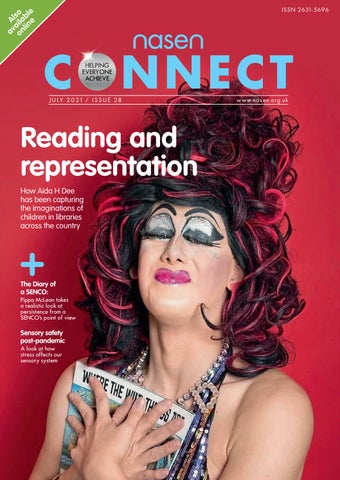
Reading and representation How Aida H Dee has been capturing the imaginations of children in libraries across the country
The Diary of a SENCO:
Pippa McLean takes a realistic look at persistence from a SENCO’s point of view
Sensory safety post-pandemic A look at how stress affects our sensory system
www.nasen.org.uk
EMAIL US: nasenconnect@nasen.org.uk
START
/ 03
#28
Welcome
By Professor Adam Boddison, Chief Executive, nasen
W
elcome to the July 2021 edition of nasen Connect Sadly, this is my last issue as Chief Executive for nasen. At the end of August, I will be moving on to a new role as Chief Executive for the Association for Project Management.
Having been at nasen for six years, I have been humbled by the kindness of colleagues across the SEND sector, who have guided and supported me to focus on the things that matter and that will make a difference. I have also been impressed with the commitment and expertise of those working in the sector. You are doing a fantastic job, often in quite challenging circumstances, and you are making a difference. And for that I thank you. At the time of writing, the SEND Review green paper has yet to be published by the Department for Education, but I am hopeful that it will come soon. Once published, the intention is for government to have a consultation period, which will be your opportunity to share your opinions. My view is that we should have a particular focus on learners at the level of SEN Support, who were largely overlooked by the 2014 SEND reforms. Lastly, please can I thank everybody who took part in the SENCO Workforce Survey at the end of last year. This has now been published (https://bit.ly/3k2gLvj) and it shows that too many SENCOs do not have enough protected time to undertake the role effectively. As well as having sufficient time, I also want you to be able to spend that time on the development of high quality, inclusive teaching and learning rather than paperwork, and nasen will continue to push for this change.
You are doing a fantastic job, often in quite challenging circumstances, and you are making a difference. And for that I thank you.
I wish you all a much-earned, restful summer when it comes. Adam Boddison Tel: 01827 311500 Fax: 01827 313005 Email: nasenconnect@nasen.org.uk Published by nasen nasen nasen House 4/5 Amber Business Village Amber Close Amington Tamworth Staffordshire B77 4RP
Designed by: Headlines Partnership Publishing, 4 Milnyard Square, Bakewell Road, Orton Southgate, Peterborough, England, PE2 6GX Email: info@headlinespp.uk.com www.headlines.uk.com
A CIS Education
Leaders in SEND Recruitment
Advertising enquiries: nasen House Tel: 01827 311500 Email: sales@nasen.org.uk
in any form or by any means electronic, mechanical, photocopy, recording or otherwise without the prior permission of nasen.
Editorial enquiries: nasen House Tel: 01827 311500 Email: nasenconnect@nasen.org.uk
While every care has been taken in the compilation of this publication, nasen cannot accept responsibility for any inaccuracies or changes since compilation, or for consequential loss arising from such changes or inaccuracies, or for any other loss, direct or consequential, arising in connection with information in this publication. The views herein are not
© nasen. All rights reserved. No part of this publication may be copied or reproduced, stored in a retrieval system or transmitted
www.nasen.org.uk
nc
necessarily those of the editor or nasen. Acceptance of advertisements does not imply recommendation by nasen. Not all photographs in nasen depict children with special educational needs. Many of the photographs are taken in integrated classes. nasen would like to thank all those who have contributed photographs. Registered Charity No. 1007023 Registered Company, limited by guarantee, No. 2674379 (England and Wales)
04 /
INSIDE
Contents J U LY 2 0 2 1 / I S S U E 2 8 REGULARS
6 / Membership Focus
12/ Sector Update
8 / Have your say
47 / Ask the team
9 / nasen Awards
48 / Reviews 50 / Events Diary
FEATURES
16 / Creating an inclusive reading curriculum
Dr Sarah Moseley outlines the steps practitioners can take in closing the learning gap for pupils with SEND.
20 / Transition – mind the gap
Karen Revill unveils the steps that Beverly School has taken to support its pupils with transition.
24 / Oral language – the foundation for learning
A closer look at the evidence from the ‘Key to Oral Language’ research project, funded by the Heather van der Lely Foundation.
27 / Sensory safety
post-pandemic
Jo Grace examines how stress affects our sensory system and the steps that will improve sensory wellness.
16
34 / The Diary of a SENCO
Pippa McLean takes a realistic look at persistence from a SENCO’s point of view.
36 / Whole School SEND update
nasen’s Alex Grady provides an overview of what to expect from Whole School SEND in the coming year.
39 / Reading and representation
How Aida H Dee has been capturing the imaginations of children as part of virtual Pride celebrations and in libraries across the country.
43 / Supporting SEND innovation
How the National Association of Independent Schools and Non-Maintained Special Schools is supporting innovations – and why it matters.
31 / What is PMLD?
A closer look at Profound and Multiple Learning Difficulties and the common barriers to learning.
nasen connect
nc
27
20 24
My view is that we should have a particular focus on learners at the level of SEN Support, who were largely overlooked by the 2014 SEND reforms.
39
PROFESSOR ADAM BODDISON, CHIEF EXECUTIVE, NASEN
www.nasen.org.uk
nc
06 /
SECTOR UPDATE
Welcome to July’s Membership Focus The nasen of 2021 is simply unrecognisable from the nasen of 2015, but that should not surprise us. he rapid change and innovation of the past six years has long been a feature of nasen’s rich history. Even when nasen was constituted in 1991, following a merger of two predecessor organisations, it was ahead of its time. One of those organisations was the National Professional Body for Special Schools and the other was the National Professional Body for SEND in Mainstream Schools. The merger that created nasen 30 years ago already recognised that inclusion was not a place, and that it was about culture, ethos and the commitment to become ever more inclusive. When I was appointed as Chief Executive of nasen in 2015, I sought a range of views to find out what people thought about our organisation. What I discovered was that nasen was known for quality, but that it was not known widely enough. The organisation had around 3,000 members, 10 staff members and it was operating in the margins of the sector.
T
Fast-forward to 2021 and nasen has more than 30,000 members, over 40 staff members and is playing a central and leading role in the SEND sector. There were many opportunities and inspirational individuals that contributed to this success, but some of the key decisions and success factors include the: introduction of tiered membership, ultimately leading to free membership expansion of nasen’s work into the early years increased focus on leadership and governance hosting and leadership of the Whole School SEND consortium establishment of the National SEND Reference Group rebranding of the membership magazine, Special, to become nasen Connect international education strategy realignment of nasen’s three peerreviewed academic journals
nasen connect
nc
rebranding of nasen’s book series to become nasen Spotlight re-establishment of the nasen Awards relocation of nasen Live to Birmingham. As a rapidly growing organisation, nasen is still experiencing ‘growing pains’. However, we must remember that the ultimate aim is to ensure that learners with SEND have an educational experience that is as good as (if not better than) those without SEND. an As a larger organisation, we can reach that goal more quickly. Thank you for coming with us and supporting us on this important journey to inclusion.
Professor Adam Boddison
08 /
HAVE YOUR SAY
e avsay... Hyour nasenconnect@nasen.org.uk
We would love to hear from you, so please send any comments or letters to nasenconnect@nasen.org.uk In case your letter is chosen for publication, please do include your name and setting. Don’t forget, you can ‘Have Your Say’ via Facebook and Twitter too.
01827 311500
@nasen_org
search: @nasen.org
Have Your Say gives you, the reader, a forum to share your thoughts and opinions about current issues in the world of education and SEND. It is also the place to share your reactions to, and thoughts about, what you have read in previous editions of nasen Connect.
Revamping EHC plans I attended the training on the Preparation for Adulthood framework as part of the SENCO development course and I wanted to let you know that as a result we have revamped all of our EHC plan formats. They now have the outcomes under the four headings and we have linked these skills from EY to post-16. It has really raised the profile of the EHCP and helped staff at all
stages to understand more about their role within the holistic development of the child.
Parental support
DHT, specialist setting, Middlesbrough
I am a parent of a three-year-old and his nursery gave me the resources for ‘Seven days, many ways’, to use at home. They were fantastic. My son has really come on and we have had some lovely times doing the activities. Thank you.
Editor: That sounds like a really positive step for your setting and we are proud to have been part of supporting pupils on that journey to adulthood.
Parent, UK
Editor: We’re so pleased to hear that! Your son clearly has a great start in having you supporting the nursery by using these resources. You may be interested in the additional resources we have produced to support you as a parent: https://bit.ly/3uMJKVp
Learning support I am embarking on my EY NASENCO award with nasen, and I had to write to say what a fantastic set of Early Years (EY) resources you have to support my learning. I have been sharing this with one of my Facebook groups for SENCOs and hope more people see them. EY SENCO in training, Leicester
Editor: Well done you for taking that step in your career and for sharing this with others. We are proud of being able to support all pupils to achieve, and early support is crucial. Good luck with completing your award.
nasen connect
nc
AWARDS
/ 09
nasen Awards 2021
Judging time!
A huge thank you to everyone who has submitted an entry for this year’s nasen Awards.
e have been overwhelmed by the response and have received a wide range of nominations across all 13 categories. As we look forward to our celebratory event in October, our judges are busy shortlisting and sifting through entries to pick out those who have gone above and beyond when it comes to ensuring the needs of children and young people with special educational needs and/or disabilities (SEND) are met. Good luck!
W
INTRODUCING OUR JUDGES Each category is judged by our judging panel of hand-picked professionals, who all have a wealth of experience working across the educational industry.
M Y LE S P I L L I N G A Specialist SEND ICT-AT SEND Consultant with 30 years’ experience as a special schools teacher working with complex needs and 10 years as an adviser for ICT SEN with a local authority.
SHE RANN HILLM AN M BE Head of Family Services at Seashell Trust, CoChair for Stockport Parent Forum and NNPCF National Rep.
CLAIRE V UCKO V IC Senior Lecturer (SEND and Inclusion) at the University of Cumbria, teaching on Undergraduate SEND and Inclusion Specialist ITE, Masters in Professional Practice and the National Professional Qualification for SENCOs.
D R SAND E E P BO D HANKE R Primary teacher at Waverley School in Birmingham and Vice-Chair of a local Multi-Academy Trust (MAT) Board.
LYN ET TE WHIT E HO USE The Learning Mentor at Stivichall Primary School in Coventry.
GRAHAM QU IN N Chief Executive Officer of the New Bridge MAT and Group, SSAT’s National SEND ambassador and chair of Special Schools’ Voice (SSV). Graham is also a member of the National SEND Reference Group.
M ALCO LM REEVE An independent SEND consultant and National SEND Leader with Whole School SEND.
JACK GR A N GE Jack Grange is a British rapper, songwriter, mental health, and neurodiversity advocate.
LO RNA MCN A B Senior Leader for Senior School Improvement at Create Partnership Trust and a governor at a local school in Birmingham.
COULD YOU SPONSOR THE NASEN AWARDS 2021?
We still have some powerful sponsorship opportunities available for our nasen Awards this autumn, including category and table sponsorship, so if you’re looking to further support the SEND sector, get in touch by emailing sales@nasen.org.uk.
ww w.na s en.org.uk
nc
nasen
Live 2021
With just a couple of months left to go until the return of our popular annual SEND Conference, nasen Live, we wanted to give you a little reminder of what’s in store. he one-day event promises to help you expand your knowledge and provide useful resources and strategies to help you improve outcomes for ALL children within your setting. Key people from the SEND sector will be delivering seminars and keynotes throughout the day covering a range of issues and topics, enabling delegates to select the sessions most relevant to their practice. Some of our speakers confirmed so far include Philippa Stobbs (CDC), Louisa Reeves (I CAN), Mary Busk (NHS), Jenny Fox (PSHE Association), Susana CastroKemp (Roehampton University), Dr Helen Curran (Bath Spa University), Mrunal Sisodia (NNPCF) and Philip Garner (Brunel University).
exhibitor discounts and giveaways, plus a free goody bag filled with nasen resources. Look at our amazing array of confirmed exhibitors so far!
T
BOOK YOUR TICKET TODAY Tickets are now available for this unmissable SEND CPD Conference. Join us for an event that will showcase a variety of high-profile speakers from the SEND community. Experience an outstanding range of seminars and workshops from some of the leading figures within education. Learn about best practice and the latest sector developments to reinforce and enhance your current skills, leading to improved outcomes for all children within your setting.
24 September, The Vox Conference Centre, Birmingham Theme: Inclusion beyond Covid
ADHD Foundation – www.adhdfoundation.org.uk
THE VOX
To make your visit to nasen Live 2021 as enjoyable as possible, we’ve compiled some handy travel and accommodation tips. Find out more at https://bit.ly/3gQDl6Q.
Axcis – www.axcis.co.uk Claro Software – www.clarosoftware.com CPOMS – https://bit.ly/35EEuZR GCSE Pod – www.gcsepod.com GL Assessment – www.gl-assessment.co.uk Health Conditions in School Alliance – www.medicalconditionsatschool.org.uk ICS Support Services – www.ics-funding.co.uk
We are delighted to be able to offer complimentary lunch, which you can enjoy while networking with other, like-minded professionals and browsing a range of exhibitor stalls from leading SEND organisations and services. Join us as we proudly celebrate the return of the SEND events in 2021.
Mable Therapy – www.mabletherapy.com Mighty Writer – www.mightywriter.co.uk Picture News – www.picture-news.co.uk Speech Link – www.speechandlanguage.info Targeted Provision – www.targetedprovision.com TTS Group – https://bit.ly/2UqUmNv
EXHIBITORS We’re also pleased to offer access to the latest products, resources and offers from some of the UK’s leading SEND organisations at nasen Live 2021. Attendees will be able to enjoy exclusive
University of Buckingham – www.buckingham.ac.uk
OUR CORONAVIRUS GUAR ANTEE
Enjoy complete peace of mind with our risk-free guarantee. In these uncertain times, it is reassuring to know that anyone who has purchase d a ticket to attend nasen Live will receive a full refun d if nasen Live cannot go ahead due to a natio nal lockdown or restrictions in their local area that prev ent travel. Read more about nasen Live 2021 at www.nasen.org.uk/nasenlive.
A CIS Education
Leaders in SEND Recruitment
www.nasen.org.uk
nc
12 /
SECTOR UPDATE
Sector
A L L T H E L AT E S T NEWS FROM ACROSS SEND
Update nasenconnect@nasen.org.uk
01827 311500
@nasen_org
search: @nasen.org
New report on EHC plans published he total number of education, health and care (EHC) plans has continued to increase since 2010, with 430,700 children and young people with EHC plans as of January 2021, according to the Department for Education (DfE) report. The number of new EHC plans made in the calendar year has also continued to increase each year since their introduction in 2014, with 60,100 new EHC plans made during 2020. However, the number of initial requests for an EHC plan has decreased for the first time, with 76,000 initial requests for an EHC plan received during 2020, down from 82,300 in 2019, which is the first decrease since EHC plans were introduced. The proportion of new plans issued within 20 weeks has also decreased; in 2020, 58 per cent of new EHC plans were issued within 20 weeks, down from 60.4 per cent in 2019.
T
To access the full report, go to: https://bit.ly/3bz47ij
FAMILY-CENTRED PRACTICE PODCAST EXAMINES IMPORTANT STEPS Hosted by Professor Barry Carpenter, the episode brings together a panel of school leaders and parents to discuss and explore how schools can work with families of children and young people with SEND to create a genuine bridge for family-centred practice. Panellists include: Vijita Patel (Principal, Swiss Cottage School Development & Research Centre)
Jo Williams (Deputy Headteacher, Dee Banks School) Maria Schultz (Parent; Co-opted Governor at Swiss Cottage School DRC; co-chair of Camden Special Parents’ Forum and Parent Advocate with KIDS Charity) Sadia Mahmud-Marshall (Parent; Co-opted Governor at Swiss Cottage School DRC and Project Lead on policy for NGOs on child protection and reduction in child slavery) The episode encourages schools to shift the focus from partnership with parents to partnership with families and embrace a more holistic and inclusive approach which values the contributions of all family members involved in a child’s life.
nasen connect
nc
Don’t want to wait for the next edition? Check out https://nasen.org.uk/news
Supporting SEND: research and analysis from Ofsted A new Ofsted report has been published, outlining how children and young people’s special educational needs are met in mainstream schools. Around 1.4 million pupils in English schools have an identified special educational need (SEN), ranging from the most severe to comparatively minor. Research suggests that there are varying interpretations and practices across professionals, schools and local authorities in both SEN identification and provision. Four broad areas of need are identified in the SEND code of practice: communication and interaction cognition and learning social, emotional and mental health difficulties sensory and/or physical needs This study was developed to explore how the needs of children and young people are met in mainstream schools and how approaches vary between providers. To access the report, go to: https://bit.ly/3eWl4p1
The Next Stop, Puberty!
Video-based learning content producer ClickView has announced the launch of a new series, ‘The Next Stop, Puberty!’, which is being offered to schools and families completely free of charge. The content is aligned to the PSHE Association and the Association for Science Education’s briefing on schools' statutory duties to teach children about puberty at Key Stage 2. The short videos provide schools with information and resources to support the teaching of what can be a challenging topic. The series is designed to address the biological, social and emotional aspects of
sexuality education and includes diversity in ethnicity, body shape and gender. Teachers are given guidance on engaging young learners with ageappropriate and evidence-based information; all designed to help them to provide a gentle, supportive and normalising approach to the topic. Separate clips about physical and mental changes in females and males are provided so that teachers can run lessons with single-sex classes if required. The new resource is available from https://bit.ly/3c1r7Xx
New report explores support needed for care providers of young people with learning disabilities On 16 May, NHS Health Education England and the Council for Disabled Children published a new report: ‘Exploring the education, training and support needs of those who provide care for children and young people with learning disabilities and learning difficulties’. The report shares the learning from children and young people with learning difficulties and disabilities, their families, and those who support them, on the education and training that supporters need to ensure that they deliver high quality care. Key recommendations of the report include: A commitment from Health Education England, and others, to further engage with those children and young people with learning disabilities and difficulties to better understand how they can continue to build the skills and values of those supporting them. The co-development of a consistent, accessible core training framework for all those in direct support roles.
www.nasen.org.uk
nc
The establishment of peer support communities for those carers providing support outside of a formalised professional role. Creating opportunities to engage with parents and carers in shadowing or coaching when entering a direct supporting role with a child or young person. To read the full report go to: https://bit.ly/3caxXd0
14 /
SECTOR UPDATE
EARLY LANGUAGE TRAINING FOR ALL SCHOOLS WITH RECEPTION CLASS Every state school with a reception class in England can now apply for training and resources through an early years’ catch-up programme funded by the government, to support thousands more pupils with vital communication skills. Delivered by the Nuffield Foundation and backed by an extra £8 million of investment, recruitment has launched for the second wave of the Nuffield Early Language Intervention (NELI). Developed by researchers at the Universities of Oxford, Sheffield and York, the programme is proven to be effective in raising outcomes in reception-age children’s early language, communication and speech skills – particularly those who need the most support to overcome the disruption of the pandemic. The programme builds on last summer’s £9 million investment to launch the first wave of NELI, which means 62,000 four and five-yearolds are receiving extra support to get their education back on track after time spent away from the classroom.
The expansion for the 2021-22 schools year will be managed and delivered by the Nuffield Foundation on the government’s behalf, supported again by the University of Oxford and Oxford University Press. Individual and small-group language teaching sessions for between three and six pupils are offered, run by a trained teaching assistant or early years professional. Nearly 20,000 staff members have already received online training and the intervention is run over 20 weeks. Sessions with the children feature ‘Ted’ the NELI puppet, for games that help them concentrate on their speaking, listening and learning. Places will be allocated on a first-come, first-served basis, with registration closing on 30 July 2021. Onboarding will begin in September 2021 and delivery in January 2022. Schools can find out more information and complete their registration to receive NELI at: https://bit.ly/3xjC92r
Volunteering Matters: social action programme Volunteering Matters is excited to have joined The Lord Mayor of London and Smart School Councils to deliver an innovative youth social action programme to Alternative Provision, Pupil Referral Units and Special Educational Needs and Disability schools in London. The new Team London Young Ambassadors Programme delivers in-school sessions that encourage and support young people aged 10-18 to explore issues that are meaningful and important to them, and help them formulate youth social action ideas in which they will be offered up to a £1,000 microgrant to make their ideas a reality. Please share this opportunity with any contacts who may be interested in taking part. There are spaces available for the next academic year. Go to: https://bit.ly/3AHbgYP
nasen connect
nc
Fully funded resources to keep young SEN people safe around alcohol The Alcohol Education Trust has developed comprehensive teaching resources for young people with special educational needs. Working in partnership with SEN specialists Image in Action, and based on visual rich and story-led activities, the SEN Talk About Alcohol Workbook and Guidance can be downloaded from https://bit.ly/3x53jKa. Four lessons supported by a simple presentation cover key aspects of alcohol education: building knowledge, exploring feelings and emotions and consent. These lessons are particularly suitable for teaching in SEN settings and in many cases, due to generous grants, the Trust is able to support settings with high numbers of children with additional learning needs with a free pack (value £60). All of the resources can be backed by training which is fully funded. Please contact the Trust if you would like to receive a pack: kate@alcoholeducationtrust.org.
16 / ➜
FEATURE
EARLY YEARS & PRIMARY Y
Creatting an inclusive ding curriicullum read Reading is the foundation of so much of education, but how should approaches differ for students with SEND? Dr Sarah Moseley outlines positive steps practitioners can take. esearch has established the significant positive impact that the teaching of reading has on the education of all young people. The Education Endowment Foundation (EEF) emphasises reading as the key to closing the gap for learners following the pandemic. Reading enables us to develop cognitively, become more independent and has a positive impact on how we feel about ourselves and the world around us.
R
For our SEN learners, the role of reading has an even greater significance. The environments and experiences of all learners have been reduced due to COVID-19, and for those with the most complex needs this impact is huge. Reading provides a window into a wider world that we can all enter regardless of our ability. Reading a story requires extraordinarily little to begin, just us, imagination, enthusiasm, and aspirations for our learners. Yet there is a lack of clarity around teaching reading to learners with complex needs, and this does
nasen connect
nc
not support an inclusive education system for all learners. So how can you support all children to learn to read? My experience during my PGCE was that the teaching of reading consisted of one afternoon session; this was aimed at learners who are typically developing. I was then placed with a class of 32 Year 2 pupils, many of whom struggled with learning to read. A lack of appropriate training and a conflicting view about what is appropriate for children with complex needs makes this even more difficult.
TOP TIPS FOR ALL LEARNERS TO BECOME READERS NOW
WHERE TO BEGIN – IT’S NOT JUST PHONICS Throughout our lives, we are surrounded by print. It is part of our world, regardless of our ability to access it. We talk about reading in many senses, reading situations or people’s faces. Yet we have a restrictive definition when we talk about all learners reading. To ensure an appropriate inclusive reading curriculum is provided for all, we must first widen our definition of what reading means for our more complex learners. Research indicates that reading in its purest form is about accessing meaning from some form of symbol, not just books! This could be text, objects, pictures, or interactions with people/the environment. Reading in this sense is about maximising interactions and communication through a shared interest (e.g. book, object, interaction, picture, drama, event, etc).
IMPORTANCE OF TRAINING AND UNDERSTANDING – IT STARTS WITH US! The importance of neuroscience to teaching and learning is high on the agenda within education, and the role of the processes involved in learning to read are key here. We need a clear understanding of how reading develops and must then look at the basis for these skills. We need to be clear what we are doing and how it will support all learners. Research has found that learning to read is a difficult skill to develop. Unlike learning to speak, we need to be taught these skills. Difficulties in learning will present in many ways and the foundations need to be in place for skill development to occur. Each learner’s journey to becoming a reader (in the widest sense) will be different. They will begin and end at different points and learners need to develop several skills at the same time. These consist of word recognition, where they need to read both sight words and the sounds words
Engagement and motivation (high expectations)
Attention skills developing the working memory to retain what’s learned
Communication skills
Key aspects crucial for reading development:
1
Environment – immerse learners in the wonders and curiosity of stories, create excitement, enjoyment and a love of language. Create a rich, diverse and engaging literacy environment from an early age that contains lots of experiences of language (talk, talk and more talk), vocabulary, sounds, stories, drama, music, songs, rhymes, books of all kinds (including sensory stories, boxes, drama), puppets and print. Provide experience of (and surround with) real books and technology to ensure access for all.
2
Behaviour – everything is reading. Create routines to make it part of everyday life, reading for information, independence and pleasure. Read aloud or hear stories at least daily, making it an active, fun experience where learners are read with rather than to, using whatever medium supports them, big books, sensory stories, story mats and all forms of ICT. Talk about stories, question, reflect, predict, and share ideas. Simply reading with learners has a huge impact and creates new neural networks in the brain, leading to deeper learning and understanding.
3
Accessibility – ensure learning is multi-sensory, motivating and bring stories to life (see, hear, feel, touch, taste and move) make the most of technology and accessibility tools (book creator, iPad apps, stories online, scanning pens, text to speech, etc). Through shared reading opportunities (reading in its broadest sense), we scaffold learning, enabling young people to explore and experience the world through their senses and mind.
4
Personalised learning – make it meaningful, create opportunities for everyone to be storytellers and develop narrative skills, make your own books (low and high tech). Always start from where the learner is, building on existing knowledge, strengths and interests. When learners struggle, go back to skills they were confident with. For example, if learners struggle with blending in phonics, go back and consolidate learning at the previous initial sound or prerequisite skill stage.
5
Awareness of vocabulary and intentionality of text
Visual processing skills
Auditory processing skills/sound discrimination
www.nasen.org.uk
nc
Repetition is the key! – Young children request the same book many times over. We must create accessible opportunities for our learners to do the same. We will be bored before them! Keep it consistent, positive, fun and go at the pace of the learner. Finally, we need to create a reading culture with high expectations and aspirations for all learners. By a wider definition, we open opportunities and experiences for all learners to become part of the established reading culture. We are the key to success and can create opportunities for our all learners to develop a love of reading and open a new world to explore and be part of.
18 / ➜
FEATURE
EARLY YEARS & PRIMARY
BIO DR SARAH MOSELEY
Research indicates that reading in its purest form is about accessing meaning from some form of symbol, not just books!
are made up of (phonics) and language comprehension, where we understand the words and sentences and what they mean. These two skills are part of the simple view of reading framework. At the same time learners must also be motivated to read. They must see it as something they can do, that is worthwhile and important to them. Finally, they also need to develop fluency; this means practising until it becomes automatic. Learning to read is linked to crucial prerequisite skills. One of the foundations for word recognition is the ability to notice the difference between sounds, known as auditory discrimination. The importance of active listening and noticing the difference or sequence of sounds is key to so many later language skills. Other key skills include visual discrimination, attention skills and development of working memory. For language comprehension, an awareness of language is key, along with engagement, communication skills and ability to add meaning to objects, people or text.
need to be reframed as part of a reading curriculum. This would include all learners in a curriculum that is established as crucial to the education of young people. This cycle feeds into the development of higher-order cognitive skills as illustrated by the Scarborough reading rope (see below), requiring each thread to be formed correctly to create a strong resilient reader.
PREREQUISITE SKILLS – THE FOUNDATION FOR ALL LEARNING The development of these prerequisite skills is a continuous cycle (illustrated right, with some of the skills required). These prerequisite skills are part of teaching for learners with more complex needs and
nasen connect
nc
Sarah is an independent educational consultant with over 25 years’ experience in special and mainstream education. Her roles have ranged from teaching assistant to headteacher. Dr Moseley is passionate about the teaching of reading, and has a PhD focusing on the teaching of reading for pupils with SEND. Dr Moseley currently leads training and support for professionals and families from all sectors specialising in school improvement and raising outcomes for all learners. Sarah Tweets @drsarahmoseley
20 / ➜
FEA ATURE
SECONDARY & POST-16
Transition – mind d the gap
Transition can be a tricky y time for pupils with SEND. Karen Revill outlines the steps one school takes to support its pupils. everley Scchool is an allage, all-ability tyy specialist school catering for pupils with wide e-ranging and often com mplex needs who have an autistic spectrum cond dition.. We cater for 144 pupils, both from our location in Middlesbrough and those who travel from five neighbouring local authhorities (LAs). Our dedicated staff workk in close partnership with parents, ca arers and other professionals with care and commitment to provide the very best in education and meet the develop pmental nee eds of the pupils. This helps to ensure that, when leaving Beverley School, all our young people have maximised the eir individual capacity tyy for independence so that they can participate successfully in so ociety tyy and move on to lead happy and fulfilliing adult lives. Where possible this is with the aspiration and skills for lifelong paid employment. As careers lead at Beverley, I have a small but effective team pluss a dedicated family liaison officer who works in tandem with our careers staff. We have an individualised, personal and d multi-faceted approach to supporting ourr young people
B
and their families in making the careful decision for the mosst appropriate nextstage provision. We e plan and manage this change, often in sma all steps to build the confidence and trustt needed to achieve a secure and successsful transition where everyone is welll sup pported d thhroughhout thhe process so they can quickly settle and thrive in their new setting. To enable this, I wo ork closely and in partnership with Marg garet, our independent Specialist Careers Advisor. We are fortunate to have such a well-qualified, highly skilled and experienced careers team member. Margaret has a crucial understa anding g of our school,, its cohort, their needs,, and the importance of family involvement. Her levels of expertise and knowledge arounnd the range of options and opportunities acro oss all our partner LAs LA A in FE, training, employm ment, and social care is extensive. This, coupleed with Margaret’s large netw twork w of trusted proffessional relationships,
n a s e n c onne c t
nc
adds a level of effective practice and quuality tyy to her advice and support. Margaret is equally passionate and driven to best meet the future needs of young people with SEND and herr interpersonal skills enable her to forge e trusting rellationshhips withh famillies thhro oughh accessible communication: in school and virtual meetings, home visits, LA, and social care communications, supportiing visits to colleges and developing new w relations with new key staff. For many of our pupils their next transition will have been after many years at Be everley (often since earlyy primaryy), so the prosspect
Our dedicated staff fff work in close partn tnership with parents, carers and other professionals with care and commitment to provid de the very best in education and meet the developme ental needs of the pup pils.
BIO KAR E N RE VI LL Karen has worked as a SEND teacher in a variety of both classroom and strategic leadership roles. She is passionate about developing and enabling the educational opportunities, employment prospects and lives of young people with SEND. She is careers and sixth form lead at Beverley School in Middlesbrough, a specialist community school for autistic students.
of moving on to a new proviision can, understandably, cause appre ehension. This decision, and the significant change it entails, is likely to be one of the biggest in their lives so far. It can bring mixed feelings and a raft of different emotio ons, often with high levels of anxiety, y as autistic young people and their families conntemplate leaving a familiar, supportive e and trusted full-time specialist environmennt to one whhichh is unfamiliar and may not be e full time. Moving into social care provision can also be difficult for parents and carers, who often worry that future provision may not be as encompassinng as school due to inconsistencies in LA funding. We often support families with accessing and securing additional provision from local voluntary organisations and charities and help in making best use of direct payment and PIP entitlements.
Ouur commitment to using whatever meanns necessary to maintain connections and continuity tyy of planned transition was especially vital last year when the pandemic changed our educational world d. Thankfully, due to our planning prior to the e first lockdown last year, we had alread dy worked with pupils and families so most of our school leavers at this point had identified and applied their next steps,, whether to FE college, supported internships or social care placements. Unforrtunately, the anticipated post-Easter returnn to school did not happen, and our older pupils effectively left school as they knew w it in March 2020. It was a shock for all buut especially the pupils; their stability tyy and d routtines severed d, no exams, no prom, no ennd-of-term residential and no leaving cerem monies. Transition was, for a time, in limbo o and both parents and pupils were left highlyy anxious about what happened next. Usiing a team approach, we worked to kee ep in regular contact with all parties to navvigate the changes, reassuring and workiing with pupils, their families and their destinnation providers to smooth their paths forwa ard. The pandemic inevitably created more of a challenge with this. We used
ww w w.na s e n.o rg .u k
nc
regular phone calls, emails and sociallyy distanced home visits to continue the muchneeded support and communication. It has been tricky at times, and it requuired much commitment and creative thinking g, but all pupils who left Beverley School last year in those unprecedented circumstances successfully embarked on their planned next stage of FE or community tyy inclusion and care. Parents and carers regularly keep p in touch, proud and happy that their younng person is still doing well. One student with quite complex needs belatedly decided d he wanted to leave Beverley and could ea asily have been at risk of becoming Not in Educattion, Emplloymentt, or Traiiniing (NEET) if it wasn’t for everyone, especially our information, advice and guidance (IAG G) specialist, working together in a lengthyy negotiation and planning process betw tween w all stakeholders. The pupil agreed to tryy the placement and is still thriving there now w. This was especially a relief to the pupil’’s family, who otherwise could foresee a life of social isolation for their adult son. Last year taught me to take nothing for granted and always to plan ahead.
22 / ➜
FEATURE
SECONDARY & POST-16
The proactive strategies that had helped to support our young people best last year were going to be not only continued but started even earlier. So, we began this process with our 2021 leavers early in September 2020; despite the optimism of the new school year, our ‘hope for the best but prepared for the worst’ strategy has proven to have been a wise decision. Additionally, to enable pupils to become more personally connected with a new provision this year, we have arranged personalised virtual tours of colleges with meet-and-greet and Q&A &A A sessions with new key staff, plus some face-to-face socially distanced visits in the evening gs and at weekends when the environnment was quiet. These have been successfful in reducing anxiety tyy levels and encouraging pupils to embrace the change with positivity ty. y For one of our quite able butt highly anxious pupils, almost now agoraphobic since COVID-19, we have negotiated for his new FE course to be accessed remotely until he feels comfortable to attend in person. Another stuudent, again capable yet plagued by thouughhts off not being ‘good enough’ to do his chosen FE course in music, was supported by one-to-one tuition with an ex-music student from the colllege (whho is now a student teacher at our school). The relationship that developed and the skills that he
has learned have helped to support hiss confidence and transition. These are a few examples of how w we see and execute our roles as we aim to turn natural concerns and apprehensio on into positive anticipation, and anxiety tyy into security ty. y The success off our careers and d IAG strategy and practice is built around this strong partnership ethos, and we invest a great deal in getting to know ouur pupils and their families well and buiilding these supporttive and d trusted relationships together in the best interests of young people. This is critical to achieving these secure and successful transitions.
Transition was, for a time, in limbo and both parents and pupils were left highly anxious about what happened next.
nasen connect
nc
24 / ➜
FEATURE
TEACHING & LEARNING
Oral language –
the foundation for learning University College London’s Julie Dockrell, Anna Llaurado, Jessica Massonnié and Emma Sumner examine the evidence from the ‘Key to Oral Language’ research project funded by the Heather van der Lely Foundation. ral language matters. It is important for accessing the curriculum and raising attainment, and there is strong evidence that oral language skills are the foundation for learning, attainment and social interactions. Yet, for many years, there have also been concerns about children’s oral language skills as they enter school. This concern continues today with teachers reporting few opportunities to learn about oral language development and how to support children effectively. When children start school in England, teaching and learning focuses on more formal aspects of literacy and numeracy. These are also the skills which are formally assessed in schools, leaving a focus on oral language to individual teachers. To address this mismatch, in 2021 the Oracy APPG called for better support for teachers to embed oracy in their classrooms. But which oracy skills should be targeted explicitly at which point in development, and how should this be done?
O
THE KEY TO ORAL LANGUAGE? In our current study, we examined the oral language skills of children in reception and Year 1. We aimed to capture the types of skills that underpin oral language at this point to further develop an understanding of how oracy can be embedded in classroom practice. Vocabulary is a key component of oral language. Teachers will be familiar with reports about the ‘Word Gap’, coined following a famous research study by Betty Hart and Todd Risley in the 1980s. While debates continue about the extent and
nature of the ‘Word Gap’, there is strong evidence that both expressive and receptive vocabulary underpin effective communication skills, learning and reading comprehension. Effective intervention programmes have been designed to focus on vocabulary. The recognised importance of vocabulary and phonological skills is evident by their inclusion in measures of emergent literacy. Additionally, phonics is taught systematically and assessed in all primary schools. Words matter, but they are not enough to express ideas and understand the language of others. Children’s use of grammar and their ability to construct and understand narratives are also important. Grammatical skills give children the potential to connect words in sentences, refer to the past, present and future, and indicate other features such as possession and number. By contrast, narrative skills provide children with the ability to orally present a series of events in a coherent fashion and they reflect a child’s ability to generate and organise ideas and use specific word and grammatical features to express them. Can we identify different oral language components at the start of school? Or is oral language best considered as a unitary construct reflecting speaking and listening? Answers to this question will help tailor oracy work in classrooms.
WHAT WE FOUND We captured the language skills of children in Reception and Year 1, focusing on oral language components at word, sentence and narrative level, ensuring that we examined both children’s ability to produce and understand oral language. To do this we used a range of tests with over 200 children
nasen connect
nc
VOCABULARY WORD GAP NARRATIVE GRAMMAR ORACY SKILLS LANGUAGE (126 in Reception; 124 in Year 1). Children were all monolingual English speakers attending mainstream schools in England. Our data showed that three language components were important in children’s oral language skills at this point in development: phonology, structural language (vocabulary and grammar) and narrative abilities. Only phonology is explicitly taught and assessed at school. These results emphasise the importance of considering the full range of language skills and highlight the important role of children’s narrative skills at the beginning of formal education. Children in reception were able to create a basic narrative, linking their ideas in a sequential order, and used dialogue between characters to capture action in their stories.
FURTHER RESOURCES:
This podcast discusses these issues:https://bit.ly/2RS4Vbv. Word Gap debate:https://brook.gs/2RS4TjT. Resources on closing the Word Gap:https://bit.ly/3c7UdEG.
BIO
Year 1 children were able to create more coherent stories with beginning and endings. They also provided more information about why things were happening. They used formal vocabulary within their narratives and included details about the characters’ emotions. For children in reception classes, both the type of skill assessed and whether we measured speaking or understanding was important, suggesting that children’s language skills differed. We did not find this difference in the language skills of Year 1 pupils, which suggests that speaking and understanding can be differentiated in the initial stages of schooling but, as skills develop, language abilities ty t pically become more syynchronous.
Vocabulary is a key component of oral language > Use a variety of promp m ts t to elicit different typ t y es of narratives (e.g. op o enended, and context-eliciting questions, single pictures, and sequences).
WHAT ARE THE IMPLICATIONS? Our data demonstrated that supporting children’s oracy skills needs to move beyond general discussions of speaking and listening and a focus on phonics. To develop a strong foundation in oral language, children need opportunities to develop their expressive and receptive oral language skills at word, sentence, and narrative levels. To achieve this, a tiered approach supported by evidence-based practices is helpful. This should be underpinned by high-quality oral language classrooms and guided by school leads to enhance teachers’ pedagogy. By targeting word, sentence and narrative skills, teachers will be in a strong position to profile children’s oracyy skills.
> Promote the use of languag g e to t describe dif fferent typ y es of activities and discuss with them the differences between conversation, dialogue and narration th t at occur t roughout th th t e day. > Extend what children say to enrich th t eir vocabulary and connect th t eir exp x erience with t general knowledge.
> Dedicate a sp s ecific time during th t e day for children to share th t eir own personal sto t ries. Use questions so children exp x lain what happ p ened but also when, where and why.
> Encourage shared book reading g and conversation around what has been read (e.g. relating book reading and narrative stories to children’s everyday life).
> Encourage children to t create stories using oral language and act them out.
> Sp S end time talking with t children and comment on their ideas and activities.
ww w.nasen.org.ukk
nc
BIO
PRO F E SSO R JULIE D O CKRE LL
D R ANNA LLAURADO
Professor Julie Dockrell is Professor of Psychology and Special Needs at University College London, Institute of Education. Her research focuses on the ways in which oral language support learning and attainments and ways in which practitioners in schools can support children’s oracy skills.
Dr Anna Llaurado is a Research Fellow at University College London, Institute of Education. Her research focuses on the development of language and literacy skills in primary school children with a particular interest in understanding how these skills may develop differently across languages.
BIO
BIO
D R JE SSICA M ASSO NNIÉ
DR EMMA SUM NE R
Dr Jessica Massonnié is a Research Fellow at University College London, Institute of Education. Her work focuses on understanding how we can best help children to thrive, by considering the influence of the home and classroom environments on their learning and development.
Dr Emma Sumner is a Lecturer in Psychology and Special Educational Needs at University College London, Institute of Education. Her research interests cover language and literacy development, with a particular focus on understanding why children present with difficulties in oral language, reading and writing.
ENHANCE YOUR PR ACTICE WITH LEEDS If you work with individuals Our postgraduate programmes include: with special educational needs, • MA Special Educational Needs • PGDip Deaf Education developmental disorders or those who (Teacher of the Deaf Qualification) are deaf, we have a range of full-time • MA Deaf Education (Teacher of the Deaf Qualification) and part-time courses to suit you.
Find out more essl.leeds.ac.uk/special-educational-needs
FEATURE ➜
/ 27
TEACHING & LEARNING
Tune in to sensory safety postpandemic Feeding our senses can ha ave a big impact on our wellbein ng. Joa anna Gracce examines how stress afffects our sensory sysstem an nd the step ps to take to o im mprove senso ory wellness.
magine your senses have volume controls inside your head. These tune the information from your sense organs to a volume that your brain can process it at. The information we get from our sensory systems is fundamental to our ability to engage with the world around us, to feel safe, to feel curious and to learn. If our sense organs do not work fully then information does not come into our brain, and if those volume controls are set wrong then even though the information is received into the brain, it may come in too quietly for the brain to ‘hear’, or too loudly to cope with. The perceived ideal is to have sense organs that are working, and volume controls on those sense organs that feed the brain the information received from the sense organs at just the right level. It is a Goldilocks scenario.
I
Settings around the UK have and they vary between too high long reported a rise in the number and too low, with seemingly no BIO of children presenting with sensory mid-ground. Incidentally, this looks difficulties, and it is likely that, posta lot like the child who is learning JO ANNA GRACE pandemic, these needs will be all to use those controls: who adjusts Joanna is a Sensory the more pronounced. too far up, too far down, in search Engagement Specialist, trainer, author and If we think about those volume of the ‘just right’ Goldilocks’ point. founder of ‘The controls, we can begin to Sensory Projects’. More STRESS EFFECTS understand why this is. Tuning in information can be SENSORY our sensory systems is a skill we found at SENSITIVITIES learn. Some children may not https://bit.ly/3bwHACw, Stress has a big impact on be able to operate their sensory including details of sensory sensitivities. Imagine volume controls because they have upcoming events. the person operating the volume yet to learn that skill. These children controls. When they feel under will present with sensory needs and threat it becomes all the more differences in your classroom. Other important to them that they adjust their children may be equipped with volume settings. Their nervousness may lead to controls that are broken: set too high, or them making more adjustments, making too low. Or...now how to proceed with this bigger adjustments, essentially overdoing analogy...too slippery to be practical, it on their controls. You will have had this such that when they try to adjust them to experience in your own life at some point; tune them in, the adjustment goes too far
www.nasen.org.uk
nc
28 / ➜
FEATURE
TEACHING & LEARNING
perhaps you had to walk alone down a street at night and you sensed danger. At that point in time, you became hyper alert to the sounds around you. All your volume controls got turned up! The pandemic has placed everyone under stress. At the start of the first lockdown, we spoke about it to one another, we learned strategies to cope, we gobbled up the facts and got a handle on all the changes. But as events have worn on, to say that you are finding it hard has become old news. People talk about it less because there is little new to say. Children have been living within this fear, alongside this stress. They are not immune to it, and it will have affected them.
WHAT CAN WE DO? TUNE I N
Playful activities that encourage children to adjust their sensory volume controls can be a fun way to support children practising sensory regulation. Think of activities that involve a gradation, like making quiet noises and then louder and louder noises.
Moving slowly then moving fast. Drawing a teeny-tiny squiggle and then drawing a gigantic squiggle. An added benefit to all these activities is that you encourage children to attend to sensation in the here and now, and that attention to the present is a little bit of mindfulness in motion. Pen Discos were a big hit on my Facebook feed over the last lockdown and they could work well as a tuning-in activity; have a Google, there are lots of examples out there but here is one to get you started: https://vimeo.com/508361198
C R E AT E S E N S O RY SAF E T Y Our senses all have a development they go through, and experiences from our early development often engender feelings of safety and security at a sensory level. Creating environments rich in early developmental sensory experiences is a good way to help children to feel secure. We are not able to learn when we do not feel safe, so this sort of sensory support in a classroom can be key. Here are three simple suggestions:
Install matt natural tone roller blinds at the top of display boards and lower them to screen off visual clutter. Try playing gentle audio during work time, natural sounds like waves lapping on a shoreline or wind rustling tree branches can be good, as can music with a heartbeat rhythm to it. Give children clip boards and allow them to work lying on their fronts on the carpet.
Creating environments rich in early developmental sensory experiences is a good way to help children to feel secure. nasen connect
nc
G O OU T SID E
We feel at home when we are around natural stimuli, when we see a green landscape, hear the sounds of nature, smell the smells of nature.
Our senses are primarily for telling us where food is and informing us of whether we are like ely to become food. They are for sensing da anger and sustenance! In part, our own sensor y perceptions are informed by our personal experiences; perhaps you once had a bad reaction to something you ate or drank and never want to taste that again? And in some ways, our sensory perceptions are informed by our evolution. From an evolutionary point of view, we have only been living in these concrete boxes for the blink of an eye. Our senses still tell us that outside is home. We feel at home when we are around natural stimuli, when we see a green landscape, hear the sounds of nature, smell the smells of nature. For so many people during the pandemic, getting outside and being in touch with nature has been a lifeline. Even if a lesson does not necessitate it, there is enormous value to going outside. Grab the clip
www.nasen.org.uk
nc
boards and sit in the open air to do your phonics, your maths, to learn about history or geography!
WHAT NOT TO DO? Sensory differences and difficulties are not fixed by the handing out of sensory toys or fiddle toys. Yes, these items have a powerful role to play, but simply distributing them is likely to do very little. Imagine if you taught maths by handing out maths resources and leaving the children to it. The sensory landscape is the same. When teaching a course, I take delegates through the purposeful use of various sensory resources, and in my next article for nasen Connect I will be doing just the same.
FEATURE ➜
/ 31
TEACHING & LEARNING
What is Profound and Multiple Learning Difficulties?
Peter Imray examines PMLD and looks at progress milestones and the common barriers to learning.
nlike some terms (such as moderate learning difficulties, for example) Profound and Multiple Learning Difficulties (PMLD) has a relatively concise meaning. The term was first used in the UK in the 1980s (though slightly different terms may be used in other parts of the world) and recognises that, as the learning difficulties are profound, they encompass the most extreme levels it is possible to experience. The word ‘multiple’ refers to the extremely high likelihood of attendant physical disabilities, which are as likely to be internal as external. The number of children with PMLD has been slowly but steadily rising since the turn of the century (Pinney, 2017) and those who have left school have been living longer (Hatton et el, 2015). Both facts can be directly related to significant medical advances, as evidenced by the now wide use of the gastrostomy, a fairly simple insertion of a tube into the stomach allowing for nutrition to bypass the throat, thus, at a stroke overcoming the huge, and often fatal, problems of aspiration so often experienced by those with PMLD. It is probably best to consider PMLD as involving a spectrum and to have knowledge of the P Scales (DfE, 2017) since the P Scales P1(i) to P3(ii) provide a pretty accurate encapsulation of the spectrum.
U
www.nasen.org.uk
nc
32 / ➜
FEATURE
TEACHING & LEARNING
The number of children with PMLD has been slowly but steadily rising since the turn of the century. Routess for Learning (WAG, 2006) is a seminal assessment tool written by a numbe er of Welsh practitioners and academics. The ‘go-to’ assessment scheme for schoo ols working with children, young people and adults with PMLD,, it notes seven ke ey developmental milestones for those with PMLD, irrespective of their age.
SEV EN KEY DEVE LOP MENTA L MILE STO NE S
1. Notices stimuli 2. Responds consistently to one stimulus 3. Contingency responding 4. Contingency awareness 5. Object permanence 6. Selects from two or more items 7. Initiates actions to achieve desired result (exerting autonomy in variety of contexts).
It might be noted that these e developmental milestones occur within neuro o-ty typical, y conventionally developing ba abies, more or less betw tween w the ages of 0 and 12 months, and might be considered to equate to Piaget’s (1952) ‘sensorimotorr stage’, his first stage of child development. The majority tyy of those designated as having g a profound learning difficulty tyy will probab bly not reach the milestones, and will be working at cognitive levels below this (annd usually well below this) for all of their livess, but clearly this is by no means an exact science. We must remember that the pheno omena of fractured learning and spiky profiles are well established (Carpenter et al, 2015) and d some learners may be working at a num mber of different levels at the same time. While the P scales are not and cannnot be related to the Routes milestones, we e can assume that learners who are workking consistently and over time at P1(i) will probably be working at ‘noticing (any) stimuli’, while learners who are initiating g
nasen connect
nc
actions to achieve desiired results will be at a level of around P3 or P4. The PMLD spectrum no oted above, has learners operating arounnd P1 very firmly entrenched in the spectruum and those on P3(ii) reaching the edgess of it. This is not of particular consequence, other than to note that those working on the edge of the spectrum may benefit from parts of a curriculum model applicable to those on thhe Severe Learning Difficulties (SLD) spectrum m, as well as that specifically written for tho ose with PMLD. What is perhaps of more intereest is the striking nature of the P4 hurdle, and ho ow common it is for those on the PMLD specttrum to have extreme difficulties in scaling this hurdle. That is, there are real and marked barriers to learning (the differences betw tween w P3 and P4). Imray and Colley (2017) define theese barriers as: the ability to imitate the ability to follow instruction the ability to initiate proto-declarative communications the achievement of a sophisticated understanding of cauuse and effect via contingency awareness.
the PMLD spectrum are unnlikely to change unless they’re challenged d. There are a numberr of PMLD curriculums available, the most famous probably being thatt produced by Victoria School in Birmingham, but the most up to date (2019) has been produce ed byy Eq quals, a UK-based not-fo or-profit. It doesn’t have subje ects as such, but there are a numbe er of learning opportunities which it notes learners should be exposed to. This curriculum is one of ideas rather than instructionn and it won’t tell you what to teach week to week. What it does do is tryy and marryy your knowledge of the child with knowledge of the condition. Put those e two tw w together, add in time and the essenntial ingredient of dedicated staff, and we have a real chance of enabling learne ers to ‘be the best they can be and do the best they can do’ (Nussbaum, 2011), whatever that is. Those on the PMLD spectrum will not have e all, or sometimes any, of these abilities. Those on the SLD spectrum will probably have all these abilities. Further, this is not a matter of teaching and learning, in the sense that all of them may be learned whe en they are taught by skilled and experienced d practitioners in exciting and motivating ways. A very small number of those on the e PMLD spectrum may get a long way on the journey to becoming adept in all seven of the Routes for Learning key milestones, mo ost will go some way and a limited number will never get beyond the first milestone off ‘noticing (any) stimuli’. Imray and Colley are clear that all of the barriers noted above cannot be learned by those on the PMLD spectrum and therefore cannot be taught; learners either have them, or they don’t. If learners can do all these things, they don’t by definition, have PMLD. Essential to the concept of all education is the knowledge that we can all learn, no matter our age or level of ability tyy or disability ty. y Children, young people and adults with PMLD are no different, but wha at
they will learn, and how they will lea arn it, will be different. In this, Carpenter and his colleagues’ key work on engagem ment (2011, 2015) which has led to the Engagement Model, has been centra al. It is, however, hugely important to rememb ber that engagement on its own, while necesssary, is not sufficient for learning (and progre ess) to take place. For this to happen, change must happen and, like everyone else, those on
www.nasen.org.uk
nc
Essential to the concept of all education is the knowledge that we can all learn, no matter our age or level of ability or disability.
34 /
FEATURE
The Diary of a SENCO be persistent
will benefit from targeted support and Pippa McLean takes there isn’t enough money to deliver it, it a realistic look at feels plain wrong. It goes against your job description. So, if it takes blood, persistence from a sweat and more tears, we’ll try again, SENCO’s point of view. and keep on trying, in the hope that oday I cried. Not just a little bit; full-on sobbing. I am totally exhausted. It’s nearing the end of term and, as SENCOs our workload has been going at break-neck speed throughout this summer term, with us working hard to make children’s transitions and transfers to new settings as smooth as possible. So much to do, and so many people to liaise with to give these children the best possible start. I cried because we’d requested short-term funding for several children to help support their transition to their new setting, but due to the current context of funding, some of our requests have been declined. BIO The Code of Practice AN P IP PA M C LE emphasises the importance is a Pippa McLean of early intervention. It’s en be s teacher and ha not rocket science. You er 12 a SENCO for ov give children intervention ht ug ta s ha e Sh years. rough where and when they Bo on nd Lo e in th urrock need it, and for some, the of Newham, Th d is challenges are minimised, and Essex, an O in a or even totally solved. But currently a SENC fant and when you know a child mainstream in
T
.
nursery school
the children who need more, get more. We all know supporting children around transitions is an important aspect of their daily lives in school, but during COVID-19, we’ve had to find creative ways to support children digitally when much of our usual faceto-face programmes have not been possible. Transition planning has to be done at lots of different levels. We have to consider the continuity of what children will learn, their experience of new people and places, the impact of change on their relationships, supporting their social and emotional needs and building their resilience as well as the administrative handover of information. So, while I’m on my knees, I’m letting my mind wander a little, to dream about holidays… When getting ready to go on holiday, you make preparations. If you’re lucky enough to be going ou abroad, you look into the currency, you look into the climate and the different rules. You check out where to eat, where to play, the ‘must sees’, the ‘doss and don’ts’. You might learn a few basic phrases so you can get by. If you’ve driven on the right in a left-hand-drive car before, you’re likelyy o to feel a bit more confident in taking to d. the road and finding your way around.
nc
If you’re holidaying with family or a travelling companion, it’s likely you’ll feel more confident than journeying alone; if you’re with someone who knows the area and lingo well, then that’s an automatic bonus; you’ll quickly gain local knowledge from them, know the best places to eat, to go and the places to avoid. When you have more information, more preparation, more experience, it’s easier to settle in. Just imagine going away without these holiday preparations. You’re thrown into a new environment with no idea of how things work or whether you’ve got the very basics to survive. We all need time to familiarise ourselves with new routines, places, practices, people, layout, directions. You can’t hurry transition. So, with or without the funding, we’ll do our best to support children around transition, maintaining their sense of safety through nurturing relationships and consistency of presence and routine. Right up to the very end.
Be persistent.
Thousands of carefully selected products to assist children and adults with Dyslexia and Special Educational Needs
5% OFF USING CODE
NASEN5
For friendly, expert advice please contact us at hello@thedyslexiashop.co.uk | 01394 671 818
www.thedyslexiashop.co.uk
36 / ➜
FEATURE
LEADERSHIP
UPDATE ON WHOLE SCHO OOL SEND:
DfE-funded support to schools Developing and supporting staff is a priority, and Whole School SEND’s support is set to continue, so what can our members expect? From webinars to resources, nasen’s Alex Grady gives us the overview of what to look out for in the coming year. pril 2021 saw the start of the one-year extension to Whole School SEND’s (WSS) workforce development contract with the Department for Education. In 2020-21, our CPD webinars and recordings were viewed over 27,000 times so we know how much they are valued, along with easy access to high-quality WSS resources on the SEND gateway. Find out more here: https://bit.ly/33BQM4d. The WSS member community is now linked to free nasen membership, giving members access to WSS’s resources and e-newsletter. More information is available here: https://bit.ly/3xhZ66A. One of the best ways of getting involved with WSS is by connecting with your regional SEND leaders; we have recently made some new appointments to the teams, all of whom are currently school-based SEND leaders. All regional SEND Leaders have an on-the-ground understanding of what you need to support you now. Visit your regional page to find out more: https://bit.ly/3x4QHTg.
A
Speech, Language and Communication Needs is the area most commonly identified in SEN support; within SLCN, Development Language Disorder (DLD) affects approximately two children in every class, but it is not always widely understood. The DLD guide, developed by I CAN for WSS, is a comprehensive guide to understanding DLD, from identification to effective practice. It contains a range of practical tools to support both leaders and classroom practitioners: https://bit.ly/3hACO9s.
NEW WSS RESOURCES Since the beginning of 2021, we have published new resources for developing SEND leadership and for supporting classroom practice.
nasen connect
nc
The WSS m ember communit y is now li nked to free na sen mem bership
adulthood from Preparation for rs is becoming a ye st ie rl a e e th important more and more The Autism Resource Suite was developed for WSS by the Autism Education Trust and the Autism Centre for Education and Research at the University of Birmingham to help schools meet the needs of pupils. The five resources are aimed at a range of audiences including SENCOs, other school leaders and teachers. Research from the Sea View Trust and East Lancashire Inclusion Partnership, supported by the Blackpool Research School for WSS, will be invaluable to support leaders to make decisions about investing in specialist provision: ‘Deploying specialists in mainstream settings to improve outcomes for learners with SEND’ (https://bit.ly/33Eci8p). This guidance includes a PowerPoint presentation, an information sheet for parents and families, a self-evaluation audit and the report itself. Preparation for adulthood from the earliest years is becoming more and more
important, but it is not always well understood how this can be achieved: the revised PfAEY Review Guide includes updated guidance along with case studies of schools who took part in the trial of the guide, making clear the benefits of this approach: https://bit.ly/3tEUvZv.
CPD WEBINARS We have a wide range of CPD webinars to watch this year. For an up-to-date listing of up-coming titles and to book your place, go to https://bit.ly/3bkY9RW. To find all the recordings of previous webinars, go to the resources page (you can search here using a key word or term to help you find what you need quickly).
PROFESSIONAL DEVELOPMENT GROUPS Alongside our webinars, we are offering the opportunity to participate in one of our new Professional Development Groups. There will be one group per region, meeting six times (virtually) over the year, to address a theme most relevant to them. There is a small payment to schools to enable to release of staff and we hope that this in-depth programme will lead to notable improvements in SEND provision. Participants will be sharing their experiences via the SEND gateway later in the year.
LA SUPPORT WSS’s support to local authorities was very successsful last year, annd we are continuing to workk with a numberr of LAs to help them to sup pport schools witth SEND. Hopefully if yo our LA is involved d, you will know, but if you are not sure, please email sara aha@nasen n.org.uk to find out.
WHAT ELSE TO LOOK OUT FOR WSS will be ma aking additional links with furthe er education (FE) in 2020-21, and we are delightted to have the support of
the Education Training Foundation and the Association of Colleges to do this. An expert reference group is compiling and trialling a new Colleges SEND Review Guide, to be published later this year. There will also be a focus on transition from school to FE to provide support to schools and FE providers. The National Network of Specialist Providers will be working with WSS to share the effective practice of our special schools via the SEND gateway over the course of the year. We will also be working with Real Group to continue to offer Online SEND Reviewer Training and will be trialling virtual reviews this year: https://bit.ly/3tGV98A. Further online SEND modules are being developed by nasen/WSS, and we will keep you updated on these. We are developing a set of CPD Pathways, based on findings from research into CPD for SEND being conducted for WSS, which will guide you through the maze of freely available SEND CPD resources, whatever your role or experience in schools
EDUCATION ENDOWMENT FOUNDATION (EEF) TRIAL The trial of the WSS Review in secondary schools, funded by EEF, is well under way, with more than 150 schools involved. Pupils in years eight and nine have been asked to complete the strengths and difficulties questionnaire and the schools will send their attainment data. Training for SEND Reviewers in the ‘experimental’ schools will start soon.
2020- 21 IS GO ING T O BE ANO THER BUSY YE AR – WE H OP E T HAT O UR RE SO U RC ES AN D C PD MAKE IT EA SIER F O R YO U T O CO NT INUE T O IM P ROVE PRO V ISIO N AND O UT CO M E S F OR A L L YO UR LE ARNE RS WIT H SE ND .
www.nasen.org.uk
nc
FEATURE ➜
SPOTLIGHT
Aida H Dee has been capturing the imaginations of children throughout the past year as part of virtual Pride celebrations and, prior to the pandemic, in libraries across the country. Julie Wharton outlines how Aida’s highly inclusive story times aim to inspire a love of reading and share the message of acceptance of diversity.
hrough the magic of zoom, I was transported for an hour into the world of Aida H Dee, Drag Queen Story Hour UK. Having been drawn to Aida’s highly inclusive story times where she uses signing, I was
T
intrigued to find out; why the drag name ‘Aida H Dee’? Sab Samuel, the person behind Drag Queen Story Hour UK, explained to me that he chose a name that was an embodiment of who he is. When he was thinking about choosing a drag name, he wanted it to be something
www.nasen.org.uk
nc
/ 39
that was meaningful that represented who he is. Having been diagnosed with Attention Deficit Hyperactivity Disorder as a child, Aida H Dee captures Sab’s lively and effervescent nature, while also providing a positive role model for children who may have been similarly labelled.
40 /
FEATURE ➜
SPOTLIGHT
Sab explained: “People say ADHD is a superpower, but there are people with ADHD who would see that as controversial as some people find it hard to live with.” As a glamorous role model, Aida H Dee is sometimes approached by children and young people who want to discuss their label. Sab explained that sometimes they are ashamed or embarrassed by their ADHD label. However, Aida explains: “Having ADHD is like having extra steps to climb. It may take longer to get to the top, but your legs will be so much stronger when you get there.” Affirming and valuing individuals is at the heart of Drag Queen Story Hour UK’s principles. Drag Queen Story Hour UK aims to entertain and educate. Sab outlined how
Aida will take a word as a theme for a story hour, for example, ‘coat’. They will explore the word ‘coat’ together and share stories that are linked by this theme. Aida will then encourage the children to think of the ways a coat might be used. For example, you can wear a coat to hide yourself. You can use a coat as a cloak of invisibility or as a shield. One of Aida’s messages is that it is good to be different and not to hide who we are. Sab explained that he knows what it is like to feel different. As well as having ADHD, he is also on the autism spectrum, and is a gay man. One of the stories that Aida shares with children is ‘Red: A crayon’s story’ by Michael Hall. In the story, a blue crayon is mistakenly given the label ‘red’. Red grows increasingly unhappy
when he is unable to conform to being ‘red’. It isn’t until he is able to celebrate who he is inside that he can embrace his true self. By using stories such as this, children are encouraged to think about diversity and difference. This example perfectly illustrates the idea that a book should not be judged by its cover. Sab, who was a care leaver, started his career by studying mathematics at university. From here he went into marketing, but he soon realised his calling was to educate children about community and diversity. He became the UK’s first full-time drag queen storyteller and Europe’s first drag queen to read stories to children in a nursery. Drag Queen Story Hour UK has five categories of ‘acceptance’ that allow for a consideration of some of the protected characteristics of the Equality Act 2010: gender, race and culture, disability, age and the orientation of romantic love. As well as representing ADHD, Sab is also a positive queer role model; in his view, he believes, “it’s not just about ADHD – I’m a gay man”. For children from rainbow families, Drag Queen Story Hour UK, while following the conventions of traditional storytelling, provides an inclusive space where acceptance is promoted. Acceptance is taught through the stories that are chosen, stories that teach about accepting people for who they are.
Affirming and valuing individuals is at the heart of Drag Queen Story Hour UK’s principles.
nasen connect
nc
More information about Drag Queen Story Hour UK can be found here: https://www.dragqueenstoryhour.co.uk/
Acceptance is taught through the stories that are chosen, stories that teach about accepting people for who they are.
RuPaul’s Drag Race, a sub-set of drag performance. However, drag queens telling stories to children has not been without criticism. Some feminists describe drag queen acts as misogynistic, calling them ‘woman-face’, likening it to ‘black face’. Sab explained, “Drag Queen Story Hour UK affirms women through exploring the themes of equality and equality and equity, and drag in itself is embedded into the very core of female empowerment.” Women are also able to dress in drag; assigned female at birth (AFAB) queens and drag kings are also an expression of this performance style/self-expression. Sab explains that it is more an expression of an inner self than an exaggeration of gender identity. Other critics believe that drag acts are not suitable for children. Sab counters this by stating that opinions and facts
www.nasen.org.uk
nc
*Assigned Female at Birth
So why tell stories in drag? Modern drag is a cosplay of one’s inner self, allowing children to explore individuality. Through a dialogic storytelling, children are encouraged to consider other characters and their experiences. Aida leads children through the stories, helping them to understand the characters and use their imaginations. In doing so, very young children are being taught the conventions of narrative as well as being taught empathy with others. A storyteller’s role is to bring the book to life and to support children to imagine what it might be like to be in someone else’s shoes. Rooted in the tradition of Shakespearian theatre and the pantomime dame, drag performance has become a part of mainstream culture with the success of television programmes such as
need to be separated. People often form opinions before fully appraising themselves of the facts. The aim of Drag Queen Story Hour UK is to develop curiosity, playfulness, imagination and inclusiveness. By a careful selection of themes and stories, Aida H Dee helps children to consider how characters might be feeling and how stories might play out as well as share positive experiences. Inclusive educational opportunities such as Aida H Dee’s story times provide real learning opportunities where all are welcomed, and difference is celebrated. Sab explained that if his work can reach just one young person with ADHD and encourage them to be proud of who they are, then he feells thatt it has been wortthwhile.
5 1
REASONS TO TRY
The Five Minute Literacy Box
Strengthens Foundations of Literacy
The Five Minute Literacy Box is a multi-sensory phonics programme which not only provides resources to develop key skills for reading, spelling and writing but also to enable the early identification of potential specific learning needs. The high-quality resources are particularly useful for teaching early phonics skills and the activities are designed to stretch children to encourage them to learn more sounds, blends and key words through regular sessions. Suitable from school entry onwards, Five Minute Literacy Box equally gives targeted support for children with EAL or those at risk of educational disadvantage.
2
Catch-Up on Confidence
More children than ever have gaps in their learning. Children using the Five Minute Literacy Box make real progress with their grapheme/ phoneme correspondence, keyword reading and spelling. For example, monitoring the lowest performing 20% of learners in one school, 100% made progress in reading,
In Brief Five Minute Literacy Box is a multi-sensory intervention providing early support or bridge gaps in English, while highlighting potential signs of Dyslexia and neurodiversity. For over 15 years Five Minute Boxes have been raising attainment in schools. Related resources include The Number Box for Mathematics.
while 95% improved spelling accuracy by a year or more. All learners improved selfesteem and confidence in learning (Neilston & Madras Campus Pupil Equity Fund Report, 2018-19).
3
Personalised intervention
Self-help strategies are built into every session so children develop the tools for confident, independent learning which they can take into any situation. The child controls the pace of the session so has a sense of taking charge of their own learning and has a chance to overlearn elements they find more challenging. This way, skills are cemented and gaps in learning are avoided. Crucially, children build self-esteem by growing their skills and feeling empowered by their progress.
4
Manageable support
Five Minute Literacy Box can be used inclusively at reception and KS1 and sits well alongside other reading or spelling programmes that may be used in school. Targeting support in
5-minute sessions means reluctant learners are not overwhelmedand find the sessions manageable. The resources are created to maximise teaching time with minimal preparation required. The box contains everything that is needed for each session including sound boards, keyword boards, plastic letters and keyword cards, even a dry marker and eraser. Progress trackers and assessment sheets help you to measure learning. With teaching professionals in mind, the resources are portable, reusable and easy to manage in a school environment.
5
NEW Online Training
The new version of the Five Minute Literacy Box video
helps teaching professionals getstarted with using the intervention. Each Box also contains a Resource Book to give background detail and teaching scripts to facilitate confident use of the intervention. For those who require more in-depth training there are new virtual training packages, in partnership with Understanding & Supporting Learning, to suit every training need.
Contact details — info@fiveminutebox.co.uk Tel: +44 (01442) 878 629 Facebook: @fiveminutebox Twitter: @fiveminutebox www.fiveminutebox.co.uk
Key Points High-quality resources particularly useful for support in phonics skills, and activities to encourage children to learn more sounds, blends and key words through regular sessions.
Individualised sessions that motivate even reluctant learners. Children love managing the resources themselves and working at their own pace of learning.
Self-esteem develops through strategies that are built into the activities and transfer across the curriculum, thereby avoiding learned helplessness.
Progress is accelerated particularly amongst children with EAL, those with gaps in education, communication needs and the 20% lowest performing learners.
FEATURE ➜
/ 43
SPOTLIGHT
Supporting SEND innovation Kate Williams tells us how NASS (the National Association of Independent Schools and Non-Maintained Special Schools) is supporting innovation and why it matters, and shares examples from schools.
f you work with children with SEND and their families, you are probably no stranger to finding new ways of doing things. Our curiosity about how individual children learn, and our passion for exploring ways of teaching that work best for them, is part of what draws us to this world. In a way, innovation is so ‘baked-in’ to supporting children with SEND, that we don’t even think of it as innovation. We think of it as finding ways to meet individual needs. As we welcome more children with complex and overlapping needs into our schools,
I
we keep working with them and their families to find new and better ways of doing things.
WHY DOES SEND INNOVATION MATTER? There are now over 100,000 more children and young people with Education, Health and Care Plans (EHCPs) than there were with EHCPs or Statements four years ago. That’s a significant increase in individual needs to meet when resources are limited, not to mention when children are recovering from the impact of a global pandemic.
BIO KAT E WILLIAM S Kate has worked on SEND policy and campaigns with young people, families and schools for nearly 20 years, most recently as Deputy CEO of NASS. NASS is a membership association for special schools and a partner in Whole School SEND www.nasschools.org.uk
www.nasen.org.uk
nc
44 /
FEATURE ➜
SPOTLIGHT
W H AT A RE TH E I NNOVATI ONS?
The Sex Factor – RSE pack for young people with complex neurodisabilities. Music for All – music assessment framework accessible for children with SEND. The Needs Led Curriculum – supporting individuals with SEND to accelerate their development against academic and broader outcomes. The Ambitious Framework – to deliver quality education for young people with autism that prioritises dignity, respect, and compassion. Reducing Exclusion: Early Intervention approach – a programme to reduce exclusions, based on trauma-informed approaches. The Work Life Ready Curriculum – which promotes positive outcomes, mental health and real-life skills learning. Resources to reduce and respond to self-harm and suicidal intent – supporting early intervention for mental health and partnerships with Child and Adolescent Mental Health Services (CAMHS). Count on Words – maths vocabulary sessions (see case study). Quality of Life Network – whole-school system for measuring, and working to improve, student and family quality of life.
You can find out more, and contact the schools behind the innovations, through the SEND gateway https://bit.ly/3hEOdF0.
If we want all children with SEND to realise their equal right to a good education, finding and sharing ‘what works’ matters now more than ever. I saw this commitment to finding better ways of doing things in action in the special schools I visited when working for NASS. A PSHE lead passionate about making relationship and sex education work for young people with complex neurodisabilities. A school leader determined to underpin all decisions with evidence from their pupils with autism and their families about what improved their quality of life. A head of music who was sick of young disabled people having their musical abilities overlooked simply because they had limited movement. “I can’t find a music assessment that works for my students,” she told me, “because they all involve clapping a rhythm, and most of my students
nasen connect
nc
physically can’t clap”. So, she’s developing a new one that works for her students.
COLLABORATION IS KEY These teachers felt deeply that all young people with SEND had the same right to an excellent education as their peers, whatever kind of school they went to. Many had worked in mainstream and special schools and felt that partnerships across different types of school were valuable. In the same way they learn from mainstream colleagues, they want to share with other schools when they hit upon something that shows evidence of working for their learners. By bridging what sometimes feels like a ‘divide’ between special and mainstream schools, we learn what works for students in different contexts, and give teachers access to tools that might help.
THE NASS SEND INCUBATOR That’s why NASS set up a partnership with the Young Foundation (founders of Which? and the Open University); the NASS SEND Incubator. Incubators are programmes of support provided to people – in this case, teachers – who have a promising idea that needs nurture and structure to grow into a ‘product’. Or in this case, into an evidencebased educational approach that improves experiences and outcomes for children and young people with SEND. We worked with nine NASS schools who had emerging evidence of positive impact for their learners from their innovative approaches. We supported them to develop their innovations
Iff we wan nt all ch hild dren with SEN ND to o realiise their equ ual rig ght to a good d educatio on, fin nding g and sh hariing ‘w whatt workss’ matttte ters now moree than everr. W H AT HAVE WE L E ARNT AB OUT S E ND IN N O VAT I ON?
through workshops, coaching, expert input and feedback from ‘critical friends’.
WHAT IMPACT ARE WE SEEING? Four of the innovations are now in use in other settings, and each setting has something ready to share. To have reached a point of sharing, and have demand from other schools, feels like a huge achievement for our schools, who have also been pretty busy with their ‘day jobs’ this year! We worked with the Education Endowment Foundation (EEF) to determine how to evaluate evidence. The full evaluation of the programme will be published later this summer.
Case study – Count on Words: Maths vocabulary sessions Rachael Lethbridge, SENCO and Numeracy Coordinator at Mary Hare School, was increasingly aware of the barriers her deaf students faced to understanding and using mathematical language. “My students don't pick up language incidentally in the way their hearing peers might. So, I needed to find more ways to arm them with the language they'd need to access mathematical concepts, understand exam questions, and demonstrate knowledge." Working with Speech and Language colleagues, Rachael created ‘Count on Words’, a set of sessions focused on the development of key maths vocabulary in core topics, such as time. It includes discussion activities, jokes, and specially adapted games. It reads as a set of lesson plans plus resources. Rachael's research found a significant improvement in her students' maths vocabulary following the intervention. She is looking at how this translates to achievement in maths. A number of other schools — some as far afield as Australia — are now trialling it.
You can read our ‘Quick Guide to SEND Innovation’ on the SEND gateway, but here are some tips for getting started: Start small. Sharing your early experience of what works with others and getting feedback to inform next steps. Keep it simple. People often look for a resource that’s easy to use. If your innovation is complex, think about ‘gateways’ that make it accessible – a simple audit tool, a free workshop. How do you know it works? Get help from research partners to evidence impact if you need. Codify. Boil your innovation down to the essential elements that make it work. And beyond that… …Let it go (to quote Elsa). We’re often protective of how our ideas are used, but others may need to adapt them to have impact for their students.
www.nasen.org.uk
nc
Visit the UK’s leading SEND show 8-9 October 2021 at the Business Design Centre, London Join SEND experts, education professionals, and exhibitors from across the UK 2> <=D& 'DD< B#A <=D 0A>< <:'D :% <(# &D2A> 2< <=D 5D> 6;/ 6=#( 1*13, @7DA <(# "2&>. 	)44 ":>$#7DA <=D 42<D>< <D2$=:%? <D$=%:C9D>. !#4:$& 9!"2<D> 2%" AD>#9A$D> <# D'!#(DA D7DA& !9!:4. D>!D$:244& <=#>D (:<= 6;/-, 8D?:><DA BADD+ tessenshow.co.uk
Headline sponsor
Media partners
ASK THE TEAM
Ask the
team nasenconnect@nasen.org.uk
/ 47
There is always a steady stream of questions arriving at nasen House and, of course, the Education Team answers them as soon as possible. But, while many of them are specific to a particular context, the answers to a number of them could be helpful to the wider nasen membership. ‘Ask the team’, formerly ‘Connect with Us’, provides the space to share these questions and answers.
01827 311500
@nasen_org
search: @nasen.org
If you have a question, and think the answer would be useful to everyone, please submit it to nasenconnect@nasen.org.uk Of course, you can always give nasen House a call too.
INCLUSIVE BEHAVIOUR POLICY We want to update our behaviour policy after seeing the new government focus. Do you have any resources to help ensure that it is inclusive? Primary Deputy Head, Hull This is a great question; the Timpson Review highlighted that 78 per cent of permanent
EHC PLAN GUIDANCE I have a pupil with recently diagnosed Developmental Language Disorder (DLD) and I am about to draft an EHC plan to get them support. Is there any guidance I can use? Primary SENCO, Cheltenham Getting the diagnosis is a great start and it could
SEND TERMINOLOGY We have a growing population of pupils with autism and staff have been asking about the appropriate language to use with parents and professionals in relation to the SEND. What is the current terminology we should be using? Secondary SENCO, Folkestone
exclusions were pupils who either had SEN, were classified as in need or were eligible for free school meals. Behaviour is a form of communication issues and can be a result of currently unmet needs. Your policy needs to take into account the statutory duty not to discriminate, and to establish whether the behaviour is a direct consequence of the pupil’s SEN. The behaviour policy falls within the duty of reasonable adjustments, and allowances can be made for the impact of SEN on behaviour. When applying reasonable adjustments, it is necessary to engage with all pupils to develop an understanding of SEN and appreciate that consequences for individual pupils may be different. There are some lovely lesson activity ideas from the Equality and Human Rights Commission for primary schools to tackle discrimination: https://bit.ly/3p5TrgA
be that the young person is already being well supported by the school and may not require an EHC plan. It would seem that you have made that decision, and our colleagues at Whole School SEND have produced a guide for DLD with advice on support and a section on EHC plans: https://bit.ly/3p79UBf. There is also a webinar that you may find useful when talking to the family as part of the EHC plan production: https://bit.ly/3i7L0jt
This is a tricky area to navigate and is subject to some debate. Many people in the UK autism community prefer the identity-first language of ‘autistic person’ to ‘person with autism’. Person-first language has been long seen as the ‘correct’ language to use when talking about difference and it represented an important cultural shift away from derogatory and dehumanising language.
nc
SEN CARE I currently work at a private nursery school, and we have an increasing number of children with SEN. Is there any training I can do to upskill myself on how best to work with them? EY practitioner, Carlisle We have worked with the DfE to produce a free course to support Early Years Practitioners to gain a thorough understanding of inclusive practice for SEND in Early Years settings. This set of resources and the webinar will help develop your practice: https://bit.ly/3wk5IA3.
More recently, however, the person-first approach has been questioned in-line with the broader recognition of neurodiversity and the idea of difference, not deficit. Ultimately, as a non-autistic individual trying to understand it, the common goal that both person-first and identity-first language have is that they aim to de-pathologise autism and inspire greater understanding and respect for all differences.
48 /
REVIEWS
Reviews
AFTER THE ADULTS CHANGE – ACHIEVABLE BEHAVIOUR NIRVANA iven the government’s new drive on behaviour, this book could not have been released at a more critical time. If you have read Paul’s previous book, ‘When the Adults Change’, you will be accustomed to his easy writing style and his way of interweaving the practice with real examples. He is reassuring in his manner and allows you to have the ‘oh no, that was me!’ revelations without preaching. Paul is a behaviour expert and, at the same time, very humble, sharing his own past failings alongside his strategies, which make his advice even more relatable; he has walked the walk. He challenges the reader to reflect upon the reasons for current practice,
G
examine how inclusive your values really are and how much ‘relational currency’ has been built into the systems used within your setting. One of the most important elements of this book is to challenge the use of the language of shame and blame within behaviour policies used in classrooms and reports. If staff view behaviour as communication, and as behaviour that challenges as an unmet need or describes a child as unregulated, then we begin to address the cause not the symptom. As an advocate for ‘ban the booths’, his reasoning is sound and his relaying of true stories truly heartbreaking. The inspirational stories from headteachers that have used the strategies and witnessed the positive effect within their
Author: Paul Dix Publisher: Independent Thinking Press ISBN: 978-178135377-6 Price: £16.99 Reviewed by: Zoe Mather, Education Officer, nasen
school, and the knock-on effect in the community, are a delight to read. I would recommend this book for every senior leadership team and governing body that are reviewing their behaviour policies in light of the government announcement to ensure they are being inclusive. I would also recommend this book to every trainee teacher as a guide to how to reach those pupils that seem, for all the world, unreachable.
RESTORATIVE PRACTICE: BUILDING RELATIONSHIPS AND CREATING STRONGER COMMUNITIES
Author: Mark Finnis Publisher: Independent Thinking Press ISBN: 978-178135338-7 Price: £9.99 Reviewed by: Dr Dominic Griffiths, Manchester Metropolitan University
Mark Finnis’s book, Restorative Practice, is all about showing how relationships lie at the heart of an effective and happy school. This may seem a self-evident truth, but the challenge lies in finding ways to bring this about. Mark believes that developing social capital sits at the heart of this process. This social capital is built incrementally, fostering a culture in which small daily acts of positive connection are performed: greeting a child by their name, asking someone how their football team got on or celebrating an individual’s success, however small. This is not an entirely ‘bottom-up’ approach, though. School communities need to develop agreed sets of principles that will inform their policies and practices, forged by all stakeholders. This is a culture of mutual respect, built through opportunities
nasen connect
nc
to connect, through listening and solutionorientated approaches informing individual encounters, group meetings and school-wide activities. In developing this culture, Mark draws upon a range of psychological and philosophical sources. One key source is the African notion of ‘Ubuntu’: where mutually beneficial outcomes should lie at the heart of all relationships. Mark Finnis supports a restorative justice approach within this broader philosophy of restorative practice. This approach to repairing damaged relationships focuses upon, instead of mere ‘crime and punishment’, three questions: ‘what happened’; ‘who has been affected by this?’ and ‘what needs to happen now?’. This very accessible and very humorous book is fundamentally both serious and optimistic. Essential reading for all headteachers.
50 /
EVENTS
Events
Diary Zoom SEND Family Parents Support group Online: 3 August 2021 and every second Tuesday (between 1-2 hours: 6.30pm) A support group for parents in a family with SEND individuals. To sign up and book a session: https://bit.ly/3tXDQ3n
nasen webinars For the full programme and for details of the Webinar Pass, please visit https://bit.ly/2N6cHMf
ISEC 2021 – ‘Closing the Research to Practice Gap’ Online: 3-5 August 2021 During the conference we will explore new perspectives on how to translate academic enquiry into practical, workable strategies with which educators can support the lives of children and young people living with special educational needs and disabilities (SEND). Booking fee: £299 Day rate: £149 Contact: isec2021@ucl.ac.uk
British Dyslexia Association – Practical Solutions for Dyslexia Online: 2 August 2021 (10am – 4pm) Price: £120 This course is suitable for those working in education or parents of school-age children. This session can be used towards the completion of the BDA’s accredited courses, so is a great starting point for anyone wishing to go on to one of its accredited courses at Level 2 and 3. Covered in the course: • Dyslexia and its effects • Strengths and specific challenges • Signs of dyslexia • Multisensory teaching • Coping strategies • Developing a dyslexia-friendly learning environment To book: https://bit.ly/3dzeYbX
Tes SEN Show 2021 Friday 8 October 2021: 9am - 5pm Saturday 9 October 2021: 10am - 4pm The Business Design Centre, 52 Upper Street, London, N1 0QH To book: https://bit.ly/2STocJu
nasen Live 2021 Friday 24 September 2021, 9.30am – 4.30pm Vox Conference Centre, Birmingham Join us for this one-day training event which promises to showcase a variety of high- profile speakers from the SEND community. Experience an outstanding range of seminars and workshops from some of the leading figures within education.
Autism online conference – a hands on approach 18th National conference, 9 November 2021 Key topics include: • The Pattern Seekers: How Autism drives Invention. • Autism in Police Custody: Keeping the noise down! • How to Tango to Two Different Beats – Navigating Relationships when your Partner and Children are on the autistic spectrum. • Autism in Women and Girls • What would Young People with Autism Like us to do Differently? • Autism and ADHD Find out more at https://bit.ly/2TZjpH0.
Learn about best practice and the latest sector developments to reinforce and enhance your current skills, leading to improved outcomes for all children within your setting. We are delighted to be able to offer complimentary lunch, which you can enjoy while networking with other, likeminded professionals and browsing a range of exhibitor stalls from leading SEND organisations and services. To book: https://bit.ly/3wvsd5F
nasen connect
nc