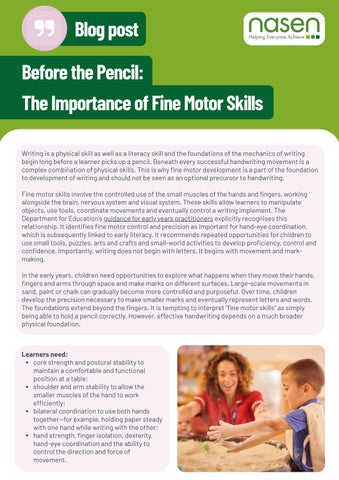
Blog post Before the Pencil: The Importance of Fine Motor Skills Writing is a physical skill as well as a literacy skill and the foundations of the mechanics of writing begin long before a learner picks up a pencil. Beneath every successful handwriting movement is a complex combination of physical skills. This is why fine motor development is a part of the foundation to development of writing and should not be seen as an optional precursor to handwriting. Fine motor skills involve the controlled use of the small muscles of the hands and fingers, working alongside the brain, nervous system and visual system. These skills allow learners to manipulate objects, use tools, coordinate movements and eventually control a writing implement. The Department for Education's guidance for early years practitioners explicitly recognises this relationship. It identifies fine motor control and precision as important for hand-eye coordination, which is subsequently linked to early literacy. It recommends repeated opportunities for children to use small tools, puzzles, arts and crafts and small-world activities to develop proficiency, control and confidence. Importantly, writing does not begin with letters. It begins with movement and markmaking. In the early years, children need opportunities to explore what happens when they move their hands, fingers and arms through space and make marks on different surfaces. Large-scale movements in sand, paint or chalk can gradually become more controlled and purposeful. Over time, children develop the precision necessary to make smaller marks and eventually represent letters and words. The foundations extend beyond the fingers. It is tempting to interpret "fine motor skills" as simply being able to hold a pencil correctly. However, effective handwriting depends on a much broader physical foundation.
Learners need: core strength and postural stability to maintain a comfortable and functional position at a table; shoulder and arm stability to allow the smaller muscles of the hand to work efficiently; bilateral coordination to use both hands together—for example, holding paper steady with one hand while writing with the other; hand strength, finger isolation, dexterity, hand-eye coordination and the ability to control the direction and force of movement.
The DfE therefore recommends a joined-up approach to physical development, recognising that gross and fine motor development are interconnected. Activities such as climbing, throwing, catching and other large movements can contribute to the physical foundations that later support more precise hand movements. This matters particularly for children who find sitting, maintaining posture, coordinating both sides of their body or controlling small movements difficult. Asking them simply to "practise their letters" may address the visible difficulty without addressing the underlying barrier. The relationship between fine motor development and academic learning is supported by a growing body of research. A 2025 meta-analysis synthesised evidence from 118 studies involving almost 80,000 children and adolescents. The researchers found particularly strong associations between fine motor skills and graphomotor skills and writing. They also identified links involving cognitive and executive-function processes, suggesting that the relationship between physical and academic development is more complex than simply having "strong fingers". Earlier research has similarly identified relationships between fine motor control, visual-motor integration and handwriting. A systematic review of handwriting-readiness assessments found evidence that children experiencing handwriting difficulties may have difficulties with fine motor control and/or visual-motor integration. However, we should be cautious about interpreting this evidence as meaning that every child must achieve a particular set of fine motor milestones before handwriting instruction can begin. There is no single, universally accepted definition or test of "writing readiness". Indeed, the systematic review found that none of the assessment instruments examined adequately captured all the components involved in writing readiness.
This has important implications for early years practice but also beyond. Those learners who arrive in Reception without meeting the early years learning goals in gross and fine motor skills may continue to require more physical foundations rather than more letter formation practice. Play is preparation for, and not a distraction from, writing. Creating rich opportunities for children to develop strength, coordination, precision and confidence through purposeful activity, rather than repetitive processes, will engage them more successfully. Including the opportunity of threading, manipulating playdough, using tweezers, building with small construction materials, cutting, painting, drawing, using pegs, fastening buttons and handling small objects can be built into the curriculum appropriately and provide valuable opportunities to develop dexterity and coordination. Extending the continuous provision beyond Early Years will support this for all, and will be vital for some. For learners experiencing persistent handwriting difficulties, early identification matters. Consider the principle that intervention should respond to the learner's actual barrier: If a learner struggles because of poor fine motor control, repeatedly copying letters may not be the most effective starting point. They may need opportunities to develop the underlying physical skills while receiving appropriately adapted handwriting instruction. For practitioners, the question is therefore not simply "Can this child write their letters?". Instead, consider: Can they maintain a stable and comfortable posture? Can they use both hands together? Can they manipulate small objects? Can they control the movement of their fingers? Can they coordinate what they see with what their hand does? Can they make marks with increasing intention and control? Can they sustain an activity without excessive fatigue? Are they developing confidence and enjoyment in communicating through marks? The strongest approach recognises that physical development and literacy development are intertwined. Learners do not need to master fine motor skills before they encounter writing. They need adults to understand that learning to write is itself a developmental journey, supported by movement, play, mark-making, language, cognition and repeated opportunities to practise. The pencil is only the final tool. The real preparation begins much earlier—in the child's whole body, their hands, their play and their exploration of the world. Learn more: welcome@nasen.org.uk Talk to us: 01827 311500
www.nasen.org.uk