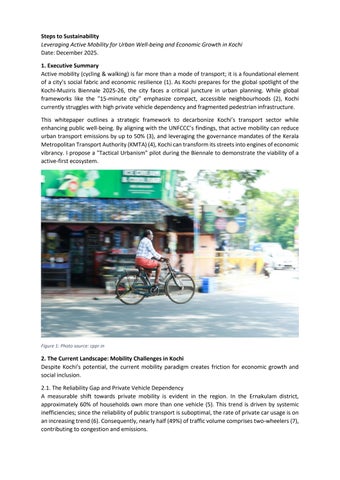
Steps to Sustainability
Leveraging Active Mobility for Urban Well-being and Economic Growth in Kochi
Date: December 2025.
1. Executive Summary
Active mobility (cycling & walking) is far more than a mode of transport; it is a foundational element of a city’s social fabric and economic resilience (1). As Kochi prepares for the global spotlight of the Kochi-Muziris Biennale 2025-26, the city faces a critical juncture in urban planning. While global frameworks like the "15-minute city" emphasize compact, accessible neighbourhoods (2), Kochi currently struggles with high private vehicle dependency and fragmented pedestrian infrastructure. This whitepaper outlines a strategic framework to decarbonize Kochi’s transport sector while enhancing public well-being. By aligning with the UNFCCC’s findings, that active mobility can reduce urban transport emissions by up to 50% (3), and leveraging the governance mandates of the Kerala Metropolitan Transport Authority (KMTA) (4), Kochi can transform its streets into engines of economic vibrancy. I propose a "Tactical Urbanism" pilot during the Biennale to demonstrate the viability of a active-first ecosystem.
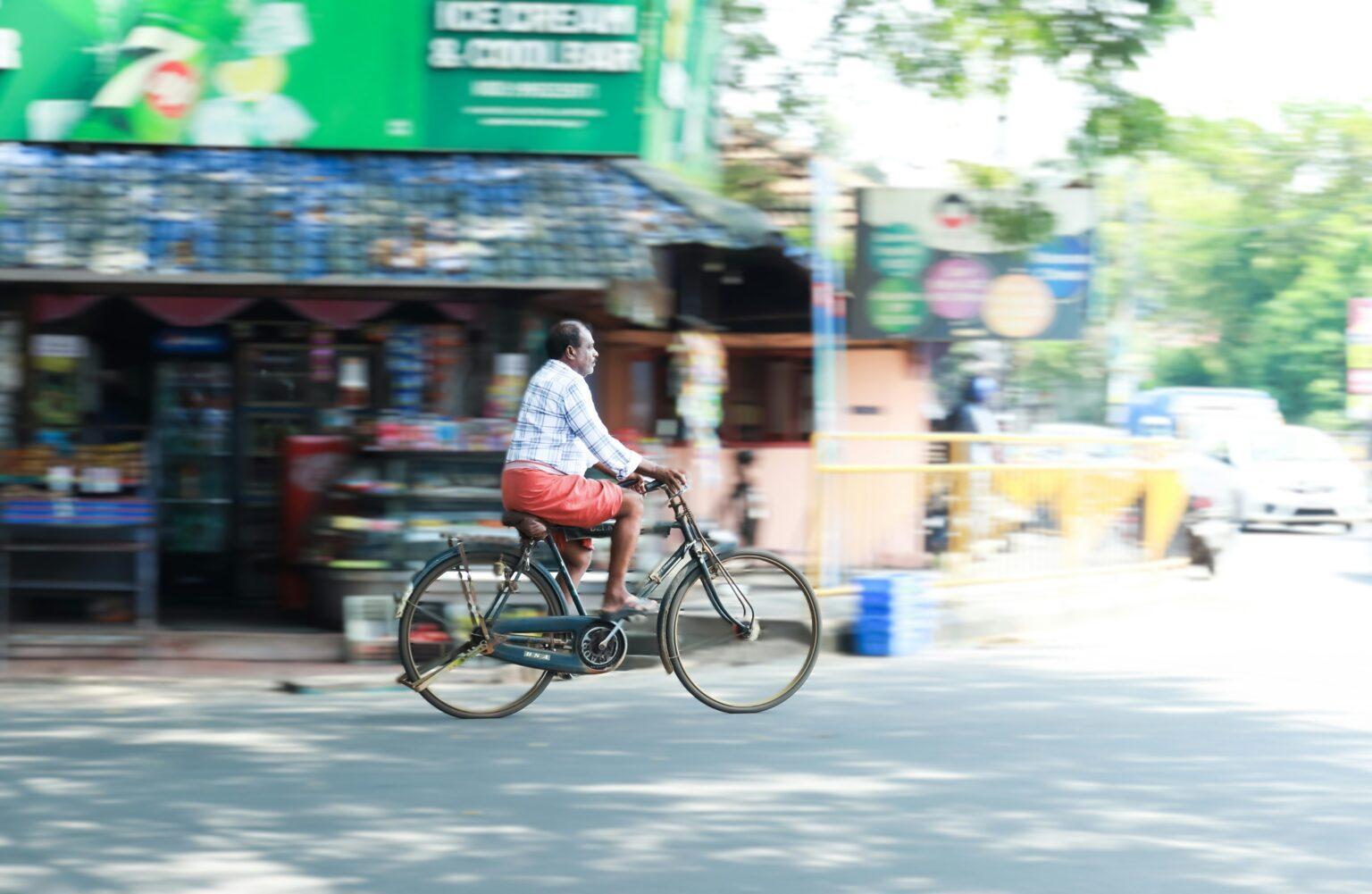
2. The Current Landscape: Mobility Challenges in Kochi
Despite Kochi’s potential, the current mobility paradigm creates friction for economic growth and social inclusion.
2.1. The Reliability Gap and Private Vehicle Dependency
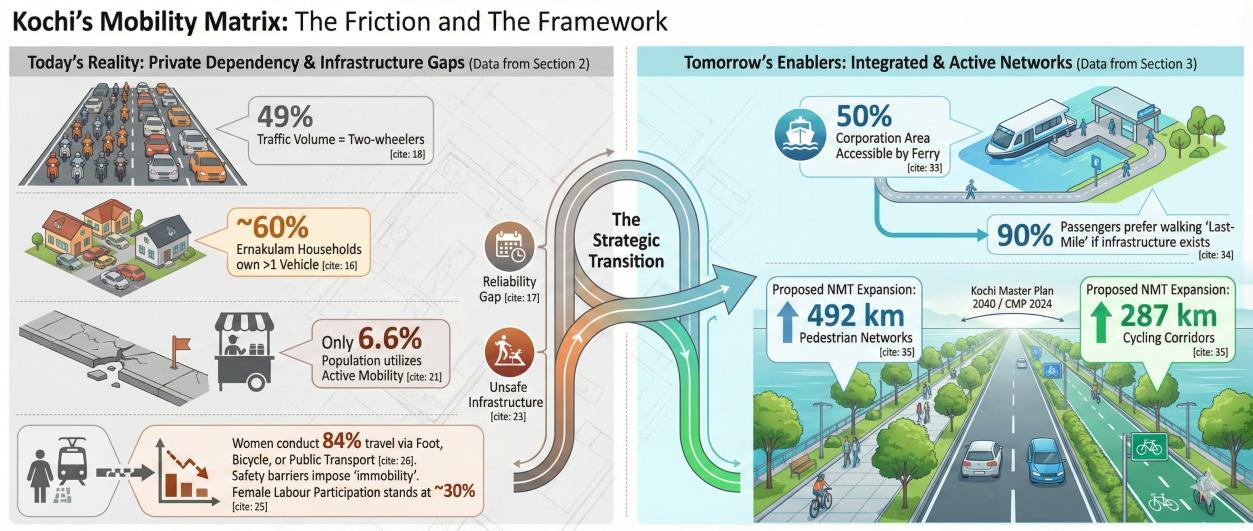
A measurable shift towards private mobility is evident in the region. In the Ernakulam district, approximately 60% of households own more than one vehicle (5). This trend is driven by systemic inefficiencies; since the reliability of public transport is suboptimal, the rate of private car usage is on an increasing trend (6). Consequently, nearly half (49%) of traffic volume comprises two-wheelers (7), contributing to congestion and emissions.
2.2. Infrastructure Deficiencies
While the appetite for walking exists, the physical environment acts as a deterrent. Studies indicate that only 6.6% of the population currently utilizes active modes of transportation (8). The primary barriers include discontinuous footpaths, encroachment by hawkers, illegal parking, and poor maintenance (9). Furthermore, the lack of protected lanes discourages cycling on main roads due to high vehicle speeds (10)
2.3. The Gendered Impact of Mobility
Mobility inclusion is a critical economic lever. In Kochi, female labour participation stands at approximately 30% (11). Women, who conduct 84% of their travel via bicycle, foot, or public transport (12), are disproportionately affected by poor infrastructure. Safety concerns, both perceived and real, impose "immobility" on this demographic (13). Enhancing the safety of active mobility corridors is therefore not just an infrastructure goal, but a strategy for women's economic empowerment (14)
3. Strategic Enablers: Policy and Infrastructure
Kochi possesses unique assets and legislative frameworks that can support a rapid transition to sustainable mobility.
• Proactive Governance: The Kerala Metropolitan Transport Authority (KMTA Act 2019) is a firstof-its-kind legislative body in India, integrating local government, police, and town planning to address mobility holistically (15).
• The Water Metro Advantage: Kochi’s Inland Water Transport (IWT) network is a unique differentiator. With 50% of the Corporation area boundaries accessible by ferry (16), the Water Metro is reversing the decline in water transport usage (17). However, its success relies on "lastmile" connectivity; 90% of ferry passengers prefer to walk to their destination if adequate infrastructure exists (18)
• Planning Frameworks: The Comprehensive Mobility Plan (CMP draft) 2024 proposes a massive expansion of non-motorized transport (NMT), including 492 km of pedestrian networks and 287 km of cycling corridors(19). This aligns with the Kochi Master Plan 2040, which encourages vertical mixed-use development to support "15-minute neighbourhoods" (4).
4. Global Benchmarks: The Economic Case for Walkability
Transitioning to active mobility offers proven economic returns, as evidenced by global case studies:
• Bogotá, Colombia (Economic Revitalization): The "Cielo Abierto" (Open Sky) project transformed streets into public areas for commerce. This revitalization of 600 eateries indirectly created 55,000 jobs (18).
• Milan, Italy (Urban Resilience): The "Parco Romana" project demonstrates how integrating residential, office, and car-free landscapes fosters biodiversity and community well-being (2)
These examples illustrate that designing for people, rather than automobiles, leads to liveable and economically robust communities (19)
5. Strategic Recommendation: The "Biennale Pilot"
The Proposal: To bridge the gap between policy (CMP 2024) and execution, this paper recommends a Tactical Urbanism Pilot centred around the Kochi-Muziris Biennale 2025-26.
5.1. The Concept: Leveraging the "Streets for People" approach (10), Kochi should implement temporary, cost-effective interventions to pedestrianize key heritage and commercial zones. This mirrors the "Reimagining Fort Kochi" initiative under the TUMI project (11)
5.2. Implementation Strategy
• First & Last Mile Connectivity: Ensure multi-modal options connect Water Metro terminals to Biennale venues (20)
• The "Sunday Street" Model: Initiate car-free Sundays in the heritage zone to allow locals, tourists, and performers to utilize the streetscape safely.
• Inclusive Design: To avoid "green gentrification" (a challenge seen in Barcelona)(21), the pilot must ensure spaces remain accessible to local vendors and diverse socio-economic groups.
5.3. Expected Outcomes
• Tourism Growth: Enhancing the "experience" of the city for the Biennale’s audience.
• Data Collection: Using the pilot to gather data on footfall and retail spending to justify permanent infrastructure investment.
• Decarbonization: Contributing to the India government’s Net Zero climate goal by 2070 (16)
6. Conclusion
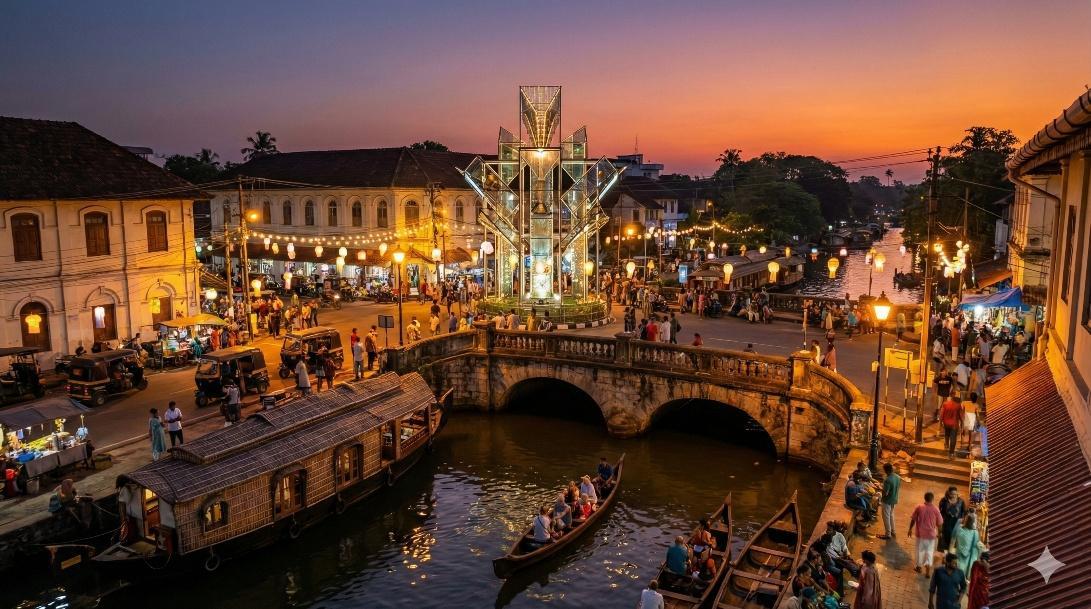
Kochi is uniquely positioned to redefine urban mobility in the Global South. By shifting from reactive transport planning to deliberate, people-centric mobility (12), the city can unlock significant social and economic value. The upcoming Biennale offers the immediate impetus to test these concepts. As observed in global benchmarks, when cities prioritize walkability, they harvest dividends in public health, social connection, and economic vitality (18)
References
1. D’Amico A. Strategies and instruments for active mobility: comparison of international experiences. Journal of Land Use, Mobility and Environment. 2024;(1).
2. Abdelfattah L, Deponte D, Fossa G. Milan The 15-minute city: interpreting the model to bring out urban resiliencies. In: Transportation Research Procedia. Elsevier B.V.; 2022. p. 330–7.
3. Lamia Abdelfattah a DD b, GF. NEW SCENARIOS FOR SAFE MOBILITY IN URBAN AREAS TeMA Journal of Land Use, Mobility and Environment. Available from: https://www.progettaferrara.eu/it/b/2284/slides.
4. Govt of Kerala. Ministry of LSG. Kochi 2040 Master Plan [Internet]. 2012. Available from: https://compose.kerala.gov.in/
5. Premnath A. Master’s Thesis titled: The role of active mobility in building smart cities. The cases of Barcelona, Bogotá and Milan. Berlin; 2024.
6. Prabhakaran Aishwarya. Better Kochi Response Group [Internet]. 2024 [cited 2024 Jul 24]. Available from: https://www.newindianexpress.com/cities/kochi/2023/Jan/11/pioneer-of-change-better-kochiresponse-group-to-turn-13-2536573.html
7. Joseph A, Mathews E, Thankappan KR, Scholar P. Why People use Private over Public Transportation? A Cross-Sectional Study from Ernakulam District, Kerala [Internet]. Vol. 10, International Journal of Health Sciences and Research (www.ijhsr.org). 2020. Available from: www.ijhsr.org
8. Healthbridge Canada & ESAF. WALKABILITY STUDY - Kochi [Internet]. Available from: http://www.esafindia.org
9. Shuja F, R A. Planning for Compact and Low-carbon Transit-Oriented Development: A Case of Kochi City, Kerala, India. In: ATINER’s Conference Paper Proceedings Series. Athens; 2023.
10. Ministry of Urban affairs G of I. Smart city mission [Internet]. 2024 [cited 2024 Jul 21]. Available from: https://smartcities.gov.in/node/115
11. TUMI Website [Internet]. [cited 2024 Jul 20]. Available from: https://transformative-mobility.org/about/
12. KMRL U. CMP_KMRL_2024. 2024;
13. Swamy HMS, Sinha S, Hari GP, Jose D. Transport and Communications Bulletin for Asia and the Pacific Gender Sensitive Mobility Policies: Case Studies from Two Indian Cities, Kochi, and Surat. 2021.
14. MoSPI Govt. of India. Periodic Labour Force Survey (PLFS) [Internet]. Annual Report, PLFS. 2023. Available from: www.mospi.gov.
15. Dona Ann J, Sujith KM. Addressing walkability of Kochi corporation area with a focus on inland water transportation. IOP Conf Ser Mater Sci Eng. 2021 Mar 1;1114(1):012036.
16. Rudini Baoy, An Rubenecia. Enhancing Urban Mobility through Low-Carbon Water Transport [Internet]. 2023 [cited 2025 Dec 10]. Available from: https://development.asia/insight/enhancing-urban-mobilitythrough-low-carbon-water-transport
17. KMTA Act 2019. THE KERALA METROPOLITAN TRANSPORT AUTHORITY ACT, 2019.
18. Mobilize ITDP.org. From Transmilenio to Cycle Networks-Lessons Learned from Bogotá’s Comprehensive Urban Mobility Planning.
19. Walkable streets [Internet]. 2024 [cited 2024 Jul 30]. Available from: https://walkablestreets.wordpress.com/roaddiets/
20. Kochi Biennale Foundation. Kochi Muziris Biennale 2025-26 [Internet]. 2025 [cited 2025 Dec 11]. Available from: https://www.kochimuzirisbiennale.org/
21. Gil-Alonso F, López-Villanueva C, Thiers-Quintana J. Transition towards a Sustainable Mobility in a Suburbanising Urban Area: The Case of Barcelona. Sustainability. 2022 Feb 23;14(5):2560.
22. Images 2 & 3 generated using Google Gemini Pro.