
PARTNERSHIP PAYS



JUNE/JULY 2026
VOLUME 102 ★ NUMBER 5
EDITORIAL DIRECTOR
Jenn Rafael
CREATIVE SERVICES MANAGER
Beth Bedard
SENIOR CONTENT MANAGER
Matt Sanderson
ADDITIONAL GRAPHIC DESIGN TGD
EDITORIAL BOARD
William Shackelford, Cindy Reneé Blythe
CONTACT US
NARFE Magazine
606 North Washington St.
Alexandria, VA 22314-1914
Phone: 703-838-7760 Fax: 703-838-7781 Editorial: communications@narfe.org
Advertising Sales: mprimuth@narfe.org
NARFE FOR THE VISUALLY IMPAIRED
ON THE TELEPHONE: This publication can be heard on the telephone by persons who have trouble seeing or reading the print edition. For more information, contact the National Federation of the Blind NFB-NEWSLINE® service at 866-504-7300 or go to www.nfbnewsline.org.
ON DIGITAL AUDIO: Issues of NARFE Magazine are also available in audio format through the National Library Service for the Blind and Physically Handicapped (NLS). For availability, call 202-727-2142 or your local NLS service provider.
The Association, since July 1970, has been classified by the IRS as a tax-exempt labor organization [not a union]; however, dues and gifts or contributions to the Association are not deductible as charitable contributions for income tax purposes.


NATIONAL OFFICERS
WILLIAM SHACKELFORD President; natpres@narfe.org
CINDY RENEÉ BLYTHE Secretary/Treasurer; natsectreas@narfe.org
TO JOIN NARFE, RENEW YOUR MEMBERSHIP OR FIND A LOCAL CHAPTER:
CALL (TOLL-FREE) 800-456-8410 OR GO TO www.narfe.org
TO CHANGE YOUR ADDRESS, PHONE NUMBER OR EMAIL LISTING:
CALL (TOLL-FREE) 800-456-8410
EMAIL memberrecords@narfe.org
OR GO TO www.narfe.org, log in and click on “My Account”
TO REACH A FEDERAL BENEFITS SPECIALIST: EMAIL fedbenefits@narfe.org
NARFE HEADQUARTERS
606 N. Washington St. Alexandria, VA 22314
703-838-7760
Hours of operation: Monday-Friday, 8 a.m.-5 p.m. ET
REGIONAL VICE PRESIDENTS
REGION I Jeff Anliker (Connecticut, Maine, Massachusetts, New Hampshire, New York, Rhode Island and Vermont) Tel: 413-813-8136
Email: jeff.anliker@outlook.com
REGION II Paul Schwartz (Delaware, District of Columbia, Maryland, New Jersey and Pennsylvania) Tel: 240-838-2200
Email: schwartzpaul02@gmail.com
REGION III Lynn Harper (Alabama, Florida, Georgia, Mississippi, South Carolina and Puerto Rico) Tel: 478-951-3260
Email: lynnlarry79@outlook.com
REGION IV Ed Konys (Illinois, Indiana, Michigan, Ohio and Wisconsin) Tel: 937-207-6087
Email: rvpkonys@outlook.com
REGION V Linda Sawvell (Iowa, Kansas, Minnesota, Missouri, Nebraska, North Dakota and South Dakota) Tel: 563-340-4823
Email: Lsawvell262@gmail.com
REGION VI Patsy Ashton (Arkansas, Louisiana, Oklahoma, Republic of Panama and Texas) Tel: 504-452-3870
Email: rvp6@narfe.org
REGION VII Sharon Reese (Colorado, Southwest, Utah and Wyoming) Tel: 575-649-6035
Email: sreese346@gmail.com
REGION VIII John Almquist (California, Hawaii, Nevada and Republic of Philippines) Tel: 949-246-4378
Email: almquistjw@yahoo.com
REGION IX Steven Roy (Alaska, Idaho, Montana, Oregon and Washington) Tel: 425-344-3926
Email: stevenroy1@yahoo.com
REGION X Robert Allen (Kentucky, North Carolina, Tennessee, Virginia and West Virginia) Tel: 757-404-3880
Email: rvp10@narfe.org
NARFE’S MISSION STATEMENT
To support legislation and regulations beneficial to federal civilian employees and annuitants and potential annuitants under any federal civilian retirement system and to oppose those detrimental to their interests.
To promote the general welfare of federal civilian employees and annuitants and potential annuitants, to advise and assist them with respect to their rights under retirement, health and other employee and retiree benefits laws and regulations, and to represent their interests before appropriate authorities.
To cooperate with other organizations and associations in furtherance of these general objectives.
NARFE Magazine (ISSN 1948-4453) is published monthly except in February and July by the National Active and Retired Federal Employees Association (NARFE), 606 N. Washington St., Alexandria, VA 22314. Periodicals postage paid at Alexandria, VA, and additional mailing offices. Members: Annual dues includes subscription. Nonmember subscription rate $48. Postmaster: Send address change to: NARFE Attn: Member Records, 606 N. Washington St., Alexandria, VA 22314. To ensure prompt delivery, members should also forward changes of address without delay. Because of the volume involved, NARFE cannot acknowledge nor be responsible for unsolicited pictures and manuscripts, although every reasonable precaution is taken. All submissions become the property of NARFE. Copyright © 2026, NARFE. Advertisements in the magazine are not endorsements of products and/or services by NARFE, unless officially stated in the ad. We shall accept advertising on the same basis as other reputable publications: that is, we shall not knowingly permit a dishonest advertisement to appear in NARFE Magazine, but at the same time we will not undertake to guarantee the reliability of our advertisers.
2 NARFE MAGAZINE JUNE/JULY 2026










Justice Federal is committed to delivering financial products and services designed to fit the way you live and work with convenience and security you can trust. We offer convenient access to—
• 5,600+ Shared Branches, around the block or across the nation®
• Over 135,000 ATMs nationwide—more than the major banks
• Digital banking solutions to easily open spending or savings accounts, apply for loans, make remote deposits, transfer money, and much more Join nearly 74,000 Members who serve nationwide and experience convenience designed to fit your busy life.


IThe Future of NARFE
n February, members passed a referendum to change the terms of office for the National Executive Board (NEB). With the referendum’s passage, all members of the NEB will be eligible to serve three-year terms. Changing the length of the term of office from two years to three years will potentially help retain continuity of leadership, thereby allowing the NEB to focus on completing projects and assignments initiated during the present term. In the past, many initiatives, such as provisions of a strategic planning committee, were “placed on hold” or completely ignored by the NEB. Additionally, the approved provisions of the referendum will potentially allow the NEB to maintain enhanced continuity and organizational effectiveness in the face of frequent uncertainties with the Federal Government.
You can become part of the organization’s national decision-making process. Following the closing of the 2026 NARFE National Conference (FEDcon26) in Indianapolis, you will be asked to vote on national bylaws amendments. The NARFE National Bylaws Committee, chaired by Dorman Otte from the Iowa Federation, received 10 bylaws and three standing rule proposals for consideration by the membership on the 2026 election ballot. The final report of the committee will be posted on the NARFE website at www.narfe.org.
As a loyal and dedicated NARFE member, your “homework” assignment is to review these proposals and become an “educated voter.” Through your vote, you will provide the NEB with guidance to ensure NARFE remains a viable organization.
FEDCON26 PREPARATIONS
Planning continues for our upcoming national conference, FEDcon26, in August. This event will be held at the Hyatt Regency in Indianapolis, Indiana. Events begin on August 23 with the NARFE Annual Meeting, during which attendees will receive reports from me and National Secretary/ Treasurer Cindy Blythe. The NARFE Headquarters staff is currently identifying keynote speakers for the general sessions and luncheons, including Dr. Joanne Pike, president and CEO of the Alzheimer’s Association, who will provide an update on the relationship between NARFE and the association during lunch on August 24. Educational and informative break-out sessions are also being planned. Check your NARFE Magazine for more information.
MARK YOUR CALENDAR
Conference Direct, a NARFE event coordinator, assisted the NARFE Site Selection Committee with identifying and evaluating potential sites for the Joint Federation Presidents’/NEB Meeting scheduled for August 22-26, 2027, and the NARFE Biennial National Conference (FEDcon28) scheduled for August 23-29, 2028. After reviewing submissions from various venues, the NARFE Site Selection Committee selected the Hilton Hotel at 1001 Cass Street in Omaha, Nebraska, for the 2027 Joint Federation Presidents’/National Executive Board Meeting and the 2028 NARFE Biennial Conference (FEDcon28).
The Hilton is offering a room rate equal to the prevailing federal government per diem rate, which is currently $122.00 plus taxes. Attendees will enjoy a walkable location at the Hilton Omaha. There are numerous off-site activities near the hotel for our attendees to enjoy. The Old Market is an entertainment district featuring local restaurants, bars, shopping, art galleries and more. The Capitol Entertainment District includes additional dining, shopping and entertainment options.
From the staff and officers at NARFE, thank you for your continued NARFE membership and dedication to our organization. Enjoy your summer and stay safe.
WILLIAM SHACKELFORD NARFE NATIONAL PRESIDENT natpres@narfe.org
Every Day is Independence Day!
Mobility issues affect over 1 in 5 Americans. These individuals, and their loved ones, know how decreased mobility can result in loss of independence, pain, and risk of falling. They are often stuck at home, missing out on a variety of activities, in a vicious cycle that diminishes their quality of life. In the past, mobility devices like scooters and power chairs were too heavy and bulky to transport easily. Now, carbon fiber material invented for the aerospace program has been used to create the ultimate mobility device. It’s called the Journey Air Elite Max.
At only 24.25 pounds*, the Journey Air Elite Max combines lightweight portability with world class performance. It’s simple to use joystick and powerful dual-motor drive system enables you to zip around quickly and safely. It’s easy to maneuver, has anti-tipper technology, fits easily through doorways, and can go right up to a table or desk. Once you’re ready to store or transport, just one pull on the seat handle folds it up.

Just imagine how this chair can improve your life and make it easier for loved ones and caregivers to accompany you to activities and events you would have missed in the past. Call today, and our knowledgeable expert will help you get a Journey Air Elite Max of your very own. Don’t wait –call now!


not
• Lightweight: Weighs only 24.25 lbs., making it easy to lift, fold, and take anywhere.
• Built for Strength: 330 lb. capacity supports you with stability and confidence at every turn.
• Room to Breathe: A wider 18” seat and taller 18” backrest ensure lasting comfort and proper posture even on longer outings.
• Freedom Without Limits: With up to a 19-mile range, dual lithium batteries keep you going further.
• Quiet, Smooth Comfort: Premium carbon fiber frame, memory foam cushioning, and whisper-quiet performance make every ride peaceful.



DHS Shutdown Hits Record 66
Days, and Counting
The shutdown of the Department of Homeland Security (DHS) reached its 66th day, and counting, at press time, hitting a new record for the length of a government shutdown. But its impact on federal employees had been blunted prior to its conclusion (still more than a month in) by several executive actions by President Donald Trump to redirect DHS funding to pay employees. First, there was a March 27 action to pay Transportation Security Administration employees working during the standoff. Subsequently, a week later, he directed payment to the remaining DHS employees who were continuing to work without pay.
With the impact mitigated and Congress on recess, the shutdown continued. Republicans had hatched a plan to use budget reconciliation to pass funding for U.S. Customs and Border Protection and U.S. Immigration and Customs Enforcement (ICE), but at press time, the timeline on passing that supplemental funding on a partisan basis and the baseline DHS funding on a bipartisan basis remained uncertain.
The Senate had agreed in late March, by voice vote, to extend DHS funding for all but Immigration and Customs
Enforcement (ICE) and Customs and Border Protection (CBP), as those two agencies remained
operating under funding authorized by H.R. 1, the One Big Beautiful Bill Act. Senate Democrats and Republicans had been negotiating over the conditions of such funding. While they had made some progress toward a negotiated solution, Democrats continued to demand no masks for agents and judicial warrants for operations, and Republicans rejected their offers. They began discussing a carve-out of ICE, with provisions limiting CBP operations to duty stations (borders and points of entry) and preventing other fund transfers, but that more modest deal fell through.
JUNE/JULY ACTION ALERT: PROTECT THE MERITBASED CIVIL SERVICE SYSTEM
Visit NARFE’s Legislative Action Center at www.narfe.org to send a message to your lawmakers urging them to cosponsor the Saving Civil Service Act, H.R. 492/ S. 134. This act would prohibit the return of Schedule F (now Schedule Policy/ Career), ensuring the public’s expectations of a system that is efficient, fair, free from political interference, and staffed by honest, competent, and dedicated employees. Merit-based civil service rules are integral to preserving institutional knowledge and expertise within the federal government.
However, the March bipartisan Senate DHS funding bill was initially rejected by House Republicans, who amended it, sent it back to the Senate with a 60-day continuing resolution to fund ICE and CBP, and then left town for recess. It was clear that the House counteroffer lacked the Senate votes, and Minority Leader Chuck Schumer, D-NY, declared it dead on arrival. After the House’s initial rejection and a couple of weeks of wasted time,
MYTH VS. REALITY
MYTH: Reclassification of federal employees in Schedule Policy/Career (P/C) is aimed at reducing inefficiencies and upholding accountability, so it should have no negative consequences for productive employees.
REALITY: Aside from the political motivations behind the push for Schedule P/C reclassification, federal employees who are shifted from the competitive service into Schedule P/C lose certain due process rights, become ineligible for student loan repayment, become excluded from recruitment, relocation, and retention incentives, and no longer qualify for Presidential Rank Awards for senior career employees. These changes hurt the public servants currently serving our country by stripping them of the protections and benefits they were entitled to when they were hired, and by inhibiting the federal service’s ability to maintain employment levels that can adequately serve the American public.
House Republicans indicated they would pass the Senate bill, and pass a ICE and CBP funding via a separate, budget reconciliation pathway. The success and timing of that effort remained uncertain at press time.
NARFE supported the bipartisan conclusion of the shutdown. Previously, National President William “Bill” Shackelford reiterated his call to Congress to end the shutdown, specifically urging Congress to:
OPM’s Processing Backlog Continues
The Office of Personnel Management (OPM) is responsible for managing retirement applications and health insurance enrollment changes. Its customer care lines are vital for providing information and keeping the public informed. Every year, tens of thousands of retirees submit claims that require review and approval before benefits are distributed. While OPM’s goal has been to process these claims within 60 days, many retirees have faced much longer waiting times, especially now.
In recent years, OPM has encountered considerable delays and criticism due to ongoing processing backlogs, especially for retirement claims. In March,
OPM’s Retirement Center shared updated statistics on Civil Service Retirement System (CSRS) and Federal Employees Retirement System (FERS) claims.
In February 2026, OPM received approximately 15,494 digital claims and 31,240 total claims (including paper submissions). However, only 7,054 digital and 18,149 total claims were processed. The average processing times were 34 days for digital and 71 days overall. Additionally, some Federal Employees Health Benefits (FEHB) and Postal Service Health Benefits (PSHB) enrollees experienced significant delays in processing their health enrollment changes, impacting their 2026 coverage.
(i) continue to engage in good faith bipartisan negotiations over Department of Homeland Security (DHS) appropriations bills to end the partial government shutdown, (ii) extend funding for noncontroversial functions while negotiations remain at an impasse, and (iii) authorize pay for federal employees impacted by the shutdown.
—BY JOHN HATTON, STAFF VICE PRESIDENT, POLICY AND PROGRAMS
WHAT’S CAUSING THE DELAYS?
The backlog issue is rooted in several factors:
Staffing Challenges: OPM has experienced a personnel shortage. In 2025, the agency lost more than 300,000 employees due to reductions in force (RIFs), the Deferred Resignation Program (DRP), and voluntary retirements.
Customer Service Phone
Line Pause: Since Open Season 2025, OPM’s customer service has experienced a surge in inbound calls. Consequently, lines are often switched to automated recordings or disconnected entirely.

NARFE GRASSROOTS ADVOCACY
LEARN MORE about how you can take action to protect your earned pay and benefits by reviewing NARFE Grassroots materials at www.narfe.org/advocacy
Don’t Wait: NARFE’s 5 Step Plan to Gear Up for Grassroots Advocacy Month
The congressional summer recess began as the idea of Sen. Gale McGee of Wyoming in the 1960s and has since become a valued tradition within Congress. The recess not only serves as an opportunity for members of Congress to return to their home states and districts for personal matters, but it has also become a prime time for constituents to secure the ear of their elected official within their own community. NARFE’s Grassroots Advocacy Month aligns with the August break, so we can encourage our members to do just that. As we prepare for our advocacy push, here are five steps to gear up for success this year.
1. START SCHEDULING MEETINGS EARLY
Every interest group in your state and district will be trying to take advantage of summer recess, just like us, but NARFE’s advice is to beat the crowds and get your requests in early! Additionally, reach out to your fellow chapter and federation leaders to schedule group meetings, so you can lean on each other to keep the conversation going, demonstrate strength in numbers, and avoid competing for meeting time! You can find a sample meeting request email template and phone script on NARFE’s website under “Grassroots Advocacy.”
2. FAMILIARIZE YOURSELF WITH NARFE’S RESOURCES
One of the biggest causes of stress before meetings with members of Congress is the fear of not being prepared. NARFE aims to alleviate those nerves by providing our membership with ample resources to review, draw from, and leave behind. Under the “Advocacy Resources” tab on NARFE’s website, you can find our bill tracker to see what pieces of legislation we are following, fact sheets on the federal community and background information about our issue, issue briefs detailing our advocacy stances, talking points to guide your conversation, and more.
3. DO YOUR RESEARCH ON YOUR AUDIENCE
For several reasons, knowing who you will be meeting with can significantly affect the success of your meeting. Knowing the background of a member of Congress and/or a member of staff can provide an opportunity to make a personal connection. For example, you may learn your representative has a parent who was a federal employee, or you may discover that you and the staff member are graduates of the same school. You can use that to create a more personal connection. Additionally,
knowing the committees and leadership positions of the member you are meeting with will help you formulate specific, realistic asks based on where their power lies, and it shows them that you know where their influence lies.
4. PRACTICE YOUR ADVOCACY PITCH
Practice makes perfect, and preparing for congressional meetings is no different. Writing down what you want to say, memorizing key talking points, and rehearsing relevant personal testimony are all ways to make yourself more comfortable ahead of your meeting. You can do this with a fellow NARFE member, organize practice time with your chapter, or even practice in a mirror to make the pitch feel more natural.
5. ASK NARFE HQ FOR HELP
While this may seem obvious, NARFE wants to reiterate to our members that we are here to help you in any way we can! Whether you have questions about specific resources, want to practice your pitch with us, or need help scheduling a meeting, the NARFE Advocacy team is at your disposal to ensure you have a successful and impactful Grassroots Advocacy Month!
—BY NICOLE BLACKSTONE, GRASSROOTS AND POLICY MANAGER
NARFE Opposes OPM Proposed Rules Eliminating Appeals to MSPB
In March, NARFE submitted comments opposing two proposed rules from the Office of Personnel Management (OPM). One rule is on “Suitability Action Appeals,” and the other is on “Reduction in Force Appeals.” Both proposed rules would shift federal employee appeals of adverse suitability actions or reduction-in-force (RIF) actions from the Merit Service Protection Board (MSPB) to OPM.
In both cases, NARFE argued that the rules would remove the key meaningful, independent review of potential politically motivated actions. They, NARFE argued, “replace
an independent body of Senateconfirmed board members who may only be removed for cause [MSPB], with a politically controlled agency [OPM]. This creates a substantial risk that OPM serves only to provide rubber-stamp approval of illegitimate agency actions rather than meaningful review.”
On suitability actions, NARFE pointed out that “the problem is compounded by ill-defined criteria for suitability actions such as dishonest conduct,” and “expansion of suitability determinations to apply to in-service conduct.” These changes could open the door
CONTRIBUTE TO
Make a one-time contribution:
q $25 – Basic lapel pin
q $50 – Bronze lapel pin
q $100 – Silver lapel pin
q $250 – Gold lapel pin
q $500 – Platinum lapel pin
q Other: _________

to agency abuse of suitability determinations, creating an opportunity to use them to terminate employees rather than on a performance-based justification. In doing so, agencies would avoid MSPB’s independent review.
When a RIF is conducted, the agency must determine which employees take priority over others. Regarding the RIF appeals, NARFE argued: “agency leaders seeking to terminate large numbers of employees based on political affiliation could improperly apply RIF procedures to target groups of employees.”
—BY JOHN HATTON, STAFF VICE PRESIDENT, POLICY AND PROGRAMS
NARFE Member #:
Name:
Address: City: State: ZIP:
Occupation:
Employer:
q Charge my credit card q MasterCard q VISA q Discover q AMEX Card #:
Exp. Date: _____ /_________
Name on Card:
Signature: Date:
To comply with federal law, we must use our best efforts to obtain, maintain and submit the name, mailing address, occupation and name of employer of individuals whose contributions exceed $200 each calendar year. NARFE-PAC is for the benefit of political candidates and activities on a national level. NARFE members have the right to refuse to contribute without reprisal, and NARFE will neither favor nor disadvantage anyone based on the amount of a contribution or failure to make a voluntary contribution. The suggested amounts are only suggestions and not enforceable. Only members of NARFE may contribute to the PAC. Contributions from non-members will be returned. NARFE-PAC contributions are not deductible for federal income tax purposes.
Monthly contributors of $10 or more receive a sustainer lapel pin

Spikes in Volume and Digital vs. Manual
Processes: OPM’s retirement processing still relies heavily on paper-based systems and manual data entry, slowing the process and increasing the risk of errors. In January 2026, OPM received 18,923 retirement claims, compared to 13,174 in December 2025.
Complex Cases: Certain claims and health enrollment changes require extra documentation or are complicated by incomplete or incorrect information, leading to further delays.
IT Systems: Outdated technology has limited OPM’s ability to automate and streamline processing, adding to inefficiencies. In December 2025, a memo from the Office of Management and Budget (OMB) set a 2027 deadline for technology modernization across all agencies. However, this timeline may be at risk, as several companies have protested the contract’s final award phase—like IBM, for example, filed a complaint with the Government Accountability Office (GAO) in February, alleging unfair removal from the competition.
IMPACT OF THE BACKLOG
The most immediate impact is on recent retirees, who may wait months to receive their full annuity payments. During
LEGISLATIVE RESOURCES
NARFE NewsLine – A weekly newsletter that goes out to NARFE members on Tuesdays and includes weekly recaps of legislative news, compiled by NARFE’s advocacy and communications teams.
LEGISLATIVE ACTION CENTER – A one-stop site to send a letter to Congress, and more, at www.narfe.org
this period, many only get interim payments, which are often much lower than their expected retirement income, causing financial stress and
OUTDATED TECHNOLOGY HAS LIMITED OPM’S ABILITY TO AUTOMATE AND STREAMLINE PROCESSING, ADDING TO INEFFICIENCIES.
uncertainty. The backlog also strains OPM staff and damages the agency’s reputation among federal employees and policymakers.
EFFORTS TO ADDRESS THE ISSUE
OPM has acknowledged the backlog and taken several steps to address it, as highlighted in the Congressional Budget Justification for Fiscal Year 2026:
Hiring Staff: The agency plans to boost staffing during peak periods to handle higher claim volumes.
Process Improvements: OPM has worked to streamline workflows and improve accuracy by providing extra training and clearer guidance for both staff and applicants.
Technology Investments: OPM has begun modernizing its IT systems to digitize records and automate additional processes. However, progress has been slow because of funding and implementation challenges.
Communication
Enhancements: OPM aims to improve communication with retirees by offering more frequent updates and clearer timelines for claim processing.
While OPM’s efforts have led to some improvements, the backlog remains a significant challenge. Fully resolving the issue will likely require major investments in IT modernization, sustained staffing increases, and continuous optimized processing. The agency continues to report its progress and faces pressure from Congress and federal employee groups, such as NARFE, to further reduce wait times.
The OPM processing backlog is a complex problem rooted in understaffing, outdated systems, and limited resources. Resolving it will require sustained commitment to restoring adequate staffing, modernizing technology, and responsive management to provide timely service for all federal retirees.
—BY ELLIE DORSEY, FEDERAL BENEFITS INSTITUTE MANAGER



THURSDAY, JUNE 4, 2 P.M. ET AMS and Microsites Training with NARFE’s Configuration Advisory Board (CAB)
THURSDAY, JUNE 11, 2 P.M. ET Should I Stay or Should I Go? with Tony Opat
THURSDAY, JUNE 18, 2 P.M. ET Preparing for Retirement with Tony Opat
THURSDAY, JUNE 25, 2 P.M. ET The Retirement Process with Tony Opat
WEDNESDAY, JULY 1, 2 P.M. ET Three Health Plan Options for Federal Annuitants with Kevin Moss
THURSDAY, JULY 9, 2 P.M. ET New Member Orientation with NARFE Staff
THURSDAY, JULY 16, 2 P.M. ET Thrift Savings Plan with Mark Keen, CFP®
THURSDAY, JULY 23, 2 P.M. ET TBD
THURSDAY, JULY 30, 2 P.M. ET Grassroots Advocacy Month Preview with NARFE Staff



NARFE BILL TRACKER
THE NARFE BILL TRACKER IS YOUR MONTHLY GUIDE TO LEGISLATION NARFE IS FOLLOWING. CHECK BACK EACH ISSUE FOR UPDATES. ISSUE BILL NUMBER / NAME / SPONSOR WHAT BILL WOULD DO
H.R. 491 /S.624: Equal COLA Act/ Rep. James Walkinshaw, D-VA-11 / Sen. Alex Padilla, D-CA
Cosponsors:
H.R. 491: 66 (D) 2 (R) S. 624: 14 (D) 2 (I)
Provides full cost-of-living adjustments, based on the relevant change in consumer prices, to Federal Employees Retirement System annuities.
Referred to the House Committee on Oversight and Government Reform. 1/16/2025
ASSUMING FIRST SPONSORSHIP - Mr. Walkinshaw asked unanimous consent that he may hereafter be considered as the first sponsor of H.R. 491, a bill originally introduced by Rep. Connolly, for the purpose of adding cosponsors and requesting reprintings pursuant to clause 7 of rule XII. Agreed to without objection. Action By: House of Representatives 09/16/2025
FEDERAL ANNUITIES
H.R. 1522: Federal Retirement Fairness Act / Rep. Emily Randall D-WA06
Cosponsors: 108 (D) 18 (R)
Provides that civilian service in a temporary position after December 31, 1988, may be creditable service under the Federal Employees Retirement System, and for other purposes.
Read twice and referred to the Senate Committee on Homeland Security and Governmental Affairs. 02/18/2025
ASSUMING FIRST SPONSORSHIP - Ms. Randall asked unanimous consent that she may hereafter be considered as the first sponsor of H.R. 1522, a bill originally introduced by Representative Connolly, for the purpose of adding cosponsors and requesting reprintings pursuant to clause 7 of rule XII. Agreed to without objection. 07/22/2025
Referred to the House Committee on Oversight and Government Reform. 02/24/2025
FEDERAL COMPENSATION
H.R. 7480 / S. 3823: Federal Adjustment of Income Rates (FAIR) Act(Support) / Rep. James Walkinshaw D-VA-11 / Sen. Brian Schatz D-HI
Cosponsors:
H.R. 7480 – 24 (D) 1 (R) S. 3823 – 10 (D) 1 (I)
Increases the rates of pay under the statutory pay systems and for prevailing rate employees by 4.1 percent in 2027, and for other purposes.
H.R. 7480 – Referred to the House Committee on Oversight and Government Reform. 02/10/2026
S. 3823 – Read twice and referred to the Committee on Homeland Security and Governmental Affairs. 02/10/2026
NARFE’s Position: Support Oppose No position
ISSUE
FEDERAL BENEFITS
NARFE BILL TRACKER
BILL NUMBER / NAME / SPONSOR
H.R. 1: One Big Beautiful Bill Act / Rep. Jodey Arrington, R-TX-19
WHAT BILL WOULD DO
The Senate-amended, final version of the bill that passed both chambers and was signed into law by the president did not contain any of the objectionable federal workforce provisions NARFE opposed throughout the process.
The House-passed version of this budget reconciliation bill, passed pursuant to the instructions of H.Con.Res.14, would (i) eliminate the Federal Employees Retirement System (FERS) annuity supplement as of January 1, 2028, cutting back vested benefits earned based on past service for individuals at or approaching retirement eligibility age; (ii) require new federal employees to choose between retaining merit systems protections or accepting a 5% pay cut via increased contributions toward retirement without any additional benefit; and (iii) institute a fee to appeal adverse actions to the Merit Systems Protection Board (MSPB).
The original version of the bill would have also (i) increased employee contributions toward retirement by up to 3.6% without any added FERS benefit, and (ii) calculated federal annuities under FERS and the Civil Service Retirement System (CSRS) based on the highest five years of salary rather than the highest three years of salary. Those provisions were eliminated via amendment prior to House floor consideration.
LATEST ACTION(S)
Senate-amended version (without objectionable federal workforce provisions) passed the Senate on 7/1/25, passed the House on 7/3/25, and was signed into law by the president on 7/4/25.
H.Res. 70 / S.Res.147: Rep. Stephen Lynch, D-MA-8 / Sen. Gary Peters, D-MI
Cosponsors: H. Res. 70: 209 (D) 21 (R) S. Res. 147: 3 (D) 4 (R)
Expressing the sense that Congress should take all appropriate measures to ensure that the United States Postal Service remains an independent establishment of the federal government and is not subject to privatization.
Referred to the House Committee on Oversight and Government Reform. 01/28/2025
Referred to the Committee on Homeland Security and Governmental Affairs. 03/27/2025
NARFE’s Position: Support Oppose No position
ISSUE
NARFE BILL TRACKER
BILL NUMBER / NAME / SPONSOR
H.R. 2550/S.2837: Protect America’s Workforce Act / Rep. Jared Golden, D-ME02 / Sen. Mark Warner, D-VA
Cosponsors:
H.R. 2550: 216 (D), 9 (R) S. 2837: 44 (D), 2 (R), 2 (I)
H.R.492/S.134: Saving the Civil Service Act of 2025 / Rep. James Walkinshaw, D-VA-11 / Sen. Tim Kaine, D-VA
Cosponsors:
H.R. 492: 94 (D) 4 (R) S. 134: 21 (D) 2 (I)
BILL WOULD DO LATEST ACTION(S)
Overturns a recent executive order that targeted certain unions due to opposition to administrative actions via public statements and lawsuits, ending collective bargaining for covered federal employees.
Prohibits the establishment of Schedule F of the excepted service, to ensure merit-based hiring and firing of civil servants.
H.R. 2550 passed the House of Representatives by a vote of 231-195. 12/11/25. Received in Senate 12/15/25.
Read twice and referred to the Committee on Homeland Security and Governmental Affairs. 09/17/25
Referred to the House Committee on Oversight and Government Reform. 1/16/2025
ASSUMING FIRST SPONSORSHIP - Mr. Walkinshaw asked unanimous consent that he may hereafter be considered as the first sponsor of H.R. 492, a bill originally introduced by Representative Connolly, for the purpose of adding cosponsors and requesting reprintings pursuant to clause 7 of rule XII. Agreed to without objection.
Action By: House of Representatives 09/16/2025
FEDERAL PERSONNEL POLICY
H.R. 5249: Limit on Sweeping Executive Reorganization Act / Rep. James Walkinshaw D-VA-11
Cosponsors: H.R. 5249: 4 (D)
Requires the President and Executive Branch to provide Congress with a Reorganization Impact Report to which Congress must approve before the President may enact major federal employee terminations.
Read twice and referred to the Senate Committee on Homeland Security and Governmental Affairs. 1/16/2025
Referred to the House Committee on Oversight and Government Reform. 09/10/2025
H.R. 4440: Protecting Federal Employee Rights to Personnel Files Act / Rep. Julia Brownley D-CA- 26
Cosponsors: 17(D)
Requires agencies to provide official personnel record files to Federal employees and former Federal employees, and for other purposes.
Referred to the House Committee on Oversight and Government Reform. 07/16/2025





Make Your Voice Heard on Capitol Hill
NARFE’s Legislative Action Center is NARFE’s easy way to send letters to your members of Congress, search for your legislators, report your congressional meetings, view voting records and much more.
Support the Equal COLA Act
Support the Saving the Civil Service Act
Protect the Freedoms of America’s Workforce
Save the Postal Service, Stop Privatization
narfe.org/advocacy/legislative-action-center/

APPLYING FOR SOCIAL SECURITY WHILE STILL EMPLOYED
QTHE FOLLOWING QUESTIONS & ANSWERS were compiled by NARFE’s Federal Benefits Institute experts. NARFE does not provide legal, financial planning or tax advice or assistance.
I’m still working as a federal employee, and I’m approaching my Full Retirement Age (FRA) for Social Security this year. I understand that the annual earnings limit that previously prevented me from drawing Social Security will no longer apply when I reach my FRA. My working spouse passed away several years ago, and I’ve been contemplating the idea of drawing my Social Security spousal survivor benefit first and then switching to my own benefit at age 70. Is this possible?
AYes, it is possible. There are “deemed filing” rules that apply at age 62 and extend to your full retirement age and beyond; however, these rules do not apply to survivors’ benefits. “Deemed filing” means that when you file for either your retirement or a spousal benefit, you are required or “deemed” to file for the other benefit as well. If you are a surviving spouse, you may start your survivor benefit independently of your retirement benefit. By claiming the survivor benefit, you can benefit from the delayed credits that will be added to your full retirement benefit amount each month until you have received the maximum amount of delayed credit at age 70, at which point you would switch to your own benefit for the rest of your life, regardless of whether or not you’re still employed at that time. Note that deemed filing also does not apply if you receive spousal benefits and are entitled to disability, or if you are receiving spousal benefits because you are caring for the retired worker’s child. Due to the earnings limit, your wages have prevented you from drawing benefits from Social Security until this year. If you are under your FRA for the entire year, Social Security will deduct
$1 from your benefit payments for every $2 you earn above the annual limit. For 2026, that limit is $24,480. In the year you reach your FRA, $1 in benefits is deducted for every $3 you earn above a different limit. In 2026, this limit on your earnings is $65,160. Your earnings are counted for the months before you reach your FRA, not your earnings for the entire year.
The situation above would also apply to someone who has outlived a former spouse with whom they were married for at least 10 years. Even if the former spouse died years after the divorce, the surviving former spouse would have the same option described above if the surviving former spouse had not remarried before age 60.
TSP CONTRIBUTIONS DURING FINAL YEAR OF SERVICE
QAs a Federal Employee Retirement System (FERS) employee, I’m thinking about retiring from federal service in September of 2026, when I reach the age of 57. However, I plan to start working for a private-sector company that offers a 401(k) plan. What should I consider regarding my contributions to Thrift
Savings Plan (TSP) for the months that I’m federally employed this year if I also plan to contribute to my new company’s 401(k) plan later in the year?
AThe contribution limit for employees who participate in 401(k), 403(b), most 457 plans, and the federal government’s Thrift Savings Plan in 2026 is $24,500. Since you have reached your 50th birthday, the age-based (50+) catch-up contribution limit allows you to contribute an additional $8,000, or a total amount of $32,500, into these types of retirement savings accounts while employed this year. For individuals who are age 60, 61, 62, or 63 this year, the special age-based catch-up contribution limit increases to $11,250.
If you are contributing at least 5% of your basic salary (or more) every pay period that you’re federally employed under FERS, you will receive the full agency automatic and matching contributions for those pay periods. If you want to contribute the maximum $32,500 into your TSP before leaving federal service, you could use the contribution calculator to help you determine how much to potentially adjust your biweekly contribution with your agency payroll office for the remaining pay periods of your federal employment. For more information, visit https://www.tsp.gov/making-contributions/ how-much-can-i-contribute/#panel-1
The elective deferral and catch-up contribution limits apply to all contributions you make to most other employer-sponsored defined contribution plans, such as a 401(k) plan. Speak with an HR employee at your new company to learn more about their retirement plan options, including any matching funds available and any restrictions that apply to new employees. This can affect how much you might want to contribute to your TSP account before leaving federal service. For a limited time in January each year, the TSP makes a Refund Request Form available by calling the ThriftLine or by logging in to My Account. The request must be received no later than March 15. Other employer plans affected by the elective deferral limit may also accept requests for excess deferral refunds. Review information from plan providers before choosing a plan from which to request a refund.
RETIREMENT SERVICE COMPUTATION
DATE
QCan I use the Service Computation Date (SCD) that is reflected on my Leave and Earnings Statement (LES) when computing the length of service that will be used in the computation of
my future annuity from the Office of Personnel Management (OPM)? This SCD matches up with the SCD on my SF-50 (Personnel Actions) in my Official Personnel Folder (OPF).
AKeep in mind that your agency uses different SCDs to compute length of service for different purposes. The SCDs on your LES and your SF-50s are considered your “leave SCD,” which is used by your agency payroll office to determine when you begin to accrue four, six, or eight hours of annual leave per pay period. Your “retirement SCD” is used for computing length of service for retirement eligibility and computation purposes. The rules that govern the retirement SCD are not the same as the rules that govern your “leave” SCD. There may be service that is creditable for leave accrual, such as a temporary service that wasn’t subject to FERS retirement contributions, that won’t be included in your retirement SCD unless it was performed before Jan. 1, 1989, and you pay a deposit into the retirement fund. For retirement planning purposes, it is recommended that you contact your human resources office to speak with a retirement specialist
COUNTDOWN TO COLA
The Consumer Price Index for Urban Wage Earners and Clerical Workers (CPI-W) increased by 1.28% in March 2026. To calculate the 2026 cost-of-living adjustment (COLA), the 2026 thirdquarter indices will be averaged and compared with the 2025 third-quarter average of 317.265, which is 2.8% greater than the average CPI-W for the third quarter of 2024 of 308.729. As a reminder, the COLA will be 2.8% for Civil Service Retirement System (CSRS) annuities and Social Security benefits and 2% for Federal Employee Retirement System (FERS) annuities.
The CPI represents purchases of food and beverages, housing, apparel, transportation, medical care, recreation, education and communication, and other goods and services.
Because there was no data collected for October 2025 due to a lapse in government funding, the monthly percentage change for November 2025 is calculated based on a two-month change from September 2025.
For FECA COLA updates, visit narfe.org and search for FECA.
to confirm your Retirement SCD. If it is different from your Leave SCD, ask them to explain the reason for this difference.
RETIREMENT
SOCIAL SECURITY SPOUSAL SURVIVOR BENEFITS
QI’m retired and, unfortunately, my spouse of 35 years recently passed away. My spouse and I both paid Social Security taxes for our entire working careers. I’ll be turning 62 in 2028 and want to understand my Social Security options now that I’m no longer working
AI’m sorry for your recent loss. You may claim Social Security survivors’ benefits as early as age 60 or wait until a later age to draw a larger benefit. If you decide not to claim your survivors’ benefit when you are first eligible, the reduction for early age will be minimized each month you delay drawing the benefit, basically increasing the benefit amount payable each month until it maxes out at the Full Retirement Age (FRA) for you as a survivor with no reduction for early age. In your case, since you were born after 1960, your FRA for the spousal survivor benefit is the same as the FRA for your own earned regular benefit, age 67. For more information, read the Social Security survivor’s FRA here https://www.ssa.gov/survivor/ full-retirement-age-survivor.
You may decide that it makes sense to delay drawing your survivors’ benefit and restrict your application to your own benefit (reduced for early age) as early as age 62 and then switch to the survivor benefit later. This might be helpful if the survivor benefit is larger than your own. If you do this, switch to the survivor benefit no later than age 67, since that is when it reaches its maximum. If you continue to work past age 62 and your wages exceed $24,480/year (this is the earnings limit for 2026), or $2,040/month, your earned income will reduce or eliminate your benefit. Since you are no longer working, you may want to consider claiming the survivor benefit from your spouse’s Social Security work record as early as age 60 (reduced for early age). You could claim this benefit sooner if you are disabled or caring for a child of the deceased who is under age 16 or disabled. Another option you may want to consider would be to restrict your application to your survivors’ benefit first and allow your own benefit (based on your Social Security work record) to continue growing until you are ready to switch over to your own earned benefit
later. Your own benefit continues to grow larger until it maxes out at age 70. This might be helpful if your Social Security work record is higher than your spouse’s.
When a Social Security–insured worker dies, the surviving spouse who was living with the deceased is entitled to a one-time lump-sum death benefit of $255. If they were living apart, the surviving spouse can still receive the lump sum under certain conditions. If there is no such spouse, the payment can be made to a child who meets certain requirements. The lump-sum death benefit was once an important part of Social Security benefits to survivors. Between 1937 and 1939, the lump sum was the only benefit available to survivors of insured workers who died before age 65. Before 1952, the $255 amount exceeded three times the maximum monthly Social Security benefit. However, because the lump-sum death benefit has been capped at $255 for the past eight decades, inflation has eroded its value. At the same time, the real value of other Social Security benefits has increased. The total lump-sum in death benefits paid in 2023 was about $215 million, approximately 0.02% of total Social Security (Old-Age, Survivors, and Disability Insurance) benefit payments. To learn more about the history and proposals for the future of this peculiar benefit, see the following Congressional Research Service report here https://www. congress.gov/crs-product/R43637.
To contact Social Security, visit www.ssa.gov or call 1-800-772-1213 or 1-800-325-0778 (TTY). They can assist you with all your options and with filing an application when you are ready. For more information on Social Security survivors’ benefits, you may visit https://www.ssa.gov/survivor
THRIFT SAVINGS PLAN AND MANDATORY TAX WITHHOLDING
QI’m preparing to take a partial distribution from my TSP account. It’s my understanding that TSP will withhold 20% of my partial withdrawal for IRS tax withholding. My question is: if 20% is higher than my federal tax rate, will the overpayment be refunded to me when I file my federal income tax return?
AWhen a separated employee requests a partial distribution from the traditional portion of their TSP account, unless the distribution is transferred to an eligible retirement savings account, the TSP is required to withhold 20% for the IRS. This withholding is automatic for this type of distribution unless the separated employee requests
that more than 20% be withheld. If the mandatory 20% minimum withholding for federal taxes on your partial withdrawal from TSP exceeds your overall federal tax liability for taxable income for that year, you can expect to receive a refund when you file your tax return. You will receive a 1099-R form (reflecting both your taxable distribution and withholding) from TSP in January following the year in which you made the withdrawal, so that you can include this with your tax return. Be sure to review the TSP Tax Booklet to learn more about taxes and the TSP, including the 10% early withdrawal penalty tax and exceptions, here https://www.tsp.gov/ publications/tspbk26.pdf
BEST ADDRESS FOR OPM
QAs an annuitant, I occasionally need to communicate with OPM via regular mail. If I want to send a letter or form to OPM, what is the best mailing address for me to use?
AOPM does have multiple addresses that they use for various purposes. If you receive a letter from OPM with instructions to respond via regular


Acorn Stairlift


mail, please use the address they provide. If you are downloading a form from OPM’s website, please use the address included in the form’s instructions. However, there may be times when OPM doesn’t provide an address to use. There are times when the instructions on the forms won’t include a mailing address. In these situations, we recommend using the following address:
U.S. Office of Personnel Management Retirement Operations Center Post Office Box 45 Boyers, PA 16017-0045
And, as always, keep copies of everything you send to OPM, and ask the U.S. Postal Service to assist you in sending the communication using a method that helps you track delivery. This may prove useful if you ever need the information, especially when it is time-sensitive.
To obtain an answer to a federal benefits question, NARFE members should call 800-456-8410 and select option 2 for the Federal Benefits Institute; send the question by postal mail to NARFE Headquarters, ATTN: Federal Benefits; or submit it by email to fedbenefits@narfe.org.





SSeparated from Federal Employment, But Not Retired: What Are My Options Concerning My Federal Benefits?
eparating from federal service without qualifying for an immediate retirement annuity can raise important questions about what happens to your federal benefits. Many employees find this stage confusing, especially regarding health insurance, life insurance, flexible spending accounts, and the Thrift Savings Plan (TSP). In a previous brief, we explored retirement alternatives for employees who are not eligible for an immediate annuity. This brief builds on that discussion by focusing specifically on what happens to your federal benefit programs when you separate from service but are not eligible for a retirement benefit.
This document explains how each major federal benefit is affected by your separation and outlines the options available to you. The goal is to help you understand what coverage may end, what can be continued, and what decisions you may need to make—often within specific timeframes—to avoid unintended gaps in coverage.
Below, each benefit is addressed separately so you can quickly find the information most relevant to your situation.
FEDERAL EMPLOYEES’ HEALTH BENEFITS (FEHB) AND POSTAL SERVICE HEALTH BENEFITS (PSHB) PROGRAMS
When you separate from federal service without retiring, your FEHB/PSHB enrollment will terminate, subject to a 31-day extension of coverage. However, you may have several options to maintain health insurance coverage. Each option is outlined below.
Option #1 – Temporary Continuation of Coverage (TCC)
After separation from service, you may elect to continue your FEHB or PSHB coverage for up to
18 months under the Temporary Continuation of Coverage (TCC) provision.
Under TCC, you pay the full premium cost, including both the employee and government shares, plus a 2% administrative fee (a total of 102% of the premium). Because the government no longer contributes to the cost, this option can be significantly more expensive than coverage while employed.
You may continue your current health plan or choose any other available FEHB or PSHB plan, option, or enrollment type for which you are eligible.
Your coverage under TCC begins immediately after the 31-day free extension of coverage ends, regardless of when you elect TCC. Your agency must notify you of your TCC eligibility within 60 days of separation, and you then have 60 days from the date of that notice to enroll.
Option #2 – Convert to an Individual (Nongroup) Policy
If you decide not to elect TCC, you may convert your FEHB or PSHB enrollment to an individual (nongroup) health insurance policy. This conversion option is available only through the carrier of the plan in
which you were enrolled at the time of separation. If you initially elect TCC, you may still choose to convert to an individual policy at any point during the 18-month TCC period.
When you convert to an individual policy, you are responsible for the full cost of coverage, and the benefits may be more limited than those provided under FEHB or PSHB. However, the carrier must offer you a nongroup policy regardless of any preexisting medical conditions affecting you or your covered family members.
Option #3 – Affordable Care Act (ACA) Marketplace Coverage
You may also obtain health insurance coverage through the Affordable Care Act (ACA) Marketplace at HealthCare.gov
Loss of FEHB or PSHB coverage qualifies you for a Special Enrollment Period (SEP), which typically allows you to enroll in ACA coverage within 60 days of losing your federal health benefits. Depending on your income and household size, you may be eligible for premium tax credits or other cost-sharing reductions that could make ACA coverage more affordable than TCC.
More information about Special Enrollment Periods is available at https://www.healthcare.gov/ coverage-outside-open-enrollment/ special-enrollment-period/
FEDERAL EMPLOYEES’ GROUP LIFE INSURANCE (FEGLI) PROGRAM
Your life insurance coverage under the Federal Employees’ Group Life Insurance (FEGLI) Program terminates at the end of the pay period in which you separate from federal service. You
BENEFITS RESOURCES
NARFE OFFERS MEMBERS a wide range of information on federal benefits. Visit www.narfe.org/federal-benefits-institute
are then entitled to a 31-day free extension of coverage, during which your coverage remains in effect at no cost to you.
During these 31 days, you may convert your FEGLI coverage to an individual life insurance policy without providing evidence of medical insurability. The cost of the individual policy will be based on factors such as the amount of insurance elected, the type of policy, your age, and the insurer’s risk classification at the time of conversion.
To convert your coverage, you must submit a Notice of Conversion Privilege (SF 2819) and an Agency Certification of Insurance Status (SF 2821) to the Office of Federal Employees’ Group Life Insurance (OFEGLI) within the 31-day conversion window. If you do not yet have SF 2821, you should still submit SF 2819 without delay.
The individual policy will be issued by an insurance company you select from the list of approved FEGLI-participating insurers.
FEDERAL DENTAL AND VISION INSURANCE PROGRAM (FEDVIP)
If you are enrolled in dental and/ or vision coverage under the Federal Dental and Vision Insurance Program (FEDVIP), your coverage ends at the close of the pay period in which you separate from federal service. Unlike FEHB or FEGLI, FEDVIP does not provide a 31-day temporary extension of coverage, nor does it offer temporary continuation of coverage or a conversion option to an individual policy. Once you are no longer eligible as a federal employee, your FEDVIP enrollment terminates automatically. If you wish to continue dental or vision coverage after separation, you
will need to obtain coverage through a nonfederal source, such as a private insurer or an employer-sponsored plan (if available).
FLEXIBLE SPENDING ACCOUNTS (FSA)
Your participation in a Health Care Flexible Spending Account (HCFSA) or Limited Expense Health Care Flexible Spending Account (LEX HCFSA) ends on the date of your separation from federal service. There are no coverage extensions after separation. However, you may still submit claims for eligible health care expenses that were incurred before your separation date.
If you used your entire annual election before FSAFEDS finished deducting contributions from your pay, you are not responsible for repaying the remaining allotments.
Your Dependent Care Flexible Spending Account (DCFSA) works differently. Any remaining balance may continue to be used for eligible dependent care expenses through the end of the calendar year or until the account balance is exhausted, whichever comes first.
More information is available at https://www.fsafeds.gov/support/ faq/all/1003.
FEDERAL LONG TERM CARE INSURANCE PROGRAM (FLTCIP)
Coverage under the Federal Long Term Care Insurance Program (FLTCIP) is portable and may continue after you separate from federal service, provided you continue to pay the required premiums.
If your premiums were previously deducted from your federal pay, you must arrange to make direct premium payments after separation. To do so, contact Long Term Care Partners at (800)
582-3337 to set up direct billing and avoid a lapse in coverage.
THRIFT SAVINGS PLAN (TSP)
After you leave federal service, you can no longer make employee contributions to your TSP account. However, your account remains open, and you may continue to manage your investments, transfer eligible funds into your account, and request distributions.
Before taking money out of your TSP, it is important to understand the potential tax consequences, as distributions are generally taxable in the year they are received.
If you have an outstanding TSP loan at the time of separation, you must decide whether to repay the loan, set up monthly payments, or allow the loan to be foreclosed, in which case the outstanding balance and accrued interest may be treated as taxable income.
The following TSP resources provide important guidance: Distributions (TSP Booklet) https://www.tsp.gov/publications/ tspbk25.pdf
Tax Rules about TSP Payments https://www.tsp.gov/publications/ tspbk26.pdf
Information for TSP Participants Leaving Federal Employment (Fact Sheet) https://www.tsp.gov/ publications/tspfs29.pdf
Taking the time to understand how separation affects your benefits can help you feel more confident and prepared for what comes next. For current and reliable information on federal benefits and retirement programs, visit the NARFE Education page at https://www.narfe.org/ education/.
—MERCEDES JOHNSON IS A RETIREMENT AND BENEFITS SPECIALIST WITH RETIRE FEDERAL.
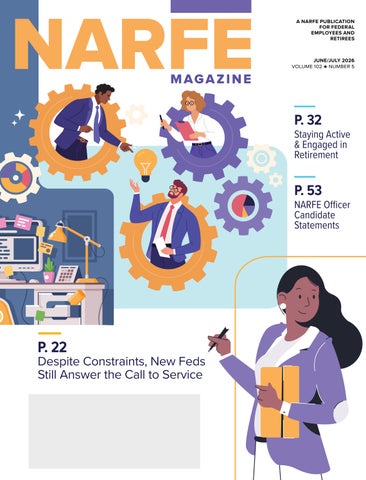
NEW FEDS DESPITE CONSTRAINTS,
STILL ANSWER THE CALL TO SERVICE
BY DAVID TOBENKIN
For past generations, a call to federal service has often included a particular desire to fulfill a mission. For many relatively new and younger federal employees, despite a challenging civil service environment, that continues.
Jaden Chambers, 25, works at NASA’s Swamp Works development branch at the Kennedy Space Center, in Florida, where he is working on research and development projects that may be used on the International Space Station or the lunar surface following NASA’s Artemis mission in April, which returned U.S. astronauts to the moon and establish a permanent base there.
“We’re basically preparing for construction on the moon, building shelters, roads, landing pads, sidewalks, and other components that will contribute to developing a habitat for a sustained human presence,” says Chambers, a robotics and automation engineer who joined NASA full-time in 2023. “My primary focus has been additive construction and polymer processing, specifically 3D printing using the resources on the moon.”
As for many federal employees, 2025 was not an easy one for Chambers and his colleagues.
“So it was a tough year,” Chambers says. “That’s when the deferred resignation forms were coming out, and the way it was worded to us was basically, you can either sign these forms or you’re going to risk getting fired anyways. So a lot of people were signing out of stress. And a lot of people were
telling me to really consider signing that form. But I didn’t sign it because I wanted to see what would happen and hold on to the job as long as I could.”
And he plans to continue at NASA.
“Long term, I do feel like I’d most likely want to stay with NASA as long as I can,” Chambers says. “It’s a very comfortable, very flexible job, not overly stressful, believe it or not. You come in, you do good work, and you leave.”
The federal civil service retirement wave that many had been predicting seems well underway, with record separations of older federal employees continuing through early 2026 after last year’s deferred resignation program. However, the Trump administration has increasingly realized that in some areas at many agencies it needs more, rather than fewer, federal employees. This article examines
The Trump Administration’s return-to-office mandate, which, for some FDA employees, was later walked back to 50% of time in office instead of five days a week, is a challenge, given his wife’s full-time job and the care needs of their children. They have a 2-year-old and an older child with special needs. John now sometimes rents a hotel room in Silver Spring at his own expense to avoid the commute and, on some days, carpool to reduce the wear and tear on his mind and body.
who is answering the call and what they and the federal agencies they are joining hope to gain from their federal service.
A Sense of Stability and Challenging Work
Feds who have joined the civil service relatively recently cite a variety of motivations.
John (whose name has been changed in the story at his request), 35, formerly an associate professor at a pharmacy school, joined the U.S. Food and Drug Administration (FDA) in August 2024 as a safety evaluator in Silver Spring, Md. evaluating drugs for adverse events.
John says he made the switch after feeling fatigue in academia and to have the opportunity “to give back to people in some form.”
In addition, the pay, while likely not as high as he could have commanded as a pharmacist at a retail pharmacy chains like a Walgreens or CVS,
is superior to pay as an associate professor. A collegiate environment and good work life balance were also motivations. John thought he had found the latter given the position initially allowed four days per week of telework, which eased the frequency of the 90-minute minimum commute between his home and Silver Spring.
But the Trump administration’s return-to-office mandate, which for some FDA employees was later walked back to 50% of time in office rather than five days a week, is a challenge, given his wife’s full-time job and the care needs of their children, a two-yearold and an older child with special needs, John says. He now sometimes rents a hotel room in Silver Spring at his own expense to avoid the commute and carpools some days to reduce the wear-and-tear on his mind and body.
A few years further into federal service is Alex Hardee, 37, soon to enter his fourth year of federal service as a trial attorney in the Environment and
“It was a tough year. That’s when the deferred resignation forms were coming out, and the way it was worded to us was basically, ‘You can either sign these forms, or you’re going to risk getting fired anyway.’ So a lot of people were signing out of stress. And a lot of people were telling me to really consider signing that form. But I didn’t sign it because I wanted to see what would happen and hold on to the job as long as I could.”
Jaden Chambers, NASA employee who works at the Swamp Works development branch at the Kennedy Space Center in Florida.
People younger than 35 made up 18% of the federal workforce at the end of 2024, but that figure had slipped to 16.8% by the end of 2025,” the study states. “And workers with less than two years of experience–most of whom would still have been on probation and without full civil service protections–fell from 16.2% of the federal workforce to 10.3%. – a January 2026 Pew Research Center analysis of Office of Personnel Management (OPM) data
Natural Resources Division of the U.S. Department of Justice (DOJ) and, earlier, at the Environmental Protection Agency. He joined DOJ after positions at two non-profit environmental non-governmental organizations, which he said were rewarding but professionally limiting. Hardee, who boasts stellar academic credentials including a top-tier law school, U.C. Berkeley, and a prestigious clerkship with a federal circuit court of appeals judge, says he enjoys his job’s mixture of regulatory enforcement and defense work, which he says allows him to gain more litigation experience than at his previous non-profit posts, largely defending government environmental policies and practicing in courts throughout the country.
Hardee, single, says the tumult of the past year has not greatly affected his job satisfaction. While he sometimes puts in long hours preparing for trial or writing briefs, he estimates the workload is less than the round-the-clock expectations for junior attorneys at law firms vying for partnership status in the often up-or-out world of private sector law practice.
By The Numbers
A relatively smaller number of new and young employees like Chambers, John, and Hardee have been entering and are remaining in federal service. The Trump administration’s 2025 federal workforce reduction initiatives disproportionately affected younger and less experienced federal workers, found a January 2026 Pew Research Center analysis of Office of Personnel Management (OPM) data: “People younger than 35 made up 18% of the federal workforce at the end of 2024, but that figure had slipped to 16.8% by the end of 2025,” the study found. “And workers with less than two years of experience–most of whom would still have been on probation and without full civil service protections–fell from 16.2% of the federal workforce to 10.3%.”
Among newer employees, many probationary employees were let go by agencies under directives by the Office of Management and Budget (OMB) and the OPM in 2025, though some were later reinstated. “There were a lot of very experienced folks who had come in from the private sector and were probationary, and they had come in to do work at [the National Institutes of Health] on something really impactful. And they were removed,” says
Jenny Mattingley, vice president for government affairs at the Partnership for Public Service. OPM has subsequently directed federal agencies to give a hard look at the performance of probationary employees and their personnel needs before converting them to permanent status. Meanwhile, the impending conversion of many federal employees to Schedule Policy/Career, a classification that greatly reduces procedural protections against adverse actions; changes to reduction in force rules; and OPM directives to agencies to reduce the performance ratings of federal employees appear to point to less job security and more competition for advancement in positions, which may be particularly significant for those with many years ahead in their careers.
What the Administration Seeks
In early 2026, after a 2025 general federal hiring freeze, the Trump administration began to allow federal agencies to hire additional federal employees, beyond some agencies exempted from the freeze. Around the same time, it began messaging the urgency of addressing a shortfall of early career employees.
“We’ve got about 7% of the workforce in federal that is basically early career—let’s call that less than 10 years work experience,” said OPM Director Scott Kupor in a December 25 taped interview with Fed Gov Today. “That’s well lower than what the kind of normal workforce is—it’s about 22 percent outside of the federal government. So we’ve got a real dearth of early career talent happening here. So I think there are a couple things we have to do. One is we have to tell the right narrative that is attractive to that audience of folks. And I don’t think that narrative is ‘come join the federal workforce and you have a job for the next 40 years.’ I think the narrative they care about is, ‘Can I work on great things? Do I have great managers? Can I grow my career? If I decide to go to the private sector, does the private sector value the work I’m doing?’ Those are the things that I think we need to message to that audience.”
There are also holes in the middle, says Megan McConnell, a partner at consulting firm McKinsey and author of a September 2026 study of public sector recruitment efforts, Attracting Gen Z talent into US public service. “When you have programs
I plan to stay as long as I can. I want to try to do what I can within reason, to advance environmental protection, reduce pollution, and to make sure that regulatory burdens are fair on people. It’s a great job with a great group of people, a lot of camaraderie.
— Chambers
like [the deferred resignation program] and others, they’re not targeted necessarily to retain certain specialties or functional areas that are critical,” McConnell says. “So a lot of the conversation now is about how to reshape, rebalance, and fill in some of the expertise that we’ve lost, but also can this be an opportunity to bring in new talent that’s digitally native, fluent with AI and in all the areas that are most needed.”
Pay and Benefits
Kupor called for replacing a civil service system that rewards tenure with one based upon performance to allow high performers to advance more rapidly and be compensated more generously. On average, however, even if some federal employees receive more money, most will receive less generous benefits than federal employees of the past and salaries whose value is being rapidly eroded by inflation. Despite occasional significant bumps in salary, over the past decade annual salary adjustments have for the most part greatly trailed the rate of inflation, meaning civil service employees are, generally, losing financial ground. Thus, whether federal employees will, on average, be able to accumulate wealth in the manner of past generations remains under question.
Still, they share many of those challenges, including the impending job threat of AI, with those in private sector. Thus, a federal government job for many is still likely a relatively favorable option and in cases where the costs of a family and a house are added, that stability becomes more important.
“One is we have to tell the right narrative that is attractive to that audience of folks, and I don’t think that narrative is, ‘Come join the federal workforce, and you have a job for the next 40 years.’ I think the narrative they care about is, ‘Can I work on great things? Do I have great managers? Can I grow my career? If I decide to go to the private sector, does the private sector value the work I’m doing?’ Those are the things that I think we need to message to that audience.”
— Scott Kupor,
director of OPM, in an interview with Fed Gov Today
Recruiting New Federal Servants
McConnell says there is room for improvement in how federal agencies recruit new Feds.
To a significant degree, McKinsey’s research accords with Kupor’s messaging that federal experience must allow for more individual impact and less bureaucracy. “In our research, we have found that meaning cannot only be at an overall mission level,” McConnell says. “Employees have got to be able to find the meaning in their day-today work. If it’s too bureaucratic, if my effort feels 18 levels away from the ultimate impact, if there’s kind of death by 1,000 paper cuts, even if I truly find meaning in the overall mission, I will start to be uninspired in my day-to-day work.”
Mattingley says a large drag in the ability of agencies to attract desirable new employees is the negative branding of federal employees by the administration and many in Congress over the past two years.
Nancy Segal, a former HR executive at the U.S. Office of Thrift Supervision and founder of Solutions for the Workforce, a consultancy for those making career transitions, is helping applicants who want to become federal employees. Segal estimates that of the 30 or so candidates she speaks with in a week, 40 percent to 50 percent are seeking law enforcement positions, including those who want to join the U.S. Department of Homeland Security’s Customs and Border Protection and Immigration and Customs Enforcement (ICE) operations, two agencies that have, contrary to most, rapidly expanded in size under the Trump administration.
“They are primarily attracted by the recruiting bonuses,” Segal says. “One guy told me he wanted to use it to buy property. I have people who have never really had a career or who have had kind of low level jobs that see this as an
“A lot of the conversation now is about how to reshape, rebalance, and fill in some of the expertise that we’ve lost, but also, can this be an opportunity to bring in new talent that’s digitally native, fluent with AI and in all the areas that are most needed?”
—
Megan McConnell, a partner at consulting firm McKinsey & Company
opportunity. I talk to them to make sure they really understand the deal, right? I had a guy recently who wanted to fight drug and human trafficking—he was more thinking Homeland Security Investigations, which is part of ICE—but the non-enforcement and removal part. And I reminded him that all of ICE is being deployed for enforcement and removal, so that, if fighting trafficking was his goal, it was going to be a while before he got to that kind of work.”
While DOJ has usually had its pick of applicants with stellar credentials from leading firms and law schools, there were reports some positions, particularly those in more ideologically charged areas of the agency, have had trouble recruiting nearly the same caliber of candidates.
Pathways New and Old
While most federal agencies were barred from making full-time hires last year, some pathway programs for training and recruiting new talent survived. NASA has long relied upon its Pathways Internship Program as a major source of new hires and that continues, notes Digna Carballosa, acting deputy chief human capital officer at NASA.
NASA, like some other agencies, has since 2010 used a federal government authority that allows agencies to hire students currently enrolled in college or graduate school to gain hands- on, paid
experience working on real NASA projects as interns while completing their degrees, Carballosa notes. After students complete their degree programs and graduate, many students may be eligible to convert into full time civil service positions—which happened in the case of Chambers, who was a NASA Pathways intern from 2021 to 2023 while studying for a mechanical engineering degree from the University of Central Florida—making it a strong pipeline across the agency, with “hundreds” of interns across NASA’s 10 centers nationally in a given year.
“Many of our recruitment needs are aligned with ensuring that we have the skills to enable the Artemis mission,” Carballosa says.
“Employees
have got to be able to find the meaning in their day-to-day work. If it’s too bureaucratic, if my effort feels 18 levels away from the ultimate impact, if there’s death by 1,000 paper cuts, even if I truly find meaning in the overall mission, I will start to be uninspired in my day-today work.”
— McConnell
NASA also is one of the participants in a major new federal government-wide initiative to attract tech talent, the Tech Force, designed to provide a corps of limited-term, high-tech employees across federal government.
In March, OPM released its first two shared certificates of eligible candidates for software
engineering and data engineering positions for the review of a variety of different agencies to review and potentially hire Tech Force employees, an initiative aimed at adding about 1,000 employees for an initial cohort who would move into two-year roles to temporarily work on technology-related initiatives. Several hundred were expected to be available soon, said OPM’s Kupor at a March 5 event hosted by Federal News Network.
Mattingley agrees with Kupor that increasing numbers of federal employees will be looking for shorter-term federal employment, rather than to stay their entire career, as is the case for the private sector.
Yet while many younger federal employees may depart, some do want to stay.
DOJ’s Hardee says he would definitely consider a full career in federal service. “I plan to stay as long as I can,” Hardee says. “I want to try to do what I can within reason, to advance environmental protection, reduce pollution, and to make sure that regulatory burdens are fair on people. It’s a great job with a great group of people, a lot of camaraderie.”
John says he anticipates working in federal government for 30 years, or until it no longer fits his family’s goals. But he says that if his current level of remote work is reduced or if “things continue to be as rocky [for federal civil servants] as they have been, I would certainly have to consider other options.”
—DAVID TOBENKIN IS A FREELANCE WRITER BASED IN THE GREATER WASHINGTON, D.C. AREA.



Staying Active & Engaged in Retirement
Here’s how to get and stay connected.

BY EVERETT A. CHASEN
For many people, retirement is a time to enjoy life. It’s a new chapter filled with opportunities for personal growth and relaxation. It’s also a time to make meaningful social connections.

Despite these new opportunities, some senior citizens are lonely, disconnected from others, and isolated in their homes. It doesn’t have to be that way for most of them, however. There are ways to build and maintain the connections every senior needs for a vibrant and successful life in retirement, whether they are newly retired or have been out of the workforce for some time.
“It’s important to stay connected with your community when you’re retired because there are a lot of health benefits, both mental and physical, to doing so,” said Emily Swenson, supervisor for the Volunteer Solutions Unit of the Fairfax County, Virginia Area Agency on Aging (www.fairfaxcounty.gov/ familyservices/olderadults). “And it’s really important to foster connections for yourself as you age, so you continue to stay active and engaged in things that will keep your brain thinking and your body working.”
Staying connected with others “really helps ground you, and keep you working towards living,” she continued. “And there are a lot of resources in your community that can help as you retire and age.”
A Recent Retiree’s Path
Karen Evans, who formerly worked for the U.S. Department of Transportation, is one of more than 150,000 federal employees who took the “fork in the road” deferred resignation offer in 2025.
“I left because of the uncertainty I felt about my future with the government,” she explained. “I would have stayed longer had we not been in this situation. I had done some retirement planning all along, but planned on working for another year or so.”
Evans was not too concerned about staying connected with others socially.
“The offer came on the heels of COVID, when people weren’t going into the office full time,” she said. “So, I was used to working by myself. I’ve been friends with many of the people I’ve worked with for years, and we still stay in touch.”
Her daily routine proved her biggest concern.
“When I worked (in an office), I was very organized. I was out of the house by 6:30 a.m.,” added Evans. “I laid my clothes out the night before and packed my lunch. I’d been doing that for decades, and all of a sudden, it stopped. When I retired, my routine was totally shattered, and I was sort of grabbing at straws. I hadn’t realized that retirement meant I needed to reintroduce and replace the things that kept me functional.”
To create a new routine, she’s developed a regular exercise schedule, taking classes at a nearby fitness center. Evans studies music theory at a local community college, attending lectures twice a week. And she puts more time into volunteer work, something she was already doing before she retired.
“What I don’t miss is the stress associated with work,” Evans said. “I don’t have accountability to anyone but myself now. I don’t have accountability to a boss. I do have accountability to my volunteer work, and I have to show up at class, but I’m really not accountable to anyone.”
What One County Offers
Many communities throughout the United States are focused on helping people as they age. Fairfax County has a “SHAPE the future of aging” plan, a strategy to make it a better place to age, and to help its older residents live safely, independently, and with dignity.
The county offers programs, including adult day health care, in which older adults receive daytime care and support through conversation, light exercise, and mental engagement. It also has a congregate meal program, which offers prepaid lunches to participants and guests at the county’s 14 senior centers, and presents a wide variety of technology training courses,
“When I retired, my routine was totally shattered, and I was sort of grabbing at straws. I hadn’t realized that retirement meant I needed to reintroduce and replace the things that kept me functional.”
—Karen Evans, U.S. Department of Transporation Retiree

including basic computer skills, how to use mobile devices and social media, and photography.
The senior centers help older adults pursue hobbies, fitness goals, special interests like art, music, and technology, friendships and a wide variety of other activities with their peers. Each center offers unique social, educational, and enrichment opportunities. They are hubs for making friends, learning new things, and staying engaged, with access to inclusive support services, including transportation for those with minor cognitive or physical challenges.
“They also provide a great place locally for learning about things that are important to people as they retire and are aging,” Swenson added.
While the county is among the nation’s leaders in offering community engagement programs, many other counties and cities promote social, intellectual, and creative activities for their older residents. More than 600 Area Agencies on Aging nationwide offer information, referrals, and direct assistance to help seniors under the provisions of the Older Americans Act of 1965, a law focused on the social services needs of older adults living in the community. Find one in your area at www.eldercare.acl.gov,
or call the U.S. Department of Health and Human Services’ Administration for Community Living at 1-800-677-1116.
You can also research your county or city’s Department of Aging or Human Services online, in libraries, or elsewhere, and look for local initiatives they may be taking under the Act or on their own initiative.
How to Build Community On Your Own
There are many ways to stay socially active after retirement without relying on government services. The key is to seek out activities and relationships that keep you engaged with others. Not only will doing so protect your mental health, but it will also help you enjoy your retirement in ways you might not have envisaged when you turned in your paperwork.
One way to stay engaged is to pay attention to your physical fitness. Working out helps maintain your independence and improves your outlook on life. It prevents chronic diseases by strengthening your bones and muscles; improves your balance to reduce falls; boosts brain function; and lowers your


Are you missing the friends you used to work with every day in the office? Find a local NARFE chapter convenient to you! Are you looking for a way to get involved with local feds in your community?
!
Visit www.narfe.org/chapters to find the chapter that’s right for you, and then call us between 8 a.m.-5 p.m. ET at 800-456-8410. Then dial 1 for membership and we’ll get you signed up right away.



Hobbies can wake up your brain, lower stress levels, and boost your overall wellness.
risk for heart disease, stroke, diabetes, and some cancers. Group activities like yoga, aerobics classes, and walking with others encourage your commitment to keeping fit, and give you something to look forward to.
Physical exercise keeps your body strong and your mind sharp, and group exercise can turn working out into a fun social activity—which, of course, motivates you to do more. John Miller, an Air Force and National Oceanic and Atmospheric Administration (NOAA) retiree, swims regularly at a fitness center pool near his home.
“There’s a senior table there, where there’s coffee available and other little snacks, so all the senior members of the center can come and sit and talk,” he said.
“I usually come in, I swim, and then I go back and sit for a while. Many other people show up, and there’s always some kind of interesting discussion going on, so it’s a very social thing. Everybody’s done playing or swimming or exercising, and we have a get-together.”
Lately, Miller has begun interviewing staff for the fitness center’s newsletter.
“I try to give other members a little background on the people who work there,” he added. “One of the ladies I interviewed is a country music singer, of all things. She’s put out several CD’s. It’s been a very, very good deal.”
Finding more time for old hobbies, or developing new ones, is another way to stay connected with others and improve your quality of life. Hobbies can wake up your brain, lower stress levels, and boost your overall wellness. Group hobbies, from book clubs to gardening groups, naturally create bonds between people who discover common interests and viewpoints.
The challenges most hobbyists encounter in pursuing their interests help maintain the problem-solving skills they’ve developed through a lifetime in the workforce. The focused attention that’s required maintains and improves concentration, and participating in a hobby group helps develop and expand communication skills.
When I retired from the government, I began piano lessons as a hobby to learn a skill I’d always wanted to master. I now attend concerts with a deeper appreciation and understanding of the skill musicians display—and my own practice helps maintain my muscle dexterity and concentration skills.
I also purchased a 1955 Chrysler New Yorker, and not only work to keep it running well, but also take part in automobile shows in which my skills in restoring and maintaining the car are judged against those of others. I enjoy talking with people about the auto, both at shows and on weekly trips to the local farmer’s market and elsewhere. This helps increase my own involvement with my community and its residents.
My wife Barbara is a knitter and crocheter who formerly edited magazines on the subject. She not only knits for our family and friends but also participates in “charity knits” for hospitals and community groups. She participates in meetups at yarn stores where attendees help each other with knotty problems, work on projects, and socialize.
There are virtual meetups called knitalongs online, along with websites where you can celebrate completed projects, cheer on other makers, and build new friendships. And, of course, knitting clubs meet in homes, community centers, and libraries. If you can’t find one nearby, why not start your own?
Working and Volunteering
Working part-time is another option to stay connected. The additional income that comes with being employed can help boost savings and increase your financial and physical well-being. It’s another way to create social connections,
keep your mind and body in good shape, and provide a renewed sense of purpose to your life. You can do consulting and freelance work if you have specialized skills; work in retail or customer service positions that often offer flexible hours; be a tutor or mentor; or find other kinds of remote or online work.
Some organizations offer job fairs and skills training programs for people 50 and better looking for full or part-time employment. In the Washington, DC area, the Jewish Council for the Aging (JCA) offers a career gateway program to help seniors with resume writing, using LinkedIn and other social media sites in their job search, and interview techniques. JCA also holds Employment Expos to link employers with older job seekers and holds seminars to inform attendees about current hiring trends and practices.
Finally, build connections by sharing your lifetime of experience through volunteering.
“There’s a plethora of volunteer service opportunities that engage people’s skills,” said Swenson. “You could have done something in your career with the federal government that you can use to help support your local community.”
Even if you don’t want to use those skills anymore, “we have folks who help provide grocery shopping services, transportation to medical appointments, running errands, and social visiting (visits to others to provide company to help brighten up that person’s day and combat their loneliness and isolation).”
“Sometimes, there are barriers people feel keep them from volunteering,” Swenson added. “I would encourage people to try to do so, however. It’s well worth your time and energy, and it gets you out of your own head and your

“There’s
a plethora of volunteer service opportunities that engage people’s skills. You could have done something in your career with the federal government that you can use to help support your local community.”
—Emily Swenson, Supervisor for Volunteer Solutions

own situation. It gives you some perspective you don’t necessarily get if you’re just staying in your house and not interacting with others.”
Some volunteers at senior and active adult centers provide IT support to the centers and to individuals.
“This keeps them fresh and learning and connecting with others,” she said. “It also helps to support others’ needs related to learning and using technology.”
AmeriCorps, the U.S. Government agency for national service, manages a nationwide program called RSVP (Retired and Senior Volunteer Program), which focuses on making public service a central part of the American experience. RSVP connects volunteers age 55 or better to non-profit organizations across the community.
Fairfax County works with a local newspaper group to put on an annual volunteer fair for seniors called “venture into volunteering.”
At the fairs, “we have more than 40 nonprofit organizations and public agencies looking for volunteers,” Swenson added.
Local businesses also attend, offering information on housing options, home remodeling, financial
planning, insurance, health care, senior resources, and other activities. In addition, free health screenings and vaccines are available, including those for COVID-19 and the flu.
“We’re really proud of our volunteer program, and we’re always looking for new people to come and help and support others,” Swenson said.
Final Advice
Wherever you live, Swenson says, “oftentimes, there are older adult newsletters, websites, or publications that have information about clubs and things that are going on in the community. They create events that engage people and connect them together.”
To build a greater connection to your community, “just be curious and try new things,” she adds. “Be open to trying something new. You might find you like something, or you don’t like something, and that knowledge could help you to try the next new thing. Experience the world through the different lens you’re now looking through. It will help you create a path as you move forward into this new stage of your life.”
—EVERETT
A. (EV) CHASEN, IS
A WRITER AND COMMUNICATIONS CONSULTANT IN THE WASHINGTON, DC, AREA. HE IS RETIRED FROM THE FEDERAL GOVERNMENT AFTER 35 YEARS OF SERVICE.
to NARFE programs Donate
Donate to NARFE
MAKE CHECK PAYABLE TO: NARFE
PLEASE MAIL COUPON AND CHECK TO:
NARFE / 606 N. Washington St. / Alexandria, VA 22314 or donate online at www.narfe.org/ donate
With NARFE’s thanks, you will receive a NARFE Photo Calendar
NARFE safeguards the earned pay and benefits of America’s five million federal workers, retirees, their spouses, and survivors. NARFE is YOUR legislative voice and tireless advocate.
NARFE contributions are NOT tax-deductible.
Enclosed is my NARFE Contribution: $ __________________ All donations go to the NARFE General Fund to support NARFE Programs and operations.
Name:
Address:
Credit Card Information: q M/C q VISA q Discover q AMEX
Card Number:
Expiration Date: (mm)/ (yy) Security Code:
Signature: Date: / /
Name: (please print)
Support Alzheimer’s Research
NARFE members contributed for Alzheimer’s research: $17 Million Fund $17,030,039.54
*Total as of March 31, 2026. All contributions go directly to Alzheimer’s research, with the exception of funds given to the Walk to End Alzheimer’s or The Longest Day.
If you have any questions, write to:
National Committee Chair
Olivia Williams PO Box 2175 Columbia, SC 29202
OR E MAIL: oeashf3@gmail.com
MAKE CHECK PAYABLE TO:
NARFE-Alzheimer’s Research (w rite your chapter number on memo line)
PLEASE MAIL COUPON AND CHECK TO:
Alzheimer’s A ssociation 225 N. Michigan Ave., 17th Floor Chicago, I L 60 601-7633
Your charitable contribution is tax-deductible to the fullest extent allowed by law.
Enclosed is my NARFE-Alzheimer’s contribution: $ Every cent that is contributed is used for research.
Name:
Address:
City:
State: ZIP:
Chapter number:
Credit Card Information: q M/C q VISA q Discover q AMEX
Card Number:
Expiration Date: (mm)/ (yy) Security Code:
Signature: Date: / /
Name: (please print)
The NARFE-FEEA Fund supports NARFE members during disasters; provides scholarships to their children, grandchildren and great-grandchildren; and funds other programs to support NARFE members at the direction of NARFE and FEEA.
MAKE CHECK PAYABLE TO: NARFE-FEEA Fund
PLEASE MAIL COUPON AND CHECK TO: FEEA
1641 Prince St. Alexandria, VA 22314
Your charitable contribution is tax-deductible to the fullest extent allowed by law.
Enclosed is my NARFE-FEEA Fund Contribution: $ ________
Name:
Address:
City:
State: ZIP:
Email:




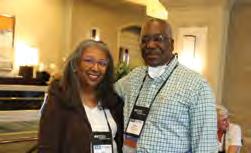
FEDCON26 BREAKOUT SESSION TRACKS
Attendees will choose from at least six options during each breakout session timeslot, with session tracks for Advocacy, Active Federal Employee, Federal Benefits, NARFE Leadership, and Lifestyle. Illustrative examples of session topics (i.e., not confirmed yet) within featured tracks are listed below:
ADVOCACY TRACK
Advocacy Update: What’s the Latest and What’s Ahead
Advocacy is Personal: How to Be A NARFE Advocate Using Your Own Story
Leading NARFE-PAC in 2026 and Beyond
NARFE LEADERSHIP TRACK
Membership Recruitment
Leadership Succession Planning
Chapter Officer 101
Federal Officer 101
Best Practices for Chapter/Federation Communication
Understanding the AMS and Zoom platforms as a Chapter/Federation Officer
FEDERAL BENEFITS TRACK
Federal Retirement Bootcamp
Getting Your Affairs in Order: Estate Planning for Feds
Roth Conversions
Medicare and FEHB/PSHB
ACTIVE FEDERAL EMPLOYEE TRACK
Career Management Strategy
Proactive Leadership and Prioritizing What’s Important
Workplace Rights and Protections
LIFESTYLE TRACK
How to Declutter Your Life and Reduce Stress
Managing Medicine and Chronic Disease with Nutrition and Exercise
Meditation and Yoga
Learning the 7 Pillars of Wellness



Book your hotel by July 29 in order to take advantage of NARFE’s special group rate of $179 per night.


MWhy ETFs Are the Better Choice for Taxable Investment Accounts
utual funds are a popular vehicle for investing in capital markets, but they may not be the best choice for taxable accounts. The reason comes down to capital gain distributions — one of the more overlooked drags on after-tax returns, and one that investors have more control over than they might realize.
Mutual funds are required by law to distribute most of the income they generate each year, including capital gains realized when the fund sells investments at a profit. When those gains are distributed, shareholders must report and pay tax on them in the year received—regardless of whether they sold a single mutual fund share.
There are two primary reasons these distributions occur. The first is normal portfolio activity, often referred to as turnover. As a fund manager buys and sells securities, those trades can generate realized gains that must be passed through to shareholders.
The second, and oftenoverlooked, driver is investor redemptions. When other investors sell shares of a mutual fund, the fund manager may need to sell underlying investments to raise cash. When those sales result in a net gain, the fund must distribute the gains to the remaining shareholders. In fact, the investors who triggered the sale are often no longer there to receive the distribution, effectively passing the tax bill to those who remain.
Many investors mistakenly believe that reinvesting the distributions to purchase additional shares increases the value of their holding. However,
when a capital gain distribution occurs, the fund’s price drops by the amount of the distribution, so even though their share balance increases, the value doesn’t, and the distribution must still be reported as income at tax time. In other words, when mutual funds are held in a taxable account, capital gain distributions are a pure tax drag, not a value enhancer.
When investing outside of a retirement plan, tax-efficient vehicles are key, but not all funds are created equal. Actively managed mutual funds tend to have higher turnover, as managers continually buy and sell securities, leading to more realized gains and distributions.
Index funds, which are designed to track a benchmark rather than outperform it, have lower turnover and are generally more tax-efficient than actively managed funds. While lower turnover tends to lead to fewer capital gain distributions, it doesn’t necessarily eliminate them. Even index mutual funds may realize and distribute gains, particularly during periods of investor outflows or when holdings must be adjusted.
Exchange-traded funds, or ETFs, have structural differences that typically make them more tax-efficient than a comparable mutual fund. The first difference
is how investors buy and sell. Mutual funds are bought and sold directly with the mutual fund company, while ETF shares are traded on an exchange like individual stocks. When one investor sells, another buys, so the fund doesn’t need to sell any underlying holdings to raise cash.
There are also times when large blocks of ETF shares need to be created or redeemed to manage supply. In this case, financial institutions known as Authorized Participants exchange ETF shares for a basket of securities “in kind” rather than cash. Unlike selling holdings, in-kind exchanges are not taxable events.
For federal retirees investing in taxable accounts, the structural differences are not trivial. Over time, as mutual funds grow in value, so do the capital gain distributions—creating a tax drag that compounds year after year. The additional income from capital gain distributions can increase the taxation of Social Security benefits, trigger or increase Medicare income-related monthly adjustment amount (IRMAA) surcharges, and reduce certain deductions that phase out at higher income levels.
This doesn’t mean mutual funds are inherently bad, or that ETFs are always the right choice in every situation. In fact, mutual funds can work just fine in retirement accounts such as traditional IRAs and Roth IRAs. If a mutual fund is your preferred investment, those accounts are often the best place to hold it. But in taxable accounts, ETFs are often the more tax-efficient choice.
BENEFITS RESOURCES
NARFE OFFERS MEMBERS a wide range of information on federal benefits. Visit www.narfe.org/federal-benefits-institute
One simple step for those who already own mutual funds in taxable accounts is to stop reinvesting capital gain distributions and dividends and redirect them into more tax-efficient ETFs. Beyond that, look for funds with little or no unrealized gain that can be sold and repositioned with minimal tax impact. Market downturns can present opportunities to exit positions when gains are smaller, or to realize losses that can offset gains elsewhere.
In some cases, particularly with funds that consistently generate large capital gain distributions, it may even make sense to recognize the gain today to avoid ongoing tax drag. While that decision requires careful evaluation, it can be beneficial over time if it reduces repeated, uncontrolled taxable income.
quietly erodes after-tax returns year after year.
When investing outside of a retirement account, the vehicles you choose matter as much as what you invest in. Selecting tax-efficient investments—and being intentional about what you hold in taxable accounts—is one of the most straightforward ways to keep more of what your portfolio earns.
MARK A. KEEN, CFP®, PARTNER, KEEN & POCOCK. SECURITIES OFFERED THROUGH THE STRATEGIC FINANCIAL ALLIANCE, INC. (SFA), MEMBER FINRA/SIPC. ADVISORY SERVICES OFFERED THROUGH STRATEGIC BLUEPRINT, LLC AND THE STRATEGIC FINANCIAL ALLIANCE, INC. MARK KEEN IS A REGISTERED PRINCIPAL OF SFA AND AN INVESTMENT ADVISOR REPRESENTATIVE OF SFA AND STRATEGIC BLUEPRINT, LLC. SFA AND STRATEGIC BLUEPRINT ARE AFFILIATED THROUGH COMMON OWNERSHIP BUT OTHERWISE UNAFFILIATED WITH KEEN & POCOCK. NEITHER STRATEGIC BLUEPRINT NOR SFA PROVIDE TAX OR LEGAL ADVICE.





JOver 7 Million Americans Live with Alzheimer’s
une is Alzheimer’s and Brain Awareness Month, a global health campaign held every June for at least the last five decades. It commemorates the awareness of Alzheimer’s and other brain diseases.
In June, we are also highlighting the importance of early diagnosis and its impact on the families of those affected by this disease. In addition to this information, it aims to urge local authorities, along with many private organizations, to donate funds to support further research and care for Alzheimer’s and Brain Health Disease.
You see globally, the prevalence of dementia, which is estimated to increase four-fold from its current global prevalence of 24 million by 2050. However, after age 65, the incidence of Alzheimer’s disease appears to double every five years. The incidence rates appear to increase dramatically with age, rising from under 1% annually before age 65 to over 6% annually after age 85.
Also, studies show that Alzheimer’s disease appears to be more common among women than men, especially for those aged 85 and older.
Alzheimer’s is a neurodegenerative disorder that generally affects people at the age of 65 and over, which also impacts cognitive processes such as attention, language, memory, judgment and reasoning. It is also the common type of dementia, contributing to at least two-thirds, making it the most prevalent form of disease. Alzheimer’s disease symptoms appear to vary with the disease progression.
Alzheimer’s and Brain Awareness Month also aims to urge local authorities and private organizations to donate funds to support further research and care.
Alzheimer’s and dementia stages are the three distinct types of Alzheimer’s disease, classified based on the presence of a degree of cognitive impairment. Most patients present with initial symptoms of episodic short-term memory loss, with relative sparing of long-term memory.
The month of June also highlights the importance of early diagnosis and its impact on the families of people affected. Also, it aims to urge local authorities and private organizations to donate funds to support further research and care.
This evidence suggests that adopting healthy lifestyle choices can help people lower their risk of cognitive decline. Therefore, here are a few of those conditions listed below, and there may be many more that are not listed:
• Regular cardiovascular exercise
• Reading books
• Having enough sleep
• Staying socially connected
• Consuming a balanced diet
• Playing strategic games
• Having enough sleep
• Abstinence from smoking and driving safely
There are four leading causes of neurological Disability-Adjusted Life Years (DALYs): Stroke (42.2%),
migraine (16.3%), Alzheimer’s and other dementias (10.4%), and meningitis (7.9%).
When we look at the importance of Alzheimer’s & Brain Awareness Month, we see that there are many things we can do to make families, friends, churches, and businesses more aware of this disease and how they can help. Let’s remember that caregivers need our help as well, and maybe if each one can reach one, this would be a great help.
NARFE members are encouraged to stay healthy by eating right, exercising, and getting enough sleep. Special thanks for your continued support for Alzheimer’s disease and one day a cure will be found, along with the first survivor. Also, with the U.S. Food and Drug Administration’s (FDA) accelerated approval of the new drug Lecanemab (Leqembi) for the treatment of patients with mild cognitive impairment, we are even more grateful and hopeful.
We encourage NARFE members to reach out to their legislative and congressional leaders to ask them to share this article on Alzheimer’s with friends and family, and to encourage others to do the same.
Thank you for your continued financial support of the NARFE Alzheimer’s research program. For more information about Alzheimer’s disease and Dementia, please get in touch with the Alzheimer’s Association at www.alz.org or call the 24-hour helpline at 800-272-3900.
OLIVIA A. WILLIAMS IS CHAIR OF THE NARFE-ALZHEIMER’S NATIONAL COMMITTEE. EMAIL: OEASHF3@GMAIL.COM. THIS COLUMN APPEARS QUARTERLY.
What is dues withholding?
NARFE’s Dues Withholding Program
It is a dues-payment method available to retired NARFE members, their spouses and annuitant survivors giving them the option to have their annual NARFE membership dues deducted from their annuities each month.
Advantages
• Save more than 10% off your annual NARFE dues
• Sign up your spouse and double your savings
• You’ll never get another dues reminder from us
• Your monthly payment is affordable and convenient
• You may cancel your dues withholding at any time
How does it work?
One-twelfth of your total dues is automatically deducted from your monthly annuity. Your monthly deduction is determined by the following formula: ($42 NARFE dues ÷ 12) + (Chapter dues - if applicable ÷ 12) = total monthly deduction
How do I sign up?
Complete the Dues Withholding Application below. Send no payment. It may take 60 to 90 days before auto-deduction starts. Your membership starts as soon as your application is received. To learn more about dues withholding, call 800-456-8410
NARFE Dues Withholding Application for NARFE Members who are Retirees, Spouses of Retirees or Annuitant Survivors
STOP! Complete this section ONLY if you are signing up for Dues Withholding. If so, DO NOT send payment
o YES. I want to enroll in NARFE’s Dues Withholding Program. NARFE dues of $42* and chapter dues, if applicable, to be withheld annually. (*Dues-withholding members save more than 10% off the regular NARFE dues rate.)
Social Security Number (9-digit number)
o Mr. o Mrs. o Miss o Ms.
Full Name
Street Address
Apt./Unit
City
State ___________ ZIP
Phone (__________)
Date of Birth _________ /_________ /
Civil Service Annuity Number
(Include prefix, CSA or CSF) (Include any applicable suffix)
NARFE MEMBERSHIP INFORMATION
NARFE Membership ID
NARFE Chapter Number
o YES. I also authorize my (NARFE member) spouse’s dues to be withheld from my annuity. (Additional annual dues of $42 and chapter dues, if applicable, to be withheld annually. If YES, enter spouse’s information below.)
Spouse’s Name
Spouse’s Membership ID
Spouse’s Email
AUTHORIZATION (Withholding will begin in 60-90 days). Send NO PAYMENT with Dues Withholding Application!
I authorize the United States Office of Personnel Management to make appropriate deductions from my annuity payments, not to exceed the amount certified by the National Active and Retired Federal Employees Association as the amount of dues for which I am annually obligated, in accordance with elections I made above, and to pay the deducted sum to the National Active and Retired Federal Employees Association (NARFE). This authorization shall also apply to any and all dues changes certified by NARFE membership in accordance with elections I made. Please allow 60-90 days for processing.
I understand that this authorization shall be valid until NARFE receives and processes my written notice of cancellation in accordance with its agreement with the Office of Personnel Management and that any disputes regarding this authorization shall be a matter between NARFE and myself. I hold the Office of Personnel Management harmless for any erroneous allotment deduction made pursuant to this authorization.
Signature of Annuitant
or Survivor-Annuitant
Date
Dues payments and gifts or contributions to NARFE are not deductible as charitable contributions for federal income tax purposes.
this form

Matching Funds Available For Chapter and Federation Recruitment Efforts!
NARFE’s National Executive Board (NEB) has voted to provide additional money for matching funds reimbursement for 2025-2026! $100,000 has been set aside for general matching funds reimbursement and $100,000 has been set aside specifically for digital marketing efforts with Street Level Studio with a lot of money still available.
Matching Funds can be used to reimburse up to 50% of recruitment expenses for activities such as increasing brand exposure of NARFE through advertising, exhibiting at a federal conference, or recruitment activities, including an open house for prospects planned by some federations. The amount of money available
depends on the number of other requests received and the time when the request comes in, as funds remain available.
Expenses available for reimbursement include travel to or sponsorship of events where federal employees will be; advertising opportunities promoting NARFE, including billboards, print or digital
FEDERATION CONFERENCES AND MEETINGS
ads; or open house expenses that will increase awareness among the active federal community, and more! Email membership@narfe.org with any questions you may have about this program. And, check with your federation as they may have additional matching funds available too. Submit your matching funds application today by visiting “Member Quick Links,” then “Membership Recruitment Materials,” then “Matching Funds Guidelines.” Funds are reimbursed once they have paid for the event
—BY NORA MACDONALD, SENIOR DIRECTOR, MEMBER ENGAGEMENT
GEORGIA FEDERATION ANNUAL MEETING: June 16. Virtual. Contact rvitaris@me.com for more information.
COLORADO FEDERATION BOARD MEETING: June 26, Winsor Gardens, Denver, CO, For more information go to http://www.narfe-colorado.com.
CALIFORNIA GENERAL MEETING: September 15. More information to come.
IOWA FEDERATION CONFERENCE: September 22-23, Meskwaki Hotel and Convention Center, 1504 305th St, Tama IA 52339, Contact: Harry Healey Irish13155@yahoo.com
REGION IX SYMPOSIUM: ALASKA, IDAHO, MONTANA, OREGON, AND WASHINGTON: Oct. 1-3, Ellensburg, WA For more information go to www.narfe.org/region09/
WASHINGTON FEDERATION CONFERENCE: October 1. Ellensburg, WA. More information to come.
CONNECTICUT FEDERATION CONFERENCE: October 14, Wallingford, CT. More information to come.
HAWAII FEDERATION CONFERENCE: October 14, Honolulu, HI. More information to come.
ILLINOIS FEDERATION CONFERENCE: October 21. More information to come.
Digital and Marketing Coordinator Joins NARFE
Jay Silver has joined NARFE as a digital and marketing coordinator, working with the communications team to create effective content that helps support our members.
Before joining NARFE, Jay worked in various communications-related fields where he developed content, both written and digital, for a variety of audiences. He served as a Marketing Content Specialist with the Academy of Managed Care Pharmacy (AMCP), worked on Capitol Hill transcribing Congressional hearings as an editor with FedNet, assisted members as an editorial assistant with the Association of Governing Boards of Universities and Colleges (AGB), and covered news
events across the country as a reporter for Business Insider and Medill News Service.
Jay is originally from West Haven, Connecticut, and moved to the D.C., Maryland, and Virginia area after college. He graduated from Marist College (now University) in 2020 with a Bachelor’s Degree in Political Science and Journalism. He then earned his Master’s Degree from Northwestern University’s Medill School of Journalism in 2021. During his academic year, he also completed programs in the D.C. Area and in Florence, Italy.
When he is not working, Jay is an avid fan of music and theatre. He sings with the Choral Arts Society of Washington, judges trading card game tournaments



across the country, interviews professional video game players and builds LEGO sets of all sizes.
Jay is excited to be joining NARFE and looks forward to supporting the organization’s mission!
—BY MATT SANDERSON, SENIOR CONTENT MANAGER
• Prepare for the future as a family decision-maker or future beneficiary.
• Get clear guidance on federal benefits, health insurance, and long-term care planning.
• Find community and connections through local events or online through FEDHub. First-year chapter dues are free for new members.
NARFE Questions USPS Decision to Suspend FERS Employer Contributions
In response to the United States Postal Service’s (USPS) decision to suspend its employer contributions to the Civil Service Retirement and Disability Fund (CSRDF) for the defined benefit portion of the Federal Employees Retirement System (FERS), effective April 10, 2026, NARFE National President William Shackelford issued the following statement:
“The U.S. Postal Service’s decision to suspend its contributions toward employee retirements is legally questionable—at best, detrimental to the future retirement security of its employees, premature given USPS does not face imminent insolvency, and only serves to delay when Congress must craft a solution to maintain USPS operations due to its financial situation.”
NARFE: OPM Must Identify How It Will Protect Privacy of Federal Employee and Retiree Health Data
In response to the Office of Personnel Management’s (OPM) notice that it intends to collect data from Federal Employee Health Benefit (FEHB) and Postal Service Health Benefit (PSHB) programs on service use and cost, including medical and pharmacy claims and provider data, NARFE National President William Shackelford issued the following statement:
“OPM’s notice to collect health care data of FEHB and PSHB participants fails to explain

adequately why OPM needs the data, how it will use it, how it will secure it, and what safeguards will be in place to protect the privacy of federal employees and retirees. OPM may have legitimate reasons to obtain and analyze the data to reduce costs and help improve health outcomes, but they have not articulated them.” To read the full media statements, visit https://www.narfe.org/blog/ category/news/.
—BY MATT SANDERSON, SENIOR CONTENT MANAGER
NARFE ATTENDS FEDERAL MANAGERS ASSOCIATION LUNCHEON
Thank you to the Federal Managers Association (FMA) for having NARFE as a sponsor at your convention on Tuesday, March 24, as part of your 88th National Convention and Management Training Seminar! NARFE National President William Shackelford gave remarks, and also caught up with Greg Stanford, FMA government and public affairs director, and Linda Lentjes, former FMA national treasurer and now newly elected incoming FMA national president.
NARFE NETWORKS AT AGA SUMMIT
Thank you to the Association for Government Accountability for having NARFE as a sponsor, helping make the Technology and Transformation Summit on March 17 a success.
Nora MacDonald, NARFE senior director of member engagement (pictured right), and Angela Gallman, NARFE member engagement coordinator, (pictured left) attended to run our booth and had a great time meeting folks! NARFE’s involvement as first time sponsors helped bring together 100+ government leaders and industry experts to accelerate mission delivery through IT innovation, workforce development and cybersecurity in partnership to drive real-world impact across government.
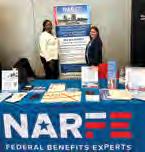
Active and Retired Federal Employees–
Join NARFE (or Renew) Today!
The only organization dedicated solely to protecting and preserving the benefits of all federal workers and retirees, NARFE informs you of any developments and proposals that affect your compensation, retirement and health benefits, AND provides clear answers to your questions.
Who Should Join NARFE?
If your future security is tied to federal retirement benefits—federal retirees, current employees, spouses and individual survivors—you should join NARFE. Membership expiring? Renew now!
NARFE MEMBER BENEFITS
• Understand benefit changes and key aspects to stay on top of with NARFE’s monthly webinars, held on a variety of topics such as Thrift Savings Plan, health insurance options and long term care insurance updates
• Direct access to Federal Benefits Institute experts who can answer your most pressing questions and help you get answers you need from OPM
• Topical and robust articles on new legislation, and topics like car buying tips and finding your path in retirement, and the ever popular Q&A section addressing your most burning benefit questions in NARFE Magazine
• Support from your peers with access to FEDHub, the only national online community for the federal community, and local chapters, where you can meet feds in a neighborhood near you
• Weekly news roundup email called Newsline, with helpful tips and updates from NARFE on the work we are doing to support you
• Discounts on popular national brands with NARFE Perks
• Powerful advocacy and alerts to take action on important legislation pending in Congress and our advocacy team that protects your benefits every day!
NARFE MEMBERSHIP APPLICATION
o I want to join NARFE for the low annual dues of $48
o Mr. o Mrs. o Miss o Ms.
Full Name
Retirement date (or expected)
I am a (check all that apply)
o Active Federal Employee o Active Federal Employee Spouse
o Annuitant o Annuitant Spouse o Survivor Annuitant
o Please enroll my spouse
Spouse’s Full Name
Spouse’s Email
LOOKING TO
MEET
OTHERS in the federal community? Go to www.narfe.org/chapters to find a chapter near you.
Are you a new member who wants to receive a FREE one-year chapter membership? Choose one: o Chapter closest to home OR o Chapter #____________
1. Complete this application and mail with your payment to NARFE Member Services / 606 N Washington St / Alexandria, VA 22314-1914.
o Renew my membership
Membership ID (ID # can be found on cover of magazine)
Verify your chapter dues amount or join a NARFE chapter today by calling 800-456-8410 x1.
To view your current renewal invoice (with chapter dues if applicable), login to narfe.org, click “Member Portal,” then “My Account” and then “My Invoices.” Simply pay online or return this form with the invoice amount.
PAYMENT OPTIONS
o Check or Money Order (Payable to NARFE)
o Charge my: o MasterCard o VISA o Discover o AMEX
Card No.
Expiration Date _______/_______ (MM/YY)
Name on Card Signature Date
TOTAL DUES
$48 annual dues x ________=_________ per person #enrolling total dues
Dues payments are not deductible as charitable contributions for federal income tax purposes.
THANK YOUR RECRUITER Did someone introduce you to NARFE? Please provide their name and member ID.
Recruiter’s Name
Recruiter’s Membership ID
Become a Silver Circle contributor today

Your contribution to the Silver Circle supports the direct work of NARFE as we continue to provide you resources and advocacy that you rely on and that member dues alone cannot support. When you donate to the Silver Circle, you are ensuring that NARFE has the resources to continue to fight for the financial security and earned benefits for you and the federal community.
NARFE appreciates all financial support you provide to us and would like to recognize you for your generous contributions to our cause.
NARFE offers members a way to give to the association’s General Fund through its donor recognition program, the Silver Circle.
Donate now to the Silver Circle at www.narfe.org/silvercircle.
With NARFE’s thanks, you will receive:
• A Silver Circle pin and recognition on NARFE.ORG with a donation of $100 or more.

• A Silver Circle pin, your name plate placed on the Silver Circle plaque at NARFE Headquarters, recognition on NARFE.ORG and recognition at the NARFE yearly conference with a donation of $1,000 or more.
To learn more about the Silver Circle donor recognition program or how to recommend an outstanding NARFE member to the Silver Circle, please visit www.narfe.org/silvercircle or email us at donatenow@narfe.org.

NARFE Silver Circle
Enclosed is my NARFE donation: $
q Mr. q Mrs. q Miss q Ms.
Name:
Address:
City:
State:
ZIP:
Member Number:

q CHECK ENCLOSED (payable to NARFE) FR-SILVERCIRCLE OR CREDIT CARD INFORMATION: q MasterCard q VISA q Discover q AMEX
Card Number:
Expiration Date: (mm)/ (yy) 3-Digit Security Code: Date:
Signature:
Name: (please print)
PLEASE MAIL COUPON AND CHECK TO: NARFE, Attn: Silver Circle, 606 N. Washington St., Alexandria, VA 22314 Donations to NARFE are not tax-deductible for federal income tax purposes.
CANDIDATE STATEMENTS
NARFE members will elect national officers and regional vice presidents. NARFE members who announced their candidacy by the deadline submitted the following statements for publication in NARFE Magazine. They have not been edited in any way. All candidate statements, including those received since March 6, are published at www.narfe.org/2026-narfe-national-election. The September issue of NARFE Magazine will include instructions for voting online or by mail.
Candidate for National President
See www.narfe.org/2026-narfe-national-election for any additional candidates.

WILLIAM “BILL” SHACKELFORD
It is with a deep sense of purpose that I come before you today to announce my candidacy for a third term as the National President of NARFE. Serving as your President since January 2023, has been a profound honor, and I am inspired by the progress we have made together during my two terms. I am eager to continue our work in advancing the interests and well-being of federal employees and retirees across the nation. I have listened to your concerns and taken appropriate action as necessary. I appreciate all members and their work for NARFE over the years. During my tenure as National President, I have been constantly reminded that together we can “secure the future” of NARFE. We must continue to work together to address the challenges that OUR organization faces. My organizational experiences within NARFE at all levels have provided me with an understanding of the need to develop a plan of action for keeping NARFE open and advocating for everyone.
With the overwhelming passage of the referendum, NARFE will be able to move towards
a more sustainable future. The change provides consistency among all National Executive Board (NEB) members’ terms, and it will allow the current NEB to focus on completing projects and assignments initiated during the present term. Projects, like the Membership Marketing Plan and Strategic Plan take longer than two years to complete or see any progress, thereby enhancing continuity and organizational effectiveness in an era of frequent uncertainties with the federal government.
As a member of the NEB since 2014, many times I have seen projects initiated by one NEB halted by a new NEB. I believe that extending the terms by one year will make a difference. It is being shown that coupled with the Membership Marketing Plan, the Strategic Plan is reversing the membership decline and welcoming a substantial number of new members into NARFE, thereby strengthening our collective voice on Capitol Hill and beyond and ensuring that NARFE continues to thrive.
I am committed to building upon our successes and driving NARFE to even greater heights. If reelected, I promise that I will continue to prioritize the key initiatives of advocacy, membership and promoting fiscal responsibility. I respectfully ask for your vote and support by re-electing me as National President. Together, let us continue our journey of progress, advocacy, and service to federal employees and retirees.
Candidate for National Secretary/Treasurer
See www.narfe.org/2026-narfe-national-election for any additional candidates.

CINDY RENEÉ BLYTHE
NARFE is confronting some big issues: protecting federal employees from damaging political actions, declining membership and getting our brand in front of potential members. As National Secretary/Treasurer, I’ve demonstrated my ability to successfully complete job requirements. It’s with a clear understanding of the road ahead that I announce my candidacy for reelection for National Secretary/Treasurer.
The political climate is challenging. Current federal employees need to understand that without NARFE their benefits are as changeable as the legislative and executive decisions that shape federal policy. Since political strategists anticipate significant shifts, NARFE’s advocacy leadership becomes even more crucial.
I built my leadership platform through multiple layers of NARFE service. My experience began as chapter president, upward to federation vice-president; then I moved to federation president, spending over 10 years gaining valuable NARFE experience. When the opportunity appeared, I successfully moved to Region V Vice President. After accomplishing 3 terms, I achieved the position of National Secretary/Treasurer.
Each progressive move in NARFE leadership has provided me with a greater understanding of how to direct the organization towards success. NARFE was once an organization that garnered respect on Capitol Hill. As membership declines, our voices weaken and we must work harder to be effective. Our potential is great but reaching that potential remains challenging.
As the current National Secretary/Treasurer, my work goes on ‘behind the scenes’. Approving Federation/Chapter bylaws, taking/transcribing NEB meeting minutes, handling audit issues, updating Incorporation documentation, updating publications, just to name a few. I chair and/or advise several committees: The Budget, Finance and Investment (BFI), Strategic Planning, and Bylaws Special Project. I fully believe that to move forward, we must invest in the organization. As the Chair of the BFI, I made proposals to invest in our membership, such as increasing the Matching Funds Program.
Leading this organization takes the daily management of priorities and continued expansion which will be my focus if elected. I rely on the relationship I have with the National President/ NEB to further move NARFE towards success. The partnership we established with Street Level Studios produced positive gains and we anticipate they will help us develop new initiatives to enhance further improvements in support of our membership.
My past leadership positions have produced results. I’d like to continue that record of success with a reelection as National Secretary/Treasurer. I am asking for your support so we can move NARFE forward together continuing the journey.
Candidates for Regional Vice President
Region I—Connecticut, Massachusetts, Maine, New Hampshire, New York, Rhode Island, Vermont
See www.narfe.org/2026-narfe-national-election for any additional candidates.
JEFF ANLIKER
I seek your support to elect me to my third term. As a NARFE member for more than 25 years, I have seen considerable change in our membership and business functions. We need to change how we do business if we are expected to reach our 125th anniversary. I have served as Chapter Treasurer, President, and PAC coordinator.

For the Massachusetts Federation, I served as the VP of Advocacy, Congressional District Leader, Senatorial Leader, and Chair of the MA CDL/SL program. My national level experience: current Member of the National Executive Board, current chair of the Strategic Planning Committee, Chair of the 2021-22 Ballot Oversight Committee; Member of the 2022 Advocacy Committee which developed NARFE’S Advocacy Psitions for 2023-24; and Member of the 2018 Advocacy Advisory Committee.
My Goals include:
• Retain Current members, Reinstate former members and Recruiting new members, particularly current employees.
• Encourage better and more effective communications between Headquarters, Federations and Chapters.
• Restructure the NARFE organization for improved efficiency.
• Increase non-dues revenue by establishing a 501(c)(3) nonprofit charitable educational organization to pursue government, foundation, CFC, and other grants and funding.
I worked for the US Department of Agriculture (USDA) Natural Resources Conservation Service (NRCS) for nearly 40 years. My work assignments were in various locations, including Washington DC with a multitude of activities including a multiyear detail to the National Association of State Departments of Agriculture. There I developed and recommended agricultural, natural resource, and environmental policy for state departments of agriculture, USDA, EPA, and Congress as it related to
resource management planning in local watershed areas. In addition, I served as the NRCS Deputy Director for the Office of Public Affairs; Staff Member of the NRCS Office of Congressional Relations; and a special assignment to Vice President Gore’s National Performance Review (NPR).
In the nonprofit arena, I was part-time Executive Director for: 1. the Federal Executive Association of Western Massachusetts (4 years) and 2. Southern New England Chapter of the Soil and Water Conservation Society (6 years).
An entrepreneur, I am the Founder, President, and CEO for Anliker Communications (2005-present) which provides management, communication, and marketing services; Anliker Financial Services LLC (2007-17) providing accounting and tax preparation services for individuals, small businesses, and nonprofit organizations with clients in more than 10 states; and Anliker Properties LLC (2011-19) to buy, improve, rent, and sell properties.
I earned a BS in Animal Science from Iowa State University in 1970.
Region II—Delaware, District of Columbia, Maryland, New Jersey, Pennsylvania
See www.narfe.org/2026-narfe-national-election for any additional candidates.

PAUL SCHWARTZ
I am proud to be your NARFE Region II Vice President and am running for a second term to continue my efforts on behalf of you. It is my mission to continue as an integral part of NARFE’s efforts to combat the systematic dismantling of our federal government and highlight the critical role of the federal workforce in serving the citizens of the United States.
We talk about increasing NARFE membership by expanding platforms to reach more potential members. NARFE’s critical role in protecting the rights and benefits of both current and retired federal employees must be highly visible in all messaging.
As your RVP II I have been relentless in interacting with members of the House of Representatives and Senate as we joined with federal unions to restore collective bargaining as well as taking our fight to the courts to restore the application of the Civil Service Reform Act of 1978 and the merit based Civil Service System of hiring and firing. We must continue our fight to protect our pensions, whether CSRS or FERS, and our health benefits under FEHB and PEHB and not let them be turned into a voucher system.
Remember, dismantling much of the federal government is not because of waste, fraud and abuse. If it were, one of the first steps of the new administration would not have been to fire the Inspectors General. No, the reason for removing so many career employees and their experience is found in Project 2025 and Schedule Policy/Career. Schedule P/C calls for replacing more than 50,000 federal employees with political appointees, making it easier for business to circumvent those bothersome rules and regulations.
So, why me? Experience. As a Fed for almost 40 years, I served as Director of Trade Enforcement for the U.S. Customs Service (let’s talk tariffs), moved to the Department of Homeland Security to
help integrate the more than 26 disparate federal agencies, and, after Katrina, I joined FEMA as Chief of Inter-Agency Coordination responsible for working with state and local governments to identify vulnerabilities before the next major event. As Maryland State Legislation Committee Chair, I built relationships with state legislators resulting in passage of the Protect Our Federal Workforce Act as well as state laws to provide tax relief for seniors and legislation to address the rising costs of pharmaceuticals. Moreover, look no further than the last two years as your RVP.
Region III—Alabama, Florida, Georgia, Mississippi, Puerto Rico, South Carolina See www.narfe.org/2026-narfe-national-election for any additional candidates.

HUELYN (LYNN) HARPER
RE-ELECT HUELYN (LYNN) HARPER AS REGION III VICE PRESIDENT
I am seeking re-election as your Region III Vice President because experienced, ethical leadership matters. Being retired and with the ability to engage in leisure activities, why do I desire to continue in a NARFE leadership role for two more years? I love NARFE and I feel that during my two terms, I have been effective! Members have been and continue to be my number one priority. When members feel their voices are being heard and that they have a stake in what is happening, they are more likely to be loyal and dedicated.
As your RVP, my focus has been clear and consistent: serving our members and strengthening NARFE. I have focused on strengthening communication, expanding training, recognizing member contributions, and supporting both chapter and national-only members.
Sometimes in life, everything goes smoothly and sometimes the unexpected happens, just like it did with all the dramatic changes to the federal workforce in early 2025. The important thing is knowing how to turn these problems into opportunities. Despite our best intentions, often efforts of the NEB, federations, or chapters do not work out as we hope. Thus, we must ask
ourselves questions such as what did I learn from this experience? What does this say about our assumptions and approach? What have we learned to do different next time?
I have been a NARFE member for over 20 years and have held leadership positions at the chapter, federation, and national levels, serving on several NARFE membership committees and the 2019-2020 and 2021-2022 NARFE Bylaws Committee. As the current Chair, Membership Advisory Committee, I helped deliver long overdue (since 2017) revisions to the Membership Renewal Forms, thus simplifying the renewal process for members. Chapter members no longer have to enter their member number; it is already annotated on the form. I also played a key role in organizing, raising funds, and executing the highly successful October 2025 Region III Training Conference – the first full in-person training conference since 2013. There was participation from every Region III federation. The conference focused on leadership development, including officer training, chapter closures, mentoring, Microsites, etc.
I believe in accountability, collaboration, and leading with integrity. If re-elected, I will continue to advocate for our members and guide Region III forward with proven leadership.
I respectfully ask for your vote.
HUELYN (LYNN) HARPER lynnlarry79@outlook.com

DON MURPHY
Thank you for considering my candidacy for Region III Vice President.
I retired from federal service on December 31, 2020, after more than 37 years of service to our nation—nine years in the U.S. Army and 28 years with the Department of Veterans Affairs. My federal career concluded as Director of Cape Canaveral National Cemetery, where I was responsible for the full range of burial, maintenance, and administrative operations. Earlier, I served as Deputy Director of Memorial Programs Service in Washington, D.C., where I helped oversee national programs including the Veterans
Headstone and Marker Program and the Presidential Memorial Certificate Program. These positions required disciplined management, accountability, and close coordination with stakeholders across the country.
I am a proud Army veteran. My military service included duty in Germany during the Cold War and later with the 101st Airborne Division during Operations Desert Shield and Desert Storm.
I joined NARFE in 2016 while still an active federal employee. Today, I serve as Treasurer and Webmaster for Chapter 2247 in Ormond Beach, Florida. Through these roles, I remain actively engaged with our members and have a clear view of the challenges and opportunities facing chapters today.
If elected, I will focus on three priorities: Member Engagement – NARFE’s long-term strength depends on maintaining an active and connected membership. When members feel informed, heard, and valued, they remain committed to the organization. Retention must remain a central focus for the National Executive Board. As Region III Vice President, I will maintain regular communication with federations and chapters to ensure concerns and ideas from the field are heard and considered.
Transparency and Communication – Members and chapter leaders deserve clear and timely information about the decisions that affect the organization. While some matters require confidentiality, much of the work of the National Executive Board can and should be shared more openly. I will support greater transparency so federations and chapters remain well informed about current initiatives, strategic planning, and organizational priorities.
Leveraging Member Expertise – NARFE members represent a remarkable pool of professional experience. This expertise should be used whenever possible to strengthen the organization. In particular, the Configuration Advisory Board can play a greater role in supporting NARFE’s technology initiatives. Making better use of member knowledge can improve outcomes while reducing unnecessary reliance on outside contractors.
Region IV—Illinois, Indiana, Michigan, Ohio, Wisconsin
See www.narfe.org/2026-narfe-national-election for any additional candidates.

EDWARD KONYS
I am Edward Konys and I am respectfully asking you to vote for me as NARFE’s Region 4 VicePresident based on my education, training, and tenure as National Executive Board member.
I bring a solid financial and management background for this position. With an undergraduate business degree, a minor in accounting, and two master’s degrees, one in business administration and another in government operation, I bring strong academic credentials. During my 36-year career with the U.S. Air Force Materiel Command, I served as deputy director of programs, responsible for preparing, presenting, and defending a multi-billion-dollar operating budget, and later as director of plans and policy, leading command-wide strategic planning. These roles broadened my fiscal management, analytical, and strategic planning skills.
I am deeply committed to ensuring NARFE’s continued existence to fulfill its mission. Since joining NARFE in 2003, I have served as Ohio Federation President (2012–2014) and as Region 4 Vice-President (2014–2018 and again beginning in 2025), giving me a deep understanding of Region 4 members’ needs and the region’s challenges. During six years on the National Executive Board, I served on the finance, budget, and investment committee, so there will be no learning curve concerning the association’s finances or how it works if elected; I will be ready to serve effectively on January 1,
I ask for your vote so I can continue to put my experience and commitment to work for NARFE as your Region 4 Vice-President.
Region V—Iowa, Kansas, Minnesota, Missouri, Nebraska, North Dakota, South Dakota
See www.narfe.org/2026-narfe-national-election for any additional candidates.

LINDA SAWVELL
I am seeking another term as NARFE Region V Vice President. I am currently in the second year of my first term for 2025/2026. I have worked hard for you, helping your Chapters and Federations by bringing specific issues/concerns to the National Executive Board and Headquarters, for resolution.
During this term, my accomplishments have been:
• I am a committee member for the Strategic Planning Team, with two other RVP’s, which is responsible for creating a 3-5 year Strategic Plan for NARFE and making recommendations to the National Executive Board on short- and long-term planning strategies.
• I am a committee member for the National Audit Committee, with two other RVP’s, which is responsible for NARFE’s audit functions and whistleblower protections. As a committee, we reviewed and discussed the annual financial audit for the year ending December 31, 2024 and it was approved by the National Executive Board in August 2025.
• Provided assistance to the Federations to ensure they stay viable now and in the future.
I joined NARFE in October 2022, shortly after retiring. I became the President of Chapter 279 in Davenport, Iowa and was then elected as Region V Vice President during the 2024 National Elections.
I retired from the Department of the Defense, Detroit Arsenal, Michigan in 2022, after 36 years of service as a Human Resources Director. I retired from the U.S. Navy in September 2016 after 31 years of service, as a Supply Corps Officer.
My goal is to be your advocate and represent Region V professionally and appropriately on the National Executive Board.
I would be honored to be your Region V Vice President for another term.
Region VI— Arkansas, Louisiana, Oklahoma, Republic of Panama, Texas
See www.narfe.org/2026-narfe-national-election for any additional candidates.
Region VII— Arizona, Colorado, New Mexico, Utah, Wyoming
See www.narfe.org/2026-narfe-national-election for any additional candidates.

SHARON REESE
I want to take this opportunity to thank every NARFE member within Region VII for electing me as your Region VII Vice President.
The last one ½ years has been filled with jubilation and enthusiasm as the current National Executive Board is working to further the betterment of the organization.
The merger between the Arizona Federation and the New Mexico Federation was completed in 2025. The Southwest Federation is now an example to other federations that may be looking at merging.
Committees that I have had the privilege of working on are the Budget, Finance and Investment (BFI) Committee and the Site Selection Committee. The BFI committee is looking at our finances in a unique way, and we continue to submit a balanced budget and provide recommendations on our investments. I was Chair of the Site Selection Committee for our 2027 NEB Meeting and Federation Presidents Meeting and FEDcon28. This report will be given and voted on at the March 2026 NEB Meeting. You will see a video at FEDcon26 in Indianapolis in August 2026.
NARFE has many challenges facing the organization. We need to increase our membership to stay financially stable in the coming years. This will require each and every member to assist in any way you can. We need to mentor members to become our future leaders. These are only a sample of our challenges.
I retired from the Department of Defense, White Sands Missile Range, New Mexico in 2008 after 33 years of service. I was a Division Chief/Deputy Director in a uniquely demanding and critical testing of weapon systems to be utilized by our military.
Organizations I am involved with are: (1) Life Member of NARFE; (2) Life member of the Federal
Managers Association for over 30 years serving as Chapter President, Region 9 Vice President and served as Secretary to the Army Caucus; (3) I am President Emeritus of the White Sands Missile Range Historical Foundation where I served as President for 10 years; and (4) Member of the Las Cruces Chamber of Commerce, serving on the Military Affairs Committee.
My goal for Region VII is to be your advocate, your voice and representative, and initiative-taking collaborator to strengthen NARFE and our future.
I respectfully ask for your vote to re-elect me as your Region VII Vice President. It will be my honor to serve you, the members of Region VII.
Region VIII— California, Hawaii, Nevada, Republic of the Philippines
See www.narfe.org/2026-narfe-national-election for any additional candidates.

JOHN W. ALMQUIST
It has been an honor to serve all the members of NARFE in Region VIII (California, Nevada, Hawaii, and The Philippines) this past year. I am asking for your vote again this year for another term. What have we accomplished? At the National Executive Board meetings in March, June, August, and November, I submitted motions, which passed unanimously, to approve the prior filing of Amicus Briefs in support of the Federal Merit Based Protection System and to protect our most confidential Social Security information. I also submitted a motion to limit expenditures by Street Level Studios, nationally to $600,000 this year. Street Level has implemented very successful recruiting initiatives which have reversed our membership declines. At the same time, we need to stay within our budgets. As the Chair of the Audit Committee we carried out our oversight of the auditors contracted by NARFE. We reviewed the 2024 NARFE financial statements in detail and compared them to the 2023 NARFE financial statements, the NARFE bank and brokerage statements, and the 2023 NARFE 990 return. The National NARFE organization is in good financial health. I also served as the National NARFE Compliance Officer. With the 990-N project, we helped chapters to regain compliance either by filing their 990-N or refiling for exemption using
form 1024. The Las Vegas Chapter and Oahu Leeward Islands Chapter successfully completed this process. In terms of member recruitment, we had a NARFE table in San Francisco March 15th , April 5, May 1st, and June 14th at events sponsored by federal employee unions and Indivisible. In Las Vegas, at the Aging Well Conference at the Rio Hotel Convention Center we received a steady stream of retired federal employees from DOD, IRS, EPA and the U.S. Postal Service, and we gave out 135 applications. We had a very successful California State Federation Convention in Reno with our fellow Nevada NARFE chapters, June 22- June 27. In Reno, the California State Federation Executive Board met as did the Nevada State Federation Executive Board, and both elected new executive board members whom I was more than happy to swear in. I spoke at the Hawaii State Federation Convention in Honolulu by Zoom on May 14th, 15th I have been a regular at the monthly Zoom California and Nevada State Federation Executive Board meetings. It has been an honor and I ask for your vote again. Thank You!
Region IX— Alaska, Idaho, Montana, Oregon, Washington
See www.narfe.org/2026-narfe-national-election for any additional candidates.

CURTIS PRICE
NARFE is at a critical juncture. This Administration’s actions have negatively affected our Federal workforce in ways which we (as Feds) understand better than anyone. The Association, and our retired members, can speak for Federal employees that cannot safely do so in this environment. As a Federal scientist, I personally saw where the unbiased science we did was protected, even in the face of political pressure on the issue. In my view, NARFE is not just about our benefits and salaries: our advocacy also serves the Nation well by educating the public about the value of a merit-based nonpartisan, professional Federal workforce. We should celebrate that!
Many Feds have learned about us during this difficult time and have given us a vote of confidence by joining NARFE. These new members joined because they recognized the value of NARFE: the mutual support, the advocacy, and the resources NARFE provides to our members. Our leadership,
staff, and members must continue to deliver for these new members, and the new ones they will invite. We must also embrace new ways to engage members to make sure that both National-only and chapter members find community and ways to serve, as well as the information and services they need from NARFE.
I joined NARFE as an active Federal employee in 2008. I have served as Legislative Chair, Chapter VP and President, and as Secretary of the Washington State Federation. Through the CAB-sponsored Microsites Working Group (MWG), I have helped our Federation move forward by creating and maintaining our Chapter, Federation and Region microsites, and mentored others through the MWG’s training program.
I believe my career and volunteer experience will be an asset to the NEB. I served a 30-year career with the Department of Interior, USGS as a physical scientist applying, supporting and practicing geographic mapping and database technology, and then taught at the university level. I have served as a director and held office on many nonprofit (arts and advocacy) boards in communities where I have lived.
Our excellent Region IX RVP Steven Roy has chosen not to run for re-election. I thank him for his exemplary contributions to our Region and NARFE. If elected, I look forward to proudly serving Region IX, working with the Federations and the NEB to help NARFE meet its mission – and its great potential.
Region X— Kentucky, North Carolina, Tennessee, Virginia, West Virginia
See www.narfe.org/2026-narfe-national-election for any additional candidates.

ROBERT ALLEN
I am Robert Allen, your Region X Vice President (RVP), your VOICE and ADVOCATE. I respectfully ask for your continued support as your representative on the National Executive Board (NEB). I am energized by the opportunity to continue the progress we have made together over the past years. Our NEB works well together and I would be honored to remain on that team to strengthen NARFE’s mission–protecting our earned rights, pay, and benefits.
Being your NEB voice requires experience, leadership, and a strong commitment to NARFE’s
mission, policies, and procedures. These qualities have guided my service from the beginning and shape every decision I make on your behalf. I will apply that same dedication for your benefit throughout the next two years.
We have achieved meaningful results. Membership is moving in a positive direction, our advocacy efforts have been effective, and NARFE’s financial position is strong. As a member of the Budget, Finance, and Investments Committee, it is my duty to ensure fiscal responsibility and balanced budgets. This includes monitoring our revenue sources to keep our dues as low as possible. The NEB has approved increased funding for membership recruitment and investments for improved communications capabilities. New policies and procedures have helped produce the first membership increase in at least 25 years, supported by renewed marketing efforts that clearly communicate NARFE’s value to the federal community.
Higher membership bolsters our influence on Capitol Hill— there is strength in numbers . That strength contributed to repealing WEP/GPO and removing many proposed benefit cuts during
the budget reconciliation process. While these victories are significant, important work remains to pass other legislation, such as the Equal COLA Act . I have consistently supported our advocacy efforts as NARFE remains the only organization solely dedicated to protecting our earned rights, pay, and benefits.
Open communication remains a priority. I hold monthly meetings with Region X federation presidents, support the Region X microsite, actively monitor FEDHub, and helped expand the Informz email platform to allow targeted region communications. I have led successful Region X conferences, attended chapter and federation meetings, and, since 2014, every FEDCON, our national conference.
Together, we have done great things already and together we will build an even stronger NARFE for today and tomorrow. I humbly ask for your continued trust and vote so I may keep serving as your voice and advocate on the National Executive Board. NARFE–upward and onward! If NARFE has an email address on file for you, you will receive an electronic ballot. ONLY MEMBERS WITHOUT AN EMAIL ADDRESS ON FILE MAY REQUEST A PAPER BALLOT.
2026 NARFE Election: Request a Paper Ballot
CHECK BOTH BOXES TO REQUEST A PAPER BALLOT BY MAIL:
q I am requesting a paper ballot by mail for the 2026 NARFE Election.
q I do not have an email address on file with NARFE.
Member Name
NARFE Membership ID Number
Address Apt./Unit
City State ZIP
Phone ( )
MAIL THIS BALLOT REQUEST TO: NARFE National Election / 606 N. Washington St. / Alexandria, VA 22314-1914
Use your NARFE Perks and your membership will more than pay for itself!
THE TOP-6 MOST POPULAR NARFE PERKS

As the largest operator of senior living communities in the US, Brookdale has over 600 locations all across the country. Members are eligible for 7.5% discount at Brookdale Independent Living, Assisted Living and Memory Care communities and 10% discounts on Brookdale Private Duty Home Care. Discounts are for new move-ins/customers only.
Brookdale Senior Living Communities 877-713-2762 | www.brookdale.com/narfe

With 6,400 hotels throughout the world, Choice Hotels offers something for everyone. As a member, receive 20% off your next stay at participating hotels when you use Special Rate ID 00801967. Choice Hotels International | 800-258-2847 www.choicehotels.com

With over 160 tours to all 7 continents and travel styles varying from small group to river cruising, Collette offers something for everyone. As a NARFE member, you receive an additional $50-$100 off all tours including sales and offers! Just use your member benefit code NARFESAVE or let our reservation agent know you are a NARFE Member when booking. Collette Travel | 844-311-6563 www.narfe.org/gocollette
Designed exclusively for NARFE members, (plans administered by AMBA Administrators, Inc.) Senior Age Whole Life Insurance, Senior Term Life Insurance, Hospital Indemnity and Short Term Recovery Insurance, Dental Insurance, Vision Insurance, AssistPlus, Discount Prescription Plan and Pet Insurance. NARFE Insurance Services | 800-233-5764 www.narfeinsurance.com

At Wheaton, we know interstate relocation is much more than trucks and boxes. With a network of top-quality agents throughout the United States, Wheaton provides peace of mind with every relocation.
Wheaton World Wide Moving | 800-248-7960 narfe@wvlcorp.com
R
Life Line Screening, America’s leading provider of community-based preventive health screenings, will conduct health screenings using state-of-the-art ultrasound technology in your neighborhood. Operator code BKHN075. Life Line Screening | 800-324-9906 www.lifelinescreening.com/NARFE
OTHER FAVORITE PERKS


IDShield monitors your identity from every angle, not just your Social Security number, credit cards and bank accounts. We make sure everything connected to you is safe, including your passport, email, phone numbers, driver’s license number, medical IDs and more. IDShield | 410-419-7130 | www.legalshield.com/info/narfe
Whether it’s big, small or somewhere in between, you have affordable legal help when you need it. Members receive the discounted rate of $18.95 for families of 10 (two adults and up to 8 children) when you sign up through the website above.
LegalShield | 410-419-7130 | www.legalshield.com/info/narfe

Renting with Alamo is easy and affordable. Book now! At Alamo Rent A Car, save more so you can see more and take advantage of a wide selection of vehicles for all your car rental needs. Reference Contract ID 262544 when you call or visit our website today.
Alamo Rent-A-Car | https://partners. rentalcar.com/narfe













See how much you can save at www.NARFE.org/memberperks
(Previously Office Depot/Office Max) ADDITIONAL

Copying the Declaration of Independence, 1976
During the U.S. Bicentennial in 1976, Angelo LoVecchio, master printer at the Bureau of Engraving and Printing (BEP), made a very limited printing from William J. Stone’s 1823 copper engraving plate of the Declaration of Independence. This was the first use of the engraving plate since the 1890s, and the last print run ever made. LoVecchio made six impressions. The National Archives gave one print to Independence Hall in Philadelphia and holds the remaining copies. This photograph shows BEP Foreman, George Alces, and LoVecchio inspecting the first print. The original engraving plate is on display at the National Archives in Washington, D.C.
PHOTO from the Records of the National Archives, courtesy of the National Archives History Office, in collaboration with the Society for History in the Federal Government (SHFG), bringing together government professionals, academics, consultants, students and citizens interested in understanding federal history work and the historical development of the federal government. To join, visit www.shfg.org.
DID YOU KNOW?
In 1876, Congress passed an appropriation bill directing the Internal Revenue Service to procure stamps engraved and printed at the Bureau of Engraving and Printing, provided the costs did not exceed those of private firms. In 1877, the BEP began printing all United States currency. The BEP began producing almost all revenue stamps in fiscal year 1878.
For more information, visit www.bep.gov/currency/history



Get your prescription oxygen without the tank.


Inogen® Portable Oxygen Concentrators are used by over 1 million patients worldwide to get their oxygen therapy on-the-go. Their compact size and long battery life help you stay active and engaged in life.



CALL NOW for a FREE Doctor Discussion Guide and see if your insurance would cover our device.
USES: The Inogen Portable Oxygen Concentrator provides a high concentration of supplemental oxygen to patients requiring respiratory therapy on a prescriptive basis. It may be used in home, institution, vehicle, and various mobile environments. DO NOT USE IF: This device is not intended to be used in any way other than described in the indications for use. Do not use in parallel or series with other oxygen concentrators or oxygen therapy devices. This device is to be used as an oxygen supplement and is not intended to be life sustaining or life supporting. ONLY use this product if the patient is capable of spontaneous breath, able to inhale and exhale without the use of a machine. The conserving, or pulse dose, oxygen delivery technique used by this device is contraindicated in persons whose breathing during normal resting would be unable to trigger the device. Proper device triggering, setup and operation must be confirmed by an experienced clinician or other respiratory professional. Not for pediatric use. Not for use by tracheotomized patients. WARNINGS: The device produces enriched oxygen gas, which accelerates combustion. Do not allow smoking or open flames within 2m (6.56ft) of this device while in use. If you feel ill or uncomfortable, or if the concentrator does not signal an oxygen pulse and you are unable to hear and/or feel the oxygen pulse, consult your equipment provider and/or your physician immediately. If you are unable to communicate discomfort, you may require additional monitoring and or a distributed alarm system to convey the information about the discomfort and or the medical urgency to your responsible caregiver to avoid harm. Use only spare parts recommended by the manufacturer to ensure proper function and to avoid the risk of fire and burns. To avoid danger of choking or strangulation hazard, keep cords away from children and pets. TALK TO YOUR HEALTH CARE PROVIDER: The oxygen flow setting must be determined and recorded for each patient individually by the prescriber, including the configuration of the device, its parts, and the accessories. It is the responsibility of the patient to periodically reassess the setting(s) of the therapy for effectiveness. The proper placement and positioning of the prongs of the nasal cannula in the nose is critical for oxygen to be delivered.

You plan for your tomorrow, but have you planned for the possibility of a tomorrow without you in it?
At a time when your loved ones should be focused on memories of you, they shouldn’t be troubled with thoughts of financial burdens.
The NARFE Senior Term Life Insurance Plan
This plan, specifically designed for our members ages 50–74, offers coverage amounts between $5,000 and $25,000* for members ages 50–64 or coverage amounts of $5,000 or $10,000* for ages 65–74. Plus, coverage is available with no medical exam required.