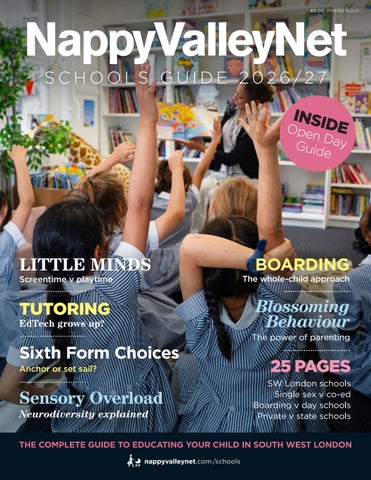
£5.00 WHERE SOLD
SCHOOLS GUIDE 2026/27 INSI Ope DE n D Guid ay e
LITTLE MINDS
BOARDING
Screentime v playtime
The whole-child approach
TUTORING
Blossoming Behaviour
EdTech grows up?
Sixth Form Choices Anchor or set sail?
Sensory Overload Neurodiversity explained
The power of parenting
25 PAGES SW London schools Single sex v co-ed Boarding v day schools Private v state schools
THE COMPLETE GUIDE TO EDUCATING YOUR CHILD IN SOUTH WEST LONDON nappyvalleynet.com /schools
WELCOME TO THE NAPPYVALLEYNET SCHOOLS GUIDE
DEAR SOUTH-WEST LONDON PARENTS Welcome to the 12th annual NappyValleyNet Schools Guide.
CONTENTS 53
83
Broomwood
Woldingham School
The world of education never stands still but the last 12 months have been especially dynamic. SEND reforms, the increasing value add of the independent sector and changes to OFSTED assessments have all either landed or are on their way and our new education secretary will also want to make their own mark. On the following pages we’ll look at what these changes mean for you and your family. Tech, as always, is front and centre: check out our feature on how educational apps are changing the tutoring market and our advice on balancing screentime and curbing the addiction to social media.
77
89
But that’s not all. We have a look at the impact of parenting on children’s behaviour, the benefits of boarding, tips on finding the funds and managing the costs of the independent route and how to get the most from your open day visits. Lastly, we look at your sixth form choices and how to ease your way through the Wandsworth Test. As always I must thank our four Preferred Property Partners for their unwavering support – John Thorogood, Rampton Baseley, Savills and Wilfords.
DLD College London
25
We hope all the insider knowledge contained within these pages will lead you to the very best, and least stressful, education for your child. Warmest wishes Camp Suisse
Founder, NappyValleyNet NappyValleyNet’s Schools Guide 2026/2027 is published by Nextville IP Ltd Company number 9965295 Editor Gillian Upton Contributors Charlotte Drew, Adam D’Souza, Sian Griffiths, Lisa Peake, Charlotte Peterson, Dr Sheila Redfern, Dina Shoukry, Susan Springate, Zoe Varenne, Nicola Woolcock Chief sub-editor Charlotte Peterson Sub-editor Jane O’Brien Design & Artwork eighthouse.co.uk Sales & Marketing Clare Sheta Marketing & Production Assistant Caroline Evans Publisher Susan Hanage While every effort is made to ensure accuracy, Nextville IP Ltd cannot be held responsible for any errors or omissions. nappyvalleynet.com/schools-guide-2026-27
King’s College School Wimbledon
31
Trinity School
05 Introduction 25 Curriculum 31 Choices in education 51 Timelines 53 Early Years 61 Value-add 77 Sixth form 83 Boarding 89 Wellbeing 95 Wandsworth Test 98 Tutoring 102 Neurodiversity 104 Open days 108 Affordability 112 Schools directory Cover photograph courtesy of Sydenham & Dulwich Girls GDST.
NappyValleyNet.com
3
Clapham’s award-winning prep school
INTRODUCTION
A BROAD-THINKING APPROACH Sian Griffiths, education journalist and formerly Education Editor at The Sunday Times, tracks the many challenges facing our schools as a new secretary of state for education takes on the role any can remember the shrill sound of the school bell summoning children to the next lesson or marking the end of the school day.
M
A record-breaking year for scholarships Broomwood educates children from 3-13. Find out more at one of our upcoming open events, or book a tour to explore our outstanding facilities. Book at www.broomwood.com admissions@broomwood.com | 020 8682 8830
Dolphin School
NappyValleyNet.com
5
THE WHITE HOUSE PREPARATORY SCHOOL
Open Morning
Emanuel School
But at Woldingham, a girls’ day and boarding school set in hundreds of acres in Surrey, most of the bells that used to punctuate the day have been silenced. “Only two are left – for morning and afternoon registration,” says Camilla Mair, Director of External Affairs. “There are no bells through the day to mark the end of each lesson which means a very calm environment and lessons come to a natural close with no shrill noise. “Girls have five minutes to walk across the grass to their next lesson – [which is] so good for their mental health.” One of the biggest education trends after the Covid pandemic was to “build back better”. One aim was to improve the wellbeing of anxious children who had spent
months glued to screens in lockdowns. The trend saw the introduction of ‘wellness centres’ (Woldingham’s ‘wellness hub’ opened this year), psychologists, counsellors and therapy dogs to many private schools – as well as other calming measures. But over the past year this trend towards a more holistic education has coincided with a tough financial climate for the independent sector, which has led to both closures and mergers.
Price-sensitive market Many families were priced out of the market by the government’s imposition of 20% VAT on fees in January 2025. A survey by the wealth management firm Saltus in March 2026 revealed that 9 per cent of the 1,167
parents surveyed with a child in private education had removed them from the sector after the VAT hike. Dozens of schools nationally are reported to have closed.
One of the biggest education trends after the Covid pandemic was to build back better
Saturday 3rd October 9:30am – 11:30am
Delivering Choices
Excellent range of 11+ destinations 60% of children gained scholarships in Art, DT, Music, Sport and Academics Unparalleled Super-Curriculum 14 weeks of school-run holiday clubs. www.whitehouseschool.com | admissions@whitehouseschool.com
6
NappyValleyNet.com
Alison Fleming, principal of Eaton House Schools, a group of single sex schools for boys and girls aged two to 13 in Clapham and Belgravia, which sends pupils onto schools including Eton and Westminster, says her numbers – around 600 – are holding up, but the sector faces “a triple whammy: the increased fees which have squeezed some families out of the market; the birth rate is falling nationally and wealthy families are leaving the UK. What it means is that for parents it has become a buyers’ market. And because the cost [of a private education] is greater than it was the demands of parents have also increased.”
Parents almost expect to negotiate over fees – sometimes playing off schools [against each other] Woldingham’s Mair agrees: “It is a very price-sensitive market with the introduction of VAT,” she says. “Parents almost expect to negotiate over fees – sometimes playing off schools [against each other] by saying, for instance, that their daughter has been offered a scholarship at another school.” Fionnuala Kennedy, head at girls-only Wimbledon High School says, “Even at age four plus our application rate has held steady. But I anticipate that in two to five years that may not be the case. Girls’ schools have also for some time seen the trend of boys’ schools going co-educational. No-one can afford to be complacent.” One of the leading schools in south London, King’s College Wimbledon, formerly a boys-only private school up to the age of 16, has already announced that it is going to accept girls into the junior school. “I would be amazed if that did not affect our admissions,” says Kennedy, who argues that the survival of single sex education for girls is more important than ever with the rise of the so called ‘manosphere’. To offer more traditional boys’ sports such as cricket, football and touch rugby, Wimbledon High, which has nearly 1,100 pupils, is developing a new strength and conditioning suite. “That is important if we are going to stand up against the facilities
8
NappyValleyNet.com
of those other schools,” says Kennedy. With more Britons now heading to America to study for a degree, excelling at sport could also lead to a scholarship covering Ivy League fees, she suggests.
The drive to offer value Schools across the capital are bolstering their offer to families. At Emanuel School for boys and girls aged 10 to 18, headteacher Ravi Kothakota says that a “£30m STEM building [is] due to open by 2027 which will provide state of the art science labs and house a new refectory.” The school in Battersea has already invested in a new sixth form centre. Notes Kothakota, “I feel parents are more discerning now, they are looking more closely at what a school stands for, and what does my child get, and what do I get as a parent in choosing this school.” Edward Rees, head of Hornsby House, a non-selective junior school at Reception, says the school has continued to attract and retain families, “who value our educational ethos. In a year that has tested many independent schools, I am enormously proud of what we have achieved together,” all the while through a transformative building project. “These successes are underpinned by something even more important, which is a happy, thriving school community where pupils, staff and families feel valued, supported and inspired. That sense of belonging remains our greatest strength.” At Cranleigh School in Surrey, where most of the pupils are boarders, day pupils are from this September (2026) being offered the chance of an extended day from 8am to 6pm as well as to board overnight occasionally. The school now also has a pre-prep and a nursery. Headteacher Sam Price is growing numbers – they are expected to top 1,000 this autumn – and says there is demand from working families who want more flexible options. There will be three fee levels at Cranleigh; day (8am to 6pm); day plus (day pupils who can also stay a night in a boarding house – a new option Price says has proved popular); and full seven days a week boarding. “I think because we have really adapted to try to appeal to what the market wanted as a result of the VAT rise, it has worked in our favour so far,” says Price. After the VAT hike on school fees some headteachers also say that they are trying to keep fees for 2026/7 close to the inflation rate, which was 3% in the 12 months to April 2026. “We are committed to keeping fees as close to inflation – or below if we can –
going forward,” says Jane Lunnon, head of Alleyn’s, the four-to-18 co-educational day school in Dulwich, where senior school fees are £32,495 a year inclusive of VAT. As part of a strategy “to diversify revenue”, she explains, Alleyn’s is expanding, including by adding schools north of the Thames. “Alleyn’s Regent’s Park opened this year. Alleyn’s Hampstead will be open from this September (2026),” says Lunnon. Alleyn’s has also joined forces with Oakfield, a prep school in Dulwich, now Alleyn’s Oakfield. “We could see it was struggling and thought we have a chance to make a difference. It is regrettable what is happening across the piste [but] there have been opportunities for us.” At the time of writing in May, Alleyn’s, like several other schools had not declared its fee rise for 2026/7 but a recent thread on NappyValleyNet.com claims that some local schools have already informed parents of fee increases ranging from between 4.8 to 9 per cent. Smaller schools, says Price, may find it difficult to keep the 2026/7 fee rise to below inflation. At Eaton House, Fleming says fees will “not be more expensive than 3.25% in 2026/7”. Continued on page 11.
Co-educational day school for pupils aged 10–18 8 minute walk from Clapham Junction Fee assistance available Aspiration. Connection. Empathy.
SUPPORTING SEND IN ONLINE LEARNING • Remove sensory triggers: Create a calm, familiar learning space at home to reduce the anxiety associated with crowded corridors, loud bells and social pressures • Provide a dedicated, trusted adult: Assign a single point of contact – or regular mentor – to conduct consistent check-ins and build a secure, trusting relationship • Build low-stakes engagement: Allow anxious learners to re-enter participation gradually through text chat or polls before asking for microphone or camera use • Scaffold progress incrementally: Introduce formal assessments and schedules step-by-step to build confidence and resilience over time without overwhelming the student • Maintain strong parent partnerships: Share regular updates and fortnightly progress reports so parents and educators stay aligned on the student’s wellbeing and academic goals Source: Minerva Virtual Learning
Battersea Rise, London, SW11 1HS 020 8870 4171 www.emanuel.org.uk Instagram: emanuel.school
Scan here to find out more.
SCHOOL PROFILE
INTRODUCTION
ALL ABOUT THE GIRLS
CONTROLLING SOCIAL MEDIA
Wimbledon High School is proud of its academic success and clear in its ambition to always put girls first, encouraging them to push themselves while exploring myriad opportunities well beyond the curriculum
Wimbledon High School, part of the Girls’ Day School Trust, doesn’t just have girls in it; it’s made by girls, for girls, with girls at its very centre. With both a junior and a senior school, there is a guaranteed transition at 11+. Outstanding academic achievement is evident in their most recent A-level results where 42% achieved A* and 80% A*-A, putting them among the top twenty nationally. The school firmly believes that girls can exist happily in an academically rigorous environment where they are encouraged to push themselves. Known for doing that in a way that’s very grounded and fun, with the wellbeing of pupils at the core, staff are expert at educating girls to high standards, focusing on the development of the whole person. The schools’ overarching philosophy is ‘playful scholarship’. If the girls are happy, rounded, grounded and being stretched, their curiosity is piqued, and the academics follow. Girls are encouraged to think critically, analyse situations and to cultivate their individual voice.
10
NappyValleyNet.com
There are five pillars running through Wimbledon High. Firstly, the curriculum, which is innovative and challenging. In GCSE years, girls typically take nine subjects, meaning they have time for such extras as an amazing (unexamined) PPE course which develops acumen and gets them thinking well above and beyond the curriculum. Most go on to take three or four A-levels alongside a broad programme of electives. The EPQ (Extended Project Qualification) is offered, with its valuable points for university applications, and offerings such as Entrepreneurship, GDST Space Technology, film studies and Mandarin add to the inspiring mix. The Big Data project gives STEM students the chance to work with 10 years’ worth of real data from Wimbledon via the LTA, and peerled reviews have been published. In short, multiple opportunities for girls to find their passions. ‘Pursuits’, or co-curricular is designed so that every individual finds something that ignites those passions – be it sport, theatre,
Lego, or chess. The pastoral programme – ‘Grow’ – fosters wellbeing from age four to 18. It’s progressive and innovative, very age-appropriate, and as girls transition through the school the support grows with them. The intention is for every girl to be recognised, heard and seen. ‘Community’ is the fourth pillar in which girls participate and know the importance of looking outwards and seeing others. Sixth formers teach and mentor Year 4, 5 and 6 pupils from local schools who come in weekly. Beyond school is ‘Futures’, guiding pupils to make the right choices and develop the skills and experiences ready to step out into the world. Alumnae are involved, and a lecture series and work experience are overseen by the Head of Employability and Entrepreneurship. Support continues for five years, through university and into the workplace. Through ‘playful scholarship’ each of these strands has equity and impact, allowing students to stride out with selfconfidence, a sense of agency and an awareness of the needs of others.
Schools have an uphill challenge to regulate children’s use of social media and how best to incorporate AI into the curriculum, says Sian Griffiths, education journalist and formerly Education Editor of The Sunday Times
nother ‘hot’ issue in recent years has been how to regulate children’s use of smartphones and social media. Concerns about the impact of spending long hours online were fuelled by American psychologist Jonathan Haidt’s bestselling book, The Anxious Generation which argues that smartphones and social media lead to sleep deprivation, mental illness and addiction. Cyberbullying and sexting are associated difficulties many schools have had to deal with.
A
Newton Prep School
NappyValleyNet.com
11
HUMAN VS AI In a world increasingly shaped by AI, the skills that matter most are becoming distinctly human. While technology can generate answers in seconds, it cannot replace curiosity, ambition, courage, respect or the feeling of belonging to something much bigger. We believe education must prepare boys not only for exams, but for life in a fast-changing world. Through sport, music, drama, leadership opportunities and collaborative learning, students develop the skills that underpin future success. These experiences help boys learn to think independently,
build meaningful relationships and respond positively to challenge. AI will undoubtedly play a major role in the future workplace, but authenticity, character and human connection will remain invaluable. By nurturing both academic excellence and personal development, schools can help young people thrive in an environment where technology evolves rapidly, while strong values and genuine interpersonal skills continue to set individuals apart. Source: Whitgift School
Used responsibly, technology doesn’t replace the learning experience - it amplifies the humanto-human connection between teacher and student
Where Every Child Shines Unrivalled. Unforgettable. Exceptional.
41 Scholarships for 2026 Eton King’s Scholarship, Eton Music Scholarship, 3 St Paul’s John Colet Scholarships, Alleyns, JAGS, and more
Burntwood School
12
NappyValleyNet.com
The best single-sex Independent education for boys and girls in London Contact our Admissions team on 020 3917 5050 or book an Open Day at www.eatonhouseschools.com
HOW TO HELP YOUR CHILD THRIVE AT SCHOOL
Parents rightly want excellent outcomes, but they shouldn’t have to choose between academic ambition and a happy childhood
Starting or moving school is an exciting milestone, but every child’s journey is different. Here’s how parents can support them: • Encourage curiosity – help your child explore their interests and develop a love of learning • Let them make mistakes – setbacks are a natural part of learning and help children build confidence and independence • Keep communication open – make time to listen, talk and understand what matters to your child
It’s a global crisis and a pervasive presence; statistics show that between 7-9 hours are lost to screen time every day. Last year, 300m children were victims of online abuse; that’s one every 10 seconds. The government’s social media legislation for the under 16s due into the statute books next spring has been welcomed, not that it tackles the unregulated industry designed seemingly to be addictive for all. The more recent midnight to 6am curfew for young people aged 16 and 17 announced this
• Encourage balance – friendships, hobbies, creativity and time to relax all contribute to wellbeing • Celebrate who they are – every child has their own strengths, interests and pathway to explore The strongest foundations come when children feel supported to be themselves, try new things and discover what they can achieve. Source: City of London Freemen’s School
Alleyn’s School
A Passion for Life and Learning since 1741
summer by the Department for Science, Innovation and Technology did not clarify which platforms will be affected by this ban at the time of writing. Meanwhile schools are doing their best to improve the situation. “We must recognise that social media and AI are not going away,” says Michael Hodge, principal of Broomwood. “These technologies will play an increasingly important role in how today’s children learn, work and communicate as they move into adulthood. The challenge is not simply to shield young people from them, but to ensure they are equipped to engage with them safely, thoughtfully and responsibly. “That is why regulation alone is not enough. While clear boundaries and safeguards are vital, we must also recognise the equally important role of education. As schools, we have a responsibility to help young people develop what I would call digital wisdom – the ability to engage with technology in a safe, responsible and thoughtful way.” At Wimbledon High girls must stash their phones away during the school day in a transparent locker. “From next year we will say to Year 7 pupils that they cannot bring phones to school at all. My ideal is that no girl would have one until they were 16. If
We are welcoming girls and boys from September 2027.
Autumn Open Events BOOK ONLINE
jags.org.uk
Find out more at our upcoming Open Mornings on 16th September and 7th October. Scan the QR code or visit wcps.org.uk to book your place
DISCONNECT TO RECONNECT At Emanuel, we run an initiative called ‘Disconnect to Reconnect’ where pupils reduce their use of social media over a three-week period and report the impact on their mood. Pupils notice an improvement in happiness, mood and sleep, amongst other positive changes to their wellbeing. Importantly, they have also gained a degree of agency over their use of social media and have become advocates for moderation. We use our form assemblies to run ‘decompression sessions’ in the middle of the day where pupils can do something fun and exciting, whether it be playing a form game of giant Jenga, creating an origami jumping frog and measuring its jump span, or a ‘drop the egg’ competition. These sessions help pupils to retain a sense of balance and perspective in their studies while having fun with their peers and reinforcing the importance of wellbeing. Source: Emanuel School
CHAMPIONING KINDNESS
/
ACHIEVING EXCELLENCE
Butterfly Pre-School
you can give your daughter a smartphonefree childhood, why would you not do it?” asks Kennedy. At White House Preparatory School in Clapham children are only allowed a mobile phone when they reach Year 6, at the age
of 10 and even then, only if they walk to school. It must be a ‘dumb’ phone, one with no internet capability, says vice principal Grace McCahery. Teachers at White House Prep have discussed regulating children’s online
BEYOND THE CURRICULUM Experiential learning through school trips offers students invaluable opportunities to connect classroom knowledge with the real world. By stepping beyond traditional learning environments, students engage with subjects in dynamic, hands-on ways – whether exploring ecosystems in botanical gardens, visiting historical sites or being inspired by art exhibitions. These immersive experiences help deepen understanding, spark curiosity and enhance memory retention. School trips also build essential life skills such as independence, resilience and teamwork,
16
NappyValleyNet.com
while fostering personal growth and cultural awareness. They create moments of shared discovery and collaboration that strengthen relationships between students and teachers, enriching the overall school experience. Our Year 9 curriculum includes London Learning, a weekly trip within the capital that brings alive their area of study, making use of the unique learning and cultural opportunities London has to offer. Always explore what provision schools have to bring learning to life. Source: DLD College London
activity with parents, some of whom now use Apple airtags on pupil backpacks instead of mobile phone technology to check a child’s location. The prep school’s teachers also explain to children the science behind social media algorithms and “why social media is so addictive.” Parents at Emanuel are trialling Limmi software which can block social media apps like Snapchat, so popular with children, in areas such as bedrooms. If the trial is successful, says Mr Kothakota, the software could potentially be used to block certain apps in the school sixth form centre.
How to absorb AI into the curriculum But it is around the curriculum that schools are making some of the most exciting changes, moving beyond a narrow focus on teaching for GCSEs and A-levels to offer lessons in becoming a personal trainer, AI and even investing in the stock market. Read
London education. Reimagined. Visit us: thomas-s.co.uk
BE KIND. BE YOU. BELONG. BE THOMAS’S.
our feature on the government’s curriculum reforms on page 25. Headteachers know that the AI revolution is already sweeping away many entry level graduate jobs, which is why schools are rising to this challenge. Hugh Viney, CEO & Founder of Minerva Virtual Academy, says: “Artificial intelligence isn’t a passing trend – it represents a structural shift in how work and human value are organised. Education cannot remain focused on information transfer alone. As AI increasingly handles cognitive routine, the true purpose of education must evolve
towards judgment: thinking critically, challenging assumptions, and navigating a complex world with ethics and adaptability.” Minerva views AI as a powerful assistant that removes low-value administration for teachers and deepens inquiry for students. “Used responsibly, technology doesn’t replace the learning experience – it amplifies the human-to-human connection between teacher and student.” Specifically, Alleyn’s will offer AIQ classes for all pupils from the age of four to 13 “to give children the skills they need to thrive with rapidly changing technology,” says
We must recognise that social media and AI are not going away
MORE WILDERNESS, LESS WI-FI: WHY OUTDOORS MATTERS In a world shaped by screens, notifications and constant connection, many parents are beginning to wonder: are children spending enough time truly engaging with the world around them? We know first-hand how valuable outdoor adventure can be. Whether hiking mountain trails, swimming in alpine lakes, learning to ski or building friendships through shared experiences, time outdoors gives young people the chance to grow in ways that are difficult to replicate online. Outdoor experiences help build confidence, independence and resilience naturally. Young people learn by trying new things, facing challenges and discovering what they are capable of in unfamiliar environments. Technology will always have an important place in modern life, but childhood deserves balance. Alongside digital connection, children need time to explore, move and challenge themselves in the real world. Perhaps what matters most is not less technology, but more opportunities for young people to discover just how rewarding life beyond the screen can be. Source: Camp Suisse
18
NappyValleyNet.com
Streatham & Clapham Prep School GDST
Lunnon. The moniker plays on the idea of Artificial IQ. “The government must not lose any more time in examining the impact of AI on all aspects of education and on the workplace that pupils today will enter in years to come,” she adds. “There is a larger conversation to be had about how the national curriculum and assessment models are preparing children for that, and what more needs to be done to make sure that children are equipped with the right technical and human skills for the future.”
At Alleyn’s, many pupils already have a “side hustle” says Lunnon – such as selling old clothing on sites like DePop. The school promotes enterprise education. Cranleigh’s AI curriculum is being developed with input from some of its international schools around the world, including in China, where AI tools such as facial recognition are already widely used. Cranleigh has also brought in a diploma qualification in the sixth form which includes “a [popular] investment elective,” says Price. For the lessons in how to invest wisely, a former banker reviews the financial markets with sixth formers on a Monday “so they can work out where to put their metaphorical million pounds. They monitor how their funds have done over the course of the week.”
As part of an enterprise programme, Cranleigh offers sessions on how to become a personal trainer – a skill young people could use “to earn money at university” – as well as a module on business in the arts, which could help make artistic endeavours pay. At Cranleigh dance lessons are on the agenda for boys as well as girls with a popular Strictly Come Dancing competition held annually. At Wimbledon High, with 1,085 pupils, sixth formers start Monday mornings with a double lesson of “playful scholarship” – cross-curricular lessons where teenagers can learn about, for instance, the psychology of anger or study the Renaissance through art, history and science. “It’s exciting, learning for learning’s sake” says Kennedy.
A testing time Concerns about the effect on three-and four-year-olds of hothousing and tutoring for complex verbal and maths reasoning admissions tests to junior schools, as well as the impact on older children of Common Entrance for senior schools, have led to some headteachers changing their admission requirements. The exams traditionally tested 12- and 13-year-olds on up to 11 academic subjects. But the Independent Schools Examination Board (ISEB), which provides the exams, has brought in online pre-tests to Common Entrance. Pupils in Year 6, aged 10 and 11, can sit the computerised pre-tests in their existing primary or prep schools. The move has meant more private senior schools
HOW TO RAISE A CURIOUS CHILD Curiosity is one of the greatest gifts we can give children. Asking thoughtful questions has become just as important as knowing the answers. Rather than asking, “What did you learn today?”, try, ‘What surprised you?’, ‘What made you think differently?’ or ‘What question are you still wondering about?’
Minerva Virtual Academy
selecting children at 11 including from state primary schools, which has put pressure on prep schools which traditionally keep children until the age of 13. “For some schools the pre-tests are the first admissions hurdle,” says Fleming. “Other schools use the [results] as supporting evidence and will still want to meet the children and set papers at their own school.” Many schools try to make the
second interview stage a relaxed experience. At Emanuel, children are set tasks in groups, such as designing and flying a paper plane. Wimbledon High uses a lottery system to select girls aged four. One of the biggest trends that has emerged in recent years, has been the recognition by schools that cramming children to pass exams can lead to mental health problems and youngsters dropping
Curiosity is deliberately cultivated at Newton Prep. Our Museum of Curiosity invited pupils to become curators of their own learning, presenting enquiry-led projects to parents and explaining not just what they had learnt, but how they had discovered it. Our 7+ assessment reflects this philosophy, with collaborative, escape roomstyle challenges designed to reveal children’s creativity, communication and problem-solving. At our EdTech Week conference, leading educationalists debated how schools can embrace AI while placing even greater value on the human skills that technology cannot replicate. Source: Newton Prep School
See where being known can lead
FRIDAY 25TH SEPTEMBER
OPEN EVENTS
SATURDAY 26TH SEPTEMBER & THURSDAY 1ST OCTOBER
Kneller Hall School
Bolingbroke Academy
Book your place at: www.ewellcastle.co.uk A 4–18 co-ed, private day school and sixth form in Ewell, Epsom, Surrey
20
NappyValleyNet.com
SCHOOL PROFILE
BRIGHT DAYS AND BRIGHT FUTURES Eaton House The Manor has long been known for its stand-out results as well as its blend of strongly rooted traditions alongside exceptional pastoral care
Eveline Day School
out of school and university courses. Instead, good schools strive, as Alison Fleming explains, to find each child’s passion and nurture it. Eaton House offers children a wide range of activities. Schools, she says, “need to look at what you will get for your money. For me there is no doubt that a range of clubs and activities that enrich the children’s lives is hugely
important.” Fleming adds, “It would have been tempting to shrink the offer [after the government brought in VAT on fees] so that it would all have been about entrance to senior school. I think the opposite. We want children to fall in love with something, whether dance or science or the UN club, but something they love. “With all the talk about children’s mental
FOSTERING INDEPENDENT THINKERS AND LEARNERS When parents and schools work together, children are far more likely to become active participants in their learning, rather than simply being told what to do. Encouraging independence at a young age helps build curiosity, confidence and critical thinking. At home, small, practical steps can make a big impact. Let your child pack their own school bag (perhaps with a quick check!), organise their homework or decide how to approach a task. Open questions like “What do you think?” or “How might you solve that?”
22
NappyValleyNet.com
can encourage problem-solving and independent thinking. Schools reinforce this by giving children opportunities to explore ideas, take risks and contribute their own perspectives. Sharing insights with teachers – what your child enjoys or finds challenging – helps create a more personalised approach. Together, this partnership gives children the confidence to take ownership, developing inquisitive, resilient learners who are engaged, motivated and ready to shape their own path. Source: Hornsby House School
Artificial intelligence ... represents a structural shift in how work and human value are organised health and wellbeing, if they love school and have found something they love doing at school that, for me, is the handrail that will guide them through the turbulent years.” Graeme McCafferty, headteacher at Newton Prep, agrees. “Parents rightly want excellent outcomes, but they shouldn’t have to choose between academic ambition and a happy childhood. “The very best schools create an environment where children are challenged to achieve while still having time to explore, create, perform and simply be children.”
It has been another stellar year for results at Eaton House The Manor with 41 top scholarships awarded - 22 for the boys and 19 for the girls across all categories - Academic, Music, Art, Sport and Allrounder. One boy, ChengTong, won Eton’s coveted King’s Scholarship as well as their Music Scholarship; three boys won the St Paul’s John Colet Scholarship and there were similar successes for the girls, including two Academic and two Sports scholarships from JAGS, an All-rounder from St Mary’s Ascot and one Sports and one Drama from Alleyn’s, to name a few. ChengTong says he feels well-grounded and set up for his senior school: “Now I’m ready to move on to Eton.” This stunning raft of scholarships is even more impressive given that entry to the school at four is non-selective. Proof that each child will find their strengths, and that’s testament to the teaching staff who are truly passionate. Many are lifetime teachers who bring the wisdom of many years of experience; others are fresh to the role and brimming with new teaching methods. The school constantly has its ear to the ground as to what parents want
and runs surveys to ensure they’re in tune with expectations. Parents love the single-sex education offered within one campus, but it was suggested that there should be more opportunities for boys and girls to collaborate. This inspired the newly opened Discovery Hub, driven by Principal, Alison Fleming, to create a cutting-edge space for the older boys and girls comprising an exciting library, learning and IT space, which will enrich them, both socially and academically. Other changes over the summer include the creation of a welcoming Admissions Suite in the Georgian part of the building, for prospective parents to come to chat with the experienced team. A new Head of Sport brings a fresh dynamism into an already successful sports department. The school offers a welcoming community, not so grand and traditional after all, but very open and approachable.
Leading the charge on that front is Alison Fleming, who has been at the school for a full academic year after her time at Newton Prep, where she was known for her exceptional pastoral care. She has brought with her a brightness, warmth and inclusivity, which emanates around the school. She places an extraordinary importance on the wellbeing of children. Put simply - when happy, they will do their very best. She talks of the excitement of learning and believes the school is winning if pupils go home laughing, telling parents about their day. She loves the interaction with pupils, investing her time in them and their families, and the results speak for themselves. Eaton House The Manor is a school ambitious for its pupils and academic, but it is also a fun and happy place to be, just opposite the wide-open green spaces of Clapham Common.
NappyValleyNet.com
23
SCHOOL PROFILE
CURRICULUM
ASPIRATION, CONNECTION AND EMPATHY
AHEAD OF THE CURVE
With a new headmaster at the helm, Emanuel School continues to combine academic excellence, outstanding opportunities and a strong sense of community for pupils across south-west London
Founded in 1594 and set on a leafy 12-acre campus between Wandsworth Common and Clapham Junction, Emanuel School has long been one of south-west London’s most respected independent schools. Today, the co-educational day school educates more than 1,100 pupils aged 10 to 18, combining centuries of heritage with a forward-looking approach to education. The school recently welcomed Ravi Kothakota as its new headmaster, bringing fresh energy and vision to an already thriving community. Embedded in his vision are the school values - aspiration, connection, and empathy - which reflect Emanuel’s long-standing commitment to developing confident, well-rounded young people who are prepared not only for academic success but also for life beyond school.
24
NappyValleyNet.com
Academic achievement remains a significant strength. Emanuel’s results have improved consistently in recent years, with pupils regularly securing places at leading universities. In 2025, 71 per cent of A-level entries were awarded A* or A grades, while GCSE results saw 91 per cent of grades awarded at 9-7. Alongside examination success, the school places equal importance on intellectual curiosity, independent thinking and a genuine love of learning. That philosophy is reflected in a broad and ambitious curriculum designed to challenge pupils while encouraging them to explore their individual interests. Alongside traditional academic subjects, pupils benefit from opportunities to undertake research projects, creative pursuits and wider enrichment activities.
Significant investment in facilities, including the school’s new science and dining building, is helping to create modern learning environments that support collaboration, innovation and scientific discovery. Pastoral care is another cornerstone of Emanuel life. The school is known for its strong wellbeing provision, with dedicated pastoral teams supporting pupils throughout their educational journey. Programmes covering mental health, personal development, relationships, digital awareness and life skills help ensure pupils feel supported both academically and emotionally. Notably, “Pupils develop levels of self-knowledge, self-confidence and empathy that go well beyond expectations for their age” - ISI Inspection 2026. Beyond the classroom, co-curricular opportunities are extensive. Sport, music, drama, art, debating, community partnerships and outreach programmes all play an important role in school life. Emanuel’s commitment to service is particularly notable, with pupils regularly working alongside local schools and community organisations through initiatives like Primary Ambitions; a mentoring programme led by Lower Sixth pupils teaching primary school classes like DJing, gymnastics, debating and swimming. Pupils develop selfconfidence, independence and empathy by connecting with the community. For parents seeking a school that balances academic ambition with character development, wellbeing and opportunity, Emanuel School continues to offer a compelling and contemporary educational experience.
Dina Shoukry unpicks the government’s curriculum reforms and finds that many schools have been there for years ver a million young people aged 16 to 24 are currently not in education, employment or training, a figure that has risen sharply since 2021, and intensifying questions about whether the education system is adequately preparing young people for work and further study. The government’s Curriculum and Assessment Review, published last autumn and led by Professor Becky Francis, proposes the biggest changes to England’s education system in more than a decade, including a broader curriculum, greater emphasis on oracy, financial and digital literacy, AI, and less rote learning.
O
London Park Schools
For many school leaders, however, the proposals feel less like a revolution than recognition of work already underway. As Laura Warner, Assistant Principal at Burntwood School, explains, “A lot of the proposed direction reflects areas we already place real value on. It feels less like a radical shift than a reasonable recognition that education needs to be broader and more equitable.” The review identifies England as an outlier in the number of high-stakes exams taken at 16. Proposals include removing the EBacc (the combination of English, maths, sciences, a language and humanities used to measure school performance), protecting arts subjects,
introducing a national oracy framework, making financial and digital literacy compulsory, bringing AI into the curriculum and reducing overall curriculum content by around 10%. A new national curriculum is expected in 2028, with reformed GCSEs and A-levels following in 2029.
Breadth, balance and creative thinking Across both state and independent schools, leaders repeatedly returned to the same theme: breadth matters. Many argued that creative subjects, flexible pathways and the explicit teaching of resilience, communication and critical thinking are as important as exam results. And this can start in Early Years. “Wellbeing, kindness and resilience are in the sedimentary layers of our curriculum and several core aspects of our ethos have been in place since the school was founded,” explains Adam Woodcraft, Head of Early Years at Dolphin School. He believes that a wide range of life skills sit within their current curriculum, “paving the way for independence in work, mind and thought so that critical thinking comes with much greater ease.” Tom Durno, Deputy Head (Academic) at Alleyn’s School, welcomed the commitment to creative subjects. “There was lots of good news for me in the curriculum reform papers,” he says. “The key thing was the commitment to elevating the arts to equal status with other subjects, which is something we’re already doing.” At Alleyn’s, most pupils take drama, music, dance or design technology at GCSE, while flexible GCSE pathways allow some students to pursue elite-level sport or other passions alongside their studies. Susan Brooks, Head at London Park School (LPS) Clapham, agrees. “More GCSEs are just more of the same. We want
NappyValleyNet.com
25
Thames Christian School
them to do other skills.” LPS is halfway through a two-year accreditation process in High Performance Learning, a framework developed by Professor Deborah Eyre that explicitly teaches qualities such as resilience, risk-taking and meta-thinking. Burntwood protects curriculum time for computing, art, design technology, music, dance, drama and PE from Year 7 onwards. “We’ve always been cautious about narrowing students’ pathways too early,” says Warner. “It is encouraging to see greater recognition nationally that breadth and balance matter.” David Adkins, Deputy Head at Thames Christian School, believes creative subjects often develop skills traditional academic disciplines struggle to teach. “You actually learn to solve more problems in art and DT. The problem-solving happens more easily in the arts because science is very content-heavy.” Phoebe Bradley, Deputy Head (Academic) at Putney High School argues that creativity should sit at the heart of every subject. Inspired
Putney High School GDST
by research into creativity in mathematics, Putney pupils work collaboratively at whiteboards covering entire walls. “Instead of asking what’s the right answer, they’re asking what are the different right answers and what are the different ways to get there.” For Antonia Geldeard, Head of Sydenham & Dulwich Girls, the review reflects a broader understanding of what education should achieve. “The reform papers recognise that a great education is about excellent academic outcomes alongside personal confidence, employability skills and the ability to engage with a changing world. How you manage yourself, present your skills and engage with people, those are the things that employers are telling us matter most.” David Flower, Deputy Head Academic at St Edward’s School Oxford, welcomes the intention to protect creative subjects and languages. “All pupils here study a modern foreign language to 16, and more than half continue to 18.” He believes reforms will only succeed if schools have access to
specialist teachers, timetable space and sustained funding. LPS has also introduced government and politics through its global citizenship curriculum. “They should understand local and national politics, look at other political systems and be informed voters,” says Brooks, who believes the subject has never been more relevant with voting rights expected to be extended to 16-year-olds. Some schools are already looking beyond the curriculum itself. Thomas’s College is developing a mini-MBA programme for the year between school and university, open to Thomas’s students and others on a meanstested basis. “We want to give them a really solid foundation,” says Founding Master Will le Fleming, “whether they use it to go to university or straight into work.” With universities now seeing students for as little as three hours a week, he is clear about the risk of over-directing young people. “If you’ve only ever been spoon-fed, you’re going to really struggle.”
Open Events
SUPER-CURRICULUM Our Super-Curriculum is a forwardthinking programme designed to create confident, capable and future-ready learners. From Reception, the Nurture Programme builds wellbeing, curiosity and confidence through purposeful, interest-led activities that develop communication and social skills.
Sydenham & Dulwich Girls GDST
26
NappyValleyNet.com
In Years 1 and 2, a Life Skills curriculum equips pupils with essential real-world knowledge, including safety, first aid and responsible decision-making. Enterprise learning further develops financial awareness, culminating in a vibrant Enterprise Fair where pupils budget, design and run their own stalls.
By Year 6, the Post 11+ Futures Programme provides transformative experiences, from cooking and podcasting to independent travel, languages and international residential trips, developing resilience and independence. Sustainability and social responsibility are embedded through initiatives such as charity projects and a whole-school clothes swap. Alongside tailored 11+ preparation and a strong wellbeing focus, the Super-Curriculum ensures pupils leave as adaptable, ambitious and socially conscious young people ready for the future. Source: The White House Prep School
Entry Entry into into Reception Reception (4+), (4+), Year Year 1 1 (5+) (5+) and and Year Year 2 2 (6+) (6+) Entry into Year 3 (7+), Year 4 (8+) and Year 5 (9+) Entry into Year 3 (7+), Year 4 (8+) and Year 5 (9+) Entry Entry into into Year Year 7 7 (11+), (11+), Year Year 9 9 (13+) (13+) and and Year Year 12 12 (16+) (16+)
Full Full and and Weekly Weekly Boarding available Boarding available
Book Book your your place place dulwich.org.uk/admissions dulwich.org.uk/admissions Bursaries of up to 100% and Academic Scholarships of up to one third of full fees are available. Bursaries of up to 100% and Academic Scholarships of up to one third of full fees are available.
Beyond rote learning One of the review’s more discussed proposals is reducing curriculum content and placing greater emphasis on applying knowledge rather than memorising it. Ellie Duncan, Assistant Principal at Bolingbroke Academy, welcomes the shift. “We’re moving away from just memorising for the sake of it and really focusing on applying the equations. Let’s leave the cognitive space for that.” Lottie Davidson, Assistant Head at LPS Clapham, points to physics as an example. “They used to have to learn 21 physics formulas off by heart. You spent the majority of your time just trying to teach them to remember, rather than teaching the physics.” But applying knowledge, some argue, is only possible when students understand it deeply. Dr Stephen Holsgrove, Head of Thames Christian School, believes understanding matters more than memorisation alone. “If you understand how a formula is derived, then you can apply it much more effectively than you would if you just remembered it.”
AI and digital literacy If there is one area where schools appear ahead of national policy, it is artificial intelligence. At Alleyn’s, AI literacy has become a core part of school life through AiQ, Alleyn’s Intelligence Quotient, a curriculum running from early years to sixth form. “It’s a technology and practice curriculum, not a computing course,” says Durno. “Students learn how large language models work alongside their political, social and environmental implications.” Year 9 pupils compare AI-assisted research with traditional methods and find the strongest results come from combining both. At Putney High, AI literacy sits at the centre of the new Artemis programme. For
Bradley, it is equally important to consider what AI cannot do. “Creativity, innovation, communication and leadership – those can’t be outsourced to a bot.” Alongside digital fluency and data intelligence, the programme focuses on creative innovation, complex problem-solving and communication, skills the school believes will become increasingly valuable in an AI-enabled world. Sydenham & Dulwich Girls has taken a similarly intentional approach through its Elevate curriculum, where students learn creative coding and pitch app ideas to industry professionals. The school was awarded the Good Future Foundation Gold AI Quality Mark for exemplary, ethical and strategic use of artificial intelligence in education.
Financial literacy Schools have long argued that financial literacy matters. The review agrees. “I could never understand why it wasn’t taught already,” says Brooks of LPS Clapham, who made it a compulsory subject from the school’s opening. “Every child is going to leave here knowing about taxation, credit cards, interest rates and mortgages.” At Wimbledon High School, financial education runs from Year 7 through to sixth form, while a team recently came second nationally in the Girls Are Investors challenge. Bolingbroke embeds financial literacy through PSHE, tutor programmes and specialist external workshops.
Finding their voice The ability to speak with confidence may be the most transferable skill a school can teach and one of the most unevenly distributed. “As the reforms aim to level up opportunities for all young people, there is growing recognition of the importance of ensuring that every child has access to high quality opportunities to develop confidence
SCHOOL PROFILE
MORE THAN A SCHOOL A PLACE TO BELONG Broomwood School, a co-educational prep school where aspiration, belonging and character are built from the very beginning Dolphin School
in speaking, listening and communication,” says Burntwood’s Warner, who sees oracy as a meaningful way the reforms could narrow the gap between state and independent education. At St Edward’s, last year, pupils took part in a mock trial with a high court judge and two barristers, one of many opportunities designed to help students give a confident account of themselves. “We look at the history of rhetoric and how one might learn from it to become a good promoter of oneself,” says Flower. At Wimbledon High, teaching girls to use their voice is central to the school’s ethos. “Critical thinking needs to be explicitly taught,” says Deputy Head Ferdinand Doepel. “Whether that’s through civil discourse, debating, Socratic seminars or Model United Nations, teaching girls to use their voice is central to everything we do.” For Bradley at Putney High, the urgency is only growing. “Many universities are moving their assessment models because of AI to viva-style assessments, and yet students aren’t being prepared for that through the schooling system,” she says. Doepel places the question of whether the playing field will be levelled up in a wider context. “We all want young people who are curious, capable and ready to contribute, wherever they’re educated. If these reforms help more schools invest in the whole person, that’s better for everyone.”
What parents should ask
Alleyn’s School
28
NappyValleyNet.com
Reforms will not reach classrooms until 2028, with revised GCSEs in 2029. But the questions they raise are worth asking now. Parents touring schools should ask how are pupils being taught to think, communicate and adapt? How are AI and financial literacy being embedded? Are pupils being prepared for the world beyond exams? The schools featured here have been answering these questions for years. The reforms, in that sense, are not a disruption – they are an arrival.
Walk into Broomwood on any given day and you will feel it immediately. There is an energy that is hard to define. “You walk in and you just feel it,” says Michael Hodge, Principal and Head of Broomwood Boys. “It’s not one thing we do; it’s every little thing we do; all focused on the benefit of the child. Are we building strong relationships? Are we creating the conditions where children feel confident to make mistakes and comfortable to share? That is what Broomwood is about.” Broomwood comprises three schools — Little Broomwood pre-prep, Broomwood Boys prep and Broomwood Girls prep, educating children from three to 13 — each on its own site but increasingly connected through a shared vision: co-educational days, joint services, residential trips and a programme of shared activities. Pastoral care is built around knowing every child as an individual. Every pupil has a pastoral tutor and communication with families is constant and proactive. Oracy runs through everything, from performances in front of large audiences in the pre-prep years to debating, public speaking and leadership opportunities
across the prep schools. From September, Years 7 and 8 will come together for the new Future Ready Curriculum, a coeducational programme covering financial literacy, enterprise, leadership, digital wisdom and global citizenship. “We want the children to have a voice and feel confident using it,” says Louisa McCafferty, Head of Broomwood Girls. “We want them to feel genuinely known and supported and that starts from the very first day.” Academically, the school benefits from specialist teachers across every subject which is unusual at prep school level. It also prepares pupils for both 11-plus and 13-plus entry through a dedicated pathway that includes interview preparation, stretch sessions and school selection advice. Scholarships are regularly secured across academics, music, sport, art, drama and design technology and the 2025/26
academic year saw a record-breaking 48 scholarship offers, half of them academic. Recent international trips have taken pupils to South Africa, New York and Sri Lanka, and the school’s broader commitment to its community has been recognised in Talk Education’s Top 250 Schools, with awards for Equity, Diversity, Inclusion and Belonging, pupil voice and sustainability. When asked to summarise the school’s ethos, Michael returns to three defining values: aspiration, belonging and character. “We meet you where you are, whether you’re in the D team or the top set. Once you’ve joined us, you belong to this community.” For Louisa, success is about much more than preparing children for their next school. “We want to set them up not just for senior school, but for everything that comes after,” she says. “The soft skills, the adaptability, the ability to engage and empathise. Those are what make us most proud.”
NappyValleyNet.com
29
SCHOOL PROFILE
CHOICES IN EDUCATION
WHY INDEPENDENCE MATTERS IN THE INDEPENDENT SECTOR
ROUTE TO SUCCESS
While many independent schools are joining larger education groups, The White House Prep School has prospered by remaining proudly family-owned. Forty years on, its distinctive approach is attracting more families than ever
For parents navigating the important decision of choosing a prep school, finding the right balance between academic achievement, pastoral care and a genuinely happy childhood can feel increasingly challenging. Yet one school that continues to attract attention from families across south-west London is The White House Prep School. Celebrating its 40th anniversary this year, The White House has built a strong reputation as one of London’s leading family-owned prep schools. At a time when many independent schools are becoming part of larger educational groups, the school remains independently run by its founding family, preserving a strong sense of community and a distinctly personal approach to education. That family ownership is evident throughout the school. Decisions are centred on the needs of children rather than wider corporate objectives, allowing the school to focus on what many parents value most: excellent teaching, strong pastoral care and an environment where every child feels known and supported. Central to the school’s success are its five core values: Positivity, Kindness, Respect, Perseverance and Resilience. These principles are woven into daily school life and help create a culture in which children are encouraged to support one another, embrace challenges and develop confidence in themselves and their abilities. The school’s appeal extends beyond its nurturing environment. Parents are attracted by a broad educational offering that combines academic rigour with opportunities for personal development. Through its innovative ‘Super Curriculum’,
30
NappyValleyNet.com
pupils benefit from a programme that blends core academic subjects with initiatives focused on nurture, choice and enterprise. Activities ranging from debating and STEM to drama, languages and sport help children develop creativity, communication skills and independent thinking alongside strong academic foundations. Academic outcomes are impressive. Pupils regularly move on to leading senior, boarding and grammar schools, while scholarship success remains a notable strength. This year, 60 per cent of pupils secured 11+ scholarships, reflecting the school’s ability to prepare children for future educational opportunities without creating an overly pressured environment. Perhaps most importantly, wellbeing sits at the heart of the school’s philosophy. Dedicated emotional support, close teacherpupil relationships and a smartphonefree environment help children focus on learning, friendships and childhood itself.
The landscape of education offerings is shifting fast, putting pressure on parents to be informed and agile in their decision-making, says Nicola Woolcock, Education Editor of The Times o far, 2026 has seen leaps in innovation but also fears around artificial intelligence, while the impact of VAT on school fees has picked up pace. Numerous small schools have closed in London and the SouthEast, particularly prep schools, or been swallowed up by bigger organisations. Those
S
who want single sex may find their choice more constrained than this time last year, especially for younger children and boys, as several schools have gone co-ed to boost numbers. But while some parts of the private sector have dwindled, innovation has also led to a broadening of options, with a growth in online and flexi-schooling.
For families seeking a prep school that combines academic excellence with warmth, character development and individual care, The White House Prep School offers a compelling example of what modern independent education can achieve.
Hornsby House School
NappyValleyNet.com
31
Bolingbroke Academy
GROWING INTO THE CHALLENGE The majority of our junior school pupils join us at 7+, but entry at 8+ or 9+ can work well for children who would benefit from additional time in a familiar, often smaller, setting before they are ready to embrace the wider opportunities of a larger school. We are always happy to advise parents on whether 7+, 8+ or 9+ feels the best fit for their child.
State and independent The Independent Schools Council’s annual census shows falling numbers joining private schools, particularly at the key entry points, with decreases of up to six per cent in some year groups. Parents may want to consider the future viability of schools whose numbers have dwindled in recent years. While private schools are innovating to attract parents, some are caught in a
JO I SA N U TU S RD FO AY R O 19 UR SE O PT PE EM N M BE O R RN 20 IN 26 G BEST BOYS’ DAY & BOARDING SCHOOL IN LONDON 2026 | Recognised in Private Education Awards
Our strongest candidates at all three entry points tend to be curious, articulate and ready to engage. Parents can support this by encouraging children to:
FIND YOUR PASSION AT WHITGIFT
• Speak confidently – by talking widely at home about stories, ideas and the world around them • Grow in independence – by taking on small responsibilities that build self-assurance • Read regularly for pleasure – developing vocabulary, imagination, emotional understanding and the ability to think independently • Learn through play – with games, puzzles and creative activities that develop thinking, resilience and social confidence Source: King’s College School Wimbledon
difficult situation: keeping fees affordable means also limiting the spending on facilities that attract so many. The government has accused the sector of scaremongering and says that state schools are not struggling to cope with a flight away from fee-charging schools. However, this has undoubtedly been helped by the decrease in the overall schoolaged population, particularly at primary and early years of secondary. Many families use private education for early years then switch if they can get their child into a desirable state school. Other parents choose state primaries and save their money for independent secondary schools. Chestnut Grove Academy, a popular state secondary in Balham, boasts unwaveringly high aspirations for every student with an ambitious and academically rigorous curriculum that is accessible to all. “As a fully inclusive and academically nonselective school, we are committed to ensuring that excellence is not reserved for a few, but made possible for all,” says Head, Violeta Fabiani. This is reflected in its academic results which are far above the national average at GCSE and A-level. Ms Fabiani says the curriculum is complemented by visual and performing arts and a focus on pastoral and personal development support, creating well-rounded and confident pupils. She adds: “Our results place us among the highest-performing schools in the borough, alongside institutions that often operate within more selective admissions contexts. We are particularly proud that our exceptional outcomes are achieved while remaining fully inclusive and welcoming
Broomwood
Fencing, robotics, Japanese club? With a Whitgift education you’re challenged academically and supported to discover interests you never knew you had. We offer independent day and boarding for boys aged 10 to 18 on an inspiring 45 acre parkland. www.whitgift.co.uk | admissions@whitgift.co.uk Whitgift School, Haling Park, South Croydon, CR2 6YT
32
NappyValleyNet.com
Scan to explore our website
WHEN TO MOVE TO SENIOR SCHOOL
THE RIGHT CHOICE Families face an array of school options, so it’s worth remembering that the right choice of school will set up your child not just for academic success, but for a happy and successful adult life. Consider:
With many senior schools offering transitional Year 7 and 8 programmes and many prep schools offering similarly robust academic and leadership programmes over the same year groups, parents have choices to make. Most girls join Woldingham at Year 7 to take advantage of the two-year Marden Diploma course. Others take the 11+ alongside their cohort but defer entry until Year 9, staying on at their prep school for two more years. While parents may think that it might be best for their child to continue at prep school until Year 8 if they are a little shy or immature, our recommendation to parents is that they join Woldingham in Year 7, when all students are new. Those who join with the smaller intake in Year 9, are likely to be more confident in making new friends quickly in an already established year group. Source: Woldingham School
• A school environment where every child is known, valued, and nurtured • A caring and friendly community that encourages mutual respect and support with positive staffpupil relationships
Ardingly College
students of all abilities and backgrounds.” Ofsted now judges schools on inclusion and the Department for Education asked the school to share its practices in this strength. As a specialist arts school, pupils win numerous awards and participate in exhibitions and lead community projects. “Creativity permeates everything at
• Small class sizes with highly tailored teaching delivered by caring and committed subjectspecialist teachers
Emanuel School
Chestnut Grove, not just arts,” says Fabiani. “Another area of real distinction is our enrichment programme. With more than 50 clubs and societies, an extensive range of sports teams and fixtures, and a wealth of educational visits and international trips, students benefit from opportunities that extend far beyond the classroom.”
Of recent government reforms to education, she says: “Inclusion is not an adjunct to educational excellence; it is a prerequisite for it. We welcome the increased emphasis on enrichment, careers education and personal development, as we are committed to educating the whole child. That said, the scale and pace of the proposed
changes inevitably bring some concerns. Developing truly excellent teaching requires sustained time, investment and focus and it is important that reform does not inadvertently detract from that core priority.” Over the past decade, Chestnut Grove Academy has grown steadily in popularity and demand for places continues to rise.
• A strong focus on pupil wellbeing and personal development, with excellent pastoral care and SEN provision where needed • A clear set of values and a positive inclusive ethos Source: Thames Christian School
This year, it received 1,585 applications for the 210 Year 7 places – the most oversubscribed in the borough with 7.5 applications for every place. “This level of demand is comparable to that seen by some of the most sought-after independent schools,” Ms Fabiani adds. “We feel incredibly fortunate that, despite the wider decline in the school-age population affecting many areas of London, we have not experienced a reduction in demand.”
Boarding and day Some schools are offering a wider variety of boarding to appeal to more parents, with flexi-boarding remaining popular as well as occasional boarding, which is more ad hoc. However, traditional full boarding schools – particularly larger establishments – say they see no slackening in demand. If anything, full boarding appeals to some parents who don’t want their child attending a school that is hollowed out on weekends. This includes Rugby School whose Head, Gareth Parker-Jones, said: “We only offer full boarding and demand is healthy. We have no flexi-boarders and think that’s really important as we believe we can offer the best education that way. “It matters a lot for their stability that all are full boarders – with flexiboarding the majority would go home. We
Ewell Castle School
36
NappyValleyNet.com
have a full school programme at weekends.” The school has lessons Saturday morning, sport in the afternoon, activities such as Scottish reeling on Saturday evening, chapel on Sunday morning and outdoor education and time to socialise with friends or play games on Sunday afternoon. Pupils attend events at other boarding houses, including black tie dinners. “Parents say, we are coming to you because it’s a full boarding school. It is important that a school is up front about what it’s offering. Where it goes wrong is when schools say lots of different things to lots of different people and there’s inevitable disappointment.” However, Reed’s School in Cobham, as well as going co-ed, embraces not being constrained by any particular model, saying on its website: “We see our boarding as highly individualised and bespoke, free from the constraints of a one-size-fits-all model. The approach centres on the pupil, rather than vice versa.” It has recently opened several newly refurbished private boarding rooms for flexi-boarding for one-, two- or threenights, or occasional boarding for one-off overnight stays. Richard Cairns, Head of Brighton College, which offers 800 day places and 500 for boarders, agrees flexi-boarding is popular,
saying: “The trend for British parents has been towards a more recent boarding phenomenon: four nights at school and three nights at home, otherwise known as weekly boarding. “Unlike most other boarding schools, our increase in boarders has been driven not by interest from China or Hong Kong but from London. It is perfect for families who want to give their children the enriching educational and social experience of boarding but still want to spend ample quality time with their children every single weekend.” Alastair Chirnside at St Edward’s School, Oxford, said many boarders chose to stay at weekends rather than go home: “Weekly boarding is increasingly popular but, wherever they live, many families want the full boarding experience – including busy, purposeful weekends. We have worked hard at St Edward’s to achieve the perfect balance: such is the popularity of the weekend programme of lessons, sport, music, drama, dance, rehearsals, performances and trips into Oxford, that around 40 per cent of our boarders choose to stay in school at the weekend. “At a time of great uncertainty and increasing pressure on young people, boarding is also a lot of fun – Harry Potter was not, after all, set in a day school.” Continued on page 39.
SCHOOL PROFILE
AN INDIVIDUALLY WRAPPED EDUCATION Hornsby House believes in a proactive and reflective approach to learning, with kindness, resilience and a ‘can-do’ attitude at its heart
At Hornsby House School, the central belief is that no two children learn in quite the same way. That is why their approach centres on delivering an ‘individually wrapped’ education, one that recognises and nurtures each pupil’s unique strengths, interests and potential. Rather than seeing children as passive recipients of information, teachers challenge them to become active participants in their own learning journey, developing a genuine sense of ownership and purpose from their earliest years. The rich and dynamic curriculum is designed to inspire curiosity and bring learning to life. From the classroom to the stage, the sports field to the music room, pupils are encouraged to explore widely and think deeply. It is through this breadth of opportunity that children begin to discover what excites them, building the confidence to pursue their interests with enthusiasm and determination. Equally important is the sense of connection that underpins life at Hornsby House. Learning here is not an isolated pursuit but collaborative, social and shaped by real relationships. Whether working together in drama productions, performing as part of an ensemble, or representing the school in sport, pupils experience the value of teamwork, shared goals and mutual support. These experiences extend across all aspects of school life, fostering a strong sense of belonging and shaping children into thoughtful, engaged members of the school community. At the heart of everything are their core values: Head, Heart, Spirit. These principles guide pupils daily, encouraging a proactive and reflective approach to learning (Head), cultivating kindness, empathy and respect for others (Heart), and nurturing a resilient, positive ‘can-do’ attitude (Spirit).
The rich and dynamic curriculum is designed to inspire curiosity and bring learning to life
Together, they create an environment in which children feel empowered to take risks, learn from challenges and celebrate their achievements. Through meaningful relationships and shared experiences, Hornsby House pupils develop key life skills including confidence, resilience, critical thinking, creativity, curiosity and, importantly, a
sense of fun. These qualities offer them genuine validation, rooted in real-world interactions and genuine accomplishment, which resonate more deeply than anything experienced in virtual spaces. An individually wrapped education at Hornsby House equips children not only with knowledge but with connection, whether to their peers, to the adults supporting them or to the wider community. With these foundations in place, pupils leave ready to step out into our vibrant city and beyond, prepared to contribute, to thrive and to make their mark on the world.
NappyValleyNet.com
37
SCHOOL PROFILE
CHOICES
HOLISTIC EDUCATION FROM SIX MONTHS TO �8 YEARS
SWAPPING TOWN FOR A COUNTRY SCHOOL? Town or country? Nicola Woolcock, Education Editor of The Times, weighs up the pros and cons
Dulwich College is an academically ambitious, diverse and welcoming school with a genuine community. Rooted in outstanding teaching and learning, it is committed to co-curricular life and pastoral care.
Children can join the Kindergarten and Infants’ School at DUCKS from six months, with additional places for girls and boys from Reception (4+) to Year 2 (6+). Boys can be offered an all-through College place from Year 3, guaranteeing their education to 18. There are further formal entry points at Year 7 (11+), Year 9 (13+) and Year 12 (16+), as well as occasional places into other year groups. Full and weekly boarding is available from Year 9. National and International Success Dulwich is a happy, aspirational and flourishing community with excellent academic results, superb pastoral care and one of the largest co-curricular programmes in the country. There are over 130 clubs and societies and more than 200 visiting speakers annually. Initiatives such as Mental Health Awareness Week, Black History Month and Eco Week are embedded within school life. Every year, pupils and teams across all age groups achieve national and international success in sporting, musical, dramatic and academic competition. The College is equally proud of its culture of participation - every pupil can represent their House or school across a wide range of activities. Strong Academic Outcomes Dulwich’s outcomes are strong. This year, the average grade at GCSE was a 9. At A-level, its A*-B score was 90%. 98% of pupils progress to higher education, with 10% going to prestigious overseas universities and 80 attending North American institutions such as Chicago, Brown and Harvard over the past five years. In the UK, strong A-level results help students secure places at leading Russell Group universities including Oxbridge.
38
NappyValleyNet.com
Pupils benefit from one-to-one higher-education and careers guidance, alongside opportunities for Professional Insight placements and supra-curricular Advanced Electives programme, which includes subjects such as Engineering and Advanced Sciences. Part of the Local Community A long-standing partnership with local school, City Heights E-Act Academy, includes weekly sports lessons between pupils, and maths mentoring. On Saturdays, Dulwich College runs Ri Maths Masterclasses and Science and Creative Schools for local primaries. Pupils also regularly share numerous co-educational activities with other schools such as James Allen’s Girls’ School and Sydenham and Dulwich Girls. What Parents Say Parents applaud the “well-rounded” education that challenges their children
while supporting them to “develop their confidence and grow in independence.” In an independent parent survey this year, pupil wellbeing was rated extremely highly with over 97% of parents saying their child is “happy and safe” at school. 98% of parents responded that they would advocate for the school. A School of Access The College believes talent and potential should never be limited by financial circumstance, and more than 210 pupils at Dulwich benefit from bursary support. Its strength lies in its diversity and pastoral care, ensuring young people from many backgrounds thrive, and achieve outstanding outcomes. In the years ahead, the College wishes to remain as diverse and accessible as possible in its pupil population, doing its best to help a wide range of families to keep sending their children here.
ondon Park Schools claim to have the best of both worlds; their sites are firmly within London but – as the name suggests – right next to major parks as well as a stone’s throw from Tube stations. They tick a lot of boxes in offering something
L
Walhampton School
different to families: fairly new, smaller than usual, innovative teaching and offering a hybrid option for those unwilling or unable to come to school physically full time. LPS Mayfair is next to Green Park in a listed property while its sixth form is in a five-storey Georgian townhouse in Pimlico.
NappyValleyNet.com
39
STAYING ON TO 13+ There are advantages to staying on for the final two years of prep school. Broomwood is happy to prepare children for the 11+ and for some, this is the right decision. But for others, leaving at 13+ to go to senior school gives them a chance to develop at their own pace and to stay a child for just that little bit longer.
Susan Brooks is Head of LPS Clapham overlooking Clapham Common. “We use London as our playground and head out and about a lot,” she says. “The Tube is right there; we go to galleries to look at paintings in real life so not just sitting behind a desk.”
The school uses ‘integrated’ learning, such as teaching Romeo and Juliet in both English and drama, or physics formulae being reinforced in maths, while common themes run simultaneously through lessons in English, history, geography and religious
studies, such as the Victorian era. “Parents love our forwardthinking approach. Modern life isn’t compartmentalised,” says Brooks: “People go on holiday and experience the food, culture, language and history and our jobs
rely on us making lots of great connections.” Being at a small school allows pupils to be themselves, with every teacher knowing every child, she adds, but it is important not to exist in a bubble. “We are opposite the common. We use a nearby theatre, the
The extended period at prep school provides them with the chance to grow in a nurturing environment, while accessing the facilities, resources and specialist teaching akin to a senior school. They can also take full advantage of leadership opportunities. We run a ‘buddy system’ where younger children are mentored and befriended by older pupils. This gives the senior cohort the chance to develop empathy, responsibility and listening skills. A good prep school setting fosters not just academic excellence, but personal development, equipping children with the skills and confidence needed for their next educational steps. Source: Broomwood
THE VALUE OF AN ALL-GIRLS’ EDUCATION Research consistently highlights: girls often thrive in environments where they feel confident to contribute, take intellectual risks and pursue subjects free from gender stereotypes. Students are more likely to put themselves forward, ask questions, take on leadership roles and engage fully across the curriculum, be that in English, physics or PE. Just as importantly, the best girls’ schools understand the particular social and emotional challenges young women face. Effective pastoral care and a culture that values wellbeing alongside achievement can make a significant difference during the teenage years. Burntwood has a deep understanding of how young women learn, grow and succeed. Academic ambition is matched by expert pastoral support, while opportunities in sport, STEM, the arts, leadership and careers help students develop confidence, resilience and a strong sense of self. Girls are empowered to be themselves, achieve highly and leave school ready to be the leaders of tomorrow.
Dulwich College
OPEN DAYS
City of London Freemen’s School
Co-educational school for 3-11 year olds
Saturday 10th October 2026 9:30am - 12:30pm Principal’s talks - 9:30am & 11:30am Thursday 15th October 2026 5:15pm - 7:15pm Principal’s talks - 5:15pm, 5:45pm & 6:30pm
INTELLIGENCE: ARTIFICIAL & OTHERWISE From solving planetary problems with the GDST Space Tech Diploma to creating game-changing apps in Design Thinking and building sustainable start-ups, Putney provides students with the skills and entrepreneurial mindset to ensure they are real-world ready.
I’m going to Bolingbroke Sixth Form in September. I CAN’T WAIT.
Source: Burntwood School
Why choose us? Individualised learning Ambitious, broad and creative curriculum 11+ preparation and bespoke parent guidance meetings Specialist teachers and weekly enrichment Wraparound care until 6:00pm included in fees Year-round holiday club
FIND OUT WHY AT OUR SIXTH FORM EVENT: Saturday 10th October 2026 9:30am - 12:30pm Director of Sixth Form talk - 10:30am
PLEASE BOOK YOUR PLACE VIA OUR WEBSITE Bolingbroke Academy, Wakehurst Road, London, SW11 6BF
+44 (0)20 7924 8200 arkbolingbrokeacademy.org info@arkbolingbrokeacademy.org
Scan to arrange a visit
madeinputney.uk
www.wandsworthprep.com | office@wandsworthprep.com PHS_Nappy Valley_200x125mm_Print_halfpage_FUTURE 2026.indd 1
10/06/2026 16:03
WE ARE
WHY DEPTH MATTERS AT GCSE When your child reaches their GCSEs, it can be tempting to assume that taking more subjects leads to better outcomes, but it’s not that simple. Parents should look beyond the number and consider how learning is structured and experienced. Depth, balance and wellbeing matter.
WIMBLEDON HIGH SCHOOL
Quality over quantity A slightly slimmer GCSE programme can allow students to engage more deeply with their subjects while creating space for enrichment, wider courses or co-curricular opportunities that broaden thinking and confidence. King’s College School Wimbledon
gym down the road, part of the community. We’re showing them where these things are, how to find them, giving them that real life skill, interacting with people, that’s all really important.” The school has helped nurture pupils who felt unsettled at larger establishments or were coasting academically in larger or more competitive environments. It opened six years ago and hopes to attract more families when it has several sets of GCSEs. However, schools rooted in the countryside also champion their strengths and their appeal to families wanting a wholesome and outdoors experience. Sue Baillie, Head of Woldingham, a girls’ day and boarding school, said the school is ideally set in more than 500 acres of the Surrey Hills, in an area of outstanding natural beauty. “We build in five minutes between lessons for the girls to get from one area to the next, which means that they get outside into the fresh air and our beautiful surroundings more or less once every hour during the school day – wonderful for their wellbeing and mental health. “Having a big countryside setting within the M25, means that all our academic, cocurricular and sports facilities are on site and it is easy for the girls to access all the opportunities on offer here in a safe and accessible manner. With our easy access to the cultural, academic and entertainment opportunities London has to offer, our students have the best of both worlds.” It’s a similar picture at Ewell Castle, a co-ed for children between four-18 set in 15 acres on the Surrey/London borders. The senior school is housed in a castellated mansion but there’s nothing old-fashioned about the school’s ethos and values. “At
42
NappyValleyNet.com
Ewell Castle School we understand every pupil’s strengths, character and potential, helping them follow an ambitious path that’s right for them,” says Silas Edmonds, Executive Principal.
In-person and hybrid Post-Covid, a new normal has developed for some families for a variety of reasons. Home schooling continues to grow in popularity but concerns about excessive screen time continue to grow. London Park Schools offers a hybrid model from its Mayfair campus, with four-daysa-week online for academic lessons, and
Assessment balance Ask how your child is assessed. Projects, presentations and coursework allow different strengths to shine, not just performance in final exams. When students are assessed through a range of thoughtful, well designed tasks, different strengths emerge and engagement is strengthened. Future-ready skills Universities and employers increasingly value curiosity, communication, adaptability and ethical thinking, not just exam grades. A rigorous education should challenge students to think meaningfully, not simply to sit more exams. Source: James Allen’s Girls’ School
FIRST GIRLS FOR
James Allen’s Girls’ School
Where every voice
engage or re-engage with their education. Once that happens, we often see students grow in confidence, develop a love of learning and truly flourish.” The school, which is accredited by the Department for Education and uses fully qualified teachers, covers secondary years including IGCSEs. Classes are capped at nine and its fees start at £2,500 a term for 17 live one-hour lessons each week, plus access to a range of extra-curricular activities. One parent, Katie McClure – whose 14-year-old son James studies full time at home through the online school – said his anxiety made him incapable of getting out of the car in the morning at school drop-
matters.
While traditional classroom-based education works well for many young people, it is not the right fit for everyone Sydenham & Dulwich Girls GDST
Prep School
Senior School
‘Into the Sixth’
Saturday 3rd October 2026
Saturday 26th September 2026
Tuesday 15th September 2026
Open Day
Open Day
FOR GIRLS FROM AGES 3 – 18
U
Open Evening
PC
OMIN
G
Towards Wisdom Unafraid admissions@schs.gdst.net | Tel: 020 8677 8400
E
V E N T S
schs.gdst.net
one-day-a-week in school for sport, science experiments, art and in-person socialising. Brooks says of the initiative: “School avoidance and mental health issues are growing so it allows students who are struggling to engage in education, but still get that social element to build back up their resilience and skills. It also works really well for pupils who are high-level athletes, for example we have a rugby player who trains intensively.” Online school, TLC Live allows pupils to keep their cameras off in most lessons to create a more comfortable and inclusive environment than mainstream school. Instead of speaking in front of the whole classroom, they interact with the teacher and peers through a dedicated chat and can contribute verbally using their microphone when they feel comfortable doing so. The head of the school, Ryan Lockett, said this approach was central to the school’s commitment to student wellbeing and engagement. “Many of the students who join us have experienced anxiety or found the mainstream school environment challenging. While traditional classroom-based education works well for many young people, it is not the right fit for everyone. By creating a learning environment where students feel safe, supported and understood, we can help reduce anxiety and encourage them to
The White House Prep School
NappyValleyNet.com
45
Single sex and co-educational
BENEFITS OF A BILINGUAL EDUCATION Far more than the ability to speak two languages with native ease – it opens doors to the world. It immerses children in two cultures and perspectives across every subject, helping them develop openmindedness, critical thinking and a broader understanding of the world. They also build stronger cognitive skills, including problem-solving, multitasking, creativity and the ability to understand beyond the surface, and are often better equipped to adapt to new situations. Bilingual students can draw on the rich literary, artistic and cultural traditions of both the anglophone and francophone worlds and connect well with people from different backgrounds. Top universities and employers value language skills highly in an interconnected world. A bilingual education is for anyone regardless of background, preparing them for life in a diverse and dynamic world. Source: Jeannine Manuel School
Thomas’s London Day Schools
off. His previous school was supportive but unsuccessful at supporting him. She said his attendance at online school has been “life-changing”, allowing him to learn at the pace that suits him. She believes
“Freemen’s is a poster school for achieving outstanding academics through stellar pastoral care.”
the government should provide funding to help families access alternative education settings like online schools for children who have the potential to succeed in education but need a different environment.
Think you know Freemen’s? Think again.
Talk Education
www.freemens.org
Robert Milne has spent a year leading the boys’ school Dulwich College, just five miles east from his previous establishment, the co-educational Emanuel School. Dulwich is part of a shrinking group of boys’ schools – with the big names of Eton and Harrow flying the single sex flag but many others opening to girls. Even Harrow announced in June a formal partnership with girls’ school, Downe House, while Tonbridge said it would start taking girls in the sixth form and Sherborne revealed a partial merger with its sister school of the same name. Milne firmly believes boys flourish in their own environment but says Dulwich is not a bubble, with longstanding partnerships with nearby girls’ schools. “Having previously led a large co-educational school, I’m certainly not someone who believes there’s only one education model. Great schools come in lots of shapes and sizes, and most of the qualities that make a school successful are the same whether it’s co-ed or single sex. “That said, there are some real advantages to being a boys’ school. It means we can really think about how boys learn at different stages of their development and then use that to develop the teaching, opportunities and support they receive.
“Whether it’s in the classroom, on the sports field, in music or drama – everything is focused on helping boys become the best they can be. One of the things I often hear from parents, is that boys seem able to just be themselves here. They throw themselves into activities, speak up in class and pursue the things they enjoy without worrying much about what others are thinking. There can be real freedom in that.” While many of those going co-ed say they are doing so for progressive and ideological reasons, it undoubtedly makes good business sense in the current environment, with VAT added to already costly fees, the removal of charitable business rates relief and tough competition for pupils.
Great schools come in lots of shapes and sizes, and most of the qualities that make a school successful are the same
WHY LONDON FAMILIES ARE STAYING PUT Living in London gives families an undeniable advantage. Today, luxury isn’t square footage - it’s time and access and having all that the capital city has to offer within easy reach. Time to invest in yourself, your family, your community, your career; everything that enriches you. With short commutes, amenities and services on your doorstep, London’s convenience is undeniable. For families living in south-west London, the benefits are myriad with several wide-open green spaces to explore, play, socialise and exercise as well as excellent transport links into central London via the Northern Line, the Overground at Clapham Junction and numerous bus routes. For your child, a London education opens doors to global culture, leading arts institutions, elite coaching and specialist opportunities. In an everchanging world, a London education is a timeless investment that prepares your child for whatever their future holds. And it’s a mighty fun place to be. Source: LPS Clapham
Being co-educational is fundamental to the founding ethos of The White House Prep School in Clapham. “We offer a naturally integrated environment where boys and girls grow, learn, and thrive side by side from their very first day of schooling,” explains headmaster Joe Knight. He adds: “By experiencing a fully integrated school career, our pupils develop a deep, mutual respect. In our classrooms, vibrant discussions are enriched by a balanced mix of voices, directly mirroring the real-world environments they will encounter in the future.” Reed’s in Cobham, Surrey, said recently it would take girls in Year 7 from September 2027, an announcement that some local parents felt was somewhat rushed as all candidates have to register by this October and sit the 11+ entrance exam before November. The day and boarding school said it was “delighted” about its “important new chapter”, which includes a merger with Feltonfleet, a nearby prep school. Mark Hoskins, Head of Reed’s, said in a video
Wimbledon High School GDST
48
NappyValleyNet.com
on the school website that applications for the school had continued to rise and its coeducational sixth form was oversubscribed, with parents frequently asking why it did not take girls at 11. He added: “We believe the time is now right to respond. This decision also reflects our history and our values. Reed’s was founded in 1813 as a co-educational school. We are increasingly aware that families value continuity and wish to educate all their children within the same school.” Magdalen College School, Oxford, announced it will start to become fully coeducational in September 2027, with Year 7 girls joining from 2030. It is already co-ed in the sixth form. The school said in opening to girls it was honouring its legacy. Abingdon School will start taking girls in Year 7 and sixth form this September, saying it wants to better reflect today’s society, and Royal Grammar School Guildford (RGS) will do so from September 2028, describing it as a “natural evolution” of its inclusive culture.
King’s College School Wimbledon has already started the process of becoming co-ed as has Wetherby School at some of its sites, although not yet at the Notting Hill branch attended by Prince William. While this opens choice for some parents – who can now send daughters to their son’s school, reducing journeys and life admin – it restricts it for those seeking a single-sex education for their boys. One mother said on social media: “Is this the inevitable end for boys-only schools outside the very elite few? Is something lost when we erase these environments that many argue help boys focus, build confidence in certain subjects, and develop without the social dynamics of mixed classes during formative years? Finances and futureproofing always play a role.” Several girls’ schools are also opening to the opposite sex. Sir William Perkins’s School in Chertsey, Surrey, will take boys in Year 7 and sixth form from this September, saying this will create a “dynamic, futurefocused environment.”
SCHOOL PROFILE
FOUNDED BY PIONEERS PRODUCING THEM EVER SINCE Sydenham & Dulwich Girls, where a bold history of putting girls first meets an uncompromising vision of what they can become
In 1887, four pioneering women made a radical decision to invest in rigorous, high-quality education for girls. That founding spirit - fearless, purposeful and unapologetically ambitious - still runs through the school today. An independent girls’ school for ages four to 18, it sits within a vibrant south London community. Head Antonia Geldeard is direct about what drives her: “Our girls deserve a seat at the table, and we need to ensure that they have the skills, ambition and confidence to aim high.” Founded on four values - curiosity, kindness, courage and generosity of spirit - Sydenham & Dulwich Girls is, above all else, a community. The famous SydSisters bond, where older girls mentor younger ones across the school’s four-house system, creates a culture of authentic female role models that girls carry long after they leave. Warm, sparky and entirely its own, the school has won multiple awards for pastoral care and its progressive curriculum, reflecting something essential: that every girl arrives knowing she belongs and leaves knowing what she is capable of achieving. Academically, the focus is on being ambitious, and nurturing each girl’s
individual interests, talents and confidence, which in turn produces excellent valueadded results. Combined with its pioneering futures programme, the girls leave “not only with ambition but with the insight, skills, and networks to realise it.” Scholarships and bursaries at 11+, 13+ and 16+ reflect a commitment to making a transformational education accessible to girls from all backgrounds. Beyond the classroom, the Mind, Body and Soul co-curricular programme reflects a belief that balance matters. Philosophy, ethics and debate sit alongside ceramics, biochemistry and drama while sport runs as a curriculum subject through to 18. From the Junior School upwards, a programme focused on identity, character and confidence builds into Elevate in the senior years, a bespoke curriculum running from Year 9 to 13, where girls study financial literacy, creative coding and AI,
and pitch their own apps to industry professionals in Year 10. A partnership with the London School of Economics develops leadership and entrepreneurial skills, while Saturday school with Dulwich College, where girls teach maths to local primary children, builds exactly the kind of real-world experience that stands out on any application or CV. A brand-new sixth form centre, a heritage renovation with a contemporary extension, opens imminently, alongside a new building housing maker spaces, innovation labs and creative tech facilities. The upper classrooms look out across the London skyline by design, not by accident. “I want them looking out at the future horizon,” smiles Geldeard. For a school whose founding mothers dared to imagine something different in 1887, it feels entirely fitting that its girls are still doing exactly that.
NappyValleyNet.com
49
SCHOOL PROFILE
ESSENTIAL TIMELINES
SHAPED AROUND YOUR CHILD
Navigating the British education system - key dates and milestones
Kneller Hall School, co-educational all-through learning with outstanding value-added results
“People talk about the academic and the pastoral as if they’re separate things,” says Amy Cavilla, Principal of Kneller Hall School. “It’s not a division I’ve ever understood. Every lesson is a lesson in helping a young person grow in confidence and self-knowledge.” It is a philosophy that runs through every aspect of this co-educational all-through school in Twickenham, where children can join from age four and stay all the way to 18 or enter at 11+ and beyond. From this September, the school rebrands from Radnor House to Kneller Hall School, ahead of an exciting relocation to two historic settings. The senior school moves in September 2027 to the Grade II-listed Kneller Hall, set within 30 acres of metropolitan open land, with a new purpose-built teaching block alongside the historic building. The junior school follows in 2028 to Pope’s Villa on Twickenham Riverside, the former home of 18th century writer Alexander Pope. In 2025, 21% of GCSE grades were at grade 9, with an average GCSE grade
of 7.15 – part of a three-year rising trend that establishes Kneller Hall as a serious academic contender with a broad and challenging curriculum. At A-level, the school sits in the top 1%, and the top 26 schools nationally, for value-added progress, with students achieving on average nearly two-thirds of a grade higher than their GCSEs would predict. Around 70% go on to Russell Group universities. In the senior school, a bespoke Global Perspectives course sits alongside traditional GCSEs, weaving together law, geography, history, economics, business and citizenship into a school-designed qualification certified to GCSE equivalent. Assessment encompasses group presentations, projects and oral exams. At the junior school, there is no 11+ preparation to disrupt the final years. “The children make exceptional progress across the core curriculum and it’s uninterrupted,” says Head, Sasha Davies. Years 5 and 6 retain their full curriculum – no subjects dropped, no trips cancelled, no timetable tweaked for exam prep – with specialist
NappyValleyNet.com
0-1
1
State primary school application deadline. This is the January of the year the child is due to start school, so those who will turn 5 during their first academic year (1st September – 31st August)
2
11-18
3
11 or 13
11
4-7/8, 11 or 13
Independent prep school. Your child will be assessed for selective schools aged 3 or 4
5
6
7
12
8
9
The results of GCSE exams dictate entry into the sixth form or a sixth form college. Check admission dates at individual colleges as some request earlier applications. For a 16+ move to an independent school, applications, written exams and interviews are undertaken during the autumn term of Year 11
Independent boarding or day schools. The 13+ Common Entrance exam is taken in Year 8 where still required, often preceded by a pre-test in Year 6 or 7, and many London day schools have their own 13+ exams in the January of Year 8. Applications for many boarding schools are often 18-24 months, or even 3 years, before the year of entry, not just 12 months like many London day schools
Independent day or boarding schools. There is a Year 6 entry at some independent secondary schools, with exams taken in Year 5 (10+). The 11+ exams for Year 7 usually take place in the November or January of Year 6. The 13+ Common Entrance exam is taken in June of Year 8 where still required; in cases of selective boarding and day schools this will have been preceded by a pre-test in Year 6 or 7. Some grammar school applications need to be in before mid-July of Year 5, with exams in the autumn of Year 6
10
4
13-18
State secondary school. Apply by 31st October of Year 6. Grammar schools set their own exams, taken early in Year 6 (see below)
4-11
State primary school. Your child will start in the academic year in which he/she turns 5 years old, so children begin school at 4 rising 5
Pre-prep school
3½-4
Start to consider catchment areas for state schools. Almost all pre-prep and prep school applications will need to be submitted within this period
Whatever their passion, children at Kneller Hall are encouraged to find it and pursue it
4½ 7/8
Pre-school or kindergarten starts
1-2
teaching across all subjects including STEAM (science, technology, engineering, arts and maths), and a diploma programme focused on leadership, sustainability and values-based learning. Sport and the creative arts are taken equally seriously. The juniors are reigning national dodgeball champions, girls’ football is thriving and swimming runs every week throughout the year. Music and performing arts are in the school’s DNA, rather fitting given that the new Kneller Hall site was formerly the Royal Military School of Music. Whatever their passion, children at Kneller Hall are encouraged to find it and pursue it. “Your child will find their path here,” says Sasha, because at Kneller Hall, “we don’t expect the child to shape to us,” explains Amy. “We shape to them.”
50
2½3
Some pre-prep and prep schools require registration the day your child is born, or shortly after
13
14
15
16-18
16
17
NappyValleyNet.com
18
51
SCHOOL PROFILE
EARLY YEARS
THE SCHOOL THAT FEELS LIKE FAMILY
NURTURING LITTLE MINDS
Eveline Day School offers children from three to 11 an outstanding education, built with the modern family in mind
In 1964, Maria Keaveney Jessiman MBE, mother of Eveline Drut, current headteacher of Eveline Day School, opened a nursery in south London, so that working mothers could pursue their careers without compromise. More than sixty years on, that founding belief still shapes a community where teachers often stay for a decade or more and families remain closely connected long after they leave. For working parents, finding a school that genuinely understands modern family life can feel impossible. Eveline Day Schools was built to meet that need. Open from 7.30am to 6.30pm, 51 weeks of the year with morning, afternoon and holiday care included in the fees, it offers children a true home from home and gives parents the confidence that their child is not just looked after but truly loved. The wider Eveline Group comprises one preparatory day school in Balham
52
NappyValleyNet.com
for children aged three-to-11 and seven nurseries across south London, all with the same family-feel that has made Eveline a first choice for generations. With class sizes of just six to 15 pupils, every child is genuinely seen, known and valued. Former pupils regularly find their way back to share news and even take part in school productions. Teaching at Eveline is genuinely personalised and academic excellence is achieved without the pressure. Teachers identify each child’s strengths, gaps and next steps - for maths and English, groups can be as small as six to eight pupils. The results speak for themselves: in a recent cohort, 50% of leavers secured scholarships in music, sport, drama, art and academia, including a first music scholarship to Westminster. A rich curriculum is played out both inside and outside the classroom. Speech
Striking the balance between tantalising screen time and physical activity, active play, parent-child interaction and sleep is a tough call but one that is necessary to ensure your child’s development, say Zoe Varenne and Lisa Peake of the Early Years Alliance
and drama, music, singing, sport and dance are essentials, not extras. Residential trips begin as early as Year 2, and whole-school events like International Day, Friendship Day and the Dino Dig bring every age group together. Eveline was also one of just 5,000 schools worldwide to make live online contact with polar explorer Robert Swan in Antarctica, bringing the wider world vividly into the classroom. Every child at Eveline is matched with a personal staff mentor, someone they can turn to for guidance and support. It is one example of the quiet, consistent care that runs through everything the school does and it is this Eveline difference that makes the school stand apart. Eveline offers something genuinely rare: personalised education and a community that feels like family. From the first day at nursery to the transition to senior school, every step of the way, just as it has been for every child that has walked through its doors since 1964.
arenting in the early years can be challenging, particularly when children would prefer to be on a screen rather than talk, play or read together; the three activities that support children’s early development.
P
Wandsworth Prep School
Screens and technology in general have become an integral part of family life, and children do need these skills to thrive in an increasingly digital world, but arguably not to the exclusion of all other activities.
NappyValleyNet.com
53
BALANCING CHALLENGE AND CARE Choosing a prep school is often said to involve a trade-off between strong academics and a warm, nurturing environment. We believe children thrive when they don’t have to choose between the two. Here, academic ambition is paired with a deep commitment to community and individual growth. Pupils are stretched and supported equally – encouraged to think critically while feeling seen, safe and valued. This balance is reflected in our outcomes. Our pupils consistently move on to some of London’s most competitive senior schools, often with scholarships in hand. These schools – and families – frequently highlight the distinct character of Dolphin children: confident, kind and quietly grounded. At Dolphin, we aim to offer more than just an education. We provide an environment where both minds and hearts are nurtured with care, believing that children thrive best when excellence and empathy go hand in hand. Source: Dolphin School
The White House Prep School
Too much passive screen time can start to reduce the talking, play and reading that are so important for children’s language and development in the early years. “The question parents are asking isn’t whether to use screens, but how to use them well,” said former education secretary, Bridget Phillipson. At Butterfly Pre-school, screen use is kept to a minimum. “When it is used, it is limited to short, purposeful activities such as phonics or themed learning, typically for no more than five-to-ten minutes a day,” explains owner Charlotte Butterfill. “The majority of our learning is hands-on, using books, real objects and play-based experiences.” Eveline Day Nurseries are device-free. “This is not because we are anti-technology but because we believe that the absorbent mind (as dubbed by Dr Maria Montessori) of the young child should be learning effortlessly from the world around them by taking in language, movement, emotional tones and sensory experiences,” says Head, Eveline Drut. She continues: “Especially in the first three years of life when this absorption happens unconsciously and with extraordinary intensity. After three-yearsold, short periods of screen time can be introduced when it is adult-led for a specific reason.” Some 90% of brain growth happens before age five and young children learn best through responsive interactions with parents and carers. Worrying statistics reveal that 98% of twoyear-olds watch screens daily and that twoyear-olds with the highest screen times have weaker language development than those with lower screen time. More broadly, large amounts of screen time can affect social, emotional, language and brain development, sleep, eyesight and healthy weight. These statistics from the government study, Children of the 2020s, track the outcomes of children and their families, and why the Department for Education published expert-led and evidence-informed guidance for parents and carers on screen use for under-fives this spring. The guidance is part of wider efforts to “support all children’s wellbeing in the digital world.” The study also found that children with the highest screen use - around five hours a day - could say significantly fewer words than children with the lowest screen use, around 44 minutes a day, and that at age two, 77% of children in the highest-income families are read to daily, compared with 32% in the lowest-income families.
The Early Years Alliance welcomed the new guidance, particularly for its practical tips and advice for parents and carers. “We hope this is the first step towards equipping children - and those supporting them - with the skills they need to thrive in an increasingly digital world, and ensuring that technology enhances rather than undermines early leaning and wellbeing,” says Alliance CEO, Neil Leitch.
Tips for real life The government guidance advises that parents should keep screen time to no more than one hour a day for children aged two to five and avoid it at mealtimes and in the hour before bed. Bedrooms should be screen-free zones and screens should not be on in the background, particularly during family time, meals or playtime.
Eveline Day School
SCREEN USE - EARLY YEARS Avoid using screens to calm children – learning to manage emotions and cope with being told “no” is an important part of early development. This can be one of the biggest challenges when children first join nursery, as some struggle to regulate their emotions without a screen. One of the most powerful influences on children is the adults around them. Limiting our own phone use when with children can make a big difference. Simple, everyday interactions – talking, listening and engaging with your child – are vital for their communication and
language development. Even small moments, like chatting during a walk, can have a lasting impact. So next time you push your child around, chat to them instead of putting on a podcast. Early years professionals have noticed a decline in children’s communication and language skills. While there are several factors involved, it’s important to reflect on how screen use fits into daily routines and consider how we can create more opportunities for conversation, play and connection. Source: Butterfly Pre-school
NappyValleyNet.com
55
Eaton House Schools
The guidance also advises to avoid screen time other than for shared activities that encourage bonding, interaction and conversation for under twos. This could include video calling with friends and family or looking through digital photo albums together. Further guidance recommends choosing slow-paced, age-appropriate content to watch screens together and to discuss what you watch. What should be avoided altogether is fast-paced, social media-style videos and AI toys or tools as this content over-stimulates little brains and may affect how young children learn to concentrate. Age-appropriate content can be chosen by using parental controls, while the guidance on AI is based on a lack of evidence to date on how it may affect your child. To be safe, avoid devices or apps such as interactive robots, smart speakers and AI chat apps. The government wants to bake in healthy habits from the start and suggests several ‘screen swaps’ such as reading bedtime stories together or playing simple games at mealtimes. Check what your child is watching and look for content with simple stories, fewer scene changes and characters who speak slowly. Of course, your child will want to copy what you are doing so you may need to check your own screen use and lead by example.
CHOOSING THE RIGHT SCHOOL It is one of the most important decisions a family will make. Take time to ask yourself the right questions and reflect on the answers - you are investing not only financially, but emotionally in your daughter’s future. • First impressions matter. Does the school feel warm and welcoming? Do the girls appear happy, confident and engaged? Can you imagine your daughter thriving in that environment and growing into the kind of young person you hope they will become? • Look closely at the school’s aims and values. Do they align with your own? Strong pastoral care is essential – happy girls are curious, resilient learners. • Consider the practicalities. Are facilities inspiring and well maintained? Is wraparound care available? Are there school buses? • Think ahead. Where do girls move on to and how well is transition supported? • Look at the extra-curricular and sporting options. A good breadth of offering is important so that your daughter can try a variety or perhaps find a new passion. Is participation in sport fully encouraged? Is there room for all levels of ability? • Trust your instincts – you will know when a school feels like the right fit for your family. Source: Streatham & Clapham Prep School GDST
What am I entitled to? Universal entitlement All parents of three- and four-year-olds in England are entitled to 570 hours of free childcare or early education per year. This is usually taken as 15 hours per week over 38 weeks (term time), until the child starts school.
Extended entitlement for working parents From September 2025, working parents of children aged from nine months to when they start school, where both parents (or the sole parent in a single-parent household) earn at least £9,518 and less than £100,000 per year, will be eligible for 30 hours per week. These hours can be used over 38 weeks per year (term time) or spread across up to 52 weeks if fewer hours are taken weekly depending on your provider. Many private nurseries offer the 15 hours for three- and four-years-olds but are not required to offer the extended 30 hours or the new entitlements for under-threes - so always check with your chosen provider. In London, funded places often exclude costs for meals, nappies and trips.
Newton Prep School
We have all seen parents spending long periods on their phone and not noticing what their child is doing or how they are feeling. Young children need your attention and interaction to feel secure and supported, so a family ban on the use of screens or phones during mealtimes, for instance, encourages communication and discussions about everyone’s day. “We educate parents – not to shame them but to support them,” says Roosha Sue, Head of Nursery at Eaton House Schools. “It’s hard for parents to strike the balance but they need to have meaningful connection and quality of presence with their children. When fully present – with their own phones down and turned off – children know they have the security of their parents’ attention,” she says. Special needs children may be an exception to the government guidance as screen-based assistive technology can be a useful tool to help them communicate and take part in everyday activities. The findings and recommendations of the Early Years Screen Time Advisory Group on the effects of all types of screen use in the early years of childhood for those under five can be found online: https://www.gov. uk/government/publications/screen-use-bychildren-aged-under-5.
Streatham & Clapham Prep School GDST
NappyValleyNet.com
57
Tax-free childcare Parents can open a Tax-Free Childcare account. For every £8 you pay in, the government adds £2, up to £2,000 per year, per child (or £4,000 for disabled children). More info at: www.childcarechoices.gov.uk
Government-funded nursery education providers Government-funded nursery education for three- and four-year-olds is available from maintained nurseries schools and state primary school nursery classes.
When to apply Applications for places at maintained nurseries or nursery classes within state primary schools usually close in February for a September start. Check your local authority’s dates, or visit: www.childcarechoices.gov.uk
The Early Years Foundation Stage (EYFS) The EYFS is how the government and early years professionals describe the time in your child’s life between birth and five-years-old. Nurseries, pre-schools, reception classes and childminders registered to deliver the EYFS must follow a legal document, the Early Years
Butterfly Pre-school
Foundation Stage Framework, which sets out: the legal welfare requirement that all those registered to look after children must follow; the seven areas of learning and development to guide professionals’ engagement with your child’s play and activities; assessments of your child’s
progress; Early Learning Goals – the expected levels your child should reach at age five; and the written details the professionals should give you at age two and age five. More info at: www.foundationyears.org.uk
WHAT DO CHILDREN NEED TODAY? London life is busy. Children growing up here are living in a fast-paced and highly stimulating world. Family schedules are demanding, and parents are working long hours to manage the pressures of modern life. What children need is not more pressure but security, consistency and emotional grounding. The most important thing that a child needs from their school is to feel known and valued. A child flourishes when seen as an individual, when adults understand their personality, recognise their emotions, support their development and create an environment where they are safe to grow – especially in the early and primary years. Relationships matter most in education. To fully achieve, children must feel secure. Before they can become confident learners, they must feel deeply cared for. In today’s world a nurturing environment is not a luxury for children – it is an essential. Dolphin School
58
NappyValleyNet.com
Source: Eveline Day Schools
SCHOOL PROFILE
VALUE-ADD
JOYFUL EXCELLENCE
BEYOND THE CLASSROOM
With Thomas’s Kindergarten moving to Battersea and Thomas’s College entering its second year in Richmond, the full three-to-18 co-educational journey offered by a Thomas’s education is now firmly taking shape
With 55 years of educational heritage, Thomas’s continues to be the definitive choice for London families seeking a broad and balanced, values-led education. With four established prep schools in Battersea, Clapham, Kensington and Fulham, and a new ambitious co-educational senior school in Richmond - Thomas’s College - the offering is clear: a culture of joyful excellence that achieves both outstanding academic outcomes and the confidence, character and adaptability to succeed in the world. Thomas’s has designed a curriculum that combines the best of the UK system with some unique twists. The Thomas’s Baccalaureate, designed for Years 7 and 8 pupils at Thomas’s Battersea, Clapham and the College, borrows from the best of the European system, while Thomas’s Qualifications offered alongside and in addition to GCSEs and A-levels are a revolutionary way to broaden learning. A unique three-year sixth form at the College takes the best of the US system to create majors and minors that support entry to top universities worldwide. Thomas’s is known for its ambitious
60
NappyValleyNet.com
academic curriculum and range of co-curricular opportunities. Over 40 drama productions are staged every year, ensuring even the most reserved child finds their voice. Music is equally impressive, and pupils relish the chance to perform to parents, teachers and friends from an early age. Sport plays a central role in school life and each has its own dedicated sports grounds, so every pupil will play team sports and join in. The vision is simple: for every pupil to flourish as a compassionate contributor to society and a courageous shaper of the future. To realise this, the schools’ ethos is based on giving and not taking, creating community and foregrounding the joy of childhood. By equipping children with selfknowledge, inner strength and intellectual curiosity, Thomas’s helps pupils develop essential skills for life and the confidence to use them. Thomas’s College, a co-educational day and weekly boarding school, is the latest addition. Now in its second year and with
500 pupils, it is set on a gated five-acre site adjacent to Richmond Park, a rare environment for a London secondary school. At the leading edge of innovation and redrawing how secondary education works, the curriculum is unique, and the admissions process holistic. Through an early decision process in Year 5, Thomas’s families who wish to commit to the group’s senior pathway can secure a place at Thomas’s College ahead of the 11+ and 13+ circuits. Others are supported in navigating the complexities of senior school entrance exams by an experienced team; many choose to hold a deferred 13+ place at Thomas’s College. The list of senior offers earned by pupils is impressive - across the prep schools 120 scholarships and awards have been achieved this year. A strong alumni body provides both lasting friendships and networking opportunities Around 65 current parents are alumni: a second-generation loyalty proving that a Thomas’s education delivers exactly what it promises.
Today, independent schools see education as a holistic experience, designed to nurture the whole child and equipping young people with skills and experiences that will endure long after they leave. Susan Springate investigates the value-added benefits of a private education t a time when schools are increasingly judged by league tables and examination results, it’s easy to overlook the broader educational experience that shapes young people for life beyond the classroom. Academic achievement remains the priority, but many independent schools would argue that their true strength lies in the wide range
A
of activities and opportunities they offer alongside the curriculum. From extensive co-curricular programmes and pioneering approaches to artificial intelligence, to meaningful partnerships with local communities and state schools, today’s independent schools should be judged not just on their academic outcomes, but on the lasting contribution they make to both their pupils and society.
Emanuel School
NappyValleyNet.com
61
INTELLECTUAL THRILL AND THE SPIRIT OF ADVENTURE The excitement of a new skill, the satisfaction of deep research, the intellectual thrill of learning for learning’s sake; Modern Scholarship is the key to a culture that fosters brilliant young minds to relish challenge and ask the big questions. Developing intellectual curiosity and the ability to embrace challenge supports students to take control of their learning, think critically and develop the skills and confidence to problem-solve now and in the future.
Sydenham & Dulwich Girls GDST
Join the club One of the defining characteristics of independent education is the sheer breadth of opportunities on offer. Parents looking for a school recognise that confidence, resilience, leadership skills and creativity − ever more needed in today’s changing world − are often developed through experiences outside the curriculum. At Dulwich College, more than 150 clubs and societies run every week, with opportunities ranging from sport and music to pupil-led initiatives. The College is particularly proud of The Union, a programme through which pupils create and lead more than 50 clubs themselves. Sport remains a central pillar of school life, with over 40 teams competing across 15 sports and more than 2,000 fixtures every year, while their Adventurous Activities Programme includes Duke of Edinburgh expeditions, Combined Cadet Force training and over 50 overseas trips annually. As Deputy Master Pastoral & Co-Curricular, Elliot Read explains, “sustained participation helps pupils build confidence, resilience, lifelong friendships and a strong sense of purpose and belonging.” Student-led innovation and initiation is just as evident at Putney High School, where 100 per cent of pupils take part in co-curricular activities every year. With over 150 clubs operating each week, recent additions have included
engineering, aviation, motorsports, and corset-making, alongside established favourites such as debating, journalism and forensic psychology. “Co-curricular activities are embedded into everyday
When young people are given space to independently investigate topics of interest and conduct deep research on ideas that spark curiosity, a love of academic adventure grows. We embrace this through the Athena academic enrichment programme and, new this coming academic year, through the unexamined and interdisciplinary Artemis project. The adventure does not end at the school gates; this mindset is taken forward by young people ready to innovate for a better future. Source: Putney High School GDST
From aspiring asset managers to product designers, we have been educating creative thinkers for 25 years. We invite you to see how our handcrafted education could help shape your future.
The Creative Choice Hornsby House School
An Independent co-educational school for pupils aged 11-18 based in Clapham Junction thameschristianschool.org.uk | 020 7228 3933 | admissions@thameschristianschool.org.uk 62
NappyValleyNet.com
life at Putney,” says Dr Jane Brandon, Deputy Head (Pastoral & Co-Curricular). “Students do not thrive despite the hours in the boathouse, the concert hall, or the debating forum, it is because of the skills, resilience, and sense of wellbeing gained through these activities that they have the confidence to take risks and be bold in their academic endeavours.” At Streatham & Clapham High School, the innovative Kinza programme encourages pupils to discover their own ‘hidden treasure’ through a carousel of enrichment activities free from examination pressure. Pupils can explore everything from bouldering and ice skating to jewellery making, pottery, Italian conversation and Spanish cinema, broadening horizons while developing confidence and curiosity. Meanwhile, Sydenham & Dulwich Girls offers more than 175 scheduled clubs through its Mind, Body & Soul programme. Pupils participate in an average of almost five non-compulsory clubs per week, with opportunities spanning robotics, debating, ceramics, theatre technology, Model United Nations and journalism. International trips to destinations including Vietnam, India and Silicon Valley further enhance global understanding and cultural awareness. Cranleigh takes a similarly expansive
Dulwich College
64
NappyValleyNet.com
SCHOOL PROFILE
PROGRESSIVE, PURPOSEFUL AND FUTURE-READY Alleyn’s School, where academic excellence goes hand in hand with joy, possibility and a belief in what young people can become
Collingham
approach. Alongside its reputation as a sporting powerhouse, along with Epsom College – consistently named “south-east England’s top co-ed school for sport” – pupils can participate in activities ranging from ultimate frisbee and boxing to classical myths and robotics. The school even has its own
‘Glitterball’ ballroom dancing competition, which was judged this year by none other than the BBC’s Strictly star Ajiaž Škorjanec. Music also plays an important role with more than 60 events annually and facilities including a recording studio and a dedicated rock room. Continued on page 67.
There is a co-ed school in Dulwich that has been doing things differently since 1619. Founded by actor and philanthropist Edward Alleyn, the school has always looked beyond traditional ideas of education, and that spirit still shapes Alleyn’s today. This year, Alleyn’s celebrates 50 years of co-education and was named Coeducational School of the Year at the Independent School of the Year Awards 2025, recognition of a school that has long been ahead of its time. There is an “ALL” in Alleyn’s, and the school takes that seriously. Pupils are encouraged to explore everything they are capable of, whether that is in the classroom, on the sports field, in the theatre or through community work beyond the school gates. But what makes Alleyn’s genuinely exciting right now is not just what it has always stood for but what it’s building next. What stands out is not simply the breadth of opportunity, but the way Alleyn’s connects learning to the real world. The school increasingly designs courses around the skills and thinking young people genuinely need for life after school. That future-facing approach runs through the entire school. From Reception onwards, pupils take part in AiQ, the Alleyn’s Intelligence Quotient, a programme combining digital fluency, ethical reasoning and emotional intelligence. At GCSE level, Alleyn’s offers Applied Computing in addition to Computing GCSE, with students tackling robotics, coding and real-world problemsolving using tools relevant to today’s tech industry. Many of these programmes have been
developed in partnership with MIT in Boston, helping keep the curriculum closely connected to innovation beyond the classroom. One recent school captain even secured a computer science placement with the Mercedes Formula 1 team. The sixth form is equally broad and ambitious. Alongside traditional academic subjects, students can study dance, film studies, psychology and food and nutrition, while a partnership with the London School of Economics gives pupils the chance to develop and pitch real social enterprise ideas. The school has also appointed an Executive Director of Innovation and Futures, a dedicated role focused on careers guidance, industry
connections and supporting students long after they leave. Sport at Alleyn’s is serious and joyful in equal measure. Girls’ hockey, cricket and football teams compete at national level, and since 2017 girls’ sports fixtures have risen by 490%, a statistic that speaks to a genuine, sustained commitment to parity rather than a tick-box exercise. Wellbeing and community are equally embedded, from The Well, the school’s dedicated wellbeing hub, to partnerships supporting hundreds of local pupils through Alleyn’s Academy. Alleyn’s pupils leave knowing not just what they are capable of, but what they want to do with it.
NappyValleyNet.com
65
SCHOOL PROFILE
VALUE-ADD
GIRLS ALOUD
PREPARING FOR AN AI-POWERED FUTURE
Streatham & Clapham High School offers an all-girls education from nursery through to sixth form in a dynamic and supportive environment
girl. Co-curricular activities give pupils a rounded experience, recognition of the fact that happy girls learn better. This ethos plays out through the school’s Kinza programme, meaning ‘hidden treasure’ in Arabic. On-timetable every two weeks, students choose from a carousel of activities such as bouldering, ice skating, rowing and cheerleading. Most change every term to try something new and in these sessions, there is no pressure - no exams, no results. Alongside is a whole host of extra-curricular activities over lunchbreak and after school, offering everything from subject clinics and debating to sports and drama. As part of the Girls’ Day School Trust, Streatham & Clapham High champions the importance of an all-girls education from the day a child arrives to the day she leaves as a fully-fledged adult, ready to take on all that life has to offer in a rapidly changing world. Girls thrive in a girls-only environment, both at prep and senior level, where, without any inhibitions as to what they want to learn, STEM subjects are popular and the curriculum can be tailored to suit each cohort. Another benefit is the all-through offering from nursery up to 18. A child can spend her early years in the nursery so starting Reception is not the big step it might be – familiarity with their surroundings has a big impact on a child’s confidence. This sense of familiarity and friendship runs through the school up to senior level, so that pupils can get on with the learning and extra-curricular rather than feeling overwhelmed by new surroundings. On-site facilities at the prep school, including a large sports hall, dovetail with elements of the senior campus where prep pupils go to use the DT lab, a podcast recording suite for computer science lessons and Sports Day. Some senior staff work across both sites. So prep pupils
66
NappyValleyNet.com
have exposure to the senior school, almost without realising it, meaning a smooth transition at 11. Most girls go on to the senior school, sitting the 11+ assessments and the same group observation activity as external candidates. Some children join the prep midway through to ease the transition to senior school, avoiding what can be a challenging period in Year 6. Values of kindness, respect, integrity and compassion are embedded in how the school operates as a whole. Academics are vitally important but it’s about so much more than that - educating the whole
Susan Springate tracks schools’ evolving approaches to artificial intelligence f co-curricular activities help develop character, schools’ evolving approaches to artificial intelligence are helping prepare pupils for a rapidly changing future. As AI continues to transform industries and reshape the workplace, private schools are at the forefront of ensuring pupils understand not only how to use these technologies, but how to question, evaluate and shape them responsibly.
I
Academics are vitally important but it’s about so much more than that educating the whole girl In the prep and new for this year, Fearless Futures is built around eight strands: Financial Literacy, Evolving and Maturing, About our World, Resilience, Leadership, Expressive Arts, Sustainability and STEAM. Through age-appropriate tasks and challenges from Reception to Year 6, each strand develops the skills, habits and confidence that girls will need, both at the senior school and beyond. Every girl can explore who she is, discover what she can do and imagine who she can become. The school is a proud member of the Southwark Schools’ Learning Partnership, with 23 state and independent secondary schools across south London, building meaningful partnerships to ensure girls have the breadth of opportunity to engage in leadership roles, competitive activities and learning experiences.
Streatham & Clapham High School GDST
NappyValleyNet.com
67
Fidelis College
Sums up Graeme McCafferty, Head at Newton Prep, “AI should never replace great teaching, but it can elevate it. The schools that will thrive are those that teach children not simply how to use technology,
but how to question it, evaluate it and think beyond it.” Epsom College has emerged as one of the UK’s most proactive independent schools in developing a structured approach to
AI, achieving Explorer status within the AI in Education Certified Framework, thus recognising the College as a leader in embedding artificial intelligence responsibly into teaching and learning. “We may not be able to predict exactly how AI will have shaped the world by the time our pupils leave us, but we can ensure they engage with it thoughtfully, think critically about its implications, and develop the confidence to harness its potential,” says Head of Epsom College, Mark Lascelles. At Dulwich College, AI development is being driven by a whole-school consultation, following the appointment of Amelia King as Director of Digital Transformation. “Our approach to AI is research-led and keeps pupils at the centre,” she says. “Much of our explicit AI teaching sits within the wellbeing curriculum, ensuring the human stays firmly in
Our approach to AI is research-led and keeps pupils at the centre Cranleigh School
68
NappyValleyNet.com
THE POWER OF PERFORMING ARTS
AI should never replace great teaching, but it can elevate it
Kneller Hall School
control. We are also exploring research into AI and metacognition to help pupils understand when and how to use it appropriately.” Meanwhile, Putney High School has responded by redesigning elements of its curriculum to focus on future-ready skills. Its new Artemis Project allows space for
academic exploration and enquiry, helping pupils develop their competency in digital fluency, data intelligence and problemsolving. “The project is designed to give young people the skills they need to thrive whatever the future holds,” says Head, Jo Sharrock. Through initiatives such
as NVIDIA Spark, students are already exploring how large language models work (an AI system trained on huge datasets to understand and generate human language) and learning to develop code themselves. “We seek to build a future generation of tech experts who act ethically and design a safer digital world for all,” says Sharrock. At Cranleigh, AI is being embedded through its pioneering STRIDE curriculum, which focuses on six competencies: stewardship, technology, readiness, innovation, diversity and economic literacy. A new course is being introduced in September called Data Analytics, where pupils develop practical skills for gathering, storing, analysing and accessing data; and the Future Skills
In a world increasingly dominated by screens, creative activities like dance, drama and music offer far more than just fun hobbies. They provide a vital space where young people can naturally develop essential skills for their future. Stepping into the spotlight, or even helping backstage, takes courage. This brave step quickly builds inner confidence, helping children find their voice to speak comfortably in public. By exploring different characters, they also learn empathy, seeing the world through someone else’s eyes. Crucially, putting on a show is a massive team effort that teaches children to listen actively, adapt to others, and realise that making mistakes is a normal part of life. Ultimately, we do not champion the arts to find the next West End star. It is about equipping children with the confidence, resilience and communication skills they need to thrive, no matter what path they choose to follow. Source: Cranleigh School
Putney High School GDST
MAKING THE MOST OF THE EXTRACURRICULAR Choose activities that genuinely interest you, not just the most popular ones. • Don’t be afraid to explore niche subjects: unique societies often build the strongest communities
For children who are ready for more
• Take initiative and create your own club if you can’t find one that fits your interests
and parents
• Leadership roles, such as running a society, help develop confidence, organisation and teamwork skills
who need a school that works
• Attend clubs regularly to build friendships and gain the most from the experience • Balance academic, creative and social activities to broaden your skills and perspectives. Use extra-curricular activities as a chance to try something new in a supportive environment
Extended days Holiday clubs Ambitious learning
The best societies are built on enthusiasm, curiosity and the confidence to share your passions with others. Source: Dulwich College
NappyValleyNet.com
Saturday 3 rd October
London Park Schools
Battersea Park
70
Discover Newton Prep at our Open Day
Queenstown Road
Battersea Power Station
FORGE YO U R
Symposium, which launched in June, brought together employers, educators, recent graduates and Cranleigh students, to address the issue of how to get into AI, and apply for jobs in tech. Sydenham & Dulwich Girls is also forging ahead in its AI strategy, having been awarded the Good Future Foundation’s Gold AI Quality Mark in recognition of its work in this area. Pupils are encouraged to examine algorithmic bias, critique AI-generated content and participate in projects such as AI hackathons and technology innovation challenges. Yet, the school is equally committed to preserving traditional learning methods, championing handwriting, books and face-to-face debate alongside digital innovation. Across all schools, the message is clear: AI will be transformative. The challenge is not simply teaching children to use technology, but preparing them to lead and shape its future.
APPROACH TO AI IN EDUCATION We balance tradition with a forwardthinking approach. In a world shaped by technology, AI presents new opportunities and challenges. Thomas’s approaches this with a careful and considered mindset, focusing on how AI can be implemented thoughtfully to support teachers, enrich learning and prioritise safeguarding.
Future
• Teachers are supported through professional development and clear guidance around the safe, ethical and responsible use of AI. Used well, AI can support teachers with planning, resource creation and engaging learning experiences. • AI is only used where it offers genuine educational value. In English, pupils may write character descriptions that the teacher then illustrates using an AI imagegeneration tool. The class compares the images with their writing, refining their descriptive language. • AI literacy is an important part of our approach. Thomas’s curriculum includes age-appropriate discussions on algorithms, ethics, misinformation and the responsible use of technology. We aim to ensure our pupils are equipped to understand and navigate the digital world critically, safely and responsibly.
A N AWA R D -W I N N I N G S C H O O L E M P OW E R I N G G I R L S AGED 4-18 SINCE 1887 VISIT US TO DISCOVER MORE S Y D E N H A M D U LW I C H G I R L S . G D S T . N E T
Thomas’s College
Jeannine Manuel School
Source: Thomas’s London Day Schools
NappyValleyNet.com
73
Building stronger communities through partnership Perhaps one of the most significant, yet least known aspects of modern independent education is the extent to which many schools invest in partnerships beyond their gates. Despite losing their charitable tax exemption in January 2025, most private schools in the UK remain registered charities and must continue to demonstrate a public benefit. As such, many independent schools view themselves as community assets, sharing facilities, expertise and opportunities, while helping to broaden access and improve educational outcomes for a wider range of young people. Dulwich College is exemplary in this respect. In 2025 alone, 2,781 pupils from 78 state schools took part in its partnership activities, placing the College among the top five per cent of independent schools
Alleyn’s School
74
NappyValleyNet.com
nationally for partnership work. “Our Saturday Schools, running since 1992 in partnership with the Southwark Community Education Charity, bring local primary pupils to the College for science, creative arts and music, supported by more than 50 sixth form mentors,” explains Elliott Read. “We also focus on university access and social mobility: through programmes such as Oxbridge Online and our mentoring for children in care, we help local young people aim high and progress to leading universities.” Similarly at Epsom College, community service is not seen as an optional extracurricular activity, but as an integral part of pupils’ education. Through timetabled volunteering, partnerships with charities, care homes and organisations supporting disadvantaged young people, pupils develop empathy, a sense of responsibility
and greater cultural and social awareness alongside academic achievement. Such initiatives, common across most private schools, benefit both the pupils and the wider community. Working with people of different ages, backgrounds and abilities helps the pupils develop compassion and emotional maturity, and the skills required to succeed in a changing world and contribute positively to society.
SCHOOL PROFILE
STRENGTH THROUGH CULTURE Inside Cranleigh School’s ambitious new era under Head Samantha Price
Across all schools, the message is clear: AI will be transformative
Cranleigh School is a co-educational independent day and boarding school for pupils aged three to 18. Its motto, Ex Cultu Robur – ‘from our culture comes strength’ - sits at the heart of everything the school does. This is a culture that prizes ambition and compassion in equal measure, with the ethos built around the values of “aspiring boldly”, “caring for others”, and “being yourself”. Visit Cranleigh and you’ll see these words everywhere, woven into a culture of ambition, belonging and pride. Much of the energy behind this lies with Head Samantha Price, who has had a transformative impact in her two years at the helm. Her vision is built on boosting Cranleigh’s standing as one of the leading boarding and day schools in the UK, and a host of new initiatives reflect that momentum. The school has just announced the opening of a new international school in Vietnam in 2027, joining existing partner schools in Wuhan and Changsha in China and Abu Dhabi. Closer to home, Cranleigh has introduced a flexible ‘Day Plus’ model, letting pupils
stay overnight for up to two nights a week, including meals, which has proved popular with busy, modern families. This year saw Cranleigh’s first Performing Arts Week, reflecting its passion for the arts to sit alongside its long-standing sporting reputation - including rugby, cricket, hockey, football, netball and golf across 280 acres of grounds. The highlight was the Cranleigh Glitterball, a Strictly-style dance competition judged by Strictly’s very own professional dancer Aljaž Škorjanec. On the innovation front, Cranleigh has launched a pioneering AI strategy focused on encouraging pupils to wield AI as a proactive tool. This year, the school also introduced its Future Skills Symposium in Shoreditch in partnership with the AI and tech company Box, bringing together pupils, recent graduates and employers from the tech industry. For sixth formers, there’s plenty to get excited about. A new sixth form centre has been established, led by Head of Sixth Form Helen Carson, as well as the school’s
Ex Cultu Robur ‘from our culture comes strength’ - sits at the heart of everything the school does CRAN.DO enterprise competition, part Dragons’ Den, which sees pupils pitch original business ideas to a panel of industry leaders. This energy extends to the prep school where Head, Will Newman, has opened a new pre-prep within the grounds. On the same site as the senior school, pupils can board from Year 5. As a through-school offering, the curriculum is designed to flow seamlessly from the prep through to the senior school. With its new international campus, sixth form centre, pre-prep and ‘Day Plus’ model, Cranleigh’s momentum under Price shows no sign of slowing.
NappyValleyNet.com
75
SCHOOL PROFILE
SIXTH FORM
GROUNDED, DIVERSE AND FULL OF LIFE
SHOULD I STAY OR SHOULD I GO?
Whitgift School, where opportunity, diversity and genuine care come together
Dina Shoukry on the sixth form decision every family faces and how to get it right There’s a moment that happens to almost every family visiting Whitgift for the first time. They arrive through the energy and bustle of Croydon, turn a corner and the school appears: peacocks roaming the grounds, striking architecture rising above the trees, boys playing sport at 7am and still going at 6pm. Traditional in setting, utterly alive in spirit. That ethos shapes everything. Yes, there are outstanding facilities, national sporting success and offers to Oxbridge, leading UK universities and 40 US universities last year alone. But what stands out most is the warmth of the community and genuine care for the boys whose backgrounds and ambitions are as diverse as the city they live in. Whitgift’s bursary programme also ensures financial circumstances are not a barrier to opportunity. With around 1,500 pupils, the school’s size is a deliberate advantage, and what
76
NappyValleyNet.com
surprises many families is how personal it still feels. Staff know each boy, their strengths, their story, what makes them tick. “The staff here really love the boys. They know them, they celebrate them, and the boys feel that,” says Toby. The co-curricular offering reflects that same breadth: students design and launch satellites through the CanSat Space Project, join robotics and fencing clubs, go mountain biking in Morocco and find community in cultural societies spanning Afro-Caribbean, Japanese and Chinese. There are multiple teams in every sport from A to E, so everyone who wants to play, does. Whitgift is unapologetically a boys’ school: a place where pupils thrive, feel seen and grow in confidence. Beautiful grounds and world-class facilities deepen that sense of belonging. “When you’re in a really beautiful environment, you change
your approach. The boys are really proud of where they are, and that matters.” From September, a new sixth form curriculum will prepare students for life beyond school, combining academic study with community service, independent research and qualifications in financial literacy and leadership. Pupils volunteer locally, represent their communities with maturity and leave with impressive results. Whitgift boys go on to leading universities across the UK, US, Europe and beyond, but what’s more telling is who they are when they leave.
A place where pupils thrive, feel seen and grow in confidence
t usually starts somewhere in Year 10. A friend mentions they’re looking at another sixth form. Then another. Before long, your own child arrives home announcing, with great conviction, that they absolutely need to move schools. Cue the open days, the prospectuses and the kitchen-table debates. Some stay exactly where they are and thrive. Others move, settle quickly and never look back. The challenge for parents and students alike is separating genuine opportunity from a temporary desire for change. Drawing on conversations with educators from some of London’s leading sixth forms, here’s what you should consider.
I
The case for staying The sixth form is the roof of the house. Jo Sharrock, Head of Putney High School, shares a favourite analogy from a parent: “I don’t understand why they’d leave for sixth form. It’s like building a house and not bothering to put the roof on.” Sixth form is the “crowning glory” when it all comes together and by Year 13, she says, “they know who they are, they know what they’ve got to offer. They have this inner sense of self. They’re not bulletproof, but they are pretty robust.” Olivia Rusholme, Director of Sixth Form at Streatham & Clapham High School, agrees. “One of the biggest advantages of staying at your current school is the relationships you’ve already built. Your teachers know you: how you learn, what motivates you, and how to help you reach the destination that’s right for you. That familiarity means you’re supported not just academically, but personally. We love seeing you develop, and we’re invested in helping you become the very best version of yourself.”
considered leaving, but stayed and went on to become head girl. She said, “I realised I wasn’t sick of Woldingham; I was sick of GCSEs.”
What feels like restlessness might just be GCSEs. Phil Abbott, Head of Sixth Form at Woldingham, recalls a former student who
The runway is shorter than you think, and your teachers already know your child. “Sixth form is effectively five terms,”
DLD College London
says Will le Fleming, Founding Master at Thomas’s College. “By the third term you’re writing personal statements and getting predicted grades. It goes fast.” Nathan Mountford, Head of Sixth Form at LPS Sixth adds, “The teachers already
NappyValleyNet.com
77
Collingham
know your child. They understand their strengths and weaknesses and have better academic tracking.” Moving means joining an established ecosystem where building relationships takes time you may not have. Even if you stay, you’re not staying in the same place. Alex Smith, Head of Sixth Form at Alleyn’s School, recalls her Year 12 students saying that even just a few weeks in, sixth form felt like a completely different school. “They were excited and energised by the difference.” Schools are investing heavily in making that distinction visible. JAGS has refurbished a dedicated sixth form centre with its own common rooms, kitchen and lecture theatre. At Bolingbroke Academy, Assistant Principal and Director of Sixth Form, Ellie Duncan describes the mezzanine space as feeling “very adult, very universitylike. It’s their space, and they love going out on the balcony in summer.” Sydenham & Dulwich Girls is opening new buildings with a skyline view across London. Staying doesn’t mean standing still.
their sixth form as deliberately broad and ambitious: “Students can do A-levels, BTECs or combine both, plus bespoke qualifications like an Arts Award, financial fundamentals or a sports leader course. Whatever your strengths, there’s a real pathway for you to become more.” The same breadth of courses applies elsewhere. Burntwood School offers over 30 A-levels alongside T-levels, including specialist visual arts subjects many schools can’t provide, and students regularly join specifically for subjects unavailable at their current school. Collingham, meanwhile, teaches classical civilisation, history of art
and ancient history, subjects that don’t appear on many school timetables. For students looking beyond A-levels entirely, Jeannine Manuel School offers both the BFI (Le Baccalauréat Français International) and the IB. “Both are highly academically ambitious and valued by top UK and global universities and employers,” says Head Pauline Prévot.
already create structured opportunities to mix with the opposite sex. Sydenham & Dulwich Girls runs academic electives such as philosophy, architecture, anatomical science and economics jointly with Dulwich College boys. Similarly, Putney High holds joint PSHE sessions with local boys’ schools.
Sixth form colleges offer something genuinely different. “The vast majority of our teachers just teach A-level,” says James Allder, Principal at Collingham. “That specialist focus makes a real difference in a through-school, where a teacher may be teaching across several year groups.” At many sixth form colleges, the majority of students are new, so everyone starts from the same place. At DLD College London, students don’t wear uniform, they call teachers by their first names and have a bit more freedom throughout the day. “We’re a halfway house,” says Principal James Kidd, “ideal for students who want independence but aren’t quite ready to fly.”
Remember to look beyond A-level results and university destinations. The questions below will often tell you far more.
Single sex to co-ed. Holly Rodgers, Head of Sixth Form at Wimbledon High School, is thoughtful. She says, “Confidence at 16 and 17 can be quite fragile, and joining an established year group isn’t the same as the level playing field of university. If it’s genuinely about the academic environment, that’s a solid reason. If it’s mainly about boys, that probably isn’t enough.” It’s also worth knowing that many single sex schools
Questions worth asking
How are new students integrated? At Wimbledon High, induction begins months before September. At Alleyn’s, new and existing students make a film together before term starts. At LPS Sixth, Nathan Mountford builds relationships before a student has even formally applied. “By September, they shouldn’t feel new. They should feel like they’ve always been here.” Bolingbroke mixes internal and external students carefully in tutor groups, runs a masterclass day for offer holders, and measures belonging through a survey. One external student said, “I feel like I’ve always been at Bolingbroke.” At Jeannine Manuel international school, they are “used to welcoming students at different entry points
Alleyn’s School
and we always help them settle quickly and feel at home in their new environment,” says Head Pauline Prévot. What leadership opportunities are there? Matthew Weeks, Head of Sixth Form at JAGS, explains, “Our sixth formers are the leaders of our school community, whether
organising whole-school events, mentoring younger students or running clubs and societies.” Mercy Maddan, Head of Sixth Form at Thames Christian School, describes two of the quietest students in her sixth form who set up clubs for younger years entirely off their own initiative. “Both said, ‘I could never’,” she recalls. “But
A modern, internationally minded school that embraces its setting in the heart of London.” The Good Schools Guide
The case for moving A fresh start can be transformative. For a young person locked into a social dynamic they can’t escape, moving can be exactly the right thing. “Some students move for pastoral reasons,” says Alex Smith of Alleyn’s. “They want a new pool of people and a chance to reinvent themselves. When it works, it really works.” Her advice: be open with the new school about why, so support is in place from day one. The subjects may not be there. If a school doesn’t offer the course your child needs, looking elsewhere makes sense. Toby Seth, Head at Whitgift, describes
78
NappyValleyNet.com
An award-winning co-ed day and boarding school on London’s Southbank Year 9 to Sixth Form | 30+ subjects incl. London Learning | Modern campus Top university destinations | Excellent transport links | Small class sizes Whitgift School
REGISTER TO ATTEND OUR OPEN MORNING: 26 SEPTEMBER, 9:30am
child. “Is it a short-term frustration? Is it peer pressure? Or is there something genuinely missing?” says Jo Sharrock of Putney High. Those are very different conversations, and they need different answers. The right sixth form, whether it’s the school they’ve known for years or somewhere entirely new, should do more than deliver
you give them responsibility and you witness their skills flourish.” Thomas’s runs its student leadership elections in April, specifically so new Year 12s have enough time to find their feet and stand. Head Will le Fleming also points to student voice when visiting sixth forms, “If the school is encouraging young people to speak naturally and spontaneously, and you’re hearing mostly from them, that is a great sign.” How much independence do students really have? Mercy Maddan of Thames Christian School believes trust is central. “Our preference is to trust students like young adults unless they give us a reason not to. They really respond to that sense of ownership.” At Wimbledon High, Holly Rodgers is clear the transition needs careful scaffolding. “You can’t just take the stabilisers off.” Students who treat sixth form like a nine-to-five arrive at university far better prepared, she says. At Collingham, independence is built gradually. Supervised study is in place in Year 12, but by Year 13 it becomes optional. The expectation, says James Allder, is that students are learning to work on their own, because university will demand exactly that. How are students supported academically and pastorally? Bruce Gerry, Head of Sixth Form at Burntwood says candidly, “In the last five years we have seen our sixth form students needing a huge amount more support managing stress and exam anxiety, mental health challenges and the pressures that come with transitioning into adulthood.” Burntwood has trained mentors, group exam-anxiety sessions and specialist support through speech and language therapy and occupational health. For students with SEND, ask specifically what provision is in place. Also ask about class sizes. At
80
NappyValleyNet.com
THE STEP FROM GCSE TO A-LEVEL • Research the curriculum - the jump is bigger than you think • Pick subjects you enjoy, not just ones you scored well in at GCSE • Consider something new - philosophy, politics or psychology, perhaps • Start with four subjects and drop one later; most schools and colleges build this in deliberately • Think about subject combinations. A humanity alongside a science, or a language with either, might serve you better at university than three closely related subjects • Independent study increases dramatically, so start the habit early • Revise differently. At A-level, test yourself, write plans from memory, explain concepts out loud
Putney High School GDST
Collingham classes typically average five or six students. Smaller groups can mean more discussion, closer relationships with teachers and fewer opportunities for students to slip under the radar. What does life beyond lessons look like? “Find out what your child is interested in and whether the school matches that,” says James Kidd, Principal at DLD College, “rather than being dazzled by somewhere with huge amounts of X, Y, Z they’re never going to touch.” It’s also worth asking whether sport and activities are optional or expected. At DLD, students can play football, basketball or volleyball without any pressure to compete. Tom Durno, Deputy (Academic) at Alleyn’s, notes co-curricular life is increasingly a draw. “What we can
• Students who do best read around their subjects beyond the textbooks
really offer pupils here are ways to find their groove on the cricket pitch, the football field, in the auditorium or in the dance show.” How are students prepared for life after school? Sydenham & Dulwich Girls has designed a futures curriculum teaching what Head Antonia Geldeard calls “power skills” because “having a good degree won’t be enough anymore.” Alleyn’s has appointed an Executive Director of Innovation and Futures for meaningful work placements. Burntwood runs a careers programme with weekly professional talks, a dedicated work experience week and longstanding employer partnerships with Savills, Battersea Power Station Development Company and architects AHMM. At LPS Sixth, students take part in mock interviews conducted by staff outside their normal teaching relationships, giving them the experience of being assessed by someone who doesn’t already know them. Ask about alumni networks too. Former students are often the best source of real-world insight, mentoring and opportunity. And don’t stop at UK university destinations – ask about experience with US and international applications, and whether degree apprenticeships are supported.
A note to parents
Jeannine Manuel School
strong grades. It should help them grow in confidence, discover new ambitions and leave with a clearer sense of who they are becoming. James Kidd at DLD College London puts it simply, “The students who do best, wherever they are, are the ones who are there for the right reasons.” And that, perhaps, is the only answer that really matters.
Before you book a single open day, take a moment. “Ask what your child is running to, not what they’re running from,” says DLD’s James Kidd. Phil Abbott at Woldingham cautions, “A school might lay it on thick on an open morning and the facilities might be very shiny, but will your child be known and nurtured there?” Above all, listen to your
• If you know your destination – Medicine, Law, Engineering – check university entry requirements early Wimbledon High School GDST
Source: Collingham
BOARDING
ALL ABOARD Boarding today is a world away from its traditional reputation. Adam D’Souza, founder of educational consultancy Select:ed, investigates the many benefits of having a term-time bed at school green-inked letter to Harry offering him a place at Hogwarts. For a younger generation, Daisy Wells and Hazel Wong’s sleuthing antics at Deepdean School for Girls in Murder Most Unladylike. Or for grownups, the toxically twisted dormitory life of Rebecca Wait’s Havoc. Boarding schools have a powerful hold on the British psyche.
A
Walhampton School
NappyValleyNet.com
83
IS WEEKLY BOARDING FOR YOUR FAMILY? Weekly boarding can be a fantastic option for busy working families. It allows children to avoid the grind of the daily commute and instead enjoy after-school activities and being with their friends, while still enjoying quality family time every weekend. Here are some key considerations: How easy is the journey on public transport? As your child gets older and more independent, they will want to catch the train to weekend matches and social events with local friends, saving you all the driving! How many boarders are flexi vs weekly/full? Check that your child won’t be in a boarding house where the majority are flexi-boarders, as that can mean it empties out on some nights each week. Are there any weekend requirements? Some schools run Saturday school or require weekly boarders to be back on Sunday night, which can eat into family time. Source: Ardingly College
With AI hollowing out the professional job market, families are questioning the value of narrow, exam-centred schooling. The character-led approach of boarding education is centre stage once more; a ‘whole child’ approach, avoiding the pressure cooker of 11+ for London day schools. “Today, boarding is a purposeful choice,” says Will Newman, Head of Prep at Cranleigh School. “The evidence from developmental research suggests it is more relevant than ever. It is about more than a bed. It is a well-resourced environment designed to foster the social and academic resilience pupils need to flourish in a complex world.”
Thinking big An extended day and global intake with broader views on education, means that boarding schools have time and space for risk-taking. Schools like St Edward’s Oxford are innovating in ways that are, “impossible in a compressed school day,” according to Alastair Chirnside, Warden (Head) of the school. (He takes up the appointment as Head Master of Eton College in September 2027). Affectionately known as Teddies, St Edward’s has scrapped GCSEs in several subjects and launched
its own ‘Pathways’ courses geared towards university or real-world applications in subjects such as the ancient world, product design and entrepreneurship, accredited by Buckingham University. “It is immensely time consuming, developing a rigorous course,” says Chirnside. But it is worth it: “You can do more as a boarding school – the richness of school life is demonstrably less great in a day school.” No less radical, Lord Wandsworth College in Hampshire is re-writing the curriculum for their younger pupils, launching the ‘1200 Programme’ combining environmental education, sustainability and design-thinking. The aim, according to Deputy Head, Angela Watson, is: “Fusing outdoor learning, understanding the environment and equipping children with World Economic Forum top skills.” The curriculum includes mapping with drones, learning about food security, and developing children’s oracy skills with a TEDx-style conference. “We keep asking what pupils are taking away from the experience – it’s Forest School on acid!” Woldingham School has pioneered an ‘Empowered Learning’ approach that is rooted in Sacred Heart goals, while looking to the future with the latest neuroscientific
research on learning. For younger pupils, the ‘Marden Diploma’ is an all-rounder programme preparing girls in Years 7-8 for the rigours of GCSE: “Students are assessed on their academic progress but also rewarded for their contribution to the community,” says Ruth McKenna, Assistant Head, who developed the course. McKenna’s colleague Gail Haythorne explains how Woldingham’s teaching is informed by scientific evidence: “We believe students need to understand some basics about how their brain works in order to know how to protect and develop it.”
Academic value-add Boarding schools typically have a broader ability intake than academically selective day schools. At Shiplake College near Henley-on-Thames, 25% of pupils are dyslexic. As Head Tyrone Howe notes, “This means developing and maximising a potential super-strength. We have a ‘yes’ culture, a can-do culture. Creative subjects are off the charts here; art, photography and DT are some of our highest-performing departments.” Analysis of pupil progress data from the national consultancy Alps Education has ranked both Shiplake and Lord Wandsworth
Ardingly College
in the top 10% of schools in the UK for academic value-add, helping pupils achieve significantly higher exam results than predicted. Shiplake’s Howe explains: “Some who join may not naturally be top grade, but they all leave with remarkable outcomes. They are taken on a journey – one in which they are happy, but also pushed to achieve their personal best.”
Angela Watson of Lord Wandsworth concurs, looking for pupils with “pride in academic progress,” and notes that opportunities for real learning often sit between siloed exam courses. Her fellow Deputy Head, Ali Cocksworth agrees: “Children build their communities in rehearsals or tea and toast at 9pm – parents underestimate the value of these moments.”
Courage. Confidence. Compassion. Leading day and boarding school for girls aged 11-18 In the heart of the Surrey countyside 25 minutes from Clapham Junction. Book a tour and discover Walhampton for your family
Open Morning Saturday 19 September
Cranleigh School
CO-ED DAY & BOARDING PREP FOR AGES 2–13 www.walhampton.com NVN_SchoolsGuide26-27_200x125.indd 1
13/05/2026 14:21
At Cranleigh, Years 7-8 join the prep school, with pupils moving up to the senior school at 13+. Head, Sam Price notes the benefits of this model: “There is something special about being at the top of the school.” Will Newman, Head of Prep says: “Educational research consistently shows that when pupils feel a deep sense of belonging and psychological safety, their capacity for academic risk-taking increases.” Lisa Botwright, Director of Admissions at Caldicott, a boys’ boarding prep school, adds: “It was the Victorians who decided that it was best for boys to wait an extra two years to join senior school, and a century and a half later it still rings true that most boys develop physically, emotionally and intellectually slightly later than girls. Boys who take the 11+ don’t then sit any significant external exams until 15 or 16. Our 11 to 13s thrive at Caldicott as they take on leadership roles and intellectual risks.” Similarly, at Walhampton, a co-ed prep in Hampshire, Head Jonny Timms emphasises growing independence: “Boarding gives younger children the chance to take responsibility for themselves. This doesn’t mean that they are left to their own devices. Our boarders are as supported with music practice, revision and homework as they are with making their beds, organising their belongings and keeping things tidy!”
Beyond the school gates Increasingly, boarding schools realise the need to look beyond the school gates. St
Edward’s Oxford’s Chirnside says: “The risk in some private schools is that they become a bubble of gigantic social privilege.” Teddies has launched compulsory community outreach programmes for sixth formers to, “keep their feet on the ground. They can’t be in an ivory tower, separated from real life.” With more international cohorts, preparation for work and life outside the UK is more pressing in boarding schools. Ardingly College in West Sussex, which offers both A-levels and IB, has boosted its careers programme. Deputy Head, Jo Hayter says: “A few years ago, we shifted away from the traditional careers function and instead put in place what is now an award-winning Enterprise & Employability programme. Developing entrepreneurial skills is essential in a world where students may set up their own businesses or go on to do a job that doesn’t yet exist. All our senior school students complete their World Ready passport. At Teddies, “The breadth is demonstrated in our exit results – some to Oxbridge or Ivy League universities; others to specialist colleges for art, music and drama,” says Chirnside. The school has a reputation for sporting excellence, particularly in rowing and rugby (for the latter there is a partnership with Gloucester). Football is the new focus for investment, teaming up with Chelsea – the girls’ teams, especially, are flying. Cranleigh, as a smaller school, has pulled off the seemingly impossible task of avoiding scheduling conflicts between sports, music
and drama – perfect for an enthusiastic allrounder. How? “We do it pretty well – with negotiation!” laughs Sam Price. Meanwhile, Woldingham girls take advantage of the school’s easy commute into London. “We have several students studying instruments and musical theatre on Saturdays at London conservatoires, including the Royal College of Music,” notes Head, Sue Baillie.
Aligned with family life With each passing year, exam pressure seems to keep increasing while family life is squeezed. Standards of living are being eroded with inflation; AI is hollowing out traditionally secure, elite professional careers. “The pressure is exhausting,” says Lord Wandsworth’s Ali Cocksworth, “particularly for families with two parents in high-powered jobs. Here, we work to give children back their childhood.” Parents often worry about not seeing their children if they board, although the reality – particularly for senior school pupils with a commute, homework and busy extra-curricular schedule – is that quality family time is thin on the ground, especially midweek. When challenges arise, boarding staff can step up ‘in loco parentis.’ “There’s
BOARDING BENEFITS A flexible boarding model at prep age allows children to experience boarding in a nurturing, home from home environment before moving onto senior schools at 13, many with boarding places. At Walhampton, boys and girls are on separate floors but with shared common room facilities and mixed evening and weekend activities with caring staff. Boarding increases independence and gives children the chance to take responsibility for themselves, but they are not left to their own devices. They are as supported with music practice, revision and homework, as they are with making their beds, organising their belongings and keeping things tidy. A weekly accompanied train service (and no Saturday school) allows London families the benefit of a country prep school environment during the week with a full weekend at home. Children can choose to stay in for weekend activities, including beach trips, New Forest exploration and fun with friends on the school’s 100-acres.
St Edward’s School Oxford
86
NappyValleyNet.com
Source: Walhampton School
nothing the school hasn’t seen before pastorally,” says Cranleigh’s Sam Price. Lord Wandsworth has gone smartphonefree for Years 7-8 and are rolling it out up the school. Instead, gaming has become a social event. Teddies’ Chirnside acknowledges how hard it is for parents to hold the line at home: “We know it’s like pushing water uphill,” and so here too there’s pride in a strict smartphone policy. “Boarding school is an investment in your child’s happiness,” believes Chirnside. At Teddies, they track pupils’ happiness scores and have seen a 17% increase to 80% in the last five years, with 98% of parents reporting to ISI inspectors their child is happy at school. Cranleigh, Lord Wandsworth, Shiplake and Ardingly all offer weekly boarding options for London-based families from 11+. Walhampton and Caldicott are prep schools with weekly boarding up to 13+, with pupils going on to boarding senior schools such as St Edward’s in Year 9. While the cost of weekly boarding is obviously higher, it may work out similar to a London day school if you factor in after-school childcare, transport, extracurricular activities and even feeding hungry, growing teens.
Woldingham School
SCHOOL PROFILE
WELLBEING
A DIFFERENT APPROACH
THE POWER OF PARENTING
With small class sizes, innovative teaching and a strong focus on creativity and wellbeing, London Park School Clapham is rethinking what a modern secondary education can look like
Dr Sheila Redfern outlines how small but significant changes to how you parent can shape your child’s emotional and behavioural development and research has taught me that parenting style can not only influence your child’s mental health, but also act as a buffer against the inevitable challenges they will face in today’s world. Adopting something we psychologists call a ‘mentalising’ or reflective stance can help go a long way towards lowering that one-in-five statistic.
The importance of play and risk-taking
Opposite the open green spaces of Clapham Common, London Park School Clapham is part of a new generation of independent schools offering a more personalised approach to secondary education. Educating pupils aged 11 to 16, the co-educational school combines academic ambition with a strong emphasis on creativity, critical thinking and individual support. Set in two renovated Victorian mansion buildings on Nightingale Lane, just moments from Clapham South station, the school benefits from both a community feel and easy access to everything London has to offer. Its relatively small size is central to its identity, allowing staff to know pupils well and tailor learning to individual strengths, interests and aspirations. Leading the school is Head Susan Brooks, whose educational philosophy centres on preparing young people for a rapidly changing world. Alongside strong GCSE outcomes, the school places significant importance on developing the human skills increasingly valued beyond the classroom, including collaboration, creativity, leadership and problem-solving.
88
NappyValleyNet.com
London Park School Clapham is part of a new generation of independent schools offering a more personalised approach to secondary education Central to the school’s approach is what it describes as integrated and experiential learning. Rather than treating subjects as entirely separate disciplines, pupils are encouraged to make connections between areas of knowledge and apply what they learn to real-world situations. This helps develop deeper understanding while fostering independence and intellectual curiosity. The curriculum is broad, with the breadth offered well above the average for independent schools. Beyond the classroom, pupils enjoy a rich and varied co-curricular programme
designed to broaden horizons and nurture new talents. Music, drama, debating, sustainability initiatives and creative clubs are all integral to school life, while the annual whole-school production at Clapham’s Omnibus Theatre provides a memorable opportunity for students to perform on a professional stage. Sport and physical wellbeing are equally important, with pupils able to explore activities including padel, climbing, CrossFit and track cycling at the velodrome, supported by specialist coaches and trainers. Pastoral care is one of the school’s defining strengths. Small class sizes and a close-knit community ensure that every pupil is known as an individual, receiving the support and encouragement needed to build confidence and thrive as they prepare for the transition to sixth form at LPS Clapham’s sister site in Mayfair. For parents seeking a smaller, forwardthinking secondary school that combines academic rigour with creativity, community and individual attention, London Park School Clapham offers a distinctive and modern educational experience.
Camp Suisse
arenting style can significantly influence a child’s mental health. This news headline appeared in April 2023 and was followed by The Mental Health of Children and Young People in England 2023 report. Add to this the huge demand for mental health services that far outweighs the actual capacity to support these needs, and parents may feel
P
understandably overwhelmed. With over 30 years’ experience working with parents and children in various mental health settings, as well as in her own private practice, Sheila Redfern outlines some steps involved in supporting your child’s development and protecting their future mental health. Your relationship with your baby or child has a huge impact on their later resilience and mental health. My own clinical practice
It is a long-held and well-established belief in both the child development and educational fields, that the basis of all development in children is play. Children first learn to walk through play, trial and error, including falling down and picking themselves up. They learn to take turns through playing alongside parents and siblings as well as peers at playgroups and nurseries. Then they learn to chase each other, play hide and seek and pretend games, usually involving multiple players. Through this play, with its inherent rules, children learn that they sometimes make mistakes, get left out, come last, win approval and so on. Dubbed ‘free play’, it is an extremely fertile context for learning about the self and the world, and for developing the type of skills and relationships essential for being an independent and competent individual. Play is also the context in which children make small mistakes that don’t cost them much – they learn to tolerate small injuries sustained during physical activity, or they learn to resolve an argument over who was the best at the game of Stuck in the Mud. They also learn how to relate to their peers, understand other people’s thoughts and feelings, and to see things from another person’s perspective; all essential components of ‘mentalising’.
NappyValleyNet.com
89
countryside, animals, people and towns. He didn’t glance up once, and nor did any of the adults in the family try to engage him. Increased anxiety leads to a decrease in risk-taking and as young people take fewer risks and parents become more protective and risk-averse on behalf of their children, we are seeing some very negative consequences for children’s outcomes in the mental health field.
PARENTING TIPS FOR WELLBEING • Wellbeing in young people is shaped by everyday relationships, routines and opportunities to feel connected and capable. Parents can support this by prioritising regular, low-pressure conversations at home, which are more effective than infrequent, problem-focused discussions. • A strong sense of belonging is also protective. Encouraging participation in sport, music, drama and wider school life helps children build friendships, identity and confidence. • Resilience develops through experience. Allowing young people to take age-appropriate responsibility, and to learn from manageable setbacks, supports long-term emotional strength. • Limit screen use but also ensure balance with sleep, movement, hobbies and social interaction. • Wellbeing is strengthened when parents and schools work in partnership, sharing concerns early and maintaining honest, open communication. Source: Trinity School
Learn to regulate your own emotions first Just as the safety advice is to put your own oxygen mask on before your child’s on a plane, try applying this to your own emotions. A well-regulated parent is in a much better position to manage their child’s emotions and behaviour than a dysregulated one. Easier said than done perhaps after a busy day when you need to find the energy
how many ‘likes’ for a post or comment. The dependence on mass approval from complete strangers, as opposed to the approval and friendly criticism of a real-life peer group, is a major factor in children’s heightened anxiety. I recently witnessed three adults travelling on Eurostar with a two-to-three-year-old who was on an iPad for the entire journey, rather than engaging with the real world outside the window – the
SKI CAMP 2027
Schools should be devising proactive strategies for pupils to build a toolkit of coping mechanisms and antifragility, enabling them to grow from setbacks and challenges. Source: Sydenham & Dulwich Girls GDST
Thames Christian School
A school built around your child
Ditch the devices and hit the slopes for an unforgettable ski camp adventure in the spectacular Swiss Alps.
DfE-accredited online school for 11 to 18s with personal mentoring
Feb 2027
BOOK ONLINE AT CAMPSUISSESKI.COM
Happy children achieve more. Schools are the place that young people spend most of their waking life and should nurture their wellbeing as well as academic endeavour. Our robust pastoral provision is the bedrock of our success, creating an environment where every girl is supported to thrive. Parents consistently affirm this: “The pastoral provision is excellent, and there is a strong sense that the wellbeing of the girls is as important as academic excellence. The teachers go out of their way to support the girls.” The relationship between parents, pupils, and school is key; listening carefully, adapting proactively and educating staff and families as well as pupils. Our Brain Bootcamp explores key areas such as nutrition for study and sleep, menstrual health, stress management and immune system support.
LPS Clapham
In this social media-saturated era, a ‘playbased childhood’ is highly preferable for children’s development – specifically their mental health – compared with what we might think of as a ‘phone-based childhood’. Activities on the phone are largely engaged with alone, or in a virtual group that the participants can suddenly elect to leave. They involve social comparison and have a strong focus on ‘likeability’ –
NURTURING WELLBEING
Discover MVA
September places open
for family dinner, homework support and preparing your child for the next day’s activities, all before bedtime. Any parent will feel their emotional ‘temperature’ rise. Start by being aware of how you feel and why. It’s almost impossible to be reflective when you’re stressed, and equally when you are tired or low. This is where an ‘Emotional Thermometer’ comes into play for parents. If your emotions are too ‘hot’ – maybe you’re angry, stressed, even excited - then it’s not possible to think reflectively or even very rationally. We’re likely to snap and jump to a behavioural intervention, such as shouting, “Go to your room, I don’t like your attitude!” When our emotions are calm and more balanced – the ‘warm’ range on the thermometer – then we are much more able to be curious about our own feelings and our children. It’s at these times you are most likely to have the best conversations and feel the most connected. When we are more aware of what’s in our own minds as parents, and where these thoughts and feelings come from, it’s a short step to feeling more regulated emotionally. This is a ‘Parent Map’, a handy tool for reflecting on your own mind as a parent, also known as ‘mentalising’ yourself. It’s incredible to see how much more available and connected to your child you’ll feel if you begin with focusing on yourself and your own emotions.
Helping your child to manage their emotions Remember it’s not normal to be happy all the time and every single one of us experiences dips in our mood and spikes in our anxiety – that’s life. Anxious thoughts and low mood are not illnesses but signals that we have evolved, feelings which tell us when to lie low
SCHOOL PROFILE
WHERE YOUR CHILD WILL SHINE Finding the school that is the right fit for your child is important. Thames Christian School is focused not just on how children reach their full potential but also how they develop a strong sense of purpose - equipped to flourish confidently throughout their adult lives
City of London Freemen’s School
and avoid danger. Try not to insist your child looks on the bright side if they’re feeling low; instead, try to just sit with them and validate their feelings so they know you understand and you’re not trying to change how they feel. Avoid saying “at least…” as no empathic statement ever started with these words! “Mum, I’m sad I can’t go to Josh’s party” – “Well, at least you got invited.” Instead try saying, “I know, it’s hard. You want to be with your friends and feel like you’ll miss out. I’m sorry you can’t make it too.” Empathy and validation help a child to regulate their feelings. Moreover, when a child’s feelings are more balanced, their behaviour settles down. Behaviour problems are the result of children being unable to manage an overwhelming feeling, so they act
SUPPORTING YOUNG PEOPLE’S WELLBEING • Conversation over solution: You don’t always need the answer. Someone willing to listen, stay calm and remain present without immediately trying to fix things is key.
• Talk about their digital life: Conversations about the positives of being online make it far more likely that children will speak openly when the difficult or worrying aspects emerge.
• Normalise ups and downs: Setbacks, disappointments and periods of struggle are a normal part of growth – and one of the most important life lessons we can teach.
• Encourage independence: Confidence grows through responsibility, problemsolving and reflection. Encourage them to have a go at navigating challenges for themselves before stepping in.
• Sleep. Eat. Move. Repeat: During periods of stress or challenge, the basics matter. Good sleep, decent nutrition and regular physical activity are the foundations of wellbeing and resilience.
• Show them what really matters: The questions we ask send powerful messages; “How did the test go?” conveys that performance matters most, whereas relationships, kindness, effort, balance and happiness are more important. Source: Alleyn’s School
92
NappyValleyNet.com
out instead. For a young child, this might be a tantrum on the supermarket floor, and for an older child this might be a bedroom door slammed in your face. If a child knows they are understood in how they feel, they are far less likely to behave in a challenging way. Schools, of course, have a huge part to play alongside parents, and wellbeing and pastoral care has long been a focus for all schools. Notes Tom Candia, Director of Admissions & Administration at Fidelis College, “In a rapidly shifting educational landscape, schools must hold fast to what matters most: forming young people of strong character. Academic success is important, but it must sit alongside wellbeing, resilience and a sense of purpose.” Similarly, Sophie Blair, Head of Senior School at City of London Freemen’s, reinforces the importance of supporting children to thrive, build confidence, resilience and belonging. “Supporting young people’s wellbeing means understanding that every pupil’s journey is different. As they grow, they need the confidence to navigate challenges, make thoughtful choices and develop a strong sense of who they are. “At Freemen’s, wellbeing is woven into everyday school life through strong relationships, pastoral support and a community where pupils feel they belong. Our role is to ensure that pupils leave us not only with excellent academic foundations, but with the resilience, confidence and character to thrive beyond school.” Dr Sheila Redfern is a Consultant Clinical Child and Adolescent Psychologist and author of two books for parents. www.redfernpsychology.org
Founded 25 years ago, Thames is a coeducational independent school with a successful track record of academic and pastoral excellence. A deep-rooted commitment to nurture the skills and talents of every pupil enables each one to understand their inherent value and purpose. Small class sizes and a highly personalised curriculum at GCSE and A-level give pupils maximum choice across a broad range of subjects. Dedicated teachers deliver exceptional learning, enrichment and high quality cocurricular activities, supported by a strong school ethos that enables our young people to develop a sense of individual responsibility and resilience. We call this ‘Navigation for Life’. Our recently built RIBA-award-winning building has outstanding facilities for
art, design, drama, science, cookery and theatre for performing arts, with a network of modern sports facilities close by. Located adjacent to Clapham Junction station, pupils commute easily by train and bus from across Greater London and the home counties. Thames is not an exam factory: we quickly get to know your child and help them navigate their educational journey shaped around who they are, where they want to go, and who they are meant to be. A broad lower school curriculum is followed by a flexible choice of options at GCSE and A-level. Equal value is placed on the arts, sciences and humanities, fostering the critical thinking, creativity and problem solving that’s essential in this dynamic age of AI and the modern world of work. We embrace the constructive and
enabling role technology can play, while also limiting our young people’s screen time to make them more agile and responsible. Sixth form offers personalised academic study alongside a deliberate and vibrant programme of life skills and personal development. Whether preparing for university or the workplace, students leave Thames ready, equipped not only with excellent qualifications but with the resilience, confidence and purpose to navigate the next phase of their lives. The enrichment and co-curricular programme includes a wide range of clubs and societies including sport, the performing arts, camps and overseas trips. An award-winning trip to rural Tanzania enables pupils to experience and develop life skills far beyond the classroom. We believe every child is a story waiting to be told. Whether your child joins us in Year 7 or later, we promise to nurture their unique gifts, helping them to flourish and to navigate through life.
NappyValleyNet.com
93
SCHOOL PROFILE
WANDSWORTH TEST
MAKING MATHS MAKE SENSE
SIXTH SENSE
Few subjects have as much influence on a child’s confidence as maths and Mathnasium is helping children build confidence, develop problem-solving skills and unlock their potential through personalised learning
If you’re a parent with a Year 6 child looking into the infamous Wandsworth Test, it’s easy to feel overwhelmed and even panicked. Should you have started tutoring in Year 3? What about catchments? Charlotte Drew is here to reassure you – it’s not you, it’s the system – and it’s not too late
When children understand maths, they are more willing to tackle challenges, think independently and approach learning with self-belief. Yet for many families, maths can become a source of frustration, not because children lack ability but because they haven’t been taught in a way that truly makes sense to them. This belief sits at the core of Mathnasium, the world’s leading maths-only learning centre. Supporting children aged four to 16, Mathnasium helps students develop a deep understanding of maths through personalised learning designed around how each child thinks and learns. Every child begins with a comprehensive assessment, allowing instructors to identify strengths, uncover gaps in understanding and create a tailored learning plan. Whether a student needs support catching up, wants to stay ahead, is preparing for the 11+ or GCSEs, or simply needs greater challenge, their
94
NappyValleyNet.com
programme is built specifically for them. What makes Mathnasium different is its focus on understanding rather than simply committing to memory. Through the proprietary Mathnasium Method™, developed over four decades and refined through work with millions of students worldwide, children learn the ‘why’ behind mathematical concepts, not just the steps needed to arrive at an answer. The impact extends far beyond improved test scores. Parents often notice a change in their child’s confidence first. Children who once avoided maths begin volunteering answers in class. Homework becomes less stressful. Challenges that previously felt overwhelming become opportunities to apply new skills and knowledge. As confidence grows, so too does a child’s willingness to engage, persevere and believe in their own abilities. This personalised approach allows Mathnasium to support children across the full
spectrum of mathematical ability. Some students join because they are struggling and need additional support. Others are already achieving highly and want to stretch themselves further. In both cases, the goal remains the same: helping every child reach their potential and develop a positive relationship with maths. With more than 1,300 centres worldwide and a growing network across the UK, Mathnasium has become a trusted partner for families seeking expert educational support. Sessions are available both incentre and online through Mathnasium@ home, offering flexibility for busy family schedules without compromising on quality or personal attention. In an increasingly competitive world, strong mathematical skills provide children with more than academic success. They develop logical thinking, problemsolving abilities and resilience, skills that support achievement across every stage of education and life. At Mathnasium, the mission is simple: to help every child see maths differently, unlock their confidence and discover what they are truly capable of achieving.
n recent years, the reach of the Wandsworth Test has shrunk so that it only needs to be taken by children applying to four Wandsworth secondary schools: Ashcroft Technical Academy, Burntwood School, Chestnut Grove Academy (which also has specialist Art and Languages Tests) and Graveney School. Primary schools, under increasing curriculum pressure, don’t have space in their timetables to teach this content – Verbal (VR, the word puzzles) and Non-Verbal
I
Burntwood School
Reasoning (NVR, the shapes) – which, while overlapping in some cognitive skills with English and maths, bears little resemblance to anything children learn at school. Having worked with families preparing for this test for decades, both in local state primaries and as a private tutor, I’ve seen how a clear, calm approach that builds familiarity with the questions, as well as techniques and confidence, can turn something that feels overwhelming into something very manageable - and even fun for some children.
NappyValleyNet.com
95
AIM FOR STEADY, CONSISTENT PROGRESS
When preparing for the “ Wandsworth Test, it’s not the number of practice papers a child completes that makes the biggest difference, but what they learn from each one. In my experience, reviewing what worked, what didn’t, and carrying that learning forward helps children approach each new assessment with greater confidence and make steady, consistent progress.
”
Kath Williams, the Wandsworth Test specialist tutor, Test Club Tutors
If you are lucky enough to have a very able and self-motivated child, provided you get some advice on the best materials (and those to avoid), it is possible for them to self-teach - with some adult guidance - within about six months. Many online providers offer good courses with selfguided programmes. For the rest of us, and for those whose children would rather eat slugs than take lessons from their parent (my otherwise quite reasonable, capable children turned into The Unteachables overnight), you may need to employ the services of a tutor. Either one-to-one or group lessons can work well depending on your child’s nature and your budget. Just make sure the tutor really knows this test inside out, because it is very different to grammar school and independent school entrance tests – there is overlap, but it’s not the same.
So do you really need a tutor? I think most of us would agree that the state system shouldn’t be selective at all and is rigged in favour of more advantaged families, so you could choose to be principled and refuse to take the tutoring route, but you can bet that won’t be the case for the majority of parents and you may get left behind. Then the guilt can creep in about not having given your child the best chance. I’d also be a bit wary of parents who tell you that tutoring is a mistake because it means your child will end up in a set too high for their natural ability. In my experience, the majority of those top set children have also been tutored. Most children, no matter how much support they receive and how much they practice, will always find the hardest questions too hard. If this wasn’t the case, every tutored child would achieve the top scores given the levels of revision, tips, strategising and practice.
Even a very able child is likely to be thrown off by the format of the test, if not well-prepared. First, there is the Answer Sheet – not as helpful as it sounds – where children must transfer their multiple-choice answers onto a separate sheet resembling a giant lottery ticket. They must draw small lines in the right sections and the right tiny, numbered boxes at high speed, ready to be marked by computer scanners - what could possibly go wrong?! Then there is the timing, totally different in VR (50 uninterrupted minutes for 80 questions) and NVR (four sections timed separately, with 30 seconds for each question). If the cost is a barrier for you, ask a tutor if they offer a sliding scale or scholarships for financial hardship. A few other myths that might need dispelling:
Myth #1: The tests are tutorproof and will uncover my child’s innate ability and potential Children typically make 30-40% improvement over the course of preparing; not because they become more intelligent, but because familiarisation with the multiple question types builds confidence, and good exam strategies maximise marks.
Myth #2: You need to start preparing in Year 3 or 4, otherwise you’ve left it too late Not true. A small number of children might need a little longer to familiarise themselves with the style of questions, but for the vast majority, six-to-nine months of structured preparation is plenty and prevents either peaking too soon or boredom setting in.
Myth #3: Your child needs to have an EHCP or diagnosis to qualify for the 25% extra time Not quite. The current criteria are that your child must be on the school’s SEN register and habitually receives a bit of extra time or extra support in class. Many SENDCOs in schools are willing to sign the form agreeing to this without rigorous checks - but get a meeting booked in with them early in the summer term to get this agreed before the September deadline.
Myth #4: I don’t understand the questions myself, so I can’t help my child The biggest indicator of academic success remains reading and stories; whether children are independent bookworms or reluctant readers, you reading to them (even into Year 6 and beyond) and sharing book chat and discussion about vocabulary and characters is invaluable. Couple that with practising active recall of times tables and mental maths practice (small sums like 8+6, 15 -7 etc) and they’ll be at an advantage already. If your child has homework from a tutor, be around, talk to them about what they’re learning, ask them to teach you, help them with timing themselves and studying their errors.
10-minutes a day or a couple of half-hour sessions a week, with possibly a mock test once a week in one or the other subject, not both. Turning the summer into a boot camp will risk real burnout and anxiety.
Preparing children for secondary “ school entrance examinations is about
Myth #6: I need to get hold of some past papers to practice You can’t! Past papers don’t exist. They are not allowed in the public arena. If a tutor says they have a real test or past paper, they are using illegal materials. GL publish similar practice papers, which are the nearest match you can use to prepare. Beware of relying solely on Bond Books, which, while very similar, have less than 50% of questions that match the real test. And lastly, avoid comparing with other families and children, keep the test in perspective - the vast majority end up in a school they love. Encourage a sense of satisfaction from the progress made and the skills honed, not the final result. For most pupils I meet, the result of preparing for the Wandsworth Test is boosted self-confidence and a sense of achievement - not to mention the friendships made along the way. Hopefully, they will bump into each other at their future schools.
far more than academic ability alone. Many children can achieve highly, yet what often holds them back is not intelligence, but their self-confidence and belief in their own abilities. Children thrive when they feel secure, supported, and emotionally prepared for challenge. Confidence develops gradually over years through encouragement, consistency, and positive experiences of learning in all areas of the curriculum/co-curricular. Regular testing in a nurturing environment helps the child learn that effort matters and that challenges can be approached calmly rather than fearfully. Over time this develops resilience, self-assurance and the children learn to believe in themselves. In this environment, confidence becomes one of the child’s greatest strengths. A child who believes in themselves is more likely to remain calm, think clearly, persevere through difficult questions, and perform to the best of their ability. Eveline Drut, Headteacher, Eveline Day Schools
”
Test Club Tutors
www.charlottedrew.com E: charlottedrewtutoring@gmail.com
Myth #5: You need to do several full practice tests a week all through the summer to be ready for the September test Please don’t! Firstly, children need a holiday. I advise two weeks’ minimum doing no practice whatsoever. For the other four weeks, keep it lightly ticking over,
VR & NVR SPECIALIST TUITION
+ Wandsworth Test preparation
Bespoke one to one tuition offering support and confidence boosting sessions Mock exams and interview practice
+ Summer courses
Educational consultancy to ensure a smooth exam process From the 7+ to the 11+
+ Mock tests
Visit our website
MORE THAN JUST GOOD GRADES
Assessment – formative and ongoing
+ Small group tuition
Fully qualified teachers
Chosen by local families for over a decade
Small, Teacher - Led Groups, Face to Face & Online Mathnasium
TestClubTutors.com
96
SELF-CONFIDENCE IS KEY
07768 768 373 | tash@teatimetutors.co.uk www.teatimetutors.com
NappyValleyNet.com Test Club Tutors_97x125_7.26.indd 1
14/07/2026 TeaTime17:29 Tutors_Quarter Page Advert_2024.indd 1
04/06/2024 18:10
TUTORING
EDTECH REVOLUTION Dina Shoukry talks to leading tutors to understand what makes a good edtech tool and what are the red flags that parents should avoid
selective schools now use digital adaptive assessments, such as the online ISEB PreTests, as their first-round selection tool, and platforms like Atom mirror that format closely, giving children valuable practice not just in the content but in the style and pace of the actual test they will face. The better platforms also allow tutors to track progress closely. As Adam D’Souza, a specialist 11+ tutor explains, “Parents can add their child to my tutor account, so I can go in and look at exactly what their strengths are, what topics they’re struggling with, how long they took, where they’re just completely rushing and where they’re actually thinking about it.” Used this way, technology becomes an extension of the tutoring relationship rather than a substitute for it. Jodie Parker-Hully, Business Operations Manager at Camp Suisse, agrees. “Technology and AI will undoubtedly continue to shape education, and there is real value in tools that make learning more accessible and personalised. But confidence, resilience and communication are still developed through real-world experiences. Young people need opportunities to problem-solve, collaborate and step outside their comfort zones, not just optimise
learning through a screen. The future of education is likely to be a balance of both.” Charlotte Hyde, founder of Hyde Tutoring, takes a similarly pragmatic view. “It’s an alongside, not an instead of.” You can tell, she says, which children have relied too heavily on apps alone. “They always come to our courses noticeably behind.” A good tutor does not rely on any single resource. “I always say to families, use a wide range of resources. Good tutors will know how to tailor a lesson using different books, online resources and apps, combining them in a way that is right for that individual child,” advises Hyde. The issue isn’t the technology itself. It’s what happens when it starts to replace rather than support teaching. Apps cannot read a child’s expression or recognise the difference between confusion, boredom and frustration. Many platforms use gamification to make learning more engaging, and children may genuinely enjoy using them. But enjoyment is not always the same thing as progress. Left entirely to their own pace, some children may rush through tasks for rewards or avoid the areas they find most difficult. As John Nichols, president of The Tutors’ Association puts it, a child may simply be, “moving a little car around a screen while
BUILD MATHS CONFIDENCE WITHOUT THE PRESSURE Confidence in maths grows through small, consistent wins. Start by making maths part of everyday life: ask children to estimate the shopping total, compare prices, measure ingredients or work out journey times. Keep the tone light and curious rather than test-like. If your child says, “I’m bad at maths,” gently reframe it as, “You haven’t mastered this yet.” Praise effort, strategy and persistence rather than speed. It also helps to spot gaps early. Maths builds layer by layer, so a shaky understanding of fractions, times tables or place value can affect later topics. Short, regular practice is more effective than last-minute cramming. Above all, help children see maths as something they can understand, not something they either can or cannot do. Source: Mathnasium
London’s best tutor agency Get on the Inside Track to 4+ and 7+ School Entrance Success.
Mathnasium
hen it comes to educational apps and technology, it is a jungle out there. The market has exploded in recent years and the promises, from personalised learning and on-demand tutoring to guaranteed grades, can be genuinely overwhelming. Some of what is available is impressive. Tools like Atom, Century and Sparx Maths are used by schools and tutors with good reason. They are aligned to the curriculum,
W
98
NappyValleyNet.com
adapt to a child’s level in real-time, and often allow tutors to track exactly where a child is struggling. Times Table Rock Stars has become a fixture of primary school maths. Dr Frost and Seneca are particularly useful for GCSE revision. These are platforms that have been tried and tested. But sitting alongside them is a very different category of product: apps marketing themselves as AI tutors, claiming to replicate or even replace the human being
who once sat at your kitchen table. Some promise personalised teaching at a fraction of the price. Some guarantee specific grades. Others target parents at exactly the moment they are most anxious. Some of them are, frankly, all sizzle and no substance. Knowing the difference matters. The case for technology is real. Adaptive tools are genuinely useful for drilling and repetition, the kind of work that needs to be done regularly and at volume. Many
Our proven pedagogy and expert teachers have delivered success for hundreds of children.
0203 051 8287 hermeseducation.co.uk
Hermes Education_200x125_7.26.indd 1
20/07/2026 15:28
doing a times table every now and again. Your child might be enjoying themselves, but that does not necessarily mean they’re learning.” It is also worth being alert to how generalised many of these tools are. Nichols explains, “AI tutoring tools tend to be very generalised by default. They don’t necessarily know what exam board your child is on, what the specific mark scheme looks like, or what kinds of questions are likely to come up. If your child is doing AQA maths, a tool trained on general maths content is not the same as a tutor who knows AQA maths inside out.” That expertise is important. Nichols says, “Every parent wants to have a person, someone flesh and blood they can talk to, who is accountable, who can tell them honestly whether their child is on track. You simply can’t get that from an app.” Tash Rosin of Teatime Tutors concurs, “Qualified teachers undergo years of training to adapt instruction and respond to the subtle, often unspoken needs of their students - skills that cannot be fully replicated or automated. Building trust cultivates a learning environment in which students feel confident to ask questions, take risks and engage more deeply with the material.” Supervision, screen time and data privacy are worth thinking carefully about too. Many AI tools encourage children to interact conversationally for long periods, often with little transparency around how data is used, how responses are generated or how much oversight there is when mistakes are made. As with social media and gaming, adult involvement is still essential. And then there are the platforms promising guaranteed results. Nichols warns: “The small print is important; a student has to have completed every single module on the course, and these companies bank on the fact that only a limited number will.” The guarantee is rarely what it appears to be.
Education Consultancy + Specialist Entrance Tutoring 7+, 11+, 13+
Select:ed
Let’s find the right-fit school for your child
With an inspiring, empathetic approach, Adam D’Souza and Select:ed education experts find the right-fit school for your son or daughter in London, Surrey or worldwide, and prepare your child for the next step.
www.selected.education
Teatime Tutors
A greater concern is what happens when children outsource their thinking entirely. Clair Brewster-Kerby of Mathnasium explains, “Anyone can type anything into any of the answer engines and get the answer. But it’s about actually understanding how they got there. Getting the answer has never been easier. Understanding it has never been more important.” There is growing evidence to support this. Research suggests that many children retain information more effectively when writing by hand, while reading from a physical page can support deeper comprehension than reading from a screen, particularly with longer or more complex texts. And yet none of that deeper learning happens without someone to inspire it. “That’s the magic of teaching,” says Charles Bonas of Bonas MacFarlane. “You’re transferring your enthusiasm and confidence to someone else. I’ve never seen a machine do that.” Lucy Cawkwell of Osborne Cawkwell Tuition makes a similar point, “If there is a deeper, emotional problem that is stopping the student from learning, AI is not going to know this, whereas a tutor will work it out and support the student accordingly.” The model that works best is often a hybrid one. A tutor provides the teaching, accountability and relationship, but between sessions, carefully chosen apps provide additional practice, with progress monitored and adjusted accordingly. A useful test when evaluating any platform is to ask not just whether tutors can access it, but whether the company actively trains and supports them in using it. The best edtech companies see tutors and teachers as partners rather than obstacles. They invest in training, provide tutor dashboards and build their tools around the assumption that learning is a human-led process. The key is that a human remains in charge. Without that, even the best app risks becoming practice without purpose.
Mathnasium’s Brewster-Kirby concurs: “AI and educational apps can be useful tools, but they cannot replace personalised instruction. The most effective tutoring identifies gaps in understanding, builds skills step by step and develops the critical thinking that helps children approach maths with confidence.” If cost is a concern, it is worth thinking carefully before reaching for an app subscription. Some are far more expensive than many parents realise. For example, Atom’s subscription plans range from £40 to nearly £70 a month, up to £840 a year, before any tutoring is factored in on top. In many cases, occasional expert guidance paired with the right resources may be more effective than an expensive app subscription alone. For families where weekly tutoring feels out of reach, group sessions, holiday workshops and exam preparation courses can still provide the human element at a lower cost. As Charlotte Hyde says, “There are lots of ways to still access support with a human. It doesn’t have to be one-to-one every week to make a difference.” John Nichols makes one final point worth considering. The explosion of edtech has not diminished the value of a great tutor - if
anything, it has highlighted it. “We’re seeing much more professionalisation within the tuition sector because of these apps. If your child needs five hours of support a week in the lead-up to an exam, the question is whether you pay for five hours of tuition, or whether they do one hour with a really good tutor who then sets them smarttech solutions for independent practice in between. I think that second model is looking much more realistic.” The direction of travel, argues Nichols, is towards better, more professional tutors who know their subject, understand exam boards and know which tools genuinely add value. He says simply, “Tutors are here to stay.” All the tutors interviewed agreed that before subscribing to anything, it is worth speaking to your child’s tutor or teacher about which tools are genuinely useful and which are mostly marketing. Be wary of bold grade guarantees, extensive small print and platforms that are too generic to reflect the qualification for which your child is studying. Whether tutoring happens at the kitchen table or through a computer screen, the human element is not disappearing anytime soon. The best tutors are already using technology intelligently as a tool, not a replacement.
WHEN TO START TUTORING? While there is no one-size-fits-all answer, many educators view Year 4 as the ‘golden window’, giving students the opportunity to build strong academic foundations, address any gaps in understanding and develop confidence – well before the increased demands of the Year 6 exams. Beginning preparation early helps to avoid the September rush at the start of Year 6. A later start can place pressure on both the student and tutor, as they work to strengthen core skills while simultaneously preparing for exams within a limited timeframe. By the time a student reaches Year 6, the goal is for them to feel comfortable and capable in an exam setting. This includes developing a strong sense of exam literacy such as: confidence in navigating different exam paper styles and expectations, an understanding of how to approach questions strategically to maximise marks, and the ability to approach exams and interviews with confidence. Source: Teatime Tutors
Select:ed
NappyValleyNet.com
101
NEURODIVERSITY
strategies include reducing background noise when possible, using clear, short instructions, providing written or visual information and allowing quiet recovery spaces. Noise-reducing headphones can also be helpful in some situations.
SENSORY OVERLOAD
Touch
Neurodivergent children – those with autism, ADHD or other neurodevelopmental differences – experience the world in ways that can make everyday environments emotionally and physically demanding. The Brain Charity details the strategies that can help alleviate sensory red flags Some children benefit from coloured overlays, tinted lenses, softer lighting or larger text spacing. Helpful strategies for parents include reducing visual clutter where possible, providing calm spaces for homework, using visual schedules and simple layouts, or allowing breaks from screens and reading.
Hearing
Minerva Virtual Academy
esearch shows that sensory processing differences are common in neurodivergent children and are an important part of how they interact with the world, how a child experiences sound, light, movement, touch, taste and their own bodily awareness. These in turn affect behaviour, attention, emotional regulation and learning. If you want to reduce stress and build confidence in neurodivergent children, it’s important to understand these differences. In neurodivergent children, sensory processing can work differently because the brain may filter, amplify, or register sensory input in different ways. Children may therefore find certain sensations overwhelming or feel them more strongly, while barely noticing others, and either actively seek or actively avoid sensory input. Research by Winnie Dunn (Sensory Profile) describes four common patterns
R
102
NappyValleyNet.com
in sensory processing: sensory sensitivity, sensory avoiding, sensory seeking and low registration. Many children experience a mix of these patterns depending on the sense involved.
Vision Visual sensitivity is very common in neurodivergent children, and they may experience difficulty with bright lights, fluorescent lighting, cluttered visual environments and fast-moving visual information. Busy classrooms, supermarkets or screens can become overwhelming. Children may squint or cover their eyes, avoid eye contact, struggle to focus on written work or become tired or irritable quickly. Some experience visual stress, sometimes referred to as Irlen Syndrome, causing words to appear to move or blur, headaches or fatigue while reading and difficulty tracking text.
Neurodivergent children often display auditory processing differences. Sound can be particularly challenging as some may feel painful or overwhelming, such as handdryers, alarms, shouting or busy classrooms and playgrounds. Some children struggle to distinguish foreground sounds from background noise. For example, they may struggle to hear a teacher’s voice in a noisy classroom, and this can affect listening, concentration and following instructions. If you witness your child covering their ears, withdrawing from noisy spaces, becoming distressed in busy environments or appearing not to listen, then helpful
The tactile or touch system processes information through the skin. Some children may be very sensitive to touch - to certain clothing fabrics, labels or seams, messy play, hair brushing, nail cutting or an unexpected touch - while others may seek it out. Those children seek touch to regulate their nervous system as they may enjoy squeezing, hugging or deep pressure, touching surfaces and textures and sensory materials such as sand, clay or water. Helpful strategies for parents include allowing gradual exposure to new textures, respecting clothing preferences, introducing messy play slowly and providing options such as tools, gloves or brushes for touching materials.
Taste and smell Taste and smell are closely connected sensory systems. Some neurodivergent children experience very strong reactions to flavours, smells or food textures. Signs of sensory-based food avoidance include eating a very limited range of foods, preferring foods with specific textures, reacting strongly to smells and gagging on or refusing certain foods. Some children experience Avoidant Restrictive Food Intake Disorder (ARFID) and it is often linked to sensory sensitivity, anxiety or fear of choking or vomiting. Support may involve occupational therapists, dietitians and psychologists. Helpful strategies include avoiding forcing foods, introducing small sensory changes
It is a common misconception that “ thinking differently limits potential. In reality, many of our highest-achieving students are neurodiverse, their success is a testament to the fact that excellence is not defined by how a brain is wired, but by the knowledge and support of teachers, and determination of the individual.
”
Laura Hooper, Director of Marketing & Communications, Sydenham & Dulwich Girls GDST
Burlington House Prep School
gradually, offering safe and familiar foods alongside new options and reducing pressure during meals.
Body awareness The proprioceptive system tells us where our body is in space and relies on information from muscles and joints. Proprioception helps control movement, judge force and pressure and coordinate actions. But neurodivergent children may bump into objects, use too much or too little force, seek deep pressure or enjoy jumping, crashing or climbing. Activities that provide deep pressure or muscle resistance can help regulate the nervous system by improving focus, calmness and body awareness. Examples include carrying heavy objects, pushing or pulling activities, squeezing putty or clay or jumping on trampolines.
Balance and movement The vestibular system, located in the inner ear, helps control balance, posture, coordination and spatial awareness. It also plays an important role in attention and emotional regulation. Vestibular-sensitive children may feel dizzy or unsafe with movement and avoid swings, climbing and spinning, whereas vestibularseeking children will crave movement and may spin frequently, jump or bounce, rock back and forth or struggle to sit still.
Sensory circuits Some schools use sensory circuits, which are short movement routines designed to regulate the nervous system such as, alerting activities (jumping, bouncing), organising activities (balance, coordination) and calming activities (deep pressure, stretching). Research suggests these activities can help improve attention, regulation and readiness to learn.
As educators and parents, we share “ a responsibility to understand the whole child. Guidance and adaptive teaching can help families navigate emotional and behavioural challenges. Combined with practical insight into the sensory and auditory differences experienced by many neurodiverse children, we help every child feel understood, supported and able to thrive at school and at home. This is why I am passionate about inclusive education, ensuring every child has opportunity and never forgetting that children only get one chance.
”
Helen Loach, Head, Streatham & Clapham Prep School GDST
Internal body signals Interoception refers to the ability to sense internal body signals such as hunger, thirst, temperature, pain, needing the toilet and emotional signals. Some neurodivergent children have difficulty recognising these signals and this can affect emotional regulation, self-care and recognising anxiety or stress. Parents can support children by helping them label body sensations and emotions and establishing routines so that they begin to associate certain internal sensations, such as hunger or needing the toilet, with the appropriate response.
In summary Supporting sensory needs can significantly reduce anxiety. Create predictable environments, reduce clutter and noise where possible and use clear routines and visual schedules. Provide sensory tools such as fidget objects, wobble cushions, noise-reducing headphones and weighted blankets or lap-pads. Respect sensory boundaries by allowing children to avoid overwhelming stimuli and offering choices and alternatives. Occupational therapists, physiotherapists and specialist educators can help develop individual sensory strategies. Many neurodivergent children experience repeated criticism or misunderstanding, which can lead to shame and low selfesteem. Supportive environments focus on recognising strengths, celebrating small successes, reducing unnecessary pressure, and connection before correction. By understanding and supporting sensory needs, we can help children feel safer, calmer and more confident in their environments. www.thebraincharity.org.uk E: brainchanger@thebraincharity.org.uk
NappyValleyNet.com
103
OPEN DAY
OPEN DAYS
GUIDE
EMBRACING STUDENT VOICE Giving pupils a genuine voice is central to a strong and supportive school culture. Schools should actively create opportunities for pupils to share their views and help shape their experience. Look for:
TAKE A LOOK
• Opportunities to take on leadership roles, such as school council positions or class representatives • Accessible forums for sharing ideas, with evidence that feedback is listened to and acted upon
It’s that time of year when schools open their doors to woo parents, but do your homework beforehand, advises Gillian Upton ne thing the new digital world cannot improve upon is in choosing which school your child should go to. There is simply no substitute for visiting to get a feel for the school - whether your child will fit in and if the school leavers fit your vision for your child. “Come to open days with an open mind and a list of questions for students and staff,” suggests Katie James, Registrar at Woldingham School. “Bring your child with you so that they can also chat to students who take you on a tour of the school and make the most of the staff experts who will be on hand to talk to you.” It’s good advice as you can check whether the school aligns with your values, educational goals and the overall suitability for your child. There is often a ‘make or break factor’ garnered through a school visit which will swing your decision as to whether it makes the shortlist or not. But before you go, do your homework; look at any virtual tours which offer an overview of the layout of the school, the grounds and usually a glimpse of some of the activities. Read any publications, check the school’s position
Fidelis College
O
Whitgift School
in the league tables, sign up to online open events and talks, ask for recommendations and read the school posts on NappyValleyNet where parents share insights. That way you can make a shortlist of potentially suitable schools. “It’s important to
OPEN DAY CONSIDERATIONS It can feel overwhelming as a parent when you begin to look for a school for your child. A first step is to attend an open day. So how do you make the most of this opportunity and what should you be looking for? In Year 4, visit a good mix of schools – single sex, co-ed, different locations – then go back in Year 5 with your child and talk to as many people as you can: pupils, teachers and current parents. Make sure you attend a head’s talk which will give you a great overview of the school’s culture and whether that feels right for your child. Remember to go prepared with your questions. And finally, don’t always assume that where your child’s friends want to go is also the right school for them. Keep an open mind and enjoy the journey.
Trinity School
104
NappyValleyNet.com
• Transparent communication explaining how pupil feedback influences decisions or reasons why suggestions can’t be implemented
Source: Wimbledon High School GDST
do the legwork, so try doing the journey to the school for example,” says Alison Fleming, Principal of the six-strong Eaton House Schools. “It’s a major life decision,” she emphasises, so more than worth making the effort. Remember though that on open days everything has been choreographed, with the grounds, children and staff groomed to perfection. “You can’t make a decision after a Saturday open morning. You can look at the facilities and meet staff, but you need to take a small group tour with the head to get a real sense of the place,” says Fleming. She advises attending a bespoke open morning for smaller groups and then a personal tour with the head. WoIdingham’s James agrees that often, open days don’t reflect a typical school day. “We always encourage families to return for a visit during a normal school day, either at one of our Information Mornings or on an individual visit.” A visit on a school day will enable you to see the school in action and give you a more rounded view. However, not all schools allow this disruption to day-to-day life as they need to balance showing off the school and respecting the impact on pupils and lessons. It’s important to walk around and ask questions, listen to the headteacher’s talk and discover all about school life, its academic prowess, sporting choices, facilities, logistics, pastoral care, the diversity of the staff and pupils, and extra-curricular options. Moreover, discover what the entry requirements are and what chances your child has of getting in, what percentage of pupils are offered a place, what you’ll have to pay if it’s an independent school and if there are payment plans or bursaries. It’s a long list! Where and who you can access during your time there will also speak volumes about the school. Red flags are no-go areas, not being able to talk directly to pupils, and the headteacher scurrying off after a presentation and not sticking around to answer one-to-one questions.
“Make sure you speak to pupils and staff from different departments,” advises Alex Finch, Director of Development and Engagement at Walhampton. The head, senior staff, subject-specific teachers, key form tutors and pupil ambassadors should all be available. A good open day will have children undertaking the tours. “The children tell the story in terms of how they conduct themselves,” says Fleming. A good open day will also see the headteacher hang back after his or her talk to answer questions. “Parents need to hear from the head,” says Fleming. “It’s hugely important to hear from the person leading the school,” she says. “Parents want to feel that they’re not an amorphous blob, they want to feel acknowledged and addressed.” Which staff are available for discussion is also key. “We always ensure families can meet senior staff from areas including academics, pastoral, co-curricular, transport and much more,” says Woldingham’s James. Adds Tamara Coelho, Head of Marketing and Communications at Whitgift: “Parents should feel confident asking schools how they are responding to emerging technologies such as AI, evolving career pathways and changing workplace expectations. The strongest schools are not simply preparing pupils for exams, but helping them become curious, resilient learners who can thrive in a world that will look very different by the time they enter the workplace.” If a school doesn’t cater for your child’s passion for a particular subject or sport, or the logistics of travelling there make it untenable, there is no reason to waste your time on an open day. Demand is always high so book early to ensure a place. Some schools will limit visits only to those children joining the following year, so don’t be over-zealous if your child is a few years off applying.
• Regular surveys covering learning, wellbeing and wider school life • Safe, anonymous reporting systems for raising sensitive concerns. When visiting schools, ask how they gather and respond to pupil feedback, and whether changes have resulted from pupil input. The most effective schools foster open dialogue, ensuring every child feels heard, valued and confident that their voice matters. Source: Streatham & Clapham High School GDST
Some open days will be highly orchestrated with tight timetables, while others are run on a more relaxed schedule where you are free to wander around unfettered. Arguably, the style of open day will tell you a lot about how the school is run. Ultimately, you know your child best so trust your instincts about whether they will be happy there. Ask yourself, will they thrive, grow and leave feeling happy and confident about their future? “A strong sense of belonging and warmth is often the clearest indicator that a school is the right fit,” says Tom Candia, Director of Admissions and Administration at Fidelis College. “A truly effective education prepares pupils not only for exams, but for life,” he says. Alasdair Kennedy, Headmaster at Trinity School, agrees. “When choosing a school, parents often focus on facilities and academic outcomes. However, the most important things are often harder to see. During open day, parents should pay attention to how students interact with one another, how staff know and support individual children, and whether there is a genuine sense of warmth, ambition and belonging. Ultimately, schools are defined by their culture and relationships. Those are the things that have the greatest influence on a young person’s experience, development and future success.”
NappyValleyNet.com
105
SECONDARY SCHOOL OFFER DAY Offer day for Year 7 entry (September 2027) is Monday 2nd March, with Wandsworth parents typically receiving their offer email at around 6pm. When your offer arrives, read it carefully and act promptly. Accept the place offered unless you have a confirmed alternative, such as an independent school, relocation overseas or home education. Even if it is not your first choice, accepting secures your child’s place while you consider waiting lists or appeals.
Please note that attending a school open day often requires booking a place in advance
WANDSWORTH STATE PRIMARY SCHOOLS (2-11) Beatrix Potter Primary Weekly school tours. Must book Belleville Primary November open mornings Belleville Wix Academy Early November open mornings Honeywell Infant School Dates to be announced in November Honeywell Junior School Dates to be announced in November
WANDSWORTH & MERTON PRIVATE PRIMARY SCHOOLS (UP TO 11/13) Broomwood 2nd October, 10am-12.30pm Dolphin School 6th October, 11th March & 11th May, 9.15am Eaton House The Manor 10th October, 9am & 10.30am. Must book. Hornsby House School 8th October, 8.50am Newton Prep School Traditionally 3rd October
Do not hold on to an offer you do not intend to take, as this delays movement for other families. After the acceptance deadline (around two weeks later), waiting lists begin to shift; it is normal for positions to move both up and down. If you decline without a firm Plan B, your child is removed from the system, and you will need to reapply from scratch. Source: Ark Bolingbroke Academy
Wimbledon Common Prep School 16th September & 7th October. Must book. Wimbledon High Junior School GDST 12th September
OTHER PRIVATE PRIMARY SCHOOLS POPULAR WITH CHILDREN LIVING IN NAPPY VALLEY Alleyn’s Junior School 26th September Ardingly College Prep School 28th September – 2nd October (Nursery & Prep open week) Cranleigh Prep 9th & 10th October, 26th February, 12th June Dulwich College 17th October, Junior School & DUCKS, 22nd October Junior School Eaton House Belgravia 26th September, 9am & 10.30am Ewell Castle School 26th September, 9-11.30am James Allen’s Girls’ School (JAGS) 3rd October. 14th October Jeannine Manuel School Small group tours. Must book Kneller Hall School 3rd October Sydenham & Dulwich Girls GDST - Junior 26th September, 9am-3pm. 7th October, 9-11am & 13th November, 9-10.30am
Putney High School GDST – Junior 9th & 10th October
Thomas’s Kensington 15th & 29th September,13th October, 3rd & 17th November & 1st December, 8.45-10.30am
The Eveline Day School October
Thomas’s Fulham 8th October, 9am
The Roche School 18th September & 10th October
Walhampton School 9th October
Thomas’s Battersea 16th September, 14th October & 9th December
WANDSWORTH STATE SECONDARY SCHOOLS
Thomas’s Clapham 4th November, 9-10.30am Wandsworth Prep School 24th September, small group tour, 9am, 5th-9th October, open week
106
NappyValleyNet.com
Bolingbroke Academy 10th October, 9.30am-12.30pm, Year 7 & 12 entry; principal’s talks 9.30 & 11.30am; sixth form talk 10.30am 15th October, 5.15-7.15pm, Year 7 entry; principal’s talk 5.15, 5.45 & 6.30pm
Burntwood School 16th September, 6-8pm; 22nd September & 1st October, 9.15-11am
TOP TIPS FOR OPEN DAYS
Ernest Bevin Academy 23rd September, 5-7pm; 25th September & 2nd October, 9-10.30am
• Talk to the pupils • When listening to talks and walking through the school and site, think:
Graveney School 15th October, 8.45am-12pm & 5-8pm, Year 7; 14th October, 5.30-8.30pm, sixth form
• Do I feel this is the right place for my child to continue to grow? • Do I trust it?
WANDSWORTH & MERTON PRIVATE SECONDARY SCHOOLS Emanuel School 12th September, 9-10am, 10-11am, 11am-12pm, 12-1pm. 24th September, sixth form, 5-7pm. 1st October, 9-10.15am & 10.30-11.45am King’s College School Wimbledon 12th September. 23rd September, opening evening, 11+. 17th September & 1st October, open evening, 16+ London Park School Clapham 2nd October Putney High School GDST – Senior 8th & 9th October, open morning; 10th October, open day Thames Christian School 15h September, 6th October, 25th January & 27th April, 10.30am-12pm; 19th September, 10am-1pm 24th September, sixth form, 7-8.30pm Wimbledon High School GDST – Senior 24th September, sixth form open evening. 3rd October, open day; 9th October, open morning
LAMBETH STATE PRIMARY SCHOOLS Henry Cavendish Primary Dates to be announced in September
MAKING THE MOST OF OPEN DAYS Open days are a valuable opportunity to look beyond prospectuses and experience a school’s ethos in action. When visiting, take time to observe how pupils interact with one another and with staff – this often reveals more than any presentation. Speak to current students where possible and ask what they enjoy most. Consider how the school balances academic challenge with pastoral care, and whether it aligns with your child’s personality and needs. Finally, trust your instincts: a strong sense of belonging and warmth is often the clearest indicator that a school is the right fit. Source: Fidelis College
• Ask to see a timetable and the club programme. Parents are always told about the vast range of extracurricular opportunities, but what would that actually look like on your child’s weekly timetable? Eaton House Schools
LAMBETH PRIVATE PRIMARY SCHOOLS (UP TO 11/13) Streatham & Clapham Prep School GDST 3rd October; 7th November 7+ (current Year 2) taster morning The White House Prep School 10th October, 9.30-11.30am
LAMBETH STATE SECONDARY SCHOOLS The Elms Academy Weeks commencing 5th & 12th October
LAMBETH PRIVATE SECONDARY SCHOOLS DLD College London 26th September, 9.30am-12.30pm Streatham & Clapham High School GDST 26th September, open day; 13th October, open morning
OTHER PRIVATE SECONDARY SCHOOLS & THROUGH SCHOOLS POPULAR WITH CHILDREN LIVING IN NAPPY VALLEY Alleyn’s School 23rd September, open afternoon, 11+ 29th September, open evening, 16+ 2nd October, taster afternoon 3rd October, open morning, 11+ & 16+ 21st October, for potential 11+ music scholars Alleyn’s Oakfield 3rd October Ardingly College 18th September, open morning, lower school 23rd September, open evening, sixth form 3rd October, open morning, senior school City of London Freemen’s School 10th September, sixth form, 6.8.30pm 19th September, senior school, 9am-1pm Collingham 15th October, A-level open house, 9.30am5.30pm. 12th October & 23rd November, GCSE head’s coffees, 9.30-10.30am Bespoke visits at any time by arrangement
Source: Kneller Hall School
Cranleigh School 11th & 25th September & 2nd October, admissions mornings, 10am-12pm 9th or 10th October, open mornings 12th September, sixth form open mornings Dulwich College 9th & 22nd September, Year 9; 10th & 18th September, Year 7; 10th October, Year 7 & 12 Ewell Castle School 25th September, 9-10.30am & 26th September, 9-11.30am 25th & 26th September, 9-10.30am & 1st October, 6-8pm, sixth form Fidelis College 26th September James Allen’s Girls’ School 10th October; 23rd September & 20th October, open morning Jeannine Manuel School Small group tours. Must book Kneller Hall School 3rd October LPS Mayfair/LPS Hybrid 19th September LPS Sixth 16th September, open evening Sydenham & Dulwich Girls GDST – Senior 26th September, 9am-3pm 8th October & 12th November, 9-11.30am 1st October, sixth form, 6-8.30pm
Meet 70+ leading schools in one day • Compare leading schools.
• Speak directly to heads and admissions teams. • Hear expert talks and receive independent advice.
Thomas’s College 19th September & 3rd October Trinity School 3rd October Walhampton School 9th October Whitgift School 19th September 24th September, sixth form open evening Woldingham School 19th September
Trusted independent advice for parents
NEXT SHOW
Saturday 14 November RHS Lindley Hall, SW1P 2QW Advance tickets are free Book now at SchoolsShow.co.uk
NappyValleyNet.com
ISS
107
AFFORDABILITY
MIND THE PENNIES EXPERIENCE
In an increasingly expensive world, how do parents find the funds required to send their children to independent school? Charlotte Peterson investigates the options
INTEGRITY
RESULTS
Dulwich College
Thoroughly Good Estate Agents 020 7228 7474
James Allen’s Girls’ School
he cost of a private education is not in doubt. It’s an expensive choice to make, but there are ways and means to make it feasible, and many schools are encouraging families to talk to them about ways to make it happen. Research is key to investigate your options, be that following the bursary
T
108
NappyValleyNet.com
route, the scholarship opportunities, prepayment plans and lump sums in advance, investments and savings. Many parents see private education as the best way to spend their money, others may choose to save earlier on the education ladder to spend on the senior years in the independent sector.
To manage private school fees either now or later, many parents set up a separate account, perhaps one they can’t readily access with the benefit of a higher interest rate, so funds grow quietly in readiness. Similarly, there are investment funds to pay into regularly and grow expressly for this purpose. Often, with both parents working, a conscious decision is made that one parent’s salary covers schooling. Grandparents may choose to share their wealth with their families, offering a legacy through the generations. Many schools are open to discussion about paying fees in advance in a lump sum and so avoiding the annual fee increases. Jo Sharrock, Head at Putney High acknowledges the commitment parents undertake when choosing a private pathway, “We do not under-estimate the trust placed in us by the families who join our community. We acknowledge that it is a significant undertaking and ensure that this investment delivers an intellectually thrilling education
and that the young people in our care thoroughly enjoy their childhood.” Thames Christian School also recognises the importance of offering excellent value. Head, Dr Stephen Holsgrove, comments: “We are an independent charity, so all of the school’s income is invested in the delivery of education to our pupils. We continue to put the children front and centre of our provision. We retain small class sizes and a high teacher-pupil ratio to maximise the quality of education as well as personal attention, and we continue to invest in first-class facilities so that our fees offer high overall value and are inclusive of essential items. Additional charges are only made for non-essentials such as DofE and overseas trips.” Other ways to ease the financial burden are to consider applying for scholarships or bursaries, particularly at senior level. All schools offer some form of financial assistance, particularly those with a charitable status, and many are proud of the number they award each year so
NappyValleyNet.com
109
Thames Christian School
that families who might never consider a private education could contemplate one. If applying for a bursary, be prepared to have your financial position scrutinised with a fine-tooth comb; many will say it’s a small price to pay for the reward it brings. Scholarships are typically less of a financial help, though some can be more significant than others, so research is worthwhile. Tash Rosin, founder of Teatime Tutors, acknowledges, “Pretty much all my students sit for some sort of scholarship in any area; since the VAT increase, parents are certainly not shy in asking anymore. My advice to all
110
NappyValleyNet.com
parents is that if you don’t ask, you don’t get.” At Putney High School, scholarships are available for girls at 11+ and 16+ with meanstested bursaries for those entering Year 7 or Year 12. Full bursaries include fees, uniform and other extras such as music or LAMDA lessons to ensure students can take full advantage of all that the school offers. One in five Putney students receives some level of financial support. A ‘Class of 2025’ alumna said, “I’ve experienced life-changing opportunities that have truly shaped my future. The school has pushed me out of my comfort zone,
broadened my horizons, and given me the confidence to pursue my dream career.” Alex Hutchinson, Head of JAGS, emphasises the importance of the bursary scheme to all her pupils, “Our bursary programme is now recognised nationally and has received numerous plaudits for its ambition and impact. In the past year, the fund has supported 17% of senior school students, providing not only fee assistance but also help with uniform, travel, trips and lunches. In total, £3.5 million was spent on bursary provision. “While the bursary changes individual lives, its impact strengthens our whole community, and we remain deeply grateful and proud of all those who help support it,” she concludes. The Girls’ Day School Trust benefits from the support of a network of 23 independent schools around the country, including Streatham & Clapham High School and Prep, Sydenham & Dulwich Girls, Wimbledon High and Putney High. An advantage of this is the ability to offer a prepayment plan for parents, which includes a discount on fees and the chance to plan for education costs for a period of two to five years. Some schools offer a sibling discount – usually only around the 5% mark, but every little helps. At the GDST schools, a third child receives 20% off. At Thames Christian School, fees are typically paid on a termly basis but can be spread into four-monthly payments. Payment of fees annually in advance attracts a discount, and they can quote fixed prices for payments covering multiple years. Thames offer a range of means-tested bursaries as well as scholarships in Years 7, 9 and 12, awarded without regard to parental income, often with a discount of around 20%. Non-means-tested scholarships are available at Sydenham & Dulwich Girls and pupils may apply for Academic, Art, Drama, Music and Sport, ranging from 5% to 30%. From 2027 they will also be offering 13+ scholarships and at 16+ there is a Rowing Scholarship. Pupils may be awarded more than one scholarship, but the total is unlikely to exceed 30%. Here, around 34% of pupils are on some form of financial assistance. Another route to consider is the welltrodden path of ‘state ‘til eight’. Pay more to live in an area with ‘Outstanding’ or ‘Good’ primary schools while saving on early years school fees in a bid to be able to afford private education later. Fifteen years ago in south-west London, the catchment areas were tight; even 50m wouldn’t guarantee you a spot at either Honeywell or Belleville primaries, both stalwarts of a ‘Between the Commons’ upbringing.
SPECIALIST TEACHING HELPS WIN SCHOLARSHIPS Scholarships tend to be a natural result when the passion inspired by specialist teachers ignites the genuine interest and dedication of the individual pupil. Encourage your child to find their own interest and work at what they become fascinated by. Eaton House The Manor has many specialist teachers in art, music, drama, sport and much more – all willing to help. One of 41 scholars this year across the boys’ and girls’ schools in Academics, Sports, Drama, Art, Music and AllRounder categories, ChengTong won both the King’s Scholarship to Eton and the Eton Music Scholarship. He worked hard to achieve Grade 8 in both piano and clarinet and genuinely loves music. Director of Music, Lukas Kargl, shared his specialist knowledge and dedication with ChengTong, which helped him to achieve his full potential. Source: Eaton House Schools
Nowadays, with a dropping birth rate (London’s is currently 1.35 per mother) and some state primaries closing their doors or merging due to low numbers, the catchments are generally much broader but nevertheless crucial. House prices in areas surrounding sought-after primaries tell that story. These days though, some families choose to stay in the state sector for a few more years, as Tash Rosin notes, “I used to tutor many more ‘state ‘til eight’ students but since the cost of living crisis and VAT [on fees], very few parents are looking at that option, employing me or other tutors earlier on for Y7 entry (11+) rather than Y4 (9+).” ‘State ‘til eleven’ may not have such a ring to it but it is music to the ears of many. Totting up the figures from Reception through to Year 6, the average family in south-west London would save around £20,000 per year on fees per child, so around £140,000 over the seven years, allowing families to save up for independent senior school. Private education is an expensive choice. But by managing your finances, investigating cost-saving pathways as well as scholarships and bursaries, it might be feasible. These days, more than ever, independent schools are appreciative of the financial burden on families and open to discussion, so talk to them about what options are available to you.
NappyValleyNet.com
111
Nappy Valley Schools Directory KEY FOR STATE SCHOOLS A Academy school
Earlsfield Primary School C SW18 3QQ | earlsfield.wandsworth.sch.uk
Ravenstone Primary School and Nursery C SW12 9SS | ravenstoneschool.co.uk
C Community school
Falconbrook Primary School C
F Foundation school
SW11 2LX | falconbrook.wandsworth.sch.uk
Roehampton Church School V
Fircroft Primary School C
SW15 4AA roehampton.wandsworth.sch.uk
V Voluntary aided school
(C of E, Catholic, Muslim)
Class size: maximum 30 Gender: mixed
PRIVATE SCHOOL FEES All fees inclusive of VAT
WANDSWORTH STATE PRIMARY SCHOOLS (2-11) Albemarle Primary School F SW19 6JP | albemarle.wandsworth.sch.uk
Alderbrook Nursery & Primary School C SW12 8PP | alderbrookprimaryschool.co.uk
All Saints’ C of E Primary School, Putney V SW15 1HL | allsaints.wandsworth.sch.uk
Allfarthing Primary School C SW18 2LR | allfarthing.org.uk
Anglo Portuguese School of London (APSoL) SW18 4QG | angloportugueseschool.org
Ark John Archer C SW11 2AA | highview.wandsworth.sch.uk
Beatrix Potter Primary School C SW18 3ER | beatrixpotterschool.com
Belleville Primary School A
SW17 7PP | fircroftprimaryschool.sch.uk
Floreat Wandsworth A
SW17 7BS | rutherfordhouseschool.co.uk
SW18 4EQ | floreatwandsworth.org.uk
Franciscan Primary School C
Sacred Heart Catholic Primary School, Battersea V
SW17 8HQ | franciscan.wandsworth.sch.uk
SW11 2TD | sacredheartschoolbattersea.co.uk
Furzedown Primary School C
Sacred Heart Catholic Primary School, Roehampton V
SW17 9TJ | furzedownschool.co.uk
Gatton Primary School V
F
SW12 9AW | gatton.wandsworth.sch.uk
Granard Primary School C SW15 6XA | granardprimary.co.uk
Hillbrook Primary School F SW17 8SG | hillbrookschool.org.uk
Holy Ghost Catholic Primary School V
SW11 6EF | honeywellschools.org
SW15 2QD | stjosephsrc.wandsworth.sch.uk
SW15 1PN | hothamprimaryschool.org.uk
SW8 4EN | stmarysschoolbattersea.co.uk
John Burns Primary School C
St Mary’s C of E Primary School (Putney) V
SW11 5QR | johnburns.wandsworth.sch.uk
Mosaic Jewish Primary School A
Brandlehow Primary School C
NappyValleyNet.com
St Faith’s C of E Primary School V
St Mary’s RC Primary School (Battersea) V
SW15 1AW ourladyofvictories.wandsworth.sch.uk
112
SW17 8PP | stboniface.wandsworth.sch.uk
Hotham Primary School C
SW4 0AJ | wix.wandsworth.sch.uk
SW11 2TH | christchurchbattersea.co.uk
St Boniface RC Primary School V
St Joseph’s RC Primary School V
Our Lady of Victories Catholic Primary School V
Christ Church C of E Primary School V
SW17 8BS | stanselms.wandsworth.sch.uk
Honeywell Infant and Junior Schools C
Belleville Wix Academy C
SW11 5DT | chesterton.wandsworth.sch.uk
St Anselm’s Catholic Primary School V
SW12 8QJ | holyghost.wandsworth.sch.uk
SW11 6PR & SW11 5NZ | belleville-school.org.uk
Chesterton Primary School C
SW15 5NX | sacredheart-roe.wandsworth.sch.uk
SW18 1AE | stfaiths.wandsworth.sch.uk
SW15 4EU | mjps.org.uk
SW15 2ED | brandlehowschool.org.uk
Rutherford House School A
Our Lady Queen of Heaven RC School V SW19 6AD ourladyqueenofheaven.wandsworth.sch.uk
SW15 1BA | stmarysschoolputney.co.uk
St Michael’s C of E Primary School V SW18 5SQ | stmichaels.wandsworth.sch.uk
Sellincourt Primary School C
Southmead Primary School C SW19 6QT | southmeadschool.co.uk
Swaffield Primary School C SW18 2SA | swaffield.wandsworth.sch.uk
Group Principal & Head: Mr Michael Hodge Pupils: 190 Ages: 7-13 Gender: Boys Term fees: Years 3-4 £9,850, Years 5-8 £10,512
SW15 4PD | thealtonprimaryschool.co.uk
Leavers’ destinations: Top London day schools and boarding schools including Dulwich College, Whitgift, City of London, Westminster, Epsom and Worth School
Tooting Primary A
Broomwood Prep - Girls
The Alton School C
SW17 8HE | tootingprimary.org.uk
Trinity St Mary’s C of E Primary School V SW12 8DR | tsm.wandsworth.sch.uk
WANDSWORTH & MERTON PRIVATE SCHOOLS (UP TO AGES 11/13)
Broomwood Pre-Prep A warm, nurturing and inspiring school for children aged 3-7. Through play, exploration and expert teaching, children develop confidence, curiosity and a lifelong love of learning. Outstanding facilities, enriching opportunities and a strong sense of community ensure every child is known, supported and celebrated 192 Ramsden Road, SW12 8RG T: 020 8682 8830 E: admissions@broomwood.com broomwood.com Head: Mrs Caron Mackay Pupils: 160 Ages: 3-7 Gender: Co-ed Term fees: Pre-School: £3,490 - £6,110 (Dependent on mornings/number of full days). Reception-Year 2 £8,588 Leavers’ destinations: Broomwood Boys, Broomwood Girls
Broomwood Prep - Boys A dynamic and nurturing school for boys aged 7-13. Through inspiring teaching, strong pastoral care and a rich programme of sport, creativity and adventure, boys develop confidence, curiosity and character. Outstanding facilities and a close-knit community help every pupil discover his strengths and flourish 26 Bolingbroke Grove, SW11 6EL T: 020 8682 8830 E: admissions@broomwood.com broomwood.com
A vibrant and ambitious school for girls aged 7-13. Combining academic excellence with exceptional pastoral care, it empowers every pupil to grow in confidence, discover her strengths and embrace new challenges. Outstanding facilities, enriching opportunities and a supportive community prepare girls to thrive beyond
The White House Prep School
Eaton House The Manor
Head: Mrs Louisa McCafferty Pupils: 170 Ages: 7-13 Gender: Girls
Exceptional single-sex academic schools for boys and girls with gold standard wellbeing and specialist music, art, drama and sport. For 2026, 41 top scholarships across the schools, including the Eton King’s Scholarship, Eton Music Scholarship, 3 St Paul’s John Colet Scholarships, 4 JAGS scholarships and more. Wraparound care from 8.00am-6.00pm
Term fees: Years 3-4 £9,850, Years 5-8 £10,512
58 Clapham Common North Side, SW4 9RU
Leavers’ destinations: Top London day schools and boarding schools including City of London, Alleyn’s, JAGS, Epsom and Worth School
T: 020 3917 5050 E: sfeilding@eatonhouseschools.com eatonhouseschools.com
68-74 Nightingale Lane, SW12 8NR T: 020 8682 8830 E: admissions@broomwood.com broomwood.com
Dolphin School (incorporating Noah’s Ark Nursery Schools) Aims to nurture children’s potential in academic and creative work and sport whilst developing character according to Christian values. Wraparound care and many co-curricular clubs are available. Senior School Scholarships are regularly awarded to Year 6 leavers. Pastoral care and academic excellence go hand-in-hand in an environment of warmth, love and respect 106 Northcote Road, SW11 6QW T: 020 7924 3472 E: admissions@dolphinschool.org.uk dolphinschool.org.uk Heads: Mrs Lucy Price Pupils: 143 Ages: 2-11 Term fees: Nursery £2,909, Lower School £7,262, Upper School £7,962 Leavers’ destinations: Alleyn’s, Dulwich College, Emanuel, Epsom College, Ibstock Place, JAGS, Kew House, KCS, Royal Russell, St. Paul’s Girls, Thames Christian, Trinity, Whitgift, Woldingham
Principal: Mrs Alison Fleming Pupils: 645 Ages: 2-13 Gender: Single-sex, girls and boys Term fees: Varies, see website for details Leavers’ destinations: Feeder school for Eton, Westminster, St Paul’s Boys, Winchester, Tonbridge, JAGS, St Paul’s Girls, Wycombe Abbey, Alleyn’s and more
Hall School Wimbledon Junior School Aims to provide an inclusive education based on practical learning and a passion for knowledge. By developing pupils’ imagination, they grow into well-rounded pupils ready for the next stage 17 The Downs, SW20 8HF T: 020 8879 9200 E: admissions@hsw.co.uk hsw.co.uk Head: Mr J Tyson Pupils: 50 Ages: 9-11 Term fees: Years 5-6 £7,275 Leavers’ destinations: Junior School feeds into the Senior School
SW17 9SA | sellincourt.wandsworth.sch.uk
Shaftesbury Park Primary School C SW11 5UW | shaftesburypark.wandsworth.sch.uk
Penwortham Primary School C
Smallwood Primary School C
SW16 6RJ | penwortham.wandsworth.sch.uk
SW17 OTW | smallwood.wandsworth.sch.uk
For open day reminders, school application deadlines and entrance exam dates all sent straight to your inbox, simply email schools@nappyvalleynet.com and we’ll sign you up right away! Your data will not be shared, sold or made available to any other organisation and you can unsubscribe from this list at any time
NappyValleyNet.com
113
Hornsby House School A warm, nurturing and inclusive co-ed prep school, situated between Wandsworth Common and Balham with a focus on an ‘individually wrapped’ education, traditional values and excellent 11+ outcomes Wraparound care from 7.30am until 6pm with an extensive range of before and after school clubs Hearnville Road, SW12 8RS T: 020 8673 7573 E: school@hornsbyhouse.org.uk hornsbyhouse.org.uk Head: Mr Edward Rees Pupils: 433 Ages: 4-11 Gender: Co-ed Term fees: Lower School £7,530, Upper School £8,082 Leavers’ destinations: Alleyn’s, Dulwich College, JAGS, Whitgift, SCHS, Emanuel, Epsom College, Royal Russell, Woldingham, Trinity, Wimbledon High, KCS
King’s College Junior School, Wimbledon A special place to learn and grow. Recognised as one of the world’s leading schools, our holistic education of Mind, Spirit, and Heart, together with an excellent futures programme, blends academic excellence with compassion, creativity and global awareness, looking to the world beyond and life at 25 Southside, Wimbledon Common, SW19 4TT T: 020 8255 5335 E: hmjssec@kcs.org.uk kcs.org.uk Head: Mr Ted Lougher Pupils: 285 Ages: 7-11 Gender: Boys Term fees: Years 3-4 £10,129, Years 5-6 £10,804 Leavers’ destinations: King’s College School, Wimbledon
Newton Preparatory School Combines high academic standards with a belief that childhood should be joyful, enriching and full of opportunity. Through an ambitious curriculum, outstanding
pastoral care and exceptional co-curricular provision, pupils develop the knowledge, confidence and character to thrive at senior school and beyond
20-48 Battersea High Street, SW11 3JB
149 Battersea Park Road, SW8 4BX
Head: Mr Rupert Hawkins Pupils: 600 Ages: 3-13 Gender: Co-ed
T: 020 7720 4091/1207 E: registrar@newtonprep.co.uk newtonprepschool.co.uk Head: Mr Graeme McCafferty Pupils: 570 Ages: 3 (Nursery), 4-13 Gender: Boys and girls Term fees: Nursery Full time £7,835, Reception-Year 2 £9,330, Years 3-6 £10,608 Leavers’ destinations: Alleyn’s, Brighton College, City of London, Dulwich College, Emanuel, Eton, Francis Holland, JAGS, KCS, Latymer Upper, Putney High, St Paul’s, Westminster
Putney High School GDST Putney High Junior School is an exciting journey of discovery. Our ethos of modern scholarship prepares girls for the future whilst ensuring they enjoy their childhood. From digging through plant life in Forest School to digging deep into academic exploration, girls cultivate a lifelong love of learning 35 Putney Hill, SW15 6BH T: 020 8788 4886 E: junioradmissions@put.gdst.net putneyhigh.gdst.net Head: Ms Liz McLaughlin Pupils: 325 Ages: 4-11 Gender: Girls Term fees: £8,409 Leavers’ destinations: The vast majority continue to Putney High Senior School
The Eveline Day School A unique and inspirational co-educational preparatory school in Balham. The school offers small classes, precision teaching with subject specialists in a loving environment. Open from 7.30am-6.30pm, 51 weeks a year making it ideal for working parents. In-house holiday care is provided all year round. The school is celebrating 37 years
T: 01483 276 377 E: admissions@cranleigh.org cranleigh.org
Head: Mr Andrew Forbes Pupils: 163 Ages:: 4-7 Gender: Boys (girls from 2027)
Head: Mr Will Newman (Prep School) Pupils: 350 Ages: 3-13 Gender: Co-ed
Term fees: £7,874
Term fees: Day: £5,275-£10,160. Boarding: £12,265, Pre-School: £4,750 (VAT exempt)
Leavers’ destinations: King’s College Junior School, Hampton Prep, Rokeby Prep, St Paul’s Prep, Prospect House, Westminster Under School
Leavers’ destinations: The vast majority of pupils progress to Cranleigh Senior, with others moving on to a range of leading independent schools
Wimbledon High Junior School GDST
An academically rigorous education that is richly creative, supporting children to grow as confident learners and contributors to society. Children are challenged to think deeply and question often Broomwood Road, SW11 6JZ
purpose-built spaces, access to outstanding Alleyn’s facilities and a culture rooted in kindness and opportunity, pupils grow in confidence, curiosity and find joy in learning
Mansel Road, SW19 4AB
125-128 Thurlow Park Road, SE21 8HP
T: 020 8971 0902 E: info@wim.gdst.net wimbledonhigh.gdst.net
T: 020 8670 4206 E: ao-admissions@alleyns.org.uk alleyns.org.uk
T: 020 7326 9300 E: clapham@thomas-s.co.uk thomas-sclapham.co.uk Head: Ms Jessica Mair Pupils: 650 Ages: 4-13 Gender: Co-ed Term fees: Years 3-4 £9,538, Years 5-8 £10,180 Leavers’ destinations: Bradfield, Charterhouse, City of London School, Dulwich College, Emanuel, Epsom, Eton, JAGS, KCS, Marlborough, Radley, St Edward’s, Thomas’s College, Wellington
Wandsworth Preparatory School A co-educational school for 3 to 11 year olds. We pride ourselves on individualised learning in an environment where children can reach their full potential. We offer a broad and balanced curriculum, 11+ preparation and bespoke parent guidance meetings as well as specialist teachers The Old Library, Allfarthing Lane, SW18 2PQ
Head: Mrs Jo Pache Pupils: 80 Ages: 3-11 Gender: Co-ed
Head: Eveline Drut Pupils: 120 Ages: 3-11 Gender: Co-ed
Term fees: Pre-Prep Nursery (3-4 years old) £592 per week, Reception-Year 6 £6,499
An exceptional educational experience enabling pupils to achieve outstanding academic outcomes and build confidence, character and adaptability to succeed in the world
Horseshoe Lane, Cranleigh, Surrey GU6 8QQ
T: 020 8946 1001 E: info@wcps.org.uk wcps.org.uk
Offering an outstanding education by nurturing each girl as an individual, building her confidence, inspiring her to embrace challenges and giving her the space to be herself. Our goal is to prepare every girl to stride out into the world with resilience, curiosity, empathy and enthusiasm for whatever lies ahead
Thomas’s Clapham
T: 020 8673 3188 E: eveline@evelinedayschool.com, office@evelinedayschool.com evelinedayschool.com
Thomas’s Battersea
NappyValleyNet.com
Leavers’ destinations: Brighton College, Charterhouse, Dulwich College, Emanuel, Francis Holland, Godolphin & Latymer, Harrow, KCS, St Paul’s, Thomas’s College, Wellington College
Swan House, 207 Balham High Road, SW17 7BQ
Leavers’ destinations: Westminster, Trinity, Emanuel, Alleyn’s, Whitgift, Dulwich College, JAGS, Ibstock Place, Wimbledon High, SCHS, Royal Russell, Thomas’s, Thames Christian, Hall School, Graveney
114
Term fees: Kindergarten £7,500, ReceptionYear 2 £9,730, Years 3-8 £11,053
T: 020 8870 4133 E: office@wandsworthprep.com wandsworthprep.com
Term fees: £7,493
Eaton House Schools
T: 020 7978 0640 E: battersea@thomas-s.co.uk thomas-sbattersea.co.uk
Leavers’ destinations: Emanuel, St John’s,
Ibstock Place, Putney High, Trinity, Kingston Grammar, Thomas’ College, Thames Christian, SCHS, Wimbledon High
Wimbledon Common Prep School A warm and nurturing school for children aged 4 to 7. Located in the heart of Wimbledon, we offer a rich, balanced curriculum that fosters curiosity, creativity, and confidence. With dedicated staff and a strong community spirit, we lay the foundations for lifelong learning in a supportive and stimulating environment 113 Ridgway, SW19 4TA
Head: Ms Harriet Fryer Pupils: 344 Ages: 4-11 Gender: Girls Term fees: £7,891 Leavers’ destinations: Wimbledon High School GDST – Senior School
OTHER JUNIOR SCHOOLS POPULAR WITH CHILDREN LIVING IN NAPPY VALLEY Alleyn’s Junior School Located on the Senior School campus, Alleyn’s Junior School nurtures curiosity, confidence and joy in learning. With exceptional facilities and full access to the wider Alleyn’s community, children are encouraged to explore, perform, compete, question and grow in a culture built on kindness, opportunity and a love of learning Hillsboro Road, SE22 8SU T: 020 8557 1519 E: juniorregistration@alleyns.org.uk alleyns.org.uk Head: Mr Simon Severino Pupils: 292 Ages: 4-11 Gender: Boys and Girls Term fees: £9,228 Leavers’ destinations: Most pupils gain automatic entry to Alleyn’s Senior School while still completing the same entrance exams and interviews as other candidates
Alleyn’s Oakfield Located in West Dulwich, the school offers a bespoke environment where its distinctive history and character fosters both belonging and independence in pupils. With
Hornsby House School
Head: Mr Peter Whitmell Pupils: 205 Ages: 4-11 Gender: Boys and Girls Term fees: £8,200 Leavers’ destinations: Most pupils gain automatic entry to Alleyn’s Senior School, while still completing the same entrance exams and interviews as other candidates
City of London Freemen’s Junior School A co-educational day and boarding school in Ashtead, Surrey, for ages 7-18. Set in 57 acres of parkland, it combines academic excellence with outstanding pastoral care. A seamless through-school education, strong university outcomes, extensive facilities, and diverse co-curricular opportunities help pupils learn, lead, and thrive Ashtead Park, Ashtead KT21 1ET T: 01372 822423 E: Admissions@freemens.org freemens.org Head: Mr Roland Martin Pupils: 243 Ages: 7-11 Gender: Co-ed Term fees: Years 3-6 £7,864 Leavers’ destinations: City of London Freemen’s Senior School and Sixth Form
Cranleigh Prep Founded in 1865, a leading independent co-educational boarding and day through school for pupils aged 3-18, with Prep and Senior Schools set across a 280-acre Surrey Hills campus. Cranleigh fosters a culture of belonging, opportunity, ambition and future-ready learning, combining academic excellence with creativity, leadership and co-curricular breadth
DUCKS (Dulwich College) Kindergarten & Infants’ School A co-educational Infants’ school and Kindergarten offering an exceptional setting for your child’s first steps towards lifelong learning. Surrounded by green open spaces, our dedicated and highly skilled team create a caring and nurturing environment where your child can grow in confidence as they start that all important learning journey 87 College Road, SE21 7HH T: 020 8693 1538 E: ducksregistrar@dulwich.org.uk dulwich.org.uk/ducks Head: Mrs Jo Parker Pupils: 241 Ages: 6 months to 7 years Gender: Boys and Girls Term fees: Varies depending on length of day and age. See DUCKS Admissions website page for details Leavers’ destinations: Dulwich College (boys), JAGS, Alleyn’s
Dulwich College Junior School An academically selective day school for boys from Years 3-6. Our ethos is one of kindness, doing the ‘right’ thing, inclusivity and striving for excellence. It is underpinned by inspiring teaching and the co-curricular life beyond the classroom. Our pupils are bright, interesting and full of enthusiasm for the opportunities around them Dulwich Common, SE21 7LD T: 020 8299 9248 E: junioradmissions@dulwich.org.uk dulwich.org.uk/junior-school Head: Dr Toby Griffiths Pupils: 249 Ages: 7-11 Gender: Boys Term fees: £10,662 Leavers’ destinations: Dulwich College
Dulwich Prep London Independent prep school founded in 1885. Formerly known as Dulwich College Preparatory School 38-42 Alleyn Park, SE21 7AA T: 020 8670 3217 E: admissions@dulwichpreplondon.org Head: Louise Davidson Pupils: 810 Ages: 3-13
NappyValleyNet.com
115
Term fees: Nursery £6,165, Reception £7,175, Years 1-2 £8,185, Years 3-4 £9,015 - £9,190, Years 5-10 £10,085 Leavers’ destinations: Dulwich College, Alleyn’s, Trinity, Whitgift, Westminster, Tonbridge, Marlborough, Eton, Harrow
Eaton Square Prep School 55-57 Eccleston Square, SW1V 1PH T: 020 7225 3131 E: registrar@eatonsquareschools.com eatonsquareschools.com Head: Trish Watt Pupils: 259 Ages: 2-11 Term fees: Nursery from £5,090 part time. Reception-Year 1 £10,675, Years 2-4 £11,385, Years 5-6 £11,495 Leavers’ destinations: Alleyn’s, Cheltenham Ladies’ College, Emanuel, Godolphin & Latymer, JAGS, Kensington Park School, Kew House, Knightsbridge School, LPS Mayfair, Roedean
Ewell Castle Prep School Renowned for our family ethos and located in a green and historic village easily accessible from South West London, our pupils are not only recognised by their name, they are also known for who they are. We support every pupil to confidently discover the path to achieve their individual best 11 Church Street, Ewell, Epsom, Surrey KT17 2AP T: 020 8394 3579 E: admissions@ewellcastle.co.uk ewellcastle.co.uk Head of Prep: Mrs Georgina Bean Pupils: 130 Ages: 4-11 Gender: Co-ed Term fees: Reception £4,963, Years 1-2 £5,584, Years 3-6 £6,311 Leavers’ destinations: Most progress to our Senior School. Others to grammar, state secondary, other independent schools and overseas
Fidelis Prep An independent school with a Catholic ethos in South London offering a values-led education grounded in academic excellence, character formation and community spirit. Educating pupils from 4-18, Fidelis College aims to form confident, compassionate young people who contribute positively to society and flourish both intellectually and personally 147 Central Hill, SE19 1RT T: 020 8185 7770 E: admissions@fidelis.org.uk fidelis.org.uk Head: Ms Candela Marquez Pupils: 412 Ages: 4-11 Gender: Co-ed
James Allen’s Girls’ Junior School JAGS is a forward-thinking, outward-looking school community which has been inspiring and nurturing self-assured, caring and fiercely independent students for nearly 300 years 144 East Dulwich Grove, SE22 8TE T: 020 8693 0374 E: prep@jags.org.uk | pre-prep@jags.org.uk jags.org.uk Head: Ms Victoria Goodson Pupils: 301 Ages: 4-11 Gender: Girls Term fees: Pre-Prep £8,857, Prep £8,918 Leavers’ destinations: James Allen’s Girls’ School (JAGS)
Jeannine Manuel Primary School A leading co-ed bilingual international school for ages 3-18, combining academic excellence with strong pastoral care. Part of the respected Jeannine Manuel network and ranked Top French School abroad, it offers a rigorous French-English curriculum leading to IGCSEs, DNBI, BFI and IB qualifications. Students without French are supported through tailored specialist programmes 21-24 Russell Square, WC1B 5EA T: 020 3829 5981 E: admissions@jmanuel.uk.net ecolejeanninemanuel.org.uk Head: Mrs Pauline Prévot Pupils: 350 (Nursery to Year 6) Ages: 3-11 Gender: Co-ed Term fees: Nursery £8,583, Reception-Year 10 £10,300 Leavers’ destinations: Pupils progress to Jeannine Manuel Middle and Senior Schools
Kneller Hall Junior School With a strong focus on both academic foundations and personal growth, pupils build the skills, resilience and enthusiasm that underpin a lifelong love of learning. Part of the wider Kneller Hall School community, the Junior School offers a seamless pathway to the Senior School, ensuring continuity, consistency and sense of belonging 41 Kew Foot Road, Richmond, TW9 2SS T: 0203 869 5871 E: admissions@knellerhalljunior.org knellerhallschool.org Head: Sasha Davies Ages: 4-11 Gender: Co-ed Term fees: £8,221 Leavers’ destinations: Kneller Hall Senior School
Term fees: Reception-Year 2 £4,620, Years 3-6 £5,010
Sydenham & Dulwich Girls GDST Junior School
Leavers’ destinations: Most pupils automatically transfer to Fidelis College Senior School
Shortlisted for the TES 2026 Prep School of the Year, we are an academically strong, pastorally exceptional school driven by a clear
116
NappyValleyNet.com
vision for holistic education - a culture that refuses to choose between high performance and genuine joy. We believe children learn best when they feel confident, inspired and valued
support and encouragement to explore their passions, nurturing curiosity and global thinking fit for a 21st century education
15 Westwood Hill, SE26 6BL
T: 01590 613300 E: registrar@walhampton.com walhampton.com
T: 0208 557 7000 E: admissions@syd.gdst.net sydenhamdulwichgirls.gdst.net Head: Mrs Gillian Panton Pupils: 241 Ages: 4-11 Gender: Girls Term fees: Reception £6,699, Years 1-6 £6,831 Leavers’ destinations: 85% to Senior School, scholarships and places from JAGS and Alleyn’s, some to grammar or state
Thomas’s Fulham Children are encouraged to be curious, independent and ambitious in their learning, while developing the resilience and confidence to embrace new challenges. Joyful excellence shines through rigorous academic and diverse co-curricular programmes 49 Hugon Road, SW6 3ES T: 020 7751 8300 E: fulham@thomas-s.co.uk thomas-sfulham.co.uk Head: Ms Annette Dobson Pupils: 400 Ages: 4-11 Gender: Co-ed Term fees: Years 3-4 £9,538, Years 5-8 £10,180 Leavers’ destinations: Alleyn’s, Charterhouse, City of London, Dulwich College, Epsom, Eton, Harrodian, Ibstock Place, KCS, Marlborough, Radley, Sherborne, Thomas’s College, Westminster College
Thomas’s Kensington A vibrant, nurturing community rooted in kindness. Our values-driven education inspires children to be confident, courageous and compassionate contributors to society 1 St Alban’s Grove, W8 5PN T: 020 7361 6500 E: kensington@thomas-s.co.uk thomas-skensington.co.uk Head: Mr Alex Matthews Pupils: 350 Ages: 4-11 Gender: Co-ed Term fees: Reception-Year 2 £10,970, Years 3-8 £11,663 Leavers’ destinations: City of London School, Dulwich College, Francis Holland, Godolphin & Latymer, Harrodian, Latymer Upper, St Paul’s School, Thomas’s College, Westminster School
Walhampton School A day and boarding Prep school on the edge of the New Forest. Offering flexi, weekly and full boarding with our ‘Walhampton Express’ accompanied train service to Waterloo. Walhampton gives children space,
Lymington, Hampshire, SO41 5ZG
Head: Mr Jonny Timms Pupils: 340 Ages: 2-13 Gender: Co-ed
Ages: 11-18 Gender: Girls, co-ed Sixth Form Leavers’ destinations: Oxford, UCL, KCL, Exeter, Edinburgh, Royal Holloway, Warwick, Central Saint Martin’s & prestigious degree apprenticeships with companies including Amazon and Airbus
Chestnut Grove Academy A SW12 8JZ | chestnutgrove.wandsworth.sch.uk
Term fees: Reception-Year 2 £4,935, Year 3 £7,315, Years 4-8 £9,315. See website for boarding fees
Ernest Bevin Academy C
Leavers’ destinations: Ballard, Brighton College, Bryanston, Canford, Embley, Eton, Godolphin, King Edward VI, Marlborough, Radley, Sherborne, Stonar, Stowe, St Swithun’s, Wellington, Winchester
Graveney School A
WANDSWORTH STATE SECONDARY SCHOOLS Ark Putney Academy A SW15 3DG | arkputney.org
Ashcroft Technology Academy A
SW17 7DF | ernestbevinacademy.org.uk
SW17 9BU | graveney.org
Harris Academy Battersea A SW11 5AP | harrisbattersea.org.uk
Saint Cecilia’s Church of England School V SW18 5JR | saintcecilias.london
St John Bosco College and School V
SW15 2UT | atacademy.org.uk
SW11 3DQ | stjohnboscobattersea.org
Bolingbroke Academy A
Southfields Academy A
Voted ‘Wandsworth’s Happiest Secondary School’ based on Ofsted parent/carer data: we are a courageous, compassionate community empowering excellence. Established in 2012, we are a four form entry state secondary school with the highest aspirations for all pupils: we respect and value every pupil and support them to reach their full potential
SW18 5JU | southfields.wandsworth.sch.uk
Wakehurst Road, SW11 6BF T: 020 7924 8200 E: admissions@arkbolingbrokeacademy.org arkbolingbrokeacademy.org Head: Ms C Edis Pupils: 800 Ages: 11-18 Gender: Co-ed Leavers’ destinations: Cambridge, Oxford, St Andrews, UCL, Durham, Exeter, York, Manchester, LSE, Bristol, Imperial, Edinburgh, Bath, as well as top 100 apprenticeship programmes
Burntwood School A An ambitious school for girls aged 11-18, with a co-ed Sixth Form. Alongside exceptional teaching, Burntwood is committed to highquality pastoral care, SEND provision and careers and enrichment opportunities. We are proud to educate the next generation of confident, articulate young women, ready for the challenges of the modern world Burntwood Lane, SW17 0AQ T: 020 8946 6201 E: info@burntwoodschool.com burntwoodschool.com Head: Helen Shorrock Pupils: 1,450
South Thames College SW18 2PP | south-thames.ac.uk
St Francis Xavier Catholic Sixth Form College SW12 8EN | sfx.ac.uk
WANDSWORTH & MERTON PRIVATE SECONDARY SCHOOLS Emanuel School An independent co-educational day school for pupils aged 10-18, based in Battersea, London. It prides itself on a nurturing, respectful, and inclusive community, where teaching, pastoral care, and co-curricular life are all designed to develop “happy, confident, and kind” young people with high aspirations Battersea Rise, SW11 1HS T: 020 8870 4171 E: enquiries@emanuel.org.uk emanuel.org.uk Head: Mr Ravi Kothakota Pupils: 1,100 Ages: 10-18 Gender: Co-ed Term fees: £10,460 Leavers’ destinations: Oxbridge, Bristol, Exeter, Manchester, Newcastle, Leeds and overseas destinations
Kneller Hall School
Hall School Wimbledon Aims to provide an all-round education through a balanced curriculum, in which art, music, sport and drama play a valuable role alongside core academic subjects. Pupils also benefit from high-quality pastoral care 17 The Downs, SW20 8HF T: 020 8879 9200 E: admissions@hsw.co.uk hsw.co.uk Head: Mr J Tyson Pupils: 125 Ages: 11-18 Term fees: £8,355 - £8,675 Leavers’ destinations: HSW Sixth Form
King’s College School, Wimbledon (KCS) A special place to learn and grow. Recognised as one of the world’s leading schools, our holistic education of Mind, Spirit, and Heart, together with an excellent futures programme, blends academic excellence with compassion, creativity and global awareness, looking to the world beyond and life at 25 Southside, Wimbledon Common, SW19 4TT T: 020 8255 5300 E: reception@kcs.org.uk kcs.org.uk Head: Dr Anne Cotton Pupils: 1,212 Ages: 11-18 Gender: Boys 11-16, Co-ed 16-18 Term fees: Years 7-8 £11,004, Years 9-13 £11,940 Leavers’ destinations: Durham, Imperial, KCL, Lancaster, LSE, Newcastle, Edinburgh, UCL, Cambridge, Exeter, Oxford, Yale, MIT, Columbia, Bocconi
London Park School Clapham A co-educational independent school on leafy Clapham Common, moments from Clapham South Underground station, for students aged 11-16. LPS offers an exciting new approach to secondary schooling, one that is dynamic, forward-thinking, and deliberately designed around smaller school communities 7-11 Nightingale Lane, SW4 9AH
NappyValleyNet.com
117
E: admissions@thameschristianschool.org.uk thameschristianschool.org.uk
Iqra Primary School V
Head: Dr Stephen Holsgrove Pupils: 200 Ages: 11-18 Gender: Co-ed
Lark Hall Primary Campus C
Term fees: £10,776 Leavers’ destinations: Bath, Birmingham, Cardiff, Essex, Exeter, Kingston, Manchester, Nottingham Trent, Sheffield, Surrey, Swansea, Goldsmiths, City & Guilds Art School
Wimbledon High School GDST London Park Schools
T: 020 8161 0301 E: admissions.clapham@ londonparkschools.com londonparkschools.com/clapham Head: Mrs Susan Brooks Pupils: 105 Ages: 11-16 Gender: Co-ed Term fees: £10,182 Leavers’ destinations: Many pupils transition to LPS Sixth in Mayfair with others choosing other top and specialist Sixth Forms
Putney High School GDST Academic with a modern edge. Forward-thinking and relevant, Putney High School’s ethos of modern scholarship ensures learning is intellectually thrilling. Through the power of great teaching and expert care, Putney builds women of character and consequence, instilling fearless curiosity, intellectual agility, and a joyful ambition for originality and adventure 35 Putney Hill, SW15 6BH
At Wimbledon High School, the aim is simple: to put girls first, individually and collectively, every single day. Centrally located with excellent transport links, the school is a grounded, scholarly and vibrant community of bright girls aged 4-18. Entry is academically selective at 11+ Mansel Road, SW19 4AB T: 020 8971 0900 E: info@wim.gdst.net wimbledonhigh.gdst.net Head: Ms Fionnuala Kennedy Pupils: 742 Ages: 11-18 Gender: Girls Term fees: £10,152 Leavers’ destinations: Oxford, Cambridge, UCL, Imperial, LSE, Russell Group universities UK wide, USA, Canada, conservatoires, degree apprenticeships
LAMBETH STATE PRIMARY SCHOOLS (3-11)
Allen Edwards Primary School C SW4 6RP | allenedwards.co.uk
Bonneville Primary School C
Head: Ms Jo Sharrock Pupils: 735 Ages: 11-18 Gender: Girls
Clapham Manor Primary School and Nursery C
Leavers’ destinations: Oxford, Cambridge, LSE, UCL, Imperial, USA, Russell Group, music conservatoires, art colleges
Thames Christian School Established 25 years ago and located adjacent to Clapham Junction station, the school is known for its small classes, strong staff retention and friendly, personalised approach. Pupils achieve highly in academic and creative subjects, leaving as well-rounded and compassionate young people who embrace good character, personal responsibility and academic excellence
SW4 9LB | bonneville-primary.lambeth.sch.uk
SW4 OBZ | claphammanor.lambeth.sch.uk
Corpus Christi Catholic School A SW2 5BL | corpuschristischool.co.uk
Glenbrook Primary School C SW4 8LD | gipsyhillfederartion.org.uk
Granton Primary School C SW16 5AN | grantonprimary.org.uk
Heathbrook Primary School C SW8 3EH | heathbrook.org
12 Grant Road, SW11 2FR
Henry Cavendish Primary School Balham and Streatham C
T: 020 7228 3933
SW12 0JA & SW16 1AU | henrycavendish.co.uk
118
NappyValleyNet.com
SW4 6PH | larkhall.lambeth.sch.uk
Macaulay CE Primary School V A SW4 ONU | macaulay.lambeth.sch.uk
Richard Atkins Primary School C SW2 4JP | richardatkins.lambeth.sch.uk
St Bede’s Catholic Primary School V A
24 Thornton Road, SW12 OLF T: 020 8674 9514 E: admissions@whitehouseschool.com whitehouseschool.com Head: Joe Knight Pupils: 230 Ages: 3-11 Term fees: Reception-Year 2 £7,710, Years 3-6 £8,356 Leavers’ destinations: St Paul’s Girls, St Paul’s Boys, City of London, Alleyn’s, Westminster, Dulwich College, JAGS, Emanuel, Brighton College, Francis Holland, Wimbledon High
SW12 0LF | stbedes.uk
St Leonard’s CE Primary School V A SW16 6NP | st-leonards.lambeth.sch.uk
St Mary’s RC Primary School V A SW4 9QJ | st-marys.lambeth.sch.uk
Sudbourne Primary School C SW2 5EF | sudbourne.com
Telferscot Primary School C SW12 OHW | telferscot.co.uk
T: 020 8788 4886 E: admissions@put.gdst.net putneyhigh.gdst.net
Term fees: £10,152
A
SW4 9PA | iqra.lambeth.sch.uk
LAMBETH PRIVATE SCHOOLS (UP TO AGES 11/13)
Streatham & Clapham Prep School GDST SCPS is academically ambitious with a commitment to empowering girls through a richly holistic and forward-looking education. Culturally and socially diverse, we encourage girls to know and be themselves. Our core values of kindness, respect, integrity, and compassion run as a vein through all we do Wavertree Road, SW2 3SR T: 020 8674 6912 E: prepadmissions@schs.gdst.net schs.gdst.net Head of Prep: Mrs Helen Loach Pupils: 202 Ages: 3-11 Gender: Girls Term fees: £7,016 (inclusive of non-residential trips and extras). Nursery full-time £4,772 minus EYFS funding. Part-time available
The White House Prep School With a strong family ethos, the school allows children to fulfil their potential through a vibrant and broad curriculum that stimulates, challenges and excites. Excellent pastoral support. Rated outstanding by Ofsted and excellent by the Independent Schools Inspectorate. Children leave the school happy and confident with a love of learning
LAMBETH STATE SECONDARY SCHOOLS Bishop Thomas Grant School V A SW16 2HY | btg.ac
Dunraven Secondary School SW16 2QB | dunraven.org.uk
Harris Academy, Clapham SW4 8LD | harrisclapham.org.uk
La Retraite Roman Catholic Girls’ School V SW12 OAB | laretraite.lambeth.sch.uk
The Elms Academy V SW4 9ET | lambeth-academy.org
Trinity Academy A SW2 1QS | trinityacademylondon.org
LAMBETH PRIVATE SECONDARY SCHOOLS DLD College London
Streatham & Clapham High School GDST SCHS is academically ambitious with a commitment to empowering girls through a richly holistic and forward-looking education. Culturally and socially diverse, we encourage girls to know and be themselves. Our core values of kindness, respect, integrity, and compassion run as a vein through all we do 42 Abbotswood Road, SW16 1AW T: 020 8677 8400 E: admissions@schs.gdst.net schs.gdst.net Head: Ms Cathy Ellott Pupils: 815 Ages: 3-18 Gender: Girls Term fees: £9,201 (inclusive of nonresidential trips and extras). Scholarships and bursaries are available Leavers’ destinations: Bath, Bristol, Cambridge, Durham, Edinburgh, KCL, LSE, Manchester, Nottingham, Oxford, Warwick, UAL (Camberwell)
OTHER SCHOOLS & THROUGH-SCHOOLS POPULAR WITH CHILDREN LIVING IN NAPPY VALLEY Alleyn’s School
Leavers’ destinations: 80% Russell Group universities, 5% Oxbridge and the rest to leading North American and European universities
City of London Freemen’s Senior and Sixth Form School A co-educational day and boarding school in Ashtead, Surrey, for ages 7-18. Set in 57 acres of parkland, it combines academic excellence with outstanding pastoral care. A seamless through-school education, strong university outcomes, extensive facilities, and diverse co-curricular opportunities help pupils learn, lead, and thrive Ashtead Park, Ashtead KT21 1ET T: 01372 822423 E: Admissions@freemens.org freemens.org Head: Mr Roland Martin Pupils: Senior: 517 Sixth Form: 211 Ages: 11-18 Gender: Co-ed Term fees: Year 7-8 £8,736, Years 9-11 £10,556, Years 12-13 £11,030
Townley Road, SE22 8SU
Independent GCSE and Sixth Form college over two sites in Kensington. Founded in 1975, it prides itself on teaching that is personal, adult and discursive. Classes of no more than nine students, no uniform and a first-name basis between teachers and students. Over 40 subjects at A-level
T: 020 8557 1500 E: registrar@alleyns.org.uk alleyns.org.uk Head: Mrs Jane Lunnon Pupils: 1,160 Ages: 11-18 Gender: Boys and Girls
199 Westminster Bridge Road, SE1 7FX
An award-winning, co-educational day and boarding school located in 240 acres of glorious West Sussex countryside, yet only 40 minutes from Clapham Junction. At Ardingly every student is known and valued as an individual. With over 150 co-curricular opportunities and our on-site reservoir for watersports, everyone finds their passion
Leavers’ destinations: KCL, UCL, LSE, Imperial College London, University of the Arts London, Russell Group and international universities
Term fees: Years 7-11 £8,648 - £11,750, Sixth Form £12,090. See website for all boarding fees
Leavers’ destinations: Top UK universities, including Oxford, Cambridge and Warwick, with specialist support available for international applications
Term fees: £10,338
Head: James Kidd (Executive Principal) Ages: 13-19 Gender: Co-ed Term fees: £11,940
Head: Alastair Tighe Prep Head: Laura Lamont Pupils: 1,050 Ages: 2-18 Gender: Co-ed
A leading co-educational independent day school in Dulwich, where academic excellence goes hand in hand with joy, wellbeing and possibility. This year, Alleyn’s celebrates 50 years of co-education and was named Co-educational School of the Year by the Independent School of the Year Awards 2025
An award-winning boarding and day school located on London’s South Bank. Described by the Good Schools Guide as “one of the most unique and exciting schools in Britain” and recommended by Tatler as “pioneering a modern alternative to traditional boarding schools”, due in part to an innovative Year 9 curriculum T: 020 7935 8411 E: admissions@dld.co.uk dldcollege.co.uk
ardingly.com
Leavers’ destinations: Oxford, Cambridge, US and European universities, music and drama conservatoires, art colleges, Russell Group Universities including Edinburgh, Durham and Bristol
Collingham
GCSE: 16 Young Street, W8 5EH Sixth Form: 23 Collingham Gardens, SW5 0HL T: Sixth form: 020 7244 7414
Ardingly College
College Road, Ardingly, Haywards Heath, West Sussex RH17 6SQ T: 01444 893320 E: admissions@ardingly.com
Thames Christian School
NappyValleyNet.com
119
T: GCSE: 020 7584 7196 E: admissions@collingham.co.uk collingham.co.uk
support every pupil to confidently discover the path to achieve their individual best
Principal: James Allder Pupils: GCSE max 50; A level c.140 Ages: 14-19 Gender: Co-ed
T: 020 8393 1413 E: admissions@ewellcastle.co.uk ewellcastle.co.uk
Term fees: Varies by number of subjects and course - see website Leavers’ destinations: Universities, UK and overseas music & art colleges including UAL, Durham, Exeter, Leeds, UCL, Edinburgh, Warwick, Oxford, KCL. Apprenticeships too
Cranleigh School A leading independent co-educational boarding and day through-school for pupils aged 3-18, with Prep and Senior Schools set across a 280-acre Surrey Hills campus. Founded in 1865, Cranleigh fosters a culture of belonging, opportunity, ambition and future-ready learning, combining academic excellence with creativity, leadership and co-curricular breadth Horseshoe Lane, Cranleigh, Surrey GU6 8QQ T: 01483 276377 E: admissions@cranleigh.org cranleigh.org Head: Mrs Samantha Price Pupils: 700 (Senior School) Ages: 3–18 Gender: Co-ed Term fees: Day: Years 9-13 £11,605. Boarding £20,180 Leavers’ destinations: Universities including Durham, Newcastle, Exeter, Leeds, Bristol, Nottingham, Birmingham, Edinburgh
Dulwich College An academically ambitious, diverse and welcoming school with a genuine community. Rooted in outstanding teaching and learning, it is committed to cocurricular life and pastoral care Dulwich Common, SE21 7LD T: 020 8693 3601 E: the.registrar@dulwich.org.uk dulwich.org.uk/senior-school Head: Mr Robert Milne (Master) Pupils: 1,675 Ages: 11-18 Gender: Boys Term fees: £10,662 (Day), £21,001 (Weekly Boarders), £22,472 (Full Boarders) Leavers’ destinations: Oxford, Cambridge, Imperial, Russell Group universities in the UK and Ivy League universities, including Harvard and Yale
Ewell Castle Senior School and Sixth Form Renowned for our family ethos and located in a green and historic village easily accessible from South West London, our pupils are not only recognised by their name, they are also known for who they are. We
120
NappyValleyNet.com
Church Street, Ewell, Epsom, Surrey KT17 2AW
Principal: Mr Silas Edmonds Pupils: 470 Ages: 11-18 Gender: Co-ed Term fees: Years 7-13 £9,033 Leavers’ destinations: Russell Group and other universities including Bristol, Exeter, Leeds, Nottingham, Reading, Sheffield, Surrey, Warwick, tennis scholarships at US universities, Higher Apprenticeships
Fidelis College An independent school with a Catholic ethos in South London offering a valuesled education grounded in academic excellence, character formation and community spirit. Educating pupils from 4-18, the College aims to form confident, compassionate young people who contribute positively to society and flourish both intellectually and personally 147 Central Hill, SE19 1RT T: 020 8185 7770 E: admissions@fidelis.org.uk fidelis.org.uk Head: Mr Raymond Prentice Pupils: 412 Ages: 11-18 Gender: Co-ed Term fees: Year 7-11 £7,260, Year 12-13 £7,650 Leavers’ destinations: Oxford, Cambridge, KCL, Bristol and careers in business, law, engineering, medicine, and the creative industries
James Allen’s Girls’ School (JAGS) JAGS is a forward-thinking, outwardlooking school community which has been inspiring and nurturing self-assured, caring and fiercely independent students for nearly 300 years 144 East Dulwich Grove, SE22 8TE T: 020 8693 1181 E: enquiries@jags.org.uk jags.org.uk
T: 020 7978 0902 E: college@thomas-s.co.uk thomas-scollege.co.uk
ranked Top French School abroad, it offers a rigorous French-English curriculum leading to IGCSEs, DNBI, BFI and IB qualifications. Students without French are supported through tailored specialist programmes
Head: Mr Will le Fleming Pupils: 500 Ages: 11-18 Gender: Co-ed
43-45 Bedford Square, WC1B 3DN T: 020 3829 5981 E: admissions@jmanuel.uk.net ecolejeanninemanuel.org.uk
Term fees: Years 7-8 £10,912, Years 9-13 £11,404. Weekly boarding £5,105, flexi £110 per night
Head: Mrs Pauline Prévot Pupils: 350 (Year 7 to Year 13) Ages: 11-18 Gender: Co-ed
Leavers’ destinations: As a new school, the Class of 2027 will be our first leavers
Term fees: Term fees: £10,300 - £12,194 (see website for details) Leavers’ destinations: Oxbridge, KCL, UCL, LSE, Warwick, St Andrew’s. Globally: Bocconi University (Italy), Sciences Po (USA and France), NYU (USA) and IE University (Spain)
Kneller Hall Senior School Offers a rich and ambitious education with a broad and challenging curriculum where students are encouraged to be intellectually curious, think deeply and aim high. Education extends far beyond examination results with a pastoral approach that ensures every student is known and supported within a respectful and inclusive community Sept ‘26 - Pope’s Villa, Twickenham TW1 4RA Sept ‘27 - 65 Kneller Rd, Twickenham TW2 7DN T: 020 8891 6264 E: admissions@knellerhall.org knellerhallschool.org Principal: Amy Cavilla Pupils: 455 Ages: 11-18 Gender: Co-ed Term fees: £10,045 - £10,474 Leavers’ destinations: Bath, Bristol, Cambridge, Durham, Exeter, Glasgow, Nottingham, Southampton, Warwick. International Destinations include Japan, Netherlands, USA
London Park School Mayfair, Sixth & Hybrid A co-educational independent secondary school and Sixth Form bang in the heart of
Trinity School Whitgift School
Mayfair, across from Green Park, for students aged 11-18. LPS offers an exciting new approach to secondary schooling, one that is dynamic, forward-thinking, and deliberately designed around smaller school communities 106 Piccadilly, W1J 7NL
Term fees: Day £10,320 - £12,816, Weekly boarding £16,032 - £18,792, Full Boarding £18,252 - £21,252 Leavers’ destinations: Durham, Edinburgh, Birmingham, Newcastle, UCL, Bristol, Exeter, ULA
STATE SCHOOLS AND COLLEGES WITH SEN UNITS
Head: Heidi Armstrong Pupils: 200 Ages: 11-18 Gender: Co-ed
T: 020 8877 0357
Term fees: Mayfair £10,953, Sixth £9,949, Hybrid £5,850
Leavers’ destinations: Bath, Bristol,
Leavers’ destinations: KCL, UCL, Exeter, Royal Holloway, NYU, UCLA, Northeastern University, University of Chicago, Bank of England degree apprenticeship
Sydenham & Dulwich Girls GDST Awarded Private Girls’ School of the Year 2025, and Most Progressive UK School 2026 for our pioneering approach to preparing girls for their futures. We are proud to inspire the future generation of creators, independent thinkers and trailblazers in a vibrant community, small by design but big on opportunity 19 Westwood Hill, SE26 6BL T: 020 8557 7000 E: admissions@syd.gdst.net sydenhamdulwichgirls.gdst.net
Leavers’ destinations: Oxford, Cambridge, UCL, Edinburgh, Bristol, Durham, SOAS, UCL, Bath, Warwick, York, KCL, Imperial, Exeter, RADA, Columbia (USA)
Russell Group Universities, Art Foundations, Degree Apprenticeships
Leavers’ destinations: Oxbridge and
Thomas’s College
Thomas’s London Day Schools
Head: Mrs Sue Baillie Pupils: 530 Ages: 11-18 Gender: Girls
Head: Alasdair Kennedy Pupils: 1,050 Ages: 10-18 Gender: Boys and girls at 10+, 11+ and 16+
Term fees: Years 7-13 £8,611
A leading co-ed bilingual international school for ages 3-18, combining academic excellence with strong pastoral care. Part of the respected Jeannine Manuel network and
T: 01883 654206 E: registrar@woldinghamschool.co.uk woldinghamschool.co.uk
Ashcroft Technology Academy
Term fees: Senior School £10,146
Jeannine Manuel School (Middle and Senior)
Shirley Park, South London CR0 7LB
Marden Park, Woldingham, Surrey CR3 7YA
T: 020 8656 9541 E: admissions@trinity.croydon.sch.uk trinity-school.org
T: 020 7491 7393 E: admissions.mayfair@londonparkschools.com londonparkschools.com/mayfair/
Head: Ms Antonia Geldeard Pupils: 515 Ages: 11-18 Gender: Girls
Head: Mrs Alex Hutchinson Pupils: 925 Ages: 11-18 Gender: Girls
A Sunday Times Top 20 London independent day school, set within 27 acres of beautiful grounds. With outstanding facilities and ISI-recognition for its warm, inclusive community, Trinity combines academic ambition with exceptional opportunities in sport, DT, and the arts. Every student is an individual encouraged to thrive at school and beyond
learning approach and values-driven ethos. With Woldingham station adjoining the school grounds, Clapham Junction is just 25 minutes away
A senior day, weekly/flexi boarding school with high expectations and a culture of joyful excellence. Pupils achieve outstanding academic outcomes and the confidence, character and capability to succeed in the world Queen’s Rd, Richmond Hill, TW10 6JP
Term fees: £10,156 Cambridge, Durham, Edinburgh, Exeter, Imperial, LSE, Loughborough, Oxford, Southampton, UCL, Warwick. Degree apprenticeships
Whitgift School Named Best Boys’ Day & Boarding School 2026 - London in the Private Education Awards, Whitgift is set within a serene 45 acre parkland site, combining exceptional academic standards with a comprehensive pastoral framework. Pupils benefit from an extensive co-curricular programme, recognised within the 2025 ISI report as a “significant strength”
Autistic Spectrum Disorder
Eastwood Nursery Autistic spectrum disorder and social communication disorders T: 020 8876 3976
Hillbrook Resource Base Autistic spectrum disorder and social communication disorders T: 020 8672 3857
Sacred Heart Primary School Autistic Resource Base T: 020 7223 5611
Sellincourt School On-site specialist Hearing Support Centre
Haling Park, South Croydon CR2 6YT
T: 020 8672 5982
T: 020 8633 9935 E: admissions@whitgift.co.uk whitgift.co.uk
Smallwood School
Head: Mr Toby Seth Pupils: 1,500 Ages: 10-18 Gender: Boys Term fees: Day pupils £10,470, Weekly boarding £17,322, Full boarding £20,538 Leavers’ destinations: UCL, Durham, Imperial College London, Cambridge, Edinburgh, Oxford, LSE, KCL, Harvard University
Woldingham School A leading day and boarding school for girls aged 11-18 set in extensive grounds in the beautiful Surrey Hills, Woldingham develops courageous, confident and compassionate young women through our empowered
Language Unit T: 020 8672 6024
Southfields Academy SEND, Deaf & Hearing Support Centre T: 020 8875 2600
Southmead School Autistic resource-based provision T: 020 8788 8901
St John Bosco College St Francis SEND Department T: 020 8246 6000
NappyValleyNet.com
121
Paddock School
Noah’s Ark Nursery Schools
Caters for pupils with severe and complex learning difficulties T: 020 8878 1521
Two locations: Dolphin School, 106 Northcote Road, SW11 6QW
PRIVATE/OTHER SCHOOLS FOR LEARNING DIFFICULTIES
Wimbledon High School GDST
The Alton School Resource-based provision for moderate learners T: 020 8876 8482
The Livity School A primary school for children with complex special educational needs T: 020 8769 1009
Tooting Primary School Autistic Spectrum Disorders T: 020 3700 0790
SEN SCHOOLS Centre Academy London Provides support for all students with special needs and specific learning difficulties T: 020 7738 2344
Garratt Park School Caters for children with moderate learning difficulties T: 020 8946 5769
Greenmead Primary School For pupils with severe physical disabilities and profound and multiple learning difficulties T: 020 8789 1466
Linden Lodge School A day and residential special needs school for pupils with vision and multi-sensory impairment T: 020 8788 0107
Nightingale Community Academy
Ages: 2-5 years
Streatham & Clapham Prep GDST
Specialist independent day schools for children and young adults aged 4-19. Teaching grounded in Applied Behaviour Analysis (ABA) and Verbal Behaviour (VB) Park House School: 48 North Side Wandsworth Common, SW18 2SL T: 020 3031 9700 E: parkhouseschool@beyondautism.org.uk Tram House School: 520 Garratt Lane, SW17 0NY T: 020 3031 9707 E: tramhouseschool@beyondautism.org.uk beyondautismschools.org.uk
Wavertree Road, SW2 3SR
Burlington House School Specialist teaching focused on SpLDs such as dyslexia, dysgraphia and dyscalculia 3 Garrad’s Road, SW16 1JZ T: 020 8129 3890 E: admissions@burlingtonhouseschool.com burlingtonhouseschool.com
NURSERY SCHOOLS Broomwood Nursery Little Broomwood 192 Ramsden Road, SW12 8RQ T: 020 8682 8830 E: admissions@broomwood.com broomwood.com Ages: Pre-school year (3-4) with automatic entry to Broomwood Pre-Prep
DUCKS (Dulwich College) Kindergarten & Infants’ School 87 College Road, SE21 7HH T: 020 8693 1538 E: ducksregistrar@dulwich.org.uk dulwich.org.uk/ducks Ages: Kindergarten 6 months - 3 years entry, Infants 3 - 7 years entry
Eaton House The Manor Nursery 58 Clapham Common North Side, SW4 9RU T: 020 3917 5050 E: sfeilding@eatonhouseschools.com eatonhouseschools.com/clapham/nursery Ages: 2-4 years
Oak Lodge School
Newton Prep Nursery
Residential and day school for pupils who are D/deaf and/or have speech, language and communication needs (SLCN) T: 020 8673 3453
T: 020 7720 4091 E: registrar@newtonprep.co.uk Ages: 3+ entry
NappyValleyNet.com
T: 020 7924 3472 ext 2 E: admissions@dolphinschool.org.uk dolphinschool.org.uk
BeyondAutism Schools
Caters for boys with social, emotional and behavioural difficulties T: 020 8874 9096
122
West Side Church, Melody Road, SW18 2ED
149 Battersea Park Road SW8 4BX
T: 020 8674 6912 E: prepadmissions@schs.gdst.net schs.gdst.net Ages: 3+ entry
The Butterfly Pre-school Two locations: 32b Webb’s Road, SW11 6SF Wimbledon Montessori St Mark’s Church, St Mark’s Place, SW19 7ND T: 020 3740 7639 E: thebutterflypreschool.co.uk Ages: 2-5 years
The Eveline Day Nurseries Eight locations: 14 Trinity Crescent, Tooting, SW17 7AE Seely Hall, Chillerton Road, Furzedown, SW17 9BE 30 Ritherdon Road, Tooting, SW17 8QD Geraldine Road, Wandsworth, SW18 2NR 89a Quicks Road, Wimbledon, SW19 1EX 49 Durnsford Avenue, Wimbledon Park, SW19 8BH Grand Drive, Raynes Park, SW20 9NA The Boulevard, 205 Balham High Road, Balham, SW17 7BW T: 020 8672 7549 E: info@evelinedaynursery.com evelinedaynursery.com Ages: 3 months-5 years
The Woodentops Nurseries Three locations: Woodentops Clapham Park 24 Thornton Road, SW12 OLF T: 020 8674 9514 Woodentops Abbeville Village 1 Poynders Road, SW4 8NX T: 020 8675 5033 E: office@woodentopsnurseries.com Woodentops Clapham Old Town Rectory Grove, SW4 0EL
At Mathnasium, we make maths make sense. Our expert instructors create a personalised learning plan for every child, helping them fill gaps, build skills and grow in confidence whether they need support, stretch or a fresh start. With the right approach, maths can become something your child understands, enjoys and feels proud of.
Book your free assessment today!
T: 020 4642 1088 E: office@woodentopsnurseries.com woodentopsnurseries.com Ages: 6 months-5 years
Mathnasium of Clapham 020 7078 7000 clapham@mathnasium.co.uk 122 Northcote Rd, London SW11 6QU