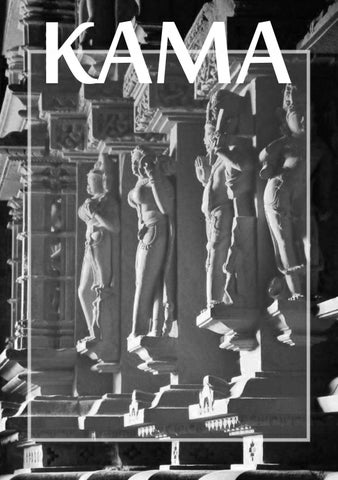
KAMA
“
India has been a land of temples with finest art and architecture across its geographical destinations. While very often many endless questions start brainstorming after being ascertained with the erotic sex sculptures on the wall so of temple for the devotees and visitors to the holy religious place.
01
“
Why Does Hindu Temples Walls and Other Structures Have Sex Sculptures and Architecture?
H
indu religion is one of the largest religion which is followed by millions across globe and has its roots relating to early inception of humans and civilization on earth. Temples of Hindu have been often denoted as the replicas of the cosmology of the universe. As per the spiritual and religious manuscripts and Vedas it has been stated that the architecture and the sculptures of a temple not only limns the cosmology of the universe but explicitly portrays sensual material pleasures on their walls, which conveys the point that we do not have to get distracted by these temptations and should move forward single mindedly towards the Lord and Almighty. Nudity has always been associated with renunciation in spirituality in most of largest religions which have been followed my many across the world. India’s highly followed spiritual and motivational leader Vivekananda said “Unless you are spiritually mature enough, don’t read Raslila, because you are going to mis read it” Hence we can conclude that for the uninformed vision these depictions of erotic sculptures may appear vulgar, but to the informed one they are replicas of the soul’s spiritual journey towards God which can be claimed as the first point and the primary understanding. The idea to have erotic images/sculpture is to test how much one can stay focused on inner aspect of truth (beliefs in god) rather then getting distracted by outer lust. It also represents that before entering into temples, leave all your negative thoughts and distraction outside temple and symbollically highlight the four goals of life dharma, kama, artha and moksha.
Khajuraho, Madhya Pradesh Khajuraho temple has been built by Chandela Kings in Madhya Pradesh. Ancient sources claim that Chandela Kings were greatly acted upon by the Tantric traditions while this temple is believed to be symbolize the ultimate seductress. Sculptures and the architecture of the temple made with the fine sandstone are well rounded finish while the later ones are more angular. Khajuraho temple sculptures twisting, broad hipped and high breasted nymphs, fleshy apsaras and extravagantly interlocked maithunas run riot along the surface of stone were described as “the apogee of erotic art” by the Mc Connachie in his history of the Kamasutra. Sun Temple, Orissa Orrisa’s Sun Temple is another well known temple for it’s abundant titillating sculptures. There are many artistic sculptures which pass on a message of ancestors to the younger generations and the devotees with the scenes of polygamy, polyandry and lesbian love. Sun Temples name ‘Konark’ has been named after the combination of Kona (corner) and Arka (Sun). One of the eye catchy monument of over here at the Sun Temple is Sun God on a colossal chariot drawn by seven horses which is usually referred as an architectural genius.
02
Stories and Myths around the erotic sculptures of Khajuraho
P
erhaps no other destination evokes so many different responses like Khajuraho does. The erotic sculptures of Khajuraho are the cynosure of all eyes and yet, you get varied reactions from people who visit the town. While some are cynical, others cringe. A few are embarrased, others are disappointed. The guides with poker faces point to “an oral activity” or a “group activity”, while most tourists giggle or look away. The vendors on the street sell kamasutra packaged as paintings or books or crude carvings depicting various forms of lovemaking. And yet, there is an intrigue around the erotic sculptures of Khajuraho that adorn the walls of these temples. We wonder why the Chandelas, who ruled over 1000 years ago built these monuments which represent love and lust in various forms. And it is not just the Chandelas. . Was it some kind of a manual that these sculptors had or was it a belief that led them to the carving these erotic sculptures of Khajuraho? There seems to be different interpretations regarding the erotic sculptures of Khajuraho from stories to spiritual beliefs. The moon always evokes romance and it is little wonder then that the descendants of the celestial moon god would build monuments that stand for love. The story goes that a beautiful woman called Hemavathy was bathing in the dark under moonlight, when she was seduced by the moon himself . She ran into the forests for refuge and raised her son, Chandravarman alone .The moon however promised her that their son would one day rule over a kingdom. True to his word, Chandravarman grew up to establish the Chandela dynasty . It is believed that he was influenced by his mother’s story and so he built temples with sculptures depicting human passions and probably, the futility of the same. There were many interpretations about letting people know about sex.
03
Other several intepretations that speak of varying beliefs in Hinduism that seem to be in the fore. One of them speaks about leaving your lust and desires behind before entering the temple which is probably why there are no carvings of sex inside the temples . The Mithunas or the couples in love are only portrayed on the outside walls of the shrines. Perhaps you can attain nirvana, once you are done with all your wordly pleasures. A mystical air hangs around it, although all the shrines are empty. It is believed that Khajuraho is charged with energy and the 64 yoginis control the very essence of life, balancing both body and mind together. Another interpretation even goes to say that the temples themselves are designed as a form of the “seductress” there is this belief centred around the tantric cult that explains that the sculptures are metaphors and are actually a form of language, a form of educating the various doctrines of the cult through symbols and imagery. Coming back to the 22 remaining temples, dedicated to Jainism and Hinduism, there is more to them than just the sexual imagery. They are divided in three main groups Western, Eastern and Southern. Most of the erotic sculptures are seen in the Western Group of temples. The sculptors seemed to have run riot carving these beautiful women in various activities. They seem so life like and beautiful and every minute detail has been given importance to. These graceful nymphs portray human emotions. And then you have scenes from day to day life. The book refers to them as ‘‘secular sculptures.” Warriors, dancers, musicians are coupled with scenes of a royal court, a teacher and a pupil, a sculptor with his students and even funeral scenes. Mithunas mating to group sex to even scenes of unnatural sex.
04
‘Mithuna’ sculptures
The famous chariot wheels of the Sun Temple in Konark. There are 24 of them, each one a marvel of symme They are 3 meters in diameter and served as sundials the shadows cast by the sundials can give you the tim
05
etry and beauty. me of the day.
O
ne of the most discussed aspects of the Konarak temple is the abundance of erotic sculptures on the temple wall. Many British commentators expressed shock and outrage at this open display of rampant eroticism on a temple wall. Lowell Thomas described Konarak as the “most beautiful” and at the same time “the most obscene building in the world”. However, various explanations have been offered for these “mithunas”, but no single explanation has succeeded in resolving the mystery. Benjamin Rowland and Percy Brown asserted that there was at that point of time, a mithuna movement involving orgiastic rites holding a spell over a large section of the people. But this explanation appears to be unfounded. The sun worship at Konarak had nothing to do with such orgiastic practices. The profusion of erotic sculptures need not also imply that there was moral laxity of the devadasis employed in the temples, who were primarily concerned with service to the deity. Of greater credibility is the explanation offered by A.K. Coomaraswamy who mentioned that the Indian sex-symbolism is ‘sacramental’ in its likeness to the union of the individual soul with the universal spirit. The representation of sexual union in sculptures according to Stella Kramrisch is regarded as a “symbol of Moksha”, because the ecstasy in sexual love was compared to religious ecstasy derived in merging of the human soul with the ultimate reality. Coomaraswamy further described the erotic sculptures as symbolic of the illusory world of pleasure in contrast to the solemn character of the inner side of the sanctuary. The outside of the temple represents various activities that belong to the samsara; beyond that and within the temple is the image of God.
06
K.C. Panigrahi, a historian of Orissa, believes that the obscene figures were in all probabiity meant to test the self-restraint of a visitor before he was entitled to reap the merits of his visit to the god. Another explanation offered is that the erotic figures are inspired by Tantric rituals. A further explanation is that erotic sculptures are meant to ward off lightning and thunder. Although various such explanations are offered for the depiction of eroticism in the Konarak sculptures, Coomaraswamy’s holistic explanation appears to be more authentic. He says that such a characteristic feature of the temple architecture in India could be thought of as a representation of the rightful place of ‘voluptous ecstasy’in life. The erotic sculptures of Konarak reflect the life and vitality of the times; they are the expressions of a happy people who took delight in the pursuit of pleasure. The total frankness, lack of guilt, and the expression of mutual enjoyment and zest expressed through these sculptures have been noted by Nihar Ranjan Ray and Abanidra Nath Tagore, Prof. K.S. Behera, a noted historian agrees with these explanations and accepts this as most credible in his latest book “Konarak, the Black Pagoda” published by the Publications Division of the Government of India. A comparison between the erotic sculptures of the Khajuraho temples and the Konarak temple can be noted. At Khajuraho, the sculptures being independent of the flat base of the temple body, seem as though they have been applied on the temple surface without any basic relationship with the temple walls. This organic relationship between the sculpture and the walls of the temple, contribute, to a very considerable degree, to the vitality and liveliness of the Orissan sculptures.
Sacred Sexuality
T
he dominant world religions treat sexuality as (at best) a distraction from the spiritual path. On the other hand, some spiritual traditions integrate sexuality into their spiritual practice. Some regard sexuality as an integral part of life, a gift to be honored and enjoyed. This section contains classic texts which discuss the sacred nature of sexuality and affirm the positive aspects of sex. Some of these texts (the Tantric) are esoteric and touch on the intersection of the spiritual and the physical.
Kama Sutra In addition to Tantra, which attributes a spritual dimension to sexuality, India has produced a rich literature of sophisticated sex manuals. In spite of their practical nature, they demonstrate how Indian culture integrated sexuality into everyday life, (including religion and spirituality). This knowledge was supposed to be part of the repetoire of any intelligent and well-educated adult. Several of these were translated in the Victorian Era by freethinking Orientalists.
07
Tantric texts describe the esoteric teachings of Tantra, a belief system which originated in India, praticed by a small number of Hindus and Buddhists. Tantra has become a synonym in the West for unbridled sexuality; however sexuality is only one facet of this elaborate spiritual practice, as a representation of the union of the soul with the Goddess. Rather, this attitude reflects the spiritual vacuum of mainstream Western religions when it comes to sacred sexuality.
Quite the contrary, the practices which involve behavior which is regarded by conventional Hinduism as ‘sinful’ (such as eating meat, drinking alcohol, and having sexual union), normally requiring expatiatory behavior, are supposed to only be engaged in by spiritually advanced practicioners in the appropriate ritual context. (Taken with these caveats, the assertion of Tantra that sexual energy can be harnessed to achieve union with the divine is fairly unique among world religions.
08