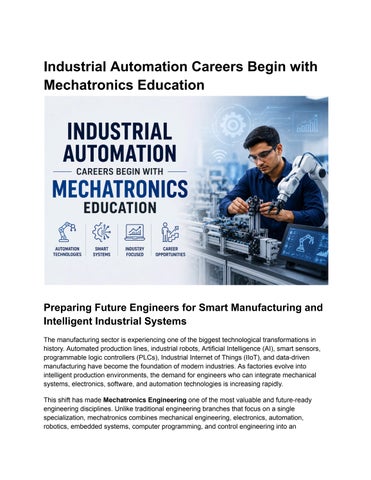
Industrial Automation Careers Begin with Mechatronics Education
Preparing Future Engineers for Smart Manufacturing and Intelligent Industrial Systems The manufacturing sector is experiencing one of the biggest technological transformations in history. Automated production lines, industrial robots, Artificial Intelligence (AI), smart sensors, programmable logic controllers (PLCs), Industrial Internet of Things (IIoT), and data-driven manufacturing have become the foundation of modern industries. As factories evolve into intelligent production environments, the demand for engineers who can integrate mechanical systems, electronics, software, and automation technologies is increasing rapidly. This shift has made Mechatronics Engineering one of the most valuable and future-ready engineering disciplines. Unlike traditional engineering branches that focus on a single specialization, mechatronics combines mechanical engineering, electronics, automation, robotics, embedded systems, computer programming, and control engineering into an
integrated field. Graduates are prepared to design, operate, maintain, and improve automated industrial systems that drive productivity and innovation. Students searching for the best mechatronics engineering colleges in India should look for universities that provide industry-oriented education, advanced laboratories, practical exposure, research opportunities, and strong industry collaboration. Sanskriti University has developed a future-focused Mechatronics Engineering program that equips students with the multidisciplinary knowledge and practical skills required for careers in industrial automation. Through project-based learning, modern laboratories, industrial internships, experienced faculty, innovation-driven education, and exposure to emerging technologies, the university prepares graduates to become valuable contributors to Industry 4.0 and beyond. This blog explores why mechatronics education is the ideal foundation for industrial automation careers and how it prepares engineers for the intelligent factories of the future.
Understanding Industrial Automation Industrial automation refers to the use of advanced technologies to perform manufacturing and industrial processes with minimal human intervention. Automation technologies include: ● ● ● ● ● ● ●
Robotics Programmable Logic Controllers (PLCs) Smart sensors Computer-controlled machinery Industrial software Artificial Intelligence Automated quality control systems
These technologies improve productivity, accuracy, safety, and operational efficiency.
Why Mechatronics Is Central to Automation Industrial automation requires expertise across multiple engineering domains. Mechatronics integrates:
● ● ● ● ● ● ●
Mechanical Engineering Electronics Embedded Systems Computer Programming Robotics Automation Control Systems
This multidisciplinary approach enables engineers to build intelligent industrial solutions.
Industry 4.0 Is Changing Manufacturing Industry 4.0 represents the digital transformation of manufacturing. Modern factories use: ● ● ● ● ● ● ●
Artificial Intelligence Internet of Things (IoT) Machine Learning Cloud Computing Digital Twins Predictive Maintenance Autonomous Robotics
Mechatronics engineers are among the primary professionals responsible for implementing these technologies.
Robotics Creates High-Growth Career Opportunities Industrial robots have become essential in manufacturing. They perform tasks such as: ● ● ● ● ● ●
Assembly Welding Packaging Material handling Quality inspection Precision manufacturing
Mechatronics engineers design, program, operate, and maintain robotic systems.
Automation Improves Industrial Efficiency Automation enables industries to: ● ● ● ● ● ●
Reduce production costs Increase productivity Improve product quality Enhance workplace safety Minimize downtime Optimize resource utilization
Mechatronics professionals contribute directly to these improvements.
Practical Learning Builds Automation Expertise Industrial automation cannot be mastered through classroom theory alone. Students benefit from practical experiences such as: ● ● ● ● ● ●
PLC programming Robotics laboratories Automation projects Industrial simulations Embedded systems development Sensor integration
Hands-on learning develops confidence and technical competence.
Essential Skills for Automation Engineers Successful automation professionals possess expertise in multiple technical areas. Key skills include: ● Robotics programming ● Mechanical system design ● Electronics
● ● ● ● ● ●
PLC programming Industrial control systems Artificial Intelligence fundamentals Data analysis Problem-solving Team collaboration
These competencies make graduates highly employable.
Career Opportunities After Mechatronics Engineering Industrial automation offers diverse career pathways. Graduates may work as: ● ● ● ● ● ● ● ●
Automation Engineer Robotics Engineer Mechatronics Engineer Industrial Control Engineer Manufacturing Engineer Maintenance Automation Specialist Product Development Engineer Systems Integration Engineer
These roles exist across manufacturing, automotive, aerospace, electronics, healthcare, logistics, renewable energy, and many other sectors.
Choosing the Right Mechatronics Engineering College Students searching for the best colleges for mechatronics in India should evaluate institutions that provide future-oriented engineering education. Important considerations include: ● ● ● ●
Industry-oriented curriculum Robotics and automation laboratories Modern engineering infrastructure Experienced faculty
● ● ● ●
Internship opportunities Research and innovation Industry partnerships Placement assistance
A quality educational environment significantly strengthens career prospects.
How Sanskriti University Prepares Students for Industrial Automation Careers Sanskriti University provides a modern learning ecosystem that supports the development of highly skilled automation engineers.
Industry-Oriented Curriculum The Mechatronics Engineering program integrates robotics, automation, electronics, embedded systems, Artificial Intelligence, control engineering, and Industry 4.0 concepts into a comprehensive curriculum.
Advanced Laboratories Students gain practical experience through robotics laboratories, automation systems, PLC training facilities, electronics laboratories, and smart engineering infrastructure.
Project-Based Learning Engineering design projects, industrial case studies, robotics competitions, automation assignments, and interdisciplinary innovation activities strengthen practical expertise.
Industry Collaboration Industrial visits, internships, expert lectures, workshops, and collaborative projects expose students to real manufacturing environments and automation technologies.
Research and Innovation
Students are encouraged to participate in research initiatives, prototype development, technical competitions, innovation challenges, and interdisciplinary engineering projects.
Career Development Support Resume preparation, aptitude development, technical training, communication enhancement, mock interviews, and placement guidance prepare students for successful engineering careers. Through this holistic educational approach, Sanskriti University develops graduates capable of designing, implementing, and managing intelligent automation systems across modern industries.
Conclusion Industrial automation is transforming global manufacturing by making production smarter, faster, safer, and more efficient. As industries continue to adopt robotics, Artificial Intelligence, intelligent control systems, and digital manufacturing technologies, the demand for multidisciplinary engineers will continue to grow. Students searching for the best colleges for mechatronics in India should choose universities that combine academic excellence with practical learning, industry collaboration, research, and innovation. Sanskriti University offers a future-ready Mechatronics Engineering program that prepares students through advanced laboratories, project-based education, industrial exposure, research opportunities, and comprehensive career development. By equipping graduates with the skills required for industrial automation, the university empowers them to become leaders in the next generation of intelligent engineering.
Frequently Asked Questions (FAQs) 1. What is industrial automation? Industrial automation involves using robotics, control systems, Artificial Intelligence, sensors, and computer technologies to automate manufacturing and industrial processes.
2. Why is Mechatronics Engineering important for automation careers?
Mechatronics combines mechanical engineering, electronics, robotics, programming, and automation, making graduates ideally suited for intelligent manufacturing and Industry 4.0 environments.
3. What career opportunities are available in industrial automation? Graduates can work as Automation Engineers, Robotics Engineers, Mechatronics Engineers, Manufacturing Engineers, Industrial Control Engineers, Systems Integration Engineers, and Product Development Engineers.
4. Which skills are essential for automation engineers? Students should develop expertise in PLC programming, robotics, electronics, embedded systems, automation, mechanical design, problem-solving, communication, and teamwork.
5. What should students consider when selecting a Mechatronics Engineering college? Students should evaluate curriculum quality, automation laboratories, robotics infrastructure, industry partnerships, faculty expertise, internships, research opportunities, and placement support.
6. Why should students choose Sanskriti University for Mechatronics Engineering? Sanskriti University offers an industry-oriented curriculum, advanced automation laboratories, robotics training, project-based learning, industrial exposure, research opportunities, experienced faculty, and comprehensive placement support to prepare students for successful industrial automation careers.