How Technology-Based Targeting Helps B2B Marketers Reach the Right Audience
Introduction Reaching the right audience has always been one of the biggest challenges in B2B marketing. A product or service may be highly valuable, but marketing efforts can produce poor results if they are directed toward companies that do not need the solution. Traditional targeting methods often focus on factors such as industry, company size, location, and revenue. While these factors are useful, they do not always provide a complete understanding of a company's needs. Technology-based targeting provides an additional layer of insight. It helps marketers understand the technologies, software platforms, and digital systems used by potential customers. This information can help businesses identify organizations that may have a stronger connection to a particular product or service.
As businesses continue to adopt new digital tools, their technology environment can reveal useful information about their operations and potential requirements. For example, the use of a specific customer relationship management system, cloud platform, or marketing automation tool may indicate that a company could benefit from related products, integrations, or services. Technology-based targeting does not replace other forms of B2B targeting. Instead, it can be combined with firmographic, behavioral, and role-based information to create a more detailed picture of the target audience. When used carefully, this approach can help marketers improve relevance, reduce unnecessary outreach, and create campaigns that address real business needs.
Understanding Technology-Based Targeting Technology-based targeting, also known as technographic targeting, is the process of identifying and segmenting companies according to the technologies they use. These technologies may include software applications, cloud services, marketing platforms, analytics tools, security systems, and other business technologies. For example, two companies may operate in the same industry and have a similar number of employees. However, their technology environments may be completely different. One organization may use a particular CRM and cloud provider, while another uses different platforms. These differences can affect the products, services, and messages that are most relevant to each company. Technographic information can help marketers answer questions such as: • • • • •
What technologies does a company use? Does the organization use a platform compatible with our solution? Could the company benefit from an additional technology or integration? Is the organization using a competing solution? What type of professionals may be involved in technology-related purchasing decisions?
The purpose of this information is not simply to collect more data. Its value comes from helping marketers make better decisions about audience selection and campaign messaging.
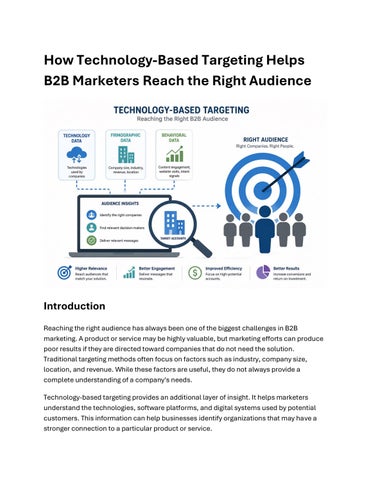
Firmographic, Technographic, and Behavioral Data Successful B2B targeting usually involves more than one type of data. Three important categories are firmographic, technographic, and behavioral data. Firmographic data describes the characteristics of an organization. It can include industry, company size, employee count, location, and revenue. This information helps marketers define the type of businesses they want to reach. Technographic data focuses on the technology environment of an organization. It may include the software platforms, cloud services, analytics tools, or other technologies used by the company. Behavioral data provides information about interactions and engagement. This may include website visits, content downloads, email engagement, or other activities that suggest interest in a particular topic. These types of information can work together. Firmographic data may help identify suitable companies, technographic data may help determine whether there is a technology fit, and behavioral information may help marketers understand engagement. For example, a business may first identify medium-sized companies in a specific industry. It can then narrow the audience based on relevant technologies and prioritize accounts that show engagement with related content. This layered approach can help marketers create more focused campaigns.
Improving Audience Relevance One of the main advantages of technology-based targeting is that it can improve the relevance of marketing communication. Generic B2B messages often attempt to appeal to a large audience. However, companies using different technologies may have different challenges and priorities. A message that is relevant to one technology environment may not be relevant to another. Technology information can help marketers create audience segments based on meaningful differences.
For example, a company providing an integration solution could create separate campaigns for organizations using different software platforms. The overall product may remain the same, but the messaging, examples, and content can be adapted to each audience. Technology-based targeting can support:
Compatibility Targeting Some products are designed to work with specific technologies. Marketers can identify organizations using compatible systems and provide information about integrations and related benefits.
Complementary Solution Targeting Companies may already use technologies that create a need for additional solutions. A marketing campaign can focus on how a product complements an existing technology environment.
Competitive Analysis Technology information can also help marketers understand the solutions currently used by potential customers. This can support comparison content and explain differences between available options. However, comparisons should be accurate and should focus on genuine business value.
Technology Change Opportunities Organizations sometimes adopt new technologies, migrate systems, or modernize their infrastructure. Such changes may create new requirements for implementation, integration, training, security, or additional tools. Technology changes can therefore provide useful context when planning B2B campaigns.
Building a Technology-Based Targeting Strategy An effective technology-based targeting strategy should begin with a clear understanding of the ideal customer.
The first step is to define the Ideal Customer Profile, commonly known as an ICP. This profile may include the company's industry, size, location, business needs, and other relevant characteristics. The next step is identifying which technologies are relevant to the product or service. Not every technology signal will be useful. Marketers should focus on technologies that have a clear relationship with the solution they offer. Questions to consider include: • • • •
Which technologies are commonly used by existing customers? Which platforms does the product integrate with? Which technologies indicate a possible need for the product? Which technology environments are most relevant to the target market?
After identifying relevant technologies, marketers can create audience segments. For example, companies can be grouped according to their technology platforms, business size, or potential use cases. Each group can receive different content based on its likely requirements. This approach can make campaigns more organized and relevant.
The Role of Decision-Makers Technology targeting is not only about identifying companies. B2B purchases often involve multiple people with different responsibilities. Depending on the product, the buying process may involve IT leaders, technology managers, security professionals, operations teams, procurement professionals, and senior executives. Therefore, after identifying relevant organizations, marketers need to understand which professional roles are most likely to be involved in the decision-making process. For example, a campaign related to IT infrastructure may need to reach technology leaders and IT managers. A marketing technology solution may require communication with marketing leaders as well as technical teams.
Role-based targeting helps marketers adapt content to the concerns of different stakeholders. A technical professional may be interested in integration and security, while a business leader may focus more on efficiency, cost, and business outcomes. This is why effective B2B targeting often combines company information with professional roles.
Technology-Based Targeting in Email Marketing Email remains an important channel for B2B communication. However, broad email campaigns can produce poor results when the audience is not properly segmented. Technology-based information can help marketers create more relevant email campaigns. For example, companies using a particular marketing automation platform may be interested in content related to improving automation workflows, integrations, campaign measurement, or lead management. When researching technology-specific B2B audiences, marketers may also refer to specialized data resources such as a Salesforce Pardot Users List. Such information can help support audience research and segmentation when used responsibly and in accordance with applicable privacy and email marketing requirements. The main focus should remain on relevance. The email should provide useful information rather than simply promote a product. Examples of useful email content include: • •
Industry insights Educational guides
• • • • •
Research findings Webinars Case studies Technology trends Implementation best practices
Relevant content can help build stronger relationships with professional audiences.
Reaching Technology and IT Professionals Many B2B products and services involve technology-related decisions. As a result, IT and technology professionals are often important members of the buying group. The specific audience depends on the product. Some campaigns may focus on senior leaders, while others may be more relevant to managers or technical specialists. For broader research into professional technology audiences, marketers may use resources such as an IT Decision Makers Email List. The key is to ensure that audience selection is based on genuine relevance rather than sending large volumes of generic messages. Responsible outreach is important. Marketers should consider data privacy requirements, applicable email regulations, and the expectations of the audience. The quality of the communication is often more important than the quantity of contacts.
Technology-Based Targeting and Account-Based Marketing Account-Based Marketing, or ABM, focuses on specific organizations rather than a broad market. Technology-based targeting can support ABM by helping marketers identify accounts that have a stronger potential fit. For example, a company can select accounts based on industry and size and then use technology information to further understand their digital environment. This can help marketing and sales teams prioritize their efforts. Once accounts are selected, campaigns can be personalized using relevant content. A company may develop: • • • • • •
Industry-specific guides Technology-focused articles Integration resources Case studies Webinars Product demonstrations
The purpose is to create useful communication for the selected audience. Technology information can help improve personalization, but it should not be treated as perfect information. Companies may use multiple technologies, and technology data can change over time. Therefore, marketers should continue testing and validating their audience assumptions.
Measuring Campaign Performance Like any B2B marketing strategy, technology-based targeting should be measured. Important performance indicators may include: • • • • • • • • •
Engagement rates Website visits Content downloads Lead quality Conversion rates Meetings generated Opportunities created Pipeline contribution Cost per qualified lead
Marketers can compare technology-based campaigns with broader campaigns to understand whether the additional targeting improves results. For example, a business may compare two similar campaigns. One campaign targets companies based only on industry, while the other includes technology-based segmentation. The results can help determine whether the technology signals are useful. Testing should be continuous. Marketers can experiment with different audience segments, content formats, messages, and channels.
Challenges and Limitations Although technology-based targeting offers many benefits, it also has limitations.
Technology information may not always be complete or current. Companies can change their software, use multiple platforms, or operate different systems across departments. Marketers should therefore avoid assuming that every technology signal is completely accurate. Another challenge is over-targeting. If an audience is filtered too narrowly, the campaign may reach too few organizations. Marketers should balance precision with audience size. Technology-based targeting should also be used responsibly. Businesses should respect privacy, follow relevant regulations, and avoid intrusive marketing practices. The best approach is to use technology information as one part of a broader audience strategy.
Conclusion Technology-based targeting is helping B2B marketers create more focused and relevant campaigns. Instead of relying only on broad characteristics such as industry or company size, marketers can gain additional insights by understanding the technologies used by potential customers. Technographic data can support audience segmentation, personalization, account-based marketing, and more relevant communication. When combined with firmographic, behavioral, and role-based information, it can help marketers develop a stronger understanding of their target audience. However, technology data should not be treated as the only indicator of customer interest. It is most effective when combined with useful content, accurate audience information, responsible outreach, and continuous measurement. The goal of technology-based targeting is not simply to collect more information about businesses. Its real value lies in helping marketers understand which audiences may benefit from a particular solution and how communication can be made more relevant. As B2B marketing continues to become more data-driven, technology-based targeting is likely to remain an important approach for businesses that want to improve audience selection and build more meaningful professional relationships.
References LinkedIn Marketing Solutions – Audience Targeting Salesforce – B2B Marketing Resources HubSpot – Account-Based Marketing Guide