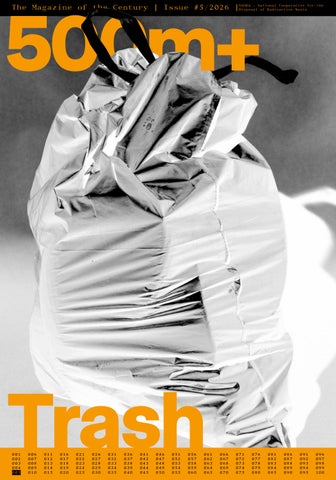
Nationale — National Genossenschaft Cooperative fürfor diethe Das Jahrhundertmagazin The Magazine of the Century | Ausgabe | Issue #5/2026 #5/2026 | NAGRA |—NAGRA Lagerung Disposal radioaktiver of Radioactive Abfälle Waste
Trash 001 002 003 004 005
006 007 008 009 010
011 012 013 014 015
016 017 018 019 020
021 022 023 024 025
026 027 028 029 030
031 032 033 034 035
036 037 038 039 040
041 042 043 044 045
046 047 048 049 050
051 052 053 054 055
056 057 058 059 060
061 062 063 064 065
066 067 068 069 070
071 072 073 074 075
076 077 078 079 080
081 082 083 084 085
086 087 088 089 090
091 092 093 094 095
096 097 098 099 100
Editorial We would love to banish it from our conscience, just like all our negative feelings and unpleasant memories: the waste that each and every one of us produces every day of our lives. We toss our rubbish bags into the container or set them out on the street, bring our old mobile phones to recycling centres. Out of sight, out of mind: we let others collect, incinerate, and ship or bury our waste for us. However, as in psychology, we can repress something, but it will eventually find its way back to us. As microplastics in our bodies. As electronic waste in Ghana. As munitions that are washed up on the Baltic coast decades after the Second World War. Or as a massive pile of rubbish in an incineration plant, exposing what we successfully block out in our everyday lives: the sheer volume of our legacy in the form of waste. In this issue of our magazine, we attempt to follow the different types of waste as they embark on their respective journeys. We want to find out what happens once something has lost its value to us. Where does our waste go? Who makes a livelihood from it? Who bears the risks associated with the waste? And could some waste components still be of value? Much of yesterday’s waste is considered a resource today. Whether electronic or radioactive waste: the idea of recycling is as compelling as it is obvious. Raw materials should remain in the cycle for as long as possible and be reused time and again. However, the stories in this magazine show that there are no miracle cures. Recycling can extend the lifespan of materials, help recover raw materials and reduce the waste volume. Yet every material cycle comes with its own challenges, and each one produces some waste of its own. This applies to radioactive waste in particular. New reactor concepts and reprocessing methods are fascinating and worthy of serious debate. They could eventually make an important contribution. Yet even if the most ambitious technological promises become a reality, some high-level waste will always remain. A deep geological repository is therefore not an alternative to recycling, but a safeguard needed to ensure the safety of humans and the environment in the near and distant future. Waste is not just what we throw away. Waste is what is left when all is said and done. This magazine reminds us of our responsibility towards this waste. Patrick Studer, Head of Communication, Nagra
CONTENT 3 Baltic Sea
La Hague Villigen (PSI) and Stadel (proposed site for a deep geological repository)
Ghana
5 – 9 Give us this day our daily ... double burger
There are mountainous piles of rubbish – and then there is the pile of rubbish available to you. Our writer spent a day indulging in junk food, bad habits and trashy TV and internet content.
10 – 11 So much waste! Facts & figures 12 – 23 A lifetime of rubbish
Not many places can boast as efficient a waste management system as Zürich: toss the rubbish in the bin bag, drop the bag in the underground collection container, start filling a new bag. But what comes to light when we dissect the waste?
24 – 25 So many nappies! Facts & figures 26 – 47 Accra speaking
The trade in used electronic devices is flourishing on Ghana’s shores. Here, smartphones are restored, televisions repaired, air-conditioning units and fridges stripped for parts, and humans and the environment steadily poisoned.
48 – 49 So much digital waste! Facts & figures 50 – 57 Ticking time bomb in the Baltic Sea
After the Second World War, tonnes of weapons and ammunition were sunk in the Baltic Sea. The previously invisible threat lurking at the bottom of the sea is slowly but surely rising to the surface.
58 – 59 So much space debris! Facts & figures 60 – 77 Second chance
If everything goes according to plan, Switzerland will close its deep geological repository for radioactive waste with the publication of the 100th issue of this magazine. This raises the question: why do we intend to bury the waste when we could maybe recycle it?
78 79
So much radioactive waste! Facts & figures Impressum
500m+
4
NOTHING BUT JUNK FOR ONE WHOLE DAY
Give us this day our daily bread – no, make it a double burger instead Starting off the day with a can of Red Bull and a reality soap, stopping at McDonald’s for lunch, feeding on Instagram and Temu in between: what is it like to let yourself go for one day? Text: Michèle Roten Photos: Jordi Ruiz Cirera
5
500m+
6
I resisted for a long time. For years, people around me had been telling me to watch “Love is Blind”. Two rooms, two people – and a wedding, without the two of them ever meeting beforehand. “Total trash, of course,” they all said, “but still fun to watch. Crazy but good.” I resisted because I wanted to avoid brain rot. I was afraid I might get hooked on this dating series. No, worse still: I know I am a sucker for this kind of show. It happened before with “Keeping Up with the Kardashians” – I resisted watching that show for a long time, too. I wasn’t interested, and I didn’t want to become interested. Due to some unfortunate circumstances, I ended up watching one episode. It was exactly as expected: scripted crap pretending to be authentic. Artificial emotions designed to convince us that these artificial humans are normal. It’s all so obvious, and yet some part of the brain decides to believe it. I watched every available episode. I could only kick the habit because of the enforced break at the end of the season. I came to my senses and did not return for the next season. Nothing but sugar for my brain all day long Normally, I’m quite mindful of what I put into my body. I eat well – not because I’m particularly sensible, but because I enjoy eating food that happens to be good for me. I read books that expand my knowledge; trash novels leave me depressed. The same goes for films and music: I like to be challenged, surprised, confronted with something thought-provoking. And yet I am not immune to the siren call of the simple, the trashy, the dumb and the easily digestible – as my Kardashians phase demonstrated. Not to mention my overflowing stash of sweets. And I love beer. Unlike my prefrontal cortex, my reward centre is no snob. So I’m actually quite looking forward to this self-experiment: for one whole day, I will indulge in anything trashy. When given the choice, I will consistently opt for the irrational, feel-good option. One whole day of instant gratification. I start off my experiment the moment I get up: instead of a cup of coffee with milk and no sugar, I knock back an energy drink. A guilty pleasure that I treat myself to about once a week, preferably away from prying eyes. Since my day degenerated into a thoroughly unromantic affair from the moment I got up, I immediately get on Instagram. Why bother gazing out of the window for a bit, listening to the news and slowly smoothing out my sleep wrinkles. Instagram is magical. In no time at all, I learn how dry ice behaves in honey, how you can use a condom wrapper to thread a needle, or how to squeeze toothpaste into a drinking straw if you want to travel light. I watch posts about someone hatching a tortoise egg and someone else creating seamless transitions while painting a wall, and learn how to spot a sweet watermelon. It’s not even that trashy. Sure, most of it is entirely pointless, but a lot is still interest-
I didn’t want to grow interested in the Kardashians, but then I became engrossed with them after all.
NOTHING BUT JUNK FOR ONE WHOLE DAY
ing – I have trained my algorithm well. Too well. The above-mentioned “no time at all” turns out to have cost me a full hour. For sixty minutes, I just absorbed everything there was to absorb. I didn’t even realise time was flying by. When I become aware of the fact that I have been sitting at the kitchen table scrolling for an hour already, I decide to carry on scrolling on the sofa. A court jester, at my beck and call Instagram works like a slot machine. As we scroll through our feed, we never know whether we will next be fed a boring picture, a funny reel or something downright life-changing. This unpredictability triggers the release of the neurotransmitter dopamine in the brain. The brain loves these surprises and wants to keep scrolling until it finds the next “reward”. Fortunately, though, the release of dopamine levels off at some point – after all, the brain isn’t stupid and eventually realises that the content is all rather similar. For me, that happens after around two hours: I get restless, I’m bored, even though the world is clowning about like a court jester on my little device, solely to amuse me. On a normal day, I would now be feeling the urge to do something meaningful. Clean the flat, complete the voting documents, sort out something I have been putting off for ages. At times like these, even an atheist can sense the religious influences in our society: do penance (Catholicism), work (Protestantism). But today is not a normal day for me. So: time to watch “Love is Blind”. The premise: 15 women and 15 men first get to know each other “blindly” – solely through conversation. If things feels right between them, they pop the question, meet for the first time, go on holiday together – and marry. There are adaptations of this show all over the world, but of course I watch the original from the “Trash Capital of the World”: the USA. And realise quickly: for me, the worst type of trash is the kind that tries to be “deep”. People who want to show that, at the end of the day, they’re decent folk. They adopt dogs. They run dance classes for mature adults. “It’s not what’s on the outside that counts,” says the man who definitely spends more time grooming the outside of his skull than cultivating what’s inside it. “The most important thing is to be yourself,” says the woman whom I cannot tell apart from any of the others. Fake tears at the memory of being bullied as a child (“Everyone called me ‘beanpole’ because my legs are so long.”) Fake horror, fake emotion, fake joy. But I'm spellbound. I’m not sure how that happened. For long stretches, I sit curled up in a little ball on the sofa and wonder why anyone would put themselves through this. Watching non-professional actors pretend that they’re looking for love, that they’re opening up, showing their vulnerability, as if something deep inside them has been touched. Of course, they’re not there to find a wife or a husband. They want to become famous, build a brand, or at least
Instagram is like gambling: the promise of a winner with that one last, very last, very, very last shot.
7
500m+
8
enjoy their 15 minutes in the spotlight. And perhaps that is precisely part of the appeal – watching the lengths people go to in order to sell themselves. Trash is honest in its dishonesty. Better to be misled than bored And yet: despite watching this show through the most cynical of lenses, I end up succumbing to the romantic narrative and find myself hoping that at least one of the women realises just how funny this guy, this weirdo, actually is. Or that the person whose arm was disfigured after several operations will find herself face to face with someone who doesn't care about that kind of thing at all. In media studies, this is known as “the suspension of disbelief”: I deliberately switch off my rational mind to let myself be carried away by my emotions. I’m striking a deal with the show’s creators: I’ll pretend it’s real, and you’ll entertain me in return. I am willing to be misled if, in return, I can escape boredom. It’s not that bad a deal. I enjoy the constant stream of drivel, paint my toenails and order some – duh – fast food: cheeseburger, fries, Coke. Around 900 calories, maximum enjoyment (fat, salt, sugar – my dopamine system is ecstatic), and there’s not even that much junk in my junk food: the meat and cheese provide around 15 grams of protein as well as some vitamin B12, zinc, iron and calcium. It’s really just the Coke that has no dietary benefits whatsoever. Unless you are willing to interpret 60 grams of sugar as carbohydrates, ignoring the fact that this amount exceeds the WHO’s recommended daily intake of sugar. (Then again, Coke is said to be an excellent remedy for nail fungus and smelly feet. Or so I learned on Instagram.) And then I deliberately deaden my senses After consuming my burger while watching “Love is Blind”, my reward centre screams for more. Screen Two, here I come. This is something I do quite often – albeit always with a guilty conscience. Of course, letting yourself be entertained by two screens at once is wrong on so many levels; and science backs up just how bad it is for you. A structural MRI study conducted by the University of Sussex showed that people who frequently multitask on their electronic devices have a lower density of grey matter in the anterior cingulate cortex (ACC). The ACC is the part of the brain that is responsible for regulating emotions, empathy and cognitive control (such as shielding from distractions). What’s more, the brain simply gets used to this constant pursuit of novelty and becomes desensitised to normal input, requiring ever more – and ever more extreme – stimulation. Instagram would be one option, but I crave an even more intense kick right now: Temu. The ultimate trash, both literally and figuratively. The app stimulates my meso limbic reward system with wheels of fortune, countdowns, falling prices and virtual
Using two screens at once is wrong on so many levels – as has been scientifically proven.
NOTHING BUT JUNK FOR ONE WHOLE DAY
9
vouchers. I scroll through a huge mountain of rubbish made up of brand-new products. A cat brush with a built-in vacuum cleaner (“Low Noise Doesn’t Scare Your Baby Fur Kids”). A miniature washing machine for underwear (“On the Strong Attraction On Beauty Appearance”). An ultra-HD visual ear cleaner (“Dig while looking ear cleaning is safer”). A cigarette holder with a finger-joint clip “for comfortable smoking”. A parasol for your mobile phone. Washable underarm sweat pads. A pair of glasses that let you watch TV while lying on your back. Flipping my finger at reason I have now reached the summit of trashiness. Temu is the monument we have built to celebrate our fascination with junk. Our society’s fascination with the trashy, the cheap, the banal and the useless has always served as an outlet, a deliberate, ironic break with reason. The world is exhausting and demanding. The desire for cognitive relief through the consumption of accessible, easily digestible, instantly rewarding content – from Instagram and TV programmes to fast food and Temu shopping – is obvious. It’s a bit like flipping my finger at reason: I know all of that, but I don’t care. In psychology, this is also referred to as “hedonic reversal”: precisely the objective inferiority of things can, subjectively, make them enjoyable. Which is exactly what we want: to enjoy ourselves, to have fun and to feel good. And for that, we’re willing to put up with being misled. To mislead ourselves. With fake love, food that doesn’t really nourish, and products whose only value lies in being anticipated and unwrapped. After that, they are, even to the person who paid for them, exactly what they were from the very beginning: trash. I’ve been watching “Love is Blind” for so long now that Netflix is asking me whether I’m still there. The answer is: no. I give up. I now feel so empty and dirty that not even a dopamine rush could help me anymore. What I need now is a more sustainable dose of serotonin. I turn to the Aristotelian approach to the question of happiness: eudaimonic fulfilment through making myself useful. I clean the drains and take the rubbish down. (But I did order the cat brush.)
Temu is the monument we have built to celebrate our fascination with junk.
500m+
Waste per person per year USA 900 kg Switzerland 670 kg EU 500 kg Sub-Saharan Africa 200 kg
So much waste! As well as metaphorical rubbish, we also produce very real rubbish – in Switzerland, around 670 kilograms per person per year. However, when it comes to assessing the environmental impact, there are more important factors than the sheer volume.
10
670 kg per capita per year in Switzerland 52 % recycling rate 100 % collection rate
With 670 kilograms of household waste per year (of which 148 kilograms ends up in rubbish bags), Switzerland ranks in the upper middle range from a global perspective. The US tops the list with around 900 kilograms; the EU average is slightly above 500 kilograms, while in the sub-Saharan region the figure is around 200 kilograms. What does this mean for the environment? The absolute waste volumes are actually less decisive than the waste treatment method. In Switzerland, just under half the waste is incinerated and 52 per cent is recycled. In the EU, the recycling rate stands at 48 per cent, albeit with significant variations: from 12.4 per cent in Romania to 62.8 per cent in Austria. The US recycling rate is roughly 37 per cent, and countries in the sub-Saharan region only recycle around 4 per cent.
THE RUBBISH WE LEAVE BEHIND
11
Recycling rate
Global forecast
Austria 62.8 % Switzerland 52 % EU 48 % USA 37 % Romania 12.4 % Sub-Saharan Africa 4%
2025 → 2.5 billion tonnes 2050 → 3.7 billion tonnes
How well the Swiss waste management system works is demonstrated, on the one hand, by the collection rate and, on the other, by landfill figures. The collection rate is almost 100 per cent. Other developed regions also collect over 90 per cent, while the rate is significantly lower in West Asia and North Africa (75 per cent), Oceania (45 per cent), Central and South Asia (37 per cent) and sub-Saharan Africa (36 per cent).
Another key factor is disposal in a landfill. In Switzerland, combustible waste cannot go into landfills, these are restricted to hazardous waste. Similar regulations apply in Japan, Sweden and Austria. By contrast, on average across Europe, 30 to 40 per cent of waste is sent to a landfill, while in the USA the figure is more than half. In parts of Africa, Asia and South America, there are no waste incineration plants at all – all the waste ends up in landfills. Globally, there is a clear trend towards an increase in the waste volume. According to forecasts, the volume of household waste is set to rise from just under 2.5 billion tonnes at present to over 3.7 billion tonnes by 2050.
Source for Switzerland: Source for EU countries: Source for global data: Source for USA:
https://www.admin.ch/de/newnsb/EcpWws7Ra2HcYI1J88uP4 (in German) https://ec.europa.eu/eurostat/statistics-explained/index.php?title=Municipal_waste_statistics Global Waste Management Outlook https://www.euwid-recycling.de/news/international/global-waste-index-2025-abfallaufkommen-pro-kopf-steigt-in-denusa-weiter-stark-an-130625/
500m+
12
A lifetime of rubbish I produce 1.9 kilograms of rubbish every single day. Forty tonnes over a lifetime. What is it made up of, and what will happen with it – from now until the end of time? Text: Florian Leu Photos: Jordi Ruiz Cirera
THE RUBBISH WE LEAVE BEHIND
13
40 tonnes of rubbish. That is the average amount that every Swiss citizen will produce in his or her lifetime.
Having just arrived in the hereafter, I step into a vast white hall to discover the museum of my rubbish. I am the only visitor. I walk across a black carpet made from the wear and tear on my bicycle tyres: ninety grams of microplastics per year that my brake marks left on the roads of Zürich – the equivalent of a bar of chocolate. Woven into it, too, the wear and tear from my trainers where I released tiny particles with every step I took. If I had driven a car instead of riding a bicycle, the carpet would be fifty times longer. I follow a row of five hundred tubes of toothpaste, sorted by colour. Twelve kilometres of dental floss, rolled into a ball. Seven hectolitres of shower gel in a basin. The adjacent aquarium holds plastic beads and polymer binding agents that entered the wastewater unfiltered. Ten thousand rolls of toilet paper piled high to look like white trees. Around fifteen spruces were felled for this purpose. I sit for a while in the little cluster of spruce growing in the museum’s courtyard. If I had had two children, it would have been twice the size – about as large as a tennis court. I would then also see a mountain of twelve thousand nappies, which would take five hundred years to decompose – except for the microplastics that would never break down. I walk on. Hanging above me are hundreds of little clouds of CO₂, each weighing two hundred grams – the remnants of my weekly train journeys from Zürich to Baden and back. Amidst all this, a tall pile of clothes: my two hundred T-shirts, an inseparable blend of cotton and elastane that cannot be recycled.
We have altered the Earth’s crust both chemically and physically. We are currently adding a new layer to Earth, the Anthropocene. In all modesty, an almost superhuman feat. Moments of wonder in the Gallery of PFAS: forever chemicals. I see microscopic images of PFAS from waterproof clothing, Teflon frying pans, baking paper, pizza boxes, paper plates and disposable tableware. Per- and polyfluoroalkyl substances – the name itself is hard to digest. Nothing natural can break up these compounds – neither bacteria, ultraviolet light, heat, nor water. There are over ten thousand different PFAS. They are water-soluble and potentially air-borne. When you wash a jacket or throw away a frying pan, PFAS end up in the wastewater. Wastewater treatment plants cannot filter them out, so they end up in rivers and the sea. They can be found in Antarctic rainwater and, at the other end of the Earth, in the blood of polar bears – and in every human body. They come to rest as deep-sea sediment. PFAS are the indelible mark we humans leave behind on this planet. Millions of years from now, geologists analysing the Holocene Period in more detail would be able to identify the beginning of the era of fluorine chemistry. We have altered the Earth’s crust both chemically and physically – in all modesty, an almost superhuman feat. We are currently adding a new layer to Earth, the Anthropocene. If you think of the planet’s age – four and a half billion years – as one single day, we accomplished these changes in the millisecond before midnight. As a projection on a screen, I can see the fluorine and carbon particles floating through the deep sea in slow motion. This is called marine snow.
500m+
14 I walk past a mound of cigarette butts from my ten years of smoking handrolled cigarettes. As a museum visitor, I am allowed to decide what I want to do with my chewing gum. I used to chew about seven pieces of chewing gum a day, Stimorol Peppermint. Now I am invited to choose: I could either use all that chewing gum to paper the walls of a replica of my flat, or I could build a tower outside as tall as the Burj Khalifa. Tucked away in a corner are memories I had forgotten: my unused inflatable boat. The faded air mattress on which I drifted through the summers of my childhood. The scuba glasses I used in search of fish. Why have these plastic items not been recycled? In Europe, plastic waste is often sorted, loaded onto cargo ships and shipped to the Global South where it is tossed into open landfills or the sea. From the sea, tiny plastic particles end up in the bellies of fish, which in turn land on our plates. As in other museums, shards of pottery are exhibited here, too. They bear the stamp Ikea. Future generations of archaeologists might be led to believe that this is the name of a goddess revered throughout the world. It can take over one million years for ceramics and glass to degrade in soil. Next to the shards are piles of disposable cutlery, which I used to eat the occasional takeaway meal. Then hundreds of kitchen sponges, cloths, scrubbers and toilet brushes, which I used to keep my own mess at bay, only to create a different sort of mess in the process. My two hundred toothbrushes: a future index fossil. I read the information boards about the Big Bang of the plastic universe. We triggered it in the 1950s. The period up to the present day is referred to as the “Great Acceleration”. Almost every piece of plastic produced since 1950 still exists today, either as a fragment or as microplastic. Disposable nappies, PET bottles and vacuum wrapping have been around since the 1960s. My toothbrushes, chewing gum, tyre wear and the casings of my electronic devices are embedded as particles in rock layers. This new rock is called plastiglomerate and will exist for thousands of years in some places, and millions of years in others. We were not merely fleeting visitors on Earth. We were a geological era.
It is not selfies – those moments set against pristine mountain landscapes, clear lakes and wild rivers – that leave the deepest digital footprints, but rather vast amounts of metadata. For future AI, this digital waste is the raw material from which it gleans what it actually meant to be human. My digital twin lives in a dark room. An undead entity, made up of a terabyte of lonely data that are still floating around in the cloud. The server’s LEDs resemble the eternal light in a church. A cloud of data that will produce two tonnes of CO₂ in ten years’ time. To remain operational, my data require power, cooling and hardware. It is not my selfies that leave the deepest digital footprints – those moments set against pristine mountain landscapes, clear lakes and wild rivers, with me standing there in my green Patagonia fleece. My metadata leave the deepest traces: movement patterns, consumer behaviour, contacts. For future AI, this digital waste is the raw material from which it gleans what it actually meant to be human. I walk past a few of the last exhibit pieces. The wear and tear of my rollator tyres – more the size of a doormat than a carpet. A few hundred adult nappies – a manageable pile. My gerontological electronic waste is arranged in such a way that it looks like the organs of a transparent human being. I see my hearing aids and other devices that, towards the end of my life, were turning me more and more into a cyborg: brain pacemaker, eye implants, bionic hip joints, feeding tubes.
THE RUBBISH WE LEAVE BEHIND
15
Finally, I find myself standing in front of a large glass bottle. It contains forty litres of purge fluid – that is the name given to the liquid that seeps from the body during decomposition and putrefaction. The mixture of ammonia, antibiotics, hormones, painkillers and the so-called cadaveric toxins putrescine and cadaverine is so toxic that European corpses are classified as hazardous waste. I see little vials of flame retardants from my clothes, which had accumulated in my fatty tissue. If I had been cremated, the crematorium would have needed filters to trap the airborne mercury from my dental fillings.
Over the course of a lifetime, enough microplastics accumulate in our brains to fill the cap of a PET bottle.
As I reach the end of the hall, I pass a statue of Tlazolteotl. She was the Aztec goddess of rubbish, the devourer of sins. She is to give my rubbish a new lease of life. From the museum shop, I pick up a wooden figurine of the goddess in a little linen bag that is easily biodegradable. At the bistro, I order a fillet of Alaska salmon. Along with the fish, I swallow those forever chemicals that I myself released half a century ago. I chew and reflect. It is now believed that there are enough microplastics in our brains to fill the cap of a PET bottle. Can I feel the particles in my head? As I sit in the museum café, I imagine something that resembles my life on earth, and the thought makes me happy. A life in which physical and digital waste remain out of sight, and I move from one moment to the next without a care in the world. Without realising that every step remains stored in Earth’s memory for one million years. A life in which I put a piece of plastic packaging into an official prepaid bin bag, toss the bag into a larger underground container, knowing it will have disappeared by the next morning. Taken away by Waste Management & Recycling, seemingly for good.
500m+
16
750 tonnes of rubbish. That is how much ends up at Hagenholz, Switzerland’s largest waste incineration plant, every day. The journey of residential waste begins on the street, starting off with men like Mauricio. He is from Porto and has been working for Zürich’s Waste Management & Recycling company for twenty years. Over the years, he has probably collected around a hundred thousand tonnes of rubbish. Residential waste management is hard work. Tough in winter, when the cold bites right through Mauricio’s gloves while he and his colleagues ride their footboards through sub-zero temperatures. Work feels lighter in summer when the bin lorries charge up the streets and are greeted by waving children. At Christmas, elderly people sometimes give bonuses or handwritten cards, chocolate and wine. Today, Mauricio is out and about in a hybrid vehicle, heading in the direction of the Hagenholz waste incineration plant north of Zürich. He passes the weighbridge: ten tonnes of rubbish, the usual. After weighing, the lorry passes through radiation detectors. If the detectors go off, the bin bags are slit open and Geiger counters are used to manually locate the source. Usually, the culprits are nappies used in connection with hospital stays: cancer patients might have undergone scans using contrast agents. The contrast agents pass through the body, by which time patients might have returned home. If they need adult nappies, they will throw any used nappies into bin bags. When the detectors remain silent, Mauricio’s truck continues on its way to offload the waste in chutes. The furnace draws in a lot of air, which is why it smells surprisingly fresh near the incineration lines. A lone avocado stone rolls between our feet. The wind whirls bits of plastic about. Everything else glides down the chute. From the control room, I overlook a hall as big as a cathedral. The walls are grey, not white. Beat Schweingruber, a plant engineer, also known as “Mister Incinerator”, is giving me a behind-the-scenes tour of the plant. The control room could be an open-plan office in any given corporation. Behind the panoramic windows lies the hall filled with rubbish, a huge mound of black and grey. It has its own distinct, post-apocalyptic atmosphere. Dust swirls in the air, mould grows on the walls, and even the mould is covered in soot and ash. In the spotlessly clean control room, three men sit motionless in front of screens full of figures and graphs. The atmosphere is reverent. Coldplay’s gentle music is playing in the background. From his lofty control room high above, the operator looks down on a twentymetre-thick layer of rubbish stretching down to the bunker floor. The steel gripper reaches into the chaos and loosens it. Materials from all over the world lie at the operator’s feet. Tennis balls, empty Coke cans, Star Wars Lego boxes, trainers, nappies, a tattered cuddly panda, an irreparable vacuum cleaner, dusty remnants of a birthday party: empty balloons attached to a glittering garland. Schwein gruber says: “You can find the whole periodic table in there.” It all goes into the furnace. The fire burns constantly. It crackles, blazes and hisses around the clock. It is switched off just once a year, for maintenance. When the incinerator chambers start up again afterwards, the staff waste no time. They sometimes start the fire using a Molotov cocktail. Once it is burning, combustion air continues to feed the fire. Before long, the temperature in the furnace has reached one thousand degrees again – a veritable inferno. A reverse-acting grate continuously propels the occasionally obstinate rubbish back into the fire, so that even the last bits and pieces go up in flames.
THE RUBBISH WE LEAVE BEHIND
17
This furnace is where the energy that went into the products of our affluent lifestyle is burned. However, some of it is also recovered. A tunnel channels the energy from the waste to the city’s central districts, providing electricity to 45,000 households and heating to 109,000. Schweingruber looks through the little window, behind which the fire is blazing. He knows a thing or two about fire. Rubbish with a high calorific value, such as plastic, should be heated slowly to allow the moisture to escape. Occasionally, sudden spikes of temperature can occur. If, for example, bales of straw are shoved into the furnace, they will burn fiercely, draw in vast amounts of air, and cause a considerable rise of temperature. Recently, a party drug has been posing a threat to the facility: nitrous oxide. People often throw away metal bottles that are still half full. They explode in the incinerator and blow craters in the walls. “They can make quite a bang,” says Schweingruber. With some imagination, the facility could be the intestine of a giant. In its pipes, you hear loud rumbling, gurgling and growling, later reduced to nothing but a soft burble. The waste, first large and bulky, gets smaller and smaller. If you have not studied chemistry, you will now come across a few new terms in every sentence: in a process known as acid fly ash washing, the fly ash is dissolved in an acid solution. Chlorides and halogens are separated and filtrated. Vibrating tables fractionate the metals. What remains after the inferno is a smouldering pit. One tonne of waste ultimately produces 150 kilograms of slag, 22 kilograms of fly ash and 7 kilograms of toxic hydroxide sludge. 3,900 tonnes of waste per year. By separating iron, 550 tonnes of metal are recovered each year. Ball bearings, chains, screws, the melted aluminium lid of a yoghurt pot – everything is sorted here. The remaining slag is ultimately sent to the Kehlhof reactor waste disposal site in Thurgau: materials containing asbestos, non-combustible industrial waste and reactive waste.
In the vast waste hall, the operator steers the steel gripper towards the next pile. Music is softly playing in the background. In the past, rubbish used to be dumped into pits. To date, the Swiss Federal Office of the Environment has recorded almost 40,000 contaminated sites: landfills, industrial sites, accident sites. Many of these legacy sites date back to a time when there were no environmental laws and waste was simply buried. One of the low points in Switzerland’s environmental history is the hazardous waste landfill site in Kölliken, Canton Aargau. Once a landfill site for residential and industrial waste, a toxic leachate seeped into the groundwater, turning Kölliken into one of the most expensive clean-up operations in the country. The costs of investigations, decommissioning, disposal and post-decommissioning measures amounted to around 900 million Swiss francs. These days, we no longer bury our waste. We burn it at one thousand degrees Celsius. Back in the control room, Schweingruber looks at the graphs showing the furnace temperatures. Everything is fine. Outside, in the vast waste hall, the operator steers the steel gripper towards the next pile. Soft music plays in the background while his gripper loosens the periodic table. The hum of the furnaces lingers in my ears for a long time, only fading away after a while. Like a foretaste of the silence that awaits me when I step onto the black carpet in the hereafter.
500m+
18
At the Hagenholz waste incineration plant, the fire blazes and crackles around the clock. Our household waste is turned into district heating for our homes.
THE RUBBISH WE LEAVE BEHIND
While not literally the entire world, rubbish from all over our world lies at the operator’s feet. With his gripper, he nudges garlands, Coke cans and nappies into incineration and thus obliteration.
19
500m+
20
THE RUBBISH WE LEAVE BEHIND
Time and again, the waste-handling crane reaches into the mountain of rubbish, feeding the fire tonne by tonne. And yet the chute in Hagenholz is never empty.
21
500m+
22
THE RUBBISH WE LEAVE BEHIND
23
Even rubbish produces a bit of rubbish of its own: Every tonne of waste results in 150 kilos of slag, 22 kilos of fly ash and 7 kilos of toxic hydroxide sludge.
500m+
24
1 million nappies per day (Switzerland)
7 per cent of household waste consists of nappies 500 years for a disposable nappy to decompose
So many nappies!
In Switzerland, around one million nappies are disposed of every day; they account for over 7 per cent of household waste. That is a considerable amount, but thanks to the 29 waste incineration plants spread across the country, Switzerland can handle this. Worldwide, the vast majority of nappies end up in landfill sites, where it takes up to 500 years for them to decompose. The main reason for this is the absorbent core, which is made from plastics such as polyethylene, polypropylene and superabsorbent polymers.
During the first few years of life, disposable nappies have a significant impact on an individual’s carbon footprint. Where waste incineration is not an option, this creates a problem that will endure for centuries.
THE GLOBAL MOUNTAIN RANGE OF NAPPIES
25
29 waste incineration plants (Switzerland)
$80 billion global market for nappies 40 per cent of these are used by adults
The pile of nappies is set to grow. While birth rates are falling in many industrialised countries, demand for nappies is rising in emerging and developing countries. At the same time, demographic trends are changing the market: in Japan, sales of adult incontinence products have long outstripped those of baby nappies – a trend that is also becoming apparent elsewhere. Adult products already account for around 40 per cent of the $80 billion market.
Solutions to the problem are known, but they are only of limited practical use. Waste incineration is not an option due to the costs; cloth nappies are unpopular because they are so inconvenient. Biodegradable nappies seem more promising, and companies, start-ups and research projects are working on them; however, there is as yet no product in sight that could offer a serious solution to the global mountain of nappies.
Proportion in household waste: https://www.bafu.admin.ch/dam/de/sd-web/HaAvGLEqJ26Z/erhebung_der_ kehrichtzusammensetzung_2022.pdf (in German) Number of waste incineration plants: https://vbsa.ch/artikel/kennzahlen-kva-2024 (in German) Market size babies vs. adults: https://www.fortunebusinessinsights.com/de/windelmarkt-106137 (in German) Japan: https://www.bbc.com/news/business-68672186 https://www.fortunebusinessinsights.com/de/windelmarkt-106137
500m+
26
Accra speaking: when our old mobile phones end up in Ghana Europe’s electronic waste is being exported to Ghana where it is transforming a once-sparkling lagoon into a toxic, foul-smelling dump site where tens of thousands of people live and work. Text and photos: Sebastian Sele
It is quite possible that our electronic waste will eventually end up on Ghana’s shores one day. This is where used electronic devices get a second life. The official figure is 150,000 tonnes a year; unofficially, it is considerably more.
ELECTRONIC WASTE IN GHANA The journey from central Accra to Agbogbloshie takes 15 minutes by taxi. Mike Akane uses the time to tell his story. It is the story of a rapid transformation: from a natural idyll in the west of Ghana’s capital to a gigantic dump site. Akane used to drive out to Korle Lagoon to watch the birds. Today, thick smoke from burning plastic mingles with the stench of a dump site as we step out of the taxi and into stifling tropical heat. “So this is Agbogbloshie,” says Akane. Cries can be heard drifting over from the Onion Market, accompanied by the constant din of tuk-tuks and lorries honking their horns. In the national and international media, Agbogbloshie is portrayed as a slum. Over 5,000 people live here, and up to 25,000 people from other parts of Accra are said to depend on the jobs this place has to offer. These can include jobs at the bazaar, in the barbershops, in the bars – but most jobs involve working on the western shore of the lagoon: a dump site that, just four decades ago, was a wetland where little stints, terns and striated herons used to flock. “All electrical and electronic devices that enter the country end up here sooner or later,” says Mike Akane. “Including those from Switzerland.” But how do Switzerland’s computers, televisions and smartphones end up at a dump site in a West African slum? The route winds its way through numerous countries. People have roughly as many notions about what a circular economy means as there are retailers involved in trading used electronic devices. From Agbogbloshie, this article attempts to track what happens to devices that are disposed of as electronic waste in Europe – and are given a second life here in Ghana. TIP TOE LANE Old smartphones, big dreams The second life of these devices begins, for example, at Tip Toe Lane, the electronics market on Accra’s ring road. Men sit shoulder to shoulder beneath a sea of parasols where they display their goods: piles of iPhones, Samsungs and Xiaomis, all of them shipped in from abroad, all previously used. Behind the men, rows of street buildings offer a similar sight: one shop window after the other, each one full of MacBooks, tablets and smart TVs. “You can find anything here,” says Shardey, who runs a small stall, and adds: “and anyone – even people with PhDs.” For him, too, Tip Toe Lane was merely a Plan B – or perhaps even Plan C. To lift his family out of poverty following his father’s death, he, like so many others here, wanted to become a professional football player. But he didn’t have the necessary money. A friend advised him to give mobile phones a go. Ever since, Shardey has been sitting here from Monday to Saturday, waiting for someone to come along and ask: “How much do you want for this one?” Shardey’s customers come from the middle-income group of Ghana’s society and include students, fathers
27 and workers. Shardey’s merchandise includes an iPhone XR and can be bought for 1,650 Ghanaian cedi, which is equivalent to 112 Swiss francs. He bought it a few weeks earlier for 1,500 cedis and hopes to sell it for a profit of around seven Swiss francs. The annual median income in Ghana is below 1,500 Swiss francs. “It’s a good business,” says Shardey. He knows people who have worked their way up here, who started out with a small stall and now live in houses, drive nice cars and own a whole fleet of electronics shops. Shardey is not one of them. Or at least not yet – he is still hopeful. In the meantime, he sells enough to pay the rent on his flat, afford his two children’s school fees and provide his family with food. “This job has done more for my family than the government has,” says Shardey, alluding to the chronic shortage of jobs. No matter whom you speak to in Ghana, everyone says: there aren’t enough jobs available. And the jobs that are available are only given to people with the right connections. Numbers confirm: one in three Ghanaians aged between 15 and 24 is unemployed. Corruption is widespread, formal education less so. Tip Toe Lane gives everyone a chance. What Shardey omits to mention: it was precisely this government that laid the foundation for him to be sitting here today, dreaming of a bright future. US author Alexander Clapp describes this in his book “Waste Wars”: as the internet began its triumphant advance at the turn of the millennium, impoverished Ghana saw an opportunity for economic recovery. It set out to become the second country on the continent with full internet connectivity. International corporations relocated their call centres from South-East Asia to this English- speaking country. Clapp writes, “Bringing the internet to Ghana was one thing. Getting millions of Ghanaians online was another.” Infrastructure alone is not enough. Equally indispensable are the electronic devices with which to access the internet. A seemingly insurmountable obstacle for a country in which a large proportion of the population lives on less than one US dollar a day. While countries such as Uganda ban imports of used electronic devices, Ghana is the only country in Africa to have abolished all import duties on used computers, monitors and printers. Shardey’s friends bring him suitcases full of equipment when they return to Ghana, “from Europe, the US, China and Dubai”, he says. These traders are often Ghanaians living abroad, but they also include Nigerians, Chinese and Lebanese. Photos of the devices sometimes already circulate in WhatsApp groups, TikTok videos and on Facebook before they even arrive. “I usually buy from a Lebanese guy on WhatsApp,” says Shardey, “or over at the American Mall.” Most of the mobile phones and laptops on display are labelled with a sticker: tested, 100 per cent functionality. This sticker is required – at least theoretically.
500m+
28
ELECTRONIC WASTE IN GHANA
29
Students, workers, fathers: at the electronics market on Tip Toe Lane, Ghana’s middle class secures used smartphones and laptops.
500m+
30
High unemployment, and insufficient means to become a professional footballer: for many, trading in used mobile phones is merely a Plan B – or perhaps even Plan C.
ELECTRONIC WASTE IN GHANA
Piles of laptops and mobile phones are displayed in the shop windows: most goods are imported by Ghanaians living abroad or by Lebanese and Chinese traders. A sticker is meant to certify that the devices have been tested and are fully functional.
Even Steve Jobs had to deal with setbacks: the traders on Tip Toe Lane dream of owning a house, a car, or going on a trip – but they are grateful that they can afford rent, school fees and food for the family.
31
500m+
Time and again, electronic waste is illegally shipped from Europe to Ghana. This has been shown by investigations and studies in which faulty devices were fitted with tracking devices.
Mobile phones and laptops that can still be used – often labelled as donations or merchandise – are allowed to cross borders without authorisation. But their remaining operating lifetime is often short.
32 Route to Ghana involves illegal networks – and legal donations Under the Basel Convention, which has been ratified by almost all UN member states except the USA, only equipment that has been successfully tested by the exporters may be imported into Ghana. Officially, around 150,000 tonnes of used electronic devices arrive in Ghana every year, many of which are beyond repair. Illegal shipments are rarely detected: customs authorities in Europe focus more on what comes in, and for customs authorities in West Africa, it is “notoriously difficult” to differentiate between electronic goods and electronic waste. The authorities are rarely successful in their investigations. Yet every now and then, they offer a glimpse into a clandestine market: in 2023, Spanish authorities arrested 43 suspected members of a network that had allegedly smuggled around 5,000 tonnes of electronic waste – equivalent to 200 lorry loads – via the Canary Islands to West Africa, and this with the help of official recycling companies. Networks such as these are not only active in Spain. Investigations in which electronic waste was fitted with tracking devices revealed the waste is also illegally shipped to Ghana from Germany and France – the two countries to which the vast majority of Switzerland’s electrical and electronic waste is exported. In 2024, around 1,100 tonnes of irreparable, used electronic devices crossed the Swiss border into other countries. This figure increased to 31,100 tonnes when individual components such as cables and circuit boards were included, rather than just the devices per se. The majority of this waste can be expected to be processed properly. However, some of it also ends up in illegal export channels. Six per cent of deliveries tracked via GPS left Europe illegally, bound for Africa and Asia. On top of that, authorities only record the export of devices that no longer work. Those that might still be usable are permitted to cross borders without authorisation when labelled as donations or merchandise, even if the remaining operating lifetime is a few years at most. Swiss organisations also donate laptops to Ghana. “No repair cable detected” A few steps further down bustling Tip Toe Lane, Enoch fumbles for his precision screwdriver to replace a smartphone screen. The repair technician rummages through the brackets, camera parts and circuit boards in front of him with his left index finger. It takes him ten minutes to complete his task. Cost: 50 cedis, 3.50 Swiss francs. Even though there are days when he has no work at all, he still manages to earn around 500 cedis a week – 35 Swiss francs. “I can survive on that,” says Enoch airily. He carries on tightening the screws nimbly, checks his work, tightens the screws
ELECTRONIC WASTE IN GHANA
33
In his workshop cave, repair technician Enoch (left) replaces an endless stream of screens, cameras and mobile phone batteries. To get the devices working again, he occasionally bypasses one or two of the manufacturers’ security features.
Around 8 million mobile phones are said to be lying unused in drawers across Switzerland. This is unthinkable in Ghana where second-hand devices are repaired and resold.
500m+
34
What exactly does “TV recycling” mean? Often, it means that scrap dealers ship containers full of televisions from Europe to Ghana. There, for example, they end up in the TV bastion of Lapaz.
In Lapaz, he is simply called “Doctor” – but his “patients” are broken TVs. He earns about 100 Swiss francs per “operation”; his “patients” come from all over Europe, and they just keep coming.
ELECTRONIC WASTE IN GHANA a little more. “Come,” he says after completing the repair, and leads me to the rear stairwell of a mall. Enoch has to duck to pass through a hidden swing door. We enter a workshop, which is really more of a cave than a room. Two people are sitting there, a Mac on one desk, a laptop and a microscope on another. The air down here is pleasantly cool; there must be an air-conditioning unit running somewhere. What Enoch wants me to see: while “simple” repairs for the masses are carried out in the hot, open space, here at the laboratory, technicians work their real magic. One of his colleagues demonstrates his skills: he uses a special device to see whether the used iPhone in his hand can detect that its battery has just been replaced. “No repair cable detected” appears on the display. Next to it is a battery icon: “100 per cent”. Nobody seems particularly impressed: another day, another dollar. Enoch grew up surrounded by electronics. This reflected the success of Ghana’s government plan in the early 2000s: vast quantities of used electronic devices poured into the country from all over the world. In 2000, Ghana did not have a single internet café. Two years later, it already had more than 600. Accra became home to one of Africa’s first supercomputers. But along with the devices came the waste: faulty computers, printers and fridges that were declared as donations or functional used goods. Although the Basel Convention prohibiting such exports was already in force, there was an almost complete lack of local oversight and regulations. LAPAZ Operating under the open sky The man whom everyone simply calls “Doctor” works 30 minutes north of Tip Toe Lane in the Lapaz neighbourhood. “These have just arrived from the UK,” he says, standing in front of the shed where he stores flat-screen TVs. Here, the street is lined with storage sheds. When his stock begins to dwindle, Doctor orders more from Europe. He picks up a newly delivered TV and takes it under a canopy where he places it on a plastic table that appears to have once been white, with the screen facing downwards. Doctor reaches for his surgical instruments, unscrews the angular plastic casing, plugs in a cable and lifts his patient to check for signs of life: nothing. The screen remains black. He tinkers with the motherboard – the brain of the smart TV – and the image-processing circuit board – its nervous system. Diagnosis: the brain shows some activity but cannot transmit the information correctly. Surgical procedure: a transplant of the image-processing circuit board. After a few minutes’ work with a screwdriver, the TV works perfectly. “The sets are much easier to repair than they used to be,” says Doctor, who has been in the business for
35 25 years and started out with cumbersome cathode-ray tube televisions. Nowadays, everyone wants a smart TV. Each one costs him around 1,500 cedis, or 100 Swiss francs. He can sell them for around 2,500 to 3,000 cedis each – provided they work. This also means that Doctor buys devices that are only allowed into the country because they have been officially classified as recycling material. None of the TVs in his warehouse were tested beforehand. “Out of 20 devices, about seven still work,” he says. He tries to repair the remaining 13, but for at least one of them, the diagnosis will be “terminal”. For 100 cedis – 7 Swiss francs – he can still sell the “remains”. Doctor takes the repaired TV back to the storage shed. In passing, he points to a man in a green T-shirt who is staring at his smartphone outside next door’s warehouse. “He’s from the UK,” he whispers. “I’ll get my next delivery from him.” Merchandise can be found on Facebook Marketplace and at official recycling centres The man in the green T-shirt is called Kingsley. He is from Ghana and leads two lives: during the night, he works at a factory in Oxfordshire; during the day, he trades in waste. His goods: anything that can be bought cheaply in large quantities, such as used TVs, laptops and chairs. “Even when I’m here in Ghana, I check what’s on offer in Oxfordshire,” he says as he scrolls through Facebook Marketplace. Kingsley makes a living from the fact that, in Europe, it is often cheaper to replace appliances than to repair them. He also profits from the circumstance that more and more TVs, laptops and smartphones are being bought at ever shorter intervals. Anyone who, like him, imports large quantities of these devices into Ghana can make a relatively decent living. He finds his goods not only on Facebook Marketplace, but also at official recycling centres. Both sides benefit: the recycling centres save on costly processing, and might even make a bit of money, while Kingsley gets the resources he needs. “I always tell customers that the goods are going to Ghana, but they don’t really care, they just want to be paid.” Four times a year, Kingsley fills a shipping container. Unlike the traders, people who dropped off their TVs at recycling centres are usually unaware of the fact that their devices are about to embark on a journey halfway around the world. The container shipment usually takes three weeks to reach the port of Tema, an hour’s drive east of Accra. Shipping costs around 4,000 British pounds – or around 4,300 Swiss francs, says Kingsley, plus 8,000 British pounds in import duties. The total costs have risen in recent years due to the coronavirus pandemic, geopolitical tensions and Ghana’s stricter import policies.
500m+
36
ELECTRONIC WASTE IN GHANA
37
Great white egrets, cormorants and sandpipers used to comb the shoreline here. Today, the Korle Lagoon is a dump site, a nightmare of uncontrolled waste disposal and one of the most polluted places in the world.
500m+
38 Some expect the higher prices to reduce the amount of electronic waste that ends up in Ghana. Kingsley remains undeterred: “When I buy the goods, I know exactly how much I’ll get for them in Ghana.” The other traders are likely to find themselves in a similar situation.
Nana Yaw Konadu, who is of German and Ghanaian descent, is working on fulfilling his dream of a truly complete cycle of devices and materials that will benefit everyone: Ghanaians, Europeans, the environment.
In the recycling industry, there is no such thing as waste – everything is a resource. Really? Nana Yaw Konadu also imports used appliances into Ghana on a large scale, but only those that still work. The German-Ghanaian is the founder and CEO of Electro Recycling Ghana, one of the country’s largest recycling companies. His dream: a truly complete cycle that benefits everyone: Ghanaians, Europeans, the environment. The principle is simple: recycled materials are increasingly in demand in the Global North – partly because companies are more often legally obligated to use them. At present, European companies import most of these materials from Asia, says Konadu, calling this “a missed opportunity”. According to Konadu, there are actually two missed opportunities. The first: European companies could sell their old devices to Ghana, where people still buy an iPhone 7 or 8. The second: anything that can no longer be sold is recycled, and the recycled materials, such as copper and plastic, could be sent back to Europe. “This market has huge potential,” Konadu says with conviction. He already imports nearly 40,000 used TVs, laptops and smartphones a year. Every year, he recycles 15,000 tonnes of electronic waste at a plant an hour’s drive north of Accra. He receives support not only from Ghana’s highest echelons, but also from the German Society for Interna tional Cooperation. The visit to the recycling plant has to be cancelled at short notice: it is the rainy season, the neighbour’s drainage is blocked, the terrain is covered in knee-deep water. Konadu does not let himself be deterred by these kinds of setbacks. During the conversation, he strings one superlative to another: the largest second-hand platforms and the largest electronic recycling initiatives would be interested in his plans. From Germany, from Austria, from Switzerland. To him, it makes perfect sense: the benefits of shipping electronics to West Africa are two-fold. Not only does it extend the lifetime of a device, but it also boosts profits. “If you scrap them in Europe, you might get two US dollars per device, but in Ghana people are still willing to pay 100 dollars for the same device.” Nevertheless, European companies are reluctant to go ahead, as the stigma surrounding Africa is too great.
ELECTRONIC WASTE IN GHANA
39
In every corner of this huge dump site, people smash refrigerators, microwaves and air-conditioning units until they are able to access valuable copper components.
The copper laboriously collected in Agbogbloshie is sold abroad, where the recycled material is used to manufacture new devices. It is quite possible that, a few years from now, it will end up back here again.
500m+
40
The scars bear witness to his dangerous job: burner boys such as Mohammed Awal bring cables to the shore of the lagoon, set fire to plastic and keep the fire going until only metal remains.
While there is a market for copper, iron and silver, there is hardly any interest in handling the plastic casing. This is supposed to change: there are now entrepreneurs who are willing to also recycle these components.
ELECTRONIC WASTE IN GHANA
Entrepreneur Nana Yaw Konadu de scribes his business model as follows: “If you scrap them in Europe, you get two US dollars per device, but here, people are still willing to pay 100 dollars for the same device.”
In Switzerland, too, sales of electronic devices keep increasing. Consequently, more and more devices are being thrown out, too: Swico collects around 130,000 tonnes of discarded electronic equipment per year.
41 AGBOGBLOSHIE Testimony to Black Friday sales frenzy Mike Akane would prefer to see no devices imported into the country at all. For him, Agbogbloshie is a prime example of everything that is wrong about the trade of used electrical and electronic goods. The environmental activist sees two fundamental problems. Firstly, it is impossible for Ghanaian customs officials to inspect all the equipment arriving in shipping containers. And secondly, nobody checks whether the devices that bear a sticker saying “tested” still actually work. Not to mention that “Absolutely anyone can apply a sticker – there’s nothing to it!” Around 20 per cent of the electrical and electronic devices shipped to Ghana require repairs before they can be sold, and a further 15 per cent directly end up in an official or unofficial scrapyard. The situation is improving. According to a study, around 70 per cent of the 215,000 tonnes of electrical appliances imported in 2009 were faulty. Akane walks through the Onion Market on Agbogbloshie’s main street, turns left before the lagoon and comes to a halt in front of a dump site. Next to him, plastic that once encased grey monitors, white air-conditioning units and black television units is piled high. Glass from shattered screens crunches under his feet. Akane talks about excessive consumption in the West, the artificially shortened operating lifetime of electronic devices, and the consumer society revolving around Black Friday. In Switzerland, too, sales of electronic devices keep increasing. Consequently, more and more is being thrown out, too. Every two to three years, consumers in Switzerland want a new smartphone, while businesses replace their IT equipment at similar intervals. From an environmental perspective, this makes little sense. Over the past 30 years, Swico has collected around one million tonnes of discarded electronic equipment, with a further roughly 130,000 tonnes expected each year. Jacob lives with three of his siblings in a tiny room somewhere in the labyrinth of the informal settlement of Agbogbloshie. When it rains – which it does frequently and heavily during the rainy season – water drips from the ceiling. The little path outside the room floods with rainwater and mud. To Jacob, Agbogbloshie is “really awful”; it is one of the most polluted places in the world. Babies here are exposed to an increased risk of developing cancer the moment they drink their mother’s milk. Three out of four residents have dangerously high levels of lead in their blood. Jacob's ultimate goal is to pack up and leave. To achieve this, he relies just as much on the second-hand HP laptop sitting in the corner of the room as he does on the dump site on the other side of the lagoon. Without the laptop his mother bought him four years ago for 2,000 cedis – 135 Swiss francs – he would not be able to study at university. Without his
500m+
42
What is considered a career in Agbogbloshie? Burner boy Mohammed Awal, for example, dreams of buying an industrial scale and moving one step up from the unhealthiest job at the dump site.
ELECTRONIC WASTE IN GHANA
The tool of the trade for middlemen: an industrial scale. Iron and copper are purchased by weight and then resold as recycled material, primarily to Chinese and Indian buyers, but also to Europeans.
43
500m+
44 job at the dump site, where he drags the magnet from a disused loudspeaker behind him to collect iron fragments from the ground, he would not be able to contribute any money towards his studies. The laptop is slow, the work is dangerous, “but I have no choice,” says Jacob. At the dump site, environmental activist Akane bends down and examines a sticker on a monitor. Time and again, he comes across the names of European universities, libraries and IT companies on the discarded devices. Every now and then, he sends them an email: “Did you know that your printers, monitors and computers have ended up in a dump site in Ghana?” For example, to a university in the Netherlands. “They couldn’t believe it. They said they had handed the equipment over to a recycling company.” They thought they had done everything right. However, the final destination was not a recycling centre in Amsterdam, but a dump site in Accra. And yet, this is not the whole truth. The components of the devices live on. At every turn, people are smashing fridges, microwaves and air-conditioning units until the scrapyard’s most sought-after material comes to the fore: copper in the form of copper coils, copper wires and copper windings.
Mike Akane examines a sticker on a discarded monitor. Time and again, the environmental activist comes across the names of European universities, libraries and IT companies.
Burned plastic, black smoke, scarred bodies Mohammed Awal, who works as a “burner boy”, has a ritual scar beneath his right eye; it tells of his origins in the impoverished North. Countless other scars, spread all over his legs, arms and hands, bear witness to a life of hard work. His job is to bring cables to the shore of the lagoon, set the plastic alight and tend the bluish fire until only the metal remains. Under the blazing midday sun, he stands less than a metre away from the flames, trying to inhale as little of the thick black smoke as possible. It is one of the unhealthiest jobs in the whole dump site. If Awal cuts himself, he risks contracting tetanus; every time there is a fire, burned plastic particles lodge in his airways. After just a few minutes standing next to the flames, the throat starts to feel scratchy. Once the flames go out, Awal cools the copper with water and throws it onto a pile: from there it goes to one of many weighing stations. The Nigerian in charge pays 55 cedis per pound of copper, or 3.50 Swiss francs. Most of the money does not go to Awal, but to his client, who bought the electronic waste. For one cedi more per pound, the Nigerian can resell the copper to clients of his own – Chinese, Indian and European buyers. There, the copper recovered in Agbogbloshie will be reused in appliances that may one day end up back here, at the dump site next to the Korle Lagoon. As a burner boy, Awal earns enough to rent one of the tiny rooms in the settlement for his family of five – but never enough to move up the ladder or leave. His next step up the career
ELECTRONIC WASTE IN GHANA
Agbogbloshie is also known as Sodom and Gomorrah. And yet the dump site also functions as a refuge: around 15,000 people live in the surrounding slum, most of whom have come from the country’s impoverished North.
45
500m+
46
He used to come to the Korle Lagoon to watch birds; now he comes as an environmental activist: “All electrical and electronic devices that enter the country end up here sooner or late,” says Mike Akane, “including those from Switzerland.”
ELECTRONIC WASTE IN GHANA
47 ladder? To weigh copper, aluminium or iron himself. However: “You need an industrial scale for that,” says Awal. “And for that, you need capital.” Awal lives for his children’s future. “Under no circumstances do I want them to stay here.” It is clear not only to environmental activist Mike Akane that a place like Agbogbloshie – which even its own residents refer to as Sodom and Gomorrah – should not be allowed to exist. The government had the army clear the dump site in 2021. However, recycling activities – and with these the core of the problem – initially shifted to the neighbouring residential area, only to return to the cleared terrain a short while later. The people here depend on the work. Like Jacob, the student, and Awal, the burner boy, they are caught in a catch-22. They don’t want to be here because they know how dangerous it is. But they have to be here to earn at least a little bit of money. Mike Akane gets into a taxi and heads back towards the city centre. He remains silent for a long time before he eventually concludes: “This is our global economy at work.” He sounds resigned. He does not appear to hold much hope for change at any time soon.
In 2021, the army cleared the dump site. Recycling activities – and with these the core of the problem – initially shifted to the neighbouring residential area, only to return to the cleared terrain a short while later.
500m+
48
180 → 400 ZB of data per year (today → 2 years from now)
945 TWh of electricity consumed by data centres per year
So much digital waste!
Social media posts, promotional emails, concert recordings lasting several minutes, cat videos or make-up tutorials. A great deal of what was once created, for reasons both good and bad, is stored, even though there is no longer any use for it. This digital waste sits on servers, consumes electricity and produces CO2. Data centres account for around 1.5 per cent of the electricity consumed worldwide; this figure is set to rise to 3 per cent by 2030. Estimated energy consumption: 945 terawatt hours.
The growth in the volume of global data – and consequently in electricity consumption – shows no sign of abating. However, by no means all data that are being stored are useful.
DIGITAL WASTE
49
1.5 → 3 % share of global electricity consumption (by 2030)
50 % of all corporate data remain unused
When it comes to digital waste, artificial intelligence is both a source of hope and a threat. The threat lies in allowing vast amounts of new content to be generated – resulting in yet more digital waste. Around 180 zettabytes of data are generated each year; according to estimates, this figure is set to rise to almost 400 zettabytes per year within the next two years. One zettabyte is equal to 1 trillion – in numbers: 1,000,000,000,000 – gigabytes.
The hope, in turn, is that AI can help companies organise their data more effectively. So far, for many people, it has been more of a struggle than a success: around half of the data remain unused, 90 per cent of companies say they struggle to analyse the data effectively – and some are not even aware that the data exist. Incidentally, because the data might yet prove to be useful, companies do not refer to them as “digital waste” but as “dark data”. The sober outlook: private individuals are unlikely to curb their data usage. There is greater hope that companies will manage their data as they are becoming an increasingly significant cost factor.
Dark Data: https://zipdo.co/dark-data-statistics/ Electricity consumption data centres: https://www.heise.de/news/KI-laesst-Strombedarf-steigen-Rechenzentren-verbrauchen 2030-doppelt-so-viel-10347139.html
500m+
50
Ticking time bomb in the Baltic Sea After the Second World War, Allied forces sank thousands of tonnes of ammunition and weapons off the Baltic coast. There, where people relax and animals live, a time bomb is ticking. Text: Elisabeth Krainer Photos: Kaja Grope
Mention of the Baltic Sea brings to mind images such as this picture-perfect idyll: a stretch of beach in Germany’s California, or Kalifornien, east of the Kiel Fjord.
AMMUNITION IN THE BALTIC SEA In Kalifornien on Germany’s Baltic coast, all is well at the moment. This little municipality differs from its larger namesake, the US state of California, not just in spelling but also in atmo sphere: rather than boasting a major seaside resort such as Santa Monica, it offers sparsely populated, idyllic views to the open sea. Occasionally, the odd container ship will pass on the horizon, so distant and small you feel you could almost flick it away with your finger. The beach, about an hour’s bus ride east of Kiel, was allegedly named after a ship fragment bearing the name California that had washed ashore. This northern German Kalifornien offers exactly the type of picture-perfect scenery you would associate with the words “Baltic Sea”. Families and pensioners relax in the traditional canopied beach chairs sprinkled along the beach while sports enthusiasts pursue more energetic activities. The wind sweeps through the dune grass; everyone is well and happy. About three kilometres west of Kalifornien lies Colberg Heath, not a heath at all, but a marine munitions dump. When Nazi Germany surrendered in May 1945, the Allied Forces had to decide what to do with the millions of tonnes of intact munitions. British forces were concerned that a guerrilla war could break out if the weapons were not disposed of. The simplest solution: dump the munitions into the sea. A cheap and easy fix. In the post-war years, the fact that unexploded ordnance might harm the environment was considered a secondary concern; moreover, it was standard practice worldwide to dispose of weapons and waste in the sea. Coastal countries that were embroiled in wars during the 20th century bear this burden to this day. Initially, the assumption was that harmful substances such as TNT, mustard gas or phosphorus would be diluted by the vast volumes of water and eventually dissolve. The same was believed to hold true for radioactive waste. From 1946 onwards, the USA, the United Kingdom, Switzerland and the Soviet Union dumped barrels full of radioactive material into the world’s oceans. It was not until 1994 that the practice was banned under an amendment to the London Convention on the Prevention of Marine Pollution by Dumping of Wastes and Other Matter. The dumping of military munitions was already banned in 1975. One central question: who dumped it? The British or the Soviets? Torpedoes, grenades, sea mines, anti-tank systems: in total, around 1.6 million tonnes of munitions were dumped in the North Sea and the Baltic Sea. V1 missiles, too, have been lying submerged for around 80 years. Each missile warhead is made up of around 850 kilograms of TNT. The Baltic Sea harbours a total of around 300,000 tonnes of various types of unexploded ordnance. Most of it is German munitions which remain intact even if the Allied Forces did remove some of its fuses before dumping them in the sea. Unexploded Allied bombs also lie submerged – bombs that were shot down or dropped to ensure safe landings, but which failed to explode. In the coastal state of Meck-
51 lenburg-Western Pomerania, formerly part of the Soviet occupation zone, the weapons were dumped into the sea without any records or maps. In Schleswig-Holstein, the procedure was different: in impeccable British manner, the munitions were sorted into categories: naval or land-based, small arms packed into wooden crates or large arms. In Colberg Heath alone, off the Kiel Fjord, around 30,000 tonnes of munitions were disposed of. There, they are rusting away, sometimes barely ten metres deep and less than two kilometres from the nearest beach. The Kiel Fjord bears no signs of bombs or destruction. The waterways in the narrow bay, which juts into the heart of the coastal town, are busy with ferries, sailing boats and skyscraper-tall cruise ships all sharing the water. In June, the nearby seaside resort of Heikendorf got a glimpse of what lies dormant beneath the water’s surface. “It looked like a stale bread roll,” remembers Sylvia Soggia. She is the first chairperson of the Heikendorf seaside resort, a small swimming club with a bathing area; a U-shaped, concrete jetty with wooden benches, white plastic chairs and a metal slide jutting out a few metres into the water. Sylvia Soggia, herself a swimmer, loves this place: the little bathhouse where you can change, a kiosk and a remarkable collection of brightly coloured
Defused illustrative material: World War II bombs recovered from the bottom of the Baltic Sea.
500m+
No indications of legacy waste: Sylvia Soggia in the bathhouse at the Heikendorf seaside resort.
Konrad Fischer on the “Maria”, his fishing vessel with which he has already recovered naval mines from the Baltic Sea.
52 rubber animals. One of the lifeguards was about to kick the “stale bread roll” back into the water, but as it rolled across the concrete part of the jetty, it suddenly turned into a fireball. Clearly, this was no bread roll: this was white phosphorus. It was used in chemical military weapons, presumably dating back to the Second World War. Underwater, phosphorus can remain stable for decades. It also remains highly toxic. Under anoxic conditions, it can release phosphine, which is lethal to fish and other marine organisms. When white phosphorus dries out, body temperature is enough to ignite it. For the seaside resort, otherwise used for swimming, playing and relaxing, this was the first time that unexploded ordnance had washed up on its jetty. “We didn’t have any guests yet; we were busy getting ready for the season. Our lifeguards instinctively did the right thing by kicking ‘the bread roll’ back into the water,” says Soggia. When the lump of phosphorus drifted back towards the beach, they collected it in a bucket of water and called the police and then the Explosive Ordnance Disposal Unit. If not for the fiery display, the phosphorus would have remained undetected. The club circulated photos by email so that everyone would know what to do in case of doubt. The lump found in the seaside resort was comparatively large and misshapen – not the sort of thing you would normally pick up and pocket. Smaller finds are trickier: many beachgoers mistake them for amber, collect the little nuggets and put them in their pockets. “Then suddenly your trousers are on fire,” says Soggia. Barren zones The threat posed by the munitions legacy is subtle. The bombs have not yet rusted through completely, and very little explosive material is leaking into the sea. “For me, as a swimmer, the water always feels the same,” says Soggia. That is why bathers have not been particularly concerned about the munitions so far; they are aware of the issue, but it does not affect their daily lives, she continues. Out of sight, out of mind – even though some of the bombs weigh several tonnes and were designed to wipe out entire stretches of land. Animal welfare and environmental organisations have been warning for years about the potential consequences of munition corrosion. TNT is carcinogenic to humans and animals. Some flatfish from maritime exclusion zones harbouring munitions are already showing an increased incidence of liver tumours, and mussels from critical zones have also been shown to absorb the pollutants. Aside from the explosives, the munitions also release heavy metals such as mercury, arsenic and lead into the water. The measured levels are slightly elevated in some of the submersion areas, but this does not yet pose a threat to the food chain. However, this may change as corrosion progresses. Once the pollutants enter the water, there is no turning back. The Baltic Sea already faces enough problems: due to the slow circulation of the inland sea, there is little
AMMUNITION IN THE BALTIC SEA water exchange. As a result, maritime conditions are sensitive. Fertilisers and other waste were dumped into the sea for years; shipping and industrial fishing are further destabilising maritime conditions. There are marine dead zones in the Baltic Sea where nothing grows or lives. Why not recover the bombs from the bottom of the sea before the explosives end up in the water and in our food chain? Unfortunately, there is no straightforward solution. The sea brings together many different interest groups, all of whom depend on the sea for their livelihoods. The shipping industry, the tourism sector, water sports enthusiasts, fishermen, politicians – who in recent years have increasingly used waterways as a political tool – or people who simply want to gaze at the horizon in peace and quiet, without having to think about world wars and bombardments. This makes it difficult not to get bogged down by individuals fighting for their interests. Added to this are legal matters: in principle, no coastal state is obliged to recover munitions from the sea. Once the bombs have rusted through, the peril will become imminent. “We do not know for sure that the TNT levels will be high enough to cause problems,” says Dr. Aaron Beck of the GEOMAR Helmholtz Centre for Ocean Research Kiel. “But we cannot rule out the possibility, either.” The rust-red building made of Corten steel, where Beck works, resembles a fragment of a naval mine, which he is holding up to the midday sun. Together with other research groups, the chemist is working to drive forward the planned recovery project. In his view, the most important step in recent years was to map and visualise data: only when you see how the bombs on the seabed are slowly turning into an artificial reef, with starfish, seaweed and fish growing and circling around the warheads, does the paradox become clear. Weapons designed to cause maximum destruction, set against a backdrop of nature that elicits wistful sighs from people and adorns smartphone screens. Over the last three years, Beck has been developing a portable water analysis device to detect TNT and other explosives in the sea. He and his team have already made considerable progress with the research, documentation and analysis. “Now, we have to put this device to use.” Surprises in places considered to be safe So, fish it out, dispose of it somewhere else, and carry on bathing? Fishermen, in particular, have been finding munitions in their nets for decades; there are few reports of accidents. One of these fishermen is 78-year-old Konrad Fischer from Heikendorf. He still goes out to sea in his 90-year-old cutter, the “Maria”. Fischer knows all about what lies on the seabed, both big and small. “It’s nothing but trouble,” he says as he tidies up his fish-frying boat, the “Elke”, from which he sells fish sandwiches, beer and “Schwarze Sau” (black sow) – a liquorice schnapps – on Saturdays and Sundays. The known dumping zones are officially offlimits to fishermen. However, as the British used
53
An explosive find: marine scientist Aaron Beck holding fragments of a naval mine in his hands.
Even the tiniest traces of highly explosive TNT are held back by these water filters.
500m+
54
to drop munitions not only in the designated areas but, in some cases, while still en route to them, there are still frequent surprises in places that ought to be clear of them. This makes it difficult to pinpoint exactly where the munitions are located. “You get used to it,” says Fischer, leafing through a photo album as he looks for pictures of the last naval mine that ended up on his cutter, which was over one metre in diameter. He recalls that, decades ago, there was a proposal to pay commercial fishermen to recover munitions. Just as they were paid in the post-war years to dump the munitions in the very place from which they now have to be removed. The proposal was rejected – it was too dangerous. Furthermore, the recovery of special military waste is strictly regulated by law. Fischer recalls that he once had an aluminium bomb on board. He knew the material was valuable, which is why he sawed the bomb in half. “I don’t know whether I was being brave or just foolish.” In the end, he call the Explosive Ordnance Disposal Unit, leaving the experts wideeyed at his audacity. Underwater blasting is extremely harmful Nowadays, it is primarily the Explosive Ordnance Disposal Unit that decides what happens when a bomb is found. Oliver Kinast, a bomb disposal expert and deputy head of the Schleswig-Holstein Explosive Ordnance Disposal Unit, explains that in the past, some naval mines and depth charges were detonated underwater. He is speaking in the service’s makeshift training materials depot, a room full of defused, gleaming bombs. It was only over the years, and thanks to a great deal of awareness-raising work by organisations such as the Nature and Biodiversity Conservation Union (NABU), that it became clear that underwater blasting is extremely harmful to wildlife: a porpoise can die from the effects of an explosion even at a distance of 30 kilometres, because it causes lasting damage to its echolocation system. For Kinast, the need to remove the munitions is not merely a question of environmental protection: given the current geopolitical situation, he regards the tonnes of explosives on the seabed as a serious threat. “Any misuse of munitions at sea could have a severely negative impact on the public’s subjective sense of security and cause harm in that way alone,” he says. Oliver Kinast is heavily involved in the current recovery project. The idea is to erect a selfsufficient offshore recovery platform capable of independently recovering munitions and incinerating them in an explosion-proof furnace. At present, military weapons – provided they have been defused – are taken to Munster, one of the few explosive ordnance disposal centres in Germany. Is there sufficient capacity there to incinerate 1.6 million tonnes of sunken munitions? “Absolutely not,” says Kinast. Munster is already working at full capacity today with finds from the mainland. Kinast envisions eventually being able to recover the munitions from the water without involving the Munster disposal centre, and without using divers. Until then, however, many
Every weekend, Konrad Fischer sells fish sandwiches from his boat, the “Elke”.
A fishing boat to clear bombs? Far too dangerous, say the experts. View of the harbour at Heikendorf.
AMMUNITION IN THE BALTIC SEA
55
500m+
Oliver Kinast uses defused bombs to teach people how to handle explosive devices correctly.
Enters the Baltic Sea almost every day, yet unaware of dangers lurking below: kitesurfer Malte Drauschke.
56 questions remain unanswered, as the 2024 pilot recovery operation in the Bay of Lübeck – organised by the MUNIMAR Centre for Management of Munitions in the Marine Environment – demonstrated. MUNIMAR unites the GEOMAR Helmholtz Centre for Ocean Research Kiel, the Schleswig-Holstein State Ministry for the Environment and the Schleswig-Holstein Chamber of Industry and Commerce. After the “traffic-light” coalition had allocated a special budget of 100 million euros for the munitions recovery, this funding was used to finance pilot recovery schemes in the Bay of Lübeck. But why now, and why not 20 or 30 years earlier? According to Tobias Goldschmidt, State Minister for the Environment, this issue has long been close to the state government’s heart. Schleswig-Holstein was the first federal state to indicate that it would assume its fair share of financial responsibility, amounting to roughly 1.19 million euros a year. The state government, the federal government and the business community also sense a business opportunity: the maritime dumping of munitions is not a phenomenon unique to Germany. Many coastal countries in Europe are affected as well, and as long as there are wars anywhere around the globe, the problem will arise time and again. To date, there is no compa rable solution for dealing with munitions in the world’s oceans. It takes years to clear tens of thousands of bombs Will the project benefit from economic pressure? Oliver Kinast from the Explosive Ordnance Disposal Unit is cautious about this. “Of course, economic efficiency drives innovation,” he concedes. “But I also think it’s important that government bodies keep an eye on things. Companies primarily want to make a profit; eliminating risks is, at best, a positive side effect.” Furthermore, it is not yet clear when the project will actually start, how long it will last and how much it will ultimately cost. The state ministry refers all enquiries to the federal government. “In the Bay of Lübeck alone, which harbours between 30,000 and 50,000 tonnes of weapons, recovery will take years,” estimates Kinast. Nevertheless, he is optimistic that things have been set in motion. A great deal has been achieved in recent years to make it clear to politicians and society just how dangerous the situation is. Slamming on the brakes now just because of a few complications is not an option. In Kalifornien, Malte has just come back from kitesurfing; unfortunately, the wind was a bit too light, and he was being pulled towards the beach by his kite. Malte is from Kiel and works as a sports and Spanish teacher. He grew up on the Baltic coast. He has never heard of submerged munitions. Nor has his girlfriend, Pauli, who is waiting for him on the beach while he glides across the water’s surface, performing little tricks. She teaches biology and geography, yet she says: this is not something we teach in school. As mentioned at the start, in Germany’s California, all is well at the moment.
AMMUNITION IN THE BALTIC SEA
57
500m+
58
9,000 tonnes of space debris in Earth’s orbit
100 million debris objects larger than 1 mm
So much space debris!
Outer space is infinite, and yet parts of it are becoming cramped due to an overabundance of spatial debris floating around. At altitudes of between 200 and 2,000 km, over 100 million objects larger than 1 millimetre orbit the Earth, along with 500,000 objects up to 10 centimetres in size and 25,000 objects that are even larger – the latter are tracked. The total mass of space debris in orbit is estimated at around 9,000 tonnes.
Tonnes of space debris end up in the sea every year. However, the majority remains in orbit, where it is becoming more and more of a problem.
SPACE DEBRIS
59
7 km/s velocity of small debris
2029: launch of the first active clean-up mission
The fact that this figure continues to rise is due to the boom in space travel, the launch of thousands of new satellites every year – and the so-called Kessler effect: collisions create additional debris, which can trigger further collisions. Even small fragments are dangerous because they travel at speeds of up to 7 kilometres per second. This is why nothing is left to chance at the ISS: as soon as the risk of collision exceeds 1:10,000, the space station will manoeuvre out of the trajectory.
One small consolation: a proportion of the space debris continuously disappears into thin air. Several hundred tonnes enter the Earth’s atmosphere every year, where most of them burn up; the rest usually end up in the sea. Not everything is left to time: larger fragments are regularly directed into the atmosphere above the South Pacific, where they burn up – or are transferred to a higher “graveyard orbit” where they pose less of a collision risk.
Orbital debris, number of objects: Entry into the atmosphere: Disposal orbits: ClearSpace:
To keep outer space usable in the long term, there is only solution: clean it up. This has been the subject of discussion for a long time and is finally set to begin in 2029. ClearSpace, a Swiss start-up funded by the European Space Agency (ESA), has developed an autonomous robotic arm designed to collect space debris piece by piece.
https://orbitaldebris.jsc.nasa.gov/faq/# (Question 3) ISS evasive manoeuvre (Question 9) https://www.tagesschau.de/wissen/weltraum/weltraumschrott-ozonschicht-100.html (in German) https://orbitaldebris.jsc.nasa.gov/faq/# (Question 14) https://www.esa.int/Space_Safety/ClearSpace-1
500m+
60
Second chance Spent fuel rods still contain vast amounts of energy. Why can we not use it rather than disposing of the fuel rods as radioactive waste? Text: Michèle Roten Photos: Jordi Ruiz Cirera
It becomes immediately clear that the reprocessing issue is complicated. In this room, the radioactive material is removed remotely from the protective containers.
RECYCLING RADIOACTIVE WASTE Using nuclear energy is like taking off in a plane without knowing whether your destination has a runway for landing. This comparison was made by the German Social Democratic Party politician Jo Leinen in the 1980s. Hey, one might think, building a runway is feasible. The current international consensus – and Switzerland’s notion – is as follows: the safest and simplest option is disposal in a deep geological repository. The plane can land – it just might never be able to take off again. It will be stuck there forever, like in an aircraft graveyard. But would it not be much better if the plane could simply make a stopover? Recycling makes perfect sense to us. We drink from glass bottles, collect the empties, melt them down and then make new bottles from the molten glass. The process allows waste to once more become a valuable resource. The question is obvious: why not do the same with radioactive waste? After all, a spent fuel rod still contains around 95 per cent uranium. How is it that, in 2026, we carry the sum total of human knowledge around in our pockets, but cannot think of a better solution for disposing of radioactive waste than to bury it in a big, deep and expensive hole? Uranium: party animal 235 and party pooper 238 To understand this, we have to take a short physics lesson. Uranium is needed to generate nuclear energy. Uranium is a fairly common ore; it is silvery-white in colour, like iron, and very heavy – heavier than lead. It is called uranium because it was discovered in 1789, shortly after the planet Uranus was discovered. It is a cosmic phenomenon in other respects, too: a product of the merger of neutron stars or the supernova explosions of dying giant stars long before the formation of our solar system. Earth was formed with a fixed amount of uranium. To produce nuclear energy, we need uranium-235. In its pure form, this cannot be found but is always embedded in natural uranium together with uranium-238 – where it accounts for just 0.7 per cent. Uranium-235 is highly fissionable; in other words, when a neutron strikes an atom of uranium-235, it splits. Let’s call it “Party Animal Uranium” to simplify things. One tiny, yet important detail: Party Animal Uranium seems to favour slow neutrons that come flying in at a leisurely pace. To stick with the party analogy: uranium-235 enjoys slow beats. So while it does split easily to those, it allows techno tracks – that is, fast neutrons – to simply whizz right through. Techno tracks don’t cause uranium-235 to split, in fact, they barely get it into the mood for dancing. Uranium-238, on the other hand, is always looking to absorb some neutrons, no matter their speed – it is “Party Pooper Uranium”, an absolute killjoy. In a nuclear reactor, a fuel rod containing 95 per cent uranium-238 and 5 per cent uranium-235 is bombarded with neutrons. Party Animal Uranium splits, releasing extreme heat (which is used to generate our electricity via a steam turbine). At the same time, particles fly off and collide with other party atoms, which in turn split, and so on and so forth – imagine a really great party where the euphoria is contagious. Massive hangover After three to five years, just under half of all party atoms have split; they are tired after this and lounge listlessly in a corner of the club. Their excesses have resulted in an extremely toxic atmosphere – in the truest sense of the word: they generated fission products, which are extremely radioactive and very hot, although most of them decay relatively quickly. At some point during the party, they were just becoming a nuisance and spoiling the
61
500m+
62
RECYCLING RADIOACTIVE WASTE
63
The colours alone are apocalyptic: the yellow glass in front of the hot cell in La Hague provides protection against radiation. Switzerland’s radioactive waste used to be processed in La Hague as well.
500m+
64 atmosphere. Because of them, the remaining Party Animal Uranium eventually also lost the desire to carry on partying. At the same time, a lot of the unfazed Party Pooper Uranium is still hanging around: some of it was struck by flying neutrons. Where that happened, Party Pooper Uranium gobbled them up, turning into plutonium as a result. Plutonium is highly toxic due to its alpha radiation; it is also extremely long-lived and reacts much faster than uranium-235 – it is the Coke Fiend and life and soul of the party, the one who just doesn’t want the party to end, and who dances to every single track and much more wildly than anyone else. Actually a brilliant concept: in the process of producing energy, a substance was created that is also capable of releasing an enormous amount of energy. Can’t we just use the plutonium to power nuclear reactors? The answer is: yes and no. No, because a reactor powered solely by plutonium would be almost impossible to control due to its extremely high reactivity. After all, at the uranium-235 party, there are always a few who take a bit longer to get into the groove, who don’t go crazy right away, and who keep the atmosphere at a manageable level. Plutonium party-goers pretty much fly off the handle straight away. Precisely the fact that plutonium is much more compact and “reactive” than uranium-235 is what makes it ideal for nuclear weapons.
Origin of fast-breeder reactors was a recycling concept Which brings us to the “yes”: for this, we travel to La Hague in Normandy, France. It is a beautiful area with wild, unspoiled nature, stone houses, a sea that reveals a vast expanse of mudflats at low tide and returns with mighty waves. Set against this idyll is the world’s largest industrial facility for the reprocessing of spent fuel rods. The huge complex, covering around 300 hectares, is operated by Orano, a French nuclear company in which the state holds a majority stake. Commissioned in 1966, its original purpose was quite different from the seemingly sustainable reprocessing of radioactive waste: after the Second World War, Charles de Gaulle wanted to build a French atomic bomb. For the Force de frappe, the nuclear weapons programme, La Hague was initially used to extract plutonium from the fuel assemblies of reactors built specifically for that purpose. These did not generate any electricity – but they did produce weapons-grade plutonium. Then, in the early 1970s, La Hague was given a new
RECYCLING RADIOACTIVE WASTE mandate: from then on, spent fuel assemblies from civilian power plants were reprocessed here. However, not for reasons of sustainability, but because there were fears that, with the oil crisis and the nuclear power boom of the 1970s, uranium reserves would soon run out. And that was where plutonium came in!
The concept was rather brilliant: take the Coke Fiends and put them in a room with the Party Pooper Uranium found in abundance in radioactive waste. The fissioning plutonium provides energy and, at the same time, turns the uranium-238 into new plutonium. However, this cannot be achieved with conventional nuclear reactors, as they are water-cooled – because, in addition to its cooling effect, water slows down the neutrons (as we recall: uranium-235 likes the slow beats). For Party Pooper Uranium-238 to turn into plutonium, you need a techno rave. This called for the development of so-called “fast breeders” (ironically, we’ll return to this concept later in this article when venturing a look into the future). Fast-breeder reactors operate just like a normal nuclear power plant,
65
500m+
66
The spent fuel assemblies are temporarily held in the pool to cool off for a period of around five years or so. The blue light is the result of charged particles travelling through water faster than the speed of light.
RECYCLING RADIOACTIVE WASTE but are cooled using different, less moderating media than water, allowing the uranium-238 to capture the neutrons needed to produce new plutonium. Conceived and constructed: Phénix was commissioned in 1973, followed in 1986 by Superphénix, which at the time was the nuclear industry’s worldwide flagship project, cooled by liquid sodium. Disillusionment promptly followed: the reactors were plagued by chronic leaks in their cooling systems. Throughout its twelve-year operating lifetime, Superphénix only reached full capacity on 278 days due to sodium leaks and technical faults. The project was an uncontrollable pit eating away billions.
Radioactive waste from all over the world is sent to La Hague on the French Atlantic coast And so, the centre in La Hague became what it is today: a waste-sorting reprocessing facility. You can tell that recycling is taken seriously here as soon as you enter the office building: there is a box where you can donate glasses you no longer need. It is eight o’clock in the morning, and crowds of people are streaming into the vast complex of the region’s largest employer. People wait patiently in the various security queues, chatting cheerfully from one queue to the other or with the security staff or the fire brigade – incidentally, as our guide mentions with a touch of pride, the only fire brigade in France authorised to carry weapons. After we have changed, the guide shows us around the grounds. We go past huge control centres seemingly straight out of a sci-fi film, past the Cellule de Déchargement, where the fuel rods are unpacked behind 1.2-metre-thick walls using robotic arms, to the huge, turquoise-blue pool where they are cooled, submerged in four metres of water. After a few years, the fuel rods are sawed into small pieces, placed in boiling nitric acid and then chemically broken down into their various components. What remains are plutonium, uranium and fission products. The fission products are vitrified and enclosed in steel flasks; the contaminated fuel rod cladding is compressed and also packaged in containers. This is the remaining, actual waste – and since France is not allowed (or willing) to keep other countries’ radioactive waste, it is shipped back, in some cases halfway around the world, to places such as Japan. The French portion will remain in La Hague until it is transferred to the Cigéo repository in the north-east of the country, which is due to begin waste emplacement around 2050. However, the treasure recovered from this whole process remains in France. The plutonium is processed into what is known as mixed oxide fuel at the affiliate plant, Melox, in the South. In principle, this is the same as what
67
500m+
68 is used in fast-breeder reactors, albeit with a less explosive mix ratio, which is why it can be used in conventional reactors – though always with around 70 per cent conventional fuel rods acting as “moderators”.
Switzerland and three major problems in dealing with radioactive waste Switzerland was also a customer of this service until 2006. Following a ten-year moratorium, Switzerland ratified the Energy Strategy 2050, withdrawing from nuclear energy altogether. The following three main reasons essentially summarise the major problems associated with the reprocessing of radioactive waste. Firstly: protests by environmentalists. Reprocessing produces large quantities of new radioactive waste – primarily from the acid bath, which, by the end of the process, has turned into the foulest toxic sludge imaginable, containing high-level fission products. Of course, it is vaporised, purified and filtered, but radioactive wastewater still remains. And this is discharged into the sea from the La Hague plant – not directly off the coast, but via a pipeline a few kilometres further out to sea. It is not easy to say just how bad it is. Orano emphasises strict dose limits and continuous monitoring. According to the organisation, the additional radiation exposure in the surrounding area remains below twenty microsieverts per year – which is less than the amount one is exposed to on a flight from Zürich to New York. Environmentalists take a different view and warn against the long-term accumulation of these substances. Highly dangerous substances such as caesium-137, strontium-90, iodine-129 and americium are absorbed by plankton; the plankton is eaten by small fish; small fish are eaten by large fish; and large fish eventually ends up on our plates. The problem here is the gradually increasing concentration: of course, a single plankton contains very few of these dangerous substances. But even small fish eat a lot of plankton. And large fish eat many small fish. And humans, well, they enjoy a nice seafood dinner, especially when they are vacationing by the sea. Our seafood platter in the small and incredibly picturesque village of Vauville, right on the beach next to the slightly elevated La Hague, was delicious. Eventually we became aware of the fact that we were the only ones eating fish in the restaurant, which was frequented exclusively by locals. But of course, that may just have been a coincidence.
RECYCLING RADIOACTIVE WASTE
69
Every year, more than 1,200 tonnes of spent fuel assemblies are dismantled at La Hague, and more than 4,000 staff members are involved in the reprocessing of radioactive waste.
500m+
70
RECYCLING RADIOACTIVE WASTE
71
Routine procedure at the end of each shift: checking that no one leaves the facility contaminated. After a few seconds, the machine displays a green light – but only if both the palms of your hands and the soles of your shoes are clean.
500m+
Locker room in La Hague: the protective suits are cleaned after every shift to prevent contamination.
72
Harmless colours, hazardous material: each of the capsules represents a stage in the reprocessing of radioactive waste.
Always and everywhere: warn, monitor, measure and hope that everything remains under control. A hand-held dosimeter and a wall-mounted dosimeter monitor the radiation levels and are intended to prevent the spread of radioactive contamination.
RECYCLING RADIOACTIVE WASTE
73
Anyone entering the controlled area of the reprocessing plant is handed a personal dosimeter, which is linked to the wearer by means of a coded system. An employee uses a portable radiation detector to check the author’s notebook for radioactive contamination.
500m+
74
“A certain degree of scepticism is certainly warranted when it comes to some nuclear start-ups,” says Andreas Pautz. The nuclear engineer is head of the Research Department Nuclear Energy and Safety (NES) at the Paul Scherrer Institute (PSI).
RECYCLING RADIOACTIVE WASTE Secondly: money. Reprocessing is extremely expensive. Much, much more expensive than uranium, which is cheap on the world market. The brief panic in the 1970s, when it was thought that uranium reserves were about to run out, subsided following major discoveries in Canada, and prices fell. Thirdly: the problem recognised at the outset remains unsolved. The remaining waste is returned and this, too, must be disposed of safely. What does the future hold? Among others, old friends who have undergone some plastic surgery So that, then, is the current status quo regarding the reprocessing of radioactive waste in 2026. The facts, the here and now. The future, however, has some surprises in store. Start-ups promising to close the cycle once and for all – while satisfying our insatiable appetite for electricity for yet more digitalisation – are springing up like mushrooms. They are called, for example, Newcleo, Moltex, Project Omega and Thorizon. The most high-profile is probably the US start-up Oklo, co-founded by OpenAI CEO Sam Altman. Oklo is planning nothing less than a revolution in nuclear energy. Small, compact reactors that will be situated right next to AI data centres and supply them with electricity. The promise sounds almost biblical: turning radioactive waste into electricity. “Turning waste into gigawatts,” is Oklo’s campaign slogan. The reactors are cooled using liquid sodium. Yes, exactly. Phénix. Superphénix. And, in fact, quite a few details sound strangely familiar. Because although start-ups like to portray themselves as disruptors, many of their ideas seem like old friends that have had some plastic surgery in the form of a new logo. Professor Andreas Pautz of the Paul Scherrer Institute takes a rather restrained stance in view of the “novelty” of some of these concepts. “There’s obviously a lot of marketing involved,” he says. “A certain degree of scepticism is certainly warranted when it comes to some nuclear start-ups.” The nuclear engineer is head of the Research Department Nuclear Energy and Safety (NES) at the Paul Scherrer Institute (PSI) in Canton Aargau. The PSI is the largest research institute for natural and engineering sciences in Switzerland. It is part of the Swiss Federal Institutes of Technology and, with around 2,300 staff, conducts cutting-edge research in the fields of future technologies, energy and climate, health innovation and nature. As Switzerland’s national competence centre for nuclear energy research and nuclear safety, it provides the scientific basis for nuclear safety and future nuclear technology. In collaboration with Nagra, it conducts research into the chemical and physical behaviour of nuclear material deep underground with the goal of contributing to the safety of the deep geological repository. Andreas Pautz is exactly the right person to provide a final overview of the recycling issue. Not all start-ups that claim to be able to recycle radioactive waste really convince him. That does not, however, mean that the idea is bound to fail. After all, sodium- cooled reactors have been in operation in Russia for decades. Have any start-ups come up with genuinely new, revolutionary ideas? He hesitates. Many of these ideas date back to the 1960s. However, “To claim that all these have ideas have been regurgitated does not do justice to the technologies.” It was simply not possible to put those ideas into practice at the time because, for example, the necessary materials were lacking or computing capacity was insufficient. “We now have better materials, better simulations and a much deeper understanding.”
75
500m+
76
One standout technology that will solve all our problems one day? Unlikely He suggests abandoning the pursuit of one reactor capable of doing everything, i.e. generating the maximum amount of electricity while simultaneously transforming long-lived radioactive materials into harmless ones, not to mention generating high temperatures for industrial process heat. When it comes to diminishing existing plutonium stocks as completely as possible, he would opt for molten salt reactors (MSRs) – corresponding experiments are also being carried out at the PSI. The idea in a nutshell: take spent fuel from old, conventional nuclear power plants and dissolve it in molten salt. While this liquid circulates, unwanted waste products can be chemically filtered out – and the plant remains operational throughout. With this approach, uranium and plutonium remain in the reactor until they have been almost completely spent. There will still be some residual waste, but it will only emit radiation for hundreds to thousands rather than hundreds of thousands of years. “Of all the new reactor designs, however, this is the one with which we have the least operational experience,” Pautz concedes. “Essentially, there has so far been only one – albeit very successful – experiment with a molten-salt reactor, and that was carried out in the USA almost sixty years ago. China just recently succeeded in commissioning a new molten-salt test reactor. Nevertheless, I consider this technology to be one of the most promising when it comes to using radioactive waste as a resource.” And how realistic is it to actually implement this on a large scale? Here, Professor Pautz is as clear as a scientist is prepared to be when it comes to making predictions: “We are no longer infinitely far from that. These are things that could become a reality on a large scale over the next twenty years. But of course, this always requires political will, technical implementation and substantial investments.” Back to the runway mentioned at the start. According to Andreas Pautz, there is no such thing as the one perfect runway for both take-off and landing. Brief stopovers might be possible, which would allow the aircraft to take off again and be used more than once. But no aircraft can stay in the air forever. At some point, it will have reached the end of its operating lifetime, and then it will be time to find a final parking – or resting – place. In other words, there is no getting round the need for a deep geological repository. That, at least, is indisputable.
RECYCLING RADIOACTIVE WASTE
A huge facility for vast quantities of radioactive waste and visible from afar: the reprocessing plant at La Hague covers 300 hectares.
77
RADIOACTIVE WASTE
78
93,000 cubic metres of radioactive waste in Switzerland
10 % of the waste → 99.8 % of activity
So much radioactive waste!
Most of the radioactive waste that will eventually end up in Switzerland's repository consists of low- and intermediate-level waste (L/ILW): around 44,000 cubic metres of waste, once packaged, will require approximately 77,900 cubic metres of space. High-level waste (HLW) requires significantly more packaging. Out of a total of 8,200 cubic metres, only 1,500 cubic metres actually consist of radio active waste – a volume of approximately 10 × 10 × 15 metres. Although HLW makes up only around onetenth of the total volume, it accounts for 99.8 per cent of the total activity. But what will happen with the waste after the final closure of the deep geological repository? After one million years, most of the radioactive waste will have decayed. To assess the post-closure safety of the re pository, Nagra even considers a time period of one million years.
In total, 93,000 cubic metres of radioactive waste will be emplaced in Switzerland’s deep geological repository. Yet while the volume is important, even more important is the question: how will the activity of the waste evolve over time?
500m+ – NAGRA’S PROJECT MANAGER The Magazine of the Century Patrick Studer (Head of Communication) Nagra’s content platform consists of a monothematic OVERALL RESPONSIBILITY & magazine, a podcast, CONCEPTION short documentaries and an Schroten, Adrian Schräder informative webpage. PROJECT LEAD Roxana Hudson, Adrian Schräder
MAGAZINE Text editing & production: Nicola Brusa Authors: David Fehr, Elisabeth Krainer, Florian Leu, Michèle Roten, Sebastian Sele Photos: Jordi Ruiz Cirera, Sebastian Sele, Kaja Grope Proofreading (German): Rea Gutzwiller Layout & art direction: Hubertus Design Language adaptations: Angela Paulsen Printing: Druckerei Odermatt, Dallenwil
FILM magazineofthecentury.ch Mattogrosso Films, © 2026 Nagra Benjamin Weiss (director), Marc Bachmann (DOP), Michèle Roten (editor & voice-over), Annika Fausch (film editor) DIGITAL AND MARKETING STRATEGY Adrian Huwyler WEBSITE Cubera Solutions AG: Natalia Gerasimenko, Michael Fretz
The documentary on the recycling of radioactive waste is now available at magazineofthecentury.ch