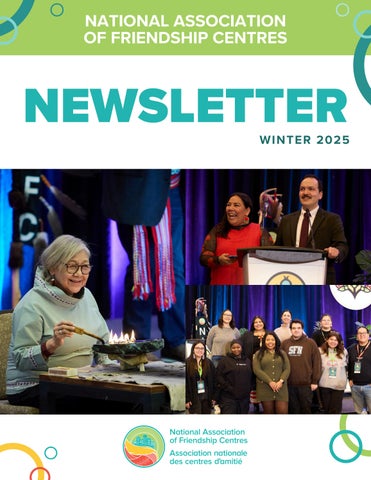
NATIONAL ASSOCIATION OF FRIENDSHIP CENTRES
NEWSLETTER
WINTER 2025
MESSAGE FROM THE INTERIM CEO
As we approach the end of the year, I want to take a moment to wish everyone across the Friendship Centre Movement a warm and joyful holiday season. The winter solstice season offers an important opportunity to reflect on the strength of our relationships, the resilience of our communities, and the continued commitment of Friendship Centres and PTAs who support urban Indigenous people every single day. It has been an honour to step into the Interim Chief Executive Officer role for the National Association of Friendship Centres, and I welcome the opportunity to serve in this capacity and to support the NAFC, PTAs, and Friendship Centres through this period of transition. On December 8, prior to the Urban Indigenous Summit, Presidents and Executive Directors from the Friendship Centre Movement met in Ottawa to discuss shared priorities and strengthen coordination across the Friendship Centre Movement (FCM). Presidents and Executive Directors also shared regional updates and presented key priorities, projects, and initiatives underway in their areas. The discussion highlighted opportunities for collaboration across the FCM, including national activities that could be advanced together, and areas where support from the NAFC would help move shared priorities forward. From December 9 to 11, the NAFC hosted our 3rd Urban Indigenous Summit in Ottawa, bringing together Friendship Centre leaders, youth, partners, and community members from across the country. Over three days, we shared knowledge, strengthened relationships, and explored paths forward for urban Indigenous programs, services, and governance. Thank you to everyone who contributed to such a powerful and inspiring gathering.
MESSAGE FROM THE INTERIM CEO
The NAFC will continue to advance the work and next steps after the 2025 Federal Budget and will continue to advocate for sustainable and stable funding for Friendship Centres. Friendship Centres are no stranger to challenges like the ones we face today. We have always found a way forward. The groundwork is strong, we have allies in Parliament, and there is broad support across the country. What we must do now is stay coordinated, keep the pressure on, and continue moving together toward a long-term agreement that reflects the importance and impact of Friendship Centres. The team at NAFC is strong, capable, and deeply committed to the Friendship Centre Movement. They will continue to do everything in their power to ensure we are heard, respected, and meaningfully supported. As we look ahead to 2026, I am hopeful. I believe in the strength of the Friendship Centre Movement, and in our shared commitment to improving the lives of urban Indigenous people. Thank you for everything you do, and may you and your families enjoy a peaceful and restorative holiday season. In Friendship,
Jennifer Rankin Jennifer Rankin Interim CEO
SEASON’S GREETINGS
SEASON’S GREETINGS
Season’s Greetings from the NAFC Board of Directors, Senate, Indigenous Youth Council, and Staff. May the Winter Solstice inspire moments of connection, togetherness, and gratitude, filling your holiday season with light and laughter!
Joyeux temps des fêtes de la part du Conseil d’administration, du Sénat, du Conseil des jeunes autochtones et du personnel de l’ANCA. Puisse le solstice d’hiver vous inspirer des moments de connexion, de partage et de gratitude, et embaumer votre temps des fêtes de joie, de chaleur et de sérénité.
ANFCA ANNUAL GENERAL MEETING
The NAFC attended the Alberta Native Friendship Centres Association’s 55th AGM in Grande Prairie, Alberta on Sept 27–28, 2025, with Jocelyn Formsma, Jennifer Rankin, and IYC President Caley Rain Anderson in attendance. The NAFC would like to congratulate the newly elected ANFCA President Miranda Laroche, newly elected Treasurer Carla Garcia, and newly appointed Alberta Youth Representative Davina Nelson. We also recognize continuing members: Secretary Janice Gauchier, Vice President Bob Oshanyk, and Elder Wisdom Circle Dave Matilpi. A heartfelt thank you to outgoing President Nicolas Bartlett for your leadership and dedication to your region and the Friendship Centre Movement. This year’s AGM also celebrated leadership, staff milestones, and the Grande Prairie Friendship Centre’s 60th Anniversary!
NAFC STAFF RETREAT
In early October, NAFC staff travelled to Calgary, Alberta for our fall staff retreat, a week filled with learning, connection, and community. We were graciously hosted by the Aboriginal Friendship Centre of Calgary (AFCC), and we extend our heartfelt thanks to their entire team for welcoming us so warmly. AFCC shared insights into their programs and services, offering us a deeper understanding of their work in supporting the urban Indigenous community. Staff also guided us through a series of site visits, including; The Confluence Historic Site & Parkland, “Omahkitapioyis” – The Elders' Lodge, and “KANAKAA’TSINOM” – The Elders’ Drop-In Centre. These visits provided an invaluable opportunity to learn directly from community spaces grounded in culture, care, and connection.
NAFC STAFF RETREAT During the retreat, the NAFC also spent focused time advancing our departmental service delivery guidelines. We also took part in a White Hat Ceremony, a signature Calgary tradition celebrating hospitality and community spirit. To balance our working sessions, staff enjoyed outings to the Calgary Zoo and a day trip to Banff, taking in the stunning mountain landscapes before heading home. The retreat was an energizing and meaningful week that strengthened relationships and deepened our understanding of regional work.
FEDERAL BUDGET ANNOUNCEMENT On November 4, the federal government presented Budget 2025. The National Association of Friendship Centres (NAFC) expresses deep concern with the release of the 2025 federal budget and the government’s missed opportunity to address the realities of urban Indigenous people. Despite promises to protect essential programs that empower Canadians, the federal government has neglected to mention Friendship Centres, despite the clear need, demonstrated success of Friendship Centres, past commitments, and the growing urban Indigenous population. The NAFC continually advises the government that the costs of inaction and lack of investment will outweigh the cost of upfront and sustained investment in the largest Indigenous service delivery network in the country. The support for millions of people who rely on Friendship Centres, and good jobs held by Indigenous people working at Friendship Centres, particularly Indigenous women, is at acute risk of disappearing. The Urban Programming for Indigenous Peoples (UPIP), which provides core funding for Friendship Centres, sunsets in 2026. The absence of any indication of long-term renewal in Budget 2025 places the entire network of more than 100 Friendship Centres and Provincial/Territorial Associations in jeopardy. Many are already stretched beyond capacity and struggling to meet rising demand. Without long-term investment, the government’s inaction could lead to program cuts, layoffs, and, in some cases, permanent closures. The NAFC calls on the federal government to immediately engage with the Friendship Centre Movement and to commit to long-term, sustainable funding for urban Indigenous programs before it is too late. Read the full media release here.
INTERIM CEO ANNOUNCEMENT As of Friday, November 7th, 2025, Jennifer Rankin has stepped into the role of Interim Chief Executive Officer for the National Association of Friendship Centres until early February 2026 or until the position is filled. During this interim period, the NAFC’s focus will remain on continuity, stability, and supporting all staff, programs, and initiatives. The NAFC has also had some recent changes to the Management Team. Our Senior leads have stepped into leadership roles and will be here to support the work of the NAFC, PTAs and FCs during this transition. Sandra Hines, Director of Finance, shines@nafc.ca Kara Louttit, Acting Policy and Research Manager, klouttit@nafc.ca James Lavellée, Acting Programs Manager, jlavallee@nafc.ca Jenna Chisholm, Acting Youth Initiatives Manager, jchisholm@nafc.ca Senior members of the Operations team are also taking on some added responsibility during the transition. John Paillé, Senior Communications Coordinator is lead contact on the 3rd Urban Indigenous Summit, jpaille@nafc.ca Andrew Macumber, Senior Information Analyst is leading continued process development and work planning support internally, amacumber@nafc.ca Jennifer will actively be working to connect with Friendship Centres, PTAs, and key partners, outlining points of contact and ensuring our network continues to receive the guidance and support they rely on from NAFC. Transitions can be a mix of emotions — change, reflection, and anticipation — but they also remind us of the shared purpose that brings us together. Thank you in advance for your support and patience during this time.
IMPORTANT OFFICE RELOCATION UPDATE The NAFC was notified that Spaces Laurier Centre, located at 135 Laurier Ave W, Ottawa, will be closing all operations on November 20th, 2025. To minimize disruption, we have developed a relocation plan to ensure continuity for our operations. The NAFC has moved our office to Regus Lisgar at 116 Lisgar Street, 6th Floor, Ottawa (located just off Elgin Street in Centretown). Please use this as our mailing address moving forward.
BRANDON FRIENDSHIP TH CENTRE 60 ANNIVERSARY Jennifer Rankin, NAFC Interim CEO and Mel Maracle, Office Manager traveled to Brandon, Manitoba where they met with MAFC leadership, Jack Park, President, Maeengan Linklater, Executive Director, and staff at their office.
They also attended the Brandon Friendship Centre’s 60th anniversary to celebrate this remarkable milestone. Sixty years of service, leadership, and community is truly something to be proud of! The NAFC would like to recognize the many board members, staff, and volunteers, past and present, who have poured their time, energy, and heart into the Brandon Friendship Centre. At the NAFC, we are proud to have the Brandon Friendship Centre as one of our members. The work done at the Brandon Friendship Centre reflects the very heart of the Friendship Centre Movement, supporting Indigenous people in urban communities and strengthening the bonds of friendship and inclusion.
URBAN INDIGENOUS SUMMIT
Paths Forward: Strengthening Urban Indigenous Futures On behalf of the NAFC Executive and Board of Directors, Senate, Indigenous Youth Council, and staff, we would like to send a big thank you to everyone who attended the National Association of Friendship Centres’ 3rd Urban Indigenous Summit, Paths Forward: Strengthening Urban Indigenous Futures. The Summit took place from December 9–11 at the Westin Ottawa and welcomed more than 375 participants from across the Friendship Centre Movement, including Friendship Centre and PTA staff, youth, community members, vendors, partners, and sponsors.
URBAN INDIGENOUS SUMMIT The Summit began with a powerful Fireside Chat with Jana Schmieding, a Mniconjou and Sicangu Lakota actor, writer, and comedian known for her roles in Rutherford Falls and Reservation Dogs. Day one continued with the plenary panel Healing Horizons: Affordable Homes and Safe Spaces for Indigenous Women and Families, followed by a series of concurrent workshops exploring Indigenous housing, philanthropy, food sovereignty, therapeutic arts, language revitalization, youth wellness research, urban Inuit experiences, and opportunities linked to the new Quebec City–Toronto high-speed rail corridor.
URBAN INDIGENOUS SUMMIT Day one concluded with Summit participants enjoying a vibrant networking reception at the Westin’s Venue Twenty-Two, emceed by Janelle Niles and featuring performances by Inuit Throat singers Asheevak and Qattuu, the Métis Asham Stompers, and Kitigan Zibi’s own Rabbit Stew.
URBAN INDIGENOUS SUMMIT A huge thank you to all who joined us at the Urban Indigenous Summit Networking Reception. We were grateful to connect with those who continue to engage deeply in the work of Friendship Centres and urban Indigenous communities. The room was filled with meaningful conversations and a shared dedication to the future of Friendship Centres. Our sincere thanks to: The Honourable Mandy Gull-Masty, Minister of Indigenous Services Canada The Honourable Marc Miller, Minister of Canadian Identity and Culture, and Minister responsible for Official Languages Lori Idlout, Member of Parliament for Nunavut Gord Johns, Member of Parliament for Courtenay—Alberni Billy Morin, Member of Parliament for Edmonton Northwest Jaime Battiste, Member of Parliament for Cape Breton—Canso—Antigonish Sébastien Lemire, Member of Parliament for Abitibi—Témiscamingue Senator Marilou McPhedran Your presence and support help strengthen our shared work and the future of Friendship Centres across the country.
URBAN INDIGENOUS SUMMIT Participants experienced inspiring presentations on day two, including the plenary session Our Cultures in Motion: Cultural Anchoring in Urban Indigenous Governance, followed by workshops ranging from northern perspectives and neighbourhood-level reconciliation to economic empowerment for youth, visions for the future from the Indigenous Youth Council, accessibility and inclusion, major capital projects, and findings from the Urban Aboriginal Knowledge Network. Day two also featured the launch of the first edition of the NAFC National Data Collection Strategy.
Throughout the Summit, participants engaged in rich workshops and discussions designed to share knowledge, strengthen capacity, and support action planning across the Friendship Centre Movement. With a focus on housing, governance, inclusion, food sovereignty, climate resilience, data, and youth empowerment, the sessions reflected the diversity, innovation, and strength of urban Indigenous communities.
URBAN INDIGENOUS SUMMIT The Summit concluded on day three with profound and forward-looking plenaries, including We Carry Many Names, a keynote by Dr. Tasha Spillett on Afro-Indigenous identity and storytelling, and Telling the Story of Our Futures, an inspiring final talk by award-winning Anishinaabe author and speaker Jesse Wente. The final day also included sessions on gender-based violence response, NAFC’s Research Framework and Toolkit, data systems across the Movement, and climate resilience in Friendship Centres.
Thank you to all our participants, partners, and sponsors who helped make this year’s Summit such a tremendous success. Your insights, expertise, and stories continue to strengthen our shared path forward and support a brighter future for urban Indigenous people across the country.
MEETING WITH FEDERAL PARTNERS AND SENATORS NAFC Executive Committee, with Interim CEO Jennifer Rankin, and Law Student and Government Relations Intern Tristan Nugent had a productive day meeting with federal partners and Senators to advance the priorities of Friendship Centres and urban Indigenous communities. We appreciated the meaningful discussions with: CIRNAC – Crown-Indigenous Relations, including Seth Pickard-Tattrie, Chief of Staff to the Minister, and Tracy Karuhogo, Policy and Prairies Regional Advisor. Senator Scott Tannas Senator Brian Francis and Senator Judy White And a quick networking stop with Senators Rebecca Patterson, Tony Ince, and Dawn Arnold. Grateful for the continued collaboration and shared commitment to the work ahead.
MEETING WITH FEDERAL PARTNERS AND SENATORS NAFC Executive Committee, with Interim CEO Jennifer Rankin met with Alyth Roos, Special Assistant of Policy for the Prime Minister’s office, and Member of Parliament for Edmonton Northwest, Billy Morin, and Member of Parliament for Haliburton— Kawartha Lakes, Jamie Schmale to advance the priorities of Friendship Centres and urban Indigenous communities. We are appreciative of the ongoing partnership and our collective dedication to the important work ahead.
EQUAL VOICE GALA NAFC leadership, members of the IYC, and Friendship Centre leaders attended the Equal Voice Gala in Ottawa. It was an inspiring evening honouring women’s leadership and the many voices shaping our future.
CALLS FOR LETTER OF INTENT FOR NAFC ANNUAL MEETINGS The National Association of Friendship Centres (NAFC) is inviting Friendship Centres and Provincial and Territorial Associations to submit Letters of Intent to host the NAFC Annual Meeting for the years 2027, 2028, 2029, and 2030. The Annual Meeting brings together delegates from across the Friendship Centre Movement to review reports from the Board of Directors, receive audited financial statements, hold elections, and address key priorities for the year ahead. As per NAFC bylaws, the meeting is held annually before July 31. Friendship Centres or PTAs interested in hosting must have access to adequate meeting facilities and hotel accommodations within their city, including plenary space for up to 300 attendees, breakout rooms, and space for vendors. For more information and to read the full Calls for Letter of Intent, please visit: https://nafc.ca/events/annual-meeting/
COMMUNICATIONS UPDATE Program Renewal Campaign The final phase of the Program Renewal Campaign was launched in late July and concluded in October. This phase focused on expanding outreach through the release of an infographic video, a broadcast advertisement, and a strong call to action in support of the Friendship Centre Movement. We encourage everyone to continue sharing key messages and campaign materials to help maximize awareness and engagement. Watch the Infographic Video here Watch the Broadcast Video here Visit the Program Renewal webpage here
In collaboration with Jocelyn Formsma, former NAFC CEO, and Tristan Nugent, Government Relations and Law Intern, the Communications Team contributed to an OpEd in The Hill Times that highlighted the need for sustainable and long-term funding for Friendship Centres. Read the Op-Ed here.
The Communications Team also collaborated with the Data Team to create a NAFC Impact Factsheet and Program Renewal Resources highlighting the reach and strength of the Friendship Centre Movement. View the Impact Factsheet here.
COMMUNICATIONS UPDATE Communications Team Planning In September, the Communications Team held a planning and team building session to identify priorities for the year ahead. A detailed workplan was developed to align upcoming projects with team objectives and broader NAFC goals.
Urban Indigenous Summit 2025 Leading up to the 2025 Urban Indigenous Summit, the Communications Team worked closely with a design company to develop the Summit’s branding and visual materials. The team also coordinated the production of Summit branded swag and oversaw translation services to ensure accessible and inclusive communications for participants. Throughout the Summit, the Communications Team provided full onsite support, including managing social media content and daily updates, coordinating photography, and responding to communications needs across all sessions. Their work helped ensure consistent, clear, and engaging communications throughout the event.
Bell Let’s Talk Partnership The NAFC is proud to be entering its fourth year partnering with Bell for Bell Let’s Talk Day 2026. This upcoming year will mark the 16th annual Bell Let's Talk Day, a nationwide initiative dedicated to mental health awareness, acceptance, and action. The theme for 2026 is “Taking a Moment for Mental Health,” encouraging people across Canada to prioritize mental health and give it the moment it deserves. Planning for Bell Let’s Talk Day activities is officially underway.
DATA UPDATE National data collection strategy The Data Team launched the organization’s Data Strategy at the Urban Indigenous Summit in December. This launch included both a report and an implementation plan toolkit. These resources will be available on our website following the Summit.
National database The Bridging Across Canada (BAC) database application included eighteen sites, including three PTAs and the National Office. The Data Team completed the first BAC Annual Assessment, which was presented at the Annual Management Review meeting at the end of November. The Annual Management Review provided an opportunity for BAC stakeholders to set goals and develop the workplan for the year ahead. BAC Lead Users from across the Movement also presented at the Urban Indigenous Summit in December to share how they are using the national database.
Using our data The Data Team completed the analysis and visualizations for the Research Team’s Executive Director Compensation Survey and presented the findings at the Urban Indigenous Summit in December. The team is also supporting the Executive in creating advocacy tools, based on the information collected, to inform the organization’s response to Budget 2025.
Managing our data The Data Team continues to maintain Data Standards for information collected through Engagements, Program Administration, and Membership. This documentation provides transparency and supports staff by ensuring wise practices are followed. The team also supported data collection for the Policy Department’s Health Forum, the Indigenous Youth Summit, the Annual Meeting, the Research Team’s Executive Director Compensation Survey, and the Urban Indigenous Summit.
POLICY & RESEARCH UPDATE Acting Policy and Research Manager Senior Policy Analyst Kara Louttit (they/them) is serving as Acting Policy and Research Manager during this transitional period for the Policy and Research Team. Kara has been leading the MMIWG2S+, Justice, and UNDRIP portfolios since joining the NAFC in April 2024 as a Policy Analyst. Kara is a Two-Spirit Omushkego-Eeyou Cree from James Bay and brings experience from Aboriginal Legal Services, Justice Canada, and other urban Indigenous service delivery roles. With post-secondary education in law, policy, and government from Carleton University, Kara is grateful for the opportunity to continue supporting the Friendship Centre Movement and the important work of the NAFC’s Policy and Research Team.
NAFC Witness Appearance to the Senate Committee on National Finance On October 29, Jocelyn W. Formsma, former NAFC CEO, Lois Duke, NAFC Vice President, and Stacey Howse, First Light Friendship Centre CEO and NAFC Board member, appeared before the Senate Committee on National Finance to highlight the urgent need to address urban Indigenous housing challenges. Their appearance drew on insights from the NAFC’s recent Build Canada Homes submission, a 2023–24 NAFC research project examining barriers to housing and homelessness, and the NAFC’s involvement with the National Indigenous Collaborative Housing Inc. The NAFC emphasized the importance of ensuring that urban Indigenous perspectives are embedded in federal housing initiatives and that equitable access to funding is prioritized. Stacey Howse also shared updates on the opening of a 10-unit transitional housing facility in St. John’s, NL, supporting women and 2SLGBTQQIA+ relatives with lived experience of violence, as an example of effective Indigenous-led solutions.
POLICY & RESEARCH UPDATE This engagement underscored the NAFC’s ongoing commitment to advocating for urban Indigenous housing needs and ensuring urban representation in national policy discussions.
Climate Change & Environment The NAFC advanced its Climate Change and Emergency Response work with a renewed focus on community engagement, evidence gathering, and ongoing federal collaboration with Environment and Climate Change Canada. A key element this year was the rollout of the Climate Resilience Survey, which collects up-to-date information on environmental, climate resilience, and emergency response initiatives across Friendship Centres. Findings will inform the new Interactive Climate Resilience Map, a national platform designed to highlight local leadership, strengthen knowledge sharing, and support federal advocacy for sustained investment in Indigenous-led climate action. The NAFC collaborated with Membertou Geomatics Solutions to design and build the map, ensuring it accurately reflects climate resilience programming across the Movement. This work will continue through the winter to ensure Friendship Centre experiences remain central in shaping national climate policy and programming.
POLICY & RESEARCH UPDATE Children & Youth The NAFC continued strengthening its Children and Youth portfolio. A key development this fall was the new partnership with the National Alliance for Children and Youth. Through this partnership, the NAFC now sits on NACY’s Research and Impact Table to bring Friendship Centre perspectives to national conversations on the wellbeing of Indigenous children and youth. This collaboration will support stronger evidence, more inclusive research practices, and improved national understanding of the realities facing Indigenous young people and their families. The NAFC also began engagement with Employment and Social Development Canada on the development of the National School Food Program. This work included a dedicated launch session at the Urban Indigenous Summit and will continue with broader engagements in the new year to ensure the program reflects the diverse needs of Indigenous learners and the central role Friendship Centres play in culturally grounded food security programming. Friendship Centres running food security or nutrition initiatives, or those interested in the program, are encouraged to contact Jan Tochinskiy, Policy Analyst, at jtochinskiy@nafc.ca.
Health The NAFC continued collaborating with partners across the health sector to support the wellbeing of urban Indigenous communities. Recently, the NAFC worked closely with the Chief Public Health Officer’s team to review the 2025 report “Working Together to Thrive: Well-being and Public Health” which highlights effective care strategies and recognizes the significant contributions of urban Indigenous communities and Friendship Centres. The NAFC also continued its role on the Anti-Indigenous Advisory Circle, supported by Indigenous Services Canada and the First Nations and Inuit Health Branch. The Circle is currently reviewing its mandate to provide clear and comprehensive guidance on cultural safety.
POLICY & RESEARCH UPDATE In addition, the Health Standards Organization, in partnership with Accreditation Canada, has begun a public-facing review of the Cultural Safety and Humility Standard. The NAFC is supporting this process by ensuring that urban Indigenous voices are centred through facilitated focus groups. Friendship Centre members interested in participating can contact Victoria Marchand, Senior Policy Analyst, at vmarchand@nafc.ca.
MMIWG2S+ Implementation Plan The NAFC and the MMIWG2S+ Steering Committee presented the finalized MMIWG2S+ Implementation and Action Plan, titled Building on Strength, Guided by Wisdom. Developed in collaboration with Kingfisher Consulting, the plan honours the resilience and cultural wisdom of Friendship Centres and outlines strategic directions to enhance safety, protection, and wellbeing for urban Indigenous women, girls, Two-Spirit, and gender-diverse relatives. It aims to expand sustainable, culturally grounded solutions across the Movement.
NAFC’s Intervenor Status for R. v. Cope (2024 NSCA 59) The NAFC continued its work as an intervenor in the Supreme Court case R. v. Cope (2024 NSCA 59), which will clarify the application of Gladue principles in sentencing. The NAFC’s position is that Gladue analysis and recent Criminal Code provisions protecting vulnerable victims are complementary. A well-applied Gladue analysis should guide sentencing toward culturally relevant alternatives that enhance community safety. Friendship Centres play an essential role in justice work, preparing Gladue reports, facilitating sentencing circles, and offering culturally grounded supports that address the unique needs of incarcerated urban Indigenous people.
POLICY & RESEARCH UPDATE Sports & Recreation Victoria Marchand, Senior Policy Analyst, began her term as a Reviewer with Sport Canada for the Sports for Social Development in Indigenous Communities (SSDIC) program in Streams 2 and 3. This work supports improved health, education, and employability through access to culturally meaningful sport and recreation opportunities. Many Friendship Centres have successfully received SSDIC funding in previous cycles, and the NAFC will continue advocating for applicants in the current cycle.
United Nations Declaration on the Rights of Indigenous Peoples Engagements The Policy Team continued engaging the Movement on the United Nations Declaration on the Rights of Indigenous Peoples (UNDRIP) to support the development of the NAFC’s UNDRIP Toolkit for Advocacy and the Urban Indigenous UNDRIP Framework. Kara Louttit, Acting Policy and Research Manager, attended urban engagements led by the British Columbia Association of Aboriginal Friendship Centres and the BC Ministry of Indigenous Relations and Reconciliation, with additional sessions held with the Victoria Native Friendship Centre and BCAAFC staff. Engagements will continue into the new year.
Research Framework Initiative In preparation for the NAFC’s October Board meeting, the Research Team drafted a briefing note outlining upcoming deliverables and Research Centre development plans. The Department also hosted a workshop at the Urban Indigenous Summit to share the Research Framework and discuss upcoming engagement opportunities. Thank you to everyone who participated in the NAFC Compensation Survey. Your insights will directly support ongoing advocacy for fair and sustainable compensation across the Movement.
POLICY & RESEARCH UPDATE Urban Aboriginal Knowledge Network (UAKN) The NAFC's Research team and the UAKN continues its work in developing a book that highlights the history, influence, and ongoing impact of the Friendship Centre movement in urban Indigenous communities. Building on the dedicated engagement session with Indigenous youth at the NAFC’s Annual Meeting this past summer, the UAKN will feature artwork from Indigenous youth artists as part of their book illustrations to continue incorporating youth perspectives into this project. The NAFC’s Research team, alongside Communications, supported this work by facilitating the call-out, coordinating outreach, and receiving portfolio submissions from Indigenous youth. In early November, the selection review took place with the participation the Indigenous Youth Council (IYC). Together, the group assessed all submissions and selected six youth artists to move forward. These artists are now preparing artwork reflecting their interpretation of the theme “City as Home,” which will be included in the UAKN publication. At the Urban Indigenous Summit, the Research Team hosted the NAFC Senators’ Fireside Chat, where the NAFC Senate shared their visions for the future of urban Indigenous policy. Audience participation through a moderated question period helped deepen discussions on community-based research and the role of the Friendship Centre Movement in national policy.
Indigenous Health Research Think Tank In early October, Justin Sackaney, Research Coordinator, attended a Think Tank session in Ottawa hosted by the Canadian Institutes of Health Research. The session convened Elders, Knowledge Keepers, researchers, youth, practitioners, and policymakers to discuss priorities and barriers in Indigenous health research. Justin shared Friendship Centre perspectives and emphasized the importance of ethical, community-driven research. The event provided a valuable opportunity to exchange ideas and highlight how Friendship Centres contribute to the broader landscape of Indigenous health research in Canada.
PROGRAMS UPDATE Building Connections in Prince George
In September, members of the NAFC Programs and Youth teams travelled to the Prince George Native Friendship Centre, one of the largest Friendship Centres in Canada, for a collaborative and enriching visit. The trip began with a presentation on the Centre’s history, programs, goals, and future plans, followed by tours of several impressive facilities and community projects. During a warm and welcoming workshop, NAFC staff connected with local staff and Elders while crafting tie blankets. The hands-on activity encouraged camaraderie and cultural exchange. The Programs team then held a retreat on September 22 to reflect on their experiences, strengthen team cohesion, and set strategic priorities for the year ahead. The time in Prince George was both meaningful and motivating, reinforcing the deep connections and shared purpose across the Friendship Centre Movement.
PROGRAMS UPDATE Regional Collaboration in Mi’kma’ki In November, the NAFC’s Programs and Youth Acting Managers joined the Atlantic Executive Directors for a regional meeting hosted at the Mi'kmaq Native Friendship Centre in Halifax. The visit created space for meaningful dialogue and shared planning, reinforcing the importance of regional collaboration across the Movement. Participants discussed emerging priorities, operational needs, and opportunities to strengthen support and communication for Friendship Centres in the Atlantic region.
The Pathways to Resilience: Mental Health Outreach program at Tansi Friendship Centre in Chetwynd, BC The Mental Health Outreach program at the Tansi Friendship Centre offered a U-Pick vegetable activity at Big Lake Ranch. This initiative supports individuals in reducing highrisk behaviours. The program provides crisis support, mental health assessments, and personalized care plans. It also connects people with Indigenous traditional knowledge and Western mental health services to offer culturally informed and holistic care.
“This program has filled a major gap in community support, supporting Urban Indigenous, especially those that are not attached to any local bands in the area that would have no other support or resource option in the community otherwise”.
PROGRAMS UPDATE Bridging the Mental Health Gap for Our Children and Youth: Georgian Bay Friendship Centre (GBNFC), Georgian Bay, Ontario A highlight of the year for youth mental health was the GBNFC Youth Conference 2025, which welcomed local high school students for an inspiring and interactive day of learning. The event featured a panel of speakers chosen by youth on topics such as traditional knowledge, healing, budgeting, self-care, and safety. The conference offered young people a meaningful opportunity to connect with peers, build skills, and celebrate their strengths.
Healing Through Connection: A Two-Day Mental Health Workshop for Manitoba Friendship Centre Staff to reflect, reconnect and heal Rubani Kaur facilitated a two-day Healing Through Connection workshop in Winnipeg that brought together participants from Friendship Centres across Manitoba. Through cultural practices, art therapy, selfcare activities, and guest speakers, attendees strengthened personal wellness and gained tools to better support their communities. Highlights included a river walk and smudge, reflective writing, and a visit from therapy dogs. The gathering concluded with traditional drumming and a shared meal that left participants feeling grateful, inspired, and eager for more workshops like this.
PROGRAMS UPDATE Family Violence Prevention Program (FVPP) The Family Violence Prevention Program, funded by ISC, received twenty-six applications this summer. Twenty-four Friendship Centres will receive funding. Disbursements began in November and will continue into December.
The Community Workforce Development Program (CWDP) The Community Workforce Development Program, funded through ESDC, wrapped up on October 31. The program operated in twenty Friendship Centres across Alberta, Saskatchewan, Manitoba, Quebec, the Atlantic region, and the North. It supported workforce planning, training, wraparound services, and partnerships in rural and remote communities. A full report will be provided after the reporting cycle is complete.
Infrastructure The Infrastructure stream remains active. A second round of infrastructure funding has been launched and funds are nearly fully expended. The NAFC is awaiting final approvals for a small number of outstanding submissions. This stream is enabling Friendship Centres to address critical structural needs such as replacing leaky roofs, repairing stairwells, and upgrading HVAC systems. These investments help ensure safe and functional spaces for community programs and services.
UPIP (Organizational Capacity and Programs and Services) The UPIP program continues to support the Friendship Centre Movement through the Organizational Capacity and Programs and Services funding streams. The NAFC is working with Indigenous Services Canada to confirm the release of the second installment of UPIP funding. We expect an update soon and remain optimistic about a smooth transition into the next phase of funding.
PROGRAMS UPDATE UPIP Wildfire Enhancement As part of the UPIP initiative, the NAFC launched the Wildfire Enhancement Fund to support Friendship Centres affected by recent wildfires. Four PTAs, which include MAFC, AFCS, ANFC, and NTNU, each received one hundred thousand dollars. These funds enhance existing programs and help address evolving community needs following wildfire-related disruptions. This targeted support strengthens the resilience of Friendship Centres and their ability to respond to emergency-related challenges while continuing to provide culturally grounded services.
Acting Programs Co-Managers James Lavallée, Senior Program Coordinator, is serving as Acting Co-Manager of Programs alongside Jenna Chisholm, who leads the Youth Initiatives Team. This structure ensures strong, consistent guidance across programs and youth portfolios.
YOUTH INITIATIVES UPDATE Youth Leadership Curriculum The Leadership Curriculum continues to move forward. Over the summer, a Request for Proposal was issued to support media creation, and Imagination FX, based in Victoria, BC, was selected. Media production and filming began in December with support from the Indigenous Youth Council (IYC). Several IYC members will complete a detailed review of the Curriculum and provide recommendations for updates and additions. An in-person session is planned for the spring.
Indigenous Youth Council (IYC)
In October, the Indigenous Youth Council gathered in Ottawa for their Orientation. Senator Marge White opened the meeting in a good way and shared wisdom and guidance throughout the weekend. After introductions and icebreakers, NAFC Communications Coordinator Megan Pearson delivered a communications workshop and offered tips on biography writing.
YOUTH INITIATIVES UPDATE Before beginning their work, the 2025-2026 IYC established community guidelines to support a safe environment for youth and to ensure accountability to their roles on council and to young people across the movement. Throughout the Orientation, the IYC focused on team building, connection and planning. They finalized committees and membership, discussed goals and priorities for the upcoming term, and began work on strategic planning, upcoming events and Youth Forum planning. Jennifer Rankin, NAFC Interim CEO, along with Jenna Chisholm, Interim Youth Manager, Aurora Ominika-Enosse, Project Coordinator, and Katrina Landon, Project Coordinator, provided project updates and supported future planning. Regional Representatives are working to strengthen relationships with Friendship Centres in their regions and to stay informed so they can best serve youth across the movement. If you have youth gatherings or events in your region where IYC participation would be valuable, please contact an NAFC staff member. The NAFC and IYC welcome Davina Nelson as the Alberta Youth Representative and Ethan Cameron as the Interim Vice-President.
SUBMIT CONTENT If you would like to submit any photos or news articles about your Friendship Centre that we can share with the Friendship Centre Movement, please send them to communications@nafc.ca.
SPIRITS OF FRIENDSHIP The Friendship Centre Movement has been shaped over a period of 60 years by Indigenous leaders in communities across Canada. These dedicated Indigenous people have greatly contributed to the success and growth of today’s Friendship Centre Movement. To view the stories of Friendship Centre trailblazers, or our Spirits of Friendship, click here. We are honoured to have known them and privileged to have worked with them and to be a part of their legacy. If you think someone should be added to this list, please send an e-mail to communications@nafc.ca with a short bio, specifically detailing their involvement in the Friendship Centre Movement and any photos you would like included.
INDIGENOUS HISTORY & HERITAGE GATHERING Indigenous History & Heritage Gathering (IHHG) Returns March 2-4, 2026 at the RBC Convention Centre in Winnipeg, MB. The National Centre for Truth and Reconciliation (NCTR) and the First Nations Confederacy of Cultural Education Centres (FNCCEC) are hosting the Indigenous History and Heritage Gathering (IHHG). This gathering is one of the many important events held during Indigenous History Month. It brings together diverse groups who are working to amplify the distinct stories of Indigenous Peoples across Turtle Island. Learn More and Register Now at: https://ihhg.ca/registration/ Use the Code: NAFC10 to save 10%!
NAFC Organizational Jennifer Rankin Interim Chief Executive Officer
CEO’s Office
Finance
Veronica Wemigwans
Sandra Hines
Executive Coordinator
Tristan Nugent Law Student Intern
Director of Finance
Operations
Jennifer Rankin Interim Chief Executive Officer
Greg Murray
Suninda Sharma HR Coordinator
Research
Senior Finance Coordinator
Hong He
Gaelle Mushyirahamwe
Senior Finance Coordinator
Senior Research Coordinator
Robert Butryne
Justin Sackaney
Senior Finance Coordinator
Research Coordinator
Manavi Weerarathne Finance Coordinator
Chloe Pictou Research Assistant
Administration
Communications
Data Nashwa Khan Research Assistant
Mel Maracle
John Paillé
Andrew Macumber
Office Manager
Senior Communications Coordinator
Senior Information Analyst
Cailin Gerrard
Megan Pearson
Nathaniel Cummings
Administrative Coordinator
Liberty Rivers
Communications Coordinator
Data Analyst
Riley Gavan
Kole Peplinskie
Administrative Coordinator
Communications Assistant
Lolita Lam
Eugehne Adangwa
Event Coordinator
French Translator
Data Coordinator
Structure Policy & Research
Programs
Kara Louttit
James Lavellée
Acting Policy & Research Manager
Acting Program Manager
Acting Youth Initiatives Manager
Natalie Cahill
Aurora Ominika-Enosse
Policy
Jenna Chisholm
Program Coordinator
Project Coordinator
Victoria Marchand
Omovigho Abiri
Katrina Landon
Senior Policy Analyst
Program Coordinator
Project Coordinator
Janis Tochinskiy Policy Analyst
Dani Sherwood Program Coordinator