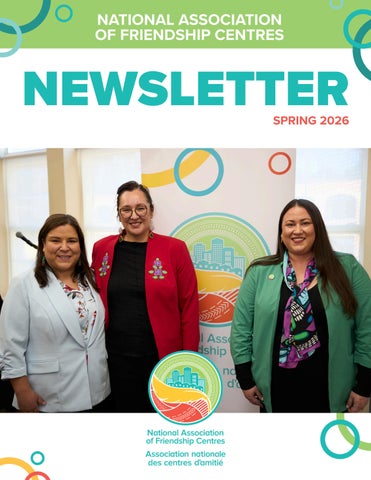
NATIONAL ASSOCIATION OF FRIENDSHIP CENTRES
NEWSLETTER SPRING 2026
Newsletter
1
Message from the CEO 55th Annual Meeting 36th National Youth Forum Program Renewal Update News and Highlights from the Friendship Centre Movement Advocacy Efforts Departmental Updates Spirits of Friendship Organizational Chart
2
National Association of Friendship Centres
1 2 3 4 6 11 13 20 22
Message from the CEO As we welcome the arrival of spring, I am honoured to share my first message with you as Chief Executive Officer of the National Association of Friendship Centres (NAFC). I officially stepped into the role on January 26, 2026, after serving as Interim CEO since November. It is a privilege to lead this organization at such an important time for our Movement, and I am deeply grateful for the confidence placed in me by the Board, Executive, staff, Provincial and Territorial Associations, and Friendship Centres across the country. As a proud member of Batchewana First Nation and someone who was born and raised on Algonquin Anishinaabe territory in Ottawa, my connection to urban Indigenous communities is both professional and personal. For more than 12 years, I have had the honour of working within NAFC and alongside national Indigenous partners to advance the well-being of our communities. My lived experience as an urban Indigenous woman continues to inform my leadership and my commitment to strengthening community-driven, culturally grounded services that reflect the realities of our people. Over the past several months, my focus has been on ensuring continuity, stability, and strong support for our staff, PTAs, and Friendship Centres. As we look ahead, I remain committed to leading with clarity, integrity, and purpose. Together, we will continue to advance NAFC’s strategic priorities, strengthen our organizational capacity, and build on the strong foundation that has guided the Friendship Centre Movement for decades. I am also pleased to share positive momentum on the funding front. We are excited to have secured $168 million in funding from Indigenous Services Canada in support of the Friendship Centre Movement. This investment recognizes the essential role Friendship Centres play in delivering critical, community-based services to urban Indigenous peoples across the country. I will be working closely with Indigenous Services Canada on next steps on the administration of these funds and will be connecting with our Provincial and Territorial Association and Directly Administered Friendship Centres leadership on next steps on the roll our of this new funding agreement as we learn more information. At the same time, our work does not stop here. We will continue to advocate clearly and consistently for sustained and increased funding that reflects the growing demand for services and the realities faced by our communities. Ensuring long-term, stable investments remains critical to strengthening the supports that Indigenous Peoples rely on every day. This spring also brings opportunities to reconnect and look ahead together. I am eager to visit
Newsletter
1
communities and engage with many of you in the coming months, including at our Annual Meeting and Youth Forum in July. I look forward to listening, learning, and working alongside you as we continue to strengthen urban Indigenous futures—together.
Annual Meeting We are pleased to share that the NAFC Annual Meeting will take place July 26–28 at the Victoria Inn Hotel & Convention Centre in Brandon, proudly hosted by the Brandon Friendship Centre. Each year, the Annual Meeting provides an important opportunity for Friendship Centres, PTAs, Board members, youth, and partners to gather, share knowledge, and strengthen our collective work in support of urban Indigenous communities across the country. Workshops will take place on Sunday, July 26, offering participants a chance to engage in meaningful dialogue and learning prior to our Opening Ceremonies at 5:00 p.m. The gathering will continue through July 28 with business sessions, updates, and opportunities to connect with colleagues from coast to coast to coast. Additional details on the agenda and registration will be shared in the coming weeks. This year’s elections will include the positions of Vice President and Treasurer, making this an especially important Annual Meeting for our governance and leadership. Delegates are encouraged to ensure their travel and accommodations are booked early. Hotel blocks have been secured at the Victoria Inn Hotel & Convention Centre and the Clarion Hotel & Suites. We look forward to gathering in Brandon this July to continue advancing the priorities of the Friendship Centre Movement together.
2
National Association of Friendship Centres
National YouthYout Forum 56th National We are excited to announce that this year’s National Youth Forum will take place July 24–26 at the Victoria Inn Hotel & Convention Centre in Brandon. Bringing together youth leaders from Friendship Centres across the country, the Forum creates space for connection, leadership development, and meaningful dialogue grounded in culture and community. It is always an energizing and inspiring gathering, and we look forward to welcoming participants to Manitoba this summer. This year’s theme, Revitalizing Roots: Healing Through the Land, reflects the importance of reconnecting with land, culture, and identity as pathways to wellness and strength. The program will feature a strong focus on land-based learning, with on-the-land activities designed to support healing, cultural revitalization, and youth empowerment. Through shared experiences, teachings, and peer exchange, participants will have opportunities to deepen their connections to community and to one another. The Forum will also include elections for Vice President and Treasurer of the Indigenous Youth Council. These leadership roles are vital in ensuring youth voices continue to shape the direction of the Friendship Centre Movement at the national level. We encourage all eligible delegates to participate in the electoral process and look forward to witnessing the next generation of leaders step forward.
2026 Elections: • Vice President • Treasurer More info to come.
Newsletter
3
National Association of Friendship National Association of Friendship Centres Centres Welcomes $168 Million Federal Welcomes $168 Million Federal Investment in Investment in Urban Indigenous Services Urban Indigenous Services The National Association of Friendship Centres (NAFC) welcomes the announcement from Indigenous Services Canada and Minister Gull-Masty confirming a $168 million investment over five years to support Friendship Centres across Canada. This multi-year commitment provides important stability for Friendship Centres and supports the continued delivery of essential, culturally grounded programs and services for Indigenous people living in urban communities. The NAFC welcomes this announcement as a reflection of sustained advocacy efforts over the past three years. Provincial and Territorial Associations and Friendship Centres have played a key role by sharing the impacts of their work and community stories to help inform decision makers. Each year, Friendship Centres support nearly one million Indigenous people through more than 2,600 programs, accessed over 2.3 million times annually. These services include employment and training, childcare, health supports, housing, cultural programming, and food security. With 3,100 staff and more than 10,300 volunteers, Friendship Centres represent one of the most significant Indigenous service delivery networks in the country. Their work strengthens communities, supports workforce participation, and contributes to safer and more inclusive outcomes for all. “The March 27th announcement reflects a meaningful commitment to the vital role Friendship Centres play in communities across the country,” said Jennifer Rankin, Chief Executive Officer of the NAFC. “This five-year investment provides important stability and allows Friendship Centres 4
National Association of Friendship Centres
to continue delivering the programs and services that Indigenous people rely on every day, while creating new opportunities to build on this strong foundation through future partnerships and investments.” Indigenous Peoples now number approximately 1.8 million in Canada, with nearly 70 percent living in urban areas. They represent one of the youngest and fastest growing populations in the country and contribute significantly to Canada’s social and economic strength. Friendship Centres provide direct and transitional services to more than half of this population. Stable, long-term investment in Friendship Centres reflects the scale, value, and contribution of this work. Demand for services continues to increase, including a rise in newcomers accessing Friendship Centre programs, highlighting their role as trusted and welcoming spaces where people can access support and build community. “Friendship Centres are at the heart of urban Indigenous communities and play a critical role in supporting individuals, families, and communities to thrive,” said Pamela Glode-Desrochers, President of the NAFC. “This investment recognizes the strength and impact of the Friendship Centre network and supports continued progress toward stronger, more inclusive communities and economies.” The NAFC looks forward to continued collaboration with Indigenous Services Canada and partners across sectors to build on this investment and further strengthen supports for urban Indigenous communities from coast to coast to coast. As needs continue to grow beyond the current investment levels, this commitment creates a stronger foundation to pursue additional funding and collaborative opportunities across all government and sectors.
Newsletter
5
News and Highlights from the Friendship Friendship Centre Movement Centre Movement British Columbia, Alberta, and Manitoba PTAs Welcome New Executive Directors We are proud to announce the appointment of new Executive Directors at three Provincial/ Territorial Associations across Western Canada. Celeste Hayward has been appointed Executive Director of the BC Association of Friendship Centres, Sandra Sutter will serve as Chief Executive Officer of the Alberta Native Friendship Centres Association, and Maeengan Linklater has been named Executive Director of the Manitoba Association of Friendship Centres. Each of these leaders brings deep experience, strong relationships, and a demonstrated commitment to advancing the well-being of urban Indigenous communities. Their leadership will support the continued growth of culturally grounded programs and services, strengthen collaboration with member Friendship Centres, and advance advocacy efforts at the provincial and national levels. Please join us in congratulating Celeste, Sandra, and Maeengan on their new roles. We look forward to the vision, integrity, and dedication they will bring to the Friendship Centre Movement and to the communities they serve.
Annette Morgan Named 2026 Indspire Public Service Award Recipient On behalf of the NAFC Executive Committee and Board of Directors, Senate, Indigenous Youth Council, and Friendship Centre Movement we would like to congratulate Annette Morgan, Executive Director of the Dze L K’ant Friendship Centre Society and President of the BC Association of Aboriginal Friendship Centres (BCAAFC), on being named the 2026 recipient of the Indspire Public Service Award! Annette is a member of the Gitxsan Nation and has over 30 years of service to the Friendship Centre Movement. She started with Dze L K’ant Friendship Centre Society in 1993 and has been Executive Director since 2001. Last year, Annette graduated as part of the inaugural class of the Master of Business 6
National Association of Friendship Centres
Administration in Advancing Reconciliation at the University of Victoria’s Peter B. Gustavson School of Business, delivered in partnership with the BCAAFC. This well-deserved recognition celebrates her outstanding leadership, dedication, and commitment to strengthening community and uplifting others through service. We are so proud of the impact she continues to make every day. This year’s Indspire Awards Ceremony will take place on May 14, 2026 in Halifax.
Samantha Jack Awarded Distinguished Alumni Award From Kwanlen Polytechnic University Faculty of Arts We are proud to congratulate NAFC Youth Executive Samantha Jack on being named the recipient of the first annual Faculty of Arts Distinguished Alumni Award from Kwantlen Polytechnic University. The award was presented on January 27 during the Faculty of Arts Dean’s Honour Roll celebration. As a POLI BA Major graduate, Samantha was selected for this distinguished recognition in honour of her exceptional achievements and leadership as an alumna. Samantha’s accomplishments reflect her deep commitment to advancing reconciliation and decolonization. Her work includes serving as an Associate Consultant and Facilitator with Len Pierre Consulting, contributing to policy and governance initiatives with the Fraser Region Aboriginal Friendship Centre Association, and acting as Co-Chair of the Surrey Indigenous Leadership Committee. She has also served on the Governor General’s Advisory Group on Reconciliation and the United Nations Global Indigenous Youth Caucus, while sharing her knowledge with students as an instructor for POLI 4120 (Indigenous Peoples in Canada: Politics and Policy). We extend our heartfelt congratulations to Samantha on this well-deserved honour and celebrate the leadership she continues to demonstrate within the Friendship Centre Movement and beyond.
Grande Prairie Women of Influence Awards The NAFC would like to congratulate NAFC Vice President and Grand Prairie Friendship Centre President Lois Duke on being the recipient of the Community Leadership Award at Grand Prairie Women of Influence Awards and Grand Prairie Friendship Centre’s Kikinaw Coordinator Paula Gerlitz for her nomination for the Community Leadership Award.
Newsletter
7
Indspire’s President’s Reception On February 11th, CEO Jennifer Rankin and Senior Communications Coordinator John Paillé attended the President’s Reception for Indspire’s new CEO and President, and former NAFC CEO Jocelyn Formsma in Toronto at Indspire’s office. It was a wonderful opportunity to connect, celebrate leadership, and reaffirm our shared commitment to supporting Indigenous students and strengthening opportunities for First Nations, Inuit, and Métis Peoples across the country. Congratulations, Jocelyn! We look forward to working together in the years ahead.
Innovative Harm Reduction Initiative Debuts at People of the Dawn Friendship Centre The People of the Dawn Friendship Centre has launched the first Healthbox in Newfoundland and Labrador, marking an important step forward in expanding access to low-barrier health and wellness supports in the province. In partnership with MAP Centre for Urban Health Solutions at St. Michael’s Hospital, the new Healthbox in Stephenville will provide free access to essential supplies, including HIV self-test kits, Naloxone kits, harm reduction and drug checking supplies, sexual health items, traditional medicines, snacks, nutritional drinks, and period packs. This Healthbox is the first of two planned for the province and one of 24 across the country. Notably, it is also the first to offer newly approved HIV self-test kits that require only a simple mouth swab, making testing more accessible, private, and convenient. Harm reduction initiatives like this are lifesaving. They help connect individuals to health care services in communities where resources may be limited, while also fostering education, awareness, and community wellbeing.
NAFC and PTA Meeting The NAFC hosted the Provincial and Territorial Association CEOs and EDs in Toronto from March 3–4, 2026. The NAFC and PTAs welcomed the new PTA leadership joining to the table – welcome to Sandra Sutter, ANFCA CEO, Celeste Hayward, BCAAFC ED and Maeengan Linklater, MAFC ED. The NAFC looks forward to prioritizing strengthening the relationships with PTAs and NAFC and how we can be more strategic and aligned in supporting the work of Friendship Centres. The two-day meeting focused on strategic dialogue, planning, and collaboration. Hosted at the Sheraton Toronto Airport Hotel. The NAFC and PTAs also centered their conversations on Government Relations, Program Renewal with an emphasis on the strength of collective impact we have across the Movement and the opportunity to align national priorities, enhance advocacy efforts, and build shared standards and tools.
8
National Association of Friendship Centres
NAFC Board Meeting The National Association of Friendship Centres (NAFC) Board of Directors convened virtually on February 26, 2026. Senator Dominque Rankin provided an opening prayer and the meeting began with officially ratifying Jennifer Rankin as NAFC CEO, effective January 26, 2026. Reports were provided from the Executive Committee, Youth Executive and Finance Committee. CEO Update Highlights outlined priorities including staff well-being, organizational stability, strengthened PTA/FC relationships, and long-term funding advocacy. Updates also included recent visits, government relations, and national events. The next NAFC Board Meeting will be held May 27-28, 2026 in Calgary, AB.
Visit with Victoria Native Friendship Centre The National Association of Friendship Centres (NAFC) Interim CEO Jennifer Rankin and Acting Policy & Research Manager Kara Louttit travelled to Victoria, BC to visit with the Victoria Native Friendship Centre (VNFC). They received a warm welcome and tour led by Executive Director Ron Rice and his leadership team, where they learned about VNFC’s incredible work, including language programs, employment and education supports, community garden and food security initiatives, daycare, community art projects, and more. Jennifer and Kara also visited the BC Association of Aboriginal Friendship Centres (BCAAFC) office, where they met with General Manager Julie Robertson. The trip concluded with a celebratory winter dinner alongside the VNFC Board and staff, BCAAFC Executive Director Celeste Hayward, and many valued partners, supporters, and community members. We’re grateful for the hospitality, collaboration, and shared commitment to strengthening the Friendship Centre Movement.
NAFC Policy and Research Team Visits the Mi’kmaw Native Friendship Centre In March, the National Association of Friendship Centres Policy and Research Team travelled to Halifax to visit the Mi’kmaw Native Friendship Centre (MNFC) to connect with staff and learn more
Newsletter
9
about the wide range of programs and services supporting the community. The visit includes time for strategic planning and visioning with the NAFC CEO, as well as strengthening our shared understanding of how Policy and Research can best support Friendship Centres at both the local and national levels. We were also pleased to connect with NAFC President and MNFC Executive Director Pamela Glode-Desrochers during our visit. Opportunities like this to meet directly with Friendship Centre leaders and staff help strengthen collaboration and ensure our work reflects the priorities and realities of Friendship Centres across the country.
Chibougamou Living Environment Société immobiliere du regroupement des centres d’amitié autochtones du Québec (SIRCAAQ) has announced it is now accepting applications for the new community living space in Chibougamu. SIRCAAQ builds, acquires, promotes, develops and carries out social housing projects in Quebec cities to contribute to Indigenous people’s wellness. Founded in 2019 by the Regroupement des centres d’amitié autochtones du Québec (RCAAQ), SIRCAAQ is a non-profit organization dedicated to the design, development and management of Indigenous real estate projects. The Chibougamu development is SIRCAAQ’s fourth community living environment and focuses on Indigenous students and their families. It offers 16 three-bedroom units, study areas, community spaces, community life activities, and guidance and support services. Learn more about the Chibougamu Living Environment at sircaaq.ca.
Naatowápitao’ohkánnao’p - A New Gathering Space for Indigenous Ceremony & Connection On January 30th, the Aboriginal Friendship Centre of Calgary (AFCC) and the City of Calgary opened the Naatowápitao’ohkánnao’p — the Holy Gathering Place at The Confluence Historic Site & Parkland. This beautiful new space provides a free, accessible place for Indigenous individuals and organizations to hold ceremony, cultural practice, gatherings, and community-led programming. Designed with guidance from Indigenous Elders and communities, it honours traditional knowledge and creates room for Indigenous cultures to thrive in the heart of Mohkinstsis. Complete with indoor and outdoor areas, smudging-friendly space, firepit, and amenities, this is more than a building — it’s a home for spirit, culture, and connection for generations to come. 10
National Association of Friendship Centres
AFCC’s New Housing Projects for Calgary’s Urban Indigenous Peoples The Aboriginal Friendship Centre of Calgary announced two new Indigenous housing developments that will create 38 culturally grounded homes for Indigenous peoples in Moh’kinsstis (Calgary). Friendship House in Forest Lawn and the Crescent Heights Indigenous Women’s Safe Housing Lodge represent a significant step forward in addressing the urgent need for safe, affordable housing for Indigenous people in Calgary. These projects are supported in part through the City of Calgary’s Maa’too’maa’taapii Aoko’iyii’piaya program. In addition, AFCC has secured funding to purchase land for future Indigenous housing development, helping to ensure long-term solutions for the growing community. Both developments will combine stable housing with culturally rooted supports, helping community members move toward stability, healing, and independence. AFCC’s work highlights how Friendship Centres across the country are leading community-driven solutions to housing challenges. Safe, affordable housing is foundational to strong and thriving Indigenous communities, and these initiatives demonstrate what is possible when Friendship Centres and municipal leaders work together with a shared purpose.
Advocacy Efforts Meeting with Minister Gull-Masty On January 20th, the NAFC Executive and Interim CEO met with Indigenous Services Canada (ISC) Minister Mandy Gull-Masty, Assistant Deputy Minister Michelle Kovacevic, and Senior Assistant Deputy Minister Candace St-Aubin to discuss Budget 2025, program renewal, and how the NAFC can continue to support ISC and its mandate for Urban Indigenous Services. The NAFC looks forward to strengthening this relationship and working collaboratively with ISC leadership on the path forward. In attendance: Pamela Glode-Desrochers, NAFC President Lois Duke, NAFC Vice President Laurie Bouvier, NAFC Treasurer Barb Ward-Burkitt, NAFC Secretary Samantha Jack, NAFC Youth Executive Jennifer Rankin, NAFC Interim CEO
Newsletter
11
Meeting with Mona Fortier Jennifer Rankin, CEO of the National Association of Friendship Centres, met with Mona Fortier, Member of Parliament for Ottawa—Vanier— Gloucester, to discuss supporting the vital work of Friendship Centres and NAFC. As demand for urban Indigenous services continues to grow, Friendship Centres remain strong economic partners delivering essential services, diversifying revenue, and contributing to their economic strength across the country.
Privy Council Office Tours Odawa Native Friendship Centre The National Association of Friendship Centres and The Odawa Native Friendship Centre were pleased to host the Privy Council Office to share the crucial lifesaving work of Friendship Centres on January 29th, 2026. During the visit, we toured the Odawa Native Friendship Centre to highlight the holistic, wraparound programs and services they provide — including their food bank, free store, gym and fitness programming, early childhood program space, and Ganawenindiwag housing and shelter support services at 510 Rideau Drop-In. This visit helped re-iterate the importance of sustainably funding the work of Friendship Centres, with the shared goal of improving the well-being of Indigenous peoples living in urban areas. Canada has an opportunity to move beyond short-term social programming and recognize Friendship Centres as economic partners by investing in services that are proven, established, and already embedded in communities. As Canada works to strengthen economic participation and protect inclusive growth, Friendship Centres have the capacity, workforce, and infrastructure to ensure Indigenous Peoples can enter, remain in, and advance within the workforce.
12
National Association of Friendship Centres
The Northwest Territories/Nunavut Council of Friendship Centres meet with Minister of Crown-Indigenous Relations, Rebecca Alty Kyle Bird, Chief Executive Officer of the Northwest Territories/Nunavut Council of Friendship Centres (NTNU), recently met with Rebecca Alty, Minister of Crown-Indigenous Relations and Member of Parliament for the Northwest Territories, to discuss the vital role Friendship Centres play across the North. Across the region, these community hubs deliver essential, culturally grounded services that support Indigenous Peoples and strengthen northern communities Their discussion highlighted the broader challenges facing communities across the North and reinforced the importance of sustained, long-term support to ensure communities can continue to respond to evolving needs and priorities. Across the region, communities continue to face persistent challenges related to food security, health and wellness, infrastructure development, and climate change.
Departmental Updates Communications Bell Let’s Talk The National Association of Friendship Centres (NAFC) and Bell partnered for the fourth year to mark the 16th annual Bell Let’s Talk Day on January 21, 2026. Through this partnership, NAFC received $25 000 in funding, which was distributed evenly ($3 125 each) to eight recipients: six Friendship Centres, one Provincial/Territorial Association, and the NAFC Indigenous Youth Council (IYC) and Senate. Funding supported mental health activities, events, and programming aligned with this year’s theme, Taking a Moment for Mental Health. Bell Let’s Talk Day activities were coordinated, supported, and amplified across the network. Event details were gathered from participating groups, messaging was developed to support social media and web, and email communications, and information was shared with Bell. Key messages
Newsletter
13
were prepared for NAFC leadership in advance of potential media interviews. The distribution of funding was coordinated through the preparation of funding letters and cheque requisitions, with payments processed in collaboration with the Finance team.
Supported activities included: Brandon Friendship Centre (MB)
Hosted Akicita Cante Waste, an Indigenous men’s sharing circle focused on health, healing, and cultural teachings, supported through space rental, food, seating, and an honorarium for a ceremonial knowledge holder.
Pulaarvik Kablu Friendship Centre (NU)
Delivered Uqalakta (Let’s Talk), a live community radio show in Rankin Inlet inviting listeners to engage in conversations about stress, coping strategies, and supporting others, with participation encouraged through call-ins, text messages, and prize draws.
First Light St. John’s Friendship Centre (NL)
Led a Week of Wellness initiative (January 19–24), featuring culturally grounded wellness programming and the distribution of 160 wellness kits to Elders, families, justice clients, housing clients, and other community members.
Aboriginal Friendship Centres of Saskatchewan – Living Skies Basketball League (SK)
Is currently producing short-form video content featuring interviews and conversations on holistic wellness, mental health, and performance through an Indigenous lens, aimed at youth aged 13–18 and shared across social media platforms.
Odawa Native Friendship Centre (ON)
Hosted Roots of Wellness: Shared Medicine Day Retreat, an all-ages community gathering combining ceremony, Elder teachings, creative activities, and the creation of a permanent Tree of Wellness Tapestry.
Aboriginal Friendship Centre of Calgary (AB)
Organized Medicine for the Mind: Soup, Bannock & Stories at the Elders’ Lodge, a winter wellness gathering focused on reducing isolation among Indigenous seniors through traditional food, storytelling, and cultural connection.
Victoria Native Friendship Centre (BC)
Hosted a community lunch and cultural workshops led by Elders, including cedar weaving and wool work, alongside information sharing on wellness and mental health supports.
NAFC Senate and Indigenous Youth Council (National)
Collaborated with the Communications and Youth Initiatives teams to create web and social 14
National Association of Friendship Centres
media content highlighting Indigenous approaches to mental health and the role of Friendship Centres in community wellness. Content was shared on Bell Let’s Talk Day across NAFC and IYC social media platforms, email communications, and a dedicated webpage on the NAFC website: https://nafc.ca/resources/mentalhealth/bell-let-s-talk-2026. Collectively, these initiatives reached diverse audiences, and demonstrated the strength of the Friendship Centre Movement as trusted, community-based leaders in mental wellness.
Data National Data Strategy At the Urban Indigenous Summit in Ottawa this past December, the NAFC officially launched its National Data Strategy, outlining a vision to become knowledge leaders on urban Indigenous peoples. The strategy emphasizes sharing and respecting the stories that Friendship Centres entrust to us while minimizing the reporting burden on members. A key part of this work is strengthening data capacity across the Friendship Centre Movement. During the Summit, the NAFC facilitated a second data capacity assessment with participants, who widely agreed that access to relevant, accurate, and timely data is essential. However, self-assessments revealed a wide range of capacity, from pen-and-paper systems to more advanced analytical tools. The top needs identified included funding for software and hardware, dedicated staffing, national data standards and policies, staff training and accreditation, and access to national dashboards. To read the National Data Strategy, go to www.nafc.ca/data-strategy.
Bridging Across Canada The NAFC continues to expand the Bridging Across Canada (BAC) database application, which now includes eighteen sites across the country, including three PTAs and the National Office. In November 2025, the NAFC Data Team met with Membertou Geomatics Solutions in Halifax to complete the Annual Management Review. This provided an opportunity to review accomplishments, analyze results from BAC assessments, and set goals for 2026 to 2027. Highlights included the
Newsletter
15
release of the first edition of the BAC supportive standards and the completion of the pilot project for the BAC Lite application. At the Urban Indigenous Summit, NAFC Data Analyst Kole Peplinksie, alongside lead users from Trois-Rivières and Halifax, presented a workshop demonstrating how Friendship Centres are using the BAC database to support their work. The Data Team will continue reaching out to Friendship Centres interested in joining BAC while supporting current users across the network.
Data in Action The NAFC Data Team continues to support programs, evaluation, and advocacy across the organization. The team facilitated the evaluation of the Urban Indigenous Summit in December 2025, which welcomed more than 400 delegates. Feedback was overwhelmingly positive, with 100 percent of survey respondents indicating they would attend another Summit. The Data Team also analyzed results from the Bridging Across Canada assessments, including feedback from the BAC Lite pilot, which highlighted a strong interest in incorporating data management tools into future programming. In addition, the Data Team supported the Programs team during the application phases of the Languages, Health Navigation, and Family Violence Prevention programs, as well as the reporting phases for the Languages and Community Wage Development programs. The data shared by Friendship Centres not only helps meet funding requirements but also strengthens advocacy efforts to renew and expand important initiatives, such as the Languages Program.
Contact Us
nafc-data@nafc.ca www.nafca.ca/data
Policy MMIWG2S+ Implementation Plan From February 11–12, 2026, NAFC participated in the National Indigenous–Federal–Provincial– Territorial (IFPT) Meeting on Missing and Murdered Indigenous Women, Girls, and 2SLGBTQI+ People (MMIWG2S+). This two-day hybrid meeting brought together Indigenous leaders, federal and provincial/territorial ministers, Knowledge Keepers, and community partners to advance coordinated implementation of the MMIWG2S+ Calls for Justice and strengthen cross-jurisdictional action toward ending gender-based violence while also reflecting on Reclaiming Power and Place: The Final Report of the National Inquiry into Missing and Murdered Indigenous Women and Girls. Key discussions included pilot initiatives such as the Manitoba Red Dress Alert, major resource projects with community safety standards, and Indigenous-led implementation priorities. The meeting underscored the importance of intergovernmental collaboration and reaffirmed the need for culturally grounded, trauma-informed approaches that center survivors, families, and urban 16
National Association of Friendship Centres
Indigenous perspectives as well as sustained funding. NAFC’s participation supports ongoing policy alignment and contributes to national frameworks that elevate urban Indigenous voices and the Friendship Centre Movement in implementing the Calls for Justice.
Gathering of 2SLGBTQQIA+ Knowledge Keepers & Researchers The NAFC attended the Gathering of 2SLGBTQQIA+ Knowledge Keepers & Researchers that took place at the Wanuskewin Heritage Park in Saskatoon from February 28 to March 1, 2026. The main goals were to strengthen relationships, share current 2SLGBTQQIA+ research and knowledge mobilization, and set next fiscal year’s priorities for Two-Spirit and gender diverse service development. During the sessions, participants presented on current research for First Nations, Métis and Inuit, that will be introduced in a magazine-format publication showcasing these small research projects to be released next fiscal year. The gathering also focused on setting priorities, especially on enhancing services and housing initiatives for 2SLGBTQQIA+ communities. The two-day gathering was warmly welcomed by local Treaty 6 community members and grounded in ceremony in laying the roadmap for the coming year.
Programs Indigenous Languages Program (ILP) The Indigenous Languages Program has secured a new five-year agreement for 2025 to 2030. This long-term funding will provide multiyear support to a number of centres in the future, prioritizing continuity and sustainability. Since 2023, the NAFC has allocated $5.39 million in Indigenous Languages Program core funding to Friendship Centres resulting in: • • • •
The creation of 154 jobs, The delivery of 1,515 language sessions, The engagement of 8,985 participants, including 697 youth, with 7,801 program completions, and The strengthening of 44 Indigenous languages and producing 6,001 new speakers
Looking Ahead Preliminary requests indicate that demand for funding far exceeds available resources, with a $2,844,217 projected need for the 2026-2027 year from currently funded Centres more than doubling our currently available funding. Funding is essential for Friendship Centres to expand existing programs, engage youth, and strengthen Indigenous language learning.
Family Violence Prevention Program (FVPP) The NAFC was pleased to approve 25 of the 27 applicants for the Family Violence Prevention Program (FVPP), funded by Indigenous Services Canada (ISC) across 7 provinces and territories. The strong response highlights the continued need for culturally grounded family violence
Newsletter
17
prevention initiatives in urban Indigenous communities and reflects the ongoing leadership of Friendship Centres in advancing this vital work.
Trauma-informed Mental Health Program
Over the 2024 to 2026 period, the NAFC secured a total of $5.8 million in program funding to support the delivery of mental health programming across the Friendship Centre Movement. This includes $3 million in 2024-2025, $2 million in 2025-2026, and an additional $800,000 top up through Indigenous Services Canada First Nations and Inuit Health Branch. Funding allocations for 2025-2026 have now been confirmed, with funding being distributed to Friendship Centres across 9 province and territories. As program implementation continues, the Programs Team remains engaged with Indigenous Services Canada to advocate for longer-term program support beyond 2026-2027.
Research Urban Aboriginal Knowledge Network (UAKN) In partnership with the NAFC, the Urban Aboriginal Knowledge Network (UAKN) completed a call-out for Indigenous youth artists as part of the development of its culminating book, which reflects research surrounding urban Indigenous realities across Canada. A central theme of the book is the experience of Indigenous people of the “City as Home.” The Research team issued a call-out for portfolios and expression statements from Indigenous youth interested in being included in this project. This approach ensured youth artists were not pressured to produce unpaid work under a tight deadline. As a result, some artists submitted original artwork, while other selected artists were given time to develop updated pieces that captured “City as Home.” The initiative was led internally and involved collaboration among NAFC and UAKN staff, as well as members of NAFC’s Indigenous Youth Council. Submissions were reviewed using a structured rating system to ensure transparency and fairness in the selection process. It was important that both the UAKN, as the authors and in charge of distributing funds, and youth voices were involved in decision-making. Overall, the artwork selected through this process reflects the creativity and lived experiences of Indigenous youth in urban communities across the country.
18
National Association of Friendship Centres
Youth Appreciation for Ethan The NAFC would like to extend our sincere appreciation to BC Indigenous Youth Council (IYC) Representative Ethan Cameron for stepping into the role of Interim Vice-President on the Indigenous Youth Council until the IYC election at the National Youth Forum in July. Your willingness to contribute to the IYC helps ensure continuity and stability for the council and young people across the movement. Thank you, Ethan!
IYC Strategic Planning Meeting NAFC CEO Jennifer Rankin, NAFC Youth Staff and The Indigenous Youth Council met February 21-22 in Montreal, Quebec. At the IYC Orientation in October 2025, a main priority was to make time to come together, strategize, and plan what the IYC priorities will be over the next few years. We brought in facilitator Raymond Jordan Johnson Brown to lead the youth in a full day of visioning, conversations and goal sharing. Discussions ranged from roles and responsibilities, expectations, regional realities and our ideal future for Indigenous youth in the Friendship Centre Movement. Council members also took some time to reflect on who they are accountable to and what it means to be a part of the Youth Council. All of this work will be compiled into a draft strategic plan to be shared at the National Youth Forum in Brandon, Manitoba, in July. Youth from the movement will help shape the multi-year strategic plan, which will inform the work of NAFC’s Indigenous Youth Council.
Newsletter
19
Spirits of Friendship The Friendship Centre Movement has been shaped over a period of 60 years by Indigenous leaders in communities across Canada. These dedicated Indigenous people have greatly contributed to the success and growth of today’s Friendship Centre Movement. To view the stories of Friendship Centre trailblazers, or our Spirits of Friendship, click here. We are honoured to have known them and privileged to have worked with them and to be a part of their legacy.
Angelina “Angie” Hazel Crerar (1936-2026) The National Association of Friendship Centres honours the life and legacy of Métis Elder Angelina “Angie” Hazel Crerar. Elder Angie dedicated more than 40 years of service to the Grande Prairie Friendship Centre, where she was a respected and trusted presence within the community. She was a long-standing advocate for the Friendship Centre Movement and contributed significantly to the work and impact of Friendship Centres over many decades. As the long-serving President of Métis Local 1990, Elder Angie was a trusted leader who brought people together through her respect for culture, compassion, and lived experience. She worked closely with friendship centres, community partners, and Métis families to strengthen Métis identity, pride, and connection across generations, always carrying a deep pride in the Métis Nation. Elder Angie was also a cherished member of ANFCA’s Elders’ Wisdom Circle, generously sharing her time, knowledge, and experience to support the Friendship Centre network. She was recognized for her leadership, knowledge, dedication to learning, compassion for others, and friendship. Her dedication and service have left a lasting mark. We extend our heartfelt condolences to Elder Angie’s family, friends, the Grande Prairie Friendship Centre, and all those who were touched by her life and work. If you think someone should be added to the Spirits of Friendship, please send an e-mail to communications@nafc.ca with a short bio, specifically detailing their involvement in the Friendship Centre Movement and any photos you would like included. 20
National Association of Friendship Centres
Newsletter
21
Organizational Chart
22
National Association of Friendship Centres
Newsletter
23
SUPPORT YOUR LOCAL FRIENDSHIP CENTRE!
WWW.NAFC.CA 24
National Association of Friendship Centres