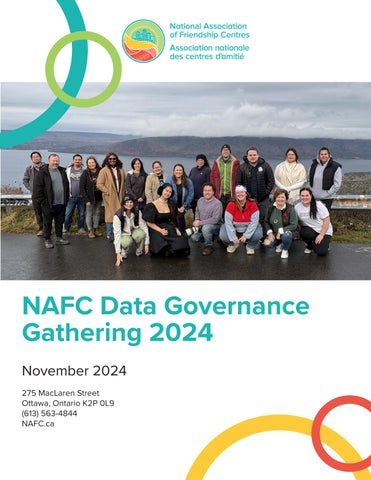
NAFC Data Governance Gathering 2024 November 2024 275 MacLaren Street Ottawa, Ontario K2P 0L9 (613) 563-4844 NAFC.ca
Table of Contents Overview ���������������������������������������������������������������������������������������������������������������������� 3 Attendees ��������������������������������������������������������������������������������������������������������������������������������������������������������������� 4 Opening In A Good Way ������������������������������������������������������������������������������������������������������������������������������������ 5 A Collective Vision ����������������������������������������������������������������������������������������������������������������������������������������������� 5
NAFC’s Data Governance �������������������������������������������������������������������������������������������7 Grounding ������������������������������������������������������������������������������������������������������������������������������������������������������������� 7 Where does our data come from? ���������������������������������������������������������������������������������������������������������������������� 8 Current Information Governance Framework ����������������������������������������������������������������������������������������������� 10
Governance Issues and Priorities ����������������������������������������������������������������������������10 Overview ������������������������������������������������������������������������������������������������������������������������������������������������������������� 10
Ethical Engagement ��������������������������������������������������������������������������������������������������12 Overview ������������������������������������������������������������������������������������������������������������������������������������������������������������� 12 What We Heard �������������������������������������������������������������������������������������������������������������������������������������������������� 12
Program Reporting ����������������������������������������������������������������������������������������������������14 Overview ������������������������������������������������������������������������������������������������������������������������������������������������������������� 14 What we heard ���������������������������������������������������������������������������������������������������������������������������������������������������� 15
Telling Our Stories ����������������������������������������������������������������������������������������������������� 17 Overview ������������������������������������������������������������������������������������������������������������������������������������������������������������� 17 What we heard ���������������������������������������������������������������������������������������������������������������������������������������������������� 17
Access To Data ����������������������������������������������������������������������������������������������������������� 17 Overview ������������������������������������������������������������������������������������������������������������������������������������������������������������� 18 What We Heard �������������������������������������������������������������������������������������������������������������������������������������������������� 18
Feedback and Recommendations ���������������������������������������������������������������������������19 Assessment ���������������������������������������������������������������������������������������������������������������������������������������������������������� 20 Knowledge Products and Tools ������������������������������������������������������������������������������������������������������������������������ 20 Stakeholder Engagement ����������������������������������������������������������������������������������������������������������������������������������� 21 Standards Development ������������������������������������������������������������������������������������������������������������������������������������� 21
2 National Association of Friendship Centres // Association nationale des centres d’amitié
Overview NAFC’s first Data Governance Gathering was held Monday November 4th to Tuesday November 5th, 2024 at the Membertou Trade and Convention Centre in the Membertou First Nations Community, Nova Scotia. The Data Governance Gathering provided an opportunity for relationship building and knowledge sharing. Delegates from across the National Association of Friendships Centres (see Attendees List) were invited to discuss data governance issues and co-develop the NAFC’s Data Collection Strategy. Topical sessions were facilitated by Senior Staff from the National Office, fostering group discussion and co-development of data governance priorities, standards and goals. Considerations, deliverables and milestones (see Feedback) were recorded from the group discussions and will drive the design of NAFC’s National Data Collection Strategy, as well as inspire the future work of the Senior Staff from the National Office. In March 2025, NAFC’s National Data Collection Strategy will be presented to the NAFC Board of Directors and the PTA Executive Directors and Presidents. The Gathering achieved its objectives through the following activities: The event prioritized activities with group discussions and sharing with the room, enabling delegates to build relationships with one another while honouring local and regional differences.
• • • • •
Relationship Building Co-development Knowledge sharing Workplan development Scan of the current context
We hosted several team building activities including a social evening and a bus tour.
•
Relationship building
We prioritized regional parity and intergenerational inclusion with delegate invitations.
• • •
Relationship building Co-development Knowledge sharing
Facilitators led group discussions around data governance, ethical engagements, program reporting, storytelling and access to data; and this included sharing best practices and establishing standards
• • • • •
Co-development Knowledge sharing Workplan development Standards development Scan of the current context
3 National Association of Friendship Centres // Association nationale des centres d’amitié
Attendees Name
Role
Organization
Omovigho Abiri
Program Coordinator
NAFC
Natalie Cahill
Program Coordinator
NAFC
Jean-Francois Côté
Projects and Programs Coordinator
RCAAQ (PTA)
Nathaniel Cummings
Data Analyst
NAFC
Michaela Finnamore
Program facilitator
Under One Sky (FC)
Senator Ray Fox
Senator
NAFC Senate
Cailin Gerrard
Administration Coordinator
NAFC
Samantha Jack
IYC Executive Rep
Indigenous Youth Council
Melissa Julian
Lead User
Mi’kmaw Native (FC)
Kara Louttit
Senior Policy Analyst
NAFC
Andrew Macumber
Senior Information Analyst
NAFC
Jacqueline Maiangowi
Data Coordinator
NAFC
Victoria Marchand
Senior Policy Analyst
NAFC
Candy Morningway
Capacity Manager
ANFCA (PTA)
Gaelle Mushyirahamwe Senior Research Coordinator
NAFC
Hinauri Nehua Jackson
IYC Alberta Rep
Indigenous Youth Council
John Paillé
Senior Communications Coordinator
NAFC
Jennifer Rankin
Senior Director
NAFC
Melissa Reinhardt
Research Analyst
BCAAFC (PTA)
Matthew Slusky
Acting Executive Director
MAFC (PTA)
Melody Wood
Special Projects Manager
AFCS (PTA)
4 National Association of Friendship Centres // Association nationale des centres d’amitié
Opening In A Good Way Elder L’lun Wells of Membertou First Nations opened the Data Gathering in a good way. Delegates introduced themselves and were asked to share their intentions for the gathering: Connection – Delegates spoke about shared responsibility, connection and coordinated movement at the local, regional and national levels. This could be supported by collective development of resources, standards and principles. Tangible – To increase buy-in from community members and front-line staff it would be important that data can drive tangible outcomes for them and that they are already collecting and sharing data. Providing tangible real-world examples of how data exists in their day-to-day lives. Knowledge Sharing – We are all at different starting points, hold different experiences and thus, it is important that we learn from each other. This can be promoted by open communication, by listening and hosting gatherings to bring people together. Standards – There is a need for collective standards that the movement can coalesce around. This would provide clarity to staff, ensure data quality, and enable us to tell regional and national stories while still being able to speak to local contexts. Thus, we must honour local and regional differences, while at the same time collectively work towards telling a unified story that can drive transformational change for Friendship Centres. Think Big – We must dream of big accomplishments even if they do not seem possible at this moment. Delegates were asked to keep these intentions in mind throughout the gathering.
A Collective Vision During this session facilitated by Andrew Macumber, Senior Information Analyst (NAFC), delegates were asked to share the visions and priorities of their organizations for information and data. Followed by identifying commonalities across organizations. Continuous Engagement – There must be continuous engagement at all levels from community members to frontline staff to managers to executives, from the local to regional and national levels. This will involve relationship building, kindness and training opportunities. To promote buy-in everyone needs to see themselves in the data strategy, understand that they are part of it and that they are already doing data. It is important that we reach out to local leaders that might not be prioritising data collection, and employing archaic data collection methods, or simply lack the data capacity to focus on data. Finally, it is important that Youth not be left out. They should National Association of Friendship Centres // Association nationale des centres d’amitié
5
and we should aim to provide them with the skills and wise practices to set them up with success. We envision a future where every centre has a data position on staff and/ or every program has a data position. Strengthen the Vision – There was a call to change the vision statement to place NAFC as ‘the’ information leaders when it comes to urban Indigenous information. There was a recognition that many other urban groups are currently building data capacity and speaking on behalf of urban Indigenous communities. If NAFC does not act quickly enough we will fall behind. It is important that NAFC share its data strategy sooner than later, in order to stake its place in this context.
“We should be saying – As Information Leaders in the Urban Context.” – Candy Morningway
Mobilization – We need to more effectively use our data and information to drive transformational change for our Friendship Centres. Reports need to not only focus on compliance, but on influencing decision makers and driving broader awareness. We need to leverage what we have and make it accessible if we are to be recognized as information leaders. Collective Standards – There needs to be consistency to the data that is collected and shared at the local, regional and national levels. This will ensure data quality and empower us to collect indicators that are relevant and useful to the movement. A key step is to understand how data moves through the Friendship Centre Movement. One big idea would be to publish an urban inspired set of principles similar to that of OCAP. This unified strategy should also recognize regional sovereignty.
“Being leaders in urban communities on data sovereignty” – JF Cote
6 National Association of Friendship Centres // Association nationale des centres d’amitié
NAFC’s Data Governance Grounding The Governance Gathering began by presenting grounding information to ensure we had a common language and understanding of the issues we were to discuss. Definitions • Data – Is raw, unprocessed facts and figures without any context or meaning. For example, the number of individuals who participated in a community event. • Information – Data that has been processed, organized, and contextualized to provide meaning and relevance. For example, the outcomes of hosting a community event. • Wisdom – Information paired with experience and expertise leading to wise practices. For example, starting an event with introductions leads to relationship building and better outcomes. • Strategy – Is a plan or approach that outlines how an organization will use its information and data to achieve its goals and objectives and realize its vision. For example, “the game plan,” for using data to reach our goals. • Governance – Overall management of the availability, usability, integrity and security of data used in an organization. This includes policies, processes and standards. For example, “the rules of the game,” for managing and protecting data. Vision and Missions NAFC’s Vision – Ascending to a future that remembers the past and is rooted in our cultures to improve the well-being of Indigenous people living in urban environments. NAFC’s Mission – Support our members in achieving their diverse missions and visions within their urban Indigenous communities. Data Strategy Vision – As Indigenous information leaders, we honour our traditions by using stories to provide an understanding of urban realities and the Indigenous context. Our stories empower our communities, promote innovation, and provide supports that gives strong selfdetermination and self-sustaining direction. Data Strategy Themes The following themes were proposed for NAFC’s Data Collection Strategy. These themes would group the workplan activities and help to provide scope to the assessment of the workplan’s success. Be Knowledgeable – NAFC must know our members’ self-determined missions and how best to support them. Be Relevant – NAFC must assess the impact of our work in supporting the self-determined missions of our members. National Association of Friendship Centres // Association nationale des centres d’amitié
7
Remember the Past – Even though programs and initiatives come and go, the stories that were shared are not forgotten.
Where does our data come from? The National Office receives information from many sources. The three primary sources of information are from:
Program Coordination
8
As part of national programming, participating Centres are required to report on objectives, goals, and outcomes. This is a rich source of information regarding the self-determined missions of Centres, their successes, and the supports they require. National Association of Friendship Centres // Association nationale des centres d’amitié
Engagements All Departments and Teams at the National Office host engagements with the membership. These can be large gatherings, surveys or meetings.
Bridging Across Canada Bridging Across Canada is a database application designed for and by Friendship Centres and PTAs. It supports Centres with centralized data management, consensual tracking of their service delivery and automates reporting at the local, regional and national level. This is a relatively new source of information and data.
9 National Association of Friendship Centres // Association nationale des centres d’amitié
Current Information Governance Framework The current Information Governance Framework parallels that of the Governance Framework of NAFC. There are currently no formal advisory bodies that are specific to making decisions on information and data.
Governance Issues and Priorities Overview This session was facilitated by Andrew Macumber, Senior Information Analyst (NAFC), with the aim of collectively identifying priorities, standards and actions when it came to data governance and to collectively strategize the role of the Data Working Group.
What we heard Breaking Down Siloes NAFC members should be aware of the advocacy and negotiations that the National Office and PTAs do on their behalf and how members can support this. Friendship Centres, PTAs and the National Office must celebrate the importance of one another and how they collectively support one another in driving transformational change for the movement. Key messaging must be shared at all levels from National to Regional to the Local level so that we can be coordinated in our collective action to drive transformational change. PTAs and the National Office should work to establish a resource database for the movement to promote knowledge and resource sharing both horizontally and vertically. There should be 10 regular sharing of updates as to what others are doing. National Association of Friendship Centres // Association nationale des centres d’amitié
An environmental scan is required to understand how many external repositories exist that hold information and data on urban Indigenous peoples and what access does the NAFC have to them. Work should be done to make these external repositories more accessible to the NAFC. Specifically, PTAs and the National Office can leverage their regional and national partnerships to help broker this access. It is important that we understand what data relationships currently exist within the movement. Shed light on what data and information is being collected by which partners and organizations and if Centres have access to these. Standards and Data Quality To have effective collective action we must understand one another and be able to coordinate. This can be supported with supportive standards that honour the autonomy of Centres and PTAs but enable us to move collectively. Delegates shared some general considerations when it came to standard development: • • •
Push back against the idea of perfect data and the all or nothing approach. Begin by focusing on ourselves, finding our own information gaps, and filling them. The National Office should maintain a glossary of definitions.
Any standards that are developed must honour that Centres and PTAs are at different stages of their data journeys and meet them where they are at. A first step could be an environmental scan of where NAFC members find themselves on their data journeys. This scan should drive transparency on how information and data is collected, shared and where it is most vulnerable. Based on this scan, resources could be developed and prioritized to have the greatest impact. Candy Morningway (ANFCA) shared a story that highlighted the importance of being able to demonstrate the authenticity and accuracy of our information and data. In Alberta, another regional organization had their data challenged with respect to their services, the number of people they support, and number of people on the waitlist by the Alberta Government. The Alberta Government questioned the authenticity and accuracy of their information and data as it contravened the government’s own messaging. They required the regional organization to undergo a full data audit. While the audit inevitably supported the regional organization, the auditing process was devastating for the organization taking up valuable time and resources that could have been better expended elsewhere. Advocacy and Awareness The National Office must design an effective communication plan as part of the National Data Collection Strategy to ensure that it is reaching everyone in the movement. The importance of data sovereignty must be communicated and appreciated by all levels of governance within the movement. From the National Board of Directors, the IYC, the Senate and to the Regional and Local Board of Directors. It is important that when standards and resources are shared that they reach both Centres and PTAs and every level of the organization from the Executive to the Front-Line staff. The FrontLine staff especially, as they will be the ones doing the data entry and collection, and they have the greatest impact when it comes to ensuring that our data is ethical, secure and of the highest quality. National Association of Friendship Centres // Association nationale des centres d’amitié
11
The Data Working Group Historically, the Data Working Group was an informal working group made up of regional representatives that developed the vision, mission, values and principles of the NAFC’s National Data Collection Strategy. It was recommended that every region should create their own data working groups with a national data working group that is composed of a member from each. There should be regularly occurring online meetings and one annual in-person meeting. These data working groups should function primarily for communication and coordination. There is the opportunity for them to serve as an advisory group for the maturation of NAFC’s Data Collection Strategy, collective resource development, and publishing of National Information Products.
Ethical Engagement Overview This session was facilitated by Victoria Marchand, Senior Policy Analyst, and Gaelle Mushyirahamwe, Senior Research Coordinator. The objectives of the session were to: •
•
To receive feedback and learn more about ethical engagement protocols and processes that can help strengthen facilitation with and between Friendship Centres, and the wider Friendship Centre Movement. Gain more insight on as a national body, on how we can better support Friendship Centres with their data collection and engagement.
The objectives of the engagement were met, as the group discussions provided more insight into the best practices when reaching out to FCs/PTAs. But also learning more about practices that they have implemented in their own work and the challenges met when facilitating conversations or data collection. More importantly, it reemphasized the importance of mutually beneficial relationship building that allows for the cultivation of safe spaces when inviting people in. There is a need for National Engagement Guidelines, including an assessment process to ensure accountability and consistency. Proper resourcing is required to have effective engagements. Careful consideration about the relevancy of engagements and the time and capacity of the movement should lead to fewer engagements that are more impactful.
What We Heard Defining Effective Engagement The session began with a broad discussion of what are the attributes and values of effective
12 engagement. Delegates highlighted the need to ensure that participants were provided National Association of Friendship Centres // Association nationale des centres d’amitié
length and frequency of engagements. Where possible those providing information should be compensated for their time and knowledge sharing. It was also important to recognize facilitator fatigue especially when engaging with sensitive topics. The following values were highlighted as being part of effective engagements: • Collaboration • Respect • Reciprocity • Shared responsibility • Communication and sharing • Relationship building • Respect Indigenous ways of knowing The following values were highlighted as being essential for ethical engagements • Safety and establishing boundaries • Trust building • Integrity • Accountability • Open and honest (transparent) boundaries and consent • Community first. Not here to take from them, but to be a humble servant. When designing engagements, facilitators should ensure that participants have access to the data and the results of the engagement. It is important for participants to be able to actively engage and share information. Throughout the engagement it is important that facilitators continually check in. This should continue following an engagement. Delegates identified the following engagement methods: surveys, workshops (in-person and virtual), membership meetings, phone calls, site visits and in-person events and forums. Delegates identified that the site visits, in-person events and forums had the highest impact when it came to effective engagements. What are the current challenges and gaps that can be improved upon? The most effective engagements require a lot of accommodation and behind the scenes work. The greatest gaps are the lack of time and capacity to ensure effective engagements. In addition, when effort is made it can be met with low uptake and engagement. One way to address this is to ensure that the topics are relevant to participants. How we ensure that our ethical engagements around national strategies align? There must be a recognition of the diversity and uniqueness within the movement, whether that be based on identity, experience or location. Intentional work must be done to bring together different perspectives. Facilitators should be transparent about the lifecycle of the engagement data. What are they collecting, what will they be doing with it, who they will be sharing it with and how long will they be holding on to it. Its important that participants have ongoing consent and the ability to say no to information collection and retention at any point. National strategies need to be broad enough, flexible and adaptive to both time and location if they have any hope of being implemented. Working groups and advisory committees should National Association of Friendship Centres // Association nationale des centres d’amitié
13
be part of all national strategy developments so that there can be continuous engagement. Not everyone has the capacity to participate, and accommodations must be made to make it more feasible and accessible for them.
Program Reporting Overview This session was facilitated by Omovigho Abiri and Natalie Cahill, Program Coordinators (NAFC). The Programs team uses collected data to advocate for funding, support program development and enhance data-driven decision making. During this session the facilitators had the delegates review and co-develop a sample program reporting template with the objective of creating a standardized form that could be used for all programming going forward. This included a discussion on how we could measure community wellness. This feedback underscores the need for a balanced approach to data collection—one that captures quantitative metrics and qualitative narratives to reflect the full scope of the Friendship Centre Movement’s impact. By refining indicators, streamlining reporting, and emphasizing stories of success, NAFC can advocate effectively for sustained funding and program development.
14 National Association of Friendship Centres // Association nationale des centres d’amitié
What we heard Indicators Needing Adjustment Metric Program Metrics
Community Reach Cultural Connectedness Staff Capacity
Adjustments • Measuring the number of programs alone is insufficient; qualitative aspects and informal services should be captured. • Differentiate between programs, services, projects, and initiatives. • Highlight specific program intentions, missions, and alignment with community strategies. • Include detailed demographic data (age ranges, gender categories: M/F/2S/NB). • Define whether engagement is continuous or one-time. • Develop nuanced indicators for language fluency and access to traditional practices, as “access” is more a goal than a measurable outcome. • Differentiate between new and long-standing staff, volunteers, and cultural advisors. • Include measures for staff growth and limitations faced.
Success Measurement • • Partnerships
•
Incorporate milestones and objectives in structured formats (e.g., tables). Evaluate success based on longitudinal outcomes, goals met, and qualitative insights (e.g., testimonials). Differentiate between new and existing partnerships. Assess their value, equity, and contribution to goals.
Additional Indicators for Community Impact/Wellness Metric Community Inclusivity
Holistic Measures
Data Depth
Adjustments • Indicators for queer safety and 2S initiatives. • Inclusion of individuals in active use or transitioning out of incarceration. • Use Indigenous social determinants of health as a foundational framework • Capture wraparound service impacts by tracking multi-service access • Include frequency and duration of service use. • Document reasons for accessing services, linking these to root causes and advocacy goals
15 National Association of Friendship Centres // Association nationale des centres d’amitié
Support and Resources for Reporting Feedback highlighted the need for streamlined and accessible reporting tools: • Templates and Automation: o Pre-filled sections for recurring details. o Use dropdown boxes and simplified language for varied education levels. • Implement digital solutions like online portals or dashboards (e.g., PowerBI, SharePoint). • Training and Education: o Ongoing workshops on data collection and its importance. o Regular updates and opportunities to share practices and challenges. • Centralized Reporting: o Archive data to track trends over time. o Share NAFC’s reports and member narratives broadly to foster transparency and collaboration. Positioning Data for Advocacy To strengthen funding cases and program renewal efforts: • Narratives and Stories: o Complement data with impactful community stories and testimonials. o Focus on strengths-based indicators that highlight progress and success. • Intersectionality: o Incorporate gender-diverse and harm-reduction lenses into data strategies. o Address upstream issues contributing to systemic challenges. • Data Accessibility: o Develop communication strategies to share findings with funders and stakeholders effectively. Sharing Wellness Data Across the Movement Ideas for ensuring data benefits all stakeholders: • Platforms and Tools: o Use online portals or shared platforms (e.g., New Journeys, SharePoint). o Provide access to raw data alongside summaries and narratives. • Regular Updates: o Leverage newsletters, social media, and podcasts to highlight stories and trends. o Create centralized databases for sharing lessons learned and best practices. Additional Thoughts and Recommendations Participants emphasized: • The importance of addressing root causes of systemic issues in data collection. • Revisiting annual “State of the Movement” reports to consolidate insights and successes. • Framing challenges as “lessons learned” to inspire progress.
16 National Association of Friendship Centres // Association nationale des centres d’amitié
Telling Our Stories “Data isn’t just numbers – it’s our story, our evidence, and our power to drive change.”
Overview This session was facilitated by John Paillé, Senior Communications Coordinator (NAFC). The objectives of the session were to: • • •
Find out what stories Friendship Centres wanted to tell How they wanted to tell them How NAFC can assist in telling Friendship Centre’s stories
What we heard When engaging with stakeholders too much time is spent explaining what Friendship Centres are and why they are essential; taking away from discussing current issues and the supports needed to support centres’ self-determined missions. NAFC should publish advocacy toolkits that quickly explain what Friendship Centres are and why they are important. NAFC should work on promoting a general awareness of Friendship Centres, an awareness that exists for both YMCA and Boys and Girls Club. Many Friendship Centres do not have a dedicated role for communications, but rather this is taken on by many staff who are often doubling roles. Having a national staff directory would facilitate connections. It would be helpful if standards and resources were developed that outlined how best to share information with NAFC. NAFC and PTAs should promote the NAFC mailing list and Members Portal to the membership to drive enrollment. This is the main way that Communications shares information with the movement. NAFC should explore an asynchronous messaging platform to promote communication. Since government is our primary funder, we need to speak their language, and that language is socio-economic indicators. They want to know the economic and financial impact of programs and services. Some examples from Alberta include: • •
The # of participants in education programs in Alberta led to this # applying to trade schools Mental health programs serviced 2,300 urban Indigenous people, resulting in a reduction of $ on provincial resources.
Access To Data
“Without comprehensive data, we lose our seat at the table with funders and governments.”
17 National Association of Friendship Centres // Association nationale des centres d’amitié
Overview The session was facilitated by Kara Louttit, Senior Policy Analyst, NAFC. The objectives of the session were to: • Explore how the NAFC, along with Friendship Centres and PTAs, can better access and utilize data to support their work. • Identify the types of information and data sets that are most valuable for the NAFC’s work in advocacy, community engagement, and program development. • Assess any gaps in existing datasets or missing information that could better support the work across the FCM. • Examine ethical standards and privacy considerations in data collection and usage within the FCM. • Discuss how to strengthen and leverage partnerships, relationships, and capacity needs for enhancing data access and use. Participants shared insights on their data needs, highlighted challenges in accessing and utilizing data, and emphasized the importance of ethical data practices. Discussions led to actionable ideas for improving the NAFC Data Strategy, such as leveraging existing datasets, enhancing partnerships, and building capacity at the PTA and individual Friendship Centre levels. Several concrete suggestions were made including ways to improve the national data strategy, providing training on OCAP principles to Friendship Centres, and improving the visibility of Friendship Centres’ contributions in non-Indigenous spaces (ex: municipal/ provincial/federal governments, non-Indigenous organizations and service providers, etc.). Key themes and goals for moving forward with data access and usage were clearly outlined.
What We Heard Bridging Across Canada – The Bridging Across Canada database was highlighted as a key tool for advocacy and resource allocation. The capabilities of the database can assist Friendship Centres in their advocacy, enabling Centres to meet the requirements of Funders and governments, who often require data on participation and outcomes to justify continued support. Socioeconomic Framing - There’s a need for more comprehensive data on community wellness, demographics, and economic impacts. With Conservative-led provincial governments, concerns often center around value per dollar. Highlighting how every dollar spent within the FCM can provide cost savings in other areas (ex: increased Indigenous health care services lead to decrease in hospital overcrowding; community-based justice programming leads to savings across the criminal justice system, etc.). Data Observatory - Quebec’s model of data observatories were mentioned as a best practice worth emulating.
18
Capacity Challenges – PTAs, especially those with limited staff, struggle with balancing multiple roles, indicating the need for more dedicated data and policy staff. Participants emphasized the importance of standardizing data reporting templates and providing training to build regional capacity. National Association of Friendship Centres // Association nationale des centres d’amitié
Ethical Data Practices – Respecting OCAP principles and providing training for OCAP, cultural sensitivity, and community ownership were central to the conversation. Concerns about maintaining participant confidentiality and transparency in data usage were frequently raised. Partnerships – Existing academic and government partnerships are underutilized and should be strengthened. Participants suggested creating clearer pathways for leveraging policy and research outputs at the national level down to the PTA and individual Friendship Centre levels.
Feedback and Recommendations Based on the engagement we have outline the various considerations, deliverables and milestones identified and organized them by themes. Assessment – Assess where we are at, if we are on track, what is working Knowledge Sharing – Disseminate and make information available Stakeholder Engagement – Continuous engagement with our stakeholders Standard Development – Co-development standards and resources to support staff National Association of Friendship Centres // Association nationale des centres d’amitié
19
Fiscal Year
Quarter
Activities
2024-2025
Q3
• •
Data Governance Gathering Presenting outline of NAFC’s National Data Collection Strategy (DCS) to Jocelyn Formsma (CEO)
Q4
• • •
Publish the Data Governance Gathering Summary Report Publish first draft of NAFC’s DCS Present DCS to PTA EDs and NAFC BOD
•
Present DCS at the Annual Meeting
2025-2026
Q1 Q2
Assessment Considerations • Ensure diverse voices are being engaged • Consider a national rollout of initiatives like Quebec’s urban Indigenous survey, including funding for local Friendship Centres to participate. Deliverables • •
Environmental scan of NAFC members data sharing agreements and partnerships Environmental scan of NAFC members current data reality and their priorities
Milestones • •
All PTAs sharing information with BAC Greater than 50% of FCs sharing information with BAC
Knowledge Products and Tools Deliverables • Central repository for all National Program Information that is accessible to the membership o Including Policy and Research Papers o Lessons learned and wise practices o Make program admin information available and track longitudinal trends • Digital Infrastructure o Story submission portal o National Metrics Portal o National CRM o Asynchronous horizontal conversation platform • Create NAFC Archives
20 National Association of Friendship Centres // Association nationale des centres d’amitié
Milestones • Begin publishing the State of the Movement Report o Share insights, lessons learned and highlight important work • Establish a resource and knowledge sharing hub • Youth Internships • Certifications
Stakeholder Engagement Considerations • •
In-person meetings are the most impactful Where possible participants should be compensated
Deliverables •
•
• •
Communication strategy for the National Data Collection Strategy that reaches all levels of organisations o Speaks to the importance of data sovereignty o Shares key messaging Offer training o Fundamentals of OCAP o Data Literacy o Statistics Canada Training Rationale Letter Template to advocate for funding to support data capacity Information kit that speaks to the history, importance and the impact of Friendship Centres
Milestones • •
Creation of National and Regional Data Working Groups Expand partnerships with universities to fill research gaps
Standards Development Considerations • • • •
That standards and resources are reaching Front Line staff Necessity to speak in socio-economic terms for government Looking to Quebec’s Data Observatories as an example Metrics to consider: o Where is funding coming from? o List of programs linked to categories o Number of individuals accessing programs o Membership numbers and process o Board numbers o Indigenous diversity of leadership o Facilities and types and Activities taking place at facilities o Missions and goals o Count of data strategies
21 National Association of Friendship Centres // Association nationale des centres d’amitié
•
o Count of data staff o Count of research and policy staff o Number of Centres contributing to BAC A healthy Centre can be assessed by the following: o Strong Membership o Strong Board o Supporting Community
Deliverables • • • •
•
• •
The National Office should maintain a glossary of terms National Engagement Standards o Policies that support ongoing consent and transparency Data and information is accessible and its lifecycle is transparent o What to share and how to share National Program Reporting Template and Standards o Standardized across all national programs o Leverage Bridging Across Canada for data entry and management o What to share and how to share National Indicator Standards o Balance quantitative and qualitative o Capture the self-determined mission of the Centre o Relate to social determinants of health o Capture wraparound service impacts by tracking multi-service access o Strength based indicators that highlight progress and success o Storytelling supported by data o List of fields / metrics with definitions o Transparency on how data is aggregated and disaggregated National Security Standards o Cybersecurity toolkits Cover confidentiality, transparency and consent
22 National Association of Friendship Centres // Association nationale des centres d’amitié