NATIONAL ASSOCIATION OF FRIENDSHIP CENTRES
NEWSLETTER FALL 2026
Newsletter
1
Contents Message from the CEO 36th National Youth Forum 55th Annual Meeting Budget 2026 NAFC Advocacy Day on Parliament Hill National Office Re-Opening National Office Activities News and Highlights from the FCM Departmental Updates Spirits of Friendship Closing Message Staff List
2
National Association of Friendship Centres
1 2 4 9 11 12 13 13 15 16 17 18
Message from the CEO Aaniin/Hello, As the fall season begins and we enter a time of harvest, gratitude and preparation for the winter months ahead, the National Association of Friendship Centres (NAFC) reflects on what has been an incredibly busy and rewarding summer for the Friendship Centre Movement. June and July were filled with preparation and anticipation as the NAFC and Friendship Centre network gathered for the 55th Annual Meeting and 36th National Youth Forum. These gatherings provide an important opportunity for Provincial and Territorial Associations, Friendship Centres, youth leaders, partners, and community members from across the country to come together to share knowledge, celebrate achievements, strengthen relationships, and help shape the future of our member centres. The NAFC extends its sincere gratitude to the Brandon Friendship Centre for hosting this year’s events in Brandon, Manitoba. Their leadership, hospitality, and dedication helped create a welcoming environment for meaningful discussions, learning, and connection. Despite a challenging season marked by wildfires and flooding in many regions, the strength and resilience of the Friendship Centre network ensured that members could gather in person. As summer comes to a close, attention turns to a busy and productive fall. Advocacy will remain a key priority as the NAFC continues to advance the voices and priorities of urban Indigenous communities at the national level. The NAFC has submitted its recommendations for the Government of Canada’s 2026 Budget, calling for a targeted investment of $25 million over five years to strengthen partnerships with the Friendship Centre network and expand support for urban Indigenous communities across Canada. The NAFC is also looking forward to reopening its national office following significant renovations, creating a renewed and more accessible space that will better support staff, members, partners, and the important work carried out alongside the Friendship Centre network. There is much to look forward to in the months ahead. Together, Friendship Centres, Provincial and Territorial Associations, youth, Elders, partners, and community members will continue building stronger communities, advancing meaningful change, and supporting Indigenous Peoples in cities and towns across the country. The NAFC extends its appreciation to Friendship Centres, partners, volunteers, and supporters
Newsletter
1
for their continued commitment. The NAFC looks forward to sharing further progress, accomplishments, and opportunities in the months ahead as our work continues to strengthen and support urban Indigenous communities across Canada. Miigwetch,
Jennifer Rankin Chief Executive Officer
36th National Youth Forum This year’s National Youth Forum welcomed more than 184 participants, including youth delegates, vendors, community members, and partners. Under the theme “Revitalizing Roots: Healing Through the Land,” Indigenous youth from Friendship Centres across Canada came together for three days of learning, leadership development, cultural teachings, and relationship building. Participants were inspired by keynote presentations from Braden Kadlun and Jennifer Brazeau, engaged in youth-led discussions on identity, wellness, and maintaining connections to the land in urban environments, and contributed to conversations that will help shape the future of Friendship Centres. The Forum also featured meaningful land-based learning experiences at the Brandon Riverbank Discovery Centre, including traditional games with Waterways Recreation, as well as hands-on cultural workshops led by Frank Tacan Sr., Meagan Anishinabie, and Garrick, including hide processing, medicine teachings, talking stick making, and willow dreamcatchers.
2
National Association of Friendship Centres
Thank you to Darren Sutherland for serving as an outstanding Master of Ceremonies throughout the National Youth Forum. Your humour, thoughtful reflections, positive energy, and ability to bring people together helped create a welcoming and engaging atmosphere for all participants. Your contributions played an important role in making this year’s Forum such a memorable experience. Together, youth strengthened relationships, celebrated culture, and reaffirmed their commitment to creating positive change within their communities.
Indigenous Youth Council Elections Congratulations to Nevaeh Munroe, elected Vice-President, and to Aby-Gaelle Jerome on her re-election as Treasurer. We would also like to welcome newly elected Regional Representatives Sharon Martin, Shiloh Prosser, and Heather Maclean. Indigenous Youth Council Executive • Caley-Rain Anderson, President • Nevaeh Munroe, Vice-President • Nadya Comeau, Secretary • Aby-Gaelle Jerome, Treasurer • Samantha Jack, Youth Executive Regional Representatives • Sharon Martin, North • Ethan Cameron, British Columbia • Shiloh Prosser, Alberta • Theland Kicknosway, Saskatchewan • Nevaeh Munroe, Manitoba • Anyssa Ford, Ontario • Vacant, Quebec • Heather Maclean, Atlantic
Youth Auction The Youth Auction raised approximately $6,795 in support of the Indigenous Youth Council. Thank you to everyone who donated items and placed bids. Your generosity and support make a meaningful difference in empowering Indigenous youth leadership across the country.
Sponsors Thank you to the official sponsors of the 36th National Youth Forum. Your generous support helped create meaningful opportunities for Indigenous youth to gather, learn, connect, and grow through culture, leadership, and land-based learning experiences. We gratefully acknowledge:
Newsletter
3
• • • •
Rideau Hall Foundation Deloitte GreenShield National Indigenous Collaborative Housing Inc. (NICHI)
Thank you for your partnership and commitment to supporting Indigenous youth and strengthening the Friendship Centre Movement. Your contributions helped make this year’s Forum a memorable and impactful experience for all who attended.
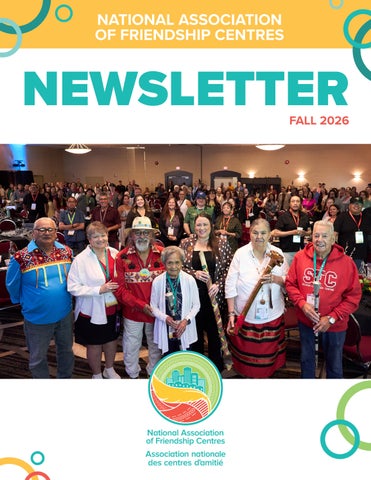
55th Annual Meeting The Annual Meeting welcomed more than 450 participants, including delegates, youth, community members, and partners. On Sunday, July 26, we celebrated Senator Marge White’s 90th birthday with cake and a special photobook presentation in recognition of her remarkable contributions to the Friendship Centre Movement. On Monday, July 27, attendees gathered for a Cultural Night hosted by the Brandon Friendship Centre, featuring a community feast and outstanding live entertainment. Guests enjoyed performances by: • Julianna Moore • Grandfather Stone • Norman Chief Memorial Dancers and Jason Lepine • Prairie Blend Choir • Akicita Cante Waste Men’s Drum Group • Don Amero Thank you to the Brandon Friendship Centre for creating such a memorable evening filled with culture, music, and community spirit.
4
National Association of Friendship Centres
NAFC Executive Committee and Board of Directors We are pleased to share the results of the 2026 NAFC Elections. Congratulations to Lois Duke on her re-election as Vice-President and to Teresa Innis on her election as Treasurer. During her campaign, Lois shared her personal journey, experiences, and the reasons behind her deep commitment to serving in this leadership role, offering delegates a meaningful reflection on her dedication to the Friendship Centre Movement. We also congratulate Teresa and know that she will bring a wealth of experience, knowledge, and leadership from her role as Executive Director of the Newo Yotina Friendship Centre to her position as Treasurer. We look forward to her contributions as she continues her commitment to strengthening the Friendship Centre Movement and supporting Indigenous communities across the country. The NAFC would also like to acknowledge Jason Gobeil for his candidacy for Vice-President. We thank Jason for sharing his passion for the Friendship Centre Movement, his dedication to the well-being of Indigenous Peoples, and his commitment to strengthening communities across the country. We appreciate his leadership and continued contributions to the Movement. We look forward to continuing the strong leadership of our all-Indigenous women Executive Committee. Executive Committee • Pam Glode-Desrochers, President • Lois Duke, Vice-President • Teresa Innis, Treasurer • Barb Ward-Burkitt, Secretary • Samantha Jack, Youth Executive Board of Directors • Holly Williams, Newfoundland and Labrador • Cheyenne Labrador, Nova Scotia • Molly Burke, New Brunswick • Jennifer Brazeau, Quebec • Jason Gobeil, Manitoba • Robert Malboeuf, Saskatchewan • Robert (Bob) Oshanyk, Alberta • Cyndi Stevens, British Columbia • Cindy Wasylyshyn, Northwest Territories/Nunavut • Caley-Rain Anderson, National Youth Representative The NAFC would also like to extend its heartfelt thanks to Laurie Bouvier for her service as Treasurer on the Executive Committee. Through a period of significant growth in funding allocations, Laurie provided steady leadership and dedication, helping strengthen the organization and its ability to serve Friendship Centres across the country.
Newsletter
5
We would also like to thank Stacey Howse, Patsy Mckinney, and Myra Malboeuf for their leadership and many years of service on the Board of Directors, and for being strong advocates for their regions and Friendship Centres.
Resolutions Carried at the 55th Annual Meeting During the 55th Annual Meeting, delegates considered and approved four important resolutions that will help guide the ongoing work and advocacy efforts of the NAFC. We thank the movers, seconders, and delegates for their thoughtful discussion, leadership, and commitment to advancing priorities that strengthen the Friendship Centre Movement and the urban Indigenous communities we serve. The resolutions carried by the membership include: • Strengthening the Role of Friendship Centres in Canada’s Indigenous Economic Future Through Social Procurement and Economic Inclusion, which calls on the NAFC to advance a national economic inclusion strategy and ensure Friendship Centres and urban Indigenous communities are meaningfully included in major project planning, engagement, and economic development opportunities. • Establishing Disability Inclusion and Accessibility as a Strategic Priority for the Friendship Centre Movement, which recognizes the importance of accessibility and disability inclusion across all areas of the Movement’s work and commits to advancing advocacy, collaboration, and investment to better support Indigenous Persons with disabilities. • Advancing Sustainable Investments in Urban Indigenous Elders, which calls for dedicated and sustainable investments to support Elders and recognize their essential role as cultural leaders, knowledge keepers, mentors, and guides within Friendship Centre communities. • Recognition and Adoption of a Nelson Mayer National Day of Friendship, which formally recognizes an annual National Day of Friendship to be observed on the first Friday of 6
National Association of Friendship Centres
June each year. The resolution honours the legacy and vision of the late Nelson Mayer, celebrates the contributions of Friendship Centres across Canada, and encourages Friendship Centres, Provincial and Territorial Associations, and the NAFC to participate in activities that promote friendship, community connection, and public awareness of the Friendship Centre Movement. These resolutions reflect the priorities and collective voice of the membership and will help inform the NAFC’s advocacy, partnerships, and strategic initiatives in the years ahead. We look forward to working alongside Friendship Centres, Provincial and Territorial Associations, Elders, youth, governments, and partners to advance these important priorities, and to reporting back to members on our progress.
National Youth Forum and Annual Meeting Awards Nelson Mayer Youth Recognition Award Congratulations to Sarah Shuttleworth of the Dauphin Friendship Centre, recipient of the Nelson Mayer Youth Recognition Award. This award recognizes an exceptional youth whose Friendship Centre has acknowledged their outstanding contributions and leadership within the community.
Most Active Youth Award Congratulations to Carson Thibodeau of The Pas Friendship Centre, recipient of this year’s Most Active Youth Award. Throughout both the National Youth Forum and the Annual Meeting, Carson demonstrated exceptional leadership by actively participating, introducing himself to fellow delegates, speaking at the microphone during his first Annual Meeting, and encouraging and supporting other youth attendees.
Groovy Delegate Award Congratulations to Daniel Reelis, recipient of this year’s Groovy Delegate Award. Daniel, from First Light Friendship Centre, was recognized for his caring and supportive nature, as well as the positive energy and kindness he brought to both the National Youth Forum and the Annual Meeting. Thank you for helping make our gatherings welcoming, inclusive, and memorable for everyone.
Newsletter
7
Congratulations to all of our award winners. Thank you for the incredible work you do in your communities and for the leadership, passion, and dedication you bring to the Friendship Centre Movement.
Celebrating Edna Terbasket During this year’s Annual Meeting, we were honoured to recognize Edna Terbasket for her many years of dedicated service and leadership within the Friendship Centre Movement. As the longtime Executive Director of the Ki-Low-Na Friendship Society, Edna has been a passionate advocate for Indigenous Peoples and communities, helping to create opportunities, strengthen programs and services, and advance the well-being of Indigenous People in urban communities. Her unwavering commitment, vision, and leadership have made a lasting impact on countless individuals, families, and communities throughout her career. The NAFC extends its heartfelt gratitude to Edna for her many contributions to the Friendship Centre Movement. Her dedication, wisdom, and advocacy have helped strengthen our network and inspire those around her. Thank you, Edna, for your outstanding service and years of leadership. Congratulations on your well-deserved retirement. We wish you happiness, good health, and every success in this exciting new chapter.
8
National Association of Friendship Centres
Honouring Annette Morgan During this year’s Annual Meeting, we were proud to recognize Annette Morgan on receiving the 2026 Indspire Public Service Award. Annette has dedicated her career to strengthening Indigenous communities and advancing the Friendship Centre Movement. As President of the BC Association of Aboriginal Friendship Centres (BCAAFC) and Executive Director of the Dze L K’ant Friendship Centre, she has demonstrated exceptional leadership, advocacy, and commitment to improving the lives of Indigenous Peoples in urban, rural, and northern communities. Her contributions have helped strengthen relationships, create opportunities, and support the well-being of countless individuals and families. Annette’s passion, vision, and dedication continue to inspire those around her and leave a lasting impact across British Columbia and beyond. On behalf of the Friendship Centre Movement, we extend our heartfelt congratulations to Annette on this well-deserved recognition and thank her for her many years of service, leadership, and commitment to Indigenous communities.
Friendship Centre Milestones We would also like to recognize and celebrate the following Friendship Centres and Provincial/Territorial Associations as they mark these significant milestone anniversaries. These achievements reflect decades of dedication, leadership, community service, and commitment to improving the lives of Indigenous Peoples in urban communities across Canada. • • • • • • • • • • •
Maniwaki Native Friendship Centre – 10 Years Centre d’amitié autochtone de Sept-Îles – 20 Years Fraser Region Aboriginal Friendship Centre – 30 Years Conayt Friendship Society – 50 Years Dauphin Friendship Centre – 55 Years Kermode Friendship Society – 50 Years Ma-Mow-We-Tak Friendship Centre – 50 Years Regroupement des centres d’amitié autochtones du Québec (RCAAQ) – 50 Years The Pas Friendship Centre – 60 Years Portage la Prairie Friendship Centre – 60 Years Brandon Friendship Centre – 60 Years
Congratulations on reaching these remarkable milestones. Your continued commitment to supporting Indigenous communities and advancing the Friendship Centre Movement is truly inspiring. We thank you for your contributions and wish you continued success in the years ahead.
Newsletter
9
Budget 2026 Pre-Budget Submission: Investing in Urban Indigenous Communities The NAFC has submitted its recommendations for the Government of Canada’s 2026 Budget, calling for a targeted investment of $25 million over five years to strengthen partnerships with the Friendship Centre network and expand support for urban Indigenous communities across Canada. As Canada’s largest Indigenous service delivery network, Friendship Centres support nearly one million people each year through more than 3,000 programs and services delivered by over 4,300 staff and 12,000 volunteers. From housing and employment supports to emergency response and culturally grounded services, Friendship Centres play a vital role in helping Indigenous Peoples access opportunities and navigate barriers in urban communities. Building on the federal government’s renewal of Urban Programming for Indigenous Peoples (UPIP), the NAFC’s Budget 2026 submission proposes dedicated investments that would strengthen local capacity, support community-led solutions, and improve outcomes for Indigenous Peoples where they live, work, learn, and raise their families.
A $25 Million Investment in Partnership and Delivery The NAFC is recommending an investment of $5 million annually over five years to strengthen cross-government partnerships through the Friendship Centre network. This funding would support local capacity, improve community readiness, enhance data and evaluation tools, and better connect federal investments with community-based delivery. The submission focuses on five priority areas:
10
•
Housing and Community Infrastructure Friendship Centres play an important role in supporting successful housing initiatives by providing wraparound services such as housing navigation, youth programming, transitional supports, cultural activities, and community gathering spaces. The NAFC is calling for dedicated pathways that allow Friendship Centres to access housing and infrastructure investments and advance projects that respond to local needs.
•
Employment and Skills Development Friendship Centres are well positioned to help Indigenous Peoples access training, employment, and skills development opportunities. The submission recommends establishing the NAFC as a national delivery partner for workforce development initiatives, helping connect participants with training, employment supports, childcare, transportation, and other services that contribute to long-term success.
•
Ending Gender-Based Violence Friendship Centres are often among the first places Indigenous women, girls, Two-Spirit,
National Association of Friendship Centres
and gender-diverse people turn to for support. The NAFC is advocating for sustainable, multi-year funding to strengthen prevention programming, safety planning, survivor supports, and culturally grounded services that reflect local realities and community needs. •
Emergency Management and Community Resilience Recent wildfires and floods have highlighted the critical role Friendship Centres play during emergencies. Across the country, Friendship Centres have supported evacuees by providing food, shelter, navigation services, and culturally safe spaces during times of crisis. The submission calls for formal recognition of the Friendship Centre network as a national emergency response partner, along with reliable funding to support this work.
•
Indigenous-Led AI and Data Capacity As governments continue to adopt digital technologies and artificial intelligence, the NAFC is advocating for investments that support Indigenous data sovereignty, cybersecurity, and digital modernization. These investments would help Friendship Centres strengthen service delivery while ensuring Indigenous communities maintain control of their data and benefit from emerging technologies.
Looking Ahead The Budget 2026 submission reflects the strength, reach, and impact of the Friendship Centre Movement and recognizes the importance of investing in community-led solutions for Canada’s growing urban Indigenous population. Through targeted investments and stronger cross-government partnerships, Friendship Centres can continue expanding their role as trusted community hubs, supporting Indigenous Peoples in accessing housing, employment, training, emergency services, and other essential supports. The NAFC looks forward to working with governments, partners, and stakeholders to advance these priorities and ensure urban Indigenous communities remain at the centre of Canada’s economic, social, and community development efforts.
NAFC Advocacy Day on Parliament Hill “Two days, dozens of meetings, one ask: Fund the spaces that support urban Indigenous communities across Canada.” That was our message on September 22nd and 23rd when NAFC staff and board members met with elected officials on Parliament Hill to discuss NAFC’s pre-budget submission and the priorities facing Friendship Centres today. The Friendship Centre movement that began more than 70 years ago now reaches more than one million people, and we want to build on that success and existing infrastructure.
Newsletter
Click the image to view the video.
11
We met with members of parliament representing communities from coast to coast to coast, as well as advisors from the Prime Minister’s Office. We were especially excited to be joined by members of our Indigenous Youth Council (IYC). We honour those who came before us and we listen to the voices of the generations coming behind so that we can prepare for an even brighter future. We look forward to continuing this important discussion with the federal government, to strengthening existing partnerships, and building new ones.
National Office Reopening The NAFC is pleased to announce the reopening of its national office at 275 MacLaren Street in Ottawa following a significant two-year renovation project. The revitalized space has been designed to better support staff, members, partners, and visitors while reflecting the values and priorities of the Friendship Centre Movement. Renovations include a fully accessible main level, a new boardroom and washroom facilities, updated office spaces, and cultural design elements integrated throughout the building. The renewed office will serve as a welcoming space for collaboration, meetings, and engagement with Friendship Centres, partners, and stakeholders from across the country. The NAFC looks forward to welcoming members of the Friendship Centre network and partners into the renewed space and celebrating this important milestone together. A grand opening event is planned for late October, with additional details to be shared in the coming weeks.
12
National Association of Friendship Centres
National Office Activities NAFC Attends Historic Opening of Thunderhead, Canada’s 2SLGBTQI+ National Monument On August 21, the NAFC participated in the opening of Thunderhead, Canada’s 2SLGBTQI+ National Monument in Ottawa. The event brought together survivors, community leaders, Indigenous representatives, advocates, and government officials to commemorate the resilience, contributions, and experiences of 2SLGBTQI+ communities across Canada. Thunderhead stands as a national symbol of remembrance, resilience, and progress. The monument acknowledges the discrimination experienced by 2SLGBTQI+ individuals throughout Canada’s history, including the impacts of colonialism and the LGBT Purge, while recognizing the ongoing contributions of Queer and Trans communities. The opening ceremony provided an opportunity for reflection, learning, and dialogue on the importance of advancing inclusion, equity, and reconciliation. The NAFC was honoured to participate alongside Indigenous and community leaders committed to supporting safer, more inclusive communities for all. During the event, NAFC representatives connected with elected officials, community advocates, and members of national advisory and advocacy groups, helping to strengthen relationships and support ongoing dialogue on issues affecting Indigenous and 2SLGBTQI+ communities across Canada.
News and Highlights from the Friendship Centre Movement Dze L K’ant Friendship Centre’s Grand Opening of New Building and Daycare On August 19, 2026, the Dze L K’ant Friendship Centre Society welcomed Elders, families, community members, funders, project partners, and supporters to celebrate the opening of two important new community spaces in Houston, British Columbia: the Cub House Indigenous Childcare Centre and the new Houston Friendship Centre building.
Newsletter
13
The celebration began with an opening ceremony at the childcare centre, featuring remarks from guests, a sweetgrass cutting, a cedar ceremony, and tours of the new facility and natural playground. Attendees also had an opportunity to experience Indigenous artwork and cultural installations incorporated throughout the space. Following the ceremony, staff and youth led a community drum walk to the new Friendship Centre building, where guests participated in additional ceremonies, acknowledgements of project partners, guided tours, and a community lunch prepared by the Dze L K’ant Friendship Centre team.
The new facilities represent a significant investment in the well-being of local Indigenous children, youth, and families. Together, these spaces will provide opportunities for learning, cultural connection, community gathering, and access to programs and services for years to come. The Cub House Indigenous Childcare Centre was made possible through capital and operating funding provided by the Aboriginal Head Start Association of British Columbia (AHSABC), with additional support from the BC Aboriginal Child Care Society and the First Peoples’ Cultural Council (FPCC). The new Friendship Centre building was supported through the Investing in Canada Infrastructure Program, the Northern Development Initiative Trust, Federal Enabling Accessibility funding, Capital Gaming Grants of BC, the National Association of Friendship Centres, and a contribution from the Bulkley Valley Credit Union to support the building’s mural and artwork. The NAFC congratulates the Dze L K’ant Friendship Centre Society on this important milestone and recognizes the leadership, partnerships, and community support that helped bring these projects to life.
Edson Friendship Centre The Edson Friendship Centre will celebrate its 40th anniversary this December. Planning for the milestone is currently underway, with additional details to be shared in the coming months. As part of this anniversary year, the Edson Friendship Centre is recognizing two dedicated staff 14
National Association of Friendship Centres
members whose longstanding service has helped shape the organization and strengthen its impact within the community. Michelle Findlay has been a valued member of the Edson Friendship Centre team for 34 years and currently serves as Operations Manager. Throughout her career, she has demonstrated an unwavering commitment to the Friendship Centre, the community it serves, and the broader Friendship Centre Movement. Michelle’s dedication continues a family legacy of service established by her mother, Valerie Findlay. Through her leadership and commitment, she has played an important role in supporting programs, services, and opportunities for community members over more than three decades. Candice Lenz has dedicated 33 years of service to the Edson Friendship Centre and has served as Finance Manager throughout her career with the organization. Her knowledge, consistency, and commitment have helped support the Centre’s growth and long-term success. Over more than three decades, Candice has made significant contributions to the strength and sustainability of the organization, helping ensure that programs and services continue to meet the needs of the community. Together, Michelle and Candice represent an extraordinary 67 years of service to the Edson Friendship Centre. Their professionalism, dedication, and commitment have helped build a strong foundation for the organization and contributed to its ongoing success. The NAFC joins the Edson Friendship Centre in recognizing Michelle and Candice for their remarkable contributions to the Friendship Centre Movement and congratulates them on their years of service and leadership.
Victoria Native Friendship Centre Launches Fall Language Classes The Victoria Native Friendship Centre (VNFC) Indigenous Language Hub is launching its Fall 2026 language class season, offering Indigenous communities from across Turtle Island living on Lekwungen Territories opportunities to gather, learn, and strengthen cultural connections through language. The fall season will include a nuuchah-nulth class focused on the Ahousaht dialect, an Anishinaabemowin class, a Cree class, and Dakota and Dene language tables. For more information or to register, contact language@vnfc.ca or visit www.vnfc.ca/languagehub/. Over the summer, the VNFC Indigenous Language Hub hosted seasonal workshops and gatherings centred on language, culture, and community connection. Highlights included a Sweetgrass
Newsletter
15
Braiding Teachings workshop led by Anishinaabe Elder Aldeen Mason and Anishinaabemowin language teacher James Darin Corbiere. Delivered in collaboration with the garden team, the workshop supported access to traditional medicines for urban Indigenous communities and brought together participants of all ages for teachings grounded in language, medicine, and cultural practice.
Departmental Updates Programs Indigenous Languages Program (ILP) The National Association of Friendship Centres (NAFC) continues to support Indigenous language revitalization efforts through the Indigenous Languages Program (ILP), helping Friendship Centres strengthen language learning and cultural connections within their communities. In July 2026, the Indigenous Languages Program, in partnership with the NAFC Data Team and Membertou Geomatics Solutions (MGS), launched the pilot phase of the ILP Bridging Across Canada Application (ILP BAC App). Five Friendship Centres representing different regions of the country are participating in the pilot and helping inform the development of the new digital platform. The application is designed to streamline reporting processes, improve data collection, and enhance the overall user experience for funded Friendship Centres. A full rollout is planned for all Indigenous Languages Program-funded Friendship Centres between November 2026 and March 2027. The program continues to expand its reach across the Friendship Centre network. In August 2026, the NAFC provided funding to an additional Friendship Centre in Atlantic Canada, bringing the total number of Indigenous Languages Program-funded Friendship Centres to 23 during the 2026-2027 fiscal year. The NAFC is proud to support these community-led language initiatives and their contributions to preserving, strengthening, and revitalizing Indigenous languages across Canada. A new call for applications is anticipated in Winter 2027. In August, Dani Sherwood, Indigenous Languages Program Coordinator, and Kole Peplinskie, Data Coordinator, attended Seven Generations Speaking Together Indigenous Language Conference: Gamifying Language Learning, hosted by Native Montréal. The conference explored innovative approaches to language learning for children and youth, with a particular focus on emerging technologies and digital engagement. 16
National Association of Friendship Centres
The NAFC congratulates the Native Montréal team on delivering a successful conference and is pleased to support initiatives that advance Indigenous language revitalization and knowledge sharing throughout the Friendship Centre Movement.
Spirits of Friendship The Friendship Centre Movement has been shaped over a period of 60 years by Indigenous leaders in communities across Canada. These dedicated Indigenous People have greatly contributed to the success and growth of today’s Friendship Centre Movement. To view the stories of Friendship Centre trailblazers, or our Spirits of Friendship, click here. We are honoured to have known them and privileged to have worked with them and to be a part of their legacy.
Senator Linda Boudreau Semaganis (1947-2026) The NAFC joins the Friendship Centre Movement in remembering Senator Linda Boudreau Semaganis, a respected leader, advocate, and cherished member of the Friendship Centre community. A proud Cree-Métis woman, Senator Linda dedicated her life to supporting Indigenous Peoples and communities across Canada. Throughout her many years of service, she was a passionate advocate for MMIWG2S+, a champion for Indigenous youth, and a dedicated supporter of the Friendship Centre Movement. As a member of the NAFC Senate and an Elder with the Alberta Native Friendship Centres Association, she provided guidance, wisdom, and leadership that helped strengthen the Movement and inspire future generations of leaders. Senator Linda’s commitment to community, culture, and advocacy touched countless lives. Through her mentorship, service, and unwavering dedication to Indigenous Peoples, she leaves a lasting legacy that will continue to be felt throughout the Friendship Centre network and beyond. The NAFC extends its condolences to Senator Linda’s family, friends, colleagues, and all those whose lives were touched by her leadership, kindness, and generosity. The Friendship Centre Movement is deeply grateful for her contributions and honours, and the lasting impact she made on communities across Canada. Her legacy will continue to inspire the work of Friendship Centres and the people they serve for years to come. If you think someone should be added to the Spirits of Friendship, please send an e-mail to communications@nafc.ca with a short bio, specifically detailing their involvement in the Friendship Centre Movement and any photos you would like included.
Newsletter
17
Closing Message As this edition of the newsletter comes to a close, the National Association of Friendship Centres extends its gratitude to the Friendship Centre network, staff, volunteers, Elders, youth, partners, and supporters whose dedication continues to strengthen communities across the country. From celebrating achievements and milestones to advancing advocacy and community-led solutions, the work highlighted throughout this newsletter reflects the collective strength, resilience, and leadership of the Friendship Centre Movement. As the fall season continues, the NAFC remains focused on supporting urban Indigenous communities, advancing national priorities, and creating opportunities for connection, healing, and growth. Together, Friendship Centres continue to serve as welcoming places where Indigenous Peoples can access services, build relationships, celebrate culture, and create brighter futures for generations to come. The months ahead will bring new opportunities to collaborate, advocate, and celebrate the successes of Indigenous communities across Canada. The NAFC looks forward to continuing this work alongside Friendship Centres, Provincial and Territorial Associations, governments, partners, and community members. Thank you for your continued support of the Friendship Centre Movement. Stay connected with the NAFC through our website and social media channels for updates, stories, opportunities, and upcoming events from across the network. Together, we are strengthening communities, advancing opportunities, and supporting Indigenous Peoples in cities and towns across Canada.
Staff List Office of the CEO • Jennifer Rankin, Chief Executive Officer • Veronica Wemigwans, Executive Coordinator • Tristan Nugent, Government Relations and Legal Advisor Administration • Mel Maracle, Office Manager • Cailin Gerrard, Administrative Coordinator 18
National Association of Friendship Centres
• •
Liberty Rivers, Administrative Coordinator Lolita Lam, Event Coordinator
Communications • John Paillé, Senior Communications Coordinator • Megan Pearson, Communications Coordinator • Anna Burnstein, Communications Coordinator • Eugehne Adangwa, French Translator Data • Andrew Macumber, Senior Information Analyst • Nathaniel Cummings, Data Analyst • Kole Peplinskie, Data Coordinator Finance • Sandra Hines, Director of Finance • Greg Murray, Senior Finance Coordinator • Teodoro Haile Selassie, Senior Finance Coordinator • Hong He, Senior Finance Coordinator • Manavi Weerarathne, Finance Coordinator • Ademola Adenlolu, Controller Human Resources • Jessica Tomic, HR Business Partner Policy & Research • Kara Louttit, Acting Policy and Research Manager • Gaëlle Mushyirahamwe, Senior Research Coordinator • Justin Sackaney, Research Coordinator • Chloe Pictou, Research Assistant • Victoria Marchand, Senior Policy Analyst Programs • James Lavellée, Acting Programs Manager • Natalie Cahill, Program Coordinator • Omovigho Abiri, Program Coordinator • Dani Sherwood, Program Coordinator Youth Initiatives • Jenna Chisholm, Acting Youth Initiatives Manager • Aurora Ominika-Enosse, Project Coordinator • Sophia Chiboka, Program Coordinator
Newsletter
19
SUPPORT YOUR LOCAL FRIENDSHIP CENTRE!
WWW.NAFC.CA 20
National Association of Friendship Centres