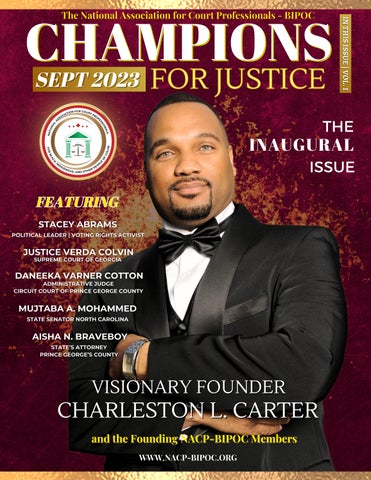
SEPT 2023 FOR JUSTICE
IN THIS ISSUE | VOL. I
CHAMPIONS
INAUGURAL FEATURING
CHARLESTON L. CARTER and the Founding NACP-BIPOC Members WWW.NACP-BIPOC.ORG
WHAT'S I SIDE
N
I INTRODUCING M EMBERS
03
CHARLESTON L. CARTER
04
PAMELA HUNTER EXECUTIVE DIRECTOR
VISIONARY FOUNDER
RONALD FLAMER II EXECUTIVE ADMINISTRATOR
STACEY ABRAMS 05 JUSTICE VERDA COLVIN 06 16 DANEEKA VARNER COTTON
20
MUJTABA A. MOHAMMED
24
AISHA N. BRAVEBOY
V ISIONARY
F OUNDER
From a young age, Charleston L. Carter was captivated by the intricate dance of justice depicted on television screens. Shows like "Forensic Files," "Courts," and "Matlock" painted a vivid picture of a world where truth was sought, and justice served. Young Charleston would sit, eyes fixed on the screen, feeling the pull of a future that seemed both clear and distant. As he grew older, this childhood fascination would become the bedrock of his life's work. Throughout his professional journey, Charleston navigated various environments within the court system, each presenting its unique set of challenges. His unyielding dedication, thoughtful presence, and perceptive insights were invaluable, but he often felt as though his voice—though present—was muffled, like a bottled message lost at sea. It was as though Lady Justice, whom he had stared at so often in his younger years, was still waiting for him to find a way to make her scales balance just right. The turning point came at a pivotal moment in Charleston’s career. In recognition of his commitment and expertise, he was put forward by a nomination committee for a significant position. He stood out among a pool of qualified candidates, which was no small feat. The committee had seen his potential and was ready to give him a platform from which he could affect meaningful change.
CharlestonL. Carter
Unexpectedly, during the conference, there was a surprising turn of events. A candidate lacking the endorsement of the nomination committee was introduced as a contender from the conference floor. Despite the committee's trust in Charleston, one of the interviewees for the role successfully secured a position on the board through a floor nomination. Employing a well-established strategy and leveraging on the conference's demographic majority, she managed to garner enough votes to override the nomination committee's endorsement for Charleston. It was a decision that seemed to underscore the systemic issues Charleston had observed for years, issues that stifled innovation, disregarded merit, and silenced voices that were different from the status quo.
In that moment, as the conference room buzzed with polite applause, Charleston made a decision that would reverberate through courtrooms across the nation. He would no longer wait for the elusive 'someone else' to unleash his voice or to correct the imbalances he observed. Inspired by the steadfast gaze of Lady Justice, Charleston resolved to act—he would form his own organization, a platform for change and a beacon for those whose voices had been stifled just like his. This was the moment the National Association for Court Professionals (NACP) was conceived—a brainchild born from a deepseated passion for justice and a resolute desire to ensure that merit and integrity would not be overshadowed by politics and procedure. The NACP emerged as more than an organization; it was, and remains, a movement. Under Charleston’s leadership, it is a space where professionals will advocate for fairness, equity, and due process without fear of being silenced. The NACP provided resources, mentorship, and, most importantly, a collective voice that is loud enough to penetrate even the most resistant of ears. Today, thanks to Charleston's vision and tenacity, the NACP stands as a testament to what is possible when one person decides to channel disappointment into action. It’s a living, breathing tribute to every professional who has felt unheard, and a promise that in the halls of justice, there will always be someone fighting to ensure that every voice is valued. Charleston Carter's story is one of resilience and vision. It’s a reminder that when faced with adversity, we have the power to say, “I must do something,” and then rise to the challenge. In Charleston’s own words, “We must bloom where we are planted. Let us plant the seeds of integrity, watered with fairness, and open doors wide with our voices.”
A MESSAGEFrom THE EXECUTIVE DIRECTOR
It is with boundless enthusiasm and profound honor that the National Association for Court Professionals for Black, Indigenous, and other People of Color (NACP) unveils our pioneering eJournal, “Champions for Justice.” This maiden edition serves as a beacon, illuminating the path paved by our Founders and Justice Champions who have passionately rallied behind the noble mission, vision, and aspirations of the NACP. Our hearts brim with gratitude for the visionary Founders who heeded the clarion call, laying the bedrock for this transformative organization. Their steadfast dedication, unwavering spirit, and relentless commitment from the very pillars that uphold the NACP's ideals. We warmly beckon you to delve into the pages of this journal, immersing yourself in the rich tapestry of stories, backgrounds, and experiences of these Justice Champions. Our deepest appreciation extends to the legendary trailblazers and guardians of justice who embraced the call to share their profound narratives and wisdom. We extend a heartfelt salute to Stacey Abrams, Justice Verda Colvin, North Carolina State Senator Mujtaba Mohammed, Prince George’s County Circuit Court Administrative Judge DaNeeka Varner Cotton, and Prince George’s County State’s Attorney Aisha Braveboy! As readers embark on this journey, they will undoubtedly be ignited with inspiration, fueled with motivation, and uplifted by the indomitable spirit of these luminaries who have evolved into the vanguards of change they represent today.
PamelaA. Hunter
Why the NACP? It stands unparalleled, a unique beacon in its realm. The dawn of its era has arrived. A judiciary that embodies diversity, equity, and inclusivity is the bedrock for lasting transformation. In establishing the NACP, Champion Carter discerned the poignant reality that numerous BIPOC professionals, despite their invaluable contributions across the judiciary's echelons, often remain in the shadows, their voices muted and their ideas overlooked. The NACP rises as a clarion call, championing those who amplify the Courts' noble work. Confronting the systemic disparities and unequal outcomes perpetuated by the judicial system, the NACP emerges as a conduit for groundbreaking change. Echoing the profound words of the trailblazing Stacey Abrams, “justice is not blind, but it should be race neutral.” To manifest this vision into a tangible reality, we march forward, united in purpose and resolve.
Born out of a profound passion for justice and inspired by the ageless wisdom of his beloved grandmother, Ronald Flamer II has dedicated his life to the pursuit of uplifting those who have been marginalized. A proud alumnus of Delaware State University, Ronald emerged with a BA in Political Science and a Master's in Public Administration, arming himself with the tools to instigate positive change in society.
EXECUTIVE ADMINISTRATOR
His tenure as a Court Administrative Coordinator is not just a title, but a testament to his unwavering commitment to creating a fairer world. Ronald has witnessed firsthand the surge in juvenile-related crimes and the heart-wrenching consequences of unjust sentencing. These experiences have not deterred him; rather, they've propelled him forward, reinforcing his belief that those who once found themselves entangled in the clutches of the criminal justice system can, and should, transform into upstanding pillars of society. Joining the National Association for Court Professionals was a conscious choice for Ronald, one driven by a desire to be a part of a community dedicated to reshaping justice, ensuring fair sentencing, and increasing access to justice for all. For Ronald, justice is not just a system, but an environment—one that he aspires to create where fairness prevails, where voices are heard, and where hope lives. In the words of his grandmother, he endeavors every day to "help uplift those who don't have the means of helping themselves." Guided by his grandmother's ethos and driven by an unwavering commitment to justice, Ronald Flamer II remains a shining example that with tenacity, faith, and a clear vision, one can indeed change the world.
Ronald Flamer, II
STACEY ABRAMS
POLITICAL LEADER | VOTING RIGHTS ACTIVIST
BY: CHARLESTON L. CARTER AND ELISA CHINN-GARY
A Global Force In the heart of the deep south of Gulfport, Mississippi, amid the fragrant magnolia trees and haunting melodies of blues, where the mighty river runs deep, and the roots of civil rights are even deeper, a young Stacey Abrams sat at the feet of her parents absorbing tales of their experiences as civil rights activists. These tales were not mere stories of bygone days; they were powerful life lessons meant to shape her destiny. Today Stacey Abrams is heralded as a political strategist, power broker, community mobilizer, best-selling author, voting rights activist, and guardian of American democracy. Yet, accolades and prominent titles fail to capture the global force that is Stacey Abrams.
“Taking care of others is the crux of what drives me.” It was a riveting experience to sit and talk with Ms. Abrams about her professional journey as a black woman steeped in public service and civic engagement. Her warmth and hospitality made us feel welcomed and valued. Such generosity of word and deed were part of Abrams’ upbringing. Growing up with five siblings, she explained, “My parents were fond of telling us our jobs were to go to church, go to school, and take care of each other.” Taking care of each other became the crux of what drives Abrams. From the historic halls of Spelman College, passion for equity and justice, ingrained from her parents and fueled by her own experiences, propelled her into numerous roles in civic, public, and private sectors. The Rodney King verdict and the aftermath that followed served as an emblematic event of the systemic racial inequalities in America. Abrams recalled watching in real time the justice system abdicate its duties. She helped organize a student social justice organization, began fact-checking the media and correcting false reports, and later began work with the Mayor of Atlanta. “We cannot abandon the systems that do not serve us. We must be not only a part of those systems, but we must also be responsible for correcting those systems. Since then, most of my work has always had this multifaceted approach of working in the civic sector, in the public sector and in the private sector. To the extent we abandon any of those channels and pathways, we are giving injustice another place to flourish. And so, I try to show up everywhere,” said Abrams.
“Justice is not colorblind.” In response to how Abrams is able to center her work on people of color without alienating white professionals, she remarked “my approach is to always acknowledge and center those who are too often left out of access, but never to the exclusion of those who need access. Justice is not colorblind, but it should be race neutral.” Leaning into the universality of justice, equality and opportunity, Abrams’ approach is to build access by adding more people to the pool, rather than diminishing the capacity of anyone else to get in. She acknowledged that some people prefer to adopt the myth of scarcity, but she rebuffs this notion saying, “we've been given this false bill of goods that addition necessarily means subtraction. I believe in the mathematical principles that addition means addition, and that we can have more.”
“If I am the first in the room, I am taking the door off the hinges.” Whenever Abrams steps onto a new platform, especially one where she is underrepresented, she faces it head-on. She embraces her unique identity, acknowledging the stories people might craft based on her race and gender. Rather than shy away from this, she leans in, inviting dialogue and understanding. By being authentic about her journey and inviting questions, Abrams dismantles barriers of misunderstanding, one conversation at a time. “It was not about making my story the dominant narrative, but about paving the way for countless stories yet untold,” said Abrams. Perhaps one of the most striking aspects of Abrams’ approach is her commitment to ensuring that she is not the last of her kind in any room. “If I am the first in the room, I am taking the door off the hinges. It is my responsibility to ensure that my presence doesn’t diminish the likelihood of someone else coming in or it doesn’t become an excuse for not allowing anyone else,” said Abrams. Abrams isn’t content being the lone representative. She is driven to ensure more like her follow. It’s not enough for one person to break a barrier; the real work lies in ensuring those barriers remain broken. For Abrams, her presence in any space is not a token achievement but a challenge to the status quo, an invitation for more diverse voices to join and enrich the dialogue. “My job is to always think globally about who else can come and who else can benefit,” says Abrams.
“I don’t take criticism from someone I wouldn’t take advice.” Using your platform to advocate for others often opens the door to critique and criticism. Abrams shared her stance on managing the opinions of others. “When someone critiques us, we internalize that. But when they praise us, when they thank us, we dismiss it. When you believe the worst, you not only can be silent, but you also often participate in silencing yourself.” Adhering to the adage, “I don't take criticism from someone I wouldn't take advice from,” she challenges advocates of justice to not be controlled by the opinions of people you do not respect. She adds, “If you don't respect that person's opinion, then why are you allowing them to control your actions? We often stifle ourselves because we are being led by the person we are the least responsive to or responsible for?” The knowledge of who you are and whose you are is a north star that guides your pathway. “When that's your lodestar, then you realize that your voice is not just yours alone. You speak up not just for you. You speak up for the people who legitimately don't have the right to speak... for the person who's never going to get to be in that room,” say Abrams.
“I’m in a different game.” Stacey Abrams’ outlook on life’s challenges is nothing short of revolutionary. It is a perspective rooted deeply in understanding, not just of the playing field, but also of the intricacies of the game. In baseball, Abrams noted, players get three strikes before they’re out and multiple chances at bat per game. But for women in politics, “We swing once and if we miss we’re out of the game.” Instead of seeing it as an admonition to tread carefully, Abrams was determined to keep returning to the plate, to keep swinging. She would not accept different rules imposed upon her because some do not want her to play the game. This sentiment deeply resonates with many who find themselves as trailblazers in their respective fields. When you are the first, or the only one, or part of a few, the journey is inherently different. The weight of legacy and the burden of representation often rests heavy. Expecting such individuals to navigate the field with the same ease as someone who has had generations of predecessors in the game is unrealistic. Abrams’ tenacity lies in recognizing this inherent imbalance and defining her own goals. “We can't measure ourselves by conditions we can neither access nor control. Instead, I determine what I am trying to achieve and what progress I can make. Victory is not simply getting the prize. Victory is getting the progress.” It's vital to recognize the external metrics, but it's equally crucial not to be solely governed by them, especially when those conditions are beyond one's control.
“The mission is never guided by the titles.” Stacey Abrams has never been one to chase the spotlight for its own sake. Rather, she views titles and roles as tools that can amplify her mission. In a society often obsessed with status, she stands apart, emphasizing the primacy of purpose over prestige. To her, titles and platforms might offer a broader reach, but the absence of them should never hinder the spirit of service. “The mission is never guided by the titles. It's never guided by the platform. The platform would be nice, but the work always remains. This grounded perspective likely stems from her deep family ties. With siblings who keep her rooted and remind her of who she is beyond the public persona, Abrams is driven by a profound sense of duty. For her, the goals she pursues remain paramount. After all, the absence of a title often means working twice as hard, pushing boundaries, and finding unconventional avenues to bring about change, Abrams concluded.
“We must expand our vision of what justice means.” Abrams delves into the intricacies of justice, highlighting its dual dimensions: Criminal Justice and Civil Justice. While society's spotlight predominantly shines on criminal justice – especially considering its profound implications on personal freedoms – civil justice, according to Abrams, cannot be sidelined. “It deals with the systems that enable or hinder access to the American Dream. Be it a penalty for not mowing one's lawn escalating into a foreclosure or navigating zoning rules to enhance housing access, civil justice plays a pivotal role in shaping the societal fabric,” said Abrams. Abrams emphasizes the importance of educating ourselves on the candidates running for office in the judicial branch and exercising our right to vote in those elections. Her argument is simple yet profound: every role, from top to bottom, holds significance, and is integral to the proper functioning of the system. To Abrams, there’s no hierarchy of value among these roles, but rather a continuum of access. She urges the voters to vote for those who share our values of justice and advocate for them to get the resources necessary to meet the demands of justice.
“Talk about what you do and what you see.” Abrams encourages court professionals to use their knowledge to educate others outside of their profession on what they do, what they see, and what they want. As insiders, these professionals have firsthand knowledge of the intricacies, imperfections, and strengths of the system. Yet, this knowledge often remains within the confines of the courtroom or legal circles. She urges them to break the barriers of silence and bring their experiences to the forefront. By sharing their observations and insights, they can enlighten the broader public, thus filling the gaps in understanding left by brief news headlines. In doing so, they provide a real and unfiltered lens into the functioning of the justice system, enabling informed dialogues. Moreover, Abrams encourages court professionals to extend their influence beyond the courthouse. “Translate your unique knowledge into positions of political power by standing for office,” counsels Abrams. When one who has been a court professional stands for office, they can use their lived experience and first-hand-knowledge into policies that bridge the disconnect between written laws and their practical implementation. Abrams’ call to action emphasizes the idea that while systemic issues may seem overwhelming, individual efforts can bring about change. The principle of "when you see something, say something" is essential for court professionals who have the closest eye on what happens when justice fails. Injustice, inequity, or inefficiency within the system must be called out and addressed. By leveraging our position and insights, we can play a pivotal role in ensuring the justice system truly serves its foundational goal: justice for all.
“Climate action is of deep concern to me.” Abrams, with her distinct commitment to uplifting marginalized communities, brings a unique perspective to the discourse on climate action. While there's global chatter about the overarching issue, Abrams chooses to focus on the intersection of environmentalism and socio-economic disparity. She underscores the importance of making sustainable choices at an individual level, emphasizing how households contribute significantly to carbon emissions. In her view, climate action is not just about grand international conferences or corporate commitments; it's about the choices a person makes in their daily routine.
By working with "Rewiring America," Abrams is on a mission to make the conversation on energy consumption and climate change relevant and accessible to all. The objective is to equip ordinary citizens with the means to make eco-friendly changes in their homes, if they so choose, and give the related resources to communities that need them the most. The Inflation Reduction Act, as described by Abrams, is a pivotal step in this direction. The act, with billions of dollars for individual homeowners and residents, offers an opportunity for everyday Americans to combat climate change right from their homes, which will allow families to breathe cleaner air even before they step outside. Beyond her environmental efforts, Abrams remains steadfast in her commitment to bolstering democracy. Her belief in the importance of a robust democratic system is unyielding. Through various organizations, both those she has founded and others she is associated with, Abrams seeks to protect and strengthen democracy at home and abroad.
“There is an ongoing attack on the American Dream.” Stacey Abrams, with her characteristic passion and vision for a more inclusive America, frames the issue at hand as more than just policy debates; she sees it as a fundamental fight for the soul of the nation. Abrams argues that the growing resistance to DEI (diversity, equity, and inclusion) and ESG (environmental, social, and governance) is not merely a reaction to recent progress. Instead, it represents a more sinister and systematic effort to restrict access to opportunities that are foundational to the American Dream. For Abrams, the idea of the American Dream is deeply intertwined with notions of equal access and opportunity. This isn't merely about economics; it's about a broader promise the nation makes to its citizens – that every individual, regardless of their background, has a right to pursue happiness and success. The attack on DEI and ESG platforms, as she sees it, is akin to denying this very promise. As Abrams rightly identifies, the 2024 elections will be a pivotal moment. The question that looms large is, who gets to claim the American Dream? The answer should be unequivocal: everyone. The American tapestry is woven with the threads of countless stories – stories of hope, ambition, perseverance, and above all, the relentless pursuit of a better tomorrow. It's imperative, now more than ever, that this tapestry remains inclusive, vibrant, and representative of all its citizens. Stacey Abrams, with her unwavering dedication to upholding the sanctity of the democratic process, has always been a fervent believer in the power of every single vote. At the heart of her message is the belief that every voice matters, and every voice has the potential to bring about transformative change.
“Every vote matters.” In response to the attitude of some that their vote doesn’t make a difference; Abrams offers a compelling counter-narrative. If a vote were truly inconsequential, she argues, why would there be persistent efforts to suppress it? Additionally, there are many examples of incredibly close races that were only decided by a small number of votes, many of which were local elections for offices that have a lot of influence over our daily lives. Abrams seeks to change that notion. She eloquently equates voting not to magic but to medicine. The metaphor is poignant and timely. In a world beset with numerous socio-political maladies, voting is the balm, the remedy that offers a chance at healing. As with any medication, consistency is key. A single dose won't cure chronic illnesses. Similarly, voting must be seen as a continuous, consistent engagement with the democratic process, where participation in every election, big or small, is critical, but where the election of one person will not magically solve all problems. When individuals disengage from this process, they inadvertently strengthen the very forces they wish to oppose. A void in participation is almost always filled by those who hold contrary beliefs. This, Abrams argues, exacerbates societal issues, allowing them to metastasize and intensify. For Abrams, the fight is not just about ensuring that every vote is counted. It is about ensuring that every citizen believes in the power of their vote. She envisions a world where everyone, regardless of their background or circumstances, has an equal shot at the American Dream. Through her tireless efforts in advocating for voting rights, she is not just fighting for today but paving the way for a more inclusive, equitable, and just future.
“Be curious. Solve problems. Do good.” In the annals of history, when the story of this era is written, Abrams will undoubtedly be remembered as a beacon of hope, a warrior for justice, and a relentless advocate for the power and potential of every individual vote. Her mantra is “be curious, solve problems and do good,” and encourages everyone to consider how they can make life better for those we share the world with and the next generation.
From his earliest memories, Charleston L. Carter knew his life's path was intertwined with the criminal justice system. While the specifics of his calling were once a vague dream, they have become a vivid, living reality. Today, with more than three decades of steadfast commitment and service, Carter stands as a beacon in the court system, serving as a dedicated Court Administrator and the esteemed Founder of the National Association for Court Professionals for Black, Indigenous, and other People of Color (NACP). Born with a profound sense of justice, Carter’s deep-rooted passion for justice was given academic wings with a Bachelor of Arts and a Master of Science in Criminal Justice from Valdosta State University. Not one to rest on his laurels, Carter further enriched his professional and intellectual capabilities through additional certifications in Judicial and Court Administration from Michigan State University, a certification in Judicial Philosophy from Harvard University, and was a Fellow of the Institute of Court Management (ICM) with the National Center for State Courts.
CHARLESTON L. CARTER FOUNDING MEMBER
The core of Carter's philosophy is clear and unwavering: he holds a profound belief that fairness, justice, and equity not only should but must be rendered in every case that passes through the courtrooms. Carter’s life is a vivid illustration of what it means to transform a childhood dream into a lifelong mission. His 30-year legacy in court administration is more than a testament to his personal and professional achievements; it is a rallying call for those who believe, as he does, that justice is more than a concept—it is a living, breathing promise that we have the power to uphold.
Elisa Chinn-Gary, one of the founders of the NACP, stands as a beacon of hope, tenacity, and determined commitment in the tumultuous seas of the court system riddled with disparities. A force for change for over 20 years, her journey has been a testament to the unyielding commitment to justice. What sets Elisa apart is her passion. A passion driven by her personal and professional mission: the Advancement of Justice and Court Excellence. She has poured her heart into the courts, wearing multiple hats - from attorney advocate to professor to the venerable Clerk of Superior Court and Judge of Probate. But it's not just her diverse roles that define her; it's her fervor to dismantle systemic barriers and implicit biases. With a potent blend rooted in sociology and psychology from Winston-Salem State University and armed with a Master of Social Work and Juris Doctorate from the University of North Carolina at Chapel Hill, Elisa has transformed her passion into significant action. She is a recipient of the revered Raising the Bar Award, Julius L. Chambers Diversity Champion, Distinguished Service Award from the Charlotte NAACP, and the Spirit Award conferred by the McCrory YMCA are just snippets of her vast accomplishments. But perhaps, most strikingly, is her co-founding of RACE MATTERS FOR JUVENILE JUSTICE (RMJJ). Through RMJJ, Elisa has channeled her energy into rectifying the stark disparities children and families of color face when encountering the justice system.
ELISA CHINN-GARY FOUNDING MEMBER
Elisa Chinn-Gary is not just a name, she’s a movement. She embodies the essence of justice and equality, forging paths for those marginalized by the very system meant to protect them. Be inspired, for through her story, we find the essence of what it means to truly serve, advocate, and lead.
14
JUSTICE VERDA COLVIN GEORGIA SUPREME COURT
BY: JESSICA DAVIS
“Just be Excellent!” That was the indelible statement that remained following my conversation with Georgia Supreme Court Justice, Verda Colvin. A seasoned attorney turned judge, Justice Colvin spent nearly three decades practicing law. She began her career as a civil rights attorney in Charlotte, North Carolina working alongside the reputable attorney, James Ferguson. It was during this first legal position that she began to understand the importance of simply being excellent. “‘You’re a credit to your race and gender’ is what he said to me,” said Colvin, referring to a comment made by an older white gentleman leading a review panel in which her client had to appear. To another person, this comment may have come as a compliment, but to Colvin it was a mask for disregard and disrespect. “I was livid! I went back to the office and shared what he said and told my supervising attorney that we had to do something,” she said. But there would be no action taken. The supervising attorney called other colleagues into the room and asked Colvin to share again what was said. She did, and her colleagues found it amusing. She, of course, did not. “They were all sitting there laughing and smiling about what this guy said to me. I got upset. I didn’t understand what was so funny,” said Colvin. However, it was what her supervising attorney said next that challenged her perspective on the situation, “‘What you did when you walked in that room did more to dispel the notions of who people could be than any complaint we could make. That is why we do what we do, to show people excellence. And you did that. You got that whole room thinking something is different than we thought it could be and would be.’ And that’s when I learned the lesson that I have taken with me throughout my life: Just be excellent.” Raised with a strong spiritual background that included Bible lessons every day, Colvin always had a strong sense and need to engage in service. “I was probably in first or second grade when I knew I wanted to do something where I helped people and made the world better. My two idols were Jesus Christ and Martin Luther King, Jr., and I knew I could never emulate them, but I knew I wanted to have a life of service. So that’s why I decided to go into law.” Colvin’s grandmother on her mother’s side was a pastor, and she spent many summers with her. In this setting she was surrounded by the constant notion of ensuring fairness and following the rules—traits that she believes are necessary for one in the legal profession. “Fairness is a laudable goal we should always be striving to administer in our court system; consequently, we have an opportunity, in fact a mandate to always improve our system of justice so that we may truly have blind justice, equality, a sense of fairness and fair play,” said Colvin. Confronting systemic issues often requires navigating complex political landscapes and opposition. In July 2021, following another political season in which all eyes focused on Georgia, Colvin became the first African American female appointed to the Georgia Supreme Court by a Republican Governor. She went on to run a successful statewide campaign to retain the seat eight months later. Her advice to court professionals willing to tackle and confront challenges within the system: “Be strategically smart. Be willing to challenge the status quo when it’s not right. Do what you can do that you know will be lasting, that will be transformative; and try your best not to burn bridges as you make those changes because some bridges you burn may be the bridges that you have to cross to come back over to do some more work. Most things that happen within our system of government happens because people have been strategic. Be strategic, be thoughtful, and think of the long game.”
Georgia Supreme Court
She admits that her position presents a challenge in confronting systemic issues while maintaining a focus on progress and transformation, “It’s hard, particularly when you sit as a judge and especially on the appellate level because, as a judge, you are duty bound to follow the law and the law is whatever the law is—whether you like it or love it—it is the law so you have to follow that.” So how, then, is a court professional to shift the culture in their respective organization to promote greater diversity, equity, and inclusion and feel supported? Colvin believes, “We have to be willing to say the thing out loud. When we see that things aren’t the way they should be, then we have to gently push others to move toward that end. You have to be willing to say the quiet out loud, like ‘Why don’t we have more managerial people in positions that reflect our community, our society?’” Even in organizations where it may be a population of majority minority, she believes that this presents an opportunity to include people who look different in order to reflect and give insight on how other people may view things. “Reflect what we want to see. And when we reflect what we want to see, then we can kind of demand what we know is needed,” said Colvin. Ultimately, for a court professional to leverage their position to confront and address challenges related to racial disparities and other forms of injustice that might be present in the court system, Colvin returns to her mantra, “You have to be excellent in what you do. To get people to listen to you, they’ve got to respect you on some level. And to get people to respect you, you have to be excellent in what you do. If we are excellent in what we do, then we can voice some opinions in places and spaces where people will be willing to listen to us because of the quality of what we bring to the table. So, let’s be excellent in what we do, and then be willing to ask the hard questions. We have to think of ways that we can bring issues to light without indicting people because when a person feels attacked, they are less likely to receive what you have to say. “Making suggestions that will help in the overall scope of work is the best approach.” Promoting diversity, equity, and inclusion in the workplace is essential in every field for the benefit of the community as a whole. Colvin believes that by ignoring diversity, we limit ourselves and our ability to serve the public, “Diversity means so many things. It’s beyond race. It’s cultural, geographical, life experiences. Diversity encompasses so much, and we limit ourselves and limit the base of ideas and movement towards things that put us in a better place as a society when we limit ideas. Everybody brings a different idea, a different perspective. So having those different thoughts, those different people around the table just makes the table that much more full. When we are inclusive, we ensure that this place, America, that we call a melting pot is truly that. And when we don’t do that, I think we rob ourselves of the gift of having a broad base of ideas.”
Ms. Pamela A. Hunter is an accomplished human resources and organizational management professional with over 25 years of experience across multiple disciplines. Ms. Hunter’s expertise covers a broad range of organizational development and human resources disciplines which include strategic workforce planning; operations management; training design, delivery, and development; organizational and employee development; performance management; diversity, equity, and inclusion; and public speaking and executive level facilitation. Her career service includes the Small Business Administration; the Chief Administrative Office of the U.S. House of Representatives; the Office of the Circuit Executive for the U.S. Court of Appeals for the District of Columbia Circuit; and the District of Columbia Courts. Ms. Hunter holds a Bachelor of Arts degree in English from Elizabeth City State University and a Master of Arts in Human Resource Development from The George Washington University. She enjoys her volunteer work for her undergraduate alma mater and other non-profit organizations. As the newly-appointed Executive Director of the National Association for Court Professionals for Black, Indigenous, and other People of Color, Ms. Hunter is deeply passionate about the work of this organization and its mission to elevate the voice of the BIPOC community who work in and for the judiciary; to advocate for the eradication of institutional racism in the justice system; and to transform the current judicial culture to achieve the true goal of justice for all.
PAMELA A. HUNTER FOUNDING MEMBER
Darwin Rice is the Director of Family Court Administration for the 26th Judicial District, Mecklenburg County, North Carolina. In this role, Darwin oversees day-to-day operations of Domestic and Juvenile court case management and the SelfServe Center for self-represented litigants. He serves as a liaison between the Family Court Administrator’s Office and the Mecklenburg County Bar as well as other agencies, service providers, and entities in the legal community involved with Domestic Court operations. Darwin supervises and trains Domestic and Juvenile court case coordinators and other staff. He attended Benedict College where he earned a bachelor’s degree in criminal justice in 1990. Darwin earned an active-duty commission in the Army where he flew helicopters. In 2006, Darwin deployed to Iraq in support of Operation Iraqi Freedom / Operation Enduring Freedom. Darwin served 33 years in the Army and Army Reserves and retired in July 2019. DARWIN RICE FOUNDING MEMBER
Darwin has worked for the Mecklenburg County Courts for 23 years. Prior to his role as the Director of Family Court Administration, he worked in the role of front desk scheduling coordinator and Director of the Mecklenburg County SelfServe Center. Since joining the Family Court Administrator’s Office in 1999, Darwin has earned a Master’s Degree in Public Administration, a Master’s Degree in Public Policy, and a Doctorate in Public Policy and Administration with a concentration in Law and Public Policy.
14
DANEEKA VARNER COTTON
ADMINISTRATIVE JUDGE CIRCUIT COURT FOR PRINCE GEORGE’S COUNTY AND THE SEVENTH JUDICIAL CIRCUIT OF MARYLAND
BY: JOCELYN STEELE
“You must start with young kids and let them see the possibilities.” Nestled quaintly in the town of Upper Marlboro, Maryland, located nearly 21 miles from our Nation’s Capital, you will find the Prince George’s County Courthouse standing as a hallmark of justice with the Honorable DaNeeka Varner Cotton at the helm. She is the Administrative Judge of the Circuit Court for Prince George’s County and the Seventh Judicial Circuit of Maryland, an appointment made by the Chief Justice of the Supreme Court of Maryland Matthew J. Fader in October 2022. Judge Cotton stated, “It is an honor and a privilege to represent the community to which I have belonged and served throughout my entire life.” As Administrative Judge, Judge Cotton oversees court operations, procurement and budgetary functions and the maintenance of the Courthouse Complex that houses many State and County agencies. At the heart of her role is maintaining an efficient trial calendar that produces the fair and expeditious disposition of cases. “I am well aware that I cannot do this job alone, and I am grateful to the talented team of judges and court professionals that work daily for the Circuit Court,” said Judge Cotton. Judge Cotton has been a judge in Prince George’s County for 16 years. In fact, her dream of joining the bench was born in elementary school. “I was in the fifth grade in Cleveland, Ohio, and one of the first Black female judges came to speak to my class and from that point forward, I wanted to be a lawyer and a judge,” added Judge Cotton. While she has presided over a myriad of cases, Judge Cotton always leaves room for compassion. “You cannot be a judge and not have empathy,” Judge Cotton stated. “When I see people in places and in situations where I would never find myself, I recognize that these people have not had the tools, resources and support system that I am blessed to have,” she continued. Judge Cotton began her legal career as a staff attorney for the Legal Aid Bureau of Maryland. It is where she cultivated her voice to advocate for those who are often ignored and overlooked while speaking up for what is right. She added, “After having experienced representing indigent people, handling landlord and tenant cases in law school, and working as a volunteer with other lawyers in criminal matters, it became clear to me that I wanted a legal profession that involved contact with the people and the community.” Judge Cotton also worked as a prosecutor in the Prince George’s County State’s Attorney’s Office. In that role, she realized the power of prosecutorial discretion. “They are the ones who decide which cases make it to the courtroom and get in front of a judge and jury,” stated Judge Cotton.
Judge Cotton was never fearful to be an advocate for justice. She said, “Prosecutors want convictions, but a good prosecutor also wants to ensure that the rights of the accused, community and victims are preserved.” A resident of Prince George’s County for most of her life, Judge Cotton graduated from Hampton University and obtained her Juris Doctorate from the University of Maryland School of Law. Her family tree consists of high achievers. Her sister is a District Court judge in Prince George’s County, making them the first sisters to serve as judges in Maryland. Her brother is a physician. Judge Cotton said, “I was raised to believe that to whom much is given, much is required.” I know I have been blessed with a great life, and I don’t take it lightly,” she added. “My mother is the person who made me what I am today and because of her influence and all I have had, it has made me grateful, appreciative and created a desire to help others,” Judge Cotton stated. Her life and career have been extremely rewarding and fulfilling, however, there are still things Judge Cotton would change about the criminal justice system. “Money gets you the best material things, but I believe it should not give you the best representation, and I still think we need a system that does not allow representation based on income,” said Judge Cotton. She also says law enforcement agencies must ensure that there is balance when it comes to their interactions with people of color, especially African Americans. According to the Sentencing Project’s 2021 Racial and Ethnic Disparities in State Prisons Report, Maryland is one of 12 states in the U.S. where more than half the prison population is Black. Judge Cotton added, “Law enforcement is an important part of our community. The police and communities of people of color must continue to find ways to respect and trust each other.” Her experiences on the bench and while serving as an attorney led Judge Cotton to understand the importance of a fair judicial system. Even though a substantial amount of work still remains when it comes to leveling the playing field within the criminal justice system, Judge Cotton is proud of the diversity and inclusion she sees behind the scenes when it comes to judges and employees at the Circuit Court for Prince George’s County. “I come from a very diverse community where I am a judge, so I see Black, White, Asian, Indian and Latino judges, prosecutors, defense attorneys, paralegals and interpreters,” she stated. “It’s a cohesive and collaborative environment, and I feel blessed that I am in such community.” As she was taught as a child, Judge Cotton is passionate about passing her blessings on throughout the community she cherishes. She encourages young people to open their minds to the wealth of career opportunities that are available in law and in the courts. Judge Cotton said, “I speak at law schools, universities and high schools to make sure students know there are opportunities out there for them.” She continued, “You must start with young kids and let them see the possibilities.” If they see someone who looks like them and sounds like them, it encourages them to believe that they can do it as well.” Afterall, it is what happened to Judge Cotton in the fifth grade. She saw it, and she believed she could achieve it. Not only a leading Judge in her field, but Judge Cotton is also helping to mentor Prince George’s County’s brightest leaders who will give back to the same community that nurtured them. A benevolent legacy that will ripple for generations to come in the place she calls home.
Ché Alexander is a force of nature, bursting with energy and innovation. Friends and colleagues are captivated by her vibrant personality and rock-solid leadership. Hailing from Atlanta, Ché proudly identifies herself as a true "Georgia Peach," wearing the "Grady Baby" badge with immense pride. While Ché has excelled in both the public and private sectors, it is public service that ignites her passion and purpose. Whether it's making a difference at MARTA, the Georgia Secretary of State's office, or within the corridors of the Fulton County Government, Ché has dedicated her life to helping others. Her commitment to empowering others extends beyond the legal system. She is a founding member and Treasurer of the esteemed National Association for Court Professionals. She has served on the Board of Directors for Sisters Against Domestic Violence and the Atlanta Board of Dress for Success. Beyond her professional accomplishments, Ché is a living testament to resilience and triumph over personal tragedies and obstacles. Driven by an unyielding spirit, she continues to defy the odds. Her unwavering faith in God fuels her fire. Through her experiences, she imparts the powerful message, “Dreams do come true by trusting in God, believing in yourself, and working toward your goals.” CHE ALEXANDER FOUNDING MEMBER
Her office’s motto, “People. Purpose. Passion.,” speaks to her engaging disposition and serves as a beacon of light for her staff as she sets a path to make the Fulton County Clerk’s Office “The office of the future.”
In the heart of Yvonne Reed lies an unwavering commitment to service. From the disciplined ranks of the military to the solemn hallways of our justice system, Yvonne's journey is a testament to her indomitable spirit and dedication. For six formidable years, she stood tall as a beacon of courage and determination in the military, fiercely defending the values that bind our nation together. Drawing from her military experiences, Yvonne made a seamless transition to the court system. Her intrinsic belief in fairness, equity, and due process found a new battleground - the court system. It's no surprise then, with her steadfast commitment to justice, that Yvonne became a proud founder of the National Association for Court Professionals (NACP). In the NACP, she saw the reflection of her core values and beliefs, a platform where her passion for equity and fairness could further flourish. The association wasn’t just an organization to her, but a mission of fairness and justice for all. Yvonne’s dedication to her roles, both in the military and the court system, is more than a career; it's a calling. Her journey inspires many, teaching them that true honor lies in selfless service and unwavering integrity. Yvonne is more than just a former enlisted member, she's a court manager with passion and purpose. In her own words, "Wherever we serve, our duty is to fairness, honor, and justice."
YVONNE REED FOUNDING MEMBER
Her education foundation includes a master’s degree in business administration, and a bachelor’s degree in business management along with a paralegal diploma.
14
MUJTABA MOHAMMED NORTH CAROLINA STATE SENATOR
BY: JESSICA DAVIS
“If you want to see progress, you have to be persistent.....” A common theme when one speaks to attorney and North Carolina State Senator, Mujtaba Mohammed, is advocacy. The son of immigrant parents, Mujtaba Mohammed is a proud Indian American and advocate for all. Raised in a community surrounded by other people of color, at a young age Mohammed often found himself translating information and assisting his parents with navigating complex systems. It was these experiences that played a vital role in his decision to become an attorney. “Growing up in a community that was often times unsure of itself and how to navigate basic services, I had to reach out to the doctor’s office or set up parent teacher conferences for my parents. When you’re used to being a voice for those that lack it, it’s something that becomes a part of who you are,” said Mohammed. “I don’t come from a family of attorneys or anyone who understood the court system so when I began my legal career, dealing with stereotypical comments from people was a challenge. But there’s always going to be people who are putting you down or stereotyping you. So, I learned to just ignore them and keep working hard because there are people who are counting on you and that’s the most important thing.” A graduate of North Carolina Central University School of Law, one of six Historically Black Colleges and Universities with a law program, Mohammed spent nearly a decade serving as a public interest attorney. His legal career began with the Council for Children’s Rights in Charlotte, and then transitioned to the Public Defender’s Office in Mecklenburg County, North Carolina. His time in these roles allowed him to witness the power of our justice system and understand the importance of advocating for people who could not advocate for themselves. His experience in the courtroom gave him insight into what works and what doesn’t within our court system. One change that he believes is necessary within the court system is diverse representation, “It’s important to have a diverse group of court stakeholders who are representative of the community they serve because diverse stakeholders can communicate with and understand the challenges of the people that are coming in and out of the court system. Positive reinforcement of diverse staffing practices would be a huge solution to court systems across the state of North Carolina,” he said. To Mohammed, the principals of diversity, equity, and inclusion are essential because they reflect the true spirit of our justice system. “Diversity, equity, and inclusion help to ensure that we are a representative justice system of all people. It’s important for judges to be diverse because they make decisions that impact lives every day. You need the empathy and understanding of folks from diverse backgrounds who can think outside the box, beyond punitive measures and sentencing, and come up with alternative, community-based solutions, to make sure a person is not before the court again.” Mohammed believes that persistency, collaboration, and relationships are critical to confronting systemic issues such as recidivism, and utilizes these principals in his legal advocacy, “Persistence, collaboration, and commitment to the greater good help us tackle systemic issues. If you want to see progress, you have to be persistent because you are advocating for someone that cannot advocate for themselves. Relationships and persistence help us move closer to the goal instead of not doing anything at all.”
Relationship building has been pivotal in Mohammed’s success beyond the courtroom. In 2018, he was elected to the North Carolina State Senate and has utilized a collaborative approach to advocate for his constituents in Senate District 38. A key to his success and being labeled one of the “most effective legislator’s in the State”, has been his ability to establish and maintain relationships and holding his legislative colleagues accountable through the building of alliances to work toward common goals. “All fingers together is going to be a stronger punch with your fist than just pushing someone with your finger. So, when we unite with different stakeholders, people with the same needs as us, we can be much more united, collaborative, and powerful. There will always be obstacles and people resistant to change, but you have to galvanize people to work in shifting strategies to bring about fundamental change,” said Mohammed. Mohammed is a politician and court professional that has experienced racial disparities and witnessed injustice in his career. He believes that dialogue and acknowledgment are valuable tools in continued efforts to confront and address challenges related to racial and economic disparities. “If you’re not having the conversation then you’re not raising awareness. If you’re not having the conversations, then you’re not talking about the impact of racial disparities on our court system and advocating for the lives of people involved in the court system.”
NORTH CAROLINA STATE CHAMBER
Dee Howell is a steadfast believer in the power of justice, the necessity of fairness, and the essential nature of transparency. These convictions are the foundation of her remarkable 31year career in the court judicial system and the driving force behind her decision to join the National Association for Court Professionals (NACP).
Born and reared in a family that values justice and community service, Dee chose a path designed to influence positive change. A distinguished alumnus of Rutgers University, Dee holds a BA in Political Science and English, reflecting her passion for law and communication. Her pursuit of education didn't stop there; she later earned an MA in Strategic Leadership from Pennsylvania State University, sharpening her skills and preparing her to effect meaningful change at the highest levels of the court profession. To further bolster her expertise, Dee earned the status of Certified Court Executive from the National Center for State Courts, exemplifying her dedication to her craft. At the core of Dee's leadership style is an firm commitment to servant leadership, a principle she holds close to her heart. For her, leadership is not about authority; it is about serving and helping others. She is a mentor to many, always ready to guide, nurture, and inspire the next generation of court professionals. One of Dee's defining beliefs—one that has fueled her involvement with NACP—is that everyone should have a seat at the table. She advocates for a participatory approach, emphasizing the value of diverse voices in shaping fair and effective policies. For Dee, the table is not just a piece of furniture; it is a symbol of dialogue, collaboration, and equity.
DEE HOWELL FOUNDING MEMBER
Shaundra Clark is a beacon of dedication and service, having committed 23 years of her life as the Executive Director of the Tifton Housing Authority. In this role, she witnessed firsthand the difficulties that tenants face, especially when landlords discriminate based on source of income or the unfortunate criminalization of homelessness—growing civil concerns that she is poised to address. While she may not work directly within the court system, her keen understanding of this nexus is profound, appreciating the impact that housing stability has on a person's life and the central role that due process plays with the court system. Clark’s work is driven by more than just professional obligation; it is fueled by genuine compassion, passion, and devotion. Clark doesn’t just observe these challenges; she acts, advocating for those whose voices are often stifled. She is one of the proud founders of the NACP. Her mission, aligning perfectly with NACP’s goals, is to equip people with the knowledge and tools they need to navigate the legal system, thereby leveling the playing field.
SHAUNDRA CLARK FOUNDING MEMBER
Her educational background, with a Bachelor of Arts degree in Business Administration from Stillman College and a Master of Public Policy and Administration from Mississippi State University, fortifies her ability to enact change. However, it is her heart that truly sets her apart. She believes in fair access for all— not just in the justice system, but in every corner of the community. Clark states that “joining NACP was not just a professional choice me, but it is a personal commitment to ensure that every individual, irrespective of their background, receives fair access in both the justice system and the community.”
14
AISHA N. BRAVEBOY
PRINCE GEORGE’S COUNTY STATE’S ATTORNEY
BY: JOCELYN STEELE
“I’ve always believed that I could make a difference, and I could work with others to make a difference...” Honorable Aisha N. Braveboy isn’t your average attorney. Not only is she the Prince George’s County State’s Attorney for Maryland, but she is also a transformative changemaker and a disruptor of the status quo. “Throughout my career, as a lawyer, I’ve always believed that I could make a difference, and I could work with others to make a difference,” Braveboy stated. This epiphany was born while Braveboy was an undergraduate student at the University of Maryland, College Park when she took a class that focused on the Voting Rights Act of 1965 taught by well-known Political Strategist Donna Brazile. Braveboy said, “through that class, I read a lot of case law, and it was my first time interacting with attorneys because Brazile would bring them in to speak to us and talk through cases.” It was then that Braveboy discovered she wanted to be an attorney and decided to attend Howard University School of Law due to its focus on Civil and Human rights. It can’t be stated enough how much Braveboy’s childhood set her on the trajectory to fight for justice, equity and human rights. It’s in her blood. “My mom was really into social justice and world justice, and we would go to rallies for local causes and for international causes,” she said. Braveboy would go on to say, “I didn’t quite understand at a young age what it all meant, but I understood that one voice could make a difference and collective voices could move mountains.” Braveboy emphatically acknowledges that she comes from a lineage defined by perseverance, hard work and empathy. “I think my parents instilled a work ethic in me that made me want to be the best in whatever I did.” Braveboy became the State’s Attorney in Prince George’s County in 2019 and immediately focused on improving Domestic Violence laws and policies. “We have really worked hard on domestic violence and have been able to drive down intimate partner homicide by 42 percent,” added Braveboy. It was a tragedy close to home that made her passionate about this issue. Her cousin, Nicole Jordan Porter, sadly lost her life as a result of domestic violence leaving an indelible impact on the State’s Attorney. She said, “we made strangulation a first-degree felony, we created a strangulation protocol, and we really provided a strong infrastructure in the State’s Attorney’s Office to care for and provide assistance to victims of violence.” Managing a budget of 24 million and a staff of over 200 is no easy feat. However, Braveboy is proud of what her talented team of prosecutors has accomplished, including a 90% conviction rate and a 95% homicide conviction rate. While holding guilty offenders accountable is something she emphasizes, giving people who qualify for a second chance at life is a testament of her faith. She said, “my faith teaches me that redemption is real and if I do believe that, then I have to look at someone’s character and judge them for who they are today and not for who they were yesterday.” Her office was the first office of its kind in Maryland to review cases of people who were sentenced to life in prison as juveniles. Many of them had served 20 or 30 years, but according to Braveboy, they were changed people who had been rehabilitated. “It is a difficult choice and decision because you have victims and next of kin who may feel very different, but justice must be balanced, and you must look at it from a holistic perspective,” said Braveboy.
Braveboy even hired a reformed juvenile lifer in her office, and it’s inspired other workplaces in the State. “It turned out to be call to action because now other agencies have hired juvenile lifers and people who have served a considerable amount of time.” Part of her greater plan to reduce crime is to target youth and help those who are already experiencing criminal interactions and truancy issues. To support this goal, Maryland Governor Wes Moore fully funded Braveboy’s new Family Justice Academy, which provides education and support to parents and youth who are in danger of becoming a part of the criminal justice system. Braveboy stated, “we are finding out that children are stressed out and the parents are stressed out, and the child does not have the coping skills to handle it, and they may end up being disrespectful in the classroom, cursing, fighting or even bringing weapons to school.” The program uses Science, Technology, Engineering and Mathematics (STEM), as well as physical and character development activities to help youth have better outcomes. Parents also get help through workshops and housing assistance. Braveboy stated, “I think people’s behavior, sometimes criminal behavior, is driven by factors such as food and housing insecurity, abuse, trauma and whether they have a good education or other needed resources.”
Student Learning S.T.E.M.S
Even within her office, Braveboy knows how she spends resources is integral to her focus on employees’ needs and financial responsibilities that often includes school debt. Therefore, she decided to increase the starting salary of prosecutors in her office from $57,000 to $80,000 per year. “Since then, not only do we have one of the most competitive salaries in the State, but it has also helped to move up our mid-level and our senior salaries,” said Braveboy. “When you place that value in your employees first, it makes a huge difference because it helps with morale and with ensuring there are enough attorneys to handle our demanding caseload,” Braveboy continued.
As a visionary leader, diversity, equity and inclusion are very important to Braveboy, and she encourages her employees to discuss these topics in the workplace. She added, “it’s up to leaders in these organizations to have these small group discussions and ask the tough questions, be open to hearing employees’ feedback and suggestions, and take action no matter the challenges that lie ahead.” It’s what she’s done throughout her entire career – taken the harder, less traveled roads. Now, in her second term as State’s Attorney, she remains committed to ensuring justice works for everyone no matter their race, gender or ethnicity. “I think that I rely a lot on my core beliefs, my values and my faith, and I know that justice only works if everyone gets to have it, that’s the only way to survive.”
In a world where the call for justice and fairness is louder than ever, Commissioner Melissa Hughes stands as a beacon of inspiration and commitment. As one of the founders of the NACP, Melissa has dedicated her life to not just hearing this call but answering it with unwavering resolve. With over a decade serving as the Director of the Tifton Judicial Circuit Alternative Dispute Resolution Program and 16 years as Tift Commissioner, her experience is not just a testament to her capability, but to her steadfast devotion to her community. Melissa is not just a professional; she is a compassionate community activist. As a certified commissioner, motivational speaker, and court mediator, she embodies the qualities that define effective and empathetic leadership. Her passion isn’t confined by city limits or state lines; Melissa’s vision is expansive, extending her helping hands to people at a national scale—this is vividly demonstrated in her decision to join the NACP. Her core belief—that fair access in both the justice system and community is not a privilege, but a fundamental right—is the powerful force that propels her actions every day. MELISSA HUGHES FOUNDING MEMBER
Hughes attended Abraham Baldwin Agricultural College. She later armed herself with a wealth of leadership certifications from University of Georgia as a lifelong learner. Melissa Hughes knows what it means to serve, to lead, and to inspire. Her journey encourages us all to look beyond ourselves and ask the pivotal question: How can I, too, be an agent of change, fairness, and compassion in the world around me?
Johnnie Gordon, a United States Marine Corps veteran, has more than 30 years of experience in technology planning and implementations, over 15 years in leading justice related technology initiatives, and over 15 years in executive advisory, enterprise strategy, operational management, service delivery, process optimization, business analysis, and program management. Mr. Gordon has designed and delivered enterprise solutions, including – integrated justice solutions, case management, jail management, and RMS for various justice system clients throughout the country. A devoted husband and proud father of three, Mr. Gordon draws his greatest inspiration from the potential of collective action to shape a brighter global future. His journey has not only steered him towards empowering organizations and communities but also led him to assume the role of a founding member of the National Association of Court Professionals. Through this involvement, he is committed to harnessing the opportunity to amplify the positive impact on the legal system, infusing it with a blend of transparency, efficiency, and equal access for all. He is immersed in pursuing a doctorate in Criminal Justice, aligning with his commitment to providing clients with visionary solutions tailored for the future.
JOHNNIE GORDON FOUNDING MEMBER
14
Nzingha Asantewa-Gordon is an accomplished business and technology executive with expertise in developing seamless strategies that align people, processes, and technology to optimize performance within public entities. As the Founder and Co-CEO of Ankobia Group, LLC, a leading management consultancy group, Mrs. Asantewa-Gordon is dedicated to improving the way government agencies and businesses operate, with a mission to enhance public services and empower employees. With a focus on leveraging technology, her company offers a wealth of experience, expertise, and a research-based approach to help clients navigate digital transformations and drive sustainable growth. Mrs. Asantewa-Gordon is driven by a deep concern for the human experience amidst rapidly changing business landscapes. She recognizes the societal implications and individual challenges brought by systemic shortcomings. Motivated by a steadfast belief in fairness, equity, and the inherent potential of every person, she approaches her work with unwavering dedication and genuine compassion. She firmly asserts that NACP is an exceptional platform for uniting diverse stakeholders within the justice community. Recognizing the immense value of collaborative efforts, she views the NACP as an extraordinary opportunity to work together toward achieving a more just, inclusive, and equitable society.
NZINGHA ASANTEWA-GORDON FOUNDING MEMBER
Kalesha Thompson, MPA, owns and operates KMT Consulting Group in metro Atlanta, Georgia. With over 20 years of court program management experience, Kalesha is an accomplished court management professional, mediator, and outstanding judicial collaborator. Her mediation services are intended to teach her clients how to collaborate and find solutions that benefit everyone involved. Her ultimate objective is to help her clients turn obstacles into growth, innovation, and change opportunities. She expertly designs Business Process Enhancement (BPE) plans that optimize court procedures and teams, creating a focused work environment that boosts efficiency and productivity. Kalesha's skills are unparalleled in problem-solving, reducing criminal caseloads, and eliminating backlogs, making her consulting services an invaluable asset to any court system. Kalesha was introduced to NACP-BIPOC through its visionary founder, Mr. Charleston Carter. Mr. Carter became her leader and mentor in 2012, impressing her with his dedication to bringing significant change to their organization. Despite changes in their work environments, they've managed to stay in touch due to their shared passion for the courts.
KALESHA THOMPSON FOUNDING MEMBER
Mr. Carter's vision for NACP-BIPOC is revolutionary. It aims to create a global haven for BIPOC court professionals and safeguard the fair, impartial administration of justice. Court professionals are the unsung heroes behind the scales of justice. Kalesha joined to make "good trouble" as this organization fills a critical void in the justice community that will have a worldwide impact.
14
JOIN THE MOVEMENT!
The National Association for Court Professionals is a member organization dedicated to elevating and leveraging the collective power of Black, Indigenous, and other People of Color. Reasons to Join NACP As a member of NACP, you can play a meaningful role in the development of court management, while accessing the tools you need to most effectively fulfill your position in the courts. A primary benefit of NACP membership is the opportunity to grow as a professional through several key resources and opportunities. Committee Involvement – Committees provide a great opportunity to get involved in NACP and network with other court professionals from around the country while helping shape the direction of the organization. NACP Mentoring Program – Sign up to become a mentor, or find a mentor to develop your professional skills, leadership, and professional competencies. Online Community – NACP members can find and connect with colleagues who work in similar areas of the profession. Social Media – Interact with colleagues by being a part of the LinkedIn and Facebook NACP networks.
SCAN TO DONATE
How To Reach Us Email: nacp@nacp-bipoc.org Telephone : 202.627.8111 DESIGNED BY: CUFFEE CREATIVE MEDIA GROUP, LLC