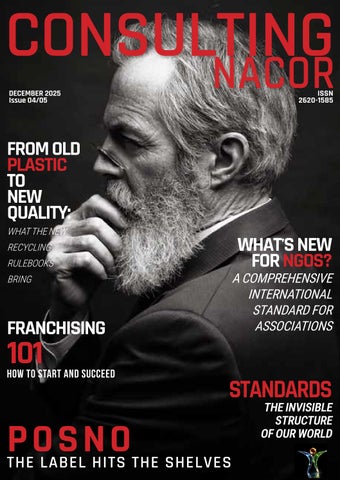
CONSULTING NACOR DECEMBER 2025 Issue 04/05
ISSN 2620-1585
FROM OLD PLASTIC TO NEW QUALITY: WHAT THE NEW
WHAT'S NEW FOR NGOS?
RECYCLING RULEBOOKS
A COMPREHENSIVE INTERNATIONAL STANDARD FOR ASSOCIATIONS
BRING
FRANCHISING
101
HOW TO START AND SUCCEED
STANDARDS
PO S NO THE LABEL HITS THE SHELVES
THE INVISIBLE STRUCTURE OF OUR WORLD
CONTENTS y EXCLUSIVE the NACOR consulting 124 Meet group
92 Step by step to certification 46 From old plastic to new quality What the new recycling rulebooks bring
101: how to start 116 Franchising and succeed
106 70
What's new for NGOs A comprehensive international standard for associations
When a system works, it creates room to play – Stefan Trifunović on art, process and responsibility
y IN FOCUS 31000 as an ally in a world of 98 ISO uncertainty standards in 37 International tourism and hospitality
140 Artificial intelligence
Between innovation and ethics
an organisation stalls, a 130 When consultant gets it moving
2
y IN FOCUS
28
Standards in the pharmaceutical industry
as the invisible structure of our 8 Standards world IT security through the new approach 34 Improved of ISO/IEC 27001
54
From personality to standards: the character of quality standards
3
CONTENTS y STANDARDS IN PRACTICE stories: how ISO 39001 improves 67 Success safety in transport
90 Agency for Prevention of Corruption
A shining example of efficient and high-quality work
96 Elephant pharma
The power of nature, the assurance of quality
38 Chocolamma, a byword for quality 138 76
Standardisation in support of environmental responsibility and the circular economy – Sekopak SOS Children's Villages Foundation ISO standards as the backbone of our mission – that no child grows up alone
80 Tools for effective employee appraisal and motivation 64
Faculty of Transport and Traffic Engineering – where standards advance knowledge
112 Pirot Regional Landfill
Waste management to the highest standards:
waste to resource: what responsible 144 From management of non-hazardous waste looks like in practice – Green Industry d.o.o.
4
y FOOD 'POSNO' (Lenten) label hits the 134 The shelves in the service of safe food 102 HACCP for children
40 Dry ageing and food safety 5
CONSULTING NACOR
IVA VUČKOVIĆ
EDITOR-IN-CHIEF
MAGAZINE CHAIRMAN OF THE BOARD AND CEO Milorad Vučković
EDITOR-IN-CHIEF Iva Vučković
ASSISTANT EDITOR Miljana Grujić
PHOTOGRAPHY Foto Studio Express fotostudio.co.rs PROOFREADING Žarko Duškov
CONTRIBUTORS TO THIS ISSUE
Milorad Vučković, Nastasja Starović, Anđela Sorak, Andrijana Jašović, Katarina Momirović, Nikola Radoičić, Žarko Duškov, Bratislav Milošević, Aleksandra Pavlović
y Frameworks that shape the world Dear readers,
not abstract documents, but living systems that shape everyday processes and decisions.
PRINTING
Grafolik doo Belgrade
Vojvode Stepe 375 11221 Belgrade, Serbia Phone: +381.11.2463.855, 3970.567, 2492.752
E-mail: stamparija@grafolik.rs PUBLISHER
National Centre for Sustainable Development – NACOR Jelene Varjaški 10 26300 Vršac Dimitrija Tucovića 146 11000 Belgrade
Phone: +381 11 38 36 066 +381 66 96 999 99 web: www.nacor.co.rs e-mail: info@nacor.rs
PLACE AND FREQUENCY OF PUBLICATION Belgrade, published every two years
Welcome to the new issue of our magazine devoted to standardisation – a space where knowledge, practice and the modern demands of business meet. In this issue, too, we have tried to bring you closer to the key topics and the benefits that standards bring to organisations, and to society as a whole, in the dynamic and increasingly complex environment in which we live and work. This time we have placed special emphasis on bringing standardisation closer to everyone – not only to those who already work in the field, but also to readers who may not have had direct contact with standards until now. Our aim was to present standardisation as it really is: the rule by which almost everything around us works – from the way we work, communicate and create, to how we manage risk, quality and safety. Through different approaches and perspectives, in this issue we have looked at standards beyond their usual technical and formal frameworks. We have presented them through art and through a single day in the life of an ordinary person, compared them with personality types and examined how they are applied in industries that gain clear and measurable benefits from standardisation. In doing so, we wanted to show that standards are
ALL RIGHTS RESERVED copyright @2025
6
In this issue we also present a new certification scheme for Lenten (posno) products, designed to ensure a high level of compliance with quality and food safety requirements for consumers who observe fasting. The initiative responds to growing market needs and at the same time opens up new opportunities for producers and distributors to improve their offer and build consumer trust. Our mission remains the same – to provide you with reliable, relevant and practical information that can help improve business practice, and contribute to a better understanding of a world in which standards play a far greater role than it may seem at first glance. We believe that in this issue you will find ideas and guidance that will further motivate you to see standardisation as a tool for growth, competitiveness and sustainability, as well as part of everyday life. Thank you for your trust. We hope this issue will be useful and inspiring in your further professional work. Warm regards, Iva Vučković Editor-in-chief
“Coming together is a beginning; keeping together is progress; working together is success.” - Henry Ford
Our first team Milorad Vučković
Iva Vučković
An economist with more than 25 years of experience in business management and work organisation, Milorad Vučković took over the leadership of NACOR more than a decade ago. His commitment to progress, his leadership and his attitude towards employees inspire and motivate the whole team.
For more than 20 years she has been actively involved in standardisation in the private and public sectors across the region. With more than 350 successfully completed projects, she works as a consultant in all branches of the economy, in the field of business organisation. She holds a master's degree in quality management.
Nastasja Starović
Žarko Duškov Senior consultant and educator
A master engineer of technology specialising in quality control, focused on consulting services in standardisation. She helps organisations align their processes with the requirements of international standards. Drawing on extensive experience in process analysis and optimisation, she designs sustainable quality and efficiency solutions for clients.
A specialist engineer in organisational sciences with years of experience in organising and optimising business processes. He stands out for his proactive approach and his ability to recognise an organisation's needs and to implement more efficient procedures aligned with the company's strategic goals.
CEO NACOR
Senior consultant and educator
Founder of NACOR and senior consultant
Miljana Grujić Organisational manager
Katarina Momirović Consultant and organisational assistant
A philosophy graduate with exceptional analytical and organisational skills, she successfully manages complex processes, teams and internal communication, contributing to the organisation's operational needs. She is committed to improving organisational efficiency and to the continued success of her team.
A final-year student of biochemical engineering and biotechnology, she provides operational support to business processes as well as consulting services. Her role includes active communication with clients, institutions and partners, contributing to service quality and the successful delivery of projects.
Nikola Radoičić
Bratislav Milošević Associate and technical expert
A master manager from the Faculty of Organisational Sciences with strong analytical and organisational skills, dedicated to developing people and improving business processes, and to finding practical solutions that increase efficiency, support cooperation and contribute to the overall success of the organisation.
Dr Bratislav Milošević is one of the leading experts in standardisation, accreditation and certification in the region. With more than 25 years of professional experience, he has taken part in implementing, assessing and improving management systems and accreditation systems in laboratories, certification bodies and inspection bodies.
Senior consultant and educator
7
IN FOCUS
ISO/IEC 17025:2017
ISO/IE
ISO 45001:2018
EN 12368:2015
en 71 EN 62115
EN 13108-1:2016
8
EC 27001:2022
Good morning, chaos!
A day without standards
06:43 – Waking up in a panic
Imagine a world without rules. Without order. Without a single agreement on how devices should work, how food should be kept safe, how data should be protected, how we can know that a hospital really is a hospital and a medicine really is a medicine. Sounds like chaos? It is. Yet most of us take order for granted. We don't think about the fact that behind every functioning day lies a vast system of agreements – in other words, standards. Standards are the silent guardians of order, safety and quality. They are not restrictions but the foundation of trust between producers and consumers, citizens and institutions, workers and employers. In this issue of the magazine we will show you how standards shape the world around us – from healthcare and industry, through the IT sector, to occupational safety. Through real-life examples, we will show that standards are not bureaucratic red tape but the essential infrastructure of modern life. To really understand how important they are, let's do an experiment.
Let's imagine a day in a world without standards.
The phone is broken. In fact, the battery is in bad shape, and the charger overheated during the night and melted the plastic on the table. The device has no CE mark – no quality control whatsoever. It was made by a company that has no idea what 'quality assurance' means. 07:05 – A morning ritual with a side of heavy metals The water is rusty. Literally. It also smells of sulphur. The local water utility applies no standards for water sampling, nor ISO/IEC 17025 for laboratory testing. Standards? They say: 'We test when needed.' And today was clearly not that day. 07:30 – Breakfast at your own risk You open the fridge. The milk has no label. 'Homemade,' said the seller. No origin, no date, no expiry date, and the producer has no HACCP. Toast? Full of grains... of sand. The microwave works, but its manufacturer has never heard of ISO 22000 or GMP. And you no longer know what you are actually eating. 08:00 – On the way to work The grey sky doesn't promise rain – just another day under a cloud of industrial smoke. In the distance, plumes rise from factory chimneys – unfiltered, unrestrained, unregulated. Nobody measures harmful emissions, nobody applies ISO 14001. You breathe shallowly, carefully, and wonder: 'Does anyone still remember what it's like to breathe clean air?'
Standards – the invisible structure of our world 9
S TANDARDS – TH E IN V ISIBL E STRU C T U R E OF OU R W OR L D 08:45 – Work: companies without systems You walk into the office. Papers get lost, the software doesn't work. A document management system? There isn't one. ISO 9001? 'We have a quality plan... somewhere in a drawer.' A colleague from IT shouts: 'Don't open your emails! Virus!' Too late. Half the computers are already locked. ISO 27001 is not on the agenda – the question of the day is whether the company can work at all.
17:15 – A game of (un)predictable consequences At home, your child opens a new toy – it's colourful, the plastic squeaks under the fingers, and the music it plays sounds as if it got there by mistake. No label, no age marking, and the contents resemble a chemistry experiment more than a children's product. After a few minutes come redness, itching and then watery eyes. The toy falls apart, and so does your peace of mind. The packaging carries no information at all. Not a trace of the EN 71 standard.
12:00 – Lunch with consequences At a nearby restaurant, chicken is the dish of the day. Or perhaps something with four legs. No traceability of origin. No temperature control in storage or preparation. No HACCP system. A staff member says: 'We have a certificate of compliance somewhere, but we can't find it.' One colleague is already walking towards the toilet, holding his stomach.
19:30 – A visit to the doctor In a panic you grab your jacket and head for the clinic, carrying your child in your arms – red-faced and covered in a rash. The clinic is open. That's a good sign, but the laboratory is improvised. Test tubes stand on the windowsill. Nobody knows what ISO 15189 is. The doctor looks at the child, nods and says: 'Maybe it's an allergy, maybe a chemical reaction, maybe fate.' You ask whether they can test the toy. The answer: 'We don't have an accredited laboratory. And it's not our responsibility anyway.'
14:00 – A view of failures from the window Through the office window you watch a chaotic scene below as someone's scream pierces the air. A worker has fallen from the scaffolding. No helmet, no safety harness, not even basic protection. They say: 'We haven't got round to introducing ISO 45001 yet.' Or to running any training. The first-aid kit? Empty. The ambulance arrives, but without a stretcher. Everything looks improvised. You look through the glass and realise: no system, no safety – no chance. Only consequences.
The day's conclusion: You go to bed (which creaks and has probably never been load-tested). You switch off the lamp (which has already burnt out the switch). You think: 'Maybe standards aren't such a bad thing after all.'
10
Standards are not just paper. They are the silent guardians of our safety, health, trust and quality of life. When they are applied, we don't notice them. When they are missing, we notice everything. Welcome to the world of standardisation.
11
STANDARDS – THE INVISIBLE STRUCTURE OF OUR WORLD
ISO 9001 in our lives – how we feel its strength in practice
12
Although we rarely think about it, every product and service we use every day passes through a quality control system based on ISO 9001 principles. This standard sets clear rules and procedures that ensure that what we receive really meets our expectations. Here are a few practical examples: Clothes that last and fit just right When we buy a new jacket or jeans, we want good-quality fabric, strong seams and the right size. Companies that apply ISO 9001 control every step of production: from choosing fabrics, through cutting, to packaging. If a defect appears, the system detects the problem immediately and prevents a faulty item from reaching us. That's why we return things less often and enjoy our clothes for longer.
medicine from a trusted source, we can be sure that it will help us, not harm us.
meal, every car service and every service delivered.
Services that arrive on time and as promised
In a world without ISO 9001, life would be full of uncertainty, mistakes and stress. With it, we can count on safety, reliability and a peaceful day.
Whether it's food delivery, appliance repair or IT support, companies whose operations comply with ISO 9001 have clearly defined processes for monitoring service time and quality. This means that our request will be properly recorded, processed and delivered within the agreed time. Fewer delays, fewer mistakes and less frustration. So ISO 9001 is not just a set of rules for companies – it is an invisible system of trust that protects our right to receive a quality product or service every time. Although we can't see it, we feel its effects every time we buy clothes, with every
A restaurant where food is not only tasty but safe Restaurants with an ISO 9001 quality management system carefully monitor every process, from purchasing ingredients to preparing and serving food. This means that hygiene standards are respected, ingredients are stored properly and preparation times are monitored, which reduces the risk of food poisoning. So we can enjoy our meal without worrying about getting ill. A car service that doesn't create new problems When we take our car in for repair, we expect the job to be done properly the first time. Garages that work to ISO 9001 have clearly defined procedures for vehicle intake, diagnostics, parts replacement and post-repair testing. If a mistake happens, the system quickly finds the cause and prevents the same problem from happening again. We save time and money, and reduce stress. Medicines that are safe and effective Pharmaceutical companies that apply ISO 9001 monitor every step of medicine production, from raw materials to the finished product. Strict control systems ensure that medicines contain the correct amount of active ingredients and are not contaminated. When we use a
13
STANDARDS – THE INVISIBLE STRUCTURE OF OUR WORLD
What we (don't) know about what we eat At a modern dairy plant, Ana, the quality manager, starts her day with the morning report from the night shift. Among the rows of data in an Excel spreadsheet she notices that the temperature in the cold store rose by 3 degrees over 2 hours. Without further analysis, this might have been overlooked. But Ana knows that when it comes to food, even the smallest deviation is not a coincidence but an alarm. The incident never happened, thanks to standards. In her morning analysis, Ana, the quality manager, discovers that the temperature in one cold room has risen above the defined limit for storing fermented dairy products. The deviation automatically triggers the protocol required by the international standard ISO 22000 and HACCP food safety management systems. She then follows the predefined steps: • Stopping delivery of that batch of products. • Microbiological testing of all potentially affected items. • Root cause analysis – in this case, a faulty probe. • Replacing the equipment and installing an additional temperature sensor. Thanks to the standardised control system, not a single risky product left the plant. Customers never learned that a potentially unsafe product had been about to be shipped, because ISO 22000 and HACCP protocols ensured that the error was identified and corrected in time.
essential. Without a quality control system and strict standards, the cold room fault might not even have been noticed, or might have been ignored. The products would have ended up on the shelves and then on conAna also leads staff training. Everyone on sumers' tables. At first glance everything the team knows that it is not enough for would have seemed fine, but spoilage in fermented dairy products is not always visible Food safety is not a matter of impressions but of or detectable by facts, measurement and monitoring. Thanks to taste. That is the power of international standards in practice – they protect not only the product, but also consumer health and trust in the brand.
the implementation of ISO 22000, everyone knows their role – from the line operator to the driver who transports the finished goods.
'the yoghurt to look fine'. Food safety is not a matter of impressions but of facts, measurement and monitoring. Thanks to the implementation of ISO 22000, everyone knows their role – from the line operator to the driver who transports the finished goods. Before the standard was introduced, Ana says, they relied on 'experience' and 'practice'. Today they have numbers. Procedures. Automated alarms. When you are dealing with hundreds of thousands of products, a system doesn't just help – it is
14
The consequences? They can range from mild stomach upsets to more serious food poisoning, especially in children, the elderly and people with
weakened immunity. Beyond the health risks, trust in the brand, the shop and even the whole industry is damaged. Trust, once lost, is hard to regain. That is why applying standards is invisible protection for every consumer, and the key to making sure that what we eat is truly safe.
Trust, once lost, is hard to regain. That is why applying standards is invisible protection for every consumer – and the key to making sure that what we eat is truly safe.
15
S TANDARDS – TH E IN V ISIBL E STRU CT U R E OF OU R W OR L D
16
Without standards, healthcare would be improvisation Milica, a nurse at a city hospital, arrives at work at 6:45. The surgery is quiet before the day begins. On the desk is the operating list. The first procedure is scheduled for 08:00. Everything must be ready: sterile instruments, gloves, disinfection, the patient admission protocol, documentation. Behind this routine lies an invisible network of rules, procedures and standards – what we often simply call 'protocols'. In fact, these are international standards that protect her, the doctors, the patients and all of us every day. When a nurse opens a box of surgical instruments, she doesn't wonder whether they are sterile – she knows they are, because a whole quality control system stands behind them.
tories a framework for working precisely and without errors. An error in processing a sample can mean a wrong diagnosis, and a wrong diagnosis means the wrong medicine. A life-changing consequence. A few months ago, during a routine check, Milica noticed that some infectious material had ended up in a general waste container. Thanks to an internal procedure that is part of the standardised quality management system, the waste was removed and safely destroyed. - ISO 9001, together with national guidelines on medical waste, makes it possible to spot and resolve such issues immediately. Standards don't think for us – they support us.
- ISO 13485 is the standard that ensures medical devices and supplies are manufactured, stored and used under strictly controlled conditions. Without it, sterility would be a matter of trust, not certainty. Later in the day, Milica assists with taking samples for the laboratory. The labels on the vials, the storage method, the sample's journey – everything is prescribed. - ISO 15189 is the standard that gives labora-
17
Milica doesn't know the names of all the standards by heart. She doesn't need to, but she knows the procedure. And the procedure exists because someone did know, and turned that knowledge into a framework everyone can apply. In moments when there is no room for error, standards provide support, clear steps and proven procedures.
S TANDARDS – TH E IN V ISIBL E STRU C T U R E OF OU R W OR L D
The path of air from a factory chimney to our lungs Milan is head of environmental protection at a metal processing plant. His day doesn't start with checking emails but with checking emissions – data from the monitoring stations that track air and water quality around the plant. On screen, these are numbers, charts and alarms. On site, they are chimneys, filters and treatment units.
ation until it became a big problem. ISO 14001 doesn't just mean 'less pollution'. It changes the way a company thinks: how waste is handled, how much energy is used, whether the use of chemicals can be reduced, how efficiency can be improved. Employees receive training, management sets targets, and the local community gains security because the plant does not only what it must, but also what is right.
At this plant, every drop of effluent and every cubic metre of air passes through a control system defined by ISO 14001, the international standard for environmental management.
When the system fails, the consequences don't stay inside the plant. They go out through the chimney, drain into rivers and are carried by the wind. That means polluted air breathed by children on their way to school. Water that can't be drunk. Soil where vegetables no longer grow. And clean-up costs that are ultimately paid by society, not by those who caused the problem.
One morning, Milan notices a slight deviation in particulate emission levels. It isn't alarming – everything is still within legal limits – but it is outside the plant's own internal targets. An internal procedure is triggered: • The filter on the galvanising line is checked. • A blockage is found in the automatic flushing system. • The unit is stopped and serviced, and samples are sent to an accredited laboratory.
To the ordinary person, ISO 14001 may look like a technical document, but in reality this standard is a guarantee that someone cares about the air we breathe, the water we drink and the planet we leave to future generations. A standard doesn't save nature on its own, but without it nature doesn't stand a chance.
Everything follows the procedure set by ISO 14001: identifying environmental aspects, controlling hazards, preventing pollution and documenting every response. Without that system, nobody would notice a small devi-
18
A standard doesn't save nature on its own, but without it nature doesn't stand a chance.
19
STANDARDS – THE INVISIBLE STRUCTURE OF OUR WORLD
Safety on four wheels
Marko, a municipal vehicle driver, starts his working day at 5:30. On paper it's a routine route: the city centre, then the industrial zone. In reality, transporting chemicals and medical waste demands total concentration, because any mistake can endanger people's health and the environment. Fortunately, Marko doesn't carry that responsibility alone. Every step he takes is defined by international standards, above all the ADR agreement (the European Agreement concerning the International Carriage of Dangerous Goods by Road) and ISO 39001, the standard for road traffic safety management. When transporting containers of chemical waste, the driver always knows:
• what is in the vehicle, • how to respond in the event of an incident, • where to stop and whom to notify if there is a leak. This is not a matter of personal judgement but the result of prescribed procedures: vehicle marking, special permits, mandatory equipment (fire extinguishers, protective gear) and certified training. All of these elements come directly from the ADR. But safety doesn't stop there. His company has also introduced ISO 39001, which makes it possible to monitor driver behaviour: the number of sudden braking events, average speed, fuel consumption and more. If someone drives too
20
fast or changes lanes too often, the system automatically sends a warning – not to punish the driver, but to improve practice. Thanks to this approach, the number of traffic incidents fell by 40% in the first two years. One day, a colleague from another shift, driving the same route, noticed a strong chemical smell during unloading. The system immediately flagged a possible problem – under the ADR, certain chemicals must not be stored together. It was a packaging error, but thanks to the rules and a quick response, a leak into the sewers was prevented.
21
Without clearly prescribed procedures, trained drivers and control systems, such errors would go unnoticed until they caused an environmental incident, endangered public health or led to a traffic accident. The ordinary citizen may never see what is inside Marko's vehicle, but will certainly feel the consequences if the system fails. Polluted water, polluted air, hazardous waste in places where it should never be – these are the risks that standards remove every day. That is why standards in transport are more than paper – they are the invisible safety we carry with us every day.
S TAN DARDS – TH E IN V ISIBL E STRU C T U R E OF OU R W OR L D
A day without a hard hat Jovan is an occupational safety engineer on a construction site. He starts his day before dawn. First he reviews the reports, then he goes out on site. His mission is clear: to make sure all workers are safe at height, near machinery and in contact with hazardous substances. But would the workers be safe without Jovan? And without all the procedures, protocols and standards he has to enforce every day? Today the situation on site is alarming – one worker is not wearing a hard hat. Jovan doesn't have to wonder what to do, because he knows. First he goes over to him and explains why the hard hat is mandatory, then he checks the whole crew. ISO 45001 is the standard for occupational health and safety management. It requires every worker to be issued with proper protective equipment and safety procedures to be strictly followed. Without this standard, Jovan would have to rely solely on the workers' personal responsibility, which in reality often doesn't work. One of the most important procedures on site is regular equipment inspection. Before any machine starts work, it must be checked. All workers must wear ear protection when using noisy tools, and safety
harnesses when working at height. OHSAS 18001, the predecessor of ISO 45001, created the framework for all these measures. However, standards don't only prevent the risk of physical injury. They also address
jury at work never stays at the workplace. An injury means lost days, reduced earnings, psychological stress for the family, pressure on the healthcare system and extra costs for the employer. In the worst cases, it means someone's life.
Without clearly defined standards, risk management doesn't happen – the possibility of injury is left ISO 45001 is the standard for occupational health to chance, and and safety management. It requires every worker to the consequences are be equipped with proper protective equipment and usually borne by those with the safety procedures to be strictly followed. least protection. That is why occupational safety is much more than regulation – it is a system that protects lives every day, often unnoticed, psychological aspects, such as preventing while we think that 'everything is fine'. stress among workers. Jovan knows that work on a construction site is safe only when everyone follows the standards. ISO 45001 was introduced not merely as an administrative obligation, but as real protection for every worker, their family and the community, because an in-
22
23
S TANDARDS – TH E IN V ISIBL E STRU C T U R E OF OU R W OR L D
A toy is no game Marija works as a quality inspector at a company that makes plastic toys for children up to the age of 3. At first glance they are just colourful little horses, blocks and rattles. But behind every colour and shape, Marija sees dimensions, chemical composition, resistance to breaking and choking risk.
that potentially dangerous toys could have ended up in their children's hands, because the standard and the control system responded in time. EN 71 prescribes everything – from the size of parts a child could swallow to the permitted amount of lead in plastic. The flammability of materials, the stability of wheeled toys and the safety of stitching on dolls' clothes are also tested. As a result, the development team thinks not only about appearance, but about safety from the very beginning.
Every toy must pass strict tests before it reaches a child's hands. None of this is a matter of personal judgement or 'common sense' – it is defined by EN 71, the European standard for toy safety. One day, during an internal inspection, it is discovered that in a new batch of rubber figures a small part comes off easily when stretched – just big enough for a child to put in their mouth.
Without such standards, the question is not whether a problem will occur, but when. A toy that falls apart in a child's hands can lead to choking, poisoning or injury. The parent, who believed they were buying a safe product, is left feeling guilty and angry. The product recall comes too late – only after the accident has happened.
Marija immediately: • stops the shipment, • runs a strength test under EN 71-1 (mechanical and physical properties), • asks the development team to correct the design, • initiates additional tests for heavy-metal migration from the paint under EN 71-3.
To the ordinary person, the CE mark on a toy may seem like a bureaucratic detail, but in reality it means that someone checked every screw, every colour and every detail before it reached the child. The EN 71 standard is not just a rule for factories – it is a guarantee that play is safe, and that is no game.
Not a single toy went on sale. Parents never even knew
24
The EN 71 standard is not just a rule for factories. It is a guarantee that play is safe – and that is no game.
25
STANDARDS – THE INVISIBLE STRUCTURE OF OUR WORLD
Silent protection – how banks protect your money Jelena works as an IT security manager at a large bank. Every day her team has the same task: to let customers deposit, transfer and withdraw money without having to think about security, because it is already taken care of. While customers open the app in the morning to pay bills or check their balance, Jelena and her team have already analysed dozens of attempts to access the system, all stopped because they were detected in time. The bank she works for applies ISO 27001, the international standard that defines how information security is managed. This standard doesn't regulate only antivirus software, but the entire system: • who has access to sensitive data, and when, • how passwords and transaction data are stored, • how to respond if an incident occurs. Thanks to this standard, the bank knows exactly who accessed which database, when and from which device, and can detect suspicious activity within seconds. One Friday evening, the system recorded an attempt to access an administrator account from a location outside the country. The ISO 27001 procedure was activated immediately: • the system blocked access, • user accounts were temporarily frozen, • the forensics team analysed the source of the threat, • customers noticed nothing, because everything happened behind the scenes. The bank was a target, but not a single dinar went missing. Nobody had to replace their card. There were no headlines in the newspapers. Without standards like ISO 27001, banks would be extremely vulnerable. Account and loan data, and even personal information such as national ID numbers and addresses, could end up in the wrong hands. For customers, that means frozen accounts, identity theft or unauthorised transactions. For the bank – lawsuits, losses in the millions and, worst of all, a loss of trust. And trust is a currency no bank can print. ISO 27001 is not a technical detail – it is the digital security lock on the safe of your trust. Without it, the system might work, but it wouldn't be secure. And in banking, security is not a luxury. It is a basic requirement.
26
Standards – the silent guardians of the ordinary person's everyday life Although most people are not experts in norms, technical specifications or international regulations, standards surround and protect us every day – quietly, without fanfare or big words. Most people think that standards are meant only for engineers, managers or auditors. But the truth is the opposite. It is precisely thanks to them that our everyday life runs reliably, safely and without major problems. Standards are like the architects of order in a world that often seems chaotic. They define the rules of the game for the products we use, the services we receive and the systems we depend on. They never stand in the spotlight, but their work maintains the stability and security we often take for granted. Imagine there were no standards. The water you shower in could be contaminated with unknown chemicals or bacteria. Electrical appliances could be dangerous. The food you buy could be untested, full of invisible health risks. Children's toys could contain harmful substances or parts that children could easily swallow. Workplaces would have no clear system of protection, leading to accidents and illness.
The information we use at work and in private could easily be accessed by unauthorised persons, threatening our privacy and security. That is exactly why standards are so important – they are not just rules on paper but a guarantee of safety, quality and trust. They ensure that what we use is safe, reliable and meets our expectations. ISO 13485 protects us from infections and complications caused by faulty medical devices. ISO 15189 ensures accurate diagnosis and correct treatment. ISO 9001 prevents errors in production and services, protecting us from problems and faulty products. ISO 22000 guarantees that the food we eat will not cause poisoning or illness. HACCP identifies and stops hazards before they endanger health. ISO/IEC 17025 ensures that the water and products we use are not harmful. ADR prevents accidents involving toxic substances during transport. ISO 39001 reduces the risk of traffic accidents and injuries on our streets. ISO 45001 protects us from injuries and illness at work. ISO 14001 takes care of clean air, water and soil. EN 71 prevents toys from injuring children or endangering their health. ISO 27001 protects personal and financial data from theft and misuse.
27
Most people think that standards are meant only for engineers, managers or auditors. But the truth is the opposite. It is precisely thanks to them that our everyday life runs reliably, safely and without major problems.
IN FOCUS
Standards in the pharmaceutical industry
opment of new technologies and production processes is therefore key to staying in the market. It is also necessary to follow and adapt to the requirements of modern healthcare systems, which are constantly changing and evolving. To meet these challenges, the pharmaceutical industry applies a range of standards in its operations. These standards cover requirements relating to product quality, process safety and risk management, as well as ethical business conduct and transparency. Applying them allows pharmaceutical companies to meet regulatory requirements, ensure a high level of product and service quality, and stay competitive in the market.
Author: Nastasja Starović
The understanding that medicines need independent assessment before they are placed on the market did not
The pharmaceutical industry is one of the most heavily reg-
develop evenly – it arrived at different times in different
ulated industries in the world. The sensitive nature of phar-
regions. In many cases, however, awareness was driven
maceutical products requires strictly defined requirements
by tragedy. One of the most significant examples of the
that must be met. These regulations cover almost every
consequences of inadequate drug safety assessment is
aspect of the business, including the research, develop-
the thalidomide case in Europe in the 1960s. The drug
ment, production and distribution of medicines. Such strict
was widely prescribed to pregnant women to relieve nau-
regulation has been established to ensure the efficacy and
sea, without adequate prior testing for reproductive and
quality of a medicine before it is used by patients.
developmental toxicity. At the time, testing was limited
In addition to regulatory challenges, the pharmaceutical in-
to a small number of animal models, in which no harm-
dustry also faces growing competition. Continuous devel-
ful effects were observed, partly because of marked dif-
28
ferences in sensitivity between species. It was later established that thalidomide has strong teratogenic potential in humans, leading to severe congenital malformations, particularly limb development disorders (phocomelia), with children born with markedly shortened or absent long bones, often with hands or feet attached directly to the trunk. The
The history and development of standardisation in the pharmaceutical industry
period between 1960 and 1970 saw the regulatory frame-
work tighten in most countries, through the introduction and expansion of laws, rulebooks and guidelines for submitting and evaluating data on the safety, quality and efficacy of new medicinal products. In parallel, the pharmaceutical industry became increasingly international, aiming at a global market, while the approval and registration of medicines remained a national regulatory responsibility. This created the need to harmonise the detailed technical requirements for registering medicines, so that they could more easily be placed on foreign markets and the cost of repeating these expensive testing procedures could be kept to a minimum. Concerns about rising healthcare costs, escalating research costs and public expectations drove an urgent rationalisation and harmonisation of legislation. To establish better organisation and coordination within companies and cooperation between countries, and to ensure safety and security, it was necessary to introduce appropriate standards. Every application of standards in society has been preceded by long development and a struggle to achieve quality. The essential feature of a standard is uniformity of terms, definitions and procedures, established to ensure the quality of the final product. The development of standards and quality are therefore inseparably linked.
29
IN FOCUS Standards are an essential requirement of the modern phar-
an acronym for 'Good x Practice', where the middle letter
maceutical industry, since compliance with them is crucial
defines the specific area of regulation. They are used to
for ensuring the quality, safety and efficacy of medicines.
achieve an appropriate standard of work in various func-
In this field there is no room for deviation from prescribed
tional areas, such as manufacturing, distribution, research
standards.
and development, and quality control. GxP guidelines are
Broadly speaking, the requirements governing the pharma-
therefore of a specific type: they are mandatory and are
ceutical industry can be divided into three main categories:
applied in the pharmaceutical and food industries. The
1. Management systems, which are usually not legally man-
basic purpose of GxP guidelines is to establish systems
datory but are expected in practice and used as a tool for
that ensure manufacturers place on the market products
improving quality and business processes (e.g. ISO stan-
that are safe to use and fit for their intended purpose.
dards).
Mandatory GxP requirements apply in highly regulated
2. Good practice in the manufacture of medicines, which is
industries, most commonly the pharmaceutical, food,
mandatory and regulated, and concerns how pharmaceuti-
cosmetics and medical device industries. Together with
cal companies carry out the development, manufacture and
ISO standards, these requirements form the backbone of
Standardisation in the pharmaceutical industry commercialisation of medicines (e.g. GxP guidelines).
quality management in the pharmaceutical industry.
3. Regulatory and technical requirements for the documen-
They can be grouped into four categories:
tation and quality of medicines, which are mandatory and
• Good Manufacturing Practice (GMP) guidelines
prescribed by current legislation, and include pharmaco-
• Good Clinical Practice (GCP) guidelines
poeias, laws and bylaws.
• Good Laboratory Practice (GLP) guidelines • Good Distribution Practice (GDP) guidelines
ISO standards in the pharmaceutical industry
Good Manufacturing Practice (GMP) guidelines
The following groups of ISO standards are most commonly applied in the pharmaceutical industry:
Good Manufacturing Practice (GMP) ensures that pro-
• General management system standards, including stan-
duction processes and controls are consistent and in
dards for quality management (ISO 9001), environmental
line with the quality standards appropriate to their
protection (ISO 14001), occupational health and safety (ISO
intended use and with the requirements of the mar-
45001), social responsibility (ISO 26000), risk management
keting authorisation or product specifications. GMP
guidelines (ISO 31000) and information security manage-
therefore covers both production and quality control.
ment (ISO/IEC 27001).
GMP improves the existing safety management system
• Pharmaceutical and healthcare ISO standards, includ-
for pharmaceutical products. These guidelines do not
ing standards for testing and calibration laboratories (ISO/
specify operational production procedures; rather, they
IEC 17025), cleanrooms and controlled environments (ISO
are a set of general principles that must be observed
14644 and ISO 14698), primary packaging for medicinal
during manufacture, and it is up to the manufacturer to
products (ISO 15378) and medical devices (ISO 13485).
determine the most effective and efficient quality process. Good Manufacturing Practice applies at every stage
GxP guidelines in the pharmaceutical industry
of the production cycle, from manufacturing medicines for clinical trials, through technology transfer and commercial production, to the discontinuation of a product.
GxP is a series of guidelines that ensure quality manage-
GMP guidelines are based on the principle of integrated
ment systems are established in various industries. GxP is
application. The current GMP guidelines consist of two
30
parts: 1. Part one, covering the basic requirements
for
manufacturing
medicinal
products, both in terms of functional areas and types of product. • Functional areas: quality management, personnel, premises and equipment, documentation, production, quality control, contract manufacturing, complaints and product recalls, and self-inspection. • Types of product: sterile medicinal products, biological medicinal products, radiopharmaceuticals, veterinary non-immunological
products,
veteri-
nary immunological products, medicinal gases, herbal medicinal products, packaging materials, liquids, creams and ointments, inhalation preparations, use of ionising radiation, investigational medicinal products, products derived from human blood and plasma, qualification and validation, certification and batch release, parametric release, and samples. 2. Part two, covering the basic requirements for manufacturing active sub-
Good Manufacturing Practice - GMP
Good Manufacturing Practice guidelines
31
stances, whose structure and content complement the requirements for manufacturing medicinal products. By applying GMP guidelines, pharmaceutical companies optimise their business processes, manage documentation better, save time and money, improve their reputation with all partners and gain a range of other benefits.
Good Clinical Practice (GCP) guidelines Good Clinical Practice in clinical trials is an international ethical and scientific quality standard for designing, conducting, recording and reporting trials involving human subjects. Compliance with these standards gives the public assurance that the rights, safety and well-being of trial subjects are protected, in line with the principles of the Declaration of Helsinki, and that the data obtained in the clinical trial are credible.
Good Laboratory Practice (GLP) guidelines
in medicines for human use, pesticides, cosmet-
Good Laboratory Practice (GLP) is a quality system con-
ditives and industrial chemicals. The substances
cerned with the organisational processes and conditions
tested are most often synthetic chemicals, but
under which non-clinical safety studies on human health
they may also be of natural or biological origin,
and the environment are planned, performed, moni-
and in some cases living organisms. The aim of
tored, recorded, archived and reported.
testing these substances is to collect data on their
The principles of Good Laboratory Practice must be ap-
properties and/or safety, with regard to human
plied to all non-clinical safety studies of substances used
health and/or the environment.
ics, veterinary medicines, food additives, feed ad-
Good Distribution (GDP) guidelines
Practice
Good Distribution Practice (GDP) guidelines are part of the quality assurance of medicines, ensuring that their quality is maintained at every stage of the supply chain, from the manufacturing site to the pharmacist or other person legally authorised to dispense medicines. In addition to GxP guidelines, the pharmaceutical industry applies other good practices that complement the regulatory framework and ensure the quality, safety and efficacy of medicines. These include: • Good Pharmacy Practice (GPP), which sets out guidelines for providing pharmaceutical services and handling medicines; • Good Pharmacovigilance Practice (GVP), which concerns the monitoring and management of adverse drug reactions;
32
Other standards in the pharmaceutical industry • Good Regulatory Practice (GRP), which guides regulatory procedures and compliance with legislation; • Good Review Practice (GRevP), which sets out
on patient safety, proper counselling and optimal
protocols for evaluating and reviewing docu-
handling of medicines. In this way, GPP serves as
ments in the registration and approval of medi-
the practical implementation of the FIP standards,
cines.
enabling pharmacies to apply international recom-
Applying these guidelines and practices enables
mendations consistently in the local context.
pharmaceutical companies to consistently meet
• Standards for substances are a set of norms and
regulatory requirements and maintain a high level
criteria that define the quality, purity, identity and
of quality at every stage of a medicine's life cycle.
pharmacological properties of the chemical and bio-
In addition to the standards mentioned above,
logical substances used to manufacture medicines.
the pharmaceutical industry applies a large num-
Applying them ensures that raw materials meet the
ber of other documents and frameworks that
strict requirements of regulatory authorities and
regulate specific aspects of the work, such as the
pharmacopoeias, which in turn ensures the safety
preparation of medicines and substances, the
and efficacy of the final pharmaceutical products.
design of production processes, the labelling and
These standards regulate testing methods, analyti-
packaging of medicines, and the standardisation
cal methods and acceptance criteria for substances.
of medical devices. The most important include:
• Standards for processes define the procedures
the pharmacopoeia, standards for substances,
and methodologies applied in the manufacture of
standards for processes, the FIP Good Pharmacy
medicines and medical devices. They cover the plan-
Practice standard, the CE mark and others.
ning, design, validation and control of production
• The pharmacopoeia is a collection of binding
processes, ensuring consistency, reproducibility and
norms and specifications for medicines. The Hi-
quality of the final product. Process standardisation
landar Medical Codex, written in the Middle Ages,
is key to meeting regulatory requirements, reducing
is regarded as the oldest Serbian pharmacopoe-
risk and achieving high standards of patient safety.
ia. As a member of the European Pharmacopoeia
• The CE mark confirms that products comply with
Commission, Serbia takes part in its development
European Union requirements. It is a prerequisite
and is committed to applying its requirements.
for selling products in the EU, and medical devices
The pharmacopoeia contains information on the
are among the products subject to CE marking.
physical, chemical and pharmacological proper-
Applying different standards and regulatory frame-
ties of substances, as well as general and specific
works in the pharmaceutical industry ensures a high
methods that ensure the quality of medicines.
level of quality, safety and efficacy of medicines and
Pharmacopoeias are published by national regu-
other products. Their implementation contributes
latory authorities or pharmaceutical associations
to regulatory compliance, the development of inno-
and exist at both national and international level.
vative solutions, process optimisation and stronger
• FIP (the International Pharmaceutical Federa-
trust among all participants in the supply chain, in-
tion) develops international standards and guide-
cluding patients.
lines that serve as a reference framework for the pharmacy profession, pharmaceutical education and the organisation of pharmacy practice. These standards provide general principles and recommendations for improving pharmaceutical services and the professional development of pharmacists. GPP (Good Pharmacy Practice), mentioned above, is a concrete set of guidelines that applies the principles of the FIP standards to the everyday work of pharmacies, focusing
33
IN FOCUS
IMPROVED IT SECURITY
through the new approach of ISO/IEC 27001
34
I
n a constantly changing world, IT security is becoming one of the top priorities for organisations of every size and sector. Given the growing threat of cyber attacks, data leaks and many forms of digital crime, standardised approaches to information protection are becoming essential. ISO/IEC 27001, one of the most important international standards in IT security, has undergone significant changes to respond to the challenges of the digital environment. In this article, the NACOR standardisation group explores what is new in IT security and how these changes affect organisations that want to protect their information as fully as possible.
The evolution of IT security and the importance of ISO/IEC 27001
(ISMS). With the latest revisions, the standard now also covers the newest aspects of digital security, giving organisations a robust framework for protecting their information.
What's new in ISO/IEC 27001? The latest version of ISO/IEC 27001 brings several key changes aimed at improving IT security and adapting the standard to modern threats: 1. Expanded cybersecurity controls: The new version of the standard introduces additional controls relating to specific aspects of cybersecurity, such as data protection in the cloud, security management of IoT devices, and improved methods for detecting and responding to cyber incidents. For example, organisations that use cloud services now have clear guidance on managing the risks specific to this technology.
IT security evolves at the pace of technology. In the past, the main goal was to protect physical infrastructure such as servers and computer networks. With the growing use of cloud services, mobile devices and Internet of Things (IoT) technology, however, the boundaries of IT security have become far more fluid. This created the need for a standard that not only provides basic protection guidelines but also has the flexibility to adapt to dynamic risks.
2. Focus on continuous monitoring and improvement: ISO/IEC 27001 now emphasises the importance of continuously monitoring security measures and their effectiveness. Instead of 'set and forget' security, the standard calls for constant evaluation and adjustment of controls to keep pace with new threats and technological innovation.
ISO/IEC 27001 is exactly that standard. It defines the requirements for establishing, implementing, maintaining and continually improving an information security management system
3. Integration with other standards: One of the most important new features is easier integration with other standards, such as ISO 22301 (business continuity management) and
35
ISO 31000 (risk management). This allows organisations to take a comprehensive approach to risk management and to ensure consistency and efficiency in applying their security policies.
Organisations that adopt ISO/IEC 27001 not only protect their data but also build trust with clients and partners. In today's business environment, reputation and trust are invaluable assets, and ISO/IEC 27001 provides a framework for preserving them. For example, a company that applies this standard can prove to its clients that it takes the protection of their information seriously, which can be decisive in retaining existing clients and attracting new ones.
4. Updated control objectives: The control objectives and controls in Annex A of the standard have been revised and updated to reflect current threats. For example, Annex A now includes new controls for managing digital identities, protecting information in transit and protecting confidential data when using mobile devices.
The latest changes to ISO/IEC 27001 reflect the need for a comprehensive and flexible approach to IT security. The standard covers not only the technological aspects of information protection, but also human and organisational factors, which makes it a powerful tool for any organisation that wants to protect its data in an increasingly complex digital environment.
5. Greater focus on the human factor: Although technology plays a key role in IT security, the human factor remains one of the biggest challenges. ISO/IEC 27001 now provides guidance on training employees, raising risk awareness and developing a security culture within the organisation. Examples include regular training on recognising phishing attacks and rules for safe online behaviour.
As the NACOR standardisation group, we are proud to support organisations in implementing this standard, helping them meet the challenges and seize the opportunities of the digital age. Applying ISO/IEC 27001 is not just a technical task; it is a strategic decision that secures an organisation's future and its success in an increasingly competitive global market. Choosing to implement this standard is choosing to take control of the future and ensure security in every aspect of the business.
Inspiration for organisations: ISO/IEC 27001 as a guide to the future These amendments to ISO/IEC 27001 not only improve information protection, but also serve as inspiration for organisations striving to continuously improve their security practices. In a world where every organisation is a potential target, implementing this standard is becoming key to long-term success and sustainability.
36
IN FOCUS
INTERNATIONAL STANDARDS IN TOURISM AND HOSPITALITY Modern tourism has long been about more than a beautiful view, a good hotel or friendly staff. It is a complex ecosystem in which guest expectations, host responsibility, the local community, infrastructure, safety, sustainability and the reputation of the destination all meet. In that space, quality can no longer be left to improvisation. Today's traveller is not looking only for an experience – they are looking for safety, consistency and trust. They want to know that the accommodation is hygienic, that procedures are clear, that their data is protected, that the food is safe and that the environment is treated responsibly. These are all 'invisible' elements of a stay, but they are exactly what makes the difference between an average and an outstanding destination. That is why tourism increasingly relies on a systematic approach. Behind every well-organised reception, efficient check-in, clean room or well-run spa there are clearly defined processes. Behind a stable business there is risk management, staff training and continuous service improvement. In other words – there is standardisation, even when the guest doesn't notice it. Standards in tourism don't exist to burden businesses but to make them predictable and sustainable. They help hotels, restaurants, travel agencies and destinations align service quality, reduce errors, improve safety and build market trust. In practice this means fewer ad hoc decisions and more clear working rules; less reliance on individuals and more on the system. Sustainability is a particularly important aspect. Tourism has the power to develop local communities, but also to overburden them. That is why current trends, promoted by international institutions such as the World Tourism Organization, increasingly insist on responsible resource management, environmental protection and involving local people in the tourism value chain. Without clear frameworks and measurable targets, sustainable tourism remains only a good intention. Standardisation thus becomes quiet support for tourism development. It connects the operational level (how things are done), the strategic level (why they are done) and the reputational level (how the market sees us). It allows quality to be measured not by subjective impressions but by concrete indicators. Safety is not assumed but proven. Guest satisfaction is not left to chance but monitored and improved. At a time when destinations compete globally and guests choose more carefully than ever, the question is no longer whether standards need to be introduced – but how quickly and how seriously. Tourism that relies only on natural beauty and the goodwill of staff has a short-term reach. Tourism that relies on a system has a future.
W W W. K I M B O. R S
In the end, perhaps the best sign of successful standardisation is precisely that the guest doesn't notice it. They simply feel that everything is 'in its place'. And behind that feeling lies a great deal of work, structure and responsibility.
37
S TA N DA R D I S AT I O N I N P R A CT I C E
CHOCOLAMMA a byword for quality On the recommendation of our food technologist, we decided to implement a HACCP system in our production, which was a key decision for several reasons. As a start-up and a small producer, we wanted to present ourselves as a serious and responsible player in the industry with clearly defined goals. We believe that this step helped our products gain recognition and a place in larger retail chains such as DM drugstores, Mercator and Idea Organic, as well as smaller shops specialising in
healthy food. Our ambition was to ensure quality at the highest level from the very start, and this is reflected in every aspect of our production. We have worked to make our products not only from the finest ingredients, but also innovative in design and in step with market trends. Thanks to these efforts, we believe we have earned the trust of our customers and opened the door to new markets, giving our brand
38
greater weight. Also, as specialist producers of dark chocolate, we are confident that our products will become even more recognisable because they are gluten-free. Building on this, we decided to certify our chocolates as gluten-free, which allowed us to reach a specific target group – people with special dietary needs. This certificate not only sets us apart in the market but also gives us a competitive edge, because customers with specific die-
tary requirements can be confident in the quality of our products. As further proof of our commitment to sustainability and health, part of our dark chocolate range also carries Organic certification. This certificate confirms that our product comes from organic production and that every segment of the production chain is fully traced and certified. Our commitment to promoting a healthier lifestyle and protecting the environment, through the use of organic ingredients and environmentally friendly processes, further strengthens our brand's image as a leader in healthy sweet products. All these initiatives, combined with our high quality standards, have helped us earn our customers' trust and position the Chocolamma brand as a byword for quality, innovation and responsibility towards the environment and consumer health.
Ana Todorović - Chocolamma
39
FOOD
Dry ageing and food safety
40
Dry ageing is a traditional method of maturing meat that produces a meaty, intense flavour and improved texture. The process is usually applied to prime cuts of beef such as T-bone and rib-eye, as well as the ever-popular rump steak and sirloin, and involves leaving high-quality meat to rest under controlled conditions in which natural enzymes break down proteins and fats, making the meat more tender and richer in flavour. Although the advantages of this method are obvious, maintaining food safety and product quality depends on strict observance of the ageing parameters and on implementing food safety standards and guidelines such as HACCP (Hazard Analysis and Critical Control Points).
The dry-ageing process: parameters and challenges in food safety
1 AGEING TIME
Dry ageing can last between 14 and 70 days, with a minimum of 28 days to achieve the desired results. During this period, natural enzymes
How does dry ageing change the flavour and texture of meat?
break down proteins and fats, producing
During dry ageing, juices are absorbed into the meat and protein and fat components break down chemically, resulting in a more intense flavour. Experts explain that during dry ageing, large molecules that have little flavour of their own – such as glycogen and DNA – break down into smaller molecules that then carry the aroma.
longer ageing also means a greater TEMPERATURE risk of microbiological contamination if
Flavour development can happen in several ways: through a reduction in sugars, the release of free amino acids and peptides, and the breakdown of ribonucleotides to produce IMP, GMP, inosine and hypoxanthine. Enzymes in the meat naturally break proteins down into peptides and free amino acids during extended ageing. All of these molecules are relatively large, and when enzymes break them apart they form fragments that are tastier than the original large molecules. The released aliphatic amino acids are responsible for a sweet taste, while those containing a sulphur atom, such as methionine, along with glutamic and aspartic acid, are associated with umami, a taste similar to that of MSG, the flavour enhancer. Furthermore, carbohydrates break down into sugars that give a sweet taste, while fats break down into aromatic fatty acids. All these breakdown products contribute to the fuller, nutty and aromatic flavour of dry-aged meat.
What does dry-aged meat taste like? The flavour profile of dry-aged meat is one of the main reasons food lovers value it so highly. If you have never had the chance to try it, you may wonder how its taste and texture differ from an ordinary steak. The flavour profile of this type of meat can vary depending on several factors, such as the type of meat, the length of the ageing process and the conditions.
41
2
a distinctive flavour profile. However,
The ideal temperature for dry is proper hygiene conditions areageing not met. between -0.5 and +3°C, with an optimum of 1.5°C. Temperatures above this range can cause the growth of mould or other pathogenic microorganisms. Temperature control is therefore crucial, and the temperature must remain constant throughout the ageing process.
HUMIDITY AND VENTILATION Relative humidity should be in the range of 75–85%. Too little humidity can cause the meat to dry out excessively, while too much increases the risk of pathogenic microorganisms developing. In addition, appropriate airflow (0.2–0.5 m/s) allows even drying and reduces the risk of microbiological contamination.
3 4
STERILISATION Using UV radiation to sterilise the inside of dry-ageing chambers is another key aspect of product safety. UV radiation effectively eliminates bacteria and other microorganisms that can survive in controlled conditions, reducing the risk of pathogenic microorganisms developing.
FOOD Here are some of the most common flavour profiles found in dry-aged steak:
One thing is certain – dry-aged meat has a unique and complex flavour that cannot be achieved by any other method.
• Nutty and earthy: dry-aged meat often has a nutty or earthy flavour profile, which comes from the breakdown of fats and proteins in the meat. These flavours are more pronounced in steaks that have been aged longer and are often described as similar to hazelnuts or mushrooms.
Is dry ageing a safe process, and how does it affect health? Dry-aged meat is safe to eat as long as it is properly prepared. What matters most is buying from reputable suppliers who follow proper food safety protocols. This ensures that the meat has been aged correctly and further reduces potential risks. In a dry-ageing chamber with circulating cold, dry air, the meat is protected from harmful bacteria. The whole surface of the meat is exposed to dry air, which forms a protective crust, and the lack of moisture makes it harder for the meat to spoil.
• Umami: umami is the fifth taste. It is generally described as a meaty, savoury aroma that deepens flavour. Dry-aged meat has a strong umami profile that intensifies with ageing. • Sweet and caramelised: as the steak dries during ageing, the natural sugars in the meat become more concentrated, resulting in a sweet, caramelised flavour typical of steaks that have been aged for a shorter time.
Dry ageing has further benefits. When natural enzymes act on the meat during ageing, it becomes more tender and therefore easier to chew and digest. This can be especially helpful for people with digestive difficulties. Like any red meat, meat prepared this way can be healthy if eaten in moderation.
• Blue cheese: steaks that have been dry-aged for a long time can develop a more complex, sharp and salty flavour, similar to blue cheese, a symbol of good taste and luxury. This flavour comes from the breakdown of meat proteins, which creates various aromatic compounds that give the meat its distinctive character.
A dry-aged cut contains many important nutrients, such as protein, iron, carnosine, creatine, B vitamins, selenium and zinc. Various studies support eating red meat, which has a positive effect on both physical and mental health.
• Mineral: some types of dry-aged meat can develop a mineral flavour, reminiscent of iron or copper. This flavour comes from the minerals in the meat itself and is more pronounced in free-range beef.
42
Exclusivity and luxury: dry-aged steaks are not just a piece of meat – they are a true delicacy for food lovers. Many producers say the experience is similar to tasting a fine wine or a luxury cheese. The drying process creates unique aromas and textures that cannot be achieved by ordinary meat preparation, which is why they are often considered an exclusive gourmet product.
How are safety levels determined? Experts at EFSA (the European Food Safety Authority) investigated current practice and identified the relevant pathogens and bacteria that can develop and survive during dry ageing and can harm health, including E. coli (STEC), particularly in beef, Salmonella, Staphylococcus aureus, Listeria monocytogenes, Yersinia enterocolitica, Campylobacter spp. and Clostridium spp. The experts described the conditions – with particular emphasis on the time and temperature parameters of dry ageing – under which producing dry-aged meat would achieve the same level of safety as fresh meat. For dry-aged meat, the experts also advised that the temperature should not exceed 3°C during the process. This is because at higher temperatures mould can grow on the surface of the meat, and some of these moulds naturally produce mycotoxins – toxic compounds that can harm health.
Safety of dry-aged meat: risk analysis and HACCP implementation HACCP is a system that identifies, assesses and controls hazards at every stage of food production and processing, and dry ageing is a process that demands particular care and strict observance of hygiene and safety standards. How does HACCP work for dry-aged meat? 1. Risk analysis: dry ageing involves storing meat for a long period under controlled conditions (at low temperature, with appropriate humidity and ventilation). During this process various biological, chemical and physical hazards can arise, including the growth of pathogenic bacteria such as Listeria, Salmonella and E. coli. HACCP analyses these risks to identify the critical points that require special attention. 2. Temperature and humidity control: one of the key aspects of the HACCP system for dry-aged meat is strict control of temperature and humidity. These critical points must be monitored continuously to prevent the growth of microorganisms that could compromise the safety of the meat. Failure to maintain these conditions can lead to contamination, which is a major threat to food safety. 3. Hygiene standards: HACCP requires dry-ageing rooms to be exceptionally clean and well maintained to reduce the risk of contamination. All workers involved in the process must be trained to follow strict hygiene measures, including proper hand washing, wearing protective equipment and avoiding contact with the meat in ways that could cause contamination.
4. Regular testing of the meat: HACCP involves regular microbiological testing of the meat during and after ageing to verify product safety. Tests check for the presence of harmful bacteria and microorganisms. If test results indicate an increased risk, measures are taken to withdraw the meat from use or to process it further. 5. Preventing physical hazards: in dry-ageing processes it is also important to control physical hazards, such as contaminants like pieces of equipment or particles of metal or plastic that could get into the meat. The HACCP system defines critical control points where meat quality is checked and physical hazards are prevented from entering the product. 6. Documentation and monitoring: HACCP requires precise documentation of every stage of dry-aged meat production, including data on temperature, humidity, sanitation measures and the results of microbiological tests. This documentation is essential for monitoring and ensuring safety, and for demonstrating compliance with standards when required.
43
FOOD Applying a HACCP system ensures a high level of food safety, with the ultimate aim that the final product is safe to eat. In the specific case of dry-aged meat, the system allows producers to monitor every step of the ageing process and to react immediately to any deviation in conditions that could compromise the safety of the meat. For dry-aged meat, therefore, HACCP is essential: it helps prevent health problems in consumers while guaranteeing the high quality and flavour of the product.
The ageing period is around 4–10 days, depending on the desired flavour and tenderness. • Dry ageing is a more traditional and lengthy process. The meat is exposed to open air, allowing it to dry naturally. This exposure to air helps concentrate the flavours and tenderise the meat. Dry ageing usually takes weeks or even months to achieve the desired result. Dry-aged meat is more expensive, but it has an unmistakable flavour and a texture far superior to wet-aged meat. Lovers of this type of meat believe the benefits far outweigh the costs. After all, they say, dry ageing is for those looking for a new level of dining experience – and of that there is no doubt.
WET-AGED or DRY-AGED meat There are two main methods of ageing meat: wet and dry. The key difference between them is how the meat is exposed during the ageing process. • Wet ageing is the most common method used in the meat industry. The meat is placed in vacuum packaging, which helps retain moisture and prevent bacterial growth.
44
DID YOU KNOW? EXOTIC FLAVOURS AND EXPERIMENTATION: producers often experiment with different types of meat and ageing conditions to achieve specific flavours. For example, some dry-aged steaks can have notes of nuts, blue cheese or even dried fruit.
CRAFTSMANSHIP: producers of dry-aged steaks often emphasise the craftsmanship behind every cut. The meat is often cut by hand and carefully monitored throughout the ageing process. Many producers proudly say that they rely on traditional methods perfected over generations, adding a personal touch and passion to the process.
INTRIGUING DETAILS ABOUT THE PROCESS: many produc-
Nature's magic: some producers describe dryasageing as the magic of nature. Without any requires artificialpatience ingrediers describe dry ageing as a adding process that NATURE'S MAGIC: some producers describe dry ageing – justadding time,any air artificial and theingremaster's care transform meatand into a delicacy. This practice highlights and love, there is even a saying that dry-aged meat is the the ents magicorofadditives nature. Without character authenticity of the product, matter more more to consumers like which aged wine – which canand create an intriguing mentaltoday. link dients or additives –natural just time, air and theand master's care between two luxury foods. Various unusual and interesting transform meat into a delicacy. This practice highlights the dry-ageing practices have been observed, such as specific natural character and authenticity of the product, which drying techniques or the use of special chambers lined with matter more and more to consumers today. blocks of Himalayan salt. Author: Nastasja Starović
45
New legislation In 2024, particular attention was drawn to the Rulebook on the types of waste for which an application may be submitted, the permitted treatment procedures and technologies for those types of waste, and other specific elements for determining end-ofwaste status.
46
From old plastic to new quality:
what the new recycling rulebooks bring Author: Aleksandra Pavlović
Over the past two years we have seen numerous changes and
The Law on Waste Management sets out the types of waste and
new legislation in the field of environmental protection, with
their classification, waste management planning, stakeholders,
particular emphasis on waste management. These include the
obligations and responsibilities in waste management, supervi-
Law on Environmental Protection, whose latest amendments
sion and many other relevant aspects. In 2024, particular atten-
came into force in November 2024, the Law on Waste Man-
tion was drawn to the Rulebook on the types of waste for which
agement, last amended in December 2025, and many others,
an application may be submitted, the permitted treatment
accompanied by numerous decrees and rulebooks of the Gov-
procedures and technologies for those types of waste, and oth-
ernment of Serbia. These changes aim to align with European
er specific elements for determining end-of-waste status (the
standards and encourage the circular economy. For recyclers,
Rulebook), adopted under this Law. The Law itself defines the
however, they also bring new challenges, especially when it
conditions under which certain types of waste that have un-
comes to end-of-waste status and meeting technical require-
dergone recycling or another recovery operation cease to be
ments.
waste, while the Rulebook focuses on the more specific technical requirements for end-of-waste status.
47
Why and how do we end waste status? End-of-waste status matters because the quantities of substances or objects that have ceased to be waste count towards the total quantities of recycled and recovered waste for meeting national recycling and recovery targets. In other words, the end-of-waste report is the tool that will make it possible to calculate the quantity of recycled waste. For packaging waste, for example, Directive 94/62/EC on packaging and packaging waste sets minimum recycling targets by weight for materials contained in packaging waste by the end of 2030: 55% for plastics, 30% for wood, 80% for ferrous metals, 75% for glass and 85% for paper and cardboard. The Ministry of Environmental Protection notifies the European Commission of end-of-waste decisions in accordance with specific regulations. While it is important to know why, there is also the question of how to obtain an end-ofwaste report. Is this a procedure that places an additional burden on legal entities and/ or entrepreneurs engaged in waste treatment, or a set of clear steps that will make a real contribution to this sector of the market? The basic condition, of course, is that the materials concerned are in demand on the market, since otherwise recycling them would be an irrational use of the resources used for treatment. The next requirement for all legal entities and entrepreneurs engaged in waste treatment is to apply a quality management system suitable for demonstrating compliance with the technical requirements and criteria for waste. This requirement is, of course, met through a quality management system certified to ISO 9001, because it provides a guarantee of consistent recyclate quality. Next, depending on the type of waste, specific technical requirements must be met. To illustrate these requirements, we will focus on plastics processing, since plastic is one of the biggest pollutants and has enormous potential for reuse. Also, according to the Waste Management Programme of the Republic of Serbia for 2022–2031, the most commonly applied treatment for packaging waste is the recycling/reprocessing of organic substances not used as solvents, and the most frequently recycled waste materials in Serbia are metal waste and packaging waste – paper/cardboard, plastic/PET, wood and glass.
48
Technical requirements for ground plastic and plastic granulate Waste entering the treatment or recovery process must be collected separately at the point of generation; it does not include waste arising from separating fractions of mixed municipal waste, and it must not be contaminated with substances that have any hazardous property. From the outset, this requirement reduces the volume of processed waste for which an end-of-waste application can be submitted, particularly municipal waste, because Serbia has no systematically organised separate collection and sorting of municipal waste. Although primary separation is established by law in Serbia and provides for plastic, paper, glass and metal to be separated into specially marked containers, separate collection does not work in practice, except in some local authorities. In addition, the Law allows waste to be traded only between legal entities or entrepreneurs that keep records of waste movements, and not with private individuals. The next requirement concerns prohibited materials: shavings and other plastic waste contaminated with oil and/or emulsion, and healthcare waste, are not permitted. The Rulebook also prescribes the permitted levels of impurities in plastic, which are demonstrated through the quality control procedures guaranteed by a successfully applied quality management system in line with ISO 9001.
49
The biggest novelty for Serbian plastics
Unlike other types of production, plastic
Control of the production process
recyclers is the requirement that a legal
waste recycling faces a particular chal-
Working with consultants who have de-
entity carrying out waste recovery must
lenge in controlling input materials, be-
cades of experience in implementing
establish a traceability system in line
cause the basic raw material – the waste
quality management systems in line with
with the European standard ISO 15343,
– is outside industrial control for a certain
ISO 9001 and the principles of good man-
Plastics – Recycled plastics – Plastics re-
period of time. For other raw materials,
ufacturing practice, it is possible to estab-
cycling traceability and assessment of
suppliers can provide confirmations of
lish documented control of the recyclate
conformity and recycled content. What is
traceability and compliance, but plastic
production process simply and efficiently
this standard, and are there challenges in
waste is used for various purposes and
– this is the central mechanism for ensur-
implementing it?
undergoes chemical or structural chang-
ing the required traceability. This step is
This standard sets out the procedures
es that no one in the production chain
therefore not a particular challenge for
for achieving traceability of recycled
can influence.
plastics recyclers.
plastics, which in turn provides the ba-
These problems can be overcome by
sis for calculating the recycled content
properly applying ISO 15343, which of-
Characterisation of plastic recyclate
of a product. With this in mind, it is clear
fers recyclers a range of solutions and
The final step in ensuring traceability is
why the Rulebook relies on this partic-
enables them to ensure traceability, re-
characterising the plastic recyclate in
ular standard. Traceability in produc-
spond successfully to new legal require-
accordance with the relevant standard,
tion is not a new concept and has long
ments and secure a significantly better
which depends on the type of polymer
been recognised as a foundation of good
market position.
being processed.
manufacturing practice. Traceability of all the components of a product allows better product control – that is, faster and more efficient identification and removal of unwanted substances and defective products from the market. The basic elements of ensuring traceability are: — control of input materials, — control of the recyclate production process — characterisation of the plastic recyclate. By documenting all these processes, manufacturers of plastic products can reliably use recycled materials, and end users receive a safe product.
50
Consulting support can be key to complying with new regulations These confirmations are provided by accredited laboratories,
We consider our cooperation with European laboratories a ma-
which unfortunately are not yet available in Serbia. To over-
jor success; over the past year it has helped a large number of
come this problem, we have established successful cooperation
recyclers comply with the new legal requirements and success-
with accredited laboratories in the European Union and given
fully place their products on the market. However, we hope that
our clients the opportunity to fully implement this European
the need for accredited laboratories in Serbia will be recognised
standard. This meets all the requirements that open the way for
in the future, as this will allow a much faster and more efficient
plastics recyclers to further certification under ISO 15343 and to
implementation and certification process, as well as more reg-
obtaining an end-of-waste report.
ular controls and an appropriate response when non-conformities arise.
51
Challenges and expectations for the future We believe that these and other new developments in environmental legislation make a significant contribution to the circular economy and the sustainable development goals, and we hope alignment with European regulations will continue. Comparing this European standard with the Rulebook analysed here, one difference stands out, which has also proved a challenge in the field when ending waste status. When setting out the technical requirements for end-of-waste status, the Rulebook first lists the types of waste used as input for recycling/recovery operations. These are given as waste index numbers from the Waste Catalogue, which always classifies waste first by source and then by the activity that generates it. The European standard, on the other hand, looks at the different polymers that make up plastic waste. When plastic waste is treated, great care is taken to separate the raw material from various forms of impurity, and then to separate the different types of plastic. Different types of material here means different types of polymer, in line with the European standard, where polystyrene, polyethylene, polypropylene and other recyclates must not be mixed. This ensures a mono-material recycled product that is fully suitable for further use in manufacturing new plastic products. Our legislation, however, does not recognise this kind of material sorting and focuses on the above-mentioned Catalogue, which classifies waste not by polymer type but by where it is generated. To illustrate this problem, let's take the example of a plastic bottle, which may consist of several types of polymer: - polyethylene terephthalate (PET) – the most common material for the bottle itself, and - polyethylene (PE) or polypropylene (PP) – the most common materials for caps According to the Waste Catalogue, the whole plastic bottle belongs to a single type of waste with index number 15 01 02, while, as we can see, its component parts are different types of material because they consist of different polymers. Although regulation to date has made huge progress in waste management, we expect that future steps – in addition to addressing waste collection and primary sorting – will tackle this kind of misalignment with the European standard and make it easier for recyclers to place their products on the market, contributing both to the circular economy and to achieving the sustainable development goals, including environmental protection as an integral part of them.
52
Consulting support can be key to complying with new regulations, especially when it comes to implementing a quality management system, establishing cooperation with European laboratories and preparing for certification. The new legal requirements are a challenge, but also an opportunity for recyclers to improve their business and contribute to sustainable development. With the right support, meeting these requirements can be simpler than it seems.
53
Personal development can be seen as similar to organisational development, since both processes require planning, adapting to change and continuous improvement. Just as every person should strive to be conscientious, organised, educated, socially responsible, honest and empathetic, as well as careful and discreet, organisations should build systems based on clearly defined rules, accountability and ethical conduct. People who develop and cultivate these traits are accepted and rec-
ognised in society as reliable and responsible partners. In the same way, organisations that apply ISO standards are also recognised as responsible and reliable, because standards encourage a culture of continuous improvement, focus on quality and sustainable development, which in the long run leads to lasting success for both individuals and organisations. In practice, standards are often seen as a set of requirements, procedures and documents – a formal framework that 'has to' be met. Seen from another
perspective, however, ISO standards are much more than technical norms. Each of them carries a particular system of values, a recognisable style of behaviour and a way of thinking. In other words, every ISO standard has its own 'character'. ISO 9001 is traditionally seen as a quality standard, but that view is too narrow today. The quality of products and services is determined not only by business processes, but also by factors such as environmental impact, employee safety and information pro-
tection. Standards such as ISO 14001, ISO 45001 and ISO 27001 have a direct impact on overall business quality and on stakeholder trust. Applying ISO standards does not only affect processes – it completely changes employee behaviour and creates a recognisable organisational culture. By introducing ISO 9001, an organisation becomes more disciplined and systematic. Applying ISO 14001 shows and proves social responsibility, while ISO 45001 develops greater care for people and their safety. Like-
54
wise, ISO 27001 and 31000 make an organisation more cautious, more analytical and more risk-focused. Together, these standards build and shape the overall quality of an organisation. Their compatibility through the HLS structure (Annex SL) allows them to be integrated efficiently into a single integrated management system (IMS), in which the different 'characters' of the standards complement rather than clash with one another.
FROM PERSONALITY TO STANDARDS: THE CHARACTER OF QUALITY STANDARDS
55
FROM PERSONALITY TO STANDARDS: THE CHARACTER OF QUALITY STANDARDS
56
If we looked at standards as personalities, it would become clearer why some standards are naturally accepted in certain organisations, while others meet resistance and misunderstanding, or are applied only formally, without any real effect. Analysing the requirements of ISO standards through the lens of personality traits allows us to see them not only as technical documents, but as 'personalities' with specific values, styles of behaviour and principles.
ISO 9001 – The perfectionist in the service of quality ISO 9001 is the embodiment of a highly conscientious and organised personality. It is a standard that doesn't like improvisation; it demands clearly defined processes, responsibilities and measurable goals. Its nature is process-oriented, stable and structured. ISO 9001 insists on planning, performance measurement and constant checks and improvement, all aimed at maintaining a professional relationship with clients and consistently meeting contractual obligations.
57
The values it promotes are discipline, transparency, accountability and continuous improvement. To organisations that work intuitively or ad hoc, this standard often seems 'rigid', while for those that strive for stability and control it is a natural environment.
F R O M PERSONALI T Y TO STAN DARDS: TH E C HA R A C T E R OF Q U A L I T Y S T A N D A R D S
ISO 14001 – The visionary with a sense of responsibility
ISO 27001 – The thoughtful strategist
This standard can be compared to people with a strong environmental and social conscience. It is an example of a systems-oriented personality that thinks longterm and doesn't make decisions without considering the consequences. This standard reacts to neglect of the environment and requires environmental impacts to be identified, analysed and controlled.
ISO 27001 works much like a 'cautiously paranoid' personality. It is a standard that never assumes that everything is secure. On the contrary, it constantly asks: 'What could go wrong?' and 'How can we prevent it?' This standard fits the profile of a 'personality' that values control, confidentiality and integrity. It doesn't rely on assumptions or accept untested, improvised solutions. Its values are security, discretion and an analytical approach before making decisions. In an era of rapid digitalisation and ever more pronounced digital risks, ISO 27001 is becoming one of the key pillars of business quality, reliability and sustainability.
The values it stands for are sustainability, responsibility and planning. ISO 14001 asks not only 'what are we doing today', but also 'what trace are we leaving tomorrow'. Organisations that apply it not only improve their environmental performance, but also send a clear message about their socially responsible business.
58
ISO 45001 – The dedicated protector of people ISO 45001 personifies a strongly people-focused personality. A personality that is cautious, preventive and always 'scanning the terrain'. Its focus is on the health and safety of employees, recognising hazards and reducing risks before an injury or incident occurs. The values this standard promotes are care, safety, prevention and responsibility towards people. Organisations that adopt ISO 45001 develop greater safety awareness and a culture in which risks are not ignored but openly communicated and systematically addressed.
59
FRO M PERSONALITY TO STA N DARDS: T HE C HA R A C T E R OF Q U A L I T Y S T A N D A R D S
ISO 22000 – The
ISO 37001 – The guardian
guardian of consumer
of ethical principles
trust
There are significant parallels between this standard and a morally consistent, principled personality that never compromises on integrity. This personality profile is particularly sensitive to abuse of power, conflicts of interest and unethical behaviour. It doesn't rely blindly on 'good intentions', but insists on clearly defined rules, control pro-
ISO 39001 is a disciplined, prevention-oriented 'personality' that insists on rules, control and learning from experience (incidents). A 'personality' with a strong awareness of the consequences of human behaviour on the road. The focus of this standard is not punishment but reducing risk and saving human lives. The values it promotes are safety, predictability and continuous improvement of the traffic system.
ISO 22000 is very much like a meticulous, cautious, systematic and analytical person with an eye for detail. Its strength lies in preventing problems before they arise, through constant process monitoring and identifying critical points. Its focus is on maintaining consumer trust and observing all safety standards. The values it stands for are safety, reliability, consistency and In addition to the standards above, which form the consumer protection.
ISO 31000 – The analyst who reduces uncertainty By its nature, ISO 31000 works like a rational, lucid and strategically oriented personality. It doesn't panic in the face of uncertainty, but it never ignores it either. Its main focus is on identifying and understanding risks before decisions are made, constantly balancing opportunities and threats. The values it stands for are risk awareness, systems thinking, responsible decision-making and organisational resilience.
ISO 50001 – The rational
basis of the IMS in most organisations, an IMS may
consumption
also include other standards, depending on the or-
planner
ganisation's activities. For this reason, we will pres-
This standard can be compared to an economical and analytical person focused on sustainable, long-term results. A person who doesn't waste energy, literally or figuratively. This standard constantly reviews consumption, looks for more efficient ways of working and encourages innovation that delivers measurable savings. Its core values are energy efficiency, rational resource management, sustainability and responsible planning.
ent the 'character' and importance of the following ISO standards:
cedures and reporting mechanisms. Its key values are ethics, transparency, accountability and zero tolerance for corruption.
ISO 39001 – The conscientious traffic conductor
60
61
FRO M PERSONALI TY TO STA N DARDS: T HE C HA R A C T E R OF Q U A L I T Y S T A N D A R D S
62
People with these traits often naturally stand out as leaders, because they have a well-developed awareness of the importance of responsible management, planning and continuous improvement. Such leaders recognise the need to implement ISO standards as a preventive tool that helps establish order, business transparency and stronger trust among employees, clients and the wider community. Their personal focus on quality, continuous competence development and professional growth is directly reflected in the organisations they lead, making them sustainable and competitive. In this sense, ISO standards are closely linked
to organisational psychology. Organisations whose culture is based on improvisation and reliance on ad hoc solutions have difficulty implementing ISO 9001. Likewise, organisations that neglect the importance of environmental protection and sustainable business face challenges in applying ISO 14001 effectively. In the same way, organisations that don't pay enough attention to employees and their well-being run into difficulties in genuinely applying ISO 45001. Standards, like people, work best in an environment that shares their values.
Finally, it should be stressed that the quality of an organisation is not the result of applying a single standard, but of a harmonious relationship between the different 'personalities' that together build its character. Author: Žarko Duškov
63
STANDARDISATION IN PRACTICE
Knowledge that shapes roads, standards and the future of transport University of Belgrade – Faculty of Transport and Traffic Engineering and ISO 39001
A long and rich tradition of more than seventy years has made the University of Belgrade – Faculty of Transport and Traffic Engineering the most important scientific and higher education institution in the field of traffic, transport, communications and logistics, both in Serbia and in the South-East European region. When the Faculty of Transport and Traffic Engineering in Belgrade first opened its doors to students, means of transport such as cars, aeroplanes, ships and trains were a source of excitement. The arrival of the postman was a special occasion in every home, and a telephone conversation
was a privilege. Seven decades later, we live and work in an age of incredible mobility and progress that brings us the same kind of excitement our ancestors felt. We are the generation that enjoys the benefits of achievements that, when the Faculty was founded, belonged to science fiction novels: autonomous vehicles, smart roads, smart cities… The Faculty of Transport and Traffic Engineering has made a significant contribution to the development and application of various standards in transport, including ISO 39001, which has become a key tool for improving road safety. With its long tradition and experience, the
64
Faculty of Transport and Traffic Engineering in Belgrade actively takes part in the development and implementation of this standard, providing expert support and education to new generations of engineers and researchers.
Projects of the Faculty of Transport and Traffic Engineering Over the course of its existence, the Faculty has educated more than 9,000 graduate and master traffic engineers, around 270 masters of science in traffic and around 200 doctors of technical sciences. Today, across 9 undergrad-
The Faculty of Transport and Traffic Engineering has made a significant contribution to the development and application of various standards in transport, including ISO 39001, which has become a key tool for improving road safety. uate modules, 11 master's modules and the Traffic module of its doctoral studies, more than 2,000 students acquire stateof-the-art scientific and professional knowledge in road, rail, water, air, postal and telecommunications traffic and logistics. In addition to modern study programmes, the Faculty is distinguished by outstanding results in scientific research and by intensive cooperation with industry and leading domestic and international institutions in the field of transport.
with local authorities, ministries, government agencies, courts, prosecutors' offices, driving schools, infrastructure management companies and many other key players in transport and traffic. Applying ISO 39001 in these projects helps improve the safety and efficiency of transport systems, which is crucial for achieving high standards of quality and safety in traffic.
Improving road safety Over the past 11 years, the Faculty has carried out more than 100 road safety projects, accounting for 28% of all its projects, making a significant contribution to improving traffic infrastructure and raising safety awareness among road users. The Faculty's road safety projects make a significant contribution to improving Serbia's traffic system. Through comprehensive research, education, the preparation of strategic documents and infrastructure analysis, the Faculty works continuously to increase the safety of all road users. This extensive work not only helps reduce the number of traffic accidents, but also improves citizens' quality of life through a safer and more efficient traffic system. In addition, every year the Faculty prepares around 100 forensic reports on traffic accidents for courts and prosecutors,
To date, the Faculty has carried out more than 2,200 projects, studies, expert reviews and forensic analyses, including participation in 20 major European research projects: 3 FP7 projects, 12 Horizon 2020 projects and 5 ongoing projects under the Horizon Europe programme. The Faculty has been involved in many international projects supported by the World Bank, the European Investment Bank, IPA funds and others. It also has a long tradition of engagement in strategic research projects in transport, technology and innovation supported by the Ministry of Science, Technological Development and Innovation of the Republic of Serbia. At national level, the Faculty works closely
65
helping to clarify the circumstances in which accidents occurred and supporting a fair and efficient judicial process.
Road safety in the world and in Serbia According to World Health Organization data, road traffic accidents are the leading cause of death among children and young people, with significant health, social and economic consequences, particularly affecting the most productive years of life. Although global trends lean towards transport systems that favour cars over people, without a fundamental focus on safety, there are reasons for hope. Since 2010, the annual number of road traffic deaths has fallen slightly, from 1.3 to 1.19 million, and more than half of UN member states report a decrease in deaths. Progress has mainly been recorded in countries that have adopted a holistic approach to road safety, putting the safety and needs of people at the centre. This approach encourages a safe, efficient and sustainable mix of transport options, including public transport, while protecting pedestrians, cyclists and other vulnerable road users, who account for half of all deaths.
STANDARDISATION IN PRACTICE
Compared with the situation ten years ago, road safety in Serbia has improved significantly. Road deaths fell by 19.6% between 2012 and 2022. Despite this progress, however, the risk of dying in a traffic accident in Serbia is still 1.8 times higher than the average risk in the European Union, which points to significant challenges and opportunities for further improving road safety. Wider and more comprehensive application of ISO 39001 can make a significant contribution to further reducing road deaths and injuries in Serbia, bringing it closer to European safety standards.
The ISO 39001 standard Recognising the scale of road casualties on the one hand, and the benefits that can be achieved by introducing and consistently applying standards on the other, the world's most important institutions – among them the World Health Organization (WHO), the World Bank (WB), the Organisation for Economic Co-operation and Development (OECD), the European Transport Safety Council (ETSC), the Global Road Safety Partnership (GRSP) and the United Nations Economic Commission for Europe (UNECE) – initiated the creation of ISO 39001, which aims to define requirements for improving road traffic safety management. The international standard ISO 39001 specifies requirements for a road traffic safety (RTS) management system to enable an organisation that interacts with the road traffic system to reduce deaths and serious injuries related to road traffic accidents that it can influence. The requirements of ISO 39001 include developing and implementing an appropriate road safety policy, and developing objectives and action plans that take into account legal and other requirements to which the organisation subscribes, as well as information on road safety elements and criteria that the organisation identifies as those it can control and those it can influence. Looking at the experience of applying the ISO 9000 quality management standards, one easily concludes that they have become an indispensable condition for anyone who wants to succeed in business relationships, be competitive in the market and succeed in applications for loans and funding from international institutions, among other things. In the near future, ISO 39001 can also be expected to become an indispensable condition for all those who intend to manage road safety successfully, and local community organisations will also have to align their procedures with ISO 39001.
66
In the context of global and national efforts, road safety remains a key area where best practices and standards such as ISO 39001 must be applied continuously. Given the significant challenges and existing risks, it is clear that further progress requires coordinated action and commitment at every level. Improving road safety in Serbia and around the world is not just a matter of regulation, but a priority that affects the quality of life of every individual. Success in this area means lives saved, reduced economic losses and a safer society for future generations. Prof. Dalibor Pešić, PhD Vice-Dean for Research, 2024 University of Belgrade – Faculty of Transport and Traffic Engineering
Success stories: how ISO 39001 improves safety in transport Road safety is today one of the key issues of sustainable and responsible business. Organisations that manage vehicle fleets or transport goods or passengers, as well as local authorities, increasingly recognise the need for a systematic approach to managing road traffic risks. That is exactly the framework provided by ISO 39001, the international standard for road traffic safety management systems, whose application around the world has delivered measurable, long-term results. In the previous article you could read how the Faculty of Transport and Traffic Engineering sees the need to implement ISO 39001, which it did in cooperation with NACOR back in 2024. Below, we present some examples from around the world.
Freight transport: safety as part of business strategy The British infrastructure and transport company FM Conway was among the first organisations in Europe to certify its system to ISO 39001. Managing a large fleet and daily deliveries on demanding road routes, the company faced an increased risk of traffic incidents. By implementing ISO 39001, FM Conway established a structured road traffic risk management system covering driver training, monitoring of driving behaviour, route optimisation and incident analysis. As a result, it recorded a significant reduction in accidents and employee injuries, as well as lower costs related to vehicle damage and work stoppages. This example clearly shows how road safety can become an integral part of overall business strategy.
67
STANDARDISATION IN PRACTICE
Bus passenger transport: trust begins with safety In passenger transport, safety has a direct impact on customer trust. In the United Arab Emirates, Arabia Holdings Group, which operates fleets of buses and taxis, applied ISO 39001 to improve safety control in everyday traffic. The standard made it possible to introduce stricter procedures for driver health checks, regular vehicle maintenance, monitoring of speed and working hours, and clear protocols for responding to emergencies. After certification, the company recorded a fall in traffic accidents and an increase in passenger satisfaction, while strengthening its market image as a reliable and responsible carrier.
International logistics: safety and efficiency go hand in hand In logistics, where on-time delivery and business continuity are crucial, ISO 39001 has proved a powerful tool for improving operational efficiency. Companies certified through national accreditation schemes, such as those run by the Japan Quality Assurance Organization (JQA), use this standard for systematic risk management in international road transport. By analysing high-risk routes, adjusting journey planning and giving drivers additional training for specific regions, logistics companies have succeeded in reducing accidents and increasing delivery reliability at the same time. This approach confirms that investing in safety contributes directly to supply chain stability and stronger client relationships.
68
In today's environment, where safety, responsibility
Urban and municipal transport: protecting all road users ISO 39001 is increasingly being applied in the public sector as well. In the United Kingdom, Jointline, a company specialising in traffic management and roadworks, certified its system to this standard to reduce risks for drivers, pedestrians and cyclists in urban areas.
and sustainability are increasingly valued, ISO 39001 provides reliable support for organisations that want to improve their business in the long term and contribute to safer roads for everyone.
By taking a systematic approach to identifying dangerous zones, improving signage and setting clear procedures for roadworks, Jointline has helped reduce incidents and improve safety in areas with heavy traffic. This example shows that ISO 39001 can have a strong positive effect beyond the traditional transport sector.
Real-life examples confirm that ISO 39001 is not a theoretical framework but a practical, measurable tool for improving road safety. Whether in freight or passenger transport, international logistics or urban traffic, organisations that apply this standard record fewer accidents, better protection of human life and health, and better business results.
69
When a system works, it creates room to play – Stefan Trifunović on art, process and responsibility make-up artists, set designers, prop masters, assistant directors, unit managers, directors and writers – nothing would be possible. Together they form a solid, yet at the same time 'perfectly imperfect' structure, in which everyone has to be creative and dedicated to their job for the whole mechanism to work. At first glance, art and standards seem to sit at opposite
Of course there are rules and shooting schedules that must
ends of the same spectrum – freedom versus rules, impro-
be respected, but it is precisely thanks to that structure
visation versus structure. Yet practice shows that without
that we, the actors, get space for that moment of creativity
clearly set frameworks there is no true creativity. Just as
and freedom in our work. On the other hand, our job also
in other complex systems, quality in art does not happen
involves particular sacrifices – working hours are unpre-
by chance; it is the result of process, consistency and the
dictable, and during filming there is often no room for sick
responsibility of everyone involved.
leave, celebrations or private commitments. That is why we, too, have to respect the plans agreed in advance. Many col-
Our conversation with actor Stefan Trifunović opens up pre-
leagues have performed and filmed with a high fever or in
cisely this 'invisible' side of artistic work: the system of peo-
difficult personal circumstances.
ple, relationships, values and rules that allows freedom to
Structure is, in that sense, the path to realising an idea.
happen on stage or in front of the camera. Drawing on his
Sometimes a well-designed structure is enough for three
experiences in theatre, film and family life, Trifunović talks
people to create an outstanding work, even without ideal
about process, ethics, teamwork and dedication – concepts
conditions. And sometimes even projects with hundreds of
that matter as much in art as in any sustainable system.
people and secure resources fail to deliver the desired result. So improvisation, too, is part of the structure – a plan thought out in advance that leaves room for freedom.
Do you believe art can exist without structure, or is structure the silent condition for its survival?
In your professional experience, where does improvisation end and responsibility begin?
As in any other job, in the process of creating a play, a film or a series it is impossible to see things through without structure. That complex system cannot function without
In creating a work of art – if I take my experience on the
clearly defined roles, precise responsibilities and structure.
film 'Celts' as an example – everything actually started with
That is why it's important to acknowledge all the people
improvisation. At the very beginning, of course, I read the
who work behind the camera – a big thank you to them!
script and talked to the director about the role, the film and
Without drivers, caterers, runners, sound supervisors, light-
her ideas. That was the first step towards understanding
ing crew, directors of photography, costume designers,
the story and the character. Very soon, in rehearsals, we
70
71
entered the process through various improvisations – we put the characters in situations that helped us see their perspectives and develop their relationships. Of course, all these improvisations were connected to the setting and theme of the film, but at the same time they were carefully thought out and planned. So freedom was always there, but with a clear responsibility towards the story we were telling. The beauty of this profession is that sometimes, during rehearsals or filming, a moment happens that goes in an unplanned direction – and that is exactly when something unexpected, something completely new, can be born. Still, behind every freedom and improvisation there must be responsibility towards others. Ethics is very important here – because where there is no ethics, there is no responsibility and no trust. Sometimes we may slip into unforeseen situations, make mistakes or give ourselves room for a personal moment, sometimes clear only to us, but it is important to remain a 'responsible improviser' and to be a person driven by passion, love for the job and endless play. Do you think an artist's maturity comes at the moment they start thinking about the process, not just the result? However much passion, dedication, effort or time we invest in a process, it often happens that the result doesn't come or isn't what we expected. That is precisely when maturity shows – when we become aware of what we have learned during the process, what it has given us and also what it has taken from us. Where we went wrong and where we moved forward. Awareness of the process and enjoying it are, in my opinion, the most important part of any creative work.
Structure is the path to realising an idea 72
Quality criteria often depend on the individual, that is, on whoever leads the process – the producer or the director. Sometimes they depend on taste or on the choice of play and actors. That is why the result often depends on personal taste, which is exactly why it is hard to set clear measures of success for a play, a series or a film. Still, I believe that consistency, hard work, total dedication and above all honesty with myself – doing what I really like and believe in – is the path I would always prefer to take. Is there an inner standard in your work below Today's system of values is rather questionable, so it's hard to talk about measures of success. When I think of the words 'maturity' and 'artist', I have to smile and quote Pablo Picasso: 'Every child is an artist. The problem is how to remain an artist once we grow up.' So I would compare an artist's maturity to the maturity of a child.
It is absolute-
There are certainly people who see only themselves, the goal and the result, but for me the most beautiful part of any job is the process itself
ly impossible
– what new things I've learned, which colleagues
to see a job
rehearsals, conversations over a drink, anecdotes –
through if all the people
I've worked with, how we arrived at the solution for a scene. I prefer to remember the moments after and if in the end there is also great success, or the success we hoped for, then that's a dream process. I also remember a story Miša Janketić told Marko and me about the roles he had played. He listed perhaps five that he was truly satisfied with, even though he had acted in hundreds of plays. That says a lot about how self-critical great artists like
don't work as
him are, and how they always see room for prog-
a team
Can quality in art be measured, or is it recognised
ress, play and learning something new.
above all through consistency? Persistence, perseverance, belief in what you do and a clear stance, despite changes and challenges, are certainly important conditions for success. When I work on a character, through the process I discover their views, their relationships with other characters and their inner logic. But honestly – without passion, desire and playfulness, it might be better not to take on the role or the job at all.
73
which you won't go – even when circumstances 'justify' it? There are human and moral values that I would never violate – that is a line I don't cross, in life or at work, whatever the circumstances. When it comes to technical matters, changes during the work or unforeseen situations, I am always ready to see the process through and to approach it as professionally and humanely as possible. Still, there are clear criteria by which I choose or accept roles. First, the text or the script – whether the story excites me, whether it raises questions and themes I want to explore. Then the role itself: whether I can find inspiration in it or put myself in a perspective I haven't had the chance to explore before. I do my best not to take part in superficial projects. Although the times we live in are not easy, I believe that an actor, like any artist, has to protect himself – because that is the only way to last. How important, in your opinion, is an artist's responsibility towards the audience? My job involves a constant awareness that I am working for someone – that someone will watch what I create and form an opinion about it. In that sense, to a certain extent we are also responsible for educating the audience, because taste is shaped by the content we offer. That's why it is important not to underestimate the audience and to fight for what we do to have real value.
Improvisation is part of the structure – a plan thought out in advance that leaves room for freedom Theatre and film are systems in miniature. In your
– by playing for one another.
mediately affects the process and the atmosphere
experience, what happens when the system works,
Any improvisation that serves the play or one's
needed to achieve the desired result. That is why
and what happens when it depends on individuals'
colleagues is healthy and necessary, because it
it's important for everyone to know their part, so
improvisation?
supports the play and the context. But improvisa-
that everything works as one perfect system that
tion that has no purpose, that leads to bad taste
depends entirely on the human factor. A play is a
We are actually always creating a system in which,
or self-promotion, is not good. It is absolutely im-
live act. If the sound technician forgets to play the
say, three actors have to play their roles consis-
possible to see a job through if all the people don't
phone ring, or the prop master doesn't leave the
tently and precisely so that the fourth gets the
work as a team.
gun in its place, we'll manage somehow – if there's
space to improvise, play and land the punchline.
Sometimes all it takes is tension in communica-
no gun, I'll find another way to 'take care of' my
The beauty lies precisely in how we leave each oth-
tion on set, a lack of understanding, or someone
colleague – but it's precisely those moments that
er room to play and how we become good partners
simply not doing their part properly – and that im-
remind us how much we depend on one another.
74
How do you choose the people you work with, and
cause of the values they share.
how important is it to trust your own instincts?
that, in the end, what matters most is the trace we leave in people.
How do you explain to a child the difference beI always look forward to working with friends and
tween freedom and responsibility in life, and in
If you looked at your professional and family life as
people whose views I share and whose way of
play?
one system, what is key for it to last?
and challenging to meet new people who bring
That's a question I ask myself almost every day –
Above all – love. That's the most important thing.
different perspectives and new ways of thinking.
how, and whether, we give children the freedom to
But also understanding the work I do, which in
Lately I have been relying more and more on my
express themselves the way they want in the right
my case is not a problem, because my wife and I
own instincts and trying to trust myself – that I will
way. To show their emotions without shame, to be
are in the same profession. The challenge is that
be able to make a good decision.
good people, empathetic. And on the other hand, to
our rhythms and commitments are often different
thinking I like. At the same time, I find it exciting
respect the rules at school and on the street, to be
and unpredictable – sometimes we're pulled in a
Your wife is also an actress. What does profession-
responsible, and to explain to them, unobtrusively,
hundred directions, snowed under with work, and
al understanding look like when two strong artistic
that they still have obligations to fulfil.
sometimes there are quiet periods.
personalities meet?
It's important to me that they never forget to play,
It is precisely that mutual understanding and love
to be free and to stay children for as long as pos-
that help us to be involved in what the other is do-
Yes, my wife is an actress – for me, the best ac-
sible. And at the same time – that we tell them
ing, to support each other, to exchange opinions or
tress. I admire the way she thinks, how involved
for the thousandth time: 'Look left and right when
views on a future job, and to help each other when
she is in every process and how dedicated she is
you cross the street', and all those little things that
dilemmas or doubts arise.
to what she does, without making compromises.
make up everyday care and love. If your work as an artist, partner and parent were
Our communication is honest, and we comment on each other's work without vanity.
Do you believe children learn most from what we
seen through a single value, which would it be, and
But I remember that while I was working on a play,
repeat, rather than from what we say?
why?
messages. At one point I stopped the rehearsal and
The greatest responsibility lies in the way we be-
I think the one word that connects work, family and
told everyone I had to step out to listen to them –
have. While children are being formed, while they
friendship is dedication. Without commitment and
because my wife, apparently, isn't an actress and
are still small, they absorb our words, attitudes
love it is impossible to function, both in relation-
doesn't understand that I can't listen to messages
and consistency like sponges. Repetition seems to
ships with those closest to you and with friends. I
while I'm in rehearsal.
me to be that special and inevitable part of par-
can hardly imagine myself doing something I don't
So sometimes there is a difference between pri-
enthood – it's often necessary to say the same
love; I believe that is the silent condition for suc-
vate and professional understanding, but it is pre-
things every day. But it is just as important to be
cess.
cisely in that combination of honesty, support and
constantly aware that we are the mirror they look
Of course, I'm not always 'in love' with everything
humour that the strength of our relationship lies.
into until they grow up.
I do, but I try to keep love an important factor in
How much more important are shared values than
In your opinion, what does an artist leave behind:
shared talent?
roles, an impression, or a way of working?
The system of values has become increasingly
I think all of these are interconnected. An actor
problematic lately, both in the world and here at
leaves roles behind – and of course we remember
home. I think we are beginning to live in a world
the greats precisely by their roles – but how we
Interviewee: Stefan Trifunović, actor / Interview by:
where the absolute and only measure of success
function in the process itself is just as important.
Iva Vučković
is money or popularity, not what a person carries
That collaboration is crucial, because whatever the
Photos: Firefly Productions
inside, what inner substance they have. People can
final result, what matters is what someone is like
be endlessly talented but drift into cheap and su-
as a colleague.
perficial things, and waste their talent by neglect-
And an actor, like every person, has other roles in
ing the values they should be fighting for. I think
life too – he is someone's friend, someone's child, a
people connect, both at work and in private, be-
parent, brother, sister, relative. That's why I think
during a rehearsal, Ivana kept sending me voice
choosing a job.
75
ISO standards as the backbone of our mission – that no child grows up alone SOS Children's Villages Serbia Since its founding 20 years ago, the
crisis, with almost 200 employees and ex-
we constantly face growing challeng-
humanitarian organisation SOS Chil-
ternal associates and five partner organ-
es from unpredictable and rapid global
dren's Villages Serbia has worked ac-
isations. Every year we help more than
changes and crises, which are also re-
cording to clearly defined standards
2,000 children, young people and adults,
flected in our environment and require
for social protection, the international
and more than 600 vulnerable families,
a fast and flexible response, adaptation
standards set out in the UN Conven-
and we run programmes and activities
and decision-making that only stable
tion on the Rights of the Child and oth-
in 13 towns and municipalities in Serbia.
and well-organised organisations can
er instruments governing this field.
provide. We are particularly vulnerable
Our work involves a high level of re-
From the very beginning, therefore, we
to these challenges as a humanitarian
sponsibility for the lives, safety, health,
were aware that introducing ISO stan-
organisation that depends to a great ex-
education and development of the chil-
dards lays the foundations for improv-
tent on the resources a society, its econ-
dren, young people and families we
ing the quality, safety, environmental
omy and its citizens can set aside to help
help, as well as for the trust placed in
protection and efficiency of any organ-
those most in need. On the other hand,
us by our donors, companies, citizens
isation,
International
it is precisely in times like these that the
and the communities in which we work.
standards are strategic tools and provide
need for our work is greatest, as the
including
ours.
guidance for the most demanding chal-
number of vulnerable fellow citizens and
We are one of the few, if not the only,
lenges of modern business. ISO stan-
the complexity of their problems grow.
humanitarian organisations in Serbia
dards should ensure that our work is as
that directly delivers large and diverse
efficient as possible, increase produc-
ISO standards allow us to maintain and
programmes and projects involving con-
tivity and help our organisation access
improve the quality of our work, with
tinuous work and long-term support for
new markets of corporate philanthropy.
clearly established guidelines for every
children, young people and families in
This is extremely important today, when
segment of our operations. We will improve efficiency, reduce errors and have better insight into the use and availability of the organisation's resources. The importance of introducing ISO standards in our programme work is manifold and builds on the existing standards for our programmes, services, projects and processes. By focusing on quality management processes, implementing these standards helps define clear procedures, responsibilities and criteria for each part of the process. This ensures that all team members know what is expected of them and increases efficiency through better planning, organisation and monitoring of work. It also improves communication and cooperation, because processes and procedures
76
are documented and everyone has access to the same infor-
ness and gives everyone equal opportunities. This is also useful for
mation. Standardised processes also make cooperation with
training new team members and ensures continuity of work. ISO
external partners easier, because everyone understands the
standards support employee development and raise it to a high-
same principles and procedures. At the same time, standards
er level. All this leads to greater employee satisfaction, because
encourage continuous process improvement, achieved through
everyone goes through clear and fair procedures, from selec-
regular internal audits, data analysis and feedback from users
tion and recruitment to development, training and career paths.
and stakeholders. Implementing ISO standards improves rela-
Because applying ISO standards allows established procedures
tions with users, encourages greater satisfaction and enables
to be reviewed continuously, it is essential to empower employ-
feedback that leads to further service improvement and in-
ees to give feedback on the usability of the record formats they
creases the trust of programme participants and partners.
will use in their daily work. By promoting a culture of quality, everyone will be empowered to communicate openly, which will
The role of ISO standards from a human resources perspec-
directly improve internal communication in our organisation.
tive is manifold. Since much of HR depends on legislation, ISO standards help systematise these provisions through
From the point of view of fundraising and external commu-
procedures, instructions and other documents. This ensures
nication, ISO standards play a key role because they ensure
continuity and quality of work, because all mandatory steps
that the organisation follows best practice and maintains high
and employee responsibilities are followed and there is a
standards of quality and transparency. They can help the or-
clear division of duties and responsibilities in every process.
ganisation improve its processes, reduce risks and build the
Standardising other HR processes under ISO gives them addi-
trust of donors, partners and the wider public. ISO standardi-
tional weight. They become part of mandatory documentation
sation also results in greater efficiency and better fundraising
and practice, regulating in detail every step and every obligation
results. By communicating that it applies these standards, an
of the employer towards each employee, which avoids arbitrari-
organisation is perceived by the public as more reliable and
77
About us The SOS Children's Villages Serbia Foundation has celebrated two decades of existence and as many years devoted to caring for and supporting the most vulnerable groups of the population – children, young people and families. Through various programmes, we have helped more than 116,000 children, young people and adults from vulnerable social groups. Every year, through our regular programmes, we support more than 2,000 children and young people from 600 families so that they can stay together, as well as 200 vulnerable young people in finding employment and becoming independent. On our own or by supporting partner organisations, we currently work in 13 municipalities and towns. We currently run five programmes at nine locations across Serbia. Achieving sustainable change in the lives of children, young people and families – so that they are empowered, become independent and can take proper care of themselves – takes time and intensive support. That is why we also need the continuous support of donors: citizens and socially responsible companies.
Our message – no child should grow up alone and without a family When you are a child, you need someone who sees you – someone who stands by you no matter what. Yet today, one in ten children in the world is separated from their family, abandoned, neglected or forced to live in a violent environment. All of them grow up without the support they need to develop their full potential in the future. This happens in every country – developed or developing – in every city and every community. The consequences follow the child and young person throughout their life, creating a vicious circle of negative influence and trauma that is passed on from generation to generation. The SOS Children's Villages Serbia Foundation is here to change this. And you can help. More information about us and our contacts is available on our website https://sos-decijasela.rs/.
78
professional, which has a positive effect on its reputation and sets it apart from others that do not apply these standards. Given the opportunity, the SOS Children's Villages Serbia Foundation would be the first non-governmental and non-profit organisation with ISO 22320:2018 and NGO Best Practice 2022 rev.3, which could position us as a leader in the market in terms of a comprehensive system of ISO standards, help us stand out from the competition and give us an advantage in attracting donations and support. Because our work is of a specific nature, developing internal procedures is challenging, since our ultimate goal is not profit but providing quality services to end users who belong to the vulnerable population of our society, and responsibly managing all processes, which must be documented at all times. We approached this task very seriously, involving all key segments and organisational units. Staff were trained, a team was formed to establish the integrated management system and a coordinator was appointed for the process. So far, twenty-five sets of procedures and fifteen policies have been created to guide our organisation through the introduction of the ISO 9001:2015 quality management system, ISO 14001:2015 environmental management system, ISO
45001:2018
occupational
health
and
safety
management
sys-
tem and ISO/IEC 27001:2022 information security management system. At the end of 2025, our organisation was certified to ISO 31000:2018 (risk management) and ISO 37001:2016 (anti-bribery management system). This is a demanding process that brings various challenges. Our work is based on the high standards of the international SOS Children's Villages network and on the legislation of the Republic of Serbia that governs certain areas of our work (direct work with users in social protection and education, labour law, finance, employee safety and more). It was challenging to transfer existing policies, rulebooks and procedures into the new system, with the obligation to record every piece of evidence that demonstrates the quality of our work. Everyone had to set aside extra time and acquire new understanding and knowledge in this field, in addition to their regular work. As in any process of change and innovation, there was resistance, repeated processes, shifting deadlines and constant work on understanding the goals and long-term benefits of these changes. Employees also showed great enthusiasm; they are aware of the scale of the work, but also of the benefits everyone will gain from this process. We believe that maintaining the integrated management system and continuously aligning with ISO requirements through a systematic approach, regular audits and improvement of existing procedures will ensure long-term compliance and sustained improvement. It will also allow us, with resources planned in advance, to assess all the risks our organisation may face and to respond to them appropriately. We would like to thank the NACOR team wholeheartedly for their exceptional understanding of the specific nature of our work and of our inability to set aside sufficient resources for this purpose, and for investing considerable extra effort, time and their own resources to help us successfully go through this process and obtain, for a symbolic fee, an extremely valuable certification that will permanently improve our market position and the quality of our work. We hope this will motivate other organisations, institutions and companies to invest in quality and sustainability by introducing ISO standards.
79
Tools for effective appraisal and motivation of employees
Evaluation must serve motivation
80
Appraising employees is essential for understanding their commitment to the job and to the organisation's goals. Periodic questionnaires, performance appraisals and conversations with employees can give the employer good insight into the overall climate in the workplace.
Of course, appraisals and trend monitoring only show the current state of the organisation, not exactly what needs to be done to change it. Evaluation must serve motivation, which includes developing a strategy for motivating employees based on identifying critical points, problems and scope for solving and improving them.
The key is to find out how motivated employees are, and for an appraisal to be successful it is necessary to understand the internal and external drivers of each individual employee. At different stages of life, the basic driving forces can change, so it is important to repeat appraisals regularly, since individual results can vary significantly over different periods. Changes should be listened to carefully, because they can affect the overall dynamics of the team and consequently the quality of the business.
81
TOOLS FOR EFFECTIVE APPRAISAL AND MOTIVATION OF EMPLOYEES
82
Carrying out employee appraisals gives the employer a better understanding of individual motivational factors and engagement
in the workplace. Through regular monitoring – using questionnaires, performance appraisals by managers or peers, interviews and
various assessments of behavioural tendencies and competences – employers can better understand what drives their employees,
as well as the obstacles that may affect their work performance.
Employee appraisal tools Performance appraisal Self-assessment
Employee questionnaires Various types of questionnaires are commonly used as a powerful tool for appraising employees; they can cover commitment, motivation or job satisfaction in general. They usually consist of a series of job-related statements, to which the employee responds by circling a number on a scale according to their personal feelings and attitudes, from strong disagreement to complete agreement with the statement. Such questionnaires can explore whether the employee clearly understands their duties, has access to the necessary equipment, has recently received recognition for their work, feels valued by colleagues or managers, receives the support they need and whether their opinion is respected. They can also explore the employee's views on the balance between work and private life. Questions may also concern how the employee perceives their status within the organisation, whether the goals of the organisation they belong to give them a sense of the importance of their work, and whether they feel their current job offers opportunities for growth and professional development.
83
Unlike questionnaires, which aim to collect information about employees' experiences and their satisfaction with the job and the working environment, performance self-assessment concerns the employee's view of how far specific goals have been met and what concrete obstacles they face at work. It serves as preparation for agreeing on next steps and a strategy for overcoming the problems identified, as well as opportunities for further growth and development. Before every performance appraisal, it is important to ask the employee's opinion of their own engagement and development, and then compare notes with the manager's assessment. The employee should consider what they have achieved in the previous period and whether the goals set were met, assess their own development, achievements and opportunities for further progress, and consider why some goals were not met. The employee can also suggest improvements and point out obstacles at work, as well as helpful and enabling circumstances. In addition, the employee should assess their cooperation with their manager and colleagues, give their opinion on whether their duties are clearly defined, and, with reasons, suggest what should be added or removed – that is, point out any need to revise the job description. This is the moment for the employee to make suggestions and state the new goals they think they should achieve in the coming period, to assess the conditions for achieving them and the support they need – in the form of training, if they feel they lack certain knowledge, or support from colleagues, by delegating certain tasks or forming a team, if they consider the assigned workload too large.
> Continued
Tools for effective appraisal and motivation of employees
Performance appraisal by the manager The manager should assess individual performance over a defined period (e.g. once or twice a year) by considering how far the basic job requirements and previously agreed goals have been met, what measures have been taken to improve certain skills, what the key achievements and contributions have been, and what the biggest challenges and obstacles observed have been. It is also worth assessing communication and cooperation with other employees, as well as the employee's relationship with managers. In these assessments it is very important for the manager to think of concrete examples that illustrate their observations, first so that the assessment is as realistic and objective as possible, and then so that they can better point out any shortcomings to the employee and more easily define concrete steps for improvement. The overall performance appraisal should include a review of the agreed work goals and an assessment of the employee's level of independence, responsibility, initiative and ability to adapt to change. After the appraisal, areas for development and improvement need to be
defined through concrete tasks and examples, and new goals set for a period clearly defined in agreement with the employee. This is the moment when the job description can be adjusted, if additional responsibilities have arisen in the meantime. While employee questionnaires are distributed to a large number of employees to understand the working climate in the organisation and track employees' attitudes and engagement over time, performance appraisals are individual and are mostly carried out between the employee and their direct manager. They are usually held on a pre-agreed schedule and are linked to specific goals and to reviewing the job description and salary. It is important that goals are clearly formulated and that the period within which they are to be achieved is clearly defined, after which the appraisal is repeated.
360° questionnaire A 360° appraisal involves collecting information about an employee's performance from several different sources – from managers, but also from subordinates and colleagues. Self-assess-
84
ments are often included too, that is, questionnaires in which employees assess their own performance and competences, and in some sectors, the indispensable impressions of clients or customers, especially if the employee's position involves direct contact with them. The advantage of this method is that it provides a complete picture, because impressions and comments about the employee come from several different perspectives, which can help in better understanding their impact on the whole organisation. In addition to questionnaires, appraisals can also be based on information obtained through interviews with employees. However, although it is generally desirable to encourage open communication with employees, it is advisable to opt for surveys and to make questionnaires about colleagues and managers anonymous, especially if such appraisals are being carried out for the first time. That way you are much more likely to get honest answers, especially if problems already exist that employees would hesitate to raise openly for fear of unpleasantness, possible confrontation or putting their own or a colleague's job at risk.
What motivates employees – the keys to motivation Meaning The ultimate purpose of appraisal should be to improve professional skills and performance on the basis of the results obtained. The employee can also gain valuable insights into their own skills and weaknesses, and into how they see themselves, by comparing their self-assessment with their colleagues' assessment. This can empower the employee or draw their attention to behaviours or shortcomings they may not have been aware of before.
Other tools Other tools worth mentioning include focus groups – small group discussions that allow employees to share their opinions and feelings about motivation and job satisfaction openly. There are also one-to-one interviews, that is, individual conversations with employees. These conversations allow a deeper understanding of individual motivations and problems. Behavioural competency assessment is also valuable; it involves assessing employees' personal traits and working styles. Although this assessment can provide significant insights into individual tendencies and styles, on the basis of which job duties can be adjusted to get the most out of employees, care is needed. The assessment can be open to subjective interpretation, can provoke resistance from the employee being observed and can take a lot of time, while the resulting picture may differ from reality. An employee may, for example, not show their typical behaviour and tendencies in stressful situations or when working under pressure. It may therefore be quicker and more effective to stick to performance appraisal, and to talk to employees and let them express their views when tasks are being allocated.
It is very important for employees to find meaning in their work, and a sense of meaning is essentially about the inner passion they feel for the job they do. This feeling is very individual and can change significantly over time, so the employer needs to keep a constant ear on the climate in the organisation. For example, employees at the start of their careers will mostly focus on proving to their employer that they can handle the responsibilities entrusted to them, but this can change over time: with experience and confidence, employees will often think about deeper meaning and seek personal fulfilment in their careers. Inner fulfilment and commitment to work will often depend on how far the work matches personal affinities, which depend a great deal on the employee's life experiences. That is why organisations should get to know their employees and their differences, and always keep them in mind when allocating specific duties. It is also very important that the personal affinities and values that guide the employee match the organisation's values as closely as possible, because the employee will then see an opportunity to contribute to a goal they themselves consider important, and so find purpose in what they do.
85
Author: Miljana Grujić
What motivates employees – the keys to motivation A sense of competence An employee's awareness of their own competence is another important factor in motivation. It comes from doing the job well and from praise by managers, and it is accompanied by pleasant feelings, a positive self-image and a desire to maintain and possibly further improve the quality of work through continued engagement. In addition to positive feedback from managers or colleagues, employees can also draw this feeling from meeting their own inner standards when they perform tasks efficiently, which again shows the importance of aligning individual and organisational values.
Autonomy Employees also need a degree of autonomy, that is, of independent decision-making. Without freedom of choice and decision, tasks can seem dry and not especially meaningful. On the other hand, employees will feel personally responsible for the consequences of actions they decided on themselves, so they will choose more wisely and work more carefully, because they are the ones who bear the responsibility.
A sense of progress An employee's sense of progress must not be overlooked when it comes to motivation, because employees will be even more dedicated to their work when they see that they are getting closer to their goal. However closely the organisation's values match those of the individuals within it, and however committed an employee seems, only a continuous sense of progress keeps individuals enthusiastic about the goals and meaning of their work. If progress is not visible for some time, this can easily lead to frustration, which has a devastating effect on satisfaction and productivity. The employer should recognise when employees lack a sense of progress and find out why. Unrealistic goals, poor strategy, an imbalance between an employee's private and professional life, a heavy workload or poor allocation of duties are just some of the possible reasons.
Constant control can only cause dissatisfaction, which inevitably leads to lower performance and demotivation if work is done only on orders rather than out of conviction that it is the best approach or move at the time. This does not mean that the employer should let employees run the company and shed responsibility, but rather that employees should be managed, not controlled. Management also implies a cooperative relationship, in which the employee's opinion matters and in which management places its trust in the employee in certain areas, while the employee strives to justify that trust, knowing that their skills and effort are recognised.
86
TO O L S FO R E FFE C T I V E A P P R A I S A L A N D M OT I V A T I ON OF E MPLO YEES
87
TOOLS FOR EFFECTIVE APPRAISAL AND MOTIVATION OF EMPLOYEES
How to put evaluation at the service of motivation
Employee motivation at the individual level, and its impact on the organisation's success, is key to doing business well. To understand exactly what motivates employees – that is, the internal and external factors that drive them – an appraisal is necessary. Based on its results, we can identify what is needed to meet employees' individual needs and move them towards greater engagement and success.
The role of feedback Create a safe atmosphere for expressing opinions and encourage a culture of open communication. An open and friendly attitude towards employees means that you will always know what the climate in your organisation is like, because employees will be more willing to share their opinions, criticism and problems they face, or make suggestions. This applies both day to day and to formal appraisals and questionnaires, so you will have reliable feedback on the basis of which you can act in the best interests of your organisation – either directly or indirectly, through your employees.
Create opportunities for growth and career development
Evaluation makes it possible to recognise individual potential and areas for improvement, on the basis of which you can provide employees with relevant training that suits their traits and interests. It is important to encourage and nurture a culture of continuous learning and to give employees the opportunity to put newly acquired knowledge into practice after completing a course or training. In this way employees will feel they are progressing in line with their own affinities and values, so they will naturally gain confidence and be more motivated, while the new knowledge will have a direct impact on the business. Carry out appraisals regularly and adapt this training to the skills and needs of employees that you have identified through questionnaires, interviews and feedback from other team members or clients. Encourage knowledge sharing within the organisation, because in addition to the direct positive effect on the business itself, you can also improve interpersonal relationships – cooperation and communication in the team – and with them, motivation.
Empower your employees
Trust your employees and give them autonomy on certain issues in areas where they have performed well, by involving them in decision-making and delegating tasks you believe they are ready to take on. Never criticise the employee's personality, but rather their actions and any observed patterns of undesirable behaviour. Suggest concrete steps for improvement and state your expectations clearly. Avoid public and unconstructive criticism, which could embarrass employees in front of their colleagues and be demotivating. Listen to employees and nurture a supportive relationship by offering support and constructive criticism that points out shortcomings, as well as how to overcome them. And of course, don't miss the chance to praise employees when you notice their effort and contribution. Praise can be a powerful motivator, especially for employees at the start of their careers, but it also allows more experienced staff to see how much they contribute, feel that they are progressing and that their effort pays off.
Recognise and reward In addition to praise, it is important to build
88
a reward system – to recognise effort and reward it. A reward can be a pay rise, flexible or shorter working hours, or a bonus. In addition to an inner sense of progress and pride in their own contribution, it is also important for employees to receive something tangible as a result of their effort, which has direct positive effects on satisfaction and further motivation.
employer a better understanding of individual motivational factors and engagement in the workplace. Through regular monitoring – using questionnaires, performance appraisals by managers or peers, interviews and various assessments of behavioural tendencies and competences – employers can better understand what drives their employees, as well as the obstacles that may affect their work performance. However, employee appraisal is not just a tool for monitoring the current situation; it is the basis for developing strategies that will improve motivation and performance. Genuine interest in employees' needs, affinities and values, combined with encouraging their autonomy and their sense of meaning, competence and progress, has immeasurable positive effects both on employee well-being and on the interests of the organisation. A culture of open communication, recognition of effort with an appropriate reward system and creating opportunities for career development further motivate employees to give their best and achieve better results. So, on the basis of the appraisal results, and bearing in mind a few main dimensions of motivation in general, the employer can create a concrete plan for overcoming the problems identified and, by increasing satisfaction and motivation and creating a better working atmosphere, achieve the organisation's goals more efficiently and secure its overall success.
Author: Miljana Grujić
Conclusion Carrying out employee appraisals gives the
89
STANDARDS IN PRACTICE
Agency for Prevention of Corruption – a shining example of efficient and high-quality work
90
Thanks to a donation from the U.S. Embassy in Podgorica and the consulting organisation NACOR from Budva, in mid-2022 the Agency for Prevention of Corruption (ASK) began implementing an ISO 9001:2015 quality management system, with the aim of improving its work and aligning with international standards. Between May and November 2022, working continuously with NACOR consultant Tatjana Graorinov, more than 130 procedures were prepared covering the key aspects of the institution's work. After intensive work and a certification audit by the accredited certification and inspection company CESNA from Belgrade, the Agency obtained its ISO 9001:2015 certificate on 25 November 2022. To mark the occasion, a ceremony was held at the Agency on 13 February, attended – in addition to ASK management and staff – by Ms Jessica Carl,
Director of the Bureau of International Narcotics and Law Enforcement Affairs (INL) at the U.S. Embassy in Podgorica, NACOR representative Tatjana Graorinov and CESNA representative Sofija Jokić, who presented the certificate to the Agency's director, Jelena Perović. At the ceremony, Perović thanked everyone involved in the project, especially the representatives of the U.S. Embassy, a long-standing and reliable partner of the Agency, and stressed that introducing ISO standards is an important step for the Agency, as it strengthens its professional standing in society and sets a good example of the importance of a quality management system in all its segments. Ms Carl congratulated the Agency on its certification and stressed that this is a cornerstone that must be built on through hard work on its implementation.
91
Photos and text: Agency for Prevention of Corruption
CERTIFICATION
At a time when trust is not taken for granted but built, certification stops being a formal requirement and becomes a considered process of putting a business in order.
STEP BY STEP
92
AUTHOR
In today's business environment, certification is often mistakenly seen as the last step: a document you receive, a mark you display or a formality you complete. In reality, certification is a process in which a system matures. It requires an organisation to pause, reflect and be willing to look at its own way of working – not through the lens of form, but of substance. In this process, the role of the certification body is not only to 'check', but to understand. This is exactly where the approach CESNA cultivates can be recognised – as a partner that guides an organisation along a clear, structured
93
Iva Vučković
and meaningful path towards a reliable management system. CESNA's basic starting point is the understanding that every organisation has its own story, specific processes and unique challenges. That is why certification is seen not as a formal check, but as a process in which the client knows exactly what to expect, why particular steps are taken and how to improve the system before the final certification decision is made.
THE CERTIFICATION PROCESS
Two stages, one goal: a reliable system CESNA carries out the certification process in two stages, but their purpose is not simply to divide the procedure. They are two views of the same system: the first analytical and reflective, the second practical and real. Together, these stages allow a complete view of the system as it was designed and as it actually works. From the moment the offer is accepted and the contract signed, the client has a clear view of the next steps. CESNA then provides an audit plan agreed with the client, which ensures transparency and good preparation, because high-quality certification begins with good organisation.
Stage one – understanding the system The first stage of the certification audit is not a test, but a dialogue. It is the moment when CESNA looks at the system from the inside: through documentation, defined processes and the way the organisation has designed its own work. At this stage, the aim is not perfection but clarity. It is not the form that is assessed, but readiness. The aim is to see whether the documented system has logic, consistency and the potential to come to life in real working conditions. That is why this stage is often experienced as a kind of mirror: in it, the organisation sees how well its intentions, rules and practice are really aligned. If the system has been certified before, previous reports and experience help in assessing the continuity and maturity of the system. The result of stage one is a report with clear findings and recommendations, which gives the organisation confidence that it enters stage two prepared and informed.
Stage two: the system in a real environment If stage one was about understanding,
94
IN FOCUS
stage two is about confirmation. In this step, the management system moves beyond the documents and shows itself in everyday work: through processes, people and decisions made in real time. This is the moment when it becomes clear whether the system really lives in the organisation: - whether employees understand their role, - whether processes work consistently, - whether the requirements of the standard have become part of the business culture. The closing meeting plays a particularly important role, because it is a space for open dialogue about the findings, the strengths of the system and any non-conformities. If corrective actions are needed, they are clearly defined, with the aim of improving the system, without ambiguity or hidden requirements.
The certificate as a result, not a goal The certificate is often the most visible part of the process, but it is never its essential goal. It is the result of the work, thought and organisation invested in the system beforehand – confirmation that the organisation does not function by chance, but consciously, under control and responsibly. That is why a certificate carries weight only when it is backed by a system that is applied every day and can withstand scrutiny today and tomorrow. Along with the certificate, the organisation receives the certification mark, rules for its use and promotional materials, because a certificate also has communication value, especially when it comes from internationally accredited certification bodies with an excellent reputation such as CESNA.
Surveillance and recertification – continuity that builds trust Managing a system does not end with obtaining the certificate. On the contrary, that is when the stage begins in which the system is tested over time. Annual surveillance audits and the recertification process serve to confirm continuity, as well as the organisation's ability to adapt to change and new challenges.
The difference between formal and high-quality certification lies not in the standard, but in the approach. When a certification body understands that every organisation is a unique system, certification stops being a check and becomes a tool for improvement. In this sense, certification with CESNA is not an obligation; it becomes a strategic decision.
95
ELEPHANT PHARMA – the power of nature, the assurance of quality ELEPHANT PHARMA was founded in 1988 and is today one of the leading companies in the production of food supplements, through its own brand STRONG NATURE™ and through contract manufacturing for companies in Serbia and other countries. The company is also known for supplying the Serbian pharmaceutical industry with gelatine capsules, packaging glass and pharmaceutical machinery. We established our quality management system, mission, vision and strategy for achieving business success and company development in accordance with international legislation, by applying the relevant laws, regulations and normative documents governing the production of dietary supplements. We have shaped our business according to the guidelines and principles of the following standards: • Quality management (ISO 9001:2015) • The international code of general principles of food hygiene and the hazard analysis and critical control point system (CAC/RCP 1-1969, Rev. 2022, HACCP system) • Compliance with the requirements of Good Manufacturing Practice (GMP) • Alignment with Kaizen and Lean principles • HALAL certification for a significant number of products.
96
STANDARDS IN PRACTICE
Through everyday work and review, we strive for improvement at every level. Given this strategy, it was not hard to decide to implement GMP guidelines. Adapting our processes and operations to take production processes, their monitoring, control and analysis to a higher level has also resulted in higher quality products. It is very important to stress that GMP is recognised worldwide, and in some countries it is mandatory for the registration process. Without GMP, food supplements cannot be placed on the market in many countries. The benefits of implementing GMP guidelines in our production and company are: • The highest level of control over production input materials, processes and procedures • Greater safety and confidence in product quality • Improvements in how all processes within production are monitored, controlled and traced • Greater awareness among employees at all levels of the organisation and operational production • Continuous improvement of processes and working methods • Savings through process optimisation as a direct result of applying the standard • Greater recognition of our products and services • Greater opportunities to sell our products and services in other markets.
As the company continues to develop, applying GMP guidelines and other standards, we plan further improvements to: • Processes – through continuous review and raising quality to a higher level • Control – of all parts of production and the company • Quality – product quality, safety and stability • Space – increasing production and warehouse space • Sustainability – using renewable energy sources and recyclable materials, and obtaining 'green producer' status • Expanding our presence in new markets. Photos and text: ELEPHANT PHARMA
97
Risk management should not be a formal obligation, but an integral part of organisational culture, awareness and responsible decisionmaking at every level.
98
IN FOCUS
ISO 31000 as an ally in a world of uncertainty In today's business environment, risk management is a key prerequisite for the sustainable and successful development of any organisation At a time of complex and unpredictable conditions that create a turbulent business environment, risk management is one of the key prerequisites for the sustainable and successful development of any organisation. Today's risks go beyond financial and operational frameworks and increasingly include strategic, reputational, digital, regulatory and security challenges that can significantly affect the achievement of business objectives. Risk management in an organisation should not be an obligation arising from legal norms or the requirements of the competent authorities. On the contrary, it should be the natural result of formal and informal education, developed awareness and the business experience of managers and employees, as well as the application of good practice. Strong management support, strategic planning and clear, timely communication are prerequisites for the successful and sustainable integration of risk management in an organisation. That is precisely why ISO 31000 is intended for organisations that want to manage different types of risk systematically, offering a universal framework that can be integrated into the entire management system.
every level of management. Unlike many standards that offer 'rigid' checklists and formal requirements, ISO 31000 offers a set of principles and a clearly defined but flexible framework for risk management. Its essence lies not in mere formal compliance, but in developing an organisational culture and a way of thinking that encourage employees to understand risks and make responsible decisions accordingly. Good risk management, based on consistent application of ISO 31000, encourages organisations to understand their own internal and external environment, adapt to their own needs and develop critical thinking. As such, ISO 31000 is a key instrument for successful business and organisational sustainability, and its application brings a number of benefits, in particular: • Developing awareness of the risks that certain decisions carry, and taking appropriate precautions in good time; • Reducing the negative consequences of inadequate responses and ensuring comprehensive protection of the organisation; • Strengthening trust and credibility with stakeholders, which helps strengthen the organisation's reputation and stability; • More efficient allocation of resources, by prioritising risks and focusing on the most critical areas; • Improving organisational culture and communication (ISO 31000 stresses the importance of open communication and a shared understanding of risk within the organisation).
Risk is
inevitable.
In the past, risks were often viewed in isolation, by department and without coordination. Today, the ISO 31000 guidelines offer a universal method for identifying, analysing and treating all types of risk, regardless of an organisation's activity or size. These guidelines are designed to be applicable throughout the organisation's life cycle and to support decision-making at
Managing it is a choice.
99
IN FOCUS
Risk management does not mean eliminating risk entirely. A risk can be a threat, but also an unplanned opportunity. In this context, risk is not avoided at all costs, but accepted, mitigated or consciously used as an opportunity.
Risk as an integral part of everyday decision-making
'Don't look for the perfect leader – build the perfect team'
Implementing ISO 31000 does not simply mean technically adjusting existing procedures; it represents a fundamental change in the way organisations perceive risk and integrate it into decision-making and everyday business activities.
ISO 31000 does not start from the assumption that there is a 'perfect' leader who will eliminate all risks through their knowledge and authority. On the contrary, the standard indirectly points out that relying on a single individual is in itself a source of risk. A primary risk can arise from a leader's dominance or personal interests, while excessive centralisation of power is a serious systemic risk for the organisation. In such an environment, decisions are made in a narrow circle, information is filtered, and the organisation's ability to recognise and respond to change is significantly reduced.
In a world where even the smallest oversight can jeopardise an entire process, this standard turns risk from a potential threat into an instrument of improvement. The focus on risk-based thinking is not a formal requirement, but reflects an understanding of current trends in management, since quality without effective risk management becomes vulnerable and unsustainable. When this approach is integrated into the organisation's culture, risk management stops being a formality and becomes an integral part of the way people think, a support for all management systems and the foundation of sustainable success. To minimise potential negative impacts, the risk management process should focus on identifying, analysing and treating risks. However, there is no universal solution that applies to all organisations. The risk management process must therefore be tailored to each organisation's specific features, size, complexity, culture and objectives. This approach enables better decision-making and makes a significant contribution to achieving the strategic goals set in advance. That is exactly why ISO 31000 should not be seen as just another standard to be 'implemented', but as a common language that connects people, processes and systems. It provides a framework in which employees understand the purpose of their activities, the impact of risk on achieving objectives, and how decisions can be made on the basis of analysis, facts and risk assessment.
The essence of risk management lies precisely in developing the organisation's ability to recognise uncertainties and risks in good time, manage them and use them to
That is precisely why ISO 31000 places strong emphasis on integrating risk management into the organisation's culture. The focus is not on individuals but on the system: on clearly defined processes, open communication, information sharing and a shared understanding of objectives and risks. An organisational culture in which it is acceptable to ask questions, express doubts and point out potential problems is the foundation of responsible and effective risk management. As many experts in this field point out, risk is at the same time human and systemic, not just technical. That is why risk management involves not only identifying and assessing hazards, but also understanding employees' behaviour, their decisions and their relationships within the organisation. Employees' attitudes, leadership style and organisational culture directly affect how risks are recognised, interpreted and treated, which is why these factors must be taken into account at every stage of the risk management process. Leadership style should be adapted to the stage the organisation is in and to the conditions of its internal and external environment. While one approach may be effective in stable conditions, crisis or transition phases require a completely different way of making decisions and allocating responsibility. In this context, the difference between a 'strong leader' and a strong team becomes clear. An effective leader does not take on risks on behalf of the organisation, but develops its ability to recognise and manage them independently. This is achieved through continuous employee development, strengthening their accountability and creating competent decision-makers. When knowledge, authority and risk awareness are spread throughout the organisation, risks are identified earlier, and decisions become better and more resilient to individual mistakes. From all of this, we can conclude that risk management is a collective capability of the organisation, based on people, relationships and culture. Instead of relying on an individual, organisations that strive for long-term stability and success should develop a team that understands risks, shares responsibility and makes decisions in line with shared values and strategic goals.
achieve its strategic goals. Author: Žarko Duškov
100
101
FOOD
HACCP as prevention Unlike reactive approaches, which are based on dealing with consequences, the HACCP system focuses on prevention. Its core value lies in analysing every stage of the process – from purchasing and receiving raw materials, through storage, preparation and cooking, to serving and storing finished meals.
102
HACCP in the service of safe food for children Author: NACOR consulting doo Budva
Food safety as a social responsibility
sible to systematically identify potential biological, chemical and physical hazards and to define measures that keep
Food safety is a fundamental element of public health protection and one of the key indicators of responsible management in institutions that provide catering. In day-care centres and kindergartens, where meals for children are prepared every day, this aspect is particularly important. Children are among the most vulnerable groups of the population, which is why even the smallest lapses in food handling can have serious health consequences. In this context, a systematic and preventive approach to food safety becomes essential. The HACCP system (Hazard Analysis and Critical Control Points) is an internationally recognised framework that makes it possible to identify, assess and control hazards that could compromise food safety throughout the en-
these risks under control. Particular attention is paid to critical control points (CCPs), such as temperature control, hygiene of premises and equipment, and staff personal hygiene.
Risk management Effective risk management is at the core of the HACCP system. In practice, this means clearly defined procedures, responsibilities and control criteria for every stage of food handling. Controlling temperature during storage and cooking, properly separating raw and cooked foods, and regularly cleaning and disinfecting work surfaces are the basic measures for preventing contamination. By applying HACCP, institutions gain a tool for continuously
tire process of preparation and distribution.
monitoring processes and responding in good time when de-
The role of the HACCP system in childcare institutions
illness and raises the safety of meals to a high and stable level.
viations occur. This significantly reduces the risk of foodborne
In day-care centres and kindergartens, HACCP makes it pos-
103
Standardising processes and complying with regulations Safe food in day-care centres and kindergartens is not just a technical or administrative matter, but part of the overall care for children's development, health and well-being.
Examples of good practice Implementing a HACCP system in day-care centres and kindergartens is a longterm investment in children's health and the quality of the institutions' work. A systematic approach to risk management, standardised processes and continuous staff training ensure stable and reliable conditions for preparing safe food. For institutions such as the public day-care centre for children and youth with disabilities and developmental difficulties 'Biseri' in Budva, the public day-care centre for children and youth with disabilities and developmental difficulties 'Sirena' in Ulcinj, the public day-care centre for children and young people with disabilities and developmental difficulties in Tivat, and the Maštolend kindergarten in Budva, applying HACCP confirms their commitment to the highest food safety standards and to a responsible attitude towards their youngest users.
104
The importance of documentation and staff training One of the key advantages of the HACCP system is its clearly structured documentation. Records of incoming raw materials, temperature monitoring, hygiene measures carried out and corrective actions provide transparency and control over all processes. In addition, HACCP involves continuous staff training. Trained staff who understand the risks and know how to prevent them are the most important factor in applying the system successfully. Regular training and refresher courses help raise awareness of the importance of food safety and reduce the possibility of human error. Applying the HACCP system helps standardise the processes of food preparation and distribution, ensuring consistency of work and the same meal quality for all users. Standardisation is particularly important in institutions with a large number of children, where a high volume of activity takes place every day. At the same time, HACCP ensures compliance with current legislation and relevant international food safety guidelines. This reduces regulatory risk and strengthens the trust of parents, founders and the wider community in the institution's work.
Parents' trust and the importance for the community Applying the HACCP system also has a broader social significance. Parents gain additional assurance that their children's meals are prepared under controlled and safe conditions, while institutions strengthen their professional and responsible image in the community.
105
EXCLUSIVE
Non-profit organisations (NGOs) play a key role in global society by addressing humanitarian issues, protecting human rights and the environment, and supporting vulnerable communities. The role of these organisations is irreplaceable, but with the growing number of NGOs around the world and ever more complex social challenges, it is becoming clear that their work needs to be standardised. This led to the development of a comprehensive international standard for associations, NGO Best Practice (2022 rev. 3) – the first global framework for the work of non-profit organisations.
What's new for NGOs? A comprehensive international standard for associations
106
UNDERSTANDING THE NGO BEST PRACTICE STANDARD NGO Best Practice was developed in response to growing demands for greater transparency, accountability and efficiency in the work of NGOs. The standard provides guidance on governance, ethical principles, fundraising, communication with donors, and measuring the impact of projects on communities. This comprehensive framework enables NGOs to improve their work and adapt to global challenges, while ensuring that their activities meet the highest standards. In addition, the NGO sector has recently faced more extensive requirements and stricter conditions when applying to donors. Donors expect associations to have developed methods and systems for risk management, business continuity, anti-corruption management and more, while associations often lack the capacity or time to prepare, for each call for proposals, serious studies that demand a great deal of time and knowledge. For these reasons, the internationally accepted NGO Best
Practice standard (2022 rev. 3) was developed. Unlike questionnaires, which aim to collect information about employees' experiences and their satisfaction with the job and the working environment, performance self-assessment concerns the employee's view of how far specific goals have been met and what concrete obstacles they face at work. It serves as preparation for agreeing on next steps and a strategy for overcoming the problems identified, as well as opportunities for further growth and development.
Key principles of NGO Best Practice (2022 rev. 3) NGO Best Practice (2022 rev. 3) is designed to cover several key areas that are vital to the successful work of NGOs:
1. Transparency and accountability One of the main problems NGOs face is a lack of transparency in managing funds and making decisions. NGO Best Practice (2022 rev. 3) sets out guidelines to ensure that all activities and financial flows are clearly documented and accessible to donors and the public.
2. Governance and leadership Effective leadership of an NGO is the basis for achieving the organisation's goals. The standard defines best practices for building a strong management team, setting strategic goals and implementing policies that ensure sustainability.
107
EXCLUSIVE
108
3. Ethics and integrity
9. Risk management
Ethics must be at the heart of NGO work. NGO Best Practice (2022 rev. 3) provides a framework to ensure that all the organisation's activities comply with ethical standards, including fundraising, providing services to beneficiaries and working with partners.
NGOs often operate in unstable environments, where they face various operational and financial risks. Procedural risk management makes it possible to identify, assess and control potential threats, reducing the harm to the organisation and the users of its services.
4. Fundraising
10. Emergency management
Responsible fundraising is a key element in maintaining donor trust. NGO Best Practice (2022 rev. 3) standardises methods for transparent fundraising, ensuring that the resources raised are used exclusively for their intended purposes.
In crises such as natural disasters or social unrest, a fast and effective response by NGOs is key to protecting the communities they serve. Well-developed emergency management procedures allow timely and coordinated action, reducing the consequences of the crisis.
5. Human resource management Effective human resource management in this sector is key to achieving the organisation's strategic goals. A procedural approach enables timely training and development of employees and volunteers, and a clear definition of responsibilities, ensuring optimal productivity and engagement.
11. Environmental protection NGOs often work in areas where environmental conservation is a priority. Procedural approaches to managing the environmental aspects of an organisation's work help reduce its negative impact on nature, supporting global sustainability goals.
6. Responsible use of infrastructure and equipment
12. Health, safety and protection of employees
NGOs often have limited resources, so responsible management of infrastructure and equipment is important for reducing costs, extending the life of equipment and environmental sustainability. Applying the requirements in this area ensures transparency and accountability in the use of these assets.
NGOs often operate in risky or difficult conditions, which requires appropriate procedures for protecting employees. Proper safety management ensures the physical safety of staff and reduces the possibility of injury, which is key to the organisation's operational efficiency and ethics.
7. Anti-corruption policies
13. Information security and preservation, and protection of personal data
Corruption can seriously damage an NGO's reputation, jeopardise funding and reduce the trust of donors and the community. Measures to prevent corruption ensure respect for ethical standards, transparency and accountability, protecting the organisation's integrity.
NGOs handle large amounts of sensitive data about beneficiaries and donors. Procedural data and information protection policies prevent misuse, loss or theft of information, protecting individuals' rights and ensuring trust in the organisation.
8. Business continuity management Business continuity ensures that an NGO can continue supporting communities even in unforeseen circumstances. Adopting business continuity procedures allows the organisation to plan ahead and minimise disruption, ensuring stability and long-term sustainability.
14. Impact measurement To justify their existence and gain support, NGOs must be able to quantify their impact on the community. ICSA includes tools and methodologies for measuring the social, economic and environmental impact of projects carried out by NGOs.
109
Why is standardisation important for NGOs? NGO Best Practice is a new step towards professionalising the non-profit sector worldwide
NGO work around the world is often fragmented, without universal rules governing all aspects of operations. Despite the importance of their activities, NGOs often face criticism for a lack of transparency or efficiency. By introducing the NGO Best Practice standard, NGOs gain the opportunity to position themselves better on the international stage, increase public and donor trust, and improve their internal capacity. Increasing donor trust: one of the main challenges for NGOs is retaining donor trust, especially when it comes to large funds. NGO Best Practice ensures that financial flows and resource management are transparent, reducing the possibility of misuse of funds. Organisations that implement NGO Best Practice have a better chance of
110
attracting long-term donors, because standardised processes build trust in their work. A more efficient internal structure: in addition to its positive external impact, NGO Best Practice helps NGOs organise their internal processes better. More clearly defined responsibilities, better risk management and setting strategic goals contribute to more efficient work. This means organisations can achieve greater impact with fewer resources, which is key at a time when budgets are often limited.
Implementing the NGO Best Practice standard NACOR is currently the only licensed organisation in our region providing implementation services for this
EXCLUSIVE standard. NGO Best Practice is currently applied by the largest associations in Serbia, but implementation is also under way in small associations that aim to apply for larger projects. Regardless of whether an NGO already has working procedures or any documentation in these areas, NACOR's experts can achieve full compliance with the requirements of the standard, which also makes international certification possible.
Challenges in implementing the NGO Best Practice standard Standardisation may seem too restrictive for some organisations that operate locally and have specific operating models. However, NGO Best Practice is designed to be flexible, allowing adaptation to different needs while ensuring minimum requirements for ethics and transparency.
111
NGO Best Practice is a new step towards professionalising the non-profit sector worldwide. This comprehensive international standard provides a framework that enables NGOs to improve their operations, increase donor trust and demonstrate measurable impact on society. Although implementing the standard can be challenging, the long-term benefits it brings make it a worthwhile investment for organisations that strive for sustainable and responsible work. With the NGO Best Practice standard, NGOs are one step closer to becoming key players in creating positive change in the world.
STANDARDS IN PRACTICE
Waste management to the highest standards: Pirot Regional Landfill For more than a decade, Pirot Regional Landfill has been an example of modern and responsible management of non-hazardous waste in Serbia. The Regional Waste Management Centre – Pirot Regional Landfill was established in 2012 with a clear aim: to ensure the permanent, safe and environmentally responsible disposal of waste in the Pirot District. Today the centre successfully serves the City of Pirot and three municipalities – Dimitrovgrad, Babušnica and Bela Palanka – and is one of the key environmental protection systems in south-eastern Serbia. From the very start, the company's operations have been based on modern technological solutions, compliance with current regulations and continuous process improvement. Pirot Regional Landfill is not just a place for disposing of waste – it is a modern centre for treating and sorting waste and reducing the amount that ends up in the landfill, with constant care for the protection of water, air and soil.
A MODERN APPROACH AND INNOVATION IN WASTE MANAGEMENT An important part of the Regional Centre's work is its established system of primary waste separation, which is constantly being improved. For several years now, households have been given special bins and bags for separating recyclable waste, so that citizens are actively and
regularly involved in protecting the environment. This system significantly reduces the amount of waste sent to landfill and increases the share of materials returned for reuse. Another important segment is the secondary waste separation line, which is fully operational and allows useful fractions – paper, plastic, metal and other recyclable materials – to be further separated after collection. Thanks to modern equipment and trained staff, the process is more efficient, operating costs are lower and the amount of waste sent for recycling rather than permanent disposal is significantly higher. As part of the continuous improvement of its operations, Pirot Regional Landfill has successfully implemented the international standards ISO 9001, ISO 14001, ISO 45001 and ISO 31000. This has ensured a higher level of service quality, improved environmental protection and employee safety, and systematic risk management. Applying ISO standards confirms that the Centre's work is in line with modern European practice and the highest professional standards in waste management.
THE COMPOSTING PLANT AND THE DEVELOPMENT OF THE CIRCULAR ECONOMY One of the most significant steps forward in improving the system is the development of a modern composting system, which is currently in
112
EDUCATION AND COOPERATION WITH CITIZENS its trial phase. The composting plant is an important step towards reducing the amount of biodegradable waste that ends up in landfill, and towards creating a useful product – compost – for landscaping green spaces and improving soil quality. This year, intensive application of primary separation of biodegradable waste is planned. Individual households will receive special bins for separating bio-waste, while apartment buildings will be equipped with dedicated containers. All the biodegradable waste collected will be delivered to the Regional Centre, that is, to the composting plant, where it will be further treated and processed.
113
'By investing in the composting plant, education and new infrastructure, Pirot Regional Landfill is laying the foundations of the circular economy in this part of Serbia.' Particular attention is paid to educating citizens and involving them in responsible waste management. To this end, Pirot Regional Landfill actively takes part in the campaign 'Clean your home, throw out everything that bothers you', which aims to raise awareness of the importance of proper waste disposal and of removing bulky and unwanted waste from households. In cooperation with local authorities, this campaign contributes to a cleaner environment and greater citizen involvement in protecting the environment.
STANDARDS IN PRACTICE
An important part of cooperation with citizens is the distribution of bags for primary waste separation to households, and of special bins to schools and other public institutions in the City of Pirot. This gives citizens practical means to separate waste properly at the point where it is generated, while collection systems for recyclable and biodegradable waste fractions are further improved in institutions. A special contribution to educational activities is the traditional competition that the public utility company 'Pirot Regional Landfill' organises to mark 5 June – World Environment Day. This year the competition is being held for the ninth time, with the aim of encouraging children and young people to think creatively about protecting nature and managing waste properly, building the environmental awareness of the youngest generations in the long term. 'Without the active participation of citizens, there is no successful waste management system – education is just as important as infrastructure.'
DEVELOPMENT PLANS AND INVESTMENTS IN 2026 The year ahead will be marked by significant investment in infrastructure and technology. Construction of the second landfill cell is well under way, ensuring long-term capacity and continuity of safe waste disposal for all the user municipalities. Construction of the second cell is financed by a sovereign loan from the European Bank for Reconstruction and Development (EBRD) and the French Development Agency (AFD), under the Serbian Solid Waste Programme. At the same time, work begins on extending the Education Centre and on building a construction waste treatment plant, which will further reduce
114
Photos: Branislava Colić, MSc in Environmental Engineering www.pirotskevesti.rs
the amount of waste disposed of and allow certain fractions to be reused in the construction industry. This plant will be built as part of the MOBICCON PRO project. A particular technological step forward is the planned introduction of a reverse osmosis system for treating leachate, which will further improve the protection of groundwater and surface water and raise the centre's environmental standards to the highest level. Today, Pirot Regional Landfill is much more than an infrastructure facility – it is an example of good practice, a reliable partner to local authorities and an important factor in the sustainable development of the region.
COOPERATION WITH THE PUBLIC AND PRIVATE SECTORS Since 2021, the Regional Waste Management Centre has cooperated continuously with public and private sector entities in the purchase of secondary raw materials, as well as with waste treatment operators, ensuring efficient management of recyclable materials. Partnerships with waste treatment operators reduce harmful gas emissions, improve waste management and bring clean technologies into use. Particularly notable is the relationship with the national packaging waste management operator, Sekopak, with which Pirot Regional Landfill has worked successfully for the fifth year in a row. Through this partnership, measurable annual savings in carbon dioxide (CO₂) emissions are achieved, confirmed by certificates awarded by Sekopak – a clear indicator of the contribution to environmental protection and the development of the circular economy. 'Constant coordination with the public and private sectors, waste treatment operators and the national operator Sekopak results in more recycling and annual CO₂ savings.'
Author: Branislava Colić, MSc in Environmental Engineering Co-author: Violeta Antić, MSc in Public Procurement Management
115
EXCLUSIVE
116
Franchising is the ideal option for those looking for security and certainty in business, offering support through proven business systems while leaving room for entrepreneurial spirit and potential success.
Franchising 101: how to start and succeed A franchise is a business arrangement between independent entrepreneurs in which the franchisor provides its know-how and brand in exchange for a fee from the franchisee, allowing the franchisee to use a proven business idea. This form of business involves a legally binding document between franchisor and franchisee, under which the franchisor provides support and advice in running the business, while the franchisee uses the franchisor's brand and knowledge. The key elements of a franchise include the right to use the franchisor's trademark and know-how, with support and advice on running the business, governed by a long-term contract between independent entrepreneurs. In addition to the rights to the brand, a franchise involves a systematic transfer of business knowledge, including training and support in purchasing, finance, marketing and sales. The franchisee pays various fees – including an initial fee, an ongoing fee and a marketing fee – for using the franchisor's knowledge and support in its own business. In franchising, the key principles that must be respected include clearly defined
117
obligations and rights for both franchisor and franchisee. The franchisee remains independent as an entrepreneur but respects the defined obligations and principles of cooperation under the franchise agreement. The franchisor provides support through knowledge transfer and continuous training. These principles allow the business model to be implemented successfully and quality standards to be maintained across the franchise network.
The franchise package The franchise package is a key element of the franchise system and covers every aspect of the business concept the franchisor offers the franchisee. A standard franchise package includes the trademark or brand licensed to the franchisee, the know-how for running the franchised business, an operations manual with detailed procedures for doing business within the franchise system, the support the franchisor provides to franchisees, and the franchise fees franchisees pay to the franchisor. Implementing ISO 9001 can ensure that these elements are standardised and consistent across the franchise network, which contributes to brand reputation and consumer trust.
EXCLUSIVE: FRANCHISING 101: HOW TO START AND SUCCEED A trademark, or brand, is an identifying symbol that the franchisor licenses to the franchisee to distinguish goods or services from the competition; it is protected by trademark law and is usually registered with the competent authorities. Know-how covers the expert knowledge and experience of technology, business and the production process that the franchisor passes on to the franchisee, including commercial and technical aspects. The operations manual provides detailed guidelines and procedures for running the business within the franchise system, ensuring consistency and standardisation of business operations.
Franchise fees Franchise fees are a key financial element of the franchise business model, charged by the franchisor to franchisees in exchange for the right to use the brand, knowledge and support of the system. There are three basic types of franchise fee:
• the initial franchise fee, • the ongoing franchise fee and • the contribution to the joint marketing fund. The initial franchise fee is paid to the franchisor on joining the system, and its amount depends on many factors. The ongoing franchise fee is usually expressed as a percentage of the franchisee's revenue and is the franchisor's main source of income, covering the costs of supporting and developing the system. The joint marketing fund contribution is used to finance promotional activities for the whole franchise system and may also form part of the ongoing franchise fee. The level of these fees may depend on various factors, including the nature of the support the franchisor provides, the reputation and value of the brand, and the geographical area in which franchisees will operate. The franchisor must also strike a careful balance between setting fees at a level that attracts potential franchisees and ensuring the sustainability and development of the system. Here too, ISO 9001 can serve as a reference point for setting standards of transparency and accountability in charging franchise fees, while certification can further increase franchisees'
118
confidence that fees are fair and correctly charged.
The franchise agreement The legal and regulatory framework of franchising shapes the basis of the relationship between franchisor and franchisee. These relationships are often defined by a franchise agreement, which is not specifically regulated by law but relies on general legal principles. Although the parties are relatively free to shape the content of the agreement, limits exist to ensure legality, public order and respect for good business practice. Franchise agreements may include requirements on quality management and accountability that are aligned with ISO 9001. This ensures that both parties respect standards of integrity and transparency in business. The specific features of each franchise system call for flexibility, but it is also very important to respect the basic principles described in the European Code of Ethics for Franchising. The European Code of Ethics for Franchising is a key document that defines standards of conduct and relationships in franchising. Aligned with national legislation and European Union regulations, the Code sets out basic principles
for franchisors and franchisees. These include the franchisor's obligation to provide the necessary support and know-how to franchisees, respecting their independence and treating them as partners. Franchisees, for their part, commit to loyalty, transparency and responsible business within the franchise system. Through clear guidelines on selecting franchisees, promotion, respecting confidentiality and other aspects, the Code ensures the integrity and sustainability of the franchise model across Europe. It is therefore a key document to become familiar with before getting involved in franchising.
ADVANTAGES
DISADVANTAGES
MISCONCEPTIONS
Transfer of knowledge and experience
Financial burden
Ownership of the brand
The franchise model allows franchisees to gain specific business knowledge and proven procedures from experienced franchisors, reducing the risk of beginners' mistakes.
Buying a franchise involves initial and ongoing franchise fees, as well as the costs of opening an outlet, which can be a significant financial burden for the franchisee.
By buying a franchise, franchisees do not become owners of the brand; they only acquire the right to use the brand and business model under certain conditions.
Support and training
Loss of autonomy
Franchisees have access to continuous support, including staff training, help with choosing a location and marketing strategies, which makes it easier to start and run the business.
Franchisees must follow the franchisor's strict standards and procedures, which can limit their autonomy and creativity in running the business.
A recognisable brand By buying a franchise, entrepreneurs gain access to recognisable brands that already have an established reputation in the market, increasing their chances of success and of attracting customers. Purchasing Franchise systems give franchisees access to trusted suppliers and better terms for purchasing goods and services, thanks to the large buying power of the franchise network. Joint marketing Franchisees benefit from joint marketing campaigns run by the franchisor, allowing effective promotion of the brand at national level.
Dependence on the franchisor Franchisees depend on the franchisor's support and decisions, which can limit their ability to adapt to changes in the market or the industry. Risk of brand failure Although franchise brands have an established reputation, there is a risk that changes in the business or poor decisions by the brand owner can harm the franchisee's business. Geographical restrictions Franchisees are often limited to a specific geographical area in which they may operate under the franchise brand, which can limit their expansion or competitiveness.
119
Running the business The franchisor does not run the franchisee's business directly; it provides support and training, while responsibility for running the business day to day lies with the franchisee. The cost of a franchise Franchise prices vary widely, and not all franchises are financially out of reach. Costs depend on the brand, the extent of support and other factors, so it is possible to find affordable options for every budget. The need for previous experience Franchise systems can also be adapted for less experienced entrepreneurs, and training and support are part of the cooperation, allowing even beginners to run a franchise successfully. Guarantee of success Buying a franchise is not a guarantee of success; it offers an opportunity for success with the right dedication, work and proper management of the business.
EXCLUSIVE: FRANCHISING 101: HOW TO START AND SUCCEED
Franchisors are key players in the expansion of franchise systems. Their role is not only to pass on the business model and knowledge to franchisees, but also to support them throughout the process. There are different models of franchising, such as direct franchising, master franchising, subsidiaries or sister companies, joint ventures and area representation. Understanding each model will help franchisors choose the one that best suits their needs and goals. There are many different types of franchise and forms of expansion, which can be combined in different ways. That is why, before deciding which model to choose, a franchisor should research all the options in detail or engage an expert consultant whose knowledge and experience will help them make the right choice.
new markets. This includes analysing the strength of the brand outside its home market, consumer habits in the target markets and the uniqueness of their concept compared with the competition. This assessment will help franchisors decide how many units to open in new markets and how to adapt their business model to those markets.
differences. The ability to manage the network effectively is key to the success of a franchise system at international level. Next, franchisors must be able to provide franchisees with adequate help in the form of training, know-how and marketing support. Providing help is key to the success of the franchise network, because it helps franchisees implement the business model successfully and make a profit.
Franchisors must also be able to control
Are you ready to become a franchisor? Franchisors are key players in the expansion of franchise systems. Their role is not only to pass on the business model and knowledge to franchisees,
Franchisors who implement ISO but also to support them throughout the process. 9001 demonstrate their commitment to quality and continuous improvement, which can make their franchise system more attractive to potential franchisees. ISO 9001 can the network of franchise units outside their also help franchisors manage the franchise home market effectively. This includes network more efficiently and reduce risks. maintaining the quality of products or In addition, franchisors should assess services, supplying the network on time their business's capacity to expand into and adapting to legislative and cultural
120
Finally, franchisors should be ready to keep improving their business model and adapting to market changes. This requires continuous monitoring of trends and market conditions, as well as flexibility in adapting business strategies. Only in this way will franchisors achieve long-term success and growth of their franchise network.
THE CONSULTANT'S ROLE IN DEVELOPING A FRANCHISE SYSTEM: A PROCESS YOU DON'T SEE, BUT ONE THAT DECIDES SUCCESS Developing a franchise is often seen as an administrative step – a series of contracts, rules and permits. In reality, it is an in-depth process of turning a successful business into a system that can work without its founder. This is exactly where there is room for consulting work: where experience has to become structure. In practice, this process goes through several key stages.
1. Diagnosing the business model • Analysis of profitability, costs and work organisation • Assessment of business stability over time • Review of the system's dependence on individuals This stage answers one key question: is the business really ready to be replicated? Many businesses work well thanks to the founder's personal involvement, but that is exactly where the risk lies. The consultant's task is to identify what is sustainable and what must be systematically redefined before moving into franchising.
2. Standardising processes – the heart of the franchise • Mapping all operational steps • Defining 'the one right way of working' • Documenting recurring procedures Standardisation is not bureaucracy – it protects the brand's identity. If a process is not written down, it will inevitably change from location to location. In franchising, a difference in quality is not a minor error but a reputational risk. The consultant's work here involves turning practice into clear,
understandable and applicable procedures.
operation
3. Producing operations and franchise manuals
A franchise without training is not a franchise, but a licence with no guarantee of success. The franchisee must know not only what to do, but why it is done in a particular way. Consulting work here has an educational role: building a programme that ensures knowledge does not depend on word of mouth or improvisation.
• Operations manual (day-to-day work) • Staff training manual • Quality and brand management manual Manuals are not documents that sit in a drawer – they are the foundation of the franchisee's autonomy. The clearer they are, the more resilient the system is to errors, staff turnover and differing interpretations. The consultant's role is to ensure that these documents are practical, understandable and adapted to real working conditions, not just theoretical papers.
4. Legal structure and protection of the system • Franchise agreement • Rules for using the brand and visual identity • Protection of know-how and intellectual property The legal framework does not just 'protect the franchisor'; it sets clear rules of the game for both sides. A well-drafted agreement prevents misunderstandings, unrealistic expectations and future conflicts. Consulting work at this stage involves close cooperation with lawyers, as well as translating legal language into obligations that make business sense.
5. The training and support model for franchisees • Initial training before opening • Continuous education and mentoring • A support system for the first months of
121
6. Pilot phase and system testing • Testing the standards in real conditions • Testing communication between franchisor and franchisee • Corrections before wider expansion of the network This phase is often skipped – and that is exactly when problems arise. The pilot phase allows the system to be 'test-driven' before it is rolled out. At this stage, consultants monitor what works and what doesn't, and adjust the system before mistakes are multiplied.
7. Continuous monitoring and improvement • Tracking KPIs • Regular checks and evaluations • Improving standards over time A franchise is not a static system. The market changes, customer expectations rise, technology advances. Consulting work does not end here; it turns into the role of a long-term partner who helps the system stay relevant, competitive and consistent.
EXCLUSIVE: FRANCHISING 101: HOW TO START AND SUCCEED
122
A CASE IN POINT: 'PRINCESS LASER CENTRE' AS A SYSTEM, NOT JUST A GREAT BRAND
The development of the Princess Laser Centre franchise from Belgrade shows how a modern aesthetics business, built on advanced technology and a high level of client trust, can develop only through a system, not through improvisation. From the very start, Princess was positioned as a brand that sells not just an aesthetic service, but a controlled experience of quality, safety and professionalism. Behind the brand stands its owner's clear vision, focused on long-term development rather than short-term expansion. Instead of making growth dependent on her personal presence or on a single team, the strategic decision was to turn knowledge, practice and responsibility into a standardised business model. That decision was the turning point in Princess's development from a successful single location into a franchise system. In cooperation with NACOR, the focus was not on multiplying locations quickly, but on structurally shaping the whole system. Detailed operating procedures, clearly defined working rules, staff training models and mechanisms for internal control and quality monitoring were developed. Particular attention was paid to aligning processes with internationally rec-
ognised management system requirements, which resulted in ISO standards being introduced and applied as the foundation of the business. In this context, ISO certification was seen not as formal confirmation but as a tool for discipline and consistency. The standards made it possible to integrate requirements relating to service quality, client safety, process management and continuous improvement into the daily work of every location. This ensured that franchise partners receive not only the right to use the brand, but also a clear, verifiable and sustainable business framework. In this way, Princess has become an example of how a franchise, when properly developed, does not depend on a single address, a single team or a single person. Its strength lies in a system that works independently but consistently – a system in which each new location is not a potential risk to the brand's reputation, but its logical and controlled continuation.
A franchise is not a business decision made out of a desire to grow, but out of readiness for order and system. It demands discipline, time and willingness to share and shape knowledge. But in return it offers what few business models can: controlled, sustainable and predictable development. That is why developing a franchise always means developing the organisation. And consulting in this process is not a secondary role, but the key bridge between an idea and a system.
123
EXCLUSIVE
124
As with any business or professional journey, the stages already completed open up new questions , challenges and opportunities for further progress. The vision remains clear: to be reliable support and a competent pillar for organisations in a dynamic and unpredictable environment.
The NACOR group
The story of a professional journey First steps – It all began with an idea Initially launched in 2007 and officially registered fifteen years ago, NACOR was created in response to the need to bring international management standards closer to organisations in Serbia and the region. From the very start, the aim was to present standards not as an administrative or regulatory obligation, but as a strategic tool for improving stability, efficiency, growth and business sustainability.
Every serious business and professional journey begins with a question. Not a big one. Not necessarily strategically defined or perfectly worded. But certainly a careful, practical and, at that early moment, decisive one: how to stay relevant and competent in a constantly changing environment while preserving quality, business security and client trust? For NACOR, that question was asked back in 2007, at a time when standardisation in this region was the exception rather than established business practice.
125
At a time when the business environment was mostly locally oriented, NACOR recognised the future direction of the market: towards internationalisation and international cooperation, regulatory alignment and European integration.
How the idea grew into a system Although clear in intent, the initial idea needed more than enthusiasm to become sustainable in practice. It was necessary to develop a structured approach that would allow international standards to be applied consistently, while adapting them to the specific needs of organisations in the local environment.
EXCLUSIVE By developing a working methodology and internal procedures, and investing continuously in the team's knowledge and competences, the initial vision gradually grew into a functional and reliable system – a practical framework for improving business, based on an understanding of the real challenges organisations face every day.
The turning point – standards as a necessity, not an option As international business cooperation intensified and the region gradually moved closer to the European Union, applying international standards became an indispensable precondition for organisations' competitiveness in both the public and private sectors. In this context, NACOR began a new phase of development, characterised by rapid growth, an expanding service portfolio and deepening expertise. It became clear that generic solutions were not enough. In response to these challenges, NACOR
built a wide network of experts who, in addition to a thorough knowledge of ISO and other relevant standards, have specific knowledge of industries, business processes and other important current challenges facing clients.
Across the region – global standards, locally adapted solutions By opening offices in Serbia (Vršac and Belgrade), Montenegro (Podgorica and Budva) and Republika Srpska (Banja Luka), and by developing business activities across the wider region, NACOR gradually built its position as a regional centre for standardisation and corporate consulting. The constant in this development has been a clearly defined approach based on the following principles: • applying globally recognised standards while adapting them to the local context; • relying on international practice with full respect for domestic regulations and the specific features of the business envi-
126
ronment; • total commitment to clients' requirements and to optimising all business processes in line with the dynamics of the modern market.
Knowledge that is shared, a network that grows A special chapter in NACOR's development has been building and expanding a knowledge network. Standards are seen not as a static set of requirements, but as a dynamic system that requires under-
127
standing, adaptation and continuous improvement. By organising training courses, seminars and specialised training for employees, and by publishing a specialist magazine, NACOR actively contributes to developing a culture of quality and standardisation. The 'Nacor Consulting' magazine was conceived as a platform for sharing experience, examples of good practice and practical guidance that help organisations apply standards effectively in their everyday business.
EXCLUSIVE
The NACOR group The story of a professional journey
128
Results that confirm the direction Several hundred successfully completed projects across the region, whose quality has been confirmed by renowned certification bodies from Serbia, Germany, Spain, Switzerland, the United Kingdom, Austria, the United States and other countries, are today clear confirmation of the quality of NACOR's work and of the rightness of the path it has chosen. Behind these figures are not only certificates, but organisations that today operate more stably, securely and competitively than before they began working with us.
A reliable partner, not just a consultant Today NACOR goes beyond the role of a consultancy and positions itself as a longterm partner in developing sustainable business and stable, efficient organisational systems. Whether in ISO standardisation, corporate consulting, franchise development, professional training, business process optimisation or compliance with various schemes in the food and other industries, the approach remains the same: thorough, tailored to clients' needs and focused on sustainable results.
ophy in which 'good' is never enough, and every new business challenge is the next stage of a shared professional journey.
Looking ahead NACOR's journey is not over. As with any business or professional journey, the stages already completed open up new questions, challenges and opportunities for further progress. The vision remains clear: to be reliable support and a competent pillar for organisations in a dynamic and unpredictable environment. At NACOR, we start from the belief that our clients' success is also our own, and it is precisely this philosophy that continues to drive this professional journey, step by step, towards excellence.
The experience gained through working with more than 1,000 clients from different sectors has shaped a business philos-
LOCATIONS
CONTACT
NACOR SERBIA Address: Belgrade, Dimitrija Tucovića 146 Address 2: Vršac, Jelene Varjaški 10
NACOR SERBIA phone: 066 96 99 999 phone: 011 38 36 066
NACOR MONTENEGRO Address: Budva, Trg Sunca 4 Address: Podgorica, 13. jula 35
email: info@nacor.rs web: nacor.co.rs
129
NACOR MONTENEGRO phone: 068 664 288 phone: +381 66 96 99 999 email: office@nacor.me web: nacor.me
Authors: Žarko Duškov, Iva Vučković
When an organisation stalls, a consultant gets it moving Stagnation should not be seen as failure. On the contrary, it often signals growth. The organisation has outgrown its existing way of working but has not yet built a structure that can carry a new level of complexity, responsibility and expectations.
130
IN FOCUS
Stagnation in an organisation rarely comes suddenly or dramatically. It develops quietly, almost imperceptibly. The first signs are subtle: meetings last longer and produce fewer decisions; the same problems come back month after month; employees' energy is spent on keeping up a way of working that no longer delivers the expected results. People are busy and activities are carried out, but real performance is missing. Such a moment should not be seen as failure. On the contrary, it often signals growth. The organisation has outgrown its existing way of working but has not yet built a structure that can carry a new level of complexity, responsibility and expectations. At this stage, instead of speeding up at all costs, it is necessary to stop, look at the bigger picture and establish a new, sustainable rhythm. That is exactly when it becomes clear that a different view of one's own way of working is needed. As an organisation matures, the focus naturally shifts from individual problems to understanding and aligning the bigger picture of how it functions. Stagnation is seen as a signal of a disturbed balance between strategy, structure, people and organisational culture. The essence of such an engagement is not a quick 'fix', but making that balance visible, introducing discipline in decision-making and restoring the organisation's ability to regulate itself. Only once that ability is restored do changes stop depending on external pressure and become part of the internal logic of growth. External support does not come with ready-made answers or in the role of a rescuer. Its value lies in creating distance – a space in which the organisation can see itself more clearly, without the noise of everyday business. In this process, the right questions become more important than quick solutions:
131
where energy is being lost, why decisions are not made on time and which points are holding back progress. Only then does it become visible what carries the organisation forward and what holds it back. One of the most common causes of stagnation is reliance on informal ways of working and 'irreplaceable' individuals. The knowledge exists, but it is trapped in people's heads. While everyone is present, the system somehow works. When key employees are absent, processes slow down or stop altogether. In such circumstances the organisation relies on enthusiasm, improvisation and individual experience, which may deliver results in the short term but leads to exhaustion in the long term. When an organisation depends on individuals, stagnation is inevitable. As the organisation grows and business becomes more complex, it becomes clear that the existing way of working can no longer rely on informal patterns and personal interpretations. Standardisation introduces a different logic: the system should carry the people. Clear processes, documented information flows and defined responsibilities create an environment in which employees work with less stress and more trust in the organisation. At that point, what until yesterday was seen as a problem becomes a signal that the existing way of working has reached its limits and that it is time for a more mature, more stable model of functioning. Every change provokes resistance. The fear that new rules will mean more control, loss of autonomy or an administrative burden is completely natural. An experienced approach does not ignore these fears; it recognises them and addresses them openly.
IN FOCUS
Author: Nikola Radoičić
In this context, standardisation itself is often mistakenly seen as bureaucracy and formalism. In reality, it is a tool for clarity. Think of a wardrobe that has been filled for years without any order: while there are only a few things in it, it's easy to find your way around. As the contents grow, chaos becomes the rule and frustration part of everyday life. The same mechanism exists in organisations: processes that are not clearly defined become tangled over time, weigh people down and reduce efficiency.
One of the biggest misconceptions about standardisation is that it serves to supervise and control people. Standards and procedures are not there to control people, but to organise processes. Their purpose is not to restrict but to make everyday work easier. When the rules are clear, uncertainty decreases, decisions are made faster, and employees get more room to focus on the essence of their job. International standards and good practices offer proven frameworks that help an organisation 'sort out its wardrobe', clearly defining processes, responsibilities and information flows in line with its activity, culture and goals. In this process, informal knowledge is turned into a sustainable system: quality is understood and improved, risks are identified before they turn into problems, and responsibilities become clear and shareable. Such a change inevitably raises a number of personal questions and doubts.
132
Through conversations, workshops and practical examples, changes stop being abstract. They only make sense when people understand why they are being introduced and how they help in specific everyday situations.
The essence of a more mature approach lies in creating a system that takes the load off people, rather than relying solely on their strength and endurance. Modern business often favours speed, but without a clear direction. A structured consulting approach helps an organisation separate the urgent from the important, set priorities and focus on small but consistent improvements. Instead of sudden cuts, the system is built gradually through learning, measuring and adjusting.
When an organisation recognises the need for a clear direction and reliable support, NACOR steps in as a partner that understands both the wider context and the real challenges of the business. Through consulting support in standardisation, risk management and system improvement, NACOR helps organisations turn moments of stagnation into opportunities, introducing order without rigidity, structure without burden, and a system that supports people rather than holding back their development. That is why we can say: when an organisation stalls, a consultant doesn't give it back its speed, but its clarity and direction.
133
The 'POSNO' (Lenten) label hits the shelves Certifying a product as Lenten gives consumers more information about the product, greater confidence in its contents and greater trust in the producer and its brand
Fasting in the Orthodox tradition is one of the fundamental spiritual practices, with clearly defined rules covering way of life, behaviour and diet. The choice of food during a fast is not just a nutritional question, but an expression of personal faith, discipline and respect for church tradition. That is why it is crucial for the believer that the foods they eat are genuinely Lenten (posno), in line with the rules of the fast, and also safe to eat. In a traditional setting, checking whether food was Lenten was simpler – food was prepared at home, with a clearly known origin and composition. Today, when most food products in modern society are industrially processed, the question 'is this really Lenten?' has become much more complex than before. This applies particularly to products labelled as plant-based that may, in their composition, their production process or through contamination, contain traces of ingredients of animal origin. In such conditions, the end consumer is often unable to judge with certainty whether a given product fully complies with the rules of the fast. Nor should the difference between products that are Lenten and those that are Lenten 'on water' (oil-free)
134
Author: Katarina Momirović
be overlooked, as it further highlights the need for clear and verifiable criteria. With traditional preparation this difference was easy to see, whereas today's food ingredients such as additives, emulsifiers and enzymes are often incomprehensible to the end consumer, even when the label is read carefully. The presence of allergens of animal origin is a particular challenge. Their unintentional introduction, whether through shared production lines or insufficiently controlled good manufacturing practice, is not only a religious but also a health risk. That is why today's consumers expect more than just a label – they expect a systematic guarantee. In this context, developing a new certification scheme for 'posno' (Lenten) and 'posno na vodi' (Lenten, oilfree) products is a logical and necessary step. Such a scheme should combine religious principles with modern food safety standards, ensuring strictly controlled production conditions, full traceability of raw materials and elimination of the risk of contamination with ingredients of animal origin.
135
The 'Posno' label is much more than a simple state-
and health beliefs.
ment. It guarantees that the product has been lab-
That is why CESNA developed the 'posno' and
oratory-tested for animal amino acids and does
'posno na vodi' certification schemes – because it
not contain them. Through a specially developed
is, above all, a need of the modern market and a
scheme for certifying the production process,
responsibility towards the consumer.
this testing allows the claim about the product's content to be backed not only by manufacturing
CESNA did not stop at defining the criteria, but
practice but also by testing of the finished prod-
independently developed a complete certification
uct. Certifying a product as Lenten therefore gives
methodology, including clear requirements for raw
consumers more information about the product,
materials, processes, control points and product
greater confidence in its contents and greater trust
labelling. CESNA is currently the only certification
in the producer and its entire brand. It is not just
body in the region with its own formally estab-
an administrative tool, but a mechanism for build-
lished and protected scheme for 'posno' and 'pos-
ing trust that allows producers to differentiate
no na vodi', setting a standard where none existed
themselves clearly in the market and consumers to
before.
make the right decisions in line with their religious
136
What sets this initiative apart is that the certificate was not created as a marketing add-on, but in response to a real market need – the need to restore meaning, consistency and credibility to the term 'posno'. Through precisely defined requirements and independent verification, producers can position their products clearly, while consumers receive a reliable guarantee that the declared claim is genuinely supported in practice. Certification thus becomes more than a formality: it becomes a tool for improving quality, transparency and responsible business.
137
Standardisation in support of environmental responsibility and the circular economy Running a packaging waste management system in practice Packaging waste management in Serbia is based on a clearly defined legal framework and the principle of extended producer responsibility. Under this system, producers and importers of packaging are responsible for the packaging waste generated after a product is used, while the role of system operators is to make it work in practice – by organising collection, recycling, reporting and cooperation with all relevant stakeholders, in line with the legal framework governing system operators. As a packaging waste management system operator, Sekopak does not see its role as formally meeting obligations, but as a responsi-
bility towards the system as a whole, the environment and society. Precisely because the system is so complex, standardisation plays an important role in supporting process management, improving transparency and ensuring continuity of operations. Environmental responsibility as the system's starting point The goal of the packaging waste management system is not to apply standards, but to make a real environmental contribution – increasing the amount of waste collected and recycled, reducing negative impacts on the environment and developing functional infrastructure. To this end, Sekopak's activities focus on investing in developing and improving infrastructure for collecting packaging waste, cooperating with local authorities and public utility companies, connect-
138
ing collectors and recyclers into a stable operating system, and continuously educating citizens and businesses. To carry out these activities in a planned and consistent way, with clearly defined responsibilities and control mechanisms, standardisation serves as a tool for managing risks and ensuring the stability of the system, preventing the accumulation of systemic disruptions and the EPR system slipping into crisis mode. Standards as a tool for managing a complex system Packaging waste management involves a large number of partners, different waste streams and constant changes in the regulatory and operating environment. In such conditions, international standards make it possible to define processes clearly, identify risks in time and keep control over the key segments of the system. For many years, Sekopak has applied ISO 9001 (quality management system) and ISO 14001 (environmental management system) as a management framework for consistently running processes and monitoring environmental performance. Soon after their publication, Sekopak was among the first in Serbia to adopt the new international circular economy standards ISO 59004 and ISO 59010. This further integrated circular economy principles into existing management and operating processes, as an upgrade to the existing system, with the aim of linking efficient use of resources, waste reduction and closing material loops more clearly with everyday practice. In this way, standards do not define the system's goals; they help achieve them in a structured and measurable way.
Trust, transparency and long-term development of the system A standardised approach to management also builds greater trust between all participants in the system – businesses, institutions, local communities and citizens. Clearly defined processes, monitoring of results and internal control allow continuous improvement and adaptation to changes in the system. This way of working has been further strengthened by joining international frameworks for responsible business, such as the EcoVadis assessment, in which Sekopak was ranked among the top 5% of the most sustainable companies worldwide, the United Nations Global Compact and ESG reporting, further contributing to transparency and to understanding the wider impact of the packaging waste management system. In practice, experience shows that without developed infrastructure, education and cooperation there is no sustainable system, while standards are an important tool that helps run such a system stably, responsibly and in the long term.
'To date, Sekopak has sent more than 1,150,000 tonnes of packaging waste for recycling' Violeta Belanović, General Manager of Sekopak
139
Artificial intelligence has the potential to completely change the economic system as we know it, and the questions it raises are complex and deeply rooted in moral dilemmas.
140
IN FOCUS
Artificial intelligence – between innovation and ethics The 2020s brought artificial intelligence to the market – an innovation in information processing rightly regarded as unprecedented. However, as with previous technological revolutions, its introduction raises a large number of moral questions and calls for careful regulation. Intelligent machines have long existed in mythology and literature, and in the 19th and 20th centuries they occupied a special place in those disciplines. Ambitions to actually build an intelligent machine, with a human-like mind, began to become scientific reality in the middle of the twentieth century. The goals of artificial intelligence have changed in line with changing understandings of what actually makes people special, or makes human intelligence what we know it to be. In this way the goals evolved from learning and data processing, through human facial expression and speech, to creating works of art and experiencing the world emotionally. In the 1950s, machines were expected to solve mathematical problems and show self-awareness, or, as Turing put it, for the difference between a conversation with a human and with a machine to become invisible. Today's AI can answer questions on topics about which it has extensive information, give advice and keep us company through endless conversations, but it can also be an artist – generating visual content, speaking and humming in a voice almost identical to a human's. Likewise, AI can write code when we give it a task and fix errors when we point them out; it can be diligent or lazy, and it is also capable of putting out inaccurate or incomplete information. For all these reasons, many authors have declared AI a new technological revolution. Although this may be
an exaggerated assessment of current capabilities, it is clear that artificial intelligence has enormous applications. However, it cannot function without supervision and verification of the data it handles. While not a technological revolution in itself, widely available AI really is a revolutionary technology – an upgrade and evolution of microchip, internet and database technologies. However, all achievements in this field come with moral questions about how progress was achieved and about its impact on the value of human labour in the future. More questions than answers: ethics vs. AI Artificial intelligence has the potential to completely change the economic system as we know it, and the questions it raises are complex and deeply rooted in moral dilemmas. Since AI uses databases that rely on existing works and information, the question arises of how to include authors in these databases properly, and how and how much to compensate them. The success of many AI tools, including ChatGPT, is based precisely on avoiding this compensation, which raises the question: should this be considered punishable? If AI takes over jobs that people do now, what will that transition look like? What will happen to workers, and what obligations do companies and the state have? Who will benefit from this way of working? Will AI work be taxed in the same way as human work has been? And how should misrepresentation of AI tools be dealt with?
More
questions than
answers:
ethics vs. AI 141
IN FOCUS Despite belated legal solutions and a lack of order reminiscent of a digital Wild West, international standards offer solutions that make it possible to respond to the challenges of using artificial intelligence in a safe and responsible way, while respecti ng ethical principles.
Marketing is another problematic aspect. From the very start of promoting artificial intelligence as a widely available, even free, product, its capabilities have often been exaggerated and even misrepresented to potential users. AI has been promoted as the cheap worker of the future, capable of doing anything it is asked. However, that is far from its real capabilities, especially considering the situation a few years ago. Today AI has become an integral part of many jobs, and users soon noticed its limits, both in knowledge and in its ability to perform certain tasks. Even when AI generates content, manual reworking and finalisation remain unavoidable, and the success of every AI model depends to a large extent on supervision and checking by human workers. Nevertheless, the AI boom has created room for misinformation, even among large organisations. Fake AI has also become a problem. In 2021, Amazon launched its AI supermarket in the United Kingdom, presenting it as the shop of the future, a fully automated system that recognises the customer's face and charges for everything they take out of the shop. It turned out that no automated technology was behind it; instead, workers in India were watching customers through cameras, adding products to their baskets and processing payment. Although it does partly rely on smart technologies, this was in fact a dishonest way of marketing the service. After this fiasco, Amazon turned to developing smart shopping carts that use automated barcode scanning. Moderating violent content is also a challenge. AI companies position themselves as offering a complete, ready-made automated solution, which in practice is simply not the case. The heavy burden of moderating content, and of training artificial intelligence to distinguish good from evil in a moral sense, is carried by cheap workers from developing countries. For example, OpenAI outsourced its content development, selection and monitoring to a company in Kenya. The workers earned just 2
Since AI uses databases that rely on existing works and information, a fundamental question arises: how can authors be made fairly visible in these systems, and how can their contribution be properly valued?
dollars an hour while being constantly exposed to violent and negative content generated by AI, including ChatGPT, training it not to produce such content for users. Given that each worker was exposed to receiving and processing up to 250 AI outputs, and that ones with violent elements were not rare, the question arises of what consequences such work has for workers' psychological health. When it comes to copyright, as soon as the first AI image generators appeared, the question of infringement arose. Many painters, photographers and digital artists found that their works had entered the databases AI uses to generate images, without their knowledge or consent, allowing artificial intelligence to generate new works of art based on them. Artists who had used social networks and other available spaces as their personal portfolio found AI companies making money from their works without their consent, or even without their being informed. Since copyright is protected by national law, these artists are unable to protect themselves legally by bringing proceedings against AI giants whose annual investments run into billions. Visual artists have responded by using various anti-AI watermarks and methods that disrupt the algorithms absorbing their work. And finally, AI learns to write by studying existing works by journalists, writers and scientists found through Google searches, collecting texts from the internet and from the private databases of news agencies – and it needs a constant flow of and access to quality texts to maintain the quality of its service.
The need for regulation: legislation and international standards Because of the nature of democratic decision-making, legislation develops slowly and in response to the demands of various social actors – associations, companies, lobbies. This is one of the reasons, though not the most important one, why legislation often lags behind rapid technological development. At European Union level, the AI Act was adopted in early 2024, and this regulation is still waiting to come fully into force. Some obligations have applied since 2025, while the full scope of obligations for high-risk AI systems and other important elements will become mandatory by 2 August 2026/2027 at the latest. Since its adoption, the AI Act has been criticised by relevant associations and civil society representatives, primarily because of numerous gaps in the protection of human and civil rights. The Act did not answer questions about the use of artificial intelligence in police surveillance and security services, and there is also a noticeable lack of a ban on using AI to decode emotions, which directly threatens the right to privacy. EU member states will decide for themselves which body will enforce the regulation, and a European AI Office has also been established.
142
Unlike legislation, standardisation can respond to industrial change and innovation more quickly and adequately. Standards often offer ready-made, thorough solutions based on practical experience that legislators can use. The International Organization for Standardization (ISO) already offers several standards that help organisations manage AI services.
ISO/IEC 23053:2022 Framework for artificial intelligence systems using machine learning describes the components and all the functions within the AI ecosystem. This framework applies to all types of organisation: public and private companies, government and local bodies, non-profit organisations and all associations that apply or rely on AI systems.
ISO/IEC 42001:2023 Artificial intelligence management system is a standard for organisations that offer AI products and services or rely on artificial intelligence in their business. The system addresses the unique challenges that come with artificial intelligence, taking into account the specific features of the industry and the size of the organisation. The standard establishes the responsible and safe use of artificial intelligence as priorities and addresses the risks that the use of artificial intelligence may bring to an organisation.
In the absence of firm legislation, it is good to follow ethical guidelines as well as international standards. Several significant ethical guidelines for AI services have been adopted: the Council of Europe has issued many guidelines and recommendations in various fields, UNESCO adopted its guidelines in 2021, and in 2023 the Government of Serbia presented its own ethical guidelines for AI at national level.
ISO/IEC 23894:2023 Information technology – Artificial intelligence – Guidance on risk management is a standard that provides guidance on managing AI-specific risks and is intended for organisations that develop, produce and use AI products, systems and services. Risk management is key to activities related to artificial intelligence, and its application is tailored to the needs and context of the organisation.
143
Despite belated legal solutions and a lack of order reminiscent of a digital Wild West, international standards offer solutions that make it possible to respond to the challenges of using artificial intelligence in a safe and responsible way, while respecting ethical principles.
Waste traceability is a protection mechanism – for both the environment and the business
Author: Ivana Stakić, COO Green Industry d.o.o.
144
FROM WASTE TO RESOURCE GREEN INDUSTRY DOO
What responsible management of non-hazardous waste looks like in practice In recent years, waste management in Serbia has been undergoing intensive change, driven by alignment with European legislation and the principles of the circular economy. Amendments to the Law on Waste Management, as well as new rulebooks that regulate in more detail the permitted treatment procedures, processing technologies and conditions for end-of-waste status, have significantly influenced the way companies approach this area today. For many businesses, these regulations are a challenge – not only because of additional administrative requirements, but also because of the need to establish clear control over waste flows. At the same time, the new regulations open up room for improving practice, greater transparency and more efficient use of resources. In this context, recycling stops being a side activity and becomes an integral part of responsible and sustainable business.
and transparency of the process. Green Industry places particular emphasis on keeping documentation in order, clear records of waste movements and full traceability of materials. This gives clients certainty in their business and also makes communication with the competent institutions and inspection authorities easier.
Secondary raw materials and the real reach of the circular economy One of the basic goals of a modern waste management system is to return materials to production flows. Plastic, paper, cardboard and metals, when properly collected and processed, become valuable secondary raw materials that can replace primary resources and reduce pressure on the environment. However, the circular economy does not work on its own. It requires well-organised infrastructure, a market for secondary raw materials and a high level of trust among participants in the chain – from waste producers to the end users of materials. That is exactly why the quality of sorting and processing is crucial. Green Industry sees its contribution to the circular economy in connecting all these elements into a functional system. Through proper sorting, baling and preparation of materials for further recycling, waste gains new value and real use, instead of ending up as a burden on landfills.
Managing non-hazardous waste – from obligation to system In practice, one still often comes across an approach in which non-hazardous waste is seen as a problem to be 'removed' from the site, without a deeper understanding of the process that follows collection. However, modern requirements clearly show that ad hoc solutions are no longer enough. Managing non-hazardous waste must be organised as a system, with clearly defined steps and responsibilities. Green Industry bases its work on exactly this kind of systematic approach. The process begins with an analysis of the types of waste generated at the client's premises, how often they are generated and the existing procedures. On this basis, a model for collecting, sorting and further processing the waste is established, in line with current regulations and the real needs of companies. This approach allows waste to be properly sorted at the point where it is generated, which increases its recycling potential and reduces the cost of further treatment. At the same time, companies gain a clear understanding of their own obligations and role in the overall process.
Challenges in practice and the importance of partnership Although the regulatory framework is becoming clearer, practice shows that companies still face numerous challenges – from insufficiently informed employees, through inadequate internal procedures, to limited capacity for temporary waste storage. In such conditions, cooperation with a reliable partner becomes key. Instead of one-off services, more and more companies are looking for long-term solutions that give them stability and regulatory compliance. This means not only operational support, but also an advisory role, adapting the system and continuously improving practice. In today's business environment, responsible management of non-hazardous waste is an important part of companies' overall sustainability. The new regulations clearly define obligations, but at the same time provide an opportunity to see waste as a resource rather than purely as a cost. Experience from practice shows that a systematic approach, with clear documentation and traceability, benefits not only the environment but the business itself. When properly organised, recycling becomes a factor of stability, compliance and long-term development.
Traceability and documentation as the key point One of the most important aspects of the new regulations concerns the traceability of waste and proof that a given material has undergone the prescribed treatment. Particularly in the context of end-of-waste status, documentation becomes the key element confirming that the material is safe for further use or for placing on the market. In practice, poorly kept records or unclear waste flows can lead to serious legal and financial consequences for the companies that generate the waste. As a result, the role of the recycler is changing significantly – it is no longer just an operational contractor, but a partner that shares responsibility for the legality
Waste management is no longer a technical issue, but a strategic part of the business
145
146
opinions on special health conditions for work in high-risk positions.
VASCULAR SURGERY Vascular surgery offers modern diagnosis and treatment of diseases of the arterial and venous systems, with an individual approach to every patient. Treatment covers varicose veins, thrombosis and chronic venous insufficiency, as well as minimally invasive and surgical procedures on peripheral blood vessels. Services we offer: examination by a vascular surgeon, Doppler ultrasound of blood vessels, creation
New Family Medica health centre opens in New Belgrade – a place of trust for your family's health
of fistulas and grafts, thrombectomy, insertion of Hickman catheters and insertion of PORTs for chemotherapy. The aim of these methods is to improve circulation, relieve symptoms and improve patients' quality of life.
ENT In otorhinolaryngology, complete ENT examinations and hearing diagnostics are available, as well as surgical procedures that in most cases are performed under local anaesthetic. Diagnosis and treatment cover diseases of the sinuses, tonsils, vocal cords and hearing. Patients have access to complete ENT examinations, audiometry, tympanometry and a wide range of ENT procedures, most of which are
Family Medica is a chain of health centres,
network, more than 4,000 highly specific tests
polyclinics and surgeries, present at more
can be carried out at our health centres, poly-
than 50 locations across the country. Through
clinics and surgeries.
continuous growth, we aim to make our ser-
With the opening of the Family Medica health
vices available to people from the north to the
centre in New Belgrade, at Bulevar Mihajla Pu-
south of Serbia.
pina 115a, our range of health services has ex-
Our mission is to give every patient a compre-
panded, including:
hensive and personalised approach to health, supported by an expert team and state-of-
OCCUPATIONAL MEDICINE
the-art medical equipment. At every stage of
Our occupational medicine service carries out
diagnosis and treatment, we aim to build trust
all types of examinations required by law that
and provide reliable support to our patients.
help protect employees' health and allow
We have modern medical equipment and a
them to perform their work safely. Caring for
team of general practitioners, specialists, sub-
employees' health also means caring for the
specialists and professors. Our expert team
quality of life, productivity and satisfaction of
consists of experienced doctors and nurses
every patient. Services we offer: pre-employ-
with many years of clinical experience, includ-
ment and periodic medical examinations, med-
ing Prof. Ljiljana Mirković, MD, PhD, Prof. Vojislav
ical certificates for employment, extraordinary
Perišić, MD, PhD, Prof. Ivana Nedeljković, MD,
medical examinations, examinations for driv-
PhD, Dr Nina Ristić and Dr Miroslava Popović.
ers of all categories, eye tests and ophthalmo-
In cooperation with the Aqualab laboratory
logical examinations for computer work, and
147
performed under local anaesthetic.
AESTHETIC PROCEDURES We offer aesthetic surgical procedures such as otoplasty and blepharoplasty, as well as non-surgical aesthetic procedures using botox, hyaluronic fillers and lifting threads. Treatments are available for correcting expression lines in all areas of the face, Nefertiti lift, chin correction, hyperhidrosis therapy, non-surgical nose correction, Radiesse and Lanluma treatments, lipolysis, and modern thread-lift treatments, including 'fox eyes', jawline and full-face tightening. Family Medica is a place where expertise, modern medicine and dedication to patients come together in caring for the health of the whole family.
'Let food be thy medicine'
CERTIFICATION OF LENTEN PRODUCTS
CESNA DOO phone: 069 333 60 70 phone: 011 624 85 89 email: info@cesna.rs web: posno.co.rs cesna.rs