according to Regulation (EC) No. 1907/2006 (REACH)
Revision date: 31 Jan 2023
Print date: 31 Jan 2023
Version: 4
Page 3/12
Sanosil S010
CAS No.: 7440-22-4
EC No.: 231-131-3
REACH No.: 01-2119555669-21-0036
(acute): 1,000
Full text of H- and EUH-phrases: see section 16.
SECTION 4: First aid measures
4.1. Description of first aid measures
General information:
In case of accident or unwellness, seek medical advice immediately (show directions for use or safety data sheet if possible). Remove victim out of the danger area. Remove contaminated, saturated clothing. If unconscious but breathing normally, place in recovery position and seek medical advice. Do not leave affected person unattended. First aider: Pay attention to self-protection!
Following inhalation:
In case of respiratory tract irritation, consult a physician. Provide fresh air.
In case of skin contact:
After contact with skin, wash immediately with plenty of water and soap. If skin irritation or rash occurs: Get medical advice/attention.
After eye contact:
In case of contact with eyes flush immediately with plenty of flowing water for 10 to 15 minutes holding eyelids apart and consult an ophthalmologist. Remove contact lenses, if present and easy to do. Continue rinsing.
Following ingestion:
Rinse mouth. Let water be drunken in little sips (dilution effect). Do NOT induce vomiting. Never give anything by mouth to an unconscious person or a person with cramps. Get immediate medical advice/ attention.
Self-protection of the first aider: Use personal protection equipment.
4.2. Most important symptoms and effects, both acute and delayed Serious eye damage/eye irritation
4.3. Indication of any immediate medical attention and special treatment needed Treat symptomatically.
SECTION 5: Firefighting measures
5.1. Extinguishing media
Suitable extinguishing media: The product itself does not burn. Water, Dry extinguishing powder, Carbon dioxide (CO2), alcohol resistant foam.
Unsuitable extinguishing media: Full water jet
5.2. Special hazards arising from the substance or mixture
Hazardous combustion products: In case of fire: Carbon monoxide. Carbon dioxide (CO2).
5.3. Advice for firefighters
Special protective equipment for firefighters: Wear a self-contained breathing apparatus and chemical protective clothing.
5.4. Additional information
Collect contaminated fire extinguishing water separately. Do not allow entering drains or surface water. Keep closed containers cool by spraying water.
SAFETY DATA SHEET
according to Regulation (EC) No. 1907/2006 (REACH)
Revision date: 31 Jan 2023
Print date: 31 Jan 2023
Version: 4
Page 4/12
Sanosil S010
SECTION 6: Accidental release measures
6.1. Personal precautions, protective equipment and emergency procedures
6.1.1. For non-emergency personnel
Personal precautions:
Avoid contact with skin, eyes and clothes.
Provide adequate ventilation.
Remove persons to safety.
Use personal protection equipment.
Protective equipment:
Wear protective gloves/protective clothing/eye protection/face protection. See section 8.
6.1.2. For emergency responders
Personal protection equipment:
See section 8. Personal protection equipment: see section 8
6.2. Environmental precautions
Do not allow to enter into surface water or drains.
Prevent spread over a wide area (e.g. by containment or oil barriers).
* 6.3. Methods and material for containment and cleaning up
For containment:
Provide for retaining containers, e.g. floor pan without outflow. Absorb with liquid-binding material (sand, diatomaceous earth, acid- or universal binding agents). Dispose of the residus of the product as hazardous waste (see section 13).
For cleaning up:
Wash with plenty of water.
6.4. Reference to other sections
Safe handling: see section 7 Personal protection equipment: see section 8 Disposal: see section 13
6.5. Additional information
Losses during use of the product must be collected and disposed of in special containers as special waste.
SECTION 7: Handling and storage
7.1. Precautions for safe handling
Protective measures
Advices on safe handling:
The simultaneous handling of incompatible substances and mixtures must be prevented. Wear personal protection equipment (refer to section 8).
Use: Surface desinfection with wipes.
Do not use for injecting or spraying.
Advices on general occupational hygiene
When using do not eat, drink or smoke. Avoid contact with skin, eyes and clothes.
* 7.2. Conditions for safe storage, including any incompatibilities
Technical measures and storage conditions:
Keep container tightly closed in a cool, well-ventilated place. Keep/Store only in original container.
Requirements for storage rooms and vessels:
Make sure spills can be contained, e.g. in sump pallets or kerbed areas.
Hints on storage assembly:
Do not store together with strong acids.
Storage class (TRGS 510, Germany): 12 – non-combustible liquids that cannot be assigned to any of the above storage classes
* 7.3. Specific end use(s)
Recommendation:
The product must whether be sprayed nor misted for disinfection.
SAFETY DATA SHEET
according to Regulation (EC) No. 1907/2006 (REACH)
Revision date: 31 Jan 2023
Print date: 31 Jan 2023
Version: 4
Page 5/12
Sanosil S010
Food must not be brought into direct contact with disinfectants or their application solutions. Residues on treated work surfaces, equipment and apparatus should be kept as low as possible by rinsing with drinking water.
The use of chemical disinfectants on surfaces and equipment as well as in vessels must be restricted to non-absorbent materials (metals, glass, ceramics, possibly to non-softened plastics).
After the prescribed exposure time, the disinfected surfaces and equipment as well as the vessels must be rinsed several times with fresh water of drinking water quality.
SECTION 8: Exposure controls/personal protection
8.1. Control parameters
8.1.1. Occupational exposure limit values
Limit value type (country of origin)
BE hydrogen peroxide
CAS No.: 7722-84-1
EC No.: 231-765-0
ES hydrogen peroxide
CAS No.: 7722-84-1
EC No.: 231-765-0
VLA (FR) hydrogen peroxide
CAS No.: 7722-84-1
EC No.: 231-765-0
WEL (GB) hydrogen peroxide
CAS No.: 7722-84-1
EC No.: 231-765-0
IDLH (US) from 1 Jan 1994 hydrogen peroxide
CAS No.: 7722-84-1
EC No.: 231-765-0
OSHA (US) hydrogen peroxide
CAS No.: 7722-84-1
EC No.: 231-765-0
NIOSH (US) hydrogen peroxide
CAS No.: 7722-84-1
Long-term occupational exposure limit value
Short-term occupational exposure limit value
Instantaneous value ④ Monitoring and observation processes
Remark
1 ppm (1.4 mg/m³)
Peroxyde
1 ppm (1.4 mg/m³)
1 ppm (1.5 mg/m³)
① 1 ppm (1.4 mg/m³) ② 2 ppm (2.8 mg/m³)
① 75 ppm
① 1 ppm (1.4 mg/m³)
EC No.: 231-765-0 ① 1 ppm (1.4 mg/m³)
ACGIH (US) hydrogen peroxide
CAS No.: 7722-84-1
EC No.: 231-765-0
BE orthophosphoric acid
CAS No.: 7664-38-2
① 1 ppm (1.4 mg/m³)
EC No.: 231-633-2 ① 1 mg/m³ ② 2 mg/m³
ES orthophosphoric acid
CAS No.: 7664-38-2
EC No.: 231-633-2
IOELV (EU) orthophosphoric acid
CAS No.: 7664-38-2
EC No.: 231-633-2
VRI (FR) from 3 May 2021 orthophosphoric acid
CAS No.: 7664-38-2
EC No.: 231-633-2
WEL (GB) orthophosphoric acid
CAS No.: 7664-38-2
EC No.: 231-633-2
OSHA (US) orthophosphoric acid
CAS No.: 7664-38-2
1 mg/m³
2 mg/m³
VLI, s
1 mg/m³
2 mg/m³
0.2 ppm (1 mg/m³)
0.5 ppm (2 mg/m³)
1 mg/m³
2 mg/m³
EC No.: 231-633-2 ① 1 mg/m³
SAFETY DATA SHEET
according to Regulation (EC) No. 1907/2006 (REACH)
Revision date: 31 Jan 2023
Print date: 31 Jan 2023
Version: 4
Page 6/12
Sanosil S010
Limit value type (country of origin)
Substance name
NIOSH (US) orthophosphoric acid
CAS No.: 7664-38-2
① Long-term occupational exposure limit value
② Short-term occupational exposure limit value
③ Instantaneous value
④ Monitoring and observation processes
⑤ Remark
EC No.: 231-633-2 ① 1 mg/m³ ② 3 mg/m³
ACGIH (US) orthophosphoric acid
CAS No.: 7664-38-2
EC No.: 231-633-2
BE silver
CAS No.: 7440-22-4
EC No.: 231-131-3
IOELV (EU) silver
CAS No.: 7440-22-4
EC No.: 231-131-3
VRI (FR) from 3 May 2021 silver CAS No.: 7440-22-4
EC No.: 231-131-3
WEL (GB) silver
CAS No.: 7440-22-4
EC No.: 231-131-3
NIOSH (US) silver
CAS No.: 7440-22-4
EC No.: 231-131-3
IOELV (EU) silver
CAS No.: 7440-22-4
EC No.: 231-131-3
WEL (GB) silver
CAS No.: 7440-22-4
EC No.: 231-131-3
VRI (FR) from 3 May 2021 silver CAS No.: 7440-22-4
EC No.: 231-131-3
BE silver CAS No.: 7440-22-4
EC No.: 231-131-3
ACGIH (US) silver CAS No.: 7440-22-4
EC No.: 231-131-3
OSHA (US) silver CAS No.: 7440-22-4
EC No.: 231-131-3
ES from 1 May 2021 silver CAS No.: 7440-22-4
EC No.: 231-131-3
ES from 1 May 2021 silver CAS No.: 7440-22-4
EC No.: 231-131-3
IDLH (US) from 1 Jan 1994 silver CAS No.: 7440-22-4
EC No.: 231-131-3
IDLH (US) from 1 Jan 1994 silver CAS No.: 7440-22-4
EC No.: 231-131-3
NIOSH (US) silver
CAS No.: 7440-22-4
① 1 mg/m³ ② 3 mg/m³
① 0.1 mg/m³ ⑤ (métal)
① 0.01 mg/m³ ⑤ (silver compounds, soluble, calculated as Ag )
① 0.01 mg/m³ ⑤ Argent composés, soluble, calculé comme Ag
① 0.01 mg/m³ ⑤ (compounds, soluble; calculated as Ag)
① 0.01 mg/m³ ⑤ compounds, soluble; calculated as Ag
① 0.1 mg/m³ ⑤ (metal)
① 0.1 mg/m³ ⑤ (metal)
① 0.1 mg/m³ ⑤ (métal)
① 0.01 mg/m³ ⑤ composés, soluble; calculé comme Ag
① 0.01 mg/m³ ⑤ compounds, soluble
① 0.01 mg/m³
① 0.01 mg/m³
⑤ (composiciones de plata, soluble, calculado como Ag ) c, VLI
① 0.1 mg/m³ ⑤ (metal)
① 10 Ag/m3
① 10 Ag/m3
⑤ (compounds, soluble)
EC No.: 231-131-3 ① 0.01 mg/m³
SAFETY DATA SHEET
according to Regulation (EC) No. 1907/2006 (REACH)
Revision date: 31 Jan 2023
Print date: 31 Jan 2023
Version: 4
Page 7/12
Sanosil S010
Limit value type (country of origin)
ACGIH (US) silver
No.: 7440-22-4
No.: 231-131-3
8.1.2. Biological limit values
No data available
8.1.3. DNEL-/PNEC-values No data available
* 8.2. Exposure controls
8.2.1. Appropriate engineering controls
occupational exposure limit value
value
and observation processes
Provide adequate ventilation as well as local exhaustion at critical locations.
8.2.2. Personal protection equipment
Eye/face protection:
Eye glasses with side protection EN 166
Skin protection:
Use protective gloves in accordance to EN 374. The following material is suitable: NBR
Respiratory protection:
In case of inadequate ventilation wear respiratory protection.
In case of an application by wiping >30 min, a respirator with gas filter (against CAS 7722-84-1) must be used. Filter type: ABEK-P3.
8.2.3. Environmental exposure controls
No data available
SECTION 9: Physical and chemical properties
* 9.1. Information on basic physical and chemical properties
Appearance
Physical state: Liquid
Odour: odourless
Safety relevant basis data
Freezing point not determined
Initial boiling point and boiling range 101 °C
Decomposition temperature not determined
Flash point not applicable
Evaporation rate not determined
Auto-ignition temperature not applicable
Upper/lower flammability or explosive limits not applicable Vapour
Vapour density not determined
Colour: colourless
SAFETY DATA SHEET
according to Regulation (EC) No. 1907/2006 (REACH)
Revision date: 31 Jan 2023
Print date: 31 Jan 2023
Version: 4
Page 8/12
Sanosil S010
Parameter
Density 1 g/cm³ 20 °C
Relative density not determined
Bulk density not applicable
Water solubility completely miscible
Partition coefficient: n-octanol/water not determined
Dynamic viscosity not determined
Kinematic viscosity not determined
9.2. Other information
No data available
SECTION 10: Stability and reactivity
10.1. Reactivity
No data available
10.2. Chemical stability
The product is chemically stable under recommended conditions of storage, use and temperature.
10.3. Possibility of hazardous reactions
No hazardous reaction when handled and stored according to provisions.
10.4. Conditions to avoid Strong acid, Strong alkali, Oxidizing agent
10.5. Incompatible materials
No data available
10.6. Hazardous decomposition products
No known hazardous decomposition products.
SECTION 11: Toxicological information
11.1. Information on hazard classes as defined in Regulation (EC) No 1272/2008
hydrogen peroxide CAS No.: 7722-84-1 EC No.: 231-765-0
LD50 oral: 376 mg/kg (Rat)
LD50 dermal: 3,000 mg/kg (Rat)
LC50 Acute inhalation toxicity (vapour): 2 mg/L 4 h (Rat)
orthophosphoric acid CAS No.: 7664-38-2 EC No.: 231-633-2
LD50 oral: >300 – <2,000 mg/kg (Rat)
Acute oral toxicity:
Based on available data, the classification criteria are not met.
Acute dermal toxicity:
Based on available data, the classification criteria are not met.
Acute inhalation toxicity:
Based on available data, the classification criteria are not met.
Skin corrosion/irritation:
Based on available data, the classification criteria are not met.
Serious eye damage/irritation:
Causes serious eye irritation.
Respiratory or skin sensitisation:
Based on available data, the classification criteria are not met.
Germ cell mutagenicity:
Based on available data, the classification criteria are not met.
SAFETY DATA SHEET
according to Regulation (EC) No. 1907/2006 (REACH)
Revision date: 31 Jan 2023
Print date: 31 Jan 2023
Version: 4
Page 9/12
Sanosil S010
Carcinogenicity:
Based on available data, the classification criteria are not met.
Reproductive toxicity:
Based on available data, the classification criteria are not met.
STOT-single exposure:
Based on available data, the classification criteria are not met.
STOT-repeated exposure:
Based on available data, the classification criteria are not met.
Aspiration hazard:
Based on available data, the classification criteria are not met.
Additional information:
No data available
* 11.2. Information on other hazards
Endocrine disrupting properties:
*
This product does not contain a substance that has endocrine disrupting properties with respect to humans as no components meets the criteria.
SECTION 12: Ecological information
12.1. Toxicity
hydrogen peroxide CAS No.: 7722-84-1 EC No.: 231-765-0
LC50: 16.4 mg/L (Fish)
LC50: 2 mg/L (Daphnia pulex)
EC50: 1.38 mg/L (Alga)
silver CAS No.: 7440-22-4 EC No.: 231-131-3
LC50: 0.015 mg/L 2 d (shellfish)
LC50: 0.00807 mg/L 4 d (fish)
EC50: 0.0092 mg/L 2 d (shellfish)
EC50: 0.00198 mg/L 3 d (Alga)
Aquatic toxicity:
Harmful to aquatic life with long lasting effects.
12.2. Persistence and degradability
hydrogen peroxide CAS No.: 7722-84-1 EC No.: 231-765-0
hydrogen peroxide CAS No.: 7722-84-1 EC No.: 231-765-0
Results of PBT and vPvB assessment: This substance does not meet the PBT/vPvB criteria of REACH, Annex XIII. orthophosphoric acid CAS No.: 7664-38-2 EC No.: 231-633-2
Results of PBT and vPvB assessment: This substance does not meet the PBT/vPvB criteria of REACH, Annex XIII. silver CAS No.: 7440-22-4 EC No.: 231-131-3
Results of PBT and vPvB assessment: This substance does not meet the PBT/vPvB criteria of REACH, Annex XIII.
*
SAFETY DATA SHEET
according to Regulation (EC) No. 1907/2006 (REACH)
Revision date: 31 Jan 2023
Print date: 31 Jan 2023
Version: 4
Page 10/12
Sanosil S010
12.6. Endocrine disrupting properties
This product does not contain a substance that has endocrine disrupting properties with respect to nontarget organisms as no components meets the criteria.
12.7. Other adverse effects
No data available
SECTION 13: Disposal considerations
13.1. Waste treatment methods
The product may not be eliminated as municipal solid waste nor allowed to end up in the drainage system. These packs can be delivered packaging-specific to the existing collection points for hazardous waste.
13.1.1. Product/Packaging disposal
Waste codes/waste designations according to EWC/AVV
Waste code product
16 05 07 * discarded inorganic chemicals consisting of or containing hazardous substances
*: Evidence for disposal must be provided.
Remark:
Wastecode according to regulation EU 2014/955
Waste code packaging
15 01 02 Plastic packaging
Waste treatment options
Appropriate disposal / Product:
Residues of the product have to be collected as hazardous waste.
Appropriate disposal / Package:
Empty packaging can be recycled or eliminated as municipal solid waste.
SECTION 14: Transport information
Land transport (ADR/RID) Inland waterway craft (ADN)
14.1. UN number or ID number
No dangerous good in sense of these transport regulations.
No dangerous good in sense of these transport regulations.
14.2. UN proper shipping name
No dangerous good in sense of these transport regulations.
No dangerous good in sense of these transport regulations.
Sea transport (IMDG) Air transport (ICAO-TI / IATA-DGR)
No dangerous good in sense of these transport regulations.
No dangerous good in sense of these transport regulations.
No dangerous good in sense of these transport regulations.
No dangerous good in sense of these transport regulations.
14.3. Transport hazard class(es) not relevant not relevant not relevant not relevant
14.4. Packing group not relevant not relevant not relevant not relevant
14.5. Environmental hazards not relevant not relevant not relevant not relevant
14.6. Special precautions for user not relevant not relevant not relevant not relevant
14.7. Maritime transport in bulk according to IMO instruments
No data available
SAFETY DATA SHEET
according to Regulation (EC) No. 1907/2006 (REACH)
Revision date: 31 Jan 2023
Print date: 31 Jan 2023
Version: 4
Page 11/12
Sanosil S010
SECTION 15: Regulatory information
15.1. Safety, health and environmental regulations/legislation specific for the substance or mixture
15.1.1. EU legislation
Authorisations:
Regulation (EU) No. 528/2012 on biocides
15.1.2. National regulations
No data available
15.2. Chemical Safety Assessment
For this substance a chemical safety assessment has not been carried out.
SECTION 16: Other information
16.1. Indication of changes
6.3. Methods and material for containment and cleaning up
7.2. Conditions for safe storage, including any incompatibilities
7.3. Specific end use(s)
8.2. Exposure controls
9.1. Information on basic physical and chemical properties
11.2. Information on other hazards
12.4. Mobility in soil
12.6. Endocrine disrupting properties
16.2. Abbreviations and acronyms
ADN European Agreement concerning the International Carriage of Dangerous Goods by Inland Waterways
ADR European agreement concerning the international carriage of dangerous goods by road
CAS Chemical Abstract Service
CLP Classification, labelling and Packaging
EC50 Effective Concentration 50%
EN European norm
IATA International Air Transport Association
IMDG-Code International Maritime Dangerous Goods Code
LC50 Lethal Concentration 50%
LD50 Lethal Dose 50%
OECD Organization for Economic Cooperation and Development
PBT persistent, bioaccumulative, toxic
PNEC Predicted No Effect Concentration
REACH Registration, Evaluation and Authorization of Chemicals
RID Regulations concerning the international carriage of dangerous goods by rail
SVHC Substance of Very High Concern
UN United Nations
VOC Volatile organic compounds
vPvB very persistent, very bioaccumulative
16.3. Key literature references and sources for data
Security safety data sheet of the ingredients. Inventory of substances of the European Chemical Agency (ECHA). GESTIS database
SAFETY DATA SHEET
according to Regulation (EC) No. 1907/2006 (REACH)
Revision date: 31 Jan 2023
Print date: 31 Jan 2023
Version: 4
Page 12/12
Sanosil S010
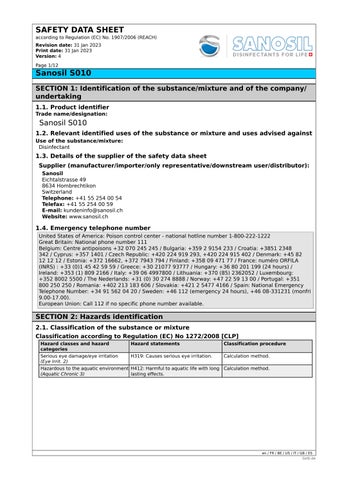
16.4. Classification for mixtures and used evaluation method according to regulation (EC) No 1272/2008 [CLP]
Hazard classes and hazard categories
Serious eye damage/eye irritation (Eye Irrit. 2)
Hazardous to the aquatic environment (Aquatic Chronic 3)
Hazard statements
H319: Causes serious eye irritation.
H412: Harmful to aquatic life with long lasting effects.
Classification procedure
Calculation method.
Calculation method.
16.5. Relevant R-, H- and EUH-phrases (Number and full text)
Hazard statements
H271 May cause fire or explosion; strong oxidiser.
H272 May intensify fire; oxidiser.
H302 Harmful if swallowed.
H314 Causes severe skin burns and eye damage.
H315 Causes skin irritation.
H318 Causes serious eye damage.
H319 Causes serious eye irritation.
H332 Harmful if inhaled.
H335 May cause respiratory irritation.
H400 Very toxic to aquatic life.
H410 Very toxic to aquatic life with long lasting effects.
16.6. Training advice
Persons charged with the handling and cleaning of the product must be trained prior to start their work and in regular intervals. They must be informed about the risks using the product and the mesures to take for efficient prevention. This concerns particularly working security, first aid, health and environment protection.
16.7. Additional information
The above information describes exclusively the safety requirements of the product and is based on our present-day knowledge. The information is intended to give you advice about the safe handling of the product named in this safety data sheet, for storage, processing, transport and disposal. The information cannot be transferred to other products. In the case of mixing the product with other products or in the case of processing, the information on this safety data sheet is not necessarily valid for the new madeup material.
* Data changed compared with the previous version.