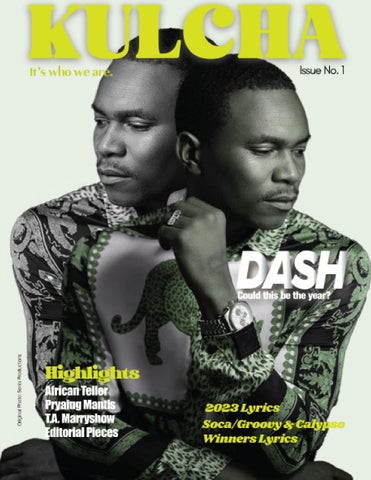
CON TENTS Editor’s Note African Teller
7 10 15
Praying Mantis Cultural Winners Historical Figure Guest Pieces
18 22
26 32
Traditonal Mass Feature Dash
34
37
Terror D’ Governor
image Source: https://virtualexpodubai.com/listen-watch/events/granada-music-in-the-garden
Editor’s note W
elcome to our first edition of Kulcha Magazine. A rhetromodern play on our culture through the years. This magazine hopes to educate local youth of the essential protagonists of our culturethe pillars from where we came; looking at the evolutionary tone of the music, culture & politics. We try our best to bring back past local published pieces pertinent to our cause of educating the present generation. In this edition we pay particular attention to two icons: the African Teller and the Praying Mantis. These two men who dominated Grenadian calypso music for decades. The African Teller known for his unapologetic energy and blatant lyrics calling out the societal ills and committers of wrongs, akin to Rootsman Kelly. Teller told it all, barring no consequences. The Praying Mantis’, music was laced with a pro-African and black consciousness theme. A formidable calypsonian, who spoke truth to power; one of the best who unfortunately never obtained a cultural title at home. He was awarded for his contribution to culture at Dimarche Gras in 2021. We hope this contribution helps highlight his grand career. We move on to an opinion piece carried by a local newspaper, “The Voice” of 2020. A piece on Self-Advocacy-finding your voice again. A reminder that we each ought to do our part for the collective enchancement and progession of our homeland. A bit on the infamous T.A. Marryshow, the father of Caribbean Federation and our present-day CARICOM, which recently celebrated its 50th anniversary on 4th July, 2023. Our dedicated section on two young stalwarts- Dash and Terror D’Governor- a look at their music and a bit of their story. This is more than a magazine, it is a repository of who we are. Do enjoy the pieces brought to you about our young carriers of the cultural light. Learn. Sing. Swing.
**Original content is not cited. Please contact us for any use of uncited work. **Kulcha does not claim the rights any of the produced work- published as educational references.
7
“Everything we hear is an opinion, not a fact. Everything we see is perception, not the truth.”
Grenada Must Live Grenada must live, Is one life she has; Lived over and over again, Through you and me. Making better for the tomorrow, we aspire, to Build and advance, As one people Looking for better. Grenada must live, A life of which the shoulders On which she stands Can be proud. Not far from where they started, Close to ourselves and nature. Close to each in tribe and in tide. Bringing life to each, Moving horizons to beseech. Grenada must live, Not a few, but the many Climbing up a mountain top, Up to see the sunrise, Waiting for sun to hit our eyes, Hand in hand. Is one Grenada we have. The future has come. Grenada must live.
The title of this poem was inspired by the words of George McCalman, at Grenada’s UNLEASH- cultural symposium and that of our current Prime Minister, in his debut speech to the nation.
8
NOWGRENADA-Image source
9
The Great,Teller-
AFRICAN TELLER
African Teller at Dimarche Gras- Image source GBTV.
African Teller live performance- Image source GBTV.
10
T
he last time I had the opportunity of seeing the African Teller, I was sitting at the front of a Bus from Grenville to St. Patrick. I immediately went into J.C.B, Tourist, “never-seecome-see”- mode and whipped out my phone. He was just standing there, chatting with someone. I was in awe, that someone so grand and so mighty would be out in the open, wearing his classic black Rasta cap, fish net t-shirt and shorts. Before this moment, I would have last seen him on TV when I was in my latter primary school years. The photo I got was blurred and I have since lost that phone. With a career that spanned the years 1981 to 2007, ‘the African Teller’ was a controversial figure in the Calypso fraternity, mainly for his out-spoken nature. He was not shy to name names and call out situations in which he saw injustices and biases. He often lamented his frustration as an artist and principal contributor to the carnival economy, by way of his unremitting presence and offerings. He called out his fellow artistes as well, for their lack of nerve to do the same. When I learnt of his passing, I was glum, the very thought that such a giant of culture had departed, left much to the conscience. If you were born before or during the 1980s then, you MUST have known about African Teller. Such a staunch figure of music. A rebel in his own right. A Rasta singing calypso in the 1980s. He often referred to the ones he deemed, at fault as, “Baldheads.” In an interview I happened to see, of another great, Scholar, he said calypso and to a certain extent culture, has nothing to offer any
aspiring individual. And he went on to use African Teller’s passing as a typical example, of how so many great ones have existed life’s stage. Not with so much of a commendation from the very culture they’ve sacrificed for, to the nation that they’ve given all to, and to an artform they loved dearly melding it with their own God-given talent. The Culture, to him, was the last element that consecutive governments thought of and gave priority to. Back to the great Teller. His daughter, “Little Pinky”, whose name later changed to “Pinky,” aimed to follow in his stride, capturing on more than one occasion, the Junior Calypso Monarch title. She too had seen the writing on the wall, and later abandoned the culture to migrate overseas seeking a tier up, away from culture. There are some things that we don’t forget about someone. Of the African Teller, we would remember his dark sunglasses, dreadlocks, his rustic voice, a muscular giant of a being. Let’s not forget his signature phrases, “Mammy Oi”, “La di doi”, “Ah ya yoi”, and “Oh God.” Another telling fact, pardon the pun, was that the African Teller was well known for performing bare feet on stages island wide as well.
His outright protest during his presentation in 1991 “Sing a Calypso”, dedicated to the Great “Meoldy Papitete”, (whose name now embellishes the final calypso Monarch competition in Grenada,) he sat on stage and waited, as a miscommunication betwen host and back-up band got sorted out. Yet again on that occasion he spoke to the mistreatment of calypsonians. He even went as far as ushering one of his fellow artists on stage showing the nation his plight- Ill and forgotten; “Ent nobody gonna treat calypsonians as dirt and throw dem in the garbage pan. Dis nonsense hadda to stop!” -his call to pave a way for the upcoming ones must be heard. Our feature of this giant of an artist is an effort to correct this wrong.
“Not with so much of a commendation from the very culture they’ve sacrificed for, to the nation that they’ve given all to, and to an artform they loved dearly melding it with their own God-given talent.”
The songs “Hutandla “and “Yet We Goin’ Forward” won him the Calypso Monarch title in 1982, just a year after Grenada’s first carnival. More foundational than that, you just don’t get. His song, “Yuh Cock Ain’t Dey” earned him the Roach March title as well. Yet how many know his name and what he did for Calypso? 11
The following is a brief synopsis of some of his most remembered entries into the calypso relm.
“Teller, speaks to the businesses, hotels, governments and promoters-all of whom gain so immensely from their craft, yet contribute a pittance, so very little to its development.” “Sing a Calypso” 1991 This magnitude of a song, spoke to the builders of carnival and the blatant neglect by all stakeholders for the artists and singers. Teller, speaks to the businesses, hotels, governments and promoters-all of whom gain so immensely from their craft, yet contribute a pittance, so very little to its development. He calls out the organizing committee, then, the CDC- Carnival Development Committee (now SpiceMas Corporation), stating that preparation was always “last minute”, and upon the conclusion of the carnival festivities they altogether just -disappeared, vanished, evaporated- you get the drift. Appearing in a ‘sackcloth outfit as part of his presentation, he again lamented the demise of the calypsonian. “Ah say tell dem me brother. Ah say tell dem me brother. La da di di dai Calypso playin’, man everybody jamin’ Carnival comin’ All business stalk-taking, Man dey you want to make 12
some money For if dey hungry But you the calysonian dat create the scenery If you try to ask them for sponsor In a hostile way they will say never! I will always remember. If you want to feel hungry, frustration and poverty, Sing a Kaiso. If you want to be victimised, brother I’m not telling lies, Sing a kaiso. x2 Oh God children. La da di di dai Ah say tell dem mi brother La da di di dai Ah say tell dem mi brother Woi lai, woi lai
Honesty we does preach Yet their achievement is so high, My question remains why? When such fellas dead and gone Dey givinin’ dem state funeral and we Cannot get such thing at all. “If you want to feel hungry, and die in share poverty, Sing a Kaiso. If you want to be victimised, brother I’m not telling lies, Sing a kaiso.”
Tourism, some again they preachin’ With calypso dat dey motivatin’ Foreigners keep coming, tax government collectin’ But not even a scholarship To us dey offerin’ After we contribute ¬so highly to the welfare man of this country There is no reward for we. CDC another deceitful body Man just can’t beat those guys For false diplomacy As soon the time comin’, dey organisin’ As carnival done, Dey ent existing Dat is after dey pocket we dunzee And buyin’ big car and laughing at we, While we children go hungry. Corruption is the politician, But yet adoring dem Dan the calypsonian While they practisin’ lie and thief
African Teller at Dimarche Gras 1991
The following is a brief synopsis of some of his songs. Many carry a tone of admonition and retribution, fully akin to who he was and what his purpose was in culture. Do have a enjoy and reflect.
“Cry Me Down” This song speaks to the victimisation he experienced at the hands of his own people for calling out the societal ills he saw -Cost of living, unemployment, prostitution. The politicians who continue to say one thing and do the other, ‘loafers’ who jump from one political party to another, as they see it a convenience to them. The cases of the Indian population who owns many of the businesses in the country, the case for the general hospital and the state of healthcare in general. “Freedom” A song of the struggle we have as a people from the continent. And the present-day condition of the state of Grenada, asking for tangible freedom and not lip service. “Save the Children”, a reoccurring phrase in his song. He also alludes to the state of African countries worldwide and no aid or recognition for the plight of our people, but decisive and rapid action is given to any other group once help is required. A call to our people to rise up and shine for all to see was made. He addresses exploitation, neglect and the obvious under development of our region. “Ah Giving Dem” A story about rural vendor who went to St. George to sell goods. And was willing to give all things requested from patrons. When he tried to persuade her otherwise, she again reiterated, anything dem boys asked for, “ah giving dem.” The vendor, for emphasis, then went on the numerate the customers she had from the 600 steelband men, the mass band 910 and anything they asked, she had to offer.
“Marimba Feelings” The story of the Martintian visitor who was hooked by the sweet sounds of his calypso and soca, so much so, that she found it difficult to leave his side. Very much akin to Mr. Killa’s “Spice Isle Rock” or “De Boom.” “Political Monkeys” His most outspoken and critical song yet. Naming many whom he saw as ‘jokers’. He also publicly stated the victimisation he suffered for his very own outspoken nature. He named policemen, political parties, political personages of history, calypsonians, and wellknown Grenadians. He calls out the recycling of the individuals within the system as well, a trend all too common in our culture and society. All this to show, according to his stance, that there was no one serious about the political situation of the country. “Same Damn Ting” A rendition about his stance on voting and the political environment of Grenada is dedicated to a hypothetical political aspirant. Prior to entering the league of politics, an apsiring politician would make promises which are never kept once elected. The title “politrickians” was probably coined here. His conclusion was, it didn’t matter which party you voted, all the parties were the same. So, he would abstain from voting all together.
placed as union leaders, ministry workers, Government ministers, lawyers, calypsonians, and foreign businessmen, highlighting the way they all seem to corroborate to aid these tendencies. The cry for fairness in payment of calypsonians was also well formed in this melodious and rhythmic rendition. The great personage of Winston Glasgow, known to many as “African Teller” was born in the Paradise, St. Andrew and died there at the age of 67 in February of 2018, not so long ago. We may have forgotten. His tremendous legacy ought not be forgotten and used as a building block for others to follow. We hope that these pages do just that and allow you to take note of what we came from and where we can go. Some of his other titles include: Santa, Toon Toon Scratching, Every Child has a right to be born, Pan Connection, No Love, Memories, Jestina Wine, Sorry, Jammin De Soca, Do Good, Ligaru, Poor man Cry, The Response, Spread Out, Inflation. If you’d like to go down memory lane, here are a few YouTube Channels to consider for his music: DJ Socaholic, ScorpioPetey and GBTV- Gentle Benjamin.
“I see Satan” This rendition spoke to the corruption of political leaders by placing their friends in critical places of position within government etc. The law of connection and ‘who knows whom’ in full effect. It also spoke to the way people were 13
“The happiness of your life depends on the quality of your thoughts”
14
The Praying, One-
A
PRAYING MANTIS
nother grand personage of the 80s was the Praying Mantis. His bent-knee stride and immensely strong vocals etched with pristine clarity of presentation are some of the few particulars that one can and does not forget about this Calypso titan. I remember the Praying Mantis’ performance of “Rosalyn” with such a vivid imagery, that it is by far, one of my favourites. “Every day Rosa getting worse, and she only singing in God we trust.” Praying Mantis has a voice that one cannot forget and is distinct to him alone. His infamous phrase, “One Love Grenada!” a staple at every performance was familiar to our ears. Born in ‘Crown City’ of St. Patrick, his consistency in delivery and ability to show up year after year, despite
Praying Mantis at Dimarche Gras- Image source GBTV.
not capturing any of the major titles, is emblematic of his love for culture and purpose for his work. Often adorned in African garb, a dashiki, with distinct African patterns- the Praying Mantis was well aware of his ancestral roots and not afraid to remind others of theirs. The last time I saw this great icon, in 2019, at Dimanche Gras (via social media), since childhood, was a bit of a jolt in time. In my mind he was still the strong, vibrant, singer. One always fails to admit that time passes, and that one ages. It was indeed a delight to see him still in form. He was awarded in 2021 for his contribution to culture. One of his most standalone songs is “What is Calypso” which he deleivered in 1990. It gives an intricate explanation of the history of the artform. A history of long ago.
From the plantation, as “Chatwells”, singing the calendar and against slavery. A combination of piccong and extempo. A cultural tradition, redemption song that tells of the history and struggles of the African. Calypso is life, love, giving, a medium, a positive vibration, the first newspaper, the chantwell the first editor and the first mass communication for planning and informing the enslaved rebellions against their self-imposed masters. I have chosen to carry the lyrics to this one because of its strength and information. Please indulge yourselves in the following:
15
“What is Calypso, I want my people to know. For my research shows, it’s history of long ago. So I got to know my grandpapa sang so well That’s why I am sure my ancestor was a chantwell. Singing out, the calendar on the plantation, Yes man, Singing against slavery and bondage and oppression. My people must know the origin of calypso, Sweet combination of the Piccong and Extempo. And they must understand It’s a cultural tradition Handed down from slavery right onto the plantation. And like they never know Calypso is redemption song That tells of the history and struggles of the African. We must be grateful to our ancestors For being so faithful To this worthy cause Now the whole world singing it It was not in vane For is only calypso that could ease the strain. Calypso is life, Calypso is living, Calypso is love, Calypso is giving, Calypso so real and calypso so true To ease up the pain and pressure Mankind going through. What is Calypso Caribbean man understand, It’s a medium and a positive vibration, Let us not forget Calypso was the first newspaper, Radio was not yet The chantwell was the first editor, 16
Was the medium for the mass communication, When they wanted to kill massa and burn down the plantation, My people must know the true history of calypso. Sweet combination of the kalinga and shango And they must understand, calypso is the people’s choice When fighting the oppressor for that was the strongest voice, And we must realize Calypso is the sweetest song Giving praise to society but licks when we’re going wrong. We must be grateful to our ancestors For being so faithful To this worthy cause Now the whole world singing it It was not in vane For is only calypso that could ease the strain Calypso is life, Calypso is living Calyspo is love Calypso is giving Calypso so real and calypso so true To ease up the pain and pressure Mankind going through. What is Calypso? I’m ashamed we do not believe It’s the best folklore that express the way we live, And we too blind to see, Calypso as a rich legacy, To a beautiful page of history Written by the slaves to their future generations, To tell of their sufferings and their emancipation. My people must know the true purpose of calypso That African gift handed down from so long ago And we must understand calypso in this modern stage
Is Africa’s legacy such beautiful heritage, And we must realize calypso is inspiration And it is a special guide for the younger generation”
This giant stalwart has given us such great hits: “Cry Grenada” A tribute to fallen contributors of nation building. He named Sir Gairy, H.A. Blaize and the murdered Maurice Bishop. He continued to cry for fairness in politics, against the societal ills, respect for the artform, sports and our traditions, such as community spirit. He calls for actions of patriotism. He ends by asking authorities once again to respect local calypsonians, their professional contributions to the carnival and their undeniable neglect once the season has concluded. “Portrait” A complaint about the state of affairs in Grenada. Drugs, robbery, the spread of AIDS, lack of jobs, police brutality. He is left to worry about these telling issues in the Country. “I am a Winner” A review of his career and contributions. In 1985, Rosalyn, was to him, a sure win, a question to the audience what went wrong? Since 1983, he’s been trying to win the Dimanche Gras monarch title. He states that in the face of the adversities he will still strive on, declaring though at times, despondent, despite it all, he is still a winner and is hopeful he will one day indeed capture a crown. In 2019, he was awarded a trophy for his contributions to culture
along with the Black Wizard and Flying Turkey, who we will look at tin a subsequent issue of Kulcha. “Blackman” A song dedicated to the fighters against apartheid in South Africa cheering them on, to continue fighting. Black men all over the world, unite as one, stick together; get up, stand up for Soweto. As often done in many of his songs, he links the global African presence to that of Grenada’s. He suggests the fight continues for complete freedom from the plantation.
harmony. “Grenada, Domenica, St. Vincent and St. Lucia we are one is the cry.” He called for one intention, direction, and destiny in the areas for education, agitation and liberation of our region. He further addresses our exportation of who we are, our culture and the importation of foreign ideals.
here is a YouTube Channel to consider for his music: GBTV- Gentle Benjamin.
“Luciann” A figurative song, about cocaine and its detrimental effects. She entered the country from overseas and destroys the brain and minds of our people. “Blood sucker, you vampire, we don’t want here in Grenada.” Stay from Ms. Luciann,…she will drive you insane….if she controls yuh head, well you better off dead.” Praying Mantis at Dimarche Gras- Image source GBTV.
“The International Airport” Dubbed an “economic liberator, Grenada’s saviour, gateway to Grenada’s future,” giving support to the dream once held by Maurice Bishop and his party, to bring an airport to the island. He lists all Caribbean countries, whose airports hold the names of their heroes, and goes on to ask why in Grenada there are no names attached to our Airport. The name of the airport was changed on May 29th 2009 from Point Salines International to the Maurice Bishop International Airport. “Federation” Addresses the political issues surrounding the unification of the region and the lack of cultural
Patrick Paul born in the parish of Sauteurs, St. Patrick. An icon and clearly a man ahead of his time. His lyrics were often linked so ably to international concerns. People who listened to the Praying Mantis’ words were amply informed of not only what happened locally but regionally and internationally as well. A music maker and an opposer of wrongs -societal and global. A constant reminder to all African descendants of our struggle and heritage. A distinct champion for justice in the treatment of calypsonians. Some of his other titles include: Change the world,, Spirit of Carnival, Spice Island Jam, and Cry Freedom.
image source: newtoday-https://www.thenewtodaygrenada.com/local-news/honours-for-flying-turkey-wizardand-praying-mantis/
If you’d like to go down memory lane, 17
1 98 0-2022
Sheldon Douglas “Lash Ah Wood” 2001
Cultural
Winners Power Soca
Sources: madeingrenada.com/Spicemas.com/youtube.com
Terra D Governor “Zen Mode” 2023 Terra D Governor “ Ultra Instinct” 2022 Boyzie “De Return” 2019 Lil Natty & Thunder “ Get in Your Section” 2018 Boyzie “De Intention” 2017 Boyzie “ Bullseye” 2016 Boyzie “ Battalions” 2015 Luni Spark & Electrify “No Mercy” 2014 Boyzie “Mas Everywhere” 2013 Lavaman “Psycho” 2012 Terra Kid “Last Days” 2011 Otis “Tornado” 2010 Mr. Killa “ Swing It Away” 2009 Luni Spark & Electrify “Clear De Way”2008 Luni Spark & Electrify “High” 2007 Baby Killa “Warriors/ Warrior Cry” 2006 Boogie B “Clear d Smoke” 2005 Mr. Killa “Thunder Rags” 2004 Tallpree “Carnival Madness” 2003 Sheldon Douglas “Represent” 2002
Zingo “How Dey Go Stop It” 2000 Sheldon Douglas “Find Something” 1999 Inspector/Scholar “Watch you Conduct/ Belly” 1998 Inspector “Power in the Soca” 1997 Randy Issac “6 for 9”1996 Ajamu “On the Road Again” 1995 Black Wizard “Jump Up” 1994
Calypso
s Groovy Soca
Image source: https://www.pinterest.com/pin/475340935640817596/
Boyzie “Middle finger” 2023 Cryave “Unbothered” 2022 Dash/V’ghn “Ah Tellin Yuh” 2019 Dash “Gifted” 2018 Dash “Hit after Hit” 2017 Dash “No Company” 2016 Shortpree “Dis Mass” 2015 Shortpree “For the Sake” 2014 Black Dan “Whole Day We Jammin’” 2013 Shortpree “Spice Island Summer” 2012 Randu Issac “Put It On Me” 2011 Rankin Marvin “Rent a Tile” 2010 Randy Issac/ Keithy Boi “/ 2009 Yaga “Somebody” 2008 Scholar “Man gone, Man dey” 2007 Baby Killa “ Spice Isle Rock” 2006
Flying Turkey 1976 Flying Turkey 1977 Flying Turkey 1978 Might Survivor 1980 Timpo “We Want we Carnival/Mr. Preacher Man” 1981 African Teller “Hutandla/ Yet We Going Forward” 1982 Lady Cynthia “Trip Down Hell/ The Future of the Revolution” 1983 Flying Turkey “Byron/ Curious Children” 1984 Smokey “Herbie/Love” 1985 Smokey “Make Me Wonder/Save the Youth” 1986 Ajamu “We Shouldn’t Worry/ Calypso Warrior” 1987 Ajamu “My Grenada/ Heat” 1988 Inspector “ Wrong Way/ Me Neighbor” 1989 Ajamu “Do it for the Children/ Double Tenor Girl” 1990 Ajamu “Love/Lick Dem Down” 1991 Ajamu “Changes/ Take That” 1992 Inspector “Big Up/Soca Hurricane” 1993 Black Wizard “Massa/Soca Instruction” 1994 Ajamu “Trouble in World/ On the Road Again” 1995 Scholar “Heroes/Dotishness” 1996 Scholar “Amnesty/Detector Test” 1997 Beast “Stop Confusing Me/ Four King” 1998 Beast “Sacrifice/ Way You Was?” 1999 Darius “Jukking, Can’t Get Fat” 2000 Akima Paul “Mr. Technology/ The Real Prostitute” 2001 Black Wizard “Warrior/ Productivity” 2002 Black Wizard “Political Blight/ Retaliation” 2003
Ajamu “Double Standards/ Until We Start” 2004 Scholar “ Green Card/ Ban Yuh Belly” 2005 Scholar “Free Man in Chains/ Hold What?” 2006 Scholar “Love Life/Man Gone, Man Dey” 2007 Biko “Can’t Understand/Ah Done Wid Dat” 2008 Scholar “Defense/ Mad Man” 2009 Biko “Confidence/ Doh Vex Me” 2010 Pamela Courtney “Vagrrancy/ Agents of Change” 2011 Scholar “Delimit it/ Naked” Keturah George “ Abuse is a Sickness/Calypso Abuse 2013 Ajamu 2014 Ajamu “Provocation/“ 2015 Scholar 2016 Rootsman Kelly 2017 Scholar 2018 Sour Serpant 2019 Scholar 2022 Rootsman Kelly “ Dy Nittin’/ De whole Place” 2023
Road March Temptress- “Toot, Toot”/ Robulous- “In Meh Land” Jab King “High” 2022 No Carnival (Covid) 2020-2021) Runs Jay “Diagnosis” 2019 Lil Natty & Thunder “Get In Yuh Section” 2018??? Lil Natty & Thunder “Top Striker” 2017 Lil Natty & Thunder “Take It To Dem” 2016 Synnah “Jab on Sesame Street” 2015 Squeeze Head “Turbo Charge” 2014 Boyzie “Mass Everywhere” 2013 Boyzie & Luni Spark “Born Troublesome” 2012 Lavaman “So We Day” 2011 Otis “Tornado” 2010 Mr. Killa “Swing It Away” 2009 Myney “1000 Masqueraders” 2008 Berbice “Traffic” 2007 Soca Banton “Over Yuh Head” 2006 Boogie B “Clear D Smoke” 2005 General PP “Never Say Never” 2004 Super P “Do What You Want” 2003 Japs “Helicopter” 2002 Tallpree “Rags Invasion” 2001 Tallpree “Grave, Jail, Hospital” 2000 Sheldon Douglas “Find Something” 1999 Sheldon Douglas “Stamp Up” 1998 Tanglar “Chala Baiti” 1997 Inspector “Madness” 1995 Tanglar “Bouncing Low” 1996 Flying Cloud “Raise Yuh Hand” 1992 Moss International “Jambalaesse Rule” 1991 Ajamu “Open Up” 1990 Skylark “Simple Policeman” 1989 Black Wizard “Soca Feeling” 1988 Squeezy “To Cork Ah Hole” 1987 Inspector “No Kicks” 1986 Flying Turkey “Byron” 1984 Lady Cinty 1983 Snakey Boy “Charmaine Darling” 1982 Timpo “We Want We Carnival” 1981
20
Image source: https://www.pinterest.com/pin/475340935640817596/
Historical Figure Feature The preceeding piece was orginally delievered from the following site- republished here for further reading and thought-https:// reference.jrank.org/biography/Marryshow_Theophilus_Albert.html
“Marryshow publicized the need for independence and laid the groundwork for the Federation.”
T
he Grenadian activist and publisher Theophilus Albert Marryshow (1887– 1958) was an important figure in the campaign for self-determination, not only in his homeland of Grenada but throughout the Caribbean Islands. He was instrumental in helping to form the Federation of the West Indies, a political union that was based, for its five-year existence, in Trinidad and Tobago. Theophilus Albert Marryshow is known in the West Indies as the Father of Federation, contributing in a short-lived attempt to unite many of the region’s English colonies into a single political unit. Although the effort failed and many of the Caribbean islands became independent countries on their own, the Federation was an important step on the road to independence in the region: it was the governing body to which Great Britain granted full self-governing status when relinquishing controlof Grenada and other islands in the area. Through years of newspaper work and speechmaking, Marryshow publicized the need for independence and laid the groundwork for the Federation. Anglicized name sometimes referred to as T.A. Marryshow or T. Albert Marryshow, 22
Marryshow was born Theophilus Maricheau on November 7, 1887, on rural Grenada island. His mother was Eugenia de Souze and his father, Prosper Isaac Maricheau, was a small cocoa farmer. Shortly after his son was christened at a Methodist church in the Grenadian capital of St. George’s, Prosper abandoned his family, leaving the young Theophilus in the care of his mother. After her death in 1890, he was raised by his godmother, a woman named Christine. Christine worked as a housekeeper for a Portuguese-born businessman named Antonio Franco and she eventually married him. Marryshow attended Catholic and Methodist elementary schools in St. George’s but otherwise had no formal education. Nevertheless, he learned to read and write well (while living in a house with no electricity), and apprenticed with a local carpenter. Franco realized that the young man’s talents lay in a different direction, however, and recommended Marryshow for a job with Grenadian newspaper publisher William Galway Donovan.
Nevertheless, he learned to read and write well (while living in a house with no electricity), and apprenticed with a local carpenter.
After working briefly as a delivery boy for Donovan’s ublications The Federalist and Grenada People, Marryshow trained as a printer’s assistant and typesetter. Once the publisher realized that his new employee had unusual literary abilities, he served as his mentor, lending the young man books and sharing magazine articles. Marryshow also became a friend of Trinidadian independence activist Arthur Andrew Cipriani (1875–1945), and both men aided support operations for the West Indian Regiment when it fought for Great Britain during World War I.
Half Irish and half Grenadian, Donovan was one of the early supporters of West Indian independence and what would become the West Indies Federation. Adopting an Anglicized spelling of his surname once he was hired on by Donovan, Marryshow “was readily accepted as an intellectual by all who later came into contact with him,” according to a Grenadian government biography.
Marryshow soon began to write for Donovan’s publications, became involved in local politics, and honed his rhetorical skills as a member of the Grenada Literary & Debating Society. By 1909, then age 22, he had held editorial positions at both the St. George’s Chronicle and the Grenada Gazette.
Shortly before Franco’s death in 1916, Marryshow amassed the resources needed to establish his own newspaper. The first issue of his The West Indian, issued on January 1, 1915, promised readers that the paper would be “an immediate and accurate chronicler of current events, an untrammeled advocate of popular rights, unhampered by chains of party prejudice, [and] an unswerving educator of the people in their duties as subjects of the state and citizens of the world,” as quoted on the Caribbean Elections website. Marryshow also expressed support for a West Indian political union as well as a representative government in Grenada, although he did not yet advocate for independence from Great Britain. He devised the slogan “Educate. Agitate. Federate.” for this new movement, and his newspaper’s motto (as quoted in Sandra Ferguson’s in Life and Work of T.A. Marryshow was “the West Indies for the West Indian.”
“Educate. Agitate. Federate.” In 1917, Marryshow stepped onto the world stage as a writer after South African general Jan Christian Smuts (1870–1950), one of the early architects of South Africa’s apartheid 23
system of racial segregation, gave a speech in London in which he argued for the supremacy of the white race. Marryshow responded with a book-length collection of essays titled Cycles of Civilization: Insights on the Rise and Fall of Nations of Europe, Asia, and Africa to take issue with Smuts’s points. The volume also presciently warned of the rise of chemical weapons during World War I. Although Cycles of Civilization is rare, a copy is held at the Schomburg Center for Research in Black Culture at the New York Public Library. By the early 1930s, Marryshow’s activities began to yield positive results. A proposal to bring about a limited confederation between Grenada and the Leeward and Windward Islands foundered on disagreements between the parties, giving a hint of what was to come. Meanwhile, in 1931, he visited London to discuss new initiatives for Grenadian selfgovernment. When Grenada won approval for a new constitution in 1935, it once again enlarged its Legislative Council. Labor unrest, organized in part by Marryshow, flared across the West Indies in the middle and late 1930s, leading to the establishment of the West India Royal Commission—also known as the Moyne Commission—which detailed the dire conditions facing workers in the region.
“Meanwhile, in 1931, he visited London to discuss new initiatives for Grenadian self-government.When Grenada won approval for a new constitution in 1935, it once again enlarged its Legislative Council. Labor unrest, organized in part by Marryshow.”
23
Elected Labor Group President Marryshow experienced several health problems beginning in the 1930s, and he sold The West Indian in 1935. His financial situation, never stable, would deteriorate in his later years. Nevertheless, he continued to play a leading role in Grenadian politics. In 1946, he was elected president of the Caribbean Labour Congress; he moved that body in the direction of supporting West Indian federation. He continued to push for that goal at the Montego Bay Conference in Jamaica in 1947. Beginning in 1944 he served on the Executive Council of Grenada. A younger, more militant generation of labor and political leaders in Grenada came to the fore in the early 1950s, but Marryshow retained his seat on Grenada’s legislative council. In 1943, as Grenada’s independence movement continued to grow due to Marryshow’s influence, he was made a commander of the Order of the British Empire. According to a Caribbean Elections writer, the former publisher and activist “lived life to the full” and was “a lover of roses, women and song.” As this epitaph alludes, Marryshow never married, but he fathered children by several women, including six by Edna Gittens. He lived on H.A. Blaize Street in St. George’s, where his former home now houses the Grenada Centre of the University of the West Indies. Located across the street are several low-income houses whose construction Marryshow initiated.
“ In 1943, as Grenada’s independence movement continued to grow due to Marryshow’s influence,......”
Marryshow lived long enough to see his dreams of West Indian Federation come true: in January of 1958, the Federation of the West Indies was formed, uniting Grenada, Jamaica, the Cayman Islands, the Turks and Caicos Islands, Barbados, Trinidad and Tobago, the Leeward Islands, and the other Windward Islands. He participated in the negotiations that led to the federation’s establishment, and he was elected to serve in its parliament. He participated in this political body for only a few months before his death on October 6, 1958. The Federation dissolved in May of 1962, and Grenada, where his birthday of November 7 is celebrated as Marryshow Day, achieved full independence in 1974.
University of the West Indies, http://www.open.uwi.edu/sites/ default/files/bnccde/grenada/centre/tam.htm (November 3, 2017), “T.A. Marryshow.”□ (MLA 8th Edition) Caribbean Elections, http://www.caribbeanelections.com/ knowledge/biography/bios/marryshow_theophilus.asp
Marryshow lived long enough to see his dreams of West Indian Federation come true: in January of 1958, the Federation of the West Indies was formed, uniting Grenada, Jamaica, the Cayman Islands, the Turks and Caicos Islands, Barbados,Trinidad and Tobago, the Leeward Islands, and the other Windward Islands. Origianl References:
Periodicals New York Times, October 21, 1958, “T. Albert Marryshow,” p. 33. Washington Post, October 21, 1958, “West Indies Statesman,” p. B2. Online(November 3, 2017), “T.A. Marryshow.” Grenadian Revolution online, http://www. thegrenadarevolutiononline.com/bishmarryshow1982.html (November 3, 2017), “Bishop Speech—Address on Marryshow Day.” Official Website of the Government of Grenada, http://www. gov.gd/biographies/theophilus_marryshow_bio.html (November 3, 2017), “Theophilus Albert Marryshow: The Father of Federation. Theophilus Albert Marryshow website, http://marryshow. name/2016/11/22/life-and-work-of-t-a-marryshow/ (November 22, 2016), Sandra Ferguson, “Life and Work of T.A. Marryshow” (scan of 1979 manuscript). 25
De Beatin’ Beat de drum, beat it hard Make it tell de tings ah doh want to say. Make it scream at de worl’ for doin’ us dat. Beat de dam drum hard. Because dat is de life dey give us After dey wuk us out and leave us here. Make de drum talk. Make it talk it soul case out, Make dem listen, Make dem try to cova dey ears, Force dem to hear de noise in meh chest and de anger in meh head. Lawd know ah cah make it go no way. Every wey ah is, is me dat dere. And dey, dere too, to remin’ me of whey dey put us. Beat de drum and make dem know dat we know fully well, why dey rich so. Beat de drum to empty de pain, Beat de frum to empty the anger, Beat de drum to reconcile de wrong, Beat it loud in dey ears, Make dem unconfortable wid “we noise.”
https://unsplash.com/@mr_chief
Beat it so ah cud cry for the past dey din’ want me to know, Beat it for the past we still doh know. Beat it loud, Beat it strong. But doh stop beatin’ it Until dey tun ‘roun’ and watch, To see, all dat dey dread to see. Let dem watch us rise.
“The weasel and the mice” Over the next few volumes we would feature old adages of culture from Aesop Fables. Many older heads knew these stories maybe reported to them through the ‘Royal Readers’ text book, of which my mother spoke so highly of; Aesop, according to the Great Dominican author, J.A. Rogers, in his book entitled, “World’s Great men of Colour vol. 1”, describes him as, ”flat-nosed….with lips thick and pendulous and a black skin from which he contracted his name Esop being the same with Ethiop).” By all accounts the grand Aesop was not a very attractive individual but had a mind as great as any philosopher, in fact, he can be dubbed the grand-father of philosophy. Here is the first of many to come, with topical reflections on the lessons therein.
A
weasel, inactive from age and infirmities, was not able to catch mice as he once did. He therefore rolled himself in flour and laid down in a dark corner. A mouse, supposing him to be food, leaped upon him, and was instantly caught and squeezed to death. Another perished in a similar manner, and then a third, and still others after them. A very old mouse, who had escaped many a trap and snare, observed from a safe distance the trick of his crafty foe and said, “ Ah! You that lie there, may you prosper just in the same proportion as you are what you pretend to be!” Moral of the story: You become what you pretend to be- but can you live with the consequences?
27
Reflections So many people live lives that are inauthentic and false. Social Media doesn’t help in this regard either. It’s easy to type a fabricated status, send a fake emoji, post a picture which has absolutely nothing to do reality. How have we grown to be a people of falsehoods, rolling with the Jones’, where perception is everything, harbouring everything on the inside- leading to a false sense of belonging and being? We have turned away from who we are. Nothing out there is who we are. Not even our neighbours Jamaica or Trinidad, bless them both but there’s only one Grenada. Who we are is everything that makes us Grenada. Fire stone stories on a moonlit nights have become chats on the blocks; roots-rock late night big people jams have become fete anywhere, anytime; stories within stories, lyrics within lyrics have become blatant with intense description-does it serve us? Looking back at the many contributions of the calypsonians, the African Teller and the Praying Mantis, we were a proud people, yes with societal issues, but we were a proud Grenada. How have we become this misguided and insecure of what being Grenadian means, clamouring for everything foreign which appears to be superior? There is only one us, let’s keep and protect it. Who are a people without a soul, without an identity? All
28
therapists, advocate working on yourself, bettering yourself. If it works, keep it, if doesn’t and let it gobeliefs, leaders, pastors, friends, habits- let them go. We have a challenge ahead, to forge a reunion with ourselves. Let us rise to the occasion, for who we pretend to be, we will easily become.
“Educate the children, it will be easier than punishing the man” 29
Guest Editorial originally from The Grenadian Voice
The shift- It’s time to change your mind. October 9th 2020
SELF-ADVOCACY We begin this article by asking this question, to which we would like our readers to contemplate before proceeding. It may also be helpful to write your response and see how you feel about it later. Why as a people, do we Grenadians lack the skill of self-advocacy to represent our desires, interests, disappointments and wellbeing? We complain to each other, throw words here and there about our discontentment with government, education, salaries, land use and other issues, yet never step up, step out and take ownership for changing the experience. Of course, elections come around and we duplicate our previous choices, expecting different results. We understand that history hasn’t always played its pawns in our favour. After all, we know now that colonialism imposed ownership, power and religion on our people to extract resources and expand political and economic power. 30
We were obliged to submit to aristocracy and bow to those with “better” economic and academic opportunities, while religion told us to keep quiet and just pray. But we’ve been independent for 47 years, so why are we still there? Maybe its time to step up and become the change you want to see? What inhibits your ability to cough up the lump in your throat and confront the issues that are confronting you?
Why as a people, do we Grenadians lack the skill of self-advocacy to represent our desires, interests, disappointments and well-being? One can say that as a people, we have been robbed of Fedon’s courage, Marryshow’s determination, Gairy’s imagination and Bishop’s tenacity – all needed to create a thriving, prosperous civilization here? But who robbed us? Did a ‘ligaru’ (EVIL SPIRIT) enter in the night and suck the soul out of us? No! It’s probably we who gave it up! We most likely gave it up for promises not honoured.
We gave up our souls for glistening droplets which vanished in the sun. As young people we were told “Know your place.” So we chose to be seen and not heard. Now we have become invisible and now we have also grown blind to a lot of things.
Maybe its time to step up and become the change you want to see? What inhibits your ability to cough up the lump in your throat and confront the issues that are confronting you? COVID-19 can be seen as a gift for which we all should be thankful! It has ripped the cataracts from our eyes, uncovered our pretenses and shoved our noses in our own stink (hope this terminology does not offend). What is seen by some as the dilapidation of this country revealed in the blunt undermining of our citizenship, the erosion of the dignity of working men and women, who, after vigorous labour still struggle to move their families forward out of poverty; the dragging feet of
our elderly who still struggle under the burden of their own provision after building us a nation, should offend and insult all of us as a people to the point where we take a stand to stop falling for broken promises.
Speak up, so that our senior citizens could still dream dreams and our youth can still realize their visions. Our refusal to engage front and center is mocked and pushes us into preoccupancy with survival. A skill that is now no match for the coronavirus pandemic economy. So what do you propose now? Do we take one final breath and succumb to the stomping of our hope into the grave of despondency? No! We have to shift before lethargy sets in and passivity, indifference, ignorance and self-absorbance echo our obituaries. Reject a new whiff of the old air, the old way, the old players disguising a new game. All of us deserve to hope, to thrive, to breathe again, so speak up! It’s simple biology, as long as you are speaking you are breathing. Speak up, so that our senior
citizens could still dream dreams and our youth can still realize their visions. Begin right where you are by asking yourself the hard questions: What do I want my life to look like next year? If I could change one element of my life today, what would it be? What and who would I need to create immediate improvements to my family’s quality of life, health and future endeavours? What can I give to my community? What obstacles stand in the way of my progress? What opportunities are available that I can exploit? How do I contribute to the big picture development of my country? What is the legacy I want to leave behind?
We are Grenadians and we are brilliant and capable beyond belief. It is time to think differently, speak expressly, do more and become the change you want to see.
love, music and laughter. We still feel good when our children are happy and healthy. We are Grenadians and we are brilliant and capable beyond belief. It is time to think differently, speak expressly, do more and become the change you want to see. Now is the time for self-advocacy.You are a being, not a doing, so become!
We have a good land which keeps giving us bountiful harvests. We have a heritage of faith that has taken us through the toughest of times. We struggle and still share love, music and laughter.
Take the first steps by seeking information, resources and support. We have a good land which keeps giving us bountiful harvests. We have a heritage of faith that has taken us through the toughest of times. We struggle and still share 31
DASH Our Lyrical Bomber
S
hondell Anthony Amada also known as “Dash” was born on November 10, 1990. He grew up in the community of La Borie, St. Pauls, with his brothers and sisters, where he became involved in many sporting activities; while also developing a deep love and appreciation for music at a tender age. His knack for music was nurtured when he began playing the steel pan for the Commoncheros Steel Orchestra, a band with which he is still an active member. His musical abilities were further harnessed when he joined the Royal Grenada Police Force band, as a lead vocalist and drummer. His musical career began as a Hip-Hop artiste, voicing songs with his group FMTP. After which the group decided to delve into the soca genre in 2013, with their first song in collaboration with Afibah McQueen “Black Majik”. The following year, they composed five songs and entered the National Soca Monarch competition for the first time; however, their road to the crown ended at the preliminary round. Notably, they placed third in the 2014 CC6 Flow Knock Out competition. Then in 2015, after entering the national competition as a solo artiste, Dash advanced to the semifinals. However, it was not until 2016 that he took the airwaves by storm with his hit single “No Company” capturing the title of National Groovy Monarch and also placed fourth in the National Power Soca Monarch competition, with another fan favorite “The Call”. These two songs were further complimented by “Party Habit” and “Mas Start” adding to his catalogue for the 2016 Grenadian carnival season.
Dash’s songs continue to be fan favorites that have transcended the boundaries of Spicemas. Consequently, he has performed at numerous stage shows and events since then, both locally and internationally. Furthermore, he was named “The People’s Champion” by Digicel Grenada and added to their list of national ambassadors. After this accomplishment, Dash continued to becoming a Brand Ambassador for Geo F Huggins Co. Ltd and also a Cultural Ambassador for Grenada. Over the last four years Dash better known as the ‘Lyrical Bomber’ has created history in his small island of Grenada. He is the first artiste to consecutively capture four National Groovy Monarch titles in Grenada over the last four years. He has nurtured his talent into producing melodic songs with deep soul content and undoubtedly has consistently crafted his music to be the best. Dash has continued to deliver exemplary performances throughout the Caribbean, North America and Europe with his catalogue of songs such as ‘Hit After Hit’, ‘Gifted’, ‘Ah Telling Yuh’, ‘What Happen’ and ‘No Company’. In the future the artiste is considering creating his own music band and music institution along with releasing mind blowing collaborations with top Soca Artistes throughout the world.
sing in the shower, it negates class, profession or rank, as the great Bob Marley said, when it hits you, you feel no pain. Dash, reminds us that Soca is undeniably a vibration where we all resonate and it is truly a feeling that just feels rightthe therapy we all need to survive. For in the diaspora, music is often the medium used to connect to home. Every Saturday morning we continue the cleaning ritual to Soca music and we transcend land, space, and time, going back to our time on the road, a jouvert, a Soca Monarch competition moving us in ways we cannot explain. Complete with a violin strings, piano chords, a climatic build up, rhythmic sounds and a crescendo into a set of commands, idyllic for the Soca Monarch stage. A complete song, if there ever was one.
http://www.dsmtheagency.com/portfolio/dash/
In 2023, after a year of pause from competition, Shondell Amada gives us 12 releases which he credits to the Covid pandemic and time. But he has given us his best yet, ‘Soca Vibration’ a complete encapsulation of all that Soca music makes us feel.Yes, it causes us to 35
people up inna place Soca Vibration many We come to set up and the crowd give
Dash
Oh lawd, oh lawd, oh lawd de mass start. Ready up again, Sound the trumpet Ready up again. Oh na oh na na, Oh oh oh It’s just a feeling that just feels right Build de vibes Oh oh oh Just as how we stage side We na bare regular, dis ha big vibes Show dem we vocal! The feeling we does get when we nice Soca leading why you’re acting surprised, The therapy we need for so many to survive. We been saving up for months Anticipating this for months Like when the pressure build up Allu better come lewwe set it alight Bring some light into this fete all the four corners ha light. Keep it right dey, right dey Now do as I say All the true soca lovers represent the right way I see doctor, lawyers and teachers so 36
us, Hold something and turn it up Jump on the ground Jump on the ground Turn it up, turn it round Stomp on the ground Stomp, stomp, stomp Everybody get active inna here Oh lawd, oh lawd It no matter the day or the hour, jumping up in the shower Soca is where we vibrate It does have us pumping for hours, Look at you and the others It’s a feeling we cannot explain. It don’t matter the time ah the month We string up a big sound Fete with the big trailer truck Wey people cah stop jumping Pressure buss pipe and Prayers move mountains So lewwe move something. (x2) Aaaaaaahhh The feeling we does get when we nice Aaaaaa, Aaaaa Oh lawd oh lawd de mass start Aaaaa, Aaaaa,Ohhh ahhhh
S
hem Bernard, gifted with a masterfully composed melody with which he captured his second Soca monarch title. Laced with a violin and metallic guitar strings the repetitive jab based piece entitled “Ultra Instinct” was no wandering from the title; reminiscent of mastery of self-movement, basically sums up what the power does very well. Using Ultra Instinct, the user gains the ability to automatically move as each of their body parts almost feel like they can think for themselves. In tandem with being unconscious and relying entirely on instinct.
Ultra insticnt
Today (x3) Today, we go mash it up (x6)
They can’t stop the unstoppable They can’t move the unmovable They can’t break the unbreakable They can’t shake the unshakable Burn it down! Today (x3) Today, we go mash it up (x6) Everything go mash up, right now Everything go break up, right now Everything rag go turn up, right now Every gal go bend up, right now (x2)
Papa oh, this is not a warning Everything we dragging We got no discipline Jab, Jab, Jab, Jab Today we go mash it up Jab, Jab, Jab, Jab Mama oh, come in like a stampede Lock it down like Covid Who can’t hear, they must feel. Papa oh, Lord look at me crosses People dragging fences Mass like we retarded. Jab, Jab, Jab, Jab Today we go mash it up Jab, Jab, Jab, Jab.
Mama oh, flag up every damn ting Early foreday morning Trouble when the bell ring. 37
Zen Mode Terra D’ Governor
Bonjay, Bonjay, Bonjay Whey allu come out Whey allu from Dis island people love dey soca and dey rum (x2) Bonjay Somebody send out de warnin’ We doh back down for nobody Doh back down for nobody (x2) Ah come here to rip it up and Break it up Lemme mash it up Is my time. Rip it up and Break it up Lemme mash it up Is we time. Doh do de fence dat Ah beg can you put it back Allu better stop dat Doh do de stage dat Ladies come down the speaker box De police go lock it off. Ah love getting high everyday on soca music, soca music Ah said, ah love getting high every 38
day on soca music. Chorus Capital, capital, when jab jab bend up dey say everything gonna fall Capital capital what make the ladies bend dey back when festival? Ah love getting high everyday on soca music, soca music I said, ah love getting high every day on soca music Chorus Ah love getting high everyday on soca music, soca music I said, ah love getting high every day on soca music. Repeat from beginning Whey allu come out......
Documentaries to Watch
For 500 years we have been hearing about the myth of the extinction of the Indigenous people of the Caribbean. This documentary journeys into the island of Dominica to tell the true story of the last remaining Indigenous people in the Lesser Antilles who have lived in the protected community of the Kalinago Territory for generations. The present population is estimated to be about 3000 people. Despite the harrowing experience of European invasion and colonialism beginning with Christopher Columbus, the Kalinago have survived these
destructive genocidal attempts and are still here today celebrating their history and culture. The story unfolds around the life of Honorable Minister Cozier Frederick as the first representative of the Kalinago in the Dominica national government and United Nations who is working towards improving the socioeconomic condition, the preservation, and promotion of the cultural heritage of the people of the Kalinago Territory.
Teddy Frederick, Producer & Director
Source: https://filmfreeway.com/NEWLAND-THEKALINAGODREAM
Books to Read
Gramers to Insta
Grenada National Trust
A to Z Grenada Heritage John Angus Martin
In Grenada, what do you see? Helle Hood-Julien
Know your Caribbean
39
Photo Credit: Hugh Whyte
Fisherman at Grand Mal