Issue # 748
AFRIC A N
C OM M UN I T Y
www.mshale.com
N EWSPA PE R
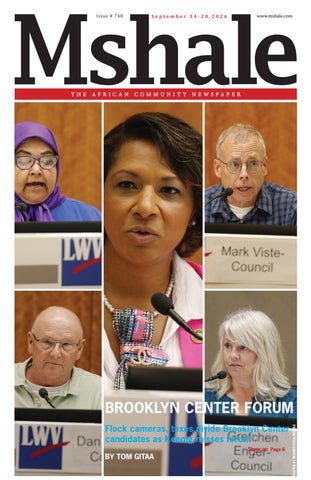
BROOKLYN CENTER FORUM Flock cameras, taxes divide Brooklyn Center candidates as Koenig misses forum BY TOM GITAA
Story on Page 6
PHOTOS BY RICHARD OOGA/MSHALE
THE
September 14-20,2026
2
Mshale - The African Community Newspaper
www.mshale.com
September 14-20, 2026 Issue 748
Eight Minnesota law enforcement agencies have signed agreements with ICE. Here’s what they do Eight agencies across seven counties have entered ICE’s 287(g) program, but the legal status of some agreements is disputed under Minnesota law. By Mshale Staff Eight Minnesota law enforcement agencies have signed agreements with U.S. Immigration and Customs Enforcement that allow specially trained local officers to perform certain federal immigration enforcement functions, though two counties say their agreements are no longer valid. The agreements are part of ICE’s 287(g) program, named for the section of federal immigration law that allows the agency to delegate specified immigration enforcement duties to state and local law enforcement officers under ICE supervision. The Minnesota agencies that have signed agreements are the Cass County Sheriff’s Office, Crow Wing County Sheriff’s Office, Freeborn County Sheriff’s Office, Isle Police Department, Itasca County Sheriff’s Office, Kandiyohi County Sheriff’s Office, Mille Lacs County Sheriff’s Office and
Sherburne County Sheriff’s Office. Together, they are located in seven counties because both the Mille Lacs County Sheriff’s Office and Isle Police Department operate in Mille Lacs County. Crow Wing County has signed agreements under two different 287(g) models. The agreements do not all give local officers the same authority. ICE currently operates three models. Under the Task Force Model, designated local officers may exercise limited federal immigration authority while performing routine law enforcement duties or participating in operations with ICE. The Warrant Service Officer model authorizes designated officers to serve and execute ICE administrative warrants on people
The Crow Wing County Sheriff’s Office in Brainerd, Minnesota. The sheriff’s office has signed agreements with U.S. Immigration and Customs Enforcement under both the Task Force and Warrant Service Officer models of ICE’s 287(g) program. Photo: Courtesy of Crow Wing County
already in their agency’s custody. The Jail Enforcement Model allows trained officers working in a jail or correctional setting to identify and process people who may be subject to removal from the United States. In Minnesota, the agencies and models are: Cass County Sheriff’s Office: Task Force Model Crow Wing County Sheriff’s Office: Task Force Model and Warrant Service Officer Freeborn County Sheriff’s Office: Warrant Service Officer Isle Police Department: Task Force Model Itasca County Sheriff’s Office: Task Force Model Kandiyohi County Sheriff’s Office: Warrant Service Officer Mille Lacs County Sheriff’s Office: Task Force Model Sherburne County Sheriff’s Office: Jail Enforcement Model The status of some of the agreements has become complicated by a dispute over whether Minnesota sheriffs have the authority to enter them without approval from their county boards. Minnesota Attorney General Keith Ellison’s office issued a formal legal opinion in December concluding that Minnesota sheriffs do not have the authority to enter 287(g) agreements with ICE on their own. The opinion, requested by Ramsey County Attorney John Choi, found
ICE
Cont’d on Pg. 2
Mshale - The African Community Newspaper
www.mshale.com
September 14-20, 2026 Issue 748
Guest Commentary by Dominic Boston II
3
Young Black men suffering in silence a curse that can be broken As a young Black man, this topic is personal to me.
Living with that kind of pressure affects your mental health, whether people realize it or not.
When people discuss mental health, they usually don’t picture someone who looks like me. Instead, Black men are often seen as strong, tough, or able to handle anything life throws at us. Growing up, I was taught exactly that.
Constantly feeling like you have to prove you are not a threat is exhausting. Always feeling like you have to be perfect just to be treated fairly takes a toll.
My elders always told me to be strong. If I got hurt, I was told to get back up. If I was upset, I was told not to cry. Showing emotion wasn’t encouraged. It was seen as a weakness.
Those experiences create anxiety, fear, and stress that many young Black men carry every single day, even if they never talk about it.
Looking back now, I realize I wasn’t just being taught how to be a man. I was being conditioned to hide my emotions. I was taught to believe that strength meant staying silent, no matter how much pain I was carrying.
I also think these experiences help explain why some young Black men feel disconnected from politics and voting.
I know my family wasn’t trying to hurt me. They wanted me to survive in a world that has never been easy for Black men. They wanted me to be prepared for life’s challenges. But somewhere along the way, being strong became confused with pretending everything was okay. Instead of talking about our feelings, we learned how to bury them. Instead of asking for help, we learned how to deal with everything on our own. The problem is that emotions don’t disappear just because you ignore them. They stay with you, and eventually, they find another way to come out. I believe that is the reality for many young Black men today. We’re expected to carry the weight of our families, our communities, our schools, our work, and our lives without ever breaking down. People admire our strength, but they rarely ask how much it costs to always be strong. The truth is, many of us are hurting in silence because we’ve spent our entire lives believing that is what real men are supposed to do. For many Black boys, those lessons start early. Some grow up in neighborhoods where hearing gunshots or seeing police lights is normal. Others lose friends or family members before they are even old enough to understand why. Some are raised in communities where violence, poverty, and limited opportunities are part of everyday life. When you’re constantly worried about making it home safely or helping your family make ends meet, you don’t always have time to process your emotions. You focus on surviving.
Before some people even hear us speak, they have already made assumptions. Many Black men know what it feels like to be watched while shopping, stereotyped because of the clothes they wear, or judged simply because they are Black. On top of that, many of us grow up having conversations with our parents about how to act if we are ever stopped by the police. We aren’t taught those lessons because our parents don’t trust us. We are taught them because our parents are afraid of what could happen if someone else doesn’t see our humanity.
Join the Mshale Text Club: Text AFRICA to 24587 or follow us onTwitter.com/Mshale Community News, updated daily on Mshale.com © 1995-2026 Mshale Communications, Inc. Mshale – The African Community Newspaper Editorial & Corporate Office: 2 E Franklin Ave., Suite 9 Minneapolis, MN 55404 Mailing Address: P.O.BOX 80071, Minneapolis, MN 55408 Tel: 612-454-5648 Email: mshale@mshale.com www.mshale.com
President & Publisher: Tom Gitaa Contributing Editor: Edwin Okong’o Staff Writers: Kwot Anwey Cynthia Simba, Panashe Matemba-Mutasa Contributing Writers: Susan Budig, Lizzy Nyoike Design & Layout: Staff
You see schools that need more resources, neighborhoods that deserve more investment, and communities asking for change year after year. After a while, some people stop believing anyone is listening. But I also believe that is exactly why voting matters. The people we elect make decisions about education, mental health funding, affordable housing, community programs, healthcare, and criminal justice. Those decisions directly affect neighborhoods like mine and families like mine. If we want things to change, we can’t sit back and expect someone else to make those choices for us. Our voices matter, and our votes do too. One of the biggest changes that needs to happen is the way we talk about mental health. We have to stop teaching young Black boys that crying makes them weak. We have to stop acting like asking for help is something to be embarrassed about. Real strength isn’t pretending you’re okay when you’re not. Real strength is being honest enough to say you’re struggling and courageous enough to ask for help. As I continue growing into the man I want to become, I’m learning that strength and vulnerability can exist at the same time. I can be determined, hardworking and resilient while still being honest about my emotions. I don’t have to carry everything by myself, and neither does the next generation of young Black men. It’s time we change the conversation.
Then there is the way society sees us.
If you have spent your whole life watching your community struggle no matter who is in office, it is easy to believe that your vote won’t change anything.
Photographers: Richard Ooga, Jasmine Webber, Bethel Gessesse Distribution: Bluebird
Mshale is published weekly on Monday. It is available every Monday for free at most African stores , African restaurants and metro area county libraries. Mailed subscriptions are $60 per year. Memberships: Minnesota Multicultural Media Consortium (MMMC) , Pan African Business Alliance (PABA).
The editor welcomes letters, opinion pieces and commentary on issues of interest to the African community in North America. Contributions must be typed and will be edited for clarity and space. Submissions can be mailed or submitted online at www.mshale.com
Instead of only telling young Black boys to be strong, we should also tell them it’s okay to cry. It’s okay to talk. It’s okay to heal. Because when we create a generation of men who feel safe expressing themselves, we aren’t making them weaker. We are giving them a better chance to live healthier, happier lives. And that is the kind of strength our communities have needed all along.
4
Mshale - The African Community Newspaper
www.mshale.com
September 14-20, 2026 Issue 748
Prostate cancer is twice as likely to kill Black men. Talking to your doctor could help save your life By Dr. Robert Winn
Cancer Society is working with health systems and professionals in your community to help remove barriers in the fight against the disease.
September is Prostate Cancer Awareness Month, and as both a Black man and a cancer center director, I know many men in our community think it’s bad luck to talk about cancer. But I’m here to tell you it’s bad luck not to talk about it.
We can help you find low-cost or free screening locations. And for men who need cancer treatment, the American Cancer Society can reduce the financial burden of traveling to medical appointments by providing free rides and, if you live far away from where you receive treatment, a free place to stay.
We, Black men in the U.S., are nearly 70% more likely than White men to be diagnosed with prostate cancer. We’re also twice as likely to die from the disease. But I’m telling you, if you’re diagnosed early, you can still enjoy a long, happy life doing the things you love, whether that’s playing with grandkids or staying active in your community. That’s because although it can become a serious illness, most men diagnosed with prostate cancer won’t die from it. In fact, more than 3.5 million U.S. men who’ve been diagnosed with prostate cancer are still alive today. And when it’s diagnosed early, you boost your odds of survival. It’s that simple. Generally, prostate cancer is most likely to develop after age 50, but when it develops in Black men, they tend to be younger. That means we need to be on the ball about understanding our personal risk. The risk factors include a family history of prostate cancer and certain genetic
Forum
Cont’d on Pg. 2
that county boards of commissioners may enter such agreements under Minnesota’s Joint Exercise of Powers Act. It also concluded that a 287(g) agreement does not give local law enforcement broader detention authority under state law and does not permit officers to hold someone solely on an ICE civil immigration detainer if Minnesota law otherwise requires the person’s release. Cass and Itasca counties subsequently said their agreements were no longer valid because their county boards had not approved them. Cass County Administrator Josh Stevenson told KAXE in January that county officials considered the sheriff’s agreement “null and void” following the attorney general’s opinion and that there were no plans to bring it before the county board. Itasca County Sheriff Joe Dasovich similarly told the station that his department’s agreement had never been approved by the Itasca County Board and that he had no plans to seek approval. Freeborn County took a different route. Sheriff Ryan Shea signed a
health risks that come from a parent. When it comes to family medical history, we need to get a lot better at talking. For me, it turned out I had uncles who’d died from prostate and other cancers, but I didn’t always know that, so I couldn’t use that information to help me make smarter screening choices. The American Cancer Society recommends that African American men speak with their doctor at age 45 about whether prostate cancer screening is right for them. Men at even higher risk should have that discussion at age 40, especially those with one or more close relatives who were diagnosed at an early age. Look, I get that no one looks forward to a screening, but it 287(g) agreement with ICE in March 2025 without prior approval from the Freeborn County Board. After Ellison challenged the authority of sheriffs to enter such agreements on their own, county commissioners unanimously approved a resolution ratifying the agreement. Four Freeborn County taxpayers subsequently sued the county, challenging the agreement under Minnesota law. A federal judge in May sent the case back to state court without deciding whether the agreement itself was legal. Crow Wing County, meanwhile, has agreements under both the Task Force and Warrant Service Officer models. The sheriff’s office has continued cooperating with federal immigration authorities despite the attorney general’s opinion. The Mille Lacs County Sheriff’s Office participates under the Task Force Model, while Isle Police Department, a municipal agency in the same county, has a separate Task Force Model agreement. Isle Police Chief Mark Reichel said earlier this year that ICE encouraged his department to join the program. The Minnesota agreements are part of a rapid nationwide expansion of the 287(g) program under President Donald Trump.
typically starts with just a simple blood test, called a prostatespecific antigen, or PSA. Even if you end up needing a digital rectal exam, it takes less than a minute and could save your life. So, what I say to people is, what’s the price of your life? Isn’t it worth a minute of being uncomfortable? Brothers, this is essential for you to know: just because you’re feeling good doesn’t mean you don’t have early-stage prostate cancer. By the time you start to actually experience symptoms, the disease could be at an advanced stage and might be harder to treat.” Prostate cancer is significantly impacting our fathers, our brothers, and our sons. That’s why the American
When it comes to prostate cancer screening, one size doesn’t fit all. So, it’s important for all men – and especially Black men – to talk to their doctor about what’s best for them based on their age, risk, and health history. Please make that appointment, because we don’t want you to risk missing out on the best years of your life. For more information, call the American Cancer Society’s 24/7 helpline at 1-800-2272345 or visit cancer.org. Dr. Robert Winn is a nationally recognized physician-scientist and researcher. He currently serves as cancer center director at Temple Health’s Fox Chase Cancer Center. Since 2021, he has served on the board of directors for the American Cancer Society, a leading cancerfighting organization with a vision to end cancer as we know it, for everyone.
An executive order Trump signed on his first day back in office directed federal immigration authorities to expand agreements authorizing qualified state and local officers to perform immigration enforcement functions “to the maximum extent permitted by law.” ICE has since mounted an aggressive recruitment effort aimed at local law enforcement agencies. Its 287(g) website includes information for sheriffs and police chiefs interested in joining the program and even guidance titled, “How Can I Convince My Chief or Sheriff to Participate in 287(g)?” ICE reported 2,462 agreements nationwide covering 39 states and two U.S. territories as of Sept. 4. The total included 1,733 Task Force Model agreements, 549 Warrant Service Officer agreements and 180 Jail Enforcement Model agreements. The agency also releases monthly reports highlighting people encountered by participating 287(g) agencies. Its August report featured cases from around the country but none from Minnesota. ICE cautions, however, that the cases included in the monthly report are only a sampling of encounters and not a comprehensive list of activity by participating agencies.
Sheriff Ryan Shea signed a 287(g) agreement with ICE in March 2025 without prior approval from the Freeborn County Board. Photo: Courtesy Freeborn County
The 287(g) program is separate from federal immigration enforcement operations such as Operation Metro Surge in Minnesota. Under 287(g), local or state officers receive specified federal immigration authority through formal agreements with ICE. Federal operations such as Metro Surge are conducted by federal immigration officers, whether or not local agencies participate in 287(g).
Mshale - The African Community Newspaper
www.mshale.com
September 14-20, 2026 Issue 748
5
Brooklyn Park seeks applicants for opening on independent Charter Commission By Mshale Staff
The City of Brooklyn Park is accepting applications through Sept. 18 for an opening on its Charter Commission following the resignation of Commissioner Shamara Freeman. The Charter Commission is an independent body that reviews the city’s governing charter and recommends changes to how municipal government operates. Unlike Brooklyn Park’s other city commissions, whose members are appointed by the City Council, members of the Charter Commission are appointed by the chief judge of Hennepin County District Court. The person appointed to replace Freeman will serve the balance of her term, which expires May 31, 2028. Applicants must be qualified voters and residents of Brooklyn Park. No previous experience is required. As a home-rule charter city, Brooklyn Park operates under a charter that establishes the framework for its municipal government. The Charter Commission is responsible for reviewing that governing document and recommending changes when needed. The 11-member commission monitors and periodically reviews the charter and recommends amendments when necessary. Its work can involve elections, the powers and procedures of the mayor and City Council, taxation and finance, and other provisions governing city operations. The commission also has authority to propose charter
Brooklyn Park City Hall. The city is accepting applications through Sept. 18 for an at-large opening on the Brooklyn Park Charter Commission. Unlike other city commissions, Charter Commission members are appointed by the chief judge of Hennepin County District Court. Photoo by Tom Gitaa/Mshale
amendments for consideration by voters. The commission has recently been considering several issues involving city government, including compensation for the mayor and City Council and proposed amendments to the city charter. At its Aug. 12 meeting, commissioners received a recommendation from a workgroup to increase the mayor’s annual salary from
$21,995 to $36,000 and council member salaries from $12,578 to $13,500. Charter commissioners serve four-year terms and represent the city at large. The commission generally meets on the second Wednesday of each month at 7 p.m., and the city estimates the time commitment at about three hours per month.
Applications are available through the City of Brooklyn Park’s website or may be picked up at City Hall. For questions, residents may contact City Clerk Devin Montero at devin.montero@brooklynpark.org.
MEDICARE AND MEDICAL ASSISTANCE (MEDICAID) COMBINED
Get one easy $0 premium plan with added benefits. Check if you qualify 1-866-925-4503, TTY 711
bluecrossmn.com/ExploreMSHO
H2425_072126_K01_M SecureBlueSM (HMO SNP) is a health plan that contracts with both Medicare and the Minnesota Medical Assistance program to provide benefits of both programs to enrollees. Enrollment in SecureBlue depends on contract renewal.
or Civil.Rights.Coord@bluecrossmn.com 1-888-740-6013, TTY 711 Discrimination is against the law. Blue Plus will accept all eligible Beneficiaries who select or are assigned to Blue Plus without regard to medical condition, health status, receipt of health care services, claims experience, medical history, genetic information, disability (including mental or physical impairment), marital status, age, sex (including sex stereotypes and gender identity), sexual orientation, national origin, race, color, religion, creed or public assistance status. Blue Cross® and Blue Shield® of Minnesota and Blue Plus® are nonprofit independent licensees of the Blue Cross and Blue Shield Association.
6
Mshale - The African Community Newspaper
www.mshale.com
September 14-20, 2026 Issue 748
Flock cameras, taxes divide Brooklyn Center candidates as Koenig misses forum
Mayoral candidate Alexander Koenig did not attend as candidates debated an 8% proposed property tax levy increase, police surveillance technology and the city's response to federal immigration enforcement By Tom Gitaa Mshale Brooklyn Center candidates drew sharp distinctions Tuesday over police surveillance cameras, property taxes and the city’s response to federal immigration enforcement, offering voters some of the clearest differences yet in races that will determine the city’s next mayor and two City Council members. But only one of the city’s two mayoral candidates was there to make her case. City Councilmember Teneshia Kragness joined all four council candidates — Gretchen Enger, incumbent Councilmember Dan Jerzak, Nahid Khan and Mark Viste — for the roughly 80-minute forum hosted by the League of Women Voters of Brooklyn Park, Osseo and Maple Grove at Brooklyn Center City Hall. Alexander Koenig, who is challenging Kragness for mayor, did not attend. At the conclusion of the forum, the moderator said Koenig had been invited but did not participate. She did not give a reason for his absence. Mshale emailed and texted Koenig Wednesday morning and attempted to reach him by phone, leaving a voicemail seeking an explanation for his absence and asking whether he had notified
Brooklyn Center mayoral candidate Teneshia Kragness, left, and City Council candidates Dan Jerzak, Gretchen Enger, Nahid Khan and Mark Viste participate in a League of Women Voters candidate forum Tuesday, Sept. 8, 2026, at Brooklyn Center City Hall. Mayoral candidate Alexander Koenig did not attend the forum. Photo by Richard Ooga/Mshale
forum organizers in advance. He did not respond before publication. The forum came less than two weeks before early voting begins Sept. 18 in races that will shape the leadership of one of Minnesota’s
Candidates split over Flock cameras
most diverse suburbs. The Nov. 3 election will determine who succeeds Mayor April Graves, who is not seeking reelection, and which two of the four council candidates win the city’s two at-large seats.
The clearest divide of the night
Forum
Cont’d on Pg. 6
Refugee and Immigrant Helpline TRAVELING INTERNATIONALLY?
Malaria can be just a plane ride away. Medications, repellent, bed nets, and more can protect you from malaria and other diseases spread by mosquitoes. Visit your doctor or travel clinic as soon as you know you are traveling. health.mn.gov/travel Image may not depict current travel requirements.
Welcome to Minnesota!
1-800-814-4806 Call today for information about jobs, food, housing, legal help and more.
Mshale - The African Community Newspaper
BUILD
www.mshale.com
September 14-20, 2026 Issue 748
Cont’d on Pg. 6
7
emerged over Brooklyn Center’s use of automated license plate readers, commonly known as Flock cameras. Viste said he initially had been open to the technology but changed his position after talking with residents and learning more about how it works. “I think the best thing to do is to stop their use,” Viste said, arguing that the technology is more invasive than many residents realize. “If we are going to be building a surveillance state, that needs to be a council decision with robust residents’ input,” he said. Khan also expressed concerns about surveillance and said the council should examine the technology further before allowing its continued use. “We do not want a police state,” Khan said, calling for a community discussion about the cameras and how information they collect can be used. Jerzak defended the cameras as an effective law enforcement tool that has helped police investigate crimes and locate vehicles, while acknowledging concerns about privacy. He pointed to an independent audit of the city’s system and policies governing its use.
Brooklyn Center residents listen as mayoral candidate Teneshia Kragness and City Council candidates Dan Jerzak, Gretchen Enger, Nahid Khan and Mark Viste participate in a League of Women Voters candidate forum Tuesday, Sept. 8, 2026, at Brooklyn Center City Hall. Mayoral candidate Alexander Koenig did not attend the forum. Photo by Richard Ooga/Mshale
Enger also supported continued use of the cameras with oversight, citing restrictions on access and the system’s 30-day data-retention period.
must be protected. She also said more public education is needed about what the cameras can and cannot do.
Kragness took a more conditional position. She said police should have access to technology that helps them do their jobs but that residents’ privacy
Brooklyn Center police deployed 10 automated license plate readers with funding from a Minnesota Auto Theft Grant. An independent audit conducted last year found the system
compliant in major areas including data collection, retention, access controls and interagency sharing, while identifying an issue involving breach-notification procedures.
Taxes and the city’s financial position produced another dividing line as candidates debated how aggressively Brooklyn Center should cut spending, seek new revenue or
An 8% levy proposal hangs over the race
Forum
Cont’d on Pg. 8
Who adopted who? Adopt a teen. You can’t imagine the reward.
8
Mshale - The African Community Newspaper
Forum
Cont’d on Pg. 8
ask property owners to pay more. The discussion comes as city officials consider a proposed 2027 budget calling for an 8% increase in the property tax levy, from about $28.3 million this year to $30.5 million next year — an increase of roughly $2.26 million. For a median-valued residential homestead, estimated at $290,300 next year, the city projects its share of the property tax bill would rise from $1,679 to $1,892, an increase of $213. If the home’s value remained unchanged, the city estimates the increase would be about $142 annually. The proposal is not final. The City Council is scheduled to consider the proposed 2027 General Fund budget and property tax levy Sept. 28, with final adoption scheduled for December. Viste cited the proposed 8% increase during the forum and questioned whether residents should bear the cost of replenishing the city’s Capital Reserve Emergency Fund. City budget documents show the proposal includes $260,000 for the fund.
should be consolidated or eliminated. Khan said alternative responders can help de-escalate situations in which sending an armed police officer may not be the best initial response. Enger said she “100%” supports expanded response, particularly for mental health calls, but wants the city to measure whether people are successfully connected with services, whether the programs reduce demand on police and whether taxpayers are getting results. Jerzak also supported multiple response options but suggested Brooklyn Center consider regional partnerships where they could reduce costs. Viste argued that the city may need more social workers, not fewer, particularly to ensure appropriate responders are available beyond limited hours. The city’s proposed 2027 budget would add one embedded mental health professional to the General Fund.
www.mshale.com
only be described as traumatic, chaotic, inhumane and a failed policy at its worst,” Jerzak said. “There’s no excuse for it.”
September 14-20, 2026 Issue 748
Viste went further in questioning whether simply declining to participate in federal immigration enforcement is enough. He noted that Brooklyn Center police do not assist U.S. Immigration and Customs Enforcement with civil immigration enforcement but argued the city should take a more affirmative position in support of residents who feel threatened. Viste said that when ICE was “pulling people out of their homes,” merely declining to assist federal agents was not the same as supporting residents. He said vulnerable residents should know that “the city supports them and wants to defend them,” rather than viewing city government as neutral. Brooklyn Center has said its police officers do not enforce civil immigration laws, participate in federal immigration raids or deportation efforts, detain
Khan argued that Brooklyn Center has relied too heavily on property owners and should more aggressively pursue grants and other state and federal funding.
Mshale previously reported that Citizens for Safer Cities, a political committee funded primarily by apartment-owning companies, made independent expenditures supporting Koenig in the mayoral race and Enger and Jerzak in the council race. The committee reported spending $5,589.60 supporting Koenig ahead of the August primary and $2,824 each supporting Enger and Jerzak. Independent expenditures are made without coordination with the candidates they support.
Housing affordability was among the concerns she said she hears most frequently while campaigning, particularly from longtime homeowners worried about whether they can afford to remain in the city.
Kragness, an accountant who repeatedly emphasized her financial background, said eliminating employees should be among the city’s last options when balancing its budget.
Kragness described the programs as additional tools rather than services that
Viste did not identify the candidates or groups by name.
She said public safety extends beyond policing, argued that Brooklyn Center should turn vacant and underused property into new businesses and housing, and emphasized helping residents build generational wealth.
Enger rejected framing the choice as simply raising taxes or cutting services. She said city officials should examine whether services are required, whether they protect health and safety, what results they produce and what would happen if they were eliminated.
The candidates found considerably more common ground on Brooklyn Center’s use of mental health professionals and other alternatives to sending police officers to every call.
“These special interests seek to install candidates ready to prioritize business interests over our residents,” Viste said.
Kragness, who serves as mayor pro tem, framed her campaign around what she called “public safety, pride and prosperity.”
Jerzak emphasized prioritizing essential city services. He said the city cannot control rising household costs such as groceries and gasoline but can control how it spends taxpayers’ money.
Broad agreement on alternatives to police
Although Brooklyn Center municipal races are nonpartisan, Viste identified himself, Kragness and Khan as candidates supported by the DFL and contrasted them with candidates he said were benefiting from “special interest money.”
Koenig’s absence left Kragness as the only mayoral candidate answering questions throughout the forum.
She earlier described a city budget as “not a mathematical exercise, but a moral document,” saying spending decisions reflect what city leaders value.
The proposed budget illustrates some of those trade-offs. It includes four additional firefighters and an embedded mental health professional. After outside revenue is applied, the firefighters would add about $406,000 to the levy and the mental health position about $31,000.
The night’s most pointed political attack came during Viste’s closing statement.
Kragness gets the mayoral stage to herself
“Our property tax is tapped out,” Khan said.
She suggested discretionary expenses, including the city’s fireworks display, should be considered for cuts before employees or essential resources.
Outside campaign spending enters the debate
The forum also produced an unusual moment between Kragness and Jerzak, who have served together on the council. Brooklyn Center mayoral and City Council candidates participate in a League of Women Voters candidate forum Tuesday, Sept. 8, 2026, at Brooklyn Center City Hall. Clockwise from bottom left is Dan Jerzak, Nahid Khan, mayoral candidate Teneshia Kragness, center photo, Mark Viste and Gretchen Enger. Mayoral candidate Alexander Koenig did not attend the forum. Photo by Richard Ooga/Mshale
Jerzak said he and Kragness have disagreed on issues but told her he believed she would be able to bring council members together if elected mayor.
Candidates address ICE enforcement
“I do believe that if you’re elected, you will do a good job of bringing us together,” Jerzak said.
Immigration produced some of the forum’s strongest language when candidates were asked how Brooklyn Center could ensure immigrants and other vulnerable residents feel safe interacting with police officers and city employees. Jerzak sharply condemned recent federal immigration enforcement in Minnesota. “What happened with the ICE invasion that occurred in Minnesota, no matter what side you’re on, can
people solely on ICE requests or share a person’s undocumented status with federal immigration authorities. Khan called for rebuilding the city’s community engagement efforts, educating immigrant residents about their rights and increasing diversity among city employees and police officers. Enger emphasized rebuilding trust with residents who may be uncomfortable interacting with law enforcement, while Kragness said residents should be treated fairly and with the same dignity city officials would expect for themselves.
Kragness finished first in the Aug. 11 mayoral primary with 52.86% of the vote. Koenig advanced with 19.71%, edging Councilmember Laurie Ann Moore by seven votes for the second spot on the November ballot. In the council primary, Enger finished first with 17.72%, followed by Jerzak with 17.22%, Khan with 13.62% and Viste with 10.98%. Voters will elect two of the four in November. Early voting begins Sept. 18 at Brooklyn Center City Hall. Election Day is Nov. 3.
Mshale - The African Community Newspaper
www.mshale.com
Religion
September 14-20, 2026 Issue 748
9
At NBCUSA denominational meeting, leaders, advocates and AOC urge midterm voter turnout By Adelle M. Banks Religion News Service The leader of the National Baptist Convention USA Inc., a historically Black denomination, said gerrymandering threatened to “destroy” the power of voters, in a plea for turnout in the midterm elections this fall. “You got to get back up and fight for your vote,” NBCUSA President Rev. Boise Kimber continued in his presidential address on Thursday (Sept. 10), the last day of the denomination’s annual meeting in Orlando, Florida, this week. “Supreme Court has become the puppets of the land, but you got to get back up and fight until justice roll down like waters and righteousness like an ever-flowing stream,” Kimber said, referencing a verse from the Bible’s Book of Amos. “They’re trying to make voting difficult, but you stand in line if you got to stand all day. You are immovable.” Kimber’s remarks came after two earlier days of the meeting featured representatives of partner organizations highlighting ways the Baptists in attendance and their church members at home can work together on get-outthe-vote efforts. The strategizing at the meeting, attended by about 8,000 people, occurred in the wake of a Supreme Court decision earlier this year to gut
A choir performs during the National Baptist Convention USA Inc. annual session in Orlando, Florida. Photo: Courtesy of National Urban League and NBCUSA
“I want you to vote for the 1.5 million children who had food taken off of their tables in the last year because of SNAP cuts,” Wilson said on Wednesday, adding that many students are also at risk of losing access to free school meals. Wilson shared resources from the Children’s Defense Fund, including a 12-page voter action guide designed
U.S. Rep. Alexandria Ocasio-Cortez, left, and the Rev. Starsky Wilson, center, participate in a panel discussion with moderator Minister Kelvin Davis, at the National Baptist Convention USA Inc. annual session in Orlando, Florida. Photo: Video Screengrab
a portion of the landmark 1965 Voting Rights Act. In a different speech, the Rev. Starsky Wilson, president and CEO of the Children’s Defense Fund, a national nonprofit focused on child advocacy and research, urged NBCUSA members to take into consideration reductions to the Supplemental Nutrition Assistance Program through Republicans’ “One Big Beautiful Bill Act” when they head to the polls. An estimated 4 million fewer people are receiving food assistance through the federal aid program compared to before the bill was passed last year, according to data analyzed by the Center on Budget and Policy Priorities, The Associated Press reported.
for congregations, and a link to use to verify voter registration status and polling place location. He recalled sitting near a woman at a Texas church revival two weeks ago, who said she had checked her status the week before to see her name on the rolls, and checked it again and found it had been removed. “We need you to check your voter registration status and verify it weekly,” said Wilson, a step his organization is encouraging faith leaders to take before the closing of services on Children’s Sabbaths weekend, a CDF-sponsored observance on the third weekend in October. U.S. Rep. Alexandria Ocasio-Cortez, D-N.Y., spoke on Wednesday during a panel discussion with Wilson about the current state of electoral politics —
including redistricting and possibilities that depend on the outcome of the midterms.
confused about everything that they see online, and let’s move them from information to action.”
“In the short term, we have to turn out in record numbers out here in the South to show them that they can’t draw us out of nothing,” she said, noting her confidence that Democratic wins could lead to passage of the John R. Lewis Voting Rights Advancement Act, a bill introduced in 2021, and which passed the House. She also expressed optimism about potentially expanding the number of justices on the Supreme Court if the midterms go well for Democrats.
Yusef Jackson, the son and successor to the late Rev. Jesse Jackson as the leader of the Rainbow Push Coalition, encouraged an increased “level of cultural maturity” through linkages between civil rights organizations, like
National Urban League officials also attended the Baptist meeting aiming to increase Black church cooperation in the civil rights group’s Reclaim the Vote initiative, especially through “Sound the Trumpet Sunday” on the fourth Sunday of each month before Election Day. In efforts to urge people to vote, the group advised not focusing on Washington but on kitchen-table topics to prevent people from sitting the election out. “Our churches cannot be silent about the issues affecting the very people we’ve been called to serve because the people sitting in our pews are not thinking about politics in the abstract,” said the Rev. Rhonda Spears Bell, a senior vice president of the league. “They’re not worried about political theory. They are thinking about whether their paycheck will last until Friday.”
The Rev. Rhonda Spears Bell addresses the National Baptist Convention USA Inc. annual session in Orlando, Florida. Photo: Courtesy National Urban League and NBCUSA
the Urban League and his coalition, with the Baptist denomination. “If I pass today, we leave this earth and this country with fewer rights than my father left me,” said Jackson, who joined National Urban League President Marc Morial and political and housing experts for a panel discussion. “We can never, never let that happen. So we have to fight. We have to go to the polls.”
For those advocating to potential voters, she encouraged answering questions about the difference a vote can make by explaining rather than shaming. “Talk to the young adult who has never voted,” Bell said. “Talk to the brother who feels nobody listens to Black men. Talk to the sister who’s working two jobs and doesn’t even know if she has time to vote. Talk to the member who’s
The Rev. Boise Kimber, NBCUSA president, addresses the National Baptist Convention USA Inc. annual session in Orlando, Florida. Photo: Video Screengrab
10
Mshale - The African Community Newspaper
www.mshale.com
Art & Entertainment
September 14-20, 2026 Issue 748
From Liberia’s civil war to the Palace stage Mon Rovia brings a musical journey shaped by war, adoption and Appalachia to St. Paul on Oct. 2 By Susan Budig Mshale Contributing Writer
The musician known as Mon Rovia has traveled a remarkable road from a childhood disrupted by Liberia’s civil war to a life in the United States and a musical career that has taken him before thousands of listeners and onto the stage of the Grand Ole Opry. On Oct. 2, that journey brings him to St. Paul, where Mon Rovia will perform at the Palace Theatre as part of his Bloodline tour. His beginnings were shaped by Liberia’s first civil war, which raged from 1989 to 1997. Before he was 7, Mon Rovia had been separated from his birth family, lost the country and culture into which he was born and joined an adoptive family on another continent whose members did not look like him. Music came relatively late. As a child, he moved around the United States with his family before eventually striking out on his own as a young man. While living in Chattanooga, Tennessee, his parents bought him a ukulele. Through it, he found a voice. His music reflects the sounds of an upbringing in the Appalachian
region of the United States, but its emotional core reaches back to his earliest beginnings in Liberia. His songs have appeared on protest-song collections on music platforms. As an adopted child, Mon Rovia drew upon a longing to understand his ancestry. But as he learned more about his birth family, he also came to understand how dramatically different his life might have been had he remained in Liberia. Siblings who remained behind were forced to take up weapons and fight in the war. Mon Rovia worked through survivor’s guilt and began creating music about what could have been. His songs bear witness to a past he escaped while exploring where he fits in the country he now calls home. Musically, his sound can sit comfortably alongside Appalachian groups such as The Watchhouse. But the stories Mon Rovia tells are distinctly his own. He sings about Liberia’s civil war, violence committed against civilians, oppressive governments and children growing up amid war while hoping for peace.
“The more you know, the more you wish you knew less,” he sings in “To Watch the World Spin Without You.” Another lyric, from “Crooked the Road,” is written on the soundboard of his ukulele: “but I still feel the edge and this cold knife.” His protest music recalls, in concept, the work of protest singers such as Pete Seeger and Woody Guthrie, whose music confronted fascism and racism. But Mon Rovia’s protest is not simply against government. It is also directed at the human tendency to “fall in love with their suffering” rather than rise above it — rejecting a helping hand and remaining wedded to misery. Recognizing that tendency in himself, he credits friends and family with helping him break free and pursue a creative life. Mon Rovia released the album “Dark Continent” in 2021, followed this year by “Bloodline.” He also has released several EPs. His Bloodline tour comes to the Palace Theatre, 17 W. Seventh Place in St. Paul, on Friday, Oct. 2. The all-ages show begins at 7 p.m. Tickets are avalable at first-avenue. com/event/2026-10-mon-rovia/
Liberian-born musician Mon Rovia performs with his ukulele. Rovia, whose Appalachianinfluenced music draws partly on his childhood experiences in Liberia, will bring his Bloodline tour to the Palace Theatre in St. Paul on Oct. 2. Photo Courtesy Mon Rovia
Mshale - The African Community Newspaper
www.mshale.com
September 14-20, 2026 Issue 748 11
12
New name – same great service Mshale - The African Community Newspaper
www.mshale.com
September 14-20, 2026 Issue 748
MINNESOTA AGING PATHWAYS, formerly the Senior LinkAge Line, helps older adults and caregivers connect to local services and supports, such as: • Housing resources • Health insurance and Medicare • Financial assistance • Long-term care planning • Services in your community • Help at home Whether you need to plan for the future or solve a problem today, Minnesota Aging Pathways can help.
800-333-2433
mn.gov/aging-pathways MBA-1000_2025