Issue # 712
THE
AFRIC A N
January 5-11, 2026
C OM M UN I T Y
www.mshale.com
N EWSPA PE R
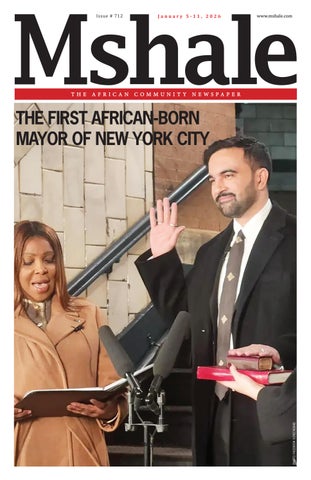
Story on Page 2
PHOTO: FACEBOOK SCREENGRAB
THE FIRST AFRICAN-BORN MAYOR OF NEW YORK CITY
2
Mshale - The African Community Newspaper
www.mshale.com
January 5-11, 2026 Issue 712
The first African-born mayor of New York City is sworn-in By Safiyah Riddle Associated Press NEW YORK (AP) — Incoming Mayor Zohran Mamdani took his midnight oath of office on a centuries-old Quran, marking the first time a mayor of New York City uses Islam’s holy text to be sworn in and underscoring a series of historic firsts for the city. The 34-year-old Democrat became mayor in a long-closed subway station beneath City Hall, the first Muslim, first South Asian and first Africanborn person to hold that position. These milestones — as well as the historical Quran — reflect the longstanding and vibrant Muslim residents of the nation’s most populous city, according to a scholar who helped Mamdani’s wife, Rama Duwaji, select one of the books. Most of Mamdani’s predecessors were sworn in on a Bible, although the oath to uphold the federal, state and city constitutions does not require the use of any religious text. And while he has focused heavily on the issue of affordability during his campaign, Mamdani was outspoken about his Muslim faith. He frequently appeared at mosques across the
Zohran Mamdani was sworn in as mayor of New York City by the New York attorney general, Letitia James, as wife Rama Duwaji held the Qu ran. Photo: Amir Hamja/AP Pool
five boroughs as he built a base of support that included many first-time South Asian and Muslim voters. A look at the three Qurans that Mamdani used
Two Qurans were to be used during the subway ceremony: his grandfather’s Quran and a pocket-sized version that dates back to the late 18th or early 19th century. It is part of the collection at the
New York Public Library’s Schomburg Center for Research in Black Culture. Mamdani Cont’d on Pg. 6
Mshale - The African Community Newspaper
www.mshale.com
January 5-11, 2026 Issue 712
Guest Commentary by Jaidyn McKinnie
3
Disappearing Districts: How racial gerrymandering is hollowing out the Black electorate American democracy is entering a dangerous stage of decline. While coverage focuses largely on the most recognizable signs of democratic backsliding, such as attacks on free speech and the use of state force against peaceful protesters, a quieter crisis is reshaping the foundation of representation itself. The second Trump administration is advancing a national policy infrastructure aimed at reshaping the democratic system from within, not by suppressing votes directly, but by manipulating the structures that determine who gets represented at all. Across the country, redistricting battles are being used to minimize the influence of Black voters and weaken the power and electability of Black legislators who represent them. These maps fracture diverse districts, erase majority-Black constituencies, and recast racial gerrymandering as a partisan strategy. Gerrymandering is the process of drawing legislative maps to favor one group over another. Partisan gerrymandering exists in both parties, but the distinction between partisan and racial gerrymandering is crucial. The latter targets voters based on race, undermining equal protection and silencing political voices that have historically been excluded. Today, partisan gerrymandering often serves as a facade for racial redistricting, allowing maps that weaken Black and brown representation while appearing procedurally neutral. The result is a democracy that technically counts every vote, but ensures that some count for less. These efforts to reshape representation operate through coordinated pressure on state and federal institutions. Republican-controlled legislatures in Texas, Missouri, North Carolina, Ohio, and Florida have advanced or are seeking to advance maps that fracture diverse districts and erase Black-performing seats to manufacture partisan strongholds. In Texas, the 2021 maps, already among the most gerrymandered in the nation, were challenged by the Department of Justice and civil rights groups for intentionally weakening minority voting power, marginalizing the very communities largely responsible for Texas’s growth. The latest maps, under Trump’s order, have only deepened the imbalance, entrenching partisan and racial control. This September, Governor Kehoe of Missouri approved new maps that work to unseat Representative Emanuel Cleaver, one of the state’s two Black congressmembers. His district, once a Black stronghold centered in Kansas City, is being divided among three predominantly white districts, reducing the concentration of Black voters and weakening their collective influence. Similar redistricting patterns in Florida and Texas, where the districts of Representatives Al Lawson, Marc Veasey, and Al Green were dismantled, follow the same logic.
Join the Mshale Text Club: Text AFRICA to 24587 or follow us onTwitter.com/Mshale Community News, updated daily on Mshale.com © 1995-2026 Mshale Communications, Inc. Mshale – The African Community Newspaper Editorial & Corporate Office: 2 E Franklin Ave., Suite 9 Minneapolis, MN 55404 Mailing Address: P.O.BOX 80071, Minneapolis, MN 55408
Tel: 612-454-5648 Email: mshale@mshale.com www.mshale.com
President & Publisher: Tom Gitaa Contributing Editor: Edwin Okong’o Staff Writers: Kwot Anwey Cynthia Simba, Panashe Matemba-Mutasa Contributing Writers: Susan Budig, Lizzy Nyoike Design & Layout: Staff
Photographers: Richard Ooga, Jasmine Webber, Bethel Gessesse Distribution: Bluebird
Mshale is published weekly on Monday. It is available every Monday for free at most African stores , African restaurants and metro area county libraries. Mailed subscriptions are $60 per year. Memberships: Minnesota Multicultural Media Consortium (MMMC) , Pan African Business Alliance (PABA).
The editor welcomes letters, opinion pieces and commentary on issues of interest to the African community in North America. Contributions must be typed and will be edited for clarity and space. Submissions can be mailed or submitted online at www.mshale.com
These efforts reveal a shift from engaging voters to reshaping the systems that define their representation. Now, all eyes are on California, where the passage of Proposition 50 has become the first major test of how far states can go in countering gerrymandered maps. The measure introduces new electoral mechanisms for redrawing maps and is expected to offer an example of how other states approach redistricting and opposition efforts ahead of the Midterms. While Black-centered organizations such as the NAACP have invested heavily in the measure, its potential impact on Black voting power remains uncertain, though analysts suggest it may strengthen Latino representation. Still, its outcome will shape national discourse on representation and determine whether state-level reforms can meaningfully alter the balance of power. While some states experiment with expanding representation, the federal landscape is moving in the opposite direction by dismantling DEI programs, eliminating race-conscious hiring, and purging staff in agencies that oversee civil rights enforcement. These measures reflect a broader effort to weaken the institutions that sustain equitable representation and to undermine the legitimacy of a multiracial democracy. Despite this, the Congressional Black Caucus is the largest it has ever been, reflecting decades of organizing and civic engagement that expanded voting access. But this progress is increasingly fragile. Gerrymandered maps that fracture Black communities and eliminate majority-Black districts weaken not only the ability of Black legislators to hold their seats but also the capacity of Black voters to shape outcomes. When predominantly Black constituencies are divided across multiple districts, disguised as routine political realignment, it functions as a racialized control that suppresses minority ballot strength. Voting power determines not just who wins elections, but whose communities receive investment, whose schools are funded, and whose voices are heard in policy debates that shape everyday life. When Black voters are packed into a few districts or split among many, their concerted voting strength is diluted, muting the political voice that has driven social and economic advancement for generations. The threat facing the United States is not only that democracy could fail, but that it could survive in form while dying in function. Ongoing efforts to manipulate representation risk creating a government that looks democratic but operates as a controlled system of exclusion. To protect multiracial democracy, the nation must confront not only the authoritarianism of power, but the quiet redrawing of the lines that decide who holds it.
Jaidyn McKinnie is a Joint Center intern and UCLA student. She wrote this for the National Newspaper Publishers Association's BlackPress USA where it first appeared.
4
Mshale - The African Community Newspaper
www.mshale.com
January 5-11, 2026 Issue 712
Deportations of African migrants triple under Trump’s second term
Most African migrants being deported under Trump’s second term have no criminal record, according to ICE data. By Adam Mahoney Capital B News African migrants in the United States are being arrested and deported at rapidly escalating rates under President Donald Trump’s second term, even though most have no criminal record. Deportations of people from African countries are on pace to nearly triple this year compared with the annual average during the Biden administration, according to a Capital B analysis of government data provided by the U.S. Immigration and Customs Enforcement. Likewise, the immigration-related arrests of African-born migrants have more than doubled, despite less than 40% of those arrested having a criminal record. The fallout is transforming daily life in countries like Ghana that are absorbing a sudden influx of returnees. Some of that surge is being routed through little known transfer deals with African governments that agreed to receive deportees from non-native residents. Some of the countries involved in this agreement,
William Yirenkyi "self-deported" himself back to Ghana after struggling to establish a life in the United States. Photo: Adam Mahoney/Capital B
like Ghana and Uganda, have accepted citizens of other African nations as well as citizens of Asian and South and Central American countries. As a result, deportees have been held in countries where they have no ties, often in deplorable conditions. In November, Capital B reported that a non-native West African woman deported to Ghana attempted suicide while under the supervision of Ghanaian detention officers. These numbers and arrangements reveal an expanding, outsourced enforcement regime that is quietly reshaping African diaspora communities in the U.S. and deepening what advocates describe as a “shadow system” of migration control. As Zaria Goicochea of Cornell Law School’s Transnational Disputes Clinic put it, “Outsourcing migration control does not absolve the United States of its human rights obligations,” adding that “African states have an independent duty not to accept transfers under bilateral agreements that put people at risk.” Her colleague Tara Nouri warned that “these agreements entrench a shadow system of migration control, undermining fundamental human rights guarantees in the process.” Organizers with the Movement for Black Lives argue that Black migrants in the U.S. — who now account for 10% of the Black population and 7.2% of all non citizens — are “disproportionately demonized and targeted for violence and exclusion” at every step, from militarized borders and interior raids to “detention under inhuman conditions” and forced returns to danger. ICE Arrests Target AfricaBorn Migrants During the first 10 months of the Trump administration, more than 3,500 Africaborn migrants were arrested by U.S. Immigration and Customs Enforcement officers. The vast majority of those arrested had no criminal record.
Mshale - The African Community Newspaper
www.mshale.com
January 5-11, 2026 Issue 712
5
Remittances to Kenya hit record, but diaspora struggles to find meaningful investments By Edwin Okong'o Mshale Contributing Editor When Prime Cabinet Secretary Musalia Mudavadi announced in November that Kenyan citizens abroad were on course to set a record in the amount of money they sent home in 2025, many saw it as a cause for celebration. “This figure has actually hit a trillion [shillings],” he announced jubilantly. That is approximately $7.7 billion, a tremendous increase from the $5.04 billion sent in 2024. The figure is even more impressive when considering Kenya’s nominal GDP in 2025 is estimated at $136 billion. Although this is often great news for the government, Kenyans abroad usually receive the news with mixed reactions. Ken Lemaiyan, one of the founders of Kenyans Changing Kenya, a California-based civic organization, said the money he and most of his compatriots sent home was for sustaining families, and for small-scale projects like building residential homes.
“Otherwise, we’re just surviving, not thriving,” he said. North America accounts for the largest portion of diaspora remittances to Kenya, according to the Central Bank of Kenya (CBK). For example, almost 60% of the $438 million sent home in October came from North America, especially the United States where close to 165,000 Kenyans live, according to the 2024 U.S. Census Bureau’s American Community Survey (ACS). Kenyans in the United States tend to be highly educated. A Minnesota Compass analysis of Integrated Public Use Microdata Series ACS data (20192023), for example, found that 94.1% of the Kenyan community in Minnesota, approximately 20,000 people, had a high school diploma or higher, and 38.9% had at least an undergraduate degree. Numerous studies have shown that
“It’s spending, not investing,” Lemayian said. “It’s a lifeline for families – school fees, medicines – but is it building Kenya’s economy?” Lemaiyan said Kenya needed systems to turn diaspora cash into sustainable projects that can create employment and trigger national growth.
Musalia Mudavadi Photo: Courtesy Govt. of Kenya
Samuel Ireri, the group head of international banking and payments at Equity Group, standing, watches as the bank’s business development manager Jeff Gitahi, right, helps a member of the diaspora in Minnesota reactivate their account during the bank’s Fall 2025 North America roadshow. Mshale Staff Photo by Tom Gitaa
that communities with high rates of education have lower unemployment rates and higher earnings, compared to those that don’t. In 2022, for example, a National Center for Education Statistics survey of people aged 25-34 found that median earnings of those with bachelor’s degrees were 59% higher than of those whose highest level of education was high school. The high education attainment is evident in Minnesota’s Kenyan community, with a median household income of $77,518, according to the Minnesota Compass report. That figure is statistically tied
with the national median household income of $77,719. This is an indication that the Kenyan community is doing relatively well and could explain the upward trend in remittances. Samuel Ireri, the group head of international banking and payments at Equity Group, agreed that Kenyan citizens abroad could be much better financially if more of the money they Remittances Cont’d on Pg. 7
Help employees heal with Paid Leave. Check that your kids are in the right seat at
NHTSA.gov/TheRightSeat
Learn more at paidleave.mn.gov
6
Mshale - The African Community Newspaper Mamdani
Cont’d from Pg. 2
That copy of the Quran symbolizes the diversity and reach of the city’s Muslims, said Hiba Abid, the library’s curator for Middle Eastern and Islamic Studies. “It’s a small Quran, but it brings together elements of faith and identity in New York City history,” Abid said. For a subsequent swearing-in ceremony at City Hall on the first day of the year, Mamdani will use both his grandfather’s and grandmother’s Qurans. The campaign hasn’t offered more details on those heirlooms. One Quran’s long journey to Mamdani’s hand
his interest in the historical relationship between Islam and Black cultures in the United States and across Africa. Unlike ornate religious manuscripts associated with royalty or elites, the copy of the Quran that Mamdani will use is modest in design. It has a deep red binding with a simple floral medallion and is written in black and red ink. The script is plain and readable, suggesting it was created for everyday use rather than ceremonial display. Those features indicate the manuscript was intended for ordinary readers, Abid said, a quality she described as central to its meaning. “The importance of this Quran lies not in luxury, but in accessibility,” she said.
The manuscript was acquired by Arturo Schomburg, a Black Puerto Rican
Because the manuscript is undated
19th century during the Ottoman period in a region that includes what is now Syria, Lebanon, Israel, the Palestinian territories and Jordan. Abid said the manuscript’s journey to New York mirrors Mamdani’s own layered background. Mamdani is a South Asian New Yorker who was born in Uganda, while Duwaji is American-Syrian. Identity and controversy The meteoric rise of a Muslim democratic socialist also brought a surge of Islamophobic rhetoric, amplified by national attention on the race. In an emotional speech days before the election, Mamdani said the hostility had only strengthened his resolve to be visible about his faith. “I will not change who I am, how I eat, or the faith that I’m proud to call my own,” he said. “I will no longer look for myself in the shadows. I will find myself in the light.” The decision to use a Quran has drawn fresh criticism from some conservatives. U.S. Sen. Tommy Tuberville of Alabama wrote on social media, “The enemy is inside the gates,” in response to a news article about Mamdani’s inauguration. The Council on American-Islamic Relations, a civil-rights group, has designated Tuberville as an anti-Muslim extremist based on past statements.
This photo provided by The New York Public Library shows the Schomburg Quran on Dec. 16, 2025 in New York. Photo: Jonathan Blanc/The New York Public Library via AP
historian whose collection documented the global contributions of people of African descent. While it is unclear how Schomburg came into possession of the Quran, scholars believe it reflected
and unsigned, scholars relied on its binding and script to estimate when it was produced, placing it sometime in the late 18th or early
January 5-11, 2026 Issue 712
www.mshale.com
Such backlash is not new. In 2006, Keith Ellison, the first Muslim elected to Congress, faced condemnation from conservatives after he chose to use a Quran for his ceremonial oath. Following the inauguration, the Quran will go on public display at the New York Public Library. Abid said
Zohran Mamdani hugs his wife Rama Duwaji after he is sworn in as mayor of New York City at Old City Hall Station, New York, Thursday, Jan. 1, 2026. Photo: Amir Hamja/via AP Pool
she hopes attention surrounding the ceremony — whether supportive or critical — will prompt more people to explore the library’s collections documenting Islamic life in New York, ranging from early 20th century Armenian and Arabic music recorded in the city to firsthand accounts of Islamophobia after the Sept. 11 attacks. “This manuscript was meant to be used by ordinary readers when it was produced,” Abid said. “Today it lives in a public library where anyone can encounter it.” ___ Associated Press writers Jake Offenhartz in New York and Kim Chandler in Montgomery, Alabama, contributed.
One easy $0 premium plan HealthPartners® Minnesota Senior Health Options (MSHO) (HMO SNP) bundles Medicare, Medical Assistance and prescription drug coverage into a simple $0 premium plan. It saves you money. And it comes with valuable perks and support.
Plan highlights
Easy, guided enrollment
• A dedicated care coordinator helps you navigate your health
Call 855-394-8845 (TTY: 711) to find out if you’re eligible.
• Rides to appointments • Extras like tablets with well-being tools and lifelike support pets* • Up to $450 in rewards for health screenings
HealthPartners is a health plan that contracts with both Medicare and the Minnesota Medical Assistance (Medicaid) program to provide benefits of both programs to enrollees. Enrollment in HealthPartners depends on contract renewal. *The benefits mentioned are a part of special supplemental benefits for members with certain chronic conditions such as: heart failure, dementia, diabetes, cancer, or a disabling mental health condition. Not all members will qualify, and all applicable eligibility requirements must be met. For details and a complete list of eligible conditions, please contact us. Discrimination is against the law. HealthPartners does not discriminate because of race, color, national origin, creed, religion, sexual orientation, public assistance status, marital status, age, disability or sex. H2422_004969_M Accepted 8/30/25 25-3491751-3609008 (9/25) © 2025 HealthPartners
Oct. 1 to March 31: 8 a.m. to 8 p.m. CT, seven days a week April 1 to Sept. 30: 8 a.m. to 8 p.m. CT, Monday through Friday
or
No NoEnglish? English?
877-713-8215 TTY 711 mshosales@healthpartners.com
Mshale - The African Community Newspaper Remittances Cont’d from Pg. 5
www.mshale.com
January 5-11, 2026 Issue 712
7
sent home went into stable investments. For more than 23 years he lived in the United States and worked for several banks in the Minneapolis area, including Wells Fargo, and JP Morgan Chase. But he left because he strongly believed he could use what he had learned from the prestigious American banks to bridge the gap in diaspora investments. “[I was] trying to find a purpose in life,” he said. “How do I serve my country? How can I fill in the gaps with the knowledge, the experience that I had in banking, and in financial services?” So, when in January an opportunity to join one of the largest private banking and finance companies in Kenya, Ireri didn’t think twice. One of his priorities at Equity was to simplify the process of opening and maintaining accounts online to give Kenyans abroad confidence in the country’s financial system. He took steps to remove obstacles he had encountered as a customer living abroad. “The load of paperwork,” Ireri said, “the bureaucracy of getting your account up and running, and trying to follow up when there’s an issue, and people not getting back to you.”
only the third person from Kenya to earn a doctorate in molecular biology. When he couldn’t find work in Kenya, he left for the United States, where he worked as a scientist at Harvard Medical School, and numerous pharmaceutical companies before leaving to found DKTB. He said for Kenyans and Africans abroad needed to rely less on governments and more on their own ingenuity.
Ireri said Equity reduced the paperwork and focused on improving its app so customers could access their accounts remotely. Equity was also working with the CBK to see how it could digitize the process. Dr. Wilson Endege is the CEO and director of Daktari Biotechnology Ltd (DKTB), an ambitious venture that has been rallying Kenyans abroad to do more than just sending money to relatives. When he graduated from the Free University of Brussels in 1992, he was
“I’m not saying that the government is not relevant,” Endege said. “I just don’t think they engage [with the diaspora] correctly.” Endege said African governments had failed to build adequate infrastructure to incentivize their citizens abroad to make sustainable investments that create jobs. He said Africans should emulate Asian countries, which became economic powerhouses because they harnessed the knowledge and power of their diasporas. “They created opportunities and invited people to bring back technology so that they could start producing some of these products in their own countries,” Endege said. “As a result, some of the big tech companies you see today have come out of those countries.”
Dr. Wilson Endege Photo: Courtesy Daktari Biotechnology
To the contrary, he said, African leaders were often skeptical or outright dismissive when their citizens abroad come home with new ideas. Ten years ago, when he founded DKTB, he wanted to develop Diaspora University Town,
Graphic: Minnesota Compass for Mshale
a city centered around a state-of-theart research university and a hub for creation of medicines and vaccines for Africa. Endege said DKTB wrote to nearly a dozen county governments seeking partners and land for the project. “We wanted to direct some of the diaspora resources into a project that would have impact and create opportunities,” Endege said. When none of them showed interest, DKTB decided to go without the government. They managed to acquire 1,500 acres from a community in TaitaTaveta, a county in southern coastal region. He assembled a team and began pitching the investment idea to the diaspora and is now hoping Kenyan investors will jump on the opportunity. “Someone has to do it,” he said when asked why, at nearly 70 years old, he should bother. “I think more about the opportunity that has been lost for people, for the country, and someone has to come back and tell them that we need to do this a little bit differently.”
Who adopted who? Adopt a teen. You can’t imagine the reward.
8
Mshale - The African Community Newspaper
January 5-11, 2026 Issue 712
www.mshale.com
New postal service rule could quietly void ballots and delay healthcare By Stacy M. Brown BlackPress USA
A quiet clarification by the United States Postal Service is drawing renewed scrutiny after health care advocates and voting rights observers warned that the change could carry serious consequences for millions of Americans who rely on postmarks to meet legal deadlines. Under new USPS guidance that took effect late last month, the date printed on a postmark no longer reflects when a letter or ballot is dropped into a mailbox. Instead, the postmark now reflects the date the mail is first processed at an automated sorting facility, which can occur days after the item is mailed. The Postal Service says the change is intended to clarify how postmarks are applied, particularly as transportation schedules and regional processing systems evolve. For voters in states that count mail-in ballots based on postmark deadlines, and for patients navigating appeals, authorizations, and Medicare paperwork, the distinction is anything but academic. “In recognition of the importance that the election laws in some states place on postmarks, it has been the longstanding policy of the Postal Service to try to ensure that every return ballot mailed by voters receives a postmark, whether the return ballot is mailed with postage pre-paid by election officials
or with a stamp affixed by the voter,” officials wrote in a release. “A voter can ensure that a postmark is applied to his or her return ballot by visiting a Postal Service retail office and requesting a postmark from a retail associate when dropping off the ballot.” The issue gained wider attention after a detailed explanation circulated to millions of viewers on social media from the account @cjnlegalnurse, a health care advocate who outlined how the rule shift moves risk away from institutions and onto individuals. “The postmark rule changed quietly, and it affects voting and health care. Let me explain what just happened at USPS because this is not minor and it’s not theoretical,” the user said. “So as of this week, the United States Postal Service clarified that a postmark date is no longer tied to when you drop your mail off. It’s tied to when that mail is first processed by an automated facility.” As the user explained, a letter placed in a mailbox on Monday may not reach a sorting center until Wednesday, making Wednesday the official postmark. For ballots and legal filings governed by strict deadlines, that delay can mean rejection despite timely mailing. “Many states say a mail-in ballot counts if it’s postmarked by election day,” the user said. “Under this rule, you can mail your ballot before election day and still have it postmarked after. So that’s not voter fraud, that’s
Photo: USPS
The user said the shift places the burden squarely on individuals navigating already complex systems.
logistics quietly overruling intent.” USPS guidance confirms that most postmarks are now applied at large processing plants rather than local post offices and that mail may sit before receiving a postmark due to updated transportation schedules. The agency recommends that customers with deadline-sensitive mail bring items directly to a post office counter and request a manual local postmark.
“In nursing and health care advocacy, timing is everything,” the user said. “And this rule shifts the risk from the institution back to the patient. The system didn’t get faster, the rules just got tighter.”
Health care advocates say the implications extend far beyond elections. “Health care runs on mail deadlines, appeals, prior authorizations, Medicare notices, and prescription paperwork,” the user said. “If an appeal has to be postmarked by a certain date and USPS processes days later, it looks late. So late appeals get denied. Denied appeals delay care.”
“So if you’re mailing anything timesensitive now, ballots or health care documents, dropping it in a box is not enough,” the user said. “Go inside the post office for deadline mail. Ask for a manual postmark or receipt. Use certified mail for appeals and legal documents, and do not rely on blue mailboxes for last week’s deadlines. So, this isn’t panic; it’s adjustment.”
Refugee and Immigrant Helpline TRAVELING INTERNATIONALLY?
Malaria can be just a plane ride away. Medications, repellent, bed nets, and more can protect you from malaria and other diseases spread by mosquitoes. Visit your doctor or travel clinic as soon as you know you are traveling. health.mn.gov/travel Image may not depict current travel requirements.
Welcome to Minnesota!
1-800-814-4806 Call today for information about jobs, food, housing, legal help and more.
Mshale - The African Community Newspaper
www.mshale.com
January 5-11, 2026 Issue 712
9
Religion Churches deliver Christmas to immigrants detained, deported and in hiding
By Jack Jenkins and Aleja HertzlerMcCain Religion News Service RNS) — Earlier this month, the Rev. Pilar Pérez, a United Methodist minister in the denomination’s Western North Carolina Conference, called up a parishioner who hadn’t been to worship in a while. The pastor encouraged the congregant to attend Christmas services, even offering to give her a ride. “I was begging her: ‘I’ll go and pick you up,’” Pérez said. The parishioner could not be convinced. She told Pérez that come Christmas, her family planned to mark the Christian holiday the safest way they know how: by watching the service on Facebook Live. Pérez understood. Like many immigrant families, the family members have barely left their home in recent weeks out of fear of encountering federal immigration agents. It’s a fear they believe is well founded, as immigration officers have detained and deported thousands across the country, including at least one person in North Carolina who was just outside a church.
son and moved worship services online. “Isolation is hurtful — it’s hurtful spiritually, emotionally and physically,” Pérez said. In response, Pérez’s church has partnered with another nearby Methodist congregation to offer an additional layer of protection for churchgoers. Over the past few weeks, the pastor of a nearby partner congregation has come to the church and sat near the door during worship — and plans to do so during Christmas services as well. The idea, Pérez says, is for the partner pastor to be the first person immigration enforcement officers encounter should they ever approach the church. Pérez and others have also delivered weekly food boxes to congregants who are still staying home, an effort bolstered by an influx of donations: A local Christmas giving ministry shifted its efforts to the nearby immigrant population, with 80% of donations heading to Hispanic families. The Rev. Luke Edwards oversees a sep-
He added of other Boston churches: “Every church is suffering this crisis.” Other clergy are seeking to bring the holidays to immigrants who have already been separated from their communities. The Rev. Brian Strassburger, a Jesuit priest who works along the U.S.-Mexico border as director of Del Camino Jesuit Border Ministries, said he plans to host a Posada event outside the airport in Harlingen, Texas. “During that span of time, we anticipate that there will be one, two or even three flights coming in and out with detained migrants,” Strassburger said. He hopes the sight of Mary and Joseph seeking shelter will offer a “public witness there in that space” and be “a sign of hope.” The priest said his group of three Jesuits is supporting migrants who are fighting “hopelessness and despair” during Christmas. They were unable to get permission to celebrate a Christmas Mass at Port Isabel Detention Center, but they were
The Rev. Melvin Valiente, who pastors two Los Angeles County Baptist churches with his wife, Ada, said he is preaching a specific message to his congregations this holiday season: “Jesus knows what it is to be an immigrant, knows what it is to be persecuted.” He also uses a system that sends out personalized texts with Bible verses, hoping Christmas messages of peace can connect with members who are too afraid to come to church. Their church members will also be preparing bags of food for families outside their congregation who have a detained loved one or are too afraid to go out, both to fortify them with regular groceries and help them celebrate a special dinner for “Nochebuena,” or Christmas Eve. One church member plans to host lonely immigrants at her own Nochebuena dinner. Back in North Carolina, attendance at Pérez’s majority-immigrant church has dropped as much as 40% since November, she said, when a surge of immigration agents deployed to her state for a week. In her congregation, 11 families essentially haven’t left their homes since. The pastor compared the situation to the height of the COVID-19 pandemic, when churches avoided meeting in per-
Since the fall, their parish has averaged more than one new family a week experiencing a detention, she said. “To be honest, I wish that we had time and energy for some special Christmas gift programs, but the truth is we are running as fast as we can and using all of the resources we have just to kind of keep up with the day-to-day emergency needs,” Kathy said, including prayer, emergency counseling and food deliveries. They also try to have a supportive presence outside immigration court. Federico, a Catholic leader in Chicago who asked to use his middle name because he lacks legal immigration status, said his parish is facing the same deluge. He is pleading for more wealthy congregations to step in because of the sheer scale of the needs. In North Carolina, a Charlotte-area initiative called Operación Esperanza has emerged as a partnership between Transforming Nations Ford, a community development nonprofit, and Iglesia Tabernaculo de Gracia, a Hispanic Pentecostal church
“That’s where they are,” said Pérez, who has spent recent months delivering groceries and other necessities to such families. Faith leaders are facing similar situations across the country this Christmas season, as clergy, churches and other religious organizations wrestle with how to mark one of the most important Christian holidays while also serving an immigrant population in crisis.
this month to show “we see us as one family” and make Latinos feel less afraid to participate, said Kathy, a coordinator of the parish’s migrant response team who asked to be identified by her first name to avoid harassment.
People protest against federal immigration enforcement, Nov. 15, 2025, in Charlotte, N.C. Photo: Erik Verduzco/AP
arate fund set up by the Western North Carolina Conference after the Charlotte raids for the needs of immigrant congregations, such as legal costs and rent. But even with the influx of resources, Edwards said, communities are struggling. He noted that many of the Hispanic churches he works with traditionally celebrate Las Posadas, reenactments of the Christmas story, in December. But this year, “They’re either canceling those, scaling them back, rescheduling them or moving things onto Zoom,” he said. The federal government’s mass deportation effort, Edwards said, “is impacting our churches’ ability to worship.” In Boston, Bishop Nicolas Homicil said his largely Haitian flagship church, Voice of the Gospel Tabernacle Church, still plans to have in-person worship on Christmas, but it’s expecting lighter attendance than the up-to-300 it typically draws. The Trump administration is slated to revoke Temporary Protected Status for Haitians on Feb. 3. “We don’t want to fool ourselves to say, ‘Yes, we expect the church to be full,’ because there are people who are still afraid to come out,” Homicil said. “People are even afraid to come to (the) food pantry.”
able to celebrate several Advent Masses there, as well as host more-typical Posadas with skits and piñatas for the children in two Reynosa, Mexico, migrant shelters. They are also planning to celebrate 10 baptisms and two first Communions on Christmas Eve in a migrant shelter in Matamoros, Mexico. The immigrants living in those shelters are in many ways stuck, lacking the means to go elsewhere in Mexico or back home and no longer able to seek U.S. asylum after President Donald Trump suspended that program in January. Strassburger described a recent experience of holding a 2-day-old baby in the shelter and being struck by the parallels in the Christmas story. “Standing in a forgotten, underresourced migrant shelter along the U.S.Mexico border on the wrong side of a political boundary is much like this stable in Bethlehem because there’s no room at the inn and that’s where Christ enters into the world,” he said. With the arrival of Christmas — a giftgiving season — religious leaders have been trying to offer what support they can. In Washington, D.C.’s Maryland suburbs, the English-speaking community at St. Camillus Catholic Church joined Latinos for their Las Posadas celebrations
The project has been distributing food and other items to impacted immigrant families, but according to Rosa Ramirez, who helps lead the effort, volunteers recently began asking families what their children would want for Christmas. The effort has been difficult — partly, she said, because asking for something “is, culturally, not comfortable for a lot of our families.” But beyond that, “for a lot of our families, it’s not even about trying to figure out the holidays,” Ramirez said. “That’s just the last thing on their mind right now.” Yet she said the holiday effort is an important part of their work — especially for families who may be celebrating Christmas alone or, in some cases, without family members who have been detained by Immigration and Customs Enforcement. “It’s super important that they have choice — that our children get to consider what they would want on their Christmas list, even if that’s not something that they’ve done before or that they thought they were going to be able to do this year,” Ramirez said. And besides, Ramirez said, the shared faith of those involved in the effort — which includes an array of local churches — points them toward an unambiguous conclusion. “As Christians, we’re called to love our neighbor and to treat the immigrant and the foreigner as our own,” she said. “I think I’ve really seen that lived out in a way that is really beautiful to see, even though it’s such a horrifying time.”
10
Mshale - The African Community Newspaper
www.mshale.com
Art & Entertainment
January 5-11, 2026 Issue 712
Might Angelique Kidjo be the true Queen of Afropop? We’re thinking Kings and Queens this week at Afropop. And while many might make the claim to be “Queen of Afropop” these days, it’s hard to think of anyone with a better claim to that throne than Angelique Kidjo of Benin. Ever since she broke onto the scene with her album Logozo in 1991, Angelique has been shaking up the scene on a regular basis with excursions into Cuban, Haitian and Brazilian music, American R&B, funk and rock, also classical music, jazz and on and on. She just keeps surprising us. Along the way, she’s won five Grammy Awards and countless other accolades. All this got us looking back at the many fascinating conversations we’ve had with her over the years. Below, you’ll find a selection. Interviews In 2012, we spoke with Angelique about her album Spirit Rising, a phrase that turned out to be the name of her upcoming autobiography. Read her thoughts on the album here. In 2014, Angelique talked to us about her Grammy Award-winning album, Eve, dedicated to women, and her autobiography Spirit Rising, My Life My Music. Click here to read.
monique du Luxembourg, Angelique Kidjo Sings. This collaboration was part of a trend of African musicians interacting with classical music ensembles and traditions, a trend that continues today.
Photo by Fabrice Mabillot
That year, she also spoke with us on video about her autobiographical album Oyo, including tributes to the artists who have inspired her. Click here to read and watch. In 2018, Angelique took the bold step of recording a complete, reimagined version of the Talking Heads album, Remain In Light. She told us all about it. Click here to read. In 2019, Angelique spoke with us about her tribute album to Celia Cruz, one of her many musical heroes. Click here to read. In 2021, in our first post-COVID chat with Angelique, she introduced the
album she created remotely during the pandemic, Mother Nature. The album earned her another Grammy Award. Click here to read. In 2022, Angelique undertook a remarkable project with Lebanese trumpet maestro Ibrahim Maalouf. The subject, apt for this post, The Queen of Sheba. Click here to read our interview with both artists. Reviews In 2014, we reviewed a live salute to Miriam Makeba, featuring Angelique among other artists. Click here to read. In 2015, we reviewed Angelique’s collaboration with the Orchestre Philhar-
Also in 2015, Angélique teamed up with acclaimed American composer Philip Glass to create an orchestral piece called Ifé: Three Yorùbá Songs. And still in 2015, a big year for Angelique, she wowed the New Orleans Jazz and Heritage Festival. In 2020, we reviewed Angelique’s contribution to the collaborative Afro-Bolero project. At the 2020 Grammy Award celebration, Angelique dedicated her award to the new generation of African musicians, notably, Burna Boy. And she sang her song “Afrika.” Angelique’s activism, especially on behalf of girls and women in Africa, is almost as legendary as her music. Her Batonga Foundation is now a well-established force of advocacy and support. But that’s not all she does. In 2025, she joined Grammy-winning jazz bassman Christian McBride in support of the non-profit Jazz House Kids.
Mshale - The African Community Newspaper
www.mshale.com
January 5-11, 2026 Issue 712 11
12
New name – same great service Mshale - The African Community Newspaper
www.mshale.com
January 5-11, 2026 Issue 712
MINNESOTA AGING PATHWAYS, formerly the Senior LinkAge Line, helps older adults and caregivers connect to local services and supports, such as: • Housing resources • Health insurance and Medicare • Financial assistance • Long-term care planning • Services in your community • Help at home Whether you need to plan for the future or solve a problem today, Minnesota Aging Pathways can help.
800-333-2433
mn.gov/aging-pathways MBA-1000_2025