Issue # 743
THE
AFRIC A N
August 10-16, 2026
C OM M UN I T Y
www.mshale.com
N EWSPA PE R
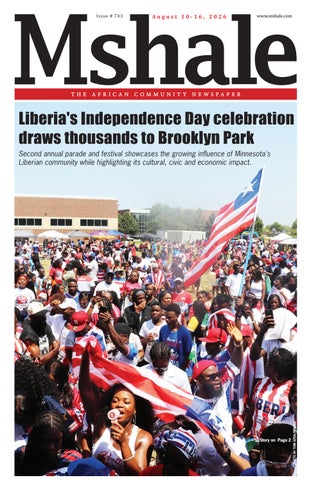
Liberia's Independence Day celebration draws thousands to Brooklyn Park
Story on Page 2
PHOTO BY TOM GITAA/MSHALE
Second annual parade and festival showcases the growing influence of Minnesota's Liberian community while highlighting its cultural, civic and economic impact.
2
Mshale - The African Community Newspaper
www.mshale.com
August 10-16, 2026 Issue 743
'There is no better place to be': Liberia's Independence Day lights up Brooklyn Park
Thousands turned out for the second annual Liberian Independence Day Parade as the celebration continued its rapid growth. By Tom Gitaa Mshale The second annual Liberian Independence Day Parade returned Sunday in Brooklyn Park, drawing thousands to what has become one of Minnesota’s largest African cultural celebrations. The event, which debuted last year in neighboring Brooklyn Center, is intended to become an annual celebration of Liberia’s independence. Crowds braved triple-digit heat to gather for the 11 a.m. parade, but the soaring temperatures did little to dampen the festive atmosphere. Leading the procession was a Ford F-150 draped with the Liberian flag and an advertisement for a local Liberian grocery store. Behind it, DJ Chinho blasted music from a trailer, including Skrewfaze’s “Liberia Independence Day,” which has become the unofficial anthem of the celebration. The music’s bass echoed along West Broadway as passing motorists rolled down their windows, danced behind the wheel and cheered marchers making their way through Brooklyn Park. Marchers wore blue, red and white shirts inspired by the Liberian flag, whose single white star distinguishes it from the American flag. Liberia declared its independence on July 26, 1847, becoming Africa’s first modern republic after being established as a settlement for formerly enslaved and free Black Americans. The parade began near the intersection of 84th Avenue and West Broadway before briefly turning onto West Broadway. Organizers soon
Participants make their way along West Broadway during the second annual Liberian Independence Day Parade in Brooklyn Park on Sunday, July 26, 2026. The parade led thousands of people to North Hennepin Community College for a daylong celebration of Liberia's independence. Photo: Tom Gitaa/Mshale
Liberian community. Brooklyn Park City Council candidate Bernice Cooper and state Senate candidate Nehemiah Garley rode in the parade alongside Rep. Huldah Momanyi Hiltsley and Brooklyn Park Mayor Hollies Winston, each representing milestones in the growing political representation of African immigrant communities.
celebrations, drawing crowds large enough to test parking capacity, traffic management and special event planning. The long lines of parked vehicles stretching along West Broadway reflected both the scale of the gathering and the organizational effort now required to stage it. Food vendors did brisk business selling Liberian favorites including dumboy, cassava leaves and jollof rice, while cold drinks became one of the day’s hottest commodities. Among those enjoying the festivities was Brooklyn Park resident Gloria Kennedy, who danced with her 6-year-old son Jaydel in front of the main stage. Recognizing Mshale’s press badge, Kennedy laughed as she recalled missing last year’s inaugural celebration. “You know last year I missed the event because I didn’t know it was happening,” she said. “I saw it on your Facebook page and I said, by the grace of God, I am not missing it next year.”
By early afternoon, attendance had swelled into the thousands, filling North Hennepin Community College’s parking lots and sending vehicles onto West Broadway, 85th Avenue and nearby side streets.
The celebration was the largest Liberian community event Mshale has covered in Minnesota, surpassing even a major Liberian soccer exhibition at the National Sports Center more than two decades ago. Throughout the week leading up to the event, community elders praised the younger generation for organizing a celebration of this scale outside the umbrella of the long-established Organization of Liberians in Minnesota.
What began last summer in Brooklyn Center has evolved into one of Minnesota’s largest African cultural
While organizers initially said the event moved from Brooklyn Center to Brooklyn Park to accommodate a larger crowd,
Parade organizer Marie Dweh takes a phone call while traveling through the festival grounds by golf cart during the Liberian Independence Day celebration in Brooklyn Park on Sunday, July 26. Dweh said organizing the rapidly growing event required months of planning and coordination. Photo: Tom Gitaa/Mshale
rushed through the procession warning marchers they did not have a permit to remain on the busy roadway. The parade instead re-entered the North Hennepin Community College campus via College Parkway, where festivities continued without interruption. The procession also reflected the growing political influence of Minnesota’s
Dweh later told Mshale the decision was also influenced by what she described as increasingly difficult permitting requirements in Brooklyn Center. Dweh said organizers had hoped to return there but ultimately concluded they could not meet the city’s permitting and public safety requirements. Among them, she said, was a request for approximately 20 police officers assigned to the event, with the nonprofit responsible for the associated overtime costs. “As a small nonprofit that is just not possible,” Dweh said. “Our event last year was very peaceful and I didn’t want our family-friendly event overpoliced because I don’t think our people would have liked that.” In a statement to Mshale, Brooklyn Center said city staff began meeting with representatives of We Are Liberian in the fall of 2025 to discuss the proposed event and review the city’s special event permitting process. The city said organizers were granted additional time to complete their application, but the proposal ultimately did not meet the required permitting timeline. Brooklyn Center said staffing requirements for special events are based on anticipated attendance, traffic management, the event route and overall public safety needs. The city added that organizers may be responsible for staffing costs when events require personnel beyond normal staffing levels. “Brooklyn Center values community
Liberia
Cont'd on Pg. 6
Mshale - The African Community Newspaper
www.mshale.com
August 10-16, 2026 Issue 743
Guest Commentary by Danielle Bess, Esq
3
Built in a moment like this: the Divine Nine and the fight after Callais Las Vegas was awash in pink and green during the week of July 18, 2026, as Alpha Kappa Alpha Sorority, Incorporated, and nearly 27,000 of its members and their families arrived for the sorority’s biennial Boule. The women of Alpha Kappa Alpha were not the only notable arrivals. Black political power showed up, too. Congresswoman Lauren Underwood moderated a conversation with attorney and political commentator Bakari Sellers at a workshop titled “Soaring to the Polls: Mastering the Midterm Journey.” Aaron Ford, Nevada’s Attorney General and the Democratic nominee for Governor, addressed the workshop participants, while Congresswoman Emilia Sykes sat in the audience. And at the organization’s public meeting, Maryland Governor Wes Moore received a community award and delivered a rousing speech that sounded less like an acceptance and more like a precursor to a run for President. Politicians go where power is. But these politicians were not mere visitors. All of the politicians are members of Divine Nine organizations. And three months after the Supreme Court neutered Section 2 of the Voting Rights Act, the power in that convention hall mattered more than it had in sixty years. AKA, and all of the Divine Nine organizations—the historically Black Greek-letter fraternities and sororities—are a natural stop for any politician who wants to raise their profile or launch a bid for elected office. The organizations collectively have more than 4 million members who are educated and civically engaged in their communities.
“In Alabama, in Mississippi, in Georgia, in Arkansas, in Texas, and in Florida, we had Black elected officials because we could go out and vote for people who we believed shared our same lived experiences and that represented our interests,” Sellers said. “When you wake up in November, that no longer will be the case. No matter if we win, lose, or draw, no matter if Hakeem Jeffries is the Speaker of the House we will have less Black Caucus members than we’ve had before. And in two years, we’ll have even less.” Sellers knows the cost of this fight in his bones. His father, Cleveland Sellers, was an early member of the Student Nonviolent Coordinating Committee. “When my dad and Stokely and everybody were going around yelling Black Power, they weren’t trying to shoot you,” he told the room. “They were talking about Black economic power and Black political power. So when they were in the depths of Mississippi, that’s what Black Power actually meant.” Governor Moore offered Maryland as proof that the storm can be answered. With the support of the AKAs, he said, the state passed its own voting rights act, and he has called the legislature into special session rather than, in his words, “sit on our hands while we’re being punched in the face.” He cited more than $1.3 billion in state investments in HBCUs, “unapologetically,” and legislation confronting book bans: “You will not ban books inside the state of Maryland.”
While the organizations are all nonpartisan, they are able to engage in voter education, policy advocacy, and get-out-the-vote efforts. Congresswoman Underwood, an AKA herself, described the mission from the stage: “We are not telling them who to vote for, but as we soar to the polls, we have a lot of ground to cover to lay the foundation for what issues are on the ballot, who’s running, how to participate in this election.”
Congresswoman Underwood was practical about what comes next. She urged the members to take the mobilization where the voters are — online — “creating content that is engaging and informative on the issues that matter: issues like the high cost of living and how we can take action in this election to lower housing costs, health care costs.” Sellers pressed the same point about the message. When Southern states refuse to expand Medicaid, he said, rural hospitals close—”and when your rural hospital closes, it’s not just the fact that you don’t have access to care. It’s your largest employer in the county.” Then came the workshop’s bluntest warning, aimed at his own party: “We cannot over the next 107 days simply believe that saying ‘I’m not Donald Trump’ is enough to win an election.”
And for their collective 120-year history, they have done that. The NAACP was cofounded by W.E.B. Du Bois, a member of Alpha Phi Alpha fraternity. Many civil rights icons were members of the Divine Nine, including Martin Luther King, Jr., who was also an Alpha. Today, more than half the current members of the Congressional Black Caucus are members of one of the Divine Nine organizations.
The Divine Nine organizations were all founded before the passage of the Voting Rights Act, and they have now outlived its full protection. They were built between 1906 and 1922—the decades after Black representation had been driven out of Congress and the ballot stripped away across the South—as infrastructure for a people the law had abandoned. Their mission of racial uplift has not changed.
With the gutting of Section 2 of the Voting Rights Act, Black political representation in Congress is at risk. Governor Moore, a member of Alpha Phi Alpha, accepting the sorority’s community award, rejected the notion that the question is whether AKA is ready. “When there’s ever a question about whether the AKAs are built for a moment like this, let’s be clear: the AKAs were built in a moment like this,” he said. “Let’s not pretend like 1908 was easy. Let’s not pretend like 1908 was simple. Let’s not forget in 1908, you had the Springfield race riot. In 1908, you had the oppressive peak of Jim Crow.”
Sellers told the women what he believed their assignment was. “I’m talking to you all as apostles,” he said. “I’m not trying to teach you something. I’m trying to give you something to go out and share.”
Moore’s history was precise. Alpha Kappa Alpha was founded at Howard University in January 1908. That August, a white mob rampaged through Springfield, Illinois — the riot that spurred the founding of the NAACP the following year. The Divine Nine were not built in calm waters. They were built in the storm. Sellers told the workshop what this storm looks like. In April, the Supreme Court ruled in Louisiana v. Callais that voting rights plaintiffs must now show a strong inference that a state intentionally discriminated — a standard Justice Elena Kagan described as rendering the VRA “all but a dead letter”. Within weeks, Southern states began dismantling majority-Black congressional districts.
Join the Mshale Text Club: Text AFRICA to 24587 or follow us onTwitter.com/Mshale Community News, updated daily on Mshale.com © 1995-2026 Mshale Communications, Inc. Mshale – The African Community Newspaper Editorial & Corporate Office: 2 E Franklin Ave., Suite 9 Minneapolis, MN 55404 Mailing Address: P.O.BOX 80071, Minneapolis, MN 55408
Tel: 612-454-5648 Email: mshale@mshale.com www.mshale.com
President & Publisher: Tom Gitaa Contributing Editor: Edwin Okong’o Staff Writers: Kwot Anwey Cynthia Simba, Panashe Matemba-Mutasa Contributing Writers: Susan Budig, Lizzy Nyoike Design & Layout: Staff
Photographers: Richard Ooga, Jasmine Webber, Bethel Gessesse Distribution: Bluebird
Mshale is published weekly on Monday. It is available every Monday for free at most African stores , African restaurants and metro area county libraries. Mailed subscriptions are $60 per year. Memberships: Minnesota Multicultural Media Consortium (MMMC) , Pan African Business Alliance (PABA).
The editor welcomes letters, opinion pieces and commentary on issues of interest to the African community in North America. Contributions must be typed and will be edited for clarity and space. Submissions can be mailed or submitted online at www.mshale.com
Governor Moore reached for the same idea through the ancestors. “It’s not a recognition of what we’ve done already. It’s a standard for what we’re still yet to get done,” he said, closing with the words every member in the hall knew by heart, from the hymn James Weldon Johnson — himself a member of Phi Beta Sigma — gave to Black America: “Facing the rising sun of our new day begun, let us march on till victory is won.” Nearly 27,000 women left Las Vegas at the week’s end and carried that assignment home across the country — members of an organization that predates the Voting Rights Act, now asked to repair its gutting. Danielle Bess, Esq., a lawyer IRL, is breaking down the law and politics as it happens. She wrote this for BlackPressUSA where it first appeared.
4
Mshale - The African Community Newspaper
www.mshale.com
August 10-16, 2026 Issue 743
What El-Sayed’s Michigan win reveals about Black voters and Democrats
The Senate primary bucked simple narratives about the state’s electorate and set the stage for a high-stakes general election. By Brandon Tensley Capital B News Abdul El-Sayed is projected to win Michigan’s Democratic primary for a U.S. Senate seat, concluding a bruising contest that became a national proxy battle over where the party is headed and how Black voters might shape that future. While many observers framed the race around whether El-Sayed could break through with Black Michiganders — who account for about 20% of the state’s Democratic primary electorate — Kermit Williams said what he saw on the ground was more complex. Williams, the political director of the Oakland Forward Action Fund, told Capital B that he noticed a clear generational divide throughout the campaign. Many older Black Michiganders, he said, embraced U.S. Rep. Haley Stevens’ message of experience, while younger and more progressive Black Michiganders were fueled by El-Sayed’s calls for deep reforms. “I think that older and more established Black voters believe in incremental change,” said Williams, who spent Election Day conducting election protection efforts at polling stations. “And when you start talking about younger Black voters, they want to see a whole new system. I think that El-Sayed has kind of tapped into that energy.” With the primary decided, attention is shifting to what the results mean. That focus will include how Black Michiganders voted, whether Democrats can unite their base, and what lies ahead for El-Sayed in November. That contest will have national implications. Senate control runs through the swing state, so reconciling tensions within their diverse coalition and winning the seat is vital if Democrats hope to secure a majority in the upper chamber and push back against the Trump administration’s policies. A former Detroit public health official, El-Sayed offered a progressive platform, calling for policies such as Medicare for All. Stevens presented herself as a pragmatic Democrat, elevating her congressional record, her support for manufacturing jobs, and her belief that she could win in the general election. El-Sayed is seen as further testing the resonance of progressive messaging after wins by Mayor Zohran Mamdani and others over the past year. He isn’t a member of the Democratic Socialists of America. What did the outcome reveal about Black Michiganders’ behavior? The race underscored that they’re not monolithic. For weeks, national conversations
Abdul El-Sayed addresses a news conference Wednesday, August 5, 2026 in Detroit shortly after winning the Democratic nomination for U.S. Senate in Michigan. Photo: Courtesy Abdul for Senate
asked whether El-Sayed could make inroads with Black Michiganders, often treating them as a single constituency. But Williams said that the contest was more like a debate among Black Democratic voters about what kind of party they want. “I think that it really seemed like a microcosm of the Hillary Clinton versus Bernie Sanders debate,” he said, referring to the 2016 primary matchup that similarly pitted an establishment candidate against a progressive challenger. “You had one candidate who proved herself as an elected official, and then you had another candidate who was moving with bold ideas.” His observation aligned with what some Black Michiganders said in the runup to the election.
behavior. He pushed back against the notion that Black Michiganders formed a single political bloc in the primary, suggesting instead that there was an electorate with an array of ideological priorities and strategic considerations. “It’s a mistake to think, ‘Oh, well, looks like there’s a divide in the Democratic Party between the ‘progressive forces’ and the ‘establishment forces,’ and it looks like Black voters are on the side of the quote-unquote ‘establishment,’” he told The New Republic. “That’s an easy story to tell. I get why people tell it,” Hutchings added. “It seems to map onto reality, but only until you scratch a little beneath the surface.” Can El-Sayed reunite Black Michiganders post-primary?
“[Stevens] was on the team that helped save our state when Obama was president. She was right there on the forefront,” Kathie House Vinson, a retired college administrator based in Detroit, told CNN, referring to how Stevens previously served as chief of staff to President Barack Obama’s task force on the auto industry.
Williams believes that it’s possible — with some work.
“I think in my heart of hearts that [El-Sayed] is a good candidate,” she added, “but Haley has the track record, and I know what she’s done for me.”
“What I’ve been working on is trying to figure out how we pull people together after Tuesday,” Williams said. “There have been some divides in this election, and I feel like there are lots of people outside of Michigan who have weighed in on the race and made it more national than local.”
El-Sayed enjoyed support from progressive leaders such as U.S. Reps. Ayanna Pressley of Massachusetts, Summer Lee of Pennsylvania, and Maxwell Frost of Florida. Stevens was backed by much of the Democratic establishment, including U.S. Rep. Jim Clyburn of South Carolina, the kingmaker credited with saving former President Joe Biden’s 2020 White House bid. Like Williams, Vincent Hutchings, a political scientist at the University of Michigan, also questioned some of the narratives around Black voter
Over the course of the campaign, he said, outside groups and national figures turned the race into a symbolic fight over the party’s future direction. Now, he argued, local Democrats must bridge these schisms.
He argued that Democrats share a common objective, regardless of where they landed in the primary, and that they must keep their eye on the ball. “Ultimately, it comes down to people turning out in November in order for us to have a senator who supports where we stand on issues,” Williams said. Black Michiganders will be essential
to El-Sayed’s effort to win in November, according to Christopher Towler, a political scientist at California State University, Sacramento, and the director of the Black Voter Project. “You need to really focus on protecting the Black community from [President Donald] Trump and MAGA Republicans and the GOP’s agenda, which has become more and more anti-Black and focused on rolling back the racial progress that this country has made since the civil rights era,” he told The New Republic. He added that Black voters are often skeptical of major policy promises and suggested that what matters most is broadcasting a message about stopping the GOP, “and then we can start to talk about what type of policy we can provide.” Both candidates expressed confidence that they can generate enough momentum to win. Who will El-Sayed face in the general election? Competing against El-Sayed in the general election will be Republican Mike Rogers. It will be one of the most closely watched races in the country: If Democrats hope to gain control of the Senate, they likely must net the seat. Rogers served as the U.S. representative for Michigan’s 8th Congressional District 2001 to 2015 and was the Republican nominee in 2024 for Michigan’s U.S. Senate election. He has received Trump’s endorsement and has campaigned around “bringing manufacturing jobs back home” and “setting our kids up for success by prioritizing education not indoctrination,” among other things. The general election will be held Nov. 3.
Mshale - The African Community Newspaper
August 10-16, 2026 Issue 743
www.mshale.com
5
Leaders launch new coalition to unite Minnesota’s African diaspora By Lizzy Nyoike Mshale Contributing Reporter For more than a decade, community leaders across Minnesota’s African diaspora have talked about the need for a coalition that could bring organizations together around a shared vision. The official launch of the PanAfrican Leadership Coalition (PALC) brought together nonprofit leaders, elected officials, advocates and community members to celebrate the creation of a union they said had been years in the making. “This organization exists because a group of leaders believe our community would be stronger if we work together instead of being alone or in isolation,” said Dr. Habon Abdulle, the president and chair of PALC. Designed to foster collaboration, strengthen leadership and elevate the voices of African diasporan communities, the coalition represents an opportunity to build stronger partnerships and advance shared priorities, organizers said. Before the formal program began, the sound of traditional African drums filled the room. Members of JAJA Band African Drumming opened the celebration with a lively performance that organizers said was fitting for the launch. They described drumming as an essential part of many African cultures, where music has long marked new beginnings, celebrated milestones and
The inaugural board of the Pan-African Leadership Coalition (PALC) poses following the organization’s official launch in Minnesota. From left are board member Naima Farah, Treasurer Dr. Gene Gelgelu, Secretary Nelima Sitati-Munene, President and Chair Dr. Habon Abdulle, board member Michael Elliott, board member Comfort Dondo and board member Wayne Doe. Leaders said the coalition aims to strengthen collaboration, leadership development, research and advocacy across Minnesota’s African diaspora communities. Photo by Lizzy Nyoike for Mshale
helped pass knowledge and traditions from one generation to the next. Although PALC officially launched in July, its origins date back to 2014, when approximately 50 Minnesota community leaders traveled to Portland, Oregon, to learn how communities of color had
successfully built unified coalitions capable of advancing shared interests.
efforts followed over the years, the vision never fully materialized.
Inspired by what they learned, leaders returned home hoping to establish a similar model for Minnesota’s African diaspora. While several organizing
Diaspora Cont’d on Pg. 6
2026 CONCERT SERI ES SPONSORED BY
Check that your kids are in the right seat at
NHTSA.gov/TheRightSeat
Tickets at mnstatefair.org
★★ ★
6
Mshale - The African Community Newspaper Liberia
Cont'd from Pg. 2
www.mshale.com
August 10-16, 2026 Issue 743
events that celebrate the city’s diverse cultures and traditions,” Communications Manager Joe Cardoza said in the statement. “The city welcomes future conversations with event organizers should they wish to host events in Brooklyn Center.” Dweh said organizers then approached neighboring Brooklyn Park, where city officials welcomed the event but explained there was not enough time to obtain a full road-closure permit for this year’s parade. She said Brooklyn Park has already committed to working with We Are Liberian on next year’s celebration, including securing the permits needed to close West Broadway. “I am hoping they come through for our community,” Dweh said. The celebration’s growth was reflected not only in attendance but also in its impact beyond the festival grounds. Several people in Minnesota’s Liberian community told Mshale that healthcare facilities experienced unusually high call-ins Sunday as many workers took time off to attend Independence Day celebrations. Within Minnesota’s Liberian community, the phenomenon has become informally known as “Liberian Weekend,” when many workers coordinate time off to attend major community events. This year’s Independence Day, however, fell outside the traditional weekend off when many had already planned their work schedules. According to the Minnesota Department of Employment and Economic Development’s Office of New Americans, more than 30% of the state’s nursing assistants and
Attendees are served traditional Liberian dishes at Tee’s Kitchen during the Liberian Independence Day celebration in Brooklyn Park. Food vendors were among the busiest attractions as thousands attended the all-day festival. Photo: Tom Gitaa/Mshale
home health aides—workers who care for elderly Minnesotans and people recovering from illness or injury at home—are foreign-born. After Somalis, Ethiopians and Kenyans, Liberians are the next-largest African immigrant community in Minnesota. Bernice Cooper said the event’s economic impact was also visible throughout the surrounding area. “The stores in the surrounding area were running out of water and all manner of drinks and had to start limiting the amount each person could buy so they would have enough for everyone, as did the restaurants,” she said.
“And we are just getting started. This is only the second year. I’ve already volunteered to help the young people organizing it by joining the cleanup crew next year.” Suah Williams, was born and raised in Liberia and lives in Dublin, Ireland. He flew in for the weekend to be with his fiancée Sheya Zarzar who lives in Brooklyn Park and the two planned to join other Liberians in the festivities. “I had to bring him out here,” Zarzar a finance professional said, as the two of them took in the music. “There is no better place to be.”
Cont’d from Pg. 5 It wasn’t until 2023 that a smaller group of leaders renewed those conversations, laying the foundation for what would become PALC. Leaders of the coalition said the need for that unified voice was greater than ever.
Yet despite those contributions, organizers say many African diaspora communities continue to face disparities in housing, education, healthcare and economic opportunity. “We have chosen to make this our home,” said Nelima Sitati-Munene, a PALC board member. “We have contributed to this great state. PALC is about bringing together our experiences, our gifts, our assets, our resources to say, ‘How do we strategize about who we want to continue to be in Minnesota?’
The couple said they were most looking forward to celebrating Liberia together through the parade and the music that filled the festival grounds. “I like it,” Williams said, taking in the music and shouts from the crowd. “I hope to move here soon.”
Lansana said his office launched the Bridging the Gap initiative to address misconceptions that have sometimes divided the two communities and create space for honest conversations rooted in shared history.
Diaspora
Between 2010 and 2021, Minnesota welcomed more than 63,000 new immigrants from Africa, according to the latest report from the state’s department of Employment and Economic Development. The report, which was released in 2022, found that Africa was the largest and fastest growing continent of origin for immigrants to Minnesota and the second largest source of foreign-born residents in the state, after Asia. With nearly 85,500 residents, eastern Africa region accounted for the largest number immigrants from the continent to Minnesota, compared to an estimated 32,500 from western Africa.
As the parade gave way to the main stage performances, hundreds more streamed onto the grounds, reinforcing Zarzar’s belief that there was “no better place to be.” By the time Mshale left at about 5 p.m., the celebration was still growing and would continue into the evening.
“I would love to see a lot of African American brothers and sisters there,” Lansana said. “Then I know we are actually reaching out. When you talk about Pan-Africanism, that’s all it is. This is your heritage. This is about us.” He added that engaging younger generations was key to ensuring the coalition’s long-term success. Members of JAJA Band African Drumming perform during the launch of the Pan-African Leadership Coalition (PALC), opening the celebration with traditional African drumming that organizers said symbolized unity, new beginnings and shared cultural heritage. Photo by Lizzy Nyoike for Mshale
Leaders said PALC was intended to serve as unifying umbrella coalition to complement and support the work community organizations were already doing. They envisioned it as a space where organizations could collaborate, share resources and advocate collectively on issues affecting African diasporan communities. One of the coalition’s first priorities would be community-rooted, datadriven research. Leaders said they aimed to better understand the needs and experiences of African diaspora communities across Minnesota by analyzing data. They said the approach would help identify gaps in services while providing policymakers with a clearer understanding of
the community’s priorities. The launch also sparked conversations about what comes next. Audience members asked how the coalition planned to engage youth, strengthen partnerships with African American communities and ensure that the many cultures represented within Minnesota’s African diaspora all have a seat at the table. For Momodja “MJ” Lansana, community engagement director for the Council for Minnesotans of African Heritage, the coalition represented an opportunity to continue strengthening relationships between African immigrants and African Americans.
“We have to get our youth involved,” Lansana said. “The current generations are so exposed to diversity, compared to the past, you know, I think we’re in the right direction. We’ll just have to be deliberate about making sure they’re part of these conversations because they’re the future generation.” Although PALC is still in its early stages, leaders acknowledged that building the coalition would take time. They encouraged community members, organizations and partners to help shape its future by sharing ideas, building partnerships and participating in the work ahead. With the coalition now formally launched, organizers said the next phase of the work would focus on turning years of planning into action through research, leadership development and community collaboration.
Mshale - The African Community Newspaper
www.mshale.com
August 10-16, 2026 Issue 743
7
2026 Liberian Independence Day Celebration Photos by Tom Gitaa | More Photos @ mshale.com
Top left, DJ Chinho serves as host and master of ceremonies during the Liberian Independence Day celebration in Brooklyn Park while attendees, top right, enjoy the celebration where music, food and fellowship drew thousands together for a day of cultural pride and community. Below, left, Brooklyn Park Mayor Hollies Winston engages spectators while ridingin a police cruiser. Bottom right, Brooklyn Park City Council candidate Bernice Cooper, left, and Minnesota Rep. Huldah Momanyi Hiltsley greet parade attendees while riding in a convertible.
Refugee and Immigrant Helpline TRAVELING INTERNATIONALLY?
Malaria can be just a plane ride away. Medications, repellent, bed nets, and more can protect you from malaria and other diseases spread by mosquitoes. Visit your doctor or travel clinic as soon as you know you are traveling. health.mn.gov/travel Image may not depict current travel requirements.
Welcome to Minnesota!
1-800-814-4806 Call today for information about jobs, food, housing, legal help and more.
8
Mshale - The African Community Newspaper
www.mshale.com
August 10-16, 2026 Issue 743
The first Black woman will lead the CDC, but can she restore trust?
Erica Schwartz has vowed not to betray science, but she repeatedly dodged how she would do that when facing pressure from the administration. By Brandon Tensley Capital B News
The Senate has confirmed Dr. Erica Schwartz as director of the U.S. Centers for Disease Control and Prevention, placing her in charge of the agency beleaguered by turmoil: resignations, deep staff cuts, and major changes to vaccine policies. In a 51-44 vote Wednesday, the 54-year-old became the 22nd leader and the first Black woman to head the Atlanta-based public health agency. The role had been vacant for nearly a year. On July 30, the Senate Committee on Health, Education, Labor, and Pensions voted nearly along party lines Thursday to advance Schwartz’s nomination to be the next director of the CDC. Last week, U.S. Sen. Bernie Sanders of Vermont was among those who opposed moving Schwartz’s nomination forward. “We have a secretary of Health and Human Services who fosters and propagates conspiracy theories on vaccines and other important issues. And the question, I think, big question before this committee: Are nominees going to be prepared to stand up to those conspiracy theories, those dangerous theories?” Sanders said. “I do not, unfortunately, think that Dr. Schwartz is prepared to do that.”
Erica Schwartz addressed the Senate Health, Education, Labor and Pensions Committee on July 15. The U.S. Senate on Wednesday officially confirmed Schwartz as the next director of the U.S. Centers for Disease Control and Prevention. Photo: CSPAN Screengrab
never betray the science ever. I will go where the science leads us. I will not have predetermined answers to conclusions.” Is Erica Schwartz the first Black nominee? No, but if Schwartz is confirmed, she would be the first Black woman to lead the CDC.
During her July 15 hearing, the physician faced senators’ questions about whether she could restore public confidence in the CDC and maintain scientific independence under Health and Human Services Secretary Robert F. Kennedy Jr., whose stances on established science have sparked controversy.
President Donald Trump’s Cabinet has attracted attention for its lack of diversity. The sole Black member of his Cabinet is Scott Turner, who’s serving as the U.S. secretary of housing and urban development.
Schwartz vowed not to betray science, but she repeatedly hedged or dodged when asked about whether she’d push back against Kennedy if he asked her to carry out a task that wasn’t backed by science.
Schwartz was the deputy surgeon general during the first Trump administration and is a board-certified preventive medicine physician.
“The secretary absolutely will allow me to be the CDC director,” she said. “That is why I’m sitting here before you.” When pressed again, Schwartz insisted that she would not be unduly influenced. “I have always stood up for what is right and what is true, and I believe that I will continue to do that,” she said. “You have my assurances that I will do that. I will
David Satcher was the first Black CDC director, leading the agency from 1993 to 1998.
What will the next CDC chief inherit? If confirmed, Schwartz will take over a CDC that has been engulfed in chaos since Kennedy was appointed to lead the agency charged with protecting public health and safety. The CDC has faced a revolving door of leadership. Schwartz is the fourth person who’s been named or nominated to lead the agency since last summer. One CDC staff member told Stat News earlier this year that, with Schwartz, “the general vibe is guarded but hopeful.” Last year, Kennedy laid off some 10,000 employees — including scientists, doctors, and researchers
— across the department. The department’s employees were almost 20% Black, though Black Americans make up roughly 14% of the U.S. population. Kennedy also reduced the number of agencies under the department from 28 to 15. These cuts eliminated experts who guide the U.S. in decisions about vaccine approval and new medical treatments. In addition to Washington, D.C., the layoffs affected Atlanta, where the CDC is headquartered.
How qualified is the CDC nominee? The retired general is also a retired rear admiral in the U.S. Public Health Service Commissioned Corps. She previously served as chief medical officer of the U.S. Coast Guard.
On July 15, Schwartz acknowledged those challenges and said that rebuilding morale and restoring confidence in the agency will be among her top priorities.
Schwartz currently works for UnitedHealth Group and makes $850,000 annually, according to the Associated Press. She’s on several boards: Butterfly Network Inc., a Massachusetts company that makes ultrasound devices; Atlanta-based Aveanna Healthcare, a medical home care provider; and Florida-based Searching for Solutions Institute.
What has Schwartz said about vaccines and science?
She said that she would resign if she were confirmed.
Senators on July 15 didn’t seem fully convinced that Schwartz could avoid the fate that befell her predecessors when it comes to pressure from the administration. They pointed to Susan Monarez, who was fired after she challenged Kennedy’s vaccine agenda.
The physician has a bachelor’s degree in biomedical engineering and a medical degree from Brown University. She holds a master’s degree in public health from the Uniformed Services University of the Health Sciences, as well as a law degree from the University of Maryland.
Sanders noted that a CDC webpage updated last year suggests that there’s a link between autism and vaccines, though studies find that there’s no link. While Schwartz acknowledged that there’s “overwhelming evidence” supporting the lack of a connection, she didn’t say that she would remove or update the page.
Schwartz was commissioned by the Navy in 1994, and she served as a Navy Occupational Medicine physician with postings including chief of the Occupational Medicine Clinic and the Immunization Clinic and head of the preventive medicine department at the Naval Medical Clinic in Annapolis, according to her U.S. Department of Homeland Security profile.
“I have been in situations where I have had to go to my superiors in the military to have conversations — very difficult conversations — about things that may have been concerning to the troops or to the military personnel, and I will do the same with [Kennedy],” she said.
“I will continue to live and lead by my integrity,” Schwartz said on July 15. “If I’m confirmed as the CDC director, the nation’s health and well-being will take primacy, and I will never compromise on that.”
Mshale - The African Community Newspaper
www.mshale.com
Religion
August 10-16, 2026 Issue 743
9
Young African Catholics say faith inspires their fight against climate change By Fredrick Nzwili Religion News Service NAIROBI, Kenya (RNS) — Across East Africa, young Catholics are transforming Pope Francis’ call to care for creation into climate education and advocacy, arguing that protecting the environment is as much a religious obligation as attending church. At St. Ignatius Parish — a young congregation in the Kenyan Catholic diocese of N g ong — 25-year-old Brian Chacha is often urging people to roll up their sleeves for tree planting and environmental clean up. “The goal is to remind people that caring for creation is not a one-day event but an expression of our faith and a year-round commitment,” Chacha said. As part of the Kenya chapter of the Catholic climate movement, Laudato Si’, Chacha leads community discussions about everything from the importance of recycling to clean energy. Other times, he helps the group organize clean ups and tree planting events using social media. “Tree cover helps reduce the impacts of climate change,” he said. “It also restores biodiversity, improves air quality and conserves water catchment areas.” Laudato Si’ is a global movement of over 900 Catholic organizations and over 10,000 trained leaders known as animators. It is inspired by Pope Francis’ second encyclical issued in 2015, “Laudato Si’” (Praise Be to You), which addresses the global environmental crisis, consumerism and climate change. Active chapters are growing in most African countries with Catholic populations, including Kenya, Tanzania, Zimbabwe, Uganda, South Africa, the Democratic Republic of Congo, Mozambique, Rwanda, Burundi, Zambia and Ethiopia, according to the organization. From July 19-26, over 100 bishops from nine countries in the Association of Member Episcopal Conferences in Eastern Africa, a regional Catholic pastoral organization, met in Nairobi for a plenary meeting focused on hearing concerns from young people, including their concerns about climate change impacts and how the church should respond. East Africa has one of the world’s youngest populationswith 80% of the population below age 35. Many of them have experienced the extreme consequences of climate change, as droughts and floods alternate decimating food crops and snuffing out animal pasture, pushing millions of people in Kenya, Ethiopia, Somalia and Sudan into extreme hunger. “The youth are knowledgeable; they have a keen awareness of what is happening,” said Bishop Peter Kimani Ndung’u of the Diocese of Embu and vice chair of the Kenya Conference of Catholic Bishops’ Commission for Youth at the AMECEA media briefing. “At the same time, we also see their fears, the worries and the doubts about themselves, the uncertainties about the future, eroding trust in institutions such as governments and the church,” he added. “They have spoken. As bishops, we have listened to them.” The bishops committed to four years of prioritizing youth involvement in the church.
Members of the Laudato Si' Kenya chapter clean up Nairobi National Park.
specific changes on the ground.” Pope Leo XIV has continued and reinforced Francis’ Laudato Si’ legacy, saying at the tenth World Day of Prayer for the Care of Creation last year that environmental justice is a “duty born of faith.” Now bishops and priests in East Africa speak more about caring for “mother earth” as part of God’s given responsibility. It is normal to hear climate change challenges being spoken about at gatherings of church leaders and interfaith events. Often, youth are leading. Regina Magoke, a 25-year-old climate justice advocate from St. Ambrose Tagaste parish in the Tanzanian Archdiocese of Dar es Salaam, recently founded Green Sphere Initiative to empower young people and communities on environmental care. Through her Green Earth for Sustainable Future Campaign, launched in 2024, she has led the planting of over 5,000 trees in schools each year. “I also work with faith communities to promote climate justice and ethical investment, encouraging ‘care for our common home’ as both a moral and Christian responsibility,” Magoke said. She also joins beach clean-up campaigns which aim at reducing plastic pollution along the coastline and protecting marine ecosystems. “For me, every tree planted and every shoreline cleaned is an act of hope, faith in action and a commitment to caring for our common home,” she said. The work against climate change — including climate and ecological justice — cannot be advanced without the voices and creativity of young people, said Ashley Kitisya, the director for Africa at the Laudato Si’ movement. “Youth bring urgency, digital organizing skills and a willingness to ask difficult questions about fossil fuels, greenwashing and the future they will inherit,” Kitisya said. “We have seen that wherever youth are genuinely involved, given space to speak, organize and lead, the conversation shifts from general concern to
Kitisya said in places where young people have been part of parish and diocesan discernment, there have been concrete results: local campaigns against pollution, new interest in renewable energy and stronger pressure on leaders to examine how church investments align with care for creation. At the plenary meeting, Laudato Si’ urged bishops in Eastern Africa to prioritize ethical investment, greater participation in its movement and stronger transparency in church financial stewardship. It also called for young people to play a more active role in church leadership while supporting youth-led initiatives in environmental stewardship and renewable energy. Allen Ottaro, a founding executive of the Catholic Youth Network for Environmental Sustainability in Africa, said Africa’s youthful population was well-educated, tech-savvy and concerned about issues of social justice. He said the church was in a unique position to form them. “Forming a generation … that has a good relationship with our ecosystems and is conscious of its ecological footprint is a key response of the church and can have tremendous results in creating a just and inclusive society where ecosystems thrive,” he said. “This is why it is critical for the church to (be) closely accompany young people in the vocation of care for our common home.” Like Chacha, Hayat Abdi Tijane, a 25-yearold Ethiopian environmental advocate and former Global Climate Change Foundation ambassador, promotes environmental stewardship and awareness campaigns. She organizes tree planting and community greening initiatives in her Mary Help of Christians parish within the Catholic Archeparchy of Addis Ababa. Her focus is on the health impacts of climate change on vulnerable communities. “As a public health professional, I view climate change as both an environmental and
Photo: Fredrick Nzwili/RNS
health challenge that requires collective action from faith communities, governments and civil society,” said Tijane. Tijane said local awareness of climate change is improving in her region. She cites an urban greening and environmental improvements initiative in Ethiopia, known as the Corridor Development Programme, as one example that has helped increase public awareness about environmental protection. But she warned that there was still a significant knowledge gap. “Many people still do not fully understand the causes and impacts of climate change or the benefits of climate action,” she said. According to Chacha, sustaining long-term community engagement, limited financial resources and inadequate access to environmental education are some of the challenges he faces. Laudato Si’ offers support through activities such as training and advocacy, but funding comes from the parishes and organizations independently, often providing only small resources like lunch for volunteers. “While many people are enthusiastic during tree planting events, maintaining the trees requires continued commitment and resources,” Chacha said. “The growing impacts of climate change itself, including prolonged droughts that reduce the survival of trees, are a key drawback.” Pius Oko, the regional program manager of GreenFaith Africa, an international, multi-faith climate and environmental movement, said climate change is simultaneously a scientific, economic, social, moral and ultimately, generational, question. “Young Africans will live longest with the consequences of today’s energy and development choices, but they can also become the generation that accelerates a different pathway — one based on renewable energy, decent green livelihoods, social protection, ecological stewardship and justice,” Oko said.
10
Mshale - The African Community Newspaper
www.mshale.com
Art & Entertainment
August 10-16, 2026 Issue 743
The Women of Habibi Fest: Summer 2026 By Banning Eyre Afropop Four powerful women from SWANA (Southwest Asia/North Africa) countries regaled the crowd at the Lena Horne Bandshell in Prospect Park, Brooklyn for the summer edition of what is now a New York institution, the Habibi Festival. Habibi means “my love” in Arabic, and there was love in the air during performances by Mai Elgezouli of Sudan, Franco-Algerian singer/cellist Nesrine and TunisianAmerican Emel, a singer/composer who has created a truly original sound during her years based in New York. Having spent the night before at the Brazilian Dance Party at Lincoln Center, where Quietevents delivered the music entirely through headphones worn by the crowd, it was somewhat of a relief to return to the world of big, loudspeakers blasting hot music into the cool evening air at Prospect Park. Habibi Fest’s summer offering began with a strong set from DJ Kofta of Yalla! Party Project. The lead performers of this night were all women—and so, it turned out, was most of the crowd dominating the dance floor. Next up was Mai Elgezouli, a Sudanese singer, songwriter, filmmaker and visual artist from Omdurman, Khartoum, now resident in New York. The unique 12/8 swing of classic Sudanese big band music was evident
Mai Elgezouli performs at this year's The Women of Habibi Fest.
in her terrific opening number, and she kept the crowd in thrall with her powerful voice and winning stage charisma. We look forward to learning more about her. Then came Nesrine, singer, cellist and singer-songwriter born in Algeria, though she has since lived in France, Spain, Switzerland, New York and now Paris. Like Elgezouli, Nesrine has a rich, powerful voice, beautifully ornamented with stylish melisma. Her cello playing is passionate and thrilling. Nesrine displayed elegance, class and rock ‘n’ roll energy during her set. Both Elgezouli
and Nesrine were backed by a New Yorkbased ensemble directed by saxophonist and Habibi Fest veteran Yacine Boulares. Closing the evening was Emel, a genre-bending singer-songwriter who came to New York from Tunis some years ago and has continued to grow in new directions ever since. She proudly announced that her 2024 album Mra was performed and produced entirely by women, a fact well known and greatly appreciated by this audience, based on the response. Emel performed with just three musicians on stage,
Photo: Banning Eyre/Afropop
all playing various drums. There were backing tracks as well, and the music soared through moody introspective passages and fierce dance grooves. And her stage presentation? Well, have a look at these images of the show. The Habibi Festival will return to Joe’s Pub in October for a more intimate set of concerts. This was pure summer joy in what many consider New York’s premier outdoor music venue. Kudos to Habibi and BRIC Arts for an evening of music that could only happen here. Check out the photos at Afropop.org.
Mshale - The African Community Newspaper
www.mshale.com
August 10-16, 2026 Issue 743 11
12
New name – same great service Mshale - The African Community Newspaper
www.mshale.com
August 10-16, 2026 Issue 743
MINNESOTA AGING PATHWAYS, formerly the Senior LinkAge Line, helps older adults and caregivers connect to local services and supports, such as: • Housing resources • Health insurance and Medicare • Financial assistance • Long-term care planning • Services in your community • Help at home Whether you need to plan for the future or solve a problem today, Minnesota Aging Pathways can help.
800-333-2433
mn.gov/aging-pathways MBA-1000_2025