AS A teenager on the northside of Brisbane in the 1970s, I have fond memories of the City Botanic Gardens and New Farm Park.
My mum and Poppa were both green thumbs, making the most of their suburban house blocks with vibrantly coloured flowering plants and potted succulents. But the sprawling trees and grand expanses of these open spaces were something else.
I particularly remember catching a train into the city from Wooloowin with two of my Year 9 girlfriends one weekend. Our idea was to head into the bicycle hire shop in Alice Street and spend an afternoon riding around the botanic gardens.
Sounds idyllic ... except for the fact I had never really learned to ride a bicycle properly. I spent most of the time crashing into bushes, ditching the bike to avoid oncoming trees, and falling sideways onto lawn whenever a fellow nature enthusiast approached on the paths. So, naturally, I returned home with a few bruises and scrapes and then had to explain why to my parents (who had a strict ‘ladies don’t ride bicycles’ policy and who had no idea I had ventured into town!).
On a happier note, the City Botanic Gardens and New Farm Park were the settings for some of my early hero worshipping at free outdoor concerts.
The Brisbane City Council must have hired a very music-savvy marketing team in the mid-to-late Seventies because they developed the FREEPS program: Free Entertainment for Everyone in Parks. What a boon that was for teenage, urban rock chicks without disposable income.
Thin Lizzy, Skyhooks, Dragon and Jo Jo Zep and The Falcons were among my favourite acts that brought together music fans from both sides of the river. I’m sure the cost of putting on big-name acts – for free – would be exorbitant today and a security nightmare. I distinctly recall Graeme ‘Shirley’ Strachan stopping the Skyhooks performance mid-song, calling out a d*ckhead who had thrown a full can of beer into the audience, and refusing to continue until said d*ckhead was removed.
DISTRIBUTION ENQUIRIES distribution@yourtimemagazine.com.au or call 0419 746 894.
FOR DIGITAL EDITIONS AND MORE yourtimemagazine.com.au
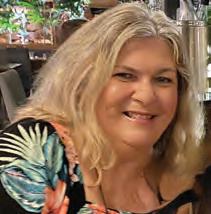
Shirley Sinclair Editor
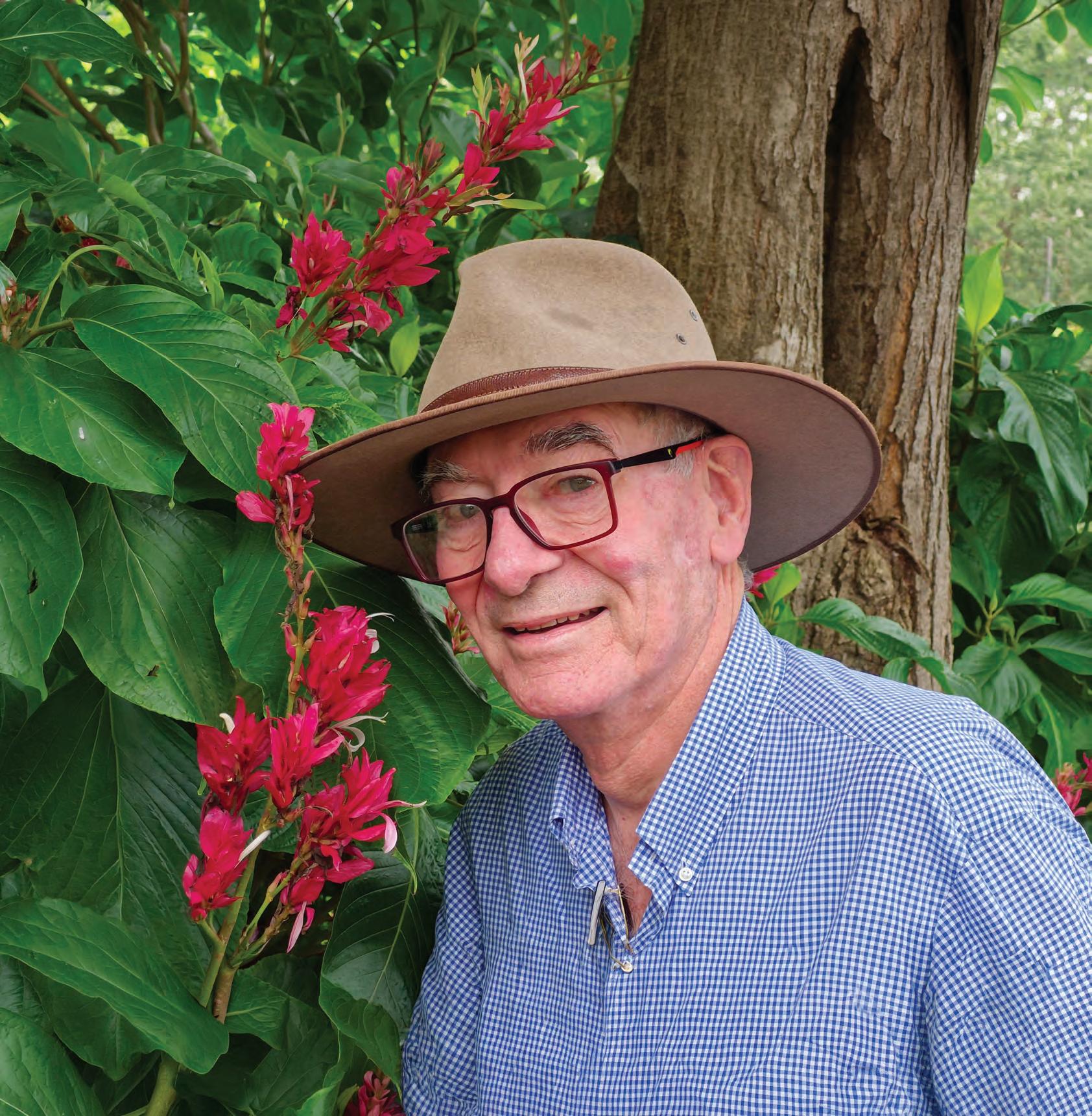
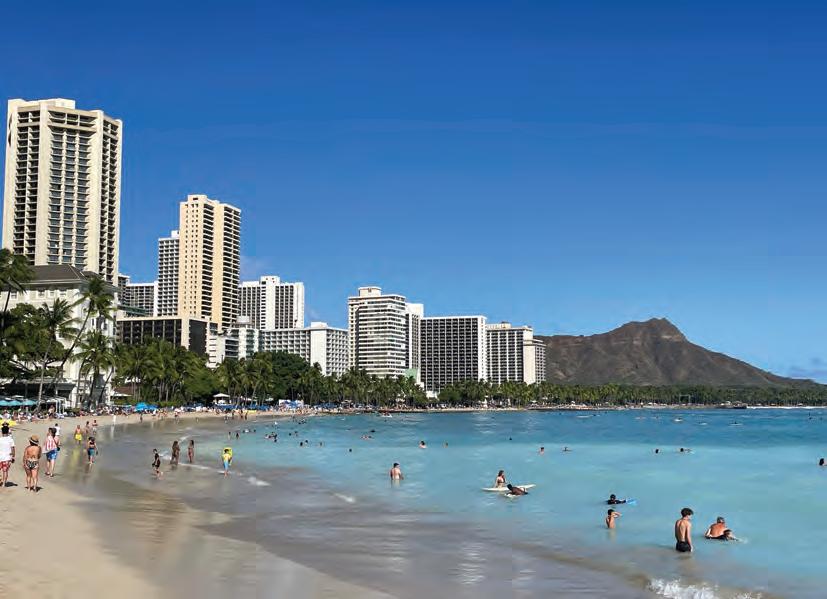
All those wonderful memories came flooding back when I read Russell Phipps’ cover story this month on Ross McKinnon, who retired in 2014 after more than a four-decade career in horticulture at those parks and gardens. And for something completely different, journalist Lee Mylne takes a deep dive into Hawaiian history and culture in our travel feature. Enjoy the read!
. Enjoy y the read!
10cm of chemically charged mud. In some places, the flood rose to a depth of over 3m.”
The flood caused massive damage to the living collections and destroyed extensive plant records. Whole plant collections were destroyed, and the gardens were closed for 10 weeks.
RUSSELL PHIPPS speaks with Ross McKinnon AM about his passion for Queensland’s horticultural attractions.
Ross McKinnon has devoted a lifetime to his love of horticulture.
And for him, that love affair all started in Brisbane in 1972 at the City Botanic Gardens.
“Those gardens are very different from what they are today,” he says.
“You could see the City Hall clock tower from the gardens. The only thing taller was the brand-new Suncorp (then SGIO) building, and the Captain Cook bridge was just being built.”
Located in the heart of Brisbane, City Botanic Gardens is Queensland’s oldest
heritage garden, established in 1855.
Steeped in Brisbane history, the riverside park spans 18ha and 1.2km of river frontage. It’s home to heritage structures, plus exotic and native plants and trees.
Working at City Botanic Gardens was an eye-opening experience for Ross as a young gardener from Adelaide.
“Twenty to 100 homeless people slept rough every night,” he remembers.
“Overnight violence and worse were simply not reported after the bell rang and the gates closed.
“There were 12 suicides in the City Botanic Gardens in my first year.”
Two years later, in 1974, Ross was second-in-charge when he witnessed the devastation caused by floods.
“On Sunday of the 1974 Australia Day long weekend, I phoned those few staff who had phones to come in to work,” he recalls.
“We all stripped off to our shorts and moved what was, at the time, the world’s largest potted cacti and succulent collection.
“The gardens were coated in about
The continual flooding of the gardens became the catalyst for controversial new botanic gardens to be built at the base of Mount Coot-tha.
The lord mayor at the time, Clem Jones, saw the huge tourist potential of the new botanic gardens, which are now the city’s second-largest tourist attraction.
However, public comment at the time was that the site was too far from the CBD and too hilly.
Ross says some people felt the soil was too stony and filled with the wrong clay.
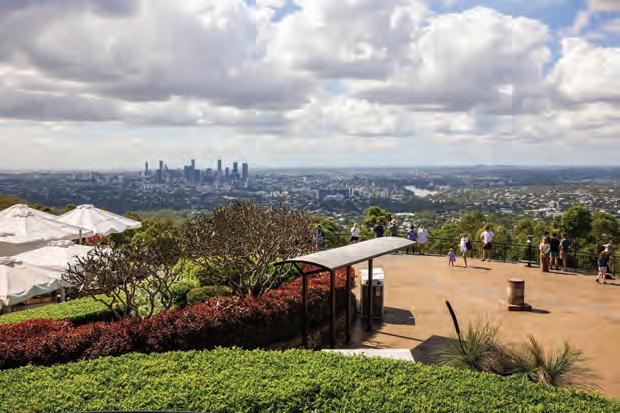
Yet, spanning 56ha, the Brisbane Botanic Gardens Mt Coot-tha has become Queensland’s premier subtropical botanic garden.
“There was amazing growth, even on the steepest slopes, which can be attributed to the heavy minerally sustaining soils,” he says.
Ross helped oversee the development
Ross McKinnon. Image: Russell Phipps. INSET: The Mount Coot-tha view
of the Mt Coot-tha gardens since their inception. But when he first looked over the site, it was virtually just a cleared paddock.
“It was a bit like a jigsaw puzzle. We have been filling in the pieces ever since,” he quips.
Ross says the construction of the new gardens at suburban Mt Coot-tha was a team effort.
“We all knew what we were creating, and it was important work that we would be proud to tell our great-grandchildren that we had been a part of something far bigger than ourselves,” he says.
In 1982, Ross became the curator-incharge of the Brisbane Botanic Gardens – a role he held until 2014.
During his curatorship, he was most proud of the doubling in size of the gardens from about 25 to 52ha, with the addition of the 25-hectare Australian Native Plants Gardens.
“This is the largest collection of Australian native rainforest trees in the world, collected primarily from seeds from Far North Queensland,” he says. Ross’s other passion was to make the gardens self-sustaining.
“We harvest all the water on the site, which goes into our lakes and then gets pumped onto our gardens,” he says, proudly.
“We have now been off mains water since 2005.”
His vision was always to create an educational institution.
Ross helped establish Lessons in the Gardens and the volunteer guides.
The Lessons facilitated the employment of eight education officers in a self-funded program for preschoolers to university botany students.
Ross says the program has been a success, with 120 volunteers helping international, interstate, Queensland and Brisbane residents better understand the Brisbane Botanic Gardens.
City Botanic Gardens and Botanic Gardens Mount Coot-tha are only a part of the capital’s major green spaces, which also include the Roma Street Parkland and New Farm Park.
Opened in 2001, Brisbane’s 16ha Roma Street Parkland transformed a former industrial railway yard into a premier inner-city garden.
Historically, the site served as an Indigenous meeting place, a 19th-century market and a World War II base before being revitalised as a modern public park featuring themed gardens and public art.
Roma Street Parkland has an open-air amphitheatre that regularly hosts outdoor cinema screenings, along with film festivals and other activities during the summer months.
New Farm Park, established in 1914 and officially opened in 1919, is a 15ha Heritage-Listed city treasure, located on a bend of the Brisbane River.
Originally a penal colony farm in 1827 and later a racecourse, it was converted into a public park to enhance urban beauty, featuring beloved rose gardens, blooming jacarandas in spring and a sprawling playground.
In retirement, Ross can look back on a proud contribution to the state’s horticulture. And he remains a champion of public open spaces for all to enjoy.
In 2025, he became vocal in opposition to the proposed Olympic stadium in Victoria Park.
“To contemplate losing another of Brisbane’s green iconic spaces is an outrage: an abomination that will reverberate around the world – the desecration of public open space,” he says.
“Victoria Park is a highly valued green reserve in suburbia for hospital patients and the public alike.
“The gardens are the lungs of the city – sometimes the closest urban kids come to the real world.”
The Brisbane Botanic Gardens Mt Coot-tha are open from 8am-6pm (September to March) and 8am-5pm (April to August). City Botanic Gardens and Roma Street Parkland are open 24 hours. New Farm Park is open 8.30am-11pm daily.
FAST facts
• On Australia Day 1999, Ross was awarded the nation’s highest civilian honour, the Order of Australia for Outstanding Services to Horticulture.
• In 2005, he was awarded the inaugural Vitae Lampada (The Burning Torch of Life) medal for his role as consultant to the Queensland Poison Information Centre and the help he gave the Department of Paediatrics and Child Health.
• In 2019, he was handed the Japanese government’s high honour: the Order of the Rising Sun for his lifetime work with and for the people of Japan.
• Ross is a patron, life or honorary member of 32 horticultural organisations.
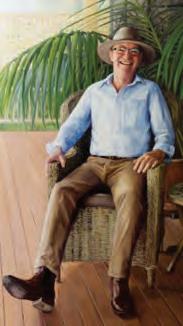
PORTRAIT OF AN ACCOMPLISHED GREEN THUMB
The Laughing Curator portrait is by Janelle Hatherly, of the Royal Art Society of NSW.
Hatherly is a professional educator and writer who, since retiring from full-time employment in 2012, has committed her energies to a career as an artist.
The portrait of Ross McKinnon was displayed in the Brisbane Portrait Gallery following judging in the prestigious Brisbane Portrait Prize.
Painting permitted for publication by Janelle Hatherly
Don’t need a formal funeral?
Let us take care of everything.
It’s funeral quality care, without the funeral price.
What’s hip
No, not the replacement surgery type of ‘hip’. It’s a selection of on-trend snippets that could include places to dine, travel destinations, where to shop, what to see and visit, as well as what to watch, read and listen to, so you can stay up to date with family, friends and neighbours of all ages.
What to book
FOODIES, wine aficionados and all lovers of ‘the good life’ are counting down the days to the 2026 Noosa Food & Wine Festival from June 11 -14. Tickets are still available for The Festival Village – the biggest event, the heart of the action and the lowest price point at $49.50 a ticket. It has a smorgasbord of food and wine stalls with 40-plus bars and eateries, as well as stages offering live interactive masterclasses with acclaimed guest chefs such as Louis Tikaram (Stanley), Jason Barrett (Supernormal), Ben Cooper (Chin Chin), and Marion Grasby. Or maybe try Settle in at Sabrosa for a 13-course dim sum journey of meticulously crafted bites, bold flavours and playful textures, with each course thoughtfully paired with Gentle Folk wines. Go to noosafoodandwine.com.au
What to hear
FORMER NASA astronaut, retired US Navy Captain and two-time New York Times bestselling author Scott Kelly presents The Sky is Not the Limit: Lessons from a Year in Space at QPAC on November 22 at 8pm. His record-breaking, 340-day ‘Year in Space’ mission was chronicled in a Time Magazine documentary series and an Emmy Award-winning TV special. Named one of Time’s 100 Most Influential People of 2015, his memoir Endurance has been optioned for a major motion picture. For a once-in-a-lifetime experience, join Scott – live in Australia for the first time –for this awe-inspiring evening of extraordinary stories from the edge of human endurance and hard-won lessons in leadership and resilience. Tickets cost $69.90-$359.90 (a transaction fee of $7.50 applies). Visit qpac.com.au/ whats-on/2026/scott-kelly-the-sky-is-not-the-limit
How to reminisce
RELIVE your favourite rock and pop memories in a two-hour show, Countdown Live, hosted by Paul Field of Aussie band The Cockroaches. This is a celebration of the music and acts that defined a generation. The show’s special guest and original Countdown artist Peter Cupples (Stylus) will be joined by Bronwyn Mulcahy, Peter Northcote and The All-Star Celebration Band to belt out the chart-topping hits and hidden gems from Australia’s most beloved music television show, Countdown. Hear classic hits by Skyhooks, The Divinyls, Cold Chisel, Suzi Quatro, AC/DC, Mental As Anything, INXS, The Angels, John Paul Young, ABBA, Pat Benetar, Blondie and KC & The Sunshine Band. Countdown Live comes to Twin Towns Showroom on July 3 at 8pm and The Events Centre Caloundra on July 4 at 7.30pm. Head to countdownlive.com.au
Back in the day ...
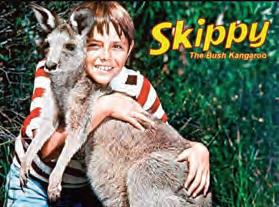
FOR many city kids growing up in the ’ 60s and ’ 70s, Skippy the Bush Kangaroo was their connection to the country and Outback.
The wholesome Australian television series originally aired from February 5, 1968, to May 4, 1970. The 91, 30-minute episodes (and one full-length movie Skippy and the Intruders) followed the adventures of Sonny Hammond (Garry Pankhurst) – the younger son of head ranger Matt Hammond (Ed Devereaux), and his closest companion: an orphaned Eastern Grey kangaroo. Charming Skippy’s intelligence, her unmistakable kangaroo-speak (even if they were man-made sound effects), her ability to understand English and complete human tasks endeared her to us all.
What to watch
SOUTHEAST Queensland’s reputation as ‘Hollywood Down Under’ is growing by the day. Blockbusters such as Thor: Ragnarok have put the Gold Coast on the filmmaking map. Travis Fimmel’s Black Snow Season 2 used the Glass House Mountains backdrop for its murder mystery. And many a star has praised our film crews as the best they’ve worked with. A short film created in Nambour, Extraordinary Rob, recently won the Best Australian Short Film award at the Gold Coast Film Festival. So, Showdown Showcase at Kawana Event Cinemas on June 9 from 6-8pm is one of the hottest tickets in town, celebrating the talent emerging from the region. Visit screencollective.au
A window of light into the world of healing for those challenged with cancer
Our focus is on gaining valuable research and a greater understanding of holistic, non-invasive cancer treatments and therapies.
At CanSurvive, we are dedicated to ensuring people challenged by cancer have a greater choice in determining their care and treatment
In doing so, we provide access to:
• Evidence-based research on traditional and complimentary care
• Holistic non-invasive cancer therapies (services)
• Books, Supplements and Events
• Support Groups
• Educational Seminars and Workshops
• Online Shop
• An extensive lending library with mail order service
Retiree GARRY REYNOLDS shares his thoughts on the world around us.
WHITE HAIR SYNDROME
A MYSTERIOUS condition seems to be sweeping Australia.
I call it ‘White Hair Syndrome’.
You know the signs. You’re first in line at the bakery, but the staff member serves the teenager behind you who’s still trying to remember what a croissant is.
You’re at the chemist and the assistant explains how to swallow a tablet, as if you haven’t been doing it since Australia had pounds, shillings and pence.
White Hair Syndrome affects anyone with silver or thinning hair (or hair that has simply packed its bags and left). It even affects people who don’t have white hair but look like they’re thinking about it.
Of course, we don’t take this lying down. We’ve developed countermeasures. There’s the strategic cough: a gentle reminder that we are, in fact, alive.
The raised eyebrow of doom: capable of stopping a barista mid-froth. And the polite but deadly “excuse me, I was next”: a phrase that should be printed on T-shirts.
Here’s the truth: white hair isn’t a warning sign. It’s a superpower.
It’s the colour of wisdom and of having lived long enough to know which nonsense to ignore.
It’s the shade you earn after decades of raising families, working jobs, loving and losing people, plus finding your way through life’s storms without the benefit of Google Maps.
Every silver strand is a story — some funny, some painful, but all hard-won.
And yes, sometimes it means you can be overlooked.
But sometimes it means you get seen more deeply by the people who matter.
You can cross the road at any speed you like and drivers will smile indulgently. You can say exactly what you think and people call it “refreshingly honest”. You can ask someone to reach the top shelf and they’ll leap like they’re rescuing a kitten.
White Hair Syndrome may try to make us invisible, but we’re not fading.
We’re glowing.
And in Queensland, nothing catches the morning light quite like a head of silver – or white.
Pilot Ross
By Mocco Wollert
I CONSIDER myself a good and responsible member of the inhabitants of this lovely planet.
I try to keep the consumption of water and electricity down.
I am also very aware of the necessity of dealing conscientiously with the waste we are creating. However, it is not as easy as it sounds: yellow bin for recycling, red bin for landfill, plus a green bin for plant waste.
It sounds so simple, but I must confess I am often confused. Having spoken to some of my readers, I am not the only one.
There is a symbol on bottles and packages: three arrows in a circle, which means the item is recyclable. I have a problem with this. Often, I cannot find the symbol and yet the item, a plastic vitamin tablets bottle or a glass jar, in accordance with the rules, is recyclable.
Thinking about the ‘old days’ when I lived in Darwin, nobody cared about where to dispose of waste.
I remember we were given a wild goose by a friendly neighbour. He had
for many years, printing cartridges. I also confess to the odd empty, plastic coffee cup.
Life in the slow lane Life’s an adventure
Wine bottles are easy and I make sure they go into the recycling bin. Small soft drink bottles or piccolos go into a skip, destined to go to the scouts for them to make some money.
By Cheryl Lockwood
just shot it in the experimental rice fields outside Darwin. My husband and I had no idea what to do with the massive bird and knew we had to get rid of it discreetly.
Into the rubbish bin? Oh no: our neighbour might see it and be offended. As the hot Darwin day progressed, the ‘present’ started to smell. Eventually, we stuck it into a plastic bag, drove to the Darwin wharf – just a wooden jetty then –and threw the bird into the water. Hopefully, the big groper that lived there would make a good meal of it.
I have made a lot of mistakes recycling in the past, mostly through sheer ignorance.
Take my wastepaper basket, sitting patiently beside my desk, for example. I discarded many things into it without thinking: pens, tissues, paper wrappers with food scraps and,
Proudly Australian owned & operated since 1970
At Algester Lodge, we provide to you high-quality residential & respite care, nestled in a bushland setting with landscaped gardens. Depending on your need we offer quality and security with 24/7 Registered Nurses on-site.
offer
Residential Care and Respite Care
Respite Care will be beneficial to you and your loved one to give you both peace of mind. If you require a break from your supportive role, please call our caring staff at either location.
Even though we might get it wrong sometimes, we are all trying in our small ways to keep our planet clean. But what about the massive amount of waste that the future generations will face?
What is going to happen to the millions of solar panels, destroyed by storms or simply old age?
What about the wind turbines – those massive machines that are dotting the landscapes?
Then, there are the enormous amounts of black plastic sheeting to cover strawberry fields or the endless metres of plastic watering lines used in fields and vineyards.
The latest is ‘space junk’. I am not sure how to classify ‘space junk’ and whether we earthlings are responsible for that?
I fear that whatever we sent out into the universe may one day come back to haunt us.
May you be informed enough to recycle responsibly.
Email mocco.wollert@bigpond.com
“Everyonehasbeenverypoliteandextremely helpful,especiallyaswewereunawareofwhat todo.Mumisveryhappywithhertreatment.” Resident’s Family Member
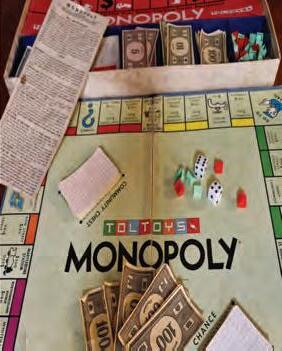
EVERY couple of months, I attend a games night and it has become something I really look forward to.
The number of attendees varies from 10 to 20 and those of us in our 60s are considered the ‘youth group’, proving that games are also for the young at heart.
This get-together happens in a friend’s home and there is a stack of board games to choose from.
Rummikub and Sequence are popular for those who want to give the grey matter a workout with some strategy. There are word games, which also require dusting off the brain cells, and games such as Pictionary are a lot of fun for those who want to show off their artistic skills (or maybe cop flack for their complete lack of talent).
Whatever the choice, there always seems to be a lot of laughter amid the good-natured rivalry.
A regular part of the night, besides the fine coffee, is what we call our icebreaker game. It’s kind of like a warm-up for the main event or stretching before a game of pickleball.
Our host has in his possession an old quiz-style game. The table you happen to sit at when you arrive automatically becomes your team for this game.
One person in each group becomes the scribe.
From edgy to elegant, Larissa brings your style to life with a twist of personality:
> Gothic, Rockabilly & Alternative vibes
> Men’s fashion with flair
> Contemporary styling for modern trendsetters
> Colour analysis to find your ‘wow’ shades
> Gift cards –perfect for stylish surprises!
The host reads a topic from a card and with the help of the team, the scribe writes as many answers relating to that topic as they can think of.
A timer is set for two minutes and, once time is up, it’s pencils down.
The host then reads out the 10 answers, which he has on his card. Teams only score a point for an answer that matches those listed. You could scribble down 23 wonderful responses, but none of them are any use unless they are a match.
To help explain, I’ll share some themes we had recently. There are a few answers below, but I can’t remember them all, even though we don’t drink anything stronger than coffee.
1. Famous Georges … as in well-known people by the name of George.
2. Items made of glass.
3. Professions or jobs beginning with ‘G’.
On games night, there are two things to note. The first is that this game was made in the 1970s or ’80s, which affects what is on the answer card. For example, the suave Mr George Clooney is a renowned actor, but maybe not so
famous when the game was printed.
The second thing is, keep your voice down because this mob of grey-haired game-players will steal an overheard answer as though their life depended on it.
Competition becomes fierce when the answers are read. It is up to the host to judge whether an answer is acceptable.
He probably didn’t sign up to be the referee to the arguments that ensue or the sledging between rival teams, but this seems to happen every time.
We play rounds until one team reaches 25 points. With our creative juices flowing, everyone moves onto their board games of choice.
The laughs continue until the host and his wife feed us dessert and send us home (the latter is likely their favourite part of the night).
Answers to Famous Georges included: Harrison, Burns, Gershwin, Washington, Orwell and King George V.
Items made of glass were: vases, bottles, marbles, glasses, magnifying glass and windows. Arguing that a glass eye was practically a marble did not work.
Those ‘G’ professions were: geologist, garbage collector, graphic artist, greengrocer, gardener, gatekeeper and gunsmith.
We’re told to keep our brains active and that laughter is the best medicine.
Games night ticks both boxes.
Visit lockwoodfreelance.com
It was no small change when Aussies moved to dollars and cents
CHRIS CURRIE goes back through State Library archives to a time when everyone had to deal with a new currency at cash registers, petrol pumps and banks.
n February 14,
Overnight, pounds, shillings and pence were replaced by dollars and cents, in what became known as Changeover Day or ‘C Day’.
The change was simple in principle.
One Australian pound became two dollars, and the new system
divided money neatly into 100 cents.
Yet, for those who lived through it, the reality was far less straightforward.
Every wage packet, bank balance and shop price had to be recalculated at once, affecting transactions everywhere from corner stores to stock exchanges.
In Brisbane, as elsewhere, the public had spent months preparing.
The Courier-Mail ran a regular column, ABC of Decimals, which advised
the public on conversions, as well as practical applications.
Schools taught children the new system and the Retail Traders’ Association held special lectures for members.
There was even a telephone service – known as the ‘Dollar Jills’ –to answer practical questions from confused consumers.
Much of the education campaign centred on a cartoon figure named ‘Dollar Bill’ whose catchy television jingle explained how the new money worked.
The tune and opening lines became so familiar that many Australians can still recite it decades later (“In come the dollars and in come the cents ...).
A shopping card produced by the Decimal Currency Board, held in State Library of Queensland’s collections, offers another (somewhat convoluted) rhyme to aid consumers:
One and two remain the same,
The only difference is the name,
Three to nine lose one, it’s true,
And for the rest, you take off two.
Despite this preparation, reactions were mixed.
A Courier-Mail street survey at the
time found some Brisbane residents unimpressed by the new notes, with one remarking that they looked more like “lolly wrappers” than real money.
Another man expressed his indifference, saying: “I wouldn’t really care if Ned Kelly’s portrait was on them, as long as I have enough.”
Behind the scenes, the scale of the operation was enormous. New coins and banknotes had to be produced and distributed across thousands of bank branches, while machines such as cash registers and petrol pumps had to be modified to accept the new currency.
All these preparations paid off: the changeover was remarkably smooth.
The then prime minister Harold Holt said Australians deserved a “pat on the back for the good-natured way they have accepted decimal currency into their daily routine”.
Brisbanites can take their share of the credit, though there were a few complaints due to confusion over conversion and suspicions of overcharging by some shopkeepers.
Over a short time, however, the new currency simply became part of how Queenslanders paid for everyday life.
Decimal currency consumer and business guides from State Library of Queensland collections
Why muscle mass matters more after 60
CAITLYN HUTH outlines why we need to build up our strength – and keep it – as we age.
Staying strong isn’t about looks: it’s about staying capable, independent and protected.
Most people associate muscle with gym culture or elite athletes. But after the age of 60, muscle mass becomes one of the most important factors in your quality of life – not for how you look, but for how you live.
What happens to muscle as we age?
From around age 35, we naturally begin losing muscle mass: a process called sarcopenia.
By the time we reach our 60s and 70s, sarcopenia can accelerate noticeably.
Without intervention, we can lose 3-5 per cent of our muscle mass per decade – often more.
This doesn’t just affect strength. It affects balance, energy, bone density, metabolism and even the ability to recover from illness.
Muscle isn’t just for lifting things. It acts as a metabolic engine, helping to regulate blood sugar and
keeping your weight stable.
It supports your joints, reducing the load on knees, hips and your lower back.
It powers every functional movement you rely on: getting up from a chair, climbing stairs, carrying groceries or simply walking confidently.
Muscle is also your body’s first line of protection in a fall.
Strong legs and trunk can mean the difference between catching yourself and hitting the ground.
The good news: you can build it at any age.
One of the most empowering facts in exercise science is that
muscle responds to training well into your 80s and 90s.
You don’t need to become a weightlifter. What you need is regular, progressive resistance exercise: movements that gradually challenge your muscles so they adapt and grow stronger.
This can include resistance bands, body weight exercises, light weights or supervised exercise with an exercise physiologist who understands how to tailor training to your needs and any conditions you may have.
Two to three sessions per week of strength-focused movement is enough to make a meaningful difference.
Combine that with adequate protein in your diet and you have a powerful formula for staying strong, capable and independent. It’s never too late to start.
In fact, the later you leave it, the more important it becomes.
Caitlyn Huth is an exercise physiologist at Full Circle Wellness. Call 5456 1599 or visit fullcirclewellness.com.au
FIT HAPPENS with Tom Law
‘YES, I SEE OLD PEOPLE EVERYWHERE’
FRIENDS of ours are celebrating their mum’s 100th birthday.
Another person who exercises with me regularly is buying a bicycle in a few months. He will be 80 years of age.
And people are working longer. Just have a look around.
Some older Australians may be working longer than in the past, simply because of the economic situation. And that makes sense. But we are, without doubt, living longer and figures confirm that.
Over the past century, life expectancy has increased from about 51 years to our current (2024) figures of 81.1 years for males and 85.1 for females.
First Nations people have a variation in life expectancy that does indicate a health gap. However, there are variations in gender and localities, of course. It is no secret that our health and wellness improvement and increased life expectancy coincide with modern-day medical advances and better nutrition for the majority of
Australians. With an increased life expectancy, we can do more – provided we are equipped to do more. By that, I mean if we have the health, mobility and strength to do more.
It really is a simple equation: keeping fit and healthy increases the chances of good health for longer.
For many, working longer actually achieves the finances required and the additional exercise necessary to maintain, to some extent, health and wellness. Good for you.
Over the years of this column, I have had some good feedback. Recently, a woman phoned me to say she loved the May ‘Don’t let the old man in’ piece.
The fact that she took the time to call me was a compliment.
So, a parting suggestion this month: “If you see someone without a smile, give them one of yours.”
Tom Law is the author of health and exercise-related books. Visit facebook.com/tomslawtraining or call 0409 274 502.
Cyber crims are everywhere
EDIN READ offers some simple rules of thumb to ensure we are all safer online against viruses, scams and other threats.
“Would you mind having a quick look at this USB for me?” It sounds harmless enough. Perhaps a friend wants help with holiday photos, or someone at the local club is handing over meeting documents.
Most of us wouldn’t think twice about plugging a USB stick into our computer.
Cyber criminals know that, too.
One of the simplest ways for hackers to infect a computer is through a USB device.
The moment it’s plugged in, hidden software can automatically install itself without any warning.
In some cases, the owner of the USB may not even realise their device is infected. Viruses can quietly spread from one computer to another like a digital cold.
Over the years, I’ve seen cases where a single infected USB caused family photos to disappear, passwords to be stolen or computers to become painfully slow.
Sometimes the damage isn’t obvious straight away. A computer may continue working normally while hidden software secretly collects personal information in the background.
These days, USB devices can be surprisingly sneaky. Some are designed to
look completely ordinary while containing malicious programs specifically created to attack Windows or Apple computers.
There have even been reports of ‘free’ USB sticks handed out at conferences or left in public places, hoping somebody’s curiosity will get the better of them. The safest rule is very simple: if you don’t fully trust the USB device, don’t plug it in.
The same caution applies to public USB charging stations. Many people plug their phones into charging ports at airports, shopping centres, hotels or libraries without thinking much about it.
While many are perfectly safe, some can potentially transfer data as well as power. This means a compromised charging station could attempt to access information from your phone.
Using your own wall charger or carrying a small portable battery pack is usually a much safer option.
Thankfully, staying safe doesn’t require being a computer expert. A few simple habits make a huge difference.
Keeping your computer updated is one of the best protections available. Those update reminders that pop up on your screen can feel annoying, but they often
contain important security fixes. Cyber criminals actively target older software because they know many people delay updates for weeks or months.
Strong passwords matter, too. I still meet many people using passwords such as ‘123456’ or the family dog’s name. A good password should be long, unique and difficult to guess. Consider using a password manager so you don’t have to remember dozens of different logins.
Email scams also continue to catch many good people out. If an email creates panic or urgency – perhaps claiming your bank account has been locked or a parcel delivery failed – take a moment before clicking anything.
Scammers rely on people reacting quickly without stopping to think.
If in doubt, contact the organisation directly using a phone number or website you already know is genuine.
Backing up your important files is another simple but powerful habit. Family photos, important documents and treasured memories should never exist in only one place. An external hard drive or trusted cloud backup can save enormous heartache if a computer fails or is infected.
Computers, phones and the internet are wonderful tools that help us stay connected, informed and entertained. Most online dangers can be avoided with a little awareness and a healthy dose of caution.
Computer security is like home security: you don’t need bars on every window and cameras in every corner. Locking the front door and being careful about who you let inside is usually enough.
The same principle applies to that innocent-looking USB stick.
Edin Read is founder and chief technician at Greyology Tech Support for Seniors. Visit greyology.com.au
Kia ticks all the boxes for cheap, cheerful and compact
BRUCE McMAHON considers how far Korean carmakers have come in the Australian market over the past 30 years or so.
Kia’s K4 hatchback and sedan are sophisticated compact cars – a fair way removed from last century’s offerings in this part of the market.
The Korean cars (this pair with internal combustion engines) are fine examples of how motoring’s moved on since the 1990s.
It’s not just in the K4s’ new-age style, nor the smart and well-equipped cabin.
It’s the road manners – the dynamics of the package – that help showcase how far cars have come, albeit with higher price tags to suit.
It took some time for Japanese makers to find solid ground in the Australian marketplace. The Koreans didn’t take quite so long.
The cheap and cheerful Hyundai Excel first arrived in 1986 and, while often derided, by 1998 the thirdgeneration Excel was the country’s top-selling car for a time (this was before utes and SUVs began to dominate sales charts).
This was about the time Kia ran into
financial troubles back home and Hyundai became Kia’s largest shareholder, owning about a third of their fellow Korean manufacturer.
From there, it appears to have been a win-win for both, with separate identities but some shared and successful synergies.
So, Kia now has an extensive range of showroom offerings – from small town cars to family-friendly SUVs to the luxuries of the Carnival people-mover and the workability of the Tasman utes (I remain delighted with the new Tasman X-Pro in the carport here, 4000km up and happy).
The Kia K4s – an upsized replacement for the Cerato and rival to Toyota’s Corolla – are handsome in design and stand out particularly in a couple of the fancier body colours.
They’re a bit low (especially after the aforementioned and high-riding Tasman), but comfortable for four adults and luggage for four.
The front seats hold a driver well, which is handy when you step up into
the GT Line and its turbocharged, 1.6-litre engine. All K4s are loaded with a deal of today’s technology and features once found only in high-end and premium European machinery.
It’s easy to hook up the phone, and the central touchscreen offers simple and intuitive access to all manner of convenience and comfort features. It’s also easy enough, if sometimes tiresome, to turn off some of the driver aids such as lane-keeping assistance at each start.
There are five trim grades for the K4s, starting out around $34,000 for the base, which is a most reasonable price for a compact car with this much class.
The heroes, though, are the top-end GT Line versions with the extra grunt – and a sunroof.
The $43,000 K4s run with 142kW
over the other models’ 110kW. More importantly, there’s an extra 85Nm of torque from 1700rpm, plus lower-profile 18-inch tyres.
And so the good road manners of the K4s’ Australian-tuned chassis can be well exploited and make for a most sporting drive. Switch to Sports mode to tighten up steering feel, shift through the eight-speed auto with paddle shifters and, despite some understeer, here’s some old-school fun punching along a mountain road.
The downside? Fuel consumption may double the factory-claimed 5 litres per 100km if having too much fun.
But a driver doesn’t have to push a Kia K4 around to appreciate this is a wellconceived compact car, and streets and goodies ahead of last century’s offerings.
Leaving a gift
CHANGE MEDICINE TODAY, CHANGE LIVES TOMORROW
THE gift you leave in your will to QIMR Berghofer is a personal expression of hope for a healthier future.
By choosing to support medical research, you will help create a positive impact far into the future.
For eight decades, QIMR Berghofer has been defined by world-leading research, a bold vision and relentless drive for better health – pushing the boundaries of science and saving lives here and around the world.
From humble beginnings in a leaky old army hut 80 years ago, QIMR Berghofer has transformed into a medical research powerhouse.
Thanks to public support, researchers are advancing worldleading research into some of the most significant health challenges facing Queenslanders, Australians
and communities worldwide. This includes research into melanoma (a major concern for Queenslanders), brain cancer, mental health, infectious and tropical diseases, dementia, autoimmune disease and many other conditions and afflictions that impact families every day.
Research relies on long-term vision, dedication and support.
Gifts in wills are that vision of financial support and trust.
They enable the researchers to continue their work that will change lives in the future.
QIMR Berghofer brings together more than 1000 scientists, students and staff to support its mission to translate scientific discovery into positive impact for the future.
For more information about QIMR Berghofer or leaving a gift in your will, call Lorraine on 0408 722 877 or email Lorraine.Fraser@qimrb.com.au
A Gift in Your Will to QIMR Berghofer is a Legacy for the Future
QIMR Berghofer is a world-leading medical research institute, renowned for our efforts in both discovery and real patient outcomes. Celebrating eight decades of delivering ground breaking medical research.
Gifts in Wills to QIMR Berghofer are the gifts that keep on giving. The research and knowledge that is achieved because of your generosity will continue, and advances that are made today will have the potential to change the lives of Australians now and generations to come.
If you have left QIMR Berghofer a Gift in your Will please let us know, we would love to thank you and ensure you receive the latest research news.
BEQUESTING THE GIFT OF LIFE-CHANGING RESEARCH
THE Mark Hughes Foundation (MHF) is a non-profit health promotion charity. It was founded by Mark Hughes and his wife Kirralee in 2014 after Mark was diagnosed with brain cancer.
The foundation was established to address the significant lack of funding for brain cancer research in Australia, which has contributed to mortality rates remaining largely unchanged for more than 30 years. Since launching the Beanie for Brain Cancer campaign in 2014, MHF has grown into a nationally recognised organisation, with more than one million beanies sold through its partnership with the National Rugby League.
Community fundraising plays a vital role in the foundation’s work, helping raise funds to support patients, increase
awareness and fund critical research. Without large-scale corporate partners, this grassroots support enables MHF to invest in initiatives such as the $25million Mark Hughes Foundation Centre for Brain Cancer Research at the University of Newcastle. And it contributes to fellowships, research projects and brain cancer care coordinators across regional NSW.
Making the choice to leave a charitable gift in your will would make a huge difference and helps the foundation continue its lifechanging work.
“Here at MHF, we believe in giving hope to brain cancer patients and their families and that one day, together, we can find a cure,” Mr Hughes says. Visit markhughesfoundation.com.au
YOU WILL MAKE A DIFFERENCE
For more information on leaving a Gift in your Will visit www.qimrb.edu.au or contact Lorraine Fraser for a confidential chat. 1800 993 000 E: giftsinwills@qimrb.edu.au
Leaving a Gift in your Will to QIMR Berghofer is a personal way to make a difference and create a lasting impact for future generations.
QIMR Berghofer has more than 650 researchers working on discovering better treatments and understanding of, Cancer Research, Brain and Mental Health, Infection and inflammation and Population Health in more than 60 specialised laboratories.
Gifts of all sizes are important, they are essential to fund the Research and the impact it has nationally and globally.
A MISSION TO BETTER UNDERSTAND BRAIN DISORDERS
THE Florey Institute of Neuroscience and Mental Health is the largest brain research centre in the Southern Hemisphere.
It brings together leading scientists dedicated to advancing knowledge across a broad spectrum of neurological and psychiatric conditions.
As global demand grows for improved understanding, prevention and treatment of brain disorders, The Florey has remained at the forefront of discovery for more than 50 years.
Its work continues to deepen understanding of the brain – one of the body’s most complex and least-understood organs – while driving meaningful advances in patient outcomes.
The institute’s mission is ambitious: to make dementia preventable, improve quality of life for people living with mental health conditions, develop cures for epilepsy and discover new ways to protect and repair the brain.
A recognised global leader, The Florey excels in discovery science, neuroimaging, brain/body interactions and therapeutic development. Its research spans a wide range of conditions, including dementia, stroke, Parkinson’s disease, motor neurone disease, epilepsy, multiple
sclerosis, addiction, schizophrenia and depression.
History shows that transformative scientific breakthroughs, from penicillin to MRI, are often made possible through timely support.
Generosity from philanthropic contributions to gifts in wills plays a vital role in accelerating research and translating discoveries from the laboratory into real-world health outcomes. Every contribution to The Florey helps advance critical brain research and improves lives.
To learn more about supporting brain research, visit florey.edu.au/ support-us/ or call 1800 063 693.
Create a lasting legacy by supporting brain research
Most of us know someone living with a brain-related condition. Dementia, stroke, Parkinson’s disease, autism and anxiety are among the many brain and mental health conditions researched at The Florey.
Discovery science is integral to solving these mysteries of the brain. Will you join us as we search to find answers to diseases affecting 1 in 5 Australians?
For a copy of our Gifts in Wills Guide or to speak to us about your wishes, please contact our Gifts in Wills Manager, Nola Wilmot on philanthropy@florey.edu.au or call 1800 063 693.
Kate Brown, pictured here with emerging Florey scientists, has included a gift to The Florey in her Will. Find out more by scanning this QR code
AN EASY WAY TO KEEP THE MEDICAL CREWS FLYING
LOOKING out for one another is the Aussie way of life.
And in regional Queensland, that belief is a lifeline.
Dick Wharton was raised on a station east of Cloncurry, where his father managed 20,000 head of sheep.
His childhood was shaped by sprawling paddocks, riding horses, milking cows and growing food.
Schooling was done at home, and the nearest shop was almost 100km away.
In a place like that, you learn quickly who has your back.
For Dick’s family, the Royal Flying Doctor Service (RFDS) was a part of everyday life.
They relied on the service as their pharmacy, their GP and their safety net.
“If something went wrong, mum or dad would ring the Flying Doctor,” Dick says.
That mantle of safety continued throughout Dick’s career as the district
engineer. His team worked hard, enduring isolation, heat, dust and torrential rain.
But the RFDS was never too far away, with an airstrip nearby and an RFDS medical chest on hand.
Now, after a lifetime of support from the Flying Doctor, Dick wants to make sure the service is there for others.
“The RFDS was there for me,” he says.
“I’d like it to be there for other people in the future.”
For Dick, a gift in his will is a personal way of making sure someone shows up for those in need, no matter the distance.
“It’s a way of saying ‘thank you’ for having my back for all of these years,” he says.
WORDS: Sam Marsh, senior content advisor, Royal Flying Doctor Service (Queensland section).
Visit flyingdoctor.org.au
IN QUEENSLAND, we are lucky to live among some of the most beautiful landscapes and alongside truly unique and diverse wildlife.
Australia is home to more than 500,000 animal and plant species, many of which are found nowhere else in the world. Devastatingly, Australia is also one of the world leaders in mammal extinctions, and many of our iconic species are at risk.
The Wildlife Preservation Society of Queensland (Wildlife Queensland) has been working for more than half-acentury to create positive change for Australia’s wildlife and environment, and is the largest, longest-running and most respected wildlife-focused conservation group in the state.
Wildlife Queensland works in cooperation with government, businesses and other conservation groups to develop policies to ensure the protection of our state’s natural heritage such as the Great Barrier Reef, mallee country, rivers and catchments, rainforests, mangrove and other coastal ecosystems.
The society is undertaking projects to protect and conserve brush-tailed rock wallabies, Richmond birdwing butterflies, yellow-bellied gliders and platypus, to name a few.
As a community, non-profit organisation, Wildlife Queensland can
only suc ceed with the support of individuals. Along with being the lifeblood of the organisation, gifts left in wills to Wildlife Queensland ensure that beloved wildlife have a voice and that these unique creatures and their habitat will be protected for future generations to live alongside and cherish.
To find out how to help protect and conserve Queensland’s native wildlife, visit wildlife.org.au, email wpsq@wildlife. org.au or call 3844 0129.
SUPPORTING QUEENSLANDERS SINCE 1928
Queenslanders
THE FINE ART OF AVOIDING POLARISING BUYERS CHOICE SHARES TOP TIPS TO HELP LOWER YOUR WINTER
ARE your prospective buyers going to feel relaxed and at home, or see a list of jobs waiting for them on their weekends?
The garden you’ve spent years creating may look stunning, but not everyone enjoys gardening.
People are time-poor. Budgets are tighter. In many households, both parents are working full-time, leaving little spare time for upkeep.
Simplify where possible. Modernise selectively. Keep maintenance low.
You don’t want features that polarise buyers or put them off.
Think of a bright-red splashback in a kitchen. Some people will love it. Others will hate it.
That’s what I mean by polarising. You risk alienating 50 per cent of buyers over this one feature alone.
While a splashback is an easy thing to change, once buyers get a negative feeling about a property, they often move on emotionally, before they move on physically.
Even small things can stop an offer and a sale. I’ve had buyers refuse to offer on a house because it didn’t have a rangehood, even though we offered to install one for them.
In another instance, buyers thought the skirting boards needed painting because they looked dull and dusty. It
turned out they simply needed a good clean. Presentation makes a world of difference.
With cash rate rises and legislative changes, more properties are likely to come onto the market, meaning presentation matters even more.
When buyers compare your home to others on the market, how do you want them to remember it?
Clean, fresh and well presented, or the one they dismissed because of the red splashback?
The more buyers your property appeals to, the more competition I can create. And competition is what helps push your sale price higher.
WORDS: Jodie Brooks, licensed real estate agent and REIQ member. Call 0404 257 024 and visit jodiebrooks.com.au
HEATING COSTS
WITH cooler months approaching and cost-of-living pressures rising, keeping your home warm without breaking the bank can be challenging.
Choice experts have crunched the numbers on different types of heating to help you save money on your energy bills.
“Ninety-seven per cent of Australians say their household bills and expenses have increased over the last 12 months –the highest number recorded in more than 10 years of our Consumer Pulse survey. So, it’s more important than ever to do what you can do to reduce your energy bill,” says Choice household expert Chris Barnes.
CHOICE’S TOP TIPS:
1. Use a reverse-cycle air-conditioner.
“In the long run, air-conditioners are the cheapest way to heat your home, as opposed to using something like a portable electric heater. Our estimates show that running a reverse-cycle air-conditioner for the entire year can cost less than running an electric heater for just three months over winter,” Mr Barnes says.
“However, if you don’t already have one installed, the upfront cost of buying a reverse-cycle air-conditioner is anywhere from $600 to $5550, plus a few hundred dollars for the installation.”
2. Ensure your home is properly insulated.
“Having a well-insulated home makes a big difference to keep the heat in and the cold out. You can lose up to 35 per cent of your home’s warmth without insulation, which can drive up energy bills,”
Mr Barnes says. “However, if you can’t afford insulation or are renting, there are still plenty of cost-effective ways to keep your home warm. Sealing draughts, closing your curtains or blinds and using rugs can all help retain heat – all of which will help reduce your heating bills.”
3. Be smart with your heating options.
“On cold days, avoid turning your air-conditioner up higher than necessary, as this will increase your energy bill. We recommended setting the temperature around 18-20°C. Every extra degree increases your heating energy use by up to 10 per cent,” Mr Barnes says. “While your heating is on, it’s also important to close doors to rooms you aren’t using. Only heating the rooms you’re in will reduce energy use and therefore lower your bill.”
4. Heat the person, not the home.
“Another cheaper way to stay warm is by using personal heating products such as heated throws or electric blankets. Rather than using an electric heater, which takes longer to warm up and is only ideal for shorter usage times, try an electric blanket or throw,” Mr Barnes says.
Stay across fine print as retirement living options keep upgrading
By DON MACPHERSON
The retirement village living industry is constantly in a state of upgrade.
Competition is high – not just within particular categories of accommodation options, but also across the board.
Clients expect more and operators need to offer more to remain competitive.
The industry is booming across Southeast Queensland, with more and more constructions happening.
People need to bear in mind that the choice to move to a retirement village is primarily a choice for community rather than merely a financial investment.
If you are focused solely on the financial outcome, you are asking yourself the wrong question.
People do, and should, buy for lifestyle as a major consideration.
It’s a choice for companionship, community involvement and security.
However, as with any significant transaction, remember the adage: “Buyer beware”.
People buying into a retirement village need to understand that the transaction is very different to buying and selling a house in the way they have been used to throughout their lives.
It involves ingoing, ongoing and outgoing costs and benefits that need to be understood.
Different retirement villages provide different ways of creating rights to reside in their properties.
In essence, you buy a right to reside for an indefinite period.
There are four main retirement living models:
1. Leasehold – this is the most common way that retirement villages offer their properties to incoming residents. The lease contract creates a right to reside for an extended period (usually 99 years –though, we are yet to see someone outlive
their lease). A lease is registered in the Titles Office. There is no stamp duty. Sometimes there is capital gain, but not usually. General services fees apply. Normally, there are exit fees.
2. Licence – less common than leasehold (at least in Queensland), a licence creates a right to reside but is not registered against the title deed. However, there are additional protections provided under The Retirement Villages Act. Usually there is no capital gain. There is no stamp duty. General services fees apply. Normally, there are exit fees.
3. Manufactured/relocatable homes/ over-50s resorts – this model involves owning the house, but not the land. Because you own the home, there is usually a modest capital gain possible. There is no stamp duty. The owner pays a site rental to have a house on the land owned by the operator. There are no exit fees.
4. Freehold – this is the way that people are used to owning property. They buy the property (like buying a house) and can sell it at the end. They pay stamp duty. They get any capital gain (and bear any loss). The title is registered in the Titles Office. It is more like buying a unit in an apartment building and is subject to a body corporate structure. Body
corporate fees, rates and water charges apply. Freehold is rare in the retirement village space.
Whatever the ownership model, all retirement living contracts provide extensive rules in relation to occupation of the home in which you live. There are always ongoing fees while in the village. There are usually significant fees payable at the end of the ownership period – called various names, including exit fees or deferred management fees. Exit fee percentages vary across the industry and can be based on the incoming payment or the resale figure.
Other exit payments such as renovation costs, reinstatement costs, costs of sale, legal costs and valuation fees vary from contract to contract and operator to operator. Some allow for capital gain (and loss); some do not.
Retirement living contracts are always long and complex (often running to more than 100 pages). Specialist advice (legal and financial) should be sought before entering into a contract for any type of retirement living arrangement.
Brisbane Elder Law staff are experts in all forms of retirement village contracts. Call 1800 961 622 or visit brisbaneelderlaw.com.au
BE AWARE THAT THE EX-PARTNER COULD INHERIT EVERYTHING IF YOU DON’T UPDATE YOUR WILL
AUSTRALIANS entering new relationships are being warned of a shocking legal reality: if you don’t update your will, your ex-partner or unintended beneficiaries could inherit your estate.
That could leave your current partner and children with little or nothing.
Brisbane solicitor Jennifer Williamson, principal and founder of Williamson and Associates, says she is seeing a surge in estate disputes driven by outdated wills that no longer reflect modern relationships.
“People assume their assets will automatically go to their current partner or children, but that is simply not the case,”
Jennifer says. “If your will hasn’t been updated, your ex could still be named as a beneficiary.
“In some cases, they could receive the entire estate, while your current partner is left with nothing.”
With blended families now the norm across Australia, Jennifer warns that the legal risks are escalating fast.
“Second marriages, de facto relationships, stepchildren and shared assets have made estate planning far more complex,” she says.
“Unfortunately, too many people are still relying on wills written decades ago, before their lives completely changed.”
Jennifer says she is increasingly seeing families blindsided after a death, when outdated documents trigger disputes, shock outcomes and costly legal battles.
“We are seeing situations where a current partner believes they are financially secure, only to discover the estate is tied up in an old will that benefits an ex-spouse,” she says.
“By the time it reaches court, emotions are high, relationships are fractured and significant portions of the estate are eaten up in legal fees.”
Jennifer says blended family structures are one of the biggest drivers of estate disputes in Australia.
“If your will does not clearly outline how assets are to be divided between a current partner and children from previous relationships, you are leaving behind a blueprint for conflict,” she says.
Superannuation, jointly owned property and informal financial arrangements can further complicate outcomes, particularly when documentation has not been aligned.
“People think their wishes are obvious, but legally, assumptions mean nothing,” Jennifer says.
“Without clear instructions, competing claims can arise almost immediately.” Visit Jlw.com.au
Ah, the Seventies – what a wild ride I was on with my mates
Chronic disease sufferer CHARLIE GRIFFITHS recalls some of his glory days as a young apprentice electrician, footloose and fancy-free in WA.
This little quip on Facebook tickled me: “I was minding my own business when suddenly 1976 was 50 years ago!”
Where were you in 1976?
I was living in the party mecca of Perth, Western Australia, after riding my Honda 750cc road bike across the gravel and bulldust of the Nullarbor to start a new job and hopefully finish my electrical apprenticeship.
There were probably easier ways to do this but the allure of an adventure was irresistible. And as they say, “Go west, young man.”
To offset the debauchery, I kept myself fit with regular karate training, snorkelling and purging my lungs with clean, fresh air at 160-plus klicks wherever possible.
I even got roped into supervising the Mount Pleasant under-11s footy team for a month until they found a real coach.
So many great bars, nightclubs, fishing spots and parties kept me from dwelling on my very poor job of maintaining a long-distance relationship with a gorgeous
but naïve Miss Australia contestant living 3200km away in Mildura.
Even after I let her down gently, by just not writing or calling, we remained friends. She married my best mate and was matron of honour at my first wedding.
I bumped into her a couple of years ago and was pleasantly not surprised at how comfortably she displayed the elegance of a fine wine.
In 1976, life was for living and working was a means to that end.
My boss and I shared mutual disrespect and I didn’t hold out any hope of a partnership offer when I finished my time.
My final exam was due in November and I took a sickie to study.
Despite the brain-cell holocaust, the few survivors soldiered on fearlessly and I was reasonably confident of a satisfactory result.
I had agreed to be best man at a mate’s wedding in Mildura in January ’77 but didn’t fancy the return trip to endure the final agonising six months of my apprenticeship. So, I came up with an offer
my boss couldn’t refuse: “If I score a credit pass in my final, how about you sign off my indentures in January?”
He agreed and a couple of mad mates and I headed back across the Nullarbor on our bikes.
One paragraph wouldn’t do this trek justice. I just want to thank the hippy dude in the floral Kombi for passing cold cans to us as we rode past and tapped on the side of his van.
A shout-out to the heat-struck lady who forgot she had handed me her baby in the Penong pub and freaked when she saw a bedraggled biker holding the infant as if it was about to explode.
Special thanks to the driver who followed me into the scrub, tooting his horn to wake me up when I dozed off near Eucla, WA.
On that New Year’s Eve, I received a letter from WA TAFE and immediately called my boss. He didn’t welch and I was a
free, licensed electrician six months ahead of schedule.
Fast forward 50 years. If I had my time over, what would I do differently?
Absolutely nothing! I wouldn’t cheat myself out of any of the fun I had, and the lessons learned are invaluable.
As rebellious as I was, and still proudly am, my values are sound. Integrity is king and responsibility just happens as a consequence. No airs and graces. ‘Just get the job done’ is my motto.
In my book, Runaway Retiree, I gleefully relate many memorable escapades from my gifted life in the Seventies. The objective is to encourage readers to tap into the glory of growing up in the Seventies and vowing to do our best work in our seventies.
Charlie Griffiths is a certified life coach and Neuro Linguistic Programming practitioner. Visit his website at charliegriffithscoaching.com
GLP-1 PEPTIDE medications have quickly become one of the biggest talking points in health and weight loss.
Many people are now wondering whether they could also be the answer to obstructive sleep apnoea (OSA).
While the research is promising, it’s important to separate the hype from the reality.
Recent clinical studies have shown that GLP-1 medications can help reduce the severity of sleep apnoea in some patients, particularly those with a body mass index of 30 or greater.
The reason is simple: weight loss can reduce pressure around the airway, which may lower the number of breathing interruptions experienced during sleep.
But here’s the key point many people are missing: GLP-1 medications are not a cure for sleep apnoea.
One year-long clinical trial found that the first 10 per cent of body weight lost resulted in roughly a 20 per cent reduction in sleep apnoea severity.
While that sounds significant, the improvement often plateaued beyond that point.
For example, someone with an apnoea-hypopnoea index of 25, classified as moderate OSA, may see that number
reduce to just under 20 after losing 10 per cent of their body weight. While improved, that person would still clinically have moderate sleep apnoea.
This highlights an important truth about OSA: sleep apnoea is not caused by weight alone.
Airway anatomy, genetics, muscle tone, age, sleeping position and other health factors all play a role. In fact, many people with sleep apnoea are not overweight at all.
CPAP Direct staff see daily how effective ongoing therapy and proper diagnosis are in improving sleep and overall health outcomes.
GLP-1 medications may play a supporting role for some patients, but they should be viewed as part of a broader management strategy, not as a silver bullet.
Visit cpap.com.au or call 1300 133 298.
MOST people who are unhappy with their health already know they want something to change.
They have thought about it, Googled it, maybe even started a conversation with their GP, but never acted on it.
The intention is there, but the followthrough keeps getting pushed to a more convenient time – after the holidays, once things settle at work, at the start of a new year. But the ‘more convenient time’ rarely comes, and what started as a plan turns into something they carry around.
Dr Justin Greenslade has spent more than 20 years as a surgeon at Brisbane Bariatric Centre, where the clinical side of his work is clearly defined: assessing patients, walking through options, performing procedures and supporting recovery.
But the pattern he comes back to most often has little to do with the surgery itself.
It is the gap between when someone first thinks about doing something for their health and when they actually walk through the door.
“People aren’t usually undecided about whether they want to change,” he says. “They’re undecided about whether now is the right time. And that question has a way of following them around for years.”
It’s a pattern most people would recognise, and it’s not limited to weight or surgery. Big health decisions tend to come
with friction, uncertainty about what’s involved, hesitation about what might come up, and the feeling that you should wait until the timing is right.
Two-thirds of Australian adults are overweight or living with obesity, yet only a small proportion seek medical support.
Access and cost play a part, but a large part of the gap comes down to hesitation.
One of the things that tends to keep people in that holding pattern is the feeling that they should be able to sort it out on their own first.
It’s something Dr Greenslade hears all the time. By the time many patients make an appointment, they have already tried most of the available alternatives –sometimes for decades.
What often changes things, he says, isn’t a big turning point such as a new year or milestone birthday, even though those moments can prompt action.
More often, it’s simply deciding to sit down and find out what the options actually are.
“The first consultation isn’t a commitment to anything,” Dr Greenslade says. “It’s just a conversation. A lot of people leave that first appointment wondering why they waited so long to have it.”
He says that, in the end, it’s rarely about finding the perfect time but about deciding to stop putting off that conversation and see what comes next.
SUPPORT FOR WHEN YOU NEED IT MOST
MOST older people cherish independence and the ability to stay in their home for as long as possible, with their physical, social and emotional wellbeing still a priority.
That’s where in-home care services come in. In-home care enables older people to keep living in their own home, but with some help. Registered providers in the community deliver a diverse range of services through the Commonwealth Home Support Programme (CHSP) and Support at Home program.
The health.gov.au website reports that the CHSP is an entry-level, in-home, aged care support program that helps older people live independently within their own surroundings and community. The CHSP also provides respite services to give carers a break. The program aims to: help older people live as independently as
possible; focus on enabling older people, rather than doing things for them; and give a small amount of help to many people.
CHSP will transition into Support at Home no earlier than July 1 next year.
Support at Home, which began on November 1 last year (replacing the existing Home Care Packages and Short-Term Restorative Care programs), helps older people remain at home as they age by delivering coordinated care and services to meet their assessed, ageing-related needs.
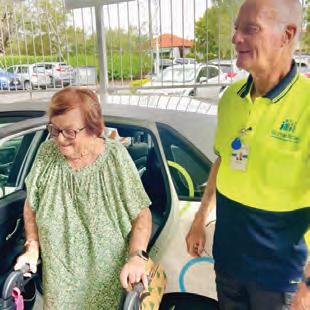
So, depending on your circumstances, you may be able to tap into myriad services – anything from short-term help with housework after a fall, to assistive technology including walkers or wheelchairs, and home modifications such rails in the bathroom, as well as transport to social group outings. Or maybe you just need someone to call in for a chat regularly.
There’s even providers to assist you in applying for a needs assessment.
The assessment is the first step that gets the ball rolling. To access any governmentfunded help at home for the first time, you need to apply for an assessment on the My Aged Care website (myagedcare.gov.au/ apply-online) or call the My Aged Care contact centre on 1800 200 422. You can complete the application for yourself or on behalf of a family member or friend.
A little help could change your life or help a loved one thrive in their later years.
– SHIRLEY SINCLAIR
Support at Home
EVERYONE NEEDS A LITTLE BREAK SOMETIMES
MANY carers don’t realise respite care is available to them or that they can have a few hours to rest, attend appointments or recharge while knowing their loved one is safe, supported and enjoying themselves.
Burnie Brae offers centre-based and in-home respite designed to support not just the person receiving care, but the carer, too.
The Club Respite program at Burnie Brae Centre is a warm, welcoming space where people can enjoy good company, activities, outings and meals with friendly support staff.
Whether it’s live music, craft, bingo, theatre outings or a trip to the beach, there’s always something happening. Transport also is available from selected locations.
In-home respite is provided across North Brisbane and Moreton Bay, too.
A support worker can visit for companionship and social support –perhaps a chat over a cuppa, card game, puzzle or simply some friendly company –while a carer takes a well-deserved break or runs errands.
Some families use respite every week; others only when they need it. Either way, a little support can make a big difference.
A free morning tea trial for Club Respite is available, so you and your carer can see what it’s all about.
Funding is available through Support at Home and the Commonwealth Home Support Program, or pay privately. Call 3624 2121 or visit burniebrae.org.au/respite
THE HIDDEN VALUE OF COMPANIONSHIP
AS WINTER approaches, days get shorter and older people are more likely to stay indoors, which can increase feelings of loneliness and isolation.
This is where the hidden value of companionship in aged care comes to the forefront.
A quality aged care provider understands the benefits of relationships and works to foster them.
Companionship helps to:
• reduce loneliness: social engagement significantly reduces feelings of isolation and loneliness, a major cause of depression in older adults
• enhance mental health: lack of social interaction increases the risk of cognitive decline. Regular interaction helps
maintain mental sharpness and cognitive function
• build strong relationships: companionship fosters meaningful relationships, enhancing quality of life and a sense of belonging
• promote physical health: older adults are more active when engaging with others as connection promotes physical movement, leading to better cardiovascular health and immune responses
• support independence: performing small tasks together, such as folding laundry, can motivate participation and support older adults to maintain their independence
• notice changes sooner: regular interaction fosters familiarity, making it easier to detect subtle changes in mood and behaviour. By identifying concerns early, individuals can access support sooner and address issues before they escalate
• support emotional wellbeing: social interaction provides emotional support, contributing to overall happiness and mental clarity.
All About Living staff know care goes beyond the tasks they are performing. Companionship is essential for the wellbeing of older adults, not only to reduce loneliness, but also to promote mental and physical health, ultimately enhancing their quality of life.
Visit allaboutliving.com.au
STAY INDEPENDENT AND CONNECTED WITH PERSONALISED SUPPORT
FOR many older Australians, accepting support at home can feel like a loss of independence.
In reality, the right kind of support can do the opposite: helping people stay connected, active and in control of their daily lives.
One of the most valuable, yet often overlooked supports is companionship.
Beyond practical assistance, having someone to share everyday experiences with can make a significant difference to wellbeing.
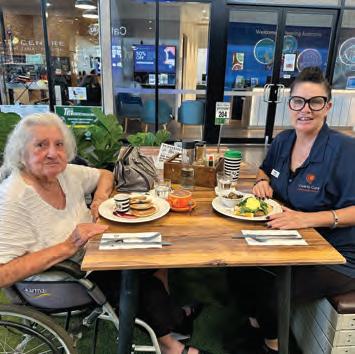
A simple outing to a local café, a walk through the park or attending community events together can help maintain routines and encourage confidence.
Research and real-life experience continue to show that social connection plays a key role in physical and emotional health.
Regular community engagement can reduce feelings of isolation and support ongoing independence, allowing individuals to remain part of the communities they know and value.
It can also help build confidence in navigating day-to-day activities and foster a stronger sense of purpose.
Importantly, support services today are flexible. They are designed around the
All About Living
individual, respecting personal preferences, routines and goals.
Whether it’s help with shopping, attending appointments or simply having someone to talk to, these supports can be tailored to enhance independence rather than replace it.
Choosing to accept support is not about giving something up.
It is about gaining the confidence and opportunity to continue living life in a meaningful and connected way.
WORDS: Annie Lazar, office manager, Care To Care.
Call 1300 620 013 or visit caretocare.com.au to discover how Care To Care can help you or your loved one thrive at home.
We are a not-for-profit provider designed to support your lifestyle, not change it.
We provide thoughtful, reliable help at home that is delivered with respect, warmth and genuine connection including:
Whether it’s a practical hand, a friendly conversation, or reassurance for families, our focus is always on people, not processes. Scan the QR Code or contact
ENRICHING LATER LIFE
For more than 35 years Jubilee Community Care has provided friendly, personalised support to help you stay independent in the home you love.
Personal care
Food preparation
Clinical care and allied health services
Light domestics and home maintenance
Shopping assistance, respite and companionship
Transport for appointments or social activities
Social support activities
CHSP and Support At Home Services
Care that’s tailored to you
07 3871 3220
Call our friendly team or enquire via our website www.jccagedcare.org.au
ASSISTANCE WITH HOW TO NAVIGATE YOUR SUPPORT AT HOME HELP
THE new Support at Home system can feel complicated.
It has now replaced Home Care Packages and is the main governmentfunded program for helping older people stay independent at home.
Navigating the system can be daunting, with many seniors waiting up to a year for their package to be available.
The aim is to access support that is tailored to personal needs, including practical tasks such as domestic assistance and shopping and facilitate social activities and engaging the community.
The government has announced it expects to fund 420,000 home packages in 2026-27.
The first step to accessing government funding is an assessment from My Aged Care (call 1800 200 422).
Once you have received your funding, the next step is to choose a provider.
Here’s a practical way to narrow it down.
Start with your actual care needs. Write down:
• what help is needed now • what might be needed in six to
12 months
• preferred visit times
• any language, cultural or gender preferences
• remember to ask about whether you can access the same carers regularly. For friendly advice and practical support, visit Jubilee Community Care at jccagedcare.org.au
We care for our clients as extended family. An approach shaped by our culture, heritage and years of experience, Co.As.It.’s support services are designed to enhance wellbeing, independence and social connection, while aligning with your personal goals and needs.
Supported by our experienced care staff, along with dedicated in-house allied health and clinical teams, we deliver coordinated, efficient and cost-effective care you can trust.
Contact us to learn how we can support you to live well, your way.
Our friendly team is here to help Brisbane: 07 3624 6100 | Gold Coast: 07 5617 9500 www.coasit.asn.au
Jubilee Community Care staff are available to help with in-home care queries
By Jan Harper Murder mystery
Reviewed by Jan Kent
FROM the pen of one of our favourite authors, this book has many features we have come to expect, following on from the success of The Dry
Many aspects of life in an Outback town are beautifully painted by Jan Harper’s descriptive passages, as the reader is drawn into the grief of a family and town gathering for the fifth year in memory of one of their young men.
Sam vanished without a trace when he returned from college for a short visit. The resultant widespread grief has been managed, as one can imagine, in various ways. With the impact of a huge mining company on an ever-dwindling small town population adding to the rising tension, Ro seeks answers to the what and the why questions around her son’s disappearance all those years ago.
Deeply enmeshed in the sad town’s secrets are accusations of betrayal towards those who have departed, their guilt and the bitterness of the remaining townsfolk.
While some readers may not be bothered by the slow-moving psychological aspects of so much sadness and despair, I found it a bit bogged down at times – not quite up to the high standard set by Harper’s previous works.
THE NAKED LIGHT
By Valentyna Solowij
THE THREE HIDDEN DAILY HABITS MAKING YOUR BACK PAIN WORSE LAST ONE OUT
By Bridget Collins
Historical fantasy
Reviewed by John
Kleinschmidt
DESCRIBED as “a gothic tale that combines ancient folklore and superstition with the stories of three women post World War I”, I found the story underwhelming on ancient folklore, little about superstition and mostly about three women and the curiosity of a teenage girl.
Kit, an artist, paints face masks for grossly disfigured soldiers returning from the war. She becomes traumatised by this work and seeks peace in a quiet, English country town. On a hillside, etched into the grass, is a chalk face rumoured to protect the village from ancient menaces, including a sinister, murderous Thurlath (a hungry, wandering thing that resembles a man).
Kit finds solace in Florence, the spinster sister-in-law of the vicar, and annoyance in Phoebe, his teenage daughter, providing the background for the creepy folklore elements that make an appearance albeit far too late.
Hard to recommend.
THE DAFFODIL DAYS
By Helen Bain, Historical
fiction
Reviewed by Rebecca Walker, of Annie’s Books on Peregian
SET in rural England in the early 1960s, The Daffodil Days tells the fictional yet true-tolife story of infamous literary couple Sylvia Plath and Ted Hughes through the eyes of the village community that lived around them.
Told backwards (beginning in 1962 and ending in 1961) through multiple narrators, the book traces the breakdown of their relationship by giving multifaceted glimpses into their lives in the years leading up to their separation.
Illuminating, lyrical and captivating, the story gives personal insights into the downward
spiral that eventually led to Plath’s suicide. And while that may sound depressing, the ‘early days’ of the story reflect the hopeful existence of a young couple pursuing their creative dreams in the English countryside.
Penned by British author Helen Bain, this poignant debut is based on extremely well-researched facts.
Equally whimsical and revealing, The Daffodil Days unveils Plath’s untimely unravelling in a new and truly unique way.
YOU go to the gym. You stretch. You try to sit up straight. Yet, your back still hurts.
After more than four decades as a practising physiotherapist, I began noticing something troubling. Some patients improved. Others returned to square one. And some never responded at all.
The real turning point came when I developed chronic pain myself. It forced me to rethink what I thought I knew. What I discovered is that most chronic back pain is not caused by a lack of exercise. It is shaped by the tiny, unconscious movements we repeat all day, every day –particularly the habit of turning to the left again and again.
For many years, I treated pain in isolated areas. But the spine operates as one connected system, and our so-called ‘harmless’ habits can cause significant damage over time.
Habit 1: Sitting too much.
Habit 2: Repeating the same movements.
Habit 3: ‘Relaxing’ positions that actually increase tension.
While many practitioners treat isolated areas, the spine does not function in isolated segments, operating as one connected system.
The insight led me to develop a two-part protocol of four simple exercises and specific habit modifications. The exercises stretch the tight muscles around the pelvis and hips, while the habit modifications strengthen the muscles that turn the body to the right, minimising the corkscrew.
Changing habits takes time. But it costs nothing. And when you treat the whole system, not just the sore area, relief is far more achievable.
– Valentyna Solowij
WILD DARK SHORE
By Charlotte McConaghy, Thriller
Reviewed by Karen
Weiber,
of Books@Stones, Stones Corner
A FAMILY on a remote island. A mysterious woman washed ashore. A storm gathering force.
Dominic Salt and his three children are caretakers of Shearwater: a tiny weatherlashed island that is home to the world’s largest seed bank. As Shearwater risks being lost to rising sea levels, the island’s researchers have fled but the Salts remain.
During the worst storm in living memory, a stranger washes ashore. The family nurses the woman, Rowan, back to
strength, but it seems she isn’t telling the whole truth about why she’s there. And when Rowan stumbles upon sabotaged radios and a recently dug grave, she realises that she’s not the only one on the island with a secret.
A novel of breathtaking twists, dizzying beauty and ferocious love, Wild Dark Shore is about the choices we make to protect the people we love.
I loved this book. The pacing, tension, climax and gut-wrenching twist were flawlessly executed.
HOW TO SECURE THE BEST-POSSIBLE SALE PRICE RESULT
THE Australian housing market seems to be entering a downturn as rising interest rates soften demand.
Cotality – a global information services company specialising in property, real estate and financial data analytics (and formerly known as CoreLogic) – warned about this last month in the media.
While a housing shortage remains, more vendors are putting homes up for sale to avoid further price declines in the market.
Experts warn that a significant correction in property prices would likely coincide with a major economic downturn, which would see rising unemployment.
The Reserve Bank has increased interest rates three times so far this year.
Markets are expecting a further two hikes in 2026.
However, this is very much dependent on what happens with the US-Iran War, and more specifically the Strait of Hormuz.
If the strait remains closed, oil prices will remain high or increase, resulting in pressure on inflation and interest rates.
So, what can sellers do to achieve the best-possible result
when selling their homes or investment properties?
The Real Estate Institute of Queensland (REIQ) offers the following great advice, which I agree with fully.
Preparation and pre-listing checklist:
1. Get a comparative market analysis: HME will provide you with this report, covering recent local sales.
2. Order a professional valuation: this will cost sellers a few hundred dollars but provides an independent benchmark of value.
3. Get a building and pest inspection done early: fix issues before they become negotiation hurdles.
4. Check for Queensland smoke alarm compliance: as of 2022, all homes in the state must have interconnected, photoelectric smoke alarms.
5. Create a decluttering plan: remove personal items to make rooms look larger. Perhaps family and friends can help store items in the short term.
I am happy to help with the implementation of the checklist. Contact me for a confidential, no-obligation meeting or chat if you are looking to sell.
WORDS: James Ball, HME Property Group. Call 0422 618 556 or email james@hme.group
AND VETERAN IS 100
A World War II veteran who has embraced modern technology and dislikes most vegetables is the latest inductee to the Carinity 100 Club for centenarians.
William Harris, from Brisbane, a Carinity Clean service user, turned 100 this year.
He was born in Croydon, England, in 1926 and left school at the age of 13.
He enlisted in the Royal Marines during World War II as a teenager.
He served for almost three years, including in Asia, towards the end of the long conflict.
“The war in Europe was finished and millions of troops were going home,” William remembers.
“Quite a large majority had to go into England to get boats to go home.
“All us troops had been earmarked for going on the ships out of England.
“We got as far as India when they decided to send some of us, a signal company, to Ceylon (now known as Sri Lanka).”
After the war ended, William worked as an engineer back home in Croydon and continued in that career for 60 years.
He married Stephanie and they moved to New Zealand in the 1950s. After living in Christchurch and Auckland for two decades, the family moved to Australia 50 years ago.
“New Zealand is a unique country, and so is this one,” William says.
“I used to employ an Australian and he used to say how marvellous Brisbane was, so we packed up and came here.
“We stayed in a caravan park at Aspley for a little while before I got a job. Then, we had a flat in Nundah and when I had some money, I bought a house.”
William’s favourite hobbies over the years have included cycling, lawn bowls and golf, which he played until he was 90.
“I never held a golf club until I was 60, and that was only in the sands that were near the beach. I’ve enjoyed my retired life,” he says.
Nowadays, William likes using his smartphone and iPad.
He is particular about the
food he consumes: he doesn’t eat carrots, lettuce and green vegetables, but enjoys potatoes, white beans and tomatoes.
William and his late wife, who were married for 66 years, had two daughters. The family grew to include three grandchildren, four greatgrandchildren and two greatgreat grandchildren.
He says walking one of his granddaughters down the aisle at her wedding “was one of the highlights of my life”.
TIPS FOR FINDING LOVE SAFELY AND CONFIDENTLY LATER IN LIFE
AS MORE Australians in their 50s and 60s re-enter the dating world after divorce, separation or loss, a relationship expert warns that the biggest mistake people make is approaching dating the same way they did decades ago.
Best-selling author and emotional wellbeing thought leader Elizabeth Jane says the dating landscape has changed dramatically and those who adapt are far more likely to find meaningful and lasting connections.
“Dating at 60 is not about
James BallProperty is his business
Community is WHO HE IS.
At HME Property Group, real estate is what we do — but community is who we are.
For many decades, James has proudly supported the people and organisations that make our regions stronger. From supporting/sponsoring National Seniors, Mater Hospital Neo-Natal unit, QLD RSPCA, Small Steps for Hannah (to help halt domestic and family violence), New Hope Care, Research into Gynaecological Cancer, Rotary and Merthyr Bowls Club. James believes it’s his responsibility to give back. James is committed to helping the community. Selling property enables him to achieve this.
trying to relive your 20s,” Jane says. “It’s about being clear, practical and emotionally intelligent. The people who succeed are those who approach it with strategy, boundaries and self-awareness.”
Jane says that after processing any heavy emotions and healing yourself of old wounds first, the next step is deciding what you actually want in a relationship.
“Are you looking for companionship, a long-term relationship, travel, fun or emotional support? Many
Exceptional Results. Proven Experience.
people date without clarity and end up frustrated,” she says. She recommended writing down non-negotiables and deal-breakers before meeting anyone. Then, focus on lifestyle compatibility, not chemistry alone.
Jane encourages people to avoid sharing personal or financial details too early and to meet in a public place, such as a cafe, in the early stages.
“Your independence and security must come first,” she says.
Visit elizabethjane.au
For over 20 years , James and HME property Group has sold homes as far north as the Sunshine Coast and as far South as the Gold Coast and across Brisbane delivering outstanding results. The internet allows them to do this without a bricks and mortar shop front.
“We found James Ball to be very helpful and attentive to our selling requirements. The sale was quick due to his enthusiasm to get us the best deal. We would have no hesitation in recommending James for the sale of their house.” – David & Janet (Shorncliffe)
William Harris has been inducted into the Carinity 100 Club for centenarians
IF YOU’RE looking to make friendships and connections with women in your local community, the Redcliffe VIEW Club welcomes new members.
The club brings women together to enjoy social activities, develop new skills, build friendships and connect through a variety of events – all while supporting the education of disadvantaged young Australians through The Smith Family.
Coffee & Chat is on the fourth Friday of each month for a relaxed catch-up.
The monthly luncheon is on the second Thursday of each month.
Email redcliffeview@gmail.com or call Noelene on 0402 227 244.
BRENDALE Evening VIEW Club members are embracing the theme: ‘Give to Gain’.
By donating their time, building lifelong friendships and providing unwavering support, they ensure that children and families in need don’t just get by, but truly thrive.
The Brendale club sponsors nine students through The Smith Family’s Learning for Life program.
Dinner meetings are at 6.30pm on the third Tuesday of the month at Aspley Hornets Football Club, 50 Graham Road, Carseldine. Call Suzanne on 0417 022 996.
SENIORS GROUP CAN GROW YOUR COMPUTER KNOWLEDGE
LOGAN Seniors Computer Group (LSCG) meets from 9am-noon on most 2nd and 4th Saturdays of the month at Logan West Library in Grand Plaza Drive, Browns Plains.
LSCG is a small, mature-aged, friendly, no-frills, non-profit group which has been running since 1995. Members share their knowledge of computers, mobile phones,
tablets and other devices. They assist each other (beginners to advanced), one on one, in discussion groups, lectures and PowerPoint presentations.
Bring in your own mug, notebook and computer on these Saturdays or share the group’s devices.
Morning tea and coffee are available. Call Dawn on 0413 938 947.
HOW TO JOIN OLDER WOMEN’S NETWORK
LOOKING to meet other women, enjoy guest speakers, social activities and stay active in your community? Contact the Older Women’s Network (Qld) Inc. to find a branch. Call 3358 2301 or email admin@ownqld.org.au
STRESS
Get your FREE guide on ‘Preparing Your Home For Sale’ and/or ‘Essential Guide To Downsizing’ by email or hard copy delivered to your door
Knowledge is Power
Not sure where to start or what to do regarding your property?
Whether you’re selling now or in a few years time, advice is free of cost and obligation.
Stress-Free Home Sales
● Fixed rate with no hidden fees
● Fully licenced Property Manager
● Regular routine inspections with photo reports
● Flexible owner payments, and same day statements
● Strict property application processes with thorough tenant checks
● Limited number of managed properties to ensure top quality service
SOMETHING FOR EVERY MUSIC LOVER
REDLAND Performing Arts Centre (RPAC) is set to deliver a sensational musical line-up this July.
The program of concerts spans pop, operatic performance and American songbook classics, with something to suit every musical taste.
Your Song celebrates the music of megastar Elton John live on stage on Thursday, July 2, at 7.30pm. This Matilda Award-winning production brings together hits including Candle in the Wind, Benny and the Jets and Tiny Dancer with real-life stories of defining moments connected to those songs. Featuring Jason Arrow, Luke Kennedy, Irena Lysiuk and John O’Hara, alongside a live band and the Redland City Choir, the production delivers a
vibrant tribute to Elton’s enduring music legacy.
Then Opera Queensland’s intimate Studio Series comes to RPAC for the first time with Alma Latina! on Thursday, July 16, at 7pm. Renowned Colombian tenor Carlos Bárcenas joins pianist John Woods to bring the passion and rhythm of Latin America to life.
With his expressive voice and strong connection to his South American roots, Bárcenas delivers a performance rich in musical storytelling.
The program continues with The Great Gershwins on Wednesday, July 22, at 11am, presented as part of Promac’s 40th anniversary of Morning Music Around Australia.
RPAC favourites – soprano Alison Jones, pianist William Schmidt and narrator Chris McKenna – return to the stage to perform works by George and Ira Gershwin, including Rhapsody in Blue, Summertime and I Got Rhythm, alongside stories of the brothers’ creative partnership.
For bookings, visit rpac.com.au or call the RPAC Box Office on 3829 8131.
WYNNUM FRINGE
FROM circus lights to rock’n’roll chaos, Wynnum Fringe is back for its seventh year.
The award-winning arts festival offers more than 200 performances of comedy, live music, circus, cabaret and family entertainment. The 2026 program features a stacked line-up of top-tier comedy and music, including Arj Barker, Luke McGregor, Mel Buttle, Matt Okine, Bradley McCaw’s The Music of Billy Joel and the Wynnum Fringe Comedy Gala.
In Pour Taste is a one-of-akind comedy and wine experience created in partnership with Innocent Bystander and award-winning comedians Ethan Cavanagh and Sweeney Preston.
Highway To Hell: The Rock ’N’ Roll Circus, transforms the Augathella Spiegeltent into a 1980s pub, celebrating the golden era of Aussie rock.
WHERE: Augathella Spiegeltent, 166 Bay Terrace, Wynnum.
WHEN: June 25 to July 12 at various times.
TICKETS: Go to wynnumfringe. com for the program and tickets.
THE KINGS OF COUNTRY ROCK
IN THE spirit of 1970s America, The Kings of Country Rock will bring their highly acclaimed stage show celebrating The Eagles and Creedence Clearwater Revival to Brisbane audiences.
Packed with powerhouse vocals, soaring harmonies and wall-to-wall hits, the two-hour spectacular promises to transport audiences straight back to the golden era of the 1970s.
Created by drummer/vocalist Peter Timms in 2006, the show has built a reputation as one of Australia’s premier live concert experiences, featuring six accomplished musicians dedicated to recreating the unmistakable sound of the era.
The first half of the concert is a tribute to The Eagles, featuring timeless anthems, including
Take It Easy, Lyin’ Eyes and Hotel California. The energy ramps up further as the band launches into CCR classics, including Proud Mary, Bad Moon Rising and Born on the Bayou With harmonies arranged by former LRB performer Marty Holt, UK musician Grant Carruthers embodying Glenn Frey, and West End and Broadway star Scott ‘Buddy’ Cameron delivering CCR’s signature grit and energy, audiences can expect a thrilling night of nostalgia, singalongs and classic country rock hits. WHERE: QPAC Concert Hall, corner of Grey and Melbourne streets, South Bank. WHEN: November 26 at 8pm. TICKETS: Visit qpac.com.au or QTIX on 13 62 46.
CELEBRATE QUEENSLAND DAY UNDER THE STARS
QUEENSLAND Day is a time to celebrate what makes our communities unique.
And this year, the Landsborough Museum offers the ideal setting to do just that.
Locals and visitors alike are invited on Saturday, June 6, from 3-9pm, to enjoy a relaxed, family-friendly evening that brings together history, culture and community pride.
Set within the grounds of the State Heritage-Listed former Landsborough Shire council building (1924), the event blends the charm of the past with a vibrant, modern celebration.
Families can enjoy free activities, including face painting, an inflatable
obstacle course and live music, while a variety of food options ensures something for everyone.
As the sun sets, Starry Nights will present outdoor screenings, beginning with the NRL clash between the North Queensland Cowboys and Redcliffe Dolphins, followed by a classic family movie experience under the stars.
More than just entertainment, the event is a reminder of the connections that shape our region. It highlights the importance of gathering, sharing stories and celebrating local heritage together. Visit heritage.sunshinecoast.qld.gov.au or register at events.humanitix.com/ qld-day
Image Bushland Spirit (detail) by Magali Feuga
SUNSHINE COAST
IMMERSE yourself in the vibrant art scene of the Sunshine Coast, as you meet talented local artists in their own creative spaces.
Open Studios Sunshine Coast provides a rare opportunity to go behind the scenes and connect directly with makers. The curated art trails are from the Glass House Mountains to Mapleton and along the coastline from Caloundra to Coolum.
Asia Images Gallery is the newest gallery on the Coast, specialising in large-scale Fine Art Photography from Asia. Alexander Manton will have the gallery at 2/942 David Low
Way, Marcoola, open from July 18-26.
“Asia is in my heart and soul,” he says.
“Although I’m American, from New York City, my family has lived in Asia since 1884 when my great-grandmother first went to China as a Methodist missionary.
“I’ve spent most of my life there before moving to the Sunshine Coast three years ago. Photography has also been in my heart and soul since I first dreamed of working for National Geographic magazine when I was young. While I never made it into that magazine, I certainly shot for most of the other high-profile NYC magazines like Time and Newsweek. After spending most of my working career in commercial photography
and video, I’ve found a renewed love for fine art photography and am excited about opening this new gallery on the Sunshine Coast.”
Call 0478 038 053 or email alex@ asiaimagesgallery.com
Magali Feuga is a French Australian artist working across sculpture and painting. Her practice centres on the human form, exploring identity, and cultural heritage through tactile processes.
Raised aboard her parents’ sailboat, creativity emerged early as a language of curiosity and exploration. She later studied art in France and continued to develop her practice while travelling globally as a
THE BIG CHILLOUT
FOR many Australians over 50, The Big Chill wasn’t just a movie, it was a moment in time.
Released in the early 1980s, the film captured a generation reflecting on friendship, love, loss and the changing world around them.
But just as memorable as the all-star cast was the soundtrack: a collection of timeless Motown and soul classics that reignited the world’s love affair with the music of the ’60s.
Now, that soundtrack is coming to life on stage in The Big Chillout: a vibrant, live concert experience celebrating the unforgettable songs that shaped an era.
Featuring hits from Marvin Gaye, The Temptations, Aretha Franklin, Smokey Robinson, Creedence Clearwater Revival and The Rolling Stones, the show is more than simply a tribute concert.
It’s a nostalgic musical journey filled with stories, memories and the enduring magic of songs that continue to resonate across generations.
Fronting the production are powerhouse performers Judah Kelly and Asabi Goodman, backed by an electrifying eight-piece live band.
Kelly, best known for winning The Voice Australia in 2017, says the music of Motown was always part of his upbringing, even though country music eventually became his professional path.
private chef. Her work focuses on portraits and figures. Using materials such as cardboard and natural fibres, her sculptures evoke contemporary relics and invite reflection on memory, ancestry and collective heritage.
Magali’s studio is at 102 Point Cartwright Drive, Buddina, and will be open from July 17-19. Call 0420 869 247.
Visit openstudiossunshinecoast.com.au
not only the music itself, but the extraordinary story behind The Big Chill soundtrack and its role in reviving Motown Records during a difficult period in the company’s history.
Producer Peter Verhoeven says the show also offers audiences something deeper than nostalgia alone. Alongside the music are fascinating stories about the artists, the songs and the cultural movement that Motown inspired.
And while the show celebrates a golden musical era, its ultimate goal is simple: to make people feel good.
WHERE and WHEN: Home of The Arts (HOTA), Gold Coast, July 3; Redland Performing Arts Centre, July 4; The J theatre, Noosa, July 31; Kings Theatre, The Events Centre, Caloundra, August 1; The Triffid, Newstead, August 2; Twin Towns, Tweed Heads, August 8; Redcliffe Entertainment Centre, September 18. TICKETS: Visit the website at tours.goodcompanyentertainment.com.au OPEN STUDIOS
What drew him most to the show was
Carlos Bárcenas and John Woods whisk you to Latin America with a vibrant mix of
Stopover Hawaii
the room in which the feisty Queen Lili’uokalani was imprisoned after she was overthrown in 1893.
Across the street from the palace, my eye is caught by a striking bronze and gold statue outside an equally impressive building and I go for a closer look. The statue is of King Kamehameha I, who united the Hawaiian Islands and established the monarchy, ruling from 1795-1819.
A friendly passer-by tells me that I’m standing outside the Supreme Court – and that it’s worth going inside.
Ride a wave of Hawaiian nostalgia
LEE MYLNE returns solo to Honolulu for a deep dive into history and culture.
From up here, the feeling of Honolulu is one of pure nostalgia. I’m standing on an ocean-view balcony at one of Hawaii’s most iconic high-rise hotels – and I can almost hear the strains of the Hawaii Five-0 theme song swirling around me.
Remember that music? As the helicopter pans around, actor Jack Lord stands gazing out on his domain: the beaches, palm trees and skyline of Honolulu expanding before him. And yes, he was standing on a penthouse balcony just above where I am, in this very hotel.
Opened in 1964, when the Waikiki streetscape looked a little different, the Ilikai Hotel & Luxury Suites is an icon, inextricably linked to the hit TV show that ran for 12 seasons from 1966 to 1980. Today, it overlooks the bustling Ala Wai boat harbour, a 15-minute walk from downtown Waikiki’s dining and shopping precinct.
I may not be in the penthouse, but my room is apartment-sized. The Ilikai was conceived as a condominium project but opened as a hotel that was soon welcoming not only the cast of Hawaii Five-0 but also celebrities including Elvis Presley, Tom Jones, Jack Benny, Engelbert Humperdinck
TUESDAY 16TH JUNE
Crows Nest & Cobb & Co Museum
Toowoomba
Scenic drive via Esk & Perseverance Dam.
and the crew of Apollo 13. Elements of the hotel, including the glass lift and rooftop restaurant, were drawcards at a time when such things were not common.
It’s my third visit to Hawaii, but my first as a solo traveller, stopping over in Honolulu for a few days on my way to mainland USA.
As I’ve already ticked off Oahu’s major attractions – Pearl Harbour, Diamond Head and, yes, the shopping – I’m keen to dig a bit deeper into the culture.
My first stop is Iolani Palace, the only royal palace in the US, once home to Hawaii’s king and queen. It’s a revelation: a reminder that Hawaii was once a monarchy.
This grand symbol of Hawaiian sovereignty was completed in 1882 but, only a decade later, the kingdom was overthrown and entered a period as a republic. Built in the ‘American Florentine’ style by King Kalakaua, Hawaii’s last king, it sits on sacred land and was home to King Kalakaua and Queen Kapi’olani.
Entry is by guided tour and is well worth doing for an insight into the lavish lifestyle – always with an eye to Hawaiian culture – that the royal family enjoyed.
There are many surprises, too, including
NEW DATE / FRIDAY 31ST JULY
Christmas in July – Birches Restaurant, Mt Mee
After passing through a security point – “guns not allowed” – I explore the ground-floor Judiciary History Centre: a small museum devoted to Hawaiian law and the transition to Western law that the 50th state now follows. Upstairs, under an elegant domed atrium ceiling, the courtrooms are empty today.
My appetite for learning more about Hawaii’s history now piqued, my next stop is the Bishop Museum, a 30-minute bus ride from Waikiki.
The museum was established in 1889, named for Princess Bernice Pauahi Bishop: a member of the Hawaiian royal family who left her estate to be used to establish schools for native Hawaiian children.
Operating as a natural and cultural history museum, it has the world’s largest collection of Polynesian cultural artifacts and is a treasure trove of Hawaiian culture and royal heirlooms.
While dining alone is one of the most dreaded aspects of solo travel – especially for women – Honolulu has plenty of welcoming, comfortable options.
Book a table by the window at Monkeypod Kitchen at Outrigger Reef Hotel for views of Diamond Head and a sweep of palm-fringed beach while you dine on Hawaiian-influenced cuisine with an emphasis on locally sourced produce.
I also found a terrific little restaurant on Ala Moana Boulevard, near my hotel.
Goofy Café & Dine is a licenced ‘surfer’s café’, upstairs in a classic old wooden shop building, serving dishes created with local organic produce. My Genovase spaghetti with homemade herb pesto, macadamia
MONDAY 21ST SEPTEMBER TILL
FRIDAY 25TH SEPTEMBER
Toowoomba Carnival of Flowers
nuts and shrimp was delicious. On my last night in Honolulu, I splurged on dinner at the Ilikai’s signature Empire Steak House restaurant on the 30th floor, where the prices are as heart-stopping as the views. For the budget-minded, head up there for a cocktail and something from the bar menu. For entertainment, I couldn’t go past the new Cirque du Soleil resident show ‘Auana (above) at the Outrigger Waikiki Beachcomber Hotel. It’s a thrilling show of acrobatics, hula and music, honouring the deep connection to the land and the people of these islands. ‘Auana is inspired by the stories of Hawaii, from the Polynesian migration, to the golden age of tourism. There’s even a nod to Hawaii Five-0 that has the theme tune stuck in my head again.
FACT BOX
Getting there: Hawaiian Airlines flies direct to Honolulu from Sydney five times a week, departing at 9.40pm and arriving at 11.40am. Since combining in September 2024, Hawaiian Airlines and Alaska Airlines now offer more than 200 daily flights for non-stop access between the islands and great connections to the US mainland. hawaiianairlines.com
Where to stay: Ilikai Hotel & Luxury Suites has rates starting at US$300 per night. aquaaston.com/hotels/ilikaihotel-luxury-suites
What to do: Go City Pass has discounted entry to 40 attractions on Oahu. gocity.com
Cirque du Soleil’s ‘Auana at Outrigger Waikiki Beachcomber Hotel has two shows nightly. cirquedusoleil.com/auana
WEDNESDAY 18TH NOVEMBER
Eumundi Markets, Sunshine Coast
Includes Morning Tea & Lunch. $110pp
SATURDAY 18TH JULY
Jumpers and Jazz Festival in Warwick
Join us for a memorable day to enjoy the quirkiest festival which has been an annual winter tradition since 2004. Includes Morning Tea but lunch is at own expense during your free time exploring Warwick’s City Centre. $110pp
Travel via Dayboro on the return to Brisbane. Includes Morning Tea & Lunch. $120pp
THURSDAY 27TH AUGUST
Back by popular demand!
Hinze Dam, Chillingham & Murwillumbah
Northern NSW Includes Morning Tea & Lunch. $90pp
Choice of Five Daily Day Tours to see the colours of this Annual Spring Festival up on the Great Dividing Range.
Includes Morning Tea & Lunch. $100pp
THURSDAY 22ND OCTOBER
Peachester – Maleny – Kenilworth Hotel & Brewery
A scenic drive up to the Sunshine Coast Hinterland.
Includes Morning Tea & Lunch. $90pp
A straight through journey today to have maximum free time at these ever popular markets. Morning Tea & Lunch are not included. $70pp
We offer a variety of pick-up locations on the northside of Brisbane, specifically the Redcliffe and Sandgate areas. We also serve Taigum and Aspley Hypermarket Shopping Centres. Pick-ups also at the Eternal Flame in Ann Street, City, and, on tours heading south, we include Palmdale Shopping Centre for added convenience. Dates and itineraries are subject to change due to unforeseen circumstances that are out of our control.
IMAGE: LEE MYLNE
IMMERSIVE RIVER JOURNEYS REIMAGINED
RIVERS have always shaped the way people travel, carrying stories, traditions and cultures through the heart of some of the world’s most remarkable destinations.
With AmaWaterways, these waterways become the backdrop to a luxury journey where comfort, discovery and connection sit side by side.
From Europe to Asia and South America, each sailing reveals a different rhythm of life along the riverbanks.
AmaWaterways is known for its refined approach to river cruising, where thoughtful details elevate every moment on board. Spacious Riverview staterooms create a calm retreat after days spent exploring, while regionally inspired dining brings local flavour to the table.
Guests enjoy free wine, beer and soft drinks with lunch and dinner, along with the signature Sip & Sail cocktail hour. What truly defines the experience is the level of choice, with a wide range of included excursions such as guided hikes,
cycling tours, cultural encounters and culinary experiences.
In Southeast Asia, a Mekong River journey captures the essence of Vietnam and Cambodia through an immersive river cruise that spans multiple regions.
From the limestone beauty of Ha Long Bay to the temples of Angkor and onward to life along the Mekong River, this experience blends iconic landmarks with authentic village encounters and meaningful cultural moments.
In Europe, a Rhine and Dutch waterways sailing travels through five countries including Switzerland, France, Germany, Belgium and the Netherlands.
Medieval towns, vineyard-covered hills and the Rhine Gorge set the scene, with stops in cities such as Amsterdam, Cologne and Bruges.
Further afield, a Magdalena River journey offers a voyage along Colombia’s waterways from Cartagena to Barranquilla. This experience showcases the country’s colourful heritage through music, colonial towns, wetland wildlife and lively cultural traditions.
Each AmaWaterways itinerary reflects a signature blend of immersive exploration and considered comfort, designed to bring you closer to the heart of each destination without compromising on ease.
Visit travellerschoice.com.au to save up to $5250 per stateroom when you book before June 30.
Outback 2 Sea
Caravan Hire For Any Adventure
UNFORGETTABLE JOURNEY COMES WORRY-FREE
THERE’S something special about heading off on an adventure where all you have to do is sit back, relax and enjoy the ride.
No worrying about maps, long drives or where to stay next.
Just good company, incredible scenery and the kind of memories that stay with you long after you return home.
And right now, there are unforgettable journeys that are well worth a closer look.
A trip that reminds you just how big and beautiful Australia really is a journey to the wild, wild west of Western Australia.
This tour is packed with beloved destinations, charming towns and unforgettable coastal scenery.
From the crystal-clear waters and relaxed charm of Busselton (pictured) to the wineries and rolling countryside of Margaret River, every stop has its own personality.
You’ll experience the rich gold rush history of Kalgoorlie, soak up the laid-back atmosphere of Rottnest Island and finish with time in the vibrant city of Perth.
This tour is about more than simply seeing the sights. It’s about travelling with like-minded people, sharing stories and laughs along the way and enjoying the comfort of knowing everything is taken care of for you.
Join Coolum Tours & Travel (CT Travel) for an unforgettable adventure from October 11 to 23.
Visit cttravel.com.au or call 5391 1648.
IMAGE: SHIRLEY SINCLAIR
SULLY’S ELEVATED DINING IS COOL BUT CASUAL
SULLY’S Rooftop Restaurant & Bar is the height of cool at the newly opened Avani Mooloolaba Beach Hotel.
Head to the 12th floor to dine out on the 180-degree panorama over the rooftops of other hotels, across to Mooloolaba Beach and Point Cartwright, north to Mt Coolum.
From the comfortable outdoor seating to the ‘very Sunshine Coast’ décor inside, guests can find their private space for poolside grazing, long lunches, sunset drinks and celebratory dinners.
Kenneth Wagner, managing director of KPAT Hotels, describes the feel-good vibe of the restaurant as “premium casual –everyone is welcome”.
Sully’s executive chef, South Africanborn Marky Godbeer, who has worked in kitchens all over the world, ensures his menu is just as welcoming.
Perhaps start with a ‘goblet’ of mixed olives, followed by any of the artisanal flatbreads – truffle honey butter and pecorino; whipped ricotta, garden peas and lemon; or prosciutto, stretched cheese and pink peppercorn. Next, maybe the passionfruit, salmon caviar and finger lime oysters, plus a lime-cured Mooloolaba yellowfin salad with green apple, cucumber and jalapeno crema will appeal.
Then, try a cheeky ‘Bunnings sausage’: a smoked wagyu beef snag in a milk bun
with caramelised onion and bone marrow aioli; or tender calamari with a plum vinegar, caramel and lemon dipping sauce.
The mains are next level, including chargrilled chicken skewer (whipped garlic, cumin brown butter and pickled onion); pork and prawn schnitty (fennel slaw, candied almond and nduja lemon butter); and woodfired oyster-cut Magra lamb shoulder (goat curd, mint, garden pea, pickled onion). If you can’t fit in a dessert such as the highly recommended Cherry Ripe, be tempted with a seasonal sgroppino (melted lemon sorbet cocktail with vodka and champagne) prepared tableside.
The menu is described as “a relaxed yet elevated dining experience that captures the energy, flavour and rhythm of the Sunshine Coast”. It certainly succeeds.
– SHIRLEY SINCLAIR Book at sevenrooms.com/explore/ sullysrooftop/reservations/create/search/ and soon via sullysrooftop.com.au
Tour Highlights: Cruise with Caloundra Cruises, Whale watching cruise Spirit of Hervey Bay, Visit M&K Model Railways & Gardens, Guided tour of Bundaberg, Visit Hinkler Hall of Aviation, Visit Bundaberg Rum Distillery, Visit & tasting of The Bundaberg Barrel, Train Ride on the Mary Ann Steam Train in Maryborough, Guided tour of Maryborough, Visit Maryborough Military Museum Visit to Story Bank
AUGUST 2026
North Queensland Savannah (11 Days) Tropical North Queensland (12 Days)
SEPTEMBER 2026
Fraser Island (5 Days)
Tasmania (15 Days)
DECEMBER 2026
O’Reillys (4 Days)
NSW Central Coast & Blue Mountains (11 Days)
MARCH 2027
O’Reillys (4 Days)
Norfolk (8 Days)
World Flower Show Sydney (6 Days)
Wonders of Colombia
Sail deep into the heart of Colombia along the Magdalena River, where centuries of culture, music and tradition come alive, while spotting rare wildlife along the way.
Highlights Cartagena • Calamar • Magangue • Mompox • Santa Barbara de Pinto • Sabanagrande • Barranquilla
Departs 30 December 2026
Riches of the Mekong with Hanoi & Siem Reap
A journey begins in the mist of Ha Long Bay, moves through sacred stone at Angkor Wat and drifts along the Mekong, all experienced in quiet elegance aboard the Highlights Hanoi • Ha Long Bay • Siem Reap • Angkor Ban • Phnom Penh • Oudong • Tan Chau
• Mekong Delta • My Tho • Ho Chi Minh City
Departs 23 March 2027
Grand Rhine & Dutch Canals
thoughtfully chosen moments that bring the river’s character to life.
15 nights from $10,014*pp Save $5,112 per stateroom *
9. The rand. 10. Marie Curie (1903). 11. Seven. 12. Sconce. 13. Blue Jasmine. 14. Three. 15. The Seekers (1967).
1. Siam. 2. Phosphorus. 3. Holbrook. 4. F-hole. 5. Bes. 6. Spain. 7. Graceland. 8. Kay Cottee, an Australian.
there, three, tranche, trench
WORD
ACROSS
1 Government-run sporting facility, painted in colour, is upgraded(6)
5 Refuse to acknowledge record set by large object(8)
9 chapter discovered in counterfeit crime(10)
10 Walked and walked endlessly(4)
11 I mention broadcast very quickly(2,2,4)
12 Embroiderer taking hold of knot with a needlelike item(6)
13 Types locked up inside, concoct an explosive hydrocarbon(6)
15 One freed by Tasmanians, perhaps, says something defamatory(8)
17 Performed outside clubs with record that’s traditional(8)
19 Type of gas brewery ultimately put into bubbly cider(3,3)
20 Closing of attorney in court incorrectly portrayed scream(3,3)
22 So, one into pay TV is outgoing?(8)
24 Consumes hot mince(4)
25 Irregularity Head of Selenology connected with lunacy(10)
26 Hypocrite upset parish and meek at heart(8)
27 Abandon wasteland(6)
DOWN
2 False information admitted by an outsider(5)
3 Some rugrat played with unrelated person carrying someone else’s child(9,6)
4 Set of gears, one with insecure(9)
5 Last month one prophet issued proclamations?(7)
6 Throws out seat found on board ship(5)
7 Mormons translated it, say, inaccurately(6-3,6)
8 Mortice is prepared with equal measurements(9)
14 Trainer, holding rock, bashed up NSW football player(9)
16 Agitated baddie, in possession of sailing boat, formally gave up(9)
18 Strip is checked by doctor with great honour(7)
21 Examines both sides of the streets(5)
23 Exploited arsenal not raygun(5)
WORDFIND
QUICK CROSSWORD
Today’s Aim:
Every row, column and 3x3 outlined square must contain the numbers 1 to 9 once each.
WORD STEP
Complete
When siblings step in, care becomes a family effort.
When Damian was diagnosed with a terminal illness, his younger siblings Ben and Claire stepped into the role of his caregivers. As he approached the end of his life, they were able to care for him at home with the help of the specialist, multi-disciplinary team from Karuna Hospice Services.
Helpfundthesupportandresourcesthatkeepfamilies togetherandcaringforoneanotheratendoflife. From Monday15June-Sunday28June2026, yourdonationswill bematcheddollar-for-dollarfromourmatch-givingfund.
GemLife offers luxury resort-style living with premium lifestyle facilities on your doorstep.
No entry fees, exit fees or stamp duty
Friendly community
Pets welcome
Gated neighbourhood
Extensive premium facilities
Luxury homes
Caravan and boat storage*
Retain your capital gain
Ageing-in-place solutions
Logan Grove and Heritage Park. New homes now selling.
A whole new life. Over-50s living redefined. *Terms & conditions apply