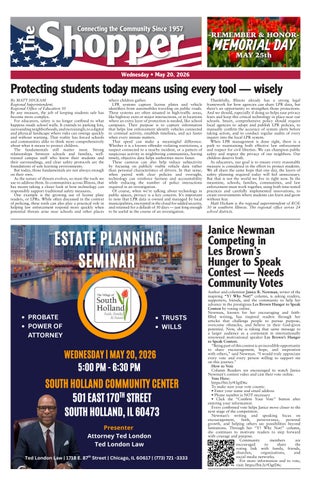
-REMEMBER & HONOR-
MEMORIAL DAY MAY 25th
Wednesday • May 20, 2026
Protecting students today means using every tool — wisely By MATT HICKAM Regional Superintendent, Regional Office of Education 30 By any measure, the job of keeping students safe has become more complex. For educators, safety is no longer confined to what happens inside school walls. It extends to parking lots, surrounding neighborhoods, and increasingly, to a digital and physical landscape where risks can emerge quickly and without warning. That reality has forced schools and communities alike to think more comprehensively about what it means to protect children. The fundamentals still matter most. Strong relationships between schools and families, welltrained campus staff who know their students and their surroundings, and clear safety protocols are the foundations of safe learning environments. But today, those fundamentals are not always enough on their own. As the nature of threats evolves, so must the tools we use to address them. In communities across Illinois, that has meant taking a closer look at how technology can responsibly support traditional safety measures. One example is the growing use of license plate readers, or LPRs. While often discussed in the context of policing, these tools can also play a practical role in helping law enforcement respond more quickly when potential threats arise near schools and other places
where children gather. LPR systems capture license plates and vehicle identifiers from automobiles traveling on public roads. These systems are often situated in high-traffic areas, like highway exits or major intersections, or in locations where an extra layer of protection is needed, like school campuses. Their purpose is to capture information that helps law enforcement identify vehicles connected to criminal activity, establish timelines, and act faster when every minute matters. That speed can make a meaningful difference. Whether it is a known offender violating restrictions, a suspect connected to a nearby incident, or a pattern of suspicious activity in neighboring communities, having timely, objective data helps authorities move faster. These cameras can also help reduce subjectivity by focusing on publicly visible vehicle data rather than personal characteristics of drivers. In that sense, when paired with clear policies and oversight, technology can reinforce fairness and accountability while reducing the number of police interactions required in an investigation. Of course, when we’re talking about technology in public spaces, privacy is a key concern. It’s important to note that LPR data is owned and managed by local municipalities, encrypted in the cloud for added security, and retained for a default of 30 days — just long enough to be useful in the course of an investigation.
Thankfully, Illinois already has a strong legal framework for how agencies can share LPR data, but there’s an opportunity to strengthen those protections. And we should, especially if doing so helps ease privacy fears and keep this critical technology in place near our schools. Smart, comprehensive policy should require local agencies to adopt and publish LPR policies, to manually confirm the accuracy of system alerts before taking action, and to conduct regular audits of every inquiry into the local LPR system. When LPR management is done right, there is a path to maintaining both effective law enforcement and respect for civil liberties. We can champion public safety and respect the privacy of our neighbors. Our children deserve both. As educators, our goal is to ensure every reasonable measure is considered in the effort to protect students. We all share the same hope that one day, the layers of safety planning required today will feel unnecessary. But that is not the world we live in right now. In the meantime, schools, families, communities, and law enforcement must work together, using both time-tested practices and carefully implemented innovations, to create environments where students can learn and grow without fear. Matt Hickam is the regional superintendent of ROE 30 in southern Illinois. The regional office serves 24 school districts.
Janice Newman Competing in Les Brown’s Hunger to Speak Contest — Needs Community Votes
Author and columnist Janice R. Newman, writer of the inspiring “Y? Why Not!” column, is asking readers, supporters, friends, and the community to help her advance in the prestigious Les Brown Hunger to Speak Contest by voting online. Newman, known for her encouraging and faithfilled writing, has inspired readers through her articles that challenge people to pursue purpose, overcome obstacles, and believe in their God-given potential. Now, she is taking that same message to a larger audience as a contestant in internationally renowned motivational speaker Les Brown’s Hunger to Speak Contest. “Being part of this contest is an incredible opportunity to share encouragement, hope, and inspiration with others,” said Newman. “I would truly appreciate every vote and every person willing to support me on this journey.” How to Vote Column Readers are encouraged to watch Janice Newman’s contest video and cast their vote online. Vote Here: https://bit.ly/43gtD6c To make sure your vote counts: • Enter your name and email address • Phone number is NOT necessary • Click the “Confirm Your Vote” button after entering your information Every confirmed vote helps Janice move closer to the next stage of the competition. Newman’s writing and speaking focus on encouragement, faith, perseverance, personal growth, and helping others see possibilities beyond limitations. Through her “Y? Why Not!” column, she continues to motivate readers to step forward with courage and purpose. Community members are encouraged to share the voting link with family, friends, churches, organizations, and social media networks. For more information and to vote, visit: https://bit.ly/43gtD6c