Test Bank for Linear Algebra with Applications 2nd Edition Holt 1464193347
9781464193347
Full link download
Solution Manual
https://testbankpack.com/p/solution-manual-for-linear-algebra-withapplications-2nd-edition-holt-1464193347-9781464193347/
Test Bank
https://testbankpack.com/p/test-bank-for-linear-algebra-with-applications2nd-edition-holt-1464193347-9781464193347/
Chapter 2
Euclidean Space
2.1 Vectors
1. Determine 3u+v 2w,where
2. Express the given vector equation as a system of linear equations
3 2 4
x1 + x2 =
3. Express the given vector equation as a system of linear equations
1 2 5 1
u
1
5 Ans: 0
2
3 1
=
1
, v = 2 , and w = 3
3 0
Ans
2x
2x1
5x2
: 3x1 +
2 =4
+
=1
x1 0 + x2 4 + x3 3 = 2 5 7 0 1
:
1 x2 + 5x3 = 1 4x2 +3x3 =2 5x1 +7x2 =1
2
1
5
1
Ans
2x
4. Express the given system of linear equations as a single vector equation.
x1 +2x2 3x3 =6
x1 + x3 =3
1 2 3 6
Ans: x1 + x2 + x3 =
1 0 1 3
5. Express the given system of linear equations as a single vector equation.
2x1 +x2 2x3 =1
x1 +x2 +x3 =1
7x1 +3x2 x3 =1
2 1 2 1
Ans: x1 1 + x2 1 + x3 1 = 1
7 3 1 1
6. The general solution to a linear system is given. Express this solution as a linear combination of vectors.
x1 =3 s1
x2 =s1
Ans: x1 = 3 + s 1
1
x2 0 1
7. The general solution to a linear system is given. Express this solution as a linear combination of vectors.
x1 =3 s1 +3s2
x2 = s1
x3 =3 +s2
x4 = s2 x1 3 1 3
Ans: x2 = 0 + s 1 + s 0
x3 3 1 0 2 1
x4 0 0 1
8. Find the unknowns in the given vector equation.
1 b 2
2 + 4 =
a 2 6
Ans: a =1, b = 1
9. Find the unknowns in the given vector equation.
1
a 1 3
2 a 0 + 3 c = 4
b 1 0 3
Ans: a =2,b = 1,c=0
10. Expressb as a linear combination of the other vectors, if possible.
4 1 14
a1 = 2 , a2 = 4 , b = 2
Ans: 3a1 2a2 =b
11. Express b as a linear combination of the other vectors, if possible.
1 1 3 1
a1 = 1 , a2 = 2 , a3 = 1 , b = 3
2 1 1 1
Ans: 2a1 +2a2 +a3 = b
True or False: If u and v are vectors, and c and d are scalars, then c(du +v) =(cd)u+v
Ans: False
13. True or False: If u , v , and w are vectors, then u−(v +w) =(u−v)+(u−w)
Ans: False
14. True or False: If u+v= w, then v =w u.
Ans: True
1
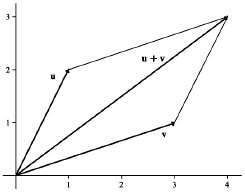
15. Sketch the graph of u = and 2 3 v = , and then use the Parallelogram Rule to sketch the graph of u+v
Ans:
16. Determine how to divide a total mass of 18 kg among the vectors
2 5 3
1
2 9
u = 1 ,u = 0 , u = 2 so that the center of mass is 2
1 2 3 3 2 4 2 9 9
Ans: Place 10 kg at u1 , 1 kg at u2 , and 7 kg at u3.
17. Find an example of a linear system with two equations and three variables that has
x1 2 3
x = 3 + s2 as the general solution.
2
x3
0 1
Ans: A possible answer is
x1 +x2 5x3 =5
x1 x2 x3 = 1
2.2 Span
1. Find four vectors that are in the span of the given vectors.
2 1
u1 = , u2 =
3 1
0 2 1 3
Ans: For example, , , , and
0 3 1 2
2. Find five vectors that are in the span of the given vectors.
1 2 5
u1 = 4 , u2 = 1 , u3 = 5
3 2 0 1
1 2 5 6
Ans: For example, 0, 4 , 1 , 5 , and 10
0 3 2 1 6
3. Determine if b is in the span of the other given vectors. If so, write b as a linear combination of the other vectors.
2 1 3
a1 = 2 , a2 = 3 , b = 1
1 1 0
Ans: b = a1 a2
4. Determine if b is in the span of the other given vectors. If so, write b as a linear combination of the other vectors.
Ans: b is not in the span of a1 and a2 .
1 2
1 1 3
,
2 ,
= 2
a =
1
a =
b
1 3 0
5. Find A , x, and b such that Ax=b corresponds to the given linear system.
x1 +x2 2x3 =1
x1 +2x2 +4x3 =8
x
1 1 2 1 1
Ans: A = , x = x2 , and b =
1 2 4 x 8 3
6. Find A , x, and b such that Ax=b corresponds to the given linear system.
x1 x3 =1
2x2 +4x3 =3
x1 +5x3 =1
1 0 1 x1 1
Ans: A = 0 2 4 , x = x , and b = 3
1 0 5 2 x3 1
7. Express the given system of linear equations as a vector equation.
2x1 x3 +x4 =1
x1 +2x2 +4x3 x4 =0
2 0 1 1 1
Ans: x1 + x2 + x3 + x4 = 1 2 4 1 0
8. Determine if the columns of the given matrix span R 2 .
4 2
1 0
Ans: Yes, the columns span R 2 .
9. Determine if the columns of the given matrix span R3 .
1 1
1 2
1 3
Ans: No, the columns do not span R3 .
10. Determine if the system Ax=b (where x and b have the appropriate number of components) has a solution for all choices of b .
1 2
A = 2 1
Ans: Yes, a solution exists.
11. Find all values of h such that the vectors span R 2 .
h 2 a1 = , a2 =
2 h
Ans: All real numbers, except h≠±2.
12. For what value(s) of h do the given vectors span R3 ?
1 4 7
2, h, 8
3 6 9
Ans: All real numbers, except h≠5
13. True or False: Suppose a matrix A has n rows and m columns, with m<n. Then the columns of A do not span R n
Ans: True
14. True or False: Suppose a matrix A has n rows and m columns, with m>n. Then the columns of A span R n
Ans: False
15. True or False: If the columns of a matrix A with n rows and m columns do not span R n , then there exists a vector b in R n
Ans: True such that Ax=b does not have a solution.
16. True or False: If the columns of a matrix A with n rows and m columns spans R n , then m≥ n
Ans: True
2.3 Linear Independence
1. Determine if the given vectors are linearly independent.
4 1
u = , v =
2 2
Ans: Linearly independent
2. Determine if the given vectors are linearly independent.
1 2 0
u = 2 , v = 0 , w = 4
3 2 8
Ans: Not linearly independent
3. Determine if the given vectors are linearly independent.
0 2 4
u = , v = , w =
2 0 1
Ans: Linearly independent
4. Determine if the columns of the given matrix are linearly independent.
3 2
2 3
Ans: Linearly independent
5. Determine if the columns of the given matrix are linearly independent.
2 1 2
A = 1 2 0
3 2 2
Ans: Linearly independent
6. Determine if the columns of the given matrix are linearly independent.
1 2 3
A = 4 5 6
1 0 2 3 2 0
7 8 9
Ans: Not linearly independent
7. Determine if the homogeneous system Ax =0 has any nontrivial solutions, where 3 1 A = 2 2 .\ 0 1
Ans: Ax =0 has only the trivial solution.
8. Determine if the homogeneous system Ax =0 has any nontrivial solutions, where
1 2 3
A = 0 1 1 1 0 1
Ans: Ax =0 has nontrivial solutions.
9. Determine by inspection (that is, with only minimal calculations) if the given vectors form a linearly dependent or linearly independent set. Justify your answer.
9 2 1
u = , v = , w =
4 20 4
Ans: Linearly dependent, by Theorem 2 14
10. Determine if one of the given vectors is in the span of the other vectors.
Ans: Yes, since w = u +v.
11. True or False: Suppose matrix A has n rows and m columns, with n<m. Then the columns of A are linearly dependent
Ans: True
12. True or False: Suppose a matrix A has n rows and m columns, with n≥m. Then the columns of A are linearly independent.
Ans: False
13. True or False: Suppose there exists a vector x such that Ax=b. Then the columns of A are linearly independent.
Ans: False
14. True or False: If Ax ≠0 for every x ≠0, then the columns of A are linearly independent.
Ans: True
15. True or False: If {u1 ,u2}, {u1 ,u3}, and {u2 ,u3} are all linearly independent, then {u1,u2,u3} is linearly independent.
Ans: False
2 2 0 u = 1 , v = 2 , w = 1 3 1 2
Another random document with no related content on Scribd:
themselves are often protected with earth during winter
In the south of Persia, and also in the north, the very slightest cultivation is employed, yet in good years the harvests of every kind are very heavy. In all cases it is the abundance, or the reverse, of the supply of water that regulates the amount of harvest. Given plenty of water, the harvest must be large.
The melon has been spoken of in another place. The watermelons and the white-fleshed melons of Gourgab, near Ispahan, are the finest in the world. I have seen melons weighing twenty-eight pounds of the former variety; these were, however, phenomenal.
In the orchards of Ispahan clover is sown under the trees to break the fall of the fruit, which is only plucked when a choice dish of it is required as a present. The usual way is simply to pick up the droppings. The Persian never thins the fruit. I have often recommended their doing so, but on two occasions when I tried the experiment and marked the trees, it did not succeed: the trees where the fruit had been thinned merely giving fewer fruit, of the same size as the unthinned trees under the same conditions and of the same variety.
Nothing can be more delightful than these cool and silent gardens in the summer in Ispahan. The thick foliage keeps out the sun, and the deep green of the short clover refreshes the eye. Tea in a garden, with pipes and fruit, is a pleasant way of spending a warm afternoon. Unfortunately the Persian or Armenian usually looks on a fruit garden merely as a good place to get drunk in, and the frequent sounds of music and singing show the passer-by that this idea is being carried out.
Garden parties are, however, often given by Persians who never touch liquor, and they are as enjoyable a form of entertainment as may be. An invitation to one is generally given without any preparation, as during the paying of a call; it is accepted, and forthwith an immediate start is made. A few carpets and pillows are rolled up and placed on a mule, with the samovar or Russian urn in its leather case, and the tea equipage in its travelling box. The cook, on his pony, takes his whole batterie de cuisine, and hurries to the
garden indicated by his master, probably buying a lamb and a couple of fowls, as he passes through the bazaar. The entertainer, his wife and children too, if we are very intimate, the former on his horse, the latter astride on white donkeys, proceed at a leisurely pace in the direction of the garden; while the servants, all smiles, for they enjoy the outing as much as the family, accompany them on foot or horseback, carrying water-pipes, umbrellas, and odds and ends. On reaching the garden, fruit is eaten; then the whole party roam unrestricted among the shady paths while tea is prepared. This is partaken of, and then a musician, or a singer, or perhaps a storyteller, makes his appearance and diverts us all. Or some servant, who has a good voice, sings or plays on the flute to us.
Often a grave and reverend merchant will produce a “tarr,” a species of lute, or a “santoor” (the dulcimer), a kind of harmonica, and astonish us by really good Eastern music. Few will consent to sing; it is infra dig. The nightingales sing merrily, and dull care is effectually banished. In these thoroughly family parties, wine or spirits are never introduced. Chess or backgammon (Takht-i-Nadir, the camp of Nadir Shah) are constantly played for a nominal stake of a lamb or fat pullet.
The party is collected on a raised daïs in the open air, and sit on carpets or lean on huge pillows. Candles are lighted in the lallahs or Russian candle-lamps; these are convenient, as they are not extinguished by wind. At about nine dinner is brought, after innumerable kalians or water-pipes have been smoked: this is eaten in comparative silence; host, guest, wives, and children, all sitting round the leathern sheet which represents a table, and dipping their hand in the platters. At about ten all retire, the bedding of each is spread in a separate nook, on one’s own carpet—all of course being in the open air—and at dawn one smokes a pipe, drinks a little cup of black coffee, and takes one’s leave.
Our host and his guests go about their several businesses, while the women and children and servants generally breakfast in the garden and return home together in the cool of the evening, bringing back fruit and huge bouquets of the moss-rose with them.
These impromptu entertainments are most enjoyable: there is no sense of restraint, and their absolute suddenness, absence of formality, and true hospitality, form a remarkable contrast to the more formal pleasures of European life and the regularity of entertainments which hang over one, till their very thought becomes insupportable. Of course, such entertainments are only possible in a country where the gardens are freely thrown open to everybody.
CHAPTER XXIX.
PERSIAN CHARACTER, COSTUMES, AND MANNERS.
Character of the Persians Exaggeration Mercifulness Anecdote Costumes of men Hair Beards Arms Costumes of women Jewellery Glass bangles
Nose-rings Painting of the face Tattooing Hair Outdoor costume Dress of children—Their manners—Strange custom—Love of mothers—The uncle— Cousins Slaves Servants Slavery
The character of the Persian, as it appears to me, is that of an easygoing man with a wish to make things pleasant generally. He is hospitable and obliging, as honest as the general run of mankind, and is specially well disposed to the foreigner. He is very kind and indulgent to his children, and as a son his respect for both parents is excessive, developed in a greater degree to his father, in whose presence he will rarely sit, and whom he is in the habit of addressing and speaking of as “master;” the full stream of his love and reverence is reserved for his mother; and an undutiful son or daughter is hardly known in the country Home virtues among the Persians are many
No act of serious import is ever undertaken without the advice of the mother; no man would think, for instance, of marrying contrary to his mother’s advice; and by the very poorest the support of their parents would never be looked on as a burden. Respect for the aged is universal; “this grey beard” is a common term of respect; and an aged man or woman will frequently give an opinion unsolicited, and such advice is often requested, and always listened to as valuable.
The peculiar honesty of the Persian servant towards his master in respect to his goods and chattels has been previously remarked; and in commercial morality, I fancy that a Persian merchant will compare not unfavourably with that of the European generally, if he does not always attain the high standard theoretically adopted by the Englishman.
To the poor, Persians are unostentatiously generous; most of the rich have regular pensioners, old servants, or poor relations who live on their bounty, and though there are no workhouses, there are in ordinary times no deaths from starvation; and charity, though not organised, is general.
The Persian is, I regret to say, a liar, but Oriental exaggeration and a tendency “to run into poetry,” as Mr. Wegg said, perhaps accounts for much of this. After a time one learns to mentally discount the statements made by the natives, and habit generally enables one to do this correctly All ranks of society exaggerate and draw the long bow; a curious instance of this occurred in Shiraz. I was conversing on the subject of hunting with the king’s son, and a large circle of courtiers and priests filled the room.
The prince narrated his exploits in hunting the antelope the previous day, and gravely stated that while pursuing a pair of “ahū,” when riding a very restive horse that he had, his head-stall broke.
“What should you have done, doctor?”
“I should have tried to stick on as long as the ground was good, and, expecting an accident, have awaited it.”
“Ah, that was because you were not a prince,” he said. “I leant forward, and unclasping my belt, placed it in the horse’s mouth as a bridle, and thus directing him, pursued my game and killed both antelope.”
All the circle applauded (as of course they were bound to do). I was silent.
“You don’t mean to say you don’t believe that?” said the prince.
I smiled.
“Speak out if you don’t; I shan’t be offended in the least.”
“Well, your Highness, I don’t believe it.”
“Quite right, darogh bood” (it was a lie), unblushingly replied his Royal Highness, and burst into a fit of laughter quite unabashed; the circle of courtiers, of course, were convulsed.
The giving of the lie is no insult in Persia; among the natives a common expression is, “You are lying,” and the general reply is merely to asseverate the statement by an oath, no indignation whatever being shown at the charge.
Procrastination is the attribute of all Persians, “please God, tomorrow,” being ever the answer to any proposition, and the to-morrow means indefinite delay. A great dislike is shown generally to a written contract binding the parties to a fixed date; and, as a rule, on breaking it the Persian always appeals for and expects delay and indefinite days of grace.
Only the upper classes and the natives of towns, among the military and servant class, are in the habit of indulging in intoxicants, and unchastity is confined to the females of these classes; this vice among young women prior to marriage is very unusual; and the Persian woman compares favourably with her European sister in this respect.
Persians are clean in their persons, washing themselves and their garments frequently, differing in this habit from the Armenians, who never wash more frequently than once a month, and consider it unhealthy to do so; these people have great fear of taking cold, and dread water like cats.
I will not trust myself to give my opinion on the character of the Armenian. Of course I have known brilliant exceptions; but when I say that I endorse all that Morier, Malcom, Lady Shiel, and the standard writers on Persia have said of these people, I need not add that my impression is unfavourable in the extreme. They possess one good quality, however,—thrift.
The Persian always makes the best of his appearance; he is very neat in his dress, and is particular as to the sit of his hat and the cut of his coat They are all fond of animals, and do not treat them badly when their own property. Of course hired horses and mules are often overridden, and a good deal of cruelty from ignorance, in the way of riding animals with sore backs, is seen; but as travellers must proceed, and are frequently unable to give their horses or mules a rest, because they must keep with their caravan, this is not to be wondered at. The Persian, however, generally saves his animal as much as possible, and frequently dismounts and walks, leading his mule or horse. Much of the
frequency of sore backs must be put down to the badly-made saddles and pack-saddles, the latter of which are merely stuffed with “kah” (cut straw).
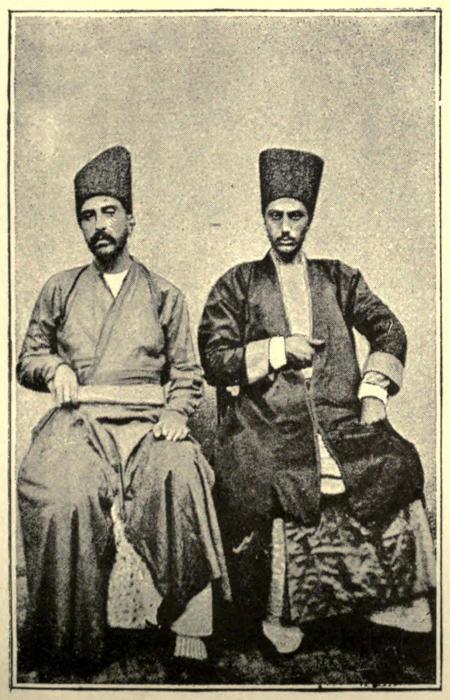
 MIDDLE CLASS PERSIANS
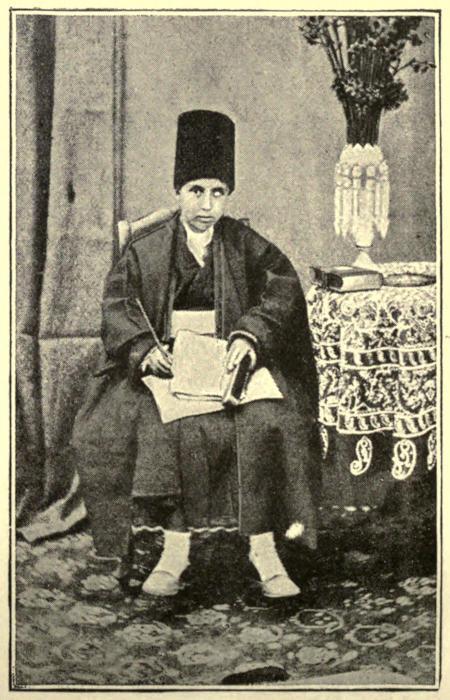
PERSIAN BOY
Cruelty is not a Persian vice; torture and punishments of an unusual and painful nature being part of their judicial system. There are no vindictive punishments, such as solitary confinement, penal servitude for long terms of years, etc. Seldom, indeed, is a man imprisoned more than twelve months, the rule being that there is a general jail delivery at the New Year. Royal clemency is frequently shown, often, perhaps, with want of judgment; still, it is very frequent. A cook I had, was years ago one of the Baabi rebels, and was seized and conducted to Teheran.
(His guilt was undoubted; he himself acknowledged it; and these men had made an attempt, nearly successful, on the Shah’s life, actually wounding him.) This cook, “Mehdi,” was chained by the neck, with eleven others, and led out in the Shah’s presence for execution. The eleven men had their throats cut. “Enough,” said the king, “let that poor rascal go!”
He was taken back to prison and his life spared; but though the Shah had meant that he should be released, there being no formal order, he remained in prison for several years, making a good living by selling savoury messes to his fellow-prisoners.
The costume of the Persians may be shortly described as fitted to their active habits. The men invariably wear an unstarched shirt of cotton. This is sewn with white silk, cotton as a sewing material being unknown; it is often, particularly in the south of Persia, elaborately embroidered about the neck. It fastens in front by a flap, having two small buttons or knots at the left shoulder. It seldom comes below the hips. There is no collar, and the sleeves are quite loose, and are not confined at the wrist. The lower orders often have it dyed blue, particularly the villagers; but the servant and upper classes invariably wear a white shirt. Silk shirts used to be worn, but are now seldom seen on men. Among the very religious, during the mourning month (“Mohurrim”), the shirt is at times dyed black.
The “zerejumah,” or trousers, are of cloth among the higher classes, particularly those of the military order, who affect a garment of a tightness approaching that worn by Europeans. But the ordinary “zerejumah” is of cotton, white or dyed blue, or at times red, cut very loose, and exactly similar to the “pyjamas” worn by Europeans in India. They are held up by a thin cord of red or green silk or cotton round the waist, and the labouring classes, when engaged in heavy or dirty work, or when running, generally tuck the end of these garments in under the cord, which leaves their leg bare and free to the middle of the thigh.
The amplitude of these loose garments enables the Persian to sit without discomfort on his heels, his usual mode of sitting, for chairs are only used by the rich, great, or Europeanised; and it is a common thing for a visitor, if on familiar terms, to ask to be allowed to sit on his heels, as the unaccustomed chair tires him.
Over the shirt and “zerejumah” comes the “alkalūk,” generally of quilted chintz or print. This is a closely-fitting garment, collarless, with tight sleeves to the elbow, whence to the wrist are a number of little metal buttons; these are fastened in winter, and left open in summer.
Above this is the coat, or “kemmercheen,” a tunic of coloured calico, silk, satin, moiré, cloth, Cashmere, or Kerman shawl, gold embroidered silk, satin, or velvet, according to the time of year and the purse or position of the wearer This, like the alkalūk, is open in front, and shows the shirt. It has a small standing collar at times, and is double-breasted. It has a pocket-hole on either side, giving access to the pockets, which are always in the alkalūk, in which garment is the breast-pocket, where watch, money, jewels, and seals are kept. The length of the “kemmercheen” denotes the class of the wearer. The military and official classes and the various “noker,” or servants, from the king’s valet, who may be also prime minister, wear them short; that is to say, to the knee, while fops and lutis (sharpers) wear them shorter even than this. The priests, and merchants, and the villagers, especially about Shiraz, and the townsmen and shopkeepers, with doctors and lawyers, wear them very long, often nearly to their heels.
Over the kemmercheen is worn the kolajah, or coat. This is as a rule cast off in summer, save on formal occasions, as when the wearer is performing his functions or making a call, and is often borne by a servant or carried over the shoulder by the owner himself. They are of cloth, shawl, or camel-hair cloth, and are invariably lined throughout with either silk or cloth, flannel, or even fur. They are like the Turkish frock-coat, made with a very loose sleeve, and with many plaits behind. They have lappels, as with us, and are trimmed with gold lace (derbeeri), shawl, or fur, or at times worn quite plain; they have a roll collar and false pockets.
Besides these garments there are others, as the long juba, or cloth cloak. This ample and majestic garment is affected by mirzas (secretaries), Government employés of high rank, as ministers, farmers of taxes, courtiers, physicians, priests. The wearers carry a staff as a rule. The jubas are made of the finest cloth, very amply cut. They have a standing collar and long sleeves. These sleeves are from one to two feet longer than the arm, and are often allowed to hang down empty when the garment is worn out of doors; but when in the actual presence
of guests or a grandee, they are used to keep the hands hidden (a token of respect to those present), and the many wrinkles formed by the excessive length of these sleeves are supposed to be their beauty.
The abba, or camel-hair cloak of the Arab, is often worn by travellers, priests, and horsemen. The priests particularly affect it; it is a very picturesque garment, warm, and waterproof, also very light. Some of these abbas are very expensive, though plain; while others, much embroidered in gold, are given as dresses of honour to the middle classes and priests, and are used at weddings, etc.
Among outer garments worn by travellers and the aged are the wellknown poosseen, or Afghan skin-cloak. These are full length, only used by travellers and the sick or aged; and the “neemtan,” or common sheepskin jacket, with short sleeves, used by shopkeepers and the lower class of servants, grooms, etc., in winter. They are mostly seen at Ispahan. The Afghan poosseen is a wonderful garment for travellers, as it is so very warm, and forms bed and bedding, but it has to be kept dry. The skins are dyed yellow; the fur is generally a natural brown. An ample cloak is made with very long sleeves, which act as gloves, the hands not being protruded. They are often elaborately embroidered with yellow silk, and are worth in Teheran, where they are very common, from four pounds (ten tomans) to sixteen pounds (forty tomans).
Besides these “balapoosh,” or overcoats, is the “yapunjah,” or woollen Kūrdish cloak. This is a kind of felt, having a shaggy side, of immense thickness. It looks like a bear-skin, and is of great weight. It is a half-circle in shape; a strap at the neck holds it on. The wearer, generally a shepherd, uses it as great-coat, bed and bedding. It is quite waterproof, and very warm. The thing is worn slung, closed side to the wind, and is used as a shield against the wind or snow
There is also the felt coat of the villager, before described, a very warm and inexpensive garment, which wears well. It is from half an inch to one inch thick, and enables the villager to defy the severest weather The cost is from five to fifteen kerans.
The kemmerbund, or belt, is also characteristic of the class. It is made of muslin, shawl, or cotton cloth among the priests, merchants, traders, and bazaar people; shawls and muslin are also affected by the
secretary class and the more aged or old-fashioned among the great Government employés.
In it is carried by the literati and merchants the pencase and a roll of paper, and its voluminous folds are used as pockets: and by the bazaar people and villagers, porters, and merchants’ servants a small sheath knife is stuck in it; while by “farrashes,” the carpet-spreader class, a large canjar, or curved dagger, with a heavy ivory handle, is carried; less for use than as a badge of office.
The headgear, too, is very distinctive. The turban is worn by the priests. These use generally a white one, consisting of many yards of muslin, unless they be “Syuds,” or descendants of the prophet, when a green one is worn. This at times is a very deep colour, nearly black; at others a grass-green.
These Syuds, too, usually wear a kemmerbund, or girdle of green muslin, shawl, or cotton cloth. Merchants also affect the turban, usually of muslin, embroidered in colours; or of a yellow pattern on strawcoloured muslin, or of calico, or at times of shawl.
The waist of the Persian is generally small, and he is very proud of his fine figure and broad shoulders.
The distinctive mark of the courtier, military, and upper servant class is the belt, generally of varnished leather, black in colour, with a brass clasp, usually of Russian manufacture. The princes and courtiers often replace the brass clasp by a huge round ornament of cut stones, the favourite one of his Royal Highness Zil-es-Sultan being of diamonds, of large size, a huge emerald being in the centre.
The “kola,” or hat, is of cloth or sheepskin, on a frame of pasteboard. The most expensive are made of the black skin of the fœtal lamb. Strange to say, these skins usually go to Europe to be dyed—I believe to Leipzig. The commoner people wear coloured lambskin hats, as grey, or even sheepskin, with the wool long. The fashions in hats change yearly; they are generally affected by the military and noker (servant) class, by courtiers and beaux, and are usually worn with a knowing cock. The Ispahani merchant, and the Armenian, at times wear very tall ones.
The hair is generally shaved at the crown, or the entire head is shaved, a karkool, or long thin lock, being at times left, often two feet
long from the middle of the crown. This is kept knotted up and hidden. Its use is to enable the prophet Mahommed to draw up the believer into paradise. The lower orders generally have the hair over the temporal bone long, and this is brought in two long locks, turning backwards behind the ear; they are termed “Zūlf;” the beaux and youths are constantly twisting and combing them. The rest of the head is shaven. Long hair, however, is going out of fashion in Persia, and the more civilised affect the cropped hair worn by Europeans, and even have a parting in it.
The chin is never shaved, save by “beauty men,” or “Kashangs,” though often clipped, while the moustache is usually left long. At forty, a man generally lets his beard grow its full length, and cherishes it much; part of a Persian’s religious exercises is the combing of his beard.
Socks, knitted principally at Ispahan, are worn: they are only about two inches long in the leg. The rich, however, affect a longer sock: white cotton ones are worn in summer, and coloured worsted in winter. The patterns of these worsted socks are often very pretty and effective. The villagers only wear a sock on state occasions, as at a wedding, the New Year, etc.
Shoes are of many patterns; the Orūssi or Russian shoe, similar to our children’s shoe without the strap, is the most common. Next, the Kafsh, or slippers of various kinds. The heel is folded down, and remains so. The priests affect a peculiar heavy shoe, with an ivory or wooden lining at the heel. Green shoes of shagreen are very common at Ispahan. Blacking is unknown to Persians generally, but a European’s servant may be always recognised by his polished shoes. Boots are only used by horsemen, and are then worn much too large, for ease. Those worn by couriers often come up the thigh, and are similar to those used by our sewer-men.
With boots are worn shulwar, or baggy riding breeches. These are very loose, and tied at the ankle by a string; a sort of kilt is worn by couriers. Pocket-handkerchiefs are never used, save by the rich or the Teheranis.
Most Persians affect a “shub kola,” or night hat, for wear in their homes. This is a loose, baggy cap, of shawl or quilted material: it is
often embroidered by the ladies, and presents of “night hats” are as frequent with them as our ones of embroidered slippers.
As to arms, these are usually carried only by the tribesmen, who bristle with weapons. The natives of the south of Persia and servants— these latter generally, particularly in Shiraz—carry a kammer, or dirk, which is, however, seldom used as an offensive weapon, save in drunken rows. The soldiery, on or off duty, always carry one of these “kammers” or their side-arms, sometimes both. They hack, but never thrust with them. Of course on the road the carrying of weapons is the rule, and it is needed, as there is no police, save the ephemeral phenomena introduced by Count Monteforte at Teheran. These men, who are really efficient, are too good to last.
The costume of the women has undergone considerable change in the last century; it is now, when carried to the extreme of the fashion, highly indecent, and must be very uncomfortable.
The garment doing duty as a chemise is called a perhān; it is, with the lower orders, of calico, white or blue, and comes down to the middle of the thigh, leaving the leg nude. Among the upper classes it is frequently of silk. At Shiraz it is often of fine cotton, and elaborately ornamented with black embroidery: among the rich it is frequently of gauze, and much embroidered with gold thread, pearls, etc. With them it often reaches only to the navel.
The head is usually covered with a chargāt, or large square of silk or cotton, embroidered. These chargāts are folded, as were shawls amongst us some years ago, thus displaying the corners, two in front and two behind; it is fastened under the chin by a brooch. It is often of considerable value, being of Cashmere shawl, embroidered gauze, etc.
A jika, a jewelled, feather-like ornament, is often worn at the side of the head, while the front hair, cut to a level with the mouth, is brought up in love-locks on either cheek. Beneath the chargāt is generally a small kerchief of dark material, worn to set off the complexion, and preserve the chargāt; only the edge of this is visible. The ends of the chargāt cover the shoulders, but the gauze perhān, quite transparent, leaves nothing to the imagination. The breasts and chest are very visible, and the abdomen is quite bare.
On state occasions, or with women who aim at beauty, the face is always painted more or less, and a profusion of jewellery worn. This is of the most solid description, the gold some twenty-three carats fine, and quite flexible: no hollow jewellery is worn, intrinsic value being what is aimed at.
Silver is only worn by the very poor: coral only by negresses.
Necklaces and bracelets are much worn, and numerous chains with scent-caskets attached to them; while the arms are covered with clanking glass bangles, called “Alangū,” some twenty even of these hoops being worn on an arm.
Jewelled “Bazūbund,” containing talismans, are often worn on the upper arm, while among the lower orders and South Persian or Arab women nose-rings are not uncommon, and at times bangles, or anklets of beads, on the ankles.
The face on all important occasions—as at entertainments, weddings, etc.—is usually much painted, save by young ladies in the heyday of beauty. The colour is very freely applied, the cheeks being reddled, as are a clown’s, and the neck smeared with white, while the eyelashes are marked round with kohl (black antimony). This is supposed to be beneficial to the eyes, and almost every woman uses it —very needlessly, as the large languishing eye of the Persian belle needs no adventitious aid. The eyebrows are widened and painted till they appear to meet, while sham moles or stars are painted on the chin and cheek—various in their way, as the patches of the eighteenthcentury belles: even spangles are stuck at times on the chin or forehead. Tattooing is common among the poor and villagers, and is seen among the upper classes.
The hair, though generally hidden by the chargāt, is at times exposed and plaited into innumerable little tails of great length, while a coquettish little skull-cap of embroidery or shawl or coloured silks is worn. False hair is common. The Persian ladies’ hair is very luxuriant, and never cut; it is nearly always dyed red with henna, or black with indigo to a blue-black tinge; it is naturally a glossy black. Fair hair is not esteemed, and I have been asked to condole with ladies in their grief in being the possessors of fair locks. At Ispahan so universal is this feeling that a young half-caste lady having beautiful golden hair, dyed it
on her marriage to a pre-Raphaelite auburn, to please her Baghdadi husband.
Blue eyes are not uncommon, but brown ones, like those of the fullblooded Jewess, are the rule: a full-moon face is much admired, and the possession of a dark complexion termed “nummak” (salt) is the highest native idea of beauty.
Most Persian women are small, with tiny feet and hands. The figure, however, is always lost after maternity, and they wear no support of any kind.
A very short jacket of gay colour, quite open in front, and not covering the bosom, with tight sleeves with many metal buttons, is usually worn in summer: a lined outer coat in cold weather
In winter a pair of very short white cotton socks are used, and tiny slippers with a high heel; in summer in the house ladies go often barefoot.
The rest of the costume is composed of the “tūmbūn,” or “shulwar;” these are simply short skirts of great width, held by a running string; the outer one usually of silk, velvet, or Cashmere shawl, often trimmed with gold lace, according to the purse of the wearer; or among the poor, of loud-patterned chintz or print. Beneath these are innumerable other garments of the same shape, and varying in texture from silk and satin to print.
The whole is very short indeed; among the women of fashion merely extending to the thigh, and as the number of these garments is amazing, and they are much bouffée, the effect of a lady sitting down astonishes the beholder, and would scandalise the Lord Chamberlain. As the ladies are supposed, however, to be only seen by their lords in these indoor dresses, there is perhaps no harm done.
Indecency, too, is very much an idea, for a Persian lady, who will thus expose her extremities and the greater part of her trunk, will carefully veil her face, showing nothing but the eyes. The ladies of rank, however, have no shame of any kind, and display very redundant charms. The indoor costume of the Persian lady is in fact exactly that of the corps de ballet, but shorter: while in winter, an over-mantle like the “kolajah” or coat of the man, and with short sleeves, lined and trimmed
with furs, is worn; this gives the costume a peculiarly graceful appearance.
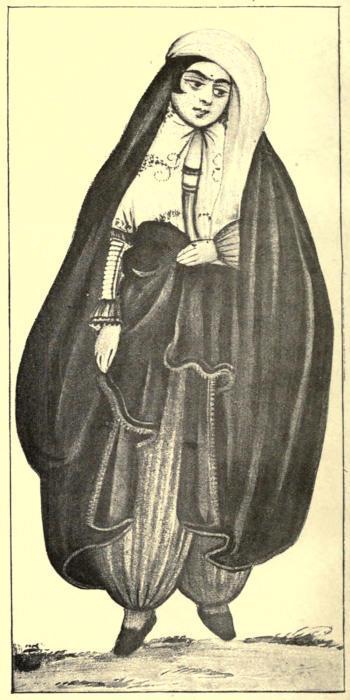
OUTDOOR DRESS OF PERSIAN WOMEN
(From a Native Drawing.)
Leg-coverings are now being introduced, and the last princess of the blood royal I saw added to her comfort, though she destroyed the
poetry of her appearance, by a tightly-fitting pair of black cloth “pants” with a gold stripe! This garment will doubtless soon become general.
In ancient days the Persian ladies always wore them, as may be seen by the pictures in the South Kensington Museum. In those times the two embroidered legs, now so fashionable as Persian embroideries (“naksh”), occupied a girl from childhood to marriage in their making; they are all sewing in elaborate patterns of great beauty, worked on muslin, in silk.
The outdoor costume of the Persian women is quite another thing; enveloped in a huge blue sheet, with a yard of linen as a veil, perforated for two inches square with minute holes, the feet thrust into two huge bags of coloured stuff, a wife is perfectly unrecognisable, even by her husband, when out of doors. The dress of all is the same; save in quality or costliness, the effect is similar. And yet with such a hideous disguise, a Persian coquette will manage to let the curious know if she have a good face and eye, by lifting her veil in a sly and half-timid way. The only thing I know exceeding in folly the chimney-pot hat, is the outdoor dress of the Persian woman. Expensive, ugly, uncomfortable, hot in summer, cold in winter, words fail to express its numerous disadvantages; it has one positive quality—as a disguise it is perfect, and its use favours the intrigues rife in the country.
As for the children, they are always when infants swaddled: when they can walk they are dressed as little men and women, and with the dress they often, nay generally, ape the manners; a Persian child of the upper class being a master of etiquette, an adept at flattery, and a mirror of politeness. It is a strange custom with the Persian ladies to dress little girls as boys, and little boys as girls, till they reach seven or eight years; this is often done for fun, or on account of some vow, oftener to avert the evil eye.
Persian women are very fond of their children, and pet them greatly. The love of the Persian for his mother is very great; he never leaves her to starve, and her wishes are laws to him, even when he is an old man, and she an aged crone. The mother is always the most important member of the household, and the grandmother is treated with veneration. Mothers-in-law are not laughed at or looked down on in Persia; their presence is coveted by their sons-in-law, who look on them as the guardians of the virtue of their wives. The uncle, too, is a much
nearer tie than with us, that is to say, the paternal uncle: while men look on their first cousins on the father’s side as their most natural wives. Possibly this is because their female cousins are the only women they have any opportunity of knowing anything of personally. Black slaves and men-nurses, or “lallahs,” are much respected and generally retained in a household, while the “dyah,” or wet nurse, is looked on as a second mother, and usually provided for for life.
Persians are very kind to their servants, and try to make their people look on them as second fathers; a master will be often addressed by a servant as his father, and the servant will protect his master’s property as he would his own, or even more jealously.
A servant is invariably spoken to as “butcha” (child). The servants expect that their master will always take their part, and never allow them to be wronged; if he does not do so, he cannot obtain a good class domestic, while if he sticks to the man, he never leaves him.
The slaves in Persia have what Americans call “a good time;” well fed, well clothed, treated as spoiled children, given the lightest work, and often given in marriage to a favourite son, or taken as a “segah,” or concubine, by the master himself (and respectable Persians only take a “segah” for ninety-nine years, which is equivalent to a permanent marriage), slaves have the certainty of comfort and a well-cared-for old age. They are always looked on as confidential servants, are entrusted with large sums of money, and the conduct of the most important affairs; and seldom abuse their trust.
The greatest punishment to an untrustworthy slave is to give him his liberty and let him earn his living. They vary in colour and value: the “Habashi” or Abyssinian is the most valued; the Souhāli or Somāli, next in blackness, is next in price; the Bombassi, or coal-black negro of the interior, being of much less price, and usually only used as a cook. The prices of slaves in Shiraz are, a good Habashi girl of twelve to fourteen, forty pounds; a good Somāli same age, half as much; while a Bombassi is to be got for fourteen pounds, being chosen merely for physical strength. They are never sold, save on importation, though at times they are given away. Strange as it may appear, to the mind of any one who has lived in Persia, slavery in that country to the African is an unmixed good. Of course the getting to Persia, and the being caught, is another thing. But I have never seen a Persian unkind to his own horse