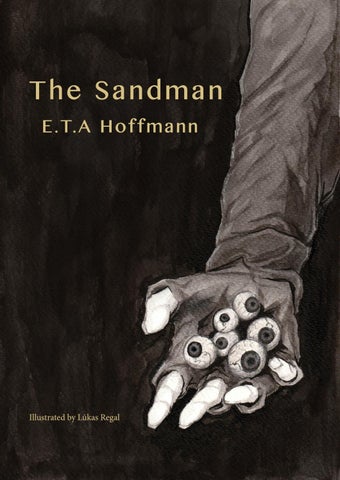
The Sandman E . T. A H o f f m a n n
Illustrated by LĂşkas Regal
NATHANAEL TO LOTHAIR I know you are all very uneasy because I have not written for such a long, long time. Mother, to be sure, is angry, and Clara, I dare say, believes I am living here in riot and revelry, and quite forgetting my sweet angel, whose image is so deeply engraved upon my heart and mind. But that is not so; daily and hourly do I think of you all, and my lovely Clara’s form comes to gladden me in my dreams, and smiles upon me with her bright eyes, as graciously as she used to do in the days when I went in and out amongst you. Oh! how could I write to you in the distracted state of mind in which I have been, and which, until now, has quite bewildered me! A terrible thing has happened to me. Dark forebodings of some awful fate threatening me are spreading themselves out over my head like black clouds, impenetrable to every friendly ray of sunlight. I must now tell you what has taken place; I must, that I see well enough, but only to think upon it makes the wild laughter burst from my lips. Oh! my dear, dear Lothair, what shall I say to make you feel, if only in an inadequate way, that that which happened to me a few days ago could
grains and was about to strew them into my eyes. Then my father clasped his hands and entreated him, saying, “Master, master, let my Nathanael keep his eyes—oh! do let him keep them.” Coppelius laughed shrilly and replied, “Well then, the boy may keep his eyes and whine and pule his way through the world; but we will now at any rate observe the mechanism of the hand and the foot.” And therewith he roughly laid hold upon me, so that my joints cracked, and twisted my hands and my feet, pulling them now this way, and now that, “That’s not quite right altogether! It’s better as it was!—the old fellow knew what he was about.” Thus lisped and hissed Coppelius; but all around me grew black and dark; a sudden convulsive pain shot through all my nerves and bones; I knew nothing more. I felt a soft warm breath fanning my cheek; I awakened as if out of the sleep of death; my mother was bending over me. “Is the Sand-man still
things, as bad as could a Satanic power which should assume a living physical form, but only—only if you do not banish him from your mind and thoughts. So long as you believe in him he exists and is at work; your belief in him is his only power.” Whereupon Nathanael, quite angry because Clara would only grant the existence of the demon in his own mind, began to dilate at large upon the whole mystic doctrine of devils and awful powers, but Clara abruptly broke off the theme by making, to Nathanael’s very great disgust, some quite commonplace remark. Such deep mysteries are sealed books to cold, unsusceptible characters, he thought, without being clearly conscious to himself that he counted Clara amongst these inferior natures, and accordingly he did not remit his efforts to initiate her into these mysteries. In the morning, when she was helping to prepare breakfast, he would take his stand beside her, and read all sorts of mystic books to her, until she begged him—”But, my dear Nathanael, I shall have to scold you as the Evil Principle which exercises a fatal influence upon my coffee. For if I do as you wish, and let things go their own way, and look into your eyes whilst you read, the coffee will all boil over into the fire, and you will none of you get any breakfast.” Then Nathanael hastily banged the book to and ran away in great displeasure to his own room. Formerly he had possessed a peculiar talent for writing pleasing, sparkling tales, which Clara took the greatest delight in listening to; but now his productions were gloomy, unintelligible, and wanting in form, so that, although Clara out of forbearance towards him did not say so, he nevertheless felt how very little interest she took in them. There was nothing that Clara disliked so much as what was tedious; at such times her intellectual sleepiness was not to be overcome; it was betrayed both in her glances and in her words. Nathanael’s effusions were, in truth, exceedingly tedious. His ill-humour at Clara’s cold prosaic temperament continued to increase; Clara could not conceal her distaste of his dark, gloomy, wearying
Lothair entered the arbour. Clara was obliged to tell him all that had taken place. He was passionately fond of his sister; and every word of her complaint fell like a spark upon his heart, so that the displeasure which he had long entertained against his dreamy friend Nathanael was kindled into furious anger.
He hastened to find Nathanael, and upbraided him in harsh words for his irrational behaviour towards his beloved sister. The fiery Nathanael answered him in the same style. “A fantastic, crack-brained fool,” was retaliated with, “A miserable, common, everyday sort of fellow.” A meeting was the inevitable consequence. They agreed to meet on the following morning behind the garden-wall, and fight, according to the custom of the students of the place, with sharp rapiers. They went about silent and gloomy; Clara had both heard
artificial roulades seemed to him to be the exultant cry towards heaven of the soul refined by love; and when at last, after the cadenza, the long trill rang shrilly and loudly through the hall, he felt as if he were suddenly grasped by burning arms and could no longer control himself,—he could not help shouting aloud in his mingled pain and delight, “Olimpia!” All eyes were turned upon him; many people laughed. The face of the cathedral organist wore a still more gloomy look than it had done before, but all he said was, “Very well!” The concert came to an end, and the ball began. Oh! to dance with her—with her—that was now the aim of all Nathanael’s wishes, of all his desires. But how should he have courage to request her, the queen of the ball, to grant him the honour of a dance? And yet he couldn’t tell how it came about, just as the dance began, he found himself standing close beside her, nobody having as yet asked her to be his partner; so, with some difficulty stammering out a few words, he grasped her hand. It was cold as ice; he shook with an awful, frosty shiver. But, fixing his eyes upon her face, he saw that her glance was beaming upon him with love and longing, and at the same moment he thought that the pulse began to beat in her cold hand, and the warm life-blood to course through her veins. And passion burned more intensely in his own heart also; he threw his arm round her beautiful waist and whirled her round the hall. He had always thought that he kept good and accurate time in dancing, but from the perfectly rhythmical evenness with which Olimpia danced, and which frequently put him quite out, he perceived how very faulty his own time really was. Notwithstanding, he would not dance with any other lady; and everybody else who approached Olimpia to call upon her for a dance, he would have liked to kill on the spot. This, however, only happened twice; to his astonishment Olimpia remained after this without a partner, and he failed not on
Coppelius—Coppelius—he’s stolen my best automaton—at which I’ve worked for twenty years—staked my life upon it—the clock-work— speech—movement—mine—your eyes—stolen your eyes—damn him—curse him—after him—fetch me back Olimpia—there are the eyes.” And now Nathanael saw a pair of bloody eyes lying on the floor staring at him; Spalanzani seized them with his uninjured hand and threw them at him, so that they hit his breast Then madness dug her burning talons into him and swept down into his heart, rending his mind and thoughts to shreds. “Aha! aha! aha! Fire-wheel—fire-wheel! Spin round, fire-wheel! merrily, merrily! Aha! wooden doll! spin round, pretty wooden doll!” and he threw himself upon the Professor, clutching him fast by the throat. He would certainly have strangled him had not several people, attracted by the noise, rushed in and torn away the madman; and so they saved the Professor, whose wounds were immediately dressed. Siegmund, with all his strength, was not able to subdue the frantic lunatic, who continued to scream in a dreadful way, “Spin round, wooden doll!” and to strike out right and left with his doubled fists. At length the united strength of several succeeded in overpowering him by throwing him on the floor and binding him. His cries passed into a brutish bellow that was awful to hear; and thus raging with the harrowing violence of madness, he was taken away to the madhouse. Before continuing my narration of what happened further to the unfortunate Nathanael, I will tell you, indulgent reader, in case you take any interest in that skilful mechanician and fabricator of automata, Spalanzani, that he recovered completely from his wounds. He had, however, to leave the university, for Nathanael’s fate had created a great sensation; and the opinion was pretty generally expressed that it was an imposture altogether unpardonable to have smuggled a wooden puppet instead of a
living person into intelligent tea-circles,—for Olimpia had been present at several with success. Lawyers called it a cunning piece of knavery, and all the harder to punish since it was directed against the public; and it had been so craftily contrived that it had escaped unobserved by all except a few preternaturally acute students, although everybody was very wise now and remembered to have thought of several facts which occurred to them as suspicious. But these latter could not succeed in making out any sort of a consistent tale. For was it, for instance, a thing likely to occur to any one as suspicious that, according to the declaration of an elegant beau of these tea-parties, Olimpia had, contrary to all good manners, sneezed oftener than she had yawned? The former must have been, in the opinion of this elegant gentleman, the winding up of the concealed clock-work; it had always been accompanied by an observable creaking, and so on. The Profes-
and Lothair, not feeling inclined to climb up all the many steps, waited below. There the two lovers stood arm-in-arm on the topmost gallery of the tower, and gazed out into the sweet-scented wooded landscape, beyond which the blue hills rose up like a giant’s city. “Oh! do look at that strange little grey bush, it looks as if it were actually walking towards us,” said Clara. Mechanically he put his hand into his sidepocket; he found Coppola’s perspective and looked for the bush; Clara stood in front of the glass. Then
a convulsive thrill shot through his pulse and veins; pale as a corpse, he fixed his staring eyes upon her; but soon they began to roll, and a fiery current flashed and sparkled in them, and he yelled fearfully, like a hunted animal. Leaping up high in the air and laughing horribly at the same time, he began to shout, in a piercing voice, “Spin round, wooden doll! Spin round, wooden