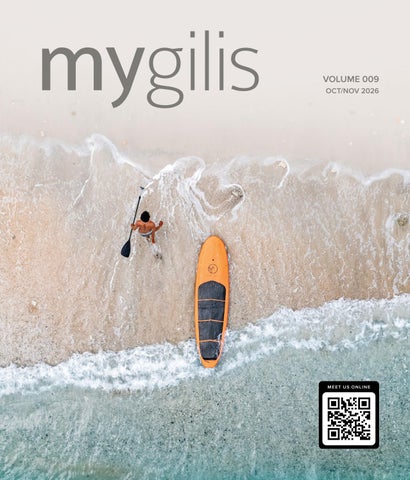
VOLUME 009 OCT/NOV 2026
MEET US ONLINE
1
2
3
A NOTE FROM THE EDITOR
Island life is about more than where you are—it’s about how you experience it. There’s always something happening across the Gilis. Beneath the surface, coral is being restored. On the beach, yoga classes bring a little calm to busy island days. In cafés, artists turn everyday spaces into places for conversation and creativity. And, of course, there is always something good to eat, somewhere beautiful to stay and a sunset worth stopping for. In this edition of mygilis, we take a closer look at some of the people, places and experiences that give the islands their character.
ON THE COVER jerryunderh2o
We dive beneath the waves to discover how visitors can get involved in coral propagation and play a small part in protecting the reefs they come here to enjoy. We meet yoga instructor Adipta Yoga Pantora and explore the idea of finding balance on Gili Trawangan, before sitting down with travelling artist Linelof, whose work and story remind us that art can be about freedom, connection and community. Food, as always, plays a big part in island life. We meet Chef Stef of Il Baretto on Gili Air and hear how a love of Italian cooking, hospitality and tradition eventually brought her to the Gilis. We also take a look at Kopi Susu’s new Kuta home, where the relaxed island spirit meets a fresh café concept. Whether you’re visiting for a few days or lucky enough to call the Gilis home, we hope this edition inspires you to explore, discover something new and, most importantly, enjoy island life.
ENQUIRIES Telephone: +62 (0) 878 9640 3464 E-mail: info@mylombokmag.com Instagram: @mylombokmag Facebook: /mylombokmag Website: www.mylombokmag.com
THE BAD GUY NOTICE No part of this publication may be reproduced, stored in a retrieval system or transmitted in any form or by any means, electronic, mechanical, photocopying, recording or otherwise, without prior permission of PT Lima Elemen Grafika. The views and opinions expressed in this publication are not necessarily those of the authors and mygilis disclaims any responsibility for any errors, ommissions or complaints arising there from. The publisher will not be held responsible for copyright infringement on images supplied by advertisers and or by contributors.
4
5
© vila ombak
EAT
EXPLORE
6
10
Explore Give back the reef you love
26
Chef Interview Chef Stef, Il Baretto, Gili Air
16
Activity Sunset Beach Yoga
30
Eating Out Kopi Susu
20
Local Profile Linelof’s story/journey/art travel
ESTATE
36
Luxury Living Villa Bulat, Gili Air
40
Hotel Review Hotel Vila Ombak, Gili Trawangan
7
8
C O R A L P R O P A G AT I O N GIVE BACK TO THE REEF YOU LOVE
S U N S E T B E AC H YO GA FINDING BALANCE ON GILI TRAWANGAN
9
Give back to the reef you love
L
et’s face it: most people who arrive on Gili Trawangan are here for the same reasons—warm crystal-clear water, tropical fish, turtles and beautiful coral reefs. But have you ever stopped to think about what makes all of that possible? Coral reefs are the foundation of life around the Gilis. They provide shelter and food for fish, create habitat for turtles and countless other marine species, and help protect our coastlines. They are also a huge part of what makes the islands such a special place to visit. So, while you’re here, why not give back to the reef and plant your own coral! You don’t need to be a marine biologist, a conservation expert or even a diver to start learning about coral restoration. All you really need is a little curiosity and a willingness to try something new. Coral propagation is surprisingly similar to gardening on land. Take the iconic frangipani trees you find on the Gili’s, for example. If a healthy branch falls from a tree and is planted in the right conditions, it can grow roots and become a brand-new tree. Corals have a similar ability to grow from fragments. Corals are colonial animals, meaning that a single coral colony is made up of many tiny individual animals living together. When a healthy colony is broken into smaller pieces, those fragments can continue growing into new colonies. This is where coral propagation comes in.
10
From broken fragment to new coral Around the Gilis, coral fragments can become dislodged for all sorts of reasons—from storms and strong currents to boat anchors, careless fins or snorkellers accidentally standing on the reef. Sometimes, even a turtle landing on a coral colony can cause some damage! Rather than allowing healthy fragments to disappear into the sand, trained coral restoration teams can rescue them and give them a chance to grow. Through microfragmentation, a single healthy coral can be divided into several smaller pieces. These tiny fragments are then attached to natural rock substrate using a specially formulated catalyst that helps the coral begin to cement itself to the rock. A small amount of glue helps hold everything securely while the coral gets established. Think of it as giving a tiny coral a temporary helping hand. Once planted, the corals are placed in shallow-water nurseries where they can be regularly monitored while they grow. After around 8 to 10 months, healthy colonies can be transplanted back onto damaged sections of reef, helping to restore coral cover and local biodiversity. The beauty of this approach is that it is simple, affordable and highly scalable. With the right training, lots of small corals can be grown in a relatively short period of time— creating a living bank of corals ready to help replenish damaged reefs. Conservation you can get your hands dirty with Marine conservation can sometimes feel a little distant from regular holiday life. You might see scientists surveying reefs or hear about coral bleaching in documentaries, but wonder what you can actually do about it.
11
12
Coral propagation brings conservation closer to home. Here on Gili Trawangan, visitors can take part in a handson workshop and learn how coral restoration works for themselves. You can learn about coral biology, discover how healthy fragments are selected and even attach your own coral to a piece of natural substrate. And you don’t necessarily have to be a diver. Bringing coral restoration onto the beach also means that conservation becomes something everyone can see and be curious about. Someone stopping for lunch, walking along the beach or enjoying a sunset can watch the process, ask questions and discover that reef restoration isn't just something scientists do somewhere far away. It's something we can all learn about—and help with. Leave more than footprints A holiday on the Gilis doesn’t have to be about simply enjoying the ocean and moving on. You can become part of protecting the place you've come to enjoy. If you’ve watched a documentary about coral bleaching, wondered what happens to damaged reefs, or simply want to try something completely different during your stay, why not learn how to plant a coral? If you’re visiting Gili Trawangan and would like to learn more, head to Trawangan Dive and ask about their coral propagation workshops. And if you’re already a certified diver with 20+ dives, you can take your involvement a step further by joining field training to become a coral propagator in a field training course. Because sometimes the best souvenir from the Gilis isn’t something you take home with you. It’s knowing that you left a little more life growing beneath the waves.
13
14
15
16
SUNSET BEACH YOGA
Finding balance on Gili Trawangan
F
or more than 11 years, Adipta Yoga Pantora has called Gili Trawangan home. Originally from West Lombok, Adipta discovered yoga as a way to bring balance, mindfulness and movement into everyday life, completing his teacher training in Ubud in 2018. Now, as a yoga instructor at Sunset Beach Yoga, he combines his passion for the practice with his love of meeting people from around the world. From mindful morning flows to playful aerial yoga as the sun sets over the island, Adipta believes yoga should be accessible, enjoyable and something that leaves you feeling happier than when you arrived. We caught up with him to find out more about his journey, his approach to teaching and why yoga might just be the perfect addition to a Gili Trawangan holiday. How long have you been working on Gili Trawangan? I came to Gili and started working back in August 2015, just over 11 years ago now. You’re a yoga instructor, and your name is yoga? It’s meant to be! Exactly! My surname is Yoga, Adipta Yoga Pantora. And I’ve been a yoga instructor for 8 years now. Where are you from originally? I was born at Bungtiang, Sakra barat, East Lombok. When did you start training in the art of yoga? Have you trained in another country or only in Indonesia? I completed my teacher training in Ubud Bali, 2018. I also got my yoga mentorship for teacher training in Bali too. I am happy to have connected with the amazing yoga communities in Bali and Gili.
What is a typical day like for you? Do you teach every day? I love to find balance in life, working hard, but staying active. I love to be able to guide other people, especially tourists and guests when they are on their holiday. I get to meet people from all over the world in my classes, and being able to give something back to them. It is a pleasure to guide these practices and makes me feel useful. Although, I teach yoga two or three times every day, I still love having time to relax on the island. What is your favourite yoga style to teach? My preferred style in class is to focus on controlling the breath. Slow, mindful movements improve the quality of each pose and help me help my students improve and adjust their poses and movements Why do you love yoga as a class activity? I love to make yoga fun and easy for anyone who wants to try! Even as a beginner, you can enjoy deep poses and quality movements. My aim is that people can leave a class feeling better and happier about themselves, and hopefully return! How long have you been teaching at sunset beach yoga? I’ve been practising and teaching at Sunset Beach Yoga since 2018. We have a treetop studio, with a great breeze and an even better sunset view, and a beach shala, if you want to feel grounded surrounded by the sand, right at the edge of your yoga mat.
17
LOCAL PROFILE
What time are Sunset Beach Yoga classes? At the moment, we have open, drop in classes twice a day, 8.30am Morning Flow which is ready to connect your body to your breath and hopefully influence your day in a positive way. At 5pm we host Fly High Yoga. A fun style of aerial yoga that helps to target precise body alignments whilst weightless upside down. It’s such a nice feeling to decompress your neck and spine after a long day scuba diving. Are Sunset Beach Yoga sessions suitable for beginners? Of course for all levels, beginners are welcome too! Nothing better than a drop in class trying Fly High yoga for the first time, just before sunset, listening to the waves. I think it should be on every Gili T bucket list. What is good advice for someone who hasn’t tried yoga before? You don’t need to be very fit, or super flexible, just willing to slow down to island pace, relax and listen to your breath and body. Yoga is our medicine, it should be a necessary therapy for a better and healthier life. Do you prefer sunrise or sunset? For a beginners practise, I prefer the morning yoga sessions, it really sets up your day to be relaxed and positive. And if you want to enjoy having fun playing with gravity, or just want to try something different the sunset classes are great. There is never a bad sunset on Gili! Lastly, other than yoga, what is your favourite activity to do on Gili Trawangan? I like swimming, snorkelling, kayaking and other activities on Gili. I also like to connect with all types of people who come to Gili and share the nicest things about life, languages and experiences, and learn many things from them.
+62 878 6212 5860 sunset_beach_yoga
18
19
LINELOF’S STORY/JOURNEY/ART TRAVEL
Thinking and revolution
W
hen you’re spending your days in Gili, take a moment to stop by Kayu Café, this time, for more than just a cup of coffee. On September 19th, 2026, Kayu Café opened their doors for Linelof’s month-long, solo art exhibition, “Thinking and Revolution”—a celebration of pointillism, creative exploration, and community. Pull up a seat and let the evening unfold naturally. Pak Rizal, you are originally from Sumatra, did you study art here too? No, I’ve never studied art. I left home when I was a teenager after being rejected by my family. I didn’t choose a typical career path that would be as successful as a job that many parents want or expect for their child. After spending around 10 years on the street, I am very grateful that even though I don’t have much, God gifted me my talents and my hands. Why do you like to travel to display your art? Travelling with my art means I can meet people from all over the world. Maybe this is because I never went to a formal art school. I don’t think you’d be encouraged to have a travelling solo exhibition on the path to great success. An art exhibition in a gallery is good, but you’ll only get to engage with people from that area. Travelling has meant I can bring art to other people, meet them on their path, and meet people from many different backgrounds and cultures. I get the feeling of freedom when I travel, collecting internal and external insights that combine to make harmony. To see the street, a cafe or even a ferry as a space to invite people to engage with my art. That is freedom.
20
What does Thinking & Revolution mean to you? Thinking takes effort and revolution comes from the heart. I have a spiritual teacher from Spain, he told me about the revolution first. You must connect with God and the universe. Ready to make the revolution every moment of every day. What does pointilism mean to you? Pointillism is a work of patience. Creating art using the pointillism technique is therapeutic, as I struggle to cry. Instead of crying, I regulate myself by creating art. It is like meditation; it helps me to breathe. Every point drawn is a tear shed and makes you stronger. Do you feel your art is political? Many people believe politics is only about governments and institutions, but politics affects our daily lives and affects everyone and humanity. Yes, I think my art is political, as are my beliefs and values. For example, if someone doesn’t believe Palestine should be free, then they won’t enjoy my art. That’s fine, strong beliefs mean I can die with dignity. Why is a ballpoint pen your favoured medium to create with? It is a simple item—a pen. When I had no money and couldn’t afford expensive materials, you would always find a pen lying around. I sometimes had problems with the rain damaging my work as I drew, so some of the pieces are backed with stronger paper to protect the original. Some I create using stencils and spray paint, especially this butterfly with the broken wings. Damage can be repaired, and beauty still remains in Palestine, even with horrific damage.
21
Here on Gili, we are surrounded by water! Have any of your pieces been inspired by the ocean? Or your journey across it? Yes absolutely, I love the ocean and nature. That’s actually why I chose this table in Kayu Café: art, culture, conversation and a beautiful view of the ocean. Do you have any Indonesia/International inspirations or art influences? Although I have much respect for several Indonesian artists and their work, I think my inspiration comes from moments, places and people around me. I think my biggest inspiration is working towards freedom in every single moment, how to find freedom around myself. How do readers get to see/witness and buy your work after they have read this? My main income comes from sales of my prints and merchandise. I am in Kayu Café on Gili Trawangan for one month presenting my pieces, and creating collaborative art with guests and tourists every evening. No need to book or sign up, just come along to Kayu Café and we will enjoy coffee, reflection on spirituality and imagination whilst creating art. You can buy my prints from Kayu Café in postcard, small and large sizes. Is there a significance between the grand opening time on Saturday’s Kayu gallery exhibition? It’s actually due to the date I was born! I was born in Sumatra on 27/11, so these numbers are meaningful to me. How do you find your art (or any art) can bring together communities? I enjoy it when people want to purchase my art, but I never want to sell the originals. Sometimes, the originals will fetch a high price, but if they fall into the wrong hands, art work can get locked away or auctioned in the private art scene. I’ve been offered huge sums to buy the original art, but then I feel if it is not shared with community, I have lost my soul. Art is meant to be shared to make a community. I am humbled with the income I make from selling my prints and merchandise. As long as I have enough income to buy food, buy drink, to pay my rent, then I feel comfortable.
22
What is next for you? My dream is to travel to Europe, so when I earn enough for this trip, then I would love to exhibit my work in Europe. Not necessarily for the money, but I feel there is more appreciation for art there. Different conversations and deeper discussions. In the near future, I have not yet planned where my next exhibition will be. I think there will be a sign or calling whilst I am here, as to what to do next. That’s thinking & revolutionizing the way we can present, interpret and appreciate art. Linelof will be featuring his solo travelling exhibition at Kayu Café every day, until October 17th.
23
24
C H E F S T E F, I L B A R E T T O , G I L I A I R INSPIRED BY BEAUTY AND SIMPLICITY; GUIDED BY TRADITION
KO PI S US U A STYLISH HANGOUT FOR COFFEE LOVERS AND FOODIES, SET TO SHAKE UP THE KUTA CAFÉ SCENE
25
CHEF STEF, IL BARETTO, GILI AIR
Inspired by beauty and simplicity; guided by tradition started at midnight and finished at 10am. During the night I’d be making croissants. Stefan, my boss and my mentor, was a master pastry chef and I would spend my afternoons working with him to learn the secrets and techniques of making pastry. That was where I also learned about organising and running a restaurant and managing a small team. Stefan taught me everything. Later, I went back to Rome and worked at Niche Café with my former chef. Everything was home-made and hand made. I stayed for five years and that’s what inspired me to build what I have here at Il Baretto, Gili Air.
S
tephania (Stef) is from Rome, Italy. A sudden decision to change direction, driven by a passion for cooking and hosting, led her, via a number of learning experiences, to start up Il Baretto, on Gili Air. She spoke with mygilis about the fundamentals that have stayed with her throughout her career. Was there a particular moment when you decided you would focus on cooking? I was working with Italian TV archives, taking care of old documents from an Italian TV company. It was an interesting job but I didn’t want to stay in front of a computer all day long. One day I decided to do something else. I’d always loved the idea of working in food and hospitality, so I took the plunge. I also took some professional cooking lessons. Then I asked a friend of mine, who was a chef, if I could work for free for three months to get some experience. Then I started applying for jobs. Could you tell us about some of the places you worked? I started working in a restaurant in Rome, where I learned how to make home-style pasta. I was also lucky enough to work in 5-star restaurants and several catering companies. Those jobs in Italy helped me to grow in confidence. When I moved to London, I worked for a year in pastry. My shift
26
On my 40th birthday I decided to give myself the gift of a long trip to Asia. I organised a month-long visit to Bali, Indonesia, because it was an exotic destination and I wanted to switch my reality from Italy. Then I discovered the Gilis and fell in love with all of them. The people, the freedom…. I felt at home and craved to go back; I wanted to find inspiration again. Three years later, I decided it was time to move. I quit my job at Niche, put everything in storage and took a flight to Indonesia. First, I went to Bali, then spent a month on Gili T and finally, Gili Air. There I met Luca, the owner of Mama Pizza, which he was building at the time. We chatted and developed a good friendship. I returned to Italy but the Gilis were still in my dreams. In 2023, after the Covid pandemic, Luca called me and asked me to manage Mama Pizza. It took five minutes to decide. After a year there, I knew I couldn’t go back to Italy. I’d learned so much: how to manage staff, suppliers and shipping. I knew I wanted to live on Gili Air and enjoy the lifestyle but not in a busy restaurant. With a friend from Italy, I drew up a business plan, so I could get help from family and friends. I love hosting people and I wanted to create something that could grow within the community—a place with good energy, like an Italian bar. There is a lot of passion,
sacrifice and commitment needed in this type of job but I didn’t feel alone; I had a lot of help from the people on Gili Air. I opened Il Baretto in April 2025. How would you describe or define your style of cooking? Everything comes fresh from the oven, made with love— and with Italian products. It’s a traditional way of cooking. Like Proust’s story about the petite madeleine and how the taste brought back memories of his past, the food ritual is bonded with emotion and memories; it’s about looking for grandma’s recipes and traditional favourites. Where do you find inspiration for your dishes? Where there is beauty there is inspiration. I am a pastry chef and my story comes from my background in Rome —the city, its traditions and even from its beautiful architecture. Inspiration might come from master chefs or from grandmothers—where there is passion and care and dedication and respect for the product. If I see older people cooking, in any country, I speak with them and I find that very inspirational. Do you have a particular ‘philosophy of cooking’? There are basically three important principles: simplicity —don’t overdo it; freshness—it’s important not to serve something from yesterday; and quality—always use the best products. What’s the best piece of cooking-related advice you’ve ever received? Three things. First, treat the product with respect and care and be proud of what you produce. Second, as one of my mentors taught me, you must make sacrifices and have passion. If you don’t understand that, you should change jobs. Third, always treat your staff properly. It is very important they stay happy and curious about their work. Which dishes do you most like to cook? I like to make pasta. It’s about having my hands in the dough and then knowing the right moment to turn it off— when the pasta is cooked al dente. And it’s about making the sauce just right… it’s the best feeling in the world!
like olive oil, the aromatic blend of basil and rosemary, the citrus smell and taste of lemon. And tomatoes, of course— the two hundred varieties of tomatoes you can find in Italy. And parmigiano, I love it! This is the richness of my country. What are your hopes and plans for the future? I want Il Baretto to grow. I want to develop more recipes and more ideas. I also want to be bolder and do more—be the entrepreneur who came from the back kitchen. I have some other projects in the pipeline. But I want to take it step by step. What makes the Gilis such an exciting destination for food lovers? There are lots of different, good quality restaurants opening and they all do a very good job. The traditional Indonesian food is becoming more ‘gourmet’; we have local chefs who have returned from abroad and are cooking ‘fusion’ dishes. There’s space for experimentation. The food scene is growing. Apart from cooking and creating dishes, what other things do you really enjoy? I love that the time seems to move more slowly. I enjoy the island, the sea and the natural surroundings. I try to go to the sea for a few hours every day. I also like to do yoga and play padel. I enjoy the sense of community and spending time with friends. If you hadn’t become a chef, what do you think you would be doing right now? It would be something that involved serving people and building a community. If there were no limits or barriers, who would you choose to cook for you? My first chef, Benjamen Hirst. He taught me so much about cooking. His job still inspires me. He still speaks with people who make everything by hand, to learn from them. Do you have any tips for budding chefs? Just one. Think hard about it. Think twice about it, because it’s no picnic.
What are your favourite ingredients? For me, everything is related to Mediterranean cuisine. I
27
Focaccia Barese Ingredients
Method
• 120 gr flour Caputo ‘00’ • 100 gr flour semola rimacinata Caputo • 50 gr boiled potatoes • 170 ml water • 6 gr yeast • 7 gr salt • 3 gr castor sugar • 10 gr extra virgin olive oil
1. Knead all the ingredients, except for the oil, at medium speed for 8 minutes. 2. Add the oil and continue kneading for a further 7 minutes. 3. Cover and leave the dough to rise for 2 hours. 4. Transfer the dough to a round, non-stick baking pan generously coating with olive oil. 5. Top with crushed cherry tomatoes, olives, and oregano. 6. Finish with flaky sea salt and a generous drizzle of extra-virgin olive oil. 7. Bake in a preheated oven at 250°C for approximately 30 minutes, or until golden and crisp.
28
Zabaione Tiramisù Ingredients
Method
• 113 gr egg yolks • 125 gr milk • 63 gr sugar • 7 gr cornstarch • 6 gr rice flour • 2 gr fresh vanilla beans • 124 gr whipping cream
1. Mix the sugar, rice flour and cornstarch. 2. Mix the egg yolks with the sugar, cornstarch and rice flour. 3. Heat the milk with the fresh vanilla beans. 4. Add the hot milk to the egg mixture (egg yolks + sugar + cornstarch + rice flour). Cook over a bain-marie or in the microwave, continuously whisking until the cream thickens and reaches 82°C. 5. Place the zabaione in an ice bath to cool. 6. Whip the whipping cream and gradually fold it into the zabaione in three additions.
29
30
KOPI SUSU
The much-loved Kopi Susu from Gili Air has landed in Kuta, bringing its stylish vibe, great coffee and foodie appeal to the local café scene
Y
our new favourite caffeine replenishment hangout is now in Kuta, Lombok. Kopi Susu, a brunch cafe that first made waves on Gili Air, has announced itself on the Kuta café scene with an impressive two-storey, lounge-style foodie venue. It brings the tropical Gili island aesthetic to downtown Kuta, along with a stylish contemporary mix of Indonesian-European vibes. The Kopi Susu origin story dates back to friends living on Gili Air with a shared vision and mutual passion for food and design, who wanted to introduce European-style brunch culture to a small island. They created a tropical space that was welcoming to all and connected to its natural surroundings. At the time, there was no dedicated brunch destination on the island. The goal was to create something unique then, and this philosophy continues with the new expansive café in Kuta. According to the founders, since first launching in the Gilis, Indonesian and international guests have embraced the Kopi Susu concept and often asked if a Kopi Susu location in Lombok was on the cards. They have now delivered. Their goal for Kuta wasn’t to create a replica of Gili Air, but to bring the same island vibe, service and thoughtful design that made the original such a favourite. The space evokes a tropical minimalism, offering a chic, breezy escape from the afternoon heat. Expect classic earthy tones with natural timber finishes and smooth textures, complemented by indoor tropical greenery. There are rustic sofa benches, dark timber tables framed by timeless wall art, handcrafted light shades and high ceilings that welcome consistent cool breezes.
31
It’s an ideal sanctuary for lazy afternoons spent sipping and snacking, or for digital nomads looking to get productive between coffees. Spanning two levels, the interior has ingeniously incorporated cosy corners and lounge areas, giving guests a welcoming place to relax and stay awhile. It has been designed to evoke a spacious yet intimate social hangout. The tropical atmosphere embraces Indonesian influences, while authentic Indonesian hospitality is what truly makes the venue stand out. Design-wise, Kopi Susu features locally crafted furniture, ceramics and artwork. The brand name, Kopi Susu, is also more nuanced than it first seems. Not only does it literally mean “coffee with milk”, but it is also an Indonesian colloquialism used to describe someone of mixed heritage. This perfectly represents what the business is all about—a truly international enterprise spanning a mix of different cultures. The founders bring together French, Swedish, Spanish, Indonesian and Australian backgrounds. The concept is delightfully uncomplicated—fresh and approachable food in a relaxed and welcoming atmosphere. Mornings kick off with the unmistakable aroma of freshly baked goods such as buttery brioche and pumpkin buns, highlighting a strong European influence. They serve up an extensive selection of all the coffee classics as well as matcha, artisan teas, juices and smoothies, all centred around their ‘build your own brunch’ concept. Guests can create their perfect brunch with favourites such as smashed avocado, eggs, fresh sourdough, panfried halloumi, salad, granola bowls, chia pudding and more. There are sweet treats too, with a surprisingly large array of cakes and desserts including banana bread, cupcakes, cheesecake, chocolate brownies and carrot cake. Sourcing local ingredients is a major focus, the cafe collaborates with many local producers to bring together everything from coffee and kombucha to seasonal fruit and vegetables. Kopi Susu is also soon introducing dinner service, together with wine and cocktails to Kuta. The dinner menu will take the build your own board concept even further. Inspired by the sharing style of
32
Spanish tapas, the dinner menu will feature dishes that blend European influences with Indonesian flavours and ingredients served up with the warm hospitality of Lombok —an expression of the cultural mix that has always been at the heart of Kopi Susu. In short, Kopi Susu in Kuta aims to create a uniquely Indonesian sense of place through its design, ingredients and flavours, so that both travellers and the local community feel connected. The ultimate aim is to be more than just a place to eat and drink, but also a valued part of Kuta’s vibrant and increasingly cosmopolitan community.
Jl. Raya Kuta No.1, Kuta, Lombok, NTB 83573 +62 859 7414 7972 kopisusu__id
33
34
© vila ombak
V I L L A B U L AT, G I L I A I R A SERENE, CIRCULAR COUPLES’ RETREAT
HOTEL VILA OMBAK, GILI T THE ORIGINAL HOSPITALITY PIONEER CONTINUES TO SHINE BRIGHT IN GILI T
35
VILLA BULAT, GILI AIR
A serene, circular couples’ retreat
T
ucked away in a quiet corner of the Kalyana Villa resort on Gili Air, Villa Bulat stands apart from the norm with its striking circular design. While modern tropical luxury villas go for the tried and tested sleek, straight lines, this villa is all about curvaceous style. These flowing curves shape its layout and functionality, with sculpted rounded walls and curvy room dividers giving it a calmer feel. It is a mostly wooden structure, including the façade and furniture, complemented by smooth ceramic flooring. It boasts a very textured, visual appeal with intricate geometric carved patterns throughout. The flowing lines and high ceilings allow natural sunlight to fill the open plan living area and bedroom. It is a unique artisan inspired haven. Accommodating up to three guests, Villa Bulat is an ideal couple’s retreat but large groups shouldn’t discount it. It has a connecting door with the adjacent Villa Antara, enabling stays for up to eight guests. Villa Bulat’s layout is designed for privacy and upmost functionality—it makes full use of the indoor space but never feels cluttered in any way. The main space combines a lounge area with plush seating, a dedicated dining area and a wellequipped, modern island kitchen. The bedroom is spacious with an elegant period feel, with carved wood wall ornamentation, a large king bed and ample wardrobe space. The en suite bathroom has a large overhead shower and vanity area. In-room amenities include unlimited tea, coffee, plus a mini bar, a work space and high-speed WiFi. Guests receive daily breakfast. It leads out onto the spacious, enclosed pool deck and manicured garden. The inviting private pool and outdoor seating allows for socialising or simply taking a dip and whiling away a hot afternoon chilling by the water’s edge. Indoors and out, every effort has been taken to emulate the natural flow of life seamlessly.
36
37
For many, the goal at Villa Bulat is simple, quiet reflection and privacy. While it provides an intimate sanctuary, it is part of the Kalyana Villas community, a small boutique collection of private pool villas. Each boasts its own distinctive style. Guests can really immerse in the island vibe with a signature experience like a spa treatment or yoga. The villa resort is well placed for everything Gili Air has to offer. It’s just a leisurely walk from the beaches, restaurants and bars. Kalyana's design philosophy is rooted in a deep appreciation for Indonesian architecture, traditional craftsmanship, and natural materials. They carefully recycle and redesign reclaimed Indonesian wood, giving old materials a new purpose while preserving their character, history, and soul
+62 823 4254 2387 kalyanagiliair reservation@kalyanavillagiliair.com www.kalyanavillagiliair.com/villa-bulat
38
39
40
HOTEL VILA OMBAK, GILI TRAWANGAN
The original hospitality pioneer continues to shine bright in Gili T
T
he history of Lombok’s island icon Gili Trawangan is closely tied to that of long established Hotel Vila Ombak. A pioneer of Gili hospitality, Vila Ombak was there almost from the very beginning of the Gili Trawangan story, nearly 30 years ago. First conceived as a simple backpacker style hostel with just a dozen rooms, its trajectory has closely followed that of the island itself, into an internationally known, stylish beach resort. It hit the ground running. From its humble beginnings, it soon transitioned into the island’s first international hotel and has continued to evolve as the island’s status as a top island destination has grown. Just like the rolling waves it is named after. Today, Hotel Vila Ombak’s original hospitality philosophy still rings true, even though the resort now boasts 132 hotel rooms and 16 private pool villas tucked away in the expansive landscaped gardens close to the beach. Since its early days many other large resort options have arrived and transformed the Gili T hospitality scene, but Hotel Vila Ombak remains both a pioneer and a standard bearer that continues to evolve. This is especially true as a premier venue for meetings and social gatherings both large and small. Few other resorts can match it. As well as beach and poolside locations suitable for tropical weddings, and other celebrations, the Rinjani Meeting Room hosts up to 300 visitors for sit down events. Additionally, there are beachfront options for stand up gatherings of up to 1,000 guests. The hotel is renowned for its festive Christmas and New Year beachfront events. The wining and dining offerings are eclectic, with the signature Seahorse Restaurant serving up indoor and al fresco meals, spanning Indonesian and Mediterranean-influenced cuisine, plus an All You Can Eat BBQ Buffet Dinner, or a romantic meal for two by the ocean. The Mana Anu Café is a Balinese-style café serving healthy, tasty food, with plenty of vegan options too. Breakfast, brunch and lunch are served daily from 9am to 5pm.
41
Despite its size and variety of amenities, it maintains its distinctive laidback vibe. The lagoon-style Island Pool is at the heart of resort life along with a dedicated kids pool and a hidden adults only pool too. It also features an elegant spa and medical centre. Accommodation options are diverse, from Garden Terrace Rooms and Lumbung Terrace Rooms to traditional Lumbung Huts, Deluxe Ombak Rooms and Deluxe Family Bungalows. For those seeking more space and privacy, the resort also offers 16 luxury pool villas—7 one-bedroom and 9 two-bedroom Akoya Pool Villas. A perfect island haven awaits, whether for couples, families or groups of friends. The design blends local craftsmanship, inspired by traditional Lombok architecture, with sleek, modern interiors. For active, adventurpous guests, nearby activities range from fishing, kayaking, glass bottom boat and of course, snorkelling around the Gilis. Be it an island adventure or a peaceful escape, Hotel Vila Ombak ticks all the right boxes. 42
Jl. Gili Trawangan, North Lombok, NTB 83355 +62 370 614 2336 vilaombak info@vilaombak.com www.vilaombak.com
43
SNAP! Photobooth Comes to Gili Air Looking for a fun way to capture your Gili memories? SNAP! Photobooth & Prints has arrived on Gili Air, offering a fun way to create memorable photos with friends, family or your other half. Located on Jl. Mojo, SNAP! is open daily from 12pm– midnight—perfect for a quick photo session before heading out for the evening. Grab your crew, strike a pose and SNAP! IG: snapgiliair
44
45
THIS IS THE GILIS!
GETTING THERE From/to Lombok: There are public outrigger boats from each island direct to Lombok throughout the day starting around 7.00am. A faster (more expensive) option is the hourly speedboat service stopping at all three islands. GETTING AROUND ON THE ISLANDS Refreshingly all forms of motorized transport are forbidden on the Gilis. That leaves travel by “Cidomo” horse cart, bicycles or let those feet do the walking. All three islands can be circumnavigated on foot within about two hours. There are numerous bicycle rental kiosks along the beachfront on all three islands—both traditional bikes and increasingly, e-bikes. ISLAND HOPPING A scheduled twice a day island hopping service by outrigger boat runs between all three islands in the morning and afternoon, meaning you can visit another island for several hours and return in the late afternoon. A more flexible option is the hourly speedboat service to and from the Lombok mainland which connects Gili Trawangan, Gili Mano and Gili Air throughout the day. MONEY MATTERS There are money changers and a wealth of ATM machines situated on each islands’ main beach strip. All accept Mastercard and Visa withdrawals.
46
POWER Electricity coverage is 24/7 but power outages are not uncommon. The good news is they are generally brief and many hotels and restaurants have a back up generator. Power outlets use two-pin plugs. International plug adapters are available for sale. Free wi-fi is available at many hotels, guest houses and restaurants. HEALTH Each island has health clinics able to treat minor ailments and illness, and you’ll find pharmacies for most over the counter medicines. For dental work or more serious injuries, you’ll need to go to the Lombok mainland. STAYING SAFE Even just metres from the shore, currents can be sudden and strong. Know your limits when swimming or snorkeling. Never attempt to swim between the islands. BE A RESPONSIBLE VISITOR There are many ways each visitor can do their bit to help keep the Gili Islands as pristine as possible. Conserve water where possible and turn off unnecessary power when leaving your hotel room, such as fan, lights s and air conditioning. Don’t litter streets or the beach —use the trash bins and when shopping, use a reusable bag. There are many ways you can get involved to help keep the Gilis clean, such as weekly beach cleanups where all are welcome.
47
THE DIRECTORY EAT Gili Trawangan BORA-BORA Sunset Beach Club +62 811 388 8339 @bora_bora_gilit Kayu Café +62 878 6239 1308 @kayucafegili Pearl Beach Lounge +62 819 9715 6999 @pearloftrawangan La Cala +62 8177 2852 855 @lacalagili Chappies Bar +62 812 3788 9378 @mantadivegilit Gili Sands +62 823 3945 3707 @gilisandshotel Pearl Sunset Resort +62 8113 9009 050 @pearlsunsetresort Pesona Lounge +62 8133 8088 963 @pesonaloungetrawangan Pizzeria Da Marco +62 818 1827 9613 @pizzeriadamarco24
48
Rabbit Jump +62 859 7118 1942 @rabbitjumpgili The Roast House +62 8174 9160 04 @giliroasthouse Gili Air Flow Gili Air +62 813 3943 9078 @flowgiliair Papaya Beach Club +62 819 0784 7382 @papayagili Gili Coffee Roasters +62 859 6034 2360 @gili_coffeeroasters Kopi Susu +62 821 4737 1516 @kopisusu_giliair Pachamama Cafe + Cantina +62 821 4649 5915 Yanai +62 853 3829 5422 @yanaigiliair Poke +62 822 3667 9253 @poke.gili.air Sabai Sabai +62 822 4791 2464 @sabaisabai_giliair
Gili Meno BASK +62 812 3764 7471 @baskgilimeno
Gili Meno Blue Marlin Dive +62 812 3727 0361 @bluemarlinmeno
WELLNESS
HEALTH & LEISURE
Gili Trawangan Azure Spa +62 823 3910 4881 @azurespagili
Gili Trawangan Utopia Catamaran +62 821 4456 7079 @utopiacatamaran
YOU SPA +62 821 4456 7093 @youspaexperience
D’Gilis +62 812 3610 3613 @degilis. Adventure
DIVING
Rabbit Jump +62 859 7118 1942 @rabbitjumpgili
Gili Trawangan Blue Marlin Dive +62 877 5936 7889 @bluemarlingilitrawangan Dive Central +62 812 2956 9183 @divecentralgili Lutwala Dive +62 859 5521 6926 @lutwaladive Manta Dive +62 812 3788 9378 @mantadivegilit Gili Air Blue Marlin Dive +62 813 3283 9446 @bluemarlinair
NGO Gili Trawangan Gili Eco Trust +62 813 3960 0553 @giliecotrust Horses of Gili +62 878 4332 0545 @horsesofgili Yayasan LUNI Lombok +62 812 3949 5308 @luni_lombok Proyek Penyu @proyekpenyu.gili Gili Air Yayasan LUNI Lombok +62 812 3949 5308 @luni_lombok
49
ESSENTIAL INFORMATION EMERGENCY NUMBERS Ambulance P: +62 370 623 489 Emergency Call: 119 Fire Brigade P: +62 370 672 013 Emergency call: 113 Lombok Police Jl. Gajah Mada No7, Ampenan P: +62 370 693 110 Emergency Call: 110 Tourist Police Senggigi Jl. Raya Senggigi km 1 P: +62 370 632 733 CLINICS ON THE GILIS GILI TRAWANGAN Hotel Vila Ombak Clinic Gili Trawangan P: +62 370 642 336 D’Gilian Clinic Center P: +62 878 6567 4141 Trawangan Clinic Center P: +62 819 1745 1861 GILI AIR Gili Air Clinic Center P: +62 878 6206 0248 Gili Air Medika P: +62 819 0747 3113 Blue Island Medical Clinic (100 metres from the harbour) P: +62 81 999 705 703 P: +62370 6198097 GILI MENO Pillar Medika Meno P: +62 811 3904 2042 Blue Island Medical Clinic (50 metres from the harbour) P: +6281999705702 Gili Emergency Medical Service P: +62 821 4444 5015 HOSPITALS Siloam Hospitals Mataram Jl. Majapahit No.10, Mataram P: +62 370 6001100 Harapan Keluarga Jl. Ahmad Yani, Selagalas P: +62 370 617 7000 / 617 7009 Risa Sentra Medika Jl. Pejanggik No.115, Cakranegara P: +62 370 625 560 New Mataram Public Hospital Jl. Bung Karno No.1, Mataram P: +62 370 645 045 Mataram Public Hospital Jl. Pejanggik No.6, Mataram P: +62 370 623 498
50
Siti Fajar Moslem Hospital Jl. Panca Warga, Mataram P: +62 370 623 498 Anthonius Catholic Hospital Jl. Koperasi, Ampenan P: +62 370 621 397 Police Hospital Jl. Langko No.54, Ampenan P: +62 370 633 701 Army Hospital Jl. HOS Cokroaminoto No.11, Mataram P: +62 370 621 420 Central Lombok Public Hospital Jl. Jen Basuki Rachmat, Praya P: +62 370 654 007 East Lombok Public Hospital Jl. Prof M. Yamin No.55, Selong P: +62 376 216 80 HEALTH CLINICS Biomedika Clinic Jl. Bung Karno No.143, Mataram P: +62 370 645 137 Medika Husada Clinic Jl. Raya Senggigi P: +62 370 664 480 Klinik Prodia Jalan Pejanggik No.107, Mataram P: +62 370 635 010 Jolie Sourire Dental Care Epicentrum Mall P: +62 370 668 1797 PHARMACIES Guardian Pharmacy Mataram Mall Jl. Pejanggik, Mataram P: +62 370 629 921 Kimia Farma Jl. Sriwijaya No.295, Mataram P: +62 370 633 211 Jl. Pejanggik No.48, Mataram P: +62 370 638 502 Jl. Catur Warga, Mataram P: +62370 634 774 TAXI Bluebird Taxis P: +62 370 627 000 IMMIGRATION OFFICE Department of Immigration Jl. Udayana, Mataram P: +62 370 632 520 POST OFFICES Central Post Office Jl. Sriwijaya, Mataram P: +62 370 632 645
Jl. Langko, Ampenan P: +62 370 631 642 Jl. Raya Senggigi P: +62 370 693 711 INTERNATIONAL SCHOOLS Mandalika Intercultural School Kuta, Lombok P: +62 813 5357 8345 Nusa Alam Kompleks Grand Natura, Jl. Bung Hatta P: +62 370 647 510 FAST BOATS Bluewater Express Gili Trawangan P: +62 811 380 9555 Gili Air P: +62 811 380 7555 Bangsal P: +62 811 380 9555 Einstein Fast Boat Gili Trawangan P: +62 82341077750 Gili Air P: +62 82341077750 Bangsal Office P: +62 823 4107 7750 Eka Jaya P: +62 819 1601 9775 Wahana Virendra Fast Boat P: +62 877 7679 0777 CAR RENTAL COMPANIES Gilitrans P: +62 813 1313 7732 FREIGHT/COURIER COMPANIES JNE Express Gili Air P: +62 851 7247 4779 PUBLIC UTILITIES Electricity (PLN) Jl. Langko No. 25, Ampenan P: +62 370 632 182 Jl. Raya Sengiggi P: +62 370 693 535 Water (PDAM) Jl. Pendidikan No.29, Mataram P: +62 370 632 510 Jl. Raya Sengiggi P: +62 370 693 886 CONSULATES IN BALI Australia (Also consular service for Canada and New Zealand nationals) Jl. Tantular No. 32, Denpasar P: +62 361 241 118
Brazil Jl. Raya Legian No.186, Kuta P: +62 361 757 775 Czech Republic Jl. Pengembak No.17, Sanur P: +62 361 286 465 Denmark Jl. By Pass Ngurah Rai No. 852, Pemogan, Denpasar P: +62 361 821 6979 France Jl.Mertasari Gg. II No.8, Sanur P: +62 361 285 485 Germany Jl. Pantai Karang No.17, Sanur P: +62 361 288 535 Italy Lotus Enterprise Building Jl. By Pass Ngurah Rai, Jimbaran P: +62 361 701 005 India Jl. Raya Puputan No.42, Denpasar P: +62 361 241 987 Japan Jl. Raya Puputan No.170, Denpasar P: +62 361 227 628 Mexico Jl. Prof. Moh. Yamin No.1, Denpasar P: +62 361 223 266 Netherlands Jl.Raya Kuta No.127, Kuta P: +62 361 761 502 Norway Segara Village Hotel Jl. Segara Ayu, Sanur P: +62 361 282 223 Russia Bali Kencana Resort II Block Cendrawasih No.18, Ungasan P: +62 361 279 1560 Spain Kompleks Istana Kuta Galeria Blok Valet 2, No. 1 Jl.Patih Jelantik, Kuta P: +62 361 769 286 Sweden & Finland Jl. Segara Ayu No.2, Sanur P: +62 361 282 223 Switzerland Kompleks Istana Kuta Galeria Blok Valet 2 No.12 Jl. Patih Jelantik, Kuta P: +62 361 751 735 United Kingdom Jl. Tirta Nadi No.20, Sanur P: +62 361 270 601 United States of America Jl. Hayam Wuruk No.188, Denpasar P: +62 361 233 605
51
52