By Kate Duggan
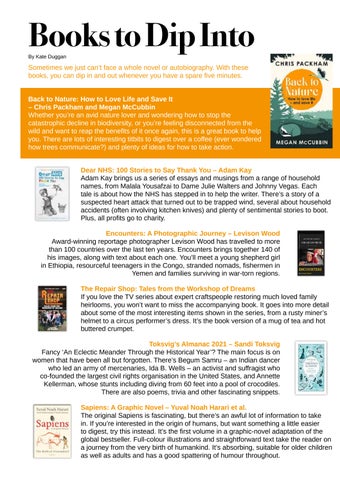
Sometimes we just can’t face a whole novel or autobiography. With these books, you can dip in and out whenever you have a spare five minutes. Back to Nature: How to Love Life and Save It – Chris Packham and Megan McCubbin Whether you’re an avid nature lover and wondering how to stop the catastrophic decline in biodiversity, or you’re feeling disconnected from the wild and want to reap the benefits of it once again, this is a great book to help you. There are lots of interesting titbits to digest over a coffee (ever wondered how trees communicate?) and plenty of ideas for how to take action. Dear NHS: 100 Stories to Say Thank You – Adam Kay Adam Kay brings us a series of essays and musings from a range of household names, from Malala Yousafzai to Dame Julie Walters and Johnny Vegas. Each tale is about how the NHS has stepped in to help the writer. There’s a story of a suspected heart attack that turned out to be trapped wind, several about household accidents (often involving kitchen knives) and plenty of sentimental stories to boot. Plus, all profits go to charity. Encounters: A Photographic Journey – Levison Wood Award-winning reportage photographer Levison Wood has travelled to more than 100 countries over the last ten years. Encounters brings together 140 of his images, along with text about each one. You’ll meet a young shepherd girl in Ethiopia, resourceful teenagers in the Congo, stranded nomads, fishermen in Yemen and families surviving in war-torn regions. The Repair Shop: Tales from the Workshop of Dreams If you love the TV series about expert craftspeople restoring much loved family heirlooms, you won’t want to miss the accompanying book. It goes into more detail about some of the most interesting items shown in the series, from a rusty miner’s helmet to a circus performer’s dress. It’s the book version of a mug of tea and hot buttered crumpet. Toksvig’s Almanac 2021 – Sandi Toksvig Fancy ‘An Eclectic Meander Through the Historical Year’? The main focus is on women that have been all but forgotten. There’s Begum Samru – an Indian dancer who led an army of mercenaries, Ida B. Wells – an activist and suffragist who co-founded the largest civil rights organisation in the United States, and Annette Kellerman, whose stunts including diving from 60 feet into a pool of crocodiles. There are also poems, trivia and other fascinating snippets. Sapiens: A Graphic Novel – Yuval Noah Harari et al. The original Sapiens is fascinating, but there’s an awful lot of information to take in. If you’re interested in the origin of humans, but want something a little easier to digest, try this instead. It’s the first volume in a graphic-novel adaptation of the global bestseller. Full-colour illustrations and straightforward text take the reader on a journey from the very birth of humankind. It’s absorbing, suitable for older children as well as adults and has a good spattering of humour throughout.
Phrases come and phrases go and ‘cancel culture’ is one of the current expressions thst tends to arouse passion. Within the gardening community we prefer to think in terms of ‘subtraction satisfaction’. What is this and how can it help improve mental health (another well-used phrase that uses loaded language)?
take time to check the most effective method for each species. In the case of forsythia, for example, best results are achieved by taking out some of the older stems, right down to the ground. This thins the shrub whilst still allowing it to adopt its natural form. What you don’t want is a ‘mechanical massacre’ whereby everything is rounded into a blob. Take a walk around your local modern housing estate to see it! Abelia, choisya, helichrysum and chaenomeles can also be pruned now.
Simply put, most of us need to do less. Many people seem to have too much going on. The digital age and our comparatively luxurious lifestyles mean there are multiple demands on our time. There’s always another gadget to buy, ‘life-enhancing’ changes to make to the home or that ‘once-in-a-lifetime’ holiday to save for (these things always happen more than once). We work more in order to play more and often give in to peer pressure urging us to join in with a greater number of things. This lifestyle suits a wide range of people, but very rarely is it perfect for gardening folk. So, this wonderful time in spring is the very best time to make space for gardening. Subtracting commitments from the diary will help you to do it. Gardening cannot be rushed! A garden is a healing, nurturing place where mental health is soothed and the soul is fed with contentment. Tend to your green carpet in glorious spring This is the month of plenty, so it’s vital to allow yourself time to enjoy it. Garden tasks can feel overwhelming because everything is growing so fast. Prioritise the lawn, if you have one, because it will provide a visual feature during the months to come. Cut and reshape the edges, it’s amazing what a difference this makes. Gradually lower the cutting blade each mowing time, aiming for grass length of around 6cm – don’t be tempted to take it too low. Most importantly, leave some patches of longer grass for wildlife. At least one square metre is recommended. Joyful garden tasks for late spring The long days mean that summer is almost here and early spring growth in the garden can be tidied up to make way for the glorious summer show. Spring-flowering shrubs often benefit from being pruned back to healthy buds, but
Climbers such as clematis need you to be wise. Some of them can have a light clip at this time of year, but not those that are about to flower! The easy-to-remember advice “if it flowers before June, don’t prune” will tell you what type of pruning group your clematis falls into. The early-flowering clematis only need a very light clip after flowering, whereas those that flower after June will mostly benefit from a harder prune next February. This will encourage the plant to produce flowers all the way down the stems rather than purely on the newer top growth. Celebrate the season by planting out your annuals towards the end of the month, when all danger of frost has passed. Hanging baskets and bedding will provide vibrant colour and interest right through until October. Jobs in the kitchen garden • If you are growing strawberries, lay straw between the plants and the soil. It will lessen the chance of mould spoiling the crop and will keep those luscious red fruits clean, too. • Did you know that you can achieve greater yields from your vegetable beds if you plant in triangles rather than rows or squares? Stagger your plants, but don’t plant too closely. The crop is far better when there’s a bit more space in between. • It’s time to make supports for runner beans. Allow about 2.5m of height and plant just one bean per support. These can go in the ground at the end of the month. • Chit and plant potatoes, if you haven’t done so already. They like soft, crumbly soil. Always avoid planting them in boggy sites. • Get weeds under control this month and it will make the rest of the growing season much easier. Hoe when the weather is dry, as this stops weeds in their tracks. By Caroline Knight: Gardendesignideas.co.uk
If your kitchen is feeling bland and boring, it could simply be missing a dose of interesting colour. Whether you’re planning a major renovation or just want a quick fix, there are plenty of ways in which to introduce bolder, brighter shades. Kitchen cupboards and appliances Bring in a blast of colour with glossy, flat-fronted modern units that can be found in a range of punchy shades. Alternatively, the more traditional painted kitchen can be commissioned in any paint colour under the sun, from palest pastel to deepest black. If this seems like overkill, a great way to create extra interest without going over the top is to specify a coloured island unit, combined with plain cupboards elsewhere. For those replacing free-standing appliances, you may wish to look out for examples in less usual colours – ice cream-coloured retro fridges, for example, or an Aga in a jewel-bright enamel. This look is not for the faint-hearted, of course, and is best teamed with neutrals in other areas of the room so as not to become oppressive or overwhelming.
A vividly coloured seating area and a painted island unit add colour to this otherwise neutral space. Twickenham Framed Handleless Shaker kitchen, Higham Furniture: 020 73810 488; higham.co.uk.
Painting free-standing furniture is a quick and cost-effective way to change your colour scheme. These pieces are by The Painted Furniture Company: 01285 656 041; paintedfurnitureco.co.uk.
Worktops and splashbacks Teamed with understated kitchen cupboards, a bright worktop or splashback adds a strip of colour through the room and can give a welcome lift. Sleek toughened glass can be painted on the back in any colour imaginable – some showrooms offer a standard range of shades, but others will, at an extra cost, provide a colour-matching service. Another option is to go for a dramatic shade of natural stone. While most are relatively subtle, some do come in quite strong colours, such as green, red/brown or chocolate. Then there are stone composites (often called quartz), man-made solid surfaces (such as Corian), and laminates (generally the least expensive option), all of which also offer a range of interesting shades among their naturalistic imitations of stone and wood. Walls and floors When faced with a boring kitchen there’s no doubt that one of the simplest ways to add some oomph is to paint a wall or two in a strong, appealing colour. Another option is to replace wall tiles – choose dramatic colours and even though the area covered is relatively small, the impact can be huge. Another cheap trick is to use plain white tiles, glossy and machine-edged, with brightly coloured grout (lemon yellow and sky blue are great): the grid-like effect is modern and the pop of colour intriguing. Floors are, of course, harder to deal with, unless you are carrying out a full-on renovation project, but one way to bring in instant colour is to throw down a small, washable rug. Make sure you use an underlay that stops it from slipping, and simply pop it into the washing machine when necessary. If you do happen to be going back to basics, vinyl and rubber flooring is available in all kinds of cool colourways while, for the more adventurous, poured floors – polished concrete or resin – can be dyed in any colour of your choosing. Free-standing furniture Painting wooden furniture is a pretty straightforward job, involving plenty of patience for the preparation – sanding, cleaning and priming – and a steady hand for some careful brushing or paint-rolling. The difference it makes, however, can be phenomenal, especially when teamed with a change of knobs, handles, hinges and other hardware.
Window treatments and soft furnishings Though a relatively small feature in many kitchens, a brightly coloured window treatment can really pack a punch. Since minimal roller blinds are the most practical for spaces where humidity and splashes are inevitable, they need not be terribly expensive, either. Or, where wooden shutters are an option, this could be just the place for an injection of something bright and breezy, perhaps reflecting the colours of the garden outside. Seating areas within kitchens are another ideal opportunity to bring in some exciting, colourful elements, whether in the form of upholstery, fabric-covered chair seats or simply a few scatter cushions. Finishing touches If you have glass-fronted cabinets or open shelving, think about creating displays that make the most of gorgeous colours – perhaps cookbooks arranged in a rainbow, or a collection of vintage glassware. Pendant shades over a kitchen island or dining table could be swapped for a more vivid alternative, always a nice way to add a few further spots of colour. The same goes for all kinds of accessories, from bread bins to tea canisters, even knife blocks, cupboard handles, plant pots, wall art or a small vase of flowers – don’t miss any opportunity to brighten up your culinary life and bring more colour into the heart of your home.
A stylish chevron splashback introduces a dose of blue to this minimal white kitchen. Savanna Petrol gloss wall tiles, £39.96 per square metre, The London Tile Company: 0333 320 8048; londontile.co.uk. By Katherine Sorrell
If you’re looking for a fun way to get fit, why not try martial arts? You’ll improve your coordination and flexibility, it’s a great way to meet people, and it can really boost your confidence. And you’re never too old to learn. Many clubs offer adult or mixed classes. Which martial art to choose There are several types of martial art to choose from. It’s worth finding out a bit more about all the different ones that are offered in your local area. Are you mainly looking for a way to keep fit or do you want to learn self-defence? Do you want to take part in competitions? Do you want to learn to fight with weapon such as swords or sticks, or would you rather focus on unarmed combat? Clubs usually offer taster sessions for free or at a reduced rate, so you could try a few types to see which one most appeals. How to learn You’ll want to join a club that’s registered with a governing body, such as the Tae Kwon-Do Association of Great Britain or The British Karate Association. Make sure that the club is fully insured and check the senior instructor’s credentials. If you’re hoping to compete, you may want to choose a larger club that has been successful in tournaments. If you’re just looking for a fun activity, you might prefer a smaller club with a family atmosphere. It’s worth asking for recommendations on social media and within your friendship group. What you’ll need For most martial arts, you’ll need to buy an outfit, such as a dobok (tae kwon-do) or gi (karate,
judo, aikido, and jiujitsu). However, clubs will usually let you wear normal sports clothes for your first few sessions. It’s a good idea to wait to buy the outfit until you’ve spoken to your instructor, as they may need you to wear a uniform that’s branded with the club logo or that’s been approved by their parent association. Branded outfits tend to cost around £30 to £40, but non-branded gis are often a lot cheaper. You can also pick up second-hand outfits on eBay and dedicated Facebook selling groups. As you progress, you may need more equipment, such as a sparring kit. Again, these can often be picked up second-hand. How much it costs Costs vary depending on the type of martial art. You’ll likely need to pay an annual membership fee of £20 to £40, plus a monthly payment for classes. Some clubs do offer a ‘pay as you go’ membership, however. Gradings (where you move onto the next level or belt) cost extra, as do tournaments. If you’re worried about the cost, the best thing to do is speak to the club’s senior instructor. They’ll be able to give you a good idea of how much you can expect to spend over the year.