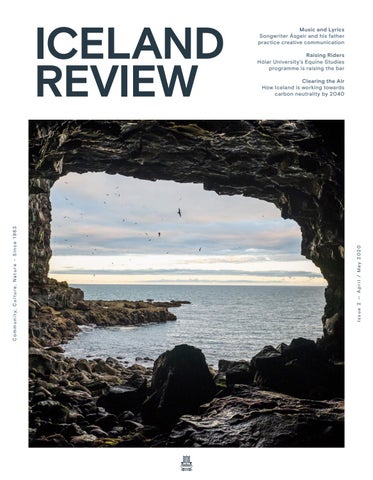
Music and Lyrics Songwriter Ásgeir and his father practice creative communication Raising Riders Hólar University’s Equine Studies programme is raising the bar
Issue 2 — April / May 2020
C o m m u n i t y, C u l t u r e , N a t u r e - S i n c e 1 9 6 3
Clearing the Air How Iceland is working towards carbon neutrality by 2040
Make the most of your last hours in Iceland. We are your one stop shop for Icelandic design, souvenirs and traditional food. Browse wheninkef.is to see our selection and offers. All shops and restaurants are tax- and duty free.
Iceland Review
News in Brief 7
SOCIETY
FEATURES
Raising Riders Hólar’s Equine Studies programme is raising the bar. 42-53
Ask Iceland Review
11-12
Hungry for More Dill restaurant’s chef forages for inspiration. 19-25
Eggs in a Basket Southwest Iceland’s largest bird cliff and the quest for its treasure. 26-33
Getting the Picture 60-69
RELIGION
Buried
DAÐI OG GAGNAMAGNIÐ
FOOD NATURE PHOTOGRAPHY
For Reykjavík City Theatre’s new Director. storytelling is at the heart of the theatre. 54-58
Music & Lyrics A songwriter and his father open a new channel of communication. 34-40
105-110
112-118
2
Staging Stories
Western Promise
ENVIRONMENT
LOOKING BACK
15-17
ÁSGEIR
Avalanche Barriers
MUSIC
IN FOCUS
Sale of State-Owned Banks
NATURE
8
Take Me to Church Can Iceland’s biggest religious institution shake the albatross off its neck? 70-77
Daði’s Eurovision is 2020 Not even an epidemic can temper Iceland’s love of Eurovision. 78-87
Clearing the Air How Iceland is working towards carbon neutrality by 2040. 88-95
When the Band Began to Play The Iceland Symphony Orchestra celebrates 70 years. 96-104
MYVATN NATURE BATHS
Please book online at naturebaths.is #myvatnnaturebaths
Iceland Review
FROM THE EDITOR It’s been a strange few weeks finishing this latest issue of Iceland Review. With the COVID-19 pandemic, it’s difficult to stay focused on the task at hand, especially as we maintin our effort to bring you the most up-to-date news on our website. Still, if history is anything to go by, life goes on, even after events much more frightening than the one we’re currently facing. So what do you do at a time like this? At a time when it feels like everyone should be stepping up to the plate and doing what they can? Washing your hands, working from home, and trying to keep up some semblance of normalcy can feel inadequate. Then again, that’s not only all we can do, it’s also the best we can do. Here at Iceland Review, we will be doing our part to help by delivering to you the stories we’ve been gathering over the past few weeks. Hopefully, our mission to inform and entertain will help get our readers' minds off the virus. If it’s pure goofy fun you’re after, look no further than Daði Freyr’s day of being chosen to represent Iceland at the Eurovision Song Contest. If you’re seeking calm in a scary world, read about our visit to the University of Hólar, where the best young riders in the country
are studying the Icelandic horse from every angle. You could also read about Michelin-starred chef Gunnar Karl Gíslason, and how he finds inspiration in Iceland’s nature and traditions. If you’re seeking answers to higher questions, we can’t really help you, but you can read about going to church in Iceland and see how you feel about it. As usual, we cover some of Iceland’s finest artists and musicians: so put on Ásgeir’s latest album and read all about his collaboration with his father. If you’re more interested in classical music, there’s the Iceland Symphony Orchestra, which celebrates its 70th anniversary this year. If you want to dive into history, check out our article on alternative theories to the increasingly implausible myth of Iceland’s settlement. For inspiration in overcoming hard times, you can read about Icelanders’ mass emigration to Canada at the turn of the 20th century, where they founded a ’New Iceland.’ Finally, if your mind’s too busy to focus on an article, we’ve brought you a wealth of images of Iceland’s landscapes to catch your eye.
Gréta Sigríður Einarsdóttir Editor, Iceland Review
Cover photo Krísuvíkurbjarg by Golli.
Annual subscription (worldwide) €55, approximately $57/�46, or equivalent in other currencies. Head office MD Reykjavík, Laugavegur 3, 101 Reykjavík, Iceland, Tel.: (+354) 537-3900. icelandreview@icelandreview.com No articles in this magazine may be reproduced elsewhere, in whole or in part, without the permission
Sometimes, the best thing you can do is lean back, flick through your copy of Iceland Review, and dream of your next visit.
of the publisher. Iceland Review (ISSN: 0019-1094) is published six times a year by MD Reykjavík in Iceland. Send address changes to Iceland Review, subscriptions@icelandreview.com.
Editor
Proofreader
Photographers
Advertising sales
Gréta Sigríður Einarsdóttir
Ragnar Tómas Hallgrímsson
Bernhard Kristinn
Reynir Elís Þorvaldsson
Bjarni F. Einarsson
reynir@whatson.is
Design & production
Writers
Eydís María Ólafsdóttir
E&Co. – eogco.is
Frank Walter Sands
Golli
Daily news from Iceland
sbs
Gunnar Jónsson
Halldór Sveinbjörnsson
icelandreview.com
Jelena Ćirić
Sigfús Eymundsson
Ragnar Tómas Hallgrímsson
Berglind Jóhannsdóttir
Copy editors Jelena Ćirić Ragnar Tómas Hallgrímsson
4
Print Kroonpress Ltd.
C
S WA
N EC
DI
Subscriptions
NO R
Magnús Sveinn Halldórsson
O
BEL
Kjartan Þorbjörnsson
Kjartan Þorbjörnsson
LA
Publisher
subscriptions@icelandreview.com 5041 0787 Kroonpress
Nr. 1 Attraction in Reykjavik
Perlan is a Must-Visit Landmark and Nature Exploratorium Perlan – Wonders of Iceland is an exploratorium in Reykjavik. Experience a real Ice Cave, Icelandic Glaciers Exhibition, Guaranteed Northern Lights Planetarium Show and more.
THE REYKJAVÍK GRAPEVINE BEST MUSEUM 2019
Perlan – Wonders of Iceland is an enchanting interactive journey through Iceland’s nature, on five floors.
Perlan Café
Perlan Restaurant
Rammagerðin Gift Store
perlan.is
13.02.–24.05.2020
Sol LeWitt
Hafnarhús Tryggvagata 17 101 Reykjavík
Open daily 10h00–17h00 Thursdays 10h00–22h00
artmuseum.is #listasafnreykjavikur +354 411 6400
Iceland Review
NEWS IN BRIEF
Words by Jelena Ćirić
Photography by Golli
COVID-19
Workers’ Strikes
Volcanic Unrest
As elsewhere in the world, local news in Iceland has been dominated by the COVID19 virus. Iceland’s fist case was identified on February 28, in a local who had just returned from Italy. Icelandic authorities have set a ban on gatherings over 100 people for four weeks starting March 16, and all Icelandic residents returning from abroad as of March 19 are required to quarantine themselves at home for 14 days. The Directorate of Health is re-evaluating its response to the virus on a daily basis. The Icelandic government has approved a plan to minimise the economic impact of the epidemic, particularly for tourism companies. For the most up-to-date information and guidelines on COVID-19 in Iceland, visit www.icelandreview.com or the Directorate of Health website www.covid.is/english.
On March 10, the City of Reykjavík and Efling Union finally reached an agreement following a three-week general strike that saw service cuts and closures in preschools, primary schools, elderly and disabled care, and garbage collection. Reykjavík Mayor Dagur B. Eggertsson called the new contract a “breakthrough agreement.” The contract includes a wage raise of ISK 112,000 per month ($875, €770) for full-time employees in the lowest wage bracket, a special allowance for the lowest earners, and a shortening of the workweek for shift workers and those who work nights. Three hundred Efling Union members began a strike in early March in the municipalities of Kópavogur, Mosfellsbær, Seltjarnarnes, Ölfus, and Hveragerði, but Efling chairperson Sólveig Anna Jónsdóttir stated she expected a swift resolution to the wage dispute in those municipalities.
Authorities declared a state of uncertainty on January 27, after uplift (land rise) and earthquakes just west of Mount Þorbjörn on the Reykjanes peninsula pointed to volcanic unrest. A town hall meeting was subsequently held in nearby Grindavík to prepare residents for a potential eruption. Around 1,000 residents attended the meeting, where authorities reviewed safety protocols and evacuation procedures. The Met Office increased its monitoring of geothermal activity and gas levels in the area. The measurements found that the most likely cause of the activity was a magma intrusion 3-5km (1.9-3.1mi) below the earth’s surface. No eruption occurred, and the activity has since calmed down. As of the time of writing, the state of uncertainty remains in effect. The last eruption in the area occurred around the year 1200.
7
Iceland Review
ASK ICELAND REVIEW
Which languages are most closely related to Icelandic?
Photography by Golli
Words by Jelena Ciric and Ragnar Tómas Hallgrímsson
Icelandic is an Indo-European language, belonging to the group of North Germanic languages, to be specific. This group also includes Danish, Norwegian, Swedish, and Faroese. Of those languages, Norwegian and Faroese (spoken in the Faroe Islands) are the most closely related to Icelandic.
are quite similar. Speaking is another matter, however: the pronunciation differs significantly, and the two languages are not mutually intelligible without study. Icelanders receive some help from their schooling when it comes to understanding the other North Germanic languages. Danish is a compulsory subject in schools, and learning it helps with the comprehension of Norwegian and Swedish as well.
Icelanders and Faroese people may be able to understand each other’s languages on the page, as their writing systems and spelling
How hard is it to get a nursing job in Iceland?
In a recent interview with Iceland Review, Guðbjörg Pálsdóttir, President of the Icelandic Nursing Association, confirmed that there is a shortage of nurses in Iceland. Applicants must, nonetheless, fulfil the requirements set by the Ministry of Health on appropriate education in nursing before receiving work permit as a nurse in Iceland. The Directorate of Health is responsible for issuing work permits on behalf of the ministry. Individuals seeking to practise nursing in Iceland are required to possess an Icelandic nursing license, which must be recognised
8
by the Ministry of Health and the State Social Security Institute. Nurses that are citizens of the EEA (European Economic Area) member states are eligible to obtain the licence upon the submission of the required documentation to the Icelandic Ministry of Health and Social Security. The Icelandic Nursing Association is a member of the International Council of Nursing and employs the same criteria as the ICN regarding job applications from nurses outside the EEA. Interested nurses can contact the Icelandic Nursing Association for more information.
Photo: Ruedi Homberger
* 1940, †2020
HIGH QUALITY HOUSES IN THE NORTH OF ICELAND
Húsavík
NOLLUR AKUREYRI
Eskifjörður
Höfn
FNJÓSKÁ NOLLUR A loft apartment with incredible views of the fjord. 1 bedroom, 1 bathroom, sleeps 2 (4)
HRAFNABJÖRG AKUREYRI LEIFSSTADIR AKUREYRI A very well situated, exclusive villa opposite Akureyri. 3 bedrooms, 3 bathrooms, sleeps 6
Exclusive villa in the vicinity of Akureyri. 4 bedrooms, 2 bathrooms, sleeps 8
VALLHOLT GRENIVIK
SÚLUR NOLLUR
KRÝSUVÍK
A spacious, luxurious house at the shore. 3 bedrooms, 2 bathrooms, sleeps 6
A wonderful holiday house with an elegant interior. 1 bedroom, 1 bathroom, sleeps 4
A convenient loft apartment on the Nollur farm in Eyjafjörður. 2 bedrooms, 1 bathroom, sleeps 4
REYKJAVÍK
Vík
Details and booking www.nollur.is
Iceland Review
IN FOCUS Words by
Jelena Ćirić Photography by Golli
Sale of State-Owned Banks Iceland’s government has announced that it's ready to sell 25-50% of Íslandsbanki bank, currently fully owned by the State Treasury. Reducing state ownership of financial institutions is part of a turnaround in Iceland’s financial policy that has been in development for years. With memories of the banking collapse still strong in the minds of the public, many are opposed to letting more financial institutions pass into private hands. Government officials argue, however, that the sale could free up funds for investment in essential infrastructure. Yet, how the Íslandsbanki sale would be carried out has yet to be decided – and finding a buyer could prove difficult.
Which Icelandic banks are state owned? Two of Iceland’s three largest banks are in state ownership: Íslandsbanki (100% state ownership) and Landsbankinn (98.2% state ownership). The third, Arion banki, is entirely privately owned. It’s important to note that all three of these banks were established as state-owned institutions on the ruins of other banks that became insolvent during the 2008 crash. Arion banki has since passed into private ownership, as the government instituted a policy to reduce state ownership of financial institutions. The other two banks remain state owned. In Iceland’s small economy, Íslandsbanki, Landsbankinn, and Arion banki are giants. These three commercial banks are among the ten largest companies in Iceland, and together they possess around 97% of the financial market share. They not only impact the economy through their investment decisions, but
also as some of the country’s largest employers. When Íslandsbanki and Arion banki underwent restructuring last year, for example, they laid off around 200 employees between them. Why does the government want to sell? The Icelandic government owns a bigger proportion of its country’s banks than any other government in Europe. When a state-owned bank makes profits, the dividends go straight into the state treasury – one clear benefit of ownership. Yet it’s not necessarily positive for a nation’s economy to have most of its financial institutions in the hands of a single owner. Diversity of ownership creates competition, to the benefit of customers. Selling Íslandsbanki could free up more cash for larger public investments. Iceland’s Prime Minister, Minister of Finance, and Minister of Transport and Local Government all support the sale
11
Iceland Review
of at least 25% of Íslandsbanki for this reason. They argue that the funds from the sale could be used for infrastructure investment, such as the building of roads and tunnels. Iceland’s tax base is small compared to its land area, meaning such costly infrastructure projects are difficult to finance with tax funds alone. Minister of Culture and Education Lilja Alfreðsdóttir, who sits on the Ministerial Committee that is overseeing the sale, has argued that if the state does sell a part of Íslandsbanki, it should ensure that Landsbankinn stays firmly in state ownership. Public to private: the case of Arion banki The small size of Iceland’s economy means it has been prone to ups and downs throughout its history – and large financial institutions or business have a large impact, for better or worse (see: WOW air). While state-owned banks develop their policy in consideration of public interest, privately owned banks have more freedom to act in their shareholders’ interests, whether or not they line up with the country’s economic interests. Arion banki is a good example. While Iceland has entered a period of economic contraction, the bank has undergone significant restructuring, including laying off 12% of its employees, shrinking its loan portfolio, and increasing equity pay-outs. Banks around the world are streamlining as they digitise their operations, but Kjarninn reporters have argued that some of these measures are being taken in order to maximise short-term profits for Arion banki’s shareholders. Some of these shareholders, such as Goldman Sachs, are not based in Iceland, and may, therefore, have little interest in how Iceland’s already slowing economy may respond to such actions. When a bank’s only shareholder is the state, on the other hand, it will presumably make policy decisions based on the needs of the state. Of course, some argue that it shouldn’t be the state’s role to control the financial market at all. Who will buy? Even though the government may be ready to sell a portion of Íslandsbanki, it still needs to find a buyer. The first one they considered was Norwegian bank DNB, 34% of which is owned by the Norwegian state. In many ways, DNB was a logical choice: it has several large Icelandic companies among its customers, and even signed a contract on asset management with Íslandsbanki in 2010. But DNB proved uninterested in the purchase. Icelandic pension funds have also been seen as potential buyers – after all, six Icelandic pension funds are among the 20 largest shareholders in
12
Arion banki, together owning 22%. But recently, these funds have been focusing more on investing abroad in order to minimise risk, and insiders say it’s unlikely they would be interested in Íslandsbanki – not to mention that such a purchase could present legal issues. MPs have suggested listing the bank on the market – but that route would likely mean a lower sales price. Few private investors within Iceland have the funds required to buy large shares in the bank, and, furthermore, few are willing to make such stock investments after the huge losses sustained on the market in the banking collapse. The government has yet to make a decision on how the sale of Íslandsbanki will be carried out. What does the public think? A recent poll conducted by Gallup found that 61.2% of Icelanders were positive towards state ownership of commercial banks. Just over one quarter (25.2%) had no strong opinion on the matter, and 13.5% were against state ownership. Those who were supportive of state ownership cited reasons such as safety, trust, and that the dividends of state-owned banks go to the public. Some supporters of state ownership believed it more likely that banks would face financial difficulties or corruption in private hands. Those who opposed state ownership of banks believed it was not the state’s role to own commercial banks, nor did they believe it was qualified for such a role. They also believed it was unnecessarily risky for the state to own banks. Icelanders who are supportive of state ownership of banks likely remember the disastrous consequences widespread privatisation had on Iceland’s economy in 2008. Yet supporters of privatisation would be right to point out that Iceland’s government has implemented much more oversight of the financial industry since then. It has also implemented taxes on banks that are among the highest in Europe – a decision that has had a hand in leading many large Icelandic companies to look for bank services abroad and decreased Icelandic banks’ competitiveness on the international market. Post-crash financial regulations make bank privatisation a safer affair for the general public but they also limit profitability, making the banks harder to sell. The government seems determined to go through with the Íslandsbanki sale. They have even recently suggested it as a measure to respond to the economic impact of COVID-19. Yet, as the global economy faces contraction, it may prove even more difficult to find a buyer. Either way, working towards the sale could prove a good opportunity for reviewing the government’s financial policy as a whole.
floating baths
Discover Iceland’s only geothermal floating baths
www.vok-baths.is
Located just off Road 1 5 km north from EgilsstaĂ°ir East Iceland www.vok-baths.is
Glacier Snowmobiling An amazing Snowmobile ride close to the Golden Circle Come with us on an adventure on Langjรถkull, Iceland's second largest Glacier. Riding a snowmobile on the massive snow cap is a unique experience that you will remember for the rest of your life.
www.mountaineers.is ice@mountaineers.is +354 580 9900
Iceland Review
IN FOCUS Words by
Ragnar Tómas Hallgrímsson Photography by Halldór Sveinbjörnsson Golli
Avalanche Barriers Avalanches in the Westfjords On January 14, 2020, three large avalanches fell in quick succession in the Westfjords of Iceland. One avalanche fell in Súgandafjörður, directly across from Suðureyri, causing a tidal wave to strike the town that, ultimately, did little damage. The other two fell in Flateyri, causing more significant destruction. The timing of the avalanches was noteworthy. Twenty-five years ago – on October 26, 1995 – 20 people died when a comparable avalanche struck Flateyri on a day that had since etched itself into the nation’s collective memory (an additional 14 people died that same year when another avalanche struck Súðavík).
Protective walls that were erected following the avalanche in 1995 appeared to have prevented even greater damage from occurring in Flateyri this year. Although no one was seriously injured (one teenage girl was trapped inside her bedroom for 40 minutes), the avalanches served to expose a deficiency in the Flateyri barriers: they were not designed to protect the harbour. Six of the seven boats in the town’s small-boat harbour were destroyed, all but crippling the town’s fishing industry. Subsequently, Prime Minister Katrín Jakobsdóttir, Finance Minister Bjarni Benediktsson, and Minister of Transport and Local Government Sigurður Ingi Jóhannsson,
15
Iceland Review
travelled to Flateyri by helicopter to survey the damage and examine the protective barriers. Before the ministers arrived, however, the avalanches had already sparked widespread criticism of the government’s allocation of resources from the Landslide Fund. Former Ísafjörður mayor and board member of the Landslide Fund Halldór Halldórsson, for example, estimated that the fund had accumulated roughly ISK 23 billion ($1.8 million/€1.66 million), which could have been used to improve avalanche protection throughout the country, but was instead used towards other projects. According to Halldór, plans were initially drawn in the aughts that called for the completion of mitigation measures against avalanches in 2010. Later regulation pushed back these plans to 2020. The plans that were in effect when the avalanches struck, however, assumed that the measures would not be finalised until 2050. An especially inclement winter Following the avalanches in Flateyri and an exceptionally inclement winter, in which two major storms battered Iceland in December and
16
February, the government established a task force to suggest proposals on how to strengthen the country’s infrastructure. In early March, the task force – having consulted with municipalities, companies, institutions, and other non-governmental organisations – introduced its findings in a roughly 200-page report. The report contained an admission that the aforementioned natural disasters had served to reveal weaknesses in Iceland’s energy grid and telecommunications system, among other things. 540 proposals The report listed a total of 540 proposed operations to be undertaken to strengthen the country’s infrastructure, including an emphasis on safety in all transportation-related decisions. More specifically, the report recommended that the government finalise avalanche protection in Iceland by the year 2030. Were the proposal to be enacted, the strengthening of avalanche barriers in densely-populated at-risk areas would be completed 25 years earlier than what current plans assume. In a presentation held in late February, the
Iceland Review
Avalanche barriers at Neskaupstaður
authors of the report traced the recent history of avalanche protection in the country: “The most destructive natural disasters in recent memory in Iceland occurred when the avalanches fell in Súðavík and Flateyri in 1995, resulting in 34 fatalities. These disasters changed our attitude on avalanche safety. Subsequently, extreme measures were taken to ensure the safety of residents within high-risk areas. New laws were enacted to counteract the harm of landslides and avalanches, and fundamental changes were made concerning administrative and governmental intervention. Municipalities were, among other things, made responsible for ensuring the safety of residents, and oversight of landslide-related matters was transferred to the Ministry of the Environment. Risk-assessment responsibility, avalanche monitoring, assessment of conditions, research, and consultation regarding avalanche barriers was transferred to the Icelandic Met Office. Furthermore, a special Landslide Fund was established by the Minister of the Environment. For residents of densely-populated areas, acceptable
risk was defined with regard to the design and construction of barriers. The protective barriers that have been erected during the roughly 25-year period have all proven their worth, and most of them have been put to the test. The winter storm in December, and especially the avalanches that fell in Flateyri and Súgandafjörður on January 14, shed light on the progress of avalanche protection. A new plan on avalanche protection has been devised, with construction being incomplete in 10 of 15 places designated as high risk.” Over the next five years, the government plans on making improvements to avalanche barriers in Patreksfjörður, Hnífsdalur, Flateyri, Siglufjörður, Seyðisfjörður, Neskaupstaður, and Eskifjörður. Between 2025 and 2030, construction in Flateyri and Siglufjörður will be completed while work will be continued in the areas mentioned above, including Tálknafjörður, Bíldudalur, and Ólafsvík. As mentioned above, the report proposes that the government finalise avalanche protection in Iceland by the year 2030.
17
Iceland Review
Photography by Golli
18
Iceland Review
H U N G R Y Words by Gréta Sigríður Einarsdóttir Photos by Golli
FOR When opening acclaimed restaurant Agern in New York, Gunnar Karl Gíslason tasted twenty different types of butter before he found one he liked. His pastry chefs sourced several kinds of organic milk because the ice creams made from regular milk tasted off to him. He never did end up finding lamb that met his standards in the US, though he found a single farm in the mountains of Pennsylvania whose grass-fed sheep he deemed adequate to serve his guests. But in Reykjavík, he’ll scarf down the local classic – a hot dog with ‘everything:’ crispy fried onion, fresh onion, mustard, remoulade, and ketchup – like the Akureyri-raised country boy he is. There’s a catch though: he’ll only get one from certain shops where they heat the sausages the way he likes them and serve the right kind of ketchup.
M
O
R
E 19
Iceland Review
Why go back? For years, the pride of Reykjavík’s culinary scene was a restaurant called Dill. Founded in 2009 by Gunnar and sommelier Ólafur Örn Ólafsson, it brought a new form of dining to Iceland, inspired by the New Nordic tradition of eating sustainable food inspired by local culinary heritage. At the time, Gunnar tells me, his Reykjavík clientele would praise his cooking for being exotic and unfamiliar. “I’d reply: ‘Really? Because I picked everything for the dish right outside this window.’” In 2017, Dill was awarded a Michelin star, the first restaurant in Iceland to receive that distinction. By then, however, Gunnar had left for greener pastures, moving his family to New York to become head chef at the Claus Meyer-owned Agern. He’d already gained his own star there in 2016, six months after opening. Fast forward a few years: Gunnar and his family were at a crossroads. “When we moved to New York, we decided we’d be there for at least two years and see how we liked it,” Gunnar explains. They liked it so much that they stayed for four. Agern is located in the city’s busy Grand Central Station, which regularly sees a million people pass through in one day. They got a three-star review in the New York Times and for Gunnar's entire reign, the place kept its Michelin star. But back home, Gunnar’s creation, Dill, was in trouble. The year after becoming the first Icelandic restaurant with a star in the Michelin guide, they lost it again, and were without a head chef. When he heard the news, Gunnar’s mind was made up. He would return home, reclaim his place at Dill, and make it star-worthy again. “I wanted to get back and lay down the law. And that was what we did,” he says with a smirk. A few months after returning, the holding company that ran Dill, and a few other restaurants, went under, and the restaurant was forced to shutter. For a while, it seemed like Dill was history. But for Gunnar, this was an opportunity. “I didn’t own much in the restaurant anymore, almost nothing, even though in my heart, it was mine. I hadn’t been back home for long when we decided to buy back the Dill brand and relocate. We decided to begin almost from scratch in a new location.” Gunnar had gone from cooking at an acclaimed restaurant in one of the world’s liveliest cities to raising his old eatery from the rubble. Rediscovering tradition The heart of Dill has always been locally-sourced ingredients. By now, the terms local and sustainable are so trendy in the restaurant world they are almost meaningless. In fact, Gunnar avoids using that terminology. “It fits what we’re doing, but it seems like every restaurant is describing itself in that manner, with rights to such claims varying greatly.” Instead of getting lost in a forest of buzzwords, Gunnar sticks to the basics. “Good ingredients are everything. Without them, you might as well skip the whole thing.”
20
For Gunnar, quality ingredients and the people who make them are intertwined. One of the major landmarks on his Dill journey was when he realised that what he was looking for was hidden in plain sight. “When Dill had been open for a year or so, I found it harder and harder to find fresh inspiration, so I decided to take a trip around the country. I was so hopeful that I’d reinvent the wheel on my travels, find some farmers that were doing something no one had ever seen before. Instead, I found a host of people nurturing the old ways of food production.” The people Gunnar met and the food they were making are still the backbone of Dill. “For instance, I always buy saltfish from Elvar Reykjalín in Hauganes. I think he’s the only one, or one of two, who still salts his fish in the traditional way. The same with harðfiskur: I want to buy harðfiskur that’s been dried in an open rig by the seaside, as opposed to being put in a dehydrator.” People who produce food using traditional methods are few and far between. Not only that, advances in agriculture and the fishing industry often make the age-old ways even harder to maintain. One of Gunnar’s favourite food-production methods is sheep-dung smoking. (Yes, it’s exactly what it sounds like.) “Gylfi, who smokes for me, he has so few sheep that he doesn’t have enough dung to smoke everything I need. He needs another farmer to supply him with dung.” But not just any dung will do. The smallest things, like changes in sheepcote architecture, can affect Gunnar’s access to his favourite smoked salmon. “Most farmers have moved on to new-fangled sheep pens. They stow the dung away somewhere where the sheep aren’t constantly stepping in it. That means it isn’t being compressed the whole winter, making it unsuitable for smoking. Even then, you can’t simply grab a shovelful of dung and set it on fire. You need to cut the dung up into layers, spread it in a field where it lies for a year to release the ammonia. Then you need to stack it up and find the perfect balance between wet and dry. There’s a science to striking that perfect balance. Gylfi has a special “The idea is that no matter what we buy knack to make it work." in, we’re making sure we’re using all of For Gunnar, products made it. We’ll buy a single type of fish whole using new technology don’t hold and use every last bit of it to make three a candle to the old ways when it different dishes.” comes to flavour. Take harðfiskur. Salted, dried cod has been a snack of choice for Icelanders throughout the centuries and its popularity isn’t waning, but the old production methods are time consuming. While technology offers a quicker solution, according to Gunnar, “the difference in taste is simply outrageous. You can’t compare fish that’s been lightly salted and put in a dehydrator for a day to fish that’s been dried outdoors by the sea where it’s windy all the time. It’s black and white.” Foraging for inspiration
Iceland Review
“Good ingredients are everything. Without them, you might as well skip the whole thing.�
21
Iceland Review
“The difference in taste is simply outrageous. You can’t compare fish that’s been lightly salted and put in a dehydrator for a day to fish that’s been dried outdoors by the sea where it’s windy all the time. It’s black and white”
22
Iceland Review
Adventure Day Tours IN SOUTH ICELAND
BOOK ONLINE at www.arcanum.is or give us a call +354 587 9999 24
ARCANUM.IS • INFO@ARCANUM.IS • TEL: +354 587 9999
Iceland Review
Gunnar and his kitchen team also go foraging for ingredients themselves. “We collect seawater and boil it down to make salt. We go out a lot to pick herbs, berries, seaweed, and mushrooms.” It might seem like wasteful time management to have the head chef out foraging for ingredients, but for Gunnar, it’s both enjoyable and a source of inspiration. “It’s amazing the ideas you get while you’re there. You might catch a scent of something or taste a herb or two that spark an idea. It’s incredibly rewarding.” After working like this for several years, Gunnar has amassed a great deal of knowledge on Iceland’s edible flora and is attuned to the natural shift in seasons. “Right now, you “I picked everything for the dish know that summer is getting closer right outside this window.” and the first chervil, angelica, and lovage will be poking their heads up soon. All of a sudden, you get excited, and you’re reminded of what you used lovage for last year. You remember that delicious lamb or pork belly. You start working your way towards that, maybe taking a dish you made last year, tweaking it, making it better or at least different, and put it on the menu when the herbs are finally ready.” As Gunnar tells me more about his process and the way he relies on the land around him to inspire his cooking, I begin to understand why Iceland was pulling him home. Foraging in Icelandic nature, Gunnar could taste his way through the country’s flora without a care in the world. In New York, he had to find a different approach to developing his ideas. “It’s a whole different kind of nature over there. You can’t simply go out and pick the herbs you want. Not only could you very well eat something that could kill you, there’s even the danger of some redneck farmer shooting at you,” Gunnar chuckles. Luckily the solution was simple, he hired a forager who brought him the ingredients he wanted, and there was never a shortage of exciting things to experiement with. Although on paper, Gunnar has returned to his old position at his “When we made the decision to just former restaurant, in actuality, focus on what’s Icelandic, that’s when he’s starting fresh in a new kitchen, it became more fun and the food Dill's new location has only been became more interesting.” open for a few months. Gunnar is building on the success of Dill’s history, but also implementing new ideas into the Dill ethos. The most significant change is how ingredients are used. “The idea is that no matter what we buy, we’re making sure we’re using all of it. We used to serve three different seafood dishes featuring three different types of fish. Now, we’ll buy a single type of fish whole and use every last bit of it to make three different dishes.” That simple change affects every part of the way the kitchen operates. “For example, we serve salt-baked celeriac. Once it’s fully baked in salt, we slice it thinly and cut out circles. Afterwards, you have a lot of cut-offs. Instead of
throwing them away, we chop them up and use them for broth. Many of the snacks we serve are actually made of scraps from other dishes on our menu.” This new approach also forces the chefs to consider not just what they’re cooking that week, but next season as well. “We use parts of what we forage the same week while it’s fresh, but the rest is dried, pickled, salted, or fermented and kept for winter. We have a fridge full of pickled herbs and vegetables, and plenty of herbal oils that were used this summer, but also packaged and frozen. We always have a little something up our sleeves: herbs, vegetables and so on, ready for winter.” To approach cooking with this ideology is time-consuming and requires a great deal of oversight and creative thought. Gunnar loves it. “It takes more work, but at the same time, it’s so much more rewarding. If I know that I can only use these ingredients, I’ll create something a little more interesting. It forces me to delve deeper than I would otherwise.” Pulling the focus tighter is what helped make Dill such a success the first time around. “At first, we were more open. We were located in the Nordic House and I thought it would be a nice idea to serve food from all over the Nordic countries. But then, in the banking collapse, everything imported became so expensive, and we couldn’t afford it anymore. So we made the decision to just focus on what’s Icelandic. For me, that’s when it became more fun and the food became more interesting.” Seeing stars With his Michelin star safely back in his pocket, in some ways, Gunnar has achieved his goals. But he doesn’t strike me like a man content to rest on his laurels. For now, he isn’t planning any extraordinary changes – after all, he’s only been in his new kitchen for three months. “My inbox is filling up, and the reservations are streaming in, but other than that, we don’t let the Michelin star affect us. I’ve always said that having one star would be perfect, since that meant you could still be a little crazy and a little relaxed. For two, you needed to get your shit together. But of course, as soon as you get one, you want that second one. My new thing is saying that two would be perfect, I would never want three!” Right now, Gunnar isn’t setting his sights further than on the next season. “I’m waiting for spring. I’m looking forward to smelling it in the air. Then I can go out foraging. But the thing is, I get excited for every season. I can’t wait for autumn when the wild game starts appearing. And in autumn, I can’t wait for the winter darkness, when we can light some candles and the atmosphere gets cosy. There’s always something coming that you can be excited about.”
25
Iceland Review
26
EGGS
A
Photos by Golli
Words by Kjartan ร orbjรถrnsson
IN
BASKET
Iceland Review
On a mild spring night in Iceland, when the wind barely ruffles the hair on your head, it’s neither too hot nor too cold, and a soft light shines through the high clouds, driving around the Reykjanes peninsula is a magical experience. The spell is broken as soon as I turn on to the road to Krísuvíkurbjarg, however; the rocky trail to Southwest Iceland’s largest bird cliff is less travelled for a reason. But there’s no turning back now. At the end of the road, I have a meeting with members of the Hafnarfjörður Search and Rescue squad, who have been visiting the cliff every spring for decades. Their goal has always been the same, though their purpose has shifted. When I finally get to the cliff, two large jeeps have already arrived, with a blur of activity around them. Long lines extend from one of the jeeps standing
28
about 60m (200ft) from the cliff’s edge. At the other end of the line is a rescue squad volunteer in red overalls and a white helmet, with an orange pack around his waist. His name is Símon Halldórsson, and it’s hardly the first time he’s preparing to lower himself over the edge of this cliff. “I was 15 when I went over for the first time, and that was about 30 years ago,” he says as he signals the driver of the jeep that he’s ready to descend. The jeep drives very slowly toward the cliff’s edge, where Símon stands until he kicks off its sheer lip, disappearing from our view. He slowly lowers himself down the face of the cliff, finding loose rocks on his way, and kicking at them, so they fall to the sea, where they sink with a muted splash. He’s preparing the way for the rest of the group – when descending a
Iceland Review
The jeep drives very slowly towards the cliff’s edge, where Símon stands until he kicks off its sheer lip, disappearing from our view.
cliff, loose rocks can prove fatal. His eyes are peeled for more than just loose stones, however. On the cliff’s narrow ledges, and in its crevasses, lie large, colourfully-marbled eggs, ranging in hue from white and brown to green. These are eggs from birds in the alcid family, mostly thick-billed murres, common murres, and razorbills. Símon swings along the cliff and sticks the eggs he can reach in his bag. They’re the reason he’s here. For decades, the rescue squads of the town of Hafnarfjörður have held exclusive rights to collect the eggs on the Krísuvíkurbjarg cliff. The squad’s director Gísli Johnsen tells me that in years gone by, they went down the cliff to collect driftwood, buoys, and other things that had drifted in from the ocean that could still be used. The squad would then sell these objects to raise money for their operations. Collecting eggs was always at the centre of the action, and during its peak, egg sales covered the squad’s fuel costs for the whole year. That’s all changed now. The jeep backs away from the edge, pulling Símon up as he kicks the cliff face to keep away from harm. He’s prepared the way for the others. He says it’s the most fun to be on the cliff on the first day of good weather following several days of strong sea winds. “It’s so amazing to experience the power of nature when the sun is out, when it’s hot and still shining on the cliff, but at the same time, big ocean waves are crashing into the cliff below you. It’s probably scary to lots of people, but I find it magnificent,” he says, glowing with excitement. He says he keeps close tabs on the cliff’s birdlife in spring. “We usually go out to the cliff a few times before we start collecting eggs so we can monitor the birds and see whether they are getting ready to lay. We try not to take the eggs that have started to develop. They have to be freshly laid.” He says it’s best to use binoculars or zoom lenses to monitor whether egg-laying has begun, but he doesn’t always need them. “I find that I know when the birds
29
Iceland Review
are ready. I sense it in the way the cliff smells,” he says and points his nose up into the air. I mimic him and sniff as well. There’s a strong smell of sea salt in the otherwise fresh and pure air. Símon and Gísli both fasten themselves to the lines and allow the jeep to lower them all the way down to sea level where they untie themselves. The two companions don’t know of anyone else in the country employing this method of descent. At Krísuvíkurbjarg, it’s as if the cliff was made for it: the top is so flat that it’s easy to manoeuvre by jeep. The squad has set strict rules about how they do it. They never drive anywhere other than exactly on top of their old tire tracks. “Since we stopped using the cliff as much as we used to, almost all of the tracks have disappeared. When we come back to the cliff in spring we often have to search to find the spots where we were the year before,” Símon says, though he points out that the cliff is always changing – some section of the six-kilometre stretch they use collapses every year. After a few jeep trips back and forth to the cliff’s edge, I’ve been let down along with five rescue squad members. We spread out across the area in search of eggs. Many of the huge sea crags are slippery, and we proceed carefully as we thread the ledges and climb the stones with the 50-metre tall cliff at our toes and the cold ocean on our heels. Through the years, the surf has carved crevasses and caves of various sizes into the cliff, which the birds exploit when choosing nesting spots. But the breeding has decreased dramatically in the last two decades, so now the squad
30
members only come to the cliff one day each spring and collect very few eggs. Símon says that something changed in the birds’ food supply 20 years ago that caused their numbers to decrease. Before then, men would go out to the cliff and camp there for a few days when the weather was good, spending all day at work and gathering maybe 5,000 eggs each spring. But as soon as they became aware of the population drop, they made fewer visits. Símon misses the old days and says it was particularly fun when the men got into a good flow. “Usually, there were four-person chains that worked together like a The cliff is always changing – well-oiled machine. Always one some section of the stretch driver, two men at the cliff’s edge, and one down on the they use collapses every year. cliff.” The climbers returned to the clifftop loaded, although they never stuffed more than 120 eggs in their packs at a time. “If they added more eggs, the weight in the bag became so great that there was a risk of damaging the eggs if you got tangled in the line. Instead, we gathered the eggs together at the bottom and brought them up in several trips,” Símon says with a hint of nostalgia. But those days are long gone. Now the group collects a few dozen eggs for itself and none of them is sold. According to Gísli, despite the reduced number of birds, collecting the eggs is an integral part of the Hafnarfjörður rescue squad’s history. The cliff’s bounty should be utilised, but, more importantly, the squad members need to stay familiar with the cliff
Iceland Review
Join the largest mobile network in Iceland
10 GB SIM card | 10 GB data Only data – No calls
2.900 ISK
5 GB
SIM card | 5 GB data 50 international min. | 50 sms
2.900 ISK
For more information: +354 800 7000
siminn.is
siminn.is/topup
siminn
siminn.is/prepaid
siminnisland 31
Iceland Review
itself. Their annual trips mean that each member of the squad knows the cliff’s every nook and cranny. “That’s the reason we want to keep the tradition alive, even though we visit fewer spots on the cliff than we used to and it’s getting harder to muster the people needed. It keeps the knowledge of the area alive, and it’s also a bit of fun and exercise. We always have to be ready when the call comes. You can’t always count on a helicopter being able to make the rescue if something happens,” he says, pointing out that just off the coast are bountiful fishing grounds. In the past three decades, it’s happened twice that a large fishing boat caught a net in its propeller, lost power, and drifted towards the cliff. In both cases, helicopters came to the crew’s rescue just before the ships sank. Right afterwards, rescue volunteers were lowered down to the shipwrecks to salvage valuables. Marks of these events are nowhere to be seen, as the cliff faces the open sea; the powerful ocean and the jagged rocks make quick work of any ship unfortunate enough to become stranded. Hafnarfjörður’s search and rescue squad numbers about a hundred active members, making it one of the largest in the country. It’s operated wholly on a volunteer basis, and when asked, Símon and Gísli each say they dedicate about 30 to 40 hours per month to the squad. At times, they show up for duty straight after work and don’t go home except to sleep. Despite the pressure, the team is popular. “We have a powerful youth division: 23 kids between the ages of 13 to 17, as well as 30 recruits in their first year of training,” Gíslis says, and explains that even if a part of the group leaves the squad after basic training, most of them return; being a search and rescue volunteer is a habit that’s hard to break. It’s almost midnight when the last volunteer is back up on the cliff’s edge, but it’s still bright out. After all, it’s a spring night in Iceland. The night’s efforts have produced 70 eggs, and since the group includes a new recruit, it’s time to re-enact an old tradition. Newbies who descend the cliff pick an egg when they get back to the top, crack it open, and swallow its contents in one big gulp – raw, warm, and slimy. “The eggs are a delicacy,” Gísli and Símon say with a grin, though I know full well they eat them cooked. The recruit gets lucky: the chosen egg is freshly laid. The older ones don’t taste as good, even if they can be used. “I made banana bread from the older eggs I collected last year,” Símon says, smiling proudly. “Best banana bread I’ve ever had!”
32
Iceland Review
On the cliff’s narrow ledges, and in its crevasses, lie large, colourfully-marbled eggs, ranging in hue from white and brown to green.
33
U
S
I
C
A N D L Y R I C S
Photography by Golli
If you googles "Icelandic musicians," his picture appears third from the right – right next to björk and of monsters and men.
M Words by Ragnar Tómas Hallgrímsson
Iceland Review
35
Iceland Review
ÁSGEIR WOULD COMPOSE THE MUSIC, LAY DOWN NONSENSICAL LYRICS, AND THEN SEND THE DEMO ON TO HIS OLD MAN – POET EINAR GEORG EINARSSON.
Born on july 1, 1992 in akureyri, Ásgeir Trausti Einarsson aspired to a career in javelin-throwing or music. When a prolonged back injury put an end to his athletic ambitions, he narrowed his attention to songwriting.
At the age of 20, he released Dýrð í dauðaþögn, an album that would become Iceland’s most commercially successful debut record, edging out the likes of Sigur Rós and Björk. It has been said that one in ten Icelanders bought the album – an assertion that would later be tested by BBC’s Dermot O’Leary. Live on Radio 2, O’Leary phoned a woman at random from Iceland’s phone book, who revealed not only that she had purchased the album, but that Ásgeir’s mother had taught her son at school. Ásgeir has lived most of his life in small towns. Hrísey. Húsavík. Garður. Reykir. Laugarbakki. Norðlingaholt, on the outskirts of Reykjavík, is as near the big city as he has ventured, which is why we are sitting at Pure Deli in Ögurhvarf, not far from his apartment. “Are you happy in this part of town?” I ask. “Yes, well, I’ve recently thought of relocating. Not abroad. I can’t see a reason. Everything is so connected, globally speaking,” he replies. He’s wearing a trucker hat and a dark coat, and he’s his usual self-effacing, sincere self. “Do you plan on staying on the outskirts of the city?” I inquire. “Yes, I would never move downtown. We have a studio in Hafnarfjörður, and sometimes the drive seems a bit unnecessary,” he says, suggesting that he would prefer moving in that direction instead. Last weekend, February 1, marked the release concert for Ásgeir’s third album – Bury the Moon in English, or Sátt in Icelandic – a performance that, in his own words, went “well.” “It was fun,” he remarks. “Not a lot of things went
36
wrong, which was nice, given how rough it sounded when we were rehearsing.” “You retreated to a cabin in the countryside to write the new album?” “Yes, near Laugarvatn. My friend’s parents own a cabin nearby, and I was allowed to stay for three or four weeks. That’s how it all began.” Asked whether he spent most of the time by himself, he reveals that visitors would drop by from time to time, but that mostly he was alone. “I like being by myself when I’m composing. When I was 12, starting to write music, I would shut myself off in the garage, and no one was allowed to enter. It’s still like that today.” “You need peace?” “Yes, it’s uncomfortable, knowing that someone is listening – even just outside the window. It’s distracting.” Dýrð í dauðaþögn Many Icelanders are familiar with Ásgeir’s first album Dýrð í dauðaþögn. The story goes that, on the heels of the album’s local success, he was persuaded by his record label One Little Indian to translate his lyrics into English to reach a wider audience. In the Silence, the English version of the album, was released a year after Dýrð í dauðaþögn. “Actually,” Ásgeir explains, “it was the other way around.” When working on his first album, he initially wrote the lyrics in English. During the process, however, someone suggested he sing in Icelandic, which led to the collaboration with his father. Ásgeir would compose the music, lay down nonsensical lyrics, and then send the demo on to his old man – the poet Einar Georg Einarsson – who would either start writing from scratch or work off old poems that seemed to suit the soundscape. There is an argument to be made that this is precisely what constitutes the true magic of Ásgeir’s
Iceland Review
“MY FATHER STRUGGLED AFTER THE DIVORCE... IT KIND OF BLED INTO THE LYRICS.”
music: the son’s poignant falsetto, and his ear for melody and arrangement, combined with the father’s touching traditional verse. And although Ásgeir commonly releases every song both in English and Icelandic, there is, undeniably, something lost in the English versions. When discussing his music, some have wanted to home in on Ásgeir’s collaboration with his father, knowing that many father-son relationships are fraught. These efforts have been to the slight annoyance of Ásgeir himself, who feels that such an emphasis belittles the role of his best friend and other main collaborator, musician Júlíus Aðalsteinn Róbertsson (not to mention Guðmundur Kristinn Jónsson, who co-produces most of Ásgeir's music). Nonetheless, I can't help but ask about his old man, who helped to write five of the new album’s 11 songs. Father and son In a Q&A section of the newspaper Þjóðviljinn, dating from September 12, 1987, five individuals were asked if they would consider employing an individual with AIDS. Two responded negatively; one said that he’d consider it; and two individuals replied “yes,” offering very different rationales. One of them, a painter, argued that he would hire the individual to keep them from being a burden on the government. “There are plenty of people whom the government needs to support, so that [refusing work to AIDS patients and letting the government pay their way] wouldn’t improve matters,” he said. The other positive respondent, a headmaster at a local school, seemed, perhaps, the most humane. “These are people like us, who must make a living.” That someone was Ásgeir’s father. “It got me thinking that your father seems a rather open-minded man,” I comment. “Which may be why you work so well together?” “Yes, well, he was born in 1941. That generation has a whole different outlook. But he’s never been prejudiced towards other people. We connect despite
37
N o r t h e r n L i g h t s at H o t e l B o r g R e y k j av i k , I c e l a n d Located in the heart of Reykjavik – Iceland, overlooking the beautiful square of Austurvöllur, sits the dignified Hotel Borg. The Borg, which has become one of Reykjavik’s landmarks, is conveniently located within walking distance of variety of restaurants, businesses, souvenir shops, art galleries and specialty shops. The hotel’s Art Deco-styled accommodations are elegantly appointed yet offer an array of modern amenities. Visiting Reykjavík during winter also means a chance to see the Northern Lights, a definite bucket list experience. This show of splendid colours is best visible when the nights are cool, dark and clear, and since the night-darkness lasts longer during the winter in the northern hemisphere, Iceland is the perfect location to chase the Northern Lights.
Book now on www.keahotels.com or email hotelborg@keahotels.is
Iceland Review
IT HAS BEEN SAID THAT ONE IN TEN ICELANDERS BOUGHT ÁSGEIR’S ALBUM DÝRÐ Í DAUÐAÞÖGN.
our age difference.” “What’s your relationship with your mother like?” I ask. “We’re close. I’m a mama’s boy. We keep in touch, and she’s supportive.” “Are your parents in town a lot?” “My parents are divorced, actually,” he reveals, “they divorced four years ago,” adding that after the divorce, Einar Georg moved to Hvammstangi while his mother – who now teaches yoga and operates a guesthouse (Ásgeir’s old bedroom has been converted into a room for guests) – still resides in Laugarbakki with her new beau. “I like the guy,” Ásgeir says. “I’m happy for her.” “Have you observed a change in your father’s lyrics after the divorce?” “Yes, a little …” Ásgeir begins, before falling silent again. “My father struggled after the separation. I tried to help. We talk almost every day. He has his good days and his bad days ... it kind of bled into the lyrics on the new album. Regret. A sense of loss.” Having read somewhere that the title song of his new album (the English version) revolves around a man so devoted to his lover that he offers to “Bury the Moon” for her benefit, I inquire if it is that song to which he is referring. “No, to Sátt,” Ásgeir says, alluding to the title track on the Icelandic version of the album. Ásgeir explains that he sent a demo of Sátt – meaningless vocalisations and all – to his father, and then his father sent back the lyrics. Upon reviewing them, Ásgeir knew immediately what they were about; inadvertently, it seemed, he had put his father’s heartbreak to music.
“We never talked about the lyrics,” Ásgeir says. “I could just tell.” “What’s it like singing that song, knowing what it’s about?” I inquire. “Is it different?” Ásgeir pauses. “Hmm … I just felt that the lyrics really suited the song. I connected them to my own life – as everyone does. Hopefully.” “Has your mother heard the song?” I ask. “No, she hasn’t heard the whole album. She probably wouldn’t talk about it either,” he replies. Sátt There are many things to be said about Ásgeir’s new album. It is, as Ásgeir intended, sparer than his sophomore effort Afterglow (the only album only released in English), which was more commercial and more frilly, perhaps, than his debut Dýrð í dauðaþögn. I can’t help but prefer the Icelandic version over the English, because of the lyrics and the stories behind those lyrics. Listening back to Sátt, for example, after having learned the story behind the song, one discovers that what was formerly a good song, has now gained an entirely new layer of meaning. You can't help picturing Ásgeir, alone in a cabin in the countryside, endeavouring to tap into a feeling, before imagining Einar – who was 52 years old when Ásgeir was born (24 years older than Ásgeir’s mom) – reacting to the mournful dance of his son’s guitar, the ruminating rumbling of his bass, and then sitting down at his typewriter and bleeding, taking stock of a relationship passed.
39
Iceland Review
A love sincere reigned Supreme in mine skies Something different, alas, Shone from thine eyes Mine sorrow was sharp Mine sense of loss deep Your beaming look nought But a veil of deceit And still, all I seek Is conciliatory peace Trouble and tears Tempt me not, but cease For, oh, how mightily The memory of you shines* *Author’s translation. Einar Georg Einarsson Finally working up the nerve, I cold-call Ásgeir’s father on a Friday afternoon to ask him about the new album generally, and the title track Sátt in particular. I have interviewed a lot of people in my career, but I have rarely been so nervous; many of Einar’s lyrics on Sátt appear to possess such a personal element that reporting on them feels almost like prying. Upon answering the phone, Einar – who speaks in an almost feeble, slightly high-pitched voice – comes off as both obliging but busy, requesting that I call back after the weekend. When I reach him again that Monday afternoon, he tells me he is in the countryside receiving a massage. The masseuse leaves the room so that we can speak, and I begin by asking him about the new album. “Yes, I think the new album is pretty good,” he says. “Probably his best so far.” I ask him about their collaboration, about how rare a father-son songwriting duo seems. “Yes, I imagine it is quite rare,” Einar replies, “but Ásgeir and I, you see, we’re friends.” “What was your relationship with your own father like?” “It was no good,” he tells me, laughing. “My father was a very strict man.” “Anything in particular?” “No, I think that I was just rather difficult myself. Once when I was 12, I was thrown into the basement, having stolen one of the old man’s cigars.” He laughs. “Did that kind of thing inspire you to take a less severe approach with your own children?” “Yes, I think so. I’ve had the rule of never being mean to my children.”
40
I inquire about the songwriting process, whether it’s changed. “No, it’s the same. Ásgeir sends me nonsensical lyrics so that I know the syllable count.” “Is it a lot of back and forth?” I interject. “Sometimes we talk, and he tells me what kind of atmosphere he wants to create.” “Do you have a favourite song on the album?” “I think the lyrics to Minning [Memory] are the most beautiful. I wrote them about my grandkid who died when she was 19. It’s been four years. She was in New York and died suddenly.” We talk about all the remote places that he’s lived in, about his two books of poetry, about the youth’s seeming decline in linguistic ability – and then I swallow and ask the question that I had wanted to ask. “Sátt is my favourite song on the album. It’s understandable that it was chosen as the title song. What can you tell me about the lyrics?” Einar pauses to think. “Well, it’s about a divorce. The most recent one, actually. I’m twice divorced.” “I understand that you and Ásgeir never discussed the lyrics?” “No, we never talked about them. I just wrote the lyrics, and I think that I … well, it’s more likely that he had already sent me the song.” I tell him about my own experiences with breakups, adding how I imagine that even as one grows older, the pain is no less hurtful – that it’s not something that one becomes accustomed to, no matter how long one lives.” “It’s terrible,” he replies. “The psychologists say that a breakup can be just as harrowing as losing a loved one.” “I imagine,” I say, “that in those circumstances, it’s good being surrounded by people whom one loves,” referring to his relationship with his son. “Yes,” he replies. I thank Einar for his time, not wanting to interrupt his massage any further, at which point he laughs. “Maybe the masseuse has left.” After hanging up, I reflect on my conversations with Ásgeir and his father. I don’t feel they brought me much closer to the meaning behind their music. Einar expresses himself through poetry, Ásgeir through music (Júlíus through both music and poetry), and, therefore, if you desire to know more about their lives – whether regarding loss, relationships past, childhood memories, or the like – simply listen to the new album. It is, as Einar Georg mentioned, one of Ásgeir’s best: full of feeling and beauty and hidden backstories.
Tasty local cuisine by the old harbour Nýlendugata 14, 101 Reykjavik
Hot
el M arin
a
ICELANDIC RESTAURANT & BAR Table Reservations: +354 517 1800 - forrettabarinn.is
Iceland Review
42
RAISING Photography by Golli
Words by Gréta Sigríður Einarsdóttir
R I D E R S
To reach Hólar University in winter, you must drive through the ice-covered Hjaltadalur valley. On your way there, you’ll pass groups of horses in almost every colour of the rainbow. You’ll notice their thick and shaggy winter coat, and how they huddle together to keep warm. The snow on their furry backs might send a shiver down yours – but the horses have been here for a millennium, bred to survive the harsh conditions.
Iceland Review
ONE THIRD OF THE EQUINE STUDIES STUDENTS COME FROM ABROAD – DESPITE THE PROGRAMME BEING TAUGHT IN ICELANDIC.
44
Iceland Review
Since they arrived in the country, Icelandic horses have been kept outside in all seasons; even today, the country doesn’t have enough stables to house them all. It might seem harsh, but Icelandic farmers always believed it was better for the animals’ health and development to spend winters in nature instead of cooped up in a stall. Like so many other horse-keeping traditions, it’s a method local farmers have practised for centuries, but now, thanks to Hólar University, they are doing the research to back them up. A local, international programme For about as long as there have been horses in Iceland, there’s been a school at Hólar. An ancient bishopric, a seminary was founded there in 1106, teaching Latin and theology until the 19th century, when an agricultural school took its place. At the start of the 21st century, the school became a university, focusing on fish farming, tourism, and equine studies – the country’s very first Horse University. While Hjaltadalur valley feels isolated, the school is the hub of an international community of riders, instructors, and scientists studying the Icelandic horse. “At this point, it is an international breed,” Sveinn Ragnarsson, head of the Department of Equine Studies at Hólar tells me as he welcomes me to the school. “There are approximately 30,000 Icelandic horses in Sweden and Denmark respectively. Twice that in Germany.” Though Hólar University has a hyper-specific focus, its efforts in education and research have had a direct effect on the Icelandic horse industry at home and abroad. The Icelandic horse’s international following means that people from all around the world flock to Hólar to study. One-third of the Equine Studies students come from abroad – despite the programme being taught in Icelandic. Each student’s education requires feeding and housing several horses as well as maintaining top-notch riding facilities, which limits how many the school can accept. Each year - after verifying diplomas,
resumes, and Icelandic language skills - only 40 applicants are invited to Hólar to take an entrance examination. Half of that group is offered a spot: 20 students in total per year. “The result is that we have an elite group of students,” Sveinn tells me. For them, riding is not a hobby; it’s a passion and their whole life. In some cases, they have been working towards their place at Hólar since they were kids. Horse course While the curriculum’s focus is tailored to the Icelandic horse, the students study it from every possible angle. There’s plenty of riding, but students also tackle the science behind training, feeding, and caring for a horse and its rider. Finally, a big part of the programme is pedagogical, training the students to teach novice riders and horse enthusiasts. They learn to teach according to a system known as Knapamerkin (Icelandic Riding levels), developed at Hólar over the years and specially designed to suit the Icelandic horse. For Sveinn, this part of the programme is crucial. “If you’re interested in horses and want to make an impact on animal welfare, how do you do it? You teach the teachers how to behave. This system has proved successful for the development of the Icelandic horse market.” For Sveinn, what makes working with horses so exciting is that it requires so much versatility. “Horsemanship: is it a sport, an art form, or a science? The answer is all of the above.” You don’t just need to develop your riding abilities, but also your communication skills. “You need to be an artist and a great communicator, interacting with an animal, conveying orders, and making sure it feels good.” In addition, riding instructors need to juggle different kinds of communication at once. “You need to find a common language with a mammal on four feet. Then you also need to communicate with another bipedal mammal in a more conventional language, requiring a whole other skill set.”
45
THE NATURAL CHOICE ICELANDIC LAMB – BEYOND COMPARE True to our tradition of 1,100 years, pure-bred Icelandic Lamb grazes freely, acquiring delicate seasonings of berries and herbs. Its premium quality, texture, and delicious flavour make it the natural choice of leading chefs. Look for the Icelandic Lamb Shield, a guarantee of excellence awarded to Icelandic restaurants. www.icelandiclamb.is
Iceland Review
“HORSEMANSHIP: IS IT A SPORT, AN ART FORM, OR A SCIENCE? THE ANSWER IS ALL OF THE ABOVE.”
Prized instructors Every student needs to bring at least one horse of their own to the school, two in their third year. In addition to the student horses, the school keeps a stable full of well-trained horses. According to Sveinn, they are some of the most valuable members of the faculty. “We run a breeding centre here, which produces eight or ten foals per year, high-quality horses. They’re raised as school horses, and we see them as part of our teaching staff.” When asked what sets the school apart from others, Sveinn mentions its focus on the Icelandic breed, and a curriculum based on Icelandic tradition as well as classical riding. “There’s a lightness to the Icelandic tradition and the focus on the gaits. In addition to the tölt, we do a lot of pacing here, which some people aren’t accustomed to – it’s a quick gait, and you can’t do it with every horse. We have several horses here that specialise in pace.” Having well-trained horses helps the teachers home in on where students need to improve. “The horses have a strong personality of their own, and they test the riders. The teachers know the horses well and can watch to see how the horse is reacting, so they know how to instruct the student better.” A broader benefit One reason why it’s crucial to have a university pro-
gramme dedicated to equine research is to benefit the farming community. It would be easy to think that a new university’s attempts to topple a centuries-old tradition in horse keeping would receive a cold welcome, but that has not been the case. “We have a great connection with the farming community and the horse trainer association. In fact, they took part in pioneering the equestrian studies at Hólar as a university-level programme. They wanted training to be a part of the studies, along with riding instruction, and for it to be a formal education programme. They saw its potential, and they were ahead of many countries in that way.” The farming community benefits directly from Hólar’s Equine Studies programme. “The students right now have about 40 young horses in training, owned by Icelandic farmers. The farmers pay for their feed and upkeep, shoeing and so on, and we teach our students to train them. Afterwards, the farmers get a trained horse for their effort.” Other benefits ripple out even wider, for example, in horse training. “It’s been years since we moved on from trying to break the horse’s will. No one is born afraid and stressed out; it comes from duress and oppression. Now we’re finding new ways to train on the horse’s own terms. It’s had a huge impact on equine welfare. Education increases understanding of the horses, which improves meth-
47
Iceland Review
“EVERYONE IS LOOKING FOR MINDFULNESS THESE DAYS, WELL, THE HORSE GIVES YOU THAT.”
ods.” The studies conducted at Hólar have provided advances in areas like how the animals are fed and riders’ weight. “Before, there were always a few ifs. Maybe the horse would like this, or maybe it would prefer that. Now, we have studies, doctoral theses, and the science can help you figure out what’s best for the horse.” It’s not just the knowledge created at Hólar that helps the community, but the recruitment of graduates that also has a ripple effect of raising the bar. “They start teaching in a new way and approach the sport in a new way. The level of professionalism rises, and we’re creating value. Each horse becomes more valuable, and the service industry around the horse increases.” Work horse When Iceland was predominantly an agricultural society, horses were known as “the most needed servant.” For years, Iceland’s equestrian community was different from the countries around us because its focus was on agriculture, not sport. “Now more people live in the cities, and fewer people have an agricultural background. With the way society is changing, the composition of our community is changing. We have fewer students coming in who spent their summers on their grandparents’ farm and already know how to treat
48
horses. Now people are starting at a different point.” It’s been years since horses were the primary mode of transport, but that’s not to say they aren’t of use to us today. “Working with horses is good for you, that’s what the psychology says. Everyone is looking for mindfulness these days; well, the horse gives you that. It calms you down and forces you to be in the now. If you’re stressed and preoccupied, you’ve already fallen off and are lying in a ditch. You need to pay attention to what you’re doing because you need to be in control. It opens whole new paths in your brain.” More than a sport As we tour the facilities, we see students performing tasks of varying difficulty in each of the school’s three riding halls. The day before, news broke that Icelandic jazz crooner Ragnar Bjarnason had passed away, and in his honour, the halls are filled with the retro sound of bygone days. We run into Konráð Valur Sveinsson, titleholder of multiple Icelandic and World Championships in 100- and 250-metre pace. He is a third-year student at Hólar, and his teacher, Anton Páll Níelsson, is also the Icelandic national team’s coach. “I like it here. It’s helping me evolve as a rider and become a stronger horseman overall. It’s also preparing
Iceland Review
ICEWEAR STORES ICEWEAR STORES
REYKJAVÍK • KÓPAVOGUR • AKUREYRI • VÍK Í MÝRDAL • VESTMANNAEYJAR REYKJAVÍK • KÓPAVOGUR • AKUREYRI • VÍK Í MÝRDAL • VESTMANNAEYJAR
www.icewear.is. www.icewear.is.
49
Iceland Review
COD LIVER OIL WITH MINT AND LEMON FLAVOUR
A FRESH TASTE AND FULL OF GOODNESS Cod liver oil mint and lemon flavor is a new product from Lýsi. Cod liver oil contains the omega-3 fatty acids EPA and DHA and is rich in vitamins A, D and E. All those are important nutrients that positively affect the immune system, eyesight, teeth and bones
LYSI.IS 50
Iceland Review
DURING THEIR TIME HERE, SOME MIGHT DEVELOP FURTHER AS RIDERS, WHILE OTHERS BLOSSOM AS INSTRUCTORS OR RESEARCHERS.
51
Iceland Review
“THERE ARE 30,000 ICELANDIC HORSES IN NORWAY AND DENMARK RESPECTIVELY. TWICE THAT IN GERMANY.”
52
Iceland Review
me to become a riding instructor.” His teacher, Anton, chimes in, telling me how happy he is that people like Konráð can hope to dedicate their lives to the sport, and even make a decent living off it. “He’s creating the conditions for him to work in this field without ruining himself. And without always being hungry, cold, and broke.” Konráð points out that the school has played a significant role in this. “With the arrival of the university, we gained access to more knowledge and science than before, and views of horsemanship changed in Iceland.” Unlike many sports, riders practise throughout their lifetime. “One of our best athletes is nearing 70. He’s been one of our best for about 50 years,” Konráð tells me. Riding out During their time at Hólar, by studying different aspects of human and horse interaction, the students figure out what field of work suits them best suited. “We’re starting at a pretty high level of riding ability, which gives us a chance to take them pretty far as riding goes. Then, it’s like any other job: as you grow, you develop your own way based on where your abilities lie. During their time here, some might develop further as riders, while others blossom as instructors or researchers. Plenty of people become enamoured with
the science behind the sport, especially when they’re working on their B.Sc. projects. It’s a whole new world that opens up.” Though Hólar seems like a place that would be hard for students to leave, they have lots to look forward to after graduation, and not only in Iceland. “There’s plenty of work for our students. Most of them have already been hired by the time they graduate, and they can go anywhere in the world. The riding levels give them the basics: the toolkit they need when they enter the business themselves.”
HAPPY HOUR EVERY DAY FROM 4-7PM OUTDOOR AREA
SPORT EVENTS
LIVE MUSIC
BEER PLATTER / DART BOARD
LIVE ON 6 HD SCREENS
EVERY NIGHT FROM 10PM
Austurstræti 12 | 101 Reykjavík | Tel: 578-0400 | enskibarinn.is | info@enskibarinn.is #TheEnglishPub
IcelandReview_May_2019_TheEnglishPub.indd 1
5/13/2019 2:45:51 PM
53
Iceland Review
S T A G I N G
54
Iceland Review
Photography by Golli
Words by
Gréta Sigríður Einarsdóttir
S T O R I E S "I remember watching the red velvet curtains open and being knocked off my feet into another world."
55
Iceland Review
At the time of our interview, Brynhildur Guðjónsdóttir has been the director of the Reykjavík City Theatre for exactly five days. She’s known that the job was hers for only ten days: the former director left before her four-year term was over and asked to be released immediately. As I congratulate her and ask how it’s going, her first reaction is the following: “Well, my calendar is full, that’s for sure.” Despite the busy times ahead, the development is a positive one. “There’s a lot of action and movement in Iceland’s theatre life. It will be interesting to see what happens in the next few years.” Looking over Brynhildur’s career, it feels like directing a theatre is the only part of the theatre she has yet to take on. She’s best known for her acting, particularly for embodying iconic characters such as Frida Kahlo and Edith Piaf. She’s also tried her hand at writing – her one-woman show Brák tells the story of Þorgerður Brák, a character from the sagas. For the past few years, Brynhildur has focused her energy on directing, staging plays like Richard III and Uncle Vanya to great acclaim. For Brynhildur, wearing many hats isn’t a problem; she can be a part of telling a story in several different ways. Love of theatre It’s a cliché question, but I ask it anyway. How did you fall in love with the theatre? Brynhildur indulges me with an answer but warns, “I’ve told this story so many times that I think it might have changed in the retelling.” That may be so but her answer still gives an insight into how she views the theatre. “I’ve always been telling stories, ever since I was a kid. I’m an only child and needed to find ways to entertain myself and keep myself busy.” So the stories and the need to tell them was always there, but finding an outlet for them came later. “My first theatre experience was going with my parents to see When the Robbers Came to Cardamom Town. That’s an experience that I’ll never forget. It’s warm, and it’s enchanting, and it still lives within me. I remember watching the red velvet curtains open and being knocked off my feet into another world. That’s where the storytelling that had always lived within me materialised.” This approach to theatre – that it’s a way to make stories come to life – influences every part of how Brynhildur works. “I approached iconic characters such as Frida Kahlo and Edith Piaf in the same way as I approach the role of Magenta in Rocky Horror. I step into the role and try to fill it up from within.” It’s not about nailing the tone of voice or outside characteristics, but understanding what makes the characters tick. “With Edith Piaf, you
56
can hear her sing, and that’s how she conveys to me how she expresses herself. I can watch interviews she’s done and I can tell how she thinks, where she pauses to think and what she says when she continues. That’s how you fill a character from within, not just copying an image.” Modern classics Storytelling is also at the heart of Brynhildur’s approach to directing classics such as Shakespeare’s Richard III or Chekhov’s Uncle Vanya. “The big classic tales, they’re eternal. Their stories are timeless because they’re stories of people, written for people, by a person.” When staging a classic play, there’s always the question of how closely you adhere to the original text and how far you go to modernise it. For Brynhildur, staging Shakespeare is as easy as reading the lines. “My heart beats for Shakespeare and his way of telling stories. I understand it so well. He tells me exactly what he’s doing, and he does it in verse, so it’s rhythmic, showing me where the emphasis should be.” In her adaptation, she does stray from the original in some ways, most notably eliminating the character of Richmond and giving his lines to the girl at the heart of the play’s strife. “When they announced that they would be staging the play, they hadn’t hired a director yet, so I volunteered. I knew right away what I wanted to do. The story resonates with me, but I’ve always wondered why the girl at the centre of the story – the grandmother of Elizabeth I, who’s waiting for a future she has no say in –doesn’t have a voice in the play. So, I put the words in her mouth. I give her the words of Richmond, the prince she marries to become Queen. I cut Richmond out of it because it’s such an old cliché to end a play with a young man stepping forward to say ‘onwards, onwards, now everything’s going to be ok.’” We need to be human and we need to keep our finger on the pulse but I believe a theatre like the City Theatre, which welcomes everyone, can’t be too political, it can’t take a stand.
For Richard III, Brynhildur also incorporated elements of dance. While she would have liked to hire six ballerinas for the piece, the budget didn’t allow it. Instead, she gave the part of Elizabeth to a young dancer. It’s not the version she saw in her head initially, but one that fitted the piece perfectly. t. “I could hire six ballerinas for this particular show. But working with the Iceland Dance Company, working with the Icelandic Opera, that’s
Iceland Review
"The perception that theatre is serious business is something that we need to change. You can’t underestimate a dazzling musical or a good farse."
57
Iceland Review
what I want to do. I want to create vehicles for the storytellers of the future. What are we going to mix together next? Will we have architects directing a show? Those are the things we should have the courage to do.” The same for her most recent project, Chekhov’s Uncle Vanya, she needed to
The big classic tales, they’re eternal. Their stories are timeless because they’re stories of people, written for people.
find the core of the play and stage that. “For Uncle Vanya, I wanted to see Chekhov come through the show. I didn’t want to just put my directorial fingerprint on it and set it in an Icelandic summer cabin. I don’t hear Chekhov in that, only my own interpretation.” For Brynhildur, updating and modernising the classics is not inherently bad, it’s just not always necessary. “We who work in the theatre, we can’t avoid being the mirror of our times. We don’t have to try to find a way to do that, we are. Everything we’ve learnt and everything we’ve experienced, that’s the vehicle to our storytelling.” Onstage balance These days, Brynhildur is mindful that in her new role, it’s not her place to get the ideas and stage the plays the way she sees them but to allow other artists to do so. With such a small population, the large theatres need to be able to do a little bit of everything, staging dramas, comedies, musicals, and new Icelandic plays as well as the classics over the course of every season. “We have to fill the heads and hearts of the nation. That’s our primary duty, but we also need to make money. That’s the way the world works. The classics need to be accessible, modern playwriting needs to be there, and we need to create spectacular shows that people want to see so that we can allow ourselves to experiment as well, and take small steps into an unwritten future.” Brynhildur is adamant that in addition to high art, the theatre should also be entertaining. “The perception that theatre is serious business is something that we need to change. You can’t underestimate a dazzling musical or a good farse.” Taking yourself too seriously doesn’t necessarily mean you’re making better art. “I remember going to the theatre with my parents as a kid, and it was so dull it could kill you. We can flatten out every piece of theatre by stuffing it down people’s
58
throats, but I don’t think that’s good for anyone.” She goes on to address the popular misconception that the theatre should be fancy. “The theatre can never be a place for the elite. Every single Icelander should be able to walk into the city theatre and think ‘this is a place for me. I feel welcome here and I want to be here.’ It’s about increasing cultural literacy, that we as artists aren’t putting ourselves on a high horse, making sure that our high art is still accessible.” For the past few years, the City Theatre has been taking steps to become more politically active, not just in the shows they put on, but as an institution. This included live readings of #metoo stories shared by women who had experienced sexual harassment and a parliamentary report on the banking collapse written by a Special Investigative Committee. Instead of taking an active role, Brynhildur would like to see the theatre be a neutral ground for political discussions. “We need to be human and we need to keep our finger on the pulse but I believe a theatre like the City Theatre, which welcomes everyone, can’t be too political, it can’t take a stand. Its role is to be there, listen and inform. We’re a community, and the theatre has to be in the middle. The scales need to be balanced.” As our talk drifts back from the art of the theatre to the practicalities of running one –ensuring an even supply of shows the public wants to see, keeping the books on the right side of zero, and finding the balance between innovative performance art and entertainment for the masses –I’m reminded that Brynhildur’s vision for the theatre is still at a theoretical stage. With only five days as theatre director under her belt, the practical application of her ideas is still to come. There’s a difference between being an artist and being in We who work in the theatre, we can’t avoid being the mirror of our times. We don’t have to try to find a way to do that, we are.
management, but hopefully, the ease with which Brynhildur slips between roles in theatre production will also help her transition to her latest project. According to her, “there is plenty of action ahead, plenty of changes in the theatre world. I’m entering it suddenly and at a strange time, but I’m not in this alone.” A few days later, it was announced that due to the COVID-19 outbreak, the playhouses would be closing. My thoughts went immediately to Brynhildur when I heard the news. When it rains, it pours - but if Shakespeare could get through it, so can she.
SHRED ICELAND Hit the slopes at Bláfjöll, Iceland’s largest skiing area, close to Reykjavík. DON’T HAVE A CAR? The city bus will drop you at Bláfjöll’s front door.
OPENING HOURS ARE SUBJECT TO WEATHER CONDITIONS
MON–FRI 14–21 WEEKENDS 10–17
NEED EQUIPMENT? You bring the adrenaline, we’ll take care of the rest. Downhill, boarding, cross-country and some fine après-ski refreshments.
ONLY
A 25 MIN . DRIVE FR OM DOWNTO WN REYKJAV IK
skidasvaedi.is tel. +354 530 3000
/skidasvaedin #bláfjöll
Iceland Review
GETTING THE PICTURE Words by Kjartan ร orbjรถrnsson
60
Portrait by Golli
Photography by Bernhard Kristinn
Iceland Review
Photography can be many things – a way of archiving, a marketing tool, or an art form. To photographer Bernhard Kristinn, it’s all of the above. For his personal projects, the industrious Bernhard avoids simply wandering around in search of inspiration. Instead, he has a more goal-oriented approach than many photographers. “I have to have some final product in mind before I start shooting. I don’t want to end up like Vivian Maier, having an endless amount of photos stored somewhere that people will never see,” Bernhard says. (Maier’s treasure trove of photographs wasn’t discovered or seen until after her death.) “I need to have an outlet in mind.” His method is unusual, but then again, so is the way he got started in photography. “When I was studying graphic design in Denmark, I had books with photographs of Icelandic landscapes to show visitors. People weren’t especially interested in Iceland at the time, but they fell for the pictures in the book. It was at a time when you could be the only traveller wandering around Skógafoss for an hour without meeting another soul,” Bernhard Kristinn reminisces. “I often wondered how the photographers made these shots. I’d always just put a cheap negative into an even cheaper camera and click the button. Then when I had it developed, the photo turned out ugly and unremarkable. I didn’t even know what slides were at the time,” he says with a laugh. At the time, Bernhard didn’t have his heart set on being a photographer, but a graphic designer. When interning for a few months as a graphic designer at an ad agency, he started working with and getting to know some of the best photographers in Icelandic advertising. He tried to drink in all he could learn from them, having already bought a better camera at that point due to increased interest. Pretty soon, he was shooting for big marketing campaigns, almost by accident. “The people at the agency knew I was taking photos as a hobby, so they got me to shoot ‘refs,’ stand-in photos to prepare for the real photographers. I’d shoot whole campaigns like that, and my pictures turned out well enough that they decided to go with them instead of having a different photographer repeat the shoot.” At the time, Bernhard didn’t even realise he was becoming a photographer. “It wasn’t remarkable to me at the time; I was just doing my job, but I liked seeing my pictures in the papers. I’d realise later that I had something like
ten full pages published over two weeks. That’s a lot!” Bernhard smiles. His employers were probably smiling as well, having saved themselves the cost of hiring a photographer for marketing campaigns. But Bernhard had found his calling, and the next step was to study photography in Denmark. By 2005, Bernhard had entered the advertising business full force. At first, most of his projects involved taking photos of new cars, but as time wore on, he got more variety in his work. In addition to shooting campaigns, Bernhard now produces and directs advertisements and music videos, as well as renting out equipment for ad production. For Bernhard, the best thing about the Icelandic market is its diversity. “I like taking photos of beautiful things in beautiful light; it doesn’t matter what they are. Abroad, you need to specialise in certain types of projects, but here, I can shoot anything. I love it!” Bernhard used to take every opportunity to wander around the highland with a tent and a camera. Now, he no longer has the time to travel around the country taking photos. With three young children and his own company to run, his hands are full. These days, he makes the most out of working trips out of the city to catch the shots he’s after. Bernhard also travels abroad for work, and during those trips he uses his free time to hunt for interesting photo subjects. Bernhard’s photos for advertising campaigns are not only meticulously planned, they have the glamorous sheen of advertisement all over them. In his more personal projects, he allows himself to play around with things that aren’t necessarily pretty from a commercial standpoint. “This one of a gas station in Dubai is my favourite. I’ll look at it again and again, but no one sees it unless they come to my studio. My interest in taking photos of gas stations originated in my respect for Icelandic photographer Spessi’s work.” He says Spessi taught him to see the beauty in ugliness. “I don’t think I’ve ever been as shocked as when he took photos of some houses in my favourite neighbourhood in Akureyri. I knew these buildings like the back of my hand, but I’d never seen them in that way. His photos opened my eyes to the beauty around me.” Bernhard says ideas come easy to him. “Of course, I’m always inspired by what I think is beautiful. But if you have an eye for graphics, lines, ratios and forms, you’ll always be able to make something new.”
61
AIRPORT, BORGARFJÖRÐUR EYSTRI
HORSE, BAKKAGERÐI
Iceland Review
R E Y K H O LT S W I M M I N G P O O L , ÞJ Ó R S Á R DA LU R
64
Iceland Review
STUÐL ABERG , HOFSÓS SK AGAFJÖRÐUR
65
Iceland Review
SUMMER COT TAGE, HAFR AVATN RE YKJAVÍK
66
Iceland Review
BR ÆÐR ABÚÐ, VATNSSK ARÐ E YSTR A BY DYRFJÖLL
67
Meet some of Iceland’s finest designers Epal Harpa / Epal Skeifan 6 / Epal Design Kringlan / Epal Icelandic Design Laugavegi 70
www.epal.is
Iceland Review
LEF T: SKI LIF TS IN BL ÁFJÖLL RIGHT: ÖLDUG ATA RE YKJAVÍK
69
Iceland Review
Words by Gunnar Jรณnsson
T
A
K
ME
E
TO
C H U R C H Photography by Golli
70
Iceland Review
71
Iceland Review
It’s a cold Sunday morning as I make my way up Skólavörðustígur towards the mighty Hallgrímskirkja church, a white, tapered structure that towers gracefully over downtown Reykjavík like a huge upside-down icicle. Very few people are out and about, and from the looks of it, most of them are tourists. None of them, however, look like they’re on their way to mass. I’ve always had a spiritual bent, reading the Bible at a very early age and revelling in its insights. But I’m not blind to the troubles and inconsistencies that plague organised religion and have become less enchanted with it over the years, Christianity included. In our modern times, Christianity has faced two main choices: to modernise and “mellow out” or become increasingly fanatical and fundamentalist. The Icelandic Church has chosen the former route, but that has not stopped it from haemorrhaging supporters over the years. As church attendance in the country has plummeted, hot yoga rooms and cacao ceremony halls are stuffed to the gills with people yearning to find connection to something greater than themselves. Today, however, I’m going to a good old-fashioned Sunday service to see if it still holds spiritual promise. Messy church Inside Hallgrímskirkja, Sunday service is already underway. But today is not a typical service. This Sunday, churches all over Iceland are celebrating their youth work with a programme based on the UK’s concept of “messy church.” In all corners of Hallgrímskirkja, tables have been set up with arts and crafts supplies, where kids are painting and creating to their heart’s content. Stuffed animals decorate the steps leading up to the altar. I spy a zonked-out rabbit, a rather cowardly-looking lion, and, on the top step, a giant panda bear. Perhaps I’m projecting my eco-consciousness onto the panda, but I detect a look of accusation in its plastic eyes. In the pews, the grown-ups sit solemnly. A mood of benevolence, bordering on anaemia, pervades the auditorium. To my surprise, the pleasant calm is a welcome contrast to the buzzing energy outside the church’s walls. Pastor Irma Sjöfn Óskarsdóttir walks among her congregation, quietly talking to those in attendance. Presently, she’s showing the embroidery on her stole to two rather impressed older women. She then turns to the crowd. “You’re welcome to take part in the arts and crafts, or just enjoy the stillness. You can meditate or simply enjoy being in the church with us,” she says warmly. On cue, soothing organ music fills the church, emanating from some of the 5,275 pipes of Hallgrímskirkja’s impressive organ. Later, I find out
72
it’s the music of 17th-century organist Louis-Nicolas Clérambault, a French composer that has sadly taken a backseat to the more popular Germans like J.S. Bach. Of course, none of this feels particularly cool, or revelatory. But it’s nice. The kids look relaxed, and the grown-ups seem happy to just sit and watch the children doodling while the music plays. For a while, I’m lost in a pleasantly thoughtless trance, and I’m starting to get why people do this church thing. Then, the sermon begins. The goddamn sermon The Clérambault from the organ is silenced, and the arts and crafts tables have shut down. In line with the kid-friendly vibe, today’s sermon is not given by Irma Sjöfn, but by two sock puppets: a fox and a mouse. Their topic: how Adam and Eve incurred the wrath of God and were cast out of paradise. First, the animals explain how the world was created in seven days. Predictably skating over any reference to Darwin, they quickly move on to the treacherous snake that made Adam and Eve eat from the tree of knowledge, making God so angry that he kicked them out of paradise forever and ever. “See kids, it’s so very important that we do what we’re asked to do!” the fox admonishes. “Have you ever disobeyed someone, kids?” the mouse chimes in. The kids shift uncomfortably. “Sometimes that just happens by mistake. But we shouldn’t blame others, we share the blame, we are all guilty!” the fox cheerfully preaches. There’s a jarring dissonance between his tone and the content of his words. The children’s mood has shifted again from uncomfortable to quizzical. The grown-up faces in the room have gone from relaxed to quietly enduring, taking on the dead-eyed sufferance of the panda. “Yeah, that’s why God bore all of our sins, so that we could achieve eternal life,” the mouse exclaims. The kids have now grown restless. I’m pretty sure they’re struggling to find sense in a God who loves us unconditionally but created us to behave in a way that calls for our abandonment. But I might be projecting. “So kids, does God love us?” the fox finally asks, exuding a dogged determination to keep it light. “No,” one child responds mournfully. The ghost of dogma Outside the church, I breathe in the crisp winter air and try to make sense of my experience. I’m reminded of the words of a spiritual saint, who once said that enlightenment is simply the absence of thought. In that sense, the former half of today’s messy church came remarkably close to fulfilling that promise. For a moment, with Clérambault’s majestic music dissolving our obsessive thought pat-
Iceland Review
“There has been tremendous reform within the Icelandic church in the last decades. I think there are few institutions that have been as ready to face their misconduct and worked as hard to atone for their misdeeds.�
73
Iceland Review
terns as we watched our children quietly playing, the calm of the gathering came as close to being holy as anyone would need. That made it all the more telling to see that atmosphere vanish the minute our minds started to grapple with the particular style of Bible stories – to see a Christian mass crumble under the weight of its own dogma. I button up my coat and start making my way back home. As I leave, I pass three tourists, looking as if they’re about to enter the church. Then suddenly one of them pipes up cheerfully in a thick American accent, a look bordering on ecstasy on their face: “Let’s go shopping!” At this moment, I feel genuinely God-forsaken. Seeking communion Searching for answers, I decided to turn to Reverend Davíð Þór Jónsson, the pastor of Laugarneskirkja. Davíð is not only a former comedian, but also a fierce intellectual who welcomed my inquiries regarding his view on faith and the future of the Icelandic Church. My first line of questioning: What’s up with that Adam and Eve thing? “For me, the story of Adam and Eve is a metaphor for how man came to be,” Davíð tells me. “That is, how man stopped being an animal, governed only by
his instincts, and achieved free will, and, therefore, the ability to act against his better judgement, i.e. to sin. That’s something the other animals are incapable of.” He goes on, “When this happened, we lost paradise automatically, because as we acquired free will, we also acquired shame. Other things that come with free will are greed and selfishness. Since these traits exist, there can be no paradise. The idea that God ‘punished’ Adam and Eve by kicking them out of paradise paints the picture of God as the perpetrator. But man destroyed his own paradise.” It already makes more sense, coming from Davíð. Why didn’t the puppets say it like that? According to visitor numbers, it could be argued that modern man is more likely to seek a connection to a higher power in today’s hot yoga rooms and swimming pools, or even with the ingestion of various drugs, than in church. So I ask Davíð if he thinks the Icelandic Church has failed in its role as the public’s spiritual lifeline. “The Church, like man, has many times over ‘sinned in thought, word, and deed,’ as we say in the Confession of Sin that is recited at every mass,” Davíð responds. “But I believe nothing can truly separate us from God’s love, and I believe his love lives in the church, and everywhere people come together to do good. There has been tremendous reform
Completing the Golden Circle Enjoy the natural pools and organic steam rooms in the beautiful scenery of Lake Laugarvatn. Only 1-hour drive from Reykjavík.
Geothermal baths Geothermal bakery Organic steam rooms Sauna Book your tickets and learn more at www.fontana.is
74
Iceland Review
within the Icelandic Church in the last decades. I think there are few institutions that have been as ready to face their misconduct and worked as hard to atone for their misdeeds. What the Church needs to do is work on its dialogue with the nation. Because I sometimes feel that much of the Church’s painful but ultimately fruitful introspection has gone largely unnoticed by Icelanders.” I’m reminded of the kids’ vacant stare in the face of existential questions posed by a polyester fox and wonder just how far along the Church is in its modernisation efforts. I shake it off before asking the reverend what he sees in the Church’s future. “This might sound strange, but I hope its social role will be diminished in the future, simply because the Church is dealing with things that I hope will soon become a thing of the past. Why is the Church aiding poor Icelanders? Why is the Church establishing a shelter for homeless women? Because these groups exist in our society, and the Church considers it its duty to help them.” Ultimately, Davíð wants the Church to be a place people come to before resorting to finding their enlightenment in a sweaty yurt. “In terms of a future role, I hope the Church will be a community of religious people that continues to offer mass, counselling, and social gatherings to everyone, and also that it will be a powerful voice in the social dialogue
LIVE MUSIC EVERY NIGHT
regarding moral issues. The fourth industrial revolution is likely to bring us many such issues, which I fear we won’t be able to discuss rationally when they present themselves. Unfortunately, however, the rise of far-right extremism and nationalistic populism, in Iceland as elsewhere, doesn’t provide me with much reason for optimism in this regard.” After talking to Davíð, I come away with more questions than answers. I agree with much of what Davíð says and do not question his integrity for a moment. But there is a nagging feeling that with Christian dogma, the Icelandic Church carries an albatross around its neck that it simply can’t get rid of without losing much of its identity. I certainly believe the Church is trying to be a responsible and benevolent force in today’s society. But I also question any church that casually mentions how the world was created in seven days, or talks about Adam and Eve as people, rather than metaphors, or talks about a loving God whose love few can really feel anymore. That kind of church is robbing itself of vitality, not to mention active churchgoers. The world keeps changing, but there is a constant and deep human need for transcendence. If, and when, the Icelandic Church fails to deliver that, culture will continue to try and fill that void, for better or worse.
HAPPY HOUR 4-7PM EVERY DAY
Ingólfsstræti 3, 101 Reykjavík | Tel: 552-0070 | danski.is
IcelandReview_182x120_DenDanskeKro.indd 1
5/7/2019 5:40:40 PM
75
Iceland Review
76
Iceland Review
It could be argued that modern man is more likely to seek a connection to a higher power in today’s hot yoga rooms and swimming pools, or even with the ingestion of various drugs, than in church.
ADVANCED READING
When interviewing a man of the cloth, the conversation quickly gets philosophical. Reporter: Carl Jung once said that “the idea of God is an absolutely necessary psychological function of an irrational nature, which has nothing whatever to do with the question of God's existence.” Furthermore, he considered it wiser to “acknowledge the idea of God consciously; for, if we do not, something else is made God, usually something quite inappropriate.” Davíð: That’s a great quote. It is kind of pointless to debate whether God exists or not, and technically, that isn’t even the preoccupation of theology or faith. As I see it, it’s not even a very interesting question. Because every attempt to answer will only be based on what someone “thinks” or “believes.” There is nothing concrete on which to build our answer. The interesting question is this: “If there is a God, what then?” It’s by attempting to answer that question that morality and personal values come into play. It is this question that theology grapples with, not the former one. In this way, I think it’s impossible to be truly nonreligious: that is to hold nothing in high regard, to believe in no higher value or truth. What you believe in, whether it’s love, your inner power, common sense, Bacchus or Mammon, is your “God.” Your moral judgement becomes the God you serve with your actions.
Reporter: I also wonder about the perils of denying the irrationality of faith, as Jung suggests. Or pretending to understand God and what he wants from us humans. Davíð: The faith in God is, of course, irrational, in that it doesn’t follow the law of stone-cold logic. Conversely, it’s easy to demonstrate how faith, irrespective of the truthfulness of that which you believe, has proven very beneficial to many people and gotten them through some heavy spiritual or mental ordeals. In that view, it is very rational to have faith in one’s mental arsenal when facing life. But it’s also easy to point to many cases of exploitative behaviour, perpetrated and justified in the name of religion. This happens when people feel they have a monopoly on divinity. It can indeed be tricky to discern between when you’re doing God’s will, as you yourself understand it, and when you are projecting your own will onto God. This depends on the person. A violent and prejudiced person will believe in a violent and prejudiced way. This applies to other personal beliefs than just religion, and it doesn’t mean that the personal belief itself is bad. It is the violence and prejudice that are the problem.
77
Iceland Review
D A Ð I ’ S EUROVISION IS 2 0 / 2 0
78
Iceland Review
Words by Ragnar TĂłmas HallgrĂmsson Photos by Golli
79
Iceland Review
80
Iceland Review
The inevitable and irrational joy The Eurovision Song Contest traces its origins to the end of the Second World War when the European Broadcasting Union (EBU) established a committee to unite the war-torn countries of Europe around a “light entertainment programme.” At a meeting in 1955, the journalist Sergio Pugliese suggested that the EBU host an international song contest in the vein of the Sanremo Music Festival in Italy, likewise established to revitalise the city’s economy and reputation in the wake of the war. A year later, in 1956, the first Eurovision was held with seven participating countries. Today, it is the longest-running annual international television contest; one of the world’s most enduring television programmes period; and ranks among the most-watched non-sporting events in the world, with an estimated 100 to 600 million viewers annually. Few people would oppose the noble ideal of peaceably uniting with one’s neighbours to forestall war, unless, of course, the very act of amicable assem-
blage could prove lethal. In Iceland, it would seem there could be no worse time to bring people together than on February 29, 2020 – the day after the first COVID-19 case was confirmed in the country. It is a testament to the inevitable and irrational joy of Eurovision that it, despite all caveats, must always go on. Too viral to care At just past noon on February 29, the parking lot outside Laugardalshöll stadium is nearly vacant. Walking through the doors, below its white concrete dome, competitors participating in Söngvakeppnin (the annual competition run by Iceland’s state broadcaster RÚV to determine the country’s Eurovision entry) are greeted by a high table with a bottle of hand sanitizer and a sign encouraging them to wash their hands. COVID-19. Upstairs, in the impromptu mess hall, Daði Freyr, this year’s front runner, is slurping what looks like
81
Iceland Review
WHEN DAÐI FREYR AND GAGNAMAGNIÐ STEP ONSTAGE, THEIR PERFORMANCE APPEARS TO ENCAPSULATE THE SPIRIT OF EUROVISION: QUIRKY, CAMP, CALCULATED.
French onion soup along with two fellow bandmates. It’s the second time that Daði is competing in Söngvakeppnin, having lost to former Steed Lord songstress Svala and her song Paper in 2017. This year, however, Daði’s song Think About Things has gone just about as viral as the coronavirus, following retweets from UK Eurovision team member Rylan Clark-Neal, royal wedding-dress designer David Emanuel, and Gladiator star Russell Crowe. Maybe it’s on account of his own virality that Daði Freyr doesn’t seem too bothered by COVID-19. “I’ve washed my hands a couple of times this morning,” he says. “But we’re risking it. We can’t drop out now.” Given the uncanny buzz that Daði’s song has garnered in the lead up to Söngvakeppnin, it would seem foolish to call it quits now. A funky, feel-good earworm, with a quirky video to boot, Think About Things has spawned a wild conspiracy theory involving Netflix’s upcoming movie Eurovision, which will star Will Ferrell and Rachel McAdams as two Icelandic songbirds. In light of the attention Daði’s
82
song and video have received – and the fact that Netflix has signed a deal with RÚV to strengthen their position on the Icelandic market – some have conjectured whether Netflix has engineered Daði’s popularity in order to drum up attention for the film. Asked about the conspiracy, Daði brushes it off, maintaining that he hasn’t spent a single dollar promoting the song. It seems a sincere response, not least because he possesses the kind of charm and stature that makes promotion appear redundant. There’s just something irresistible about Daði Freyr and his band that money could do little to further. Gagnamagnið not only comprises Daði’s wife Árný, who is something like three heads shorter than her 208cm-tall beau, but also Daði’s sister and three other spectacularly nerdy individuals. Each of them has donned an endearing green sweater with a cartoon version of their face emblazoned on the front. And then there’s the song: Think About Things, dedicated to Daði and Árný’s first child (born last year), the title refers to the doting father’s wish to know what his little girl “thinks about things.”
Iceland Review
It’s not long until Daði and Gagnamagnið step on stage for a practice run in front of a family audience. I wonder whether – in light of the coronavirus – they intend on mingling with the crowd after their performance. “I think we will,” Daði says, undaunted. “The band will have to decide for themselves, of course, but I will.” “Me, too,” one of Daði’s bandmates pipes up, sounding slightly more brazen than brave. At the table next to Daði is Agnes Wild, Director of Söngvakeppnin, who reveals that preparations for the competition have gone well. Despite viral worries, there has been no drop in the demand for tickets. “Even if people decided to turn away,” Agnes’ colleague, Björk, says, “I think other fans would take their place. People have been asking for tickets.” “Yes, people seem, generally, quite crazy about Eurovision,” I remark. A very strange institution indeed At just past 6.00pm, the stadium begins to fill. The
84
weather is cold and calm, the snow marked by the footsteps of children being accompanied by their parents. There is also a smattering of kidless adults, most of whom under the influence. Backstage, Einar Bárðarson, who has been involved in Söngvakeppnin both as a panel judge and a creator (this year, Einar helped to author the lyrics to Nína’s Ekkó), admits that he has always been a fan of Eurovision. That is, ever since the public got a say in choosing their representatives. “That’s when it began making sense for someone like me – someone who thinks like everyday people. In the old days, when it was a panel of judges selecting weird songs, you were often quite taken aback by the songs that were selected.” Iceland competed in Eurovision for the first time in 1986. Initially, the competition was open to all songwriters, although those who submitted songs had to yield their creative rights to the broadcaster. RÚV oversaw the arrangements of the songs and selected the singers as well. The first song to repre-
sent Iceland in Eurovision was Gleðibankinn, composed by Magnús Eiríksson and chosen by a panel of judges comprised of Icelandic musicians (Daði Freyr released a cover of the song in 2017 to much fanfare). As time went by, the judges’ opinions were complemented by an audience vote. This year, an international panel of judges weighs equally against the televote. “Do you think Söngvakeppnin has improved since then?” “Yes, it was inevitable for the competition to evolve in this manner,” Einar says. “Or else it would have devolved into a very strange institution indeed.” Falling silent to muse upon the apparent “generational gap” in the composition of lyrics, an acquaintance walks up to Einar and extends a sanitary elbow. “Ahhh, we’re all going to catch the virus before long, you know?” Einar says, before responding to the question. “What I like most is that young people are writing in Icelandic – it’s just great.”
“What’s your prediction for tonight?” “I think that Daði will win tonight. And then it’s a question of whether Dimma or Iva will be in second place.” “Do you put any stock in the conspiracy theories involving Daði and Netflix?” “I don’t think that he’s involved with it. It’s a little far-fetched. You can buy name drops online, but that’s something that I’d imagine would be beyond Daði’s means,” Einar says, referring to Russell Crowe’s retweeting of the song. Backstage at Söngvakeppnin Matthías Tryggvi Haraldsson, frontman of Hatari (the band that represented Iceland in last year’s Eurovision), cuts through a crowd of young children in full BDSM attire to buy some fizzy water from a vending machine. Felix Bergsson, actor and Eurovision enthusiast – charged with firing up the crowd in between acts, along with his long-time collaborator Gunnar
Iceland Review
Helgason – rehearses a dance routine with a small army of kids. Daði Freyr strolls out of the green room. His practice run for the family audience went okay, despite timing issues with the fireworks and communication difficulties with the sound technician. Two girls wearing white T-shirts ask for a selfie, and Daði – like some kind of friendly giraffe – palms one of the girls’ smartphones and proceeds to pose for a selfie as if from a helicopter. Everyone appears to be rooting for Daði. Cosmetologist Rakel María, who has been doing makeup at Söngvakeppnin for years, reveals that things have gone exceptionally well this time around. “Although, it’s always a little strange putting eyeliner on men,” she says, referring to her work with the rock band Dimma. “Who are you rooting for?” “I don’t want to say,” she laughs. “I’m rooting for Daði or Nína – but I think Daði is going to win.” “Do you put any stock in the conspiracy theories surrounding Daði and Netflix?” “No, I don’t believe it.” Like soccer in Brazil At around 7.00pm, shortly before the five contestants take the stage, Söngvakeppnin’s three hosts – Fannar Sveinsson, Benedikt Valsson, and Björg
86
Magnúsdóttir – ride into the stadium in a glitter-infested golf cart. Despite a few technical glitches, the atmosphere is electric. There’s a lot of flag waving, and when Daði Freyr and Gagnamagnið step onstage, their performance appears to encapsulate the spirit of Eurovision: quirky, camp, calculated. The crowd cheers. Following the conclusion of the performances, Richard Cameron, who co-wrote Iva’s song Oculis Videre, is milling about backstage, visibly excited by the whole Eurovision ado in Iceland. “Eurovision to Iceland is like football to Brazil,” he says. Asked if he was struck by anything in particular, he makes a note of the amicableness between the competitors. “That really moved me,” he says. “What also struck me is that there is a lot of love between the contestants. Even now, in the finals. The general atmosphere is wonderful.” Hailing from the Netherlands, Richard’s partnership with Icelandic singer Iva Marin Adrichem began following the latter’s move to Rotterdam to study music (Richard is also a good friend of Iva’s father). Eurovision, Richard says, had only relatively recently entered his radar. “I’m not an expert on Eurovision… the way that
Iceland Review
I perceived it in Holland was that it was more like a joke. Very gay and very camp. Not something that people took seriously. Until in 2013 when Anouk got involved. That was the first time I thought: well, maybe it’s more than just a joke.” During a quick jump to the bathroom, a woman in her forties is receiving a blunt talking-to from a security guard, who finds her obvious public inebriation – especially in light of the family-friendly atmosphere – worrying. “I’m not going to ask you to leave, but I’m going to ask you to slow down,” the security guard says. The woman excuses herself sincerely while swaying gently back and forth in front of the man. And the winner is ... As Einar Bárðarson had predicted, Daði Freyr squares off against Dimma in the final, duel round of Söngvakeppnin; Dimma, which has predictably spawned many comparisons to Finnish metal band Lordi, receives the second most votes in the televote but is voted last by the judges.
After the two bands square off and the votes are tallied, the camera zooms in on Daði Freyr and Dimma for the grand finale. When Daði is declared the winner by a staggering 30,000 votes, he breaks into an earnest, heartfelt laugh, before strolling over to the members of Dimma and offering a consolatory hug. On stage, Hatari pass the ceremonial torch, i.e. the Söngvakeppnin trophy, to Daði, who thrusts the prize into the air as confetti explodes over the stage. “What does it feel like?” Benedikt Valsson inquires. “It’s very nice,” Daði responds. “Just very nice?” “We’re going to Eurovision,” he replies, with a kind of good-natured, disbelieving smugness. Asked to compare the feeling of second place to winning, Daði can’t be bothered answering the question. He’s too busy removing confetti from the hair of his interviewers. “It’s different. Very surreal. Thanks for voting,” he says, addressing the audience. And the crowd goes wild.
87
Iceland Review
88
Iceland Review
C L E A R I N G Words by Jelena Ćirić
T
H
E
Photography by Golli Eydís María Ólafsdóttir
A
I
R
ICELAND’S PLAN TO BECOME CARBON NEUTRAL BY 2040 89
Iceland Review
Guðmundur Ingi Guðbrandsson Iceland’s Environment Minister
Not long after it signed the Paris Agreement, the Icelandic government set an even more ambitious goal: to achieve carbon neutrality by 2040, ten years earlier than the agreement outlined. Since then, the City of Reykjavík, the National Power Company, and the National Church have all hopped on board, with their own timelines for reaching carbon neutrality by 2040 or sooner. While it seems that Icelanders are ready to roll up their sleeves and get to work, they have a daunting task ahead of them. So how do you make a country carbon neutral? Experts, activists, and decision makers are realising that it’s not one step at a time. Rather, it’s many steps at once, in time with the steps of others – a co-ordinated dance towards a brighter future. Setting the example: The Environment Minister For Iceland’s Environment Minister Guðmundur Ingi Guðbrandsson, the main action Iceland needs to take to achieve carbon neutrality is the following. “What we need to do is to change from fossil fuels in all of our energy systems over to renewable energy sources and sequester the remaining carbon emissions into soils and vegetation through land restoration activities. We Icelanders are almost there when it comes to renewables for heating and energy production, but that still leaves
90
Pétur Halldórsson Chairperson of the Icelandic Youth Environmentalist Association
road transport, the fishing industry, the construction industry, and agriculture.” The Icelandic government’s plan to reach carbon neutrality is heavily based on the Paris Agreement, which lays out certain obligations countries must fulfill by 2030 to contribute to reaching carbon neutrality by the middle of the century. “We are implementing changes as they relate to these remaining challenges in order for emissions to decrease by 2030 and then continue decreasing towards 2040 and further on,” Guðmundur explains. “Then we have to ask ourselves, what is left in emissions after 2030, how can we reach zero by neturalising them? And in that area, we are looking to land restoration, afforestation, restoration of wetlands and woodlands, which are tools that give us a lot of possibilities in Iceland. Over 95% of the original forests in Iceland are gone, 50% of all the soil that was here at the time of settlement has been blown out to sea, so we have a lot of land that we can work on and towards more goals than just the climate. Towards the restoration of biodiversity, soil quality, fertility, all things that are very important when considering the environment and nature.” When asked about the biggest obstacle, Guðmundur doesn’t hesitate with his answer:
Iceland Review
Anna Hulda Ólafsdóttir Engineer
“Time. Both because it takes time to revolutionise energy systems, and because carbon fixation, which is another part of the solution, also takes time.” Forests, for example, take decades to reach their carbon capturing potential. “If we look at Iceland’s history, implementing geothermal power for heating and electricity took time. It was done in stages. Nevertheless, if we look at energy transition in the transport sector, there are quite remarkable things happening. We are only second to Norway when it comes to the proportion of newly registered vehicles that are clean energy vehicles. In our small society, there are a lot of possibilities for making changes quickly and showing that it’s possible to make them quickly.” Guðmundur is encouraged by the progress he already sees on the roads. “On the other hand, there are still big challenges. In Iceland, the proportion of rental cars on the resale market are very high, 40-50%. We are now looking at how we can ensure more rental cars are electric or use other alternative fuels. Then there’s the fishing industry, which is responsible for about one fifth of the emissions we have to reduce according to the Paris Agreement. We are working to see what sort of actions the government can take to encourage that.” Then there’s heavy industry – aluminium and
silicon factories are responsible for a large share of Iceland’s carbon emissions. “I think we will see companies in the next ten years take action to lower emissions rather than have to buy additional emission allowances with higher prices. That’s something I know companies here in Iceland have started thinking about a lot.” The government is also encouraging companies to use new technology, such as Carb-fix, to sequester emissions directly from the industrial processes. Of course, implementing any changes requires a budget that supports them, and if a budget is going to support systemic changes then it needs a new perspective on worthwhile investment. The Icelandic government has outlined 39 indicators of well-being related to economic factors, social factors, and environmental factors that go beyond traditional measurements of economic growth such as GDP. “With the new five-year budget, I hope that we start seeing the first goals towards other indicators rather than just gross national product. That is a development that is happening in other parts of the world too, and I think it would be very exciting to see how we succeed in implementing that in our small economy.” There are many reasons to be positive about Iceland’s environmental actions, according to
91
Iceland Review
"We’re starting to see the results of actions we took, for example, in road transport, lowering taxes on electric vehicles and installing charging stations across the country." Guðmundur. “I am more optimistic than I was even a year ago, because I’m starting to see progress. We’re starting to see the results of actions we took, for example, in road transport, lowering taxes on electric vehicles and installing charging stations across the country. That sends a positive message to society. I know that people feel sometimes like things aren’t happening fast enough. And I sometimes feel like things aren’t happening fast enough. But here we are seeing a sign that change is starting to happen in the right direction.” If those changes happen quickly enough, they can serve to inspire Iceland’s bigger neighbours. “We’re a 360,000-person nation, equivalent to a small town in the US. Yet we are a nation and a state, and if we show it’s possible to do things in a certain way, then it should be scalable. I think we could be a role model in certain areas, and I think it’s very important that we also think about that when taking action.” Empowering and connecting: the activist Young people are likely the most visible group in the fight against climate change in Iceland. For over a year, various youth organisations have come together to hold a weekly climate strike in front of the Icelandic Parliament. Pétur Halldórsson is the chairperson of one of those groups: the Icelandic
Youth Environmentalist Association (Ungir umhverfissinnar, or UU). He argues that the government’s current measures towards carbon neutrality do not go far enough. “It’s not enough to achieve carbon neutrality by 2040. There’s clearly more that needs to be done.” Icelandic youth have been demanding the government ramp up its action on climate issues with immediate, drastic measures – and the funds to support them. Last spring, the Environment Minister invited the climate strike organisers to meet with him and discuss their demands. Pétur believes that’s a sign of progress. “A few years ago, it wasn’t a given that a group striking in this manner would be granted a meeting with a minister and specialists within the ministry. So we have definitely started the conversation on what really needs to be done.” Yet a handful of officials willing to listen does not mean the government will respond as a whole. “It’s great that we got to speak to the minister who is responsible for these matters, but there are maybe 50 other staff at the Ministry for the Environment, and 600-800 people who work for the ministry offices – so how do we reach all of them? Though the Environment Minister is working to promote biodiversity in various ways, other ministries are still not putting enough emphasis on nature conservation.”
93
Iceland Review
Government actions:
Activists’ actions:
Experts’ actions:
Short term: encourage clean energy with tax cuts
Short term: raise awareness using a positive approach
Short term: create tools to measure the impact of environmental policy changes
Mid term: measure well-being as well as economic growth
Mid term: empower youth to be democratically active
Long term: plant trees and restore wetlands
Long term: lobby for the integration of climate goals into government policy
According to Pétur, revolutionising society will require connecting a wide network of specialists and decision makers. “In public administration, we talk about governance networks. They consist in mapping out all the parties who impact a particular issue, such as environmental or climate issues. It’s not only the government, or companies that are emitting, or NGOs, but also specialists and all sorts of people. Then you have to ensure that there are effective channels between the parties. If there is one person who knows everything about environmental psychology, it’s not enough for him to do one radio interview to make an impact. You need to ask: who does he need to meet in the city administration, who makes the political decision to use the knowledge, is there initiative on the part of the contractors hired to carry it out?” The Icelandic Youth Environmentalist Association focuses its efforts on empowering young people by illuminating how such networks work. “Right now, we’re releasing a handbook on environmental advocacy. Most adults don’t even know how the system works, much less young people. We’re hoping this book will kickstart youth participation in the democratic process. Then these important conversations can happen a lot faster.” For Pétur, climate activism is as much a democratic project as an environmental one. “A healthy democracy enables citizens to defend important issues.” The handbook emphasises positivity as a
94
Mid term: make the tools accessible to decision makers and the general public Long term: apply those tools to take the best possible course of action
foundation of climate activism, a key tenet of UU’s work. “Being positive towards the process makes it a lot more efficient. Whenever we have a meeting with an institution or expert, we always assume the best. There isn’t necessarily anyone who intends to damage the environment. They just have a limited perspective on the consequences.” Being positive also benefits the cause. “Even if your cause is important, if you’re tedious then people want to oppose you just because of that. We’re not doing this to have a platform to complain. At root, what we’re doing is positive: empowering young people and working towards solutions on environmental issues.” Creating tools: the engineer We are faced with an incredibly complex, multifaceted problem, and we have a looming deadline – which means there is little room for error. So how can we ensure we make the right choices – ones that will lead us towards a low-carbon society within the necessary time frame? Engineer Anna Hulda Ólafsdóttir, Assistant Professor at the University of Iceland, is overseeing an international team of scientists that aims to help policy makers in that process. Called the LOCOMOTION project, the initiative is developing so-called integrated assessment models (IAMs) to help assess the impacts of various sustainability policy changes and identify which ones would be most effective. “Models are useful when the task at hand has
Iceland Review
“It’s very likely that the solution to reaching carbon neutrality will be to change the economic system from the ground up.” gotten so complex that you can’t use other methods to find solutions,” Anna explains. LOCOMOTION’s IAMs will recreate systems that exist in the real world, making it possible to test climate solutions that would otherwise be prohibitive due to their cost or the time required. “We can test all sorts of possibilities, for example, what happens if we continue business as usual, and then compare that to if we make some policy changes, and what effect that has on the values we’re looking at both in the short term and long term.” LOCOMOTION aims to do this in a more sophisticated way than existing models have done. “Many methods for creating models don’t take into account soft variables, for example social aspects of policy changes that are difficult to measure numerically. But by leaving out such variables they are effectively assigning them a value of zero. So instead of excluding them, we are integrating them to really look at the problem in a very broad context.” Anna and her collaborators are also looking at the planet and its resources as a whole – which, Anna points out, is what they are. “In reality, we have only one Earth. So we’re stepping back and looking at the whole picture.” An international project, LOCOMOTION takes into account the Paris Agreement’s set goal of carbon neutrality by 2050. While its results won’t be available until 2023, Anna believes “it’s very likely that the solution to reaching carbon neutrality will be to change the economic system from the
ground up.” But what about Iceland in particular? “Independent of LOCOMOTION, it’s very clear that both Icelanders and, of course, others in the world need to change their consumption habits, transportation habits, and eating habits – and we need to recycle a lot more. We have realised that we’re facing climate issues, but in the not-so-distant future, we’ll also be facing shortages of natural resources. We are sitting on what many people call ‘urban mines.’ It takes something like 27 times less energy to make aluminium from recycled material than from iron ore. And recycling has lower emissions as well. We need to realise that our resources are limited and reuse the materials we’re discarding.” Modelling can also help both the public and decision makers by making information more easy to understand. “I think it improves people’s understanding of the subject by making it more visual. It’s easier to communicate these kinds of visual results to the public rather than just talking about numbers. We can discuss things on a whole new level than we could before and make decisions on how we change the real systems based on the simulations.” Anna hopes that once the results of the research are available, they’ll be used by as many people as possible. “Especially people who have the power to make changes. The results of the model will be such that we can’t say with certainty how the future will be, but we can compare the potential impacts of our actions much, much more accurately than simply guessing.”
95
Iceland Review
WHEN
THE
BAND
TO
PLAY
BEGAN Words by Jelena Ćirić
Words by Jelena Ciric
96
Photography by Golli
Photography by Golli
Iceland Review
SEVENTY YEARS OF THE ICELAND SYMPHONY ORCHESTRA
97
Iceland Review
First, the strings enter: bowing a soft, high A. It’s the first ray of morning sunlight breaking over the horizon. The woodwinds answer with a two-note proclamation, like shadows retreating before the dawn. Like brilliant droplets of dew, glittering textures arise from the clarinets. This is how Mahler’s First Symphony begins. And for several minutes, this is how it continues. Rather than a build-up, its first movement sounds more like a meltdown: like cold, winter sunlight slowly thawing months of snow. “It’s a metaphor for spring. Everything waking up and bursting into life,” Finnish conductor Eva Ollikainen tells me over the phone from Denmark. “I think it’s a great metaphor for the Iceland Symphony Orchestra, actually.” Eva is conducting Mahler’s First Symphony, also known as The Titan, at the ISO’s upcoming 70th anniversary concert. Seventy is relatively young in orchestra years, maybe something like adolescence, but Iceland’s only professional orchestra has already achieved the status of titan in the country’s musical landscape. To understand just how glorious a musical spring its founding instigated, one has to understand how silent the winter had been.
98
Brass from abroad It’s hard to exaggerate how musically isolated Iceland was before the 20th century. While music flourished in mainland Europe, widespread poverty and the sheer difficulty of survival in the remote Danish colony left little time or money for pursuing the arts. While Bach’s majestic Toccata and Fugue in D minor made church windows rattle in Germany, it was still one hundred years before the first organ was installed in Iceland. Decades later, as opera singers battled it out in six-part counterpoint in Mozart’s Marriage of Figaro, Icelanders were singing in unison (occasionally in two parts) in country churches. Still later, while Beethoven premiered his 9th symphony and its famous Ode to Joy with a massive orchestra and choir, Icelandic fishermen were lucky if they had a three-string fiddle (langspil), to while away the evenings in their turf houses. For hundreds of years, little changed. But in the 19th century, as Iceland’s independence movement started gaining momentum, so did its musical potential. In 1874, King Christian IX of Denmark visited the island as it marked the 1,000th anniversary of its settlement. He came with a Danish
Iceland Review
“We have to search for new forums to reach more people so that the symphony orchestra is really an orchestra for everybody in Iceland, and not just the ones that have the possibility to come to Harpa.�
99
Harpa Concert Hall sinfonia.is harpa.is (+354) 528 50 50
Main sponsor:
@icelandsymphony / #sinfo
Iceland Review
brass band in his retinue. It’s hard to imagine what the locals thought of the sound of the loud, blaring instruments, but perhaps easier to imagine how they saw the musical entourage: as a symbol of the King’s status, and of Denmark’s nationhood, advancement, and superiority over the little island colony. The band’s performance enthralled two brothers, Jónas and Helgi Helgason, so completely they decided to travel to Denmark to study music the following year. Upon their return, they formed a brass sextet, which held its debut concert in 1876. It was the first public concert in Iceland – held nearly 50 years after Beethoven’s death. A slow start Just like the springs of its climate, Iceland’s musical spring started late and warmed up slowly. Around the turn of the century, a handful of Icelanders went abroad to study music, forming small ensembles or teaching others upon their return. Foreign musicians also brought a glimpse of music’s possibilities to the island. One of them was Danish violinist Oscar Johansen, who moved to Reykjavík in 1910, where he proceeded to teach violin and perform in Hótel Ísland regularly for years. While Iceland declared
its sovereignty in 1918, the occasion was sombre – on the heels of a volcanic eruption and Spanish flu epidemic, most of its population was still thinking of little else than survival. Yet despite these hardships, or perhaps because of them, the will to assert their nationhood grew stronger among Icelanders. And from these early days, patriotic occasions did not fail to include music. In 1930, when a festival was organised to mark the 1,000th anniversary of the founding of Alþingi, it was decided that a musical spectacle would be the main attraction. Original compositions were commissioned for the occasion, both for orchestra and choir. Dr. Franz Mixa, an Austrian conductor, was brought from abroad to prepare the orchestra, and Danish musicians hired to support the ensemble. Composer Páll Ísólfsson, who conducted at the event, described it as “a spring thaw across the country, turning it green.” The performance convinced Icelanders that to be a nation, they must have music that befits one. A few attempts to form a permanent orchestra in Reykjavík followed in the 30s, but a lack of funds prevented any of them from establishing themselves permanently. World War II broke out
101
Iceland Review
102
Iceland Review
“The Icelandic audience is very open and very curious. I don’t see why we should play Tchaikovsky’s 5th Symphony every season.”
in Europe, then in 1944, Iceland officially declared its independence from Denmark. On February 7, 1950, after a lot of political legwork by musicians, the Radio Council approved temporary funding to establish an orchestra as a pilot project. One month and two days later, 39 musicians held a concert in Austurbæjarbíó. It was the official debut of the Iceland Symphony Orchestra. Looking in the mirror “When I listen to old recordings of the symphony orchestra, I find them so musically beautiful. Though maybe we’re technically better today, it was so musical, especially in the strings,” says Sigrún Eðvaldsdóttir. She has been the ISO’s concertmaster since 1998, when it was still performing in Háskólabíó movie theatre. When Sigrún joined the orchestra, it had gone through nearly half a century of learning what it meant to play together – at the same time as
Icelanders were learning how to unite under the banner of nationhood. As Iceland’s government looked abroad for role models when it came to running the nation, its orchestra brought in a series of foreign conductors and instrumentalists who challenge the group of musicians, constantly improving their playing. There were many challenges: they faced financial struggles and they lacked a proper venue. Yet the orchestra played on. A watershed occurred in 2011, when state-ofthe-art concert hall Harpa was completed. Finally, the ISO had a home worthy of its potential. But the sophisticated acoustics were also brutally unforgiving. “It was wonderful,” Sigrún remembers, “But it was also incredibly difficult for the orchestra. Because for the first time you could hear everything. We couldn’t hide anything. We became insecure and we weren’t very good to each other. Eventually, with the help of our HR staff, we started having meetings where we discussed the kind
103
Iceland Review
“I think every orchestra is a miniature model of society.”
of work environment we wanted to be in, how we wanted to treat each other. Now, the atmosphere is much better.” Today, the orchestra’s sound has blossomed into its new home. The national and the universal Iceland is far from the only country where music has played a part in building a national identity. Eva’s home country Finland used the music of Jean Sibelius for that purpose. His Violin Concerto is also on the programme for the Symphony Orchestra’s anniversary concert. “I think Sibelius really became essential for the Finns after the Second World War,” Eva reflects. “He was important when Finland was part of Russia and fighting against oppression, but I think once we actually managed to keep our independence after the war, his music came to mean even more for the Finnish people.” Yet besides the value societies place on music as a symbol of superiority or a measuring stick against other nations, it has its own inherent value. Today, Sibelius’ works are beloved around the world for their musical elements, and the same is true of the works of Icelandic composers. “It has been great to follow how [Icelandic contemporary composers] Anna Þorvaldsdóttir and Daníel Bjarnason’s music has spread around the world in a very short time – and, of course, Hildur Guðnadóttir, who is like a rock star now. They carry the Icelandic brand with them, but I’m not sure how ‘Icelandic’ their music is. Personally, I see it more as universal music. Like Sibelius: it shouldn’t be Finnish music, it should be everybody’s music.” Music of the people That’s also what Eva hopes for the ISO’s music, as she prepares to take over as its principal conductor this fall: that its music can be everybody’s music. “We have to search for new forums to reach more people so that the symphony orchestra is really an orchestra for everybody in Iceland, and not just the ones that have the possibility to come to Harpa. One of our dreams, for example, is to perform more
104
outside of Reykjavík.” Eva is very aware of how the orchestra can be more inclusive in its programming as well. While some in the classical music world see it as a challenge to sell new music to audiences, she doesn’t feel that way. “I don’t see why we should play Tchaikovsky’s 5th Symphony every season. It’s a beautiful symphony, but some orchestras around the world keep repeating it all the time, and I honestly don’t know why. I think the Icelandic audience is very open and very curious. When I conducted Lutoslawski’s Third Symphony here about a year ago, it was very well received, and it is most certainly not very easy to listen to.” Then there’s the matter of female composers. While their works are making more frequent appearances in orchestra programming, Eva says it’s usually smaller works that are featured. “I still feel that there is one glass ceiling for female composers, and that is the second half of the programme, which usually features a symphony or some sort of a large piece – the beef of the programme, if you like. This is something that’s important to me, to offer both the orchestra and especially the audience in the future.” Tuning together Far from a staid institution, the Iceland Symphony Orchestra is embracing change. That’s both a reflection of and an example for the wider community. “I think every orchestra is a miniature model of society. It contains people with different personalities, who come from different backgrounds and countries, and that is where its richness lies.” According to Eva, the ISO already has the most essential aspect of its job nailed down. “They take every piece to heart. They really communicate it to the audience and give something from themselves. They give their personality to the music.” But she also looks forward to developing the orchestra’s sound as a unit: “so that we are one organism instead of 80 people: this process of becoming one is ongoing work. But that means you always have something to look forward to.”
Six destinations with year-round possibilities Gjögur
Experience the excitement of Iceland’s pure nature or get a bird’s-eye view of the country’s most beautiful places
Húsavík
Bíldudalur
Höfn
Reykjavík Vestmannaeyjar
Westman Islands One of the wonders of nature, surrounded by mountains, islands, volcanoes and seabirds.
Vatnajökull Region Witness the majestic power of Europe’s largest glacier or conquer Iceland’s highest peak.
North Iceland Visit Húsavík and Mývatn area, and witness the natural wonders of North Iceland.
The Westfjords Explore one of the country’s most isolated regions, rich in natural wonders.
For more information, pick up our brochure at your hotel or local tourist information centre, or visit eagleair.is
eagleair.is | +354 562 4200 | info@eagleair.is Location: Behind Icelandair Hotel Reykjavík Natura at Reykjavík Airport
Iceland Review
W E S T E R N Photography by SigfĂşs Eymundsson
Words by Frank Walter Sands
P R O M I S E
106
Iceland Review
While most people today are very much aware of Europe’s exploration and colony building in what was optimistically called the New World, you would be forgiven for not knowing that Icelanders founded a self-governing colony in the Americas as well. New Iceland was established on the shores of Lake Winnipeg, Manitoba in the late 19th century, beginning with the settlement of Gimli, named after “the most beautiful place on Earth” in Norse mythology. It is estimated that nearly 25% of the entire population of Iceland emigrated to North America over the four decades that followed. Today, Iceland has some of the highest standards of living in the world, and it’s hard to imagine a quarter of the nation emigrating for greener pastures. At the time, however, it was a poor and backward colony of the Danish Crown. The traditional way of life had remained practically unchanged since the founding of the Old Commonwealth in 930 CE. Sheep farming was the occupation of 70% of the nation and the basis of its economy. Lamb was supplemented by fish caught at great risk in open rowboats. In 1870, the population of Iceland was no more than 70,000 while the combined populations of Reykjavik and the next largest town of Akureyri were just over 3,000 people. Until the 20th century, Iceland had virtually nothing in the way of infrastructure: no harbours, railways, bridges or paved roads, and not even a single hospital until the last decade of the 19th century. Diseases such as smallpox, measles, tuberculosis, scurvy, and leprosy regularly ravaged the country. Starvation was a familiar foe. Even after the First World War, the majority of Icelanders lived in turf houses with dirt floors and neither indoor plumbing nor central heating. Born on the 1st of February 1867, Jakob Ágúst Jónsson, known as “Gústi,” grew up in a typical turf and stone farmhouse not far from the village of Vopnafjörður in East Iceland. His parents were simple farmers, living on rented land in a lifestyle not unlike that of their ancestors a thousand years before them. Even as an older man, Gústi remembered the infamous winter of 1881-2 all too well; it is now regarded as one of the most extreme ice years of the past two centuries, contributing to the worst years of famine in living memory.
107
Iceland Review
The motivations to emigrate from Iceland to Canada were many and various. Laws on indentured servitude prevented average people from marrying unless they had land, and viable land was in short supply. Some longed for adventure, modernity, freedom, and a farm to call their own. Others sought relief from the grinding poverty and harshness of their existence. They too often failed to eke out a decent living in the inhospitable climate, where sea ice regularly held the nation hostage, and volcanic eruptions, such as the Askja eruption of 1875, could destroy hundreds of farms in one fell swoop. By 1882, heart-breaking stories of natural disasters, epidemics, famine, and hardships in Iceland were regularly appearing in the international press, but little assistance could be mustered. Gústi’s family’s 300 free-range sheep were caught in a snowstorm in the spring of 1882. At 15 years of age, Gústi and his brother Jón were tasked by their father to go out into the storm and bring back as many as possible. They would have to get a minimum of 60 just to be able to service the family’s debts. Scores of sheep died, forcing their father to sell off all his livestock and quit farming altogether. He moved the family to the local town of Vopnafjörður and found some work as a carpenter while Gústi’s mother helped out at a local farm. They had known hard times before, but without farming their family would stay separated. Not long after, Gústi’s father died. However dire these last years of the 19th century were, they also brought the first real signs of hope and progress. In 1874, during the celebrations of the 1,000th anniversary of settlement, the King of Denmark came to Iceland and formally granted the colony a constitution of their own. Sheep and horse farmers found profitable markets in Great Britain, and hard currency was beginning to seep into Iceland for the first time. With the constitution, the country got its own domestic currency, the krona, and the Icelandic National Bank was founded in 1885. International transport became affordable to ever-larger numbers of common folk, and for the first time, emigration became a realistic option for subsistence farmers and their families. However, the fight for the nation’s independence from Denmark was in full swing, and those who sought opportunity in North America and escape from a feudal existence in Iceland were publicly denounced as unpatriotic, or traitors running from work. Benedikt Gröndal, a respected intellectual, wrote in 1888, “Dirt-poor wretches and the lowest kind of rabble, these people are pathetic layabouts – good riddance!”
108
Seeing only a dim future for the family in Iceland, Gústi’s mother decided to emigrate to North America. She took his two sisters and younger brother with her, never to return. Gústi, now a capable young man, was determined to stay in Iceland. He married Arnbjörg Jónsdóttir, a local farmer’s daughter, and for the next few years they lived and worked on the farm with Gústi’s father-in-law, Jón. Arnbjörg soon became pregnant and gave birth to their first child. The harvests were improving, the livestock multiplying, and the future looked a bit less dim for a change. There was no central plan to promote Icelandic settlement in Canada. Still, in the 1870s, the Canadian government was eager to encourage the settlement of vast territories in order to secure its claim on the land and extend its borders. The idea of an Icelandic colony was enabled by the GovernorGeneral of Canada, Frederick Temple Blackwood. Better known as Lord Dufferin, he had travelled to Iceland in 1856 as a young man and published a best-selling account of his journey, Letters From High Latitudes. Recalling the industriousness and resilience of the Icelanders, he agreed that they would make ideal homesteaders on the sparsely-settled Manitoba plains. Shipping companies hired Icelanders to sell the idea of moving to the New World to their countrymen, offering them payment for each one who emigrated. Sigfús Einarsson was one of the most successful of these agents. Rather than move abroad himself, he made enough money from the sale of tickets that he was able to build a mansion in Reykjavík where he lived out his life as a wealthy gentleman. In the summer of 1873, the first largescale group migration to North America began, when 200 Icelanders boarded the steamship Queen in Akureyri. The hastily organised journey was arduous and took up to 70 days. Unsurprisingly, seasickness and diseases plagued the early emigrants en route, and many perished. With little ceremony, their corpses were cast into the sea. Over time, conditions gradually improved. A typical journey in the 1890s would be relatively safe and take no more than two weeks. In late May 1892, Arnbjörg gave birth to twins. Ominously, the skies darkened, and heavy flakes began to fall. Within two days the fields were covered with a metre of heavy snow. Rather than grazing on fresh green grass in the open air, the livestock would have to remain in their cramped, murky barn and feed on what remained of the hay. In the following weeks, as the snow continued to enshroud the fields, it became apparent to
Gústi, Arnbjörg, and Jón that they were facing a crisis. Realising they would have to cull some of the herd, they began with the scores of new-born lambs. Some time passed. When the hay supply was nearly exhausted, Gústi and his father-inlaw were forced to cull more of their livestock, which had numbered 60 ewes and two horses. By the time the first grass appeared through the melting snow in late June, all they had left were 18 malnourished sheep and a single skinny horse. Although Gústi had never seriously considered emigrating from his beloved homeland, now he was a husband and the father of three small children. In a little over a decade, he had seen his family’s sheep herd decimated four times by unseasonal cold and the resulting diseases and hunger. On top of that, wet summers and early frosts had led to poor hay harvests every year for the past decade. Gústi and Arnbjörg made up their minds to emigrate, selling everything they could to pay for their family’s journey to the Icelandic settlement in Canada. In the plains surrounding Lake Winnipeg, there was plenty of timber for building, and substantial tracts of land would be granted to hard-working, ambitious settlers. The Canadian Pacific Railway
company planned its new route to give better access to the colony while sawmills were set up to provide employment and furnish timber for building. To promote the plan, the Canadian government offered temporary housing and paid, steady employment for assiduous settlers. An additional draw was that the colony site promised an “abundance of fish” in the vast waters of Lake Winnipeg. Apart from the rapidly growing local industry, the expectation was that the New Icelanders would be able to sustain themselves generously from agriculture, cattle-ranching, and fishing. The settlers would be allowed to create their own laws, maintain their own schools, and generally manage their own affairs – all in the Icelandic language. They even made their own constitution that declared, among other articles, that their settlement would be for Icelanders only. After a two-week voyage, by ship, train, and ferry, the family of five arrived in Winnipeg, Manitoba in early September 1892. Eager to establish himself and pay off his debts, Gústi tended cattle, dug ditches, slaughtered pigs, reaped corn, cultivated fields, cut and collected firewood, and did whatever work he could find. At first, he earned about $1 per day, about 27 American dollars in today’s
At your service- Anywhere- Anytime
Book a taxi with ease Download the Hreyfill Taxi App The taxi app is FREE and available in iOS and Android.
We´ll make you a Comfortable Price offer!
Special sightseeing taxi tours We specialize in personalized sightseeing day trips to the natural wonders of Iceland – for small groups of 4-8 persons. All major credit cards accepted by the driver.
To book in advance: tel:+354 588 5522 or on www.hreyfill.is E-mail: tour@hreyfill.is
Iceland Review
To get land, ambitious immigrants would go to the government office in Canada and select squares from a map, without ever having seen it. Very often they would arrive to find that very little of the land was actually arable.
value - about a quarter of the minimum wage then. By the end of that fall, the 25-year-old Gústi had managed to pay off his loans, but the family was broke once again. They stayed wherever they found shelter, government huts or cheap rentals. After seven years, Gústi, his brother-in-law Gunnar, and their growing families were able to take ownership of some forested land in Swan River Valley that the Canadian government was granting to settlers. The two families built log cabins and worked the land together, taking loans to buy cattle and growing a variety of crops. Within five years, Gústi and his family were growing high-quality wheat and barley, enough to pay off all their debts. In the meantime, Gústi and another neighbour founded a Sunday school for the local children, which Gústi ran himself. Arnbjörg and Gústi’s good reputations grew among the community of Swan River Valley, as did the size of their family – they eventually had nine children. Arnbjörg died in 1949 and Gústi in 1957.
110
The New Iceland colony experienced numerous setbacks and in just over a decade, it lost its independent status and was integrated into the province of Manitoba. But the tens of thousands of Icelanders who emigrated seeking a better life and endured the risks and hardships were often well rewarded. Much had to be learned, including ice fishing, hunting, felling trees, and building log cabins. (Most had never seen trees, but now they were surrounded by them!) The West-faring settlers thus created a vibrant community in their newfound home of North America that even had positive impacts back home in Iceland. Had they not emigrated, it is estimated that 10-20% of the population of Iceland would have died of hunger. A recent census found that today there are over 25,000 citizens of Manitoba and over 100,000 Canadians who can trace their roots to Iceland, with perhaps another 100,000 in the United States. The enduring connections between the descendants of Icelanders in North America and those still in Iceland are a testament to their shared identity as survivors of the hardest of times.
HERE IS
THE BEST SHOPPING EXPERIENCE
EXPLORE, ENJOY AND HAVE FUN GREAT SELECTION OF DESIGNER LABELS AND RESTAURANTS
OPEN: WEEKDAYS 11-19 THURSDAY 11-21 SATURDAY 11-18 SUNDAY 13-18 SMARALIND.IS
Iceland Review
B U R Words by MagnĂşs Sveinn Helgason
112
Photography by Bjarni F. Einarsson
Iceland Review
I E D Digging deeper into the myth of Iceland’s settlement
Once upon a time, there was a brave Viking chief called Ingólfur Arnarson. He took to the open ocean along with his family and farmhands to seek out a land far across the sea that only a handful of explorers had visited. When Ingólfur saw this new, uninhabited land rise from the sea, knowing nothing of its opportunities
or the challenges it presented, he asked the gods for direction on where to settle. Ingólfur threw his highseat pillars overboard, swearing an oath to build his farm wherever they came ashore. The gods directed the pillars to Reykjavík, where Ingólfur made his home in the year 874. .
113
Iceland Review
For centuries, this simple tale, written down by the first Icelandic historian Ari Þorgilsson sometime in the early 12th century, has been the accepted origin story of Iceland’s settlement. In his Landnámabók, The Book of Settlements, and the Saga literature, composed in the 11th-14th century, Iceland was settled by noble Viking chieftains fleeing the tyranny of the Norwegian crown. Now, recent archaeological studies are forcing us to reconsider this narrative in new and exciting ways. The wall of 874 Landnámabók and the Saga literature, composed in the 11th-14th centuries, provide Icelanders with a uniquely rich trove of source material to write the story of early Icelandic society. But according to Bjarni F. Einarsson, leader of the excavation of a Viking Age site at the farm Stöð, located in Stöðvarfjörður fjord in East Iceland, it has also functioned as a barrier to scholarship. “Landnámabók erects this wall at the year 874. Scholars have been hesitant and afraid to peek beyond it. I prefer to approach the question of settlement as an open book. The excavation at Stöð and several other sites in Iceland provide clear proof of
House 2/3
human presence in Iceland decades before Ingólfur settled in Reykjavík.” Bjarni took the first exploratory digs at Stöð in the autumn of 2015. The excavation is ongoing but has already produced findings leading us to reconsider the early history of Iceland. “We are currently excavating what is certainly a Viking-Age farmstead, dating back to 860-870 AD according to my estimate. The building technology and artefacts unearthed show a typical but rich settlement farm.” It would have been the seat of a wealthy farmer, according to Bjarni. “The longhouse is among the largest found in Iceland, 31.4m (103ft) long. In Scandinavia, only chieftains’ farms had longhouses larger than 28m (92ft). It is also the richest longhouse ever excavated in Iceland. We have found 92 beads and 29 silver objects, including Roman and Middle-Eastern coins.” The bead horde at Stöð is twice as large as the next two largest found in Iceland combined. In fact, it is one of the very largest ever found at a Viking-Age site in all of Scandinavia. An even older longhouse What makes the site particularly fascinating is that the farm is built on the ruins of an even older
House 3
Silver coins
House 3
114
House 2
We know preciously little about the economy of early settlement Iceland, but the number of beads, pearls, and silver at Stöð certainly suggests significant wealth and trade.
Iceland Review
Seasonal hunting camps like the one in Stöðvarfjörður were a major feature of the westward expansion of the Viking world across the Atlantic according to Bjarni. “The Viking settlement in Newfoundland, at L‘Anse aux Meadows, was a camp of this type, very similar to the one at Stöð, operated by Icelandic or Greenlandic chiefs. The latest research shows it was in operation for 150 years before being abandoned.” The Newfoundland camp did not evolve into a permanent settlement, unlike the camps in Iceland.
longhouse. “We still don’t have the complete picture, since we must complete the excavation of the newer farm before we can explore this older structure,” Bjarni points out. “It was built inside the fallen walls of the older structure that appears to have been huge, at least 40m (131ft) long.” To put this in context, the largest longhouses found in Scandinavia measure 50m (164ft). “It also appears to be at least as old as the oldest structures we have previously excavated in Iceland. Based on radiocarbon dating and other evidence, I estimate this structure dates to around 800 AD.” The most striking feature of the older structure is the conspicuous absence of the bones of domesticated animals. “My theory is that the older longhouse was a seasonal hunting camp, operated by a Norwegian chief who outfitted voyages to Iceland to gather valuables and bring them back across the sea to Norway.” Bjarni believes such camps were operated in other parts of Iceland as well. “We have found several sites in Iceland where we can confirm human presence before the year 874. The site on Aðalstræti in downtown Reykjavík is one. Another is Vogur in Hafnir [Southwest Iceland], where I did a thorough search for signs of animal pens or farm animals and found none.” A crucial precursor to settlement Seasonal camps would have played a vital role in the settlement of Iceland. “Any permanent settlement
would require prior exploration at considerable risk and cost, followed by a largely hunting-gathering existence until the livestock had multiplied,” Helgi Skúli Kjartansson argues. He is Professor Emeritus of History at the University of Iceland and author of several textbooks on Icelandic history. “An initial phase of seasonal camps, for workers hunting and scavenging for valuable export items, would explain how the exploration was financed and how the resources and opportunities of Iceland became known to the Norse world.” Helgi Skúli points out that we used to accept the narrative of Landnámabók and the Sagas, which indicated that the settlement of Iceland followed quickly and automatically after its discovery by explorers, led by members of prominent Viking families, even of aristocratic background. “But we must remember that Iceland is at the edge of the inhabitable world, separated from other Norse settlements by a vast, hostile ocean.” People would not have embarked on this voyage by the thousands over the span of only a few decades without a firm knowledge of what awaited them. “Most importantly, there would have to have been some powerful carrot to draw people across the ocean. It makes very little sense to outfit these high-risk voyages to bring back stable goods that are relatively cheap but bulky. You need high value, low bulk goods.” Helgi Skúli argues. Recent paleoecological research offers an answer: walrus ivory.
115
HOTEL VARMALAND
CALOR RESTAURANT
a brand new country hotel in a renovated historical building near Borgarnes. The hotel has all modern facilities, the atmosphere is charming and the surroundings beautiuful and peaceful.
is on the top floor with a spectacular panoramic view over Borgarfjördur and a delicious “a la carte menu” from local farms.
hotelvarmaland.is
●
Tel. +354 419 5000
●
info@hotelvarmaland.is
Iceland Review
One of the more fascinating discoveries has been a large number of stone tools and chips of jasper, chalcedony, opals, and flint created by lithic industry. We can safely assume that the people who occupied the camp knew and used this ‘stone age’ technology.
Iceland was home to a distinct, localised subspecies of walrus, which disappeared shortly after the arrival of settlers.
The extinct Icelandic walrus In 2019, DNA analyses and radiocarbon dating of walrus tusks found in Iceland revealed that they belonged to a previously unknown subspecies of the Atlantic walrus. “This finding came as a surprise to us,” Dr. Hilmar Malmquist, the Director of the Icelandic Museum of Natural History, and the instigator and co-author of the study, tells me. “The prevailing assumption has been that the bones belonged to stray animals from Greenland or the Svalbard archipelago. But what we found was that Iceland was in fact home to a distinct, localised subspecies.” The Icelandic walrus appears to have lived along Iceland’s shores for thousands of years, from at least 7000 BC, only to disappear shortly after the arrival of the settlers. Hilmar argues that several factors could have contributed to the disappearance of the Icelandic walrus, including a warming climate and volcanic eruptions. “But I think the obvious explanation is hunting. The total population appears to have been small, maybe as few as 5,000 animals. They would have been completely unaccustomed to humans and easy to kill – hence hunting could have wiped out the Icelandic walrus relatively rapidly.”
Walruses fuelled the Viking expansion Walrus ivory was in high demand in Europe, not least due to a drop in the supply of elephant ivory following the Muslim conquest of the Middle East, which disrupted trade routes to Asia and Africa. The tusks were not the only thing the Vikings were after. It turns out walrus was crucial to Viking seafaring: the hides were highly sought after, as they were the most durable material available for ropes. These ropes were essential for securing the large sails of Viking ships. Vikings also used oil from walrus blubber for waterproofing ship hulls and protecting them from parasites. And while we do not know how exactly they prepared it, the sources seem to suggest Vikings considered walrus meat quite tasty. The teeth of marine mammals, narwhals, sperm whales, and walruses was known as tannvara, or “toothware,” and was among the most valuable of prestige goods, used by chiefs to signal and cement their position and buy access to royal courts. A single walrus tusk was worth the annual wages of one farm worker. We do not know the price of sperm whale teeth, but Iceland would have been an abundant source. “Each sperm whale skull contains 50-70 teeth, and the shores would have been littered with the
117
Iceland Review
skeletons of sperm whale and walrus. The teeth are extremely hard and survive for centuries. The first explorers could have gathered boatloads of tannvara just by scavenging the shores,” Bjarni argues. It is easy to envision Iceland’s discovery as a kind of gold-rush moment, one that propelled the westward expansion of the Viking world. “One question that emerges is whether the colonisation of Greenland from Iceland in the late 10th century was connected to the depletion of the Icelandic walrus population by excessive hunting,” Helgi Skúli points out. Hunting camps as staging grounds for settlement Hunting camps like those in Stöðvarfjörður and Reykjavík would have been crucial to the settlement of Iceland, serving as key staging points for further colonisation of the island. New settlers would have arrived at these sites to gather information. There, they would have found experienced guides with knowledge of the land, ocean currents, and good harbours; where the rivers could be forded; which streams and lakes yielded the best catch of salmon and trout; and which bays and fjords were home to the largest bird colonies. It is easy to imagine that alongside walrus hunting, tourism and hospitality would have been cornerstone occupations of the first inhabitants of Reykjavík. An early melting pot The arrivals hailed from all over the Norse world of the North Atlantic. Studies by Agnar Helgason at deCODE genetics in Reykjavík show the new Icelanders came from Scandinavia and the British Isles, including Scotland and Ireland. The research has also revealed an intriguing gender imbalance. While 75-80% of the men came from Scandinavia, 40-60% of the women were of Gaelic origin. The excavation at Stöð adds a whole new layer to this image. “One of the more fascinating discoveries has been a large number of stone tools and chips of jasper, chalcedony, opals, and flint created by lithic industry. We can safely assume that the people who occupied the camp knew and used this ‘stone-age’ technology. We have found the same kinds of tools and chips at other sites in Iceland, but the excavation at Stöð has produced more than any other Icelandic site. Stöð is also completely unique in this regard when compared to Scandinavian Viking-Age sites.” .”
118
The Vikings were an Iron-Age culture, but stone tools were used by the Sami, a nomadic people who lived alongside the Norse in northern Scandinavia. Sami craftsmen were expert bone carvers and could have provided skilled labour for an Icelandic ivory industry. The chiefs arrive late We know preciously little about the economy of early settlement Iceland, but the number of beads, pearls, and silver at Stöð certainly suggests significant wealth and trade, Bjarni points out. Walrus hunting would have played a vital role during the early exploration and initial settlement of Iceland, potentially generating enormous riches for ambitious settlers. But the vast majority of immigrants who arrived during the late 9th and early 10th century did not come to hunt walrus on a large scale. According to Helgi Skúli, the great chiefs, described in the Sagas as the first settlers of Iceland, did not arrive until a society had emerged. “If our aristocratic ancestors are not pure fantasy, they were latecomers to the settlement process. Unoccupied land would have been attractive mainly to the labouring classes. For the more respectable, land is only an asset if it comes with plenty of working people and a social structure with a reasonably steep pecking order.”
“Any permanent settlement would require prior exploration at considerable risk and cost.”
A more dynamic, less aristocratic society Historians have yet to write the walrus trade and seasonal hunting camps into the early history of Iceland. In the meantime, we are free to imagine what this story might look like. One thing is certain: we can safely reject the myth that the heroes of this first stage were noble, freedom-loving chiefs, escaping taxation and the tyranny of the Norwegian central power, guided by a divine hand that steered the high-seat pillars to Reykjavík. Instead, we have the nameless inhabitants of hunting camps like the one at Stöð, walrus hunters, and Sami craftsmen, and the thousands of people of all ranks who followed in their footsteps to make a fresh start at the edge of the world.
Great value car hire matched by great service 2 CONVENIENT CITY LOCATIONS! ►
BSI Bus Terminal in City Center
►
Skarfabakki Cruise Ship Harbor
BSÍ Bus Terminal - 101 Reykjavík Klettagarðar 12 - 104 Reykjavík Keflavík International Airport Info@EnterpriseRentACar.is www.EnterpriseRentACar.is • Tel. +354 519 9300
Iceland Review
120
Photography by Golli
Words by Gréta Sigríður Einarsdóttir
Travelling is all about experiencing new things – seeing, hearing, tasting, even smelling them. Planning a trip is all well and good, but the unexpected adventures are half the fun. Driving along the south coast, the waterfalls, geysers, and iceberg-filled
lagoons are what you’re there for. But perhaps the highlight of your journey will be the unexpected fall of snow on an otherwise sunny day, or simply the view from the road over an empty heath, unmarred by trees or fences on the side of the road.
Check online for special offers Over 100 tours & activities on re.is BSÍ Bus Terminal - City Centre •101 Reykjavík
SOUTH SHORE ADVENTURE A full day of awe-inspiring sights! Jökulsárlón Glacial Lagoon & Diamond Beach
Wonders of Snæfellsnes National Park
19.999 ISK Book on re.is
16.999 ISK Book on re.is
10.999 ISK
Book on re.is
GOLDEN CIRCLE DIRECT A fusion of sights & history!
6.999 ISK
Book on re.is
GREAT SELECTION OF GOLDEN CIRCLE TOURS! TAKE A LOOK AT RE.IS
Hot Spring Canyon Baths & Waterfalls
- Caving in Raufarhólshellir
21.999 ISK Book on re.is
10.999 ISK Book on re.is
The Lava Tunnel
One of 25 wonders of the world Blue Lagoon geothermal seawater is unlike any other water on the planet. Born deep underground where fresh water and ocean water converge in volcanic aquifers, this natural marvel possesses silica, algae, and minerals. These elements give the water its cleansing, healing, nourishing powers—bringing radiance to the mind and body. Discover the water. Experience the wonder.
Book your visit at bluelagoon.com