
Coming soon to a theater near you
By Jet Burnham | j.burnham@mycityjournals.com
In a world of big-budget Hollywood films, these high school students must take on demanding technical roles, gain work skills and master industry secrets in order to make a feature film that will impress audiences, propel them into future careers and earn an A.
The setting:
The scene opens in Copper Hills High School’s Film 3 class. After months of the grueling demands of movie-making, students are thrilled to premiere “Fixing Benny”--a full length feature film they wrote, directed, filmed and edited--at a local movie theater some time in late May/early June.
“I love seeing it all come together and seeing a finished product,” senior Ethan Edwards, the film’s director said. “One of the things that’s awesome about film is you put in so much effort in something and you actually get something in return, something that’s always there, a physical--digital--thing that you can see. There’s a representation of all the hard work you put in.”
The plot:
Film teacher Joshua Oman believes


CHHS is the only public school in the nation that shoots a full-length feature film each year. This is their fourth film, but his first at CHHS. After 25 years of working in commercials, TV and film, Oman left Hollywood and returned home to Utah to replace Kamiko Ho’okano, the film teacher who had helped students make three movies before leaving CHHS last year to work in the film industry.
“He infused this place with passion, and I came, and I’m bringing the skills,” Oman said. “I’m just so grateful they had three years to work out the bumps on their previous films, because we’re definitely standing on their shoulders.”
Oman’s film industry knowledge and resources raised the bar on this year’s production, students said. This year they are following industry practices and safety standards and using upgraded equipment including a high resolution professional cinematographer’s camera. The film had 10 shooting locations compared to last year’s three.
“We’re networking a lot more, and this is becoming a bigger and bigger thing than we expected,” senior Jack Bowler said. “We’ve got a lot of people supporting this.”
Each of the 19 class members had a specific role in filming, logistics, post production
Continued on page 10

Meet us at The Lake Break
Daybreak’s newest destination spot on the lake!
Where lake views, good food, brunch vibes, cocktails, and a stylish crowd all come together. From sunny lunches to golden hour drinks, it’s the spot to relax, cele brate, and soak in the atmosphere.


Lighting a scene filmed in a camper at night so as to look like daylight streaming through the window was Jack Bowler’s responsibility as gaffer. (Photo courtesy Joshua Oman)


Join us in celebrating National EMS Week! We would like to take this opportunity to thank you for your dedication and service to our communities. In celebration of National EMS Week, we invite you to join us for a free BBQ. Thursday, May 25 | 11 a.m. - 2 p.m.
• South Jordan City Fire Stations 61, 62, 63, 64 • West Jordan City Fire Stations 52, 53, 54, 55
• Unified Fire Authority Station 103 (Herriman)
• Unified Fire Authority Station 115 (Copperton)
• Unified Fire Authority Station 120 (Riverton)
• Unified Fire Authority Station 121 (Riverton)
• Unified Fire Authority Station 123 (Herriman)
• Unified Fire Authority Station 124 (Riverton)
• Gold Cross Ambulance
• Bluffdale City Fire Stations 91 and 92
• Riverton City Police Department
• Herriman City Police Department
• South Jordan City Police Department • West Jordan City Police Department




COMMON GROUND
I can’t afford YOUR tax bill
Common Ground will be a column of rotating viewpoints that highlight specific feelings across the political spectrum, and it will always end with possible ways to come together.
Thousands of Utahns put down their phones from their doomscrolling and rage-baiting, to create vulgar poster boards and attend the No King rallies. Because Salt Lake City found it acceptable to shut down blocks of State Street, I watched the crowd waving their signs and chanting as they made their way to the State Capitol.
It was the weekend, and I wanted to be home. I had no desire to sit behind a police roadblock, watching people chanting and waving their signs. But I was working that day, or at least trying to work.
This was the end of a 60-hour work week for me, making sure we covered expenses and payroll for my business, trying to eke out just enough for me to get my bills covered. Then a question took over, a question that nearly every middle-aged, middle-income man finds themselves asking, “What am I doing here? Why am I working so hard?”
Could it be that I’m working so hard just to pay the bills of others?
Look at the facts. The national debt is $40 trillion. The Utah State Budget is over $31 billion. Salt Lake County increased property taxes by 14.65%, with a budget of over $2 billion.
How did we get here?
Let’s look close to home. Let’s start with Salt Lake County. We have a nine-member council, with five republicans, four democrats and a Democratic mayor.
Collectively (8-1), the council approved a $2 billion budget that significantly raised property taxes.
Earlier this year, Salt Lake County Council Members tried to cut the budget, proposing the shuttering of a county-operated senior center and child care facility. Then, all those who have had their hands out for
WEST JORDAN TEAM
The West Jordan Journal is a monthly publication distributed directly to residents via the USPS as well as locations throughout West Jordan. The views and opinions expressed in display advertisements do not necessarily reflect or represent the views and opinions held by Loyal Perch Media or the City Journals. This publication may not be reproduced in whole or in part without the express written consent of the owner.
© 2026 Loyal Perch Media, Inc.
John J. Walker Common Ground
years popped out of the cookie-jar, insisting they keep getting their subsidized child care or, in some instances, their jobs.
I watched the parents argue for continued services at below market rates, as if society and the taxpayers were somehow responsible for providing them with subsidized child care.
The same tiny violins were played throughout the legislative session earlier this year, with state legislators lined up to bring bills that would stick the Utah taxpayers with subsidizing or paying more money for child care, more money for property tax deferment/credits and more money for down payments for first-time home buyers, paying more money for Medicaid, more money for the homeless, more money for Title 1 schools, mental health treatments and food pantries.
Have we lost our conservative way of life here in Utah? Are we slowly drifting away from our base and sliding into the pit that California has become?
How much more can we afford? For me the answer is none.
Common Ground: In my late 20s, I asked a friend a question. What is the difference between a Republican and a Democrat? I will never forget his answer, “If you are a Republican in your 20s, you don’t have a heart; if you’re a Democrat in your 30s, you don’t have a brain.” At the time, it made sense; now that I’m in my 40s, it makes a whole lot less sense.
I like to think most of us have brains and hearts, all at the same time.
PUBLISHER
Bryan Scott | bryan.s@thecityjournals.com
EDITOR
Travis Barton | travis.b@thecityjournals.com
ADVERTISING EXECUTIVES
Mieka Sawatzki | mieka.s@thecityjournals.com
Ryan Casper | ryan.c@thecityjournals.com
Marc Davis | marc.d@thecityjournals.com
CLIENT SERVICES
Lydia Rice | lydia.r@thecityjournals.com 385-557-1022
Big expenses for the general population are best paid for by taxes, such as the military or highways. I am happy to pay my share of taxes to build roads and bridges. I surely don’t want to pay fees at a toll booth.
Sometimes having a monopoly makes sense. I guess the city could stop collecting trash and each home could pay a company to pick up the trash from their home. But I would imagine that would be less efficient and more expensive.
I’m curious to know what residents feel is the purpose of local, county and state government. I think most would agree on roads, bridges, trash pick-up, dumps, water infrastructure and more. But how do we really feel about child care, senior centers, golf courses, zoos, museums, and theaters?
My fear is that when the economy is prospering, we vote yes on these expenses, but now that cost of living has increased and people are struggling more, we are less likely to support these governmental expenses. l
From the Publisher:
Last month, the City Journals launched Common Ground. The column will tackle typically divisive political topics, with a focus to bring the community together. It’s our goal to help community members better understand how their neighbors feel.
We had a large response from readers. With over 100 emails, several mailed letters and phone calls, we consider month one a success. Peri submitted her opinion about local immigration legislation that was proposed during the 2026 legislative session. earlier this year. The responses were largely favorable for the Common Ground article, with both supporting and dissenting comments on Peri’s first
submission. Unfortunately, we had some readers who simply were not interested in hearing how their neighbors felt.
The general tone of the dissenting readers was that Peri did not distinguish between legal and illegal immigrants. One commenter wrote, “First, let’s address the elephant in the room. Kinder’s commentary never used the words illegal immigrants…But illegal immigration is the issue the Utah legislature is trying to address.”
Other dissenting views included the large amounts of tax money spent each year supporting and aiding illegal immigrants.
Those who supported Peri’s comments were appreciative of having their views represented, they also commented about how immigration is the “American Way,” a nation built by immigrants. From a workforce perspective, they said our economy needs immigrants and their willingness to take less desirable jobs at lower wages. Others supported immigration from the perspective that fertility rates in the United States are decreasing and our economy is essentially centered on population growth.
Where people did agree was that Congress needs to work together to create effective policies around immigration on a national level, and that those laws need to be consistently enforced and adhered to from administration to administration. One reader wrote, “This is the key to solving our immigration dilemma.”
Hopefully, this fall as we select candidates to represent Utah in Congress, we all remember that we need Congress to fix the immigration issue.
— Bryan Scott
CIRCULATION COORDINATOR
Lindsay Andreasen | lindsay.a@thecityjournals.com Rack locations are also available on our website.
EDITORIAL & AD DESIGN
Stacey LaMont Ty Gorton
WEST JORDAN CITY JOURNAL 9500 South 500 West, Suite 205 Sandy, UT 84070
PHONE: 801-254-5974
MISSION STATEMENT
Our mission is to inform and entertain our community while promoting a strong local economy via relevant content presented across a synergetic network of print and digital media.
& Distributed by

Pinwheels for Prevention brings community together to help prevent child abuse
“We want parents to come out and get educated on positive ways to help their kids.”
By Rachel Tramontana r.tramontana@mycityjournals.com
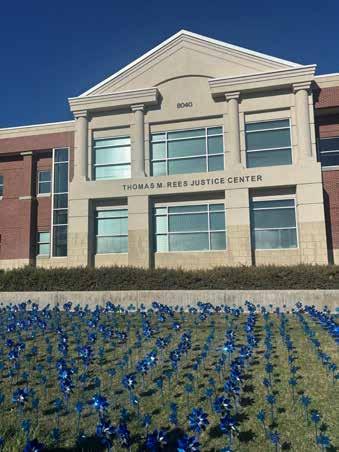
Onthe morning of April 7, nearly 3,000 bright blue pinwheels were planted on the lawn of West Jordan’s Justice Court. Each pinwheel represents three children of confirmed cases of child abuse.
The Pinwheels for Prevention event, sponsored by The Family Support Center in partnership with Child Abuse Prevention Utah, marked the beginning of Child Abuse Prevention Month.
The organizations hope to bring residents and volunteers together to raise awareness for child abuse and connect families with critical resources.
“The pinwheels may look simple to you, but they carry a powerful message. Each one represents the bright, safe and joyful childhood that every child deserves,” said Deondra Brown with Prevent Child Abuse Utah.
In 2025, 8,622 children in Utah were confirmed victims of abuse or neglect.
Lori Cox, executive director of The Family Support Center, hopes that community events such as these will prompt people to think about child abuse in a different way.
“We want people to drive past and ask about what these blue pinwheels mean… to get people to think about child abuse and think about it in a different way.” She continued, “Instead of condemning all parents, we want people to look at prevention measures.”
The Family Support Center is a nonprofit organization that provides critical resources to protect children, strengthen families and prevent child abuse across the state. The organization offers crisis childcare, transitional housing for families rebuilding their lives and parent education information.
“We want parents to come out and get educated on positive ways to help their kids. We want them to not be ashamed of taking advantage of places like crisis nurseries when they’re in a moment of stress,” Cox said. “It’s in moments of stress that parents react in ways that they’re not super proud of. We want to prevent that before it happens.”
Jenna Sume, a parent educator with Prevent Child Abuse Utah, spoke on risk factors that increase the likelihood of child abuse, and how to offset these challenges.
“Risk factors can be things that set someone at a disadvantage in life, a lot of which is not up to their control. Protective factors, such as getting families connected to their communities and helping them with developmental education, can combat these risk factors.”
Prevent Child Abuse Utah works with all kinds of families to build community and prevent child abuse through events, education, public awareness and more.
“It’s important to recognize that abuse is happening within our communities and to raise awareness for that,” Sume said. “One of our sayings is that child abuse isn’t inevitable, but it is preventable.”
Following the planting of the blue pinwheels, Mayor Dirk Burton and Chief of Police Jeremy Robertson gave remarks on the event and their hopes for the future of West Jordan’s children.
“West Jordan is the third largest city in Utah and as such, we have a lot of children. We care about our children here, and














we want them to have a great life,” Burton said.
“There’s nothing worse than a true victim who is abused in this community, and children are true victims,” Robertson said. “We need to have more members in our community being willing to intervene and help prevent child abuse.”
The Family Support Center planned to host another Pinwheels for Prevention event at City Hall on April 27, and the bright blue pinwheels will continue to be a visual reminder of the bright future every child deserves. l



Bright blue pinwheels line the Justice Center’s lawn. (Rachel Tramontana/City Journals)
Copper Rock golf championship set for May 14-16
The road to the LPGA Tour begins with the Epson Tour, and again this month, 132 of the best female golfers on the planet will reconvene for the Copper Rock Championship May 14-16 in Hurricane, Utah. Golfers will compete for $250,000 in prize money and points in the season-long Epson Tour standings.
There were 15 players who gained LPGA status during last year’s Epson Tour season, and 13 of them finished in the top 30 at Copper Rock in 2025. Champion Gina Kim won twice on the Epson last season and is now playing on the LPGA Tour.
Exemptions this year went to four golfers:
Navy Hubbs is a junior at Salem Hills High School who has verbally committed to Boise State University. She started playing golf at the age of 12 and quickly developed a passion for the game. Since then, she has enjoyed competing in both local and national tournaments, gaining valuable experience and continually challenging herself against strong competition.
Hubbs is known for her calm presence on the course and the strong work ethic she brings to improving her game. She approaches competition with focus and determination while enjoying the process of learning and growing as a golfer and developing friendships with others on and off the course.
Maria Jose “MJ” Barragan is a standout collegiate golfer for Brigham Young University, known for her consistency, competitiveness and upward trajectory on the women’s golf scene. A native of Morelia, Mexico, Barragan has quickly become one of BYU’s most impactful players, combining sharp scoring with a calm mindset under pressure. She owns a career-low 18-hole score of 68 (4-under) and a lowest 54-hole score of 210 (−6), achieved at the 2024 Red Raider Invitational where she claimed her best finish with a victory. Barragan has also



Utah golf, recognized for her competitive excellence and advocacy for women’s golf. An inaugural member of the women’s golf team at Dixie State University (now Utah Tech), she was a two-time PacWest Conference Champion, Conference Player of the Year and an All-American.
She competed professionally on the Cactus Tour and is a seven-time Utah PGA Women’s Player of the Year (2019-25), a four-time Women’s Utah PGA Match Play Champion, and the 2025 Utah Section Assistant Professional of the Year. Her career includes numerous Utah Section victories, multiple top-10 finishes in both men’s and women’s events, and an overall championship at The Copper Club Open.
posted strong rounds in key events including the opening rounds of the 2025 San Diego State Classic and the 2025 Dr. Donnis Thompson Invitational, and she played a pivotal role in BYU’s 2025 USF Invitational win with a 72-73-69 (214) performance.
Off the course, Barragan is equally distinguished. She’s majoring in pre-business and has earned recognition for her academic achievements, being named to the 2025 CSC Academic All-District team. In amateur golf, she finished runner-up at the 2025 Women’s Mexico Amateur in a dramatic playoff and represented Mexico at the Pan American Games in Paraguay, showcasing her talent on the international stage.
Gabby Barker is a professional golfer known for her resilience, consistency and purpose-driven approach to the game. A standout junior and collegiate competitor, Barker built her foundation through

years of high-level tournament play before turning professional and committing fully to the grind of tour golf. Since turning pro, Barker has competed across multiple professional circuits, including the Epson Tour and various mini tours, steadily gaining experience at the highest levels of women’s golf.
Her career has been shaped by perseverance, adaptability and a deep belief in long-term growth — both on and off the course. In addition to her competitive career, Barker is the first female Native American professional golfer, a milestone she carries with pride and responsibility. She uses her platform to inspire younger athletes, advocate for representation in golf, and share the realities of pursuing a professional sports career.
Haley Sturgeon is an accomplished golf professional and respected leader in

There are always so many things to enjoy during and around the Copper Rock Championship. On Tuesday, May 12, RAM Aerospace presents the 2026 RAM Women’s Business Luncheon. The theme is “Rising Together: Personal Growth and Professional Influence.” Keynote speaker is Stephanie Palmer, Director of Radio Sales for KSL NewsRadio, FM 100.3, The Arrow and the KSL Sports Zone. Whitney Harris, Director of People and Culture at RAM Aviation, will join in that discussion. The luncheon will run from 11:15 a.m. to 1 p.m.
A free Junior Clinic will be held on Championship Saturday, May 16, at noon. Signups for the clinic and RSVP for the luncheon can be made at Copperrockchampionship.com. There will also be a free photo booth on Championship Saturday, and food trucks will be onsite including Corn Dog Company and Chicharos Tacos.
To get tickets to the tournament go to Copperrockchampionship.com and choose from General Admission, Club 17 or Copper Rock Club tickets, and the website details those options.
Copper Rock is located at 1567 W. Copper Rock Parkway in Hurricane. l

2025 Champion Gina Kim (Courtesy Copper Rock)
Young golfers can participate in a free Junior Clinic on Championship Saturday at noon.
Haley Sturgeon Maria Jose “MJ” Barragan Gabby Barker Navy Hubbs




Joint Replacement
TA New Chapter for Pain-Free Living: Modern Joint Replacement at CommonSpirit
ired of nagging joint pain dictating your life?
The good news: joint replacement surgery has made significant advancements in recent years. Forget the daunting tales of long hospital stays and arduous recoveries. Surgery today is all about quicker recovery, less pain, and a faster return to the activities you love. This isn’t just about fixing a joint; it’s about reclaiming your freedom, and CommonSpirit is at the forefront of this transformation.
What’s driving this revolution? Minimally invasive techniques. Imagine surgery with smaller incisions and less disruption to your muscles and tissues. This “less is more” approach translates directly into less post-operative pain, reduced blood loss, and significantly shorter hospital stays.
“Joint replacement surgery once meant a long, difficult recovery. Now, thanks to minimally invasive techniques, patients are getting back on their feet and regaining their independence far more quickly, significantly improving their quality of life,” said Michael Blatter, an orthopedic surgeon at Holy Cross Hospital – Davis.
This means you can get back to golfing, gardening, playing with grandkids with renewed vigor.
But the journey to rapid recovery begins even
before surgery. We believe in empowering our patients, and that’s why pre-operative education is a cornerstone of our approach. Our comprehensive classes walk you through every step, covering everything from physical therapy exercises and navigating stairs to home safety. We emphasize two crucial rules: no falls and no infections. Patients consistently tell us they feel better prepared and more confident heading into surgery, which dramatically improves their outcomes.
Our commitment to your well-being extends with Enhanced Recovery After Surgery (ERAS) protocols. This isn’t just about the surgery itself; it’s a carefully coordinated care pathway. ERAS focuses on preparing your body for a smoother recovery through optimized nutrition, multimodal pain management that reduces reliance on opioids, and getting you up and moving just hours after surgery. It all works together to reduce complications, enhance your comfort, and get you home safely and sooner.
And speaking of cutting-edge, robot-assisted surgery has become a game-changer. While a surgeon is always in control, robotic systems provide unparalleled precision, allowing for less invasive procedures, greater accuracy in implant
Nurture what’s next.
Women’s health care for every stage of you.
placement, and ultimately, quicker recovery times. This advanced technology ensures your joint replacement is tailored with remarkable exactness.
“Many joint replacement procedures can now be done same day. And with our current techniques and technologies, we are able to facilitate a quicker recovery and healing process for joint replacement. Our patients are able to get back to the activities they enjoy more quickly. For many of our patients, joint replacement is a game changer,” said Dr. Kevin Sagers, an orthopedic surgeon at Holy Cross Hospital – Jordan Valley.
At CommonSpirit, we understand that living with joint pain can feel limiting. But with these modern advancements, the path to renewed mobility and a significantly improved quality of life is clearer and more accessible than ever. We’re dedicated to providing not just exceptional medical care, but a supportive and empowering experience that truly makes a difference. If you’re ready to explore how modern joint replacement can transform your life, we invite you to discover the CommonSpirit difference – where your rapid recovery is our priority.
For more information or to find a provider visit mountain.commonspirit.org


Learn more about the services, care providers and mission-driven work of the Holy Cross hospitals and CommonSpirit Health at www.holycrossutah.org.

At CommonSpirit Health, we make the healing presence of God known in our world by improving the health of the people we serve, especially those who are vulnerable, while we advance social justice for all.

Women go through many changes in their lives. And we believe every milestone matters. Our health care experts can help you face your next phase with confidence – because each chapter deserves to be celebrated.
Find care near you at mountain.commonspirit.org.
or promotion. Oman was impressed with the students’ skills and dedication to the film. During the intense nine weeks of filming, students were working 14 hour days between school and the movie.
“Those are official Hollywood hours and these students are doing it while they’re studying for the ACT and getting ready to graduate,” Oman said.
The Credits:
Script writer: Senior McKay Bowler worked for months on the script he describes as a John Hughes-type of comedy about a boy named Benny who hires a rebel girl as a consultant to teach him how to be more likeable to his peers.
Director: Ethan Edwards, a senior, said his job is to understand how the story needs to be told. “It’s a universal story about finding yourself, and I hope that everyone sees a little bit of themselves in Benny,” he said. “The struggle of finding who you are and balancing what’s expected of you versus what you want to do, something we all go through, and something that currently, as a high schooler, I’m living through right now. So I hope to put into words all that emotion and feelings.”
His role also comes with the responsibility of coordinating and communicating with all of the various departments and setting the set culture.
“It’s all eyes on you all the time,” Edwards said. “Obviously you’ve got to have a strong work ethic, because you’re who everyone looks to to get stuff done.”
Gaffer: Senior Jack Bowler said his responsibility to set up the lighting was the most time consuming job on the set.
“It’s a lot of working with the director, working with the cinematographer, making sure I know his angles and I know the director’s vision, and then I get the rest of the freedom on the creative part of the lighting,” he said.
Audio/Music Director: Kai Hansen, also a senior, took the lead of the audio team. He wrote the film’s score, recorded
himself playing each of the instrument’s parts and edited the music. He had experience from working on the music for last year’s film and also was a member of the only all high school team in last year’s SLC 48 Hour Film Project Competition in which he won Best Music.
“I’m not a huge musical guy--I like rock music--but being able to broaden my horizons with things like a musical sequence has been super cool,” Hansen said.
Film Editor: Ayden Farnsworth was the film editor for both this year’s and last year’s movies. For a two-minute scene, he sifted through about two hours of footage to find the best angles, line delivery and character reactions, which he then fit together, syncing movements between camera angles. His innate grasp of pacing enabled him to fit scenes together. “It’s kind of just figuring out what makes you not feel bored when you’re watching,” Farnsworth said.
Assistant Editor and Digital Imaging Tech: Isaac Kongsayasane kept tabs on the film footage, getting it from on-location to the school and ensuring it was backed-up and organized.
Director of Photography/Cinematography: Aaron Galgoci got to use a professional camera to film this year’s movie in 8K definition (though it has 12K capability). “This was a huge upgrade,” he said. “Our old cameras were 6Ks so we’re shooting at a better quality than those, and it’s a lot smaller and a lot more travel size.”
Other students had roles handling logistics, budget, public relations, set design, etc.
The Next Chapter:
For the remainder of the school year, the film students will be learning about scriptwriting and preparing for next year’s film project. Oman hopes to eventually include the whole school and even other schools to be a part of future films. He also encourages his students to get involved in the film industry in any way that interests them.
“The film industry is this little microcosm of everything else,” Oman said. “It doesn’t matter what you do, you could do
Majestic is golden

it in the film industry if you want to.”
Many of the students who worked on “Fixing Benny” will be graduating and Oman believes they are well-prepared for their next chapter. Even those not going into movie-making have learned leadership, communication and managerial skills that will benefit them in any career. For those students who have ambitions to work in the film industry, he provides encouragement, letters of recommendation, advice about film schools and networking contacts, because as a graduate of Jordan High School and the University of Utah, he sees his younger self when he looks at his students.
“I feel like I’m kind of passing that torch,” Oman said. “These are all Utah high school students that want to do film, and I can tell them how to do it.” l
A West Jordan area school which almost closed several years ago celebrates 50 years.
By Jet Burnham j.burnham@mycityjournals.com
In August of 1975, children were watching “School House Rock,” reading “Ramona the Brave,” and “Jive Talkin’” with the Bee Gees. Pet rocks and the summer movie hit “Jaws” were all the rage. And in West Jordan, kids were excited to attend their brand new school, Majestic Elementary School, Home of the Monarchs.
Suzette Johnson remembers being a first grader that first year.
“It was brand new and fun, with great teachers, and just a great environment,” she said. “There were a lot of kids because we were a growing community then--Redwood Road was just two lanes. We were a lot larger because there weren’t other schools around.”
The new school replaced West Jordan Elementary, built in 1927 at 7800 S. Redwood Road, which was too small and rundown to accommodate West Jordan’s growing population, which increased 547% between 1970 and 1980.
Johnson attended Majestic Elementary first through sixth grade and then returned as a
teacher eight years ago. She is now the instructional coach for the school staff and was a golden resource in helping plan the school’s 50th anniversary celebration held in March.
Majestic Elementary School almost didn’t make it to its 50th birthday. In 2019, the Jordan School District Board of Education was considering closing the school due to low enrollment. However, the school community campaigned to save it and in the fall of 2020, it became Majestic Elementary Arts Academy, an arts-integrated school with arts-endorsed staff members who use the arts to enhance learning. “Bringing the arts in has really added a depth of reaching students in different ways,” Johnson said.
Jeannie Hamilton loves the opportunities her son, a kindergarten student, has to make art at school. “He brings home art,” she said. “He draws every day, so he brings something home every day. I don’t know where to put all of it.”
The 50th golden celebration of the school was held in conjunction with the annual spring student art showcase. Current students and their families came to admire the artwork which covered nearly every wall, in every hallway and even some of the ceilings. Art pieces representing a wide variety of art mediums illustrated what students had been learning in science, math, history, world culture and art.
“Students loved being able to show their
parents what they do daily in our school and why it’s so important to integrate the arts,” Majestic’s Culture and Climate Specialist Linzi Pettey said.
The majority of those who attended the celebration were current students and their families. However, many former students, teachers, secretaries and principals also dropped by.
Majestic Elementary’s first principal, Joe Barfus, (who passed away in 2021 at the age of 99) would have loved to see the 50th celebration, his wife Sally Barfus and daughter Julie Beck said. They attended the open house and reminisced about how much he had loved being a principal there. They said he loved interacting with students whenever he could.
“They loved going to see the principal because he had jelly beans,” Barfus said. “He’d talk to them and then say, ‘Go get a book. I want to hear you read.’”
Beck remembers her dad took every opportunity to drop by the classrooms, which were initially an open classroom design, and that he always wanted to listen to students read.
“He loved to read one-on-one with kids, to help them be successful,” she said.
Former Majestic Elementary principals Kathe Riding (2017-2020) and Cora Jckowski (2005-2011) also dropped by the open house.
Majestic Elementary is known for having

at
Art Academy, was a first grader at the school in 1975, the year it opened. (Jet Burnham/City Journals)
a fantastic staff, Jckowski said. “I thought the staff and the teachers were very high quality, that they genuinely cared about their students and they enjoyed teaching them,” she said.
Jckowski was an educator for 39 years and feels lucky to have been part of Majestic Elementary Arts Academy’s golden legacy. “I think back, and it just makes me smile-- or cry out of joy-- just remembering what a treat it is to have the opportunity to help kids grow,” she said. l
Copper Hills High School Film 3 students film scenes for their movie at the school and about 10 other locations. (Photo courtesy Joshua Oman)
Suzette Johnson, who works
Majestic Elementary
Small business SECTION

County?
By Peri Kinder
Ranging from $0 to more than $300 for a base license, business licensing fees differ across Salt Lake County.
For entrepreneurs looking to start a company in Salt Lake County, location can shape the cost of opening that business. Licensing fees vary drastically as cities determine costs and define regulations. Fees can fluctuate based on the type of business, number of employees, impact on city services and required inspections.
On one end of the scale is Riverton, which in 2018 became the first city in Utah to eliminate all business licensing fees. The move was orchestrated by the mayor at the time, Trent Staggs, who wanted to let companies know the city was open for business.
“He wanted Riverton to be a business-friendly community,” said Riverton Business Licensing Coordinator Angie Keller. “We’re also very user-friendly when it comes to getting a license. They click on our website and it guides them through the process. I don’t get many phone calls asking for help…I feel like Riverton has gone above and beyond, as far as pointing them in the right direction and giving them all the information they need.”
Draper’s base fee for a commercial license is $82, with additional fees for alcohol or firework sales, sexually-oriented businesses and solicitors. Murray charges $100 for a commercial license with regulatory fees on companies like auto towing, tobacco retailers, tattoo parlors and convalescent homes. Midvale has a base fee of $137 for commercial businesses with add-on charges for industries including bars, hotels, pawn shops and restaurants.
For companies in the county’s newly incorporated areas, including Kearns, Magna and Copperton, the Greater Salt Lake Municipal Services District administers those business licenses. The district charges a $150 base fee for commercial businesses and home-based locations that have customers coming to the home.
On the higher end of the scale, South Jordan charges $337 for a general business license application fee, with additional charges for hotels ($2,700), restaurants ($633), big box stores ($3,331) and entertainment/recreation facilities ($1,727).
Brian Preece serves as South Jordan’s Director of Planning and Economic Development. He said the city’s licensing fee structure wasn’t put together haphazardly, but was based on a feasibility study that determined the cost impact of specific businesses to the city. More fees are placed on businesses that have a higher volume of calls for police or fire services.
“We have a fire inspection for most businesses and that’s part of the [licensing] fees,” Preece said. “Even though Riverton doesn’t have a business licensing fee…it’s being paid for somewhere. The general fund is paying for it.”
South Jordan Public Information Officer Rachael Van Cleave added, “If we weren’t to charge these fees, taxpayer dollars would be subsidizing these costs for businesses. So the fees help to take that off the general taxpayer.”
For home-based businesses, Utah Code states that cities cannot charge a licensing fee unless the business impacts the neighborhood, such as having customers or an unusually high number

of home deliveries. However, several cities, including Taylorsville and South Salt Lake, charge administrative processing fees of $100 and $59, respectively, for home-based businesses.
Riverton requires every home-based business to have a license, but there is no fee. South Jordan does not require home-based businesses to have licenses unless they operate a daycare/preschool or if they have regular clients coming to the home.
“We made the decision to not charge for or even require a home license business,” Preece said. “If somebody wants one, then we’ll get you a license, but you have to go through the regular process, and that’s your choice.”
While getting a business license is certainly an important step in starting a business, it’s not the only step. Business owners need to make sure that the company is registered with the state and, if sales are involved, with the Utah State Tax Commission. Owners must ensure all licenses and inspections are complete before a business license can be issued. Most cities have license approval completed in two weeks or less.
The wide-ranging business licensing fees and processes across the county impact business owners and municipalities differently. For some entrepreneurs, that difference could be the deciding factor on where they ultimately locate their business.
Born during the height of World War II, Behunin Tree is still going strong
By Carl Fauver | c.fauver@mycityjournals.com
The founder of this venerable business is credited with “inventing” one of our most iconic holiday traditions: the Temple Square light display.
Have you ever seen a 1943 Lincoln head penny? They’re gray instead of brown, because they’re made of steel rather than copper. These are the only coins ever minted in the United States that can be picked up with a magnet.
How about a 1943 American-made automobile – ever seen one of those? No, you haven’t. Henry Ford and his competitors received Uncle Sam orders to construct tanks and other war apparatus that year, instead.
It seems that pivotal year in the history of our entire planet must have been a challenging, topsy-turvy time to launch a brand-new business. But that’s exactly what J. Leland Behunin did. And now, 83 years later, his daughter-in-law, grandson, granddaughter, great-granddaughter and great-grandson are continuing to operate Taylorsville-based Behunin Tree.
“My grandpa was pretty well retired by the time I was born in 1969,” Ben Behunin said. “But I worked the business side-byside with my dad (Ben Sr.) for well over 30 years. Dad was in his 80s when he passed away just three years ago. He continued to ride along in the truck with me to jobs until six weeks before he passed.”
Ben’s mother, Pauline, now owns Behunin Tree with her son. Pauline’s daughter Michelle is one of their employees, along with at least two of her grandkids, Korissa –and a third Ben.
“I grew up in Colorado and met Ben (Sr.) when we were students at BYU,” Pauline Behunin explains. “He was already focused on learning about plant physiology and tree diseases. We married in 1967, moved into our first home in this area in 1972 and built the house I still live in now, in 1977.”
The oldest of five siblings, Ben Jr. graduated from Taylorsville High in 1987. His
wife, Julianna, is a 1988 THS graduate.
“I had known Julianna since third grade at Vista Elementary, after her family moved to Utah from Nebraska; but we did not date in high school,” he explained. “We reconnected years later, after we had each served church missions. We were married in 1998.”
Their marriage came just a few years after a couple of life-changing things happened to Ben Jr., which drew him back into a tree trimming career he had loathed.
“As soon as I was out of elementary school, my dad didn’t force me to work for the company – but he did say I had to earn my own money to buy new school clothes,” Behunin said. “So, by the time I went to college – and then on to my mission – I really didn’t care for the family business and had no plans to rejoin it. But that changed in the summer of 1994, when my dad had a chainsaw accident. He cut his left arm three-quarters of the way through.”
In that instant, Behunin faced a key, life decision. He could either continue his BYU studies in accounting, which would likely force his father to sell the family business… or, Ben Jr. could turn his life’s plans on a dime and return to the tree trimming business he had absolutely sworn off.
Right at that most pivotal moment, Behunin says someone intervened. That person was, arguably, the most well-known businessman in Utah history.
“My dad had grown up in the same neighborhood as Larry Miller,” Behunin said. “I literally ran into Larry at a hospital elevator as I was going to visit my dad, right after he nearly lost his arm. Larry pulled me aside and said ‘Your dad really needs you now. If you will take over his family business, I promise you Behunin Tree will have all of the landscaping and tree trimming accounts for all of my properties.’ I took that conversation as a sign and agreed to go back into the tree trimming business.”
Behunin changed his BYU major from accounting to horticulture and never looked


back. Twenty years later, he also earned a graduate degree in horticulture through an online program. He’s not sure what course his life and career might have taken if not for that chance hospital meeting with Miller.
Behunin Tree would continue to be the exclusive provider of all tree trimming and landscape work on Miller Company properties up through Miller’s death in 2009.
“He was always very nice to us,” Ben added. “We got to sit with Larry many times down on the floor, front row, at Jazz games.”
Some 30 years before that career change – and even before Ben Jr. was born – Behunin Tree founder Leland Behunin is also credited with coming up with the original idea to illuminate Salt Lake Temple Square trees during the holiday season.
“My grandfather began trimming the Temple Square trees in the early 1940s,” Behunin explained. “That contract was one of the reasons why he started his business. Several years later, grandpa suggested the tree lighting idea; but the Temple Square head gardener had reservations about it. He was afraid the light bulbs might bring the trees out of their winter dormancy too early. This was all very experimental back then. They would string some lights, overload a circuit, make adjustments and try again, over and over. But my grandfather finally got it right. Behunin Trees put up and took down the Temple Square lights every year from 1964 to 1983.”
Behunin Tree now has five full-time employees and about a dozen more during their busiest season. Tree transplanting, pruning and removal still account for about 60% of their business. But they are also active now designing and building outdoor patio cooking areas as well as waterfalls, landscaping around swimming pools and other features. The company now enjoys gross revenues of about $1 million, annually.
“I am so proud of the way Ben (Jr.) has taken over the business,” co-owner Pauline Behunin said of her son. “He has faced some hard times; but has always pushed through the challenges so well. He has so much knowledge about tree diseases. And when he has a tree to cut down, he’s an expert at dropping it exactly where it needs to go to not cause any damage.”
Meantime, Ben Jr. says one of his biggest ongoing challenges is trying to find employees who understand the tree care business.
“I’m talking with Salt Lake Community College now about creating a tree pruning program because schools just aren’t teaching these skills anymore,” Behunin said. “One of our clients serves on the SLCC Board of Trustees. I provided him with an outline on how the school could establish a horticulture course. I also offered to be an instructor. I’m waiting to hear back from them.”
Finally, Ben Behunin is also excited one of his two daughters, Korissa, and his nephew (that third Ben, a Copper Hills High School student) are working with the company now, as fourth generation employees.
“When you devote so many years of your life to something like this, it becomes much more than a job,” Ben Behunin concluded. “It’s a big part of your heritage –something you take great pride in. When I go to work properties that I recall working with my dad years ago – back when I swore I would never do this for a living – I get very emotional, thinking about him and our time together. I get that feeling of loss all over again.”
To learn more about the now 83-year-old Behunin Tree – and to get tips on how best to care for your own trees, shrubs and other landscape plants – visit behunintree.com.
Korissa Behunin, her father Ben, cousin Ben and grandmother Pauline (L-R) represent three of the four generations that have operated Behunin Tree for some 83 years. (behunintree.com)
In addition to planting, pruning and removing trees, Behunin Tree also specializes in creating outdoor cooking and dining space. (behunintree.com)
Local resources support entrepreneurs
By Peri Kinder | peri.k@thecityjournals.com
Six ways to get help starting or growing your business.
Starting a new business can be a massive undertaking. Creating a business plan, obtaining loans and developing marketing strategies can feel overwhelming. But in Utah, several organizations want you to succeed and offer resources, mentoring and connections to help build a sustainable business. Here are six places to start.
Utah Small Business Development Center. Located at Salt Lake Community College Miller Campus in Sandy and in Kaysville at Davis Technical College, the SBDC offers free business consulting. Whether your business is just an idea or a built-out concept, working with SBDC professionals can increase your chance of success.
SBDC also provides information about financing, customer relations, employee management and business accounting through the Entrepreneur Academy, workshops and training classes. It also hosts networking events to build support so your business can thrive. To learn more, visit utahsbdc.org.
Suazo Business Center. Nearly 10% of Utah businesses are owned by Latino or Hispanic entrepreneurs. Suazo Business Center is often a first step for members of underserved communities to help them build and grow a thriving company. Bilingual consultants offer advising appointments to create an understanding of small business while providing guidance and mentorship.
With locations in Salt Lake and Ogden, Suazo Business Center has classes in Spanish and English to cover topics like QuickBooks, business development, legal structure, accounting and financing. It also has a series of workshops to tackle issues from HR to government contracts. For more information, visit suazocenter.org.
SCORE Utah. With free business mentoring and low-cost educational workshops, SCORE Utah can help expand your network and grow your business. Its online courses allow entrepreneurs to explore all areas of business ownership, including e-commerce, customer service, crisis management and online marketing.
SCORE Academy premium courses offer inexpensive training in grant writing, AI for business or sales, and marketing strategy. Additionally, SCORE will provide a free mentor who will partner with you on your business journey. Mentors give advice and educate business owners to help them feel supported. To learn more, visit score.org/utah.
Utah Microloan Fund. For business owners who might have a low credit score or no access to collateral, the Utah Microloan Fund is a “lender of last resort” that can help entrepreneurs who can’t get traditional business loans. It can offer lending to higher-risk clients because its purpose is about creating impact, not profit.
For 35 years, the organization has funded microloans to help people build their dreams. By providing training and financing to businesses that don’t qualify for traditional funding, the Utah Microloan Fund is a resource for those who have been declined for a bank loan. The microloans are set at a fixed rate, with up to six years for repayment.
Plus, its popular Banking on Women program helps women create a business plan and apply for funding to make it a success. Visit utahmicroloanfund.org/orientation for more information.
Local Chambers of Commerce For advocacy and networking, the local Chamber of Commerce is a great place to connect with like-minded business owners, find opportunities for promotion and get your company involved with volunteer activities.
The Salt Lake Chamber is the biggest in Utah, while the South Valley Chamber represents many communities in Salt Lake County, including Sandy, Draper and Riverton. ChamberWest serves businesses in Taylorsville, West Valley, Kearns and West Jordan, and several smaller chambers serve individual cities, like Murray or South Salt Lake. The Davis Chamber is the primary organization for businesses in Davis County.
There are also specialized chambers, including the Utah Black Chamber, the Utah Hispanic Chamber, the Utah Asian Chamber and the Utah LGBTQ+ Chamber. For a complete list of Chambers of Commerce, visit utahassociationofchambers.com.
Spice Kitchen Incubator. If you have an idea for a food truck or restaurant, but can’t invest in a truck or brick-and-mortar location, the Spice Kitchen Incubator is an answer to your prayers. Spice Kitchen provides hands-on learning for refugees and other disadvantaged community members interested in creating a food business.
Part of the incubation program includes access to affordable kitchen space, plus capital, operations development and technical assistance. Graduates of the program include Bhutan House, IndieGo Coffee, Wings on Wheels and Waterwheel Kitchen. To learn more, visit spicekitchenincubator.org.





Small business owners in Utah have many resources and organizations available to help make their dreams a reality. (Stock photo)
Starting smart: What every small business owner needs to know first
By Holly Curby | hello@hollycurby.com
For many entrepreneurs, the journey begins with a spark—an idea, a passion or a defining life moment. For me, it started with loss.
In 2019, after my mother passed away, I made her a promise: I’ll write the book. That promise became more than a personal goal, it grew into a business rooted in becoming an eighttime award-winning published author — speaking, podcasting, coaching and consulting. Like many small business owners, my path wasn’t linear. It was built step by step, with research, guidance and a willingness to learn.
My story reflects a larger trend. According to the U.S. Census Bureau, more than five million new businesses were launched in 2025. Yet only about 65% of small businesses become profitable. The message is clear: starting a business is more accessible than ever, but building a successful one takes preparation and persistence.
Start with research—not just passion
Passion is important, but it’s not enough on its own. “Do your research,” advises a representative from Investor.gov. “You may have a bright idea, but before you invest money, make sure it’s viable.”
That means asking hard questions: Is this a true passion or just an interest? Do you have the time and financial stability to pursue it? Is the timing right?
Timing, in particular, can shape the entire experience. In my case, reduced work hours during the pandemic created an unexpected opportunity to build something new.
Understanding your market is just as critical. Who are your competitors? What makes your idea different? Tools like a SWOT analysis—evaluating strengths, weaknesses, opportunities and threats— can provide a realistic snapshot before you commit.

Build
the right foundation
Once your idea is validated, it’s time to make it official. That includes choosing a business name, registering it and selecting a structure that fits your goals.
“Make sure your name is available, not just legally, but online,” says David York, managing partner of York Howell. “That includes checking domain names and social media handles.”
Next comes the operational setup: securing an Employer Identification Number (EIN), registering with your state, and opening a dedicated business bank account. Keeping personal and business finances separate isn’t just good practice—it’s essential.
Tony Wolff of Wolff & Company puts it simply: “Set up your financial system early. It will save you and your tax advisor a lot of stress later.”
Know your money habits
Your personal relationship with money doesn’t disappear when you start a business—it follows you.
“How you handle money personally will carry over into your business,” says financial coach Sara Fernandes. “Whether you rely on cash, debit or credit, understanding your habits can help you avoid costly mistakes.”
She also emphasizes consistency over complexity: “Set aside time weekly to track expenses and send invoices. Don’t let it pile up.”
Your brand is your first impression
In today’s digital marketplace, your online presence often determines whether a customer engages with your business.
“Don’t wait for your website to be perfect before you launch it,” says Promise Tangeman, owner of GoLive. “Get it live and improve it along the way.”
Clarity matters. Visitors should quickly understand what you offer and

who you serve. And when it comes to growth, Tangeman advises focus over reach: “Most people chase reach—the real leaders chase depth.”
That same strategy applies to social media. Choose platforms you can maintain consistently and build trust over time.
Protect yourself and communicate clearly
Legal and operational safeguards are essential, even if they’re not the most exciting part of entrepreneurship. Permits, licenses, insurance and contracts all protect your business.
“Communicate, communicate, communicate,” York emphasizes. Clear contracts outlining services, pricing and expectations can prevent issues before they arise.



Getting your first customers
Marketing often starts small. Networking, community involvement and word-of-mouth remain powerful tools.
trepreneurship, it’s this: success doesn’t come from having everything figured out. It comes from starting, learning and continuing forward.





“Marketing is what you say; branding is what they feel,” says Susan Carlson, owner of Redrig gaming truck. “Make that first feeling count.”
Simple strategies—like creating a Google business profile, joining a local Chamber of Commerce, or building an email list—can help establish visibility and trust.
Progress over perfection
If there’s one common thread in en-
The journey may feel overwhelming at times, but every business begins with a single step. And sometimes, it begins with a promise, and the courage to follow through.
Learn more from some of these small business owners and others on Holly’s Highlights podcast, available wherever you stream podcasts and at www.HollyCurby.com.
Built from the ground up, Redrig gaming truck shows how small businesses can bring big ideas to life. (Redrig)
Learn from the people doing it—real conversations with local small business owners and community leaders. (Holly Curby)


From creatives to council members, the Cultural Arts Society of West Jordan has a place for everyone
The city’s art scene continues to materialize whether it’s art in the park, symphony or Shakespeare.
By Rachel Tramontana r.tramontana@mycityjournals.com
Imagine a place in our community where new actors perform old classics, the sounds of symphonies float down the hall and magic fills the air. That place is the Cultural Arts Society of West Jordan, and it’s calling out to you.
Walking down the halls, you will find actors, artists, literary geniuses and master musicians. Whether you are a performer at heart or an eager audience member, you’re bound to experience the magic of the arts here.
“It’s a safe place people can come and escape for roughly two hours,” said Kass Rackham, a member of the theater arts board for West Jordan. “The harder the world is on the outside, it’s easier to escape to the land of what we’re trying to see and feel.”
One person who can testify to the power of the arts is none other than West Jordan’s City Council Chair, Bob Bedore.
When Bedore moved to Utah in 1978, he knew no one. His father encouraged him to take an acting class to make friends. Since that year, he hasn’t gone more than a month without being in some kind of show or performance.
In fact, Bedore’s love for the arts was a driving force behind his running for city council. “I knew there was money that was appropriated to build the community and arts building. And the person who had the seat I have now was actively stalling it.”
Prior to 2017 the Cultural Arts Society in West Jordan, also known as CASWJ, was part of the city’s programs. Since then, the Cultural Arts Society was formed to bring groups such as the Sugar Factory Playhouse and the West Jordan Symphonies together.
Now that CASWJ has a permanent home, Bedore is proud that West Jordan’s name is attached to something so magical. “We are a place where artists realize that they can be seen. We get the best from everywhere, and it shows we’re doing something right.”
Bedore took a moment to highlight the importance of creating a safe space for kids and future generations to embrace the arts. “A lot of times, people interested in the arts are having a tough time expressing themselves. If you start taking away the arts, we’re going to lose people.”
A 2019 report by the World Health Organization found that the arts play a critical role in promoting health and wellbeing while supporting the treatment and management of mental illness and neurological disorders.
“A lot of people in theater have ADHD and anxiety and even depression,” Rackham said. “It’s an outlet to express emotions that people might not be able to in their normal lives.”
Rackham, who was chosen to direct William Shakespeare’s “A Midsummer Night’s Dream” at the Sugar Factory Playhouse, mentioned how the centuries old play reflects modern times.
“It’s all about mischief, magic and love. And, yeah, craziness, but it’s about friendship,” Rackham said. “There’s things that go wrong, but it’s still full of love. It’s important to remember that we can bring those things into our own life as well.”
South Jordan resident Andrew Hackman, who plays the character of Nick Bottom in the show, gushed over what he loves most about theater: the sense of connection. “For me, it’s social. Every cast becomes a little family. That’s what drew me to theater initially, and it’s what’s kept me in.”
Dillon Workman, CASWJ’s Executive Director, reiterated this point. “There’s something about the people of West Jordan that make it
easy to make friends. To see someone that needs help, or someone that wants to help you.”
Workman continued: “I think art is therapy, and if the arts took over the world, everyone would be happy. We’d have ways of express ing ourselves so that we wouldn’t resort to vi olence. I don’t think you can ever say there’s too much art.”
and professional artists, it’s a place for every one. Whether you want to build set pieces and sew costumes or learn piano and finish up that book you’ve been mulling over, you are wel come here.
or an accountant by day, and a comedian or violinist at night. You can come from West Jordan, or travel far and wide to make this your home.
At the end of the day, The Cultural Artsty members to dream boldly, awaken creativity and inspire together. Whether you’re a painter, a performer or a purveyor of the arts, you are
“There’s so many outlets that I don’t thinkman. “The arts just unlock things for you, and there are opportunities for people who haven’t

Artists display their works at Art in the Park. (Photo courtesy Dillon Workman)
West Jordan Symphony presents Handel’s “Messiah.” (Photo courtesy Dillon Workman)
Preshow photo of CASWJ’s “A Midsummer Night’s Dream.” (Rachel Tramontana/City Journals)
A system rethought: New director targets root causes of homelessness and incarceration
Anndrea Wild takes reins of SLCO Homelessness and Criminal Justice Reform office.
By Shaun Delliskave s.delliskave@mycityjournals.com
When Anndrea Wild reflects on her career path, she describes a steady shift from evaluating public systems to helping build them. That transition now places her at the center of Salt Lake County’s efforts to address two of its most complex and intertwined challenges: homelessness and criminal justice reform.
“I’m Anndrea Wild, and my career has focused on understanding and improving how public systems serve people,” she said.
Wild, who recently stepped into her role as Director of the Office of Homelessness and Criminal Justice Reform under Salt Lake County Mayor Jenny Wilson, brings experience from both policy analysis and direct program leadership. She began as a Legislative Performance Auditor, reviewing how state programs function in practice, before moving into a more hands-on role with the Utah Department of Corrections as Programming Director.
“That experience gave me a deep appreciation for both the strengths of our systems and the gaps that can leave individuals and communities without the support they need,” she said.
In her current position, Wild’s focus is
on coordination—bringing together agencies, service providers and policymakers to address issues that often overlap but are traditionally handled separately.
“For me, this role is a meaningful opportunity to help drive real, lasting change for individuals and families who are experiencing homelessness, involved in the justice system, or both,” she said.
At the core of the office’s mission is collaboration. Wild oversees efforts that connect key groups such as the Criminal Justice Advisory Council and the Salt Lake Valley Coalition to End Homelessness. The goal, she said, is to align strategies, share data and ensure resources are used effectively.
“Our mission is to advance effective, data-driven criminal justice and homelessness solutions through strong partnerships, innovation and a focus on outcomes,” Wild said.
A major factor shaping that work is housing availability. According to data cited by the office, Utah faces a significant shortage of deeply affordable housing, with only three units available for every 100 households in need. In Salt Lake County alone, the deficit is estimated at 35,000 units.
“Housing is a foundational priority in this work,” Wild said. “We know that stable housing is one of the strongest predictors of positive outcomes.”
Wild emphasized that homelessness and criminal justice involvement often stem from
shared underlying issues, including mental health conditions, substance use and housing instability. Those connections are increasingly visible in local data.
“Historically, about a quarter of our Salt Lake County jail population was homeless. Over the last few years, it has grown to nearly one-third,” she said.
Her office’s approach centers on addressing those root causes while maintaining accountability and public safety. That includes expanding diversion programs, increasing access to behavioral health services and ensuring

individuals leaving incarceration have stable housing and support.
“It’s important to be clear: incarceration plays a critical role in holding individuals accountable and protecting public safety,” Wild said. “For many others…a system response centered primarily on incarceration is not the most effective path forward.”
One of the most immediate challenges Wild identified upon taking the role is the lack of coordination in crisis response systems. Currently, multiple agencies respond to mental health and substance use crises, which can result in inconsistent care and unnecessary reliance on law enforcement.
“Too often, law enforcement is the default first responder, even when a behavioral health response is more appropriate,” she said.
To address that, the county has launched a crisis response task force and is working to improve how emergency calls are routed, with the goal of directing individuals to appropriate treatment rather than jail or emergency departments.
Wild also highlighted prevention—particularly among youth—as a key priority. Expanded diversion programs, mentorship opportunities and school partnerships are part of a broader strategy to intervene early and reduce long-term system involvement.
“We know that early intervention can change the trajectory of a young person’s life,” she said.
Looking ahead, Wild said her first year will focus on building a more connected system that better matches individuals with the care they need.
“Ultimately, long-term impact comes from building a system that is both effective and humane,” she said.
For Wild, the work is rooted in a simple but complex goal: creating systems that not only respond to crises but prevent them— while supporting both individuals and the broader community. l
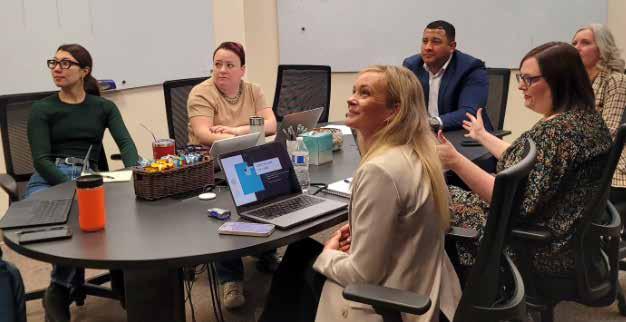
Anndrea Wild (center) meets with County Councilmember Carlos Moreno (back). (Photo courtesy Carlo Moreno)


Government efforts good, but more needed to save the Great Salt Lake
State legislative action is a good initial step from government to save the Great Salt Lake, but more conservation efforts and infusion of cash are critically needed.
By Tom Haraldsen t.haraldsen@mycityjournals.com
In mid-March, before the record heat wave in Utah, the Great Salt Lake was at 36.1% of its desired water level. That day, it was more than 6 feet below its minimum healthy water level of 4,198 feet. Over 53% of the lakebed was exposed (1,150 square miles), and its salinity was 11.9% (12-16% is considered ideal for brine shrimp).
In other words, the GSL was, and still is, in serious trouble. Reserving that trend and educating Utahns and the world about ways to prevent that pending disaster is Grow the Flow, a citizen-led movement that unites science with facts and civic action to address the issue. The team monitors all facets of the lake daily, continues to update its website (growtheflowutah.org) with latest developments, and seeks the public’s engagement in efforts to save the lake before it’s too late.
The GSL was a big topic of discussion during the recently completed Utah State Legislature, and the good news is that the Grow the Flow team was for the most part optimistic about this year’s session.
“By and large, it was the most productive session that I’ve been a part of,” said Jake Dreyfous, managing director of the organization. “Some of the biggest levels of improvement came from focusing on
making it easier for farmers to lease water to the Great Salt Lake and expediting that process.”
He pointed to two bills—HB 348 and HB 410—sponsored by Rep. Jill Koford (R-Ogden). The first addressed dedicated water amendments and the second water leasing agreements. Both passed and were sent to Gov. Spencer Cox for his signature.
“These bills create a process to file a dedicated water right and tell the state engineer that they need to prioritize the processing of change applications,” Dreyfous said. “Where before a single lease agreement could take six months or even a year to process, this cuts that down to six weeks and no more than three months. That’s a big step forward to make sure farmers can make informed decisions to lease their water and be financially compensated for a single irrigation season.”
He said large progress was also made with the increased engagement from the federal government.
“We saw President Trump proclaim his support for Great Salt Lake restoration,” Dreyfous said. “That led to the passing of a concurrent resolution from the state legislature on the last day that explicitly outlines the scope and scale of the problem and the impact it stands to have on the lake. It affects millions of Utah businesses and homes, public health from the increase in dust pollutants, the importance of this migratory bird flyway and ecosystem for 10 million migratory birds, and the role the lake plays in the production of critical minerals and food security. The extraction of things like potassium sulfate, lithium and magnesium where, in a lot of cases, the Great Salt Lake
is the only domestic source. We’ve made it clear to our federal delegation that we can’t solve this problem alone—we need federal support and coordination.”
Trump intimated a $200-million pledge from the federal government. The state of Utah will seek $1 billion from the feds for the lake. Neither action has been taken thus far.
Another huge achievement was the state’s acquisition of U.S. Magnesium in January, The approved $30-million purchase gives the state control over 4,500 acres of land and extensive water rights.
“That’s very massive in terms of both water quantity and air quality perspectives,” Dreyfous said. “Historically speaking, U.S. Mag has been the source of 20% of our winter inversion pollution in the Salt Lake Valley. The state’s purchased water rights, 40-60,000 acre feet of water, will now stay in the lake.”
He said the legislature’s approval of a settlement agreement between Utah and the federal government allowing transfer of Bear River Migratory Bird Refuge will net the state $60 million. That money is earmarked for GSL conservation efforts, $10 million available this year and the remaining $50 million that will require future appropriations from lawmakers. Dreyfous is confident that future money will be set aside for the lake.
But he added there were some missed opportunities this year on Capitol Hill, particularly on the municipal conservation front.
“We had really strong policies focused on limiting the use of thirsty grass landscapes in new development within the
Great Salt Lake Basin,” he said. “There were policies that would have mandated watering ordinances across the Basin, and set more aggressive water pricing to conserve. Where we took our eyes off the ball this year was to insure the growth of water wise programs to help us conserve.”
At this year’s Sundance Film Festival, a documentary from director, editor and cinematographer Abby Ellis, who now lives in Utah and was titled “The Lake,” centered on the challenges faced by the GSL. Its showings received standing ovations and it won the U.S. Documentary Special Jury Award for Impact for Change. It profiled three people: microbiologist Bonnie Baxter, ecologist and BYU associate professor Ben Abbott, and the state’s Great Salt Lake commissioner Brian Steed, and it painted a poignant picture of the lake’s pending demise if strong, aggressive action isn’t taken to preserve it. The film will be shown at other festivals around the country this year.
Dreyfous said community engagement is now more important than ever, and that large financial donations to clean up waters and expand leasing programs are critical to helping get more water into the lake.
“Investing in water conservation is investing in future growth and prosperity for your city or town,” he said. “Actions on the state level will trickle down to the local level. A common sense regulation from the state’s population, like waiting a few weeks before turning on our sprinklers and cutting down watering by maybe a third, would help. The most cost-effective proven solution that we can do as individuals is conservation.” l
The Great Salt Lake is nearing a record-breaking low for its water level. State lawmakers took some action during this year’s Utah Legislature, but more is needed to preserve the lake. (Photo courtesy of Grow the Flow)
What once was covered with waters up to the shores of Antelope Island has become the new norm—lakebeds exposed and salinity become levels considered unsafe for brine shrimp and other species that depend on the lake. (Photo by Laszlo Otis-Pasternak)
Daffodils and kind words – students lift cancer patients’ spirits
Students brightened patients’ day at Holy Cross Hospital – Jordan Valley to mark the first day of spring.
By Becky Ginos becky.g@thecityjournals.com
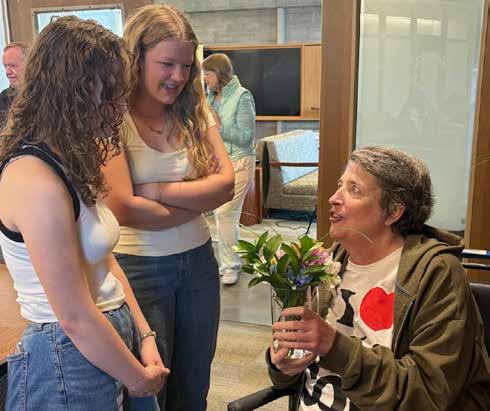
Undergoing cancer treatment is a tough road, but a group of students from Roy High School brightened patients’ day at Holy Cross Hospital – Jordan Valley March 20, to mark the first day of spring. The kids brought in daffodil flower arrangements and hand-written notes to turn an otherwise difficult day into a hopeful one.
“It all started because Julie Steadman, the Cancer Center manager, is my mom,” Colten Smith said, an agriculture, floral culture and greenhouse teacher at the school. “We talk about her work then we talk about my students and all the cool stuff that they’re doing. She told me that around the third week of March are daffodil days.”
The daffodil is the symbolic flower for hope for cancer patients, he said. “So they’re kind of a neat deal. She knew I
a difference.”
It started in 2025 and it has really just caught on, he said. “This year especially the students were very excited. I’m really proud of the students that they’ve really taken this project on with their full heart.”
In the floral culture and greenhouse class the students learn how to make a variety of flower arrangements, said Smith. “They learn the design process. They learn the names of different flowers and they learn to make arrangements like bud vases, corsages, sympathy arrangements and holiday arrangements.”
They learned the principles and elements of design and created these bud vases for the cancer patients, he said. “So it’s really good quality stuff. The students did a great job and they really took it seriously. They wanted to make a heartfelt and thoughtful gift for these patients.”
Smith said his mom has also done radiology therapy for many years. “She tells me how much she cares about her patients and that she really wants to help them through their treatments. More than just their treatments, but to give them hope as
realm yet still show hope and peace. With the cold ground it’s the first flower that you see and it’s bright and offers hope. I think the patients definitely deserve that.”
When the patients received the cards and flowers they were so touched, she said. “They were almost surprised, in a way, that somebody had done that for them, let alone some cool high school kids. You know, sometimes they can get misunderstood.”
They grew the daffodils this year with this specific thing in mind, Steadman said. “It was deliberate, watching the flowers grow, having the patients in the back of their minds, thinking about them and that’s the part that has really touched me the most.”
Steadman said they had one incredible patient who was getting so discouraged. “I just said ‘hang in there until Friday. There are some high school kids that are going to come down and they want to give you some hope and encouragement.’”
When the kids came he was one of the last ones of the day, she said. “He was a little overwhelmed by all of these amazing kids and everyone’s just cheering him on and rooting for him and sharing their love.”
“This project has really changed the way that I teach because I believe in it,” said Smith. “It’s my job as a teacher to give these students opportunities to use their skills. If we give students that opportunity to use them for service then they’ll take it.” l
Roy High students present a flower bouquet to cancer patient Lisa Wilkerson at Holy Cross Hospital – Jordan Valley. The kids grew the daffodils in their floral culture class and then
Experts say expect housing market in ’26 to repeat ’25
First time homeowners nationally accounted for an all-time low of 21% of the homeownership market.
By Brice Wallace Salt Lake Business Journal
“Running in place.”
That was a real estate watcher’s assessment of the industry in Salt Lake County in 2025 and also his expectation for 2026.
“The operative notion for this last year really is ‘running in place.’ 2025 was very much like 2024,” James Wood, Ivory-Boyer senior fellow at the Kem C. Gardner Policy Institute, said at a housing forecast event hosted by the Salt Lake Board of Realtors.
“The last couple of years, we’ve been back to the level of sales of the Great Recession period. … It’s a market that’s really holding its own but really running in place.”
Residential sales and the median price of a home in the county saw little change in 2025. Sales were down 2.4% to 11,797 homes, while the median sales price grew 1.9% to $550,000. In 2022-25, the median price grew just 3.8%, from $530,000 to $550,000. Median days on the market grew from 29 in 2024 to 36 in 2025.
Real estate sales per 1,000 population were running at the lowest level in the past quarter-century.
“Sales prices were up but at a pretty meager level, which is really good. We need that to improve affordability,” Wood said.
Prices in the county grew a massive 40% from 2020 to 2022 but cooled unexpectedly in 2023. Price increases have stabilized since then.
“We are catching our breath right now,” Wood said. “It’s taken a couple of years.”
Housing prices, he said, are “sticky,” unlikely to fall except if there is a serious recession, which leads to foreclosures and slipping property values.
Expect stable home prices for two more years, he said.
“The demand is still a bit weak because of affordability, so the prices, I think, are going to struggle for a little while,” Wood said. “And that’s not bad because we are one of the highest-priced markets in the country, in the metropolitan area of Salt Lake….It’s going to be another year, 18 months, before we see much movement in housing prices.”
Wood expects Salt Lake County single-family homes sales this year to rise 2% to 8,600 units. Sales of condos, townhomes and twin homes likely will increase 3% to 3,500 units. Overall, the total is 12,100 units, or 2.5%. Median sales prices should remain flat.
“Just hang in there,” he advised the audience, which consisted of real estate officials. “Better times are ahead,” he said, with 2026 probably mimicking what the county saw the past couple of years. “Plan on about what you did last year. If you do better than that, congratulations.”
Nonetheless, Jessica Lautz, deputy chief economist and vice president of research at the National Association of Realtors, said Salt Lake City remains a top 10 hot-spot market for housing. Its advantages include a young population, job growth, and in-migration of people from outside the state.
Nationally, the past three years have been sluggish, but the existing-home sales volume, despite still being below the five million mark, should rise 14% this year from a flat 2025, she said. New-home sales likely will grow 5%, compared to a 2% decline last year. And median home prices are expected

to jump 4%, compared to 3% last year.
Both Wood and Lautz decried affordability issues preventing young people from getting into homeownership. First-timers nationally accounted for an all-time low of 21% of the homeownership market. It was 44% in 1981 and once was as high as 50%.
Repeat homebuyers have a median age of 62 — it once was 36 — and they also are likely to hold on to their home for 15 to 20 years.
Lautz noted that the median age of first-time homebuyers is 40, much higher than the traditional 28 to 32. And they aren’t likely to move anytime soon, she said.
Wood said he can relate to the trend. “I’ve got people in my basement,” he said to the audience giggles. “I’m sure I’m not alone.” l



Residential sales and the median price of a home in the county saw little change in 2025. (File photo City Journals)

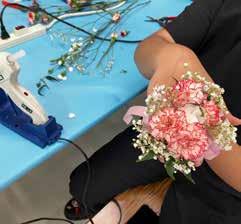
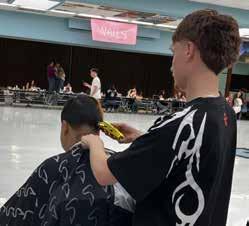
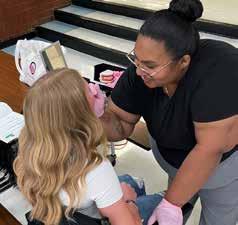
Teens get pampered at self-care prom
Professionals
By Jet Burnham j.burnham@mycityjournals.com
The afternoon before prom, West Jordan High School students got their nails done, their hair cut and tinselled, eyebrows laminated, eyelashes extended and teeth gemmed by professionals at the third annual
self-care prom. The event, organized by the WJHS Sources of Strength club, was open to all students whether or not they were attending the dance.
“Our goal for this is to provide services that make our students feel better, so like it’s a pick-me-up for our students,” SOS Service VP Izabella Rasmussen said. “Getting pampered makes you feel better and helps with your mental health, for sure--looking good and feeling good.”
More than 40 professionals volunteered their services for more than 100 appoint-
ments and walk-ins.
Licensed nail tech Isamar Flores, of nailsbyy.marss, said she was contacted to provide nail services at last year’s event and was excited to participate again this year.
“I like how the school is prioritizing their students’ mental health and putting up the whole organization for them to get pampered up for the ones who really can’t afford it,” she said. She said she also appreciated the opportunity to get more exposure for her nail business.
Landon Hansen, from Savant Barbershop, spent four hours giving free haircuts and getting to know students and even some parents, who had to give permission for their student to receive services. “Working in a barbershop is a lot about working with the community, getting your cuts out there, getting your brand out there and reaching more people,” he said. He also donated his time because he knows how important it is for teens to feel confident about how they look for special events.
“I remember my prom,” Hansen said. “I remember how important it was for me, how good I wanted to look.”
Many students signed up for free eyelash extensions and eyebrow laminations provided by licensed estheticians. Ellie Isobe, from Beauty with Ellie, brought her table, lighting and eyelash extensions all the way from Orem for the third year in a row because making people feel good about themselves is her favorite part of her job. “Especially for kids--they need the self-esteem boost,” she said. “They need to feel supported, they need to feel good about themselves. I think it’s really important.”
There were some new volunteers offering new services this year, like Estrella Lopez of @blingbrowsbystar who offered tooth gems, but SOS advisor Robyn Briggs said most of the volunteers were the same ones who were part of the first self-care prom. “Most people who volunteer once want to come back the next year,” Briggs said.
This year there were also more volunteers because students from the hair and

nail design programs at Jordan Academy for Technology and Careers provided nail services and hair styling for students while earning hours toward their certification.
The self-care prom saved students a lot of money. Nail and hair services begin at about $40, teeth gems start at $50, eyelash extensions cost $100-140 and corsages can range from $25-40.
“I just saved myself $25,” said one student as they sealed their handmade corsage into a bag.
WJHS floriculture teacher Madison Sorenson helped students make corsages and boutonnieres for their prom dates with flowers donated by Ensign Floral. She said removing financial barriers allows more students to be able to attend prom, which she says is an important part of the normal high school experience many might miss out on due to their family situations.
“It’s just becoming more normal for those high school students to take on more of that adult role in their home lives, especially for a low income area,” Sorenson said. “And so this helps emphasize they don’t have to always be an adult, they can still be a kid, and can still have fun.l
Chloe Kingston gets eyelash extensions from Ellie Isobe of Beauty with Ellie. (Jet Burnham/City Journals)
Landon Hansen of Savant gives a WJHS student a trim as part of a self-care event. (Jet Burnham/City Journals)
City Journals)
Estrella Lopez of blingbrowsbystar was busy all evening applying tooth gems for WJHS students. (Jet Burnham/City Journals)
Students from JATC’s hair design classes style hair in preparation for prom. (Jet Burnham/City Journals)




Kaysha Love takes the bobsledding world by storm

Herriman’s Kaysha Love represented the U.S. in the 2026 Winter Olympics. (Photo courtesy U.S. Olympic and Paralympic Committee)
The Olympic medalist reflects on childhood, sacrifices, the future and her meteoric bobsled career.
By Elisa Eames e.eames@mycityjournals.com
Attempting to master her nerves, Kaysha Love exhales slowly while gripping the bobsled in front of her firmly. Her entire body is tense as she waits for the first women’s monobob heat to begin at the 2026 Winter Olympics. And there it is, the signal—she’s off running, sprinting for all she’s worth, legs pumping and muscles burning as she pushes the sled.
Then, like lightning, she jumps inside and flies down the icy track at approximately 75 miles an hour.
Milano Cortina was not Love’s first Olympic experience—she competed in Beijing in 2022—but compared to her current fame and glory, her origins are much more humble. She and her family settled in Herriman, where she attended Fort Herriman Middle School and then Herriman High.
“I have so many fond memories of growing up in Herriman,” she said. “I really enjoyed high school and the city in general.”
When Love lived in the once rural city, there was much more open space, and she and her family regularly took advantage of this to go four-wheeling. Some of her core memories include four-wheeling among the Herriman hills.
The sport that started it all
Love comes from a family of athletes, so it surprised no one when she asked to take gymnastics classes as a child. Ironically, it was watching the Olympics that began
the journey ultimately leading to her own Olympic pursuits.
“I was obsessed with gymnastics,” she said. “My first interaction was the Olympics. These girls were doing these amazing flips, and I remember telling my mom I wanted to do that.”
After Love turned the family living room into a gym, using the couch as her personal vault, her mother, Stephanie, finally signed her up for classes. “My mom said ‘we need to put her in a real gym so she can’t break anything else,’” Love said with a chuckle. “And I absolutely loved it!” She soon rose to the top, achieving the highest level of gymnastics at the junior level.
But a career as a gymnast wasn’t in the cards. “It wasn’t until high school that I was constantly getting hurt,” she said. “I was so devastated. I think my body grew too fast.”
After months and months of breaking bones or sustaining other injuries, healing and then returning only to get hurt again, Love made the heartbreaking decision to walk away.
Spending 25 to 30 hours a week training for gymnastics meant she hadn’t made many friends, so as Love searched for something else to do, her mother suggested she might enjoy the close-knit groups in track and field.
“I hated running but thought I’d try it for the sense of community,” she said.
The reluctant runner ended up breaking multiple state records at Herriman High. “Some of my favorite memories are of track practice, laughing and having a good time,” she said.
“I think you’re in the wrong sport.”
Her success followed her to the University of Nevada, Las Vegas, where she earned a degree in hospitality and helped
her team to the 2020 NCAA national track and field championships.
She didn’t know it then, but her life was about to change dramatically.
“A recruiter for USA Bobsled approached me and said, ‘I think you’re in the wrong sport. You’re a great sprinter, one of the best in the country, but you could be one of the best in the world if you do bobsledding,’” Love said. “I thought he was crazy. I didn’t know anything about bobsleds.”
But she decided to give it a try, discovering, of course, that she loved it.
She loved the workouts less, but Love has always been determined to win.
On any given day during the preseason from April to September, you can find Love running brutal 60 to 100-meter sprints, then lifting weights for an hour or two and sometimes also push training in the same day. “I’m a sprinter at heart, but the weight room is where champions are made,” she said.
To help her muscles recover from the abuse, she is a firm believer in contrast therapy. “I often sit in a hot tub for about three minutes and then jump into an ice bath for two to five minutes,” Love said. “It helps control my circulation and inflamed joints. Workouts are hard on joints. And it’s good for metabolism and blood pressure.”
During the bobsled season, which typically runs from November to March, Love’s exhausting days are longer, but workouts aren’t as intense. Her goal is to compete every weekend. March is usually a recovery month, the only month of the year she describes as “normal.”
Love has competed on three continents and describes the season as a whirlwind of driving across countries in a large rented van, training, competing and lugging and caring for equipment. “It’s not something I was expecting when I first came into the sport,” she said. “I thought maybe someone else would move the equipment and sand the sleds.”
Easily scratched on the unforgiving ice, the steel runners of a bobsled need to be hand-polished to a flawless shine every week. Scratched runners can cost tenths of seconds or more during a race, which can mean the difference between a gold medal and finishing off the podium entirely.
“It takes me around four to eight hours to get every scratch, nick and blemish out,” Love said. “I start with maybe 100grit sandpaper and work down to around one grit.”
Once her team has finished one tiring competition, it’s time to pack up once again and drive to another country for another race.
Olympic debut and beyond
Less than a year and a half into her bobsled career, Love found herself competing with the world’s elite in Beijing, where, despite her rookie status, she finished seventh in the two-woman bobsled as a brakewoman. She took bronze at the 2023 Bobsleigh and Skeleton World Championships in the two-woman bobsled and then decided she wanted to pilot the monobob. “Piloting is finally something I feel equally passionate about [compared to gymnastics and running],” she said. “Being a bobsled pilot is something I was meant to do. It feels great.”
Love is the reigning world champion in the women’s monobob after winning gold in October at the 2025 world championships.
“The world championships have always been a fun experience. They’re good practice going into the Olympics,” she said. “They’re a great opportunity to represent my country and work on my craft without worrying about winning medals or satisfying sponsors. I can perfect my skill.”
The Olympics, take two Competing every weekend during the

As a sprinter for Herriman High School, Kaysha Love broke multiple state records. (Photo courtesy Herriman High)

2025–2026 season, Love’s tireless efforts paid off when she qualified for Italy, but with the expense of bobsleds, equipment and gear, she couldn’t have made it there without her sponsors. “I am extremely grateful to have partnered with Acura, Skims Clothing and Advance Manufacturing,” she said.
A set of four runners can cost as much as $15,000, a monobob sled around $30,000, and a two-man or woman sled with upgrades can come in at a staggering $150,000. Advance Manufacturing built Team USA’s two-man and two-woman sleds and runners.
“This was an absolute game-changer for the season. I definitely couldn’t have done it without the sponsors,” Love said.
Owned by Honda, Acura sponsors the USA bobsled team and Love in particular, while Honda sponsors Team USA in general.
“As the Official Automotive and Premier Technology Partner of USA Bobsled/ Skeleton, Honda supported Kaysha and the team with aerodynamic testing at the Honda Automotive Laboratories of Ohio (HALO)
wind tunnel to help maximize their performance heading into Milano Cortina,” Chris Abbruzzese of Honda Corporate Communications said.
“They brought us in [to the wind tunnel] throughout the season, and we also had trackers in our sleds that sent info about how fast we were going to a team of engineers at Acura/Honda. They dissected it and told us how to improve,” Love said. “It was incredibly helpful. They’ve been awesome! The sponsors continue to help us. It’s a game-changer for my career.”
Grace under fire
Though she is no stranger to performing under stress, Love felt somewhat sidelined by the fierce scrutiny and expectations at February’s Olympics.
“I thought I was prepared to handle all the pressure but quickly realized that the COVID 2022 Olympics were very different from the ones in 2026,” she said. “The pressure of World Cups and world championships versus the Olympics are different things.”
In Italy, Love had never before competed in front of so many family members and fans. The intensity caught her off guard, but she greatly appreciated the love and support.
Though she missed the podium this year, finishing seventh in the women’s monobob and fifth in the two-woman sled, she still maintained composure, finishing strong and expressing gratitude for the experience. “It was a good learning opportunity,” she said. “Pressure makes diamonds. It’s an incredible superpower to do great things under pressure.”
During her time in Italy, she enjoyed the two-woman bobsled heats the most. “I was hard on myself in the monobob, but in the two-woman, I really allowed myself to enjoy the moment,” she said. “I told myself that whether or not we come home with a medal, it’s amazing to know that I fell in love with the sport.”
The cost of achievement
As many successful athletes must, Love pays a high price for her victories. “We’ve all sacrificed the same things: spending quality time with family, getting established in a career, missing holidays,” she said. “It’s the hardest not seeing family and friends, but I’m so blessed because they understand the vision, and they’ve always been so supportive. It means everything.”
Last year, Love spent Christmas Day with her team in Germany after a draining 24-hour drive from Latvia.
The world champion credits her mother and fiancé for inspiring her to persevere despite the sacrifices. “My mom was a single mom. Growing up, she had two jobs, a night shift, but she never missed a single track meet,” Love said.
She and fiancé Hunter Powell met at a state track championship in college. Powell ran for Colorado State at the time, and in 2022, he asked Love on a date. She turned him down, feeling she didn’t have time for a relationship. “He said, ‘Okay, I’d love to date you if you change your mind,’” she said. “And of course, I changed my mind, and we started dating.”
Last year, Powell retired from competing in decathlons to give bobsledding a try and made the national team. He competed in Italy in February in the four-man sled. Engaged last summer, he and Love will marry in September.
The bride-to-be also recognizes colleagues in the bobsled program for their support. “I have a team full of the most incredible athletes and coaching staff. There’s no other option other than to be successful in the U.S. program because you’re surrounded by greatness,” she said.
What’s next?
Love’s upcoming plans include many more races, culminating in the 2030 Winter Olympics in the French Alps. “It’s a sentimental place for me because that track was
where I had my first win as a pilot, and it was also my first World Cup race,” she said. “It was the first World Cup race of the season, and I won with a record.”
Apart from breaking international records, Love also hopes to use her hospitality degree to work with the U.S. Olympic and Paralympic Committee. As part of the Salt Lake 2034 Olympic delegation team, she went to Paris to present to the International Olympic Committee her vision of why Salt Lake should host in 2034.
“If I’m not competing in 2034, my dream is to help plan and coordinate the opening and closing ceremonies,” she said. “I’d love to help run Team USA and help create the Team USA welcome experience.”
As an international bobsled star and celebrity, Love has earned her own place in history, experiencing things that for many are the stuff of dreams. But despite all this, she still reminisces about her beloved hometown—and sometimes even gets to visit.
As part of her training, she returns to her roots each summer to complete stadium runs at her old high school. “Going to the Herriman High stadium always brings me back to the good old times,” she said.
To aspiring athletes, she offers advice that helped her through her own dark times. “Never give up. There will be days when you’ll want to give up. There will be no light at the end of the tunnel, but keep pushing and believing,” she said. “One of these days, it will be your day. You didn’t come this far to just come this far.” l

Pilot Kaysha Love and brakewoman Azaria Hill prepare for a heat in the women’s bobsled.
(Photo courtesy Jimmy Reed)
Kaysha Love pilots the two-woman bobsled while Azaria Hill serves as brakewoman. (Photo courtesy U.S. Olympic and Paralympic Committee)
Care that grows with you and your family.
Visit CommonSpirit Primary Care Jordan Valley.
At CommonSpirit Primary Care Jordan Valley, we’re here for you at every stage of life. From preventive visits to managing ongoing conditions, we’re proud to be your partner in lifelong health.
Our services include:
• Annual physicals and child checkups
• Care coordination with specialty providers
• Immunizations and preventive screenings
• Diagnosis and treatment of common illnesses
• Chronic condition management
• Health education, advocacy, and family planning support
• OMT services
• Infectious disease
Meet our providers





Call (801) 263-2370 or scan the QR code to schedule a sameweek appointment.
CommonSpirit Health Mountain Region does not discriminate against any person on the basis of race, color, national origin, disability, age, sex, religion, creed, ancestry, sexual orientation, and marital status in admission, treatment, or participation in its programs, services and activities, or in employment. For further information about this policy contact CommonSpirit Health Mountain Region Office of the General Counsel at 1-303-643-1000 (TTY: 711). Copyright © CommonSpirit Health Mountain Region, 2026. ATENCIÓN: Si habla español, tiene a su disposición servicios gratuitos de asistencia lingüística. Llame al 1-303-643-1000 (TTY: 711). CHÚ Ý: Nếu bạn nói Tiếng Việt, có các d
1-303-673-8166 (TTY: 711).
Barclay Bigelow, MD
Devin Bourne, DO Grant Hawkins, MD
Kashif Memon, MD Kevin Peterson, PA-C
More Utah insurers cover TMS treatment for teens
TMS therapy has been shown to help teens suffering from depression.
By Peri Kinder peri.k@thecityjournals.com
As a growing number of teens struggle with depression, some insurance companies are now providing coverage for transcranial magnetic stimulation, a technique proving to be more effective than antidepressant medications.
While the FDA initially approved TMS treatment for teens 15 and older in 2024, increased insurance coverage will allow doctors to help their younger patients in a meaningful way.
“It has been remarkable to see people of all ages find relief from depression and begin to enjoy life after treatment with TMS,” said Dr. Tom Rayner, a psychiatrist with NeuroHealth. “It has also been rewarding to watch them get better without the many debilitating side effects that medications can bring.”
NeuroHealth in South Jordan (10437 S. Temple Drive, Ste. 200) uses the NeuroStar TMS nondrug therapy to treat adult patients. As insurers expand TMS coverage to include teens dealing with depression, Rayner hopes to see young patients find lasting results.
TMS uses a magnetic pulse to activate neurons, increasing activity in the brain area to improve symptoms of depression. It is a noninvasive procedure, similar to an MRI. Many patients see results in less than one month of treatment.
Rayner said the treatment is safe with almost no side effects. Compared to the weight gain, sedation, fatigue, nausea and diarrhea that commonly occur with antide-
pressant use, TMS patients might experience a mild to moderate headache during the first few sessions as the brain gets accustomed to the stimulation.
“Rates of depression and anxiety have increased among all ages, especially among teenagers and youth,” Rayner said. “TMS is specifically indicated for teens and other individuals suffering from major depressive disorder, a condition that contributes to sad or irritable moods, feelings of guilt and worthlessness, poor energy, poor motivation, poor sleep and appetite, loss of hope and even suicidal ideations.”
Insurers that now allow adolescent TMS treatment in Utah are United Healthcare, Aetna, Cigna, BCBS Federal Employee Plan, Regence BCBS and Select Health. Other insurance companies are currently holding reviews, evaluations and evidence assessments to determine if their TMS coverage will be expanded to teens.
The health policy team at NeuroStar, a premier manufacturer and developer of TMS technology, continues to educate insurers across the country that have not yet added adolescent TMS coverage. NeuroStar officials said while they can’t provide a specific timeline for expansion, discussions are ongoing and progress is being made.
“Adolescent coverage has already been added to several policies as a direct result of the health policy team’s advocacy efforts,” said NeuroStar Practice Development Manager Jessica Brown. “Some insurers initially expressed hesitancy or indicated they would not move forward with coverage; however, with continued engagement and presentation of clinical evidence, decisions have evolved over time.”
Approval can’t come quickly enough for families of


Insurance coverage expands to include TMS treatment for teens. TMS is a noninvasive therapy that uses magnetic pulses to stimulate nerve cells in the area of the brain that controls mood. (Photo courtesy of NeuroHealth)
teens dealing with depression but Rayner is pleased insurance companies are seeing the benefits of TMS and providing assistance to cover the treatment. He advises parents to be proactive in getting their teen into treatment, whether that’s TMS or counseling.
“Don’t wait,” he said. “Get help immediately. TMS, medications or therapy all work more effectively earlier in the course of illness. The longer the treatment is delayed, the more difficult it is to get good treatment responses.”
For more information, visit NeuroHealthUtah.com. l






Jaguars win first nine games of season

Junior Jane Myers helped lead the West Jordan girls lacrosse team to a 9-0 start before losing its first game to Riverton. The Jaguars mowed down all its 5A competition in non-region play. That slate also included a win over crosstown rival Copper Hills. At one point, West Jordan was ranked No. 1 in the RPI. Through the first 10 games, the Jags had six players with double figure point tallies in Brooklynn Barton, Lily Henderson, Mazie Hoy, Jordyn Hughes, Sadie Kevan and Betty Smith. The regular season wraps up on May 8 with a home game against Spanish Fork. Photo by Travis Barton
Herriman High’s unified basketball team wins state championship and shows how unified sports brings students of all abilities together, onand off-the-court
By Julie Slama j.slama@mycityjournals.com
Ina high school gym, the sounds are familiar — balls bouncing, high tops squeaking on the court and teammates cheering.
But unified basketball is not just a game; it’s a space where students of all abilities come together as teammates, playing together on the floor to build friendships, confidence and community through sports. The focus isn’t only on winning, it’s on inclusion, sportsmanship and connection.
At Herriman High, the spirit carried all the way to the biggest moment of the season, as the team beat Juab High in the state championship for their division at the Delta Center. Jordan School District’s Copper Hills High and West Jordan High were state runners-up in their respective divisions.
Across the valley, Jordan High also won its division for a state title, beating Highland High. Playing in the state championship was exciting, but for the players, it meant more than an opportunity for a title.
Jordan senior Alejandro Beltran Lopez played with pride and purpose.
“I want to continue my dad’s legacy in playing sports,” he said. “He taught me a little and coach taught me more; Dad’s happy for me.”
Beltran Lopez said unified sports helped pave friendships with his teammates, from eating lunch together to watching the movie, “Elf.”



“We’ve had others at school support us too,” he said. “Unified soccer was fun; we wanted to beat Bingham at state championship (played at America First Field last fall), but it’s OK we lost because being a good sport means accepting defeat.”
His teammate, junior and peer tutor Sawyer Herzog, said unified sports extends beyond the court.
“I love this,” he said. “We’ve become friends and I probably wouldn’t have met him if not. We’ve become genuine friends. We hang out, doing puzzles, watching Switch TV, talking, I help with math and ELA (English Language Arts). My whole family loves him.”
At Alta High, senior and peer leadership team member Macey Rockwood sees unified sports as something bigger.
“The goal of PLT is to make the community better, so through unified sports, we can support them,” she said. “Everyone deserves a community.”
Rockwood has refereed and ran the score table at unified tournaments and enjoys helping others succeed.
“It’s satisfying to help others have fun and

have a sense of accomplishment,” she said.
For players like Corner Canyon sophomore Mia Lems, the competition still matters, but so does kindness.
“I like to take down the other team,” she said. “I’ve made friends with other teams too. I like to give them handshakes and clap and give high-5s for making good shots.”
Across Utah, with more than 250 Utah high school unified teams, players emphasize the game has given them friendship, growth and joy.
Hunter High senior Maelie Jorgensen loves “the good environment where everyone has fun playing and being together” while teammate sophomore Bentley Wright said the teammates’ friendships stretch into lunch tables and school dances. On the court, Wright, like Granger High’s freshman Jhanpeer Macha Dias, loves the celebration after a basket that comes with dance moves and cheers.
Murray High’s Parker May loves the game, especially shooting the ball, and playing with friends while teammate senior Hayden Gardner added he loves the confidence his teammates have gained over the season.
Murray High senior Ethan Teusher added: “There is simple joy in spending time together whether we’re playing basketball or a game of Uno.”
Nearby Skyline High finished second in its division at state.
After West Jordan senior Robert West said he hoped his team would practice more early in the season, the Jaguars finished second at state in its division.
West Jordan senior Colton Reid refereed unified basketball last year, but decided to participate this year.
“It’s the greatest thing and something I didn’t want to miss out on,” Reid said. “I’ve made some good friends and great memories playing unified basketball.” l
A West Jordan High player demonstrated her basketball skills at the state championships.
(Julie Slama/City Journals)














Experienced heart care you can trust.
Visit Dr. Konstantyn Szwajkun at CommonSpirit Cardiology Jordan Valley.
When it comes to your heart, experience matters. Konstantyn Szwajkun, MD, brings more than four decades of cardiovascular expertise to patients across the West Jordan community. He’s known for his thoughtful approach, clear communication, and commitment to helping patients understand their heart health and treatment options.
Special areas of care include:
• Coronary heart disease
• Heart attack and angina care
• Atrial fibrillation and heart rhythm conditions

• Pacemaker implantation
• Interventional cardiology procedures
• Atherosclerosis
Call (801) 263-2370 to schedule an appointment or scan the QR code to learn more.
CommonSpirit Health Mountain Region does not discriminate against any person on the basis of race, color, national origin, disability, age, sex, religion, creed, ancestry, sexual orientation, and marital status in admission, treatment, or participation in its programs, services and activities, or in employment. For further information about this policy contact CommonSpirit Health Mountain Region Office of the General Counsel at 1-303-643-1000 (TTY: 711). Copyright © CommonSpirit Health Mountain Region, 2026. ATENCIÓN: Si habla español, tiene a su disposición servicios gratuitos de asistencia lingüística. Llame al 1-303-643-1000 (TTY: 711). CHÚ Ý: N
1-303-673-8166 (TTY: 711).













Like many communities across the country, Salt Lake County has felt the impact of the opioid crisis. In recent years, hundreds of people have died from opioid-related overdoses with fentanyl playing a significant role. It has affected families, strained our healthcare and public safety systems, and left too many people searching for a path forward. Opioids have devastated countless lives.
Several years ago, states and local governments across the nation took legal action against pharmaceutical manufacturers, distributors and retailers for the role







they played in fueling the opioid epidemic. Those cases resulted in national settlements totaling more than $50 billion.
Starting in 2021, Salt Lake County expects to receive over $91 million from multiple settlements to help combat the opioid crisis locally. The funds will be distributed over a 17-year period.
Unlike traditional tax dollars, these funds are specifically designated for ad-
the council works closely with the mayor’s office and a specialized opioid task force to evaluate and prioritize programs. Our goal is to invest in solutions that reduce reliance on the criminal justice system and create better long-term outcomes for those struggling with substance use disorders.
Last week, my colleagues and I approved a set of targeted programs designed to address this crisis in meaningful and measurable ways. These investments focus on what we know works and were shaped by input from public health experts, first responders and community organizations.
First, we are investing in prevention and education. This includes expanding school-based programs that help young people avoid substance use in the first place.
Second, we are strengthening treatment and recovery services. We approved funding to expand access to evidence-based care,
overdoses, and funding outreach programs that connect individuals to services before a crisis turns fatal.
These efforts are part of a long-term strategy to address both the root causes and ongoing impacts of opioid misuse in our community. To improve outcomes, we are also strengthening coordination across systems. This includes better data sharing and tracking how people move through law enforcement, jails, courts and other community programs. This will help us identify opportunities to intervene earlier, connect people to treatment and reduce repeat offenses.
To ensure transparency and accountability, a public-facing dashboard will begin to roll out starting June 2026.
The opioid crisis did not happen overnight, and it will not be solved overnight. But this funding from the lawsuit settlement provides an important opportunity to






Whenastronaut Neil Armstrong took those first steps on the moon, I had just celebrated my first birthday. I don’t remember either event, but the entire world held its breath as it watched Apollo 11 land, while I shoved my hands into a birthday cake.
That moon mission used less technology than your bathroom scale. It was basically human calculations, a slide rule and a Rand McNally paper map that guided those astronauts on the first lunar road trip.
We were told that space was the final frontier; space was the future. We learned that, like age and teenagers, space isn’t forgiving.
As a Murray High School senior, my home ec advisor wheeled a TV into the classroom to watch the Space Shuttle Challenger carry the first teacher, Christa McAuliffe, into space. We were speechless when the shuttle blew up at 46,000 feet. In February 2003, I watched the Space Shuttle Columbia disaster unfold as the spacecraft disintegrated on re-entry.
To say I was apprehensive watching the Artemis II mission launch to the moon would be an astronomical understatement.
On April 1, NASA perched the Orion space capsule atop a 300-foot rocket, one of the most powerful ever built. It launched a team of four astronauts 250,000 miles away from Earth, the farthest humans have ever traveled, discounting alien abductions, of course.
Unlike the catapulted station wagon that
Peri Kinder Life and Laughter
Copy, Moon Joy

somehow got us to the moon during Apollo missions, Orion uses autonomous navigation and extreme precision, carrying astronauts beyond low-Earth orbit for the first time in more than 50 years, traveling at speeds up to 25,000 mph.
It was the 10th manned moon exploration, or for conspiracy theorists, the 10th “faked” moon mission. The entire adventure was livestreamed so we could travel together.
Space exploration is equal parts wonder, technology and angst. During the 10-day moon trip, I endured galactic levels of anxiety. Launch sent my blood pressure soaring. My jaw clenched while they circled the moon on April 6, and my internal organs somersaulted during splashdown on April 10.
I was hyperaware that dreams explode and rockets fall apart.
Apollo missions were built on bravery, and America was racing to beat Russians to the moon. Now, Artemis is an international collaboration, one that should remind us we only sur-

vive this wild ride by working together.
In Greek mythology, Artemis is Apollo’s twin sister and goddess of the moon. It is an apt comparison: while the first moon missions had bro energy, the Artemis program continues the story in a wiser, more thoughtful way.
Women play key roles in the Artemis program. Besides the first female to fly on a moon mission, there are female science officers, mission leads and launch directors. In fact, for the first time in NASA’s history, the current astronaut class has more women than men.
If I could do math while enduring crushing g-forces and the stomach-dropping sensation of freefall, I would definitely have been in the space program. Instead, I appreciate the life of an astronaut from the comfort of my recliner.
Apollo gave us “One giant leap,” Challenger dropped us to our knees and Artemis refocused our gaze. These missions remind us to look to the stars, but also look to our beautiful, blue planet. We only have each other. We should start acting like it.
As I approach my next birthday, one I hope I remember, I raise a glass to the dreamers, the heroes, to the brilliant engineers in mission control and the fearless astronauts who explore new paths. It reminds us that even when the story goes wrong, we need to keep looking up.
Peri Kinder is an award-winning columnist and journalist who has written for The City Journals since 2004. She can be reached at peri.k@thecityjournals.com