July 2026 | Vol. 8 Iss. 7
FREE
See Inside...
Millcreek
Civics 101
Class teaches how systems of city government work Page 7
Death Cafe
Death doulas host unique discussions each month Page 11
Community Clean Energy Program ordinance adopted by Millcreek City Council By Alexandra Straumann | a.straumann@mycityjournals.com
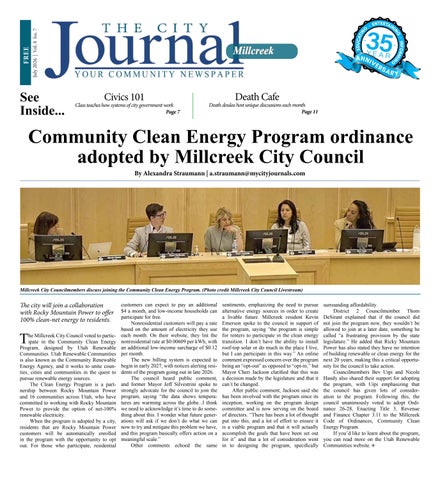
Millcreek City Councilmembers discuss joining the Community Clean Energy Program. (Photo credit Millcreek City Council Livestream)
The city will join a collaboration with Rocky Mountain Power to offer 100% clean-net energy to residents.
T
he Millcreek City Council voted to participate in the Community Clean Energy Program, designed by Utah Renewable Communities. Utah Renewable Communities is also known as the Community Renewable Energy Agency, and it works to unite counties, cities and communities in the quest to pursue renewable energy sources. The Clean Energy Program is a partnership between Rocky Mountain Power and 16 communities across Utah, who have committed to working with Rocky Mountain Power to provide the option of net-100% renewable electricity. When the program is adopted by a city, residents that are Rocky Mountain Power customers will be automatically enrolled in the program with the opportunity to opt out. For those who participate, residential
customers can expect to pay an additional $4 a month, and low-income households can participate for free. Nonresidential customers will pay a rate based on the amount of electricity they use each month. On their website, they list the nonresidential rate at $0.00609 per kWh, with an additional low-income surcharge of $0.12 per month. The new billing system is expected to begin in early 2027, with notices alerting residents of the program going out in late 2026. The council heard public comment, and former Mayor Jeff Silvestrini spoke to strongly advocate for the council to join the program, saying “the data shows temperatures are warming across the globe...I think we need to acknowledge it’s time to do something about this. I wonder what future generations will ask if we don’t do what we can now to try and mitigate this problem we have, and this program basically offers action on a meaningful scale.” Other comments echoed the same
sentiments, emphasizing the need to pursue alternative energy sources in order to create a livable future. Millcreek resident Kevin Emerson spoke to the council in support of the program, saying “the program is simple for renters to participate in the clean energy transition. I don’t have the ability to install roof-top solar or do much in the place I live, but I can participate in this way.” An online comment expressed concern over the program being an “opt-out” as opposed to “opt-in,” but Mayor Cheri Jackson clarified that this was a decision made by the legislature and that it can’t be changed. After public comment, Jackson said she has been involved with the program since its inception, working on the program design committee and is now serving on the board of directors. “There has been a lot of thought put into this, and a lot of effort to ensure it is a viable program and that it will actually accomplish the goals that have been set out for it” and that a lot of consideration went in to designing the program, specifically
surrounding affordability. District 2 Councilmember Thom DeSirant explained that if the council did not join the program now, they wouldn’t be allowed to join at a later date, something he called “a frustrating provision by the state legislature.” He added that Ricky Mountain Power has also stated they have no intention of building renewable or clean energy for the next 20 years, making this a critical opportunity for the council to take action. Councilmembers Bev Uipi and Nicole Handy also shared their support for adopting the program, with Uipi emphasizing that the council has given lots of consideration to the program. Following this, the council unanimously voted to adopt Ordinance 26-28, Enacting Title 3, Revenue and Finance Chapter 3.11 to the Millcreek Code of Ordinances, Community Clean Energy Program. If you’d like to learn about the program, you can read more on the Utah Renewable Communities website.l
SPONSORED CONTENT
Page 2 | July 2026
Millcreek City Journal
Home Remodeling D�n� R�ght! R�ght! Home Remodeling Right! Home RemodelingDone D�n�
FULL BATHROOM REMODELING • WALK-IN SHOWERS • BATHS • TUB TO SHOWER CONVERSION
Bathroom Remodeling Experts!
Exclusive Designs & Styles On-The-Spot Installation Scheduling Fully Licensed and Insured Highly Trained Employee Installers
LIMITED TIME OFFER! EXPIRES 7/31/2026
$ 1,500 OFF Bathroom Projects1
Flexible Financing Subject to credit approval
Evening & Weekend Appointments Available America’s Most Trusted Home Remodeling Brand
12 MONTHS
No Payments, No Interest 2
CALL OR VISIT US ONLINE TO GET STARTED!
Ready to Renovate?
SCAN BELOW
to schedule your appointment!
801-829-9924 WSHPromotion.com
New orders only. Offer not valid on previous sales or estimates and cannot be combined with other offers. See design consultant for details. Other restrictions may apply. Flooring jobs minimum 500 sq ft required. 1. $1,500 off. Discounts taken from 1 year price and applied before other promotional offers. 2. Financing offers a no payment - no interest feature (during the “promotional period”) on your purchase (at an APR of 13.99-23.99%, rates vary by state). No finance charges will accrue on your account during the promotional period, as set forth in your Truth in Lending Disclosures, and you will not have to pay a monthly payment until the promotional period has ended. If you repay your purchase in full before the end of the promotional period, you will not have to pay any finance charges. You may also prepay your account at any time without penalty. Financing is subject to credit requirements and satisfactory completion of finance documents. Any finance terms advertised are estimates only. Normal late charges apply once the promotional period has ended. Call 888-697-4033 for financing costs and terms. Expires 7/31/2026.
FULL BATHROOM REMODELING • WALK-IN SHOWERS • BATHS • TUB TO SHOWER CONVERSION
Bathroom Remodeling Experts!
Exclusive Designs & Styles On-The-Spot Installation Scheduling Fully Licensed and Insured
4660Trained South 200 West Highly Employee Installers
801-252-5962 Flexible Financing Subject to credit approval
Evening & Weekend Appointments Available America’s Most Trusted Home Remodeling Brand
Celebrating 31 Years Right In Your LIMITED TIME OFFER! Neighborhood! REPLENISH EXPIRES 7/31/2026
GARDEN PRODUCTS $LANDSCAPE 1,500 OFF
Selling Premium Landscape Materials in Murray 1 Bathroom • Barks •Projects Colored Mulches • Replenish Compost • Premium Soil Blends • Playground Chips • Sand - Gravel • Landscape Fabric & More
12 MONTHS
Available in: Small Bag - Bulk (loose) OR Super Big Bag (1 cubic yard)
No Payments, No Interest 2
CALL OR VISIT US ONLINE TO GET STARTED!
801-829-9924
DELIVERY OR PICK-UP
RECEIVE A
10% DISCOUNT ON ALL
WSHPromotion.com
New orders only. Offer not valid on previous sales or estimates and cannot be combined with other offers. See design consultant for details. Other restrictions may apply. Flooring jobs minimum 500 sq ft required. 1. $1,500 off. Discounts taken from 1 year price and applied before other promotional offers. 2. Financing offers a no payment - no interest feature (during the “promotional period”) on your purchase (at an APR of 13.99-23.99%, rates vary by state). No finance charges will accrue on your account during the promotional as set forth in your Truth in Lending Disclosures, and you will not have to pay a monthly payment until Mperiod, illcreek Journal .com the promotional period has ended. If you repay your purchase in full before the end of the promotional period, you will not have to pay any finance charges. You may also prepay your account at any time without penalty. Financing is subject to credit requirements and satisfactory completion of finance documents. Any finance terms advertised are estimates only. Normal late charges apply once the promotional period has ended. Call
801-252-5962
PRODUCTS & MATERIALS
replenishcompost.com
July 2026 | Page 3
COMMON GROUND
The Pot Calling the Kettle a Rainbow
Common Ground will be a column of rotating viewpoints that highlight specific feelings across the political spectrum, and it will always end with possible ways to come together. As normal for June in Utah, there was little rainfall, but that didn’t stop tears of the far left from crying throughout the month. What were they upset about this time? Gov. Cox decided June (2026) should be Fidelity Month. Did the left feel betrayed by one of their biggest supporters when he didn’t recognize their month-long orgy? His declaration reads: Whereas, a recent opinion poll of Americans showed that support for traditional values has significantly declined; Whereas, a majority of Americans no longer esteem values like faith, family, patriotism or community involvement; Whereas, fidelity means dedication to faith, family and country; Whereas, it is imperative that we recommit ourselves to the pursuit of fidelity; Whereas, John Adams, a founding father of the United States, said, ‘‘Our Constitution was made only for a moral and religious people. It is wholly inadequate to the government of any other.’’; Whereas, the survival of the United States depends on the shared bonds of faith, family and patriotism; and Whereas, it is fitting to observe one month each year to rededicate the United States to its core values; Now, therefore, I, Spencer J. Cox,
MILLCREEK TEAM
The Millcreek Journal is a monthly publication distributed directly to residents via the USPS as well as locations throughout Millcreek. The views and opinions expressed in display advertisements do not necessarily reflect or represent the views and opinions held by Loyal Perch Media or the City Journals. This publication may not be reproduced in whole or in part without the express written consent of the owner. © 2026 Loyal Perch Media, Inc.
John J. Walker Common Ground
governor of the great state of Utah, do hereby declare June, 2026 as Fidelity Month in Utah. If you imagined Gov. Cox activated his taxpayer-funded propaganda machine and waged war against the LGBTQ+ community by shoving his new declaration down everyone’s throat, it would be exactly that, your imagination. No politician has made such a lackluster declaration since Clinton used his air quotes. The Governor simply posted the declaration to his website. But that didn’t stop people from feeling butthurt about the proclamation. As if the Governor’s track record had been forgotten: 2021: The Governor declares the month of June, LGBTQ+ Pride Month in Utah. 2022: The Governor declares the month of June, LGBTQ+ Pride Month in Utah. 2023: The Governor declares the month of June, Pride Month in Utah. 2024: The Governor declares June the month of “Bridge Building”. 2025: No declaration by the Governor, but 42 miles south of the State Capitol Charlie Kirk, a right-wing political activist, was assassinated on Sept. 10. Note: the accused assassin may have been aligned with the LGBTQ community.
PUBLISHER
Bryan Scott | bryan.s@thecityjournals.com
EDITOR
Travis Barton | travis.b@thecityjournals.com
ADVERTISING EXECUTIVES
Mieka Sawatzki | mieka.s@thecityjournals.com Ryan Casper | ryan.c@thecityjournals.com Marc Davis | marc.d@thecityjournals.com
CLIENT SERVICES
Lydia Rice | lydia.r@thecityjournals.com 385-557-1022
2026: The Governor declares the month of June, Fidelity Month. Now, let’s look at the track record of the LGBTQ+ community for the same time period. 2021: They mock the LDS culture and religious community by creating an all-out effort to change Pioneer Day into Pie and Beer Day. 2022: They continue to mock LDS culture and community by creating an all-out effort to change Pioneer Day into Pie and Beer Day. 2023: They continue their mocking of the celebration of Pioneer Day. 2024: Continue mocking the celebration of Pioneer Day. 2025: Continue mocking the celebration of Pioneer Day. 2026: Continue their mocking celebration of Pioneer Day. It’s probably the most consistent aspect of their culture, in a world where they add new colors to their flag and their acronym gets so large they just add a + sign. To get respect, you might have to give a little. Common Ground: The current political environment has tricked us, leaving us with two polar options. Either we have to gay bash or we have to run through the street dressed like Richard Simmons, waving a rainbow flag. However, it seems like there’s a lot of ground in the middle. That ground might be the area most of us occupy. I think most Utahns can agree the
CIRCULATION COORDINATOR
Lindsay Andreasen | lindsay.a@thecityjournals.com Rack locations are also available on our website.
EDITORIAL & AD DESIGN Stacey LaMont Ty Gorton
MISSION STATEMENT
Our mission is to inform and entertain our community while promoting a strong local economy via relevant content presented across a synergetic network of print and digital media. Designed, Published, & Distributed by
MILLCREEK CITY JOURNAL
9500 South 500 West, Suite 205 Sandy, UT 84070
PHONE: 801-254-5974
EDUCATING, ENTERTAINING, INFORMING: 35 YEARS SUPPORTING COMMUNITY
Page 4 | July 2026
LGBTQ+ community should be recognized; they should be allowed to celebrate their community. But can we make it less about their sexuality and focus more on their suffrage, rights, and successes? Those things we can all celebrate. As a mutual sign of respect, can’t all members of the state come together to celebrate and balance religious aspects with the suffrage, rights and successes within the communities? Those celebrations leave room for the journey of the pioneers in the mid-1800s and the similarities to that of the LGBTQ+ community in the mid-to late 1900s. Both suffered persecution. Both fought the federal government’s overreach as to who they can marry. Should Utah celebrate Pride Month? Of course. Should the Governor have declared the month Pride Month? Maybe. He doesn’t own the month; he can declare it anything he wants and we can celebrate each day as we please. Equally important are values like faith, family, patriotism or community involvement. Are they currently at risk? Of course. Let’s celebrate those values. So thank you, Gov.Cox, for supporting these key values and declaring June Fidelity Month. Let’s celebrate it and next year let’s get even louder about our celebration, maybe a drone show over the Capitol or a UFC fight in the rotunda. Thank you, Governor, for supporting Pride Month for five years. We hope you have not given up on it, and our families and community.
FREE | COMMUNITY | PAPERS
Millcreek City Journal
AIR DUCT CLEANING What’s Hiding in Your
AIR VENTS?
We can sanitize your vents to help Strengthen your Immune System.
BACTERIA
DUST MITES
POLLEN
PET DANDER
ARE YOU EXPERIENCING:
• Allergies • Asthma • Headaches • Coughing/Sneezing • Excessive Dust?
Do you KNOW what your Family is Breathing? WE WILL BEAT ANY PRICE
W I T H S U P E R I O R Q UA L I T Y AIR DUCT CLEANING DRYER VENT CLEANING ASTHMA & ALLERGY TREATMENT
49
$
10 VENTS, 1 RETURN, AND 1 MAIN comes with free system analysis/inspection
Additional vents priced separately. With coupon. Call By 8/15/26.
FREE % 50 801-618-4649 www.apexcleanair.com
with any complete air duct system cleaning
With this coupon. Call By 8/15/26.
CALL US
TODAY!
DRYER VENT CLEANING
OFF
ALLERGY/ASTHMA DISINFECTANT with any complete duct cleaning
With this coupon. Call By 8/15/26.
MillcreekJournal .com
SUMMER CLEANOUT SPECIALS
100% GUARANTEED
July 2026 | Page 5
Millcreek residents with roots in Iran speak out about the current conflict in their homeland Millcreek residents express concern for family and friends in Iran, detailing the need for regime change and hope for a peaceful outcome by international pressure instead of military action. By Jolene Croasmun j.croasmun@mycityjournals.com
S
ince the overthrow of the Iranian government in 1979, many Iranians have been living abroad, including in Utah. While residents in Millcreek can feel the impact of the conflict with Iran in their pocketbooks, some local residents have more at stake. A local resident going by the name Pedram, to protect himself and his family, has been in the United States for decades. “I came before the revolution. I came here to go to university. I worked with American people in Iran. I started learning English and decided to get my education and go back to Iran because they had tons of opportunities for all educated people to build the country,” Pedram said. “Utah is very similar to my country, with the four seasons, snow and mountains. We love it here.” Pedram explained how important family is to their culture and that they are concerned about family and friends back in Iran. “We cannot call my family. The only way is if they buy a calling card and call us. Once a week a family member will call and let us know they are OK.” For Pedram’s family still living in Iran, life has not been easy. “The power goes on and off along with water and gas and yet Iran is sitting on the second biggest gas reserve,” Pedram said. “Yet after 47 years they have not created a good infrastructure for the gas, oil, the hospitals or roads. All the revenue they got from oil or some other minerals, they put it towards this militia group. In southern Lebanon this group is called Hezbollah and is associated with the Iranian regime.” “The regime doesn’t care about Iranian people at all. They think Iran is a treasure of the gods for them and not for the Iranian people,” Pedram added. Pedram’s wife Roya is also from Iran and she still has family there. “When the U.S. military and Israel attacked Iran at the end of February, a lot of people did not have the chance to leave. My family stayed,” Roya said. “They hear the bombs especially at night and they say, ‘We take a sleeping pill and we sleep, if we die, we die.’ But because the relatives are old and sick they cannot leave.” “During the time of the bombing, every place of business was closed. They only opened the shops for a few hours,” Roya said. “The food is available now but it is very
Page 6 | July 2026
The Ministry of Foreign Affairs building which displays European influenced architecture in Iran. (Pedram/Millcreek)
During the last visit to Iran, a Utah couple shopped at a nut and candy store. (Pedram/Millcreek)
expensive. For example a loaf of bread is twice as expensive as before the war started.” “The people are just in survival mode,” added Pedram. “My old friend there told me that they wish that a bomb would get rid of this regime,” Roya stated. “Yet my family does not have that same feeling and is afraid that somebody will come in and take over and not support the Iranian people and they worry about what will happen.” “Iranian people are fed up, they asked Trump and Israel to come help,” Pedram said. “I hope that somehow this government collapses. Right now we have a lot of political prisoners. I wish the whole world would not recognize this regime as a government and force this government to collapse,” Pedram said. “I was scared,” said Roya when she heard about the conflict starting. “Nobody wants a war. The people are suffering,” Roya went on to say that the Iranian people want what we all want—a home, family, good job and that Iranians are loving, peaceful and family oriented. “Hopefully one day Iranians can live in a free country,” Pedram expressed with great emotion about his homeland.
The couple had plans to go back to Iran to visit earlier this year until the conflict started. Both Pedram and Roya are retired and now have the time and can afford to travel. They want to explore parts of Iran and visit family and friends. For now, it is just not safe. Niala Masrouri has lived in Utah since 2001 and left Iran when she was 16 with her mother and sisters because of religious persecution. Masrouri still has family back in Iran and has only spoken to them twice since January. “We are called refugees of our religious belief, Baháʼí is our faith,” Masrouri said. “My religion suffers the most because the regime believes we are against Islam. We are socially and financially persecuted and Baháʼí youth are not allowed to continue education beyond high school.” “The internet blackout has been used against the people because the people are not able to organize,” Masrouri said. “Internet access is selectively given to regime sympathizers and it’s given to people who are paid to promote propaganda.” “The majority of the population wants this regime to be gone,” Masrouri stated. “The sanctions that are put on the people have benefited the regime. The only people that are
losing are the Iranian people. Regular people don’t have access to medication and the economy has collapsed.” “I think the Islamic Republic staying in power would be a catastrophe. There are insane numbers of executions and so many families were threatened to silence with the hope that their silence would help their loved ones but that didn’t help.” “Being an Iranian American you see the consequences of war and the financial cost of war and people around me are suffering too,” Masrouri said. “I still think international pressure will have a higher impact than bombing. Especially if other governments start to recognize how bad this government is,” Masrouri added. Masrouri helps translate information in Farsi that comes out of Iran. “It is important to have a person clearly translate the news and make it available. The international community on X needs to know what is going on. The Iranian people have very little access to the coverage of executions and of political prisoners. Nobody knows the real number of people who are in prison or killed for protesting,” Masrouri said. “People of Iran are fighting on two fronts, one is the active war and the other is they are still fighting against their own government and they are suffering and just surviving is very difficult for many of them.” “The war, the way it is going, there is no certain outcome, our economy is suffering, our troops are suffering. The U.S. will be left worse than it was when we went into this conflict. There is so much damage to infrastructure in Iran that it is going to take 20 years to fix,” Masrouri said. “We are all stuck on one boat and eventually it will go down.” l
Millcreek City Journal
Newly renovated playground unveiled at Big Cottonwood Regional Park East
As part of the upgrades, aging materials were exchanged in favor of modern, state-of-the-art equipment. By Lizzie Walje l.walje@mycityjournals.com
F
amilies in Millcreek can once again enjoy the playground at Big Cottonwood Regional Park East following extensive upgrades and renovations. Just in time for summer, the newly upgraded playground drew design inspiration from a nature-inspired treasure-hunt theme and offers tailored spaces for children ages 2-5 and older children ranging up to 12. Highlights include new climbing structures and slides, specialized swings and interactive play areas. The updated playground boasts a variety of climbing
structures and five unique slide options, including one slide that is wide enough to accommodate both parent and child in a side-by-side formation. Families can also use the face-to-face specialized swing seat that includes a built-in five-point harness ideal for children who need additional support during playtime. Another major upgrade comes in the form of the interactive play areas. The playground now features a music-making station, an integrated search-and-find activity, and a hand-cranked moving shadow windmill. Interactive play is often cited as an integral part of healthy childhood development as it simultaneously exercises the mind and body. Interactive play is one of the most effective ways for children to develop stronger neural connections which can lead to increased cognitive growth, language development, physical development and social and emotional
skill refinement. To commemorate the playground’s reopening, various members of both the Salt Lake County Council and Millcreek City Council attended a ribbon cutting ceremony on May 11. They were joined by Salt Lake County Mayor Jenny Wilson and Millcreek Mayor Cheri Jackson. Prior to the ribbon cutting, children were treated to an onsite library-style story time session in the park. Big Cottonwood Regional Park East, located in Millcreek, reflects the city’s continued growth and development since officially incorporating back in 2016. Jeff Silvestrini served as Millcreek’s first mayor until late 2025, when he was succeeded by Jackson. “Millcreek began as an idea — neighbors choosing to shape their own destiny. Ten years later, that spirit remains strong,” Jackson said. “Our city is growing wiser, more capable and more compassionate with each passing year.
Millcreek’s future is bright, not just because of what we will build, but because of who we are becoming together.” The new playground was funded through a partnership between the U.S. Department of Housing and Urban Development (HUD), Community Project Funding (CPF) and Salt Lake County’s Tourism, Recreation, Cultural and Convention (TRCC) fund. Through this alliance, the playground was able to undergo extensive renovations which included the replacement of aging materials in favor of modern, state-of-the-art equipment. Additional improvements made by Salt Lake County include parking lot upgrades, sidewalk repairs and a significant tree-planting initiative in partnership with Tree Utah, a local environmental nonprofit. The playground is located within Big Cottonwood Regional Park East at approximately 4657 S. 1590 East. l
Millcreek’s Civics 101 program engages the community
Hosted by Jeff Silvestrini, the sixweek class provided residents a chance to learn about systems of government. By Alexandra Straumann a.straumann@mycityjournals.com
W
hen Jeff Silvestrini announced his retirement as Millcreek mayor, he didn’t want to give up public service. After spending 10 years as mayor, he had developed a deep understanding of what people know about government, and more so, what they don’t know. “We had a town hall meeting with residents, it was really just an open forum where they could ask whatever they wanted to,” he said. “And what I learned from that, is people didn’t have a very good understanding about the roles of what the city does versus what the state does.” The result of this was Civics 101: A free, six-week program designed to educate people about the different responsibilities and logistics of government at all levels. The participants included people of all ages and base knowledge levels, brought together by their shared desire to better understand the systems of government that shape their lives every day. The program fostered an educational yet conversational environment, where participants were free to raise their hands and ask questions. Silvestrini said the program topics were picked based on his goal of wanting to increase the level of understanding people have about government systems. Educating the public about how government works feels especially important now as nationally, the American public is continually losing trust in the institutions designed to support them.
MillcreekJournal .com
Former mayor Jeff Silvestrini offers a Civics 101 class, a free six-week program. (Alexandra Straumann/City Journals)
“We live in a pretty tumultuous time politically, and many people don’t have trust in our institutions, particularly our government, and that makes me sad,” he said. For weeks one and two, the class discussed what each level of government is. They went over the various roles and responsibilities for each level of government, and how the local, state and federal governments work together to make progress, but can sometimes clash and create barriers for the other levels to succeed. Week three shifted focus from broader concepts to applying them locally and centered around how Millcreek’s government operates. Millcreek City Manager Mike Winder and Community Life Director Aimee McConkie attended as guest speakers to discuss city administration and how the city programs support public life and works throughout Millcreek. For week four, the class took a deeper look into Millcreek’s innerworkings, going
over the city departments and their various roles and responsibilities. Amy Winder Newton of the Salt Lake County Council was present and spoke to the class, giving a presentation about how Salt Lake County works and how taxes are collected and distributed at a county level. Also in attendance was Millcreek’s Unified Fire Authority liaison and the Executive Officer in the Millcreek police precinct, to talk about how police and fire use tax dollars to serve the community. In week five, the class heard from Millcreek’s planning director, building official, public works director and city engineer, who spoke about their roles and government and how public works operate. An example of this is how building codes are set by the state government, but Millcreek is responsible for enforcing it, and thus the responsibility to keep the city up to state regulations falls upon those in public works. For the final lesson, Silvestrini, with the help of Millcreek’s Financial Director
Lisa Dudley, went over Millcreek’s budget and explained how the city is responsible for managing money and making decisions related to tax, allocation of funds, and who is allowed to develop in Millcreek. “The budget exists to protect taxpayers,” Silvestrini said, “and to make sure that public money gets spent in an appropriate way with deliberation and forethought.” To help explain these complicated topics in just an hour and a half, Silvestrini and Dudley provided printed handouts to participants that included graphs illustrating how the Millcreek budget is allocated for the 2025-26 fiscal year. Additionally, they provided examples as to what considerations are made when allowing for new development for tax purposes. At the end of the session Silvestrini and participants remarked that the program was widely successful and a fun way to teach people about systems of government. Silvestrini said he was pleasantly surprised by how engaged the participants were each week and the level of consideration they gave when asking questions. On the success of the program he said, “I think what we hit on here was much more about the nitty gritty of what cities do and how they do it, than what you get in a civics class.” One participant said, regarding the subject matter, “so much of it is stuff I didn’t know I didn’t know.” While the program may be over, the participants and Silvestrini emphasized the value they all got from the program, and indicated they were interested in continuing the program at a later date and covering new subjects. Silvestrini was interested in knowing what the participants wanted to cover next, and for those interested in learning more about civics and how government works, he is welcoming topic submissions at: jlsilve@gmail.com. l
July 2026 | Page 7
Silvia Catten. (Photo credit Natalie Simpson)
Millcreek City Hall. (Alexandra Straumann/City Journals)
Millcreek City Councilmember Silvia Catten breaks down her political journey By Alexandra Straumann a.straumann@mycityjournals.com
M
illcreek City Councilmember Silvia Catten entered the race for Utah Senate District 13 with 10 years of experience serving as District 1 representative. Catten spoke with the City Journals a month before the June 23 election about her work with the council and how experiences have shaped her political perspective. City Journals: How did you start working in politics? Silvia Catten: Before we became a city, there were community councils that functioned through the county. I saw something in a newspaper about joining, and I was the youngest by far, I was 23, but I just kept showing up. After five years we voted on incorporating into a city and it failed, but when we tried again it passed. I thought it would be a way to do similar things but in an
Because Pets are Family Too! Cremation & Memorial Services by
385-243-7563 Page 8 | July 2026
official capacity, so I decided to run. CJ: It’s a very unique experience to be with a city through its creation and assist in that process. I’ve heard you and other councilmembers discuss wanting to keep a united vision for Millcreek, how have you approached this? SC: There’s a lot of respect for ideas and wanting to represent your area. Since the beginning all of the councilmembers have really considered how a project will affect other people, such as if we do a project in Mount Olympus, next year we’ll do a project in west Millcreek. We want equality and equity between our districts, sometimes it’s hard, but everyone coming from a position of already having worked in the community allowed us to come together for a single vision. CJ: Advocating for your own district while also thinking of the broader community is a delicate balance, what have you learned from doing this during your time with the city council?
SC: The senate district covers a large area, and each of those communities has distinct interests and priorities. Representing the west side of Millcreek has done me a great service in realizing there are some people who are louder about things than others. I want to make sure that everyone’s taken care of, but generally there is someone who will be unhappy when making policy decisions. When moving policy forward I recognize cooperation is needed, and we have to find a consensus. Working in the council has given me experience representing different groups of people in the same district. In my area there’s a lot of diversity, and I pride myself on representing a diverse group of people. CJ: When you’ve been engaging with your community, how have you approached learning the priorities of the groups of people in your district? SC: I’ve been asking people this whole campaign, “What’s important?” When I started collecting signatures in January and February, I’d knock on doors and people would ask what I thought about ICE and the detention centers. In May, everyone’s asking about the data center. That tells me people care about big state issues, and this was true in every community I visited. CJ: There are a lot of changes happening in Utah, one of those being an increasingly diverse population. You mentioned that your district is diverse, how has representing your district prepared you to represent the needs of a larger, ever-changing population? SC: I have a soft spot for the American Dream. I know that’s become a taboo thing, and I don’t believe the American Dream exists in the way it used to. Some people need social programs, and I wouldn’t be where I
am if my mom hadn’t relied on certain social structures and programs, but you have to balance understanding that some people don’t care about that. I feel like I have a good balance of identifying and understanding the needs of different groups of people. CJ: When the Salt Lake County Council decided to close four county-funded childcare centers there was a lot of backlash and expressing concerns over this decision. I know you spoke out against this decision, why did you decide to speak out? SC: One of the daycares that closed is in my neighborhood, and I have neighbors relying on it for childcare. I think about my own experience where I was in childcare and my mom didn’t have a choice, she relied on subsidized programs to go to work. I regret that the county shut them down without exploring every avenue to keep them open, and I think there’s more that could have been done. Certain county councilmembers thought it wasn’t a good use of taxpayer money, and I think the opposite. My neighbor said, “if the government doesn’t have a hand in organizing childcare so that we can work, then who’s responsibility is it if we can’t afford childcare,” and I said, she’s right. I expressed at the meeting that I wished they would have vcome to Millcreek, we would have worked to find a solution. I hope that the county explores further options, and I do think the state needs to get involved and assist in subsidizing childcare. CJ: It seems like there are a lot of young families and individuals wanting to establish roots in Millcreek, but can’t afford to settle in. SC: When we don’t have affordable housing, communities collapse, and we have to figure out how to make housing attainable
Millcreek City Journal
MURRAY CITY CULTURAL ARTS
2026
FREE SPECIAL EVENTS
Picnic On The Lawn Monday, August 24, 6-8 p.m. Murray Museum, 4872 Poplar St Dine And Dance – Swing Dance Friday, August 28, 6-8 p.m. Murray Armory, 246 E Myrtle Ave Get To The River - River Fest Saturday, September 12, 12-2 p.m. Winchester Park, 1250 W Winchester St. Dine And Dance – Silent Disco Friday, September 25, 6-8 p.m. Murray Armory, 246 Myrtle Ave
MURRAY FUN DAYS
Millcreek City logo. (Alexandra Straumann/City Journals)
for people, and the state has to step in. We have to figure out getting control of building costs and allowing cities to get creative with housing. There has to be some give and take, and it has to come from the state, in order for cities to feel like they can do things to fix affordability. It’s a really hard issue. CJ: As a city there is only so much you can do when you’re relying on the state. What have you taken from this experience? SC: Several years ago the state kind of forced cities to take a proactive stance in solving the housing crisis. They gave cities a list of around 20 things and required cities to do three, in Millcreek we took on around seven. I like legislation like this as it forces cities to take a look at what they’re doing and how they can fix larger problems. I don’t like when the state tells cities what they can and can’t do, that’s not helpful. Every city knows their identity and what they will and will not tolerate. CJ: Speaking more to that, in the senate you would be working with senators who have different ideas regarding the state and where they want it to go. How would you approach this kind of environment? SC: I think a lot of people don’t understand that when you’re a Democrat in a state like Utah, you spend a lot of time making bad policy less bad. I’ve always approached things like we should make friends along the way. I feel confident that I can stand my ground while also saying no, but to me it’s about compromise and understanding where
MillcreekJournal .com
people are coming from and why they might believe something. It’s not always going to be perfect, you’re in a bit of gridlock, but even those circumstances you can always come back and make something better. To me it’s about progress, not perfection. CJ: You serve on the Jordan River Commission, can you talk about that experience? SC: The commission has really informed what I want to do at the state with water and the Great Salt Lake, but it’s really informed my perspective on energy. We’re at a critical point in figuring out our water resources, but also at a critical point in figuring out power sources. All these things are connected. CJ: Could you elaborate more on how your time on the Jordan River Commission has impacted your views on water? SC: I didn’t realize how big of a problem water diversion is, specifically on the Jordan River. If we don’t have good water quality we don’t have solid eco systems on the river, which keeps water in the river, which leads to water in the Great Salt Lake. Serving on the Jordan River Commission has opened my eyes to the ways in which we use water in general. I think Utah is really ripe for a big reckoning on our water use, and I say that as a very broad thing across the entire state. It takes all of us. We live in a desert, we shouldn’t be having all these big green beautiful lawns, when you go to Arizona, they don’t have that. l
Saturday, July 4, 2026 Annual Chalk Art Contest (Pre-Register) 6 a.m.–2 p.m. Murray Armory, 246 Myrtle Ave Annual Plein Air Painting Contest 6:30 a.m.–1 p.m. Murray Armory, 246 Myrtle Ave Sunrise Service, 7 a.m. Murray Amphitheater, 495 5300 S Rotary Club Community Breakfast 6:30-10 a.m., Murray Park Pavilion #5 Entry Fee Required Races 5k Race, 8 a.m. Children’s Race (Ages 4-9), 9 a.m. Both Races Near Constitution Circle Parade, 8:30 a.m. Fashion Place To Murray Park Daytime Entertainment Heber Matute, 11:00 a.m. Flashback Brothers, 12:30 p.m. Murray Park Gazebo Evening Entertainment Hartley Road, 8:30 p.m. Firework Display, 10:00 p.m. Murray Park Softball Field For full list of activites and updates visit the qr code
JULY-SEPT s t n e v E
AMPHITHEATER For more show details & tickets, visit the qr code
Pirates Of Penzance August 7, 8, 10, 13, 14, 15, 8 p.m. Ronstadt Revival Saturday, September 5, 7 p.m. Always Tina: The Tribute To Tina Turner Saturday, September 12, 7 p.m. End Of The Line: Allman Brother Tribute Saturday, September 26, 7 p.m.
LUNCH CONCERTS
FREE, Murray Park Pavilion 5, 296 E Murray Park Ave Lonesome Folk July 7, 12 p.m. Rocksimile July 14, 12 p.m. Enny 1 July 21, 12 p.m. Craig Mecham July 28, 12 p.m.
THURSDAY MATINEES
FREE, Murray Park Pavilion 5, 296 E Murray Park Ave Patriotic Ensemble - Music July 2, 2 p.m. Ballet Center Inc - Dance July 9, 2 p.m. Paul Brewer - Magician July 16, 2 p.m. Angel Martinez - Music July 23, 2 p.m. Trash Panda – Drumming July 30, 2 p.m.
FAMILY NIGHT CONCERTS
FREE, Murray Senior Center, 10 E 6150 S Susie Brown July 13, 7 p.m. Pop-O-Gogo 60’S Band Aug 10, 7 p.m. The Ironport Band Sept 14, 7 p.m. Starlight Quartet Oct 12, 7 p.m.
For more information, call 801-264-2614 or visit https://www.murray.utah.gov/213/Cultural-Arts Sponsored by Murray City Cultural Arts, Murray Parks & Recreation, and Murray City Library. Murray Arts in the Park is supported with funding assistance by the residents of Salt Lake County, Salt Lake County Zoo, Arts, and Parks (ZAP), Utah Division of Arts and Museums, NowPlayingUtah.com, Utah Humanities and National Endowment for the Arts.
July 2026 | Page 9
Books are just the beginning at Millcreek Library Library manager Laura Renshaw says there is so much at your local library to help enrich your life. By Alexandra Straumann a.straumann@mycityjournals.com
M
any may think of libraries as just silent buildings full of books. But, for Laura Renshaw, the manager of Millcreek Library, books are “the tip of the iceberg.” “The books are great,” Renshaw said, “but there’s a lot more that can help your life and make your life more rich.” For the over 18,000 visitors the Millcreek Library gets each month, a visit to the information desk can get them book recommendations and a whole “library of things” including telescopes, pasta makers, Chromebooks, radon detectors and bird watching kits all available to check out for free with a library card. And that’s not all. Patrons can have unrestricted access to magazines, Consumer Reports, news outlets like the New York Times, personalized homework help with tutors, and the Job Now service, which offers resume assistance and career coaching.
Sure, e-books can be great, but sitting down with a child and reading, there’s just no substitute for that Laura Renshaw Last, but not least, the Millcreek Library offers books aplenty with everything from graphic novels to memoirs to cookbooks to fiction. Unfortunately, reading has become a less common activity for some. Nationwide, literacy rates are declining across all ages, and in Utah, about half of third-grade students are not reading at grade level. Knowing this, it is more important than ever to support early literacy development in children and to help maintain a reading habit throughout life. For children, the five components of early literacy are talking, reading, singing, writing and playing. Renshaw, who has worked in the Salt Lake County Library system for 13 years, said that libraries makes an effort to encourage parents and children to partake in each of these components. There are child-oriented spaces scattered throughout the library, with a dedicated play area with sensory objects, fun seating and a plethora of picture books.
Page 10 | July 2026
There’s also the “forest,” an area adorned with tall leaves and comfortable seats, giving parents the chance to engage with their children in a special, safe environment. “Sure, e-books can be great, but sitting down with a child and reading, there’s just no substitute for that,” Renshaw said. The library provides “story time to go” backpacks that each contain three books, toys that relate to the book’s theme, songs and activities for parents and children to connect through story telling. But for those that prefer using an e-reader, the county libraries offer one of the largest collection of e-books in the country, available through Libby. They also offer a selection of audio books for rental, with some being available on CD. For students, the library has a dedicated teen section, where teenagers can relax, use computers, and explore books tailored to a young adult audience. The area provides a refuge from the large library, allowing teenagers a sense of independence. Keeping teenagers interested in reading is a critical component of supporting their academic success. In 2023, the University of Utah partnered with Salt Lake County to study the correlation between participating in a library summer reading program and academic success. The study found that partaking in a summer reading program offset “summer slide,” an academic backtrack students experience when they come back to school after months without learning. The slide impacts student’s ability to start the year strongly, and for parents looking to set their children up for a successful school year, the library is a great place to start. This year, the summer reading program kicked off May 29 and runs until July 31, based on the theme “Unearth a story.” Each year the program sees approximately 3,000 participants and it’s designed for people of all ages to partake. To participate grab a reading record and complete the list of activities, which range from reading to spending time in nature. Upon completion of the program turn your record in for a pass to the Natural History Museum of Utah, a book of your choosing to keep, and the opportunity to enter in prize raffles. Aside from the cognitive benefits of reading, books provide readers of all ages the opportunity to better understand the world. “To me,” Renshaw said, “at any given time you could read a book and it will change the way you think. Reading lots of different things exposes you to all different kinds of people and different things in the world. I think it makes you a more accepting and compassionate person when you’re able to, through reading, experience other points of view.” The ability for young people to access such perspectives has changed. There has been
Millcreek Library manager Laura Renshaw. (Alexandra Straumann/City Journals)
an increasing rate of book banning taking place across the country. In Utah, 35 books have been banned from schools, 15 of which were banned this year. And while banning books takes them out of the classroom, banning a book creates an unintended consequence for those who wish to bury them: free publicity. “Banning books puts it on people’s radar,” Renshaw said, explaining that when books are banned, the library experiences an increased demand for those titles. “Feelings have changed about libraries for some people, some people are worried about books. To me, it’s sad. Everyone should be able to read about all kinds of people.” She said that when the library does receive complaints, it is not taken lightly,
and the staff does their due diligence to investigate the book and the subject of the complaint. The wonderful thing about the library though, is that there truly is something for everyone. There are knitting classes, cookbook clubs, read dogs, Lego nights and scavenger hunts, all designed to represent the interests of the community. When someone has an idea, the library seeks to support it in the best way they can. Learn more about the library by stopping by or visiting their website for information about upcoming events, summer reading and more here. Millcreek Library is at 2266 E. Evergreen Ave. (3435 South).l
Millcreek City Journal
Death doulas host a death-centered discussion group, dubbed a ‘Death Cafe’ Through creating a community focusing on death, HELD death doulas hope to help normalize this part of the human experience. By McKinna Baird m.baird@mycityjournals.com
O
n the last Wednesday of every month, The Lotus Center in Millcreek hosts a “Death Cafe.” This may not seem too strange, as the center also hosts grief support groups and workshops, but the Death Cafe is different. Instead of being a place to process grief, the Death Cafe is a place for people to gather for more philosophical discussions surrounding death and dying. The original Death Cafe was founded by a Swiss anthropologist in the early 2000s, but was brought to The Lotus Center by Jennie Carey. Carey is a trained death doula under the HELD doula services company, making her well-versed in the subjects of death and dying. “A death doula is a nonmedical practitioner who’s trained to sit in space or sit in relationship with someone who is suffering a terminal diagnosis,” is how Jude Higgins, Ph.D., doula and founder of HELD services defines a death doula. Carey decided to start the cafe as a way to help her navigate her own relationship with death, after experiencing chronic illness and the deaths of many people around her. “I’ve been next to my friends as they pass, starting at the age of 8, so it just felt like it was natural progression for me to then actually step into it and start to work on what death work actually looks like,” she said. Not everyone gets so many opportunities to see death up close like Carey, but she believes it is important to normalize death. “Death is a topic that scares everybody. Maybe [the cafe] is to soften it. The
Death Cafe to me seems a softer place to start,” Carey said. Higgins agrees that death and grief are heavily stigmatized in our society and considers the cafe a way to counter that. “I think there’s so much that we could do with changing the way we see death, the way we experience it, the way we’re so alone in it. It doesn’t have to be that way,” Higgins said. The actual meeting place is a dimly lit room with chairs arranged in a circle. The participating doulas have organized what looks like little shrines throughout the room with candles and flowers. A potluck is set up in the back of the room. Throughout the discussion, there are reminders to participants to nourish themselves. In that quiet space, participants share thoughts and pose questions. Carey can never say where a discussion will land, but she welcomes whatever comes out. “The space becomes sacred to me, because… it’s the joining of souls, ideas, thoughts, feelings, this human condition,” she explained. “It’s not segregated, it’s not picked apart, and to me that’s sacred to be able to just have each and every person step in and be OK with wherever they’re at right then.” Over time, the discussion group has garnered some regulars and become a monthly event that Carey’s fellow doulas look forward to. “What I want people to know about Death Cafe is it’s not as scary as it seems, it’s not as dark as it seems, and again, inevitably, it’s going to happen to all of us. So, why are we running from it? Come and be with people,” Carey said. The doulas who head these discussions are full of wisdom and experience with death, something so many people instinctively shy away from. Higgins describes the way we view death in our society as “sanitized” and hopes the Death Cafe can inspire people to accept it as one of the
A cafe shrine next to a potluck table. (McKinna Baird/City Journals)
most natural parts of life. “If I look at all the deaths I’ve had in my life, all the little deaths, those things had to happen, those deaths had to happen to make room for something new, and always something very different was birthed from the death of something,” Higgins said.
YOUR LOCAL TREE CARE EXPERTS! • TREE HEALTH CARE • TREE TRIMMING & REMOVAL • STUMP GRINDING • EMERGENCY TREE SERVICES • DEMOLITION
MillcreekJournal .com
Call Diamond Tree Experts Today!
801--938 801 938--4345
DiamondTreeExperts.com
“Whatever little deaths I’ve had, I feel like something beautiful has been born from that, and so that’s my feeling about death, and I think just a conversation about normalizing it is the start.” The Lotus Center is at 4376 S. 700 East, suite 200. l
TREE SERVICES
FREE
10% OFF
Green Waste Dumping
Must present coupon at time of purchase. Expires 8/15/26.
at Our Magna Yard 7774 West SR 201 Magna, UT
July 2026 | Page 11
Better Shelves. Custom Solutions. Say goodbye to clutter and frustration–wherever it lives. From kitchens and pantries to bathrooms and laundry rooms, ShelfGenie® custom pull-out shelves bring smart, accessible storage to every space in your home.
FREE EXPERT DESIGN CONSULTATION
A
250 VALUE
$
• Personalized 3D design • Custom-built to fit existing spaces • Fast, Professional installation • Lifetime Warranty* for peace of mind
Schedule Now by Calling
1-801-878-6917
AS SEEN IN
© 2025 ShelfGenie SPC LLC. All rights reserved. Locally owned and operated franchise. Offer valid at participating locations only. Limit one offer per household. *Applies to Classic and Designer line. EXP 6/30/2026.
Page 12 | July 2026
Millcreek City Journal
City Journals presents:
recreation A publication covering outdoor recreation around the Salt Lake Valley
Take a walk on the wild side By Peri Kinder | peri.k@thecityjournals.com Forest bathing is an invitation to fast-paced world.” The Japanese practice was created intentionally commune with nature. in the 1980s by doctors who noticed their If you’ve ever sat on the front porch to patients were experiencing burnout. They watch a sunset, enjoyed a cup of tea in the developed a prescription involving nature backyard or walked through a park to look connection that research has shown to offer mental and physical benefits. at the trees, you’ve done forest bathing. Napper invites people to attend a Ian Napper is a mindful outdoor guide who leads forest bathing sessions, also forest bathing experience which he holds at known as shinrin-yoku. He said commu- places along the Wasatch Range, including nion with nature comes easily to most canyons, parks and Tracy Aviary. Each people and the mental health benefits are event is around 90 minutes and Napper encourages participants to restore their off the chart. “It literally means to bathe in the sense of wonder, awe and community. “I’m trying to help people reconnect nature of the forest,” he said. “It invites you to slow down, like really deeply slow to nature in a personal way,” he said. “As down. The more you slow down, the more humans, we’ve become very isolated, you notice and the more you notice, then partly because of technology, but we expethe more you slow down. It helps us return rience this and there’s a connection that to a more natural pace, which is one of happens and it reduces this loneliness.” As an Army veteran and yoga the many things we need in this hyper,
instructor, Napper understands the grounding benefits of engaging with the natural world. He said some of those benefits include reduced stress, lower blood pressure, better sleep, reduced fatigue, a sense of peace and a settled nervous system. He holds his forest bathing sessions in places with lots of big trees, preferably near running water and away from man-made noise, which can be jarring to the mind. He said listening to birds or the wind in the trees, allows the body to relax in a way we don’t usually experience. People will ask him, “Why should I pay you when I can walk in the mountains for free?” He explains it’s the difference between taking a yoga class online and immersing yourself in a live class led by a trained guide. “You get instruction. You learn things that you wouldn’t have known before, because you get guidance,” Napper
said. “I have a master’s in education with a focus on trauma, and so I bring a lot of that understanding into this. It’s one thing to talk about things that I notice, it’s another thing to guide you into a different way of being.” Napper said learning to calm the mind and pay attention in nature takes practice; it can also bring up anxiety or judgment around being still. But as the practice continues, participants find it easier to attain a level of calm, and they want to bring friends and family into the experience. Some people think having idle time to walk around in a forest is a frivolous luxury, but Napper said that’s not true, in fact it’s just the opposite. “It might feel luxurious to schedule some time to do nothing but you’re giving yourself permission to go out in nature and do nothing for a while. It’s not a luxury; it’s kind of a necessity.”
Ian Napper leads groups through forest bathing sessions in canyons and parks as a way to reduce stress and build connection. (Photos courtesy of Ian Napper)
MillcreekJournal .com
July 2026 | Page 13
Shifting gears: Utah enacts new e-bike rules By Shaun Delliskave | s.delliskave@mycityjournals.com One new rule will see riders ages 8 micromobility,” Begay said. “Micromoto 15 needing to complete a state-ap- bility being battery powered vehicles, also known as scooters, e-bikes, e-moto, proved safety course. hoverboards and similar devices. We Whether climbing mountain trails, have seen the supply and demand grow commuting to work or cruising through exponentially.” According to Begay, improvements neighborhood streets, e-bikes are becoming an increasingly common part in battery technology, performance and of life in Utah. Their growing presence has affordability have transformed the market prompted lawmakers to adopt new regu- over the past decade. As demand increased, manufacturers lations aimed at balancing safety, access responded with a growing number of and the future of outdoor recreation. The law arrives at a time when the brands and product offerings. However, broader micromobility industry—which Begay noted that rapid growth has also includes e-bikes, electric scooters, e-mo- created new challenges. “This rapid development in the last torcycles and similar devices—has expedecade has largely been unregulated and rienced explosive growth nationwide. Jeremy Begay, an e-bike enthusiast it feels a bit like the Wild West,” he said. who works in the outdoor recreation “The list of issues we are facing ranges industry, said advances in technology from batteries being a fire hazard, trail and manufacturing have fueled much of access, the speed of these devices, and the race of manufacturers to create a that expansion. “There are several movements platform that is faster, better and cheaper nationwide in industry, retail and outdoor than its competitor,” Begay said. Utah’s new law seeks to address recreation when it comes to the world of some of those concerns by reinforcing the state’s existing three-class e-bike system while drawing a sharper line between electric bicycles and higher-powered electric motorcycles. Under the law, Class 1 e-bikes provide pedal assistance up to 20 miles per hour. Class 2 e-bikes may include a throttle and are limited to 20 miles per hour. Class 3 e-bikes provide pedal assistance up to 28 miles per hour and require a speedometer. Devices exceeding those limits may be classified differently under state law and could be subject to additional requirements. The legislation also establishes new age-based restrictions. Children younger than 8 years old are prohibited from operating e-bikes on public roads, sidewalks and trails. Riders younger than 14 must be supervised by a parent or guardian, while riders under 16 are prohibited from operating Class 3 e-bikes. Additionally, riders younger than 21 are now required to wear helmets while operating e-bikes or electric scooters on public roads. Beginning in 2027, Utah will also require riders ages 8 through 15 to complete a state-approved safety course or ride under direct adult supervision. For Begay, the new regulations represent a reasonable first step toward addressing safety concerns while preserving access to the benefits of micromobility. “The simple answer to this for me is Quick fact sheet on Utah’s new e-bike law. yes,” he said when asked whether the (Shaun Delliskave/City Journals) law strikes the right balance between
Page 14 | July 2026
E-bike enthusiast Jeremy Begay takes his bike for a spin. (Shaun Delliskave/City Journals) safety and accessibility. “We need to start somewhere for the purpose of making people aware that micromobility devices are different, so that they can then educate themselves with how to interact with them.” Begay believes many consumers still lump all electric mobility products into a single category despite significant differences in performance and intended use. “The purist in me wants to see a difference in how e-moto and e-bike are treated,” he said. “Currently, people see these as one category.” Trail access remains one of the most debated issues within Utah’s outdoor recreation community. As electric bicycles become more common, land managers, municipalities and trail organizations continue to evaluate where different classes of e-bikes should be permitted. “This is still being debated, so there is a whole spectrum of opinions,” Begay said. He has observed changing attitudes among many outdoor recreation users. “I think people’s ideas about e-bikes are changing and more people are finding that these bikes allow for more people to ride,” he said. Begay noted that the popularity of e-bikes has expanded participation among older riders, individuals recovering from injuries and people who might otherwise be unable to enjoy cycling. “This new market of people who are riding are pushing access simply by riding,” he said. “Trails are becoming more crowded and municipalities are responding to trail demand by creating more trails and trails that are e-bike accessible.” State officials have cited increasing crash and injury reports involving younger riders as one reason for strengthening
regulations. Begay believes education remains one of the biggest challenges facing the industry. “Unfortunately, I have not seen changes in behavior with families yet,” he said. “With micromobility being somewhat new to the masses, there has not been enough education.” He said many consumers still view electric mobility devices as toys rather than transportation equipment capable of reaching significant speeds. “Most people categorize these devices as children’s toys or other light recreation devices,” Begay said. “This leads to people not enforcing rules of the road, helmet safety, product care and other best practices.” He hopes the new law will help raise awareness. “Hopefully, these laws will create more awareness to what people are purchasing,” he said. “Awareness and education lead to more responsible decisions.” Looking ahead, Begay believes Utah’s reputation as an outdoor recreation leader positions the state to influence future policy discussions nationwide. “Utah is known for its access to outdoor recreation,” he said. “Most of that comes from Utah being a model state in the way it approaches recreation.” While debate over trail access, safety standards and regulation is likely to continue, Begay remains optimistic about the future. “I think that Utah should be at the forefront of all of this because it would mean that everyone could benefit— riders, retailers and tourism,” he said. “I’m confident that we Utahns will find a place for micromobility devices to exist in all spaces.”
Millcreek City Journal
Trading screen time for trail time: Why more families are heading outdoors this summer By Holly Curby | hello@hollycurby.com What are children missing when childhood and adolescence are critical periods of brain development. During the screens occupy more of their free time? middle school years, the brain undergoes With school out and long summer a process of strengthening frequently used days stretching ahead, families are looking pathways while pruning away those that are for ways to keep kids active, engaged and neglected. “If your kid is doing music and school healthy. For many parents, summer presents an opportunity to swap screen time for and sports, then those are the things that are trail time, replacing hours spent on phones, going to be strengthened,” she said. “But if tablets and video games with hiking, biking, your kid is sitting on the couch and playing video games, then those are the things that fishing and outdoor adventure. The challenge, however, is that tech- are being strengthened.” That reality has prompted some families nology has become deeply woven into children’s daily lives. Author and parenting to rethink how they spend their summers. expert Arlene Pellicane highlights just how Instead of defaulting to screens, parents dramatically technology use has increased are intentionally creating opportunities for among young people. She notes that smart- outdoor adventure. Whether it’s hiking a local phone ownership among teens surged from trail, exploring one of our many national park, 41% in 2012 to 89% by 2018. During that paddling a lake, fishing, mountain biking or same period, the percentage of teens using simply walking the neighborhood, outdoor social media multiple times a day rose from recreation provides something screens cannot: direct engagement with the world. 34% to 70%. Research has long connected outdoor For many parents, those numbers raise an important question: What are children activity with improved physical health, better missing when screens occupy more of their sleep and stronger social skills. Pellicane free time? According to Pellicane, one of the emphasized that children benefit from faceearliest warning signs of excessive screen to-face interaction and experiences that use is a loss of interest in real-world activities. require movement, communication and “If your child used to love playing soccer, but problem-solving. “In the absence of elecnow it’s like, ‘I’d rather just stay home,’ and tronics, guess what? They’ll go out and play, you know they’re gaming instead, that’s a they’ll go build, they’ll do different things,” she said. red flag,” she said. Some families are taking that advice Outdoor recreation advocates say that observation reflects a larger trend. Activi- literally. Pellicane described implementing ties that once happened naturally such as what she calls a “digital Sabbath,” a recurpickup games at the park, bike rides with ring period when screens are set aside and friends, neighborhood exploration and family other activities take center stage. “It could be hikes, now compete with endless digital Sunday afternoon where everyone’s offline and you go to the park instead,” she said. “A entertainment. The consequences extend beyond rhythm of forcibly getting off is helpful.” For outdoor enthusiasts, that idea resophysical activity. Pellicane explained that nates. Recreation experts often point out that children do not need elaborate adventures to benefit from time outside. A picnic, an afternoon of kayaking, a game of Ultimate Frisbee, an evening bike ride or a visit to a local trail can help families reconnect without the distractions of phones and social media. Parents may also find comfort in knowing they are not alone. While social media can create pressure to stay constantly connected, Pellicane argues that meaningful relationships are built through real-life experiences. “I’d rather have one person in real life say, ‘You’re a good person, and I’m glad you’re in my life,’ than have all these followers,” she said. As summer unfolds, families have a unique opportunity to create memories that don’t require Wi-Fi or a charging cable. Whether it’s introducing a child to their first hiking trail, teaching them how to cast a fishing line, or simply spending The best part of hiking isn’t always the destimore evenings outdoors together, these nation, it’s everything you discover along the experiences can help build confidence, way. (Courtesy Holly Curby)
MillcreekJournal .com
Whether casting for the first time or continuing a longtime tradition, anglers find recreation, relaxation and connection on the water. (Courtesy Holly Curby)
Paddleboarding provides time outdoors, enjoyment of scenery and creates lasting memories together. (Courtesy Holly Curby)
strengthen relationships and encourage healthy habits that last well beyond the summer months. For more insights on helping children develop a healthy relationship with technology while making room for real-world experiences, listen to the full interview
with Arlene Pellicane on Holly’s Highlights Podcast, Season 2, Episode 29 available on Spotify, Apple Podcasts and at www.HollyCurby.com. Her practical advice offers valuable guidance for parents seeking to raise healthy, connected kids and perhaps spend a little more time outdoors along the way.
You care about the future. I care about you. People caring about people is a powerful thing. That’s why I take time to get to know you and your needs. Let’s connect. You talk and I’ll listen – the way it should be. Felicia Wright 9865 S. State S., Sandy, UT 801.233.3176 agentfeliciawright.com
Auto | Home | Life | Business | Farm & Ranch Registered Representative/Securities & services offered through FBL Marketing Services, LLC,+ 5400 University Ave., West Des Moines, IA 50266, 877/860-2904, Member SIPC. Farm Bureau Property & Casualty Insurance Company,+* Western Agricultural Insurance Company,+* Farm Bureau Life Insurance Company+*/West Des Moines, IA. +Affiliates. *Company providers of Farm Bureau Financial Services. PR-GB-A (4-25)
July 2026 | Page 15
Report finds major salary gap between Utah teachers and administrators On average, administrators earn some 61% more than their teaching counterparts according to a report which analyzed data provided by the Utah State Board of Education. By Lizzie Walje l.walje@mycityjournals.com
A
recent report published by the Utah Taxpayers Association found that school administrators in Utah earn, on average, 61% more than their teacher counterparts. The report, which was released in early May 2026, compiled and analyzed data provided by the Utah State Board of Education. Rather than attempting to cover all aspects of statewide education expenditures, the report focused on comparing spending trends among Utah’s local education agencies, including the state’s 41 public school districts and 113 charters. The Utah Taxpayers Association is a nonpartisan and nonprofit advocacy group that was founded in 1922. Since their formation, the association has operated as a watchdog group, specifically focusing on overseeing local government spending, taxation and debt in the state of Utah. Utah taxpayers funnel a significant amount of funding into public education, which continues to be one of the largest recipients of taxpayer dollars. In addition to revealing the pay gap disparity between teachers and administrators, the report also outlined enrollment figures. According to the data provided by the Utah State Board of Education, K-12 enrollment continues to decline statewide. Declining enrollment has been an ongoing issue for numerous districts across the state, and the latest data reveals that in 2026, enrollment is down by 11,542 students compared to the previous year. Beaver, Grand County, Logan and Tooele are the only school districts in the state that reported positive growth. The remaining 40 districts either reported no change in enrollment or a decrease in enrollment. As statewide student enrollment continues to decline, tax revenue and per-student spending have both increased. Compared to the 2024 fiscal year, per-student spending has now increased to $750. Instruction, administration and facility construction are the driving forces behind the increase. The report also revealed that in 2026, the weighted-average teacher salary in Utah is $71,456, however, that number can vary significantly based on the individual school district. “Taxpayers expect education dollars to be focused on student outcomes in the classrooms,” stated Utah Taxpayers Association President Billy Hesterman. “When administrators are paid significantly more than teachers and fewer than half of school employees are in the classroom, it raises important questions about how that is being accomplished.”
Page 16 | July 2026
Utah education administrators earn on average 61% more than their teaching counterparts. (Adobe Stock Photo)
At the time of publication, the Utah State Board of Education had not released a formal response or statement regarding the Utah Taxpayers Association report. However, during a May 7 Utah State Board of Education meeting, the board’s chair report, presented by Chairman Matt Hymas, discussed the board’s fiscal goals for 2027. “We don’t want to just throw out finance requests, we want to say, well, where’s that money coming from? We want to work hard to make sure that we’re in line with the legislators when we ask for money, that it’s not just a money tree we’re pulling from.” Despite the recent conclusion of the 2026 Utah legislative session earlier this year, the Utah State Board of Education is already working to outline its goals for the next legislative session, which will begin in January 2027. During that meeting, the board voted on whether to adopt the proposed State Fiscal Year 2027 Public Education Budget following a review by the Finance Committee. In a near-unanimous vote, only one board member voted against budget adoption. As of now, it does not appear that the board is considering implementing any significant administrator or teacher salary changes. Rather, the key areas of increased funding appear to be focused on investing in Utah’s students and residents through literacy, student success, strong families and volunteerism. Currently, 64% of general education funding in Utah is allocated
toward instruction, which encompasses teacher salaries, classroom resources and other student-focused educational expenditures. The pay gap between administrators and teachers in Utah typically falls around $40,000. According to Hesterman, these are not novel findings, as a substantial pay gap between administrators and teachers has existed for a considerable amount of time already. However, the latest numbers decidedly caught his attention. The association found that the average public or charter school teacher earns slightly more than $75,000 annually, while the average administrator earns roughly $115,000 per year. “What stood out to us definitely is how much more the administrators are making over the teachers. But also, it’s expected, right?” Hesterman said. “There is some element of someone as they climb the ladder is going to make more money. It just seemed like a figure, maybe a little bit higher than what we would think taxpayers would expect.” Hesterman clarified that the growing pay gap does not automatically indicate a misuse of taxpayer funds. To that point, the pay gap between administrators and teachers only increased by 1% over the past fiscal year. Compared to teachers, administrators have historically received higher salaries for a multitude of reasons. On average, administrators typically oversee much larger operational responsibilities, including budgets, staffing, disciplinary matters and legal compliance.
Certain administrative positions also require additional licensing, graduate degrees or, in some cases, prior teaching experience. “We know [administrators are] leading a large organization and so we have to take that into account,” Hesterman said. “But again, this is still taxpayer dollars. This is still money that’s being spent on making sure that the schools run. And the focus needs to be on ‘How are we getting good student outcomes,’ not, ‘How are we paying people more money?’” At the same time, compared to previous years, teachers have seen higher wage increases. Mostly, these increases can be attributed to the passing of HB215 by the Utah State Legislature in 2023. HB215 gave licensed educators a $6,000 pay raise. Hesterman also noticed that compared to a decade ago, teacher salaries have largely increased across the state. Ultimately, Hesterman hopes the board can continue to invest in students and help them achieve the best outcomes possible. Hesterman stated that instruction is an instrumental component to helping students excel in and out of the classroom. “Our hope is that we’ll see a refocus by the school boards across the state to look at this and say, ‘You know, maybe that percentage is a little too high,” Hesterman said. “We do want to figure out what are the best ways to help our students succeed then how to pay our administrators more.” l
Millcreek City Journal
Skyline, Olympus (seen here in 2019), fared well in track and field. (File photo City Journals)
Olympus, Skyline track and field fare well at 5A state championships Titan girls relay teams bring home silver, bronze while Skyline freshman Valeska Stoltenow earns gold in high jump. By Brian Shaw b.shaw@mycityjournals.com
F
or the Olympus Titans 4x200 girls relay team, well, they were going back to the site of their last setback. Keep in mind that this was a group that, going into state, had something to prove; they’d just finished 13th at the BYU Invitational May 1, and then were eighth at the only meet in which they competed in the 4x200 in April, the Alpha Invitational. These results were far cries from the second place the Titans earned back in March at the Taylorsville Invitational. And yet, when it mattered most, these Olympus girls put it all together at the right moment to go home with a silver medal in Utah County at these state championships. The Titan girls crossed the finish in 1 minute and 44 seconds, their best result in over a month as a team. It set a 4x200 meter school record, improving upon last year’s mark at state by more than four seconds. In the 4x100 at state, the Olympus girls received a bronze medal for their efforts, crossing the finish line in a time of 48.96 seconds. It also set a school record and shaved nearly one-half second off the previous mark achieved back in 2023. The Titan girls then came in eighth in the 4x800, marking the third race in three that Olympus finished in the top eight at state. As for the Skyline Eagles girls, they went up and up to find their prize. That said, Olympus would be in that vicinity, for in the high jump, it was a rivalry like no other as Skyline freshman Valeska Stoltenow would outleap Olympus senior Sarah Kellogg by the smallest of margins to capture gold. Both jumped 5’04.0, however, it was Stoltenow who received two more points over the
MillcreekJournal .com
course of these state championships to claim the victory. There would be many rivalry battles at other track and field events on the girls side, as Skyline junior Eliza Mildon would get sixth place (15.60 seconds) in the 100 hurdles, finishing .31 faster than Olympus senior August Bigler, who came in seventh. Mildon also grabbed another sixth- place ribbon in the 300 hurdles. In the girls distance events, it was Skyline junior Hailee Sullivan reigning supreme, as she won bronze in the 800 meter race, reaching for the finish in a time of 2 minutes, 14 seconds. She was also fourth in the 1600 (5:02.32) and fifth in the 3200, crossing in 10:54.04. Skyline senior Mia Johnson had already set a school record in the discus on May 7, throwing it 126’0. At state, Johnson finished in fourth place (116’0). As a team, the Skyline girls had a successful state championship run, finishing fifth among all Class 5A teams with a total score of 41. On the boys side, you didn’t see any heated rivalry battles such as the one witnessed in the girls high jump, but you did see some great performances, particularly in the distance races. In the 1600 meters, Skyline senior Ezra Heckmann brought home a silver medal, crossing in 4 minutes, 16 seconds. He’d finish in sixth place in the 800 in 1:55.20. In addition, senior Alex Brown took the Eagles second sixth-place ribbon of the day in the 400 (49.59 seconds). As a team, the Eagles also had a sixthplace result in the 4x400 relay, reaching the finish line in 3 minutes and 23 seconds. For the Olympus Titans boys, two underclassmen finished in the top eight at state. Junior Beckham Allred blazed past the line for a sixth-place ribbon in 11.15 seconds in the 100 meter race, and in the 3200, junior William Towers came into the finish in a time of 9 minutes, 27 seconds in eighth place. l
For 140 years, families have come to trust Larkin Mortuary as the leading funeral service provider along the Wasatch Front. Family owned and managed for seven generations, Larkin provides a full spectrum of end-of-life services from funeral and graveside amenities, cremation facilities, two cemeteries, indoor and outdoor mausoleums, cremation niches and scattering gardens. Larkin’s vertically integrated services also offers a premier floral shop, monument, urn and vault manufacturing facilities, along with beautiful memorial meeting and luncheon facilities for celebration of life services. Multilingual staff honor and facilitate important traditions of many cultures.
LOCAL FAMILY OWNED & OPERATED Taking Care of your Family’s Needs every step of the way
Larkin Mortuary - Downtown
Larkin Sunset Lawn
260 East South Temple Salt Lake City, UT 84111 (801) 363-5781
2350 East 1300 South Salt Lake City, UT 84108 (801) 582-1582
Larkin Sunset Gardens
Larkin Mortuary - Riverton
1950 East Dimple Dell Rd (10600 S) Sandy, UT 84092 (801) 571-2771
LarkinMortuary.com
3688 West 12600 South Riverton, UT 84065 (801) 254-4850
For more information about preplanning visit
July 2026 | Page 17
Utah Board of Education releases updated AI policy framework
Additionally, they have created an AI task force, focusing on addressing the growing concern of AI in classrooms. By Lizzie Walje l.walje@mycityjournals.com
L
ike many governing entities, The Utah Board of Education is currently grappling with Artificial Intelligence, specifically, how it can ethically be integrated into Utah classrooms. As of May 2026, the board has officially released an update to their statewide framework regarding AI. The updates come on the heels of existing protocol which was first established in 2024. The Utah Board of Education seems to have taken a careful yet calculated approach to AI integration, acknowledging that when used intentionally and ethically, AI can serve as a tool for educators, faculty and students. The challenge, however, lies in creating a workable framework. “Generative AI systems in education can help educators and learners create documents, refine data, and collaboratively create materials. Generative AI systems are a developing technology whose output may be inaccurate, misleading, or incomplete. USBE’s Steering Committee for Artificial Intelligence (SCAI) monitors AI in education for potential benefits and to safeguard students and educators from harm created by AI,” states an except on the Utah Board of Education’s website. The Utah State Board of Education has extensively outlined its updated AI framework for K-12 students in a document available for download on its website. The framework addresses a variety of factors related to academic AI integration, including how to use AI ethically and when its use is prohibited. According to the board’s guidelines, AI may be used in academic settings to aid student learning, supplement teaching methods, manage school operations and support communities and families. The document cites research assistance, improved communication between faculty and students, and enhanced safety alerts as appropriate applications of AI. On the other hand, the board clarified that implementing AI for the purposes of bullying, cheating and plagiarism are strictly prohibited. Their framework further emphasizes that AI should not be considered completely authoritative or reliable, considering that AI is subject to providing misinformation or information that lacks important context. “Users should realize that all data needs to be verified and not to accept what comes in results as truth. AI tools trained on human data will inherently reflect societal biases in the data. Risks include reinforcing stereotypes, recommending inappropriate educational interventions, or making discriminatory
Page 18 | July 2026
The Utah Board of Education recently released their updated AI policy framework, which is not technically mandated, but encouraged to be used as guidelines for institutions. (Pixabay/Stock Image)
evaluations, such as falsely reporting plagiarism by non-native English speakers,” the document states. Integrating AI into school settings has proven a challenging and nuanced task. For many governing authorities, including the Utah Board of Education, the new standard for combatting AI appears to be focused on ethical integration rather than outright prohibition. Many institutions across the nation have softened their original stances on AI, after observing just how pervasive it’s become in academics. The issue is further compounded by the fact that the United States, writ large, is currently grappling with a literacy crisis. Utah’s own literacy crisis made headlines earlier this year when a study released by the Kem C. Gardner Policy Institute at the University of Utah reported that only 50.3% of third graders in the state of Utah are reaching grade-level appropriate reading proficiency. Unfortunately, the literacy issue plaguing the United States is multifaceted and likely the result of numerous intersecting factors. However, many teachers have pointed to AI as a potential contributing reason as to why students are falling behind. For many students, the allure of AI’s ability to deliver content almost instantaneously has proven too difficult to resist. In April 2026, The New York Times published an article based on over 400 interviews conducted with students and teachers across the nation. The piece sought to shed
light on how educators and students are navigating the growing role of artificial intelligence in the classroom, a force that has impacted nearly every facet of modern learning. AI’s influence is especially concerning when it comes to essay writing, a skill long used to gauge reading comprehension, develop research abilities, and cultivate the formation of arguments supported by evidence. Teachers across the nation have continually reported issues surrounding student essay writing, particularly when essays are assigned as homework. Many educators who initially relied on AI detection software to monitor take-home assignments have since abandoned such tools after discovering they are frequently inaccurate and capable of falsely flagging original student work. In search of workable solutions, many teachers have gravitated toward traditional methods: timed essays written in the classroom using pen and paper. Given the overwhelming presence of technology in modern classrooms, requiring students to write essays using pen and paper might initially seem counterintuitive. However, both students and teachers have praised the approach. The pen and paper methodology has already proven useful in various educational contexts, including at community colleges and Ivy League institutions. Of course, the timed pen and paper method isn’t without its own challenges, among them, varying degrees of student penmanship. However, many educators and
students feel it is a worthwhile trade-off. “If there is a downside, it is that today’s teenagers have little experience writing with pens and pencils. Their handwriting can be atrocious. Still, many educators said they were willing to deal with that inconvenience in order to ensure they were grading authentic student work,” The New York Times article explained. Back in Utah, more guardrails are being put in place to manage AI. Despite the board’s updated framework, AI will only continue to advance, creating the need for continued revisions to existing policy. To help oversee the task of AI reform, the Utah Board of Education has created a designated AI task force. Matthew Winters, a Utah Board of Education AI Specialist, emphasized the board’s desire to prioritize teacher freedom and personal discretion when it comes to AI usage in the classroom. “Artificial intelligence is one tool in a larger toolbox that a teacher has or a school has to support their students in their learning process,” Winters said. “Whether it be critical thinking or literacy.” Winters further clarified that the board’s newest AI policy document is not mandatory, but rather a framework intended to help guide schools, teachers and students on best practices regarding AI. Winters maintained that schools and educators should determine which aspects of the framework to adopt, highlighting the importance of preserving control at the local level.l
Millcreek City Journal
Data released by the Utah State Board of Education reveals two districts in Davis County and Washington County are responsible for the majority of statewide book bans. (Stock Image)
Data shows majority of Utah’s educational book bans originate from two districts Data shows majority of Utah’s educational book bans originate from two districts By Lizzie Walje l.walje@mycityjournals.com
A
s of June 2026, a total of 34 books and counting have been banned in Utah’s public schools. Toni Morrison’s 1970 debut novel, “The Bluest Eye” is the latest book ordered for statewide removal. “The Bluest Eye” explores a handful of themes including racism, abuse and the function of beauty, gender and socioeconomic class in society. Over the course of her career Morrison garnered attention when she became the first Black female writer to win a Nobel Prize in literature in 1993. According to data compiled by PEN America, a nonprofit that focuses on preserving free speech, particularly as it pertains to journalism and literature, Florida, Texas and Tennessee currently lead the charge in book censorship. Those three states alone account for over 80% of all public school book bans nationwide. However, Utah consistently ranks as one of the nation’s leading states for public school book bans, particularly when adjusted for population size and statewide enforcement policies. Utah has some of the most expansive statewide restriction policies in the United States. In 2024, Gov. Spencer Cox signed House Bill 29 into law. That particular legislation allows a single book to be removed from all Utah public schools if at least three school districts, or two school districts and five charter schools, determine that it contains “objective sensitive material.”
MillcreekJournal .com
Before it was officially signed into law, HB29 was considered controversial and received widespread criticism from various local and national organizations, including PEN America. Many opponents expressed concerns over its highly restrictive nature and worried it would allow for a handful of school districts to make decisions for the majority of the state. Back in 2024, Rep. Carol Spackman Moss, D-Holladay, a former teacher, heavily criticized the bill. “This is the antithesis of local control,” Spackman Moss said. “With this bill, just a couple of individuals can take away the rights of parents statewide to make choices that best fit their children’s needs.” Despite the vocal response from opponents, the bill received overwhelming support among policymakers. While adversaries argued the policy was overreaching and limiting, many legislators felt the bill was a step in the right direction. They believed the legislation would help protect students from exposure to explicit content or “objective sensitive material.” Many schools along the Wasatch Front, where the state’s most populous districts are located, have since been required to remove all 34 restricted titles from their institutions despite never independently challenging or reviewing most of the books themselves. Rather, every single book ban thus far has originated from one of nine school districts within the state. For reference, the state of Utah has 41 school districts. The Utah State Board of Education has compiled an online database that lists each of the titles that are now banned in Utah’s public schools. Among them are “The Handmaid’s Tale” by Margaret Atwood; “A Stolen Life: A Memoir” by Jaycee Dugard; “Milk and
Honey” by Rupi Kaur; and “Wicked: The Life and Times of the Wicked Witch of the West” by Gregory Maguire. In addition to the titles themselves, the database also details which districts originally requested the books removal and notes exactly when the threshold for statewide removal was met. Two districts in Davis County and Washington County appear more frequently than any other districts in the state. As of June 2026, all 34 books banned in Utah have originated from either Davis, Washington, Jordan, Tooele, Alpine, Nebo, Granite, Cache or Park City districts. However, Davis and Washington clearly dominate the list. Those nine districts, which make up roughly 21% of Utah’s 41 school districts, have facilitated the bans. So far, no charter schools have initiated removals. Spokespersons for both Davis County and Washington County school districts stated they intend to continue following the laws set forth by the state. Washington County School District Public Relations Director Steven Dunham referenced the conservative nature of the area while emphasizing that the district is not attempting to influence others. “It is important to note that Washington County has historically been a conservative community,” Dunham said. “Washington County School District is not seeking to influence other districts, rather we are respecting and responding to our own parent requests and following the law.” At the local level, book bans require a formal “challenge” to be submitted before a title can be considered for statewide removal. Under Utah law, books may be challenged by students, teachers, school board members or district employees. Many districts have since created their own online “challenge”
forms. On the Davis School District form, for instance, challengers are required to provide basic information about the book in addition to listing specific passages and quotations from the source material itself. Each school district has its own review policy. However, once a challenge has been submitted, a district review committee — often made up of educators, community members and administrators — will evaluate the book to determine whether it should remain available or undergo removal at the local, and possibly statewide, level. While the list of banned books in Utah continues to grow, many organizations and individuals across the state continue to criticize and oppose the policy. Opponents argue that restricting access to books is an issue in itself but also contend that these removals can impede students’ ability to learn more about themselves, others and the world at large. Let Utah Read is a nonpartisan organization that largely focuses on fighting back against book censorship. Per their website, “Let Utah Read is a coalition of Utahns, educators, parents, librarians and organizations dedicated to preserving Americans’ freedom to read.” “It’s very disappointing where we’re at, that we’re just reducing and reducing the number of books that students have access to,” said Susan Heiner, the administrative director of Let Utah Read. Heiner also argued that removing certain books can send broader messages to students, particularly those who are LGBTQ+, people of color, or victims of sexual assault, who may turn to books seeking solace, understanding and an opportunity to process lived experiences. “The loss is that students lose access to stories that reflect their lives,” Heiner said. l
July 2026 | Page 19
Skyline girls golf finishes second at state tournament Individually, freshman Anushka Rajeev sat in first place after day one but faded to fifth. By Brian Shaw b.shaw@mycityjournals.com
H
aving captured the Region 6 championship May 11, it looked like the Skyline girls golfers were going into the 5A state tournament at Riverbend Golf Course with a big dose of energy. Mojo, baby, to borrow that saying from the one and only Austin Powers. Unfortunately, things don’t always go your way and so on May 19, the Eagles fell just shy of winning a 5A state team title for the second year running. Skyline trailed one region foe, as a matter of fact, in Woods Cross by the score of 314 to the Eagles’ 316, the very narrowest of margins after the first day at state. To boot, Woods Cross was a team the Eagles had just defeated to lift the Region 6 title a week earlier. As high school sports sometimes go, however, momentum can be everything, particularly at such a big event, and so the Eagles finished in second place overall, losing by 10 strokes. It certainly wasn’t due to any lack of effort by these Eagles. Skyline freshman Anushka Rajeev led the entire 5A state tournament field after the first day in Riverton along the banks of the Jordan River, having hit a 2-under 70.
All told, the Eagles had three girls in the top-15 after the first day of action, including the clubhouse leader Rajeev, senior Tristyn Green in sixth place and senior India Colarusso in 14th. On day two at state though, the Eagles didn’t quite get enough lift on their shots and lacked that backspin that could have handed them a chance at not only an individual crown, but a team title. As a group, the Eagles scored a 325, finishing 10 strokes
behind their region rivals Woods Cross. It marked the second straight year that Skyline missed out on winning a 5A state title. From an individual standpoint, Rajeev–who finished fourth at the Region 6 Championships–had put herself in a position to win a state title. But, the Skyline freshman Rajeev struggled with the pressure that comes with a chance at immortality and the winding, windy course in Riverton. Rajeev hit a 9-over 81 on the second and final day of the state tournament, ending her assault at the ultimate trophy in Class 5A and a storybook two days in fifth place. Her Skyline teammate Green was seventh at 11-over 155, and Colarusso finished in a tie for ninth at a 21-over 165 over the 36 holes at Riverbend. Rajeev’s finish at this state tournament was the best for any Skyline girls golfer at state since Ashley Lam’s 2023 record-setting rounds of 65 and 68 at Remuda. Skyline’s results at state also don’t take anything away from the Eagles’ Region 6 title, won ironically enough with the same number of points as Woods Cross had for its 5A title: 314. Skyline was so dominant during the region season, matter of factly, that it outpointed Brighton its nearest competitor by 13 strokes. For most of the regular season, Skyline seniors Green and Colarusso stayed at or near the top of the Region 6 leaderboard along with fellow Eagles that included Rajeev, Emiko Bolton, Sarah Holbrook and Sloan Toland at various tournament stops.
Under new head coach, Skyline baseball makes major strides as a program Eagles pull off two stunning upsets in state tournament play to complete a 15-win season. By Brian Shaw b.shaw@mycityjournals.com
T
his season did not start out well for the Skyline Eagles baseball team. They’d tell you that too after leading off with three losses in the first three games, but what happened over the course of the season was that a team under new head coach Mike Hayes found their mojo en route to one of the biggest turnarounds in Utah high school baseball this season. It was slow going, and the Eagles completed their preseason schedule winning just two of seven. Then to make matters worse, Skyline got swept by rival Olympus mustering up just eight runs, 11 hits, and getting run-ruled in two of three games in that series. After that though, the Eagles blasted Brighton and then dispatched a highly regarded Woods Cross team, winning four of those six. But then the wheels fell off for the Eagles, swept by Alta and Bountiful. That had to have been disheartening to Skyline, but it kept plugging away at the game, thumping Viewmont in that three-game sweep to end the regular season. It was hard to know which Skyline team you were
Page 20 | July 2026
going to get, and the Eagles went into the 5A state baseball tournament with a No. 22 seed having completed Region 6 play with just a 7-9 record. That meant Skyline would have to start its state tournament experience at No. 11 Taylorsville, a team that had been at or near the top of the Region 4 standings, for most of the season. Things did not go well for the Eagles over the first four innings as they failed to score a single run. But, three runs in the fifth and sixth innings knotted the game at 3-3, and Skyline’s pitching was clutch in the seventh and eighth innings behind the arm of junior Carson Atkinson, helping the Eagles pull off a 4-3 stunner in Game 1 of the 5A Super Regional. In Game 2, Skyline roared out to a 4-0 lead in the first inning. The well ran dry for the Eagles over the next four innings, but they regrouped in the top of the sixth with five runs and pulled out a 9-4 victory, advancing to the next round with a sweep of Taylorsville. Next up for the Eagles would be the 5A Regional and a trip west to Magna to play No. 4 Cyprus, one of the state’s best teams and the Region 4 champions. Something had to give here, and it did; Skyline found the consistency it had been lacking, scoring five runs in the first three innings. Cyprus would roar back by the bottom of the fourth, putting the Eagles in a 7-5 hole. But, Skyline blasted in six runs in the top of the seventh to pull off its third upset in a row at this state tournament
in a 13-11 victory. Cyprus knotted up the 5A Regional in handing Skyline a 7-5 loss in Game 2. In a win-or-go-home Game 3, Skyline stared down at the Great Salt Lake from the foothills of the Oquirrhs and at an 11-9 deficit going into the top of the third with Cyprus. But, nine runs over the next three innings propelled the Eagles to an 18-14 win and their second straight series upset at state. It was the furthest Skyline had advanced since 2021, when that team reached the third round. The Eagles would then lose in double-elimination 5A Bracket Play against West Field but would stay alive by beating Payson. Skyline’s season would come to an end against Spanish Fork May 20, but what a season it turned out to be. A 15-19 overall record marked by three upsets at state. For the Eagles, they got plenty of hitting from junior Cole Muse who hit a team-best .440 with five home runs and 26 RBI. Senior Abe Wilson stole 20 bases to lead Skyline. And, fellow senior Peyton Papadakis had a perfect 1.000 fielding percentage over the 34 games he played. In addition, Atkinson had a 2.88 ERA on the mound in 19 appearances. In all, these Eagles under a new coach proved that you can teach an old dog new tricks. This is a program that hasn’t won a state title since the 2011-12 season, but it is a program on the rise over the mighty Wasatch Mountains. l
Millcreek City Journal
It’s a soup-er patriotic showcase at SLCO facilities Eight canned-food sculptures celebrating America’s 250th birthday grace Salt Lake County facilities. By Shaun Delliskave s.delliskave@mycityjournals.com
T
owering rockets, patriotic birthday cakes and even a replica of the Liberty Bell made entirely from canned food are now on display across Salt Lake County as part of a countywide effort to fight hunger while celebrating America’s upcoming 250th anniversary. The eight sculptures, created through the national CANstruction program, were unveiled May 15 and will remain on display through the end of July at public facilities throughout the valley. The installations were created in partnership with Salt Lake County, Utah Food Bank, AIA Utah and CANstruction Salt Lake City. Together, the displays contain more than 25,000 cans of food, all of which will ultimately be donated to Utah Food Bank after the exhibition concludes. County leaders say the larger initiative aims to generate the equivalent of 250,000 meals for Utah families experiencing food insecurity. Among the most eye-catching installations is a massive Artemis II-themed moon landing scene featuring a rocket ship and lunar display. The sculpture was designed by teams from Layton Construction, Architectural Nexus and Dunn Associates. “Houston, we have a food insecurity problem,” wrote Landon Sherwood, director of business development for Layton Construction, in a social media post promoting the event. Sherwood said the team’s design was inspired by both the America250 theme and NASA’s Artemis II mission, which is expected to become the first crewed lunar mission since 1972. The installation used approximately 5,900 cans, making it the largest sculpture in this year’s event. “But the best part?” Sherwood added. “Every can used in the competition gets donated
The USS CANstellation at the Draper Senior Center. (Photo courtesy of Salt Lake County)
A hot air balloon sculpture made of canned food graces the Mid-Valley Performing Arts Center. (Photo courtesy of Salt Lake County)
The Liberty Bell greets visitors at the Holladay Lions Recreation Center. (Photo courtesy of Salt Lake County)
to a local food bank for families in need.” Other sculptures include a USS Constitution battleship, a patriotic hot air balloon, a city skyline and multiple oversized birthday cake displays designed around red, white and blue themes. The installations are spread throughout county facilities, including the Salt Lake County Government Center North Building, Mid-Valley Performing Arts Center, JL Sorenson Recreation Center and Viridian Event Center in West Jordan. According to organizers, CANstruction events are held in roughly 100 cities annually and combine architectural design competitions with charitable food drives. Teams are typically composed of architects, engineers, contractors, fabricators and other design professionals who have only eight hours to assemble their structures. Awards are given in categories such as structural ingenuity, best original design and people’s choice. Salt Lake County Mayor Jenny Wilson said the sculptures represent both creativity
and community service. “These 25,000 cans are a symbol of what Salt Lake County does best: coming together to take care of one another,” Wilson said in a statement released by the county. “Come see the sculptures, cast your vote, and donate if you can.” Salt Lake County Council Chair Aimee Winder Newton emphasized the public nature of the exhibit, encouraging residents to visit all eight locations during the summer. “It was fun to watch these food sculptures take shape, and we hope residents visit all eight locations around the county,” Winder Newton said. “Who knew that canned food could provide such great nutritional and artistic enrichment.” Donation bins have been placed near each sculpture, allowing visitors to contribute canned goods while touring the displays. Residents may also donate online through Salt Lake County’s America250 fundraising campaign. The displays are part of broader
America250 celebrations taking place throughout Utah ahead of the nation’s semiquincentennial in 2026. The statewide initiative includes community events, historical commemorations and service projects intended to encourage civic participation and volunteerism. Salt Lake County’s canned-food sculpture initiative is part of the broader America250 celebration, a nationwide effort commemorating the 250th anniversary of the signing of the Declaration of Independence. Utah’s America250 campaign emphasizes the themes of education, unity and service, encouraging residents to celebrate what brings communities together. Salt Lake County’s partnership with Utah Food Bank and CANstruction aligns with that mission by combining public art with charitable giving, transforming thousands of cans of food into sculptures that will ultimately help families facing food insecurity. Locations of all canned-food sculptures can be found at www.saltlakecounty.gov. l
Your time can make a lifetime of difference Volunteer at a local school as a Foster Grandparent and receive a monthly stipend that won’t affect benefits. Must be 55+, serve 15+ hours per week, and meet income eligibility: at or below $2,660/month for one person or $3,606/month for two-person household. Can deduct medical expenses.
Call 801-538-3999 MillcreekJournal .com
July 2026 | Page 21
A
A more perfect union of hearts and principles
s our nation celebrates America 250, it’s worth asking what it really means to be a citizen of the United States. The Constitution is built on a simple but powerful idea: people should be free—free to speak, believe, assemble, act and worship. It protects our ability to make choices, even when others disagree. That freedom is not accidental. The framers also separated power— legislative, executive and judicial— because they understood something deeply human: we are imperfect. Unchecked power tends to be abused. So they built guardrails, not around perfect people, but around real ones. The Constitution itself was born from compromise. Large states and small states. Different economies. Competing interests. Deep disagreements. The founders didn’t eliminate those differences—they worked through them. Today, compromise is often dismissed as weakness. But peacemaking is not weakness—it is strength. We often talk about politics as two opposing sides, but that oversimplifies reality. Within each party are a wide range of ideas and perspectives. You will never find a leader—or a neighbor—you agree with 100% of the time. And that’s OK.
Aimee Winder Newton
Salt Lake County Councilmember District 3
Scholar Yuval Levin, in American Covenant, puts it this way: the Constitution answers a central question—how can we act together when we don’t think alike? His answer is not uniformity, but cooperation. The system works by requiring negotiation, bargaining and coalition-building. I see this firsthand in my role in county government. Our council includes members from both parties in nearly equal numbers. When we work together, outcomes improve. When we dig in and fight, progress stalls. The system works best when leaders work with each other—not against each other. Congress was designed with this same purpose in mind: to force opposing sides to negotiate and find common ground. The frustration many feel with today’s political climate is not because the Constitution has
failed, but because we are drifting away from how it was meant to function. Instead of persuasion, we often see performance. Cable news and social media reward outrage, not understanding. The more inflammatory the message, the more attention it gets. The more attention it gets, the more it spreads. And the more it spreads, the more it shapes our perception of reality. When we “like,” share and financially support politicians who attack, vilify or refuse to work with others, we are reinforcing the very behavior we say we dislike. We are, in effect, incentivizing division. Peacemaking, by contrast, is quieter. It requires listening, humility and a willingness to move forward together. It does not mean abandoning truth. It means recognizing that in a diverse society, progress often requires cooperation. Without compromise, we don’t get purity—we get paralysis. Yet today, there is enormous pressure to divide into “us versus them.” Instead of seeing neighbors, we see opponents. Instead of truth, we see spin. Instead of compromise, absolutism. Instead of charity, contempt. We can change that—but it starts with us. First, be principled, not tribal. Care more about what is right than who is right. Second, seek truth. Be thoughtful about
what you believe and share. If your news diet is dominated by one outlet—or your social media feed is filled with outrage—it will shape how you see the world. These platforms profit from strong emotional reactions. Don’t reward that model with your attention. Third, speak with civility. You can disagree without being disagreeable. Fourth, work with others—even those you don’t fully agree with. Relationships matter more than winning an argument. Fifth, participate. Vote, engage and serve. Too often, only the loudest and most extreme voices are heard. And finally, lead with charity. Remember that every person you disagree with is still worthy of respect. The Constitution can only do so much. It creates a framework, protects rights and structures power. But it cannot make people virtuous. That responsibility belongs to us. We live in a time of division—but also a time of opportunity. An opportunity to be better citizens. To use our agency wisely. To defend freedom with responsibility. To build unity without demanding uniformity. If we do that, we won’t just strengthen our nation—we will help create a more perfect union of hearts and principles.
URGENT & PRIMARY CARE:
JUST $10 PER VISIT with MEMBERSHIP
MEMBERSHIP STARTING AT
$60 A MONTH! Corporate memberships available
Promotion is for new members, ages 18 and above only. You must open this account with a Financial Service Representative and mention this promotion for enrollment. Must meet membership requirements and a minimum balance of $10 must be maintained. With the exception of the mortgage loan bonus, eligibility for payouts is limited to 6 months from the primary savings open date. Contact us for more information, and full terms and conditions. Promotion cannot be combined with other new member offers and is valid thru 12/31/26. This offer is subject to change without notice, and other restrictions may apply. Fees could reduce earnings. Equal Housing Lender. NMLS #654272. Federally insured by NCUA.
Simplify your healthcare with Medallus Medical and SAVE on every visit!
801.810.7058
arlissf@medallus.com Medallus.com
Page 22 | July 2026
Millcreek City Journal
I
had my first glass of water at the age of 27. I was at my doctor’s office for a physical and he asked how much water I was drinking. The answer was zero, but I thought it was a trick question. I hedged my bet and said, “Um, two?” “Two what?” he asked. “Two waters?” “Give me a measurement.” “Tablespoons?” He sighed and told me I was dehydrated. Looking back, that makes sense because I hadn’t had a glass of water in more than a quarter-century. Growing up, we drank four things: Kool-Aid, orange juice, milk and soda. Even our ice cubes were made from Kool-Aid. I never remember going to the faucet to get a glass of water. We used the faucet to fill up water balloons. On the weekends, I’d ride my bike 40 miles, play two games of basketball, hike Mt. Timpanogos and play at the park until it was dark, and I never, ever stopped for a glass of water. If I got thirsty, I’d swing by 7-Eleven to grab a Fresca and a pack of candy cigarettes. We didn’t carry expensive, gallonsized, bedazzled Stanley cups where we could sip cucumber-infused, artisan well
MillcreekJournal .com
A tall drink of water Peri Kinder Life and Laughter
water through a biodegradable straw. We would have mercilessly mocked anyone who did. I did have a metal Thermos that came with my Holly Hobbie lunch box, but it always smelled like sour milk, even when it was filled with Hawaiian Punch. We didn’t drink water at school except after lunch recess, when we were allowed to have one gulp from the water fountain at the back of the room. But Raymond B. always put his mouth on the faucet and then no one else wanted to drink. Raymond was Patient Zero for all diseases in our class. If we were driving with Mom around town and got thirsty, she wouldn’t throw us a bottle of Dasani. She would hand us a stick of gum and say, “Chew this until you have enough spit to swallow.” I didn’t know drinking water was an option. Well, that’s not quite true. When we
played outside, we’d drink it straight from the hose like God intended. It was cold, refreshing and full of lead and arsenic, but it quenched my thirst. I never would have poured water into a cup and just sat around like a fancy person, sipping Perrier with my pinky in the air. No hoity-toity water for me, thank you. But then, single-use plastic bottles were created and water became an industry. Why drink water from the hose for free when you can purchase tap water in a bottle? We were told to drink eight glasses of water every day. Who has time for that? Social media influencers took drinking water to a whole new level. They are responsible for making reusable water bottles a lifestyle necessity, launching brands like Yeti, Hydro Flask and Stanley into the liquid stratosphere. Do you know how many water bottles are in my home? As of yesterday, there were 4,628, most of them branded from events, including the 17 my husband has from the Sundance Film Festival. We can blame data centers for taking our water (and I do), but maybe we should share culpability for the world’s dehydration by carrying 100 cubic meters of water with us wherever we go.
My eight-year-old self is sitting on a bench at Murray Park, puffing a candy cigarette and swigging Fresca. My 27-year-old self is learning how to drink water every day. My current self just knocked my Yeti mug over for the umpteenth time, spilling water all over the desk. Progress or product placement? Peri Kinder is an award-winning columnist and journalist who has written for The City Journals since 2004. She also hosts the Life & Laughter podcast. Peri can be reached at peri.k@thecityjournals.com.
July 2026 | Page 23