Grant program will help businesses host more events Page 8
Teaching more than music
Hillcrest teacher honored after four decades Page 15
By Julie Slama | j.slama@mycityjournals.com
Eva Zimmerman never set out to win four state wrestling championships. Her goal was simpler: improve every day.
This winter, Zimmerman closed out her high school wrestling career by winning her fourth consecutive state title, finishing an undefeated season and becoming the first wrestler in school history — girls or boys to achieve the feat.
“There’s about five girls in the state ever who have won all four years,” she said.
Girls wrestling was added about four years ago as its own sport, said Utah High School Activities Association Assistant Director Jeff Cluff. With that, it grew from 250 girls competing against boys to about 2,000 girls participating with their own championship.
“I’m happy I won, but it also is a big relief,” Zimmerman said. “I tried not to put a ton of pressure on it, because it’s not fun that way, but there was building pressure all season since I hadn’t lost. It was never my goal since it wasn’t something I can control, but I’m glad I did it and can move on to the next stage.”
At the state meet, “the energy was electric, and the crowd was huge.”
“It was fun competing with my sister, too. Katie won this year, her second time winning; and my teammates, Caroline and Cassie Pastrana, won titles too,” Zimmerman said.
Zimmerman comes from a large family. She’s number six of 10 children; her older brother Zeke was “a really good wrestler” who competed at state and older sister, Eliza, who now helps coach the team, is a three-time state champion. Younger brother Isaiah is on Hillcrest’s team as well.
Even with enough to make their own team, Zimmerman said the living room doesn’t become a mat of competition.
“My dad owns a jiu jitsu gym so sometimes we’ll go there and work out; our family is really active,” she said.
Zimmerman took up wrestling, following the lead of older siblings.
“I started wrestling as a freshman. I wish I stared sooner, but I followed Zeke and Eliza. I look up to them,” she said. “Early on, they were like, ‘Eva, you could be really good; you’re athletic.’”
Her success came quickly.
— Eva Zimmerman
“To come in and win state the first year of wrestling says a lot about how hard she works,” Hillcrest coach Nick Pappas said. “She was beating boys in the room in a very short time. Her learning curve is remarkable.”
But Zimmerman said the journey wasn’t easy. She recalls struggling through grueling practices.
“I wouldn’t say I hated wrestling, but my freshman and sophomore years, I would cry at least once a week at practice,” she said. “Wrestling is hard. You have to learn to love the grind.”
Continued page 19
OThank
You
to our Community Sponsors for supporting City Journals
stores and online ads have been reminding us for weeks that the holidays are just around the corner. Happy time, right? Surprisingly the holidays can be a time of increased
Hillcrest’s
who won her fourth state title
the most outstanding wrestler
is joined by her coach, Nick Pappas. (Photo courtesy of Eva Zimmerman)
4/2/25
4/08/26 Wednesday @ 12 PM Larkin Mortuary: 260 E. South Temple, Salt Lake City
Family Restaurant (9236 Village Shop Dr, Sandy, 84070)
4/3/25 9:00 am
4/22/26 Wednesday @ 9 AM
Jim’s Family Restaurant: 9236 Village Shop Dr, Sandy, UT 84070
Jim’s Family Restaurant (9236 Village Shop Dr, Sandy, 84070)
4/23/26 Thursday @ 9 AM
Jim’s Family Restaurant: 9236 Village Shop Dr, Sandy, UT 84070
4/10/25 12:00 pm @ Larkin Mortuary SLC (260 E South Temple, SLC, 84111)
COMMON GROUND
Immigrants are not the enemy
Common Ground will be a column of rotating viewpoints that highlight specific feelings across the political spectrum, and it will always end with possible ways to come together.
While the 2025 FIFA Peace Prize winner bombs Iran and talks about invading Cuba, the Utah Legislature is fighting its own battles against immigrants and refugees.
Legislators introduced several zero-tolerance immigration bills addressing issues ranging from public education and driving privileges to the right to receive food from local pantries.
If these bills had passed, women, infants and children would have been barred from receiving vaccinations and treatment for communicable diseases. It seems the pro-measles group would also like to welcome back polio, meningitis and maybe a bit of scurvy, just for fun.
I keep saying, “We’re better than this,” but certain legislators (you know who you are) keep making that statement false.
These lawmakers say providing services to immigrants is a drain on taxpayers. There’s just one problem: immigrants pay taxes, too. They pay gas, income, sales and property tax. In fact, immigrants contribute more than $200 million to the state. Why shouldn’t they have access to public schools when they help fund them?
As a kind human, I want my tax dollars to assist those in need. I want families to have food and housing, basic human requirements everyone deserves. I’d much rather have my tax dollars go to immigrants than to pay legal fees fighting Prop 4.
This year, a bill was introduced to add a 2% tax on international money transfers for those without approved IDs. That might not sound like much, but it could be the difference between sending money for rent or having grandma evicted. Immigrants often wire money to their families in other countries for food, medicine or housing, things our lawmakers obviously take for granted.
Immigrant driving privileges were also on the chopping block. Not only would the bill have revoked those cards, it also required police to contact ICE to turn in an undocumented person involved in a traffic accident.
Utah issues around 35,000 driving privilege cards each year. They allow people to have car insurance, drive to school or work, and navigate the two hazards of Utah roads: terrible drivers and whatever UDOT is tearing up this week.
Undocumented college-bound students were also targeted after a lawmaker introduced legislation to strip them of the right to access lower in-state tuition. Many of these students are on the path to citizenship. Don’t we want an educated populace? My guess is no.
All these initiatives seem to be based on selfishness. If we were really putting Utah first, wouldn’t we ensure that the people who lived here were healthy, fed, educated and safe?
Until recently, Utah leaders lauded the state’s programs designed to help immigrants and refugees learn English, get career training and become productive members of society. Now, the perfect immigrant is someone who doesn’t want education or food and who never sends money to grandpa for a new roof.
Immigrants are our neighbors, coworkers and friends. They deserve the right to dignity and respect. I’d love to see any lawmaker work as hard as the immigrants I know.
Luckily, these bills didn’t pass. But in this political climate, they will probably rise again. Like a case of measles in St. George.
Common Ground: Sometimes, those on the left act like we should open the borders and let the world flow through, while those on the right can’t build walls high enough. What if we all implore Congress to create sustainable immigration policies? Instead of punishing people who want to work and contribute, we need an immigration structure that makes sense. And thanks to the state legislators who voted down the harmful bills presented this year. We can do better. l
From the Publisher:
Thirty-five years ago the City Journals (South Valley Journal) were created with a vision to stay local and bring the community together. Thirteen years ago when I took over as publisher the name changed. but the vision did not. Today that vision is still true; we want the Journals to be hyperlocal and we want to bring the community together.
Over the last few years, as our nation continues to divide between the right and left, it has become harder and harder to feel like we are bringing our community together. If we write on something that is political, one side will be mad at us, and worse of all we may lose them as readers. This does not feel like we are bringing a community together.
This has left our editorial team in a tough position. Do we write on issues and upset our readers, or do we not write on the issues and move forward blind to the issues that are dividing our community.
Our solution: Common Ground. A monthly opinion column that will cover issues that we feel are dividing our communities. Each month one of two writers will present an opinion column, one that leans right and one that leans left.
This month Peri Kinder wrote about state legislation concerning immigration-related topics.
We hope that you have enjoyed the first Common Ground.
— Bryan Scott
TEAM
The Midvale Journal is a monthly publication distributed directly to residents via the USPS as well as locations throughout Midvale.
The views and opinions expressed in display advertisements do not necessarily reflect or represent the views and opinions held by Loyal Perch Media or the City Journals. This publication may not be reproduced in whole or in part without the express written consent of the owner.
Ryan Casper | ryan.c@thecityjournals.com Marc Davis | marc.d@thecityjournals.com
CLIENT SERVICES
Lydia Rice | lydia.r@thecityjournals.com 385-557-1022 CIRCULATION COORDINATOR Lindsay Andreasen | lindsay.a@thecityjournals.com Rack locations are also available on our website.
EDITORIAL & AD DESIGN
Stacey LaMont Ty Gorton
MIDVALE CITY JOURNAL 9500 South 500 West, Suite 205 Sandy, UT 84070
PHONE: 801-254-5974
Peri Kinder Common Ground
America’s #1 gutter protection
Keeping Your Pup Safe: Simple Ways to Protect Your Dog Every Day
sit and wait at doors helps prevent dangerous run-outs and builds better control.
Every dog benefits from a place to relax and decompress, especially in busy households.
Not every dog or setting is the right fit. Safe, super vised interactions help build positive behaviors.
How Dogtopia Creates a Safe Environment for Your Dog
At Dogtopia, safety is at the core of everything we do. We create a safe, structured environment with trained Canine Coaches who understand dog behavior and supervise dogs throughout the day.
Every dog begins with a Meet & Greet process to ensure they are a good fit for our open play environment. Our facilities are specifically designed for dogs to play safely all day, with thoughtful room placement based on size and temperament, and a focus on socialization, exercise, and rest.
IF YOU’RE LOOKING FOR A SAFE PLACE for your pup to play and thrive, we invite you to schedule a MEET & GREET and experience the Dogtopia difference. Go to https://www.dogtopia.com/location-finder/ to find the nearest location to you.
APRIL 2026 CITY NEWSLETTER
MIDVALE. UTAH. GOV
A Strong Main Street is Good for All of Midvale
For nearly ten years, you have watched Midvale Main Street transform from a blighted street with empty shops and boarded up windows, to a vibrant walkable street with dozens of larger-than-life murals, exquisite aromas and an activity for every age.
The transformation isn’t complete, and Midvale City’s part is far from nished. But have you wondered why we decided to make it a project area in the rst place, and why we decided to paint it over with murals and insert an art house? It wasn’t just a fun idea we decided to try while crossing our ngers and hoping it might work. The vision was shaped through research, planning studies, and community engagement to understand what residents wanted Main Street to become.
Have you been to our open houses, or taken our surveys about Main Street? The following studies are the result of community engagement and research:
• Main Street Neighborhood Form-Based Code
• Midvale Downtown Arts District Market Study
• Midvale Urban Design Plan
• Midvale Main Street Concept Plan
From these studies, we learned what would serve the people of Midvale best. If we did nothing, the area would continue to sit empty, unusable and losing money.
The Look and Feel – Form-Based Code
“Form-based code” sounds like a snooze fest. What it means is that the look of the street comes rst.
“We call this placemaking,” Nate Rockwood, Assistant City Manager, said. “We’re trying to create something where people feel comfortable and safe, or they feel like it’s an interesting place to be. It gives you something new but it also maintains that identity…that would be on a historic main street.”
What is inside those buildings can be mixed. It doesn’t have to be just one thing, a business or a home, but can be both at the same time.
The buildings are built right up to the sidewalk, with parking in back. They are two or three stories tall, and have big glass windows on the bottom oor.
West Main is one of our best examples of form-based code. Even though it is one big building, it looks like several small ones because there are three facades, three shapes of windows, glass, crowning and entrances.
When you think about places you spend time shopping or eating, think about how much you want to be there, or if you want to walk from shop to shop. In some unorganized places “As people just walk along, they get to a point and they recognize something’s changed about the street, they’ll just turn around and start walking back the other way,” Rockwood said. We need to prevent that.
Placemaking also means building an ecosystem. If we put in a ordable housing (Main Street Upper Floor Housing Pro-
gram), that not only helps our residents, but the state. It puts more people on the street to use the co ee and ice cream shops. There are more eyes on the street to decrease crime. There are more people to see shows at The Pearl. All of these things support and grow the street which ultimately serves you, the people who live here.
This shows up again in our lighting strategy. While lights look cool and are nice for helping us see when the sun goes down, they also make people feel safer, which means they are more likely to come. That helps the businesses. Businesses doing well helps other businesses do well.
The Art - Midvale Downtown Arts District Market Study
What we needed was a spark.
The questions we asked rst: What’s lacking in the valley?
What is our niche?
Are there enough people to support a revitalized Main Street to bring in customers?
What we found: The demographics in Midvale really thrive when it comes to experiences. They want to participate in a community. They want experiential art.
“It’s not that they want to go and see art in a museum,” Rockwood said. “They want to go out onto a street and see that it’s a part of everything.”
This is where our Arts and Culture District comes in. The Art House supports the creation of art culture. It is a City subsidized space, not to turn a pro t but to act as a cornerstone.
“The key is that it’s open to the public and we invite the public to come in, talk to the artists, engage with them,” Rockwood said. “We work with the artists to put on workshops and di erent classes. They provide additional opportunities for the community to come out and engage with the artistic process.”
The Los Muros on Main: Midvale City Mural Festival also supports the culture.
“It’s a time where we bring in artists from all over the world and they paint for a week,” Kate Andrus, Redevelopment Agency Director, said. “The community can come out, interact with the mural artists, and watch them paint. At the end we have a mural festival, a celebration of the new art on the street. We have vendors and musicians on the street. We try to incorporate di erent art elements that people can participate in.”
An arts district is arts focused but includes restaurants, retail and many other things. Everything has an art “slant” to it.
We’re building the space for longevity, a vibrant, constant gathering spot for generations to come. Longevity also means continuing support of local artists. We aren’t going to price out artists with high rent. Once we reach 50 murals on the block, we will start to renew them. All our muralists know their art is temporary and paint with this in mind. This keeps the area fresh but also continues to support the artists.
“We’ll always need muralists and we’ll always give muralists an opportunity to put up new art because we’re constantly revitalizing,” Andrus said.
The Details - Main Street Concept Plan
(We don’t want to brag, but this plan won the American Planning Association Utah Beehive Award of Excellence.)
We asked:
• What does it feel like to walk down the street?
• What does it take to make it feel inviting, walkable?
• What makes people want to go to Midvale Main Street? This meant looking closely at landscaping, lighting, building iconic entryways on either end of the street, and commu-
nal gathering spaces.
On the north end we have the food truck plaza with seating, shade structures. It’s a place for people to spend their evening and experience new food. The other end is The Pearl, the draw of the iconic architecture of the businesses, and we have envisioned a grand entry arch.
Already, the two ends of Midvale Main Street have di erent vibes, but we have worked to create cohesion with lighting.
The historic south lights were inspired by photos from the 1950s with matched streetlights and classic straight across string lights to evoke a nostalgic, traditional feel.
The modern north continues the string lights, but continues in a zig-zag pattern with updated light xtures. The two halves meet in the center with a midblock plaza that will serve as a central gathering place.
You also asked for more open gathering space along Midvale Main Street.
“We really took that to heart,” Rockwood said. “We actually changed the form- based code around a little bit to allow that to happen. There’s a couple of other properties that the RDA in the city owns and rather than just sell them to a developer, we’re looking at those spaces to be additional open spaces.”
The walkability is the biggest asset to Midvale Main Street. We want people to feel safe and like they can walk the street. This study looked at the tra c load on the street, how fast are people driving.
We are developing strategies to slow tra c and push some tra c to other streets. Put parking on the outside, keep it pedestrian friendly.
Making Midvale Main Street Work for Small Businesses
We can give a leg up to local and small businesses to bring them to our street, either to help them with remodeling of the building (Adaptive Reuse Loan), or moving into the area, or host events to bring guests onto the street. Some examples are:
• Midvale Main Business Loan Program
Honeysuckle Co ee Co., SaltFire Brewing Co., Greek Streak, The Bambino, Cactus and Tropicals, The Pearl, Blacksmith Ice Cream Co.
• Main Street Facade Improvement Program
The Pearl, The Bambino (old Vincent Drug building), SaltFire Brewing Co., Midvale Bank, El Potrero Market
• Our brand new Activation Grant
$1,000 to activate Midvale Main Street with events
Small businesses are the heart of Midvale Main Street, bringing life, art, and history together for everyone in Midvale. Stroke by stroke, Midvale Main Street plans are blending together, but we have to trust the process. It will be a place where neighbors can gather, local businesses can thrive, artists can create, and Midvale can feel welcome and proud of their city.
Act FAST, Save a Life: Why Stroke Awareness is Everyone’s Business (No, Seriously, Everyone’s!)
When you hear the word “stroke,” what image comes to mind? For many, it’s an elderly relative, perhaps a grandfather, suddenly incapacitated. But local neurologists are clear: that outdated image is a dangerous myth. Strokes can strike anyone, at any age, and often without warning, making awareness and rapid response absolutely critical.
“The idea that strokes are an ‘old person’s disease’ is incredibly harmful,” says Dr. Mohammad Shoari, a neurologist at Holy Cross Hospital – Jordan Valley, Salt Lake and Mountain Point. “We are seeing strokes in younger adults, even teenagers, with increasing frequency. Lifestyle factors, genetics, and even certain medical conditions can put anyone at risk. This isn’t just about grandpas anymore; it’s about protecting our entire community.”
A stroke occurs when blood flow to part of the brain is interrupted, either by a clot (ischemic stroke) or a burst blood vessel (hemorrhagic stroke). When brain cells are deprived of oxygen, they begin to die, leading to potential long-term disability or even death. The good news? Many strokes are treatable, but time is brain.
This is why recognizing the warning signs is
paramount. Healthcare professionals use the acronym F.A.S.T. to help people remember:
SAFFace Drooping: Does one side of the face droop or is it numb? Ask the person to smile. Is the smile uneven?
Arm Weakness: Is one arm weak or numb? Ask the person to raise both arms. Does one arm drift downward?
Speech Difficulty: Is speech slurred, are they unable to speak, or are they hard to understand? Ask the person to repeat a simple sentence.
TTime to call 911: If someone shows any of these symptoms, even if the symptoms go away, call 911 immediately. Note the time when symptoms first appeared.
“Every minute counts when someone is having a stroke,” emphasizes Dr. Rebecca Reiser, a neurologist at Holy Cross Hospital – Jordan Valley.
“The quicker a patient receives specialized medical attention, the higher their chances of a full recovery. Don’t second-guess or wait for symptoms
to worsen. Call 911 immediately.”
Our hospitals are equipped with advanced treatments to combat stroke. For ischemic strokes, our team can administer clot-busting medications like TNK (tenecteplase) if the patient arrives within a critical time window. Holy Cross Hospital – Jordan Valley also offers thrombectomy, a procedure where a specialized device is used to physically remove large blood clots from the brain.
“Beyond immediate intervention, our comprehensive stroke centers focus on post-stroke care, including rehabilitation services that are crucial for regaining function and improving quality of life,” adds Dr. Reiser. “Our multidisciplinary teams work tirelessly to help patients navigate their recovery journey.”
From emergency response to rehabilitation, our community has vital resources. But the first line of defense is you. By understanding that stroke doesn’t discriminate by age and by remembering F.A.S.T., you can be the hero who helps save a life – perhaps even your own.
For more information or to find a provider visit mountain.commonspirit.org
Learn more about the services, care providers and mission-driven work of the Holy Cross hospitals and CommonSpirit Health at www.holycrossutah.org.
At CommonSpirit Health, we make the healing presence of God known in our world by improving the health of the people we serve, especially those who are vulnerable, while we advance social justice for all.
When you need emergency care fast, the closest emergency room is a smart thing to know. You never know the level of care you’ll need when an emergency happens and choosing the right ER can make all the difference. And a hospital ER comes with the confidence of additional services right on-site.
CommonSpirit Holy Cross Hospital – Salt Lake has been awarded Chest Pain Center Accreditation from the American College of Cardiology (ACC). Facilities that achieve accreditation meet or exceed an array of stringent criteria for evaluating, diagnosing and treating patients who may be experiencing a heart attack.
Find emergency care close to you at mountain.commonspirit.org.
EDUCATION SECTION
A publication covering local education around the Salt Lake Valley
Teaching more than music
By Julie Slama | j.slama@mycityjournals.com
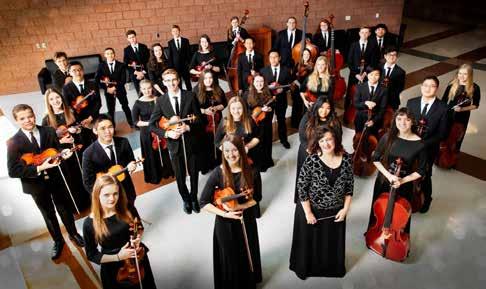
National Federation of High Schools honors RaNae Dalgleish for four decades of shaping students hearts through harmonies.
When RaNae Dalgleish was 4 years old, her mother placed a violin in her small hands the last one her father had worked on before he died.
“This is yours,” her mother told her. Dalgleish remembers looking at it and saying, “This is the most wonderful thing I’ve ever seen in my life.”
In that moment, she knew music would always be part of her life.
Dalgleish’s father had been a violin maker, trained by German luthier Peter Prier, who first worked under her grandfather, a longtime band teacher in Provo who also opened Pearce Music Company.
Music was part of her upbringing. Her mother would accompany Dalgleish on piano during her early violin recitals and her grandfather would play for her,
symphonies and string quartets on his downstairs stereo system for hours.
“He introduced me to the world of classical music,” she said. “He was so knowledgeable and he had such a passion for it.”
Dalgleish’s introduction to music became a lifetime passion which she has shared with students for four decades. Recently, the National Federation of High Schools named Dalgleish as region seven’s Performing Arts Educator Award recipient of the year for her 40 years of dedication to music education.
The nomination itself came as a surprise. Former Canyons School District performing arts specialist Sheree Jorgensen submitted her name in November 2025 and it was in early February that Dalgleish learned she won the award, which as of press deadline, was yet to be presented to her.
“I was excited, humbled, honored and surprised,” she said. “I appreciate Sheree for noticing my work through the
years and thinking about nominating me for this award. It means a lot.”
After earning her degree in instrumental music education on full scholarship at the University of Utah, Dalgleish’s career began teaching elementary students string instruments. She then progressed to teach high school choir and eventually, nearly two decades at Hillcrest High directing orchestras and choirs.
Dalgleish directs highly esteemed ensembles, mentors teachers and organizes districtwide events. She is the musical director for many of Hillcrest’s award-winning musicals and has served on the Utah Music Educators Association. She has performed with the Utah Tabernacle Choir, the Salt Lake Symphony, the Salt Lake Vocal Artists and Salt Lake Symphonic Choir.
For Dalgleish, the heart of teaching was shaped early in her career. During her first year teaching at her alma mater, Olympus High, her student choir president was killed when, as a pedestrian, he was struck by a car.
“I learned the lesson that I needed to
For more than 40 years, Hillcrest High’s RaNae Dalgleish has shared her passion of music with students and recently was recognized with the National Federation of High Schools’ Performing Arts Educator Award. (Photo courtesy of RaNae Dalgleish)
love my kids more than I need to love music,” Dalgleish said. “They needed love and they needed music.”
That experience changed her priorities, which still guides her today. Festivals and ratings matter less than connection.
“I want them to understand music as a way to touch hearts that words can’t,” Dalgleish said. “Music is a service that you can help people to heal and to go through hard times. It helps to brighten spirits, to lift hearts that are heavy.”
She chooses repertoire with care, tailoring pieces to the students in her classes. Through COVID, through loss of family and through other circumstances, she chooses music with a message for her students to embrace and share.
“Every year, I need to know my students so I can make music meaningful for them,” Dalgleish said.
One beloved tradition is ending concerts with “Peace be with You,” an arrangement passed down through Hillcrest High choir directors Leo Dean to Brian Bentley and to Dalgleish. Alumni return to sing it in the final concert of each year, filling the stage alongside current students, creating a community through music and love she has helped build.
Music has given Dalgleish many opportunities beyond the school stage. From her first school bus trip to Vancouver, B.C. as a high school senior to performances across Europe and Asia, she has seen how music connects people. She shares that experience with her students, giving them opportunities to tour across the country, including singing in Nashville this spring. Through it all, Dalgleish still keeps that little girl’s sense of awe. The violin was her first love. Teaching became her life’s work. And whether conducting a choir or repairing a student’s bow, she continues to share the gift first placed in her hands, imparting music is an act of love.
“I love giving opportunity to my students and hearing them create music that speaks to the heart,” Dalgleish said.
Hillcrest High teacher RaNae Dalgleish, who has taught thousands of student-musicians throughout her career, is honored by the National Federation of High Schools with the Performing Arts Educator Award. (Photo courtesy of RaNae Dalgleish)
Elementary chess students use winning strategies at state tournament
By Julie Slama | j.slama@mycityjournals.com
Third grader captures his fourth state title with strategy, problem solving.
Thinking about his moves ahead of everyone else and humble enough not to brag, Ridgecrest third-grader Beckham Rawle quietly claimed his fourth state title at the Utah State Elementary Chess Championship.
Beckham captured his fourth consecutive state title, adding another trophy to his growing collection, however this year’s victory came with a challenge. After five rounds in the third-grade division, he and another girl both swept all their games, resulting in a tie break.
His mother, Rachel Rawle, was busy selling chess-themed T-shirts nearby and didn’t even realize the deciding match had ended.
“I didn’t know how he came out after the tie break,” she said. “He didn’t even come tell me, but he just started playing with his friends. Somebody else told me he won.”
Beckham finished with six victories to claim the title. His points also helped Ridgecrest place third in the team standings behind Waterford School of Sandy and American Preparatory Academy Draper 2.
“I’m happy,” he said about his fourth straight title.
That understated reaction is typical, his mother said.
“He’s super chill,” she said. “He has the same even kneel if he doesn’t win.”
Beckham’s chess journey began in kindergarten, when he set his sights on defeating his father, Jason, who coaches the Ridgecrest chess club. By first grade, Beckham was consistently beating his first teacher across the board.
His mother, who is the team’s chess manager, said Beckham studies the game,
concentrating and problem-solving to figure out strategies. Beckham likes testing himself and prepares for his matches.
“He’s patient and likes the challenge,” she said.
While Beckham enjoys chess, he balances his time with sports — soccer and basketball — and is a Chinese dual immersion student. He also is competing in the upcoming regional spelling bee. With money he has won at tournaments, he purchased Xbox controllers.
“We like he has a balance,” Rawle said. “At tournaments, we are more of the mindset that they’re already playing so much chess, their brain needs a break. So, in between games, we let them play with their friends, often it’s Minecraft, or four-player mini games they play with other kids.”
Beckham plays in several weekend tournaments — mostly in the open sections since his rating is so high — and is planning to compete in the Power Chess state tournament this spring and the Vegas International Chess Festival in June.
Chess is a family game. His brother, second-grader Max, finished third in his division at state while sister, kindergartner Poppy, placed fourth in her first tournament behind teammate Mickey Labrum.
Many Ridgecrest players competed for the first time.
“A lot of them, it was their first time competing at state and they did well,” Rawle said. “We had eight of our 12 kids get trophies. We want them to know, win or lose, you’re there to have fun, a good experience and trying your best is an accomplishment. We’re super proud of our kids.”
That was the sentiment of Granite Elementary coach Jacob Jensen, who said many of his 25 players were new to the game only months ago.
“Some of these kids didn’t even know how the pieces moved when we started,” he said. “To see them go to the state tournament and win a game, that was huge.”
Granite’s standout performer was his daughter, first-grader Sophia, who finished third in the first-grade division. She won five of her six matches to help Granite place 11th in team standings. She also recently competed in the girls’ state chess championships.
“She likes the mental challenge, the mental stimulation,” Jensen said. “She’s this tiny first grader and you see her as this cute little girl, but then she’s an assassin on the chessboard. She comes in and destroys you.”
The school recently held its own chess tournament and has started up
again with weekly chess meetings, with some new members.
“We had such a good success, it’s cool to see the kids in their progression over the course of a few months,” he said. “They’re learning the principles of chess. They’re learning how to apply them, and then they’re actually brave enough and willing enough to go there and compete at the state level.”
Top area schools’ placements: First Waterford, Sandy; Second APA Draper 2; Third Ridgecrest, Cottonwood Heights; Fourth Sunrise, Sandy; Fifth Brookwood, Sandy; Sixth Peruvian Park, Sandy; Ninth APA Draper 1; 11th Granite, Sandy; 15th North Star Academy, Bluffdale; 18th Channing Hall, Draper; 26th Quail Hollow, Sandy; 29th Draper; 39th Herriman; and 51st Bella Vista, Cottonwood Heights.
Ridgecrest Elementary students competed to their highest finish ever, third, at the state championship. (Photo courtesy of Rachel Rawle)
Bell-to-bell school cell phone ban passes in Utah legislature
By Lizzie Walje | l.walje@mycityjournals.com
SB 69 would ban cell phone use during school hours including lunch and in-between classes.
Utah public schools will more than likely enforce a bell-to-bell cell phone ban when students return to class at the end of this coming summer. The bill in question, Senate Bill 69, which calls for a complete cell phone ban during school hours, most recently passed the vote in the Utah legislature. SB 69 now goes to Gov. Spencer J. Cox, who will ultimately decide if it is to become law. For years now, Cox has expressed his desire to ban the usage of cell phones in schools. Cox was also an early vocal supporter of SB 69, meaning it’s almost all but guaranteed that he will sign off on the bill once it crosses his desk.
SB 69, sponsored by Sen. Lincoln Fillmore (R-South Jordan) further expands upon a 2025 bill, Senate Bill 178, that was eventually signed into law. SB 178 banned the usage of cell phones during school hours, however, it did have one caveat; students could still use phones during downtime like in-between classes or during lunch. SB 69 takes an even firmer stance, completely forbidding the usage of cell phones during the school day, including times when students are not in the classroom.
While the bill does require all public schools to implement the bell-to-bell ban, how schools choose to enforce the ban, will be determined by their Local Education Agency (LEA). LEAs will be given the freedom to establish their own guiding parameters and policy, so long as they uphold the requirements laid out in SB 69. Should an LEA choose not to set their own policy, devices will not be permitted from bell-to-bell by default.
When SB 69 was first introduced, those who opposed it, largely residents and parents, expressed concerns over children not having access to their phones during emergency situations. However, the bill does allow for exceptions where students will be permitted to use their phones during threats or emergencies, to access the SafeUT crisis line, as part of accommodations outlined in a student’s IEP or Section 504 plan, or for medical necessity.
“Utah leads by putting students first, and this is the next step,” said Emily Bell McCormick, president of The Policy Project, a Utah nonprofit organization that defines itself as a “nonpartisan organization that acts as a policy accelerator to do real good for real people.” McCormick continued, “Bell-to-bell policies aren’t about restriction—they’re about creating learning environments built for focus,
connection and success. We see calmer classrooms, stronger engagement and more meaningful learning when distractions are limited.”
To that point, a handful of Utah schools have already implemented their own versions of a bell-to-bell ban, among them, Granite School District’s Granger High School. A change that school officials report has yielded overwhelmingly positive outcomes. Luke Allen, the Associate Director of Communications for Granite School District, reported that student fights at Granger have decreased by 50% following their cell phone ban. He also mentioned that failure rates have dramatically improved.
“The first year of that policy at Granger High School, if you compare the student failure rate to the four years leading up to that, [Granger] had their lowest rates of those five years.” Allen said. “So, they had their lowest failure rates in five years, the first year they had that policy.”
Snow Canyon Middle School in St. George is another institution that enforced a ban on devices, a policy that they began enforcing at the beginning of the 2024-25 academic school year. While staff and teachers initially worried their students would push back strongly on such a ban, they were pleasantly surprised at the outcome.
“The students reacted far more willingly than we ever anticipated. There was very, very little parent resistance. We feel that creating a space where students are no longer distracted is one of the greatest gifts we have given them. We just wish we had done it years earlier,” said a staff member at Snow Canyon.
Cell phone bans are starting to take root at the national level. According to several national news outlets, as of early 2026, 26 states have now imposed complete bell-to-bell cell phone bans in K-12 schools. Among them are Florida, Alabama, Georgia, New York and Virginia. Additionally, it’s reported that 25 states have put in place some level of cell phone restrictions or guidelines to be observed during school hours.
As more schools report successful outcomes from outright cell phone bans, it is anticipated that other states will soon follow suit and put in effect their own bell-to-bell bans. If you’re wondering how these bans are managing to be enforced during school hours, one company in particular has found a way to make such a prospect easily streamlined — Yondr pouches.
Yondr pouches are not the only magnetic locking cell phone pouch on the market, however, they’ve certainly emerged as the most widespread and
Senate Bill 69, which bans the usage of cellphones completely during school hours, has passed in the Utah legislature and now faces final decision from Gov. Spencer J. Cox. (Pew Research Center)
well-known option available. As a matter of fact, Granger is among the schools currently utilizing Yondr’s technology. Many educators, administrators and staff like Yondr pouches, because they restrict students from using their cell phones, but still allow for the phone to remain on the
student’s person.
As previously mentioned, Yondr pouches are controlled by magnetic locking technology. At the end of the school day hours, students can unlock their phones at various locking bases, which are usually strategically placed at exit points throughout the school. While Yondr pouches do prevent the usage of phones during school hours, they don’t block signals, meaning cell phones can still be used in case of emergency.
Yondr pouches, while incredibly effective, are still considered relatively expensive. This has caused concerns for certain districts and schools in Utah who feel they’re already being stretched thin financially due to budget cuts and insufficient funding. In response to this concern, Sen. Fillmore explained that schools will not need to use Yondr patches specifically, so long as their rules, whatever they are, reflect and enforce the totality of the bell-to-bell ban.
Now that the Utah general legislative session has concluded, and SB 29 has cleared Utah’s legislation, per Utah state law, Gov. Cox has 20 days to decide on the bill. If after those 20 days Cox has still not signed or vetoed the bill, it will, by default, automatically become law.
Where every move matters
Eastmont middle schoolers make strategic moves to claim Canyons District chess championship.
By Julie Slama j.slama@mycityjournals.com
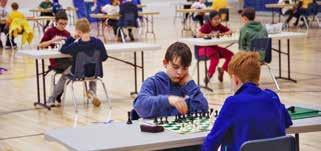
It may be the only competition which silence fills the room once it begins. Aside from the occasional click of a clock, a quiet intensity settled over the gymnasium at Eastmont Middle as students across the District squared off in the Canyons School District middle school chess tournament. With eight boards per team and trophies on the line, every move carried weight and strategy that would determine the championship.
Still the day was more than scores.
At Albion Middle, coach Lacee Larson is building her program on consistency and sportsmanship.
“It’s about fun first and foremost,” she said. “We want students to come join the fun and learn good sportsmanship. They’re good about shaking hands and nobody gloats when they win. Everybody’s a good winner. They’re great kids.”
Albion players started practicing at the beginning of the school year and play every week. Although the team had a smaller turnout this year and competed with seven boards instead of eight, strong leadership led the group.
“Our first grader has won in every tournament in middle school so he wants to have a streak and is working hard at that,” Larson said. “Our team is a mix of experience; some kids come knowing their stuff and others come in and are learning as they go.”
Indian Hills Middle School players felt both the pressure and joy of the competition.
Sixth-grader Jacob Hamilton joined the team for the opportunity to play.
“I wanted to play chess more, but nobody in my family ever wanted to, so I joined chess club,” he said. “It’s fun and now I get to play more often.”
Teammate seventh-grader Dysen Painter found himself competing at a higher level than expected at the tournament.
“It’s kind of difficult for me because I’m the second alternate, but I’m playing the second table because our second player didn’t show,” he said. “I’ve won one game and lost another so far, but I feel pretty good about it.”
Dysen learned chess from his father, but he hadn’t played a lot until recently.
“I want to beat my dad three times in a row. I’ve only beat him once because he’s a good player, but most of my skill I’ve learned comes from him,” he said.
Seventh-grader Thiago Jara Mateo, who won board 7, likes chess for the skill and strategy.
“Unlike most board games, it’s not about luck and it’s more about skill,” he said. “I like figuring out how I can get better. I often attack and leave pieces open, hanging. That’s mostly why I lose, and I need to get better at that.”
Coach Adam Martinez is in his fourth year coaching Indian Hills, guided a team that entered the tournament as a two-time defending District champion.
“I’d love to take a lot of the credit, but players are dedicated to the game,” he said. “They’re the ones who make all the difference. I’m just a pretty good cheerleader.”
Martinez prepares his team with an abridged round robin school tournament.
“They’re ranked accordingly so you can figure out how to place them on the boards,” he said. “We practice as we
play, too.”
That preparation includes using chess clocks, following “touch move” rules and adhering to guidelines against sideline coaching.
When the matches concluded, teams scores were tallied, with eight possible points per round: one point per win, half point for a draw and zero for a loss.
In the end, Eastmont prevented Indian Hills from claiming a third straight title by capturing the District title with 41 points. Mount Jordan Middle followed with 38.5 points for second place while Midvale Middle took third with 35 points.
Individually, Albion’s Stephen Lindsay and Draper Park Middle’s Sam Chen tied on board 1; Midvale’s Yuun Kim and Mt. Jordan’s Noah Whitting tied on board 2; Mt. Jordan’s Arthur Despain won board 3; Eastmont’s Kevin Bretz took board 4; Midvale’s Will McKenna won board 5; Indian Hills’ Alex Zollinger took board 6 and Eastmont’s Kimball Bettinson won board 8. l
Canyons’ middle school students square off in the districtwide chess championship. (Julie Slama/City Journals)
That mindset shift came after her junior year when she began competing more in the offseason.
“This last year when I went and did offseason, I competed nationally a ton and that was so much fun for me,” she said. “I started to trust myself.”
Pappas said that growth defined her senior season.
“This year, she loved the sport and process,” he said. “She was such a huge player in developing other girls’ technique on the team. She was even better at helping girls keep things in perspective and helping them develop into their best selves as well.”
“At the beginning of the year, a lot of the girls on my team wanted to be a state champ. That was never a goal of mine. Mine was I’m going to get better, and that’s what I focused on.”
— Eva Zimmerman
Zimmerman served as a team captain, helping guide a Hillcrest squad that placed third at state with six finalists.
“It’s hard to have a positive mindset,” she said. “I helped them with that a ton. I drilled it into them: It doesn’t matter if you lost, let it go.”
While Zimmerman went undefeated, she was scored on two weeks before state at the Rockwell Rumble tournament.
“Heading into state, my mindset was ‘I’m going to wrestle. I’m just going to do my best’ because that’s all you can control,” she said. “At the beginning of the year, a lot of the girls on my team wanted to be a state champ. That was never a goal of mine. Mine was I’m going to get better, and that’s what I focused on.”
She moved up a weight class for the state meet.
“I wasn’t actually 115, but 110 roughly,” she said. “I already had won at 100, 105 and 100 so I thought it would be cool to go with 115. Plus, Cassie was 110 and so it worked out she won that weight class.”
With her high school career complete, Zimmerman, with a 3.9 GPA, is currently choosing between two colleges — North Central College (Illinois) and Grand Valley State University (Michigan) — to continue wrestling.
“I cannot imagine being done with wrestling right now,” she said. “I’m grateful I have an opportunity to go and compete at college.”
Looking ahead, Zimmerman hasn’t ruled out bigger dreams.
“Being in the Olympics would be awesome,” she said. “It’s going to take a ton of work and I’m ready to put that work in, but my focus is still improving and trying my best because I can control those things.”
Zimmerman has learned lessons wrestling.
“I’ve learned you got to be kind and patient,” she said. “The process isn’t always going to be perfect. Failure is part of the process and it’s not always going to be fun, but to enjoy the moment and the process.”
For the four-time champion, her titles are not the most important part of her wrestling journey.
“Win or lose, at the end of the day, you’re going to go home and you’re going
to be the same person tomorrow,” she said. “I don’t want to be defined by the sport, but by doing my best.”
Pappas, who also coached senior Moroni Mahe this season to his second state title, believes wrestling and those around Zimmerman are better because of her.
“Not many coaches get lucky enough to coach someone like Eva,” he said. “I count my lucky stars I was able to be a small part at the beginning of her journey.” l
Hillcrest High’s Eva Zimmerman pins a Salem Hills competitor to win her fourth state title. (Photo courtesy of Iszak Urinko)
Hillcrest High senior Eva Zimmerman became the school’s first wrestler to win four individual state titles. (Photo courtesy of Iszak Urinko)
Living Traditions Night brings world culture to life
The annual event showcased student art, global traditions and hands-on learning experiences for East Midvale students and their families.
By Julie Slama j.slama@mycityjournals.com
Families traveled across Oceania and even to the Northern Pole all without ever stepping outside of East Midvale Elementary.
The adventure was part of the school’s annual Living Traditions Night, an event where each grade level explores different countries and cultures, then shares what they learned with the school community. This year, supplied with paper passports, families made their way through stations featuring the Marshall Islands, Tonga and Samoa, Finland, Sweden and Greenland.
At every destination, visitors read student-researched displayed filled with facts and pictures, recording key details in their passports along with way.
Families also sampled a variety of international foods including Swedish meatballs, ginger snaps, dried coconut, mango pineapple ‘otai, rye bread and lingonberry jelly, dried meat jerky and pani popo (coconut buns).
The celebration continued in the multipurpose room, where music and dance performances brought culture to life.
“Special guests entertained and taught us with Tongan drums and dances that tell stories with hand, feet and body movements,” said Shelley McCall, community school facilitator and Living Traditions organizer.
Principal Amy Sandgren said the event was meaningful for families and staff alike.
“It was incredible to see all of the families come together with our faculty and celebrate culture,” she said. “We had such a good turnout. We had families even come from our new boundary change (that will occur next school year). We personally called each one to invite them so they could get a feel of who we are and about our school. We’re trying to bridge the gap that boundaries can cause.”
Student artwork also was showcased with displays featuring kindergartners’ Dala horses from Sweden, first-graders’ sea life in the Marshall Islands, second-graders Tongan fans, third-graders’ aurora borealis chalkings, fourth-graders’ depictions of ice castles in Greenland and fifth-graders’ Samoan tataus or the traditional art of tattooing, symbolizing identity, lineage and personal life stories.
For McCall, the event highlights the diversity already present in the school community.
“Our school has a lot of cultures, languages; they’re from so many places,” she said. “It’s fun when we focus on East Midvale countries because the kids are proud of their culture and like sharing it and telling people about it.” l
East Midvale families ask questions about Tongan drums and dances during the school’s annual Living Traditions Night. (Photo courtesy of Shelley McCall)
Students helping students, one haircut at a time
CTEC cosmetology students gained handson experience giving free haircuts for Sandy Elementary and Midvale Elementary students, who gave them big smiles in return.
By Julie Slama j.slama@mycityjournals.com
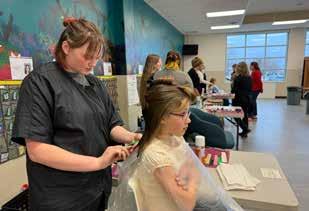
More than two dozen Sandy Elementary students left with fresh haircuts and smiles recently, thanks to a service project led by Canyons Technical Education Center cosmetology students.
Seniors in the program volunteered to provide free haircuts for Sandy Elementary and Midvale Elementary students during parent-teacher conferences. The event gave families a convenient service while allowing older students to gain real-world experience working with clients.
“It’s a service project to help kids get a nice, fresh haircut that’s free,” said CTEC instructor Marci Melendez. “We do it for our students too, because they’re in training and it gives them a good experience.”
Seven cosmetology students came to each elementary school, giving them the opportunity to work with younger clients, something that isn’t common at CTEC.
Cutting children’s hair presents different challenges from adult haircuts.
“Kids are wiggly, so that can be hard. The reason why I bring my seniors is because it doesn’t take them as long to do the haircuts,” said the instructor with 28 years of experience.
Most cuts took about 30 minutes, depending on the style.
“Some parents bring photos of hairstyles they want, but others allow the kids to have a creative leeway,” she said. “A lot
can go into it, but we can do basic haircuts here and if they want more than that, we offer them coupons to come to our school.”
The project is especially meaningful to Melendez since she attended Sandy Elementary as a child.
“I came here so it’s really fun for me to come here and see everything again,” she said.
The program has offered services at Sandy Elementary for two years and now has expanded to include Midvale Elementary.
“We’re trying to branch out and help the community any way we can,” she said.
Cosmetology students said the opportunity provided them with valuable hands-on practice.
“We’re getting better at kids’ cuts since we don’t get them often,” said Alta High senior Tyler Lantis. “We get more older men’s haircuts or women’s colors at CTEC.”
Despite the challenge to keep the younger students still while cutting hair, senior Sadie Nigbur said her favorite part was doing it for the kids.
“They watch all these adults get their hair done so it’s a special thing for them to come,” she said.
Hillcrest High senior Addy Simper added: “We’re hoping they’ll be more confident and happier with the haircut. Most of them are excited to show their friends at school tomorrow.”
Sandy Elementary families have welcomed the addition to the services — including health, clothing, food and more provided by the school, said Isa Connelly, Sandy’s community school facilitator.
Connelly said the idea started two years ago when her daughter, Sunny Whitman, then a CTEC cosmetology student, gave a haircut to a child at the school who needed one. That led to another session where she offered them to any students.
“We had a line out the door with 40 students waiting,” Connelly said. “That’s when we realized this is a need in the community. We bring the haircuts here because going to CTEC is an issue with transportation.”
Parent Brittney Grell said the experience for her first-grade daughter Gwen was positive.
“She wanted bangs and she’s getting a bob,” Grell said. “It’s free and convenient and it’s a great for her first haircut.”
Third-grader Sage Burgard also was excited to get a new hairstyle.
“I want to match my best friend’s hair length, and I like getting something new done to my hair; it makes me happy,” Sage said. “Haircuts are important so my hair won’t be like Rapunzel’s.” l
Little fans give Hawks big cheers
Fourth-grade basketball players rallied behind Alta High’s team and the Hawks return the favor caught in a video which sparked a viral sensation.
By Julie Slama j.slama@mycityjournals.com
Agroup of fourth graders from Crescent Elementary became some of the most loyal fans of the Alta High School boys basketball team this season — and when their support caught the attention of the Hawks, the high school players returned the favor.
The story, captured in a video and posted to social media, quickly went viral. Shared by the account galpractical, the clip spread on Instagram, Facebook and TikTok, where it drew more than 8,000 comments and 92,000 reshares as viewers celebrated the moment between the young players and the high school team.
It started organically as the young Bantam team began showing up throughout the season.
“These little guys were coming to all the games and following our guys,” said Alta High head coach Travis Ohrn. “At first, they sat with their parents, but as the season went on, they created their own little student section and created posters and started doing cheers and rallied behind our team.”
After cheering loudly, they’d stick around after the game to interact with the players. On senior night, they met the team.
“After our last home game, we always put the tables out and pass our team pictures to all the young kids who come to get autographs,” he said.
But the support continued into the postseason.
The Bantam team followed Alta into the state tourna-
ment, attending playoff wins against Hillcrest High in Midvale and Timpview High in Provo.
After the second-round victory, the Crecent Cubs invited Ohrn to their game on Saturday. He took the request to the team, who rallied to go support the youngsters.
With the roles reversed and Alta players in the stands, they cheered on the Bantam team. Again, the moment captured on the viral video that resonated with thousands of viewers.
For Ohrn, the experience highlighted the influence high school athletes have in their communities.
“They don’t realize the impact they have on young kids,” he said. “That’s a big thing we emphasize here. Basketball is
just a tiny little thing in life and they can have a huge impact on younger kids who look up to them. I want every kid in this community to grow up wanting to play for Alta, to be a part of our school, our community, and take pride in doing that.”
Alta’s season ended in the quarterfinals of the state tournament where the Hawks fell to Bountiful High, 58-44.
“We had a lot of adversity and battled through injuries and ups and downs,” Ohrn said. “To be able to get where we did, making it back up to the University of Utah in the state tournament, is a big accomplishment. I’m super proud of our guys for fighting through that and making it up there. I’m appreciative of all our fans and want to give a shoutout to those young players who cheered us on.” l
Alta High’s basketball team had fan support by a fourth-grade team and in return, they supported the youngsters. (Photo courtesy of Travis Ohrn)
CTEC cosmetology student and Alta High senior Tyler Lantis trims Sandy Elementary third-grader Sage Burgard’s hair as part of the free haircut program. (Julie Slama/City Journals)
County Council proposal expands childcare access without taxpayer subsidies
daycare spots available without using
dollars? That’s what the Salt Lake County Council voted unanimously to support last month when Councilmember Laurie Stringham and I brought forward a proposal to explore a new approach to childcare.
Last December, the council voted to close four county-run daycare centers as part of efforts to reduce the proposed property tax increase put forward by Salt Lake County Mayor Jenny Wilson. An extensive report highlighted the significant subsidy the county had been providing to a relatively small number of families. Taxpayers were contributing between $6,000 and $10,000 per child each year, covering roughly half of the tuition costs for 271 children enrolled in county-run programs.
Aimee Winder Newton
Salt Lake County
Councilmember
District 3
Families across Salt Lake County are facing rising childcare costs and limited availability, making it difficult for many parents to remain in the workforce. Access to reliable childcare is not just a family issue — it is also an economic issue that affects employers and communities across the county.
access to affordable space, families gain additional childcare options, and taxpayers are protected from ongoing subsidies.
The report and audit findings also made it clear that while the county performs many important services well, operating childcare centers was not one of them. In addition to financial concerns, the program had operational challenges that raised questions about whether the county should be directly running childcare programs in the first place. Even if the program had worked perfectly, it would have been impossible for the county to provide daycare services to every family who might want them.
At the same time, the need for childcare in our community continues to grow.
Many residents who contacted me said they support helping families who are struggling financially afford childcare. That’s a reasonable and compassionate position. However, the county program had no income qualifications, meaning families earning above the median household income were also receiving subsidies funded by taxpayers — including those living on fixed or lower incomes.
As Stringham and I looked for alternatives, we began exploring whether the county could help expand childcare access without directly operating the programs or increasing taxes.
Our proposal is simple: allow nonprofit childcare providers to lease existing county childcare spaces and operate their own programs. These organizations would raise their own funding, hire their own staff, and manage their own operations. In return, they would receive discounted rent in exchange for prioritizing care for low-income and vulnerable families. The rent payments would cover the county’s operations and maintenance costs for the space, ensuring that taxpayers are not subsidizing the programs.
This type of partnership could create a win-win solution. Nonprofit providers gain
The council unanimously approved our legislative intent, and our Parks and Recreation Department will now evaluate childcare spaces at the Magna, Kearns, and Northwest Recreation Centers to determine which facilities may be viable for leasing to childcare providers. We are also working with the Granite School District to explore a similar arrangement for the childcare space in Millcreek.
Councilmember Stringham and I recognize that this approach will not solve the childcare shortage overnight, but it represents a practical step forward. By working with community partners, Salt Lake County can help expand childcare availability while respecting the taxpayers who make these public facilities possible.
Families deserve more childcare options, and taxpayers deserve responsible stewardship of public funds. With creative partnerships and thoughtful planning, we can pursue both goals at the same time.
Ifthere’s one thing that makes you question your life choices, it’s sitting at a child’s outdoor soccer game in April.
Clutching Stanley mugs filled with coffee, whisky, or both, parents and grandparents sit on wobbly camp chairs, huddled under musty blankets while trying not to be too conspicuous about checking the time.
The idea is sound: help kids understand the concepts of a sport and learn teamwork. In reality, it’s about which kid brought the best treats or if we’re going to catch pneumonia and die before the game ends.
Utah’s spring is a weather roulette that can have you freezing at 9 a.m. and sweltering by noon. The cold wind, constant trickle of rain and glacial temperatures give way to heat stroke and sunburn before halftime.
My four daughters played softball every spring for what felt like 75 consecutive years. Each year, we’d bundle up in coats, gloves, scarves and earmuffs to watch them play. We shoved handwarmers into pockets and told them to “Think warm thoughts.”
It was often torture. Not only do you watch your child strikeout, but strikeout in 45-degree weather. They’d hold the bat with frozen hands, waiting for the impact to snap their fingers off at the knuckles.
Now, my grandkids enjoy soccer, which is played no matter the weather, and everything is mud. The only thing running faster than my granddaughter is my nose. Except
The view from the sidelines
Peri Kinder Life and Laughter
when it’s treat time, then the whole team finds a burst of adrenaline to snatch up granola bars and Capri Suns. Don’t even think about bringing oranges or bananas. Who are you? Someone who hates kids?
Each spring, hope wears shin guards and batting helmets. It’s a fresh start, a chance to learn skills and an opportunity for new coaches to lower their expectations.
You can spot a new coach by their optimism. They come prepared with drills, practice schedules and intricate plays, but by the end of the season, they’re just happy to have players who can identify a soccer ball and run in the right direction.
They also have to deal with parents. There’s always that person who believes their child is the next Lionel Messi or Aaron Judge. They memorize the rule book and counter every official’s call. “Blue! Were you the lookout on the Titanic?” or “Hey, Ref! Are we keeping you awake?”
They scream at their child to “Run!” for 45 minutes straight and call their 6-year-old over
between innings to explain baseball defense.
Yet, even in drizzly, cold weather, spring sports thrive. There’s just something about watching a child finally hit the ball off a tee or score their first goal. We see coaches kindly redirect a player’s attention from doing cartwheels to protecting third base.
When your granddaughter makes a great pass, she looks to the sidelines to see if you saw it happen. You did.
Although we complain about the mud, the temperature, the uncomfortable seating and wonder if the other team altered the birth certificate of their star player, there’s something inherently human about watching young people navigate sportsmanship.
It’s not about winning. It’s about showing up for the kids you love. You watch them fall on their faces, sometimes literally, and get back up. You watch them strike out, kick the ball in the wrong goal or drop an easy fly ball, and wince along with them.
If there’s one thing that makes you question your life choices, it shouldn’t be watching a child you love run past you with a big grin on their face. Even wrapped in quilts, chugging espresso, you’re exactly where you’re supposed to be.
Peri Kinder is an award-winning columnist and journalist who has written for The City Journals since 2004. She can be reached at peri.k@thecityjournals.com