MASSAGE WORLD
M M M W W W M M M W W W M M M W W W M M M W W W M M M W W W M M M W W W M M M W W W M M M W W W M M M WTHE W W M M M W W W
M M M M M M M M M M M M M M M M M M M M M M M M M W W W W W W W W W W W W W W W W W W W W W W W W W M M M M M M M M M M M M M M M M M M M M M M M M M W W W W W W W W W W W W W W W W W W W W W W W W W M M M M M M M M M M M M M M M M M M M M M M M M M W W W W W W W W W W W W W W W W W W W W W W W W W M M M M M M M M M M M M M M M M M M M M M M M M M W W W W W W W W W W W W W W W W W W W W W W W W W M M M M M M M M M M M M M M M M M M M M M M M M M W W W W W W W W W W W W W W W W W W W W W W W W W M M M M M M M M M M M M M M M M M M M M M M M M M W W W W W W W W W W W W W W W W W W W W W W W W W M M M M M M M M M M M M M M M M M M M M M M M M M W W W W W W W W W W W W W W W W W W W W W W W W W M M M M M M M M M M M M M M M M M M M M M M M M M W W W W W W W W W W W W W W W W W W W W W W W W W M M M M M M M M M M M M M M M M M M M M M M M M M W W W W W W AND W W W W W WTHERAPISTS W W W W W W W W W W W W W MASSAGE BODY MAGAZINE M M M M M M M M M M M M M M M M M M M M M M M M M W W W W W W W W W W W W W W W W W W W W W W W W W
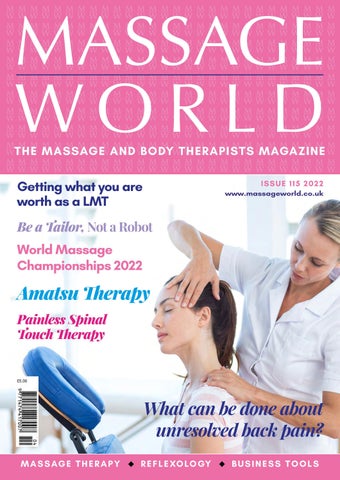
Getting what you are worth as a LMT
I S S U E 1 15 2022 www.massageworld.co.uk
Be a Tailor, Not a Robot
World Massage Championships 2022
Amatsu Therapy Painless Spinal Touch Therapy
£5.00
What can be done about unresolved back pain? M A S S AG E T H E R A P Y ◆ R E F L E XO LO GY ◆ B U S I N E S S T O O L S
editorial by Wendy Kavanagh
OR
Wendy Kavanagh
TURES
Earle Abrahamson Pauline Baxter Kate Browne Ruth Duncan Rachel Fairweather EDITOR Madelaine Winzer EDITOR Susan Findlay Wendy Kavanagh FEATURES Pauline Baxter Emma Gilmore FEATURES Pauline Baxter Rachel Fairweather Jane Langston Kate Findlay Browne Susan Ruth Duncan Michael Furlong Meghan Mari James Earls John Gibbons Nana Mensah Rachel Fairweather Jane Langston Greg Morning SusanLewis Findlay Owen Giacomo Sandri Mark Liskey Til Luchau Kathy Scott Sarah Jane Tepper Meghan Mari Ashton Nana Stimson Mensah Ian Tennant Claire NicoleSquire Perez Madelaine Winzer Susanna GiacomoTerry Sandri Mark Woollard Madelaine MadelaineWinzer Winzer Anna Lisa Zisman Marina Young
GRAPHICVictoria DESIGN Osborne Victoria Osborne PHIC DESIGN
MEDIA IA Victoria Osborne GRAPHIC DESIGN COMMUNICATION C J Newbury MMUNICATION C J Newbury SOCIAL MEDIA Pia Singleton PUBLISHERS
MEDIA LISHERS
NK Publishing
NK Publishing
COMMUNICATION C Please J Newbury ADVERTISING call the Massage PUBLISHERS NK Publishing World office ERTISING Please call the Massage T 020call 7387 ADVERTISING Please the2308 Massage World office World office FOUR QUARTERLY ISSUES T 020 7387 2308 370 6953 T 0207 UK: £20 UK Student: £15 or Jackie Bristow R QUARTERLY ISSUES Rest of World: £40 T 01963 ISSN 1474-4171 361 753
welcome welcome M
illions of people have been staying inside and working from home, highlighting the huge impact our living space has on our lives as we interact editorial by Wendy Kavanagh with clients, friends, and families the likes ummer is in full swing with people enjoyingthrough life again. of Zoom Skype.industry COVID-19 has caused mass Theand massage is picking up too awith theof anxiety throughout world, especially for massage therapists recentthe World Massage Championships taking place as caring s the colour of the leaves change, there is one in Copenhagen. exciting event offering massage touch is integralIttowas ouranindustry.
S
A
question on opportunity everyone’s mind – what’s next? Weskills. have therapists a wonderful to showcase their been living a week at a time as we wait to see what new guidelines will be set out by the Government. It In this issue of Massage World, Owenit Lewis writes hisworking. Massage therapists have had think outside box has come toabout remote hastoaffected everythingthe from thewhen way we work to our relationships experience on health. television discussing back pain. Anthan alarming 1 in 6 Emma Gilmore talks about the waysTherefore, you canit work from home as aever massage and different mental is more important to find people suffer from back pain so it is wonderful bringing these issues routine works for you, stay connected ones, eat therapist and what you needa to takethat in consideration when doing to so.loved Some massage into the spotlight. Alsotime inwell this issue, Rachel discusses a very important exercise. therapists have taken this toand improve theirFairweather websites and social media platforms, while topic of conversation which is valuing your time. It can be a difficult task for some others have taken this time to expand their knowledge through research and online courses. In this issue, the FHT talks about appropriately alternative approaches to support healthinand wellbeing to Massage Therapists to charge for their treatments comparison In thiswhen issue Greg Morling gives some new perspectives on research designs that might truly hands-on therapies are sadly not an option. As bodyworkers, it is our goal to needed provide other bodywork professionals, therefore Rachel’s article serves as a much reflectclients the way we work and the wellbeing we hope to foster in out clients, while with the support they need to feel better, so they won’t need to rely on us to feel Kate Browne reminder that you need to value yourself first in order for other people to do the same. better. explains howbe to used manage by integrating explains theGiacomo ways inSandri which art can to inflammation learn anatomical terms.medicinal herbs into the massage treatment.
We are super be hosting thesummer! National It is an uncertain time soexcited try to stay to positive and enjoy the
Massage Championships at Olympia Beauty in London this Autumn. If you fancy putting your skills to the test, why not sign up now and I may see you there. Our situations are unique, and we face a lot of uncertainty and challenge going forward. It is essential to take pleasure in the small things and be grateful for what is good in life. Make sure you wrap up warm and enjoy reading this new issue of Massage World!
MADELAINE WINZER Freelance writer @madswinz
£20 UK Student: £15 of World: £40 ISSN 1474-4171 How to contact us
FOUR QUARTERLY ISSUES Massage World, The Crypt Centre UK:St£20 UK Student: £15 Mary Magdalene Church Rest of World: £40 ISSN Munster Sq, London, NW1 1474-4171 3PL
ow to contact us
sage World,T/FThe Crypt 020 7387Centre 2308 ary Magdalene Church E info@massageworld.co.uk H O W TO CO N TAC T W www.massageworld.co.uk ster Sq, Network London, NW1 3PL Business Centre, Suite 10
US
2822308 Earls Court Road, London SW5 9AS 020 7387 DISCLAIMERS The publisher has taken all reasonable measures to nfo@massageworld.co.uk ensure the370 accuracy of the information in Massage World T/F 0207 6953 www.massageworld.co.uk and cannot accept responsibility for errors in or omissions
E from info@massageworld.co.uk any information given in this or previous editions or for W any www.massageworld.co.uk consequences arising thereof. The Editor may not always
AIMERS agree with opinions expressed in Massage World but allow ublisher has taken all reasonable to publication as a mattermeasures of interest, nothing printed should be DISCLAIMERS as Policy or an Official Announcement unless stated. e the accuracy construed of the information in Massage World The publisher has taken all reasonable measures to No part of this publication may reproduced in any form or annot accept responsibility for errors in orbeomissions ensure the accuracy of the information in Massage World by any means whether electronic, mechanical and/or optical ny information given inaccept this or previous editions or for and without cannot for errors or publisher. omissions the expressresponsibility prior written permission ofinthe nsequences arising thereof. The Editor may always from any information given in this or not previous editions or for any expressed consequences arising thereof. with opinions in Massage WorldThe butEditor allowmay not always PRINTED BY expressed in Massage World but allow opinions ation as a agree matterwith of interest, nothing printed should be www.bishops.co.uk publication as a matter of interest, nothing printed should be ued as Policy or an Official Announcement unless stated. construed as Policy or an Official Announcement unless stated. rt of this publication may be reproduced in any form or No part of this publication may be reproduced in any form or y means whether electronic, mechanical optical by any means whether electronic,and/or mechanical and/or optical ut the express priorthe written the publisher. without expresspermission prior writtenofpermission of the publisher.
NTED BYPRINTED BY w.bishops.co.uk www.bishops.co.uk
Download the
Download the Download the Massage World App! Massage World App! Massage World App! Purchase digital copies ofissue each Purchase digital copies ofeach each issue issue Purchase digital copies of
Search for for “Massageworld magazine” Search “Massageworld magazine” Search for “Massageworld magazine”
Follow us on Twitter! Follow us on Follow us onTwitter! Twitter! @massageworlduk
@massageworlduk @massageworlduk
ALTOGETHER NATURAL…A SUPREME MEDIUM FOR MASSAGE & BODYWORK
25% offNATURAL…A our retail prices for all professionals ALTOGETHER SUPREME MEDIUM FOR MASSAGE & BODYWORK and students registered online with us
25% info@songbirdnaturals.co.uk off our retail prices for all professionals | www.songbirdnaturals.co.uk and students registered online with us MW110.indd 3
info@songbirdnaturals.co.uk | www.songbirdnaturals.co.uk
28/10/2020 17:44
contents
issue 115 2022
◆
F E AT U R E S
8 Sports Massage and Beach Volleyball
Susan Findlay Director of the NLSSM takes a dive into Beach Volleyball and looks at associated injuries that your clients may present with. Massage mentor Susan also offers up some anatomy of stretching.
12 Be a Tailor Not a Robot
I am sure that by now you are back to happily massaging in the corporate environment. Pauline Baxter looks at tailoring your treatments to clients needs.
16 7 Questions to Massage Pain Free
8
Do you view body mechanics as a system of rules to be applied universally? Mark Liskey argues that we must update our current view on Body mechanics for LMT’s
22 When the Cameras Rolled in My Clinic
Our regular feature writer Owen Lewis had a visit from a TV production company looking into the idea of Fascia bodywork being a benefit to the general population. This is his diary for the day.
28 Spinal Touch – Treating the Real Cause of Pain and Dis-ease Susanna Terry explains the Light Touch’ approach may bring pain-relief and at the same time realigns the person physically, energetically and often emotionally.
30 Getting What You Are Worth If you had to put a price on your head as a massage therapist how much would it be? Hundreds? Thousands? Millions? Rachel Fairweather from Jing advanced massage tells you How much.
12
◆
3 6 34 58
R EG U L A R S
22
Editor’s Welcome News & Views Reviews Course Listings
38 What Can Be Done About Unresolved Back Pain
If someone has a traumatic injury - perhaps because of a fall - it is easy to see why they may have a problem with their back. But understanding that in most cases of unresolved back pain, if the problem has built up over time it can be more difficult, says Michael Furlong.
16
ISSUE 115 2022
5
news & views Reacquainted and Realigned with the CHP Conference 2022
Launch of Advanced Clinical Massage & Sports Qualification Jing Advanced Massage are delighted to announce the launch of their new improved Advanced Clinical Massage qualification (ACMT). This innovative course immerses you in the Jing Method – how to get results with chronic pain in 1-6 sessions- PLUS the skills and confidence to build a successful massage practice and to get the life you desire. In addition to being a recognised and respected qualification in advanced clinical massage and the Jing method, we have worked with the SMA (sport massage association) for the ACMT to be recognised as a sports massage qualification. The ACMT now includes new material to allow you to feel confident treating at sporting events and working with athletes. What’s more the ACMT now includes a comprehensive online learning package, monthly Zooms and 3 x 4 day hands on immersion blocks down at sunny Brighton to learn directly from the dynamic Jing team. Successful graduates can also progress onto our full BTEC Level 6 (degree) – this certification is unique to Jing and is the highest qualification in massage in the UK. If you are short on time or money then there are generous monthly payment plan options plus an affordable ONLINE ONLY OPTION where you will learn the same dynamic skills at a fraction of the price.
Our next course starts September 2022. We would love to see you there! For more information check out our website www.jingmassage.com/advanced-clinicalmassage-therapist-acmt-certificate/ or call us on 01273628942 6
ISSUE 115 2022
We are delighted to be able to in fully catered with a lovely buffet. 15 October from 9:30am to 4:45pm therapies supporting your profes coming year. You will receive 6 C This event will be held at The Business Xchange members Hub, Marco Polo and current students. E House 3-5 Lansdown Road, Croydon, Surrey, CR0 2BX. As number ofusual, peopleyou and have the c can expect an amazing buffet that is fully catered for all attendees you to take away. Please do let u throughout the event, and dietary requirementstickets can beare expressed by £60 to anyone else wh email after a ticket is purchased. Tickets can be the bought at https://www. continued positive feedback, complementaryhealthprofessionals.co.uk/team-3 on the main study again thathome each speaker wi page, halfway down the screen select the green “Book Ticket”. These are focus on this year the subject will free to Premium Members and students and £60.00 for non-members. Similarly, to years past, the annual conference will have a theme that revolves around a central case study which will be explained and presented by the speakers. 9.30 Registration This year’s theme is Musculoskeletal Disorders. Massage World is - Hot bever a close media partner of the CHP conference and attends every year. 10.00 CHP Welcome, News and We always look forward to Meghan Mari from Jing Massage who is a regular contributor to the event, and this year will be speaking on The 10.15 Discussion and read thro Jing Method which focuses on advanced clinical workshops and sports on. massage for neck and shoulder pain. This includes whiplash which is one of the 10.25 Spiral – Ja most common conditions in the United Kingdom. We also look Stabilization forward revolutionary exercise method th to Jana Mitackova, the director of Spiral Stabilization UK, will open treat back pain, prevent injuries, the show by discussing the revolutionary exercise method for spiral conditioning. This is an ideal adju stabilization. As well as speakers, the event offers workshops for a further information, please visit w hands-on understanding of musculoskeletal disorders, like the postural analysis and neuroskeletal re-alignment therapy workshop. During 11.15 Coffee Break (hot tea an this, there will be a demonstration on how to properly examine a patient 11.30 points, Postural Analysis and to best conduct treatment by focusing on re-alignment then This workshop will explain and de each attendee will be able to put this new knowledge into practice by to help you both determine the b conducting in pairs. treatment objectives have been knee, shoulder and elbow pain, w This is a cannot miss event! correct position through the nerv knowledge gained into practice! www.naturaltherapeutics.co.uk
THE HOT TICKET! ME, YOU AND YOGI TOO! 14 -16 October 2022
Stretch your mind and body by attending the OM Yoga Show. You do not want to miss this year’s event as it marks 15 years of hosting the largest yoga gathering in Europe. Located at Alexandra Palace, placed perfectly in between Muswell Hill and Wood Green you will be able to use public transport and have access to the detailed accommodations on Hotel Map which have deals specifically for the show. Presenters include more than 20 specialists who all are experts within their perspective fields.
Tickets, FAQs & additional contacts please visit london.omyogashow.com
news & views ARE MASSAGE ON DEMAND APPS SAFE?
www.handsfreemassage.com/taster Advanced Hands Free Massage 8 day Training, starts Dec 5th 2022, BCMB Bristol, £970 Hands Free Massage, as taught by Darien Pritchard, was designed to save your fingers, thumbs and wrists while applying firm pressure. However, there is so much more to the training than just that!
Summary of the training • A range of forearm and elbow techniques that can substitute for and extend ‘classic’ massage techniques with varied pressure for table, chair and side-lying massage • The soft forearm (the fleshy inner forearm) for effleurage, petrissage and applying widespread general pressure. The soft forearm is firmer and uses less effort than using your hand • The hard forearm (the ulna) and the bony areas around the elbow for applying focused pressure in an appropriate, skillful and sensitive way in order to save your fingers, thumb, knuckles, wrist, lower back and shoulders • Using the whole forearm for mobilising parts of the body, for applying stretches • How to support yourself with dynamic bodyuse • ...and soooooo much more!
A recent BBC news article, https://www.bbc.co.uk/news/uk62081247 highlighted how a number of therapists working for a large well known online massage App provider sexually assaulted clients. Thankfully, there have thankfully been prosecutions as a result, but there is rightfully concern that these therapists’ profiles are not removed from the site quickly enough. Massage is by its nature an intimate procedure that requires a clear understanding of the boundaries in places for both the bodyworker and the client, on both sides. What we are creating is a therapeutic dyad, where the ability of the client to feel safe, relax and ‘let go’ is central to optimum results. There are questions to be asked of the qualifications’ providers in looking out for concerning behaviour and boundary crossing during practical work together with including reflection on the role of a therapist. Safety has long also been a concern for the therapists who provide mobile treatments on ‘unvetted’ clients for online companies with anecdotal reports of therapists ‘arming’ themselves in advance in various ways, both legal and illegal. The linked BBC article begins, as a matter of course, by highlighting the issue of unqualified ‘therapists’ advertising massage services on social media and, devoid of any checks or qualifications, registrations or DBS, and then proceeding to assault clients. While the article focuses on the lack of statutory regulation and protection of title for massage therapists, it remains a priority for all of us to educate the public to choose therapists who are registered with a reputable organisation which has checked qualifications and has a clear complaints and reporting procedure in place. With this in mind, ThinkTree has produced a social media pic with which members can celebrate their ThinkTree registration as well as reminding clients of their bodywork qualifications. Since there is no statutory regulation, it is one way to remind the public always to check that their therapists are, firstly, fully qualified and insured and, secondly, members of a recognised professional association.
classifiedsclassifiedsclassifiedsclassifiedsclassified
Your tutor is Leora Sharp (mastering Hands Free since 2008) and if we have a full house of participants, Darien Pritchard will also be teaching; a fabulous opportunity to learn with the master and creator of these amazing 'tools'!
Please let us know your thoughts info@massageworld.co.uk
Bowtech training with
assifiedsclassifiedsclassifieds www.handsfreemassage.com/advanced Helen Mary Perkins
h s
uk
Helen with Ossie Rentsch
t×ijDz»ÆDzć®ĊĕDzûÑe×ÚõëeĊÆÆNj www.bowentraining.co.uk
• • •
e×ÚõëeĊÆÆDzÚĎDzĕ×ÆĊÆDzĕûDzîûûëDz®ÑĕÆĊDzijûĚĊDz Develop professional skills ÚõĕÆĊÆĎĕĎDžDzõûDzûõÆDzÆîĎÆǣĎDŽDzC®õijDzćÆûćîÆDz ĭÚĕ×ÚõDzûĚĊDzÚõÂĚĎĕĊijDzĭûĊëDzÚõÂÚĬÚÂĚ®îîijDz®õÂDz »ÆÚõÒDzć®ĊĕDzûÑDz®DzćĊûÑÆĎĎÚûõ®îDz®ĎĎû¼Ú®ĕÚûõDz Boost your business L Canning, Lincolnshire ÒÚĬÆĎDzijûĚDzĎĚććûĊĕDžDz®DzõÆĕĭûĊëDzûÑDz ¼ûîîÆ®ÒĚÆĎDžDz®¼¼ÆĎĎDzĕûDz¼®ĊÆÆĊDzÂÆĬÆîûćôÆõĕDz ®õÂDzÚõÂĚĎĕĊijDzĚć®ĕÆĎDžDzĎƼĚĊÚĕijDzÚõDzijûĚĊDz Places available in Peterborough for 2020 ĭûĊëDz®õÂDz×ÆîćĎDzijûĚDzÆõĎĚĊÆDzijûĚDz®ĊÆDzĚćDzĕûDz Details 01733 555476 or ®ĕÆDzĭÚĕ×DzîÆÒ®îDžDzÚõĎĚĊ®õ¼ÆDz®õÂDz
• Free social media resources • #ĊÆÆDzĚse of our logo for your marketing • Your own mini web page on our site in our directory • Free legal and business support helplines • Highly competitive joining fee.
Who can join • Massage and Bodywork practitioners of all
s first lov e is danc e, nything to do wit h of movem ent. She as a nur se in Ca nada left the p rofession when sh the UK a e s she wa nted a d on with eeper her clien t s . F or many worked iOutdoor volleyball n both h alth Paul aching 2originated ewhen and 0+ classe s a wewhile Johnson ng GP r“Pablo” ek eferral s c h e m waiting for other players es. She make be tter use o show up forfan alloutdoors her whicto h led her t o rehe game decided tra assagsix-man in as to e and Re mesmall with the at dial Sgroup apistplay oft .hand, Curr2 enon this tlyeach sheteam, NLSSM i s t h e nd beginning wasathe specialis of what we es in ncology M have a come know ssagto e. She isas beach orts Mas the sagevolleyball. : H a n d s erapists on and is th e Sports ure write r for Mas olunt8eer I S S U E 1 1 5 2 0 2 2 sage s her tim e as a er
◆
Mas is ch
MASSAGE MENTOR
◆
BY S U SA N F I N D L AY
JOIN the JING o n and business going suppor
ne of the more recent additions to the Olympics, it was initially introduced as a demonstration sport in 1992 at the Barcelona Games prior to officially becoming part of the Games in 1996. Its sister game, indoor volleyball was first introduced as an Olympic sport in Tokyo in 1964 but due to protests was dropped in 1968 before returning as a permanent feature. There are some differences from indoor volleyball other than the obvious playing on sand, the court size is smaller, the number of players is 2 rather than 6, there are no substitutions in beach volleyball, a block at the net counts as one of the 3 allowed touches, scoring system best of 3 sets to 21 rather 1 set to 25. As a result of these changes there is an increased demand on endurance and power from the individual players plus when playing on sand the kinds of injuries differ. The sand does offer an advantage, because of its cushioning effect it softens the impact from the numerous dives and falls for the ball, effectively lessening the frequency and severity of injuries. The qualities required in order to excel in beach volleyball include the ability to make quick direction changes, as well as being able to stop and start instantly. Players must have powerful legs to produce the necessary height in vertical
O
• Advice a nd tutoria ls on how online sel to di f-care tea m and one to • Advice a nd help on both hand s-on • Up to da te informa tion on CO VID g • Exclusiv e commun ity Zoom s and Rache essi l of Jing a dvanced m o assa • A welco ming and
massagementor today’s challenges
Covid-19 Protocols
massagementor B E AC H VO L L E Y B A L L
finger and fractures to the metacarpals the overuse conditions include tendinitis, jumping as well as lateral speed. Extra and phalanges. The management tears and/or impingement injuries demand is placed on the joints due to the typically uses acute protocols such that involve the rotator cuff and bicep unpredictable and sometimes tenacious as RICE (rest, ice, compression and tendons. If an athlete is complaining effects of the sand, strength is critical in elevation), NSAIDs (nonsteroidal of an anterior lateral shoulder pain stabilizing joints and preventing injury. anti-inflammatory drugs) and buddy felt when his arm is doing an overhead For the upper body, players specifically taping/strapping for the fractures. motion, impingement is a likely need strong rotator cuffs for serving and Once the injury is in a sub-acute stage culprit. Assess and palpate for those spiking, pectorals and triceps for setting, conservative soft tissue management can muscles that are tight and overworked and latissimus dorsi for blocking. Other commence using joint play techniques, and others that are not stabilizing skills include hand eye coordination, softening any tissue restrictions. the shoulder (often infraspinatus is flexibility, accuracy, core strength and One of the more chronic overuse weak). Focus on developing a better balance, speed and endurance. Lastly, conditions that affect volleyball players counterbalance between the rotator players must have a soft touch for setting. is patellar tendinitis also called Jumpers cuff muscles, lengthening short and As in most sports muscle imbalance date about all the current policies, procedures. I cannot say this for every PA, but I Knee. It is frequently referred to as a tight muscles and engaging weak is part of the athletes muscular makeup. do know that those sitting as board members of the GCMT (The General Council Susan’s first love is dance, tendinopathy rather than a tendonitis ones using muscle energy techniques. In the case of a volleyball player this is of Massage Therapies) played a significant role in getting information out to all their sport, anything to do with as the symptoms usually lack any Other conditions worth considering partly due to the positioning of their members. the joy of movement. She inflammation. condition is are acromioclavicular arthritis feet.I Having one foot forward with the was heartened to see that so many therapists joined in on the conversation, trained as a nurseThis in Canada connected to profession most sports when that demand and acromial a player is hips in towards thetalking courtasallows how facing the profession started a unified body, and how we spurring got behindifour but soon left the she a jumping those that participate of anterior for greater flexibility to with moveGCMT quickly professional associations, emerged as complaining a body with influence. It islateral now pain. camelot toofthe UK asorshe wanted a deeperin a higherwith level her of activity. following While performing a serve there is connection forward (tosupport block) our andPA’s backwards (to to petition the up to us to in their efforts government to recognise clients.The For many test can be used to assist in proving a substantial amount of force coming peel). But of course this can result in the value of higher education within the profession. years she worked in both health andor disproving its20+ existence, it is fromeducation the shoulder complex coupled the development of rotational muscle So, what can you do? The good news is, the more and experience fitness, teaching classes a consider week you have thethat easier it will be for youbecome to re-establishwith yourself. For those therapists GP referral She to be a highly sensitive schemes. test with good maximal lumbar extension. This and running imbalances can sometimes that are new tothat the there profession, is important that you have aaniche, a specialism wanted to make better of in allsupine her specificity. With youruse client requires strong trunk in order to so dominant is notitenough that placesmuscle you in astrength position of value. Your allow expert the skillstorso will establish ledextension, her to retrain placing which the leg in put oneas hand to comeyou forward while knowledge opposing togreater counteract firmly and increase the need for your services. a Sports Massage and Remedial Soft above the patella (upper pole) while using keeping the axial skeleton stable to and stabilize the action. One of our I wantgoals to leave you with thoughts of encouragement; we all know how Tissue shepressure is the theTherapist. other hand Currently to apply finger allow the scapula and glenohumeral massage is to encourage a more important massage is and the thought of a future without it is daunting, both for director of NLSSM and specialises in on the inferior pole immediately below joint to manoeuver effectively. This symbiotic relationship between the two. our“Move clients your and ourselves as professionals. I cannot see massage stopping; whilst teaching Oncology Massage. She is the the patella, if it elicits pain it is positive. explosion of energy needs both strength feet, bend your knees, we may have to improvise and adapt, we will certainly survive. author of Sports Massage: Hands on Specific to volleyball is a condition and flexibility to be able to function get underneath the ball” is another Guide for Therapists and is the Sports called Sand Toe, this is a plantar flexion well as a whole. It is important to key skill for a player, along with being Massage feature writer for Massage injury that occurs when the athlete’s keep in mind that in order to release, able to bring the arms right back and World. She volunteers her time as a foot strikes a hard spot in the sand lengthen, and create more movement deep to enable better hitting and board member of GCMT. References and causes the toe to buckle under their needs-to be an jumping. Hence, is great inIn The UK “Coronavirus Andthere The Impact Onvalue Output Economy Office Forelement of stability the foot. The on weight of the player’s to support any changes. In soft tissue soft tissue techniques that encourage You can join her Massage Mondays National Statistics”. Ons.Gov.Uk, 2020, https://www.ons.gov.uk/economy/ body drives the great toe into the work it is of greater benefit to work flexibility in the related joints. for free weekly massage videos grossdomesticproductgdp/articles sand causing a very painful sprain incrementally, making smaller changes www.susanfindlay.co.uk coronavirusandtheimpactonoutputintheukeconomy/june2020#:~:text=It%20 to the metatarsophalangeal joint. that allow the musculoskeletal system Associated injuries is%20clear%2C%20that%20the,the%20largest%20recession%20on%20 It results in a significant functional to adjust decreasing any further Due to the repetitive nature of volleyball record.&text=Furthermore%2C%20Quarter%202%202020%20is,downturn%impairment that will interfere with risk of injury from instability. there are some typical injuries associated 20of%202008%20to%202009. “Set it. UpFor A Business”. 2020, https://www.gov.uk/set-up-business. any running, jumping or push off Not surprisingly are the injuries with instanceGOV.UK, the overhead Hellicar, Lauren. “Coronavirus: What Support Is Available For Small Businesses And movements. Treatment consists of associated with the hand and wrist, the actions such as spiking, blocking and The Self-Employed?”. Simplybusiness.Co.Uk, 2020, https://www.simplybusiness. RICE, NSAIDs, taping, soft tissue more common type of injuries include serving play a significant role in some of co.uk/knowledge/articles/2020/06/coronavirus-support-for-small-business/. work, physical therapy that might collateral ligament sprains, mallet the common shoulder injuries. Many of
10
Issue 110 2020
massagementor B E AC H VO L L E Y B A L L
Terminology Corner: Blocking: is when a player comes close to the net to intercept the ball by reaching higher than the top of the net. Dig: preventing the ball from hitting the ground and putting it up in the air so your teammate can make a play. “Pepper Warm Up Drill” a way to improve their defensive skills http://www.youtube.com/ watch?v=efOnFhj2LQQ
include joint play techniques. Recovery is long and can take anywhere from 6 to 12 months. Metatarsal stress fractures (which happens as a result of all the jumping) takes much less time, 4 to 6 weeks. Fractures are usually found in the third and fourth metatarsals. Symptoms will commonly be a dull achy pain in the forefoot which increases during weight bearing. Manual therapy should focus on correcting any leg length discrepancies, maintaining or improving the mobility within the hard structures, softening the tissues that might be restricting movement within the tarsals, paying particular attention to the subtalar area. Other foot and ankle related conditions found in volleyball players include achilles tendinitis and plantar fasciitis. Additional conditions that are associated with the sport are thoracic, lumbar and sacral back pain, iliotibial band syndrome, suprascapular nerve injury. Most of these have been discussed in greater detail in previous A-Z Olympic sports articles so as not to be repetitive I would recommend picking up some of the back issues.
Set: a skill in which a player controls or handles the ball with their finger tips and sends to a waiting hitter. “…handling the ball overhand using finger action with the hands separated) are stricter on the beach. In practice, this means that players are effectively forbidden from setting the ball on serve receive; similarly, players seldom use a hand setting motion as the first (except on a hard driven attack) or last of the three allowed team contacts.” http://en.wikipedia. org/wiki/Beach_volleyball Spike: the action of jumping striking the ball with one hand using it as an attack hit.
Homecare
The majority of homecare is derived from what you find out in the initial subjective interview, finding out what has led to the injury, was it because of poor training technique, was the environment an issue, did they warm up and cool down sensibly, is the nutrition supporting their needs etc. Homecare is often a matter of understanding what has contributed to the cause and advising an action to counteract it. So for beach volleyball many of the injuries are from overuse, lack of proper rest, lack of an adequate warm up and poor conditioning therefore good advice would be to rest, devise a proper warm-up, improve the training to adjust it to meet the demands and advise them to get a coach if they do not have one. It might seem obvious but sometimes to the athlete it quite often needs to be pointed out.
http://www.klokavskade.no/en/ Oslo Sports Trauma Research Center
S U S A N F I N D L AY Susan’s first love is dance, sport, anything to do with the joy of movement. She trained as a nurse in Canada but soon left the profession when she came to the UK as she wanted a deeper connection with her clients. For many years she worked in both health and fitness, teaching 20+ classes a week and running GP referral schemes. She wanted to make better use of all her knowledge which led her to retrain as a Sports Massage and Remedial Soft Tissue Therapist. Currently she is the director of NLSSM and specialises in teaching Oncology Massage. She is the author of Sports Massage: Hands on Guide for Therapists and is the Sports Massage feature writer for Massage World. She volunteers her time as a board member of GCMT.
Prevalence of Pain on Palpation of the Inferior Pole of the Patella Among Patients with Complaints of knee Pain http://www.ncbi.nlm.nih.gov/pmc/articles/PMC2666452/
You can join her on Massage Mondays for free weekly massage videos www.susanfindlay.co.uk
References & great websites http://www.capitalcityvbc.com/
https://volleyballengland.org/ 10
ISSUE 115 2022
“As a result of the advert, on the CThA Members Forum, I have one new holistic massage therapist who has joined the team and is very much appreciated by the clients” Donna Woodcock Massage Therapist
To find out how the CThA helped Donna and hundreds of other members last year just when they needed it, call a member of the CThA team on: 0845 202 2941or visit our website at: www.ctha.com
Professional help when you need it
The Des k Fri 26 Mar - (P1) O n line c lass (1 hr) Mon 29 March- (P 2) Practica l (3 hrs)
ALL pra ctical train ing will take place at www.kingsmoo More details a vaila rc linic .c o.uk ble at www.aosm.c o.uk
Be a Tailor, Not a Robot BY PAU LI N E BA X T E R
I am sure that by now you are back to happily massaging in the corporate environment. If not yet, then hopefully very soon. There are so many sets of backs, necks and shoulders that will be incredibly grateful for your return.
f you have already returned, how were you first couple of sessions? For some practitioners it probably felt as if they had never been away. There are likely to be new, permanent protocols to incorporate that may impact the number of massages you can complete in a day, and/or the amount of time required for you to be at the company to complete the same number of massages per day as you did pre-pandemic. In most cases, previously introduced legal requirements in relation to Covid- 19 that were issued from the Government,
I
12
ISSUE 115 2022
massagefeature B E A TA I LO R , N O T A R O B O T
insurance providers and Professional Associations are now guidelines. Note that these can vary depending on the type of therapy you provide so it is important that you check regularly for any changes. In a similar way, company protocols and even your own systems are likely to have changed.
In relation to Covid-19, you may have adapted some techniques. For example, you may have decided to avoid working from a position that means you face the front of the client. In which case, you may decide not to work from the front of the chair. Perhaps you prefer not to work on the hands of the client, even though you may ask them to sanitise their hands upon arrival to their appointment. Personally, I think What about the massage you provide, requesting that your client also sanitises their hands has always specifically Seated Acupressure? What been good practice. By both you and your client sanitising changes have you made since your return your hands from the beginning of the appointment, it shows to corporate work that due to Covid-19? that you have a professional and hygienic approach. This The obvious ones include Covid-19 specific questions in your also includes the client seeing you clean and dry the chair. consultation, cleaning of equipment (this should have been Within corporate work the massage appointment is often part of your routine anyway but you may have changed the only 15 or 20 minutes long. This can reduce what you can achieve cleaning product you use), increased room ventilation time for your client which means efficiency is key. So, how do you between clients, the wearing of face coverings (this may be complete the health consultation, clean the chair, and provide still recommended for close contact services by your insurance a suitable massage for your client when there is limited time? provider, professional body, company in which you are working, This is something that can be quite challenging, or Government guidelines specific to the area of the UK in which particularly for those practitioners who are used to you work. Please ensure you keep up to date). Even spending anywhere from 15 to 30 minutes on the if there are no additional requirements from consultation alone. To help with this, it is other sources, you may choose to continue recommended that you get your client to to wear a face covering and may request submit a health questionnaire in advance that your client also wears one. For Seated Acupressure In the last issue I asked the question, percussion is usually performed of their appointment, though there will still be questions to ask when 'Is your percussion a hit?'. This was near/at the end of the massage. they arrive. The questionnaire can looking specifically at your percussive It is used not only to help relax the potentially be done online or via phone techniques (of which there are a number) and the quality of their larger muscles of the back but helps call, the day before the appointment. Talking to your client/asking follow execution. Percussive techniques invigorate and refresh your client… up questions whilst cleaning the (also known as tapotement) are The last thing you want is a client chair makes effective use of time. designed to help the relaxation of tense Remember that Seated Acupressure muscles and involve a series of rapid who is too sleepy to work is, a general and overall balancing but light, striking actions, usually with after their massage! type of massage and not designed to be either the edge of the hand or with cupped corrective. Having said that, there are clearly hands. Care must be taken to ensure you are benefits for the individual that do have the potential not simply 'hitting' your client, which is where the to resolve an issue or, at least to contribute towards a technique is important. For Seated Acupressure percussion is resolution. For a more corrective form of massage, you usually performed near/at the end of the massage. It is used might recommend remedial, sports or myofascial release not only to help relax the larger muscles of the back but helps etc. You may even suggest your client contacts their GP, a invigorate and refresh your client thus allowing them to return physio, osteo or chiropractor. Reminder: always work within to their desk ready to tackle the working day. The last thing you your own professional qualifications and experience. want is a client who is too sleepy to work after their massage! Going back to Seated Acupressure and a short appointment, if you are going ahead with the massage What about the rest of the massage your general framework will be something like this. techniques you use and the routine
you provide for your clients?
Have you made any changes due to emergence of Covid-19? If so, have you maintained these changes or gone back to your original massage routine? There are many different techniques used in Seated Acupressure. When you first trained you would have learned a basic routine which creates the framework around which you can base the massage you offer. By drawing from your massage 'toolbox' of skills, experience, and client feedback, you can tailor the massage to suit the needs of each individual client at that time.
u General techniques (whole back) u Shoulders (& arms/hands) u Lower back u Neck/head u Stretches u Percussion
ISSUE 115 2022
13
massagefeature B E A TA I LO R , N O T A R O B O T
It has been noted that some practitioners conduct little or no consultation before going ahead with a massage. They simply get the client on the chair and proceed with a set routine. There is next to no care and attention to the health and comfort of their client. A consultation should always be completed to identify any cautions or contra-indications to massage with an emphasis on the type of massage offered. Remember that what may be contra-indicated with one type of massage therapy could be ok with another. Once you have the information, you can tailor the massage.
What are the benefits of tailoring massage?
Let us look specifically at Seated Acupressure. This is a general wellbeing massage aimed at helping the client relax their back, neck, and shoulders, leaving them feeling relaxed yet refreshed and invigorated. It is not meant to be a corrective form of massage, though it will obviously have great benefits. For a more corrective massage the client should book a separate massage appointment e.g., sports or remedial massage. However, it is still possible to provide a more specific
massage for each client, according to their requirements. For example, a client who presents with tension in their neck and upper shoulders will be disappointed if there is little attention paid to these areas. It is important to do some work on the whole back but in this situation, there will be a little more emphasis on the upper back.
Depending upon the length of the appointment, health and needs of the client, your skills and experience, the techniques used, and time spent on any one area will vary from client to client. Stay well and massage safely.
PAU LI N E B A X T E R A 10 year background in Health & Fitness Club Management laid the foundation for Pauline’s venture into the world of complementary therapies. Over 22 years later, that journey has been, and continues to be exciting, rewarding and ever-evolving. Notable events include becoming a tutor for Academy of On Site Massage (AOSM) in 2000, director and owner of AOSM in 2006, a regular contributor to industry magazines since 2010, development and growth of additional On Site Massage training, and a judge at the National Massage Championships in 2018 & 2019. www.aosm.co.uk | 0118 391 4313
14
ISSUE 115 2022
WORK SMARTER, NOT HARDER
$
JOIN A
The Complete Practice Management System for Massage Practitioners Running a practice is easy when you use Power Diary. It’s an all-in-one system with over 100 powerful features for health practitioners; appointment scheduling, client messaging, SOAP notes, Telehealth portal, payment integrations, and much more. Let Power Diary simplify and streamline your day-to-day operations so you can take care of clients. Join a live demo or start a free trial today.
DEMO TODAY
7 Questions
To Massage Pain-Free BY M A R K LI S K EY
Do you view body mechanics as a system of rules to be applied universally? I once did. Then injuries and pain conditions nearly ended my massage career. I did a year-long experiment in my massage room and found out that simply following body-mechanics rules didn’t work. To massage effectively, efficiently and pain-free, I had to find the bodymechanics strategies and techniques that worked for my specific needs. I did that through asking myself a series of questions that I’m going to share with you now.
16
ISSUE 115 2022
bodymechanics S E V E N Q U E S T I O N S T O M A S S AG E PA I N - F R E E
1
R E P R OG R A M M I N G YO U R AU TO P I LOT After enough years of doing massage, the process of massage becomes automatic. You don’t think about the next move you’re going to do, you just do it. Flying on autopilot in the massage room is not a bad thing unless your autopilot is on course of pain and injury, like mine was. One issue I had was persistent shoulder pain when I using my forearm. But here’s the thing: I was in textbook form when I was doing my forearm work. My back was neutral, and I was pushing from my back leg and using my body to generate force
W H Y WAS I I N PA I N?
I was in pain because I had a shoulder issue that pre-dated my massage career. I got away with using my forearm for twenty years of my massage career, but it was now catching up with me. My autopilot wasn’t programmed to take into consideration my pre-existing condition. He was programmed to execute a body-mechanics technique for a person with good shoulders. I needed to reprogram my autopilot with strategies and techniques that worked specifically for my body if I were going to make it to my 30 year mark in massage. So I started asking myself these questions before the client got on the table.
Q U E S T I O N S TO AS K B E FO R E T H E C LI E N T G E T S O N T H E TA B LE u Does this body-mechanics
strategy/technique work for my body type?
u Does this body-mechanics
strategy/technique work for my massage style?
u Does this body-mechanics
strategy/technique work for my pre-existing injury/pain condition?
So which body-mechanics strategy/technique was going to work for my shoulder condition? I tried fists even though I was worried about overusing my hands. My first attempt at fists didn’t go well. With my massage table set at my forearm work height, I couldn’t generate enough force using my body weight to apply firm pressure. I needed to lower my table. Why lower? Picture a couch. Make loose fists, put your arms straight out and lean onto the top of the back of the couch. Now try to increase your pressure. Not easy, right? The top of the couch is too high for you to lean all your body weight into it. To generate more force, you need to press with your upper-body. That’s hard work. Now walk to the front of the couch. Do the same thing with your arms, but now lean into the seat cushions of the couch. You’re basically in a pushup position with most of your body weight leaning into the cushions with minimal strain in your upperbody. The key to leaning with fists is to have enough “leaning distance” to transfer your body weight onto the client. In the massage room, you increase your leaning distance by lowering your table. That worked for me, and I learned if I relaxed my fists when I leaned, my hands were fine.
Picture #1
By using my fists on a low table, I basically changed my massage style. Now, I worked over top the massage table instead of to the side of the massage table. My body responded well to this, but there was still more questions to consider with table height.
M O R E M AS SAG E TA B LE H E I G H T QUESTIONS u What’s my client’s body type? u What’s my client’s pressure request?
u Does my client have an area of focus?
For my leaning-with-fists style, large clients, body parts that stuck up off the table (like glutes and thoracic back) and firm pressure requests required a lower table so that I had enough leaning distance. Light pressure and body parts that didn’t stick up off the table, like calves and arms, didn’t require a lower table. At this point, you may be wondering if I change my table height for each massage? I did, but not anymore. ISSUE 115 2022
17
bodymechanics S E V E N Q U E S T I O N S T O M A S S AG E PA I N - F R E E
Now, I set my table at the lowest setting and adapt to light and medium pressure requests by broadening my stance and using the table for support. Different Strokes for Different Folks It’s important to make it clear that the body-mechanics strategies/ techniques that work best for me, may not be the ones that work best for you. Tara, who came to me for help, is a perfect example of that. Tara is a forearm therapist when applying firm pressure and works on a high table. She has pain in her left wrist and arm from a congenital, wrist issue that can only be temporarily corrected by surgery. Her lower-back acts up if she’s not careful about how she works, but she hadn’t had any episodes for a long time. She struggles to deliver firm pressure when working on backs. Immediately it was apparent to me that Tara shouldn’t lower her table and use her fists. Any compression in her wrist would aggravate her condition. In fact, the less she can use her left wrist, the better. When I watched Tara work, I noticed that she switched to palms and fingers when applying light to medium pressure. Though natural to do, it was potentially aggravating her compromised wrist. My suggestion was for her to use more forearms for light and medium pressure. I also noticed that Tara would switch from forearms to fingers, knuckles and fists in hard to access areas, like between the scapula and spine. Again, it was natural to do, but not good for her wrist. I suggested a round-tip L-bar because it was a good substitute for fingers and thumbs.
Picture #2
She could hold the round-tip L-bar in her right hand (dominant hand) and just use the left hand (compromisedwrist hand) to help support the massage tool without putting any pressure in her left wrist.
18
ISSUE 115 2022
2
Picture #3
The last suggestion I had for her to protect her left wrist was to never use her left hand for detail work. Her table height for her back seemed to be spot on since she hadn’t had any recent back pain episodes. So to do firm pressure, she just needed to be able to generate more force at her current table height. Tara uses an asymmetrical stance when working with her forearm. I noticed that she didn’t fully use her leg power in that stance. I recommended that she practiced driving from her back leg to generate additional force.
Picture #4
Another technique for Tara to make firm pressure easier is to shorten long strokes. Making a stroke shorter will allow Tara to reposition her feet so that she is not overextending and diminishing her capability to push from her back leg. Lastly, when doing short-stroke, focus work, like in the lower-back, Tara could experiment with stroke direction. Is it easier to do a forearm stroke from L5 to L1 or from L1 to L5? Go with the winner.
So far I talked about questions that I ask myself before the client gets on my table. I showed you how those questions led me to finding a substitute for my forearm. Then with Tara I showed you how those questions led to different body-mechanics solutions than mine. We have one more question to ask in our pursuit to massage pain-free.
T H E Q U E S T I O N TO AS K D U R I N G T H E M AS SAG E As you’re doing the massage, it’s important to ask yourself this question: How is my body feeling? If the answer is not good, then you’ll need to make an adjustment. Here’s an example of how I make adjustments to my body mechanics on the fly. Roberto wants a 60 minute massage with focus work on his midand upper-back. If you’re not using your forearm (like me) or are using your forearm on a limited basis, you can see that his request could be tough on fingers and thumbs. But it’s an easy request to fulfill if you have a variety of options to deliver pressure. I start the massage using my fists and knuckles to make exploratory strokes up and down Roberto’s back, looking for the specific areas he wants me to work. I find an area around T6 on his left side that I palpate with my thumb. Then I lift my thumb and use a massage tool to apply ischemic compression. Once I’m done my work with the massage tool, I continue the stroke up his back until I find the next area that I want to work at the top of his scapula. As I start to palpate with my thumb, I feel that it’s fatiguing. So I switch to a middle knuckle.
bodymechanics S E V E N Q U E S T I O N S T O M A S S AG E PA I N - F R E E
3
4
T I M E TO R E T H I N K B O DY M E C H A N I C S Once I finish scoping out the area I want to work with my middle knuckle, I use a massage tool again. But this time, my hand that is holding the massage tool is feeling a little overworked from the three massages before Roberto, so I use my non-dominant hand to hold the massage tool. Next I glide into the upper-trap with the massage tool, but the angle I’m at now makes the massage tool feel awkward in my hand so I switch to a two-handed hold. During one, long back stroke, I may make three or more transitions between fists, massage tools and combined body parts (e.g., knuckle and a thumb). The point is not to set a PR with transitions; it’s to do a massage that feels good to the client without causing you pain. If this sounds like way too much thinking for you during a massage, I have some good news. The thinking happens as you’re experimenting and finding new ways to do massage that don’t hurt your body. The additional benefit of practicing these new ways is that you’re reprogramming your autopilot with the body-mechanics strategies and techniques that work for you body.
We all make body-mechanics decisions with each massage whether we know it or not. When we don’t know it, we’re operating on autopilot. My autopilot did what he was programmed to do. He followed general body-mechanics rules. It’s not his fault that my body fell apart and my massage career almost ended. Once I asked myself questions about my pre-existing injuries/pain conditions and other important considerations, I was able to figure out ways to do massage without being in pain. Now I’m at thirty years of massage and counting.
Ultimately, body mechanics is not a picture in a textbook with an objective of achieving perfect form. Body mechanics is about figuring what works for you and making adjustments as you go along. Once you do, then the objective of body mechanics becomes clear—to have a long, prosperous and pain-free massage career.
M A R K LI S K E Y is a massage therapist of 30 years, massage business owner, CE teacher/provider, blogger, writer, and co-producer and co-host of the International Take Care of You School Event, an annual self-care conference for massage therapists. Recently he has written The Pain-Free Massage Therapist, a DIY, “body-mechanics strategies and techniques” book for eliminating pain in the massage room and extending massage careers. You can access free, instructional body-mechanics videos at his website www.painfreemassagetherapist.com.
ISSUE 115 2022
19
The FHT Excellence Awards are back again this year to celebrate the work of their members and this year with the addition of two new categories
aunching 11 years ago, the FHT’s Excellence Awards showcase the company’s leading holistic practitioners and how they are making a difference to people living in their local community – from helping clients improve their health and wellbeing to providing tailored learning and support to students and qualified therapists. This year FHT sees the introduction of two new categories: the ‘Lifetime Achievement Award’ and the ‘Volunteer Service Award’, recognising their members who have dedicated their career to the health and wellbeing of others and who have gone above and beyond to give their time to hospitals, charities and good causes.
L
The FHT Excellence Awards 2022 categories are:
u Complementary Therapist of the Year u Beauty Therapist of the Year u Sports Therapist of the Year u Green Therapy Business of the Year u Inclusive Therapy Business of the Year u Tutor of the Year u Student of the Year u FHT Ambassador of the Year u Lifetime Achievement Award NEW
The ceremony will take place online over the duration of one week. All entries will be judged by a panel of experts, with the winners being announced via all social media platforms.
20
ISSUE 115 2022
To enter, FHT members can selfnominate or put forward an inspirational colleague or team. As well as gaining much deserved recognition in the industry and among other practitioners, the winners will receive a personalised glass trophy, certificate, winner logo for marketing materials, and PR support to help spread the word nationally. Entries are now open and will close on Thursday 31st July 2022 at midnight. Finalists will be published on the FHT website in August and the winners announced in November.
u Volunteer Service Award NEW
FHT’s CEO, Monica Price, said: ‘I am so thrilled to start the Excellence Awards again this year. There has never been a more exciting time for all our Therapists. Covid-19 has taught us that our health and wellbeing are so important and complementary therapy has a huge role to play in this. I would like to wish everyone good luck, and I look forward to seeing the entries.’
ABOUT FHT:
Established in 1962, the FHT is the largest professional association that represents Complementary, Beauty and Sports therapists both nationally and internationally. With over 350 accepted therapies, FHT provide support to over 11,000 members whether they are starting out, teaching or fully qualified in this growing industry. As a notfor-profit organisation, FHT values its members’ interests with every decision and service they provide. Follow FHT on LinkedIn, Facebook, Twitter and Instagram.
A RELAXED PLACE TO WORK NOT TO MENTION THE ADDED BENEFITS - Fully certified training. - Ongoing training and development. - Great rate of pay. - 2 bonus schemes, in addition to regular pay. - Fixed shifts. - FREE massage per month. - Welcoming staff room. - CPD over 3 years. - Great team atmosphere. - Contracts of employment. - Paid holiday and pension.
We understand that training is the future of our business. Our TMC Training Programme is a growing part of our focus, and every Massage Therapist will undergo both training and live practice before working with us.
- Ergonomically designed treatment rooms built for massage treatments. - Further training to become a specialist in: Deep Tissue, Sports, Classic Swedish and Maternity.
JOIN US. Please apply online at massagecompany.co.uk/jobs
When the Cameras Rolled in My Clinic BY O W E N LE W I S
In a move away from the usual series of articles on the biomechanics of common movements I’ve returned to the coffee shop where my little TV adventure began. I intend to give you a ‘behind the scenes’ look at and some more complex insights edited out of the eventual program. Unlike most adventures it began with a most unromantic moment: the ping of an email, containing a request from ITV to discuss my work. The question: would I consider appearing on their flagship documentary series, ITV Tonight. My answer, after a much-needed hit of espresso — yes.
22
ISSUE 115 2022
clientfocused W H E N T H E CA M E R A S R O L L E D I N MY C L I N I C
he unblinking eye of the largest camera I had ever seen held me like some big cat about to pounce. In some strange distant world, the voice of the director, a fireball of positive energy, spoke to me. She spoke of ignoring the camera and the other three cameras just being set up. Lighting, enough for a late-night football match, helped to further overloaded my senses. I heard a voice, my voice, unrecognisable at first by its peculiar tremor. I attempted to chat casually, with the softly spoken presenter, Joe Crowley, of Countryfile fame. Thankfully we soon got onto my favourite subject — my work. With topics of fascia, posture, pain, anatomy, and biomechanics I calmed enough to say something that seemed to please the everenthusiastic, director. “Perfect, perfect,” she kept saying. Between her lively repetitions, I mused if perfection could ever exist. But before I could make this my philosophical
T
thesis, I was told it was time. Time for me to stop talking and actually do some work. In this strange reality, it really was lights, camera, and now action. But first, a confession — the original plan, for me to work on someone with real back pain, was shelved due to the COVID restrictions at the time of filming. So, for a TV program on back pain, I got to work on the presenter, Joe, who did not have…back pain. While it is estimated that 1 in 6 people in the UK have back pain and a large proportion of my clients have back pain, Joe did not. Joe did have persistent discomfort in his right knee. So, I agreed to give a session so long as it was genuine, result…I focused on his knee. The reason for the pressure I felt was unusual. I do not usually have cameras, lighting, and directors in my clinic. However, the pressure itself was very familiar. It is a type of pressure that is a daily clinical reality. Akin to the client who almost screams with insistence to focus on their (in this case) knee pain. The result, a pressure on the practitioner to focus on that area, the symptom. Even though we all know not to ‘chase the pain’ and that a symptom is by definition symptomatic of a cause. The result, to capitulate to this pressure and work on the symptoms presented is immense. I believe collectively we need to change this norm; to search for, and treat, the causes and commit to not chasing the pain. Never was there a more vivid moment to challenge my conviction, to find and treat the cause, as the day the cameras came. The customer is always right, right? It's a strong bias but one which can undermine the well-meaning practitioner. Let's face it, with the wealth of manual skills available to you the temptation is to appease the client and focus on their symptoms. The result of this common capitulation is to belittle your beliefs concerning the cause, which results in only ever working on an area of discomfort. The hidden ramification
of this approach is to inform the client that they are the expert. This reinforces the client’s perception that the knee pain is coming from their ‘bad’ knee. Another avenue is to empower the practitioner. Ensuring you are not led by the client’s understanding alone, by finding and treating the cause. The consequence is in the practitioner retaining and utilising their expert opinions. Empowering practitioners to empower clients is at the heart of my work. I acknowledge that for the practitioner to find and treat the cause there is a psychological challenge. A challenge we must recognise and overcome even before we get to the anatomical complexity of where to start. Without a strong conviction, this can create a psychological barrier in any practitioner. A barrier that often results in reverting to working only on the symptom. In psychology, there is a term: cognitive dissonance. Festinger (1957) describes it as an incompatibility between belief and action that creates a sense of dissonance or incongruence. He found that people like a world to make sense and avoid the distress caused by dissonance. When we are in a place of dissonance Festinger found that it is generally easier to change one’s belief than physical actions. The result is a form of mental gymnastics: we change the dialogue. Being in a state of dissonance, of chasing symptoms, rubbing what hurts, while our cognitive belief says we must work on the cause, is uncomfortable. Yet after a bit of mental gymnastics, our inner voice says: we are ‘listening to our clients’ needs and responding’ or ‘the knee pain is the cause’ or ‘I checked the adjacent joints’. No longer at dissonance, we continue chasing symptoms and perpetuating the urban myth linking pain and cause. There is an alternative: to start the search for the cause. At first, the search may be conducted as a guilty apology to the confused client. With time and ISSUE 115 2022
23
clientfocused W H E N T H E CA M E R A S R O L L E D I N MY C L I N I C
between the words of a story. Joe often downplayed the importance of his knee pain; however, it was the quantity of times he mentioned it that told his story of concern and subsequent meaning. Combining my curiosity and Joe’s motivation gave me a rational reason to check out his knee during a small squat. Shaking a little, my nerves still not conquered, I lay my hands on his knee to listen to what was happening. One hand wrapping around the medial and lateral epicondyles the other hand on the tibial tuberosity I asked for a small squat. I wanted to follow the bones of the knee to feel the biomechanics. I got lucky; Joe presented with reverse screw mechanism. Instead of the tibia medially rotating during the first 10–15 degrees of knee flexion (Screw home mechanism, Goodfellow, 1978) Joe’s tibia laterally rotated. confidence, the need to search becomes obvious, logical and expected by both practitioner and educated client. This rebellion that starts in our minds can revolutionise clinical practice into treating the cause of symptoms. This is why, as cameras rolled, I worked on Joe’s neck to change the biomechanics and sensations in his right knee. Obvious? Then no need to read any further. For everyone else let me try to explain. Taking a tensegrity system approach to our chaotic, complex body means I could start anywhere. Not much help, until we remember that ‘all roads lead to Rome’. Logically then, it should not matter where we start our exploration as the destination will be the same. Rome in this case means the cause and so the best (not the only) place to intervene. The intervention itself depends upon finding the right tool (a manual technique or exercise homework) 24
ISSUE 115 2022
for the system that is creating the barrier to change. This could be a psychosocial barrier, usually picked up during the initial consultation, such as the cognitive belief that bending one’s back is bad, requiring an educational intervention. Or a physical restriction from one of our main systems — such as myofascial, articular, neural or visceral. Resulting in the logical choice from our tool bag of skills and techniques. [While the question of where to start intervening is of paramount importance where to begin to assess is less important. If all roads lead to Rome, then each logical step leads to the same/similar logical conclusion as we search for the cause.] Joe explained his right knee hurt as he sat down into a chair. A small part of his intricate story but one that included a wealth of information. The truths within the stories of Dickens, Proust and Austin are so often between the lines. Within each of our clients’ stories, we can uncover important, useable truths. The screening task (a small knee bend), the timing (during the downward phase of this task) and other meanings that lie
And so, to the best, most amazing, yet undervalued, question ever — why? ‘Why’ is a question that starts, and often stops, in childhood. Yet within these three letters lies your superpower — clinical reasoning. I believe that being successful in clinic is all about persistently asking why. ‘Why’ has such a strong creative force it itself perpetuates to improve your ability to ask better ‘why questions'. Time to tap into your inner toddler for clinical excellence! Of course, it is possible that the problem of Joe’s knee pain was because of his knee. However, I rationalised that if this had been the case Joe’s frequent visits to various knee specialists would likely, have fixed the problem. We all know that the knee is caught between two influential friends, the foot and hip. It seems logical to check if the knee was reacting to a difficult relationship with one or both of its adjacent friends. Once freed from its bonds of leather and laces Joe’s foot happily went through my tests (the various foot movements associated with the squat). I could
clientfocused W H E N T H E CA M E R A S R O L L E D I N MY C L I N I C
not blame the foot as the principal actor in this story of reactions. So, I checked the pelvis and here things became interesting… Joe stood with his pelvis in a left torsion. By definition, a left torsion includes a rotation to the left coupled with the left innominate being in a posterior tilt, the right innominate being in a right tilt, and both right and left sacral iliac joints being in nutation, relative to the position of the innominates, as described. Consider, for a moment, the attachments of the hamstrings. The hamstrings alone would give us a reason why the right knee was dysfunctional. The anterior tilt of the right innominate can create a tension to pull through the hamstring and into the knee. But did it? I could hit and hope; release the hamstring and see what happens. Or I could use scientific principles to test this hypothesis in order to predict the result of the possible implications of an intervention. As with any good scientific methodology, we alter one variable and observe the effects of all other variables. Predicting the outcome of any intervention is a skill, I believe, we all need. Alter the pelvic position and clearly see the influence of this change on the knee. This is our way to then predict if intervening to improve his pelvic position (hamstrings, quads, abductors and adductors) will improve knee function. It was simple enough to gently move Joe’s pelvis out of its torsion position. Holding this position with one hand allows my other hand to assess his knee as he performs a small squat. My ‘knee-hand’ can comfortably span both the femur (lateral epicondyle) and tibial tuberosity. For Joe, it’s a ‘hey presto’ magic moment. With me holding his pelvis he can perform a squat with normal screw home mechanics and reports none of his usual discomfort. Although being an optimistic pessimist I wonder if he is reacting to please me, the cameras and the director, who looks like she’ll detonate
at any moment. Either way, his knee biomechanics have clearly improved. It seems logical then that I could work to improve his pelvic position to improve his knee. Unfortunately, this time it wasn’t that simple. One glance at his neck and thorax position told me the story was not so simple. Both neck and thorax looked slightly twisted and generally unhappy. If I changed his pelvic position his knee might improve but I’d just predicted something else would get worse. If I followed this initial hypothesis, I would be shifting the problem elsewhere. The next logical question — why (it always is why). Why was his pelvis in that position? Was it, perhaps, reacting to some other idiosyncrasy from our much-studied textbook norms?
As with any good scientific methodology, we alter one variable and observe the effects of all other variables. Predicting the outcome of any intervention is a skill, I believe, we all need.
I continued my search north and bumped into Joe’s eighth rib and ‘bump’ is the right word. An obvious bump I palpated on his left side. It took just a moment of careful counting to ascertain it was his eighth rib. The concept of thoracic rings (Lee 1994) tells us that this bumpy rib indicates a positional change of the whole eighth ring. A thoracic ring includes the rib on the left, the associated vertebrae above and below and the rib on the right of the same number. The upper rings also include the sternum or manubrium to form a complete ring. What I had found was that Joe’s eighth ring was translated left, rotated right and the right rib posteriorly tilted, left rib anteriorly tilted — consistent with
the normal (not optimal) biomechanics of a rotated thoracic ring. This inconsistency, the pelvis torsioning left and the eighth ring rotating right, creates a twist. This is non-optimal and presents what we call an ‘area of interest’. Interesting, yes, but is it relevant? Again, the need to use our skills prediction to explore and understand further. I change the ring position — the fact I can tells me this is not an articular (stiff joint) issue — and the pelvic position improved. It may seem like magic until you consider work such as the careful dissections of Macintosh and Boduk (1986). Their work, still relevant today, shows the many connections from ring to pelvis. For completeness, I check the other way around. If I changed the pelvic position, did it improve the ring position? No, it didn’t. So now my interest has changed. The eighth ring clearly improves Joe’s pelvis, and we already know that changing his pelvis improves his knee function. Perhaps it is all down to the eighth ring position and the cables of the erectors, external and/or internal obliques. Again, a glance up and the neck still looks unhappy and poorly aligned. What else is going on? Perhaps the eighth ring is another reactor, not an actor. Further exploration and I find that the second ring is rotating to the left, translating to the right. Inconsistent with the right rotating eighth ring but consistent with the left pelvic torsion. More predictions show that changing the eighth ring made the second ring worse, or more rotated. However, changing the second ring does improve the eighth ring. This gradual building of a logical pattern gives me a much-needed boost of confidence and legitimises treating the silent cause of pain. Perhaps this story is one I can tell the camera and so change the common narrative of symptom-based treatment. But I’m getting ahead of myself, I can’t stop yet. Throughout this assessment, it has ISSUE 115 2022
25
clientfocused W H E N T H E CA M E R A S R O L L E D I N MY C L I N I C
featured heavily edited elements of my day of filming. I watched, concerned that the simplification of this topic might inevitably betray the nature of its complexity. However, popularising the topics of cause, fascia and movement have, in my view, important educational value. There are plenty of places to find high-brow educational content full of scientific rigour that fails to speak to many of our clients. Popularising some of these ideas was my goal when I dared to be on TV. Perhaps now a few more of your clients expect you to look for the cause, have at least heard the word fascia, and realise that movement can be a hugely powerful catalyst to change.
For more depth, scientific rigour, and a complete story I suggest you come to our workshops borntomove.com become clear that one of the characters in Joe’s story is his neck. But is his neck an actor or reactor? I palpate the transverse processes of his neck, feeling for a translated segment. The sixth cervical vertebrae were indeed translated right, with its coupled left rotation (remember Fryette’s laws?).
Joe lies down and as I work into his middle and posterior scalenes, I realise I had forgotten, momentarily, the existence of the cameras. Again, I am reminded that in bodywork so often we must have a ‘unity of intent with a diffuse awareness’ (a wonderful phrase and if anyone can tell me who said it I’d be grateful info@borntomove.com )
I repeat the process of discovery: lift, decompress, wait, change the position of C6 with one hand while the other hand checks the other areas of interest; the second ring is now not rotated, no bump felt at the eighth, pelvis is in neutral, and knee… well I’m tall but not tall enough, I can’t reach! I ask for a squat and the obliging Joe reports no pain and a lightness in his knee.
After a little work, Joe gets back up and performs his squat, as I happily assess his new pattern of optimal knee biomechanics. Now I, at least, have less scepticism about his ‘piece to camera’ reporting surprise at his feeling of ease, of lightness and an absence of knee pain.
I cross my fingers and decide that perhaps this neck is driving his second ring that drives his eighth, his pelvis and so his knee. So, what connects the second ring to C6? Return if you wish to your anatomy books to be reminded that the scalenes complete this story of interrelationships. 26
ISSUE 115 2022
How long did it take you to read this account? I know it took a few coffees to write into this format. In clinic, it takes about 10–15 minutes to complete and that includes time for a scribbled note. So, these skills of asking good questions, of predicting outcomes to find and treat the cause will certainly fit your limited clinical time. All this happened in January. Three months later the program aired nationally, on ITV. The eventual program
OWEN LEWIS Owen is a highly experienced and educated clinician. An accomplished teacher of many years he has recently teamed up with James Earls to create Born to Move. Born to Move is a comprehensive set of courses that are not confined to any one doctrine but blends and utilises James and Owen’s varied and extensive understanding of the body in movement. Being taught by Owen is to experience simplicity within the complex. Seeds of knowledge watered by a wealth of clinical relevance. Clinically Owen has gained a distinguished reputation. Grounded in his extensive anatomical and biomechancial understanding he works alongside his clients. Taking a principle based framework that allows the discovery of individually tailored, effective solutions to problems and empower change. His diverse interests in art, anatomy, philosophy and movement to ensure his workshops are a pleasurable part of your training. borntomove.com
14th 15th 16th October 2022 Alexandra Palace, London 3 DAYS of Yoga 100 FREE Yoga classes 20 FREE Lectures 250 Exhibitors 20 Master workshops 20 FREE children yoga classes FREE Meditation sessions
For further information & to book tickets please visit:
omyogashow.com
Painless Spinal Touch Treating the Real Cause of Pain & Dis-ease
BY S U SA N N A T E R RY
As practitioners, we offer a variety of healing modalities and its remarkable how much better people feel with therapeutic approaches that release pain as well as facilitate the 'clearing' of emotions. People need our healing touch more than ever before. A variety of therapies including massage can offer healing touch and bring a sense of wellbeing. What I’d like to cover here though is the ‘Light Touch’ approach which brings pain-relief and at the same time realigns the person physically, energetically and often emotionally.
s far back as 1899, two German doctors formulated a biological law named after them - the Arndt-Schultz Law. This law states that “Light stimuli enhance the function of biological systems; moderate stimuli inhibit the function of the biological systems, and heavy stimuli arrest the function of biological systems”.
A
Later, in 1930, the concept of ‘light touch’ therapy was developed by an American engineer and chiropractor called John Hurley. He combined a ‘light touch’ nonforce therapeutic approach, with principles of engineering (such as laws of leverage) and physiology. At the time he called it Aquarian Age Healing which later became known as Spinal Touch (ST). Hurley’s trial-and-error research that led him to locate the body’s centre of gravity on a plane between the fifth lumbar and the first sacral vertebrae.
28
ISSUE 115 2022
It is in consequence of this positioning that the sacrum becomes a critically vulnerable part of the body’s structure. Even stresses and strains at relatively remote parts can be expected to have an impact on the sacrum. The sacrum cannot move in any one direction without at the same time, one or more of the eight muscles attached to it being impacted. Because of this, displacement of the sacrum and its consequent knock-on effect on other muscles can result in a rotation of the hips resulting in pain and discomfort. Such discomfort can manifest as lower back pain, sciatic pain, or even shoulder pain and headaches.
therapyfocus PA I N L E S S S P I N A L T O U C H
the clients and totally strain-free for the practitioner.
Treating Sciatic Pain
The real basis of such aches and discomfort is that the whole body is thrown out of alignment with the force of gravity. The body’s structure is such that the weight of the upper body is borne directly by the centre of gravity at the lower spine. However, when the hips are rotated then the weight of the upper body tends to be transferred to the hip and the knee. This is often the reason why so many people are diagnosed with ‘worn out’ hips or knees and need surgical replacements. To my surprise, I am often told by my clients that their chiropractor or osteopath told them that there is nothing else that can be done and that they must live with their hip rotation. They are also told that they have one leg long and another one short. However, after one or two ST treatments the hips de-rotate back to normal plus the legs become level. This re-alignment with Painless Spinal Touch is often enough to bring the desired therapeutic outcome. A common response of clients after an ST treatment is to say: “I feel lighter now” The reason for that response is that, as their whole body is now properly aligned, they are no longer, in effect, ‘fighting’ gravity. As the body realigns structurally it also rebalances the energy field. The result is that, as clients relax during treatment, they often go very deep, and they may release emotions or any other stresses they may feel. The treatment is very relaxing for
Peter (54) came in for treatment with severe sciatic pain. He had been suffering from the problem for eight months. He had been practicing Yoga exercises when he suddenly felt an ‘electric shock’ in his back. The pain was terrible. Since then, he had developed a leftsided sciatic pain extending down his leg. Along with this, he also felt pain in the gluteal area. In his own words: “It’s as if somebody is pushing a hot poker into my body” When his posture was assessed at the plumb line, it was observed that he had a pronounced left pelvic rotation forward. His right buttock was, in effect, rotated backward. In short, his body was considerably distorted and out of alignment. The distortion was affecting various muscles, especially in the lumbar and the dorsal region, around the shoulders and neck, and down the legs. Peter’s postural assessment revealed the precise points of leverage to be used throughout his treatment session, with the aim of guiding his body back to structural and energetic balance. The session
involved the application of a sequence of gentle ‘rub-outs’ at various muscle zones and at points on various meridians. At the same time, specific leverage points were held to facilitate the realignment of both the posture and the internal organs. When he rose from the couch and walked around the room, he found that he was entirely free from pain. Peter’s symptoms tended to slightly return when he was under stress or physical exertion. So, he came back for three more Spinal Touch treatments, after which he felt properly in balance and pain-free. Repeatedly after treatment he would exclaim with disbelief and ask: “How did you do that? The pain has totally disappeared!” The theme of his discussions with his friend who had referred him for treatment was that the therapist “must be doing some sort of magic!”
Painless Spinal Touch realigns the body structurally and energetically. It brings pain relief to sciatic and other musculoskeletal disorders, as well as being a powerful yet noninvasive treatment whose effects can indeed seem like magic.
S U S A N N A T E R RY Susanna Terry is a holistic health practitioner, a homeopath, and a Light Touch Therapies practitioner and trainer. Susanna has been helping holistic therapists and chiropractors build a thriving practice with Spinal Touch for over twenty-five years. Graduates of her courses (now over 200) practice in Australia, the US, Europe, and the UK. Her Light Touch Therapy Training in Spinal Touch is accredited by the Complementary Therapists Association (CThA) & The Federation of Holistic Therapists (FHT) Susanna teaches the original Spinal Touch Therapy as it was developed by Dr. Hurley and Dr. Rosquist with whom she trained as an instructor. Susanna also teaches Bio-Stress Release, the homeopathic approach to bodywork, which uses positional releases to instantly release pain and discomfort. In her practice as a homeopath and as a ‘light touch’ practitioner Susanna has seen people recover from health challenges that have not responded to conventional or any other form of treatment. 01837 840718 | https://lightouch.co.uk | susanna.terry@gmail.com
ISSUE 115 2022
29
◆
ADVANCED CPD
◆
GETTING WHAT YOU ARE WORTH
as a massage therapist BY R AC H E L FA I R W E AT H E R
If you had to put a price on your head as a massage therapist how much would it be? Hundreds? Thousands? Millions? Chances are that most of you will be valuing yourself at far less than your actual worth; your potential earnings over your lifetime as a bodyworker could run into hundreds of thousands- or even a million if you charge enough for your services!
M
ost of you however will not value yourself at anywhere near this amount. The website www.payscale.com puts the average massage therapist earnings in the UK at £12,774 for 1-4 years experience or £14,832 for 4-9 years experience. A survey by one of our leading professional organisations found that most bodyworkers (massage therapists, aromatherapists and reflexologists) were earning less than £10,000 a year. If you are employed by a spa, chances are your hourly wages will be something in the region of £8-12/hour. If you take into account the fact that due to the physical demands of the job, the maximum number of hours spent massaging a week should be in the region of 20 treatments, you start to get an idea of how pitifully little most massage therapists are paid. Yet it is entirely possible to make a wonderful living out of bodywork if we collectively start to value ourselves and raise the standards of the profession. At our recent advanced massage conference, one of my students said to me “When I first came on Jing courses I could only afford to stay in a youth 30
ISSUE 115 2022
hostel; this time, because of what you have taught me, I can afford to stay in a four star hotel!” If we are able to get results with our clients we feel able to charge appropriately and truly get what we are worth.
Money is a unit of energy! As a fresh-faced new massage therapist 30 years ago, I spent my first couple of years in the business feeling totally exhausted. I was trying too hard, running over on treatment times and not charging enough. A wise herbalist friend with many years of running her own business said to me “Money is just a unit of energy. If you are not charging enough for what you are giving out, then you will end up feeling tired and resentful”. Time and time again I have found this to be true. I always use this as an internal barometer - am I giving out more than I am getting back? If you feel that the scales have become unbalanced, you may need to put your prices up!
1 Make sure you are not spending longer with your clients than their allocated treatment time. Over- running on time is poor therapeutic boundaries and poor business! ©Anita Barratt
advancedcpd G E T T I N G W H AT YO U A R E W O R T H
How much should I charge? Charging appropriately seems to be a very emotive and difficult task for many massage therapists. Massage therapists tend to charge very low fees in comparison with other bodywork professionals; there are still massage therapists charging in the region of £20-£30 an hour; whereas osteopaths and chiropractors charge more in the region of £30 for 20 minutes. A graphic designer typically charges in the region of £75 -£100 an hour for their time; a business consultant between £300-£500. Do we really feel that our value is only a fraction of these other professionals? I feel that all massage therapists should be charging a minimum of £50 an hour for their time; this still makes us incredibly good value compared to other bodywork professionals. Therapists with advanced soft tissue skills who can get results with chronic musculoskeletal pain should be able to charge far higher than this – between £70-£125 a session.
Time is money! Value your time! Common problems I have noticed with therapists are: u Underpricing mobile house calls: If you are doing
mobile treatments where you go to client’s houses you need to make sure that you have factored your own time and energy into your pricing. How long does it take you to load up the car; unpack; set up your table; do your treatment; pack back up and drive home? Probably 3 times as long as just doing your treatment, right? So, are you charging 3 times as much? Probably not! Many massage therapists get seduced into doing mobile calls when they first start as you don’t have to pay for clinic space. However, the time factor usually means that you can only do a limited number of treatments in a day. When I lived in New York nearly 20 years ago I charged $150 for mobile treatments; however, that felt like an appropriate exchange for the sweat and toil of dragging my massage table around the New York subway! u Spending too long with clients: If you charge for an
hour of your time then make sure you are only giving an hour of your time! Again, when I first started, I would charge for an hour’s treatment but spend probably twice as much time running over on treatments, chatting to my clients and generally trying far too hard as I didn’t feel good enough! (FIG 1) So you are effectively halving your hourly rate by doing this. I usually book new clients in for one and a half hours to allow for consultation time; regular clients I book in every hour on the hour (ie: 45-50 minutes on table and 10 -15 minutes changing/talk time). ISSUE 115 2022
31
advancedcpd G E T T I N G W H AT YO U A R E W O R T H
u Leaving too long between treatments: Many massage
therapists get into a habit of scheduling treatments too far apart to give them time to rest in between. Although you need to look after yourself in this job, if you get into the habit of doing this on an ongoing basis, again you are losing time – your own - which means you are losing money. This is especially a problem if you are working in a clinic where you are paying for the space. Just do the maths; if you leave half an hour between treatments that means for every 2 clients you see, you could have seen an extra one. Multiply this by the number of clients you see a week and you get an idea of how much longer you are spending to earn the same amount of money. For example, if you see 20 clients a week and you see them on the hour in 5 x 4 hour shifts you can work five half days with the rest of the time spent in marketing, accounts, scheduling appointments and your own personal training and development. If each client takes one and a half hours you will be working a 30 hour week which now lengthens each working day by 2 hours and probably leaves not enough time to keep up with the other tasks involved in running a successful business.
Don’t be fooled by thinking that if you charge less, you will get more clients; most clients will come to you for the results you give them, not whether you charge £5 less than the person down the road. Think about the hairdresser that you go to or the mechanic that you use chances are you go to them because they can fix your car or make you look great, NOT because they are the cheapest in town!
32
ISSUE 115 2022
Improve your value by getting results Part of valuing yourself also means doing a god job. If you are good at what you do and get results, people will come to you and pay what you ask. If you price yourself highly but don’t give a good service, your business will ultimately fail. Successful bodyworkers are focussed on the outcome of their treatments not just what style or techniques they offer. If a client wants to relax, a good therapist doesn’t just launch into the same old tired routine but digs into their toolbox of techniques and finds what they can use to make this unique individual relax. This may well be entirely different from what will be needed to enable the next client to achieve deep relaxation. At Jing, our clinical massage courses look at how to reduce pain within 1-6 treatments from a combination of advanced techniques including trigger point, myofascial release and stretching. Being outcome orientated builds practices and retains clients as they know exactly what they can expect to achieve from the treatment or series of treatments. Being outcome orientated also relies on good consultation and assessment skills, so you know what your client needs and expects.
advancedcpd G E T T I N G W H AT YO U A R E W O R T H
Once you feel confident about what your ability to get results you will find your resistance to charging appropriately diminishes as you know in your heart you are giving good value for money.
2 Therapists with clinical massage skills who are able to get quick and effective results for clients in chronic pain will typically be able to charge more for their treatments. ©Anita Barratt
Make our profession professional!
I always say to my students- if you don’t value yourself, you are devaluing the wonderful profession of massage therapy. So, if you cant make changes for yourself, do it for all the other massage therapists out there. If you are dedicated to what you do you will be going on lots of training courses, reading books, articles like this one, and constantly finding new ways to help your clients. To do this you need to be charging enough. So my rallying call to you out there is: raise your standards, raise your prices, raise the profession and join the revolution!
RACHEL FAIRWEATHER Rachel is author of the best selling book for passionate massage therapists – ‘Massage Fusion: The Jing Method for the treatment of chronic pain”. She is also the dynamic co-founder and Director of Jing Advanced Massage Training (www.jingmassage.com), a company providing degree level, hands-on and online training for all who are passionate about massage. Come and take part in one of our fun and informative short CPD courses to check out the Jing vibe for yourself! Rachel has over 25 years experience in the industry working as an advanced therapist and trainer, first in New York and now throughout the UK. Due to her extensive experience, undeniable passion and intense dedication, Rachel is a sought after international guest lecturer, writes regularly for professional trade magazines, and has twice received awards for outstanding achievement in her field. Rachel holds a degree in Psychology, a Postgraduate Diploma in Social Work, an AOS in Massage Therapy and is a New York licensed massage therapist. jingmassage.com | 01273 628942 | © Jing Advanced Massage
ISSUE 115 2022
33
bookreviews Muscle Energy Techniques: A Practical Guide for Physical Therapists (2nd Edition) By John Gibbons REVIEWED BY BRIAN BROWN, SPORTS THERAPIST AND LECTURER AT THE CITY OF GLASGOW COLLEGE have just finished reading a wonderful book by body master method practitioner John Gibbons titled Muscle Energy Techniques 2nd edition. This book specializes in the practice of a specialist technique used in sports and remedial massage.
I
Muscle energy techniques are a range of techniques used to break down tension in fascia and muscle and further increase the range of motion in joints. The muscle energy techniques are performed either by a post isometric relaxation method which involves the use of isometric contraction of the agonist muscle or reciprocal inhibition which involves the contraction of the antagonist muscle. As a lecturer in sports therapy, I have found this book and the previous edition extremely useful in the practice and teaching of clinical sports massage. What I liked about the book is the amount of detail focused on the application of muscle energy techniques to the major muscles of the body. There is a breakdown of the application of the techniques to all the major muscle groups with great pictures to back up this. There is also fantastic information on the anatomy of muscle and anatomical terminology which is very useful to any learner. This has helped me to great effect as a current practicing sports therapist and lecturer. Over the years I have practiced many ways of applying these types of techniques however I have always found that John's methods are very effective.
ISBN: 978-1905367238 RRP price: £19.99 – Offer £17.99 Pages: 176 Format: 264 mm x 195 mm Cover: full colour Illustrations: 60 colour Binding: paperback Publication date: 30.04.2022
Overall, I would highly recommend the second edition of Muscle Energy Techniques to up and coming sports and remedial massage therapists as a valuable source of information.
BRIAN BROWN Brian Brown is a Sports Therapist and Lecturer at The City of Glasgow College. His skills include sport and remedial massage, rehabilitation, flexibility training and taping techniques. He has worked for 6 years as a sports therapist at the Scottish Rocks basketball and 10 years as a self-employed sports therapist.
34
ISSUE 115 2022
bookreviews Rubbing Shoulders With the Best By Kathy Scott REVIEW BY THE MASSAGE WORLD TEAM I wish I had known at the beginning how to run a business” and “I wish I had looked after myself better” are two common themes you hear when talking to complementary therapists.
"
The book is written by a practising massage therapist who understands the challenges and by sharing her personal experiences hopes to inspire others to feel as amazing as they make their clients feel, to stop being so nice and build the massage business they always dreamed of. It’s time for them to look after themselves and enjoy what is a genuinely awesome job. 1. Find the clients who make you feel comfortable and who you want to work with 2. Value what you do – this is a vocation AND a business 3. Create your own brand and marketing to stand out from the crowd 4. How to break into the corporate market 5. The importance of practising selfcare to maintain your own health and wellbeing Complementary therapists are often carers and nurturers torn between seeing what they do as a vocation and the desire to grow a profitable business. As a result, they undervalue their skills and the benefits they bestow on their clients. This leads to seeing too many clients, feeling constantly exhausted, and putting their own health and wellbeing last in favour of everyone else. There is a need for a business advice book specifically aimed at the complementary therapy industry. Not so much the practicalities of setting up a clinic, keeping client records, and health and safety but to address anxieties around self-promotion,
saying no to the client you definitely would not want to be alone with in a room, valuing yourself and not burning out. This book will resonate with all complementary therapists as it has been written by a therapist who is actually doing what they do. It is heartfelt, humorous, and with real-life examples. Terms such as core values and what is your ‘Why’ are discussed with therapists in mind rather than in generic business-speak. The aim is to encourage therapists, in a world where concern around health and wellbeing is currently in high demand, to have the confidence to enjoy their business but on their terms and have the confidence to ignore everyone else and forge their own path. The author feels that the book would be ideal for massage training schools and colleges to promote the book to their students as there is never enough time on the therapy courses to delve into practical business advice. This book will fill a muchneeded gap and prevent newly qualified therapists wasting too much time and energy flailing around in the dark. It is also the intention to create online videos/a course to expand on the business advice contained in the book. Kathy Scott has been a massage therapist for 13 years and runs her own corporate massage business providing onsite massage and wellbeing services to businesses across the UK. The business has grown from one person to a team of over 100 self-employed therapists. She hasn’t always worked in health and wellbeing. For around 20 years Kathy was a property lawyer. She enjoyed the fact that she was helping people but never felt as if being a lawyer was her true vocation.
Handing in her notice not knowing what she would do, someone must have sown the seed about massage. As it turned out taking that initial massage course was the best career decision she made. She struggled at first as many therapists do. Massage training naturally concentrates on massage techniques, but very little about how to run a business, there just isn't enough time. There are also very few business books available dedicated to this industry. For this reason she decided to use her time productively during the first Coronavirus lockdown in 2020 to write about growing the business and to prove that it is possible to do a job you absolutely love and to make a living from it. Here is a link to a short video about my book: https://vimeo.com/507966842 Password: 3dn4^*/ghx Kathy Scott: 07989 367669 www.rubbingshoulderswiththebest.co.uk kathy@rubbingshoulderswiththebest.co.uk
Publisher Hands On At Work (25 Nov. 2020) Language:English Paperback: 152 pages ISBN-10: 191271356X ISBN-13: 978-1912713561 Dimensions: 13.97 x 0.89 x 21.59cm ISSUE 115 2022
35
◆
NMC DIARY
◆
National Massage Championships 2022 BY A N N A LI SA
s the excitement builds and social media starts buzzing for the National Massage championships 2022, I can’t help but smile and reflect on my wonderful experience of the competition last year. It was an honour to be asked to be a judge amongst a line-up of others that I hold in high esteem, and it seemed fitting as 2021 also saw my anniversary of 30 years in practice. As I scroll through social media, the photos of the event highlight such excitement, comradery, passion, energy, and the collaboration of those competing alongside each other. The diversity of massage styles, immense knowledge, flair, and client care shown in the treatments made me exceptionally proud to be part of the event. The organisation was exceptional. However, just because it looked seamless, I am aware of the huge amount of work that went on behind the scenes. It was
A
36
ISSUE 115 2022
amazing to network with both established connections and new ones within an industry I love. Covid had brought many challenges to everyone and the isolation and inability to work at points made it even more emotional being able to come together. But enough looking backwards and let’s get back to 2022! When Carl phoned and asked me to judge again, I was extremely excited. Carl is one of those people in the industry that I have huge respect for. It’s always been a pleasure to bump into him at various events - his dynamic personality, natural networking ability and huge smile make him stand out as one of a kind. It was in that phone call that he asked me to write this article and it was only his power of persuasion that made me say yes, given that I am dyslexic and struggle to put words on paper! We also discussed a new role within the competition for this year of massage mentor for participants in the
competition which I am pleased to take on. I will be welcoming competitors, answering questions, signposting where they need to be and calming nerves. A fantastic part of the event is the diversity of categories including new for 2022, a Clinical and a Corporate Spa category enabling a wider variety of people to showcase their work in a safe, friendly and supportive environment. We are very aware of what a big step it is to enter and the nerves that can follow (trust me I have butterflies in my stomach as a judge!). Way back in the 90s when I first started as a therapist, there weren’t such events, training was very limited, the industry had much less exposure and social media hadn’t even been dreamt of, so it is such a pleasure to have seen the development of so many opportunities. Events like this can catapult your exposure, raise your profile as well as giving you valuable feedback on how you did with practical suggestions of ways to build on your knowledge to help fasttrack your progress. Part of my success as a fully booked therapist who in the past owned a successful massage school is no doubt due to those that have taken time out of their busy schedules to support my knowledge and development, I feel a huge responsibility to give back and really support the next generation of talented therapists. If you were sitting on the fence wondering whether to enter, I really encourage you to do so. https://www. olympiabeauty.co.uk/thenmc/enter/ If you take the step and I hope you do, I’ve laid out below some helpful tips on ways to prepare and get the most out of your experience.
judgesdiary N AT I O N A L M A S S AG E C H A M P I O N S H I P S 2 0 2 2
Pre-Event
During Your Round
•
Look through the many categories, read the descriptions thoroughly and see which ones will best showcase your work. You can enter several categories and many people do!
•
Set up in an organised fashion, make sure your workspace is as per judging criteria, take some deep breaths and enjoy the experience.
•
Read the rules and judging criteria as this will really guide you in your preparation. It’s important to know what we will be looking for. Please remember we are here to give you supportive, constructive feedback to help you succeed as a therapist. https://www.olympiabeauty.co.uk/thenmc/ thenmc-rules/
•
If you follow the steps above, you will be well prepared so enjoy it! Forget about what is going on around you, this is about you and your model. Focus on the work you love to do and respond to their needs.
•
Just be you! You are not modelling or changing the way you work as we are looking for your authentic treatment style. Try and imagine being back in your treatment room or clinic environment and just do as you do best.
•
Make sure you are demonstrating the judging criteria you would have gone through in advance.
•
Be aware of time so you offer a complete experience to your model and show us the diversity of your skills.
•
End your treatment appropriately. Help your model to get up and pack away when told to do so in an organised way.
•
Really work on your self-care so you can try and relax into the event and demonstrate your true level of skills.
•
Arrange your model and always have a backup so you are not left stressed out on the day running around trying to find someone to stand in.
•
•
Make lists of what you will need and make sure you have a good supply of everything. Plan your journey if you are travelling a long way (we have many international competitors!). If you have any questions, please email the team, there is no such thing as a ‘stupid question’ (WAYS OF CONTACT).
On the Day of the Event •
Check you have everything. Bring spares where necessary and ensure both you and your model’s attire meet the judging criteria.
•
Ensure your model is well prepared and understands their role in supporting you.
•
Allow lots of time. London is a frantic and busy city. It was so sad to see competitors arriving late causing themselves undue stress and feeling thrown off centre for their round of the competition.
•
Make yourself known to the organisational team who will guide you from then on.
•
Try to relax as much as possible. We are here to see you succeed and you will get huge support from those around you.
Finally…enjoy the experience, make sure you allow time to network with both established contacts and new people around you, share experiences and look around to see all that the show has to offer but be sure to stay around for the results, grand finale, and awards ceremony. See it as a weekend of showcasing your skills, learning, networking, and supporting fellow competitors.
I am thoroughly looking forward to it and I hope you are too.
The NMC is organised by Carl Newbury of Massage World magazine, Kate Tora from Citylux and Ian Archbold and Laura Tarling from Olympia Beauty entries are now open for 2022 just visit www.olympiabeauty.co.uk/thenmc.
ISSUE 115 2022
37
What can be done about...
Unresolved Back Pain BY M I C H A E L F U R LO N G
If someone has a traumatic injury - perhaps because of a fall - it is easy to see why they may have a problem with their back. But understanding that in most cases of unresolved back pain, if the problem has built up over time it can be more difficult.
U
nresolved back pain falls into two categories: we have pain because we have put off doing something about it; we have pain that persists despite trying some form of treatment. Depending on the nature of the problem, in practically all cases something can be done to help people; from manual therapy and exercise to more advanced treatments such as IDD Therapy spinal decompression. The less we move, the more our muscles weaken. The less we move, the more we lose flexibility in the joints as the tissues around them become stiff or tight. Sitting all day, slouching, and generally not moving as much means that when we do stretch or twist or bend over incorrectly to lift something, we can strain our spine or, we can trigger a protective response in our body which causes it to lock up in a spasm. That protective mode is very painful. There can be inflammation if there is a minor injury to soft tissues (muscle) and the inflammation can irritate nerves and cause further pain.
Spinal surgery has an important place in spine care, but it is generally given as a last resort and most orthopaedic surgeons and neurosurgeons will only operate when all other non-invasive options have been exhausted.
prolonged periods, for example, the muscles in our hips (hip flexors) can become tight. Or again through sitting and lack of movement, the hamstring muscles in the back of our legs can lose length and this combination changes our posture and puts undue strain on our backs. There is some debate about the importance of core muscles, but these are the deep muscles in our abdomen which support the spine and, in some ways, push the spine back and keep it in place. This isn’t the “six-pack” muscles and we don’t need such aspirations to have a healthy spine, thank goodness. So, in most cases where pain hasn’t been addressed for a long period, we begin by easing the tightness around the painful area and then we examine the tissues which connect the body as a whole. Patients often equate “exercise” with images of army drill sergeants and boot camps. The reality is that in the time it takes to read some social media posts on a phone, we can all do some exercises which have a dramatic impact on our spinal health. And whilst we are interested in spinal health, any exercise and being pain-free means we can do so much more besides and live life with a smile on our faces.
M A N UA L T H E R A PY AND EXERCISE
I A M S T I LL I N PA I N
S U RG E RY
When somebody has back pain, they think the problem is in their back. However, the reason the back has a problem is often due to problems elsewhere. Our bodies work as a single unit. So, if we sit for 38
ISSUE 115 2022
The second category of unresolved pain is when manual therapy and exercise haven’t brought
bodyworker U N R E S O LV E D B AC K PA I N
Herniated Disc about change. It is always good to get a second opinion if one practitioner is not able to address the problem. However, some conditions can be more challenging. A “slipped disc” or the correct term is a “bulging” or “herniated” disc is a common category of back, neck and nerve pain which can persist and have a significant impact on someone’s life. The intervertebral disc is a spongy shock absorber which sits between the bones of our spine (vertebrae). If we think of the vertebrae in the spine as a stack of cotton reels, the discs in between are like mini doughnuts which can be squashed in all directions. Therefore, we can bend to the side, backwards and forwards as well as twist. As we get older the disc walls can become weaker. These days the number one enemy of the disc is the way we sit and slouch. Poor posture and a lack of activity put a lot of pressure on the disc which is unable to stay healthy and recover
adequately from this slow bombardment. Over time the discs can weaken and become vulnerable. Sudden or small movements can cause the toothpaste-like centre of the disc to push out and cause the walls of the disc to bulge. In some cases, the centre of the disc can push out through the disc wall itself. At any given time, we may have slight bulges in our discs and the body has a natural correction and healing mechanisms, so it isn’t a problem. Movement or rather, correct movement, is especially beneficial for disc health. However, if the bulging disc wall presses against a nerve as it exits the spine, the result can be shooting pain or dull aching pain. If the centre of the disc pushes out through the wall, then the pain can be especially intense and cause additional chemical irritation to the nerves as the area becomes inflamed. Such a disc bulge usually happens at the bottom of the spine, and this is the area where nerves leave the spine and travel down through the buttocks to control the legs. This sciatic nerve is a source of real pain, and even agony, for some people and the pain condition is called sciatica. When the body picks up a sense that it is injured, it can go into spasm. The spasm is like a cramp sensation and the muscles lock up thinking they need to prevent further movement and possible further damage. This is incredibly painful and combined with nerve pain, is doubly bad. Physical therapy can address most cases of sciatica caused by a bulging or herniated disc.
Disc Degeneration ISSUE 115 2022
39
bodyworker U N R E S O LV E D B AC K PA I N
Over a series of treatments, pain can subside and, gradually, normal movement returns.
I D D T H E R A PY S P I N A L D ECO M P R E S S I O N
When a condition has built up over a long time, the tissues around the spine can become extremely stiff and immobile. The discs in our spine rely on movement to replenish fluid and nutrients but if the joints become compressed, which is compounded by pain, then it can be very challenging to restore mobility and function to help the disc. IDD Therapy is a computer-controlled spinal decompression treatment that practitioners use to decompress the affected spinal segments. This non-surgical treatment sees patients lie fully clothed on the table of the Accu SPINA machine. They are connected to the machine by the ergonomic pelvis and chest harnesses and then a gentle force pulls the pelvic harness at a precise angle. How the force is applied means that we can take pressure off the affected spinal segment and importantly, gently stretch and work the tissues. This is done through a series of stretching cycles to help release muscle spasms and improve mobility. Patients have a series of twenty-five minute sessions on the Accu SPINA machine. IDD Therapy treatment is combined with hands-on treatment and exercise, again to help address some of the other underlying causes which led to the problem manifesting in the first place. By decompressing the disc, restoring mobility, and taking pressure off nerves, patients can make significant improvements and return to a pain-free life.
PA I N M A N AG E M E N T
There are of course many causes of pain. Age-related back pain from conditions like arthritis can lead to restricted movement. Sadly, in some cases, we must not set our expectations too high about the degree of improvement that can be achieved. However, some improvement can usually be obtained with gentle activity and hands-on treatment to give relief, and preserve and maintain function, i.e. to prevent further deterioration Pain management is a term to describe where pain persists and, usually, pain medication or injections are given. A pain consultant will discuss the available options depending on the severity of the pain. Pain medication can help ease pain and ideally provide a means to get some improved activity levels. Whilst not desirable, some conditions are only currently served with pain management through medication.
Spinal Decompression Therapy
CO N C LU S I O N
Back pain can affect us all and it is rare that anyone gets through life without an episode or two of pain. When pain persists despite hands-on treatment and exercise, IDD Therapy can make a big difference for patients without the need for surgery or pain management. There are of course those conditions which are best suited to or require, surgery or careful management with pain medication. The key, as always, is to take action and not leave pain untreated.
About IDD Therapy ‘Intervertebral Differential Dynamics’ or IDD Therapy is the fastest growing non-surgical spinal treatment for intervertebral discs with over 1,000 clinics worldwide and 34 clinics across the UK. Safe, gentle, and non-invasive, IDD Therapy helps patients who need something more for their pain when manual therapy alone is insufficient to achieve lasting pain relief. Web: iddtherapy.co.uk/ Facebook: IDD Therapy Europe Twitter: twitter.com/IDDTherapyDisc
M I C H A E L F U R LO N G Michael Furlong is the Clinic Director of Balance Health Centre in Liverpool. An Osteopath for over twenty years, Michael is passionate about spine care. When IDD Therapy resolved his own herniated disc, which was threatening to stop him from working, Michael brought IDD Therapy to his clinic to complete a comprehensive non-surgical spine care service.
40
ISSUE 115 2022
CNM Tr a i n i n g
S u c c e s s f u l
P r a c t i t i o n e r s
CHANGE CAREER
Train to become a… Nutritional Therapist Herbalist E R U T C E L E FRE Acupuncturist Scan below Homeopath Naturopath Health Coach Natural Chef Postgraduate & Short Courses Part-time studies NEW
Study in class or Online
Colleges across the UK and Ireland
01342 777 747
EDUCATION AWARDS 2021
Best College
2021
naturopathy-uk.com/mwfree
Compare & Contrast Amatsu with the Great British Bake Off…
BY JA N E L A N GS TO N
Let’s face it. I am no baker. My scones are like brick, my Victoria sponges are biscuits and my biscuits could be used as roof tiles. However, I do make a mean roast dinner and an awesome peach and raspberry crumble, so I will not go hungry. Like half of Britain, I like to watch the Great British Bake Off, and watch in awe of these amateur bakers who can whip up intricate creations made of cake and chocolate. Surely it is sculpture, not cookery! However, last night I was struck by the similarities and differences between Mary Berry’s television show and Amatsu, this amazingly powerful therapy that I both practice and teach. I sat and pondered whether to set my students the essay title “Compare and Contrast Amatsu with the Great British Bake Off”. My students will no doubt be relieved that I decided to answer this question myself.
42
ISSUE 115 2022
I
n Amatsu Therapy, we have practitioners from vastly different backgrounds, with skills ranging from biomedical science to psychology, paramedics and cleaners, personal trainers and primary school teachers. Like the Bake Off contestants, they have to learn how they can apply their existing skills. In Bake Off, they need raw ingredients. In Amatsu Therapy, those raw ingredients are the knowledge of anatomy and physiology. The Amatsu Training School now asks that all students take a basic course in Anatomy and Physiology before commencing Amatsu training, and for previously qualified practitioners, continual professional development is encouraged and supported, giving opportunities to revisit their training to enhance their anatomical knowledge. Students are taught the key structures which make up the human body, and learn the functions for each part. Just as the Bake Off contestants fundamentally
massagetechnique A M AT S U
understand the difference between selfraising and plain flour, Amatsu students learn the attachments of each muscle, and understand its actions. By practicing and revising this information, clearer diagnosis of dysfunctions and problems can occur, giving clarity to the assessment and treatment. The equipment needed by our amateur bakers is, as I mentioned earlier, vast. It
is such a huge selection as it gives them the chance to use the right tool for the right task. Our Amatsu practitioners have been taught a huge amount of assessment techniques; observation, range, textural changes, orthopaedic tests, muscle tests and of course, the most important, listening to the client’s history. As the Amatsu practitioner goes through their training, they learn different techniques, varying in degrees of difficulty, a bit like a new baker may use a balloon whisk to make a cake, but a professional pâtissier uses a hugely technical, and probably expensive, electric food mixer. Early baking equipment makes great cakes, but there are many ways to whisk a batter! Amatsu practitioners may have their favourite techniques, and equally may have assessment tools that they positively avoid, just as a baker may absolutely hate using the balloon whisk, so chooses a different kitchen tool for the same task. The cakes produced in Great British Bake Off are sublime. Works of art in sugar and flour. They are constructed by artistic people who use every corner of their imagination to grab the attention and taste buds of Paul Hollywood and Mary Berry. Our Amatsu practitioners are not dissimilar to this, although our judges are more discerning – the general public! Just as the bakers follow a recipe to create their cake, the recipe we use to create our Amatsu treatment protocol is dependent on training, expertise and favourite techniques. We, like the bakers, follow prescribed protocols, which if incorrectly performed, do not get the desired results. Creative flair is used by both bakers and Amatsu practitioners, yet we do have to follow the rules which are there for very good reason. Attempting to make a chocolate mousse cake at the wrong temperature will not make for a successful cake! Amatsu practitioners have prioritisation techniques at their disposal to help to work out the most appropriate treatment
for that particular client. And each client is different. They have a different set of symptoms, that have different causes, and their bodies are literally different shapes. One size does not fit all in Amatsu. Prioritisation techniques such as circuit locking, anchoring, prone leg length tests, polarity, and therapy localization can all be used to style the treatment to be the most effective it can possibly be, with minimum treatment intervention – the Amatsu equivalent of not over-whipping the cream! Final touches on the cakes give individuality and make each cake unique, irrespective of the fact that the basic cake followed the same recipe. The decorations and final finish are chosen by individuals to suit individuals so plenty of opportunity for diversity. The final finish also reflects the expertise of the baker. Each client will receive treatment techniques that have been chosen by that practitioner. No single practitioner will give the same treatment, ever. That would be wrong. Different levels of training will offer different treatment options – none are more right than others, they just have to fit the requirements of the client at that time. Some clients may require Anma massage to improve blood and lymphatic flow to the muscles, others may require a more ligamentous approach, and kinetic induction may be the treatment of choice. Some need space around and between their abdominal organs, as their pelvis, spine and ribs are being held in a compromised shape. Others may need spinal balancing via the plough technique and others still may need cranial balancing as the finesse. And others will require all of these within a treatment. The professionalism and training of the Amatsu practitioner allows the decision of which technique and in which order it is applied to give the best possible final result, good health. However, watching GBBO, it is clear that if bakers are given the same training, the same ingredients, the same recipe and the same equipment, somehow the results come out differently – my Victoria sponges bear testimony to this. Is baking somehow “in the blood” or instinctive? Or is it that some bakers simply bake more often than others, and ISSUE 115 2022
43
massagetechnique A M AT S U
It’s all in the movement. Getting the right arm and wrist action is imperative to a good sponge. It is effectively whole body action which makes for a good sponge mix. are prepared to learn from their mistakes? I will never manage a perfect Victoria sponge if I refuse to practice! So case studies and reflective practice are a vital part of the Amatsu practitioners’ training, and the reflective practice should continue into professional practice. Meeting or chatting with fellow practitioners and discussing problems in technique is essential. We learn from each other. And as for those bakers (and think of our grandmothers here) who can whip up a sponge mix in no minutes flat with minimum effort… It’s all in the movement. Getting the right arm and wrist action is imperative to a good sponge. It is effectively whole body action which makes for a good sponge mix. Amatsu works by the practitioners using their own natural body movement, or to give it its correct title, taijutsu, to match the clients’ twists, turns and injury patterns. By holding key areas of the body, called Kyushu, the practitioner is able to apply their taijutsu, recreating the pulls in the soft tissue of the body, and offering it the opportunity of fully correcting. If the body could correct itself without the helping hand, it would have done so already, so the practitioner simply is the enabler, a helping hand, a Good Samaritan, and facilitator. The Amatsu practitioner doesn’t judge or force, but coerces and coaxes the body back to its functional shape. Amatsu practitioners give the body its space to be itself, and of course, since we humans are creatures of habit, and we are bodies that change according to our mind and our environment, we need to receive Amatsu treatments regularly to give the body a chance to develop the habit of healthy posture. The proof of the pudding is in the eating. Are you ready to try Amatsu therapy? As a client? Or as a student?
For more information about The Amatsu Clinic see theamatsuclinic.com For more information ofAmatsu Training School see amatsutrainingschool.com
JANE LANGSTON Jane is the Managing Director of the award winning Amatsu Training School Ltd, and runs a busy Amatsu clinic in Kings Langley, Hertfordshire, and Elmswell, Suffolk. She is a Senior Practitioner with the Institute for Complementary and Natural Medicine, and a Fellow of the Institute of Medical Laboratory Science. Enquires about Amatsu Therapy and its training to jane@amatsutrainingschool.com or phone 07890 437940. Images: © Gina Croft
44
ISSUE 115 2022
TRAINING PROFESSIONAL SOFT TISSUE THERAPISTS
INDUSTRY LEADING TRAINING
in MSK pain and injury assessment, treatment and rehabilitation
UPGRADE YOUR QUALIFICATION TO SOFT TISSUE THERAPY DIPLOMA (BTEC LEVEL 5) ENHANCE YOUR SCOPE OF PRACTICE TO ASSESS, TREAT & REHABILITATE PEOPLE WITH PAIN AND INJURY FROM ALL WALKS OF LIFE We offer full Diploma courses, Upgrade courses for level 3 and 4 therapists and a comprehensive programme of CPD courses For more information visit our website on www.thestschool.co.uk or call us on 01395 271610 or email us on info@thestschool.co.uk
More than just a training provider, The School is a supportive community of professionals
◆
WMC DIARY
◆
World Massage Championships 2022 BY M A D E L A I N E W I N Z E R
“World Massage Championship?” was a response I heard many times from people as I told them the reason for my trip to Copenhagen. And rightly so. When we think of massage, relaxation is the main thing that springs to mind, a piece of the day carved out where we can switch our brains off and enjoy a sense of peace and relieve some tension.
o, what exactly is the World Massage Championship and how are the participants judged? It is a competition organised by the International Massage Association with 6 different categories which took place at the Sports University in Copenhagen. It attracted 250 participants from 46 nations with their own set of skills and knowledge. Last year, the World Massage Championships took place online, so this year allowed competitors and professionals in the industry to network with others, attend workshops and build on their
S
46
ISSUE 115 2022
current skills by sharing knowledge with others in the industry. During the weekend, I spent most of my time in a room where various massages competitions ran parallel to one another while interviewing various individuals in the industry about their journeys in the massage industry. It was intriguing as I looked around the room at the competitors and the props they decided to incorporate into their routine – the obvious props were used by most people and included towels, oil, fans and decorations, while some competitors coloured outside the lines using honey and blindfolds in their
routines. Every competitor’s approach to the competition was different with each individual contributing something valuable to the event. At the end of the weekend, it was Kuing Baek from South Korea who came out on top with a truly unique and dynamic performance. His performance stood out for the judges with Laurent Lacour from Switzerland taking the silver and Alexandre Thang from France taking the bronze. Community is the word that sits at the top of the list for me from my weekend in Copenhagen surrounded by individuals from a variety of countries and backgrounds. Copenhagen is referred to as the happiest city in the world, with its beautiful canals, fine-looking individuals, organised architecture and hygge. It was a city I spent time exploring by bicycle with a few individuals from the massage industry over the course of the weekend – a time where they shared their stories, cultures, and most importantly of all their undeniable passion for massage. It was a truly unique event that allowed massage therapists to expand their horizons and give them some fresh inspiration for their own practice and also their businesses. For information about next year’s event go to worldchampionship-massage.com
◆
◆ JING LIBRARY MASSAGE MENTOR ◆
◆
Mental Health Issue & the Human Connection of Wellbeing Practitioners BY C L A I R E S Q U I R E – B A LE N S LT D
T
his brief article will explore some of the factors that affect Mental Health and the unique position that Wellbeing practitioners are in, to support. As humans our brains are wired for social connection, indeed experiments have demonstrated that the same pain receptor regions in the brain are triggered when we experience exclusion as for physical pain (Lieberman, 2013), and loneliness has been shown to be as great a health risk as smoking 15 cigarettes a day (Archer, 2015). Conversely kindness, which in its very essence involves social connection, has been shown to have the opposite effects to stress – it is cardiovascular protective, anti-inflammatory and helps your immune system (Hamilton, 2021). Government legislation brought in to tackle the Covid-19 pandemic had required restrictions on our physical social connections for a period of nearly 15 months. Only time will tell what the long term effects of this will be, but an Oxford Study release in October ‘21 on the effects of the Pandemic on Childhood mental health stated that ‘The evidence shows the overall impact of COVID-19 restrictions on the mental health and well-being of children and adolescents is likely to be severe.’ (Carl Heneghan, 2021). Pre Covid there was already a hidden pandemic, with 1 in 4 people suffering with some form of Mental Health issue every year (NHS England, 2021). Although 48
ISSUE 115 2022
awareness is growing, and the stigma associated with Mental Health Issues are starting to be eased with famous faces from footballers to film stars, politicians to princes discussing their own personal experiences, it is still an area that many find hard to face and shame may lie. Shame itself is toxic, and self-focused. Brené Brown is a Professor and researcher who has spent decades studying shame (Brown, 2021). Her findings show that there are three things that those who manage their shame well have in common, they are u Talk to yourself like you would talk to someone you love u Reach out to someone you trust u Tell your story To ‘reach out’ and ‘tell your story’, requires the social connection we started with, but to ensure that we won’t be rejected, that we can trust, we also
require a space of Psychological Safety. Psychological Safety as defined by the work of Amy Edmondson in 1999 is ‘The belief that one will not be punished or humiliated for speaking up with ideas, questions, concerns, or mistakes.’ (Edmondson, 2021). It is this sense of trust, that we will not be excluded from the group, that allows us to share, safely, and it is this space that Health and Wellbeing Professionals provide, in abundance. As a therapist, you will inevitably see clients with a range of issues. Body work therapists, although they may not classically get into deep discussions with their clients, do have the privilege of being granted access to touch their clients, in ways that is not open to most. This deeply personal social connection, will allow over time that trust to build, and perhaps for clients to open up and share more. It is for individual therapists to develop themselves as their client base and practice requires. However, at Balens we have for many years offered Continual Professional Development (CPD) Conferences for our clients (Health, Wellbeing, Fitness and Beauty Professionals), on a range of subjects areas, that we believe will be relevant. In May of this year, we held our first online CPD Conference, with the focus on Mental Health and Wellbeing, and the important role that Health and Wellbeing Professionals can have within the sphere (Balens Ltd, 2021). We were fortunate to have Dr Michael Dixon, National Clinical Lead for Social Prescription (NHS England) as our key note speaker. Social Prescribing is a way of creating social connection, with a focus on ‘taking a holistic approach
industryinsight M E N TA L H E A LT H I S S U E & T H E H U M A N C O N N E C T I O N O F W E L L B E I N G P R AC T I T I O N E R S
to people’s health and wellbeing’ (NHS England, 2021). Whilst perhaps not widely known, Social Prescribing is part of the NHS long term personalised care plans, and is an option for those with both physical and mental health and wellbeing issues. Dr Dixon described the benefits that various group activities, such as gardening, had had for patients, and encouraged therapists to connect with their local Social Prescribing networks, as there may be opportunities, particularly in the current climate, for their services to be both welcomed and needed. In addition to Dr Dixon, we were joined for the day by Dr Rosy Daniel, who ‘Mapped the Mental Health Territory’. Giving participants the knowledge to understand this complex topic more widely, Rosy explaining the impacts and effects of loneliness, types of mental illness – thought, mood, behavioural disorders, and how our consciousness is a key component within the mix. Rosy concluded with a focus on looking at what is right about ourselves and our clients, rather than what is wrong. She described what she called the four pillars of mental health, these being: u Self-belief – having meaning and being true to ourselves u Mental Balance – Regulating our thoughts and emotions u Self-Expression – communication and creativity u Loving Kindness – with relationships and social support; a link again to social connection Rosy concluded with the importance of looking after our own Mental Health and Wellbeing, suggesting many techniques that therapists can adopt to support themselves both personally and in their relationships with their clients. Many therapists are comfortably able to deal with their client’s well-being and mental health issues, whilst these remain within their capability levels. However, there will inevitably be times when the needs of a client cross over to areas outside of your knowledge or experience. Our third speaker for the day was Helen Wadley, CEO of Mind Birmingham. Mind
is a national charity for Mental Health in the UK, offering a wealth of resources both online, in regional centres and via their support lines (Mind UK, 2021). Helen discussed the current trends in Mental Health provisions, examining the increased focus on Mental Health awareness, and how therapists can assist and fit into the picture. Mind also offers information and tools for workplaces, through their Mental Health at Work website, these may be useful for both practitioners and their clients alike. Employers have a duty of care under the Health and Safety at Work Act 1974, for their employees Health and Wellbeing. This includes managing things such as work related stress, which can be a key contributing factor to longer term Mental Health issues. (The Health and Safety Executive have a Stress Indicator Toolkit available on their website that is free for up to 50 users - Free Stress Indicator Tool (hse.gov.uk)). Many Practitioners have made links with work places, to offer support to employees regarding their stress management, and this is an area where body work practitioners may be particularly well placed to explore. Practitioners who are dealing with clients that have some form of Mental Health issue need to be aware that they may be classed as ‘vulnerable’, and therefore require a higher duty of care when managing their treatment. It is important, as noted by Hannah Volpe, partner at DAC Beachcroft LLP, the legal expert in Balens CPD event; that the issues of consent is well documented with such individuals, and that therapists ensure they have good record keeping. Hannah described a number of examples where psychiatric injury had been claimed against therapists. She offered important tips to practitioners of how to best protect themselves when dealing with vulnerable clients, including for example the need, where you believe it is necessary, to strongly recommend to your client that they seek assistance from a qualified mental health practitioner or doctor. Most therapists do not find themselves in such complaint or claim situations, but with the prevalence of mental health issues so high it is likely that they will have
clients that experience problems. The social connection afforded by the therapist client bond, the kindness, trust and psychological safety that the relationship typically develops are all key factors that have been shown to help individuals feel happier and be healthier. As therapists you are uniquely positioned to offer this gift to your clients, and in so doing to receive the positive benefits in return. As Dr Hamilton has noted, kindness has been shown to be one of the most contagious things on the planet, (Hamilton, 2021), and kindness, in my experience, is the bedrock of the therapists relationship with their clients.
Full recordings of all lectures from Balens CPD Conference are available on Balens website CPD Films | Balens, allowing Massage World readers to gain the insight and understanding from the speakers. Balens are a Specialist Insurance Broker for Health, Well-being, Fitness and Beauty Professionals. Further articles and information regarding insurance and risk management may be found on Balens website.
Works cited Archer, D., 2015. Psychology Today - Loneliness and Dealth. [Online] Available at: https://www.psychologytoday.com/us/blog/ reading-between-the-headlines/201504/loneliness-and-death [Accessed 2021]. Balens Ltd, 2021. Balens Educational Resources CPD Films. [Online] Available at: https://www.balens.co.uk/educationalresources/cpd-films/ [Accessed 2021]. Brown, B., 2021. Brene Brown. [Online] Available at: https:// brenebrown.com/ [Accessed 2021]. Carl Heneghan, J. B. e. a., 2021. Collatoral Global - The Impact of Pandemic Restrictions on Childhood Mental Health. [Online] Available at: The evidence shows the overall impact of COVID-19 restrictions on the mental health and well-being of children and adolescents is likely to be severe. [Accessed 2021]. Edmondson, A., 2021. Psychological Safety. [Online] Available at: https://www.psychsafety.co.uk/about-psychologicalsafety/ [Accessed 2021]. Hamilton, D., 2021. Don't tell me the score. [Online] Available at: https://www.bbc.co.uk/sounds/play/p096kzt8 [Accessed 2021]. Hamilton, D., 2021. Kindness is the opposite of stress. [Online] Available at: https://drdavidhamilton.com/kindness-is-theopposite-of-stress/ [Accessed 2021]. Lieberman, M., 2013. The social brain and its superpowers: Matthew Lieberman, Ph.D. at TEDxStLouis. [Online] Available at: https://www.youtube.com/watch?v=NNhk3owF7RQ [Accessed 2021]. Mind UK, 2021. Mind. [Online] Available at: https://www.mind. org.uk/ [Accessed 2021]. NHS England, 2021. NHS - Mental Health. [Online] Available at: https://www.england.nhs.uk/mental-health/ NHS England, 2021. Social Prescribing. [Online] Available at: https://www.england.nhs.uk/personalisedcare/ social-prescribing/ [Accessed 2021]
ISSUE 115 2022
49
The N ational M assage Hosted C hampionship
at
RECOGNISING PROFESSIONALISM GLOBALLY
Experience • Live Massage Competition • Networking • Awards Ceremony • Demonstrations • Autumn’s biggest event for beauty professionals • Honest feedback
Enter today! REGISTRATION IS NOW OPEN FOR ALL CATEGORIES For UK participants: Advanced | Freestyle | Chair | Eastern | Clinical | Spa/Wellness | Swedish/ Deep Tissue | Massage with Tools | Corporate Spa |International Advanced | International Freestyle For international participants: International Advanced | International Freestyle
ENTER BEFORE 18.09.22 AND USE THE CODE MWM10 TO SAVE 10%
GO TO WWW.OLYMPIABEAUTY.CO.UK/THENMC FOLLOW US @THENMCLONDON ON INSTAGRAM & FACEBOOK
S
SE AV T E M HE 1 W C 0 M O % 10 D E:
THE NATIONAL MASSAGE CHAMPIONSHIP IS SPONSORED BY:
JING ADVANCED MASSAGE TRAINING 28/29 Bond Street, Brighton BN1 1RD 01273 628942
www.jingmassage.com
Foundation in advanced 3 day course clinical massage £425 This is a dynamic hands-on, standalone CPD course and also module one of the BTEC 6 professional diploma in advanced clinical and sports massage. You will learn: • Trigger point therapy • Advanced sports stretching • Myofascial release • Eastern techniques including table shiatsu ----------------------------------------------------------------------------------------------------------------------------------TUESDAY 3 - THURSDAY 5 MAY 2022 IN BRIGHTON ----------------------------------------------------------------------------------------------------------------------------------TUESDAY 27 - THURSDAY 29 SEPTEMBER 2022 IN BRIGHTON ----------------------------------------------------------------------------------------------------------------------------------TUESDAY 6 - THURSDAY 8 DECEMBER 2022 IN BRIGHTON -----------------------------------------------------------------------------------------------------------------------------------
◆
BOOK EXTRACT
◆
Rubbing Shoulders With The Best Growing A Massage Business Without The Stress BY K AT HY S COT T
HOW TO GET THE MOST OUT OF BUSINESS NETWORKING With business networking, where do you go, what groups would be good for you, are they expensive and how do you approach them if you are looking to take your massage into the corporate world? Many networking groups meet for breakfast and depending on which ones you go to they’ll usually start anytime between 6.45 am to 8 am for a couple of hours. Some can be quite structured and have an itinerary to stick to and may include a 40 or 60-second slot where 52
ISSUE 115 2022
everyone in the room stands up and says who they are, what they do, and the type of client they are looking for. Does that sound scary? It can be, or at least the thought of it is. The times I have been driving to a meeting in the car and I’m saying out loud my 60-second pitch trying to get it perfect! And then, in the room as they are going around the table, my heart starts thumping louder as it gets nearer to being my turn, because I am so obsessed about what I’m going to say, I’m not listening properly to those who are already doing their pitches! Let’s just talk for a moment about doing a 60-second slot and how to get
the most out of it. The first thing is to be prepared, which sounds a bit obvious, but there have been times when I haven’t thought it through and that’s when the nerves kick in. Think about where you’re going, who’s likely to be in the room, and who you’re hoping to meet. I don’t mean specific people necessarily, but more about the business sectors you are interested in. It may be that you want to speak to people who are involved in IT to help them with neck and shoulder pain from being hunched over a computer all day. Even if there are no IT people in the room there may well be people there who know of IT
businesslibrary RU B B ING SHOU LDERS WITH THE B EST
firms who could do with your services. Being specific about who you want to meet will make people think about who they know or if they would benefit from using you themselves rather than just listening to you talk generally about what you do. You want to paint a picture so people can either imagine themselves using your services or know of someone else who would like to. If we take IT companies as an example of your preferred client, your pitch could go along the lines of, “Good morning, I’m Annie Smith from Massage is Fab. Do you sit at a computer for hours on end and by the end of the day you feel tired and your neck is stiff and your shoulders ache? This is a common problem because as humans we are not built to sit down for hours on end. I can help reduce those aches and pains in just 15 minutes with a seated massage at your workplace and advice on how to look after your posture while sitting at your desk. I’m particularly looking for introductions into IT firms in Colchester so if you know of anyone who would benefit from destressing at work please let me know. I’m Annie Smith from Massage is Fab.” It’s better than just saying, “I’m Annie Smith from Massage is Fab and I do onsite massage.” If you can relay a
story it’s a good way of getting people’s attention. If you have already done some onsite work talk about how you have benefitted a particular client of yours. I remember Mick, the video filmmaker we used, doing a 60-second pitch at a networking meeting and asking specifically for introductions to equestrian centres. I’ve known Mick for some time and one of my clients is an equestrian centre. If he had not specifically said he wanted introductions to equestrian centres, it would never have crossed my mind to refer him to my client. As it turned out, the introduction did result in some work for him, so being specific does work. Always finish how you started, too, with your name and the name of your business because people may not have caught it the first time. Some people say you should finish with a tag line, but I’ll leave that one for you to decide. Some tag lines I’ve heard sound a bit cheesy— although saying that, I do remember a chiropractor saying once to refer people to him if you know of anyone whose back goes out more than they do. I thought that was quite clever. I joined the local Chamber of Commerce early on and attended many of their networking events. There is a fee to join the Chamber and you do pay
for most of the events but it felt relaxed. They do the 60-second pitch at most of their networking breakfasts but the more you do, the more you get used to it. The ones that we found worked for us the best, were what I would call the purely social meetings which tended to be early evening after usual working hours, so around 5.30 pm or 6 pm for a couple of hours or even some lunchtime meetings. There are no 60-second slots just pure networking with people in the room. Sometimes there is a speaker, other times there isn’t. It is so relaxed and informal and yet business still gets done. At the end of the day, as we said above, networking is having conversations and building relationships with people so you get to know them and build trust. Being a good listener is key: think if there is anyone you could introduce people to. I know in the early days, I used to think, “But I don’t know anyone, so I can’t refer.” That doesn’t matter too much but as time goes on you’ll be surprised how many people you do meet and connections you make. I have met loads of people through networking, some I would class as good acquaintances, some whose services I have used for the business, and others who have also become good friends and clients. There will always be people at networking meetings who thrust their business cards into your hands almost before they have even introduced themselves. You don’t need to do that, besides which, how do you know the person is going to be interested or in need of your services? They are usually the people who are desperate to sell— but you’re not, you’re there to make connections. It is better after having had a conversation with someone to give them a card if they ask you for it, or if you feel there has been a good conversation ask them if they would like a card. The exception to this is speed networking. Speed networking is like speed dating: there are two rows of chairs and you sit facing a person. After two minutes one row gets up and moves along one chair. ISSUE 115 2022
53
businesslibrary RU B B ING SHOU LDERS WITH THE B EST
You have 60 seconds each to tell the person opposite you who you are, about your business and what you are looking for, and hand over your business card. When the buzzer goes, you will then have a different person opposite you and you start again. It is frantic, it is noisy but you do get to speak to lots of people! The problem is you end up with loads of cards and if you don’t look at them immediately you get home it’s easy to forget who was who. If I’m interested in a business or think I can help them, I tend to either write a note on the actual business card or in a notepad quickly before the next round starts so it jogs my memory, later on, to follow them up.
Speed networking is like speed dating… You have 60 seconds each to tell the person opposite you who you are, about your business and what you are looking for, Having a clear message is important before you go out and hand over your there and talk to people. The business card. best way to find clients is for people to know and trust you. Networking is just having conversations, ask the person you’re talking to what they are interested in, why are they at this event, do they know anyone else there? Just talk, don’t think about being there to get sales or new clients. No-one likes a hard sell so don’t do it, it’s not necessary. Don’t do what I used to do either though, and effectively be so shy that I was doing the equivalent of standing against a wall looking as if I was about to shot by a firing squad. I
gave out signals saying don’t come near me I won’t know what to do! If you’re a quiet person, don’t worry about it, there are more nice people out there than horrible ones! I’m sure your passion and enthusiasm for what you do will shine through.
Just be you.
K AT H Y S C OT T Kathy Scott has been a massage therapist for 13 years and runs her own corporate massage business providing onsite massage and wellbeing services to businesses across the UK. The business has grown from one person to a team of over 100 selfemployed therapists. She hasn’t always worked in health and wellbeing. For around 20 years Kathy was a property lawyer. She enjoyed the fact that she was helping people but never felt as if being a lawyer was her true vocation. Handing in her notice not knowing what she would do, someone must have sown the seed about massage. As it turned out taking that initial massage course was the best career decision she made. She struggled at first as many therapists do. Massage training naturally concentrates on massage techniques, but very little about how to run a business, there just isn't enough time. There are also very few business books available dedicated to this industry. For this reason she decided to use her time productively during the first Coronavirus lockdown in 2020 to write about growing the business and to prove that it is possible to do a job you absolutely love and to make a living from it. 07989 367669 | www.rubbingshoulderswiththebest.co.uk | kathy@rubbingshoulderswiththebest.co.uk
54
ISSUE 115 2022
Photizo Light Therapy
Bringing natural healing into every home
Non-invasive & simple red light LED treatment for fast natural healing of acute & chronic conditions Ideal for… Acute & chronic wounds Musculoskeletal injuries Pain, soreness and joint stiffness Tissue trauma & bruising Calming and relaxation
£25 off Reader Offer
Discount code: Naturopath-Photizo25
Danetre Health Products Limited
01327 310909 info@danetrehealthproducts.com PhotizoUk PhotizoUk PhotizoUk
www.danetrehealthproducts.com
56
ISSUE 115 2022
Light Toch
Hoistic Body Theapies
IN
Spinal Toch & Bio-Stess Release
Empower your holistic practice with gentle yet dynamic treatments • Powerful and effective therapeutic systems for backache and musculoskeletal complaints.
• Relaxing multifaceted treatments for your clients & zero-strain for you the practitioner. • 2 Module Diploma course in Spinal Touch
• Certificate course in Bio-Stress Release (positional approaches to instantly remove pain)
visit: www.lightouch.co.uk Spinal Touch Training is accredited by the Complementary Therapists Association (CThA) Certification is eligible for 20 CPD credits
Call for details or email: Susanna Terry LCCH DipST DipBSR t 01837 840 718
e susanna.terry1@gmail.com
Illustrated books for physical therapy, anatomy, complementary therapy, health & fitness A body of work for the body that works www.lotuspublishing.co.uk ISSUE 115 2022
57
application to be integrated into everyday massage. “Thank you so much for excellent training, I thoroughly enjoyed all aspects of the course and the LIM benefits. You are an inspirational teacher.” Please see more details on our website.
courselistings
www.gatewayworkshops.com
T: 07599 985648 E: info@theuklc.com Bristol College of Massage and www.theuklc.com Bodywork
Bristol College of Massage and Bodywork offers Diplomas in Holistic Massage (Level 4), Remedial and Sports Massage (Level 5) and Indian Head Massage (Level 3 Certificate) in which Bristolis and Worcester. A soft tissue remedial therapy gentle on bothSet in our spacious, cool premises inbeing the heart of Bristol and TheAdd Fold, Bransford, practitioner and client while still powerfully effective. we also provide an extensive CPD programme for qualified Bowen to your existing practice, offering it as an alternative to therapists taught by national and international tutors new and existingincluding: clients. Training is rigorous but fun with an
Bowen Technique
emphasi s on your practical skills. Download our prospectus one u Massage for Womens' Health from the website. Join one of the many Part 1 courses on offer across the UK. u Massage and Pregnancy
Practitioner Training in Hawaiian Lomi Lomi Massage With Rosalie Samet. Dynamic, spiritually rich and life-changing
T:syllabus. 07599 985648 massage from Hawaii synthesizes ancient with modern in Inauthentic this Workshop you will: E: info@theuklc.com exceptional 12 Day Practitioner Training of highest UK standard. u Experience the wisdom and paradise of Hawaii through guided www.theuklc.com
Intensive, Fast Track and Progressive options. CPD Workshops. visualization Blend powerful massage skills, energy techniques, Huna wisdom and give basic back of the body Hawaiian Massage u ReceiveTechnique Bowen and Aloha. Daily massage exchanges, small happy classes. strokes A soft tissue remedial which is gentle on 2-day both Accredited by therapy FHT and CThA with Assessment for Certification
u Visceral Massage Details: u Acupressure for Facial Release Contact us for course dates.
practitioner while stillgrace, being powerfully effective. Add of your body theclient dance-like ease, and alignment u Sense and Details: Bowen to your existing practice, offering it as an alternative to flowing with the rhythm of the ocean waves newFAST and existing clients. Training is rigorous but funeach with an TRACK One Module of 4 days – emphasi on your forearms practical skills. Download our prospectus onethe long, flowing, and body weight to create u every Use shands, month over 3 the months. fromcontinuous the website. Join one of many Part 1 courses on offer and beautiful strokes unique to Lomi Lomi Autumn: Oct 10*– 13, Nov 07–10, Dec 05 – 08 across the UK.
u Cupping Therapy T: 01373 461812 u Chair Massage E: info@thebowentechnique.com u Oncology Massage with Susan Findlay www.thebowentechnique.com
u Bring the Spirit of Aloha into your hands to give your clients T: 01373 461812 nourishment, revitalisation, inner calm, and more meaningful relaxation E: info@thebowentechnique.com
u INTENSIVE Advance your bodywork to new depth Three Modules of 4levels days of with oneand dayconnection off between Details: Contact us for course dates.
u Alleviating Headaches
PrenataluMassage Training Deep Tissue Massage
Number of CPD Points gained varies per Practitioner Association Prenatal Massage Training
Cost: £135 Training with Comfy Spa Training Company enables you to Introductory Workshop Dates 2022 specialise in pregnancy massage. Our Post Graduate course will teach the important and don’ts July you 7th,allOctober 1st, do’s October 6th along with practical skillsWe of how to deliver beautiful chiropractors ritual spa treat forfor mum to be45 years and have have been atraining over and baby bump. To qualify for training in this unique & beautiful graduated many massage therapists who recognised that they 2023 all you need is a certificate in A&P and massage. Free course needed additional and knowledge to enable them to help belly casting is4th included withskills this course. February and 16th
Training with Comfy Spaas Training Company enables you to u Heat Medicine specialise in pregnancy massage. Our Post Graduate course will u Balinese Massage teach you all the important do’s and don’ts along with practical u HotaStones skills of how to deliver beautiful ritual spa treat for mum to be Free and baby bump.uToAdvanced qualify forHands training in Massage this unique & beautiful course all you need is a certificate in A&P and massage. Free u Eastern Foot Massage belly casting is included with this course.
McTimoney College of Chiropractic
Details: more clients. We deliver two programmes providing a Masters in Courses are run throughout year. Chiropractic. One isthesuitable for school leavers and is taught during T: 01273 730508 1 Day Course with pre-course study £160 + vat
u Intro to Remedial and Sports Massage
Details: Courses are run throughout the year. For more info and to book: 1 Day Course with pre-course study £160 + vat
the week and one is specifically designed for mature learners wishing
www.bristolmassage.co.uk
T: 01782 285545 or 01782 639777 E: carol@comfyspatraining.co.uk www.comfyspatraining.co.uk Practitioner Diploma Course in Painless
Light Touch
Holistic Body Therapies
Spinal Touch
The ultimate treatment for backache and musculoskeletal Gladwell School of Massage Spinal Touch & Bio-Stress problems. Release
Gladwell School An of Massage open totherapy everyone who has anpostural advancedis remedial that corrects interest in the healing arts, and whether you arebrings a practitioner or as a well as a distortion consistently pain relief sense lightnessinclude and well-being. complete beginner. Ourofcourses Thai Yoga Massage - the A relaxing andmassage energizing whole-body treatment for the latest and most effective table techniques, Postural client testing while itand is strain-free for the practitioner. Assessment - muscle rehabilitation, Chair Massage, visit: www.lightouch.co.uk as well as online by courses and webinars. and much more.In-person Expert tuition is provided Daniel and his daughter Lila (see below), at popular locations in the UK or at Details. their retreat home in Greece.
Empower your holistic practice with gentle yet dynamic treatments Powerful and effective therapeutic systems for backache and musculoskeletal complaints.
Relaxing multifaceted treatments for your clients & zero-strain for you the practitioner. 2 Module Diploma course in Spinal Touch
Certificate course in Bio-Stress Release (positional approaches to instantly remove pain)
Spinal Touch Training is accredited by the Complementary Therapists Association (CThA) Certification is eligible for 20 CPD credits
Call for details or email: Susanna Terry LCCH DipST DipBSR t 01837 840 718
e susanna.terry1@gmail.com
In-person in Devon UK
www.gladwellschoolofmassage.com Module 1 - October 20, 21, 22, 23 2022
MW110.indd 57
Module 2- November 18, 19, 20 2022 https://lightouch.co.uk/spinal-touch-course-in-devon-uk/ Painless Spinal Touch Online Course https://lightouch.co.uk/spinal-touch-courseinternational/
T: +441837840718 E: susanna.terry1@gmail.com https://lightouch.co.uk
info@hawaiianmassage.co.uk T:E:to 01782 285545 or 01782 639777 is taught over one weekend change their career. This programme www.huna-massage.com E: acarol@comfyspatraining.co.uk month and through summer schools in each year which allows www.comfyspatraining.co.uk students to continue to work whilst training. Both programmes are registerable qualifications with the General Chiropractic Council.
Gladwell School Gladwell School of Massage This is a perfect wayof to Massage upskill, building on your knowledge of
Gladwell School of Massage is open to to everyone who has an clinical Learn an awesome complete Thai massage routine. Massaging the and anatomy and physiology learn more about conditions interest in the healing arts, whether you are a practitioner or a body, acupressure points andskills trigger points complete with stretches the practical adjustment you need to make a difference. complete beginner. Our courses include Thai Yoga Massage - the is a perfect all round massage. Learn this ancient art and add to it latest most wanted effective table massage techniques, Postural ‘I and always to be a chiropractor – I just never knew it would be what you offer your clients. Assessment - muscle testing and rehabilitation, Chair Massage, this good!’ and much more. Expert tuition is provided by Daniel and his Details: daughter Lila (see below), at popular locations in theby UKDaniel or at and his daughter The course is fully accredited and taught their Greece. Lilaretreat who home have in over 30 years combined experience as massage
Intakes in January (Manchester and Abingdon)
therapists & run a school for the past 10 years. They have taught a www.gladwellschoolofmassage.com and September (Abingdon) past world massage champion.
www.mctimoney-college.ac.uk
Details: Thai yoga massage course, 4 days, April 1, 2, 23, 24 near Watford, Herts Course repeated in Glastonbury, Somerset May 7, 8, 9, 10
T: 01923 330985 & 079414 70072 E: gladwellmassage108@gmail.com Issue 109 2020 www.gladwellschoolofmassage.com Level 3 Sports Massage Therapy Course Skill level: Beginner CPD hours: 225 hours
ISSUE 115 2022
57
27/07/2020 18
The course to kick-start your sports massage career, taking you from complete beginner to competent sports massage practitioner. Sheffield • 9th - 11th Sep 2022 • £950.00 • Jurys Inn, Sheffield Newcastle • 3rd - 5th Oct 2022 £950.00 • Jurys Inn, Newcastle Quayside Birmingham • 4th - 6th Nov 2022 • £585.00 • Birmingham Conference Centre, B5 4EW London 9th - 11th Dec 2022 • £950.00 • Holiday Inn Express, London Limehouse
Book Online at https://breeze.academy/
58
each.
T: 01273 730508 E: info@hawaiianmassage.co.uk www.thebowentechnique.com Accredited by the CThA, FHT, Think Tree Hub www.huna-massage.com
u Myofascial Release with Ruth Duncan
IN
return overall therapist. post-operative improvement. VTCT asfor a an mobile Approved. For caring, empathetic therapists confident in their ownDetails: ability to provide excellent standards of UKLC aftercare! Must have sixcheck monthsour massage months practice. Please webtraining site forandallsixthe courses we offer - regular Lymphatic Integrated Massage Day Attended Course 12 monthly weekday and- One weekend options in -London, UK and Ireland. CPD points Encouraging a new approach towards effective lymphatic stimulation. This two-part course of three weeks home study theory and one day practical results in a short powerful therapy application to be integrated into everyday massage. “Thank you so much for excellent training, I thoroughly enjoyed Lomi Introductory allLomi aspects of the course and the LIM benefits. Workshop You are an Introductory Hawaiian Lomi Lomi Workshops are held on the inspirational teacher.” first day of every Practitioner Training as both share the same Please see more detailsfull on our website.
Insurance for Health Professionals and your Businesses A pioneering insurance package specifically designed for you
BALENS
Specialist Insurance Brokers
BALENS HEALTH PROFESSIONALS INSURANCE PACKAGES » Professional, Public and Products Liability Cover » Limit of Liability of £4,000,000 or £6,000,000 » Multi Therapy cover for over 3,500 activities (subject to qualifications)
» Cover for working abroad
Offering you one of the widest Insurance covers available in the UK with competitive premiums to match!
(temporary trips abroad excluding USA and/or Canada)
» Legal Protection Cover » Policies also available in Europe » Policies for Clinics, Training Schools and Business Contents
Telephone: 01684 580771 Web: www.balens.co.uk Email: info@balens.co.uk Balens Ltd is Authorised and Regulated by the Financial Conduct Authority
If you are a member of one of our recognised Associate or Training Schools, you will be entitled to a discounted rate Please call or visit our website for further details and benefits
SUPPORTING COMPLEMENTARY BEAUTY SPORTS THERAPY SINCE 1962
60 years of raising the standards in therapy practice and allowing our members to flourish and be part of a supported community Celebrating
WE ARE MEMBERSHIP
WE ARE INSURANCE
WE ARE ACCREDITATION
WE ARE TRAINING
WE ARE EDUCATION
Find out more about membership options: www.fht.org.uk • 023 8062 4350 • info@fht.org.uk
WE ARE COMMUNITY