
Early Childhood Postural and Neuro-Musculoskeletal Screening Program
Developmental Asymmetry, Spinal Balance, and Neurofascial Integration in Infancy and Early Childhood
ABSTRACT
The Growing Spine Program is a pediatric massage and movement-based approach to infant and early childhood screening, therapy, and correction. This program teaches practitioners to recognize early signs of postural and movement imbalance, including head preference, plagiocephaly, torticollis, uneven crawling, pelvic imbalance, gait asymmetry, and early spinal patterns that may affect healthy development. The goal is to support early awareness, gentle correction, neurofascial balance, healthy movement, parent education, and appropriate referral when needed.
Dr. Gregory Lawton
The Growing Spine Program
Infant and Early Childhood Screening, Therapy, and Correction
A Pediatric Massage and Movement-Based Approach to Early Postural Balance, Neurofascial Development, and Healthy Spinal Growth
Workshop Booklet for Scoliosis, Correction and Postural Balance Through Effective Spinal Mobilization and Brain Training
Presented by Gregory T. Lawton, D.C., D.N., D.Ac., N.D.
Blue Heron Academy of Healing Arts & Sciences
American Health Source
Building a Healing Community
The Growing Spine Program
Infant and Early Childhood Screening, Therapy, and Correction
A Pediatric Massage and Movement-Based Approach to Early Postural Balance, Neurofascial Development, and Healthy Spinal Growth
Copyright © 2026 Gregory T. Lawton. All rights reserved.
Published for educational use by Blue Heron Academy of Healing Arts & Sciences and American Health Source. No part of this booklet may be reproduced, stored in a retrieval system, distributed, transmitted, or used in any form or by any means, electronic, mechanical, photocopying, recording, or otherwise, without written permission from the author, except for brief quotations used for educational review or professional reference. This booklet is intended for educational purposes only. It is designed for licensed massage therapists, healthcare professionals, bodyworkers, movement educators, and students participating in professional training. It is not intended to diagnose, treat, cure, or prevent any disease or medical condition. The material presented here does not replace pediatric medical care, pediatric physical therapy, orthopedic evaluation, neurological assessment, or radiographic examination when such care is indicated.
All work with infants and children must be gentle, age-appropriate, nonforceful, and performed within the practitioner’s legal scope of practice. Infants and children should never receive aggressive stretching, painful procedures, forceful manipulation, or high-velocity techniques. Any signs of developmental delay, neurological abnormality, progressive spinal deformity, pain, unexplained weakness, abnormal muscle tone, loss of milestones, or parental concern should be referred to the child’s pediatrician or appropriate specialist.
The author and publisher assume no liability for the use or misuse of the information contained in this booklet. Practitioners are responsible for applying clinical judgment, obtaining appropriate informed consent, following state and local laws, and referring when needed.
Author: Gregory T. Lawton, D.C., D.N., D.Ac., N.D.
Organizations: Blue Heron Academy of Healing Arts & Sciences, American Health Source
Program: The Growing Spine Program
Edition: Workshop Edition, 2026
Foreword
The health of a child’s spine begins long before adolescence. It begins in the earliest patterns of movement, posture, balance, muscle tone, breathing, and sensory-motor development. A baby who always turns the head to one side, an infant with a flattened area of the skull, a toddler who crawls unevenly, or a young child who stands with one shoulder higher may be showing us something important about how the body is organizing itself.
These early signs do not mean that a child has scoliosis. They do not mean that a spinal disorder is inevitable. But they do invite observation. They ask us to look more carefully at the relationship between movement, fascia, muscle tone, the nervous system, and the growing spine.
For too long, scoliosis screening has often begun only after a spinal curve has become visible, commonly during the adolescent growth spurt. At that stage, the practitioner may already be dealing with an established pattern of structural adaptation. The purpose of The Growing Spine Program is to encourage earlier observation, not earlier labeling. We are not attempting to turn every asymmetrical infant into a patient. We are attempting to recognize developmental patterns that may deserve attention, support, correction, or referral.
This booklet introduces a practical framework for licensed massage therapists and healthcare professionals who want to better understand the developing spine. It brings together postural observation, pediatric massage principles, gentle musculoskeletal support, neurofascial balance, movement guidance, parent education, and appropriate referral. It is rooted in the simple idea that healthy movement begins early and that balanced posture begins with careful observation.
The Growing Spine Program does not claim that scoliosis can always be prevented. The cause of idiopathic scoliosis remains complex and multifactorial. However, when early asymmetry is present, it is clinically
reasonable to support better movement, better balance, better body awareness, and better spinal organization. This is not a replacement for pediatric medical care. It is a complementary model of early recognition and gentle support.
The growing spine deserves careful attention. The developing child deserves patience, kindness, and skillful hands.
Preface
This booklet grew out of a practical clinical question raised in a scoliosis workshop: if early developmental asymmetries may influence posture, movement, pelvic balance, fascial tone, and spinal organization, why are we not observing these patterns earlier in infancy and early childhood?
That question led to the development of The Growing Spine Program, a pediatric massage and movement-based approach to infant and early childhood screening, therapy, and correction. The program is designed to help practitioners recognize early signs of postural and movement imbalance, including head preference, plagiocephaly, torticollis, asymmetrical rolling, uneven crawling, pelvic imbalance, gait asymmetry, rib cage imbalance, primitive reflex concerns, and early spinal or postural patterns that may affect healthy development.
The word “correction” in this program must be understood carefully. In infants and children, correction does not mean forcing the body into alignment. It does not mean aggressive stretching, manipulation, or structural correction imposed from the outside. Correction means gently guiding the child toward better options. It means creating conditions in which the nervous system can discover symmetry, comfort, balance, and freer movement.
This approach is based on observation, not alarm. It is based on support, not fear. The practitioner is trained to ask: How does the child move? Does the child use both sides of the body? Is the head free to turn both ways? Does the pelvis shift or rotate? Does the child crawl, stand, squat, and walk with reasonable symmetry? Are there signs that require referral?
In this booklet, students will learn how to observe developmental asymmetry, how to use gentle movement-based strategies, how to support neurofascial balance, and how to educate parents in simple, practical ways. The goal is not to diagnose scoliosis in infancy. The goal
is to recognize early patterns that may influence spinal health and to respond appropriately.
This work belongs within a larger healthcare community. Pediatricians, pediatric physical therapists, occupational therapists, orthopedic specialists, neurologists, chiropractors, massage therapists, movement educators, and parents each have a role to play. The Growing Spine Program is offered as a bridge between careful observation, hands-on support, guided movement, and timely referral.
Introduction
The spine of a child is alive with growth, movement, sensation, and adaptation. It is shaped not only by bones and muscles, but by the nervous system, fascia, vestibular balance, respiration, visual tracking, primitive reflexes, pelvic mechanics, gait, and daily movement experience. From the earliest months of life, the body is learning how to organize itself in gravity.
An infant first learns to turn the head, track with the eyes, bring the hands to midline, tolerate tummy time, roll, reach, push up, sit, crawl, kneel, stand, and walk. Each of these developmental steps helps organize the spine. Each step teaches the brain where the body is in space. Each step helps the child build strength, coordination, balance, and postural control.
When development is reasonably symmetrical, the child has many movement options. The head turns both ways. The hands come together at midline. The child rolls right and left. The pelvis rotates both ways. Crawling develops as a cross-pattern movement. Standing and walking emerge from a balanced relationship between the feet, pelvis, spine, ribs, shoulders, and head.
When movement becomes persistently asymmetrical, the body may begin to organize around that imbalance. A baby who always looks one way may develop neck tightness or skull flattening. A child who crawls unevenly may develop pelvic and shoulder asymmetry. A toddler who always shifts weight onto one leg may reinforce a pattern of pelvic rotation. A child who avoids crossing the midline may show reduced trunk rotation and poor right-left integration.
These patterns do not prove that scoliosis will develop. They are not diagnostic by themselves. However, they are clinically meaningful because they reveal how the child is using the body. They may give us an early window into the child’s postural organization, fascial tension, muscle tone, balance, and sensory-motor development.
The Growing Spine Program is built around this early window of observation. It asks practitioners to look before the curve, before the compensation becomes fixed, and before the adolescent growth spurt magnifies an existing imbalance. It encourages gentle screening of posture, movement, head preference, skull shape, neck mobility, rib cage balance, pelvic position, crawling, gait, and developmental milestones.
The program also introduces the concept of neurofascial balance. Fascia is not merely wrapping or connective tissue. It is a sensory-rich communication system that helps transmit tension, support posture, and inform the nervous system about body position. The nervous system and fascia constantly influence one another. When a child repeatedly moves in one direction, avoids one side, or holds persistent asymmetrical tone, the fascial and neurological systems may adapt to that pattern.
This is why guided movement is so important. Gentle movement can give the nervous system new information. Tummy time, side-lying play, visual tracking, assisted rolling, crawling games, cross-body reaching, balance play, animal walks, squatting, and breath awareness can all help a child explore movement in a more balanced way. These activities should be playful, comfortable, and age appropriate.
For the practitioner, the most important skills are observation, patience, gentleness, and referral judgment. A skilled practitioner does not force correction. A skilled practitioner notices patterns, supports better options, educates parents, and recognizes when another provider is needed.
The Growing Spine Program is therefore not a program of fear. It is a program of early awareness. It does not tell parents that every asymmetry is dangerous. It teaches practitioners that persistent asymmetry deserves thoughtful attention. It encourages healthy movement, balanced posture, neurofascial integration, and supportive care for the growing child.
Healthy movement begins early. Balanced posture begins with observation. The growing spine deserves careful attention.
Early Childhood Postural and Neuro-Musculoskeletal Screening Program
Developmental Asymmetry, Spinal Balance, and Neurofascial Integration in Infancy and Early Childhood
Purpose of This Screening Model
The purpose of this early childhood screening model is not to diagnose scoliosis in infancy, nor to claim that scoliosis can always be prevented. Rather, the purpose is to identify early signs of developmental asymmetry that may influence spinal balance, postural organization, movement development, fascial tension, pelvic alignment, gait, and later spinal loading.
Adolescent idiopathic scoliosis is generally understood as a multifactorial condition. Genetic, neurological, vestibular, biomechanical, hormonal, fascial, connective tissue, and growth-related factors may all contribute. Because scoliosis often becomes more visible during periods of rapid growth, especially in adolescence, early developmental asymmetries may be overlooked until a spinal curve is already established.
This handout presents a practical clinical model for observing infants and young children for asymmetrical posture, movement preference, muscle tone imbalance, delayed motor development, head preference, plagiocephaly, torticollis, pelvic imbalance, gait asymmetry, and family
history of scoliosis. These findings do not mean that a child will develop scoliosis, but they do suggest that the child may benefit from early supportive care, parent education, guided movement, and referral when appropriate.
Clinical Caution
All screening and corrective work with infants and children must remain gentle, age-appropriate, non-forceful, and within the practitioner’s legal scope of practice. Infants should never receive forceful stretching, highvelocity manipulation, aggressive traction, or painful procedures. Any significant asymmetry, developmental delay, neurological sign, abnormal tone, suspected congenital anomaly, or progressive spinal deformity requires referral to the child’s pediatrician, pediatric physical therapist, or appropriate specialist.
Why Early Screening Matters
The developing spine is not simply a column of bones. It is shaped by the nervous system, vestibular system, fascial system, respiratory system, pelvis, feet, muscle tone, vision, primitive reflexes, proprioception, and movement experience. In infancy and early childhood, the body is constantly organizing itself around sensory input and movement patterns.
If a child persistently turns the head to one side, feeds more easily on one side, develops flattening of one side of the skull, resists tummy time, rolls only one way, crawls asymmetrically, stands with pelvic imbalance, walks with one foot turned out, or consistently shifts weight to one side, the body may begin to organize around that asymmetry. Over time, this may influence spinal loading, fascial tone, rib cage development, pelvic rotation, balance reactions, and gait.
This does not mean that every asymmetrical baby will develop scoliosis. Most will not. But persistent asymmetry deserves attention because the
earlier a pattern is recognized, the easier it may be to improve movement options, restore balance, and support healthy development.
Key Terms
Head Preference
Head preference means that an infant consistently turns or rests the head to one side. For example, the baby may usually look to the right when lying on the back and may resist turning fully to the left. This may be related to neck tightness, torticollis, positioning in the womb, birth positioning, feeding habits, visual preference, or early handling patterns.
Plagiocephaly
Plagiocephaly means asymmetrical flattening of the infant’s skull. It is often called positional plagiocephaly or flat head syndrome. It can occur when a baby repeatedly rests on the same part of the head while the skull is still soft. Plagiocephaly is often associated with head preference or torticollis.
Torticollis
Torticollis means a persistent head tilt or rotation caused by imbalance, tightness, or shortening of the neck muscles, often involving the sternocleidomastoid muscle. In infants, torticollis may appear as a head tilt to one side with rotation to the opposite side. It may interfere with feeding, visual tracking, rolling, tummy time, and symmetrical development.
Neurofascial Balance
Neurofascial balance refers to the relationship between the nervous system and the fascial system. Fascia is richly supplied with sensory receptors and helps transmit tension, support posture, guide movement, and inform the brain about body position. When a child has persistent asymmetrical tone or movement preference, the nervous system and fascial system may adapt to that pattern.
Developmental Asymmetry
Developmental asymmetry means that a child repeatedly uses one side of the body differently than the other. This may appear in head turning, rolling, reaching, crawling, sitting, standing, gait, pelvic position, or spinal posture. Mild asymmetry can be normal during development, but persistent or strong asymmetry should be observed and addressed.
Screening Checklist for Infants
Birth to 3 Months
Observe the baby at rest, during feeding, during tummy time, and during gentle handling.
Head and Neck
Does the baby consistently turn the head to one side?
Does the baby resist turning the head equally in both directions? Is there a visible head tilt?
Does one side of the neck appear tighter? Is there flattening on one side of the skull?
Does one ear appear more forward than the other?
Does the baby have difficulty maintaining the head near midline?
Does the baby become upset when encouraged to look toward the nonpreferred side?
Feeding and Visual Tracking
Does the baby feed better on one breast or one side of the bottle? Does the baby turn more easily toward one caregiver side?
Does the baby track faces or objects equally to both sides?
Does the baby consistently avoid looking in one direction?
Tummy Time
Does the baby tolerate supervised tummy time?
Can the baby turn the head both ways during tummy time?
Does the baby collapse more onto one shoulder?
Does the baby push more strongly with one arm?
Does the baby rotate or roll unintentionally to one side only?
Trunk and Pelvis
Does the trunk curve more to one side when lying on the back?
Does one hip appear tighter or more externally rotated?
Does the pelvis appear rotated or tilted?
Does the baby kick both legs evenly?
Does one hand remain more fisted or inactive than the other?
Referral Signs
Refer when there is persistent head tilt, strong head preference, obvious skull asymmetry, poor feeding related to positioning, significant developmental delay, abnormal muscle tone, persistent hand fisting on one side, poor visual tracking, seizures, loss of milestones, or parental concern.
3 to 6 Months
Head Control and Rolling
Does the baby hold the head upright in midline?
Does the baby roll both ways or only one way?
Does the baby reach equally with both hands?
Does the baby bring both hands to midline?
Does one shoulder remain elevated or retracted?
Does the baby prefer lying on one side?
Tummy Time and Prone Support
Does the baby push up evenly through both forearms?
Does the baby shift weight equally from side to side?
Does the baby lift the head symmetrically?
Does the baby pivot or rotate only in one direction?
Does the baby fatigue quickly or collapse to one side?
Corrective Focus
At this age, correction should focus on supervised tummy time, visual tracking to the non-preferred side, gentle positioning, symmetrical reaching, side-lying play, alternating feeding positions, and parent education. If torticollis or plagiocephaly is present, referral to pediatric physical therapy is appropriate.
6 to 12 Months
Sitting, Crawling, and Transitional Movement
Does the baby sit with the spine curved to one side?
Does the baby prop more on one arm?
Does the baby reach across midline?
Does the baby transition from lying to sitting through both sides?
Does the baby crawl symmetrically on hands and knees?
Does the baby drag one leg or use one side more strongly?
Does the baby avoid crawling and move by scooting asymmetrically?
Does the baby pull to stand using one leg more than the other?
Pelvis and Lower Extremity
Does one hip appear tighter?
Does one leg externally rotate more than the other?
Does the baby sit in a persistent W-sitting posture?
Does the pelvis rotate or shift to one side?
Does one foot bear weight differently?
Corrective Focus
At this stage, the focus is on symmetrical crawling, cross-body reaching, side-to-side weight shifting, supported kneeling, supported standing with even weight bearing, and guided transitions through both sides. Crawling is especially important because it integrates the shoulders, pelvis, spine, vestibular system, proprioceptive system, and cross-pattern neurological organization.
Screening Checklist for Toddlers and Early Childhood
12 Months to 3 Years
Standing and Walking
Does the child stand with weight shifted to one side?
Does one shoulder sit higher?
Does one hip appear higher or rotated?
Does one foot turn out more than the other?
Does the child toe-walk persistently?
Does the child fall frequently to one side?
Does the child avoid stairs or lead with the same leg every time?
Does the child run asymmetrically?
Spinal and Pelvic Observation
Observe the child from the front, back, and side. Look for shoulder height difference, scapular winging, rib cage rotation, pelvic tilt, increased lumbar lordosis, flattened thoracic kyphosis, trunk lean, asymmetrical arm swing, or uneven gluteal folds.
Movement Quality
Can the child squat evenly?
Can the child rise from the floor without always using the same side?
Can the child climb with both legs?
Can the child balance briefly on each foot?
Does the child rotate the trunk equally to both sides?
Does the child cross midline during play?
Corrective Focus
The focus should be playful movement, not formal exercise. Use crawling games, animal walks, rolling games, reaching across midline, balance play, stepping over obstacles, climbing, squatting, gentle spinal rotation, and breath-based relaxation.
4 to 7 Years
Posture and Coordination
Does the child stand with persistent head tilt?
Is one shoulder consistently higher?
Does one scapula protrude more?
Is there visible rib asymmetry?
Does the pelvis appear rotated or tilted?
Does the child have poor balance on one side?
Does the child avoid crossing midline?
Does handwriting, throwing, kicking, or climbing show extreme onesided dominance beyond normal preference?
Early Scoliosis Observation
In older children, observe standing posture and perform a gentle forward bend observation if appropriate and within scope. Look for rib prominence, lumbar prominence, shoulder asymmetry, pelvic shift, and trunk rotation. A scoliometer may be used by trained practitioners. Any suspected structural curve, progressive asymmetry, pain, neurological signs, or strong family history should be referred for appropriate medical evaluation.
Red Flags Requiring Referral
Refer to the pediatrician, pediatric physical therapist, pediatric orthopedist, or appropriate specialist when any of the following are present:
Persistent head tilt or rotation that does not improve.
Moderate or severe plagiocephaly.
Delayed motor milestones.
Loss of previously acquired milestones.
Marked asymmetry in limb use.
Persistent hand fisting on one side.
Abnormal muscle tone, either too floppy or too rigid.
Seizures or abnormal neurological signs.
Pain, distress, or refusal to move.
Progressive spinal curve or rib prominence.
Uneven leg length with functional impairment.
Persistent toe-walking.
Developmental regression.
Parental concern that something is not right.
Principles of Postural and Musculoskeletal Correction
Correction in infants and children must be gentle, respectful, nonforceful, and developmentally appropriate. The goal is not to force the child into a position. The goal is to create opportunities for the nervous system to discover better symmetry, more movement options, and improved comfort.
Principle One: Restore Midline Awareness
The infant or child should be gently encouraged to find the midline. This includes head midline, visual midline, hand-to-hand contact, hand-tomouth activity, symmetrical kicking, balanced sitting, and even weight bearing.
Principle Two: Encourage Movement Toward the Non-Preferred Side
If a child always turns right, place toys, faces, voices, and visual stimulation slightly to the left. If the child rolls only one way, encourage rolling in the other direction. If the child always rises through one side, guide transitions through the other side.
Principle Three: Use Play Instead of Force
Infants and children learn through play. Correction should be woven into feeding, carrying, dressing, floor play, reaching, crawling, climbing, and parent-child interaction.
Principle Four: Balance the Pelvis and Rib Cage
The pelvis and rib cage are central to spinal balance. Observe whether the pelvis shifts, rotates, or tilts. Gentle side-lying play, crawling, reaching, rolling, and supported kneeling help integrate the pelvis, spine, and shoulders.
Principle Five: Support Breath and Relaxation
Breathing helps regulate tone. A distressed child will tighten, resist, and reinforce asymmetry. Gentle rocking, slow rhythmic touch, calm voice, relaxed handling, and comfortable positioning help the child move out of defensive tension.
Principle Six: Build Cross-Pattern Movement
Healthy spinal development depends on cross-pattern organization. Crawling, creeping, reaching across midline, rolling, marching, climbing, and animal walks help integrate right-left coordination, trunk rotation, vestibular balance, and proprioception.
Gentle Corrective Strategies for Infants
1. Alternating Head Position
When the infant is awake and supervised, encourage the baby to look both ways. Place toys, lights, faces, or sounds on the non-preferred side. Alternate the direction the baby lies in the crib while maintaining safe sleep guidelines. Always place infants on their backs for sleep, but use supervised awake time for positional variety.
2. Supervised Tummy Time
Tummy time should be introduced gradually and gently. Begin with short periods and increase as tolerated. Tummy time can be done on the caregiver’s chest, across the lap, on a firm surface, or with a small towel roll under the chest during awake supervised play. The goal is to strengthen the neck, shoulders, spine, and postural muscles while reducing constant pressure on the back of the head.
3. Side-Lying Play
Side-lying play is useful for babies with head preference, plagiocephaly, or difficulty bringing the hands to midline. Place the baby on one side while awake and supervised. Support the back with a rolled towel if needed. Encourage hands together, reaching, visual tracking, and gentle kicking. Alternate sides.
4. Visual Tracking
Use a face, toy, or soft sound to invite the baby to follow movement with the eyes and head. Move slowly from midline toward the restricted or avoided side. Do not force the head. Let the child initiate as much movement as possible.
5. Gentle Rolling Games
Help the baby experience rolling through both sides. Begin by guiding the pelvis, not the head or neck. A gentle pelvic roll often invites the trunk, rib cage, shoulder, and head to follow. Move slowly and keep the baby comfortable.
6. Symmetrical Carrying
Parents and caregivers should alternate carrying sides. If the baby is always carried on one hip or always rests the head in one direction, this may reinforce asymmetry. Carrying should support the baby’s head, trunk, and pelvis in a relaxed and balanced way.
7. Feeding Position Variety
If the baby feeds better on one side, the caregiver may need guidance in positioning. Alternating feeding positions can reduce repetitive head rotation and encourage symmetrical neck movement. Persistent feeding difficulty should be referred.
Guided Movement Exercises for Infants
These exercises should be done only when the baby is awake, calm, and supervised.
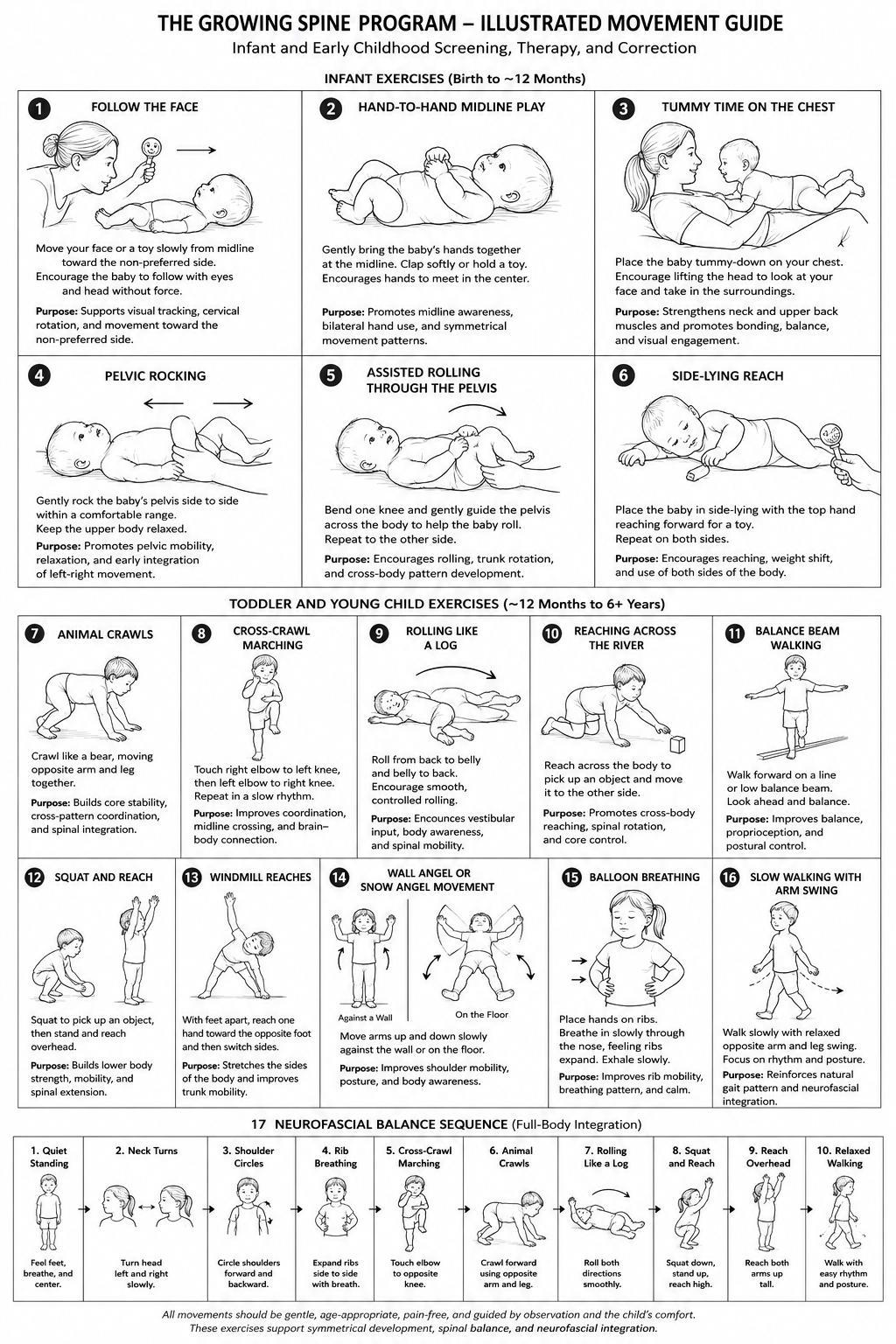
Exercise One: Follow the Face
Place the baby on the back. Bring your face close to the baby’s midline. Slowly move your face toward the side the baby avoids. Speak softly and allow the baby to follow you with the eyes and head. Return to midline. Repeat several times without forcing.
Exercise Two: Hand-to-Hand Midline Play
Place the baby on the back or in side-lying. Gently bring both hands toward the center of the chest. Allow the baby to touch hands, explore fingers, or bring hands toward the mouth. This supports midline awareness and symmetrical shoulder activity.
Exercise Three: Tummy Time on the Chest
Recline slightly and place the baby on your chest, tummy down. Encourage the baby to lift the head and look at your face. Shift your voice and face slightly left and right to encourage balanced head turning. This is often easier than floor tummy time for very young infants.
Exercise Four: Pelvic Rocking
With the baby lying on the back, gently place your hands around the pelvis. Slowly rock the pelvis side to side in a very small range. This
invites spinal relaxation, trunk awareness, and gentle fascial mobility. The movement should be soothing, not corrective or forceful.
Exercise Five: Assisted Rolling Through the Pelvis
With the baby lying on the back, bend one knee gently and guide the pelvis toward rolling. Allow the trunk, shoulder, and head to follow naturally. Repeat to both sides. This supports spinal rotation and rightleft integration.
Exercise Six: Side-Lying Reach
Place the baby in side-lying while awake and supervised. Offer a toy at chest level to encourage reaching with the top hand. This supports shoulder mobility, trunk rotation, and midline organization.
Guided Movement Exercises for Toddlers and Young Children
The goal in toddlers and young children is to create playful, symmetrical, whole-body movement. These activities are not presented as medical treatment for scoliosis. They are developmental movement practices that support balance, coordination, spinal mobility, pelvic control, and neurofascial integration.
1. Animal Crawls
Use bear crawl, cat crawl, tiger crawl, frog jumps, and crab walk. Crawling patterns strengthen the shoulders, hips, spine, and core while integrating opposite arm and leg movement. Encourage slow, smooth movement rather than speed.
2. Cross-Crawl Marching
Have the child touch the right hand to the left knee and the left hand to the right knee while marching. This supports cross-body coordination, trunk rotation, balance, and neurological integration.
3. Rolling Like a Log
Have the child lie on the floor and roll slowly from back to belly and belly to back. Encourage rolling both directions. This supports vestibular input, spinal rotation, rib cage mobility, and symmetrical trunk control.
4. Reaching Across the River
Place toys or objects across the midline. Ask the child to reach across the body to pick them up and place them on the other side. This improves cross-midline integration and trunk rotation.
5. Balance Beam Walking
Use a line on the floor, a low beam, or tape. Have the child walk slowly, heel-to-toe if able. Observe whether the child drifts, turns one foot out, or loses balance more to one side.
6. Squat and Reach
Have the child squat to pick up an object, then reach overhead with both hands. Watch for equal weight bearing, knee alignment, pelvic shift, and spinal symmetry.
7. Windmill Reaches
With feet apart, ask the child to reach one hand toward the opposite foot, then return to standing and repeat the other side. This encourages spinal rotation, hamstring mobility, pelvic movement, and cross-body integration.
8. Wall Angel or Snow Angel Movement
Have the child stand against a wall or lie on the floor and slowly move the arms up and down like making a snow angel. This encourages shoulder mobility, thoracic extension, rib cage awareness, and postural opening.
9. Balloon Breathing
Have the child place hands around the lower ribs and imagine slowly filling a balloon with breath. Encourage expansion into the back and sides of the rib cage. This supports rib mobility, relaxation, and postural regulation.
10. Slow Walking with Arm Swing
Ask the child to walk slowly while swinging opposite arm and leg. Observe arm swing, trunk rotation, pelvic rhythm, foot position, and head alignment. Encourage relaxed, natural movement.
Neurofascial Balance Sequence for Children
This simple sequence can be used as a warm-up in class or as a home movement routine.
Begin with quiet standing or sitting and three slow breaths. Bring awareness to the feet, pelvis, spine, shoulders, and head. Then perform gentle neck turning right and left, shoulder circles, rib cage breathing, cross-crawl marching, animal crawling, rolling on the floor, slow squatting, reaching overhead, and relaxed walking.
The purpose of this sequence is to invite the nervous system and fascial system into better balance. It combines breath, vestibular input, proprioception, spinal rotation, cross-pattern movement, and postural awareness.
This sequence should never cause pain. It should feel playful, exploratory, and comfortable.
What Practitioners Should Look For
The practitioner should watch the child move, not just stand still. Static posture gives useful information, but movement reveals how the child organizes the body.
Look for head tilt, head rotation preference, shoulder height difference, scapular winging, rib cage rotation, trunk lean, pelvic tilt, pelvic rotation, asymmetrical arm swing, one-sided toe-out, toe-walking, poor balance on one side, avoidance of midline crossing, delayed crawling, asymmetrical crawling, uneven squat, and difficulty transitioning through both sides.
The practitioner should also ask about family history of scoliosis, birth history, C-section or difficult delivery, breech positioning, torticollis, plagiocephaly, delayed milestones, early feeding difficulty, visual problems, vestibular problems, trauma, pain, and growth spurts.
Suggested Screening Form
Child’s Name: ___________________________
Age: ___________________________
Date: ___________________________
Parent/Guardian: ___________________________
Practitioner:
History
Family history of scoliosis: Yes / No / Unknown
C-section delivery: Yes / No / Unknown
Breech or difficult delivery: Yes / No / Unknown
History of torticollis: Yes / No / Unknown
History of plagiocephaly: Yes / No / Unknown
Delayed milestones: Yes / No / Unknown
Crawling history: Normal / Asymmetrical / Skipped / Unknown
Pain or discomfort: Yes / No
Parent concern: Yes / No
Infant Findings
Head preference: Right / Left / None
Head tilt: Right / Left / None
Restricted cervical rotation: Right / Left / None
Plagiocephaly: Mild / Moderate / Severe / None
Feeding asymmetry: Yes / No
Tummy time difficulty: Yes / No
Asymmetrical rolling: Yes / No
Asymmetrical reaching: Yes / No
Abnormal tone: Yes / No
Referral recommended: Yes / No
Toddler and Child Findings
Shoulder asymmetry: Yes / No
Rib cage asymmetry: Yes / No
Pelvic tilt or rotation: Yes / No
Gait asymmetry: Yes / No
Toe-walking: Yes / No
Foot turnout asymmetry: Yes / No
Poor balance on one side: Yes / No
Difficulty crossing midline: Yes / No
Asymmetrical squat: Yes / No
Forward bend asymmetry: Yes / No
Referral recommended: Yes / No
Corrective Recommendations
Parent education: Yes / No
Supervised tummy time: Yes / No
Side-lying play: Yes / No
Visual tracking: Yes / No
Cross-crawl activities: Yes / No
Crawling games: Yes / No
Rolling games: Yes / No
Balance play: Yes / No
Breath and rib mobility: Yes / No
Pediatric physical therapy referral: Yes / No
Pediatrician referral: Yes / No
Orthopedic referral: Yes / No
Clinical Summary
Early childhood postural and neuro-musculoskeletal screening provides an opportunity to identify developmental asymmetry before it becomes an entrenched postural pattern. While we cannot claim that this work prevents idiopathic scoliosis, we can reasonably state that early correction of asymmetrical movement, tone, posture, head preference, torticollis, plagiocephaly, pelvic imbalance, and gait dysfunction may support healthier spinal development.
The goal is not to label children with disease. The goal is to observe, educate, guide, and refer when needed. A child’s body is highly adaptable. Gentle, playful, early intervention may help restore symmetry, improve movement options, and support the developing spine through infancy, childhood, and adolescence.
Instructor note: This model is a clinical screening and early intervention framework. It does not replace pediatric diagnosis, pediatric physical therapy, orthopedic evaluation, or radiographic assessment when indicated. Its purpose is to help practitioners recognize early asymmetry, support balanced development, and refer appropriately.
Glossary
Adolescent Idiopathic Scoliosis
Adolescent idiopathic scoliosis is a spinal curvature that appears most commonly during the adolescent growth period and has no single known cause. The word idiopathic means that the exact cause is unknown. Current understanding suggests that many factors may contribute, including genetics, growth patterns, connective tissue influences, neuromuscular control, vestibular function, biomechanics, hormones, and environmental factors.
Asymmetrical Crawling
Asymmetrical crawling occurs when an infant or young child uses one side of the body differently than the other during crawling. The child may drag one leg, push more strongly with one arm, avoid using one hip, or move in a scooting pattern rather than a balanced hands-andknees pattern. Persistent asymmetrical crawling may indicate uneven trunk, pelvic, shoulder, or neurological organization.
Balance Reactions
Balance reactions are the body’s automatic responses to changes in position, weight shift, or movement. These reactions help the child stay upright, prevent falling, and adjust posture during sitting, crawling, standing, walking, and play.
Body Awareness
Body awareness is the child’s internal sense of where the body is in space. It develops through touch, movement, balance, vision, proprioception, and repeated motor experience.
Cervical Rotation
Cervical rotation refers to the ability of the neck to turn the head to the right and left. In infants, limited cervical rotation may contribute to head preference, feeding asymmetry, plagiocephaly, and difficulty with visual tracking or tummy time.
Cross-Crawl Pattern
A cross-crawl pattern is a coordinated movement in which the opposite arm and opposite leg move together. Crawling, walking, and running all depend on cross-pattern organization. Cross-crawl movement helps integrate the right and left sides of the body and supports trunk rotation, spinal coordination, and neurological development.
Developmental Asymmetry
Developmental asymmetry means that a child repeatedly uses one side of the body differently than the other. This may appear in head turning, rolling, reaching, crawling, sitting, standing, gait, pelvic position, or spinal posture. Mild asymmetry may occur during normal development, but persistent or strong asymmetry should be observed and addressed.
Fascial Tone
Fascial tone refers to the tension, responsiveness, and adaptability of the fascial system. Fascia helps support posture, transmit force, guide movement, and provide sensory information to the nervous system. Persistent asymmetry may influence fascial tone and movement organization.
Gait Asymmetry
Gait asymmetry means that a child walks with an uneven pattern. This may appear as one foot turning out, uneven arm swing, pelvic shift, toewalking, trunk lean, limping, or favoring one side of the body.
Head Preference
Head preference means that an infant consistently turns or rests the head to one side. For example, the baby may usually turn the head to the right and resist turning fully to the left. Head preference may be associated with neck tightness, torticollis, birth positioning, feeding patterns, visual preference, or early handling habits.
Midline Awareness
Midline awareness is the child’s ability to recognize and organize movement around the center of the body. Bringing the hands together,
reaching toward the mouth, looking straight ahead, rolling equally both ways, and sitting with balanced posture all reflect developing midline awareness.
Motor Milestones
Motor milestones are developmental movement skills that typically appear in a predictable sequence. These include head control, rolling, reaching, sitting, crawling, kneeling, pulling to stand, walking, running, climbing, and jumping. Delayed or asymmetrical milestones may suggest the need for further observation or referral.
Neurofascial Balance
Neurofascial balance refers to the relationship between the nervous system and the fascial system. The nervous system directs movement, posture, tone, and balance. The fascial system provides structural support and sensory feedback. When a child repeatedly uses one side more than the other, the nervous system and fascia may adapt to that pattern.
Pelvic Balance
Pelvic balance refers to the position and movement of the pelvis during lying, sitting, crawling, standing, and walking. Because the pelvis forms the foundation of the spine, pelvic tilt, rotation, or weight-shifting patterns can influence spinal posture, rib cage balance, gait, and movement development.
Plagiocephaly
Plagiocephaly means asymmetrical flattening of the infant’s skull, often called positional plagiocephaly or flat head syndrome. It may occur when an infant repeatedly rests on one area of the head. It is often associated with head preference, limited neck rotation, or torticollis.
Postural Balance
Postural balance refers to the ability to maintain upright, centered, and adaptable alignment during rest and movement. Good postural balance is
not rigid. It allows the body to adjust, rotate, bend, breathe, and respond to changing demands.
Primitive Reflexes
Primitive reflexes are automatic movement responses present in infancy. They help the newborn survive, feed, orient, and begin movement development. As the nervous system matures, these reflexes are gradually integrated into more voluntary motor control. Persistent primitive reflex patterns may influence posture, coordination, balance, and movement quality.
Proprioception
Proprioception is the body’s sense of joint position, movement, pressure, and muscular effort. It allows the brain to know where the body is in space without needing to look. Proprioception is essential for posture, balance, gait, coordination, and spinal control.
Rib Cage Balance
Rib cage balance refers to the mobility, symmetry, and position of the ribs during breathing, posture, and movement. The rib cage is closely related to the thoracic spine, shoulders, diaphragm, and pelvis. Rib cage asymmetry may influence spinal rotation and postural compensation.
Scoliometer
A scoliometer is a simple measuring tool used during forward bend screening to estimate trunk rotation. It does not diagnose scoliosis by itself, but it can help identify when further evaluation may be needed.
Spinal Loading
Spinal loading refers to the forces placed on the spine during standing, sitting, walking, carrying, lifting, and movement. When posture or movement is asymmetrical, spinal loading may become uneven.
Torticollis
Torticollis means a persistent head tilt or rotation caused by imbalance, tightness, or shortening of the neck muscles, often involving the
sternocleidomastoid muscle. In infants, torticollis may interfere with feeding, visual tracking, rolling, tummy time, and symmetrical development.
Vestibular System
The vestibular system is the balance system located in the inner ear. It helps the brain detect head position, motion, gravity, and spatial orientation. Vestibular input is important for posture, balance, eye movement, coordination, and spinal control.
Conclusion
The Growing Spine Program was developed from a simple clinical observation: children often show patterns of postural and movement asymmetry long before a spinal curve is recognized. A baby may always turn the head to one side. An infant may develop a flat spot on the skull. A toddler may crawl unevenly. A young child may stand with a shifted pelvis, one shoulder higher, or a gait pattern that favors one side.
These signs do not mean that a child has scoliosis. They do not mean that scoliosis is inevitable. But they do deserve careful observation.
The purpose of this program is to help practitioners recognize early developmental asymmetry, support healthier movement patterns, guide parents, and refer appropriately when needed. This is not a program of fear, diagnosis, or over-treatment. It is a program of early awareness, gentle care, and developmental support.
The spine does not develop in isolation. It is shaped by the nervous system, fascia, vestibular balance, respiration, vision, muscle tone, pelvic mechanics, gait, crawling, balance, and movement experience. When a child has more balanced movement options, the spine has a better opportunity to grow in an adaptable and organized way.
Correction in this program does not mean force. It does not mean imposing alignment on a child’s body. It means gently creating better conditions for the nervous system to explore symmetry, comfort, balance, and freedom of movement. It means using play, touch, breath, movement, and observation to help the child discover better patterns.
For the practitioner, the most important skills are patience, sensitivity, and clinical judgment. The practitioner must know what to observe, how to support gentle correction, and when to refer. Persistent head tilt, significant plagiocephaly, delayed milestones, abnormal tone, progressive spinal curvature, neurological signs, pain, or parental concern should always be taken seriously.
The Growing Spine Program does not replace pediatric medicine, pediatric physical therapy, orthopedic evaluation, or radiographic assessment when those are indicated. It offers a complementary model of observation, early support, and movement-based education.
Healthy movement begins early. Balanced posture begins with observation. The growing spine deserves careful attention.
References and Suggested Reading
American Academy of Pediatrics. Positional plagiocephaly pediatric patient education materials. American Academy of Pediatrics.
American Physical Therapy Association, Academy of Pediatric Physical Therapy. Physical Therapy Management of Congenital Muscular Torticollis: An Evidence-Based Clinical Practice Guideline.
Kaplan, S. L., Coulter, C., & Sargent, B. Physical Therapy Management of Congenital Muscular Torticollis: A 2018 Evidence-Based Clinical Practice Guideline From the APTA Academy of Pediatric Physical Therapy. Pediatric Physical Therapy, 30(4), 240-290.
U.S. Preventive Services Task Force. Screening for Adolescent Idiopathic Scoliosis: U.S. Preventive Services Task Force Recommendation Statement. JAMA, 2018.
Scoliosis Research Society. Patient and professional educational materials on adolescent idiopathic scoliosis.
Aulia, T. N., and colleagues. Etiopathogenesis of adolescent idiopathic scoliosis: a review of current concepts.
Negrini, S., Donzelli, S., Aulisa, A. G., Czaprowski, D., Schreiber, S., de Mauroy, J. C., and colleagues. 2016 SOSORT Guidelines: Orthopaedic and Rehabilitation Treatment of Idiopathic Scoliosis During Growth.
Weinstein, S. L., Dolan, L. A., Wright, J. G., & Dobbs, M. B. Effects of Bracing in Adolescents with Idiopathic Scoliosis. New England Journal of Medicine, 2013.
Kendall, F. P., McCreary, E. K., Provance, P. G., Rodgers, M. M., & Romani, W. A. Muscles: Testing and Function with Posture and Pain.
Bly, L. Motor Skills Acquisition in the First Year: An Illustrated Guide to Normal Development.
Feldenkrais, M. Awareness Through Movement.
Shumway-Cook, A., & Woollacott, M. H. Motor Control: Translating Research Into Clinical Practice.
About the Author
Gregory T. Lawton, D.C., D.N., D.Ac., N.D. is a licensed Chiropractor, licensed Naprapath, licensed Acupuncturist, registered Naturopath, Master Herbalist, author, educator, and founder of the Blue Heron Academy of Healing Arts and Sciences. He has more than 45 years of professional healthcare practice experience and more than 55 years of teaching experience in the healing arts, manual therapy, natural medicine, martial arts, movement training, and integrative health education.
Dr. Lawton’s professional work has focused on the integration of manual medicine, medical massage therapy, naprapathy, acupuncture, naturopathy, herbal medicine, clinical nutrition, therapeutic movement, spinal health, and rehabilitation. His teaching emphasizes practical hands-on skill, clinical reasoning, professional ethics, and the development of compassionate practitioners who understand both the structure and the spirit of healing.
He is the founder of the Blue Heron Academy of Healing Arts and Sciences, a state-licensed postsecondary school that has trained thousands of students in massage therapy, medical massage, manual medicine, holistic health, natural medicine, and related healthcare disciplines. He is also the founder of American Health Source and has developed numerous educational programs, clinical manuals, workshops, and professional training systems.
The Growing Spine Program reflects Dr. Lawton’s long-standing interest in scoliosis, posture, spinal mobilization, movement therapy, neurological retraining, neurofascial balance, pediatric development, and early intervention. The program is designed to help practitioners observe early signs of postural and developmental asymmetry, support healthy movement, educate parents, and refer appropriately when needed.
Dr. Lawton’s teaching philosophy is grounded in the belief that healing begins with careful observation, respectful touch, sound clinical
judgment, and service to the well-being of the whole person. Through his work with Blue Heron Academy, American Health Source, and Building a Healing Community, he continues to train practitioners in hands-on methods that support health, dignity, movement, and human development.