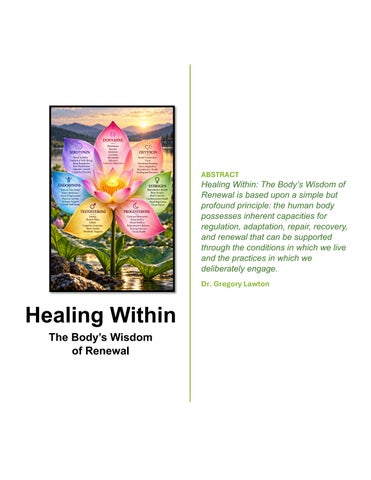
ABSTRACT
Healing Within: The Body’s Wisdom of Renewal is based upon a simple but profound principle: the human body possesses inherent capacities for regulation, adaptation, repair, recovery, and renewal that can be supported through the conditions in which we live and the practices in which we deliberately engage. Dr. Gregory Lawton
Healing Within The Body’s Wisdom of Renewal
Healing Within - The Body’s Wisdom of Renewal Traditional and Physiological Methods for Supporting the Body's Hormonal and Neurochemical Balance With Applications in Fatigue, Chronic Fatigue, Fibromyalgia, Stress, Metabolic Health, Aging, and Physical Conditioning Gregory T. Lawton, D.C., D.N., D.Ac., N.D. American Health Source Blue Heron Academy of Healing Arts and Sciences 2026
1|Pa ge
Copyright and Educational Statement Copyright © 2026 Gregory T. Lawton, D.C., D.N., D.Ac., N.D. All Rights Reserved. No portion of this publication may be reproduced, distributed, stored, transmitted, or used in any form without the written permission of the author and publisher, except for brief quotations used for educational or scholarly purposes. Published by American Health Source and the Blue Heron Academy of Healing Arts and Sciences. Educational and Clinical Statement This program has been prepared for professional and continuing education. It presents traditional practices, empirical observations, clinical experience, anatomy and physiology, and contemporary concepts related to neuroendocrine regulation, physical conditioning, adaptation, health, and recovery. The information presented is educational in nature and is not intended to replace appropriate medical diagnosis, treatment, emergency care, or consultation with qualified health-care professionals. Practitioners are responsible for working within their professional scope of practice and for modifying any exercise or practice according to the health, age, physical condition, functional capacity, medications, diagnoses, and individual response of the patient. The practices described in this program range from gentle meditation and breathing exercises to more demanding forms of physical conditioning, muscular contraction, breath control, and temperature exposure. They should not be interpreted as requiring every individual to perform the same exercise at the same intensity. Adaptation is progressive. What is appropriate for a highly conditioned individual may be inappropriate for a person who is elderly, severely deconditioned, acutely ill, or experiencing significant cardiovascular, respiratory, neurological, metabolic, or other health limitations.
2|Pa ge
This program encourages the thoughtful integration of traditional knowledge, clinical observation, physiological understanding, and individualized patient care.
3|Pa ge
Abstract Healing Within: The Body’s Wisdom of Renewal is based upon a simple but profound principle: the human body possesses inherent capacities for regulation, adaptation, repair, recovery, and renewal that can be supported through the conditions in which we live and the practices in which we deliberately engage. For thousands of years, human cultures have developed practices intended to improve health, vitality, resilience, physical capacity, emotional balance, and longevity. Meditation, controlled breathing, yoga, Chi Kung, physical exercise, muscular contraction, abdominal and pelvic-floor exercises, fasting, exposure to heat and cold, and other forms of controlled physiological challenge have appeared repeatedly within traditional systems of health and physical cultivation. Modern physiology provides a new vocabulary with which to examine many of these practices. The nervous and endocrine systems continuously communicate with one another through hormones, neurotransmitters, neuropeptides, autonomic pathways, sensory information, metabolic signals, and feedback mechanisms. Dopamine, serotonin, endogenous opioids such as the endorphins, oxytocin, catecholamines, cortisol, estrogen, progesterone, testosterone, and many other signaling substances participate in the body's responses to movement, breathing, stress, temperature, social interaction, sleep, exercise, pain, recovery, and the surrounding environment. This program uses the term neuroendocrine regeneration to describe the support and cultivation of the body's inherent capacity to produce, release, regulate, utilize, and maintain these signaling systems as part of normal physiological adaptation. The program examines the historical development of traditional practices alongside the physiology of neuroendocrine regulation. Particular attention is given to meditation, breathwork, reverse breathing, yoga, pelvic-floor exercise, abdominal churning, physical conditioning, controlled temperature exposure, Bone Marrow Cleansing Chi Kung, and Iron Shirt Chi Kung. Clinical applications are considered in relation to suboptimal health, physical deconditioning, metabolic dysfunction, stress, depression, chronic 4|Pa ge
pain, aging, fatigue, chronic fatigue, fibromyalgia, and related disturbances of health and function. The central premise of this program is simple: the human organism is responsive, adaptive, and capable of change. Health care should not overlook the ability of patients to participate actively in developing their own physiological resilience, functional capacity, and health.
5|Pa ge
Foreword Human beings were experimenting with the regulation of their own physiology long before they possessed a scientific vocabulary with which to explain what they were doing. Through observation, experience, and the accumulation of knowledge across generations, people learned that breathing could be deliberately changed, that stillness and meditation could alter consciousness and emotional state, that repetitive movement could increase physical capacity, and that muscular effort could strengthen the body. They also discovered that exposure to heat and cold produced profound physical responses, that fasting and dietary practices changed how the body functioned and felt, and that disciplined physical and contemplative practices could increase a person's tolerance for physical and psychological stress. These discoveries did not belong to a single civilization or historical period. Across different cultures and geographical regions, systems developed that incorporated meditation, controlled breathing, movement, posture, muscular contraction, physical conditioning, dietary regulation, fasting, heat, cold, controlled discomfort, and contemplative practice. The terminology, philosophies, and explanations differed considerably, but beneath those differences was a recurring observation: the human organism possesses an extraordinary capacity to respond and adapt to deliberate changes in its internal and external environment. Ancient practitioners did not speak of dopamine, serotonin, endorphins, oxytocin, norepinephrine, cortisol, estrogen, progesterone, or testosterone. They could not measure heart-rate variability, blood glucose, oxygen consumption, metabolic rate, inflammatory mediators, autonomic activity, or electrical activity within the brain. Instead, cultures developed their own ways of describing what they observed. Concepts such as vitality, balance, internal strength, purification, qi, prana, and harmony with nature emerged from particular cultural, philosophical, medical, and spiritual traditions. Modern physiology provides another language with which to examine many of these observations. We can now describe communication between the brain and body through the nervous system, endocrine system, autonomic nervous system, hypothalamus, pituitary gland, sensory pathways, receptors, feedback mechanisms, metabolic signaling, and circadian rhythms. We can measure many of the chemical messengers that 6|Pa ge
participate in this communication and observe how their concentrations and activities change in response to exercise, stress, sleep, temperature, breathing, social interaction, physical discomfort, recovery, and numerous other experiences. The ability to measure these processes, however, should not cause us to overlook an important historical reality. Human beings experienced these physiological responses long before science developed instruments capable of measuring them. The laboratory did not create the effects of movement, controlled breathing, meditation, muscular contraction, fasting, heat, cold, physical conditioning, or disciplined practice. The laboratory provided another means of observing processes that had always been present within the human organism. This distinction is particularly important when considering traditional systems of health. It would be inappropriate to assume that traditional concepts such as qi or prana are simply ancient names for individual hormones, neurotransmitters, or physiological processes. These concepts arose within their own systems of thought and often encompassed physical, psychological, environmental, philosophical, and spiritual dimensions. At the same time, the physical practices associated with these traditions involve a human body whose fundamental physiology has not changed simply because our terminology has. Controlled breathing alters respiratory mechanics regardless of whether it occurs in an ancient contemplative tradition or a modern rehabilitation setting. Muscular contraction places demands upon skeletal muscle and metabolism. Exercise challenges the cardiovascular and respiratory systems. Cold exposure requires thermoregulatory responses. Meditation changes attention, perception, and the relationship between stimulus and response. Repeated exposure to physical challenge can result in conditioning and adaptation. Rest and recovery influence what happens after that challenge. These are fundamental characteristics of the living human organism. This relationship between traditional practice and physiological adaptation provides the foundation for the concept explored throughout this program, which I refer to as neuroendocrine regeneration. As the term is used in this booklet, regeneration is broader than simply increasing the concentration of a particular hormone or neurotransmitter. Human 7|Pa ge
physiology depends upon patterns of production, release, reception, feedback, inhibition, stimulation, utilization, adaptation, and recovery. A well-regulated physiological system must be capable of responding when a response is needed and of reducing that response when the demand has passed. The objective is therefore not simply greater stimulation or higher hormone levels, but the cultivation and maintenance of appropriate physiological responsiveness and regulation. This concept becomes especially important when working with people experiencing physical deconditioning, obesity, metabolic dysfunction, chronic stress, depression, chronic pain, fatigue, fibromyalgia, aging, or progressive loss of physical capacity. Treatment of these individuals can easily become centered upon what is done to the patient. Medications may be prescribed, procedures performed, treatments administered, and symptoms monitored. These interventions may have important roles, but another question deserves consideration alongside them: what can the patient learn to do that changes the physiological environment in which illness, adaptation, and recovery are occurring? Movement can be practiced and physical capacity can be progressively developed. Breathing can be consciously modified. Strength can be increased. Meditation can be learned. Sleep and dietary habits can change. Muscular contraction can be deliberately cultivated. Temperature can become a controlled physiological stimulus. Attention and concentration can be trained. The individual's relationship with effort, discomfort, recovery, and physical challenge can also change. In each instance, the patient becomes an active participant rather than solely the recipient of treatment. The practices explored in this program range from familiar activities such as exercise, meditation, yoga, and controlled breathing to traditional practices including reverse breathing, abdominal churning, pelvic-floor contraction, Bone Marrow Cleansing Chi Kung, and Iron Shirt Chi Kung. Some practices are gentle and can be introduced with relatively little physical demand, while others represent substantial physiological challenges that require progressive conditioning. Their appropriate use therefore depends upon the age, health, experience, functional capacity, and degree of adaptation of the individual.
8|Pa ge
This principle of progressive adaptation is essential. A practice developed through decades of conditioning cannot simply be transferred at the same intensity to a person who is severely deconditioned. The objective is not to imitate the performance of an experienced practitioner. The objective is to understand the underlying principles and identify an appropriate starting point for the individual. A relatively small challenge may initially provide sufficient physiological stimulation. With repetition, recovery, and adaptation, capacity can increase and the nature of the challenge can gradually change. What was once difficult may eventually become comfortable, and what once represented a substantial physiological stress may become part of ordinary daily activity. This process of stimulus, response, recovery, and adaptation can be observed throughout human physiology, and it is also one of the oldest principles contained within traditional systems of physical cultivation. It provides an important bridge between historical empirical practice and contemporary understanding of the nervous, endocrine, metabolic, cardiovascular, respiratory, and musculoskeletal systems. For this reason, this program will not begin with an isolated hormone, neurotransmitter, laboratory value, or disease. It will begin with the long history of human beings observing their own bodies and discovering that deliberate practice could change physical and mental function. From that foundation we will move into the physiology of adaptation and neuroendocrine communication, examine individual hormones and neurochemical signaling systems, explore traditional and contemporary practices that influence human physiology, and finally consider how these principles may be applied to health, conditioning, fatigue, chronic pain, fibromyalgia, metabolic health, aging, and the restoration of physical capacity. Throughout this discussion, one principle will remain at the center of the program. The human body is not merely capable of being treated. It is capable of responding, learning, adapting, regulating, recovering, and changing. Understanding how to cultivate and support that inherent capacity is the purpose of Neuroendocrine Regeneration.
9|Pa ge
Preface During more than half a century of clinical practice and health science education, I have repeatedly observed an important distinction between treating disease and cultivating health. Modern medicine possesses extraordinary abilities. It can diagnose disease, control infection, perform complex surgery, stabilize traumatic injury, replace failing joints, regulate dangerous physiological abnormalities, and intervene during medical emergencies that would once have resulted in death. Yet there is another side of health care that is easily neglected. The human body is not simply something upon which treatment is performed. It is a living, adaptive organism capable of responding to movement, exercise, breathing, nutrition, temperature, touch, rest, sleep, thought, emotion, environmental exposure, and repeated physiological challenge. The patient is therefore not merely the recipient of treatment. The patient can become an active participant in the process of improving health. My interest in these principles did not begin recently. For more than six decades, I have personally practiced various combinations of meditation, breathwork, yoga, Chi Kung, martial arts, reverse breathing, abdominal exercise, pelvic-floor contraction, Bone Marrow Cleansing, Iron Shirt Chi Kung, physical conditioning, and exposure to the natural environment. My own practice continues today. My day commonly begins at approximately four o'clock in the morning, outdoors, in darkness, throughout the seasons. I practice in only a pair of shorts and combine meditation, controlled breathing, reverse breathing, physical exercise, yoga, abdominal churning, pelvic-floor exercises, Bone Marrow Cleansing, Iron Shirt Chi Kung, and other methods of physical and mental cultivation. This did not become my present practice overnight. It represents decades of progressive conditioning and adaptation. That distinction is important. The purpose of describing this practice is not to suggest that an elderly, chronically ill, obese, fatigued, physically deconditioned, or previously sedentary patient should suddenly imitate it. The lesson is quite the opposite. Human adaptation develops through 10 | P a g e
repeated exposure to an appropriate physiological stimulus followed by recovery and further adaptation. During my clinical career, I have also worked with patients whose health was profoundly compromised. Some were severely deconditioned. Some struggled with obesity, metabolic dysfunction, chronic pain, fatigue, depression, and multiple illnesses. In many cases, improvement involved more than treatment performed upon the patient. It involved teaching the patient to participate in changing the conditions under which his or her body was functioning. Diet changed. Movement changed. Breathing changed. Physical capacity changed. Daily habits changed. The patient's relationship with discomfort, effort, rest, and recovery changed. And the patient changed. These experiences caused me to become increasingly interested in a fundamental question: What can the human body restore when we provide it with the appropriate conditions and stimulus? For most of human history, people did not possess laboratory measurements of neurotransmitters, hormones, inflammatory mediators, glucose metabolism, cardiovascular function, autonomic activity, or brain physiology. Nevertheless, they possessed something else of great importance: observation. They observed what happened when people moved and when they did not move. They observed the effects of controlled breathing, meditation, fasting, muscular effort, heat, cold, repetitive exercise, sleep, rest, physical hardship, social connection, and disciplined practice. These observations accumulated over generations and, in some traditions, over centuries. The explanations differed among cultures. Ancient Indian practitioners spoke of prana. Chinese traditions developed concepts involving qi. Other peoples described vitality, spirit, internal strength, purification, balance, or harmony with nature. We should not assume that these traditional terms are simply ancient names for modern hormones or neurotransmitters. They arose from different philosophical systems. But neither should we overlook the physical 11 | P a g e
practices simply because the people who developed them lacked our modern biochemical vocabulary. A person practicing controlled breathing thousands of years ago possessed the same fundamental respiratory anatomy as a person practicing it today. Skeletal muscle contracted according to the same biological principles. Cold activated thermoregulatory responses. Exercise placed demands upon metabolism. Meditation altered attention and sensory processing. Pain produced physiological responses. Recovery followed exertion. Repeated exposure produced adaptation. The terminology changed. Human physiology did not suddenly begin when we learned how to measure it. This program explores that intersection between traditional practice, accumulated human experience, clinical observation, and contemporary physiology. Its purpose is not merely to ask whether a particular exercise increases a particular hormone. That question is too narrow. Instead, we will examine how breathing, movement, muscular contraction, meditation, temperature, controlled discomfort, physical conditioning, rest, and repeated practice interact with the nervous, endocrine, metabolic, cardiovascular, respiratory, musculoskeletal, and immune systems. We will examine dopamine, serotonin, endorphins, oxytocin, catecholamines, cortisol, estrogen, progesterone, testosterone, and other signaling substances. But we will consider them as parts of an interconnected regulatory organism rather than isolated chemicals. The objective is not simply to produce more of everything. The objective is regulation, responsiveness, adaptation, resilience, recovery, and health. This is what I mean by neuroendocrine regeneration.
12 | P a g e
Introduction The human body is in a continuous state of communication, adjustment, and adaptation. Every moment requires countless physiological systems to respond to changes occurring both within the body and in the surrounding environment. Temperature changes, physical movement, muscular effort, breathing, food intake, sleep, pain, emotional experience, social interaction, light and darkness, physical exertion, and periods of rest all provide information to which the body must respond. Health depends in part upon the ability of these regulatory systems to recognize changing demands, produce an appropriate response, and return toward balance when the demand has passed. Much of this regulation occurs without conscious effort. Heart rate changes with physical activity. Blood vessels constrict or dilate in response to temperature and metabolic demand. Breathing changes with exercise, emotion, and alterations in blood chemistry. Hormones are released according to circadian rhythms, nutritional status, physical activity, stress, reproduction, and numerous other physiological signals. The nervous system continually receives information from the body and environment and modifies muscular activity, circulation, respiration, digestion, endocrine function, attention, behavior, and perception accordingly. Yet human beings possess another remarkable ability. Some of these regulatory systems can also be influenced deliberately. We can consciously change the rate and pattern of breathing. We can contract or relax skeletal muscles. We can exercise until cardiovascular and metabolic demands increase substantially. We can sit quietly and direct attention inward through meditation. We can expose ourselves to heat or cold. We can voluntarily enter and remain in physically demanding postures. We can contract the abdominal and pelvic musculature, alter respiratory mechanics, fast for periods of time, modify our diet, and progressively condition ourselves to tolerate physical challenges that initially seemed difficult or uncomfortable. Repeated practice changes the practitioner. A person who begins walking a short distance may eventually walk several miles. Muscles that initially fatigue after a small amount of work can become stronger and more resistant to fatigue. Exposure to cool temperatures that was once uncomfortable may become increasingly tolerable. Breathing that was once 13 | P a g e
rapid and poorly controlled may become slower and more deliberate. A posture that initially required considerable effort may eventually be maintained with relative ease. Meditation that begins as a struggle to remain attentive may develop into a familiar state of mental and physical quiet. These changes illustrate one of the central principles of this program: the human organism is adaptive. Adaptation occurs because living systems respond to demands placed upon them. When an appropriate stimulus is repeated and sufficient recovery is allowed, the body may alter its structure, function, metabolism, neurological activity, endocrine responses, and behavioral patterns in ways that prepare it to respond differently when the stimulus occurs again. Physical conditioning is perhaps the most familiar example, but the principle extends well beyond muscle strength and cardiovascular endurance. The nervous and endocrine systems are deeply involved in these adaptive processes. They provide important communication networks through which different parts of the body coordinate their activities. The nervous system can transmit information rapidly through electrical and chemical signaling. The endocrine system communicates largely through chemical messengers released into the circulation. These systems are not isolated from one another. The brain influences endocrine activity, hormones influence the brain, sensory experiences influence both, and the resulting responses affect virtually every tissue of the body. This interconnected relationship is the basis for the term neuroendocrine. Neuroendocrine regulation involves communication among the brain, nervous system, endocrine glands, hormones, neurotransmitters, neuropeptides, receptors, organs, and peripheral tissues. Rather than functioning as independent systems, these structures and chemical messengers participate in an enormous network of communication and feedback. Dopamine, serotonin, endorphins, oxytocin, norepinephrine, epinephrine, cortisol, estrogen, progesterone, and testosterone are among the signaling substances that will be examined in this program. Each has different functions, sites of production, patterns of release, receptors, and regulatory mechanisms. Some act primarily as neurotransmitters in particular
14 | P a g e
locations, some function as hormones, and some may perform different signaling roles depending upon where and how they are released. These substances influence much more than mood. They participate in motivation, movement, reward, pain perception, stress responses, reproduction, sexual function, social behavior, sleep, appetite, metabolism, vascular regulation, immune activity, physical performance, recovery, and numerous other aspects of human physiology. Their effects are interconnected, and changes in one regulatory system may influence others. For this reason, neuroendocrine health should not be viewed simply as having a particular amount of a particular chemical. Regulation is dynamic. Hormones and neurotransmitters are produced, released, transported, received, metabolized, recycled, or eliminated according to changing physiological requirements. Receptors may change in number or sensitivity. Feedback mechanisms may increase or suppress further production. Circadian rhythms alter secretion throughout the day and night. Age, nutrition, physical conditioning, illness, medications, sleep, psychological stress, exercise, and environmental conditions can influence these processes. The concept of neuroendocrine regeneration, as used throughout this program, therefore refers to supporting the body's inherent capacity to produce, release, regulate, utilize, and maintain the chemical signaling systems involved in healthy physiological adaptation. Regeneration is not simply an attempt to drive hormone concentrations upward. A physiological substance that is beneficial within an appropriate range and context may be undesirable when excessive, deficient, mistimed, or poorly regulated. The objective is not maximum production. The objective is effective regulation, responsiveness, adaptation, recovery, and balance. This understanding is particularly important as people age or become progressively inactive. Modern life can remove many of the physiological challenges that were once unavoidable. Temperature is controlled indoors. Transportation reduces the need for walking. Physical labor has diminished for many people. Food is continuously available. Chairs support the body for much of the day. Electronic entertainment requires little movement. Many occupations require prolonged sitting, and daily life can proceed with remarkably little muscular exertion. 15 | P a g e
At the same time, psychological demands may remain high. A person can therefore experience considerable mental and emotional stress while receiving relatively little of the physical activity that traditionally accompanied human life. The body may be frequently stimulated psychologically while becoming progressively deconditioned physically. Over time, the consequences can become visible as loss of strength, reduced endurance, declining mobility, altered sleep, increasing body fat, metabolic dysfunction, diminished tolerance for physical exertion, chronic pain, fatigue, and a progressive narrowing of physical capacity. For some individuals, daily activities that once required little thought eventually become substantial physical challenges. This decline is sometimes accepted as an inevitable consequence of aging or chronic illness. Aging certainly produces biological changes, and disease can impose genuine limitations. Nevertheless, chronological age alone does not determine physical capacity. The amount and type of physiological stimulation an individual receives throughout life also matter. The body responds not only to what we do, but also to what we repeatedly fail to do. Muscle that is not challenged does not receive the same stimulus as muscle that is regularly used. Cardiovascular capacity that is never called upon is not challenged in the same way as cardiovascular capacity that is progressively exercised. A person continuously protected from temperature variation does not experience the same environmental demands as someone regularly exposed to changing conditions. Physical and physiological systems require use. Traditional systems of health recognized this principle long before the mechanisms of adaptation could be measured. Their methods varied, but many deliberately required participation. The practitioner breathed, moved, stretched, contracted muscles, maintained postures, meditated, fasted, walked, trained, encountered temperature, tolerated controlled discomfort, and repeated these activities over long periods of time. Health was not necessarily understood as something another person could simply provide. It was cultivated through practice. This idea is especially relevant to the health-care practitioner. Treatment can reduce pain, improve mobility, control disease, support healing, and 16 | P a g e
sometimes save life. There are circumstances in which the patient unquestionably requires something to be done for him or her. However, long-term health and physical function also depend upon what the patient does between treatments and throughout daily life. A therapist may work with a patient for an hour. The patient lives within his or her own body for the remaining hours of the day. Teaching a patient how to breathe, move, exercise, relax, recover, improve physical capacity, and participate actively in health therefore has the potential to extend the therapeutic process beyond the treatment room. The objective is not to replace appropriate medical care. It is to recognize that health care can include both treatment and education, and that education can help return a measure of responsibility and capability to the patient. This becomes particularly important when working with individuals experiencing fatigue, chronic fatigue, fibromyalgia, chronic pain, metabolic dysfunction, obesity, depression, stress, physical deconditioning, or agerelated loss of function. These individuals do not all have the same condition, and they should not receive identical recommendations. Nevertheless, many can benefit from understanding that physiological capacity exists on a continuum and that appropriate practices can often begin at a level compatible with the individual's present ability. A highly conditioned person and a severely deconditioned person may practice the same underlying principle without performing the same activity. One person may encounter cold by exercising outdoors during winter. Another may begin by briefly reducing the temperature of a shower. One person may perform demanding Chi Kung postures and muscular contractions. Another may begin with several gentle contractions coordinated with breathing. One person may exercise vigorously. Another may begin by walking for several minutes. The principle is not intensity for its own sake. The principle is an appropriate stimulus followed by response, recovery, and adaptation. The practices presented in this program should therefore be understood as tools rather than rigid prescriptions. Meditation, breathwork, reverse breathing, yoga, pelvic-floor exercise, abdominal churning, physical exercise, temperature exposure, controlled physical discomfort, Bone Marrow Cleansing, and Iron Shirt Chi Kung represent different ways of interacting deliberately with human physiology. Their usefulness depends 17 | P a g e
upon the individual, the purpose for which they are being used, the manner in which they are performed, and the progressive adaptation of the practitioner. The chapters that follow will first examine the historical development of these practices and the remarkable recurrence of similar principles among different cultures. We will then explore the adaptive human organism and the communication between the nervous and endocrine systems. Individual neurochemical and hormonal systems will be considered before we turn to the practices themselves and their application to health, conditioning, fatigue, chronic pain, fibromyalgia, metabolic health, aging, and recovery. Throughout the program we will return repeatedly to a fundamental idea. The body is continually receiving information from the way we live. Movement provides information. Stillness provides information. Breathing provides information. Temperature provides information. Muscular effort provides information. Food provides information. Sleep provides information. Pain, pleasure, touch, social interaction, stress, and recovery provide information. The body responds to these signals, and repeated responses can become adaptations. Neuroendocrine regeneration begins with learning how to participate deliberately in that process. Healing within is the larger principle. Neuroendocrine regeneration is one of the physiological processes through which that principle can be understood. The practices presented in this program are methods of creating conditions that may support the body's inherent capacities for regulation, adaptation, recovery, and renewal.
18 | P a g e
Chapter One From Ancient Practice to Neuroendocrine Regeneration Long before human beings understood hormones, neurotransmitters, receptors, mitochondria, autonomic regulation, or cellular metabolism, they observed that certain activities changed the way the body and mind functioned. Breathing could be deliberately slowed or intensified. Muscles became stronger when repeatedly challenged. Periods of stillness and contemplation changed attention and emotional state. Fasting altered hunger, energy, and perception. Exposure to heat and cold produced powerful physical responses. Repeated physical challenges that were initially difficult often became easier with practice. Through observation and experience, people discovered one of the fundamental characteristics of human physiology: the body is capable of adaptation. These observations became part of some of the earliest systems of health care. Traditional healing was not limited to substances or treatments administered to a sick person. It frequently included instructions concerning food, sleep, movement, exercise, bathing, breathing, posture, mental discipline, spiritual practice, relationships, and the individual's interaction with the natural environment. Health was not simply something provided by a healer. It was something in which the individual participated and, to a considerable degree, something that had to be cultivated. The explanations given for these practices reflected the cultures from which they arose. Some traditions described vitality in terms of life force or vital energy. Others emphasized balance, harmony, purification, discipline, moderation, or alignment with natural rhythms. These concepts developed long before the physiology of the nervous and endocrine systems could be investigated scientifically, and they should not simply be redefined as ancient descriptions of modern hormones or neurotransmitters. The Chinese concept of qi, for example, cannot be reduced to a particular hormone, electrical current, or biochemical reaction, just as the Indian concept of prana cannot simply be equated with oxygen or a neurotransmitter. These concepts belonged to much larger philosophical and medical traditions. The physical practices associated with these traditions, however, involved real human bodies. When an ancient practitioner deliberately altered 19 | P a g e
breathing, respiratory physiology changed. When a person maintained a physically demanding posture, skeletal muscles contracted and metabolic demands changed. When someone fasted, metabolism responded to the absence of incoming food. When a practitioner entered cold water, thermoregulatory mechanisms responded. When people walked long distances, lifted and carried objects, practiced martial skills, danced, prayed, chanted, meditated, or performed repetitive exercises, their nervous, endocrine, cardiovascular, respiratory, metabolic, and musculoskeletal systems participated in those experiences. The laboratory came much later, but the physiological response was always present. The health traditions of ancient India provide an important example of this relationship between deliberate practice and physiological adaptation. Ayurveda developed a broad approach to health that considered food, digestion, sleep, exercise, daily routine, environmental conditions, constitutional differences, and mental and emotional life. Health was understood within the context of the individual's relationship with daily behavior and the surrounding environment. Yoga likewise developed as something much broader than the stretching exercises with which it is commonly associated today. Yogic traditions incorporated meditation, disciplined attention, posture, breathing, sensory control, ethical behavior, and other methods intended to cultivate both body and mind. The regulation of breathing became especially sophisticated through practices generally described as pranayama. Different breathing methods altered the rate, depth, rhythm, and timing of respiration, and some included periods of breath retention. Some practices were quiet and calming, while others were more physically demanding. Although the traditional explanations for these practices differ from contemporary respiratory physiology, breathing occupies a particularly interesting position in human biology because it is both automatic and voluntary. A person does not ordinarily need to remember to breathe, yet the rate and pattern of breathing can be deliberately changed. Breathing therefore provides a readily accessible point at which voluntary behavior can interact with physiological processes that are normally regulated automatically. Traditional yogic practices also incorporated deliberate muscular contractions and internal exercises, including those commonly called bandhas. Other practices involved coordinated activity of the abdominal wall and diaphragm, and abdominal techniques such as nauli required 20 | P a g e
voluntary isolation and manipulation of the abdominal musculature. Regardless of how these practices were traditionally interpreted, they involved coordination among respiration, skeletal muscle, posture, abdominal pressure, concentration, sensory awareness, and the nervous system. They demonstrate that human beings learned very early that functions normally taken for granted could be deliberately manipulated and progressively trained. China developed another extensive tradition of health cultivation involving movement, breathing, posture, attention, massage, dietary practices, herbal medicine, martial training, and observation of natural rhythms. Early practices such as Dao Yin incorporated guided movement, stretching, posture, breathing, and self-directed exercise. Over time, related traditions contributed to the development of systems now commonly described as Chi Kung or Qi Gong. Traditional Chinese practitioners developed increasingly sophisticated combinations of breathing, posture, movement, muscular contraction, relaxation, concentration, and internal awareness. Reverse abdominal breathing deliberately altered the usual relationship between respiration and movement of the abdominal wall. Other exercises coordinated breathing with abdominal and pelvic-floor contraction, while still others employed sustained postures, whole-body muscular tension, relaxation, visualization, or repetitive movement. These methods required practice because the individual had to learn to coordinate activities that were initially unfamiliar. Practices known as Bone Marrow Cleansing Chi Kung and Iron Shirt Chi Kung developed within these broader traditions of internal cultivation. Their traditional names should be understood within their historical context. Bone Marrow Cleansing does not require a modern practitioner to interpret the term as literally washing or cleansing the anatomical bone marrow. The traditional name identifies a system of practice whose observable physical components may include breathing, movement, muscular contraction, posture, concentration, and progressive conditioning. Iron Shirt training likewise may combine breathing, posture, abdominal and pelvic stabilization, muscular contraction, concentration, and progressively increasing physical challenge. These practices are especially relevant to the present discussion because they illustrate the deliberate creation of physiological demands followed by repeated practice and adaptation. 21 | P a g e
Ancient Greek and Roman approaches to health developed within a different philosophical framework, yet again we find considerable attention given to physical activity, diet, bathing, sleep, rest, environmental conditions, and daily habits. Within the Hippocratic tradition, health care included attention to what would now be described as lifestyle. Walking and other forms of physical activity could be adjusted according to the condition and needs of the individual. Later physicians and writers, including Galen, continued to explore the relationship between exercise and health. Exercise could be considered according to its intensity, duration, and effect upon the person performing it. This ancient attention to the amount of physical challenge is important because it approaches a principle that remains fundamental to modern conditioning. The physiological effect of exercise depends partly upon the amount of stress imposed upon the organism. Too little challenge may provide insufficient stimulus for meaningful adaptation, while excessive challenge may result in exhaustion or injury. Between these extremes is an appropriate level of challenge capable of stimulating a response from which the individual can recover and adapt. The appropriate amount differs among individuals and changes as conditioning develops. Human beings also discovered that environmental temperature could be deliberately incorporated into physical, cultural, religious, and healing practices. Heated rooms, steam, bathing, hot springs, cold-water immersion, and alternating temperature practices appeared in different forms across cultures. Finnish sauna traditions provide a familiar example of repeated heat exposure, sometimes followed by cooling. Japanese traditions include cold-water purification practices associated with misogi. Other cultures developed their own uses of bathing, steam, sweating, immersion, and temperature as parts of health, social life, purification, or ceremony. Whatever cultural meaning accompanied these practices; temperature is a genuine physiological stimulus. Human beings must maintain internal temperature within a relatively narrow range. Cold requires responses that conserve or generate heat, while heat requires mechanisms that help dissipate it. Circulation changes, autonomic activity changes, metabolic demands can change, and endocrine and neurochemical systems participate in these adjustments. Temperature therefore provides a clear 22 | P a g e
example of an external environmental condition producing a complex internal physiological response. Repeated exposure also introduces the possibility of adaptation. A person encountering cold for the first time may experience it very differently from someone who has gradually conditioned himself or herself through repeated exposure. The same principle applies to heat. This does not mean that extreme temperatures are inherently beneficial or that the dangers of excessive exposure disappear with experience. It means that the organism can change its response when an appropriate challenge is repeated over time. Periods without food have likewise been part of human experience throughout history. At times fasting occurred because food was unavailable, while in other circumstances it became deliberate and was incorporated into religious, philosophical, cultural, or healing traditions. Fasting has been associated with purification, discipline, contemplation, prayer, and self-control, while traditional health systems also developed dietary principles concerning when to eat, what to eat, how much to eat, and when food should temporarily be withheld. The physiological significance of fasting extends beyond its cultural or spiritual meaning. The body must respond differently when nutrients are entering the digestive system than when they are temporarily absent. Human metabolism therefore contains mechanisms that allow the organism to respond to both feeding and fasting. As with exercise and temperature, however, the dose of the challenge matters. A limited period without food is not physiologically equivalent to prolonged nutritional deprivation. The principle of adaptation depends upon an appropriate challenge rather than indiscriminate stress. Many Indigenous peoples also developed practices integrating movement, fasting, exposure to the natural environment, bathing or sweating, dance, chanting, rhythmic activity, communal participation, and spiritual practice. These traditions were highly diverse and should not be combined into a single generalized system. Different peoples developed practices appropriate to their own environments, cultures, beliefs, and ways of life. Nevertheless, their histories remind us of something easily overlooked in modern health care: human physiology developed in continuous interaction with the natural environment. 23 | P a g e
For most of human history, people experienced natural darkness and daylight, seasonal temperature changes, changing weather, uneven terrain, substantial physical movement, periods of exertion, and cycles of activity and rest. Human beings did not develop within a continuously illuminated and climate-controlled environment in which transportation, food, communication, work, and entertainment could all be obtained while remaining almost completely sedentary. In many traditional societies there was little need to invent separate categories such as exercise, cold exposure, or nature therapy because movement and environmental exposure were inseparable from ordinary life. Modern societies have removed many of these physical demands, often for very good reasons. Heating protects against dangerous cold. Air conditioning protects against excessive heat. Transportation increases mobility and access to resources. Mechanization reduces exhausting physical labor. Modern agriculture, food storage, and distribution reduce the threat of starvation. These are genuine advances. At the same time, reducing hardship can unintentionally reduce some of the ordinary physiological challenges that once required the body to maintain greater physical capacity. This presents an important question for contemporary health care. When ordinary life no longer requires people to walk substantial distances, lift and carry objects, encounter changing temperatures, regularly use large muscle groups, or perform other forms of sustained physical activity, might some of these challenges need to be deliberately and appropriately reintroduced? Modern exercise is, in one sense, the intentional reintroduction of physical work that daily life may no longer require. Traditional physical and contemplative systems also frequently required practitioners to tolerate some degree of discomfort. A demanding posture produces muscular fatigue. Vigorous exercise increases respiratory and cardiovascular effort. Stretching can create tension. Cold is uncomfortable. Fasting produces hunger. Martial training requires effort and discipline. Meditation may require remaining still despite an impulse to move. These experiences are not identical, but they share an important characteristic: the individual learns to remain engaged with a manageable challenge rather than immediately escaping from it.
24 | P a g e
This does not mean that suffering or pain should be pursued for its own sake. The distinction between controlled discomfort and injury is essential. Pain may indicate tissue damage or disease and should not automatically be regarded as a barrier that must be overcome. At the same time, not every uncomfortable sensation represents injury. Exercise produces effort and fatigue. Stretching creates tension. Cold produces an immediate sensory response. Muscular contraction can become difficult before it becomes harmful. Physical conditioning therefore involves learning to distinguish between tolerable physiological challenge and warning signals that indicate excessive stress or potential injury. The important question is not whether discomfort is good or bad. The more useful question is whether a particular physiological challenge is appropriate for the individual and whether that person can respond to it, recover from it, and gradually adapt to it. A stimulus that is moderate for a highly conditioned individual may be excessive for someone who is elderly, chronically ill, severely deconditioned, or recovering from illness or injury. Conversely, a stimulus that initially challenges a deconditioned person may eventually become relatively easy as capacity develops. This principle provides an important connection between ancient empirical practice and modern physiology. Earlier practitioners could observe what happened when people breathed differently, exercised, fasted, meditated, encountered temperature, or repeatedly practiced demanding physical skills, but they could not directly observe the molecular and cellular events occurring within the body. Modern science gives us additional ways to investigate those responses. We can examine autonomic activity during controlled breathing, hormonal responses to exercise, metabolic changes associated with feeding and fasting, physiological responses to heat and cold, endogenous opioid activity associated with exercise and pain, changes associated with meditation and stress regulation, and the effects of skeletal-muscle contraction upon metabolism and communication between tissues. The existence of these modern measurements does not mean that every traditional explanation has been scientifically confirmed, nor does it mean that a traditional practice should be rejected simply because its original explanation arose before contemporary physiology. A more useful approach is to examine what the practice actually asks the human organism to do. We can ask what happens to breathing, which muscles 25 | P a g e
contract, what sensory information is generated, how circulation changes, what metabolic demands are created, how the autonomic nervous system responds, what endocrine and neurochemical changes accompany the activity, how the body recovers afterward, and what changes when the practice is repeated over weeks, months, years, or decades. Viewed in this way, traditional practice and contemporary physiology do not need to compete with one another. Traditional systems provide a record of human observation and experimentation, while contemporary science provides increasingly sophisticated methods for examining the mechanisms involved. The language may differ, but the human organism being observed is the same. Across these different traditions, a common principle begins to emerge. Human beings discovered that they could deliberately expose themselves to physical, mental, and environmental experiences and that repeated practice could change their ability to respond. Breathing became a practice. Movement became a practice. Stillness became a practice. Temperature became a practice. Muscular contraction became a practice. Fasting became a practice. Attention became a practice. Even physical difficulty, when appropriately controlled, could become a practice. Modern physiology adds an important dimension to this ancient observation. These activities do not involve the lungs, muscles, brain, endocrine glands, or metabolism independently. They occur within an integrated organism in which the nervous, endocrine, immune, cardiovascular, respiratory, metabolic, musculoskeletal, and connectivetissue systems continually communicate with one another. A voluntary action can therefore initiate a much larger series of physiological responses that are largely involuntary. A person may voluntarily enter cold water, but does not consciously direct each vascular, autonomic, metabolic, and endocrine response that follows. A person voluntarily exercises but does not consciously instruct individual muscle cells how to respond to the resulting metabolic demand. A person deliberately changes the pattern of breathing, but does not individually control every cardiovascular, neurological, and biochemical consequence of that change. A person chooses to meditate but does not consciously direct every subsequent change in autonomic activity, sensory processing, or neurochemical signaling. 26 | P a g e
This relationship between voluntary practice and involuntary physiological response is one of the central ideas of neuroendocrine regeneration. Through deliberate behavior, a person can introduce a physiological stimulus. The body responds to that stimulus. When the stimulus is appropriate and adequate recovery occurs, repeated responses may gradually produce adaptation. As adaptation develops, the individual's capacity may increase, allowing the body to respond more effectively to future demands. This progression can be understood as stimulus, response, recovery, adaptation, and increased capacity. It is not restricted to exercise. It provides a useful framework for examining many of the practices that will be considered throughout this program. The nature of the stimulus may differ, but the underlying question remains similar: what does this practice ask of the body, how does the body respond, and what happens when that process is repeated appropriately over time? Ancient practitioners could observe this process without understanding its molecular mechanisms. Modern practitioners have the opportunity to consider both the traditional observations and the physiology that may help explain them. This combination provides the historical foundation for neuroendocrine regeneration and prepares us to examine the next question: how does the human organism actually adapt? Summary The deliberate cultivation of health through breathing, movement, exercise, meditation, fasting, temperature exposure, physical discipline, and controlled physiological challenge is not a modern invention. Across human history, different cultures developed practices based upon the observation that repeated experience could change physical and mental capacity. Their explanations reflected their own medical, philosophical, cultural, and spiritual traditions, but the practices themselves interacted with the same fundamental human physiology that exists today. Traditional concepts such as qi and prana should therefore be understood within their historical traditions rather than simply renamed as hormones, neurotransmitters, or other modern physiological phenomena. At the same time, the physical practices associated with these traditions can be examined through contemporary anatomy and physiology. Breathing 27 | P a g e
changes respiratory mechanics. Muscular contraction changes mechanical and metabolic demand. Exercise challenges multiple physiological systems. Temperature requires thermoregulatory responses. Meditation changes attention and physiological state. Feeding and fasting require different metabolic responses. Repetition provides an opportunity for adaptation. The historical importance of these practices is not that ancient people possessed modern neuroendocrinology without modern terminology. Their achievement was more fundamental. Through generations of observation, they recognized that human beings could deliberately participate in changing their own physical and mental capacity. Modern physiology now allows us to investigate how a voluntary practice can initiate involuntary physiological responses and how repeated cycles of stimulus, response, recovery, and adaptation can contribute to increased functional capacity. Reflection Questions How does the historical use of breathing, movement, meditation, fasting, heat, and cold demonstrate an understanding of physiological adaptation that developed before modern laboratory science? Why is it important to preserve the historical meaning of concepts such as qi and prana while also examining the physiology of the practices associated with them? How would you explain the difference between an appropriate physiological challenge and excessive physiological stress to a patient who is beginning a conditioning program? How does the ability of a voluntary activity to produce involuntary physiological responses help us understand the potential importance of breathing, exercise, meditation, temperature exposure, and other traditional practices? How might the reduction of ordinary physical and environmental challenges in modern life contribute to physical deconditioning, and how might those challenges be appropriately reintroduced?
28 | P a g e
Chapter Two The Body as an Adaptive Organism The human body is not a fixed structure. It is a living biological system that continually changes in response to the demands placed upon it. From the cellular level to the whole organism, tissues and physiological systems receive information about the internal and external environment and adjust their activity accordingly. Some responses occur within seconds, while others develop over hours, days, months, or years. Together, these responses allow human beings to survive changing conditions and, within limits, to become better prepared for conditions that are repeatedly encountered. This ability is called adaptation. Adaptation is one of the most fundamental characteristics of life and one of the most important principles underlying the practices discussed in this program. Exercise, controlled breathing, meditation, temperature exposure, muscular contraction, fasting, physical conditioning, and other forms of deliberate physiological challenge are meaningful because the body can respond to them. If the human organism did not adapt, repeated practice would accomplish very little. Adaptation can be seen easily in skeletal muscle. When muscles are repeatedly required to perform work that exceeds their accustomed demand, they respond to that challenge. With appropriate training, nutrition, and recovery, strength and endurance may improve. The same general principle can be observed in cardiovascular conditioning. An activity that initially produces substantial effort may become easier after weeks or months of regular training. The activity itself may not have changed, but the person performing it has. The same principle extends beyond muscles and cardiovascular endurance. Bone responds to mechanical loading. Connective tissues respond to movement and loading. The nervous system becomes more efficient at coordinating frequently practiced movements. Metabolism adjusts to recurring energy demands. The cardiovascular and respiratory systems become conditioned by repeated activity. Temperature regulation can change with repeated environmental exposure. Psychological responses to familiar physical challenges can also change. Adaptation is 29 | P a g e
therefore not a single event occurring within one tissue. It is a coordinated biological process involving multiple systems. This ability to adapt begins with the body's ability to detect change. The human organism is continuously monitoring itself and its environment. Receptors within the body provide information about temperature, pressure, pain, stretch, muscle length, joint position, blood pressure, blood chemistry, oxygen and carbon dioxide, nutrient availability, and numerous other conditions. The brain receives and processes enormous amounts of sensory information, much of which never reaches conscious awareness. Endocrine tissues also respond to changing chemical signals within the circulation. When a change is detected, the body attempts to respond in a manner appropriate to the situation. A decrease in environmental temperature may produce changes intended to conserve or generate heat. Physical exercise increases the need for oxygen and energy. Standing rapidly from a seated position requires cardiovascular adjustments that help maintain blood flow to the brain. Eating initiates digestive, metabolic, and hormonal responses. Fasting requires a different metabolic strategy. Injury initiates inflammatory and repair processes. Emotional stress may activate systems designed to prepare the organism for action. These responses illustrate a central characteristic of biological regulation: the body is continually attempting to maintain workable internal conditions while responding to changing external demands. The term homeostasis is often used to describe this process. Homeostasis does not mean that physiological conditions remain perfectly constant. Human physiology is far too dynamic for that. Heart rate changes. Blood pressure changes. Hormones rise and fall. Body temperature varies within a controlled range. Glucose concentrations change after eating and during fasting. Cortisol follows a daily rhythm. Reproductive hormones vary according to sex, age, reproductive stage, and physiological state. Sleep and wakefulness alternate. Activity is followed by recovery. A healthy organism therefore does not remain motionless at a single physiological set point. It continually adjusts. This leads to another useful concept, sometimes described as allostasis. Rather than simply maintaining a fixed internal state, the organism changes 30 | P a g e
its physiological activity in anticipation of or response to changing demands. Heart rate increases when greater circulation is required. Stress hormones rise when immediate action is necessary. Energy stores are mobilized during exercise. After the challenge passes, these responses should diminish, and recovery should occur. The ability to move appropriately between activation and recovery is an important part of physiological health. A body that cannot increase its activity when challenged is poorly adapted to demand. A body that remains continuously activated after the challenge has ended may also become dysfunctional. Regulation requires both the capacity to respond and the capacity to recover. This principle is particularly important when considering stress. Stress is frequently discussed as though all stress were harmful. Physiologically, however, life without stress is impossible. Standing against gravity is a form of physical stress. Exercise is a stress. Temperature changes create stress. Learning a new physical skill challenges the nervous system. Fasting creates a metabolic challenge. Even getting out of bed and beginning the activities of the day requires physiological adjustment. The more useful distinction is between stress that can be successfully accommodated and stress that exceeds the individual's ability to respond and recover. An appropriate challenge may stimulate adaptation. An excessive challenge may produce injury, exhaustion, or physiological disruption. A challenge that is too small may produce little meaningful adaptation at all. This relationship is sometimes described through the concept of hormesis. Hormesis refers broadly to the observation that a relatively small or controlled stress may stimulate adaptive responses that help prepare the organism to deal with subsequent challenges. The important element is the dose. The same general stimulus can have very different consequences depending upon its intensity, duration, frequency, and the condition of the person receiving it. Exercise provides an obvious example. A sedentary person who begins an appropriate walking program may initially experience increased breathing, heart rate, muscular effort, and fatigue. These responses do not necessarily indicate harm. They are part of the body's response to 31 | P a g e
increased demand. If the amount of exercise is appropriate and adequate recovery occurs, repeated walking may gradually improve functional capacity. If the same individual were immediately required to perform prolonged vigorous exercise far beyond present capacity, the result could be excessive fatigue, injury, or other adverse effects. The difference is not simply the activity. It is the relationship between the activity and the individual's present capacity. This principle explains why a regenerative practice cannot be prescribed solely by naming the practice. Cold exposure, for example, tells us very little unless we also know the temperature, duration, amount of the body exposed, environmental conditions, health of the individual, previous conditioning, and frequency of exposure. The same is true of exercise, fasting, breathing exercises, yoga postures, muscular contraction, and other forms of physiological challenge. The concept of dose therefore applies to much more than medication. Exercise has a dose. Heat and cold have a dose. Stretching has a dose. Muscular contraction has a dose. Fasting has a dose. Breathing practices have intensity and duration. Even meditation can vary considerably in length, frequency, and the mental demands placed upon the practitioner. This understanding is especially important when working with older adults, chronically ill individuals, or people who have been sedentary for many years. Their starting capacity may be substantially different from that of a conditioned individual. A practice that represents a moderate challenge for one person may represent an excessive demand for another. The objective is therefore not to begin with an idealized level of performance. The objective is to determine where the individual is presently functioning and provide an appropriate stimulus from that starting point. This can be difficult for patients who remember what they were once capable of doing. A person who walked several miles each day twenty years earlier may become frustrated when a short walk now produces fatigue. Another may compare present strength with abilities from earlier adulthood. The body, however, responds to its current condition rather than to its history alone. Regeneration and conditioning must begin with the organism that exists today.
32 | P a g e
Fortunately, beginning with a low level of capacity does not necessarily mean remaining there. Adaptation provides the possibility of progression. A short walk can become a longer walk. A few carefully performed contractions can become additional repetitions. Gentle movement can gradually develop into more demanding exercise. Brief exposure to cool temperature may eventually be tolerated for a longer period. A simple breathing practice can become more sophisticated as respiratory control improves. The process should be progressive because adaptation itself changes the meaning of the stimulus. An exercise that initially challenges the body may eventually cease to provide the same degree of challenge. As capacity increases, the stimulus may need to change if further adaptation is desired. This is familiar in physical conditioning, where resistance, duration, frequency, complexity, or intensity may gradually increase as the individual becomes stronger or more capable. Progression does not necessarily mean continuously doing more. There are times when maintaining capacity is the appropriate objective. There are also periods of illness, injury, emotional stress, inadequate sleep, or other circumstances in which the intensity of a practice should be reduced. Adaptation depends upon the interaction between challenge and recovery, not challenge alone. Recovery is therefore as important as the stimulus itself. Exercise creates a demand, but many of the changes associated with conditioning develop during the period following exercise. Sleep, nutrition, hydration, rest, and time between demanding activities influence the body's ability to respond constructively. Repeatedly adding stress without allowing adequate recovery can eventually reduce rather than improve capacity. This relationship can be expressed simply as stimulus, response, recovery, and adaptation. The stimulus challenges the organism. The body responds to that challenge. Recovery allows the systems involved to return toward a functional state and to carry out processes associated with repair and adaptation. When an appropriate stimulus is repeated after sufficient recovery, capacity may progressively change. The same principle can help us understand why chronic stress is different from intermittent challenge. A short-lived physiological stress response can 33 | P a g e
be useful when immediate action is required. The body mobilizes energy and temporarily prioritizes functions needed to respond to the situation. When the challenge ends, those responses should diminish, and restorative activities can again predominate. If the stress never seems to end, the situation changes. Persistent psychological distress, chronic pain, sleep disruption, excessive physical training, inadequate nutrition, ongoing illness, or combinations of these factors can repeatedly demand physiological resources without adequate opportunity for restoration. What was designed as a temporary adaptive response may become prolonged. The issue is therefore not simply whether stress exists, but whether the organism can complete the cycle of activation and recovery. This distinction has relevance to the autonomic nervous system. Sympathetic activation is often portrayed negatively because of its association with stress, while parasympathetic activity is commonly presented as desirable because of its association with rest and restoration. This is an oversimplification. Sympathetic activation is essential. It helps the body respond to exercise, changing posture, temperature, physical danger, and many other demands. The problem is not that the sympathetic nervous system becomes active. The problem can arise when activation is excessive, inappropriate, or prolonged and when normal recovery is impaired. Likewise, parasympathetic activity should not be understood simply as the opposite of stress. Human health requires the ability to mobilize when action is necessary and to recover when the demand has passed. A resilient nervous system is not permanently relaxed. It is responsive and adaptable. This gives us a more useful understanding of balance. Physiological balance is not a motionless state halfway between two extremes. It is the capacity to move appropriately according to changing circumstances. During vigorous exercise, the body should not behave as though it were asleep. During restorative sleep, it should not behave as though it were running from danger. Appropriate regulation means producing the right response at the right time and modifying that response when conditions change.
34 | P a g e
Neuroendocrine regulation operates according to similar principles. Hormones and neurotransmitters are not simply good when high and bad when low. Their effects depend upon concentration, timing, location, receptors, interactions with other signals, and the physiological circumstances in which they are released. Cortisol, for example, is necessary for normal physiology and adaptation. Problems can arise when its regulation becomes inappropriate, just as problems can arise when cortisol production is inadequate. The same caution applies when discussing dopamine, serotonin, endorphins, oxytocin, estrogen, progesterone, testosterone, and the other signaling substances considered later in this program. Neuroendocrine regeneration should not be understood as an effort to raise every desirable chemical. The objective is to support the body's ability to regulate these systems appropriately. Adaptation also involves the nervous system's ability to learn. Repeated movement changes coordination. A beginner learning a Tai Chi movement may initially need to consciously think about the position of the feet, knees, hips, hands, head, and spine. Breathing may become irregular because attention is divided among unfamiliar tasks. With practice, movements that initially required substantial conscious effort become increasingly coordinated. The nervous system has changed through experience. The same process can occur with breathing exercises, meditation, yoga, martial arts, pelvic-floor contraction, abdominal exercises, and other practices. At first, the practitioner may struggle to identify or control the muscles involved. With repetition, sensory awareness and motor control improve. What was initially difficult becomes familiar. This is another reason that traditional practices often required months or years of training. Their effects cannot always be understood by observing a single performance. Part of the practice is the process through which the nervous system learns to perform the activity more efficiently. Adaptation can also occur psychologically. A sensation initially interpreted as threatening may become familiar when repeatedly experienced under safe and controlled conditions. The rapid breathing and increased heart rate associated with exercise may alarm a severely deconditioned person who has not experienced vigorous activity for many years. With progressive 35 | P a g e
conditioning, those same sensations may become recognized as normal components of physical effort. This does not mean ignoring symptoms or assuming that all discomfort is harmless. It means that perception itself participates in the physiological experience. The brain interprets sensory information partly according to previous experience, expectation, context, and perceived threat. Learning and adaptation therefore involve both the physical stimulus, and the meaning assigned to that stimulus. This relationship becomes particularly important when working with chronic pain, fibromyalgia, fatigue, anxiety, physical deconditioning, and other conditions in which activity may have become associated with discomfort or fear. A regenerative approach should not force the individual through symptoms. It should attempt to identify a level of activity that can be successfully performed and recovered from, allowing confidence and capacity to develop together. There are conditions in which the relationship between activity and recovery requires particular care. Myalgic encephalomyelitis/chronic fatigue syndrome, for example, can involve post-exertional worsening of symptoms following physical, cognitive, or emotional effort. In such circumstances, the ordinary assumption that progressively increasing exercise will necessarily produce greater conditioning may not apply. The stimulus must be adapted to the physiology of the individual rather than the individual being forced into a predetermined conditioning model. This example illustrates a principle that applies throughout this program. Regeneration is not produced by forcing the body to conform to a technique. The technique must be adapted to the body. Age provides another important example. Aging changes physiology, but aging does not eliminate adaptation. Older adults can still respond to appropriate physical training, movement, balance work, muscular contraction, breathing practices, and other forms of conditioning. The magnitude and speed of adaptation may differ from those of younger individuals, and recovery may require greater attention, but the fundamental capacity to respond to appropriate stimulation remains important throughout life.
36 | P a g e
This has profound implications for health care. If an individual is viewed primarily as a collection of declining organs and laboratory values, treatment may become focused almost entirely upon compensating for what has been lost. If the same individual is also recognized as an adaptive organism, another set of questions becomes possible. What capacities remain? Which have been underused? Which systems can still be challenged safely? What level of activity can be tolerated today? What can be progressively developed over the next several months or years? These questions shift the emphasis from decline alone toward capacity. The human body is constantly adapting whether we deliberately direct that process or not. Prolonged inactivity produces adaptation to inactivity. Repeated sitting changes the demands placed upon the musculoskeletal and cardiovascular systems. Avoiding physical exertion reduces the need to maintain the capacity for exertion. Constant environmental comfort reduces the need to respond to environmental variation. Conversely, regular movement, exercise, muscular loading, skill development, and appropriate environmental challenge provide different information to the organism. In this sense, adaptation is neither inherently positive nor negative. The body adapts to what is repeatedly required of it. This may be one of the most important concepts in neuroendocrine regeneration. The question is not simply whether the body adapts. The question is what we are asking it to adapt to. If daily life requires almost no strength, strength can diminish. If balance is rarely challenged, balance may deteriorate. If cardiovascular capacity is seldom used, endurance may decline. If a person repeatedly experiences psychological stress without physical activity or adequate recovery, the body may adapt to a very different environment than one characterized by regular movement, restorative sleep, social connection, controlled challenge, and periods of recovery. Deliberate practice provides an opportunity to influence this process. Through movement, breathing, exercise, meditation, temperature, muscular contraction, and other appropriately selected challenges, the individual can provide different physiological information to the body. Repeated over time, these experiences can become part of the environment to which the organism adapts.
37 | P a g e
This is the bridge between adaptation and neuroendocrine regeneration. The nervous and endocrine systems participate in detecting demands, coordinating responses, mobilizing resources, regulating recovery, and preparing the organism for future challenges. To understand how deliberate practices may influence these processes, we must next examine how the brain, nervous system, endocrine glands, hormones, neurotransmitters, and peripheral tissues communicate with one another. Summary The human body is an adaptive organism. It continually receives information from its internal and external environment and modifies its activity in response. Exercise, temperature, food intake, fasting, breathing, sleep, pain, emotional experience, movement, and physical effort all provide physiological information that requires a response. Adaptation depends upon more than the stimulus itself. The intensity, duration, frequency, and nature of the challenge must be considered in relation to the individual's present capacity. An appropriate stimulus can be followed by response, recovery, and adaptation, while excessive or prolonged stress may exceed the body's capacity to recover. Insufficient challenge may provide little reason for the organism to develop greater capacity. Recovery is therefore an essential component of regeneration. The objective is not continuous physiological stimulation but the restoration of a healthy ability to move between challenge and recovery. Sympathetic activation is not inherently harmful, nor is a permanently relaxed state the objective. Healthy regulation requires the ability to mobilize when necessary and to restore when the demand has passed. The body adapts to what is repeatedly required of it. This principle applies to physical training, but it also applies to inactivity and deconditioning. Deliberate regenerative practice attempts to use this adaptive capacity constructively by providing appropriate physiological challenges that the individual can successfully respond to, recover from, and eventually accommodate with greater capacity.
38 | P a g e
Reflection Questions How would you explain the difference between homeostasis and adaptation to a patient without using highly technical terminology? Why is recovery as important as the physiological stimulus when attempting to improve physical or functional capacity? How can the same activity represent an appropriate adaptive challenge for one individual and an excessive stress for another? Why should sympathetic nervous-system activation not automatically be regarded as harmful? How does the statement that “the body adapts to what is repeatedly required of it” apply both to physical conditioning and to physical deconditioning?
39 | P a g e
Chapter Three The Neuroendocrine System: How the Brain and Body Communicate The human body depends upon communication. Billions of cells, multiple organ systems, and countless physiological processes must continually coordinate their activities if the organism is to function as a unified whole. A muscle cannot contract effectively without communication from the nervous system. Blood glucose cannot be regulated without communication among the digestive system, pancreas, liver, skeletal muscle, adipose tissue, brain, and endocrine system. Reproduction requires communication among the brain, pituitary gland, reproductive organs, and peripheral tissues. Stress, sleep, appetite, pain, temperature regulation, physical activity, emotion, and recovery all depend upon similar networks of communication. Two of the major systems involved in this communication are the nervous system and the endocrine system. They are often taught separately because they use somewhat different methods of signaling, but in the living body they function in close association. The nervous system communicates rapidly through electrical impulses and chemical messengers released between cells. The endocrine system communicates primarily through hormones released into the circulation and transported to tissues capable of responding to them. The nervous system can influence endocrine activity, endocrine hormones can influence the nervous system, and both respond continuously to information arising from the body and the environment. The term neuroendocrine describes this close relationship. It reminds us that the brain, nervous system, endocrine glands, hormones, neurotransmitters, sensory systems, and peripheral tissues participate in an interconnected regulatory network. Understanding this network is essential to understanding neuroendocrine regeneration because the practices examined in this program do not act upon a single organ or chemical messenger. Breathing, movement, exercise, meditation, temperature, muscular contraction, physical discomfort, sleep, and social interaction provide information that can influence multiple regulatory systems simultaneously.
40 | P a g e
The nervous system is especially important because it provides rapid communication between the brain and the rest of the body. Sensory receptors continually report conditions occurring within and around us. Some information reaches conscious awareness, such as the sensation of cold air against the skin or muscular fatigue during exercise. Much of it does not. The nervous system continuously receives information concerning blood pressure, blood chemistry, internal temperature, stretch within organs, joint position, muscle length, and other physiological conditions without requiring conscious attention. This information allows the body to make rapid adjustments. If blood pressure changes when a person stands, cardiovascular reflexes help compensate. If body temperature begins to fall, the nervous system participates in responses intended to conserve and generate heat. During exercise, information from working muscles, joints, the cardiovascular system, respiratory system, and brain contributes to adjustments in circulation, breathing, metabolism, and muscular activity. The endocrine system generally communicates more slowly, although hormonal responses can begin rapidly. Endocrine glands and other hormone-producing tissues release chemical messengers that travel through the blood. These hormones can reach many parts of the body, but only cells possessing the appropriate receptors respond directly to a particular signal. A hormone circulating in the blood is therefore not simply issuing the same instruction to every cell it encounters. The response depends upon whether a cell possesses receptors for that hormone and upon the physiological condition of the cell and surrounding tissue. This concept of the receptor is essential. A chemical messenger is useful only if its message can be received. Hormonal and neurochemical regulation therefore depends upon more than the amount of a substance circulating within the body. Receptor number, receptor sensitivity, cellular condition, timing of the signal, interactions with other signals, and the ability of the cell to respond all contribute to the final physiological effect. A familiar analogy is a key and a lock. The hormone or neurotransmitter can be thought of as carrying information, while the receptor recognizes that particular signal. The analogy is useful, but physiology is more complicated than a simple key opening a lock. Cells can alter the number and responsiveness of receptors. Receptors can activate complex internal 41 | P a g e
signaling pathways. Different tissues can respond differently to the same hormone. The effect of a signal may also depend upon what other chemical messages are present at the same time. For this reason, the idea of simply increasing a hormone or neurotransmitter can be misleading. More is not necessarily better. Effective neuroendocrine function depends upon appropriate production, release, timing, reception, utilization, feedback, and eventual removal or metabolism of the signaling substance. Neuroendocrine regeneration must therefore involve the quality of regulation rather than merely the quantity of a chemical messenger. At the center of much neuroendocrine communication is the hypothalamus. This relatively small region of the brain plays an extraordinary role in coordinating information about the internal and external environment. It participates in the regulation of temperature, hunger, thirst, sleep and wakefulness, stress responses, reproductive function, autonomic activity, and endocrine signaling. It receives information from other regions of the brain and from physiological signals arising throughout the body. The hypothalamus is especially important because it forms a major connection between the nervous and endocrine systems. Through its relationship with the pituitary gland, it can influence endocrine activity throughout the body. The pituitary has traditionally been called the master gland because of its influence over several other endocrine glands, although this term can oversimplify the much larger network of feedback that regulates endocrine function. The hypothalamus and pituitary participate together in several major regulatory pathways. One involves communication with the adrenal glands and is commonly called the hypothalamic-pituitary-adrenal axis. Another involves communication with the reproductive system through the hypothalamic-pituitary-gonadal axis. The thyroid is regulated through another related pathway involving the hypothalamus, pituitary, and thyroid gland. These systems demonstrate how activity beginning within the brain can influence endocrine organs located elsewhere in the body. The relationship also works in the opposite direction. Hormones produced by peripheral endocrine glands communicate back to the brain and pituitary. This creates feedback loops. When sufficient amounts of a 42 | P a g e
hormone are present, signals can reduce further stimulation of its production. When concentrations decline, the regulatory system may increase stimulation. These feedback mechanisms allow endocrine function to change according to physiological need. Feedback is one reason endocrine regulation cannot be understood simply by asking whether a hormone should be increased. The body continually adjusts production according to information received from multiple sources. A healthy system must be capable of increasing a signal when needed, recognizing when sufficient signaling has occurred, and reducing that signal appropriately. The adrenal glands provide a useful example of this relationship between the nervous and endocrine systems. During a stressful or demanding situation, the body may need to mobilize rapidly. Sympathetic nervoussystem activity can contribute to the release of epinephrine and norepinephrine from the adrenal medulla. At the same time, the hypothalamic-pituitary-adrenal system participates in the regulation of cortisol. Together with other physiological mechanisms, these responses help mobilize energy, support cardiovascular function, and prepare the organism to meet increased demand. These responses are not inherently pathological. They are part of normal human physiology. A person performing vigorous exercise requires substantial physiological mobilization. A person suddenly exposed to cold requires rapid adjustments. An individual confronted by danger requires the ability to respond immediately. The same biological systems that participate in psychological stress also participate in normal physical adaptation. The problem arises when an acute response becomes inappropriate, excessive, or prolonged. A system designed to mobilize the organism temporarily is not necessarily intended to remain continuously activated. Chronic psychological distress, inadequate sleep, persistent pain, illness, excessive exercise, nutritional problems, or combinations of stressors can alter normal patterns of activation and recovery. This brings us back to a central theme from the previous chapter. Neuroendocrine health requires flexibility. The organism must be capable of activation and restoration rather than being permanently fixed in either state. 43 | P a g e
The autonomic nervous system plays an important role in this flexibility. It regulates many functions that occur without conscious control, including aspects of heart rate, blood vessel activity, digestion, glandular secretion, respiratory function, and sexual physiology. Its sympathetic and parasympathetic divisions are sometimes described as though they were opposing forces, but they are better understood as interacting systems that help the organism respond appropriately to changing circumstances. Sympathetic activity generally supports mobilization. It becomes important during physical exertion, environmental challenge, emotional arousal, and situations requiring increased cardiovascular and metabolic activity. Parasympathetic activity contributes strongly to functions associated with digestion, restoration, energy conservation, and many aspects of recovery. Neither system is inherently good or bad. Exercise requires sympathetic activation. Digestion and restorative processes depend substantially upon parasympathetic activity. Healthy regulation involves the ability to shift appropriately according to the circumstances. The vagus nerve is an important component of parasympathetic regulation and provides extensive communication between the brain and structures within the neck, chest, and abdomen. It participates in the regulation of cardiovascular, respiratory, and digestive functions and carries information in both directions. Much of the information traveling through the vagus nerve actually moves from the body toward the brain, reminding us that communication between brain and body is not simply a series of commands traveling downward from the brain. This two-way communication is fundamental to neuroendocrine regeneration. The brain influences the body, but the body also continually informs the brain. Breathing, movement, posture, muscular contraction, visceral activity, temperature, pain, touch, and other sensory experiences provide information that can alter nervous-system activity and physiological state. This helps explain why physical practices can influence mental and emotional experience. The relationship between mind and body is not a one-way process. Anxiety can alter breathing, but breathing can also influence the physiological state associated with anxiety. Emotional stress can produce muscular tension, while deliberate relaxation and movement 44 | P a g e
can change sensory information returning from the muscles. Fear can increase heart rate, while the perception of cardiovascular activity can itself influence emotional experience. The body and brain are engaged in continuous conversation. Breathing provides one of the clearest examples. Respiration is automatically regulated according to metabolic requirements, yet it can also be consciously altered. A person can breathe more slowly, more rapidly, more deeply, more shallowly, or temporarily hold the breath. These voluntary changes influence mechanical movement of the chest and diaphragm and alter sensory information traveling to the nervous system. Depending upon the breathing pattern, they can also alter carbon dioxide, blood chemistry, cardiovascular activity, and autonomic responses. This makes breathing a particularly important practice within neuroendocrine regeneration. Through a voluntary action, the individual gains access to a physiological process that normally functions automatically. The person does not consciously command every downstream response. Instead, the breathing pattern changes the physiological conditions to which the body must respond. Skeletal muscle provides another important pathway of communication. Muscle was once considered primarily in terms of movement and strength. We now understand that contracting skeletal muscle also participates in metabolic and chemical communication. During physical activity, muscle interacts with glucose metabolism, circulation, nervous-system activity, inflammatory regulation, and signaling to other tissues. Exercise therefore involves far more than the mechanical shortening of muscle fibers. This helps explain why physical inactivity can have consequences extending beyond weakness. When large muscle groups are rarely used, the body loses not only mechanical loading and strength but also a recurring metabolic and physiological stimulus. Conversely, when skeletal muscles contract regularly, they participate in a much larger whole-body response. Adipose tissue likewise is not simply an inert storage location for excess calories. It participates in endocrine and inflammatory signaling. The gastrointestinal system communicates extensively with the nervous and endocrine systems. The immune system releases signaling molecules 45 | P a g e
capable of influencing the brain and endocrine function. Bone also participates in biochemical communication. The modern understanding of physiology therefore increasingly replaces the idea of isolated organs with the concept of communicating tissues. The reproductive system is part of this larger network. Estrogen, progesterone, and testosterone influence tissues far beyond the reproductive organs. Their effects extend to bone, muscle, brain, connective tissue, metabolism, vascular function, and other systems. Reproductive endocrine activity is itself influenced by the brain, stress, nutrition, energy availability, age, sleep, and other physiological conditions. Oxytocin provides another example of the difficulty of separating nervous and endocrine function into simple categories. It is produced within the hypothalamus and participates in both neural and hormonal signaling. It is involved in reproductive physiology but also participates in social bonding, attachment, and other aspects of behavior and physiological regulation. Dopamine provides a different example. It functions prominently as a neurotransmitter in the nervous system and participates in movement, motivation, reward, learning, attention, and behavior. It also participates in endocrine regulation through its influence upon prolactin secretion. A substance that is commonly discussed in relation to mood and motivation therefore also participates directly in endocrine physiology. Serotonin likewise cannot be understood solely as a "happiness chemical." It participates in a wide range of functions involving the nervous system and other tissues, including mood, sleep, appetite, gastrointestinal function, sensory processing, and other regulatory activities. Much of the body's serotonin is located outside the brain, illustrating again that neurochemical signaling is not confined to the central nervous system. Endorphins and other endogenous opioid peptides participate in pain modulation and responses to physical and emotional experience. Their activity can change during exercise and other forms of physiological challenge. The existence of endogenous opioid systems demonstrates that the body possesses its own mechanisms for altering the perception and processing of pain. These examples illustrate why the neuroendocrine system should be thought of as a network rather than a collection of isolated chemicals. Dopamine does not act alone. Cortisol does not act 46 | P a g e
alone. Testosterone does not act alone. Serotonin, oxytocin, estrogen, progesterone, endorphins, and catecholamines all function within an organism already receiving thousands of other signals. Timing is also important. Human physiology follows rhythms. Cortisol normally changes across the day. Melatonin is closely associated with the light-dark cycle and sleep timing. Reproductive hormones may follow cyclical patterns. Testosterone demonstrates daily variation. Body temperature changes over approximately twenty-four hours. Sleep, appetite, alertness, and metabolic activity are influenced by circadian organization. The neuroendocrine system therefore communicates not only through the amount of a chemical signal but also through its timing. A hormone released at an appropriate time may support normal physiology, while disruption of normal rhythmic patterns can alter function even when the hormone itself is still being produced. Light and darkness provide important environmental information for these rhythms. Specialized pathways from the eyes communicate information about environmental light to brain regions involved in circadian timing. The organism uses this information, along with behavioral and physiological cues such as sleep, activity, and food intake, to coordinate daily rhythms. This is another example of the body responding continuously to its environment. Light is information. Temperature is information. Food is information. Physical activity is information. Social contact is information. Pain is information. Breathing is information. The nervous and endocrine systems help translate these experiences into physiological responses. Repeated experiences can therefore influence the regulatory environment of the body. Regular exercise repeatedly communicates the need for physical capacity. Consistent sleep and waking patterns provide temporal information. Meditation and controlled breathing repeatedly expose the nervous system to patterns of attention and respiration. Temperature exposure challenges thermoregulation. Social connection and compassionate touch provide sensory and emotional information. Muscular contraction communicates physical and metabolic demand. This does not mean that a person can consciously command a particular hormone concentration merely by performing an exercise. Neuroendocrine 47 | P a g e
physiology is not that simple. It means that deliberate behavior can influence the physiological conditions under which neuroendocrine regulation occurs. This distinction is central to the meaning of regeneration used throughout this program. We are not attempting to control the endocrine system as though it were a machine with individual switches labeled dopamine, serotonin, testosterone, or oxytocin. We are attempting to understand how patterns of living and deliberate practice provide signals to an adaptive biological system. The body's response to those signals depends upon many factors, including age, health, genetics, nutrition, sleep, medications, disease, physical conditioning, previous experience, emotional state, and the intensity and duration of the stimulus. Two people performing the same activity may therefore experience different physiological responses. This is why individualized practice remains essential. Neuroendocrine regeneration does not consist of prescribing the same exercise, breathing technique, temperature exposure, or meditative practice to every patient. It requires understanding the individual, selecting an appropriate stimulus, observing the response, allowing recovery, and modifying the practice as adaptation occurs. At the center of this process is communication. A stimulus provides information. Receptors detect change. The nervous and endocrine systems coordinate responses. Tissues respond according to their condition and capacity. Feedback provides additional information. Recovery modifies the physiological state. Repetition can produce adaptation. Seen from this perspective, neuroendocrine regeneration is not a mysterious process. It is an extension of normal human physiology. The body is already communicating, responding, regulating, and adapting every moment of life. The purpose of deliberate regenerative practice is to participate intelligently in those processes. Understanding this communication prepares us for the next stage of the program. We can now examine more closely what happens when the organism is deliberately challenged, why some forms of stress strengthen adaptive capacity while others contribute to physiological exhaustion, and 48 | P a g e
how the relationship among stress, hormesis, conditioning, and recovery can be used to develop greater resilience. Summary The nervous and endocrine systems form an interconnected communication network that allows the body to detect change, coordinate responses, and adapt to changing conditions. The nervous system provides rapid electrical and chemical communication, while the endocrine system uses hormones and other chemical messengers to influence tissues throughout the body. These systems continually communicate with one another rather than functioning independently. The hypothalamus and pituitary provide an important connection between the brain and endocrine system, while regulatory pathways involving the adrenal glands, thyroid, and reproductive organs demonstrate the importance of feedback. Hormonal and neurochemical effects depend not simply upon how much of a substance is present, but upon timing, receptors, tissue responsiveness, interactions with other signals, and the physiological condition of the individual. Communication between brain and body is also bidirectional. Breathing, muscular contraction, movement, posture, temperature, pain, touch, visceral activity, nutrition, light, darkness, and other experiences provide information that can influence nervous and endocrine activity. Voluntary behavior can therefore alter the physiological environment in which involuntary regulatory processes occur. Neuroendocrine regeneration should not be understood as an attempt to maximize individual hormones or neurotransmitters. Its objective is to support appropriate communication, responsiveness, timing, feedback, adaptation, and recovery. Deliberate practices such as exercise, breathing, meditation, muscular contraction, and controlled environmental challenge provide signals to an adaptive organism. Understanding how to use those signals appropriately is the foundation for the practices explored later in this program.
49 | P a g e
Reflection Questions How would you explain the term neuroendocrine to a patient who has no previous knowledge of physiology? Why is the number or sensitivity of receptors important when considering the effects of a hormone or neurotransmitter? How does breathing provide an example of voluntary behavior influencing physiological processes that are normally regulated automatically? Why is it misleading to describe sympathetic activity as harmful and parasympathetic activity as beneficial without considering the circumstances in which each is occurring? How does viewing muscles, adipose tissue, the gastrointestinal system, reproductive organs, and other tissues as communicating parts of a larger network change the way we think about health and regeneration?
50 | P a g e
Chapter Four Stress, Hormesis, Conditioning, and Adaptation Stress is an unavoidable part of life. Every living organism must continually respond to changes in its environment, and every response requires some degree of physiological adjustment. Walking up a hill, lifting a weight, entering cold water, missing a meal, learning a difficult skill, experiencing emotional conflict, remaining awake too long, recovering from an infection, and performing vigorous exercise all place demands upon the body. Although these experiences differ greatly, each requires the organism to recognize a challenge and make adjustments that help it meet that challenge. For this reason, stress should not automatically be regarded as harmful. The human body requires appropriate challenge to maintain many of its capacities. Skeletal muscle requires loading if strength is to be maintained. Bone responds to mechanical stress. Cardiovascular capacity is maintained through use. Balance improves when the nervous system is required to practice balance. Physical skills develop through repeated performance. Even psychological resilience may be influenced by successfully encountering manageable challenges and learning that they can be tolerated. The important question is therefore not whether stress exists, but what kind of stress is occurring, how intense it is, how long it continues, how frequently it is repeated, and whether the individual possesses sufficient capacity to recover from it. A challenge that stimulates constructive adaptation in one person may overwhelm another. The same challenge may even affect the same person differently depending upon health, conditioning, sleep, nutrition, age, illness, emotional state, medications, and other stresses occurring at the same time. This relationship between stress and adaptation provides the foundation for the concept of hormesis. Hormesis describes a biological response in which a relatively small or moderate challenge stimulates protective or adaptive processes. The important principle is not that stress is inherently beneficial. Rather, an appropriate amount of stress may provide the stimulus that causes an organism to become better prepared for future demands. 51 | P a g e
Physical exercise provides one of the clearest examples. Exercise temporarily disturbs physiological balance. Heart rate increases, respiration increases, energy is consumed, muscles are challenged, body temperature may rise, and metabolic demands increase. Vigorous exercise may also produce microscopic disruption within muscle tissue and temporary fatigue. Yet when the exercise is appropriately matched to the individual and followed by sufficient recovery, the result can be greater strength, endurance, coordination, metabolic capacity, and physical resilience. The exercise itself is therefore not the adaptation. Exercise provides the stimulus. The body responds to the stimulus, and adaptation develops through the biological processes that occur during and following that response. This distinction is fundamental to regenerative practice because it reminds us that more stimulation is not necessarily better. The purpose of the stimulus is to initiate an appropriate response from which the organism can recover and adapt. A useful way to understand this relationship is to consider the difference between exercise and overtraining. A properly designed exercise program alternates challenge with recovery. As the individual becomes stronger or better conditioned, the challenge can be modified. If increasingly intense exercise is continually imposed without adequate recovery, performance may eventually deteriorate rather than improve. Fatigue accumulates, sleep may become disturbed, motivation may decline, and the risk of injury can increase. A practice intended to build capacity can become a source of physiological depletion when the relationship between stress and recovery is ignored. This principle extends well beyond exercise. Cold exposure provides another example. Entering a cool or cold environment requires immediate physiological adjustments. Skin blood vessels may constrict, heat conservation becomes increasingly important, sympathetic nervous-system activity changes, and metabolic mechanisms participate in maintaining body temperature. Depending upon the degree of cold, shivering may occur as skeletal muscles rapidly contract to generate heat. These reactions are not evidence that cold is automatically beneficial. They are evidence that cold is a physiological challenge. When exposure is controlled and appropriate for the individual, repeated experience may change the way that person responds to cold. The individual may become 52 | P a g e
more accustomed to the sensory experience and develop greater tolerance for conditions that previously produced substantial discomfort. When exposure is excessive, however, cold can produce tissue injury, dangerous loss of body temperature, cardiovascular stress, or other adverse effects. Once again, dose and individual capacity determine whether the challenge is potentially adaptive or harmful. Heat presents the same general principle from the opposite direction. Exposure to elevated temperature requires the body to increase heat dissipation. Skin blood flow changes, sweating increases, cardiovascular demands may increase, and fluid balance becomes increasingly important. Repeated controlled heat exposure may produce adaptations, while excessive heat can produce dehydration, heat exhaustion, or more serious illness. The difference lies not in declaring heat beneficial or harmful, but in understanding the relationship among stimulus, dose, physiological capacity, and recovery. Fasting also illustrates this principle. A temporary period without food requires the body to shift its metabolic activity. Stored energy becomes increasingly important, and hormonal signals associated with feeding and fasting change. This is a normal physiological capability. Prolonged nutritional deprivation, however, is very different from a limited fasting period. A potentially manageable metabolic challenge can become physiological depletion when the intensity or duration exceeds the individual's capacity. Breathing practices provide another form of deliberate physiological challenge. Slow diaphragmatic breathing may create a very different physiological condition from rapid breathing, prolonged breath retention, or strenuous respiratory exercises. Breath retention, for example, changes the relationship among oxygen, carbon dioxide, respiratory drive, and the individual's perception of discomfort. A trained practitioner may tolerate a breathing exercise that would be inappropriate or distressing for someone with certain cardiovascular, respiratory, neurological, or anxiety-related conditions. The term "breathwork" therefore tells us very little unless we know what type of breathing is being performed and how it is being used. The same is true of yoga, Chi Kung, martial arts, pelvic-floor exercise, abdominal churning, and other traditional practices. A gentle movement performed with relaxed breathing represents a different physiological 53 | P a g e
stimulus from a prolonged posture combined with strong muscular contraction and breath control. Traditional systems often contained both restorative and demanding exercises, and experienced teachers understood that students progressed through training rather than beginning with the most advanced practice. This idea of progression is central to conditioning. The human organism adapts to what it repeatedly encounters. As adaptation occurs, a stimulus that was once challenging may become relatively easy. If further development is desired, some aspect of the challenge may need to change. The duration may increase, the resistance may increase, the movement may become more complex, the environmental challenge may become greater, or the practitioner may develop more refined control. Progression does not mean continuously increasing intensity. The objective is greater capacity, not greater suffering. Sometimes progression consists of performing the same activity with less effort. Sometimes it means better coordination, slower and more controlled movement, improved balance, more efficient breathing, or the ability to remain calm while performing an activity that previously created anxiety. Improvement can occur through efficiency and control as well as through greater force or endurance. This becomes especially relevant when considering traditional internal exercises. A beginner performing a standing Chi Kung posture may use excessive muscular tension because the nervous system has not yet learned how to maintain the posture efficiently. With practice, unnecessary tension may diminish. The practitioner may eventually maintain the same posture with greater stability and less apparent effort. From the outside, the exercise may appear unchanged, but internally the quality of performance has changed considerably. Meditation presents an interesting variation of the same principle because the external physical challenge may be minimal while the internal challenge can initially be considerable. A beginning practitioner may find remaining still and attentive for even a few minutes difficult. Thoughts wander, the body becomes restless, minor sensations become distracting, and the impulse to move may become increasingly noticeable. Repeated practice can change the individual's relationship with these experiences. The external activity has not become more strenuous, but the capacity for sustained attention and stillness may develop. 54 | P a g e
This reminds us that adaptation is not limited to muscle, bone, and cardiovascular conditioning. The nervous system itself is highly adaptive. Repeated experiences influence sensory processing, movement patterns, coordination, attention, expectation, and behavioral responses. The brain continually learns from experience, and repeated practice can make previously unfamiliar activities increasingly automatic. Controlled discomfort occupies an important place within this discussion. Many traditional systems deliberately introduced manageable discomfort through exercise, sustained posture, fasting, temperature exposure, martial training, or other disciplined practices. This does not mean that pain or suffering was universally regarded as therapeutic. Rather, the practitioner learned that discomfort could sometimes be experienced without immediately escaping from it and that the response to discomfort could change through training. Modern life provides many opportunities to avoid physical discomfort. Rooms can remain at nearly constant temperatures. Transportation minimizes walking. Elevators eliminate climbing. Chairs reduce the need to support the body for prolonged periods. Food can be continuously available. Physical labor has been mechanized. Entertainment often requires little more than visual attention and small movements of the hands. These advances have reduced enormous amounts of unnecessary suffering and physical hardship. Nevertheless, the body still requires physiological challenge if physical capacity is to be maintained. A life in which nearly every form of physical effort is systematically removed may inadvertently train the body for inactivity. This leads to an important principle: comfort and health are not always identical. Rest is necessary, but continuous rest produces deconditioning. Warmth protects against dangerous cold, but complete avoidance of environmental variation removes one source of physiological challenge. Food is necessary for life, but constant eating creates a different metabolic environment from periods between meals. Protection from pain and injury is desirable, but avoiding every sensation of muscular effort can eventually reduce strength and physical capacity.
55 | P a g e
The objective is not to romanticize hardship. It is to recognize that the body requires appropriate demands. The relationship between challenge and recovery can be represented as a wave rather than a straight line. A physiological stimulus temporarily moves the organism away from its resting condition. The body responds. When the challenge ends, recovery begins. If the stimulus was appropriate and sufficient resources are available, the organism may adapt so that it is better prepared for a similar challenge in the future. This is one reason sleep is so important to regenerative physiology. Sleep is not simply the absence of activity. It is an active biological state involving changes in nervous-system activity, endocrine signaling, metabolism, memory processing, immune regulation, and tissue recovery. Repeatedly challenging the body while depriving it of sufficient sleep undermines an important part of the adaptive cycle. Nutrition is similarly important. Physical training creates demands that require energy and structural materials. Protein provides amino acids required for numerous physiological functions, including tissue maintenance and repair. Essential fatty acids, vitamins, minerals, carbohydrates, and other nutrients participate in metabolism and cellular function. A regenerative program cannot reasonably demand increasing physical adaptation from a body that is chronically deprived of the resources required to support that adaptation. Recovery also includes periods of reduced psychological demand. A person can be physically resting while remaining mentally and emotionally activated. Persistent worry, fear, conflict, grief, financial pressure, caregiving responsibilities, chronic pain, or other stressors may continue to stimulate physiological responses even when the individual is sitting quietly. This is one reason meditation, prayer, slow breathing, gentle movement, time in nature, supportive social relationships, and other restorative practices can become important components of a broader conditioning program. Regeneration does not require only stronger stimulation. It also requires the capacity to reduce stimulation and enter periods of recovery. This alternating pattern of activation and restoration can be understood as a form of physiological rhythm. The body is designed to move between 56 | P a g e
states. We wake and sleep. We eat and spend periods without eating. Muscles contract and relax. The heart contracts and relaxes. Breathing alternates between inhalation and exhalation. Physical activity is followed by rest. Sympathetic mobilization is balanced by processes that support recovery. Problems can arise when one part of the cycle dominates continuously. Continuous inactivity can produce deconditioning, while continuous excessive activity can produce exhaustion. Persistent psychological activation without sufficient restoration may interfere with sleep and recovery. Excessive fasting becomes nutritional deprivation. Excessive heat or cold becomes dangerous. Excessive muscular loading becomes injury. The therapeutic principle is therefore not maximum stimulation but appropriate oscillation between challenge and recovery. The neuroendocrine system participates throughout this process. Exercise, temperature, pain, psychological stress, fasting, social interaction, sleep, and other experiences can influence hormones, neurotransmitters, autonomic activity, and metabolic signaling. These responses help the organism meet immediate demands and contribute to longer-term adaptation. Catecholamines such as epinephrine and norepinephrine participate in mobilization during physical and psychological challenge. Cortisol contributes to the regulation of energy availability and stress adaptation. Endogenous opioid systems can influence pain perception during physical exertion and other demanding experiences. Dopamine participates in motivation, reward, learning, and movement. Serotonergic systems contribute to multiple functions involving mood, sleep, appetite, and sensory processing. Sex hormones influence muscle, bone, metabolism, brain function, and recovery in addition to their reproductive roles. The important point is that these chemical messengers operate as parts of coordinated physiological responses. A person does not need to consciously command the release of every substance involved in exercise or cold exposure. The individual provides the stimulus, and the organism organizes the response. This provides another way to understand neuroendocrine regeneration. Rather than attempting to manipulate isolated chemicals directly, many 57 | P a g e
traditional and contemporary practices alter the conditions to which the body must respond. Exercise does not simply "give" the body a hormone. It creates a physiological demand. Cold does not simply "give" the body norepinephrine. It presents a thermoregulatory challenge. Meditation does not simply "give" the body serotonin. It changes attention, behavior, breathing, sensory processing, and physiological state. The distinction is important because it prevents us from reducing complex practices to slogans about individual chemicals. The body is a network. Its response to a stimulus depends upon the interaction of many systems. The concept of hormesis therefore provides a useful framework, but it should not become a justification for indiscriminately increasing stress. If a little challenge can produce adaptation, it does not follow that a great deal of challenge will produce greater adaptation. Biological systems have limits. This is especially important when working with patients whose adaptive capacity is already reduced. An elderly sedentary patient, a person recovering from surgery, an individual with significant cardiovascular disease, or someone experiencing severe fatigue may require a much smaller initial stimulus than a healthy athlete. The regenerative principle remains the same, but the dose changes. Fibromyalgia provides another example. A patient experiencing widespread pain, sleep disturbance, fatigue, and heightened sensitivity may not initially tolerate the same degree of physical challenge as a healthy person. The goal should not be to prove that the patient can endure discomfort. The goal is to find forms and amounts of movement, breathing, relaxation, conditioning, and other activity that can be tolerated and recovered from while gradually supporting greater function. Myalgic encephalomyelitis/chronic fatigue syndrome requires even greater attention to the relationship between exertion and recovery because physical, cognitive, or emotional exertion may produce delayed worsening of symptoms known as post-exertional malaise. In such cases, simply applying a conventional progressive exercise model may be inappropriate. The individual's response must determine the allowable stimulus. These examples reinforce one of the central rules of regenerative practice: the dose of the challenge must be determined by the capacity of the person. 58 | P a g e
For a severely deconditioned individual, standing from a chair several times may represent meaningful exercise. Walking to the end of a driveway may provide cardiovascular and muscular challenge. Several minutes of controlled breathing may be sufficient practice. Brief exposure to slightly cooler water may provide a temperature stimulus. These activities may appear insignificant when compared with the practices of a highly conditioned person, but comparison with another individual is irrelevant. What matters is whether the activity creates an appropriate stimulus for the person performing it. As adaptation occurs, capacity may expand. The patient who initially walks for several minutes may eventually walk for twenty. The person who could perform only a few controlled muscular contractions may eventually perform an entire exercise sequence. The individual who found cool water intolerable may gradually become comfortable with a greater temperature difference. The patient who could sit quietly for two minutes may eventually meditate for twenty. This progression can have psychological importance as well as physiological importance. Each successful encounter with an appropriate challenge provides evidence that change is possible. The patient begins to experience the body not solely as a source of symptoms and limitations but as an organism capable of learning and adaptation. This shift can be particularly meaningful for individuals who have experienced years of illness, pain, obesity, physical inactivity, or progressive deconditioning. When nearly every discussion of health focuses upon disease, medications, limitations, and abnormal laboratory findings, the patient may begin to identify primarily with what is wrong. Regenerative practice introduces another question: what capacity can still be developed? That question does not deny disease. It changes the focus from disease alone to the relationship between disease and remaining adaptive capacity. The practitioner therefore has an important responsibility. We must neither underestimate the patient's potential nor exceed the patient's present capacity. An effective regenerative program begins where the patient is, not where the practitioner believes the patient ought to be. It introduces sufficient challenge to invite adaptation while preserving the ability to
59 | P a g e
recover. Over time, the challenge may change because the patient changes. This principle brings together the historical practices discussed in Chapter One, the adaptive physiology discussed in Chapter Two, and the neuroendocrine communication described in Chapter Three. Human beings have long used movement, breathing, fasting, temperature, meditation, muscular contraction, and controlled discomfort to challenge themselves. We can now examine these practices through the physiology of stress, recovery, and adaptation. The fundamental sequence remains remarkably simple. A stimulus is introduced. The organism responds. The stimulus ends. Recovery occurs. Adaptation may follow. The adapted organism can then encounter a new challenge from a different level of capacity. Repeated over time, this becomes conditioning. When this process includes appropriate nervous-system, endocrine, metabolic, musculoskeletal, and psychological adaptation, it also becomes part of what we are calling neuroendocrine regeneration. Summary Stress is not inherently harmful. Physiological challenge is necessary for the maintenance and development of many human capacities. Exercise, muscular loading, temperature exposure, fasting, breathing practices, learning, and other experiences create demands to which the organism must respond. When the challenge is appropriate and sufficient recovery occurs, adaptation may follow. Hormesis provides a useful model for understanding how controlled physiological stress can stimulate adaptive responses. The principle depends upon dose. Too little challenge may provide insufficient stimulus, while excessive or prolonged stress may overwhelm the organism's capacity to recover. The same stimulus can therefore be adaptive for one individual and excessive for another. Recovery is an essential part of conditioning. Sleep, nutrition, hydration, psychological restoration, and sufficient time between demanding activities allow the body to respond to the challenge that has occurred. Regeneration 60 | P a g e
requires movement between activation and restoration rather than continuous stimulation or continuous rest. The purpose of regenerative practice is therefore not to create the greatest possible stress. It is to identify a challenge that the individual can successfully encounter, respond to, recover from, and eventually adapt to. As adaptation occurs, capacity may increase, and the challenge can be modified accordingly. This process can be summarized as stimulus, response, recovery, adaptation, and increased capacity. It provides the physiological foundation for understanding how exercise, meditation, breathwork, temperature exposure, controlled discomfort, and traditional physical practices may interact with neuroendocrine function. Reflection Questions Why is it inaccurate to describe all stress as harmful, and what determines whether a physiological challenge is potentially adaptive or excessive? How does the concept of hormesis help explain the possible value of exercise, temperature exposure, fasting, and other controlled physiological challenges? Why should recovery be considered part of the treatment or conditioning process rather than simply the absence of treatment? How would you modify the concept of physiological challenge when working with an elderly, chronically ill, severely deconditioned, or highly sensitive patient? How can successfully adapting to a manageable physical challenge change both the physiological capacity and the psychological outlook of a patient?
61 | P a g e
Chapter Five The Chemistry of Motivation, Pleasure, Connection, and Recovery Human experience has a chemistry. Motivation, pleasure, attachment, pain, stress, sexual function, sleep, appetite, movement, emotional experience, physical effort, and recovery are accompanied by changing patterns of chemical communication throughout the nervous and endocrine systems. These chemical messengers do not create human experience by themselves, but they participate in the biological processes through which the brain and body respond to experience. Popular discussions sometimes describe dopamine as the chemical of pleasure, serotonin as the chemical of happiness, oxytocin as the love hormone, endorphins as natural painkillers, cortisol as the stress hormone, and testosterone as the male hormone. These descriptions are memorable, but they are too simple for an understanding of neuroendocrine regeneration. Each of these substances participates in multiple physiological processes, interacts with other signaling systems, and can have different effects depending upon where it is produced, where its receptors are located, when it is released, and what else is occurring within the organism. The same caution applies to the word hormone. Some chemical messengers function primarily as hormones, some primarily as neurotransmitters, and others can participate in more than one type of signaling. Hormones generally travel through the circulation to influence tissues possessing appropriate receptors. Neurotransmitters are commonly released by neurons to communicate with other cells across relatively small distances. Neuropeptides are signaling molecules composed of short chains of amino acids and may function within the nervous system or elsewhere in the body. These categories help us understand physiology, but the living organism does not separate them into independent systems. For purposes of neuroendocrine regeneration, the most useful question is not simply how much of a particular chemical is present. We are interested in the body's capacity to produce an appropriate signal, release it at an appropriate time, receive and respond to that signal, regulate its effects, and modify the response as circumstances change. A substance that is 62 | P a g e
necessary and beneficial within one physiological context can become disruptive when it is excessive, deficient, prolonged, or released at an inappropriate time. This is why neuroendocrine regeneration should not become a search for ways to continuously increase individual hormones or neurotransmitters. The objective is not maximum dopamine, serotonin, endorphins, oxytocin, estrogen, progesterone, or testosterone. The objective is a responsive organism capable of changing its chemistry according to changing needs. Dopamine provides an excellent starting point because it demonstrates how easily a complex signaling system can be reduced to an oversimplified popular description. Dopamine is frequently called a pleasure chemical, yet its functions extend well beyond pleasure. Dopamine participates in motivation, reward-related learning, attention, movement, behavioral activation, and the willingness to pursue goals. It helps the brain recognize that something may be important enough to seek, repeat, learn, or work toward. This distinction between pleasure and motivation is important. A person may experience satisfaction after accomplishing something difficult, but dopamine signaling is also involved in the anticipation, pursuit, and learning that precede the accomplishment. The biological importance of such a system is apparent. Survival requires organisms not merely to enjoy food when it appears but to become motivated to seek food. Human beings likewise require motivation to explore, learn, move, work, create, form relationships, and pursue meaningful objectives. Dopamine is also essential to movement. Dopaminergic pathways within the brain participate in the regulation of motor activity, and severe disruption of these pathways is associated with movement disorders such as Parkinson's disease. Dopamine therefore provides an important example of a substance that cannot be divided neatly into a psychological function and a physical function. Motivation and movement involve different neural pathways, but both demonstrate the broad importance of dopamine signaling. Dopamine also participates directly in endocrine regulation. Dopamine produced within the hypothalamus inhibits the release of prolactin from the pituitary gland. This creates a direct connection between a neurotransmitter 63 | P a g e
commonly discussed in relation to motivation and an endocrine system involved in reproductive physiology. Neurochemical and hormonal regulation are therefore not separate worlds. Physical activity provides repeated opportunities for motivational and reward systems to interact. A person decides to walk, exercise, practice Tai Chi, perform Chi Kung, or complete another activity. The nervous system organizes movement. The individual experiences effort and sensory feedback. Completion of the activity can create satisfaction, and repeated successful experiences can influence motivation to perform the activity again. This process can become especially important in the severely deconditioned patient. A person who believes that physical activity will always result in failure, pain, humiliation, or exhaustion may have little motivation to begin. If the initial activity is appropriately selected and successfully completed, the experience itself provides new information. The patient has accomplished something. That accomplishment can become part of the motivation for the next attempt. In this sense, progressive conditioning is not merely a muscular process. It can also become a process of rebuilding engagement. Serotonin represents another complex signaling system frequently reduced to a single emotional description. Although serotonin participates in mood regulation, its functions extend to sleep, appetite, gastrointestinal activity, sensory processing, pain, vascular function, and other physiological processes. A large proportion of the body's serotonin is associated with tissues outside the brain, particularly the gastrointestinal system. This alone demonstrates why serotonin should not be understood simply as a substance responsible for happiness. Serotonergic systems interact with circadian rhythms, sleep, activity, nutrition, and other aspects of physiology. Mood itself is not the product of a single neurotransmitter. Emotional state emerges from complex interactions among neural circuits, neurochemicals, hormones, sensory experiences, physical health, relationships, memories, expectations, environment, and behavior. This broader understanding has practical importance. A person experiencing low mood cannot be reduced to a presumed deficiency of one 64 | P a g e
chemical, just as improving mood cannot be reduced to finding a single activity that supposedly "boosts serotonin." Exercise, daylight exposure, sleep, nutrition, social interaction, purposeful activity, and contemplative practices may influence different aspects of the physiological environment associated with emotional health. Their effects involve networks rather than a single chemical switch. Endorphins provide another important connection between physical experience and neurochemistry. The term refers to endogenous opioid peptides produced within the body. These substances interact with opioid receptors and participate in the modulation of pain and other physiological and behavioral processes. The body therefore possesses internal chemical systems capable of changing how painful or stressful experiences are processed. Physical exercise can engage endogenous opioid mechanisms, particularly under sufficiently demanding conditions. This may contribute to some of the changes in pain perception and mood experienced during or following sustained exercise. Endogenous opioid activity is not the only explanation for the emotional effects of exercise, but it is one part of a much larger response involving multiple neurotransmitters, hormones, neural circuits, metabolic changes, and psychological experiences. The endogenous opioid system is especially interesting when considering traditional practices involving strenuous exercise, prolonged postures, martial conditioning, temperature, or controlled discomfort. Human beings discovered empirically that the subjective experience of discomfort could change during repeated physical practice. Modern physiology provides several possible mechanisms through which pain processing and tolerance can be modified, including endogenous opioid signaling and changes within the nervous system itself. This does not mean that deliberately producing pain is inherently regenerative. Pain serves important protective functions. Acute pain may warn of injury, inflammation, excessive mechanical stress, or disease. Chronic pain can involve more complex alterations in sensory processing and nervous-system function. The regenerative principle is therefore not to create unnecessary pain but to understand that appropriately controlled physical challenge can influence the systems through which discomfort is perceived and regulated. 65 | P a g e
Oxytocin introduces another dimension of neuroendocrine physiology. It is produced primarily within the hypothalamus and released both within the nervous system and through the posterior pituitary into the circulation. Oxytocin is well known for its roles in childbirth and lactation, but its functions extend beyond reproduction. It participates in social bonding, attachment, interpersonal behavior, and aspects of the physiological response to social contact. Touch is particularly relevant to the health-care professions. Compassionate and appropriate touch is not merely a mechanical event involving skin, fascia, and muscle. Touch is also sensory information entering the nervous system. The meaning of that touch depends upon context, trust, previous experience, emotional state, culture, expectation, and the relationship between patient and practitioner. A therapeutic interaction that feels safe and respectful may therefore produce a very different nervous-system response from touch that is unexpected, unwanted, painful, or perceived as threatening. This principle is important in massage therapy, manual medicine, rehabilitation, nursing, and every health profession involving physical contact. Oxytocin should not be reduced to the idea that touch simply causes the release of a "love hormone." Human social neurobiology is far more complicated. Nevertheless, oxytocin illustrates an important principle: social experience can become biological information. The same principle applies to companionship, trust, affection, intimacy, nurturing relationships, and social support. Human beings are social organisms. Isolation and connection are not merely philosophical concepts. They can influence behavior, stress responses, sleep, activity, and other physiological processes. A regenerative model that considers only exercise and nutrition while ignoring meaningful human connection would therefore be incomplete. Catecholamines provide another important group of chemical messengers. Epinephrine and norepinephrine participate prominently in the body's response to physical and psychological challenge. During exercise, environmental stress, fear, excitement, or other demanding circumstances, these systems help mobilize cardiovascular and metabolic resources.
66 | P a g e
Norepinephrine also functions as a neurotransmitter within the nervous system and participates in alertness, attention, arousal, and the regulation of behavior. These functions demonstrate again that the distinction between mental and physical physiology is artificial. The same organism that becomes more alert during a challenge must also adjust circulation, respiration, energy availability, and muscular readiness. Cold exposure provides an especially useful example. The sensory experience of cold signals a potential threat to thermal stability. The nervous system responds rapidly, and sympathetic activity becomes involved in the effort to preserve body temperature. The individual consciously experiences cold, but most of the physiological response occurs automatically. This is precisely the relationship discussed in previous chapters. The practitioner voluntarily enters the environment, while the organism produces the physiological response. Cortisol is another essential component of stress adaptation. It is a glucocorticoid hormone produced by the adrenal cortex under regulation involving the hypothalamus and pituitary gland. Cortisol helps regulate energy availability, metabolism, cardiovascular function, immune activity, and the response to stress. It also follows a circadian rhythm, demonstrating the importance of timing within endocrine physiology. Cortisol is frequently described as though it were inherently harmful. This is incorrect. Human beings require cortisol. Without adequate cortisol, normal physiological function is seriously impaired. The problem is not the existence of cortisol or the normal increase that may accompany an appropriate challenge. The problem arises when regulation becomes abnormal, including circumstances in which cortisol activity is excessive, inadequate, or poorly timed. This distinction is central to the entire concept of neuroendocrine regeneration. We are not attempting to eliminate stress hormones. We are attempting to support a physiological system capable of producing an appropriate stress response and then moving toward recovery when the challenge has ended. Massage therapy provides a useful clinical example of how sensory experience may influence neuroendocrine activity. Touch, pressure, movement of the tissues, warmth, interpersonal contact, and the patient's 67 | P a g e
perception of safety and comfort all provide sensory information to the nervous system. Research examining massage therapy has reported changes in several of the same signaling substances discussed in this chapter, particularly cortisol, oxytocin, serotonin, dopamine, and endogenous opioid activity. Some studies have reported reductions in cortisol and increases in serotonin and dopamine following massage, while controlled studies have also investigated changes in oxytocin, adrenocorticotropic hormone, catecholamines, and beta-endorphin. The findings are not uniform across studies, however, and the physiological response appears to vary according to the type and pressure of massage, duration of treatment, characteristics of the patient, timing of biological measurements, and the methods used to measure the response. These findings are important because they place massage therapy within a larger model of physiological communication rather than explaining its effects solely through mechanical changes in muscle and connective tissue. Massage is also a sensory and neurological event. Pressure and movement stimulate cutaneous, fascial, muscular, and proprioceptive receptors, while the therapeutic encounter includes environmental, emotional, and interpersonal information. These signals are processed through the nervous system and can interact with autonomic, endocrine, cardiovascular, immune, and pain-regulating processes. Massage should therefore not be described simply as causing the release of a particular "feel-good hormone." A more accurate interpretation is that therapeutic touch can become part of a complex physiological experience capable of modifying the regulatory state of the organism.
Massage therapy also illustrates an important principle of healing within. Not every physiological adaptation requires conscious effort by the patient. Exercise requires muscular activity, meditation requires attention, and deliberate breathwork requires active control of respiration, but massage introduces sensory information largely through an externally applied treatment. The patient's body must still receive, interpret, and respond to that information. Changes in muscle tone, pain perception, autonomic activity, circulation, emotional state, and neuroendocrine signaling are responses produced by the patient's own physiology. The therapist provides the stimulus and therapeutic environment, but the living organism produces the response. In this sense, massage therapy does not stand outside the concept of neuroendocrine regeneration. It provides another example of the body's capacity to respond to appropriate sensory input by modifying its internal physiological state.
68 | P a g e
The reproductive hormones provide another major connection between neuroendocrine regulation and whole-body health. Estrogen, progesterone, and testosterone are commonly discussed in relation to sexual development and reproduction, but their physiological effects extend far beyond the reproductive organs. Estrogens influence bone, connective tissue, cardiovascular physiology, the nervous system, reproductive tissues, and other systems. Their effects depend upon the particular estrogen, tissue, receptor, age, and physiological context. Changes in estrogen during the female life cycle therefore have consequences extending beyond fertility. Progesterone likewise has functions beyond reproduction. It participates in reproductive physiology while also interacting with the nervous system and other tissues. Changes in progesterone across the menstrual cycle, pregnancy, and the menopausal transition occur within a much larger neuroendocrine environment influenced by stress, sleep, nutrition, age, and health. Testosterone is present in both men and women, although typical concentrations and physiological patterns differ. It contributes to reproductive and sexual physiology but also influences muscle, bone, red blood cell production, behavior, and other aspects of health. In men, testosterone production is regulated substantially through communication among the hypothalamus, pituitary gland, and testes. Physical health, energy availability, sleep, age, illness, medications, and other factors can influence this system. The fact that estrogen, progesterone, and testosterone participate in wholebody physiology is important to neuroendocrine regeneration. These hormones should not be regarded only as reproductive chemicals. They participate in the biological environment within which people maintain muscle, bone, physical capacity, sexual health, cognition, mood, and other functions across the lifespan. At the same time, these hormones provide another reminder that the goal cannot simply be to maximize hormone production. Excessive concentrations can be harmful, just as inadequate concentrations can be associated with dysfunction. Appropriate physiology depends upon regulation. 69 | P a g e
Sex hormones also interact with age. Hormonal patterns change throughout life, particularly during puberty, reproductive maturation, pregnancy, menopause, and aging. Some changes are normal components of the life cycle rather than diseases. Nevertheless, lifestyle, physical activity, nutrition, sleep, stress, body composition, illness, and medications can influence the physiological environment in which these age-related changes occur. This gives the practitioner an important distinction to make. Neuroendocrine regeneration is not an attempt to make an older person hormonally identical to a twenty-year-old. Aging is not simply a hormone deficiency that can be reversed by forcing hormone levels upward. The more reasonable objective is to preserve and support physiological capacity, regulation, strength, mobility, metabolic health, recovery, and quality of life throughout the aging process. The chemistry of regeneration also includes substances beyond those emphasized in this program. Insulin, glucagon, thyroid hormones, growth hormone, melatonin, inflammatory mediators, myokines released in association with muscular activity, and many other signaling molecules participate in the communication that allows the organism to adapt. No brief course could examine every substance involved. The substances selected for this program are therefore not intended to represent a complete list. They provide examples of the larger principle that human experience and physiology are connected through chemical signaling networks. This network perspective helps us avoid another common error: assuming that one practice corresponds to one chemical. Exercise does not belong to dopamine. Meditation does not belong to serotonin. Touch does not belong exclusively to oxytocin. Cold does not belong to norepinephrine. Pain does not belong solely to endorphins. Sleep does not belong only to melatonin. Each experience involves multiple systems interacting at the same time. A vigorous walk, for example, involves skeletal-muscle contraction, cardiovascular and respiratory activity, sensory input, autonomic regulation, energy metabolism, thermoregulation, and neurochemical signaling. If the walk occurs outdoors, environmental light and temperature add additional information. If it occurs with a friend, social interaction adds another 70 | P a g e
dimension. If the person successfully completes a distance that previously seemed impossible, motivation, confidence, reward-related learning, and emotional experience become part of the event. The body does not divide this walk into separate departments. It experiences one integrated event. This may be one of the most important concepts for understanding neuroendocrine regeneration. We often study physiology by separating it into systems because doing so makes an enormously complex subject easier to learn. We study the nervous system in one chapter, endocrine glands in another, muscles in another, and psychology somewhere else. The patient, however, arrives as a whole person. Traditional practices frequently reflect this integrated experience. Tai Chi combines movement, balance, breathing, attention, posture, coordination, and repetition. Yoga can combine movement, posture, breathing, concentration, relaxation, and meditation. Chi Kung may combine breathing, muscular activity, posture, movement, internal attention, and progressive conditioning. Martial arts combine movement, balance, reaction, strength, coordination, attention, emotional regulation, and adaptation to physical challenge. The potential value of these practices may therefore lie partly in the fact that they provide multiple forms of physiological information simultaneously. The same principle can be deliberately incorporated into contemporary regenerative practice. A patient does not necessarily need a separate activity for every neurotransmitter or hormone. A carefully chosen practice may influence many physiological systems at once. Walking outdoors, resistance exercise, controlled breathing, meditation, safe therapeutic touch, meaningful social interaction, adequate sleep, and appropriate exposure to the natural environment each create complex patterns of sensory, metabolic, neurological, and endocrine information. The practitioner should therefore resist the temptation to promise that a particular technique will "boost dopamine," "increase serotonin," "release oxytocin," or "raise testosterone" as though these substances were buttons that could be pushed on command. The more accurate and clinically useful concept is that behavior creates physiological conditions to which the neuroendocrine system responds.
71 | P a g e
This brings us again to the meaning of neuroendocrine regeneration. Regeneration is not simply the production of more chemical messengers. It is the preservation and support of the body's capacity to communicate. That communication requires production, release, receptors, feedback, timing, metabolism, nervous-system responsiveness, endocrine responsiveness, and tissues capable of receiving and acting upon signals. It also requires rhythm. Dopamine should not remain maximally active at all times. Endogenous opioid signaling should not permanently suppress all pain. Cortisol should not disappear. Oxytocin cannot replace every other social and physiological signal. Testosterone and estrogen should not simply be driven to the highest achievable concentration. Healthy physiology depends upon variation. Activation must be followed by recovery. Hunger is followed by feeding. Activity is followed by rest. Wakefulness is followed by sleep. Effort is followed by restoration. Stress responses rise and fall. Hormones and neurotransmitters change according to circumstance. Neuroendocrine health is therefore better represented by responsiveness than by a single laboratory number. This distinction also explains why physical conditioning can have such broad effects. When a previously sedentary individual begins to move regularly, the intervention is not confined to skeletal muscle. The individual is repeatedly asking the nervous, cardiovascular, respiratory, metabolic, endocrine, and musculoskeletal systems to coordinate their activities. When appropriate recovery occurs, the organism adapts to the repeated demand. The same can be said for meditation and breath training. Their importance does not depend upon identifying one hormone that changes after practice. Their significance lies in repeatedly engaging systems involved in attention, respiration, autonomic regulation, sensory processing, emotional response, and recovery. The practices examined in the chapters ahead should therefore be understood as methods of communication with an adaptive organism. Through behavior, the individual changes the conditions under which the nervous and endocrine systems operate. Some practices create activation. Others encourage restoration. Some combine both. Many become more 72 | P a g e
effective as skill and conditioning develop. The chemistry follows the experience because the chemistry is part of the experience. This provides an important transition from theory to practice. We have examined the historical discovery of deliberate physiological cultivation, the body's capacity for adaptation, communication between the nervous and endocrine systems, and the relationship among stress, hormesis, conditioning, and recovery. We have now considered several of the chemical messengers through which these responses are coordinated. The next step is to examine how human beings can deliberately engage these systems. We will begin with one of the oldest and most accessible methods available to us: meditation and the intentional regulation of attention, stillness, and physiological state. Summary Dopamine, serotonin, endorphins, oxytocin, catecholamines, cortisol, estrogen, progesterone, and testosterone participate in a much larger network of chemical communication. None should be reduced to a single emotional or physiological function, and none operates independently of the nervous, endocrine, metabolic, and behavioral systems surrounding it. Neuroendocrine regeneration is therefore not an attempt to maximize particular hormones or neurotransmitters. Healthy physiology depends upon appropriate production, release, timing, reception, feedback, utilization, and recovery. A substance that is essential in one concentration or circumstance may become disruptive when excessive, deficient, prolonged, or poorly regulated. Human behavior can influence the physiological environment in which these signaling systems operate. Exercise, breathing, meditation, temperature, physical challenge, sleep, touch, social connection, nutrition, and other experiences provide information to which the organism responds. The response usually involves multiple chemical and physiological systems simultaneously rather than a single isolated messenger. The goal of neuroendocrine regeneration is therefore not chemical stimulation for its own sake. It is the support of an adaptable biological system capable of responding appropriately to activity, challenge, connection, rest, and recovery. With that foundation established, we can 73 | P a g e
begin examining the specific practices through which an individual may deliberately participate in this process. Reflection Questions Why is it misleading to describe dopamine simply as a pleasure chemical, serotonin as a happiness chemical, or oxytocin as a love hormone? How does dopamine demonstrate a direct relationship between nervoussystem signaling, motivation, movement, and endocrine regulation? Why should cortisol be understood as an essential adaptive hormone rather than simply as a harmful stress hormone? How can an experience such as walking outdoors influence several neuroendocrine and physiological systems simultaneously? Why is appropriate regulation and responsiveness a more useful objective for neuroendocrine regeneration than attempting to maximize individual hormone or neurotransmitter levels?
74 | P a g e
Chapter Six Meditation, Attention, and the Regulation of Physiological State Meditation is among the oldest deliberate methods human beings have used to influence the relationship between mind and body. Forms of contemplative practice developed independently within many cultures and spiritual traditions, including those of India, China, Japan, Tibet, the Middle East, and the West. Although their philosophical purposes differed, many shared a basic observation: attention can be trained, mental activity can be observed rather than automatically followed, and repeated periods of stillness can change the way a person responds to internal and external experience. Within neuroendocrine regeneration, meditation is important because attention is not separate from physiology. What a person perceives, anticipates, remembers, fears, or concentrates upon can influence breathing, muscular tension, heart rate, autonomic activity, sleep, pain perception, and endocrine responses. A frightening thought can produce physical changes even when no immediate physical danger is present. A remembered conflict can increase muscular tension. Anticipation of an unpleasant event can disturb sleep. Conversely, a perception of safety can allow muscular tension and physiological arousal to diminish. The brain does not simply receive information from the external world. It continually interprets that information and attempts to determine its significance. A sound may be ignored when it is familiar but produce an immediate stress response when it is interpreted as threatening. A rapid heartbeat may be regarded as normal during exercise but frightening when it occurs unexpectedly while resting. A physical sensation can be interpreted differently depending upon experience, expectation, attention, and context. Meditation provides an opportunity to work with this interpretive process. The practitioner learns to observe sensations, thoughts, emotions, and impulses without necessarily reacting immediately to each one. This does not mean suppressing thought or attempting to make the mind completely empty. In many forms of meditation, thoughts continue to arise. The practice consists partly of recognizing that a thought has occurred and 75 | P a g e
returning attention to a chosen focus without becoming completely absorbed in the thought. The object of attention varies among traditions. Some practices use the breath. Others use a word, phrase, prayer, mantra, sound, visual image, bodily sensation, movement, or awareness itself. Some forms of meditation emphasize concentration, while others cultivate open observation of thoughts and sensations as they arise. Contemplative prayer may focus upon spiritual communion or sacred meaning. Tai Chi and Chi Kung may become forms of moving meditation in which attention, posture, breathing, and movement are coordinated. These practices should not be assumed to produce identical physiological effects simply because they are all called meditation. A quiet breathing meditation performed while seated differs from chanting, contemplative prayer, visualization, or a demanding moving meditation. Nevertheless, they share the deliberate use of attention, and many involve a reduction in competing external activity that allows the practitioner to become increasingly aware of internal experience. This awareness is clinically important. Many people move through daily life with limited awareness of their own physiological state. They may not recognize that their shoulders remain elevated, their jaw is clenched, their breathing has become shallow, their abdominal muscles remain tense, or their hands are tightly contracted. They may recognize stress only after it has become severe enough to produce headache, exhaustion, irritability, gastrointestinal symptoms, or difficulty sleeping. Meditation can help develop awareness of these patterns. A person sitting quietly may suddenly notice how much unnecessary muscular tension is being maintained. The individual may become aware that breathing repeatedly stops for brief periods during concentration or worry. Thoughts that previously seemed like an uninterrupted stream may become recognizable as individual mental events. This awareness creates an opportunity for choice. Awareness alone does not guarantee physiological change, but it can provide the first step toward deliberate regulation. A person cannot easily modify a pattern that remains unnoticed. Once unnecessary muscular tension is recognized, it can sometimes be released. Once rapid or 76 | P a g e
irregular breathing is noticed, the breathing pattern can be changed. Once repetitive thought patterns are recognized, attention can be redirected. Meditation therefore introduces another form of the principle developed throughout this program: voluntary behavior can influence processes that are otherwise largely automatic. The autonomic nervous system provides an important connection between meditation and physiological state. During periods of perceived danger or demand, sympathetic activity can support alertness and mobilization. When immediate action is unnecessary, and the environment is perceived as safe, physiological activity can shift toward conditions more compatible with digestion, restoration, and recovery. Meditation does not simply turn off the sympathetic nervous system or turn on the parasympathetic nervous system. Healthy physiology is more complex than such a switch. Instead, contemplative practices may help create conditions in which excessive arousal can diminish and autonomic flexibility can be supported. Breathing frequently contributes to this process. During meditation, respiration often becomes slower and more regular, particularly when the practitioner intentionally uses the breath as the focus of attention. The mechanical movement of the diaphragm continues, sensory information associated with respiration reaches the nervous system, and the cardiovascular and respiratory systems continue to interact with each breath. For this reason, it can sometimes be difficult to separate the effects of meditation from the effects of breathing. A meditation practice that incorporates slow breathing is simultaneously an attentional practice and a respiratory practice. This is not a weakness. It illustrates the integrated nature of the intervention. Human physiology does not require us to isolate attention from respiration before it can respond to them. Muscular relaxation may provide another component. When a person becomes physically still and consciously releases unnecessary tension, the sensory information returning from skeletal muscles changes. The body is no longer receiving the same pattern of information associated with preparation for action. The individual may experience this as relaxation, heaviness, warmth, quietness, or simply a reduction in the urge to move.
77 | P a g e
Repeated practice may gradually make these states easier to enter. A beginning meditator may spend much of the practice struggling with restlessness. After months or years, the transition into a quieter state may occur more readily. This represents another form of conditioning. The practitioner is not merely repeating the same experience. The nervous system is learning through repetition. Meditation can therefore be understood as training rather than merely relaxation. Relaxation may occur, but meditation also develops attention, awareness, patience, and the ability to remain present with internal experience. Some sessions may feel deeply peaceful, while others may contain restlessness, discomfort, intrusive thoughts, sadness, frustration, or boredom. The absence of immediate pleasure does not necessarily mean that the practice has failed. This distinction is important because neuroendocrine regeneration should not be based upon chasing pleasant sensations. A regenerative practice should develop capacity. In meditation, part of that capacity is the ability to observe changing internal states without immediately becoming controlled by them. This ability may become useful during physical conditioning. A person exercising encounters increased heart rate, breathing, muscular effort, heat, and fatigue. A practitioner who has developed greater awareness of internal sensation may become better able to distinguish normal exertion from excessive distress. During cold exposure, the initial sensory intensity may create an immediate desire to escape. During a sustained yoga posture or Chi Kung exercise, muscular effort may create discomfort. Meditation can help develop the ability to observe these sensations while still respecting legitimate warning signals. The objective is not to teach people to ignore pain or danger. It is to improve discrimination. An individual who reacts fearfully to every uncomfortable sensation may avoid useful activity, while a person trained to disregard every painful signal may injure himself or herself. Effective self-regulation lies between these extremes. Meditation also has an important relationship with psychological stress. Many stressors cannot be eliminated immediately. A person may be caring for an ill family member, experiencing financial difficulty, recovering from 78 | P a g e
bereavement, managing chronic illness, or working within a demanding environment. Telling such a person simply to "reduce stress" may be unrealistic because the circumstances producing stress remain present. Meditative practice approaches the problem differently. It may not remove the external situation, but it can change the way attention is repeatedly directed toward it. A difficult circumstance may require thought and action, yet continuously rehearsing the same fearful possibilities does not necessarily produce additional solutions. Meditation can provide periods during which the individual temporarily disengages from this repetitive mental activity. This can be understood as recovery for attention. Just as skeletal muscle cannot remain maximally contracted indefinitely without fatigue, continuous mental vigilance carries a cost. Periods of contemplative stillness allow the individual to practice shifting away from constant problem solving, anticipation, and reaction. The concept of recovery is particularly important when meditation is incorporated into neuroendocrine regeneration. Previous chapters emphasized the cycle of stimulus, response, recovery, and adaptation. Meditation can participate primarily on the recovery side of this cycle, but it can also be a stimulus in its own right. Maintaining attention, remaining still, observing discomfort, and redirecting wandering thought require practice. The individual is simultaneously learning a skill and creating an opportunity for restoration. The neurochemical effects of meditation should be understood within this broader framework. Meditation has been studied in relation to autonomic regulation, stress physiology, attention, mood, pain processing, and numerous aspects of brain function. It would be misleading, however, to describe meditation as a technique for producing a particular neurotransmitter. The experience involves networks of brain regions and signaling systems rather than the release of a single "meditation chemical." Dopamine may participate in attention, motivation, and learning associated with contemplative practice. Serotonergic systems participate broadly in mood, sensory processing, and other functions relevant to mental state. Endogenous opioid systems may participate in pain modulation. Stressrelated endocrine activity may change as physiological arousal changes. 79 | P a g e
None of these substances should be regarded as the sole explanation for meditation. The more useful clinical concept is that meditation repeatedly exposes the nervous system to a different pattern of experience. Instead of continually responding to external demands, the practitioner deliberately reduces activity, focuses attention, observes internal experience, and practices remaining present without automatically reacting to every stimulus. Over time, this may become part of the individual's adaptive environment. Meditation can also influence the perception of pain. Pain is not simply a measurement of tissue damage. It is a conscious experience produced by the nervous system in response to sensory information interpreted within a larger biological and psychological context. Attention, fear, previous experience, expectation, fatigue, sleep, emotional state, and perceived threat can all influence the pain experience. This does not mean that pain is imaginary. Pain is real regardless of whether tissue injury is present. It means that pain is an experience created through nervous-system processing rather than a simple numerical report of tissue damage. Meditation may help some individuals change their relationship with pain by teaching them to observe sensations with less immediate emotional reaction. Instead of automatically responding to every sensation with fear or muscular guarding, the person may learn to examine its location, intensity, quality, and change over time. This can sometimes reduce the secondary tension and distress that accompany chronic pain. For patients with fibromyalgia, persistent musculoskeletal pain, or other chronic pain conditions, this distinction may be particularly useful. Meditation should not be presented as a claim that pain can simply be thought away. Rather, it can become one component of a broader program intended to improve self-regulation, sleep, movement, coping, and functional capacity. Meditation may also be useful in fatigue and chronic stress because these conditions often involve an imbalance between demands and opportunities for restoration. A patient may spend much of the day moving from one demand to another while continuing the same mental activity during 80 | P a g e
supposed periods of rest. Sitting in a chair while worrying is physically inactive, but it is not necessarily restorative. A deliberate contemplative period creates a different kind of rest. The objective is not sleep. The practitioner remains conscious and attentive while reducing unnecessary physical and mental activity. This distinction between passive inactivity and active restoration is important. The timing of meditation can be adapted to the individual. Morning practice can establish a period of intentional awareness before the demands of the day accumulate. Evening practice may help create a transition between daily activity and preparation for sleep. Brief periods during the day may interrupt prolonged cycles of psychological activation. Longer practice may be appropriate for experienced individuals who have developed the ability to remain comfortable and attentive for extended periods. Duration should not become a competition. Five minutes practiced consistently may be more useful to a beginner than an hour that becomes physically uncomfortable, frustrating, or impossible to maintain. As with physical exercise, regularity and appropriate progression are often more important than beginning with an advanced dose. Posture should likewise serve the individual rather than the tradition becoming an unnecessary obstacle. Meditation does not require every person to sit cross-legged on the floor. A practitioner may sit in a chair, kneel, stand, lie down when appropriate, walk slowly, or incorporate meditation into Tai Chi, Chi Kung, yoga, or another movement practice. The posture should support alertness while avoiding unnecessary pain or strain. This consideration is particularly important for older adults and patients with arthritis, spinal disorders, joint replacements, neurological conditions, or significant deconditioning. Forcing a painful posture does not make meditation more authentic. The objective is to create a physical position that allows sustained attention without making musculoskeletal discomfort the dominant feature of the practice. One of the simplest methods is breath awareness. The individual sits comfortably and observes breathing without initially trying to change it. Attention may be directed toward movement of the abdomen, expansion of the lower ribs, sensation of air entering the nose, or another comfortable 81 | P a g e
respiratory sensation. When attention wanders, the individual recognizes that it has wandered and gently returns awareness to breathing. The wandering itself is not failure. Recognizing that attention has wandered is part of the exercise. Each return to the breath represents another repetition of attentional training. As experience develops, meditation may be combined with deliberate regulation of breathing. Slow abdominal breathing, extended exhalation, reverse breathing, or other methods can be introduced according to the purpose of the practice and the capacity of the practitioner. At this point, however, meditation and breath training begin to overlap, and the physiological demands may change substantially. This distinction will become important in the following chapter. Observing natural breathing is very different from deliberately manipulating respiratory rate, depth, pressure, abdominal movement, or breath retention. Each can be valuable, but they should not automatically be treated as the same practice. Meditation can also be combined with body awareness. Attention may gradually move through different regions of the body while the practitioner observes tension, temperature, pressure, discomfort, or other sensations. This type of practice can be particularly useful for individuals who have become disconnected from physical sensation or who recognize muscular tension only after it becomes painful. Another approach uses a word, phrase, prayer, or mantra. Repetition provides the mind with a stable object of attention and may carry personal, philosophical, or spiritual meaning. For some individuals, the spiritual dimension of contemplative practice is inseparable from its value. A purely physiological explanation should not be used to dismiss that meaning. This is an important consideration when discussing traditional practices within a modern health program. Meditation existed for centuries before it was investigated in laboratories. Many practitioners meditate not simply to lower physiological arousal but to cultivate compassion, wisdom, devotion, awareness, self-discipline, or a relationship with the sacred. These purposes cannot be reduced to neurotransmitters. At the same time, spiritual meaning does not prevent physiological effects from occurring. A person engaged in prayer still has a nervous system. A 82 | P a g e
person meditating upon compassion still breathes, maintains posture, experiences emotion, and processes sensory information. Spiritual and physiological interpretations can coexist without requiring one to eliminate the other. Meaning itself can become physiologically relevant. Human beings respond differently to experiences depending upon what those experiences mean to them. A demanding physical practice performed voluntarily and with a sense of purpose may be experienced differently from an identical physical demand imposed under conditions of fear or helplessness. The external stimulus may be similar, but the psychological context is not. This interaction among meaning, attention, physiology, and behavior becomes especially important in long-term practice. A regenerative program that is experienced only as another obligation may be difficult to sustain. Practices connected with personal purpose, spiritual life, relationships, independence, service, creativity, or another deeply valued objective may acquire greater significance. Meditation can help clarify that purpose. When constant external stimulation is reduced, individuals may become more aware of what they value, what they fear, what habits dominate their lives, and where their attention repeatedly goes. This awareness can influence decisions concerning movement, food, sleep, relationships, work, and other aspects of health. The therapeutic value of meditation therefore extends beyond what occurs during the minutes spent sitting quietly. Its larger value may appear in the way the individual responds afterward. A person may become more aware of tension before it becomes severe, recognize escalating stress earlier, interrupt repetitive thinking, respond less impulsively to discomfort, or become more deliberate about daily choices. In this way, meditation becomes training for everyday life. For neuroendocrine regeneration, this is particularly important because the body is continuously responding to daily experience. A twenty-minute meditation period cannot completely compensate for a life characterized by chronic sleep deprivation, inactivity, nutritional imbalance, social isolation, or relentless psychological stress. Meditation is not a substitute for addressing those conditions when they can be changed. 83 | P a g e
Instead, meditation becomes one of the tools through which the individual learns to recognize physiological state and participate in changing it. The practice does not need to be complicated. Sit comfortably. Become still. Direct attention toward the breath, a meaningful word or prayer, a bodily sensation, or another appropriate focus. Notice when attention wanders. Return without frustration. Observe unnecessary muscular tension. Allow breathing to remain comfortable. Continue for a period appropriate to present capacity. Repeated regularly, this apparently simple activity becomes a form of training. The significance of that training becomes clearer when we return to the central concept of this program. Neuroendocrine regeneration involves supporting the body's inherent capacity to produce, release, regulate, utilize, and maintain hormones, neurotransmitters, neuropeptides, and related signaling substances as part of normal physiological adaptation. Meditation does not accomplish this by commanding particular chemicals to rise or fall. It contributes by altering attention, sensory processing, behavior, breathing, muscular activity, perceived stress, and the physiological conditions within which neuroendocrine regulation occurs. Meditation therefore represents one of the gentlest examples of deliberate physiological participation. The individual does very little externally, yet internally an important process is occurring. Attention is being trained. Sensations are being observed. Automatic reactions are being recognized. Stillness is being practiced. Recovery is being given a place within daily life. From this foundation of attention and stillness, we can move to a more direct method of interacting with automatic physiology. Breathing is normally regulated without conscious thought, yet it can be deliberately changed at any moment. Through the breath, voluntary activity can immediately alter a process that is fundamental to metabolism, autonomic regulation, movement, posture, and emotional state. The next chapter will examine breathwork, abdominal breathing, reverse breathing, and the physiology that connects respiration with neuroendocrine regulation. Summary Meditation is an ancient practice that can be understood as both contemplative activity and physiological training. By deliberately directing 84 | P a g e
attention and reducing unnecessary external activity, the practitioner becomes more aware of breathing, muscular tension, sensory experience, thought, emotion, and automatic patterns of reaction. Meditation should not be reduced to a technique for increasing or decreasing a particular hormone or neurotransmitter. Its effects arise through interacting systems involving attention, sensory processing, respiration, autonomic activity, muscular tension, pain processing, emotional experience, and neuroendocrine regulation. The practice may support recovery while simultaneously training attention and the ability to remain present with manageable internal experience. Regular meditation may also help an individual recognize stress and physiological tension earlier, create periods of active restoration, and develop a greater ability to choose a response rather than react automatically. The objective is not permanent relaxation or the elimination of thought. It is greater awareness, regulation, adaptability, and responsiveness. Within neuroendocrine regeneration, meditation provides an important foundation because it demonstrates that a deliberate change in attention can influence the physiological environment of the body. It also prepares the practitioner for the more direct regulation of breathing explored in the next chapter. Reflection Questions How does meditation demonstrate the relationship between voluntary attention and physiological processes that ordinarily occur without conscious control? Why should meditation be considered a form of training rather than simply a relaxation technique? How might greater awareness of breathing, muscular tension, and internal sensation help a patient distinguish between manageable physiological challenge and excessive stress? Why would it be misleading to explain the benefits of meditation by claiming that it simply increases one desirable neurotransmitter or decreases one stress hormone? 85 | P a g e
How could a brief, consistent meditation practice become part of the recovery phase of a broader program involving exercise, physical conditioning, and other forms of physiological challenge?
86 | P a g e
Chapter Seven Breathwork, Abdominal Breathing, and Reverse Breathing Breathing is one of the most remarkable points of interaction between conscious intention and automatic physiology. From the first breath after birth until the end of life, respiration continues without requiring deliberate thought. The respiratory centers of the nervous system continually adjust breathing according to metabolic requirements and changing concentrations of carbon dioxide, oxygen, and hydrogen ions. Yet at almost any moment, a person can voluntarily alter the rate, depth, rhythm, and pattern of breathing. This dual control makes breathing especially important to neuroendocrine regeneration. We cannot ordinarily decide to change our heart rate directly, order the adrenal glands to modify hormone secretion, or consciously command blood vessels to dilate. We can, however, deliberately change breathing, and that change can influence physiological conditions that interact with cardiovascular, autonomic, metabolic, muscular, and emotional regulation. Traditional systems recognized the unusual importance of breathing long before respiratory physiology was understood scientifically. Indian yoga developed extensive practices of pranayama. Chinese Dao Yin and Chi Kung coordinated breathing with posture, movement, attention, and muscular activity. Martial traditions used breathing to coordinate force, stabilization, concentration, and physical effort. Contemplative and religious traditions incorporated breathing into meditation, chanting, prayer, and periods of stillness. These traditions did not all explain breathing in the same way. Prana and qi should not simply be translated as oxygen, carbon dioxide, electrical energy, or a particular biochemical substance. Their historical meanings were much broader. Nevertheless, the breathing practices associated with these traditions involved measurable changes in respiratory mechanics and physiology. Once again, traditional interpretation and modern physiology can be examined together without requiring one to be reduced to the other.
87 | P a g e
Breathing Is More Than the Movement of Air The obvious purpose of breathing is gas exchange. Oxygen from the atmosphere reaches the lungs and ultimately becomes available to tissues, while carbon dioxide produced through metabolism is transported to the lungs and exhaled. This description is correct, but breathing influences much more than the movement of these gases. Every breath requires coordinated activity of the respiratory muscles. The diaphragm changes position. The ribs move. Muscles of the chest and abdomen participate according to the respiratory demand. Pressure changes occur within the thoracic and abdominal cavities. These pressure changes interact with venous return, lymphatic movement, abdominal organs, spinal stabilization, and the mechanical relationship between the chest, abdomen, and pelvic floor. Respiration is therefore simultaneously a chemical, neurological, cardiovascular, and mechanical event. The diaphragm is particularly important. During quiet inhalation, the diaphragm contracts and descends, increasing the dimensions of the thoracic cavity and helping draw air into the lungs. As it descends, abdominal contents are displaced, and the abdominal wall normally accommodates this movement. During quiet exhalation, the diaphragm relaxes and ascends as the lungs and chest wall recoil. This produces the familiar pattern often called abdominal or diaphragmatic breathing. During inhalation, the abdomen generally expands. During exhalation, it returns inward. Although the term "abdominal breathing" is useful for teaching, air is not entering the abdomen. The abdominal movement reflects the mechanical relationship among the diaphragm, abdominal contents, abdominal wall, ribs, and other structures involved in respiration. Understanding this distinction is important because abdominal breathing is sometimes taught as though the objective were simply to push the belly outward. That is not the goal. Efficient breathing involves coordinated movement of the diaphragm and lower rib cage while unnecessary tension in the upper chest, shoulders, neck, and abdomen is minimized. A person who has spent years breathing primarily through upper-chest movement may initially find diaphragmatic breathing unfamiliar. The abdomen may be habitually held tight. The lower ribs may move very little. 88 | P a g e
The shoulders may elevate during each inhalation. Some individuals may even reverse the normal abdominal movement without realizing it. Before introducing sophisticated breathwork, it is therefore useful to observe how the person already breathes. Breathing and Carbon Dioxide One of the most important concepts in breath training is that deeper or faster breathing is not automatically better breathing. Respiration must be appropriate to metabolic demand. Breathing substantially more than the body requires can lower carbon dioxide in the blood, producing respiratory alkalosis and changes in cerebral blood flow and nerve excitability. Lightheadedness, tingling, numbness, feelings of unreality, muscular symptoms, or even fainting can occur during excessive ventilation. This is why the common instruction to "take a lot of deep breaths" can sometimes be counterproductive. A slow comfortable breath is very different from repeatedly taking the largest possible inhalation. Carbon dioxide is not merely a waste product that should be eliminated as completely as possible. It is an important participant in acid-base regulation and respiratory control. The body continually adjusts ventilation partly in response to carbon dioxide and the resulting changes in hydrogen ion concentration. Breathing therefore involves maintaining an appropriate relationship among metabolic activity, ventilation, oxygen, carbon dioxide, and blood chemistry. This principle becomes especially important during deliberate breathwork. Any practice that substantially changes respiratory rate or depth has the potential to change blood gases. Breathwork should therefore be approached as a physiological intervention rather than simply as a relaxation exercise. Slow Breathing and Physiological Regulation Slow, comfortable breathing provides one of the simplest ways to begin deliberate respiratory training. The individual reduces the respiratory rate without creating air hunger or repeatedly taking excessively large breaths. Attention may be placed on the movement of the lower ribs and abdomen while the shoulders and upper chest remain relatively relaxed. 89 | P a g e
As breathing slows, the relationship between respiration and cardiovascular activity becomes more noticeable. Heart rate naturally varies somewhat across the respiratory cycle, generally increasing during inhalation and decreasing during exhalation. This phenomenon, known as respiratory sinus arrhythmia, reflects interaction among respiration, cardiac regulation, and autonomic nervous-system activity. Slow breathing can accentuate these respiratory-related cardiovascular oscillations in many individuals. This provides a useful example of how a voluntary change in breathing can interact with a physiological function that is otherwise largely automatic. The objective is not to force the heart into a particular rhythm. The practitioner changes the breathing pattern, and the cardiovascular and autonomic systems respond according to their own regulatory mechanisms. This principle is central to neuroendocrine regeneration. We frequently cannot control the desired physiological response directly, but we can alter conditions that influence it. Breathing and the Autonomic Nervous System Breathing is often described as a bridge between the conscious mind and the autonomic nervous system. Although this phrase simplifies a complicated relationship, it expresses an important practical truth. Respiration continues automatically, yet voluntary changes in breathing can influence autonomic state. Rapid breathing commonly accompanies physical exertion, fear, excitement, and sympathetic mobilization. Slow breathing frequently accompanies rest and relaxation. These associations work in both directions. Emotional state changes breathing, while deliberately changing breathing can modify some of the sensory and physiological information associated with emotional state. This does not mean that slow breathing simply turns off sympathetic activity. A healthy autonomic nervous system must remain capable of responding to changing demands. The objective is flexibility rather than permanent parasympathetic dominance.
90 | P a g e
A person who is preparing to lift a heavy object requires a different respiratory and autonomic state from someone preparing for sleep. Breath training should therefore be appropriate to the activity being performed. The Diaphragm, Abdomen, and Pelvic Floor Respiration also creates an important mechanical relationship between the diaphragm, abdominal wall, spine, and pelvic floor. These structures participate together in the regulation of pressure within the trunk. During movement, lifting, coughing, defecation, childbirth, martial activity, and many forms of exercise, this pressure system contributes to stabilization and force transmission. The pelvic floor is not an isolated group of muscles functioning independently at the bottom of the pelvis. Its activity is coordinated with breathing, abdominal musculature, posture, and changes in intraabdominal pressure. This relationship helps explain why traditional systems frequently combined breathing with abdominal and pelvic-floor exercises. During relaxed breathing, the pelvic floor can move subtly in coordination with changes in pressure associated with respiration. During greater physical effort, the relationship changes as abdominal and pelvic musculature contributes to stabilization. Skilled breath training therefore involves more than simply increasing the amount of air inhaled. It develops awareness and coordination among structures that participate in respiration and trunk function. This relationship will become particularly important when we examine pelvic-floor exercise and abdominal churning later in this program. Natural Abdominal Breathing Natural abdominal breathing provides an appropriate foundation for more advanced respiratory practices. The individual assumes a comfortable posture in which the spine can remain upright without excessive muscular effort. One hand may be placed lightly over the lower abdomen and another over the upper chest to increase awareness of movement. During inhalation, the diaphragm descends, and the lower rib cage expands. The abdominal wall is allowed to move outward rather than being deliberately pushed forward. During exhalation, the abdominal wall returns 91 | P a g e
inward as the diaphragm ascends. The movement should initially remain gentle and comfortable. Attention can gradually shift from simply observing the breath to improving its quality. Unnecessary shoulder elevation can be reduced. Tension in the jaw and neck can be released. The individual can become aware of lowerrib expansion rather than concentrating solely on the front of the abdomen. The goal is not the largest breath possible. The goal is coordinated breathing appropriate to the person's metabolic requirements and the purpose of the exercise. When this pattern becomes comfortable, breathing can gradually become slower and more deliberate. Exhalation may be allowed to lengthen without strain. Pauses may occur naturally between breaths. There should be no need to compete with a clock or another person's respiratory rate. Breath training is a skill, and skills develop through repetition. Reverse Abdominal Breathing Reverse abdominal breathing introduces a substantially different pattern. It has been used within several traditional Chinese internal practices and martial systems and is sometimes incorporated into Chi Kung training. Instead of allowing the abdomen to expand during inhalation, the practitioner gently draws the lower abdomen inward during inhalation. During exhalation, the abdominal wall is allowed to release or expand according to the method being practiced. This reverses the visible abdominal pattern of relaxed diaphragmatic breathing, which is why the technique is commonly called reverse breathing. Reverse breathing should not be confused with ordinary dysfunctional paradoxical breathing. In a traditional internal exercise, the pattern is deliberately created and coordinated with posture, muscular activity, attention, and often pelvic-floor engagement. The practitioner is intentionally changing the mechanical relationship among respiration, the abdominal wall, and internal pressure. This distinction is important. A patient who involuntarily draws the abdomen inward during every normal inhalation because of poor respiratory mechanics is not necessarily practicing an advanced breathing method. Voluntary reverse breathing is a trained exercise performed for a specific purpose and then discontinued when the exercise ends. 92 | P a g e
During reverse breathing, the abdominal wall can become more active and intra-abdominal pressure relationships change. Depending upon the method, pelvic-floor and deeper trunk musculature may also participate. This can create a sense of internal compression and stabilization that has been used in martial and Chi Kung practices. Because reverse breathing is more demanding than relaxed abdominal breathing, it should generally be introduced after the practitioner can comfortably recognize and control natural diaphragmatic breathing. Attempting advanced respiratory patterns before establishing basic respiratory awareness can simply add tension to an already inefficient breathing pattern. The movement should initially be gentle. Forcefully pulling the abdomen inward while inhaling, straining the throat, tightening the entire torso, or holding the breath under excessive pressure is unnecessary for introductory practice. Breathing, Pressure, and Physical Effort Respiration changes naturally when the body produces force. During heavy physical effort, people may instinctively hold the breath and increase pressure within the trunk. This can help stabilize the spine and provide a more rigid base from which muscles can generate force. Weightlifters and martial artists have long recognized the relationship among breathing, abdominal pressure, and physical strength. This response can be useful, but it also demonstrates why respiratory practices must be matched to the individual. Forceful breath holding and straining can produce substantial cardiovascular effects. A technique appropriate for a conditioned martial artist or strength athlete may be inappropriate for a severely deconditioned person or someone with certain cardiovascular, cerebrovascular, ocular, respiratory, or other medical conditions. The principle is the same one developed throughout this program. The practice itself cannot be separated from its dose or from the person performing it.
93 | P a g e
Gentle breathing practice and strenuous pressure-generating breathwork should therefore not be placed in the same category merely because both involve respiration. Breath Retention Breath retention has appeared in yogic, Chi Kung, martial, contemplative, and athletic practices. Holding the breath creates a progressively changing internal environment. Carbon dioxide rises, oxygen eventually falls, and the drive to breathe becomes increasingly strong. The sensations accompanying retention provide powerful sensory information to the nervous system. Brief comfortable pauses are different from prolonged competitive breath holding. The physiological demand increases as retention continues, and tolerance varies greatly among individuals. From the perspective of neuroendocrine regeneration, breath retention can be understood as another controlled physiological challenge. The purpose is not to demonstrate how long a person can tolerate oxygen deprivation. The practice creates a temporary respiratory stress to which the body responds. As with cold, fasting, exercise, and other hormetic challenges, more is not automatically better. A beginning practitioner may require no deliberate breath retention at all. Comfortable breathing control should come first. If retention is later introduced, it can begin conservatively and should never become a contest. Breath, Movement, and Exercise Breathing becomes particularly important when combined with movement. Walking naturally coordinates respiration with increasing metabolic demand. Resistance exercise requires breathing to adapt to force production. Yoga coordinates breathing with posture and movement. Tai Chi and Chi Kung may deliberately synchronize respiratory phases with specific movements. The value of this coordination extends beyond oxygen delivery. Breathing provides rhythm. It can help organize movement and attention. Exhalation can be coordinated with particular phases of effort, while inhalation can accompany other phases. Repetition eventually allows movement and 94 | P a g e
breathing to become integrated rather than consciously managed as separate tasks. This is one reason experienced practitioners can appear relaxed while performing complicated movements. Breathing, posture, balance, and movement have become coordinated through training. A beginner often demonstrates the opposite pattern. When concentrating intensely upon a new movement, the individual may unconsciously stop breathing. The instructor may repeatedly have to remind the student to breathe. With practice, the nervous system learns to maintain respiration while performing the movement. This is another example of adaptation. Breath and Emotional State Breathing changes rapidly with emotion. Fear can produce rapid, shallow respiration or temporary breath holding. Crying produces distinctive respiratory patterns. Laughter changes breathing dramatically. Anger can alter respiratory rhythm and muscular tension. Calm states often produce slower and quieter respiration. Because this relationship is bidirectional, breathing can become a practical tool when emotional arousal is excessive. A person may not be able to immediately eliminate the thought or circumstance producing distress, but he or she may be able to change breathing. This provides an accessible starting point for self-regulation. Rather than instructing an anxious or stressed person simply to relax, the practitioner can provide something concrete to do. The individual can become aware of the breath, reduce unnecessary upper-chest activity, release muscular tension, and gradually allow respiration to become slower and more comfortable. The instruction is physical rather than abstract. This can also increase a patient's sense of participation. The patient is not waiting passively for the body to become calm. A voluntary action is being used to influence the physiological environment associated with the stress response. Breathing and Pain Pain frequently changes breathing. A person experiencing acute pain may hold the breath, breathe rapidly, brace the abdomen, or maintain 95 | P a g e
unnecessary muscular tension. Chronic pain can produce habitual protective patterns that persist long after the original event. Breath awareness can help identify these patterns. A patient may discover that a painful movement is accompanied by breath holding and whole-body tension. Coordinating movement with comfortable exhalation may reduce some of this unnecessary guarding. This does not mean that breathing removes the underlying cause of pain. Nor should breathing be used to encourage a patient to force movement through an injury. It provides another method of modifying the physiological context in which movement and pain are experienced. This can be particularly useful in manual therapy. A practitioner can coordinate treatment with the patient's breathing rather than working against involuntary guarding. Slow exhalation may provide an opportunity for the patient to release unnecessary muscular contraction while remaining actively involved in treatment. Breathing as Training Rather Than Technique One of the greatest mistakes in breathwork is searching for a single ideal breathing technique. Human beings require different breathing patterns for different activities. Quiet sleep, meditation, walking, sprinting, lifting, speaking, singing, swimming, and martial training cannot all use the same respiratory pattern. The objective is therefore respiratory adaptability. A well-trained person should be capable of quiet efficient breathing at rest and increased ventilation during physical activity. The individual may learn specialized patterns for meditation, exercise, martial practice, or other purposes, but should not become dependent upon consciously controlling every breath throughout the day. Training should increase freedom, not create another form of rigidity. This principle is especially relevant to reverse breathing. Reverse abdominal breathing is a deliberate practice, not necessarily a replacement for natural breathing. Its value lies partly in developing greater awareness and control of the abdominal wall, pelvic floor, respiratory musculature, pressure, posture, and attention. When the exercise is complete, ordinary respiration should be allowed to resume. 96 | P a g e
Progressive Respiratory Conditioning Breath training follows the same principles of conditioning described earlier in this program. The starting point is the individual's present capacity. A person who is comfortable with meditation, exercise, and diaphragmatic breathing may progress differently from someone who becomes anxious simply by focusing attention on respiration. Initial practice may consist entirely of observation. The individual notices where movement occurs during inhalation and exhalation. The next stage may involve allowing greater lower-rib and abdominal movement while reducing unnecessary upper-chest tension. Slow breathing may then be introduced. More specialized techniques can follow as appropriate. Reverse breathing, stronger abdominal contraction, coordinated pelvic-floor activity, and breath retention represent progressively more demanding forms of respiratory control. They should be developed as skills rather than imposed as demonstrations of endurance. This gradual progression reflects the central sequence of neuroendocrine regeneration. A stimulus is introduced. The body responds. Recovery occurs. The practice is repeated. Coordination and tolerance improve. What initially required substantial concentration eventually becomes easier. The individual has adapted. Breathing Within Neuroendocrine Regeneration Breathing illustrates nearly every principle developed in the preceding chapters. It has been used historically in traditional systems of health cultivation. It demonstrates the body's adaptive capacity. It provides communication between voluntary behavior and automatic physiology. It can create either challenge or restoration. It interacts with autonomic activity, cardiovascular regulation, movement, posture, emotion, pain, and attention. Breathing also demonstrates why neuroendocrine regeneration should not be reduced to the pursuit of individual chemicals. A slow breath cannot reasonably be described as a button that releases a particular neurotransmitter. Reverse breathing is not a switch that activates a particular hormone. Breath retention does not have one predictable 97 | P a g e
chemical effect that applies equally to every person. The body responds as an integrated organism. For purposes of this program, the importance of breathwork lies in its accessibility. Breathing requires no specialized equipment. It can be practiced while sitting, standing, walking, meditating, exercising, or performing therapeutic movement. It can be modified according to physical capacity and can range from extremely gentle observation to demanding forms of respiratory and abdominal conditioning. Most importantly, breathing gives the individual an immediate experience of participation in physiology. A thought can become an intention. The intention changes the breath. The changed breath alters sensory, mechanical, cardiovascular, chemical, and autonomic information. The organism responds. This is neuroendocrine regeneration in one of its most fundamental forms: deliberate behavior interacting with an adaptive biological system. The next step is to extend this relationship beyond breathing alone. Traditional yoga, Chi Kung, martial training, and therapeutic exercise frequently combine respiration with posture, pelvic-floor contraction, abdominal control, movement, and internal pressure. These practices allow us to examine how the diaphragm, abdominal wall, pelvis, spine, and nervous system can be trained as an integrated functional unit. Summary Breathing occupies a unique position in human physiology because it is both automatic and voluntary. This gives the individual direct access to a physiological process that interacts with respiratory chemistry, cardiovascular activity, autonomic regulation, muscular function, posture, movement, pain, and emotional state. Natural abdominal breathing begins with coordinated movement of the diaphragm, lower ribs, abdominal wall, and related structures rather than simply pushing the abdomen outward. Slow comfortable breathing can be used as a foundation for respiratory awareness and regulation, while more advanced methods such as reverse abdominal breathing and breath retention introduce progressively greater demands.
98 | P a g e
Reverse breathing is a deliberate traditional practice and should be distinguished from involuntary dysfunctional breathing. It changes the relationship among respiration, abdominal activity, internal pressure, and often pelvic-floor participation. It should generally be learned progressively after comfortable diaphragmatic breathing has been established. Breathwork demonstrates the central principle of neuroendocrine regeneration. The practitioner voluntarily changes a behavior, while the body organizes the larger physiological response. The objective is not maximum respiratory control or the manipulation of a single hormone or neurotransmitter. The objective is greater awareness, coordination, adaptability, and the ability to use breathing appropriately during rest, recovery, movement, physical effort, and controlled physiological challenge. Reflection Questions Why does the ability to control breathing voluntarily make respiration an especially useful tool for influencing physiological state? Why can excessive deep or rapid breathing produce symptoms even though oxygen is essential to life? How would you explain the difference between natural abdominal breathing and deliberate reverse abdominal breathing to a patient or student? Why should breath retention and forceful pressure-generating breathing be considered physiological challenges rather than ordinary relaxation exercises? How does respiratory training demonstrate the larger principle that neuroendocrine regeneration depends upon adaptability rather than maintaining one supposedly ideal physiological state?
99 | P a g e
Chapter Eight Pelvic Floor Exercise, Abdominal Conditioning, and Internal Regulation The diaphragm, abdominal wall, pelvic floor, and muscles surrounding the spine form an integrated functional system. Although these structures are frequently taught separately, they do not function independently during breathing, movement, lifting, coughing, elimination, sexual activity, exercise, or postural stabilization. Changes in respiration alter pressure within the trunk. Changes in abdominal muscular activity affect the distribution of that pressure. The pelvic floor responds to pressure from above while also contributing to support and control from below. Together, these structures participate in a constantly changing relationship among breathing, pressure, movement, stability, and internal organ support. Traditional systems of yoga, Chi Kung, martial arts, and internal exercise recognized the importance of the abdomen and pelvis long before contemporary biomechanics described these relationships. Yogic practices developed abdominal exercises, pelvic contractions, postural locks, and breathing methods. Chinese internal practices frequently directed attention toward the lower abdomen and coordinated breathing with abdominal and pelvic activity. Martial systems developed methods for stabilizing the trunk while generating or receiving force. Although traditional explanations varied, these practices repeatedly returned attention to the center of the body. Modern anatomy gives us another way to examine these observations. The abdomen is not simply an empty space between the chest and pelvis. It contains organs, connective tissues, blood vessels, nerves, lymphatic structures, and layers of muscle that participate in respiration and movement. The pelvis forms the lower boundary of this region, while the diaphragm separates much of the abdominal cavity from the thoracic cavity above. Pressure generated within this space changes continuously as we breathe and move. This relationship becomes easy to appreciate during coughing. A cough requires rapid coordination among respiration, the abdominal muscles, pressure within the trunk, and the pelvic floor. Lifting a heavy object creates another pressure demand. Defecation, urination, childbirth, forceful 100 | P a g e
exhalation, and many forms of exercise involve different patterns of pressure and muscular coordination. The body must continually regulate these forces rather than simply maintain a constant contraction. This is why the pelvic floor should not be understood merely as a group of muscles that needs to be made stronger. Strength is important when weakness is present, but normal function also requires timing, coordination, endurance, sensory awareness, and the ability to relax. A muscle that cannot relax appropriately can be dysfunctional even when it is capable of producing considerable force. This distinction is particularly important because pelvic-floor exercise is often reduced to the instruction to perform repeated Kegel contractions. That approach may be useful for some individuals, but it is not a complete description of pelvic-floor function. A person must first be able to identify the appropriate muscles, contract them without excessive substitution from surrounding muscles, maintain breathing, and then release the contraction. The ability to release is as important as the ability to contract. The Pelvic Floor as Part of Respiration During quiet diaphragmatic breathing, the descent of the diaphragm changes pressure within the abdomen. The abdominal wall accommodates this movement, and the pelvic floor participates in the pressure relationship at the lower boundary of the trunk. During exhalation, the diaphragm ascends, and the pressure relationship changes again. These movements are relatively subtle during quiet breathing, but they demonstrate that respiration and pelvic-floor function are mechanically connected. The pelvic floor does not simply remain rigid while the diaphragm moves above it. This relationship becomes more pronounced during exercise and deliberate breathing practices. Strong abdominal contraction, breath holding, forceful exhalation, reverse breathing, and resistance exercise can substantially alter pressure within the trunk. The pelvic floor must respond appropriately to these changes. For this reason, pelvic-floor training should generally begin with breathing awareness rather than maximal contraction. The individual learns to recognize what occurs during inhalation and exhalation and then learns to 101 | P a g e
gently contract and release the pelvic floor without unnecessarily tightening the entire body. A common problem is substitution. When asked to contract the pelvic floor, an inexperienced person may strongly tighten the buttocks, thighs, abdominal wall, or even the jaw and shoulders. The individual is clearly producing muscular effort, but the intended exercise may be poorly isolated. Training begins with awareness. Learning Pelvic Floor Contraction and Release A gentle pelvic-floor contraction can be imagined as drawing the muscles around the pelvic openings inward and upward. The contraction should initially be modest rather than maximal. Breathing should remain comfortable, and unnecessary contraction of the buttocks and thighs should be minimized. After the contraction, the muscles should be deliberately released. This sequence of contraction and release teaches something more useful than simply producing force. It develops sensory discrimination. The individual begins to recognize the difference between tension and relaxation within a region of the body that may previously have received very little conscious attention. As control improves, contractions can be varied. Some may be brief and followed immediately by release. Others may be maintained gently for a longer period while breathing continues. The objective is not to create constant pelvic-floor tension but to develop a muscle system capable of responding appropriately to different demands. The principle is similar to training the hand. A healthy hand can grip firmly when necessary, maintain a lighter grip for sustained activity, perform delicate movements, and completely release an object. Keeping the hand tightly clenched throughout the day would not represent superior hand function. The same principle applies to the pelvic floor. Pelvic Floor Function in Women and Men Pelvic-floor function is relevant to both women and men. Anatomical differences influence the organization and demands placed upon the pelvic floor, but both sexes depend upon these muscles for important aspects of 102 | P a g e
continence, pelvic support, sexual function, pressure regulation, and coordination with the trunk. In women, pregnancy, childbirth, hormonal changes, pelvic surgery, aging, chronic straining, and other factors can influence pelvic-floor function. Weakness may contribute to problems such as urinary leakage or reduced support, while excessive muscular tension may contribute to other pelvic symptoms. In men, pelvic surgery, aging, chronic straining, neurological conditions, physical deconditioning, and other factors can also affect pelvic-floor function. Pelvic-floor rehabilitation may be used in appropriate circumstances to support continence and other aspects of pelvic function. In either sex, the assumption that every pelvic-floor problem requires stronger contraction is too simplistic. Weakness, poor coordination, excessive tension, impaired relaxation, pain, altered sensation, or combinations of these problems may be present. Persistent pelvic pain, unexplained urinary or bowel symptoms, bleeding, neurological changes, or significant dysfunction require appropriate clinical evaluation rather than simply adding more exercises. Within neuroendocrine regeneration, pelvic-floor training is valuable not because it directly raises a particular sex hormone but because it develops voluntary control of a muscular and sensory region closely integrated with breathing, posture, sexual function, abdominal pressure, and movement. The Abdomen as a Functional Center Traditional exercise systems frequently place unusual emphasis on the lower abdomen. In Chinese internal practices, attention may be directed toward the region traditionally described as the lower dantian. Yogic systems developed sophisticated abdominal practices and muscular locks. Martial artists learned to coordinate the abdomen with breathing and movement in order to stabilize the trunk and transmit force. These traditional concepts should be respected within their own systems rather than simply translated into a modern anatomical structure. The lower dantian, for example, is not synonymous with a specific organ, endocrine gland, or anatomical point. Nevertheless, concentrating upon the lower abdomen during breathing and movement directs attention toward a region 103 | P a g e
in which respiration, posture, trunk musculature, pelvic-floor activity, balance, and internal pressure interact. Modern exercise science often approaches the same region through the concept of the core. Although the terminology is different, both perspectives recognize that effective movement depends upon more than the arms and legs. Forces generated by the extremities must be coordinated through the trunk. The abdominal wall includes several layers of muscle with different fiber orientations and functions. These muscles participate in flexion, rotation, lateral movement, forced expiration, pressure regulation, and stabilization. They work with spinal muscles, the diaphragm, pelvic floor, and other structures to provide dynamic support. A functional abdomen therefore should not simply be strong. It should be responsive. Abdominal Contraction and Internal Pressure When the abdominal muscles contract, they can increase pressure within the abdominal cavity and contribute to stabilization of the trunk. This becomes especially important during lifting, pushing, pulling, martial movement, and other activities requiring force. Pressure itself is neither beneficial nor harmful. It is part of normal physiology. The body uses pressure when coughing, sneezing, lifting, eliminating waste, and performing strenuous activity. Problems may arise when pressure becomes excessive, is repeatedly generated with poor coordination, or is directed against tissues that cannot adequately manage it. Breathing and abdominal training therefore need to be coordinated. Strong abdominal contraction while forcefully holding the breath can create a very different physiological demand from gentle abdominal engagement while breathing normally. This is one reason traditional internal practices were often learned progressively. The student first developed posture, breathing, awareness, and basic muscular control. Stronger contractions and pressure-generating methods could be added later.
104 | P a g e
Abdominal Churning Abdominal churning is a more advanced example of voluntary abdominal control. Yogic traditions developed practices such as nauli, in which the abdominal musculature is deliberately contracted, isolated, and moved in a controlled pattern. Similar forms of abdominal manipulation or internal exercise appear in other traditional systems. To someone unfamiliar with the practice, abdominal churning may appear unusual because most people rarely attempt to voluntarily isolate different portions of the abdominal wall. With training, however, some practitioners develop remarkable control over these muscles. From a contemporary physiological perspective, the most defensible way to understand abdominal churning is as a specialized neuromuscular and mechanical exercise. It requires voluntary control of the abdominal musculature, respiratory coordination, changes in pressure, concentration, and considerable body awareness. Traditional systems may attribute broader effects to these exercises, including effects upon digestion, internal vitality, or the movement of energy. Those interpretations belong to the traditions from which the practices developed. Contemporary physiology allows us to describe the observable mechanical and neurological components without needing to dismiss the traditional framework. Abdominal churning demonstrates a principle that is central to this program. A body function that initially appears involuntary or inaccessible can sometimes be brought under greater voluntary control through repeated practice. The beginner may be unable to identify the appropriate muscles. With practice, the nervous system learns to recruit them more selectively. Coordination improves. What initially required intense concentration becomes easier. The nervous system has adapted. Abdominal Exercise and the Internal Organs Traditional abdominal exercises are sometimes described as directly massaging the internal organs. There is a reasonable mechanical basis for recognizing that breathing, abdominal contraction, and changes in pressure 105 | P a g e
produce movement and deformation within the abdominal cavity. The viscera are not suspended motionlessly. They move with respiration, body position, intestinal activity, and changes in surrounding pressure. It is nevertheless useful to distinguish mechanical movement from exaggerated claims that abdominal exercise literally squeezes toxins from organs or directly cleanses specific tissues. The body already possesses sophisticated systems for metabolism, circulation, lymphatic transport, and elimination. The importance of abdominal movement may lie more realistically in maintaining mobility, muscular coordination, respiratory mechanics, pressure regulation, and sensory awareness within the trunk. This does not make the practice less interesting. It places the practice within observable physiology. The Pelvis, Abdomen, and Sexual Physiology The pelvic region is closely associated with reproductive and sexual function, which has led many traditional systems to connect pelvic exercises with vitality, longevity, and regenerative capacity. Some traditions developed practices intended to conserve, circulate, or transform sexual energy. Others emphasized abstinence, moderation, pelvic contraction, breathing, or meditative control. These traditional concepts should not automatically be translated into claims that pelvic exercises increase testosterone, estrogen, progesterone, or oxytocin. The relationship between sexual physiology and endocrine function is much more complex. Nevertheless, sexual function clearly involves interactions among the nervous system, endocrine system, circulation, pelvic musculature, sensory pathways, emotion, and social relationship. Pelvic-floor muscles participate mechanically in aspects of sexual function, while sex hormones influence reproductive tissues and sexual physiology. Autonomic and sensory pathways also play essential roles. Pelvic exercise therefore belongs within a discussion of neuroendocrine regeneration, but not because contracting a muscle can be expected to produce a predictable hormone concentration. Its importance lies in restoring awareness, coordination, muscular function, circulation 106 | P a g e
associated with activity, and the connection between voluntary movement and a region strongly influenced by autonomic and reproductive physiology. Pelvic Floor Exercise and Aging Aging provides an important reason to preserve pelvic and abdominal function. Like other skeletal muscles, pelvic-floor and abdominal muscles can be affected by inactivity, illness, surgery, neurological changes, and physical deconditioning. Changes in connective tissue, hormonal environment, posture, mobility, and overall muscle mass may further influence function. These changes should not automatically be accepted as unavoidable disability. Appropriate training can often be incorporated into a larger program of strength, mobility, balance, breathing, and physical conditioning. For an older adult, the starting exercise may be very gentle. The person may first learn to identify the pelvic-floor muscles and perform a brief contraction while continuing to breathe normally. Abdominal exercise may begin with simple awareness of the abdominal wall during breathing rather than forceful strengthening. As control improves, the practice can become more demanding. This reflects the same regenerative principle applied throughout the program. We begin with existing capacity rather than an idealized performance. Pelvic Floor Training and Chronic Deconditioning Severe physical deconditioning affects more than the visible muscles of the arms and legs. When physical activity declines, trunk musculature, balance, coordination, respiratory efficiency, and the ability to manage physical effort may also decline. A patient may become progressively less confident in movement and increasingly dependent upon external support. Pelvic-floor and abdominal exercises offer an opportunity to begin rebuilding awareness and muscular control even when vigorous wholebody exercise is not initially possible. Many of these exercises can be performed while sitting, standing with support, or lying down. This makes them useful as an entry point for some patients.
107 | P a g e
The objective, however, should not be to leave the patient performing isolated contractions indefinitely. As capacity develops, pelvic and abdominal control should become integrated into functional movement. Standing, walking, reaching, lifting, balance, and other daily activities eventually provide the context in which trunk stability becomes meaningful. The body does not live as a collection of isolated muscles. Integration With Breathing The relationship between the previous chapter and this one is deliberate. Breathing provides the foundation upon which more sophisticated pelvic and abdominal exercises can be developed. The practitioner first learns to recognize natural abdominal breathing. Awareness of the diaphragm and lower ribs develops. Unnecessary muscular tension is reduced. The individual then learns to recognize the pelvic floor and abdominal wall without losing comfortable respiration. From this foundation, pelvic-floor contractions can be coordinated with phases of breathing. Abdominal engagement can be added. Reverse breathing can introduce a different relationship among the diaphragm, abdominal wall, pelvic floor, and internal pressure. More advanced traditional exercises may combine these elements with posture, movement, visualization, or whole-body muscular contraction. The progression is important because complexity should be added to control rather than substituted for it. A person who cannot comfortably breathe while performing a gentle pelvicfloor contraction is not ready to add forceful breath retention, strong abdominal compression, or complicated internal exercises. The appropriate response is not greater effort. It is returning to the simpler practice until coordination improves. Internal Awareness and Proprioception These practices also develop an aspect of body awareness sometimes neglected in conventional exercise. Most people can easily see and feel the movement of an arm or leg. Internal changes within the abdomen and pelvis are less obvious. Learning to distinguish abdominal tension from relaxation or pelvic-floor contraction from surrounding muscular activity requires focused sensory attention. 108 | P a g e
Repeated attention can improve this discrimination. This resembles the process encountered in meditation. Attention is directed toward subtle internal information. Initially, very little may be perceived. With practice, the individual becomes more aware of muscular activity, breathing, pressure, posture, and tension. The boundary between meditation and exercise begins to disappear. This is particularly apparent in Chi Kung and yoga, where movement and internal attention are intentionally combined. The practitioner is not merely performing a mechanical exercise. He or she is simultaneously observing the experience of performing it. This combination of attention and movement can become an important part of neuroendocrine regeneration because the nervous system receives both the physical stimulus, and the sensory information associated with that stimulus. From Isolated Exercise to Whole-Body Integration Ultimately, pelvic-floor and abdominal training should contribute to wholebody function. Human beings do not normally stabilize the pelvis independently of the spine, diaphragm, hips, and lower extremities. Nor does the abdomen function separately from respiration and movement. Walking requires trunk control. Rising from a chair requires coordinated activity through the legs, pelvis, abdomen, and spine. Carrying an object requires stabilization while the extremities generate force. Tai Chi requires continuous coordination of balance, trunk control, breathing, and movement. Martial training may require rapid changes between relaxation and powerful whole-body contraction. The purpose of isolated practice is therefore to develop awareness and control that can eventually be incorporated into more complex movement. This is similar to learning individual notes before playing music. The isolated skill is necessary, but the goal is integration. Contraction and Relaxation One of the most important lessons provided by pelvic and abdominal training is that strength without relaxation is incomplete.
109 | P a g e
Traditional internal practices frequently alternate contraction and release. Muscles are deliberately activated and then allowed to relax. The practitioner learns not merely how to generate tension but how to remove unnecessary tension. This has obvious importance for movement. A muscle that remains continuously contracted cannot respond normally to changing demands. Efficient movement requires some muscles to contract while others lengthen or reduce activity. Even during powerful movement, unnecessary tension can interfere with speed, coordination, and endurance. The same principle provides a useful metaphor for neuroendocrine regulation. Activation alone is not health. Recovery alone is not health. Healthy function requires the ability to move appropriately between states. Pelvic-floor training makes this principle physically tangible. Contract. Recognize the contraction. Release. Recognize the release. Repeat until both become familiar. This is regulation expressed through muscular experience. Internal Exercise and Neuroendocrine Regeneration Pelvic-floor exercise, abdominal conditioning, and traditional internal practices do not need to produce dramatic hormonal changes to be relevant to neuroendocrine regeneration. Their importance lies in the way they bring voluntary attention and muscular control into an area involved in respiration, posture, pressure regulation, elimination, sexual function, movement, and autonomic physiology. They also demonstrate the trainability of internal awareness. Functions that initially occur with little conscious recognition can become increasingly accessible through practice. The individual learns to feel, contract, release, coordinate, and integrate. This develops another form of physiological participation. A patient who begins with very little awareness of the abdomen or pelvis may eventually learn to coordinate breathing with pelvic-floor activity, stabilize the trunk during movement, release unnecessary tension, and incorporate these skills into walking, exercise, yoga, Tai Chi, Chi Kung, or daily activity. The result is not merely a stronger muscle. It is a more coordinated organism. 110 | P a g e
This distinction prepares us for the next stage of the program. Once breathing, attention, abdominal control, and pelvic-floor function begin to work together, movement can be introduced on a larger scale. Yoga, Chi Kung, Tai Chi, and related traditional practices combine these elements with posture, balance, flexibility, muscular activity, concentration, and repeated movement. They therefore provide a natural bridge between internal regulation and whole-body physical conditioning. Summary The pelvic floor, abdominal wall, diaphragm, spine, and surrounding musculature function as an integrated system. Breathing changes pressure within the trunk, abdominal muscles contribute to stabilization and movement, and the pelvic floor participates in support, pressure regulation, continence, sexual function, and coordination with respiration. Pelvic-floor training should involve more than repeated maximal contractions. Healthy muscular function requires awareness, strength, timing, coordination, endurance, and the ability to relax. The same principle applies to the abdominal wall. Effective function depends upon the ability to produce appropriate tension and then release that tension when it is no longer required. Traditional practices such as pelvic contraction, abdominal control, reverse breathing, and abdominal churning demonstrate the degree to which internal muscular activity can be brought under voluntary control through training. Their traditional explanations should be respected while their observable respiratory, muscular, mechanical, and neurological components can also be examined through contemporary physiology. Within neuroendocrine regeneration, these practices are important because they integrate voluntary attention with breathing, muscular activity, pressure, posture, movement, sensory awareness, and reproductive and autonomic physiology. Their ultimate purpose is not isolated muscular contraction but greater coordination and adaptability within the whole organism. Reflection Questions Why should pelvic-floor function be understood in terms of both contraction and relaxation rather than strength alone? 111 | P a g e
How does the mechanical relationship among the diaphragm, abdominal wall, and pelvic floor demonstrate that breathing and movement cannot be completely separated? Why is abdominal churning better understood physiologically as a trained neuromuscular and mechanical practice rather than as a literal method of cleansing internal organs? How might pelvic and abdominal training be modified for an older or severely deconditioned patient while still providing an appropriate adaptive stimulus? Why should isolated pelvic-floor and abdominal exercises eventually be integrated with breathing, posture, walking, exercise, and whole-body movement?
112 | P a g e
Chapter Nine Yoga, Chi Kung, Tai Chi, and Integrated Mind-Body Movement Movement is one of the most fundamental forms of communication between the individual and the body. Every deliberate movement requires the nervous system to organize muscular activity, maintain balance, regulate posture, process sensory information, adjust respiration, and respond to changing metabolic demands. When movement is combined with conscious breathing and focused attention, the experience becomes even more complex. The practitioner is no longer simply exercising muscles. He or she is simultaneously training movement, awareness, respiration, balance, coordination, and physiological regulation. Traditional practices such as yoga, Chi Kung, and Tai Chi developed different methods for bringing these elements together. Their historical origins, philosophical foundations, terminology, and methods are distinct, and they should not be treated as interchangeable systems. Nevertheless, all three demonstrate an important principle that is central to neuroendocrine regeneration: deliberate movement can become a method for training the whole organism rather than simply strengthening an isolated muscle or improving a single measurement of physical fitness. Modern exercise is often divided into categories such as strength, endurance, flexibility, balance, and cardiovascular conditioning. These distinctions are useful for teaching and rehabilitation, but the human body does not experience movement in separate compartments. Standing on one leg requires strength, balance, sensory processing, joint stabilization, attention, and continuous neurological adjustment. Walking involves rhythmic movement, posture, respiration, circulation, visual orientation, vestibular information, proprioception, and metabolic activity. A carefully performed Tai Chi sequence adds deliberate attention and movement control to these already integrated processes. This is one reason traditional movement practices are particularly useful within the concept of neuroendocrine regeneration. They provide an opportunity to train several physiological capacities simultaneously while allowing the intensity of the practice to be modified according to the individual. 113 | P a g e
Yoga as an Integrated Practice Yoga is frequently associated in the West with stretching and flexibility, but its historical traditions are much broader. Yogic systems have included posture, breathing, concentration, meditation, ethical discipline, sensory regulation, and contemplative practices. The physical postures commonly called asanas represent only one aspect of this larger tradition. From a physiological perspective, yoga postures can create many kinds of physical demand. Some positions primarily challenge mobility and flexibility. Others require considerable muscular strength or endurance. Standing postures challenge balance and lower-extremity control. Transitional movements require coordination. Sustained positions can produce isometric muscular activity, while slower movement between postures develops control throughout a range of motion. The respiratory component adds another dimension. Breathing may be coordinated with movement, maintained during sustained postures, or deliberately altered as part of a particular practice. Attention is simultaneously directed toward posture, muscular effort, balance, breathing, or internal sensation. The result is an activity involving sensory, motor, respiratory, cardiovascular, and attentional systems at the same time. Yoga also demonstrates the importance of individualizing the physiological challenge. The same posture can be relatively easy for one person and extremely demanding for another. A healthy young practitioner with years of experience may perform a posture requiring considerable flexibility and strength, while an older or deconditioned patient may receive an appropriate challenge simply by maintaining an upright posture, reaching comfortably, or moving between sitting and standing with control. The therapeutic objective is not to reproduce an idealized yoga posture. The objective is to use movement appropriately. This distinction becomes particularly important when yoga is introduced into rehabilitation or health care. The patient should not be forced to conform to the posture. The posture should be adapted to the patient. Chairs, walls, supports, reduced ranges of motion, and simplified positions can allow many of the underlying principles of yoga to be retained without requiring advanced flexibility or balance. Breathing, attention, controlled 114 | P a g e
movement, and postural awareness remain available even when the external form is modified considerably. In this sense, the value of yoga does not depend upon performing increasingly dramatic positions. It lies partly in developing awareness and control within movement. Chi Kung and the Cultivation of Coordinated Movement Chi Kung, commonly written Qigong, encompasses a large family of traditional Chinese practices involving posture, movement, breathing, attention, and internal cultivation. Some methods are quiet and meditative. Others involve repetitive movements, sustained postures, muscular contraction, coordinated breathing, or physically demanding conditioning. The traditional concept of qi is central to these practices, but as discussed earlier, qi should not simply be translated as oxygen, electricity, circulation, or a particular hormone. It belongs to the conceptual framework of traditional Chinese thought and medicine. At the same time, the physical practice of Chi Kung can be examined anatomically and physiologically. When a practitioner slowly raises and lowers the arms while coordinating breathing, the nervous system organizes the movement. Muscles contract and relax. Joints move. Posture changes subtly. Visual, vestibular, and proprioceptive information is processed. Respiration continues. Attention remains focused upon the activity. Slow movement does not mean that nothing physiologically important is occurring. In fact, moving slowly can increase certain demands upon control. Momentum contributes less to the movement, and the practitioner must continuously regulate muscular activity throughout the range. Small deviations in balance become more noticeable. Unnecessary tension becomes easier to recognize. The individual has time to observe how movement is being produced rather than merely completing it as quickly as possible. Chi Kung also places substantial emphasis upon relaxation, but relaxation in this context does not necessarily mean muscular inactivity. A person can remain upright, maintain posture, move the extremities, and stabilize the body while minimizing unnecessary tension. This is a sophisticated motor skill. 115 | P a g e
Many beginners confuse strength with tension. When asked to stabilize themselves, they contract more muscles than necessary. The shoulders elevate, the jaw tightens, the hands become rigid, and breathing becomes restricted. With practice, the individual may learn to use sufficient muscular activity for the task while releasing tension that contributes nothing to the movement. This produces a different kind of efficiency. Within neuroendocrine regeneration, this alternating relationship between activation and relaxation is particularly important. The practitioner learns not only how to produce muscular activity but how to regulate it. The lesson parallels autonomic and endocrine regulation. The objective is not permanent activation or permanent relaxation. It is the capacity to change according to need. Tai Chi as Moving Regulation Tai Chi Chuan developed as a Chinese martial art, although it is now widely practiced for health, meditation, balance, and physical conditioning. Its traditional martial foundations remain important because the movements were not originally designed merely as gentle calisthenics. Posture, balance, weight transfer, coordinated whole-body movement, attention, and the ability to alternate relaxation with force are fundamental to the practice. When Tai Chi is performed slowly, the practitioner continuously shifts body weight while maintaining control of the center of mass. One leg gradually accepts more load while the other becomes less weighted. The feet provide sensory information concerning pressure and position. The ankles, knees, hips, pelvis, spine, and upper extremities continually adjust to maintain balance. This produces a rich stream of sensory information. Proprioceptors provide information concerning joint position and muscular activity. The vestibular system contributes information concerning head movement and orientation. Vision provides additional environmental reference. The nervous system integrates these signals and continuously modifies muscular activity to maintain stability. Balance therefore is not a static possession. It is an ongoing neurological achievement. This has particular importance with aging. When older adults become fearful of falling, they may progressively reduce movement. Reduced movement then provides fewer opportunities to challenge balance, leg 116 | P a g e
strength, coordination, and confidence. Capacity may decline further, increasing dependence and reinforcing fear. Appropriately modified Tai Chi provides one method of reintroducing controlled weight transfer and balance challenge without requiring rapid or high-impact movement. The range and complexity can be adjusted to the individual, and support can be available when necessary. The objective is not to teach an elderly or deconditioned patient an entire traditional form before benefit can occur. A single controlled weight shift can become an exercise. Learning to transfer weight from one leg to another while maintaining upright posture may provide an appropriate starting point. Once again, capacity determines the dose. Slow Movement and the Nervous System Slow deliberate movement deserves particular attention because it differs from both complete rest and vigorous exercise. The practitioner must remain active enough to maintain posture and movement while moving slowly enough to observe what is occurring. This creates an opportunity for sensory learning. When movement occurs rapidly, momentum may conceal inefficient patterns. A person can sometimes move through a difficult range by using speed rather than control. Slowing the movement removes some of this assistance and requires the nervous system to regulate the movement more continuously. Slow movement can also increase awareness of asymmetry. The practitioner may notice that weight is consistently shifted away from one side, that one shoulder elevates, that one knee collapses inward, or that breathing stops during a particular portion of the movement. Recognition creates an opportunity for correction. The objective should not be perfect movement according to an abstract model. Human bodies differ in anatomy, previous injury, age, flexibility, strength, and neurological control. The goal is to improve the quality and adaptability of movement available to the individual.
117 | P a g e
Movement and Proprioception Proprioception is the nervous system's awareness of body position and movement. Information from muscles, tendons, joints, skin, and other sensory structures contributes to the brain's understanding of where the body is and what it is doing. We rarely notice this system when it functions well. A person can close the eyes and still know approximately where the arms and legs are positioned. Walking does not require continuously watching the feet. The hand can reach toward the face without visual guidance. Traditional movement practices repeatedly challenge proprioception. In yoga, the practitioner maintains unfamiliar postures and learns to recognize alignment without relying entirely upon vision. In Chi Kung, subtle shifts in posture and muscular tension become increasingly noticeable. In Tai Chi, continuous weight transfer requires awareness of pressure through the feet and changing relationships among the joints. This sensory training becomes especially important after injury, prolonged inactivity, or aging. When movement becomes limited, the nervous system receives less varied movement information. Reintroducing controlled movement can therefore be understood partly as restoring sensory experience. The body is not simply becoming stronger. The nervous system is relearning the body. Movement, Balance, and the Vestibular System Balance also depends upon the vestibular system of the inner ear. Movement of the head provides information about acceleration and orientation. This information is integrated with vision and proprioception to help maintain posture and stability. Many people gradually reduce head movement as they age or become fearful of imbalance. They may turn the entire body rather than freely rotating the head, look downward while walking, and avoid positions that challenge orientation. Appropriately designed movement practices can gradually reintroduce these experiences. Tai Chi and Chi Kung often involve turning the head, changing direction, shifting weight, and coordinating upper- and lower-body movement. Yoga may change head position relative to gravity and alter the 118 | P a g e
visual relationship with the environment. These movements can provide useful sensory challenges when appropriate for the individual. As always, the degree of challenge matters. A patient with significant vertigo, neurological disease, severe balance impairment, or a recent history of falls requires appropriate evaluation and modification rather than being placed immediately into difficult balance positions. Movement and Breathing The breathing principles discussed in Chapter Seven become more meaningful when incorporated into movement. Respiration must now adapt not only to metabolic demand but also to posture, muscular activity, trunk stabilization, and the rhythm of movement. Traditional systems frequently coordinate particular movements with inhalation or exhalation. The precise pattern varies among methods, but the larger principle is that breathing and movement can become organized rather than occurring as unrelated activities. For the beginner, maintaining comfortable breathing is often more important than following a complicated breathing formula. If coordinating the breath causes excessive tension, breath holding, dizziness, or confusion, the movement can first be learned with natural respiration. As skill develops, breathing can be deliberately integrated. This reflects a general principle of motor learning. Complexity should be added gradually. The student first learns one component, then another, and eventually combines them. Once breathing and movement become coordinated, the practice can acquire a rhythm that helps organize attention. The individual is simultaneously aware of posture, movement, breathing, balance, and internal sensation. This is where movement begins to become meditation. Attention Within Movement Meditation is often imagined as complete physical stillness, but attention can also be cultivated during movement. In fact, movement may provide an easier meditative focus for some individuals because the body continually supplies sensory information to which attention can return. 119 | P a g e
The practitioner feels the feet contacting the ground, the transfer of weight, movement of the arms, changes in muscular tension, and the rhythm of breathing. When attention wanders, awareness returns to the movement. This resembles seated meditation. The object of attention has changed, but the training principle remains similar. For individuals who find prolonged sitting uncomfortable or psychologically difficult, moving meditation can provide another pathway into contemplative practice. An older patient with spinal or hip discomfort may tolerate slow standing movement better than twenty minutes of seated meditation. Another patient may begin with movement and gradually incorporate periods of stillness. The method should serve the individual. Movement and the Stress Response Integrated movement can also provide an interesting combination of activation and regulation. The muscles are working and the cardiovascular system is responding, yet the movement may be slow, controlled, and accompanied by focused breathing. This differs from both passive relaxation and vigorous exercise. The practitioner learns that physiological activation does not necessarily require psychological agitation. Heart rate may increase modestly, muscles may work, balance may be challenged, and attention may become highly focused while the overall experience remains calm. This can be particularly useful for people who have come to associate physical effort with distress. A severely deconditioned individual may become anxious whenever heart rate or breathing increases. Slow controlled movement provides an opportunity to experience physical activation within a manageable context. The person can learn that effort and calmness can coexist. Movement, Mood, and Motivation Physical movement also interacts with the neurochemical systems discussed in Chapter Five. Exercise and purposeful movement can influence systems involved in motivation, reward, pain modulation, stress regulation, and emotional state.
120 | P a g e
The psychological experience of mastering movement may be equally important. A patient who initially cannot maintain balance for several seconds may eventually perform a controlled sequence. Someone who believed that age or illness had eliminated the possibility of improvement may discover otherwise. This experience can alter motivation. Success encourages repetition. Repetition provides additional physiological stimulus. Additional practice can produce further adaptation. The psychological and physical processes begin to reinforce one another. This is especially important when working with patients who have become discouraged by chronic illness or physical decline. Asking such a person to immediately begin a strenuous exercise program may confirm the belief that physical activity is impossible. Providing a manageable movement that can be successfully completed creates a very different experience. Regeneration begins with what can be done. Movement and Chronic Pain People experiencing chronic pain often reduce movement in an attempt to avoid provoking symptoms. In the short term, this can be protective. Following an acute injury, temporary limitation of certain activities may be necessary. When avoidance becomes prolonged, however, additional problems can develop. Muscles may weaken, endurance may decline, joints may become less accustomed to movement, balance can deteriorate, and the person may become increasingly fearful of activity. Gentle integrated movement can sometimes provide a way to begin reversing this cycle. The objective is not to force painful tissues through increasingly difficult exercises. It is to identify movements that can be performed within a tolerable range and then gradually expand capacity. Slow movement provides continual sensory information. The patient can observe when tension increases, when breathing changes, and when a movement begins to exceed a comfortable range. This can help restore confidence in the body's ability to move. Fibromyalgia and Gentle Integrated Movement Fibromyalgia presents challenges because patients may experience widespread pain, fatigue, sleep disturbance, and heightened sensitivity. A 121 | P a g e
conventional exercise prescription may initially feel overwhelming to someone whose ordinary daily activities already produce substantial discomfort. Gentle yoga, Tai Chi, Chi Kung, breathing, and meditative movement can provide lower-intensity options that combine physical activity with attention and self-regulation. The word gentle is important. A yoga class designed for healthy young adults may be physically demanding. A prolonged Chi Kung stance can produce considerable muscular fatigue. Even slow Tai Chi can become challenging when performed with deep postures and sustained weight bearing. The name of the practice does not determine its intensity. The practice must be adapted to the patient. Chronic Fatigue and Movement Chronic fatigue requires similar individualization. Some individuals experiencing fatigue are physically deconditioned and may benefit from carefully progressive activity. Others may have medical conditions requiring different approaches. Myalgic encephalomyelitis/chronic fatigue syndrome requires particular caution because post-exertional malaise can produce delayed worsening following physical, cognitive, or emotional effort. For these individuals, movement cannot simply be increased according to a predetermined schedule. Yoga, Chi Kung, or Tai Chi should not be assumed safe merely because the movements appear gentle. The relevant question is how the individual responds during the hours and days following the activity. A very small amount of movement may be appropriate for one person, while another may tolerate substantially more. The patient's response determines the dose. Movement and Metabolic Health Integrated movement also contributes to metabolic activity. Skeletal muscle is a major consumer of energy and an important site of glucose utilization. When muscles contract, metabolic demand increases.
122 | P a g e
For a severely sedentary person, this means that even relatively modest movement can represent a meaningful change from the existing physiological environment. Tai Chi, yoga, and Chi Kung should not necessarily replace aerobic or resistance exercise when greater physical conditioning is appropriate. They can, however, provide an entry point. A person who will not or cannot initially perform conventional exercise may be willing to begin with controlled movement. Once movement becomes part of daily life, additional forms of physical conditioning can be introduced as capacity improves. This progression is particularly useful when working with obesity and severe deconditioning. The initial objective may not be weight loss. It may be restoring the ability to move. Improved movement can then support greater activity, and greater activity can contribute to broader metabolic conditioning. Aging and the Preservation of Movement Aging is often accompanied by reductions in strength, speed, flexibility, balance, and endurance. Some of these changes reflect biological aging, but inactivity can substantially compound them. When an older adult stops performing an activity, the capacity required for that activity may decline further. Stairs are avoided because they are difficult. Because stairs are avoided, the legs receive less challenge. The legs become weaker, making stairs even more difficult. This creates a cycle of progressive loss. Integrated movement practices can help interrupt this cycle because they can be modified to provide manageable challenges in strength, balance, mobility, coordination, and attention. The objective is not to make an eightyyear-old move like a twenty-year-old. The objective is to preserve and develop the greatest practical capacity available to that individual. Age changes the starting point and sometimes the rate of progression. It does not eliminate the principle of adaptation. The Difference Between Exercise and Practice There is an important distinction between performing an exercise and developing a practice. An exercise may be performed because someone has prescribed a certain number of repetitions. A practice develops through repeated engagement over time. The practitioner begins to notice 123 | P a g e
subtleties that were invisible at first. Breathing becomes more coordinated. Balance improves. Unnecessary muscular tension decreases. Movements become more efficient. Attention becomes steadier. The activity gradually becomes part of daily life. Traditional systems understood this distinction well. Tai Chi, yoga, and Chi Kung were not generally conceived as activities performed several times and then completed. They were disciplines cultivated over years. This long-term perspective is particularly compatible with neuroendocrine regeneration. Adaptation is not an event. It is an ongoing relationship between the organism and its environment. A practice that continues for decades becomes part of that environment. From Gentle Movement to Physical Conditioning Integrated mind-body movement should not be mistaken for the entire physical conditioning program. Human beings also benefit from sufficient muscular strength, cardiovascular capacity, endurance, power, and the ability to perform the physical tasks required by daily life. Yoga, Chi Kung, and Tai Chi can contribute to several of these capacities, but the degree depends upon how they are practiced. A gentle Tai Chi sequence may provide excellent balance and coordination training while producing relatively modest cardiovascular demand. A demanding yoga practice may require substantial strength and endurance. Some forms of Chi Kung are restorative, while others can be physically strenuous. The practitioner should therefore ask what physiological demand is actually being created rather than relying upon the name of the method. This question connects traditional practice with modern conditioning. What muscles are working? How much weight are they supporting? How long does the activity continue? How difficult is balance? How much does respiration increase? Does the individual recover easily? What happens when the practice is repeated? These questions allow us to preserve the traditional practice while also understanding its physiological dose. Integrated Movement and Neuroendocrine Regeneration Yoga, Chi Kung, and Tai Chi demonstrate that neuroendocrine regeneration does not require separating the person into individual physiological systems. A single movement practice can involve skeletal 124 | P a g e
muscle, connective tissue, joints, respiration, circulation, balance, sensory processing, attention, autonomic regulation, metabolism, and emotional experience. The practitioner voluntarily creates the movement, but most of the physiological response occurs automatically. Muscles contract. Sensory receptors report position and tension. The cardiovascular system adjusts to demand. Respiration changes. The brain processes balance and movement. Neurochemical and endocrine systems participate in the response. When the practice ends, recovery begins. Repeated over time, adaptation can occur. This is the same sequence we have followed throughout this program: stimulus, response, recovery, adaptation, and increased capacity. Integrated movement adds another element. It teaches the individual to remain aware during the process. The practitioner is not simply being exercised. The practitioner is learning to participate. This distinction is fundamental to the philosophy of neuroendocrine regeneration. The patient should not remain a passive recipient of treatment when there are appropriate ways to participate in improving function. Manual therapy, medication, surgery, and other interventions may sometimes be necessary, but they do not eliminate the value of developing the patient's own capacity. Movement is one of the most direct ways to begin. A person can learn to stand differently, breathe differently, shift weight, move slowly, relax unnecessary tension, strengthen weakened muscles, improve balance, and progressively tolerate greater physical demand. These changes may begin with movements so small that they appear insignificant. Repeated over months and years, they may become the foundation of substantial physical transformation. The traditional systems examined in this chapter provide a bridge between internal regulation and more demanding physical conditioning. The next chapter will examine two practices from Chinese internal and martial traditions that move further along this continuum: Bone Marrow Cleansing Chi Kung and Iron Shirt Chi Kung. These methods introduce stronger muscular contraction, breathing, posture, internal pressure, and controlled physical challenge, providing another opportunity to examine how traditional training can be interpreted through the principles of stress, adaptation, and neuroendocrine regulation. 125 | P a g e
Summary Yoga, Chi Kung, and Tai Chi are distinct traditional systems, but each demonstrates the possibility of integrating movement, breathing, attention, posture, balance, and sensory awareness within a single practice. Their potential importance within neuroendocrine regeneration lies not in assigning a particular hormone or neurotransmitter to each practice but in recognizing the broad physiological information created by deliberate movement. Slow movement can provide substantial neurological and muscular training because it requires continuous control, balance, proprioception, and attention. Breathing can be coordinated with movement, and unnecessary muscular tension can gradually be distinguished from the muscular activity required for the task. These practices can be modified for older adults, individuals with chronic pain, fibromyalgia, fatigue, obesity, and physical deconditioning. The name of a practice does not determine its physiological intensity. The appropriate dose depends upon the individual's present capacity and response. Integrated movement also demonstrates the difference between performing an exercise and developing a lifelong practice. Repeated practice can progressively improve awareness, coordination, efficiency, balance, strength, confidence, and functional capacity. Within neuroendocrine regeneration, movement becomes both a physiological stimulus and a method through which the individual learns to participate deliberately in adaptation. Reflection Questions Why can a slow movement such as Tai Chi create a meaningful neurological and physical challenge even when it does not appear strenuous? How does combining attention, breathing, balance, and movement make an integrated practice different from simply exercising an isolated muscle? Why should yoga, Chi Kung, or Tai Chi be modified according to the individual's present capacity rather than requiring the patient to conform to a traditional or idealized form? 126 | P a g e
How might controlled movement help an older, chronically painful, or severely deconditioned patient begin rebuilding both physical capacity and confidence in movement? What is the difference between occasionally performing an exercise and developing a physical practice that continues to influence adaptation over many years?
127 | P a g e
Chapter Ten Bone Marrow Cleansing and Iron Shirt Chi Kung Among the traditional Chinese internal practices, Bone Marrow Cleansing and Iron Shirt Chi Kung represent a transition from relatively gentle movement and breath training toward more demanding forms of physical conditioning. These practices combine attention, breathing, posture, muscular contraction, relaxation, and progressively greater physiological challenge. Their traditional explanations developed within Chinese systems of health cultivation and martial training and should be understood within that historical context. At the same time, many of the physical components of these practices can be examined through contemporary knowledge of neuromuscular conditioning, respiration, circulation, connective tissue, bone loading, autonomic regulation, sensory adaptation, and the physiological response to repeated stress. The term Bone Marrow Cleansing can easily be misunderstood when interpreted literally through modern anatomy. The traditional name should be preserved because it identifies a particular family of practices and concepts, but it should not be taken to mean that exercise physically washes or cleanses the marrow within the bones. Bone marrow is a complex living tissue involved in blood-cell production and immune function, and it cannot literally be cleansed by muscular contraction or breathing exercises. The importance of the traditional practice lies instead in the combination of physical and mental activities through which the practitioner attempts to influence the deepest levels of physical vitality and conditioning. Historically, Chinese internal practices frequently described progressive training as moving from the external toward the internal. The practitioner first learned posture and movement, then breathing and muscular coordination, and eventually more subtle forms of internal awareness and control. The language used to describe this progression often referred to qi, essence, internal strength, organs, bones, and marrow. These concepts should not simply be replaced with modern anatomical terminology. They belong to a traditional system developed long before contemporary physiology.
128 | P a g e
Nevertheless, the physical practices associated with these concepts clearly act upon the modern anatomical body. Standing, moving, contracting muscles, controlling respiration, shifting pressure within the trunk, loading the skeleton, and maintaining postures all create physiological demands. The traditional interpretation and the modern physiological interpretation can therefore be considered together without pretending that they are identical. Bone is particularly relevant to this discussion because bone is not an inert framework. It is living tissue that continually undergoes remodeling. Mechanical loading provides information to bone tissue, and the skeleton adapts over time according to many interacting influences, including mechanical demand, nutrition, age, hormones, illness, medications, and general physical activity. Weight-bearing exercise and muscular contraction create forces that are transmitted through the skeleton. Appropriate repeated loading can therefore contribute to maintaining skeletal strength. This provides a useful modern perspective on traditional practices intended to strengthen the bones. The practice does not need to literally drive energy into the marrow for skeletal adaptation to occur. When muscles contract, they pull upon their attachments. When a person stands, shifts weight, maintains a posture, or performs resistance exercise, mechanical forces pass through the skeleton. The body senses these demands and responds according to its biological capacity. The relationship between muscle and bone also demonstrates why physical deconditioning can become progressive. Reduced activity decreases muscular demand. Muscles may become weaker, and the skeleton receives less mechanical loading. Balance may deteriorate, reducing confidence in movement. The person moves even less, and the cycle continues. A progressive conditioning program reverses the direction of this process by gradually restoring appropriate physical demands. Bone Marrow Cleansing practices also commonly involve deliberate breathing and focused internal attention. As discussed in previous chapters, breathing is capable of influencing mechanical pressure, autonomic activity, cardiovascular responses, and the sensory experience of the body. Combining breathing with muscular contraction changes the physiological character of the exercise. A relaxed standing posture accompanied by quiet abdominal breathing is different from the same 129 | P a g e
posture performed with strong muscular contraction, reverse breathing, or breath retention. The distinction is important because traditional internal exercises exist along a continuum of intensity. Some practices can be performed gently by an older or deconditioned individual. Others represent substantial physiological challenges and require progressive conditioning. The traditional name alone does not tell us the dose. Iron Shirt Chi Kung provides an especially clear example of this principle. Traditional Iron Shirt training developed methods intended to strengthen the body, improve structural integrity, coordinate breathing with muscular activity, and prepare the practitioner to tolerate physical forces. In martial practice, the concept of an "iron shirt" suggested a body that had become more resistant and structurally unified through training. This should not be interpreted to mean that the body literally becomes armor or that conditioning makes a person resistant to injury. Human tissues remain vulnerable to excessive force. Rather, the useful physiological question is what happens when posture, muscular contraction, breathing, pressure regulation, sensory exposure, and progressive loading are repeatedly practiced together. One of the first changes is improved muscular coordination. An untrained person asked to brace against an external force may contract nearly everything. The shoulders rise, the jaw tightens, breathing stops, the arms become rigid, and enormous effort may be expended without creating efficient stability. With training, the individual can learn to organize muscular activity more effectively. This is not simply an increase in strength. It is an improvement in recruitment and coordination. The nervous system determines which muscles are activated, how strongly they contract, when they contract, and how their activity is coordinated with other muscles. Repeated practice provides sensory information that allows these patterns to be refined. The practitioner learns how much tension is necessary and, equally important, where tension is unnecessary. Traditional martial arts often emphasize the paradoxical relationship between relaxation and strength. A completely relaxed body cannot generate substantial force, yet excessive tension can interfere with speed, coordination, breathing, and efficient movement. Skilled performance 130 | P a g e
requires the ability to remain relatively relaxed until muscular force is needed, generate appropriate tension rapidly, and then release it. Iron Shirt practice can be viewed partly as training this relationship. Posture is another essential component. A person standing with poor structural alignment may depend upon excessive muscular effort to maintain stability. When body segments are organized more efficiently, mechanical forces can be transmitted through the skeleton and surrounding tissues with less unnecessary effort. This does not mean that there is one perfect posture that everyone must reproduce. Human anatomy and function vary. It means that posture influences how forces move through the body. This becomes particularly apparent when an external force is applied. A small push can destabilize a person whose balance and posture are poorly organized. A trained individual may respond by adjusting the feet, legs, pelvis, trunk, and breathing as a coordinated unit. The body behaves less like a collection of independent parts and more like an integrated structure. Respiration becomes increasingly important as the intensity of the practice increases. Strong muscular contraction often produces a natural tendency to hold the breath. In some traditional methods, breath retention or pressure-generating breathing may be deliberately incorporated. These techniques can increase trunk stiffness and alter pressure within the thoracic and abdominal cavities. This can contribute to stabilization, but it also increases physiological demand. Forceful straining can produce substantial changes in blood pressure and cardiovascular load. For this reason, advanced pressuregenerating methods should not be treated as casual breathing exercises or universally appropriate health practices. The distinction between basic and advanced practice is essential. A beginning student can learn posture, relaxed abdominal breathing, gentle whole-body muscular engagement, and controlled release without performing forceful breath retention. Greater respiratory and muscular demands can be introduced only after the basic skills have been established and when they are appropriate for the individual. This progression illustrates the same principle of hormesis discussed earlier. A
131 | P a g e
manageable challenge can stimulate adaptation. A challenge exceeding the individual's capacity may produce injury or physiological distress. Traditional Iron Shirt practices sometimes include striking, tapping, rubbing, pressure, or other forms of external stimulation applied to the body. These methods have historically been used as progressive conditioning practices. From a contemporary perspective, they provide sensory and mechanical stimulation and may gradually change the individual's familiarity with physical contact and discomfort. This does not mean that repeated trauma strengthens every tissue or that damaging the body is therapeutic. There is an important difference between controlled sensory conditioning and injury. Skin, fascia, muscle, peripheral nerves, blood vessels, and internal organs have different tolerances for mechanical force. Repeated bruising or tissue damage should not be interpreted as evidence that a conditioning method is working. The objective is adaptation without unnecessary injury. This distinction becomes particularly important when discussing controlled discomfort. Traditional martial training sometimes intentionally exposes the practitioner to sensations that an untrained person would find unpleasant. Over time, the practitioner may become less reactive to those sensations. Part of this change may reflect physical adaptation, while part may reflect changes in attention, expectation, pain modulation, confidence, and learned response. The nervous system is learning along with the tissues. Endogenous pain-modulating systems may participate when the body encounters demanding physical activity or controlled noxious stimulation. Endogenous opioid peptides are one component of the body's painregulatory mechanisms. Descending neural pathways can also modify sensory processing. Attention, expectation, previous experience, emotional state, and perceived control can influence how discomfort is experienced. This helps explain why a trained practitioner may experience a familiar physical challenge differently from a beginner. The important lesson is not that pain should be pursued. The lesson is that the response to manageable physical discomfort can be trained. Pain remains protective information. Sharp pain, neurological symptoms, joint instability, persistent tissue pain, dizziness, unusual shortness of breath, chest symptoms, or other warning signs should not be treated as
132 | P a g e
obstacles to be overcome through greater determination. Traditional discipline should not become an excuse for ignoring physiology. Iron Shirt training also provides an interesting example of the relationship between voluntary and involuntary responses. The practitioner deliberately assumes a posture, regulates breathing, contracts selected muscles, and focuses attention. The body then produces cardiovascular, metabolic, neurological, and endocrine responses appropriate to the demand. As the practice becomes more challenging, sympathetic nervous-system activity may increase. Heart rate and blood pressure may change. Energy requirements increase. Catecholamines and other signaling systems participate in the response. Pain-modulating systems may become involved when discomfort occurs. The practitioner does not need to consciously direct these chemical events. The practice provides the stimulus. The organism organizes the response. This distinction protects neuroendocrine regeneration from becoming a collection of unsupported claims about specific exercises releasing specific hormones. Bone Marrow Cleansing should not be presented as a technique for increasing testosterone. Iron Shirt should not be described as a method for releasing a predictable quantity of endorphins. Abdominal contraction should not be presented as a method for forcing endocrine glands to produce hormones. The physiological effects are broader and more interesting than these simplistic claims. The practices train the organism to encounter physical demand. This becomes particularly relevant when considering aging. One of the major challenges of aging is not simply the passage of time but the progressive loss of physical demands from daily life. A person stops lifting heavy objects, stops getting down on the floor, stops climbing stairs, avoids uneven surfaces, walks shorter distances, and increasingly chooses activities that require less effort. Some of these decisions are reasonable responses to changing capacity, injury, or illness. The problem arises when every challenge is removed. The body adapts to reduced demand. Muscular strength declines. Balance may deteriorate. Movement becomes less confident. Activities that were once easy become challenging. Because they are challenging, they are avoided. Further capacity is lost.
133 | P a g e
A progressive internal conditioning practice can provide one method of interrupting this cycle. The starting point does not need to resemble advanced martial training. An older adult may begin simply by standing with good support, learning to distribute weight through both feet, maintaining an upright posture, breathing comfortably, and gently engaging and releasing different muscle groups. That is already training. As capacity develops, the stance may be maintained longer. Weight may be shifted. The knees and hips may flex slightly more. Arm positions can change. Gentle resistance may be introduced. Breathing can be coordinated more deliberately with muscular activity. The practice grows with the practitioner. This is very different from taking an advanced exercise developed through years of training and imposing it upon an unconditioned patient. The external appearance of the final practice is less important than the adaptive process through which the person reaches it. The same principle applies to Bone Marrow Cleansing. The concept becomes most useful when understood as progressive internal conditioning rather than a mysterious procedure performed upon the marrow. Standing, breathing, muscular contraction, relaxation, attention, movement, and skeletal loading can all be introduced at levels appropriate to present capacity. Over time, these practices may contribute to a broader conditioning program that includes conventional strength training, walking, aerobic exercise, balance work, flexibility, and functional movement. Traditional and contemporary methods do not need to compete. A patient can practice Chi Kung and resistance exercise. Tai Chi can coexist with walking. Yoga can complement strength training. Traditional internal practices can be incorporated into rehabilitation when their physiological demands are understood and appropriately modified. The question should always be what capacity the practice is developing. This question also prevents traditional terminology from becoming a substitute for clinical reasoning. If a practice is said to strengthen internal energy, we can still ask what the individual is physically doing. Is the person standing? Contracting muscles? Holding a posture? Controlling breathing? Shifting weight? Tolerating pressure? Concentrating attention?
134 | P a g e
Receiving sensory stimulation? Once those components are identified, the physiological demands become easier to understand. This does not invalidate the traditional explanation. It provides another lens through which the practice can be taught to contemporary health professionals. The integration of attention is especially important. Iron Shirt and Bone Marrow Cleansing are not merely mechanical strengthening exercises. Traditional practice requires awareness of the body during the exercise. The practitioner monitors posture, tension, breathing, balance, internal sensation, and response to effort. This brings the meditative component developed in Chapter Six into increasingly demanding physical activity. The practitioner learns to remain attentive while under stress. This ability has implications beyond martial training. Everyday life requires people to make decisions while physically or emotionally challenged. A person carrying a heavy object must maintain balance and breathing. Someone recovering from a stumble must rapidly reorganize posture. A patient experiencing pain must distinguish discomfort from danger. An older adult navigating an uneven surface must remain calm enough to coordinate movement. Physical resilience includes the ability to maintain organization under challenge. Traditional internal conditioning provides one method of practicing that ability. Recovery remains essential. A demanding Chi Kung or martial conditioning session should not be viewed as beneficial merely because it was difficult. The practitioner must be able to recover from the stimulus. Persistent exhaustion, worsening pain, prolonged sleep disturbance, repeated injury, or progressive loss of performance may indicate that the training demand exceeds the individual's capacity. This principle becomes particularly important in patients with chronic illness, fibromyalgia, significant deconditioning, or disorders characterized by poor tolerance of exertion. A practice that is appropriate for a conditioned practitioner may be completely inappropriate at the same intensity for such a patient. The method must adapt to the person. The traditional martial arts understood progression through repeated practice. A student did not become conditioned because an instructor explained the theory of conditioning. The body changed because the 135 | P a g e
student repeatedly practiced within an environment that imposed physical demands. This remains true today. Knowledge can guide adaptation, but knowledge alone does not produce it. Reading about strength does not strengthen muscle. Understanding balance does not prevent deconditioning. Knowing the physiology of respiration does not develop respiratory control. The body must experience an appropriate stimulus. This is why neuroendocrine regeneration is fundamentally participatory. The patient or practitioner must do something. Bone Marrow Cleansing and Iron Shirt Chi Kung provide particularly useful examples because they combine nearly every principle developed in the preceding chapters. They have historical roots in traditional health and martial practices. They require attention and meditation. They incorporate breathing. They engage the abdomen and pelvic region. They involve posture, movement, muscular contraction, and skeletal loading. They can introduce controlled discomfort and physiological stress. They require recovery. Through repetition, they produce conditioning. They therefore represent an integrated adaptive experience rather than a technique directed toward a single organ, hormone, or neurotransmitter. The traditional language describes this process in terms developed within Chinese internal cultivation. Contemporary physiology describes many of its observable components through neuromuscular recruitment, respiratory mechanics, proprioception, mechanical loading, autonomic regulation, sensory processing, pain modulation, stress physiology, and adaptation. Both perspectives point toward the importance of practice. For purposes of neuroendocrine regeneration, the central lesson is not that the marrow can literally be cleansed or that the body can become an impenetrable iron shirt. The lesson is that human tissues and physiological systems respond to repeated demand. Muscle can become stronger. Bone responds to loading. Balance can improve. Movement can become more efficient. Breathing can become better coordinated with physical effort. Sensory responses can change. Confidence can develop. The nervous system can learn to organize the body more effectively under challenge. These adaptations occur gradually.
136 | P a g e
A lifetime practice may eventually look extraordinary to someone observing it for the first time, but the advanced practice is the accumulation of thousands of ordinary training sessions. That principle will become especially important in the next chapter. Traditional internal conditioning provides one approach to progressive physical development, but the same biological laws operate during conventional exercise. Resistance training, walking, cardiovascular exercise, muscular endurance, and progressive physical conditioning provide powerful and accessible methods for challenging the adaptive capacity of the human organism. Chapter Eleven will therefore move from traditional internal conditioning to the broader physiology and clinical application of exercise, strength, endurance, and progressive physical conditioning. Summary Bone Marrow Cleansing and Iron Shirt Chi Kung are traditional Chinese practices that combine breathing, attention, posture, muscular activity, internal pressure, sensory awareness, and progressive physical conditioning. Their traditional terminology should be preserved within its historical context while avoiding overly literal anatomical interpretations. Bone Marrow Cleansing does not literally wash or cleanse bone marrow, and Iron Shirt training does not make human tissues invulnerable to injury. Their physiological significance can instead be considered through the effects of muscular contraction, skeletal loading, respiratory control, posture, proprioception, sensory conditioning, autonomic responses, pain modulation, and repeated adaptation. These practices also demonstrate the importance of progressive conditioning. A technique appropriate for an experienced practitioner may represent excessive physiological stress for an older, chronically ill, or severely deconditioned patient. Basic posture, breathing, muscular awareness, and gentle contraction can provide an appropriate starting point from which greater demands may gradually be developed. Within neuroendocrine regeneration, the importance of these practices lies in their integration. The practitioner voluntarily creates a physical and mental challenge, while the nervous, endocrine, cardiovascular, respiratory, 137 | P a g e
musculoskeletal, and metabolic systems organize the response. Recovery allows adaptation to occur, and repeated adaptation gradually increases capacity. Reflection Questions How can the traditional term Bone Marrow Cleansing be preserved while distinguishing its historical meaning from the literal anatomy and physiology of bone marrow? Why is Iron Shirt Chi Kung better understood as progressive conditioning than as a method of making the body resistant to injury? How do breathing, posture, muscular contraction, skeletal loading, attention, and sensory experience interact during traditional internal conditioning? Why is the ability to release unnecessary muscular tension as important as the ability to produce strong muscular contraction? How does the progression from gentle internal exercise to more demanding conditioning illustrate the principle of stimulus, response, recovery, adaptation, and increased capacity?
138 | P a g e
Chapter Eleven Exercise, Strength, Endurance, and Progressive Physical Conditioning Human beings are adapted for movement. Walking, lifting, carrying, climbing, reaching, pushing, pulling, balancing, and changing position have been part of ordinary human activity throughout most of our history. Modern life has reduced many of these physical demands through transportation, mechanization, elevators, labor-saving devices, and occupations that require prolonged sitting. These changes have made many aspects of life easier, but they have also removed much of the routine physical challenge that once helped maintain muscular strength, cardiovascular endurance, mobility, balance, coordination, and metabolic capacity. Exercise can therefore be understood as the deliberate reintroduction of physical demands that ordinary daily life may no longer provide. Physical conditioning provides one of the clearest demonstrations of adaptation. When muscles are repeatedly required to produce greater force, they respond to that demand. When walking or another sustained activity challenges endurance, cardiovascular and respiratory systems adapt to support the increased workload. When balance is repeatedly challenged within reasonable limits, the nervous system becomes more practiced at maintaining stability. The fundamental process is the one already developed throughout this program: stimulus, response, recovery, and adaptation. Exercise does not create improvement merely because movement occurred. The challenge must be sufficient to require adaptation, but not so great that it repeatedly exceeds the individual's ability to recover. Muscular strength deserves particular attention because it contributes to almost every activity of daily living. Rising from a chair, climbing stairs, carrying groceries, maintaining posture, lifting an object, recovering from a stumble, and getting up from the floor all require muscular force. When strength declines, these ordinary activities become progressively more demanding. The person may begin avoiding them, which reduces muscular demand still further and contributes to additional deconditioning. What begins as modest weakness can gradually become a cycle in which declining capacity produces declining activity, and declining activity produces further loss of capacity. 139 | P a g e
Progressive resistance exercise can interrupt this cycle by giving skeletal muscle a reason to retain and develop strength. Resistance does not necessarily require sophisticated equipment. Body weight, elastic resistance, hand weights, exercise machines, household objects, gravity, and manual resistance can all provide an appropriate training stimulus. The important consideration is the relationship between the resistance and the individual's present capacity. A weight that provides almost no challenge to one person may be entirely appropriate for another. For a severely deconditioned patient, simply rising repeatedly from a chair may initially constitute significant resistance exercise. As strength improves, assistance can be reduced, repetitions increased, resistance added, or the movement made progressively more demanding. Early improvements in strength do not depend entirely upon increasing muscle size. The nervous system also learns to recruit and coordinate muscular activity more effectively. A movement that initially feels awkward can become increasingly organized as the individual learns how to stabilize the body, maintain balance, coordinate breathing, and direct muscular force toward the task. This neurological component of conditioning is particularly important in older or deconditioned individuals because improved coordination may produce meaningful functional gains even before obvious structural changes in muscle occur. Skeletal muscle is also much more than a mechanical tissue. Contracting muscle consumes energy, participates importantly in glucose utilization, influences insulin sensitivity, and communicates chemically with other tissues. Skeletal muscle can release signaling substances, including compounds collectively described as myokines, that participate in communication between muscle and other parts of the body. Physical conditioning therefore belongs naturally within a discussion of neuroendocrine regeneration. The muscles do not merely receive instructions from the nervous and endocrine systems. They are active participants in the larger physiological network. This metabolic role becomes especially important in obesity, insulin resistance, and prolonged sedentary behavior. Exercise is sometimes presented primarily as a method of burning calories and losing weight, but this substantially understates its physiological importance. Muscular activity affects glucose handling, circulation, functional capacity, skeletal loading, nervous-system coordination, cardiovascular fitness, mood, sleep, and the 140 | P a g e
ability to perform daily activities. A patient may therefore be experiencing meaningful physiological improvement even when body weight changes slowly. For a severely obese or deconditioned individual, restoring the ability to walk farther, rise more easily from a chair, climb steps, carry objects, or tolerate longer periods of activity may represent important progress before dramatic changes appear on a scale. Endurance represents another dimension of conditioning. A person may possess sufficient strength to perform an activity once but lack the capacity to continue it for very long. Sustained movement requires the cardiovascular and respiratory systems to support working tissues while skeletal muscles continue producing force and the body regulates energy use and temperature. Repeated endurance activity can improve the ability to meet these demands. An activity that initially produces considerable fatigue may eventually be performed with substantially less relative effort because the task has remained the same while the organism performing it has changed. Walking is one of the simplest examples of endurance training and can be adapted across a remarkably wide range of ability. Distance, duration, pace, terrain, and frequency can all be modified. One patient may appropriately walk several miles, while another may initially walk only a few minutes. The shorter duration should not be dismissed because a longer period would eventually be desirable. If five minutes represents a meaningful challenge that can be completed and recovered from, it provides a starting point from which greater capacity may develop. Consistency is usually more valuable than occasional extreme effort because the body adapts to repeated patterns of demand. Recovery is therefore part of physical conditioning rather than time lost between exercise sessions. Exercise creates the challenge, while many of the processes through which adaptation develops occur afterward. Muscular repair, restoration of energy stores, neurological recovery, sleep, nutrition, and cellular responses all participate. When physical demand repeatedly exceeds the ability to recover, exercise can become progressively less productive. Persistent exhaustion, declining performance, prolonged soreness, disturbed sleep, recurrent injury, or loss of enthusiasm may indicate that the relationship among intensity, frequency, and recovery requires modification. Neuroendocrine regeneration should never be interpreted as a demand for continuous 141 | P a g e
physiological stimulation. Healthy adaptation requires both activation and restoration. Exercise interacts with many of the chemical messengers discussed earlier in this program. Physical activity can influence catecholamines, cortisol, endogenous opioid activity, growth-related signaling, reproductive hormones, and numerous other regulatory substances. These responses vary with exercise intensity, duration, type of activity, age, training status, nutrition, health, and recovery. It is therefore misleading to select an exercise simply because it is said to increase testosterone, growth hormone, dopamine, endorphins, or another desirable substance. Temporary changes in a particular hormone do not by themselves determine whether the training is beneficial. The more clinically useful question is whether repeated exercise improves the individual's function, resilience, metabolic health, and capacity to meet physical demands. This is also true when considering estrogen and progesterone in women and testosterone in men. Exercise can contribute to a physiological environment that supports metabolic and endocrine health, but more exercise does not automatically produce better reproductive hormone function. Excessive physical stress, inadequate nutrition, poor recovery, illness, aging, body composition, sleep, and many other factors influence endocrine regulation. The objective is not to drive hormone concentrations upward but to support the broader conditions within which appropriate regulation can occur. Physical activity also influences pain, mood, motivation, and confidence. Exercise engages neural and chemical systems involved in movement, reward, stress regulation, and pain modulation, but the psychological experience of increasing physical ability may be just as important clinically. A person who believes that walking around the block is impossible receives powerful new information after accomplishing it. A patient who gradually increases resistance during strength training repeatedly experiences evidence that physical capacity is capable of change. This can be particularly important for individuals who have become discouraged by chronic illness, obesity, pain, depression, or years of physical decline. Motivation therefore does not always have to precede activity. It can develop from successful activity. Asking a severely deconditioned patient to begin an exercise program far beyond present capacity may reinforce the 142 | P a g e
belief that exercise is impossible. Beginning with an achievable task provides an opportunity for success. Success encourages repetition, repetition provides additional physiological stimulus, and repeated adaptation permits further progression. The initial exercise may appear insignificant to an observer, but its importance lies in where it leads. A comprehensive conditioning program should eventually involve more than strength and endurance. Mobility, balance, coordination, and the ability to produce force when needed are also essential to physical independence. Mobility is more than passive flexibility because useful movement requires muscular control throughout an appropriate range. Balance depends upon interaction among strength, proprioception, vision, vestibular function, reaction time, and attention. The ability to recover from a stumble requires not only balance but sufficient muscular force and speed of response. Traditional practices such as yoga, Tai Chi, and Chi Kung can contribute to several of these capacities, while walking, resistance training, and other conventional exercises provide additional forms of challenge. No single method needs to accomplish everything. Aging makes this integrated approach particularly important. Strength, endurance, balance, mobility, and recovery can change with age, but age does not eliminate the body's capacity to respond to appropriate training. An older adult may require a different starting point, slower progression, or greater recovery than a younger person, but the underlying principle of adaptation remains. The goal is not to make an eighty-year-old perform like a twenty-year-old. It is to cultivate the greatest practical capacity available to that individual and to prevent inactivity from unnecessarily magnifying the effects of aging. This perspective is especially important because loss of function is sometimes accepted too readily as an unavoidable consequence of getting older. A person stops using stairs because they have become difficult, walks less because walking has become tiring, avoids the floor because getting up is challenging, and eventually restricts activity to an increasingly narrow range. Each reduction in activity removes another physical demand. The resulting loss of capacity makes those activities still more difficult. Appropriate conditioning can reverse at least part of this direction by asking the body once again to maintain strength, balance, movement, and endurance. 143 | P a g e
Chronic pain and fibromyalgia require thoughtful application of the same principles. Pain can lead to guarding and avoidance, and prolonged avoidance may contribute to weakness, reduced endurance, loss of confidence, and increasing fear of movement. Exercise can help restore capacity when the challenge is introduced within a tolerable range. The objective is neither to force the patient through severe pain nor to assume that every uncomfortable sensation indicates injury. Patients can gradually learn to distinguish muscular effort and manageable exercise-related discomfort from symptoms that indicate the need to stop, modify the activity, or seek further evaluation. In fibromyalgia, even apparently gentle activity can represent a substantial demand, so progression should be determined by the individual's response rather than by what the exercise looks like to an observer. Myalgic encephalomyelitis/chronic fatigue syndrome requires a more specific distinction. Post-exertional malaise can produce delayed and prolonged worsening following physical, cognitive, or emotional exertion. In this situation, a conventional progression based upon steadily increasing exercise may be poorly tolerated and can aggravate symptoms. This is different from ordinary deconditioning, even though both patients may describe severe fatigue and reduced activity. The presence of postexertional worsening changes how activity must be approached. The patient's response during the hours and days following exertion becomes particularly important, and predetermined increases in exercise should not override that response. These differences illustrate why physical conditioning must begin with the person rather than the program. Age, cardiovascular and respiratory status, neurological function, metabolic health, medications, pain, previous injury, sleep, nutritional state, and current conditioning can all influence exercise tolerance. A diagnosis does not necessarily prohibit movement, but it may change the form, intensity, frequency, duration, and progression of the activity. The objective is not to discover how much stress a patient can survive. It is to identify the amount and type of challenge that can stimulate useful adaptation. Exercise also provides a foundation for many of the other practices discussed in this program. Greater leg strength can make Tai Chi more accessible. Improved trunk strength can support yoga and Chi Kung. Better endurance can make ordinary daily activity less exhausting. Increased 144 | P a g e
physical capacity may improve tolerance for environmental challenges such as cold. Breathing techniques can be integrated with exercise, while meditation and relaxation can contribute to recovery. These methods therefore should not be viewed as competing approaches. They can become different components of a broader regenerative practice. The central lesson is that the body tends to adapt to what is repeatedly required of it. When strength is repeatedly required, the body receives information that strength remains necessary. When endurance is challenged, the organism receives a reason to improve its ability to sustain activity. When balance is practiced, the nervous system repeatedly solves the problem of maintaining stability. When movement disappears from daily life, the body receives very different information. Physical conditioning deliberately changes that information. For the practitioner, the clinical approach can remain remarkably simple. Begin with the patient's present capacity, identify an activity that can be performed successfully, provide enough challenge to require a response, allow adequate recovery, and repeat the process. Progression follows when the previous demand has become manageable. Over time, small improvements can accumulate into substantial changes in function. The patient who begins with several minutes of walking may eventually walk much farther. The person who initially requires assistance to stand may eventually rise independently. The patient who fears physical effort may gradually rediscover confidence in movement. This progression also explains why lifelong practice is more important than a temporary exercise program. The specific activities may change with age, injury, illness, environment, and personal interest, but the need for physical challenge remains. A lifelong practice continually reminds the organism that strength, movement, endurance, balance, and adaptability are still required. Periods of illness or injury may reduce capacity and require rebuilding, but the underlying process remains available as long as the organism retains the ability to adapt. Within neuroendocrine regeneration, exercise therefore represents far more than muscular conditioning. It is a deliberate conversation with an adaptive organism. Movement creates mechanical, metabolic, neurological, cardiovascular, respiratory, sensory, and chemical information. The body interprets that information and responds according to its capacity. 145 | P a g e
Repeated appropriate challenge, combined with recovery, can gradually change that capacity. The next chapter extends this principle beyond movement to the physical environment itself. Human beings evolved within changing temperatures rather than constant climate control. Exposure to heat and cold requires rapid adjustments in circulation, autonomic activity, metabolism, and thermoregulation. Deliberate temperature exposure therefore provides another example of controlled physiological challenge and adaptation, and another opportunity to examine how traditional practices can be understood within the framework of neuroendocrine regeneration. Summary Exercise is the deliberate use of physical demand to maintain or develop strength, endurance, mobility, balance, coordination, metabolic function, and practical physical capacity. Its importance extends well beyond burning calories or increasing muscle size. Skeletal muscle participates in metabolism and chemical signaling, while exercise simultaneously challenges the nervous, cardiovascular, respiratory, skeletal, endocrine, and metabolic systems. The appropriate exercise dose depends upon the individual. A task that is easy for one person may be a substantial training stimulus for another. Older adults, people with obesity, chronic pain, fibromyalgia, or severe deconditioning may begin with modest activities that become progressively more demanding as capacity improves. Myalgic encephalomyelitis/chronic fatigue syndrome requires particular caution because post-exertional malaise may make conventional progressive exercise inappropriate. Exercise demonstrates the central process of neuroendocrine regeneration: an appropriate stimulus produces a physiological response, recovery permits adaptation, and repeated adaptation can increase capacity. The long-term objective is not simply to complete an exercise program but to preserve a lifelong relationship with movement and physical challenge. Reflection Questions Why is the physiological value of an exercise determined partly by the individual's present capacity rather than simply by the activity being performed? 146 | P a g e
How does skeletal muscle contribute to metabolic and neuroendocrine health in addition to producing movement? Why can restoring functional ability be a more useful early objective than focusing exclusively on weight loss in an obese or severely deconditioned patient? How should progressive conditioning differ when working with ordinary deconditioning, fibromyalgia, and myalgic encephalomyelitis/chronic fatigue syndrome? Why should recovery and lifelong consistency be considered essential components of physical conditioning rather than separate from the exercise itself?
147 | P a g e
Chapter Twelve Cold, Heat, and Deliberate Temperature Exposure Human beings evolved in an environment in which temperature was not maintained within a narrow range throughout the day and year. Heat, cold, wind, rain, sunlight, darkness, seasonal changes, physical activity, clothing, shelter, and fire all influenced the thermal demands placed upon the body. Modern heating and air conditioning have greatly reduced these challenges. This provides obvious benefits, particularly for infants, older adults, people with illness, and those living in extreme climates, but it also means that many people spend most of their lives within a relatively narrow range of comfortable temperatures. Deliberate exposure to heat and cold can therefore be viewed as another way of introducing a controlled environmental challenge to an adaptive organism. The human body must maintain its internal temperature within relatively narrow physiological limits despite substantial changes in the surrounding environment. Temperature receptors in the skin and deeper tissues provide information to the nervous system, while the hypothalamus plays an important role in coordinating thermoregulatory responses. When the environment becomes cold, the body can alter skin blood flow, increase sympathetic activity, change metabolic heat production, and eventually produce shivering. When the environment becomes hot, blood flow to the skin increases and sweating provides an important mechanism for heat loss. These responses demonstrate that thermoregulation is not passive. The organism continually detects environmental conditions and adjusts physiology in an effort to preserve internal stability. Cold exposure has been incorporated into traditional health, religious, and physical conditioning practices in many cultures. Cold-water bathing, winter swimming, immersion, outdoor training, and alternating hot and cold bathing have all been used in different forms. Some practices were associated with health and physical hardening, while others were connected with purification, spiritual discipline, mental training, or preparation for difficult environmental conditions. The explanations varied, but the common element was deliberate exposure to a condition that initially challenged comfort and required a physiological response.
148 | P a g e
Cold is sensed almost immediately at the skin. Peripheral blood vessels can constrict, reducing blood flow near the surface and helping conserve heat within the body. Sympathetic nervous-system activity increases, and catecholamine responses, particularly involving norepinephrine, participate in the acute reaction to cold. Breathing may initially become rapid or irregular, especially during sudden cold-water exposure, and heart rate and blood pressure can change. The experience that is casually described as "feeling cold" is therefore accompanied by a coordinated neurological, cardiovascular, respiratory, metabolic, and endocrine response. This acute response helps explain why cold exposure should not be reduced to a claim that it simply increases dopamine, burns fat, or stimulates a particular hormone. The physiological response depends upon the temperature, duration, amount of the body exposed, whether the exposure involves air or water, the individual's age and conditioning, medications, cardiovascular status, body composition, and previous experience with cold. Cold water removes heat from the body much more rapidly than cold air, making immersion fundamentally different from standing outdoors at the same temperature. Repeated exposure can change the experience. A person who regularly trains outdoors in cool weather may eventually tolerate conditions that initially seemed extremely uncomfortable. Someone accustomed to cold showers may respond differently from someone encountering sudden cold water for the first time. Part of this change may involve physiological acclimatization, and part may involve psychological familiarity, altered perception, improved control of breathing, and reduced alarm in response to a known stimulus. The person has learned that the sensation of cold does not necessarily mean immediate danger, while the body has repeatedly practiced responding to the thermal challenge. This distinction between discomfort and danger is important. Cold can be uncomfortable without being harmful, but sufficiently intense or prolonged cold can become dangerous. The purpose of deliberate exposure is not to demonstrate the ability to endure increasingly extreme conditions. It is to provide a manageable challenge from which the individual can recover. Shivering, numbness, loss of coordination, confusion, unusual weakness, or progressive inability to warm are not signs that a regenerative practice is becoming more effective. They may indicate that the thermal challenge has exceeded an appropriate level. 149 | P a g e
Cold exposure also demonstrates the importance of progressive adaptation. A person who has spent decades practicing outdoors in cold conditions may possess an experience and tolerance that cannot be transferred directly to a beginner. The advanced practice represents the result of adaptation rather than an appropriate starting prescription. A person beginning temperature conditioning might start with cooler air, a brief cool shower, or a modest reduction in water temperature rather than immediately attempting prolonged cold immersion or minimally clothed exposure in severe winter conditions. This principle is especially relevant to older adults and chronically ill or severely deconditioned patients. Cardiovascular disease, impaired circulation, autonomic dysfunction, reduced sensation, neurological disorders, diabetes with sensory impairment, certain medications, and other conditions can alter the response to temperature. An individual who cannot accurately perceive cold or who has difficulty maintaining blood pressure may not respond in the same way as a healthy conditioned practitioner. Clinical judgment should therefore precede enthusiasm. The respiratory response to cold deserves particular attention. Sudden cold-water exposure can provoke an involuntary gasp followed by rapid breathing. If this occurs while a person's face or head is submerged, the consequences can be serious. Cold-water training should therefore never be treated as an opportunity to combine aggressive breath holding with an unpredictable cold response. Breathwork performed safely on land is physiologically different from breath retention in or around water. When cold is introduced gradually, breathing can become part of the selfregulatory process. The practitioner notices the initial impulse to tense the shoulders, contract the entire body, and breathe rapidly. With experience, unnecessary muscular tension may be reduced, and breathing can remain more controlled. This does not eliminate thermoregulatory responses, nor should the practitioner attempt to suppress protective shivering indefinitely. It demonstrates instead how the attentional and respiratory skills developed in previous chapters can be applied during environmental stress. Cold also has an important relationship with physical activity. Exercise generates heat, which is why a person may remain comfortable while moving outdoors at a temperature that feels very cold while standing still. Clothing that is appropriate at rest may become excessive during vigorous 150 | P a g e
activity, while clothing that feels adequate during exercise may provide insufficient protection after movement stops. Outdoor conditioning therefore requires awareness not only of ambient temperature but of wind, moisture, activity level, clothing, exposure time, and the ability to rewarm. This interaction between movement and temperature provides another example of integrated physiology. Muscular activity increases metabolic heat production. Circulation adjusts to support working muscles while thermoregulatory mechanisms attempt to manage heat exchange. Respiration increases. The nervous system processes both exerciserelated and temperature-related information. Environmental challenge and physical conditioning become part of the same physiological event. Heat provides a different but equally significant challenge. Humans have used sweat bathing, sauna, steam, hot-water bathing, and other forms of deliberate heat exposure for centuries. As body temperature begins to rise, circulation changes and blood flow toward the skin increases. Sweating allows evaporation to remove heat, while cardiovascular activity adjusts to the competing demands of maintaining blood pressure and supporting heat dissipation. The experience may feel passive because the individual is sitting rather than exercising, but the body is actively regulating itself. Repeated heat exposure can also produce acclimatization. A person accustomed to working or exercising in hot conditions may respond differently from someone suddenly exposed to the same environment. Sweating responses, cardiovascular adjustments, perceived effort, and tolerance can change with repeated exposure. As with cold, however, adaptation should not be confused with invulnerability. Heat can overwhelm thermoregulatory capacity, particularly when exposure is prolonged, humidity is high, fluid losses are substantial, or the individual has impaired cardiovascular or thermoregulatory function. Hydration becomes especially relevant during heat exposure because sweating removes water and electrolytes. A brief warm bath is very different from prolonged heavy sweating in a hot sauna. Repeated intense heat exposure without adequate replacement of fluids can create physiological stress rather than restoration. Certain medications, illnesses, and age-related changes may also alter sweating, blood-pressure regulation, thirst, or the ability to dissipate heat. The same principle
151 | P a g e
therefore applies to both ends of the temperature spectrum: the dose must be appropriate to the person. Alternating heat and cold has also been used traditionally in bathing and hydrotherapy. Warmth can increase skin blood flow, while cold produces a different vascular and sensory response. Moving between the two creates repeated changes in thermal sensation and thermoregulatory demand. Historically, these methods have been described as stimulating circulation, invigorating the body, or improving resilience. Contemporary physiology allows us to recognize that temperature changes do indeed require vascular and autonomic adjustments, but it does not require us to claim that alternating temperatures mechanically "pump toxins" from tissues or cleanse the blood. The concept of circulation itself should be understood carefully. Heat can increase blood flow to the skin, and cold can reduce superficial blood flow as part of heat conservation. These are regulated physiological responses rather than simple plumbing effects. The body is deciding, through neural and vascular mechanisms, where blood flow is most appropriate under the circumstances. Temperature exposure therefore provides another opportunity to observe regulation rather than merely stimulation. Heat and cold can also influence the experience of pain. Warmth may reduce the perception of stiffness or muscular discomfort in some circumstances, while cold can temporarily reduce pain sensation and alter nerve conduction and local tissue responses. These effects are familiar in rehabilitation and self-care, but they should not be interpreted to mean that every painful condition should be treated with one temperature. The cause, timing, tissue involved, patient preference, circulation, sensation, and response all matter. The psychological component of temperature exposure is equally interesting. Cold, in particular, creates an immediate and difficult-to-ignore sensory experience. Attention is drawn rapidly toward the body. For a brief period, ordinary mental preoccupations may recede because the thermal stimulus demands attention. The practitioner encounters the urge to escape the discomfort and must decide whether the sensation remains within the intended training range.
152 | P a g e
This makes temperature exposure a form of mental as well as physical conditioning. The individual can practice remaining attentive and organized while experiencing manageable discomfort. Breathing, posture, and mental focus can be maintained rather than allowing the initial sensation to produce panic or unnecessary muscular tension. Over time, the practitioner may develop greater confidence in the ability to remain composed during physical challenge. The purpose, however, is not to glorify suffering. Discomfort is useful only when it serves an appropriate training purpose. The belief that greater suffering necessarily produces greater benefit can transform a reasonable conditioning method into an unsafe contest. The same error can occur in exercise, fasting, martial arts, or any other hormetic practice. The appropriate challenge is the one that stimulates adaptation without unnecessarily overwhelming the organism. This distinction is central to the concept of hormesis. A moderate environmental stress can activate physiological responses that would not occur under conditions of constant thermal comfort. The body must detect the change and respond. Repeated manageable exposures can provide opportunities for adaptation. If the exposure becomes excessive, however, the relationship changes. The stressor is no longer a useful challenge simply because a smaller dose might have been beneficial. Temperature conditioning therefore follows the same general principles as exercise. The individual begins at a level that can be tolerated and recovered from, repeats the exposure, observes the response, and progresses gradually when appropriate. Progression may involve temperature, duration, frequency, amount of body surface exposed, or the environmental conditions under which the practice occurs. There is no requirement that all of these variables become more extreme. In fact, successful adaptation may sometimes be expressed as greater comfort and control at the same exposure rather than the pursuit of colder water or hotter environments. The individual who once reacted to a cool shower with severe tension and rapid breathing may later remain relaxed and breathe normally at the same temperature. Physiologically and psychologically, that represents change even though the thermometer has not moved.
153 | P a g e
Morning temperature exposure introduces another dimension because the body also operates according to circadian rhythms. Body temperature, cortisol secretion, alertness, sleep pressure, and many other physiological variables change across the twenty-four-hour day. A person who practices outdoors before dawn is therefore combining temperature exposure with a particular environmental and circadian setting. Darkness, quiet, seasonal temperature, movement, breathing, and the psychological experience of beginning the day through deliberate practice become part of the same routine. It is important not to assign a single biochemical explanation to such a complex practice. The effects of early-morning outdoor training cannot be reduced to cold alone, nor should darkness itself automatically be described as regenerative. What matters clinically is that a repeated routine can combine environmental exposure, physical conditioning, attention, breathing, self-discipline, and adaptation. Over years, the practice may become deeply integrated into the individual's physical and psychological life. Long-term practitioners provide an important lesson in this regard. A practice that eventually includes substantial cold exposure may have developed through decades of progressive adaptation. Observing the advanced practice without understanding its history can create the mistaken impression that the final intensity produced the adaptation. In reality, the adaptation made the final intensity possible. This principle should guide the use of temperature exposure with patients. The objective is not to reproduce another person's practice. A patient beginning with a brief period outdoors in cooler weather may be performing the correct exercise for that stage of conditioning. Another individual may tolerate a cool shower. A conditioned practitioner may comfortably perform much more demanding exposure. Each represents a different point along a continuum rather than a different philosophy of treatment. For individuals with obesity or metabolic dysfunction, temperature exposure is sometimes promoted as a method for substantially increasing metabolism or rapidly reducing body fat. Cold does require thermoregulatory responses and can influence metabolic activity, but temperature exposure should not be presented as a substitute for nutrition, movement, muscular conditioning, sleep, and broader metabolic care. The 154 | P a g e
attraction of a passive metabolic shortcut can distract from the much more important process of rebuilding functional capacity. The same caution applies to fatigue. A brief cool exposure may feel invigorating to some individuals because it creates strong sensory and autonomic activation. Feeling temporarily more alert, however, is not the same as correcting the cause of chronic fatigue. Temperature exposure can be one component of a larger program, but the patient's underlying condition and response remain important. In fibromyalgia, temperature preference varies considerably. Some individuals find warmth soothing, while others tolerate cooler conditions well. A practice that produces a pleasant sense of invigoration in one patient may provoke prolonged discomfort in another. Temperature conditioning should therefore be introduced according to response rather than ideology. In myalgic encephalomyelitis/chronic fatigue syndrome or significant autonomic dysfunction, even a seemingly modest thermal challenge may add to the total physiological demand and should be approached conservatively. Temperature exposure also illustrates why recovery cannot be separated from adaptation. After cold exposure, the body must rewarm. After substantial heat exposure, heat must be dissipated and fluid balance restored. The post-exposure period is part of the physiological event. A person who repeatedly exposes the body to demanding temperatures without adequate recovery is not necessarily becoming more resilient. The objective of neuroendocrine regeneration is not continuous stress. It is improved regulatory capacity. Cold and heat make this principle especially visible because the body must continuously defend internal conditions while the external environment changes. Blood vessels constrict or dilate. Sweating begins or stops. Metabolic activity changes. Breathing and cardiovascular responses adjust. Sensory information reaches the brain, and behavior changes accordingly. The individual may add clothing, seek shade, move more vigorously, drink water, or leave the environment. Physiology and behavior cooperate to maintain survival. Deliberate temperature exposure temporarily enters this regulatory process. The practitioner chooses not to immediately remove every 155 | P a g e
sensation of heat or cold but instead remains within a manageable challenge long enough for the body to respond. This is voluntary participation in an automatic regulatory system. That is why temperature exposure belongs within neuroendocrine regeneration. It is not because cold or heat reliably produces one desirable hormone or neurotransmitter. It is because thermal challenge engages an integrated network involving sensory receptors, the nervous system, circulation, metabolism, endocrine signaling, behavior, and thermoregulation. When appropriately dosed, temperature becomes another form of physiological information. The next chapter will extend this discussion from thermal discomfort to the broader subject of controlled discomfort and mild pain. Exercise, stretching, martial conditioning, massage, temperature exposure, and many traditional health practices can produce sensations that are uncomfortable without necessarily being injurious. Understanding the distinction among useful challenge, protective pain, excessive stress, and injury is essential if controlled discomfort is to be incorporated responsibly into a regenerative program. Summary Heat and cold are environmental stresses that require active physiological regulation. Cold can alter peripheral circulation, sympathetic activity, respiration, metabolism, and catecholamine responses, while heat increases demands upon skin circulation, sweating, cardiovascular regulation, and fluid balance. Repeated exposure can produce adaptation, but adaptation does not make the body invulnerable to excessive temperature. Deliberate temperature exposure follows the same principles as other forms of conditioning. The challenge should be appropriate to the individual's present capacity, recovery should follow, and progression should occur gradually. The advanced cold or heat practice of a highly conditioned individual should not be used as the starting dose for an older, deconditioned, chronically ill, or inexperienced patient.
156 | P a g e
Temperature exposure should also not be reduced to claims about increasing one hormone, neurotransmitter, or metabolic pathway. Its importance within neuroendocrine regeneration lies in the coordinated response of the sensory, autonomic, cardiovascular, respiratory, metabolic, behavioral, and endocrine systems. The objective is not greater and greater thermal stress. It is improved physiological adaptability. A person who becomes calmer, better regulated, and more comfortable during a previously challenging but reasonable temperature exposure has demonstrated adaptation even if the temperature itself never becomes more extreme. Reflection Questions Why is repeated cold or heat exposure better understood as a form of physiological conditioning than as a method for increasing a single desirable hormone or neurotransmitter? How does the difference between cold air and cold-water exposure demonstrate the importance of dose when prescribing environmental stress? Why should an advanced practitioner's tolerance of cold or heat be viewed as the result of adaptation rather than an appropriate starting point for a beginner? How can breathing and attention influence a person's response to thermal discomfort without eliminating the body's protective thermoregulatory mechanisms? Why is the ability to recover from temperature exposure as important as the ability to tolerate the exposure itself?
157 | P a g e
Chapter Thirteen Controlled Discomfort, Mild Pain, and Adaptive Neurophysiology Human beings naturally seek comfort and avoid pain. These tendencies are protective and essential to survival, but complete avoidance of discomfort is not necessarily the same as optimal health. Exercise produces muscular effort and fatigue. Stretching may create tension. Cold exposure can be uncomfortable. Heat challenges thermoregulation. Massage and manual therapy sometimes produce strong sensations. Martial arts, yoga, Chi Kung, breath training, and other traditional disciplines may intentionally bring the practitioner to the edge of familiar physical comfort. When these experiences are appropriately controlled, they can become opportunities for physiological and psychological adaptation. This distinction between discomfort and injury is fundamental. Pain is an important protective experience, but pain does not provide a perfect measurement of tissue damage. The experience of pain is produced through interactions among sensory input, the nervous system, previous experience, attention, expectation, emotional state, context, and the perceived meaning of a sensation. A person can experience substantial discomfort without significant tissue injury, while serious tissue injury can sometimes occur with surprisingly little initial pain. The clinical objective is therefore not to teach patients to ignore pain, but to help them develop better discrimination between manageable challenge and signals that indicate potential harm. Exercise provides a familiar example. A muscle working against resistance may burn, fatigue, tremble, or become temporarily uncomfortable. These sensations do not necessarily indicate injury. A patient who interprets every sensation of muscular effort as dangerous may avoid the very activity needed to restore strength. At the opposite extreme, a person who believes that all pain represents progress may continue through sharp, escalating, or abnormal symptoms and cause injury. Productive conditioning requires judgment between these extremes. The same principle applies to stretching. A useful stretch may produce a sensation of tension or moderate discomfort as tissues approach the limits 158 | P a g e
of a familiar range. The objective is not to force the joint as far as possible or to create pain for its own sake. Excessive force can irritate tissues and provoke protective muscular guarding rather than greater mobility. A progressive approach allows the nervous system and musculoskeletal tissues to become familiar with a greater range while maintaining control. The patient learns that unfamiliar sensation can sometimes be tolerated without interpreting it automatically as danger. Manual therapy provides another useful example because pressure applied by the therapist creates both mechanical and sensory information. Some patients prefer very light contact, while others tolerate substantial pressure comfortably. The appropriate treatment pressure cannot be determined solely by the therapist's strength or by the belief that deeper treatment must be more effective. Tissue condition, treatment objective, location, patient history, sensitivity, and response all matter. Strong sensation may sometimes accompany effective treatment, but pain itself should not become the objective of the treatment. This is particularly important because the nervous system can modify sensory experience. Signals arising in peripheral tissues are processed at multiple levels before the conscious experience of pain emerges. Spinal mechanisms, descending pathways from the brain, endogenous opioid systems, attention, emotion, expectation, and previous experience can all influence the final perception. Pain is therefore a biological experience rather than a simple meter that reports the exact condition of a tissue. Endorphins and other endogenous opioid peptides participate in the body's internal pain-modulating systems. Physical activity and certain forms of physiological stress can engage these systems, helping to explain why discomfort may change during or after exercise and other demanding activities. This does not mean that producing pain is necessary to release endorphins or that painful treatment is inherently therapeutic. The important point is that the body possesses internal mechanisms capable of modifying the experience of pain according to physiological circumstances. Other signaling systems also participate in the response to physical challenge. Catecholamines contribute to arousal and readiness for action. Cortisol participates in energy regulation and the broader stress response. Dopaminergic systems contribute to motivation, movement, learning, and reward-related behavior. Attention and expectation can modify the 159 | P a g e
interpretation of sensory information. Controlled physical challenge therefore engages a network of responses rather than a single "pain chemical." The psychological meaning of discomfort is particularly important. An unexpected painful sensation that appears threatening can produce a very different response from a similar sensation experienced during a familiar and voluntarily chosen activity. A runner who expects muscular fatigue during a climb interprets the sensation differently from someone who suddenly develops unexplained leg pain while resting. A martial artist receiving controlled contact during training experiences the event within a context of preparation and choice. A patient performing a carefully explained rehabilitation exercise may tolerate unfamiliar muscular sensations more comfortably when the purpose and expected response are understood. Perceived control can therefore change the experience of a challenge. Voluntary cold exposure is different from unexpectedly falling into cold water. A demanding exercise chosen by the participant is different from being physically forced into an activity. Strong therapeutic pressure given with communication and consent is different from unexpected painful pressure. Although the sensory stimulus may share certain characteristics, the context changes how the nervous system interprets the event. This is one reason traditional disciplines frequently combine physical challenge with attention and mental training. The practitioner does not merely experience discomfort but learns to observe the response to it. The initial impulse may be to tense every muscle, hold the breath, withdraw immediately, or mentally amplify the experience. Training can develop the ability to remain attentive, regulate breathing, reduce unnecessary tension, and determine whether the challenge remains within a manageable range. Breathing becomes especially important during controlled discomfort. People commonly hold their breath when lifting, stretching, receiving painful treatment, or anticipating an unpleasant sensation. In some circumstances, brief breath holding may be part of a deliberate technique, but unconscious respiratory restriction can also increase tension and anxiety. Maintaining controlled breathing during a manageable challenge can provide the practitioner with useful information about the intensity of the experience. If
160 | P a g e
breathing becomes increasingly difficult to control, the demand may be approaching or exceeding the person's present ability to remain regulated. This relationship among sensation, breathing, attention, and muscular tension illustrates why controlled discomfort can become a form of nervoussystem training. The individual encounters a challenging sensation without immediately escaping from it, while remaining capable of observing and regulating the response. Repeated successful experiences may change the person's relationship with similar sensations in the future. What was initially interpreted as threatening may eventually be recognized as familiar physical effort. The objective is not desensitization to every form of pain. Protective sensation remains necessary. Rather, the goal is improved discrimination. The person becomes better able to distinguish ordinary muscular effort from injury, stretching tension from joint pain, therapeutic pressure from harmful force, temporary cold discomfort from dangerous cooling, and manageable fatigue from physiological exhaustion. This is a more sophisticated objective than simply increasing pain tolerance. Traditional martial conditioning demonstrates this principle particularly well. Progressive contact, pressure, stance training, muscular effort, and repetitive practice can make physical sensations increasingly familiar. The practitioner may become less startled by contact and better able to maintain posture and breathing when challenged. Some of this change may involve physical conditioning of muscle and connective tissue, while some reflects sensory learning, improved motor control, expectation, confidence, and changes in the interpretation of the experience. The same principle can be applied more gently in rehabilitation. A patient who has avoided movement because of pain may initially require very small exposures to the feared activity. A person afraid to bend may begin with a limited comfortable range. Someone who fears walking because of previous pain may begin with a short distance. The objective is to provide an experience that is challenging enough to be meaningful but manageable enough to avoid reinforcing the expectation that movement inevitably produces harm. Repeated successful movement can provide new information to the nervous system. The patient discovers that a movement previously 161 | P a g e
associated with fear can sometimes be performed safely. Range, resistance, duration, or complexity can then be increased gradually. This is another expression of progressive conditioning, but the adaptation involves perception and confidence as well as muscles and connective tissues. Chronic pain makes these distinctions more complicated. When pain persists, the relationship between tissue condition and sensory experience can become less straightforward. The nervous system may become more responsive to sensory input, movement may become associated with fear, sleep may deteriorate, physical activity may decline, and muscular deconditioning may develop. The resulting cycle can involve pain, guarding, inactivity, weakness, reduced confidence, and still greater limitation. In this setting, telling the patient simply to push through pain can be counterproductive. Equally problematic is the assumption that all activity producing any discomfort must be avoided. The useful region often lies between these extremes. Carefully selected movement and physical challenge can help restore function while respecting the patient's symptoms and response. Progress is determined by what the person can tolerate and recover from rather than by an arbitrary expectation of how much discomfort should be endured. Fibromyalgia illustrates this need for individualized dosing. A stimulus that seems mild to another person may be experienced as intense by someone with widespread pain and altered sensory processing. Aggressive stretching, heavy exercise, deep manual pressure, intense cold, or demanding breathwork may therefore produce more stress than benefit. Controlled discomfort remains a relative concept. The correct dose is determined by the organism receiving the stimulus, not by the therapist's opinion of how mild the technique appears. The same principle becomes even more important when fatigue and poor recovery accompany pain. If a challenging activity produces prolonged worsening rather than recovery and adaptation, increasing the challenge simply because discomfort is believed to be beneficial misunderstands hormesis. A hormetic stimulus is useful only within a range from which the organism can successfully respond and recover. Beyond that range, the same stimulus can become excessive stress.
162 | P a g e
Mild pain and controlled discomfort must therefore be distinguished from deliberate injury. There is no regenerative principle requiring tissue damage, bruising, extreme stretching, prolonged breath deprivation, severe cold, excessive heat, or exhausting exercise. More intense sensation does not automatically produce greater adaptation. The desire to prove toughness can easily transform a physiological training method into unnecessary risk. This distinction is also important when considering age. Older adults sometimes become increasingly protected from physical challenge because family members, caregivers, or the individuals themselves fear falls, pain, fatigue, or injury. Appropriate caution is necessary, but removing every challenge can contribute to further loss of strength, balance, and confidence. The alternative is not reckless exposure to danger. It is controlled challenge within a safe environment, allowing the individual to continue practicing the capacities needed for independence. A similar principle applies to rehabilitation following injury or surgery. During early healing, tissue protection may be essential. As healing progresses, however, tissues generally need appropriate mechanical loading to restore functional capacity. The amount and timing depend upon the tissue, procedure, stage of healing, medical restrictions, and individual response. A sensation that would be inappropriate early in recovery may later accompany useful rehabilitation. Context determines meaning. The concept of controlled discomfort also has a psychological dimension beyond pain. Getting out of bed to exercise when one would rather remain comfortable, walking outdoors in cool weather, learning an unfamiliar movement, maintaining a difficult posture, fasting appropriately, or sitting quietly in meditation can all challenge habitual preferences without producing significant physical pain. Self-regulation frequently involves choosing a beneficial activity despite an immediate preference for comfort. This is one reason discipline appears repeatedly in traditional systems of health cultivation. Discipline does not require punishment of the body. It means developing the ability to act according to a longer-term purpose rather than responding automatically to every immediate desire for comfort or avoidance. The person learns that discomfort can be temporary, meaningful, and manageable.
163 | P a g e
Over time, this can change the person's understanding of physical capacity. Someone who has repeatedly experienced manageable challenges followed by successful recovery develops a practical knowledge that discomfort does not always mean damage and that difficult sensations can pass. Confidence is built through experience rather than reassurance alone. Within neuroendocrine regeneration, this process is significant because challenge involves the entire organism. Sensory input, autonomic responses, endocrine signaling, muscular activity, respiration, attention, emotion, expectation, and pain modulation interact during the experience. The individual is not consciously commanding these systems to release chemicals. Instead, a controlled experience creates conditions requiring coordinated physiological regulation. The pattern should by now be familiar. A stimulus is introduced. The body responds. The individual remains within a manageable range. The stimulus ends. Recovery occurs. Repeated successful exposure can change future responses. This is the same adaptive sequence seen in exercise, temperature conditioning, breathwork, and traditional physical practices. Controlled discomfort therefore has a legitimate place within a regenerative approach, but only when the term controlled is taken seriously. The purpose is not to teach patients to endure suffering. It is to help them develop the capacity to encounter reasonable physical challenge without unnecessary fear, excessive tension, or immediate avoidance while preserving their ability to recognize genuine warning signals. The goal is neither pain seeking nor pain avoidance. It is intelligent adaptation. This principle provides an important bridge into the clinical conditions considered in the next chapter. Chronic fatigue, fibromyalgia, chronic stress, and persistent pain frequently involve altered relationships among activity, sensation, stress, recovery, sleep, autonomic regulation, and physical conditioning. Applying neuroendocrine regeneration to these patients requires greater attention to individual response than simply prescribing a standard exercise, breathing, meditation, or conditioning program.
164 | P a g e
Chapter Fourteen will therefore examine how the principles developed throughout this program can be applied to fatigue, fibromyalgia, chronic stress, and pain without assuming that every patient requires the same stimulus or progresses at the same rate. Summary Discomfort and pain are protective experiences, but they are not identical to tissue damage. The experience of pain is influenced by sensory input, nervous-system processing, attention, expectation, emotion, previous experience, context, and endogenous pain-modulating systems. This helps explain why the same physical stimulus may be experienced differently under different circumstances. Exercise, stretching, manual therapy, martial conditioning, temperature exposure, and other practices can create manageable discomfort without necessarily causing injury. When the challenge is appropriate, the individual can learn to remain attentive, regulate breathing, reduce unnecessary muscular tension, and distinguish manageable physical effort from warning signs of harm. Controlled discomfort should never become an excuse for excessive pain, tissue injury, or forcing a patient through symptoms. Its value lies in developing discrimination and adaptive capacity rather than simply increasing pain tolerance. Chronic pain, fibromyalgia, fatigue, aging, injury, and individual sensitivity can substantially change the appropriate dose. Within neuroendocrine regeneration, controlled discomfort provides another example of stimulus, response, recovery, and adaptation. The goal is neither the pursuit of pain nor the complete avoidance of discomfort. The goal is the intelligent use of manageable challenge to improve physiological and psychological adaptability. Reflection Questions Why is it clinically important to distinguish the experience of pain from the amount of tissue damage? How can breathing, attention, expectation, and perceived control change a person's response to an uncomfortable physical stimulus? 165 | P a g e
What distinguishes productive exercise or therapeutic discomfort from excessive stress or injury? Why might avoiding every uncomfortable sensation contribute to further disability in some chronic pain patients, while encouraging them simply to push through pain may also be harmful? How does controlled discomfort illustrate the broader neuroendocrine principle of stimulus, response, recovery, and adaptation?
166 | P a g e
Chapter Fourteen Neuroendocrine Regeneration in Fatigue, Fibromyalgia, Chronic Stress, and Pain Fatigue, fibromyalgia, chronic stress, and persistent pain are different clinical problems, but they frequently overlap. A patient experiencing one may also report disturbed sleep, reduced physical activity, impaired concentration, muscular tension, diminished endurance, altered mood, metabolic problems, or increased sensitivity to physical and emotional stress. These conditions can gradually affect how a person moves, rests, eats, sleeps, thinks, and participates in daily life. For this reason, treatment directed only toward an isolated symptom may overlook the broader pattern of physiological adaptation that has developed around the illness. The concept of neuroendocrine regeneration provides a useful framework because it directs attention toward regulation rather than toward a single hormone, neurotransmitter, muscle, or painful structure. The nervous, endocrine, immune, metabolic, cardiovascular, respiratory, and musculoskeletal systems continually communicate with one another. Sleep influences pain and energy. Pain influences movement. Movement influences metabolism and physical conditioning. Psychological stress can influence muscular tension, breathing, sleep, and autonomic activity. Fatigue reduces activity, while reduced activity can contribute to deconditioning. The clinical picture that eventually emerges may therefore represent several interacting processes rather than one isolated malfunction. Fatigue itself must first be understood as a symptom rather than a diagnosis. It can accompany inadequate sleep, excessive physical or psychological stress, infection, anemia, endocrine disorders, metabolic disease, nutritional problems, medications, cardiovascular or respiratory disease, chronic pain, depression, and many other conditions. Persistent or unexplained fatigue therefore deserves appropriate evaluation rather than an automatic assumption that the patient simply needs more exercise, stimulation, supplements, or motivation. Once serious or treatable causes have been considered, however, lifestyle and conditioning practices may become important components of restoring function.
167 | P a g e
Ordinary fatigue also needs to be distinguished from physical deconditioning. A person who has been inactive for months or years may describe ordinary activity as exhausting because the activity represents a large percentage of present physical capacity. Walking across a parking lot may require little effort from a conditioned person but substantial effort from someone who has lost muscular strength and cardiovascular endurance. In this situation, carefully progressive activity may gradually reduce the relative effort required for daily tasks. As capacity improves, the same activity consumes a smaller portion of the individual's available resources. This is one reason the instruction to "rest when tired" can be incomplete. Rest is essential when recovery is needed, but prolonged inactivity can also produce further deconditioning. The challenge is to distinguish restorative rest from inactivity that progressively reduces capacity. A patient recovering from excessive physical demand may need rest, while another patient who has become increasingly sedentary may need carefully increased movement. The symptom of fatigue alone does not tell us which approach is appropriate. Myalgic encephalomyelitis/chronic fatigue syndrome requires a particularly important distinction because post-exertional malaise can produce delayed worsening following physical, cognitive, emotional, or other physiological stress. A patient may complete an activity and appear to tolerate it reasonably well, only to experience significant worsening later. In such circumstances, the ordinary conditioning principle of progressively increasing exercise cannot simply be applied according to a predetermined schedule. Activity must remain within the individual's tolerable capacity, and the response during the hours and days following exertion becomes important in determining whether the stimulus was appropriate. This distinction does not contradict the principle of adaptation. It demonstrates that adaptation depends upon the ability to respond and recover. When a challenge repeatedly produces prolonged deterioration rather than recovery, increasing that challenge is not successful conditioning. The same principle applies throughout this program: a stimulus becomes useful only in relationship to the capacity of the organism receiving it. Fibromyalgia presents a different but often overlapping clinical picture. Widespread pain, fatigue, sleep disturbance, cognitive complaints, 168 | P a g e
tenderness, and altered sensory processing can make ordinary physical and emotional demands feel unusually intense. The patient's symptoms should not be dismissed simply because tissue damage cannot fully explain their severity. Pain is a genuine physiological experience, and the nervous system participates actively in how sensory information is processed and perceived. At the same time, persistent pain can gradually change behavior. Movement becomes associated with discomfort, and activities are reduced. Muscles become less conditioned, endurance declines, and the range of comfortable movement may become smaller. Poor sleep can increase fatigue and pain sensitivity, while pain further interferes with sleep. Anxiety about provoking symptoms may increase muscular guarding and reduce activity still further. The resulting pattern can become a self-reinforcing cycle involving pain, sleep disturbance, stress, inactivity, weakness, and declining confidence. The goal of a regenerative approach is not to force the patient out of this cycle through aggressive exercise or painful treatment. It is to identify points at which the cycle can be influenced without overwhelming the individual. Gentle movement, appropriate manual therapy, breathing practices, meditation, sleep improvement, nutritional support, carefully selected exercise, and other methods may each address different aspects of the pattern. The appropriate combination depends upon the person rather than upon the diagnosis alone. Movement is particularly important because complete avoidance of activity can contribute to further loss of function. For some patients, the starting point may be walking, gentle range-of-motion activity, Tai Chi, Chi Kung, restorative yoga, light resistance exercise, or another form of movement that can be performed without substantial worsening. The purpose is not initially to achieve conventional fitness standards. It is to reintroduce successful movement and provide the nervous and musculoskeletal systems with experiences that do not repeatedly end in failure or excessive symptom aggravation. Successful movement can have psychological as well as physical importance. A patient who has come to expect pain from every activity may gradually rediscover that some movement is possible. A person who believes that the body is incapable of improvement may begin to observe 169 | P a g e
small changes in walking tolerance, balance, mobility, or strength. These changes provide information to the nervous system and to the individual's understanding of the body. Confidence can develop from repeated successful experience rather than reassurance alone. Manual therapy may also have an important role in this process. Touch, pressure, movement, stretching, and other manual methods provide sensory input while addressing muscular tension, restricted movement, and the patient's experience of discomfort. Treatment should not become a contest over how much pressure the patient can tolerate. Particularly in fibromyalgia and sensitized pain states, excessive pressure may produce unnecessary distress or prolonged aggravation. The objective is to use manual treatment as part of a larger strategy that supports movement, comfort, body awareness, and functional improvement. Breathing practices provide another accessible point of intervention because respiration is both automatic and voluntary. Chronic pain and psychological stress are often accompanied by altered breathing patterns, unnecessary muscular tension, and difficulty settling after arousal. Gentle abdominal breathing, comfortable slower breathing, and awareness of respiratory patterns can help patients recognize and modify some of these responses. More demanding techniques such as prolonged breath retention, forceful reverse breathing, or strenuous respiratory exercises may be inappropriate initially for a highly symptomatic or deconditioned patient. Meditation can complement this process by developing attention without requiring substantial physical exertion. A patient can learn to observe sensations, thoughts, emotional responses, and muscular tension without immediately reacting to each experience. This does not mean imagining pain away or denying physical symptoms. It means developing a different relationship with internal information. The ability to notice a sensation without automatically increasing tension, fear, or avoidance can become clinically meaningful when combined with appropriate medical care, movement, and physical rehabilitation. Chronic stress deserves similar attention because stress is not simply an emotional state. Repeated psychological demands can affect sleep, appetite, muscular tension, breathing, cardiovascular activity, concentration, behavior, and endocrine regulation. The sympathetic 170 | P a g e
nervous system and hypothalamic-pituitary-adrenal system participate in the body's response to challenge, but neither should be described as inherently harmful. The problem is not that the body possesses a stress response. The problem arises when demands remain persistent, recovery is inadequate, or the individual loses the flexibility to move effectively between activation and restoration. The objective of stress management should therefore not be permanent relaxation. Human beings need the capacity to become alert, active, and physically engaged when circumstances require it. Healthy regulation involves being able to increase activity and then return toward recovery when the demand has passed. Meditation, breathing, exercise, sleep, social connection, meaningful activity, time outdoors, and other restorative practices can support this flexibility. The desired state is not physiological inactivity but adaptability. This is particularly relevant to the neurochemical messengers discussed earlier in this program. Chronic fatigue, fibromyalgia, stress, and pain are sometimes explained through claims that the patient has too little serotonin, too little dopamine, too much cortisol, depleted endorphins, or another single chemical imbalance. Such explanations are usually too simple for complex clinical conditions. Dopamine, serotonin, endogenous opioid peptides, catecholamines, cortisol, reproductive hormones, inflammatory mediators, and many other signaling systems interact with sleep, movement, metabolism, pain, stress, and behavior. Neuroendocrine regeneration should therefore focus on supporting healthy regulatory conditions rather than attempting to manipulate one messenger in isolation. Sleep is one of those conditions. Poor sleep can worsen pain, fatigue, concentration, mood, appetite regulation, and physical performance. Pain and stress can in turn interfere with sleep, creating another self-reinforcing cycle. A regenerative program should therefore consider the quality, duration, timing, and regularity of sleep rather than treating sleep as unrelated to daytime symptoms. Breathing problems during sleep, persistent insomnia, restless sleep, medication effects, environmental disturbance, and other causes may require specific evaluation rather than simply advising the patient to sleep more. Nutrition and metabolic health also influence the patient's capacity to recover. Adequate protein, essential fats, vitamins, minerals, fluids, and 171 | P a g e
overall energy intake provide the materials needed for normal physiological function. At the same time, excessive consumption of highly refined foods, persistent overnutrition, unstable eating patterns, or metabolic dysfunction may contribute to poor health in susceptible individuals. The purpose of nutritional care within this model is not to identify one miracle food or supplement but to create a physiological environment that supports energy production, tissue maintenance, metabolic regulation, and recovery. Social connection and meaningful activity should not be overlooked. Human physiology does not operate independently of human relationships. Isolation, caregiving burden, grief, occupational stress, financial problems, family conflict, and loss of purpose can influence sleep, activity, mood, and the experience of pain and fatigue. Conversely, supportive relationships, appropriate touch, meaningful work, spiritual practice, companionship, and a sense of purpose may contribute to an environment in which recovery is easier to pursue. These factors should not be used to imply that illness is psychological. They are part of the total environment in which physiology operates. Temperature exposure may also have a place for selected patients, but the principles of Chapter Twelve remain important. A brief cool exposure may feel invigorating to one person and exhausting to another. Warmth may reduce muscular discomfort for some patients with fibromyalgia, while excessive heat may be poorly tolerated by a person with autonomic dysfunction. Temperature conditioning should therefore be introduced according to response rather than because cold or heat is assumed to be universally regenerative. The same caution applies to controlled discomfort. A patient living with chronic pain does not necessarily need more pain. The useful principle from Chapter Thirteen is discrimination rather than endurance. The patient may need to learn that some muscular effort, stretching tension, or temporary discomfort can occur safely, but this should not become an instruction to ignore worsening symptoms. A successful challenge is one that the patient can experience, recover from, and eventually adapt to. For many chronically ill patients, progress is not linear. There may be periods of improvement followed by temporary setbacks. Sleep may deteriorate, illness may occur, emotional stress may increase, or an activity may exceed current capacity. These events do not necessarily mean that 172 | P a g e
the entire program has failed. They provide information that may require adjustment of the dose, frequency, intensity, or combination of practices. This is where careful observation becomes more valuable than rigid protocol. The patient and practitioner can ask what happened after an intervention. Was sleep better or worse? Did pain return to baseline within a reasonable period? Was the patient able to perform ordinary activities afterward? Did walking tolerance improve over several weeks? Is the person becoming stronger, more confident, and more functional, or progressively more exhausted? The answers help determine whether the current level of challenge is producing adaptation or simply adding stress. Small changes can be clinically meaningful. A patient who sleeps more consistently, walks several minutes longer, requires less assistance rising from a chair, experiences fewer periods of overwhelming tension, or resumes an activity that had been abandoned may be demonstrating genuine improvement even if symptoms have not disappeared. Regeneration should not be defined only as complete resolution of disease. Increasing functional capacity, improving regulation, reducing unnecessary physiological stress, and restoring participation in life are meaningful outcomes. The patient's role in this process is essential because most regenerative practices occur outside the treatment room. A therapist may spend an hour with a patient, but the patient's breathing, movement, sleep, food, relationships, thoughts, physical environment, and daily habits continue throughout the remainder of the week. This does not diminish the importance of professional treatment. It places treatment within the larger reality of the patient's life. One of the most valuable things a practitioner can therefore provide is not simply a treatment but a reasonable way for the patient to participate in recovery. That participation may begin with several minutes of walking, a brief breathing practice, improved sleep habits, gentle stretching, meditation, appropriate nutrition, or another manageable change. As capacity improves, additional challenges can be introduced. The sequence matters. A severely exhausted and painful patient may not need an elaborate program containing every technique in this course. Too many simultaneous changes can become another source of stress. 173 | P a g e
Beginning with one or two manageable practices makes it possible to observe the response and establish consistency. The program can then expand according to need and capacity. This approach also preserves an important ethical balance. Conventional medical treatment, medications, diagnostic evaluation, rehabilitation, manual therapy, and other professional interventions can be necessary and valuable. At the same time, patients should not be deprived of reasonable opportunities to participate in improving their own health. The question is not whether professional care or self-care is superior. The more useful question is how appropriate professional care and informed patient participation can work together. Neuroendocrine regeneration does not promise that every patient with chronic fatigue, fibromyalgia, chronic stress, or persistent pain will recover completely through lifestyle practices. These conditions are too varied, and individual circumstances are too complex, for such a promise. The model instead recognizes that the organism remains responsive to information. Movement, breathing, sleep, nutrition, touch, temperature, attention, social experience, physical challenge, and recovery all provide information that can influence physiological state. The clinical task is to determine which information the patient needs, how much can presently be tolerated, and whether the response demonstrates adaptation. This returns us to the central principle developed throughout this program. Regeneration cannot be forced. Conditions can be created that support it. A stimulus can be introduced, the response can be observed, recovery can be protected, and the next challenge can be adjusted according to what has been learned. In some patients the progression may occur rapidly. In others it may require considerable patience. The next chapter will extend these principles to metabolic health, obesity, aging, and physical deconditioning. These conditions frequently develop over many years and may involve profound changes in movement, strength, metabolism, confidence, and daily behavior. They also demonstrate an important theme of neuroendocrine regeneration: the body continuously adapts to the life being lived, but changing the demands
174 | P a g e
placed upon the body can sometimes change the direction of that adaptation. Summary Fatigue, fibromyalgia, chronic stress, and persistent pain are complex conditions that can involve interactions among the nervous, endocrine, metabolic, immune, cardiovascular, respiratory, and musculoskeletal systems. Sleep, movement, psychological stress, pain, physical conditioning, nutrition, and social circumstances may influence one another and create patterns that either support recovery or contribute to continued loss of function. Neuroendocrine regeneration does not attempt to explain these conditions through a single hormone or neurotransmitter. Instead, it focuses on restoring conditions that support appropriate regulation and adaptation. Movement, breathing, meditation, manual therapy, sleep, nutrition, social connection, and carefully selected physiological challenges may all contribute when matched to the patient's needs and capacity. The distinction between ordinary deconditioning and myalgic encephalomyelitis/chronic fatigue syndrome is particularly important because post-exertional malaise can make conventional progressive exercise inappropriate. Fibromyalgia and chronic pain also require individualized dosing because apparently mild physical challenges may produce substantial symptoms in some patients. The objective is not to force adaptation but to create opportunities for it. A successful intervention produces a response from which the patient can recover. Repeated successful experiences can gradually improve function, confidence, regulation, and participation in daily life. Reflection Questions Why is persistent fatigue better approached as a symptom requiring clinical context rather than automatically as evidence that a patient needs more exercise? How can pain, poor sleep, inactivity, stress, and physical deconditioning reinforce one another in fibromyalgia and chronic pain? 175 | P a g e
Why does post-exertional malaise require a different approach to physical activity than ordinary deconditioning? How can small improvements in function provide useful evidence of regeneration even when a chronic condition has not completely resolved? Why is patient participation an essential part of neuroendocrine regeneration while remaining compatible with appropriate medical and professional treatment?
176 | P a g e
Chapter Fifteen Metabolic Health, Obesity, Aging, and Physical Deconditioning Metabolic health, obesity, aging, and physical deconditioning are closely related but should not be treated as interchangeable conditions. A person may be older and metabolically healthy, obese and physically active, thin and metabolically unhealthy, or chronically ill without being obese. Nevertheless, these conditions frequently interact. Reduced activity can contribute to loss of muscle and declining metabolic capacity. Increasing body weight can make movement more difficult. Poor sleep and chronic stress can influence appetite, energy, and activity. Pain can reduce movement, while reduced movement contributes to further deconditioning. Over time, several relatively small changes can combine into a substantial decline in physical capacity and health. Metabolism is sometimes described simply as the rate at which the body burns calories, but metabolism encompasses far more than energy expenditure. Every cell requires energy to maintain structure, transport substances across membranes, synthesize proteins, repair damage, communicate with other cells, and perform its specialized functions. The body must continually regulate glucose, fats, amino acids, oxygen, hormones, electrolytes, and other substances while adjusting to feeding, fasting, physical activity, sleep, illness, and environmental conditions. Metabolic health therefore reflects the ability to manage and utilize energy appropriately rather than merely the number of calories consumed or expended. Insulin provides an important example of this regulatory process. Following the consumption of carbohydrate and mixed meals, rising blood glucose can stimulate insulin secretion. Insulin helps coordinate the movement and storage of nutrients and plays an essential role in normal physiology. Problems develop not because insulin is inherently harmful but when metabolic regulation becomes impaired. Insulin resistance can develop in association with excess adiposity, physical inactivity, genetics, sleep disturbance, aging, medications, and other influences. The pancreas may initially compensate by producing more insulin, but over time glucose regulation may deteriorate further in susceptible individuals. 177 | P a g e
Skeletal muscle is especially important in this process because it represents a large metabolically active tissue capable of using substantial amounts of glucose. When muscles contract during physical activity, their demand for energy increases. Regular muscular activity and resistance training can therefore contribute to improved glucose handling and insulin sensitivity while simultaneously increasing strength and functional capacity. This provides another reason why muscle should not be considered merely a structure for movement. Maintaining muscle is an important component of metabolic health. Adipose tissue is also more than passive storage. Fat cells participate in endocrine and metabolic signaling and communicate with other tissues through a variety of chemical messengers. The physiological consequences of excess adiposity depend upon many factors, including the amount and distribution of fat, metabolic health, physical activity, genetics, sleep, diet, and associated disease. This complexity is one reason obesity should not be reduced to a problem of willpower or simply described as the consequence of eating too much and exercising too little. At the same time, recognizing complexity should not remove the patient's ability to participate in change. Food intake, food quality, physical activity, sleep, stress, alcohol consumption, daily routines, and the physical environment can influence metabolic health. These factors do not explain every case, nor can every patient modify them equally, but they represent important areas in which behavior and physiology meet. A regenerative approach seeks to identify which of these factors can reasonably be changed and then helps the patient develop changes that can be sustained. Nutrition is central because food provides both energy and the materials required for tissue maintenance and physiological regulation. A diet dominated by highly refined carbohydrates, added sugars, and heavily processed foods may provide abundant energy while offering poor nutritional quality and encouraging patterns of eating that are difficult for some individuals to regulate. A diet emphasizing minimally processed foods, adequate protein, vegetables, fruits, appropriate sources of fats, fiber-rich foods, and individualized carbohydrate intake can provide a more supportive nutritional environment. The exact pattern should be adapted to the individual's metabolic status, medical needs, culture, resources, tolerances, and ability to maintain it. 178 | P a g e
For patients with substantial obesity, changing food intake alone may not restore physical capacity that has been lost over years. Weight reduction can decrease the mechanical demand of movement, but muscles that have become weak still require training. Balance that has deteriorated requires practice. Cardiovascular endurance must be rebuilt through activity. Mobility that has been lost may need to be progressively restored. Nutrition and exercise therefore address overlapping but different aspects of the problem. This distinction is clinically important because weight loss is often treated as the only meaningful measure of success. A patient who has not yet lost a large amount of weight may nevertheless have improved strength, walking tolerance, blood pressure, glucose regulation, sleep, mobility, or ability to perform daily activities. These changes can be physiologically important and may make additional change easier. Success should therefore include restoration of function and metabolic capacity rather than depending exclusively upon the scale. Severe obesity can create substantial mechanical barriers to exercise. Walking may produce joint pain, rising from a low chair may be difficult, floor exercises may be impractical, and heat tolerance may be reduced. The answer is not to conclude that the patient cannot exercise. It is to find forms of activity that match present capacity. Chair exercises, supported standing, short periods of walking, water-based activity when available and appropriate, light resistance exercise, and repeated practice of functional movements can provide useful starting points. As capacity improves, the activity can become more demanding. The patient's experience during this process deserves attention. Someone who has repeatedly failed at highly restrictive diets or overly demanding exercise programs may approach another recommendation with little confidence. Shame and criticism rarely improve physiological capacity. A program that begins with achievable changes allows the patient to experience success and provides evidence that the body can still respond. The initial objective may be modest, but repeated success can gradually alter both function and expectations. Sleep is another important part of metabolic regulation. Inadequate or disrupted sleep can affect appetite, glucose regulation, daytime activity, mood, concentration, and the ability to recover from exercise. Sleep179 | P a g e
disordered breathing is particularly important in patients with obesity because obstructive sleep apnea can contribute to fragmented sleep, daytime fatigue, cardiovascular stress, and reduced willingness to exercise. A patient who is persistently exhausted because of untreated sleep apnea may appear unmotivated when the underlying problem is physiological. Appropriate evaluation and treatment can therefore become an essential part of restoring the capacity to participate in other health practices. Chronic psychological stress can also influence metabolic behavior and physiology. Stress may alter sleep, appetite, food choices, alcohol use, physical activity, muscular tension, and the ability to maintain health routines. Cortisol participates in normal metabolic and stress regulation, but chronic stress should not be simplified into the claim that cortisol alone causes obesity. The relationship among stress, metabolism, eating behavior, sleep, endocrine function, and body composition is considerably more complex. Meditation, breathing, physical activity, social support, time outdoors, and meaningful restorative activities may help reduce some of the behavioral and physiological burden associated with persistent stress. Aging adds another dimension because changes in muscle mass, bone, connective tissue, cardiovascular capacity, balance, hormone production, recovery, and metabolism can accumulate over time. These changes are real, but aging should not be treated as synonymous with inevitable disability. Chronological age and functional age are not identical. Two people of the same age may differ enormously in strength, endurance, balance, mobility, body composition, metabolic health, and independence because of genetics, illness, injury, occupation, nutrition, lifelong activity, and many other influences. Muscle loss with aging is especially important because reduced muscle can affect both function and metabolism. As strength declines, ordinary tasks require a greater percentage of available capacity. A flight of stairs that once represented a minor effort can become a substantial challenge. Carrying groceries becomes difficult, walking slows, and recovery from a stumble becomes less effective. If activity is then reduced because it has become difficult, further loss of muscle and endurance can occur. Resistance exercise, adequate nutrition, and continued physical activity provide important signals that muscular capacity remains necessary.
180 | P a g e
The same principle applies to bone. Bone is living tissue that responds to mechanical loading, hormonal influences, nutrition, age, and disease. If weight-bearing activity and muscular loading progressively disappear from life, one source of skeletal stimulation is also reduced. This does not mean that exercise can prevent or reverse every form of osteoporosis, but it does illustrate why movement and resistance remain relevant throughout life. Balance and coordination can also decline when they are no longer challenged. A person who avoids uneven ground, stairs, turning movements, or situations requiring balance may gradually become less capable of performing them. Fear of falling can therefore become part of a cycle in which reduced movement contributes to further loss of balance and confidence. Safe balance training, strengthening, Tai Chi, walking, and functional movement can help maintain or restore some of these capacities. Physical deconditioning is important because it can resemble disease and can also magnify the effects of disease. A deconditioned person may experience shortness of breath, rapid fatigue, muscular weakness, difficulty climbing stairs, poor tolerance of heat, and prolonged recovery after activity. These symptoms require appropriate clinical evaluation because similar symptoms can result from serious illness. Once significant pathology has been considered, however, deconditioning itself may remain an important part of the clinical picture. The distinction matters because deconditioning is potentially responsive to conditioning. A person cannot think or medicate a muscle into becoming stronger without providing some form of physical demand. Cardiovascular endurance cannot be fully developed without requiring the cardiovascular system to support sustained activity. Balance does not improve simply through understanding balance. The organism must repeatedly practice the capacities that are expected to improve. This does not diminish the importance of medication when medication is indicated. Drugs that control blood pressure, diabetes, cardiovascular disease, pain, or other conditions may be necessary and, in some circumstances, lifesaving. The regenerative question is whether medical treatment is being accompanied, when appropriate, by reasonable efforts to improve the underlying physical and behavioral capacities available to
181 | P a g e
the patient. Controlling a laboratory value and improving the patient's functional health are related goals, but they are not always the same goal. For this reason, metabolic health should not be approached as a competition between conventional treatment and lifestyle care. A patient may need medication while simultaneously improving nutrition, increasing physical activity, restoring sleep, reducing unnecessary stress, and developing greater strength. As health changes, medication needs can sometimes change as well, but those decisions belong within appropriate medical management rather than being made simply because a lifestyle program has begun. Neuroendocrine regeneration adds another dimension by recognizing that metabolic health is regulated through communication among the brain, endocrine organs, skeletal muscle, adipose tissue, gastrointestinal system, liver, pancreas, immune system, and other tissues. Insulin, glucagon, thyroid hormones, reproductive hormones, cortisol, catecholamines, appetite-related signals, inflammatory mediators, and myokines are part of a much larger communication network. Trying to identify one "master hormone" responsible for obesity, aging, or metabolic decline usually oversimplifies this network. The same caution applies to claims of hormone restoration through exercises or traditional practices. Resistance exercise, endurance activity, sleep, nutrition, stress management, temperature exposure, and other behaviors can influence the physiological environment in which endocrine regulation occurs. Their value does not depend upon proving that a specific practice reliably raises one hormone. The more meaningful objective is improved regulation, metabolic flexibility, physical capacity, recovery, and function. Metabolic flexibility provides a useful way of thinking about this process. The body must continually adjust to changing availability and demand for energy. Feeding, fasting, rest, exercise, sleep, illness, and environmental stress all require different metabolic responses. A healthy organism is not locked into one metabolic state. It moves among states according to circumstances. Physical activity and appropriate eating patterns provide repeated opportunities for these regulatory systems to operate.
182 | P a g e
This concept connects naturally with the traditional practices discussed earlier. Periods of activity alternate with rest. Feeding alternates with periods without food. Muscular contraction alternates with relaxation. Warmth may alternate with cold. Sympathetic activation is followed by recovery. The healthy organism is characterized not by permanent stimulation or permanent relaxation but by the ability to change state appropriately. Aging can be viewed through the same lens. The objective is not to stop biological aging or promise indefinite youth. It is to preserve adaptability for as long as possible. A person who continues to walk, lift, balance, learn, breathe deeply, interact socially, experience meaningful challenges, and recover from those challenges continues to provide the organism with reasons to maintain capacity. This becomes particularly important after illness, injury, hospitalization, or prolonged inactivity. Capacity can be lost surprisingly quickly when normal activity disappears. An older person may enter an illness with limited reserve, spend days or weeks largely inactive, and emerge substantially weaker. Returning to the previous level of function may require deliberate rebuilding rather than simply waiting for strength to return. The principle is equally relevant earlier in life. Physical decline does not begin suddenly at a particular birthday. Habits established over decades influence the capacities carried into later life. Maintaining muscle, mobility, cardiovascular endurance, metabolic health, balance, sleep, and meaningful activity throughout adulthood creates a different starting point for aging than decades of progressive inactivity. This is why neuroendocrine regeneration should not be understood only as a treatment concept. It is also a preventive philosophy. The organism is continually adapting whether we deliberately participate in that process or not. Sedentary behavior is a repeated signal. Physical activity is a repeated signal. Chronic sleep deprivation is a repeated signal. Adequate sleep is another. Excessive energy intake communicates one set of metabolic conditions, while periods of appropriate energy utilization communicate another. The body responds to the life being lived. This does not mean that every disease is caused by behavior or that people can control every aspect of aging and metabolism. Genetics, 183 | P a g e
socioeconomic circumstances, medications, environmental exposures, trauma, disease, disability, and chance all influence health. A regenerative model should increase patient agency without turning that agency into blame. The clinical question is therefore not, "What did this patient do wrong?" It is, "What capacities remain available, and what can reasonably be strengthened from this point forward?" That question can be asked of an athlete, an obese patient, an eighty-year-old adult, someone recovering from illness, or a person who has been sedentary for decades. The starting points will be different, but the principle remains the same. An effective program may begin with surprisingly modest changes. A patient may replace some highly processed foods with more nutritious choices, walk for several minutes after meals, practice rising from a chair, perform simple resistance exercises, establish a more regular sleep schedule, or begin a brief breathing and meditation practice. None of these interventions is dramatic by itself. Their importance comes from repetition and from the direction in which they move the person's physiology and behavior. As capacity improves, the program can become more demanding. Walking can become longer or faster. Resistance can increase. Balance can become more challenging. Dietary changes can become more consistent. Temperature conditioning or traditional exercises can be added when appropriate. What begins as rehabilitation may gradually become a lifestyle. This progression represents one of the central themes of neuroendocrine regeneration. We do not begin by demanding that a compromised person perform like a conditioned one. We begin with the organism that is present. We introduce a reasonable challenge, observe the response, protect recovery, and allow adaptation to determine the next step. Metabolic health, obesity, aging, and deconditioning therefore provide some of the clearest examples of why regeneration must be understood as a process rather than an event. These conditions often develop over years or decades. Meaningful restoration may also require time. The body that adapted gradually to inactivity cannot reasonably be expected to reverse every consequence in a few weeks. Yet slow change is still change. 184 | P a g e
A patient who becomes stronger, moves more easily, sleeps better, improves glucose regulation, increases walking tolerance, reduces dependence on assistance, or regains confidence in physical activity is moving in a different physiological direction. That direction matters. The final chapter will bring the principles developed throughout this program together into an individualized approach. Meditation, breathing, movement, exercise, traditional internal practices, temperature exposure, controlled discomfort, nutrition, sleep, and recovery should not be assembled into an identical protocol for every patient. Neuroendocrine regeneration requires selecting and dosing these practices according to the individual's health, goals, present capacity, and response. Summary Metabolic health, obesity, aging, and physical deconditioning frequently interact, but they should not be treated as identical conditions. Metabolism involves the regulation and utilization of energy throughout the body, while skeletal muscle, adipose tissue, the nervous system, endocrine organs, and other tissues participate in an extensive network of physiological communication. Physical inactivity can contribute to loss of muscle, endurance, balance, mobility, and metabolic capacity. Obesity can make movement more difficult, while sleep disturbance, chronic stress, pain, metabolic dysfunction, and deconditioning can reinforce one another. Aging changes physiological capacity but does not eliminate the ability to adapt. A regenerative approach combines appropriate medical care with patient participation. Nutrition, progressive physical activity, resistance exercise, sleep, stress management, traditional practices, and other interventions can be selected according to individual need. The objective is not simply weight loss, hormone elevation, or the elimination of aging. It is the preservation and restoration of regulation, function, metabolic health, physical independence, and adaptive capacity. Neuroendocrine regeneration recognizes that the body continually adapts to the conditions in which it lives. The clinical task is to change those conditions where reasonably possible and provide the organism with repeated signals that support greater capacity rather than progressive decline. 185 | P a g e
Reflection Questions Why should metabolic health be understood as more than calorie intake, calorie expenditure, and body weight? How can skeletal muscle influence both functional independence and metabolic regulation? Why can improvements in strength, mobility, sleep, glucose regulation, and walking tolerance represent meaningful progress even when substantial weight loss has not yet occurred? How can aging and physical inactivity interact to create a cycle of progressive deconditioning, and how might that cycle be interrupted? How can a practitioner encourage meaningful patient participation in metabolic and physical recovery without implying that illness, obesity, or age-related decline is simply the patient's fault?
186 | P a g e
Chapter Sixteen Building an Individual Neuroendocrine Regeneration Program The principles presented throughout this program lead to an important conclusion: there is no single neuroendocrine regeneration program that is appropriate for everyone. Meditation, breathing exercises, yoga, Chi Kung, Tai Chi, resistance exercise, endurance training, pelvic floor conditioning, abdominal exercises, temperature exposure, controlled discomfort, nutrition, sleep, and recovery can all influence human physiology, but their usefulness depends upon the individual. The same practice may be restorative for one person, insufficient for another, and excessive for a third. An effective program must therefore begin with the person rather than with a predetermined collection of techniques. Individualization begins with understanding present capacity. Age alone does not determine capacity, nor does a diagnosis. Two people of the same age and with the same diagnosis may differ considerably in strength, endurance, mobility, pain, sleep, metabolic health, cardiovascular status, emotional stress, previous training, medications, confidence, and ability to recover. One person may have exercised throughout life, while another may have been sedentary for decades. One may tolerate cold easily, while another experiences dizziness or prolonged chilling. One may find meditation immediately calming, while another initially becomes more aware of anxiety or discomfort. These differences are not failures of the methods. They demonstrate the variability of the organisms receiving them. Assessment should therefore consider more than symptoms. The practitioner should understand what the patient can presently do. Can the person rise from a chair without assistance? Walk comfortably? Climb stairs? Maintain balance? Breathe comfortably through ordinary movement? Perform basic resistance exercises? Sleep adequately? Recover from physical activity? Does moderate exertion produce ordinary fatigue or prolonged worsening? Are there cardiovascular, neurological, metabolic, musculoskeletal, or other conditions that change the appropriate level of challenge? The answers help establish a practical starting point. The patient's goals are equally important. A person seeking greater athletic performance requires a different program from someone attempting to 187 | P a g e
regain independence after prolonged illness. A patient with chronic pain may initially want to move with less fear and greater comfort. An older adult may want to preserve the ability to walk, climb stairs, garden, travel, or get up from the floor. Someone with metabolic dysfunction may need to increase muscular activity while improving nutrition and sleep. A patient experiencing chronic stress may need greater attention to recovery, breathing, meditation, and the organization of daily routines. Neuroendocrine regeneration becomes clinically meaningful when physiological principles are connected to the life the patient actually wants to live. The next consideration is priority. It is tempting to introduce every beneficial practice at once, particularly when several areas of health have deteriorated. This can create a program so complicated that the patient cannot realistically maintain it. A severely deconditioned person does not necessarily need meditation, resistance training, endurance exercise, cold exposure, fasting, yoga, Chi Kung, breath retention, pelvic floor exercises, dietary changes, and an elaborate sleep routine introduced simultaneously. The result may be another experience of failure. A more effective approach is often to identify the few changes most likely to improve present capacity and establish them before adding additional demands. For one patient, walking and sleep may be the appropriate beginning. For another, pain and weakness may make gentle range-of-motion exercises and basic resistance training more practical. A highly stressed but physically conditioned individual may benefit initially from breathing, meditation, and improved recovery. An older person with declining balance may need lower extremity strengthening and controlled balance exercises. The purpose of individualization is not to make the program complicated. It is to make it appropriate. The concept of dose applies to every practice in this course. Exercise has a dose determined by resistance, repetitions, duration, frequency, speed, and other variables. Cold has a dose determined by temperature, duration, medium, body surface exposed, and environmental conditions. Heat has a dose. Stretching has a dose. Manual pressure has a dose. Breath retention has a dose. Fasting has a dose. Even meditation can have a practical dose determined by duration, frequency, technique, and the individual's response. The name of an intervention tells us very little about whether its dose is appropriate. 188 | P a g e
This is particularly important with traditional practices. A gentle Chi Kung exercise performed for several minutes is physiologically different from a demanding Iron Shirt practice involving strong muscular contraction, internal pressure, and breath control. A comfortable yoga posture is different from an extended or strenuous posture performed near the limits of strength and mobility. Quiet abdominal breathing is different from forceful reverse breathing or prolonged breath retention. Traditional systems frequently contain practices ranging from very gentle to extremely demanding. The practitioner must understand the actual physiological challenge rather than assuming that a practice is safe or intense simply because of its name. Progression follows the same logic. The objective is not to make every practice continuously harder. Progress may mean greater strength, longer endurance, improved coordination, better balance, easier breathing, greater relaxation, more refined attention, or improved recovery at the same level of physical demand. A person who can remain calm and breathe comfortably during an activity that previously produced tension has progressed even if the external exercise has not changed. A patient who recovers from a walk within an hour instead of requiring the remainder of the day has demonstrated a meaningful change in capacity. This broader definition of progression prevents neuroendocrine regeneration from becoming a competition. More weight, colder water, longer fasting, deeper stretching, stronger massage, longer breath retention, and greater discomfort are not automatically signs of better training. The objective is improved regulation and function. Sometimes increased intensity is appropriate. At other times, greater control at the same intensity represents the more important adaptation. Recovery provides one of the best measures of whether the dose is appropriate. A useful challenge should create a response, but the organism should subsequently be capable of returning toward its usual state. Exercise may produce temporary muscular fatigue. Cold may produce an initial period of cooling followed by rewarming. A demanding Chi Kung practice may create muscular effort followed by relaxation. The important question is what happens afterward. If the patient repeatedly experiences prolonged exhaustion, substantial worsening of pain, sleep disruption, unusual cardiovascular symptoms, persistent dizziness, or declining function, the challenge may be exceeding present capacity. 189 | P a g e
Recovery also requires resources. Adequate sleep, nutrition, hydration, periods of reduced demand, and psychological restoration support the body's response to training. A person cannot continuously remove resources from the system while expecting adaptation to proceed normally. This is especially important for older adults, chronically ill patients, people under substantial emotional stress, and individuals simultaneously attempting several forms of physical conditioning. The relationship between challenge and recovery can be visualized as a continuing rhythm. Activity alternates with rest, muscular contraction with relaxation, feeding with periods without food, wakefulness with sleep, and sympathetic activation with recovery. Health does not require remaining permanently at one end of these cycles. The organism must be capable of moving among physiological states according to changing circumstances. Neuroendocrine regeneration seeks to cultivate this flexibility rather than permanent stimulation or permanent relaxation. Breathing can serve as one of the foundational practices within an individualized program because it accompanies every other activity. The patient can become aware of unnecessary breath holding, excessive upper-chest breathing, or tension associated with effort. Comfortable abdominal breathing may be introduced before more demanding respiratory practices. As coordination develops, breathing can be integrated with walking, resistance exercise, yoga, Chi Kung, meditation, and other activities. Advanced methods can be added when there is a reason to use them and when the individual has developed sufficient control. Meditation can provide a complementary form of training. Even a brief period of quiet attention can help the patient become more aware of breathing, muscular tension, internal sensations, emotional responses, and habitual patterns of thought. This awareness may influence choices throughout the day. The individual may notice tension before it becomes severe, recognize fatigue before exceeding capacity, become aware of unnecessary breath holding, or distinguish an automatic stress response from an actual physical emergency. Meditation therefore becomes less an isolated activity and more a way of improving observation and selfregulation.
190 | P a g e
Movement should also appear early in most programs when it is medically and physically appropriate. Walking, mobility exercises, Tai Chi, Chi Kung, yoga, resistance training, balance exercises, or simple functional movements can be selected according to the patient's needs. The initial activity does not need to resemble a conventional fitness program. For a severely deconditioned person, several minutes of walking and repeated chair rises may be sufficient to create a meaningful stimulus. For a conditioned person, a substantially greater challenge may be required. The correct exercise is the one that creates an appropriate demand for the individual at that point in time. Strength deserves particular consideration because loss of muscular capacity can restrict almost every other activity. A patient may be unable to walk farther because the legs are weak rather than because of a lack of motivation. An older person may avoid stairs because the task approaches the limit of available strength. A person may struggle with yoga or Tai Chi because maintaining the postures requires more lower-extremity strength than is presently available. Progressive resistance exercise can therefore support many of the other practices in the program by increasing the physical reserve available for daily life. Endurance can be developed alongside strength, although the starting dose may be very small. Walking is particularly useful because it is familiar, functional, and easily modified. Duration, speed, terrain, and frequency can change as capacity develops. The objective is not initially to meet a universal number of minutes or steps but to establish repeated activity from which the patient can recover. Over time, increasing endurance can make ordinary daily activities less physiologically demanding. Traditional practices can then be integrated according to the patient's interests and abilities. Yoga can contribute mobility, strength, balance, breathing, and attention. Tai Chi can combine weight transfer, balance, coordination, and mental focus. Chi Kung can provide a wide range of practices from gentle movement and breathing to more demanding internal conditioning. Pelvic floor and abdominal exercises can improve awareness and coordination of the trunk and pelvis. Bone Marrow Cleansing and Iron Shirt practices can provide progressively greater conditioning for individuals prepared for those demands. Traditional methods become most useful when their actual physiological requirements are understood and appropriately matched to the person. 191 | P a g e
Temperature exposure can be added in the same manner. There is no requirement that a neuroendocrine regeneration program include extreme cold or intense heat. A patient may begin simply by spending more time outdoors across normal seasonal conditions, using a brief cool shower, or experiencing modest temperature variation rather than maintaining constant thermal comfort. Greater challenges may be introduced gradually when appropriate. A practice developed over decades should never be mistaken for the starting point of a beginner. Controlled discomfort follows a similar progression. The objective is not to teach the patient to seek pain but to develop greater discrimination and confidence around manageable physical challenge. Muscular effort, stretching tension, cool temperatures, unfamiliar movement, or the temporary discomfort of conditioning can become less threatening through successful experience. The patient learns that some discomfort can be tolerated while retaining the ability to recognize symptoms that require modification or evaluation. Nutrition and sleep form part of the environment within which all of these practices occur. A person attempting to build muscle requires adequate nutritional resources. A patient who sleeps poorly may have greater difficulty recovering from physical training. A metabolically compromised patient may benefit from improving food quality and eating patterns while increasing muscular activity. These interventions do not need to be perfect before exercise or other practices begin, but they should develop together as parts of a coherent approach. Meaning, relationships, and purpose also belong within an individualized program. People are more likely to continue practices that have personal significance. One individual may enjoy walking in nature, another Tai Chi, another resistance training, another gardening, swimming, yoga, martial arts, or dancing. A physiologically reasonable practice that the patient performs consistently may be more valuable than an idealized program that is quickly abandoned. Social support can also transform exercise and health practices from obligations into meaningful parts of daily life. Long-term adherence is therefore an important clinical consideration. A program should eventually become less dependent upon constant professional supervision. The practitioner can teach, guide, assess, modify, and encourage, but the patient ultimately lives within the body every day. 192 | P a g e
Neuroendocrine regeneration becomes most powerful when health practices become integrated into ordinary life rather than remaining temporary assignments performed only while symptoms are severe. This does not mean that the patient becomes responsible for diagnosing or treating every medical problem independently. Professional evaluation remains important when symptoms change, new problems develop, or medical conditions require monitoring. The objective is partnership rather than abandonment. The practitioner contributes knowledge and clinical judgment, while the patient contributes daily participation. Periodic reassessment allows this partnership to remain responsive. The question is not simply whether the patient completed the prescribed activities. We should ask whether function is changing. Is the patient stronger? Is walking easier? Is balance improving? Is recovery becoming faster? Is sleep better? Are ordinary tasks requiring less effort? Is pain becoming more manageable? Has the person resumed meaningful activities? Are metabolic indicators improving when measured? These outcomes provide practical information about whether the program is moving in a useful direction. Laboratory measurements can also contribute valuable information when appropriate. Glucose regulation, lipids, thyroid function, reproductive hormones, inflammatory markers, nutritional status, and other measurements may be clinically relevant depending upon the patient. These findings should be interpreted within the larger clinical picture rather than becoming the sole definition of regeneration. A laboratory number is important when it answers a meaningful clinical question, but health is ultimately expressed through the function of the whole person. The same principle applies to hormones and neurotransmitters. The objective of this program has never been to maximize dopamine, serotonin, endorphins, oxytocin, estrogen, progesterone, testosterone, cortisol, or any other signaling substance. These messengers function within regulatory networks governed by timing, receptors, feedback, tissue responsiveness, environmental conditions, and physiological need. More is not automatically better. Healthy regulation means that signals are produced, received, modified, and terminated appropriately.
193 | P a g e
For women, neuroendocrine health includes the changing roles of estrogen and progesterone across reproductive life and through the menopausal transition. For men, testosterone production and regulation change with age and health. These hormones interact with metabolism, bone, muscle, mood, sexual function, cardiovascular physiology, and other systems. Exercise, nutrition, sleep, stress, body composition, illness, medications, and age can influence the physiological environment surrounding reproductive endocrine function. Supporting that environment is different from promising that a particular exercise or traditional practice will restore a hormone to a predetermined level. Individualization becomes especially important when illness limits adaptation. Fibromyalgia may require slower progression because apparently modest stimulation can produce substantial discomfort. Severe obesity may require modification of weight-bearing activities. Cardiovascular disease may alter the appropriate intensity of exercise, temperature exposure, breath retention, or strong isometric contraction. Neuropathy may impair the ability to judge temperature or pressure. Older adults may need additional attention to balance and recovery. These differences do not necessarily eliminate the possibility of conditioning. They change its dose and form. Myalgic encephalomyelitis/chronic fatigue syndrome again requires particular care because post-exertional malaise can make conventional assumptions about progressive exercise inappropriate. The principle of neuroendocrine regeneration remains regulation rather than force. If increased activity repeatedly produces prolonged worsening, the response itself is telling us that the current demand exceeds what the organism can successfully manage. The program must respect that information. The same reasoning applies when a patient encounters a temporary setback. Illness, emotional stress, poor sleep, injury, travel, medication changes, or other circumstances can temporarily reduce capacity. The appropriate response may be to reduce the intensity of training rather than abandon the entire practice. When the individual recovers, conditioning can be rebuilt. Lifelong practice requires flexibility because human capacity is never completely static. A mature neuroendocrine regeneration program therefore becomes selfcorrecting. The individual learns to observe response rather than blindly 194 | P a g e
follow a formula. Challenge is increased when adaptation is occurring and reduced when recovery is inadequate. Different practices may become more or less important at different stages of life. The program that serves a person at forty may not be identical to the one that serves at sixty, eighty, or during recovery from illness. This brings us back to one of the oldest principles of health cultivation. Health is not something that is done to the patient exclusively from the outside. Professional treatment can relieve suffering, correct pathology, support healing, and at times save life. Yet there are aspects of health that require participation. No therapist can exercise a patient's muscles on the patient's behalf for the remaining hours of the week. No physician can sleep for the patient. No practitioner can perform every breath, choose every meal, take every walk, maintain every relationship, or practice every moment of attention. The patient remains an active participant in the biological conditions under which life is being lived. This is not a statement of blame. Disease can occur despite excellent habits, and many circumstances affecting health are beyond individual control. It is instead a statement of possibility. Wherever some capacity for participation remains, there is an opportunity to influence the environment in which adaptation occurs. Neuroendocrine regeneration begins with that possibility. The body receives information continuously from movement and stillness, food and fasting, wakefulness and sleep, muscular effort and relaxation, heat and cold, pain and pleasure, touch and isolation, fear and security, attention and distraction. These experiences do not act independently. They become part of the continuously changing physiological environment of the person. The task is not to control every variable. It is to cultivate a pattern of life that repeatedly provides appropriate signals for health, function, resilience, and adaptation. Such a program may begin very simply. A person walks each morning, practices several minutes of breathing, performs resistance exercises several times each week, eats more nourishing food, establishes a consistent sleep routine, and gradually becomes more comfortable with appropriate environmental challenges. Another person may practice Tai 195 | P a g e
Chi at dawn, meditate, perform Chi Kung and strength exercises, spend time outdoors throughout the seasons, and maintain a disciplined nutritional routine. The practices differ because the people differ. What unites them is the principle of deliberate participation. Over months and years, repeated practices become more than interventions. They become conditioning. Conditioning becomes capacity. Capacity provides greater freedom to move, work, adapt, recover, and participate in life. This is the practical meaning of neuroendocrine regeneration. It is not the pursuit of a single hormone, neurotransmitter, treatment, exercise, or traditional technique. It is the deliberate cultivation of the body's inherent ability to respond, regulate, recover, and adapt. Summary An effective neuroendocrine regeneration program must be individualized according to the person's health, age, goals, present physical capacity, previous experience, and ability to recover. The same practice can represent an appropriate challenge for one person and excessive stress for another. Meditation, breathing, movement, resistance exercise, endurance training, yoga, Tai Chi, Chi Kung, pelvic and abdominal conditioning, temperature exposure, controlled discomfort, nutrition, sleep, and recovery can be combined according to individual need. Not every person requires every practice, and introducing too many interventions simultaneously can make a program unnecessarily difficult to sustain. Progress should be evaluated through function and adaptation rather than simply through increasing intensity. Greater strength, improved balance, easier breathing, longer walking tolerance, better sleep, faster recovery, improved metabolic measures, and renewed participation in meaningful activities can all represent progress. The central process remains stimulus, response, recovery, and adaptation. The practitioner provides knowledge, assessment, treatment, and guidance, while the patient participates through daily practice. Neuroendocrine regeneration is therefore not a standardized protocol but a 196 | P a g e
lifelong process of providing the organism with appropriate conditions and challenges through which its inherent adaptive capacity can be supported. Reflection Questions Why must a neuroendocrine regeneration program begin with the individual's present capacity rather than with a standardized collection of practices? How can recovery be used to determine whether the dose of an exercise, breathing practice, temperature exposure, or other challenge is appropriate? Why does progression sometimes mean improved control, coordination, or recovery rather than simply greater intensity? How can a practitioner help a patient become an active participant in health without implying that illness is the patient's fault? How would you select the first two or three practices for a severely deconditioned patient, and what changes would you observe before deciding to progress the program?
197 | P a g e
Conclusion The Practice of Neuroendocrine Regeneration The human body is not a static structure. From the beginning of life until its end, it is continuously sensing, responding, regulating, repairing, learning, and adapting. Every change in movement, temperature, nutrition, sleep, physical effort, emotional experience, breathing, social interaction, and environment provides information to the organism. Some of these influences are beyond our control, but many are not. The central premise of neuroendocrine regeneration is that we can deliberately participate in creating conditions that support the body's inherent capacity for regulation and adaptation. Throughout this program, we have examined this process from both traditional and contemporary perspectives. Long before hormones, neurotransmitters, receptors, mitochondria, autonomic pathways, or neuroplasticity could be measured, human beings developed systems of health cultivation based upon careful observation and repeated experience. Meditation, controlled breathing, yoga, Chi Kung, Tai Chi, martial conditioning, fasting, temperature exposure, physical exercise, and other practices developed within different cultures and were explained through the language and philosophy of those cultures. Modern physiology provides another way of examining many of the responses produced by these practices without requiring us to discard their history or force traditional concepts into modern terminology. The terminology has changed, but the human organism has not. A person practicing controlled breathing centuries ago possessed the same fundamental respiratory structures, autonomic pathways, cardiovascular system, muscles, and nervous system as a person practicing today. A practitioner standing in a demanding posture experienced muscular loading and sensory input even though electromyography did not yet exist. Someone entering cold water produced thermoregulatory and autonomic responses long before catecholamines could be measured. Traditional practitioners did not need modern laboratory terminology for their bodies to respond physiologically. At the same time, respect for traditional knowledge should not prevent careful physiological interpretation. Bone Marrow Cleansing does not 198 | P a g e
require us to believe that exercise literally washes the marrow. Iron Shirt does not make the body invulnerable. Qi does not have to be renamed oxygen, electricity, or a hormone to make Chi Kung meaningful. The traditional language can be preserved while modern physiology helps us understand the observable physical processes occurring during the practice. This same caution applies to contemporary claims about neurochemistry. Dopamine is not simply the chemical of pleasure, serotonin is not simply the chemical of happiness, oxytocin is not merely the love hormone, endorphins are not produced only by pain, and cortisol is not simply a harmful stress hormone. Estrogen, progesterone, and testosterone have functions extending far beyond reproduction. These substances operate within complex regulatory networks involving receptors, feedback systems, timing, tissue responsiveness, metabolism, nervous-system activity, and environmental conditions. For this reason, neuroendocrine regeneration should never become a program for attempting to maximize individual hormones or neurotransmitters. More is not automatically better. Healthy physiology depends upon appropriate signaling at the appropriate time, followed by the ability to modify or terminate that response when circumstances change. The goal is regulation, responsiveness, and adaptability. This brings us back to the definition that has guided this program. Neuroendocrine regeneration refers to supporting the body's inherent capacity to produce, release, regulate, utilize, and maintain hormones, neurotransmitters, neuropeptides, and related signaling substances as part of normal physiological adaptation. Regeneration therefore involves much more than a laboratory concentration. It includes nervous and endocrine communication, receptor responsiveness, circadian organization, metabolic regulation, physical conditioning, stress adaptation, recovery, and the ability to respond appropriately to changing demands. The principle underlying nearly every practice discussed in this course has been remarkably consistent: stimulus, response, recovery, and adaptation. Exercise provides a muscular and metabolic stimulus. Cold and heat provide environmental stimuli. Breathwork alters respiratory and mechanical conditions. Meditation changes attention and the response to internal experience. Balance training challenges postural control. 199 | P a g e
Resistance exercise challenges muscular force. Traditional internal practices combine several of these demands simultaneously. The body responds, the stimulus ends, recovery follows, and repeated successful exposure can change future capacity. The importance of recovery cannot be overstated. Regeneration is not produced by continuously stressing the body. A system that is never permitted to recover may become less resilient rather than more resilient. Sleep, nutrition, hydration, relaxation, social connection, periods of reduced demand, and appropriate spacing of physical challenges are therefore not separate from conditioning. They are part of it. Activation and restoration belong to the same adaptive cycle. This is why the concept of hormesis must always be accompanied by the concept of dose. A manageable challenge may stimulate adaptation, while an excessive challenge may produce injury, exhaustion, or deterioration. The same cold exposure, exercise, fasting period, breathing technique, or physical conditioning method can represent very different physiological demands to different people. The practice cannot be evaluated independently of the person performing it. This becomes especially important when working with older adults, severely deconditioned individuals, people with obesity, chronic pain, fibromyalgia, cardiovascular or metabolic disease, or other chronic conditions. Their starting point may be very different from that of a conditioned practitioner, but a modest starting point does not make the practice insignificant. Standing independently, walking several minutes, rising from a chair, breathing comfortably during movement, or performing a simple resistance exercise may represent a substantial physiological challenge for one patient. The advanced practice is not the starting point. It is the result of adaptation. Myalgic encephalomyelitis/chronic fatigue syndrome provides an important reminder that even the principle of progressive conditioning must remain subordinate to individual response. When exertion produces post-exertional malaise and prolonged worsening, simply increasing the activity does not represent successful adaptation. The response of the organism must guide the program. Neuroendocrine regeneration cannot be forced by applying a theory more rigidly than the patient's physiology permits.
200 | P a g e
The same lesson applies to aging. Aging changes the body, but it does not eliminate adaptation. Strength can be trained, balance practiced, mobility maintained, breathing coordinated, and endurance developed within the capacity of the individual. The objective is not to deny aging or promise perpetual youth. It is to avoid unnecessarily surrendering capacities that can still be maintained or improved. This distinction has profound clinical importance. When patients become progressively weaker, heavier, more sedentary, more painful, or more dependent, it is easy to focus entirely upon the diseases that accompany the decline. Diagnosis and treatment remain essential, but another question should also be asked: what capacities have been lost because they are no longer being used, and which of those capacities can reasonably be restored? That question changes the role of the patient. The patient is no longer simply the recipient of treatment. The patient becomes a participant in the process of adaptation. A physician, therapist, or other practitioner can diagnose, treat, teach, guide, and provide appropriate professional care, but the patient ultimately lives within the physiological environment created during the remaining hours of every day. No practitioner can exercise a patient's muscles for the patient, sleep for the patient, breathe every breath, choose every meal, take every walk, maintain every relationship, or perform every moment of practice. This does not mean that patients cause their illnesses or that all diseases can be reversed through personal effort. Genetics, infection, injury, environmental exposure, socioeconomic circumstances, aging, and many other factors influence health. Patient participation should increase possibility, not assign blame. The ethical question is whether we are giving patients all the reasonable tools available to participate in improving their own health. Modern medicine has extraordinary capabilities. Emergency medicine, surgery, diagnostic imaging, pharmaceuticals, intensive care, infection control, and the treatment of many acute and chronic diseases have saved and extended countless lives. Neuroendocrine regeneration does not require rejecting these accomplishments. It asks us to recognize that treatment of disease and cultivation of health are related but not identical activities.
201 | P a g e
A medication may control blood pressure while physical conditioning remains poor. A drug may improve glucose regulation while skeletal muscle remains severely deconditioned. Pain treatment may reduce suffering while fear of movement continues to limit function. Medical treatment may stabilize a patient sufficiently to make rehabilitation possible. These approaches need not compete. Professional treatment and deliberate health cultivation can support one another. For the clinician, this requires a shift from asking only, "What treatment can I provide?" to also asking, "What capacity can this patient begin to develop?" Sometimes the answer will be strength. Sometimes it will be endurance, balance, mobility, sleep, respiratory control, stress recovery, nutritional improvement, or greater confidence in movement. Often several capacities will eventually need attention, but they do not all need to be addressed at once. The process can begin simply. A patient walks a little farther. Another learns to breathe without unnecessary tension. Someone who has avoided resistance exercise begins strengthening the legs. An older adult practices balance. A chronically stressed person develops a daily meditation practice. A conditioned individual introduces carefully controlled temperature exposure. Another returns to Tai Chi, yoga, Chi Kung, or a martial practice that once provided movement, discipline, and meaning. Each practice communicates something to the organism. Repeated often enough, those signals become part of the person's physiological environment. A single walk does not create endurance, one resistance exercise does not create strength, one meditation does not establish emotional regulation, and one cold exposure does not create thermal adaptation. The power of these practices lies in repetition. Days become weeks, weeks become months, and months become years. What initially required discipline may eventually become part of ordinary life. This is perhaps the most important lesson of a lifelong practice. Extraordinary capacity is rarely produced by one extraordinary event. It is usually the accumulation of ordinary actions repeated over a very long period. The advanced practitioner is not evidence that beginners should
202 | P a g e
immediately attempt advanced practices. The advanced practitioner is evidence of what progressive adaptation may sometimes make possible. After decades of practice, the boundary between training and daily life may largely disappear. Movement, breathing, meditation, environmental exposure, nutrition, physical conditioning, and mental discipline are no longer temporary treatments undertaken because something has gone wrong. They become part of the way the individual lives. That is the deeper meaning of regeneration presented in this program. Regeneration is not a promise that aging can be stopped, every disease reversed, or every damaged tissue restored. It is the continuing effort to provide the organism with conditions that support its remaining capacity to regulate, repair, respond, recover, learn, and adapt. The human body is always receiving information. Comfort is information. Challenge is information. Movement and inactivity are information. Light and darkness are information. Heat and cold are information. Food and periods without food are information. Touch, relationships, stress, rest, sleep, attention, and physical effort are information. The organism responds to this continuous stream according to its biology, history, environment, and present capacity. We cannot control all of these influences, nor should we attempt to. We can, however, become more deliberate about some of them. That is where neuroendocrine regeneration becomes a practice rather than merely a theory. We learn to challenge without overwhelming, strengthen without exhausting, rest without surrendering to inactivity, experience discomfort without worshipping pain, and use traditional knowledge without abandoning physiological reasoning. We respect the limitations imposed by disease and age without automatically assuming that present limitations define permanent capacity. The objective is not perfection. It is continued participation. As long as the organism retains the capacity to respond, there remains something with which to work. The starting point may be strong or weak, young or old, conditioned or deconditioned, healthy or chronically ill. The appropriate practice will differ, but the underlying question remains the same:
203 | P a g e
What can the human body restore when we provide it with appropriate conditions and stimulus? The answer will never be identical for every person. It can only be discovered through informed practice, careful observation, appropriate challenge, recovery, patience, and time. Neuroendocrine regeneration is ultimately the cultivation of that possibility.
204 | P a g e
About the Author Gregory T. Lawton, D.C., D.N., D.Ac., N.D., is a health science educator, clinician, author, and martial arts practitioner with more than fifty years of experience in health care, education, and the healing arts. His professional background includes chiropractic, naturopathy, naprapathy, acupuncture, medical massage, manual medicine, physical rehabilitation, herbal medicine, and traditional Asian healing practices. Throughout his career, his clinical and educational work has emphasized the integration of traditional healing knowledge with anatomy, physiology, rehabilitation, and practical patient care. Dr. Lawton is the founder of the Blue Heron Academy of Healing Arts and Sciences and American Health Source. Through these organizations, he has developed and taught professional programs in medical massage, advanced manual therapy, holistic health, herbal medicine, Asian medicine, acupuncture-related methods, physical conditioning, and other areas of complementary health care. His work has included the development of educational and clinical programs for massage therapists, manual therapists, allied health professionals, and other health care practitioners. An important influence on Dr. Lawton's approach to health has been more than six decades of personal practice in the martial and internal healing arts. His training includes Kosho Ryu Kenpo Jujitsu and Karate, Yang Tai Chi Chuan, Chi Kung, Dao Yin, meditation, breathwork, internal conditioning, and traditional methods of physical and mental cultivation. These disciplines have provided a lifelong laboratory for observing the effects of repeated practice, progressive conditioning, breathing, movement, environmental exposure, attention, and recovery upon the human body. His approach to neuroendocrine regeneration grew from this combination of clinical experience, traditional practice, and the study of human physiology. Rather than viewing the patient solely as the recipient of treatment, Dr. Lawton emphasizes the body's continuing capacity to respond to appropriate physical, metabolic, neurological, environmental, and psychological challenges. His teaching encourages practitioners to combine professional treatment with patient education and reasonable opportunities for patients to participate actively in maintaining and improving their own health. 205 | P a g e
As a health science writer and educator, Dr. Lawton has devoted much of his career to making complex clinical and physiological subjects understandable and useful to practicing therapists. His educational philosophy emphasizes practical application, careful observation, progressive adaptation, individualized treatment, and respect for both traditional knowledge and contemporary physiological understanding. Underlying his work is a simple principle that has remained consistent throughout his clinical, educational, and personal practice: the human body should not be viewed only in terms of disease and decline. It should also be understood as a living, responsive, adaptive organism with an inherent capacity to learn, regulate, recover, and change.
206 | P a g e
Glossary Adaptation: A change in physiological or functional capacity that develops in response to repeated demands or environmental conditions. Adaptation may involve the nervous system, muscles, cardiovascular system, metabolism, endocrine regulation, connective tissues, bone, or other systems. Adipose Tissue: Body tissue specialized primarily for storing energy as fat. Adipose tissue is also metabolically and hormonally active and releases signaling substances that communicate with other tissues. Allostasis: The process through which the body maintains stability by changing physiological activity in response to changing demands. Unlike the idea of maintaining a single fixed state, allostasis emphasizes adjustment and adaptation. Autonomic Nervous System: The division of the nervous system involved in regulating largely involuntary functions such as heart rate, blood pressure, digestion, sweating, vascular tone, and aspects of respiration. Its major divisions include the sympathetic and parasympathetic nervous systems. Bone Marrow Cleansing: A traditional term used for certain Chinese internal cultivation practices associated with deeper conditioning of the body. Within this program, the term is preserved historically and does not imply that exercise literally washes, detoxifies, or cleanses anatomical bone marrow. Catecholamines: A group of signaling substances that includes epinephrine, norepinephrine, and dopamine. They participate in functions including arousal, cardiovascular regulation, movement, attention, metabolism, and responses to physical and psychological challenge. Chi Kung (Qi Gong): A broad family of traditional Chinese practices combining posture, movement, breathing, attention, and internal awareness. Methods vary considerably among traditions and may range from gentle health exercises to demanding physical conditioning.
207 | P a g e
Circadian Rhythm: An approximately twenty-four-hour biological rhythm that influences sleep and wakefulness, body temperature, hormone secretion, metabolism, alertness, and many other physiological processes. Controlled Discomfort: A manageable physical or sensory challenge intentionally experienced within an individual's capacity. Controlled discomfort is distinguished from tissue injury, excessive pain, or physiological stress from which the individual cannot adequately recover. Cortisol: A glucocorticoid hormone produced by the adrenal cortex. Cortisol participates in normal metabolism, circadian regulation, immune activity, and responses to stress. It should not be considered simply a harmful "stress hormone." Dantian: A traditional Chinese concept referring to an important center used in internal cultivation practices. The lower dantian is generally associated with the lower abdominal region. It is a traditional concept and should not be equated with a single anatomical organ or structure. Dopamine: A neurotransmitter involved in movement, motivation, attention, reward-related learning, behavioral activation, and several endocrine functions. Dopamine should not be described simply as the chemical of pleasure. Endocrine System: The network of glands, tissues, hormones, receptors, and feedback mechanisms involved in chemical communication and physiological regulation throughout the body. Endorphins: Endogenous opioid peptides produced within the body that participate in pain modulation and other physiological processes. Physical activity and certain forms of stress can engage endogenous opioid systems. Estrogen: A family of steroid hormones with important roles in reproductive physiology as well as bone, brain, cardiovascular, metabolic, and other functions. Estrogens occur in both women and men, although concentrations and physiological patterns differ. Feedback Mechanism: A regulatory process through which the result of physiological activity influences the system that produced it. Endocrine 208 | P a g e
systems frequently use feedback loops to regulate hormone production and maintain appropriate signaling. Hormesis: The concept that a relatively small or moderate physiological challenge can stimulate adaptive responses, while a larger or prolonged exposure to the same stressor may be harmful. The appropriate dose depends upon the individual and the stressor. Hormone: A chemical messenger produced by cells or tissues and transported to other cells where it influences physiological activity through specific receptors. Hypothalamic-Pituitary-Adrenal Axis (HPA Axis): A regulatory system involving the hypothalamus, pituitary gland, and adrenal glands that participates in stress responses, metabolism, immune regulation, circadian physiology, and other functions. Hypothalamic-Pituitary-Gonadal Axis (HPG Axis): The neuroendocrine system through which the hypothalamus, pituitary gland, ovaries or testes, and their hormones interact in the regulation of reproductive and related physiological functions. Hypothalamus: A region of the brain involved in integrating nervous and endocrine functions. It participates in temperature regulation, appetite, thirst, reproduction, stress responses, circadian rhythms, and pituitary regulation. Insulin: A hormone produced by pancreatic beta cells that plays a central role in regulating glucose and nutrient metabolism. Insulin Resistance: A state in which tissues respond less effectively to insulin, requiring greater insulin activity to maintain glucose regulation. It is associated with multiple genetic, metabolic, behavioral, and environmental influences. Interoception: The nervous system's perception and interpretation of signals arising from within the body, including breathing, heartbeat, muscular tension, visceral sensation, temperature, and other internal conditions.
209 | P a g e
Iron Shirt Chi Kung: Traditional Chinese internal and martial conditioning practices emphasizing structural organization, breathing, muscular control, internal pressure, attention, and progressive tolerance of physical forces. "Iron Shirt" is a traditional description and does not imply physical invulnerability. ME/CFS: Myalgic encephalomyelitis/chronic fatigue syndrome, a complex chronic illness in which post-exertional malaise is a central feature. Its response to exertion must be distinguished from ordinary fatigue and physical deconditioning. Metabolic Flexibility: The capacity of the organism to adjust energy utilization and metabolic activity according to changing conditions such as feeding, fasting, rest, and exercise. Metabolism: The total collection of chemical processes through which the body obtains, transforms, stores, and uses energy and materials necessary for life. Mitochondria: Cellular structures involved in energy metabolism and the production of adenosine triphosphate (ATP), along with numerous other metabolic and signaling functions. Myokines: Signaling substances produced and released by skeletal muscle, particularly in association with muscular contraction, that can influence other tissues and physiological processes. Neuroendocrine: Referring to the integrated communication and interaction between the nervous system and endocrine system. Neuroendocrine Regeneration: For purposes of this program, supporting the body's inherent capacity to produce, release, regulate, utilize, and maintain hormones, neurotransmitters, neuropeptides, and related signaling substances as part of normal physiological adaptation. Neuropeptide: A small protein-like signaling molecule released by neurons or other cells that influences nervous-system and physiological activity. Neuroplasticity: The capacity of the nervous system to change its organization, connections, and functional responses as a result of experience, learning, injury, or repeated activity. 210 | P a g e
Neurotransmitter: A chemical messenger released by neurons that communicates with other neurons, muscles, glands, or other target cells. Norepinephrine: A catecholamine functioning as both a neurotransmitter and hormone. It participates in alertness, attention, sympathetic nervoussystem activity, vascular regulation, and responses to physical and environmental challenge. Oxytocin: A peptide hormone and neurochemical messenger involved in childbirth, lactation, social interaction, bonding, and other physiological and behavioral processes. Parasympathetic Nervous System: A division of the autonomic nervous system involved in numerous regulatory and restorative functions. It should not simply be characterized as the "good" or relaxation side of the nervous system. Post-Exertional Malaise: A worsening of symptoms following physical, cognitive, emotional, or other exertion that may be delayed and prolonged. It is an important characteristic of ME/CFS and differs from ordinary exercise fatigue. Progesterone: A steroid hormone with important reproductive and systemic functions, particularly in women. Its actions extend beyond pregnancy and reproduction. Proprioception: The nervous system's awareness of body position, movement, joint position, and muscular activity. Receptor: A cellular structure capable of recognizing and responding to a particular chemical or physical signal. Hormone and neurotransmitter effects depend not only upon the amount of a signaling substance but also upon receptor activity and tissue responsiveness. Regeneration: Within this program, the support and cultivation of the body's inherent capacities for regulation, adaptation, recovery, repair, and functional improvement. It does not imply that every damaged tissue or disease can be completely restored. Reverse Abdominal Breathing: A deliberate breathing method used in some traditional Chinese internal practices in which abdominal movement 211 | P a g e
differs from ordinary relaxed diaphragmatic breathing. It should be distinguished from involuntary paradoxical breathing associated with respiratory dysfunction. Serotonin: A neurotransmitter and signaling substance involved in mood, sleep, appetite, gastrointestinal function, sensory processing, pain modulation, vascular function, and other physiological processes. It should not be described simply as the chemical of happiness. Sympathetic Nervous System: A division of the autonomic nervous system that participates in cardiovascular regulation, alertness, energy mobilization, temperature regulation, and responses to physical and psychological challenge. Sympathetic activation is a normal and necessary physiological function. Testosterone: A steroid hormone involved in reproductive function, muscle, bone, sexual physiology, behavior, metabolism, and other processes. It is present in both men and women, although typical concentrations differ substantially. Thermoregulation: The physiological processes through which the body regulates internal temperature in response to metabolic activity and environmental conditions. Vagus Nerve: The tenth cranial nerve and an important component of parasympathetic and bidirectional communication among the brain and many organs of the chest and abdomen.
212 | P a g e
References Basso, J. C., & Suzuki, W. A. (2017). The effects of acute exercise on mood, cognition, neurophysiology, and neurochemical pathways: A review. Brain Plasticity, 2(2), 127-152. doi:10.3233/BPL-160040. Borg, G. A. V. (1982). Psychophysical bases of perceived exertion. Medicine & Science in Sports & Exercise, 14(5), 377-381. Craig, A. D. (2002). How do you feel? Interoception: The sense of the physiological condition of the body. Nature Reviews Neuroscience, 3(8), 655-666. doi:10.1038/nrn894. Dhabhar, F. S. (2014). Effects of stress on immune function: The good, the bad, and the beautiful. Immunologic Research, 58(2-3), 193-210. doi:10.1007/s12026-014-8517-0. Dishman, R. K., Berthoud, H. R., Booth, F. W., Cotman, C. W., Edgerton, V. R., Fleshner, M. R., et al. (2006). Neurobiology of exercise. Obesity, 14(3), 345-356. doi:10.1038/oby.2006.46. Egan, B., & Zierath, J. R. (2013). Exercise metabolism and the molecular regulation of skeletal muscle adaptation. Cell Metabolism, 17(2), 162-184. doi:10.1016/j.cmet.2012.12.012. Fisher, J. P., Young, C. N., & Fadel, P. J. (2015). Autonomic adjustments to exercise in humans. Comprehensive Physiology, 5(2), 475-512. doi:10.1002/cphy.c140022. Garber, C. E., Blissmer, B., Deschenes, M. R., Franklin, B. A., Lamonte, M. J., Lee, I. M., Nieman, D. C., & Swain, D. P. (2011). American College of Sports Medicine position stand. Quantity and quality of exercise for developing and maintaining cardiorespiratory, musculoskeletal, and neuromotor fitness in apparently healthy adults: Guidance for prescribing exercise. Medicine & Science in Sports & Exercise, 43(7), 1334-1359. doi:10.1249/MSS.0b013e318213fefb. Goldstein, D. S. (2010). Adrenal responses to stress. Cellular and Molecular Neurobiology, 30(8), 1433-1440. doi:10.1007/s10571-010-96069. 213 | P a g e
Hawley, J. A., Hargreaves, M., Joyner, M. J., & Zierath, J. R. (2014). Integrative biology of exercise. Cell, 159(4), 738-749. doi:10.1016/j.cell.2014.10.029. Herman, J. P., McKlveen, J. M., Ghosal, S., Kopp, B., Wulsin, A., Makinson, R., Scheimann, J., & Myers, B. (2016). Regulation of the hypothalamic-pituitary-adrenocortical stress response. Comprehensive Physiology, 6(2), 603-621. doi:10.1002/cphy.c150015. Joyner, M. J., & Green, D. J. (2009). Exercise protects the cardiovascular system: Effects beyond traditional risk factors. The Journal of Physiology, 587(23), 5551-5558. doi:10.1113/jphysiol.2009.179432. Kenney, W. L., Wilmore, J. H., & Costill, D. L. (2020). Physiology of Sport and Exercise (7th ed.). Champaign, IL: Human Kinetics. McEwen, B. S. (1998). Protective and damaging effects of stress mediators. New England Journal of Medicine, 338(3), 171-179. doi:10.1056/NEJM199801153380307. McEwen, B. S., & Wingfield, J. C. (2003). The concept of allostasis in biology and biomedicine. Hormones and Behavior, 43(1), 2-15. doi:10.1016/S0018-506X(02)00024-7. Meeusen, R., & De Meirleir, K. (1995). Exercise and brain neurotransmission. Sports Medicine, 20(3), 160-188. doi:10.2165/00007256-199520030-00004. Pedersen, B. K., & Febbraio, M. A. (2012). Muscles, exercise and obesity: Skeletal muscle as a secretory organ. Nature Reviews Endocrinology, 8(8), 457-465. doi:10.1038/nrendo.2012.49. Powers, S. K., Howley, E. T., & Quindry, J. (2026). Exercise Physiology: Theory and Application to Fitness and Performance (12th ed.). McGraw Hill. Schmidt-Nielsen, K. (1997). Animal Physiology: Adaptation and Environment (5th ed.). Cambridge: Cambridge University Press. Tipton, M. J. (1989). The initial responses to cold-water immersion in man. Clinical Science, 77(6), 581-588. doi:10.1042/cs0770581. 214 | P a g e
Tipton, M. J., Collier, N., Massey, H., Corbett, J., & Harper, M. (2017). Cold water immersion: Kill or cure? Experimental Physiology, 102(11), 13351355. doi:10.1113/EP086283. Vaile, J., Halson, S., Gill, N., & Dawson, B. (2008). Effect of hydrotherapy on recovery from fatigue. International Journal of Sports Medicine, 29(7), 539-544. doi:10.1055/s-2007-989267. Warburton, D. E. R., Nicol, C. W., & Bredin, S. S. D. (2006). Health benefits of physical activity: The evidence. CMAJ, 174(6), 801-809. doi:10.1503/cmaj.051351. World Health Organization. (2020). WHO Guidelines on Physical Activity and Sedentary Behaviour. Geneva: World Health Organization. ISBN 97892-4-001512-8. Foundational and Historical Sources Cannon, W. B. (1932). The Wisdom of the Body. New York: W. W. Norton & Company. Huangdi Neijing (The Yellow Emperor's Inner Classic). Traditional Chinese medical text. Various scholarly translations and editions. Daoyin Tu. Mawangdui therapeutic exercise illustrations, Han dynasty China. Patañjali. Yoga Sutras. Various scholarly translations and editions. Hatha Yoga Pradipika. Traditional text of Hatha Yoga. Various scholarly translations and editions. Bhagavad Gita. Various scholarly translations and editions.
215 | P a g e