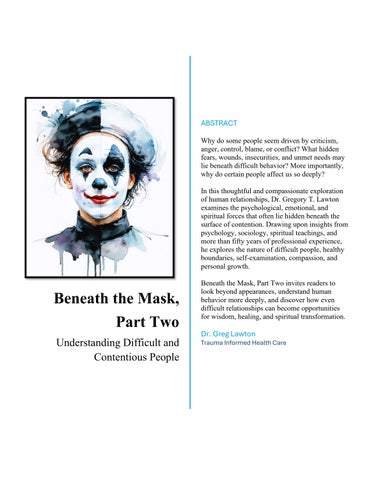
ABSTRACT Why do some people seem driven by criticism, anger, control, blame, or conflict? What hidden fears, wounds, insecurities, and unmet needs may lie beneath difficult behavior? More importantly, why do certain people affect us so deeply? In this thoughtful and compassionate exploration of human relationships, Dr. Gregory T. Lawton examines the psychological, emotional, and spiritual forces that often lie hidden beneath the surface of contention. Drawing upon insights from psychology, sociology, spiritual teachings, and more than fifty years of professional experience, he explores the nature of difficult people, healthy boundaries, self-examination, compassion, and personal growth.
Beneath the Mask, Part Two Understanding Difficult and Contentious People
Beneath the Mask, Part Two invites readers to look beyond appearances, understand human behavior more deeply, and discover how even difficult relationships can become opportunities for wisdom, healing, and spiritual transformation.
Dr. Greg Lawton
Trauma Informed Health Care
Beneath the Mask, Part Two Understanding Difficult and Contentious People Reflections on Conflict, Emotional Reactivity, Boundaries, Discernment, and Compassion By Dr. Gregory T. Lawton "Nothing whatsoever can, in this Day, inflict a greater harm upon the Cause of God than dissension and strife, contention, estrangement and apathy among the loved ones of God." — Bahá'u'lláh
1|Page
Abstract Beneath the Mask, Part Two explores one of the most challenging aspects of human relationships: dealing with difficult, argumentative, reactive, controlling, and contentious individuals. Drawing upon the wisdom of the world's religions, modern psychology, trauma-informed care, conflict resolution, and the teachings of Bahá'u'lláh and 'Abdu'l-Bahá, this booklet examines the hidden fears, insecurities, emotional wounds, attachments, and unmet needs that often lie beneath disruptive behavior. Rather than encouraging judgment or condemnation, this work invites readers to look beyond appearances and develop a deeper understanding of why people behave as they do. Topics include anger, defensiveness, projection, blame, manipulation, the need to be right, emotional reactivity, power struggles, healthy boundaries, forgiveness, compassion, discernment, and spiritual detachment. The booklet also explores the delicate balance between kindness and selfprotection, emphasizing that understanding difficult behavior does not require tolerating abuse, abandoning healthy boundaries, or surrendering one's peace of mind. Readers are encouraged to cultivate emotional maturity, self-awareness, courage, and compassion while learning to respond wisely to conflict and contention. Ultimately, this work is a guide to preserving inner peace, maintaining spiritual authenticity, and developing a deeper understanding of human behavior. It reminds us that beneath every mask lies a human being struggling with fears, hopes, wounds, attachments, and the universal search for meaning, belonging, and love.
2|Page
Dedication To all those who have struggled to maintain kindness in the presence of criticism, patience in the presence of anger, and peace in the presence of conflict. To those who have sought to understand difficult people without surrendering their integrity, their dignity, or their emotional well-being. To those who have discovered that compassion and discernment are not opposites, but companions on the path of wisdom. And to all who continue striving to see beyond appearances, beyond behavior, and beyond contention, recognizing that beneath every mask lies a human soul carrying burdens, fears, wounds, hopes, and possibilities often unseen by the world.
3|Page
Preface Every life eventually encounters difficult people. Some enter our lives briefly and pass like a summer storm. Others remain for years. Some appear within our families. Others emerge in workplaces, organizations, communities, friendships, marriages, and even spiritual environments. Their personalities, circumstances, and behaviors may differ, yet they often leave behind similar questions. • Why do some people seem unable to tolerate disagreement? • Why do certain individuals repeatedly create conflict wherever they go? • Why do some personalities appear driven by criticism, control, resentment, anger, or the need to be right? And perhaps most importantly, how can we respond to such individuals without losing our own peace, dignity, compassion, and authenticity? These questions have accompanied me throughout much of my life. My early studies in psychology, sociology, and probation science introduced me to the complexity of human behavior and the powerful influence of family, culture, environment, social systems, and personal experience upon the formation of personality. Later work in rehabilitation, behavioral science, addiction recovery, healthcare, education, trauma-informed care, and spiritual study deepened my appreciation for the many forces that shape human thought, emotion, and behavior. Over the decades, I have worked with patients, students, families, community organizations, healthcare professionals, spiritual communities, and individuals struggling with physical illness, emotional pain, addiction, loss, trauma, and personal transformation. In those encounters, I repeatedly observed a reality that was both fascinating and humbling. Human behavior is rarely as simple as it first appears. • The angry person is not always motivated by anger. • The controlling person is not always motivated by a desire for control. • The critical person is not always motivated by criticism. And the difficult person is not always motivated by a desire to be difficult. Again and again, I discovered that beneath the surface of behavior often lay deeper realities. Fear disguised itself as anger. Insecurity disguised itself as arrogance. 4|Page
Emotional wounds disguised themselves as criticism. Loneliness disguised itself as control. Unresolved grief disguised itself as bitterness. What appeared obvious on the surface frequently concealed a far more complicated human story beneath. Yet understanding difficult behavior did not necessarily make it easier to live with. Like most people, I have experienced the frustration of being misunderstood. I have encountered individuals determined to argue, criticize, manipulate, dominate conversations, resist accountability, or create conflict where none previously existed. I have observed how a single difficult personality can influence an entire family, disrupt an organization, divide a community, or exhaust the emotional resources of those around them. I have also learned that difficult people often become unexpected teachers. • • • • •
Some reveal our impatience. Some expose our pride. Some challenge our need for approval. Some force us to examine our boundaries. Some teach us the difference between kindness and accommodation.
Some compel us to develop discernment, courage, humility, and emotional maturity in ways that comfort and agreement never could. The first volume of Beneath the Mask explored the hidden motivations that influence human behavior. It examined ego attachment, recognition-seeking, selfdeception, authenticity, conscience, and the lifelong struggle between appearance and truth. At its heart was a simple question: • What lies beneath the masks we wear ourselves? • As that work evolved, another question gradually emerged. • What lies beneath the masks worn by the people who challenge us? This booklet is an attempt to explore that question. It is not a book about labeling people, diagnosing personalities, or identifying villains. Human beings are far too complex for such simplifications. Nor is it intended to encourage superiority, judgment, resentment, or emotional withdrawal. Every one of us struggles with fear, insecurity, attachment, defensiveness, emotional wounds, and imperfection. The difficult people we encounter are not fundamentally different from ourselves. More often than not, they are wrestling with the same human struggles expressed in different ways. 5|Page
At the same time, experience has taught me another important lesson. • • • •
Compassion does not require surrender. Understanding does not require agreement. Forgiveness does not require unlimited access. Kindness does not require the abandonment of healthy boundaries.
One of the central themes that emerges throughout these pages is the distinction between judgment and discernment. Judgment seeks to elevate itself by diminishing others. Discernment seeks to understand reality clearly and respond wisely. Healthy relationships require compassion, but they also require boundaries. Authentic love requires kindness, but it also requires truthfulness. Emotional maturity requires empathy, but it also requires the ability to recognize harmful patterns and respond appropriately. As I worked on this manuscript, I found myself returning to an observation that has become increasingly clear with age. • The behavior of difficult people often reveals as much about us as it does about them. • The person who provokes us may expose our impatience. • The person who misunderstands us may expose our need to be understood. • The person who criticizes us may expose our insecurity. • The person who challenges our beliefs may expose our attachment to certainty. • The person who creates conflict may reveal our relationship to anger, fear, control, forgiveness, and compassion. For this reason, this booklet is not merely about understanding difficult people. It is also about understanding ourselves. The teachings of Bahá’u’lláh and the example of ‘Abdu’l-Bahá provide a guiding foundation for this exploration. Their teachings repeatedly call humanity toward kindness, moderation, consultation, humility, truthfulness, patience, compassion, and justice. They remind us that human beings are capable of both nobility and weakness, and that authentic spiritual growth requires both self-awareness and love.
6|Page
My hope is that the pages that follow will encourage greater wisdom, emotional maturity, discernment, patience, and peace. The world has no shortage of conflict. It has no shortage of criticism, anger, division, resentment, and contention. What it desperately needs are individuals capable of remaining compassionate without becoming naïve, strong without becoming harsh, discerning without becoming judgmental, and peaceful without becoming passive. Such qualities do not arise automatically. They must be cultivated. And perhaps nowhere are they tested more thoroughly than in our encounters with difficult and contentious people. Dr. Gregory T. Lawton
7|Page
Foreword Human beings are social creatures. From the moment of birth until the end of life, our existence is shaped by our relationships with others. We learn, grow, work, love, worship, celebrate, and suffer in the company of family, friends, neighbors, coworkers, teachers, students, community members, and countless individuals whose lives intersect with our own. Through these relationships we experience some of life's greatest joys and some of its deepest sorrows. Few things enrich human life more than healthy relationships. Love, friendship, trust, cooperation, encouragement, forgiveness, and mutual support have the power to strengthen individuals, families, communities, and entire societies. Throughout history, human beings have recognized that our greatest achievements are rarely accomplished alone. We flourish through connection. Yet relationships also present some of life's greatest challenges. Wherever human beings gather, differences emerge. Personalities clash. Opinions diverge. Expectations collide. Misunderstandings arise. Feelings are hurt. Trust is broken. Anger appears. Resentments develop. Conflict becomes unavoidable. This reality is neither new nor unusual. The story of humanity is, in many respects, the story of people learning how to live together. The earliest families struggled with jealousy, rivalry, loyalty, forgiveness, and reconciliation. Communities wrestled with justice, leadership, cooperation, and division. Nations rose and fell through the consequences of human ambition, fear, pride, wisdom, and folly. Every generation has inherited the same challenge: how to create harmony among individuals whose experiences, beliefs, desires, fears, and personalities often differ greatly from one another. For this reason, nearly every religion, philosophy, and wisdom tradition has devoted considerable attention to human relationships. The Hebrew prophets spoke of justice, mercy, humility, and reconciliation. The teachings of Jesus emphasized forgiveness, love, compassion, and the importance of treating others as we ourselves wish to be treated. Islamic scholars wrote extensively about character, self-discipline, patience, and the struggle to overcome the lower tendencies of human nature. Hindu and Buddhist traditions explored attachment, compassion, suffering, and the causes of human conflict. Taoist philosophers encouraged balance, moderation, humility, and harmony. The Stoics taught self-mastery, emotional discipline, and the importance of governing one's own reactions rather than attempting to govern the behavior of others. 8|Page
Although these traditions differ in language, culture, and theology, they often arrive at remarkably similar conclusions. Human beings are capable of extraordinary kindness and extraordinary cruelty. They are capable of generosity and selfishness, wisdom and foolishness, compassion and resentment, patience and anger. Within every age and every society, individuals are called upon to navigate these realities while striving to live meaningful, productive, and ethical lives. Modern psychology and the social sciences have added valuable insights to this ancient conversation. They have helped us better understand personality, motivation, emotional development, family systems, social influences, trauma, attachment, and human behavior. Yet despite all that has been learned, the fundamental challenge remains unchanged. Human beings continue to seek understanding. They continue to seek belonging. They continue to seek love, acceptance, meaning, and purpose. And they continue to struggle with conflict, misunderstanding, disappointment, criticism, anger, and division. The questions that confront us today are, in many respects, the same questions that confronted our ancestors. • • • •
How do we live together peacefully? How do we respond to disagreement? How do we maintain our values in the presence of conflict? How do we preserve kindness when faced with hostility?
How do we remain true to our principles when others test our patience, challenge our beliefs, or disturb our peace? These questions are not merely social questions. • • • •
They are psychological questions. They are moral questions. They are spiritual questions. And they touch every human life.
This booklet explores one aspect of that larger journey. It examines the challenges that arise when we encounter difficult and contentious behavior in others and seeks to better understand both the causes of such behavior and our responses to it. For 9|Page
before we can understand conflict, we must understand the people who create it, the people who experience it, and the human struggles that often lie hidden beneath the surface of both.
10 | P a g e
Introduction Most of us can remember a difficult person. The memory may arise immediately. A face comes to mind. A voice. A conversation that ended badly. A relationship that seemed to consume far more emotional energy than it ever returned. Perhaps it was a family member. Perhaps it was a coworker, a supervisor, a neighbor, a community member, or someone encountered during a particularly difficult period of life. Years may pass, yet certain interactions remain surprisingly vivid. We remember the arguments. We remember the criticism. We remember the misunderstandings and frustrations. We remember the feeling of trying to explain ourselves to someone who seemed determined not to understand. We remember the emotional exhaustion that often followed such encounters. For many people, some of life's greatest challenges have not arisen from illness, financial hardship, or external adversity. They have arisen through relationships with other human beings. A difficult personality can alter the atmosphere of an entire family. A contentious individual can create tension within an organization, workplace, classroom, or community. A single person consumed by resentment, anger, criticism, or the need for control can influence the emotional well-being of countless others. As a result, many of us spend years attempting to understand such people. • • • •
Why are they this way? Why do they seem unable to let go of conflict? Why do some individuals create division wherever they go? Why do certain people appear driven by criticism, resentment, control, anger, or the need to always be right?
And why do their words and actions affect us so deeply? The answers are rarely simple. One of the most important lessons I have learned through decades of studying human behavior is that what we see is often only part of the story. Human beings are complicated. • The angry person is not always motivated by anger. 11 | P a g e
• The critical person is not always motivated by criticism. • The controlling person is not always motivated by a desire for power. • The arrogant person is not always motivated by superiority. Again and again, experience teaches us that beneath the visible behavior often lies something hidden from view. • • • •
Fear may disguise itself as anger. Insecurity may disguise itself as criticism. Vulnerability may disguise itself as control. Shame may disguise itself as arrogance.
And emotional pain may disguise itself as hostility. This does not mean the behavior is harmless. Nor does it mean that difficult actions should be excused, ignored, or tolerated. Understanding the origins of behavior is not the same as approving of behavior. Yet if we hope to understand difficult people, we must learn to look beyond appearances. In many ways, this is the central theme of the present work. The first volume of Beneath the Mask explored the hidden motivations that influence our own thoughts and actions. It asked readers to look beneath the masks of ego, recognition-seeking, self-deception, pride, attachment, and fear. This second volume invites us to undertake a different journey. It asks us to look beneath the masks worn by those who challenge us. Not to excuse them. Not to condemn them. But to understand them more clearly.
12 | P a g e
Session One - Why Difficult People Affect Us So Deeply Most people can recall a difficult person who occupied far more space in their thoughts than they deserved. The memory may involve a family member, a coworker, a supervisor, a neighbor, a former friend, or someone encountered only briefly. Yet long after the interaction has ended, the emotional residue often remains. We remember the criticism. We remember the argument. We remember the misunderstanding. We replay conversations in our minds and imagine what we should have said or done differently. Sometimes we carry these experiences for days, months, or even years. This raises an interesting question. Why do difficult people affect us so deeply? The answer is not as simple as it first appears. At first glance, we may assume that the difficult person is solely responsible for our distress. After all, they were the one who criticized, argued, manipulated, controlled, or behaved unfairly. Their behavior created the conflict. Yet if we observe carefully, we begin to notice that different people respond to the same difficult individual in very different ways. One person becomes angry and preoccupied. Another remains relatively calm. One person carries the encounter for weeks. Another lets it go by the end of the day. This suggests that something more is occurring. Human beings do not merely experience events. We interpret them. We assign meaning to them. We weave them into stories about ourselves and the world around us. A criticism is rarely experienced as a simple collection of words. Instead, it is filtered through our beliefs, our memories, our insecurities, our expectations, and our emotional history. A disagreement may become a challenge to our competence. A misunderstanding may feel like rejection. A dismissive comment may touch an old wound we thought had healed long ago. As a result, difficult interactions often affect us less because of what was said and more because of what the experience means to us. Beneath many painful encounters lies a deeper emotional concern. We want to be understood. We want to be respected. We want to be treated fairly. We want our efforts to be recognized and our intentions accurately perceived. When those desires are frustrated, powerful emotions frequently arise. For this reason, difficult people often become unexpected mirrors. They reveal aspects of ourselves that might otherwise remain hidden. A person who constantly argues with us may expose our attachment to being right. Someone who repeatedly misunderstands us may reveal how deeply we desire approval or validation from 13 | P a g e
others. A harsh critic may uncover insecurities we believed had long ago been resolved. A controlling personality may challenge our understanding of personal boundaries, self-respect, and autonomy. In this way, difficult relationships often illuminate not only the behavior of the other person but also our own vulnerabilities, fears, and emotional attachments. Many spiritual traditions have recognized this principle for centuries. The people who disturb our peace often become our greatest teachers, not because their behavior is admirable, but because our reactions reveal important truths about ourselves. The individual who provokes our anger may reveal where anger still resides within us. The person who tests our patience may reveal the limits of our patience. The person who repeatedly captures our attention may expose an attachment we have not yet fully understood. Although we may prefer to focus exclusively on the faults of the other person, genuine growth often begins when we become curious about our own reactions. This does not mean that harmful behavior should be excused or tolerated. Difficult people can cause genuine suffering. Some individuals are manipulative, dishonest, controlling, or emotionally destructive. Others create conflict wherever they go. Healthy boundaries remain essential, and wisdom often requires us to limit our exposure to harmful behavior. Understanding our own reactions does not remove responsibility from those who act poorly. Rather, it helps us avoid becoming prisoners of their behavior. One of the most important lessons difficult people teach us is that peace of mind cannot depend entirely upon the conduct of others. If our emotional well-being rises and falls with every criticism, disagreement, misunderstanding, or act of disrespect, we surrender tremendous power over our lives. We become dependent upon circumstances we cannot control. Yet the behavior, opinions, attitudes, and choices of other people have always been beyond our control. Human beings possess free will, and they often exercise it imperfectly. What remains within our control is our response. This realization represents a turning point in personal growth. Instead of devoting all our energy to changing difficult people, we begin to examine the thoughts, beliefs, expectations, and attachments that make their behavior so influential in our lives. We learn to recognize our emotional triggers. We become more aware of our vulnerabilities. We strengthen our boundaries. We cultivate patience, discernment, and selfmastery. Gradually, we discover that peace is not something granted to us by agreeable people. It is something cultivated within ourselves. 14 | P a g e
As this process unfolds, our perspective begins to change. We no longer see difficult people merely as obstacles or adversaries. We begin to recognize them as participants in a larger process of growth and understanding. Their behavior may still require boundaries. Their actions may still require accountability. Yet they also provide opportunities for self-examination, emotional maturity, and spiritual development. The very individuals who challenge us most often become the ones who reveal where our deepest work remains to be done. Perhaps this is why difficult people affect us so deeply. They touch places within us that are still seeking healing, understanding, acceptance, strength, or peace. They confront us with aspects of ourselves we might otherwise avoid. They challenge our assumptions about who we are and how we respond to adversity. And in doing so, they invite us into a deeper relationship with ourselves. The journey toward understanding difficult people begins there. Before we can fully understand those who challenge us, we must first understand why their behavior affects us so profoundly. Only then can we begin to look beyond the behavior itself and explore the hidden fears, wounds, insecurities, and struggles that often lie beneath the surface. That exploration begins in the next chapter.
15 | P a g e
Session Two - Looking Beneath the Mask One of the greatest mistakes we make when dealing with difficult people is assuming that what we see is all there is. Human beings naturally judge behavior by appearances. We see an angry person and conclude that anger is the problem. We encounter a critical individual and assume criticism is their defining characteristic. We meet someone who is controlling, argumentative, arrogant, or manipulative and believe we understand who they are. The behavior appears obvious, and our minds instinctively construct explanations based upon what is visible. Yet experience often teaches a different lesson. The longer we work with people, live with people, teach people, counsel people, or care for people, the more we discover that human behavior is rarely as simple as it first appears. What is visible on the surface is often only a small part of a much larger story. A physician learns that symptoms are not diseases. A cough may indicate dozens of different conditions. A fever may arise from many different causes. Treating symptoms while ignoring underlying causes rarely produces lasting results. In much the same way, human behavior often functions as a symptom rather than a cause. The behavior may be obvious, but the forces producing it frequently remain hidden. Consider anger. Most people have encountered individuals who seem perpetually angry. They criticize, complain, argue, and react with hostility to even minor frustrations. Yet beneath that anger we often discover something else entirely. Fear, insecurity, disappointment, grief, shame, helplessness, and emotional pain frequently wear the mask of anger. Anger may be the visible expression, but it is not always the originating cause. The same principle applies to many other difficult behaviors. The person who constantly seeks control may not be motivated by power as much as by fear. The individual who appears arrogant may be struggling with deep feelings of inadequacy. The person who criticizes everyone around them may carry a harsh inner critic that never allows them to experience peace. What appears on the surface is often a protective adaptation, a defense, or a survival strategy developed over many years. This reality becomes easier to understand when we recognize that every human being is shaped by experiences both seen and unseen. No one arrives in adulthood 16 | P a g e
untouched by disappointment, loss, rejection, fear, failure, grief, or emotional injury. Some wounds heal. Others remain active for decades. Some are recognized and addressed. Others become woven into the personality itself, influencing behavior in ways the individual may never fully understand. Over the years, I have worked with many individuals whose outward behavior initially seemed difficult, irrational, or self-defeating. Yet as their stories unfolded, a more complete picture emerged. Behind the controlling behavior was often fear. Behind the criticism was frequently insecurity. Behind the defensiveness was shame. Behind the hostility was pain. The behavior itself was real, but it represented only the visible portion of a much deeper struggle. This does not mean that every difficult person is secretly kind, misunderstood, or emotionally healthy. Some individuals cause considerable harm to themselves and others. Some become deeply attached to patterns of resentment, manipulation, blame, or hostility. Understanding the origins of behavior does not eliminate responsibility for behavior. Human beings remain accountable for their choices. Nevertheless, understanding changes how we see people. When we focus exclusively on behavior, we tend to judge. When we begin to explore causes, we become more curious. Curiosity does not excuse harmful actions, but it often replaces simplistic conclusions with a deeper appreciation of human complexity. One of the reasons difficult people are so difficult to understand is that many of them are not fully aware of the forces driving their own behavior. A person may insist they are angry because of what happened today when, in reality, today's event merely touched an old wound that has existed for years. Another individual may believe they are fighting for truth when they are actually defending an identity built upon being right. Someone else may sincerely believe they are protecting others when they are acting from fear and the need to control. Human beings possess a remarkable ability to conceal their true motivations, not only from others but from themselves. We develop explanations that feel reasonable. We create narratives that protect our self-image. We justify our actions and overlook contradictions. This tendency is not limited to difficult people. It is part of the human condition. All of us have blind spots. All of us possess motivations that remain partially hidden from conscious awareness. For this reason, looking beneath the mask requires humility. It asks us to acknowledge that human behavior is more complicated than our first impressions 17 | P a g e
suggest. It encourages us to resist the temptation to reduce people to a single characteristic or a single moment of behavior. It reminds us that every person carries a history, a collection of experiences, wounds, fears, beliefs, hopes, and disappointments that influence the way they interact with the world. The purpose of looking beneath the mask is not to become naïve. It is not to ignore harmful behavior, abandon discernment, or surrender healthy boundaries. Rather, it is to develop a deeper understanding of the forces that shape human behavior so that our responses may be guided by wisdom rather than reaction. As we look more closely at the lives of difficult people, a recurring pattern begins to emerge. Beneath many forms of difficult behavior lie wounds that have never fully healed. These wounds may be psychological, emotional, social, relational, or spiritual in nature. They often influence behavior long after the original injury has been forgotten. To understand difficult people more fully, we must next explore the hidden wounds that frequently lie beneath the mask.
18 | P a g e
Session Three - The Hidden Wounds Behind Difficult Behavior "The more we search for virtues in our fellow-men, the more we shall discover." — 'Abdu'l-Bahá As we move through life, we gradually discover that people carry far more than is visible. The smiling coworker may be struggling with loneliness. The successful executive may be burdened by insecurity. The critical parent may be carrying disappointments that stretch back decades. The angry neighbor, the controlling supervisor, the argumentative community member, or the perpetually dissatisfied friend may all be responding to wounds that remain largely unseen by those around them. One of the great limitations of human perception is that we tend to judge others by what they do while remaining unaware of what they have experienced. We see behavior, but we do not see the memories, fears, disappointments, losses, betrayals, humiliations, and emotional injuries that may have shaped that behavior over many years. This does not mean that every difficult person has suffered unusual hardship. Pain is part of the human experience. Every life contains disappointments, losses, failures, and periods of struggle. What differs is not whether people experience wounds, but how those wounds are processed, understood, healed, or carried forward. Some individuals experience hardship and emerge with greater compassion. Others become fearful. Some become resilient. Others become defensive. Some develop wisdom. Others develop bitterness. Human beings respond to adversity in remarkably different ways. Modern psychology has devoted considerable attention to understanding these differences. Researchers have explored the influence of childhood experiences, attachment patterns, family systems, trauma, emotional development, social environments, and learned coping mechanisms. Although theories differ, most agree on one important point: early experiences often shape later behavior in powerful ways. A child who grows up in a highly critical environment may learn to criticize others before they can be criticized themselves. A child raised in unpredictability may 19 | P a g e
become controlling as an adult because control provides a sense of safety. A person who repeatedly experiences rejection may become defensive long before any actual rejection occurs. Someone who has been betrayed may struggle to trust even trustworthy people. Over time, these adaptations often become so familiar that they feel like personality rather than protection. What once served as a survival strategy gradually becomes a way of life. The individual may no longer recognize the connection between present behavior and past experience. They simply know that certain situations make them uncomfortable, certain people make them anxious, and certain circumstances provoke strong emotional reactions. The original wound fades from awareness, but its influence remains active. This phenomenon is not limited to severe trauma. Many emotional wounds are subtle. They develop through years of criticism, neglect, unrealistic expectations, chronic stress, unresolved grief, family conflict, social isolation, or repeated experiences of disappointment. Individually, these experiences may appear insignificant. Collectively, they can shape how a person views themselves, others, and the world around them. One of the most common wounds encountered in both clinical practice and everyday life involves shame. Shame is not the same as guilt. Guilt says, "I made a mistake." Shame says, "I am the mistake." Guilt focuses on behavior. Shame attacks identity. When shame becomes deeply rooted, individuals often develop elaborate strategies to avoid experiencing it. Some become perfectionists. Some become controlling. Some become highly critical of others. Some become defensive whenever their behavior is questioned. Others withdraw emotionally and avoid vulnerability altogether. Fear is another powerful influence. Fear rarely presents itself honestly. Few people openly acknowledge that they are frightened. Instead, fear often disguises itself as anger, certainty, control, criticism, or stubbornness. The louder the fear, the more convincing the disguise may become. Similarly, insecurity frequently hides behind confidence. Individuals who appear arrogant are not always confident. In some cases, the outward display of superiority serves as protection against deeply rooted feelings of inadequacy. The individual becomes invested in appearing knowledgeable, successful, powerful, or important because the alternative feels emotionally intolerable. 20 | P a g e
These observations do not explain every difficult behavior, nor should they be used to excuse harmful actions. Human beings remain responsible for the ways they treat others. Nevertheless, understanding the role of hidden wounds helps us see behavior with greater depth and compassion. Instead of reducing people to labels, we begin to recognize the complex human stories that often lie beneath the surface. This perspective can be transformative. • • • •
The critical person is no longer merely critical. The angry person is no longer merely angry. The controlling person is no longer merely controlling. The difficult person is no longer merely difficult.
Instead, we begin to recognize human beings struggling, sometimes skillfully and sometimes poorly, to manage fears, insecurities, disappointments, and wounds they may not fully understand themselves. Such understanding does not require us to tolerate unhealthy behavior. Boundaries remain essential. Accountability remains necessary. Discernment remains important. Yet understanding allows us to respond with greater wisdom and less hostility. Perhaps this is one of the most important lessons we can learn about difficult people. People are often fighting battles we cannot see. Some of those battles are recent. Some began years ago. Some began in childhood. And some have been carried for so long that they have become woven into the very fabric of a person's identity. When we remember this, we begin to see beyond behavior and into the deeper realities that shape it. The next challenge is learning how these hidden wounds influence the way people think, communicate, argue, defend themselves, and relate to others. For many difficult individuals, the greatest struggle is not the wound itself, but the powerful need to protect it.
21 | P a g e
Session Four - The Need to Be Right Few things create more conflict in human relationships than the need to be right. At first glance, this may seem like a strange statement. After all, there is nothing inherently wrong with seeking truth, defending a position, or expressing a sincere conviction. Human progress depends upon the free exchange of ideas. Science advances through questioning. Philosophy advances through inquiry. Spiritual growth often begins with the courage to ask difficult questions. The problem is not the search for truth. The problem arises when being right becomes more important than discovering what is true. Most people have encountered individuals who seem unable to tolerate disagreement. A simple difference of opinion quickly becomes an argument. A discussion becomes a debate. A debate becomes a contest. The goal gradually shifts from understanding to winning. Once this occurs, genuine communication becomes increasingly difficult because the conversation is no longer about truth. It is about identity. This distinction is important. When truth is the objective, individuals remain open to new information. They listen. They reflect. They ask questions. They remain willing to revise their opinions when presented with evidence that challenges their assumptions. The pursuit of truth requires humility because it acknowledges the possibility that we may be mistaken. The need to be right operates differently. When being right becomes attached to identity, disagreement begins to feel threatening. A challenge to an opinion is experienced as a challenge to the self. Instead of examining ideas, the individual defends their position. Instead of listening, they prepare responses. Instead of seeking understanding, they seek confirmation. The conversation gradually becomes less about discovering reality and more about protecting a self-image. In my years of studying human behavior, I have often observed that the strongest arguments are not always about the most important issues. Sometimes they arise around surprisingly minor matters. Family members argue about events that occurred years ago. Coworkers dispute details that have little practical significance. Community members become divided over procedures, personalities, or differences in perspective that could easily be resolved through consultation and mutual respect.
22 | P a g e
When viewed from a distance, such conflicts often appear irrational. Yet beneath the surface something more significant is occurring. The issue under discussion may not be the real issue at all. The argument may be protecting something deeper. For one person, being right may provide a sense of competence. For another, it may preserve self-respect. For someone else, it may protect a fragile sense of identity. A lifetime of insecurity, criticism, failure, rejection, or humiliation may create a powerful emotional investment in appearing knowledgeable, capable, or certain. In such situations, admitting error can feel far more threatening than the actual mistake. This dynamic helps explain why some individuals become increasingly rigid as evidence accumulates against them. From a purely logical perspective, changing one's mind should be relatively simple when presented with new information. Yet human beings are not governed by logic alone. We are also influenced by pride, fear, attachment, emotion, memory, and identity. The more deeply a belief becomes connected to a person's sense of self, the more difficult it becomes to examine objectively. History provides countless examples of this phenomenon. Individuals, organizations, and even entire societies have sometimes clung to ideas long after evidence suggested otherwise. In many cases, the resistance was not intellectual. It was emotional. The belief had become part of identity, and surrendering it felt like surrendering a part of oneself. The same process occurs in everyday relationships. A person may insist upon being right because they fear appearing weak. Another may argue because uncertainty makes them uncomfortable. Someone else may reject alternative viewpoints because their self-worth depends upon appearing knowledgeable. What appears as stubbornness on the surface often conceals vulnerability underneath. Ironically, the need to be right frequently prevents genuine learning. Learning requires curiosity. Curiosity requires openness. Openness requires the willingness to encounter uncertainty. Yet uncertainty is precisely what many people spend their lives trying to avoid. The result is a paradox. The person most committed to being right may become the person least capable of discovering truth. This tendency is not limited to difficult people. All of us are susceptible to it.
23 | P a g e
Every person possesses beliefs, assumptions, and conclusions that have become emotionally significant. Every person has opinions that feel comfortable and perspectives that feel familiar. The desire to protect these mental structures is a natural part of human psychology. For this reason, one of the most important questions we can ask ourselves is not, "Am I right?" but rather, "Am I willing to discover that I am wrong?" That question requires humility. Humility is often misunderstood as weakness, self-deprecation, or lack of confidence. In reality, humility is the ability to place truth above ego. It is the willingness to learn, to listen, and to remain teachable. Humility does not diminish intelligence. It enhances it. A person who remains open to learning can continue growing throughout life. A person who believes they already possess all necessary answers gradually becomes imprisoned by their own certainty. Many difficult people struggle because they have confused certainty with strength. They assume that admitting uncertainty reflects weakness. They fear that changing their minds will diminish their authority or credibility. In reality, the opposite is often true. Few qualities inspire more trust than intellectual honesty. The willingness to acknowledge mistakes, reconsider assumptions, and learn from experience reflects maturity rather than weakness. As we begin to understand this dynamic, our response to difficult people often changes. Instead of viewing them merely as argumentative or stubborn, we begin to recognize the fears and insecurities that may lie beneath their behavior. We become less reactive and more curious. We begin to understand that many arguments are not truly about facts, opinions, or ideas. They are about identity, fear, and the human need to feel safe in an uncertain world. This understanding does not eliminate conflict. Nor does it guarantee agreement. However, it does help us approach difficult conversations with greater wisdom and compassion. Perhaps most importantly, it encourages us to examine our own attachment to being right. For whenever truth becomes subordinate to ego, the mask has once again taken the place of reality. And whenever that happens, genuine understanding becomes impossible.
24 | P a g e
Section Five - Criticism, Projection, and Deflection "Look ye not upon the faults of others so that ye may forget your own." — 'Abdu'l-Bahá One of the most curious aspects of human behavior is our tendency to see in others what we struggle to see in ourselves. Most people have experienced the frustration of being accused of motives they do not possess, intentions they never held, or attitudes they never expressed. We encounter individuals who seem convinced that they know exactly why we acted, what we intended, or what we were thinking, even when their conclusions bear little resemblance to reality. At times, these misunderstandings may be harmless. At other times, they become the source of significant conflict, resentment, and division. Why does this happen? Part of the answer lies in the fact that human beings are not always comfortable with self-examination. Looking honestly at our own fears, insecurities, weaknesses, contradictions, and shortcomings can be difficult. It requires humility, courage, and a willingness to confront aspects of ourselves that may be uncomfortable or painful. As a result, the mind often develops ways of protecting itself from such discomfort. One of the most common of these protective mechanisms is projection. Projection occurs when individuals attribute to others thoughts, motives, feelings, or characteristics that actually originate within themselves. Rather than recognizing an uncomfortable quality internally, they perceive it externally. The flaw is seen in someone else. The motive belongs to someone else. The problem exists somewhere outside the self. This process is rarely conscious. Most people who project are not intentionally deceptive. They genuinely believe their perceptions are accurate. The mind has simply redirected attention away from an uncomfortable internal reality and focused it elsewhere. Consider the person who constantly accuses others of selfishness while remaining unaware of their own self-centered behavior. Or the individual who repeatedly questions the honesty of others while struggling with honesty themselves. Sometimes the person most suspicious of manipulation has manipulative tendencies they have never fully acknowledged. The harsh critic may possess an internal critic so severe that they cannot help but see flaws everywhere they look. 25 | P a g e
Human beings often find it easier to confront shortcomings in others than to recognize those same qualities within themselves. This tendency becomes particularly visible during conflict. When emotions intensify, self-awareness frequently diminishes. Individuals become increasingly convinced of their own righteousness while becoming increasingly critical of the perceived faults of others. The focus shifts outward. Attention becomes fixed on what someone else is doing wrong, while personal responsibility quietly retreats into the background. Closely related to projection is the process of deflection. Deflection occurs when attention is redirected away from an uncomfortable issue. Rather than addressing a legitimate concern, the conversation is shifted elsewhere. Questions are answered with accusations. Accountability is replaced with counterattacks. The original issue becomes obscured beneath layers of distraction, defensiveness, and blame. Many people have experienced conversations in which a simple concern quickly transforms into an entirely different discussion. An individual is asked to examine their behavior, and moments later the focus has shifted to the faults of everyone else in the room. The original issue disappears beneath a cloud of secondary complaints and unrelated grievances. When viewed objectively, such exchanges can be surprising. Yet they often arise from a very human desire to avoid discomfort. Accountability can feel threatening. Self-examination can feel painful. Deflection offers temporary relief by directing attention elsewhere. Criticism frequently serves a similar function. This may seem surprising because criticism is often viewed as an attempt to improve others. In healthy relationships, constructive feedback can indeed be valuable. Honest observations offered with kindness and wisdom may help individuals grow and develop. However, not all criticism serves this purpose. Some criticism functions as a defense. By focusing attention on the shortcomings of others, individuals avoid confronting their own. The conversation remains safely external. Energy is directed outward rather than inward. The faults of others become a convenient refuge from the challenge of self-reflection. This dynamic helps explain why some individuals appear perpetually dissatisfied. No matter the circumstance, they find something to criticize, something to correct, or someone to blame. The focus remains fixed on what is wrong with the world 26 | P a g e
around them while little attention is given to the possibility that some of the conflict originates within. The danger of projection, deflection, and excessive criticism is not merely that they create conflict. They also obstruct growth. Personal growth begins with self-awareness. It requires the willingness to recognize our own fears, weaknesses, blind spots, and contradictions. When attention is continually redirected toward the perceived faults of others, opportunities for self-understanding are lost. The individual remains trapped in familiar patterns while believing the source of every problem exists outside themselves. This is one reason difficult people often seem resistant to change. • Change requires insight. • Insight requires honesty. • Honesty requires self-examination. And self-examination requires the courage to look beneath one's own mask. Yet it would be a mistake to view these tendencies as belonging only to other people. Projection, deflection, and criticism are part of the human condition. All of us are capable of seeing faults in others that we overlook in ourselves. All of us occasionally defend our self-image at the expense of truth. All of us possess blind spots. The difference is not whether these tendencies exist, but whether we are willing to recognize them when they appear. This realization invites a more balanced perspective. Instead of asking only, "Why is this person behaving this way?" we begin asking, "What might this behavior be protecting?" Instead of responding immediately with judgment, we become curious. We begin to wonder what fears, insecurities, disappointments, or emotional wounds may be hidden beneath the criticism, blame, or defensiveness. Curiosity does not eliminate accountability. Harmful behavior must still be addressed. Boundaries must still be maintained. Truthfulness remains essential. Yet curiosity often softens hostility and creates space for understanding. As we continue looking beneath the masks people wear, another important distinction begins to emerge. We discover that understanding behavior is not the 27 | P a g e
same as approving of behavior. Compassion does not require surrender. Kindness does not require passivity. The challenge lies in learning how to balance understanding with wisdom. That balance is the subject of the next chapter.
28 | P a g e
Section Six - Discernment Versus Judgment "Ascribe not to any soul that which thou wouldst not have ascribed to thee." — Bahá'u'lláh One of the greatest challenges in dealing with difficult people is learning to balance understanding with wisdom. As we begin to recognize the fears, insecurities, disappointments, wounds, and unmet needs that often lie beneath difficult behavior, it becomes easier to develop compassion. We begin to see that many people are struggling with burdens that remain invisible to those around them. We recognize that anger may conceal fear, criticism may conceal insecurity, and control may conceal vulnerability. What once appeared simple becomes more complex. Yet this deeper understanding can create a new dilemma. Some people become so focused on understanding others that they lose sight of their own well-being. They explain harmful behavior. They excuse repeated offenses. They tolerate mistreatment. They convince themselves that compassion requires unlimited patience, unlimited access, and unlimited forgiveness. In their desire to be kind, they gradually abandon the very boundaries that protect their emotional, psychological, and spiritual health. Others move in the opposite direction. Rather than seeking understanding, they become increasingly judgmental. Difficult people are viewed as entirely responsible for their circumstances and behavior. Little attention is given to the fears, wounds, experiences, or emotional struggles that may have contributed to the problem. Compassion gives way to criticism. Curiosity gives way to certainty. Understanding is replaced by condemnation. Neither approach serves us well. One leads to naivety. The other leads to hardness of heart. Wisdom requires a middle path. That middle path is discernment. Although the words judgment and discernment are sometimes used interchangeably, they are fundamentally different processes. Judgment seeks to 29 | P a g e
classify, condemn, and evaluate. It places people into categories and arrives at conclusions about their worth, character, or intentions. Judgment often creates distance. It separates people into opposing groups: right and wrong, good and bad, worthy and unworthy. Discernment operates differently. Discernment seeks understanding. It attempts to perceive reality clearly and respond appropriately. Rather than asking whether a person is good or bad, discernment asks whether a particular behavior is healthy or unhealthy, helpful or harmful, constructive or destructive. Discernment focuses less on assigning labels and more on recognizing consequences. This distinction may appear subtle, but it has profound implications: Judgment says, "This person is difficult." Discernment says, "This behavior is creating difficulty." Judgment says, "This person cannot be trusted." Discernment says, "Trust must be earned, and the evidence before me suggests caution." Judgment says, "This person is selfish." Discernment says, "This pattern of behavior consistently prioritizes personal interests at the expense of others." One approach reduces a human being to a label. The other observes reality and responds wisely. Throughout my years of working with patients, students, families, and organizations, I have often observed how easily judgment disguises itself as wisdom. We become convinced that we fully understand another person's motivations. We assume we know why they behave as they do. We reduce a complex human being to a single trait, a single mistake, or a single period of their life. Once this happens, curiosity disappears. Growth becomes unlikely. The relationship becomes defined by conclusions rather than understanding. Discernment requires greater humility. It acknowledges that human beings are complicated. It recognizes that behavior is influenced by countless factors, many of which remain hidden from view. It allows 30 | P a g e
us to maintain compassion without surrendering common sense. We may recognize another person's pain while also acknowledging that their behavior is harmful. We may understand their fears while still refusing to participate in unhealthy patterns. We may forgive without forgetting important lessons. We may care deeply while maintaining appropriate boundaries. This balance is often difficult to achieve because many people have been taught that compassion and boundaries are opposites. In reality, they are partners. Healthy boundaries are not punishments. They are expressions of wisdom. A physician who recommends dietary restrictions is not punishing a patient. A parent who establishes reasonable limits is not rejecting a child. A counselor who maintains professional boundaries is not withholding compassion. In each case, boundaries exist because relationships function best when guided by wisdom and clarity. The same principle applies to difficult people. Understanding another person's wounds does not require us to absorb their anger. Recognizing their insecurities does not require us to tolerate manipulation. Appreciating their struggles does not require us to participate in unhealthy dynamics. Compassion becomes sustainable only when it is balanced by discernment. One of the most valuable questions we can ask ourselves in difficult relationships is not, "What do I think of this person?" but rather, "What response does this situation require?" That question shifts attention away from judgment and toward wisdom. • • • • • • •
Some situations require patience. Others require honesty. Some require forgiveness. Others require accountability. Some require continued engagement. Others require distance. Discernment helps us recognize the difference.
Perhaps nowhere is this principle demonstrated more beautifully than in the lives of great spiritual teachers. Their compassion was extraordinary, yet it was never confused with passivity. Their kindness was genuine, yet it did not prevent them from speaking truthfully, establishing boundaries, or confronting harmful behavior when necessary. They understood that love without wisdom can become 31 | P a g e
indulgence, while wisdom without love can become harshness. The challenge of maturity is learning to unite both. As we grow in discernment, we gradually discover that understanding and accountability are not enemies. Compassion and boundaries are not opposites. Kindness and strength are not contradictory. In fact, they often depend upon one another. The goal is not to become less compassionate. The goal is to become compassionate in ways that are guided by wisdom. When we achieve that balance, we become capable of seeing difficult people more clearly. We are less likely to react impulsively, less likely to judge harshly, and less likely to abandon ourselves in the name of helping others. We begin to understand that genuine compassion is not weakness. It is one of the highest forms of strength. And it is this strength that allows us to care deeply without losing ourselves in the process. From this foundation, we are prepared to explore one of the most misunderstood aspects of difficult relationships: how to remain compassionate without surrendering our peace, our boundaries, or our sense of self.
32 | P a g e
Section Seven - Compassion Without Surrender One of the most common misunderstandings about compassion is the belief that it requires us to tolerate everything. Many people assume that kindness means never saying no. They believe forgiveness requires forgetting. They imagine that understanding another person's struggles obligates them to accept whatever behavior follows. Over time, this misunderstanding can create confusion, resentment, emotional exhaustion, and relationships that are neither healthy nor sustainable. True compassion is something quite different. Compassion begins with understanding. It asks us to recognize that every human being carries burdens, fears, disappointments, insecurities, and wounds that may not be immediately visible. It encourages us to look beyond behavior and consider the struggles that may have contributed to it. Compassion reminds us that difficult people are still human beings, deserving of dignity, respect, and concern. Yet compassion does not require surrender. Understanding another person's pain does not require us to become responsible for it. Recognizing another person's wounds does not obligate us to accept mistreatment. Appreciating the challenges someone faces does not mean we must allow those challenges to dominate our own lives. This distinction is often difficult for caring people to accept. Many individuals who are naturally compassionate find themselves trapped in unhealthy relationships because they continually focus on the suffering of the other person while ignoring the impact that relationship is having upon themselves. They become so committed to helping, rescuing, understanding, or supporting that they gradually lose sight of their own needs, boundaries, and well-being. In clinical practice, this pattern is sometimes described as overfunctioning. One person assumes increasing responsibility for the emotional health, happiness, choices, or behavior of another. The relationship becomes unbalanced. The more one person gives, the more the other expects. The more one accommodates, the more accommodation is required. What begins as compassion slowly transforms into exhaustion. Healthy compassion operates differently. Healthy compassion recognizes that every individual remains responsible for their own choices. We may offer support, encouragement, understanding, and assistance, but we cannot live another person's life for them. We cannot make their
33 | P a g e
decisions. We cannot heal wounds they refuse to address. We cannot force growth, insight, accountability, or change. This realization can be uncomfortable because many of us genuinely wish to help. We want the difficult person to improve. We want the conflict to end. We want the relationship to become healthy and harmonious. Yet there are times when our desire to help exceeds our ability to help. Wisdom begins when we recognize the difference. Throughout life, we encounter people who are not yet ready to change. Some remain deeply attached to resentment. Others cling to anger, blame, criticism, or self-pity. Some repeatedly create the very circumstances they claim to dislike. Others reject every opportunity for growth while insisting that their problems originate entirely outside themselves. Such individuals deserve compassion. They do not necessarily deserve unlimited access. This is one of the most important lessons difficult relationships have to teach. Compassion and access are not the same thing. I may care about someone deeply and still recognize that spending time with them is emotionally unhealthy. I may forgive someone and still choose not to place myself in a position where the same injury can occur repeatedly. I may understand the reasons behind a person's behavior and still conclude that the relationship requires distance, structure, or clear boundaries. Many people struggle with this idea because they confuse distance with rejection. The two are not identical. Distance may simply be an acknowledgment of reality. A physician who limits exposure to infectious disease is not rejecting the patient. A counselor who maintains professional boundaries is not withholding care. A parent who establishes appropriate consequences is not abandoning a child. In each case, limits exist not because love is absent, but because wisdom is present. The same principle applies to difficult people. There are individuals whom we can love best from a distance. There are relationships that require clear boundaries in order to remain healthy. There are situations in which the most compassionate response is not increased involvement but respectful disengagement. This is particularly true when repeated efforts at understanding, communication, reconciliation, and cooperation have produced little change. At such times, continued engagement may simply reinforce unhealthy patterns for everyone involved.
34 | P a g e
The example of the great spiritual teachers is instructive in this regard. Their compassion was remarkable, yet it was never indiscriminate. They offered love freely, but they also exercised wisdom. They understood that helping others does not always mean giving them what they want. Sometimes helping means allowing individuals to experience the consequences of their own choices. Sometimes helping means refusing to participate in destructive behavior. Sometimes helping means stepping back and allowing life itself to become the teacher. Compassion without wisdom becomes sentimentality. Wisdom without compassion becomes hardness. The challenge is to bring these qualities together. When compassion and wisdom work in harmony, something remarkable happens. We become capable of caring deeply without becoming consumed. We can remain kind without becoming passive. We can forgive without becoming vulnerable to repeated injury. We can understand without excusing. We can support without surrendering ourselves. Perhaps this is one of the highest expressions of emotional and spiritual maturity. It is easy to be compassionate when relationships are healthy and harmonious. It is far more difficult to remain compassionate when confronted by criticism, manipulation, hostility, resentment, or chronic conflict. Yet it is precisely in those moments that compassion reveals its true nature. Compassion is not weakness. It is strength guided by understanding. And when that strength is balanced by wisdom, it allows us to care for others without losing ourselves in the process.
35 | P a g e
Section Eight - Healthy Boundaries Few concepts are more misunderstood than boundaries. To some people, boundaries seem harsh, selfish, or unkind. They associate boundaries with rejection, distance, or emotional coldness. Others view them as barriers designed to keep people away. As a result, many individuals struggle to establish healthy limits, fearing that doing so will make them appear uncaring, unforgiving, or insensitive to the needs of others. Yet healthy boundaries are not barriers to love. They are the structures that allow love, respect, and healthy relationships to flourish. Every healthy system contains boundaries. Nations have borders. Homes have walls and doors. Gardens have fences. The human body itself is defined by boundaries. Skin separates the internal environment from the external world. Cell membranes regulate what enters and leaves each living cell. Without boundaries, life itself could not function. The same principle applies to human relationships. Boundaries help define where one person ends and another begins. They clarify responsibilities, expectations, and acceptable behavior. They help protect emotional well-being while allowing relationships to remain healthy and sustainable. Rather than creating distance, healthy boundaries often make genuine closeness possible. Many difficult relationships arise because boundaries are unclear, inconsistent, or absent altogether. Some people assume responsibility for problems that belong to others. Some become emotionally entangled in situations they cannot control. Others repeatedly tolerate behaviors that violate their values, undermine their well-being, or create unnecessary suffering. Over time, resentment often develops. Exhaustion follows. Relationships that began with good intentions gradually become sources of frustration and conflict. One reason boundaries are so difficult to establish is that many people have never been taught the difference between helping and enabling. Helping supports another person's growth. Enabling protects another person from the consequences of choices they are capable of addressing themselves. The distinction is not always obvious. It requires discernment, patience, and honesty. Sometimes what appears compassionate in the moment may actually prevent growth in the long term. A parent who continually rescues an adult child from the consequences of poor decisions may unintentionally delay maturity. A 36 | P a g e
friend who repeatedly excuses destructive behavior may contribute to its continuation. A community that avoids accountability in the name of kindness may inadvertently create conditions in which unhealthy patterns thrive. Healthy boundaries recognize that every individual possesses both rights and responsibilities: • • • • • •
I have the right to be treated with respect. I have the responsibility to treat others with respect. I have the right to express my thoughts and feelings. I have the responsibility to do so with honesty and consideration. I have the right to protect my emotional well-being. I have the responsibility to do so without becoming cruel, vindictive, or unnecessarily defensive.
Boundaries help maintain this balance. Contrary to popular belief, boundaries are not primarily about controlling other people. In fact, healthy boundaries are largely about managing our own behavior. They define what we will do, what we will accept, and how we will respond when certain situations arise. They are expressions of self-respect rather than attempts to dominate others. For example, a boundary may involve ending a conversation that has become abusive. It may involve limiting contact with someone who repeatedly creates conflict. It may involve refusing to participate in gossip, manipulation, or unhealthy patterns of behavior. It may involve declining requests that exceed our abilities, compromise our values, or damage our well-being. The focus remains upon our choices rather than upon controlling the choices of others. This is an important distinction because difficult people often resist boundaries. Individuals accustomed to controlling others, creating drama, avoiding accountability, or receiving unlimited accommodation may react negatively when limits are introduced. They may accuse others of being selfish, uncaring, unforgiving, or unreasonable. They may attempt to create guilt or pressure. In some cases, they may intensify the very behaviors the boundary was intended to address. Such reactions can be unsettling, yet they often reveal why the boundary was necessary in the first place.
37 | P a g e
Healthy people generally respect healthy boundaries. They may not always agree with them, but they recognize the legitimacy of another person's right to establish reasonable limits. Chronically difficult individuals often react differently because boundaries interfere with familiar patterns and expectations. This does not mean boundaries should be rigid or inflexible. Life requires adaptation. Circumstances change. Relationships evolve. Wisdom often involves knowing when to hold firm and when to make adjustments. Healthy boundaries are living structures, not prison walls. They exist to serve growth, respect, and wellbeing rather than control. Perhaps the greatest benefit of healthy boundaries is that they protect peace. Not the fragile peace that depends upon avoiding conflict at all costs, but the deeper peace that arises from living in alignment with one's values, responsibilities, and sense of self. Individuals with healthy boundaries are less likely to become entangled in unnecessary drama, less vulnerable to manipulation, and less dependent upon the approval of others. They understand what belongs to them and what does not. This understanding creates freedom. • Freedom from excessive guilt. • Freedom from chronic resentment. • Freedom from the impossible task of fixing every problem and pleasing every person. • And freedom to direct one's energy toward what truly matters. As we continue exploring difficult relationships, we come to another important realization. Sometimes the wisest boundary is not a limit, a rule, or a consequence. Sometimes the wisest boundary is the decision to walk away from an argument that cannot be won, a conflict that cannot be resolved, or a person who remains committed to misunderstanding. The wisdom of knowing when to stay and when to walk away is the subject of the next section.
38 | P a g e
Section Nine - Walking Away Without Hatred One of the most difficult realities of human relationships is the recognition that not every conflict can be resolved. Most of us enter disagreements with the hope that understanding is possible. We believe that if we communicate clearly enough, patiently enough, or sincerely enough, the other person will eventually understand our perspective. We assume that truth, once properly explained, will naturally prevail. We trust that misunderstandings can be corrected and that goodwill will ultimately lead to reconciliation. Often this proves true. Many conflicts are resolved through honest conversation, mutual respect, and a willingness to listen. Relationships recover. Trust is restored. People learn from one another. Some of life's most meaningful relationships have survived periods of tension and emerged stronger because both individuals remained committed to understanding rather than winning. Yet life eventually teaches another lesson. There are situations in which understanding is not the goal. There are individuals who become deeply attached to their grievances, their resentments, their conclusions, or their version of events. Sometimes the conflict itself becomes part of their identity. The argument is no longer about discovering truth or strengthening a relationship. It becomes a means of preserving a familiar emotional position. In such circumstances, every explanation generates another objection, every answer produces another accusation, and every attempt at resolution becomes another opportunity for disagreement. This can be profoundly frustrating for thoughtful people. Those who value communication often find themselves investing enormous amounts of energy trying to repair situations that cannot be repaired by communication alone. They explain themselves repeatedly. They revisit old conversations. They search for better words, better arguments, and better ways of expressing their intentions. They continue believing that somewhere, just beyond the next conversation, lies the understanding they have been seeking. What makes this experience so painful is that the desire to be understood is deeply human. We want others to see us accurately. We want our motives interpreted fairly and our intentions recognized honestly. Few experiences are more frustrating than feeling misunderstood by someone whose opinion matters to us. The resulting discomfort often keeps us engaged in conflicts long after those conflicts have ceased to be productive. 39 | P a g e
Eventually, however, there comes a moment when reality begins to assert itself. We recognize that communication requires participation from both sides. Understanding cannot be forced. Insight cannot be imposed. Reconciliation cannot occur when only one person seeks it. No matter how sincere our efforts may be, there are limits to what we can accomplish when another individual remains unwilling or unable to meet us halfway. This realization often feels like a loss: • We grieve the relationship we hoped to have. • We grieve the understanding that never arrived. • We grieve the possibility of reconciliation that seemed so close and yet remained beyond reach. Such grief is natural. It reflects the value we place upon human connection. Yet it also marks the beginning of a different kind of wisdom. Maturity gradually teaches us that peace does not require the resolution of every conflict. Some misunderstandings will remain unresolved. Some relationships will remain incomplete. Some individuals will continue to see us through the lens of their own fears, assumptions, disappointments, or emotional wounds. While we may wish things were otherwise, wisdom begins with seeing reality as it is rather than as we wish it to be. This is where the challenge of letting go begins. Letting go is not the same as giving up. It is not an admission of defeat, nor is it an abandonment of truth. Rather, it is the recognition that continuing the struggle serves no constructive purpose. Energy that might be invested in healing, growth, service, creativity, friendship, family, or spiritual development becomes consumed by endless cycles of explanation and defense. The conflict takes on a life of its own, demanding attention long after it has ceased to deserve it. Walking away, therefore, is not always an act of avoidance. Sometimes it is an act of discernment. There are moments when the wisest response is to stop participating in an argument that no longer seeks understanding. There are situations in which stepping back represents not weakness but strength. The individual who recognizes the limits of persuasion often demonstrates greater wisdom than the one who continues fighting battles that cannot be won. The difficulty, of course, lies in walking away without hatred.
40 | P a g e
Many people physically leave a conflict while remaining emotionally entangled in it. The conversations continue internally. The arguments are replayed repeatedly. Resentments are nurtured. Old injuries remain active. Although the relationship has ended or the discussion has ceased, the conflict continues to occupy valuable space within the mind and heart. True freedom requires something more. It requires releasing not only the argument but also the emotional attachment to the argument. This does not happen all at once. It is often a gradual process. We release the need to convince. We release the need to defend. We release the expectation that every misunderstanding will be corrected and every injustice acknowledged. Over time, we begin to recognize that our peace of mind cannot depend upon another person's willingness to understand us. There is a profound liberation in this realization. The energy once consumed by conflict becomes available for more meaningful purposes. Attention returns to the people who love us, the work that inspires us, the service that fulfills us, and the spiritual growth that sustains us. Instead of remaining trapped in a struggle that leads nowhere, we begin moving toward what truly matters. Perhaps this is the deepest lesson difficult relationships have to teach. Not every conflict is meant to be won. Not every misunderstanding is meant to be resolved. Some experiences teach us the value of patience, others the value of courage, and still others the value of acceptance. And sometimes the greatest wisdom lies in knowing when to stop fighting, not because we no longer care, but because we care too much about our own peace, our own growth, and our own humanity to sacrifice them in a battle that no longer serves any useful purpose. To walk away without hatred is not an act of surrender. It is an act of freedom.
41 | P a g e
Section Ten - Protecting Your Peace "Let not the happenings of the world sadden you." — 'Abdu'l-Bahá There comes a point in many difficult relationships when the focus must change. For a long time, our attention may have been directed toward the other person. We try to understand their behavior. We attempt to improve communication. We search for solutions, explanations, and opportunities for reconciliation. We examine their motives, their wounds, their fears, and their actions. We invest considerable energy trying to make sense of what is happening and hoping that somehow the situation will improve. Eventually, however, a more important question begins to emerge. What is happening to us? This question often marks a significant turning point in personal growth. Instead of focusing exclusively on the behavior of another person, we begin to examine the effect that behavior is having on our own emotional, psychological, and spiritual well-being. We notice how much time we spend thinking about the conflict. We become aware of the energy consumed by frustration, resentment, anxiety, or disappointment. We recognize how easily a single difficult interaction can overshadow an otherwise productive and meaningful day. Many people are surprised by this realization. They discover that the greatest harm caused by difficult individuals is not always the original conflict itself. Often the greater harm arises from the space that conflict continues to occupy within the mind. Long after a conversation has ended, the argument continues. Long after the criticism has been spoken, the words remain active. Long after the individual has left the room, they continue to influence thoughts, emotions, and decisions. In this way, difficult people sometimes acquire more power over our lives than they deserve. Not because they possess extraordinary influence, but because we unconsciously allow them to occupy valuable mental and emotional territory. Attention becomes fixed upon their behavior. We analyze their motives. We replay their words. We imagine future confrontations. We continue fighting battles internally that no longer exist externally. The cost of this pattern is often overlooked. Every hour spent dwelling on resentment is an hour unavailable for creativity, service, friendship, family, learning, gratitude, or spiritual growth. Every moment consumed by replaying old conflicts is a moment removed from the present. The 42 | P a g e
mind becomes preoccupied with what cannot be changed while neglecting what remains possible. Protecting one's peace begins with recognizing this tendency. Peace is often misunderstood. Many people imagine peace as the absence of conflict, the absence of disagreement, or the absence of difficult people. Yet life rarely offers such conditions. Conflict exists. Disappointment exists. Criticism exists. Difficult personalities exist. If peace depends upon their disappearance, peace will remain fragile and elusive. A more durable peace emerges from a different source. It develops when we learn to govern our own attention. It grows when we become more selective about where we invest our emotional energy. It deepens when we recognize that not every problem deserves equal consideration and not every criticism deserves equal weight. Over time, we begin to understand that protecting peace is less about controlling external circumstances and more about cultivating internal stability. This process requires conscious choices: • We choose what we will focus upon. • We choose which conversations deserve continued attention. • We choose whether a criticism becomes a source of learning or a source of endless rumination. • We choose whether a difficult person becomes the center of our attention or simply one small part of a much larger and more meaningful life. Such choices are not always easy. Human beings are naturally drawn toward problems. The mind often returns to unresolved situations in an effort to find closure, certainty, or understanding. Yet not every situation offers closure. Some questions remain unanswered. Some conflicts remain unresolved. Some individuals remain committed to patterns we cannot change. Wisdom lies in recognizing these realities without allowing them to dominate our lives. As this wisdom develops, we begin to appreciate the value of directing our attention toward what nourishes rather than depletes us. We invest more time in relationships characterized by mutual respect and genuine affection. We devote more energy to meaningful work, service, creativity, learning, and spiritual growth. We become increasingly aware that life is too precious to spend large portions of it trapped within conflicts that lead nowhere. This shift does not mean ignoring reality. It does not mean denying problems or pretending that difficult people do not exist. 43 | P a g e
Rather, it reflects a conscious decision to place greater emphasis upon what is lifegiving than upon what is life-draining. It is an acknowledgment that while conflict may be unavoidable, becoming consumed by conflict remains a choice. The teachings of the world's great spiritual traditions consistently point toward this truth. Again and again, they encourage human beings to cultivate qualities such as gratitude, patience, forgiveness, service, compassion, humility, and trust. These qualities do not eliminate life's difficulties, but they provide a foundation upon which genuine peace can grow. They remind us that the quality of our inner life ultimately depends less upon external events and more upon the condition of our own hearts and minds. Perhaps this is why some of the wisest individuals appear remarkably peaceful despite facing circumstances that would overwhelm others. Their peace is not the result of perfect conditions. It is the result of perspective. They have learned what deserves their attention and what does not. They have learned the difference between carrying a burden and carrying it longer than necessary. Most importantly, they have learned that protecting peace is not an act of selfishness but an act of stewardship. Our peace influences our families. It influences our relationships.It influences our ability to serve, to teach, to heal, and to love. When peace is continually sacrificed to resentment, conflict, and emotional turmoil, every area of life suffers. When peace is cultivated and protected, its benefits extend far beyond the individual. For this reason, protecting your peace is not a retreat from life. It is a commitment to living it more wisely. And perhaps that wisdom begins with a simple realization: not every person deserves a permanent place in your thoughts, and not every conflict deserves a permanent place in your heart.
44 | P a g e
Section Eleven - What Difficult People Teach Us About Ourselves "Dost thou reckon thyself only a puny form when within thee the universe is folded?" — Bahá'u'lláh One of life's great ironies is that some of our most important teachers arrive in forms we would never have chosen. When we think of teachers, we often imagine mentors, friends, parents, spiritual guides, or individuals whose wisdom inspires us. We rarely think of the difficult coworker, the critical family member, the argumentative acquaintance, or the person who consistently challenges our patience. Yet experience often reveals that difficult people can become powerful catalysts for self-discovery. This realization usually develops slowly. Initially, our attention is focused almost entirely upon the other person. We analyze their behavior. We examine their motives. We wonder why they act as they do and why they continue to create conflict. We become preoccupied with understanding them. During this stage, it is natural to view the relationship primarily as a problem that needs to be solved. Over time, however, something begins to change. As we reflect upon the experience, we may notice that different difficult people affect us in different ways. One person's criticism wounds us deeply, while another person's criticism barely registers. One individual's anger provokes a strong reaction, while another person's anger leaves us relatively unaffected. Certain conflicts linger in our thoughts long after they have ended, while others fade quickly from memory. These differences invite an important question. If the behavior alone were responsible for our reactions, why would our responses vary so dramatically? The answer often lies within ourselves. Difficult people have a remarkable ability to reveal emotional attachments that might otherwise remain hidden. A person who repeatedly misunderstands us may expose our strong desire to be understood. A harsh critic may uncover insecurities we believed had long ago been resolved. An argumentative individual may reveal our attachment to being right. Someone who refuses to acknowledge our efforts may expose our need for recognition or appreciation. In this way, difficult relationships often function like mirrors. They reflect aspects of ourselves that are difficult to see under ordinary circumstances. Just as a physical mirror reveals features we cannot observe 45 | P a g e
directly, difficult people often reveal emotional patterns, expectations, fears, and vulnerabilities that remain hidden until challenged. This can be an uncomfortable process. Most of us prefer to focus on the behavior of the other person. It is easier to analyze their faults than to examine our own reactions. Yet personal growth rarely occurs within comfort. Growth often begins when we become curious about our discomfort instead of simply blaming its source. For example, consider the experience of criticism. One person may receive criticism and move on with little difficulty. Another may dwell upon it for days or weeks. The difference is not necessarily the criticism itself. Often the difference lies in what the criticism touches. Perhaps it activates an old fear of failure. Perhaps it awakens a lingering insecurity. Perhaps it threatens a self-image that feels important to protect. The same principle applies to many difficult interactions. Beneath our reactions often lie expectations we did not realize we were carrying. We expect fairness. We expect gratitude. We expect understanding. We expect others to recognize our intentions and appreciate our efforts. These expectations are understandable and often reasonable. Yet when reality fails to meet them, disappointment follows. This does not mean expectations are wrong. Nor does it mean difficult people are somehow doing us a favor. Rather, it suggests that every conflict contains multiple layers. There is the behavior of the other person, which remains their responsibility. There is also our response to that behavior, which remains ours. The wisdom emerges when we learn to examine both. One of the most transformative questions we can ask during a difficult relationship is surprisingly simple: "What is this experience teaching me about myself?" The answer may not always be flattering. • • • •
Sometimes the experience reveals impatience. Sometimes it reveals pride. Sometimes it reveals insecurity, fear, resentment, or attachment. Sometimes it exposes a need for approval that we did not realize was influencing our decisions.
46 | P a g e
At other times, the lesson may be more positive. We may discover reserves of courage we did not know we possessed. We may find a capacity for forgiveness that surprises us. We may learn that our resilience is greater than we imagined. Difficult relationships have a way of revealing strengths as well as weaknesses. The process of self-discovery requires honesty. It asks us to look beyond the immediate conflict and examine the ways in which we participate in our own suffering. Not all suffering is self-created, but some of it arises from our resistance to reality, our attachment to particular outcomes, or our insistence that other people behave according to our expectations. As this understanding deepens, our relationship with difficult people begins to change. We stop viewing them solely as obstacles. We begin to see them as opportunities for greater self-awareness. The conflict itself may remain unpleasant, but it acquires new meaning. Instead of focusing exclusively on how another person needs to change, we become interested in what the experience reveals about our own growth. This shift does not excuse harmful behavior, nor does it eliminate the need for boundaries. It simply broadens our perspective. We recognize that every difficult encounter contains two stories: the story of the other person and the story unfolding within ourselves. Both deserve attention. Perhaps this is one of the most important lessons difficult people have to offer. While they may not intend to teach us anything, they often reveal aspects of ourselves that would otherwise remain hidden. Through frustration, disappointment, conflict, and challenge, they invite us into a deeper understanding of our own hearts. And it is often there, beneath our reactions, beneath our assumptions, and beneath our carefully constructed self-images, that the next stage of growth begins.
47 | P a g e
Section Twelve - The Need for Approval "Be generous in prosperity, and thankful in adversity. Be worthy of the trust of thy neighbour, and look upon him with a bright and friendly face." — Bahá'u'lláh Few human needs are more universal than the desire to be accepted. From early childhood, we learn that approval often brings rewards. A smile from a parent, praise from a teacher, acceptance by friends, recognition for a job well done, or appreciation from those we care about can provide a deep sense of belonging and emotional security. Such experiences help shape our identity and contribute to healthy emotional development. There is nothing inherently wrong with wanting to be appreciated. Human beings are social creatures. We thrive in relationships characterized by respect, affection, encouragement, and mutual support. The desire to be understood and valued is a natural part of the human experience. Difficulties arise, however, when approval becomes something more than a preference. For many people, approval gradually becomes a measure of self-worth. Instead of appreciating acceptance, they begin to depend upon it. Their emotional well-being becomes increasingly tied to the opinions, reactions, and judgments of others. Praise produces confidence. Criticism produces self-doubt. Acceptance creates security. Rejection creates anxiety. The individual may not consciously recognize this pattern, yet it quietly shapes countless interactions and decisions. This dynamic often becomes most visible in difficult relationships. A person who criticizes us repeatedly may affect us far more deeply than their words alone would suggest. We may find ourselves replaying conversations, questioning our actions, and wondering how we might have gained their approval. Even when we know the criticism is unfair, we may continue seeking validation from the very person who seems unwilling to provide it. At first glance, this behavior can seem irrational. Why would we seek approval from someone who consistently withholds it? The answer often lies in the powerful emotional influence of unmet needs. Human beings are naturally drawn toward unfinished emotional business. We tend to revisit experiences that remain unresolved. A person who freely offers appreciation rarely occupies our thoughts for long because there is no tension. The relationship feels complete. By contrast, the individual whose approval remains 48 | P a g e
just out of reach may capture a disproportionate amount of our attention. We continue hoping that one more effort, one more explanation, or one more success will finally earn the acceptance we desire. In some cases, these patterns have deep roots. An individual who grew up in a highly critical environment may develop a heightened sensitivity to disapproval. Someone who received affection only when meeting certain expectations may unconsciously link approval with personal worth. Others may carry longstanding fears of rejection that influence relationships throughout adulthood. The specific circumstances vary, but the underlying theme remains remarkably consistent. We often seek from others what we have not fully learned to provide for ourselves. This is one reason difficult people can exert such powerful influence over our emotional lives. They do not merely challenge our patience. They often touch unresolved needs that remain active beneath the surface of awareness. The challenge, therefore, is not simply learning how to deal with difficult people. It is learning how to develop a healthier relationship with approval itself. Maturity gradually teaches us that no amount of external validation can permanently resolve internal uncertainty. Approval may feel reassuring, but its effects are often temporary. As soon as one source of approval disappears, the search begins again. The individual remains dependent upon circumstances beyond their control. Lasting emotional stability emerges from a different foundation. It develops when self-worth becomes less dependent upon external affirmation and more grounded in personal integrity, values, and conscience. The individual begins to ask different questions. Instead of constantly wondering, "Do others approve of me?" they become more interested in whether their actions align with their principles. The focus shifts from seeking validation to living authentically. This transition does not happen overnight. Most people spend years gradually loosening the grip of approval-seeking. Along the way, difficult relationships often become unexpected teachers. The person who refuses to appreciate us may challenge our dependence upon appreciation. The individual who misunderstands us may force us to examine our need to be understood. The critic who never seems satisfied may reveal the extent to which we have entrusted our self-worth to the opinions of others. These lessons are rarely comfortable. Yet they can be profoundly liberating. 49 | P a g e
As we become less dependent upon external approval, we discover a greater freedom to act according to conscience rather than popularity. We become less reactive to criticism and less intoxicated by praise. We remain open to feedback while recognizing that the opinions of others, whether positive or negative, do not define our value as human beings. This does not mean we stop caring about relationships. Healthy relationships remain important. Encouragement remains meaningful. Appreciation remains a gift. The difference is that these things are no longer carrying the burden of determining our worth. Instead, they become what they were always meant to be: welcome additions to a life already grounded in something deeper. Perhaps this is one of the hidden gifts difficult people sometimes offer. By withholding the approval we seek, they force us to examine why we seek it so intensely. In doing so, they invite us toward a more stable and mature sense of self, one that depends less upon the changing opinions of others and more upon the enduring values by which we choose to live. When this shift begins to occur, difficult people lose much of their power over us. Their criticism may still sting. Their disapproval may still disappoint. Yet our sense of worth no longer rises and falls with their opinion. And that is a freedom worth cultivating.
50 | P a g e
Section Thirteen - Attachment and Expectation Many of the disappointments we experience in difficult relationships arise not from what other people do, but from the gap between what we expect and what actually occurs. This observation can be difficult to accept because the behavior of others often appears to be the obvious source of our distress. Someone behaves unfairly. Someone breaks a promise. Someone fails to express gratitude, refuses accountability, or responds with criticism when we expected appreciation. The behavior itself may be real and genuinely disappointing. Yet if we look more closely, we often discover that the intensity of our suffering is influenced not only by the event itself but also by the expectations we carried into the situation. Human beings naturally form expectations. We expect honesty from those we trust. We expect fairness from those who exercise authority. We expect loyalty from friends and family. We expect kindness from those who claim to care about us. Such expectations are neither irrational nor unhealthy. In many cases, they form the foundation of healthy relationships and functioning communities. The difficulty arises when expectations become attachments. An expectation says, "I hope this will happen." An attachment says, "I need this to happen." An expectation remains flexible enough to accommodate reality. An attachment becomes emotionally dependent upon a particular outcome. When that outcome fails to occur, disappointment quickly intensifies into frustration, resentment, anger, or despair. This distinction helps explain why two people can experience the same event and respond very differently. One individual may be disappointed by a criticism and move forward with relatively little difficulty. Another may remain deeply wounded by the same criticism for months or years. One person may accept a disagreement as a normal part of life, while another experiences it as a profound personal injury. The difference often lies not in the event itself but in the degree of emotional attachment surrounding it. Many difficult relationships are sustained by attachments that remain largely invisible. We become attached to the hope that another person will finally understand us. We become attached to the belief that fairness will eventually prevail. We become attached to receiving an apology, gaining recognition, correcting a misunderstanding, or changing another person's behavior. These 51 | P a g e
desires are understandable. In many cases, they are entirely reasonable. Yet when our emotional well-being becomes dependent upon their fulfillment, suffering often follows. One of the most common attachments involves the expectation that other people will see the world as we do. We assume that if our motives are sincere, they will be recognized as sincere. If our intentions are good, they will be interpreted fairly. If our reasoning is sound, others will eventually agree with us. When reality fails to conform to these expectations, confusion and disappointment emerge. We find ourselves asking why another person cannot see what appears so obvious to us. The answer, of course, is that human beings do not experience reality in identical ways. Each person views the world through the lens of their own history, personality, beliefs, fears, hopes, disappointments, and experiences. What appears obvious to one individual may appear entirely different to another. Difficult people often remind us of this reality in uncomfortable ways. They challenge our assumptions about how people should think, behave, and respond. They force us to confront the limits of our influence over the thoughts and perceptions of others. This realization can be frustrating, but it can also be liberating. Much of the emotional energy expended in difficult relationships comes from attempting to control outcomes that remain beyond our control. We want another person to understand. We want them to change. We want them to apologize. We want them to recognize the consequences of their behavior. We want them to become the person we believe they could be. When these things fail to happen, we often continue struggling long after it has become clear that the outcome is not ours to determine. Maturity gradually teaches a different approach. Rather than becoming attached to outcomes, we learn to focus upon intentions and actions. We may still hope for understanding, but we recognize that understanding cannot be forced. We may still desire reconciliation, but we accept that reconciliation requires participation from both parties. We may still prefer fairness, kindness, and honesty, but we understand that our peace of mind cannot depend entirely upon the choices of others. This shift does not diminish caring. In many ways, it deepens it. When attachment loosens its grip, relationships become less burdened by demands and expectations. We are able to care about people without attempting to control them. We become more capable of accepting reality as it is rather than constantly
52 | P a g e
struggling against what it should be. We remain engaged, but we are no longer imprisoned by outcomes. The great spiritual traditions have repeatedly emphasized the importance of this principle. While they differ in language and theology, many teach that attachment is a significant source of human suffering. The problem is not love, commitment, or caring. The problem arises when our happiness becomes dependent upon circumstances we cannot control. The more tightly we cling to specific outcomes, the more vulnerable we become to disappointment when those outcomes fail to materialize. Difficult people often become unexpected teachers in this regard. They reveal where our attachments remain strongest. They expose expectations we did not realize we were carrying. They show us where we have invested our peace in the opinions, behaviors, and choices of others. In doing so, they offer an opportunity for growth that might not otherwise be available. The lesson is not that expectations are wrong or that relationships should be approached with indifference. Rather, it is that emotional freedom increases when attachment decreases. We remain capable of loving, serving, helping, and caring deeply, but we no longer require reality to conform perfectly to our preferences before we can experience peace. This understanding represents an important step toward wisdom. Life becomes less about controlling outcomes and more about responding skillfully to whatever outcomes arise. Relationships become less about managing other people and more about cultivating integrity, patience, discernment, and compassion within ourselves. Difficult people may still challenge us. They may still disappoint us. Yet their ability to disturb our peace diminishes as our attachment to specific outcomes begins to loosen. Perhaps this is one of the deeper forms of freedom available to human beings. It is the freedom to care without clinging, to hope without demanding, and to remain at peace even when life unfolds differently than we expected. And it is often through our most difficult relationships that we begin to learn it.
53 | P a g e
Section Fourteen - Humility and Self-Examination "Bring thyself to account each day ere thou art summoned to a reckoning." — Bahá'u'lláh If difficult people teach us anything of lasting value, they often teach us humility. This is not usually the lesson we seek. When confronted by criticism, conflict, manipulation, or misunderstanding, our attention is naturally drawn outward. We focus on the behavior of the other person. We analyze their motives, evaluate their actions, and consider the ways in which they have contributed to the problem. In many cases, these observations may be entirely accurate. Yet if our attention remains fixed exclusively upon the faults of others, we risk overlooking one of the greatest opportunities for personal growth. Throughout history, philosophers, spiritual teachers, counselors, and psychologists have repeatedly pointed toward a similar truth: self-knowledge is among the most difficult forms of knowledge to attain. Human beings possess a remarkable ability to recognize the shortcomings of others while remaining largely unaware of their own. We notice arrogance in those around us while overlooking our own pride. We recognize stubbornness in others while defending our own unwillingness to change. We see emotional reactivity in those who frustrate us while failing to acknowledge the emotions influencing our own judgments. The tendency is so common that it has become a recurring theme in both spiritual teachings and psychological literature. The reason is not difficult to understand. Self-examination requires courage. It asks us to look beyond the stories we tell ourselves and examine the motivations, fears, attachments, and assumptions that influence our behavior. It requires us to consider the possibility that our understanding may be incomplete and that our reactions may reveal as much about us as they do about the people who provoke them. This can be uncomfortable. Most people prefer certainty to uncertainty. We like to believe that our intentions are pure, our reasoning is sound, and our perceptions are accurate. Yet genuine growth often begins at the moment we become willing to question those assumptions. Instead of asking only, "What is wrong with this person?" we begin asking, "Why am I responding so strongly?" Instead of focusing exclusively on another person's behavior, we become curious about our own reactions. Difficult relationships often provide fertile ground for this kind of inquiry. 54 | P a g e
A critical individual may reveal how much we depend upon approval. An argumentative person may expose our attachment to being right. Someone who repeatedly misunderstands us may uncover our deep desire to be recognized and understood. A controlling personality may challenge our confidence in our own judgment. In each case, the relationship becomes more than an interpersonal difficulty. It becomes an opportunity to learn something about ourselves. This does not mean that we are responsible for another person's behavior. Nor does it suggest that all conflict arises from our own shortcomings. Some individuals genuinely behave in ways that are harmful, manipulative, dishonest, or destructive. Recognizing our own opportunities for growth does not absolve others of responsibility for their actions. What it does provide is a broader perspective. Instead of viewing ourselves solely as victims of another person's behavior, we begin to see ourselves as participants in a larger process of learning and development. The difficult person remains responsible for their choices, but we remain responsible for our response. It is within that response that much of our growth takes place. Humility plays an essential role in this process because humility creates space for learning. A humble person does not assume they possess all the answers. They remain open to new insights, willing to reconsider old assumptions, and capable of recognizing mistakes without feeling diminished by them. Humility does not require weakness or self-condemnation. On the contrary, it often reflects a quiet confidence rooted in truth rather than ego. The absence of humility, however, can create significant obstacles. When pride dominates, every disagreement becomes a threat. Every criticism feels like an attack. Every challenge to our viewpoint becomes something to resist. The focus shifts from learning to defending, from understanding to protecting one's position. In such a state, growth becomes difficult because growth requires the willingness to encounter truths that may be uncomfortable. One of the most liberating discoveries in life is realizing that we do not need to be perfect in order to grow. We do not need to have all the answers. We do not need to win every argument or justify every decision. We simply need to remain teachable. This attitude transforms difficult relationships. Instead of asking, "How can I change this person?" we begin asking, "What can I learn from this experience?" Instead of viewing every conflict as an obstacle, we begin to see some conflicts as opportunities for greater self-awareness. The focus 55 | P a g e
gradually shifts from controlling external circumstances to cultivating internal growth. The Bahá'í teachings place great emphasis upon this process of self-examination. Again and again, individuals are encouraged to look within themselves, to examine their motives, and to strive for greater honesty, humility, and self-awareness. The purpose is not self-criticism but self-understanding. Just as a gardener regularly examines the condition of the soil, so too must we periodically examine the condition of our own hearts and minds. This work is rarely easy, it requires patience, it requires honesty. It requires the willingness to encounter aspects of ourselves that may be imperfect, unfinished, or in need of healing. Yet it is through this process that genuine transformation occurs. Over time, the difficult people in our lives begin to occupy a different place in our understanding. They are no longer merely sources of frustration. They become mirrors reflecting aspects of ourselves that invite attention and growth. Their presence may still be challenging, and boundaries may still be necessary, but the experience acquires a deeper meaning. The conflict becomes a classroom. The frustration becomes a lesson. The relationship becomes an opportunity for greater wisdom. Perhaps this is why some of life's most profound growth emerges from its most difficult relationships. They compel us to examine ourselves in ways that comfort and agreement rarely do. They challenge our assumptions, expose our attachments, and invite us toward greater maturity. And when approached with humility, honesty, and courage, they can help us become not only more understanding of others, but more understanding of ourselves.
56 | P a g e
Section Fifteen - The Example of 'Abdu'l-Bahá "The more difficulties one sees in the world the more perfect one becomes. The more you plough and dig the ground the more fertile it becomes." — 'Abdu'l-Bahá Throughout this booklet we have explored the many challenges presented by difficult and contentious people. We have examined hidden wounds, emotional attachments, the need for approval, the importance of boundaries, and the value of self-examination. Yet an important question remains. What does all of this look like in practice? Ideas are valuable, but human beings often learn best through examples. We understand principles more deeply when we see them embodied in the life of another person. For this reason, it is often helpful to look toward individuals who demonstrated exceptional wisdom while facing some of the most difficult circumstances imaginable. For Bahá'ís, no example is more illuminating than the life of 'Abdu'l-Bahá. The challenges He faced were extraordinary. Throughout His life He encountered opposition, false accusations, betrayal, misunderstanding, imprisonment, hostility, and persistent efforts by others to undermine His work and reputation. Some of this opposition came from political authorities. Some came from religious leaders. Perhaps most painful of all, some came from individuals who had once been close to Him. Yet those who observed 'Abdu'l-Bahá consistently remarked upon His remarkable composure, kindness, patience, and generosity of spirit. This does not mean that He ignored wrongdoing or pretended that harmful behavior did not exist. He possessed tremendous discernment and a profound understanding of human nature. He could recognize dishonesty, manipulation, selfishness, and injustice when they appeared. Yet His response differed from what many people might expect. He refused to allow the faults of others to determine the condition of His own heart. This may be one of the most important lessons His life offers. Many people spend years allowing difficult individuals to shape their emotional world. Their peace depends upon whether others approve of them. Their happiness rises and falls according to the behavior of those around them. They become preoccupied with criticism, consumed by resentment, or trapped in endless 57 | P a g e
attempts to defend themselves against misunderstanding. 'Abdu'l-Bahá demonstrated another path. Again and again, He directed His attention toward service rather than conflict. While others focused upon division, He focused upon unity. While others criticized, He encouraged. While others sought personal advantage, He devoted Himself to the welfare of others. His life illustrates a profound spiritual principle: the most effective response to darkness is not preoccupation with darkness but commitment to light. This perspective does not imply passivity. One of the common misunderstandings about kindness is the assumption that it reflects weakness. In reality, the kindness demonstrated by 'Abdu'l-Bahá required extraordinary strength. It is relatively easy to be kind toward those who agree with us, appreciate us, and treat us well. It is far more difficult to remain gracious in the presence of criticism, hostility, and betrayal. Such kindness is not weakness. It is disciplined strength. The accounts of His life repeatedly reveal an individual who refused to allow bitterness to take root. He understood that resentment often harms the one who carries it more than the one toward whom it is directed. He recognized that hatred binds people to the very conflict from which they seek freedom. By refusing to surrender His peace to the behavior of others, He preserved the freedom to act according to His own principles rather than merely reacting to the actions of those around Him. Perhaps nowhere is this principle expressed more beautifully than in the words of Bahá'u'lláh: "Adorn thyself with My virtues, in such wise that should anyone stretch forth the hand of oppression against thee, thou wouldst neither take notice nor contend with him." At first glance, such a standard may seem almost unattainable. Human nature instinctively seeks to defend itself. We want to answer criticism, correct misunderstandings, and respond to injustice. We want others to recognize our good intentions and acknowledge our efforts. Yet Bahá'u'lláh directs our attention toward something deeper than reaction. He invites us to cultivate a character so firmly rooted in spiritual qualities that the actions of others no longer determine the condition of our hearts. This does not mean that oppression is acceptable or that harmful behavior should be ignored. Rather, it speaks to a profound degree of inner freedom. The individual who has adorned himself with patience, humility, wisdom, compassion, and trust is 58 | P a g e
no longer easily drawn into cycles of contention. He does not surrender his principles, but neither does he surrender his peace. The behavior of others may remain unchanged, yet his response arises from spiritual maturity rather than emotional reactivity. The life of 'Abdu'l-Bahá offers a living example of this teaching. Again and again, He encountered criticism without bitterness, opposition without hatred, and misunderstanding without resentment. He did not allow the faults of others to dictate His conduct. His strength did not arise from overcoming His opponents but from refusing to become like them. Regardless of what others chose to do, He remained free to choose His own response. This lesson remains profoundly relevant today. We may not be able to control what others say about us. We may not be able to control how they interpret our actions, the assumptions they make, or the conclusions they draw. What remains within our control is the quality of our own character and the manner in which we choose to respond. The question, therefore, is not simply how to deal with difficult people. The deeper question is who we choose to become in their presence. Do we become more resentful or more understanding? More reactive or more thoughtful? More attached to being right or more committed to truth? More focused on the faults of others or more attentive to the condition of our own hearts? The life of 'Abdu'l-Bahá encourages us to ask these questions because it reminds us that spiritual maturity is revealed not during easy moments but during difficult ones. Anyone can appear patient when nothing tests their patience. Anyone can appear forgiving when nothing requires forgiveness. The true measure of these qualities emerges when they are challenged. Perhaps this explains why difficult people can become such powerful teachers. They provide opportunities to practice virtues that might otherwise remain theoretical. They challenge us to move beyond our ideals and embody them in daily life. They invite us to demonstrate patience when impatience would be easier, understanding when judgment would be more natural, and wisdom when reaction would be more immediate. 59 | P a g e
In a world often characterized by criticism, conflict, and contention, the example of 'Abdu'l-Bahá reminds us that another path is possible. It is the path of strength without harshness, discernment without judgment, compassion without surrender, and peace without passivity. It is the path of a soul that has learned to look beyond the mask.
60 | P a g e
Section Sixteen - The Spiritual Transformation of Conflict As we reach the end of this exploration of difficult and contentious people, it becomes apparent that the subject is not really about difficult people alone. It is also about us. It is about the ways in which human beings respond to challenge, disappointment, criticism, misunderstanding, and adversity. The people who enter our lives often become catalysts for growth, but the growth itself remains our responsibility. Most people naturally view conflict as something negative. Conflict disrupts relationships, creates emotional discomfort, and often leaves behind disappointment or hurt. We long for harmony and understanding, and when conflict appears, our first impulse is usually to make it disappear. Yet life repeatedly demonstrates that some of our most important lessons emerge not from periods of comfort and agreement but from periods of challenge and uncertainty. This does not mean that conflict is inherently good or that difficult people should be welcomed without discernment. Harmful behavior remains harmful. Boundaries remain necessary. Wisdom remains essential. Nevertheless, when viewed from a broader perspective, conflict often reveals aspects of ourselves that would otherwise remain hidden. The criticism we receive may expose an attachment to approval. A misunderstanding may reveal how strongly we desire recognition. A disagreement may uncover our attachment to being right. In this way, conflict frequently acts as a mirror, reflecting dimensions of ourselves that ordinary circumstances leave undisturbed. The process can be uncomfortable because it challenges the stories we tell ourselves. Most people prefer to see themselves as reasonable, fair-minded, and self-aware. Difficult relationships often reveal that we are more complicated than we imagine. We discover old wounds that have not fully healed, expectations we did not realize we were carrying, and emotional reactions that seem disproportionate to the events that triggered them. Such discoveries can be humbling, yet they also create opportunities for growth that comfort rarely provides. Many spiritual traditions describe human development as a process of refinement. The image of gold purified in a furnace appears repeatedly in sacred literature because it captures an important truth. Refinement does not occur when everything unfolds according to our wishes. It occurs when circumstances challenge us to become something greater than we presently are. Patience develops when patience 61 | P a g e
is tested. Forgiveness becomes meaningful when forgiveness is difficult. Compassion deepens when we encounter suffering. Humility emerges when life confronts us with the limits of our own understanding. Seen in this light, difficult people occupy an unexpected place in our spiritual education. Without intending to do so, they often reveal where growth is still needed. They expose attachments, challenge assumptions, and test the strength of our principles. Their presence may be frustrating, and their behavior may require clear boundaries, yet the experience itself can become an invitation to greater selfawareness and maturity. One of the most significant shifts in perspective occurs when we stop asking why a particular person is behaving as they are and begin asking what the experience is teaching us. This question does not remove responsibility from the other individual, nor does it excuse harmful conduct. Rather, it redirects attention toward the one area of life over which we possess genuine influence: our own character. The behavior of another person may remain beyond our control, but our response remains our responsibility. As this understanding deepens, difficult relationships begin to look different. We no longer see them solely as obstacles standing in the way of happiness. We begin to recognize that they may also serve as opportunities for learning, refinement, and spiritual growth. The conflict itself may remain unresolved. The other person may never change. The apology we hoped for may never arrive. Yet something within us can still be transformed. We can become wiser, more patient, more discerning, and more compassionate than we were before the experience began. Perhaps this is the deepest lesson hidden beneath the mask. The people who challenge us most are not always placed in our lives to be defeated, corrected, or even fully understood. Sometimes they become part of the process through which our own character is shaped and refined. Their behavior may reveal our weaknesses, but it may also reveal strengths we did not know we possessed. Their presence may test our principles, but it may also deepen our commitment to them. In the end, spiritual growth is not measured by the absence of difficult people. It is measured by who we become in their presence. The true victory is not found in winning arguments, proving ourselves right, or changing the behavior of others. It is found in preserving our humanity, protecting our peace, and continuing to cultivate wisdom, compassion, humility, and understanding despite the challenges we encounter along the way. 62 | P a g e
When viewed from this perspective, even conflict can become a teacher. Difficult people remain difficult, and life remains imperfect, yet the soul that learns from these experiences emerges stronger, wiser, and more capable of extending understanding to others. In that transformation lies the possibility of genuine freedom, the freedom that comes not from controlling the world around us but from mastering the responses that arise within us.
63 | P a g e
Conclusion - Beyond the Mask "If a man has ten good qualities and one bad one, look at the ten and forget the one; and if a man has ten bad qualities and one good one, look at the one and forget the ten." — 'Abdu'l-Bahá At the beginning of this booklet, we explored a simple but profound idea: every difficult person wears a mask. The angry person may be hiding fear. The critical person may be concealing insecurity. The controlling person may be struggling with vulnerability. The arrogant person may be protecting a wounded sense of self. Again and again, we discovered that behavior often reveals only a small portion of a much larger story. As we looked more deeply, however, another truth gradually emerged. The masks are not worn only by difficult people. They are worn by all of us. Human beings present different versions of themselves to the world. We conceal our fears. We protect our vulnerabilities. We defend our self-image. We hide our wounds and sometimes remain unaware of them ourselves. Beneath our opinions, our reactions, our strengths, and our weaknesses lies a deeper reality that is not always visible to those around us. Perhaps this is why relationships can be both so challenging and so valuable. Other people have a remarkable ability to reveal aspects of ourselves that would otherwise remain hidden. Through friendship, disagreement, criticism, misunderstanding, disappointment, and even conflict, we learn who we are. We discover our attachments, our expectations, our strengths, our weaknesses, and our capacity for growth. The people who enter our lives become participants in a process of learning that neither they nor we fully control. This does not mean that difficult behavior should be excused. Throughout these pages we have emphasized the importance of discernment, healthy boundaries, personal responsibility, and wisdom. Some relationships require distance. Some conflicts cannot be resolved. Some individuals remain committed to patterns that create suffering for themselves and for others. Understanding these realities is part of maturity. Yet wisdom asks something more of us than simply identifying the faults of others. It asks us to remain curious. It asks us to look beneath appearances.
64 | P a g e
It asks us to recognize that every person carries struggles that may not be immediately visible. Some carry grief. Some carry fear. Some carry shame, disappointment, loneliness, resentment, or old wounds that have never fully healed. The behavior we observe is often only the surface expression of a much deeper human story. When we remember this, judgment begins to soften into understanding. The kind of understanding that recognizes the complexity of human beings while still honoring truth. The kind of understanding that allows compassion and accountability to coexist. The kind of understanding that protects peace without withdrawing from life. The example of the great spiritual teachers reminds us that this path is possible. They encountered criticism, opposition, misunderstanding, and hostility, yet they refused to allow those experiences to define their character. Their lives demonstrated that genuine strength does not arise from controlling others but from governing oneself. They showed that peace is not the absence of difficulty but the ability to remain centered in the midst of it. Perhaps this is the deepest lesson hidden beneath the mask. The difficult people who enter our lives are not always obstacles placed in our path. Sometimes they become mirrors, teachers, and opportunities for growth. They challenge us to develop patience where patience is lacking, humility where pride remains, discernment where confusion exists, and compassion where judgment has taken root. Through them, we are invited into a deeper understanding of ourselves and a deeper appreciation of the human condition. The goal, therefore, is not simply to understand difficult people: • • • • • • • • • • •
The goal is to become less difficult ourselves. To become more patient. More understanding. More truthful. More compassionate. More free. Free from the need to control others. Free from the need to win every argument. Free from the burden of resentment. Free from attachments that rob us of peace. Free to respond with wisdom rather than reaction. 65 | P a g e
As we learn these lessons, we gradually discover that the masks worn by others lose much of their power over us. We see more clearly. We judge less quickly. We understand more deeply. We become less reactive and more reflective. Most importantly, we become increasingly capable of responding to life from the higher qualities of the soul rather than from the wounds of the ego. In the end, every human being is engaged in the same journey. We are all learning. We are all struggling. We are all carrying burdens, hopes, fears, strengths, and imperfections. We are all seeking understanding, whether we realize it or not. And perhaps the greatest wisdom is found when we learn to look beyond the masks, beyond the conflicts, beyond the misunderstandings, and beyond the appearances that so often divide us, and recognize in one another the shared humanity that has been there all along.
66 | P a g e
Glossary Attachment An emotional dependence upon a particular outcome, relationship, belief, or expectation. Attachment often becomes a source of suffering when peace and wellbeing become contingent upon circumstances beyond one's control. Boundaries Healthy limits that protect emotional, psychological, physical, and spiritual wellbeing. Boundaries clarify what behaviors are acceptable and help maintain respectful, sustainable relationships. Compassion The ability to recognize the suffering, struggles, and humanity of others while responding with understanding, kindness, and wisdom. Compassion does not require the abandonment of discernment or healthy boundaries. Contention A state of persistent conflict characterized by argument, hostility, division, or opposition. Contention often arises when the desire to be right becomes more important than the search for truth or understanding. Deflection A psychological process by which attention is redirected away from an uncomfortable issue, responsibility, or truth and focused elsewhere. Discernment The ability to perceive situations clearly and respond wisely. Discernment differs from judgment in that it seeks understanding and appropriate action rather than condemnation. Ego The aspect of personality concerned with identity, self-image, status, and personal importance. While necessary for functioning, an unchecked ego can contribute to conflict, defensiveness, and attachment. Emotional Reactivity The tendency to respond impulsively to emotional triggers without thoughtful reflection. Emotional reactivity often intensifies conflict and obscures understanding. 67 | P a g e
Forgiveness The conscious decision to release resentment and the desire for retaliation. Forgiveness does not necessarily imply reconciliation or the removal of healthy boundaries. Humility A realistic and balanced view of oneself characterized by openness to learning, self-examination, and growth. Humility is strength grounded in truth rather than self-importance. Projection A psychological defense mechanism through which individuals attribute to others qualities, motives, or emotions that they have difficulty recognizing within themselves. Resentment A persistent feeling of anger, bitterness, or indignation resulting from perceived injustice, injury, or disappointment. Self-Examination The practice of honestly reflecting upon one's own thoughts, motives, behaviors, attachments, and emotional responses in the pursuit of growth and selfunderstanding. Shame A painful belief that one's worth or identity is fundamentally flawed. Unlike guilt, which focuses on behavior, shame focuses on the self. Spiritual Maturity The development of qualities such as wisdom, humility, compassion, patience, discernment, forgiveness, and inner peace. Vulnerability The willingness to be emotionally open, authentic, and honest despite the possibility of disappointment, criticism, or rejection.
68 | P a g e
References and Suggested Reading Bahá'í Sources Bahá'u'lláh The Hidden Words Gleanings from the Writings of Bahá'u'lláh Tablets of Bahá'u'lláh Revealed After the Kitáb-i-Aqdas 'Abdu'l-Bahá Some Answered Questions The Secret of Divine Civilization Selections from the Writings of 'Abdu'l-Bahá Paris Talks Shoghi Effendi The Advent of Divine Justice The Universal House of Justice Selected Messages and Guidance Psychology and Human Behavior Frankl, Viktor E. Man's Search for Meaning Jung, Carl G. Modern Man in Search of a Soul Peck, M. Scott The Road Less Traveled Rogers, Carl On Becoming a Person Goleman, Daniel Emotional Intelligence Brown, Brené The Gifts of Imperfection Daring Greatly 69 | P a g e
Conflict Resolution and Communication Patterson, Grenny, McMillan, and Switzler Crucial Conversations Rosenberg, Marshall B. Nonviolent Communication Covey, Stephen R. The 7 Habits of Highly Effective People Additional Areas of Study Psychology Sociology Trauma-Informed Care Family Systems Theory Conflict Resolution Adult Learning Theory Spiritual Development Character Education Leadership Development Interpersonal Communication
70 | P a g e
About the Author Gregory T. Lawton, D.C., D.N., D.Ac., N.D., is an educator, healthcare practitioner, author, and founder of Blue Heron Academy and American Health Source. For more than five decades he has worked in the fields of healthcare, education, personal development, and professional training, helping individuals and healthcare professionals better understand the relationship between physical, emotional, psychological, and spiritual well-being. Dr. Lawton's educational background includes studies in chiropractic, naprapathy, acupuncture, naturopathy, psychology, sociology, probation science, rehabilitation, healthcare administration, and adult education. Throughout his career he has served as a clinician, teacher, curriculum developer, healthcare administrator, and mentor to thousands of students and practitioners. As the founder of Blue Heron Academy, one of the Midwest's pioneering schools for holistic and integrative healthcare education, Dr. Lawton has developed numerous educational programs in massage therapy, acupuncture, manual medicine, herbal studies, holistic health, and professional development. Through American Health Source he has also contributed to the advancement of continuing education and professional standards for healthcare practitioners throughout the United States. Dr. Lawton is the author of numerous books, manuals, educational texts, and workshop materials covering topics such as healing, personal growth, spirituality, manual medicine, herbal medicine, rehabilitation, and integrative healthcare. His writing reflects a lifelong interest in understanding the factors that influence health, behavior, relationships, and human potential. A member of the Bahá'í Faith for more than fifty years, Dr. Lawton's work has been deeply influenced by the Bahá'í teachings regarding the unity of humanity, the development of character, the harmony of science and religion, and the transformative power of service to others. He resides in Michigan with his wife, Virginia, and continues to teach, write, consult, and develop educational programs dedicated to healing, learning, and personal transformation.
71 | P a g e
Final Reflection "Adorn thyself with My virtues, in such wise that should anyone stretch forth the hand of oppression against thee, thou wouldst neither take notice nor contend with him." — Bahá'u'lláh May we learn to look beyond appearances, beyond conflict, beyond criticism, and beyond the masks that so often separate us from one another. May we cultivate the wisdom to understand, the courage to establish healthy boundaries, the humility to examine ourselves, and the compassion to recognize the struggles carried by others. And may every challenge become an opportunity for growth, every conflict an invitation to greater understanding, and every difficult encounter a step along the path toward wisdom, peace, and spiritual maturity.
72 | P a g e