Mutuality The Voice of Christians for Biblical Equality
Worship & Equality Inside: Is my church feminized?
A female pastor explores the issue of “feminization” in the church by Dorcas George
Do you hear what I hear? Hearing the call to justice in Mary’s song by Scot McKnight
Love beyond romance
Contemporary worship music and the American romantic ideal by Jenell Williams Paris
The living language of worship
The challenges of using inclusive language in church music by Paul Westermeyer
Plus much more!
Winter 2006
www.cbeinternational.org
Mutuality The Voice of Christians for Biblical Equality
Let us then pursue what makes for peace and mutual upbuilding. — Romans 14:19 VOLUME 13, ISSUE 4 Mutuality seeks to provide inspiration, encouragement, and information about equality within the Christian church around the world. President/Publisher : Editor : Graphic Designer :
Mimi Haddad Chelsea DeArmond Image Spigot
EDITORIAL AND ADVERTISING OFFICE Christians for Biblical Equality 122 W Franklin Ave, Suite 218 Minneapolis, MN 55404-2451 phone: (612) 872-6898 fax: (612) 872-6891 e-mail: cdearmond@cbeinternational.org web: www.cbeinternational.org Advertising in Mutuality does not imply organizational endorsement.
SUBMISSIONS Mutuality welcomes submissions. E-mail cdearmond@cbeinternational.org, write to CBE for the writer’s guidelines, or visit CBE’s website and follow the Publications links.
PERMISSIONS Christians for Biblical Equality grants permission for any original article (not a reprint) to be photocopied for local use provided no more than 1,000 copies are made, they are distributed free, the author is acknowledged, and CBE is recognized as the source. Mutuality (issn: 1533-2470) is published quarterly by Christians for Biblical Equality and is sent free to members. For membership information, see page 31. To purchase back issues, contact our Editorial and Advertising Office, or order online at www.equalitydepot.com.
Contents Features
5
Is my church “feminized”? A female pastor explores the issue of “feminization” in the church — by Dorcas George
8
“Do You Hear What I Hear?” Hearing the call to justice in Mary’s song — by Scot McKnight
11 Love Beyond Romance Contemporary worship music and the American romantic ideal — by Jenell Williams Paris
14 Name that Hymn Guess the names of these beloved hymns based on the inspiring stories of the women and men who wrote them
16 The Living Language of Worship The challenges of using inclusive language in church music — by Paul Westermeyer
18 Sister Gertrude Morgan’s Record The story of one woman who lived a life of worship through art and music in the Lower Ninth Ward of New Orleans — by Chelsea DeArmond
22 Preaching in the treble clef A female pastor’s reflections on the opposition and affirmation she has experienced as she pursues her calling and uses her gifts — by Penny Zettler
Ministry & Chapter News 30 CBE makes valuable contributions to the 2006 Evangelical Theological Society Annual Meeting
32 CBE hosts Kevin Giles Lecture Tour; Advocating for the Poor and Oppressed: CBE, Global Women, and ESA
33 Egalitarian Counselor and Therapist Directory 34 Praise and Prayer report 35 CBE’s Journal Celebrates 20 Years; CBE Chapters; Future Events
Departments 3 From the Editor: Rejoicing with the Truth 26 Movie Review by Amy Morris: The Nativity Story 27 Book Review by Craighton Hippenhammer: Coming of Age, by Roland Martinson, David Anderson, and Paul Hill
29 Church and Study Group Resources: Study Guide for Lianne Roembke’s Building Credible Multicultural Teams
36 President’s Message: Prayer and Worship in CBE 38 Giving Opportunities
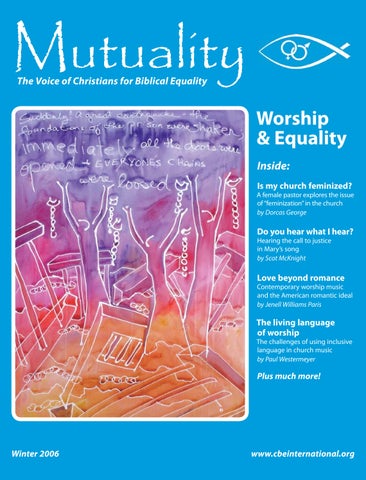
cover image: Shaken and Set Free (Freedom Series), Gwen Meharg, watercolor, 2005,
22 × 30 in. (www.drawneartogod.com)
| Mutuality Winter 2006
website: www.cbeinternational.org
From the Editor by Chelsea DeArmond
Rejoicing with the Truth Worship is at the heart of one of the most beloved passages in the Bible: 1 Corinthians 13. In this familiar passage, Paul describes the characteristics of love. After a long list of what love is not, he concludes: Love does not rejoice in wrongdoing, but rejoices with the truth. Paul wrote these words in a letter to a church that was struggling with serious divisions and disputes over worship practices from baptism to communion and everything in between. Instead of focusing on what’s going wrong, love gathers people together to celebrate the truth. It rejoices in a way that brings people together and builds them up as one body. Bible scholars debate just what “truth” refers to in this verse. Does it refer to any true statement or to the Gospel itself ? Other biblical examples of this contagious rejoicing may offer clues about the truth that love celebrates. Although the word Paul uses for “rejoices with” (sugchairo) is unusual, it occurs in some of the best-known passages in the Bible. Luke also uses this word in the Christmas story and in Jesus’ parables of the lost sheep and the lost coin.
Children of the Promise In the Gospel of Luke, sugchairo is used to describe the celebration when Elizabeth gives birth to her son John after years of barrenness: “Her neighbors and relatives heard that the Lord had shown his great mercy to her, and they rejoiced with [sugchairo] her” (Luke 1:58 nrsv). Elizabeth’s friends and family shared her joy and spread the news about what the Lord had done in her life. Elizabeth’s story is similar to another woman who gave birth in her old age: Sarah. In fact, in the Greek translation of the Old Testament, Sarah uses the same word after her son Isaac (whose name means “laughter”) is born: “Now Sarah said, ‘God has brought laughter for me; everyone who hears will laugh with [sugchairo] me’” (Gen. 21:6 nrsv). The truth that Elizabeth and Sarah rejoiced with was the children they bore according to God’s promise, even after it was no longer humanly possible. If the truth that love rejoices with is not an idea, but rather a person—like it was for Elizabeth and Sarah—who would this person be for us? Paul uses Sarah’s example to describe how all Christians are “born as the result of a divine promise” (Gal. 4:23 tniv). In fact, “Now you, brothers and sisters, like Isaac, are children of promise” (Gal. 4:28 tniv). Love rejoices with every person who was once dead in sin and is now born again in Christ.
Once Lost, Now Found Jesus’ parables about the lost sheep, the lost coin, and the lost (or prodigal) son offer more examples of love’s celebration. The same word for rejoicing describes the shepherd who leaves his flock behind to find one lost sheep and the woman who will not sleep until she finds one lost coin. They both call together their friends and neighbors to celebrate (sugchairo) finding something precious that was once lost (Luke 15:6, 9). In the parable of the lost son, the father calls his friends and neighbors together to celebrate when his son returns, because “this son of mine was dead and is alive again; he was lost and is found!” (Luke 15:24 tniv). What is the truth that love rejoices with? The truth is, you were once lost and now you’re found. You were once dead and now you’re alive. God has chosen to “give us birth through the word of truth” ( James 1:18 tniv) and that’s worth celebrating.
The Open Invitation Love’s invitation is open to everyone, but some choose not to come. In the parable of the lost son, one person refused to join the celebration. The older son was focused on his brother’s wrongdoing, and he believed he was more entitled to his father’s love than his wayward brother was. Like the older son, some people believe they have a greater claim to inherit the Father’s kingdom than their younger brothers and sisters. The truth is, only God can qualify someone for the kingdom. Everyone who is born again as a child of the promise receives the full inheritance of the first born son (Rom. 8:14–17; Gal. 4:6–7). There are no slaves in the kingdom of God. Many women who are eager to use their gifts in the church face resistance from people who, like the older son in Jesus’ parable, refuse to rejoice with the truth of their sisters’ new birth and identity in Christ. In spite of their resistance, love never stops longing to rejoice with them.
In This Issue The articles in this issue of Mutuality celebrate the rich contributions that women like Jesus’ mother Mary, Sister Gertrude Morgan, and women who use their preaching gifts have made to the church’s worship. These articles also explore current issues by responding to the charge of “feminization,” offering alternatives to romanticism, and recognizing the need for inclusive language in our worship. Paul is a great example of someone who confronted serious issues in worship in a way that called divided people to a greater unity. A church that is focused on wrongdoing will fall apart. Love does not overlook wrongdoing—it overcomes it on the cross. If we rejoice with the truth of God’s amazing grace for us all, love will build us up into one body. And love never fails.
Chelsea DeArmond is Editor of Mutuality and Bookstore Coordinator at Christians for Biblical Equality. She can be reached at cdearmond@cbeinternational.org. bookstore: www.equalitydepot.com
Mutuality Winter 2006 |
In Our Box
Mutuality
Visit CBE’s website at
www.cbeinternational.org for the latest… ▶ FREE audio and print resources on biblical equality ▶ Membership information for churches, libraries, families, and individuals ▶ On-line discussions about gender and justice on The CBE Scroll, the blogging voice of CBE ▶ CBE chapters in the U.S. and around the world ▶ Directory of egalitarian churches in the U.S. and around the world ▶ Giving opportunities ▶ Listings for counselors, therapists, and spiritual directors who agree with CBE’s Statement of Faith ▶ Ministry news and needs ▶ Employment, internship, and volunteer opportunities
Call for Papers
Mutuality provides inspiration, encouragement, and information about equality within the Christian Church around the world. Mutuality is published quarterly and sent to all CBE members and subscribers. Current and back issue are also available for purchase. We are currently seeking features, reports, and reviews (books, films, and/or music) from evangelical, egalitarian perspectives related to the following topics: • • • •
Advocacy versus Apathy Equality and our evangelical heritage Persecution and revival Raising Children
Most of the articles we publish fall into the following categories: • Personal testimonies illustrating how biblical equality provides practical benefits to everyday lives. • Teaching on relevant Bible passages, explaining the meaning and showing how to apply it to daily life. • Reviews of books about biblical equality that would appeal to a wide audience. (Books must complete CBE’s book service review process before being reviewed in Mutuality.) • Feature stories about issues related to CBE’s mission and ministry. The length of features is generally 1,000–2,500 words. Send articles to the attention of the editor at the postal address below or e-mail to cdearmond@cbeinternational.org (if possible, as an attached Microsoft Word document). We are unable to consider or respond to authors who send us more than two pieces at the same time, whose pieces are substantially over 3,000 words, or whose submissions are not sent uniquely to Mutuality. Complete Writers Guidelines for Mutuality are available on our website (www.cbeinternational.org) or contact our office to request a copy. Questions and submissions can be directed to the attention of the editor, Chelsea De Armond.
Visit CBE’s online bookstore at
www.equalitydepot.com for resources like… ▶ Books and articles ▶ Audio and video tapes ▶ CD, DVD, and MP3 recordings ▶ Sales and specials ▶ New resources, CBE exclusives, and best sellers ▶ Foreign language resources ▶ Become a CBE member or renew your membership and save 15% on every purchase ▶ Registration for CBE conferences ▶ Subscription to CBE publications or purchase back issues of Mutuality and Priscilla Papers
| Mutuality Winter 2006
We’d love to hear from you! Send your comments and critiques to:
Mutuality
122 W Franklin Ave, Suite 218 Minneapolis, MN 55404-2451 phone: (612) 872-6898 fax: (612) 872-6891 e -mail: mutuality@cbeinternational.org web: www.cbeinternational.org Letters may be edited for clarity and brevity.
website: www.cbeinternational.org
feminized?
Is my church
A female pastor explores the issue of “feminization” in the church
by Dorcas George
My favorite hymn is Martin Luther’s “A Mighty Fortress is Our God.” Something must be wrong, because according to an article I recently found on the internet, that is a “manly” song. As a female pastor, I became concerned when I started hearing reports about the decreasing number of men in church. Some specu-
claims. Here are some examples of generalizations Murrow makes about men and women: “Deep in his heart, every man has a desire to expend himself for a great cause,” “Men are not as studious as women,” “Men have always done the dangerous jobs,” and “Women buy romance novels; men buy pornographic magazines.” On the first page of the first chapter, readers are informed that men are dissatisfied with the church, but women remain unaffected. Murrow doesn’t consider whether this dissatisfaction Contemporary praise songs are “feminine” said one writer, and might extend to women as well anthems and hymns are “masculine.” On the list of manly songs? as men. My favorite, Martin Luther’s stirring anthem, “A Mighty Fortress.”
Should churches be more mighty and manly?
“
”
Martin Luther’s 1527 hymn “A Mighty Fortress is Our God” is known as the “Battle Hymn of the Reformation.” Luther based the lyrics on Psalm 46.
lated that this decrease was a result of the “feminization of the church” and the solution was for men to be “manly.” I love the men in my congregation, and I want them to be strong and righteous people of faith. So I wondered, was the worship in my own congregation somehow too feminine to attract men? Had my rural church’s culture been damaged when I answered the call to serve as their pastor six years ago? Was there truth to the claim of “feminization”? Even though I believe the Bible supports women’s ministry, I seriously considered whether the Holy Spirit might be trying to teach me something.
Findings at the local Christian book store
Findings from the internet
A subsequent internet search left me overwhelmed by the number of results, but I ploughed in with determination. I recognized the names of some of the authors as pastors of large churches and leaders of nationally-known organizations. If the opinions and warnings I read are correct, we need a total worship overhaul. Pictures, music, worship forms, sermons—all must change in order to effectively appeal to men. According to article after article, one of the most alarming presentday problems threatening the church of Jesus Christ is—women. Dire predictions were made of what is going to happen to the church if we
Should churches be more meaty and masculine?
“
I decided to investigate the issue. At my local Christian There were also admonitions to remove feminine art and decobook store I browsed through rations from our church and to replace them with reproductions titles like: Why Men Hate Going of manly paintings by artists like Rembrandt. to Church, Wild at Heart, Heart of a Tender Warrior, and Jesus Rembrandt, “The Flayed Ox,” 1655, oil on wood, 94 × 69 cm, Musëe de Louvre, Paris Mean and Wild. A look inside the cover of Why Men Hate Going to Church by David Murrow revealed some suggestions that I thought the church do not turn this alarming trend of feminization around, and soon. I might do well to at least consider. But then I read this statement: read that the church’s worship has become “girly,” “silly,” “wimpy,” and “The growth of Islam is due to its stronger moral content.” Sweeping “simpering.” I read that the “priests of the home must take their stand” generalizations like this caused me to doubt the credibility of his in both home and church and stop letting the women take over. bookstore: www.equalitydepot.com
”
Mutuality Winter 2006 |
Does worship come in and blue?
“
pink
I am a woman, but I love anthems and strong hymns and metaphors of action and struggle and victory, while our male worship leader prefers more introspective contemporary choruses. When I read the Psalms of David, I see both kinds of worship.
”
Hear this, you kings! Listen, you rulers! I, even I, will sing to the Lord; I will praise the Lord, the God of Israel, in song.… Deborah, Judges 5:3,9
Show me the wonders of your great love… Keep me as the apple of your eye; hide me in the shadow of your wings.… David, Psalm 17:7–8
You [are] all-accomplishing Word of the Father.…your power like a wheel around the world, whose circling never began and never slides to an end.
But you too, good Jesus, are you not also a mother? Are you not a mother who like a hen gathers her chicks beneath her wings? Anselm of Canterbury
Hildegard of Bingen, “Song to the creator”
Mine eyes have seen the glory of the coming of the Lord; He is trampling out the vintage where the grapes of wrath are stored; He hath loosed the fateful lightning of His terrible swift sword; His truth is marching on.
Contemporary praise songs are “feminine” said one writer, and anthems and hymns are “masculine.” Pastors were urged to increase the number of masculine songs featured in worship. On the list of manly songs? My favorite, Martin Luther’s stirring anthem, “A Mighty Fortress.” There were also admonitions to remove feminine art and decorations from church classrooms and sanctuaries and to replace them with reproductions of manly paintings by artists like Rembrandt. I can agree with that if it means replacing pictures of Jesus that present him as pink-cheeked and pretty, but I’m not convinced that only men find these sorts of portrayals to be less than inspiring. Pentecostal and Charismatic congregations were chastised along with mainline denominations for allowing women to teach and preach. Charismatic worship was characterized as “hysterically feminine and emotional,” and mainline churches were urged to make their liturgy more “meaty and masculine.” The tone of most of the articles I managed to read was, at best, mildly derogatory and, at worst, deeply offensive. The primary insult was to women, but men were included as well. For example, in response to the obvious question about how centuries of male clergy could result in a feminized church, I read that while we know men have dominated the clergy, male members of the clergy are usually effeminate, and psychological tests and studies proved this (though none were cited)! Several articles asserted that we have emasculated Jesus by referring to him with terms such as “gentle.” Pastors were exhorted to stop “preaching like girls” and instead to call the men of the congregations to decisive action. One pastor-writer went so far as to assert, “Gentle Jesus, meek and mild is repugnant to men.” It didn’t take me long to become discouraged and disgusted, but when I came across a satiric piece titled, “Dirty Harry Goes to Church” by columnist Doug Giles, I decided I had read enough.
Findings close to home
Julia Ward Howe, “Mine Eyes Have Seen the Glory”
Jesus, lover of my soul, let me to Thy bosom fly, While the nearer waters roll, while the tempest still is high. Hide me, O my Savior, hide, till the storm of life is past; Safe into the haven guide; O receive my soul at last. Charles Wesley, “Jesus, Lover of My Soul”
You are Lord of creation And Lord of my life Lord of the land and the sea You were Lord of the heavens Before there was time Lord of all lords You will be Twila Paris, “We Bow Down”
| Mutuality Winter 2006
Like a rose Trampled on the ground You took the fall And thought of me Above all Michael W. Smith “Above All”
Yet, I was still trying to learn something. Was there any truth to be found in the warnings and suggestions? I spent several days pondering the issue and praying for wisdom. I observed the churches and Christians around me in light of this alleged threat of feminization. I consulted the pastors I know (both male and female) and the people of my own congregation and considered the demographics of the churches in our area. I do not claim to have conducted a scientifically accurate survey, but I hope my observations will merit some thought and discussion. The churches in my area have either a slightly greater number of women than men, or the genders are approximately equal. There is no difference in gender demographics in churches that have a female pastor as opposed to those who have a male pastor. One Sunday I asked a member of my own congregation to note the percentages of adult men and women in our church’s worship service. It turned out that my church was actually composed of 54% men and 46% women. I looked over the congregation as we stood together to pray. I saw a group of young men. I saw families and single men and women. I saw worshippers.
website: www.cbeinternational.org
Findings from Scripture
it comes to worship forms, songs, preaching style, or artwork? Perhaps. I admit we avoid pink in my church’s décor. We also tend to avoid worship songs that sound more like love songs than songs of praise and adoration to a Holy God. I am a woman, but I love anthems and strong hymns and metaphors of action and struggle and victory, while our male worship leader prefers more introspective contemporary choruses. When I read the Psalms of David, I see both kinds of worship. Does the Church need an overhaul? Do we need to be stronger, more focused, more dynamic, and more active? Absolutely! But I agree with United Methodist minister and educator, Rev. Elaine Heath who says, “We have far too many churches that feature insipid music and programs that lost vitality years ago. We have
Where are the Scriptures about how to become more masculine or more feminine? The Bible nowhere attempts to define those words at all. While we do have a portrait of a virtuous woman (Proverbs 31), she is far from simpering, weak, or silly. She is strong and courageous and hard-working and kind. I do not find Scripture about the “wild” Jesus. On the contrary, he appears focused, self-controlled, and calm. I do not see Scripture that says women all love to relate and men all love to take action. I do not see one list of spiritual gifts and talents for men and another for women. I see no Scripture about methods to ensure the church is sufficiently masculine. I do see where Scripture talks about the priesthood of all believers, with no specifications about gender. I do see where spiritual gifts are given to members of the Body of Christ for the edification I believe in a gentle, meek Jesus. (If some of these manly men of all. No specifications about would study Greek they’d see that meekness is not weakness, manliness there either. I read that but is strength under control.) I don’t think Jesus was “wild” but both men and women prophI do think he was not afraid to take on evil or to speak strong esy and preach and teach and words. I want to be like Him. learn and sing and worship. I see Rembrandt, “Head of Christ,” c. 1650–1652, oil on wood, 25 × 21.5 cm, Staaliche that prayer makes a difference Museen Preussischer, Kulturbesitz,Gemäldegalerie whether offered by a woman or a man. I see Scripture about war and victory and putting on the armor of God so that we can stand gender-specific programs that ought to embarrass us with their lack strong. All of us. of robust spirituality. Men are attracted [to church] not because I believe in a gentle, meek Jesus. (If some of these manly men there are masculine activities and emphases, but because the church would study Greek they’d see that meekness is not weakness, but is alive, vital and dynamic—because God is there.” is strength under control.) I don’t think Jesus was “wild” but I do think he was not afraid to take on evil or to speak strong words. I want to be like Him. Results of my study
Does meekness equal weakness?
“
A few more questions What does it mean to be “masculine”? What does it mean to be “feminine”? Popular Christian media often suggest that women and men have completely different needs, attributes, emotions, desires, and goals. However, as I looked at the Christians in my world, I saw that both men and women could be strong, meek, gentle, relational, talkative, dominant, frightened, intense, active, kind, etc. I saw men sitting and talking together and I saw women who would rather work than chat. What, I wondered, is causing this current fad in the evangelical church with policing masculinity and femininity? And if a “feminized” man is automatically whining, weak, and simpering, what does that say about what women are like? If men want battles to fight, do women just sit on the sidelines and cheer them on? Is that their place in the Army of God? Are there gender-related differences or tendencies? Certainly there are. Might we also have gender-related preferences when
bookstore: www.equalitydepot.com
”
The more I considered the “buzz” about the so-called feminization of the church, the more I realized the concern was misguided. What we need are mature Christians, not manly Christians. The church may indeed be weak. This has nothing to do to do with femininity or masculinity. It has to do with the need for strength, conviction, boldness, and giving our lives for Jesus Christ and His Kingdom. It has to do with growing up—with becoming mature disciples. We must die to self and forsake sin, count the cost, and follow the Lord with all our hearts. “Stand up for Jesus, ye soldiers of the Cross!” I loved those words as a child, and I love them still. According to what I’ve just been reading, men are looking for a cause to give their lives to. So am I.
A wife, mother, blogger, and first-time grandmother, the Rev. Dorcas George is senior pastor at Jubilee Assembly of God in New Holstein, Wisc.
Mutuality Winter 2006 |
“Do you hear what I hear?” Hearing the call to justice in Mary’s Song
I once stood in front of 65 of my students and read Mary’s song from Luke 1:46–55 loudly, with the emotion of protest. I asked this question: What kind of woman would have sung this song? Deep inside I wanted to know, Do you (students) hear what I hear (in Mary’s song)? Do you hear that the woman who sang this song had vision? Do you hear her courage? Do you hear that she must have been what some have called a “dangerous” woman? Dangerous? Mary? Most evangelicals are accustomed to the Mary of icons with an emotionless face, the Mary of statues draped in a powder blue robe, and the Mary of piety who quietly and submissively obeys orders. And, if you are like me, you have been nurtured in a faith that, intentionally or not, ignores Mary. One of my favorite books on women and the Bible, Discovering Biblical Equality, paid little attention to Mary. Why? Because Protestant evangelicals aren’t quite sure what to do with Mary—so she gets ignored. It’s time to change that.
The real Mary It’s time to take Mary out of the nativity scene we get out every Christmas and give her a permanent place in the home—after all, she is Jesus’ mother! A careful look at Mary in the Gospels reveals an altogether different Mary than the one we’ve rejected. The real Mary was more like Harriet Tubman and Mother Teresa than the soft image of traditional piety. We live in a world wracked by pain and systemic injustices based on gender, ethnicity, and economics. When my students ask me for a good example of someone in the Bible who believed in and fought for
By Scot McKnight
justice, I refer them to the song (and life) of Mary. “Just take a gander at the Magnificat; it’ll surprise you,” I tell my students. Read the Magnificat aloud, not silently. Shout it if you can. As you read, imagine two things: First, Herod the Great (and whatever comes to your mind about him) on the throne; second, Mary as a poor, young, unmarried, pregnant woman in far-off Galilee who, with thousands of others, was sick and tired of oppression. Here’s her song. Hang on. 46 My soul glorifies the Lord 47 and my spirit rejoices in God my Savior, 48 for he has been mindful of the humble state of his servant. From now on all generations will call me blessed, 49 for the Mighty One has done great things for me— holy is his name. 50 His mercy extends to those who fear him, from generation to generation. 51 He has performed mighty deeds with his arm; he has scattered those who are proud in their inmost thoughts. 52 He has brought down rulers from their thrones but has lifted up the humble. 53 He has filled the hungry with good things but has sent the rich away empty. 54 He has helped his servant Israel, remembering to be merciful 55 to Abraham and his descendants forever, just as he promised our ancestors. (Luke 1:46–55 tniv)
Mary’s Song Through the Centuries Mary’s song in Luke 1:46–55, known as the Magnificat, has been an important biblical text in Christian worship for centuries. Mary, the mother of Jesus, sings the Magnificat when the unborn John the Baptist moves in his mother Elizabeth’s womb after she greets Mary. Her song of victory and praise is based on the song of another famous woman of the Bible, Hannah (1 Samuel 2:1–10), and other biblical songs. Mary’s song is known as the Magnificat because in Latin, the traditional liturgical language, the first lines are “Magnificat anima mea Dominum” or “My soul magnifies (or glorifies) the Lord.” The Magnificat has been used in Christian worship since at least 535 a.d. Monastic communities have a long tradition of worship and prayer at regular times throughout each day, called the daily office. The Magnificat is usually sung at the end of the Vespers service, which occurs around 6:00 p.m. It is the service of twilight, the time to thank God for the day and ask for protection through the night. Most major composers from the medieval period to the mid-eighteenth century composed music for Mary’s words in this text. The Magnificat continues to be sung today in Catholic and some mainstream Protestant churches. Now it is usually sung in the language of the worshipers instead of Latin, and it is used during evening services and around Christmas time. When we sing the Magnificat today, we worship God alongside not only Mary, but other Christian worshipers through time and across borders of culture and tradition. Together we glorify the Lord and rejoice in God our Savior. | Mutuality Winter 2006
website: www.cbeinternational.org
A victory speech We’ve just experienced yet another election in the United States. Every candidate had either a victory speech or a concession speech. The Magnificat is a victory speech—Mary has been told by the angel Gabriel that her son would be the Son of the Most High God, that her son would rule on the throne of David, and that her son would be Messiah. When Mary visits her relative, Elisabeth, Mary bursts into a song celebrating the victory of God and the poor over the proud and the powerful. Mary, and thousands like her, had been yearning—for generations—for the promise of God to be fulfilled, the promise that God would someday place the Messiah on Israel’s throne. That promise involved a Messiah who would establish justice and peace and righteousness. This is the victory about which Mary sings. The parallels between Mary’s song and Hannah’s Old Testament song of praise (1 Sam. 2) are often noted. But Mary’s song is also the New Testament equivalent of Moses and Miriam’s great song of victory after their exodus from captivity in Egypt (Exod. 15) and the worship services of Ezra and Nehemiah after the return from Exile. Mary’s agile willingness in Luke 1:38 also parallels Abraham’s response to God’s call (Gen. 12, 15), and the other heroes of faith celebrated in Hebrews 11. The verbs in Mary’s Magnificat are in the past tense: though the things Mary celebrates have not been fully realized, she sings as if they have already occurred: “He has brought down rulers from their thrones” and “He has filled the hungry with good things.” Mary, a poor, pregnant woman sings not “we shall overcome”—as if that victory would come soon, but “we have overcome.” Why? Because Mary believed that God’s justice had already begun to roll in the baby in her womb.
Herod de-throned, Jesus en-throned If you have imagined with me that Mary’s Magnificat is more like a rally or a victory speech than anything else, then you will have to admit something else: Mary is going toe-to-toe with Herod the Great in the verbal fisticuffs of the Magnificat. Who was on the throne? Who was proud? Who was oppressing the poor and humble? Whose policies ripped the gleanings from the table of the poor? Whose system favored the rich at the expense of the poor? Whose kingship called into question the promises of God? Herod’s. These words of Mary’s are an assault—if I may be so bold—or at least a prophetic assault, something like Nathan’s words to David, on Herod. He is the one whose ways are about to change, whose policies are about to be subverted, and whose ethic is about to be deconstructed. Mary’s song is about Jesus being en-throned and Herod being de-throned.
Mary knows it is God’s work Read the Magnificat aloud one more time, but this time consider how Mary knows that God is at work. She is pregnant—but God has brought that about through a supernatural conception; her son will be king and Messiah—but that is God’s work; her son will establish justice in the Land—but that, too, is the work of God. Notice how often the sentences begin with a personal pronoun that points us toward God. Over and over Mary’s focus is on God bookstore: www.equalitydepot.com
Ark of the New Covenant – Batik, Gwen Meharg, watercolor, 2002, 22 × 30 in. (www.drawneartogod.com)
because she knows that what is happening in the birth of the Messiah is the promised work of God. Mary’s song begins with “My soul glorifies [or, ‘magnifies’] the Lord and my spirit rejoices in God my Savior.” Mary is captivated by the missio Dei, the work of God in this world, and she exults in what God is doing here and now.
God works through those who fear God No one who reads the Bible should be surprised that God chose a most unlikely person—a poor, young, unmarried woman—to play such a key part in this new era. God has never been attached to human strategies or our values; God doesn’t think it is important to begin with the most powerful people or with the most practical plans. God, after all, chose Moses—a murderer, and then David—a shepherd boy. He chose younger sons, like Jacob and Joseph. And God has worked mightily through women like Miriam the prophet, Deborah the judge, and Huldah the temple scribe. Women are noted in Matthew’s genealogy of Jesus—Tamar, Rahab, Ruth, and Bathsheba (Matt. 1:1–17). Each of these women had a scandalous reputation similar to the one Mary was given by her contemporaries. Mary’s song reminds us that God works with those who “fear God” (Luke 1:50): those who stand in awe of God’s work in this world. Mary was such a woman, and she points us to renewed hope that our fear of God will be rewarded as we work for God’s mission for this world. She offers liberating words for those who have been disqualified on Mutuality Winter 2006 |
the basis of their gender, ethnicity, or class. Mary’s example shows that anyone who fears God can be called to be a servant of God.
God’s work deconstructs injustice Mary sings that when God bares (and swings into history) that heavenly arm of might, God will: Scatter the proud with their haughty hearts; Strip rulers from their top-heavy thrones; Send the rich away with empty pockets. This is the work of God in the kingdom of Mary’s son. God’s will is to end the power of the proud, end the power of unjust thrones, and end the rapacious policies of unjust rulers. Anyone who wants to follow Jesus will join Mary in singing and working for the end of injustice. We might need to remind ourselves that once Herod the Great realized that the next-born king was now loose in the Land, he sought to kill Jesus—and I am persuaded that he would also have liked to get his hands on the woman who had the audacity to sing the Magnificat as a song that threatened those who used power and wealth unjustly.
God’s work constructs justice Not only did Mary sing of deconstructing injustice, her song was balanced by constructing justice. Notice these elements of Mary’s vision for the “new world order” called the kingdom of Jesus: Mercy to those who fear God; Exaltation of the humble (poor); Food for the hungry.
Mary describes these acts of deconstruction and construction done by the power of God’s mercy as demonstrations of God’s faithfulness to his covenant and his promises (see vv. 54–55). Our understanding of covenant tends to focus on the forgiveness of sins and overlook the covenantal theme of justice. A fuller biblical view of covenant involves Abraham’s call (Gen. 12, 15), the promises for David’s kingdom (2 Samuel 7), the formation of the new community in the Lord’s Supper (Mark 14, 1 Cor. 11, Heb. 10), and right up to Pentecost when the new community receives the Holy Spirit and is healed of divisions reaching back to the tower of Babel (Acts 2). Mary was among the men, women, and children who were pioneers of this new Pentecost community (Acts 1:14). “Practicing Pentecost,” to use the words of blogger Anthony Smith (postmodernegro.wordpress.com), means letting God’s Spirit invigorate the community into unity. Practicing Pentecost means living “in Christ,” where there is no male nor female, Jew nor Greek, slave nor free. Practicing Pentecost is learning to live the Magnificat’s dream.
Responding to the call Here’s what I hear in the Magnificat: The power of Mary’s song is the power of telling her story about Jesus. Who was the first person to tell the world the good news about Jesus? Mary, who learned to call Jesus Messiah and Son of the Most High God. She is an example of what it means to stand up to injustice, fight for justice, and point others to God’s redemption work in Jesus. Do you hear what I hear? Scot McKnight is Karl A. Olsson professor in religious studies at North Park University. A prolific author, his most recent book is The Real Mary: Why Evangelical Christians can Embrace the Mother of Jesus (Paraclete 2006). He hosts a blog at www. jesuscreed.org.
Divine Illumination, Gwen Meharg, watercolor, n.d., 22 × 30 in. (www.drawneartogod.com)
10 | Mutuality Winter 2006
website: www.cbeinternational.org
LOVE Romance beyond
Contemporary Worship Music and the American Romantic Ideal
From the simple chorus Jesus Loves Me to the classic Charles Wesley hymn Jesus, Lover of My Soul, Christians of all eras have sung about God’s love. Even when well-informed by Scripture, worshippers naturally use the language and symbols of their cultures when speaking of God’s love. Since romantic ideals predominate the language of love in the American culture, many have argued that romance is overrepresented in our contemporary praise and worship music. Biblical writers describe God’s love in many ways, none of which are romantic. In the Old Testament, the foremost name for God is “I AM,” emphasizing God’s sheer existence and everlastingness. God is often called lord, king, or warrior—a righteous leader. God is described metaphorically as animals including lion, lamb, eagle, and hen, implying strength, tenderness, and protectiveness. Family terms are also used for God, including husband, brother, father, and mother. Though erotic love (eros) was present in biblical times, it was different than American romantic love. The Song of Solomon shows us that eros was honored, but it was just one kind of human bond, not the be all and end all it is in our culture. In biblical cultures, marriage relationships were formed for political or financial gain, for joining extended families, and for procreation. Intimacy could grow between a husband and wife over time, but passionate love would not be cultivated before marriage, nor developed in isolation of an extended family context. Even more importantly, however, romantic love was not ascribed to the relationship between God and God’s followers.
The American romantic ideal Sociologist Ann Swidler found that many white, middle-class Americans she interviewed believe in the American romantic ideal found in romance novels, Hollywood movies, and our imaginations. Though they also critiqued the unrealistic aspects of this ideal, Swidler found that it still shaped expectations for their own loving relationships. In this ideal, lovers come together in sudden passion, each finding an idealized lover in the other. Their love enables them to overcome obstacles and transforms each of them into more virtuous people. Romantic love separates individuals from society, because the lovers need nothing but each other. Their union is often made in defiance of social or family expectations. In romantic stories, the man is cast as strong, active, and initiative-taking, while the woman is needy, passive, and ultimately receiving of the man’s initiative. bookstore: www.equalitydepot.com
By Jenell Williams Paris
Celebrate in the Flow, Gwen Meharg, watercolor, n.d., 22 × 30 in. (www.drawneartogod.com)
In order to find out how contemporary workship music used the American romantic ideal to describe the relationship between God and humans, I analyzed lyrics of the top 25 praise and worship song lists from 1989–2005. I examined their portrayal of the roles of God and of humans in the divine-human relationship, and of the difference love makes in the life of the believer and the world. While romantic love serves to illuminate some aspects of the divinehuman relationship, an overreliance on the American romantic ideal in worship has drawbacks. I offer applications to encourage worship leaders and worshipers toward greater faithfulness to Scripture and stronger discernment about contextualizing the Word in American culture.
Portraying God as the “leading man” The romantic “leading man” pursues the woman, overcoming obstacles to win the heart of his beloved. He takes risks to save the woman from a dire situation. In romantic praise and worship songs, God takes this leading male role. Mutuality Winter 2006 | 11
Instruments of
Peace
Take Your Pick, Marilyn Banner, encaustic on wood, 11 × 14 in. (www.marilynbanner.com)
by Julia L. Butcher
Verse 1 Lord, we’re choked and overwhelmed by Storms of chaos in the night. Hate and terror, death and violence, What is our small, flick’ring light? Chorus Yet you gather us together, Causing hate and fear to cease. You combine our strengths and frailties In a symphony of peace. Verse 2 Instruments of peace we claim, Lord As our calling in this place. Yet our strings are weak and breaking, Out of tune with your sweet grace. Verse 3 Give us hope and faith secure, Lord, That your work is far from done. Still we strive to bring your Kingdom. Still we strive to live as one. Julia Butcher is the Conference Coordinator at Christians for Biblical Equality. She graduated from St. Olaf College with a degree in Church Music. She wrote this hymn for the intentional Christian community she lives with in Minneapolis, Minn.
12 | Mutuality Winter 2006
In songs that describe divine actions, most refer to Jesus’ initiative in saving humans. Jesus is praised for “Taking my sin/ My cross my shame” (“You are My All in All”), and honored for having “set me free” (“I Could Sing of Your Love Forever”). God also initiates emotional intimacy. For example, in “Draw Me Close,” the worshiper longs for God to say “that I’m Your friend.” “The Heart of Worship” describes God this way: “You’re looking into my heart.” Lyrics frequently climax with the enjoyment of interpersonal intimacy between God and humans, mimicking the romantic ideal of total fulfillment found between lovers. The static image of a believer resting in intimacy with God suggests that God’s primary purpose in the world is to enjoy romance-like relationships with individuals. “Draw me Close,” for example, ends, “You’re all I want / Help me know You are near.” “When I Look into Your Holiness” ends, “When my will becomes enthralled in Your love / when all things that surround / Become shadows in the light of You.” Other purposes of the divine-human relationship are minimized, such as spiritual growth, mission, acts of service, or even salvation. In their pervasive portrayal of God as leading man, these romantic praise and worship songs encourage people to view God primarily in terms of God’s ability to deliver an experience of emotional fulfillment. Worshipers imagine a divine partner who is the ultimate boyfriend—a strong, benevolent, wooing man. While this is not entirely inappropriate—a heartfelt relationship with God is important—it can also be limiting if it is not balanced with other biblical portrayals of God’s love. God’s activities include more than personal salvation and interpersonal intimacy. To name just a few, God also created the world, formed a nation and a church, and continues to work through people for justice. These actions are related to God’s loving character, and reach beyond an individual’s experience of inner fulfillment or even salvation. God’s intimate relationships with people in Scripture, such as Jeremiah, Miriam, or Moses, were not primarily for the personal fulfillment of the individuals, but rather, to empower them to work for God’s purposes in the world.
Portraying humans as the “leading lady” A leading lady complements her man by being weak, passive, and in distress. In romantic worship songs, humans take this feminine role. In “Draw Me Close,” worshipers sing, “Draw me close to You / Never let me go…You are my desire / No one else will do / Cause nothing else could take your place / To feel the warmth of your embrace.” And in “Breathe,” worshipers sing, “And I / I’m desperate for You / And I / I’m lost without You.” The human stance before God is one of longing and begging. Humans and God are paired in a distress and rescue motif in which humans rarely initiate action or do good. While a stance of humility is essential in worship, the overemphasis of human worthlessness may limit worshipers from becoming agents of change in the world and in their lives. As in our world, people in Scripture engage with God in a variety of ways. Moses argued with God, Jeremiah accepted his calling and acted boldly, David lamented, and Mary became an active participant in the Incarnation. These love relationships with God offered strength and purpose to live, not intense emotional feelings as an end in themselves. The most active things humans do in these songs are individual religious acts that are done in a church, such as, “I worship You” (“When I Look Into Your Holiness”), “I lift up my hands” (“Thy Lovingkindness”), or “I lift my voice” (“I Love You Lord”). While religious responses to God are valuable, most people spend only a few website: www.cbeinternational.org
hours a week at church. Worship songs might also speak of the workplace, family, or society, and corporate acts of worship and service. Even more problematically, these songs suggest that personal fulfillment is the apex of being a Christian. “Better is One Day” says, “For my soul longs and even faints for You / For here my heart is satisfied within your presence.” Human identity does find completion in God, but the repetition of this theme to the exclusion of service and community may promote an excessively personal vision of faith: that feeling satisfied in life and experiencing romantic feelings of love toward God are marks of Christian maturity.
Here are a few ways worship leaders can bring greater depth and width to the portrayal of God’s love in worship music.
• Increase reliance on Scripture in song lyrics. God’s love cannot be pinned down to a simple definition, and the hundreds of scriptural metaphors for God help us begin to envision its vastness and perfection. Images of God could be broadened to include scriptural images from the family, the natural world, and community life. For example, worship songs could enhance a heartfelt relationship by depicting God as the Savior (Acts 13:23), the good shepherd ( John 10:11), or a sure foundation (Isa. 28:16). Worshipers will be more faithful to scriptural attributes of God, and reduce the “Riding off together into the sunset” tendency to apply pop culture images and ideas onto God. Romantic lovers “ride off together into the sunset,” finding com- • Broaden the language of love beyond the romantic. Songs about pletion in each other. Connections to family or society become love should also include expressions of the commitment, hard work, either unnecessary or and long-suffering of real even harmful, when love lived over time. The others present obstawell-known appropriation cles to the lovers purof Greek words for love, suing their relationship. including eros, storge, agape, Rather than exploring and pragma can also offer how God’s love binds ways of describing differus to the church and ent facets of love. to communities, popu• Expand the role of lar worship songs more humans beyond passivity, often describe individuweakness, and sinfulness. als becoming less and Scriptural images of God less connected to life often carry complemenon earth as they pursue tary images of humans— God. Creator and creation, “When I Look into father and child, teacher Your Holiness” describes and student, and friends. a person losing touch In all these examples, with society, “When I God is clearly greater than look into your holiness humans, but humans are / when I gaze into your also active participants in loveliness / when all the divine-human relathings that surround / Revelations Of Him, Gwen Meharg, watercolor, n.d., 22 × 30 in. (www.drawneartogod.com) tionship, doing important become shadows in the works of creativity, justice, and mercy. The personal, private, and light of You.” Detachment from earthly surroundings is sometimes “otherworldly” part of the spiritual life is not the whole. Worship even considered evidence of true worship. In “Surely the Presence of the music should reflect more of spiritual formation—the shaping of Lord,” the worshiper knows she is worshiping because she “can hear the a person in relationship with God, living life in this world. brush of angel’s wings” and “feel that same sweet spirit.” • Exercise greater discernment toward American culture. It is Many romantic praise and worship songs conjure a sense of a perimportant to become aware of ways in which worship music may son united with God, floating somewhere in space, with no earthly superficially “christianize” elements of our culture. Developing context. This overemphasis is problematic because worshipers will worship music that expresses the wonderfulness of God’s love in soon return to real world contexts in which faith needs to make pracways that connect to culture without capitulating to it will be an tical sense. As Christians learn to engage social justice issues such as ongoing adventure. war, AIDS, poverty, and disaster relief, they should find a fullness of Music is a powerful instrument for helping people experience the personal piety and social action in their worship music. scope and everlastingness of God’s love. The near-exclusive use of the American romantic ideal in love-oriented worship songs uses only a Applications fraction of what Scripture teaches about God’s love. Romantic worship songs encourage an intimate, heartfelt relationship with God, and such a purpose should be conserved. But when it comes Jenell Williams Paris is associate professor of anthropology at to love, romance is not the whole story. Love is also about commitBethel University. This article was developed from a book chapter ment, hard work, change over time, and, at times, confusion and doubt. that will appear in Words, Music, and Message (forthcoming from Abingdon). The widespread use of romantic language in praise and worship music presents worship leaders and worshipers with important challenges. bookstore: www.equalitydepot.com
Mutuality Winter 2006 | 13
Open My Eyes, That I May See
1. This hymn by Charlotte Elliott (1835) is most famous as an altar call song in the Billy Graham crusades. Graham used the title of the hymn as the title of his 1997 autobiography.
by Clara H. Scott
2. John Jacob Niles, the singer and collector of folk songs, said that he based this haunting Christmas carol (1933) on a song he heard a girl named Annie Morgan singing. She was the daughter of a revivalist preacher whose poverty-stricken family was camping in the town square of Murphy, North Carolina.
Open my eyes, that I may see Glimpses of truth Thou hast for me; Place in my hands the wonderful key That shall unclasp and set me free. Refrain Silently now I wait for Thee, Ready my God, Thy will to see, Open my eyes, illumine me, Spirit divine! Open my ears, that I may hear Voices of truth Thou sendest clear; And while the wave notes fall on my ear, Everything false will disappear. Open my mouth, and let me bear, Gladly the warm truth everywhere; Open my heart and let me prepare Love with Thy children thus to share.
3. This hymn by abolitionist Julia Ward Howe (1861) became popular in the Union Army during the Civil War, and is still a favorite Memorial Day hymn. It was sung at the funerals of British Prime Minister Winston Churchill, Senator Robert Ken nedy, and Presidents Ronald Reagan and Richard Nixon.
Charlotte Elliott
Open My Eyes. Words & Music: Clara H. Fiske Scott (1841–1897); first appeared in Best Hymns No. 2, by Elisha A. Hoffman & Harold F. Sayles (Chicago, Ill.: Evangelical Publishing Company, 1895). Clara Scott taught music at the Ladies Seminary, in Lyons, Iowa (1859) and published the Royal Anthem Book, the first volume of anthems published by a woman.
Julia Ward Howe
4. Martin Luther King Jr. quoted the words of this spiritual in his famous “I Have a Dream” speech, and its words are inscribed on his tombstone. The spiritual (1931) was collected in Sumter County, Alabama, by WPA project worker Ruby Pickens Tartt.
Ruby Pickens Tartt
14 | Mutuality Winter 2006
5. Perhaps the most familiar children’s hymn (1860) of all time is based on a poem Anna B. Warner wrote for her sister Susan’s novel, Say and Seal. A reporter once asked theologian Karl Barth to summarize what he had said in the thousands of pages of theology he had written. After thinking for a moment, Dr. Barth quoted the first two lines of this hymn.
Anna B. Warner
website: www.cbeinternational.org
Name that Hymn See if you can guess the names of these beloved hymns based on the inspiring stories of the women and men who wrote them. The answers are listed at the bottom of the page. 6. Helen H. Lemmel based this hymn (1922) on the Gospel tract Focused, by missionary Lillias Trotter, which includ ed these words: “So then, turn your eyes upon Him, look full into His face and you will find that the things of earth will acquire a strange new dimness.” 7. Known as “the greatest gospel song of all time,” Thomas Dorsey wrote this hymn (1932) after his wife Nettie died while giving birth to their son who also died soon afterward. Gospel singer Mahalia Jackson performed it for Martin Luther King Jr.’s funeral.
Lillias Trotter
He understands; He’ll say ‘Well done’
by Lucie Campbell-Williams
If when you give the best of your service Telling the world that the Savior is come Be not dismayed if men don’t believe you He understands; He’ll say, “Well done.” He’ll Understand and Say, ‘Well Done.’ Words & Music: Lucie Campbell (1933)
Mahalia Jackson and Thomas Dorsey
8. This is probably the most popular hymn (1779) in the English language—per haps because its words so well describe the author: John Newton was a slave trader before coming to Christ.
10. As a teenager, Louisa Stead felt called to be a missionary after attending a camp meeting in Urbana, Ohio. She John Newton wrote her most famous hymn (1882) 9. Pioneering gospel musician Lucie Campbell after witnessing her first husband’s Williams’ first hymn (1919) was inspired by a death as he tried to rescue a drownchance encounter with a blind gospel singer ing boy. She later remarried to Robert named Connie Rosemond. When some men Wodehouse and served as a missionpressured Connie to sing some blues, he ary in South Africa, Rhodesia, and responded, “I can’t do that; all that I know is Zimbabwe. Her daughter Lily mar that there is something within” and insisted ried D. A. Carson and became a mis on singing only gospel songs. sionary like her mother.
[Music] is no invention of ours: it is a gift of God. I place it next to theology. — Martin Luther Lucie Campbell-Williams
answers: 1) Just As I Am 2) I Wonder As I Wander 3) Mine Eyes Have Seen the Glory 4) Free at Last 5) Jesus Loves Me 6) Turn Your Eyes Upon Jesus 7) Precious Lord Take My Hand 8) Amazing Grace 9) Something Within 10) ’Tis So Sweet to Trust in Jesus bookstore: www.equalitydepot.com
Mutuality Winter 2006 | 15
Living Language of Worship
The
By Paul Westermeyer
The challenges of using inclusive language
Inclusive language—language hospitable to all people and the whole creation—has perplexed the church in our generation. Some people have radically rewritten hymn texts, some have stubbornly opposed any changes at all, and some have sought a middle ground. Some editors simply include unaltered and altered versions of hymns back to back so that congregations can choose one version or the other. Efforts like these have been greeted with varying degrees of pleasure and hostility. We have learned from the experimentation, but there is still no consensus. Though new rounds of disagreement continue to emerge, stereotypical extremes have receded as the complexity of the discussion has become more apparent. I’ll try to unpack the topic here by analyzing some key issues— especially those related to masculine and feminine imagery—and by suggesting how we might proceed.
Key issues in considering inclusive language Inclusive language and questions of idolatry Inclusive language raises questions that have to do with idolatry. We are called to worship God, not our words or our images of God. As finite creatures we will necessarily use anthropomorphic language to refer to God. That is, we use human attributes to describe or envision the God whom we address, as in Psalm 108:6, “Save us by your right hand, O God.” Such language is always imperfect. If we understand this imagery literally in our worship—as if God literally has a right hand which we attach to God’s essential being—we worship a God of our creation rather than the Creator. That is idolatry. The commandment is clear: we are to have no other gods besides God alone. As Christians, we believe God has been made known in the mighty acts recorded in the Old Testament and has been most clearly revealed in Jesus Christ. Idolatry leads to injustice Idolatry is not benign. It leads to injustice. If we worship a right-handed God, the implication is that God’s left hand, assuming it exists, is less important. That in turn can imply that the God we worship must favor right-handed human beings over left-handed ones. And that
16 | Mutuality Winter 2006
in church music
in turn can imply that right-handed people are more like God than left-handed ones. Likewise, if we worship God’s essential being as male, then the implication can be drawn that men are more like God than women. If the God we worship is perceived as white, then white people can be seen as more like God than black people. If the God we worship is perceived as a warrior, then we may well conclude that we are to conquer others in the name of that God. In each of these cases, the way God’s essential being is described in our worship affects the way we treat each other. God is greater than we can imagine Language is directly related to this progression. If all our language about God invariably calls to mind God’s right hand, the weight of this imagery will affect how left-handed people are perceived and treated. Similarly, if all of our language about God is male and patriarchal, then women are more likely to be regarded as second-class citizens. We each have to make decisions about the God Christians worship and about the biblical witness to that God. Here’s the way I read that witness. • The many examples of women in the Bible, from Miriam to Sarah to Deborah to Hannah to the Marys and the other women who gathered around Jesus, suggest that God cares about women as much as God cares about men. • All of us are regarded as equal by God, for in Christ there is neither Jew nor Greek, male nor female, slave nor free, nor any other distinctions (Gal. 3:28). • The biblical imagery about God is not exclusively male (for example, Jesus compares himself to a mother hen in Matthew 23:37, and God is described as a fortress and a rock in Psalm 18:2). Even masculine imagery reveals graciousness toward all people by a God in Christ who, unlike earthly rulers and all human men and women, cares about the least of all of us. The nature of God’s being always trumps, breaks, revises, recreates, renews, and re-sets all of our imagery. God is not what we imagine. What we imagine is always made new by God, not the other way around.
website: www.cbeinternational.org
Limitations of language lead to change
The language of proclamation and praise
Language changes. Male pronouns for humanity may once have been regarded by both men and women as generic and not oppressive, but in our day many people, both men and women, do not understand them that way. Whatever any of us may think individually about this linguistic shift—whether we regard it as good, bad, or indifferent—is finally not very important. Language functions the way it functions and is regarded as it is regarded. Those of us committed to worship materials in the vernacular must attend to its characteristics. This is easier said than done. Here are a few important things to keep in mind as your congregation considers the issue of using inclusive language in worship. •
•
•
•
What then should we do? Press on with care and compassion! What does that mean? It means trying things as responsibly as possible—that is, very well thought-out efforts that are likely to have staying power with a wide constituency instead of frivolous or last minute fixes. It means admitting failures and trying again. It means thinking as far as possible beyond our present narrow time frames. This involves gaining wisdom from those who have gone before us in their mistakes as well as in their well-conceived judgments and by thinking into the present and the future on behalf of the other. The solutions are not easy. We lack clarity and agreement about precisely what to do. In the last ten years or so I have been much perplexed by some young women who have opposed inclusive language more than Changing familiar language in worship plays with people’s memo- young men. The complexity was ratcheted up several notches recently ry banks. That is a significant matter which raises its own questions when I got a note from a woman who had challenged me in class several of justice. For example, to change texts which have been known years ago about my concern for inclusive language. She said she had and used for many years is to shut out old people who cannot see changed her mind. Why? Because in her job she had come to see how well to read or who have little left except their deepest memories. language related deeply to people’s perceptions and actions. Not only do we lack clarity and agreement about what to do. We On the other hand, since language changes and communities of also do not yet have a Thomas Cranmer in our midst who can fashion faith live in the present, not the past, changes have to be made. language the way he did in the Book of Common Prayer. Cranmer proChristian communities of faith are always called to figure out their vided language with lasting beauty and impact for English-speaking responsibilities to both past and present. They are neither museworshipers in and beyond the Anglican Church. ums nor reflections of Language which is not easily sung will the current culture. never work. Pressure by individuals or groups They draw from both who try to force a specific solution that past and present and neglects sound and its flow—no matter how stand against both. just the solution may seem or how strongQuestions of language ly someone may feel about it—will always are simply a part of this unravel and undo itself. That’s because such larger duty and delight special-interest agendas are seldom related to which they face. the community’s welfare. Over time the community will sniff them out for what they are. Poetry is important. The underlying problem we face is that Changing a hymn, we are still searching for a vernacular which which is a poem set to can express the faith in language which befits music, cannot be done the nature of praise. Hymns very often move lightly without serious from proclamation and prayer to praise of consequences. Poetry God, that is, to final stanzas of doxology. has to do with beauty, which has to do with Holy Hands, Gwen Meharg, watercolor, 22 × 30 in. (www.drawneartogod.com) Proclamation and praise, not agendas, undergird and drive justice. Our generation has yet how well a hymn will sing. Forcing a non-poetic agenda on a hymn treats people badly. to discover what might be called the intrinsic language of doxological beauty and grace. Sooner or later they will stop singing what is not well-crafted. None of this means we should stop trying to figure out what incluThere are different opinions about to what extent an author’s text sivity means or how to embody it in our language. We live in the flux should be respected and to what extent it belongs to the com- of human history the same as our predecessors have done. We are called munity once it leaves the author’s hand and is sung by the body of to our particular vocation in our time and place. Part of that vocation is the baptized. My own view is that, although authors’ words need to work at the inclusivity the Christian gospel brings with it, not only to be deeply respected, in the final analysis the community of the “with our lives,” but also “with our lips.” The two are integrally related. baptized “owns” a hymn and will eventually make alterations over In the final analysis we will not do one without the other. time—as judiciously and modestly as possible, one hopes.
These issues are complex, and cases have been argued strongly on all sides. Yet changes are inevitable as texts are translated from one language to another, as the language a hymn is written in itself changes over time, and as the understanding of the faith brings different emphases and deeper understandings from generation to generation. bookstore: www.equalitydepot.com
Paul Westermeyer is professor of church music at Luther Seminary in St. Paul, Minn., and director of the Master of Sacred Music program in cooperation with St. Olaf College in Northfield, Minn. He has served as President (1998–2000) of the Hymn Society of America and Editor (1985–1990) of its journal The Hymn. He has written several books on church music, including The Church Musician and Let Justice Sing: Hymnody and Justice.
Mutuality Winter 2006 | 17
Sister Gertrude Morgan’s Record
Sister Gertrude Morgan made a record. She made it using crayons, poster paint, pens, and even shoe polish on all kinds of surfaces from cardboard to canvas. She made it using spirituals, gospel hymns, shouts, chants, and songs she made up on the spot, sometimes accompanied by piano, guitar, and always with percussion. She made it in orphanages, prisons, street corners, jazz festivals, art galleries, and her living room. She made it in the Lower Ninth Ward of New Orleans. Sister Gertrude Morgan’s record reveals her single-minded commitment to worship. Her artwork and music were saturated with images and words from Scripture. Even the clothes she wore were consistent with revelations she received from the Lord about her mission to preach the gospel and her identity as the bride of Christ.
Country life, 1900–1938 Sister Gertrude Morgan was born the seventh child of a dairy farmer on April 7, 1900 in Lafayette, Alabama. When the family moved across the river to Columbus, Georgia, in 1917, Sister Gertrude began attending Rose Hill Memorial Baptist Church (part of the National Baptist Convention). In 1928, she married Will Morgan. At Rose Hill Memorial Baptist Church, Sister Gertrude studied the Bible and learned the core Christian doctrines that grounded her faith. Her pastor, James Berry Miller, is a good example of the empha-
By Chelsea DeArmond
sis on literacy and education that characterized many black communities around the turn of the century. The Bible was the primary teaching tool. Though he was born a slave, Rev. Miller eventually earned a Doctor of Divinity degree. This emphasis on formal training led to successful ministries like Rev. Dr. Miller’s. But it also alienated self-taught ministers who were either unwilling to adopt more reserved forms of worship or unable to meet the new qualifications for ministry. Though Sister Gertrude’s formal education did not extend beyond third grade, she learned to read and write and knew the Bible well. She could also sing and play the piano. However, the formal training that would qualify her for ministry in the Baptist Church was beyond her reach as a poor, black woman living in the country. When Sister Gertrude received her first call to go and preach on December 30, 1934, she lived in the tension of the more conservative Baptist Church that nurtured her faith and encouraged her education, but that also urged assimilation rather than free expression of the simple message God put on her heart and mind. When she received her second revelation in 1937, she could no longer contain it. Though it was the middle of the night, she ran from house to house with the news. Shortly afterward, she set out on her own, supporting herself by working as a nanny and nursemaid. During this time she also began singing and preaching in the streets. Sister Gertrude’s decision to leave her home must have been difficult, but during the urban migrations of the 1920s, it was not so uncommon for black women and men to found their own missions after receiving the call to preach. Known as “jack-leg preachers,” these itinerant musical evangelists supported themselves by selling their songs, or “ballets” (Sister Gertrude distributed one called “A Poem of My Calling”). Their hard-working voices often gave them a distinctive sound that came to be emulated in later gospel music styles.
Above: Sister Gertrude Morgan Singing and Playing theTambourine, Sylvia de Swaan, New Orleans, c. 1973, gelatin silver print, 8 × 10 in., collection of and © Sylvia de Swaan. Self-Portrait in White with Jesus, n.d., acrylic and/or tempura on guitar case, 35 ¾ × 14 × 5 in., collection of the Jaffe family
18 | Mutuality Winter 2006
website: www.cbeinternational.org
Just outside the city, 1939–1956 Some jack-leg preachers traveled the rail lines and remained on the streets indefinitely, but others settled down if they found a sympathetic group of supporters. Just before her fortieth birthday, Sister Gertrude received another vivid revelation during a terrifying hailstorm in which the Lord told her to leave the streets and find a new way to preach the Gospel. She headed toward the city of New Orleans, where she met Mother Margaret Parker and Sister Cora Williams. Together they founded an orphanage in the Lower Gentilly neighborhood on the outskirts of New Orleans (533 Flake Avenue). The three of them traveled to the French Quarter to preach on the streets and raise money to support the mission. During this time Sister Gertrude began using simple crayon drawings and music to teach the gospel to the children she cared for. Sister Gertrude and Mother Margaret continued the ministry after Sister Cora’s death in 1944. They traveled to worship conferences in Louisiana and Texas that were associated with the Holiness and Sanctified Church. Anthropologist and novelist Zora Neale Hurston wrote, “The whole movement of the Sanctified Church is a rebirth of song-making! It has brought in a new era of spiritual-making” (The Sanctified Church, pg. 104). Remnants of brush arbor ring shouts and rhythms from the African slaves can be heard in the worship of the Holiness and Sanctified Church. The ecstatic style lends itself to improvisation and preaching. Sister Gertrude combined her rich knowledge of the Bible (especially the Book of Revelation) and her commitment to sound Christian teachings with the rough voice of the jack-leg preachers and rhythm of the Holiness and Sanctified worship.
Sister Gertrude Morgan with her first little group of children, n.d., crayon, acrylic and/or tempura, felt-tip ink, and pencil on paper, 9 × 8 5/8 in., collection of Barbara B. Louviere Part of the inscription reads, “But o what a great number of children cooperated with me on an[d] on to sing and pray with me…” In another painting depicting her time at the Flake Avenue mission, Sister Gertrude wrote, “I enjoyed that great work teaching children to do Right. O God my father and savior…let some of the prayers and words I said sink down in their hearts that they will take heed to the word of God and never will depart.”
New Jerusalem, n.d., acrylic and/or tempura, ballpoint ink, and pencil on cardboard, 12 × 19 in., American Folk Art Museum, New York, gift of Sanford and Patricia Smith bookstore: www.equalitydepot.com
Mutuality Winter 2006 | 19
Settling in the Ninth Ward, 1957–1965 After the city of New Orleans shut down the Flake Avenue mission because it failed to comply with housing codes in 1955, Sister Gertrude began singing and preaching in the streets of New Orleans’ Lower Ninth Ward. Soon afterward she received a revelation that she was the bride of Christ and from that day forward she dressed only in white. Sometime around 1960, an art dealer named Larry Borenstein invited Sister Gertrude to show her artwork and perform her music at his gallery, Associated Artists, on Saint Peter Street in the French Quarter. This was the beginning of a lifelong friendship.
Women who were not permitted to minister in Christian churches were often welcomed by the “Spiritual Church” and Voodoo movements that thrived during this period. These eclectic movements venerated Roman Catholic saints and Native American folk heroes. Worshipers called on angels and demons in trance-inducing rituals. Sister Gertrude established her Everlasting Gospel Mission just blocks from The Manger of True Light, where a charismatic leader in the Spiritual Church named Mother Catherine used to hold services. Although women like Mother Catherine and her predecessor Leafy Anderson gained influence, respect, and freedom to minister in the Spiritual Church movement, Sister Gertrude rejected their path to ministry. She held fast to the sound Christian teaching of her upbringing in the Baptist Church and turned to the Holy Spirit alone for inspiration and authority over and against all other spirits. At the Everlasting Gospel Mission, Sister Gertrude refuted the teachings of the Spiritual Church and preached biblical truths to people who had previously worshiped at Mother Catherine’s Manger. Sister Gertrude transformed the living room into her Prayer Room and held daily services. The white walls were decorated with her artwork, including a large painting of the New Jerusalem from the Book of Revelation (also a recurring theme in her music) and a painting of the “All-Seeing Eye” which included an inscription with the words of a spiritual by the same title. She painted hand-made fans and megaphones with images from the Scriptures and the spirituals. One of her favorite images was of her and Jesus in the cockpit of an airplane, probably inspired by Mother McCollum’s 1930 spiritual “Jesus is My Air-o-plane.”
Preaching the New Jerusalem in New Orleans, 1974–1980
Sister Gertrude Morgan Singing and Playing the Tambourine on the Front Gallery of the Everlasting Gospel Mission, Joshua Horowitz, New Orleans, c. 1974, gelatin silver print, 7 × 5 in., collection of Joshua Horowitz
Though Sister Gertrude began receiving acclaim at art shows and jazz festivals through Borenstein’s promotion of her work, she insisted, “Just be sure and give Jesus credit for what I do. He’s the one that deserves all the praise. He’s the one that made me do it” (from a 1973 interview with Rosemary Kent). She once refused to accept a trophy for her work in an exhibition sponsored by the Louisiana State Art Commission because she considered it a “graven image.” Sister Gertrude settled in the home of a widow named Jennie Johnson (5444 North Dorgenois). In 1965 the entire Lower Ninth Ward was flooded after Hurricane Betsy caused the levees to breech. Jennie Johnson died shortly afterward, and Borenstein quietly bought the house so Sister Gertrude could remain there. She whitewashed the walls and christened it “The Everlasting Gospel Mission” (from Rev. 14:6–7). 20 | Mutuality Winter 2006
In 1971, Borenstein invited Sister Gertrude to make a record since his friend, British sound engineer Ivan Sharrock, was in the studio. According to Benjamin Jaffe, the son of Allan Jaffe who founded Preservation Hall with Borenstein, “The album is very typical of how Sister Gertrude sang. As they got ready to roll the tape, she said to Larry, ‘Let’s make a record for our Lord’—and on the spot, she made up a song based on that idea. She could take a verse from the Bible and turn it into a song” (Let’s Make a Record liner notes). Sister Gertrude sang in the same range as her speaking voice so she could transition smoothly between song, shout, chant, and sermon. Her tambourine and the repetition of simple phrases created a sense of driving rhythm. Sister Gertrude’s worship through art and music is full of imagery from the Book of Revelation and focuses on Jesus’ second coming. This emphasis expresses a central theme in gospel music. In his book, Protest and Praise, Jon Michael Spencer writes that “In gospel music Jesus Christ is Everything—Friend, Protector, and Liberator—because he is portrayed as the Ultimate Alternative to a world that is essentially nothing, that is, no friend, offering no protection, and conditioned by captivity” (pgs. 221–22). Larry Borenstein’s gallery was right around the corner from the infamous Bourbon Street, known as the place “where vaudeville went to die.” The Lower Ninth Ward neighborhood where Sister Gertrude founded her Everlasting Gospel Mission was known as “the murder capital of the murder capital.” By the time Sister Gertrude made her record, her neighborhood had endured the following events: website: www.cbeinternational.org
New Jerusalem with Jesus is My Airplane, n.d., acrylic and/or tempura, pencil, and ballpoint ink on paper, 18 × 20 in., collection of Christopher and Jane Botsford The inscription includes lyrics from Mother McCollum’s 1930 spiritual “Jesus is My Air-o-plane”: “Jesus is my air plane / he hold[s] the world in his hand / he guide[s] me through the land / Lord Jesus you [are] my air plane.…” The painting is signed “Sister Gertrude Morgan, missionary, Everlasting gospel teacher, Rev. 14:6.”
1960 Six-year-old Ruby Bridges is the first black student to attend William Franz Elementary School; she is escorted by U.S. Marshalls past white protesters 1965
Hurricane Betsy strikes New Orleans, causing levee breaches in the Lower Ninth Ward and other neighborhoods; 164,000 houses are flooded
1970 Police stage violent raids on Black Panther offices on Saint Thomas Street and in the Desire Housing Project Songs and images of Jesus as an airplane may seem odd to many of us, but they make perfect sense in a context where the storm waters of prejudice, hurricanes, and violence regularly flooded the streets. Sister Gertrude was 71 years old when she made her record, in a context where few black people could expect to live that long. As rural black people migrated to the cities in search of a better life, the deep
bookstore: www.equalitydepot.com
disillusionment many of them experienced is expressed in the otherworldly focus of gospel music. Her message is like Jesus’ message to the man crucified next to him: in the midst of insurmountable and overwhelming odds, he offered the promise of imminent paradise. While her listeners knew that interruptions could come in the form of illness, violence, or storms at any time, Sister Gertrude’s ministry through art and music shifted the focus to divine interruptions—the only interruptions that mattered to her. Sister Gertrude died in her sleep on July 8, 1980. After having a traditional jazz funeral, she was buried in an unmarked grave at Providence Memorial Park in Metairie, Louisiana, near Louis Armstrong International Airport. Chelsea DeArmond is editor of Mutuality magazine and coordinator for Equality Depot Bookstore. She is finishing her M.A. in theology at Luther Seminary in St. Paul, Minn.
Mutuality Winter 2006 | 21
Preaching in the
Treble Clef
In a preaching class a male fellow student said, “You sound just like my mother.” His body language and vocal intonation said it all: Bad Thing. The professor marked my sermon manuscript, “A,” with the addition of: “Superb.” Twenty-five years later, those competing voices represent the tension in which female preaching voices struggle to develop. This was not just a defining moment for me, but also an initiation into the on-going struggle into which I live out my calling and preaching life. It is a challenge male voices do not have.
Called to preach
By Penny Zettler
comfortable.) How might God use my voice? (If I was really free to use it.) Now when I teach seminary students, I smile with delight in our first class and I invite them to believe that God’s promises are more amazing than they can possibly dream. But I know, for the women students in particular, this will be a struggle. Treble clef voices are still outside the norm and not necessarily welcome. We will work to help them uncover the voice God has given them; the voice God is blessing them to use.
Receiving opposition and affirmation
I don’t think my story or experience is much different from many, many other women who love Jesus and are called and gifted to preach. As I listen to women talk about their journeys to use their gifts most talk about the struggle to find their voices, to be heard, and to have I was that student and their uniqueness accepted in the knew full well that I would church. We are the lucky ones. have no use for the spiritual Only God knows how many gift of preaching. I was on women are called and gifted but a path to ministry that I find their voices silenced by famconsidered acceptable by ily, congregations, or leadership. the church in which I had A woman recently told me how, Whole New World, Marilyn Banner, encaustic on wood, 11 × 14 in. grown up and, I assumed, (www.marilynbanner.com) at age seventeen, she had been by God. Preaching was defcalled to ministry. Her parents initely NOT on that path—not even in the neighborhood! were excited and took her to their church board to get a blessing. They Suddenly my experience had taken me into a place beyond received a flat out no. She gave up her call and moved vocationally in my theological understanding. I needed to find out—really search a far different direction. Delightfully, I met her in a seminary setting out—what the Scriptures said about women who ministered and where she is now a middle-aged student and an advocate for other what Jesus really wanted with me. What was my call? (Call from God, voices in the upper registers. not from socially accepted versions of that possibility.) What were my That kind of “Yes” is what God longs to have each of us experigifts? (Really my gifts, not whatever gift mix that might make others ence, yet affirmation remains absent at many levels of church life. Seminary Preaching Class: “You have the gift of preaching!” Female Seminarian: “Then I’m looking very seriously into the Gift Return Policy!”
22 | Mutuality Winter 2006
website: www.cbeinternational.org
One denominational preaching forum I attended was exciting and stimulating. The room was full: there were about 50 men, plus one female Administrative Assistant (alto) and me, an Associate Pastor (soprano). As we sang the closing hymn, our two female voices were completely lost in the chorus of enthusiastic male voices. I remember thinking how much God wants to hear all the voices God has created, the full chorus—not just the bass clef. For many evangelicals, Treble Clef pastors are still a surprise or at best unsettling. That wears on the woman preacher. As I went to pursue a Doctor of Ministry in Preaching at a consortium of seminaries in Chicago, I realized that I had a bad case of the “You’re Onlys.” You’re only a woman. You’re only an associate pastor. You’re only a part-time preacher. You’re only a fill in when the Senior Pastor can’t be here. You’re only a beginner. During a trip home in my first summer of class, a friend in the congregation that ordained me asked what I was learning. I said I was learning that preaching was my natural gift—that I loved preaching and was really good at it. She laughed and asked: “Did you think we were just being nice when we told you those things?” How hard it is to hear the affirmation and encouragement in the midst of the “You’re Onlys.” As I continued to develop my voice, I was blessed to study with a group of people who expected women to be full participants. The first time our group sang together, the sound of the singing echoed off the chapel walls. The men offered to hold their voices back in order for the women’s voices to be heard. I was deeply touched. What a contrast: people purposely creating space for voices other than their own to join this chorus.
Differences between men and women preachers When I was candidating to be a Senior Pastor, one of the most troublesome issues for the congregation was: “How will we be able to hear you?” My voice is softer than many men’s voices; I followed a pastor who has the most amazing, resounding bass voice. Does that make my preaching any less powerful? My preaching is also based more upon story, relationship, invitation, and possibility. Are these tendencies inherent in treble clef preaching? Or are they simply personal inclinations that happen to be expressed in my female voice? As I melded family and ministry, I came to seminary at a later age and did my pastoral work part-time for many years. In my experience, women often have more fragmented ministry lives than men. In the overall scheme of things, this adds up to a significant difference in experience, training, and opportunity for developing one’s preaching voice. The path into my calling has been rich and convoluted. These factors add to the character of my voice. What are the differences between the genders in regard to preaching? I’d love to provide that answer; we live in a world wildly eager to define gender. But as Christians we want to be biblically thoughtful about gender definitions, careful to avoid cultural stereotypes. Preaching in the treble clef is more about individual style, preference, background, and culture than biology. bookstore: www.equalitydepot.com
Heavenly Treble Clef, Marilyn Banner, encaustic on wood, 11 × 14 in. (www. marilynbanner.com)
Supporting women who answer the call to preach God is moving in this area of the church. Things are changing, and each of us who uphold egalitarian values can make a difference. We need to recognize that we are still on the cutting edge of gender equality—especially in the preaching life of the church. Support and encouragement are crucial for freeing and developing treble clef voices. I risk being simplistic, but I am convinced that making a concerted effort to support women in ministry will bring stunning results. For which woman leader are you praying? What female pastor do you encourage? Whose treble clef voice do you thank? We often think we are further down the road to full acceptance than we actually are. Another simple option might be to support a seminary student. Pray, cheer, do something tangible to encourage her voice. Let her know that when the going gets tough there are others in the body of Christ who will come alongside and pay for coffee. We who are called to care about inclusivity are called to pay attention to what’s really happening and to get into the action. Adopt a female! Putting female voices in front of the worshiping congregation is crucial in order to change perceptions. Many places say “Yes” to being egalitarian, at least in theory. I think the true test of their belief is whether or not women are actually participating in the ministry of preaching, the pastoral prayer, reading the gospel text, and officiating in the priestly privileges. Ask in your church—could a woman do that? Advocate with the church leadership to have more women visible and audible on Sunday mornings. When the preaching is only done in male voices, the music is out of balance. It doesn’t have the fullness of God’s original manuscript. The complete range of God’s love song is still waiting to be sung. Penny Zettler has served in several pastoral roles in the Baptist General Conference, including nine years as senior pastor of Elim Church in Minneapolis, Minn. She is an adjunct professor of preaching at Bethel Seminary and of leadership at Northern Baptist Seminary. She is also a proud grandmother of three.
Mutuality Winter 2006 | 23
Christians for Biblical Equality 2007 International Conference Denver, Colorado • August 10–12, 2007
Seeking Justice and Loving Mercy Gender and Equality in the Bible and Our Culture
GENERAL SESSIONS
BIBLE & THEOLOGY workshops
CULTURE workshops
The World of the Early Church: Insights and Misconceptions Christopher Hall
Interpreting Paul’s Instructions in 1 Timothy in Light of Ephesian Inscriptions, Artifacts, & Traditions Frank Ritchel Ames
Patriarchy Happens Del Birkey
There is No Longer Male and Female: Gender Equality as a Question of Justice Lidija Novakovic
The Eternal Subordination of the Son and the Permanent Subordination of Women Kevin Giles
Women Unedited: The Power of the Authentic Voice Sally Morgenthaler
Beyond Equality to Interdependence: Women and Men in Community Roger Olson
Genesis 1–3: Creation, Order, and Equality Richard S. Hess
Insights from Priscilla and Aquila on Partnering in Leadership Jeanne Porter
New Wineskins for New Wine: The Work for Gender Justice in the 21st Century Jeanne Porter
The Great Commission and the Ministry of Women in the Church Keum Ju (Jewel) Hyun
Answering Those Who Ask About the Reason for our Hope Cynthia Long Westfall
JUSTICE workshops
FAMILY rELATIONSHIP workshops
HISTORY workshops
Justice, the Self, and the Kingdom of God Janis Balda
The Invisibility of Our Growing Single Adult Population in Family-Oriented Churches Tyler De Armond
Recovering our History: Antebellum Evangelical Feminist Voices in Condemnation of Slavery Kent A. Eaton
The Spirit of Deborah: When the Prophetic Leader Is a Woman Elaine A. Heath
Work, Church, Ministry, Children… Where’s the Couple?: Pressures on Christian Marriages Today Lynley Giles
Ontology, Gender, and Women’s Authority in the Church: Noticing the Particulars Mimi Haddad
Gender and Justice in the New Testament Alan Johnson Shame and Abuse: Understanding and Healing a Deadly Legacy Steven R. Tracy
JUSTICE PANEL Seeking Justice and Loving Mercy Confirmed Panelists: Ron Sider, Janis Balda, Joanne Lyon, Scott and Sally Harrison, and Mimi Haddad (moderator)
The Master Bedroom: Marital Equality in an Unequal World Fred & Heather Gingrich Equality and Justice in Marriage: An Oxymoron or Biblical Ideal? Lidija Novakovic Emotional Intimacy and Equality: Understanding Ourselves & Each Other Cathy & Phil Van Loon
God or Mammon? Tracing the Origins of Patriarchy Carrie Miles A Forgotten Pioneer: Julia Kavanagh’s “Women of Christianity” Jim Smith
Devotions Reconciliation Meditation Deborah M. Gill
“He will make your righteousness shine like the dawn, the justice of your cause like the noonday sun” (Psalm 37:6) 24 | Mutuality Winter 2006
website: www.cbeinternational.org
Conference Registration & Payment
More Conference features
Contact Information
Vibrant Worship Worship will be led by singer, songwriter Wendy Francisco (left), artist Gwen Mehard (right), and other gifted musicians.
______________________________________________________ first and last name
______________________________________________________ street address
Award Presentations Three major awards will be presented at this year’s conference, including the Priscilla and Aquila Award and Lifetime Achievement Award, and introducing the Micah Award, which has been developed to honor those who exhibit extraordinary courage, creativity, and tenacity in opposing abuse and advancing justice for women and children in Christ’s name.
Bookstore and Authors’ Autograph Party CBE’s bookstore, Equality Depot, will offer special conference discounts on many exclusive and best-selling titles. Authors who are speaking and attending the conference will sign copies of their books at the Authors’ Autograph Party on Saturday evening. Bring your own books to have the authors sign, or purchase them from the conference bookstore.
More Conference Information Conference Housing
Cancellation and Refund Policy
To cancel your registration, contact CBE by the dates listed below: • Refund of fees (minus $25 cancellation fee) by June 8, 2007. • Refund of fees (minus $50 cancellation fee) by July 10, 2007. • No refund after July 10, 2007.
Miscellaneous • •
city
____________________________________ state / province / country _________________________
Contact CBE by June 8, 2007 to ensure arrangements for special needs related to disabilities or dietary concerns may be met. Childcare will not be provided at the conference. Please contact CBE for information about local childcare options.
For More Information For questions about conference registration, conference programming, or CBE membership, contact CBE’s conference coordinator, Christine Stockton by phone (612-872-6898) or email (cstockton@cbeinternational.org).
________________ zip / postal code
phone
__________________________ e -mail address
_________________________
__________________________
church denomination
registering with
Conference Registration All fees are in U.S. dollars and include registration, Friday night plated dinner, and Saturday night buffet. Please check one: CBE Member CBE Member Early Bird (by June 8) Non-Member Non-Member Early Bird (by June 8) Full-time Student (includes teens) / International One Staff of CBE Member Church (half price)
$279 $249 $329 $299 $139 $139
Subtotal $ _________ Use the form on pg. 39 to become a CBE Member $ _________
Peter Lande
Conference attendees will stay at The Renaissance Denver Hotel at 3801 Quebec Street in Denver, Colorado, 80207. Call 1-303-399-7500 for room reservations, airport shuttle services, and local transportation.
______________________________________________________
Additional gift* $ _________ TOTAL $ _________ * CBE is an exempt organization as described in IRC Sec. 501(c)(3) and as such donations may qualify as a charitable contributions where allowed by law.
Payment Method Check/Money Order (payable to Christians for Biblical Equality) Visa MasterCard Discover American Express
____________________________________ ________________ account number expiration date _________________ verification code (the four digits on the top right corner of American Express cards or final three digits found on the back of other cards)
______________________________________________________ signature
Please mail or fax this form to: Christians for Biblical Equality 122 W Franklin Ave, Suite 218 • Minneapolis, MN 55404-2451 phone: (612) 872-6898 • fax: (612) 872-6891 e -mail: cbe@cbeinternational.org bookstore: www.equalitydepot.com
Mutuality Winter 2006 | 25
Movie Review by Amy Morris
Mercy, Grace, and Wisdom
The Nativity Story
Despite the positive reviews I had heard of The Nativity Story, I went to the movie prepared to be a critic. After all, I thought, it was my duty to see through the cinematic gimmicks and factual errors to produce a film review. Though I came to the film a bit cynically, I left feeling uplifted and moved.
Hiam Abbass (left) as Anna and Keisha Castle-Hughes (right) as Mary.
The Nativity Story chronicles the annunciation, Mary (Keisha Castle-Hughes) and Joseph’s (Oscar Isaac) journey from Nazareth to Bethlehem, and the birth of Christ. The film’s combination of biblical accuracy, excellent acting (directed by Catherine Hardwicke), outstanding cinematography (Elliot Davis), and well-written story (Mike Rich) is both believable and compelling. The emotions of Mary and Joseph, and indeed all of the characters in The Nativity Story, are portrayed well. The development of each character, although not detailed in the text of Scripture, makes sense within the context of the story, both historically and humanly. Mary and Joseph are afraid of what lies ahead after they are shunned by most of the people in their hometown for supposed premarital relations. Elizabeth (Shohreh Aghdashloo) and Zechariah (Stanley Townsend) are steadfast in their support of Mary and of each other as their son John is born. The Jewish people live in fear of the Romans and are treated ruthlessly by Herod the Great (Ciarán Hinds) and Herod Antipas (Alessandro Giuggioli). The Magi are both anxious to reach their destination and sometimes doubtful of what they will find there. The shepherds are awestruck when they see 26 | Mutuality Winter 2006
Reviewed by Amy Morris
the infant Messiah, filled with joy beyond words as they receive the gift “for all mankind.” Perhaps the most interesting writing and directing choices surround the foreshadowing of Mary and Joseph’s influence on Jesus. The two main characters said and did many things that reminded me of scenes from the life of Christ. Joseph confesses to Mary, “I wonder if I will even be able to teach [ Jesus] anything,” but the writers imply that both he and Mary, with mercy, grace, and wisdom, have a profound effect on the Messiah. Joseph learns of the divinity of Mary’s child in a dream that begins with Mary about to be stoned for adultery. As Joseph hesitates to cast the stone, the angel Gabriel speaks to him. This episode evokes the story in John 8 of Jesus’ mercy on the woman caught in adultery. Mary describes Joseph as “a man who will give himself before anyone else,” a description that would also fit Christ. My favorite foreshadowing of Christ’s life occurred when Mary and Joseph passed by the Temple in Jerusalem. Confronted by merchants selling animals for sacrifice, Joseph voices his anger to Mary that such trade is going on in a holy place. This righteous indignation mirrors Christ’s fury against the moneychangers in Matthew 21 (see also Mark 11, Luke 19, and John 2). Mary’s influence on Christ is also evident. First and foremost, her obedience to God’s will and faith that He will protect and provide for her is a trait that we see throughout Jesus’ life. She is unbending to people’s scorn and disbelief, never wavering in her confidence in God’s plan for her and her child, despite her fear. Joseph tells her, “Do you know why I picked you [for my wife]? Because I thought you were a woman of virtue.” This commendation of her character makes the virtue of Christ a partial reflection of his mother’s influence. In a beautiful scene that foreshadows Christ’s servant heart (especially in John 13), Mary washes Joseph’s dusty feet as he sleeps, exhausted from their long journey to Bethlehem. The film ends as Mary and Joseph travel to Egypt, fleeing from Herod and his soldiers. As they struggle across the desert with the newborn Christ, Mary’s voice resounds with the words of the Magnificat, “My soul glories the Lord and my spirit rejoices in God my Savior.” I left the theater with joy at the story of the Nativity, joy that “the Mighty One has done great things,” and that those things are so well portrayed in this film so that we can have a visual hint at the splendor of our faith history. I commend it to you and your families! Amy Morris is the Development Coordinator for CBE. She is also an undergraduate student at Bethel University in St. Paul, Minn., where she is majoring in English Literature.
website: www.cbeinternational.org
Book Review by Craighton Hippenhammer
Resources for egalitarian men’s ministries Coming of Age is a result of the Young Male Spirituality Project, a joint effort of Lutheran Men in Mission, the Evangelical Lutheran Church in America, and Luther Seminary (St. Paul, Minn.) to find out why young men are staying away from the church in droves, a pattern that surveys are showing is increasingly alarming. The Project interviewed eighty-eight young men between the ages of eighteen and thirty-five to find out about their lives, faith, and faith practices. The interviewees consisted of men of four ethnic groups from six different areas of the United States, who had a wide range of different religious experiences. Some of the men interviewed had never been church members, some went to church as children but then left, some came to faith and membership as young adults, and some had been believers and active in church their entire lives. The one-hour interviews uncovered lively and engaging life stories that revealed each man’s unique faith path, core beliefs, and purposes and relationships with God. The results were reported back to the young men for verification of fullness and accuracy. The interviews uncovered eleven common themes of concern such as the importance of male mentors. One major theme was the stress and meaninglessness of work, which was seldom seen as a spiritual part of their lives. On the other hand, they did consider the importance of sports and nature (outdoor activities) to be part of their spirituality, i.e., those activities in which they saw themselves as most alive, connected to others, and at their best. Other concerns that were covered in the interviews included family relationships, life-defining experiences such as crises, service to others, and spiritual hunger (usually expressed in non-religious language). Very few of the interviewees had an in-depth knowledge of Jesus’ life and ministry and did not relate him much to their belief in God—even the ones who were church members. Their vague spiritualities seemed more like what Christian Smith and Melinda Lundquist Denton noted in Soul Searching: The Religious and Spiritual Lives of American Teenagers as “moralistic therapeutic deism,” which consists mainly of “happiness, niceness, and an earned heavenly reward” via any remote god one chooses. This window into young men’s spirituality presents daunting challenges to churches. Though the advice offered by the authors is not new, it is certainly helpful and welcome. They call for churches to implement new approaches, such as “Go out to them, rather than waiting for them to come to the church” or “Go there, listen, and walk alongside.” Add “cyber ministries,” “adventure ministries,” and “mentor (life coaching) ministries,” both for men only and/or for both men and women, depending on demand. They also call for a new vision for women and men to become an “authentic, egalitarian, mutual humanity” and recommend that churches study their book or Mary Stewart VanLeeuwen’s book, My Brother’s Keeper. The book’s main audience may be Lutherans and egalitarians, but it certainly deserves a wider audience due to its easy reading style, its clear explanation of the problem, and its helpful advice for pastors and lay leaders. Although some and maybe even most of the advice is directed at helping men, much of the advice is likely to also be of help to many if not most women. Craighton Hippenhammer is a professor of information technology at Olivet Nazarene University and an elder in the Reformed Church of America. He also helps administer The CBE Scroll, CBE’s on-line blog (blog.cbeinternational.org). Craighton and his wife Linda have two daughters. bookstore: www.equalitydepot.com
NEW Coming of Age exploring the spirituality and identity of younger men by David W. Anderson, Paul G. Hill, & Roland D. Martinson Augsburg Fortress, 216 pages List: $15.99 CBE member: $13.59 Endorsement: “With compassion, solid theological understanding, and great creativity, Coming of Age provides a guide for denominational leaders, pastors, Christian educators, and education committees that can not only renew men’s ministries, but transform the Church as we know it. To say that this book is important is an understatement. It is a challenge to the Christian community for change, renewal, and an increased commitment to be a transforming community where a new partnership is developed. Where a new equality between men and women is practiced. And a community where people are accepted where they are, as they are, and equipped for life in the real world. This book is a winner!” Dr. Curtis A. Miller, Past-President of the North American — Conference of Church Men’s Staff and former Associate of Men’s Ministries, Presbyterian Church (USA)
My Brother’s Keeper
what the social sciences do (and don’t) tell us about masculinity by Mary Stewart Van Leeuwen InterVarsity Press, 255 pages List: $17.00 CBE member: $13.59 This helpful resource explores biological, psychological, biblical, and cultural aspects of masculinity. It also includes practical applications for raising sons, sexuality, and dealing with addiction. The book also casts a vision for a Christian worldview that encourages men and women to honor God’s creation of human beings by blessing one another.
Mutuality Winter 2006 | 27
An E GALITARIAN C LASSIC U PDATED for T ODAY ’S R EADER BEYOND SEX ROLES WHAT THE BIBLE SAYS ABOUT A WOMAN’S PLACE IN CHURCH AND FAMILY, 3RD ED.
Gilbert Bilezikian 0801031532 • 272 pp. • $19.99p This first-rate biblical and theological study offers an accessible examination of the key texts of Scripture pertinent to understanding female roles, affirming full equality of the sexes in family and church. The third edition has been revised throughout. Gilbert Bilezikian avoids using scholarly jargon and complex argumentation in the main text of the book to encourage readers to interact with the biblical research. The aim is for nonspecialized readers to be able to follow his discussion step-by-step, evaluate arguments, consider alternative views, and arrive at independent conclusions. The study guide format of the book is designed for either individual investigation or group work. Pastors, church leaders, students, and those interested in issues relating to gender and church life will value this classic work on the egalitarian viewpoint.
Praise for the second edition: “Because Bilezikian presents his thesis with an obvious and unqualified submission to the Word of Scripture, his work is profoundly significant.”—Hendrik Hart, Calvin Theological Journal
Available at your local bookstore, www.bakeracademic.com, or by calling 1-800-877-2665 Subscribe to Baker Academic’s electronic newsletter (E-Notes) at www.bakeracademic.com
28 | Mutuality Winter 2006
website: www.cbeinternational.org
Study Group Resources
Building Credible
Multicultural Teams Welcome to the fourth and final installment of our Study Guide on Lianne Roembke’s book about developing valuable skills for cross-cultural team ministry.
Chapter 5—Selection, Training & Formation of Multicultural Teams Careful selection is necessary to avoid missionary failure which could have been predicted and prevented. Discuss the qualities and characteristics necessary to evaluate candidates for international service. In addition to careful selection, dealing with potential problems before the candidate reaches the field can prevent many failures and frustrations. Discuss unhealthy personalities that present difficulties in multicultural teams. What personal issues in a candidate’s past should be examined? What kinds of personal attitudes need to be evaluated and dealt with? What is the “Barnabus quality”? Why is this an important quality for candidates who work in multicultural teams?
2006
In 2006 Mary Gonsior wrote summaries and discussion questions for each chapter of Lianne Roembke’s book, Building Credible Multicultural Teams. CBE church members received a free copy of this classic CBE resource for their church libraries (list price, $17.99). We’ll conclude our study guide for Building Credible Multicultural Teams in this issue of Mutuality. We hope it was a helpful resource for you!
Chapter 6—Guidelines for Multicultural Mission Teams & Conferences What factors should be considered when selecting a training location? Discuss the balance of elements required for training. What challenges do missions agencies face in deciding on training programs? What cultural factors impact training decisions? What tools are available for use in placement and team formation? Discuss rules of thumb that can help minimize problems. How does size affect the team? Discuss the advantages and disadvantages of both small and large teams. s How does “cultural distance” impact team success?
Chapter 7—Conclusions d Are multicultural teams worth all the preparation, training, and effort? Discuss why or why not.
Let every member of your church know they are free to use their gifts! Becoming a CBE Church Member sends a message to your congregation that ministry is based on God’s gifting, not gender. CBE Church Members receive free subscriptions to CBE publications, discounts on CBE conferences and Equality Depot Bookstore, and a free book for your church library. Visit CBE’s website (www.cbeinternational.org) to learn more about the benefits of Church Membership and join today!
bookstore: www.equalitydepot.com
2007
In 2007 we will feature a CBE exclusive, Let Her Be: Right Relationships and the Southern Baptist Conundrum over Woman’s Role, by Charles O. Knowles (list price, $15.95). Now is a great time to start a study group on this book, or sign your church up for CBE church membership to receive a free copy of Let Her Be for your church library (see pg. 39 for membership information or visit www.cbeinternational.org).
Mutuality Winter 2006 | 29
Ministry & Chapter News CBE makes valuable contributions to the 2006 Evangelical Theological Society Annual Meeting by Chelsea De Armond Christians for Biblical Equality hosted a booth and a community does cause a real problem of liberalism. Complementarianism, howdinner at the 2006 Evangelical Theological Society annual meeting in ever, pushed too far can enmesh us in a swamp of legalism.” Washington, D.C., Nov. 15–17. Rather than seeking to restrict women’s contributions to evanBefore the convention, CBE members and friends met at Margot gelical scholarship, Dr. Yamauchi quoted ETS founding member Frank Eyring’s home for a dinner with Richard Gathro, vice president of the Gaebelein (father of CBE founding member and Priscilla Papers editor Council for Christian Colleges & Universities (CCCU), and his wife emerita Gretchen Gaebelein Hull) that “Another piece of unfinished Kathrine. The dinner was followed by a discussion of the Trinity led business relates to the place of women in our society…there are areas…in by Kevin Giles, author of The Trinity which women need greater freedom and and Subordinationism and Jesus and more support and recognition.” the Father. In addition to hosting CBE Dr. Yamauchi also called for greatPresident Mimi Haddad and Kevin and er ethnic diversity. In a version of his Lynley Giles, Margot also volunteered at address prepared for publication in CBE’s booth during the conference. the March 2007 issue of the Journal of A full-page advertisement in the the Evangelical Theological Society, Dr. ETS program announcing the twentieth Yamauchi cited 2001 ETS President anniversary issue of Priscilla Papers and Darrell Bock’s challenge that, “the prifree articles on biblical equality written mary value of the ETS is the mixture by leading ETS scholars drew many that is here (and we need to do better visitors to CBE’s booth. Hundreds with regard to that mixture, ethnically, in of resources on gender and the Bible terms of gender, and internationally).” were distributed to professors and stu Dr. Yamauchi modeled evangelical dents at evangelical seminaries in the scholarship that remains committed United States and beyond. Workers at to biblical inerrancy without becomthe booth had opportunities to engage CBE booth volunteers Margot Eyring (left) and Tyler DeArmond (right) ing enmeshed in legalism by critically critics, fellowship with colleagues, and engaging both egalitarian and compleencourage women who had been prevented from using their gifts in mentarian scholarship. He commended Harold Hoehner’s (Dallas churches and schools because of their gender. Theological Seminary) innovative thesis that pastor/teacher is a CBE members presented papers on topics ranging from core spiritual gift that both women and men may receive. In his work Christian practices such as feeding the hungry to core Christian with the newly-formed study group on Asian-American Christian doctrines such as the Trinity. Their commitment to Scripture and Thought, Dr. Yamauchi also modeled commitment to greater ethnic the quality of their scholarship highlighted the ongoing value of diversity within ETS. egalitarians’ contributions to the ETS and evangelical theology and practice more broadly. Egalitarian contributions to the Gender and
ETS president commends CBE founders CBE members such as Linda Belleville, Aída Besançon Spencer, and Catherine Clark Kroeger presented papers and moderated sessions on a variety of topics. All three of these women were commended in ETS President Edwin Yamauchi’s presidential address, in which Cathy Kroeger was applauded by the entire assembly for resisting liberal movements and founding Christians for Biblical Equality. Dr. Yamauchi also noted historical examples of evangelicals such as prominent abolitionist Theodore Dwight Weld and his wife Angelina Emily Grimké who believed the Bible supported the freedom and equality of both slaves and women. In light of these current and historical examples, Dr. Yamauchi addressed several recent complementarian publications that suggested egalitarianism leads to liberalism and is inconsistent with biblical inerrancy. He cautioned that, “If egalitarianism is pushed too far, it 30 | Mutuality Winter 2006
Evangelicals Study Group
CBE members also presented papers in sessions hosted by the Gender and Evangelicals Study Group (GESG). This study group provides a scholarly forum for egalitarian and complementarian scholars to explore gender in the church, home, and world from theological, biblical, historical, and pastoral perspectives. The GESG is co-moderated by an egalitarian, CBE president Mimi Haddad, and a complementarian, Phoenix Seminary vice president of academic affairs Steve Tracy. Dr. Haddad commented that “Presentations at this year’s Gender and Evangelicals Study Group were thoughtful, well-researched and generally they were also conciliatory and irenic in tone. With four panels, and a total of thirteen speakers, humility, challenge, and passion for the Gospel characterized most presenters.” She noted complementarian John DelHousaye’s (Phoenix Seminary) paper on Jesus’ inclusion of women in his circle of disciples as an example of scholarship that “created new common ground for both egalitarians website: www.cbeinternational.org
Ministry & Chapter News and complementarians in perceiving the radical treatment of women were not only core to orthodox theology, i.e. the doctrine of God, by Christ as he moved beyond ritual taboos to include women but also practical matters were likewise considered, i.e. evangelical as full members of the new Covenant.” A popular version of Dr. responses to lesbianism and abuse.” DelHousaye’s paper was published in the Spring 2006 issue of CBE’s The GESG sessions at the 2007 ETS annual meeting in San Diego, quarterly magazine Mutuality. Ca., will be co-moderated Another recent Mutuality by egalitarian Cynthia Long author whose work appeared Westfall (McMaster Divinity on the Spring 2006 issue, egalCollege) and complementaritarian Carrie Miles (George ian Gerry Breshears (Western Mason University), also preSeminary). Paper inquiries and sented an excellent paper on proposals for consideration in the topic of Christianity and GESG sessions can be sent to family values. cbe@cbeinternational.org. This year GESG sessions focused on the topics of gender ETS egalitarians and justice and the doctrine face ongoing of the Trinity. In October of challenges 2005, CBE revised its mission statement to include its comEgalitarian evangelicals have mitment to the biblical call to been encouraged by the leaderjustice. The GESG provides a ship of current ETS President venue for further articulating Edwin Yamauchi and many of this conviction in dialogue his predecessors. Ron Sider with leading egalitarian and and others’ call for gender juscomplementarian scholars. Biola University professor Michelle Lee (left), 2006 ETS President Edwin Yamauchi (center), tice and Millard Erickson and For example, complementar- CBE President Mimi Haddad (right) Kevin Giles’ strong defense of ian Russell Moore (Southern Baptist Theological Seminary) and egalitarians Ron Sider (Palmer the historic doctrine of the Trinity against the subordinationist view Theological Seminary), Cynthia Long Westfall (McMaster Divinity in sessions hosted by the GESG also made significant contributions to College), and Linda Belleville (Bethel College, Ind.) read papers in egalitarian scholarship. However, many challenges remain for ETS egalitarians. Based on the session on “An Evangelical Perspective on Justice and Gender.” In addition to the inerrancy of Scripture in its original autographs, his experience as 2005 program chair, Dr. Yamauchi noted that less the following belief is identified as a core doctrine of the ETS: “God than 10% of non-study-group papers are presented by women, and is a Trinity, Father, Son, and Holy Spirit, each an uncreated person, these figures are even lower for people of color. No women serve on one in essence, equal in power and glory.” Several prominent comple- ETS committees listed in the society’s journal. Dr. Yamauchi conmentarian scholars have proposed a view of the Trinity that affirms cluded that the ETS has “a long way to go before we are representative the essential equality of all three persons, but also affirms an eternal of society as a whole and of Christianity as a whole.” Research that articulates the biblical basis for the egalitarian view relationship of supremacy and subordination between the Father and the Son. They argue that the Son’s eternal subordination to the Father of gender and defends the historic doctrine of the Trinity is also within the Trinity provides the theological basis for the permanent under-represented in recent volumes of the Journal of the Evangelical Theological Society (JETS). In an appeal to the ETS Editorial and subordination of women in relation to men. The GESG session on “The Trinity and Gender” discussed Executive Committees, New Testament scholar Philip Payne noted that this complementarian teaching in light of Scripture and the his- since the current editor of JETS took office in 1999, the journal has not toric Trinitarian doctrine of God. The subordinationist view of the published “a single exegetical defense of the equal standing in Christ’s Trinity was presented by complementarian Bruce Ware (Southern church of woman and man or a single defense of non-hierarchical Baptist Seminary), and challenged by egalitarians Millard Erickson interpretation of the eternal relationships of the persons of the Trinity.” (Truett Theological Seminary) and Kevin Giles (vicar of St. Michael’s Egalitarian scholars who have written responses to complementarian Church). Erickson noted biblical, philosophical, practical, and theo- colleagues have also been denied publication in the journal. At the next ETS annual meeting, prominent complementarian and logical problems with the view, and Giles offered a primarily historical critique in light of the teachings of Athanasius, the Cappadocians, Trinitarian subordinationist Bruce Ware will begin a three-year term as Vice President (2007), President-Elect (2008), and President (2009). Augustine, and Calvin, as well as numerous creeds and confessions. Though the 2006 annual meeting was encouraging, the need Mimi Haddad attributed the GESG’s success to the importance of the topics and the tone of the presentations, “I believe the lectures for evangelical scholarship that affirms biblical equality and justice were more irenic and better attended because they explored issues that remains great. bookstore: www.equalitydepot.com
Mutuality Winter 2006 | 31
Ministry & Chapter News
Lynley (left) and Kevin (right) Giles
CBE Hosts Kevin Giles Lecture Tour by Julia Butcher
In a seminary classroom in San Diego, a college chapel in Wichita, a large church in Chicago, a living room in Washington, D.C., and in several other locations, Australian theologian Dr. Kevin Giles spread the message of biblical equality on his recent CBE-sponsored speaking tour. Dr. Giles and his wife Lynley kindly accepted CBE’s invitation to lecture around the United States while he promoted his recent book on the trinity, Jesus and the Father (Zondervan 2006). He also co-edited and contributed to an expanded twentieth anniversary issue of Priscilla Papers published in Autumn 2006. Dr. Giles addressed the dangers of the increasingly popular, yet unorthodox belief that God the Son is eternally subordinate to God the Father within the Trinity. He shared how important it is for Christians to believe in the equality of the members of the Trinity as well as equality between men and women. In addition to CBE chapter events, Dr. Giles spoke at several Christian colleges, including Sterling College in Wichita, Kansas, Judson College in Elgin, Illinois, and Malone College in Canton, Ohio. Many attendees heard about CBE for the first time and welcomed further information about biblical equality. Dr. Giles’ final stop was at the Evangelical Theological Society’s annual meeting in Washington, D.C., where he presented two papers, including a summary of his research on the shared authority, majesty, and glory of God the Father, God the Son, and God the Holy Spirit. (See ETS report on pgs. 30–31 for more information.) CBE is pleased to announce that Kevin and Lynley Giles will return this summer, where he will speak at our 10th International Conference in Denver, Colorado. He will continue the work he started last autumn by again touring the United States and reaching more CBE members, students, and scholars with the message of biblical equality. 32 | Mutuality Winter 2006
Advocating for the Poor and Oppressed: CBE, Global Women, and ESA by Amy Morris CBE participates in ”Global Voices” conference hosted by Global Women “The poorest of the poor are almost always women,” said Dr. Mimi Haddad, president of CBE, “and I was deeply impressed by the commitment of Global Women to bring the Gospel and social justice to these women.” CBE participated in the recent Global Voices conference in Winston Salem, N.C., from Oct. 27–28, sponsored by Global Women and Ardmore Baptist Church. The event focused on women’s missions to women and the biblical basis for women’s leadership in missions. Conference speakers addressed the need for women in missions around the world and highlighted the impact women are having in missions today. Speakers included Dr. Lilian Lim, president of Asia Baptist Graduate Theological Seminary (a consortium of nine seminaries in eight Asian countries), and Diana Bridges, the intercultural consultant for Global Women working with Islamic communities in the United States, and other prominent women ministry leaders from around the world. “Working with Global Women reminded me of what it must have been like to be part of the 19th century mission movement characterized by Lottie Moon and others who were committed to Scripture, social justice, and outreach to women who were often overlooked,” Haddad said.
CBE participates in “Woman Be Free!” conference hosted by Evangelicals for Social Action (ESA) CBE also partnered with Evangelicals for Social Action (ESA) for their “Woman, Be Free!” conference in Philadelphia, Pa., on Nov. 2–4, 2006. The conference focused on ministering to incarcerated women. Sessions focused on the importance of Christian outreach to these women and the impact these programs are already having on women in prison. The event featured a pre-conference tour of the Riverside Correctional Facility near Philadelphia. Dr. Haddad describes the visit this way: “We spent three hours interacting with women prisoners, most of whom were in jail because of nonviolent crimes related to abandonment, sexual abuse, and drug use. Many of the women prisoners were Christians who were courageously recovering from the brokenness, trauma, and abuse they experienced as children. While in prison, these women participated in a drama class, which we observed during our onsite visit. Poetry and drama gave [them] an outlet to express the truth about who they are—daughters of the King against whom exploitation should never be tolerated—instead of who they were raised to be—objects for men. These women, like all of us, must learn to oppose lies concerning their ultimate significance and potential. Through this unique prison program, women are learning that they are created in God’s image and called to service for Christ, and that each minute of their life is of eternal worth for Christ and His kingdom. ESA’ outstanding leadership and commitment is helping to ensure that women in prisons nationwide are able to experience this truth.” The opportunity for CBE to partner with both of these events was a tremendous privilege. Please join us in prayer for these ministries as they reach out to women around the world. website: www.cbeinternational.org
Egalitarian Counselor and Therapist Directory This directory features counselors and therapists who agree with CBE’s Statement of Faith and are active CBE members (though CBE does not necessarily endorse these counselors/therapists as professionals). If you are interested in working with a counselor or therapist listed below, all arrangements should be made directly with the individual. If you are a CBE member and a counselor or therapist and your name does not appear in this list, you can apply to have your name added to our directory at www.cbeinternational.org, or call CBE headquarters at 612-872-6898. alabama Jane N. Geiger, MA Ernest Bates, J.D. Pastoral Care Ministry Grace Ministries, Inc. 2920 18th Street South Birmingham, AL 35205 JanePuppy@aol.com www.janegeiger.org 205-870-5515 phone 205-870-4114 fax California Judith K. Balswick, Ed D Private Practice (Senior Faculty at Fuller Seminary) 180 Oakland Pasadena, CA 91101 jbalswic@fuller.edu 626-584-5333 Jeff Bisaga, PhD Licensed Psychologist PSY 5229 1430 East Avenue 4-C Chico, CA 95926 Labrichico@earthlink.net 530-342-3377 Linda M. Ikeda, RN, MFT Hope Counseling of Silicon Valley 1101 S Winchester Blvd, Building K, Suite 236 San Jose, CA 95128 www.hopecounselingsiliconvalley.com 408-247-1600 Dr. Barbara L. McGraw Box 463 Mount Herman, CA 95041 blmcgraw@ix.netcom.com 831-335-4370
Dr. Brenda K. O’Reilly, PhD Licensed Clinical Psychologist 2629 Redwing Road, Suite 316 Fort Collins, CO 80526 info@drboreilly.com 970-229-9959 Dr. Sara Van Anrooy, MD 599 Topeka Way, Suite 300 Castle Rock, CO 80109 www.drsara.medem.com 303-325-2252 or Fax 303-325-2222 Duane Isabel Wallace, LPC 3206 S Clayton Street Denver, CO 80210 duanew42@msn.com 303-525-3152 Georgia F. Gayle Roberts, MED, LPC Master’s Counseling Center 259 Arrowhead Boulevard, Suite B1 Jonesboro, GA 30236 770-471-0725 or Fax 770-477-6315 Illinois Linda L. Alford Lakeside Center 41 E Main Street, Suite 104 Lake Zurich, IL 60047 t.l.alford@worldnet.att.net 847-540-9625 Jeanne W. Courtright, PhD Summit Clinical Services 1761 S Naperville Road, Suite 200 Wheaton, IL 60187 630-260-0606 Kansas
Dr. Martha Thorson Renewal Resources 515 E Kimball Avenue Hemet, CA 92543 marthathorson@yahoo.com
Marjorie Cox 5620 SW 22nd, Suite #502 Topeka, KS 66614 765-228-1795
Colorado
Kentucky
Betsy Burnett, MA, LPC 7475 W 5th Avenue, Suite 103 Lakewood, CO 80226 303-933-0499
Donald and Robbie Joy 600 North Lexington Avenue Wilmore, KY 40390 rodojoy@juno.com 859-858-3817
bookstore: www.equalitydepot.com
Dr. John D. Scanish, PsyD Licensed Psychologist James Kassel, PsyD & Associates, PLLC 320 Whittington Parkway, Suite 101 Louisville, KY 40222 john.scanich@ky.gov 502-339-4511 Louisiana Mark D. Ifland, LPC, LMFT Visions Church P.O. box 1022/705 Mahlon Street DeRidder, LA 70634 Ifland@wnonline.net Massachusetts Geraldine Elliott, LICSW ReVision Counseling and Consulting Liberty Square, Suite 212 Danvers, MA 01923 978-762-5435 Jeff and Jodi Ensroth, MA Ensroth Counseling LLC 21637 East Nine Mile Road St. Clair, MI 48080 jeffensroth@yahoo.com 586-202-8308 Minnesota Rebekah Brandvold, MA 3550 Lexington Avenue, Suite 112 Roseville, MN 55116 brandvolDr.jkv@crosswalkmail.com 763-754-5159 Sheryl Freeman, MS, LMFT 14581 Grand Avenue #204 Burnsville, MN 55337 freemancounseling@hotmail.com 952-435-5782 Brian Nystrom, LICSW, LMFT Nystrom & Associates, LTD Brighton Professional Building 1900 Silver Lake Road, Suite 110 New Brighton, MN 55112 bnystrom@nystromcounseling.com www.nystromcounseling.com 651-628-9566 or Fax: 651-628-0411 Shannon Staiger, MA, LICSW Macalester/Groveland Area Saint Paul, MN shannonlstaiger@aol.com 651-642-5073
Missouri Tammy Jackson, MS Healing Grace Counseling Center 688 SE Bayberry Lane, Suite 103C Lee’s Summit, MO 64063 816-246-4465 and 123 E Gay, Suite S-4 Warrenburg, MO 64093 660-747-9242 North Carolina Dr. Maria L. Boccia, DMin, PhD Center for Psychological and Family Services 101 Cloister Court, Suite E Chapel Hill, NC 27514 mboccia@email.unc.edu 919-408-3212 Ext. 28 Ohio Morven R. Baker, MA, LPCC Cornerstone Psychological Affiliates 259 Sandusky Street Ashland, OH 44805 419-289-1876 Oregon Linda L. Hill, MA Sunnyside Counseling Center 150 SE 80th Avenue Portland, OR 97215 SunnysideCC@comcast.net 503-257-7572 Carolyn Kohlenberger, MA Sunnyside Counseling Center 150 SE 80th Avenue Portland, OR 97215 sunnysidecc@prodigy.net 503-257-7572 Pennsylvania Dr. Mardee Alff, PsyD Building One 6321 Library Road-Rt 88 Library, PA 15129 412-831-9183 or Fax 412-831-9184 Katherine Krentel 1086 W King Road Maple 316 Devon, PA 19355 610-995-2800 Ext. 4
Continued on pg. 34 Mutuality Winter 2006 | 33
Praise & Prayer Praise God with us for…
Pray to God with us for…
•
•
•
• •
•
• •
A rich time of worship and planning together during CBE’s October board meeting. Kevin and Lynley Giles, who spent several weeks traveling the United States for Kevin’s lecture series sponsored by CBE. We are thankful for Kevin’s important critique of subordinationist views of God the Son in the Trinity and subordinationist views of women in marriage and ministry. The expanded issue of CBE’s journal, Priscilla Papers we published this autumn in celebration of its twentieth anniversary. The wonderful opportunities CBE had to participate in conferences hosted by Global Women and Evangelicals for Social Action. We praise God for the way these organizations are working for biblical equality and justice for women. The important contribution made by egalitarian scholars at the 2006 annual meeting of the Evangelical Theological Society. God blessed our annual community dinner and relationships were built and strengthened through our booth and through egalitarian papers. CBE’s faithful volunteers, who give so generously of their time and talents. We thank God for the time of celebration and reflection during our annual volunteer party in December. The many people we reached through our booth and workshops at Urbana06—don’t miss our report on this incredible event in the spring 2007 issue of Mutuality!
God clearly states that all who believe share the indwelling Holy Spirit: “…I will give my Spirit to everyone. Your sons and daughters will prophesy…I will give my Spirit to my servants, both men and women, and they will prophesy” (Acts 2:17a, 18 cev)
• • •
•
• •
Traveling mercies for speakers and attendees at CBE’s Symposium in Bangalore, India. Pray that God would use this event to empower and equip Christians in India and around the world to use their gifts in their ministries and marriages. Wisdom as CBE staff members develop our 2007 budget and annual plan, and prepare for our spring board meeting. Marketing for CBE’s 10th International Conference in Denver, Colorado on Aug. 10–12, 2007 as we finalize our planning. Continued wisdom, guidance, and love as we address theology that eternally subordinates God the Son in the Trinity and permanently subordinates women to men in ministry and marriage. The continued growth of CBE publications, that God would continue to bless them with excellent authors and artists, and that God would grant us favor at the 2007 Evangelical Press Association in May. Those in the CBE community who are hurting because of gender discrimination, and for those who are wittingly and unwittingly perpetuating that discrimination. Another year of growth for CBE’s ministry and our members.
Our world desperately needs the Good News. Why should anyone want to suppress the gifts that bring that message? “And how can they believe in the one of whom they have not heard? And how can they hear without someone preaching to them? And how can they preach unless they are sent? As it is written ‘How beautiful are the feet of those who bring good news!’” (Romans 10:14b–15 nivi).
Scriptures and meditations are provided by Susan McCoubrie, one of the founders of CBE and retired staff member. Prayer items are recorded during daily staff prayer. Continued from pg. 33 Diane Langberg, PhD 512 West Avenue Jenkintown, PA 19046 dlangberg@worldlynx.net 215-885-1835 Ext. 17
Arbutus B. Sider 3714 Midvale Avenue Philadelphia, PA 19129 a.sider@verizon.net 215-843-7744
Carol Young Schreck Kairos Counseling Services, LLP 237 Lancaster Avenue, Suite 215 Devon, PA 19333 610-995-2800 Ext. 1
Tennessee
Marilyn Campbell, MS Creekside Business Park 1520 140th Avenue NE, Suite 210 Bellevue, WA 98005 425-603-1949
Michael Somers Bristol Family YMCA 400 Edgemont Avenue Bristol, TN 37620 mikesymca@btest.tv 423-968-3133
Susan M. Hall, MA, LMHC 610 N 48th Street Seattle, WA 98103 susan@susanhall.com www.susanhall.com 206-660-5483
Virginia
Wisconsin
William G. Bixler, PhD 9300 Forest Point Circle, Suite 168 Manassas, VA 20110 703-369-2362
Mary E. Bonneson, MS, CPC, NCC Family Care Psychological Services 2500 Mayfair Road, Suite 500 Wauwatosa, WI 53226 414-771-5002 or Fax 414-771-2928
G. Peter Schreck Kairos Counseling Services, LLP 237 Lancaster Avenue, Suite 215 Devon, PA 19333 pschreck@eastern.edu 610-995-2800
34 | Mutuality Winter 2006
Washington
Jade Mueller, PhD Lighthouse Clinic SC 2577 N Downer Ave Milwaukee, WI 53211 1jeweljade@wi.rr.com 414-964-9200 Ext. 217 Steven B. Tyvoll, MA, CAZ 36 South Avenue East Clear Lake, WI 54005 INTERNATIONAL Heather and Fred Gingrich Alliance Bible Seminary PO Box 1095 Manilla, PHILIPPINES frether@jmf.org.ph 632-371-3984
website: www.cbeinternational.org
Ministry & Chapter News
Congratulations Priscilla Papers!
Future Events
CBE’s journal celebrates its twentieth year
Please be in prayer over CBE preparations for the following events. Visit www.cbeinternational.org for updates.
CBE published an expanded issue of Priscilla Papers in celebration of the award-winning journal’s twentieth anniversary. The anniversary issue featured articles by leading evangelical theologians, Bible scholars, and ministry leaders such as N. T. Wright, Alan Johnson, and Roberta Hestenes. Kevin Giles and Chelsea DeArmond served as guest editors. During the last twenty years, the journal’s scholarship on biblical equality in the church, home, and world has reached hundreds of college and seminary libraries and the homes of thousands of lay people, pastors, and ministry leaders around the world. William David Spencer, current editor of Priscilla Papers, has assembled a gifted editorial and design team that will launch the journal into its third decade. CBE publications uphold a high view of Scripture and offer both popular and scholarly resources from different cultures and evangelical denominations. In the last three years, Priscilla Papers and Mutuality magazine have received nine Evangelical Press Association awards in the categories of biblical exposition, critical review, first-person narrative, and poetry. Subscriptions to Priscilla Papers are included with CBE membership. Back issues and nonmember subscriptions are also available for purchase at CBE’s on-line bookstore, Equality Depot (www.equalitydepot.com).
CBE Chapters Find out how to join a CBE chapter in your area—or start your own!
▶ CBE will co-sponsor a symposium on biblical equality in Bangalore, Feb. 15–18, 2007. See our report on this exciting event in the next issue of Mutuality!
SIDE by SIDE
CBE Bangalore Symposium Feb. 15–18, 2007
▶ CBE board meeting in Denver, Co., March 10–12. ▶ CBE staff members will attend the Evangelical Press Association annual meeting in Colorado Springs, Co., May 2–4, 2007.
Starting or joining a CBE chapter is a great way to get more involved and meet people who share your passion for mutuality in the church, home, and world. CBE chapters promote biblical equality in their communities by holding regular meetings, conducting Bible studies, hosting booths at local events, visiting colleges, and more. If you are interested in learning more about CBE chapters, visit www.cbeinternational.org or contact cbe@cbeinternational.org. Chapters that are established and meeting regularly
Chapters that are forming or are in-process
United States Chapters California • Greater Los Angeles, Santa Cruz County, South Bay/Peninsula, San Diego Colorado • Pike’s Peak/Colorado Springs Connecticut • Hartford District of Columbia • National Capital Florida • Tampa Bay Illinois • Greater Chicago, Wheaton College, Greenville College Michigan • Grand Rapids Minnesota • Twin Cities Oregon • Greater Portland Pennsylvania • Philadelphia Tennessee • Smokey Mountain
United States Chapters Arkansas • Little Rock Colorado • Denver Georgia • Atlanta/North Georgia Idaho • Lewiston/Moscow Indiana • Peru Massachusetts • Greater Boston Nevada • Reno New York • New York/Smithtown/Long Island Ohio • North Central Ohio Texas • North Texas Wisconsin • Milwaukee
International Chapters Australia • Melbourne Canada • Toronto England • London Norway • Oslo South Africa • Port Elizabeth bookstore: www.equalitydepot.com
International Chapters Australia • Western Australia Japan • Tokyo Scotland • North Scotland Uganda
▶ CBE’s 10th international conference in Denver, Co., Aug. 10–12, 2007. See pgs. 24–25 for more information.
Seeking Justice and Loving Mercy Christians for Biblical Equality 10th International Conference Denver, Colo., Aug. 10–12
Contact cbe@cbeinternational.org if you are interested in becoming involved.
Mutuality Winter 2006 | 35
President’s Message by Mimi Haddad
Prayer and Worship in CBE A wise friend once told me that the best time to take a vacation is when you feel least able to do so. I believe the same may be true concerning prayer and worship. If I have learned anything from working at CBE, it is that prayer is the source from which abundant ministry flows. Here are a few examples from the ministry of CBE.
Bags of bread During our yearly staff prayer retreat, staff members are given a time of solitude to reflect on their particular area of ministry. As I was sitting outside on a crisp autumn day, reflecting on my work as CBE president, I found myself begging God to solve our technical limitations. I told God that if we were to grow, someone would need to send us funds for a new database. My talk with God was cut short as a woman emerged from the door to the kitchen a few feet from where I was sitting. In each hand she held overstuffed black plastic bags. She seemed eager to give me her black bags. Walking directly up to me she asked, “Do you want these bags of bread?” “Sure,” I said. But what I really wanted to say was.… “What we need is a database!” As I walked back to our prayer room holding the two bags of bread, I began to wonder if there might be another level of meaning in this experience. Were the bags of bread symbolic of God’s daily provision not only of food, but also the needed equipment to run CBE—a new database? Several weeks later the funds we needed for a new database arrived! What is even more exciting is that a CBE member and I had been praying for several years for a specific sum of money that would provide for our technical needs. My prayer partner insisted we ask God for this daring sum with a holy boldness! After years of prayer the exact sum arrived and CBE was able to purchase the best nonprofit database available. In answer to our prayers, God moved the hearts of those who sent the funds.
A discouraging diagnosis Worship and prayer has also opened opportunities for healing in the lives of CBE leaders. Here is one example. Hours before our second marriage conference, we received a phone call from a beloved plenary speaker and board member, John 36 | Mutuality Winter 2006
Kohlenberger. He was having trouble speaking on the phone. John said, “Mimi, I can’t participate in the conference tomorrow. I was just diagnosed with cancer and the treatments begin immediately.” The news was so shocking and also discouraging! With his diagnosis of fourth-stage cancer, we wondered how we might begin to pray. But pray we did! We organized a weekly schedule of fasting and prayer and CBE board members prayed over John and anointed him with oil. John’s doctors were equally aggressive. He was selected to enter several clinical trials, the results of which have been astonishing. Thus far his cancer has remained in remission, reminding us of the Scripture that exhorts us to be “joyful in hope, patient in affliction, faithful in prayer” (Rom. 12:12).
A missing box of Bibles Let me share with you one more example of joy in answered prayer. Several years ago, we returned home from a successful international conference with all of our equipment, books, and resources— everything except our NIVI Bibles. The shipment of these expensive Bibles never made it back to our office. We took every step possible to recover the Bibles. Yet, they seemed hopelessly lost. We finally decided to pound the doors of heaven in prayer! Together as a staff we asked God to release the Bibles, to bind every foe blocking their return. We poured out our hearts in prayer. A few hours later we received a phone call from a karate school in a neighboring city. The woman on the phone said she had had our boxes in her office for months. She said, “I decided today I must get them back to their owner. Will you come and pick them up please?”
Prayer and reform Prayer has become such a part of the ministry regular rhythm at CBE, that our staff and volunteers report it as the highlight of their experience here. Not only is the fellowship of staff prayer inspiring, we also resolve many problems this way! Convinced that we need a million prayers more than we need a million dollars, we decided to incorporate prayer and worship more intentionally in our annual board meetings. This autumn, our board of directors arrived one day early in order to spend half a day in prayer and worship with CBE staff and volunteers. We prayed for every aspect of our ministry and for each CBE staff member and volunteer. We sang songs from Taizé and John Kohlenberger flew out from website: www.cbeinternational.org
President’s Message by Mimi Haddad
Washington to lead us in worship. Kevin Giles was in town and led us in communion, while Sally Harrison anointed and prayed for those seeking a special touch from God. We all sensed God’s joy and presence and the experience was so powerful we plan to continue this practice in the future. Prayer is also part of work of our larger membership. CBE members have banded together in prayer for years, seeking God’s reforming power in their churches, denominations, marriages, and friendships. CBE members assemble to pray online, on the phone, and as groups in their churches. By doing so, they stand in a great tradition of Christian reformers whose efforts, historically, have changed the course of human history. Something powerful takes place when those who are called to be agents of change passionately devote themselves to prayer and worship. It’s like striking a match over logs soaked in fuel. The equipping power of prayer sharpens the God-given abilities of church reformers as God uses them to bring renewal to the church, glory to the gospel, and justice to the world. Nearly every reform movement has begun with a careful foundation of prayer. Remember what Mary Queen of Scots once said about John Knox the Protestant reformer? She said she feared “the prayers of John Knox more than all the assembled armies of Europe.” Why? Because when prayer meets God’s reforming work in the church, things change!
Prayer and revival Prayer and worship fuelled the abolitionist movement and the revivals that swept through slave communities. These revivals equipped slaves to be spiritual leaders, first in their own communities but later on the mission field, and ultimately as spokespersons for the abolition movement. God uses the oppressed and the discouraged as troubadours of worship and justice, and their songs of lament and praise ignite spiritual and cultural reform. Perhaps because church reform is such arduous work, we meet the challenge best with the strategic tools of prayer and worship. Imagine what might happen if every egalitarian or CBE member joined or initiated a prayer partnership with someone, even someone who may not agree with us on the issue of biblical equality. I frequently pray with my complementarian colleagues, an experience both sides appreciate. That discipline has opened new venues for dialogue, understanding, respect and fruitful partnerships. What if you began praying with one other person from your church or on the phone? You might begin by praying for one another’s needs, and by asking God to open the minds and hearts of leaders and people in the pews of your church and denomination. You might also pray for the needs of CBE. Some CBE members and friends remember the 28th day of each month as a day to pray specifically for CBE’s work. Just like Paul in Colossians 4:2, join God’s reforming work through prayer and worship as together we “devote ourselves to prayer, being watchful and thankful. And pray for us, too, that God may open a door for our message”—a message the world longs to hear.
bookstore: www.equalitydepot.com
Receive a life-long income and tax savings while helping CBE!
Charitable Gift Annuities CBE is partnering with the Christian Community Foundation (CCF)* to offer a giving opportunity that balances security and flexibility—without compromising generosity. This opportunity is the Charitable Gift Annuity. You can make a gift of cash, securities, or other assets in exchange for fixed lifetime payments. At your death, the remaining value benefits the mission of your recommended charity. This giving opportunity ensures income for your future, tax-benefits both now and later, and support for your favorite non-profit organization.
Benefits • Security—Your fixed payments will not change, regardless of whether interest rates rise or fall. • High rates of return—Your annuity payments may be considerably more than you are presently receiving. • Tax benefits both now and later. • Flexibility—You choose immediate or deferred payments and frequency of payments…quarterly, semi-annually, or annually. • Provide for yourself and one other…your spouse, a special needs child, a parent. • Support your favorite charities—Your recommended charity may receive both an immediate gift and the portion left at the maturity of the agreement.
Your Next Step • Notify CBE of your interest in setting up a gift annuity and we will connect you with the Christian Community Foundation (CCF), who will walk you through the process. You can also contact CCF at www.thefoundations.org or (719) 447-4620 for a confidential gift annuity proposal. • Check with your attorney, accountant, or financial advisor about how a Charitable Gift Annuity might fit into your total financial and estate planning. CCF will work with them, and you to achieve your charitable objectives. *The Christian Community Foundation (CCF) has a vision to glorify Jesus Christ by inspiring and enabling personal commitment of time, talent, and treasure to the expansion of the Kingdom of God. Both CBE and CCF are members in good standing with the Evangelical Council for Financial Accountability (ECFA), and have agreed to abide by the ECFA Standards of responsible stewardship, financial integrity, and Christian ethics.
Mutuality Winter 2006 | 37
Giving Opportunities
Providing for the Future—CBE’s Endowment Fund Julie and Vince Huffaker are CBE members with a vision for giving. Despite their busy schedules filled with work, family, church, and CBE Colorado chapter meetings, the Huffakers faithfully give to CBE. In an e-mail interview, they explained the reason and plan for their commitment to giving. How did you become egalitarian?
How did you become involved with CBE?
Julie: I grew up in an evangelical, non-egalitarian church which I thought supported me as a woman, even though they restricted what I could do. When I worked with “A Christian Ministry in the National Parks” in the summer during college, a group of people walked away from my worship service simply because I was a woman. I realized then that the people in my church had the same view as the people who walked out—they didn’t really support me. Vince: I grew up in an egalitarian, non-evangelical church, but I never gave it much thought. Female leaders were normal there at all levels. We even had a female senior pastor at one point.
Julie and Vince: We both went to Boston for further education and met at the church we had each fallen in love with—an egalitarian, evangelical church. The pastors of the church (a married couple) were highly effective egalitarian advocates. However, we never really felt the urge to get involved with CBE until those pastors moved away and we experienced other pastors who were not as openly egalitarian. That was when we realized how important it was for us to be in a church that was purposefully egalitarian instead of just egalitarian by chance. Also, along the way we had four children, including three daughters. This gave us even more reason to be involved with CBE. We strongly hope that our daughters are able to use their gifts fully for God without giving any thought to gender-based restrictions. How have you decided to contribute to CBE? Julie and Vince: We have been involved with CBE for about ten years. However, we only started donating additional money to CBE a few years ago. We gave money to the Endowment Fund last year for the first time. We wanted to give a gift that would always be there, year after year. The Endowment Fund is a great way for you to give a single gift to CBE that gives again and again. Your money will make money for CBE to continue its mission long into the future. What advice do you have for others who are interested in financially supporting CBE?
“Along the way we had four children, including three daughters. This gave us even more reason to be involved with CBE.”
Julie and Vince: We encourage other CBE members to consider planned giving, particularly through the Endowment Fund. Egalitarianism is important, CBE is a wonderful organization, and giving to the Endowment Fund helps to ensure that CBE can continue its efforts as long as is needed. We enjoy giving to the endowment funds of all of the organizations that we support. It allows our money to support the organization for many years in the future. Please join the Huffakers and others in planned giving, enabling CBE to send the message of equality around the world! Consider giving to the Endowment Fund today to make a lasting impact for the future! For more information on planned giving, please visit CBE’s website at www.cbeinternational.org or call (612) 872-6898.
Share in God’s work for the future—consider including CBE in your will. Your resources will ensure that the Church continues to grow in its understanding of the whole gospel and in the gifts of its members. Call 612-872-6898 or visit CBE’s website (http://www.cbeinternational.org) for more information. Help make it possible for great-grandchildren to hear about biblical equality.
38 | Mutuality Winter 2006
website: www.cbeinternational.org
Christians for Biblical Equality Christians for Biblical Equality is an organization of Christian men and women who believe that the Bible, properly interpreted, teaches the fundamental equality of believers of all racial and ethnic groups, all economic classes, and all age groups, based on the teachings of Scripture as reflected in Galatians 3:28. Injustice is an abuse of power, taking from others what God has given them: their dignity, their freedom, their resources, and even their very lives. CBE also recognizes that prohibiting individuals from exercising their God-given gifts to further his kingdom constitutes injustice in a form that impoverishes the body of Christ and its ministry in the world at large. CBE accepts the call to be part of God’s mission in opposing injustice as required in Scriptures such as Micah 6:8. Core Values ◆ We believe the Bible teaches the equality of women and men. We believe God has given each person gifts to be used for the good of Christ’s kingdom. We believe Christians are to develop and exercise their God-given gifts in home, church, and society. We believe the Bible teaches that Christians are to oppose injustice. Mission Statement ◆ CBE equips believers by affirming the biblical truth about equality and justice. Thus all believers, without regard to gender, ethnicity, and class, are free and encouraged to use their God-given gifts in families, ministries, and communities. Core Purpose ◆ To communicate broadly the biblical truth that men and women are equally responsible to act justly and use their God-given gifts to further Christ’s kingdom. Envisioned Future ◆ CBE envisions a future where all believers will be encouraged to use their gifts for God’s glory and missional purposes, with the full support of their Christian communities.
Statement of Faith We believe the Bible is the inspired Word of God, is reliable, and is the final authority for faith and practice. We believe in the unity and trinity of God, eternally existing as three equal persons. We believe in the full deity and full humanity of Jesus Christ. We believe in the sinfulness of all persons. One result of sin is shattered relationships with God, others, and self. We believe that eternal salvation and restored relationships are possible through faith in Jesus Christ who died for us, rose from the dead, and is coming again. This salvation is offered to all people. We believe in the work of the Holy Spirit in salvation, and in the power and presence of the Holy Spirit in the life of believers. We believe in the equality and essential dignity of men and women of all ethnicities, ages, and classes. We recognize that all persons are made in the image of God and are to reflect that image in the community of believers, in the home, and in society. We believe that men and women are to diligently develop and use their God-given gifts for the good of the home, church, and society. We believe in the family, celibate singleness, and faithful heterosexual marriage as God’s design. We believe that, as mandated by the Bible, men and women are to oppose injustice.
CBE Membership CBE membership is available to those who support CBE’s Statement of Faith. Members receive CBE’s quarterly publications, Mutuality magazine and Priscilla Papers journal. Members are eligible for discounts on items from Equality Depot Bookstore, including books, articles, tapes, and videos. Members are also offered discounts on all international CBE conferences. bookstore: www.equalitydepot.com
� CBE Membership Application Contact Information ________________________________________________ first and last name ________________________________________________ street address ________________________________________________ city ________________________________ state / province / country _______________________ phone
_______________ zip / postal code
_______________________ email address
_________________________________________________ church denomination Annual Membership Fee (all fees are in U.S. dollars) Please check one: United States Members Individual Household Low Income Subscriptions*
1 Year � $45 � $65 � $25 � $40
3 Years � $120 � $170 � N/A � $115
International Members Individual Household Low Income Subscriptions*
1 Year � $55 � $75 � $34 � $49
3 Years � $145 � $190 � N/A � $140
*Does not include membership benefits.
Additional Contribution $ _______ TOTAL $________ CBE is an exempt organization as described in IRC Sec. 501(c)3 and as such donations may qualify as charitable contributions where allowed by law.
Payment Method � Check/Money Order (payable to Christians for Biblical Equality) � Visa � MasterCard � Discover � American Express ________________________________ _______________ account number expiration date ________________ verification code (the four digits on the top right corner of American Express cards or final three digits found on the back of other cards) _________________________________________________ signature Please mail or fax this form to: Christians for Biblical Equality 122 W Franklin Ave, Suite 218 • Minneapolis, MN 55404-2451 phone: (612) 872-6898 • fax: (612) 872-6891 e-mail: cbe@cbeinternational.org Mutuality Winter 2006 | 39
Further reading from Equality Depot Bookstore All Equality Depot resources are screened by a team of reviewers to ensure that they promote the biblical basis for equality in the church, home, and world. CBE members save 15% on all regularly-priced resources and 50% on all CBE-produced recordings. Visit www.cbeinternational.org to join or renew your membership. Don’t miss the “Name that Hymn” quiz on pgs. 24–25. NEW Jesus Love Me, This I Know the remarkable story behind the world’s most beloved children’s song
by Robert J. Morgan Readers from ages 8–80 will enjoy learning the story behind the first hymn most of us ever learned, “Jesus Loves Me.” It’s the story of two sisters—Anna and Susan Warner—who went from riches to rags, from the hustle and bustle of New York City to the isolation of a small island, and from a quiet ministry to young soldiers into the hearts of children worldwide. The book includes photos of the Warners’ Revolutionary War-era home on Constitution Island, just offshore from West Point, and highlights stories about lives that have been changed by this simple, powerful refrain.
NEW I Wonder as I Wander by Gwenyth Swain (author) and Ronald Himler (illustrator) This charming, beautifully illustrated story tells what may have inspired young Annie Morgan to write the beloved Appalachian Christmas carol “I Wonder As I Wander.” Annie Morgan wonders about a lot of things. She wonders why her mother had to die. She wonders how she and her wandering preacher father will pay for gas and food. Finally she finds a way to express all her wonderings in a song about her savior. Eerdmans for young readers, 32 pages List $16.00 CBE member $13.60 Limited time offer, while supplies last
J. Countryman, illustrated throughout, 95 pgs List $12.99 CBE member $11.04 Limited time offer, while supplies last
A Passion for the Impossible
Her Heart Can See
the life of lilias trotter
the life and hymns of fanny j. crosby
by Miriam Huffman Rockness
by Edith L. Blumhofer
This is the story of the woman whose life of faith and devotion inspired the hymn “Turn Your Eyes Upon Jesus.”
Her Heart Can See offers an intimate, informed look at Fanny J. Crosby (1820–1915), the most prolific American hymn writer. Having lost her sight in infancy through a doctor's negligence, Fanny went on to compose more than 9,000 hymns, including such all-time favorites as “Blessed Assurance,”“Jesus, Keep Me Near the Cross,” and “Safe in the Arms of Jesus.”
Without knowing the language and without the sponsorship of any organization, Lilias left her London home of comfort for a modest dwelling in Algeria. There her love of literature and art became dynamic tools for evangelism, and her compassion captured the hearts of the people. Discovery House, 16 photographs, 368 pages List $14.99 CBE member $12.74
Eerdmans, 26 photographs, 405 pages List $20.00 CBE member $17.00
Order on-line at www.equalitydepot.com or call 612-872-6898 Christians for Biblical Equality 122 West Franklin Ave, Suite 218 Minneapolis, MN 55404-2451 Forwarding Service Requested
40 | Mutuality Winter 2006
Non-Profit Org. U.S. POSTAGE
PAID
Brainerd, MN 56401 Permit No. 440
website: www.cbeinternational.org