Mutuality The Voice of Christians for Biblical Equality
Widows & Orphans Inside: Widows, orphans, and pure religion by Michelle Sanchez Not without hope: A widower’s reflections on facing the death of a spouse by Harman Clark Focus on adoptive families Reflections on adoption experiences Lessons from Hannah: An interview with adoptive parents by DesAnne & John Hippe It’s a long road: A widow’s reflections on parenting and ministry by Beulah Wood Never alone: Finding love as an orphan by David Claydon Plus much more!
Autumn 2006
www.cbeinternational.org
Features 5
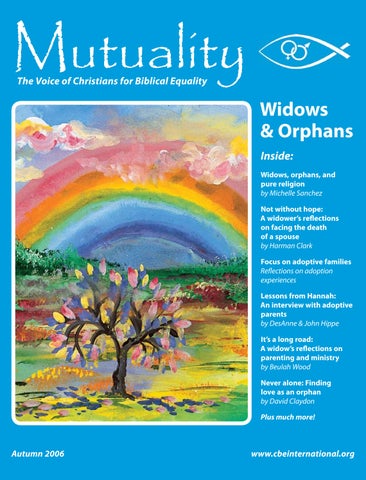
cover image
Rainbow in the clouds by Sveta Khokhlova Sveta Khokhlova was one of the first twelve Moscow children enrolled in an innovative arts rehabilitation program for orphans called “Maria’s Children.” Before Sveta became involved in Maria’s Children, the director of her orphanage rented children out for sexual purposes, resulting in sexual, physical, and psychological abuse. Without intervention, children like Sveta have a life expectancy of 25 years—25% of them commit suicide, and the rest become lost into the world of prostitution, crime, and drugs. When Sveta left the orphanage, American donors provided schooling for her at an art institute. She now earns her living creating Russian souvenir pieces. Maria’s Children International is a Minneapolis-based 501(c)(3) nonprofit foundation that funds arts rehabilitation programs for the forgotten children of the world. Art provides opportunities for children to discover their value and potential. The children are also taught life skills for survival in their cultures. Today more than 500 children participate in Maria’s Children programs in Moscow, St. Petersburg, and Dmitrov, Russia, as well as Haiti. Maria’s Children International 4321 W Highway 13, Savage, MN 55378 phone: 952-895-1603 e-mail: info@mariaschildren.com www.mariaschildren.com
9
Contents
Widows, orphans, and pure religion How the practice of “pure religion” reconciles the historic tension between the Great Commission and the Great Commandment — by Michelle Tiffany Sanchez
Not without hope
A widower’s reflections on facing the death of a spouse, and suggestions for husbands and churches about preparing for this loss — by Harman Clark
13 Lessons from Hannah
An interview with adoptive parents about how adoption has given them new insights into what it means to be part of the family of God — by DesAnne and John Hippe
14 It’s a long road
Reflections from a widow who raised four daughters and entered full-time ministry after the death of her young husband — by Beulah Wood
16 Never Alone
How an orphan boy came to know the love of Christ — by David Claydon
18 Pandita Ramabai: Student, seeker, and visionary leader Biography of an Indian widow who was a pioneering advocate for women’s rights and who founded a mission to child-widows — by Sonia Hazard
23 Focus on adoptive families
Reflections from CBE members and friends on their experiences with adoption
25 Broken but hopeful hearts
Lessons from Boaz, Ruth, and Naomi on crisis and redemption — by Coralee Murray
28 Birthfathers: Adoption stories’ silent, complex characters A birthfather’s reflections on biblical examples of fathers whose children were adopted — by Daryl Parks
30 “A genius of a woman”
How an early Christian widow journeyed from Roman mansions to the manger where Christ was born — by Martha Ann Kirk
Ministry & Chapter News 33 Evangelical study group will discuss gender, justice, and the Trinity at ETS annual meeting; CBE prepares for Urbana 06; Future Events
34 CBE chapters; Praise and Prayer report
Departments 3 From the Editor: The meek and the mighty 35 Church and Study Group Resources: Study Guide for Lianne Roembke’s Building Credible Multicultural Teams
36 Giving Opportunities 38 President’s Message: Visibility & inclusion: Women in Christ’s new community
| Mutuality Autumn 2006
website: www.cbeinternational.org
Mutuality The Voice of Christians for Biblical Equality
Let us then pursue what makes for peace and mutual upbuilding. — Romans 14:19 VOLUME 13, ISSUE 3 Mutuality seeks to provide inspiration, encouragement, and information about equality within the Christian church around the world. President/Publisher : Editor : Graphic Designer :
Mimi Haddad Chelsea DeArmond Image Spigot
Special thanks to Jenilee Morrison for her editorial assistance on this issue.
EDITORIAL AND ADVERTISING OFFICE Christians for Biblical Equality 122 W Franklin Ave, Suite 218 Minneapolis, MN 55404-2451 phone: (612) 872-6898 fax: (612) 872-6891 e-mail: cdearmond@cbeinternational.org web: www.cbeinternational.org Advertising in Mutuality does not imply organizational endorsement.
SUBMISSIONS Mutuality welcomes submissions. E-mail cdearmond@cbeinternational.org, write to CBE for the writer’s guidelines, or visit CBE’s website and follow the Publications links.
PERMISSIONS Christians for Biblical Equality grants permission for any original article (not a reprint) to be photocopied for local use provided no more than 1,000 copies are made, they are distributed free, the author is acknowledged, and CBE is recognized as the source. Mutuality (issn: 1533-2470) is published quarterly by Christians for Biblical Equality and is sent free to members. For membership information, see page 31. To purchase back issues, contact our Editorial and Advertising Office, or order online at www.equalitydepot.com.
From the Editor by Chelsea DeArmond
Our help in time of need
“God gets up early and stays up late.” One of my seminary professors uses this phrase to remind us that God is never caught off guard by our crises. Our time of need is never too early or too late for God to meet us then and there. God directs our attention to the needs of those who are often overlooked—whether they are children who face the challenges of growing up after losing their parents, or adults who face the challenges of growing old after losing their spouses. Care for widows and orphans is a theme that carries through the whole Bible. Although the Bible calls us to help those who have suffered the devastating loss of a spouse or parents, it never portrays widows and orphans as objects of pity. In fact, some of the most heroic and revered people in the Bible were widows and orphans. The widows Ruth and Naomi became ancestors of King David and Jesus the Messiah. The orphan Esther became the queen of Persia and liberated the Jewish people from a plot to destroy them. The Bible also offers examples of widows and orphans who helped others against all odds. For example, when the prophet Elijah was fleeing from King Ahab, God told him to go to Zarephath, saying, “I have directed a widow there to supply you with food” (1 Kings 17:9). God made the widow able to provide for herself, her son, and the prophet by miraculously refilling her last jar of flour and jug of oil. In another example, the prophet Elisha told a widow and her sons to gather all the empty jars she could from her neighbors, and then start filling them with her last little bit of oil. The widow did what he said, and she had enough oil to pay her debts and provide for her family (2 Kings 4:1–7). By empowering these two widows to care for themselves and others, God helped these women and their sons in a way that was more than mere charity. The more patriarchal a society is, the more women and girls will suffer disproportionately upon the death of their father or husband. Women in patriarchal societies must depend on the charity of others in times of crises. Freeing women to support themselves and others is an important systemic way of helping widows and orphans. No matter how suddenly crises may come upon us, God’s help leads to lasting, systemic change. The articles in this issue of Mutuality feature the voices of widows, widowers, and orphans. This issue also features examples of people who care for widows and orphans in ways that break cycles of dependence and lead to lasting change. These authors testify to a God who “gets up early and stays up late,” who meets us in our time of greatest need, and never leaves us alone. Chelsea DeArmond is Editor of Mutuality and Bookstore Coordinator at Christians for Biblical Equality. She can be reached at cdearmond@cbeinternational.org
bookstore: www.equalitydepot.com
Mutuality Autumn 2006 |
In Our Box
Mutuality
Visit CBE’s website at
www.cbeinternational.org for the latest… ▶ FREE audio and print resources on biblical equality ▶ Membership information for churches, libraries, families, and individuals ▶ On-line discussions about gender and justice on The CBE Scroll, the blogging voice of CBE ▶ CBE chapters in the U.S. and around the world ▶ Directory of egalitarian churches in the U.S. and around the world ▶ Giving opportunities ▶ Listings for counselors, therapists, and spiritual directors who agree with CBE’s Statement of Faith ▶ Ministry news and needs ▶ Employment, internship, and volunteer opportunities
Call for Papers
Mutuality provides inspiration, encouragement, and information about equality within the Christian Church around the world. Mutuality is published quarterly and sent to all CBE members and subscribers. Current and back issue are also available for purchase. We are currently seeking features, reports, and reviews (books, films, and/or music) from evangelical, egalitarian perspectives related to the following topics: • • • •
Worship and Equality Advocacy vs. Apathy Revival and Equality Raising Children
Most of the articles we publish fall into the following categories: • Personal testimonies illustrating how biblical equality provides practical benefits to everyday lives. • Teaching on relevant Bible passages, explaining the meaning and showing how to apply it to daily life. • Reviews of books about biblical equality that would appeal to a wide audience. (Books must complete CBE’s book service review process before being reviewed in Mutuality.) • Feature stories about issues related to CBE’s mission and ministry. The length of features is generally 1,000–2,500 words. Send articles to the attention of the editor at the postal address below or e-mail to mutuality@cbeinternational.org (if possible, as an attached Microsoft Word document). We are unable to consider or respond to authors who send us more than two pieces at the same time, whose pieces are substantially over 3,000 words, or whose submissions are not sent uniquely to Mutuality. Complete Writers Guidelines for Mutuality are available on our website (www.cbeinternational.org) or contact our office to request a copy. Questions and submissions can be directed to the attention of the editor, Chelsea DeArmond.
Visit CBE’s online bookstore at
www.equalitydepot.com for resources like… ▶ Books and articles ▶ Audio and video tapes ▶ CD, DVD, and MP3 recordings ▶ Sales and specials ▶ New resources, CBE exclusives, and best sellers ▶ Foreign language resources ▶ Become a CBE member or renew your membership and save 15% on every purchase ▶ Registration for CBE conferences ▶ Subscription to CBE publications or purchase back issues of Mutuality and Priscilla Papers
| Mutuality Autumn 2006
We’d love to hear from you! Send your comments and critiques to:
Mutuality
122 W Franklin Ave, Suite 218 Minneapolis, MN 55404-2451 phone: (612) 872-6898 fax: (612) 872-6891 e -mail: mutuality@cbeinternational.org web: www.cbeinternational.org Letters may be edited for clarity and brevity.
website: www.cbeinternational.org
Widows, Orphans, and Pure Religion
By Michelle Tiffany Sanchez
I often wonder what it will be like once I finally find myself before to obey everything I have commanded you” (Matt. 28:19–20). the Judgment Seat of Christ. When the Lord looks back at my life, Yet, despite this firm Scriptural basis about the importance of what will stand out as my most outstanding achievements? Will I right belief, there are also many “troubling” passages in the Bible be surprised by his assessment of my “righteousness”? Will I discover which seem to suggest that the key to righteousness is right behavior. that his values are quite different from the stereotypical values of the Take the book of James for example. James’ emphasis on works Western “Christian” world? What will that moment be like? as a basis for righteousness is indisputable. In fact, Martin Luther To be honest, I have not imagined that on found it difficult to reconcile the book of James that day the Lord will look deep into my eyes and with the Pauline emphasis on righteousness ask, “So, what have you done to care for widows by faith, and he referred to James’ letter as the “Religion that God and orphans in their distress?” Yet that is exactly “Epistle of Straw.” what Scripture suggests he will do. Indeed, James declared that “faith by itself, our Father accepts if it is not accompanied by action, is dead” as pure and faultless ( James 2:17). He ridiculed the idea that right The Great Commission vs. alone is sufficient for holy living: “You is this: to look after belief the Great Commandment? believe that there is one God. Good! Even the orphans and widows demons believe that—and shudder” ( James Of course, in one way or another, most Christians 2:19). Here’s what James says is the heart of in their distress…” are well-aware that the Bible addresses issues of “pure” religion: “Religion that God our Father poverty and injustice. Yet, we as evangelicals accepts as pure and faultless is this: to look — James 1:27 (tniv) tend to think that the key to righteousness is after orphans and widows in their distress and right belief. keep oneself from being polluted by the world” Strictly speaking, this is correct. We cherish ( James 1:27). the fact that the righteous shall live by faith (Heb. 10:38). This was Jesus’ parable of the sheep and the goats in Matthew 25 is another the dazzling truth Martin Luther recovered and that sparked the example of this emphasis on good works. On what basis will Jesus Protestant Reformation along with an extended period of renewed welcome people into eternal life on Judgment Day? According to his spiritual vitality. We are justifiably relieved by the good news that clear teaching in this parable, Jesus will welcome the “sheep”—those our salvation is a gift from God, received through simple faith and people who throughout their lives nourished the hungry, invited in not works of righteousness (Eph. 2:8–9). Our eternal life with strangers, clothed the naked, looked after the sick, and visited prisonChrist is guaranteed if we confess him as Lord and believe that ers (Matt. 25:34–36). Strangely, Jesus mentions nothing about right God raised him from the dead (Rom. 10:9). belief in the entire parable. Evangelicals have characteristically emphasized right belief, Mainline and more “liberal” Christians have typically focused on especially in the twentieth century. We embrace the Great this passage when they envision what God deems to be true rightCommission as our all-encompassing mandate: “Therefore go and eousness. They prefer to emphasize the Great Commandment rather make disciples of all nations, baptizing them in the name of the than the Great Commission, which calls us to love God and love our Father and of the Son and of the Holy Spirit, and teaching them neighbors as ourselves (Matt. 22:37–40).
Join these historical and contemporary church leaders who knew the meaning of pure religion
John Wesley
William Wilberforce
Catherine Booth
bookstore: www.equalitydepot.com
William Booth
Sarah Grimké
Angelina Grimké
Katharine Bushnell
Michele Rickett
Gloria WhiteHammond
Mutuality Autumn 2006 |
Reconciling the historic “contradiction”
When we truly become one with Christ, abiding in him by faith, we produce fruit that will last ( John 15:16) and become a way of life (Matt. 25:34–36). This fruit includes not only the characteristic fruit of the Holy Spirit (Gal. 5:22), but also effective evangelism (Matt. 28:19–20) and works of charity, compassion, and justice. This is why James declared that faith without works is dead: we are not justified by our works, but our works are natural and visible proof that our faith is genuine and truly rooted in Christ.
So what are we to make of this apparent “contradiction” between the Great Commission and the Great Commandment? I believe one of the low points of recent church history was a conflict in the 1920s that historians now refer to as the “fundamentalist-modernist controversy.” Before this period, and especially in the nineteenth century, Christianity was marked by a vibrant emphasis on the importance of both evangelism and good works. For example, John Wesley (1703–1791) founded the Methodist God’s concern for the vulnerable movement which birthed scores of influential leaders who were active in social justice. William Wilberforce (1759–1833), who was highly Now that we have established that both faith and good works are influenced by the Methodist movement as a young man, was later necessary for righteousness in God’s eyes, how then can we effectively elected to the British parliament and successfully campaigned for demonstrate this in our lives? the abolition of slavery in England. Methodist ministers Catherine Scripture is full of teaching that reveals God’s heart for the poor. Booth (1829–1890) and her husband William (1829–1912) founded After an extensive search through Scripture, Jim Wallis concluded: the Salvation Army, an evangelistic and social services ministry to the “We found several thousand verses in the Bible on the poor and “undesirables” of society such as alcoholics, drug addicts, and prosti- God’s response to injustice…One of every sixteen verses in the New tutes. Other evangelical Christians of the era were at the front lines of Testament is about the poor or the subject of money.”1 abolitionism, prison reform, and women’s rights. God’s concern for widows and orphans is a consistent theme However, early in the twentieth century, disputes arose between throughout the Bible. This concern was enshrined in the covenant Christians with different commitments. Those committed to biblical law God gave to the nation of Israel: “Do not take advantage of inerrancy and the historic fundamentals of the faith (the “fundamen- a widow or an orphan. If you do and they cry out to me, I will talists”), opposed those willing to “modernize” the faith and relin- certainly hear their cry” (Exod. 22:22–23). The Israelites were also quish certain historic beliefs such as the virgin birth and the bodily instructed to make regular provisions for widows and orphans resurrection of Christ so that Christian faith would become more through tithes and offerings (Deut. 14:28, 29; 26:12). The Psalms compatible with secularism and intellectualism (the “modernists.”) extol God’s defense of widows and orphans: “A father to the fatherThe fundamentalists tended to remain committed to evangelism while less, a defender of widows, is God in his holy dwelling” (Ps. 68:5; the modernists tended to emphasize see also Pss. 11:17–18, 82:1–4, 146:7–9). good works, or what became known Likewise, the prophets admonished God’s as the “social gospel.” people to demonstrate their righteousness In time, the fundamentalistthrough the care of widows and orphans, modernist controversy led to many and warned them of God’s impending painful denominational splits. judgment if they did not do so (Isa. 10:1–3; Today’s evangelicals are primarily Jer. 7:5–7, 22:2–5; Zech. 7:9–11; Mal. 3:5). the spiritual children of the fundaI must admit that it still seems a bit mentalists. Similar to their forbears, quaint to me that even the New Testament evangelicals tend to be suspicious describes the essence of “pure religion” as about good works since they fear it caring for widows and orphans ( James will lead to the watering down of the 1:27). This emphasis makes more sense in Salvation Army co-founders Catherine (1829–1890) and William (1829–1912) Booth are an example of a married couple who Great Commission. On the other some contexts than others. For example, practiced pure religion in their ministry together. hand, liberals are the children of I have friends involved in overseas ministhe modernists. They tend to fear tries to street children, and I’m sure they that overemphasis on evangelism will lead the Church to ignore encounter many orphans that need care. the Great Commandment and issues of social justice. However, I usually don’t come across many homeless orphans in Biblically speaking, these two concerns of faith and good works my own daily interactions. This, of course, is a cause for gratitude. are absolutely not opposed; rather, they are both crucial for true Thankfully, most orphans in the United States are taken care of by righteousness. Within the Christian community and as individuals, our state governments. This is not to say that our social service systems we should commit to no longer making a choice between one or the are perfect—they are far from it. However, we certainly do have more other. The day has finally come when the rift between these two views extensive safety nets in place today than anything that was in place of righteousness can once again be reconciled. during biblical times. But how can both faith and good works be indicators of righteousLikewise, I don’t often come across many widows who are “in ness? Jesus’ teachings on fruitfulness can help clarify this paradox. Jesus distress”—except, perhaps, emotionally. Again, modern insurance did teach that the essence of eternal life is right belief (John 3:16, 17:3), policies and state welfare programs generally do a good job of ensurbut he also taught that the evidence of right belief is visible fruitfulness: ing that most men and women are protected from utter financial ruin “A good tree cannot bear bad fruit, and a bad tree cannot bear good upon the death of their spouse. fruit.…Thus by their fruit you will recognize them.” (Matt. 17:18, 20). In light of modern advances such as these, we may feel that our | Mutuality Autumn 2006
website: www.cbeinternational.org
responsibility to care for “widows and orphans” has become unnecessary. However, this conclusion would be a gross misapplication of God’s Word. Like the Pharisees, this literal approach observes the “letter of the law” but certainly not the spirit of the law. Because we are no longer living two thousand years ago in ancient Israel, it may be helpful for us to reframe who widows and orphans might represent in our day and age. According to Donald E. Gowan, former professor of Old Testament at Pittsburgh Theological Seminary:
reconciliation and reconstruction of their communities. Michele Rickett is founder of Sisters in Service (www.sistersinservice.org), whose goal is to inform, mobilize, and equip advocates to extend God’s love to women and children through local partnerships in the least-reached places of the world. Life is short, so we obviously cannot help every “widow and orphan” in need of our care. However, we can prayerfully go before the Lord and seek his will about a specific group of vulnerThe widow is a person who has experienced able people that he would have a sudden, unplanned, undesirable change you serve and defend. Does a of fortune, from security to uncertainty. certain social injustice anger you Orphans are people unable to help themmore than others? Are there any selves because of their physical condition… pressing needs right in your own Looking at these groups in this way may community? Have you experihelp us to appreciate their plight more fully enced an injustice that you can in that we can identify parallels in our own help others recover from and culture…The worst problem, that which resist? As you begin thinking these groups have in common, is powerlessand praying more about this Sisters Sarah (1792–1873) and Angelina (1805–1879) Grimké are ness and its consequences.2 biblical challenge, I would also examples of family members who stood for biblical equality and recommend reading some of the justice together. So we might say that today’s “widows and incredible books on this subject orphans” are any people who are powerless to give you great ideas about in some way and therefore vulnerable to impoverishment and many where and how to care for the vulnerable in our midst.4 forms of social injustice. Who might fall in this category in our day Jesus clearly identified his mission in one of his first puband age? The global list, of course, is nearly endless: homeless adults, lic addresses: “The Spirit of the Lord is on me, because he has street children, HIV/AIDS orphans, victims of sex trafficking and anointed me to preach good news to the poor. He has sent me to other forms of enslavement, genocide refugees, inner-city youth, the proclaim freedom for the prisoners and recovery of sight for the unborn, the uneducated and illiterate, and the list goes on. blind, to release the oppressed, to proclaim the year of the Lord’s favor” (Luke 4:18–19). As the body of Christ in the world, the Church now has the responsibility to carry on Jesus’ mission of Who are your widows and orphans? expanding the Kingdom of God by preaching the gospel, healing The fight for biblical equality and justice is at the heart of what the sick, liberating the oppressed, and dismantling all forms of Christians for Biblical Equality (CBE) stands for. Part of CBE’s injustice. And, if we do, I believe that we will achieve the goal of Statement of Faith is: “We believe that men and women are to oppose practicing “pure religion” and certainly hear him say to us on that injustice as mandated by the Bible” (see pg. 39 for the entire state- day: “Well done, good and faithful servant!” (Matt. 25:21). ment). If you are reading this magazine, then you’ve probably already taken up the mantle of contending for justice on behalf of women in the Church, home, and world. However, like many of our evangelical forebears, we should also commit to opposing other forms of injustice, especially regarding the care and defense of the vulnerable. For example, Sarah (1792–1873) and Angelina (1805–1879) Grimké fought for women’s equality and were also prominent abolitionists. Catherine Booth published a treatise called Female Ministry: Or, a Woman’s Right to Preach the Gospel in addition to founding the Salvation Army and caring for the homeless and the poor. Katharine Bushnell (1856–1923) is best known for her book entitled God’s Word to Women, an early defense of women in ministry; however, she also worked tirelessly to shelter sick and dying prostitutes around the world.3 We also have many contemporary role models. While working part-time as a pediatrician and part-time as a minister, Rev. Dr. Gloria White-Hammond has traveled to the Sudan six times since 2001 to help purchase the freedom of 10,000 slaves. In 2002 she founded My Sister’s Keeper (www.mskeeper.org), a human rights group organized to support women in southern Sudan in the bookstore: www.equalitydepot.com
Notes 1. Jim Wallis, God’s Politics: Why the Right Gets It Wrong and the Left Doesn’t Get It (New York: Harper Collins, 2005), 212. 2. Donald E. Gowan, “Wealth and Poverty in the Old Testament: the Case of the Widow, the Orphan, and the Sojourner,” Interpretation 41,4 (1987): 341–353. 3. Dana Hardwick, Oh Thou Woman That Bringest Good Tidings: The Life and Work of Catherine Bushnell (Kearney, Neb.: Morris Publishing, 1995). 4. Some of my favorites include Good News about Injustice, by Gary A. Haugen; Walking with the Poor: Principles and Practices of Transformational Development, by Bryant L Myers; and Rich Christians in an Age of Hunger, by Ronald Sider. For more information see Evangelicals for Social Action (www.esa-online.org) and the International Justice Mission (www.ijm.org). Michelle Tiffany Sanchez is an M.Div. student at Gordon-Conwell Theological Seminary. She also works part-time as a minister to international students with Park Street Church in Boston, Ma. She and her husband Mickey have been married for four years and look forward to a lifetime of partnership in ministry together.
Mutuality Autumn 2006 |
Equality Depot Book Sale Learn more about pure religion from these historical and contemporary church leaders. Use coupon code PURE06 to save 25% when you order these titles on-line at www.equalitydepot.com, or call 612-872-6898. Her Own Story
Good News about Injustice
early methodist women
by Gary A. Haugen
autobiographical portraits of
by Paul Wesley Chilcote Through journals, diaries, and letters, this anthology brings to life more than 20 Methodist women who lived from the early 1700s to the middle 1800s. These women helped make the Wesleyan Revival of the 18th century one of the most dynamic Christian movements in the Church’s history. Kingswood, 301 pages List $25.00 CBE member $21.25 Sale $18.75
Terms of Empowerment
salvation army women in ministry
by Catherine Booth, Evangeline Booth, Kay Rader This book includes ground-breaking writings on women in ministry from Salvation Army co-founder, Catherine Booth, her daughter and successor in ministry, Evangeline Booth, and a contemporary Salvation Army leader, Kay Rader. Salvation Army, 100 pages List $2.50 CBE member $2.12 Sale $1.86
The Power of Woman the life and writings of sarah moore grimké
by Pamela R. Durso Sarah Moore Grimké (1792–1873) became a spokeswoman for and a leader in the abolition movement in the 1830s. Her writings show that she was also a passionate advocate of women’s rights who confronted the subjugation of women and rejected patriarchal interpretations of Scripture. Mercer University Press, 192 pages List $28.00 CBE member $23.80 Sale $21.00
a witness of courage in a hurting world
The good news about injustice is that God is against it. This book offers stories of courageous Christians who have stood up for justice and also provides concrete guidance on what Christians can do for justice throughout the world. Youth edition available InterVarsity Press, 200 pages List $13.00 CBE member $11.05 Sale $9.75
God’s Word to Women
one hundred bible studies on woman’s place in the church and home
by Katharine C. Bushnell From Genesis to Revelation, Katharine C. Bushnell covers every Bible passage about women. The book emerged from Bushnell’s lifetime working for social reform on behalf of women. Scholars have leaned on her groundbreaking work since its first publication in 1921. CBE, 408 pages List $14.99 CBE member $12.74 Sale $11.24
Daughters of Hope:
stories of witness and courage in the face of persecution
by Kay Marshall Strom and Michele Rickett Christians continue to face intense persecution throughout the world today, and Christian women are most vulnerable. This deeply moving book tells the stories of persecuted Christian women from around the globe. Each section includes prayer points and practical action steps. InterVarsity Press, 200 pages List $12.00 CBE member $10.20 Sale $9.00
Your purchases help support CBE’s ministry—Thank you! | Mutuality Autumn 2006
website: www.cbeinternational.org
Not without
hope
A widower’s reflections on facing the death of a spouse
Tobias and Jane, June 24th, 2003, photo courtesy of Harman Clark
On July 6, 2003, Jane Randall Hess Clark, my wife of 46 years, died of a brain tumor, eleven months after diagnosis. She received the best medical treatment and home care therapies available. We had a Christ-honoring memorial service, planned by her in detail, that was attended by many of her large family, and conducted by her nephew. I thus entered the world of widowerhood. I felt a profound loss, with many adjustments following those eleven months of intensive care-giving. But I didn’t feel the kind of grief I was told was “normal.” Tears came mainly at seeing the compassion in my three young granddaughters and sensing their great loss. Their brother, Tobias—which means “God is good”—was born less than a month before Jane died and knew his Nana only by being held by her in her last days. Was there something wrong with me that I did not go deeper into depression?
Facing Jane’s death as a family
By Harman Clark
ing for the survivors. Christian clichés are often not much better. Acknowledging the reality of what was going on helped our family deal with Jane’s death. Christians should be the ultimate realists. Jane’s “life verse,” included as part of her signature on every birthday card and note she sent, was from Nahum 1:7: “The Lord is good. When trouble comes, he is a strong refuge. And he knows everyone who trusts in him” (nlt). Her faith was strong and her outlook courageous—and contagious. As a family we also claimed Paul’s assurance: “Brothers and sisters, we do not want you to be uninformed about those who sleep in death, so that you do not grieve like the rest who have no hope” (1 Thess. 4:13 tniv). It’s not that we don’t miss her. There are moments when we do grieve but with hope, such as when we long to tell her about her grandchildren’s latest accomplishments.
Facing Jane’s death alone There is also a profound personal loss. Those who have experienced long, happy marriages know that there really are times when you know what the other person is thinking; and you can recognize each others’ needs without asking. It is, I think, encompassed within Genesis 2:24: “and the two shall become one flesh.” That is not replaced by any other relationship. As I look back over these three years since Jane died, however, I have concluded that two factors helped prepared me to be a widower—as much as one can be prepared for the loss of their spouse. First, from my earliest days I was taught that God so loved me that he gave his only son so that if I believed in Him I would have eternal
Tobias—which means “God is good”—was born less than a month before Jane died and knew his Nana only by being held by her in her last days.
Some suggested my muted reactions were because I had eleven months to prepare. That didn’t fit, since from the day of the diagnosis, Jane and I, and even our children, had placed the situation in the hands of the Lord and faced what the statistics told us was coming. This includes the simple idea of being honest about the reality of death. Death is a taboo in our culture, and when someone says “I am going to die from this disease,” the usual response is “don’t talk that way, you are going to recover.” That kind of response invalidates the suffering person’s experience, and makes the loss all the more crush-
"The Lord is good. When trouble comes, he is a strong refuge. And he knows everyone who trusts in him."
bookstore: www.equalitydepot.com
— Nahum 1:7
Mutuality Autumn 2006 |
Wilder Farm, Lyndonville, V.T., Oct. 2004; photo courtesy of Harman Clark
life (John 3:16); that the Lord is my Shepherd, and that he would see me experience in fulfilling the instrumental and expressive roles through the valley of death (Psalm 23); that God does care for me (1 Pet. previously performed by their spouses. (my emphasis; Aging 5:7); and, yes, that the Lord is my refuge in times of trial if I trust in Him International vol. 27, no. 1 [Winter 2001–02]: pp. 65–88; (Nahum 1:7). Thus, in facing Jane’s illness, we both knew where she was available on-line at http://www.rci.rutgers.edu/~carrds/pubgoing; that it is a far better place; and that someday, in the Lord’s time, we lications/carr_utz_2002.pdf ) will be reunited. Second, I was also preI find that their study offers pared in practical ways to manscholarly support for having an age without my wife after 46 egalitarian marriage. Men, this years of not having to “go it means learning how to do a alone.” Jane and I did not have lot more than just cooking and a “traditional marriage” for our doing laundry. It’s the big stuff generation. We shared many of as well. And, if you should go first, the household tasks including it means making sure your wife cooking, dish washing, launknows how to do what you do. dry, and cleaning—everything At least a year before reachexcept sewing: you don’t learn ing 65, Jane suggested that we to sew when you are married to retire, build a home in Vermont someone who likes doing it and next to our daughter Sarah, and is the best seamstress in town. move there. While open to the But we also recognized idea, I was cold (no Vermont pun each other’s particular gifts intended) to it happening so soon. Listening, deferring, and ultimately agreeing with a wiser and experience. We deferred to But a series of events plus a spouse led to seven years together in this lovely setting. each other and made decisions good bit of prayer and financial together. If we couldn’t agree at figuring led me to accept the first, we waited. Neither one of us claimed or was given authority over idea. Besides, Jane really had better judgment on things like that than the other. The Bible calls for this in Ephesians 5:21—“Submit to one I did. Within a year of moving I had a flare-up of ulcerative colitis another out of reverence for Christ” (tniv). and was also diagnosed with prostate cancer—these combined health In other words, we lived and experienced an egalitarian mar- issues would have severely diminished my law practice if I had still riage, though we didn’t know the term and didn’t call it that. In been in New Jersey. fact Jane would not have considered herself an egalitarian, parListening, deferring, and ultimately agreeing with a wiser ticularly in areas involving a woman’s role in the church, one place spouse led to seven years together in this lovely setting. After where we had our disagreements. Just like “free lunches” there is Jane’s death, this decision also put me next door to my daughter, no such thing as an idyllic marriage, whether egalitarian or tradi- son-in-law, and four grandchildren, near her caring in-laws, and tional, but overall it worked! in a Bible-centered egalitarian church. What if we had adhered to a “rigid gender-based allocation of social roles,” or had practiced a hierarchal approach to marriage and Jane had submitted to my How mutuality in marriage can help prepare initial response? men for widowerhood A former pastor of ours once stated that if husband and wife cannot agree on something, “someone has to make the final deciMy answer for how the Church should deal with widowers is preparsion, and that is the husband.” My reply then, as now, is that ing men for that possibility, rather than focusing on how to handle it marriage is not like an Army where there has to be a general. after it happens. That’s pretty logical—after all, the death of a spouse Rather, marriage is two equal parties who often must enter into is one of the most traumatic events in life. But so are things like marwhat lawyers call a “settlement conference.” When we hear the riage, the birth of a child, choosing a career, and retirement, and most term “Mediator” used as one of the attributes of the Holy Spirit, of us plan for those (or should). we think primarily of His role in our prayer life. He can also be a Aside from common sense and my own observations, several studies mediator in our family settlement conferences. have backed up this conclusion, including one that should be examined by church leaders and anyone dealing with widows and widowers. Two authorities on aging, Deborah Carr and Rebecca Utz, have published a study on “Late-Life Widow Hood in the United States: New Directions in Research and Theory.” A paragraph on the first page reads: When one’s spouse dies, the survivor must adjust psychologically to the loss of their closest confidante, and must manage the daily decisions and responsibilities that were once shared by both spouses.…The adjustments required by widowed spouses may be particularly difficult in societies which maintain a rigid genderbased allocation of social roles; men and women may have little 10 | Mutuality Autumn 2006
Much of this article is written from a personal standpoint, about what has happened to me, and how my local church has helped me in this stage of my life. One of the most helpful books for dealing with grief and difficult times is Joy Through the Night. Written by two eminent scholars, it is also very personal.
Joy Through the Night biblical resources for suffering people
by Aída Besançon Spencer & William David Spencer InterVarsity Press, 217 pages List $12.00 CBE member $10.20 website: www.cbeinternational.org
The reason for having that kind of marriage is biblical (see, for example, Eph. 5:21). The result of such a marriage is measurable in many aspects, not the least being the beneficial results to the surviving spouse.
How churches can help prepare men for widowerhood
women who will survive their spouses. I’m no expert, but it seems to me that if the local church offers sound, undiluted teaching from the Word of God, especially the Good News of Jesus Christ, people will come, including men. It doesn’t take special programs, contemporary music, or “men’s” events, but it very well may take an invitation from a neighbor or friend. A great idea for men who are in a church—invite other men to join the fellowship.
New York City skyline c. 1949; photo courtesy of Harman Clark
The Carr and Utz study also suggests an implicit question for local churches. In our society, the modern nuclear family is socially Words of advice for widowers and economically autonomous. Is your local church part of the “nuclear family” or at least one of the “few alternative sources of It is quite possible that the social contacts you had as husband and social, emotional or instrumental support” (before the spouse dies, wife with other couples will end, perhaps gradually. For some reason that just seems to happen. The need for forming new social contacts not just after)? Regarding religious and spiritual undergirding, Carr and Utz is another reason men and women need to be part of a caring local include research that supports what Christians should already know— church. If you are not in one, find one, and get involved. Using your gifts is one great way to get involved. I believe the that our beliefs make a difference in our ability to cope with loss. They Holy Spirit endows each of us with gifts, but also that these gifts conclude that “[b]y identifying the psychological resources that ease may change throughout the course of our lives. For example, I’ve the widowhood process, practitioners can target interventions toward always been interested in photography, but that hobby lay dorindividuals who appear to lack such resources” (pg. 83). mant as we raised our family This suggests to me that and sent four kids to college. churches should identify the Now, during retirement in the men and women who lack beautiful Vermont mountains, religious beliefs and do someopportunities reappear. thing about it before they face Some of my photo backthe death of their spouse. Isn’t grounds (including a few from strengthening these beliefs the 1940s) are used in the something churches are supPowerPoint presentations that posed to be doing anyway? accompany our church service. There are 1.5 million older But my church would not have women and 1 million older men known about my photography in the United States, according to interest if I had not volunteered. a study called “A Profile of Older To the widower I say, let the Americans: 2003” prepared by church know what you can do; the Administration on Aging, to the local church I say, find a U.S. Department of Health and My church would not have known about my photography way the widower can help. Human Services. Look around interest unless I had volunteered. To the widower I say, let your congregation. Do you see the church know what you can do; to the church I say, find ten senior men for every fifteen Words of advice a way the widower can help. senior women? Or, forget the for husbands “senior” part and look again. If religious/spiritual beliefs are important for coping with widowerhood, Husbands, these pragmatic reasons for establishing an egalitarian marriage and going to church can be key factors in your adjustment where are the younger men in your church getting the tools to cope? Are all those women sitting by themselves or with other women to widowerhood if that should ever become your status. I did not intend this article to advocate for egalitarian marriage. really unmarried? I’ve been in my local church for almost three Indeed, I had not previously considered having had such a marriage. years and am just finding out that some women I assumed were widBut in the process of writing, I have recognized that what I had expeowed or divorced are actually rather happily married. Why don’t their rienced had in fact been egalitarian, and that partnership was essential husbands come to church? in preparing me for my unexpected widowerhood status. Do we wait until men lose their spouses to attempt to minister So I write, not in the nature of an advocate, but with the hope that to them? Get them involved now and provide the undergirding the husbands may consider both the biblical foundation for mutuality in experts on aging cite as tools for coping. This involves both leading marriage and the practical results of such a marriage. them to accept Christ as Savior, and providing the social network also documented as a factor of adjustment to widowerhood. Harman R. Clark, Jr. (BA, JD), practiced law in N.J. for 40 years; his Several widows over the years have expressed concern to me wife, Jane, was Director of Learning Disabilities at Timothy Christian School, Piscataway, N.J. Harman is now retired living in Shefthat their deceased husbands had not been believers in Christ. By field, Vt., where he is a member of the Lyndonville United Methreaching out to men in the community and spreading the Gospel, odist Church (Rev. Barbara Dwyer, pastor). local churches are also vital to the spiritual well-being of many bookstore: www.equalitydepot.com
Mutuality Autumn 2006 | 11
Christians for Biblical Equality 2007 International Conference Denver, Colorado n August 10–12, 2007
“He will make your righteousness shine like the dawn, the justice of your cause like the noonday sun” (Psalm 37:6)
General Session Speakers Roger Olson Roger Olson is professor of theology at Truett Theological Seminary in Waco, Tex. He has also served as president of the American Theological Society (Midwest Division) and co-chair of the Evangelical Theology Group of the American Academy of Religion.
Jeanne Porter Jeanne Porter has served as associate professor of communication arts at North Park University. She has also taught in the African American Leadership Partnership Program (AALP) at McCormick Theological Seminary in Chicago.
Christopher A. Hall Christopher A. Hall is dean of the Templeton Honors College at Eastern University in St. Davids, Pa., where he teaches in the biblical and theological studies program. He is also associate editor of the Ancient Christian Commentary on Scripture.
Lidija Novakovic Lidija Novakovic is associate professor of biblical and theological studies at Bethel University in St. Paul, Minn. She is also a member of the Princeton Theological Seminary Dead Sea Project.
Workshop Sessions & Speakers Interpreting Paul’s Instructions in 1 Timothy in Light of Ephesian Inscriptions, Artifacts, and Traditions Frank Ritchel Ames
Genesis 1–3: Creation, Order, and Equality Richard S. Hess
Patriarchy Happens Del Birkey
The Great Commission and the Ministry of Women in the Church Keum Ju (Jewel) Hyun
Recovering our History: Antebellum Evangelical Feminist Voices in Condemnation of Slavery Kent A. Eaton
God or Mammon? Tracing the Origins of Patriarchy Carrie Miles
The Eternal Subordination of the Son and the Permanent Subordination of Women Kevin Giles
Women Unedited: The Power of the Authentic Voice Sally Morgenthaler
Work, Church, Ministry, Children… Where’s the Couple?: Pressures on Christian Marriages Today Lynley Giles
Shame and Abuse: Understanding and Healing a Deadly Legacy Steven R. Tracy
The Master Bedroom: Marital Equality in an Unequal World Fred & Heather Gingrich
Emotional Intimacy and Equality: Understanding Ourselves & Each Other Cathy & Phil Van Loon
Ontology, Gender, and Women’s Authority in the Church: Noticing the Particulars Mimi Haddad
Answering Those Who Ask About the Reason for our Hope Cynthia Long Westfall
The Spirit of Deborah: When the Prophetic Leader Is a Woman Elaine A. Heath
Devotional Leader: Reconciliation Meditation Deborah M. Gill
CBE members receive discounts on conference registration Join or renew your membership today at www.cbeinternational.org
12 | Mutuality Autumn 2006
website: www.cbeinternational.org
Lessons from Hannah An interview with adoptive parents CBE: What kind of adoption have you chosen and why? DesAnne & John: Adoption was our first choice for bringing children into our family. The decision to adopt our daughter Hannah from China was strongly influenced by John’s experience as a missionary in China as well as China’s reputation for having a stable adoption process. We also chose to adopt from China because so many little girls have been relinquished to orphanages and desperately need homes. What intersections do you see between your decision to adopt and your convictions about biblical equality and justice? In China, most of the children in need of permanent, loving homes find themselves without a family due to the mere fact that they were born as girls and not as boys. Poverty, disease, racism, sexism, war, and other forms of discrimination and violence are the main contributors to the staggering number of orphans around the world (which, according to a recent UNICEF report, numbers in the hundreds of millions). It is true that God wants all children to enter into their spiritual family, claiming their rightful heritage as daughters and sons of the Living God. But equally true and sometimes neglected is the fact that God also wants all children to have loving, caring earthly families. God’s concern for the plight of the orphan is quite clear throughout Scripture. One helpful, succinct definition of justice offered by the Mennonite Central Committee in their restorative justice work is that “justice is making things right.” Adoption is one part of redressing the injustices of the world that leave children without loving parents. While more solutions are needed on a systemic level to address the sins that separate children from parents, adoption is nevertheless one of the many ways of entering into God’s work of “making things right” when they have gone so horrifically wrong. What advice do you have for families who have adopted or considered adopting children? Our hope is that families that have adopted would provide a witness to others about the joys as well as the challenges of adoption. Even during our short time as adoptive parents, we have encountered several misconceptions regarding adoption that we have been able to dispel. For those who have considered adopting, our hope is that they would give the very same prayerful consideration to adopting a child as they would to having a biological child. Too often have we heard that adoption was a choice made (if it was made at all) after all options for having a biological child had been exhausted. From the pulpit one Sunday, we heard a couple describe their decision to adopt as a choice wrought with sadness and defeat, reflecting the fact that they had exhausted their medical options and had to give up on having a child of “their own.” We have also heard people classify bookstore: www.equalitydepot.com
By DesAnne and John Hippe
children as “real” (i.e., biological) vs. adopted, as if a child is not quite part of the family if she or he enters it through adoption. Comments like these neglect the fact that all children first and foremost are God’s. Whether children come into our lives through our biological contribution or through adoption, it is God who places them in our lives and gives us the grace to fully embrace them as parents. It is God’s image that gives them value and worth; not ours. One of the great wonders of the Christian faith is that all believers become heirs with Christ through adoption and not biology. In Romans 8, Paul paints a beautiful picture of salvation, using the language of adoption to describe how God embraces us. To say that adoption is a second best choice for building families is to neglect the fundamental way in which Whether children come God has chosen to build the into our lives through our Family of God. How has your experience of sadoption changed your understanding of family?
biological contribution or through adoption, it is God who places them in our lives and gives us the grace to fully embrace them as parents. It is God’s image that gives them value and worth; not ours.
To one degree or another, we both grew up in families that were open to including nonbiological members, so adoption was always in the realm of possibilities for us when we were ready to have children. The experience of adoption has given us additional insights into our own adoption by God. For example, in Romans 8:15, Paul states that we have received a spirit of adoption: The Holy Spirit allows us to cry out to God as Abba! Father! Curiously enough, a few verses later Paul says “we ourselves, who have the first fruits of the Spirit, groan inwardly as we wait eagerly for our adoption, the redemption of our bodies” (v. 23, tniv). So on the one hand, we’ve already received a spirit of adoption, but on the other hand, there’s a sense in which we cont. on pg. 22
Mutuality Autumn 2006 | 13
It’s a Long Road
By Beulah Wood
Perhaps there are others like me, or perhaps I was a slow learner. I am not sure I really grew up until I was 40, three years after I became a widow. Growing Up
where Brian was a school principal, we continued the same pattern. Then my sportsman husband died climbing in the mountains in 1980. I was 37. In the months of mourning, I experienced kindness from my rural assembly back in New Zealand—and invisibility when it came to Christian work. As a returned missionary, high school teacher, and holder of a BD, I was more qualified than any leader there, but they could not see I may have something to offer. Then came the time when I think I finally grew up, when I was willing to go against the wishes of a man I loved, in this case my father. I felt God directed me to move to Auckland city in 1984, but my father insisted the country life was safer for the children than the temptations of the city. We moved anyway. I had learned to decide for myself. I worked part time as a writer, and full-time from when the youngest was 11, working for two Christian newspapers, then for World Vision.
Raised in an Open Brethren home on a farm in the North Island of New Zealand, I longed to serve God and was planning missionary work by the time I was 12 years old. There were few supported positions for men and none for women in church work. Overseas mission was the only place for women in Christian service, but I did not see that for many years. I began my college studies in Auckland city, and as I walked through the park on my way to lectures, I often wondered, “As a woman, do I have to obey all the men in my assembly, or only my father or husband?” What a vulnerable thought! Obey any man in the assembly! Years later my father assured me he had not intended to raise me with such a subordinate attitude, but there I was. By God’s grace, my conservative temperament also kept me out of harm. I learned to speak for myself in the Raising Four Daughters InterVarsity Fellowship prayer gatherings and Bible study groups. But when I Bringing up four daughters required energy returned as a teacher to my home town, I and prayer, but it was not a burden. The girls found myself muzzled. On Sunday mornwere 11 down to four years when their father ing and the Wednesday evening prayer and died, but they were well-behaved and God Bible study I could not pray in the mixed gave me the health a mother needs to keep group nor offer a suggestion in the discustwo steps ahead. We had prayers, music pracsion. If I was smart, I could ask a question tices, sports, limited television, and wonderlike, “Do you think Paul meant communful summer holidays with aunts, uncles, and ion in this verse?” to shape the discussion. cousins. Even more, we took to backpacking That was all. in the New Zealand forest and mountains When I started studying for a Bachelor on many weekends and holidays. We learned of Divinity (the equivalent of M.Div.), a Ancient Church, by Mary Melikian, pastel, 2000, resourcefulness, stamina, decision-making, 12 × 9 inches (30.48 × 22.86 cm), St. Bartholomew’s friend asked, “Why are you studying when the highs of accomplishing a physical chalChurch, New York, N.Y. you are Brethren and won’t be able to use it?” lenge, and the beauty of the mountains. Naively, I had no idea why I was beavering One winter we all went back to Nepal. I away on Greek and Biblical history. did not know any other widow who took her four daughters aged 11 I met my Baptist husband Brian, another high school teacher, and we to 18 trekking to the Annapurna Base Camp in the high Himalayas, left for India within 12 months of our wedding. We taught at a school for but it was a formative time for us and a load of fun. missionaries’ children and our four delightful daughters were born. Brian Kaaren and her husband are now doctors in the Indian Himalayas. wanted to do his BD too, so he persuaded me to pick up the study again. Bronwyn, a high school teacher and textbook writer is, at the time of The whole project took me 11 years, studying part-time. I still did not writing, evacuating with two young sons from south Lebanon where know why I was doing it. Brian taught full-time, preached sometimes, her husband is a UN Observer. Adee is a mother, music teacher, and taught a Bible class, and conducted choirs, and I happily stayed home high school teacher, and Rosalind, now also married, is a doctor in her with the children. When we finished the study and moved to Nepal house surgeon year. 14 | Mutuality Autumn 2006
website: www.cbeinternational.org
In 2004 Kaaren and Rosalind joined a five-member party that traveled to the north of Tibet and made a world-first human-powered traverse down the Mekong River to Vietnam, trekking for two weeks, cycling 2,500 km, and paddling 2,500 km by kayak and rubber raft. I guess one would call them strong daughters, though I did not know the label.
What drove me during this time?
keeping a journal were keys to listening to and talking to God. This process of spiritual renewal enabled me survive in a culture that was not my own. The other skill was a hobby—bird-watching in the fields and lanes around where I lived on campus at the South Asia Institute of Advanced Christian Studies (saiacs) near Bangalore, South India. Going out walking was healthy, and learning to identify the birds and observe their characteristics and their beauty became part of my spirituality as well, recognizing them as part of God’s creation and at times an inspiration.
First, I did not feel as if I was driving. That we worked hard, lived frugally, and took our leisure in music and in outdoor sport was our family culture. Second, I experienced the meaning of Christian hope Further Study during the period of grieving—not only the hope of seeing my husband in heaven, but also that life has meaning and hope here and now. By then I was editing theological and missiological books, lecturing on Third, my family gave me warmth and support. And the fourth is also preaching and academic writing, and writing about family issues for significant—I had learned a level of mental and emotional independ- India. Realizing that writing had uniquely prepared me for teaching ence while doing so much of my study and writing on my own. homiletics, I enrolled in the Doctor of Ministry in Preaching program I did not always get through Gordon Conwell it right. I did not always Theological Seminary, understand how much Massachusetts, in 1999. my daughters missed their When I attended my first father. I tried to be a caring course, I discovered that and fun mother, but I was I was the only woman in only one person. Uncles, a class of 24 men, many aunts, and grandparents unsympathetic to my were a great help, but the being in the class. lack of a father is a lack But I had advanof part of one’s identity, tages. My daughters which was deeper than were grown and did my experience in the lack not need my time, I had of my beloved husband. broader perspectives as I think my daughters did an international stunot often get a chance to dent and a missionary, voice their deep sadness. and being a writer was I asked later about that. a great preparation for One answer was, “Oh, yes, writing a dissertation. Mum. But I had a happy When I attended the childhood. Don’t worry.” third residential sesThe Road Ahead, by Mary Melikian, pastel, 2000, 9 × 12 inches (22.86 × 30.48 cm), St. BarPhew! Well, none of us sion in January 2002, I tholomew’s Church, New York, N.Y. are perfect. defended my thesis and the professor addressed me in front of the class as Dr. Wood. I was the oldest in the class, A Tough Transition the only woman, and the other students had not even started their I returned to India 10 years ago. One of the hardest things happened dissertations. The ups and downs of being a woman in ministry continue. Not then, years after Brian died, when I had to learn how to live alone in many people want a woman to teach homiletics, despite the fact that the context of an Indian city. Daughters living at home had protected my students love my classes. I am beginning to do more teaching and me from that aspect for 15 years. writing on the equality of women and men in Asia. I struggled. I used to finish work at 5:00 p.m. with the dread feelMy own last chapters are not written yet. I find I need support ing that I had nobody to talk to until 9:00 a.m. the next morning. I from friends, family, and my mission, and sometimes time out after a walked the streets to avoid returning to my empty apartment, and at difficult patch. But I have also learned that I can count on my Savior the time few had email and I could not get a phone. to prop me up and give me courage to keep going. I looked forward to my leave in New Zealand to rely on my daughters for company, but they quite rightly had their own working lives and husbands. I needed new skills and it took three years to find them. The first new skill was spiritual—learning to listen to God more, keeping a spiritual journal, taking spiritual retreats at times, knowing that God would indeed speak to me. Using a spiritual director and bookstore: www.equalitydepot.com
A high school teacher by training, Beulah Wood (BD, D.Min.) and her husband taught in Ootacamund, India, and then in Nepal. Following early widowhood, Dr. Wood gained writing and editing experience in New Zealand, and has authored or co-authored more than 30 books. She lectures in homiletics and spiritual formation at the South Asia Institute of Advanced Christian Studies in Bangalore, India, and has served on the SAIACS Press editorial team.
Mutuality Autumn 2006 | 15
Never Alone finding love as an orphan
by David Claydon
My father worked with the British Protectorate Government of family worked. The father was one of two doctors who ran the Palestine in the 1930s. Like many British government workers, he and Church Mission to the Jews hospital. On Sundays, a person visited his wife were killed by those who opposed the government’s manage- the ward and showed lantern slides depicting some stories about ment of the 1917 Balfour Declaration (which allowed Jews to go and Jesus. The story of the lost lamb caught my attention. I thought to live in Palestine). I was about six months old at the time so I never myself that if Jesus could care for a lamb, he would therefore care knew my parents. for me. After that, the awareness that Being in Palestine meant that there Jesus loved me started to develop in were no relatives to care for me. The my thinking. government placed me in a Palestinian Lora reappeared in the following orphanage. The matron of this orphanyears, and after another five years in age was German and with the develPalestine, the government placed us on oping World War, all Germans in a troop ship and sent us to Australia. In Palestine were interned. This meant Australia I stayed in various institutions that the orphanage had to be closed and guest houses during my school years. down. I am certain Lora was concerned about me, but she lacked the capacity to show Lora, a missionary woman from Australia, was working with the governlove and returned to missionary work ment as a social worker and was given in India. the job of distributing the orphans to I was on my own throughout most their extended families. Government of my high school days. I worked durrecords about me had been destroyed ing the holidays as well as after school in one of the bombings of government each day, and with a scholarship I had buildings, so my family background just enough to live on. By my last year was unknown. When Lora realized of school (now 15 years old) I had that this now four-year-old boy was developed a deep sense of loneliness. British and had no extended family, I was so caught up in this lonely state she felt challenged to care for him. that I was unable to study for my final exams. Every evening I cried until I Lora’s job with the government ended when she completed her task went to sleep. Soul of the Olive Tree, by Ann B. Rhodes, oil on canvas, 2003, at the orphanage, so she accepted a At that time, I was staying in the old 40 × 30 inches (101.6 × 76.2 cm), All Saints’ Church, Atlanta, Ga. request from the Emperor of Ethiopia holiday home which belonged to Lora’s to run a school for him. Lora left me family. This holiday home was in the with another missionary family before she left. They were kind, but mountains where it was very cold at night. I kept thinking of other the only sense of love came from their daughter who was two years students who would go home and have a family and perhaps a dog older than me and liked caring for her little “adopted brother.” to cuddle in front of a fire. Every evening I went down to the railway During my time with this family I contracted measles and was station waiting room where there was a coal fire where I could warm placed in the children’s ward of the hospital where this missionary up before going home to bed. 16 | Mutuality Autumn 2006
website: www.cbeinternational.org
In the midst of this loneliness I kept recalling the story of Jesus and a unique gift of teaching or of leadership, while others, according to the lost lamb from Matthew 18:10–14. With this story in mind I sang their category, are not allowed to exercise their gifts. to myself the chorus, “Jesus loves me this I know, for the Bible tells me My parents were killed because they were deemed to be in a so.” Each night I said to myself: “I may not have anyone else to love certain category (namely British government). By placing people in me, but I do have Jesus who is always a category we develop the capacity to with me and who does love me.” marginalize, dehumanize, or even kill. One of the greatest evidences of Yet we are clearly told that men and Jesus’ love for me was a family who women are created in the image of God. invited me to spend the weekends with He does not have two images and we them. They had twin boys my age and have no right to regard some as having we became life-long friends. Every weeksomething less than his image. end I would hitch-hike 30 miles to their It was a woman, working on her home, and then early on Monday mornown and without the proper resources, ing would hitch-hike back to school. who chose to care for me. While her The way they welcomed me into their capacity to care and to love was limited, family and showed me unconditional nevertheless, she rescued me from the love was so important to me at that streets of Jerusalem and found ways of time and is a wonderful example of how getting me to a country where others loving Christian people can embrace a could assist me. God has used women lonely person. wonderfully in pioneering missionJesus’ care of me was further shown ary work and also in teaching young by a scholarship I received for University, men and women at home. I can see so where I was able to stay at a church uniclearly the contrast between the Islamic versity residence for overseas students. theological stance, which is totally legal My friendships at this residence have and which categorizes a range of peocontinued ever since, giving me a ring ple, and the Biblical stance, which is of close friends scattered across Asia. one of relationships. Men and women People often asked me about my backare empowered equally by God’s Holy From the Cross Grows the Vine of Christ, by Ann B. Rhodes, ground and I was unable to tell them Spirit such that if the church maximizes oil on canvas, 2005, 20 × 16 inches (50.8 × 40.64 cm), All Saints’ without tears overwhelming me. the use of these gifts the Kingdom will Church, Atlanta, Ga. When I graduated and started teachbe further extended. ing economics, I joined the youth I have met with orphans in other group of a missionary organisation. That’s when I met Robyn, and countries in recent years. Though I can assure them of God’s ever what a great relationship this grew to be! We were married about present love, I long for others to welcome them into their family and three years later. Ever since then, we have enjoyed the love and to embrace them with a love which men and women can show in respect we have for each other, the encouragement we have given God’s strength and love. each other for using our gifts, and the mutuality we experience as we minister together. Robyn also helped me to work though my David Claydon is a Canon of St. Andrew’s Cathedral in Sydney, Australia and of All Saints’ Cathedral in Cairo, Egypt. He has served grief and to tell my story in a way which would encourage others as International Director of the Lausanne Committee for World to realize that God does care for us. Evangelism. It was wonderful now to have my own family to love and be loved by, and then to have the great joy of having a daughter. Her love for me and Robyn has continued through her family such that Never Alone we now have a son-in-law and two grandchildren whose lives we the remarkable story of david and robyn claydon very much enjoy. by Cecily Paterson My association with Muslims in my childhood days and at university helped me to see that if God communicated only in word (e.g. via A child with no name, no parents and no place in the world, grows up in war-time Israel, escapes the Koran), then our relationship with God is a legal one. But God death several times, is rescued, and brought to has communicated with us in the person of His Son, the Word incarAustralia. It seemed he had no future; but God nate, and he is a God of relationship. Thus, it has been so clear to me had him in the palm of his hand. As he grew up, that God is the One who always loves us. he knew that he would never be alone. A study of the Gospels makes it clear that Jesus’ love and care David’s story, and God’s work in his life is remarkwas not only for one category of people. He was caring not only for able. From belonging nowhere, he is now a man Synagogue-attending males. He cared for women, he cared for those who through his dedication to Christian mission belongs almost everywhere. His ministry and who were regarded by all as “outside” the community (such as tax partnership with his equally remarkable wife SPCK Australia, 224 pages collectors) or who were known to be adulterers, as well as those who Robyn, has touched lives around the world. List $18.85 CBE member $16.02 were beggars or were ill. Thus we have no grounds for categorizing people and determining that some, according to their category, have This is a story of two people nurtured and held close by God. bookstore: www.equalitydepot.com
Mutuality Autumn 2006 | 17
Pandita Ramabai
Student, Seeker, and Visionary Leader
By Sonia Hazard
On a hot July weekend in 1848, sixty-eight women and forty-two original Sanskrit by heart, in addition to excelling in astronomy, men—all of them American or European—convened in Seneca Falls, botany, and physiology. New York, as delegates to the first ever women’s rights convention. Ramabai’s first-class education was incredibly rare. She notes in Perhaps it is because of this watershed event paired with lingering her book, The High-Caste Hindu Woman, that less than one-quarter colonialism that many Westerners consider women’s liberation to be a of one percent of Indian women at the time were able to read or write. uniquely Western initiative. Of these privileged few, many were required to cease their studies at But when these early ripples from Seneca Falls were just beginning a young age—often at nine- or ten-years-old—when they were marto make waves in the West, a beautiful baby girl named Ramabai was ried. Early marriage was the norm for young Brahmin girls, and it born over ten thousand miles away just was often considered dishonorable for a outside Karkal, India. Equipped with woman to continue her education once courage, intelligence, and an unshakwed. Baffling and angering Hindu tradiable Christian faith, Ramabai would tionalists, Ramabai’s father further went eventually become known as Pandita, against the grain by refusing to arrange or “wise person,” and the preeminent her marriage. pioneer of women’s rights in India. This remarkable woman, whose The Passionate feminist commitment was rivaled only Social Reformer by her ardent conviction for Christ upon her conversion at age 25, changed Tragically, Ramabai’s mother, father, the lives of countless girls and women. and sister died from starvation during The Mukti Mission she founded the great famine of 1874–76, leavreached India’s neglected and abused ing Ramabai and her older brother child-widows. Ramabai’s father defied the custom in his Hindu context by hungry and without help. The pair
The Gifted Young Student
teaching the women in his family. Ramabai eventually mastered seven languages.
Pandita Ramabai was born Ramabai Dongre on April 23, 1858, to an intellectual Brahmin family. Her father was a prominent Sanskrit scholar who directed an ashram, a residential religious community and school for boys. Defying social custom, he firmly believed that women, like men, should also be allowed an education—and accordingly took it upon himself to teach Ramabai and her mother. He was probably ostracized by his colleagues for his radical views on women’s education and soon after lost the ashram due to financial reasons. The entire family—Ramabai, her father, mother, and two siblings—then took off on foot and traveled all over India. Her parents eked out a modest living as Puranikas, wanderers who recited and commented on the Vedas and other sacred Hindu texts. True to their dedication to education, Ramabai’s parents spent long hours teaching her during their travels. She proved to be quite a precocious student. Soon, she had learned 18,000 verses of the Bhagavata Purana in their 18 | Mutuality Autumn 2006
continued to wander India until reaching Calcutta in 1878. After stunning scholars with her extraordinary knowledge of Sanskrit and ancient texts, the 20-year-old Ramabai became an instant celebrity in the city. She was honored with the title Pandita, meaning “wise person,” and heralded as a Saraswati, or “goddess of learning.” She soon joined the ranks of Calcutta intelligentsia. In 1880, shortly after her brother’s death, Ramabai transgressed social norms yet again by marrying a man of a lower caste. Before long, she gave birth to a daughter named Manorama. Her new baby gave her much joy, if only ephemerally, for her husband died of cholera before their second anniversary. Now a widow, Ramabai was left to raise Manorama on her own. During this period of severe turmoil in her personal life that her public life really began to thrive. Troubled by the immensity of suffering she had witnessed during her travels and galvanized by the western website: www.cbeinternational.org
Indian social reform movement, Ramabai soon established herself as a champion of the oppressed—especially women. She published, lectured, and founded Arya Mahila Sabha in 1881, the very first Indian feminist organization. The group fervently crusaded for female education and a higher marriage age for girls. Ramabai was called to speak before India’s Education Commission in 1883, where she made an impassioned case that “it is evident that women, being one half of the people of this country, are oppressed and cruelly treated by the other half.”
church dogma and doctrine espoused by Anglicans, emphasizing the importance of the Bible above all. She explained, In this new Faith, there are some things which I cannot take in, and I shall not feel myself bound to do so, until I know them, as far as my poor understanding will carry me. But, I must ever continue to search Scriptures and never stop until I find the lost piece of silver—either in this world or the next.
In 1886, the dean of the Woman’s Medical College of Pennsylvania invited Ramabai to Stemming from an interest in women’s pubAmerica for the graduation ceremony of one of lic health, Ramabai left India with daughter her distant cousins, Anandibai Joshee, who was Manorama in 1883 to study medicine in England. the first Indian woman to receive a degree in She was supported by the Anglican Community medicine. Like her rise to success in Calcutta a of St. Mary the Virgin in Wantage. The Sisters decade earlier, the 28-year-old became a sensagave her a home and allowed her to improve her tion in Philadelphia. Through invitations to English and teach Sanskrit in return. Many of speak at several American women’s organizaPandita Ramabai was widowed soon after her mostly Hindu followers were understandtions, Ramabai developed partnerships with the birth of her daughter Manorama. ably suspicious of such an arrangement. They feminist leaders like Frances Willard, Susan didn’t trust Christian missionaries; in India, the B. Anthony, and Harriet Tubman. With the help of Willard and cross often represented colonialism, not liberation. Before Ramabai her Women’s Christian Temperance Union, Ramabai published left for England, she assured this Hindu faction that “Nothing would her second full-length book in 1887, The High-Caste Hindu induce me to embrace Christianity.” Woman, the first Indian feminist manifesto. However, when her hosts encouraged Ramabai to read the New Testament, she was deeply touched by the gospel stories of Jesus ministerThe Founder of Mukti Mission ing to the oppressed. The way he treated people like the Samaritan woman made a strong impression on her. Her feminism was freely reconciled with The High-Caste Hindu Woman also reflects Ramabai’s emerging this new faith; she started to realize that Christ could truly “transform commitment to minister to India’s high-caste child widows. The and uplift the downtrodden women of India.” She wrote later, bookdelivers a heart-rending—yet culturally sensitive—feminist
The Silver Seeker
One can feel that the teaching of our Lord Jesus comes from the AllFather, who loves not one nation, not one class, or one caste, but bears in His heart every creature of His hand; it would be a blessed day for India, if her sons and daughters could see that He is the revelation of the Father. Ramabai and her daughter Manorama were baptized by the Sisters. As an Indian woman, Ramabai’s new faith met some unique challenges. Despite accepting the religion of Britain, she remained a die-hard Indian patriot and considered herself a cultural Hindu. This dual identity prevented her from completely fitting in with either Hindus or Christians. Ramabai was constantly living on the boundaries—she was accused by Hindus for deserting them, while simultaneously bearing the brunt of colonial British racism and condescension. She was further alienated by refusing to indiscriminately accept all bookstore: www.equalitydepot.com
cont. on pg. 22
Pandita Ramabai translated the Bible from its original languages into the Marathi language. Hers is the only Bible translation done completely by a woman, and it is still in use today.
Mutuality Autumn 2006 | 19
SIDE by SIDE
KEYNOTE ADDRESS richard howell
GENERAL SESSIONS
Gender from a Christian Perspective: Men and Women Dependent on Each Other (1 Cor. 11:11)
Man and Woman He Created Them
CBE Bangalore Symposium Feb. 15–18, 2007
Women in the Old Testament
CBE is joining Pilgrim Partners, South Asia Institute of Advanced Christian Studies, and the Union of Evangelical Students of India for an International Symposium on Christianity and gender.
Dieter Kemmler
Chae Ok Chun
Together: Taking the Gospel to the World David & Robyn Claydon Havilah Dharamraj
Gender, Bible Language, and Culture Examining Changing Trends in the Attitudes of Men and Women Melba Maggay
CONFERENCE SPEAKERS Tehmina Arora is secretary for the
Christian Legal Association of India, an initiative of the Evangelical Fellowship of India. Kuruvilla Chandy is the
Pastor of Grace Bible Church in Lucknow, India. Chae Ok Chun is Dean of the
Graduate School of Theology at Ewha Women’s University in Seoul, Korea. David Claydon is Canon of St.
Andrew’s Cathedral in Sydney, Australia, and of All Saints’ Cathedral in Cairo, Egypt. Robyn Claydon is the Lausanne Movement’s Senior Associate for Women in World Evangelization. Havilah Dharamraj is completing
her Ph.D. in Old Testament at the University of Durham.
evangeline dutta works with the
Christian Medical Association of India; gender in health and development programs is one of her passions.
shantanu dutta has been a devel-
opment practitioner for fifteen years and formerly served as a doctor with the Indian Air Force. christine edwards works with the
Lutheran Aid to Medicine in Bangladesh (LAMB) Health and Development Project.
kevin giles is vicar of St. Michael’s
Chuch (Anglican) in North Carlton, Australia.
20 | Mutuality Autumn 2006
Hermeneutics and Gender Mimi Haddad is president of Christians for Biblical Equality (CBE).
Finny Philip
Christian Men and Women: Some Pauline Perspectives Brian Wintle
Richard Howell is the General Secretary of the Evangelical Fellowship of India and the vice-chairperson of the International Council of the World Evangelical Alliance. Dieter Kemmler is a visiting
scholar at Fuller Theological Seminary (USA) and the South Asia Institute of Advanced Christian Studies (India). Melba Maggay is a social scientist at the Institute for Studies in Asian Church and Culture (isacc) in Quezon City, Philippines. leela manasseh is Vice-Chairper-
WORKSHOP SESSIONS Religious Liberty and Gender Tehmina Arora
No Male Gods
Kuruvilla Chandy
Women for God’s Missions Chae Ok Chun
Men & Women Ministering Together David & Robyn Claydon
Gender and Health Development evangeline & shantanu dutta
son of Global Council of Women Leaders of World Evangelical Alliance.
“Heaven at Her Husband’s Feet” …and the Health Consequences
Finny Philip is the Academic Dean
Trinity and Subordination
for the Filadelfia Bible College in Udaipur, India. david selvaraj is the Founder
Director of Visthar, an Institute for Development and Peace Studies.
jamila thomas is a psychiatrist.
christine edwards kevin giles
Social History as a Window into Paul and Women Mimi Haddad
Transforming Societal Views of Gender Melba Maggay
Violence and Women leela manasseh
satish thomas is a senior finance
professional
Brian Wintle is General Secretary
of Asia Theological Association India.
Gender and Bringing Hope to Devadasi (Temple Prostitute) Children david selvaraj
Does Gender Define Roles and Functions? jamila & satish thomas
website: www.cbeinternational.org
Conference Registration & Payment Payment Options ► indian subcontinent (India, Pakistan, Sri Lanka, Bangladesh, Nepal, Myanmar): contact the Conference Coordinator at sidebyside. india@gmail.com ► anywhere else: pay by check or credit card in US dollars. Mail form to: CBE • 122 W Franklin Ave, Suite 218 • Minneapolis, MN 55404 ► To register on-line, visit www.cbeinternational.org.
Registration Fee
Pre-Conference Tour to Mysore, India Are you planning to attend the CBE conference in February? There is so much to see while you’re in India! A special tour of the ancient city of Mysore will be available to conference registrants. The tour begins on Sunday, Feb. 11 at 1:30 p.m. and ends on Wednesday, Feb. 14. Day trips will include visits to the former Maharajah’s palace, the Summer Palace of Tippu Sultan, Chaumandi Hill, Srirangipatna historic fort, and typical south Indian villages. The tour will also include a jungle safari to a famous wildlife sanctuary and opportunities to shop at local markets including a silk factory. A $350 pre-conference tour fee covers comfortable accommodations for three nights in Mysore City. Full refunds for tour, minus a $35 administrative fee, will be granted until Nov. 15, 2006. Space is limited so sign up now!
Important Travel Information If you are planning on attending the 2007 Bangalore Conference and do not have a current and valid Passport, please begin the Passport application process as soon as possible. Requirements to obtain an Indian Visa include possessing a valid Passport for a minimum of six months. For more information on Indian Passport, Travel Visa (includes a $150 fee), and other travel requirements, please visit www.indianembassy.org or www.travel.state.gov. Learn more about suggested vaccinations, medications and other health information related to South Asia, please visit the Centers for Disease Control and Prevention at www.cdc. gov/travel/indianrg.htm#vaccines.
Groups of 4 or more save 20% on symposium registration! bookstore: www.equalitydepot.com
The registration fee includes: ► lodging: Three nights at the Ecumenical Christian Centre from Thursday, Feb. 15 to Sunday, Feb. 18, 2007. View the conference facilities at www.eccbangalore.org. ► meals: Breakfast, lunch, tea, and dinner, beginning with tea on Thursday, Feb. 15 through breakfast on Sunday, Feb. 18. ► All workshops and general sessions. refund policy: Full refunds minus a $50 administrative fee will be granted until Nov. 15, 2006.
Contact Information ___________________________________________________ first and last name
___________________________________________________ street address
___________________________________________________ city
__________________________________ state / province / country _________________________ phone
_______________ zip / postal code
_______________________ e-mail address
___________________________________________________ church denomination
Conference Registration All fees are in U.S. dollars. Please check one: CBE Member (Use the form on pg. 31 to join) Non-Member Full-time Student I would like to join the pre-conference Mysore Tour
□ $300 □ $375 □ $350 □ add $350
TOTAL $ ____________
Payment Method
□ Check/Money Order (payable to Christians for Biblical Equality) □ Visa □ MasterCard □ Discover □ American Express ________________________________________ account number
__________________ expiration date
__________________ verification code (the four digits on the top right corner of American Express cards or final three digits found on the back of other cards) ____________________________________________________________ signature
Mutuality Autumn 2006 | 21
continued from pg. 13
still await adoption. This passage made much more sense to us after we became adoptive parents. When Hannah was first put into our arms, we thought that we were nearing the end of our journey in the process of adoption. We had started our paperwork well over a year before that, and knew that on the following day, Hannah would officially be our daughter. Hannah, however, was oblivious to this fact, crying for hours on end, quite angry about all of the new changes and people in her life. Even though Hannah’s adoption was officially completed, the adoption process for all of us had really just begun. She did not have the spirit of adoption in those days. But through time and our loving presence, she came to know us as Momma and Dada—she came to know the joy of family that was meant for her long before she even knew it; long before she was even born. In reflecting on our spiritual journey in relation to this, we know that we have been adopted by God; that we are God’s children. But what Hannah has taught us is that we are still in the process of being adopted into God’s family—that there are areas of life where, for whatever reason, we don’t cry out, Abba! Father! Abba! Father! is a cry that is learned through time and God’s loving presence. Adoption into God’s family is about constantly learning the language of family. To lean on theologian Stanley Hauerwas’ insights, it’s about a process of allowing one’s life-narrative to be shaped and given meaning by the narrative of the family. Adopting Hannah and helping her to understand her identity as a member of our family and, more importantly, as a member of God’s family, has continued from pg. 19
critique of the plight of these women and girls. While it is more complex than can adequately be addressed here, Ramabai presents the issue, at its base level, as such: when Brahmin women are married off as children, they usually live with their husband’s family. If the husband dies young, the child widow is often blamed for the death and despised by the family, as prescribed by a particular interpretation of Hindu scriptures. In her book, Ramabai documents the widow’s plight in detail. The widow must wear a single coarse garment, white, red, or brown. She must eat only one meal during the twenty-four hours of a day. She must never take part in family feasts and jubilees, with others. She must not show herself to people on auspicious occasions. A man or woman thinks it unlucky to behold a widow’s face before seeing any other object in the morning. A man will postpone his journey if his path happens to be crossed by a widow… Ramabai returned to India in 1889 with a renewed sense of vision and generous financial support from the newly-formed American Ramabai Association. She soon opened the Sharada Sadan, a secular residential school for high-caste child widows. Ramabai made a point to make both Hindu and Christian texts freely available, although she conducted Bible study for those interested. The school operated for several years, until the bubonic plague epidemic of the late 1890s forced Ramabai and her students to flee to the rural village of Kedgaon. It was in Kedgaon—in an unusual place with unusual circumstances— that Ramabai’s Christian feminist vision became fully actualized in the Mukti (Salvation) Mission. Unlike the secular Sharada Sadan, Mukti was overtly Christian and ministered to all in need of help, eventually growing to house and educate over 2,000 girls and women. 22 | Mutuality Autumn 2006
been an iconic experience for us: it has been a physical window that allows us to glimpse a spiritual reality. What has been the greatest challenge of adopting? What was the greatest surprise? What was the greatest blessing? The greatest challenge of adopting has been logistics: raising the funds, wading through mountain of legal bureaucracy and paperwork, and finally waiting for the referral. As Hannah grows older, however, we do anticipate that we will have the extra challenge of helping her to negotiate the grief and identity issues that she will naturally have as a result of her relinquishment. We also anticipate having to help her negotiate the issue of being a part of a mixed-race family and a racial minority in a society that will not always welcome her as such. The greatest surprise is also the greatest blessing: Hannah herself. It is a joy to continuously discover the person that she is and that she is becoming. Each day is a new adventure with her. Whenever we are confronted with the occasional comment that Hannah is a “lucky girl” (in reference to being adopted), it comes as no effort to respond that it is we who are truly blessed.
DesAnne is an adjunct professor of theology, teaching on a parttime basis so that she can care for Hannah full-time. John spent many years as a psychiatric social worker and currently works for an international training company that teaches non-violent crisis intervention strategies. The family recently sent a second dossier to China, and looks forward to the day when they can bring Hannah’s younger sister home.
In addition to high-caste child widows, Mukti opened its doors and provided services for those who suffered from sexual abuse, famine, and disability—of every caste. While presiding over the flourishing Mission until her death in 1922, she continued to write and lecture. Among other achievements, she translated the entire Bible from its original Hebrew and Greek into her native Marathi, and was awarded the government’s Kaiser-e-Hind gold medal in 1919.
The Visionary Leader Pandita Ramabai was a strong leader with a clear vision. Her lifelong refusal to conform to patriarchal norms and resolute commitment to equality and justice are truly inspirational. She clearly deserves a prominent place as one of the movement’s heroes. Her voice rings just as truely today as it did a century ago. While the situation for child widows in India has greatly improved, injustice, inequality, and the mistreatment of women still abound all over the world. Like Jesus, Ramabai still presents a challenge for contemporary women and men. She entreats us to respond to her urgent clarion call for justice, expressed so well in The High-Caste Hindu Woman, In the name of humanity, in the name of your sacred responsibilities as workers in the cause of humanity, and, above all, in the most holy name of God, I summon you…to bestow your help quickly, regardless of nation, caste, or creed. Sonia Hazard is an undergraduate student at Macalester College in St. Paul, Minn., where she is majoring in Religious Studies. She serves her church as a religious education teacher and worship layleader. Sonia also enjoys art, creative writing, and DJing her local music show on college radio. website: www.cbeinternational.org
Focus on Adoptive Families Reflections from CBE members and friends on their experiences with adoption
David and Jeannette Scholer David and Jeannette Scholer adopted their daughter from Korea In 1972, my wife Jeannette and I began the process of adopting an international child (considered in those days “hard to place”). We worked through the Boston Children’s Society and Holt International. We had been married for 13 years by the time our baby girl arrived from Korea. As my wife says so often: “Every child must be adopted.” Even children physically born into a family must genuinely be accepted; they, too, need their parents’ “adoption.” We also can attest that adopted children are genuine children in the real family. Our family is blessed.
Brandon & Erika (last name withheld by request) Brandon & Erika adopted a sibling group of 5 children We feel strongly that adoption is not something to be ashamed of or hidden, and in fact our children can take comfort in the fact that their adoptions are part of God’s plan for their lives. A coworker and friend, who was also an adoptive parent and a Christian, first opened our eyes to the idea of earthly adoptions as the image of God’s love for all of us. While we are broken beings, God looks past our problems and loves us as we are, adopts us into his family, and cares for us and encourages us to heal, grow, and care for others. Keeping that in mind, we felt strongly that we would not “shop” for children to adopt. We made no requests for “a healthy infant boy” or a “Caucasian girl” or children with any other qualities. God clearly placed our two oldest boys in our path and hearts. When additional siblings were born, we agreed with each other, God, and our children that we would continue to pursue adopting them all, regardless of gender, health, or number. Eventually, our family was made complete (we think...) with a total of four sons and one daughter.
Camilla Swain Camilla adopted her daughter, Adonnya, from Guatemala I had known for years that adoption would be a part of my future. When the seed was first planted in my heart, I assumed that adoption would come after a spouse, white picket fence, and biological children. Over time, my assumptions faded away and adoption became my first choice. bookstore: www.equalitydepot.com
I chose an international adoption for multiple reasons. As a single parent the practical nature of the situation certainly impacted my decision—some international countries culturally and legally are much “friendlier” to my marital status and believe that a family with one parent is better than no family at all. I was also predisposed to adopt internationally because I have had the opportunity to travel and serve in multiple countries—my heart beats to the rhythm of many peoples and enjoyed the international aspects of our family’s growth. I carefully researched what adoption agency I would use, but ultimately it was a matter of prayer. I came to believe quite simply that God had sent my daughter to Guatemala and I had to go get her. I have only begun to grasp the implications of God giving His children the “spirit of adoption” and making us His children. He came to get me when I was far away and He made a way for me to come home to Him when I was powerless to do it myself. Now He calls me fully His own and has granted me all the rights, privileges, and responsibilities of bearing His name. I understand His love for me at a new depth because of the love I have for my daughter.
Pastor Francis Ondara Pastor Francis and his congregation care for AIDS orphans In our region, many people are dying because of the AIDS epidemic. Due to this, the number of orphans is drastically increasing. Most people here live far below the poverty line, and sustaining a child is not easy. When I read James 1:27 and Deuteronomy 14:28–29, I really felt I had to do something to look after children with special needs. We help children with schooling and meals until they are old enough to take care of themselves. This is not all that easy. Caring for more than ten children who are not family members needs much determination. It is also expensive; most of the people in our area earn below a dollar a day. But we believe always in God. God has not abandoned us, and we are sure he never will. I believe God has a plan for all of us, and this includes both men and women. So we understand the importance of caring for both boys and girls. God also directs us to care for the disabled, regardless of their gender. The great barrier we have in many places in Africa is that girls are not seen as all that important. But Mutuality Autumn 2006 | 23
through the Bible, we have been made to know that God created all people with the same value. In Mathew 25:34–40, there is a great reward for those who care for the less fortunate in society. My soul gets satisfaction and pleasure seeing these children having their needs met.
Fred and Heather Gingrich Fred and Heather adopted 2 bi-racial brothers We are often reminded by the obvious differences in how we look as a family that genetic ties are not what ultimately constitute a family. At times these differences cause tension, but understanding and appreciating our diversity has greatly enriched our family life. Adopting families need to wrestle openly and honestly with our biological differences and we can’t depend on sameness of genetics to get us through. Isn’t one of the key messages of the New Testament that we are all related by something more powerful than genetic ties? Our decision to adopt had little to do with the bigger issues of compassion and justice; it was purely emotional at the time. However, throughout the years the bigger issues have sustained a passion to broaden our understanding of family, to embrace multiculturalism and ethnic diversity, to support and advocate for adoption, especially interracially, and to champion the causes of equality.
a little one. Our hope is that this little one will someday be a leader amongst our people. There are many intersections between adopting and our beliefs about biblical equality and justice. We really believe that men and women are created equally and uniquely and that they complement one another. We also believe that we need to try our best to be a voice for the voiceless and care for those that need it most. Adoption is a way for us to do our small part and hopefully it will allow others—especially other First Nations people—to consider adoption. We desire for this little one to do greater things than what we are doing. We want to give him the tools, support, and love to allow him to be successful. I guess I take it quite literally that we are to take care of the orphans and the widows. There are just so many children in need of a loving, supportive homes. My husband and I just returned from Haiti after two weeks of basketball clinics for children and youth there. We left our hearts with them. It was this trip that really pushed us over the edge to go to Community Resources and begin this process of adopting. We just could not deny all that was in our hearts after seeing hundreds of children that need a family. We in Canada are so blessed. We have more than one shirt, one pair of shoes, a pair of pants, etc. How can we not consider it?
Kathy Nesper
Sonda Hansen
Kathy Nesper is an adult adoptee
Sonda and her husband are in the process of adopting a daughter from China
As an adopted child, I would like to share a particular blessing that took years to recognize. Many blessings were obvious all along. I was adopted by the closest thing to “perfect parents” possible in a fallen world. My mom and dad had been married thirteen years and had longed for a child when I came along. They provided a home permeated with love for God, for one another, for my brother (born three-and-a-half years later), and me. Still, after giving birth to two of my own children, I wondered why: why had God felt it necessary to remove me from my birth family and place me elsewhere, wonderful as it had been? I posed this question in a time of meditative prayer one day, and God’s answer dropped immediately into my mind, as surely as if God had spoken it aloud: “Because,” God said to me, “I needed the genes of that family and the environment of this one, to make Kathy, Kathy.” Well, of course! The Bible tells me God had had plans for me from the foundation of the earth. Yes, pain would be involved—for both my families and also for me. But God specializes in working all things together for good in order to develop me in the likeness of the Son (Rom. 8:28, 29). I realize that these words are hard to understand, especially for those whose adoption did not bring the happy childhood I had. But my life has brought pain in other ways, and still I have come to know the truth of these words. My prayer for all adopted children and their parents is that they would come to rest in the knowledge of God’s care in their lives, even in the times when it isn’t immediately apparent. It does not come early or easily…but it is worth it.
I have wanted to adopt internationally since I was a teenager. I have enjoyed experiencing beautiful cultures and people in my travels to Mexico, Canada, Tanzania, Kenya, Egypt, India, Pakistan, England, Switzerland, France, Israel, and Jordan. It amazed me to see the Gospel blossom in the hearts of men, women, and children in contexts that were totally different from what was normal to me. I learned that all people have a basic need to be loved—by God and by others. I believe it was then that the seeds to adopt orphaned children from other countries were planted in my heart. These children need to know that their Heavenly Father will never abandon them and He wants them to experience loving homes. My husband and I can’t adopt every orphan, but we want to open our hearts and home to at least one.
Dale and Galen Plett Dale and Galen are in the process of adopting a First Nations baby My husband and I are choosing an open adoption for a First Nations baby. We feel it is important for us to adopt because of my Ojibway heritage. We have learned that there are many First Nations children in need of adoption and it is becoming more difficult for white people to adopt them. We both feel that we have been overwhelmingly blessed, and we want to provide a home for 24 | Mutuality Autumn 2006
website: www.cbeinternational.org
hopeful hearts
Broken but
Lessons from Boaz, Ruth, and Naomi about crisis and redemption
By Coralee Murray
Let’s assume he would have been familiar with Scriptures which taught that people should not take advantage of the widow or orphan, because God “will certainly hear their cry” (Exod. 22:22–27). He might also have known the command, “Do not deprive the alien or the fatherless of justice, or take the cloak of the widow as a pledge” (Deut. 24:17). Whether or not Boaz had access to these Scriptures through teachers How Boaz welcomed strangers or written texts, his treatment of Naomi and Ruth shows that he lived them out. Boaz, the kinsman-redeemer from the Why then do people in our day and Book of Ruth, is one of the examples I age who have private copies of the Bible admire most. A man like Boaz must have on their shelves with dozens more referbeen every widow’s dream. I am amazed ences to care, compassion, and respect for to find him in the Old Testament, in a widows, fail to live out this message? For time and place where women did not have example, why would a couple write to a the rights and opportunities many women missionary widow whose family they have enjoy today. supported for seventeen years saying, “So In the ancient near east, a kinsmansorry that Bob died, we always appreciated redeemer is someone who took on the getting the prayer letters, etc.…This will responsibility of redeeming a relative in crisis be our last month of financial support”? (see Lev. 25:25–55). Widowhood certainly This is only one of many similar examples qualified as a crisis for Boaz’s distant relamy widowed friends have shared with me tive Naomi and her foreign daughter-in-law about their experiences. Ruth. But since there was a closer relative Thus a man like Boaz steps out of the who could have redeemed them (Ruth 3:12), pages of Scripture to challenge me in new Boaz was not obligated to take on the added ways. First of all, he knew his servant girls And Boaz said to her at meal-time, “Come here and responsibility of supporting these women. well enough to recognize a new one among eat some bread, and dip your piece in the sour-wine. ” He chose to welcome them anyway. (Ruth 2:14) them (Ruth 2:5). When I was in nursing Where did Boaz learn to respect forschool we wore street clothes instead of our eigners, women, and long lost relatives? usual uniforms as an experiment to test how children on our pediatric The Book of Ruth does not mention any of his role models. Much ward would respond. We discovered the doctors didn’t recognize us. of the Bible as we know it had not yet been written during his time. They had been giving orders and relating to “nurses in white” and they Perhaps he learned these things from the Pentateuch (the first five didn’t have a clue who we were as individuals. But being recognized as books of the Bible), though many people in his context did not the unique person God created each of us to be resonates deeply in each know how to read or write. one of our hearts, doesn’t it? When our name is called we look up. As I read my Bible and historical biographies, I sometimes wonder, “Have we truly progressed in our view of women using their gifts? Or, have there always been men and women who walked with God through the centuries and stepped out in faith, in spite of cultural restrictions?” They are the ones that become our heroes and heroines of faith.
bookstore: www.equalitydepot.com
Mutuality Autumn 2006 | 25
Another thing about Boaz that stands out to me is that before he approaches Ruth for the first time, he informs the men of proper conduct toward her (Ruth 2:9). Having lived for more than 30 years in foreign countries, I marvel at his sensitivity toward her plight. How often do groups of men working together in the field or on the street hold one another accountable for how they treat foreign women in their midst? Here we see that as Boaz goes about his business he takes time to teach those around him about the God of the universe who cares for all people.
In any case, Boaz appears to have sensed the cultural incongruence, so after Ruth left the meal to continue gleaning, he again teaches his men how to be sensitive to foreigners (Ruth 2:15). “She doesn’t know all the rules, give her grace. In fact, pull out some extra grain to help her out, and in any case don’t rebuke her.” We rebuke people who are supposed to know better. Foreigners just don’t know, so give them time and help. Boaz is generous, understanding, and sensitive; he is inviting but appropriate. Vulnerable in body and soul, Ruth could easily have reverted to whatever tricks she brought from Moab, flashing her long, dark eye lashes, smiling coyly, flirting Table manners and more… with a glance. Did she tie up the uneaten roasted grain for Naomi with her skirt, raising it high Boaz goes on to bless Ruth. “May you be richly enough for her ankle to show (Ruth 2:14, 18)? rewarded by the Lord…under whose wings you Every culture has its way of saying “I’m available” have come to take refuge” (Ruth 2:12). Ruth’s to the opposite sex. heart hungered for a God who might care. At However, the text seems to indicate none this stage in her widowhood she might have of this, in fact it says, “So Ruth stayed close to been vulnerable to any man and the security he the servant girls.…” and she continued living could offer. with her mother-in-law through the barley and We have no idea if Ruth was beautiful or not. “Now wash up, and anoint yourself, and put wheat harvests (Ruth 2:23). She responded to on your best dress, and go down to the But Boaz connects with her by admiring her Boaz’s kindness by expressing honest appreciathreshing floor. ” (Ruth 3:3) character on the basis of what he has heard about tion (Ruth 2:13). No playing games. her (Ruth 2:11). He didn’t quiz her on her theolI suspect what attracted Boaz to Ruth was her hard-working, faithogy or doctrine, which she probably would have flunked at this point. ful, thankful self in the midst of overwhelming circumstances. These He met her where she was; he knew she had chosen to accompany character traits have attracted many admirers through the centuries. her mother-in-law to a strange land and was trying to provide for two So Ruth “got her man”! She is not a widow at the end of the story but desperate widows. a happy wife and mother. In fact, we’re told she becomes the ancestress Boaz invites Ruth to come share in the meal. The table manners of King David himself (Ruth 4:22). probably differed among their cultures. Did Ruth use the wrong fork?
26 | Mutuality Autumn 2006
website: www.cbeinternational.org
Passing along the story
a God who cares must have influenced her son’s wives who pleaded with her to allow them to join her in the land of Judah. The pain these But what about the other widow in this story: Naomi? How did she women felt at the prospect of separating from each other is evident in serve God without a man? The way so many people are prayed over their kisses and the tears. Naomi spoke of the Lord’s loving kindness and paired up, it seems as if we think single people can’t serve God. and asked the Lord to give them another husband where they could I admire the wonderful single women in our missions organization make a home for their hearts. who decide to work full-time sharing Christ and discipling young Separation was the only thing that made sense for three widows believers. This is not culturally acceptable in many of the eastern who had no means of support. One daughter-in-law kissed Naomi European countries in which we work. Without a husband and chil- goodbye, but the other clung to her. Thus Naomi lets Ruth tag along, and accepts responsibility for providing for this foreigner. When God dren, a woman’s life is considered incomplete and insignificant. begins to move in Boaz and Ruth’s relationship, I often hear this same attitude among Naomi doesn’t pat herself on the back but says, American evangelicals, even though in 1869, the “Praise be to the Lord, who this day has not left first woman licensed to preach in the United you without a kinsman-redeemer” (Ruth 2:20). States was a widow who “hit the sawdust trail” Somewhere in her heart that was broken by for thirty years. Margaret Van Cott preached the death of her husband, two sons, separation 400 sermons in one year, which resulted in 1700 from a daughter-in-law, migration, famine, and people becoming members of the Methodist poverty, this widow clung to the hope of a kinschurch. Her ministry has been likened to that man-redeemer. She paved the way for all of us of her contemporary, Dwight L. Moody (read who have our own stories of receiving redempher story in Daughters of the Church, by Ruth tion in Christ. Tucker and Walter Liefield). It seems our challenge is to respond with Naomi and her husband decided to leave the compassion of Boaz to those in crisis, and their home in Bethlehem because of a famine. to work with the courage and diligence of They settled in Moab, where food was more Ruth, while continuing, like Naomi, to ponder plentiful and where their two sons found wives. and pass along the story of our Redeemer. As However, within ten years, Naomi’s husband we see from the examples of Ruth and Naomi, and sons died, leaving her and her two Moabite God works through widows in unexpected and And Naomi took the child and held him to daughters-in-law without any means of supher body… (Ruth 4:16) redemptive ways. Like Boaz and the people of port. Their tragic circumstances bring to mind Bethlehem, may we stand out in history for welIsaiah’s warning, “.…these will overtake you in a coming them and working with them, respecting and learning from moment, on a single day: loss of children and widowhood” (Isa. 47:9). their broken but hopeful hearts. That is a common experience among widows I know: busy living life, planning for the future, dreaming, not expecting death to intervene. Coralee and her husband, Ed, presently reside in Budapest, HunBut it does; in a moment everything is different. gary and have enjoyed traveling and teaching with Campus Crusade for Christ in Eastern and Western Europe for 33 years. They When Naomi hears that the Lord has come to the aid of his people have five grown children and 11 grandchildren. by providing food for them, she decides to return home. Her belief in
The images in this article are part of a series of 20 woodcuts in The Ruth Portfolio by Margaret Adams Parker. The woodcuts accompany biblical scholar Ellen F. Davis’ translation and notes on the Book of Ruth in Who Are You, My Daughter? Reading Ruth Through Image and Text (Westminster John Knox Press, 2003). In Who Are You, My Daughter? the mutuality in Boaz and Ruth’s relationship is emphasized in the translation and the art. For example, in the woodcut on pg. 25, the men in the background are sitting under a shelter, while the women are seated on the ground, representing the hierarchical context of the story. But in the foreground, Boaz and Ruth are at the same level. Artist Margaret Adams Parker writes,
Who Are You, My Daughter? reading ruth through image and text
by Ellen F. Davis (trans.) and Margaret Adams Parker (woodcuts) Westminster John Knox, 124 pages List $24.95 CBE member $18.71 bookstore: www.equalitydepot.com
The text describes both Boaz and Ruth as ‘valorous’ (in character rather than martial prowess), underscoring the appropriateness of the match between them. Boaz and Ruth are fit partners, equals. So I picture Boaz, in the first meeting with Ruth in the fields, crouching down as he speaks with her. We might have expected him to stand or to bend over the kneeling woman. It is a measure of his character (and a significant and unusually egalitarian gesture in a culture that subordinated women) that he instead lowers himself to speak with her. (xix) The rest of Margaret Parker’s Ruth woodcuts can be seen online at www.margaretadamsparker.com.
Mutuality Autumn 2006 | 27
Birthfathers
Adoption stories’ silent, complex characters
By Daryl Parks
I remember the day I learned the word birthfather. I was 23 years old, sitting at a desk in a sterile office of the Sunny Ridge Adoption Agency. Florescent lights shone down on brochures with pictures of smiling families spread out on the tables. A woman pointed to the “X” on the document in front of me and said, “We’re so pleased to have a birthfather involved in the process.” She gave me a pen and my hand trembled as I signed my name. I stood up and walked to my car. I opened the door and collapsed onto the seat with my chest against the steering wheel. I wept and prayed and pounded my clenched hands on the dashboard. And that was the day that I learned the word. In the years that have passed since that day, I’ve paid careful attention to the stories and images that folks connect to that word: birthfather. I’ve learned that this person, this birthfather-man, exists as a near mythical figure in most adoption stories. Silent, misunderstood, and frequently reviled, he serves as a sort of foil for adoption’s lovelier characters. When not silent, he warrants only a brief mention, typically as the embodiment of pure evil or pure goodness. In these regards, birthfathers’ images in society are fairly consistent with the hints of birthfather experiences that appear in the Bible.
Birthfathers in the Bible My earliest memory of a birthparent image occurred in a Sunday school class around age 9. Our neighborhood Baptist church had a children’s curriculum like most: we learned the books of the Bible (in song form), memorized key verses (i.e. John 3:16), and read Bible stories. There I learned the story of how a baby boy named Moses floated down a river in a wicker basket and was discovered and adopted by Pharaoh’s daughter. The story also described Moses’ upbringing in Pharaoh’s house, his growth in responding to the call of God, and his role as the deliverer of Hebrew people enslaved in Egypt. The relevance of adoption appeared as little more than an interesting backdrop for the real story of God’s redemptive work for Israel. But the teacher complicated things a bit. She talked about the baby’s “natural” mother who had placed Moses into the river. She explained that the woman had to “give the child up” so that he could live (Exod. 1:22). Looking back, I appreciate my teacher’s willingness to acknowledge the birthmother’s role within the story. In our rare mention of birthparents in adoption stories, the conversation usually stops with the mother.
28 | Mutuality Autumn 2006
But was there a birthfather in the story of Moses? A glance at that chapter finds him to be a “Man from the house of Levi” (Exod. 2:1). As in most adoption stories, there is no further mention of his thoughts or feelings about placing the child. We gain no insight into his experience, his peace or tension at the unfolding of these incredibly difficult events. Did he struggle with Pharaoh’s systemic injustice that caused his child to be placed into the river? While we know that he helped to hide baby Moses for those three months (Heb. 11:23), did he support or orchestrate the placement of the child along with the mother? The absence of such detail regarding this Levite man is considered a “stylized account” of the story. In a stylized account, the author includes only the details that are critical for telling the central story, in this case the story of Moses. For example, the detail of “House of Levi” is significant in that it ties Moses to Levi, one of Jacob’s twelve sons who is essentially cursed by his father (Gen. 49:5). Such details are key for theologians who see Moses as prefiguring Christ; just as Moses arises from a cursed lineage to become the savior of his people, Jesus rises from a disgraced lineage of human flesh to become the Savior of all.
website: www.cbeinternational.org
This birthfather detail is also essential for understanding later events in Moses’ life. When Moses killed an Egyptian who was beating a Hebrew, he seems to be motivated by compassion for “one of his own people” (Exod. 2:11), a reference to his personal identity remaining tied to his birthfather. Similarly, when God appears to Moses within the burning bush, He acknowledges the birthfather connection, saying, “I am the God of your father, the God of Abraham, the God of Isaac, and the God of Jacob” (Exod. 3:6). The story of Moses suggests that the birthfather may be a significant factor within adoption stories in two ways: 1) He may play a key part in the identity of an adoptee; 2) God’s call upon the life of an individual may connect to biological heritage. The story does not provide any details, however, that would assist a reader in better understanding the complexity of birthfather experiences. Such stylized accounts of adoption stories remain common today. Other prominent adoption stories in scripture yield even fewer details about birthfather experiences or ways to think about them. In the adoption of Esther by Mordecai we learn only that her parents had died (Esther 2:7), leaving her more of an orphan than an adoptee in the traditional sense. As with Moses, her cultural connection to her biological parents is significant (Esther 2:20) in that she was supposed to keep it hidden from the King who was courting her.
Birthfather imagery in the Bible
Conversations with birthfathers over the years often include details that connect with such a scriptural image as they mention rebellion, selfishness, or even sin. But I also find much more. I find men who longed for something good to come of a difficult situation. I find men who were (and are) confused, scared, and ashamed about their role. We talk of how we wanted to do the right thing, but were not always sure what that right thing was. Stranger still, some birthfathers even sprinkle the word love through their complex tales. Could such a notion somehow connect with birthfather images of scripture? Could there be a biblical birthfather image that might affirm the emergence of such a theme within our contemporary birthfather experiences? And then I recall the Sunday school class of my childhood. The first verse that we children were asked to memorize was John 3:16: “For God so loved the world that He gave His only begotten Son, that whoever believes in Him shall not perish but have eternal life.” And there, in that foundational verse of our Christian faith, I find an image in which a father gives a child out of pure and perfect love. While I reject a complete comparison between this holy act of Divine giving and the motives of imperfect men, I do recognize an echo of such a motive in birthfather stories. This verse suggests that the God of the universe was more familiar with my weeping and moaning and sobbing in the car that day than I’d ever realized.
Conclusion While the New Testament is devoid of traditional adoption stories, the theme The birthfather images in Scripture are of adoption is foundational to underfairly consistent with my experience and standing our identity in Christ (Eph. many of the men I’ve met over the years. 1:5; Rom. 8:15; Gal. 4:5). Most evangelical Christians are familiar with the Things Past, by Charles St. Charles, monotype print, 5 × 7 inches We tend to be identified as significant (12.7 × 17.78 cm), courtesy of Touchstone Gallery, Washington, D.C. teaching that we have been adopted by facing page: Remembrance, by Charles St. Charles, monotype in the life of the child, as in the stories of God through Christ. This commonly print, 5 × 7 inches (12.7 × 17.78 cm), courtesy of Touchstone Gallery, Moses and Esther, but little more. In the rare instances of our mention, we appear understood spiritual adoption story Washington, D.C. as flat or one-dimensional: “He loved tends to include two of the roles within the adoption triad: the adopted children (us) and the adoptive parent you so much, that he knew he couldn’t keep you” or “He was such a selfish, messed-up loser that we’re all glad he’s out of your life.” (God). Might a birthfather image exist within this adoption story? While I wish I could claim that the giving of my son was from a When Jesus spoke with those who refused to hear his message, he declared: “Why do you not understand what I am saying? It is because motive of love as pure as that of God’s, I cannot. While I wish that I you cannot hear my word. You are of your father the devil, and you could banish any mention of sin or rebellion or evil from my tale, I want to do the desires of your father” ( John 8:43–44). The apostle cannot do that either. The reality is that human birthfather stories are messy, compliPaul used similar language when he described the spiritual paternity of Elymas the magician as a “son of the Devil” due to his opposition cated tales that contain elements of both good and evil. Should your next encounter with adoption stories find us absent, I invite you to to the Gospel (Acts 13:8–10). When considering the full adoption triad within the Christian welcome us in all of our complexity; it seems that the scriptures do. story of adoption, the birthfather image is one of spiritual evil Daryl Parks, Ph.D. is Assistant Professor of English Education at and rebellion; it is Satan himself. While the story is beautiful for Metropolitan State University in Minnesota. His primary work is Christians in our emancipation from such a lineage, it is a difficult in literacy issues of urban education, but he speaks, writes, and consults within the adoption and church communities as opporone for this Christian birthfather seeking scriptural exemplars of the tunity allows. complex birthfather image. bookstore: www.equalitydepot.com
Mutuality Autumn 2006 | 29
“A Genius of a Woman” How an early Christian widow journeyed from Roman mansions to the manger where Christ was born By Martha Ann Kirk Without the work of a generous widow, millions of people may have gone without a good translation of the Bible for centuries. This woman had a profound hunger for the word of God, boundless care for the needy, courage to cross cultural boundaries based on gender, ethnicity, and class, and gospel vision to put the values of Christ before the values of empire. This amazing woman was born in Rome in 347 and died in Bethlehem in 404. Her name was Paula.
Marcella welcomes Paula to her palace Widowhood was one of the greatest hardships in the ancient world. But Paul’s words, “There is neither Jew or Gentile, slave or free, male or female, we are all one in Christ Jesus” (Gal. 3:28) helped free widows and other single women from thinking they were worthless without a husband. Instead of devoting themselves to husbands, these women came to love and serve God’s larger family. By both birth and marriage, Paula was extremely wealthy. Paula probably married Toxotius and began having children soon after she reached the age of puberty, as was the custom. She had four daughters and a son. When Toxotius died, the 32-year-old Paula was overcome with grief. Like Naomi in the Book of Ruth who not only lost her husband, but also two children, Paula suffered the loss of two of her daughters over the course of the next several years. She was already an upright, wealthy person, but bereavement led her to an even deeper relationship with God. Her faith was encouraged by Marcella, another widow who was 22 years older. Marcella’s palace on the Aventine Hill was a center for studying Scripture, for prayer, and for planning service. Marcella, her mother Albina, and friends Lea and Asella gathered there with Paula and her 30 | Mutuality Autumn 2006
daughters Blaesilla, Paulina, Eustochium, and Rufina and committed to live more simply and prayerfully. Another wealthy Roman woman in their group named Fabiola decided to start hospitals to help the suffering in Rome. They lived like the Christians in Acts 2:44–47, who shared their material possessions, sold what was not necessary, and gave to those in need. They remembered Luke 18:22 in which Jesus told a rich person to sell what he had, distribute the money to the poor, and to come follow him. While most women were illiterate, both Marcella and Paula were educated and they used their abilities for Bible study.
Paula joins Jerome Jerome, a man from Dalmatia who had been studying scripture in Bible lands, returned to Rome in 382. Pope Damasus employed Jerome to translate the Bible into Latin. This translation came to be called the Vulgate, from vulga, which meant the common language of the people who did not know the Hebrew, Greek, and Aramaic of the Scriptures. The Vulgate was the most used translation of the Bible until the modern period, and it is still used today. Marcella invited Jerome to speak on Scripture at her “church of the household.” While there, he also told them about the fervor of monks and nuns in the East. Jerome decided to return to Jerusalem when the pope died in 384 ( Jerome was not well-liked in Rome because of his quarrelsome personality). Paula and Eustochium decided to join Jerome and go to the East to learn how to follow Christ more closely. Needless to say, family and friends in Rome criticized Paula for abandoning the luxurious palace and going to the eastern deserts to learn from the nuns and the monks about following the poor and simple Christ. Paula’s decision echoed Paul’s words “I have suffered the loss of all things and count them as dung that I may win Christ” (Phil. 3:8).
Paula’s pilgrimage East In 385 Paula, her third daughter Eustochium, and a group of prayerful young women set sail from the mouth of the Tiber River at Ostia. Their first stop was the island of Pontia, where they visited the wife of the Emperor Domitian, who had been banished there for being a website: www.cbeinternational.org
Christian (though Christianity had been tolerated since 312, it was not made the official religion of the empire until 380). Paula sought to understand Scripture by experiencing its context. Her pilgrimage stops are like an atlas of Bible lands. She went to Greece, Rhodes, Lycia, Cyprus, Seleucia in Cilicia, where the monastery of Thecla (a woman from Iconium commissioned by Paul to evangelize). She met Jerome in Antioch and they continued on pilgrimage together. Traveling on donkeys, they went to Berytus (Beirut), through Sidon, Zarephath, Tyre, Ptolemais, Dor, Caesarea (which was known as a place of many martyrs), Antipater, Diospolis (Lydda), Nicopolis (Emmaus), Jerusalem, Bethlehem, Gaza, Hebron, Jerusalem again, Jericho, the fountain of Elisha, the valley of Achor, Bethel, Mt. Ephraim, Shiloh, Neapolis or Schechem. They climbed Mt. Gerizim and visited Nazareth, Capernaum, the Lake of Tiberias, and Naim. From northern Palestine they probably traveled to Egypt by ship. They stopped at Socoth as did Egeria, another famous woman pilgrim. Then they went to Alexandria and the nearby monastic centers of Nitria and Scete. Due to intense heat, they sailed from Pelusium in the northwest corner of Sinai to Maioma. This extensive itinerary and the rugged climate would be exhausting today, not to mention the hardships of traveling by donkey over desert lands and by ship over unpredictable seas. Paula and Eustochium wrote to Marcella in 392, urging her to leave Roman and come learn with them in the holy land. While their letter may seem to be a list of geographical places, it is actually an invitation to fall more deeply in love with Christ by praying through the biblical texts associated with each place: Will the day never come when we shall together enter the Saviour’s cave, and together weep in the sepulchre of the Lord with His sister and with His mother? Then shall we touch with our lips the wood of the cross, and rise in prayer and resolve upon the Mount of Olives with the ascending Lord. We shall see Lazarus come forth bound with grave clothes, we shall look upon the waters of Jordan purified for the washing of the Lord.… If only you will come, we shall go to see Nazareth, as its name denotes, the flower of Galilee. Not far off Cana will be visible, where the water was turned into wine. We shall make our way to Tabor, and see the tabernacles there which the Saviour shares, not, as Peter once wished, with Moses and Elijah, but with the Father and with the Holy Ghost. Thence we shall come to the Sea of Gennesaret, and when there we shall see the spots where the five thousand were filled with five loaves, and the four thousand with seven. The town of Nain will meet our eyes, at the gate of which the widow’s son was raised to life.…Our eyes will look also on Capernaum, the scene of so many of our Lord’s signs—yes, and on all Galilee besides. And when, accompanied by Christ, we shall have made our way back to our cave through Shiloh and Bethel, and those other places where churches are set up like standards to commemorate the Lord’s victories, then we shall sing heartily, we shall weep copiously, we shall pray unceasingly. Wounded with the Saviour’s shaft, we shall say one to another: “I have found Him whom my soul loveth; I will hold Him and will not let Him go.” (Letter 46)*
Paula settles in Bethlehem Paula was deeply moved by Bethlehem and the place where Jesus was born. In her letter to Marcella, Paula described the place as a lesson in gospel values. Her reference to the “miserable toil of doomed wretches” reveals her compassion for slaves who were the foundation of the imperial economy. She contrasted Roman mansions like the one she left behind, which depended on slave labor, with Christ’s humble birthplace: [L]et us pass now to the cottage-inn which sheltered Christ and Mary. With what expressions and what language can we set before you the cave of the Saviour? The stall where he cried as a babe can be best honored by silence; for words are inadequate to speak its praise. Where are the spacious porticoes? Where are the gilded ceilings? Where are the mansions furnished by the miserable toil of doomed wretches? Where are the costly halls raised by untitled opulence for man’s vile body to walk in? Where are the roofs that intercept the sky, as if anything could be finer than the expanse of heaven? Behold, in this poor crevice of the earth the Creator of the heavens was born; here He was wrapped in swaddling clothes; here He was seen by the shepherds; here He was pointed out by the star; here He was adored by the wise men. (Letter 46) Paula decided to settle in Bethlehem and she lived there for twenty years until her death. Her daughter and entourage formed the heart of a religious community. Today we would call them “Sisters.” Paula began to draw women from different classes and provinces to join them. She used her wealth to support monastic communities for women and one for men, which Jerome joined. Jerome described how Paula and the sisters shared and worked together: “At dawn, at the third, sixth and ninth hours, at evening, and at midnight they recited the Psalter each in turn. No sister was allowed to be ignorant of the psalms, and all had every day to learn a certain portion of the holy scriptures.…” (Letter 108). After they returned from Sunday worship in the next door Church of the Nativity, each sister was given tasks for the week, such as helping the poor, cooking, sewing, or cleaning. While most of us do not have the luxury of joining others at a convent chapel five times a day to pray the psalms, we can learn to let the awareness of God and the praise of God saturate the hours of our days and nights. As the psalms turn to God in hope, desire, fear, joy, confusion, and especially gratitude, we can learn to bring each of our very human emotions to the Holy One. Learn more about Paula and other women pilgrims in Martha Ann Kirk’s anthology, Women of Bible Lands. Ancient words and journeys strengthen modern readers for a challenging pilgrimage from the head to the heart as they travel in spirit through the Holy Land to Greece, Turkey, and North Africa.
Women of Bible Lands a pilgrimage to compassion and wisdom
by Martha Ann Kirk Liturgical Press, 376 pages List $16.95 CBE member $14.40
* The two letters cited in this article, “Letter 46: Paula and Eustochium to Marcella” and “Letter 108: To Eustochium,” are available in “The Letters of St. Jerome” in The Principal Works of St. Jerome, ed. Philip Schaff, Nicene and Post-Nicene Fathers, series 2, vol. 6 (New York: Christian Literature Publishing Co., 1892), or on-line at http://www.ccel.org/ccel/schaff/npnf206.html (Accessed Aug. 21, 2006). bookstore: www.equalitydepot.com
Mutuality Autumn 2006 | 31
In her letter urging Marcella to leave “Babylon”—the false idols of Roman wealth and power—and to come to the holy land, Paula described her new home in Palestine as a place of simplicity and prayer: But, as we have said above, in the cottage of Christ all is simple and rustic: and except for the chanting of psalms there is complete silence. Wherever one turns the laborer at his plough sings alleluia, the toiling mower cheers himself with psalms, and the vine-dresser while he prunes his vine sings one of the lays of David. These are the songs of the country; these, in popular phrase, its love ditties: these the shepherd whistles; these the tiller uses to aid his toil. (Letter 46)
Paula’s legacy
A certain Jerome of Dalmatia stood in her way, for she was well able to surpass everyone else, being a genius of a woman. He thwarted her with his jealousy and prevailed upon her to work to his own end and purpose. (Ancient Christian Writers 34, pg. 118)
photo courtesy of Martha Ann Kirk
Jerome probably wouldn’t have finished the translation of the Bible without Paula’s help. Her wealth subsidized him during years and years of translating, her charming personality covered some of his rudeness, and some scholars say that she contributed to the translating and editing. Jerome never acknowledged this, but in the Lausiac History, the historian Palladius wrote of Paula:
How shall I describe her kindness and attention toward the sick or the wonderful care and devotion with which she nursed them? Yet, although when others were sick she freely gave them every indulgence…, when she fell ill herself, she made no concessions to her own weakness, and seemed unfairly to change in her own case to harshness the kindness which she was always ready to show to others. (Letter 108) He also praised Paula’s mediating ability: “When the sisters quarreled one with another she reconciled them with soothing words” (Letter 108). Paula died at age 56 and was buried in a cave beside the Nativity of Christ. Jerome described her funeral as being attended by every monk and virgin in Palestine. The gathering lasted for an entire week: The bishops lifted up the dead woman with their own hands, placed her upon a bier, and carrying her on their shoulders to the church in the cave of the Saviour, laid her down in the centre of it.…As in the case of Dorcas, the widows and the poor showed the garments Paula had given them, while the destitute cried aloud that they had lost in her a mother and a nurse. (Letter 108)
Conclusion
In ancient times women rarely had the opportunity to become biblical scholars. Men could “sit at the feet of a rabbi” studying scripture, but women were expected to focus on household tasks. Jesus invited women beyond those gender stereotypes and into scripture study Most of what we know of when he invited Martha Jerome used a cool cave under the Church of the Nativity in Bethlehem for studying Paula comes from Jerome’s to sit at his feet, to study and translating the Bible. A modern mosaic of Eustochium, Paula, and Jerome rememEpitaph of Paula, which scripture like her sister bers them there. he wrote for her daughMary. The “better part” ter Eustochium when she shall not be kept from died. He commended his benefactor’s many virtues, and though he women (Luke 10). Paula followed this tradition. did not reveal how much she might have helped with the Bible, he Paula had lived at the center of the empire and its values. The praised her knowledge of Hebrew: Roman empire dominated other lands and peoples to its own advantage. Wealth and comfort were built on the enslavement of others. While I myself beginning as a young man have with much toil Today Christians are called to consider how we might be unjustly and effort partially acquired the Hebrew tongue and study it now profiting from others. We have only to start looking at the labels on unceasingly lest if I leave it, it also may leave me; Paula, on makour clothing. We’re connected by these threads to women around the ing up her mind that she too would learn it, succeeded so well world. Are they economically enslaved? that she could chant the psalms in Hebrew and could speak the What can we learn from Paula about exchanging the values of language without a trace of the pronunciation peculiar to Latin. empire for the values of Christ who cared about the poor and the little The same accomplishment can be seen to this day in her daughter ones, who would give his life, but not take the life of another? Eustochium.…” (Letter 108) In addition to her mastery of Hebrew, Paula also studied Greek and her father was of Greek background. Jerome recognized that Paula was just as determined in her kindness and generosity as she was in her study of the Scriptures: 32 | Mutuality Autumn 2006
Martha Ann Kirk (C.C.V.I., Th.D.) is professor of religious studies at the University of the Incarnate Word. She has also been a research scholar at Tantur Ecumenical Institute in Jerusalem and regularly leads study trips to the Bible lands.
website: www.cbeinternational.org
Ministry & Chapter News Future Events Please be in prayer over CBE preparations for the following events. Visit www. cbeinternational.org for updates. ▶ CBE board meeting in Minneapolis, Minn., Oct. 19–22. ▶ CBE will host a booth at the National Church Libraries Association Conference in Bloomington, Minn., Nov. 2–4, 2006. ▶ CBE will host a booth at the Annual Meeting of the Evangelical Theological Society in Washington, D.C., Nov. 15–17, 2006. ▶ CBE will host workshop sessions at InterVarsity’s Urbana missions conference in St. Louis, Mo., Dec. 27–31, 2006. ▶ CBE will co-sponsor a symposium on biblical equality in Bangalore, Feb. 15–18, 2007. See information and registration on pgs. 20–21. ▶ CBE’s 10th international conference will be held in Denver, Co., Aug. 10–12, 2007. See advertisement on pg. 12.
Evangelical study group will discuss gender, justice, and the Trinity at ETS annual meeting Egalitarian and complementarian scholars will discuss evangelical perspectives on gender and justice, the doctrine of the Trinity, and other topics at the 2006 Evangelical Theological Society annual meeting in Washington, D.C., Nov. 15–17. The sessions will be hosted by the Evangelicals and Gender Study Group, which provides a scholarly forum for exploring gender in the church, home, and world from theological, biblical, historical, and pastoral perspectives. The Study Group is co-moderated by an egalitarian, CBE president Mimi Haddad, and a complementarian, Phoenix Seminary vice president of academic affairs Steve Tracy. In October of 2005, CBE revised its mission statement to include its commitment to the biblical call to justice (see pg. 31). The Evangelicals and Gender Study Group provides a venue for further articulating this conviction in dialogue with leading egalitarian and complementarian scholars. In addition to the inerrancy of Scripture in its original autographs, the following belief is identified as a core doctrine of the ETS: “God is a Trinity, Father, Son, and Holy Spirit, each an uncreated person, one in essence, equal in power and glory.” The Evangelicals and Gender Study Group will explore what, if any, implications our understanding of intratrinitarian relationships has for interpersonal relationships between men and women.
CBE prepares for Urbana 06 CBE is preparing for Urbana 06, InterVarsity’s 21st Student Mission Convention on December 27–31 in St. Louis, Missouri. This conference attracts over 300 mission agencies and about 20,000 students from around the world who are interested in mission work. CBE will host an informational booth and bookstore at this event where we can provide these young, eager Christian students with resources that can help them define their calling and experience the freeing truth of biblical equality. CBE president Mimi Haddad will also present two seminars, which have the potential of being heard by almost 3,000 attendees. Her workshops are Gender and the Church: Do spiritual gifts come in pink and blue? and Gender and mission: Women and men in partnership. Please pray for us as we prepare for this opportunity to share the message of biblical equality to future ministry leaders.
bookstore: www.equalitydepot.com
Some complementarian scholars have proposed that a subordinationist understanding of the Trinity, in which God the Son is eternally subordinate to God the Father, provides theological precedent for a hierarchical understanding of relationships between men and women. Egalitarian scholars question both the orthodoxy of this view of the Trinity, and the logic and/or ethics of its application to human relationships. Author Kevin Giles will present a paper for the Evangelicals and Gender Study Group on the Trinitarian doctrine of God and its relationship to the current gender debate as part of an autumn lecture series hosted by CBE. Giles (Th.D., Australian College of Theology) is vicar of St. Michael’s Church (Anglican) in North Carlton, Australia. He has also served as a minister and consulting theologian for World Vision Australia.
The CBE Scroll
http://blog.cbeinternational.org With new generations growing up around computers, video games, and personal music devices, CBE wants to reach people in fresh ways with the timeless message of biblical equality. CBE now offers The CBE Scroll, a blogging voice of CBE. With a team of experienced bloggers and many relevant topics to address, CBE trusts that this online discussion of gender and the Bible will reach audiences who would not hear of biblical equality otherwise. Please visit http://blog.cbeinternational.org to see The CBE Scroll in action! Mutuality Autumn 2006 | 33
Ministry & Chapter News CBE Chapters Find out how to join a CBE chapter in your area—or start your own! Starting or joining a CBE chapter is a great way to get more involved and meet people who share your passion for mutuality in the church, home, and world. CBE chapters promote biblical equality in their communities by holding regular meetings, conducting Bible studies, hosting booths at local events, visiting colleges, and more. If you are interested in learning more about CBE chapters, visit www.cbeinternational.org or contact cbe@cbeinternational.org. Chapters that are established and meeting regularly United States Chapters California • Greater Los Angeles, Santa Cruz County, South Bay/Peninsula, San Diego Colorado • Pike’s Peak/Colorado Springs Connecticut • Hartford District of Columbia • National Capital Florida • Tampa Bay Illinois • Greater Chicago, Wheaton College, Greenville College Michigan • Grand Rapids Minnesota • Twin Cities Oregon • Greater Portland Pennsylvania • Philadelphia Tennessee • Smokey Mountain International Chapters Australia • Melbourne Canada • Toronto England • London Norway • Oslo South Africa • Port Elizabeth
Praise God with us for… • • • • •
The Lord made it clear that widows and orphans were a priority very early in biblical history. “Do not take advantage of a widow or an orphan. If you do and they cry out to me, I will certainly hear their cry” (Exod. 22:22 nivi; see also Deut. 26:12 and Isa. 1:17). Jesus upheld this standard in his teachings about the poor and his example of compassion for widows and children.
Pray to God with us for… • •
•
Chapters that are forming or are in-process United States Chapters Arkansas • Little Rock Colorado • Denver Georgia • Atlanta/North Georgia Idaho • Lewiston/Moscow Indiana • Peru Massachusetts • Greater Boston Nevada • Reno New York • New York/Smithtown/Long Island Ohio • North Central Ohio Texas • North Texas Wisconsin • Milwaukee International Chapters Australia • Western Australia Japan • Tokyo Scotland • North Scotland Uganda Contact cbe@cbeinternational.org if you are interested in becoming involved.
34 | Mutuality Autumn 2006
Successful outreach efforts at conference booths and speaking opportunities. The speakers, authors, and artists who help spread the word about biblical equality through their contributions to CBE conferences and publications. Amazing interns who committed their summers to helping CBE spread the message of biblical equality through speaking, writing, fundraising, and research projects. CBE’s new scanner, which will help us create resources on biblical equality that can be instantly accessed by anyone with an internet connection. Kevin Giles, CBE’s guest lecturer, who will be sharing the message of equality on a US tour this autumn.
• • • •
Continued wisdom, guidance, and love as we work on gender reconciliation and justice. Outreach at the Evangelical Theological Society annual meeting this November, that we would facilitate fruitful dialogue through our booth and egalitarian papers, and that God would bless our annual community dinner and the relationships that are built and strengthened there. Our October board meeting, that God would lead us to make wise and sustainable decisions, that He would bless our current, future, and past board members and their families. CBE chapters, as they continue to spread the hope of biblical equality in their communities. At least 40 more conference registrations for Side by Side, the 2007 international symposium in Bangalore, India. At least 100 new partners, giving $1000 each, and more monthly pledges to support and grow CBE’s ministry. Those in the CBE community who are hurting because of gender discrimination, and for those who are wittingly and unwittingly perpetuating that discrimination.
The apostle James wrote that “Religion that God our Father accepts as pure and faultless is this: to look after orphans and widows in their distress…” (James 1:27 nivi). Wars, natural disasters, and diseases (such as hiv/aids) are creating widows and orphans all over the world. How are we caring for them? Scriptures and meditations are provided by Susan McCoubrie, one of the founders of CBE and retired staff member. Prayer items are recorded during daily staff prayer. website: www.cbeinternational.org
Study Group Resources
Building Credible
Multicultural Teams Welcome to the third installment of our Study Guide on Lianne Roembke’s book on developing valuable skills for cross-cultural team ministry. Building Credible Multicultural Teams
Chapter 4—Adjustment of the Missionaries to One Another
By Lianne Roembke William Cary Library • paperback • 287 pgs.
What cultural assumptions within internal team functions can lead to problems? Discuss the importance of maintaining a balance between team member care and ministry to the community. Cite Scriptures. Soliciting, receiving, and giving feedback are crucial in the interplay of a multicultural team. Contrast the four models of developing interpersonal relationships. Discuss the scriptural basis for the “mutual respect” model. Why is personal change desirable? Tensions in team communication must be discussed and resolved in a timely manner. Describe visible signs of conflict in team communication. Discuss principles that are helpful in resolving conflicts. How can credibility and trust be restored among team members? What factors determine which language is used for team functions? What challenges do non-Western missionaries face? What challenges do Westerners face?
List Price: $17.95 CBE Church Membership Price: FREE! Writing from more than twenty-five years of experience with multicultural teams and training others for cross-cultural ministry, Lianne Roembke addresses the challenges of forming multicultural missions teams. Concentrating on both interaction between team members and the team’s interaction with the host culture, this book identifies and clarifies credibility factors as well as problem areas of multicultural mission teams.
Trust is more easily destroyed than built. What actions and attitudes affect trust positively? Negatively? How can team members “rebuild” trust? Cite Scriptures. The concept of team may be both culturally and personally defined. Discuss expectations that are connected to the concept of team. What cultural forces affect team decision making and problem solving? Identify factors that have the potential to create distance in the team. What are the warning signs of “burnout”? What actions may be taken to counteract the effects of “burnout”? Discuss different “styles” of leadership and authority. What factors make the transition to national leadership so difficult? How can leaders provide checks and balances to combat destructive uses of power? The use of money and financial resources affects credibility and has the potential to be a stumbling block to team life. How may the team remove inequities in the multicultural team? s Suffering from loneliness is a significant challenge to single missionaries. What cultural and social expectations make this especially difficult for single women? What can the team do to alleviate these stresses? d What advantages do non-white, non-Western missionaries have over their Western colleagues? What difficulties are non-Western missionaries likely to encounter in a multicultural team? bookstore: www.equalitydepot.com
also available
Empowering Women & Men to Use Their Gifts Together in Advancing the Gospel Lausanne Occasional Paper No. 53, Issue Group No. 24, Alvera Mickelsen, editor CBE 2005 • Available in print or CD-ROM
List Price: $11.99 CBE Church Membership Price: $10.19 In this Occasional Paper from the 2004 Lausanne Committee for World Evangelism’s Gender Forum, over 30 international participants address the foundations for men and women in ministrypartnerships around the world.
Mutuality Autumn 2006 | 35
Giving Opportunities Receive a life-long income and tax savings while helping CBE!
Yes, include me on CBE’s team! I would like to be part of these ministry opportunities: � $28,000 New full-time staff member
Charitable Gift Annuities
Responsibilities will include marketing our publications, managing our website and blog, maintaining our new database, and much more.
CBE is partnering with the Christian Community Foundation (CCF)* to offer a giving opportunity that balances security and flexibility—without compromising generosity. This opportunity is the Charitable Gift Annuity. You can make a gift of cash, securities, or other assets in exchange for fixed lifetime payments. At your death, the remaining value benefits the mission of your recommended charity. This giving opportunity ensures income for your future, tax-benefits both now and later, and support for your favorite non-profit organization.
Send two staff members to host a booth and offer egalitarian workshops at Urbana in St. Louis, Mo.
Benefits
� $2,785 Urbana Outreach
� $6,310 Evangelical Theological Society Outreach Send staff members to host a booth, help moderate a gender study group and present papers, and network with authors and publishers at the ETS annual meeting in Washington, DC. Kevin Giles will also host a lecture for the DC chapter.
� $5,615 Upgrade e-commerce for Equality Depot Bookstore Provides real-time order processing and instant digital downloads of print and audio resources from CBE’s bookstore. This upgrade will save time and money for bookstore staff and customers. � $8,000 Bangalore Symposium travel expenses Send three staff members to record sessions and work with partners in India for the 2007 Bangalore Symposium.
• Security—Your fixed payments will not change, regardless of whether interest rates rise or fall. • High rates of return—Your annuity payments may be considerably more than you are presently receiving. • Tax benefits both now and later. • Flexibility—You choose immediate or deferred payments and frequency of payments…quarterly, semi-annually, or annually. • Provide for yourself and one other…your spouse, a special needs child, a parent. • Support your favorite charities—Your recommended charity may receive both an immediate gift and the portion left at the maturity of the agreement.
� $60.00 International literature distribution
Your Next Step
____________________________________ account number
• Notify CBE of your interest in setting up a gift annuity and we will connect you with the Christian Community Foundation (CCF), who will walk you through the process. You can also contact CCF at www.thefoundations.org or (719) 447-4620 for a confidential gift annuity proposal. • Check with your attorney, accountant, or financial advisor about how a Charitable Gift Annuity might fit into your total financial and estate planning. CCF will work with them, and you to achieve your charitable objectives.
*the four digits on the top right corner of American Express cards or final three digits found on the back of other cards
*The Christian Community Foundation (CCF) has a vision to glorify Jesus Christ by inspiring and enabling personal commitment of time, talent, and treasure to the expansion of the Kingdom of God. Both CBE and CCF are members in good standing with the Evangelical Council for Financial Accountability (ECFA), and have agreed to abide by the ECFA Standards of responsible stewardship, financial integrity, and Christian ethics.
36 | Mutuality Autumn 2006
Send six donated books to an international library.
� Yes, I want to become a monthly donor for $______/month. Monthly gifts help CBE anticipate income and plan strategically.
� Yes, I want to make a general contibution of $______. General contributions will be applied toward CBE’s operating expenses. TOTAL: $______.
Payment Method � Check/Money Order (payable to Christians for Biblical Equality) � Visa � MasterCard � Discover � American Express _ _______ _ _______ expiration cvv date code*
______________________________________________________ signature
Contact Information ______________________________________________________ first and last name ______________________________________________________ street address ______________________________________________________ city ____________________________________ state / province / country __________________________ phone
_ _______________ zip / postal code
__________________________ email address
CBE is an exempt organization as described in IRC Sec. 501(c)(3) and as such donations may qualify as charitable contributions where allowed by law.
Please mail or fax this form to CBE. See pg. 3 for contact information. website: www.cbeinternational.org
Giving Opportunities
Alvera Mickelsen establishes CBE’s first gift annuity By Mimi Haddad & Alvera Mickelsen CBE founder and egalitarian pioneer Alvera Mickelsen is someone who needs no introduction to the CBE community. In fact, it was Alvera who introduced many of us to biblical equality. Her wisdom, love, and outspoken witness have guided generations of egalitarians around the world. She is a pioneer in every sense of the word! A week rarely goes by when I haven’t communicated with someone who tells me how thankful they are for Alvera Mickelsen and the way she helped them through a crisis, resolve a theological problem, find a new job, locate a better church, heal a broken relationship, etc. Many CBE members affectionately refer to her as our Swedish Mama. And, I loathe to admit how often I phone her each week. But, that is just the kind of person she is. Alvera is always there for you. At 87 years old, she continues to serve Christ through a rigorous volunteer schedule. If you want some of her time, you better reserve it well in advance! Her week is filled with volunteer activities, including weekly service at the Red Cross Blood Bank, care and share groups, tending to friends who are ill, singing in her church choir, teaching adult Bible classes, and, of course, extensive writing and editing for CBE. Most recently Alvera “What better investment served as the editor of the Lausanne Committee for World is there? You invest in Evangelization Occasional Paper the work of the Kingdom (LOP), editing hundreds of pages of God and usually get a written by ministry leaders from better return in this life around the world. She did so joy(depending on your age) fully, with a sense of humor and a very sharp mind. She is always than you can get in stocks, ready to find new ways of advancbonds, or real estate!” ing the causes she believes in. Alvera has long been an outspoken advocate for planned giving as a way to invest wealth in God’s kingdom. Because of her vision, Alvera and I researched gift annuity options and CBE was approved by the Christian Community Foundation (CCF). Alvera informed me that she planned to be the first to establish a gift annuity with the residuum directed toward CBE. As a result of this decision, Alvera received an immediate tax deduction, quarterly payments, and the great joy of knowing that her gift will further CBE’s mission.
When asked why others should consider a gift annuity with CCF, naming CBE as an approved beneficiary, Alvera replied, “What better investment is there? You invest in the work of the Kingdom of God and usually get a better return in this life (depending on your age) than you can get in stocks, bonds, or real estate!” Here are some of the ways you can invest in the future of CBE’s important message: • Charitable Gift Annuity: The charitable gift annuity program, offered through CCF, balances security and flexibility and makes generosity possible. Your gift is made in exchange for fixed lifetime payments (part of which is tax free) and you also receive an immediate tax deduction. At your death, the remaining value benefits the ongoing mission of CBE. • Will Designation: In your written will, you can designate a certain percentage or fixed amount of your estate to CBE. • Stocks and Bonds: Donating rather than selling your appreciated securities is generally more tax-wise because your tax deduction is based on current market value, rather than your cost. In the case of depreciated stocks, it is more tax-wise to sell depreciated assets and take the loss on your taxes and then donate the proceeds to CBE. • Life Insurance: Making CBE the beneficiary of part or all of a life insurance policy is a simple, yet powerful way to leave a legacy to build future generations of egalitarians. • Regular Gifts: Monthly donations by Electronic Funds Transfer, credit card, or check are critical to the ministry of CBE! Please join with Alvera and others in planned giving, and empower the ministry of CBE to send the message worldwide! For more information on planned giving, please visit CBE’s website at www. cbeinternational.org or call (612) 872-6898.
Helping you express your faith! The Christian Community Foundation, our service provider for planned giving, offers some of the best rates available! Gift annuity payouts are determined by age and payments are fixed for the rest of your life. Compare gift annuity rates before renewing your certificate of deposit. Contact CBE for details (phone: 612-872-6898; e-mail: cbe@cbeinternational.org). bookstore: www.equalitydepot.com
Current Rates* Age
Payout
65 75 85 90+
6.0% 7.1% 9.5% 11.3%
* Rates are set by the American Council on Gift Annuitites, and are subject to change prior to date of gift.
Mutuality Autumn 2006 | 37
President’s Message by Mimi Haddad
Visibility & Inclusion Women in Christ’s New Community I recently participated in an adult education class led by a CBE intern. The class was promoted as an opportunity to explore the biblical basis for women’s Gospel service. We were delighted to have a diverse group attend. Each person was asked why they believed gender is an important issue for the Church. One woman, a medical doctor, said she found it confusing that God had gifted her as a leader and critical thinker in the medical field, while her thinking and leadership abilities were not highly valued by some Christians, simply because she is a woman. One young couple expressed regret for having invested so much energy in adapting their marriage to prescribed gender roles. They longed for a more biblical approach to marriage that engaged them as individuals with person-specific, rather gender-specific abilities. One man admitted that his motivation for attending the class grew out of his concern for the feminization of an organization that had been, until recently, largely male. Thinking about his comment later, I wondered why we do not hear people talk about the feminization of disenfranchised groups. What do I mean? We often hear people complain of the feminization—the inclusion of many more women leaders—in the Church, or law, or any historically male-dominated profession. Yet how many of us are equally disturbed by the feminization of poverty, illiteracy, disease, and abuse? Why should women be invisible when they represent the majority of the world’s poor? And, when women move into privileged positions of leadership, their visibility proves offensive. Even devout Christian people dedicated to missions, evangelism, and the elimination of poverty can behave inconsistently. For example, many of us attend churches that spend thousands of dollars on missions so that women can preach, teach, and evangelize around the world. Yet, when these same women return home on furlough, we insist upon the invisibility of their leadership by granting them only a moment to “share” their ministries. Why not invite them to preach from the pulpit, like we do male missionaries, so that the entire congregation might enjoy the ministry they offer men, women, and children in other countries? Here is another example. Several years ago I was invited to join a group of Christian leaders concerned for the poor. More than twenty prominent leaders including six women were seated around a large table. As we discussed poverty and its remedies, I noticed that the women in the room remained mostly silent. Several hours passed before the group began talking about the fact that the poor were mostly women and children. Yet few men at that table were intentionally inclusive of the women seated next to them. I returned home thankful for the men involved in CBE who gladly share ministry and 38 | Mutuality Autumn 2006
leadership with women. In doing so, they model our Savior and the apostle Paul, both of whom made women’s participation in the New Covenant abundantly visible. Women were visible gospel partners in Christ’s new covenant community. By including women among his inner circle of followers, women proved integral to Christ’s mission (Mark 3:31–35, 6:1, 10:10–12, 32, 14:13, 15:40–41; Luke 8:1–3, 10:40–41, 11:27–28; see John C. DelHousaye’s article “It will not be taken from her: Jesus’ inclusion of women in his circle of disciples” in the spring 2006 issue of Mutuality). Women’s participation in the new Covenant community is likewise noted at Pentecost (Acts 2:9–11, 17–18), for as Jesus promised, he sent the Holy Spirit through whom the Church is quickened and empowered for service (Acts 1:8, 2:4, 17–18). The Apostle Paul also advanced women’s leadership through the many women who worked beside him. Women such as Lydia, Priscilla, Phoebe, the Elect Lady, Junia, Lois, Eunice, Euodia, Syntyche, Chloe, Nympha, Tryphena, Tryphosa, Persis, the mother of Rufus, Julia, and the sister of Cereus. Christ also fought the feminizing of poverty by healing the woman whose twelve-year hemorrhage not only depleted her financial resources, but also denied her access to religious and social support. By openly acknowledging her suffering, Christ made visible her faith and her need for physical healing. By allowing her to touch him in public and by declaring her ill rather than unclean, Christ challenged the disdain associated with women’s bodies. Christ opposed the feminizing of poverty not only by raising women above the status of unclean, but also by reframing divorce and adultery laws that made injustice and poverty all too common among first-century women (Matt. 5:27–30, 31–32). Perhaps it is time for us to set the record straight. In Christ, holiness, justice, and righteousness (all related words in Hebrew, Greek, and Latin) are offered to all people, and all people are invited to join Christ’s new community of faith. And because of this, the life and ministry of Christ (and Paul) was an affront to those who sought to separate and exclude people based on gender, ethnicity, and class (See All of God’s People: An Exploration of the Call of Women to Pastoral Ministry, by John E. Phelan Jr.). It may be tempting to view the potential of individuals through categories such as gender, like those who said to Christ: “Blessed is the mother who gave you birth and nursed you.” But like Christ we can insist that: “Blessed rather are those who hear the word of God and obey it” (Luke 11:27–28). As men and women, we serve God not as distinct and separate groups, but as unique members of Christ’s body—created in God’s image—gifted through the Holy Spirit, obedient to God’s Word, and called to Christian service. website: www.cbeinternational.org
Christians for Biblical Equality Christians for Biblical Equality is an organization of Christian men and women who believe that the Bible, properly interpreted, teaches the fundamental equality of believers of all racial and ethnic groups, all economic classes, and all age groups, based on the teachings of Scripture as reflected in Galatians 3:28. Injustice is an abuse of power, taking from others what God has given them: their dignity, their freedom, their resources, and even their very lives. CBE also recognizes that prohibiting individuals from exercising their God-given gifts to further his kingdom constitutes injustice in a form that impoverishes the body of Christ and its ministry in the world at large. CBE accepts the call to be part of God’s mission in opposing injustice as required in Scriptures such as Micah 6:8. Core Values ◆ We believe the Bible teaches the equality of women and men. We believe God has given each person gifts to be used for the good of Christ’s kingdom. We believe Christians are to develop and exercise their God-given gifts in home, church, and society. We believe the Bible teaches that Christians are to oppose injustice. Mission Statement ◆ CBE equips believers by affirming the biblical truth about equality and justice. Thus all believers, without regard to gender, ethnicity, and class, are free and encouraged to use their God-given gifts in families, ministries, and communities. Core Purpose ◆ To communicate broadly the biblical truth that men and women are equally responsible to act justly and use their God-given gifts to further Christ’s kingdom. Envisioned Future ◆ CBE envisions a future where all believers will be encouraged to use their gifts for God’s glory and missional purposes, with the full support of their Christian communities.
Statement of Faith We believe the Bible is the inspired Word of God, is reliable, and is the final authority for faith and practice. We believe in the unity and trinity of God, eternally existing as three equal persons. We believe in the full deity and full humanity of Jesus Christ. We believe in the sinfulness of all persons. One result of sin is shattered relationships with God, others, and self. We believe that eternal salvation and restored relationships are possible through faith in Jesus Christ who died for us, rose from the dead, and is coming again. This salvation is offered to all people. We believe in the work of the Holy Spirit in salvation, and in the power and presence of the Holy Spirit in the life of believers. We believe in the equality and essential dignity of men and women of all ethnicities, ages, and classes. We recognize that all persons are made in the image of God and are to reflect that image in the community of believers, in the home, and in society. We believe that men and women are to diligently develop and use their God-given gifts for the good of the home, church, and society. We believe in the family, celibate singleness, and faithful heterosexual marriage as God’s design. We believe that, as mandated by the Bible, men and women are to oppose injustice.
CBE Membership CBE membership is available to those who support CBE’s Statement of Faith. Members receive CBE’s quarterly publications, Mutuality magazine and Priscilla Papers journal. Members are eligible for discounts on items from Equality Depot Bookstore, including books, articles, tapes, and videos. Members are also offered discounts on all international CBE conferences. bookstore: www.equalitydepot.com
� CBE Membership Application Contact Information ________________________________________________ first and last name ________________________________________________ street address ________________________________________________ city ________________________________ state / province / country _______________________ phone
_______________ zip / postal code
_______________________ email address
_________________________________________________ church denomination Annual Membership Fee (all fees are in U.S. dollars) Please check one: United States Members Individual Household Low Income Subscriptions*
1 Year � $45 � $65 � $25 � $40
3 Years � $120 � $170 � N/A � $115
International Members Individual Household Low Income Subscriptions*
1 Year � $55 � $75 � $34 � $49
3 Years � $145 � $190 � N/A � $140
*Does not include membership benefits.
Additional Contribution $ _______ TOTAL $________ CBE is an exempt organization as described in IRC Sec. 501(c)3 and as such donations may qualify as charitable contributions where allowed by law.
Payment Method � Check/Money Order (payable to Christians for Biblical Equality) � Visa � MasterCard � Discover � American Express ________________________________ account number
_______________ expiration date
________________ verification code (the four digits on the top right corner of American Express cards or final three digits found on the back of other cards) _________________________________________________ signature Please mail or fax this form to: Christians for Biblical Equality 122 W Franklin Ave, Suite 218 • Minneapolis, MN 55404-2451 phone: (612) 872-6898 • fax: (612) 872-6891 e-mail: cbe@cbeinternational.org Mutuality Autumn 2006 | 39
Further reading from Equality Depot Bookstore Books mentioned in this issue are available at CBE’s on-line bookstore (www.equalitydepot.com). All Equality Depot resources are screened by a team of reviewers to ensure that they promote the biblical basis for equality in the church, home, and world. CBE members save 15% on all regularly-priced resources and 50% on all CBE-produced recordings. Visit www. cbeinternational.org to join or renew your membership. Don’t miss the booksale on pg. 8! See text and image excerpts from this faithful and creative translation of the book of Ruth in the article on pgs. 25–27.
NEW Who Are You, My Daughter? reading ruth through image and text
by Ellen F. Davis (trans.) and Margaret Adams Parker (woodcuts) In this annotated and illustrated translation of the book of Ruth, Ellen Davis and Margaret Adams Parker demonstrate how translation and art can be complementary forms of biblical interpretation. This story of suffering and loss redeemed by steadfast faithfulness is explored through translation, notes, and images. Westminster John Knox, 124 pages List $24.95 CBE member $18.71
Read an article by David Claydon about his experience as an orphan in Palestine on pgs. 16–17.
NEW Never Alone the remarkable story of david and robyn claydon
by Cecily Paterson This child with no name, no parents, and no place in the world, seemed to have no future; but God had him in the palm of his hand. As he grew up, he knew that he would never be alone. David’s story, and God’s work in his life is remarkable. From belonging nowhere, he is now a man who, through his dedication to Christian mission, belongs almost everywhere. His ministry and partnership with his equally remarkable wife Robyn, has touched lives around the world. SPCK Australia, 224 pages List $18.85 CBE member $16.02
Read a note from Harman Clark about how this book helped him recover after the death of his wife on pg. 10.
Follow the Holy Land pilgrimage of an early Christian widow and her daughter in Martha Ann Kirk’s article about Paula on pgs. 30–32.
Joy Through the Night
Women of Bible Lands
biblical resources for suffering people
a pilgrimage to compassion and wisdom
by Aída Besançon Spencer & William David Spencer
by Martha Ann Kirk
Aída and William Spencer offer realistic and hopeful reassurance that even in the midst of pain we can know joy as we learn to rely on God and the communal care of the church. The authors draw on their own experiences with disease and death and their extensive theological training to explore biblical resources for dealing with suffering.
Learn more about Paula and other women pilgrims in Martha Ann Kirk’s anthology, Women of Bible Lands. Ancient words and journeys strengthen modern readers for a challenging pilgrimage from the head to the heart as they travel in spirit through the Holy Land to Greece, Turkey, and North Africa.
InterVarsity Press, 217 pages List $12.00 CBE member $10.20
Liturgical Press, 376 pages List $16.95 CBE member $14.40
Order on-line at www.equalitydepot.com or call 612-872-6898 Christians for Biblical Equality 122 West Franklin Ave, Suite 218 Minneapolis, MN 55404-2451 Forwarding Service Requested
40 | Mutuality Autumn 2006
Non-Profit Org. U.S. POSTAGE
PAID
Brainerd, MN 56401 Permit No. 440
website: www.cbeinternational.org